Cryptocurrency Posts
Crypto Briefing
Escalating U.S.-Iran tensions could destabilize global markets, influence U.S. politics, and increase the risk of regional airspace restrictions.
The post US airstrikes on Iran escalate conflict, impact global energy prices appeared first on Crypto Briefing.
Rising European gas prices highlight the region's vulnerability to geopolitical tensions, underscoring the need for diversified energy sources.
The post European gas prices surge on Middle East supply disruption fears appeared first on Crypto Briefing.
The ongoing military actions in Bint Jbeil exacerbate regional instability, complicating prospects for peace and increasing geopolitical tensions.
The post Israeli military destruction in Bint Jbeil fuels Lebanon conflict tensions appeared first on Crypto Briefing.
Arsenal's defensive prowess could significantly impact the Premier League title race, challenging rivals with their strategic resilience.
The post Arsenal concedes just four shots in two Premier League matches appeared first on Crypto Briefing.
South Korea's AI investment reshapes global tech dynamics, enhancing Nvidia's position while highlighting SK Hynix's supportive role.
The post South Korea’s $1T AI investment boosts Nvidia, leaves Hynix behind appeared first on Crypto Briefing.
Bitcoin Magazine
Bitcoin Magazine

Bitcoin Slides as US-Iran Tensions Escalate
Bitcoin slid on Tuesday after investors went into “risk-off” mode following escalating attacks between the U.S. and Iran.
The largest cryptocurrency had initially shrugged off President Donald Trump’s threats to the Middle Eastern nation, as well as the first strikes.
But things heated up on Tuesday, and bitcoin’s price slid. It was recently down more than 2% on the day, trading for $77,363. The coin had pushed past as high as nearly $81,282 on Friday.
The Tuesday attacks from the U.S. were because Iran tried to put mines in the Strait of Hormuz, and also because of an attack on an American military base in Jordan, according to President Trump.
U.S. Central Command said on X that Iran had also attacked commercial ships.
“The strikes follow recent attempted attacks by the Islamic Revolutionary Guard Corps against commercial shipping in the Strait of Hormuz and against American service members deployed to the region,” the post read.
Iran responded with a “decisive operation” against U.S. military bases, according to Iranian media. Oil surged on the news.
Bitcoin’s price has been sensitive to geopolitical tensions this year — especially after Iran and Israel attacked Iran. The cryptocurrency has typically faced downward pressure on news of war, only to then rally when Trump raised hopes of a ceasefire.
Despite Bitcoin’s price being relatively muted, in recent months, it has made more wild swings since mid-August.
Bitcoin’s immediate reaction to rising oil prices is to drop: more expensive energy means higher inflation, and higher inflation typically means the U.S. central bank will postpone rate cuts, which can restrict the liquidity that bitcoin needs to gain momentum.
The Federal Reserve’s chair, Kevin Warsh, last week gave his first major speech as leader of the central bank and said that inflation in the world’s largest economy had not come down enough.
Traders are now no longer pricing in an interest rate cut this year, instead expecting a hike. Bitcoin has typically performed well in the past in low interest rate environments.
Still, the coin had one of its best runs in August after the U.S. Treasury said it would at least double the size of its liquidity-support buyback operations, in response to surging borrowing costs.
The announcement hurt the dollar but non-yielding assets like bitcoin and gold have benefited.
This post Bitcoin Slides as US-Iran Tensions Escalate first appeared on Bitcoin Magazine and is written by Mathew Di Salvo.
Bitcoin Magazine

Bitcoin Defies Seasonal Slump With Third-Best August Ever
Bitcoin is known for its summer slumps. But August was different.
In fact, the leading cryptocurrency had its third best August ever.
As highlighted on Tuesday by Bitwise’s European Head of Research, André Dragosch, bitcoin delivered returns of 25% last month.
“No ‘summer lull’ so far,” Dragosch wrote on X, highlighting that the only better Augusts the coin has had were in 2017 when it gave investors returns of nearly 66%, and 2013, with close to 31%.
OFFICIAL: August 2026 is in the books and it's been the 3rd best August in bitcoin's history.
— André Dragosch, PhD
August 2017: +65.6%
August 2013: +30.7%
August 2026: +25.0%
No "summer lull" so far. pic.twitter.com/jwHt2VP5Sk(@Andre_Dragosch) September 1, 2026

Multiple analyses point to the months of June-September showing weaker average returns than the rest of the year.
Throughout most of June and July, bitcoin’s volatility was particularly muted, and the coin traded below $65,000.
But that changed in mid-August after the U.S. Treasury Department said it would more than double the size of its government debt repurchases due to fixed income markets under pressure and yields surging to levels not seen in nearly 20 years.
Lower long-term yields reduce the opportunity cost of holding non-yielding assets like bitcoin and gold, and generally support risk-on sentiment.
Investors flooded into bitcoin as a result.
Positive news soon followed, with President Donald Trump urging lawmakers to get the long-awaited crypto Clarity Act over the line. The digital asset industry has long called for clear rules on how regulators should treat bitcoin, stablecoins and other cryptocurrencies.
Despite a delay in a vote on the legislation, Trump called the draft “very powerful.” The president made the comments after having met with crypto industry bigwigs and CEOs.
Investors also rushed back into ETFs in August, throwing over $2.8 billion at the vehicles — the most since October, when the coin hit a new all-time high.
Bitcoin in August had its best run in three years — and is up nearly over 20% over the past month.
The asset reached as high as $81,281 last week before sliding again on Friday.
Bitcoin’s price recently stood at $76,883, nearly down 3% over a 24-hour period.
This post Bitcoin Defies Seasonal Slump With Third-Best August Ever first appeared on Bitcoin Magazine and is written by Mathew Di Salvo.
Bitcoin Magazine

BlackRock’s iShares Bitcoin Trust Is Beating Top S&P 500 ETF
BlackRock’s iShares Bitcoin Trust exchange-traded fund has delivered better returns since its 2024 launch than Vanguard’s popular S&P 500 fund.
That’s according to Bloomberg data highlighted by the firm’s senior ETF analyst, Eric Balchunas, who said that the BlackRock product’s cumulative percentage return was only slightly ahead of Vanguard’s in the time period.
BlackRock’s bitcoin ETF is up 71% since its January 2024 debut, while Vanguard’s S&P 500 ETF up 66% on a total-return basis.
The iShares Bitcoin Trust — IBIT — started trading in 2024 after the Securities and Exchange Commission gave the green light to 11 spot bitcoin ETFs following a decade of denials.
“IBIT’s path to 70% looks like the El Toro roller coaster at Great Adventure (I needed two Advil last time I rode that thing) while $VOO was a walk in the park in comparison,” wrote Balchunas on Tuesday.
U.S. investors now have several funds to choose from to buy shares that track the price of bitcoin managed by the likes of Fidelity, Grayscale and Morgan Stanley. But BlackRock’s product is the most successful: It currently manages $61.4 billion in assets, according to its website.
By comparison, the second biggest bitcoin ETF, the Fidelity Wise Origin Bitcoin Fund, manages nearly $11 billion.
BlackRock, which manages over $15 trillion in assets, sent shockwaves through the crypto space after it applied for a spot bitcoin ETF in 2023. Its fund now allows more traditional investors to get exposure to bitcoin; its product also experiences more day-to-day trading action than the other ETFs.
Investors piled back into ETFs in August, which has also helped bitcoin’s price. From August 17 to 27, investors threw over $2.8 billion at the vehicles — the most since October, when the coin hit a new all-time high.
Bitcoin reached as high as $81,281 last week before sliding again on Friday.
The price of the biggest cryptocurrency recently stood at $77,539, nearly down 1% over a 24-hour period.
Bitcoin started a phenomenal run two weeks ago — its best in three years — and is up nearly 30% over the past month.
This post BlackRock’s iShares Bitcoin Trust Is Beating Top S&P 500 ETF first appeared on Bitcoin Magazine and is written by Mathew Di Salvo.
Bitcoin Magazine

South Korea’s Bitcoin ‘Kimchi Premium’ Returns
Bitcoin is up this month but there’s one place where it’s more significantly more expensive: South Korea.
The so-called Kimchi Premium — when bitcoin costs more on Korean exchanges — is back as retail investors pile back into the coin. Bloomberg first reported the news and CoinGecko data shows that bitcoin’s price is nearly 1% higher on Upbit, Korea’s biggest exchange, than Binance.
Named after a popular dish in the Asian nation, the phenomenon comes down to Korea’s market being partly walled off. Prices have historically run higher there because of strong local retail demand combined with strict capital controls and trading regulations.
As a result, the Bitcoin/won trading pair is more common in South Korea compared to the Bitcoin/U.S. dollar pair in other places. When there is demand for the asset, it will naturally be higher in the country as compared to other places.
The phenomenon has been described as a retail FOMO indicator, since Korea has few notable crypto funds and tight capital controls. The premium has reached as high as 21.5% in 2022.
Bitcoin was recently trading for $78,287, unmoved over the past 24 hours. It’s also at the same price it was seven days ago, but over the past month, the coin has rallied by 24%.
The price of the biggest digital asset started surging after the U.S. Treasury in August said it would at least double the size of its liquidity-support buyback operations. The announcement hurt the dollar but non-yielding assets like bitcoin and gold have benefited.
President Donald Trump also said the same week that the long-awaited crypto Clarity Act was an important piece of legislation, and urged lawmakers to get it over the line.
JUST IN: There's now a 59% chance Bitcoin will be above $82,500 this month, according to Polymarket.com
— Bitcoin Magazine (@BitcoinMagazine) September 1, 2026pic.twitter.com/kTYEZsxQvk
Crypto industry bigwigs have been calling for clear rules for distinguishing between digital assets that are securities, commodities or payment stablecoins, and news that regulators will soon have such a framework has typically benefited crypto markets.
Speculators are now betting on Polymarket that there’s a 59% chance bitcoin will be above $82,500 this month, leading some to call an end to the bear market.
This post South Korea’s Bitcoin ‘Kimchi Premium’ Returns first appeared on Bitcoin Magazine and is written by Mathew Di Salvo.
Bitcoin Magazine

BlackRock Re-Underwrites Bitcoin, and the Portfolio Math Still Holds
Bitcoin’s roughly 50% decline from its October 2025 high has created a useful test for the institutional investment thesis. It is relatively easy to make the case for a new asset while prices are rising, correlations are favorable and capital is flowing into the market. The more revealing exercise comes after a major drawdown, when investors can revisit the original assumptions and determine which were structural and which were simply products of the preceding cycle.
That is effectively what BlackRock has done in its latest research, Re-Underwriting Bitcoin: Still a Portfolio Diversifier. Rather than treating the recent drawdown as evidence for or against Bitcoin in isolation, the firm returns to the question most relevant to an allocator: how has Bitcoin actually affected the risk and return characteristics of a diversified portfolio?
The results are more consequential than the headline return figures suggest. In BlackRock’s rolling 10-year analysis through May 29, 2026, a traditional 60/40 equity and fixed-income portfolio generated an annualized return of approximately 9.9% with annualized standard deviation of roughly 10.1%. Introducing a 1% Bitcoin allocation increased annualized return to approximately 10.9%, while volatility moved only modestly higher to roughly 10.3%. At a 2% allocation, annualized return reached approximately 11.8%, with standard deviation of about 10.6%.
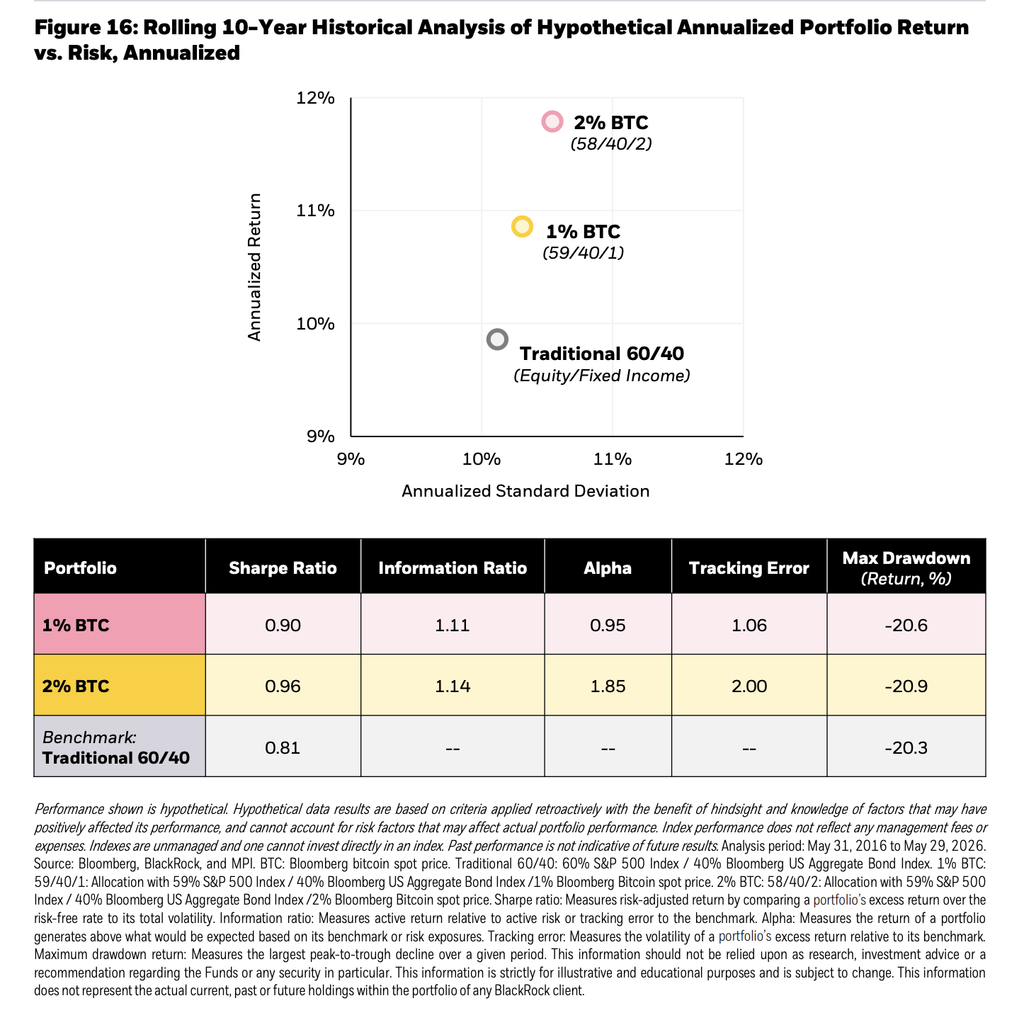
Put differently, the 2% allocation added roughly 190 basis points of annualized return relative to the traditional portfolio while increasing annualized volatility by approximately 50 basis points. The portfolio’s Sharpe ratio improved from 0.81 to 0.96, while maximum drawdown changed from -20.3% to -20.9%. Those figures are hypothetical and backward-looking, but they illustrate why judging Bitcoin primarily by its standalone volatility can produce an incomplete assessment of its portfolio impact.
The more relevant question is how that volatility interacts with everything else an investor already owns. BlackRock continues to characterize Bitcoin as having risk and return drivers that are fundamentally different from traditional assets, rooted in its fixed supply, decentralized structure and independence from any sovereign issuer. Those characteristics do not prevent Bitcoin from trading alongside risk assets during periods of deleveraging, but BlackRock’s research suggests those correlations have historically been episodic rather than permanent.
That distinction helps explain the portfolio results. A modest allocation does not import Bitcoin’s standalone volatility into a portfolio on a one-for-one basis. What matters is the marginal contribution of that allocation to total portfolio risk relative to the return it has historically generated. In BlackRock’s analysis, that trade-off remained favorable at 1% and 2%, even after incorporating one of Bitcoin’s most significant recent drawdowns.
Why 1–2% keeps appearing in BlackRock’s work
This is not the first time BlackRock has arrived at this range. Its earlier portfolio research approached Bitcoin sizing through risk contribution, concluding that a 1–2% allocation could represent a reasonable range for investors willing and able to accept Bitcoin’s risk. At those weights, BlackRock found that Bitcoin could contribute a similar share of overall portfolio risk as an individual mega-cap technology holding in a conventional 60/40 portfolio. Beyond 2%, however, Bitcoin’s contribution to total portfolio risk begins to increase disproportionately.
The new analysis approaches the same question from the opposite direction. Rather than asking how much risk Bitcoin contributes, it examines what investors historically received for assuming that additional risk. The improvement in Sharpe ratio from 0.81 for the traditional portfolio to 0.90 with 1% Bitcoin and 0.96 with 2% Bitcoin suggests that the incremental return historically more than compensated for the additional portfolio-level volatility.
This does not establish 1% or 2% as an optimal allocation, and BlackRock does not present it that way. The appropriate exposure will depend on liquidity requirements, investment horizon, governance constraints and risk tolerance. What the analysis does provide is a more rigorous framework for the discussion. The allocation question can increasingly be evaluated in terms of marginal risk, correlation, drawdown and portfolio efficiency rather than through a binary debate over whether Bitcoin itself is too volatile to own.
BlackRock has also seen the demand firsthand
There is another dimension to BlackRock’s latest analysis that is difficult to separate from the firm’s experience in the market.
BlackRock launched the iShares Bitcoin Trust, IBIT, in January 2024. Less than a year later, it had accumulated more than $50 billion in assets, making it what BlackRock itself has described as the largest exchange-traded product launch in history. It reached that milestone roughly five times faster than the previous record holder.
Its significance has only grown since then. BlackRock now describes IBIT as the world’s largest and most traded Bitcoin ETP, and the fund became the firm’s highest-revenue ETF in 2025 despite competing within a global BlackRock lineup of more than 1,000 products.
The concentration within the U.S. spot Bitcoin ETF market is equally notable. According to current ETF holdings data tracked by Bitcoin For Corporations, U.S. spot Bitcoin ETFs collectively hold approximately 1.25 million BTC, representing nearly 6% of Bitcoin’s fixed 21 million supply. IBIT alone accounts for roughly 775,000 BTC, or more than 60% of the Bitcoin held across the U.S. spot ETF complex.
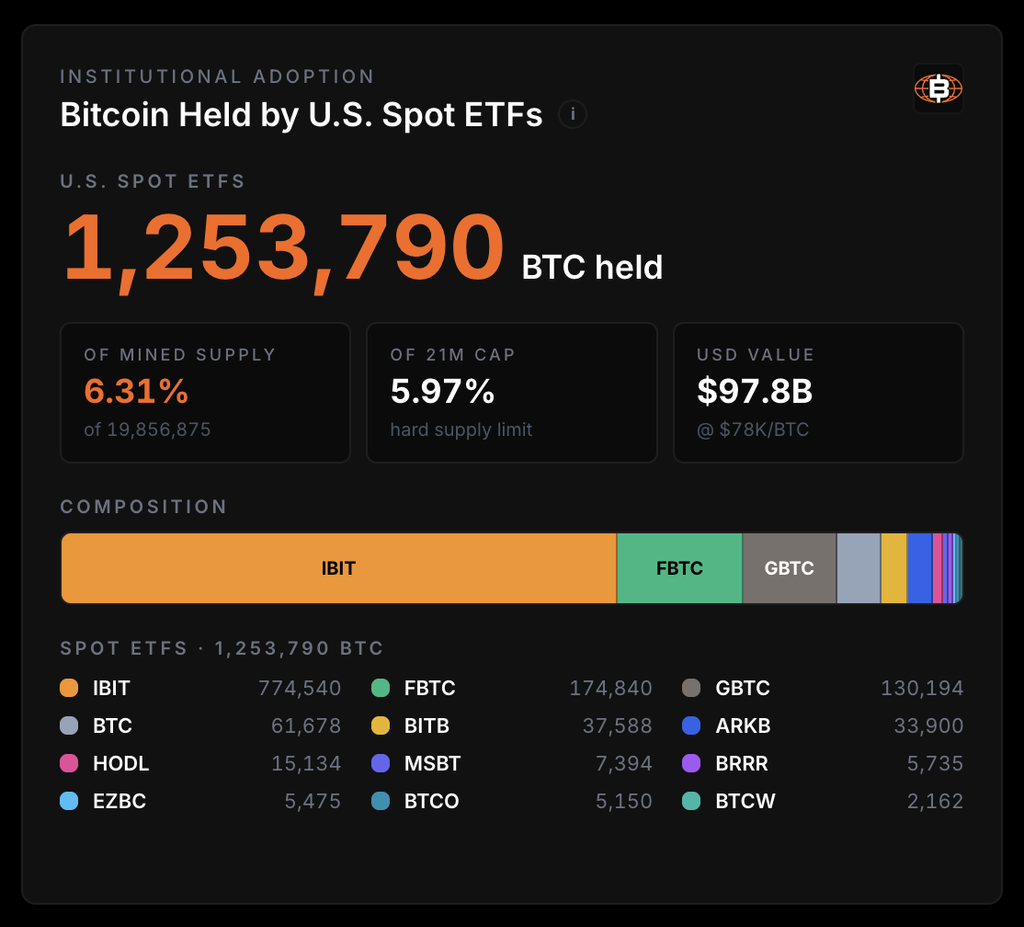
View the full Bitcoin ETF Dashboard.
That does not make BlackRock’s research independent of commercial context; IBIT is an important and increasingly valuable BlackRock product. That context should be understood rather than ignored. But it also means the firm’s reassessment is occurring alongside more than two years of observing how investors actually use Bitcoin exposure at scale.
The distinction is useful. The theoretical case for Bitcoin as a portfolio asset is increasingly being accompanied by observable allocation behavior. Investors have now had access to Bitcoin through familiar brokerage, advisory and institutional infrastructure across multiple market regimes, including periods of rapid appreciation and severe drawdowns. IBIT’s growth suggests that demand has persisted well beyond its initial launch window.
A drawdown is precisely when a thesis should be re-underwritten
The timing of BlackRock’s report may ultimately be more informative than the portfolio simulation itself.
Bitcoin is not being reassessed at an all-time high. BlackRock published the analysis after an approximately 50% drawdown from Bitcoin’s October 2025 peak, a period the firm associates with leveraged positioning being unwound, slowing ETP flows and weaker demand from companies accumulating Bitcoin. Its conclusion is that these forces represented a positioning correction rather than a fundamental change in Bitcoin’s investment case.
That is what re-underwriting is supposed to accomplish. An investment thesis should not survive because investors are attached to it; it should survive because its underlying assumptions continue to hold when conditions change.
For Bitcoin, those assumptions extend beyond historical returns. The asset remains scarce by design, globally liquid, independent of a sovereign issuer and structurally different from the liabilities that dominate traditional portfolios. BlackRock argues that concerns around fiscal sustainability, monetary stability and geopolitical risk may therefore become increasingly relevant to Bitcoin’s long-term adoption.
The portfolio evidence does not prove what Bitcoin will return over the next decade, nor does IBIT’s success establish what an appropriate allocation should be. What the two developments show together is that the institutional conversation has advanced considerably. Bitcoin is no longer being evaluated solely as an unconventional asset that institutions may or may not choose to own. It is increasingly being evaluated through the same disciplines applied elsewhere in capital allocation: sizing, risk contribution, correlation, liquidity, drawdown and expected return.
What this means for corporate leaders
For CFOs, boards and corporate operators, that evolution may be the most important takeaway from BlackRock’s work.
The relevant decision is not whether Bitcoin is volatile; that is already known. Nor does a corporate allocation need to resemble the concentrated Bitcoin strategies pursued by companies that have explicitly built their capital structures around the asset. Between zero exposure and a Bitcoin-centric balance sheet sits a much broader spectrum of possible allocations.
BlackRock’s research provides a useful framework for thinking about that spectrum. A relatively small allocation was sufficient to materially alter the historical return characteristics of a conventional portfolio without producing a comparable increase in portfolio-level risk. At 2%, approximately 190 basis points of additional annualized return came with roughly 50 basis points of additional annualized volatility in the period studied. The allocation was small; its effect was not.
For corporate leaders, the implication is less about adopting BlackRock’s specific allocation range than adopting the discipline behind the analysis. Bitcoin can be underwritten like any other strategic allocation: define its purpose, determine an acceptable risk contribution, establish liquidity and governance requirements, size the position accordingly and periodically revisit the assumptions.
That is a considerably more mature question than whether a company should simply “buy Bitcoin.”
As Bitcoin becomes more deeply integrated into institutional portfolios and financial infrastructure, the burden of analysis is shifting. The question facing the C-suite is increasingly not whether Bitcoin belongs in the conversation, but what allocation, if any, can be justified by the company’s objectives, constraints and cost of capital.
BlackRock has now re-underwritten that question after another full market cycle and a roughly 50% drawdown. Its historical portfolio math still makes the case that, in measured amounts, Bitcoin can improve the equation. For corporate decision-makers, that is the takeaway worth bringing into the boardroom.
Disclaimer: This content was prepared on behalf of Bitcoin For Corporations for informational purposes only. It reflects the author’s own analysis and opinion and should not be relied upon as investment advice. Nothing in this article constitutes an offer, invitation, or solicitation to purchase, sell, or subscribe for any security or financial product.
This post BlackRock Re-Underwrites Bitcoin, and the Portfolio Math Still Holds first appeared on Bitcoin Magazine and is written by Nick Ward.
CryptoSlate
MultiversX has given node operators nine days to prepare for an upgrade designed to make its blockchain 10 times faster.
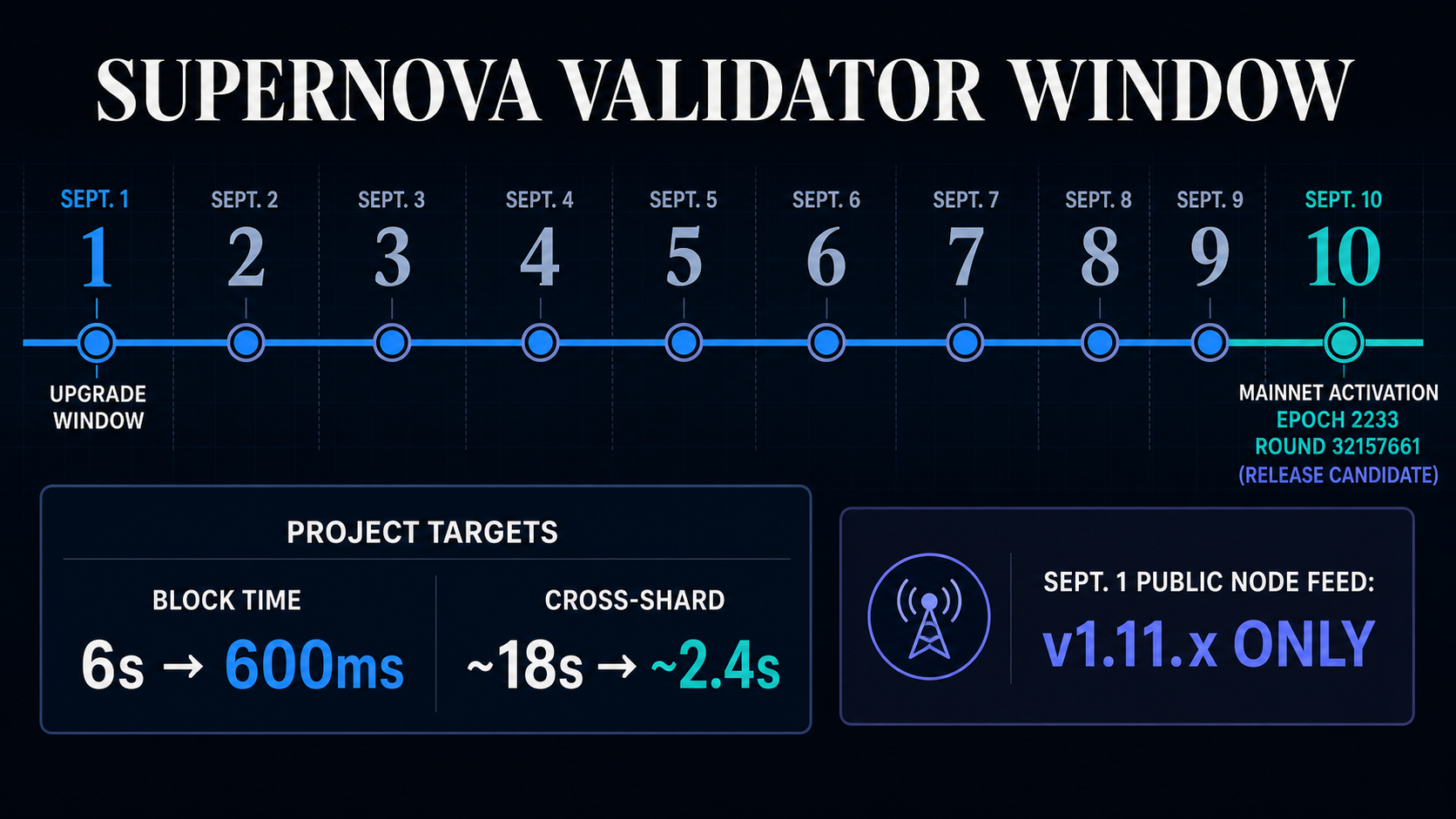
The Supernova upgrade is scheduled to activate Sept. 10 during epoch 2233, cutting block times to 600 milliseconds from six seconds and forcing more than 5,000 nodes to migrate onto software capable of processing the new rules.
The upgrade goes beyond shorter block intervals. Supernova restructures MultiversX’s consensus pipeline so validators can vote on a block while execution proceeds in parallel, removing transaction execution from the critical path that previously constrained block production.
The design is also intended to preserve deterministic finality while pushing intra-shard finality below 250 milliseconds and cutting cross-shard settlement from about 18 seconds to roughly 2.4 seconds.
Meanwhile, MultiversX is keeping its epoch length unchanged and maintaining backward compatibility for addresses, keys, and balances.
The countdown begins as MultiversX’s EGLD token shows renewed momentum. Data from CryptoSlate showed that EGLD crossed $4 over the weekend for the first time since May, reaching about $4.05 before pulling back below the threshold.
Most MultiversX nodes are still on the old software
Early indications show validators are still preparing for the switch.
A mainnet configuration release candidate published Aug. 31 identified round 32157661 as the planned activation point, setting up a coordinated transition during the Sept. 1 to Sept. 10 migration window.
A Sept. 1 check of MultiversX’s public network data showed no visible Supernova migration yet, with 95.35% of its 5,171 nodes still running v1.11.11.0.
That does not indicate the network is behind schedule at the start of a nine-day window. However, it establishes the baseline against which the migration can now be measured.
The stakes rise once Supernova activates.
MultiversX’s validator guidance says processing changes require operators to upgrade so nodes continue interpreting transactions the same way. Old and new binaries can coexist before activation, but once the new rules take effect, an outdated node could produce a different transaction result and lose synchronization with the majority chain.
The transition will also include a temporary slowdown before the faster network takes over.
MultiversX expects mainnet to stop accepting new pool transactions for roughly 240 rounds under the existing six-second clock, equivalent to about 24 minutes, while clearing transactions already in flight. New transactions submitted during that period are expected to remain queued until Supernova begins processing them.
The immediate benchmark is therefore visible before Sept. 10: whether the network’s version mix shifts decisively toward Supernova ahead of round 32157661.
If that coordination arrives on schedule, attention will move to whether the upgrade can deliver its promised speed on mainnet. If a meaningful number of operators remain behind, MultiversX will have to manage the consequences of introducing substantially faster processing across a network that has not fully moved in sync.
The post A major layer-1 chain will pause new transactions for 24 minutes to unlock a 10x speed boost appeared first on CryptoSlate.
Bitcoin’s hashrate has spent 316 days below its record as miners redirect power toward AI.
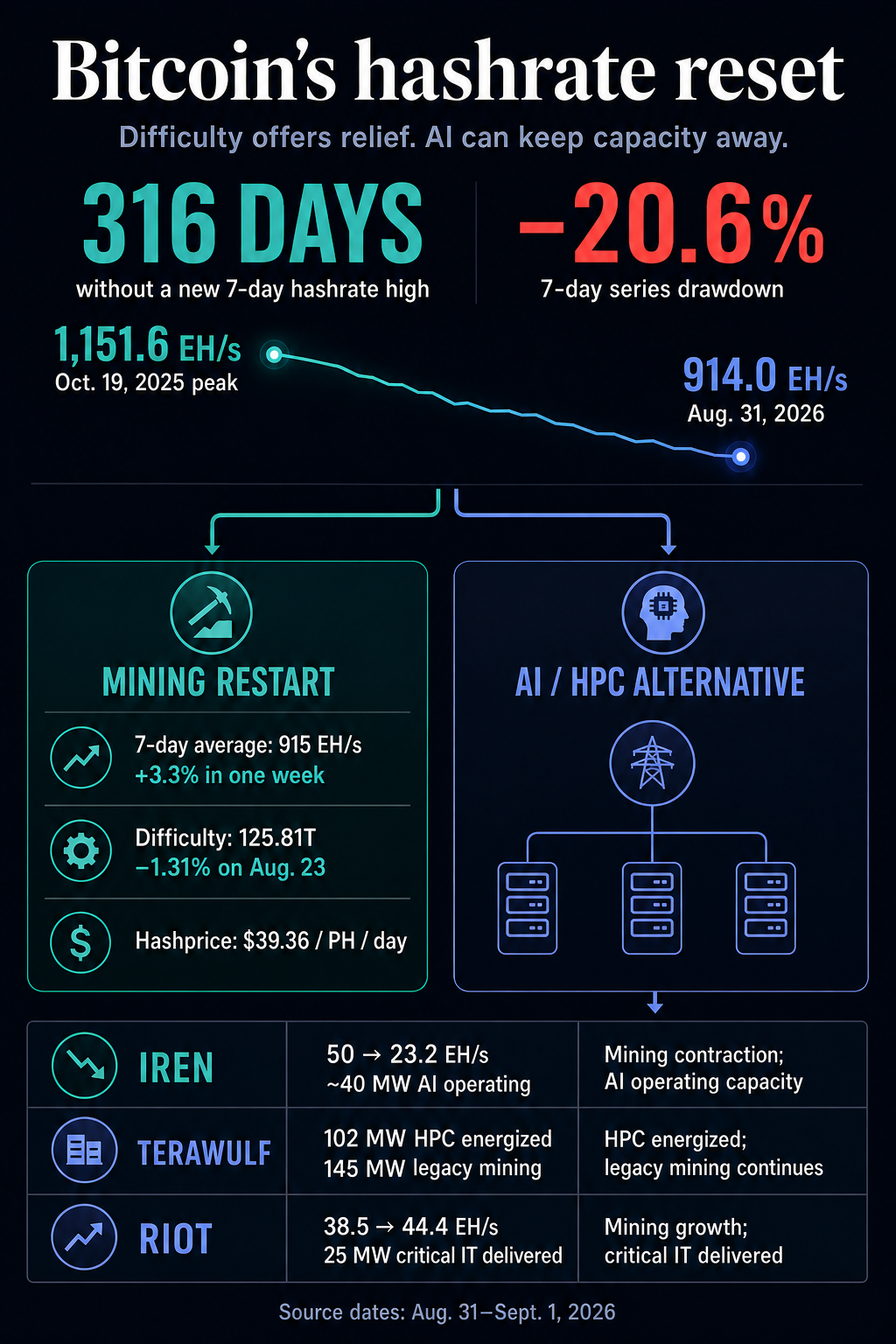
The seven-day network average stood near 914 exahashes per second on Aug. 31, about 20.6% below its October 2025 peak of 1,151.6 EH/s. The stretch without a new high is the longest in a decade, exceeding the previous 252-day maximum in the same Blockchain.com series.
The decline followed months of weak mining economics, summer power curtailments and a growing shift by some operators toward artificial intelligence and high-performance computing. Twenty One Capital CEO Raphael Zagury has described the episode as Bitcoin’s first sustained “economic hashrate bear market.”
That description has become more significant because Bitcoin itself has already delivered the kind of price recovery that historically helped revive mining.
BTC rallied 34.9% from late June through late August reaching as high as above $81,000, while network hashrate fell 10.1% over the same period, only the second such divergence since 2012.
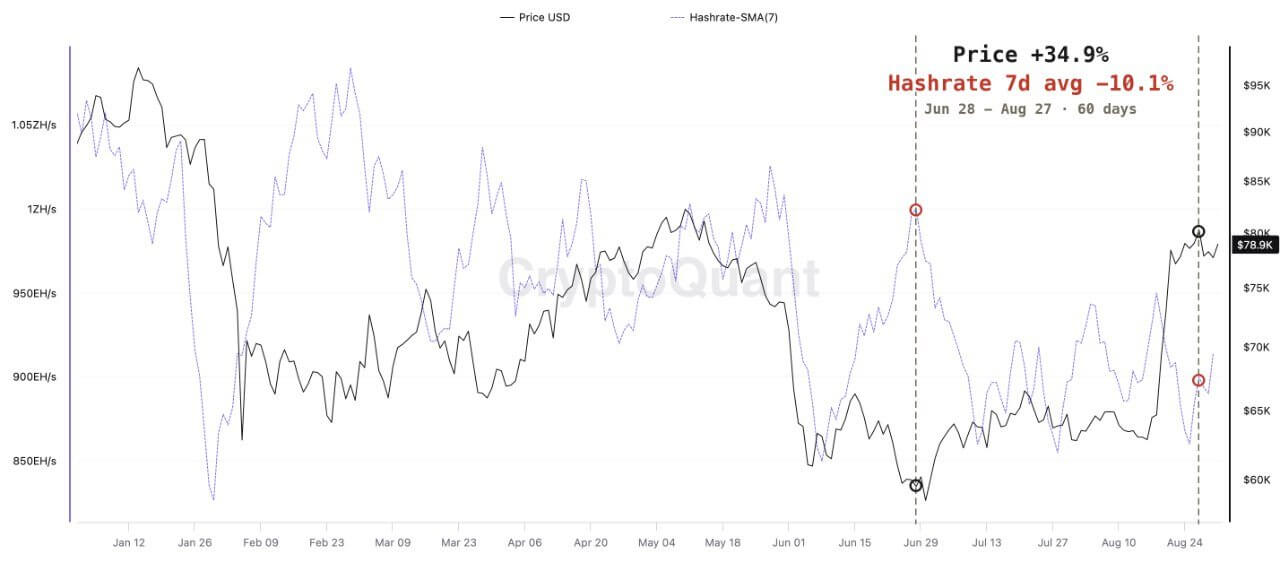
Higher Bitcoin prices increase the dollar value of block rewards and normally encourage miners to restart machines that became uneconomic during a downturn. This time, the response has been much weaker.
The difference is that some of the power and data-center capacity leaving Bitcoin now has somewhere else to go.
Bitcoin’s rally has not brought enough machines back
The usual recovery signals are already appearing across mining economics.
VanEck estimated network hashrate at roughly 885 EH/s in the week through Aug. 11, while mining difficulty stood 18.3% below its November 2025 peak. That was the largest difficulty drawdown since China’s 2021 mining ban.
The Puell Multiple, which compares the dollar value of daily Bitcoin issuance with its one-year average, averaged about 0.73 over the preceding 30 days, placing it in the 16th percentile and pointing to unusually weak miner revenue conditions.
Those pressures forced marginal machines offline. Bitcoin then began doing what it was designed to do.
As hashrate falls, the protocol eventually reduces difficulty, allowing the remaining miners to compete for the same block subsidy with less computing power. Better margins can then entice idle capacity back.
However, signs of that rebound also emerged in August.
VanEck said the Aug. 8 difficulty adjustment rose 1%, the first upward move in the sequence it tracked, as hashrate recovered toward 925 EH/s. Difficulty later fell 1.31% on Aug. 23, providing another round of relief.
By Aug. 31, Hashrate Index put seven-day hashrate at 915 EH/s, up 3.3% from 886 EH/s a week earlier. Blocks were arriving every 9 minutes and 56 seconds, almost exactly on Bitcoin’s 10-minute target.
Hashprice had also improved to $39.36 per petahash per second per day, above its 30-day average of $34.63.
That combination of a roughly 35% Bitcoin rally, lower difficulty, and better hash price would normally make restarting machines increasingly attractive. Yet hashrate remains far below its record.
AI changes what happens after a miner switches off
For some operators, shutting down Bitcoin machines no longer means waiting for mining margins to recover.
IREN cut installed self-mining capacity from 50 EH/s in June 2025 to 23.2 EH/s by June 2026 as it decommissioned miners and redirected power and data-center infrastructure toward AI Cloud Services. About 40 megawatts of AI Cloud capacity was already operating at the end of June.
TeraWulf has also moved operating capacity toward high-performance computing. It reported 81 MW of critical-IT capacity at June 30 and 102 MW energized in July, alongside 145 MW of legacy Bitcoin mining capacity.
Riot Platforms highlighted how long those alternative commitments can last when it signed a roughly $9 billion, 20-year compute agreement with Anthropic in August.
That changes the economics of a mining recovery.
A machine taken offline because hashprice fell can be restarted when Bitcoin becomes more profitable. However, power committed to a long-duration AI customer cannot return nearly as quickly, even if Bitcoin rallies and difficulty falls.
Years spent building mining operations have made the sector particularly attractive to AI developers. Miners already control large power allocations, grid connections and data-center sites built to handle dense computing loads.
The hashrate downturn cannot be attributed entirely to that shift. Seasonal curtailments, particularly in Texas, reduced mining during periods of high electricity demand, while inefficient fleets were also shut down as margins deteriorated.
AI becomes important because it can determine what happens to that capacity afterward.
Better mining economics now have to compete with AI
The next phase of Bitcoin’s hashrate recovery will show how much capacity was merely idle and how much has effectively moved on.
Some miners are still expanding aggressively.
MARA reported 70.3 EH/s of energized hashrate as of June 30, while Bitdeer reached 76.7 EH/s of self-mining capacity in July. Riot increased deployed mining capacity to 44.4 EH/s from 38.5 EH/s even as it expanded into AI.
| Company | Observed operating signal | Implication for hashrate recovery |
|---|---|---|
| IREN | Mining capacity fell from 50 EH/s to 23.2 EH/s; about 40 MW of AI Cloud capacity was operating at June 30 | Converted infrastructure may not return through difficulty relief alone |
| TeraWulf | 102 MW of critical-IT capacity was energized in July alongside 145 MW of legacy mining capacity | HPC can absorb operating capacity while mining continues |
| Riot | Deployed mining capacity rose from 38.5 EH/s to 44.4 EH/s while 25 MW of critical-IT capacity was delivered | AI infrastructure and mining can expand in parallel |
| MARA | Energized hashrate reached 70.3 EH/s at June 30 | Large-scale mining growth has continued |
| Bitdeer | Self-mining hashrate reached 76.7 EH/s in July | New capacity is still entering the network |
That leaves the industry split between operators still adding Bitcoin machines, those diverting infrastructure toward computing customers, and companies trying to pursue both.
Bitcoin’s own recovery mechanism remains intact. Difficulty continues to adjust, blocks are arriving near target and the recent rebound toward 915 EH/s shows that some hashpower is returning.
But the 316-day drought suggests the response has not yet been strong enough to restore the network’s late-2025 peak.
The question now is whether improving Bitcoin prices, hashprice and difficulty economics can pull enough idle machines back to end that drought.
If they cannot, the reason may increasingly lie outside Bitcoin itself: some of the infrastructure that once waited for the next mining recovery is now being paid to stay somewhere else.
The post Bitcoin’s 316-day hashrate drought shows why AI could make this mining downturn harder to reverse appeared first on CryptoSlate.
Robinhood Chain revenue from applications totaled between $2.66 million and $2.82 million over a rolling 24-hour window early on Sept. 1, creating an eye-catching measure of network activity with no disclosed bridge to Robinhood’s corporate accounts.
DefiLlama tracks application revenue, chain revenue and chain fees as separate layers. Its dashboard showed $963,612 of chain revenue on $1.07 million of chain fees during the same period. Public records provide no formula that turns either revenue figure into a Robinhood GAAP revenue line.
The recipients also show where the app total went. DefiLlama’s revenue table placed trading bot GMGN first at about $1.11 million and token launchpad Pons second at about $1 million. Uniswap led the corresponding protocol fee table.
What Robinhood Chain revenue means for the company
Robinhood has described its own monetization in transaction terms. During the company’s second-quarter earnings call, CFO Shiv Verma said Robinhood earns a few basis points per transaction, with approximately half shared with Arbitrum. He emphasized transactions as the basis instead of transaction volume.
The company provided no precise rate, eligible transaction count, fee base or reconciliation to its financial statements. DefiLlama also defines the $963,612 chain figure as gas revenue remaining after Ethereum execution and blob costs and the Arbitrum Expansion Program share. The available disclosures therefore establish substantial fee activity while leaving Robinhood’s exact corporate take unquantified.
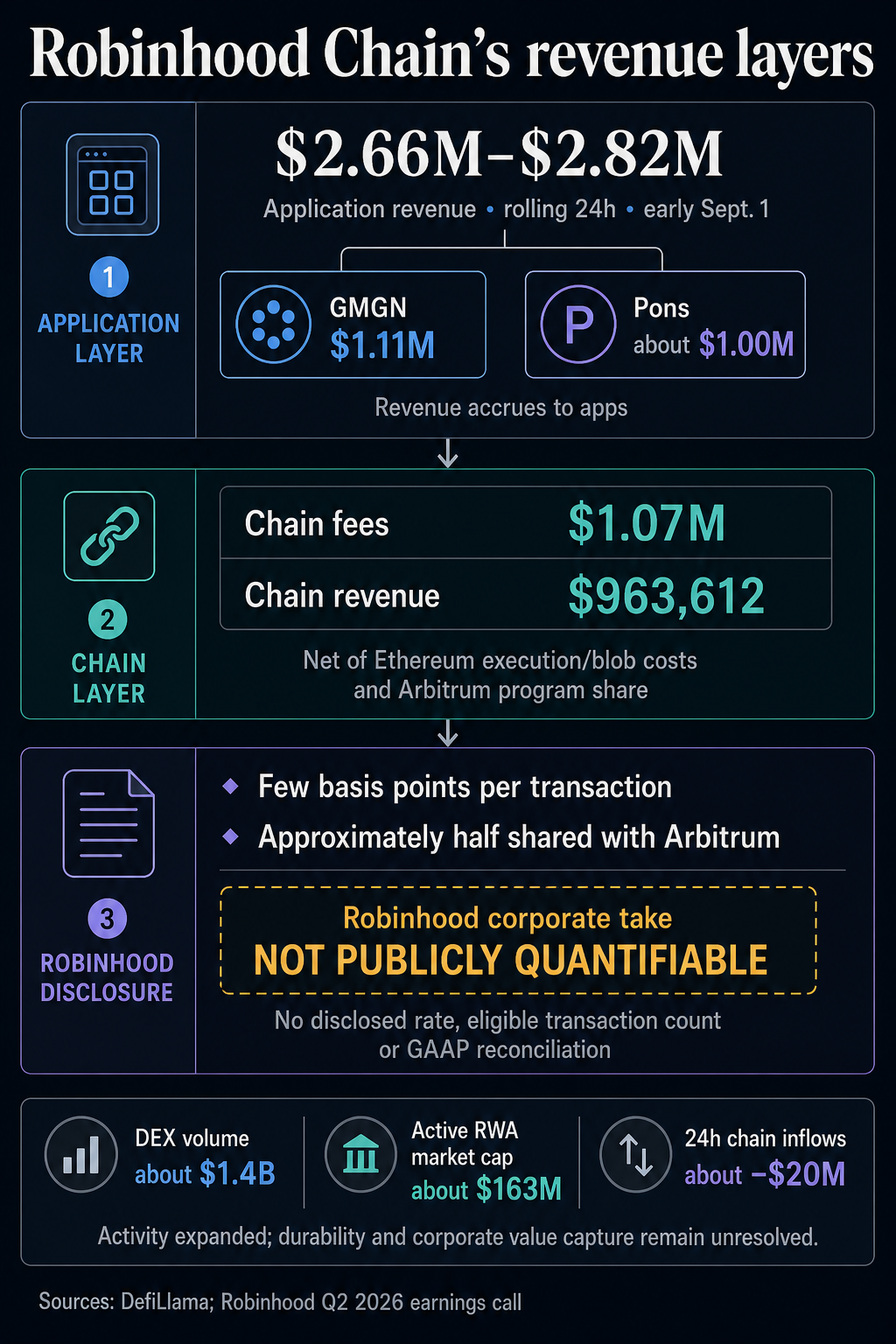
The chain’s growth metrics still matter because sustained use could create a larger future earnings base. Rolling 24-hour decentralized exchange volume reached about $1.4 billion, led by Uniswap, compared with nearly $370 million on July 29. Chain-wide active real-world asset market cap rose from nearly $28 million in late July to about $163 million.
The composition tempers that growth signal. DefiLlama’s RWA table attributed about $95 million of the total to Syrup USDG private credit, the chain’s largest listed asset. The increase therefore reflects broad RWA growth across Robinhood Chain rather than equivalent growth in Robinhood-issued stock tokens.
Other short-term indicators also pulled in opposite directions. Twenty-four-hour chain inflows were negative by about $20 million even as DEX volume and RWA value remained well above their July snapshots. A trading bot and launchpad continued to lead application revenue.
Robinhood Chain has expanded its transaction and tokenized-asset base since July. The Robinhood Chain revenue mix and Robinhood’s limited monetization disclosure leave the larger question unresolved: how much of that growth will become recurring revenue in Robinhood’s accounts.
The post $2.7 million poured into Robinhood Chain apps in one day, but it barely touches corporate revenue appeared first on CryptoSlate.
The Pocket Bitcoin breach exposed more than email addresses and support conversations for 291 customers, the company said. Some copied records linked real-world identities to public Bitcoin activity.
The finding expands the scope described in the Swiss non-custodial Bitcoin service's Aug. 21 disclosure. In an Aug. 31 update, Pocket Bitcoin said correspondence with partner banks contained varying combinations of names, postal addresses, Bitcoin addresses used for transactions, identity-document copies and source-of-funds records. Most people in the cohort had only some of those fields exposed, the company said.
The distinction creates a privacy and phishing risk without giving an attacker control of anyone's wallet.
Why public Bitcoin addresses still matter
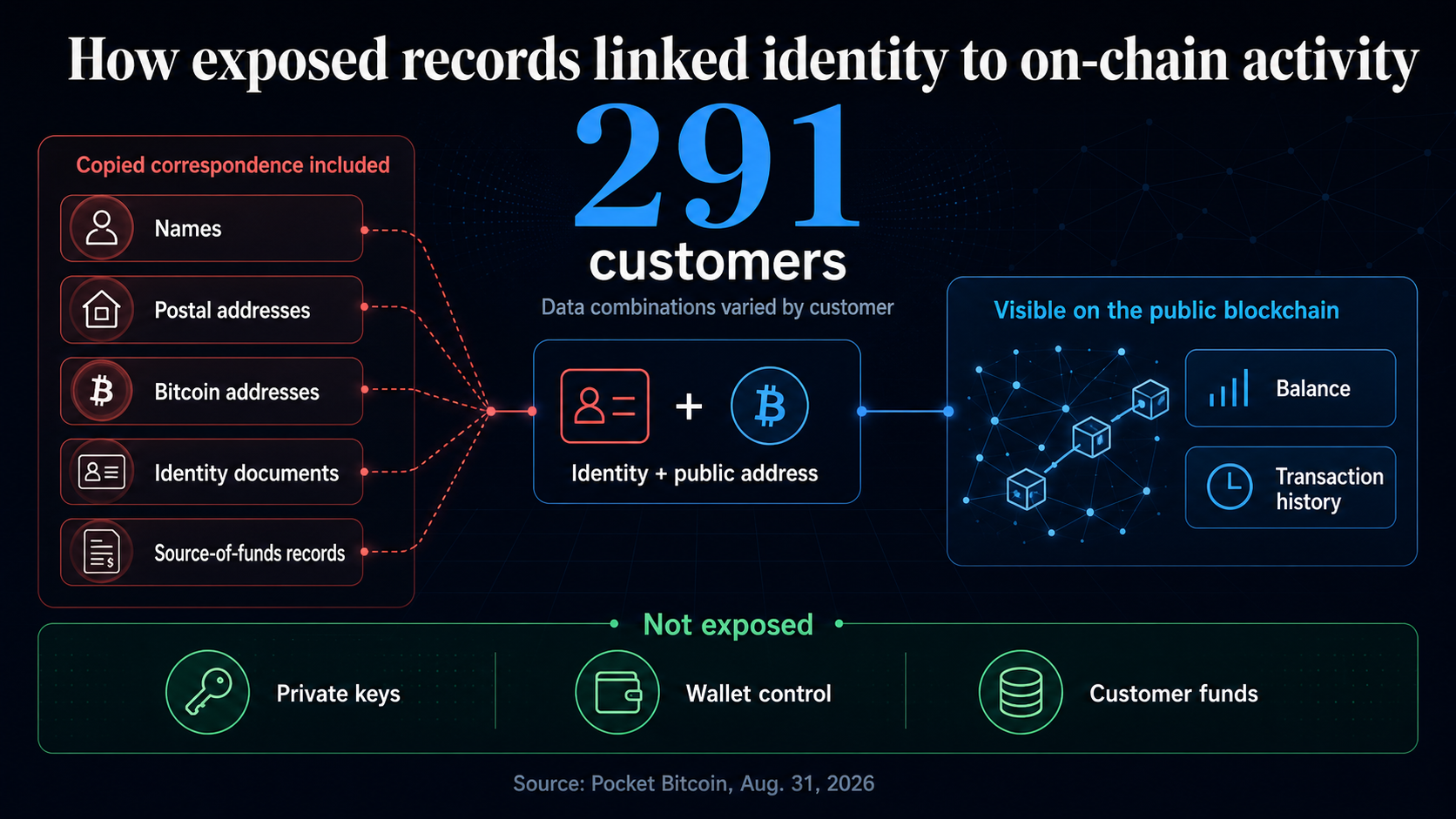
Bitcoin addresses are public. Anyone with an address can inspect its balance and transaction history on the blockchain, as Bitcoin.org's privacy guidance explains. Connecting an address to a name and, for some customers, a postal address or payment amount removes a layer of separation between a person's offline identity and public on-chain activity.
The exposed information cannot, by itself, move Bitcoin. Spending requires a valid signature made with the corresponding private key, according to the Bitcoin developer guide. Pocket Bitcoin said it is non-custodial, never held customers' private keys and saw no risk to customer funds.
The more immediate concern is deception. Pocket Bitcoin warned that details from copied support correspondence could make emails, calls or messages about the incident look more credible. Separately, Switzerland's National Cyber Security Centre has documented scams and threats that use a recipient's real home address to increase pressure. That guidance illustrates the broader danger of exposed location data but is not evidence that Pocket Bitcoin customers have been targeted.
How the Pocket Bitcoin breach changed the disclosure
Pocket Bitcoin's initial disclosure said Bitcoin addresses, its customer database containing know-your-customer data and transaction history were not affected. The company later said that wording was too broad.
Pocket Bitcoin said neither the customer database nor the transaction database was compromised. However, related information was included in some correspondence stored in the affected support system. Payment amounts were often present when exposed records involved source-of-funds documents or discussions of a payment, the company said.
The company said every customer in the 291-person cohort received an individual notice listing the data affected in that person's case. It also said the forensic investigation and its review of the relevant partner-bank correspondence were complete, the vulnerability had been closed, the incident had been reported to the Swiss Federal Data Protection and Information Commissioner, and a police report had been filed.
Pocket Bitcoin said it had no indication that the copied information had been misused, adding that its current visibility was not a guarantee.
The post Leaked compliance records shatter anonymity of 291 crypto users by matching names directly to wallet activity appeared first on CryptoSlate.
Adjusted USDC transfer volume reached $32 trillion in 2026 through Coin Metrics' August measurement, with each dollar of supply turning over 741 times at an annualized rate. Those figures signal reach and settlement intensity. Circle's second-quarter revenue, however, remained dominated by yield on the assets backing USDC.
For the three months ended June 30, reserve income supplied $667.7 million of Circle's $701.3 million in total revenue and reserve income, or 95.2%. Transaction revenue was $5.3 million. Volume is a usage signal; balances and yields still determine most of Circle's revenue base.
Arc, Circle's blockchain infrastructure scheduled for a Sept. 16 public mainnet launch, is the company's clearest attempt to build a direct fee surface around some of that activity. Its test is whether traffic can become retained recurring revenue.
How USDC transfer volume is generated
Coin Metrics described the $32 trillion as adjusted USDC transfer volume in 2026 through its August analysis, not consumer payments, unique economic settlement or a full-year total. Its annualized velocity estimate measures how often supply moves relative to its size.
The composition of that movement matters. Coin Metrics' bottom-up analysis examined raw transfer volume through tagged lending contracts, decentralized exchange pools and known exchange wallets. On Base, 69% of USDC volume involved DEX liquidity provision and 23% involved flash loans. On Ethereum, flash loans accounted for 65%.
Those categories represent real crypto-market demand. Liquidity rebalancing, collateral movement and arbitrage make markets function, while generating enormous gross transfers without a matching increase in net capital moved, purchases made or fees collected by Circle. A liquidity position that is repeatedly rebalanced may move the same dollars many times, while a flash loan is borrowed and repaid within one transaction.
Coin Metrics also treated its tagged shares as lower-bound estimates. About 8% of Base volume and 33% of Ethereum volume remained outside the identified categories, and that residual could include payments, bridging, treasury activity and other settlement. It cannot safely be relabeled as commercial payments.
The result is a better reading of USDC's velocity: the stablecoin is deeply embedded in crypto's financial plumbing, but headline transfer volume is not a revenue ledger.
Circle's own Q2 activity metric reinforces the gap. The company said USDC onchain transaction volume rose 151% year over year to $14.8 trillion, while period-end circulation increased 19% to $73.3 billion. Total revenue and reserve income rose 6.6% to $701.3 million.
The Coin Metrics and Circle volume measures are not interchangeable. Coin Metrics reports adjusted transfer volume; Circle's filing defines its figure as native and canonically bridged USDC processed across supported chains other than Solana. Both show scale, but neither implies that Circle charges a toll on every transfer.
| Signal | Reported result | What it shows |
|---|---|---|
| 2026 adjusted USDC transfer volume | $32 trillion through Coin Metrics' August measurement | Onchain movement, not consumer payments |
| Annualized adjusted-supply velocity | 741x | How frequently supply turns over |
| Circle Q2 USDC onchain volume | $14.8 trillion, up 151% | Company-defined network activity |
| Q2 reserve income | $667.7 million, 95.2% of total | Interest and dividends on reserve assets |
| Q2 transaction revenue | $5.3 million | Usage-, volume- or event-driven revenue |
| Q2 distribution, transaction and other costs | $412.5 million | Costs that sit between gross revenue and operating leverage |
The SEC filing shows where Circle's growth translated into revenue. The company attributed about $147.4 million of year-over-year reserve-income improvement to a 25.2% increase in average daily USDC circulation. A 66-basis-point decline in average yields offset about $113.9 million of that gain, leaving reserve income up roughly $33.5 million.
That bridge explains why circulation matters more to current revenue than velocity. More USDC outstanding expands the reserve base that earns interest. The same USDC moving hundreds of times does not automatically create hundreds of revenue events for Circle.
The filing also separates reserve income from retained economics. Circle recorded $410.4 million of distribution and transaction costs in the quarter, including $324.6 million of Coinbase-related distribution costs, and $412.5 million when other costs were included. The Coin Metrics transfer total does not directly drive those costs. Their scale still shows why gross reserve income cannot be read as operating margin.
Rates remain the larger near-term sensitivity. Holding circulation and reserve allocation constant, Circle modeled a 100-basis-point move from June's average yield as changing reserve income by about $737 million and distribution and transaction costs by about $360 million over the following 12 months. That was a hypothetical sensitivity, not guidance, but its scale shows how far Circle remains from a revenue mix driven primarily by transaction fees.
Arc's monetization test
Arc is Circle's clearest attempt to bring more economic activity onto infrastructure it helps operate. Circle's latest Aug. 5 statements placed Arc in private mainnet with more than 100 builders and scheduled public mainnet for Sept. 16. As of those statements, the public launch had not occurred.
Arc's design gives the experiment a direct connection to USDC usage. Its gas and fee system denominates transaction fees in USDC, creating a dollar-denominated charge each time the network processes activity. That is a more visible fee surface than ordinary USDC transfers across third-party chains.
Recurring Circle revenue from Arc remains unproven. Arc's documentation does not establish how much gas-fee revenue Circle will retain, and Circle's Aug. 5 list of builders and prospective integrations does not prove transaction volume, commercial demand or margin after the scheduled public launch. The important post-launch signal will be whether activity appears in Circle's transaction and service revenue rather than only in network statistics.
The ARC Token presale is a separate economic event. Circle agreed to sell 807.5 million tokens for about $242.2 million, but the Q2 filing recorded the proceeds as deferred revenue, not recognized quarterly revenue. The prospective token is tied to a possible later transition from proof of authority to proof of stake or delegated proof of stake, whose timing and terms remain conditional.
Treating the presale as proof that Arc has already diversified Circle's operating revenue would therefore confuse financing and future performance obligations with recurring network economics.
Arc does not need to displace reserve income immediately to matter. It needs to show that Circle can capture a repeatable share of activity that USDC already enables elsewhere.
That creates a concrete scorecard after Sept. 16: whether public mainnet launches as scheduled, what kinds of transactions dominate, whether applications generate sustained activity outside mechanical liquidity loops, and whether Circle begins reporting material growth in transaction or subscription and service revenue. Retained economics will matter as much as gross fees.
USDC's $32 trillion year-to-date transfer total demonstrates reach and liquidity. Coin Metrics' decomposition shows why that number should not be mistaken for payments revenue. Until Arc or another Circle product turns more of that movement into durable fees, Circle's business will continue to be governed primarily by how many USDC are outstanding, what their reserves yield and how much of that income remains after distribution costs.
The post Circle processed $32 trillion in USDC transfers, yet 95% of its revenue relies entirely on interest rates appeared first on CryptoSlate.
HTTP error 429 on https://cryptoticker.io/en/feed/
Failed to fetch feed: https://cryptoticker.io/en/feed/
Failed to fetch feed.
Decrypt
The open-source agent framework that started the "autonomous AI" hype cycle just shipped its biggest update ever, almost by accident, and it's coming for the enterprise now.
The deal, part of MediaTek's record $3.9 billion bond offering, ties Nvidia's chip ecosystem to a Taiwanese rival building its own AI accelerator business.
Trading on the Ethereum Layer 2 climbed 61% in a matter of days as DeFi deposits and stablecoin holdings approached $800 million.
Bitcoin has lost ground in eight of the last 13 Septembers. The stock market's had the same problem since 1928. Here's the case for the curse, what broke it last year, and what's coming in the next round.
Attackers reportedly registered Lenovo IDs using victims’ email addresses, allowing them to sign into existing Dropbox accounts without their passwords.
U.Today - IT, AI and Fintech Daily News for You Today
Another fake Grand Theft Auto VI leak is putting crypto users at risk.
Robinhood CEO Vlad Tenev has fueled fresh speculation that the trading platform could expand its memecoin offerings.
The amount is not the Bitcoin bull's personal debt, but the disclosure is very notable nonetheless.
The mysterious figure behind the recent Grand Theft Auto VI leaks has reportedly cashed out roughly $350,000 from the CYBERLEEK crypto operation.
Choosing between AI stocks and Bitcoin is a mistake, according to Bitwise CIO amid the $40 trillion US debt dilemma.
Blockonomi
Key Takeaways
- XRP hovered around $1.37 on September 1, declining 1.38% amid pressure from climbing Treasury yields on speculative assets
- Spot XRP ETFs in the United States posted their largest weekly capital influx of 2026, reaching $110.49 million during the week concluded August 28
- The benchmark 10-year Treasury yield neared 4.80%, redirecting investment flows away from digital currencies
- Breaking below the $1.34 threshold could trigger a decline toward $1.30, with further downside to $1.20 if bearish momentum persists
- Technical Elliott Wave projections indicate a potential Wave 3 rally to $2.90–$3.10, contingent on completing a corrective pullback first
XRP retreated 1.38% to reach $1.3592 on September 1, surrendering some of August’s gains as strengthening US government bond yields encouraged capital rotation out of higher-risk digital assets.
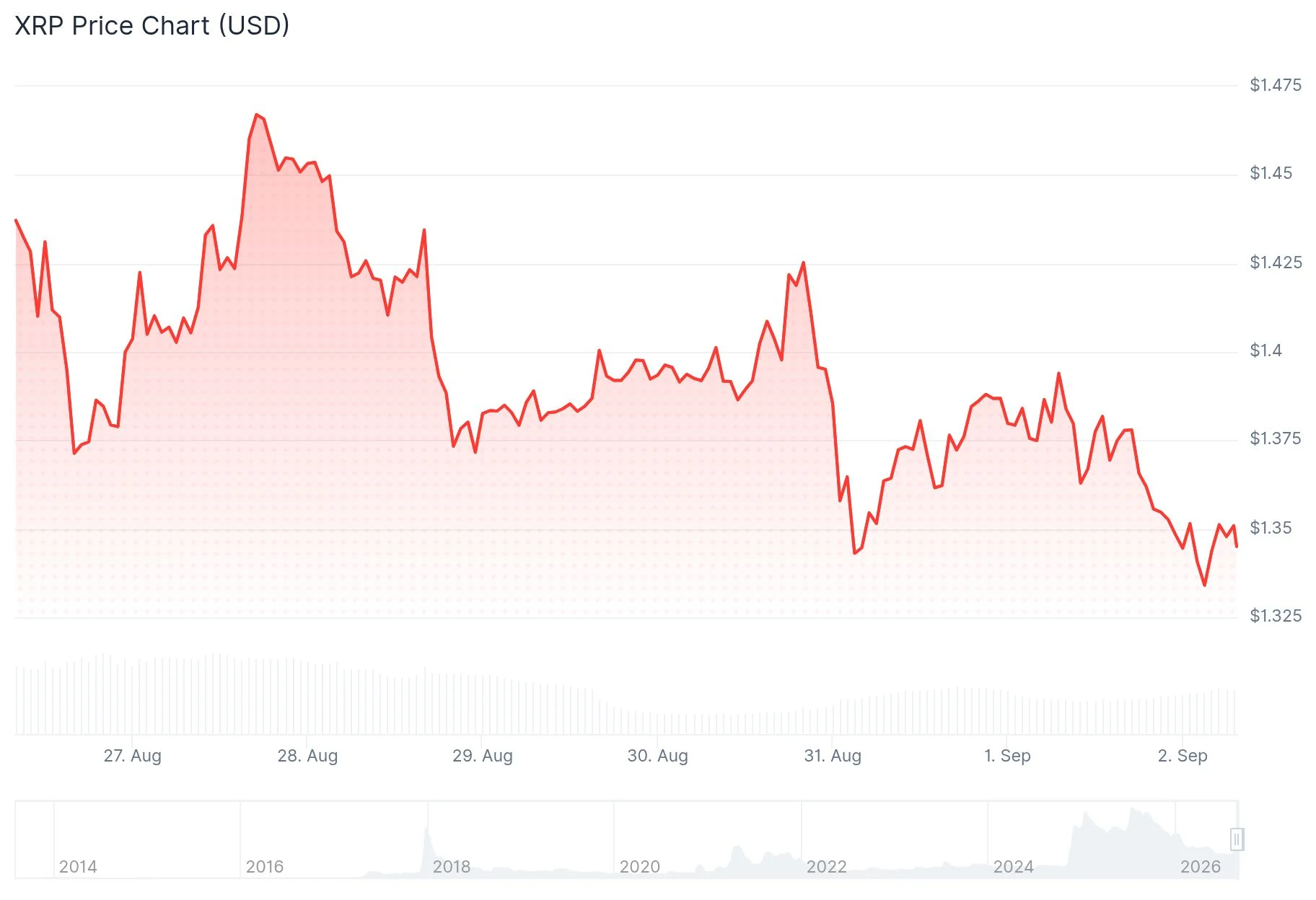
The cryptocurrency had momentarily climbed to $1.69 throughout August before encountering resistance. Since then, price action has consolidated within a narrow corridor spanning $1.35 to $1.40.
Notwithstanding the pullback in price, institutional appetite via US-listed spot XRP exchange-traded funds showed resilience. During the seven-day period concluded August 28, these investment vehicles captured net capital inflows totaling $110.49 million — marking the strongest weekly performance year-to-date for 2026.
Focusing on August 31 specifically, single-day inflows registered $5.64 million. Canary’s XRPC product dominated with $4.71 million in new capital, while Bitwise contributed approximately $930,000.
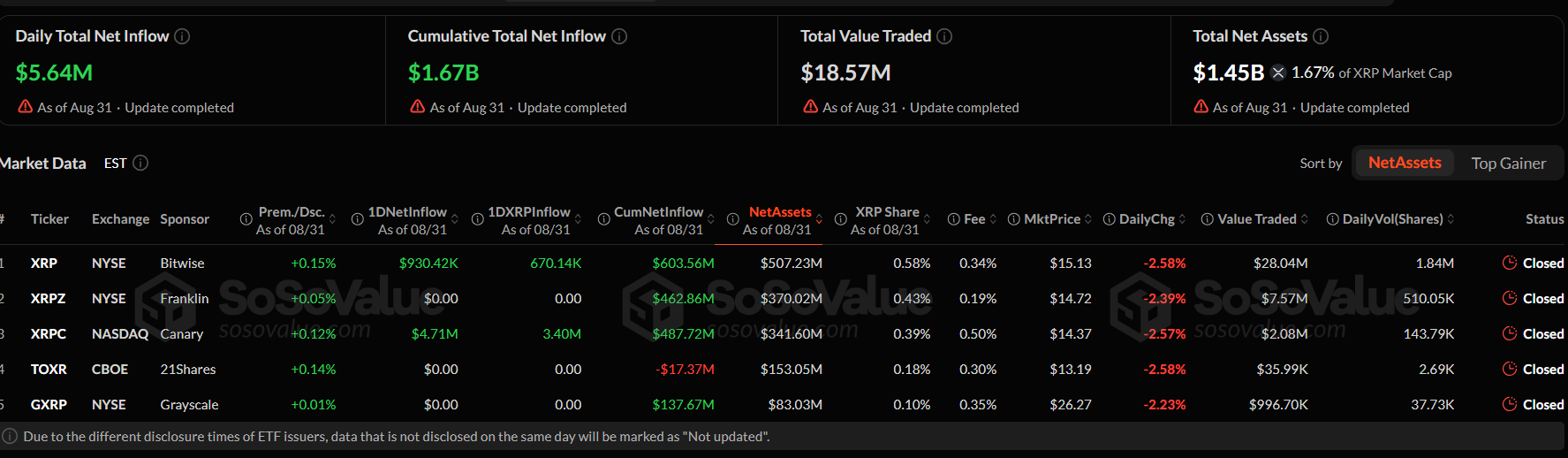
Aggregate ETF holdings climbed to $1.45 billion, representing roughly 1.67% of XRP’s approximately $85 billion total market capitalization. Bitwise commanded the largest position with $507.23 million in managed assets, trailed by Franklin’s $370.02 million and Canary’s $341.60 million.
The yield on 10-year US Treasury notes pushed toward 4.80%, marking its most elevated reading since January 2025. Higher fixed-income returns typically divert capital away from cryptocurrency markets as risk-adjusted returns become less favorable.
Market analyst XRP Update highlighted on X that the token is “running out of room,” observing that the 4-hour chart displays compression between support around $1.35 and declining resistance near $1.40. According to the analyst, a decisive breakout from this consolidation pattern could catalyze the next substantial directional movement.
$XRP IS RUNNING OUT OF ROOM.
The 4H chart is squeezing between support near $1.35 and descending resistance around $1.40.
A clean break from this structure could trigger the next major move.
@Bird_XRPL
pic.twitter.com/36jDOewOJd
— XRP Update (@XrpUdate) September 2, 2026

Technical Indicator Breakdown
The Relative Strength Index registered 39.56, positioned below the midpoint but not yet indicating oversold conditions. The MACD indicator measured -0.0088, hovering marginally above its signal line at approximately -0.0090.
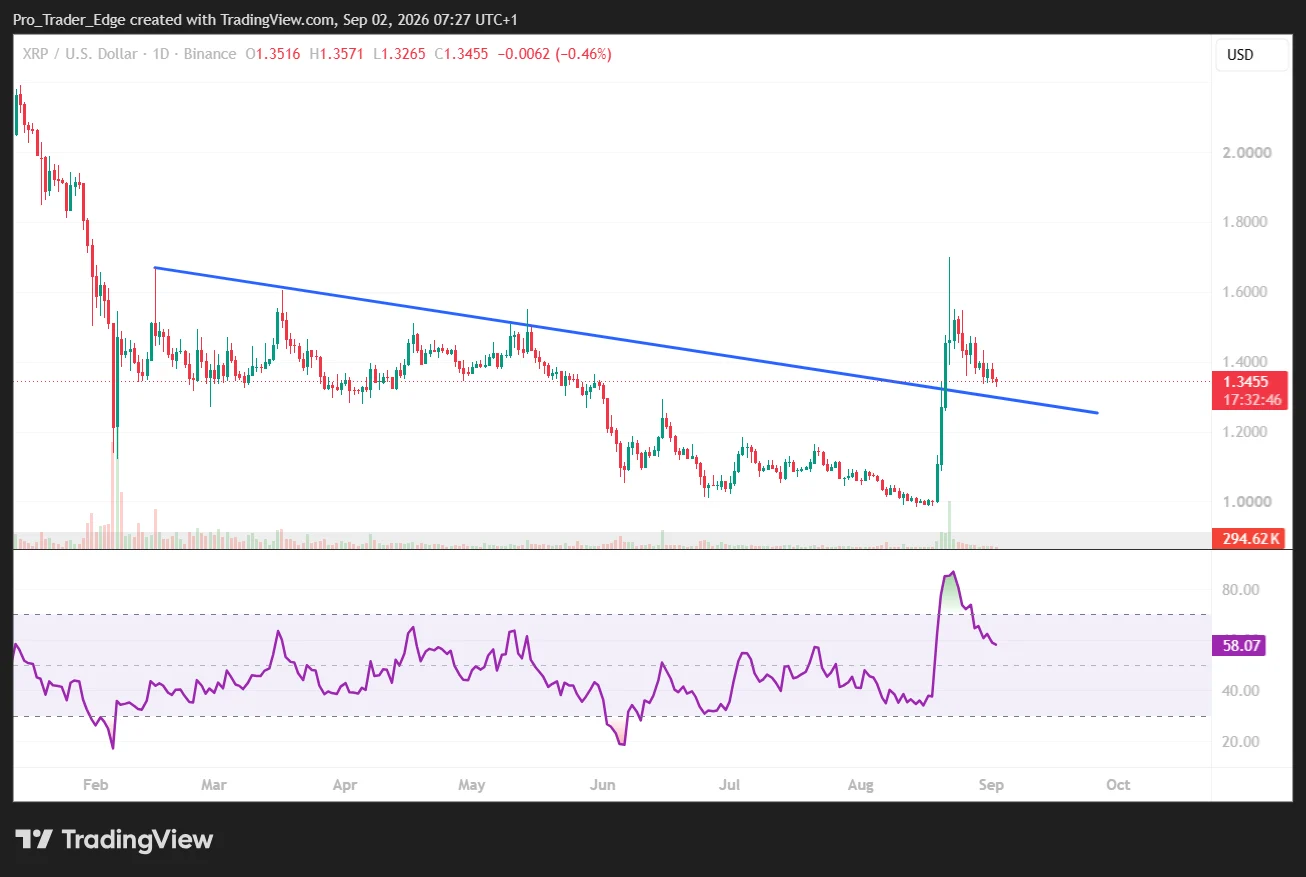
A decisive close beneath $1.34 would likely expose the path toward $1.30. Should downward momentum intensify, the $1.20 zone emerges as the subsequent critical support area.
Conversely, successfully recapturing $1.38 could redirect XRP toward the $1.50 region, with $1.60 representing an extended upside objective.
Wave Analysis and Legislative Developments
TradingView analyst Kap_Waves outlined a possible Wave 2 correction unfolding, forecasting a retracement toward the $1.15–$1.25 range before any significant upward continuation. This framework positions Wave 3 objectives at $2.90 and $3.10, though these remain theoretical projections rather than guaranteed outcomes.
Senator Kevin Cramer expressed confidence that the CLARITY Act holds substantial prospects for progression during the September 15 Senate voting session. Prediction market participants on Kalshi assigned a 91% likelihood to a Senate vote occurring before October, whereas Polymarket users estimated only a 13% probability of the legislation achieving enactment during 2026.
Additionally, the SEC unveiled proposed regulations facilitating blockchain integration within securities settlement processes, a move potentially indicating regulatory evolution even as legislative debates surrounding cryptocurrency frameworks persist in Congress.
XRP was trading at $1.39 according to the most recent market data.
The post XRP (XRP) Struggles at $1.36 Despite Record ETF Interest — Key Support Zones Ahead appeared first on Blockonomi.
Key Highlights
- Binance introduces physically settled options covering over 1,000 US equities and ETFs, available exclusively to qualified international users
- Execution flows through Nest Trading in Abu Dhabi to Alpaca Securities for processing and safekeeping
- Traditional finance perpetual futures on Binance soared to $433 billion in August, a dramatic jump from January’s $29.5 billion
- The tokenized equity sector has expanded to $2.6 billion in distributed value, compared to $346 million twelve months prior
- Competing platforms including Coinbase, Kraken, and Robinhood have similarly broadened stock access for global audiences
Binance has unveiled options trading capabilities spanning more than 1,000 US-listed stocks and exchange-traded funds, targeting qualified customers beyond American borders. This development represents another milestone in the exchange’s strategic expansion into conventional financial instruments.
HUGE: Binance now offers options on 1,000+ US stocks and ETFs as its TradFi perpetual volume explodes to $433 BILLION.
Users can now trade calls and puts on stocks like Tesla and Nvidia directly through their Binance account.
Equity-linked perpetual volume surged from $410… pic.twitter.com/VWfImTHVkI
— Coin Bureau (@coinbureau) September 2, 2026
Delivery of these options products will operate through Nest Trading Limited, Binance’s brokerage entity supervised by Abu Dhabi Global Market regulators. Functioning as an introducing broker, Nest will channel trade orders to Alpaca Securities, a US-registered financial institution responsible for trade execution, clearing processes, settlement operations, and asset custody.
These contracts feature physical settlement mechanics. When exercised, holders will take possession of or surrender the actual stock shares themselves, rather than receiving a cash-equivalent payment.
Qualified retail participants in the options program can purchase both call and put contracts. Risk exposure remains capped at the initial premium payment. Binance has indicated plans to gradually expand its stock options catalog with additional listings.
Traditional Finance Trading Activity Explodes
This options rollout extends Binance’s current equity infrastructure, which previously incorporated access to over 7,000 US-listed stocks and ETFs for its global customer base, introduced this past June.
Traditional finance perpetual futures activity on Binance climbed to $433.4 billion throughout August. This figure marks a substantial increase from January’s $29.5 billion baseline, representing approximately a 15-fold multiplication since year’s beginning.
Stock-linked perpetual contracts powered the majority of this expansion. These instruments alone produced $342.9 billion in August trading volume, up dramatically from a mere $410.9 million in January, comprising roughly 79% of aggregate TradFi activity.
Bybit has announced its own entry into this segment. The platform will debut continuous options on stock perpetuals September 17, initially featuring SpaceX and Nvidia. Diverging from Binance’s approach, Bybit’s products will utilize USDT cash settlement and reference stock perpetuals instead of direct equity positions.
Tokenized Equity Market Gains Momentum
Cryptocurrency platforms aren’t alone in pursuing this trajectory. The tokenized stock ecosystem has experienced substantial growth throughout the previous twelve months.
Tokenized equities currently represent approximately $2.6 billion in distributed value, ascending from roughly $346 million one year earlier, per RWA.xyz data. Monthly transfer activity jumped 93% over the last 30-day period to $25.1 billion, while holder count surged 157% to approach 2.5 million participants.
Coinbase deployed its tokenized stock offering on the Base blockchain in recent days, providing qualified international users with continuous access to onchain representations of equities such as Apple, Nvidia, Meta, and Alphabet.
Kraken extended availability of more than 7,000 US-listed equities to eligible European clientele in August, positioning them alongside its existing xStocks tokenized product line.
Robinhood debuted Robinhood Chain this July, accompanied by Stock Tokens accessible to qualified individuals across more than 120 nations.
Binance characterized the options launch as integral to its ambition of evolving into a comprehensive multi-asset trading venue, delivering international customers capabilities traditionally confined to conventional brokerage platforms.
The post Binance Expands Trading Arsenal with Options on 1,000+ US Stocks for Global Users appeared first on Blockonomi.
Key Highlights
- August saw ETH climb 32.5%, marking its strongest monthly showing since July 2025
- Spot Ethereum ETFs in the United States registered $1.85 billion in net capital inflows throughout August
- Large holders amassed 430K ETH as smaller investors reduced their positions
- Price action shows ETH battling to overcome the $2,550 barrier, currently hovering near $2,463
- BitMine added 53,501 ETH to its portfolio last week, pushing total reserves to approximately 5.9 million ETH
As of September 2, Ethereum is changing hands around $2,463, reflecting a 1.79% increase in the last 24-hour period. This comes after an impressive August session where ETH delivered a 32.5% monthly advance — representing its strongest performance since July 2025.
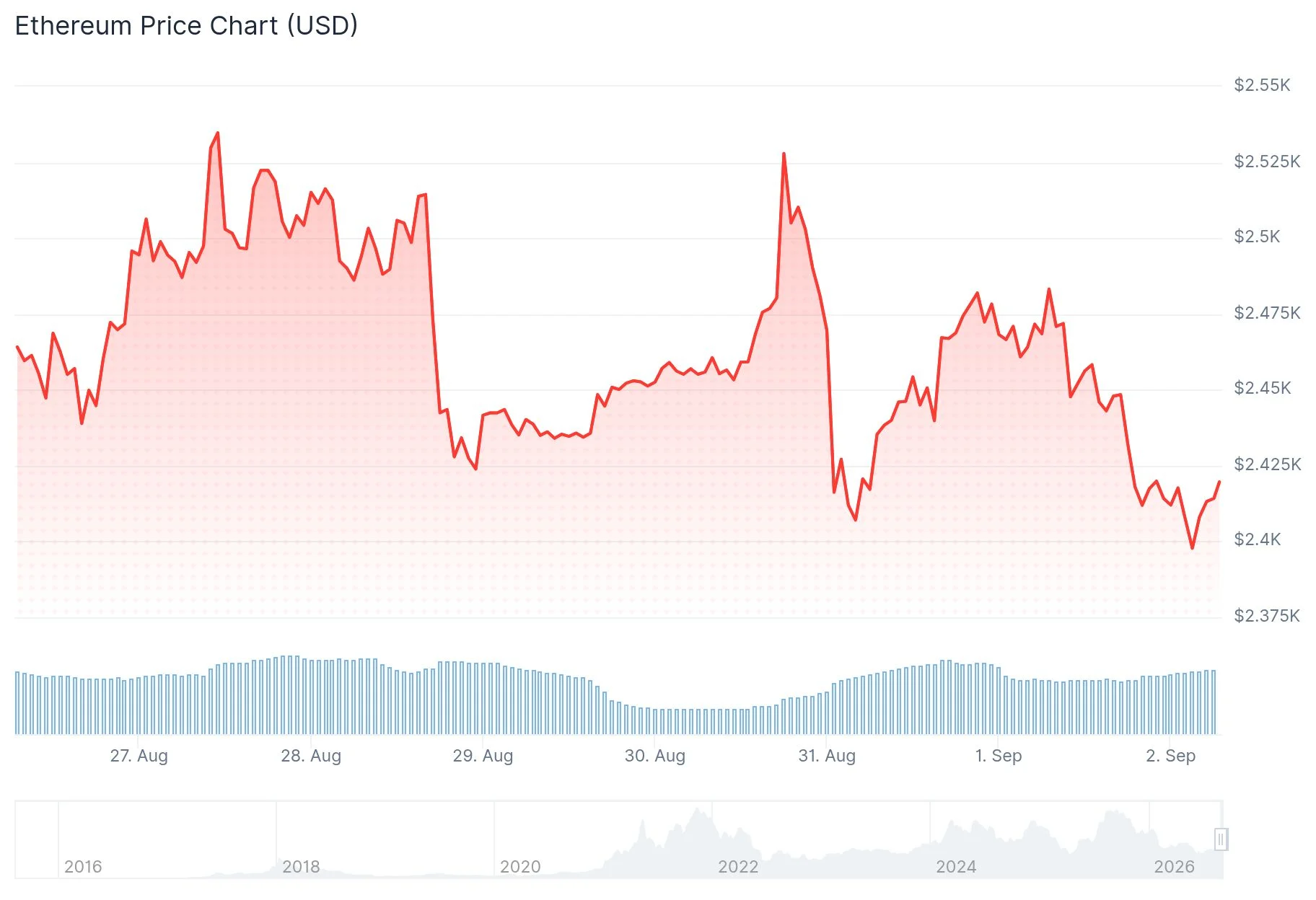
The surge was primarily fueled by United States-based spot Ethereum exchange-traded funds. Data from SoSoValue indicates these investment vehicles drew in $1.85 billion in net capital during August, representing their strongest monthly showing in more than 12 months. The funds concluded August with an impressive 11-consecutive-day inflow sequence, experiencing just four sessions of outflows throughout the entire period.
Large wallet addresses containing between 10,000 and 100,000 ETH purchased 430,000 ETH throughout August, with the majority of this accumulation occurring during the latter half of the month. Simultaneously, smaller retail addresses disposed of significant ETH holdings, indicating a pronounced shift from individual investors to institutional players.
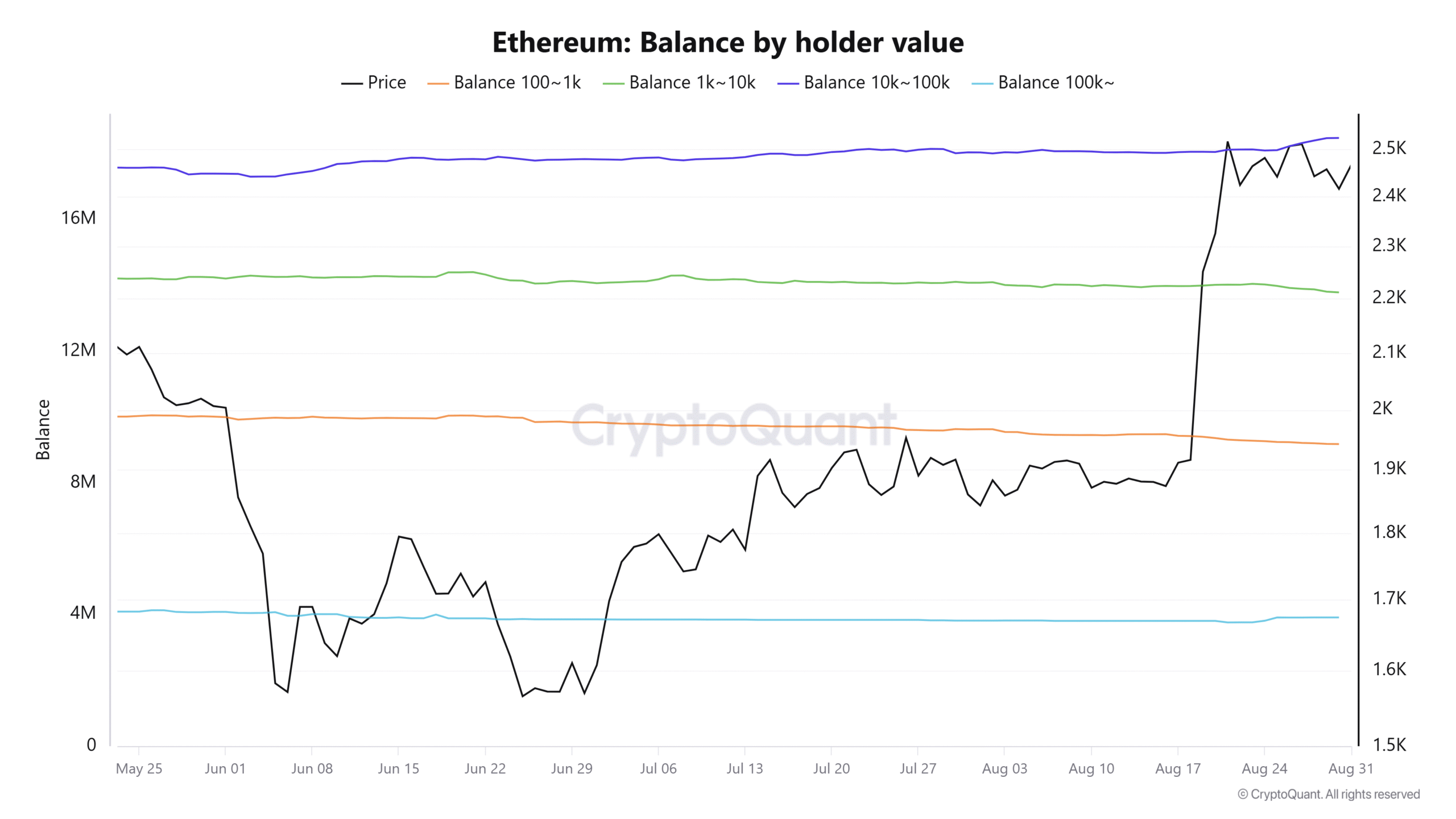
Staking participation also experienced notable growth. Ethereum staking smart contracts received 1.4 million ETH during August, representing the most substantial monthly expansion since February 2024. Increased ETH deposits into staking mechanisms effectively decrease circulating supply in the market.
Market analyst BATMAN highlighted this momentum change on X, observing that ETH “seems to not be getting the attention it deserves.” He emphasized that the recent price movement signaled a trend reversal toward bullish territory following nearly twelve months of downward pressure. He observed that the 50-day moving average, which had consistently served as resistance, is now functioning as a support level. His advice to the community: “Don’t sleep on ETH.”
$ETH seems to not be getting the attention it deserves.
The recent pump marked a trend reversal back to bullish, after being bearish for almost a year.
Ethereum got rejected by the 50-day MA multiple times.
Now that things have been flipped, it acts as support.
Don't sleep on… pic.twitter.com/U8hI5zXbyG
— BATMAN
Resistance at $2,550 Proves Stubborn
Notwithstanding August’s impressive performance, ETH has encountered difficulty breaking through the $2,550 threshold. Several breakout attempts have been unsuccessful in establishing a sustained move beyond this price point. On-chain specialist Ted Pillows observed that leveraged long positions are accumulating rapidly at current price levels, creating potential liquidation risk if ETH faces another rejection. Open interest has climbed to approximately 4.973 million, accompanied by elevated funding rates.
Should bulls fail to defend present levels, the $2,250–$2,300 range represents the next significant support zone worth monitoring. Successfully clearing $2,550 could potentially trigger a rally toward the $2,650–$2,700 territory.
Corporate Accumulation Persists
Corporate appetite for ETH has remained strong despite near-term consolidation. BitMine acquired another 53,501 ETH during the previous week, increasing its cumulative position to roughly 5.9 million ETH.
Market commentator DonAlt has highlighted that macro resistance between present price levels and the $4,000–$4,100 range appears relatively sparse, establishing that zone as an important longer-term objective should ETH sustain upward momentum.
ETH currently trades at $2,463, with the $2,550 level representing the most prominent near-term resistance obstacle on the chart.
The post Ethereum (ETH) Price Rallies 32.5% in August — Analyst Warns Against Overlooking Bullish Reversal appeared first on Blockonomi.
Key Points
- Fraudulent “Claude Opus 5 Free Desktop” application distributes RevStealer on Windows systems
- Malware compromises more than 50 cryptocurrency wallets and 12 credential management tools
- Sophisticated evasion tactics bypass security research and analysis environments
- Stolen information is transmitted to remote infrastructure before the malware self-destructs
- Fallback command server address is embedded within a Polygon blockchain smart contract
Security researchers at Morphisec have uncovered a malicious campaign leveraging a counterfeit desktop client mimicking Anthropic’s Claude artificial intelligence assistant to deploy the RevStealer information-stealing malware.
The campaigns targeting Claude users spread infostealers that silently grab passwords and browser data, putting exchange logins and hot wallets directly at risk.
One user got… pic.twitter.com/5OTIf64pdl
— Coin Bureau (@coinbureau) August 30, 2026
Distributed as “Claude Opus 5 Free Desktop” through GitHub repositories, the fraudulent application exploits Anthropic’s brand identity to deceive victims into downloading it under the pretense of accessing premium AI capabilities without charge.
Upon installation, the executable masquerades as legitimate software. However, rather than launching a functional user interface, it operates covertly in the background while staging its malicious components.
Evasion Techniques and Anti-Analysis Measures
RevStealer employs sophisticated reconnaissance before deploying its primary functionality. The malware conducts extensive system profiling to verify it isn’t operating within a controlled research environment.
System fingerprinting includes enumeration of RAM capacity, CPU core count, GPU specifications, machine hostname, and active user account. Additionally, it performs temporal analysis to identify virtualization or debugging frameworks frequently employed in malware research.
Systems that trigger any detection heuristics cause the malware to abort execution without leaving forensic evidence. The malware also terminates on machines configured with Russian, Ukrainian, or various Central Asian language settings.
An intermediary CAPTCHA challenge provides an additional layer of obfuscation, necessitating human interaction before proceeding with the infection sequence.
After successfully validating the environment, the encrypted payload undergoes decryption, receives a randomized filename within the Windows AppData directory, and launches as a windowless background process.
To further evade detection, the malware attempts to register the AppData directory as an exclusion within Microsoft Defender’s scanning parameters.
Data Exfiltration Capabilities
Following successful deployment, RevStealer initiates comprehensive data harvesting operations across browser profiles, stored credentials, and cryptocurrency wallet storage. Its targeting scope encompasses more than 50 digital currency wallets and 12 password management applications, supplemented by browser session cookies, VPN configuration files, messaging platform data, screen captures, and document files.
Compromised authentication cookies present particular risk, enabling threat actors to hijack active sessions and bypass multi-factor authentication protections through session replay attacks.
Harvested information undergoes encryption and compression before transmission to command-and-control infrastructure. In scenarios where primary exfiltration servers become unavailable, RevStealer retrieves alternative connection parameters from a smart contract deployed on the Polygon blockchain network.
Distinguishing itself from persistent threats, RevStealer functions as transient malware. Following data exfiltration, it eliminates all traces of its presence from the compromised system. Morphisec characterized this methodology as a “single short burst of theft.”
This operation represents a continuation of adversarial tactics leveraging counterfeit applications for credential harvesting. In July, comparable malware was distributed through fabricated video conferencing interfaces specifically targeting cryptocurrency industry professionals. Kaspersky researchers separately documented the OkoBot framework, which utilizes deceptive wallet recovery interfaces to capture seed phrase mnemonics.
In May 2025, the U.S. Department of Justice disclosed that the LummaC2 malware-as-a-service platform had facilitated approximately 1.7 million credential theft operations before law enforcement intervention disrupted its operational infrastructure.
The post Malicious Claude Desktop Clone Deploys Crypto Wallet-Stealing Malware appeared first on Blockonomi.
Key Takeaways
- BTC plunged to $76,762 following U.S. military operations targeting Iranian Revolutionary Guard positions
- Crypto markets saw $115 million in long liquidations within 60 minutes as Ethereum slipped under $2,400
- Oil markets reacted sharply, with Brent crude approaching $93 on Strait of Hormuz disruption fears
- Traditional markets sold off, pushing the S&P 500 to August 4 lows as Treasury yields climbed
- Strategy added 4,603 BTC worth $368.7 million, marking its first acquisition in over two months
The cryptocurrency market experienced severe turbulence Tuesday following confirmation that American military assets conducted coordinated strikes on Islamic Revolutionary Guard Corps (IRGC) installations throughout Iran. Bitcoin’s value plummeted to $76,762, breaching critical support zones at $78,000 and $77,000 in rapid succession.
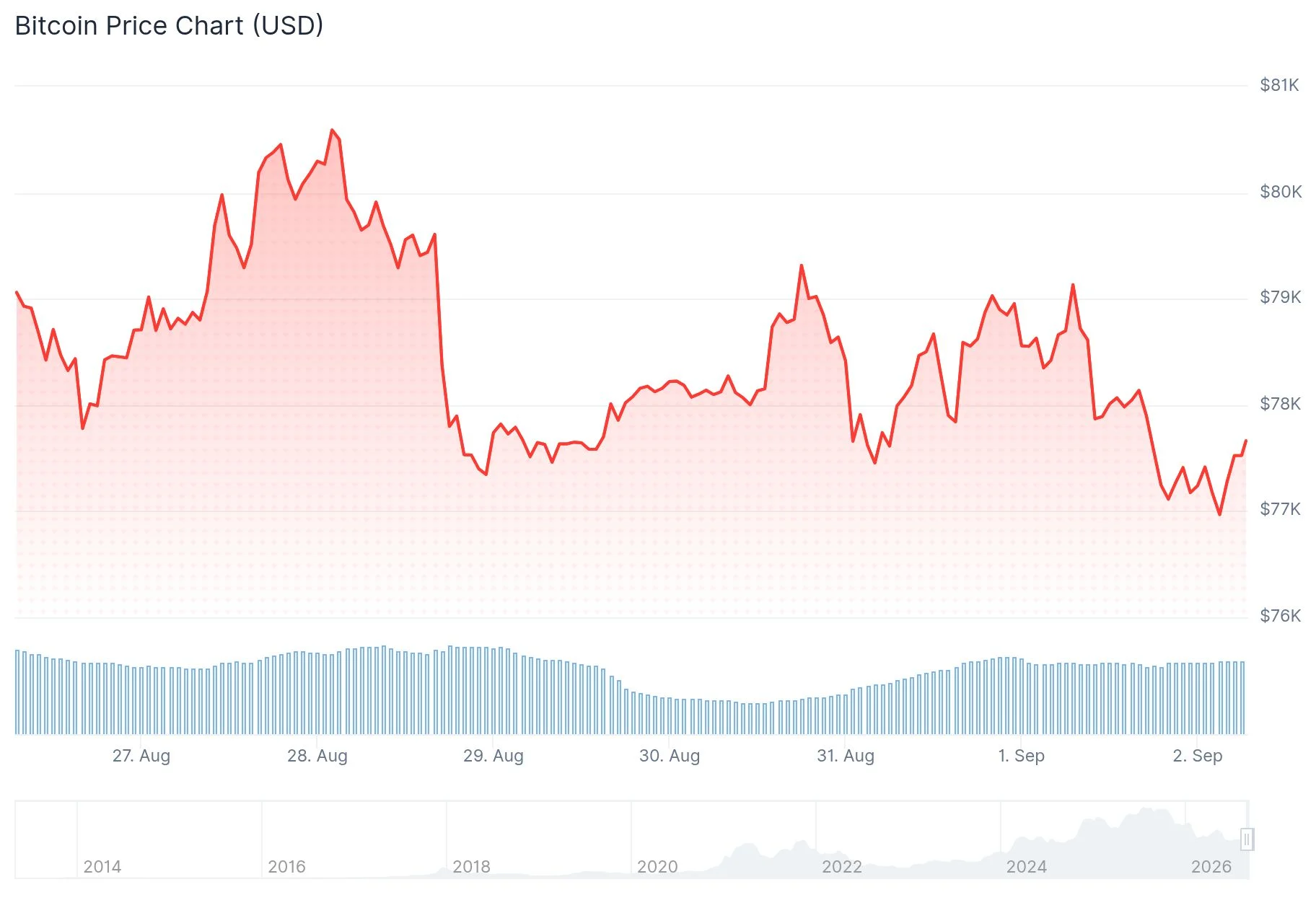
Official confirmation from U.S. Central Command indicated the military campaign commenced at noon Eastern Time on Tuesday. The offensive targeted IRGC installations believed to be involved in naval mine deployment operations near the strategically vital Strait of Hormuz waterway.
Tehran-controlled media outlets documented explosions across multiple locations including Qeshm Island, the port city of Bandar Abbas, and Chabahar. An IRGC spokesman, quoted by Iran’s Fars news service, warned that Washington “will regret its new attacks.”
In a public statement, President Trump characterized the military action as “large and powerful.” He issued a stern warning that any Iranian counterattack would trigger a “much harder and higher level” of American response.
Tehran’s military answered with its own show of force, launching ballistic missiles at Camp Titin, a United States Marine Corps installation in Jordan. According to Jordanian government media, air defense systems successfully intercepted and neutralized eight incoming missiles.
Digital Asset Markets Under Strain
Amid the volatility, cryptocurrency analyst Nebraskangooner shared his market perspective on X. He suggested that Bitcoin’s August candle close makes a price bottom “more likely than not,” though he emphasized $73,500 as the critical support zone. He identified this level as the invalidation point for bullish scenarios, noting that if the price holds above this threshold, potential upside targets include $87,000 and $97,000.
Ethereum experienced comparable downward pressure, breaking below the $2,400 threshold during the same timeframe. Data from Coinglass revealed that approximately $115 million in leveraged long positions were forcibly closed in a single 60-minute window.
Traditional financial markets mirrored the crypto selloff. The S&P 500 index retreated to levels not witnessed since early August, while U.S. government bond yields climbed higher as investors dumped bonds amid mounting concerns over inflation trajectories and expanding fiscal obligations.
Market participants have revised upward their expectations for a Federal Reserve interest rate increase in September following Fed Chair Kevin Warsh’s notably hawkish remarks delivered at last Friday’s Jackson Hole economic symposium.
Energy Markets Surge on Shipping Corridor Concerns
Brent crude oil futures climbed toward $93 per barrel as market participants monitored maritime traffic conditions through the strategic waterway. West Texas Intermediate crude similarly advanced toward the $90 threshold.
Additional market jitters emerged from unconfirmed reports indicating two commercial tanker vessels sustained damage while transiting the Strait of Hormuz exit corridor, intensifying supply disruption anxieties. Iranian government representatives issued warnings that Persian Gulf petroleum exports could face significant interruption if external pressures persist.
The geopolitical flare-up arrived merely one day after Bitcoin concluded its strongest monthly showing since November 2024, rallying approximately 25% throughout August.
In a regulatory filing, Strategy revealed it acquired 4,603 Bitcoin tokens for roughly $368.7 million last week — representing the company’s first accumulation since the final days of June. The transaction was financed through $602.8 million in common equity sales, elevating Strategy’s aggregate Bitcoin reserves to 845,050 BTC.
The post Bitcoin (BTC) Plunges to $76K Amid U.S.-Iran Military Escalation — Strategy Seizes Opportunity appeared first on Blockonomi.
CryptoPotato
Bitcoin continues to hover below $78K, but the absence of meaningful upside progress is becoming increasingly important. After the initial breakout impulse, repeated failures to challenge the $80K-$82K supply area suggest demand is losing strength, raising the probability of a deeper corrective move.
Bitcoin Price Analysis: The Daily Chart
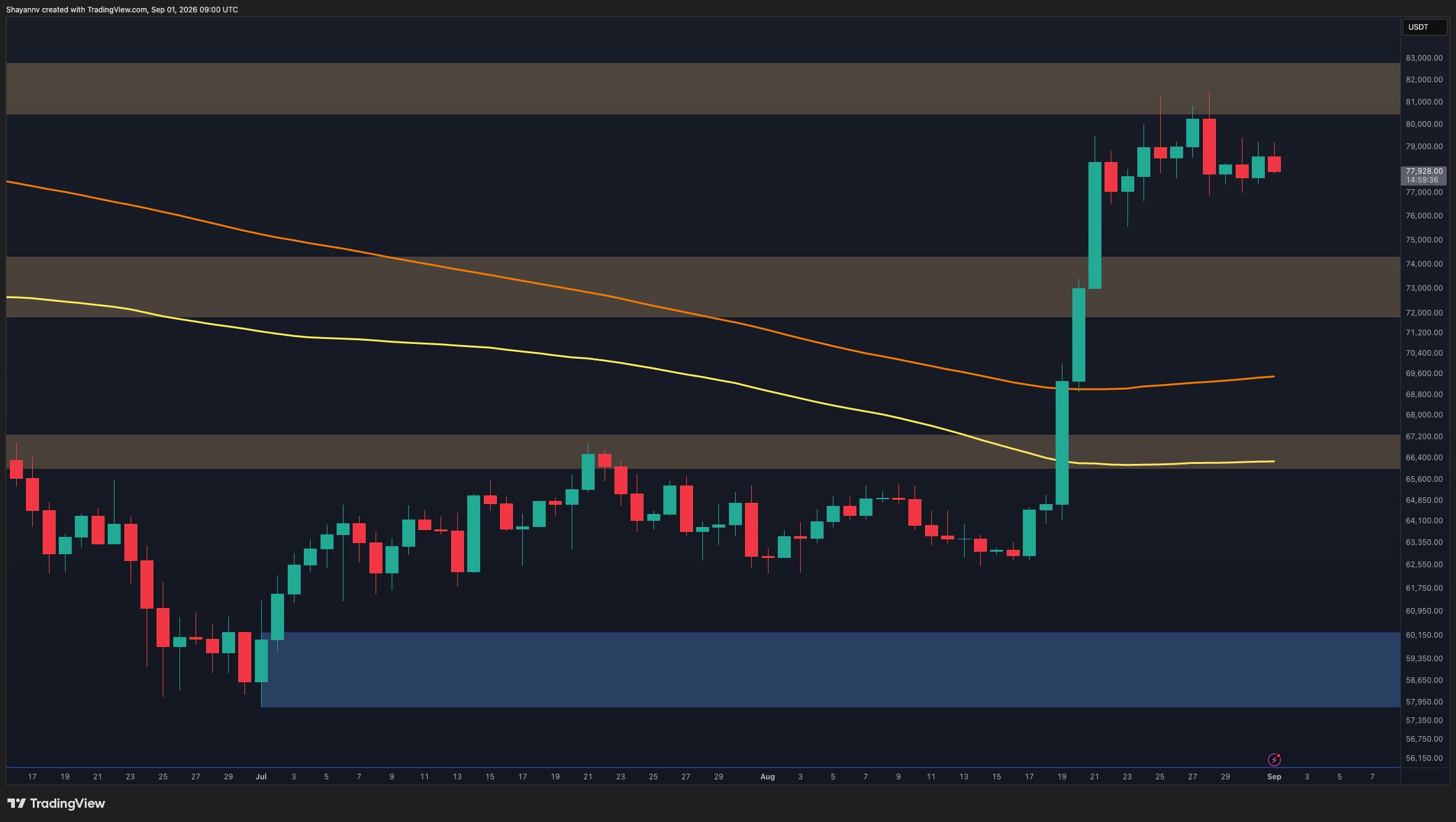
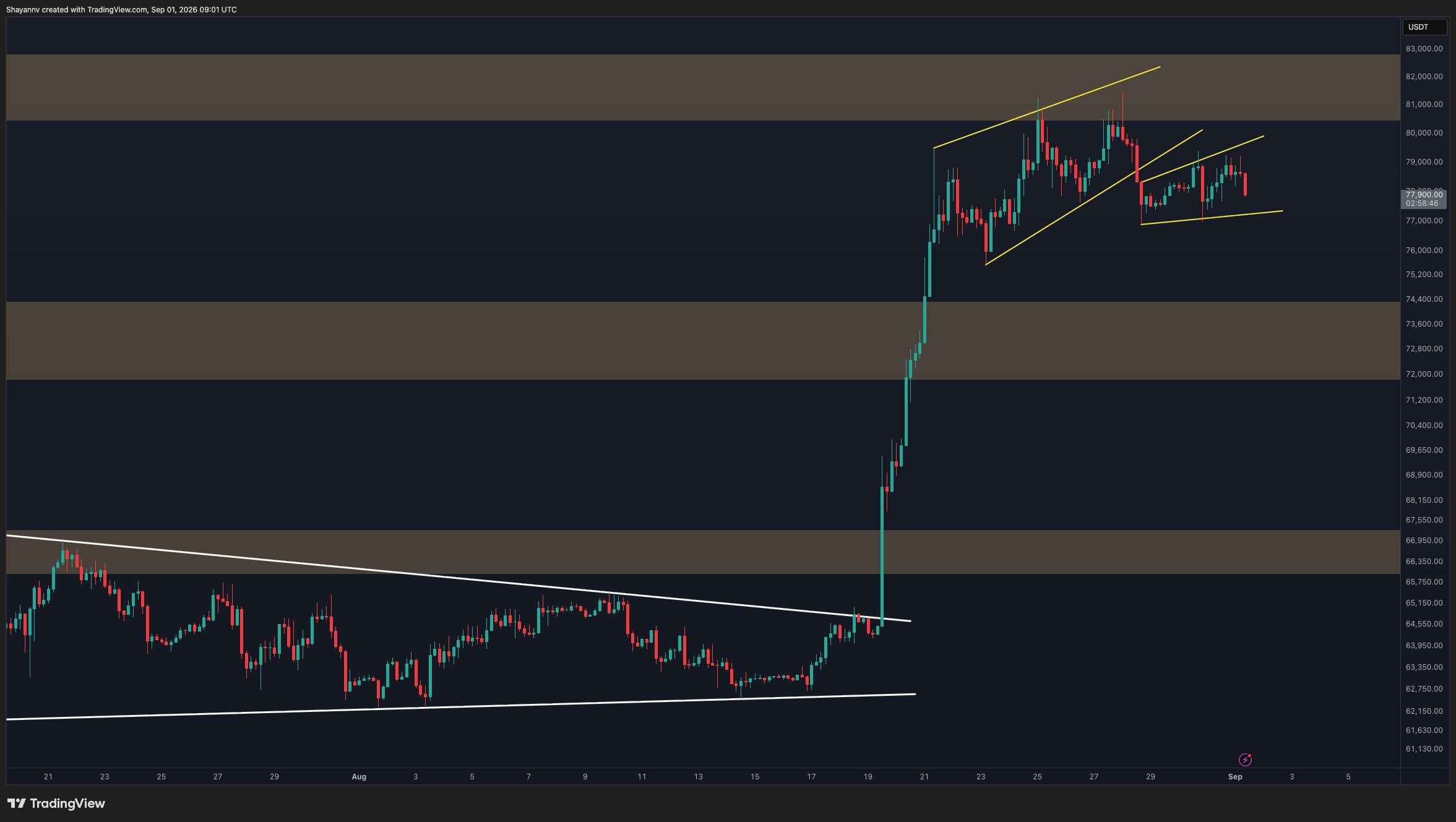
The daily chart shows BTC transitioning from an impulsive breakout into a clear loss of momentum. Following the rapid advance from the mid-$60K region, Bitcoin has spent several sessions fluctuating between roughly $77K and $81K without establishing a fresh high.
This behavior is particularly notable because the price is consolidating directly beneath the major $80.5K-$82.5K resistance zone. The inability to absorb supply around this area, combined with repeated upper wicks, suggests buyers are struggling to maintain the strength seen during the initial rally.
Although the broader structure remains bullish following the breakout above the moving averages and previous resistance levels, the probability of a deeper pullback has increased. The $72K-$74.4K zone is the first major daily support area and represents a logical destination if selling pressure expands.
For the immediate bearish risk to diminish, BTC would need to regain momentum and establish acceptance above $80.5K-$82.5K. Until then, the prolonged hesitation beneath resistance favors caution.
BTC/USDT 4-Hour Chart
The deterioration is more apparent on the 4-hour timeframe. Bitcoin initially formed an ascending channel following its breakout, but the price subsequently lost the lower boundary and failed to recover it.
The latest consolidation has developed into a smaller rising structure around the $77K-$80K area. However, the recent rejection from its upper boundary has pushed BTC back toward the lower trendline near $77K. This makes the current area an important short-term decision point.
A breakdown below this structure would strengthen the case for a larger correction, particularly given the lack of bullish follow-through over recent sessions. In that scenario, the $72K-$74.4K support zone would become increasingly relevant.
Alternatively, buyers could still invalidate the developing bearish setup by reclaiming $79K-$80K and eventually breaking through the $80.5K-$82.5K resistance zone. Yet, without such a move, the repeated inability to extend the rally suggests that downside risk is gradually building.
Sentiment Analysis
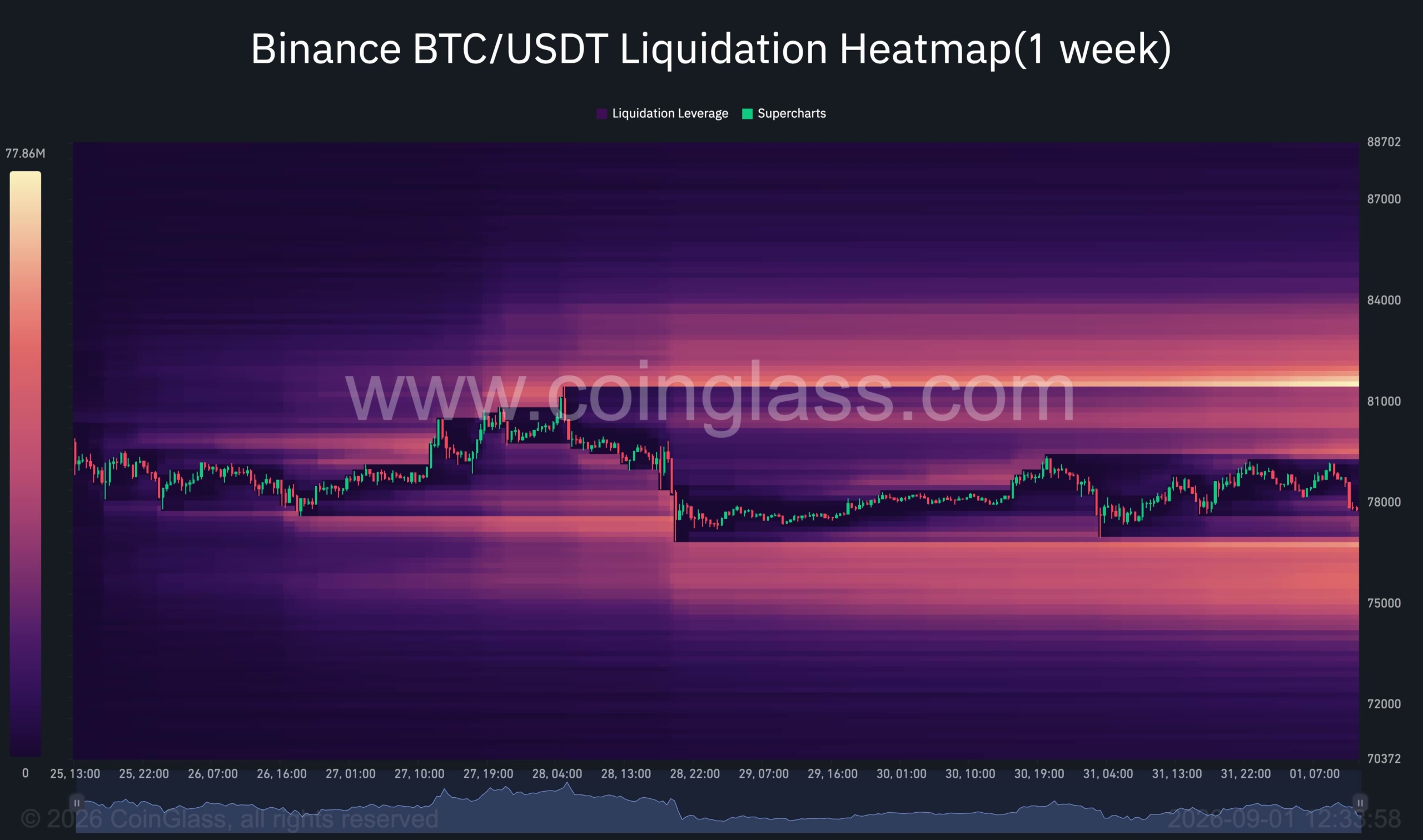
The one-week Binance BTC/USDT liquidation heatmap provides additional support for the possibility of increased volatility. Bitcoin is currently positioned between substantial liquidity concentrations on both sides of the market, but the downside cluster is particularly relevant given the weakening short-term price structure.
A broad concentration of liquidation liquidity is visible below the current price, extending approximately through the $74K-$77K region. If BTC loses its current short-term support, this liquidity could act as a magnet and accelerate a sweep toward lower levels.
There is also substantial liquidity above the market, most notably around $80K-$82K, meaning an upside liquidity hunt remains possible. However, Bitcoin’s repeated inability to sustain advances toward this region reduces the strength of that scenario for now.
Overall, the heatmap and price structure point to an increasingly fragile consolidation. A downside liquidity sweep toward the mid-$70K region, potentially followed by a test of the major $72K-$74.4K technical support zone, appears more plausible than it did previously unless buyers quickly restore momentum above $80K.
The post Bitcoin Price Analysis: Warning Signs Emerge as BTC’s Breakout Loses Momentum appeared first on CryptoPotato.
Goldman Sachs, Jane Street Group, and Millennium Management were the three largest reported holders of spot XRP ETFs in second-quarter 13F filings, according to Bloomberg Intelligence data shared by James Seyffart on August 31.
The filings show that institutional exposure has grown alongside a sharp increase in XRP ETF inflows, even as the Ripple token itself has pulled back from its August highs.
Advisors Dominate XRP ETF Holdings
Bloomberg’s compilation puts Goldman Sachs well ahead of other reported holders, with $87.4 million in ETF exposure representing 84 million XRP. Jane Street followed with just under 16 million XRP, worth $16.6 million, while Millennium Management held 15.5 million tokens valued at about $16.2 million.
Intesa Sanpaolo ranked fourth with $14.4 million in exposure, followed by Marex UK Holdings at $8.1 million. Citadel Advisors also appeared in the filing data, although its XRP exposure fell by $645,000. But SIG Holdings recorded a much larger reduction, with its reported XRP exposure down by roughly $4.6 million.
Across the identified holders, total exposure reached $183.5 million, representing about 176.4 million XRP. Bloomberg also grouped the holders by category and found investment advisors far ahead of the other groups, with $120.9 million in exposure. Hedge fund managers accounted for $25.1 million, brokerages for $17.9 million, and banks for $14.8 million.
ETF Demand Rises While XRP Price Cools
The numbers come as demand for spot XRP ETFs has picked up, with the funds attracting $110.5 million during the week ending August 28, their strongest five-day inflow since the first week of December 2025, when they drew in more than $230 million. SoSoValue data shows another $5.6 million entered the products on August 31, taking cumulative net inflows to about $1.67 billion, with total net assets reaching roughly $1.45 billion.
Meanwhile, the token itself was trading near $1.40 at the time of writing, having hit a multi-month high of $1.70 last week. Although that price represents a nearly 9% dip over seven days, it is still 28% higher than where it was a month ago and almost 40% up from its level two weeks ago. That said, XRP’s value is still nearly half of what it was this time last year, and it is stuck approximately 62% below its all-time high of $3.65 recorded in July 2025.
Traders are now watching the $1.35 to $1.38 zone closely, since a break below could open the door to more downside, while analyst Ali Martinez fingered $1.60 as the next major resistance level were XRP to attempt another recovery.
The post These Wall Street Giants Are the Biggest Holders of Spot XRP ETFs appeared first on CryptoPotato.
July and August have been quite successful for the self-proclaimed Dogecoin killer, with its price closing both months in the green.
Nonetheless, certain important elements suggest that September may not be as beneficial and could deliver a move south.
The Worrying Signals
The first concerning element on the list is Shiba Inu’s burn rate, which has declined by 6% on a monthly scale. Data shows that less than 600 million tokens have been sent to a null address throughout August, an amount whose USD equivalent is negligible.
The burning mechanism aims to reduce the overall supply of the meme coin and potentially make it more valuable, but little to no activity on that front poses a serious obstacle to that mission.
Next is Shibarium’s stalled activity. The layer-2 scaling solution was exploited last year, and since then, the number of processed daily transactions has dropped to mere hundreds or even thousands (at most).

The feature has been labeled numerous times as important for the overall advancement of Shiba Inu’s ecosystem and something that can positively impact its price.
Last but not least, we shall mention the seasonal element. September has been a predominantly poor month for SHIB, with its price finishing the period in the red three out of five times. In 2022, July and August were green (just like this year), yet the following month stopped the uptrend. We have yet to see whether history will repeat itself.

The Bright Side
Not all aspects suggest that the meme coin could experience a downtrend in the coming weeks.
According to CryptoQuant, the amount of SHIB held on exchanges has declined over the past month, signaling that investors continue to abandon centralized platforms in favor of self-custody. This, in turn, reduces immediate selling pressure and could set the stage for a potential additional price ascent.

The post 3 Reasons Why Shiba Inu (SHIB) May Plunge This Month appeared first on CryptoPotato.
Artificial intelligence could usher in a new wave of concern over financial privacy, according to a Grayscale research report. The firm’s Head of Research, Zach Pandl, expects AI to create new privacy threats and drive demand for new solutions.
He sees Zcash as one potential option.
Zcash For Blockchain Privacy
Public attention to financial privacy has historically increased alongside major technological changes. The first wave came in the 1970s, when computers enabled the digitization and automation of financial record-keeping. A second wave followed in the 1990s with the expansion of the Internet and growing concerns over online privacy.
Grayscale believes a third wave has now begun as AI becomes more widely used. Pandl said AI tools are likely to create new privacy challenges across the economy, and the issue is particularly pressing for public blockchains that are transparent by default.
For instance, on the Bitcoin network, every transaction is recorded on a public ledger and can be viewed by anyone. When blockchain activity is linked with off-chain information, user addresses could potentially be de-anonymized, a risk also noted in the Bitcoin white paper.
While that risk existed before AI, Grayscale said advances in the technology could make blockchain address labeling more effective and widely available, increasing the need for privacy protection. Unlike Bitcoin, Zcash offers additional privacy features through shielded transactions, which use zero-knowledge cryptography to conceal both the addresses involved in a transaction and the amount being transferred. Grayscale said this privacy feature could become a “must-have” for users who prioritize financial privacy.
Grayscale had made a similar point earlier, while noting that ZEC had surged about 20 times in the past year but was still worth less than 1% of Bitcoin’s market cap. The firm said Zcash’s privacy features and other advantages may not be fully reflected in its current valuation, which leaves room for further gains.
The comments come days after Grayscale converted its Zcash Trust, launched in 2017, into a spot ZEC ETF. The fund began trading on the NYSE Arca on August 25.
$1,800 Target
ZEC has posted a strong performance. The privacy-focused crypto asset gained nearly 80% over the past month alone. Following the sharp rally, ZEC is trading around $850, but crypto analyst Ali Martinez is betting on further upside.
He said that “Zcash is about to melt faces,” while identifying $1,800 as the “first stop.”
The post Zcash May Have a Bigger Role to Play as AI Threatens Financial Privacy: Grayscale appeared first on CryptoPotato.
Prediction-market exchange Kalshi has permanently banned former US Rep. George Santos from accessing the platform after its Compliance Department found “reasonable cause to believe” that he engaged in insider trading and market manipulation.
The lifetime ban, effective August 28, 2026, is the first permanent penalty of its kind imposed by Kalshi on a user.
Penalty and Lifetime Ban
According to the official compliance document, Santos traded in markets linked to whether he would attend the State of the Union address on February 24, despite being prohibited from trading in those markets because he was capable of influencing the outcome of the underlying event. Kalshi said Santos placed a series of large trades between February 2 and February 25 in contracts whose results depended on his own attendance.
The platform said Santos materially benefited from the activity and earned $17,839.57 from the targeted markets. Alongside the permanent suspension of direct and indirect access to the exchange, the Compliance Department has also imposed a $71,356 penalty.
In response to the development, Santos took to X to attack Kalshi and accused the latter of violating its own notices and deadlines. He said that the August 7 notice allegedly gave his side 30 days before the latest action, as he questioned why the exchange had announced “frivolous nonsense” before that period was over.
“Leaking and attention seeking seem to be the M/O of this organization. Pathetic!”
The action comes after a settlement Santos reached last month with the Commodity Futures Trading Commission, which has said it has jurisdiction over prediction markets. He agreed to pay $35,000 under the settlement but did not admit or deny the agency’s findings. His counsel, Joseph W. Murray, said Santos cooperated with the CFTC.
The former congressman was expelled from the House of Representatives in 2023 after facing federal charges. In April 2025, he was sentenced to more than seven years in prison after pleading guilty to wire fraud and identity theft. In October of that year, Trump announced that he had commuted the sentence, and Santos was released after serving less than three months.
Kalshi had previously suspended three US political candidates after finding they bet on election outcomes they were directly involved in, while calling the activity “political insider trading.”
More Heat on Prediction Markets
Prediction-market platforms face growing scrutiny from regulators and lawmakers. Last month, Baltimore officials sued Kalshi and Polymarket, alleging that their sports prediction contracts amount to unlicensed sports betting and can mislead consumers about their legal and regulatory status.
Meanwhile, Kalshi is also fighting a lawsuit from New York Attorney General Letitia James. The exchange has separately faced a lawsuit from FlightAware over flight-related markets, although that case was withdrawn shortly after being filed.
The post Former US Rep. George Santos Banned From Kalshi for Life After Betting on Himself appeared first on CryptoPotato.