Cryptocurrency Posts
Crypto Briefing
Stripe's strategic acquisitions could redefine digital commerce infrastructure, potentially positioning it as a dominant force in the AI economy.
The post Stripe’s acquisition spree mirrors early Google strategy, with a crypto twist appeared first on Crypto Briefing.
Venezuela's limited oil output and refining challenges may sustain global price pressures, highlighting the need for diversified energy sources.
The post Venezuelan crude unlikely to replace disrupted oil supplies, analysts say appeared first on Crypto Briefing.
Hatate's move to Burnley highlights the shifting dynamics in player careers, emphasizing the pursuit of new challenges and strategic club investments.
The post Reo Hatate bids farewell to Celtic after completing Burnley move appeared first on Crypto Briefing.
GlobalFoundries' UX platform could accelerate the integration of AI in everyday devices, potentially transforming industries and user experiences.
The post GlobalFoundries makes UX platform available to customers for edge AI and connectivity applications appeared first on Crypto Briefing.
Escalating US-Iran tensions over strategic infrastructure could destabilize global communications and trade, heightening invasion risks.
The post Recent US strikes were preemptive and aimed at disrupting an alleged Iranian plot to target submarine cables in the Strait of Hormuz, a US source tells Al Arabiya appeared first on Crypto Briefing.
Bitcoin Magazine
Bitcoin Magazine

Bitcoin Slides as US-Iran Tensions Escalate
Bitcoin slid on Tuesday after investors went into “risk-off” mode following escalating attacks between the U.S. and Iran.
The largest cryptocurrency had initially shrugged off President Donald Trump’s threats to the Middle Eastern nation, as well as the first strikes.
But things heated up on Tuesday, and bitcoin’s price slid. It was recently down more than 2% on the day, trading for $77,363. The coin had pushed past as high as nearly $81,282 on Friday.
The Tuesday attacks from the U.S. were because Iran tried to put mines in the Strait of Hormuz, and also because of an attack on an American military base in Jordan, according to President Trump.
U.S. Central Command said on X that Iran had also attacked commercial ships.
“The strikes follow recent attempted attacks by the Islamic Revolutionary Guard Corps against commercial shipping in the Strait of Hormuz and against American service members deployed to the region,” the post read.
Iran responded with a “decisive operation” against U.S. military bases, according to Iranian media. Oil surged on the news.
Bitcoin’s price has been sensitive to geopolitical tensions this year — especially after Iran and Israel attacked Iran. The cryptocurrency has typically faced downward pressure on news of war, only to then rally when Trump raised hopes of a ceasefire.
Despite Bitcoin’s price being relatively muted, in recent months, it has made more wild swings since mid-August.
Bitcoin’s immediate reaction to rising oil prices is to drop: more expensive energy means higher inflation, and higher inflation typically means the U.S. central bank will postpone rate cuts, which can restrict the liquidity that bitcoin needs to gain momentum.
The Federal Reserve’s chair, Kevin Warsh, last week gave his first major speech as leader of the central bank and said that inflation in the world’s largest economy had not come down enough.
Traders are now no longer pricing in an interest rate cut this year, instead expecting a hike. Bitcoin has typically performed well in the past in low interest rate environments.
Still, the coin had one of its best runs in August after the U.S. Treasury said it would at least double the size of its liquidity-support buyback operations, in response to surging borrowing costs.
The announcement hurt the dollar but non-yielding assets like bitcoin and gold have benefited.
This post Bitcoin Slides as US-Iran Tensions Escalate first appeared on Bitcoin Magazine and is written by Mathew Di Salvo.
Bitcoin Magazine

Bitcoin Defies Seasonal Slump With Third-Best August Ever
Bitcoin is known for its summer slumps. But August was different.
In fact, the leading cryptocurrency had its third best August ever.
As highlighted on Tuesday by Bitwise’s European Head of Research, André Dragosch, bitcoin delivered returns of 25% last month.
“No ‘summer lull’ so far,” Dragosch wrote on X, highlighting that the only better Augusts the coin has had were in 2017 when it gave investors returns of nearly 66%, and 2013, with close to 31%.
OFFICIAL: August 2026 is in the books and it's been the 3rd best August in bitcoin's history.
— André Dragosch, PhD
August 2017: +65.6%
August 2013: +30.7%
August 2026: +25.0%
No "summer lull" so far. pic.twitter.com/jwHt2VP5Sk(@Andre_Dragosch) September 1, 2026

Multiple analyses point to the months of June-September showing weaker average returns than the rest of the year.
Throughout most of June and July, bitcoin’s volatility was particularly muted, and the coin traded below $65,000.
But that changed in mid-August after the U.S. Treasury Department said it would more than double the size of its government debt repurchases due to fixed income markets under pressure and yields surging to levels not seen in nearly 20 years.
Lower long-term yields reduce the opportunity cost of holding non-yielding assets like bitcoin and gold, and generally support risk-on sentiment.
Investors flooded into bitcoin as a result.
Positive news soon followed, with President Donald Trump urging lawmakers to get the long-awaited crypto Clarity Act over the line. The digital asset industry has long called for clear rules on how regulators should treat bitcoin, stablecoins and other cryptocurrencies.
Despite a delay in a vote on the legislation, Trump called the draft “very powerful.” The president made the comments after having met with crypto industry bigwigs and CEOs.
Investors also rushed back into ETFs in August, throwing over $2.8 billion at the vehicles — the most since October, when the coin hit a new all-time high.
Bitcoin in August had its best run in three years — and is up nearly over 20% over the past month.
The asset reached as high as $81,281 last week before sliding again on Friday.
Bitcoin’s price recently stood at $76,883, nearly down 3% over a 24-hour period.
This post Bitcoin Defies Seasonal Slump With Third-Best August Ever first appeared on Bitcoin Magazine and is written by Mathew Di Salvo.
Bitcoin Magazine
BlackRock’s iShares Bitcoin Trust Is Beating Top S&P 500 ETF
BlackRock’s iShares Bitcoin Trust exchange-traded fund has delivered better returns since its 2024 launch than Vanguard’s popular S&P 500 fund.
That’s according to Bloomberg data highlighted by the firm’s senior ETF analyst, Eric Balchunas, who said that the BlackRock product’s cumulative percentage return was only slightly ahead of Vanguard’s in the time period.
BlackRock’s bitcoin ETF is up 71% since its January 2024 debut, while Vanguard’s S&P 500 ETF up 66% on a total-return basis.
The iShares Bitcoin Trust — IBIT — started trading in 2024 after the Securities and Exchange Commission gave the green light to 11 spot bitcoin ETFs following a decade of denials.
“IBIT’s path to 70% looks like the El Toro roller coaster at Great Adventure (I needed two Advil last time I rode that thing) while $VOO was a walk in the park in comparison,” wrote Balchunas on Tuesday.
U.S. investors now have several funds to choose from to buy shares that track the price of bitcoin managed by the likes of Fidelity, Grayscale and Morgan Stanley. But BlackRock’s product is the most successful: It currently manages $61.4 billion in assets, according to its website.
By comparison, the second biggest bitcoin ETF, the Fidelity Wise Origin Bitcoin Fund, manages nearly $11 billion.
BlackRock, which manages over $15 trillion in assets, sent shockwaves through the crypto space after it applied for a spot bitcoin ETF in 2023. Its fund now allows more traditional investors to get exposure to bitcoin; its product also experiences more day-to-day trading action than the other ETFs.
Investors piled back into ETFs in August, which has also helped bitcoin’s price. From August 17 to 27, investors threw over $2.8 billion at the vehicles — the most since October, when the coin hit a new all-time high.
Bitcoin reached as high as $81,281 last week before sliding again on Friday.
The price of the biggest cryptocurrency recently stood at $77,539, nearly down 1% over a 24-hour period.
Bitcoin started a phenomenal run two weeks ago — its best in three years — and is up nearly 30% over the past month.
This post BlackRock’s iShares Bitcoin Trust Is Beating Top S&P 500 ETF first appeared on Bitcoin Magazine and is written by Mathew Di Salvo.
Bitcoin Magazine

South Korea’s Bitcoin ‘Kimchi Premium’ Returns
Bitcoin is up this month but there’s one place where it’s more significantly more expensive: South Korea.
The so-called Kimchi Premium — when bitcoin costs more on Korean exchanges — is back as retail investors pile back into the coin. Bloomberg first reported the news and CoinGecko data shows that bitcoin’s price is nearly 1% higher on Upbit, Korea’s biggest exchange, than Binance.
Named after a popular dish in the Asian nation, the phenomenon comes down to Korea’s market being partly walled off. Prices have historically run higher there because of strong local retail demand combined with strict capital controls and trading regulations.
As a result, the Bitcoin/won trading pair is more common in South Korea compared to the Bitcoin/U.S. dollar pair in other places. When there is demand for the asset, it will naturally be higher in the country as compared to other places.
The phenomenon has been described as a retail FOMO indicator, since Korea has few notable crypto funds and tight capital controls. The premium has reached as high as 21.5% in 2022.
Bitcoin was recently trading for $78,287, unmoved over the past 24 hours. It’s also at the same price it was seven days ago, but over the past month, the coin has rallied by 24%.
The price of the biggest digital asset started surging after the U.S. Treasury in August said it would at least double the size of its liquidity-support buyback operations. The announcement hurt the dollar but non-yielding assets like bitcoin and gold have benefited.
President Donald Trump also said the same week that the long-awaited crypto Clarity Act was an important piece of legislation, and urged lawmakers to get it over the line.
JUST IN: There's now a 59% chance Bitcoin will be above $82,500 this month, according to Polymarket.com
— Bitcoin Magazine (@BitcoinMagazine) September 1, 2026pic.twitter.com/kTYEZsxQvk
Crypto industry bigwigs have been calling for clear rules for distinguishing between digital assets that are securities, commodities or payment stablecoins, and news that regulators will soon have such a framework has typically benefited crypto markets.
Speculators are now betting on Polymarket that there’s a 59% chance bitcoin will be above $82,500 this month, leading some to call an end to the bear market.
This post South Korea’s Bitcoin ‘Kimchi Premium’ Returns first appeared on Bitcoin Magazine and is written by Mathew Di Salvo.
Bitcoin Magazine

BlackRock Re-Underwrites Bitcoin, and the Portfolio Math Still Holds
Bitcoin’s roughly 50% decline from its October 2025 high has created a useful test for the institutional investment thesis. It is relatively easy to make the case for a new asset while prices are rising, correlations are favorable and capital is flowing into the market. The more revealing exercise comes after a major drawdown, when investors can revisit the original assumptions and determine which were structural and which were simply products of the preceding cycle.
That is effectively what BlackRock has done in its latest research, Re-Underwriting Bitcoin: Still a Portfolio Diversifier. Rather than treating the recent drawdown as evidence for or against Bitcoin in isolation, the firm returns to the question most relevant to an allocator: how has Bitcoin actually affected the risk and return characteristics of a diversified portfolio?
The results are more consequential than the headline return figures suggest. In BlackRock’s rolling 10-year analysis through May 29, 2026, a traditional 60/40 equity and fixed-income portfolio generated an annualized return of approximately 9.9% with annualized standard deviation of roughly 10.1%. Introducing a 1% Bitcoin allocation increased annualized return to approximately 10.9%, while volatility moved only modestly higher to roughly 10.3%. At a 2% allocation, annualized return reached approximately 11.8%, with standard deviation of about 10.6%.
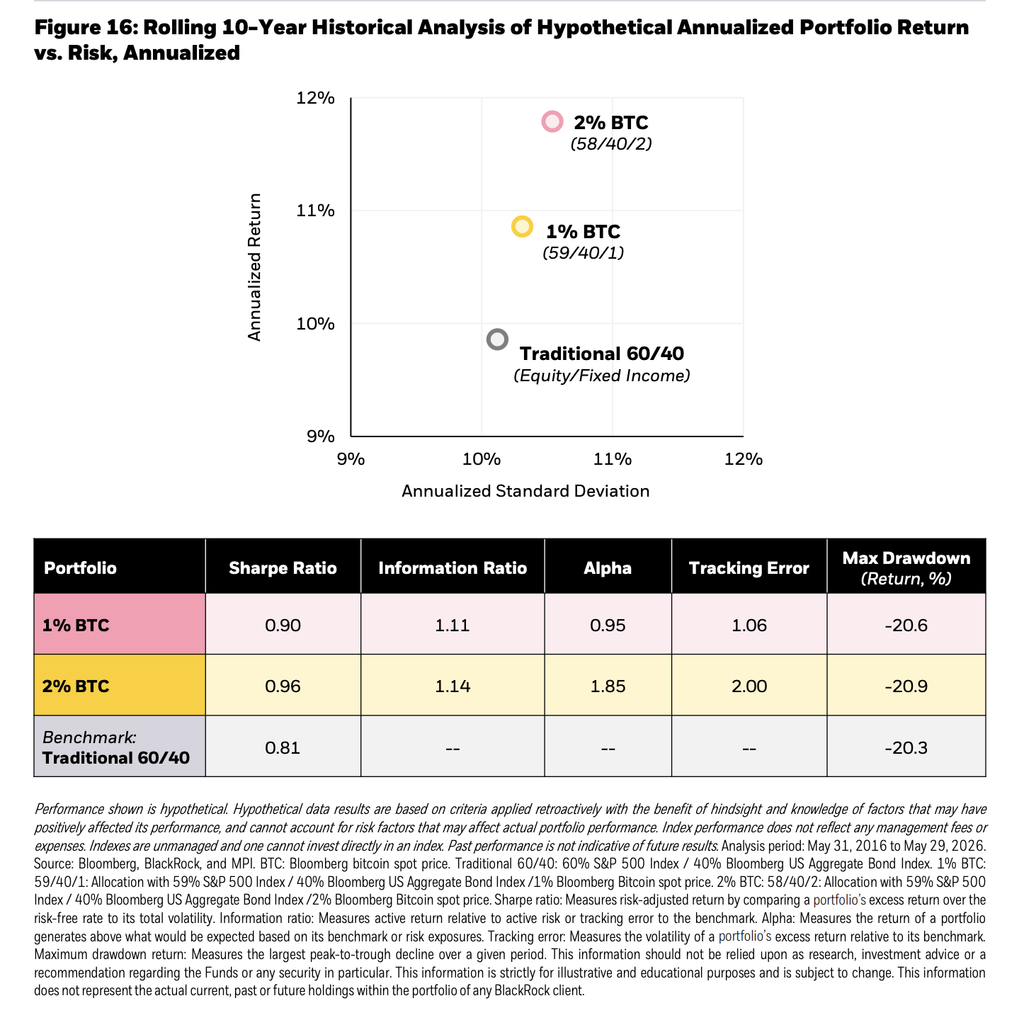
Put differently, the 2% allocation added roughly 190 basis points of annualized return relative to the traditional portfolio while increasing annualized volatility by approximately 50 basis points. The portfolio’s Sharpe ratio improved from 0.81 to 0.96, while maximum drawdown changed from -20.3% to -20.9%. Those figures are hypothetical and backward-looking, but they illustrate why judging Bitcoin primarily by its standalone volatility can produce an incomplete assessment of its portfolio impact.
The more relevant question is how that volatility interacts with everything else an investor already owns. BlackRock continues to characterize Bitcoin as having risk and return drivers that are fundamentally different from traditional assets, rooted in its fixed supply, decentralized structure and independence from any sovereign issuer. Those characteristics do not prevent Bitcoin from trading alongside risk assets during periods of deleveraging, but BlackRock’s research suggests those correlations have historically been episodic rather than permanent.
That distinction helps explain the portfolio results. A modest allocation does not import Bitcoin’s standalone volatility into a portfolio on a one-for-one basis. What matters is the marginal contribution of that allocation to total portfolio risk relative to the return it has historically generated. In BlackRock’s analysis, that trade-off remained favorable at 1% and 2%, even after incorporating one of Bitcoin’s most significant recent drawdowns.
Why 1–2% keeps appearing in BlackRock’s work
This is not the first time BlackRock has arrived at this range. Its earlier portfolio research approached Bitcoin sizing through risk contribution, concluding that a 1–2% allocation could represent a reasonable range for investors willing and able to accept Bitcoin’s risk. At those weights, BlackRock found that Bitcoin could contribute a similar share of overall portfolio risk as an individual mega-cap technology holding in a conventional 60/40 portfolio. Beyond 2%, however, Bitcoin’s contribution to total portfolio risk begins to increase disproportionately.
The new analysis approaches the same question from the opposite direction. Rather than asking how much risk Bitcoin contributes, it examines what investors historically received for assuming that additional risk. The improvement in Sharpe ratio from 0.81 for the traditional portfolio to 0.90 with 1% Bitcoin and 0.96 with 2% Bitcoin suggests that the incremental return historically more than compensated for the additional portfolio-level volatility.
This does not establish 1% or 2% as an optimal allocation, and BlackRock does not present it that way. The appropriate exposure will depend on liquidity requirements, investment horizon, governance constraints and risk tolerance. What the analysis does provide is a more rigorous framework for the discussion. The allocation question can increasingly be evaluated in terms of marginal risk, correlation, drawdown and portfolio efficiency rather than through a binary debate over whether Bitcoin itself is too volatile to own.
BlackRock has also seen the demand firsthand
There is another dimension to BlackRock’s latest analysis that is difficult to separate from the firm’s experience in the market.
BlackRock launched the iShares Bitcoin Trust, IBIT, in January 2024. Less than a year later, it had accumulated more than $50 billion in assets, making it what BlackRock itself has described as the largest exchange-traded product launch in history. It reached that milestone roughly five times faster than the previous record holder.
Its significance has only grown since then. BlackRock now describes IBIT as the world’s largest and most traded Bitcoin ETP, and the fund became the firm’s highest-revenue ETF in 2025 despite competing within a global BlackRock lineup of more than 1,000 products.
The concentration within the U.S. spot Bitcoin ETF market is equally notable. According to current ETF holdings data tracked by Bitcoin For Corporations, U.S. spot Bitcoin ETFs collectively hold approximately 1.25 million BTC, representing nearly 6% of Bitcoin’s fixed 21 million supply. IBIT alone accounts for roughly 775,000 BTC, or more than 60% of the Bitcoin held across the U.S. spot ETF complex.
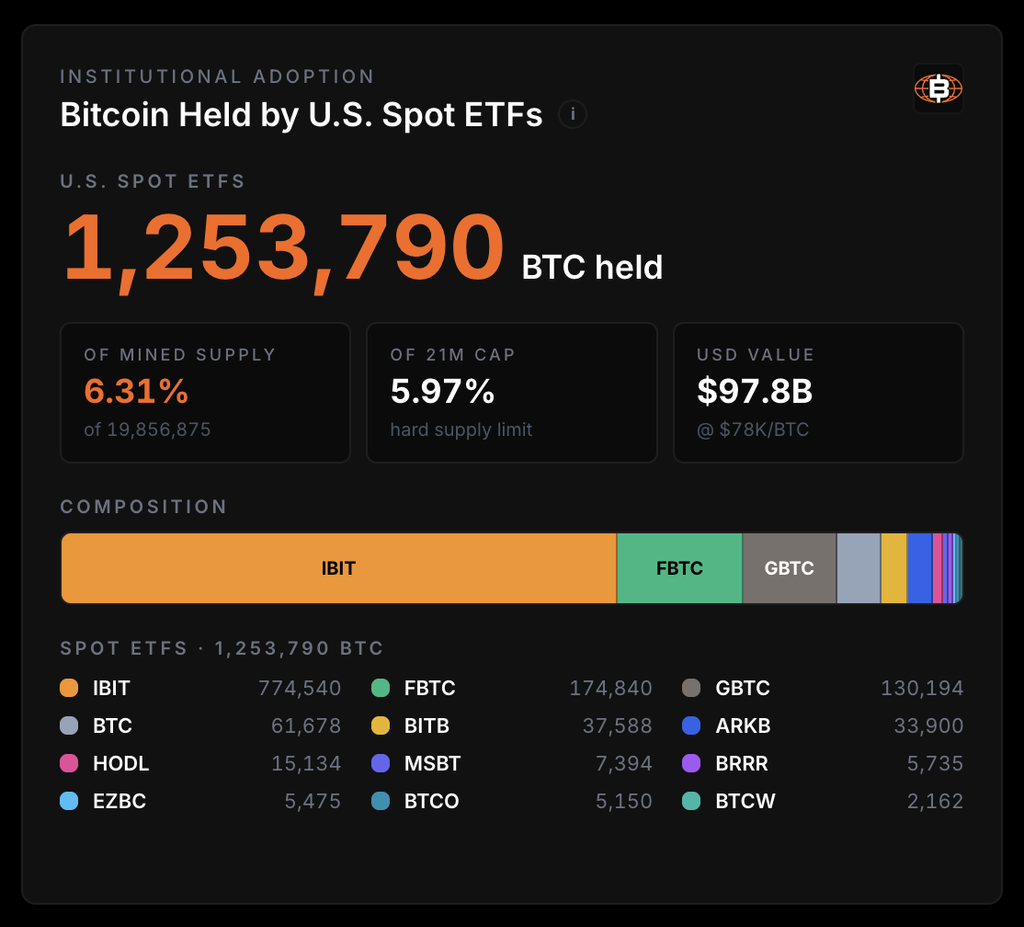
View the full Bitcoin ETF Dashboard.
That does not make BlackRock’s research independent of commercial context; IBIT is an important and increasingly valuable BlackRock product. That context should be understood rather than ignored. But it also means the firm’s reassessment is occurring alongside more than two years of observing how investors actually use Bitcoin exposure at scale.
The distinction is useful. The theoretical case for Bitcoin as a portfolio asset is increasingly being accompanied by observable allocation behavior. Investors have now had access to Bitcoin through familiar brokerage, advisory and institutional infrastructure across multiple market regimes, including periods of rapid appreciation and severe drawdowns. IBIT’s growth suggests that demand has persisted well beyond its initial launch window.
A drawdown is precisely when a thesis should be re-underwritten
The timing of BlackRock’s report may ultimately be more informative than the portfolio simulation itself.
Bitcoin is not being reassessed at an all-time high. BlackRock published the analysis after an approximately 50% drawdown from Bitcoin’s October 2025 peak, a period the firm associates with leveraged positioning being unwound, slowing ETP flows and weaker demand from companies accumulating Bitcoin. Its conclusion is that these forces represented a positioning correction rather than a fundamental change in Bitcoin’s investment case.
That is what re-underwriting is supposed to accomplish. An investment thesis should not survive because investors are attached to it; it should survive because its underlying assumptions continue to hold when conditions change.
For Bitcoin, those assumptions extend beyond historical returns. The asset remains scarce by design, globally liquid, independent of a sovereign issuer and structurally different from the liabilities that dominate traditional portfolios. BlackRock argues that concerns around fiscal sustainability, monetary stability and geopolitical risk may therefore become increasingly relevant to Bitcoin’s long-term adoption.
The portfolio evidence does not prove what Bitcoin will return over the next decade, nor does IBIT’s success establish what an appropriate allocation should be. What the two developments show together is that the institutional conversation has advanced considerably. Bitcoin is no longer being evaluated solely as an unconventional asset that institutions may or may not choose to own. It is increasingly being evaluated through the same disciplines applied elsewhere in capital allocation: sizing, risk contribution, correlation, liquidity, drawdown and expected return.
What this means for corporate leaders
For CFOs, boards and corporate operators, that evolution may be the most important takeaway from BlackRock’s work.
The relevant decision is not whether Bitcoin is volatile; that is already known. Nor does a corporate allocation need to resemble the concentrated Bitcoin strategies pursued by companies that have explicitly built their capital structures around the asset. Between zero exposure and a Bitcoin-centric balance sheet sits a much broader spectrum of possible allocations.
BlackRock’s research provides a useful framework for thinking about that spectrum. A relatively small allocation was sufficient to materially alter the historical return characteristics of a conventional portfolio without producing a comparable increase in portfolio-level risk. At 2%, approximately 190 basis points of additional annualized return came with roughly 50 basis points of additional annualized volatility in the period studied. The allocation was small; its effect was not.
For corporate leaders, the implication is less about adopting BlackRock’s specific allocation range than adopting the discipline behind the analysis. Bitcoin can be underwritten like any other strategic allocation: define its purpose, determine an acceptable risk contribution, establish liquidity and governance requirements, size the position accordingly and periodically revisit the assumptions.
That is a considerably more mature question than whether a company should simply “buy Bitcoin.”
As Bitcoin becomes more deeply integrated into institutional portfolios and financial infrastructure, the burden of analysis is shifting. The question facing the C-suite is increasingly not whether Bitcoin belongs in the conversation, but what allocation, if any, can be justified by the company’s objectives, constraints and cost of capital.
BlackRock has now re-underwritten that question after another full market cycle and a roughly 50% drawdown. Its historical portfolio math still makes the case that, in measured amounts, Bitcoin can improve the equation. For corporate decision-makers, that is the takeaway worth bringing into the boardroom.
Disclaimer: This content was prepared on behalf of Bitcoin For Corporations for informational purposes only. It reflects the author’s own analysis and opinion and should not be relied upon as investment advice. Nothing in this article constitutes an offer, invitation, or solicitation to purchase, sell, or subscribe for any security or financial product.
This post BlackRock Re-Underwrites Bitcoin, and the Portfolio Math Still Holds first appeared on Bitcoin Magazine and is written by Nick Ward.
CryptoSlate
Injective, a layer-1 blockchain network, produced no new block for nearly four hours during an emergency response to an exploit that researchers traced into core modules.
On Sept.1, the foundation said the blockchain was “upgraded, not halted” and that its consensus, native INJ, and staked assets were never compromised. It described the attack as affecting a small number of ecosystem applications using binary-options markets.
On-chain researcher Earthling Paddy challenged both characterizations, while crediting Injective for containing the exploit and keeping staked funds safe.
The ledger shows block 181027005 at 16:09:59 UTC on Aug. 31 before block production stopped for roughly four hours. Paddy said one earlier block alone took about 37 minutes, while infrastructure provider QuickNode also reported a stalled block height during the incident.
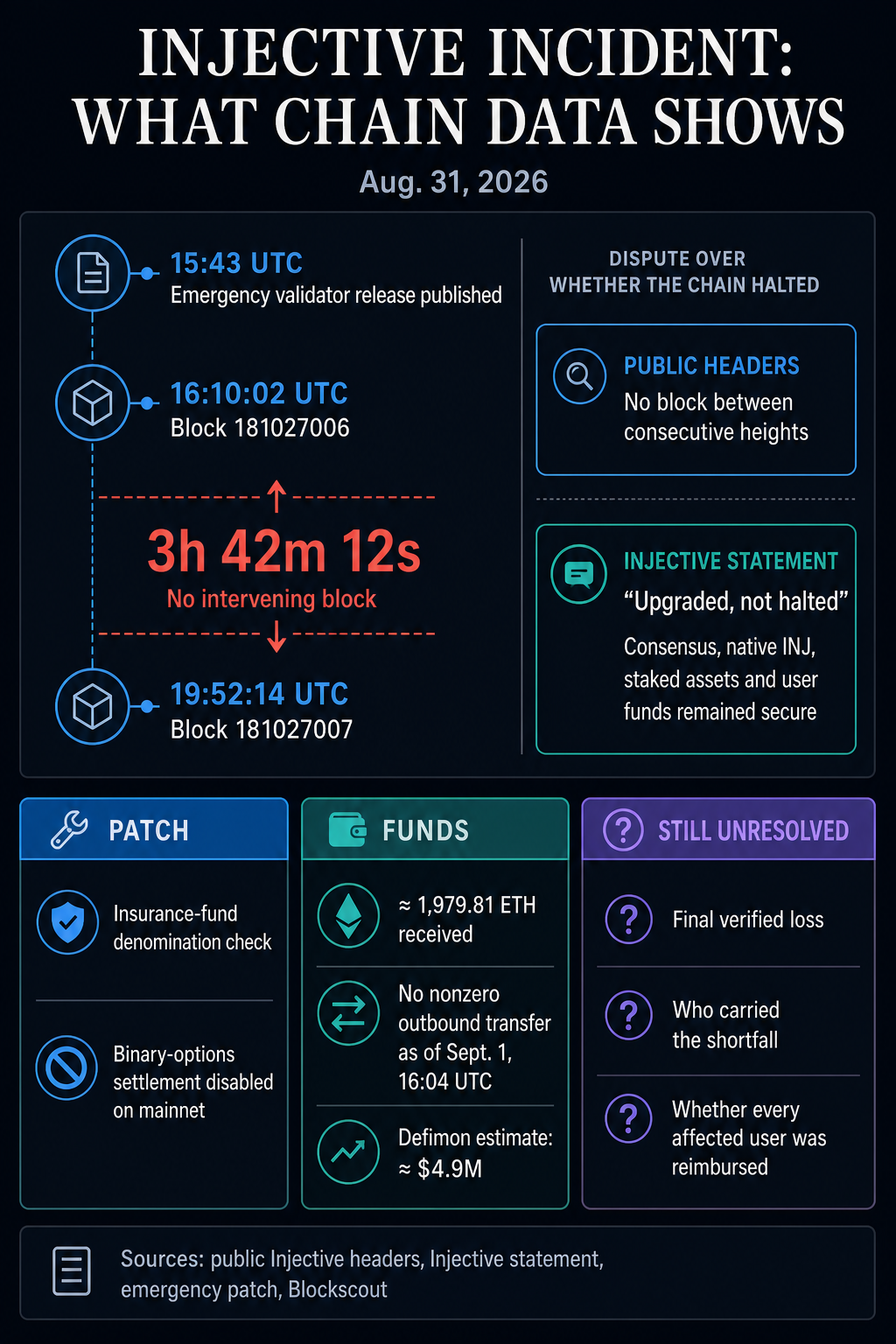
Injective said the accelerated upgrade took longer than expected as validators and ecosystem infrastructure moved to the emergency release. Some validators were temporarily jailed after missing the required upgrade window, while exchanges including Coinbase and Coins.ph temporarily restricted transfers.
Data from CryptoSlate shows INJ trading around $4.80 as of press time, down roughly 3% over the previous 24 hours.
Researcher disputes where the vulnerability sat
Paddy also questioned Injective’s description of the exploit as isolated to ecosystem applications.
He said the attack used messages from Injective’s native exchange and insurance modules, while the emergency v1.20.3-safeharbor.1 release patched the chain’s core code by adding an insurance-fund denomination check and disabling binary-options settlement on mainnet.
That would place the vulnerable logic inside a protocol module used by applications rather than solely within application code.
Injective has not yet published a full technical postmortem. Its statement said the relevant attack vector had been contained and patched and that the foundation was adding stronger invariants, real-time monitoring, and other safeguards.
Researchers estimate about $4.9 million was bridged to Ethereum during the exploit. Paddy said roughly that amount remained in the attacker-linked wallet and had not moved.
The final loss allocation remains unclear. Injective has not disclosed how much was ultimately drained, which party absorbed any shortfall, or whether an ecosystem pool that now appears replenished was restored by the foundation, developers, or another participant.
Instead, the blockchain has maintained that its users weren't affected. In an X post, Injective CEO Eric Chen said:
“Injective users aren’t affected and we’ve been helping the team on recovery. Always sad to see exploits happening in the ecosystem but we’re glad that the incident was contained before further harm was done.”
Nonetheless, the incident therefore leaves two separate findings intact. Injective’s consensus and staked INJ were not compromised, while its emergency response still coincided with a multi-hour interruption in block production and required a core-code patch.
The post A layer-1 blockchain froze for 4 hours to stop a $4.9 million hack, then claimed it was just an upgrade appeared first on CryptoSlate.
Standard Chartered estimated in January that stablecoins could pull about $500 billion from US bank deposits by the end of 2028.
Regional banks looked especially exposed given how much they depend on the spread between what they pay depositors and what they earn on loans.
Now, 21 major financial institutions, including Bank of America, Citi, Goldman Sachs and Wells Fargo, committed Sept. 1 to build one.
The group announced plans to establish a company in the second half of 2026, launch a US dollar-denominated stablecoin in the first half of 2027, and comply with both the GENIUS Act and MiCA.
The venture started as a 10-bank exploration into reserve-backed digital money in October 2025 and has since grown to 21 institutions spanning North America, Europe, Asia, Africa, and the Middle East.
Its stated use cases include wholesale and institutional activity, cross-border payments, digital-asset settlement, and retail markets where client benefits can be achieved.
| Earlier bank concern | Sept. 1 bank response |
|---|---|
| Stablecoins could pull deposits out of banks | 21 institutions committed to launch a bank-backed stablecoin |
| Regional banks could be exposed to funding pressure | Large banks are positioning to capture stablecoin flows |
| Crypto platforms could compete for customer cash | Banks are creating their own digital-dollar product |
| Stablecoins could redirect reserves into Treasuries | Banks may seek a role in reserve management and distribution |
| Payments could move outside bank rails | Banks want stablecoins for cross-border payments, settlement and institutional activity |
Why deposits and stablecoins compete for the same dollar
Bank deposits fund lending and balance-sheet activity, with banks earning income on the spread between what they pay depositors and what they collect on loans.
Stablecoins work as fully backed tokens that hold their reserves in cash, bank balances, and short-dated government securities, with Treasuries making up most of Tether and Circle's reserve holdings.
A dollar moving from a bank account into a stablecoin can remain a dollar in every practical sense while changing who controls the customer relationship, the reserve economics and the payment rail underneath it.
That move in control is what Standard Chartered's warning was about.
Owning the stablecoin migration beats losing the relationship
A bank-backed stablecoin customer moving money from a conventional deposit into a fully reserved token still reduces the bank's traditional funding base.
What a bank-issued stablecoin can preserve is everything built around that deposit: the distribution relationship, the compliance layer, the settlement business and a share of the reserve economics.
Banks appear to be accepting cannibalization of one part of their existing model to avoid surrendering the entire customer relationship to a crypto-native competitor.
Total stablecoin market capitalization stands near $303.7 billion, according to DefiLlama, with Tether's USDT alone accounting for more than 60%.
Citi's 2030 research projects a base case of $1.9 trillion in stablecoin issuance and a bull case of $4 trillion, implying roughly $1.6 trillion to $3.7 trillion of additional issuance from today's level.
Citi's base case also puts annual stablecoin transaction activity near $100 trillion at 50 times velocity, climbing toward $200 trillion under its bull scenario.
The consortium is positioning for a share of that future issuance and transaction flow, a much larger prize than any slice of Tether and Circle's existing balances.
The bank that produced one of the industry's most aggressive stablecoin growth forecasts is simultaneously helping build a company designed to compete inside that forecast. It treats its own projection as a live market opportunity worth entering.
| Metric | Estimate | What it means |
|---|---|---|
| Potential US bank deposit outflow | $500B by end-2028 | Stablecoins could pressure traditional bank funding |
| Current stablecoin market cap | ~$303.7B | The market banks are entering today |
| Citi 2030 base case | $1.9T | Roughly $1.6T of additional issuance from today |
| Citi 2030 bull case | $4T | Roughly $3.7T of additional issuance from today |
| Citi base-case transaction activity | ~$100T/year | Stablecoins become payment and settlement infrastructure |
| Citi bull-case transaction activity | ~$200T/year | The market becomes too large for banks to ignore |
Multiple forms of digital money can coexist
None of this means banks are abandoning tokenized deposits for public-chain stablecoins. Citi's research explicitly expects stablecoins, tokenized deposits, deposit tokens and central bank digital currencies to coexist, and projects that bank-token transaction volume could exceed stablecoin turnover by 2030 even as stablecoin issuance itself keeps expanding.
The more accurate read is that banks want exposure across every plausible form of digital dollar at once. Qivalis, a separate 37-institution consortium building a euro-pegged stablecoin, shows the competitive landscape is already splitting by currency and structure as well as by issuer.
The GENIUS Act takes effect on the earlier of 18 months after its July 2025 enactment, which lands on Jan. 18, 2027, or 120 days after federal regulators finalize implementing rules.
The consortium's first-half 2027 target overlaps that threshold. The same law that gave existing stablecoin issuers regulatory certainty also opened a clear, compliant path for heavily regulated banks to enter the category directly.
That turns a compliance milestone for incumbents into a competitive entry point for their newest rivals.
One warning sign for bank-issued stablecoins is Societe Generale's dollar-backed token, which had just $12.5 million in circulation.
Distribution remains the harder test
Institutional trust and compliance infrastructure do not, by themselves, produce the minting volume, secondary-market liquidity, exchange listings, wallet support, and merchant demand that make a stablecoin useful.
Tether and Circle built years of that kind of distribution, and a consortium of banks cannot replicate it by announcement alone.
Whether the bet pays off or produces a compliant token nobody needs
The bull case has stablecoins approaching Citi's $4 trillion scenario, with bank-backed tokens becoming one of several dominant digital-money formats used across payments, treasury and settlement.
Under that path, deposit substitution turns into a genuine structural funding issue for banks that stayed on the sidelines. Institutions in the consortium capture settlement fees, custody relationships, and reserve income in a market many times larger than today's.
| Scenario | What happens | Who wins | What it means for banks |
|---|---|---|---|
| Bull case: bank stablecoins scale | Stablecoins approach Citi’s $4T scenario and bank-backed tokens gain institutional usage | Consortium banks, regulated issuers, institutional clients | Banks cannibalize some deposits but retain settlement, custody and customer relationships |
| Base case: partial adoption | Bank tokens find use in wholesale, cross-border and institutional settlement but do not displace USDT/USDC broadly | Banks in specific niches; crypto-native issuers in public markets | Banks capture some future flows without fully reshaping deposit funding |
| Bear case: compliant but unused | The consortium launches a well-regulated token that fails to build liquidity or integrations | Existing stablecoins and tokenized-deposit systems | Banks spend years building infrastructure customers do not need |
| Regulatory shock case | Stablecoin rules tighten after a failure, run or liquidity event | Tokenized deposits and bank-controlled rails | Stablecoins lose momentum, and banks pivot harder toward deposit tokens |
The bear case has the consortium building a fully compliant, well-capitalized stablecoin that fails to attract liquidity, matching the same pattern Societe Generale's token already shows.
In that scenario, deposit strain stays limited because stablecoins never scale far past their current niche. The 21 institutions end up having spent years and real capital building infrastructure that crypto-native issuers and tokenized-deposit systems continue to outcompete on usage.
Banks spent months warning that stablecoins could hollow out part of their business. Their answer was to make sure that if the dollar keeps moving onto programmable rails, some of the largest banking names control the rails it moves on.
The post Wall Street is now racing to control the $1.9T stablecoin shift to avoid losing its customer base appeared first on CryptoSlate.
Binance is putting options on more than 1,000 selected US stocks and exchange-traded funds inside the same account that already offers crypto and several forms of equity exposure.
The product is limited to eligible users outside the US, and the securities machinery behind the offer does not belong to Binance.
The company said on Sept. 1 that Nest Trading Limited will introduce the orders and route them to Alpaca Securities LLC. Alpaca will execute, clear, and settle the trades, then custody any shares delivered when an option is exercised.
Eligible customers can move among more products without leaving Binance, while Nest and Alpaca carry distinct responsibilities behind the scenes.
Who does what behind Binance
Binance is the customer-facing access point, Nest Trading is the introducing broker, and Alpaca provides execution and post-trade infrastructure.
An options customer places an order through Binance, but Nest introduces it to Alpaca. If physical settlement produces shares, Binance says Alpaca holds them on the user's behalf.
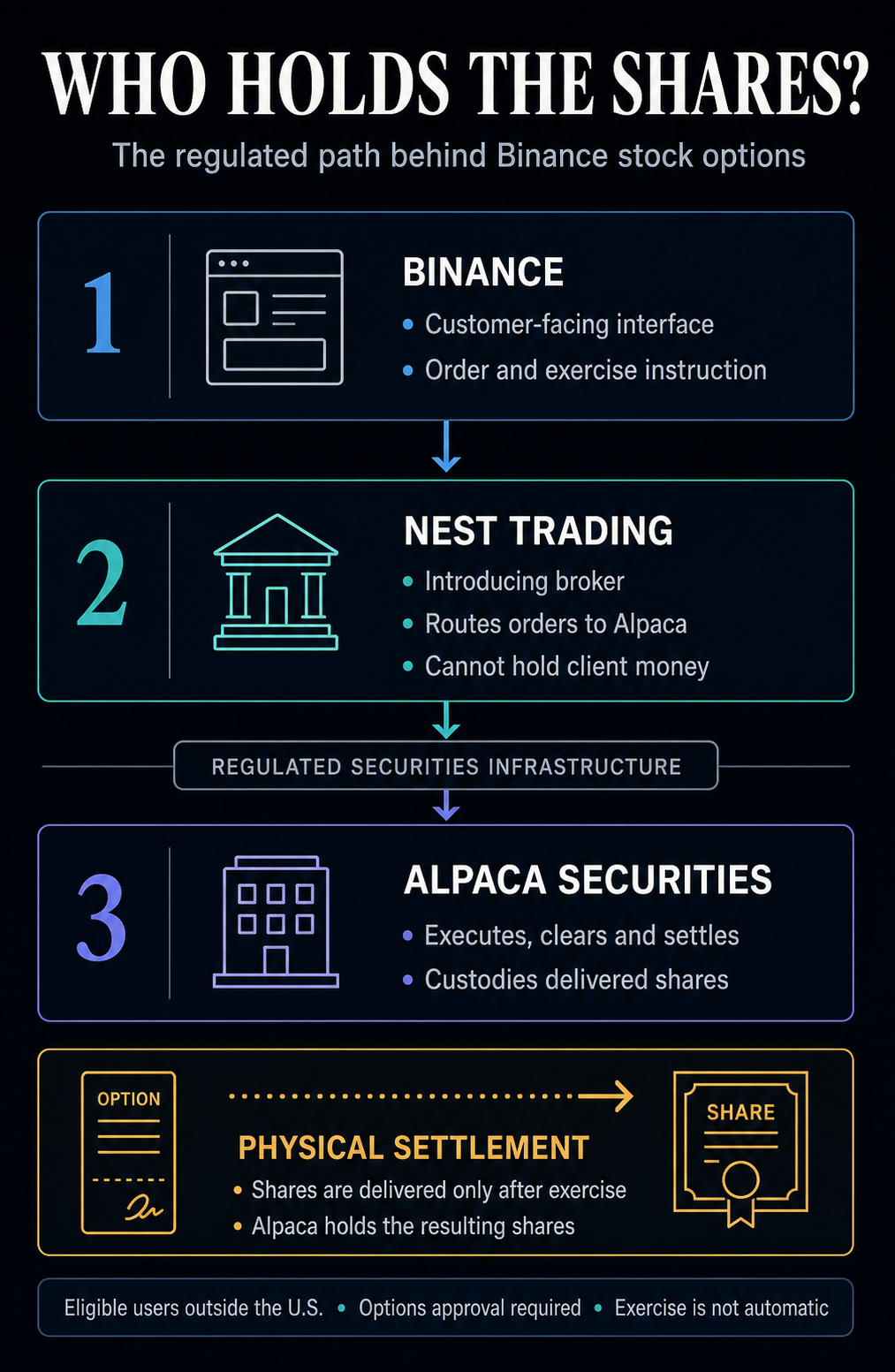
Nest's Abu Dhabi Global Market register lists the firm as active under financial services permission 260000. Its permitted activities include arranging deals, dealing as an agent, and arranging custody, but the register says Nest cannot hold or control client money.
Alpaca's FINRA BrokerCheck profile identifies the firm as SEC- and FINRA-approved and lists options activity, securities clearing and settlement, and electronic trading among businesses it conducts or expects to conduct.
The profile also says Alpaca can hold or maintain funds or securities and provide clearing services for other broker-dealers.
The contracts are physically settled. Exercising a call can produce the underlying shares, while exercising a put can require delivery of them. Until exercise and settlement, the option is a contractual right.
Binance says an exercise instruction must be submitted through its platform by the relevant cutoff, as late as 30 minutes before expiry. Even an in-the-money contract will not exercise automatically without that instruction.
A position without an instruction becomes subject to best-efforts auto-liquidation before trading closes. If it cannot be sold, it may expire worthless, leaving the holder with a loss of the premium.
Binance said eligible retail users may buy calls and puts, with maximum potential loss limited to the premium. The statement does not extend that defined-loss description to option-writing strategies.
The exchange also says that the options remain subject to jurisdictional and user restrictions. Alpaca's options documentation says every customer account must be approved before its first options trade, with financial circumstances, experience, risk tolerance and investment objectives supplied alongside a signed options agreement.
Four products behind one account
The options join three existing routes to equity exposure inside Binance. A single account can make them look adjacent, but their ownership and settlement mechanics differ.
| Product | What the user holds | Ownership or settlement |
|---|---|---|
| Direct U.S. stocks | Shares | Direct equity ownership held through a U.S.-regulated clearing broker |
| bStocks | Tokenized securities | No direct ownership of the underlying company share |
| Equity-linked perpetuals | Derivative exposure | No delivery of the underlying share described |
| Stock options | A right to buy or sell | Underlying shares are delivered or received after exercise and held by Alpaca |
Binance made the ownership distinction explicit when it introduced direct stock trading and previewed bStocks in June. It said direct-stock users would own equities held by a US-regulated clearing broker, while bStocks would not give holders direct ownership of the underlying company shares.
The options add another regulated route, consolidating convenience for users.
Shunyet Jan, Binance's head of exchange and trading, called stock options an “important next step” toward a “fuller multi-asset platform.” Binance said equity-linked perpetuals generated about $342.9 billion in volume during August, represented about 79% of its TradFi perpetual activity and grew more than 800-fold from January.
The launch release shows how Binance is presenting demand within its own ecosystem, but it does not establish how much demand the new physically settled contracts will attract.
The options announcement expands what a crypto account can distribute. Binance controls product discovery and the customer experience, while Nest and Alpaca define the operational route into regulated securities markets.
That structure gives Binance much of the strategic benefit of a securities super-app without making it the entity that executes, clears, or custodies every product on screen.
For users, the practical test is whether they understand which firm holds the asset, which rules govern the account, and which action they must take before an option expires.
The post Binance deepens TradFi push with physically settled options on over 1,000 US equities appeared first on CryptoSlate.
Cardano’s 2026 Constitutional Committee renewal had crossed both voting thresholds in a pre-boundary snapshot on Sept. 1, but formal ratification still waited for the epoch change. The narrow margin on the stake pool side exposed how non-participation can become an effective veto in the network’s on-chain governance.
Cardano divides governance authority among delegated representatives, stake pool operators, and the Constitutional Committee.
DReps vote with ADA delegated to them, SPOs represent block-producing stake pools, and the committee reviews the constitutionality of actions that require its approval. For an update to the committee’s own membership, DReps and SPOs vote while the committee does not.
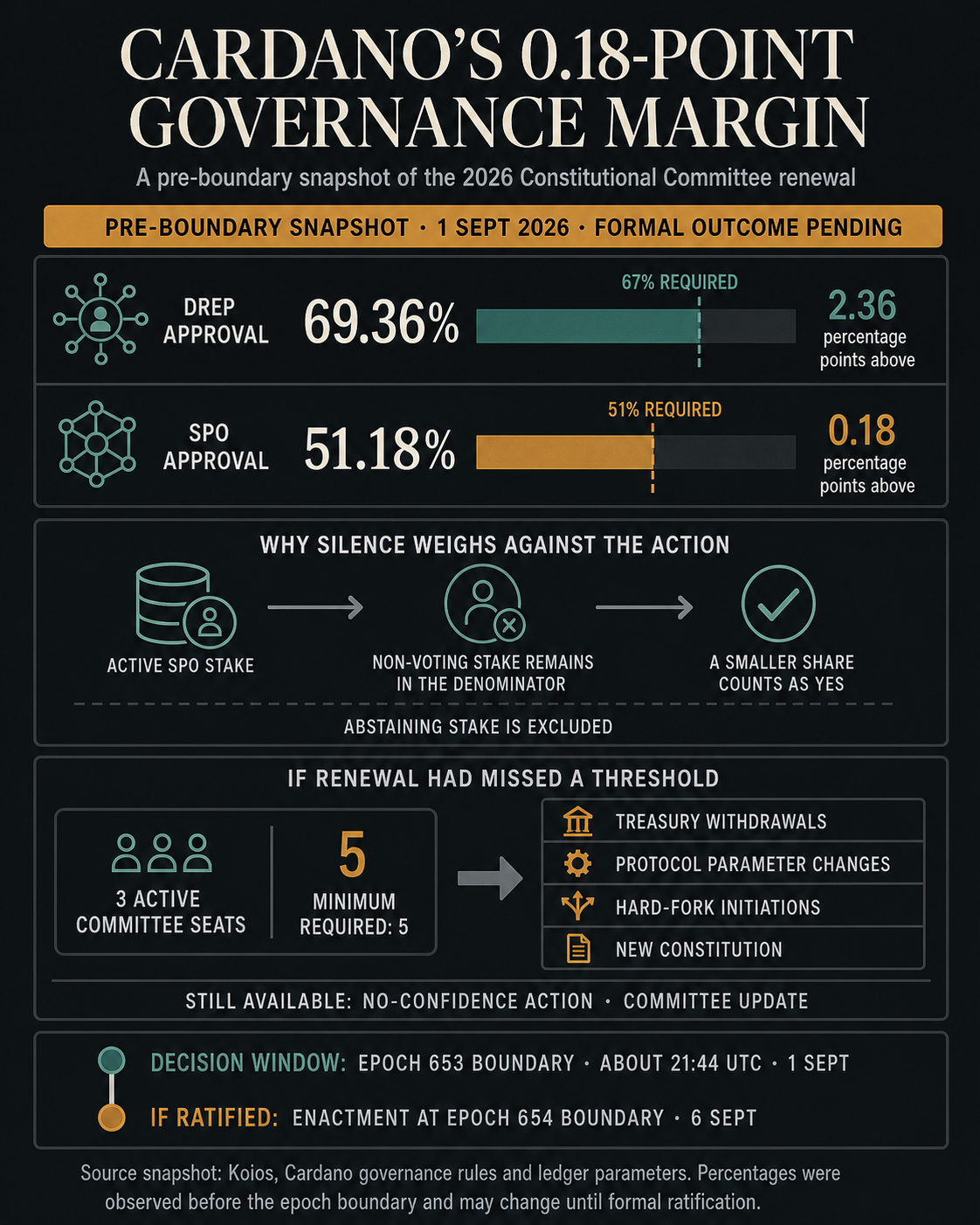
A synchronized Koios voting snapshot retrieved at about 09:59 UTC showed DRep support at 69.36% against a 67% threshold. SPO support stood at 51.18% against a 51% requirement, leaving a margin of 0.18 percentage points at that observed moment.
The proposal’s on-chain record still showed no ratification, enactment, or expiration, and the Koios chain tip remained in epoch 652. The decision was due at the boundary into epoch 653 at about 21:44 UTC on Sept. 1.
| Measure | Pre-boundary snapshot | Requirement or timing |
|---|---|---|
| DRep approval | 69.36% | 67% threshold met |
| SPO approval | 51.18% | 51% threshold met |
| Formal outcome | Pending in epoch 652 | Decision at epoch 653 boundary |
| Enactment if ratified | Pending | Epoch 654 boundary on Sept. 6 |
The thresholds come from Cardano’s epoch-652 protocol parameters, while Cardano's governance overview and CIP-1694 set out the division of voting authority.
The key mechanism sits inside the SPO denominator. The Cardano Developer Portal’s governance rules say stake behind a pool that does not cast a ballot remains against ratification in the effective calculation. The pool has not submitted an explicit No, but its uncast stake still makes the Yes threshold harder to reach.
Abstention follows a different path. Explicit abstentions and stake assigned to alwaysAbstain are removed from the effective calculation.
The Koios breakdown separated roughly 2.008 million ADA of explicit SPO No votes from about 5.316 billion ADA in the total No or default-No side of the calculation. The gap indicates that non-participating stake created most of the drag on approval.
The four committee seats due to lapse raise the stakes of that denominator rule. Those seats remain valid through epoch 653 and expire as epoch 654 begins on Sept. 6. Without an enacted renewal, the committee would fall to three active members, below the minimum of five.
The five-seat line
Voting closes as epoch 652 ends, and ratification is assessed at the boundary into epoch 653. If the update is ratified there, it is scheduled to enact one epoch later at the start of epoch 654, the same boundary at which the four current seats lapse. The action page and a ledger-focused chronology align those two events.
A committee below its five-member minimum could not supply the approval required for new treasury withdrawals, protocol parameter changes, hard fork initiations, or a new constitution. The Cardano ledger implementation treats an undersized committee as lacking the voting threshold needed for actions that require committee approval.
No-confidence and update-committee actions would remain available because the committee does not vote on them. The cited protocol rules describe a ratification bottleneck affecting specified governance actions.
If the threshold-crossing snapshot held through the epoch boundary and the ledger ratified the action, the immediate three-seat bottleneck would be avoided. The vote would still leave a governance lesson: SPO approval rested just 0.18 percentage points above the line after billions of ADA in non-voting stake weighed against passage.
Intersect had warned that failed renewal could interrupt governance continuity and may affect progress toward Dijkstra, Cardano’s next hard-fork program. Cardano has separately described the constitutional preparation required for Dijkstra.
Those sources frame a timeline impact as a risk rather than a confirmed delay.
At the latest synchronized pre-boundary snapshot, late voting had moved the renewal above both thresholds. Its razor-thin SPO margin still demonstrated the force of Cardano’s participation rule: when uncast stake remains in the denominator, governance silence can decide whether the network’s decision-making machinery keeps moving.
The post Cardano clears key voting thresholds for constitutional committee renewal by 0.18% margin appeared first on CryptoSlate.
DeFi Technologies reached its Sept. 1 Nasdaq minimum-bid deadline after its US-listed DEFT shares closed Aug. 31 at $0.6032, making it impossible to complete the required 10-business-day streak at or above $1.
The threshold miss moves the company into an eligibility review, with either a second compliance window or a written delisting determination as the next formal outcome.
Nasdaq notified DeFi Technologies on March 5 that DEFT had closed below $1 for 30 consecutive business days as of March 4, and gave DeFi Technologies an initial 180-calendar-day period ending Sept. 1.
The stock's daily history through Aug. 31 showed every August close below $1, so a move above the threshold during the Sept. 1 session could not produce the required consecutive closing-price streak in time.
Nasdaq's test uses consecutive closing prices. DEFT entered the final day without an active qualifying streak, and the Aug. 31 close was about 40% below the $1 threshold. The company's March filing also said Nasdaq staff can require generally up to 20 consecutive business days before confirming compliance.
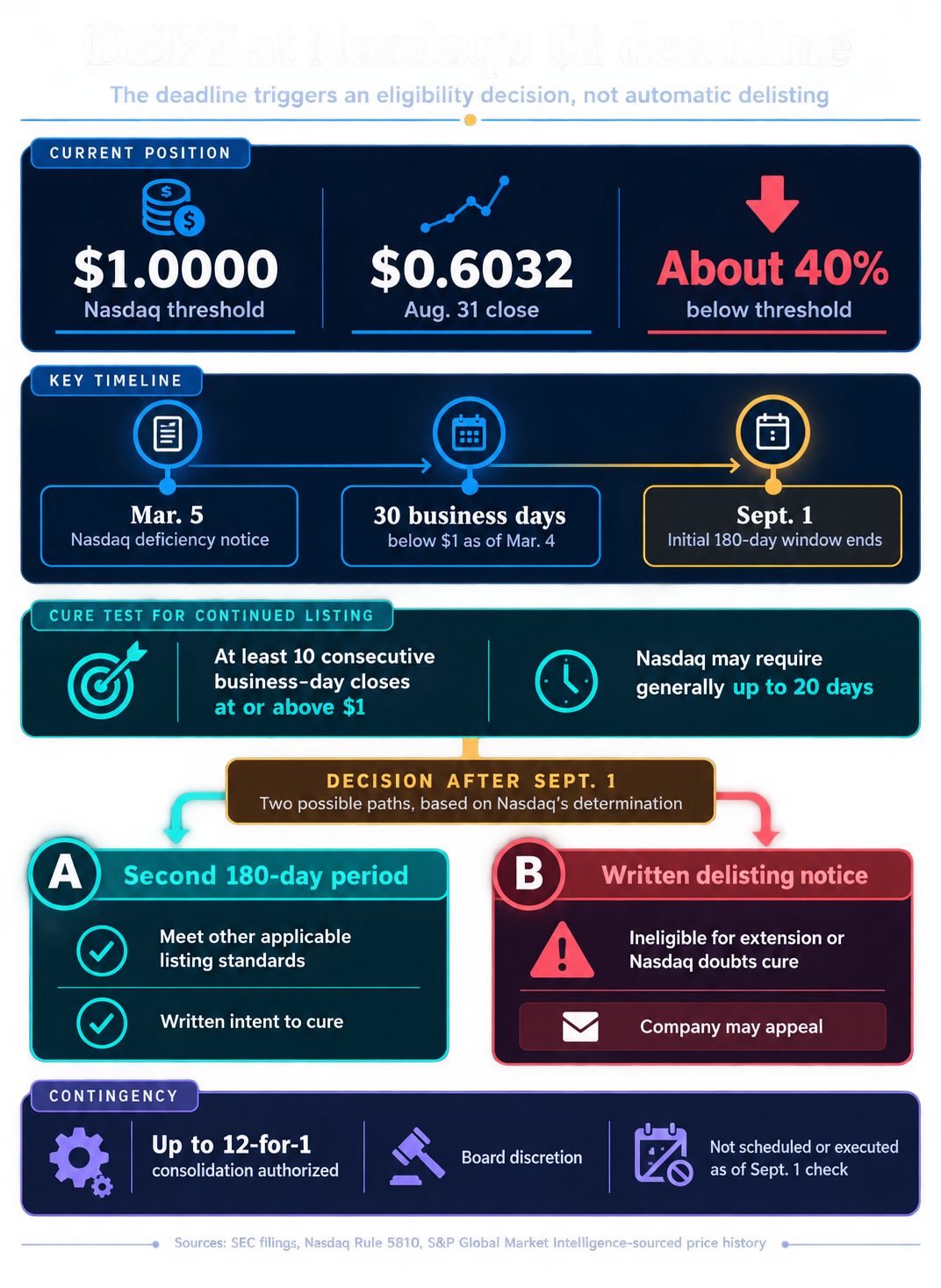
Extension or delisting notice
Nasdaq can grant a second 180-calendar-day period if DeFi Technologies satisfies the continued-listing requirement for the market value of publicly held shares and all other applicable initial standards for the Nasdaq Capital Market, apart from the bid-price rule.
The company must also notify Nasdaq in writing that it intends to cure the deficiency during the additional period.
If DeFi Technologies does not qualify, or Nasdaq staff concludes it cannot cure the deficiency during a second window, Nasdaq would issue written notice that the shares are subject to delisting. The company could appeal that determination to a Nasdaq hearings panel.
Shareholders have already authorized the board to conduct a share consolidation of up to 12-for-1. The annual meeting circular left the board to decide whether and when to use that authority, making the consolidation a contingency rather than a committed corporate action.
The authorization allows the board to choose a consolidation ratio up to the approved limit before the next annual meeting, or to take no action. That flexibility gives DeFi Technologies a mechanism for addressing the per-share requirement while leaving the decision dependent on its Nasdaq compliance path.
DeFi Technologies' Aug. 13 management filing still described the company as noncompliant and identified the authorized consolidation as a mechanism available to address the bid-price requirement. Company materials through Sept. 1 showed no scheduled or executed consolidation.
At 11:19 UTC on Sept. 1, the company's public newsroom and SEC submissions contained no announcement of a second compliance period, a delisting determination, regained compliance, or an executed consolidation.
The post DeFi Technologies misses Nasdaq $1 deadline as DEFT faces delisting review appeared first on CryptoSlate.
HTTP error 429 on https://cryptoticker.io/en/feed/
Failed to fetch feed: https://cryptoticker.io/en/feed/
Failed to fetch feed.
Decrypt
So far, Rektember is living up to its name as Bitcoin slips. Will this September follow the historical averages, or break the trend?
CrowdStrike and the DOJ isolated more than 15,000 infected machines in a malware takedown spanning four countries.
New Form TA-2 questions would make agents report how many share registers they keep on distributed ledgers.
The North Carolina Republican bought less than $1,000 of contracts on her own race and drew a three-year ban.
The open-source agent framework that started the "autonomous AI" hype cycle just shipped its biggest update ever, almost by accident, and it's coming for the enterprise now.
U.Today - IT, AI and Fintech Daily News for You Today
Dogecoin is certainly not finding a recovery ground as quickly as we anticipated.
A Shiba Inu mega whale has moved another 600 billion SHIB worth roughly $3.09 million.
Crypto community gets safety warning as Coinbase adds support for wrapped Zcash and HYPE assets.
XRP reserve on Binance falls to its lowest monthly average since February 2024 as over 500 million XRP find their way out of the exchange.
XRP Ledger is closer to the long-awaited million threshold.
Blockonomi
Key Takeaways
- GitLab shares climbed 21% to $54.53 in premarket trading following second-quarter results that exceeded Wall Street projections.
- Second-quarter revenue reached $286.3 million, representing a 21% year-over-year increase and surpassing the $273.1 million forecast.
- Non-GAAP earnings per share hit 25 cents, significantly topping the Street’s 18-cent projection.
- William Blair moved GTLB to Market Perform from Underperform, though analysts refrained from issuing a Buy recommendation.
- The DevOps platform provider increased its fiscal 2027 annual revenue projection to $1.131 billion.
Shares of GitLab rallied 21% to $54.53 in Wednesday’s premarket session following the software company’s impressive second-quarter earnings results. The stock had previously climbed 46% during the three-month period ending with Tuesday’s market close.
GitLab Inc., GTLB
Second-quarter revenue totaled $286.3 million, marking a 21.3% year-over-year gain and beating Wall Street’s $273.1 million projection. Non-GAAP earnings per share of 25 cents topped the consensus estimate of 18 cents. Adjusted operating income reached $42.6 million, exceeding analyst expectations of $31.3 million.
The results demonstrated momentum across multiple metrics. Transactions valued at $500,000 or more increased by over 150% compared to the same period last year. Ultimate-tier annual recurring revenue expanded approximately 35% and now represents 59% of total ARR. Software-as-a-service revenue surged 36%, comprising 34% of overall revenue.
GITLAB $GTLB Q2’27 EARNINGS HIGHLIGHTS
Revenue: $286.3M (Est. $273M)
; +21% YoY
FY27 Guide:
— Wall St Engine (@wallstengine) September 1, 2026
The company posted record gross bookings for the period. Net ARR growth showed acceleration, while net dollar retention improved on a sequential basis for the first time since 2024.
Strengthening Sales Performance
First-order volume more than doubled to approximately 1,700, while net ARR from first orders jumped 39%. The company expanded account executive headcount by roughly 30%, while productivity per sales representative improved by about 10%. Activity in the small and medium business segments stabilized, and the company reported higher competitive win rates.
GitLab’s Duo Agent Platform experienced approximately 50% sequential growth in paid consumption. Secure repositories expanded 60%, code pushes increased 50%, and CI/CD pipeline usage grew roughly 40%.
The platform’s Flex subscription offering generated robust early traction. Management also highlighted improving win rates against competitors across different regions and customer segments.
Management Increases Annual Forecast
GitLab raised its fiscal 2027 full-year outlook. The company now anticipates revenue of $1.131 billion, representing an 18.4% increase from the previous fiscal year. Management projects an adjusted operating margin of 13.3% and non-GAAP earnings per share of 86 cents.
Third-quarter guidance calls for revenue of $282 million and adjusted earnings per share of 20 cents.
William Blair raised its rating on the stock to Market Perform from Underperform. Analyst Jason Ader cited widespread improvements in growth metrics, sales execution, and customer expansion as justification for the upgrade.
However, Ader emphasized this doesn’t constitute a full buy signal. “One quarter does not resolve long-term questions about AI-driven disruption in the dev tools market,” he noted in his research report.
William Blair highlighted competitive pressures as a significant concern. GitLab faces competition from Microsoft’s GitHub, Anthropic’s Claude Code, and Cursor, which SpaceX recently acquired in a $60 billion transaction.
The firm stated it requires additional evidence that the recent bookings momentum can be sustained and that Flex will generate incremental revenue rather than simply reallocating existing customer commitments. Analysts also identified potential pressure on seat-based pricing models as a headwind.
Notwithstanding the strong quarterly performance, William Blair declined to issue a Buy rating, emphasizing the need for GitLab to demonstrate the staying power of its recent growth catalysts.
The post GitLab (GTLB) Stock Soars 21% on Strong Q2 Earnings Beat – Is It a Buy? appeared first on Blockonomi.
TLDR
- FCEL drops 11.59% as Q3 revenue falls 29% despite total backlog reaching $3.6B
- FuelCell Energy posts deeper Q3 losses while total backlog expands to $3.6B
- FCEL slides pre-market as gross loss widens sharply in fiscal third quarter
- FuelCell Energy adds major data center deals as quarterly revenue declines 29%
- FCEL targets manufacturing growth after backlog jumps to roughly $3.6B in Q3
FuelCell Energy (FCEL) shares fell 11.59% to $15.10 pre-market after the company reported weaker third-quarter revenue and deeper operating pressure. Revenue dropped 29% to $33.0 million, while gross loss widened sharply to $24.5 million from $5.1 million. However, the company expanded total committed and awarded capacity backlog to $3.65 billion, driven largely by Fit Energy commitments.
FuelCell Energy, Inc., FCEL
FCEL Stock Falls After Revenue Decline
FuelCell Energy recorded a $45.3 million net loss, down from a $91.9 million loss one year earlier. Still, adjusted EBITDA weakened to a $36.7 million loss, compared with a $16.4 million loss last year. The company linked the decline mainly to inventory valuation charges tied to the initial Fit Energy project phase.
Product revenue fell as FuelCell Energy delivered fewer modules to Korean customers than during the comparable quarter. Generation revenue also declined because several plants produced less electricity, including the Groton Project at a Connecticut submarine base. The company reported $18 million in product revenue from completed module deliveries at South Korea’s Gyeonggi Green Energy park.
FuelCell Energy ended July with $737.3 million in cash and restricted cash, up significantly from October 2025. Unrestricted cash reached $658.1 million, while restricted balances totaled $79.2 million at quarter-end, supporting planned manufacturing investments and operations. The company strengthened liquidity through a July stock offering and additional shares sold through its open market agreement.
FuelCell Energy Backlog Reaches $3.65 Billion
Committed backlog rose 4.1% to $1.30 billion, compared with $1.24 billion during the previous year. FuelCell Energy also added $2.35 billion in awarded capacity backlog linked to Fit Energy’s optional expansion phases. Those awards cover up to 350 megawatts, while Fit Energy must elect each phase before payment obligations begin.
The Fit Energy agreement could cover 380 megawatts across four phases for data center power projects. FuelCell Energy expects to begin delivering the initial 30-megawatt phase during the fourth quarter of fiscal 2026. The company also signed a reservation agreement for a planned 75-megawatt Texas data center project after quarter-end, with upfront payment.
Beyond backlog growth, FuelCell Energy continued expanding its Torrington manufacturing plant toward 500 megawatts of annual production capacity. The company expects to reach a 100-megawatt annualized production rate by October 2026 and complete expansion by June 2028. It also advanced projects with Siemens and ExxonMobil, supporting larger power deployments and industrial carbon capture development.
The post FuelCell Energy, Inc. (FCEL) Stock: Drops as Q3 Losses Deepen Despite $3.6 Billion Backlog appeared first on Blockonomi.
Key Highlights
- Shares of Eos Energy (EOSE) climbed 12% following the announcement of a strategic clean energy partnership with Google and MN8 Energy in West Virginia.
- The initiative integrates 86 MW of solar generation with 10 MW/100 MWh of Eos’ proprietary Z3 zinc-based storage plus 70 MW/280 MWh of lithium-ion batteries.
- Google has committed to acquiring all energy output, grid capacity, and renewable energy credits from the facility.
- Total capital expenditure for the venture is projected at $350 million, with approximately 200 construction positions anticipated.
- The partnership marks Google’s inaugural deployment of Eos’ domestically manufactured Z3 platform and the initial project from the MN8-Eos Master Supply Agreement.
Shares of Eos Energy Enterprises (EOSE) experienced a 12% surge on Wednesday following the announcement of a strategic partnership with MN8 Energy and Google to develop a combined solar and battery storage facility in West Virginia.
Eos Energy Enterprises, Inc., EOSE
The facility will be constructed on a former coal mining site in Kanawha County. MN8 Energy has been designated as the owner and operator, branding the venture as Mammoth Solar.
The installation features 86 MW of utility-scale solar panels integrated with dual storage technologies. Eos will deploy 10 MW/100 MWh of its innovative Z3 zinc-based long-duration energy storage, complemented by 70 MW/280 MWh of conventional lithium-ion battery systems.
The combined infrastructure aims to supply consistent, renewable, dispatchable electricity to the PJM interconnection grid continuously, specifically tailored to support the energy demands of Google’s regional data center operations, including a forthcoming West Virginia facility.
Google has agreed to procure all electricity production, grid capacity rights, and renewable energy certificates from the installation. This initiative aligns with Google’s broader strategy to introduce fresh clean energy capacity to electrical grids serving its operational infrastructure.
Pioneering Technology Deployment
This venture represents Google’s inaugural implementation of Eos’ U.S.-manufactured Z3 battery technology. Additionally, it serves as the debut project emerging from the previously established MN8-Eos Master Supply Agreement.
The Z3 platform delivers 10 hours of energy storage duration, enabling solar-generated electricity to be dispatched well beyond what conventional lithium-ion configurations typically support. The project also represents West Virginia’s first commercial-scale long-duration energy storage installation.
The solar component is scheduled to begin commercial operations in 2028. The lithium-ion storage segment will follow in 2029, while the long-duration Z3 technology is planned for activation in 2030.
Financial and Employment Benefits
The initiative involves an estimated total capital commitment reaching $350 million. Throughout its first two decades of operation, the facility is forecasted to contribute approximately $4 million in property tax revenues benefiting Kanawha County and local educational institutions.
The construction phase is anticipated to generate roughly 200 employment opportunities, with ongoing full-time and part-time positions expected throughout the facility’s operational lifespan.
Eos maintains its corporate headquarters and production facilities in Pittsburgh, Pennsylvania, ensuring localized supply chain operations.
This agreement emerges amid growing demands on data center operators to procure dependable, environmentally sustainable power supplies. Google has been proactively pursuing long-duration energy storage investments as a cornerstone of its comprehensive energy approach.
Nathan Kroeker, Chief Commercial Officer at Eos, noted that the Z3 platform “extends the value of clean generation across more hours, strengthens the overall portfolio, and delivers more dependable capacity when it’s needed most.”
MN8 CEO Jon Yoder remarked that the venture demonstrates the potential when a client like Google is “willing to pair next-generation storage with utility-scale solar.”
The 12% appreciation in EOSE shares occurred on September 2, 2026, coinciding with the partnership announcement.
The post Eos Energy (EOSE) Stock Surges 12% on $350M Google Energy Deal in West Virginia appeared first on Blockonomi.
Key Takeaways
- NIO’s third quarter revenue forecast of approximately $5 billion fell short of analyst expectations of $5.3 billion
- Second quarter revenue reached $4.7 billion, marking a 69% year-over-year increase, with adjusted profits reaching breakeven
- J.P. Morgan shifted its rating from Overweight to Neutral while reducing its price objective from $7.00 to $4.50
- The company’s vehicle gross margin expanded to 18.5% during Q2, though future cost challenges from battery and chip expenses loom
- The investment bank dramatically reduced its 2027 adjusted earnings projection by 52%, now anticipating a net loss of 975 million yuan
The Chinese electric vehicle manufacturer posted second quarter revenue of $4.7 billion, representing a 69% year-over-year surge, while achieving breakeven on an adjusted profit basis. Analysts had anticipated a 4-cent per share deficit on $4.8 billion in sales, making the actual performance marginally better than projected.
NIO Inc., NIO
However, the company’s American Depositary Receipt plunged 6.4% in after-hours trading and continued declining by approximately 1.4% to $4.17 during Tuesday’s U.S. session. The shares had already retreated 17% year-to-date and 34% over the trailing twelve months prior to the earnings announcement.
The primary concern centered on the third quarter projection. The automaker forecasted revenue of around $5 billion, significantly trailing the $5.3 billion consensus estimate from Wall Street analysts. This shortfall triggered the negative market reaction.
Management anticipates delivering approximately 109,500 vehicles during the third quarter, suggesting roughly 37,500 September deliveries. Year-to-date through August, the manufacturer has delivered 262,893 vehicles in 2026, reflecting 58% year-over-year growth.
Chief Executive William Bin Li emphasized robust performance across the vehicle portfolio. The refreshed ES8 model achieved its 140,000th delivery milestone in just 335 days. The ES9, which launched in May 2026, has likewise demonstrated strong traction.
Li also spotlighted the ONVO brand as the market leader within China’s $30,000 to $45,000 large SUV category, while noting that Firefly has maintained the number one position in China’s premium small-car segment for 15 consecutive months.
Investment Bank Reduces Rating and Price Objective
J.P. Morgan moved its rating on the stock to Neutral from Overweight on Tuesday, slashing its price target from $7.00 to $4.50. The firm pointed to softening demand in China’s passenger vehicle sector, intensifying price wars, and minimal international market penetration.
The institution recognized the company’s Q2 vehicle gross margin of 18.5% as encouraging, particularly considering approximately 4 billion yuan in per-vehicle cost inflation versus late 2025 levels. However, analysts cautioned that additional cost pressures are approaching.
Company leadership itself identified another 2,000 to 3,000 yuan per vehicle cost escalation expected during the second half of 2026, primarily stemming from battery and memory chip expenses. Given the competitive landscape, transferring these costs to consumers will prove challenging.
The investment bank reduced its 2026 revenue projection by 5% and its 2027 estimate by 9%. Its adjusted net income outlook shifted dramatically, now forecasting a 975 million yuan deficit in 2027, compared to a previous projection of 2.52 billion yuan in profit.
Updated Financial Projections
The firm also lowered its delivery expectations, projecting 430,000 vehicles in 2026 and 480,000 in 2027, representing growth rates of 32% and 12% respectively. Analysts anticipate China’s overall passenger vehicle demand to remain flat or decline by up to 5% in 2027.
This environment makes NIO’s ambitious long-term target of 40% to 50% volume expansion appear increasingly difficult to achieve. J.P. Morgan indicated it favors BYD and Geely among Chinese automotive manufacturers due to their superior earnings stability and international expansion capabilities.
The EV maker delivered 71,770 vehicles during the combined July and August period. The company’s full-year delivery objective now faces heightened challenges given the competitive pressures and demand dynamics within the Chinese market.
The post NIO (NIO) Stock Slides as Weak Q3 Guidance Triggers J.P. Morgan Downgrade appeared first on Blockonomi.
Key Highlights
- Shares of Equinix climbed 2% Wednesday following the reveal of the Equinix Inference Exchange initiative
- The initiative was developed in partnership with Nvidia and Together AI
- More than 200 open-source models are supported via Together AI’s inference platform
- The announcement took place at Equinix Horizon, the company’s inaugural customer and partner gathering
- The Equinix Inference Exchange platform will launch in Q1 2027
Equinix (EQIX) shares advanced 2% Wednesday following the company’s announcement of Equinix Inference Exchange, a distributed artificial intelligence inference platform developed in partnership with Nvidia and Together AI.
Equinix, Inc., EQIX
This initiative integrates Nvidia’s Enterprise Reference Architectures with Together AI’s inference technology and Equinix’s worldwide data center network. The platform aims to enable businesses to implement AI workloads with greater speed, reduced expenses, and enhanced scalability.
Together AI’s technology provides access to over 200 open-source models. These models will be accessible through Equinix’s international data center footprint and linked via Equinix Fabric to cloud platforms, networks, and AI service providers.
The reveal occurred during Equinix Horizon, the company’s first-ever customer and partner conference. During the same event, Equinix also introduced Equinix Fabric One, designed to facilitate enterprise connectivity across distributed AI infrastructures.
Chief Executive Adaire Fox-Martin stated the organization is “uniquely positioned” to address enterprise AI requirements, referencing almost 30 years of experience constructing infrastructure for mission-critical workloads.
Platform Architecture Explained
The offering is built on a three-tier architecture. Equinix delivers the foundational infrastructure layer, encompassing power systems, cooling capabilities, and operational management. Nvidia contributes its Enterprise Reference Architectures and AI hardware infrastructure. Together AI operates the inference layer, managing both shared and dedicated deployment configurations.
The platform establishes connections to inference providers throughout major metropolitan areas globally, engineered to minimize time-to-first-token. It also integrates with an extensive array of cloud services, network providers, and AI platforms to streamline deployment processes.
Equinix presently manages over 280 data centers spanning 77 metropolitan markets, featuring 230 cloud on-ramp connections and more than 10,500 interconnected enterprises. Eight of the leading 10 AI model providers and nine of the top 10 AI cloud platforms currently utilize Equinix infrastructure.
Target Applications and Use Cases
Equinix Inference Exchange addresses three primary enterprise scenarios. First is metro edge inference, which positions AI processing closer to end users and data sources for reduced latency. Second is open model migration, assisting organizations transitioning from proprietary models to open-source frameworks. Third is sovereign AI, supporting enterprises in regulated sectors requiring AI workloads to operate within designated geographic boundaries.
Nvidia Vice President Raj Mirpuri commented that the collaboration “turns the world’s leading digital interconnection platform into a global fabric for AI inference.”
Together AI co-founder and Chief Executive Vipul Ved Prakash noted the partnership demonstrates that model selection and performance “are not trade-offs” but instead “the foundation of enterprise AI done right.”
The Equinix Inference Exchange platform is scheduled for availability beginning in the first quarter of 2027.
The post Equinix (EQIX) Stock Climbs 2% Following Major Nvidia Partnership Announcement appeared first on Blockonomi.
CryptoPotato
You have all probably heard the speech that Ursula von der Leyen, the European Commission President, gave at the annual conference “La Rencontre des Entrepreneurs de France 2026,” held on August 26th. It’s been circulating on crypto Twitter like wildfire throughout the past few days.
To those of you who might have missed it, her message was rather clear: the world has already changed, and Europe must respond by becoming more independent, more industrially capable, and more willing to direct capital toward strategic priorities.
Von der Leyen argued that many of the assumptions that once underpinned the Union’s economic model have disappeared. Part of her point was that Europe must become a continent that “produces, invests and protects.” She said that the expanding access to China, open global trade, strategic American protection, cheap imported energy, as well as the West’s technological dominance can no longer be taken for granted.
And as a European, I can get behind some of the things she’s saying. European companies are facing increasingly high energy costs, regulatory complexity, and growing competition from China. However, I can’t help but consider one particular point she’s making to be rather alarming.
Today, 10 trillion EUR in household savings are kept in bank accounts. And a large share of Europe’s savings is invested outside our continent. Europe now needs to put these savings to work for its companies.
The intention behind this may be to boost growth, but the language, to me, reveals something important about the relationship between private wealth and governments.
E.U. Commission President said households have €10T sitting “idle” that can be “put to work” to boost the economy.
Yes, Ursula von der Leyen really said that.
Buy Bitcoin while you can! pic.twitter.com/hguuQjzk3r
— Bitcoin Archive (@BitcoinArchive) September 2, 2026

Who Should Control Your Savings?
From her speech, I see one thing: to policymakers, our household savings are increasingly viewed not just as our property, but as a resource – an economic catalyst that could be encouraged, incentivized, or regulated toward potential objectives.
And, mind you, consider this statement in light of how heavily Europe has traditionally been taxed. A very brief Google search shows that 4 of the top 5 countries in the world with the highest income tax rates are in the European Union.
We already surrender a massive share of our economic output to the state. That, apparently, isn’t sufficient to accomplish the Union’s political and industrial objectives.
So here’s my question: who should decide what my savings are for?
I’ve worked for my money; I’ve paid my taxes when I earned it; I’m also paying consumption taxes when I spend it in the form of VAT. Oh, by the way, guess where the top six countries with the highest VATs are located. So, having this in mind, should my savings be regarded as capital waiting to be deployed toward certain priorities, which may or may not align with my own?
Something’s Becoming Interesting
This is exactly where Bitcoin becomes interesting. With all of its flaws, Bitcoin represents the absolute opposite philosophy.
It’s an asset without a central issuer. The European Central Bank, or any other bank for that matter, cannot increase its total supply. The EC cannot decide to mint more BTC to finance industrial expansion. There is no government that can determine its issuance schedule.
There will never be more than 21 million bitcoin in existence. I can hold it without an intermediary (I know, lately this has become a touchy subject, but still). If I hold it on my own and keep my private keys private, theoretically, nobody can confiscate it. Nobody can tell me what to do with it.
This is an important distinction – one that carries increasing significance in the times that we appear to be headed toward.
Now, don’t get me wrong, I’m not trying to call out European politicians for doing something they haven’t yet done. Most headlines on this topic scream “the EU wants to steal your savings,” while I’m taking a more moderate approach. As an EU citizen, however, as someone who has spent my entire life here, I cannot rule that possibility out, especially not in the face of modern politics.
A few years ago, we were in Amsterdam at a Bitcoin conference, and we asked a bunch of people: “Why do you Bitcoin?”
I guess this is my answer: this is why I Bitcoin.
The post When Governments Want to Direct Your Wealth, Bitcoin Offers an Exit appeared first on CryptoPotato.
Financial markets experienced enhanced turbulence in the middle of August after the US Treasury Department’s Scott Bessent announced a major monetary pivot.
Bitcoin and gold were among the most significant beneficiaries, posting substantial gains in the first few days. However, the landscape has since changed, especially for the precious metal.
What Happened?
On August 19, the US Treasury Department said it will at least be doubling the maximum size of liquidity-support buybacks for longer-dated government debt, raising them from $2 billion to $4 billion per operation. This came after the bond market’s notable rise to a 19-year high, as the 30-year Treasury yield touched 5.34% the day before.
The impact on financial markets was immediate. The same 30-year Treasury yield corrected to 5.2%, while gold, stocks, and crypto rocketed. The precious metal went from $4,360/oz to $4,530/oz in hours. It kept surging in the following days and skyrocketed to $4,700 per ounce on August 25, which became its highest price tag in over three months.
Bitcoin also reached a similar local peak, but its rally was even more impressive. The cryptocurrency struggled below $65,000 for weeks before it exploded to $81,500 last week.
The two assets, considered safe havens by many investors, were at the forefront of financial gains. Moreover, analysts began commenting that their spectacular rise was due to the ‘debasement trade’ narrative as the greenback weakened while the US debt kept growing.
Gold Down, BTC Stable
The macro situation has since changed, and most of the aforementioned price movements have returned to their starting point. Perhaps the most significant change came last Friday, when the new Federal Reserve Chairman, Kevin Warsh, spoke at Jackson Hole. Although he didn’t say it directly, his speech was quite hawkish, and markets interpreted it as a sign of upcoming rate hikes.
BTC slipped by a few grand to $77,000, while the US bond market reclaimed almost all of its lost value. Gold, on the other hand, was rejected at $4,700 and plunged to $4,300 earlier today. This meant that it not only gave up all its gains but also dropped below its starting level, as it is down by over 8.5% from the local peak.

Although bitcoin has fallen from $81,000, it remains 20% higher than $64,000, where its run began. However, there are a few cracks now, which could suggest that its price might follow the bullion. Aside from the macro perspective returning to unfavorable for risk-on assets, the spot BTC ETFs have experienced more withdrawals than inflows in the past couple of business days as the initial rush is over.
The post Gold Just Erased All Its August Gains – Bitcoin Is Holding Up Better at $77K appeared first on CryptoPotato.
OpenPayd has announced expanded its regulatory presence in the United States after completing the integration of MSB USA Inc. into its group.
The latest move brings 43 state money transmitter licences (MTLs) under its umbrella.
US Expansion
In an official press release shared by CryptoPotato, the London-based financial infrastructure provider said the move strengthens its position in the US market and creates a broader regulatory base for its operations across North America. MSB is a US-based, state-licensed money services business, and the integration was finalised after receiving the required regulatory approvals.
In a statement, OpenPayd Founder, Dr. Ozan Ozerk, said,
“Every era of finance has been defined by its infrastructure: correspondent banking wired together the twentieth-century economy; programmable money will power the twenty-first. The U.S. is at the forefront of this evolution, and with regulated foundations now spanning the U.S., U.K. and Europe – across both fiat and digital assets – OpenPayd has something few providers can claim: regulated infrastructure spanning both fiat and digital assets, on both sides of the Atlantic.”
The network of 43 state licences will increase its geographic reach for global clients that already operate in the US or are planning to enter the market, OpenPayd added. The expansion comes after the platform’s recent authorisation under the European Union’s Markets in Crypto-Assets (MiCA) framework by the Malta Financial Services Authority.
Stats disclosed by OpenPayd continued to show organic growth across its business. As of July 31, 2026, its annual recurring revenue (ARR) climbed above $96 million, while annualised transaction volume surpassed $300 billion. The company said it remains profitable and has not taken external capital. It currently serves more than 1,200 clients globally, including crypto and financial companies such as Kraken, eToro, OKX and B2C2.
Nasdaq Plans
OpenPayd is also preparing to enter the US public markets through a previously announced business combination with Titan Acquisition Corp. In June 2026, the two companies announced a definitive agreement under which the company is expected to become a publicly listed company on Nasdaq under the ticker “OP.”
The transaction values OpenPayd at an equity value of up to $1.145 billion on a pro forma basis. The combination is expected to close in the fourth quarter of this year, subject to customary closing conditions, including approval from Titan’s shareholders.
The post OpenPayd Makes Major US Push After Securing 43 State Money Transmitter Licences appeared first on CryptoPotato.
The cryptocurrency market is a weird one and frequently offers investors the opportunity to make enormous gains in just days, sometimes even hours. Of course, securing such profits requires more than skill; one also needs a bit of luck, perfect timing, and the courage to sell when the moment is right.
Here’s the story of a certain trader who missed their chance to become a millionaire.
Selling Too Early
The analytics platform Lookonchain revealed the case of a crypto trader who bought 7.99 million PONS tokens a month ago for roughly $443,000. Shortly after, the price of the coin headed south, and the investor cashed out their entire position, taking a $308,000 loss.
What happened next must have been hard for the mysterious trader to watch. PONS experienced a major pump, with its price skyrocketing by approximately 1,100% over a two-week period. Lookonchain estimated that those 7.99 million coins would now be worth nearly $3.46 million, meaning the investor would have made a $3 million profit (at least on paper).
PONS is a relatively new token that currently boasts a market capitalization of around $275 million. It is closely connected to Robinhood Chain; if you are interested in learning more, take a look at our detailed article here.
Previous Unlucky Traders
Selling too early can be just as painful as buying at the top, only to watch a major price decline drag your portfolio down with it.
This is what happened to one unlucky trader in the summer of 2024. Back then, they spent more than $900,000 to buy 7.2 million Restore the Republic (RTR) tokens. The anonymous person hopped on the bandwagon when the valuation of the Trump-related meme coin exploded upon launch.
Instead of a further rally, the token’s price crashed hard, and the trader eventually sold the stash for only $18,000.
The post Selling at the Wrong Time: Here’s How an Unlucky Crypto Trader Missed a $3 Million Profit appeared first on CryptoPotato.
Bitcoin was rejected on a few occasions at $79,000 in the past several days, and the latest leg down pushed it to under $76,500 for the first time since August 23.
The most evident reason behind this correction, which has impacted numerous altcoins as well, comes from the Middle East, where the US and Iran initiated new violent strikes against each other.
BTC Slips
The primary cryptocurrency’s major breakout that began on August 19 led to a massive surge of over $16,000, driving it to over $81,000 on a couple of occasions last week before the bears stepped up and halted the move. The subsequent retracements were quite modest aside from the Friday drop to $77,000 after the hawkish speech from Jackson Hole by the new Fed Chair, Kevin Warsh.
Nevertheless, BTC’s more positive sentiment prevailed in the following days, and the asset managed to recover some ground during the weekend. It even tapped $79,000 on Sunday evening before the US and Iran resumed the strikes against each other, and bitcoin dipped by two grand.
The bulls intervened once again on Tuesday, pushing the cryptocurrency to $79,000 once again. However, another leg down followed that drove BTC to $76,500 for the first time in ten days. This came after reports that the US and Iran had carried out more violent strikes.
BTC remains at $77,000 as of now, with its market cap of under $1.550 trillion. Its dominance over the alts has also declined slightly to 59.6% on CoinMarketCap.

FIL, UNI, BTW Defy the Trend
The larger-cap alts are almost all in the red. Ethereum is down below $2,400 after a 2% daily decline; XRP has slipped further away from $1.35; SOL is slightly below $100. TRX, HYPE, ZEC, DOGE, XMR, and LINK are also in the red. Uniswap is the only notable exception, surging by almost 10% to over $6.2.
There are also other gainers from the mid- and lower-cap alts, such as FIL (14%), BTW (13%), and SKY (6%). Most other alts have retreated over the past day.
The total crypto market cap is down by almost 1% daily to $2.6 trillion on CMC.

The post Bitcoin Drops to 10-Day Low, Altcoins Retrace Following New US-Iran Attacks: Market Watch appeared first on CryptoPotato.