Cryptocurrency Posts
Crypto Briefing
The incident exacerbates regional instability, complicates US-Gulf state relations, and heightens risks in global oil markets.
The post US airstrikes in southern Iran kill five at wedding, injure dozens as regional tensions escalate appeared first on Crypto Briefing.
HiddenLayer's funding boost highlights the growing importance of AI security, potentially setting new standards for protecting sensitive AI models.
The post HiddenLayer raises $100M in Series B funding to enhance AI security appeared first on Crypto Briefing.
The Bank of Canada's focus on risk repricing highlights the need for vigilance in financial stability, emphasizing resilience over crisis intervention.
The post Bank of Canada says markets are repricing risk, not running out of liquidity appeared first on Crypto Briefing.
The Vibe Index enhances decision-making in the Stacks ecosystem by integrating community sentiment into investment and development strategies.
The post Stacks launches Vibe Index for real-time community sentiment tracking appeared first on Crypto Briefing.
Universal deposit addresses simplify crypto transactions, potentially boosting user adoption but raising concerns about transparency and trust.
The post Universal deposit addresses are quietly fixing crypto’s most annoying problem appeared first on Crypto Briefing.
Bitcoin Magazine
Bitcoin Magazine

Bitcoin Slides as US-Iran Tensions Escalate
Bitcoin slid on Tuesday after investors went into “risk-off” mode following escalating attacks between the U.S. and Iran.
The largest cryptocurrency had initially shrugged off President Donald Trump’s threats to the Middle Eastern nation, as well as the first strikes.
But things heated up on Tuesday, and bitcoin’s price slid. It was recently down more than 2% on the day, trading for $77,363. The coin had pushed past as high as nearly $81,282 on Friday.
The Tuesday attacks from the U.S. were because Iran tried to put mines in the Strait of Hormuz, and also because of an attack on an American military base in Jordan, according to President Trump.
U.S. Central Command said on X that Iran had also attacked commercial ships.
“The strikes follow recent attempted attacks by the Islamic Revolutionary Guard Corps against commercial shipping in the Strait of Hormuz and against American service members deployed to the region,” the post read.
Iran responded with a “decisive operation” against U.S. military bases, according to Iranian media. Oil surged on the news.
Bitcoin’s price has been sensitive to geopolitical tensions this year — especially after Iran and Israel attacked Iran. The cryptocurrency has typically faced downward pressure on news of war, only to then rally when Trump raised hopes of a ceasefire.
Despite Bitcoin’s price being relatively muted, in recent months, it has made more wild swings since mid-August.
Bitcoin’s immediate reaction to rising oil prices is to drop: more expensive energy means higher inflation, and higher inflation typically means the U.S. central bank will postpone rate cuts, which can restrict the liquidity that bitcoin needs to gain momentum.
The Federal Reserve’s chair, Kevin Warsh, last week gave his first major speech as leader of the central bank and said that inflation in the world’s largest economy had not come down enough.
Traders are now no longer pricing in an interest rate cut this year, instead expecting a hike. Bitcoin has typically performed well in the past in low interest rate environments.
Still, the coin had one of its best runs in August after the U.S. Treasury said it would at least double the size of its liquidity-support buyback operations, in response to surging borrowing costs.
The announcement hurt the dollar but non-yielding assets like bitcoin and gold have benefited.
This post Bitcoin Slides as US-Iran Tensions Escalate first appeared on Bitcoin Magazine and is written by Mathew Di Salvo.
Bitcoin Magazine

Bitcoin Defies Seasonal Slump With Third-Best August Ever
Bitcoin is known for its summer slumps. But August was different.
In fact, the leading cryptocurrency had its third best August ever.
As highlighted on Tuesday by Bitwise’s European Head of Research, André Dragosch, bitcoin delivered returns of 25% last month.
“No ‘summer lull’ so far,” Dragosch wrote on X, highlighting that the only better Augusts the coin has had were in 2017 when it gave investors returns of nearly 66%, and 2013, with close to 31%.
OFFICIAL: August 2026 is in the books and it's been the 3rd best August in bitcoin's history.
— André Dragosch, PhD
August 2017: +65.6%
August 2013: +30.7%
August 2026: +25.0%
No "summer lull" so far. pic.twitter.com/jwHt2VP5Sk(@Andre_Dragosch) September 1, 2026

Multiple analyses point to the months of June-September showing weaker average returns than the rest of the year.
Throughout most of June and July, bitcoin’s volatility was particularly muted, and the coin traded below $65,000.
But that changed in mid-August after the U.S. Treasury Department said it would more than double the size of its government debt repurchases due to fixed income markets under pressure and yields surging to levels not seen in nearly 20 years.
Lower long-term yields reduce the opportunity cost of holding non-yielding assets like bitcoin and gold, and generally support risk-on sentiment.
Investors flooded into bitcoin as a result.
Positive news soon followed, with President Donald Trump urging lawmakers to get the long-awaited crypto Clarity Act over the line. The digital asset industry has long called for clear rules on how regulators should treat bitcoin, stablecoins and other cryptocurrencies.
Despite a delay in a vote on the legislation, Trump called the draft “very powerful.” The president made the comments after having met with crypto industry bigwigs and CEOs.
Investors also rushed back into ETFs in August, throwing over $2.8 billion at the vehicles — the most since October, when the coin hit a new all-time high.
Bitcoin in August had its best run in three years — and is up nearly over 20% over the past month.
The asset reached as high as $81,281 last week before sliding again on Friday.
Bitcoin’s price recently stood at $76,883, nearly down 3% over a 24-hour period.
This post Bitcoin Defies Seasonal Slump With Third-Best August Ever first appeared on Bitcoin Magazine and is written by Mathew Di Salvo.
Bitcoin Magazine
BlackRock’s iShares Bitcoin Trust Is Beating Top S&P 500 ETF
BlackRock’s iShares Bitcoin Trust exchange-traded fund has delivered better returns since its 2024 launch than Vanguard’s popular S&P 500 fund.
That’s according to Bloomberg data highlighted by the firm’s senior ETF analyst, Eric Balchunas, who said that the BlackRock product’s cumulative percentage return was only slightly ahead of Vanguard’s in the time period.
BlackRock’s bitcoin ETF is up 71% since its January 2024 debut, while Vanguard’s S&P 500 ETF up 66% on a total-return basis.
The iShares Bitcoin Trust — IBIT — started trading in 2024 after the Securities and Exchange Commission gave the green light to 11 spot bitcoin ETFs following a decade of denials.
“IBIT’s path to 70% looks like the El Toro roller coaster at Great Adventure (I needed two Advil last time I rode that thing) while $VOO was a walk in the park in comparison,” wrote Balchunas on Tuesday.
U.S. investors now have several funds to choose from to buy shares that track the price of bitcoin managed by the likes of Fidelity, Grayscale and Morgan Stanley. But BlackRock’s product is the most successful: It currently manages $61.4 billion in assets, according to its website.
By comparison, the second biggest bitcoin ETF, the Fidelity Wise Origin Bitcoin Fund, manages nearly $11 billion.
BlackRock, which manages over $15 trillion in assets, sent shockwaves through the crypto space after it applied for a spot bitcoin ETF in 2023. Its fund now allows more traditional investors to get exposure to bitcoin; its product also experiences more day-to-day trading action than the other ETFs.
Investors piled back into ETFs in August, which has also helped bitcoin’s price. From August 17 to 27, investors threw over $2.8 billion at the vehicles — the most since October, when the coin hit a new all-time high.
Bitcoin reached as high as $81,281 last week before sliding again on Friday.
The price of the biggest cryptocurrency recently stood at $77,539, nearly down 1% over a 24-hour period.
Bitcoin started a phenomenal run two weeks ago — its best in three years — and is up nearly 30% over the past month.
This post BlackRock’s iShares Bitcoin Trust Is Beating Top S&P 500 ETF first appeared on Bitcoin Magazine and is written by Mathew Di Salvo.
Bitcoin Magazine

South Korea’s Bitcoin ‘Kimchi Premium’ Returns
Bitcoin is up this month but there’s one place where it’s more significantly more expensive: South Korea.
The so-called Kimchi Premium — when bitcoin costs more on Korean exchanges — is back as retail investors pile back into the coin. Bloomberg first reported the news and CoinGecko data shows that bitcoin’s price is nearly 1% higher on Upbit, Korea’s biggest exchange, than Binance.
Named after a popular dish in the Asian nation, the phenomenon comes down to Korea’s market being partly walled off. Prices have historically run higher there because of strong local retail demand combined with strict capital controls and trading regulations.
As a result, the Bitcoin/won trading pair is more common in South Korea compared to the Bitcoin/U.S. dollar pair in other places. When there is demand for the asset, it will naturally be higher in the country as compared to other places.
The phenomenon has been described as a retail FOMO indicator, since Korea has few notable crypto funds and tight capital controls. The premium has reached as high as 21.5% in 2022.
Bitcoin was recently trading for $78,287, unmoved over the past 24 hours. It’s also at the same price it was seven days ago, but over the past month, the coin has rallied by 24%.
The price of the biggest digital asset started surging after the U.S. Treasury in August said it would at least double the size of its liquidity-support buyback operations. The announcement hurt the dollar but non-yielding assets like bitcoin and gold have benefited.
President Donald Trump also said the same week that the long-awaited crypto Clarity Act was an important piece of legislation, and urged lawmakers to get it over the line.
JUST IN: There's now a 59% chance Bitcoin will be above $82,500 this month, according to Polymarket.com
— Bitcoin Magazine (@BitcoinMagazine) September 1, 2026pic.twitter.com/kTYEZsxQvk
Crypto industry bigwigs have been calling for clear rules for distinguishing between digital assets that are securities, commodities or payment stablecoins, and news that regulators will soon have such a framework has typically benefited crypto markets.
Speculators are now betting on Polymarket that there’s a 59% chance bitcoin will be above $82,500 this month, leading some to call an end to the bear market.
This post South Korea’s Bitcoin ‘Kimchi Premium’ Returns first appeared on Bitcoin Magazine and is written by Mathew Di Salvo.
Bitcoin Magazine

BlackRock Re-Underwrites Bitcoin, and the Portfolio Math Still Holds
Bitcoin’s roughly 50% decline from its October 2025 high has created a useful test for the institutional investment thesis. It is relatively easy to make the case for a new asset while prices are rising, correlations are favorable and capital is flowing into the market. The more revealing exercise comes after a major drawdown, when investors can revisit the original assumptions and determine which were structural and which were simply products of the preceding cycle.
That is effectively what BlackRock has done in its latest research, Re-Underwriting Bitcoin: Still a Portfolio Diversifier. Rather than treating the recent drawdown as evidence for or against Bitcoin in isolation, the firm returns to the question most relevant to an allocator: how has Bitcoin actually affected the risk and return characteristics of a diversified portfolio?
The results are more consequential than the headline return figures suggest. In BlackRock’s rolling 10-year analysis through May 29, 2026, a traditional 60/40 equity and fixed-income portfolio generated an annualized return of approximately 9.9% with annualized standard deviation of roughly 10.1%. Introducing a 1% Bitcoin allocation increased annualized return to approximately 10.9%, while volatility moved only modestly higher to roughly 10.3%. At a 2% allocation, annualized return reached approximately 11.8%, with standard deviation of about 10.6%.
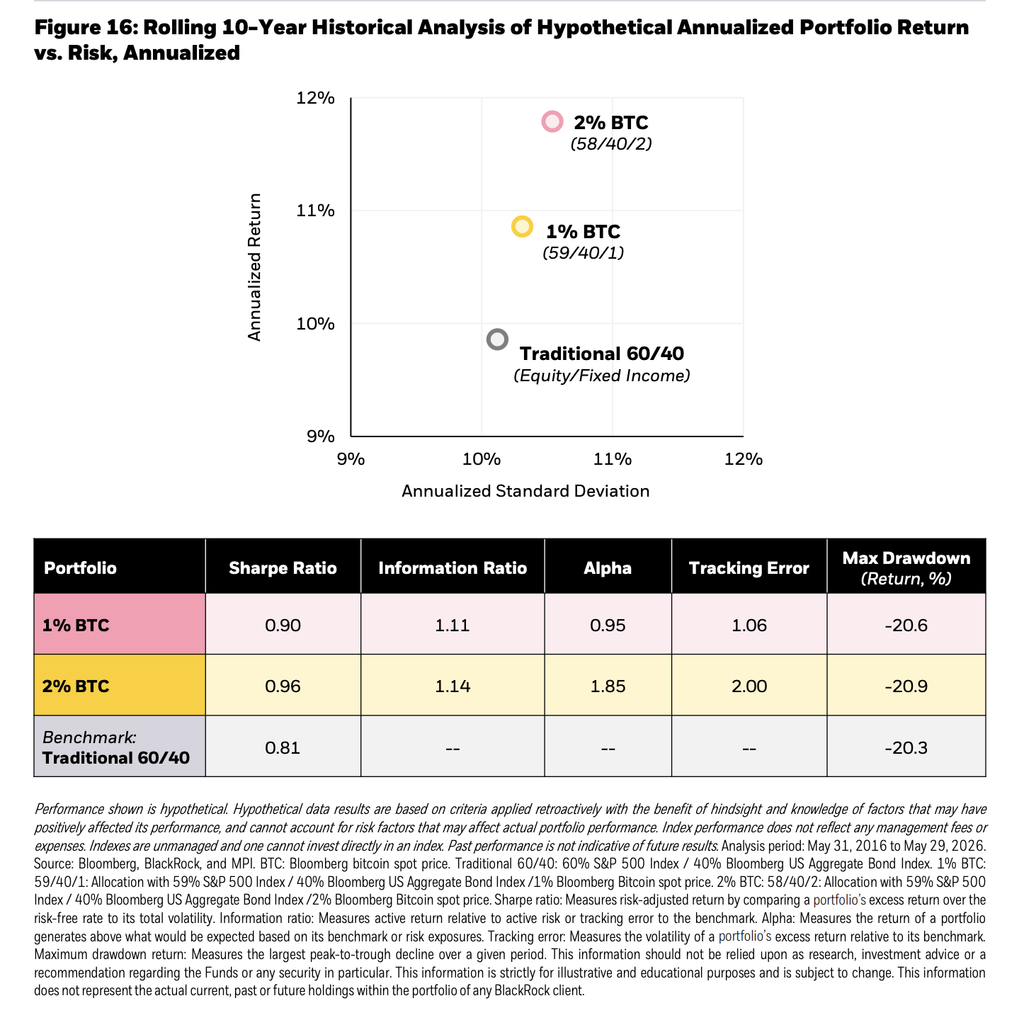
Put differently, the 2% allocation added roughly 190 basis points of annualized return relative to the traditional portfolio while increasing annualized volatility by approximately 50 basis points. The portfolio’s Sharpe ratio improved from 0.81 to 0.96, while maximum drawdown changed from -20.3% to -20.9%. Those figures are hypothetical and backward-looking, but they illustrate why judging Bitcoin primarily by its standalone volatility can produce an incomplete assessment of its portfolio impact.
The more relevant question is how that volatility interacts with everything else an investor already owns. BlackRock continues to characterize Bitcoin as having risk and return drivers that are fundamentally different from traditional assets, rooted in its fixed supply, decentralized structure and independence from any sovereign issuer. Those characteristics do not prevent Bitcoin from trading alongside risk assets during periods of deleveraging, but BlackRock’s research suggests those correlations have historically been episodic rather than permanent.
That distinction helps explain the portfolio results. A modest allocation does not import Bitcoin’s standalone volatility into a portfolio on a one-for-one basis. What matters is the marginal contribution of that allocation to total portfolio risk relative to the return it has historically generated. In BlackRock’s analysis, that trade-off remained favorable at 1% and 2%, even after incorporating one of Bitcoin’s most significant recent drawdowns.
Why 1–2% keeps appearing in BlackRock’s work
This is not the first time BlackRock has arrived at this range. Its earlier portfolio research approached Bitcoin sizing through risk contribution, concluding that a 1–2% allocation could represent a reasonable range for investors willing and able to accept Bitcoin’s risk. At those weights, BlackRock found that Bitcoin could contribute a similar share of overall portfolio risk as an individual mega-cap technology holding in a conventional 60/40 portfolio. Beyond 2%, however, Bitcoin’s contribution to total portfolio risk begins to increase disproportionately.
The new analysis approaches the same question from the opposite direction. Rather than asking how much risk Bitcoin contributes, it examines what investors historically received for assuming that additional risk. The improvement in Sharpe ratio from 0.81 for the traditional portfolio to 0.90 with 1% Bitcoin and 0.96 with 2% Bitcoin suggests that the incremental return historically more than compensated for the additional portfolio-level volatility.
This does not establish 1% or 2% as an optimal allocation, and BlackRock does not present it that way. The appropriate exposure will depend on liquidity requirements, investment horizon, governance constraints and risk tolerance. What the analysis does provide is a more rigorous framework for the discussion. The allocation question can increasingly be evaluated in terms of marginal risk, correlation, drawdown and portfolio efficiency rather than through a binary debate over whether Bitcoin itself is too volatile to own.
BlackRock has also seen the demand firsthand
There is another dimension to BlackRock’s latest analysis that is difficult to separate from the firm’s experience in the market.
BlackRock launched the iShares Bitcoin Trust, IBIT, in January 2024. Less than a year later, it had accumulated more than $50 billion in assets, making it what BlackRock itself has described as the largest exchange-traded product launch in history. It reached that milestone roughly five times faster than the previous record holder.
Its significance has only grown since then. BlackRock now describes IBIT as the world’s largest and most traded Bitcoin ETP, and the fund became the firm’s highest-revenue ETF in 2025 despite competing within a global BlackRock lineup of more than 1,000 products.
The concentration within the U.S. spot Bitcoin ETF market is equally notable. According to current ETF holdings data tracked by Bitcoin For Corporations, U.S. spot Bitcoin ETFs collectively hold approximately 1.25 million BTC, representing nearly 6% of Bitcoin’s fixed 21 million supply. IBIT alone accounts for roughly 775,000 BTC, or more than 60% of the Bitcoin held across the U.S. spot ETF complex.
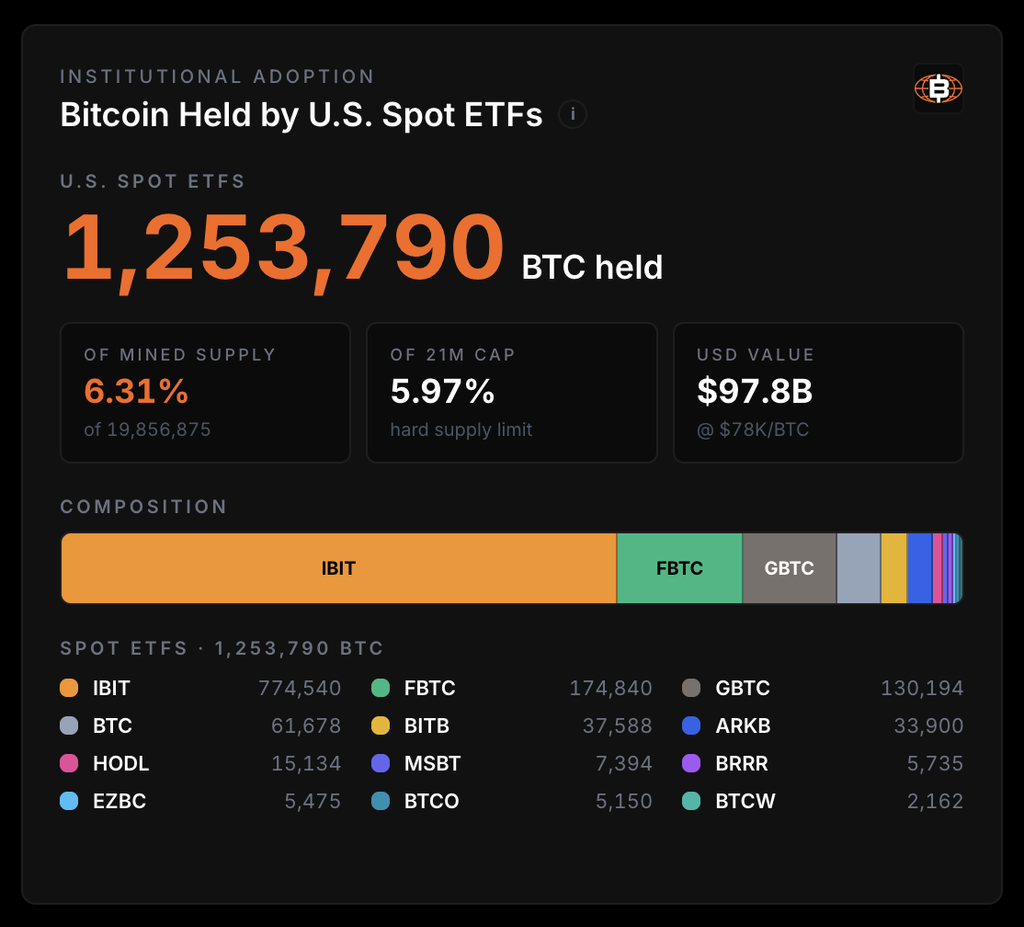
View the full Bitcoin ETF Dashboard.
That does not make BlackRock’s research independent of commercial context; IBIT is an important and increasingly valuable BlackRock product. That context should be understood rather than ignored. But it also means the firm’s reassessment is occurring alongside more than two years of observing how investors actually use Bitcoin exposure at scale.
The distinction is useful. The theoretical case for Bitcoin as a portfolio asset is increasingly being accompanied by observable allocation behavior. Investors have now had access to Bitcoin through familiar brokerage, advisory and institutional infrastructure across multiple market regimes, including periods of rapid appreciation and severe drawdowns. IBIT’s growth suggests that demand has persisted well beyond its initial launch window.
A drawdown is precisely when a thesis should be re-underwritten
The timing of BlackRock’s report may ultimately be more informative than the portfolio simulation itself.
Bitcoin is not being reassessed at an all-time high. BlackRock published the analysis after an approximately 50% drawdown from Bitcoin’s October 2025 peak, a period the firm associates with leveraged positioning being unwound, slowing ETP flows and weaker demand from companies accumulating Bitcoin. Its conclusion is that these forces represented a positioning correction rather than a fundamental change in Bitcoin’s investment case.
That is what re-underwriting is supposed to accomplish. An investment thesis should not survive because investors are attached to it; it should survive because its underlying assumptions continue to hold when conditions change.
For Bitcoin, those assumptions extend beyond historical returns. The asset remains scarce by design, globally liquid, independent of a sovereign issuer and structurally different from the liabilities that dominate traditional portfolios. BlackRock argues that concerns around fiscal sustainability, monetary stability and geopolitical risk may therefore become increasingly relevant to Bitcoin’s long-term adoption.
The portfolio evidence does not prove what Bitcoin will return over the next decade, nor does IBIT’s success establish what an appropriate allocation should be. What the two developments show together is that the institutional conversation has advanced considerably. Bitcoin is no longer being evaluated solely as an unconventional asset that institutions may or may not choose to own. It is increasingly being evaluated through the same disciplines applied elsewhere in capital allocation: sizing, risk contribution, correlation, liquidity, drawdown and expected return.
What this means for corporate leaders
For CFOs, boards and corporate operators, that evolution may be the most important takeaway from BlackRock’s work.
The relevant decision is not whether Bitcoin is volatile; that is already known. Nor does a corporate allocation need to resemble the concentrated Bitcoin strategies pursued by companies that have explicitly built their capital structures around the asset. Between zero exposure and a Bitcoin-centric balance sheet sits a much broader spectrum of possible allocations.
BlackRock’s research provides a useful framework for thinking about that spectrum. A relatively small allocation was sufficient to materially alter the historical return characteristics of a conventional portfolio without producing a comparable increase in portfolio-level risk. At 2%, approximately 190 basis points of additional annualized return came with roughly 50 basis points of additional annualized volatility in the period studied. The allocation was small; its effect was not.
For corporate leaders, the implication is less about adopting BlackRock’s specific allocation range than adopting the discipline behind the analysis. Bitcoin can be underwritten like any other strategic allocation: define its purpose, determine an acceptable risk contribution, establish liquidity and governance requirements, size the position accordingly and periodically revisit the assumptions.
That is a considerably more mature question than whether a company should simply “buy Bitcoin.”
As Bitcoin becomes more deeply integrated into institutional portfolios and financial infrastructure, the burden of analysis is shifting. The question facing the C-suite is increasingly not whether Bitcoin belongs in the conversation, but what allocation, if any, can be justified by the company’s objectives, constraints and cost of capital.
BlackRock has now re-underwritten that question after another full market cycle and a roughly 50% drawdown. Its historical portfolio math still makes the case that, in measured amounts, Bitcoin can improve the equation. For corporate decision-makers, that is the takeaway worth bringing into the boardroom.
Disclaimer: This content was prepared on behalf of Bitcoin For Corporations for informational purposes only. It reflects the author’s own analysis and opinion and should not be relied upon as investment advice. Nothing in this article constitutes an offer, invitation, or solicitation to purchase, sell, or subscribe for any security or financial product.
This post BlackRock Re-Underwrites Bitcoin, and the Portfolio Math Still Holds first appeared on Bitcoin Magazine and is written by Nick Ward.
HTTP error 429 on https://cryptoslate.com/feed/
Failed to fetch feed: https://cryptoslate.com/feed/
Failed to fetch feed.
HTTP error 429 on https://cryptoticker.io/en/feed/
Failed to fetch feed: https://cryptoticker.io/en/feed/
Failed to fetch feed.
Decrypt
Marc Andreessen, Ben Horowitz and OpenAI's Greg Brockman have backed the super PAC behind the campaign, which faces surging opposition.
So far, Rektember is living up to its name as Bitcoin slips. Will this September follow the historical averages, or break the trend?
CrowdStrike and the DOJ isolated more than 15,000 infected machines in a malware takedown spanning four countries.
New Form TA-2 questions would make agents report how many share registers they keep on distributed ledgers.
The North Carolina Republican bought less than $1,000 of contracts on her own race and drew a three-year ban.
U.Today - IT, AI and Fintech Daily News for You Today
September has opened on a familiar note for risk assets, with Dogecoin cofounder sharing an unexpected take.
Here are the top stories on U.Today that defined crypto markets.
Key crypto updates for Sep. 2: a $369 million long squeeze hits 90,000 XRP, ETH, and SOL traders while the SEC bypasses Congress to integrate blockchain into TradFi.
3.59 million SHIB burned at the start of September, a month deemed historically poor for risk assets.
Dogecoin is certainly not finding a recovery ground as quickly as we anticipated.
Blockonomi
Key Highlights
- Dell Technologies (DELL) shares surged 10% following adjusted earnings per share of $7.04, significantly exceeding the $4.91 consensus forecast
- Total revenue reached $46.97 billion, surpassing Wall Street’s $44.92 billion projection with year-over-year growth approaching 60%
- Forward guidance for Q3 projects $49 billion in revenue and $6.50 earnings per share, substantially above analyst expectations
- The company secured $60.9 billion in new AI server contracts during the quarter, bringing cumulative backlog to $95 billion
- Analyst firms including JPMorgan and Citi elevated price targets to $635 and $600 respectively, maintaining positive ratings
Shares of Dell Technologies (DELL) experienced a dramatic 10% surge during Wednesday’s opening bell following the company’s exceptional quarterly performance powered by explosive artificial intelligence server demand.
Dell Technologies Inc., DELL
The technology giant reported adjusted earnings of $7.04 per share, representing more than a threefold increase compared to the same period last year and comfortably beating the analyst consensus of $4.91. Total quarterly revenue climbed to $46.97 billion, marking a nearly 60% year-over-year expansion and topping the Street’s $44.92 billion forecast.
The company’s stock performance has been remarkable throughout the year, more than tripling in value since January and posting gains of nearly 240% year-to-date prior to Wednesday’s trading session.
Artificial Intelligence Infrastructure Fuels Exceptional Results
The primary catalyst behind Dell’s outstanding performance was its AI server division. During the quarter, the company secured an impressive $60.9 billion in new AI server commitments, elevating its overall order backlog to an unprecedented $95 billion. Such figures effectively silence skeptics questioning the sustainability of AI infrastructure investment.
JPMorgan’s Joseph Cardoso upgraded his price objective on DELL shares from $565 to $635 while maintaining his Buy recommendation. He characterized the results as “another robust quarter” and noted that “the AI momentum spoke for itself.” Cardoso additionally highlighted a sustainable IT infrastructure modernization cycle coupled with surprisingly resilient PC market demand.
Management’s third-quarter outlook projects revenue of $49 billion alongside adjusted earnings of $6.50 per share. This guidance significantly exceeded Wall Street’s estimates of $41.42 billion in sales and $4.49 in earnings. The company also raised its full-year revenue forecast to $192 billion from a previous $167 billion, while boosting adjusted EPS guidance to $25.50 from $17.90.
Wall Street Firms Elevate Price Objectives Following Strong Performance
Citi analyst Asiya Merchant increased her price target to $600 from $515 while reaffirming a Buy rating. She described the quarterly results as a “clear beat” and expressed confidence that accelerating enterprise artificial intelligence deployment will support Dell’s continued strong performance.
TD Cowen’s Krish Sankar boosted his target to $500 from $450 while maintaining a Hold rating. He labeled the performance another “stunning beat and raise” and projected AI server revenue could reach $74 billion in fiscal year 2027. Sankar also observed strengthening demand for conventional server upgrades and emerging interest in agentic AI processors.
Morgan Stanley raised its price objective to $499 from $434 but expressed some caution regarding demand sustainability given Dell’s recent pricing adjustments.
Currently, Dell maintains a Moderate Buy rating from Wall Street’s analyst community, with 20 professionals issuing 13 Buy recommendations and seven Hold ratings over the past three months. The consensus 12-month price target stands at $581.78, suggesting approximately 28% appreciation potential from present trading levels.
The company’s cumulative order backlog now totals $95 billion, with the most recent quarter alone contributing $60.9 billion in AI server bookings.
The post Dell Technologies (DELL) Stock Soars 10% on Record AI Server Demand and Earnings Beat appeared first on Blockonomi.
Quick Summary
- Bernstein assigns SpaceX an Outperform rating with a $248 target, representing a potential 74% gain from present trading levels.
- Analysts project SpaceX’s AI-related revenues will explode from $24.6 billion in 2026 to $115.1 billion by 2027.
- The company’s entry into power turbine blade production triggered notable declines across energy equipment manufacturers this week.
- Industry analysts downplayed competitive concerns, noting it would take more than four years for new competitors to scale operations.
- Howmet Aerospace received positive attention from Citi’s catalyst watch and Deutsche Bank’s top supplier designation.
Shares of SpaceX closed at $141.04 on Wednesday, slipping 0.8% despite positive momentum across broader indices. The S&P 500 gained 0.55% while the Dow advanced 0.77% during the same session.
Space Exploration Technologies Corp., SPCX
The week has been eventful for Elon Musk’s space venture. SpaceX shares have climbed approximately 25% during the past month, with continuous catalysts emerging across multiple business segments.
Douglas Harned, an analyst at Bernstein, maintains an Outperform stance on SpaceX shares with a $248 valuation target. This projection suggests approximately 74% appreciation potential from today’s price levels. Harned anticipates SpaceX’s artificial intelligence segment will expand dramatically from $24.6 billion in 2026 to $115.1 billion the following year, positioning AI as the dominant revenue contributor.
According to Bernstein’s projections, overall company revenue should reach $46.4 billion in 2026, then surge to $150.4 billion in 2027. Artificial intelligence initiatives account for the bulk of this anticipated expansion.
The investment thesis extends well beyond launch services. Bernstein highlights space-based data centers as a significant long-term opportunity. SpaceX is developing Starbase Louisiana across 125,000 acres, with groundbreaking scheduled for 2027 and initial Starship operations from the location planned for 2029. The complex is designed to accommodate at least 10 launch platforms and ultimately support over 30 Starship missions daily.
The company also recently finalized its Cursor acquisition, integrating advanced coding capabilities into the Grok AI ecosystem. Bernstein believes this positions SpaceX to monetize AI software services beyond raw computational infrastructure.
Starlink and Terafab Fuel Expansion Plans
Bernstein projects Starlink connectivity revenues of $17.0 billion in 2026, climbing to $27.7 billion in 2027, and ultimately reaching $205.9 billion by 2031. The aviation sector continues expanding, with 46 carriers now participating. Qatar Airways broadened its implementation in August, while Royal Air Maroc recently became the latest airline partner.
SpaceX’s forthcoming Terafab semiconductor manufacturing facility in Texas represents another strategic initiative. The project’s initial construction phase alone demands approximately $16.8 billion in capital investment.
The Street’s average price objective for SpaceX stands at $231.63, suggesting 64% upside potential. Consensus sentiment leans Moderate Buy, derived from 25 Buy recommendations, five Hold ratings, and three Sell opinions since the company went public.
Energy Equipment Stocks React to SpaceX News
SpaceX’s announcement regarding turbine blade production capabilities created turbulence throughout the power generation equipment industry. Howmet Aerospace declined roughly 4% through Wednesday’s trading week. GE Vernova and Siemens Energy fell approximately 3% and 6%, respectively. Caterpillar and Cummins also experienced downward pressure.
Analysts countered the market’s negative reaction. Citi designated Howmet for upside catalyst monitoring, characterizing the decline as excessive. Deutsche Bank elevated Howmet to its premier aerospace supplier selection with 35% appreciation potential. Jefferies emphasized that any new competitor would require four years minimum to establish meaningful single-crystal casting production capacity.
22V Research suggested SpaceX’s probable near-term strategy involves manufacturing replacement components for its proprietary power generation fleet rather than directly challenging established foundries. SpaceX acquired APR Energy earlier this year, a company that operates mobile power equipment utilizing turbines from manufacturers including GE Vernova.
Howmet shares remained under pressure on Wednesday, declining 1.2% despite supportive analyst commentary.
The post SpaceX (SPCX) Stock: Bernstein Sets $248 Target Amid Explosive AI Growth Projections appeared first on Blockonomi.
Key Takeaways
- Tesla shares declined 1.5% during early Wednesday trading, reaching $350.80 before Thursday’s highly anticipated Cybercab unveiling in Austin, Texas
- The upcoming event will showcase Tesla’s steering wheel-free Cybercab, designed specifically for autonomous taxi operations
- Since launching its robotaxi program with Model Y vehicles in Austin during June 2025, Tesla’s expansion has progressed slowly
- Morgan Stanley analysts kept their “Equal Weight” stance with a $400 price projection, cautioning that a basic product reveal may not drive significant stock momentum
- Year-to-date, TSLA has fallen approximately 20%, trading roughly 30% beneath its peak levels from late 2025
Shares of Tesla (TSLA) retreated 1.5% during Wednesday’s pre-market session, settling at $350.80 as market participants prepared for the automaker’s Cybercab event set to take place Thursday in Austin, Texas.
Tesla, Inc., TSLA
The broader market painted a different picture during this timeframe, with the S&P 500 and Dow Jones advancing 0.2% and 0.4% respectively, highlighting Tesla’s underperformance.
Recent trading sessions have shown considerable volatility for the electric vehicle manufacturer. Following Monday’s impressive 5.5% surge, shares reversed course Tuesday with a 3.2% decline. These price movements appear closely connected to robotaxi developments and mounting speculation surrounding Thursday’s presentation.
The Cybercab represents Tesla’s dedicated autonomous taxi platform. Distinguished by its absence of traditional steering controls and reliance solely on camera-based sensing technology, production of the vehicle commenced earlier this year.
Golden Fleet Alert
Golden Tesla Cybercabs have taken over the city and are flooding Austin
They are constantly validating pick-ups and drop offs ahead of the Cybercab launch event on 09/03
Can’t wait for the most futuristic Robotaxis ever@robotaxi @Tesla… https://t.co/0yy7Whn9uq pic.twitter.com/5bWnPLGVme
—
_Cyber_Owl_
(@RimaSukhadia) September 1, 2026


Thursday’s presentation is anticipated to officially integrate the Cybercab into Tesla’s operational robotaxi network, which presently deploys Model Y vehicles throughout metropolitan areas including Austin, Miami, and Dallas.
The company initiated its robotaxi operations in Austin during June 2025. Following that debut, shares settled near $349. Expansion has proceeded gradually since launch, with the fleet estimated to comprise several hundred vehicles operating across a limited number of markets.
Tesla’s Position Versus Waymo
In contrast, Alphabet’s Waymo division currently maintains thousands of autonomous vehicles operating throughout more than a dozen American cities, employing comprehensive sensor arrays that incorporate lidar systems.
Tesla’s vision-only strategy aims to minimize production expenses. The underlying thesis suggests that economically efficient vehicles will gain competitive advantage once robotaxis primarily compete on fare pricing rather than against traditional human-operated rideshare platforms like Uber.
American motorists collectively travel more than three trillion miles annually. Should robotaxi pricing decrease to approximately 50 cents per mile, industry experts believe a trillion-dollar market opportunity could emerge.
Tesla’s present market capitalization incorporates investor confidence that the company will secure a substantial share of this prospective market.
Analyst Community Maintains Reserved Outlook
Morgan Stanley’s Andrew Percoco observed prior to the event that Tesla’s historical product demonstrations have generated varying investor responses. He indicated that a conventional Cybercab presentation alone would probably not catalyze substantial stock appreciation.
Percoco sustained his “Equal Weight” assessment on TSLA while reaffirming a $400 price objective over the coming twelve months.
Tesla’s promotional campaign for the event has intensified since late August, emphasizing safety protocols and autonomous driving capabilities. However, concrete information regarding Thursday’s agenda has remained scarce.
TSLA shares have depreciated approximately 20% from the beginning of 2026 and currently trade about 30% below the highs achieved in late 2025. The stock experienced a roughly 9% increase throughout August, though market observers largely credited post-earnings momentum rather than Cybercab enthusiasm.
As of Wednesday morning, TSLA was changing hands at $350.80.
The post Tesla (TSLA) Stock Dips Ahead of High-Stakes Cybercab Reveal appeared first on Blockonomi.
Key Takeaways
- Over the past year, RKLB stock has surged 43.7%, significantly outperforming competitors in the aerospace sector.
- ARK Investment Management, led by Cathie Wood, accumulated more than 705,000 shares of RKLB valued at approximately $44 million during two recent trading sessions.
- CEO Peter Beck acknowledges the year-end launch window for Neutron is “narrowing,” positioning it as both a critical opportunity and substantial risk factor.
- Blue Origin secured a $700 million contract from NASA for Mars communications infrastructure, representing a setback for Rocket Lab’s competitive positioning.
- The company’s contract backlog reached an all-time high of $2.36 billion, representing 137% growth year-over-year and ensuring solid revenue visibility.
Shares of Rocket Lab (RKLB) are currently hovering around $62.54, experiencing a 2.2% decline on Tuesday and representing more than a 50% retreat from the peak achieved in May. Nevertheless, ARK Investment Management has maintained an aggressive accumulation strategy, acquiring 705,102 shares during two recent trading sessions totaling approximately $44 million in value.
Rocket Lab USA, Inc., RKLB
The Tuesday session alone saw ARK purchase 504,799 shares distributed across three separate ETFs, representing roughly $31.6 million based on Tuesday’s closing prices.
This accumulation activity occurs against a backdrop of significant selling pressure, with RKLB declining in nine out of the last ten trading sessions, followed by additional weakness in after-hours trading.
Analyst sentiment remains constructive despite recent price target adjustments. Bank of America analyst Ronald Epstein reduced his price target from $115 to $110 on August 31, primarily accounting for anticipated share dilution, while maintaining his Buy recommendation. Even with this adjustment, Tuesday’s closing price suggests potential upside of approximately 76%.
Following the company’s second-quarter earnings release, Cantor Fitzgerald analyst Andres Sheppard raised his price target from $96 to $122, emphasizing Neutron as “the most material catalyst.” Meanwhile, Roth Capital’s Suji Desilva lowered his target from $130 to $110 while preserving his Buy rating, highlighting that the substantial backlog provides “meaningful near-term revenue coverage.”
The Neutron Factor
Rocket Lab’s Neutron launch vehicle represents the focal point of investor debate. The platform is designed to penetrate the medium-lift launch segment, substantially expanding the company’s addressable market beyond Electron’s small-satellite niche.
However, CEO Peter Beck cautioned during the Q2 earnings call that the timeframe for achieving an inaugural launch before year-end is “narrowing.” Critical testing phases must still be completed successfully before flight operations commence. Any additional delays to Neutron’s deployment would postpone the growth trajectory that forms the foundation of bullish analyst price targets.
The orbital launch industry continues facing supply constraints, positioning Rocket Lab favorably if operational execution remains on track. Electron has successfully completed 87 missions to date, while HASTE provides critical support for government programs. The company currently has commitments for over 90 launches spanning Electron, HASTE, and Neutron platforms.
NASA Contract Loss and Backlog Strength
Market sentiment experienced another setback in after-hours trading Tuesday when NASA announced Blue Origin as the recipient of its Mars Telecommunications Network contract. This firm-fixed-price agreement carries a potential value of $700 million, with Blue Origin responsible for deploying a Mars orbiter by late 2028. Rocket Lab had been among the eligible bidders for this opportunity.
Despite this disappointment, the company’s Q2 2026 backlog achieved a record $2.36 billion, representing 137% growth compared to the prior year. Approximately 45.5% of this contracted work is scheduled for revenue recognition within the next twelve months.
Recent strategic acquisitions of Mynaric and Motiv have enhanced Rocket Lab’s capabilities in optical communications and robotics technologies. In August 2026, the company secured a position on the U.S. Space Force’s NITE-STAR IDIQ program, a contracting vehicle with a $981 million ceiling encompassing both space-based and ground systems.
Wall Street’s consensus earnings per share estimate for RKLB in 2026 has increased 44.44% during the past 60 days. The company maintains a total debt to capital ratio of just 0.83%, significantly below the industry benchmark of 61.47%. Its current ratio stands at 5.48, compared to the industry average of 2.06.
RKLB currently commands a valuation of 31.3X forward Price/Sales, representing a substantial premium compared to the industry average of 7.64X.
The post Rocket Lab (RKLB) Stock: Should You Follow Cathie Wood’s $44M Buying Spree? appeared first on Blockonomi.
TLDR:
- Thailand’s SEC will require digital asset firms to verify ownership of self-custodial wallets.
- Operators must transmit sender and beneficiary details with digital asset transfer orders.
- The new Crypto Travel Rule sets a February 27, 2027, compliance deadline for covered firms.
- Thailand’s SEC developed the framework with AMLO to strengthen AML and international regulatory alignment.
Thailand’s Securities and Exchange Commission has issued a new Crypto Travel Rule for digital asset operators nationwide.
The regulation requires firms to verify ownership of self-custodial wallets during transfers. Announced in Bangkok, the rule targets money laundering and technology-related crimes across the digital asset sector. Operators now face stricter due diligence duties before the rule takes full effect in 2027.
New Compliance Duties Under the Crypto Travel Rule
The SEC’s Crypto Travel Rule sets out clear duties for digital asset business operators across Thailand. Operators must first establish internal policies and procedures for managing transfer-related risks.
These systems need to track both the sender and receiver of every transaction. This step forms the foundation for broader monitoring under the new framework.
Beyond internal policy, operators must collect detailed information on customers and their counterparties. This includes conducting due diligence checks before any transfer takes place.
Firms must also verify the standing of counterparty digital asset service providers involved in each transaction. Where an intermediary operator handles part of the transfer route, its qualifications require verification too.
A central feature of the Crypto Travel Rule involves self-hosted wallets. Operators must confirm ownership or control of these wallets before sending or accepting funds.
This applies whenever digital assets move to or from a wallet outside a regulated platform. The requirement closes a gap that previously allowed limited oversight of peer-to-peer transfers.
Ordering operators also carry a transmission duty under the new rule. They must send originator and beneficiary details alongside every transfer order.
This information must reach the counterparty operator receiving the transaction. Operators must retain all transaction records for a minimum of five years for regulatory review.
Timeline and Coordination Behind the Digital Asset Rule
The Crypto Travel Rule will not take effect immediately, giving operators time to adjust. The SEC set February 27, 2027, as the compliance deadline for all covered firms.
This gap allows operators to build systems for information transmission and transaction monitoring. Public hearings on the proposal ran from March through July 2026 before finalization.
The SEC developed the rule alongside the Anti-Money Laundering Office as an interim measure. AMLO is separately preparing its own regulations under the Anti-Money Laundering Act.
A subcommittee on financial data connectivity recommended this coordinated approach between agencies. Most stakeholders who took part in the hearings supported the proposed principles.
SEC Secretary-General Pornanong Budsaratragoon explained the reasoning behind the new framework directly. “The SEC has placed importance on ensuring that digital asset business operators are not misused,” she said.
Budsaratragoon added that the rule strengthens oversight of money laundering and terrorist financing risks. She said the framework reinforces operators’ responsibility for overseeing customer transactions properly.
Budsaratragoon also linked the rule to international standards set by the Financial Action Task Force. She said the measures would enhance “confidence in Thailand’s digital asset ecosystem” over time.
The SEC expects the framework to support stronger connectivity with international digital asset markets. Officials view the rule as a step toward long-term regulatory alignment abroad.
The post Thailand SEC Issues Crypto Travel Rule for Digital Asset Transfers appeared first on Blockonomi.
HTTP error 429 on https://cryptopotato.com/feed/
Failed to fetch feed: https://cryptopotato.com/feed/
Failed to fetch feed.