Cryptocurrency Posts
Crypto Briefing
EURCV's growth highlights the increasing importance of euro-denominated stablecoins in diversifying digital finance beyond dollar reliance.
The post Societe Generale’s EURCV gains $5.6M, second-fastest-growing euro stablecoin appeared first on Crypto Briefing.
The expanded sanctions on Iran could significantly disrupt global aviation, shipping, and crypto sectors, impacting international trade dynamics.
The post US targets airlines, digital assets linked to Iran as Treasury ramps up sanctions pressure appeared first on Crypto Briefing.
A 25-company coalition including Nvidia, Microsoft, and Meta opposes US restrictions on open-weight AI models, arguing the push benefits closed
The post US frontier labs face criticism for pushing ban on open-source AI appeared first on Crypto Briefing.
US-China AI rivalry could reshape global tech dynamics, impacting markets, supply chains, and geopolitical strategies amid rising tensions.
The post US Treasury Secretary says China catching up on AI is ‘biggest risk’ for US appeared first on Crypto Briefing.
Arbitrum's rapid transaction growth and economic expansion highlight its increasing influence in blockchain infrastructure and real-world asset tokenization.
The post Arbitrum Foundation reports 478M transactions in H1 2026 as ecosystem GDP hits $206M appeared first on Crypto Briefing.
Bitcoin Magazine
Bitcoin Magazine

Capital B Raises €7.6M From Adam Back to Fund Another Bitcoin Buy
Top bitcoiner Adam Back has invested €7.6 million ($8.8 million) in Capital B, the Euronext Growth-listed company that bills itself as Europe’s first bitcoin treasury company.
The company said Wednesday that the investment will be used to buy more bitcoin. Adam Back is the CEO of bitcoin infrastructure company Blockstream, and one of the biggest and well-known figures in the space
Capital B’s announcement comes after the company last week said it had raised €21 million ($24 million) in a private placement backed by Blockstream’s Adam Back and asset manager TOBAM.
— Capital B (@_ALCPB) August 28, 2026
Capital B announces a €21.0 million capital raise with global institutional investors, including strategic investors Adam Back and TOBAM, to accelerate its Bitcoin Treasury Company strategy
Full Press Release (EN): https://t.co/XQGT44ma4d
Full Press Release (FR):…
“The proceeds of the Private Placement will be used primarily to strengthen Capital B’s balance sheet through the accumulation of bitcoin as a long-term reserve asset,” the company said in a statement.
“This capital increase is a key step in implementing the company’s Bitcoin Treasury Company strategy, focused on increasing the number of bitcoin per share on a fully diluted basis over time.”
It added that the placement would fund it buying 376 additional bitcoins, taking its potential holdings to 3,521 coins from its current stash of 3,145.
Capital B is the 26th biggest publicly traded bitcoin treasury in the world, according to Bitcoin Treasuries, with a total of 3,145 bitcoins in its coffers — worth $242 million at today’s bitcoin price of $76,959.
Capital B built much of that position through fundraising rounds during the first half of 2026.
In May, it acquired 192 coins for €13 million after completing three capital raises.
Capital B’s is trying to build a bigger bitcoin position as other treasuries look to raise funds and accelerate their buys.
NYSE-listed AI-powered education company Genius Group last week said it was aiming to build parallel AI and bitcoin treasuries worth a combined $1.6 billion, after the company sold its entire bitcoin reserves to repay $8.5 million in debt.
The Bitcoin treasury model has taken a hit since last year when the price of the leading cryptocurrency took a hit.
A number of companies in the space have had to liquidate their holdings — including the biggest corporate holder of bitcoin, Nasdaq-listed Strategy.
This post Capital B Raises €7.6M From Adam Back to Fund Another Bitcoin Buy first appeared on Bitcoin Magazine and is written by Mathew Di Salvo.
Bitcoin Magazine

The Quantum Issue: Letter From The Editor
Quantum this, quantum that…who put a stupid cat on-chain!?
Ahem.
Alright, let’s be serious. The threat that a viable, actually functioning, quantum computer would pose to Bitcoin if it were to be built is very serious. It is the concrete example of an existential threat, in every sense of the word.
One of the bedrock foundations that Bitcoin rests upon is the assumption of a functioning cryptographic system that can be used to produce unforgeable signatures, i.e. that if you follow that system’s protocol properly when signing things, there is no way that anyone but a bitcoin’s rightful owner could produce a signature needed to spend it unless the rightful owner failed to secure their private key from theft.
Quantum computers toss that right out the window. There goes the integrity of the entire mechanism that is used for owners of bitcoin to authenticate their ownership for the protocol to process their legitimately authorized transactions, and ONLY their legitimately authorized transactions. There’s no way for anyone to actually own anything in the context of the Bitcoin protocol if that assumption breaks.
Bitcoin breaks if that assumption breaks.
Thankfully, there are many different cryptographic systems that exist, and not all of them rest on assumptions that a quantum computer breaks. That’s the good news. The bad news is that its all a set of tradeoffs, none of them are ideal, and there are going to be some hard choices that have to be made.
But there are solutions to just about every one of the problems that a viable quantum computer would create…except the problem of choosing which solutions to use. So in light of that, here is The Quantum Issue.
This issue is a lot more structured than most past issues, and that is to ensure that it guides a reader through the entirety of the problem space and solution space without assuming any prior understanding (this is a very deep and technical subject).
The first set of articles goes through the general issue of quantum computing itself, how it differs from classical computing, why that matters, how likely it is one is developed soon, etc.
The second set examines Bitcoin’s exposure. How is it exposed? How badly is it exposed? How can that degree of exposure change?
The third set examines concrete (or developed enough to not be too hard to get to a concrete place) solutions to securing your bitcoin in a quantum safe way, and handling a network wide migration to those solutions.

Don’t miss your chance to own The Quantum Issue — featuring articles written by many influential figures in the space working on the necessary pieces for a post-quantum Bitcoin!
This piece is the Letter from the Editor featured in the latest Print edition of Bitcoin Magazine, The Quantum Issue. We’re sharing it here as an early look at the ideas explored throughout the full issue.
This post The Quantum Issue: Letter From The Editor first appeared on Bitcoin Magazine and is written by Shinobi.
Bitcoin Magazine

Strategy CEO Defends Bitcoin Sale as the ‘Right Trade’
The CEO of bitcoin treasury Strategy brushed off concerns investors may have about the company selling some of its stash, instead telling reporters that the move was to strengthen its balance sheet.
Speaking to Bloomberg on Tuesday, Phong Le said that the company now has a “bullet-proof balance sheet” and it was the “right trade at the time” to sell bitcoin when it did.
Strategy, the largest corporate holder of bitcoin, restarted its buying the cryptocurrency on Monday after a 10-week pause. After halting its buys in June, it instead sold small amounts of its bitcoin and built two cash reserves.
“We don’t really make decisions specifically on bitcoin’s price,” Le said.
He added: “We’re a net accumulator, and so I don’t sit around and say, ‘Well, when am I going to sell Bitcoin next?’ It comes down to a bit of a capital management mathematical equation of when we would do it.”
“I don’t foresee us selling bitcoin as we enter into what I consider a pretty heavy bull market.”
Strategy — formerly MicroStrategy — is an enterprise software company that pivoted to buying and holding bitcoin in 2020.
It first bought the cryptocurrency to protect its shareholders from inflation but has since aggressively bought the asset and pivoted to being a bitcoin treasury. It is now the largest corporate holder of the cryptocurrency, with 845,050 bitcoins worth $65.1 billion at today’s prices.
Investors can buy Strategy’s Nasdaq-listed stock (MSTR) to get heightened exposure to bitcoin’s performance.
This year, Strategy has bought back some of its preferred stock, STRC, which is trading at a discount, and increasing its dollar cushion.
In the company’s quarterly earnings in July, Strategy posted a $8.22 billion loss. But Le said the firm’s current paper loss wasn’t important for the time being, and that next year, its stock would soar again.
“We’re the J.P. Morgan of the crypto economy, so whether we sell 1,000 Bitcoin out of 840,000 to me is irrelevant to the conversation,” Le said.
Strategy stock (NASDAQ: MSTR) was trading 2% lower on Wednesday. Year-to-date, the stock is down 22%.
This post Strategy CEO Defends Bitcoin Sale as the ‘Right Trade’ first appeared on Bitcoin Magazine and is written by Mathew Di Salvo.
Bitcoin Magazine
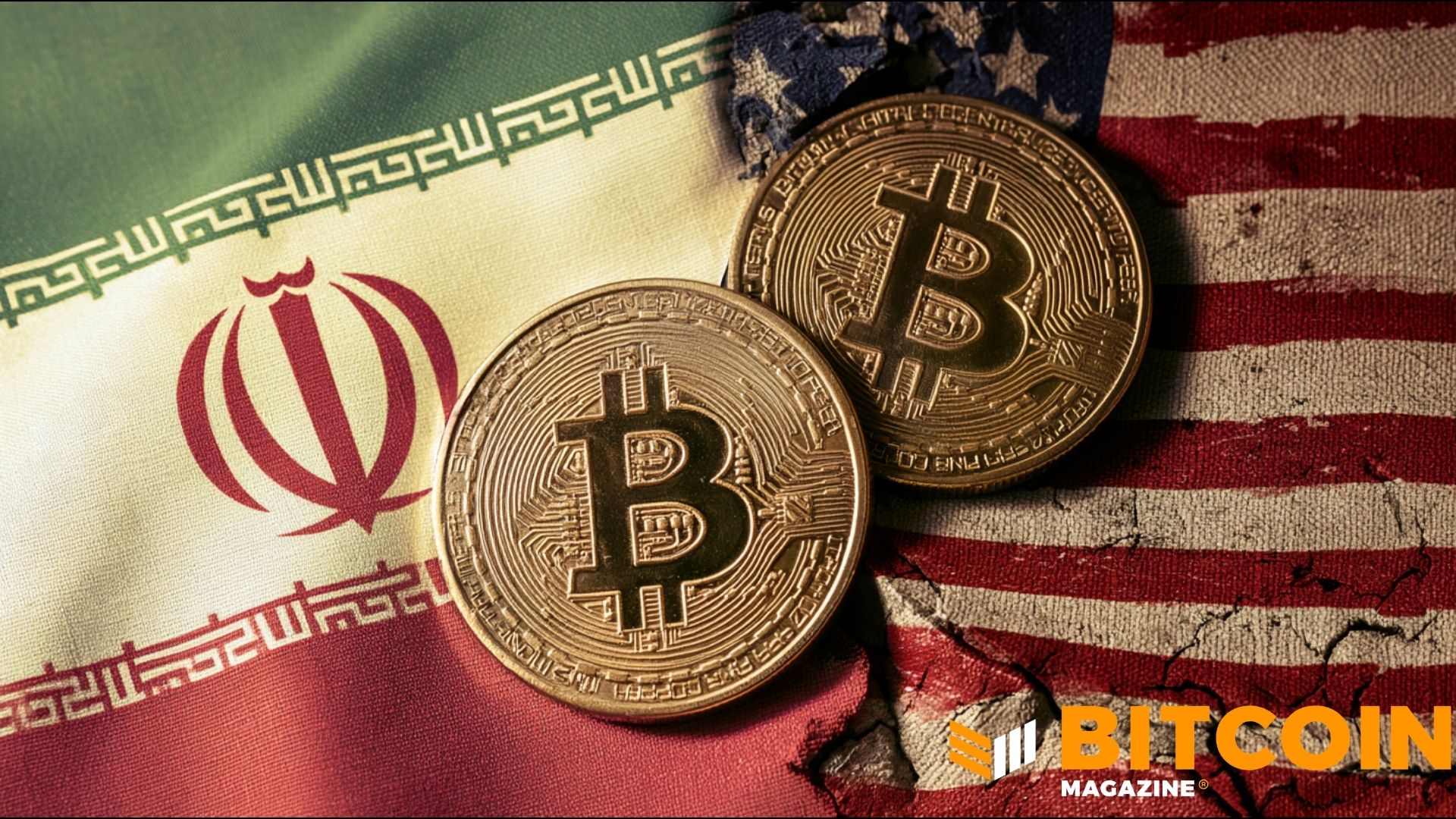
Bitcoin Slides as US-Iran Tensions Escalate
Bitcoin slid on Tuesday after investors went into “risk-off” mode following escalating attacks between the U.S. and Iran.
The largest cryptocurrency had initially shrugged off President Donald Trump’s threats to the Middle Eastern nation, as well as the first strikes.
But things heated up on Tuesday, and bitcoin’s price slid. It was recently down more than 2% on the day, trading for $77,363. The coin had pushed past as high as nearly $81,282 on Friday.
The Tuesday attacks from the U.S. were because Iran tried to put mines in the Strait of Hormuz, and also because of an attack on an American military base in Jordan, according to President Trump.
U.S. Central Command said on X that Iran had also attacked commercial ships.
“The strikes follow recent attempted attacks by the Islamic Revolutionary Guard Corps against commercial shipping in the Strait of Hormuz and against American service members deployed to the region,” the post read.
Iran responded with a “decisive operation” against U.S. military bases, according to Iranian media. Oil surged on the news.
Bitcoin’s price has been sensitive to geopolitical tensions this year — especially after Iran and Israel attacked Iran. The cryptocurrency has typically faced downward pressure on news of war, only to then rally when Trump raised hopes of a ceasefire.
Despite Bitcoin’s price being relatively muted, in recent months, it has made more wild swings since mid-August.
Bitcoin’s immediate reaction to rising oil prices is to drop: more expensive energy means higher inflation, and higher inflation typically means the U.S. central bank will postpone rate cuts, which can restrict the liquidity that bitcoin needs to gain momentum.
The Federal Reserve’s chair, Kevin Warsh, last week gave his first major speech as leader of the central bank and said that inflation in the world’s largest economy had not come down enough.
Traders are now no longer pricing in an interest rate cut this year, instead expecting a hike. Bitcoin has typically performed well in the past in low interest rate environments.
Still, the coin had one of its best runs in August after the U.S. Treasury said it would at least double the size of its liquidity-support buyback operations, in response to surging borrowing costs.
The announcement hurt the dollar but non-yielding assets like bitcoin and gold have benefited.
This post Bitcoin Slides as US-Iran Tensions Escalate first appeared on Bitcoin Magazine and is written by Mathew Di Salvo.
Bitcoin Magazine
Bitcoin Defies Seasonal Slump With Third-Best August Ever
Bitcoin is known for its summer slumps. But August was different.
In fact, the leading cryptocurrency had its third best August ever.
As highlighted on Tuesday by Bitwise’s European Head of Research, André Dragosch, bitcoin delivered returns of 25% last month.
“No ‘summer lull’ so far,” Dragosch wrote on X, highlighting that the only better Augusts the coin has had were in 2017 when it gave investors returns of nearly 66%, and 2013, with close to 31%.
OFFICIAL: August 2026 is in the books and it's been the 3rd best August in bitcoin's history.
— André Dragosch, PhD
August 2017: +65.6%
August 2013: +30.7%
August 2026: +25.0%
No "summer lull" so far. pic.twitter.com/jwHt2VP5Sk(@Andre_Dragosch) September 1, 2026

Multiple analyses point to the months of June-September showing weaker average returns than the rest of the year.
Throughout most of June and July, bitcoin’s volatility was particularly muted, and the coin traded below $65,000.
But that changed in mid-August after the U.S. Treasury Department said it would more than double the size of its government debt repurchases due to fixed income markets under pressure and yields surging to levels not seen in nearly 20 years.
Lower long-term yields reduce the opportunity cost of holding non-yielding assets like bitcoin and gold, and generally support risk-on sentiment.
Investors flooded into bitcoin as a result.
Positive news soon followed, with President Donald Trump urging lawmakers to get the long-awaited crypto Clarity Act over the line. The digital asset industry has long called for clear rules on how regulators should treat bitcoin, stablecoins and other cryptocurrencies.
Despite a delay in a vote on the legislation, Trump called the draft “very powerful.” The president made the comments after having met with crypto industry bigwigs and CEOs.
Investors also rushed back into ETFs in August, throwing over $2.8 billion at the vehicles — the most since October, when the coin hit a new all-time high.
Bitcoin in August had its best run in three years — and is up nearly over 20% over the past month.
The asset reached as high as $81,281 last week before sliding again on Friday.
Bitcoin’s price recently stood at $76,883, nearly down 3% over a 24-hour period.
This post Bitcoin Defies Seasonal Slump With Third-Best August Ever first appeared on Bitcoin Magazine and is written by Mathew Di Salvo.
CryptoSlate
The TAC network halt continues at block 24,671,475, more than 10 days after an exploit emptied the bonded staking pool. The network is an EVM-compatible Layer 1 connected to the TON ecosystem. An RPC query by CryptoSlate at 2:33 a.m. UTC still showed the final block from Aug. 22, meaning normal block production had not resumed.
The network's Sept. 1 postmortem put the drain at 2,985,651,403.40 TAC, or 28.6% of supply. TAC said one transaction reduced the bonded pool to zero without changing total token supply, leaving the chain's delegation records without the tokens that backed them.
The upstream Cosmos EVM advisory attributed the attack path to a mismatch between two balance records. The EVM StateDB tracked only an account's spendable tokens, while the Cosmos SDK ledger also tracked locked vesting tokens that could be delegated. Delegating more than the spendable amount caused an unchecked subtraction to wrap toward an enormous number close to 2^256.
Cosmos Labs said a second overflow operation then let an attacker zero a victim account while retaining its legitimate tokens. TAC identified the protocol-controlled staking pool as the victim account on its network. The advisory classed the flaw as critical and said Cosmos EVM versions below 0.6.2, plus versions 0.7.0 and 0.7.1, were vulnerable.
The disclosure trail predates the attack. Cosmos Labs' postmortem said the bug reached its bounty program on April 25, was patched on the main branch May 15 and was backported into releases on Aug. 19. A Push Chain fork publicly described the path on Aug. 20. TAC separately said it sent a maintainer an analysis of two related defects in July without acknowledgement.
TAC network halt recovery leaves BNB Chain balance unresolved
TAC said the attacker sold 1,208,329,197 TAC on BNB Chain for 950,293 USDT and another 49.9 million TAC on TON for 55,481 USDT. The reported proceeds total 1,005,774 USDT.
The proposed recovery splits the drained pool three ways. A targeted state edit would remove 65,100,989 incident-linked TAC frozen on TAC. Another 1,662,322,353 TAC remains in incident-associated BNB Chain addresses and will be handled separately. TAC said the remaining 1,258,228,061.40 TAC, representing tokens sold from the pool, would be replaced in full from TAC Foundation treasury reserves.
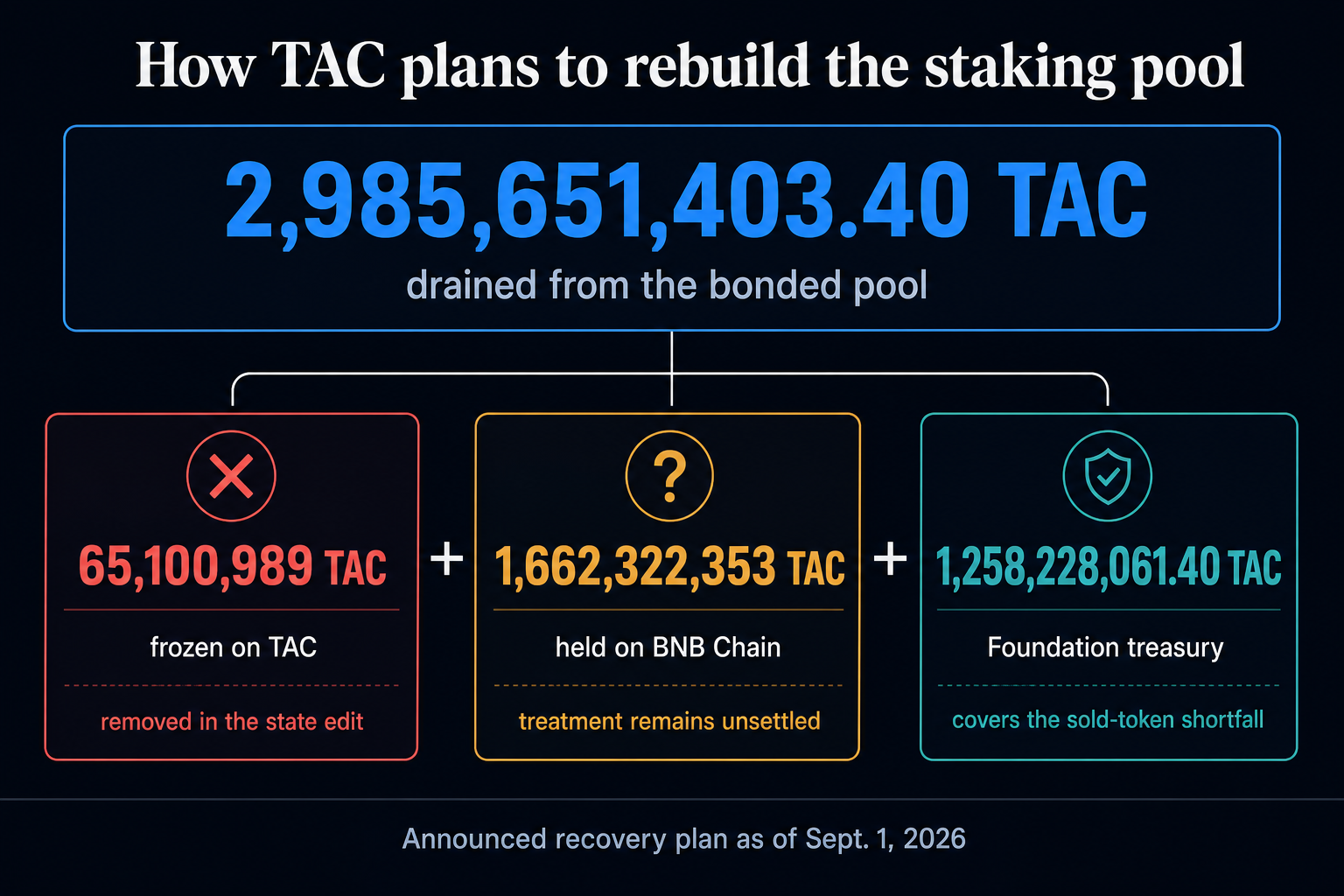
Unlike a rollback, the proposed edit would correct specified balances at the halt block without rewinding the chain. TAC said that would restore the bonded pool and delegator balances while preserving 7,772 legitimate transactions from 218 unrelated addresses.
Ending the TAC network halt still depends on validators adopting TAC's patched binary, resuming block production and executing the edit. Bridging and redemption remain disabled, and TAC has not settled how the 1.662 billion TAC on BNB Chain will be treated. The treasury commitment therefore addresses the sold-token shortfall, not the larger attacker-held balance outside the network.
The post TAC blockchain remains frozen for over 10 days after a massive exploit forces a 1.26 billion token bailout appeared first on CryptoSlate.
The US Securities and Exchange Commission (SEC) wants to let Wall Street’s official shareholder records move onchain while keeping regulated transfer agents in control.
On Sept. 1, the financial regulator proposed its first major overhaul of transfer-agent rules since regulations were adopted in the late 1970s and early 1980s, explicitly allowing blockchain or other distributed-ledger technology to serve as a company’s master securityholder file, or part of it.
That would bring tokenized securities deeper into the machinery that determines who legally owns shares, rather than limiting blockchain to a parallel record or digital representation.
One recordkeeping transfer agent would still retain exclusive control over the official shareholder file and remain responsible for its accuracy, security, and production to regulators.
SEC Chairman Paul Atkins said the proposal reflects the growing use of electronic communications and blockchain technology in securities offerings and share transfers. The broader rewrite would also replace paper-based requirements with electronic recordkeeping standards and update reporting around tokenization and distributed ledgers.
Securitize, a registered transfer agent already using blockchain infrastructure for digital securities, said the proposal moves regulation toward a model it has advocated to the SEC. Securitize is a tokenized real-world asset manager, with over $4 billion in assets under management.
The company has previously argued that public blockchains should be incorporated into securities recordkeeping while transfer agents continue overseeing the official ownership record.
“Modernization should raise standards, not lower them,” Securitize said, calling the regulatory shift and growing adoption of digital securities a tailwind for the sector.
Blockchain enters the official shareholder ledger
The proposal would formalize a direction SEC staff had already signaled.
Staff guidance has allowed registered transfer agents to use distributed-ledger technology as the official master securityholder file without maintaining a separate offchain duplicate, provided they meet existing regulatory requirements.
Transaction data, including wallet addresses, balances, ownership percentages, and purchase information, can reside onchain while sensitive personal information remains in separate systems.
The proposed rules would put that approach directly into the transfer-agent framework.
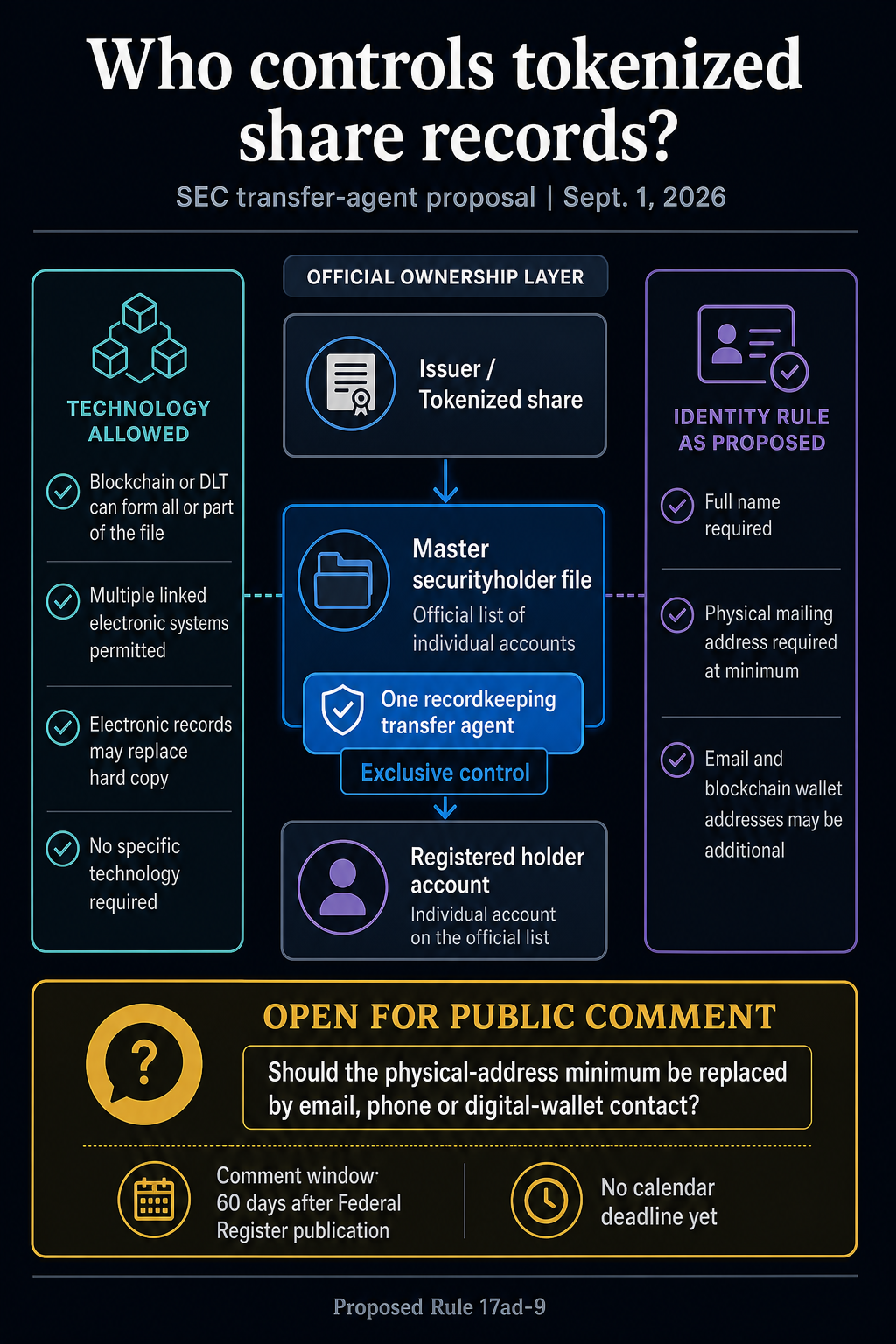
However, they would not mandate blockchain. Instead, transfer agents could choose the technology used to maintain their records, but the SEC said the system must remain secure, current, and accessible whether the underlying infrastructure is a conventional database or a distributed ledger.
Transfer agents would also have to give regulators more visibility into tokenization. Proposed changes to Form TA-2 would require reporting around securities using distributed ledgers, tokenization agents and platforms involved in those arrangements.
The technology provider would not inherit the transfer agent’s regulatory responsibility simply because the shareholder record runs through its infrastructure.
Wallet-only shareholders will have to wait
The proposal stops short of making corporate ownership fully wallet-native.
The SEC’s drafted framework would continue requiring the master securityholder file to include a holder’s full name and contact information, including a physical mailing address.
This means that a digital-wallet address can form part of the identifying information attached to a tokenized security, but it would not replace those traditional identity requirements.
The agency is nevertheless asking whether that should change.
Among the questions opened for public comment is whether transfer agents should have to collect a shareholder’s full name and physical mailing address and what consequences eliminating those requirements could have for other securities laws and market participants.
Commissioner Hester Peirce has separately raised the possibility of using email or digital-wallet addresses instead of names and physical addresses in some circumstances to facilitate onchain securities trading.
That leaves the SEC drawing a line between modernizing the shareholder ledger and replacing the identity system built around it.
Under the proposal, blockchain could become the authoritative infrastructure recording legal share ownership. The regulated transfer agent, however, would remain the gatekeeper connecting those on-chain positions to identifiable shareholders.
Comments are due 60 days after publication in the Federal Register. As of Sept. 1, the SEC had not provided a fixed publication date.
The post The SEC is rewriting 50-year-old Wall Street rules to let public blockchains decide who legally owns a stock appeared first on CryptoSlate.
Corporate political donations hit a record $646 million over the 18 months through June, according to Public Citizen's analysis of FEC filings. Crypto political spending led every other corporate sector at $206 million, while crypto, AI, and online betting together accounted for $344 million, more than half the total.
The GENIUS Act already created a federal regulatory framework for payment stablecoins, the SEC is rewriting crypto rules under Chair Paul Atkins, and the CFTC is pushing to bring more digital asset trading onshore. The Senate also faces a Sept. 15 cloture vote on the motion to proceed to the CLARITY Act, a procedural step requiring 60 votes to limit debate.
Three years ago, the industry's Washington agenda was simple: stop regulating through enforcement and say what rules apply. Founders interviewed for this piece describe a different ask now, one that treats today's wins as a starting point Congress needs to make permanent.
Crypto political spending seeks durable rules
Utkarsh Ahuja, founder of Moon Pursuit Capital, said the industry has moved past asking for rules.
He told CryptoSlate:
“Founders are building companies on five- and ten-year timelines, and investors are deploying capital on similar horizons.”
A regulatory framework that can swing with each new administration gets priced directly into where that capital goes. Serious long-term bets are hard to make when asset classification, agency jurisdiction, and compliance requirements could all move again in four years.
Ahuja framed the goal in terms of credibility:
“The US doesn't need to be the easiest jurisdiction for crypto, but it should aim to be the most credible and predictable.”
SEC Chair Paul Atkins said on Aug. 18 that legislation remains indispensable to creating rules “future-proofed” enough that a future regulator cannot simply undo the current SEC's work.
That an administration official and an industry investor are converging on the same point independently gives the durability argument real weight beyond standard lobbying language.
| Earlier crypto agenda | New congressional agenda |
|---|---|
| Stop regulation by enforcement | Make today’s rules durable through statute |
| Define whether tokens are securities or commodities | Lock in SEC/CFTC jurisdiction before administrations change |
| Get a federal stablecoin framework | Keep stablecoin rules open to new entrants |
| Win permission to operate | Gain access to banking, charters and payment rails |
| Protect exchanges and issuers | Protect noncustodial software and settlement infrastructure |
| Make crypto payments usable | Update tax rules for microtransactions and machine payments |
The Sept. 15 vote shapes what comes next
The House passed the CLARITY Act 294-134 in July 2025. The bill would create a system letting the SEC and CFTC jointly regulate the offer and sale of digital commodities, resolving the jurisdictional fight that has defined crypto lobbying for years.
Ahuja, Ryan Kirkley of Global Settlement Network, and Parth Kapadia of OpenVPP all named finishing market structure as their priority, independently of each other.
Whether the Senate clears cloture on Sept. 15 will shape which fight the next Congress inherits.
If cloture clears and the bill later becomes law, market structure could stop being the answer to every question about crypto's agenda, freeing attention for banking access, tax rules, and noncustodial protections.
Fail it, and finishing market structure remains the industry's dominant fight straight through the midterms, with committee control and chamber leadership suddenly carrying much higher stakes for crypto than they did a year ago.
| Scenario | What happens politically | What crypto focuses on next |
|---|---|---|
| CLARITY clears cloture and advances | Market structure looks more likely to be settled before the midterms | Banking access, payment rails, tax treatment, noncustodial protections and implementation |
| CLARITY clears cloture but stalls later | The industry gains momentum but not permanence | Keeping pressure on Senate leadership and preventing the bill from being rewritten |
| CLARITY fails cloture | Market structure remains unresolved heading into the election | SEC/CFTC jurisdiction, asset classification and committee-control fights |
| CLARITY fails after control of Congress shifts | Negotiations may reset under new leadership | Rebuilding the coalition and defending earlier policy gains |
Crypto wants infrastructure access
Kirkley wants federal regulatory sandboxes that let startups test settlement infrastructure under supervision “without needing a megabank's compliance budget on day one,” modernized bank charters, and direct access to payment rails.
He added that “ambiguity taxes every founder building here.”
That means crypto companies want the same infrastructure access banks already have, well beyond a regulator's acknowledgment that they can operate legally.
Kirkley also warned that stablecoin rules need to stay workable for new entrants, since GENIUS implementation could otherwise harden into an incumbent moat and close off the open market it was supposed to create.
Total stablecoin market capitalization sits near $303.7 billion, and 21 financial institutions, including Goldman Sachs, Bank of America, Citi and Deutsche Bank, announced on Sept. 1 plans to launch a jointly owned dollar-pegged stablecoin by early 2027.
BIS chief Pablo Hernández de Cos has separately argued that stablecoins do not yet credibly function as a means of payment at scale, while presenting tokenized deposits as a more promising path. That view reminds us that Washington's stablecoin enthusiasm is not universally shared.
Congress still writes crypto tax law for people
Kapadia's example involves a homeowner's battery enrolled in a virtual power plant, automatically earning thousands of tiny crypto-denominated payments for exporting electricity or responding to grid conditions.
Cynthia Lummis's pending digital asset tax proposal includes a $300 de minimis exemption meant to spare consumers from tracking every small crypto transaction, but it excludes property held for income production.
Kapadia argued that the carve-out excludes households earning automated crypto income from physical infrastructure, since the enrolled battery counts as income-producing property.
His proposed fix is an aggregation rule treating a year of micro-settlements as a single basis event, though how any enrolled battery gets classified in practice still needs confirmation from tax counsel.
Kapadia also wants a federal path for noncustodial settlement platforms, arguing a system that orchestrates payments without ever holding customer funds should not need money-transmitter licenses in fifty states. Congress has already begun addressing this.
The Blockchain Regulatory Certainty Act, introduced by Lummis and Wyden, would exempt developers and infrastructure providers without control over user funds from money-transmitter status.
CLARITY's Senate materials describe similar protections for software developers who never control customer assets. Kapadia's request builds on that foundation, aiming to make those protections durable enough to survive state-by-state licensing fights that recreate the same problem elsewhere.
His final ask involves tokenized assets tied to physical performance, like renewable energy certificates and verified megawatt-hour receipts, which he wants classified on the commodity side of the line.
Tokenized real-world assets have already more than tripled since the start of 2025, reaching nearly $39 billion as of Sept. 1.
Market structure, in other words, also touches receipts for electricity, grid capacity and other machine-measured outputs.
| Policy area | Industry ask | Why it matters |
|---|---|---|
| Banking and payment rails | Modernized charters and direct access to payment infrastructure | Prevents crypto firms from depending entirely on incumbent banks |
| Stablecoins | Rules workable for startups, not only large banks and issuers | Keeps GENIUS from becoming an incumbent moat |
| Federal sandboxes | Supervised testing for settlement and tokenized products | Lets startups experiment without megabank-scale compliance costs |
| Crypto taxes | Aggregation or de minimis treatment for machine-scale payments | Makes thousands of tiny automated transactions economically usable |
| Noncustodial settlement | Federal protection for platforms that never control user funds | Avoids 50-state money-transmitter fights for software-based systems |
| Tokenized physical assets | Commodity-side treatment for verified energy and performance receipts | Extends market structure beyond tokens, stocks and Treasuries |
Whether crypto political spending delivers durable rules
One path has cloture clearing Sept. 15 and the bill later becoming law, giving the next Congress room to work through banking access, tax treatment and noncustodial protections beyond relitigating basic jurisdiction.
Under that path, institutional capital gains the predictability Ahuja describes, and the industry's political spending starts converting into legislation a future administration cannot casually unwind.
Another path has cloture failing, or CLARITY stalling short of full passage, leaving market structure as the industry's dominant fight into a midterm election that could hand committee gavels to different hands entirely.
In that scenario, Ahuja's durability problem stays unresolved, capital keeps discounting US crypto policy for its volatility, and the industry's record political spending buys attention without buying the permanence founders say they need.
Crypto's next fight is over how much of the financial system it gets permitted to help rebuild.
The post What the $344M crypto political spending spree wants from Congress next appeared first on CryptoSlate.
CME and ICE told Washington in May that Hyperliquid's pseudonymous, always-on markets could let sanctioned state actors circumvent enforcement.
On Aug. 31, an Arkham analysis reviewed by CoinDesk found that wallets linked to North Korea's Lazarus Group had sold more than $30 million of Bitcoin through Hyperliquid over the prior three weeks.
The proceeds were converted into ETH and SOL before funds moved to Kraken, LBank, and KuCoin. The same day, Bloomberg reported that Hyperliquid Labs was in advanced talks with Kraken parent Payward over a regulated US entry point.
On paper, the timing could hardly be worse for Hyperliquid. Whether it threatens the push to bring the exchange onshore depends on a detail neither Bloomberg's report nor the Lazarus findings answer: how the proposed US structure would connect to Hyperliquid's market.
| Date | Event | Why it matters |
|---|---|---|
| May | CME and ICE warn Washington about Hyperliquid’s pseudonymous, always-on markets | Establishes that sanctions and market-integrity concerns predated the Lazarus finding |
| June 18 | CME files Chicago Mercantile Exchange Inc. v. Selig | Shows CME was already fighting the regulatory pathway for US crypto perpetuals |
| Aug. 19 | Trump says Selig is working to bring Hyperliquid into the US legally | Turns Hyperliquid’s US entry into a public political priority |
| Aug. 31 | Bloomberg reports Hyperliquid-Payward talks involving Bitnomial | Reveals the likely US-facing regulated venue |
| Aug. 31 | CoinDesk/Arkham identify $30M+ in Lazarus-linked BTC sales via Hyperliquid | Gives CME’s earlier warning a concrete, timely example |
| Sept. 2 / Oct. 2 | CFTC/Selig response deadline, then CME opposition deadline | Keeps the legal fight immediate rather than historical |
The plumbing for the Hyperliquid deal remains a mystery
Bloomberg reported that US customers would use Payward's Bitnomial exchange to trade perpetual futures tied to the price of crypto tokens built on Hyperliquid's blockchain technology, subject to regulatory approval.
Bitnomial would be the US-facing venue, the products would be perpetual futures, and Hyperliquid-related tokens would sit underneath them economically.
The report does not establish whether Bitnomial orders would ever touch Hyperliquid's existing order book, or whether the two venues would share liquidity. It also leaves open whether positions would settle on Hyperliquid's chain, or whether Payward and its market makers would hedge Bitnomial exposure by trading directly on Hyperliquid.
That gap determines whether Lazarus becomes a distant offshore data point or a direct question about who US-regulated customers could end up transacting against.
CME is already fighting the framework in court
CME filed Chicago Mercantile Exchange Inc. v. Selig on June 18 in the US District Court for the District of Columbia. The suit challenges the CFTC's decision to let Kalshi and other designated contract markets list crypto perpetual contracts as futures, a classification CME argues should have been swaps under a separate regulatory structure.
CME's complaint points to differences in swap-dealer registration, margin treatment, transaction reporting, collateral rules, and tax treatment. It alleges competitive injury from a regime that lets newer products compete directly with CME for retail derivatives customers.
The court ordered the CFTC and Selig to respond by Sept. 2, with CME's opposition to an expected motion to dismiss due Oct. 2.
CME's case turns on a narrow statutory question: whether perpetual contracts meet the legal definition of futures under the Commodity Exchange Act, or whether they function as swaps subject to a different regulatory structure entirely.
Whether North Korean wallets moved $30 million through an offshore venue has no direct bearing on that classification question. Lazarus gives CME a far more intuitive story to tell outside the courtroom, in front of the CFTC's product-review process, in congressional hearings, and in public advocacy.
A concrete sanctions-evasion example lands harder there than a technical swaps argument ever could.
ICE has drifted away from CME's position
The original May warning grouped CME and ICE. ICE CEO Jeffrey Sprecher has since struck a far more conciliatory tone, saying ICE was “not freaked out about Hyperliquid” and describing the two companies as helping each other understand their respective worlds.
Those comments followed a round of meetings between the two sides. He called Hyperliquid a wake-up call, a framing well short of a threat to reject outright. That breaks the tidy version of this story where legacy exchanges unite against a common DeFi rival.
CME is actively litigating the CFTC's framework, while ICE looks more interested in understanding the model while still pushing for a level regulatory playing field.
Payward agreed to acquire Bitnomial for up to $550 million in April and completed the deal May 1. The purchase gave it a full CFTC-regulated derivatives stack: a designated contract market, a derivatives clearing organization, and a futures commission merchant.
Kraken has already listed CFTC-regulated crypto perpetuals through that infrastructure for US users. Bitnomial functions as regulated market infrastructure that Payward acquired specifically for this kind of product, carrying its own designated contract market, clearing organization, and futures commission merchant licenses.
Two opposite conclusions for Hyperliquid
CME's version treats Lazarus as proof of concept. A sanctioned North Korean hacking group apparently moved tens of millions of dollars through the kind of pseudonymous, permissionless market CME warned regulators about months earlier.
That market lacks the identity and surveillance architecture required of conventional US intermediaries.
Keeping Hyperliquid offshore leaves the protocol running as it does now, available to the same global actors, with US regulators holding no more control over it than they already do.
A customer entering through a registered FCM, DCM, and DCO structure instead faces onboarding, compliance, and surveillance requirements that offshore access never required in the first place.
| Question | CME’s argument strengthened? | Why |
|---|---|---|
| Did Lazarus validate the category of risk CME and ICE warned about? | Yes | It gives a concrete example of a sanctioned state-linked actor using Hyperliquid’s pseudonymous market. |
| Does it prove crypto perpetuals are legally swaps, not futures? | No | CME’s lawsuit turns on statutory classification, not who used Hyperliquid offshore. |
| Does it raise the political cost of approving a Hyperliquid-linked US product? | Yes | It gives Congress, the CFTC, and legacy exchanges a national-security example. |
| Does it automatically block Hyperliquid’s US entry? | No | The effect depends on whether Bitnomial is segregated from or connected to Hyperliquid liquidity. |
| Could it support the onshoring argument? | Yes | Selig/Payward can argue offshore access is the problem, while US access would impose onboarding, surveillance, and compliance controls. |
CME can litigate the CFTC's classification decisions, lobby Congress, press for stricter surveillance and sanctions-screening requirements, and contest future agency actions if it has standing. Its current complaint already leans on a competitive-injury theory to establish that standing.
CME cannot veto the Payward-Hyperliquid agreement directly, order the CFTC to reject a product, or stop Congress and the CFTC from building a different lawful pathway if this one gets blocked.
Even a full win in its current lawsuit would mean Hyperliquid-linked products cannot use this specific futures framework, a narrower outcome than closing off every compliant path Hyperliquid could take into the US.
Whether the plumbing vindicates the warning or the onshoring push
The bull case for the CFTC's approach has Bitnomial running as a genuinely segregated market, handling its own onboarding, clearing, and participant controls, while Hyperliquid supplies only technology, token exposure, and reference pricing underneath.
Under that path, Lazarus becomes mostly a benchmark and surveillance question, well short of evidence that sanctioned wallets could ever transact against US customers. The episode ends up strengthening the case that bringing this activity onshore beats leaving it purely offshore and unsupervised.
| Scenario | How the structure works | Who benefits rhetorically? | Main regulatory issue |
|---|---|---|---|
| Segregated Bitnomial market | US users trade on Bitnomial; onboarding, clearing, and controls stay inside regulated US infrastructure | Selig / Payward | Lazarus becomes mostly an offshore optics, benchmark, and surveillance issue |
| Shared Hyperliquid liquidity | Bitnomial trades execute against or settle through Hyperliquid’s permissionless market | CME | Sanctioned wallets could be closer to US-regulated exposure |
| Separated US market, offshore hedging | US users stay on Bitnomial, but Payward or market makers hedge exposure on Hyperliquid | Mixed / contested | Regulated US risk may indirectly depend on pseudonymous offshore liquidity |
The bear case has Bitnomial activity executing against, settling through, or getting hedged on Hyperliquid's own permissionless liquidity in some meaningful way.
In that scenario, the compliance picture gets much harder fast: wallet sanctions screening, counterparty exposure, settlement finality, and whether regulated US positions can end up economically dependent on the same liquidity environment Lazarus just used.
That is the scenario where CME's May warning reads as an accurate prediction of what happened.
Lazarus may end up as evidence for two opposite visions of American market regulation at once. One holds that pseudonymous derivatives markets are inherently too dangerous to connect to US finance, while the other holds that leaving them offshore was the danger all along.
Which argument wins probably depends on a technical detail nobody involved has explained publicly yet.
The post North Korea’s $30M crypto cashout just handed legacy finance its best weapon to kill DeFi’s US debut appeared first on CryptoSlate.
Abstract: In H1 2026, TRON bucked broader market headwinds through a twin-track strategy: solidifying its core DeFi engine while aggressively expanding into AI. As recurring deflationary mechanics anchored value across DeFi protocols, a rapid wave of AI product launches unlocked new vectors for ecosystem growth.
Throughout the first half of 2026, global crypto markets faced a macro-driven cooldown. Tightening market liquidity and capital rotations into traditional AI tech pushed many crypto sectors into stagnation. TRON, however, carved out a distinct counter-cyclical rally. From expanding its stablecoin settlement layer and upgrading core DeFi asset value to strategically positioning itself across the Web3 AI stack, TRON delivered ecosystem-wide growth that significantly outperformed industry benchmarks.
At the heart of this performance is TRON's stablecoin infrastructure, which serves as the primary liquidity engine for the entire network. During H1 2026—even as global USDT market cap held relatively flat—circulating USDT on TRON expanded rapidly, breaking through $90 billion and setting consecutive all-time highs as it approaches the $100 billion milestone. This sustained liquidity depth cements TRON's role as the leading settlement network for digital dollars, providing low-cost, capital-efficient liquidity for applications building on top of the layer.
Building on its stablecoin dominance, TRON pursued a cohesive strategy throughout H1 2026: fortify the DeFi foundation and expand the AI front. In DeFi, key protocols introduced recurring buyback-and-burn mechanics alongside steady feature upgrades, sharpening the network's overall value-capture capability. Simultaneously, TRON executed a rapid rollout of foundational AI products—building a full-stack Web3 AI ecosystem that spans unified multi-model access layers, AI agent infrastructure, and distributed compute networks.
DeFi Ecosystem: Synergizing Token Deflation with Protocol Innovation
Against industry headwinds in H1 2026, TRON's DeFi sector advanced a dual-track strategy: value empowerment via buybacks and burns, and continuous product iteration. On the one hand, the ongoing execution of buyback-and-burn mechanisms by core projects across multiple tracks established a normalized, ecosystem-wide deflationary system. On the other, the relentless refinements to the functionality and user experience of core protocols enhanced both token value and protocol fundamentals.
To drive sustainable tokenomics, core ecosystem projects established programmatic buyback-and-burn mechanisms, forming a network-wide deflationary matrix across liquidity infrastructure, lending, oracles, and decentralized storage:
- SUN.io (Liquidity): Expanded its SUN buyback revenue streams. Starting with its 50th buyback-and-burn round in April, revenue from SUNX derivatives was permanently added to the burn pool alongside existing fees from SunSwap V2 and SunPump. The protocol completed its 50th and 51st token burn rounds in April and July, respectively.
- JUST (DeFi): Executed scheduled, multi-round JST token burns. The protocol completed its 2nd and 3rd large-scale buyback-and-burn rounds in January and April, followed by a record-setting 4th round in July that marked the largest capital allocation to date.
- WINkLink (Oracles): Launched a dedicated WIN buyback-and-burn program in July, allocating 100% of oracle service revenue toward repurchasing and burning WIN tokens.
- BitTorrent (Storage & Compute): Initiated a BTT buyback-and-burn program in July, funneling all revenue from decentralized services directly into token burns.
Parallel to these value-accrual mechanics, TRON protocols pushed aggressive feature upgrades across trading, lending, data feeds, and decentralized compute:
- SUN.io completed a strategic rebranding in January by introducing a dedicated Chinese brand to accelerate global adoption, followed by the launch of SunSwap V4 in March to deepen liquidity and enhance user experience.
- JustLend DAO deployed SBM V2 in June, introducing isolated collateral pools to support long-tail assets while enhancing risk management. Concurrently, the network's gasless transaction solution, GasFree, saw exponential adoption across stablecoin transfers.
- WINkLink upgraded its price feed portal in March, adding an integrated “Market Statistics” dashboard to enhance on-chain analytics.
- BitTorrent formally entered the AI space in June with BTTInferGrid, a decentralized AI compute marketplace that unlocks long-term demand for the network.
This dual engine of consistent token deflation and protocol innovation not only drove a steady surge in on-chain DeFi activity but also established a robust bedrock for long-term token value.
According to DeFiLlama, TRON's DeFi TVL climbed past $5.18 billion by September 1, placing it firmly in the top five public chains globally—narrowing the gap with Solana and BSC, and even overtaking them during peak trading periods. TRON's lead is even more pronounced in user engagement: the network logged over 3.88 million 24-hour active addresses, nearly double that of second-place BSC, underscoring its unmatched real-user adoption.

SUN.io: Enhancing DEX Efficiency via SunSwap V4 and Expanding Burn Pools
In H1 2026, SUN.io rolled out major updates across its branding, product suite, and tokenomics. By expanding brand awareness, upgrading protocol capabilities, and strengthening its value-accrual mechanics, the platform significantly sharpened its competitive edge.
To support global adoption, SUN.io launched a dual-brand strategy in January. This included introducing a dedicated Chinese brand identity, “Sun Wukong” (孙悟空), alongside a localized official website. The core product suite was seamlessly unified under this new framework: the DEX platform SunSwap became “Wukong Swap”, the memecoin launchpad SunPump became “Wukong Launch”, and the derivatives platform SunX became “Sun Wukong”. This approach allows SUN.io‘s comprehensive DeFi matrix—covering spot DEX trading, meme issuance, and perpetuals—to effectively engage both Western and Asian user bases.

On the product side, SUN.io continued to iterate on its core protocols, leveraging technical upgrades to lower trading barriers and reduce costs for users. On March 2, SunSwap V4 went live with six core architectural innovations:
- Singleton Design: Unified pool management for maximum capital efficiency.
- Native TRX Swaps: Direct trading pairs without the need to wrap TRX.
- Flash Accounting: Net balance settlements that dramatically cut transaction costs.
- Hooks: Customizable smart contract plugins for novel trading strategies.
- Custom Accounting: Tailored settlement logic for specialized pools.
- Subscribers: Real-time event notifications for active position monitoring.
These features pushed the protocol's customizability to new heights, unlocking possibilities for innovative DeFi scenarios. Within five months of launch, SunSwap V4 saw rapid adoption: peak liquidity stabilized at $108 million, and 24-hour trading volumes frequently surpassed $70 million during peak periods.
Capital efficiency was further improved in May with an upgraded Universal Router contract, which automatically executes trades across the optimal multi-pool paths.
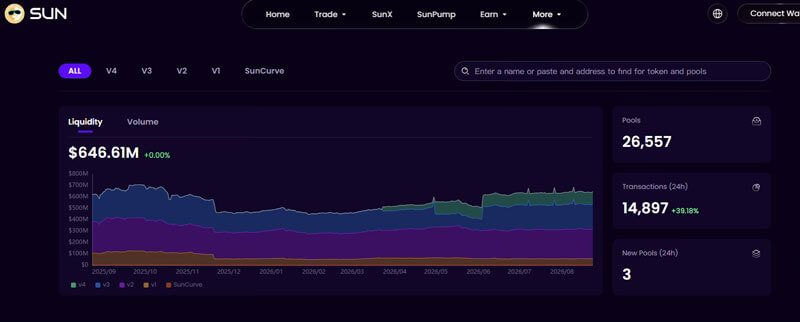
As of September 1, SUN.io reports a total TVL of ~$650 million across more than 26,500 active liquidity pools. Over the past seven days, total platform trading volume exceeded $514 million across 112,000+ individual transactions, maintaining a steady upward trajectory across all metrics.
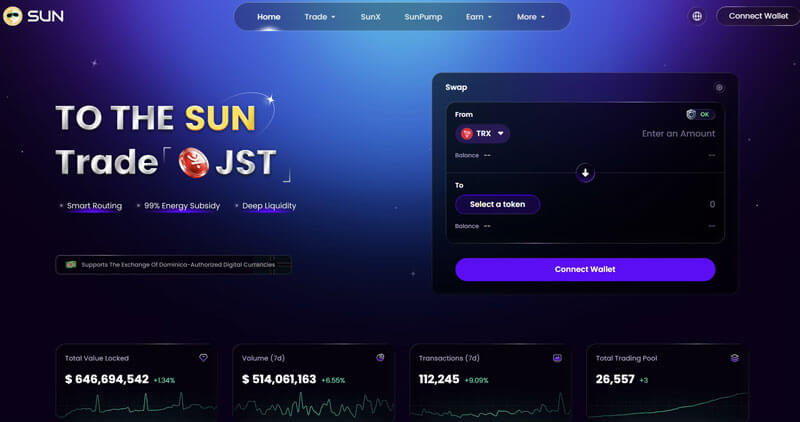
Finally, SUN.io accelerated the deflation of the SUN token by expanding its buyback revenue streams. Starting with its 50th buyback-and-burn round on April 25, revenue from the SunX derivatives platform was permanently added to the burn pool, complementing existing fees from SunSwap V2 and SunPump. To make this deflationary process more transparent and predictable, the platform also standardized its execution schedule, shifting to a unified announcement in the middle of the first month of each quarter.
Since launching its buyback-and-burn model in December 2021, SUN.io has executed 51 consecutive burn rounds without interruption, permanently removing 678,547,188.32 SUN from circulation—bringing the token rapidly toward the 700 million deflation milestone.
JustLend DAO: Real Yield Fuels JST Deflation as Product Matrix Expands
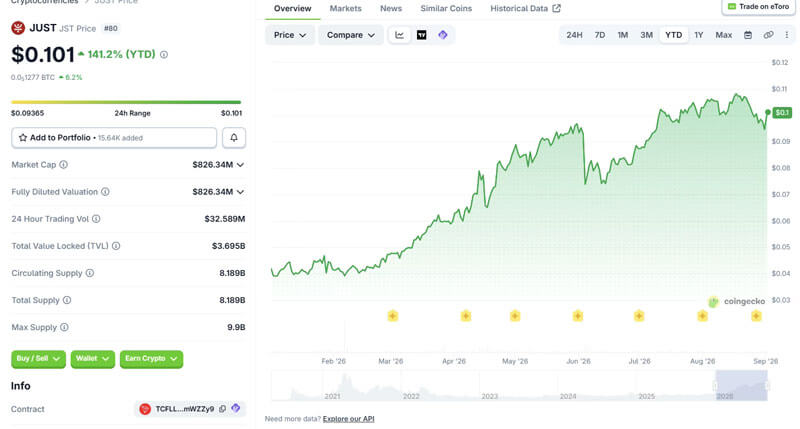
Powered by the protocol's sustained revenue growth in H1, JustLend DAO has executed multiple rounds of JST buybacks and burns. This established a complete closed-loop value model: real business revenue drives programmatic deflation, which fundamentally reinforces JST's value proposition. Driven by this deflationary flywheel, JST's price charted strong growth, surging from $0.04 at the start of 2026 to a peak of $0.11—a 275% cumulative gain. This rally catapulted its market cap from $400 million to over $868 million, marking its highest valuation since 2022. As of September 1, JST remains strong, trading at $0.101.
Concurrently, JustLend DAO‘s diversified product suite—spanning lending, liquid staking, Energy Rental, and smart wallets—unlocked new vectors for long-term ecosystem growth.
Since the start of 2026, JST has completed three large-scale scheduled burn rounds, each deploying over $20 million. In H1 alone, more than $70 million was allocated to buybacks, with nearly 90% derived from JustLend DAO‘s real operating net revenue:
- Round 2 (January 14): 525 million JST burned (equivalent to $21 million), accounting for 5.3% of the total JST supply.
- Round 3 (April 15): 271 million JST burned (equivalent to $21.3 million), accounting for 2.74% of the total JST supply.
- Round 4 (July 17): A record-breaking 355 million JST burned (equivalent to $34.59 million).
Funded by robust protocol revenue alongside accrued USDJ stability fees, this milestone burn accounted for 3.59% of the total JST supply.
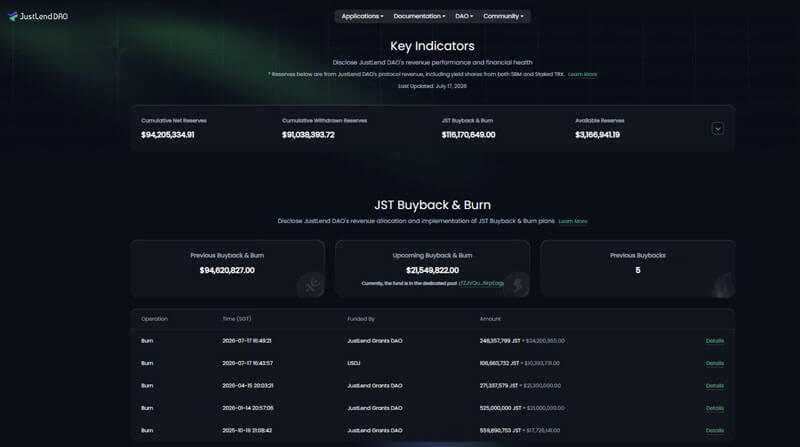
To date, the protocol has completed four major buyback-and-burn rounds, permanently removing 1.711 billion JST from circulation. This accounts for 17.29% of the total token supply and represents over $94.62 million in cumulative capital deployed. Excluding the $10.39 million special burn from accrued USDJ stability fees in Round 4, 100% of routine buyback funds are sourced directly from JustLend DAO‘s real business revenue.
According to official data, JustLend DAO has generated over $94.2 million in cumulative net revenue to date. When combined with stability fees, the total capital generated for repurchases approaches $105 million. This deflationary engine is primed to continue: the protocol has already reserved an additional $10.34 million in accrued revenue to fund the next scheduled buyback-and-burn event.
As the core protocol of the JUST ecosystem, JustLend DAO has built a robust, diversified product suite covering Supply & Borrow Markets (SBM), Liquid Staking (sTRX), Energy Rental, Gas-Free Transfers (GasFree), and Energy Purchasing (Buy Energy)—maintaining a top-tier industry position across all respective verticals.
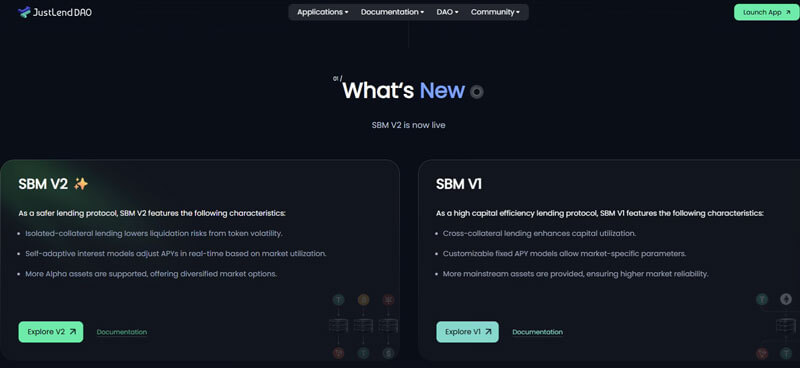
In the decentralized lending sector, JustLend DAO remains a dominant global force. According to DeFiLlama data as of September 1, the SBM platform boasts a Total Value Locked (TVL) of $3.38 billion, firmly securing its rank as the #4 decentralized lending protocol worldwide. Innovation continues to drive this growth: the launch of SBM V2 in June introduced isolated vaults, a critical architectural upgrade that expanded asset coverage while substantially reinforcing platform security. To further enhance capital efficiency during H1, the protocol also rolled out a dedicated $U lending market, continuously broadening its asset support to meet growing user demand.
In the liquid staking track, the sTRX product has accumulated over 9.73 billion staked TRX across more than 17,000 unique addresses, maintaining a steady upward trajectory in both TVL and user adoption. Building on this liquid staking foundation, the Energy Rental market introduces a highly flexible, pay-as-you-go model. This solves the pain point of requiring users to lock up large amounts of TRX long-term to lower on-chain gas costs, attracting a cumulative user base of over 80,000 participants.
Further expanding this utility ecosystem, JustLend DAO launched the Buy Energy feature in August. This pay-as-you-go service allows users to purchase TRON Energy on demand, saving users up to 64% in transaction fees compared to the traditional method of burning TRX for on-chain resources.
Driven by a core mission to eliminate friction and democratize on-chain access, JustLend DAO has engineered a comprehensive utility suite comprising Energy Rental, Buy Energy, and GasFree Transfers.
GasFree Transfers, in particular, has emerged as a primary growth catalyst for the platform. By allowing users to pay gas fees directly in their target token—bypassing the necessity of holding native TRX—it drastically lowers the barrier to entry for decentralized transactions. Currently supporting fee deductions in USDT and USDD (following its strategic integration in August), the feature is experiencing accelerating user adoption and transaction velocity.
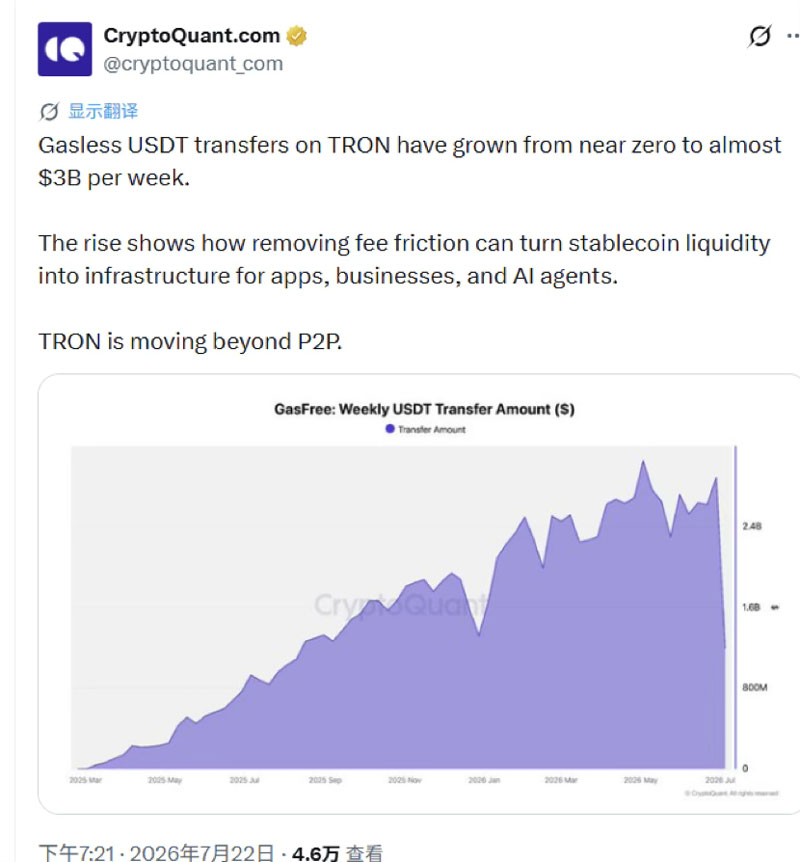
Recent data underscores this robust traction. According to CryptoQuant's TRON Q2 report, GasFree transfer volume in the final week of June reached $2.9 billion, closely approaching the $3 billion all-time high established in early May. As of September 1, cumulative GasFree stablecoin transfers have surpassed 7.7 million transactions, representing $132.6 billion in total transfer volume. By saving users over $8.48 million in cumulative transaction fees, GasFree Transfers has rapidly solidified its position as an indispensable utility and a significant new growth vector for JustLend DAO.
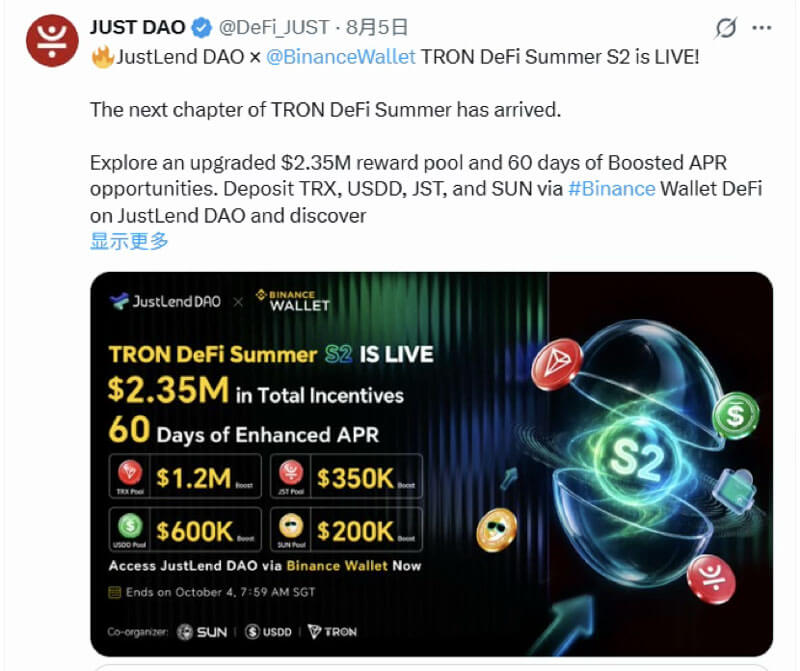
Beyond rapid product iteration and steady growth in core business metrics, JustLend DAO is actively expanding its strategic partnerships to bridge external ecosystems and onboard new users. On July 6, JustLend DAO was officially integrated into the Binance Web3 Wallet DeFi hub, launching dedicated liquidity pools to tap into the leading CEX's massive global user base. Hot on the heels of this integration, JustLend DAO teamed up with USDD and SUN.io to co-host the “TRON DeFi Summer” campaign alongside Binance Wallet, backed by a $4.5 million prize pool. This cross-ecosystem alliance is highly strategic: it not only injects substantial fresh capital and new user cohorts, but it also establishes a seamless conversion pipeline moving users from a top-tier CEX directly into TRON ecosystem DeFi. Ultimately, this frictionless acquisition funnel broadens the protocol's foundation for sustainable revenue generation.
BitTorrent: Expanding into Decentralized AI via BTTInferGrid and Launching Long-Term BTT Buybacks
BitTorrent advanced its core value proposition in H1 2026, achieving landmark breakthroughs across compliance, product development, and tokenomics. By resolving long-standing regulatory headwinds, accelerating core product iteration, expanding into artificial intelligence, and instituting a multi-phase BTT buyback-and-burn initiative, BitTorrent has executed a comprehensive strategic transformation from the ground up.
This shift began with the total clearance of a multi-year regulatory overhang. On March 6, the U.S. SEC officially dropped all charges against Justin Sun, the TRON Foundation, and the BitTorrent Foundation. This resolution brought a definitive end to a three-year dispute, eliminating the policy uncertainty that had previously constrained the ecosystem's growth and strategic roadmap. Capitalizing on this regulatory clarity, BTT secured a fiat listing on Bitkub, a leading Thai cryptocurrency exchange, with the launch of the BTT/THB trading pair. By enabling local users to trade BTT directly with Thai Baht, the listing significantly bolsters BTT's regional market liquidity and deepens its strategic footprint in Southeast Asia.
Simultaneously, BitTorrent continues to iterate on its core infrastructure. On June 5, the team rolled out BitTorrent Neo, a specialized client designed natively for macOS. Delivering a lightweight, intuitive user interface without compromising performance, BitTorrent Neo modernizes the peer-to-peer (P2P) file-sharing experience and reinforces the protocol's position in decentralized distribution.
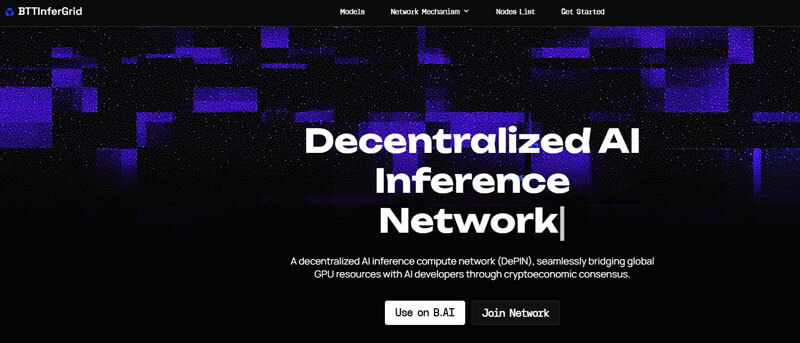
Expanding into high-growth verticals, BitTorrent officially entered the decentralized AI compute sector with the June 17 launch of BTTInferGrid. Built as a DePIN (Decentralized Physical Infrastructure Network) tailored specifically for AI inference workloads, BTTInferGrid aims to optimize traditional compute supply. This launch signals BitTorrent's strategic expansion into the Web3 AI landscape, unlocking a new growth vector for the entire ecosystem.
To complement this expansion, BitTorrent has activated a comprehensive BTT buyback-and-burn mechanism designed to drive long-term value. In a strategic update announced July 6, 100% of the revenue generated from its decentralized businesses is now routed into a dedicated pool for routine quarterly burns. This enhances BTT's value capture logic—upgrading it from a standard utility and governance token into a deflationary asset anchored by real protocol yield. Ultimately, this ensures the community shares directly in the growth of BitTorrent's expanding network.
WINkLink: Core Oracle Services Upgrade as New Buyback Program Bolsters Token Value
As the premier oracle infrastructure powering the TRON ecosystem, WINkLink executed comprehensive upgrades throughout H1. These enhancements touched every layer of the protocol, spanning core product functionalities, broader asset coverage, and updated tokenomics. By fortifying its on-chain data services and deploying a dedicated token buyback-and-burn mechanism, WINkLink is actively translating its operational success into sustainable, long-term value for token holders.
On the product front, WINkLink upgraded its Price Service page on March 27, introducing a new Market Statistics module. This feature visualizes key metrics—such as market cap ranking, circulating and total supply, and 24-hour and 7-day price ranges—substantially improving data completeness and readability to better support the diverse needs of developers and financial protocols.
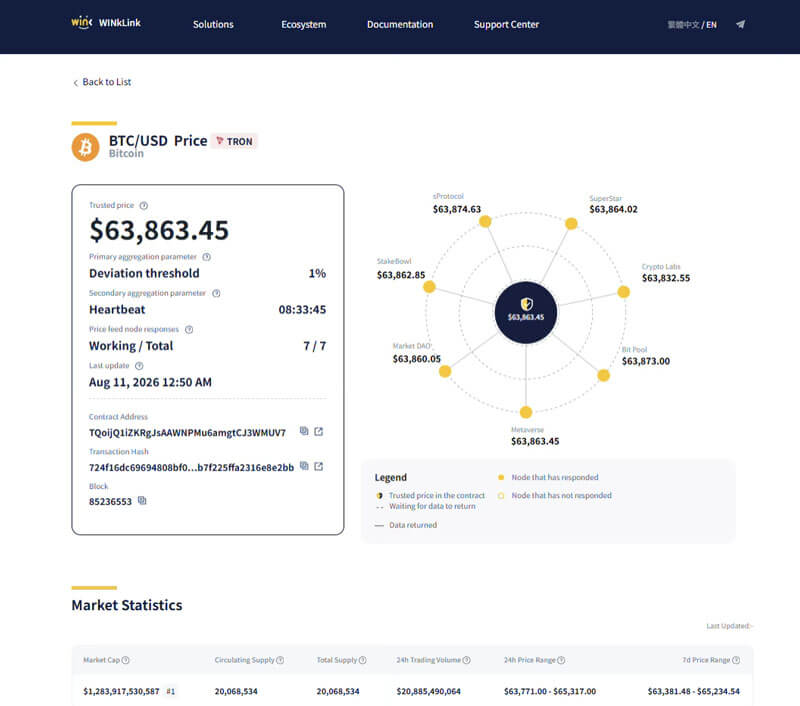
In terms of asset coverage, WINkLink steadily expanded its oracle price feeds. It integrated $U price feeds alongside U/TRX and U/USD trading pairs on April 13, followed by KGST price feeds and the KGST/TRX pair on June 9, continuously enriching on-chain price data across a broader range of asset classes.
To empower token value, WINkLink launched a long-term WIN buyback-and-burn initiative on July 6. Under this program, 100% of the revenue generated from providing oracle services to the TRON ecosystem is allocated to buying back and burning WIN tokens, with burn data publicly disclosed around the middle of the following quarter. By directly linking ecosystem revenue to token value, this mechanism continuously optimizes token supply dynamics, fostering a positive feedback loop between protocol utility and token value. Following the announcement, WIN surged from ~$0.00002055 to $0.00002514 on July 29, marking a 22.5% gain that clearly demonstrates the value appreciation driven by deflationary mechanics.
Additionally, WINkLink secured exchange recognition early in the year. WIN was officially listed on Thailand's leading crypto exchange, Bitkub, on January 30, followed by Baltex on February 28, expanding its global market footprint ahead of schedule.
TRON's AI Matrix: Rapid Product Rollouts Drive Expansion
While a mature DeFi ecosystem serves as TRON's financial anchor through market cycles, its strategic expansion into Web3 AI forms the core pivot for capturing the dividends of the next technological revolution. In H1 2026, TRON entered a major growth phase for its AI ecosystem: Bank of AI, a dedicated financial infrastructure for AI Agents, launched in February; B.AI, a unified multi-model service gateway, debuted in April; and BTTInferGrid, a decentralized AI computing network, went live in June—marking a rapid succession of milestone product rollouts.
Today, TRON's AI ecosystem features a robust product matrix anchored by B.AI, Bank of AI, AINFT, and BTTInferGrid. Spanning large language model (LLM) service gateways, AI Agent infrastructure, AI Agent financial trading, and distributed compute supply, each layer boasts distinct positioning, complementary capabilities, and functional synergies. Together, they form a complete multi-tier architecture connecting top-layer service gateways, middle-layer core infrastructure, and bottom-layer computing power, creating a highly efficient and well-structured decentralized AI ecosystem.
At the top layer, B.AI serves as a unified multi-model gateway bridging Web2 and Web3. Positioned as premier AI infrastructure, B.AI functions as a global settlement layer for intelligence, operating above all models and below all agents to route, compute, and settle every call. Its LLM offering integrates conversational capabilities and standardized API services from multiple mainstream models, supporting one-click model switching and rapid integration through a single API. The platform has also introduced essential ecosystem tools, including the desktop AI agent BAIclaw, the coding assistant BAIcode, and foundational protocols like the x402 payment standard and 8004 identity protocol. Together, these solutions deliver a frictionless user experience while drastically lowering technical barriers for developers, providing a unified LLM foundation for all applications across the ecosystem.
At the middle infrastructure layer, Bank of AI and AINFT power two central pillars for AI agents: financial service onboarding and trading strategy validation. Bank of AI provides dedicated financial infrastructure, leveraging native components such as the x402 payment standard, 8004 identity protocol, MCP Server, and Skills to deliver one-stop Web3 integration. This allows AI agents to seamlessly access mature DeFi functions like trading and lending out of the box, positioning Bank of AI as the primary bridge between AI agents and TRON's DeFi ecosystem. Meanwhile, AINFT plans to build an AI trading hub by introducing standardized evaluation infrastructure, providing strategy verification and benchmarking to foster trust and value flow across the AI trading landscape.
At the foundational layer, BitTorrent's BTTInferGrid decentralized AI inference network powers the entire ecosystem. Drawing on BitTorrent's 20-plus years of global distributed node infrastructure, the platform uses crypto-economic incentives to aggregate idle GPU compute and bandwidth resources. By transforming fragmented hardware into a standardized, unified compute pool, BTTInferGrid delivers low-cost, high-availability, and on-chain-verifiable AI inference services for all upper-layer applications. This directly challenges the monopoly of centralized providers while significantly reducing compute costs for Web3 AI projects.
Beyond product rollouts, TRON has also secured a forward-looking position in industry standards. In March, TRON joined the Agentic AI Foundation hosted by the Linux Foundation as a Gold Member, taking a seat alongside global tech and finance leaders, including OpenAI, Anthropic, Circle, and JPMorgan Chase, to shape industry governance. This strategic move further reinforces TRON's influence and competitive edge in decentralized AI, bolstering its position to lead the next technological revolution.
B.AI: Full-Stack AI Infrastructure and the Go-To Gateway for Global Users
Officially launched in April, the platform has rapidly evolved into a breakout Web2 and Web3 AI product through high-frequency iterations and constant feature rollouts. Serving as TRON's core unified gateway for both everyday users and developers, B.AI surpassed 2.2 million registered users by September 1, reaching a multi-million scale in just four months. Momentum reached a new high on August 31, when daily token throughput crossed 1.1 trillion, ushering the platform into the era of 1T+ compute orchestration and solidifying its position among the industry's fastest-growing AI platforms.
In just four months, B.AI has built a full-stack infrastructure spanning consumer interactions and developer tools. Its multi-tiered architecture features a unified LLM platform at its core, practical applications like the desktop AI agent BAIclaw and coding assistant BAIcode, and foundational components such as the x402 payment standard, 8004 identity protocol, and Skill modules. Together, these layers form an end-to-end framework connecting unified access, real-world applications, and underlying capabilities.

At the core service layer, B.AI aggregates dozens of leading global AI models, pairing premier international flagships with highly cost-effective options. The catalog includes global benchmarks including ChatGPT (GPT-5.4/5.5/5.6 series), Claude (Opus/Sonnet/Haiku series), Gemini (Flash/Pro series), and Grok (4.5 series), alongside competitive Chinese models like MiniMax (M2.7/M3), DeepSeek (V4 series), Kimi (K2.5/K2.6/K3), Zhipu GLM (5.1/5.2/5.3), Qwen (3.6/3.8 series), Tencent Hy3, and MiMo (V2.5/V2.5 Pro). With new models continuously integrated, users can freely toggle across options within a single interface, eliminating the hassle of switching platforms.
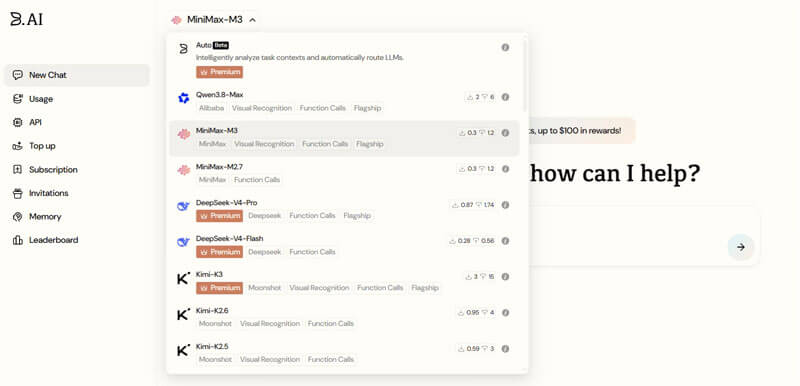
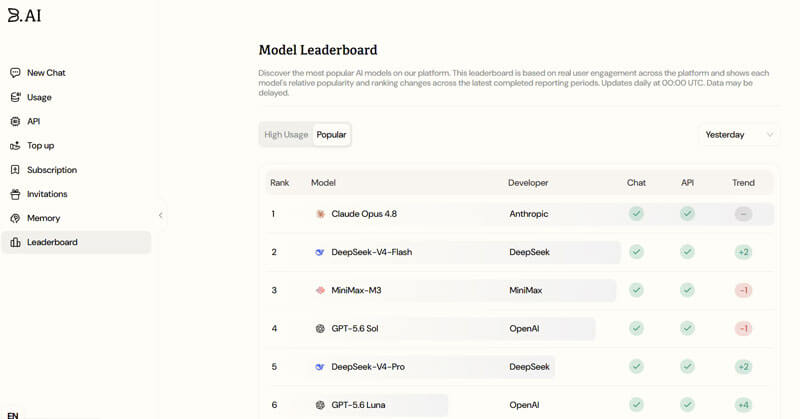
To solve the complexity of model selection, B.AI introduced Auto Smart Routing, which automatically pairs user tasks with the optimal model based on task type, complexity, and cost. This drastically lowers the barrier to leveraging multi-model AI. Additionally, a dedicated Leaderboard tracks real-time usage volume and user ratings, enabling new users to quickly identify top-performing models tailored to their needs.
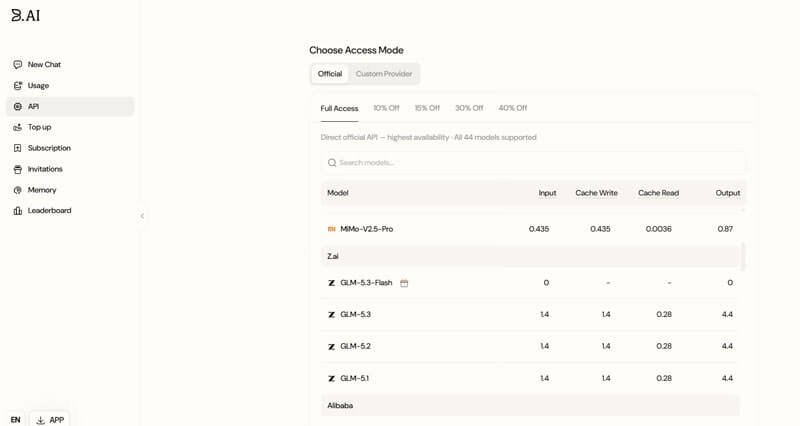
For API integrations, B.AI launched a unified API key interface that enables developers to access every model on the platform with a single key. To accommodate varying user scales, budgets, and operational needs, B.AI API offers dual operating modes:
- Official Mode: Connects directly to native provider APIs and offers discounted resource pools with 10% to 40% off across models like GLM-5.2, Grok, Gemini, and GPT, with model coverage expanding continuously.
- Custom Provider Mode: Allows users to select model providers based on specific business needs and unlock flexible tiered pricing. Featuring discounts up to 90% off across mainstream models like Claude, GPT, Gemini, Kimi, and GLM, this mode regularly adds new providers and pricing tiers to offer developers even more diverse choices for API integration.
For authentication and payments, B.AI supports dual Web2 and Web3 rails, ensuring frictionless onboarding for users across all ecosystems. On the login side, the platform supports one-click Web2 sign-in via Google accounts alongside multi-chain Web3 wallet access across TRON, Ethereum, BNB Chain, Optimism, Arbitrum, and non-EVM networks like Solana. On the payment side, B.AI bridges traditional fiat and crypto ecosystems: Web2 users can pay via Visa, WeChat Pay, Alipay, and UnionPay, while Web3 users can connect through dozens of major global wallets including TronLink, Binance Wallet, OKX Wallet, MetaMask, and Trust Wallet. By pairing full wallet compatibility with unified fiat-crypto payments, this hybrid approach delivers a smooth interaction and payment experience worldwide.
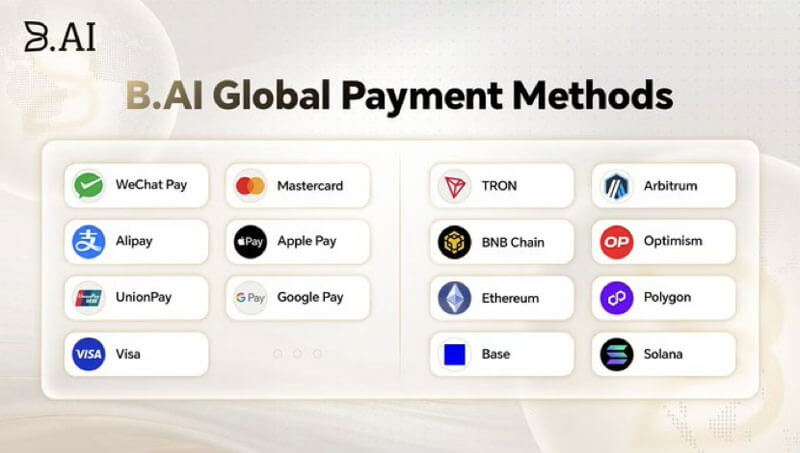
 To expand its ecosystem, B.AI has partnered with dozens of tech and Web3 leaders, including cloud giants Alibaba Cloud and Tencent Cloud, AI unicorn MiniMax, and Web3 innovators like Biconomy, MoonPay, Pundi X Labs, KuCoin Web3 Wallet, Symbiosis, CROSS, and deBridge.
To boost adoption, B.AI launched a limited-time free-access campaign on August 17, offering zero-threshold, unlimited access to six top LLMs: GLM-5.3-Flash (Ox Alpha), Qwen3.8-Flash, DeepSeek-V4-Flash, DeepSeek-V4-Flash-Vision-Exp, Tencent Hy3, and Xiaomi MiMo-V2.5.
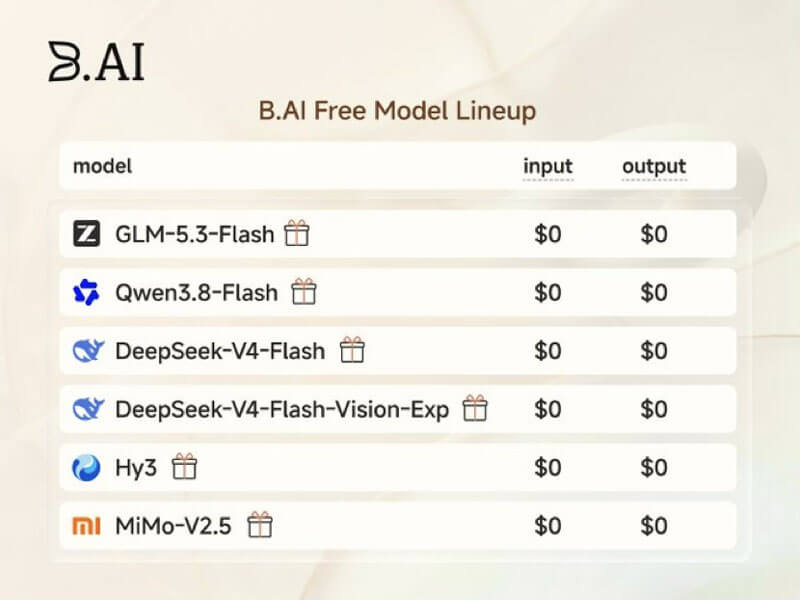
Official data shows this promotion drove explosive usage growth. On August 31, B.AI‘s daily token throughput topped 1.1 trillion, marking a new milestone in 1T+ compute scale. In the campaign's first 14 days, cumulative throughput reached 6.86 trillion, bringing in over 196,000 new API users.
Bank of AI: One-Click On-Chain Financial Infrastructure for AI Agents
Unveiled in February, Bank of AI serves as a financial protocol hub connecting AI and Web3. By equipping AI agents with autonomous execution capabilities, it transforms them from passive chatbots into active, decision-making economic actors.
Designed as an all-in-one toolkit, Bank of AI provides standardized, out-of-the-box financial modules. It integrates foundational standards like the x402 payment protocol and 8004 identity protocol, alongside developer tools such as the MCP Server, Skills plugin framework, and OpenClaw Extension. With simple code snippets or plain natural language prompts, developers and no-code users can equip any AI agent with automated payments, identity verification, and DeFi operations—no smart contract expertise required.
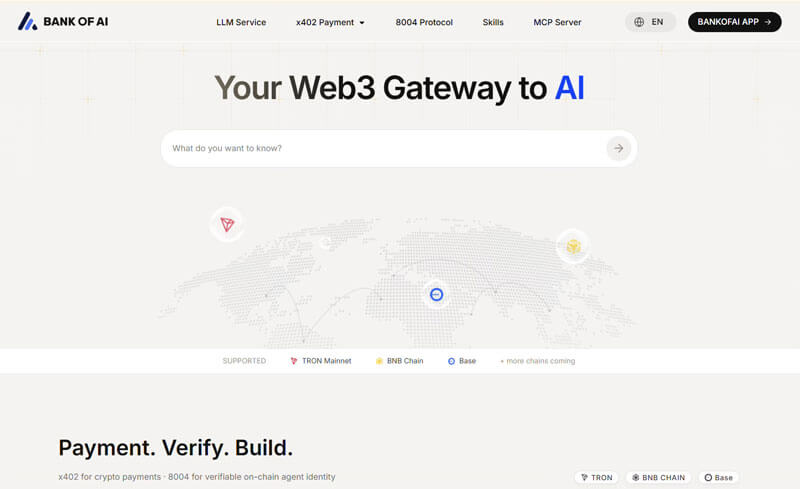
Currently, Bank of AI‘s MCP Server and Skills framework support TRON, Ethereum, and BNB Chain. Connected agents can fetch real-time data and interface seamlessly with top DeFi protocols—including SUN.io, JustLend DAO, Uniswap, and PancakeSwap—to autonomously handle swaps, lending, yield farming, and cross-chain arbitrage. This grants AI agents true asset management autonomy, laying an extensible financial execution layer for the Web3 AI economy.
AINFT: Trading Hub & Standardized Trust Layer for AI Agents
AINFT plans to provide standardized infrastructure and serve as a financial trading hub for AI agents. For developers, AINFT will launch a dedicated trading benchmark platform to turn investment concepts into audited, quantitative backtesting results, establishing clear performance standards and validation frameworks for AI agent trading strategies.
Specifically, developers can evaluate strategies with zero financial risk using simulated real-market data for core assets like BTC and ETH. The platform provides objective quantitative assessments across key metrics—including returns, risk control (loss limits and maximum drawdown), operational stability, alpha generation, and end-to-end decision logic. This allows top-tier strategies to stand out through market competition, building an industry-recognized capability rating and trust credential system for AI agents.
While AINFT has not officially launched, a preview version is currently live on its website. For further product updates, please follow @AINFT on X.
BTTInferGrid: Decentralized AI Compute Network Reshaping the Economy
Launched by BitTorrent in June, BTTInferGrid is a flagship DePIN decentralized compute network designed for AI inference. Serving as the compute foundation for TRON's AI ecosystem, it connects global idle GPU resources with AI developers to build an open, accessible next-generation compute infrastructure.
Powered by cryptoeconomic incentives and distributed consensus, BTTInferGrid aggregates fragmented, underutilized GPU capacity into a standardized, schedulable resource pool that precisely matches developer inference demands. This approach reshapes the production, distribution, and value flow of compute power, dismantling traditional centralized monopolies.
Currently, BTTInferGrid supports key open-source models—including Qwen3.6 27B, Qwen2.5 7B Instruct, and Meta Llama 3.1 8B Instruct—which developers can access with one click via B.AI. The platform will soon release standardized APIs for flexible, on-demand compute scheduling, further shortening AI application development cycles.
Longer term, BTTInferGrid aims to become a fully AI-native infrastructure. By 2028 and beyond, it plans to deliver an integrated network combining compute, storage, and smart contracts to power AI agents and automated applications, establishing itself as the go-to decentralized compute network for global open-source AI.
TRON's DeFi + AI Engine: Building Resilience Across Market Cycles
Amid an industry-wide downturn, TRON achieved counter-cyclical growth by solidifying its DeFi foundation while expanding into AI. Its DeFi sector maintains market leadership, while a rapidly maturing AI ecosystem unlocks new growth vectors. Together, these complementary drivers power TRON's long-term competitiveness, setting a proven blueprint for Web3 growth.
TRON has established a mature DeFi ecosystem spanning trading, asset management, and infrastructure. SUN.io provides a full suite of trading services, including SunSwap (DEX), SunPump (meme launchpad), and SUNX (perpetuals). The JUST ecosystem delivers integrated asset solutions via JustLend DAO—covering SBM lending, sTRX liquid staking, and energy rental—alongside the GasFree smart wallet and USDD stablecoin. Supporting the entire network, WINkLink oracle and BitTorrent offer essential data and file transfer capabilities.
Backed by real protocol revenue, ongoing product iteration, and token deflation, this robust DeFi base provides both the revenue and user foundation needed to power TRON's expansion into AI.
In AI, TRON has secured a strong first-mover advantage through rapid product rollouts and practical execution, establishing a full-stack, closed-loop ecosystem. Built around four core products—B.AI, Bank of AI, AINFT, and BTTInferGrid—TRON has structured a three-tiered architecture spanning top-layer model entry, middle-layer agent infrastructure, and bottom-layer compute. Rather than standalone tools, these components operate as a cohesive system: B.AI serves as the portal for user traffic and model services; Bank of AI and AINFT empower AI agents with financial capabilities; and BTTInferGrid provides distributed compute. Working in synergy, these products drive TRON's competitiveness in Web3 AI and lay the groundwork for deep AI-blockchain integration.
At Malaysia Blockchain Week 2026, TRON Founder Justin Sun highlighted TRON as a cornerstone for converging AI and finance. He noted that DeFi, TradFi, and AI are accelerating convergence across shared assets, payment rails, and user bases. In a future financial landscape shaped by institutions, open blockchains, and AI, TRON's infrastructure will play a central role.
Just as TRON's 2019 vision established its global stablecoin leadership and its 2020 push built its DeFi foundation, its systematic deployment of AI now serves as the growth engine for its next era, driving the ecosystem into new technological frontiers.
TRON Eco Team
Singapore
media@just.network
Disclaimer: This was a sponsored post brought to you by TRON.
The post TRON H1 2026 Strategy Report: Dual-Engine Growth via DeFi and AI Delivers Record Traction appeared first on CryptoSlate.
HTTP error 429 on https://cryptoticker.io/en/feed/
Failed to fetch feed: https://cryptoticker.io/en/feed/
Failed to fetch feed.
Decrypt
Bitcoin traders are calling August's spike-and-fade a Bart Simpson hairline. Here's what separates an actual flash crash from an ordinary correction.
Groups including The Crypto Council for Innovation, Grayscale, and a16z urged the regulator to preserve existing fund classifications and streamline reviews for new exchange-traded products.
The unreleased model can find zero-day vulnerabilities and chain them into working exploits without a human walking it through each step, and access to that capability is starting with a small group of testers.
Two Thai businessmen claim Tether blocked access to their stablecoins months before federal authorities secured a seizure warrant.
The country's consumer watchdog went further, urging retailers to stop selling the devices until the law is clear.
U.Today - IT, AI and Fintech Daily News for You Today
Trading activity on the XRP Ledger surged in the second quarter, with average daily order-book volume rising 79% from a year earlier even as the number of accounts executing trades fell.
Bitcoin is breaking out of its bear market as giant buyers completely absorb the retail panic.
Kalshi traders are betting on Bitcoin reaching a high of $82,000 this month, amid growing expectations for another price recovery across major assets.
Former Ripple CTO backs Tether's $42 million warrantless freeze in SDNY lawsuit, warning of massive anti-money laundering risks.
September has opened on a familiar note for risk assets, with Dogecoin cofounder sharing an unexpected take.
Blockonomi
Key Highlights
- Vertiv is purchasing Utility Innovation Holdings in a cash deal worth $1.45 billion upfront
- Contingent earn-out payments could add another $1.15 billion based on performance milestones at 12 and 24 months
- Utility Innovation specializes in microgrid management, on-site energy generation, and storage solutions for data center facilities
- The transaction is priced at approximately 13x Utility Innovation’s projected 2027 EBITDA with first-year EPS accretion expected
- VRT shares have climbed 58% since the start of the year, despite a 23% pullback in the last quarter
Vertiv Holdings revealed on Wednesday plans to acquire Utility Innovation Holdings, commonly referred to as UtilityInnovation Group (UIG), in an all-cash transaction valued at $1.45 billion.
Vertiv Holdings Co, VRT
Beyond the initial payment, the agreement incorporates performance-based consideration of up to $1.15 billion linked to EBITDA milestones measured at 12-month and 24-month intervals, pushing the maximum transaction value to $2.6 billion.
Shares of VRT experienced modest volatility on Wednesday, initially dipping approximately 0.3% during morning trading before stabilizing near unchanged levels by the afternoon session.
The acquisition places a valuation on Utility Innovation at roughly 13 times its anticipated 2027 EBITDA. According to Vertiv, the transaction should boost adjusted earnings per share during the initial complete year following the deal’s closure.
The transaction is anticipated to finalize during the fourth quarter of 2026.
Strategic Capabilities of Utility Innovation
Utility Innovation focuses on developing on-site microgrid energy systems and behind-the-meter power solutions tailored for data center operations. The company also produces advanced software platforms for real-time energy management.
These competencies represent significant strategic assets. With artificial intelligence driving unprecedented data center expansion, securing rapid grid connectivity has emerged as a critical bottleneck for facility operators.
Vertiv indicated that integrating Utility Innovation’s technology portfolio should “help data center operators secure power faster as grid constraints increasingly limit AI infrastructure deployment.”
Microgrid platforms enable the coordination of local power generation assets and battery storage, minimize reliance on traditional utility infrastructure, and can even return excess capacity to the grid during peak demand periods.
This acquisition brings microgrid control systems, distributed generation capabilities, energy storage coordination, and behind-the-meter design expertise into Vertiv’s comprehensive data center infrastructure offerings.
Acquisition Addresses Rising Infrastructure Resistance
The strategic timing of this purchase reflects current market realities. Increasing political resistance and community pushback against linking massive AI data centers to local utility networks has created significant development challenges.
Through expanding its microgrid technology portfolio, Vertiv is strategically enabling clients to circumvent these obstacles instead of confronting them directly.
Vertiv emphasized that power infrastructure choices made during early site planning phases can significantly influence the entire facility development timeline and costs.
VRT shares have posted impressive 58% gains year-to-date, representing strong performance in any context. However, the stock has retreated approximately 23% during the past three months amid a broader correction in AI-related equities.
Market reaction to Vertiv’s July quarterly results was also subdued, contributing additional downward pressure on the shares in recent weeks.
Analyst sentiment toward the company remains overwhelmingly positive. All 16 equity analysts tracking VRT maintain Buy recommendations, resulting in a Strong Buy consensus rating.
The consensus price target of $344.36 suggests potential appreciation of approximately 34% from current trading levels.
The acquisition is scheduled to conclude in Q4 2026, subject to customary regulatory clearances.
The post Vertiv (VRT) Stock: $2.6B Acquisition of Utility Innovation Bolsters Data Center Power Solutions appeared first on Blockonomi.
Key Takeaways
- Shares of CRDO tumbled 21% to $163.83 even after surpassing fiscal Q1’27 earnings and sales projections.
- The company reported adjusted earnings per share of $1.20, exceeding the $1.17 consensus; sales reached $479 million versus $473 million forecasted.
- Forward guidance calling for $525M-$535M in Q2 revenue failed to meet heightened investor expectations.
- J.P. Morgan reduced its target price from $335 down to $310; Bank of America lowered its outlook from $340 to $275.
- From a technical perspective, shares have declined approximately 40% from the 2026 peak of $308.30, with analysts warning of potential additional weakness.
Shares of Credo Technology Group plummeted 21% during Wednesday’s session, settling at $163.83 in afternoon activity, following a Tuesday evening earnings announcement that generated lukewarm responses from Wall Street analysts despite the company exceeding quarterly benchmarks.
Credo Technology Group Holding Ltd, CRDO
During the fiscal first quarter that concluded on August 1, the semiconductor firm delivered adjusted earnings per share of $1.20, surpassing analyst projections of $1.17. Total revenue reached $479 million, beating both the Street consensus of $473 million and the upper boundary of management’s guidance at $475 million. Compared to the same period last year, revenue surged 114.7%.
The company’s GAAP gross margin expanded to 64.5%, while GAAP net income reached $129.4 million, representing an increase from $64 million in the prior-year quarter. Sequentially, however, net income declined from the $169 million figure reported in fiscal 2026’s fourth quarter.
Chief Executive Bill Brennan highlighted that the firm’s “portfolio now spans connectivity from millimeters to kilometers,” encompassing both optical and copper solutions designed for artificial intelligence data center infrastructure.
Looking ahead to the current quarter ending in October, management projected revenue in the range of $525 million to $535 million.
Analyst Community Expresses Reservations
The forward-looking revenue projection disappointed market participants. J.P. Morgan’s Joseph Cardoso trimmed his target from $335 down to $310, noting that the “raised outlook is likely to disappoint,” especially regarding optical revenue expectations. “Investors and we alike had been anticipating more material upside,” Cardoso explained.
Bank of America preserved its Buy recommendation but dramatically reduced its price objective from $340 to $275, citing deceleration in Credo’s copper cable segment despite ongoing expansion in optics.
Mizuho maintained its Outperform stance and encouraged clients to “buy the pullback,” though analyst Jordan Klein conceded that both the revenue performance and forward guidance appeared “a bit skinnier” relative to previous reporting periods.
The market’s negative response underscores how CRDO had been trading at elevated expectations. The stock had climbed to a year-to-date peak of $308.30 earlier in 2026 before Wednesday’s selloff drove shares into the $160 range. This represents a decline of nearly 40% from recent highs.
Elevated Valuation Multiples Intensify Selling
Valuation metrics have also contributed to the selling pressure. Despite the recent decline, Credo continues to trade at a forward price-to-earnings multiple of approximately 45 times on a GAAP basis. The broader technology sector median stands at 29, positioning CRDO significantly above comparable companies including Dell and Nvidia by this measurement.
From a technical analysis standpoint, the stock has breached both its 50-day and 100-day exponential moving averages. Chart patterns reveal a double-top formation near the June peak levels, a configuration commonly associated with continued downward pressure. The next significant support zone to monitor is the 61.8% Fibonacci retracement level around $171.
The company manufactures copper active electrical cables and optical digital signal processors that facilitate connections between AI servers and networking switches within data center environments. Its customer base includes Amazon, Microsoft, and SpaceX, all of which have committed to expanding their data center infrastructure investments.
During Wednesday’s premarket session, CRDO shares had already declined more than 9%, touching their lowest point since July 30.
The post Credo Technology (CRDO) Stock Plunges 21% Despite Earnings Beat on Weak Guidance appeared first on Blockonomi.
Key Points
- New Jersey petitions the Supreme Court to resolve whether states retain regulatory power over Kalshi’s sports prediction platforms
- Two separate federal appeals courts have delivered contradictory verdicts on identical legal questions
- The state contends Kalshi operates unlicensed sports wagering in violation of state statutes
- The $22 billion company maintains its offerings fall under CFTC jurisdiction as federally regulated swap contracts
- The high court’s decision would establish precedent impacting prediction market platforms nationwide
New Jersey has escalated its legal fight against Kalshi by formally requesting Supreme Court intervention to determine whether state governments possess authority to oversee sports prediction markets operated by the platform.
The petition, submitted September 2, challenges an April decision from the Third US Circuit Court of Appeals that favored Kalshi. That appellate panel determined the US Commodity Futures Trading Commission holds sole jurisdiction over the platform’s sports-related contracts.
New Jersey Attorney General Jennifer Davenport maintains these platforms lack authorization to facilitate sports wagering without adhering to state regulations. She emphasized that numerous states from diverse political backgrounds have challenged Kalshi’s interpretation.
Conflicting Federal Appellate Decisions
The petition’s submission follows significant developments. On August 28, the Ninth Circuit Court of Appeals delivered a ruling opposing Kalshi in litigation involving Nevada. That panel determined Kalshi’s sports-based contracts constitute sports gambling rather than federally supervised swaps, affirming Nevada’s right to enforce its gaming regulations.
This verdict stands in sharp contrast to the Third Circuit’s earlier determination. When separate federal appellate courts issue conflicting interpretations on identical legal matters, the Supreme Court typically demonstrates greater willingness to grant review.
Multiple states including Nevada, Massachusetts, Michigan and Washington have already secured judicial orders limiting Kalshi’s business activities.
Central Issues in Dispute
Kalshi’s position maintains its offerings constitute event contracts subject to CFTC oversight under the Commodity Exchange Act. The CFTC during the Trump administration has endorsed this interpretation, initiating litigation against states attempting to apply gambling statutes to the platform.
New Jersey argues Congress never envisioned transferring sports betting industry control to federal agencies when enacting the Dodd-Frank Act following the 2008 financial collapse. The state asserts the legislation lacks sufficient clarity to eliminate state jurisdiction over this multi-billion dollar sector.
Currently valued at $22 billion, Kalshi has pursued aggressive expansion throughout the prediction markets sector.
The litigation bears the official designation KalshiEX v. Flaherty. The Supreme Court has not yet indicated whether it will grant certiorari.
Should the court accept the case, its determination would extend beyond Kalshi to influence the broader prediction markets industry, which confronts legal challenges and operational restrictions across numerous jurisdictions. Standard procedure involves docketing the petition, potentially requesting respondent briefing from Kalshi, and determining whether to grant full review.
Oral arguments have not been scheduled.
The post Supreme Court Petition Filed Over Kalshi Sports Betting Jurisdiction Battle appeared first on Blockonomi.
Key Takeaways
- Scotiabank launched coverage of Affirm (AFRM) on September 2 with a Sector Outperform rating and $95 price target
- The stock surged approximately 6% in response to the bullish analyst call
- The bank contends Wall Street incorrectly values Affirm as a cyclical lending business instead of a capital-efficient payments platform
- The company’s gross merchandise volume continues expanding at significant scale, with improved conversion to operating profit
- Wall Street firms have recently boosted price targets, now spanning from $88 to $124
Shares of Affirm Holdings surged approximately 6% on September 2 following Scotiabank‘s coverage initiation with a Sector Outperform rating and $95 price objective. The fintech stock climbed to around $74.17, representing a gain from its previous close of $73.11.
Affirm Holdings, Inc., AFRM
The central thesis from Scotiabank is clear and compelling: Wall Street continues to value Affirm as though it were a traditional, capital-intensive lender vulnerable to economic cycles, when the business increasingly operates as a lightweight payments infrastructure.
This classification is critical. Payment networks typically receive premium valuations compared to conventional lending operations, and Scotiabank believes Affirm merits recognition in the former category.
The company’s gross merchandise volume continues expanding even as it reaches meaningful scale, with the bank highlighting that incremental revenue increasingly converts to operating profit. This represents precisely the type of margin expansion and operating leverage that attracts growth-oriented investors.
The Affirm Card represents a strategic cornerstone of this evolution. The card product is driving transaction volume toward more frequent, consumer-initiated purchases while simultaneously diversifying away from merchant partner concentration risk.
Additionally, the card generates comprehensive consumer spending insights, which should strengthen Affirm‘s underwriting capabilities over time. Enhanced data analytics translate to superior credit decisioning—a critical advantage for any company operating in the consumer finance sector.
Capital Structure and Credit Performance
Regarding capital management, Affirm has successfully expanded its committed funding capacity, optimized asset-backed securities issuance, and decreased the proportion of equity capital deployed against its platform loan portfolio.
While credit quality remains the primary risk consideration, Scotiabank observed that recent loan cohort performance indicates losses are well-managed and appropriately reserved. This assessment provides important comfort for investors who remain cautious about potential credit deterioration.
Legacy dilutive factors including warrant exercises and stock-based compensation are diminishing, which should enhance reported earnings clarity in coming quarters. Leadership has established ambitious targets including $100 billion in annual gross merchandise volume alongside improved profit margins.
Top-line revenue expanded 32% on a year-over-year basis over the trailing twelve months, and the company achieved GAAP profitability. This represents a significant operational milestone that management has pursued for an extended period.
Wall Street Raises Price Expectations
Scotiabank isn’t alone in expressing increased optimism. Multiple research firms have elevated their price objectives following Affirm’s impressive fourth-quarter financial performance.
Cantor Fitzgerald increased its price target to $97, while Bernstein SocGen Group established a $110 objective. TD Cowen set the most aggressive target at $124, acknowledging a significant earnings per share outperformance that benefited partially from favorable tax impacts.
BMO Capital Markets lifted its target to $101 alongside an Outperform recommendation. Cantor Fitzgerald separately maintained an Overweight rating with an $88 target.
The company’s fourth-quarter results exceeded expectations on both revenue and earnings metrics, with fiscal 2027 guidance projecting gross merchandise volume reaching $64 billion and revenue approximating 8.49% of GMV.
Current Wall Street consensus suggests approximately 43% upside opportunity from recent trading levels. Despite this optimistic outlook, shares remain down roughly 6% on a year-to-date basis.
The post Affirm (AFRM) Stock Rallies 6% as Scotiabank Challenges Wall Street’s Valuation Narrative appeared first on Blockonomi.
Key Highlights
- Lynn Martin, President of the NYSE, revealed to lawmakers that the exchange participated in Anthropic’s Project Glasswing initiative
- The program provides select partners with early access to Anthropic’s advanced Mythos AI model for security vulnerability detection
- The exchange successfully identified and remediated several security weaknesses using the technology
- The revelation came during Martin’s response to questions from Representative Bill Huizenga regarding cyber threat preparedness
- Specific details about the nature of the vulnerabilities and remediation timeline remain undisclosed
The New York Stock Exchange has deployed artificial intelligence technology from Anthropic to identify and remediate security weaknesses within its infrastructure.
During testimony before the House Financial Services Committee on Wednesday, NYSE President Lynn Martin revealed that the exchange participated as an early partner in Anthropic’s Project Glasswing initiative.
According to Martin, the AI-powered technology enabled the exchange to discover several security issues and address them promptly. She declined to elaborate on the specific nature of the vulnerabilities or provide a timeline for when the remediation occurred.
Understanding Project Glasswing
Anthropic’s Project Glasswing represents a specialized initiative that grants exclusive access to the company’s Mythos AI model to a carefully selected group of organizations. The primary objective is to enable these partners to enhance their cybersecurity posture.
According to Anthropic, Mythos represents its highest-capability model tier. Currently, the technology remains unavailable to general users and is restricted to approved participants.
The NYSE operates under Intercontinental Exchange, its parent organization, which manages various financial market infrastructure systems worldwide.
Congressional Context
Martin’s revelation emerged during a line of questioning from Michigan Republican Representative Bill Huizenga. The congressman inquired about the exchange’s preparedness protocols for defending against organized cyberattacks.
Martin cited the Project Glasswing participation as a concrete example demonstrating the exchange’s proactive approach to bolstering its security infrastructure.
The NYSE president offered no additional information regarding the severity of the discovered vulnerabilities or the investment required to address them.
By participating in the program, the exchange joins an exclusive cohort of institutions granted early access to the Mythos model for defensive security applications.
Financial market infrastructure operators face mounting cybersecurity challenges. Regulatory bodies and legislative officials increasingly demand that major exchanges prove their ability to resist advanced cyber threats.
As a platform handling millions of transactions daily, the NYSE represents a particularly attractive target for malicious cyber actors.
Martin’s remarks to Congress made no reference to ongoing threats or security breaches. The cybersecurity work she described appears to have been conducted as preventive testing rather than incident response.
Anthropic has not released a public roster of Project Glasswing participants. The NYSE’s involvement only became known through Martin’s congressional appearance.
Shares of Intercontinental Exchange declined 1.39% on the day Martin delivered her testimony.
Neither Anthropic nor the NYSE provided additional statements at press time.
The post NYSE Deploys Anthropic’s AI to Identify and Repair Security Weaknesses appeared first on Blockonomi.
CryptoPotato
Analyst Ali Martinez says the $15 Dogecoin target he has been tracking since the token’s early days is dead, now that DOGE has broken below the long-term rising channel the whole thesis was built on.
The call undoes months of bullish setups other analysts pointed to through August, from whale accumulation to a technical buy signal that had suggested a rally back toward that same structure.
The Channel That Defined the $15 Case Just Broke
The channel in question is a rising parallel one that Martinez says has defined Dogecoin’s price action since inception. Every time the price touched its lower boundary, it marked what he calls a generational buying opportunity, pointing to gains of 9,221% in 2017 and 30,694% in 2020.
When DOGE returned to that support in February 2026, the setup pointed to the possibility of another historic run, with $15 as the projected target. Now that DOGE has broken below the boundary, Martinez says the move has removed “the technical foundation behind the $15 thesis.”
The OG meme coin was trading around $0.0806 at the time of writing, down about 6.6% for the week and 3% on the day, sitting just below the $0.0813 level several analysts had flagged earlier this month as the line to hold.
Against Bitcoin, the token is almost flat, down about half a percent, so this isn’t a case of DOGE lagging some broader market pullback so much as losing a level tied to its own chart. It also remains 89% below its all-time high of $0.7316, set in May 2021.
How the Bullish Case Built Up Through August
The bullish case has been building for weeks. On August 15, Martinez pointed to a monthly TD Sequential buy signal alongside an inverted hammer and a developing doji candle, a combination he compared to a setup from August 2022 that preceded a 145% monthly rally.
He also flagged whale wallets adding more than 430 million DOGE that week. As CryptoPotato reported, the meme coin had slumped below $0.07 days earlier, its lowest level in almost three years, with active addresses climbing from 38,000 in July to 44,000, and other analysts, including Crypto Patel, marking the $0.07 to $0.10 range as a long-term accumulation zone.
By late August, DOGE had rallied 30% in a week to near $0.09, clearing that $0.0813 level the market was watching. More aggressive traders went further still, with MikybullCrypto calling for $3 and Vuori Trading predicting $10, a target that would require Dogecoin’s market cap to top $1.5 trillion.
That rally has since faded, with DOGE back under the same resistance it broke through weeks earlier.
The post Analyst Says $15 Dogecoin Target Is Dead After Long-Term Channel Break appeared first on CryptoPotato.
The cryptocurrency market took another step back today (September 2) as the USA and Iran exchanged more strikes in the Middle East.
Despite that, certain digital assets like Filecoin (FIL) remain in green territory and even posted double-digit increases on a daily scale. Here’s what may come next for the token.
How Much More?
FIL outperformed all top 100 cryptocurrencies today after jumping by 15% and briefly surpassing $0.80. As of this writing, it trades at around $0.77 (per CoinGecko), representing a 25% increase over the past two weeks.

It remains unclear exactly what triggered the resurgence, but according to numerous market observers, the upward move may not be over yet. X user Crypto GVR recently claimed that FIL is moving toward a zone that could be important for “the next major trend shift.”
The analyst said they are paying close attention to the $0.50-$0.70 zone as “the potential reversal area,” arguing that a strong recovery and strengthening momentum could open the door to a further push toward $2 in the long term.
The Boss also chipped in. The analyst opined that FIL is nearing a major technical decision as its descending wedge has compressed further and price is now much closer to the apex.
“The lower boundary has continued to act as support, while the upper trendline keeps pressure on the recovery. What has changed is the degree of compression. Price is spending more time near the lower part of the structure instead of expanding lower, making the wedge increasingly important,” they added.
The X user claimed that a breakout from the upper boundary would be the “first meaningful structural confirmation,” but until then “the descending wedge remains intact.”
JAVON MARKS was much more bullish. The analyst believes that if FIL continues to hold the key breakout, “sights remain on a major reversal & run,” especially given the improved condition of the crypto market lately. The X user envisioned a 1,200% jump to $2.94, followed by an explosion to $7.50 and $11.40.
“We could be right at the start of this process, right now,” they concluded.
Pullback Ahead?
It is important to note that some market participants used the recent price uptrend to lock in profits. Crypto trader Mehmet GIZIK revealed that he closed his FIL position, resulting in a $10,200 gain.
His decision isn’t illogical, given the asset’s Relative Strength Index (RSI), which briefly rose above 80 and now stands beyond 70. Such readings mean the asset has entered overbought territory and could be due for a correction. On the other hand, anything below 30 is typically viewed as a buying opportunity.

Separately, if you want to know about the market state, the recent Iran-US tension, and other hot crypto news, please check our video below.
The post Filecoin (FIL) Jumps 15% Daily: Here Are the Next Bullish Targets appeared first on CryptoPotato.
Tether is facing a lawsuit in the Southern District of New York over the freeze of $42.4 million in USDT belonging to two Thai businessmen, Nutthawat Rukthammachalern and Natthawat Kasamvilas.
The plaintiffs allege that Tether blacklisted their Ethereum addresses in late October 2025 after receiving an informal request from an agent with the US Department of Homeland Security (HSI). A total of 42.4 million USDT was frozen. According to the businessmen, the stablecoin issuer took the action without a warrant, court order, or notice to them.
Funds Linked to Pig-Butchering Investigation
According to an update from Attorney Ariel Givner, the funds appear to be connected to an HSI Raleigh investigation into a pig-butchering case. The investigation began after a victim tip involving romance and investment fraud, a fake trading platform, and the movement of stolen USDT through multiple wallets in an effort to make the funds appear clean.
One of the wallets linked to the plaintiffs held about $26.1 million and had already been identified as a consolidation address in an “accumulate, layer, integrate” flow.
A warrant came later. On February 19, 2026, the Eastern District of North Carolina issued warrant 5:26-MJ-1267-JG, directing Tether to burn the frozen USDT and remint the tokens to a government wallet. Five days later, EDNC and HSI announced a $61 million USDT seizure traced to addresses allegedly associated with laundering proceeds stolen from pig-butchering victims. Tether was publicly thanked for carrying out the transfer.
The lawsuit, however, does not dispute the government’s claim that the funds are connected to scam proceeds. Instead, the plaintiffs have challenged Tether’s authority to freeze, burn, and reissue USDT that they say was purchased on the secondary market. The duo argued,
“Defendants are profiting directly from the freeze itself. Defendants use the actual U.S. dollars they receive when they mint USDT to purchase interest-bearing financial instruments, predominantly United States Treasury securities custodied in New York.”
Their claims include declaratory judgment, conversion, trespass to chattels, unjust enrichment, and injunctive relief. The duo is seeking to lift the freeze, damages if the tokens are destroyed, repayment of reserve interest earned during the freeze, and punitive damages.
Tether Defends Law Enforcement Role
The stablecoin issuer has defended the freeze. In a statement to CryptoPotato, the stablecoin issuer said,
“The new lawsuit against Tether is a baseless attempt to interfere with Tether’s important work with global law enforcement, including the Department of Justice, to prevent the unlawful use of USDT.”
The post Two Thai Businessmen Sue Tether Over $42.4M USDT Freeze as Issuer Calls Case ‘Baseless’ appeared first on CryptoPotato.
[PRESS RELEASE – HONG KONG, HONG KONG, September 2nd, 2026]
New suite of standalone products gives institutions principal OTC dealing and LP connectivity alongside Liminal’s existing wallet and key-management infrastructure
Today, Liminal, a provider of institutional digital asset wallet and key-management infrastructure, announced the launch of Liminal Prime, an enterprise software suite designed to provide stablecoin liquidity connectivity. It is built exclusively to enable locally licensed exchanges, financial institutions, payment providers, fintechs, market makers, corporate treasuries and OTC trading desks to access principal-to-principal OTC dealing and LP connectivity alongside Liminal’s existing wallet and key-management infrastructure. Liminal’s technology is delivered strictly as a tech infrastructure solution to authorised entities responsible for their own local regulatory compliance.
As cross-border payments, tokenized assets and enterprise blockchain applications move from pilot projects into production deployments, financial institutions increasingly need trading and liquidity infrastructure designed to integrate with the governance and compliance controls institutions have already established. Liminal Prime has been built to address that gap precisely.
For many institutions, secure wallet infrastructure is no longer the primary challenge. As digital asset operations mature, attention is shifting toward trading, liquidity access, and operational efficiency. Liminal Prime has been developed to address this next phase of institutional adoption.
This launch marks the next phase of Liminal’s evolution as an institutional partner, expanding its core wallet and key-management offering with OTC and liquidity connectivity. Each product operates as an independent module, licensed and deployed separately, giving institutions the flexibility to adopt what fits their operational and regulatory requirements, without displacing existing infrastructure
Liminal Prime is built by the team behind Liminal’s institutional wallet infrastructure and key-management infrastructure, which has processed more than US$100 billion in on-chain transactions across more than 20 blockchain networks for institutions in over 12 countries.
The products have been shaped by direct engagement with the licensed exchanges, payment companies, financial institutions and digital asset businesses that form Liminal’s client base. What those clients identified consistently was a common operational gap: institutional-grade trading and liquidity access that works within, not alongside, their existing governance and compliance frameworks.
“What we keep hearing from institutions, across markets, is that the wallet question is largely settled. The conversation has moved on. They are now asking how they actually operationalise digital assets at scale — how they trade, how they manage liquidity, and how they do all of that without introducing new counterparty risk or compliance gaps. Liminal Prime is built to close that gap. We have the relationships and the trust already in place. This is a natural next step.” Rajesh Sabari, Chief Commercial Officer, Liminal
Liminal Prime comprises three products, each addressing a distinct institutional operating requirement:
White-Glove OTC supports high-value, complex, and time-sensitive block trades through a dedicated dealing desk. A desk reaches Liminal directly, gets a price, and confirms the trade; no automated flow, a human on the other end for every transaction. Where regulatory frameworks permit, Liminal acts as principal counterparty for its own account on every trade, buying and selling digital assets. Designed for licensed institutions where transaction size, confidentiality and tailored workflow requirements are paramount.
Electronic OTC (eOTC) provides GUI and API-driven access to streaming and firm quotes for organisations managing recurring, high- frequency digital asset transaction flows at scale. A GUI and API connection enables automated, always-on pricing; a web platform provides a self-serve, screen-based experience for systematic dealing without a manual conversation for every trade. Subject to applicable local licensing, Liminal acts as principal counterparty for its own account.
Bridge is a technology platform that gives institutions a single screen or API to request quotes from, and trade directly with, liquidity providers they have separately onboarded with and been approved by. Liminal is not the counterparty to the trade, does not operate an exchange, brokerage or trading venue, and takes no custody of assets. Liminal’s role is limited to routing quote requests, displaying prices and supporting communication between the two parties; the trade and its settlement happen directly between the institution and its chosen liquidity provider, off-platform, under their own bilateral agreement.
Across all three products, Liminal Prime delivers configurable reporting, audit-ready workflows and integration with Liminal’s wallet and key-management infrastructure. The products support multiple blockchain networks and major digital asset pairs, providing the transparency, governance and operational controls that institutions require.
“The time for discussing institutional digital assets in theory is over. Institutions now need practical solutions that can be deployed against real treasury, payment and liquidity requirements. Whether you are managing stablecoin flows, entering a new market or looking for more efficient execution, bring us the challenge. Liminal Prime is ready to help you put into action.” Clarence Leong, Senior Manager – Institutional Markets, Liminal
Liminal Prime is the first step in a broader infrastructure strategy. As institutional participation in digital asset markets deepens across tokenization, cross-border payment infrastructure and enterprise treasury management, Liminal will continue building out its product offering. The company’s objective is to serve as a trusted infrastructure partner for licensed institutions at every stage of their digital asset operations, from wallet and key-management infrastructure to OTC and liquidity connectivity solutions.
Important Notice
White-Glove OTC and Electronic OTC (eOTC) are restricted and unavailable to entities operating or residing in the UAE, India, Singapore and Taiwan, as well as any jurisdiction where local laws prohibit their use. Bridge is available subject to local regulatory requirements. Note: Users are solely responsible for ensuring compliance with all local regulations before attempting to access any of our services.
Communication Notice: The following Important Notice is an integral part of this release and must be reproduced in full wherever this release, or any substantial portion of it, is published or reproduced.
About Liminal Prime
Liminal Prime is a suite of institutional OTC and liquidity connectivity products comprising three distinct offerings: White-Glove OTC, Electronic OTC and Bridge. Where regulatory frameworks permit, White-Glove OTC and eOTC are principal-to-principal dealing products in which Liminal acts as counterparty for its own account. Bridge is a technology platform through which institutions can request quotes from, and trade directly with, approved and licensed liquidity providers of their choosing; the legal trade is formed and settled bilaterally between the institution and its chosen LP under their own agreements. Each product is operated and assessed independently and is designed to complement existing institutional infrastructure. Institutions may adopt individual products independently, based on their operational and regulatory requirements.
About Liminal
Liminal is an institutional digital asset infrastructure provider offering enterprise-grade wallet infrastructure, key management and governance solutions for exchanges, financial institutions, fintech companies, digital asset businesses and enterprises. Liminal has processed over US$100 billion in on-chain transaction volume across more than 20 blockchain networks for institutions in over 12 countries.
The post Liminal Launches Liminal Prime for Institutional OTC and Stablecoin Liquidity appeared first on CryptoPotato.
The August 19 monetary pivot from the US Treasury Department led to some major changes in the cryptocurrency markets, including how investors view and operate with the spot ETFs tracking BTC and the largest altcoins.
However, another investor shift came on Friday after the hawkish speech by Fed Chair Kevin Warsh. Some crypto ETFs have fallen out of grace, but others remain strong. Interestingly, the winner on Tuesday was neither of the two largest cryptocurrencies.
Who Won The Monday Battle?
Before we get to who stood out as the clear victor in terms of net inflows, let’s ensure that we know who didn’t. The first funds to go live on Wall Street, those tracking the performance of the market leader, were the only ones in the red on Monday. Investors pulled out $236.46 million, according to data from SoSoValue. As such, the Monday inflows of $216.70 million were dwarfed, and the week has turned red, even though there are three more business days left.
The ETFs tracking SOL, ETH, and XRP were all in the green. The Solana ETFs attracted $10.19 million, which was significantly higher than the Monday inflows of just $925,000.
The spot Ethereum funds fared slightly better, gaining $10.95 million on Tuesday. However, their Monday numbers were a lot more impressive, standing at $87.68 million. The ETH-tracking financial vehicles have been on a green-only streak for weeks, with no red days since August 11.
As the title of this article suggests, the winner on Tuesday was XRP. The exchange-traded funds tracking the cross-border token gained $14.38 million, which was nearly 3x higher than Monday’s $5.64 million. The funds have been on an even more impressive streak, as their last red day was August 5. Moreover, they have seen just two days with more outflows than inflows since July 2.
Naturally, the vast XRP Army was quick to celebrate the September 1 win.
US Spot ETF Flows Sep 1
XRP: +$14.38M
BTC funds saw net outflows while XRP, ETH and SOL ETFs all posted inflows a clear rotation signal despite the broader market being down 4% today. https://t.co/uK0Bs00Of0 pic.twitter.com/lUV9v4LHma
— 𝗕𝗮𝗻𝗸XRP (@BankXRP) September 2, 2026

XRP Fails to Capitalize
Although the spot XRP ETFs have become a fan favorite once again in recent weeks, the underlying asset has failed to continue its run. The token exploded in mid-August from $1.00 to $1.70 within 72 hours, but was rejected there and pushed south hard.
It lost a few key support levels, including $1.40 earlier this week. It now struggles below $1.35 after a 6% weekly decline. Nevertheless, analysts remain confident that its actual bull phase is around the corner, outlining some major targets of $7 and beyond.
The post The Crypto ETF Battle: How Ripple (XRP) Won September’s First Fight appeared first on CryptoPotato.