Cryptocurrency Posts
Crypto Briefing
China's maritime survey heightens regional tensions, signaling increased geopolitical pressure on Taiwan and potential shifts in global alliances.
The post China conducted survey of waters east of Taiwan last month appeared first on Crypto Briefing.
Mango Excellent Media's AI-driven success highlights the transformative potential of AI in media, despite underlying financial challenges.
The post Mango Excellent Media soars 44% amid AI drama frenzy appeared first on Crypto Briefing.
Escalating US-Iran tensions in Hormuz heighten regional instability, impacting global oil markets and increasing invasion speculation.
The post US military escorts 40 vessels, strikes 60 Iranian targets in Hormuz appeared first on Crypto Briefing.
Ending the Iran War could reshape U.S.-Iran relations, potentially paving the way for a comprehensive deal and reconstruction efforts by 2026.
The post Trump in talks to declare end of Iran War: WSJ appeared first on Crypto Briefing.
Musk's PAC funding may boost Collins' campaign, but high Democratic win odds suggest limited impact on Senate control dynamics.
The post Musk’s PAC injects $150K into Maine Senate race to back Susan Collins appeared first on Crypto Briefing.
Bitcoin Magazine
Bitcoin Magazine
‘Crypto Capital of the World’: SEC Chair Expects Clarity Act to Pass This Month
Wall Street’s top regulator has said that he expects the long-awaited Clarity Act will get passed this month and the U.S. will be on track to be the “crypto capital of the world.”
Speaking to Fox Business on Tuesday, Securities and Exchange Chairman Paul Atkins confirmed that the regulator was pushing ahead with rules to help the crypto industry.
Pro-crypto lawmakers had hoped to pass the Clarity Act before Congress broke for August recess, but the vote slipped to September. The bill will establish a framework for distinguishing between digital assets that are securities, commodities or stablecoins.
JUST IN:
— Bitcoin Magazine (@BitcoinMagazine) September 2, 2026SEC Chairman Paul Atkins says "The Regulation Crypto Assets proposal is our most historic step yet to cement America as the Crypto Capital of the World"
pic.twitter.com/lcHtWcslgO

“The Clarity Act will be voted on in the Senate on the 15th of September,” Atkins said. “I anticipate and hope that it will be passed by the Senate and sent ultimately to the President’s desk for a signature.”
He added: “We’re changing the past approaches to try to update [rules], modernize them in the age of blockchain and crypto assets.”
Despite a vote on the Clarity Act being delayed, regulators like the SEC and Commodity Futures Trading Commission have said they will still proceed with trying to shape crypto policy.
Last week, the SEC sent a proposal to the White House aiming to “clarify the framework for the custody of crypto assets” for investment advisers and companies.
Despite being passed by the House of Representatives last year, the Clarity Act has been in a deadlock for most of this year after the banking lobby clashed with lawmakers and crypto businesses over whether platforms like Coinbase should be able to pay customers yield.
Some lawmakers have sought to change wording in the bill regarding ethics, and a new bill started circulating in July. The draft bans government officials from promoting and making money from crypto.
But other Democratic lawmakers said it still fell short; a number of pro-crypto Republicans accused Democrats of deliberately playing politics and delaying the bill.
This post ‘Crypto Capital of the World’: SEC Chair Expects Clarity Act to Pass This Month first appeared on Bitcoin Magazine and is written by Mathew Di Salvo.
Bitcoin Magazine

Mexican Billionaire Ricardo Salinas Tells People To Escape Fiat Inflation With Bitcoin
Mexican billionaire Ricardo Salinas is at it again.
This time, the third richest man in Mexico told his followers that “fiat inflation is a hidden tax,” and the way to hedge against it was to buy bitcoin.
Salinas, the former chairman of home appliance and electronics retailer Grupo Elektra and Banco Azteca founder, told his followers to opt out and start protecting their savings.
“Bitcoin changes one fundamental rule: no one can print more just because they want to,” Salinas said in a video on X on Monday.
“While you have to work to earn more money, the system can simply create more of it. Don’t be fooled: learn, protect your savings, and defend your freedom, buy bitcoin and hold it.”
It’s not the first time Salinas has told his followers to be aware of government monetary policy.
The billionaire posts on X almost daily to millions of followers, and criticizing central bank money creation is one of his recurring themes, appearing in tweets, interviews, conference keynotes, and video messages.
In recent years, the entrepreneur has stepped up his criticisms of governments — and his praises of bitcoin. Earlier this year admitted he had increased his allocation in the asset from 10% to 70% of his portfolio.
Salinas’ bitcoin enthusiasm all stems from central bank monetary policy. Speaking at Bitcoin 2022, Salinas described traditional money as “the fiat fraud.”
“What they are doing is printing money out of thin air, and then making fake purchases,” he said of the Federal Reserve.
The business magnate has also talked about his success in “orange pilling” his friends and family.
“I convinced my wife to mortgage the house that she has and take a loan to buy bitcoin,” he once boasted in an interview.
This post Mexican Billionaire Ricardo Salinas Tells People To Escape Fiat Inflation With Bitcoin first appeared on Bitcoin Magazine and is written by Mathew Di Salvo.
Bitcoin Magazine

When the Banks Don’t Work, Bitcoin Does: Cornell University’s Adoption Index
A lot of people have heard of Bitcoin but even among those who hold it, knowledge is shallow.
Though for those holding the leading cryptocurrency, it appears to be solving a problem: getting around failing banking rails or inflation.
That’s according to new findings from the U.S. Ivy League research university Cornell, which spoke to nearly 26,000 around the globe about Bitcoin.
In its new Bitcoin Adoption Index report, the top college found that El Salvador, Venezuela and Nigeria were the countries that had the highest number of people who had ever owned bitcoin.
“Ranked by the share of all respondents who have ever owned bitcoin, the leaders are not wealthy financial centers — they are economies where the national currency has been unstable and everyday access to dollars or reliable banking is hard,” the report read.
“In each, bitcoin functions less as a speculative bet and more as a practical workaround.”
Still, Cornell found that actually being able to explain the fundamentals of the protocol was difficult for most — including how many bitcoins would ever be minted in existence. In fact, 58% of those surveyed said they didn’t know the supply was capped at 21 million coins.
But technicalities aside, the cryptocurrency has still proved helpful to people wanting to use it, the report found.
One Venezuelan — who wasn’t named — told interviewers that Bitcoin was “faster, cleaner, and much less risky” than other methods of getting dollars in the country.
While another Salvadoran was quoted saying: “When nobody controls [bitcoin], it means we all have control of it.”
And a Nigerian interviewee reportedly told Cornell researchers: “I’ve been to six African countries and whenever I go there, I don’t fear it because I know I can spend my bitcoin.”
Bitcoin adoption started growing in Venezuela ahead of other countries years ago, when hyperinflation crippled the economy and strict government currency controls meant getting dollars became difficult.
El Salvador made bitcoin legal tender — along with the dollar — in 2021. The country’s leader admitted that getting its citizens to use the cryptocurrency was difficult but the Central American nation still says it buys the asset for its government coffers.
In Nigeria, which has had some of the highest transaction volumes in the world, saving in bitcoin has been used by some to get around the collapse of the naira.
Cornell University’s research was fielded by Morning Consult in partnership with the Tech Policy Institute in Cornell University’s Jeb E. Brooks School of Public Policy, the Cornell Bitcoin Club, the Human Rights Foundation and the Reynolds Foundation.
Researchers interviewed 25,880 people in 25 countries between December 16, 2024 to March 10, 2025, asking 125 individual questions.
This post When the Banks Don’t Work, Bitcoin Does: Cornell University’s Adoption Index first appeared on Bitcoin Magazine and is written by Mathew Di Salvo.
Bitcoin Magazine

Capital B Raises €7.6M From Adam Back to Fund Another Bitcoin Buy
Top bitcoiner Adam Back has invested €7.6 million ($8.8 million) in Capital B, the Euronext Growth-listed company that bills itself as Europe’s first bitcoin treasury company.
The company said Wednesday that the investment will be used to buy more bitcoin. Adam Back is the CEO of bitcoin infrastructure company Blockstream, and one of the biggest and well-known figures in the space
Capital B’s announcement comes after the company last week said it had raised €21 million ($24 million) in a private placement backed by Blockstream’s Adam Back and asset manager TOBAM.
— Capital B (@_ALCPB) August 28, 2026
Capital B announces a €21.0 million capital raise with global institutional investors, including strategic investors Adam Back and TOBAM, to accelerate its Bitcoin Treasury Company strategy
Full Press Release (EN): https://t.co/XQGT44ma4d
Full Press Release (FR):…

“The proceeds of the Private Placement will be used primarily to strengthen Capital B’s balance sheet through the accumulation of bitcoin as a long-term reserve asset,” the company said in a statement.
“This capital increase is a key step in implementing the company’s Bitcoin Treasury Company strategy, focused on increasing the number of bitcoin per share on a fully diluted basis over time.”
It added that the placement would fund it buying 376 additional bitcoins, taking its potential holdings to 3,521 coins from its current stash of 3,145.
Capital B is the 26th biggest publicly traded bitcoin treasury in the world, according to Bitcoin Treasuries, with a total of 3,145 bitcoins in its coffers — worth $242 million at today’s bitcoin price of $76,959.
Capital B built much of that position through fundraising rounds during the first half of 2026.
In May, it acquired 192 coins for €13 million after completing three capital raises.
Capital B’s is trying to build a bigger bitcoin position as other treasuries look to raise funds and accelerate their buys.
NYSE-listed AI-powered education company Genius Group last week said it was aiming to build parallel AI and bitcoin treasuries worth a combined $1.6 billion, after the company sold its entire bitcoin reserves to repay $8.5 million in debt.
The Bitcoin treasury model has taken a hit since last year when the price of the leading cryptocurrency took a hit.
A number of companies in the space have had to liquidate their holdings — including the biggest corporate holder of bitcoin, Nasdaq-listed Strategy.
This post Capital B Raises €7.6M From Adam Back to Fund Another Bitcoin Buy first appeared on Bitcoin Magazine and is written by Mathew Di Salvo.
Bitcoin Magazine

The Quantum Issue: Letter From The Editor
Quantum this, quantum that…who put a stupid cat on-chain!?
Ahem.
Alright, let’s be serious. The threat that a viable, actually functioning, quantum computer would pose to Bitcoin if it were to be built is very serious. It is the concrete example of an existential threat, in every sense of the word.
One of the bedrock foundations that Bitcoin rests upon is the assumption of a functioning cryptographic system that can be used to produce unforgeable signatures, i.e. that if you follow that system’s protocol properly when signing things, there is no way that anyone but a bitcoin’s rightful owner could produce a signature needed to spend it unless the rightful owner failed to secure their private key from theft.
Quantum computers toss that right out the window. There goes the integrity of the entire mechanism that is used for owners of bitcoin to authenticate their ownership for the protocol to process their legitimately authorized transactions, and ONLY their legitimately authorized transactions. There’s no way for anyone to actually own anything in the context of the Bitcoin protocol if that assumption breaks.
Bitcoin breaks if that assumption breaks.
Thankfully, there are many different cryptographic systems that exist, and not all of them rest on assumptions that a quantum computer breaks. That’s the good news. The bad news is that its all a set of tradeoffs, none of them are ideal, and there are going to be some hard choices that have to be made.
But there are solutions to just about every one of the problems that a viable quantum computer would create…except the problem of choosing which solutions to use. So in light of that, here is The Quantum Issue.
This issue is a lot more structured than most past issues, and that is to ensure that it guides a reader through the entirety of the problem space and solution space without assuming any prior understanding (this is a very deep and technical subject).
The first set of articles goes through the general issue of quantum computing itself, how it differs from classical computing, why that matters, how likely it is one is developed soon, etc.
The second set examines Bitcoin’s exposure. How is it exposed? How badly is it exposed? How can that degree of exposure change?
The third set examines concrete (or developed enough to not be too hard to get to a concrete place) solutions to securing your bitcoin in a quantum safe way, and handling a network wide migration to those solutions.

Don’t miss your chance to own The Quantum Issue — featuring articles written by many influential figures in the space working on the necessary pieces for a post-quantum Bitcoin!
This piece is the Letter from the Editor featured in the latest Print edition of Bitcoin Magazine, The Quantum Issue. We’re sharing it here as an early look at the ideas explored throughout the full issue.
This post The Quantum Issue: Letter From The Editor first appeared on Bitcoin Magazine and is written by Shinobi.
CryptoSlate
Coinbase co-founder Fred Ehrsam's separate Venezuela investment firm, Primavera, is reportedly pursuing three oil assets as the country reallocates energy projects under a US-backed restructuring.
Reuters reported on Sept. 2 that Primavera was among companies expected to sign Venezuelan energy agreements as soon as that day. Bloomberg reported on Sept. 1 that Ehrsam was seeking control of at least three fields operated by Alvorada Heavy Industries in the Boca, Guico and Guara blocks of the Orinoco Belt.
Bloomberg attributed the block-level details to unnamed people familiar with nonpublic talks, while Reuters did not identify the fields.
Coinbase co-founder's crypto fortune targets Venezuela
Neither Coinbase nor Paradigm has been identified as a bidder or participant, and no blockchain, cryptocurrency, or digital payments component has been established for the reported transaction.
Ehrsam nevertheless retains close ties to the crypto industry. Coinbase's 2026 proxy filing lists him as a director, while Paradigm describes him as a co-founder and senior advisor. The distinction makes this a story about crypto-derived personal capital entering a state-mediated commodity business.
Banco de Venezuela said it hosted Ehrsam at a digital-finance event in Caracas on May 13, where he discussed opportunities involving cryptocurrencies and the country's financial sector.
The talks are unfolding during a wider reallocation of Venezuelan energy assets. On Aug. 31, a White House fact sheet said interim Venezuelan authorities had granted North American Blue Energy Partners 100-year concessions covering 17 fields.
The arrangement includes a 35% US government equity stake, preferential purchase rights over production and veto power over board appointments.
The authority behind those long-term rights is already contested. The Associated Press reported that analysts questioned whether acting President Delcy Rodríguez could grant 100-year oil-field rights and noted that the National Assembly had not approved the wider arrangement.
Primavera's reported pursuit shows how capital built in crypto can move into politically allocated hard assets. An executed agreement, including the assets and terms it covers, would determine whether that pursuit becomes operational control.
Until then, Boca, Guico, and Guara remain reported targets under negotiation.
The post Coinbase co-founder joins rush for Venezuelan oil assets under new US-backed framework appeared first on CryptoSlate.
Circle president Heath Tarbert told Congress on Sept. 2 that placing digital-dollar infrastructure under US rules could reinforce the network effects that support the currency’s global role. The testimony framed stablecoin and digital asset legislation as a tool of dollar statecraft.
US rules can strengthen private dollar-token rails, while official reserve share remains a separate contest. Regulated stablecoins can spread private use of dollar-denominated tokens, change how issuers hold reserves, and add demand for short-term Treasuries.
Central banks remain responsible for deciding which currencies they hold. Tarbert acknowledged the boundary, arguing that payment technology cannot substitute for sound economic policy and that digital infrastructure cannot preserve dollar primacy on its own.
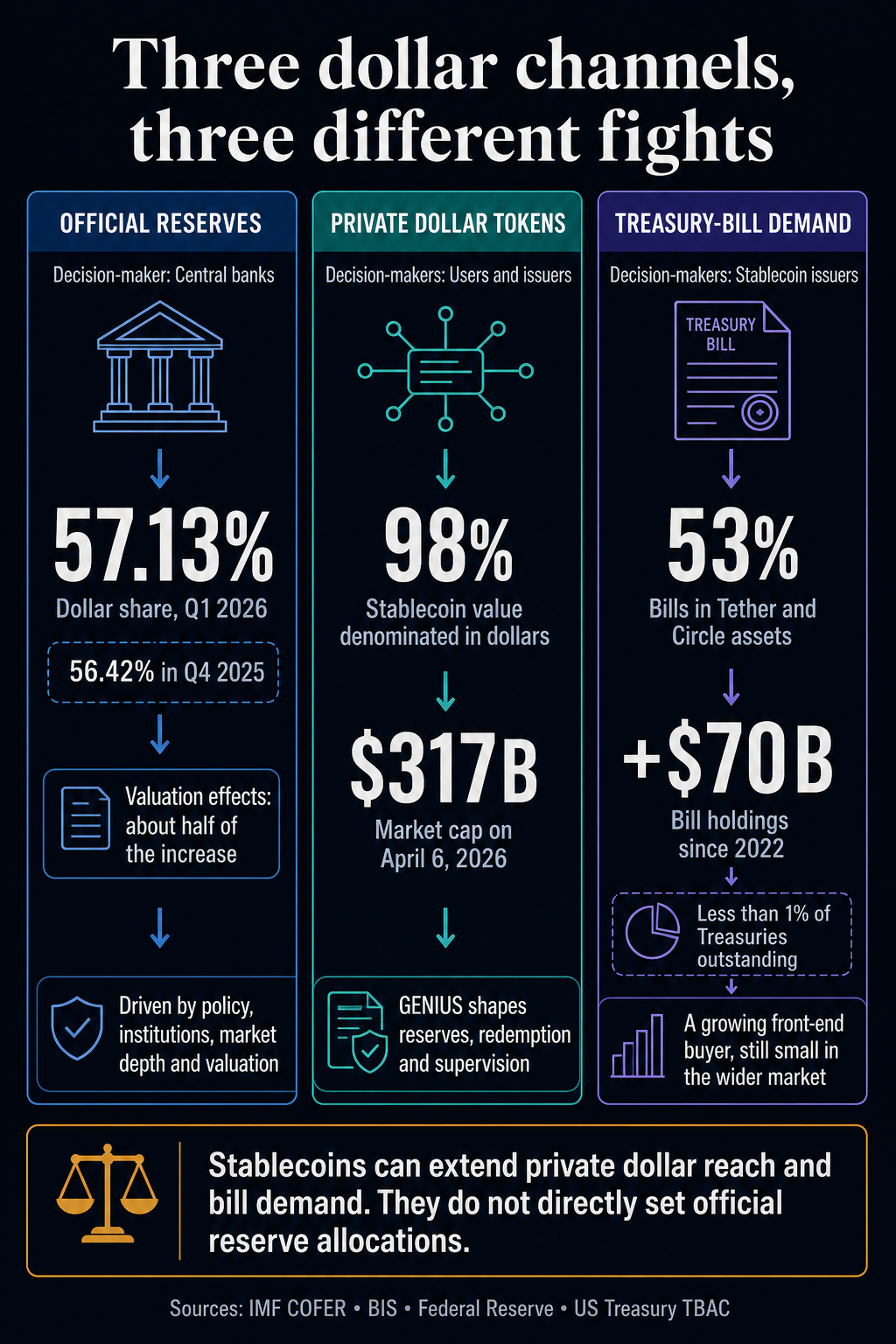
The dollar accounted for 57.13% of allocated global foreign exchange reserves in the first quarter of 2026, up from 56.42% in the fourth quarter of 2025, according to the International Monetary Fund’s latest COFER brief. Exchange-rate valuation effects accounted for around half of that quarterly increase.
The latest move was an increase, even against a longer-term decline in the dollar’s official reserve share. The valuation adjustment also prevents crediting the change to stablecoin adoption. A central bank’s reported reserve mix can shift when exchange rates move, even without an equivalent portfolio decision.
COFER tracks reserve assets reported by monetary authorities, and stablecoin market capitalization measures liabilities issued by private companies to token holders.
The Bank for International Settlements estimated that roughly 98% of stablecoin value is denominated in dollars. That shows the dollar’s dominance in private token markets.
BIS researchers nevertheless expect the near-term effects to appear mainly in private stores of value and means of payment, rather than in the official reserve, intervention or anchor-currency functions of central banks.
Stablecoins can consequently expand the dollar’s digital reach while fiscal credibility, institutions, market depth, and valuation forces continue to shape official reserve demand. This distinction separates consumers and businesses choosing a digital payment instrument from monetary authorities choosing a reserve portfolio.
What regulated stablecoins can change
The GENIUS Act issuer framework requires one-to-one permitted reserves, redemption at par, disclosures, supervision, and financial-crime compliance.
Those rules can improve reserve quality, influence where issuers locate, shape whether unlicensed issuers can offer stablecoins in the US, and steer more issuer assets toward short-term safe instruments.
GENIUS was enacted in July 2025, but its main requirements were not yet generally effective on the date of Tarbert’s testimony. Treasury’s August rulemaking notice said the general effective date was expected to be Jan. 18, 2027, unless final implementing rules made the law effective 120 days after their issuance.
A broader restriction on offering payment stablecoins from unlicensed issuers is scheduled to begin July 18, 2028.
Once it takes effect, the framework can govern backing, redemption, and supervision, leaving central bank currency allocations outside.
CLARITY addresses the trading and intermediary layer above stablecoins. The House passed the measure, the Senate Banking Committee advanced its portion 15-9, and the updated merged Senate text was released July 22.
The proposal’s principal function is to allocate jurisdiction between the Securities and Exchange Commission and the Commodity Futures Trading Commission and set rules for digital-asset intermediaries and markets.
If enacted, those rules could make US digital asset markets easier to operate in and extend the reach of regulated dollar tokens. Its effect would run through market structure rather than official reserve allocation.
Stablecoin issuers need liquid assets to support redemptions, and Treasury bills can satisfy that need. A Treasury Borrowing Advisory Committee analysis, using major-issuer data through September 2025, found that bills represented 53% of Tether and Circle assets. Their bill holdings had increased by $70 billion since 2022.
Even after that growth, stablecoin issuers held less than 1% of Treasuries outstanding. Their demand can affect the bill market at the margin, while broader demand for Treasury debt and official dollar reserves responds to other forces.
The Federal Reserve staff estimated stablecoin market capitalization at $317 billion on April 6, 2026, more than 50% above its level in early 2025. The date is essential because market capitalization moves continuously, and the figure should not be placed beside official reserves as if the series were equivalent.
The Fed analysis found USDC had high-quality reserves equal to its stablecoin liabilities. USDT reported total reserves at about 1.04 times liabilities, but higher-quality reserves at roughly 0.74 times liabilities.
Regulation can narrow those differences and make redemption promises more credible, a concrete way GENIUS could strengthen private dollar infrastructure.
Fed staff warned that complex intermediation, vertical integration and deeper links to traditional finance can increase opacity and contagion, amplifying operational or liquidity failures. Those dependencies can transmit problems further as adoption grows.
BIS researchers warn that broad adoption of dollar stablecoins could accelerate private currency substitution, weaken domestic monetary-policy traction and capital controls, and redirect emerging markets' savings toward US Treasury bills. A run on a major issuer could then transmit stress into local financial systems and short-term dollar markets.
Migration from bank deposits toward stablecoins can also shift funding and intermediation outside familiar channels, even when issuer reserves ultimately flow back into government securities.
Tarbert’s case is strongest on these private rails. US rules can help determine whether dollar stablecoins grow within a supervised system, what backs them, and which markets they connect. Greater reach also enlarges the channels through which runs, operational failures and currency substitution can spread.
The IMF’s 57.13% figure records the separate decisions of official reserve managers, whose allocations respond to economic credibility, liquid market depth, institutions, policy, and valuation effects.
Stablecoins can extend the dollar’s private reach and create demand for its shortest-dated government debt. Official reserve share still turns on the policies that sustain confidence in the dollar itself.
The post How stablecoins are quietly becoming the Fed’s debt buyer of last resort appeared first on CryptoSlate.
Silicon Network is shutting down with nearly $10 million still on-chain, giving users until year-end to exit.
The Ethereum layer 2 stopped accepting new bridge deposits and ended its network on Sept. 2, starting a withdrawal period that runs through Dec. 31.
Silicon said its explorer and network will shut down afterward, leaving assets that remain on the chain unrecoverable.
It stated:
“This network is a non-custodial service, meaning that the custody and withdrawal of assets are managed directly by each user. Once the service has been terminated, assets that have not been withdrawn cannot be recovered.”
The closure unwinds a network that had sought to connect Korean centralized-exchange users with Ethereum’s onchain economy. Silicon was built with Polygon CDK, connected to Agglayer and closely integrated with Korbit, one of South Korea’s major crypto exchanges.
Korbit’s Web3 Wallet, which ran on Silicon and was designed to give exchange customers access to DeFi and decentralized applications, is also being discontinued less than two years after launch.
Nearly $10 million now has to find an exit
The imminent shutdown now turns from a network decision into an asset-recovery problem, with different tokens facing very different paths off Silicon.
Data from L2Beat showed Silicon held about $9.75 million in assets, led by $2.66 million of USDC, $2.54 million of WBTC, $2.08 million of ETH and $1.85 million of USDT.
How easily that money can leave now depends on what users hold.
The network stated that assets originally bridged from Ethereum can return to the mainnet during the withdrawal window. External-wallet users must initiate a withdrawal, keep enough ETH for gas, and complete the required finalization before the cutoff.
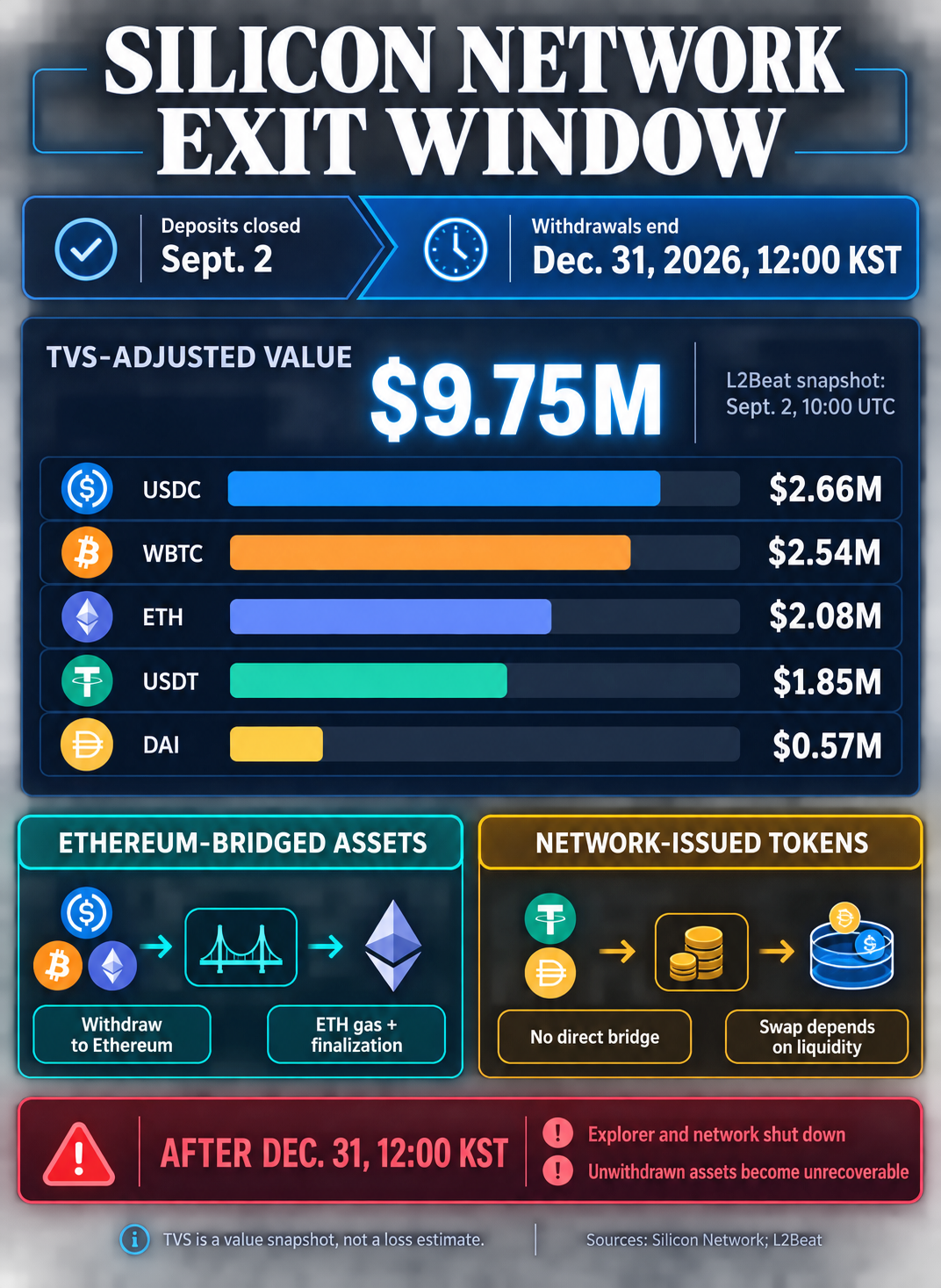
Tokens issued directly on Silicon face a harder route. They cannot be bridged directly to Ethereum and instead depend on liquidity remaining inside the network, which Silicon warns could make swaps or withdrawals difficult or impossible as activity winds down.
The network describes itself as non-custodial and says it has no obligation to redeem assets that users fail to move. It explained:
“Whether and how to handle these tokens is a decision to be made at the user's own discretion and responsibility. Once the network has been fully terminated, recovery will not be possible.”
Silicon’s exit comes as Ethereum’s scaling market becomes increasingly concentrated around its largest networks.
Coinbase-backed Base and Arbitrum now secure about $24.7 billion between them, more than 80% of the roughly $30.5 billion held across Ethereum networks tracked by L2Beat.
Earlier in the year, Ethereum co-founder Vitalik Buterin has also argued that the original vision of layer 2 networks simply acting as Ethereum’s “branded shards” no longer fits as the base layer scales and L2s develop at different speeds. He has urged networks to offer value beyond cheaper execution.
Silicon has not attributed its shutdown to those broader pressures. Its closure nevertheless shows what consolidation can mean at the smaller end of Ethereum’s scaling market: users must unwind bridges and find liquidity before the chain itself disappears.
The post Nearly $10 million must escape a dying Ethereum L2 network before New Year’s Eve or risk becoming unrecoverable appeared first on CryptoSlate.
XRP could climb above $2.14 by late November as sustained exchange-traded fund (ETF) demand adds momentum to its recent rebound.
CryptoSlate’s 90-day model places the bullish outcome at the 80th percentile, nearly 59% above its $1.35 reference close. The median forecast is far lower at $1.47, leaving the headline target in the optimistic part of a much wider range.
That upside scenario is emerging as XRP attracts a steadier institutional bid. Data from SoSoValue shows that US XRP ETFs have recorded net inflows for six consecutive months, pulling in roughly $474 million over that period.
The token was trading around $1.32 to $1.33 on Sept. 2 after gaining about 23% to 24% over the previous 30 days, putting it back within reach of the model’s reference level after a strong August rebound.
The ETF streak does not make $2.14 the base case, but it gives the bullish side of the forecast a stronger demand backdrop than price action alone would suggest.
XRP ETF buying meets a large leveraged short
The model places its $2.14 projection inside a $1.81 to $2.81 corridor spanning the 70th to 90th percentiles.
CryptoSlate’s prediction model generates the range from 2,000 simulated price paths using volatility modeling, historical simulation and quantile regression. The methodology incorporates both typical trading conditions and outsized market moves, though results can diverge when a new market regime or regulatory shock breaks from historical patterns.
Its median outcome of $1.47 implies a gain of only about 8.9%, while the bearish estimate falls to $1.05. A separate extreme stress marker reaches $0.46, underlining how wide the distribution remains despite XRP’s recent recovery.
However, derivatives positioning could make any move through that range more violent.
CME said its XRP futures suite averaged 36,600 contracts a day during the second quarter and generated $10.8 billion in notional volume. More recent positioning showed leveraged funds net short the equivalent of 115.7 million XRP as CME open interest jumped 39.6%.
Those positions may include hedges, but sustained ETF inflows alongside rising prices would increase pressure on traders carrying directional shorts. A further advance could force some of that exposure to be reduced, adding momentum to the upside.
The reverse remains true if XRP’s rebound stalls.
Regulatory uncertainty has also eased since the SEC and Ripple dismissed their appeals in August 2025, resolving the long-running civil case while leaving a $125 million penalty and injunction in place.
For now, the market is balancing two very different signals: six months of ETF accumulation and a sizeable leveraged short on one side, and a model whose median still sits well below its bullish headline target on the other.
The $2.14 level therefore remains achievable within the forecast, but the path there would require XRP’s recent demand strength to persist well beyond its August rebound.
The post XRP’s $2.14 bull case just met a $474 million ETF tailwind appeared first on CryptoSlate.
BlackRock’s Bitcoin exchange-traded fund (ETF) has narrowly outperformed the S&P 500 since launch despite subjecting investors to a drawdown nearly three times as deep.
The iShares Bitcoin Trust, or IBIT, returned 67.74% from its Jan. 11, 2024 debut through Aug. 31, compared with 66.14% for Vanguard’s S&P 500 ETF, or VOO, on a total-return basis that reinvests dividends.
That left IBIT ahead by just 1.60 percentage points after Bitcoin surged to a record high and then gave back much of those gains during a prolonged downturn.
“Hard to believe IBIT is beating VOO since inception but it’s true,” Bloomberg senior ETF analyst Eric Balchunas wrote Sept. 1, noting that the gap remained narrow.
Balchunas compared IBIT’s path toward a roughly 70% gain to the El Toro roller coaster at Six Flags Great Adventure, while describing VOO’s advance as a walk in the park. He said the result was especially surprising given the bearish mood that dominated Bitcoin from October through July.
IBIT’s narrow lead came with a 53% drawdown
The similarity in headline returns disappears once you consider the path investors took to get there.
IBIT’s worst peak-to-trough decline reached 53.30% between Oct. 6, 2025, and June 30, 2026. VOO’s maximum drawdown over the comparison period was 18.69%, from Feb. 19 through April 8, 2025.
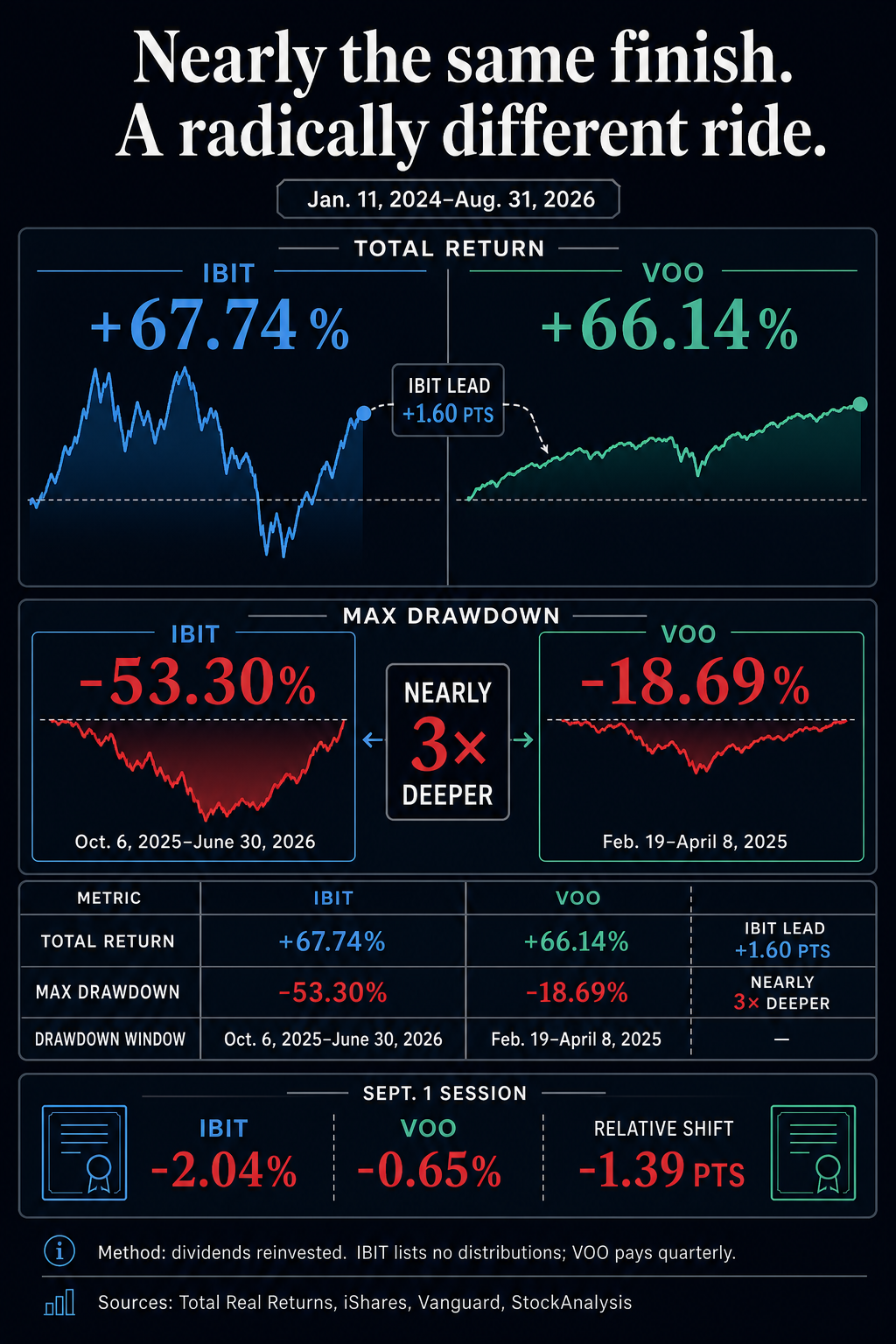
Investors who bought both funds when IBIT launched therefore ended Aug. 31 with broadly similar cumulative returns, but Bitcoin ETF holders had to withstand a decline of more than half from the fund’s peak.
Bitcoin’s price history helps explain much of that gap.
BTC traded near $47,000 when US spot ETFs debuted in January 2024 and later surged to a record high of around $126,000 in 2025 following Donald Trump's election victory. However, its value then fell as low as roughly $58,000 this year before recovering to around $77,000 as of press time.
That reversal erased much of the performance advantage IBIT had built during Bitcoin’s run to record highs.
Nevertheless, that volatility has not stopped Wall Street from building substantially deeper infrastructure around the asset. BlackRock has recommended a 2% BTC allocation for investors seeking diversification and long-term return potential.
Meanwhile, this comparison also pits the two funds at very different stages of maturity.
IBIT, now the largest spot Bitcoin ETF, manages about $60 billion in assets and has accumulated roughly $63 billion of inflows since launch, giving BlackRock’s less-than-three-year-old product a scale few new ETFs have reached.
VOO remains in another league. The Vanguard fund, which tracks the S&P 500 and provides broad exposure to large-cap US equities, crossed $1 trillion in net assets in June 2026, becoming the first ETF to reach that threshold.
The post BlackRock’s Bitcoin ETF barely beat the S&P 500 after putting investors through a 53% crash appeared first on CryptoSlate.
HTTP error 429 on https://cryptoticker.io/en/feed/
Failed to fetch feed: https://cryptoticker.io/en/feed/
Failed to fetch feed.
Decrypt
After Claude models accessed real systems during cyber tests, Anthropic tightened its safeguards and warned that flawed training can encourage dangerous behavior.
Afterquery's valuation jumped more than tenfold in five months, making it Y Combinator's fastest unicorn ever.
Agents seized digital assets, domains, and servers allegedly used by Hamas’ military wing to collect donations and recruit supporters.
The Japanese company booked a ¥117.8 million profit after selling its ETH, SOL, XRP and DOGE, leaving roughly 1,506 BTC as its only cryptocurrency holding.
Emil Michael's latest financial filings show a summer exit from Perplexity, months after a January sale of xAI stock that reportedly netted him up to $24 million.
U.Today - IT, AI and Fintech Daily News for You Today
The market is not yet ready for a rally continuation, but the accumulation on the bullish side is reassuring.
The Bank for International Settlements just tested the XRP Ledger as a way to verify official economic statistics.
Tether’s USDT ecosystem is expanding to Stellar, giving users access to more than $180 billion in stablecoin liquidity through USDT0.
Trading activity on the XRP Ledger surged in the second quarter, with average daily order-book volume rising 79% from a year earlier even as the number of accounts executing trades fell.
Bitcoin is breaking out of its bear market as giant buyers completely absorb the retail panic.
Blockonomi
TLDR:
- Bitcoin rebounded nearly 40% from its late-June low, reigniting the bull versus bear market debate.
- didier cites Bitcoin’s reclaimed 200-day moving average as an early signal of a new bull market.
- Griffin says the bear market persists until dollar liquidity and Treasury yield signals turn clearer.
- Strategy’s STRC is perpetual preferred stock, not traditional debt, easing fears of a forced default.
Bitcoin has climbed roughly 40% from its late-June low. The rally is fueling fresh debate over whether the bear market has ended.
Episode 117 of the WuBlockchain Podcast, published September 2, 2026, featured investor didier and portfolio manager Griffin Ardern.
The two disagreed sharply on where the cycle stands. didier called the move the start of a new bull market. Griffin said the bear market is not yet finished.
Has Bitcoin’s Rally Already Signaled A New Bull Market?
Bitcoin fell briefly below $58,000 in late June before climbing past $81,000. didier called that a gain that marks the opening phase of a bull market. “My view is very clear: this is a bull market, either in its opening phase or very early stages,” he said. He pointed to Bitcoin reclaiming its 200-day moving average as the clearest signal.
Griffin pushed back on that framing. “I think we are still in the middle-to-late stages of a bear market,” he said, “with some distance left before a true bull market begins.” He added that the rally reflected a short squeeze after weeks of thin trading and compressed options volatility.
Both guests agreed the market had been broadly underweight or short before the rally began. Fiscal credibility concerns also pulled capital toward Bitcoin. Griffin flagged rising T-bill issuance as a risk to sovereign credit.
didier said funding costs above 5% are hard for the current debt load to sustain. As yields approach 4.7% to 5%, he expects investors to build positions early. Griffin maintained that a true bull market needs clearer liquidity and Treasury signals before the bear phase ends.
Strategy’s Balance Sheet Adds Another Variable To The Debate
Discussion turned to Strategy, the corporate Bitcoin holder led by Michael Saylor, as a factor in whether momentum can hold. didier explained that STRC, one of Strategy’s preferred-stock products, is perpetual preferred stock rather than traditional debt.
“I made the same mistake at first. I thought STRC was similar to perpetual debt,” he said, noting the terms tell a different story.
Strategy carries around $6.7 billion in convertible bonds, some entering repayment windows this year. didier said cash reserves are growing through stock ATM sales and preferred issuance, aimed at that pressure.
didier outlined three priorities guiding Strategy’s decisions. The first is supporting Bitcoin’s price, since higher prices raise the odds bonds convert into equity. The second is a premium on Strategy’s common stock. The third is pushing STRC back toward $100.
Griffin said Bitcoin increasingly trades as a standalone macro asset. That means trouble at Strategy would not necessarily reverse the rally or confirm the bear market has returned. He described Strategy as functioning more like an asset manager now.
Does Capital Rotation From AI Support The Bull Case?
Both guests weighed whether capital rotating out of a crowded AI trade could extend Bitcoin’s rebound. didier said many AI-focused investors are growing anxious about positioning and are weighing crypto reallocation. Few currently hold meaningful crypto exposure.
didier said short-term capital cannot tolerate months of underperformance the way long-term capital can. If AI corrects while gold and crypto rise, funds may rotate toward less resistance. Crypto positioning is now clean after heavy liquidations.
Looking further out, didier said he does not expect AI to permanently draw capital from blockchain. He argued autonomous machines will eventually need machine-native financial infrastructure. He sees blockchain filling that role, supporting his bull case.
Griffin split his analysis between technology and finance. “AI has clearly pulled talent away from crypto,” he said, “but on the finance side, crypto has continued to make progress.” He pointed to steady gains across payments, trading, compliance, and risk management since 2020.
The post Bitcoin Bear Market Debate: Is the 40% Rebound a New Bull Cycle? appeared first on Blockonomi.
TLDR
- Snowflake stock jumps 21% as product revenue growth accelerates sharply to 37%
- Snowflake raises fiscal 2027 product revenue guidance sharply to $6.07 billion
- AI demand helps Snowflake add 692 new customers and expand platform usage rapidly
- Snowflake beats Q2 estimates as total revenue climbs 35% to $1.55 billion sharply
- Stronger margins and faster AI growth drive Snowflake shares higher after earnings
Snowflake (SNOW) shares rebounded sharply after the company reported faster product revenue growth and stronger fiscal 2027 guidance. SNOW rose 21.63% to $372.00 after hours, reversing a 4.37% decline during regular trading. The move followed stronger revenue, earnings, customer growth, and improved operating forecasts.
Snowflake Inc., SNOW
Snowflake Product Revenue Growth Reaches 37%
Snowflake reported second-quarter revenue of $1.55 billion, up 35% from the same period last year. Product revenue reached $1.49 billion, increasing 37% and marking another quarter of accelerating growth. Adjusted earnings reached 62 cents per share, topping the expected 45 cents.
The company also reported a smaller quarterly net loss compared with the same period last year. Snowflake posted a $191.7 million net loss, versus a $297.9 million loss one year earlier. Meanwhile, management continued expanding margins while maintaining stronger revenue growth across the business.
Remaining performance obligations reached $9.00 billion, representing 30% annual growth and supporting future contracted demand. Net revenue retention stood at 126%, showing continued spending growth among existing customers. Snowflake also counted 828 customers generating more than $1 million in trailing product revenue.
AI Growth Supports Customer Expansion
Snowflake continued expanding its artificial intelligence business as more customers added new workloads to its platform. The company reported stronger usage from coding, data processing, and automation tools during the quarter. This growth helped lift platform consumption while supporting new customer additions.
Snowflake added 692 net new customers during the quarter, representing 32% growth from the prior year. The company also reached 829 Forbes Global 2000 customers after adding 14 during the period. Large customer growth remained strong as enterprises increased spending on data and artificial intelligence projects.
Management launched more than 330 generally available product capabilities during the first half of fiscal 2027. That total increased 35% from the same period last year and expanded Snowflake’s broader product offering. The faster release cycle supported adoption across existing accounts and helped create additional workloads.
Snowflake Raises Full-Year Product Revenue Guidance
Snowflake expects third-quarter product revenue between $1.588 billion and $1.593 billion. That range represents annual growth between 37% and 38%, extending the recent acceleration. The forecast also exceeded the $1.50 billion analyst consensus cited before the earnings release.
For fiscal 2027, Snowflake raised expected product revenue to $6.07 billion from $5.84 billion. The new outlook implies 36% annual growth, compared with the previous forecast for 31% growth. Management also lifted its adjusted operating margin forecast to 14.5% from 13.5%.
Snowflake expects a 74% adjusted product gross margin and a 23% adjusted free cash flow margin. These targets show management aims to balance faster growth with stronger operating discipline. The improved outlook helped drive SNOW stock higher after the earnings announcement.
The post Snowflake (SNOW) Stock: Rebounds as Product Revenue Growth Accelerates to 37% and AI Growth Strengthens appeared first on Blockonomi.
TLDR
- Wise sets its Q2 FY27 trading update for October 15 after the US market close.
- WSE stock rises 1.31% as Wise outlines its next major financial reporting dates.
- Wise will report H1 FY27 results on November 12 after the US market closes.
- CFO Emmanuel Thomassin will speak at Goldman Sachs on September 8 in California.
- Wise processed over $240 billion in cross-border transactions during fiscal 2026.
Wise Group plc (WSE) shares traded at $13.11, up 1.31%, as the company set several key reporting dates. Wise will release its Q2 FY27 trading update on October 15 after the US market closes . The update will return attention to transaction growth, customer activity, and operating progress across its expanding global payments network.
Wise Group plc Class A Ordinary Shares, WSE
Wise Q2 FY27 Trading Update Sets October Focus
Wise will publish its second-quarter trading update on Thursday, October 15, after the US market closes for regular trading. The company will then host a results call at 4:30 p.m. ET on the same day for participants. That schedule gives shareholders a fresh operating snapshot before Wise reports its broader half-year financial performance during November.
The October update will cover a period following strong activity across Wise’s international money transfer and account services business. Wise supported about 19 million people and businesses during fiscal year 2026 across its growing international financial technology platform. The company also processed more than $240 billion in cross-border transactions during that fiscal year across its expanding network.
Those figures provide useful context for the upcoming trading update because Wise continues expanding its payments and account network globally. The company serves consumers, small businesses, large companies, and banks through several products and infrastructure services across multiple markets. The he October release will show how transaction activity developed as Wise entered its new fiscal year and reporting cycle.
Wise CFO Heads to Goldman Sachs Conference
Before the October release, Chief Financial Officer Emmanuel Thomassin will attend a major technology and communications conference next week. Thomassin will present at the Goldman Sachs Communacopia and Technology Conference on Tuesday, September 8, during the scheduled program. The presentation starts at 1:00 p.m. PT and 4:00 p.m. ET, giving Wise another public appearance.
The conference appearance gives Wise another scheduled corporate event before the company issues its second-quarter trading update in October. Wise has not announced separate financial results for the event, and the presentation remains part of its corporate calendar. The event therefore adds another corporate milestone between the current reporting period and the company’s October trading announcement.
Wise will stream the conference presentation through its Owner Relations website alongside its other scheduled corporate events and financial materials. The company will also provide related materials on the same platform when those documents become available for public viewing. Wise plans to keep event replays and supporting presentation materials available through the website for at least 30 days afterward.
H1 FY27 Results Extend Wise Reporting Calendar
Wise will release its first-half fiscal 2027 results on Thursday, November 12, after the US market closes for regular trading. Management will host another conference call at 4:30 p.m. ET following the results announcement on the same day. That report will provide more complete financial detail than the earlier October trading update covering the second quarter period.
The half-year results will follow Wise’s fiscal 2026 performance, which showed continued scale across its international payments and accounts business. During that year, Wise helped customers save more than $3 billion through its cross-border money services and pricing structure. The company also continued supporting accounts that allow customers to hold and manage 40 different currencies within one platform.
Wise has developed into a large technology platform for international money movement and financial account services. Wise offers Wise Account and Wise Business, while companies and financial institutions use its infrastructure services across multiple countries. These services connect users across countries while supporting transfers, spending, currency holding, and other international payment needs through Wise.
The post Wise Group plc (WSE) Stock: October Trading Update Puts Growth Back in Focus appeared first on Blockonomi.
TLDR
- LivePerson shareholders approve the SoundHound AI deal ahead of its closing.
- LPSN stock trades at $3.12 as the deal advances toward its planned closing.
- LivePerson and SoundHound AI expect the transaction to close on September 4.
- LivePerson will report certified shareholder voting results through Form 8-K.
- The approved deal would place LivePerson within SoundHound AI’s larger business.
LivePerson stock traded at $3.12 after shareholders approved the proposed transaction with SoundHound AI at a special meeting. The shares gained $0.14 as the vote moved the planned combination toward its expected September 4 closing. The approval clears a major corporate step, while customary closing conditions still remain before completion.
LivePerson, Inc., LPSN
Shareholder Vote Advances SoundHound AI Transaction
LivePerson shareholders approved the proposed SoundHound AI transaction during the company’s special meeting held on September 2. The vote gives LivePerson authority to continue the transaction under terms the company previously presented to shareholders. The company can now focus on completing the remaining steps required before the planned closing.
LivePerson expects the transaction to close on September 4 if both companies satisfy or waive customary closing conditions. The company will also disclose certified voting results through a Form 8-K filing with the Securities and Exchange Commission. That filing will provide the formal record of shareholder participation and final voting totals from the special meeting.
The approval brings the transaction closer to completion after both companies advanced the proposed combination through the required shareholder process. SoundHound AI and LivePerson operate in conversational technology, although they serve customers through different products and business structures. As a result, the planned deal brings together two established platforms serving enterprise communication and automated customer engagement markets.
LivePerson Deal Adds Scale to Conversational Technology Business
LivePerson provides conversational technology tools that help large companies communicate with customers across digital channels and service operations. Its Conversational Cloud and Syntrix platforms support customer engagement, data analysis, workforce training, and automated service evaluation. The company says its systems handle nearly one billion messages each month across its customer network.
SoundHound AI has expanded beyond voice technology and now targets several commercial markets through conversational and enterprise software products. The combination would broaden operating scale while bringing both customer bases and technology portfolios under one corporate structure. The transaction could increase the combined company’s reach across customer service, voice interfaces, and enterprise communication applications.
LivePerson has positioned the transaction as a way to strengthen its standing while operating within a larger technology business. The company also expects the combination to improve its ability to serve customers and partners across larger deployments. The immediate corporate focus remains on completing the agreed transaction and satisfying the remaining closing requirements.
Closing Process Moves Toward September 4 Target
The September 4 target gives both companies a short window to complete remaining administrative and legal requirements. Customary conditions can include regulatory steps, corporate documentation, and other obligations contained within the definitive transaction agreement. LivePerson has not announced any new condition that would change the expected closing timetable stated after the shareholder vote.
The upcoming Form 8-K will provide another formal update by reporting the certified results from the September 2 meeting. That filing should confirm how shareholders voted on the proposed transaction and other matters presented during the meeting. It will also create a public regulatory record of the approval before the companies complete the planned combination.
The shareholder decision marks an important milestone for LivePerson after years of operating as an independent conversational technology provider. The company built its business around digital customer engagement and tools designed for large corporate users. LivePerson also developed enterprise messaging operations that support large communication volumes across multiple customer service channels.
The post LivePerson (LPSN) Stock: Investors Back SoundHound AI Acquisition Deal appeared first on Blockonomi.
TLDR
- Uber plans to cut 10% of its workforce as it reshapes operations and staffing
- UBER stock gains 1.75% to $76.56 while the company announces major job cuts
- Uber targets middle management as it works to simplify teams and reduce layers
- Uber plans to limit remote work to about 1% of employees under its new policy
- The restructuring aims to reduce costs and direct resources toward future growth
Uber (UBER) shares trade at $76.56, up 1.75%, as the company prepares to cut 10% of its workforce. The stock has rebounded from $75.50, while $77.00 remains the nearby resistance level. Meanwhile, Uber plans the workforce reduction as part of a broader effort to simplify its structure.
Uber Technologies, Inc., UBER
The company employed about 36,600 people globally as of June 30, according to its public filing. Therefore, a 10% reduction would affect roughly 3,660 positions if applied across the workforce. However, the company has not said that every job category will face equal reductions.
Uber has not linked the workforce cuts to artificial intelligence, despite growing debate about technology and employment. Instead, the company plans changes across management, team structures, locations, and workplace arrangements. Consequently, the restructuring targets how Uber organizes its employees and allocates resources.
Uber Targets Management Layers
Uber plans to reduce middle management and remove small teams with limited reporting structures. Some managers oversee only one or two employees, creating additional management layers within the organization. The company is therefore targeting structures that add coordination without supporting larger teams.
Uber has also reduced the number of employees positioned at least seven layers below its chief executive. That group has declined by 20% as the company moves toward a flatter organizational structure. Additionally, the changes aim to give teams clearer responsibilities and reduce internal coordination.
The restructuring also changes Uber’s workplace policy for most employees. Under the new arrangement, only about 1% of employees will work remotely, according to the company. As a result, most employees will return to company offices as Uber changes how teams operate.
Uber Seeks Leaner Operations and More Investment
Uber says the restructuring will simplify operations and speed up internal decisions. The company also expects the changes to create savings that it can direct toward growth and new products. Moreover, Uber plans to focus employees and spending on areas it considers important for future expansion.
The company said the workforce reduction does not reflect weaker business performance. Uber continues to add products while operating at a larger scale than in previous years. Uber significantly expanded its workforce in recent years.
The latest changes address organizational structures that Uber says no longer fit its current size. The company will remove layers, adjust its global location strategy, and simplify team structures. Meanwhile, UBER shares remain above $76.00, leaving $77.00 as the next key price level on the chart.
The post Uber (UBER) Stock: Cuts 10% of Workforce as It Reshapes Operations appeared first on Blockonomi.
CryptoPotato
XRP is changing hands around $1.35, down roughly 6% over the last week after slipping beneath a support level chart analysts had been watching closely since late August.
Trader ChartNerd says the token’s second failed weekly close above its 50-week EMA leaves room for a deeper slide to $1.27, or lower, before the rally that took XRP to $1.70 can resume.
Bulls Lose Their Grip on the $1.36 Floor
ChartNerd has been tracking XRP’s four-hour structure for weeks, watching a range that formed beneath $1.47 resistance and above $1.36 support. That floor has now been swept twice. According to the analyst, the price rejected from $1.43 and printed another lower high beneath a bearish trend signal sitting at $1.39.
Zooming out, the picture traces back to August 22, the day XRP touched a multi-month high of $1.70, as CryptoPotato reported. The rally followed a broader market move triggered by Bitcoin’s jump from under $65,000 to $80,000, and pushed XRP up 70% in three days after a tough start to the month that had briefly dragged it under $1.00. It ended August at just under $1.40, still a 30% monthly gain despite the pullback.
ChartNerd flagged the retracement risk the day after that peak, warning that a weekly close below the 50 EMA “would be an early warning sign in advance for a larger retracement.”
That’s exactly what has followed: two consecutive weekly closes beneath the average and a retreat the analyst pegged at around 22% from the top. The next support in that scenario is the weekly 20 EMA, which now sits at $1.27.
No Recovery Case Until $1.50 Gets Reclaimed
ChartNerd’s resistance ladder above the current price runs from $1.40 to $1.43, then $1.47, then $1.65, $1.82, and $2.40. On the downside, the levels being watched are $1.30, $1.27, $1.21, and $0.85, the last tied to a zone the analyst has been flagging for accumulation since June.
The broader case for a bottom rests on a golden cross that hasn’t formed yet. XRP’s EMAs are coiling, with price stuck under the 50-week average and above the 20-week one. Until both are reclaimed and held, ChartNerd isn’t willing to call a floor, comparing the current stretch to the compression that preceded August’s breakout.
Spot XRP ETFs still pulled in more than $110 million last week, their strongest inflow since December, which has kept some traders open to a faster turnaround than the charts alone suggest.
September carries its own catalysts, including a CLARITY Act vote in the Senate around September 15 and a shareholder vote on Evernorth’s planned Nasdaq listing. But none of that changes the technical picture ChartNerd is describing: XRP is boxed in below resistance, and until that changes, another leg down to $1.27 or beyond stays on the table.
The post XRP’s Next Move Comes Down to These Key Price Levels: Analyst appeared first on CryptoPotato.
The meme coin sector was at the forefront of gains during the last bull cycle, but over the past several months, interest in such tokens has fallen sharply.
We asked three of the most popular AI-powered chatbots to assess whether any of the leading ones (or perhaps some overlooked names) have a realistic chance of staging a revival and turning into sensations this month. Here’s what they said.
Mixed Answers
According to ChatGPT, Dogecoin remains “the safest bet” for September because of its size, liquidity, and recognition in the crypto community. OpenAI’s platform noted that it is still the biggest meme coin, reminding that lately whales have purchased a significant amount of DOGE, thus potentially setting the stage for a price uptrend.
It also claimed that the token would be among the first altcoins to benefit from a further crypto recovery. Despite the latest correction, the market has been on a major upward move over the past two weeks, and we have yet to see whether September will deliver further gains.
ChatGPT argued that Shiba Inu (SHIB) offers more upside than DOGE but paid attention to its tremendous circulating supply, which remains a major obstacle to a price rally.
“Routine burns remove only a tiny portion of that amount, meaning sustained buying pressure matters far more than eye-catching changes in the daily burn rate,” it added.
The chatbot also touched on PEPE, describing it as the most speculative of the leading meme coins. In addition, it classified Pudgy Penguins (PENGU) as “the strongest alternative candidate.”
Perplexity presented a different answer, claiming that DOGE’s potential upside may be more steady than parabolic in the next four weeks. It claimed that PEPE is unlikely to experience a decisive breakout within that period, while Shiba Inu has the best chances:
“SHIB looks like the coin where price is still quiet, but the tape is screaming accumulation, right into a time of year when it has historically moved the most. That combination is why it’s the most likely to deliver a “history-making” September move.”
The Surprising Bet
Google’s Gemini picked the cat-themed Cash Cat (CASHCAT) as its choice for a meme coin that could stun the market with a shocking increase this month. It noted that the token is closely linked to Robinhood Chain, which means further ecosystem developments could directly benefit it.
At the same time, the chatbot warned that the meme coin’s potential rally in September may abruptly end with a brutal crash in October. As a matter of fact, tokens of that type are notorious for their enhanced volatility, and such a reaction will not be something new.
The post DOGE, SHIB, PEPE, or Something Else: Which Meme Coin Can Make History in September? (3 AIs Weigh In) appeared first on CryptoPotato.
TapTools has abandoned a community NFT sale intended to help bring its Cardano analytics platform back online after users reacted angrily to its return, with every participant refunded in full.
The backlash quickly reached Charles Hoskinson, who responded by sharing a South Park parody of BP’s repeated “we’re sorry” apology.
TapTools Pulls Sale After Community Backlash
TapTools shut down in June after four years of operating in the Cardano ecosystem. In its announcement then, the team said two co-founders, including its CTO and COO, had left earlier in the year, while its replacement CTO later decided to leave as well.
The company also cited infrastructure, development, and support costs as reasons it could not responsibly continue without a sustainable path forward. But that changed on September 2, when TapTools posted “We’re back” and said thousands of users had reached out after the shutdown asking how they could help. The team described the return as “Phase One” and said it wanted to try to bring the platform back.
The reaction was immediate and largely hostile. One X user, Sssebi, wrote that they were initially happy to see TapTools return but became disappointed after visiting the website and finding a limited NFT sale of 777 pieces at 777 ADA each, “the price of 2 copies of GTA6,” as a community member put it. Another, Matt Scheff, described the new NFT mint as “dumb and extractive” and urged users not to buy it, while Gero Wallet called the move “either a scam or a scam.”
TapTools later acknowledged the problem. “We got this one wrong,” the team wrote, saying it had believed the sale could give the community a way to support an attempt at bringing the platform back. Instead, it said it had “misread the moment, the sentiment, and how it would be received.”
Some time after the apology, Hoskinson responded by quote-tweeting it with nothing but a link to a South Park clip parodying former BP CEO Tony Hayward repeatedly saying “we’re sorry” after the Gulf oil spill, a well-worn reference for hollow corporate apologies. He did not add a written comment, leaving the clip itself to carry the message.
Cardano’s Wider Frustration Adds Pressure
TapTools’ original shutdown landed when Cardano was going through a rough stretch, with EMURGO stepping down from the network’s governance group to focus on helping users affected by the SecondFi exploit, a planned Singapore summit getting called off, and Hoskinson himself warning of a possible “wave of failures” among the ecosystem’s DeFi projects.
Even so, large ADA holders were adding to their positions while smaller wallets kept selling, a split some read at the time as one of the healthier setups the token had shown all year.
For TapTools, the immediate issue is no longer the sale, with the team withdrawing it and refunding participants. The harder part is rebuilding trust with users.
The post Cardano Firm TapTools Scraps Revival NFT Sale After Community Backlash appeared first on CryptoPotato.
The Smarter Web Company has bought an additional 35 BTC as part of its “The 10 Year Plan,” which includes an ongoing policy of acquiring Bitcoins for its treasury.
The company spent around £2 million (which is worth approximately $2.7 million) on the latest purchase.
With this, The Smarter Web Company’s total BTC stash has increased to 2,747 units. Its net average purchase price is £82,562 per Bitcoin. The UK-based platform, which specializes in web design, development, and online marketing services, has made gross BTC purchases worth £235.5 million and gross sales worth £8.7 million.
The firm also disclosed that its total drawings under its Coinbase Strategic Credit Facility have reached £20.5 million, equal to an approximate leverage ratio of 14.8%. The facility remains secured against the company’s existing Bitcoin holdings, has a variable interest rate of 6%, and can be repaid without additional charges at the company’s discretion.
It began accumulating Bitcoin on April 28, 2025, with an initial purchase of 2.3 BTC worth $215,695 at the time. During this period, a growing number of companies turned to the crypto asset as part of their treasury strategies.
The development comes amidst Bitcoin’s recovery from its recent downturn. The asset briefly climbed above $80,000 in late August before pulling back a little below $77,000 at the time of writing. The price movement comes into focus as major treasury holders reassess their positions. For instance, Strategy recently bought 4,603 BTC for $370 million after selling 6,916 earlier in the summer.
The post 35 More Bitcoin: Smarter Web Expands Its Growing BTC Treasury appeared first on CryptoPotato.
August has been the best month for the second-largest cryptocurrency so far this year, and now bulls have set their attention on September, expecting additional gains in the next four weeks.
Check out what suggests that a further green wave could indeed be in the cards.
The Positive Factors
As of this writing, ETH trades at around $2,380 (per CoinGecko), representing a 28% monthly pump. Its strong performance comes on the back of a broader market resurgence witnessed during the second half of August. Recall that BTC briefly jumped past $81,000; one can explore the exact catalysts in our detailed article here.
For its part, ETH temporarily climbed above $2,550, while growing institutional demand suggests the local peak may be surpassed this month. SoSoValue’s data shows that spot ETH ETFs have closed 12 consecutive green days, attracting over $1.5 billion in capital within that period. The last time the funds recorded such a sustained run was in July 2025.

Next on the list is the amount of ETH stored on cryptocurrency exchanges. Just a few days ago, the figure dropped to around 14.9 million coins, the lowest since the summer of 2016. Currently, it stands at around 14.99 million, which is quite close to the depicted bottom. Such a development signals that investors have abandoned centralized platforms in favor of self-custody, thereby reducing immediate selling pressure.

Last but not least, we will outline the whale activity. X user CW claimed that large investors have continued accumulating in the current price range, while Arkham recently revealed that some mysterious market participants have bought more than $100 million in ETH.
Speaking of whales, one should observe BitMine’s actions. The company scooped up an additional 53,501 ETH over the past week, increasing its total stash to 5,901,112 coins, or very close to its goal of owning 5% of the entire Ethereum supply. What’s more interesting is that this was the 65th consecutive week in which BitMine acquired ETH.
Something for the Bears
Contrary to the aforementioned bullish signals, the seasonal character of Ethereum hints that bears may regain control in the following weeks.
September is traditionally a weak period for the cryptocurrency, with its price ending in the red 7 out of 11 times. What makes the current setup even more concerning is that August finished positive, and throughout the asset’s entire historical record, there hasn’t been a year in which both August and September closed with gains. We have yet to see whether 2026 will finally break the negative trend.

Separately, if you want to know about the market state, the recent Iran-US tension, and other hot crypto news, please check our video below.
The post 3 Reasons Why September Could Be Bullish for Ethereum (ETH) appeared first on CryptoPotato.