Cryptocurrency Posts
Crypto Briefing
The reaffirmation by Egypt and China may shift geopolitical dynamics, potentially influencing U.S. policy and regional stability in the Middle East.
The post Egypt, China reaffirm support for independent Palestinian state amid tensions appeared first on Crypto Briefing.
Strategy's reliance on Bitcoin for reserve capital highlights potential volatility risks and challenges traditional financial stability norms.
The post Strategy surpasses all S&P 500 financial firms in reserve capital, says Michael Saylor appeared first on Crypto Briefing.
Zelenskyy's move underscores internal security challenges, potentially affecting Ukraine's stability and complicating diplomatic resolutions.
The post Zelenskyy fires security official after Kyiv shootout amid Russia tensions appeared first on Crypto Briefing.
Pons' dominance on Robinhood Chain highlights the potential for token launchpads to reshape blockchain ecosystems, impacting fees and liquidity dynamics.
The post Pons hits record $5.95M in daily fees, surpassing Robinhood Chain itself appeared first on Crypto Briefing.
The SOPR breakout suggests a potential Bitcoin market cycle shift, possibly leading to increased investor confidence and market activity.
The post Bitcoin’s SOPR indicator breaks 11-month suppression, signaling potential cycle reversal appeared first on Crypto Briefing.
Bitcoin Magazine
Bitcoin Magazine
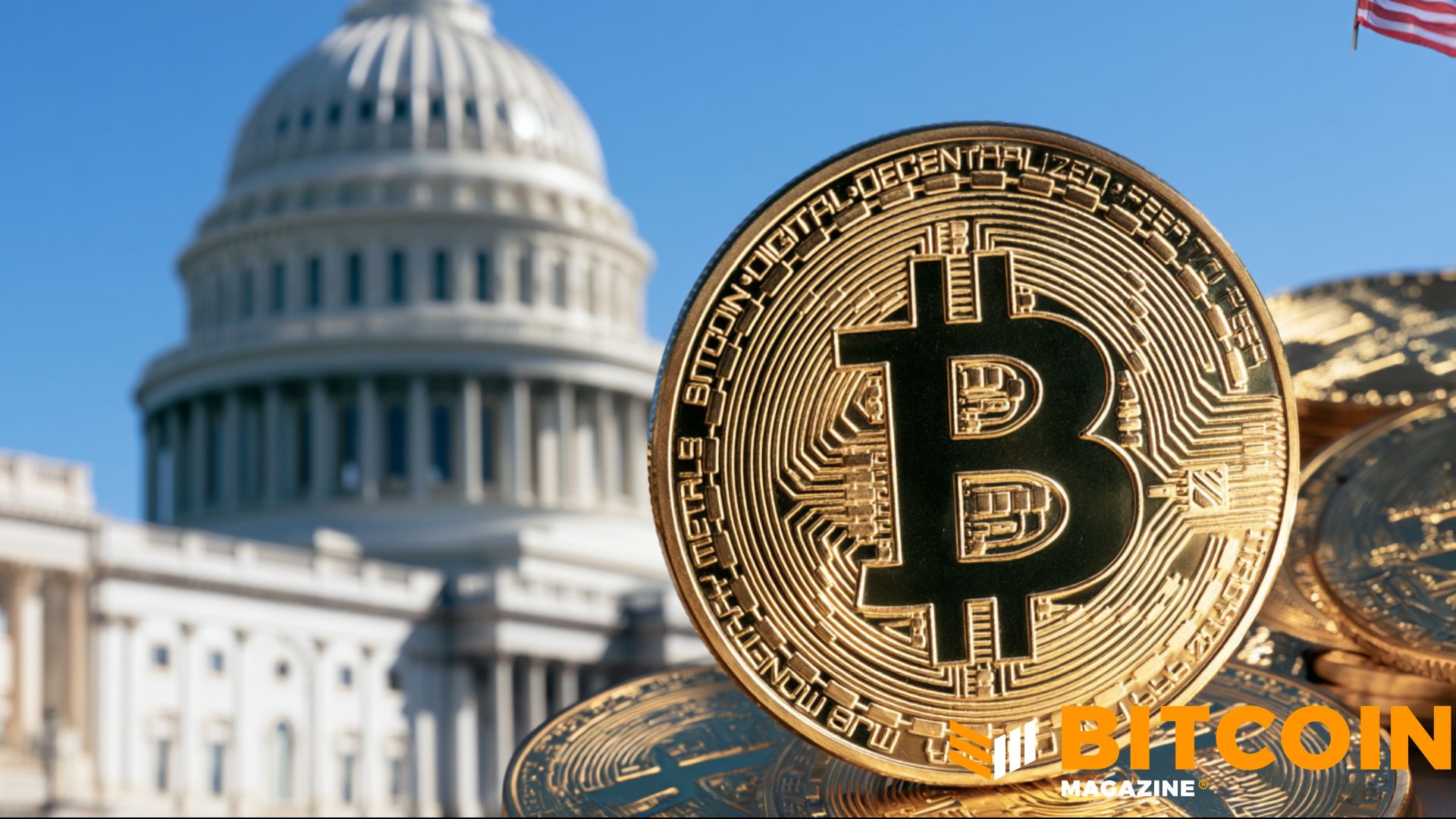
‘Crypto Capital of the World’: SEC Chair Expects Clarity Act to Pass This Month
Wall Street’s top regulator has said that he expects the long-awaited Clarity Act will get passed this month and the U.S. will be on track to be the “crypto capital of the world.”
Speaking to Fox Business on Tuesday, Securities and Exchange Chairman Paul Atkins confirmed that the regulator was pushing ahead with rules to help the crypto industry.
Pro-crypto lawmakers had hoped to pass the Clarity Act before Congress broke for August recess, but the vote slipped to September. The bill will establish a framework for distinguishing between digital assets that are securities, commodities or stablecoins.
JUST IN:
— Bitcoin Magazine (@BitcoinMagazine) September 2, 2026SEC Chairman Paul Atkins says "The Regulation Crypto Assets proposal is our most historic step yet to cement America as the Crypto Capital of the World"
pic.twitter.com/lcHtWcslgO

“The Clarity Act will be voted on in the Senate on the 15th of September,” Atkins said. “I anticipate and hope that it will be passed by the Senate and sent ultimately to the President’s desk for a signature.”
He added: “We’re changing the past approaches to try to update [rules], modernize them in the age of blockchain and crypto assets.”
Despite a vote on the Clarity Act being delayed, regulators like the SEC and Commodity Futures Trading Commission have said they will still proceed with trying to shape crypto policy.
Last week, the SEC sent a proposal to the White House aiming to “clarify the framework for the custody of crypto assets” for investment advisers and companies.
Despite being passed by the House of Representatives last year, the Clarity Act has been in a deadlock for most of this year after the banking lobby clashed with lawmakers and crypto businesses over whether platforms like Coinbase should be able to pay customers yield.
Some lawmakers have sought to change wording in the bill regarding ethics, and a new bill started circulating in July. The draft bans government officials from promoting and making money from crypto.
But other Democratic lawmakers said it still fell short; a number of pro-crypto Republicans accused Democrats of deliberately playing politics and delaying the bill.
This post ‘Crypto Capital of the World’: SEC Chair Expects Clarity Act to Pass This Month first appeared on Bitcoin Magazine and is written by Mathew Di Salvo.
Bitcoin Magazine
Mexican Billionaire Ricardo Salinas Tells People To Escape Fiat Inflation With Bitcoin
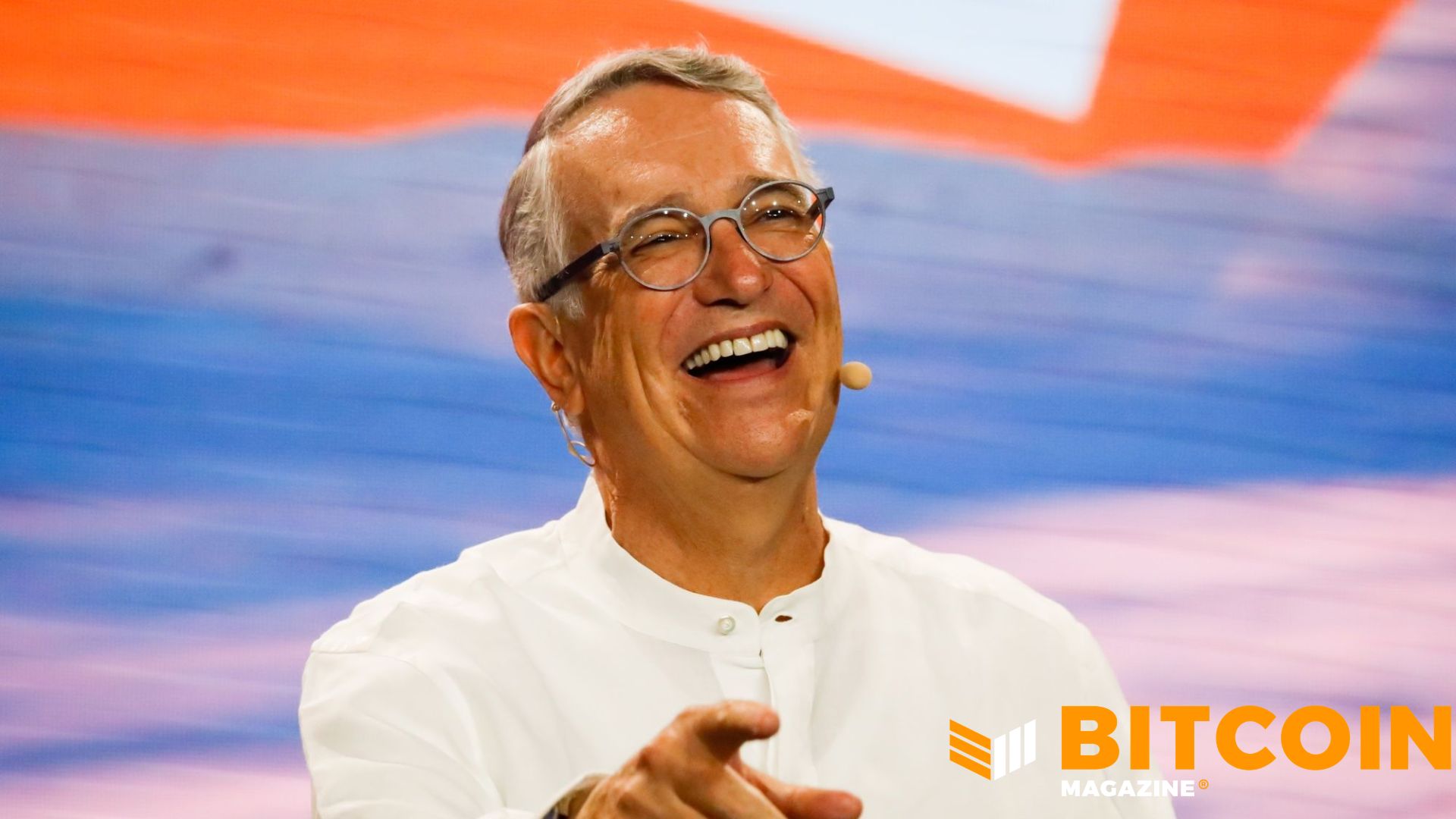
Mexican billionaire Ricardo Salinas is at it again.
This time, the third richest man in Mexico told his followers that “fiat inflation is a hidden tax,” and the way to hedge against it was to buy bitcoin.
Salinas, the former chairman of home appliance and electronics retailer Grupo Elektra and Banco Azteca founder, told his followers to opt out and start protecting their savings.
“Bitcoin changes one fundamental rule: no one can print more just because they want to,” Salinas said in a video on X on Monday.
“While you have to work to earn more money, the system can simply create more of it. Don’t be fooled: learn, protect your savings, and defend your freedom, buy bitcoin and hold it.”
It’s not the first time Salinas has told his followers to be aware of government monetary policy.
The billionaire posts on X almost daily to millions of followers, and criticizing central bank money creation is one of his recurring themes, appearing in tweets, interviews, conference keynotes, and video messages.
In recent years, the entrepreneur has stepped up his criticisms of governments — and his praises of bitcoin. Earlier this year admitted he had increased his allocation in the asset from 10% to 70% of his portfolio.
Salinas’ bitcoin enthusiasm all stems from central bank monetary policy. Speaking at Bitcoin 2022, Salinas described traditional money as “the fiat fraud.”
“What they are doing is printing money out of thin air, and then making fake purchases,” he said of the Federal Reserve.
The business magnate has also talked about his success in “orange pilling” his friends and family.
“I convinced my wife to mortgage the house that she has and take a loan to buy bitcoin,” he once boasted in an interview.
This post Mexican Billionaire Ricardo Salinas Tells People To Escape Fiat Inflation With Bitcoin first appeared on Bitcoin Magazine and is written by Mathew Di Salvo.
Bitcoin Magazine
When the Banks Don’t Work, Bitcoin Does: Cornell University’s Adoption Index
A lot of people have heard of Bitcoin but even among those who hold it, knowledge is shallow.
Though for those holding the leading cryptocurrency, it appears to be solving a problem: getting around failing banking rails or inflation.
That’s according to new findings from the U.S. Ivy League research university Cornell, which spoke to nearly 26,000 around the globe about Bitcoin.
In its new Bitcoin Adoption Index report, the top college found that El Salvador, Venezuela and Nigeria were the countries that had the highest number of people who had ever owned bitcoin.
“Ranked by the share of all respondents who have ever owned bitcoin, the leaders are not wealthy financial centers — they are economies where the national currency has been unstable and everyday access to dollars or reliable banking is hard,” the report read.
“In each, bitcoin functions less as a speculative bet and more as a practical workaround.”
Still, Cornell found that actually being able to explain the fundamentals of the protocol was difficult for most — including how many bitcoins would ever be minted in existence. In fact, 58% of those surveyed said they didn’t know the supply was capped at 21 million coins.
But technicalities aside, the cryptocurrency has still proved helpful to people wanting to use it, the report found.
One Venezuelan — who wasn’t named — told interviewers that Bitcoin was “faster, cleaner, and much less risky” than other methods of getting dollars in the country.
While another Salvadoran was quoted saying: “When nobody controls [bitcoin], it means we all have control of it.”
And a Nigerian interviewee reportedly told Cornell researchers: “I’ve been to six African countries and whenever I go there, I don’t fear it because I know I can spend my bitcoin.”
Bitcoin adoption started growing in Venezuela ahead of other countries years ago, when hyperinflation crippled the economy and strict government currency controls meant getting dollars became difficult.
El Salvador made bitcoin legal tender — along with the dollar — in 2021. The country’s leader admitted that getting its citizens to use the cryptocurrency was difficult but the Central American nation still says it buys the asset for its government coffers.
In Nigeria, which has had some of the highest transaction volumes in the world, saving in bitcoin has been used by some to get around the collapse of the naira.
Cornell University’s research was fielded by Morning Consult in partnership with the Tech Policy Institute in Cornell University’s Jeb E. Brooks School of Public Policy, the Cornell Bitcoin Club, the Human Rights Foundation and the Reynolds Foundation.
Researchers interviewed 25,880 people in 25 countries between December 16, 2024 to March 10, 2025, asking 125 individual questions.
This post When the Banks Don’t Work, Bitcoin Does: Cornell University’s Adoption Index first appeared on Bitcoin Magazine and is written by Mathew Di Salvo.
Bitcoin Magazine

Capital B Raises €7.6M From Adam Back to Fund Another Bitcoin Buy
Top bitcoiner Adam Back has invested €7.6 million ($8.8 million) in Capital B, the Euronext Growth-listed company that bills itself as Europe’s first bitcoin treasury company.
The company said Wednesday that the investment will be used to buy more bitcoin. Adam Back is the CEO of bitcoin infrastructure company Blockstream, and one of the biggest and well-known figures in the space
Capital B’s announcement comes after the company last week said it had raised €21 million ($24 million) in a private placement backed by Blockstream’s Adam Back and asset manager TOBAM.
— Capital B (@_ALCPB) August 28, 2026
Capital B announces a €21.0 million capital raise with global institutional investors, including strategic investors Adam Back and TOBAM, to accelerate its Bitcoin Treasury Company strategy
Full Press Release (EN): https://t.co/XQGT44ma4d
Full Press Release (FR):…

“The proceeds of the Private Placement will be used primarily to strengthen Capital B’s balance sheet through the accumulation of bitcoin as a long-term reserve asset,” the company said in a statement.
“This capital increase is a key step in implementing the company’s Bitcoin Treasury Company strategy, focused on increasing the number of bitcoin per share on a fully diluted basis over time.”
It added that the placement would fund it buying 376 additional bitcoins, taking its potential holdings to 3,521 coins from its current stash of 3,145.
Capital B is the 26th biggest publicly traded bitcoin treasury in the world, according to Bitcoin Treasuries, with a total of 3,145 bitcoins in its coffers — worth $242 million at today’s bitcoin price of $76,959.
Capital B built much of that position through fundraising rounds during the first half of 2026.
In May, it acquired 192 coins for €13 million after completing three capital raises.
Capital B’s is trying to build a bigger bitcoin position as other treasuries look to raise funds and accelerate their buys.
NYSE-listed AI-powered education company Genius Group last week said it was aiming to build parallel AI and bitcoin treasuries worth a combined $1.6 billion, after the company sold its entire bitcoin reserves to repay $8.5 million in debt.
The Bitcoin treasury model has taken a hit since last year when the price of the leading cryptocurrency took a hit.
A number of companies in the space have had to liquidate their holdings — including the biggest corporate holder of bitcoin, Nasdaq-listed Strategy.
This post Capital B Raises €7.6M From Adam Back to Fund Another Bitcoin Buy first appeared on Bitcoin Magazine and is written by Mathew Di Salvo.
Bitcoin Magazine
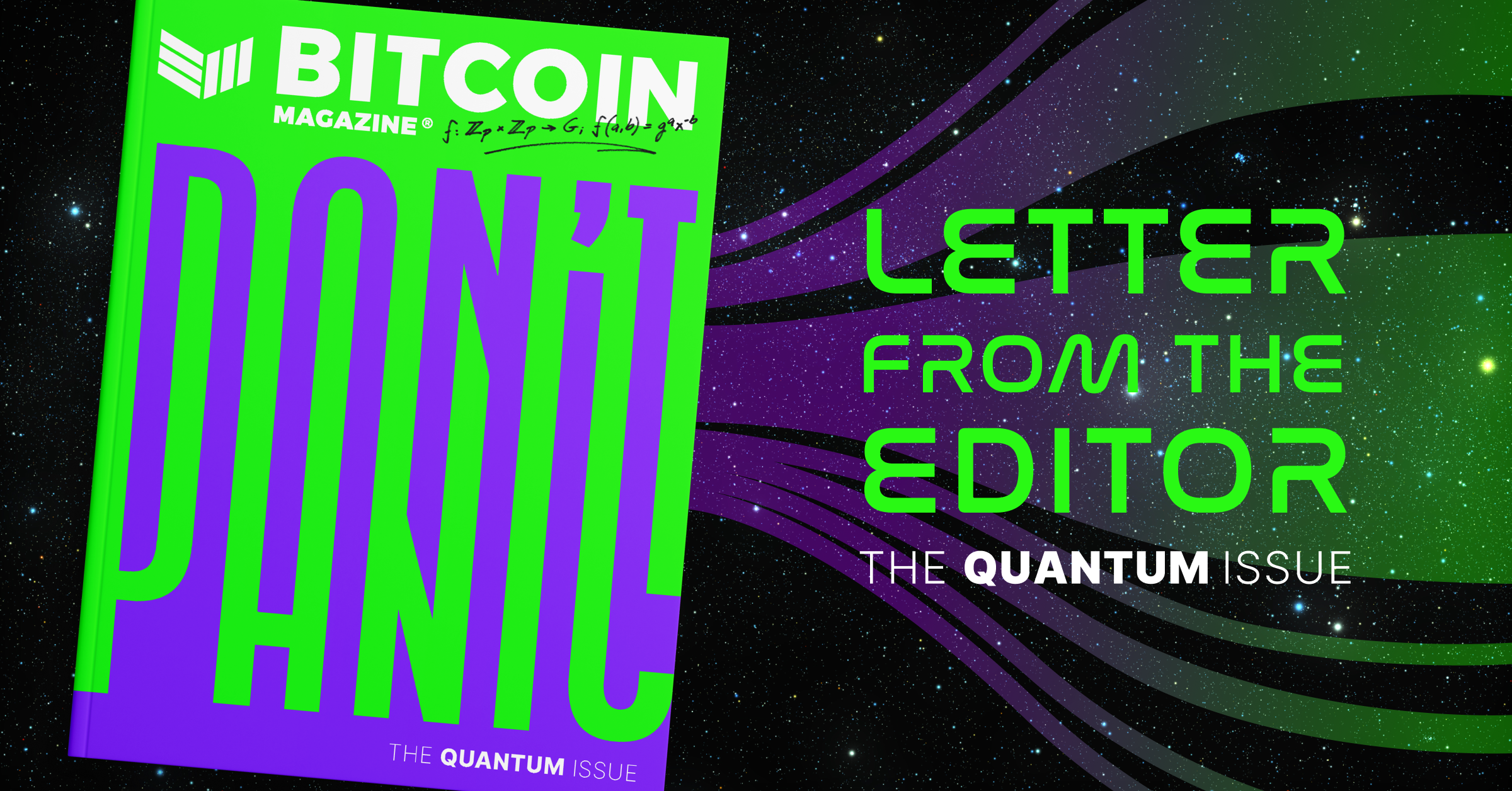
The Quantum Issue: Letter From The Editor
Quantum this, quantum that…who put a stupid cat on-chain!?
Ahem.
Alright, let’s be serious. The threat that a viable, actually functioning, quantum computer would pose to Bitcoin if it were to be built is very serious. It is the concrete example of an existential threat, in every sense of the word.
One of the bedrock foundations that Bitcoin rests upon is the assumption of a functioning cryptographic system that can be used to produce unforgeable signatures, i.e. that if you follow that system’s protocol properly when signing things, there is no way that anyone but a bitcoin’s rightful owner could produce a signature needed to spend it unless the rightful owner failed to secure their private key from theft.
Quantum computers toss that right out the window. There goes the integrity of the entire mechanism that is used for owners of bitcoin to authenticate their ownership for the protocol to process their legitimately authorized transactions, and ONLY their legitimately authorized transactions. There’s no way for anyone to actually own anything in the context of the Bitcoin protocol if that assumption breaks.
Bitcoin breaks if that assumption breaks.
Thankfully, there are many different cryptographic systems that exist, and not all of them rest on assumptions that a quantum computer breaks. That’s the good news. The bad news is that its all a set of tradeoffs, none of them are ideal, and there are going to be some hard choices that have to be made.
But there are solutions to just about every one of the problems that a viable quantum computer would create…except the problem of choosing which solutions to use. So in light of that, here is The Quantum Issue.
This issue is a lot more structured than most past issues, and that is to ensure that it guides a reader through the entirety of the problem space and solution space without assuming any prior understanding (this is a very deep and technical subject).
The first set of articles goes through the general issue of quantum computing itself, how it differs from classical computing, why that matters, how likely it is one is developed soon, etc.
The second set examines Bitcoin’s exposure. How is it exposed? How badly is it exposed? How can that degree of exposure change?
The third set examines concrete (or developed enough to not be too hard to get to a concrete place) solutions to securing your bitcoin in a quantum safe way, and handling a network wide migration to those solutions.

Don’t miss your chance to own The Quantum Issue — featuring articles written by many influential figures in the space working on the necessary pieces for a post-quantum Bitcoin!
This piece is the Letter from the Editor featured in the latest Print edition of Bitcoin Magazine, The Quantum Issue. We’re sharing it here as an early look at the ideas explored throughout the full issue.
This post The Quantum Issue: Letter From The Editor first appeared on Bitcoin Magazine and is written by Shinobi.
CryptoSlate
Ontology said its mainnet resumed normal operation on Sept. 2 after an emergency security pause and told every sync-node operator to upgrade to version 3.1.5. Sync nodes are infrastructure that keep their copy of the blockchain synchronized with the network.
The restoration notice says the new software is required to maintain compatibility with the restored chain and ensure stable synchronization. Ontology told operators to upgrade as soon as possible, confirm that their nodes are fully synchronized, and verify normal operation afterward.
Older software therefore carries a compatibility and synchronization risk, although the notice does not say that every unupgraded node has already failed.
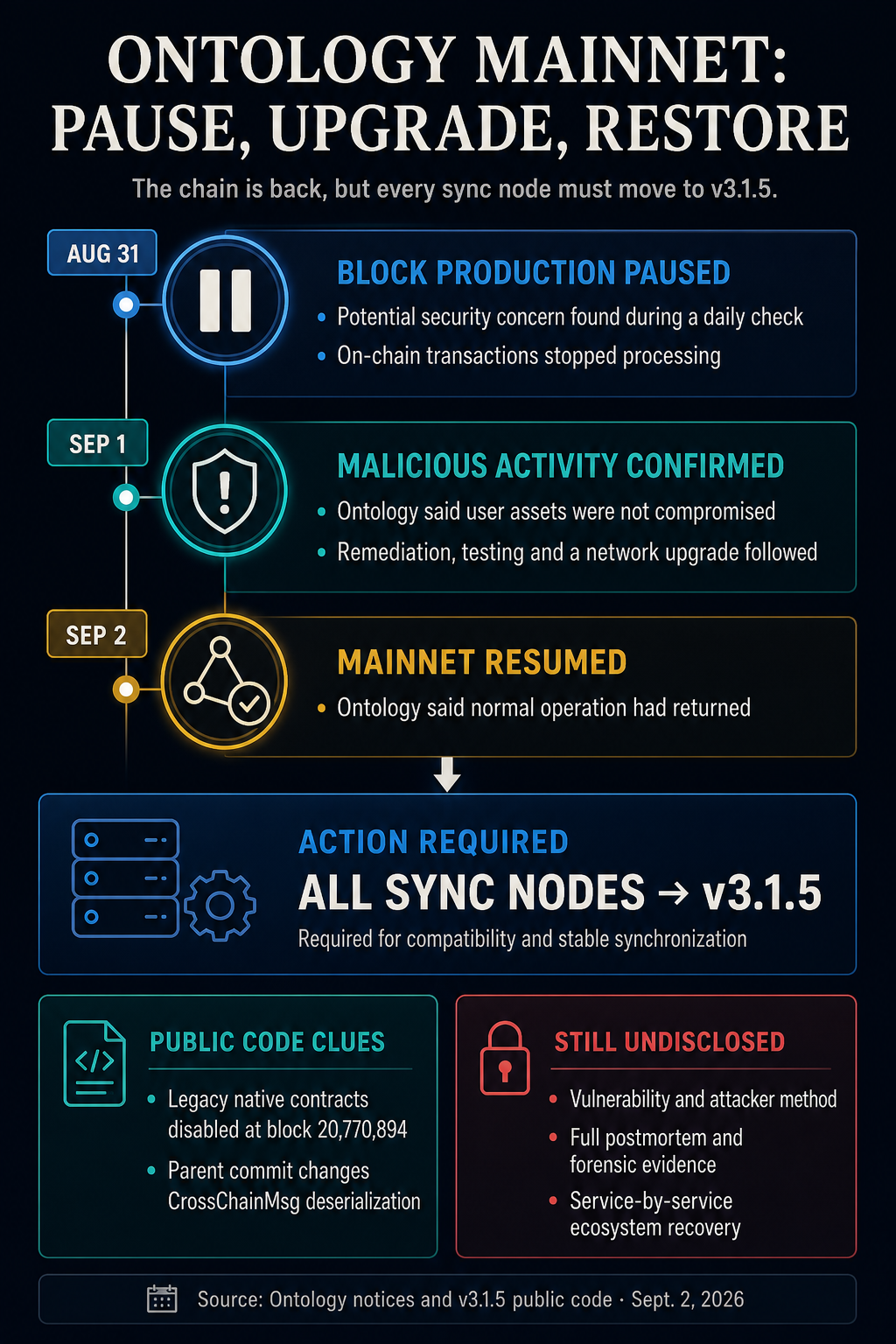
The restoration followed a pause that began Aug. 31. Ontology initially described the trigger as a potential security concern found during a daily security check and suspended block production, leaving on-chain transactions unprocessed.
A Sept. 1 update escalated that description, saying the team had identified malicious attack activity targeting the network while remediation, testing, and a network upgrade were underway.
During the pause, Ontology told users not to attempt time-sensitive on-chain transactions and said they did not need to move ONT, ONG, or other assets because of the announcement. It said block production would not restart until the network had been assessed and deemed safe to operate.
Ontology also said its investigation found that the activity did not involve or compromise user assets. That remains the network's assessment because it has not published an independent forensic report.
The code offers clues, not an attack explanation
The v3.1.5 release provides a Linux AMD64 binary and checksum but no incident explanation. The tagged code change disables registrations for several legacy native contracts at mainnet block 20,770,894, one block after the 20,770,893 height observed during the halt. Its parent commit changes cross-chain message deserialization.
The public code shows the shape of the emergency software change, but Ontology has not linked either commit to a specific attack path. Its notices do not identify the vulnerability or attacker method, explicitly name the affected component, or provide forensic evidence or a postmortem.
The restoration announcement confirms the mainnet's return, not a service-by-service recovery across the wider ecosystem. It does not establish whether public RPC providers, exchange deposits and withdrawals, wallets or dapps have all resumed normal operation.
The malicious-activity confirmation had already moved the incident beyond the initial pause, as CryptoSlate reported in a Sept. 1 examination of network shutdowns.
Ontology said monitoring will continue with technical and security partners. For now, v3.1.5 tells operators what they must do, while the reason for the emergency change remains undisclosed.
The post Ontology forces urgent node upgrade after restarting chain hit by malicious activity appeared first on CryptoSlate.
Thailand’s Securities and Exchange Commission has issued a Travel Rule that will require supervised crypto platforms to collect and transmit information identifying the people or entities behind coin transfers.
The regulator announced the rule on Sept. 2, and an associated notification is dated Aug. 25. It takes effect Feb. 27, 2027, after a 180-day implementation period from publication in the Royal Gazette.
The lead time lets operators prepare systems for exchanging transfer data, checking transactions, and requesting required information from customers, according to the SEC’s customer-facing Q&A.
How crypto transfers will change
SEC-supervised digital-asset operators must collect information on customers and their counterparties when coins are transferred. They must also check counterparties and verify the qualifications of digital-asset service providers or intermediaries in the transfer route.
An operator sending a transfer instruction must pass originator and beneficiary information to the operator receiving it. Transfer-related records must be kept for at least five years.
Customers will face different information requests based on transfer size. When sending coins from a wallet held with a regulated platform, a customer must identify the recipient even when the transfer is no more than 30,000 baht.
For transfers over 30,000 baht, the customer must also provide the recipient’s province or city and country. If the recipient is a legal entity, the customer must also provide its registration number. Smaller transfers require basic recipient identification, while larger ones require additional location or entity details.
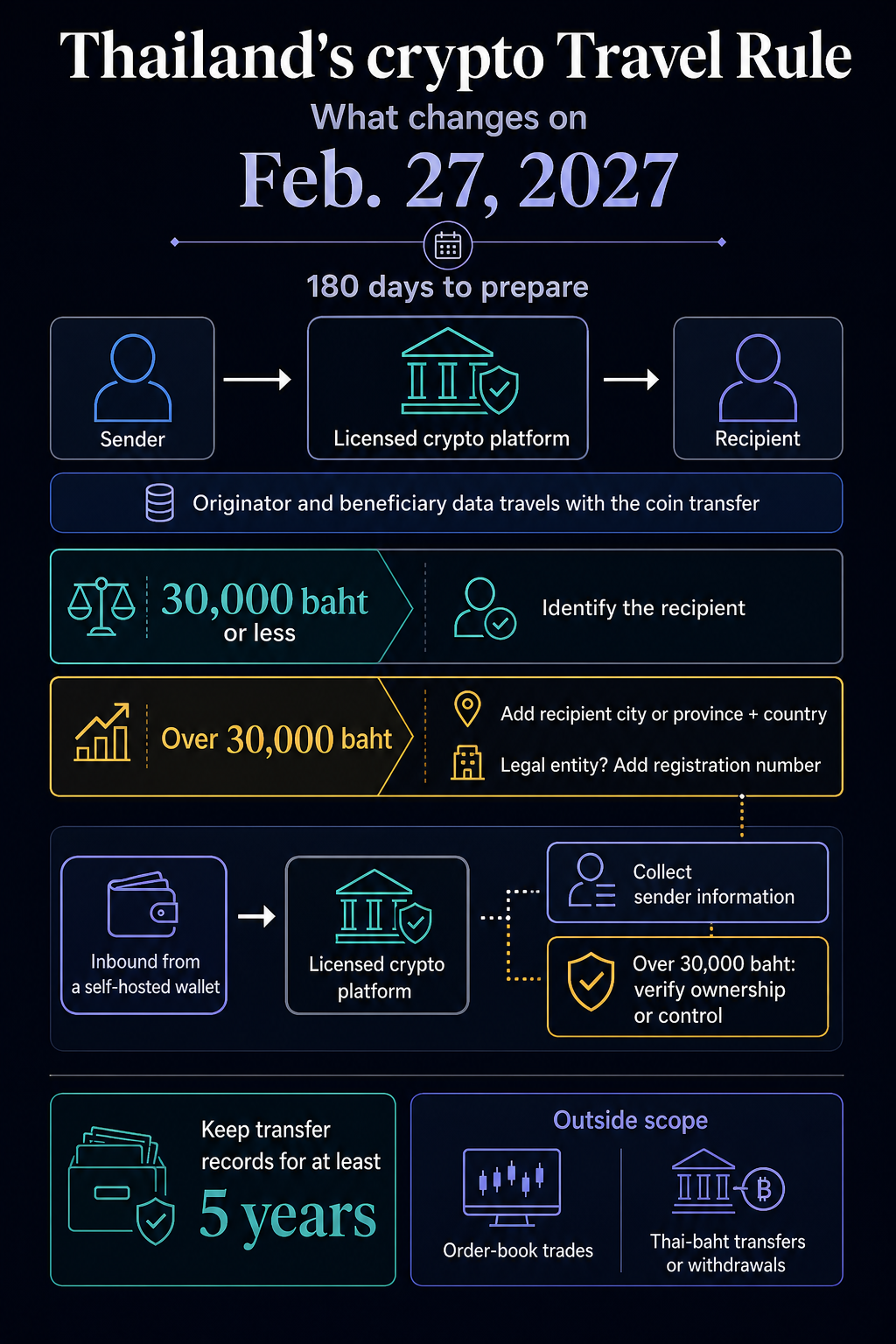
On incoming transfers between regulated operators, the recipient’s platform must collect information from the sender’s operator before allowing the recipient to move the coins out of the wallet.
The process becomes more specific when coins arrive at a regulated-platform wallet from a self-hosted wallet. The platform must collect sender information as it would for another transfer. If the transaction exceeds 30,000 baht, it must also verify that the user owns or controls the wallet by confirming the person can control or access it.
The obligation falls on supervised operators when a transfer touches their services, and the Q&A does not state that every coin transfer requires proof of wallet ownership.
The rule also stops short of extending the new data checks across all platform activity. It does not apply to trades on an operator’s order book or to transfers and withdrawals of Thai baht because it governs coin transfers.
The SEC said most transfers should continue through normal processes when customers provide complete information and platforms are ready. High-value transfers, cases with missing data, or transactions requiring added wallet checks may take longer.
The post Thailand puts private wallets and offshore crypto transfers on notice in a major new crypto rule appeared first on CryptoSlate.
Coinbase co-founder Fred Ehrsam's separate Venezuela investment firm, Primavera, is reportedly pursuing three oil assets as the country reallocates energy projects under a US-backed restructuring.
Reuters reported on Sept. 2 that Primavera was among companies expected to sign Venezuelan energy agreements as soon as that day. Bloomberg reported on Sept. 1 that Ehrsam was seeking control of at least three fields operated by Alvorada Heavy Industries in the Boca, Guico and Guara blocks of the Orinoco Belt.
Bloomberg attributed the block-level details to unnamed people familiar with nonpublic talks, while Reuters did not identify the fields.
Coinbase co-founder's crypto fortune targets Venezuela
Neither Coinbase nor Paradigm has been identified as a bidder or participant, and no blockchain, cryptocurrency, or digital payments component has been established for the reported transaction.
Ehrsam nevertheless retains close ties to the crypto industry. Coinbase's 2026 proxy filing lists him as a director, while Paradigm describes him as a co-founder and senior advisor. The distinction makes this a story about crypto-derived personal capital entering a state-mediated commodity business.
Banco de Venezuela said it hosted Ehrsam at a digital-finance event in Caracas on May 13, where he discussed opportunities involving cryptocurrencies and the country's financial sector.
The talks are unfolding during a wider reallocation of Venezuelan energy assets. On Aug. 31, a White House fact sheet said interim Venezuelan authorities had granted North American Blue Energy Partners 100-year concessions covering 17 fields.
The arrangement includes a 35% US government equity stake, preferential purchase rights over production and veto power over board appointments.
The authority behind those long-term rights is already contested. The Associated Press reported that analysts questioned whether acting President Delcy Rodríguez could grant 100-year oil-field rights and noted that the National Assembly had not approved the wider arrangement.
Primavera's reported pursuit shows how capital built in crypto can move into politically allocated hard assets. An executed agreement, including the assets and terms it covers, would determine whether that pursuit becomes operational control.
Until then, Boca, Guico, and Guara remain reported targets under negotiation.
The post Coinbase co-founder joins rush for Venezuelan oil assets under new US-backed framework appeared first on CryptoSlate.
Circle president Heath Tarbert told Congress on Sept. 2 that placing digital-dollar infrastructure under US rules could reinforce the network effects that support the currency’s global role. The testimony framed stablecoin and digital asset legislation as a tool of dollar statecraft.
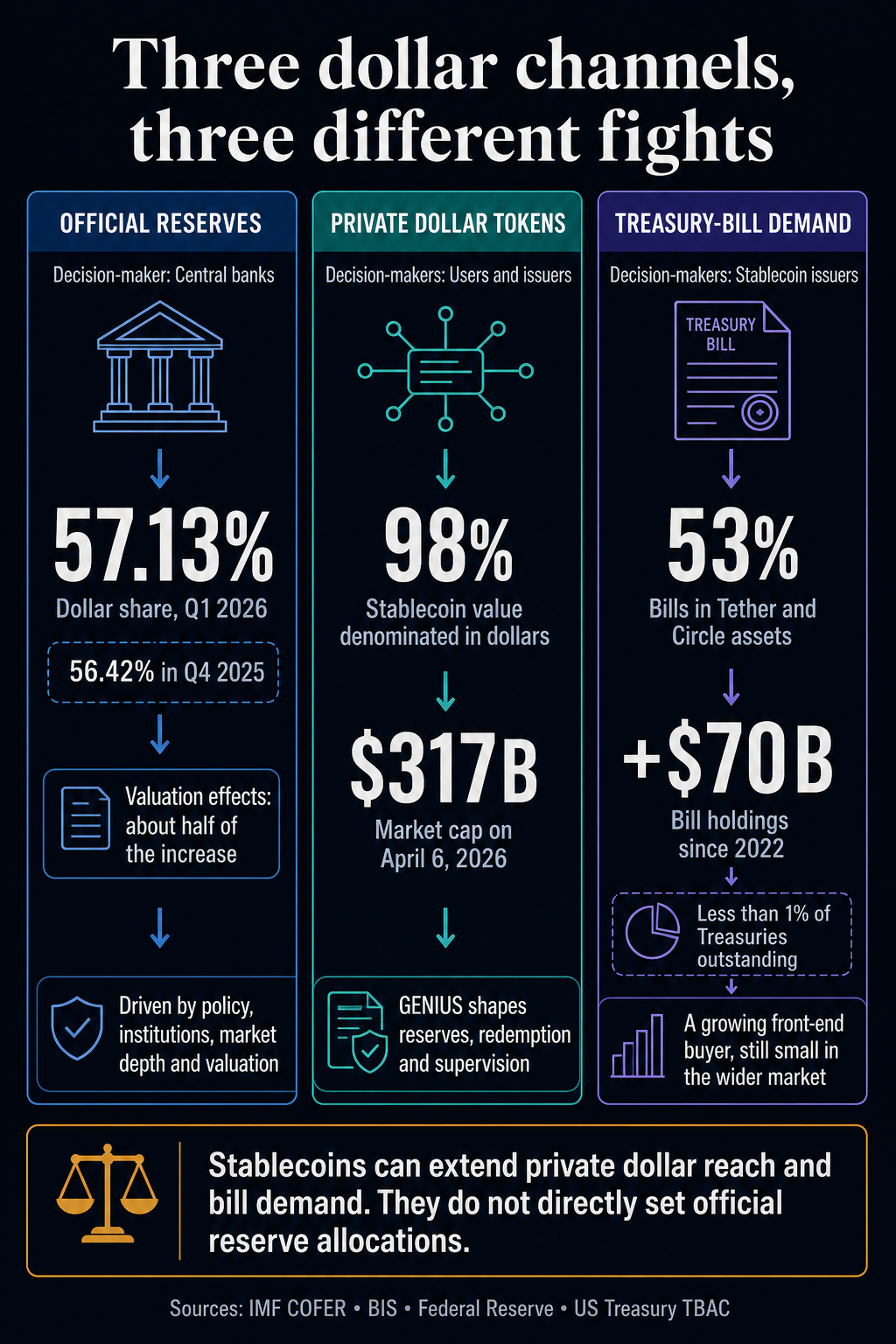
US rules can strengthen private dollar-token rails, while official reserve share remains a separate contest. Regulated stablecoins can spread private use of dollar-denominated tokens, change how issuers hold reserves, and add demand for short-term Treasuries.
Central banks remain responsible for deciding which currencies they hold. Tarbert acknowledged the boundary, arguing that payment technology cannot substitute for sound economic policy and that digital infrastructure cannot preserve dollar primacy on its own.
The dollar accounted for 57.13% of allocated global foreign exchange reserves in the first quarter of 2026, up from 56.42% in the fourth quarter of 2025, according to the International Monetary Fund’s latest COFER brief. Exchange-rate valuation effects accounted for around half of that quarterly increase.
The latest move was an increase, even against a longer-term decline in the dollar’s official reserve share. The valuation adjustment also prevents crediting the change to stablecoin adoption. A central bank’s reported reserve mix can shift when exchange rates move, even without an equivalent portfolio decision.
COFER tracks reserve assets reported by monetary authorities, and stablecoin market capitalization measures liabilities issued by private companies to token holders.
The Bank for International Settlements estimated that roughly 98% of stablecoin value is denominated in dollars. That shows the dollar’s dominance in private token markets.
BIS researchers nevertheless expect the near-term effects to appear mainly in private stores of value and means of payment, rather than in the official reserve, intervention or anchor-currency functions of central banks.
Stablecoins can consequently expand the dollar’s digital reach while fiscal credibility, institutions, market depth, and valuation forces continue to shape official reserve demand. This distinction separates consumers and businesses choosing a digital payment instrument from monetary authorities choosing a reserve portfolio.
What regulated stablecoins can change
The GENIUS Act issuer framework requires one-to-one permitted reserves, redemption at par, disclosures, supervision, and financial-crime compliance.
Those rules can improve reserve quality, influence where issuers locate, shape whether unlicensed issuers can offer stablecoins in the US, and steer more issuer assets toward short-term safe instruments.
GENIUS was enacted in July 2025, but its main requirements were not yet generally effective on the date of Tarbert’s testimony. Treasury’s August rulemaking notice said the general effective date was expected to be Jan. 18, 2027, unless final implementing rules made the law effective 120 days after their issuance.
A broader restriction on offering payment stablecoins from unlicensed issuers is scheduled to begin July 18, 2028.
Once it takes effect, the framework can govern backing, redemption, and supervision, leaving central bank currency allocations outside.
CLARITY addresses the trading and intermediary layer above stablecoins. The House passed the measure, the Senate Banking Committee advanced its portion 15-9, and the updated merged Senate text was released July 22.
The proposal’s principal function is to allocate jurisdiction between the Securities and Exchange Commission and the Commodity Futures Trading Commission and set rules for digital-asset intermediaries and markets.
If enacted, those rules could make US digital asset markets easier to operate in and extend the reach of regulated dollar tokens. Its effect would run through market structure rather than official reserve allocation.
Stablecoin issuers need liquid assets to support redemptions, and Treasury bills can satisfy that need. A Treasury Borrowing Advisory Committee analysis, using major-issuer data through September 2025, found that bills represented 53% of Tether and Circle assets. Their bill holdings had increased by $70 billion since 2022.
Even after that growth, stablecoin issuers held less than 1% of Treasuries outstanding. Their demand can affect the bill market at the margin, while broader demand for Treasury debt and official dollar reserves responds to other forces.
The Federal Reserve staff estimated stablecoin market capitalization at $317 billion on April 6, 2026, more than 50% above its level in early 2025. The date is essential because market capitalization moves continuously, and the figure should not be placed beside official reserves as if the series were equivalent.
The Fed analysis found USDC had high-quality reserves equal to its stablecoin liabilities. USDT reported total reserves at about 1.04 times liabilities, but higher-quality reserves at roughly 0.74 times liabilities.
Regulation can narrow those differences and make redemption promises more credible, a concrete way GENIUS could strengthen private dollar infrastructure.
Fed staff warned that complex intermediation, vertical integration and deeper links to traditional finance can increase opacity and contagion, amplifying operational or liquidity failures. Those dependencies can transmit problems further as adoption grows.
BIS researchers warn that broad adoption of dollar stablecoins could accelerate private currency substitution, weaken domestic monetary-policy traction and capital controls, and redirect emerging markets' savings toward US Treasury bills. A run on a major issuer could then transmit stress into local financial systems and short-term dollar markets.
Migration from bank deposits toward stablecoins can also shift funding and intermediation outside familiar channels, even when issuer reserves ultimately flow back into government securities.
Tarbert’s case is strongest on these private rails. US rules can help determine whether dollar stablecoins grow within a supervised system, what backs them, and which markets they connect. Greater reach also enlarges the channels through which runs, operational failures and currency substitution can spread.
The IMF’s 57.13% figure records the separate decisions of official reserve managers, whose allocations respond to economic credibility, liquid market depth, institutions, policy, and valuation effects.
Stablecoins can extend the dollar’s private reach and create demand for its shortest-dated government debt. Official reserve share still turns on the policies that sustain confidence in the dollar itself.
The post How stablecoins are quietly becoming the Fed’s debt buyer of last resort appeared first on CryptoSlate.
Silicon Network is shutting down with nearly $10 million still on-chain, giving users until year-end to exit.
The Ethereum layer 2 stopped accepting new bridge deposits and ended its network on Sept. 2, starting a withdrawal period that runs through Dec. 31.
Silicon said its explorer and network will shut down afterward, leaving assets that remain on the chain unrecoverable.
It stated:
“This network is a non-custodial service, meaning that the custody and withdrawal of assets are managed directly by each user. Once the service has been terminated, assets that have not been withdrawn cannot be recovered.”
The closure unwinds a network that had sought to connect Korean centralized-exchange users with Ethereum’s onchain economy. Silicon was built with Polygon CDK, connected to Agglayer and closely integrated with Korbit, one of South Korea’s major crypto exchanges.
Korbit’s Web3 Wallet, which ran on Silicon and was designed to give exchange customers access to DeFi and decentralized applications, is also being discontinued less than two years after launch.
Nearly $10 million now has to find an exit
The imminent shutdown now turns from a network decision into an asset-recovery problem, with different tokens facing very different paths off Silicon.
Data from L2Beat showed Silicon held about $9.75 million in assets, led by $2.66 million of USDC, $2.54 million of WBTC, $2.08 million of ETH and $1.85 million of USDT.
How easily that money can leave now depends on what users hold.
The network stated that assets originally bridged from Ethereum can return to the mainnet during the withdrawal window. External-wallet users must initiate a withdrawal, keep enough ETH for gas, and complete the required finalization before the cutoff.
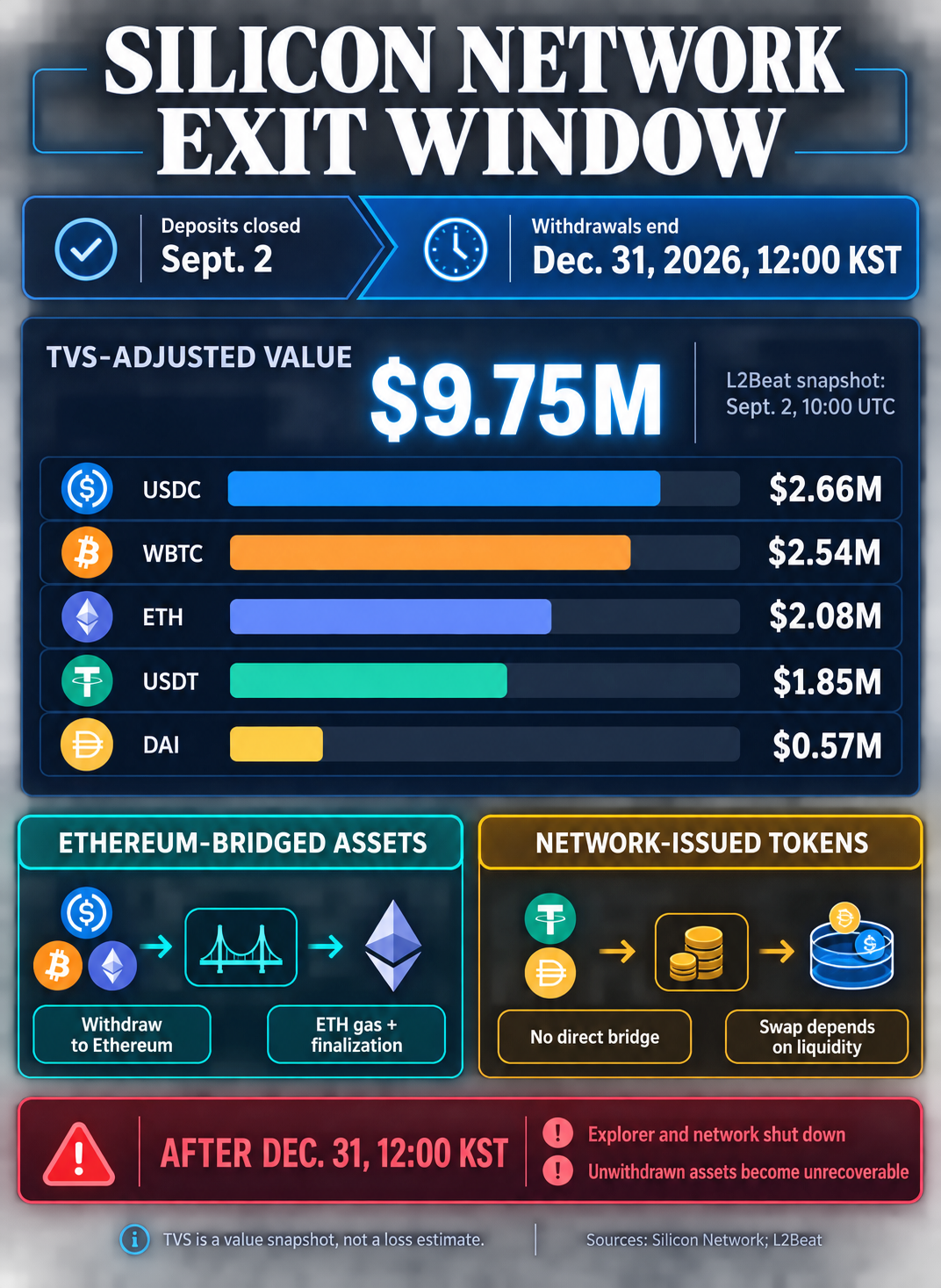
Tokens issued directly on Silicon face a harder route. They cannot be bridged directly to Ethereum and instead depend on liquidity remaining inside the network, which Silicon warns could make swaps or withdrawals difficult or impossible as activity winds down.
The network describes itself as non-custodial and says it has no obligation to redeem assets that users fail to move. It explained:
“Whether and how to handle these tokens is a decision to be made at the user's own discretion and responsibility. Once the network has been fully terminated, recovery will not be possible.”
Silicon’s exit comes as Ethereum’s scaling market becomes increasingly concentrated around its largest networks.
Coinbase-backed Base and Arbitrum now secure about $24.7 billion between them, more than 80% of the roughly $30.5 billion held across Ethereum networks tracked by L2Beat.
Earlier in the year, Ethereum co-founder Vitalik Buterin has also argued that the original vision of layer 2 networks simply acting as Ethereum’s “branded shards” no longer fits as the base layer scales and L2s develop at different speeds. He has urged networks to offer value beyond cheaper execution.
Silicon has not attributed its shutdown to those broader pressures. Its closure nevertheless shows what consolidation can mean at the smaller end of Ethereum’s scaling market: users must unwind bridges and find liquidity before the chain itself disappears.
The post Nearly $10 million must escape a dying Ethereum L2 network before New Year’s Eve or risk becoming unrecoverable appeared first on CryptoSlate.
HTTP error 429 on https://cryptoticker.io/en/feed/
Failed to fetch feed: https://cryptoticker.io/en/feed/
Failed to fetch feed.
Decrypt
After Claude models accessed real systems during cyber tests, Anthropic tightened its safeguards and warned that flawed training can encourage dangerous behavior.
Afterquery's valuation jumped more than tenfold in five months, making it Y Combinator's fastest unicorn ever.
Agents seized digital assets, domains, and servers allegedly used by Hamas’ military wing to collect donations and recruit supporters.
The Japanese company booked a ¥117.8 million profit after selling its ETH, SOL, XRP and DOGE, leaving roughly 1,506 BTC as its only cryptocurrency holding.
Emil Michael's latest financial filings show a summer exit from Perplexity, months after a January sale of xAI stock that reportedly netted him up to $24 million.
U.Today - IT, AI and Fintech Daily News for You Today
XRP drew more questions than any other cryptocurrency during a presentation to about 400 wealth managers, according to Bitwise research analyst Ryan Rasmussen.
The market is not yet ready for a rally continuation, but the accumulation on the bullish side is reassuring.
The Bank for International Settlements just tested the XRP Ledger as a way to verify official economic statistics.
Tether’s USDT ecosystem is expanding to Stellar, giving users access to more than $180 billion in stablecoin liquidity through USDT0.
Trading activity on the XRP Ledger surged in the second quarter, with average daily order-book volume rising 79% from a year earlier even as the number of accounts executing trades fell.
Blockonomi
Key Highlights
- Heidi O’Neill assumes the CEO position at Lululemon on September 8, leveraging her 27-year tenure at Nike.
- The company reduced North American product assortment by approximately 15% to enhance full-price sales performance.
- Mainland China delivered impressive 30% revenue growth reaching $478.4 million in Q1, contrasting with a 3% decline in Americas revenue.
- Board member Charles V. Bergh acquired 4,275 shares at $117.05 each, investing approximately $500,000.
- Analyst consensus stands at “Reduce” with a mean price objective of $148.38.
Shares of Lululemon are hovering near the $120 mark as the athletic apparel retailer approaches a significant leadership overhaul. Heidi O’Neill is set to assume the chief executive position on September 8, arriving at a time when the brand confronts considerable headwinds in its core North American market.
Lululemon Athletica Inc., LULU
O’Neill brings nearly three decades of expertise from Nike, where she occupied leadership positions in product development and consumer engagement. This professional pedigree aligns well with Lululemon’s current operational requirements.
In anticipation of her arrival, the organization has initiated strategic adjustments. Product selection in North American retail locations has been trimmed by approximately 15%, resulting in a more focused assortment that emphasizes fresh merchandise. Simultaneously, management has adopted a more disciplined approach to promotional pricing.
These strategic initiatives aim to restore demand for full-price merchandise, which has deteriorated over recent reporting periods. Comparable sales across the Americas region declined 5% during Q1, while gross profit margin compressed by 410 basis points to 54.2%, pressured by increased promotional activity and tariff-related costs.
Asian Markets Drive Growth Momentum
As North American performance falters, the Asian region is generating meaningful expansion. Revenue from Mainland China surged 30% to reach $478.4 million during Fiscal Q1. Although the broader Americas region weighed on consolidated results, the robust Asian performance provides a critical growth pillar.
Lululemon inaugurated its largest APAC retail location in Tokyo’s Harajuku district on August 31, spanning 1,220 square meters. Previously in August, the organization unified its China and APAC operations under a single regional management framework.
This organizational consolidation indicates a more strategic approach to international market development, elevating it beyond a supplementary growth narrative.
Board Restructuring Intensifies Pressure
Company founder Chip Wilson negotiated a cooperation arrangement that resulted in two fresh board appointments. Among them is Marc Maurer, who previously served as co-CEO of On Holding. The company additionally committed to appointing another independent director with expertise in apparel merchandising and brand strategy by October 1.
Board-level intervention of this nature typically accelerates decision-making timelines. O’Neill will face limited time to demonstrate tangible results.
Regarding institutional activity, Headlands Technologies acquired 10,668 LULU shares worth approximately $1.22 million during the second quarter. Institutional investors and hedge funds collectively control 85.2% of outstanding shares.
Director Charles V. Bergh personally acquired 4,275 shares at $117.05 per share on June 15, elevating his total position to 10,365 shares valued at roughly $1.21 million.
Wall Street sentiment remains reserved. Zacks Investment Research elevated LULU from “strong sell” to “hold” on August 19. Piper Sandler reduced its price objective from $130 to $110, maintaining a “neutral” stance. BTIG downgraded the stock from “buy” to “neutral” in early June. The aggregate analyst consensus registers as “Reduce” with a mean price target of $148.38.
The next critical milestone arrives when Lululemon announces Fiscal Q2 financial results on September 3. Market participants will scrutinize U.S. demand patterns, promotional intensity, and initial consumer reception to the refreshed merchandise assortment.
The company delivered $1.69 earnings per share in its latest quarter, exceeding the consensus forecast of $1.67, with revenue reaching $2.47 billion, representing 4.3% year-over-year growth. Management has issued FY2026 EPS guidance ranging from $10.95 to $11.15.
The post Lululemon (LULU) Stock Analysis: New CEO Takes Helm as North America Sales Decline appeared first on Blockonomi.
Key Takeaways
- NIO shares declined 4.9% to close at $3.86 with trading activity surging approximately 91% beyond typical levels
- Second-quarter revenue increased 69.1% annually to RMB32.14 billion, falling short of analyst projections
- The automaker delivered 107,658 vehicles in Q2, marking a 49.4% year-over-year increase
- JPMorgan shifted its rating to Neutral from Buy while reducing the price objective from $7.00 to $4.50
- Third-quarter revenue projection of $4.9B-$5.0B underperformed the $5.1B Street consensus
NIO stock tumbled 4.9% to settle at $3.86 during Wednesday’s session, as trading volume surged to approximately 71.9 million shares—nearly twice the standard daily average. The sharp decline came after the Chinese EV manufacturer received a rating downgrade from JPMorgan alongside publishing third-quarter guidance that disappointed investors.
NIO Inc., NIO
JPMorgan’s Nick Lai shifted his stance on the Chinese electric vehicle maker, moving the rating from Buy to Neutral while simultaneously reducing his price objective from $7.00 down to $4.50. Lai highlighted concerns regarding underwhelming delivery projections for the latter portion of 2026 and emphasized deteriorating demand conditions within China’s passenger vehicle sector as significant headwinds approaching 2027.
Adding to the bearish sentiment, Freedom Broker also revised its outlook, downgrading NIO to Hold from its previous Buy recommendation. The firm lowered its price target from $7.00 to $4.00, citing the company’s below-consensus third-quarter delivery forecast as evidence of decelerating momentum.
Despite the negative market reaction, NIO’s second-quarter performance contained some positive elements. The company posted revenue growth of 69.1% compared to the prior year, reaching RMB32.14 billion ($4.74 billion), while vehicle deliveries expanded 49.4% to 107,658 units. The automaker also narrowed its adjusted losses and achieved an 18.5% vehicle gross margin.
Additionally, NIO reported positive free cash flow generation and showcased improved cost management through its premium vehicle portfolio.
However, these achievements failed to offset investor concerns. Revenue figures still came in below Wall Street’s expectations, marking the third consecutive quarter where the stock faced pressure following earnings announcements.
Third-Quarter Projections Fall Short
Company leadership provided third-quarter revenue guidance ranging from approximately $4.9 billion to $5.0 billion, missing the $5.1 billion consensus estimate from analysts. While the shortfall appears modest, it proved sufficient to trigger concerns about the strength of NIO’s recovery trajectory.
Lai revised his revenue projections for 2026-2027 downward by 5% to 9% and slashed earnings estimates by 13% to 52%, concluding that the updated outlook no longer justifies maintaining a bullish position. He now anticipates NIO stock to deliver returns comparable to the wider automotive sector.
Escalating input expenses present another challenge. Both memory chip and battery material costs have experienced upward pressure, potentially threatening the margin improvements NIO achieved during the second quarter.
Vehicle Deliveries Advance Despite Fierce Market Competition
August delivery figures totaled 35,836 vehicles, representing a 14.5% year-over-year gain. Cumulative deliveries through August reached 262,893 units, reflecting a 57.9% increase compared to the corresponding period in 2025.
Company executives are targeting monthly delivery volumes exceeding 40,000 units during the fourth quarter while striving to restore positive cash flow generation. Achieving this objective would necessitate quarterly deliveries surpassing 120,000 units, dependent upon strengthening conditions in China’s electric vehicle marketplace.
NIO continues expanding its battery swap infrastructure and advancing Firefly technology development, with possible robotaxi applications being explored for future deployment.
On the distribution front, NIO is launching multi-brand Sky Stores alongside a flagship Nio House location in Macau, serving its NIO, Onvo, and Firefly vehicle lines. This retail strategy aims to reduce distribution expenses.
Sanford C. Bernstein similarly reduced its price target on NIO from $6.00 to $5.00 while maintaining a market perform rating. The consensus analyst recommendation currently sits at Hold, with an average price objective of $6.29.
Per TipRanks data, NIO carries a Moderate Buy consensus rating derived from four Buy recommendations, four Hold ratings, and one Sell rating issued over the past three months, accompanied by an average price target of $5.31.
The post NIO (NIO) Stock Plunges 5% as JPMorgan and Freedom Broker Slash Ratings appeared first on Blockonomi.
Key Highlights
- Alphabet’s autonomous vehicle division Waymo is finalizing negotiations to secure over $3 billion through its inaugural debt offering, with major lenders such as Pimco, Blackstone, and Sixth Street Partners participating.
- The proposed loan, which lacks a credit rating, may feature an interest rate exceeding 500 basis points over the benchmark.
- Goldman Sachs serves as Waymo’s financial advisor for this transaction, expected to conclude imminently.
- This debt initiative arrives on the heels of Waymo’s massive $16 billion equity fundraising round completed in February 2026, establishing a $126 billion company valuation.
- Waymo aims to deliver one million weekly paid autonomous rides spanning 20 global cities throughout this year.
Waymo is approaching the final stages of securing more than $3 billion through debt financing, representing a watershed moment as Alphabet’s autonomous driving division explores borrowed capital for the first time. Investment giants Pacific Investment Management (Pimco), Blackstone, and Sixth Street Partners are among the primary lenders participating in this landmark transaction, Bloomberg reports.
Alphabet Inc., GOOGL
Financial services powerhouse Goldman Sachs has been retained as Waymo’s advisor throughout this financing arrangement, with closure anticipated in the coming days. Negotiations over specific terms continue, meaning final conditions remain subject to modification.
The financing package is anticipated to lack a formal credit rating and may command pricing exceeding 500 basis points—equivalent to five full percentage points—above the applicable benchmark rate. This positions the loan as a comparatively costly capital source.
Alphabet stock (GOOGL) climbed 0.63% during the reporting period. Analysts maintain a Strong Buy consensus rating on GOOGL shares, establishing a mean price target of $422.96 that suggests approximately 25% appreciation potential.
This debt fundraising emerges mere months following Waymo’s substantial $16 billion equity injection concluded in February 2026, which established the autonomous vehicle company’s valuation at $126 billion—representing nearly triple growth over a span of less than two years.
What prompted this strategic pivot toward debt instruments? The fundamental driver is operational scale. Waymo faces mounting demands as it accelerates deployment of autonomous vehicles while managing substantial AI-driven operating expenses. Equity capital alone has proven insufficient for current growth trajectories.
The autonomous driving platform currently facilitates upward of 500,000 compensated rides weekly throughout 14 American cities. Management has articulated ambitious targets to achieve one million weekly paid journeys across 20 global metropolitan areas before year-end. Meeting these objectives requires deploying substantial robotaxi capacity.
Geographic Expansion Initiatives
Looking beyond American borders, Waymo is orchestrating pilot programs in over a dozen supplementary locations, with both London and Tokyo featured among prospective international markets. Such ambitious geographic expansion necessitates considerable financial resources.
The autonomous ride-hailing sector faces mounting competitive pressure. Waymo confronts direct rivalry from Amazon’s Zoox platform alongside Tesla’s self-driving technology, with the competitive race toward operational scale gathering momentum.
Proprietary Semiconductor Innovation
From a technological perspective, Waymo disclosed last month the successful development of a proprietary semiconductor designed specifically for its autonomous fleet, strategically targeting both cost reduction and enhanced operational performance. Investing in custom hardware development represents another capital-intensive undertaking amplifying the company’s funding requirements.
Neither Waymo nor Goldman Sachs provided responses to Reuters’ inquiries seeking comment. Blackstone, Pimco, and Sixth Street Partners each declined to offer statements.
Throughout its operational history, Waymo has predominantly secured funding through equity investments from Alphabet and external backers. This strategic transition toward debt capital markets underscores the substantial business maturation and escalating capital demands necessary to sustain aggressive expansion objectives.
Financial analysts covering the stock have established a Strong Buy consensus recommendation for GOOGL, derived from 24 Buy ratings alongside four Hold ratings issued during the preceding three-month period. The consensus price target of $422.96 indicates potential upside of approximately 25.4% relative to prevailing market levels.
The post Alphabet (GOOGL) Stock: Waymo Eyes Over $3B Debt Financing in First-Ever Loan Deal appeared first on Blockonomi.
Key Takeaways
- Federal investigators have broadened their beef pricing probe to include Amazon alongside seven other major grocery chains like Walmart and Costco.
- The DOJ is demanding half a decade’s worth of pricing, purchasing, and profit margin information from each company.
- In July, ground beef prices hit $7.116 per pound—a 9.4% annual increase approaching historic peaks.
- Initially, the investigation focused on meat processing companies, where four firms dominate over 85% of the U.S. market.
- Analysts give AMZN a Strong Buy rating with a consensus target of $334.05, suggesting approximately 31% potential gains.
Federal antitrust officials have widened their investigation into elevated beef costs, now targeting Amazon and seven additional prominent grocery retailers across the nation. In correspondence dispatched last July, the DOJ demanded comprehensive records spanning six years covering procurement practices, consumer pricing structures, profitability metrics, and competitive market assessments.
The Seattle-based e-commerce giant joins seven other retail powerhouses in receiving federal data requests. The list includes Walmart, Costco, Albertsons, Kroger, Ahold Delhaize, Publix, and Aldi.
Associate Attorney General Stanley Woodward authorized the formal requests. Importantly, federal officials have not leveled any charges or allegations of misconduct against any retailer at this juncture.
Amazon.com, Inc., AMZN
These data requests form a component of a more extensive antitrust examination exploring persistent elevation in beef pricing. During July, ground beef prices averaged $7.116 per pound, representing a 9.4% year-over-year climb and nearing all-time records.
Evolution of the Federal Probe
Initially, DOJ investigators concentrated their efforts exclusively on meat processing facilities rather than retail operations. Currently, four dominant processing corporations maintain control over more than 85% of American beef processing capacity, triggering initial antitrust questions.
Federal authorities are now examining downstream supply chain segments to comprehend pricing transformations occurring before products reach end consumers. Bringing major retailers like Amazon into the investigation demonstrates the DOJ’s commitment to obtaining comprehensive visibility across the entire pricing ecosystem.
Supply constraints in cattle markets compound the situation. The American cattle inventory recently declined to levels not witnessed since the 1950s, maintaining upward pressure on beef costs independent of any potentially questionable pricing behaviors.
Last August, President Trump unveiled initiatives permitting up to 300,000 metric tons of supplementary beef imports under reduced tariff structures for a 90-day window to address supply shortages. Separately, Walmart announced in July its intention to reduce prices on select seasonal merchandise, including certain beef products.
Additional Regulatory Challenges Facing Amazon
This beef pricing investigation represents merely one element within Amazon’s broader regulatory landscape. The Federal Trade Commission, joined by 22 state attorneys general, has accused the company of manipulating advertising auction mechanisms and allegedly overcharging approximately 1.2 million advertisers by exceeding $20 billion. Additionally, Amazon has navigated planned corporate workforce reductions and labor actions, including a Teamsters strike affecting its Riverside distribution facility.
From an institutional investment perspective, sentiment appears considerably stronger. Vanguard maintains ownership of over 832 million AMZN shares valued above $158 billion. Notable hedge fund manager Stanley Druckenmiller expanded Duquesne’s Amazon holdings more than tenfold, while Coatue increased its position by 49%.
The company’s second-quarter performance showed earnings of $5.75 per share, significantly exceeding the $1.82 analyst consensus. Revenue reached $200.61 billion, marking a 19.6% year-over-year increase.
AMZN shares began Thursday’s trading session at $254.98, trading within a 52-week bandwidth of $196.00 to $287.20, supporting a market capitalization of $2.75 trillion.
The post Amazon (AMZN) Stock Faces DOJ Scrutiny in Beef Pricing Probe appeared first on Blockonomi.
Key Highlights
- Shares of Paramount Skydance (PSKY) climbed approximately 4% on Wednesday following encouraging signals regarding the multi-state legal challenge to its Warner Bros. Discovery merger.
- Several New Jersey Democratic officials issued a public appeal urging their state’s Attorney General to withdraw from the ongoing litigation.
- Court documents revealed the case was assigned to a magistrate judge for potential settlement discussions, although California officials characterized this as routine procedure.
- California Attorney General Rob Bonta indicated settlement discussions are “very possible” while criticizing Paramount for alleged bad-faith negotiation approaches.
- The media company announced an expansion of its FAST channel offerings via a partnership with German streaming platform High View, debuting on Samsung TV Plus.
Shares of Paramount Skydance (PSKY) experienced a significant uptick on Wednesday, climbing nearly 4% and reaching as high as 4.7% at its peak, as dual developments provided renewed confidence regarding the company’s proposed $110 billion acquisition of Warner Bros. Discovery (WBD).
Paramount Skydance Corporation Class B Common Stock, PSKY
Despite Wednesday’s gains, the stock remains down approximately 30% year-over-year, making any favorable developments particularly impactful for investor sentiment.
The initial momentum originated from New Jersey, where multiple Democratic officials co-authored an opinion piece in the New Jersey Globe calling on Attorney General Jennifer Davenport to withdraw the state from the multi-state legal action. The list of signatories featured Bayonne’s mayor, three state senators, and six Assembly members.
Their rationale emphasized New Jersey’s substantial investment in cultivating its film and television sector, with Paramount serving as a key participant in that development. They contended that pursuing litigation that federal authorities had already resolved after an eight-month review represented an inefficient allocation of public resources.
Legal Developments Generate Market Interest
The second positive development emerged from court documentation submitted by Judge Araceli Martinez-Olguin, assigning the case to Magistrate Judge Thomas S. Hixson for settlement conference proceedings. Market participants initially responded by pushing Warner Bros. Discovery (WBD) shares higher on speculation that a resolution might be approaching.
However, representatives from California’s Attorney General’s office quickly tempered expectations. In correspondence with Seeking Alpha, a spokesperson clarified: “This order does not indicate a settlement is in progress. The court specifically asked us to identify magistrate judges for a settlement conference in a previous scheduling order. This is a standard course in a case of this magnitude.”
Additionally, California Attorney General Rob Bonta had previously canceled a scheduled meeting with Paramount executives that was planned for the prior Monday.
Nonetheless, Bonta shared with CNBC in recent comments that reaching a settlement remains “very possible,” emphasizing his office’s continued openness to negotiations while simultaneously alleging that Paramount has disclosed information from confidential discussions to the media.
FAST Channel Portfolio Grows
In separate business developments, Paramount revealed a licensing agreement with High View, a German-based streaming media enterprise, to introduce additional free ad-supported streaming (FAST) channels.
Two channels have already launched: one featuring exclusively Beverly Hills 90210 content and another showcasing Lucky Dog programming. A Gunsmoke-focused channel is planned for future release.
These channels will distribute through Samsung (SSNLF) TV Plus, with High View’s subsidiary Goldvertise managing advertising sales operations.
Current Wall Street sentiment on PSKY stock reflects a Hold rating consensus, derived from two Buy recommendations, five Hold ratings, and three Sell ratings issued within the last three months. Analysts have established an average price target of $10.50 per share, suggesting approximately 4% potential upside from present trading levels.
As of Wednesday, Bonta’s office confirmed that formal settlement negotiations with Paramount have not yet commenced.
The post Paramount Skydance (PSKY) Stock Climbs 4% Amid Lawsuit Pressure and Settlement Signals appeared first on Blockonomi.
CryptoPotato
Over the past few days, developments in Ripple’s ecosystem centered on asset management, custody, and tokenization.
Meanwhile, XRP has failed to extend the rally that briefly carried it to around $1.70 in August, leaving traders focused on resistance levels and key support lines.
Bitwise XRP ETF Tops $500 Million
Bitwise’s spot XRP ETF has surpassed $500 million in assets under management only nine months after it was first launched. As CryptoPotato reported, the fund held about $507 million after Monday’s close, while US spot XRP ETFs had managed to attract a record $1.66 billion in cumulative net inflows by the end of last week.
Bitwise’s product leads this particular category with more than $600 million in cumulative inflows. It’s currently ahead of Canary Capital’s XRPC and Franklin Templeton’s XRPZ.
The milestone suggests that there’s continued demand for regulated exposure to XRP despite the token’s pullback from its August high.
Ripple, SettleMint Target Banks with New Institutional Stack
Ripple Labs and SettleMint have launched a partnership. It seeks to integrate Ripple Custody with SettleMint’s Digital Asset Lifecycle Platform.
The offering is aimed at allowing regulated financial institutions to custody, issue, and manage tokenized assets through a single system.
The service is already live in Asia, with expansion already planned. It targets banks, market infrastructure operators, and sovereign entities, while RLUSD and XRP are among the assets that support Ripple’s institutional solutions.
The partnership also provides the company with more exposure to tokenization – a market BCG estimates could reach $88 trillion in the next 10 years.
Evernorth Moves Closer to Nasdaq Listing
The popular XRP-focused treasury company Evernorth cleared yet another important regulatory hurdle after the US Securities and Exchange Commission declared its registration statement effective. Shareholders of merger partner Armada Acquisition Corp. II are scheduled to vote on the transaction on September 30th.
If approved, the combined company is expected to trade on Nasdaq under the ticker XRPN. Evernorth has so far disclosed more than $1 billion in gross proceeds from its investors, including Ripple, SBI Holdings, Pantera Capital, Kraken, and Arrington Capital.
The strategy is centered on holding and actively managing XRP as a corporate treasury asset.
XRP Price Update: Bulls Need to Reclaim $1.40 – $1.50
Last but not least, let’s take a closer look at XRP’s price action throughout the past few days. It is trading at around $1.35 at the time of this writing, with a market capitalization nearing $85 billion. It has slipped by about 2% in the past few days, dropping by 6% on the weekly chart.
That said, analysts remain divided. Some of them foresee $1.70 as the next major target if the current breakout holds. On the other hand, some highlight the resistance that is currently being faced at around $.140 to $1.43 followed by $1.5, warning that failing to break above these levels could signal weakness and a drop to below $1.3.
The post Important Ripple News and XRP Price Update: September 3 appeared first on CryptoPotato.
Bitcoin (BTC) sat near $77,000 today, clawing back part of a slide that took it under $76,500 earlier in the week after fresh US-Iran strikes spooked the markets.
Analysts are now split on whether the dip was a shakeout before another push higher or the first sign of a deeper pullback.
Traders Watch the $83,000 Gap
Analyst NoName is watching the CME futures gap above the current price and considers $83,000 the line that decides what happens next. They wrote that Bitcoin needs “the level that separates a real reversal from another relief rally” with a daily close above it backed by real spot volume.
Without that close, they are treating the recent bounce as a retest of old supply rather than confirmation of a new uptrend, and their downside case is blunt: if $83,000 rejects and $74,000 gives way, they see room for a drop toward $50,000 to $55,000 before Bitcoin finds a real bottom.
But not everyone is reading the chart that way, including Doctor Profit, who dismissed calls for a new low outright, saying, “I consider the bear market as over.”
Another market watcher, Sykodelic, pointed to the monthly candle instead of shorter timeframes, citing the reversal structure, a bullish tick on the DSS Bressert indicator, and a flattening MACD.
He called the setup “not bearish, and never been bearish,” and said the monthly close held above the $76,400 level he had flagged as the line between confirming the reversal and voiding it.
Behind the argument sits a rough week. As CryptoPotato reported previously, Bitcoin got turned away at $79,000 more than once before the latest leg down pushed it under $76,500 for the first time since August 23, with renewed US-Iran fighting being the main trigger. You can hear more about that in the video below:
The primary cryptocurrency is now changing hands above $77,000, having traded between $76,300 and $77,800 in the last 24 hours. It’s down almost 2% for the week but still up nearly 22% for the month.
August’s Rare Green Candle Complicates the Picture
The pullback follows a month that broke a pattern, with BTC closing August up almost 25%, the first green August during a bear market stretch comparable to 2014, 2018, or 2022, when it fell between 9% and 18% at the same point in each cycle.
It was also the asset’s best August since 2017, when the month closed up more than 65%. Furthermore, the third quarter is already up close to 33%, with one month left to go.
That doesn’t change where Bitcoin sits against its cycle high, though. It remains down close to 30% for the year and more than 38% below its October 2025 peak of over $126,000, with dominance currently above 57%.
The post Bitcoin Could Crash to $50K if Bulls Fail This Crucial Test: Analyst appeared first on CryptoPotato.
XRP is changing hands around $1.35, down roughly 6% over the last week after slipping beneath a support level chart analysts had been watching closely since late August.
Trader ChartNerd says the token’s second failed weekly close above its 50-week EMA leaves room for a deeper slide to $1.27, or lower, before the rally that took XRP to $1.70 can resume.
Bulls Lose Their Grip on the $1.36 Floor
ChartNerd has been tracking XRP’s four-hour structure for weeks, watching a range that formed beneath $1.47 resistance and above $1.36 support. That floor has now been swept twice. According to the analyst, the price rejected from $1.43 and printed another lower high beneath a bearish trend signal sitting at $1.39.
Zooming out, the picture traces back to August 22, the day XRP touched a multi-month high of $1.70, as CryptoPotato reported. The rally followed a broader market move triggered by Bitcoin’s jump from under $65,000 to $80,000, and pushed XRP up 70% in three days after a tough start to the month that had briefly dragged it under $1.00. It ended August at just under $1.40, still a 30% monthly gain despite the pullback.
ChartNerd flagged the retracement risk the day after that peak, warning that a weekly close below the 50 EMA “would be an early warning sign in advance for a larger retracement.”
That’s exactly what has followed: two consecutive weekly closes beneath the average and a retreat the analyst pegged at around 22% from the top. The next support in that scenario is the weekly 20 EMA, which now sits at $1.27.
No Recovery Case Until $1.50 Gets Reclaimed
ChartNerd’s resistance ladder above the current price runs from $1.40 to $1.43, then $1.47, then $1.65, $1.82, and $2.40. On the downside, the levels being watched are $1.30, $1.27, $1.21, and $0.85, the last tied to a zone the analyst has been flagging for accumulation since June.
The broader case for a bottom rests on a golden cross that hasn’t formed yet. XRP’s EMAs are coiling, with price stuck under the 50-week average and above the 20-week one. Until both are reclaimed and held, ChartNerd isn’t willing to call a floor, comparing the current stretch to the compression that preceded August’s breakout.
Spot XRP ETFs still pulled in more than $110 million last week, their strongest inflow since December, which has kept some traders open to a faster turnaround than the charts alone suggest.
September carries its own catalysts, including a CLARITY Act vote in the Senate around September 15 and a shareholder vote on Evernorth’s planned Nasdaq listing. But none of that changes the technical picture ChartNerd is describing: XRP is boxed in below resistance, and until that changes, another leg down to $1.27 or beyond stays on the table.
The post XRP’s Next Move Comes Down to These Key Price Levels: Analyst appeared first on CryptoPotato.
The meme coin sector was at the forefront of gains during the last bull cycle, but over the past several months, interest in such tokens has fallen sharply.
We asked three of the most popular AI-powered chatbots to assess whether any of the leading ones (or perhaps some overlooked names) have a realistic chance of staging a revival and turning into sensations this month. Here’s what they said.
Mixed Answers
According to ChatGPT, Dogecoin remains “the safest bet” for September because of its size, liquidity, and recognition in the crypto community. OpenAI’s platform noted that it is still the biggest meme coin, reminding that lately whales have purchased a significant amount of DOGE, thus potentially setting the stage for a price uptrend.
It also claimed that the token would be among the first altcoins to benefit from a further crypto recovery. Despite the latest correction, the market has been on a major upward move over the past two weeks, and we have yet to see whether September will deliver further gains.
ChatGPT argued that Shiba Inu (SHIB) offers more upside than DOGE but paid attention to its tremendous circulating supply, which remains a major obstacle to a price rally.
“Routine burns remove only a tiny portion of that amount, meaning sustained buying pressure matters far more than eye-catching changes in the daily burn rate,” it added.
The chatbot also touched on PEPE, describing it as the most speculative of the leading meme coins. In addition, it classified Pudgy Penguins (PENGU) as “the strongest alternative candidate.”
Perplexity presented a different answer, claiming that DOGE’s potential upside may be more steady than parabolic in the next four weeks. It claimed that PEPE is unlikely to experience a decisive breakout within that period, while Shiba Inu has the best chances:
“SHIB looks like the coin where price is still quiet, but the tape is screaming accumulation, right into a time of year when it has historically moved the most. That combination is why it’s the most likely to deliver a “history-making” September move.”
The Surprising Bet
Google’s Gemini picked the cat-themed Cash Cat (CASHCAT) as its choice for a meme coin that could stun the market with a shocking increase this month. It noted that the token is closely linked to Robinhood Chain, which means further ecosystem developments could directly benefit it.
At the same time, the chatbot warned that the meme coin’s potential rally in September may abruptly end with a brutal crash in October. As a matter of fact, tokens of that type are notorious for their enhanced volatility, and such a reaction will not be something new.
The post DOGE, SHIB, PEPE, or Something Else: Which Meme Coin Can Make History in September? (3 AIs Weigh In) appeared first on CryptoPotato.
TapTools has abandoned a community NFT sale intended to help bring its Cardano analytics platform back online after users reacted angrily to its return, with every participant refunded in full.
The backlash quickly reached Charles Hoskinson, who responded by sharing a South Park parody of BP’s repeated “we’re sorry” apology.
TapTools Pulls Sale After Community Backlash
TapTools shut down in June after four years of operating in the Cardano ecosystem. In its announcement then, the team said two co-founders, including its CTO and COO, had left earlier in the year, while its replacement CTO later decided to leave as well.
The company also cited infrastructure, development, and support costs as reasons it could not responsibly continue without a sustainable path forward. But that changed on September 2, when TapTools posted “We’re back” and said thousands of users had reached out after the shutdown asking how they could help. The team described the return as “Phase One” and said it wanted to try to bring the platform back.
The reaction was immediate and largely hostile. One X user, Sssebi, wrote that they were initially happy to see TapTools return but became disappointed after visiting the website and finding a limited NFT sale of 777 pieces at 777 ADA each, “the price of 2 copies of GTA6,” as a community member put it. Another, Matt Scheff, described the new NFT mint as “dumb and extractive” and urged users not to buy it, while Gero Wallet called the move “either a scam or a scam.”
TapTools later acknowledged the problem. “We got this one wrong,” the team wrote, saying it had believed the sale could give the community a way to support an attempt at bringing the platform back. Instead, it said it had “misread the moment, the sentiment, and how it would be received.”
Some time after the apology, Hoskinson responded by quote-tweeting it with nothing but a link to a South Park clip parodying former BP CEO Tony Hayward repeatedly saying “we’re sorry” after the Gulf oil spill, a well-worn reference for hollow corporate apologies. He did not add a written comment, leaving the clip itself to carry the message.
Cardano’s Wider Frustration Adds Pressure
TapTools’ original shutdown landed when Cardano was going through a rough stretch, with EMURGO stepping down from the network’s governance group to focus on helping users affected by the SecondFi exploit, a planned Singapore summit getting called off, and Hoskinson himself warning of a possible “wave of failures” among the ecosystem’s DeFi projects.
Even so, large ADA holders were adding to their positions while smaller wallets kept selling, a split some read at the time as one of the healthier setups the token had shown all year.
For TapTools, the immediate issue is no longer the sale, with the team withdrawing it and refunding participants. The harder part is rebuilding trust with users.
The post Cardano Firm TapTools Scraps Revival NFT Sale After Community Backlash appeared first on CryptoPotato.