Cryptocurrency Posts
Crypto Briefing
Despite a decrease in job cuts from last year, the fluctuating labor market and sector-specific challenges highlight ongoing economic uncertainties.
The post Challenger Gray reports 52,881 job cuts in August, down 38% from last year appeared first on Crypto Briefing.
Discrepancies in oil transit data could lead to market volatility, impacting global economies reliant on stable energy supplies.
The post Trump claims Strait of Hormuz oil volumes hit 18 million barrels per day, but independent trackers tell a different story appeared first on Crypto Briefing.
Broadcom's partnership with Anthropic highlights a shift towards custom AI hardware, potentially reshaping the AI infrastructure landscape.
The post Broadcom CEO names Anthropic as largest XPU customer, signaling massive AI hardware shift appeared first on Crypto Briefing.
HIP-3* enhances market flexibility, potentially reshaping access control in permissioned markets and influencing regulatory compliance strategies.
The post Hyperliquid unveils HIP-3* as optional layer for permissioned markets appeared first on Crypto Briefing.
Strive's aggressive Bitcoin accumulation strategy could significantly impact its financial stability and influence corporate cryptocurrency adoption.
The post Strive CEO Matt Cole hints Strive could exceed 27,000 Bitcoin by year-end appeared first on Crypto Briefing.
Bitcoin Magazine
Bitcoin Magazine
‘Crypto Capital of the World’: SEC Chair Expects Clarity Act to Pass This Month
Wall Street’s top regulator has said that he expects the long-awaited Clarity Act will get passed this month and the U.S. will be on track to be the “crypto capital of the world.”
Speaking to Fox Business on Tuesday, Securities and Exchange Chairman Paul Atkins confirmed that the regulator was pushing ahead with rules to help the crypto industry.
Pro-crypto lawmakers had hoped to pass the Clarity Act before Congress broke for August recess, but the vote slipped to September. The bill will establish a framework for distinguishing between digital assets that are securities, commodities or stablecoins.
JUST IN:
— Bitcoin Magazine (@BitcoinMagazine) September 2, 2026SEC Chairman Paul Atkins says "The Regulation Crypto Assets proposal is our most historic step yet to cement America as the Crypto Capital of the World"
pic.twitter.com/lcHtWcslgO

“The Clarity Act will be voted on in the Senate on the 15th of September,” Atkins said. “I anticipate and hope that it will be passed by the Senate and sent ultimately to the President’s desk for a signature.”
He added: “We’re changing the past approaches to try to update [rules], modernize them in the age of blockchain and crypto assets.”
Despite a vote on the Clarity Act being delayed, regulators like the SEC and Commodity Futures Trading Commission have said they will still proceed with trying to shape crypto policy.
Last week, the SEC sent a proposal to the White House aiming to “clarify the framework for the custody of crypto assets” for investment advisers and companies.
Despite being passed by the House of Representatives last year, the Clarity Act has been in a deadlock for most of this year after the banking lobby clashed with lawmakers and crypto businesses over whether platforms like Coinbase should be able to pay customers yield.
Some lawmakers have sought to change wording in the bill regarding ethics, and a new bill started circulating in July. The draft bans government officials from promoting and making money from crypto.
But other Democratic lawmakers said it still fell short; a number of pro-crypto Republicans accused Democrats of deliberately playing politics and delaying the bill.
This post ‘Crypto Capital of the World’: SEC Chair Expects Clarity Act to Pass This Month first appeared on Bitcoin Magazine and is written by Mathew Di Salvo.
Bitcoin Magazine

Mexican Billionaire Ricardo Salinas Tells People To Escape Fiat Inflation With Bitcoin
Mexican billionaire Ricardo Salinas is at it again.
This time, the third richest man in Mexico told his followers that “fiat inflation is a hidden tax,” and the way to hedge against it was to buy bitcoin.
Salinas, the former chairman of home appliance and electronics retailer Grupo Elektra and Banco Azteca founder, told his followers to opt out and start protecting their savings.
“Bitcoin changes one fundamental rule: no one can print more just because they want to,” Salinas said in a video on X on Monday.
“While you have to work to earn more money, the system can simply create more of it. Don’t be fooled: learn, protect your savings, and defend your freedom, buy bitcoin and hold it.”
It’s not the first time Salinas has told his followers to be aware of government monetary policy.
The billionaire posts on X almost daily to millions of followers, and criticizing central bank money creation is one of his recurring themes, appearing in tweets, interviews, conference keynotes, and video messages.
In recent years, the entrepreneur has stepped up his criticisms of governments — and his praises of bitcoin. Earlier this year admitted he had increased his allocation in the asset from 10% to 70% of his portfolio.
Salinas’ bitcoin enthusiasm all stems from central bank monetary policy. Speaking at Bitcoin 2022, Salinas described traditional money as “the fiat fraud.”
“What they are doing is printing money out of thin air, and then making fake purchases,” he said of the Federal Reserve.
The business magnate has also talked about his success in “orange pilling” his friends and family.
“I convinced my wife to mortgage the house that she has and take a loan to buy bitcoin,” he once boasted in an interview.
This post Mexican Billionaire Ricardo Salinas Tells People To Escape Fiat Inflation With Bitcoin first appeared on Bitcoin Magazine and is written by Mathew Di Salvo.
Bitcoin Magazine

When the Banks Don’t Work, Bitcoin Does: Cornell University’s Adoption Index
A lot of people have heard of Bitcoin but even among those who hold it, knowledge is shallow.
Though for those holding the leading cryptocurrency, it appears to be solving a problem: getting around failing banking rails or inflation.
That’s according to new findings from the U.S. Ivy League research university Cornell, which spoke to nearly 26,000 around the globe about Bitcoin.
In its new Bitcoin Adoption Index report, the top college found that El Salvador, Venezuela and Nigeria were the countries that had the highest number of people who had ever owned bitcoin.
“Ranked by the share of all respondents who have ever owned bitcoin, the leaders are not wealthy financial centers — they are economies where the national currency has been unstable and everyday access to dollars or reliable banking is hard,” the report read.
“In each, bitcoin functions less as a speculative bet and more as a practical workaround.”
Still, Cornell found that actually being able to explain the fundamentals of the protocol was difficult for most — including how many bitcoins would ever be minted in existence. In fact, 58% of those surveyed said they didn’t know the supply was capped at 21 million coins.
But technicalities aside, the cryptocurrency has still proved helpful to people wanting to use it, the report found.
One Venezuelan — who wasn’t named — told interviewers that Bitcoin was “faster, cleaner, and much less risky” than other methods of getting dollars in the country.
While another Salvadoran was quoted saying: “When nobody controls [bitcoin], it means we all have control of it.”
And a Nigerian interviewee reportedly told Cornell researchers: “I’ve been to six African countries and whenever I go there, I don’t fear it because I know I can spend my bitcoin.”
Bitcoin adoption started growing in Venezuela ahead of other countries years ago, when hyperinflation crippled the economy and strict government currency controls meant getting dollars became difficult.
El Salvador made bitcoin legal tender — along with the dollar — in 2021. The country’s leader admitted that getting its citizens to use the cryptocurrency was difficult but the Central American nation still says it buys the asset for its government coffers.
In Nigeria, which has had some of the highest transaction volumes in the world, saving in bitcoin has been used by some to get around the collapse of the naira.
Cornell University’s research was fielded by Morning Consult in partnership with the Tech Policy Institute in Cornell University’s Jeb E. Brooks School of Public Policy, the Cornell Bitcoin Club, the Human Rights Foundation and the Reynolds Foundation.
Researchers interviewed 25,880 people in 25 countries between December 16, 2024 to March 10, 2025, asking 125 individual questions.
This post When the Banks Don’t Work, Bitcoin Does: Cornell University’s Adoption Index first appeared on Bitcoin Magazine and is written by Mathew Di Salvo.
Bitcoin Magazine

Capital B Raises €7.6M From Adam Back to Fund Another Bitcoin Buy
Top bitcoiner Adam Back has invested €7.6 million ($8.8 million) in Capital B, the Euronext Growth-listed company that bills itself as Europe’s first bitcoin treasury company.
The company said Wednesday that the investment will be used to buy more bitcoin. Adam Back is the CEO of bitcoin infrastructure company Blockstream, and one of the biggest and well-known figures in the space
Capital B’s announcement comes after the company last week said it had raised €21 million ($24 million) in a private placement backed by Blockstream’s Adam Back and asset manager TOBAM.
— Capital B (@_ALCPB) August 28, 2026
Capital B announces a €21.0 million capital raise with global institutional investors, including strategic investors Adam Back and TOBAM, to accelerate its Bitcoin Treasury Company strategy
Full Press Release (EN): https://t.co/XQGT44ma4d
Full Press Release (FR):…

“The proceeds of the Private Placement will be used primarily to strengthen Capital B’s balance sheet through the accumulation of bitcoin as a long-term reserve asset,” the company said in a statement.
“This capital increase is a key step in implementing the company’s Bitcoin Treasury Company strategy, focused on increasing the number of bitcoin per share on a fully diluted basis over time.”
It added that the placement would fund it buying 376 additional bitcoins, taking its potential holdings to 3,521 coins from its current stash of 3,145.
Capital B is the 26th biggest publicly traded bitcoin treasury in the world, according to Bitcoin Treasuries, with a total of 3,145 bitcoins in its coffers — worth $242 million at today’s bitcoin price of $76,959.
Capital B built much of that position through fundraising rounds during the first half of 2026.
In May, it acquired 192 coins for €13 million after completing three capital raises.
Capital B’s is trying to build a bigger bitcoin position as other treasuries look to raise funds and accelerate their buys.
NYSE-listed AI-powered education company Genius Group last week said it was aiming to build parallel AI and bitcoin treasuries worth a combined $1.6 billion, after the company sold its entire bitcoin reserves to repay $8.5 million in debt.
The Bitcoin treasury model has taken a hit since last year when the price of the leading cryptocurrency took a hit.
A number of companies in the space have had to liquidate their holdings — including the biggest corporate holder of bitcoin, Nasdaq-listed Strategy.
This post Capital B Raises €7.6M From Adam Back to Fund Another Bitcoin Buy first appeared on Bitcoin Magazine and is written by Mathew Di Salvo.
Bitcoin Magazine

The Quantum Issue: Letter From The Editor
Quantum this, quantum that…who put a stupid cat on-chain!?
Ahem.
Alright, let’s be serious. The threat that a viable, actually functioning, quantum computer would pose to Bitcoin if it were to be built is very serious. It is the concrete example of an existential threat, in every sense of the word.
One of the bedrock foundations that Bitcoin rests upon is the assumption of a functioning cryptographic system that can be used to produce unforgeable signatures, i.e. that if you follow that system’s protocol properly when signing things, there is no way that anyone but a bitcoin’s rightful owner could produce a signature needed to spend it unless the rightful owner failed to secure their private key from theft.
Quantum computers toss that right out the window. There goes the integrity of the entire mechanism that is used for owners of bitcoin to authenticate their ownership for the protocol to process their legitimately authorized transactions, and ONLY their legitimately authorized transactions. There’s no way for anyone to actually own anything in the context of the Bitcoin protocol if that assumption breaks.
Bitcoin breaks if that assumption breaks.
Thankfully, there are many different cryptographic systems that exist, and not all of them rest on assumptions that a quantum computer breaks. That’s the good news. The bad news is that its all a set of tradeoffs, none of them are ideal, and there are going to be some hard choices that have to be made.
But there are solutions to just about every one of the problems that a viable quantum computer would create…except the problem of choosing which solutions to use. So in light of that, here is The Quantum Issue.
This issue is a lot more structured than most past issues, and that is to ensure that it guides a reader through the entirety of the problem space and solution space without assuming any prior understanding (this is a very deep and technical subject).
The first set of articles goes through the general issue of quantum computing itself, how it differs from classical computing, why that matters, how likely it is one is developed soon, etc.
The second set examines Bitcoin’s exposure. How is it exposed? How badly is it exposed? How can that degree of exposure change?
The third set examines concrete (or developed enough to not be too hard to get to a concrete place) solutions to securing your bitcoin in a quantum safe way, and handling a network wide migration to those solutions.

Don’t miss your chance to own The Quantum Issue — featuring articles written by many influential figures in the space working on the necessary pieces for a post-quantum Bitcoin!
This piece is the Letter from the Editor featured in the latest Print edition of Bitcoin Magazine, The Quantum Issue. We’re sharing it here as an early look at the ideas explored throughout the full issue.
This post The Quantum Issue: Letter From The Editor first appeared on Bitcoin Magazine and is written by Shinobi.
CryptoSlate
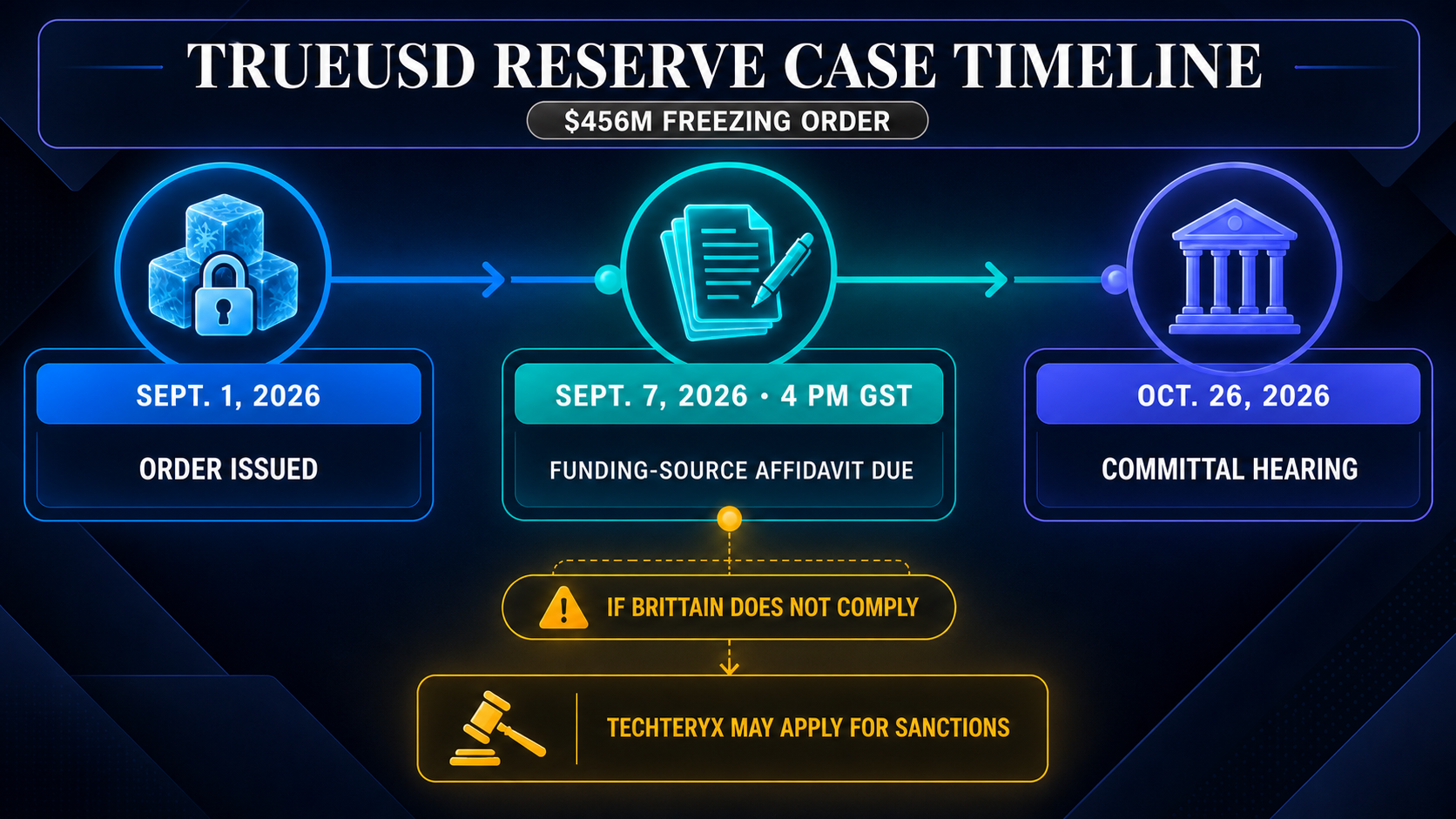
A Dubai court has given Matthew William Brittain until Sept. 7 to explain where money used for legal and advisory bills ultimately came from in a dispute over $456 million connected to TrueUSD reserves.
The Sept. 1 order adds a near-term disclosure deadline to proceedings in the Dubai International Financial Centre Courts. Techteryx, the claimant seeking the information, has obtained a proprietary injunction and worldwide freeze against Aria Commodities DMCC covering $456 million transferred from Legacy Trust and First Digital Trust, along with traceable proceeds.
Earlier DIFC court reasons for the freeze identify the money as part of the reserves backing TrueUSD, or TUSD. The injunction supports litigation in Hong Kong over what happened to the funds, but it does not decide who ultimately owns them.
Brittain must swear and serve an affidavit by 4 p.m. Gulf Standard Time on Sept. 7, acting “to the best of his ability.” For money paid to Quinn Emanuel, Horizons, Gall, Campbells and FTI Consulting, he must list amounts, payment dates and bank accounts. He must also identify the original sources and ultimate beneficial owners, explain how the accounts were funded and provide supporting documents.
The order separately requires an explanation of $1,083,912.49 paid by Aria Bio Industries FZE, another respondent in the case, on Oct. 31, 2025 toward Aria Commodities’ legal costs. The same funding details are required for that payment and for any further legal advice or representation costs incurred since a May 13 remedy application.
If Brittain does not comply, Techteryx may apply for sanctions. A penalty is not automatic: the court would still have to consider the further application.
Third adjournment sets October hearing
The court also moved the committal hearing to Oct. 26 for an estimated four days, marking its third adjournment. It is scheduled to take place in person at the DIFC Courts, with remote attendance allowed for Techteryx’s lead counsel.
In the reasons, Justice Michael Black said another adjournment would require “the most extreme circumstances” supported by strong evidence. The Sept. 7 disclosure deadline is distinct from the October committal hearing, which will address the pending committal application.
The Dubai proceeding is also separate from the underlying Hong Kong case. Techteryx alleges there that the transfers formed part of a fraud and that Aria holds the money or its proceeds on constructive trust. Those allegations remain disputed. At the interim stage, the DIFC court described key merits and ownership questions, including whether Techteryx had a proprietary interest in the reserves, as unresolved.
The post TrueUSD’s $456M court case gives defendant days to reveal legal funding source – or face court sanctions appeared first on CryptoSlate.
Memecoins paired against Robinhood's tokenized stocks generated $217 million of trading volume on Robinhood Chain on Sept. 2, according to data compiled by on-chain researcher Adam Tehc.
The volume outpaced the $127 million that traded through direct stock token markets that same day. Traders are using tokenized Nvidia or Hims & Hers shares as the plumbing for a memecoin economy Robinhood never designed.
Robinhood describes stock tokens as ERC-20 tokenized debt securities that give holders economic exposure to an underlying stock without legal or beneficial ownership in the issuer.
New supply comes from a single authorized participant, identified at issuance as BBVI, which alone can mint tokens once onboarded. Everyone else trades, pools, and builds with the tokens already in circulation, permissionlessly and without Robinhood's direct involvement.
| Activity type | Sept. 2 volume | What it shows |
|---|---|---|
| Memecoin pairs using stock tokens | $217M | Stock tokens are being used as trading infrastructure for speculation |
| Direct stock token markets | $127M | Traditional “buy the tokenized stock” activity was smaller |
| Difference | +$90M | Meme-stock-token pairs generated about 71% more volume than direct stock-token trading |
| Ratio | 1.7x | The casino layer outpaced the investment layer |
A memecoin cornered more than half the tokenized float on Robinhood Chain
A memecoin called BONER accumulated 31,198 of the 58,714 HIMS stock tokens then outstanding, roughly 53% of the entire tokenized supply, with another 1,424 sitting in separate meme pools.
That left only about 20,303 tokens circulating in conventional HIMS pairs against stablecoins and ETH, the thin remainder available for anything resembling ordinary price discovery.
While the New York Stock Exchange sat closed for the weekend, the tokenized HIMS instrument printed as high as $132.64. That compares with a $28.84 close for the underlying stock the previous Friday, a premium of roughly 4.6 times.
A small, closed-loop pool of tokens experienced an AMM scarcity event while the market that could have supplied fresh tokens or corrected the price sat shut.
Hims & Hers has roughly 233.3 million shares outstanding, so the 58,714 HIMS stock tokens involved equal about 0.025% of that count. Reported short interest in the stock runs near 58.7 million shares, meaning the entire tokenized float that briefly cornered represented roughly 0.1% of the shares already sold short.
The episode left Hims & Hers' equity market untouched, while shaking confidence in a much smaller, newer market sitting on top of it.
Once the underlying market reopened, BBVI minted roughly 4,000 new HIMS stock tokens, worth about $115,000 at Friday's closing price and equal to just 6.8% of the prior tokenized supply.
That comparatively small injection was enough to pull the token price back toward the stock's value. The real vulnerability sits in who controls new supply, when they can create it, and which pools need it during a squeeze, well beyond the total dollars involved.
| Metric | Figure | Why it matters |
|---|---|---|
| HIMS stock tokens outstanding | 58,714 | The full on-chain wrapper supply was tiny |
| Tokens accumulated by BONER | 31,198 | Equal to 53.1% of tokenized supply |
| Peak tokenized HIMS print | $132.64 | About 4.6x the prior stock close |
| HIMS prior Friday stock close | $28.84 | The reference price the wrapper was meant to track |
| New tokens minted after reopen | ~4,000 | Only 6.8% of prior tokenized supply |
| Approx. value of new mint at stock close | ~$115,000 | A small supply injection helped normalize the wrapper |
| Hims & Hers shares outstanding | ~233.3M | Shows the real equity market was much larger |
| Tokenized float as share of equity count | ~0.025% | Confirms this was not an equity-float squeeze |
Robinhood stock tokens become the thing memecoins are priced against
Inside the Robinhood Chain pools, HIMS or Nvidia stock tokens become the denominator memecoins are priced against, turning a security-linked instrument into part of the speculative settlement layer itself.
The underlying stock trades during regulated exchange hours, and Robinhood's own oracle feeds for stock token prices update 24 hours a day, five days a week, on that same schedule. The on-chain token itself keeps trading and transferring around the clock regardless, so a weekend print does not necessarily represent a repriced stock.
It more often points to stress inside a thin token wrapper trading without its usual reference market open.
Secondary trading is permissionless and open to anyone, but new stock token supply only comes from an authorized participant. A large on-chain dislocation can form even in an instrument explicitly built to track a real security, because nobody trapped in a cornered pool can mint their way out.
Robinhood's terms say it does not control what third parties build on the chain and cannot reverse transactions once submitted.
Its securities filings separately warn that this same third-party activity may be difficult or impossible to monitor, influence, or prevent, even though Robinhood could still face reputational, legal, or regulatory consequences from whatever happens.
Regulators are already circling the underlying question
The SEC said in January that representing a security through a crypto network does not change which federal securities laws apply. That statement targeted this kind of third-party product offering synthetic exposure to an underlying stock.
The World Federation of Exchanges has separately warned regulators that tokenized equities raise real issues around market integrity, disclosure and post-trade standards.
Both are describing a genuine gap in who takes responsibility when a security-linked token starts behaving like a permissionless crypto asset.
Nasdaq's approved tokenization framework and DTCC's tokenization service both keep tokenized securities on the same order books, under the same rights and controls as conventional shares.
Robinhood Chain sits at the end of a broader move, letting its tokens loose into open DeFi composition. Citi's 2030 tokenization outlook, projecting roughly $5.5 trillion in tokenized assets under its base case, anticipates retail investors doing this with instruments like it.
For crypto markets broadly, the more interesting implication is that on-chain speculation may grow less dependent on BTC, ETH, and stablecoins as its default liquidity legs if tokenized equities keep working this well as collateral and quote assets in their place.
Whether this becomes real infrastructure or a lasting liability
The bull case is that stock tokens graduate from meme-pair liquidity into broader usage in lending, collateral, and index products, with direct stock token activity and legitimate collateral use eventually overtaking memecoin-pair volume.
Under that path, Robinhood Chain's RWA activity multiplies several times over from today's roughly $188 million base, and the network becomes credible on-chain brokerage infrastructure.
| Path | What Robinhood Chain becomes | Signal to watch | Market implication |
|---|---|---|---|
| Bull case: infrastructure | Stock tokens become collateral, lending assets, index components, and settlement legs | Direct stock-token and collateral activity overtakes memecoin-pair volume | Tokenized equities become credible on-chain financial primitives |
| Bear case: liability | Meme pools and low-float squeezes remain the dominant source of activity | Memecoin-stock pairs repeatedly exceed direct stock-token trading; more weekend dislocations appear | High volume starts looking like market-integrity risk rather than product validation |
| Core tension | Same assets enable both outcomes | Ratio of productive use vs. reflexive speculation | Robinhood benefits from activity but inherits reputational and regulatory exposure |
The bear case has volumes staying high while remaining dominated by reflexive meme pools and low-float squeezes like the one HIMS just experienced. Regulators and issuers turn their attention toward disclosure and market-integrity risk, well past simple growth metrics.
In that scenario, high transaction counts stop reading as validation, and Robinhood's fee opportunity comes wrapped in the reputational exposure its filings already warn about.
Tokenization promised that a stock stops being just something you buy and becomes something software can use. Memecoin traders are showing Wall Street what “use” means when nobody outside crypto got a vote in the definition.
The post Robinhood put stocks on a permissionless blockchain- memecoin traders are stress-testing what happens next appeared first on CryptoSlate.
Bitcoin is testing a roughly $68 billion breakeven wall that has repeatedly stalled its push back above $80,000.
About 880,000 BTC carry a cost basis between roughly $77,500 and $80,300, leaving a large group of holders close to where they originally bought, Bitfinex Alpha data shows.
Data from CryptoSlate shows Bitcoin trading near $77,890 as of press time after spending much of the past week trapped below $80,000.
The concentration means even modest price moves can shift tens of billions of dollars in Bitcoin between profit and loss, potentially releasing supply from investors who endured months underwater.
So far, that selling has been absorbed, setting up a test of whether fresh demand can clear the zone or whether the recovery stalls near current levels.
Older buyers are using the rally to get out near cost
The behavior of long-term holders suggests some investors are already taking advantage of the recovery to exit positions without realizing significant losses.
Bitcoin's long-term holder Spent Output Profit Ratio, or SOPR, has moved around 1 for nine consecutive sessions, with readings between 0.88 and 1.19 and a latest level near 0.98, Bitfinex said. A reading around 1 indicates coins are being moved at roughly the same price at which they were acquired.
Bitfinex analysts tied that activity primarily to investors who accumulated Bitcoin around February and March, when prices were close to current levels. Those holders subsequently sat through the downturn and now have an opportunity to recover their original investment as Bitcoin revisits their entry prices.
That creates a recurring supply problem. Bitcoin closed at $80,256 on Aug. 27, when 72.1% of supply was in profit. By the time it closed at $77,468 several days later, that share had fallen to 67.7%. The change implies roughly 880,000 BTC sit inside the narrow $2,800 cost-basis window now surrounding the market.
At about $77,000 per Bitcoin, that represents nearly $68 billion of supply whose profitability changes as prices move through the region.
The pattern has yet to resemble capitulation. Bitfinex said sustained SOPR readings below 0.9 alongside falling prices would indicate holders had begun accepting deeper losses to exit. Instead, sellers have largely appeared around breakeven while buyers have prevented a more decisive breakdown.
Bitcoin's True Market Mean, an on-chain measure Bitfinex uses to estimate the average acquisition price of active investors, stands near $76,350. That places the market only slightly above another level where a broader portion of holders approaches cost.
Strategy steps in as the ETF bid cools
The demand absorbing those sellers is also changing, with Strategy returning to the market just as buying through US spot Bitcoin ETFs has become less consistent.
Strategy bought 4,603 Bitcoin for $369.7 million between Aug. 24 and Aug. 30, ending a 10-week pause in purchases. The acquisition lifted the company's holdings to 845,050 BTC and was made at an average price of $80,318, placing Strategy's buying directly inside the zone where Bitcoin has repeatedly struggled to hold gains.
That timing provides an unusually direct test of corporate demand. Strategy paid above every Bitcoin daily close since May 14, even as other investors were using prices near $80,000 to sell.
The purchase also arrived as ETF demand cooled following one of its strongest stretches of the summer.
US spot Bitcoin ETFs had accumulated about $3.04 billion during a nine-session inflow streak before recording a $201.9 million outflow on Aug. 28. A $216.7 million inflow followed, but the products opened September with another $236.5 million in withdrawals.
The reversal does not establish a sustained ETF exodus, particularly after August's heavy inflows. It does reduce one source of buying pressure at a point where Bitcoin is encountering a large concentration of potential sellers.
Bitfinex described the shift as a handoff between the liquidity engines behind the recent rally, with corporate purchases helping offset softer ETF demand.
That balance could become increasingly important if breakeven selling persists. The more supply investors release around $78,000 to $80,000, the more sustained demand will be needed to convert the region from resistance into support.
Options traders are insuring against a deeper break
Derivatives traders are preparing for that balance to fail even as the options market prices relatively subdued volatility.
Average Bitcoin implied volatility stood at 37.2 in Bitfinex's analysis, putting it in the 18th percentile of daily closes over the past year. Options have therefore been cheaper on fewer than one in five trading days during that period.
Yet protection is concentrated around the period containing key US economic releases that could shift expectations for Federal Reserve policy.
The Sept. 11 options expiry has one put outstanding for every call, compared with a put-call ratio of 0.56 across the broader options market. Downside positions are concentrated between $68,000 and $75,000, while the largest call open interest sits at $80,000.
That positioning suggests investors are keeping exposure to another advance while paying for protection against a retracement through the current support zone.
The timing coincides with US payroll and inflation data that could alter expectations for the Fed after Chair Kevin Warsh's hawkish Jackson Hole remarks helped knock Bitcoin from an Aug. 28 high above $81,000.
Bitcoin now needs to clear the supply shelf
The next move may depend on whether buyers can exhaust the remaining breakeven supply without allowing Bitcoin to lose the cost basis supporting the recovery.
Bitfinex sees two daily closes above $82,818, accompanied by improving holder profitability and positive ETF flows, as confirmation that the current supply shelf has been absorbed. That would put roughly $85,200, another on-chain cost-basis level, into focus.
A failure would expose the opposite side of the trade. Two closes below about $76,657 would weaken the current structure and could open a move toward $73,500, followed by the short-term holder cost basis near $69,980.
Bitcoin's August rally still gives buyers some historical support. The cryptocurrency gained roughly 24% during the week ended Aug. 23, its strongest weekly percentage increase since March 2023. Since 2020, Bitcoin has posted 17 weekly gains exceeding 15% and was higher 30 days later in 14 of those cases, with a median return of 8.4%, Bitfinex found.
The immediate obstacle is closer than those historical returns suggest. Before Bitcoin can extend the rally, buyers have to absorb a block of supply worth nearly $68 billion from holders who have finally been offered a chance to leave near where they came in.
The post Bitcoin cannot break out past $80,000 until it devours an 880k BTC roadblock that choked every rally appeared first on CryptoSlate.
Ontology said its mainnet resumed normal operation on Sept. 2 after an emergency security pause and told every sync-node operator to upgrade to version 3.1.5. Sync nodes are infrastructure that keep their copy of the blockchain synchronized with the network.
The restoration notice says the new software is required to maintain compatibility with the restored chain and ensure stable synchronization. Ontology told operators to upgrade as soon as possible, confirm that their nodes are fully synchronized, and verify normal operation afterward.
Older software therefore carries a compatibility and synchronization risk, although the notice does not say that every unupgraded node has already failed.
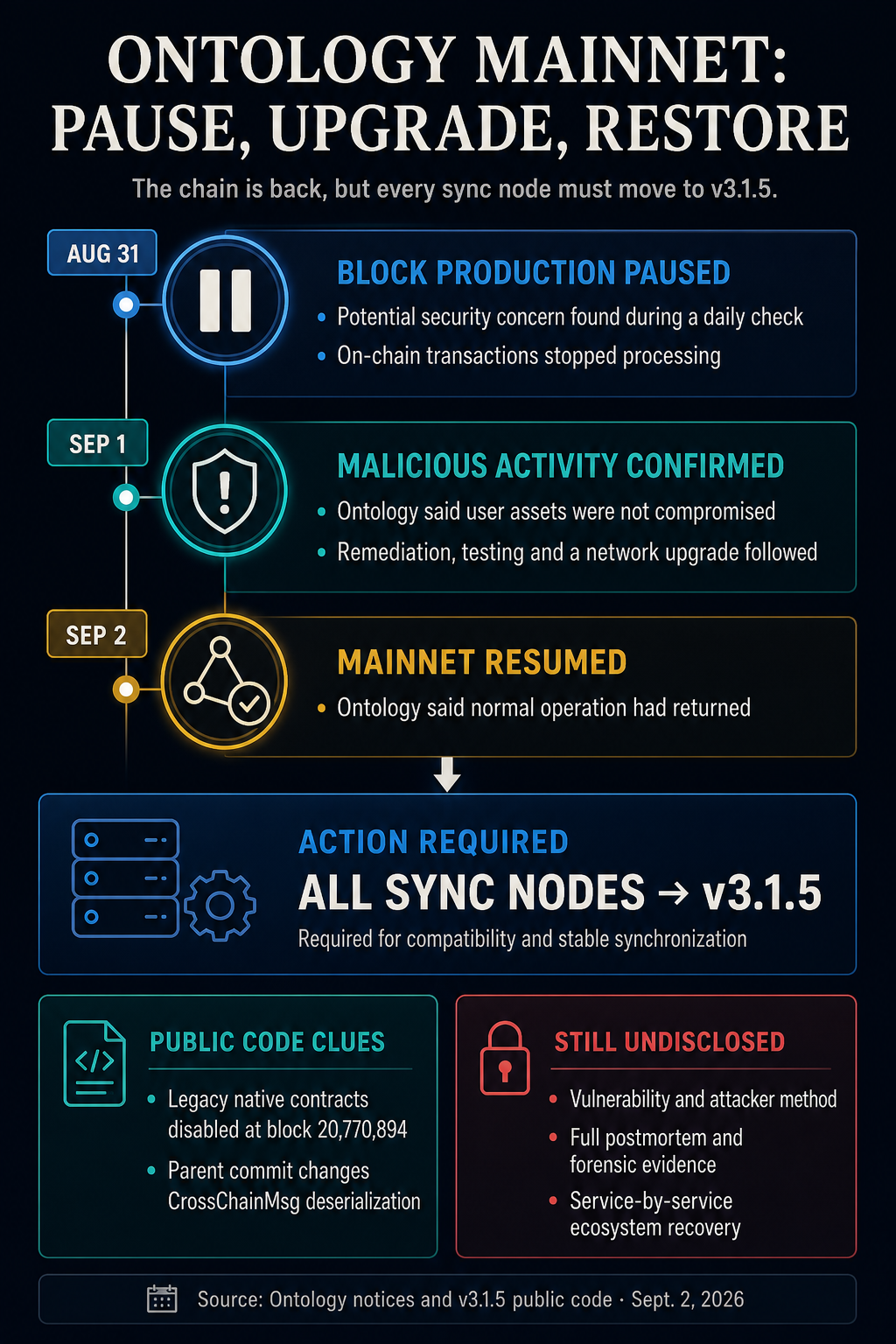
The restoration followed a pause that began Aug. 31. Ontology initially described the trigger as a potential security concern found during a daily security check and suspended block production, leaving on-chain transactions unprocessed.
A Sept. 1 update escalated that description, saying the team had identified malicious attack activity targeting the network while remediation, testing, and a network upgrade were underway.
During the pause, Ontology told users not to attempt time-sensitive on-chain transactions and said they did not need to move ONT, ONG, or other assets because of the announcement. It said block production would not restart until the network had been assessed and deemed safe to operate.
Ontology also said its investigation found that the activity did not involve or compromise user assets. That remains the network's assessment because it has not published an independent forensic report.
The code offers clues, not an attack explanation
The v3.1.5 release provides a Linux AMD64 binary and checksum but no incident explanation. The tagged code change disables registrations for several legacy native contracts at mainnet block 20,770,894, one block after the 20,770,893 height observed during the halt. Its parent commit changes cross-chain message deserialization.
The public code shows the shape of the emergency software change, but Ontology has not linked either commit to a specific attack path. Its notices do not identify the vulnerability or attacker method, explicitly name the affected component, or provide forensic evidence or a postmortem.
The restoration announcement confirms the mainnet's return, not a service-by-service recovery across the wider ecosystem. It does not establish whether public RPC providers, exchange deposits and withdrawals, wallets or dapps have all resumed normal operation.
The malicious-activity confirmation had already moved the incident beyond the initial pause, as CryptoSlate reported in a Sept. 1 examination of network shutdowns.
Ontology said monitoring will continue with technical and security partners. For now, v3.1.5 tells operators what they must do, while the reason for the emergency change remains undisclosed.
The post Ontology forces urgent node upgrade after restarting chain hit by malicious activity appeared first on CryptoSlate.
Thailand’s Securities and Exchange Commission has issued a Travel Rule that will require supervised crypto platforms to collect and transmit information identifying the people or entities behind coin transfers.
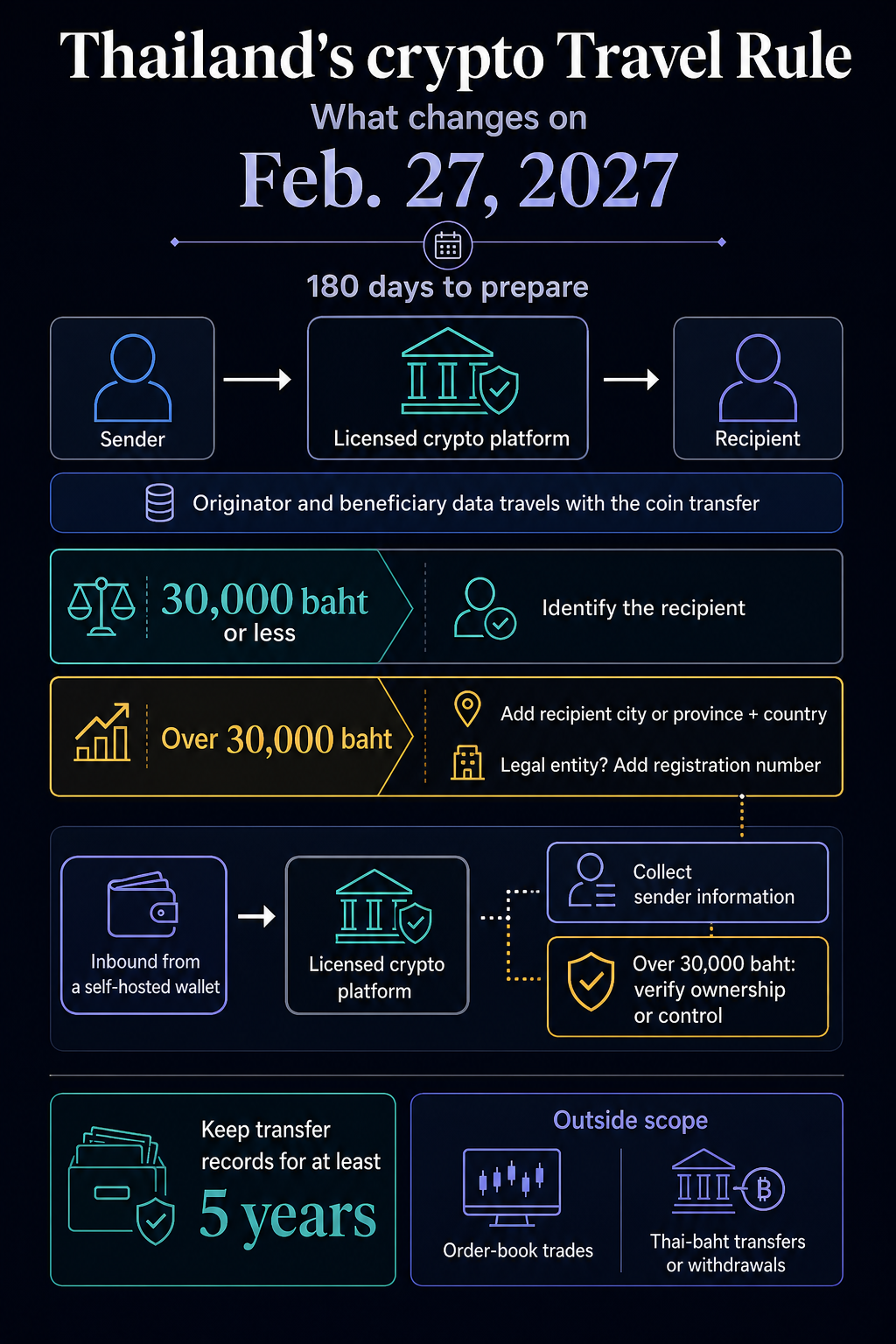
The regulator announced the rule on Sept. 2, and an associated notification is dated Aug. 25. It takes effect Feb. 27, 2027, after a 180-day implementation period from publication in the Royal Gazette.
The lead time lets operators prepare systems for exchanging transfer data, checking transactions, and requesting required information from customers, according to the SEC’s customer-facing Q&A.
How crypto transfers will change
SEC-supervised digital-asset operators must collect information on customers and their counterparties when coins are transferred. They must also check counterparties and verify the qualifications of digital-asset service providers or intermediaries in the transfer route.
An operator sending a transfer instruction must pass originator and beneficiary information to the operator receiving it. Transfer-related records must be kept for at least five years.
Customers will face different information requests based on transfer size. When sending coins from a wallet held with a regulated platform, a customer must identify the recipient even when the transfer is no more than 30,000 baht.
For transfers over 30,000 baht, the customer must also provide the recipient’s province or city and country. If the recipient is a legal entity, the customer must also provide its registration number. Smaller transfers require basic recipient identification, while larger ones require additional location or entity details.
On incoming transfers between regulated operators, the recipient’s platform must collect information from the sender’s operator before allowing the recipient to move the coins out of the wallet.
The process becomes more specific when coins arrive at a regulated-platform wallet from a self-hosted wallet. The platform must collect sender information as it would for another transfer. If the transaction exceeds 30,000 baht, it must also verify that the user owns or controls the wallet by confirming the person can control or access it.
The obligation falls on supervised operators when a transfer touches their services, and the Q&A does not state that every coin transfer requires proof of wallet ownership.
The rule also stops short of extending the new data checks across all platform activity. It does not apply to trades on an operator’s order book or to transfers and withdrawals of Thai baht because it governs coin transfers.
The SEC said most transfers should continue through normal processes when customers provide complete information and platforms are ready. High-value transfers, cases with missing data, or transactions requiring added wallet checks may take longer.
The post Thailand puts private wallets and offshore crypto transfers on notice in a major new crypto rule appeared first on CryptoSlate.
HTTP error 429 on https://cryptoticker.io/en/feed/
Failed to fetch feed: https://cryptoticker.io/en/feed/
Failed to fetch feed.
Decrypt
Strategy sold millions in Bitcoin in the low $60k range and just rebought at $80k. Now they’re sharing the rationale behind the moves.
Nearly 600,000 students lose access to generative AI tools, while five named vendors keep metered pilots running in high schools.
Fake investment ads on Telegram channels funneled EU victims to a lookalike exchange that emptied their wallets.
The order calls the prediction market platform a sports betting operation "masquerading as an investment opportunity."
After Claude models accessed real systems during cyber tests, Anthropic tightened its safeguards and warned that flawed training can encourage dangerous behavior.
U.Today - IT, AI and Fintech Daily News for You Today
Michael Saylor likens Bitcoin strategy to golf as Strategy claims the No. 2 S&P 500 reserve spot despite a paradox re-buy.
The update gives Shibarium users another piece of infrastructure to work with while improvements to the underlying ecosystem contribute to broader utility over time.
Bitcoin ETFs attracted more than $100 million in fresh inflows as Ethereum, XRP and Solana funds slipped into the red.
Multicoin Capital has sold another chunk of its HYPE holdings, cutting its position by roughly 10% as the investment firm continues to take profits from its massive bet on Hyperliquid.
Trading platform CPO confirms the 'Earn on XRP' feature is in its final phase, mobilizing 1.6 billion tokens and unlocking passive yield under U.S. regulation.
Blockonomi
Key Highlights
- Berkshire Hathaway purchased approximately $17 billion of Alphabet shares during Q2, elevating it to Berkshire’s third-largest position with about 106 million shares
- Greg Abel, Berkshire’s CEO, described Google as a “significant player” in artificial intelligence, referencing insights gained from AI adoption within Berkshire’s portfolio
- Berkshire’s initial $10 billion position was established about 15 months prior at a 6.5% discount to market price
- A U.S. federal judge denied the Department of Justice’s demand that Google divest its AdX ad platform
- Analyst consensus on GOOGL stands at Strong Buy across 28 analysts, with a mean price target of $425.88—indicating potential upside of 26%
Shares of Alphabet (GOOGL) are gaining ground in Thursday’s pre-market session, trading near $337.12, representing a 0.63% increase. The upward momentum stems from two distinct catalysts: a substantial endorsement from Berkshire Hathaway and a beneficial legal decision concerning Google’s advertising technology operations.
Alphabet Inc., GOOGL
During a Wednesday CNBC appearance, Berkshire CEO Greg Abel disclosed that the investment giant accumulated approximately $17 billion in Alphabet shares throughout the second quarter. This acquisition represented the most substantial portfolio addition Berkshire made during that period.
Berkshire’s current holdings total roughly 106 million shares across Alphabet’s Class A and Class C stock, with a present market value near $36.6 billion. This position now ranks as Berkshire’s third-largest equity investment.
According to Abel, the investment decision drew from tangible observations across Berkshire’s diverse business holdings. The conglomerate’s portfolio spans numerous sectors, providing direct insight into artificial intelligence implementation and its practical value proposition.
“We have a lot of visibility from within our companies as to how we’re using AI, what type of benefits it’s delivering, so that brought incremental interest, and then we saw Google as a significant player,” Abel told CNBC’s Becky Quick.
Berkshire initially entered its Alphabet position approximately 15 months earlier with a $10 billion investment executed at a 6.5% discount. Abel noted that he personally suggested that discount percentage, which received Warren Buffett’s approval.
Federal Judge Sides with Google on AdX Platform
Complementing the Berkshire development, a federal judge ruled Wednesday against the Justice Department’s petition compelling Google to divest its AdX advertising exchange. This judgment eliminates a significant regulatory uncertainty surrounding Alphabet’s operations.
The ruling allows Google to maintain ownership of AdX without mandated divestiture. From an investment perspective, it delivers enhanced predictability regarding Alphabet’s advertising technology revenue pipeline.
The combination of these developments is prompting increased investor interest in the stock as Thursday’s trading approaches.
Abel highlighted an additional indirect advantage Berkshire stands to gain from AI expansion. Escalating data center requirements are pushing electrical power demand upward, potentially benefiting Berkshire Hathaway Energy’s operations.
Analyst Community Maintains Positive Outlook
The analyst community continues expressing confidence in GOOGL. Among 28 analysts tracking the stock, 24 maintain Buy ratings while four assign Hold ratings. Currently, zero analysts recommend selling.
The consensus price target stands at $425.88, suggesting approximately 26% appreciation potential from present trading levels.
Alphabet ranks among five major hyperscalers—including Microsoft, Meta, Amazon and Oracle—channeling significant resources into AI infrastructure development. Goldman Sachs projects worldwide hyperscaler capital spending could reach approximately $1 trillion by 2026.
During the identical quarter when Berkshire expanded its Alphabet holdings, it also grew its Delta Air Lines stake by 44%, representing roughly $1.6 billion in additional investment.
The post Alphabet (GOOGL) Stock Climbs as Berkshire Hathaway Praises Google’s AI Leadership appeared first on Blockonomi.
TLDR
- Beijing’s Moonshot has submitted confidential IPO paperwork in Hong Kong targeting $3 billion in capital
- Latest funding rounds price the AI developer at a $50 billion valuation
- The firm’s Kimi K3 model boasts 2.8 trillion parameters, positioning it as the largest open-weight AI model globally
- Partnership discussions are underway with tech giants Microsoft, Amazon, and Google for revenue-sharing arrangements
- U.S. authorities are investigating allegations the company utilized prohibited Nvidia processors
Beijing-based artificial intelligence developer Moonshot has submitted confidential documentation for a Hong Kong stock market debut, three informed sources have revealed. The AI company intends to secure approximately $3 billion through the public offering.
The firm specializes in developing Kimi, a large language model platform. Kimi K3, the most recent iteration launched in July, has experienced substantial market traction since its introduction.
Current fundraising activities value Moonshot at $50 billion. This positioning trails competitors including DeepSeek, which commands a $74 billion valuation, and Z.AI, currently valued at $66 billion in market capitalization.
Investment banking giants Goldman Sachs, China International Capital Corporation, and Deutsche Bank have been enlisted as underwriters for the public offering. Both the launch schedule and ultimate offering size depend on receiving regulatory clearance and favorable market dynamics.
Kimi K3 and Computing Pressure
According to Moonshot, Kimi K3’s architecture incorporates 2.8 trillion parameters, establishing it as the planet’s most extensive open-weight language model. The organization has acknowledged that overwhelming user demand has pushed its computational infrastructure to capacity limits.
Negotiations are currently in progress with Microsoft, Amazon, and Google regarding revenue-sharing frameworks that would enable these American cloud computing platforms to provide hosting services for the model. Should these discussions conclude successfully, this arrangement would mark the inaugural significant revenue-sharing partnership linking a Chinese artificial intelligence company with major U.S. cloud service providers.
Yang Zhilin, a Carnegie Mellon University alumnus, established the company in 2023.
U.S. Scrutiny and Regulatory Steps
The company has attracted attention from high-ranking American government officials. Accusations involve the unauthorized deployment of restricted Nvidia processing units and extracting technical capabilities from Anthropic’s AI models through distillation methods. Scott Bessent, serving as U.S. Treasury Secretary, has indicated potential inclusion of the firm on a trade restriction list.
Moonshot has publicly challenged the allegations regarding Kimi K3’s development through distillation techniques.
Prior to submitting IPO documentation, Moonshot dissolved its international corporate framework and relocated its legal domicile to mainland China. Two sources confirmed this restructuring was mandatory before proceeding with the listing application.
The company’s investor roster features Alibaba, Tencent, IDG Capital, and HSG, previously operating as Sequoia Capital China. During May, the organization secured over $2 billion from backers including Meituan, China Mobile, and private equity player CPE. Cumulative capital raised exceeds $5.5 billion.
Hong Kong’s exchange has witnessed robust listing momentum. Capital mobilized through the platform reached $41.2 billion through mid-August, representing a 142% year-over-year surge. Chinese technology enterprises have accounted for the majority of this expansion.
Moonshot has not issued official confirmation regarding the IPO submission. Anthropic, the developer behind the Claude AI platform, is similarly preparing for a public market entry with targeted completion by October.
The offering schedule continues to await regulatory authorization, and financial parameters may be adjusted depending on prevailing market circumstances.
The post Moonshot AI Targets $3B Hong Kong IPO at $50B Valuation appeared first on Blockonomi.
Key Takeaways
- Fiscal Q3 revenue jumped 86% year-over-year to $29.59 billion, surpassing analyst expectations of $29.43 billion
- AI-related chip sales exploded 221% to reach $16.7 billion, with Q4 projections pointing to $21.7 billion (236% year-over-year increase)
- Company elevated its FY2027 AI revenue target to $115 billion and maintained FY2028 expectations at $230 billion
- Fourth-quarter revenue forecast of $34.8 billion fell short of the $35 billion Street consensus, triggering the selloff
- Shares declined approximately 2.2% in Thursday’s premarket session; Wall Street consensus remains Strong Buy with $505.38 average target
Broadcom (AVGO) delivered impressive fiscal third-quarter results on Wednesday evening, yet investors reacted negatively to the report. Shares dropped roughly 2.2% in Thursday’s premarket session after experiencing volatile after-hours trading Wednesday.
Broadcom Inc., AVGO
The core financial metrics looked impressive. Third-quarter revenue reached $29.59 billion, marking an 86% surge from the prior year and exceeding Wall Street’s $29.43 billion projection. Adjusted earnings per share of $3.32 topped forecasts ranging from $3.22 to $3.24, while nearly doubling last year’s $1.69 figure.
BROADCOM $AVGO Q3’26 EARNINGS HIGHLIGHTS
Revenue: $29.6B (Est. $29.36B)
; +86% YoY
Q4 Guide:
— Wall St Engine (@wallstengine) September 2, 2026
The artificial intelligence segment delivered exceptional performance. AI chip sales skyrocketed 221% compared to last year, hitting $16.7 billion and surpassing both internal projections and analyst estimates. Management forecasts this metric will reach $21.7 billion next quarter, representing 236% annual growth.
Company Elevates Multi-Year AI Revenue Projections
Management also upgraded its extended timeline forecasts. The semiconductor giant now anticipates $115 billion in AI chip sales for fiscal 2027, an increase from its previous target exceeding $100 billion. Looking further ahead, the company projects this figure will approximately double to $230 billion by fiscal 2028.
Chief Executive Hock Tan indicated that current customer demand is exceeding the company’s manufacturing and supply chain capabilities, lending credibility to these ambitious targets.
During the previous quarter, Broadcom maintained its FY2027 AI forecast at $100 billion, which triggered a significant stock decline. This time, even the increased outlook failed to prevent investor selling.
The Culprit Behind Thursday’s Decline
The problem centered on fourth-quarter projections. Management expects revenue of $34.8 billion, representing 93% year-over-year growth, yet falling marginally below the approximately $35 billion Wall Street consensus. Additionally, adjusted operating margin guidance of 66% came in slightly under the anticipated 66.5%.
This modest shortfall proved sufficient to eclipse the impressive AI performance.
The stock is also burdened by recent headwinds. AVGO has retreated approximately 26% from its June all-time peak. A quarterly disclosure revealed the company potentially faces up to $29 billion in lease commitments associated with a data center investment fund established by Apollo and Blackstone, raising questions about underlying demand dynamics.
Additionally, in August, Google entered an agreement with Marvell to develop chips for portions of its AI infrastructure. While Broadcom renewed its TPU partnership with Google in April, Marvell’s new role in handling additional chip design work reduces a potential revenue stream for Broadcom.
The company creates customized AI accelerator chips for Google Cloud, Meta Platforms, and OpenAI. Google represents its largest and longest-standing client.
For the year, AVGO has gained 6.5%. Mizuho’s Vijay Rakesh maintained his Buy recommendation and $530 price objective following the earnings release, forecasting AI revenue reaching $129 billion in FY2027 and $235 billion in FY2028. TipRanks shows the average analyst price target at $505.38, suggesting 37.6% potential upside.
Wall Street’s consensus stands at Strong Buy, comprising 23 Buy recommendations and three Hold ratings.
The company’s forward price-to-earnings ratio of 18.8x sits marginally above the S&P 500 average, a significant contrast to the premium valuation it commanded earlier in the year.
The post Broadcom (AVGO) Stock Dips 2% Despite Massive 221% AI Revenue Growth in Q3 Earnings appeared first on Blockonomi.
Key Highlights
- AeroVironment secured a landmark $464.8 million Army contract for the Enduring-High Energy Laser (E-HEL) initiative.
- This marks the inaugural production agreement for directed-energy weapons in United States military history.
- The company will supply multiple Locust X3 30-kilowatt laser weapon platforms throughout the coming years.
- The Locust X3 system is engineered to neutralize Group 1-3 unmanned aerial vehicles and will be mounted on vehicles including the Joint Light Tactical Vehicle.
- Shares of AVAV finished the trading day up approximately 1%, with an additional 0.25% gain in extended hours.
Shares of AeroVironment (AVAV) climbed following Tuesday’s announcement of a substantial $464.8 million contract from the United States Army, with the stock advancing nearly 1% during standard trading hours and tacking on another 0.25% after the closing bell.
AeroVironment, Inc., AVAV
This agreement pertains to the Enduring-High Energy Laser (E-HEL) initiative and signifies the inaugural production purchase of directed-energy weaponry in the annals of U.S. defense procurement. This achievement represents a significant turning point for the sector.
Issued by the Army’s Portfolio Acquisition Executive for Fires (PAE Fires), the contract stipulates that AeroVironment will furnish numerous Locust X3 laser weapon platforms throughout the forthcoming years, complete with operational support and personnel training.
Understanding the Locust X3 System
The Locust X3 operates as a 30-kilowatt directed-energy weapon engineered to neutralize smaller unmanned aerial systems without relying on traditional projectiles or explosives. Its versatile design allows deployment across various military vehicle platforms and tactical configurations.
Army planners intend to mount the system on the Joint Light Tactical Vehicle (JLTV). Additional palletized versions are under development, while evaluations continue for potential integration with the Infantry Squad Vehicle (ISV).
The weapon leverages AeroVironment’s proprietary AV Halo artificial intelligence platform for target acquisition and operates as part of the company’s comprehensive Halo Shield counter-unmanned aircraft system architecture.
The Locust X3’s primary mission focuses on defeating Group 1 through Group 3 unmanned aircraft systems—the class of compact drones that have emerged as an escalating challenge across contemporary combat zones.
Transition from Development to Deployment
The E-HEL initiative represents an evolution of the Army’s Multi-Purpose High Energy Laser (AMP-HEL) experimental program. The Locust platform underwent rigorous evaluation at White Sands Missile Range under Joint Interagency Task Force 401 oversight, where it successfully validated its capability to neutralize aerial threats with precision and safety.
Those trials additionally facilitated a collaborative DOD-FAA authorization enabling the platform’s deployment within United States territory.
According to AeroVironment CEO Wahid Nawabi, this contract demonstrates directed-energy technology’s evolution from laboratory experimentation to operational military deployment. This transition marks considerable progress for a capability that has undergone extensive evaluation without achieving full-scale manufacturing.
Manufacturing expansion will be supported through a $30 million capital investment in AeroVironment’s Albuquerque, New Mexico production facility, which was revealed in March 2026.
The organization previously showcased the Locust platform aboard the USS George H.W. Bush, suggesting potential naval implementations extending beyond this Army agreement.
AeroVironment’s current product lineup encompasses loitering munitions, autonomous platforms, counter-unmanned aircraft technology, space systems, electronic warfare solutions, and directed-energy armaments—representing substantial diversification from its origins as a tactical drone manufacturer.
This $464.8 million contract incorporates a substantial Army initiative into the company’s portfolio and establishes a manufacturing foundation within an emerging defense sector receiving heightened Pentagon emphasis.
The post AeroVironment (AVAV) Secures Historic $465M Military Laser Weapons Deal appeared first on Blockonomi.
Key Takeaways
- Zscaler delivers fiscal Q4 results September 3 following market close
- Jefferies lifted its ZS price target to $220 from $200 with a Buy rating maintained
- Wall Street consensus projects 24.2% year-over-year Q4 ARR growth
- Last quarter’s guidance disappointed with FY2027 ARR growth projected at only 16-17%
- Management’s forward outlook will drive stock movement more than Q4 results
Zscaler is set to release fiscal fourth-quarter earnings this evening, September 3, following the market close. Shares are currently trading near $172.73, sliding more than 3% during today’s session.
Zscaler, Inc., ZS
The dynamics heading into this print are noteworthy. When Zscaler last reported quarterly results, the company posted respectable metrics—25% gains in both revenue and ARR during Q3, alongside record-setting adjusted operating margins. Yet the market punished the stock. The reason? Management’s guidance, particularly the FY2027 ARR growth forecast calling for merely 16-17%, which rattled investor confidence.
That conservative projection has established a lower baseline for tonight’s report. Whether executives choose to elevate those expectations will determine the market’s response.
Jefferies analyst Joseph Gallo boosted his ZS price objective to $220 from $200 earlier this week while reaffirming his Buy stance. He characterized the FY2027 ARR guidance as “very reasonable” and highlighted Q1 as potentially positioned for organic ARR acceleration, supported in part by favorable federal spending dynamics.
Gallo observed that Wall Street consensus anticipates approximately $220 million in net new ARR for Q4, though some market participants are targeting figures closer to $245 million. His proprietary research indicates achieving the higher threshold may prove challenging.
Valuation Multiple Remains Compelling
From a valuation perspective, ZS currently commands approximately 41 times forward-twelve-month free cash flow. This compares favorably against Palo Alto Networks at 54 times and Fortinet at 48 times, positioning Zscaler as the more attractively priced alternative among large-cap cybersecurity names entering tonight’s announcement.
The company’s remaining performance obligation—effectively its contracted revenue backlog—expanded 30% during Q3 to reach $6.5 billion. This metric deserves attention in tonight’s release. Sustained bookings growth exceeding reported revenue suggests accelerating growth momentum ahead.
Competitive Landscape Raises Expectations
Recent earnings from CrowdStrike and Palo Alto Networks demonstrated that artificial intelligence is catalyzing increased cybersecurity expenditures. CrowdStrike delivered its strongest net new ARR growth rate on record, with management projecting FY2027 net new ARR growth 630 basis points higher than previous levels. That announcement propelled shares toward record territory.
Palo Alto disclosed Q4 adjusted earnings per share of $1.02 on $3.41 billion in revenue, surpassing analyst estimates of $0.98 and $3.35 billion respectively. Despite the beat, PANW shares tumbled over 9% as market participants scrutinized the Q1 forecast.
This dynamic—exceeding expectations yet declining nonetheless—merits consideration for Zscaler’s report tonight. Simply beating consensus figures likely won’t suffice to drive shares higher.
The Jefferies analyst emphasized that Zscaler’s SecOps and Agentic AI opportunities remain one to two quarters from materializing as fundamental catalysts. Q1 FY2027, rather than Q4 FY2026, may represent when the growth narrative truly begins materializing.
Zscaler’s most recent closing price stood at $172.73.
The post Zscaler (ZS) Stock: Earnings Preview and What Analysts Are Watching appeared first on Blockonomi.
CryptoPotato
The trending altcoin PONS, which saw the light of day earlier this summer, hit a new all-time high and just entered the prestigious club of the 100 largest cryptocurrencies by market capitalization.
Here’s what triggered its additional rally and some of the most interesting predictions for the near future.
PONS Keeps Pumping
The cryptocurrency market has a habit of spewing tokens that stun industry participants with rapid price increases. The latest example is PONS, which is closely connected to Robinhood Chain and began trading in mid-July.
Over the past two weeks, its valuation has skyrocketed by nearly 1,300% and is now hovering at a record high of around $0.55 (per CMC). PONS’s market capitalization is approximately $395 million, making it the 98th-largest cryptocurrency.

The most recent jump was likely triggered by Binance, which added the token to its Binance Alpha section. The platform serves as an early-stage discovery hub, featuring emerging cryptocurrencies before they potentially receive official backing.
The impressive performance has caught the attention of numerous industry participants. X user Crypto Tony, for instance, claimed that PONS “will no doubt” hit the $1 billion market-cap milestone “soon.”
Meanwhile, some traders and investors have already tried their luck with the token, but not all have been successful. As CryptoPotato reported, an anonymous person purchased nearly 8 million PONS roughly a month ago for about $443,000. Shortly after, the token pulled back, and the investor decided to minimize the damage by selling their entire position, incurring a $308,000 loss. This turned out to be an emotional and irrational move since the stash is currently worth over $4 million.
Surpassing the Leaders on This Front
Besides being a standout performer today (September 3), PONS is also the number-one trending cryptocurrency (according to CoinGecko). It has dwarfed popular altcoins like Arbitrum (ARB), Uniswap (UNI), Hyperliquid (HYPE), and others, while the heavyweights Bitcoin (BTC) and Ethereum (ETH) have not even made the top 10 list.

The post Viral Altcoin Enters Crypto’s Top 100 Club Following Support From Binance: Details appeared first on CryptoPotato.
Following the latest escalation in the Middle East war, bitcoin’s price dipped toward $76,000 yesterday for the first time in almost two weeks before rebounding today.
Most larger-cap alts have posted some gains over the past day, with XRP climbing to over $1.35 and BNB tapping $700. ETH still fights for $2,400.
BTC Rebounds
The breakout from a couple of weeks ago drove the primary cryptocurrency from under $65,000 toward $80,000 within days. After hitting some resistance there at first, BTC finally managed to surge past that level last week, jumping to $81,200 and $81,500 on a couple of occasions.
However, the bulls were too exhausted and couldn’t continue driving the asset north. Instead, bitcoin dropped to $77,000 last Friday after Kevin Warsh’s hawkish speech at Jackson Hole.
Nevertheless, the cryptocurrency managed to recover some ground during the weekend and touched $79,000 on Sunday. It dipped back down to $77,000 on Monday after the strikes in the Middle East resumed, rebounded to $79,000 and closed the month in the green, and dropped once again yesterday to $76,200 – its lowest price tag in 10 days.
Nevertheless, that level provided the necessary support, and BTC now trades close to $78,000. Its market capitalization on CMC is up to $1.560 trillion, while its dominance over the alts stands still at 59.6%.

ARB Rockets
Arbitrum’s native token is today’s top performer, having surged by 18.5%. It now trades close to $0.14 after a 50% increase in the past week. NIGHT is next with an 11.5% pump, followed by CAKE (9%), APT (9%), LIT (8%), and PYTH (6.5%).
SUI and ADA have surged the most from the larger caps, both up by over 6% to $0.21 and $0.77. XRP has reclaimed the $1.35 support after a 2.7% daily increase. ETH fights for $2,400, while BNB is slightly above $700. SOL is back to $100, while TRX is up by just over 1%. In contrast, UNI has slumped by 6.5% after its recent rally, while SKY is down by almost 6%.
The total crypto market cap is up by $20 billion to $2.620 trillion on CMC.

The post ARB Skyrockets by Double Digits Again, BTC Recovers From Drop to $76K: Market Watch appeared first on CryptoPotato.
Over the past few days, developments in Ripple’s ecosystem centered on asset management, custody, and tokenization.
Meanwhile, XRP has failed to extend the rally that briefly carried it to around $1.70 in August, leaving traders focused on resistance levels and key support lines.
Bitwise XRP ETF Tops $500 Million
Bitwise’s spot XRP ETF has surpassed $500 million in assets under management only nine months after it was first launched. As CryptoPotato reported, the fund held about $507 million after Monday’s close, while US spot XRP ETFs had managed to attract a record $1.66 billion in cumulative net inflows by the end of last week.
Bitwise’s product leads this particular category with more than $600 million in cumulative inflows. It’s currently ahead of Canary Capital’s XRPC and Franklin Templeton’s XRPZ.
The milestone suggests that there’s continued demand for regulated exposure to XRP despite the token’s pullback from its August high.
Ripple, SettleMint Target Banks with New Institutional Stack
Ripple Labs and SettleMint have launched a partnership. It seeks to integrate Ripple Custody with SettleMint’s Digital Asset Lifecycle Platform.
The offering is aimed at allowing regulated financial institutions to custody, issue, and manage tokenized assets through a single system.
The service is already live in Asia, with expansion already planned. It targets banks, market infrastructure operators, and sovereign entities, while RLUSD and XRP are among the assets that support Ripple’s institutional solutions.
The partnership also provides the company with more exposure to tokenization – a market BCG estimates could reach $88 trillion in the next 10 years.
Evernorth Moves Closer to Nasdaq Listing
The popular XRP-focused treasury company Evernorth cleared yet another important regulatory hurdle after the US Securities and Exchange Commission declared its registration statement effective. Shareholders of merger partner Armada Acquisition Corp. II are scheduled to vote on the transaction on September 30th.
If approved, the combined company is expected to trade on Nasdaq under the ticker XRPN. Evernorth has so far disclosed more than $1 billion in gross proceeds from its investors, including Ripple, SBI Holdings, Pantera Capital, Kraken, and Arrington Capital.
The strategy is centered on holding and actively managing XRP as a corporate treasury asset.
XRP Price Update: Bulls Need to Reclaim $1.40 – $1.50
Last but not least, let’s take a closer look at XRP’s price action throughout the past few days. It is trading at around $1.35 at the time of this writing, with a market capitalization nearing $85 billion. It has slipped by about 2% in the past few days, dropping by 6% on the weekly chart.
That said, analysts remain divided. Some of them foresee $1.70 as the next major target if the current breakout holds. On the other hand, some highlight the resistance that is currently being faced at around $.140 to $1.43 followed by $1.5, warning that failing to break above these levels could signal weakness and a drop to below $1.3.
The post Important Ripple News and XRP Price Update: September 3 appeared first on CryptoPotato.
Bitcoin (BTC) sat near $77,000 today, clawing back part of a slide that took it under $76,500 earlier in the week after fresh US-Iran strikes spooked the markets.
Analysts are now split on whether the dip was a shakeout before another push higher or the first sign of a deeper pullback.
Traders Watch the $83,000 Gap
Analyst NoName is watching the CME futures gap above the current price and considers $83,000 the line that decides what happens next. They wrote that Bitcoin needs “the level that separates a real reversal from another relief rally” with a daily close above it backed by real spot volume.
Without that close, they are treating the recent bounce as a retest of old supply rather than confirmation of a new uptrend, and their downside case is blunt: if $83,000 rejects and $74,000 gives way, they see room for a drop toward $50,000 to $55,000 before Bitcoin finds a real bottom.
But not everyone is reading the chart that way, including Doctor Profit, who dismissed calls for a new low outright, saying, “I consider the bear market as over.”
Another market watcher, Sykodelic, pointed to the monthly candle instead of shorter timeframes, citing the reversal structure, a bullish tick on the DSS Bressert indicator, and a flattening MACD.
He called the setup “not bearish, and never been bearish,” and said the monthly close held above the $76,400 level he had flagged as the line between confirming the reversal and voiding it.
Behind the argument sits a rough week. As CryptoPotato reported previously, Bitcoin got turned away at $79,000 more than once before the latest leg down pushed it under $76,500 for the first time since August 23, with renewed US-Iran fighting being the main trigger. You can hear more about that in the video below:
The primary cryptocurrency is now changing hands above $77,000, having traded between $76,300 and $77,800 in the last 24 hours. It’s down almost 2% for the week but still up nearly 22% for the month.
August’s Rare Green Candle Complicates the Picture
The pullback follows a month that broke a pattern, with BTC closing August up almost 25%, the first green August during a bear market stretch comparable to 2014, 2018, or 2022, when it fell between 9% and 18% at the same point in each cycle.
It was also the asset’s best August since 2017, when the month closed up more than 65%. Furthermore, the third quarter is already up close to 33%, with one month left to go.
That doesn’t change where Bitcoin sits against its cycle high, though. It remains down close to 30% for the year and more than 38% below its October 2025 peak of over $126,000, with dominance currently above 57%.
The post Bitcoin Could Crash to $50K if Bulls Fail This Crucial Test: Analyst appeared first on CryptoPotato.
XRP is changing hands around $1.35, down roughly 6% over the last week after slipping beneath a support level chart analysts had been watching closely since late August.
Trader ChartNerd says the token’s second failed weekly close above its 50-week EMA leaves room for a deeper slide to $1.27, or lower, before the rally that took XRP to $1.70 can resume.
Bulls Lose Their Grip on the $1.36 Floor
ChartNerd has been tracking XRP’s four-hour structure for weeks, watching a range that formed beneath $1.47 resistance and above $1.36 support. That floor has now been swept twice. According to the analyst, the price rejected from $1.43 and printed another lower high beneath a bearish trend signal sitting at $1.39.
Zooming out, the picture traces back to August 22, the day XRP touched a multi-month high of $1.70, as CryptoPotato reported. The rally followed a broader market move triggered by Bitcoin’s jump from under $65,000 to $80,000, and pushed XRP up 70% in three days after a tough start to the month that had briefly dragged it under $1.00. It ended August at just under $1.40, still a 30% monthly gain despite the pullback.
ChartNerd flagged the retracement risk the day after that peak, warning that a weekly close below the 50 EMA “would be an early warning sign in advance for a larger retracement.”
That’s exactly what has followed: two consecutive weekly closes beneath the average and a retreat the analyst pegged at around 22% from the top. The next support in that scenario is the weekly 20 EMA, which now sits at $1.27.
No Recovery Case Until $1.50 Gets Reclaimed
ChartNerd’s resistance ladder above the current price runs from $1.40 to $1.43, then $1.47, then $1.65, $1.82, and $2.40. On the downside, the levels being watched are $1.30, $1.27, $1.21, and $0.85, the last tied to a zone the analyst has been flagging for accumulation since June.
The broader case for a bottom rests on a golden cross that hasn’t formed yet. XRP’s EMAs are coiling, with price stuck under the 50-week average and above the 20-week one. Until both are reclaimed and held, ChartNerd isn’t willing to call a floor, comparing the current stretch to the compression that preceded August’s breakout.
Spot XRP ETFs still pulled in more than $110 million last week, their strongest inflow since December, which has kept some traders open to a faster turnaround than the charts alone suggest.
September carries its own catalysts, including a CLARITY Act vote in the Senate around September 15 and a shareholder vote on Evernorth’s planned Nasdaq listing. But none of that changes the technical picture ChartNerd is describing: XRP is boxed in below resistance, and until that changes, another leg down to $1.27 or beyond stays on the table.
The post XRP’s Next Move Comes Down to These Key Price Levels: Analyst appeared first on CryptoPotato.