Cryptocurrency Posts
Crypto Briefing
Bitget's collaboration with BlackRock could accelerate the integration of tokenized assets in Asia, reshaping financial markets and wealth distribution.
The post Bitget reportedly in talks with BlackRock to boost Asian distribution appeared first on Crypto Briefing.
The incident may exacerbate anti-regime sentiment in Iran, potentially destabilizing the regime and influencing geopolitical dynamics.
The post A grand funeral ceremony is being held for the victims of US’ criminal strike on a wedding in Kuhestak, Hormozgan Province appeared first on Crypto Briefing.
Texas Instruments' growth in analog chips for AI highlights the critical role of foundational tech in advancing AI infrastructure and innovation.
The post Texas Instruments benefits from rising AI demand for analog chips appeared first on Crypto Briefing.
Nvidia's acquisition of Hugging Face could reshape AI's open-source landscape, balancing proprietary dominance with open model accessibility.
The post Nvidia to acquire Hugging Face for $13B in landmark open-source AI deal appeared first on Crypto Briefing.
The shift of speculative capital back to crypto highlights the fluidity of investment trends and underscores the sector's enduring allure.
The post Binance founder CZ says capital is returning to crypto market from AI sector appeared first on Crypto Briefing.
Bitcoin Magazine
Bitcoin Magazine
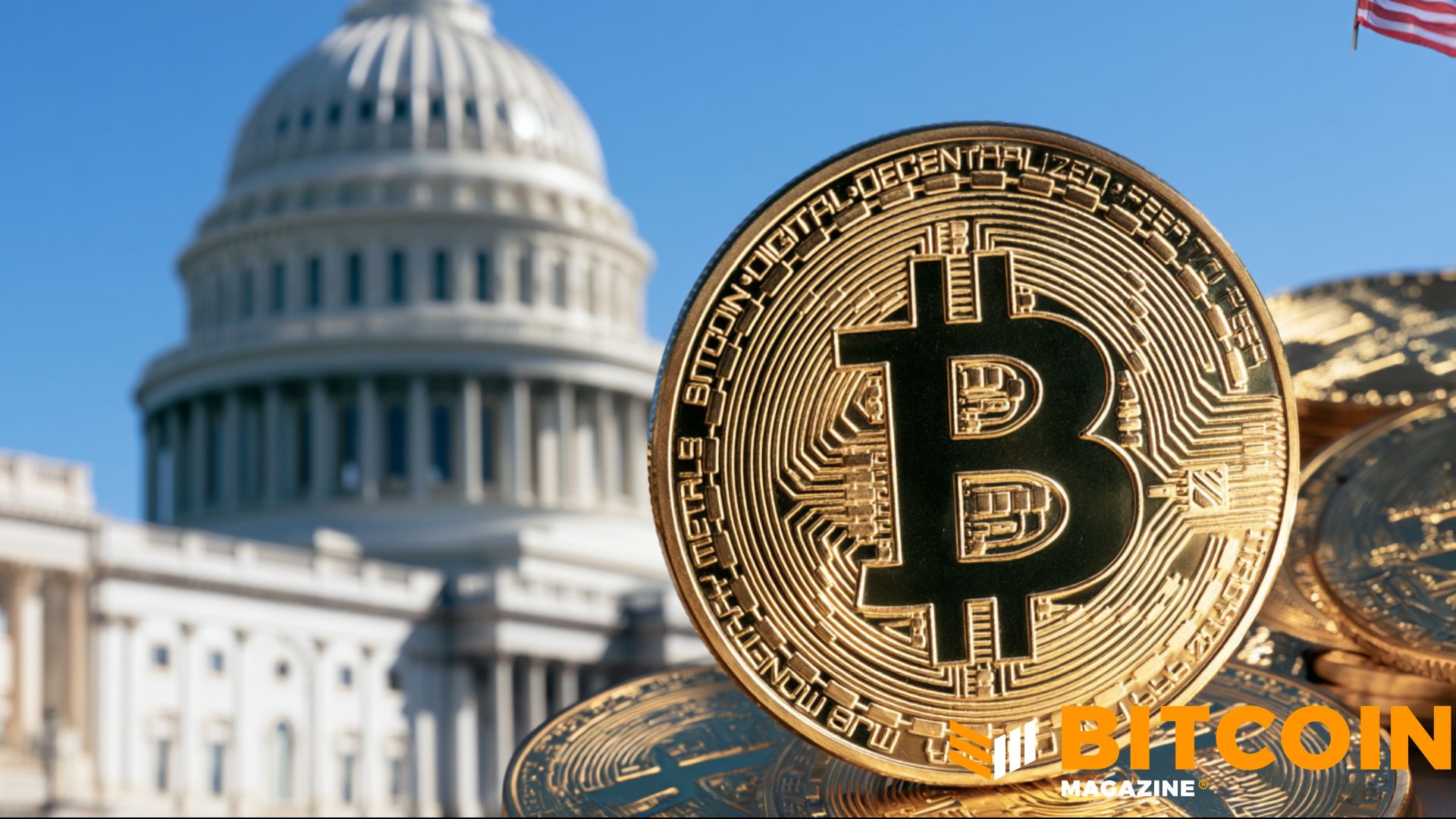
‘Crypto Capital of the World’: SEC Chair Expects Clarity Act to Pass This Month
Wall Street’s top regulator has said that he expects the long-awaited Clarity Act will get passed this month and the U.S. will be on track to be the “crypto capital of the world.”
Speaking to Fox Business on Tuesday, Securities and Exchange Chairman Paul Atkins confirmed that the regulator was pushing ahead with rules to help the crypto industry.
Pro-crypto lawmakers had hoped to pass the Clarity Act before Congress broke for August recess, but the vote slipped to September. The bill will establish a framework for distinguishing between digital assets that are securities, commodities or stablecoins.
JUST IN:
— Bitcoin Magazine (@BitcoinMagazine) September 2, 2026SEC Chairman Paul Atkins says "The Regulation Crypto Assets proposal is our most historic step yet to cement America as the Crypto Capital of the World"
pic.twitter.com/lcHtWcslgO

“The Clarity Act will be voted on in the Senate on the 15th of September,” Atkins said. “I anticipate and hope that it will be passed by the Senate and sent ultimately to the President’s desk for a signature.”
He added: “We’re changing the past approaches to try to update [rules], modernize them in the age of blockchain and crypto assets.”
Despite a vote on the Clarity Act being delayed, regulators like the SEC and Commodity Futures Trading Commission have said they will still proceed with trying to shape crypto policy.
Last week, the SEC sent a proposal to the White House aiming to “clarify the framework for the custody of crypto assets” for investment advisers and companies.
Despite being passed by the House of Representatives last year, the Clarity Act has been in a deadlock for most of this year after the banking lobby clashed with lawmakers and crypto businesses over whether platforms like Coinbase should be able to pay customers yield.
Some lawmakers have sought to change wording in the bill regarding ethics, and a new bill started circulating in July. The draft bans government officials from promoting and making money from crypto.
But other Democratic lawmakers said it still fell short; a number of pro-crypto Republicans accused Democrats of deliberately playing politics and delaying the bill.
This post ‘Crypto Capital of the World’: SEC Chair Expects Clarity Act to Pass This Month first appeared on Bitcoin Magazine and is written by Mathew Di Salvo.
Bitcoin Magazine

Mexican Billionaire Ricardo Salinas Tells People To Escape Fiat Inflation With Bitcoin
Mexican billionaire Ricardo Salinas is at it again.
This time, the third richest man in Mexico told his followers that “fiat inflation is a hidden tax,” and the way to hedge against it was to buy bitcoin.
Salinas, the former chairman of home appliance and electronics retailer Grupo Elektra and Banco Azteca founder, told his followers to opt out and start protecting their savings.
“Bitcoin changes one fundamental rule: no one can print more just because they want to,” Salinas said in a video on X on Monday.
“While you have to work to earn more money, the system can simply create more of it. Don’t be fooled: learn, protect your savings, and defend your freedom, buy bitcoin and hold it.”
It’s not the first time Salinas has told his followers to be aware of government monetary policy.
The billionaire posts on X almost daily to millions of followers, and criticizing central bank money creation is one of his recurring themes, appearing in tweets, interviews, conference keynotes, and video messages.
In recent years, the entrepreneur has stepped up his criticisms of governments — and his praises of bitcoin. Earlier this year admitted he had increased his allocation in the asset from 10% to 70% of his portfolio.
Salinas’ bitcoin enthusiasm all stems from central bank monetary policy. Speaking at Bitcoin 2022, Salinas described traditional money as “the fiat fraud.”
“What they are doing is printing money out of thin air, and then making fake purchases,” he said of the Federal Reserve.
The business magnate has also talked about his success in “orange pilling” his friends and family.
“I convinced my wife to mortgage the house that she has and take a loan to buy bitcoin,” he once boasted in an interview.
This post Mexican Billionaire Ricardo Salinas Tells People To Escape Fiat Inflation With Bitcoin first appeared on Bitcoin Magazine and is written by Mathew Di Salvo.
Bitcoin Magazine
When the Banks Don’t Work, Bitcoin Does: Cornell University’s Adoption Index
A lot of people have heard of Bitcoin but even among those who hold it, knowledge is shallow.
Though for those holding the leading cryptocurrency, it appears to be solving a problem: getting around failing banking rails or inflation.
That’s according to new findings from the U.S. Ivy League research university Cornell, which spoke to nearly 26,000 around the globe about Bitcoin.
In its new Bitcoin Adoption Index report, the top college found that El Salvador, Venezuela and Nigeria were the countries that had the highest number of people who had ever owned bitcoin.
“Ranked by the share of all respondents who have ever owned bitcoin, the leaders are not wealthy financial centers — they are economies where the national currency has been unstable and everyday access to dollars or reliable banking is hard,” the report read.
“In each, bitcoin functions less as a speculative bet and more as a practical workaround.”
Still, Cornell found that actually being able to explain the fundamentals of the protocol was difficult for most — including how many bitcoins would ever be minted in existence. In fact, 58% of those surveyed said they didn’t know the supply was capped at 21 million coins.
But technicalities aside, the cryptocurrency has still proved helpful to people wanting to use it, the report found.
One Venezuelan — who wasn’t named — told interviewers that Bitcoin was “faster, cleaner, and much less risky” than other methods of getting dollars in the country.
While another Salvadoran was quoted saying: “When nobody controls [bitcoin], it means we all have control of it.”
And a Nigerian interviewee reportedly told Cornell researchers: “I’ve been to six African countries and whenever I go there, I don’t fear it because I know I can spend my bitcoin.”
Bitcoin adoption started growing in Venezuela ahead of other countries years ago, when hyperinflation crippled the economy and strict government currency controls meant getting dollars became difficult.
El Salvador made bitcoin legal tender — along with the dollar — in 2021. The country’s leader admitted that getting its citizens to use the cryptocurrency was difficult but the Central American nation still says it buys the asset for its government coffers.
In Nigeria, which has had some of the highest transaction volumes in the world, saving in bitcoin has been used by some to get around the collapse of the naira.
Cornell University’s research was fielded by Morning Consult in partnership with the Tech Policy Institute in Cornell University’s Jeb E. Brooks School of Public Policy, the Cornell Bitcoin Club, the Human Rights Foundation and the Reynolds Foundation.
Researchers interviewed 25,880 people in 25 countries between December 16, 2024 to March 10, 2025, asking 125 individual questions.
This post When the Banks Don’t Work, Bitcoin Does: Cornell University’s Adoption Index first appeared on Bitcoin Magazine and is written by Mathew Di Salvo.
Bitcoin Magazine

Capital B Raises €7.6M From Adam Back to Fund Another Bitcoin Buy
Top bitcoiner Adam Back has invested €7.6 million ($8.8 million) in Capital B, the Euronext Growth-listed company that bills itself as Europe’s first bitcoin treasury company.
The company said Wednesday that the investment will be used to buy more bitcoin. Adam Back is the CEO of bitcoin infrastructure company Blockstream, and one of the biggest and well-known figures in the space
Capital B’s announcement comes after the company last week said it had raised €21 million ($24 million) in a private placement backed by Blockstream’s Adam Back and asset manager TOBAM.
— Capital B (@_ALCPB) August 28, 2026
Capital B announces a €21.0 million capital raise with global institutional investors, including strategic investors Adam Back and TOBAM, to accelerate its Bitcoin Treasury Company strategy
Full Press Release (EN): https://t.co/XQGT44ma4d
Full Press Release (FR):…

“The proceeds of the Private Placement will be used primarily to strengthen Capital B’s balance sheet through the accumulation of bitcoin as a long-term reserve asset,” the company said in a statement.
“This capital increase is a key step in implementing the company’s Bitcoin Treasury Company strategy, focused on increasing the number of bitcoin per share on a fully diluted basis over time.”
It added that the placement would fund it buying 376 additional bitcoins, taking its potential holdings to 3,521 coins from its current stash of 3,145.
Capital B is the 26th biggest publicly traded bitcoin treasury in the world, according to Bitcoin Treasuries, with a total of 3,145 bitcoins in its coffers — worth $242 million at today’s bitcoin price of $76,959.
Capital B built much of that position through fundraising rounds during the first half of 2026.
In May, it acquired 192 coins for €13 million after completing three capital raises.
Capital B’s is trying to build a bigger bitcoin position as other treasuries look to raise funds and accelerate their buys.
NYSE-listed AI-powered education company Genius Group last week said it was aiming to build parallel AI and bitcoin treasuries worth a combined $1.6 billion, after the company sold its entire bitcoin reserves to repay $8.5 million in debt.
The Bitcoin treasury model has taken a hit since last year when the price of the leading cryptocurrency took a hit.
A number of companies in the space have had to liquidate their holdings — including the biggest corporate holder of bitcoin, Nasdaq-listed Strategy.
This post Capital B Raises €7.6M From Adam Back to Fund Another Bitcoin Buy first appeared on Bitcoin Magazine and is written by Mathew Di Salvo.
Bitcoin Magazine

The Quantum Issue: Letter From The Editor
Quantum this, quantum that…who put a stupid cat on-chain!?
Ahem.
Alright, let’s be serious. The threat that a viable, actually functioning, quantum computer would pose to Bitcoin if it were to be built is very serious. It is the concrete example of an existential threat, in every sense of the word.
One of the bedrock foundations that Bitcoin rests upon is the assumption of a functioning cryptographic system that can be used to produce unforgeable signatures, i.e. that if you follow that system’s protocol properly when signing things, there is no way that anyone but a bitcoin’s rightful owner could produce a signature needed to spend it unless the rightful owner failed to secure their private key from theft.
Quantum computers toss that right out the window. There goes the integrity of the entire mechanism that is used for owners of bitcoin to authenticate their ownership for the protocol to process their legitimately authorized transactions, and ONLY their legitimately authorized transactions. There’s no way for anyone to actually own anything in the context of the Bitcoin protocol if that assumption breaks.
Bitcoin breaks if that assumption breaks.
Thankfully, there are many different cryptographic systems that exist, and not all of them rest on assumptions that a quantum computer breaks. That’s the good news. The bad news is that its all a set of tradeoffs, none of them are ideal, and there are going to be some hard choices that have to be made.
But there are solutions to just about every one of the problems that a viable quantum computer would create…except the problem of choosing which solutions to use. So in light of that, here is The Quantum Issue.
This issue is a lot more structured than most past issues, and that is to ensure that it guides a reader through the entirety of the problem space and solution space without assuming any prior understanding (this is a very deep and technical subject).
The first set of articles goes through the general issue of quantum computing itself, how it differs from classical computing, why that matters, how likely it is one is developed soon, etc.
The second set examines Bitcoin’s exposure. How is it exposed? How badly is it exposed? How can that degree of exposure change?
The third set examines concrete (or developed enough to not be too hard to get to a concrete place) solutions to securing your bitcoin in a quantum safe way, and handling a network wide migration to those solutions.

Don’t miss your chance to own The Quantum Issue — featuring articles written by many influential figures in the space working on the necessary pieces for a post-quantum Bitcoin!
This piece is the Letter from the Editor featured in the latest Print edition of Bitcoin Magazine, The Quantum Issue. We’re sharing it here as an early look at the ideas explored throughout the full issue.
This post The Quantum Issue: Letter From The Editor first appeared on Bitcoin Magazine and is written by Shinobi.
CryptoSlate
The US Federal Bureau of Investigation (FBI) seized Hamas-linked fundraising infrastructure and used it to intercept cryptocurrency donations intended for the group.
Earlier this week, the Justice Department said the operation followed earlier court-authorized seizures that traced and recovered more than $560,000 in digital assets tied to Hamas fundraising.
Those seizures came through warrants issued in March, June and October 2025 after investigators followed rotating donation addresses distributed through encrypted chats and fundraising websites.
The June warrant showed how that process worked. Tether was ordered to burn targeted USDT and reissue an equivalent amount to a US law-enforcement-controlled address, while Binance was directed to transfer specified account balances into FBI-controlled wallets.
That approach allowed investigators to recover crypto after identifying where it had moved.
Special Agent in Charge Justin A. Garris of the FBI Albuquerque Field Office said:
“Reducing the capabilities of foreign terrorist organization's ability to receive donations and creating distrust in communications to their donors was the primary focus of this latest operation. This continued success demonstrates the unwavering commitment and determination of the FBI in fighting terrorism.”
FBI moved from tracing funds to intercepting them
Investigators targeted domains and servers linked to AlQassam.ps, a website the DOJ tied to the Al Qassam Brigades, Hamas’ military wing.
Affidavits filed in July and August said authenticated responses from fund@alqassam.ps were routed through host.alaqsaflood.org, helping investigators connect fundraising communications to related infrastructure.
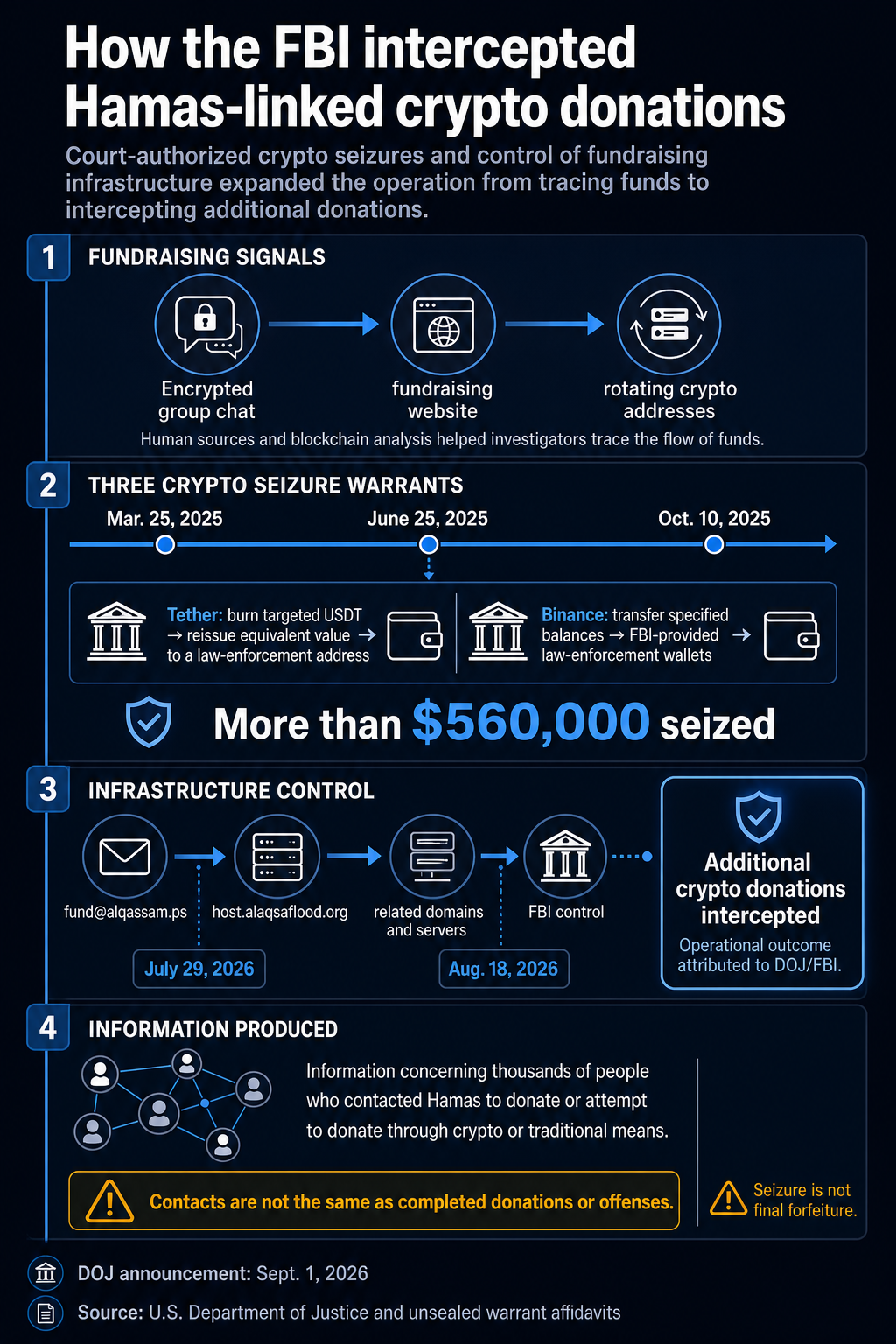
The FBI’s Albuquerque Field Office then worked with human sources to identify and seize domains and servers associated with the operation.
Control of that infrastructure changed the scope of the investigation. DOJ said agents were able to intercept crypto donations intended for Hamas and obtain additional information about people attempting to contribute.
That turned the case from a retrospective tracing effort into an active disruption operation.
DOJ said the broader investigation produced information about thousands of people who contacted Hamas online seeking to donate through cryptocurrency or traditional payment methods. The department did not specify how much of that information came directly from the seized servers.
The disclosure also does not establish that every person identified completed a donation or committed an offense.
However, this shows how several enforcement tools converged: blockchain tracing identified the money, court orders moved assets through centralized crypto providers, and infrastructure seizures gave investigators control over the fundraising channels themselves.
The post How FBI turned Hamas’ crypto fundraising pipeline into a law-enforcement trap appeared first on CryptoSlate.
Bitcoin trades near $77,381, and Glassnode says 68% of circulating supply now sits in profit at this level, up from 65% when BTC traded here in May.
That three-point gap works out to roughly 600,000 additional BTC, an estimate worth about $47 billion at current prices, that could be sold for a gain before Bitcoin even reaches its next major resistance band.
Bitcoin summer accumulation built the floor and the overhang at once
The short-term holder cost basis now sits near $71,000, reset lower by months of trading through the June-to-August range. Buyers who accumulated during that stretch are already profitable at today's price, well before Bitcoin revisits its highs.
The same accumulation that steadied Bitcoin's floor through the drawdown also built a larger pool of holders with real gains to protect as it moves back up.
Glassnode's latest report identifies heavy long-term holder supply concentrated between $83,000 and $86,000, and the firm's prior research quantified that band at roughly 1.05 million BTC.
Those coins belong to holders who sat through the entire drawdown without selling, and a return to that zone would make them whole for the first time since the correction began.
Bitcoin's path to a real breakout runs through two distinct seller types in sequence: newly profitable buyers near current prices first, then patient long-term holders approaching breakeven higher up.
Coins sitting in profit represent potential supply, and Bitcoin now needs fresh demand large enough to absorb both cohorts if either one starts distributing into strength.
| Price zone | Seller cohort | Size / signal | Why it matters |
|---|---|---|---|
| ~$77K–$78K | Recently accumulated BTC now in profit | 68% of supply in profit, up from 65% in May | Roughly 600K more BTC can now be sold at a gain |
| ~$71K | Short-term holder cost basis | Current STH cost basis | Break below here risks turning recent buyers defensive |
| $83K–$86K | Long-term holders nearing breakeven | Roughly 1.05M BTC in the band | Patient holders get a chance to exit whole |
| $62K–$65K | Deeper accumulation floor | Glassnode lower support zone | Bear-case retest if demand fails |
Bitcoin ETFs funded the squeeze at limited trading depth
US-traded spot Bitcoin ETFs pulled in a seven-day average of $290 million per day during August's rally, real capital that helped drive Bitcoin's move toward $80,000.
Secondary-market turnover on those same ETFs stayed closer to $3 billion per day throughout, a level Glassnode describes as well below prior expansionary phases.
What remains for this rally is broad trading activity that typically accompanies a durable move higher.
US spot Bitcoin ETFs posted roughly $236 million of outflows this week, led mostly by IBIT, as Bitcoin slid back toward $77,000. One outflow day marks the first live test of whether ETF demand can keep absorbing supply now that the profit overhang has expanded.
| ETF metric | Figure | Read-through |
|---|---|---|
| Peak seven-day average intake during August rally | $290M/day | Real spot demand helped fund the move |
| Secondary-market ETF turnover | ~$3B/day | Below prior expansionary phases |
| Latest reported ETF flow | ~$236M outflow | First sign demand is being tested again |
| Key market question | Can ETFs absorb profitable supply? | Flows need to offset selling from both recent buyers and LTHs |
The macro backdrop that fueled August has inverted
Treasury's Aug. 19 buyback announcement briefly pulled the 10-year yield toward 4.6%, part of the relief that helped launch Bitcoin's move.
The yield sat back near 4.8% eight trading sessions later, erasing that relief. Brent crude has since settled around $95.63 as fighting between the US and Iran resumes.
A global bond selloff has pushed sovereign yields broadly higher, and futures markets now assign roughly two-thirds odds to a September Fed rate hike. Higher yields and oil prices raise the bar for whatever buyer shows up next to absorb the supply already sitting in profit.
The August jobs report lands on Sept. 4, followed by CPI on Sept. 11 and the Fed's meeting Sept. 15 to 16. A quarterly options expiry follows on Sept. 25, carrying roughly $14 billion of open interest across Deribit and IBIT, with a meaningful share of that positioning clustered above $80,000.
Bitcoin enters that sequence with more profitable supply above the current price than the last time it traded at this level.
It all comes down to fresh demand
The bull case has the jobs report and easing CPI lower the odds of a Fed hike, while ETF flows turn positive again, letting Bitcoin close above the $83,000 to $86,000 long-term holder band.
Under that path, the profit overhang gets absorbed cleanly, and Bitcoin opens a path toward the upper end of the options-implied range near $89,700, with September's four tests read afterward as confirmation.
The bear case has stronger jobs or inflation data reinforcing hike expectations while ETF outflows continue, leaving recent buyers more inclined to defend their gains than add fresh capital.
| Scenario | Macro setup | Demand signal | BTC implication |
|---|---|---|---|
| Bull case | Jobs/CPI cool hike risk; yields ease | ETF flows turn positive and turnover expands | BTC clears $83K–$86K and targets the options-implied upper range near $89.7K |
| Base case | Macro remains tight but not worse | ETFs alternate between inflows and outflows | BTC ranges between $71K and $83K–$86K |
| Bear case | Jobs/inflation reinforce hike risk; yields stay high | ETF outflows persist; recent buyers protect gains | BTC loses $71K and retests $62K–$65K |
| Core variable | Higher oil, higher yields, Fed risk | Fresh marginal buyer | Determines whether profitable holders sell or stay put |
In that scenario, Bitcoin loses the $71,000 short-term holder cost basis and tests Glassnode's deeper accumulation floor near $62,000 to $65,000. The same summer buyers who steadied the market become the ones selling into any bounce.
Bitcoin needs enough new buyers to show up so people already sitting on gains can stay put.
The post Bitcoin’s next $80,000 breakout has $47 billion more profitable supply to absorb appeared first on CryptoSlate.
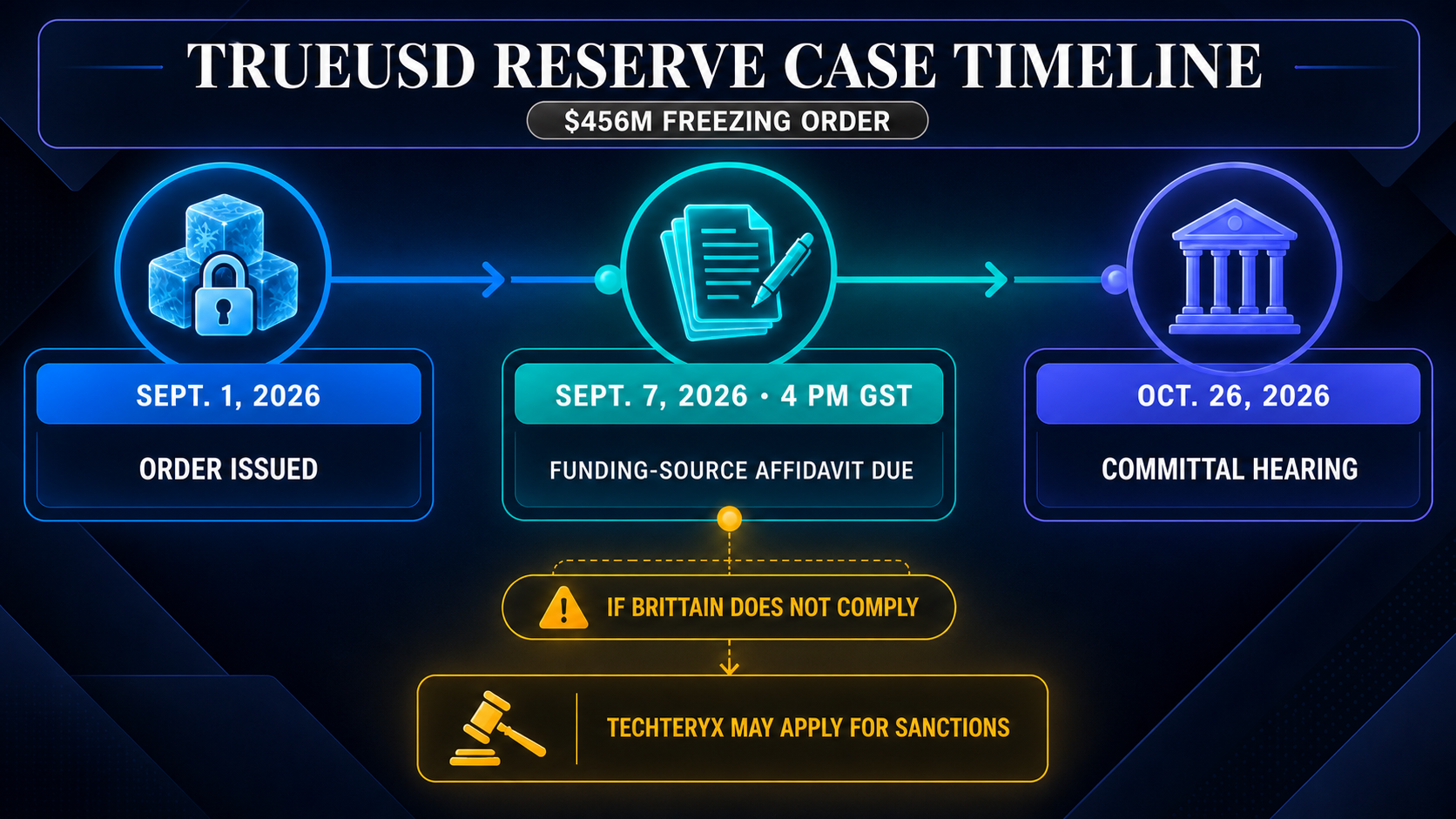
A Dubai court has given Matthew William Brittain until Sept. 7 to explain where money used for legal and advisory bills ultimately came from in a dispute over $456 million connected to TrueUSD reserves.
The Sept. 1 order adds a near-term disclosure deadline to proceedings in the Dubai International Financial Centre Courts. Techteryx, the claimant seeking the information, has obtained a proprietary injunction and worldwide freeze against Aria Commodities DMCC covering $456 million transferred from Legacy Trust and First Digital Trust, along with traceable proceeds.
Earlier DIFC court reasons for the freeze identify the money as part of the reserves backing TrueUSD, or TUSD. The injunction supports litigation in Hong Kong over what happened to the funds, but it does not decide who ultimately owns them.
Brittain must swear and serve an affidavit by 4 p.m. Gulf Standard Time on Sept. 7, acting “to the best of his ability.” For money paid to Quinn Emanuel, Horizons, Gall, Campbells and FTI Consulting, he must list amounts, payment dates and bank accounts. He must also identify the original sources and ultimate beneficial owners, explain how the accounts were funded and provide supporting documents.
The order separately requires an explanation of $1,083,912.49 paid by Aria Bio Industries FZE, another respondent in the case, on Oct. 31, 2025 toward Aria Commodities’ legal costs. The same funding details are required for that payment and for any further legal advice or representation costs incurred since a May 13 remedy application.
If Brittain does not comply, Techteryx may apply for sanctions. A penalty is not automatic: the court would still have to consider the further application.
 Third adjournment sets October hearing
The court also moved the committal hearing to Oct. 26 for an estimated four days, marking its third adjournment. It is scheduled to take place in person at the DIFC Courts, with remote attendance allowed for Techteryx’s lead counsel.
In the reasons, Justice Michael Black said another adjournment would require “the most extreme circumstances” supported by strong evidence. The Sept. 7 disclosure deadline is distinct from the October committal hearing, which will address the pending committal application.
The Dubai proceeding is also separate from the underlying Hong Kong case. Techteryx alleges there that the transfers formed part of a fraud and that Aria holds the money or its proceeds on constructive trust. Those allegations remain disputed. At the interim stage, the DIFC court described key merits and ownership questions, including whether Techteryx had a proprietary interest in the reserves, as unresolved.
The post TrueUSD’s $456M court case gives defendant days to reveal legal funding source – or face court sanctions appeared first on CryptoSlate.
Memecoins paired against Robinhood's tokenized stocks generated $217 million of trading volume on Robinhood Chain on Sept. 2, according to data compiled by on-chain researcher Adam Tehc.
The volume outpaced the $127 million that traded through direct stock token markets that same day. Traders are using tokenized Nvidia or Hims & Hers shares as the plumbing for a memecoin economy Robinhood never designed.
Robinhood describes stock tokens as ERC-20 tokenized debt securities that give holders economic exposure to an underlying stock without legal or beneficial ownership in the issuer.
New supply comes from a single authorized participant, identified at issuance as BBVI, which alone can mint tokens once onboarded. Everyone else trades, pools, and builds with the tokens already in circulation, permissionlessly and without Robinhood's direct involvement.
| Activity type | Sept. 2 volume | What it shows |
|---|---|---|
| Memecoin pairs using stock tokens | $217M | Stock tokens are being used as trading infrastructure for speculation |
| Direct stock token markets | $127M | Traditional “buy the tokenized stock” activity was smaller |
| Difference | +$90M | Meme-stock-token pairs generated about 71% more volume than direct stock-token trading |
| Ratio | 1.7x | The casino layer outpaced the investment layer |
A memecoin cornered more than half the tokenized float on Robinhood Chain
A memecoin called BONER accumulated 31,198 of the 58,714 HIMS stock tokens then outstanding, roughly 53% of the entire tokenized supply, with another 1,424 sitting in separate meme pools.
That left only about 20,303 tokens circulating in conventional HIMS pairs against stablecoins and ETH, the thin remainder available for anything resembling ordinary price discovery.
While the New York Stock Exchange sat closed for the weekend, the tokenized HIMS instrument printed as high as $132.64. That compares with a $28.84 close for the underlying stock the previous Friday, a premium of roughly 4.6 times.
A small, closed-loop pool of tokens experienced an AMM scarcity event while the market that could have supplied fresh tokens or corrected the price sat shut.
Hims & Hers has roughly 233.3 million shares outstanding, so the 58,714 HIMS stock tokens involved equal about 0.025% of that count. Reported short interest in the stock runs near 58.7 million shares, meaning the entire tokenized float that briefly cornered represented roughly 0.1% of the shares already sold short.
The episode left Hims & Hers' equity market untouched, while shaking confidence in a much smaller, newer market sitting on top of it.
Once the underlying market reopened, BBVI minted roughly 4,000 new HIMS stock tokens, worth about $115,000 at Friday's closing price and equal to just 6.8% of the prior tokenized supply.
That comparatively small injection was enough to pull the token price back toward the stock's value. The real vulnerability sits in who controls new supply, when they can create it, and which pools need it during a squeeze, well beyond the total dollars involved.
| Metric | Figure | Why it matters |
|---|---|---|
| HIMS stock tokens outstanding | 58,714 | The full on-chain wrapper supply was tiny |
| Tokens accumulated by BONER | 31,198 | Equal to 53.1% of tokenized supply |
| Peak tokenized HIMS print | $132.64 | About 4.6x the prior stock close |
| HIMS prior Friday stock close | $28.84 | The reference price the wrapper was meant to track |
| New tokens minted after reopen | ~4,000 | Only 6.8% of prior tokenized supply |
| Approx. value of new mint at stock close | ~$115,000 | A small supply injection helped normalize the wrapper |
| Hims & Hers shares outstanding | ~233.3M | Shows the real equity market was much larger |
| Tokenized float as share of equity count | ~0.025% | Confirms this was not an equity-float squeeze |
Robinhood stock tokens become the thing memecoins are priced against
Inside the Robinhood Chain pools, HIMS or Nvidia stock tokens become the denominator memecoins are priced against, turning a security-linked instrument into part of the speculative settlement layer itself.
The underlying stock trades during regulated exchange hours, and Robinhood's own oracle feeds for stock token prices update 24 hours a day, five days a week, on that same schedule. The on-chain token itself keeps trading and transferring around the clock regardless, so a weekend print does not necessarily represent a repriced stock.
It more often points to stress inside a thin token wrapper trading without its usual reference market open.
Secondary trading is permissionless and open to anyone, but new stock token supply only comes from an authorized participant. A large on-chain dislocation can form even in an instrument explicitly built to track a real security, because nobody trapped in a cornered pool can mint their way out.
Robinhood's terms say it does not control what third parties build on the chain and cannot reverse transactions once submitted.
Its securities filings separately warn that this same third-party activity may be difficult or impossible to monitor, influence, or prevent, even though Robinhood could still face reputational, legal, or regulatory consequences from whatever happens.
Regulators are already circling the underlying question
The SEC said in January that representing a security through a crypto network does not change which federal securities laws apply. That statement targeted this kind of third-party product offering synthetic exposure to an underlying stock.
The World Federation of Exchanges has separately warned regulators that tokenized equities raise real issues around market integrity, disclosure and post-trade standards.
Both are describing a genuine gap in who takes responsibility when a security-linked token starts behaving like a permissionless crypto asset.
Nasdaq's approved tokenization framework and DTCC's tokenization service both keep tokenized securities on the same order books, under the same rights and controls as conventional shares.
Robinhood Chain sits at the end of a broader move, letting its tokens loose into open DeFi composition. Citi's 2030 tokenization outlook, projecting roughly $5.5 trillion in tokenized assets under its base case, anticipates retail investors doing this with instruments like it.
For crypto markets broadly, the more interesting implication is that on-chain speculation may grow less dependent on BTC, ETH, and stablecoins as its default liquidity legs if tokenized equities keep working this well as collateral and quote assets in their place.
Whether this becomes real infrastructure or a lasting liability
The bull case is that stock tokens graduate from meme-pair liquidity into broader usage in lending, collateral, and index products, with direct stock token activity and legitimate collateral use eventually overtaking memecoin-pair volume.
Under that path, Robinhood Chain's RWA activity multiplies several times over from today's roughly $188 million base, and the network becomes credible on-chain brokerage infrastructure.
| Path | What Robinhood Chain becomes | Signal to watch | Market implication |
|---|---|---|---|
| Bull case: infrastructure | Stock tokens become collateral, lending assets, index components, and settlement legs | Direct stock-token and collateral activity overtakes memecoin-pair volume | Tokenized equities become credible on-chain financial primitives |
| Bear case: liability | Meme pools and low-float squeezes remain the dominant source of activity | Memecoin-stock pairs repeatedly exceed direct stock-token trading; more weekend dislocations appear | High volume starts looking like market-integrity risk rather than product validation |
| Core tension | Same assets enable both outcomes | Ratio of productive use vs. reflexive speculation | Robinhood benefits from activity but inherits reputational and regulatory exposure |
The bear case has volumes staying high while remaining dominated by reflexive meme pools and low-float squeezes like the one HIMS just experienced. Regulators and issuers turn their attention toward disclosure and market-integrity risk, well past simple growth metrics.
In that scenario, high transaction counts stop reading as validation, and Robinhood's fee opportunity comes wrapped in the reputational exposure its filings already warn about.
Tokenization promised that a stock stops being just something you buy and becomes something software can use. Memecoin traders are showing Wall Street what “use” means when nobody outside crypto got a vote in the definition.
The post Robinhood put stocks on a permissionless blockchain- memecoin traders are stress-testing what happens next appeared first on CryptoSlate.
Bitcoin is testing a roughly $68 billion breakeven wall that has repeatedly stalled its push back above $80,000.
About 880,000 BTC carry a cost basis between roughly $77,500 and $80,300, leaving a large group of holders close to where they originally bought, Bitfinex Alpha data shows.
Data from CryptoSlate shows Bitcoin trading near $77,890 as of press time after spending much of the past week trapped below $80,000.
The concentration means even modest price moves can shift tens of billions of dollars in Bitcoin between profit and loss, potentially releasing supply from investors who endured months underwater.
So far, that selling has been absorbed, setting up a test of whether fresh demand can clear the zone or whether the recovery stalls near current levels.
Older buyers are using the rally to get out near cost
The behavior of long-term holders suggests some investors are already taking advantage of the recovery to exit positions without realizing significant losses.
Bitcoin's long-term holder Spent Output Profit Ratio, or SOPR, has moved around 1 for nine consecutive sessions, with readings between 0.88 and 1.19 and a latest level near 0.98, Bitfinex said. A reading around 1 indicates coins are being moved at roughly the same price at which they were acquired.
Bitfinex analysts tied that activity primarily to investors who accumulated Bitcoin around February and March, when prices were close to current levels. Those holders subsequently sat through the downturn and now have an opportunity to recover their original investment as Bitcoin revisits their entry prices.
That creates a recurring supply problem. Bitcoin closed at $80,256 on Aug. 27, when 72.1% of supply was in profit. By the time it closed at $77,468 several days later, that share had fallen to 67.7%. The change implies roughly 880,000 BTC sit inside the narrow $2,800 cost-basis window now surrounding the market.
At about $77,000 per Bitcoin, that represents nearly $68 billion of supply whose profitability changes as prices move through the region.
The pattern has yet to resemble capitulation. Bitfinex said sustained SOPR readings below 0.9 alongside falling prices would indicate holders had begun accepting deeper losses to exit. Instead, sellers have largely appeared around breakeven while buyers have prevented a more decisive breakdown.
Bitcoin's True Market Mean, an on-chain measure Bitfinex uses to estimate the average acquisition price of active investors, stands near $76,350. That places the market only slightly above another level where a broader portion of holders approaches cost.
Strategy steps in as the ETF bid cools
The demand absorbing those sellers is also changing, with Strategy returning to the market just as buying through US spot Bitcoin ETFs has become less consistent.
Strategy bought 4,603 Bitcoin for $369.7 million between Aug. 24 and Aug. 30, ending a 10-week pause in purchases. The acquisition lifted the company's holdings to 845,050 BTC and was made at an average price of $80,318, placing Strategy's buying directly inside the zone where Bitcoin has repeatedly struggled to hold gains.
That timing provides an unusually direct test of corporate demand. Strategy paid above every Bitcoin daily close since May 14, even as other investors were using prices near $80,000 to sell.
The purchase also arrived as ETF demand cooled following one of its strongest stretches of the summer.
US spot Bitcoin ETFs had accumulated about $3.04 billion during a nine-session inflow streak before recording a $201.9 million outflow on Aug. 28. A $216.7 million inflow followed, but the products opened September with another $236.5 million in withdrawals.
The reversal does not establish a sustained ETF exodus, particularly after August's heavy inflows. It does reduce one source of buying pressure at a point where Bitcoin is encountering a large concentration of potential sellers.
Bitfinex described the shift as a handoff between the liquidity engines behind the recent rally, with corporate purchases helping offset softer ETF demand.
That balance could become increasingly important if breakeven selling persists. The more supply investors release around $78,000 to $80,000, the more sustained demand will be needed to convert the region from resistance into support.
Options traders are insuring against a deeper break
Derivatives traders are preparing for that balance to fail even as the options market prices relatively subdued volatility.
Average Bitcoin implied volatility stood at 37.2 in Bitfinex's analysis, putting it in the 18th percentile of daily closes over the past year. Options have therefore been cheaper on fewer than one in five trading days during that period.
Yet protection is concentrated around the period containing key US economic releases that could shift expectations for Federal Reserve policy.
The Sept. 11 options expiry has one put outstanding for every call, compared with a put-call ratio of 0.56 across the broader options market. Downside positions are concentrated between $68,000 and $75,000, while the largest call open interest sits at $80,000.
That positioning suggests investors are keeping exposure to another advance while paying for protection against a retracement through the current support zone.
The timing coincides with US payroll and inflation data that could alter expectations for the Fed after Chair Kevin Warsh's hawkish Jackson Hole remarks helped knock Bitcoin from an Aug. 28 high above $81,000.
Bitcoin now needs to clear the supply shelf
The next move may depend on whether buyers can exhaust the remaining breakeven supply without allowing Bitcoin to lose the cost basis supporting the recovery.
Bitfinex sees two daily closes above $82,818, accompanied by improving holder profitability and positive ETF flows, as confirmation that the current supply shelf has been absorbed. That would put roughly $85,200, another on-chain cost-basis level, into focus.
A failure would expose the opposite side of the trade. Two closes below about $76,657 would weaken the current structure and could open a move toward $73,500, followed by the short-term holder cost basis near $69,980.
Bitcoin's August rally still gives buyers some historical support. The cryptocurrency gained roughly 24% during the week ended Aug. 23, its strongest weekly percentage increase since March 2023. Since 2020, Bitcoin has posted 17 weekly gains exceeding 15% and was higher 30 days later in 14 of those cases, with a median return of 8.4%, Bitfinex found.
The immediate obstacle is closer than those historical returns suggest. Before Bitcoin can extend the rally, buyers have to absorb a block of supply worth nearly $68 billion from holders who have finally been offered a chance to leave near where they came in.
The post Bitcoin cannot break out past $80,000 until it devours an 880k BTC roadblock that choked every rally appeared first on CryptoSlate.
HTTP error 429 on https://cryptoticker.io/en/feed/
Failed to fetch feed: https://cryptoticker.io/en/feed/
Failed to fetch feed.
Decrypt
Strategy sold millions in Bitcoin in the low $60k range and just rebought at $80k. Now they’re sharing the rationale behind the moves.
Nearly 600,000 students lose access to generative AI tools, while five named vendors keep metered pilots running in high schools.
Fake investment ads on Telegram channels funneled EU victims to a lookalike exchange that emptied their wallets.
The order calls the prediction market platform a sports betting operation "masquerading as an investment opportunity."
After Claude models accessed real systems during cyber tests, Anthropic tightened its safeguards and warned that flawed training can encourage dangerous behavior.
U.Today - IT, AI and Fintech Daily News for You Today
XRP community takes notice as key ecosystem site gets redesign.
Despite the rising pressure on the market, Shiba Inu successfully absorbed larger part of the pressure.
Former Ripple VP Emi Yoshikawa reacts to Goldman's stablecoin bid, highlighting Wall Street's predictable shift and 21-bank governance traps.
Robinhood chain leads all major networks in its 24-hour revenue following a massive surge in the metric, recording over $4 million in just one day.
Michael Saylor likens Bitcoin strategy to golf as Strategy claims the No. 2 S&P 500 reserve spot despite a paradox re-buy.
Blockonomi
Quick Overview
- Nvidia completes acquisition of AI development platform Hugging Face in a $12.93 billion transaction
- Snowflake stock soars more than 20% following impressive quarterly results and upgraded guidance
- Broadcom forecasts AI chip revenue reaching $230 billion mark by 2028
- Hewlett Packard Enterprise upgrades revenue outlook after posting 33.7% growth in quarterly sales
- Crude oil climbs to six-week peaks amid heightened U.S.-Iran geopolitical tensions
Nvidia Completes $12.93 Billion Hugging Face Acquisition
Nvidia has finalized its purchase of Hugging Face, a leading open-source artificial intelligence model platform, in a transaction valued at approximately $12.93 billion.
This represents one of Nvidia’s most significant corporate acquisitions to date, signaling the chipmaker’s strategic expansion beyond hardware into AI software infrastructure and development tools.
Hugging Face has established itself as a cornerstone resource for developers globally, providing access to machine learning models, comprehensive datasets, and development frameworks. Company leadership has confirmed the platform will maintain its open-access philosophy following transaction completion.
This strategic move arrives at a critical juncture as several of Nvidia’s major clients pursue proprietary chip development initiatives. The Hugging Face acquisition positions Nvidia as an essential partner in AI development workflows, independent of underlying hardware architectures.
Snowflake Stock Rallies Over 20% on Strong AI-Driven Growth
Snowflake shares experienced a dramatic surge exceeding 20% following the data cloud provider’s announcement of better-than-anticipated quarterly performance and an upward revision to revenue projections.
The company posted second-quarter product revenue of $1.49 billion, representing 37% year-over-year expansion. Overall quarterly revenue reached $1.55 billion.
Management has increased its fiscal 2027 product revenue guidance to approximately $6.07 billion, a substantial upgrade from the previous projection of $5.84 billion.
Chief Executive Officer Sridhar Ramaswamy attributed approximately 50% of the company’s recent growth momentum to artificial intelligence-related products. This positions Snowflake advantageously compared to competitors viewing AI as disruptive to their business models.
Broadcom Projects AI Chip Revenue Could Reach $230 Billion by 2028
Broadcom has unveiled ambitious projections for its artificial intelligence semiconductor division, anticipating AI chip revenue will approach $115 billion during fiscal 2027 before potentially escalating to $230 billion in 2028.
Third-quarter AI semiconductor sales already totaled $16.7 billion. The company reported comprehensive quarterly revenue of $29.59 billion.
Broadcom has emerged as a critical supplier of customized AI processors for major technology corporations, offering these companies strategic alternatives to exclusive dependence on Nvidia’s hardware ecosystem.
Notwithstanding these robust figures, Broadcom’s stock declined following the release of near-term guidance that marginally underperformed analyst consensus estimates.
HPE Posts 33.7% Revenue Increase on Surging AI Infrastructure Demand
Hewlett Packard Enterprise delivered quarterly revenue totaling $12.21 billion, marking a 33.7% year-over-year expansion that exceeded Wall Street projections. The company posted adjusted earnings of $1.11 per share, surpassing analyst expectations.
HPE has elevated its fiscal 2026 revenue growth projection to a range between 34% and 37%, with additional expansion of 13% to 17% anticipated for fiscal 2027.
The company’s Chief Financial Officer indicated that current market demand for AI-optimized servers and networking infrastructure significantly exceeds available supply. Memory constraints and component shortages are creating fulfillment challenges for pending orders.
HPE has also broadened its strategic collaboration with Oracle, agreeing to provide networking equipment supporting Oracle’s artificial intelligence data center expansion initiatives.
Crude Oil Reaches Six-Week Peak Amid Escalating Iran Tensions
Brent crude advanced approximately 1.7% to reach $97.29 per barrel. West Texas Intermediate increased roughly 2.2% to $93.04, propelling oil prices to their highest levels in six weeks.
The price acceleration followed renewed U.S. military operations targeting Iranian interests and mounting concerns regarding potential disruptions through the Strait of Hormuz, a critical conduit for international petroleum shipments.
Elevated oil prices may amplify fuel and logistics expenses across the economy. This development could contribute to inflationary pressures and influence Federal Reserve deliberations on monetary policy adjustments.
The post Nvidia (NVDA) Acquires Hugging Face for $13B While Broadcom Projects $230B AI Chip Revenue appeared first on Blockonomi.
TLDR
- SoFi and Kraken formed a partnership linking banking services, dollar settlement, stablecoins, and crypto trading infrastructure.
- Kraken’s parent company, Payward, will join the SoFi Exchange Network for 24/7 U.S. dollar transfers and liquidity management.
- Kraken will list SoFiUSD, giving the bank-issued stablecoin access to retail, professional, and institutional users.
- SoFi will use Kraken Prime as an additional liquidity source for crypto trades made through its platform.
- The companies said the partnership could later expand into payments, treasury services, lending, and other digital asset products.
SoFi and Kraken have formed a new partnership that connects banking, dollar settlement, stablecoins, and crypto trading. The deal gives Kraken access to SoFi’s financial network while SoFi gains another source of crypto liquidity for customer trades. The agreement links two firms that are expanding their roles across digital finance.
The arrangement also gives both firms a wider role in digital finance as banks, fintechs, and crypto platforms compete to combine payments, trading, and settlement services under one platform.
SoFi Opens Banking Network to Kraken
Payward, Kraken’s parent company, will join the SoFi Exchange Network, known as SEN. The network will let Kraken’s institutional clients move U.S. dollars and manage liquidity at any time, including outside normal banking hours.
SoFi designed SEN to support faster dollar transfers for companies that operate around the clock. The service gives businesses another way to settle funds without waiting for standard bank schedules. Kraken can now connect its institutional activity directly with those banking rails.
Kraken will also list SoFiUSD, SoFi’s dollar-backed stablecoin, on its platform. The listing will make the token available to Kraken’s retail, professional, and institutional users across its trading network.
At the same time, SoFi will use Kraken Prime as another source of liquidity for crypto trades made by its customers. The arrangement can help SoFi access additional market depth when customers buy or sell digital assets through its app.
Kraken Broadens Access to Financial Services
The partnership follows SoFi’s wider return to crypto services. The company recently added crypto trading to its app and launched SoFiUSD. These products give the bank a direct role in consumer crypto access and blockchain-based dollar transfers.
SoFi has also expanded its business banking services. In April, the company launched Big Business Banking, which combines enterprise banking with digital asset services. SEN supports this strategy by giving businesses access to a dollar transfer system that operates beyond regular banking hours.
Kraken has also moved beyond basic crypto trading. Its Prime division serves institutional clients and provides trading services, liquidity access, and other tools. The SoFi agreement connects those services with a regulated bank’s payment and settlement network.
Both companies said the relationship could expand into payments, treasury services, lending, and other digital asset products. The current deal starts with banking access, stablecoin listing, and crypto liquidity, while leaving room for more services later.
The post Kraken Joins SoFi Network as Crypto Push Deepens appeared first on Blockonomi.
Key Takeaways
- Snowflake crushed Q2 expectations with earnings of 62 cents per share versus 45 cents forecast and revenue of $1.55B against $1.48B consensus
- Shares rocketed 22% in after-hours trading and climbed above 23% to $376 in pre-market sessions
- CNBC’s Jim Cramer highlighted SNOW as poised for a significant rally after the quarterly report
- The company’s AI coding assistant CoCo expanded to 9,100 accounts, adding more than 2,000 users in the quarter
- Investor Michael Burry countered the optimism, warning Snowflake is significantly overpriced and faces cybersecurity threats
Snowflake delivered an impressive fiscal Q2 performance, surpassing analyst projections across key metrics. The cloud data platform reported revenue of $1.55 billion, representing a 35% year-over-year increase and exceeding the Street’s $1.48 billion estimate. Adjusted earnings per share reached 62 cents, substantially higher than the 45-cent consensus forecast.
Snowflake Inc., SNOW
Following the announcement Wednesday after market close, SNOW shares skyrocketed 22% during extended trading. By Thursday’s pre-market session, the stock had advanced 23.27% to reach $376 per share. If sustained, this would represent the fourth-largest single-session jump since the company’s 2020 initial public offering.
The company’s product revenue segment generated $1.49 billion in Q2, reflecting 37% growth from the prior-year period. Snowflake’s net loss contracted to $191.7 million, or 55 cents per diluted share, compared with a $297.9 million deficit in the year-ago quarter.
Looking ahead to Q3, Snowflake projected product revenue of $1.59 billion, topping the analyst consensus of $1.50 billion. Executives also boosted the full fiscal year product revenue outlook to $6.07 billion from the previous $5.84 billion target issued in May.
Additionally, the company elevated its adjusted operating margin projection to 14.5%, an improvement from the 13.5% guidance provided three months earlier.
CoCo AI Assistant Gains Traction
A significant highlight from the earnings call centered on CoCo, Snowflake’s artificial intelligence coding assistant. The platform now serves 9,100 accounts, representing growth of more than 2,000 accounts throughout the quarter. Company leadership emphasized CoCo as a critical catalyst for revenue expansion and deeper enterprise adoption.
CNBC’s Jim Cramer featured Snowflake on his Mad Money program, declaring the stock positioned for a substantial upward movement. He emphasized that Snowflake provides businesses with an efficient method to purchase on-demand computing resources. Cramer’s CNBC Investing Club maintains a position in Broadcom, though he expressed greater caution regarding that holding after its Q4 outlook fell marginally short of forecasts.
Burry Raises Valuation Concerns
Not all investors share the enthusiasm. Michael Burry, the hedge fund manager famous for predicting the 2008 financial crisis depicted in “The Big Short,” described Snowflake as “very overvalued” in a recent Substack commentary. He cautioned that the company confronts an “existential threat” should data lakes prove increasingly susceptible to cyberattacks as artificial general intelligence and quantum computing technologies advance.
Burry further suggested that if corporations choose to internalize AI development and maintain data on proprietary infrastructure, demand for third-party platforms like Snowflake might diminish.
Despite Burry’s skepticism, Wall Street analysts remain overwhelmingly bullish. SNOW holds a Strong Buy consensus rating based on 23 Buy recommendations and three Hold ratings. The average analyst price target stands at $368.68, suggesting approximately 20.6% upside potential from pre-earnings trading levels.
Prior to Wednesday’s market close, SNOW had already climbed 39% year-to-date, significantly outperforming the S&P 500’s roughly 12% gain over the same period.
The post Snowflake (SNOW) Stock Soars 22% on Strong Q2 Earnings Beat—Wall Street Weighs In appeared first on Blockonomi.
TLDR
- Australia has set Sept. 30 as the deadline for affected crypto firms to meet ASIC’s licensing conditions.
- ASIC’s temporary no-action relief ends after the deadline, exposing non-compliant firms to enforcement from Oct. 1.
- Penalties could reach 10% of annual turnover for businesses operating without required financial services authorization.
- More than 45 crypto-related license applications have reached ASIC since its guidance update in October 2025.
- Australia’s broader Digital Assets Framework starts April 9, 2027, bringing crypto and tokenized custody platforms under licensing rules.
Australia has given crypto businesses until Sept. 30 to meet licensing conditions tied to regulatory relief. The Australian Securities and Investments Commission said firms that miss the deadline could face enforcement from Oct. 1. ASIC said affected companies must apply for an Australian Financial Services license, change an existing license, or join arrangements with licensed firms. Businesses operating without required authorization may breach financial services law and face civil or criminal penalties.
Australia Tightens Crypto Licensing Rules
ASIC’s no-action position gave crypto companies temporary protection while they prepared for licensing. The regulator extended that relief from June 30 to Sept. 30 and widened it to cover some authorized representatives and intermediary arrangements.
Companies that require an Australian Market Licence or a Clearing and Settlement facility licence must also contact ASIC by the deadline. They must notify the regulator and hold a pre-application meeting by Sept. 30 to remain within the relief conditions.
From Oct. 1, ASIC may act against businesses that need a licence but fail to meet the relief terms. The regulator said penalties can include fines reaching 10% of annual turnover, depending on the breach.
ASIC has received more than 45 applications for crypto-related authorizations since updating its INFO 225 guidance in October 2025. The guidance explains when digital assets and related services fall under Australia’s existing financial services laws.
New Digital Asset Framework Arrives in 2027
Australia is preparing for a wider legal framework for digital asset businesses. The Corporations Amendment (Digital Assets Framework) Act 2026 will take effect on April 9, 2027, and bring crypto and tokenized custody platforms under financial services licensing rules.
ASIC said many companies may still need current financial services authorizations after the new framework starts. The regulator plans to release more standards and guidance before the law takes effect, giving businesses future compliance details.
The Sept. 30 deadline creates a near-term compliance requirement for firms that relied on ASIC’s temporary position. Companies must now decide whether to seek their own license or operate through an approved licensed entity.
The move forms part of Australia’s broader effort to place crypto services within existing financial regulation before the 2027 framework begins. ASIC’s warning makes clear that temporary relief will not protect companies that fail to complete required steps by the deadline.
The post Australia Tightens Crypto Rules as Sept. 30 Deadline Looms appeared first on Blockonomi.
Key Highlights
- A 7-figure, one-year agreement with a European defense and intelligence agency has been secured by Planet Labs
- Planet Mosaics and professional services for operational planning are included in the agreement
- This follows multiple 2026 contracts including NGA, Swedish Armed Forces, and Defense Innovation Unit partnerships
- Wall Street analysts maintain a consensus “Hold” rating with a $35.36 average price target
- Recent quarterly revenue jumped 42% year-over-year to $94.15 million, exceeding analyst expectations
On Thursday, Planet Labs (NYSE: PL) revealed it has secured a substantial 7-figure, one-year agreement with a European defense and intelligence organization.
Planet Labs PBC, PL
Under the terms of this agreement, the customer will receive access to Planet Mosaics along with dedicated professional services support designed to enhance operational planning for both land and maritime regions of strategic importance.
According to Jon Powers, VP of Global Defense and Intelligence at Planet, this contract underscores the increasing appetite for geospatial intelligence and specialized support services within these sectors.
Shares were trading approximately 2.60% lower during the trading session.
This recent win represents part of a larger trend. Throughout 2026, Planet has been securing a series of defense-related agreements, including prior announcements involving the National Geospatial-Intelligence Agency, Sweden’s Armed Forces, and the Defense Innovation Unit.
The company’s contract pipeline continues to expand at a notable pace.
Financial Performance Shows Strong Momentum
Financially, Planet delivered quarterly revenue of $94.15 million in its latest earnings release, representing a 42.1% increase compared to the same period last year and surpassing the Street’s consensus estimate of $90.39 million.
The satellite imaging provider posted a per-share loss of $0.03, which came in narrower than the anticipated loss of $0.04.
For the full fiscal year, the analyst community projects earnings per share of -$0.92.
Institutional investors control 41.71% of shares outstanding, with Vanguard representing one of the largest stakeholders, holding more than 19.3 million shares with an approximate value of $381.7 million.
Wall Street Maintains Cautious Outlook
Even with recent contract announcements and solid revenue expansion, analysts remain measured in their assessments. The consensus recommendation stands at “Hold” with a mean price objective of $35.36.
Price targets vary across the Street, from Deutsche Bank’s “Buy” rating with a $36 target down to New Street Research’s “Sell” rating accompanied by a $28 target. Goldman Sachs recently raised its price target from $22 to $25 while maintaining a “neutral” recommendation.
Regarding insider activity, company executives divested 171,122 shares valued at approximately $4.15 million during the most recent quarter. Robert H. Schingler offloaded 64,593 shares at $25.92 in July, while board member John W. Raymond sold 6,494 shares at $26.16.
The stock’s 52-week trading range spans from $6.26 to $51.76, and it currently maintains a 50-day moving average of $24.31 alongside a 200-day moving average of $30.17.
The post Planet Labs (PL) Stock Wins Major European Defense Deal Following NGA Partnership appeared first on Blockonomi.
CryptoPotato
Bitcoin is holding above $78K after a sharp recovery from the $60K area, but the latest price action suggests that buyers have yet to secure a decisive breakout above the upper resistance levels. At the same time, the exchange whale ratio has risen significantly, adding a potentially bearish supply-side signal to the otherwise constructive technical structure.
Bitcoin Price Analysis: The Daily Chart
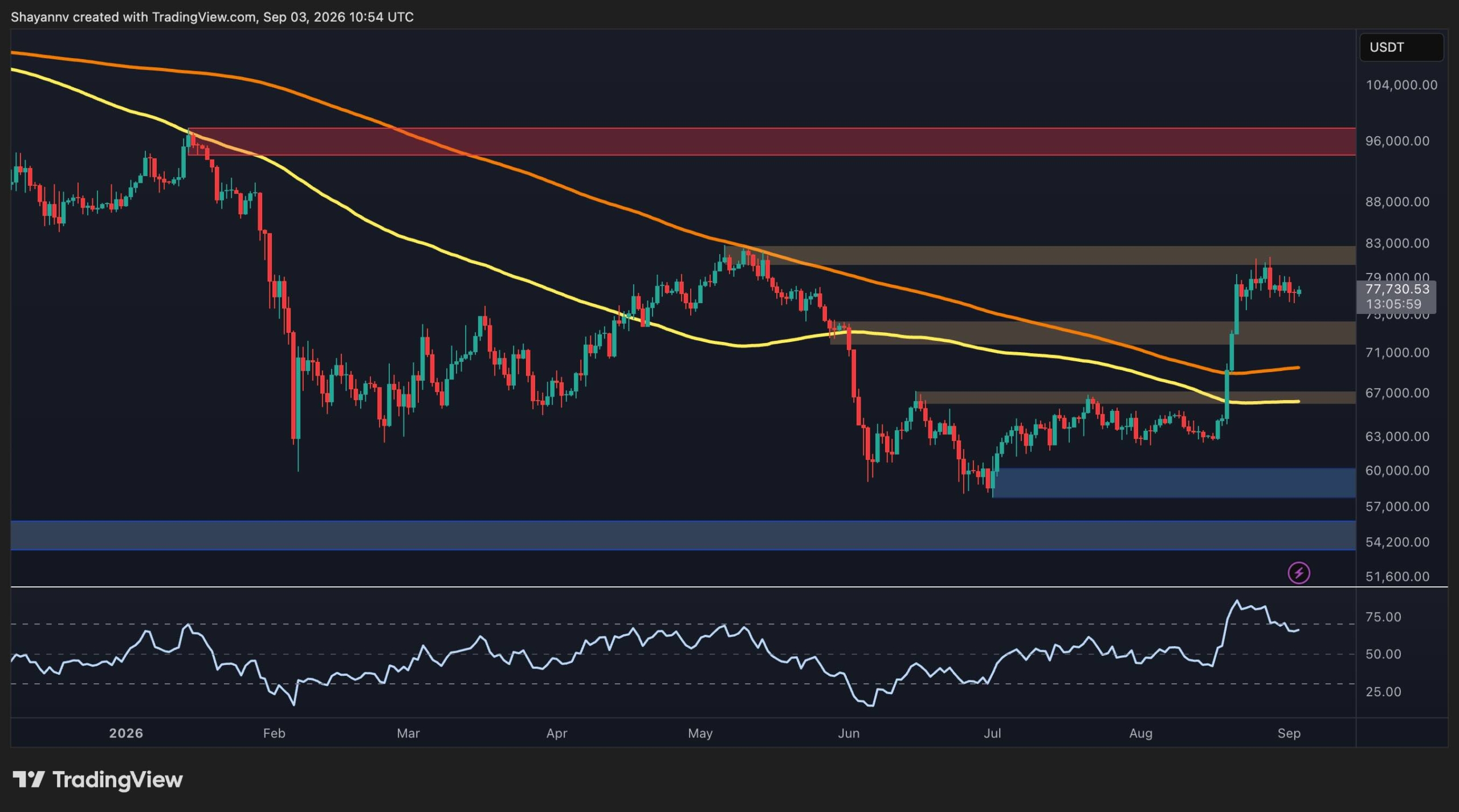
The daily chart shows a significant structural improvement following the recovery from the $60K support zone. BTC broke above the $67K area and subsequently reclaimed the $72K zone, which had previously acted as resistance. The price is now trading around $78.5K, comfortably above both major moving averages shown on the chart.
The short-term challenge is the $82K resistance zone. This area coincides with the recent swing highs, making it an important barrier for the buyers. A daily close above this level would strengthen the recovery structure, as it would create a higher high after months of downtrend. Therefore, this potential breakout could open the way toward the $95.6K resistance region.
Momentum has also improved considerably. The daily RSI climbed from oversold territory during the June bottom and is now just below the overbought territory. However, it has started to turn lower after reaching elevated levels, suggesting that momentum is cooling rather than accelerating.
On the downside, the $72K zone is the first major support to monitor. Holding above it would keep the broader recovery intact, while a deeper correction could bring the $67K region back into focus.
Therefore, the daily structure remains cautiously constructive, but BTC needs to clear $82K to confirm that the recent recovery is evolving into a stronger bullish continuation rather than another rejection from resistance.
BTC/USDT 4-Hour Chart
The 4-hour chart provides a more cautious picture. BTC has been moving inside a falling wedge-like structure since reaching the $82K area in late August. The upper trendline has repeatedly capped advances, while the lower boundary currently sits around $76K.
BTC is now testing the upper boundary of this structure once again. A successful breakout above this resistance line, which is currently near the $78K mark and declining, would be the first indication that buyers are attempting to regain short-term control.
A potential breakout would lead to another push toward the $82K area, which, as mentioned, is currently the most important resistance level on the daily timeframe.
Conversely, failure to break the wedge and a move below $76K could trigger a deeper correction toward the $72K-$74K area, which has turned into support after getting broken to the upside earlier. Holding this zone would be critical for keeping the recovery alive, as a breakdown could undo all the positive price action BTC has shown over the past couple of weeks.

On-Chain Analysis
The exchange whale ratio measures the proportion of exchange inflows associated with the largest transactions, making it useful for assessing whether large holders are becoming more active in sending BTC to exchanges. A rising reading can indicate increased potential selling pressure, although it does not necessarily mean that whales are immediately selling.
The chart shows the 30-day moving average of Bitcoin’s exchange whale ratio rising sharply during the latest price recovery. It has moved back toward the 0.32 area, which is nearly the highest level visible on the chart, while BTC is trading around $78.5K.
This development is worth monitoring. Bitcoin has recovered substantially from its June lows, but the increasing whale ratio suggests that large transactions toward exchanges have also become more prominent, which could unbalance the supply and demand equation in favor of the sellers. If this elevated reading persists while BTC struggles to break above the $80K-$82K area, it could reinforce the case for a rejection or consolidation.
On the other hand, a decisive breakout above $82K accompanied by a subsequent decline in the whale ratio would provide a more constructive confirmation that the increased whale activity is not translating into significant distribution and that there is enough fresh demand to absorb whales’ distribution.

The post BTC Price Analysis: Bitcoin Rebounds From $76K but Crucial Resistance Remains Above $80K appeared first on CryptoPotato.
XRP is consolidating after its sharp late-August breakout, with the price now hovering close to $1.40. The charts suggest that the broader structure has improved considerably, but the token remains trapped beneath a major resistance zone. A breakout from the current corrective structure could determine whether the recent rally resumes or develops into a deeper retracement.
Ripple Price Analysis: The USDT Pair
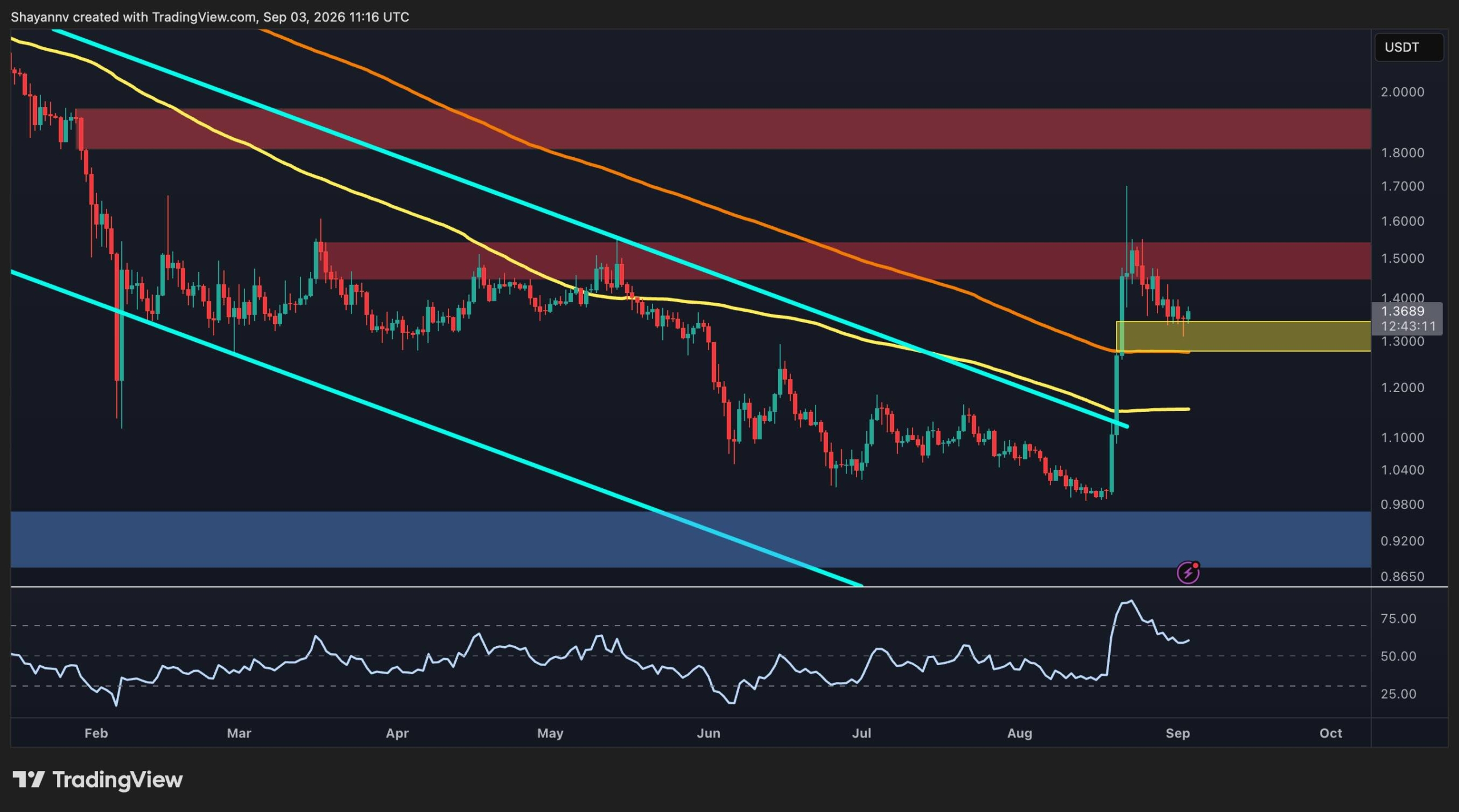
On the daily timeframe, XRP has undergone a significant structural shift. After spending several months in a broad downtrend, the asset broke decisively higher in late August, surging from around $1.00 to a spike near $1.70. This move also pushed XRP above the previously declining long-term trendline and the major moving averages visible on the chart.
The subsequent pullback has brought XRP toward the $1.30 area, which is currently highlighted as an important demand zone at a clear bullish imbalance area. Meanwhile, the still price remains above the 100-day and 200-day moving averages, suggesting that the broader recovery structure is still intact despite the recent correction.
Above the current price, the $1.5 region represents the main resistance zone. It previously acted as a significant supply area and has already rejected XRP several times over the past year. Therefore, a daily close above this zone would significantly strengthen the bullish case and could pave the way toward the $2 region, which is an important psychological barrier for Ripple.
The momentum picture has also cooled substantially from the extreme levels reached during the initial breakout. The daily RSI has fallen below 75, relieving overbought conditions while remaining above the neutral 50 area. This is generally constructive because XRP has been able to consolidate without completely losing its momentum.
The 4-Hour Chart
The 4-hour chart provides a clearer view of the current correction. Since the late-August spike, XRP has been forming a descending structure defined by two downward-sloping trendlines. The price is currently near $1.37 and appears to be testing the upper boundary of this formation.
This makes the current area particularly important. A breakout above the descending resistance line, followed by a move through the $1.5 zone, would provide an initial signal that the corrective phase may be ending.
On the downside, the highlighted $1.25 bullish order block is the immediate support region. As long as XRP continues to hold this zone, the descending structure could eventually resolve to the upside. A breakdown below it, however, would increase the probability of a deeper retracement toward the lower order block around $1.1.
Overall, XRP is approaching a decision point. Holding $1.25 and breaking above the descending trendline would favor continuation above $1.5. Conversely, losing the $1.25 area would invalidate the immediate bullish setup and could send the price back toward the base of the recent rally.

The post XRP Price Analysis: Can XRP Resume Its Rally After Defending Key Support? appeared first on CryptoPotato.
The native token of Pi Network has rebounded from its all-time low set earlier this summer, and many market observers now anticipate further gains in the near future.
Certain technical indicators also support the bullish perspective.
Breakout Setup?
PI currently trades at around $0.094 (per CoinGecko), representing a 13% monthly surge and a 34% increase from its July historic bottom. Its market capitalization has climbed back over the psychological $1 billion mark, making it the 68th-largest cryptocurrency.
X user OxNeena noted that the token is holding a key support zone around $0.09-$0.10 after a long consolidation, foreseeing a major push above $0.30 if bulls reclaim $0.20.
Nakamoto Files and CT News also weighed in. The former claimed that “something is moving behind the scenes” at Pi Network, arguing that PI might be gearing up for a move that nobody expects.
“The ecosystem is evolving. The pieces are falling into place. Is the PI wave finally coming?” they asked.
For their part, CT News highlighted Bitcoin’s solid performance throughout August, adding that PI remains near the floor. In their view, if the next altcoin rotation reaches Pi Network, the token could move much faster than people expect.
“The sleeping giant may not stay asleep forever,” the X user added.
PI’s Relative Strength Index (RSI) supports the positive scenario. The ratio has plunged to nearly 30 on a weekly scale, suggesting that the coin is nearing oversold territory, which is typically seen as a buying opportunity.

Of course, not all are so optimistic. Crypto With Gopal opined that PI has formed a rising wedge, with price grinding higher within the formation and momentum compressed near the $0.095 resistance.
“A breakdown could send PI toward the $0.085 target. Bears are watching the wedge closely – short-term sentiment leans bearish,” he estimated.
Burning Mechanism on the Way?
Lately, there has been growing speculation that the controversial crypto project is on the verge of integrating a burning program that could reduce the token’s supply and positively impact the price. Recall that years ago, the meme coin Shiba Inu implemented such a mechanism, and since then the team and community have burned over 410.8 trillion units.
According to the X account BSCN, there is little chance that Pi Network will run such an extensive burn program. PiNews360 also rejected the possibility, saying:
“Pi Network is never going to burn tokens from its 100 billion PI total supply. Pi is never going to be 100% mined; it will take hundreds of years to fully mine. Pi is going to be successful as a long-term project because of its simple mobile mining technology and its growing ecosystem.
Pi is going to become one of the most widely used cryptocurrencies for day-to-day activities, developing in parallel with AI. Pi is going to be a tough competitor to BTC, ETH, and XRP. The day Pi starts burning its token supply could be the beginning of Pi’s collapse, due to the failure of its inclusive model for a massive community.”
The post Top Pi Network Price Predictions as PI Rises 13% in a Month appeared first on CryptoPotato.
Arthur Hayes, the chief investment officer of crypto family office Maelstrom, said in an essay published Thursday that traders should stop paying attention to Fed Chair Kevin Warsh’s hawkish comments and instead watch the euro-yen exchange rate for early signs of fresh dollar liquidity.
He argued that mounting funding stress at French banks will eventually force the Federal Reserve to print money to keep the US repo market working, a dynamic he sees as bullish for Bitcoin and the wider crypto market.
Hayes Points to EUR/JPY as His Liquidity Gauge
Hayes said EUR/JPY, trading near 185 at the time of writing, will fall to 140 or lower by next June. He tied that forecast to Treasury Secretary Scott Bessent’s effort to weaken the euro and strengthen the currencies of US allies in Asia, meant to make American exports more competitive.
Rather than let Japan, South Korea, and Taiwan sell their dollar holdings outright, Hayes said the plan is to route that capital through the Fed’s FIMA repo facility, and he noted Bessent has already sold euros for yen through the Treasury’s Exchange Stabilization Fund.
The bigger risk, in his view, sits with French banks. He named BNP Paribas, Credit Agricole, and Societe Generale, which together handle roughly a fifth of US repo lending, and pointed to widening French government bond spreads and capital leaving French banks as signs that foreign lenders are pulling back.
If those banks retreat from repo lending, Hayes expects the New York Fed to lean harder on its RPM program, which already buys 39% of T-bill issuance, to keep the market funded.
That program has grown the balance sheet by about $22 billion a month since December, and Hayes said the pace could climb toward $100 billion if the Treasury steps up long-end bond purchases too.
He dismissed Warsh directly, writing, “I don’t pay attention to anything Warsh says.” Maelstrom’s portfolio, he added, keeps Bitcoin at its core long-term holding with year-end 2026 price targets of $10,000 for ETH and $0.50 for ENA.
A Hawkish Fed and a Choppy Bitcoin
Hayes’ essay comes about a week after Warsh’s hawkish Jackson Hole speech, which hit Bitcoin hard.
As CryptoPotato reported then, the OG cryptocurrency dropped by $3,000 within hours of that address, slipping under $77,000 after Warsh said the Fed’s 2% inflation target was “firm and fixed” and downplayed recent encouraging inflation data. Rate-hike odds for September then jumped from about a third to roughly 60% in the aftermath.
Bitcoin has stayed choppy since, with the asset turned away from $79,000 more than once before another leg down pushed it under $76,500, the lowest level in ten days, after renewed US-Iran strikes rattled markets.
However, at the time of writing, it had clawed its way back up and was trading closer to $78,000 than $77,000, pushing its gains over the last 30 days to almost 22%.
The post Arthur Hayes Says Ignore Warsh and Watch EUR/JPY for Bitcoin’s Next Move appeared first on CryptoPotato.
[PRESS RELEASE – Road Town, Tortola, British Virgin Islands, September 3rd, 2026]
DWF Labs, an established, market-tested investor and market maker built to strengthen digital asset market infrastructure at scale, today announced an expansion of its global regulatory footprint with a group entity granted Virtual Asset Service Provider (VASP) regulatory approval from the British Virgin Islands Financial Services Commission (BVI FSC).
Granted under the BVI’s Virtual Assets Service Providers Act 2022, the approval authorizes DWF Labs as a registered VASP, to provide the exchange of one or more forms of virtual assets, as well as to participate in, and provide financial services related to an issuer’s offer and/or sale of a virtual asset.
The approval enables institutional clients access to DWF Labs’ integrated OTC trading and market making capabilities, including spot trading across thousands of digital assets and stablecoins, through a regulated BVI entity. It also strengthens the company’s ability to deliver investment, incubation and ecosystem development services to support token issuers and digital asset projects on a global scale.
The BVI has established itself as a leading jurisdiction for decentralized ledger deployments and structured real-world asset (RWA) tokenization. The territory now represents nearly 10% of the global tokenization US treasuries market, with $1.5 billion in distributed value. BVI-domiciled entities also facilitate more than $1.2 billion in active, circulating stablecoins – figures underpinned by more than 24,700 stablecoin asset holders and weekly transfer volumes of $694.1 million. These figures (Source: rwa.xyz treasuries and stablecoins) reflect the strength of both the regulatory and market infrastructure DWF Labs is now positioned to operate within.
Heng Lee, Managing Director and Partner at DWF Labs said, “The Virtual Asset Service Provider (VASP) approval from the British Virgin Islands Financial Services Commission (BVI FSC) is a key step in responsibly expanding and delivering DWF Labs’ regulated digital asset services to international institutional clients.”
“As the digital asset market and industry continue to mature, and adoption increases, this addition to our regulatory framework will enable us to deliver a broader range of solutions, products, and services, while reinforcing our focus upon transparency and governance.”
DWF Labs will continue to expand its regulatory footprint across key global markets, supporting its international growth strategy and commitment to operating within robust regulatory frameworks.
About DWF Labs
Established in 2022, DWF Labs is an investor and market maker, focused on giving builders the capital, liquidity, expertise, and partnerships needed to take ideas from concept to scale. DWF Labs is among the world’s largest high-frequency digital asset trading organizations, active on more than 80 centralized and decentralized exchanges. The firm supports over 20% of CoinMarketCap’s Top 100 projects and 35% of its Top 1,000, and has worked with more than 1,000 blockchain companies across Layer 1 and Layer 2 networks, DeFi, gaming, AI, payments, infrastructure, and tokenization.
The firm’s work is organized across four business lines: Liquidity (institutional market making and liquidity provision), Investment and Incubation (strategic capital and token advisory for emerging projects), Ecosystem Development (go-to-market support), and OTC and Structured Markets (tailored trading solutions for institutions, funds, and protocol treasuries). DWF Labs also founded and incubated Falcon Finance, a synthetic dollar and universal collateralization protocol.
DWF Labs operates a globally distributed team on a 24/7/365 basis.
For more information, visit www.dwf-labs.com, or follow DWF Labs on X, LinkedIn, and Telegram.
The post DWF Labs Expands Global Regulatory Footprint with BVI Virtual Asset Service Provider Approval appeared first on CryptoPotato.