Cryptocurrency Posts
Crypto Briefing
The acquisition highlights potential risks in AI infrastructure investments, echoing past market bubbles, and may influence future financial strategies.
The post SoftBank acquires DigitalBridge for $4B as CEO warns of dot-com bubble echoes appeared first on Crypto Briefing.
The CLARITY Act could standardize crypto regulations, potentially enhancing market stability and investor confidence across the U.S.
The post CLARITY Act aims to extend Wyoming’s crypto framework nationwide, says Senator Lummis appeared first on Crypto Briefing.
Bybit's integration with Mesh could significantly enhance crypto's mainstream adoption by simplifying transactions and expanding merchant access.
The post Bybit Pay integrates with Mesh to let 80 million users spend crypto without withdrawals appeared first on Crypto Briefing.
Flouzer's standout performance highlights the strategic importance of nurturing young talent in esports, potentially reshaping team dynamics.
The post Flouzer secures series win with powerful 4k at IEM Beijing 2026 qualifiers appeared first on Crypto Briefing.
137 Ventures' success highlights the potential of patient, strategic investments in high-growth sectors, reshaping venture capital norms.
The post 137 Ventures’ 2014 fund surges to over 8x original investment on SpaceX bet appeared first on Crypto Briefing.
Bitcoin Magazine
Bitcoin Magazine
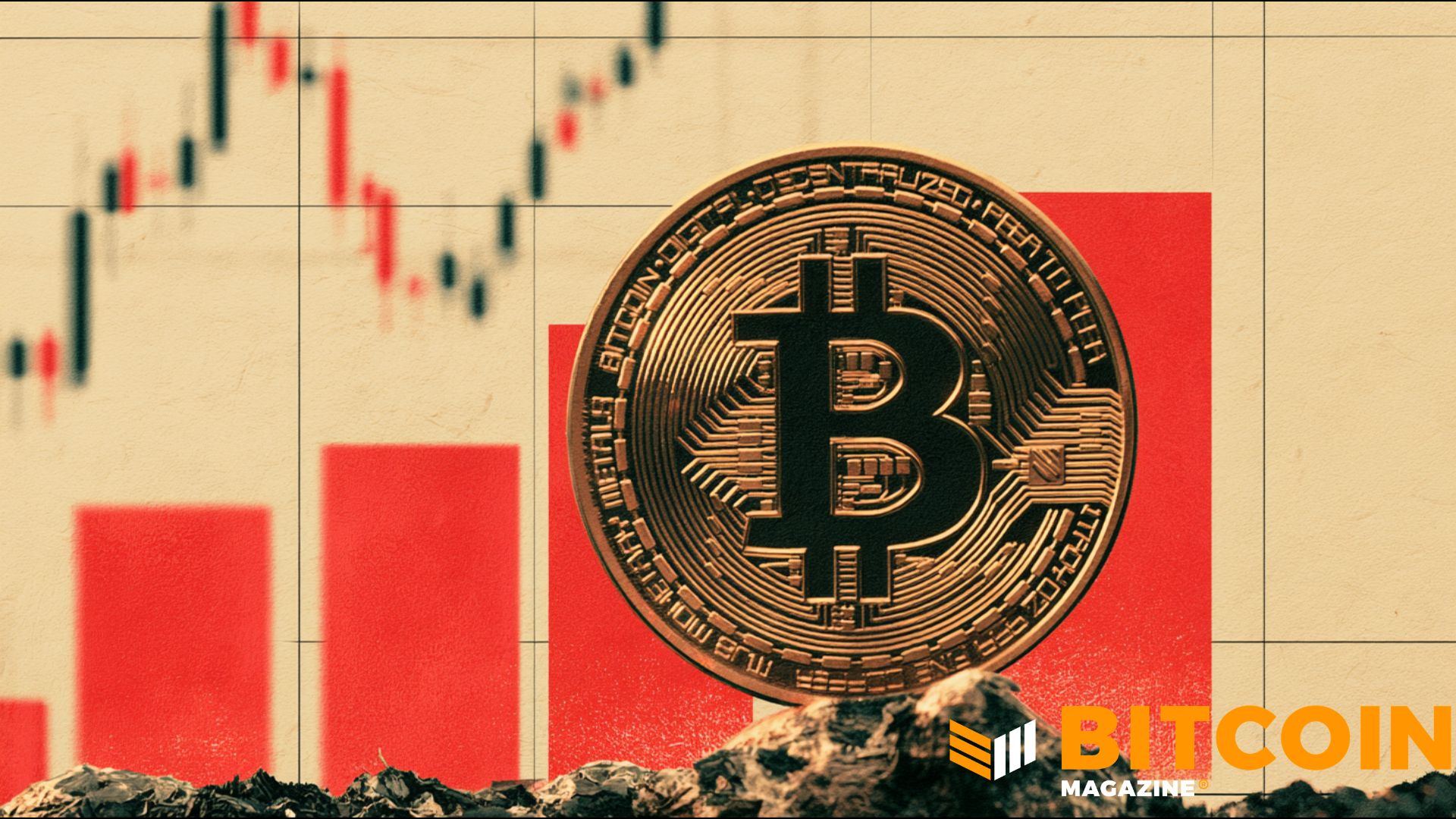
Bitcoin Rallies Over $81,000 — And Brings BTC-Related Stocks With It
Bitcoin surged on Thursday — but industry-related stocks rose even quicker as a rally that started weeks ago again picked up steam.
The price of the biggest cryptocurrency hit as high as $81,282 on Thursday morning in New York, a nearly 3% increase over a 24-hour period.
Over the past 30 days, the bitcoin price has surged over 23% following both positive regulatory news and announcements from the U.S. Treasury Department regarding debt buybacks.
JUST IN: $80,139 Bitcoin
— Bitcoin Magazine (@BitcoinMagazine) September 3, 2026pic.twitter.com/2hCpC00rrg
But other major crypto company stocks rose quicker. Bitcoin treasury Strategy (NASDAQ: MSTR) was trading more than 13% higher on Thursday. The company on Monday resumed bitcoin buys after a 10-week pause to reshuffle its cash balance sheet.
America’s biggest crypto exchange, Coinbase, also saw its stock shoot up. Nasdaq-listed COIN was trading 11% higher in the same time period.
Elsewhere, bitcoin mining companies had a boost too. Top public companies in the space — including the Nasdaq-listed HIVE Digital, MARA, and CleanSpark — all were up on Thursday.
HIVE Digital led the pack with a 13% jump, while MARA Holdings was up more than 10% on the day.
Clean energy bitcoin miner CleanSpark jumped by 9%; IREN, which is slowly phasing out its mining operations to focus on AI-compute, was up by 4%.
Bitcoin had a phenomenal run in August — its third best such month in its history — after the U.S. Treasury Department said it would more than double the size of its government debt repurchases.
The announcement, aimed to tame surging yields not seen in nearly 20 years, hurt the dollar but has benefited non-yielding assets like bitcoin and gold.
Soon after, President Donald Trump urged lawmakers to get the long-awaited crypto Clarity Act over the line — digital asset legislation the industry has long called for.
Investors rushed back into bitcoin exchange-traded funds as a result, throwing over $2.8 billion at the vehicles — the most since October, when the coin hit a new all-time high.
Bitcoin had spent a lot of the year trading below $80,000 per coin, with June and July mostly below $65,000. The coin hit a new record of $126,080 in October. It is now nearly 40% below that number.
This post Bitcoin Rallies Over $81,000 — And Brings BTC-Related Stocks With It first appeared on Bitcoin Magazine and is written by Mathew Di Salvo.
Bitcoin Magazine

Standard Chartered Debuts Bitcoin Trading In the United Arab Emirates
Multinational bank Standard Chartered announced Thursday that it had debuted bitcoin spot trading for institutional clients in the United Arab Emirates.
The bank said that eligible institutional clients would be able to use the service — the first of its kind in the country.
Standard Chartered in 2024 launched digital asset custody services in the UAE, months before it debuted spot crypto trading in other countries.
JUST IN: Standard Chartered Bank becomes first Global Systemically Important Bank to launch institutional Bitcoin trading in the UAE
— Bitcoin Magazine (@BitcoinMagazine) September 3, 2026pic.twitter.com/yeOMtcO7bo
“The UAE has developed a clear digital assets regulatory framework that supports institutional participation and innovation,” Rola Abu Manneh, Chief Executive Officer, UAE, Middle East and Pakistan at Standard Chartered, said.
He added: “By combining execution with secure custody, governance and the connectivity of a global bank, we are providing clients with a more integrated way to participate in digital asset markets.”
Standard Chartered in 2025 set up a trading desk for bitcoin and other cryptocurrencies in London, making it one of the first global banks to enter spot cryptocurrency trading.
The crypto desk became part of the forex trading operation. The bank the same year debuted a blockchain unit called Libeara to help institutions tokenize traditional assets.
Standard Chartered has lately said that bitcoin’s price should continue to surge this year. Writing in an August note to investors, the bank’s Global Head of Digital Assets Research, Geoffrey Kendrick, said that a $100,000 price forecast by year-end was too low.
“Once investors remember how quickly prices can accelerate to the topside, and we get past the 6 October date (12 months after the all-time high) an overshoot towards the all-time high (USD126k) before year-end may be possible,” he said, adding that bitcoin’s bear market so far has been the shallowest on record.
This post Standard Chartered Debuts Bitcoin Trading In the United Arab Emirates first appeared on Bitcoin Magazine and is written by Mathew Di Salvo.
Bitcoin Magazine
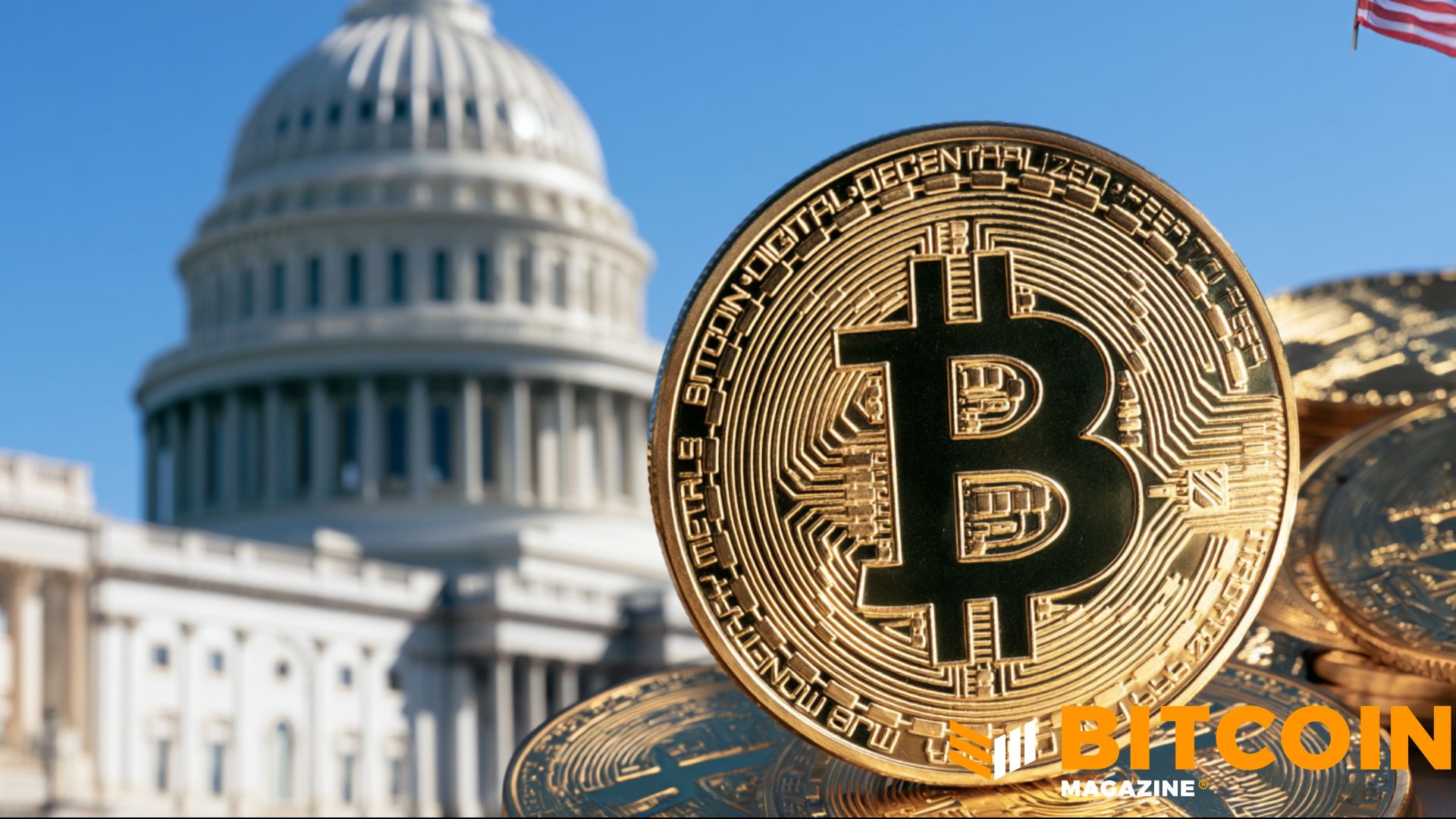
‘Crypto Capital of the World’: SEC Chair Expects Clarity Act to Pass This Month
Wall Street’s top regulator has said that he expects the long-awaited Clarity Act will get passed this month and the U.S. will be on track to be the “crypto capital of the world.”
Speaking to Fox Business on Tuesday, Securities and Exchange Chairman Paul Atkins confirmed that the regulator was pushing ahead with rules to help the crypto industry.
Pro-crypto lawmakers had hoped to pass the Clarity Act before Congress broke for August recess, but the vote slipped to September. The bill will establish a framework for distinguishing between digital assets that are securities, commodities or stablecoins.
JUST IN:
— Bitcoin Magazine (@BitcoinMagazine) September 2, 2026SEC Chairman Paul Atkins says "The Regulation Crypto Assets proposal is our most historic step yet to cement America as the Crypto Capital of the World"
pic.twitter.com/lcHtWcslgO

“The Clarity Act will be voted on in the Senate on the 15th of September,” Atkins said. “I anticipate and hope that it will be passed by the Senate and sent ultimately to the President’s desk for a signature.”
He added: “We’re changing the past approaches to try to update [rules], modernize them in the age of blockchain and crypto assets.”
Despite a vote on the Clarity Act being delayed, regulators like the SEC and Commodity Futures Trading Commission have said they will still proceed with trying to shape crypto policy.
Last week, the SEC sent a proposal to the White House aiming to “clarify the framework for the custody of crypto assets” for investment advisers and companies.
Despite being passed by the House of Representatives last year, the Clarity Act has been in a deadlock for most of this year after the banking lobby clashed with lawmakers and crypto businesses over whether platforms like Coinbase should be able to pay customers yield.
Some lawmakers have sought to change wording in the bill regarding ethics, and a new bill started circulating in July. The draft bans government officials from promoting and making money from crypto.
But other Democratic lawmakers said it still fell short; a number of pro-crypto Republicans accused Democrats of deliberately playing politics and delaying the bill.
This post ‘Crypto Capital of the World’: SEC Chair Expects Clarity Act to Pass This Month first appeared on Bitcoin Magazine and is written by Mathew Di Salvo.
Bitcoin Magazine

Mexican Billionaire Ricardo Salinas Tells People To Escape Fiat Inflation With Bitcoin
Mexican billionaire Ricardo Salinas is at it again.
This time, the third richest man in Mexico told his followers that “fiat inflation is a hidden tax,” and the way to hedge against it was to buy bitcoin.
Salinas, the former chairman of home appliance and electronics retailer Grupo Elektra and Banco Azteca founder, told his followers to opt out and start protecting their savings.
“Bitcoin changes one fundamental rule: no one can print more just because they want to,” Salinas said in a video on X on Monday.
“While you have to work to earn more money, the system can simply create more of it. Don’t be fooled: learn, protect your savings, and defend your freedom, buy bitcoin and hold it.”
It’s not the first time Salinas has told his followers to be aware of government monetary policy.
The billionaire posts on X almost daily to millions of followers, and criticizing central bank money creation is one of his recurring themes, appearing in tweets, interviews, conference keynotes, and video messages.
In recent years, the entrepreneur has stepped up his criticisms of governments — and his praises of bitcoin. Earlier this year admitted he had increased his allocation in the asset from 10% to 70% of his portfolio.
Salinas’ bitcoin enthusiasm all stems from central bank monetary policy. Speaking at Bitcoin 2022, Salinas described traditional money as “the fiat fraud.”
“What they are doing is printing money out of thin air, and then making fake purchases,” he said of the Federal Reserve.
The business magnate has also talked about his success in “orange pilling” his friends and family.
“I convinced my wife to mortgage the house that she has and take a loan to buy bitcoin,” he once boasted in an interview.
This post Mexican Billionaire Ricardo Salinas Tells People To Escape Fiat Inflation With Bitcoin first appeared on Bitcoin Magazine and is written by Mathew Di Salvo.
Bitcoin Magazine

When the Banks Don’t Work, Bitcoin Does: Cornell University’s Adoption Index
A lot of people have heard of Bitcoin but even among those who hold it, knowledge is shallow.
Though for those holding the leading cryptocurrency, it appears to be solving a problem: getting around failing banking rails or inflation.
That’s according to new findings from the U.S. Ivy League research university Cornell, which spoke to nearly 26,000 around the globe about Bitcoin.
In its new Bitcoin Adoption Index report, the top college found that El Salvador, Venezuela and Nigeria were the countries that had the highest number of people who had ever owned bitcoin.
“Ranked by the share of all respondents who have ever owned bitcoin, the leaders are not wealthy financial centers — they are economies where the national currency has been unstable and everyday access to dollars or reliable banking is hard,” the report read.
“In each, bitcoin functions less as a speculative bet and more as a practical workaround.”
Still, Cornell found that actually being able to explain the fundamentals of the protocol was difficult for most — including how many bitcoins would ever be minted in existence. In fact, 58% of those surveyed said they didn’t know the supply was capped at 21 million coins.
But technicalities aside, the cryptocurrency has still proved helpful to people wanting to use it, the report found.
One Venezuelan — who wasn’t named — told interviewers that Bitcoin was “faster, cleaner, and much less risky” than other methods of getting dollars in the country.
While another Salvadoran was quoted saying: “When nobody controls [bitcoin], it means we all have control of it.”
And a Nigerian interviewee reportedly told Cornell researchers: “I’ve been to six African countries and whenever I go there, I don’t fear it because I know I can spend my bitcoin.”
Bitcoin adoption started growing in Venezuela ahead of other countries years ago, when hyperinflation crippled the economy and strict government currency controls meant getting dollars became difficult.
El Salvador made bitcoin legal tender — along with the dollar — in 2021. The country’s leader admitted that getting its citizens to use the cryptocurrency was difficult but the Central American nation still says it buys the asset for its government coffers.
In Nigeria, which has had some of the highest transaction volumes in the world, saving in bitcoin has been used by some to get around the collapse of the naira.
Cornell University’s research was fielded by Morning Consult in partnership with the Tech Policy Institute in Cornell University’s Jeb E. Brooks School of Public Policy, the Cornell Bitcoin Club, the Human Rights Foundation and the Reynolds Foundation.
Researchers interviewed 25,880 people in 25 countries between December 16, 2024 to March 10, 2025, asking 125 individual questions.
This post When the Banks Don’t Work, Bitcoin Does: Cornell University’s Adoption Index first appeared on Bitcoin Magazine and is written by Mathew Di Salvo.
CryptoSlate
Bitcoin may be slipping beyond its four-year cycle as institutional capital and macro liquidity gain influence over price.
On Sept. 3, Bitcoin analyst Willy Woo said that Bitcoin could be moving toward a 6-to-8-year rhythm tied more closely to traditional finance’s short-term debt cycle than to its halving schedule.
According to him, this shift does not make halvings irrelevant. Instead, it means their influence is shrinking relative to the scale of capital now moving through exchange-traded products, corporate treasuries and other institutional channels.
Bitcoin’s April 2024 halving cut the block reward to 3.125 BTC, leaving annual new issuance at roughly 164,250 BTC, or about 0.82% of current circulating supply. The next halving, expected in 2028, would cut that pace again to about 82,125 BTC a year, equivalent to roughly 0.41% of today’s supply base.
That makes each new supply shock smaller just as Wall Street’s footprint grows larger.
Institutional capital is starting to rival Bitcoin’s internal clock
The balance has already changed materially, with institutional holdings now dwarfing the amount of new Bitcoin miners add to circulation each year.
Data from Bitcoin Treasuries shows 100 public companies now hold more than 1.2 million BTC, while Bitcoin exchange-traded products around the world control more than 1.5 million coins.
Together, those two groups account for more than 2.7 million BTC.
That stock is already more than 16 times the amount of new Bitcoin miners currently produce in a year. After the 2028 halving, the gap would widen further as annual issuance falls toward 82,125 BTC.
The comparison does not mean institutional holders dictate price. It does show how much smaller the miner-supply shock has become relative to the Bitcoin already sitting inside corporate balance sheets and regulated investment products.
Woo’s argument is that this changing balance could make credit conditions, global liquidity and portfolio flows increasingly important in determining major market turns.
Bitcoin’s historical four-year rhythm has always been approximate rather than mechanical. Halvings, monetary policy and investor psychology have overlapped across previous cycles, while the limited number of completed cycles makes any fixed pattern difficult to establish.
Recent research has also stopped short of declaring the old framework dead.
Galaxy Research said in June that the four-year cycle remained visible, although its amplitude was compressing. A 21Shares midyear review similarly described the pattern as evolving rather than broken.
Fidelity Digital Assets has also argued that Bitcoin’s larger market capitalization, broader institutional base and lower volatility could make future cycles behave differently from earlier boom-and-bust periods.
Woo’s 6-to-8-year thesis therefore remains a developing framework rather than a confirmed replacement.
The measurable change is already underway: annual miner issuance is shrinking toward a fraction of circulating supply while millions of Bitcoin accumulate inside institutional vehicles.
If that trend continues, the next major Bitcoin cycle may depend less on the halving clock alone and more on the same credit and liquidity forces that already shape traditional markets.
The post Bitcoin may be leaving its 4-year cycle behind for a 6-to-8-year Wall Street rhythm appeared first on CryptoSlate.
Revolut filed with the OCC and FDIC on March 4 to establish Revolut Bank US, an insured national bank that would take deposits, issue credit cards, make loans, and connect directly to Fedwire and ACH.
Nearly six months later, that application remains pending, while federal regulators have spent the same stretch conditionally approving or converting bank charters for Circle, Ripple, Coinbase, Paxos, BitGo and several other crypto firms.
Revolut has not been denied, though its application sits under review, and comparing it directly to those crypto approvals misses what each company asked Washington for.
A national bank wants more
Revolut's application describes a full-service digital national bank supporting deposit accounts, card products, consumer and commercial lending, cross-border payments, and investment and trading services, built to reduce the company's reliance on partner banks.
The company says it serves more than 70 million customers across 40 markets and carries a $75 billion valuation, reached in a November 2025 secondary offering.
That puts the application through every layer of traditional bank review at once. Regulators must weigh capital and liquidity adequate to survive stress, credit underwriting and loss reserves for its lending book, and BSA and OFAC compliance given the deposits and payments involved.
Community Reinvestment Act obligations tied to insured status add another layer, along with an OCC judgment on whether Revolut's management can run a US national bank safely. Federal deposit insurance adds exposure to the Deposit Insurance Fund itself, an industry-funded, government-backed layer none of the crypto trust charters carry.
| Feature | Revolut’s requested national bank | Most crypto trust charters |
|---|---|---|
| FDIC-insured deposits | Yes | No |
| Credit cards / personal loans | Yes | Generally no |
| Consumer and commercial lending | Yes | Generally no |
| Fedwire / ACH access | Yes, sought directly | Not the central purpose |
| Digital-asset custody | Possible | Core activity |
| Stablecoin reserves / issuance | Not the main request | Often central |
| CRA obligations | Yes | Often no if not insured |
| Deposit Insurance Fund exposure | Yes | No ordinary insured-deposit exposure |
| Main regulatory question | Can Revolut run a safe national bank? | Can crypto firms safely custody assets or manage reserves? |
Most crypto approvals cover something narrower than Revolut's case
The OCC's December 2025 approvals for First National Digital Currency Bank and Ripple National Trust Bank, along with conversions for BitGo Bank, Fidelity Digital Assets Trust Company and Paxos National Trust, were national trust-bank approvals.
They centered on custody, reserves, and digital-asset services, well short of full deposit banking.
Circle's charter provides custody for the firm, its affiliates, and a limited set of institutional customers. Coinbase National Trust Company offers digital-asset custody and related transactional services strictly to custody clients.
World Liberty's trust bank issues and redeems its USD1 stablecoin and holds reserves. Its OCC decision states plainly that the company has no plans to become an insured depository institution, so Community Reinvestment Act requirements do not apply.
Bridge, owned by Stripe, received a similar stablecoin-and-custody trust charter, with the OCC noting that the stablecoins involved are not deposits and carry no FDIC insurance under the GENIUS Act framework.
Still, these are not the same license Revolut is seeking, but the gap between them is worth reading into.
The comparison that runs through other fintechs
Three other companies pursued the same full-service insured bank charter Revolut wants, and their outcomes show what the OCC requires.
Nubank received preliminary conditional approval in January for a new national bank offering lending, deposits, and digital-asset custody. The OCC noted it still needs FDIC insurance and other preopening approvals before final sign-off.
Upstart received similar preliminary conditional approval in July for a fully digital insured lender focused on consumer credit, while bunq did not clear that bar.
The OCC denied bunq's application over issues with capital, management experience, profitability assumptions, and risk to the Deposit Insurance Fund. The agency found that bunq's proposed leadership lacked sufficient US banking and credit-product experience and that its financial projections were not adequately supported.
Revolut sits inside that same full-bank lane, which makes Nubank, Upstart and bunq the honest comparison set, well beyond Circle or Coinbase.
| Applicant | What it sought | OCC status | What it shows |
|---|---|---|---|
| Nubank | Full-service insured national bank with deposits, lending, and digital services | Preliminary conditional approval | The full-bank path is open, but conditional |
| Upstart | Digital insured bank focused on consumer credit | Preliminary conditional approval | Lending-heavy fintechs can advance with conditions |
| bunq | Full-service national bank | Denied | Capital, management, profitability, and DIF risk can stop an application |
| Revolut | Full-service insured national bank with deposits, cards, loans, and payment rails | Pending | The OCC is still testing whether Revolut clears the full-bank bar |
The Revolut review has turned contested on its own terms
Fair Finance Watch filed formal opposition to Revolut's application on May 7, citing the company's international compliance history and criticizing its Community Reinvestment Act plan.
The Federal Reserve has since pressed Revolut on BSA and OFAC obligations, the timeframe behind its CRA plan, and its planned service to low- and moderate-income communities.
Lithuania's central bank fined Revolut €3.5 million in 2025 for anti-money laundering deficiencies found during a routine inspection, covering gaps in transaction monitoring and suspicious-activity detection.
Regulators identified no confirmed money laundering, and Revolut says it has committed to corrective action.
Inner City Press has separately alleged that the OCC withheld more than 1,000 pages of records tied to the Revolut review in response to a FOIA request.
That claim shows the review has become genuinely adversarial at the same moment the OCC is publicly marketing itself as newly open to chartering.
Comptroller Jonathan Gould said in August that the OCC had received 40 new charter applications since President Trump took office, with 23 involving digital assets.
The agency had resolved many complete applications within roughly 120 days, a timeline applied only to complete filings.
The OCC's guidance allows it to return deficient filings or request additional information when supervisory, compliance, or CRA issues remain open. A faster chartering posture and a cautious approach to insured deposit-taking can coexist inside the same agency without contradiction.
The length of the full-bank lane
The bull case has Revolut eventually joining Nubank and Upstart with conditional approval, showing that a global fintech can become a US national bank if it fully satisfies capital, CRA, management, and compliance requirements.
Under that path, more competition arrives in deposits, cards, remittances, and crypto-linked retail finance, and the broader “crypto banking boom” narrative gains a genuine full-bank chapter alongside its custody and stablecoin one.
The bear case has Revolut's review dragging on, facing a bunq-style denial, or ending in withdrawal, while trust-bank approvals for crypto firms keep moving forward on their own separate track.
| Scenario | Revolut outcome | What it means for crypto banking |
|---|---|---|
| Bull case | Revolut receives conditional approval | The OCC is willing to let large fintechs move beyond custody and stablecoins into full banking |
| Base case | Review continues with more conditions and information requests | Trust charters keep moving faster than insured bank charters |
| Bear case | Revolut withdraws or faces a bunq-style denial | The crypto banking boom remains mostly a custody and stablecoin infrastructure story |
| Policy signal | OCC remains open to digital assets but cautious on deposits and lending | Federal banking access is expanding, but not all charters carry the same powers |
In that scenario, the apparent boom in crypto banking narrows considerably in practice. Custody and stablecoin infrastructure keep advancing under federal supervision, while the harder door into deposit-funded, FDIC-insured banking stays about as difficult to walk through as it always was.
Washington has genuinely opened federal banking infrastructure to digital assets this year. It has not yet decided how far it will open the older, harder door sitting right next to it, and Revolut's application is where that answer is getting tested.
The post Revolut hit by Washington crypto boom illusion, exposing massive two-tier banking system appeared first on CryptoSlate.
Kalshi, the US-regulated exchange that won approval for a Bitcoin perpetual in May, is preparing to ask the Commodity Futures Trading Commission to approve a perpetual futures contract tied to West Texas Intermediate crude oil, Reuters reported on Sept. 2. If approved, it would be the first oil perpetual to trade on a regulated US platform and would move a product structure built in crypto into the benchmark US oil market.
Crypto's favorite derivative was built around assets that trade every hour, with a structure that lets traders keep the same position because the contract has no fixed expiration. Reuters said Kalshi plans to offer the WTI contract 24 hours a day, five days a week, leaving it closed during the period when an always-on oil price would be most useful.
While that trade-off may improve the contract's chances in Washington, it will weaken its strongest use case. Bitcoin perpetuals can reference spot trading that runs continuously across many venues. Oil prices depend on physical supply and storage, while the futures market expresses those conditions through contracts for different delivery months. Those features stay with the commodity even when the derivative loses its expiration date.
A perpetual contract that still closes
Perpetual futures replace expiration with a funding mechanism. Payments between long and short positions are calculated at regular intervals to keep the derivative's price close to a reference price. Traders can keep the same position open as the market advances through successive delivery months.
Kalshi's existing Bitcoin perpetual shows the crypto model. It trades 24/7, uses the CF Benchmarks Bitcoin Real-Time Index, updates that reference every second, and applies funding every eight hours. The CFTC's approval rested in part on Bitcoin's globally distributed and continuously observable spot trading.
Kalshi's reported plan separates contract maturity from trading hours and from the reliability of the market being tracked.
| Product design | Expiration | Trading schedule | Reference challenge |
|---|---|---|---|
| Kalshi Bitcoin perpetual | None | 24/7 | Continuous global spot Bitcoin index |
| Reported Kalshi WTI perpetual | None | 24/5 | Final index and funding terms are not yet public |
| CME's proposed small WTI future | Fixed, standard-futures structure | 24/7 proposed | Weekend liquidity and benchmark effects remain under review |
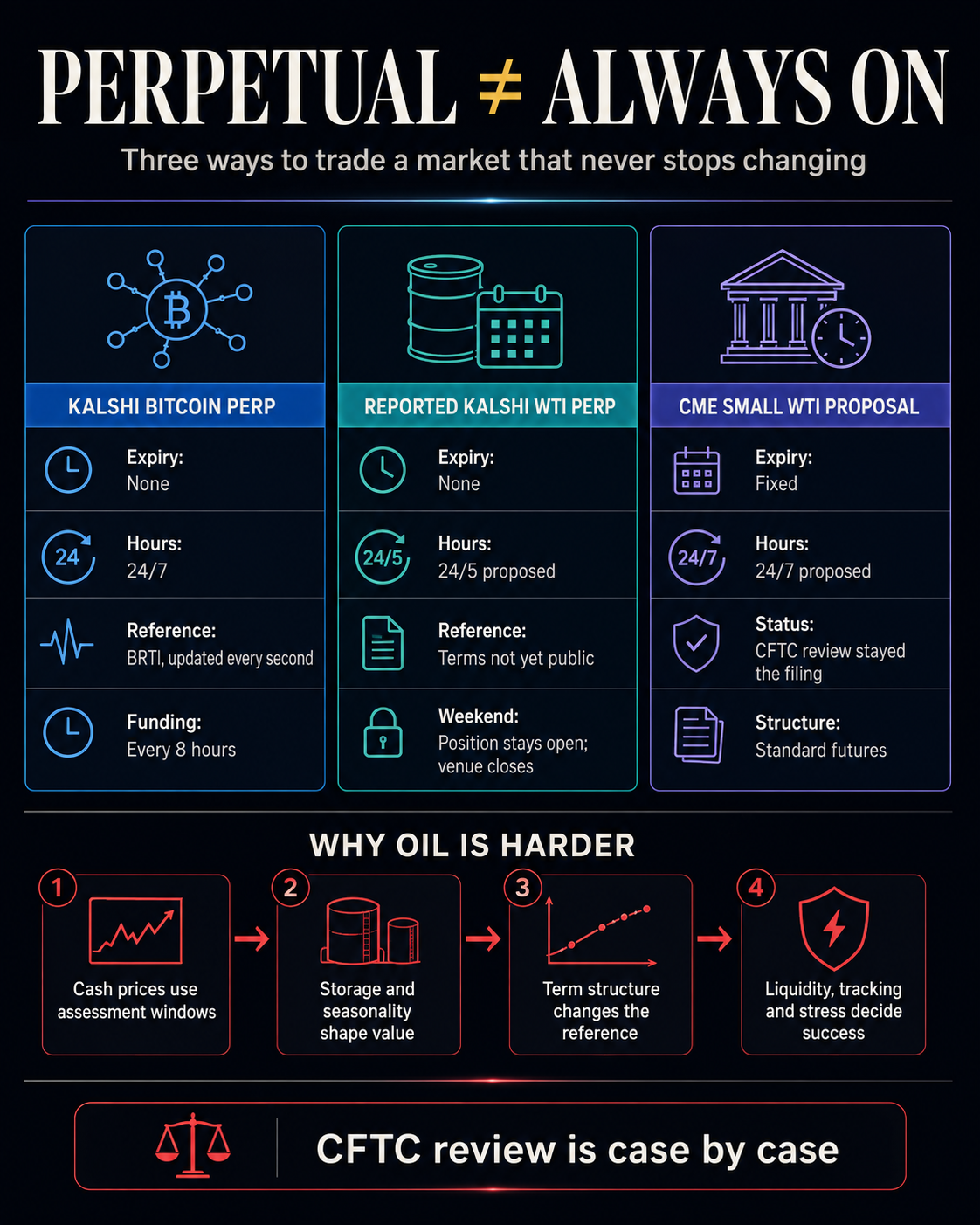
CME's separate proposal shows why trading hours and contract maturity require different regulatory answers. The exchange announced a small, cash-settled 10-Barrel WTI Crude Oil future with proposed 24/7 trading, while preserving fixed expiration. The CFTC later stayed CME's self-certification while conducting a fuller review. The action leaves Kalshi's case open and shows how closely the agency is examining extended-hours oil products.
Conventional WTI futures already trade for nearly 24 hours a day from Sunday evening through Friday, with a daily break. Kalshi's weekday value would therefore come primarily from removing expiration because conventional WTI already covers almost all those hours. The 24/5 schedule also avoids many operational problems around weekend trading, while leaving positions exposed to news that accumulates during the closure and has to be absorbed when trading resumes.
A funding rate is only as credible as the price it is trying to follow. Bitcoin offers continuous spot transactions from which an index can be calculated. Physical crude trades through dispersed transactions and assessments during defined windows, providing no single, continuously observable spot market of the same kind.
In its review of energy perpetuals, the CFTC asked whether a perpetual could reference a physical assessment, a futures contract, or some composite of the two without creating an unreliable or easily manipulated price.
The sequence of oil delivery carries information that a single no-expiry price has to compress into one reference. Storage and financing costs help shape the futures curve, along with the value of having physical barrels available sooner. Contango, where later contracts trade above near-term ones, can reflect plentiful supply and the cost of holding oil. Backwardation, where near-term contracts trade higher, can reflect physical scarcity and the value of immediate access to barrels.
This also means a perpetual can remove the trader's manual roll by transferring the economics behind it into the contract. If Kalshi's reference follows the front-month future, the methodology still has to move into another contract as delivery approaches. The resulting roll cost or benefit would reappear through the reference price, the funding rate, or both.
The April 2020 collapse below zero shows why the reference choice is more than just a little technical detail affecting the price.
The expiring WTI contract fell below zero as storage at Cushing became scarce, while later-dated contracts stayed positive. A perpetual has no terminal delivery event, so Kalshi would have to decide whether its mark price should reproduce that kind of physical stress or follow a broader measure that smooths it out. Its funding and liquidation systems would then have to function at or below zero. The CFTC limited its Bitcoin approval to similarly structured perpetuals tied to digital commodities with deep, active, and continuous spot trading.
The strongest use case is the one Kalshi left out
If approved, the immediate benefit of this contract would be operational. Traders seeking sustained oil exposure could hold one instrument across successive delivery months, with the contract managing each transition while the position stayed open.
It could appeal to a company seeking a persistent hedge around oil-sensitive revenue or costs. Producers, refiners, transporters, and fuel users already hedge through futures, options, and swaps, however. The CFTC has asked for evidence that a perpetual would meet an additional commercial need and whether its users would be hedgers or primarily speculators.
The best evidence for an oil perpetual comes from the feature left out of Kalshi's reported design. Dune's study of trading on the crypto venue Hyperliquid examined 30 weekend closures and found that its WTI perpetual explained about three-quarters of the move when conventional futures reopened. During the 20 weekends when oil moved by more than 1%, the perpetual called the direction correctly every time, and 18 of those periods recorded more than $100 million in volume.
The result depended heavily on participation. Slippage on orders above $100,000 during the closure rose from 0.23 basis points in April to 3.19 basis points in August as the order book thinned. The venue's Brent perpetual moved about three times as far as Brent futures over the same weekends, making it a poor guide to the reopen. Live price can process geopolitical or supply news while benchmark futures are closed, although 30 weekends on one venue leave its broader validity unproven.
Kalshi's reported 24/5 design gives up that weekend price-discovery function. Its most obvious audience is therefore traders seeking large oil positions with relatively little collateral and automatic management of the transitions between dated contracts. A different schedule or an unusual funding treatment around closures could broaden that use case, with the terms staying undisclosed until Kalshi files.
The regulatory path for this contract is very narrow. The CFTC approved Kalshi's Bitcoin perpetual on May 29, and its policy statement directs perpetuals tied to other asset classes into case-by-case review.
The agency's later energy inquiry maps the problems Kalshi will have to solve. Most come from the same structural mismatch: federal oil-market rules were built around delivery months, while a perpetual has no spot month or final convergence event. The reference price, position limits, margin, and liquidation rules all have to account for that difference.
A relatively small collateral requirement can turn a modest oil move into a rapid loss, while funding obligations accumulate for as long as a position stays open. The contract specifications will determine who can trade, how large a position can be relative to its collateral, which assets Kalshi will accept, and when positions will be liquidated. Reuters did not disclose those terms, and Kalshi had yet to file the contract when the report was published.
Approval would begin the market experiment
Approval would establish that Kalshi's design meets the legal and market-integrity threshold, but it's trading that will determine whether the contract is actually useful.
Liquidity and tracking would quickly become one of the biggest issues with crude oil perps. Perps need enough natural participation on both sides for their price and funding rate to carry information instead of reflecting a handful of concentrated positions.
The market would watch how closely it follows the chosen WTI reference during ordinary sessions and around inventory reports, geopolitical shocks, and market reopening. Wide spreads or persistent deviations would make the contract costly to use and leave funding payments doing too much of the work.
Any kind of stress the market feels would expose the rest. Margin calls and forced liquidations protect the clearinghouse, while automatic selling into a falling market can intensify the move. Oil's history of abrupt supply shocks and negative prices gives regulators real episodes against which to evaluate the system.
Kalshi is betting that one of the most interesting and unique products to come of the crypto market, exposure without expiry, can be adapted to physical oil while trading still pauses each week.
And while that compromise may help the contract through Washington, it removes the part of the crypto model that offers oil traders something beyond their existing market. If the product just moves roll management inside the contract while tracking nearly the same weekday market, it will become a simpler vehicle for speculation backed by relatively little capital and leave oil price discovery largely untouched. The filing will show whether Kalshi has found a broader purpose for it.
The post Kalshi’s new oil contract promises non-stop exposure, but a hidden flaw could expose traders to massive weekend shocks appeared first on CryptoSlate.
US spot Bitcoin ETFs returned to inflows Wednesday, extending a four-session pattern of investors repeatedly switching between buying and selling.
Data from SoSoValue shows that the funds attracted $101.2 million on Sept. 2 after losing $236.5 million a day earlier. That followed $216.7 million in inflows on Aug. 31 and $201.9 million in withdrawals on Aug. 28, leaving the group without sustained direction since its previous inflow streak ended.
Bitcoin’s price has been similarly unsettled. BTC closed Aug. 27 around $80,268 before falling to $77,821 the following day, recovering to $78,553 on Aug. 31 and slipping back toward $77,300 by Sept. 2.
Despite this market choppiness, Bitcoin ETFs have attracted more than $3 billion in fresh capital over the past 30 days. This has contributed to BTC price rising by 22% during this reporting period.
Ether, XRP and Solana break lengthy inflow streaks
The uneven Bitcoin flows contrast with a much cleaner trend elsewhere in the crypto ETF market, where Ethereum, XRP and Solana funds continued attracting capital even during Bitcoin’s weaker sessions.
However, that changed on Wednesday when the major altcoin products registered their first outflows in nearly two weeks.
Spot Ethereum ETFs recorded about $48 million in net outflows, snapping 12 consecutive trading days of inflows that had pulled in roughly $1.62 billion.
The streak had pushed cumulative net inflows into Ethereum funds to about $13.03 billion before Wednesday’s reversal.
XRP ETFs also turned negative, posting $7.2 million of withdrawals after 11 straight sessions of inflows. Investors had added roughly $170 million during that run, lifting cumulative XRP ETF inflows to about $1.68 billion.
Solana funds followed with approximately $6 million of outflows, ending their own 11-session streak after attracting about $193 million. Cumulative net inflows remain around $1.34 billion.
The simultaneous breaks ended a period in which the three altcoin fund groups had maintained steady buying even as Bitcoin ETF demand swung from one session to the next.
Newer products did not pick up the slack. Hyperliquid, BNB and several other altcoin ETF groups registered zero net flows Wednesday.
The reversals remain small compared with the money accumulated during the preceding streaks, particularly for ETH. The daily figures also do not establish that investors pulled money from altcoin ETFs and redirected it into Bitcoin.
However, they leave the two sides of the crypto ETF market in markedly different positions. Bitcoin has spent four sessions oscillating between inflows and outflows while its price struggles around $77,000. ETH, XRP and Solana, meanwhile, have just lost the uninterrupted ETF demand that had distinguished them during that volatility.
The next sessions will show whether altcoin buying quickly resumes or Bitcoin’s return to inflows marks the beginning of a broader shift in ETF demand.
The post Bitcoin keeps whipsawing around $77,000, and ETF investors are doing the same appeared first on CryptoSlate.
The US Federal Bureau of Investigation (FBI) seized Hamas-linked fundraising infrastructure and used it to intercept cryptocurrency donations intended for the group.
Earlier this week, the Justice Department said the operation followed earlier court-authorized seizures that traced and recovered more than $560,000 in digital assets tied to Hamas fundraising.
Those seizures came through warrants issued in March, June and October 2025 after investigators followed rotating donation addresses distributed through encrypted chats and fundraising websites.
The June warrant showed how that process worked. Tether was ordered to burn targeted USDT and reissue an equivalent amount to a US law-enforcement-controlled address, while Binance was directed to transfer specified account balances into FBI-controlled wallets.
That approach allowed investigators to recover crypto after identifying where it had moved.
Special Agent in Charge Justin A. Garris of the FBI Albuquerque Field Office said:
“Reducing the capabilities of foreign terrorist organization's ability to receive donations and creating distrust in communications to their donors was the primary focus of this latest operation. This continued success demonstrates the unwavering commitment and determination of the FBI in fighting terrorism.”
FBI moved from tracing funds to intercepting them
Investigators targeted domains and servers linked to AlQassam.ps, a website the DOJ tied to the Al Qassam Brigades, Hamas’ military wing.
Affidavits filed in July and August said authenticated responses from fund@alqassam.ps were routed through host.alaqsaflood.org, helping investigators connect fundraising communications to related infrastructure.
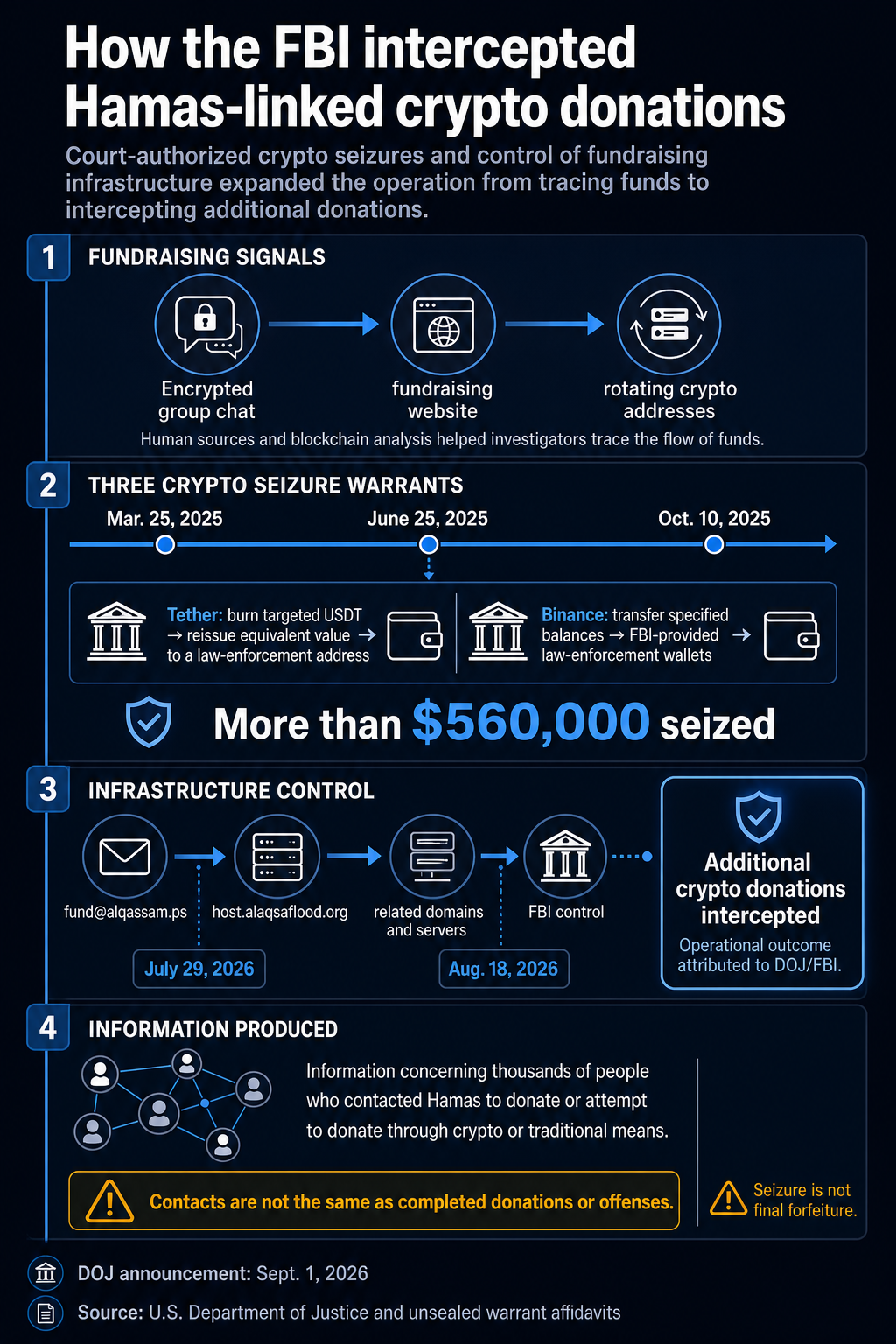
The FBI’s Albuquerque Field Office then worked with human sources to identify and seize domains and servers associated with the operation.
Control of that infrastructure changed the scope of the investigation. DOJ said agents were able to intercept crypto donations intended for Hamas and obtain additional information about people attempting to contribute.
That turned the case from a retrospective tracing effort into an active disruption operation.
DOJ said the broader investigation produced information about thousands of people who contacted Hamas online seeking to donate through cryptocurrency or traditional payment methods. The department did not specify how much of that information came directly from the seized servers.
The disclosure also does not establish that every person identified completed a donation or committed an offense.
However, this shows how several enforcement tools converged: blockchain tracing identified the money, court orders moved assets through centralized crypto providers, and infrastructure seizures gave investigators control over the fundraising channels themselves.
The post How FBI turned Hamas’ crypto fundraising pipeline into a law-enforcement trap appeared first on CryptoSlate.
HTTP error 429 on https://cryptoticker.io/en/feed/
Failed to fetch feed: https://cryptoticker.io/en/feed/
Failed to fetch feed.
Decrypt
The regulator argues that CME cannot challenge its approval of Kalshi’s Bitcoin perpetual contract without showing concrete financial harm.
Stocks and crypto rallied together after Governor Christopher Waller said he could back holding rates steady, with short sellers absorbing the brunt of the squeeze.
The company raised PlayStation prices for a second time in March, five weeks after the tariffs were struck down.
Kraken will list SoFiUSD and gain access to SoFi’s round-the-clock dollar settlement network, while Kraken Prime will execute trades for SoFi’s crypto customers.
Strategy sold millions in Bitcoin in the low $60k range and just rebought at $80k. Now they’re sharing the rationale behind the moves.
U.Today - IT, AI and Fintech Daily News for You Today
XRP ETFs outpace the token by 100% amid an abnormal liquidity mismatch in U.S. order books during a $27.2 million trading session.
U.S. Treasury Secretary Scott Bessent’s warning that the world is "awash in debt" has inadvertently made the case for Bitcoin.
Binance shares new safety measures on how users can protect their funds amid rising phishing attacks from scammers tricking victims.
Bitcoin and AI are the only assets needed for the next two decades: Pompliano $BTC.
XRP community takes notice as key ecosystem site gets redesign.
Blockonomi
TLDR:
- Ethereum saw accelerated August activity across Layer-2 upgrades, institutional adoption and ecosystem development.
- BlackRock expanded tokenization on Ethereum while Gnosis and Whitechain pursued Layer-2 transitions.
- Privacy tools and wallet infrastructure advanced through new applications, security features and post-quantum technology.
- DeFi growth continued as Aave, Morpho and Uniswap reached new deposit and trading milestones.
Ethereum development activity accelerated through August as builders across the ecosystem shipped new upgrades, launched fresh protocols, and expanded institutional integrations.
Layer-2 networks advanced their infrastructure, decentralized finance protocols recorded fresh deposit milestones, and privacy-focused applications gained new momentum.
The developments touched governance, tokenization, wallet security, and onchain gaming across the wider Ethereum landscape.
Institutional and Layer-2 Expansion Gain Momentum
Ethereum’s Layer-2 ecosystem saw structural changes this month. GnosisDAO approved a vote to move Gnosis Chain from an independent Layer-1 network to a ZK-proven Ethereum Layer-2 rollup.
The shift introduces synchronous composability, allowing applications on Gnosis and Ethereum to interact within a single transaction.
Institutional interest in Ethereum also expanded. BlackRock introduced its Select Treasury Based Liquidity Fund with a tokenized share class deployed on Ethereum mainnet.
The asset manager additionally began tokenizing share classes tied to its $311 billion European money market fund series on the network.
Arbitrum activated its ArbOS Elara upgrade, bringing more responsive transaction fees to Arbitrum One. The update also increased Stylus smart contract capacity fourfold and added new features for chains built on the Arbitrum stack.
Elsewhere, Whitechain, the network connected to the WhiteBit exchange ecosystem, announced plans to transition from an independent Layer-1 into an Ethereum Layer-2 built on the OP Stack.
Ethereum client teams also introduced the Platåberget testnet to prepare implementations ahead of the Glamsterdam network upgrade.
Privacy Tools and Wallet Infrastructure Advance
Privacy-focused development remained active across the Ethereum ecosystem in August. Aztec Network launched Alpha v5, a protocol upgrade that reduced private transaction proving times. The release also brought an initial group of privacy-preserving applications onto the network.
Privacy Boost introduced a new frontend application enabling users to send private transfers directly from connected wallets.
Separately, Privacy Pools launched onchain payroll support, letting employers issue recurring wage payments while keeping salary amounts and recipient addresses private.
Wallet security also advanced through new releases. MetaMask launched its Agent Wallet, an agentic tool built with spending limits, allowlists, and configurable risk profiles.
Freedom Factory opened presales for PQ1, an air-gapped hardware wallet that signs transactions using post-quantum cryptography through an Ethereum smart account.
Privacy-focused wallet Cloaked reported reaching $650,000 in deposits and $1 million in transaction volume during its first 90 days of operation.
Web3Privacy also released an updated Ethereum Privacy Ecosystem Mapping for 2026, documenting the network’s growing privacy tooling landscape.
DeFi Growth and Ecosystem Programs Continue
Decentralized finance activity on Ethereum showed continued expansion during the month. Aave v4 surpassed $525 million in deposits on Ethereum mainnet.
Morpho reported crossing $880 million in total deposits on Robinhood Chain within less than two months of going live, while also reaching $5.75 billion in deposits on Base.
Uniswap processed more than $1 billion in stock token volume on Robinhood Chain, contributing to over $20 billion in total volume since the platform’s July launch.
The exchange also launched v4 Permissioned Pools, a hook standard enabling allowlisted swaps for regulated assets while keeping the base protocol permissionless.
Coinbase launched tokenized stocks on Base for non-U.S. users, backed one-to-one by a regulated custodian and held in self-custody wallets.
Base separately opened applications for its Base Batches 004 accelerator program, supporting ten early-stage teams building on the network.
Ether.fi expanded its crypto neobank offering with tokenized stocks and portfolio-backed loans facilitated through Aave.
The Ethereum Foundation also launched an autoresearch challenge focused on post-quantum security, built alongside zkSecurity and EigenLabs, placing a machine-verified security problem on a public leaderboard for open contribution.
The post Ethereum Ecosystem Accelerates in August with Layer-2, DeFi and Privacy Growth appeared first on Blockonomi.
Quick Overview
- Nvidia completes acquisition of AI development platform Hugging Face in a $12.93 billion transaction
- Snowflake stock soars more than 20% following impressive quarterly results and upgraded guidance
- Broadcom forecasts AI chip revenue reaching $230 billion mark by 2028
- Hewlett Packard Enterprise upgrades revenue outlook after posting 33.7% growth in quarterly sales
- Crude oil climbs to six-week peaks amid heightened U.S.-Iran geopolitical tensions
Nvidia Completes $12.93 Billion Hugging Face Acquisition
Nvidia has finalized its purchase of Hugging Face, a leading open-source artificial intelligence model platform, in a transaction valued at approximately $12.93 billion.
This represents one of Nvidia’s most significant corporate acquisitions to date, signaling the chipmaker’s strategic expansion beyond hardware into AI software infrastructure and development tools.
Hugging Face has established itself as a cornerstone resource for developers globally, providing access to machine learning models, comprehensive datasets, and development frameworks. Company leadership has confirmed the platform will maintain its open-access philosophy following transaction completion.
This strategic move arrives at a critical juncture as several of Nvidia’s major clients pursue proprietary chip development initiatives. The Hugging Face acquisition positions Nvidia as an essential partner in AI development workflows, independent of underlying hardware architectures.
Snowflake Stock Rallies Over 20% on Strong AI-Driven Growth
Snowflake shares experienced a dramatic surge exceeding 20% following the data cloud provider’s announcement of better-than-anticipated quarterly performance and an upward revision to revenue projections.
The company posted second-quarter product revenue of $1.49 billion, representing 37% year-over-year expansion. Overall quarterly revenue reached $1.55 billion.
Management has increased its fiscal 2027 product revenue guidance to approximately $6.07 billion, a substantial upgrade from the previous projection of $5.84 billion.
Chief Executive Officer Sridhar Ramaswamy attributed approximately 50% of the company’s recent growth momentum to artificial intelligence-related products. This positions Snowflake advantageously compared to competitors viewing AI as disruptive to their business models.
Broadcom Projects AI Chip Revenue Could Reach $230 Billion by 2028
Broadcom has unveiled ambitious projections for its artificial intelligence semiconductor division, anticipating AI chip revenue will approach $115 billion during fiscal 2027 before potentially escalating to $230 billion in 2028.
Third-quarter AI semiconductor sales already totaled $16.7 billion. The company reported comprehensive quarterly revenue of $29.59 billion.
Broadcom has emerged as a critical supplier of customized AI processors for major technology corporations, offering these companies strategic alternatives to exclusive dependence on Nvidia’s hardware ecosystem.
Notwithstanding these robust figures, Broadcom’s stock declined following the release of near-term guidance that marginally underperformed analyst consensus estimates.
HPE Posts 33.7% Revenue Increase on Surging AI Infrastructure Demand
Hewlett Packard Enterprise delivered quarterly revenue totaling $12.21 billion, marking a 33.7% year-over-year expansion that exceeded Wall Street projections. The company posted adjusted earnings of $1.11 per share, surpassing analyst expectations.
HPE has elevated its fiscal 2026 revenue growth projection to a range between 34% and 37%, with additional expansion of 13% to 17% anticipated for fiscal 2027.
The company’s Chief Financial Officer indicated that current market demand for AI-optimized servers and networking infrastructure significantly exceeds available supply. Memory constraints and component shortages are creating fulfillment challenges for pending orders.
HPE has also broadened its strategic collaboration with Oracle, agreeing to provide networking equipment supporting Oracle’s artificial intelligence data center expansion initiatives.
Crude Oil Reaches Six-Week Peak Amid Escalating Iran Tensions
Brent crude advanced approximately 1.7% to reach $97.29 per barrel. West Texas Intermediate increased roughly 2.2% to $93.04, propelling oil prices to their highest levels in six weeks.
The price acceleration followed renewed U.S. military operations targeting Iranian interests and mounting concerns regarding potential disruptions through the Strait of Hormuz, a critical conduit for international petroleum shipments.
Elevated oil prices may amplify fuel and logistics expenses across the economy. This development could contribute to inflationary pressures and influence Federal Reserve deliberations on monetary policy adjustments.
The post Nvidia (NVDA) Acquires Hugging Face for $13B While Broadcom Projects $230B AI Chip Revenue appeared first on Blockonomi.
TLDR
- SoFi and Kraken formed a partnership linking banking services, dollar settlement, stablecoins, and crypto trading infrastructure.
- Kraken’s parent company, Payward, will join the SoFi Exchange Network for 24/7 U.S. dollar transfers and liquidity management.
- Kraken will list SoFiUSD, giving the bank-issued stablecoin access to retail, professional, and institutional users.
- SoFi will use Kraken Prime as an additional liquidity source for crypto trades made through its platform.
- The companies said the partnership could later expand into payments, treasury services, lending, and other digital asset products.
SoFi and Kraken have formed a new partnership that connects banking, dollar settlement, stablecoins, and crypto trading. The deal gives Kraken access to SoFi’s financial network while SoFi gains another source of crypto liquidity for customer trades. The agreement links two firms that are expanding their roles across digital finance.
The arrangement also gives both firms a wider role in digital finance as banks, fintechs, and crypto platforms compete to combine payments, trading, and settlement services under one platform.
SoFi Opens Banking Network to Kraken
Payward, Kraken’s parent company, will join the SoFi Exchange Network, known as SEN. The network will let Kraken’s institutional clients move U.S. dollars and manage liquidity at any time, including outside normal banking hours.
SoFi designed SEN to support faster dollar transfers for companies that operate around the clock. The service gives businesses another way to settle funds without waiting for standard bank schedules. Kraken can now connect its institutional activity directly with those banking rails.
Kraken will also list SoFiUSD, SoFi’s dollar-backed stablecoin, on its platform. The listing will make the token available to Kraken’s retail, professional, and institutional users across its trading network.
At the same time, SoFi will use Kraken Prime as another source of liquidity for crypto trades made by its customers. The arrangement can help SoFi access additional market depth when customers buy or sell digital assets through its app.
Kraken Broadens Access to Financial Services
The partnership follows SoFi’s wider return to crypto services. The company recently added crypto trading to its app and launched SoFiUSD. These products give the bank a direct role in consumer crypto access and blockchain-based dollar transfers.
SoFi has also expanded its business banking services. In April, the company launched Big Business Banking, which combines enterprise banking with digital asset services. SEN supports this strategy by giving businesses access to a dollar transfer system that operates beyond regular banking hours.
Kraken has also moved beyond basic crypto trading. Its Prime division serves institutional clients and provides trading services, liquidity access, and other tools. The SoFi agreement connects those services with a regulated bank’s payment and settlement network.
Both companies said the relationship could expand into payments, treasury services, lending, and other digital asset products. The current deal starts with banking access, stablecoin listing, and crypto liquidity, while leaving room for more services later.
The post Kraken Joins SoFi Network as Crypto Push Deepens appeared first on Blockonomi.
Key Takeaways
- Snowflake crushed Q2 expectations with earnings of 62 cents per share versus 45 cents forecast and revenue of $1.55B against $1.48B consensus
- Shares rocketed 22% in after-hours trading and climbed above 23% to $376 in pre-market sessions
- CNBC’s Jim Cramer highlighted SNOW as poised for a significant rally after the quarterly report
- The company’s AI coding assistant CoCo expanded to 9,100 accounts, adding more than 2,000 users in the quarter
- Investor Michael Burry countered the optimism, warning Snowflake is significantly overpriced and faces cybersecurity threats
Snowflake delivered an impressive fiscal Q2 performance, surpassing analyst projections across key metrics. The cloud data platform reported revenue of $1.55 billion, representing a 35% year-over-year increase and exceeding the Street’s $1.48 billion estimate. Adjusted earnings per share reached 62 cents, substantially higher than the 45-cent consensus forecast.
Snowflake Inc., SNOW
Following the announcement Wednesday after market close, SNOW shares skyrocketed 22% during extended trading. By Thursday’s pre-market session, the stock had advanced 23.27% to reach $376 per share. If sustained, this would represent the fourth-largest single-session jump since the company’s 2020 initial public offering.
The company’s product revenue segment generated $1.49 billion in Q2, reflecting 37% growth from the prior-year period. Snowflake’s net loss contracted to $191.7 million, or 55 cents per diluted share, compared with a $297.9 million deficit in the year-ago quarter.
Looking ahead to Q3, Snowflake projected product revenue of $1.59 billion, topping the analyst consensus of $1.50 billion. Executives also boosted the full fiscal year product revenue outlook to $6.07 billion from the previous $5.84 billion target issued in May.
Additionally, the company elevated its adjusted operating margin projection to 14.5%, an improvement from the 13.5% guidance provided three months earlier.
CoCo AI Assistant Gains Traction
A significant highlight from the earnings call centered on CoCo, Snowflake’s artificial intelligence coding assistant. The platform now serves 9,100 accounts, representing growth of more than 2,000 accounts throughout the quarter. Company leadership emphasized CoCo as a critical catalyst for revenue expansion and deeper enterprise adoption.
CNBC’s Jim Cramer featured Snowflake on his Mad Money program, declaring the stock positioned for a substantial upward movement. He emphasized that Snowflake provides businesses with an efficient method to purchase on-demand computing resources. Cramer’s CNBC Investing Club maintains a position in Broadcom, though he expressed greater caution regarding that holding after its Q4 outlook fell marginally short of forecasts.
Burry Raises Valuation Concerns
Not all investors share the enthusiasm. Michael Burry, the hedge fund manager famous for predicting the 2008 financial crisis depicted in “The Big Short,” described Snowflake as “very overvalued” in a recent Substack commentary. He cautioned that the company confronts an “existential threat” should data lakes prove increasingly susceptible to cyberattacks as artificial general intelligence and quantum computing technologies advance.
Burry further suggested that if corporations choose to internalize AI development and maintain data on proprietary infrastructure, demand for third-party platforms like Snowflake might diminish.
Despite Burry’s skepticism, Wall Street analysts remain overwhelmingly bullish. SNOW holds a Strong Buy consensus rating based on 23 Buy recommendations and three Hold ratings. The average analyst price target stands at $368.68, suggesting approximately 20.6% upside potential from pre-earnings trading levels.
Prior to Wednesday’s market close, SNOW had already climbed 39% year-to-date, significantly outperforming the S&P 500’s roughly 12% gain over the same period.
The post Snowflake (SNOW) Stock Soars 22% on Strong Q2 Earnings Beat—Wall Street Weighs In appeared first on Blockonomi.
TLDR
- Australia has set Sept. 30 as the deadline for affected crypto firms to meet ASIC’s licensing conditions.
- ASIC’s temporary no-action relief ends after the deadline, exposing non-compliant firms to enforcement from Oct. 1.
- Penalties could reach 10% of annual turnover for businesses operating without required financial services authorization.
- More than 45 crypto-related license applications have reached ASIC since its guidance update in October 2025.
- Australia’s broader Digital Assets Framework starts April 9, 2027, bringing crypto and tokenized custody platforms under licensing rules.
Australia has given crypto businesses until Sept. 30 to meet licensing conditions tied to regulatory relief. The Australian Securities and Investments Commission said firms that miss the deadline could face enforcement from Oct. 1. ASIC said affected companies must apply for an Australian Financial Services license, change an existing license, or join arrangements with licensed firms. Businesses operating without required authorization may breach financial services law and face civil or criminal penalties.
Australia Tightens Crypto Licensing Rules
ASIC’s no-action position gave crypto companies temporary protection while they prepared for licensing. The regulator extended that relief from June 30 to Sept. 30 and widened it to cover some authorized representatives and intermediary arrangements.
Companies that require an Australian Market Licence or a Clearing and Settlement facility licence must also contact ASIC by the deadline. They must notify the regulator and hold a pre-application meeting by Sept. 30 to remain within the relief conditions.
From Oct. 1, ASIC may act against businesses that need a licence but fail to meet the relief terms. The regulator said penalties can include fines reaching 10% of annual turnover, depending on the breach.
ASIC has received more than 45 applications for crypto-related authorizations since updating its INFO 225 guidance in October 2025. The guidance explains when digital assets and related services fall under Australia’s existing financial services laws.
New Digital Asset Framework Arrives in 2027
Australia is preparing for a wider legal framework for digital asset businesses. The Corporations Amendment (Digital Assets Framework) Act 2026 will take effect on April 9, 2027, and bring crypto and tokenized custody platforms under financial services licensing rules.
ASIC said many companies may still need current financial services authorizations after the new framework starts. The regulator plans to release more standards and guidance before the law takes effect, giving businesses future compliance details.
The Sept. 30 deadline creates a near-term compliance requirement for firms that relied on ASIC’s temporary position. Companies must now decide whether to seek their own license or operate through an approved licensed entity.
The move forms part of Australia’s broader effort to place crypto services within existing financial regulation before the 2027 framework begins. ASIC’s warning makes clear that temporary relief will not protect companies that fail to complete required steps by the deadline.
The post Australia Tightens Crypto Rules as Sept. 30 Deadline Looms appeared first on Blockonomi.
CryptoPotato
Bitcoin has gained almost 23% over the past month, but a few choppy sessions briefly dragged the asset below $76,500. BTC has since stabilized above $77,700 following a minor 1.4% surge on Thursday.
The latest uptick came mainly from short covering rather than a fresh increase in leverage, according to QCP Capital, as markets continued to face a firm Federal Reserve stance.
Fragile Positioning?
Kevin Warsh reinforced the Fed’s focus on maintaining a 2% PCE inflation target, while headline PCE remains at 3.7%. This leaves little visible support for near-term rate cuts. Treasury long-end buybacks were doubled to $4 billion quarterly, but QCP said the amount represents only 0.013% of the $31.5 trillion Treasury market, which points to liquidity support rather than a policy pivot.
Heavy long-dated investment-grade issuance is also adding pressure, as technology companies account for 38% of 10-year-plus supply. Additionally, ETF inflows near the 95th percentile indicate genuine spot demand, although MSTR’s Bitcoin accumulation was funded through equity issuance.
“With policy guidance scarce and liquidity narrow, is this conviction or fragile positioning?”
Meanwhile, analyst NoName said that Bitcoin’s next major move could depend on whether it can close above $83,000. The analyst is also watching a CME futures gap above the current price and sees it as an important level separating a genuine reversal from another relief rally. A daily close above the level, supported by strong spot volume, would be needed to confirm a new uptrend.
Without that confirmation, NoName said that the recent bounce was a retest of previous supply. They warned that a rejection at $83,000 followed by a break below $74,000 could send the crypto asset toward $50,000-$55,000.
CryptoPatel also flagged the exact level and said that Bitcoin could face further losses if it fails to reclaim it with a higher-timeframe candle close. In that scenario, the analyst expects potential declines toward $70,000, $65,000, and $60,000. If the bearish market structure remains intact, the crypto asset could eventually fall toward the $50,000-$40,000 range. However, a higher-timeframe close above the $83,000 level would invalidate the bearish setup.
Another market watcher, Rain, noted that Bitcoin is starting to lose the demand support that helped the August rally.
The Case for Further Upside
Not everyone sees further downside ahead. Doctor Profit, for one, reiterated his stance that the bear market is over. He had previously stated that BTC broke out above key resistances and entered the Soft Bull Market, which he expects to turn into a full bull market escalation.
“Many desperate investors that wish for a lower Bitcoin price, some even call for a new low, and others say the bear market isn’t over. In fact, and I say it with my full conviction, I consider the bear market as over!”
More on the current market state can be found in our latest video below.
The post Bitcoin (BTC) Rally Driven by Short Covering, Not Fresh Leverage: QCP appeared first on CryptoPotato.
The cryptocurrency market has posted a slight resurgence over the past 24 hours, with ADA and SUI among the best performers.
Certain factors suggest that the uptrend may be just starting, while numerous analysts have been making bullish bets lately.
ADA’s Potential
Cardano’s native token has jumped by 6% on a daily scale, reclaiming the $0.20 psychological level. What’s more, the popular analyst Ali Martinez revealed that the asset’s Tom DeMark Sequential indicator has flashed a buy signal.
He noted that on previous occasions, such a development has identified price bottoms and has been followed by double-digit increases. “Now the indicator is signaling another rebound for ADA could be underway,” Martinez concluded.
Another positive sign is the recent exchange net flow. Data show that over the past several days, outflows have exceeded inflows, suggesting that investors have shifted from centralized platforms to self-custody, thereby reducing immediate selling pressure.

X user Sjuul | AltCryptoGems said ADA has truly surprised him this cycle after printing “very strong higher highs, one after the other in a perfectly bullish fashion.”
“Probably not a coin I would fade in the coming months,” he added.
The Moon Show also chipped in, arguing that ADA “survived the deep retrace.” The X user believes that a firm move above the $0.205 level would mean that recovery “starts looking a lot more serious.”
SUI’s Case
As of press time, SUI trades at approximately $0.76, translating into a 7% increase for the day. Similar to ADA, the token might be gearing up for a further uptick, at least given another insight from Martinez.
He claimed that SUI’s TD Sequential has flashed a buy signal on the asset’s daily chart, hinting that the recent correction could be nearing its end.
“This indicator points to a potential 1–4 daily candlestick rebound or the beginning of a new bullish countdown. I’m watching for the rally to begin,” Martinez said.
Other popular analysts who have given their two cents on the cryptocurrency lately include Michael van de Poppe and Celal Kucuker. The former noted that SUI has outperformed Bitcoin, opining that “the uptrend has started.”
For their part, Celal Kucuker claimed the asset “is making a move,” envisioning a price explosion to as high as $10 in a bull market. The X user also suggested that September could be a good month for SUI in case “OTC flows are any indication.”
The post Cardano (ADA) and Sui (SUI) Flash Buy Signals: What Are Their Next Targets? appeared first on CryptoPotato.
After a few days of suppressed price action, the crypto market is on the move again, with bitcoin leading the pack with a surge past $80,000 for the first time in a week.
Most altcoins followed the sharp uptick, leading to more than $140 million in shorts getting wrecked in the past hours alone.

It was just 24 hours ago that the primary cryptocurrency struggled to hold the $77,000 support and dipped to a 10-day low of $76,200 amid the escalating tension in the Middle East.
However, the asset rebounded successfully in the following hours, as reported earlier today, and quickly reclaimed the $77,000 and $78,000 levels. The past hours or so have been even more impressive, as bitcoin just soared past $80,000 for the first time since last Friday, when it was rejected and driven south to $77,000 after Kevin Warsh’s hawkish speech at Jackson Hole.
Many altcoins have joined the ride, posting notable 1-hour and 24-hour gains. ETH is up to almost $2,500 as of now after a 2.6% surge in the past 60 minutes and a 4.4% pump since this time yesterday. BNB has rocketed past $720, while XRP has gained 9% on a daily scale (and 4.3% in the past hour alone).
This price volatility has harmed overleveraged traders. Data from CoinGlass shows that the hourly wrecked positions have risen to $157 million, with more than $142 million coming from shorts. On a daily scale, the total liquidations are over $400 million, and shorts are responsible for $315 million.
Nearly 110,000 traders have been wiped out in the past day, with the single-largest liquidation occurring on Binance, totaling more than $5.2 million.

The post Over $140M in Shorts Wrecked in an Hour as BTC, ETH, XRP Suddenly Explode appeared first on CryptoPotato.
Bitcoin is holding above $78K after a sharp recovery from the $60K area, but the latest price action suggests that buyers have yet to secure a decisive breakout above the upper resistance levels. At the same time, the exchange whale ratio has risen significantly, adding a potentially bearish supply-side signal to the otherwise constructive technical structure.
Bitcoin Price Analysis: The Daily Chart
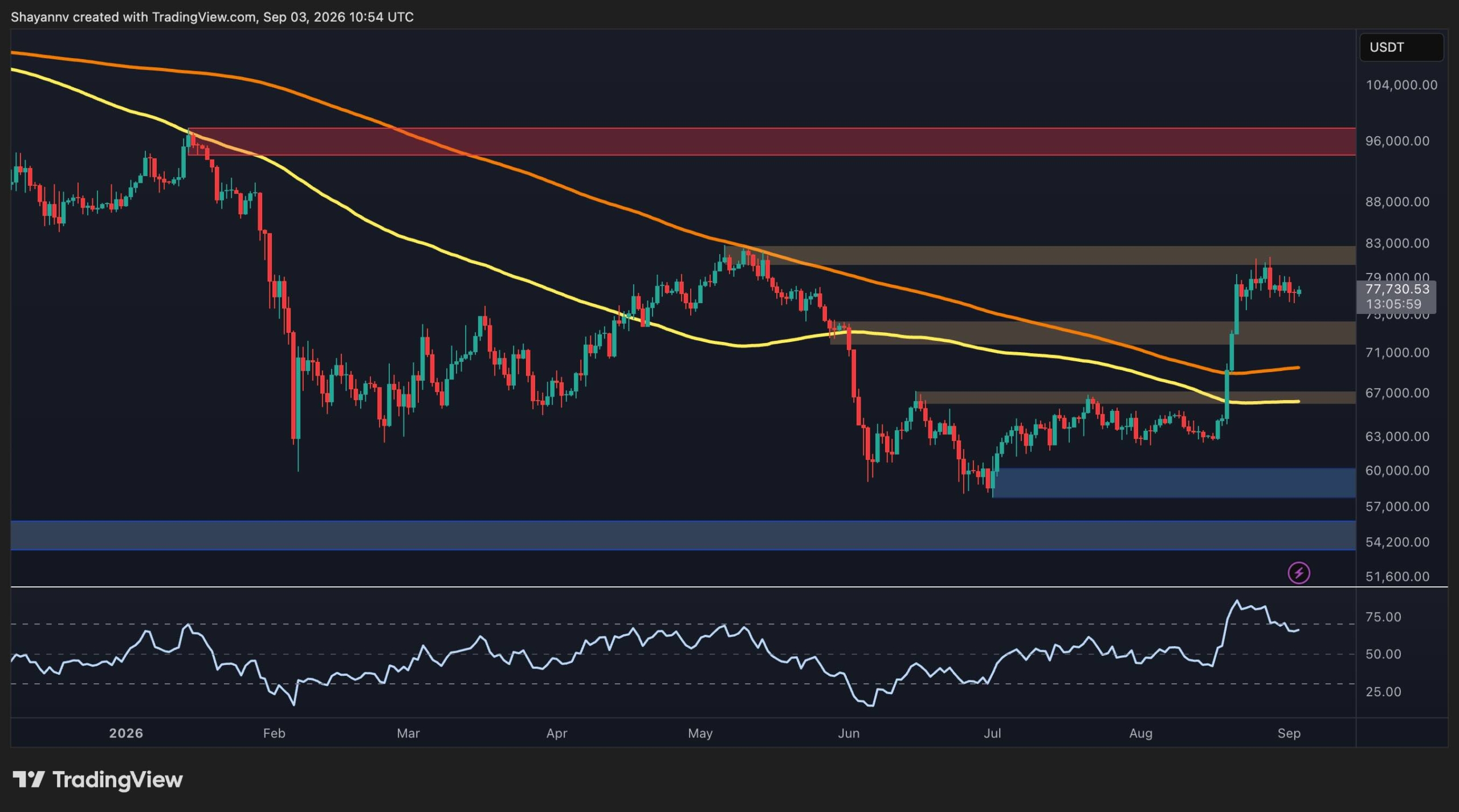
The daily chart shows a significant structural improvement following the recovery from the $60K support zone. BTC broke above the $67K area and subsequently reclaimed the $72K zone, which had previously acted as resistance. The price is now trading around $78.5K, comfortably above both major moving averages shown on the chart.
The short-term challenge is the $82K resistance zone. This area coincides with the recent swing highs, making it an important barrier for the buyers. A daily close above this level would strengthen the recovery structure, as it would create a higher high after months of downtrend. Therefore, this potential breakout could open the way toward the $95.6K resistance region.
Momentum has also improved considerably. The daily RSI climbed from oversold territory during the June bottom and is now just below the overbought territory. However, it has started to turn lower after reaching elevated levels, suggesting that momentum is cooling rather than accelerating.
On the downside, the $72K zone is the first major support to monitor. Holding above it would keep the broader recovery intact, while a deeper correction could bring the $67K region back into focus.
Therefore, the daily structure remains cautiously constructive, but BTC needs to clear $82K to confirm that the recent recovery is evolving into a stronger bullish continuation rather than another rejection from resistance.
BTC/USDT 4-Hour Chart
The 4-hour chart provides a more cautious picture. BTC has been moving inside a falling wedge-like structure since reaching the $82K area in late August. The upper trendline has repeatedly capped advances, while the lower boundary currently sits around $76K.
BTC is now testing the upper boundary of this structure once again. A successful breakout above this resistance line, which is currently near the $78K mark and declining, would be the first indication that buyers are attempting to regain short-term control.
A potential breakout would lead to another push toward the $82K area, which, as mentioned, is currently the most important resistance level on the daily timeframe.
Conversely, failure to break the wedge and a move below $76K could trigger a deeper correction toward the $72K-$74K area, which has turned into support after getting broken to the upside earlier. Holding this zone would be critical for keeping the recovery alive, as a breakdown could undo all the positive price action BTC has shown over the past couple of weeks.

On-Chain Analysis
The exchange whale ratio measures the proportion of exchange inflows associated with the largest transactions, making it useful for assessing whether large holders are becoming more active in sending BTC to exchanges. A rising reading can indicate increased potential selling pressure, although it does not necessarily mean that whales are immediately selling.
The chart shows the 30-day moving average of Bitcoin’s exchange whale ratio rising sharply during the latest price recovery. It has moved back toward the 0.32 area, which is nearly the highest level visible on the chart, while BTC is trading around $78.5K.
This development is worth monitoring. Bitcoin has recovered substantially from its June lows, but the increasing whale ratio suggests that large transactions toward exchanges have also become more prominent, which could unbalance the supply and demand equation in favor of the sellers. If this elevated reading persists while BTC struggles to break above the $80K-$82K area, it could reinforce the case for a rejection or consolidation.
On the other hand, a decisive breakout above $82K accompanied by a subsequent decline in the whale ratio would provide a more constructive confirmation that the increased whale activity is not translating into significant distribution and that there is enough fresh demand to absorb whales’ distribution.

The post BTC Price Analysis: Bitcoin Rebounds From $76K but Crucial Resistance Remains Above $80K appeared first on CryptoPotato.
XRP is consolidating after its sharp late-August breakout, with the price now hovering close to $1.40. The charts suggest that the broader structure has improved considerably, but the token remains trapped beneath a major resistance zone. A breakout from the current corrective structure could determine whether the recent rally resumes or develops into a deeper retracement.
Ripple Price Analysis: The USDT Pair
On the daily timeframe, XRP has undergone a significant structural shift. After spending several months in a broad downtrend, the asset broke decisively higher in late August, surging from around $1.00 to a spike near $1.70. This move also pushed XRP above the previously declining long-term trendline and the major moving averages visible on the chart.
The subsequent pullback has brought XRP toward the $1.30 area, which is currently highlighted as an important demand zone at a clear bullish imbalance area. Meanwhile, the still price remains above the 100-day and 200-day moving averages, suggesting that the broader recovery structure is still intact despite the recent correction.
Above the current price, the $1.5 region represents the main resistance zone. It previously acted as a significant supply area and has already rejected XRP several times over the past year. Therefore, a daily close above this zone would significantly strengthen the bullish case and could pave the way toward the $2 region, which is an important psychological barrier for Ripple.
The momentum picture has also cooled substantially from the extreme levels reached during the initial breakout. The daily RSI has fallen below 75, relieving overbought conditions while remaining above the neutral 50 area. This is generally constructive because XRP has been able to consolidate without completely losing its momentum.
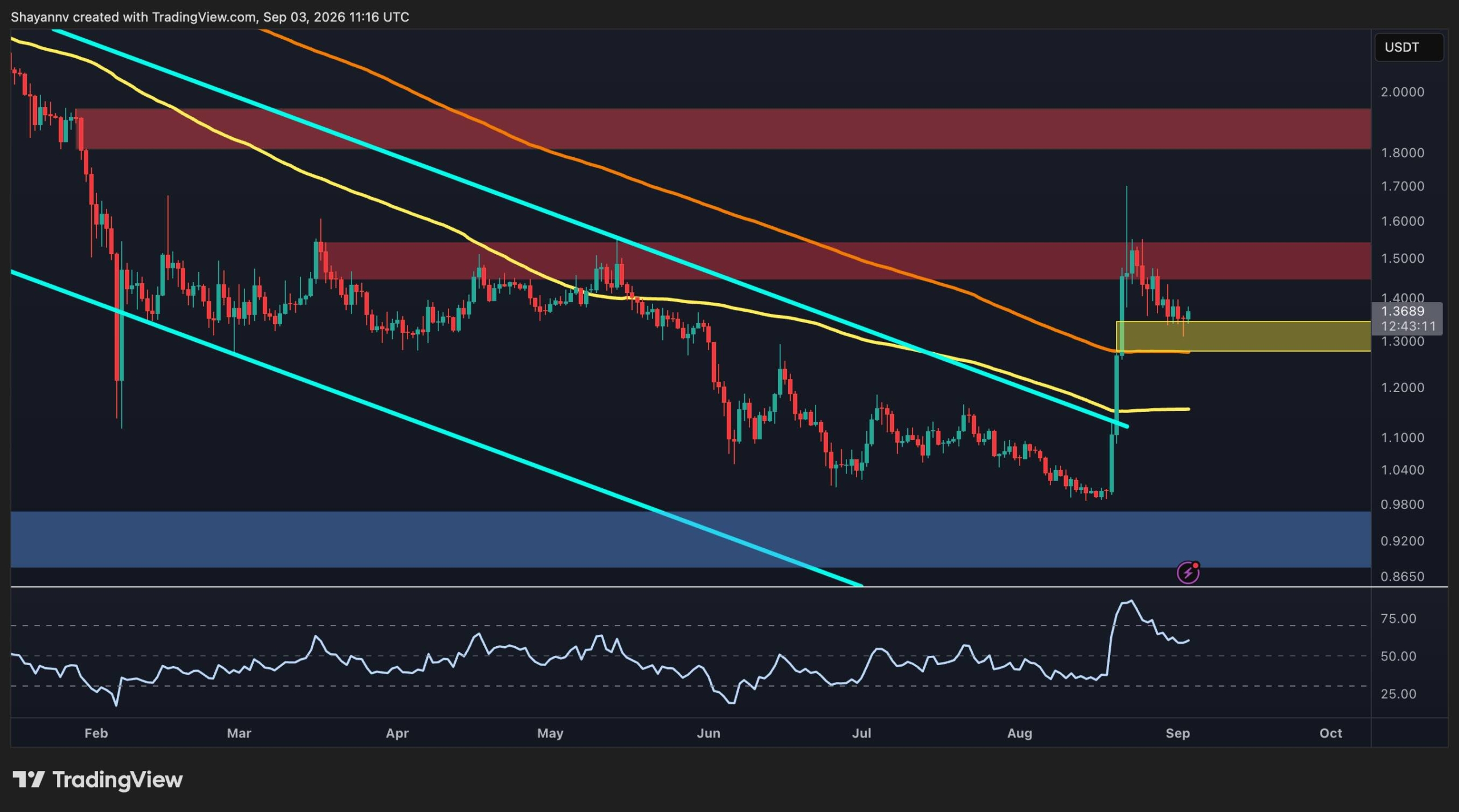
The 4-Hour Chart
The 4-hour chart provides a clearer view of the current correction. Since the late-August spike, XRP has been forming a descending structure defined by two downward-sloping trendlines. The price is currently near $1.37 and appears to be testing the upper boundary of this formation.
This makes the current area particularly important. A breakout above the descending resistance line, followed by a move through the $1.5 zone, would provide an initial signal that the corrective phase may be ending.
On the downside, the highlighted $1.25 bullish order block is the immediate support region. As long as XRP continues to hold this zone, the descending structure could eventually resolve to the upside. A breakdown below it, however, would increase the probability of a deeper retracement toward the lower order block around $1.1.
Overall, XRP is approaching a decision point. Holding $1.25 and breaking above the descending trendline would favor continuation above $1.5. Conversely, losing the $1.25 area would invalidate the immediate bullish setup and could send the price back toward the base of the recent rally.

The post XRP Price Analysis: Can XRP Resume Its Rally After Defending Key Support? appeared first on CryptoPotato.