Cryptocurrency Posts
Crypto Briefing
El Salvador's economic reforms and improved security enhance investor confidence, signaling potential for sustained growth and poverty reduction.
The post IMF reports better-than-anticipated growth performance in El Salvador appeared first on Crypto Briefing.
The tightening Texas Senate race signals potential shifts in political dynamics, challenging traditional party strongholds and voter alignments.
The post Texas Senate race tightens as Talarico, Paxton face off appeared first on Crypto Briefing.
The SEC's inquiry into novel ETFs could reshape regulatory frameworks, impacting innovation and market dynamics in the financial sector.
The post SEC seeks public opinions on novel ETF funds as industry races to innovate appeared first on Crypto Briefing.
Anthropic's substantial pre-IPO credit facility signals strong market confidence, potentially boosting investor interest and IPO valuation expectations.
The post Anthropic nears $15B pre-IPO credit facility appeared first on Crypto Briefing.
Coinbase's move could reshape US trading by enabling 24/7 leveraged stock derivatives, challenging traditional market hours and regulations.
The post Coinbase takes regulatory step for leveraged stock trading appeared first on Crypto Briefing.
Bitcoin Magazine
Bitcoin Magazine

Bitcoin Bear Market May Not Yet Be Over, Says Fidelity
Bitcoin may be rallying but that doesn’t mean the bear market is over. Not yet, anyway.
A new report from asset manager Fidelity said that while bitcoin was behaving like it did in previous cycles, it could still hit a bottom in November.
Bitcoin started rallying in mid-August after the U.S. Treasury Department said it would more than double the size of its government debt repurchases. The asset’s price recently stood at close to $81,639, up nearly 30% over a 30-day period.
Some have since argued that bitcoin is out of its bear market. The coin touched a record high in October last year, hitting $126,080.
“Given bitcoin’s recent performance, the bottom could already have occurred in July,” Chris Kuiper, Vice President of Research at Fidelity Digital Assets, wrote.
“It could also drop again to make another new low in November or later,” he continued, adding that bitcoin cycles have historically not been precisely four years long, so they “aren’t reliable for timing the market.”
Throughout most of June and July, bitcoin’s volatility was particularly muted, and the coin traded below $65,000.
But that all changed in August after the Treasury Department’s announcement, which has since brought the so-called debasement trade back in the picture again.
To get an idea of where bitcoin moves next, Kuiper argued that investors should pay attention to what happens with the crypto Clarity Act. Proponents argue it could provide “greater regulatory certainty and support continued innovation in the U.S. digital asset ecosystem,” he wrote.
President Donald Trump in August urged lawmakers to get the long-awaited crypto market structure bill over the line, helping spur bitcoin’s run. The president called the draft “very, very powerful” after meeting with crypto industry bigwigs at the White House.
The digital asset industry has long called for clear rules on how regulators should treat bitcoin, stablecoins and other cryptocurrencies.
Lawmakers will vote on the bill this month.
This post Bitcoin Bear Market May Not Yet Be Over, Says Fidelity first appeared on Bitcoin Magazine and is written by Mathew Di Salvo.
Bitcoin Magazine

Bitcoin-Gold Correlation Hits Six-Year High as Debasement Fears Mount
Bitcoin’s correlation with gold is at its highest in six years as investors increasingly look for ways to hedge against currency debasement.
That’s according to a new report from Bitwise, which this week pointed out that the precious metal and leading cryptocurrency are trading in lockstep because the U.S. government has “materially intervened in the macro picture.”
Bitcoin started surging last month, after the U.S. Treasury Department said it would more than double the size of its government debt repurchases. The coin had its best run in three years and third best August ever.
JUST IN: Bitcoin's correlation with gold hit a six-year high, according to Bitwise
— Bitcoin Magazine (@BitcoinMagazine) September 3, 2026
"The last time it was this high was 2020, after the Covid stimulus."pic.twitter.com/fHtQUlR9Ol

“The last time the bitcoin-gold correlation was that high was in 2020, following the rounds of fiscal and monetary stimulus during the Covid crisis,” Bitwise’s European Head of Research, André Dragosch, wrote.
He added that bitcoin’s correlation with the stock market dropped to a one-year low, “implying some kind of decoupling between hard assets and the stock market.”
Bitcoin has been pushed as “digital gold” for years but has sometimes traded with tech stocks as a “risk-on” asset.
But the so-called debasement trade — when investors buy an asset as a way to hedge against a currency losing value — was a much-talked about investment strategy last year and appears to be back.
The reason is down to the government intervening in markets, Dragosch argued. When the Treasury said it would try to rein in long-term borrowing costs, the dollar’s value slid and sent investors flooding back to gold — and bitcoin.
The Treasury the same week also said the U.S. public debt exceeded $40 trillion for the first time. Excessive debt also undermines confidence in the dollar.
“Investors are no longer asking whether to hedge currency debasement with gold or bitcoin. They’re simply hedging with both,” the report added.
“Bitcoin spent its first fifteen years being priced as a risk asset. If this correlation trend with gold holds, the next fifteen may look very different.”
The leading cryptocurrency again rallied this week, and was recently trading for close to $81,438 after jumping nearly 6% over a 24-hour period.
This post Bitcoin-Gold Correlation Hits Six-Year High as Debasement Fears Mount first appeared on Bitcoin Magazine and is written by Mathew Di Salvo.
Bitcoin Magazine
French Hill Eyes Bipartisan Path for Clarity Act Ahead of September Vote
U.S. congressman French Hill expressed the importance of bipartisan support to get the long-awaited crypto market structure bill, the Clarity Act, over the line before the midterms.
The lawmaker told Fox Business Thursday that Democrats and Republicans have come to “narrow their differences in getting the bill drafted.
Pro-crypto lawmakers were hoping the Clarity Act passed before Congress departed for August recess. After a delay, a vote will now go ahead on September 15.
“Can Democrats work with Republicans and make sure America leads the world in distributed ledger technology and financial services?” Hill said.
“This one remaining significant issue is the ethics provision, and that is best solved by passing the legislation because everybody — no matter what family they belong to, the Trumps or not — would then be under a regulatory framework fully scrutinized by the United States government in commodity and securities and banking regulators,” he added.
The Clarity Act was first introduced by Hill, the House Financial Services Chairman, last year.
Crypto companies have long called for clear regulations for the industry. The Clarity Act drafts a framework to formally divide oversight between regulators, distinguishing which digital assets are securities, commodities or stablecoins.
The House of Representatives passed the bill last July but it has been stalled this year, mostly because the banking lobby clashed with crypto companies over paying customers stablecoin yield.
A new draft tackling the issue of ethics started circulating in July. It bans government officials from promoting or making money from crypto — something Democrats have criticized the Trump family for doing.
A group of Democrats said the bill fell short and wanted amendments. Some were accused of deliberately holding it back by Republicans like Cynthia Lummis.
Some have praised the bipartisan work that has already gone into the bill, namely Coinbase, America’s biggest crypto exchange. The company’s Chief Policy Officer, Faryar Shirzad, said in July that while some Democratic lawmakers were holding back the long-awaited legislation, younger Democrats wanted to pass it.
President Donald Trump in August said that in order for the U.S. to remain the “undisputed leader in Bitcoin and crypto,” lawmakers had to pass the “very, very powerful legislation.”
This post French Hill Eyes Bipartisan Path for Clarity Act Ahead of September Vote first appeared on Bitcoin Magazine and is written by Mathew Di Salvo.
Bitcoin Magazine

Kraken and SoFi Link Crypto Trading To Banking Rails
Payward, the parent company of crypto exchange Kraken, and fintech company SoFi Technologies on Thursday announced a deal to route SoFi customers’ crypto orders through Kraken’s institutional trading platform and list SoFi’s stablecoin on the exchange.
Under the agreement, SoFi will send its digital asset order flow to Kraken Prime, Kraken’s prime brokerage arm, which launched in 2025.
Rather than filling trades against a single order book, Kraken Prime uses smart order routing to compare prices and depth across multiple venues and execute where the fill is best. SoFi said customers will see no change to the app itself.
Payward is also joining the SoFi Exchange Network, the bank’s real-time settlement system, and will list SoFiUSD — SoFi’s bank-issued stablecoin — on Kraken.
Kraken Prime’s institutional and business clients will in turn gain access to SoFi’s business banking services and round-the-clock fiat settlement. The companies said qualified custody services would follow later.
SoFi holds a national bank charter and has 15.8 million members. The partnership is the latest in a series of tie-ups between Kraken and established financial firms, following arrangements with Deutsche Börse on foreign exchange and derivatives infrastructure, Nasdaq on a tokenized equities gateway, and Franklin Templeton on tokenizing exchange-traded funds.
The news comes after SoFi, a purely digital lender, last year became the first nationally chartered bank in the United States to launch crypto services for retail customers.
The company’s new SoFi crypto platform allows members to buy, sell and hold bitcoin directly within their bank accounts.
Kraken — like other crypto exchanges — is pushing into the traditional finance world, allowing users to trade stocks, bonds and other assets. The company has sold its app as a “primary account for everything.”
This post Kraken and SoFi Link Crypto Trading To Banking Rails first appeared on Bitcoin Magazine and is written by Mathew Di Salvo.
Bitcoin Magazine
Bitcoin Rallies Over $81,000 — And Brings BTC-Related Stocks With It
Bitcoin surged on Thursday — but industry-related stocks rose even quicker as a rally that started weeks ago again picked up steam.
The price of the biggest cryptocurrency hit as high as $81,282 on Thursday morning in New York, a nearly 3% increase over a 24-hour period.
Over the past 30 days, the bitcoin price has surged over 23% following both positive regulatory news and announcements from the U.S. Treasury Department regarding debt buybacks.
JUST IN: $80,139 Bitcoin
— Bitcoin Magazine (@BitcoinMagazine) September 3, 2026
But other major crypto company stocks rose quicker. Bitcoin treasury Strategy (NASDAQ: MSTR) was trading more than 13% higher on Thursday. The company on Monday resumed bitcoin buys after a 10-week pause to reshuffle its cash balance sheet.
America’s biggest crypto exchange, Coinbase, also saw its stock shoot up. Nasdaq-listed COIN was trading 11% higher in the same time period.
Elsewhere, bitcoin mining companies had a boost too. Top public companies in the space — including the Nasdaq-listed HIVE Digital, MARA, and CleanSpark — all were up on Thursday.
HIVE Digital led the pack with a 13% jump, while MARA Holdings was up more than 10% on the day.
Clean energy bitcoin miner CleanSpark jumped by 9%; IREN, which is slowly phasing out its mining operations to focus on AI-compute, was up by 4%.
Bitcoin had a phenomenal run in August — its third best such month in its history — after the U.S. Treasury Department said it would more than double the size of its government debt repurchases.
The announcement, aimed to tame surging yields not seen in nearly 20 years, hurt the dollar but has benefited non-yielding assets like bitcoin and gold.
Soon after, President Donald Trump urged lawmakers to get the long-awaited crypto Clarity Act over the line — digital asset legislation the industry has long called for.
Investors rushed back into bitcoin exchange-traded funds as a result, throwing over $2.8 billion at the vehicles — the most since October, when the coin hit a new all-time high.
Bitcoin had spent a lot of the year trading below $80,000 per coin, with June and July mostly below $65,000. The coin hit a new record of $126,080 in October. It is now nearly 40% below that number.
This post Bitcoin Rallies Over $81,000 — And Brings BTC-Related Stocks With It first appeared on Bitcoin Magazine and is written by Mathew Di Salvo.
CryptoSlate
Remixpoint sold all of its Ethereum, Solana, XRP, and Dogecoin holdings, leaving Bitcoin as its only cryptocurrency asset.
The Japanese company generated ¥878.8 million, or about $5.5 million, from the Sept. 1 sales and booked a net gain of about ¥117.8 million, or roughly $737,000, according to a regulatory filing.
Remixpoint sold 901.45 ETH, 13,920 SOL, 1.19 million XRP, and 2.8 million DOGE. Ethereum generated the largest realized gain at ¥60.2 million, or about $377,000, followed by Solana at ¥49.3 million, or more than $300,000, and XRP at ¥11.5 million, or about $72,000. Dogecoin produced a ¥3.3 million loss, or roughly $21,000.
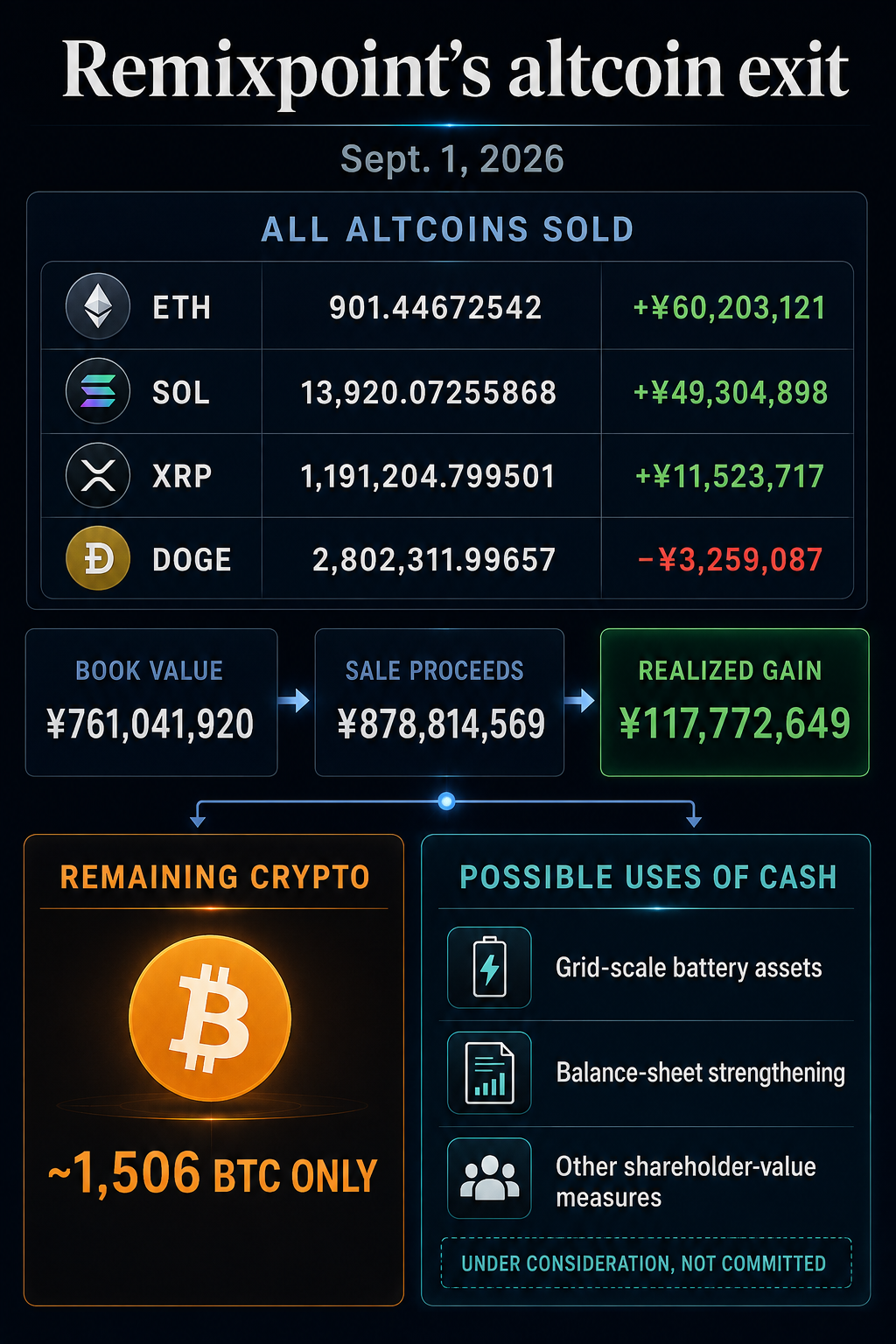
The disposals leave Remixpoint with a Bitcoin-only digital-asset treasury. Its live treasury page showed about 1,506.23 BTC as of Sept. 3, worth roughly $121 million at current prices.
Bitcoin Treasuries data shows the company has added about 90 BTC to its holdings this year. Remixpoint was also among the earlier Japanese listed companies to adopt a Bitcoin treasury strategy after Metaplanet helped establish the model domestically.
The continued accumulation makes Bitcoin more than the residual asset left after the altcoin sales. Remixpoint has been increasing its BTC position even as it moved to eliminate exposure to other major cryptocurrencies.
The company did not say the ¥878.8 million raised from the sales would be used to buy more Bitcoin.
Instead, it left the proceeds available for several corporate priorities, including expansion into grid-scale battery storage, strengthening its balance sheet and other measures aimed at increasing shareholder value.
Remixpoint said it considered market conditions, the risk-return profile of each asset and its broader financial strategy before deciding to concentrate its remaining crypto exposure in Bitcoin.
The sale came after the company had also generated income from some of the assets it exited. Remixpoint reported ¥29.9 million in yen-denominated staking rewards from Ethereum and Solana between July 2025 and Aug. 31, 2026.
Separately, its Bitcoin holdings generated 14.92 BTC in lending fees between Feb. 24 and Aug. 31, valued at about ¥164.2 million using month-end prices.
Remixpoint’s pivot also reflects a broader reassessment among corporate crypto treasuries navigating weaker markets and increasing pressure to justify how digital assets fit into their balance sheets.
The post This Japanese company made money on Ethereum, Solana, and XRP, but sold them anyway to keep its $121 million Bitcoin holdings appeared first on CryptoSlate.
The Bank for International Settlements released a working paper on Sept. 2 describing a prototype for checking the authenticity of official statistics. The system turns a statistical file into a cryptographic fingerprint, anchors a summary of those fingerprints on XRP Ledger, and lets a recipient compare the file with the public record.
The result creates a split verdict for XRP. The prototype gives XRPL a credible institutional-style use case, while its batching design keeps the direct fee-burn pathway mechanically small. One ledger transaction can represent thousands of datasets, so useful activity can scale much faster than the number of transactions consuming XRP.
The research first appeared online through SAGE on Aug. 1; Sept. 2 marks its release as BIS Working Paper 1374. The paper presents the authors' views and says its references to firms and projects are illustrative. Its implementation remains an experimental XRPL DevNet proof of concept, and the reviewed sources disclose no commercial relationship with Ripple.
How the authentication system works
Official statistics commonly travel in SDMX, a standard for exchanging statistical data and metadata. The prototype normalizes an SDMX file and applies SHA3-512 hashing to the whole file or to individual data series. It then combines those fingerprints in a Merkle tree, a structure that compresses a large group of records into one summary value called a root.
The root is written into the memo field of an XRPL transaction. Underlying statistics and the prototype's operational stores and proofs stay off-chain. The returned SDMX file embeds the transaction reference, ordered fingerprints, and a signed verifiable credential, giving a recipient the material needed to rebuild the root and compare it with the ledger.
XRPL therefore serves as a timestamped public notary for the commitment. It does not serve as the database holding the economic figures. The open-source implementation describes itself as experimental, unsuitable for production, and unmaintained.
The authors selected XRPL for low nominal fees, fast consensus finality, and accessible developer resources. They also made the blockchain interface replaceable, so another ledger could perform the same anchoring role. That design choice makes the prototype evidence for the authentication method and for XRPL's ability to host it, rather than evidence that the method depends on XRP Ledger.
Performance results came from a single developer workstation connected to XRPL DevNet and using a synthetic SDMX corpus. In those controlled tests, median publication latency was three to five seconds and verification took one to two seconds. The evaluation excluded sustained Mainnet load, an enterprise firewall, hardware-security-module-backed signing, and adversarial conditions. DevNet uses test XRP with no real-world value, so the run produced technical measurements instead of live token demand.
Those boundaries still leave a meaningful result. A statistical publisher could provide an independent integrity check without exposing confidential data on a public ledger. The economic trade-off appears in the same mechanism: Merkle batching reduces the number of on-chain commitments needed to authenticate a large body of information.
The XRP value-capture math
XRPL's standard transaction cost normally starts at 10 drops, equal to 0.00001 XRP. When a transaction enters a validated ledger, its fee is destroyed. Network load can raise the cost, and special transaction types can carry different minimums, but the BIS paper uses 10 drops as its base case.
The fee scales with anchoring transactions, while dataset volume can be compressed into batches. The following arithmetic illustrates the gap under a constant 10-drop minimum and standard transactions:
| Activity pattern | Anchoring transactions | XRP burned |
|---|---|---|
| 1 million datasets, batched 1,000 per anchor | 1,000 | 0.01 XRP |
| 1 million individual anchors | 1,000,000 | 10 XRP |
| 1 anchor per minute for 365 days | 525,600 | 5.256 XRP |
| 1 anchor per second for 365 days | 31,536,000 | 315.36 XRP |
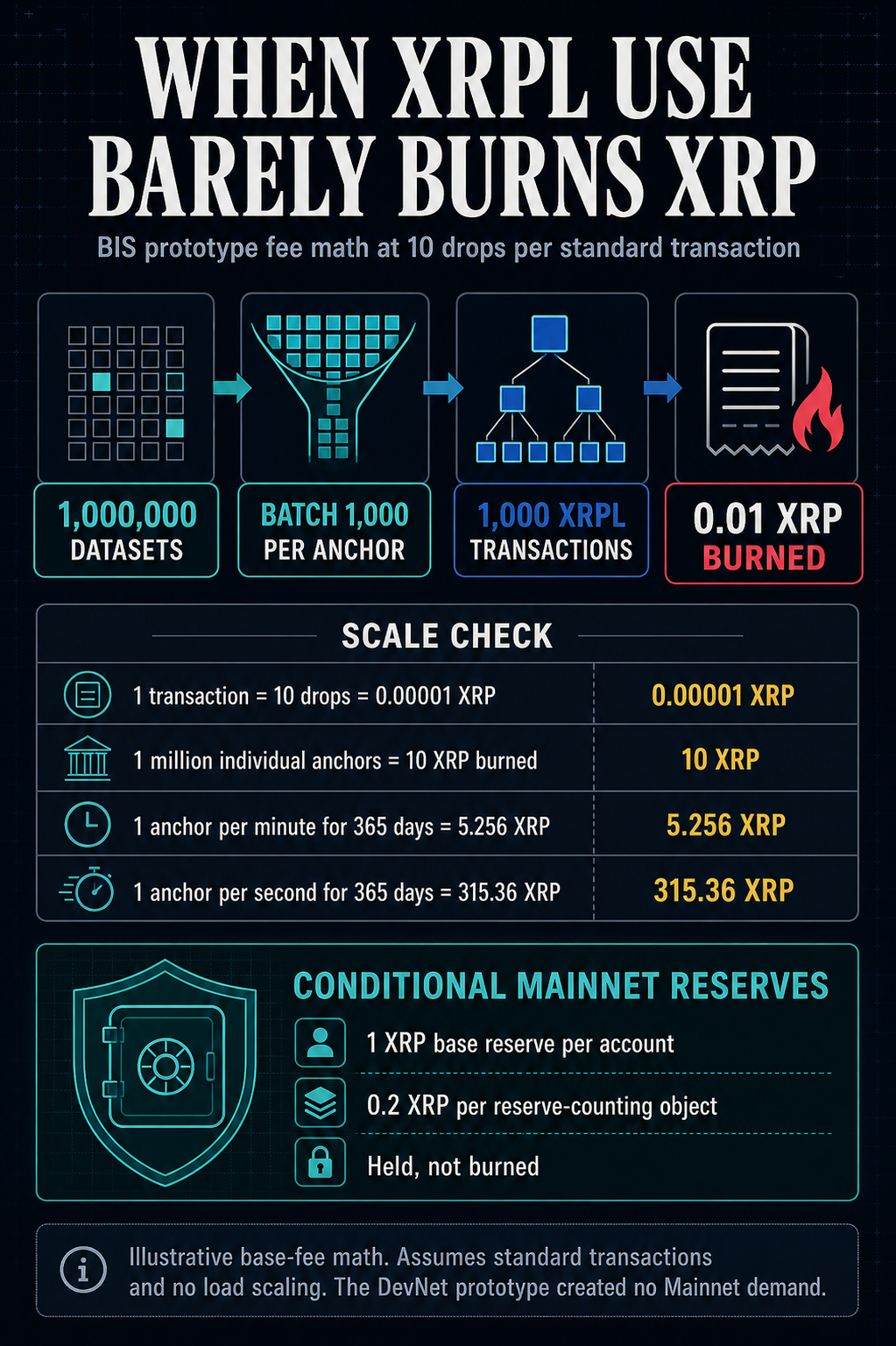
These are scale illustrations, not deployment forecasts. Actual burn would reflect how frequently publishers submit anchors, how many datasets they batch, prevailing network load, and the transaction type. The DevNet prototype generated none of this Mainnet demand.
The paper's cost model points in the same direction. It assumes a 10-drop fee and an illustrative price of $0.30 per XRP, which is a model input rather than a current quote. With a batch size of 1,000, the authors calculate an on-chain cost of $0.000000003 per dataset. Above roughly 50 items per batch, processing and raw storage dominate the chain and proof-storage costs in their examples.
Urgent releases can favor smaller batches because waiting for more datasets creates delay. Even then, the paper says XRPL's low nominal fee bounds the penalty. For XRP holders, this means production cadence matters more than the headline number of files or series authenticated.
Mainnet reserves create a second, conditional pathway. Under current XRPL reserve rules, each address must hold a 1 XRP base reserve, with another 0.2 XRP for every reserve-counting ledger object. The network holds those balances as prefunding; ordinary transaction fees are the XRP that gets destroyed.
Reserve demand grows when a deployment needs new accounts or ledger objects. A dataset does not carry its own reserve requirement, and repeated memo anchoring from an existing account does not lock another 1 XRP each time. Validator voting can also change the reserve levels. Production usage could therefore increase held XRP across many new institutional accounts, but the effect depends on deployment architecture rather than dataset throughput.
The paper supports a narrow value-capture conclusion. XRP would supply the fees and reserves for a Mainnet version, while Merkle batching deliberately compresses the recurring fee flow. Under the paper's assumptions and current fee mechanics, the direct burn channel stays small even as authenticated data volume rises.
XRP's market price can still respond to expectations, liquidity, and activity elsewhere on the network. Those forces sit outside this prototype. The BIS work establishes XRPL as a viable low-cost authentication layer under controlled conditions; material token demand would require sustained anchoring cadence, broad account creation, or other XRP-centered activity that the experiment did not demonstrate.
The post BIS shows why real institutional adoption on XRP Ledger won’t trigger the XRP supply squeeze holders expect appeared first on CryptoSlate.
The Aug. 28 Solana fee vote on SGP-0003 produced an unusual result: a majority of participating stake supported the reform, yet the proposal failed. The outcome offers the clearest evidence so far that co-founder Anatoly Yakovenko can shape the network’s economic agenda while validators and stakers retain formal authority over a mandate.
SGP-0003 finalized with 142.844 million SOL in favor, 50.146 million against, and 72.025 million abstaining across 1,152 voters. About 265.015 million SOL participated, equal to 61.14% of the 433.486 million SOL snapshot. Quorum was comfortably cleared. Approval stood at 53.90% because the governing calculation included abstentions, leaving the For side roughly 33.83 million SOL short of the required two-thirds.
Abstaining stake remained separate from opposition, but it still increased the support needed for approval. That rule turned the large middle of the electorate into a decisive part of the result and made coalition breadth more important than a simple For-versus-Against comparison.
The vote bundled a rulebook test with an economic package
The rejection exposed a conflict inside Solana’s new governance record. The frozen text of SGP-0003 said no quorum applied and excluded abstentions from its approval calculation. The current governance FAQ and the Constitution ratified in the same cycle count For, Against, and Abstain toward quorum participation and the two-thirds denominator.
The official system applied that inclusive rule and finalized the proposal as rejected. The frozen ballot’s wording would have yielded a different approval percentage, but the recorded outcome follows the FAQ and Constitution. For voters, abstention therefore offered a way to decline the full mandate without joining the Against camp. That describes the ballot’s effect rather than any individual voter’s motive.
CryptoSlate’s earlier coverage of Solana’s governance framework outlined how stake can sponsor proposals and override validator choices. SGP-0003 provides a live demonstration of how the denominator shapes power: public advocacy can put a policy on the agenda, while approval still depends on a sufficiently broad stake coalition.
The economic package made that coalition difficult to assemble. Yakovenko’s public support focused on the proposed starting rate. On Aug. 25, he backed a rate of one-tenth of a lamport per requested cost unit, according to Solana Compass. The ballot covered a full three-stage path, with later feature gates lifting the resource-fee rate to one-quarter and then one-half of a lamport.
Validators and stakers were thus deciding on more than the first step Yakovenko highlighted. They were asked to endorse the entire ramp and the distributional consequences built into SIMD-0553.
The technical plan would replace Solana’s 5,000-lamport fee per signature with a 2,500-lamport inclusion fee per transaction, paid to the block leader. It would add a resource fee based on the scheduler cost requested by a transaction and burn that fee in full. Priority fees would remain unchanged and continue going to the leader.
Charging for requested resources would affect users unevenly. Applications that set loose compute limits could pay more or encounter insufficient-balance rejections. Efficient low-resource transactions could pay less. Legacy validator vote transactions would need compute-budget and fast-path updates ahead of Alpenglow, and every validator client implementation would need the relevant feature gates before the consensus-breaking change could first activate.
CryptoSlate previously examined the design’s potential burn effect. The final Solana fee vote supplies the political lesson. General support for pricing scarce resources left major questions about the rate path, the cost burden, and how much policy should be approved in a single mandate.
The Solana fee vote makes coalition-building part of protocol design
The recorded positions crossed prominent operators and delegated-stake holders. Validator Info listed Jupiter, Drift, Bitwise Onchain Solutions, and Forward Industries among opponents. Figment, Staking Facilities, Kiln, and P2P.org were among the supporters.
The arithmetic rules out a single-voter explanation. Jupiter’s allocation of roughly 11.78 million SOL was substantial, yet the For side needed approximately 33.83 million additional SOL to reach two-thirds. The wider distribution of opposition and abstention produced the shortfall.
Yakovenko’s public comments also complicate a founder-versus-validator reading. In an Aug. 27 reply, he said validator revenue encourages more people to stake. His argument placed validator economics within the network’s security model, even as he promoted the reform’s initial resource-fee rate.
Formal governance covers only one stage of the change. An SGP provides a directional stake mandate. Technical design lives in a SIMD, and deployment still requires compatible validator-client releases and separately scheduled feature activation. Finalizing a vote locks the tally. The implementation process follows separately.
That division of authority defines the practical constraint on Yakovenko. His endorsement elevated the fee question and supplied an economic argument. The full three-stage package still fell short of the coalition required for a stake mandate. Validators and stakers exercised the authority granted by the ratified rules, while developers retain responsibility for technical review and implementation.
Yakovenko’s agenda-setting role remains visible in the proposed response. AMBCrypto reported after his initial endorsement that he favored splitting the reform into one proposal replacing the fixed signature fee and another deciding whether validators or an automatic mechanism should set future rates. Unbundling those choices could isolate areas of agreement and give voters a clearer view of each tradeoff.
A smaller successor could begin through the optimistic SIMD process. Under Solana’s governance process, holders of 15% of active stake can still force a network vote. The Constitution also directs fundamental economic changes toward the SGP path. Splitting the plan would improve its packaging while leaving open the possibility of another validator and staker decision.
SGP-0003 therefore marks a change in how founder influence operates on Solana. Yakovenko’s support helped define the problem and the first proposed rate. The electorate rejected the bundled mandate under a supermajority rule. Any successor now needs either a more focused technical scope, a broader stake coalition, or both.
The Solana fee vote demonstrated the governance system’s ability to stop a founder-supported implementation. The next round will test the other half of the power equation: how effectively the same founder can reframe the policy, separate its contested parts, and persuade enough stake to move it forward.
The post What Solana’s failed fee vote reveals about Anatoly Yakovenko’s power appeared first on CryptoSlate.
Hyperliquid Strategies, a Nasdaq-listed company using equity sales to build a treasury of Hyperliquid's HYPE token, has expanded its committed-equity facility with Chardan Capital Markets to $2.5 billion from $1 billion.
The immediate runway before a new dilution constraint applies is far smaller than the headline commitment. Hyperliquid Strategies' annual report disclosed $646.6 million of gross facility proceeds through June 30, followed by another $117.1 million raised through facility shares after quarter-end. Together, those figures show at least $763.7 million of proceeds, leaving no more than about $236.3 million before aggregate sales reach $1 billion. Any later sales would reduce that headroom, and the September 1 filing did not provide an updated utilization total.
Once aggregate facility sales pass $1 billion, the issue price becomes decisive. Under the operative amendment, Hyperliquid Strategies cannot complete a sale if doing so would take the aggregate number of facility shares issued at prices below $12.02 above 42,641,847. That exchange cap equals 19.99% of the company's pre-amendment voting power or outstanding common shares. Issuance above the cap requires stockholder approval unless that approval is not required under Nasdaq rules.
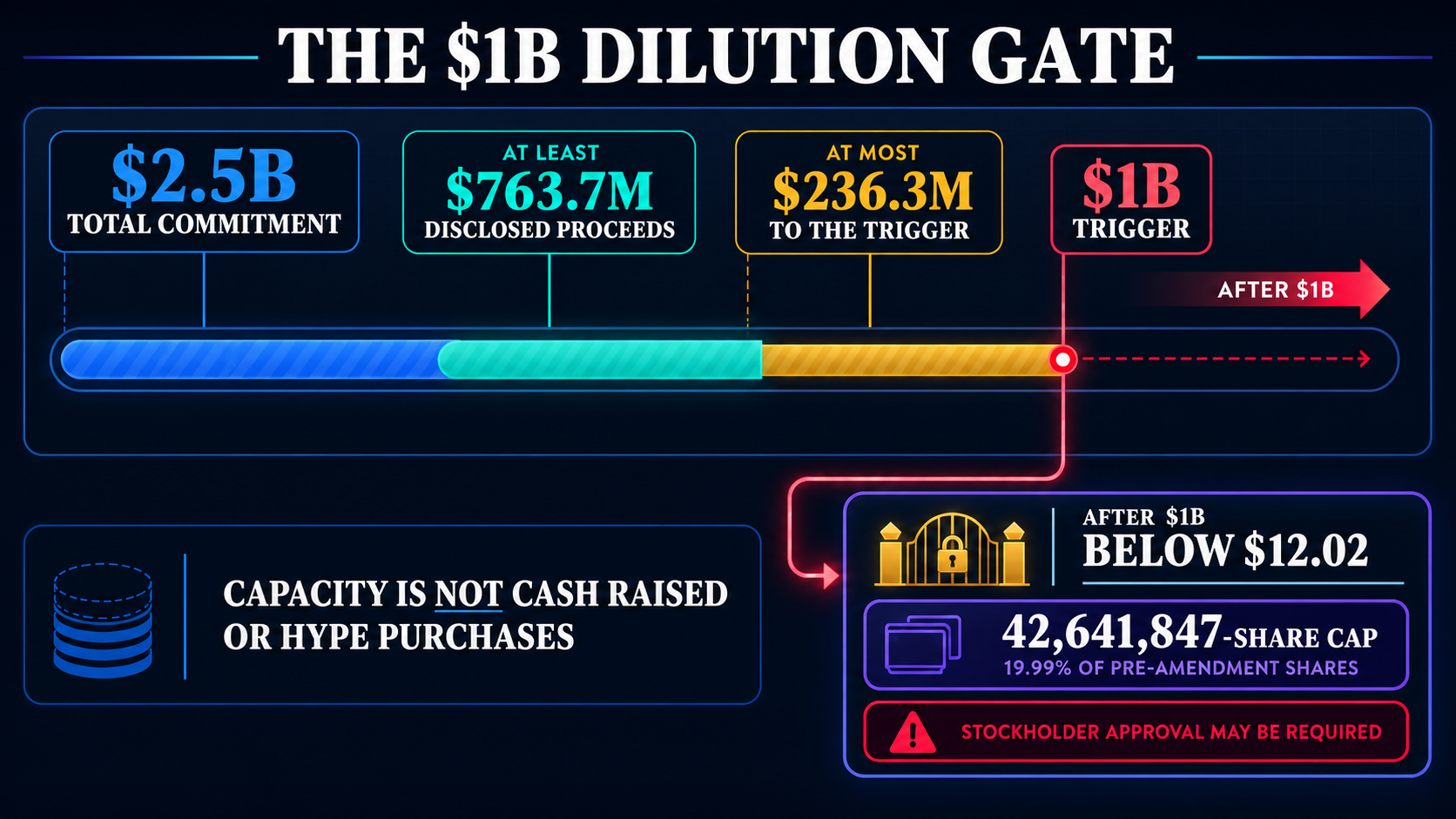
The restriction does not, however, translate into a clean dollar ceiling. Shares sold at $12.02 or more do not fall under the price-specific cap, while the remaining capacity for lower-priced sales depends on how many qualifying shares already count toward it. The filings disclose aggregate shares, proceeds and an average price, but not the transaction-level price mix needed to calculate that count. The amendment also permits the cap to be reduced by other transactions that Nasdaq treats as part of the same issuance.
The dilution mechanism matters because equity sales have financed the company's crypto treasury strategy. An August 27 update said Hyperliquid Strategies had deployed $773.4 million to acquire about 16.5 million HYPE and held roughly 29.3 million HYPE in total. It also reported $646.6 million raised at an average issue price of $8.70; that figure did not include the additional $117.1 million of post-June 30 facility sales disclosed in the annual report.
The $2.5 billion facility therefore represents optional financing capacity, not a guaranteed HYPE buying program. The dated disclosures indicate at most $236.3 million remained before the $1 billion trigger; beyond that point, access to the full commitment will depend on sale prices, remaining exchange-cap headroom and whether stockholders must authorize additional discounted issuance.
The post Hyperliquid treasury company increases token buying strategy to $2.5 billion as shares run out appeared first on CryptoSlate.
Bitcoin may be slipping beyond its four-year cycle as institutional capital and macro liquidity gain influence over price.
On Sept. 3, Bitcoin analyst Willy Woo said that Bitcoin could be moving toward a 6-to-8-year rhythm tied more closely to traditional finance’s short-term debt cycle than to its halving schedule.
According to him, this shift does not make halvings irrelevant. Instead, it means their influence is shrinking relative to the scale of capital now moving through exchange-traded products, corporate treasuries and other institutional channels.
Bitcoin’s April 2024 halving cut the block reward to 3.125 BTC, leaving annual new issuance at roughly 164,250 BTC, or about 0.82% of current circulating supply. The next halving, expected in 2028, would cut that pace again to about 82,125 BTC a year, equivalent to roughly 0.41% of today’s supply base.
That makes each new supply shock smaller just as Wall Street’s footprint grows larger.
Institutional capital is starting to rival Bitcoin’s internal clock
The balance has already changed materially, with institutional holdings now dwarfing the amount of new Bitcoin miners add to circulation each year.
Data from Bitcoin Treasuries shows 100 public companies now hold more than 1.2 million BTC, while Bitcoin exchange-traded products around the world control more than 1.5 million coins.
Together, those two groups account for more than 2.7 million BTC.
That stock is already more than 16 times the amount of new Bitcoin miners currently produce in a year. After the 2028 halving, the gap would widen further as annual issuance falls toward 82,125 BTC.
The comparison does not mean institutional holders dictate price. It does show how much smaller the miner-supply shock has become relative to the Bitcoin already sitting inside corporate balance sheets and regulated investment products.
Woo’s argument is that this changing balance could make credit conditions, global liquidity and portfolio flows increasingly important in determining major market turns.
Bitcoin’s historical four-year rhythm has always been approximate rather than mechanical. Halvings, monetary policy and investor psychology have overlapped across previous cycles, while the limited number of completed cycles makes any fixed pattern difficult to establish.
Recent research has also stopped short of declaring the old framework dead.
Galaxy Research said in June that the four-year cycle remained visible, although its amplitude was compressing. A 21Shares midyear review similarly described the pattern as evolving rather than broken.
Fidelity Digital Assets has also argued that Bitcoin’s larger market capitalization, broader institutional base and lower volatility could make future cycles behave differently from earlier boom-and-bust periods.
Woo’s 6-to-8-year thesis therefore remains a developing framework rather than a confirmed replacement.
The measurable change is already underway: annual miner issuance is shrinking toward a fraction of circulating supply while millions of Bitcoin accumulate inside institutional vehicles.
If that trend continues, the next major Bitcoin cycle may depend less on the halving clock alone and more on the same credit and liquidity forces that already shape traditional markets.
The post Bitcoin may be leaving its 4-year cycle behind for a 6-to-8-year Wall Street rhythm appeared first on CryptoSlate.
HTTP error 429 on https://cryptoticker.io/en/feed/
Failed to fetch feed: https://cryptoticker.io/en/feed/
Failed to fetch feed.
Decrypt
Privacy advocates say the law raises First Amendment questions the courts have yet to address.
The projected revenue requires two contract extensions, while an option for more computing capacity could bring the total above $3 billion.
PONS, the token behind Robinhood Chain's biggest meme coin factory, flipped CASHCAT to become the chain's largest cryptocurrency by market cap—and its chart looks like a hockey stick.
The forthcoming bill would pause advanced AI development, create a federal regulator, and threaten violators with up to 20 years in prison.
The model can independently discover and exploit unknown security flaws across hardened systems, triggering a staged rollout and White House review before public access.
U.Today - IT, AI and Fintech Daily News for You Today
Bitcoin has decisively reclaimed its closely watched 50-week moving average.
House Republicans’ decision to cut the September legislative session short could significantly delay the CLARITY Act.
XRP ETFs outpace the token by 100% amid an abnormal liquidity mismatch in U.S. order books during a $27.2 million trading session.
U.S. Treasury Secretary Scott Bessent’s warning that the world is "awash in debt" has inadvertently made the case for Bitcoin.
Binance shares new safety measures on how users can protect their funds amid rising phishing attacks from scammers tricking victims.
Blockonomi
TLDR:
- ARB price gained more than 50% in seven days and roughly 23% in 24 hours, while daily trading volume climbed above $500 million.
- ArbitrumDAO reported $6.19 million in first-half income from four revenue lines carrying a combined gross margin above 97%.
- Robinhood Chain generated $360,000 in July licensing fees, representing about 35% of ArbitrumDAO’s income for that month.
- Arbitrum’s tokenized real-world asset market reached $1 billion, while first-half network transactions totaled 478 million.
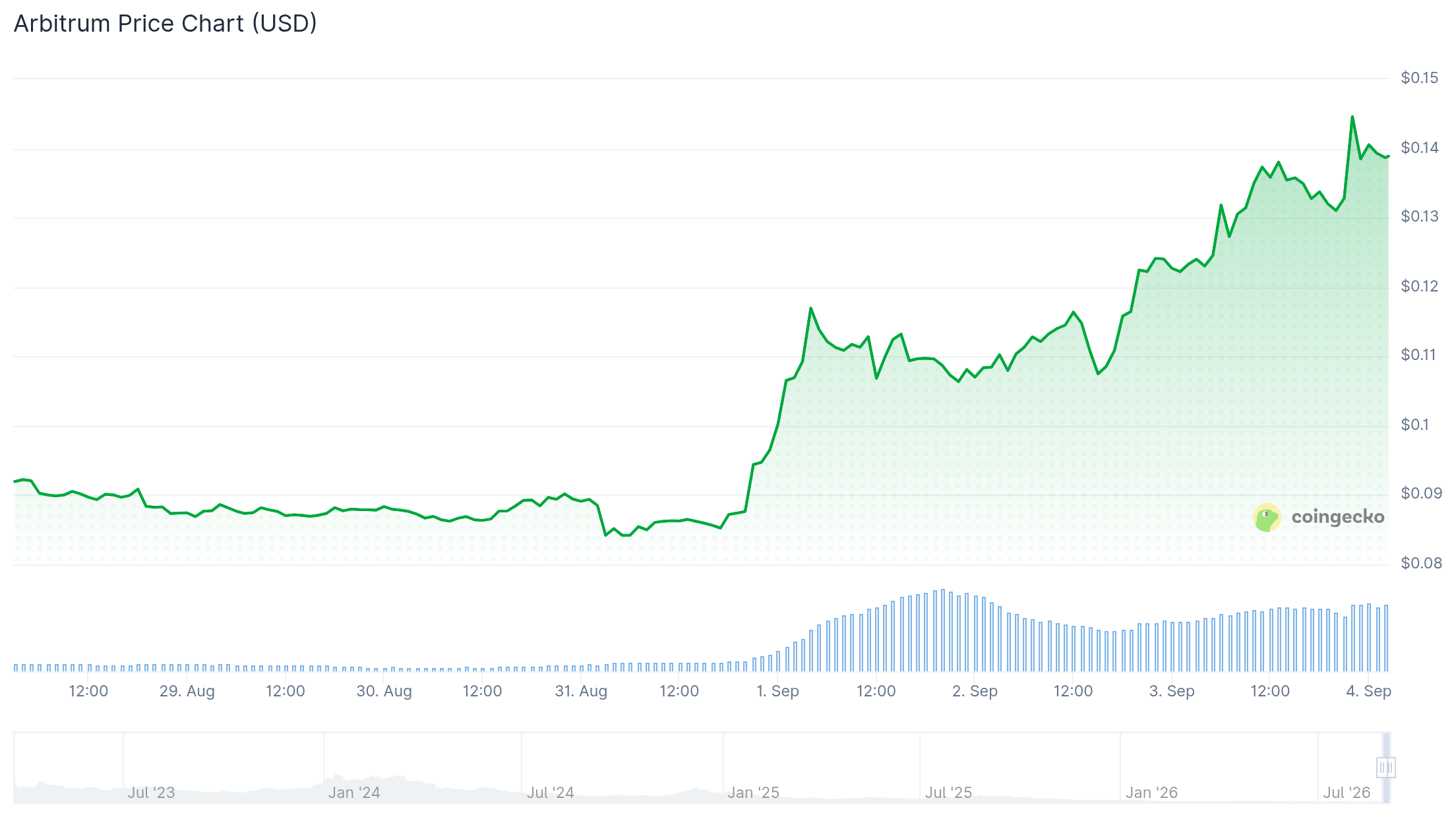
ARB price traded near $0.136 on September 3 after gaining more than 50% over seven days. The token rose roughly 23% within 24 hours, placing Arbitrum among the week’s strongest performers.
The rally followed the Arbitrum Foundation’s first-half progress update. ArbitrumDAO recorded $6.19 million in income during the first six months of 2026. Separate July figures showed Robinhood Chain adding a new licensing stream after its mainnet launch.
Trading activity accelerated sharply with the move. Daily volume topped $500 million, around nine times the previous week’s daily average. Futures open interest climbed 35%, showing increased leveraged exposure alongside spot demand.
ARB Price Gains Support From Expanding DAO Revenue
The first-half update gives investors a clearer view of ArbitrumDAO’s finances. Its $6.19 million income came from four revenue lines carrying a combined gross margin above 97%. The figures show that network activity and commercial agreements can generate income beyond token market movements.
Robinhood Chain became an additional contributor after launching its mainnet in July. The network uses Arbitrum technology through an expansion program. Participating chains return 10% of net protocol revenue to the Arbitrum ecosystem under that arrangement.
Robinhood Chain generated $360,000 in licensing fees during July, its first mainnet month. That payment represented about 35% of the DAO’s income for the month. The Foundation said July income alone put third-quarter revenue on course to exceed second-quarter revenue by more than 40%.
The deployment also recorded much heavier activity than Arbitrum One during one cited 24-hour window. Robinhood Chain processed $1.43 billion in decentralized exchange volume and generated $3.75 million in fees. Arbitrum One recorded $193 million in volume and about $14,700 in fees during the same period.
ARB price rose while those commercial figures attracted wider market attention. The move also came with a sharp increase in turnover. Higher open interest shows traders added futures positions, although it also raises the market’s exposure to liquidations during sudden reversals.
Arbitrum RWA Growth Strengthens Its Tokenization Position
Arbitrum’s tokenized real-world asset market reached $1 billion, expanding the network’s role in blockchain-based finance. The ecosystem ended the half with more than 2,000 deployed RWA assets, ranking first by asset count. Ethereum continued to lead the sector by total value locked.
Tokenized assets use blockchain rails to represent instruments such as funds, bonds, and equities. Their deployment can expand settlement options while connecting traditional products with decentralized infrastructure services.
Broader network usage also expanded during the period. Arbitrum processed 478 million transactions in the first half, lifting lifetime transactions above 2.7 billion. Average monthly stablecoin transfer volume surpassed $70 billion, another measure of settlement activity across the ecosystem.
These network measures provide fundamental context for the ARB price recovery. They do not guarantee that fee income will create direct token demand. Traders still need to assess whether activity, DAO revenue, and ecosystem adoption translate into sustained buying pressure.
Crypto analyst Crypto Patel says ARB had recovered from an earlier entry zone. The analyst identified possible levels at $0.49, $1.20, $2.42, and above $5. Those figures represent an individual forecast rather than confirmed targets.

The near-term ARB price structure depends on buyers holding the recent advance after a fast weekly move. Profit-taking could increase after the 50% gain, especially with futures exposure growing. Continued volume would help show whether demand can absorb sales without erasing the breakout.
ARB price also remains more than 95% below its 2024 all-time high. That distance gives the $5 projection important context, since reaching it would require a substantial revaluation. At the reporting time, ARB traded near $0.136 with circulating supply around 6.68 billion tokens.
The post ARB Price Soars More Than 50% as Arbitrum DAO Income Hits $6.19M appeared first on Blockonomi.
TLDR:
- Bitcoin price trades above the 50-week moving average near $81,041, placing the weekly close at the center of the technical outlook.
- A weekly close above $82,814 would create the first higher high of the decline and challenge the established bearish market structure.
- Bitcoin futures volume reached roughly $84.74 billion, while open interest climbed to about $57.86 billion during the price advance.
- BTC liquidations totaled approximately $229.56 million, including $214.81 million in shorts and only $14.74 million in longs.
Bitcoin price trades above its closely watched 50-week moving average after a strong daily advance. BTC reached $81,797 before easing toward $81,400, leaving traders focused on the weekly close. The move places the $82,000 to $83,000 resistance zone within immediate reach. Scott Melker identifies $82,814 as the decisive level for the weekly structure.
A close above that price would create Bitcoin’s first higher high since the decline began. It would also confirm strength above the long-term average. Bitcoin price therefore sits near a technical threshold that could challenge the sequence of lower highs and lower lows. That close now matters.
Bitcoin Price Firmly Retakes the 50-Week Moving Average
Market analyst Ted Pillows has highlighted the 50-week moving average near $81,041. Bitcoin spent much of the past year below this indicator, turning it into a ceiling during the decline. The latest move carried BTC firmly through that area on the daily chart. The weekly settlement will determine whether buyers can hold the recovery.
An earlier breakout attempt failed near the same level. Bitcoin reached $81,265 on August 25, while the average stood near $81,085. Sellers rejected that advance before a confirmed weekly break developed. The current candle shows stronger momentum, but price still needs to hold through the close.
Bitcoin price also approaches $82,814, which Melker views as the structural trigger. Clearing that mark would produce the first higher high after months of declining peaks. That change would invalidate a central feature of the bearish trend. It would also place BTC above the nearby resistance band between $82,000 and $83,000.
The 50-week moving average carries added weight because it has capped Bitcoin during previous bear markets. Weekly closes often stayed below it until those downtrends approached their final stages. A sustained recovery would not guarantee further gains, but it would alter the market structure monitored by technical traders. Momentum depends on buyers defending the reclaimed average through the final weekly settlement.
Bitcoin price has also lifted the wider cryptocurrency market. BTC traded above $81,800 during the advance and gained nearly 6%. Ethereum, BNB, and Cardano recorded gains during the same market move. Their performance shows that buying extended beyond Bitcoin during the session.
Derivatives Activity Builds Near the $82,814 Resistance
CoinGlass reports roughly $84.74 billion in Bitcoin futures volume over 24 hours. Open interest rose to about $57.86 billion, showing that leveraged exposure increased alongside price. This positioning can strengthen short-term moves when forced closures accelerate market orders. It can also magnify volatility when prices reverse.
Liquidations reached approximately $229.56 million across Bitcoin positions during the same period. Short positions accounted for $214.81 million, compared with only $14.74 million in long liquidations. The imbalance shows that bearish traders absorbed most of the forced losses during the rally.
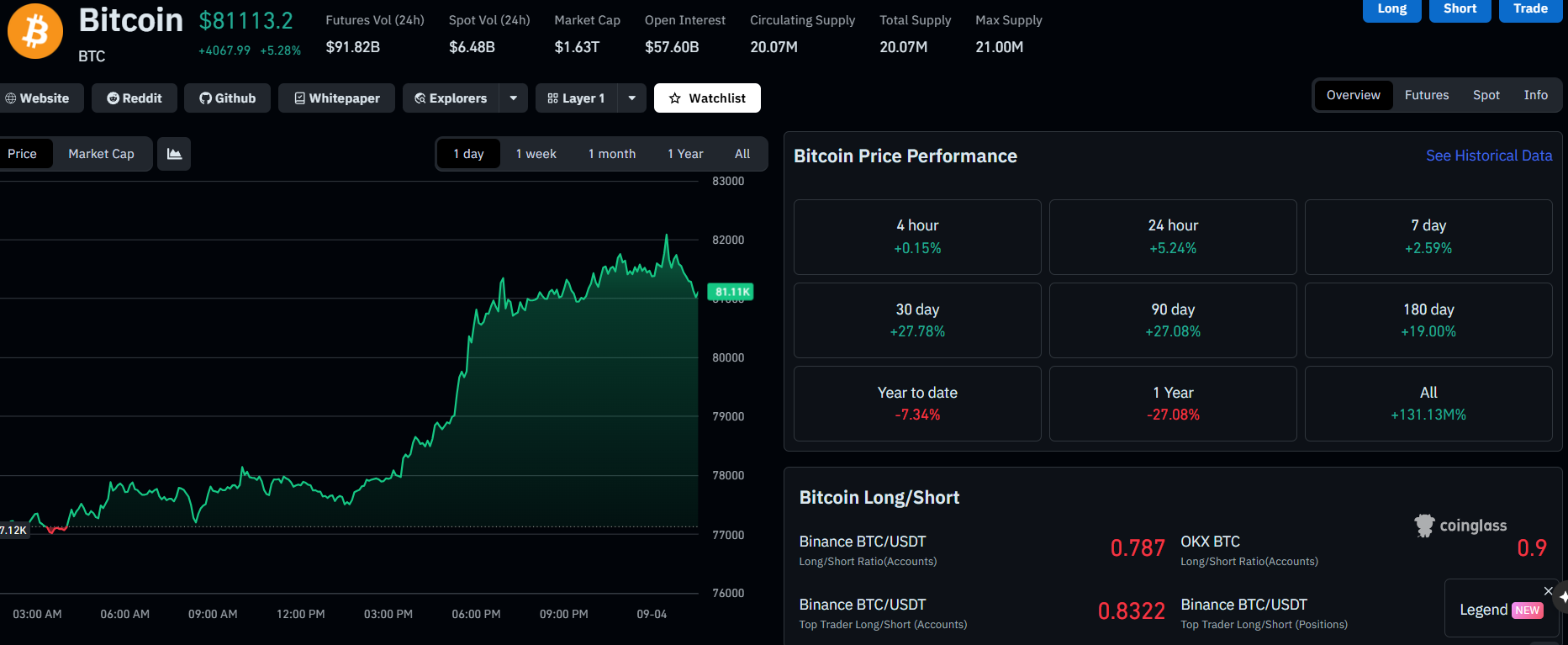
Bitcoin price benefited from that short-covering pressure while crossing the 50-week moving average. Traders closing bearish positions must buy back exposure, adding demand during an advance. Still, rising open interest means substantial leverage continues to sit in the futures market.
The next test centers on the $82,000 to $83,000 band and the exact $82,814 resistance marker. A weekly close above both levels would confirm a higher high and strengthen the breakout signal. Failure to hold the long-term average would leave the August rejection relevant for traders.
Bitcoin price is now trading between confirmed support from the reclaimed average and resistance near the recent threshold. Market participants will watch whether spot buying can sustain the move after the liquidation surge.
Futures positioning will also show whether new exposure follows the breakout or leverage begins to unwind. CoinGlass figures place short liquidations at more than fourteen times long liquidations during the measured 24-hour period. Weekly settlement will show whether buyers convert resistance into support.
The post Bitcoin Price Targets $82,814 After 50-Week Average Breakout appeared first on Blockonomi.
TLDR:
- Securitize and Dubai’s VARA signed an MoU to advance regulated tokenization market efforts.
- The partnership will give licensed market participants access to Securitize’s global expertise.
- Collaboration will focus on ecosystem growth, talent attraction, and financial market education.
- Executives said regulatory clarity will shape where tokenized capital markets will take root.
Securitize has signed a Memorandum of Understanding with Dubai’s Virtual Assets Regulatory Authority to advance regulated tokenization across the emirate.
The agreement, announced on September 3, 2026, aims to strengthen digital asset infrastructure and support Dubai’s ambition to lead global tokenized financial markets.
Under the MoU, both parties will share expertise, encourage institutional participation, and promote research and talent development within Dubai’s regulatory framework. The partnership signals growing regulatory engagement with tokenization worldwide.
Securitize and VARA Outline Collaboration Framework
The MoU sets up a structure for ongoing cooperation between Securitize and VARA. Both organizations plan to work together on knowledge sharing and ecosystem development within Dubai’s virtual asset sector.
Licensed market participants operating under VARA’s oversight will gain access to Securitize’s global tokenization experience.
Securitize confirmed the announcement through a post on its official X account. The company described the agreement as a step toward advancing tokenization and digital asset infrastructure throughout Dubai. It also noted the deal supports Dubai’s goal of becoming a leading jurisdiction for regulated tokenized markets.
A follow-up post outlined additional areas of focus under the partnership. These include exploring tokenization initiatives, supporting talent attraction, and encouraging market education across Dubai’s ecosystem. Data-driven research and the development of new tokenized financial products were also listed as shared priorities.
According to the companies, projects may be initiated or facilitated directly by VARA. The collaboration is designed to operate within Dubai’s existing regulatory framework rather than outside it. This structure is intended to maintain market integrity while allowing innovation to continue.
Executives Comment on Dubai’s Regulatory Vision
Carlos Domingo, Co-Founder and CEO of Securitize, addressed the partnership in a public statement. He said Dubai “has established itself as one of the world’s most forward-looking jurisdictions” for digital asset innovation.
Domingo added that collaboration between regulators and industry is becoming increasingly important as tokenization advances.
Domingo also spoke about Securitize’s role in the broader shift toward onchain capital markets. He said the company is “proud to support VARA’s vision” of a trusted, well-regulated digital asset ecosystem. His comments tied the partnership directly to Securitize’s ongoing institutional tokenization efforts.
Matthew White, CEO of VARA, also commented on the agreement’s purpose. He said Dubai’s ambition is that financial markets be shaped “not only by new technologies” but by supportive regulatory frameworks. White noted this approach gives institutions confidence to adopt emerging digital asset tools.
White further described the Securitize partnership as reinforcing Dubai’s broader market position. He said the collaboration supports development of regulated tokenized markets within the emirate. White framed the agreement as strengthening Dubai’s standing as a global capital markets center.
The post Securitize Signs MoU with Dubai’s VARA to Advance Regulated Tokenization appeared first on Blockonomi.
TLDR:
- Coinbase filed SEC notices this week covering its derivatives exchange and brokerage business.
- The notice registrations create a regulatory pathway involving both the SEC and CFTC together.
- Coinbase already offers single-stock perpetuals abroad on stocks like Apple, Tesla, and Nvidia.
- Trading dates, leverage limits, and supported stocks for the U.S. remain undisclosed for now.
Coinbase is moving to bring single-stock perpetuals to the United States, filing SEC notice registrations this week. The filings cover its derivatives exchange and its brokerage unit.
The move marks an early step toward offering leveraged exposure to individual stocks. Traders would gain that exposure without owning the underlying shares.
Coinbase said it intends to work closely with the SEC and the CFTC. The goal is to bring more financial products onshore.
Coinbase Files Notice Registrations With The SEC
Coinbase Derivatives filed Form 1-N with the SEC to cover its exchange operations. Coinbase Financial Markets separately filed Form BD-N for its brokerage business.
Together, the two filings create a regulatory pathway involving both the SEC and CFTC. The company describes this coordination as an important step for competitiveness in digital asset markets.
In a public statement, Coinbase said it is working to bring single-stock perpetuals to the U.S. The company said it filed SEC-notice registrations this week for its derivatives exchange and broker.
It added that it will be “collaborating closely with the SEC and CFTC” to bring more major financial products onshore.
We're working to bring single stock perps to the US.
This week, we filed SEC-notice registrations for our derivatives exchange and broker.
We'll be collaborating closely with the SEC and CFTC to bring more major financial products onshore. pic.twitter.com/6wvjLXRwih
— Coinbase
(@coinbase) September 3, 2026
Faryar Shirzad, Coinbase’s chief policy officer, called the filing the first step toward offering equity perpetuals domestically. He said single-stock perpetuals have already shown strong demand in international markets.
Shirzad added that Coinbase is “excited at the prospect of a regulated pathway for U.S. investors.” He said the next milestone involves product approval from the CFTC.
The filings establish a framework but do not guarantee an immediate product launch. Coinbase has not released trading start dates or contract specifications.
Leverage limits and the list of supported stocks also remain undisclosed at this stage. Traders and market watchers will likely wait for further guidance before the product becomes available.
International Perpetuals Offer Early Clues
Coinbase already offers single-stock perpetuals to eligible customers outside the United States. Its current lineup includes shares of Apple, Microsoft, Alphabet, and Amazon. Nvidia, Meta, and Tesla are also part of the existing international offering.
These overseas contracts allow continuous trading without a fixed expiration date. They use funding mechanisms common to perpetual futures products in crypto markets. Traders gain price exposure to the underlying stock rather than shareholder rights such as voting or dividends.
The structure mirrors how crypto perpetual swaps already operate on many exchanges. Applying that model to individual equities could appeal to traders seeking leveraged stock exposure. Regulatory approval in the U.S. would extend this format beyond digital assets alone.
Coinbase framed the coordination between the SEC and CFTC as necessary for the U.S. to remain competitive. The company said investors already want access to these products.
Whether approval arrives quickly may depend on how regulators respond to the joint filings. For now, U.S. traders will continue to watch the process unfold.
The post Coinbase Files SEC Notices to Launch Single-Stock Perpetuals in the U.S appeared first on Blockonomi.
TLDR:
- Bitcoin-gold correlation hits its highest level since 2020, per Bitwise Asset Management data.
- Bitcoin surged 22.4% weekly after Treasury Secretary Bessent’s bond market intervention in August.
- Bitcoin’s correlation with the Nasdaq-100 dropped to a one-year low, weakening its risk-asset label.
- Gold’s $30 trillion market could reprice bitcoin if the correlation trend with debasement hedging holds.
Bitcoin’s correlation with gold just hit a six-year high, according to new research from Bitwise Asset Management. The 90-day rolling correlation between the two assets has climbed to its strongest level since 2020, when pandemic-era stimulus reshaped global markets.
Bitwise says the shift signals a change in how investors view bitcoin, moving it closer to gold’s traditional role as a store of value during periods of macro stress.
Bitcoin’s Correlation With Gold Reaches Six-Year Peak
Bitwise tracked the relationship using Bloomberg data spanning from April 2015 through August 2026. The current reading matches levels last seen during the Covid-19 stimulus era. That earlier period also involved heavy government intervention in financial markets.
August marked a turning point for this correlation. U.S. Treasury Secretary Scott Bessent stepped into the bond market after yields on 10- and 30-year Treasuries climbed. The move stirred concerns about financial repression and yield curve control.
Bitcoin posted its largest weekly gain since March 2024 following the intervention, rising 22.4%. Gold gained roughly 5% over the same period while equities fell. Bitwise says both assets moved together in a way that stood out statistically.
What’s Driving the Bitcoin-Gold Relationship
Bitwise’s official account shared the findings, noting that when macro conditions dominate headlines, investors tend to stop choosing between gold and bitcoin. Instead, many allocators are buying both assets at once.
The firm’s Europe research director, André Dragosch, authored the analysis. He pointed to bitcoin’s declining correlation with the Nasdaq-100, which has dropped to a one-year low. That trend weakens the argument that bitcoin simply tracks tech stock sentiment.
Bitcoin also remains negatively correlated with the U.S. Dollar Index. Bitwise explains that dollar weakness tends to align with bitcoin strength, a pattern gold has exhibited for decades during currency pressure.
Why the Six-Year High Matters for Investors
Bitwise cautions that bitcoin and gold remain different assets despite the recent convergence. Gold has served as a store of value for thousands of years, while bitcoin was created less than two decades ago.
Still, the firm argues that rising correlation during stressful macro periods carries weight. Gold’s market is valued near $30 trillion, built by central banks and institutional allocators over generations.
If bitcoin continues moving toward this category, Bitwise suggests it could eventually be priced against a much larger capital base. That would mark a shift from its historical pricing as a venture-style risk asset toward something closer to a macro hedge.
The post Bitcoin’s Correlation with Gold Hits Six-Year High Amid Macro Uncertainty appeared first on Blockonomi.
CryptoPotato
Multicoin Capital has sold another 10% of its HYPE holdings, according to blockchain analytics platform Arkham Intelligence. Still, HYPE remains its largest holding, currently worth around $90.5 million.
The investment firm had accumulated the tokens between February and March this year and has held the position for more than six months.
Slashing HYPE
Arkham stated that Multicoin held 4 million HYPE at its peak and now owns just over 25% of that amount. Earlier this week, the firm moved a large amount of the token to Coinbase Prime. On-chain data showed three separate transfers totaling 261,555 HYPE, worth about $21.7 million. The batches contained 63,235, 101,144, and 97,176 units. The transfers drew attention because they came as the crypto asset traded near its recent highs.
In June, Multicoin said it projected that HYPE could hit $319. The target came from valuing $8 billion in expected 2028 earnings at 20 times, which results in a $160 billion valuation based on an adjusted supply of about 502 million HYPE tokens. Its base case assumes crypto derivatives volume grows 35% annually, DEXs reach 32% of the derivatives market, Hyperliquid captures a 30% share, and USDC balances rise with volume.
On the other hand, its bear case puts HYPE at $109, while its bull case reaches $689 on $17.3 billion in projected cash flow. In the same report, Multicoin also compared Hyperliquid’s growth path with Binance’s rapid rise in 2017.
HYPE has been one of the best-performing assets this year. It has been on an absolute tear. The asset has gained 50% over the past month alone and recently established an all-time high of $86.71. It has since suffered a minor pullback, but continues to hover above $82.
Hyperliquid was also discussed during Donald Trump’s meeting with major crypto executives at the White House last month. Trump said CFTC Chair Michael Selig is working to bring the perpetuals-focused trading platform into the US. He said the goal is to make Hyperliquid operate in a “fully compliant and legal fashion.” The meeting also covered Bitcoin, the Digital Asset Market Clarity Act, and efforts to expand crypto activity in the US.
Due for a Drop?
While the broader outlook remains bullish, one trader is betting on a drop. Pseudonymous market watcher “swarmik” shared a bearish view on the token. The trader said it could fall 17.2% based on a four-hour chart setup while pointing to signs of weakness in the market structure. Heavy selling liquidity could push the price lower.
However, a potential correction could create an opportunity for a short position, with three downside targets being $76.77, $72.68, and $68.49. The trade would carry a risk level of 1.5R, according to the analysis.
The post Multicoin Sells Another 10% of HYPE Stack as Holdings Fall From 4 Million Tokens appeared first on CryptoPotato.
XRPL developer Denis Angell launched a live dashboard this week that scores every amendment on the XRP Ledger for how much of its functionality has actually been exercised on devnet before it reaches mainnet.
The tool turns amendment readiness, previously a matter of trust in the process, into a public scorecard that shows exactly which transaction types, fields, and result codes have never been touched by a real transaction.
What the Dashboard Actually Tracks
Angell built the tool, hosted at amendments-staging.xrpl.foundation, to read each amendment’s full spec surface directly from the node rather than maintaining it by hand. That includes every transaction type, optional field, flag, result code, and ledger entry the amendment introduces.
The dashboard then watches devnet activity and checks whether a validated transaction has ever exercised each one, with green cells linking to the transaction that first did it and red cells marking what hasn’t happened yet.
The developer explained the reasoning behind the project directly, saying:
“Every new XRPL feature ships as an amendment. Validators vote it in, and once it’s active it’s part of the protocol for good. That deserves real evidence that the feature has been exercised end to end on devnet, not just tested in isolation.”
As of this week, the dashboard is watching 16 amendments live on devnet, and 13 of them still have untested surface.
The widest gaps sit in newer amendments: Sponsor has 65 of its 107 possible checks never exercised, XChainBridge is missing 30 of 40, and MPTokensV1 is short 27 of 102.
This week’s scan also turned up 59 findings across the set: two spec bugs, 23 documentation gaps, and 34 test gaps.
One amendment, XLS-75 permission delegation, which lets an account hand off narrow powers to another key, such as freezing trust lines and nothing else, closed out its remaining test gaps this week.
According to Angell, the team added logic mapping each delegated transaction back to the specific permission behind it, then exercised every remaining cell on devnet, bringing all 122 checks across its 12 granular permissions to full coverage.
He’s framed the effort as crowdsourced, encouraging XRPL builders to “go find the red cells” and run the missing transactions themselves, since the dashboard picks up new activity within seconds.
Amendment Testing Comes as Adoption Lags
The push for more rigorous pre-activation testing follows a rocky upgrade cycle. As CryptoPotato reported in July, Ripple’s v3.2.0 update, which renamed the core server software from rippled to xrpld and cut node memory usage by 30% to 40%, had sat unadopted by more than half of XRPL nodes weeks after release, even as 89% of the network’s trusted validator set had moved it.
The post New XRP Ledger Tool Turns Amendment Testing Into Public Scorecard appeared first on CryptoPotato.
ZEC and XMR are among the market’s top performers over the past 30 days, both experiencing double-digit price increases.
The former remains the largest in the privacy coin sector, so we wanted to check whether it will keep its throne by the end of 2026 or be replaced by some of its competitors. Here’s what three widely used AI-powered chatbots said on the matter.
ZEC Has a Solid Chance
As of this writing, Zcash has a market capitalization of more than $14 billion, making it the 10th-biggest cryptocurrency, and ChatGPT expects the token to finish the year as number one in its niche for various reasons.
First, it noted that ZEC has better exchange accessibility, stating that it is available on major platforms like Binance and Coinbase. In contrast, its biggest competitor, XMR, was removed from the biggest crypto exchange in 2024 and has never been listed on Coinbase.
“This gives ZEC deeper liquidity and easier access for speculative and institutional capital,” the chatbot said.
Another positive development is the recent launch of the first Zcash ETF. The product is issued by Grayscale and represents a conversion from the existing Trust to an exchange-traded fund.
The financial product saw the light of day on August 25, and the social buzz prior to the launch drove a rally to a historic peak above $870. In the following days, ZEC experienced heightened volatility, briefly surpassing that record after reaching nearly $890 before retracing to the current $847 (per CoinGecko).
It is important to note that ChatGPT also praised XMR as a “strong privacy product,” but gave it a 33% chance of topping the ranking by the end of 2026. ZEC, in turn, has a 65% likelihood of keeping its first spot.
Perplexity also ranked Zcash’s token as the leading candidate on this front, giving particular attention to XMR:
“Monero will almost certainly remain the go-to for maximal privacy, but it’s unlikely to outperform ZEC on price and access by year-end under the current regulatory regime.”
More in Favor
Google’s Gemini agreed with the theories presented by the aforementioned chatbots. It claimed that the existence of a ZEC ETF could capture Wall Street liquidity, making it really difficult for XMR to keep pace. Additionally, it noted that the current market cap gap between the two coins is nearly $5 billion.
“For Monero to overtake Zcash by the end of 2026, it would need a massive surge to overcome major hurdles like centralized exchange delistings, slower P2P liquidity, and ZEC’s strong lead from institutional ETF capital. With only a few months remaining, XMR would have to drastically outpace ZEC’s growth – an unlikely scenario barring an unexpected regulatory shift,” Gemini concluded.
The post Who Will Win the Privacy Coin Battle in 2026: ZEC, XMR, or Another Competitor? (3 AIs Weigh In) appeared first on CryptoPotato.
Bitcoin has gained almost 23% over the past month, but a few choppy sessions briefly dragged the asset below $76,500. BTC has since stabilized above $77,700 following a minor 1.4% surge on Thursday.
The latest uptick came mainly from short covering rather than a fresh increase in leverage, according to QCP Capital, as markets continued to face a firm Federal Reserve stance.
Fragile Positioning?
Kevin Warsh reinforced the Fed’s focus on maintaining a 2% PCE inflation target, while headline PCE remains at 3.7%. This leaves little visible support for near-term rate cuts. Treasury long-end buybacks were doubled to $4 billion quarterly, but QCP said the amount represents only 0.013% of the $31.5 trillion Treasury market, which points to liquidity support rather than a policy pivot.
Heavy long-dated investment-grade issuance is also adding pressure, as technology companies account for 38% of 10-year-plus supply. Additionally, ETF inflows near the 95th percentile indicate genuine spot demand, although MSTR’s Bitcoin accumulation was funded through equity issuance.
“With policy guidance scarce and liquidity narrow, is this conviction or fragile positioning?”
Meanwhile, analyst NoName said that Bitcoin’s next major move could depend on whether it can close above $83,000. The analyst is also watching a CME futures gap above the current price and sees it as an important level separating a genuine reversal from another relief rally. A daily close above the level, supported by strong spot volume, would be needed to confirm a new uptrend.
Without that confirmation, NoName said that the recent bounce was a retest of previous supply. They warned that a rejection at $83,000 followed by a break below $74,000 could send the crypto asset toward $50,000-$55,000.
CryptoPatel also flagged the exact level and said that Bitcoin could face further losses if it fails to reclaim it with a higher-timeframe candle close. In that scenario, the analyst expects potential declines toward $70,000, $65,000, and $60,000. If the bearish market structure remains intact, the crypto asset could eventually fall toward the $50,000-$40,000 range. However, a higher-timeframe close above the $83,000 level would invalidate the bearish setup.
Another market watcher, Rain, noted that Bitcoin is starting to lose the demand support that helped the August rally.
The Case for Further Upside
Not everyone sees further downside ahead. Doctor Profit, for one, reiterated his stance that the bear market is over. He had previously stated that BTC broke out above key resistances and entered the Soft Bull Market, which he expects to turn into a full bull market escalation.
“Many desperate investors that wish for a lower Bitcoin price, some even call for a new low, and others say the bear market isn’t over. In fact, and I say it with my full conviction, I consider the bear market as over!”
More on the current market state can be found in our latest video below.
The post Bitcoin (BTC) Rally Driven by Short Covering, Not Fresh Leverage: QCP appeared first on CryptoPotato.
The cryptocurrency market has posted a slight resurgence over the past 24 hours, with ADA and SUI among the best performers.
Certain factors suggest that the uptrend may be just starting, while numerous analysts have been making bullish bets lately.
ADA’s Potential
Cardano’s native token has jumped by 6% on a daily scale, reclaiming the $0.20 psychological level. What’s more, the popular analyst Ali Martinez revealed that the asset’s Tom DeMark Sequential indicator has flashed a buy signal.
He noted that on previous occasions, such a development has identified price bottoms and has been followed by double-digit increases. “Now the indicator is signaling another rebound for ADA could be underway,” Martinez concluded.
Another positive sign is the recent exchange net flow. Data show that over the past several days, outflows have exceeded inflows, suggesting that investors have shifted from centralized platforms to self-custody, thereby reducing immediate selling pressure.

X user Sjuul | AltCryptoGems said ADA has truly surprised him this cycle after printing “very strong higher highs, one after the other in a perfectly bullish fashion.”
“Probably not a coin I would fade in the coming months,” he added.
The Moon Show also chipped in, arguing that ADA “survived the deep retrace.” The X user believes that a firm move above the $0.205 level would mean that recovery “starts looking a lot more serious.”
SUI’s Case
As of press time, SUI trades at approximately $0.76, translating into a 7% increase for the day. Similar to ADA, the token might be gearing up for a further uptick, at least given another insight from Martinez.
He claimed that SUI’s TD Sequential has flashed a buy signal on the asset’s daily chart, hinting that the recent correction could be nearing its end.
“This indicator points to a potential 1–4 daily candlestick rebound or the beginning of a new bullish countdown. I’m watching for the rally to begin,” Martinez said.
Other popular analysts who have given their two cents on the cryptocurrency lately include Michael van de Poppe and Celal Kucuker. The former noted that SUI has outperformed Bitcoin, opining that “the uptrend has started.”
For their part, Celal Kucuker claimed the asset “is making a move,” envisioning a price explosion to as high as $10 in a bull market. The X user also suggested that September could be a good month for SUI in case “OTC flows are any indication.”
The post Cardano (ADA) and Sui (SUI) Flash Buy Signals: What Are Their Next Targets? appeared first on CryptoPotato.