Cryptocurrency Posts
Crypto Briefing
The attack's escalation risks broader conflict, potentially involving NATO, and heightens diplomatic and military tensions globally.
The post Ukraine calls SBU headquarters attack major escalation in Russia conflict appeared first on Crypto Briefing.
Trump's proposal could strain international relations, disrupt global trade, and challenge economic stability amid rising national debt concerns.
The post Trump proposes halting trade with deficit countries if Fed doesn’t cut rates appeared first on Crypto Briefing.
Leveraging retirement savings for AI infrastructure could reshape financial markets, posing liquidity risks and strategic opportunities.
The post BlackRock CEO Larry Fink says AI infrastructure needs trillions of Americans’ retirement savings appeared first on Crypto Briefing.
The push to involve the UN Security Council could heighten geopolitical tensions, impacting global nuclear diplomacy and regional stability.
The post US and E3 push to report Iran to UN Security Council at upcoming IAEA meeting appeared first on Crypto Briefing.
The tariff strategy risks undermining domestic semiconductor and solar industries by inadvertently reducing US polysilicon production capacity.
The post Trump’s chip supply chain shield could backfire in Tennessee appeared first on Crypto Briefing.
Bitcoin Magazine
Bitcoin Magazine

Bitcoin Bear Market May Not Yet Be Over, Says Fidelity
Bitcoin may be rallying but that doesn’t mean the bear market is over. Not yet, anyway.
A new report from asset manager Fidelity said that while bitcoin was behaving like it did in previous cycles, it could still hit a bottom in November.
Bitcoin started rallying in mid-August after the U.S. Treasury Department said it would more than double the size of its government debt repurchases. The asset’s price recently stood at close to $81,639, up nearly 30% over a 30-day period.
Some have since argued that bitcoin is out of its bear market. The coin touched a record high in October last year, hitting $126,080.
“Given bitcoin’s recent performance, the bottom could already have occurred in July,” Chris Kuiper, Vice President of Research at Fidelity Digital Assets, wrote.
“It could also drop again to make another new low in November or later,” he continued, adding that bitcoin cycles have historically not been precisely four years long, so they “aren’t reliable for timing the market.”
Throughout most of June and July, bitcoin’s volatility was particularly muted, and the coin traded below $65,000.
But that all changed in August after the Treasury Department’s announcement, which has since brought the so-called debasement trade back in the picture again.
To get an idea of where bitcoin moves next, Kuiper argued that investors should pay attention to what happens with the crypto Clarity Act. Proponents argue it could provide “greater regulatory certainty and support continued innovation in the U.S. digital asset ecosystem,” he wrote.
President Donald Trump in August urged lawmakers to get the long-awaited crypto market structure bill over the line, helping spur bitcoin’s run. The president called the draft “very, very powerful” after meeting with crypto industry bigwigs at the White House.
The digital asset industry has long called for clear rules on how regulators should treat bitcoin, stablecoins and other cryptocurrencies.
Lawmakers will vote on the bill this month.
This post Bitcoin Bear Market May Not Yet Be Over, Says Fidelity first appeared on Bitcoin Magazine and is written by Mathew Di Salvo.
Bitcoin Magazine

Bitcoin-Gold Correlation Hits Six-Year High as Debasement Fears Mount
Bitcoin’s correlation with gold is at its highest in six years as investors increasingly look for ways to hedge against currency debasement.
That’s according to a new report from Bitwise, which this week pointed out that the precious metal and leading cryptocurrency are trading in lockstep because the U.S. government has “materially intervened in the macro picture.”
Bitcoin started surging last month, after the U.S. Treasury Department said it would more than double the size of its government debt repurchases. The coin had its best run in three years and third best August ever.
JUST IN: Bitcoin's correlation with gold hit a six-year high, according to Bitwise
— Bitcoin Magazine (@BitcoinMagazine) September 3, 2026
"The last time it was this high was 2020, after the Covid stimulus."pic.twitter.com/fHtQUlR9Ol

“The last time the bitcoin-gold correlation was that high was in 2020, following the rounds of fiscal and monetary stimulus during the Covid crisis,” Bitwise’s European Head of Research, André Dragosch, wrote.
He added that bitcoin’s correlation with the stock market dropped to a one-year low, “implying some kind of decoupling between hard assets and the stock market.”
Bitcoin has been pushed as “digital gold” for years but has sometimes traded with tech stocks as a “risk-on” asset.
But the so-called debasement trade — when investors buy an asset as a way to hedge against a currency losing value — was a much-talked about investment strategy last year and appears to be back.
The reason is down to the government intervening in markets, Dragosch argued. When the Treasury said it would try to rein in long-term borrowing costs, the dollar’s value slid and sent investors flooding back to gold — and bitcoin.
The Treasury the same week also said the U.S. public debt exceeded $40 trillion for the first time. Excessive debt also undermines confidence in the dollar.
“Investors are no longer asking whether to hedge currency debasement with gold or bitcoin. They’re simply hedging with both,” the report added.
“Bitcoin spent its first fifteen years being priced as a risk asset. If this correlation trend with gold holds, the next fifteen may look very different.”
The leading cryptocurrency again rallied this week, and was recently trading for close to $81,438 after jumping nearly 6% over a 24-hour period.
This post Bitcoin-Gold Correlation Hits Six-Year High as Debasement Fears Mount first appeared on Bitcoin Magazine and is written by Mathew Di Salvo.
Bitcoin Magazine
French Hill Eyes Bipartisan Path for Clarity Act Ahead of September Vote
U.S. congressman French Hill expressed the importance of bipartisan support to get the long-awaited crypto market structure bill, the Clarity Act, over the line before the midterms.
The lawmaker told Fox Business Thursday that Democrats and Republicans have come to “narrow their differences in getting the bill drafted.
Pro-crypto lawmakers were hoping the Clarity Act passed before Congress departed for August recess. After a delay, a vote will now go ahead on September 15.
“Can Democrats work with Republicans and make sure America leads the world in distributed ledger technology and financial services?” Hill said.
“This one remaining significant issue is the ethics provision, and that is best solved by passing the legislation because everybody — no matter what family they belong to, the Trumps or not — would then be under a regulatory framework fully scrutinized by the United States government in commodity and securities and banking regulators,” he added.
The Clarity Act was first introduced by Hill, the House Financial Services Chairman, last year.
Crypto companies have long called for clear regulations for the industry. The Clarity Act drafts a framework to formally divide oversight between regulators, distinguishing which digital assets are securities, commodities or stablecoins.
The House of Representatives passed the bill last July but it has been stalled this year, mostly because the banking lobby clashed with crypto companies over paying customers stablecoin yield.
A new draft tackling the issue of ethics started circulating in July. It bans government officials from promoting or making money from crypto — something Democrats have criticized the Trump family for doing.
A group of Democrats said the bill fell short and wanted amendments. Some were accused of deliberately holding it back by Republicans like Cynthia Lummis.
Some have praised the bipartisan work that has already gone into the bill, namely Coinbase, America’s biggest crypto exchange. The company’s Chief Policy Officer, Faryar Shirzad, said in July that while some Democratic lawmakers were holding back the long-awaited legislation, younger Democrats wanted to pass it.
President Donald Trump in August said that in order for the U.S. to remain the “undisputed leader in Bitcoin and crypto,” lawmakers had to pass the “very, very powerful legislation.”
This post French Hill Eyes Bipartisan Path for Clarity Act Ahead of September Vote first appeared on Bitcoin Magazine and is written by Mathew Di Salvo.
Bitcoin Magazine

Kraken and SoFi Link Crypto Trading To Banking Rails
Payward, the parent company of crypto exchange Kraken, and fintech company SoFi Technologies on Thursday announced a deal to route SoFi customers’ crypto orders through Kraken’s institutional trading platform and list SoFi’s stablecoin on the exchange.
Under the agreement, SoFi will send its digital asset order flow to Kraken Prime, Kraken’s prime brokerage arm, which launched in 2025.
Rather than filling trades against a single order book, Kraken Prime uses smart order routing to compare prices and depth across multiple venues and execute where the fill is best. SoFi said customers will see no change to the app itself.
Payward is also joining the SoFi Exchange Network, the bank’s real-time settlement system, and will list SoFiUSD — SoFi’s bank-issued stablecoin — on Kraken.
Kraken Prime’s institutional and business clients will in turn gain access to SoFi’s business banking services and round-the-clock fiat settlement. The companies said qualified custody services would follow later.
SoFi holds a national bank charter and has 15.8 million members. The partnership is the latest in a series of tie-ups between Kraken and established financial firms, following arrangements with Deutsche Börse on foreign exchange and derivatives infrastructure, Nasdaq on a tokenized equities gateway, and Franklin Templeton on tokenizing exchange-traded funds.
The news comes after SoFi, a purely digital lender, last year became the first nationally chartered bank in the United States to launch crypto services for retail customers.
The company’s new SoFi crypto platform allows members to buy, sell and hold bitcoin directly within their bank accounts.
Kraken — like other crypto exchanges — is pushing into the traditional finance world, allowing users to trade stocks, bonds and other assets. The company has sold its app as a “primary account for everything.”
This post Kraken and SoFi Link Crypto Trading To Banking Rails first appeared on Bitcoin Magazine and is written by Mathew Di Salvo.
Bitcoin Magazine

Bitcoin Rallies Over $81,000 — And Brings BTC-Related Stocks With It
Bitcoin surged on Thursday — but industry-related stocks rose even quicker as a rally that started weeks ago again picked up steam.
The price of the biggest cryptocurrency hit as high as $81,282 on Thursday morning in New York, a nearly 3% increase over a 24-hour period.
Over the past 30 days, the bitcoin price has surged over 23% following both positive regulatory news and announcements from the U.S. Treasury Department regarding debt buybacks.
JUST IN: $80,139 Bitcoin
— Bitcoin Magazine (@BitcoinMagazine) September 3, 2026
But other major crypto company stocks rose quicker. Bitcoin treasury Strategy (NASDAQ: MSTR) was trading more than 13% higher on Thursday. The company on Monday resumed bitcoin buys after a 10-week pause to reshuffle its cash balance sheet.
America’s biggest crypto exchange, Coinbase, also saw its stock shoot up. Nasdaq-listed COIN was trading 11% higher in the same time period.
Elsewhere, bitcoin mining companies had a boost too. Top public companies in the space — including the Nasdaq-listed HIVE Digital, MARA, and CleanSpark — all were up on Thursday.
HIVE Digital led the pack with a 13% jump, while MARA Holdings was up more than 10% on the day.
Clean energy bitcoin miner CleanSpark jumped by 9%; IREN, which is slowly phasing out its mining operations to focus on AI-compute, was up by 4%.
Bitcoin had a phenomenal run in August — its third best such month in its history — after the U.S. Treasury Department said it would more than double the size of its government debt repurchases.
The announcement, aimed to tame surging yields not seen in nearly 20 years, hurt the dollar but has benefited non-yielding assets like bitcoin and gold.
Soon after, President Donald Trump urged lawmakers to get the long-awaited crypto Clarity Act over the line — digital asset legislation the industry has long called for.
Investors rushed back into bitcoin exchange-traded funds as a result, throwing over $2.8 billion at the vehicles — the most since October, when the coin hit a new all-time high.
Bitcoin had spent a lot of the year trading below $80,000 per coin, with June and July mostly below $65,000. The coin hit a new record of $126,080 in October. It is now nearly 40% below that number.
This post Bitcoin Rallies Over $81,000 — And Brings BTC-Related Stocks With It first appeared on Bitcoin Magazine and is written by Mathew Di Salvo.
CryptoSlate
ProCap Financial sold Bitcoin to buy back discounted shares, lifting BTC exposure for remaining investors.
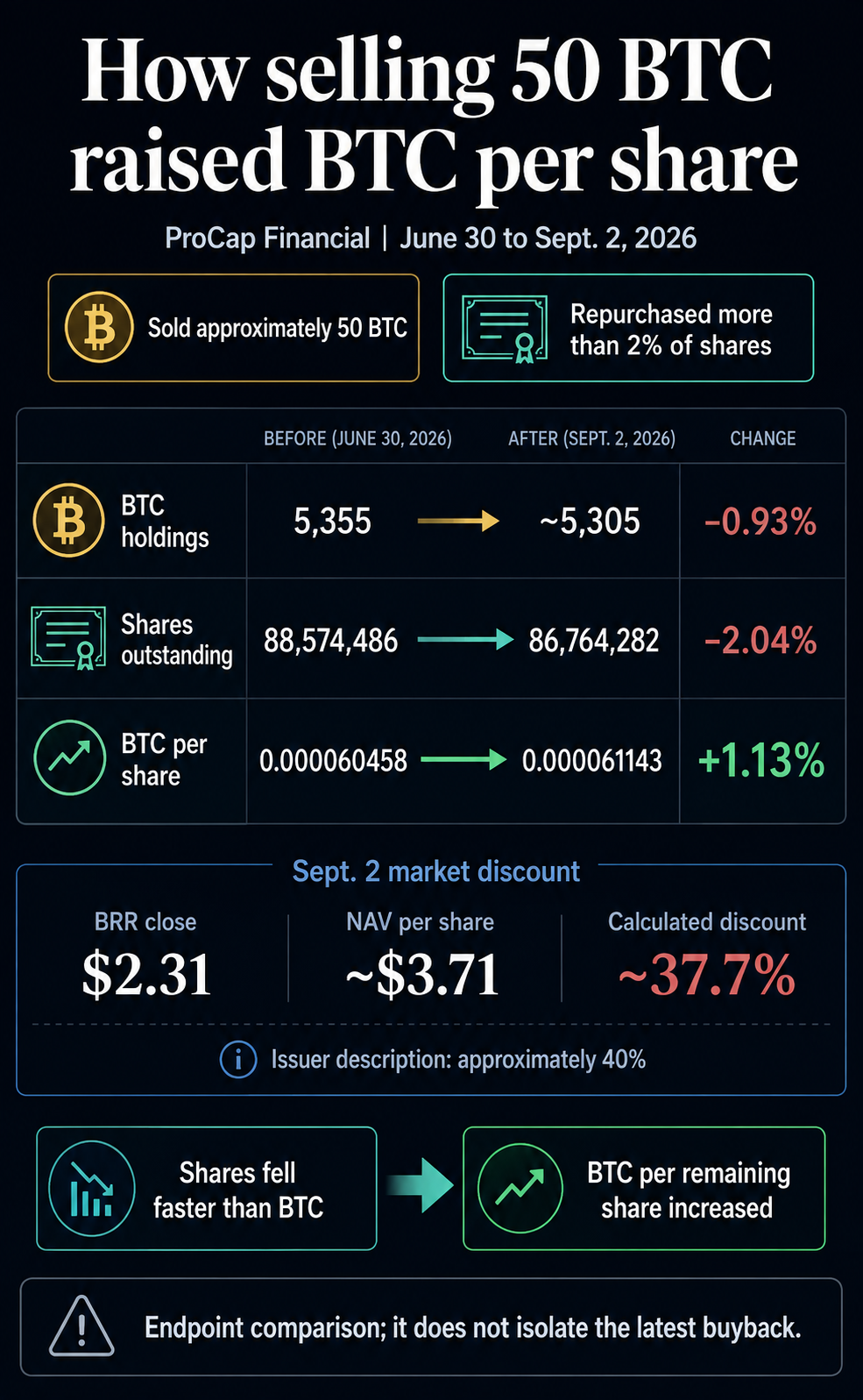
The Nasdaq-listed company sold about 50 BTC and repurchased more than 2% of its common stock while shares traded roughly 40% below net asset value, extending a strategy that has now retired about 10% of outstanding shares since its buyback program began.
ProCap reported about 5,305 BTC and 86.8 million shares outstanding as of Sept. 2, down from 5,355 BTC and 88.6 million shares at the end of June.
The Bitcoin balance fell about 0.9% over that period, while the share count declined roughly 2%. That lifted Bitcoin per share by about 1.1%, showing how buying stock below NAV can offset a smaller treasury even as the company sells some of its Bitcoin.
Anthony Pompliano, ProCap’s chairman and chief executive, said the company intends to keep exploiting the gap between its market price and underlying asset value.
“We continue to repurchase shares of $BRR while they trade significantly below NAV,” Pompliano said. “We have now repurchased approximately 10% of shares outstanding since we started the buyback program.”
BRR discount flips the Bitcoin treasury playbook
The strategy reverses the usual approach used by Bitcoin treasury companies, which often issue stock when shares trade at a premium and use the proceeds to accumulate more Bitcoin.
For ProCap, the economics shift when its own stock trades well below the value of the Bitcoin and cash backing each share. At Sept. 2, ProCap calculated NAV at about $3.71 per share, while BRR closed at $2.31, a discount of roughly 38%.
Selling some Bitcoin to retire deeply discounted shares can therefore leave each remaining share representing a larger portion of the company’s treasury.
ProCap used the same approach in June, when it sold about 52 BTC and repurchased two million shares at an estimated 50% discount to NAV.
The company still had $84.4 million remaining under its $100 million buyback authorization at June 30, though further purchases remain discretionary.
Its ability to keep repeating the trade will also depend on liquidity. ProCap reported $15.3 million in cash at June 30, along with $99.6 million of convertible-note principal and a $77.3 million working-capital deficit driven largely by how the notes were classified.
As long as BRR remains deeply discounted, however, ProCap has an unusual incentive: selling Bitcoin may increase the Bitcoin backing each share faster than simply holding every coin.
The post A public company sold Bitcoin and somehow gave each shareholder more BTC exposure appeared first on CryptoSlate.
Bitcoin accelerated above $81,000 on Thursday as easing rate fears and fresh institutional demand lifted the broader crypto market.
On Sept. 3, Federal Reserve Gov. Christopher Waller said he could support keeping interest rates unchanged this month if August inflation continues to cool, helping push the market-implied odds of a September rate increase to roughly 50% from about 65% earlier in the day. Treasury yields declined following the remarks.
This news helped spark a rally across major cryptocurrencies, with Ethereum, XRP and Solana gaining more than 5%, while Zcash and Cardano climbed more than 10%.
Fresh capital starts replacing the short squeeze
Bitcoin’s rally is beginning to draw fresh capital from several parts of the market after its initial advance relied heavily on bearish traders being forced out of positions.
US spot Bitcoin ETFs drew $730.9 million on Thursday, their largest daily inflow since January. BlackRock’s IBIT accounted for roughly $454 million, while products from Fidelity, Grayscale and others also attracted capital.
The inflows provide a stronger source of demand after CryptoQuant found that much of Bitcoin’s earlier push toward $81,000 was driven by shorts being liquidated or closed, with relatively few traders opening new long positions. That left the first phase of the rebound dependent on forced buying that fades as bearish positions are cleared.
The latest market activity suggests that composition is starting to change.
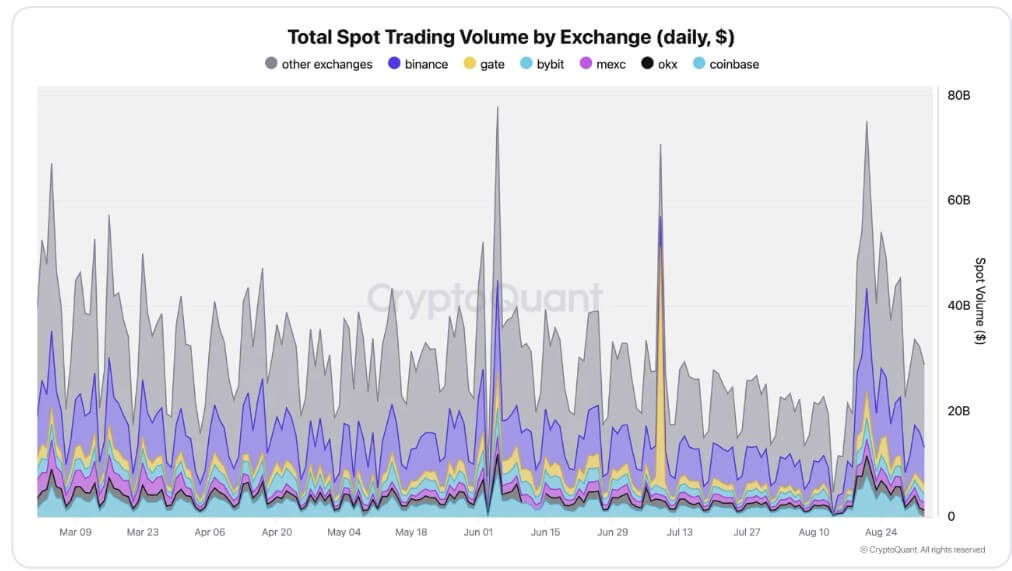
Thursday’s ETF haul followed a strong August in which US Bitcoin funds attracted about $3.5 billion, their best month since September 2025. At the same time, spot trading activity across exchanges has accelerated sharply as Bitcoin recovered toward $80,000.
CryptoQuant data showed daily Bitcoin spot volume rising roughly three to four times from early-August lows. Binance captured the largest increase, while Coinbase and MEXC also recorded stronger activity.
Large holders have also become more active around exchanges. Hourly Bitcoin whale inflows repeatedly exceeded 2,000 BTC, while the average deposit size on Binance climbed from roughly 20 to 30 BTC to more than 50 BTC, with peaks near 75 BTC.
Those transfers point to heavier participation rather than outright accumulation, since coins sent to exchanges can also precede selling.
Combined with stronger ETF subscriptions and rising spot turnover, however, they show that the rally is drawing activity from a broader group of market participants than during its initial short-covering phase.
Notably, this market expansion is also spreading beyond Bitcoin. Seven-day cumulative altcoin deposit transactions increased from roughly 15,000 to 20,000 to around 45,000, suggesting improving sentiment is translating into greater participation across the wider crypto market.
That leaves Bitcoin entering its next test with a broader demand base than it had during the first phase of the rebound.
Options traders stay cautious near Bitcoin’s breakout zone
The stronger spot backdrop is running into a derivatives market clustered around the same price region Bitcoin needs to clear.
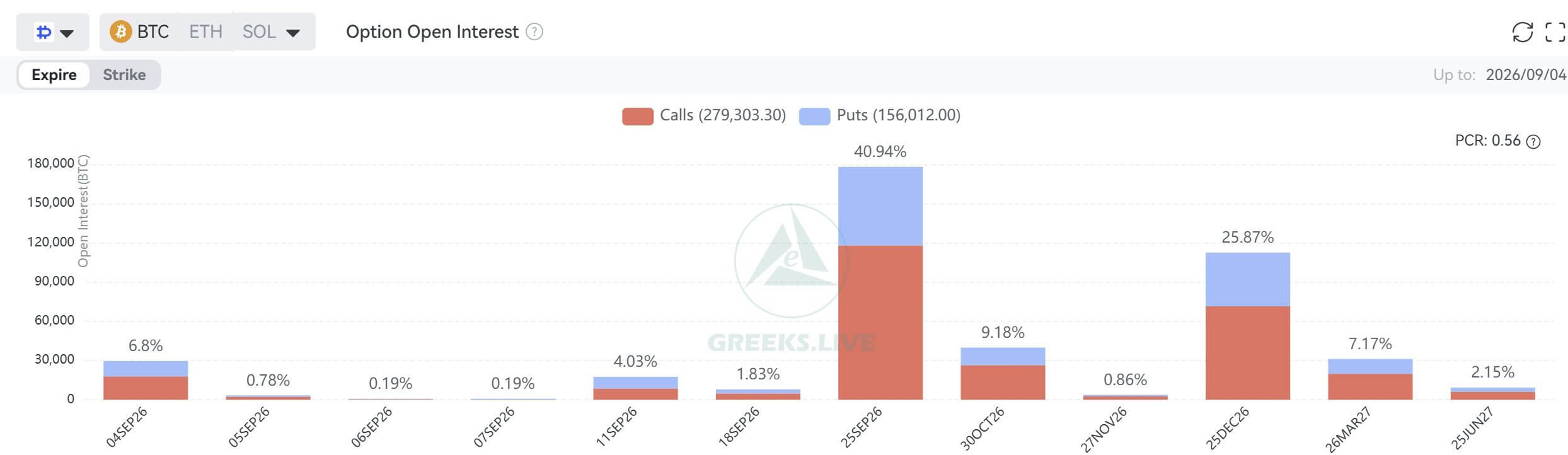
About 29,600 Bitcoin options worth $2.39 billion expired Friday, carrying a put-call ratio of 0.65 and a maximum pain level of $73,000. The expiry represented only about 7% of outstanding options, leaving most positioning intact.
Greeks.live said call gamma exposure, previously spread across multiple strikes, has increasingly converged as traders sell calls above $80,000, while put gamma exposure remains minimal. That positioning could create additional friction around heavily populated strikes if option sellers adjust hedges as Bitcoin moves higher.
The concentration sits directly below another major threshold.
Bitcoin reached $81,400 on Aug. 28 before retreating into a roughly $76,000 to $81,000 range. CryptoQuant’s 365-day moving average is near $82,300, a level the firm uses to distinguish stronger long-term bull-market regimes.
Its Bull Score remains at 70 after briefly reaching 80 during the August rally, the highest since October 2025. Readings above 60 have historically coincided with stronger market conditions.
Yet volatility markets are becoming less aggressive as Bitcoin approaches that test.
Monthly realized volatility increased to about 40% this week, while monthly implied volatility declined to roughly 36%. The 15-day volatility risk premium briefly dropped to negative 16% on Thursday before recovering to about negative 6%, well below last month’s peak near 15%.
Bitcoin has therefore been moving more sharply than options prices imply it will move in the coming period.
Headline leverage figures also look less extreme beneath the surface. Bitcoin open interest is approaching $48 billion when measured in dollars, but Alphractal data show the same exposure declining when denominated in BTC. Part of the rise in dollar open interest reflects Bitcoin’s higher price rather than a proportional increase in the amount of exposure traders are taking.
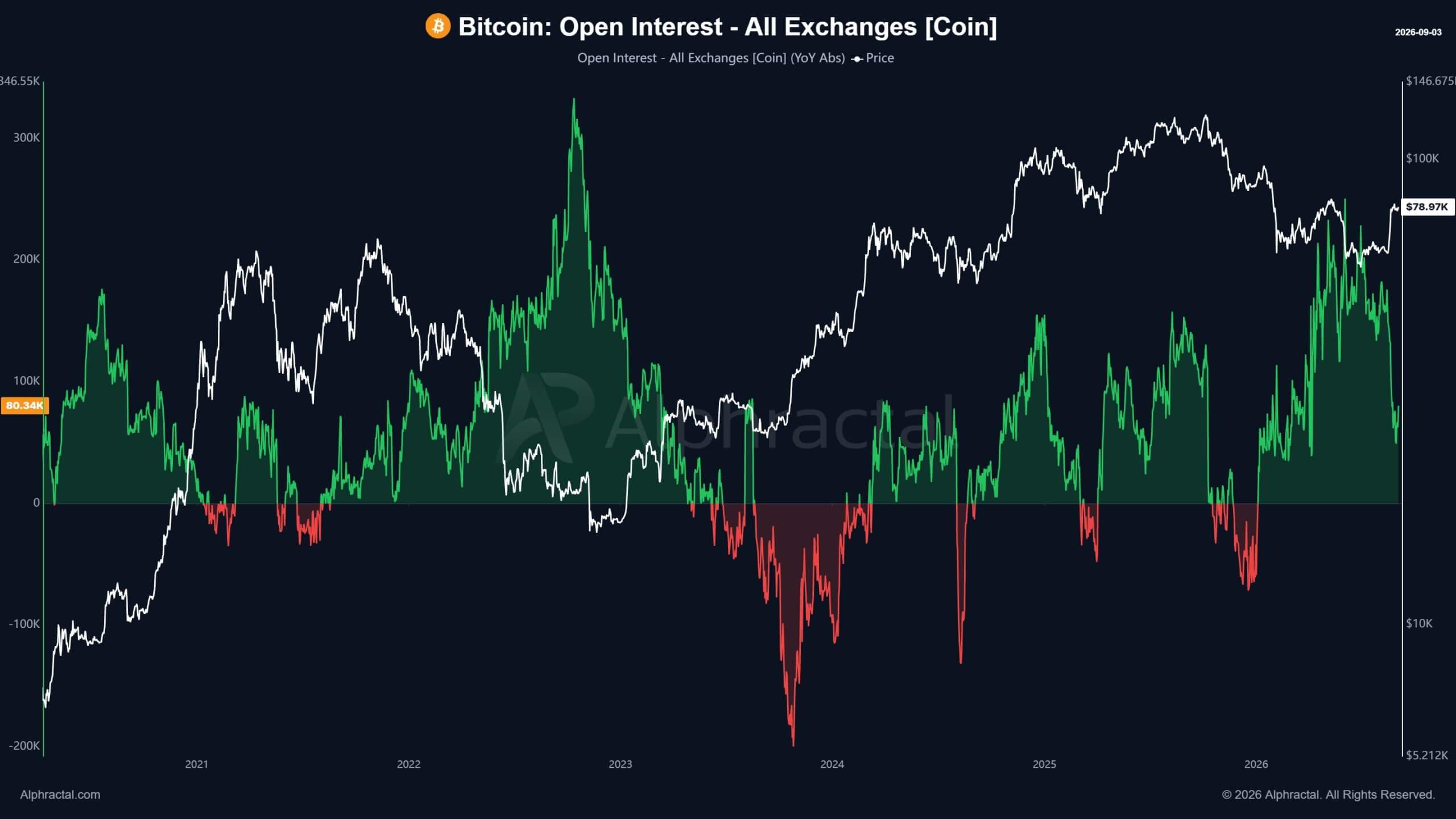
The result is a derivatives market that remains comparatively restrained even as Bitcoin sits beneath a major breakout level.
With call positioning building above $80,000 and implied volatility falling below realized volatility, traders appear to be pricing consolidation rather than an immediate expansion in price swings.
The next move needs buyers to stay
Bitcoin now enters its next attempt at the $80,000 to $83,000 zone with a stronger foundation than it had during the first phase of the rebound.
Short covering can accelerate a rally, but its contribution fades as bearish positions are closed. Sustained advances eventually require investors willing to keep buying at progressively higher prices.
Thursday’s ETF flows suggest that transition may be beginning.
The test is persistence. A single $730.9 million session can strengthen demand without establishing a durable institutional bid, particularly after the funds recorded a $236 million outflow earlier in the week.
Bitcoin must also absorb call positioning above $80,000 and clear the roughly $82,300 long-term threshold while the options market continues to price lower volatility.
Waller’s comments have improved the macro backdrop, but that support remains conditional on incoming inflation data. A stronger-than-expected reading could quickly restore expectations for tighter policy and reverse some of Thursday’s easing in financial conditions.
For now, Bitcoin has gained something its initial rebound lacked: a large fresh injection of spot capital alongside expanding participation across the crypto market.
Whether that becomes a sustained bull-market breakout depends on those buyers returning after the first surge. If ETF demand persists, Bitcoin’s next attempt at $83,000 may also test how long the options market’s subdued volatility expectations can hold.
The post Bitcoin’s rally over $81,000 is finding real buyers, but options traders still aren’t pricing a clean breakout appeared first on CryptoSlate.
Australian crypto firms that need financial-services authorization have until Sept. 30 to enter a compliance pathway or risk enforcement.
This week, the Australian Securities and Investments Commission (ASIC) said qualifying digital-asset businesses must apply for or vary a license, become an authorized representative, notify the regulator of an intended market-license application or begin winding down before the deadline.
From Oct. 1, firms that require authorization but have not met the applicable conditions will lose the benefit of ASIC’s temporary no-action position. The regulator warned that breaches of financial-services law can carry civil and criminal penalties, including fines of up to 10% of annual turnover.
However, this deadline does not apply uniformly across the crypto sector.
Whether a business falls inside the regime depends on whether the digital asset or arrangement it offers qualifies as a financial product and what service the company provides. ASIC said that assessment turns on the rights, benefits, expectations and product features attached to each offering.
That makes Sept. 30 less a blanket licensing cutoff and more a deadline for firms to establish where they sit within the regulatory framework.
Firms must choose a path or step away
Businesses providing financial services involving digital assets that qualify as financial products can apply for an Australian Financial Services License, vary an existing license or operate through specified authorized-representative and related-company arrangements.
Market operators and clearing and settlement providers face a different route. They must notify ASIC in writing that they intend to apply and attend a pre-application meeting by Sept. 30, with a formal application due within 12 months.
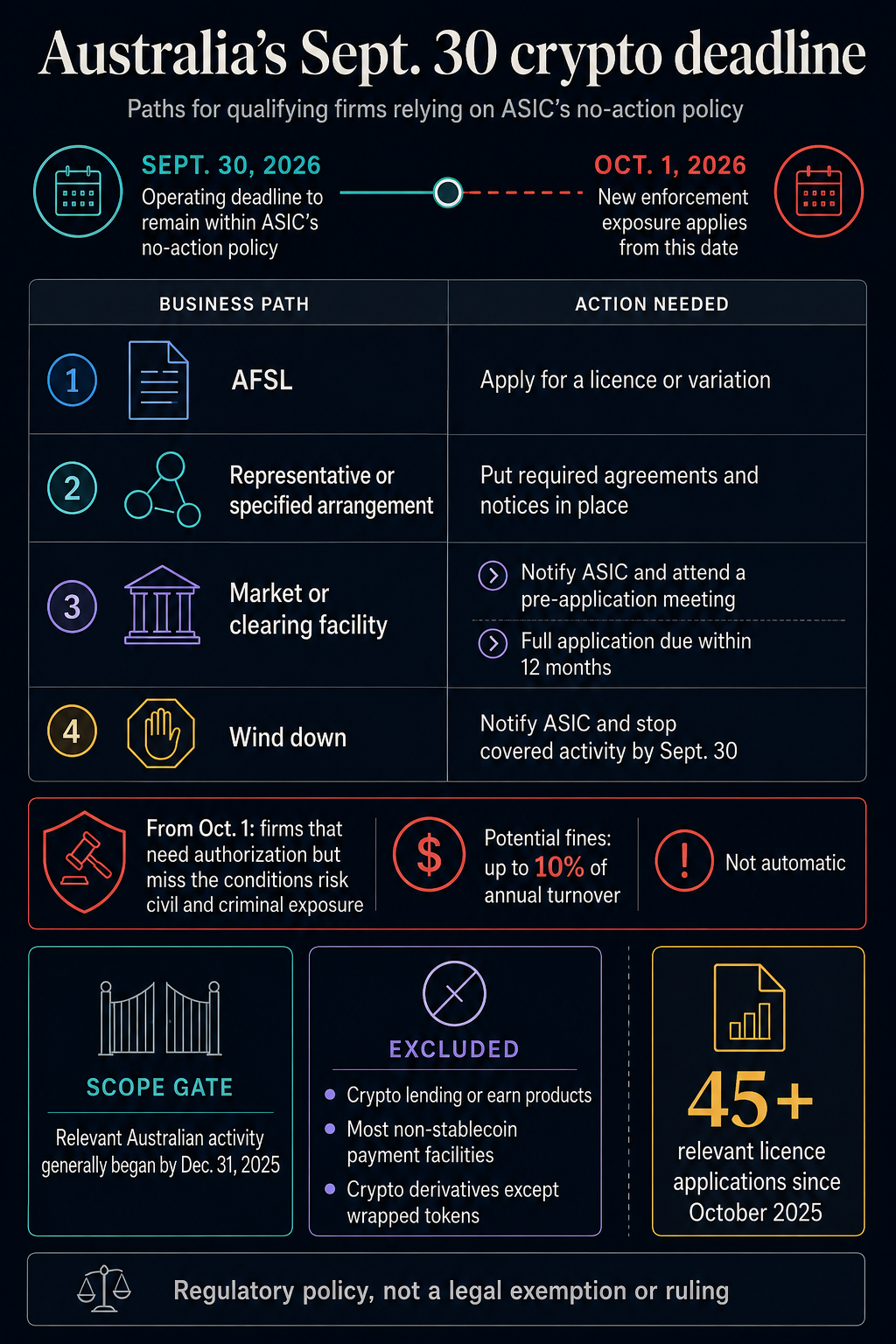
Companies that do not want to enter the licensing system can wind down instead, but they must notify ASIC by the same deadline and stop the covered activity within the permitted period.
The no-action policy also excludes several products, including crypto lending and earn offerings, most digital-asset derivatives and certain non-cash payment facilities.
ASIC has already recorded more than 45 applications for relevant digital-asset financial-services authorizations since updating its guidance in October 2025.
The regulator originally set a June 30 deadline, then extended the transition by three months and broadened the available compliance routes.
That extension now appears to be the final buffer.
ASIC’s no-action letter does not declare the covered activity lawful or prevent courts and third parties from acting. It simply sets out when the regulator presently intends not to pursue enforcement.
The practical choice for qualifying firms is therefore narrowing quickly: enter the licensing system, restructure how they operate or leave the regulated activity behind before the reprieve expires.
The post Australia gives crypto firms until Sept. 30 to get licensed or risk enforcement appeared first on CryptoSlate.
The Commodity Futures Trading Commission (CFTC) asked a federal court on Sept. 2 to dismiss CME's challenge to Kalshi's Bitcoin perpetual contract.
The lawsuit turns on whether a contract without a fixed expiration belongs in the US futures regime. Before the court reaches that question, the regulator says CME must first show an injury the court can fix.
The Commodity Futures Trading Commission says CME is free to list a comparable digital commodity product, so the exchange cannot blame the regulator for competitive harm caused by its choice to stay out.
That threshold argument turns a dispute over one Bitcoin contract into a test of how perpetual-style futures can spread through regulated US markets.
Bloomberg reported discussions about Coinbase seeking a regulated route to selected contracts linked to prices on Hyperliquid. Kalshi is reportedly preparing to seek approval for a West Texas Intermediate crude-oil version.
Together, the examples trace a contract structure popularized in offshore crypto markets as it enters the American regulatory perimeter one venue and asset class at a time.
CryptoQuant data shows that global crypto perpetual-futures volume reached about $61.7 trillion in 2025, up 29% from the previous year, while spot trading totaled $18.6 trillion over the same period.
The CME case could shape how much of that activity US exchanges can pursue through the CFTC's futures framework.
The CFTC says CME can compete in Bitcoin perpetuals
CME sued the CFTC on June 18, seeking to overturn the agency's May 29 approval of KalshiEX's Bitcoin perpetual contracts and the accompanying policy statement. CME argued that a contract without a fixed expiration is a swap rather than a future under the Commodity Exchange Act.
The CFTC's motion said the relief CME seeks would fail to remedy the exchange's claimed competitive injury.
The agency added that CME may list similarly structured digital commodity perpetuals, characterizing any disadvantage from CME declining that opportunity as self-inflicted.
A judicial decision treating Kalshi's product as a swap would not necessarily remove competing exposure from the market because another venue might offer it under that classification. In the agency's view, a win for CME on that point would still fail to redress the alleged injury.
The current schedule gives CME until Oct. 2 to oppose the dismissal motion. A ruling on standing could leave the deeper line between futures and swaps unresolved.
The May 29 CFTC policy defined designated contract markets as those that could list similarly structured perpetuals tied to Bitcoin and digital commodities with deep, active, and continuous spot markets. Products outside that group were directed toward case-by-case review under Regulation 40.3.
The result is a faster path for qualifying digital commodity products and a separate review track for other assets. That distinction will matter as venues look from crypto toward energy and other established futures markets.
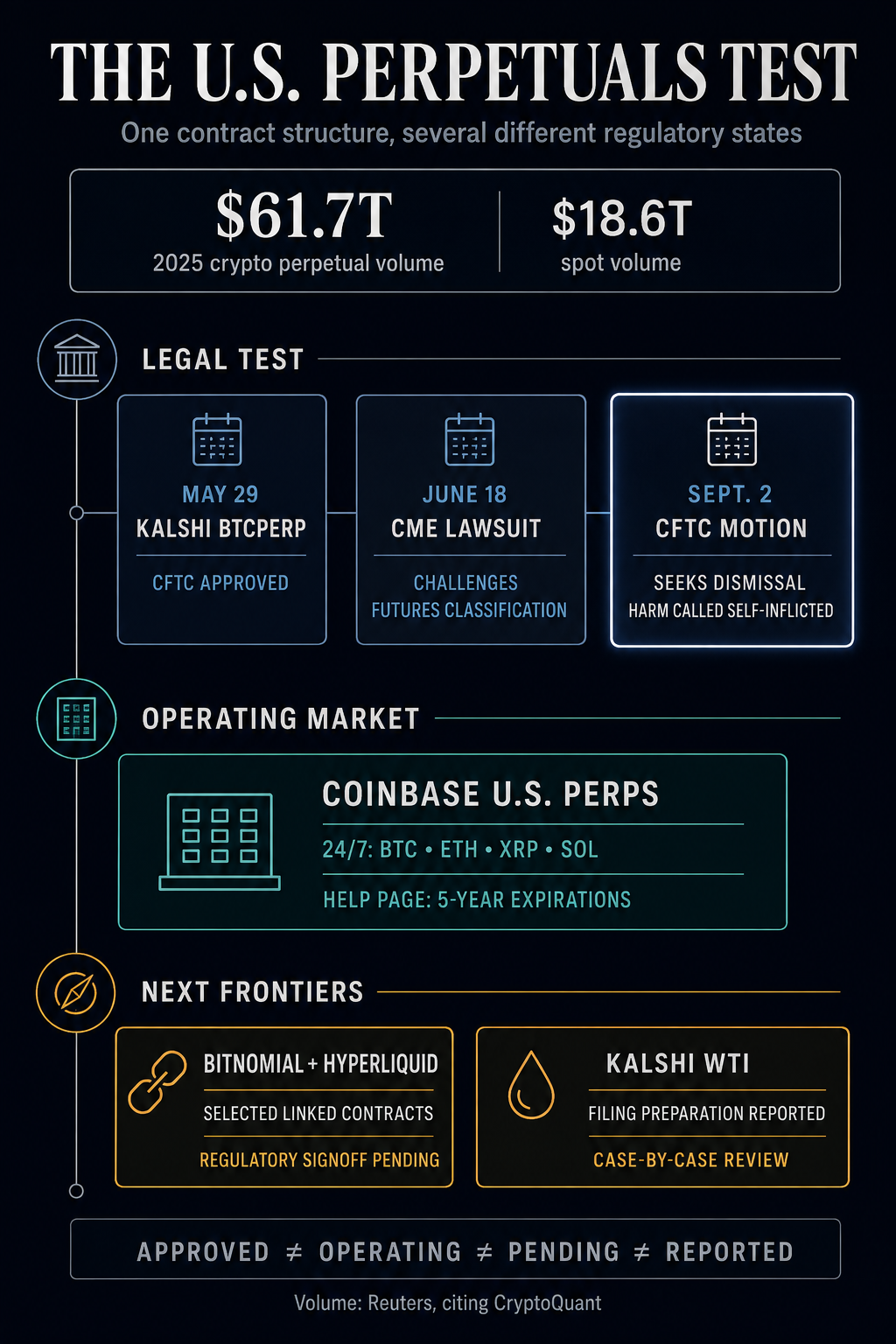
Coinbase's derivatives market page markets US perpetual-style futures with 24/7 trading and contract families tied to Bitcoin, Ethereum, XRP, and Solana.
The name “perpetual” covers different contract mechanics in the emerging US market. Coinbase's official help material describes the covered contracts as having five-year expirations, so they offer long-dated, continuously traded exposure, while a literal expiry-free contract requires different terms.
A June CFTC staff letter granted conditional relief for requests from Coinbase Derivatives and Bitnomial to remove expiration dates from existing digital commodity perpetual-style contracts that expired on June 30.
Regulated US perpetual-style crypto futures have moved from policy concept to operating category, even as the exact expiration mechanics vary by contract. CME's suit challenges the agency approach behind that change as rival venues adapt one of crypto's largest trading formats.
Hyperliquid would test an on-chain bridge
Hyperliquid and Payward are reportedly discussing a structure for registered US users. Payward subsidiary Bitnomial, a regulated derivatives venue, would offer selected contracts tied to token prices on Hyperliquid.
Payward completed its acquisition of Bitnomial in August, adding its US derivatives exchange and clearing infrastructure.
President Donald Trump supplied a political signal on Aug. 19, saying that his administration was working on a US route for Hyperliquid during a White House technology event.
A signed-off structure would test a bridge between a registered domestic venue and token prices formed in an on-chain market. Surveillance, market integrity, and the precise relationship between the venues would turn on the approved design.
Polymarket's international site shows live leveraged crypto perpetual markets, while Polymarket US is a separate platform. The international product demonstrates how quickly crypto-native venues are expanding the format, supplying global context.
Oil brings the model into traditional futures
In June, the CFTC requested public comment on 24/7 futures trading and perpetual contracts for storable, physically delivered energy commodities, including crude oil. That consultation placed the structure under active review in a longstanding futures market.
Kalshi is reportedly preparing a CFTC filing for a perpetual contract tied to WTI crude oil, potentially as soon as the following week.
A WTI proposal would follow the CFTC's case-by-case route. Its review would also confront the practical differences between a cash-referenced crypto contract and a market built around a physical commodity with established delivery infrastructure.
Perpetuals are being considered for a traditional commodity market where CME is an incumbent, placing the new structure closer to the core of established derivatives competition.
A quick CFTC victory on standing would preserve the agency's framework without a ruling on the futures-versus-swaps question. Other exchanges could read that result as support for proposing similar contracts, subject to the applicable listing or review process.
Continued litigation on the merits would put the statutory classification question before the court. A decision on whether a no-expiry contract can qualify as a future would create a clearer legal boundary, while the period before a ruling could complicate product planning.
Regulatory sign-off for selected Bitnomial contracts linked to Hyperliquid prices would test the on-chain bridge. Acceptance of a WTI perpetual would show the structure crossing into a traditional commodity.
The CFTC is now defending its approach in court while exchanges probe its limits, with perpetual-style products entering the regulated US market.
The next phase will depend on whether CME has standing, how a court classifies the Kalshi contract, which venues can meet the CFTC's conditions, and whether regulators allow the model to extend from digital commodities to on-chain prices and physical markets.
The post From Bitcoin to oil, perpetual contracts are breaking into American financial markets appeared first on CryptoSlate.
Bitcoin registered an intraday high above $82,000 on Sept. 3, pushing above the 50-week moving average that Galaxy Research says marked the definitive end of four of Bitcoin's five comparable completed bear markets.
Galaxy's signal requires a weekly close above that line, and the Sept. 3 push through it happened well before the week's close.
A historical signal with one real exception
Galaxy's framework treats the 200-week moving average as Bitcoin's historical bear market floor and the 50-week moving average as its ceiling, with the 50-week line currently sitting around $81,800.
In four of the five completed bear markets where Bitcoin fell below that ceiling, the first successful weekly reclaim marked the bottom.
The exception came in 2021 and 2022, when Bitcoin briefly reclaimed the level twice before falling to a fresh low.
Galaxy's drawdown accounting puts the current bear market's start near a $124,800 peak in October 2025 and its low near $58,500 at the end of June, a decline of roughly 53%.
| Metric | Current setup | Why it matters |
|---|---|---|
| 50-week moving average | ~$81,800 | Galaxy’s historical bear-market ceiling |
| Sept. 3 intraday high | Above $82,000 | BTC has traded through the line, but not confirmed it |
| Required confirmation | Weekly close above 50W MA | Galaxy’s signal is not based on intraday moves |
| Historical record | 4 of 5 comparable bears | Successful reclaim usually marked the bear-market bottom |
| Main exception | 2021–2022 | BTC reclaimed the level twice before making a new low |
| Current drawdown | ~$124,800 to ~$58,500 | Roughly 53% peak-to-trough decline |
More than a chart pattern
Bitwise's Sept. 1 research argues that Bitcoin's reclaimed price levels, combined with its Long-Term Holder Supply and Risk-On Transition models, point to a new bull market cycle already underway, provided those reclaimed levels hold.
That combination makes the bullish case broader than one technical line crossing another.
CryptoQuant analyst Darkfost said Sept. 2 that Bitcoin's apparent demand, a measure of whether fresh buying is absorbing newly available supply, briefly turned negative again after its short recovery earlier in August faded.
Wallets holding more than 100 BTC added roughly 60,000 BTC during that same month even as smaller holders sold, and Glassnode's data shows real spot participation and ETF inflows behind the rally's earlier stages.
Bitcoin's buyer base is real, and it has not yet grown large enough to absorb sellers as price keeps climbing.
Several methods point to the same price band
Glassnode's latest on-chain research identifies $83,000 to $86,000 as a dense band of long-term-holder supply, the level at which the current relief rally has stalled.
At comparable prices, 68% of Bitcoin's supply now sits in profit, up from 65% during a similar test in May, meaning more coins could be sold into any further strength.
21Shares frames roughly $81,000 to $82,000 as the line separating a genuine turn higher from an ordinary bear market bounce, with $85,000 and eventually $98,000 as the next markers above it.
None of these frameworks arrived at the same number through the same method. Nonetheless, Galaxy's moving average, Glassnode's supply data, and 21Shares' regime band all independently cluster in the same broad $81,000 to $86,000 zone, a strong signal.
| Source / framework | Key level or band | What it measures | Signal |
|---|---|---|---|
| Galaxy | ~$81,800 | 50-week moving average | Bear-market ceiling test |
| 21Shares | ~$81,000–$82,000 | Regime recovery band | Bull turn vs. bear bounce |
| Glassnode | $83,000–$86,000 | Long-term-holder supply cluster | Overhead selling pressure |
| Glassnode | 68% supply in profit | Profitable coins available to sell | Higher profit-taking risk |
| Reuters / market technicals | ~$82,800 | Prior resistance area | Breakout gateway toward $90K |
The rally's origin invites a closer look
Glassnode traces the current move back to a short squeeze in mid-August that pushed Bitcoin from roughly $63,500 toward $80,000.
That leg came alongside about $2.8 billion of ETF inflows, falling futures open interest, and contained funding rates, a pattern more consistent with spot buying and short covering than with leveraged longs chasing price.
ETF intake later peaked near $290 million a day, though secondary-market turnover on those same ETFs stayed closer to $3 billion daily, a quieter pace than prior expansion phases showed.
The Treasury's Aug. 19 move to at least double its long-end liquidity-support buybacks helped fuel the initial leg.
QCP has cautioned that operations function as liquidity support, well short of full monetary easing, and Fed Governor Christopher Waller has pointed to fiscal strain keeping Treasury yields elevated in the high-4% range.
Bitcoin needs a weekly close above the 50-week moving average, since Galaxy's historical signal has never been satisfied by an intraday wick alone.
It also needs to clear and hold $83,000 to $86,000, genuinely absorbing the long-term-holder supply Glassnode has identified over a sustained stretch.
Apparent demand, ETF flows, and US spot activity need to turn convincingly positive on their own, past the mixed readings seen so far.
The reclaimed levels also need to survive the profit-taking that comes with more of the supply moving into the green.
Whether the reclaim holds or joins 2021-22 as the exception
The bull case has Bitcoin closing the week above the 50-week moving average. It then clears $83,000 to $86,000 on spot demand strong enough to push through the same level where Glassnode says the current relief rally has stalled.
| Scenario | What needs to happen | Upside / downside markers | What it would imply |
|---|---|---|---|
| Bull confirmation | Weekly close above 50W MA, then clear and hold $83K–$86K | $90K, then ~$98K | Galaxy’s signal joins the four successful historical reclaims |
| Failed reclaim | BTC fails the weekly close or loses $76K–$78K support | ~$71.8K, then $62K–$65K | The move looks more like a short squeeze than a confirmed bull cycle |
| Demand-confirmed breakout | Apparent demand, ETF flows, and US spot activity improve together | Sustained move above $86K | Buyers absorb profit-taking rather than just chasing price |
| Demand failure | Price rises while apparent demand remains weak | Return below reclaimed levels | 2021–22 becomes the closest historical comparison |
Under that path, $90,000 comes into view next, followed by the prior 2026 high near $98,000. Galaxy's historical signal joins its four successful predecessors, leaving the 2021-22 episode as the sole exception on record.
The bear case has Bitcoin failing the weekly close entirely or losing support back near $76,000 to $78,000. That would send it sliding toward $71,800 and eventually the $62,000 to $65,000 zone that marked the accumulation base beneath this year's rally.
In that scenario, the 2021-22 exception gets company, and the August rally reads in hindsight as forced short covering that ran out of room once real demand failed to show up behind it.
Bitcoin crossed the line that has historically marked the end of its bear markets. The next few thousand dollars will decide whether enough buyers showed up to prove it.
The post Bitcoin just crossed the line that ended 4 out of 5 bear markets, but one deadly historical trap could still trigger a crash to $62,000 appeared first on CryptoSlate.
HTTP error 429 on https://cryptoticker.io/en/feed/
Failed to fetch feed: https://cryptoticker.io/en/feed/
Failed to fetch feed.
Decrypt
Bitcoin soared past $81k, HYPE and ZEC hit smashing new ATHs and the onchain rally leveled up. Is this the first stage of the next leg up?
A year ago the fund claimed the total had not moved, and that the reserve was only shuffling coins between government wallets.
Some records exposed in the breach date to 2019, years beyond the 90-day retention Trezor said its partners had agreed to.
Monthly reported sums rose 18% on average, and the compounds now appear to be spreading beyond Southeast Asia.
Adam Aron says AMC Entertainment has no connection to the tokens and is putting outside securities counsel on the case.
U.Today - IT, AI and Fintech Daily News for You Today
Robinhood Chain appears to have suffered a network outage on Sept. 4, temporarily halting new block production.
Key crypto updates for Sep. 4: SEC clears XRP and Solana; a $566M short squeeze hits bears, and Zcash jumps above $1,000 on autonomous AI risks.
Four crypto assets added to Binance's delisting roster with another 14 set to be axed on the Binance Alpha platform.
ZCash is coming closer to the historic threshold despite the relatively bearish momentum.
XRP saw a massive rebound in its trading activity as its spot trading volume across all exchanges reached its highest level since February.
Blockonomi
Key Takeaways
- Q4 adjusted earnings per share reached $1.19, surpassing analyst expectations of $1.09, while revenue hit $898.2 million against a $927 million consensus
- Year-over-year revenue expansion of 25% accompanied by a robust 77% gross profit margin
- First quarter FY2027 revenue outlook of $935-$939 million exceeded Wall Street’s $927 million projection
- Shares gained 5% in Thursday’s after-hours session before retreating 3.4% during Friday’s premarket trading
- Analysts remain optimistic: JPMorgan maintains Overweight with $215 target; Stephens increases target to $225
Despite delivering solid earnings results and upgrading forward guidance, Zscaler faced an unexpected market reaction. This paradox captures the current sentiment surrounding ZS shares.
$ZS EARNINGS UPDATE
Zscaler just delivered a strong Q4:
Revenue: $898.2M (+25% YoY)
Adjusted EPS: $1.19 vs. $1.09 expected
ARR: $3.77B (+25%)
AI security becoming a major growth driver
But there’s a catch… FY2027 ARR growth is guided to only ~17%, a…
— Geovany (@Geovany2300) September 4, 2026
The cloud security provider announced fourth quarter adjusted earnings of $1.19 per share, marking a significant increase from 89 cents in the same period last year and exceeding Wall Street’s $1.09 projection. Quarterly revenue for the period ending July 31 totaled $898.2 million, representing a 25% year-over-year surge and topping the $877 million consensus forecast.
Share prices initially surged 5% to $186.27 during Thursday’s extended trading hours before momentum reversed. During Friday’s premarket session, ZS declined 3.4% after finishing Thursday’s regular trading at $177.80.
Zscaler, Inc., ZS
The company’s annual recurring revenue climbed to $3,771 million, surpassing consensus projections by $26 million and representing a 25% annual growth rate.
Management upgraded its first quarter FY2027 revenue forecast to $935-$939 million, exceeding Wall Street’s $927 million expectation. The company’s EPS outlook of $1.15-$1.16 for the upcoming quarter also topped the analyst consensus of $1.08.
Wall Street’s Response
JPMorgan maintained its Overweight stance with a $215 price objective, highlighting that the revenue and ARR beats represented the strongest performance witnessed throughout the year. The investment firm characterized the updated forecasts as reasonably conservative.
Stephens elevated its price objective to $225. Needham increased its target to $215. Stifel affirmed a Buy recommendation with a $200 price goal. Scotiabank also bumped its target to $200, emphasizing the improvement in new ARR growth. Canaccord Genuity preserved its Buy rating alongside a $210 target.
Following last quarter’s guidance disappointment that shook shareholder confidence, this quarter’s solid performance was viewed as a positive development.
Understanding ZS’s Market Position
Year-to-date, ZS has declined 21%, contrasting sharply with competitors CrowdStrike and Palo Alto Networks, which have surged 83% and 80% respectively.
Market participants have expressed concerns about artificial intelligence potentially rendering conventional security solutions obsolete. Zscaler countered this narrative, emphasizing that AI-powered threats are actually amplifying demand for its infrastructure solutions.
Management disclosed a 3% workforce reduction while announcing the successful hiring of two senior sales leadership positions. Canaccord noted that FY2027 projections might be deliberately cautious due to the continuing sales organization restructuring.
According to InvestingPro’s assessment, ZS appears undervalued at present levels when compared against its calculated fair value.
The most recent Friday premarket stock price stood at $171.65, reflecting a decline of $6.15 or 3.46%.
The post Zscaler (ZS) Stock Slides 3% Following Strong Q4 Earnings Beat – Here’s Why appeared first on Blockonomi.
TLDR
- Shares of LULU plummeted as much as 20% during premarket trading Friday following disappointing Q2 financial results
- Second quarter revenue totaled $2.4 billion, falling short of analyst projections of $2.458 billion, marking a 4% year-over-year decrease
- Comparable store sales declined 9%, significantly worse than the anticipated 4.6% drop forecasted by Wall Street
- The athleisure retailer reduced its annual revenue forecast to $10.35B-$10.5B, representing a 5%-7% decrease compared to the previous year
- New CEO Heidi O’Neill assumes leadership next week, facing challenges as the brand loses market share to competitors including Alo and Vuori
Shares of Lululemon experienced a significant selloff Friday following the athletic apparel company’s announcement of underwhelming second quarter performance and its second reduction of annual guidance this fiscal year.
Lululemon Athletica Inc., LULU
Shares declined to approximately $100.89 during morning trading, representing a roughly 17% decrease, after plunging as much as 20% before the opening bell. This positions the stock for one of its most severe single-session declines since March 2020.
Second quarter revenue reached $2.4 billion, falling below analyst consensus of $2.458 billion and declining from $2.525 billion in the year-ago period. Comparable store sales contracted 9% throughout the quarter, substantially exceeding the 4.6% decrease Wall Street had anticipated.
While adjusted earnings of $2.92 per share surpassed the $1.79 consensus estimate, this figure incorporated 86 cents per share attributed to federal tariff reimbursements. Jefferies analyst Randal Konik noted this makes the actual earnings capacity “materially worse than the headline.”
Annual Outlook Reduced for Second Time
Lululemon lowered its annual revenue projection to between $10.35 billion and $10.5 billion, signaling a 5% to 7% contraction from the prior year. This marks a significant reduction from previous guidance ranging from $11 billion to $11.15 billion.
Adjusted earnings per share for the full year are now anticipated to land between $9.48 and $9.73, considerably beneath earlier guidance of $10.95 to $11.15. Both forecasts fell short of analyst expectations.
Konik characterized the quarter as a “triple whammy,” highlighting declining sales across U.S. retail locations, women’s apparel including a 20% plunge in leggings revenue, and China performance on a constant-currency basis.
Citi analyst Paul Lejuez stated there “weren’t really any significant positives” throughout the quarter, noting the company is grappling with both customer traffic and conversion challenges across multiple regions.
Incoming CEO Faces Significant Challenges
Former Nike executive Heidi O’Neill is scheduled to assume the CEO role next week, inheriting a brand struggling against competitors like Alo and Vuori while confronting product quality concerns.
Konik suggested O’Neill has “a mountain to climb,” with brand momentum “fading fast and share losses mounting.” He partially attributes the margin pressure to strategic decisions by outgoing CEO Calvin McDonald, who pursued expansion into larger, costlier retail spaces that elevated fixed operating expenses.
Morningstar analyst David Swartz told Yahoo Finance the revised guidance represents a prudent strategic move. “There’s no reason to put out numbers that are going to be too aggressive and hard to hit,” he explained. He emphasized the company maintains zero debt, clarifying the primary concern centers on revenue growth rather than financial stability.
The lowered guidance does establish more achievable targets for O’Neill. However, Lejuez warned that “another cut is also possible once she starts.”
LULU shares have declined more than 40% year-to-date. The stock also experienced a selloff in April when O’Neill’s appointment was initially announced.
In May, Lululemon finalized a settlement agreement with founder Chip Wilson, resolving a proxy dispute concerning board governance, with O’Neill’s appointment representing one of the contentious issues.
The post Lululemon (LULU) Stock Plunges 17% Following Disappointing Q2 Results and Revenue Forecast Reduction appeared first on Blockonomi.
TLDR
- Lululemon stock drops 20% after weak Q2 sales and a reduced fiscal 2026 outlook.
- Americas revenue falls 8% as comparable sales slide 12% in the second quarter.
- Lululemon cuts 2026 revenue guidance as demand pressure hits its core market.
- Q2 operating income falls 13% despite tariff refunds lifting gross margins.
- Full-year EPS guidance drops to $9.48-$9.73 as sales weakness weighs on growth.
Lululemon (LULU) stock plunged 20.42% to $96.91 in pre-market trading after weak second-quarter sales results and a reduced fiscal 2026 outlook. Shares had closed Thursday at $121.77, up 1.42%, before the earnings release triggered a sharp reversal in early trading. The drop followed weaker Americas demand, lower comparable sales, and guidance pointing to further revenue pressure through the year ahead.
Lululemon Athletica Inc., LULU
Lululemon Q2 Sales Fall as Americas Demand Weakens
Lululemon reported second-quarter revenue of $2.4 billion, down 4% from the same period last year across its global operations worldwide. Revenue fell 5% on a constant-currency basis, while Americas revenue declined 8% during the quarter from the prior year period. International revenue rose 4%, although constant-currency growth slowed to 2% compared with the same quarter in fiscal 2025 overall.
Comparable sales dropped 9% overall, while constant-currency comparable sales declined 10% during the quarter across Lululemon’s store network globally. Americas comparable sales fell 12%, showing deeper weakness across the company’s largest operating region during the three-month reporting period. International comparable sales declined 3%, while constant-currency comparable sales fell 6% from the prior-year quarter despite continued overseas expansion plans.
Gross profit slipped 1% to $1.5 billion, while gross margin increased 200 basis points to 60.5% during the quarter overall. However, $134.5 million in tariff refunds lifted gross margin by 560 basis points and supported quarterly profitability. Operating income fell 13% to $453.7 million, while operating margin declined 190 basis points to 18.8% from last year.
Lululemon Cuts 2026 Guidance After Weak Quarter
Diluted earnings per share fell to $2.92 from $3.10 in the second quarter of fiscal 2025. The quarter included $0.86 per share from tariff refunds and related interest after taxes, which supported reported earnings. Lululemon also repurchased 2.7 million shares for $330 million and ended the quarter with 825 stores after nine net openings.
The company expects third-quarter revenue between $2.29 billion and $2.32 billion, representing a 10% to 11% year-over-year revenue decline. Third-quarter earnings per share should range from $0.93 to $0.98, with an estimated tax rate near 30%. The weaker outlook followed falling sales and continued pressure across the Americas business, where comparable sales posted a double-digit decline.
For fiscal 2026, Lululemon expects revenue between $10.35 billion and $10.50 billion, down 5% to 7% from last year. Full-year earnings per share should range from $9.48 to $9.73, including the tariff-related benefit recognized during the second quarter. Lululemon holds $1.4 billion in cash as incoming CEO Heidi O’Neill prepares to lead efforts to improve growth and execution.
The post Lululemon (LULU) Stock: Plunges 20% After Weak Q2 Sales and Guidance Cut appeared first on Blockonomi.
Key Takeaways
- WTI crude poised for 10% weekly surge while Brent approaches 7% gains, reaching six-week peaks
- Military confrontations between Washington and Tehran intensified this week, affecting Kuwait, Bahrain, and Jordan
- Vessel traffic through the Strait of Hormuz collapsed to merely 4 ships on Thursday versus a 10-day average of 15
- American diesel costs reached unprecedented levels, fueling inflationary pressures and climbing bond yields
- Citigroup boosted third-quarter Brent projection to $86/barrel; ANZ anticipates near-term prices at $95
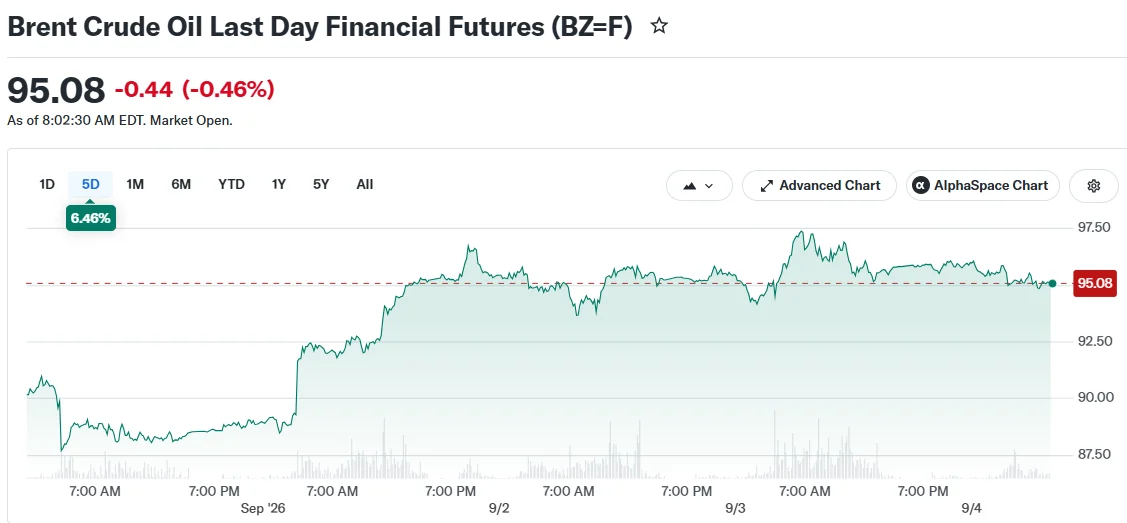
Crude oil markets experienced modest declines on Friday yet remained positioned for one of their strongest weekly showings in recent months, as escalating U.S.-Iran hostilities continue rattling global energy traders.
By Friday morning, Brent crude hovered near $95.15 per barrel, registering a 0.4% intraday decline. West Texas Intermediate dropped 0.6% to $90.77. However, looking at the broader picture, Brent posted a 6.6% weekly advance while WTI surged 8.8%, marking its strongest seven-day performance since mid-July.
Washington and Tehran have now been engaged in military confrontations for seven months. Recent days witnessed some of the most intense exchanges since July, with American forces targeting sites near the critical Strait of Hormuz. Iranian forces retaliated with missile and drone strikes against U.S. and coalition installations across Kuwait, Bahrain, and Jordan.
Reports indicate one American strike impacted a location where a wedding celebration was underway in southern Iran, resulting in civilian casualties. Iranian officials strongly denounced the incident.
Critical Waterway Sees Dramatic Traffic Reduction
As the planet’s most vital oil transit point, the Strait of Hormuz has faced intensified Iranian shipping restrictions following the recent military escalation.
Iran has expanded its Strait of Hormuz shipping blacklist to 56 vessels, following the latest U.S. attacks.
A senior Iranian official is vowing an “asymmetrical and multi-layered” response.
Gulf tankers appear to be facing tighter restrictions, while Iraqi commercial… pic.twitter.com/9QnEQe2kPu
— Mario Nawfal (@MarioNawfal) September 4, 2026

Thursday saw merely four commercial cargo vessels navigate the strait, a stark contrast to the approximately 15 ships that typically pass through based on 10-day averages. This significant decline underscores persistent disruption, contradicting U.S. administration assertions that maritime traffic has largely normalized.
Maritime tracking services and independent energy consultants maintain that substantial interruptions persist. The discrepancy between official rhetoric and observable reality has amplified market volatility.
Vice President JD Vance stated Thursday that Washington would refuse diplomatic engagement with Tehran unless Iranian attacks on international shipping cease immediately.
Diesel Markets Reach Historic Peak
American diesel markets climbed to unprecedented price levels this week. Industry experts attribute this surge partially to crude supply constraints, compounded by continued Ukrainian strikes targeting Russian refining infrastructure.
“Diesel impacts every economic sector,” noted Claudio Galimberti, Rystad Energy’s chief economist. He emphasized that elevated diesel costs are amplifying inflation expectations, consequently driving upward pressure on U.S. Treasury yields.
The dramatic energy price escalation has prompted warnings regarding potential severe economic slowdown risks globally.
According to Energy Information Administration data, U.S. commercial crude stockpiles decreased to 424.5 million barrels during the week concluded August 28, declining from 428.9 million barrels recorded the prior week.
Market observers anticipate OPEC+ will maintain its October production strategy when convening Sunday. The cartel recently completed reversing one phase of output reductions, though Hormuz-related supply disruptions have muddied the effects of those policy adjustments.
Citigroup revised its third-quarter Brent average projection upward to $86 per barrel from $80, citing slower-than-anticipated Strait reopening. ANZ elevated its near-term Brent outlook to $95, warning of additional upside potential should hostilities intensify.
Iraqi oil shipments increased during August to approximately 2.34 million barrels daily, rising from July’s 1.35 million.
The post Crude Oil Surges Toward Six-Week Peak Amid U.S.-Iran Tensions in Hormuz Strait appeared first on Blockonomi.
Key Highlights
- On September 3, 2026, Oura submitted its S-1 registration statement, advancing toward a public offering on Nasdaq with the ticker symbol OURA
- The wearable health technology firm generated $1.4 billion in sales and posted $59 million in net earnings for the fiscal year concluded in June 2026
- Sales increased 74% compared to the previous year, although management cautioned that expansion rates might decelerate
- The platform serves 5 million paying subscribers and distributes products across 56 international markets through approximately 8,400 brick-and-mortar stores
- Management highlighted potential challenges including trade tariffs, dependence on a limited group of major retailers, and reliance on external artificial intelligence providers such as OpenAI, Anthropic, and Google
Oura, the health technology company responsible for creating the Oura Ring wearable device, submitted its S-1 registration statement to the Securities and Exchange Commission this Thursday, progressing toward a public market debut on the Nasdaq exchange.
The smart ring manufacturer intends to trade publicly using the ticker symbol OURA. Goldman Sachs, Morgan Stanley, and J.P. Morgan serve as primary underwriters for the offering.
The regulatory disclosure highlights impressive financial momentum. The company generated $1.4 billion in total sales and achieved $59 million in net profitability during the twelve-month stretch ending in June 2026.
During the nine-month window concluding in June 2026, sales reached $1.21 billion, marking a 74% increase over the comparable timeframe from the prior year.
Gross earnings for those nine months totaled $662 million, reflecting a 55% profit margin.
Strong Sales Figures Accompanied by Cautionary Notes
While the financial metrics appear robust, Oura maintained transparency regarding its operating history. Management acknowledged the company has experienced “a history of operating losses” and only “recently achieved profitability.”
The filing emphasized that sustained profitability cannot be guaranteed moving forward.
During the nine-month period through June 2026, Oura documented losses totaling $924 million against sales of $1.21 billion. The corresponding period one year earlier showed losses of $182.8 million on revenues of $697.6 million.
Management also warned that ongoing international trade disputes and potential tariff implementations could drive manufacturing costs higher.
Revenue Streams and Subscriber Base
The company operates on a dual revenue model: direct sales of the Oura Ring hardware device and recurring subscription revenue through Oura Membership plans.
As of June 2026, the platform supported 5 million paying subscribers. Approximately 72% of the membership base consists of female users.
During the twelve months ended June 2026, Oura distributed 3.6 million ring units. Users wear the device an average of roughly 23 hours daily.
The company maintains distribution channels spanning 56 countries through approximately 8,400 physical retail outlets, including partnerships with Amazon, Best Buy, Target, Costco, and Walmart. International markets outside the United States account for less than 20% of hardware sales.
Roughly 40% of new subscriber acquisition occurs through organic channels, and the 12-month member retention rate stands at approximately 85%.
Dependencies and Strategic Alliances
The filing disclosed that two major retail customers collectively represented 12% and 10% of total revenue during the nine-month reporting period, indicating significant concentration among distribution partners.
Management also revealed that the platform’s functionality depends on artificial intelligence technology from OpenAI, Anthropic, and Google, alongside third-party data infrastructure providers. The company cautioned that service interruptions from these vendors could impact business operations.
Oura maintains collaborative relationships with Dexcom, Natural Cycles, ResMed, Strava, and additional partners to broaden its health ecosystem.
According to the filing, the company targets a serviceable addressable market exceeding $90 billion spanning fitness tracking, digital healthcare, and connected biosensor technologies.
The executive team includes CEO Thomas Hale, who previously served as President at Momentive, and CFO Sean Brecker, former CEO of Headspace.
Capital raised through the public offering will fund technology innovation, operational expenses, and general corporate initiatives.
The post Oura (OURA) IPO: Smart Ring Maker Files for Nasdaq With $1.4B Revenue and 5M Subscribers appeared first on Blockonomi.
CryptoPotato
This Friday, we examine Ethereum, Ripple, Cardano, Binance Coin, and Hyperliquid in greater detail.
Ethereum (ETH)
Ethereum was flat this week. Still, the price held well above the support at $2,400. However, the volume has been falling since the initial rally, and volatility has decreased significantly compared to the early days.
While a consolidation period is normal, this is also a period of weakness in the price action when sellers could make their return. Nevertheless, as long as the key support is not challenged, buyers continue to have the upper hand.
Looking ahead, ETH must stay above $2,400 if it wants the rally to continue. So far, buyers appear in control, but the road towards $2,800 could be bumpier compared to the past few weeks.

Ripple (XRP)
XRP was also mostly flat this week, booking a modest 2% gain. The price has been moving sideways between $1.3 and the resistance at $1.6. This range also kept the price in check between February and May this year.
To get momentum back, this cryptocurrency will need to break away from this range. That will likely see volume and volatility return as well. Based on the current price action, buyers have the advantage, but this could change if they fail to clear $1.6.
Looking ahead, the market is showing some indecision here after a strong pump. While a continuation would put an end to the bear market, it is still too early to say this is it. That’s why buyers may be hesitating here.

Cardano (ADA)
ADA closed 5% higher this week after a good push from buyers, with the price retesting resistance at $0.23. At the time of this post, the resistance remains intact but could be put under pressure by any renewed buying.
For Cardano to confirm a bottom under $0.15, the price has to move beyond its current resistance. Buyers were rejected there in August. However, another push in September could be successful.
Looking ahead, this cryptocurrency is ripe for a strong rally as soon as $0.23 turns into a key support. That can easily see ADA move towards $0.30 and $0.40 if buying volume picks up.

Binance Coin (BNB)
This week, Binance Coin held well above the support at $690, but did not manage to distance itself much beyond that. That’s the reason why the price is up only 1% in the past seven days.
While momentum has been decreasing, BNB is very close to making a higher high. Any price above $745 would confirm it and likely see this cryptocurrency continue its rally towards $900 next.
Looking ahead, the market may be taking a pause right now before momentum returns. While the price action favors a continuation of the rally, a higher high is needed to give it confidence.

Hype (HYPE)
This week, Hyperliquid managed to break above the $85 resistance and closed 4% higher. This both confirmed a higher high and new price record. The question is if this level can hold as support or sellers will turn it into a resistance again.
If the latter, then buyers will likely move to the support at $76 next to defend the recent gains. Still, HYPE has been in a rally for weeks without any significant pullback or correction. One should be expected eventually.
Looking ahead, HYPE could continue its push higher until it hits the psychological level at $100. Sellers could be making a stand there if buyers decide to go for it. But for now, best to watch the price reaction at $85 in the coming days.

The post Crypto Price Analysis Sep-04: ETH, XRP, ADA, BNB, and HYPE appeared first on CryptoPotato.
The US economy added almost three times as many jobs as expected in August, triggering an immediate sell-off for risk-on assets like bitcoin as investors reassess the chances of another Federal Reserve rate hike.
The cryptocurrency’s price had risen to over $81,000 before the news went live, but plunged immediately by $2,000 to $79,200.

More specifically, the US economy added 162,000 jobs in August, according to data shared by the Bureau of Labor Statistics. The general expectations were for roughly 55,000-58,000 new jobs, which means that the actual numbers were significantly higher. The unemployment rate remained unchanged at 4.1%.
The July reading was also revised sharply higher, from a previously reported loss of 23,000 jobs to a gain of 21,000. Average hourly earnings increased 0.3% monthly and 3.1% annually.
A strong labor market gives the Federal Reserve more room to keep monetary policy tight, which, given Kevin Warsh’s hawkish speech from last week, spells trouble for risk-on assets like bitcoin.
The blowout jobs number weakens one argument for keeping rates unchanged: that the US labor market needs protection from tighter monetary policy. Higher interest-rate expectations typically push Treasury yields and the greenback north while reducing the relative appeal of risk assets.
Although the jobs report does not guarantee a September rate hike, as inflation remains the biggest concern for the US central bank, it certainly gives investors a lot to think about ahead of the CPI data next week.
The post Bitcoin Price Plunges After Blowout US Jobs Report: Here’s Why appeared first on CryptoPotato.
[PRESS RELEASE – Los Angeles, California, United States, September 4th, 2026]
Digital collectibles platform MEMONS has officially launched its service. MEMONS is a digital collectibles platform where users can obtain digital cards of various rarity levels by opening Capsules, collect them, and trade them with other users through the Marketplace.

Unlike conventional collectible services that end once an item is acquired, MEMONS connects Capsule Opening, Collection, and Marketplace functions within a single platform. This creates a continuous ecosystem in which collecting and trading continue even after cards are obtained.
MEMONS combines the concepts of collecting, scarcity, and trading—widely used across the global collectible card, loot box, gacha, and digital asset markets—within a digital environment.
Recently, Web3 projects have increasingly expanded beyond token- and community-centered models into services where users can actively participate, including IP, gaming, digital content, and marketplaces.
In line with this trend, MEMONS is expanding into a digital collectibles platform that can connect various IPs and Web3 projects, beginning with APEPE.
About MEMONS
MEMONS is a digital collectibles platform that brings Capsule Opening, Collection, and Marketplace experiences together within a single ecosystem. Users can obtain digital cards of varying rarity levels, build their own collections, and trade cards with other users through the Marketplace.
Incubated within the APEPE ecosystem, MEMONS is designed as a scalable platform capable of supporting various IPs, characters, and Web3 communities. APEPE serves as its founding IP and core ecosystem partner.
Website: https://memons.io
The post Digital Collectibles Platform ‘MEMONS’ Officially Launches appeared first on CryptoPotato.
Uniswap Labs has purchased a stake in PONS as part of a longer-term partnership, sending the token to a new all-time high of $0.75.
The move comes as the Pons team reported rising activity on the platform, with more than 63% of Robinhood Chain launchpad volume passing through the protocol over the past 24 hours.
Uniswap Labs Confirms the Purchase
Pons announced the purchase on September 4, saying the deal would deepen its partnership with Uniswap and give the two projects “long-term alignment.” However, the post did not disclose how much PONS Uniswap Labs purchased or the value of the transaction.
Still, the market reaction was immediate. At the time of writing, PONS was trading at $0.71, up 40.2% in the last 24 hours and more than 507% in the last week, per CoinGecko. It touched as high as $0.75 earlier in the day, a new price record, before easing back, so the current price sits close to 4% below that peak.
Volume climbed too, with $151.8 million changing hands in the past day, a 9% jump from the session before. And if you look at longer timeframes, the numbers get harder to ignore. PONS is up more than 1,769% in the last 14 days and over 2,713% for the month, a run that traces back to a low of $0.0033 in mid-July, and it’s also up close to 25% on its pairing with Bitcoin.
A Token Built Around Burning Its Own Supply
Pons has leaned on deflationary mechanics since it launched. The project says 29.34% of the total PONS supply has been burned to date, with 80% of protocol fees going toward buying back and burning more tokens on an ongoing basis.
The team has also been adding tokenized stock pairs to its platform, including UPS, Snap, Lululemon, Figma, Moderna, Pfizer, Rivian, Marvell, and Johnson & Johnson in the past day alone. Trading followed. More than 63% of all volume on Robinhood Chain’s launchpad flowed through its platform in a single 24-hour stretch, a day that saw $400 million in volume overall.
Uniswap’s PONS purchase came the same week its own token, UNI, was climbing. As CryptoPotato reported earlier, UNI gained as much as 32% over seven days, and it has since gone even higher, changing hands at just under $6.40 as of this writing, a jump of over 60% in the last 30 days.
The post Uniswap Buys PONS Stake, Token Jumps 40% to New All-Time High appeared first on CryptoPotato.
The hardware wallet manufacturer revealed in a new update from September 4 that another 67,000 customers in the United States had their personal information exposed in the breach at its shipping provider, ShipMonk.
These clients placed orders between November 2019 and August 2021, meaning some of the compromised records were almost seven years old.
CryptoPotato reported last month that Trezor had initially said the ShipMonk breach affected approximately 13,689 customers. The timing was quite peculiar as it came amid the Coldcard saga, and investors’ confidence was already shaken.
12,742 of the entire amount had their names, emails, phone numbers, and shipping addresses exposed, while another 1,947 had more limited information compromised.
The latest discovery, though, shed some more worrisome light on the incident, as much older customer information remained in ShipMonk’s systems. Trezor said it had repeatedly requested – and received, written assurances from the logistics provider confirming that the data had been deleted in accordance with its contract and data policy.
“We are very disappointed that, despite receiving this confirmation, the data was not deleted in their systems,” reads the update on X.
Adding the newly identified 67,000 customers brings the known number of affected users to more than 80,000. The hardware wallet provider noted that all newly affected customers have been contacted directly by email and explained that users who have not received a notification are not believed to be impacted.
Trezor’s team emphasized that its own systems were not compromised and that its wallets remain secure. Private keys and wallet backups were not exposed in the ShipMonk incident.
However, the danger comes from criminals possessing detailed information identifying people are hardware wallet customers. The company warned affected users to be particularly cautious of fake emails, fraudulent phone calls, and physical letters.
The update also highlighted potential physical security risks, which have become a considerably more serious issue lately.
The post Trezor Breach Is Much Bigger Than Initially Thought: Another 67,000 Customers Exposed appeared first on CryptoPotato.