Cryptocurrency Posts
Crypto Briefing
Simultaneous kick-offs in the revamped Champions League ensure fairness, intensifying competition and impacting team strategies across Europe.
The post Champions League final matchday features simultaneous kick-offs to protect competitive integrity appeared first on Crypto Briefing.
Weaker dollar and rising gold prices may boost emerging markets, potentially reshaping global investment flows and economic power dynamics.
The post Emerging markets set for capital inflows as US dollar weakens, gold rises appeared first on Crypto Briefing.
The ongoing conflict and rejection of ceasefire talks highlight the diminishing prospects for a diplomatic resolution and sustained peace.
The post Russia rejects ceasefire, continues strikes on Ukraine appeared first on Crypto Briefing.
Atltico's strategic long-term contracts, backed by Apollo's investment, strengthen their market position, challenging rivals' acquisition efforts.
The post Atlético Madrid locks Julián Álvarez until 2030 as Manchester City monitors appeared first on Crypto Briefing.
Mbapp's form could significantly enhance Real Madrid's title prospects and elevate his Ballon d'Or candidacy, impacting market perceptions.
The post Real Madrid sees Mbappé in top form for 2026/27 season appeared first on Crypto Briefing.
Bitcoin Magazine
Bitcoin Magazine

Hargreaves Lansdown Reverses Course, Rolls Out Bitcoin Trading
British financial services firm Hargreaves Lansdown is letting retail investors buy bitcoin — nearly one year after it said the cryptocurrency was “not an asset class.”
The Bristol, UK-based investment firm’s website said it was offering bitcoin and other crypto exchange-traded notes to investors. ETNs are investment funds which trade on stock exchanges and track the prices of digital assets.
It comes after the firm, which manages nearly £173 billion (over $233 billion) in assets, last year warned customers about buying bitcoin.
NEW:
— Bitcoin Magazine (@BitcoinMagazine) September 4, 2026U.K.'s largest investment platform Hargreaves Lansdown is now offering Bitcoin products to 2 million clients!
pic.twitter.com/GgdeHK8vyM
“While longer-term returns of Bitcoin have been positive, Bitcoin has experienced several periods of extreme losses and is a highly volatile investment — much riskier than stocks or bonds,” the firm said at the time.
“The HL Investment view is that Bitcoin is not an asset class, and we do not think cryptocurrency has characteristics that mean it should be included in portfolios for growth or income and shouldn’t be relied upon to help clients meet their financial goals.”
Now, a number of ETNs tracking the price of bitcoin and other cryptocurrencies are available. The firm warns users that “crypto ETNs are considered high-risk and may be volatile.”
U.S. regulator the Securities and Exchange Commission in 2024 approved bitcoin exchange-traded funds for investors after a decade of saying no to the products.
The funds had the most successful debut in the history of ETFs as investors previously unable to buy exposure to the asset class rushed in to buy the products.
Run by top asset managers and banks like BlackRock, Fidelity, and Morgan Stanley, the investment vehicles now collectively manage over $100 billion in assets.
This post Hargreaves Lansdown Reverses Course, Rolls Out Bitcoin Trading first appeared on Bitcoin Magazine and is written by Mathew Di Salvo.
Bitcoin Magazine
Trezor Breach Worse Than Reported: Another 67,000 US Customers Exposed
Hardware wallet manufacturer Trezor has said that a data breach first announced last month is worse than originally reported.
The Prague, Czech Republic-based company said Friday that an additional 67,000 U.S. customers had their names, emails, phone numbers, shipping addresses and order numbers leaked. The leaked data came from orders made between November 2019 and August 2021, according to Trezor.
Trezor first announced in August that data from 11,742 customers from the U.S., UK, Sweden, Colombia, Brazil, Italy, and Portugal had been exposed — with names, emails, phone numbers and shipping addresses leaked.
Another 1,947 customers just had their names, cities and emails exposed in the breach.
In Friday’s announcement, Trezor said that its third-party fulfillment partner, ShipMonk, had falsely reassured the company about deleting customer data.
“Throughout our entire relationship with ShipMonk, we repeatedly requested and received written assurance confirming the deletion of the data, in line with our contract, data policy, and past communications,” Trezor wrote.
“We are very disappointed that, despite receiving this confirmation, the data was not deleted in their systems.”
Neither Trezor nor ShipMonk immediately responded to Bitcoin Magazine’s questions.
Trezor first announced in August that the data had been leaked because ShipMonk experienced “unauthorized access to their systems containing customer data.”
The company added that it had directly emailed all customers involved in the breach. Trezor’s parent company, SatoshiLabs, told Bitcoin Magazine last month that it was investigating the incident.
Trezor is one of the most popular Bitcoin hardware wallet solutions, and also has support for storing other cryptocurrencies.
Bitcoiners’ personal data has been targeted by cybercriminals in the past: back in 2020, an unauthorized party accessed popular hardware manufacturer Ledger’s e-commerce and marketing database, leaking over 1 million email addresses and the personal contact data of nearly 10,000 customers.
At the start of this year, customers reported receiving emails from Global-e, Ledger’s payment partner, that a data breach at its cloud systems leaked sensitive customer data.
This post Trezor Breach Worse Than Reported: Another 67,000 US Customers Exposed first appeared on Bitcoin Magazine and is written by Mathew Di Salvo.
Bitcoin Magazine
El Salvador Isn’t Buying Bitcoin With Public Money, Says IMF
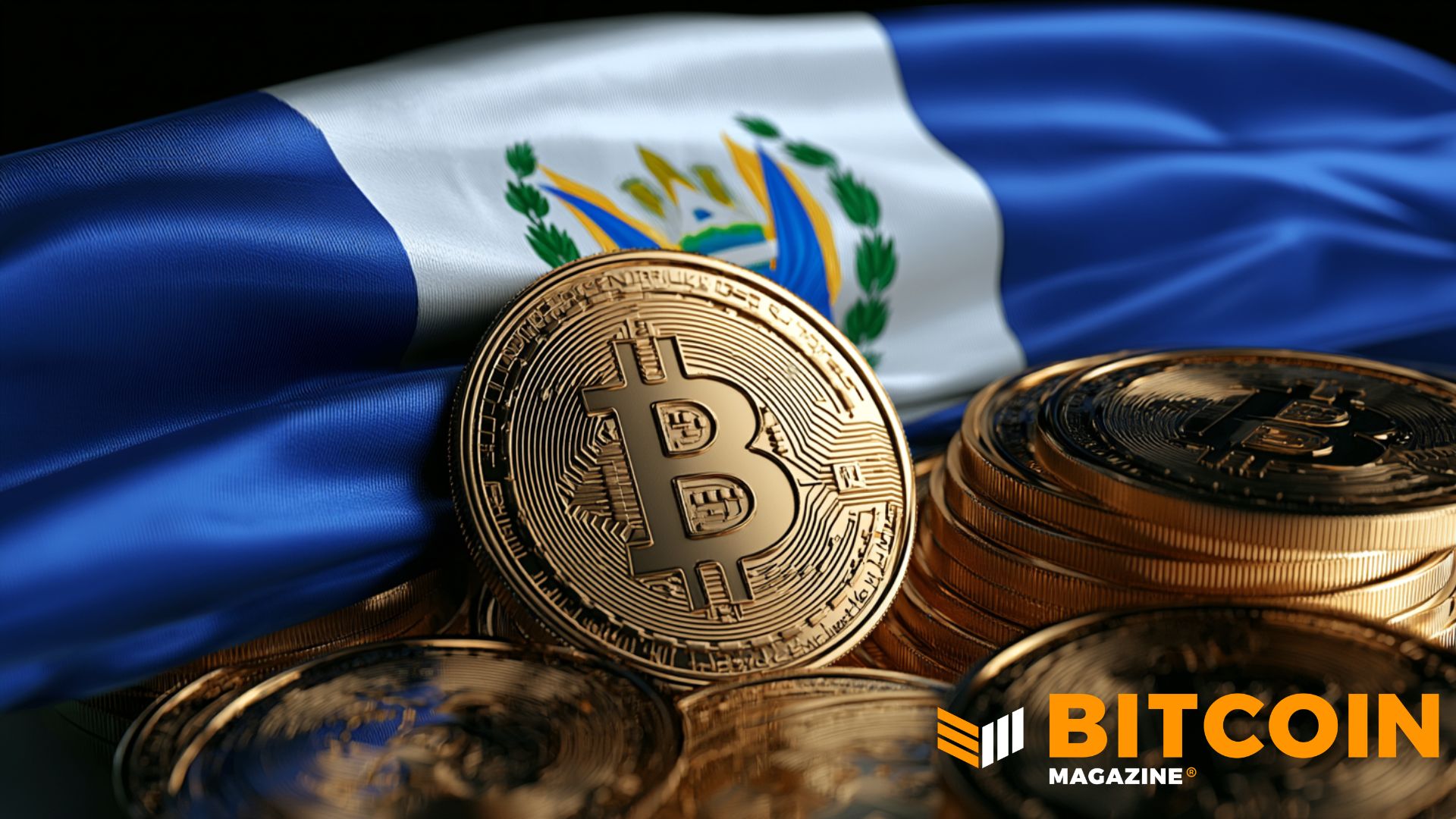
El Salvador has not used public funds to accumulate bitcoin since the International Monetary Fund’s last review of its loan program, the fund said Thursday.
In a report Thursday, the body said that the Central American country had instead received bitcoin from private donations, citing documentation from the government. It added that “no further Bitcoin accumulation beyond the documented donations is expected.”
El Salvador made headlines in 2021 when it became the first country in the world to make bitcoin legal tender. Salvadoran president Nayib Bukele in 2022 said the country would buy one bitcoin per day but it was never clear where the money was coming from — or if he was actually buying at all.
“Documentation has been provided verifying that Bitcoin accumulation since the first review reflects private donations and that no public resources were used,” the IMF release said.
“Understandings were also reached on steps to modernize the legal, regulatory, and supervisory framework for digital assets and to further strengthen the governance and risk-management arrangements for public-sector crypto-asset holdings. Going forward, no further bitcoin accumulation beyond the documented donations is expected.”
The report added that public participation in the government-sponsored bitcoin wallet has been largely wound down, with majority ownership and operational control handed to a private operator.
El Salvador in 2021 debuted a state-sponsored wallet called Chivo for its citizens as part of its plan to increase bitcoin adoption in the country.
“IMF staff thank the Salvadoran authorities for the constructive discussions and excellent collaboration,” the report added.
The IMF El Salvador entered a $1.4 billion loan agreement at the end of December but the fund asked for the country to scale back certain aspects of its bitcoin strategy.
Institutions like the World Bank and the IMF have long criticized President Bukele’s Bitcoin law, which also asked businesses to accept the cryptocurrency if they had the technological means to do so.
President Bukele in 2024 admitted that Salvadorans weren’t using the cryptocurrency to buy things as expected, but always boasted that the government was still stacking sats.
Since launching a crime crackdown to tackle the country’s notorious crime gangs, murder rates in El Salvador have plunged. The country was once the most dangerous place in the Americas but President Bukele is now trying to turn it into a tech hub.
Crypto companies like Tether have since relocated to its capital, San Salvador.
This post El Salvador Isn’t Buying Bitcoin With Public Money, Says IMF first appeared on Bitcoin Magazine and is written by Mathew Di Salvo.
Bitcoin Magazine

Bitcoin Dips Below $80,000 on Strong US Jobs Report
Bitcoin slid Friday after a better-than-expected labor report showed that the U.S. job market accelerated in August.
The leading cryptocurrency was recently trading for close to $79,764 after dropping as low as $78,706 earlier in the morning in New York. It’s currently down over 1% over a 24-hour period. On Thursday, the coin soared above $82,000.
The Federal Reserve is typically more likely to raise interest rates when the labor market is strong, because more people employed means more spending, and more spending can push inflation up.
Federal Reserve Chair Kevin Warsh last week gave his first major speech as head of the U.S. central bank and said he had “more work to do” to fight inflation. Bitcoin has typically done well in a low-interest rate environment.
Traders currently view a U.S. Federal Reserve interest rate hike at the upcoming September 15–16 policy meeting as roughly a 50% to 60% probability.
But U.S. President Donald Trump on Friday demanded the Federal Reserve slash interest rates.
Writing on his social media platform Truth Social, Trump said: “Lower the interest rates because the U.S.A. is a much stronger credit than it was just a short time ago!”
He added: “We should have the LOWEST RATE of any country in the World, like ‘the old days.'”
Bitcoin has decoupled from stocks recently as investors have renewed concerns around dollar debasement.
The cryptocurrency started surging last month, after the U.S. Treasury Department said it would more than double the size of its government debt repurchases. The coin had its best run in three years and third best August ever.
The much-talked about debasement trade is back in the spotlight, and bitcoin has been trading in lockstep with gold, according to analysts. The so-called debasement trade is when investors buy an asset as a way to hedge against a currency losing value.
News dropped last month that U.S. public debt exceeded $40 trillion for the first time too. Excessive debt also undermines confidence in the dollar, making assets like bitcoin and gold attractive.
This post Bitcoin Dips Below $80,000 on Strong US Jobs Report first appeared on Bitcoin Magazine and is written by Mathew Di Salvo.
Bitcoin Magazine
National Sheriffs’ Association Drops Opposition to Clarity Act
The National Sheriffs’ Association this week dropped its opposition to the crypto Clarity Act, after having previously warned that the proposed bill could help criminals.
Writing Thursday to Senate Majority Leader John Thune and Minority Leader Chuck Schumer, the association said it was changing its stance to neutral given how complex the issue is.
A number of lawmakers were hoping to vote on the Clarity Act in August. After a delay, a vote will now go ahead this month. The bill will establish a framework for distinguishing between digital assets that are securities, commodities or payment stablecoins — legislation that the crypto industry has long called for.
“Given the complexity of the legislation and the number of important details that remain under consideration, the NSA is changing its position on the Clarity Act to neutral,” the letter from NSA President Sheriff Troy Wellman and Executive Director Justin Smith read.
JUST IN: Major U.S. law enforcement organization National Sheriffs’ Association no longer opposes The Clarity Act
— Bitcoin Magazine (@BitcoinMagazine) September 4, 2026
“We believe the most appropriate course is to step back and allow the legislative process to proceed to establish a…much needed regulatory framework.”pic.twitter.com/NBpKlrUsUj
“At this time, we believe the most appropriate course is to step back and allow the legislative process to proceed to establish a clear, effective, and much needed regulatory framework.”
The NSA had previously warned that the bill could create regulatory and anti-money laundering loopholes by exempting certain crypto developers and infrastructure providers from money transmitter rules.
Despite being passed in the house of representatives last year with strong bipartisan support, the Clarity Act has been in a deadlock for much of 2026. The banking lobby raised concerns over stablecoin yield and some lawmakers have said improvements need to be made surrounding ethics.
An updated bill of the Clarity Act was introduced in July that addressed some of these concerns — banning government officials and their families from issuing or promoting crypto.
Pro-crypto senator Cynthia Lummis wrote on Friday that the “bipartisan bill” gives “law enforcement real tools to fight the illicit finance crimes hurting hard working Americans.”
Major financial institutions, lawmakers and companies have said they support the latest draft of the new bill, but some Republicans have accused Democratic lawmakers of deliberately playing politics and holding the bill back.
This post National Sheriffs’ Association Drops Opposition to Clarity Act first appeared on Bitcoin Magazine and is written by Mathew Di Salvo.
CryptoSlate
Every interaction with AI uses electricity in a data center. Servers calculate the answer, cooling equipment carries away the heat, and network connections send the result back to the user.
Multiply that process across millions of requests and the electric bill becomes one of the facility's highest costs, while access to enough power determines how much computing the building can support and how much money it can earn.
Wall Street is now packaging that income into bonds. Once a data center is open and has paying customers, its owner can transfer the facility and its contracts to a separate legal entity that issues debt. Investors are repaid from the rent and service fees paid by the data center's customers after expenses such as electricity, maintenance, taxes, and insurance are covered.
The collateral extends beyond rent, covering the property, its essential systems, customer agreements, and the business that keeps everything running. Electricity appears as an expense in the cash-flow waterfall, so power prices and deliverable megawatts can shape the bond almost as much as tenant credit.
In February, S&P assigned an A(sf) rating to Sabey Data Center Issuer's $475 million 2026-1 notes, backed by real estate and tenant lease payments. Across the sector, outstanding data-center securitizations expanded from roughly $4 billion in 2020 to $61 billion through July 2026, according to Structured Finance Association research drawing on Barclays data.
The bond gives investors a claim on real estate and operating revenue, though the economic unit underneath is nothing more than reliable electricity delivered to a creditworthy computing customer.
AI has turned the megawatt into something Wall Street can price and place in a fixed-income portfolio.
The new unit of real estate is a megawatt
Conventional property language struggles with a data center because square footage explains only the shell. Server campuses need a utility connection, substations, backup generation, cooling, security, and fiber routes designed around each rack's power draw.
Space with little usable electricity offers little to an AI company, while a secured megawatt in a region short on capacity can define the entire project.
The national totals show how fast that physical requirement is expanding. Lawrence Berkeley National Laboratory's 2025 update estimates that US data centers could consume 649 terawatt-hours in 2030 in its reference case, equal to 11.8% of total US electricity use.
The wider model range runs from 521 to 843 TWh, or 9.5% to 15.3%, depending partly on chip shipments, server use, equipment life, and cooling performance.
For bond investors, that wide range captures how far the industry's power needs could move during the life of a long-dated security.
More AI chips can lift revenue but also require extra power equipment, utility upgrades, and cooling. Even a facility with a long customer contract may need expensive retrofits as new processors pack more heat into each rack.
The customer agreement translates that computing demand into revenue. Large cloud and AI tenants lease a data hall or a block of capacity measured in megawatts, then pay for the space, available power, and operating services.
Those payments create recurring cash while tenant concentration ties an entire campus to a small number of technology companies.
The transaction structure described to the SEC starts with tenant and customer revenue, then deducts taxes, insurance, electricity, repairs, and operating costs before bondholders get paid.
The property and contracts form the collateral, while the electric bill controls how much revenue completes the trip from an AI tenant to an investor's coupon.
That leaves bond buyers with two connected underwriting jobs, since an investment-grade hyperscaler can make lease payments look dependable even when the building faces limits around power and technological usefulness.
Tenant credit asks whether the customer can pay, while facility design asks whether that customer will still want the building when denser chips demand another electrical and cooling configuration.
How an AI server hall becomes a bond
Data centers pass through several kinds of finance as their risk profile matures. Construction loans, project finance, private credit, or corporate bonds can fund the land, equipment, permits, and utility work.
Those early lenders bear the danger of a delayed grid connection, cost overruns, or a facility that opens without enough tenants.
Once the building is operating and leased, its owner can refinance through a data-center securitization or commercial mortgage-backed security. Corporate debt depends on the company's broad balance sheet, while a commercial mortgage-backed deal owns a mortgage loan secured by the property.
A data-center securitization places the facilities and operating assets themselves inside a ring-fenced issuer, giving investors recourse mainly to that pool.
The special-purpose issuer can own the property, power and cooling systems, fiber, leases, and service contracts, while an operator runs the facilities. A master trust lets the sponsor add qualifying data centers and issue more notes over time, turning a portfolio of server campuses into a repeat source of finance for another round of construction.
The Latham letter filed with the SEC says these transactions usually start with debt equal to no more than 70% of the appraised asset value, leaving at least 30% as sponsor equity. The notes often carry an expected repayment point around five years and a legal final maturity of 25 to 30 years.
Such a wide gap creates refinancing exposure because the business plan assumes the owner can issue new debt or repay early many years before the legal deadline.
Wall Street can divide the same pool into classes with different claims on the cash, allowing one building portfolio to serve pension funds, insurers, hedge funds, and other buyers with different risk appetites.
Senior classes receive their payments first and usually carry lower coupons, while junior classes collect more interest because they absorb losses sooner.
The Structured Finance Association's sector review puts average data-center ABS issuance near $600 million and average data-center CMBS issuance near $1.2 billion.
The market is still small beside the capital race feeding it. The Structured Finance Association cites a Morgan Stanley estimate of $2.9 trillion in global data-center spending through 2028, with about $1.4 trillion covered by cash generated at large cloud companies and another $1.5 trillion needing external finance.
Securitizations and commercial mortgage bonds could supply around $150 billion, leaving corporate debt, bank loans, project finance, private credit, and equipment lending to fund the rest.
Data centers already take up much more room in structured credit. The same paper puts data-center ABS at about 12% of the esoteric ABS market in 2026, up from 3% in 2020, while data-center CMBS represents about 6% of single-asset, single-borrower CMBS.
A Barclays projection cited in the report puts outstanding data-center securitizations as high as $180 billion by the end of 2028.
The AI bond market sheds an ABS label
A legal distinction gave this market a valuable opening on July 29, when the SEC's Office of Structured Finance agreed that data-center securitizations matching Latham's description fall outside the Exchange Act definition of an asset-backed security.
The SEC staff response applies only to the facts presented, carries no independent legal force, and leaves room for staff to reach another conclusion when a deal uses a different structure.
The reasoning depends on what is left once investors have been repaid. Conventional asset-backed securities often contain mortgages, car loans, or receivables that convert into cash and disappear as borrowers pay them down.
Data-center issuers still own and operate the facility once its notes have been repaid, and the land, power gear, cooling equipment, contracts, and business can keep producing value. That makes the structure much closer to financing an operating real-estate company.
It also creates a language issue because the market still refers to these instruments as data-center ABS, while the SEC letter deals with the narrower legal definition of an Exchange Act ABS. The familiar market label and the statutory category can now point to different things without either usage being wrong.
That classification lets qualifying deals avoid several ABS-specific obligations. Latham's explanation of the SEC view says market participants can stop voluntarily observing the federal rule requiring securitizers to retain 5% of the credit risk.
Rule 192, which bars certain conflicts of interest for covered securitizations, also falls outside the structure, along with disclosure provisions tied to repurchase activity and third-party due-diligence reports.
Typical data-center structures keep sponsor equity at 30% or more, giving owners plenty of their money at risk, though that feature differs from a statutory retention rule.
Federal antifraud law and the relevant registration or offering exemption still apply. The staff letter can reduce the cost and work of issuing the bonds while still leaving investors to study the deal documents for power contracts, tenant exposure, refinancing assumptions, and asset condition.
If lower issuance costs bring more operating facilities into the bond market, voluntary disclosure will carry more weight. Investors need enough information to compare deliverable power, tenant concentration, equipment age, and debt due at the expected repayment point.
Familiar ratings compress a complicated credit view into a letter, while the physical reasons behind that view can stay buried several layers down.
Those layers connect in ways that make AI credit different from an ordinary office mortgage. Delayed grid connections postpone the lease and the revenue that comes with it, while concentrated tenants can choose to renegotiate or leave. Higher electricity costs then reduce cash available for debt service, and denser chips can force expensive retrofits.
If the bond market also turns hostile near the five-year repayment point, the issuer may need another lender just as demand for its older facilities is weakening.
AI data centers are testing the power-saving playbook pioneered by Bitcoin miners, using flexible computing to cut electricity use when the grid is strained.
The bond version carries the same physical reality into credit markets. A facility that can manage power intelligently may preserve margins and improve reliability, while one built around uninterrupted maximum demand leaves the grid and its operating cash with less room.
The user who receives an AI-generated answer sees software moving at extraordinary speed. The investor holding a data-center note owns a claim that may stretch across decades.
Between them lies a chain of utilities, substations, leases, servers, and refinancing assumptions, all feeding one stream of operating cash. Wall Street has made AI's electric appetite investable, and every coupon now carries the physical constraints the interface leaves out.
The post Wall Street is turning AI’s massive electricity appetite into a $61 billion bond market appeared first on CryptoSlate.
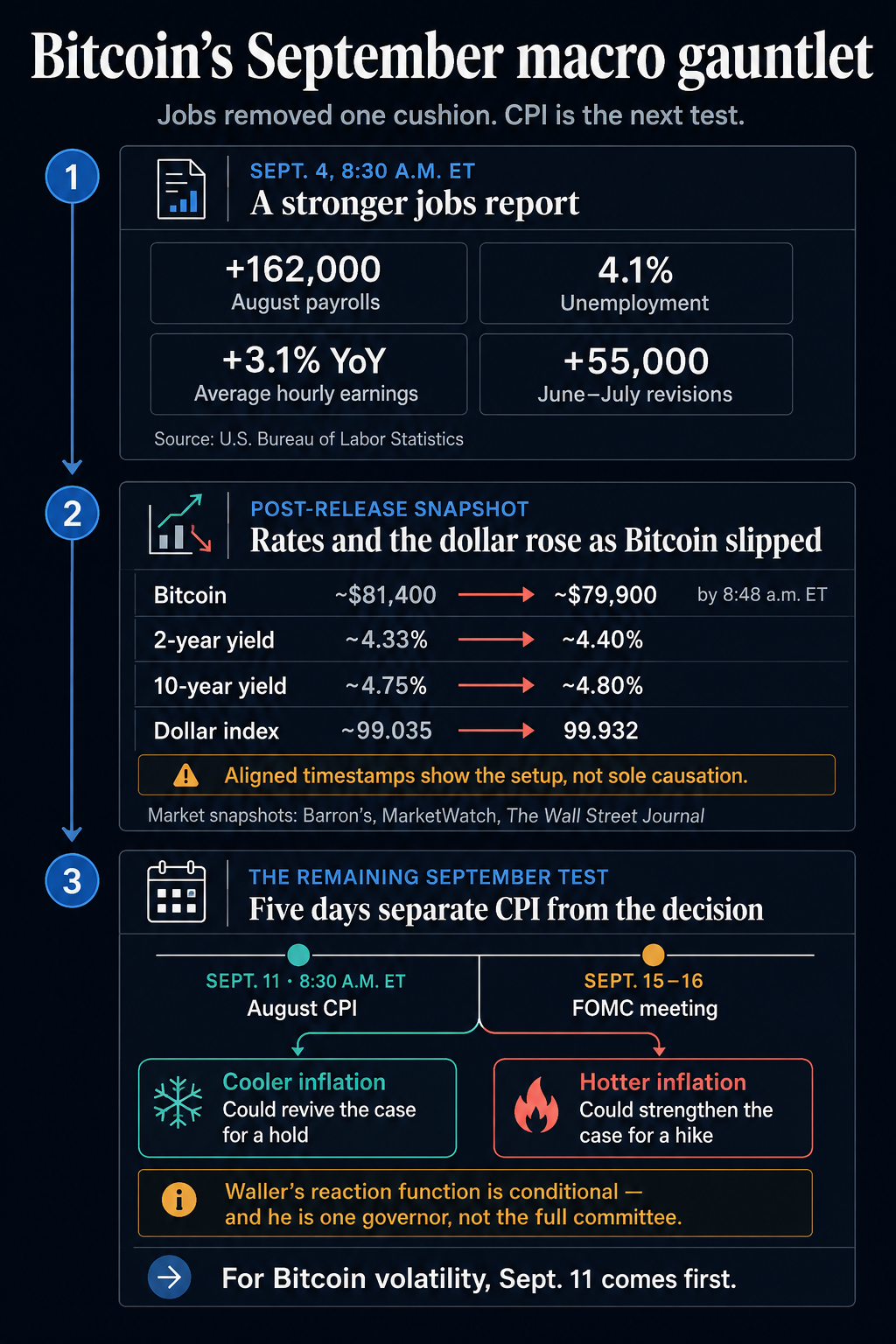
Bitcoin's push above $80,000 lost an important policy cushion on Sept. 4, when the August jobs report came in far stronger than the recent hiring trend. The result made it harder for the Fed to justify holding rates steady on labor-market weakness alone.
Bitcoin registered an intraday low of $78,660, but recovered to stay close to $80,000.
Within the same post-release window, MarketWatch reported the two-year Treasury yield near 4.40%, up from just above 4.33%, and the 10-year near 4.80%, up from just under 4.75%. The Wall Street Journal reported that the dollar index touched 99.932 from about 99.035 before the data.
Those aligned timestamps show that a more resilient labor market gave policymakers more room to focus on inflation, while higher short-term yields and a firmer dollar tightened the financial backdrop for a dollar-priced risk asset.
Payrolls narrowed the Fed question
The Bureau of Labor Statistics said nonfarm payrolls rose by 162,000 in August, more than five times the average monthly gain of 31,000 over the previous 12 months. The separately measured unemployment rate was unchanged at 4.1%.
BLS raised June payroll growth to 31,000 and July growth to 21,000, adding a combined 55,000 jobs to its earlier estimates.
Average hourly earnings for private nonfarm workers rose 0.3% in August to $37.75 and were 3.1% higher than a year earlier.
Food services and drinking places accounted for 59,000 jobs, and local government education added 42,000. Information employment fell by 23,000, while health care added 13,000, well below that sector's 32,000 average monthly gain over the prior year.
The report weakened the labor-market argument for an immediate pause without establishing that every corner of the economy was overheating. Inflation now has more weight in determining whether the Fed can stay patient.
Fed Governor Christopher Waller had laid out one visible version of that tradeoff the day before the release. His view does not bind the full Federal Open Market Committee, but his published remarks offered a clear reaction function.
Waller described the labor market as satisfactory and stable, with employment near its maximum sustainable level, and said that August inflation would heavily influence his September stance.
Continued progress toward the Fed's 2% goal would make him willing to hold the policy rate steady, while a hot reading, or evidence that progress had reversed, could make him consider a hike.
The payroll report removed the kind of obvious labor deterioration that could have outweighed an uncomfortable inflation print. September's decision now turns more cleanly on whether price pressures continue to ease.
CPI becomes Bitcoin's next September deadline
The BLS calendar schedules the August consumer price index for 8:30 a.m. ET on Sept. 11. The Federal Reserve calendar lists the FOMC meeting for Sept. 15-16, with decision-day events on Sept. 16.
The five-day gap makes CPI the last major scheduled inflation test before the meeting. For Bitcoin traders, Sept. 11 is when the September rate debate can absorb new evidence, rather than when policymakers formally settle it.
A cooler report would fit Waller's condition for supporting a hold and could relieve pressure transmitted through short-term yields and the dollar. A hotter print would strengthen the case that inflation progress has stalled just as the labor market has shown renewed resilience.
Waller spoke only for himself, and one inflation report will not erase the other evidence policymakers weigh. CPI can nevertheless change the balance because payrolls have already answered the labor side of the debate more firmly than the recent trend suggested.
Bitcoin had rallied above $80,000 before the two closely spaced macro tests. After payrolls, the asset fell back below it while yields and the dollar rose.
A softer CPI reading could reopen the hold narrative and give the rally breathing room. A hotter one could leave Bitcoin approaching the Sept. 16 decision with both labor resilience and inflation pressure pointing toward tighter policy.
The Fed meeting remains the policy deadline, but Sept. 11 comes first for Bitcoin volatility.
The post Bitcoin dips below $80,000 as a hot August jobs report shifts Fed policy expectations appeared first on CryptoSlate.
Robinhood Chain’s rapid growth ran into two problems at once on Sept. 4 as the network briefly stopped producing blocks while AMC challenged its fast-growing Stock Token business.
On Sept. 4, the Ethereum layer-2 network halted block production for at least 14 minutes, stalling transactions before activity began recovering. Robinhood had not publicly disclosed the cause of the interruption at the time of publication.
The outage came roughly two months after the network’s public mainnet launch.
Robinhood Chain’s rapid growth raises the stakes
The disruption comes after Robinhood Chain rapidly emerged as one of crypto’s highest-earning networks, making even a brief interruption in block production more significant.
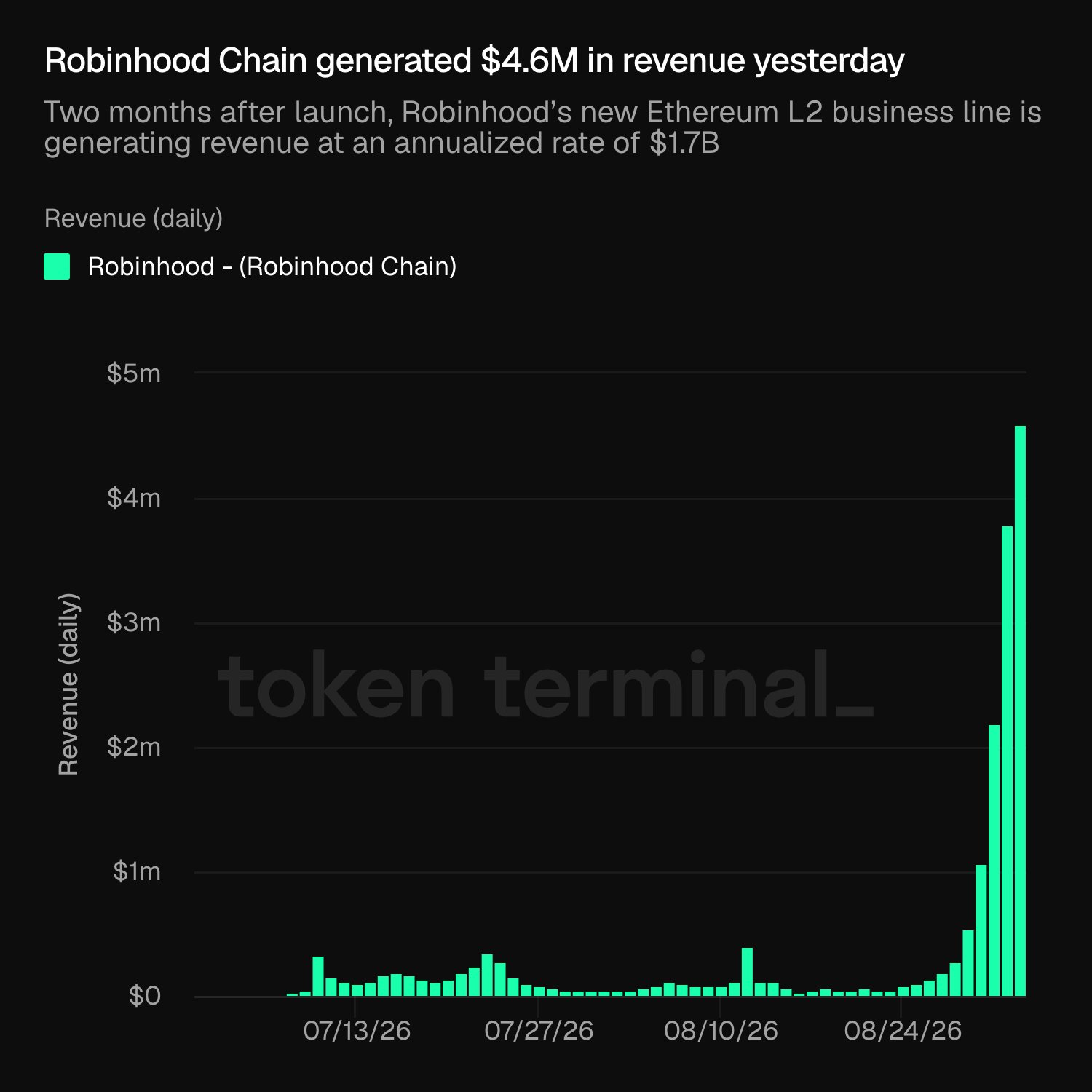
The network has generated about $23 million in cumulative fees, including roughly $4 million in a recent 24-hour period, Entropy Advisors’ Tom Wan said. Token Terminal separately estimated that Robinhood Chain accounted for 78.5% of layer-2 blockchain revenue over the past 30 days.
At its recent pace, Robinhood Chain’s revenue would annualize to roughly $1.7 billion. That figure extrapolates a short period of elevated activity rather than representing a formal revenue forecast, but it illustrates how quickly the two-month-old network has scaled.
DeFi activity has expanded alongside those fees. Data from DeFiLlama shows that the total value locked on Robinhood Chain climbed nearly 27% over the past week to roughly $840 million, while decentralized exchange activity has also accelerated as users move more assets and trades onto the network.
The chain is also creating revenue opportunities beyond transaction fees.
Wan estimated that Robinhood could have generated roughly $1.7 million from its share of USDG economics at a 3% annual yield.
Growth in assets held across Robinhood and Bitstamp may also support higher trading revenue, with crypto assets under management rising by about $4 billion on Robinhood and $600 million on Bitstamp.
Stock Tokens add another potential revenue source, though their economics are less transparent. Robinhood has not published a detailed fee schedule covering possible minting and redemption charges for authorized participants or market makers.
This rapid expansion has pushed Robinhood Chain into territory normally occupied by much older networks like BNB Chain and others.
Stock Tokens draw resistance as adoption accelerates
That growth raises the cost of downtime as Robinhood pushes more financial products onto the network, including a Stock Token business already attracting resistance from some of the companies it tracks.
AMC Entertainment CEO Adam Aron challenged Robinhood this week after discovering a token tracking his company’s shares on the platform's Ethereum layer-2 network.
He stated on X:
“They are not registered under U.S. securities laws !!!!!! I find this practice to be contemptible, outrageous, disgusting, detestable, inexcusable, vile. How can it possibly be legal? We have no connection to this at all, and do not condone it in any way.”
Aron said AMC would ask outside securities counsel to examine the offering, while asking “Robinhood to voluntarily CEASE AND DECIST the trading of AMC stock tokens. If you don’t, our high priced securities counsel has been asked to see whether we can force you to stop.”
In response, Dan Gallagher, Robinhood's chief legal officer, stated that the company will not stop trading the AMC token. He said:
“We know a little something about the US securities laws and will not ‘DECIST.' Send your lawyers and we’ll educate them.”
The dispute highlights how Robinhood brings equities onchain without requiring participation from the companies being referenced.
Robinhood describes Stock Tokens as the flagship real-world asset on its chain. The ERC-20 tokens provide economic exposure to US shares and exchange-traded funds and can be transferred or used within onchain applications.
The instruments are debt securities issued by Robinhood Assets Limited. Holders receive exposure to the performance of the referenced security but gain no legal or beneficial ownership of the underlying shares and no claim against the company whose stock is tracked.
The tokens are not registered under US securities laws and cannot be offered or sold to US persons.
That framework allows Robinhood to create an instrument linked to AMC’s share price without AMC participating in the issuance, with the legal relationship instead running between the token holder and Robinhood’s Jersey entity.
OpenAI previously raised a similar objection after Robinhood introduced tokens referencing the privately held company. OpenAI said the instruments were not OpenAI equity, that it had not partnered with Robinhood and that it did not endorse the offering.
However, corporate resistance has so far done little to slow demand.
Token Terminal data show Robinhood has become the largest Stock Token issuer by holder count in roughly two months, reaching about 862,800 holders. The wider tokenized-stock market has expanded more than eightfold over the past six months to roughly 2.6 million holders.
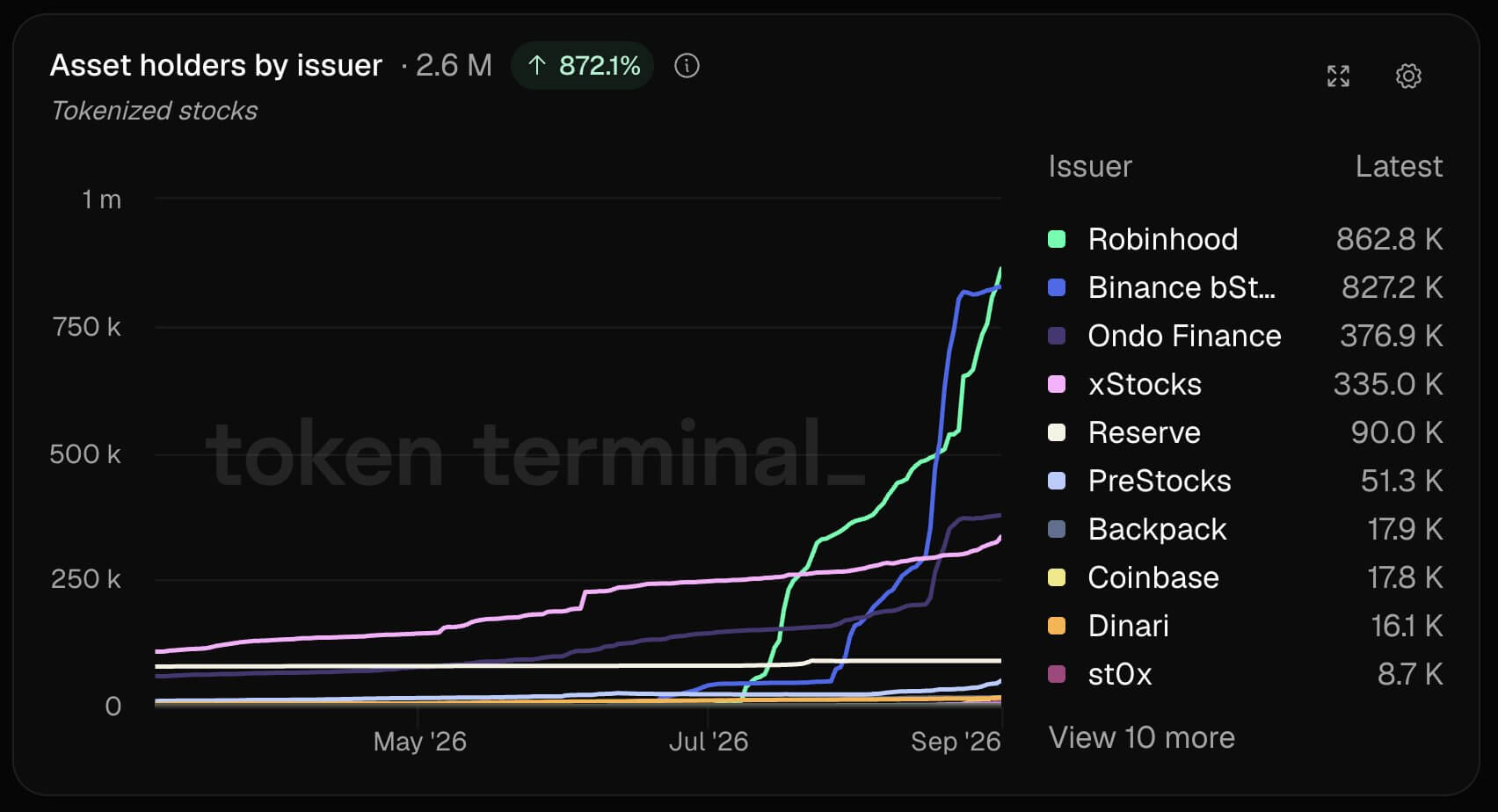
Trading has accelerated alongside that expansion. Tokenized stocks generated about $6.4 billion in decentralized exchange volume over the past 30 days, up more than 90% from the preceding period. PancakeSwap accounted for about $3.1 billion and Uniswap another $2.5 billion, giving the two exchanges the overwhelming majority of activity.
Stock Tokens now represent more than $200 million of active real-world assets on Robinhood Chain, while stablecoins on the network have approached $1 billion.
The scale puts the Sept. 4 outage in perspective. Robinhood is positioning its chain as infrastructure for financial products that can trade and move onchain while simultaneously expanding a Stock Token model that some of the referenced companies have openly rejected.
As more assets and users migrate onto those rails, Robinhood will have to demonstrate that the infrastructure can support the financial activity its distribution network is bringing onchain.
The post A major outage and corporate backlash hit Robinhood Chain at the peak of its growth appeared first on CryptoSlate.
The International Monetary Fund (IMF) says El Salvador’s Bitcoin reserve growth over the past year came from private donations, not new government spending.
In its latest review of the country’s loan program, the global financial agency said documents supplied by El Salvador showed that Bitcoin accumulated since the previous review reflected private donations. It added that no public resources were used and said it expects no further accumulation beyond those documented contributions.
The Fund also reiterated that earlier changes in El Salvador’s BTC position had not necessarily represented new buying.
In previous reviews, it said increases in the Strategic Bitcoin Reserve reflected transfers among government-controlled wallets, while small fluctuations elsewhere were linked to Bitcoin-denominated deposits held through Chivo.
The IMF also noted that the Salvadoran government had “substantially unwound” its stakes in the Chivo e-wallet. It explained:
“Majority ownership and operational control have been transferred to a private operator, while a minority stake and custodial responsibilities for customer assets have been retained by the government.”
El Salvador’s Bitcoin push continues despite the IMF accounting
The IMF’s assessment sits uneasily beside both the size of El Salvador’s growing reserve and the government’s continued pro-Bitcoin messaging.
The country held about 6,224 BTC at the end of June 2025. Its official reserve tracker now shows more than 7,764 BTC, an increase of roughly 1,540 BTC.
If the IMF’s latest assessment is applied to that subsequent accumulation, much of the increase came from private donations rather than taxpayers funding new Bitcoin purchases.
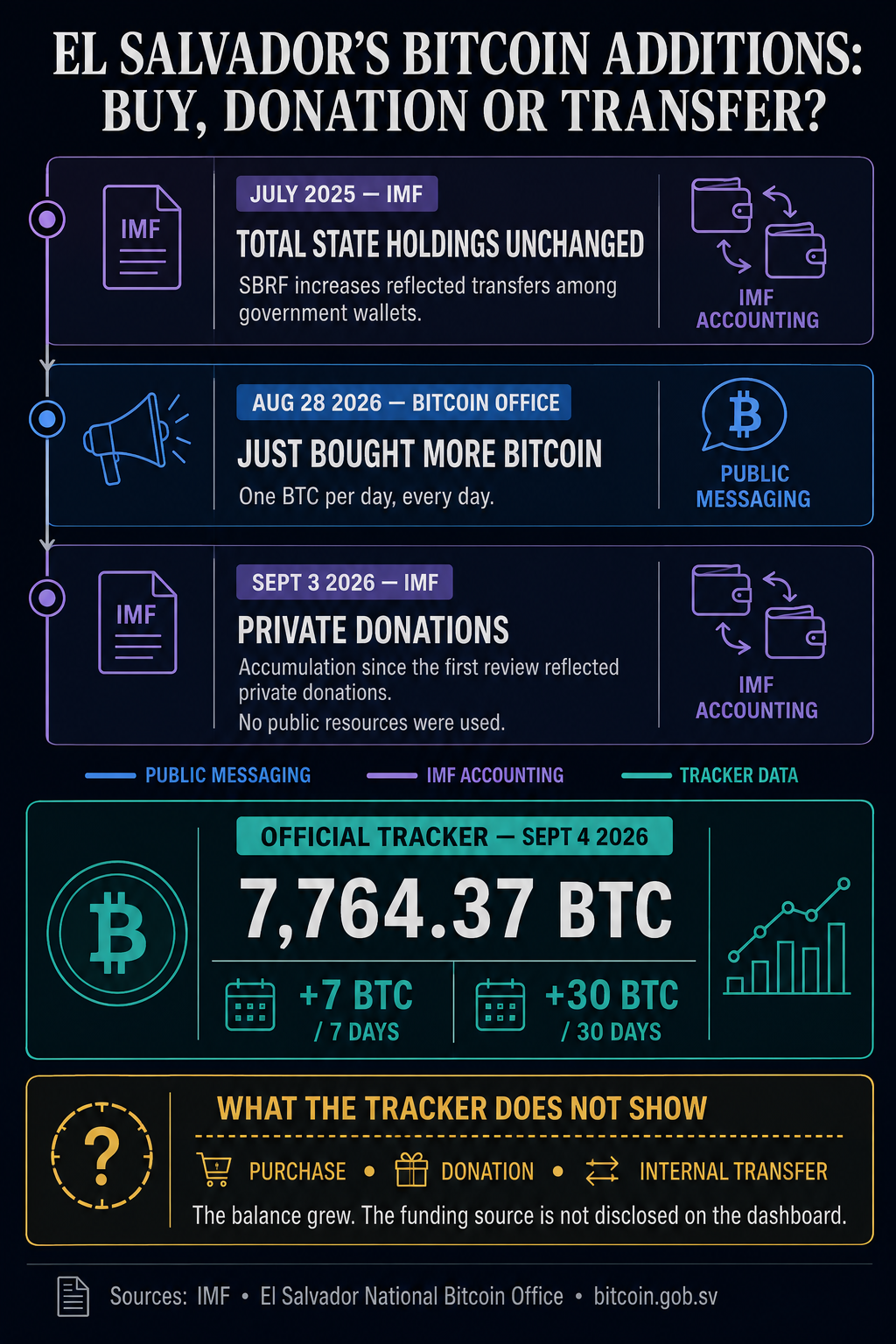
Yet El Salvador continues to describe itself as an active Bitcoin buyer.
As recently as Aug. 28, the National Bitcoin Office said the country had “just bought more Bitcoin” and repeated its longstanding message: “One BTC per day, every day.”
The government has also continued pushing BTC beyond the treasury. President Nayib Bukele has maintained his pro-Bitcoin stance, while El Salvador has kept expanding Bitcoin education initiatives and presenting the asset as part of its long-term economic strategy.
Last year, the country also overhauled its Bitcoin treasury structure, moving away from a single reused wallet and spreading its holdings across multiple addresses. Officials said the change followed digital-asset security best practices and reduced potential long-term exposure to quantum-computing threats.
The new structure keeps the addresses public, allowing observers to verify the reserve balance. However, it does not distinguish BTC bought with public money from private donations or transfers between government-controlled wallets.
That distinction now sits at the center of the disagreement. El Salvador’s reserve has grown by more than 1,500 BTC while the government continues to publicly promote daily purchases, but the IMF says the recent accumulation it verified did not require additional public spending.
The country clearly owns substantially more Bitcoin than it did a year ago. What remains unresolved is whether “one BTC per day” still describes government-funded purchases or simply the pace at which Bitcoin is entering the reserve.
The post El Salvador added 1,540 Bitcoin, but the IMF says Bukele’s government didn’t pay for them appeared first on CryptoSlate.
Solana’s v1 transaction format promises more than three times as much room per transaction, but RPC clients, indexers, relayers and fee sponsors that are not ready for it can fail in two very different ways: some systems stop, while others keep running with the wrong resource limits.
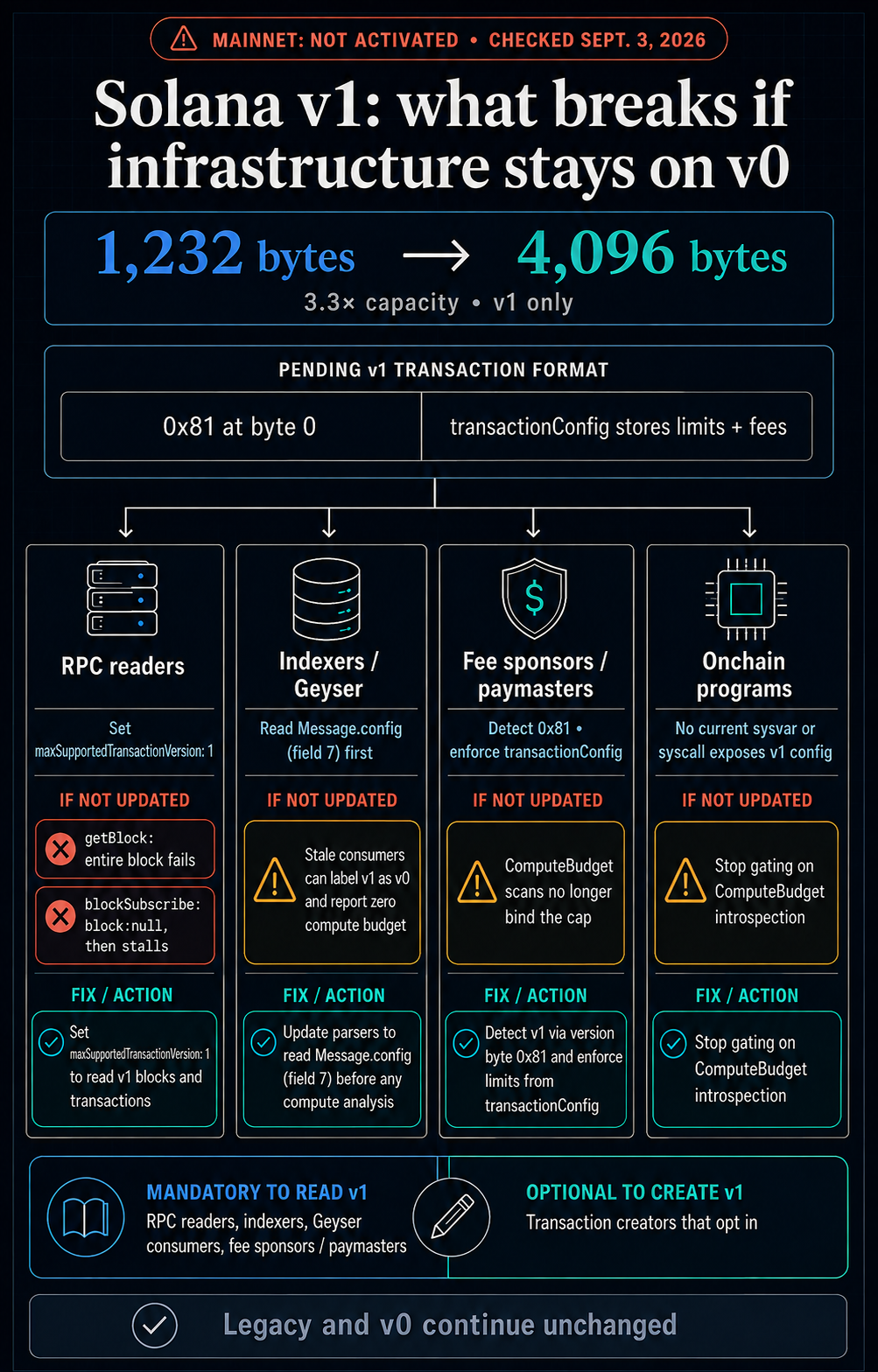
Solana’s live upgrade page still lists v1 as not activated on mainnet as of Sept. 4. Testnet is active and devnet is live in epoch 1140. A Solana changelog published Aug. 28 said v1 transactions were “coming soon,” leaving infrastructure operators a pre-activation window to update.
V1 raises the maximum payload from 1,232 bytes to 4,096 bytes, about a 3.3-fold increase. Legacy and v0 transactions keep their existing limits and behavior, so users and applications that continue using those formats do not need to migrate.
RPC consumers must pass the integer maxSupportedTransactionVersion: 1 when using getTransaction, getBlock or blockSubscribe. Without that opt-in, a v1 getTransaction request returns error -32015, one v1 transaction makes getBlock fail for the entire block, and blockSubscribe emits block: null and stops advancing at the first affected slot.
The parameter only tells the RPC service the highest format the client can decode. It does not request v1 data or change how legacy and v0 transactions are returned.
Other failures are quieter. V1 moves compute-unit limits, loaded-account data limits and priority fees into a transactionConfig object instead of ComputeBudget instructions. An indexer that keeps scanning those instructions will report a zero compute budget for every v1 transaction without raising an error.
Geyser and gRPC consumers face a related trap. The protobuf’s versioned flag is true for both v0 and v1. A stale consumer can therefore label v1 as v0 and preserve an empty budget. The fix is to regenerate the protobuf stubs and check for Message.config, field 7, before reading the flag.
Relayers, paymasters and other server signers must change their policy checks too. A sponsor that enforces a fee cap by scanning ComputeBudget instructions no longer has a binding cap because those instructions may appear in v1 but execute as no-ops. Servers must identify the 0x81 v1 prefix and enforce the fee and resource limits in transactionConfig. This is an application-control failure, not a consensus flaw or evidence that funds are automatically at risk.
Onchain programs face a harder constraint: Solana says no current sysvar or syscall exposes the v1 message configuration. Programs that gate behavior on introspected ComputeBudget instructions must stop relying on that check when v1 goes live.
Who needs to upgrade for Solana v1
The minimum reader-capable releases include @solana/kit 8.0.0, @solana/web3.js 3.0.0-rc.3, Rust solana-* 4.2.x, Python solders 0.29.0 and solana-go 1.23.0. The 1.x web3.js line can read v1 from 1.99.0-beta.0 but cannot build, sign or send it.
Yellowstone users need at least yellowstone-grpc-proto 12.6.0, geyser plugin 15.1.1, gRPC client 12.0.0 or @triton-one/yellowstone-grpc 6.0.0, depending on their stack.
Creating v1 transactions is optional. Teams that opt in must set compute-unit and loaded-account data limits explicitly because both default to zero, remove no-op ComputeBudget instructions, stop using address lookup tables and use base64 for payloads larger than 1,232 bytes. The immediate deadline is not a universal wallet migration. It is a compatibility test for every service that may read, index or sponsor somebody else’s v1 transaction.
The post Hidden Solana upgrade bug can freeze network readers and silently disable fee limits appeared first on CryptoSlate.
HTTP error 429 on https://cryptoticker.io/en/feed/
Failed to fetch feed: https://cryptoticker.io/en/feed/
Failed to fetch feed.
Decrypt
Nearly 30 banks backed the rare unsecured facility as TikTok’s parent company spends heavily on AI chips, models, and overseas data centers.
The group is urging organizations to adopt post-quantum security before powerful computers can compromise today’s encryption and digital signatures.
The prediction market platform's new Perps product scaled from 10 markets to 67 on its first day—though the 20x leverage ceiling only applies to some of them, and none of it reaches U.S. traders.
A meme coin called BONER cornered half of Hims & Hers Health's tokenized shares on Robinhood's new blockchain. It started a new trend that's spreading fast.
Lawyers question AMC’s grounds for a securities-law challenge, but say the tokens’ branding and marketing could leave room for a dispute.
U.Today - IT, AI and Fintech Daily News for You Today
XRP stabilizes at $1.40, but on-chain data shows whales are waiting for a $1.25 pivot point to buy the dip before the massive Sept. 15 catalyst.
Shiba Inu is staying on the verge of a potential correction, but the outflow dynamic might help the price greatly.
The current structure of the market might push altcoins and memecoins towards new heights.
Raghuram Rajan, the former governor of the Reserve Bank of India, will join Ripple’s Swell 2026 conference.
Robinhood's Vlad Tenev backs the $104 million "stock token" market, defying AMC's legal threats over on-chain trading.
Blockonomi
Key Highlights
- Shares of Astera Labs surged approximately 11% on Friday as market participants anticipated a potential addition to the S&P 500 during the September 21 rebalancing event.
- Bloom Energy experienced a similar rally, climbing 7% on comparable S&P 500 inclusion expectations.
- The company delivered Q2 2026 revenue of $392.4 million, representing a 104% increase year-over-year, while EPS of $0.80 surpassed analyst expectations of $0.69.
- Management’s Q3 revenue forecast of $540 million to $560 million suggests approximately 40% growth from the previous quarter.
- Several Wall Street firms increased their price targets, with Citi establishing a $430 target, Roth Capital moving to $450, and Northland upgrading the stock to Outperform with a $350 price objective.
Astera Labs (ALAB) shares experienced an approximately 11% rally on Friday, climbing from around $282 as market participants positioned ahead of a possible S&P 500 index inclusion expected later this month.
Astera Labs, Inc. Common Stock, ALAB
The quarterly S&P 500 index rebalancing is scheduled for September 21. Market observers anticipate the official announcement will come after Friday’s closing bell. Traders have been building positions in anticipation, driving ALAB shares significantly higher.
Bloom Energy (BE) experienced a similar tailwind, advancing roughly 7% on comparable S&P 500 addition speculation. With a market capitalization exceeding $63 billion, Bloom Energy represents a compelling candidate based purely on size metrics.
ALAB currently commands a market capitalization of approximately $47.6 billion. This valuation comfortably exceeds the S&P 500’s present minimum requirement of $22.7 billion, positioning the company as a credible contender for index inclusion.
Index inclusion typically triggers substantial buying activity, as index funds must purchase newly added constituents. With approximately 30% of the S&P 500 held in passive investment vehicles, any new entrant experiences automatic demand. This mechanism frequently generates upward price momentum even before official confirmation.
Barron’s identified additional potential candidates including Cheniere Energy (LNG), Everpure (P), Credo Technology (CRDO), Heico (HEI), Rocket (RKT), and Royalty Pharma (RPRX). SpaceX (SPCX) was excluded from consideration due to insufficient public trading history, falling short of the mandatory 12-month requirement.
To accommodate new additions, the index typically removes companies with smaller market capitalizations. Current candidates for removal include Trade Desk (TTD), Builders FirstSource (BLDR), Norwegian Cruise Line (NCLH), Molson Coors (TAP), and Mosaic (MOS).
Exceptional Quarterly Performance Providing Additional Momentum
Index speculation represents just one catalyst behind ALAB‘s recent surge. The semiconductor connectivity specialist recently unveiled impressive Q2 2026 financial results.
The company generated $392.4 million in revenue, marking a 104% year-over-year expansion. Adjusted earnings per share reached $0.80, exceeding Wall Street’s consensus forecast of $0.69. These results demonstrated the company’s accelerating growth trajectory.
Management also elevated Q3 guidance, projecting revenue between $540 million and $560 million, implying approximately 40% sequential expansion. Scorpio X AI fabric switches began volume production earlier than anticipated, while PCIe 6.0 products now account for over 50% of quarterly revenue.
Wall Street Raises Price Expectations
Sell-side analysts have been revising their outlooks upward. Citi elevated its price target to $430. Roth Capital increased its forecast to $450. Northland upgraded ALAB to Outperform while establishing a $350 price objective.
Prior to Friday’s rally, the stock had declined more than 36% from its record high of $499.48. That pullback created an attractive entry point relative to the company’s robust growth fundamentals.
ALAB is scheduled to participate in the Citi 2026 Global TMT Conference on September 9, potentially generating additional institutional attention in the near term.
The post Astera Labs (ALAB) Stock Surges 11% Amid S&P 500 Index Addition Rumors appeared first on Blockonomi.
Key Takeaways
- Chief Executive Michael Intrator dumped $25.1 million worth of CoreWeave Class A shares on September 1, with sale prices ranging from $80.45 to $82.81 per share.
- Company insider Kristen Mcveety liquidated 156,000 units worth $12.7 million at approximately $81.63 each, reducing her direct stake by 55.85%.
- All transactions were executed through previously established Rule 10b5-1 trading arrangements.
- Shares of CRWV closed Thursday at $84.56, representing a roughly 45% decline from the 52-week peak of $153.20.
- Wall Street maintains a “Moderate Buy” rating with a consensus price target of $141.90, significantly higher than current trading levels.
The chief executive of CoreWeave and another company insider unloaded a substantial $37.8 million in shares during a single trading session on September 1, attracting scrutiny despite the firm’s impressive revenue performance.
CoreWeave, Inc. Class A Common Stock, CRWV
Michael Intrator, serving as both CEO and President, liquidated $25,127,375 in Class A common stock through multiple transactions. The sales executed at prices ranging from $80.45 to $82.81 per share. With CRWV closing Thursday at $84.56, Intrator’s selling prices came in slightly beneath current market value.
The CEO’s divestiture involved 307,692 Class A shares total. Direct sales accounted for 200,000 shares. The balance of 107,692 shares moved through Omnadora Capital LLC, an entity controlled by Intrator as the sole manager of its managing body.
These transactions occurred under a Rule 10b5-1 trading plan established by Intrator on November 20, 2025. Such plans are implemented ahead of time and serve to eliminate concerns about opportunistic timing in stock sales.
Concurrently, Intrator converted 107,692 Class B shares into Class A stock via Omnadora Capital LLC. The conversion occurs on a one-to-one basis between share classes.
Additional Executive Dumps Holdings
In a parallel move, CoreWeave insider Kristen Mcveety liquidated 156,000 units at a mean price of $81.63, generating proceeds of $12,734,280. This divestiture slashed her direct holdings by 55.85%, with remaining ownership at 123,313 units worth approximately $10 million.
Mcveety’s sale also proceeded through a pre-established Rule 10b5-1 plan and received proper SEC disclosure.
The stock showed momentum despite these insider moves. CRWV gained $3.63 on Thursday to settle at $84.56. Trading volume registered at 18.7 million units, falling short of the typical 27 million daily average. The stock’s 52-week trading band extends from $60.55 to $153.20.
Wall Street Maintains Optimistic Stance
Analyst sentiment toward CoreWeave remains constructive. Among 34 analysts tracking the stock, 21 recommend Buy, 10 suggest Hold, and three advise Sell.
The consensus price target stands at $141.90, representing upside potential exceeding 60% from Thursday’s closing price.
Wells Fargo elevated its price objective from $155 to $160 while maintaining an “Overweight” recommendation. Robert W. Baird established a $130 target with an “Outperform” designation. Goldman Sachs increased its target to $139 while preserving a “Neutral” stance. JPMorgan boosted its objective to $110, also remaining “Neutral.”
Truist Securities established a $165 target, highlighting CoreWeave’s favorable pricing dynamics and the deployment of approximately 500 megawatts in additional capacity during Q2, surpassing all competing neocloud providers.
The company reported $2.58 billion in quarterly revenue, reflecting 112.5% year-over-year expansion. CoreWeave recorded a $1.14 per-share loss, outperforming the consensus forecast of a $1.52 loss.
Institutional buying has intensified. California State Teachers Retirement System expanded its holdings by 12,886.8% in Q2, accumulating over 41.5 million units valued at $4.1 billion.
Current analyst projections anticipate full-year earnings per share of -$5.19 for CoreWeave.
The post CoreWeave (CRWV) Insiders Dump Nearly $38M in Stock Despite Bullish Analyst Outlook appeared first on Blockonomi.
Key Takeaways
- President Trump issued an executive directive enabling cattle ranchers to process and market beef independently, decreasing dependence on dominant processors.
- The nation’s four leading beef packers currently command approximately 85% of cattle purchasing power, a dramatic increase from 36% in the 1980s.
- The directive instructs the USDA to streamline federal authorization processes for smaller meat processing operations and establishes a loan initiative for regional facilities.
- In a separate measure, Trump authorized an additional 300,000 tons of imported lean beef at reduced tariff rates, with a monthly cap of 100,000 tons extending through November.
- TSN shares declined approximately 1.5% following the announcement, while JBS experienced a 1.4% downturn.
Shares of Tyson Foods (TSN) retreated roughly 1.5% during Friday’s trading session following President Trump’s announcement of an executive directive designed to challenge the consolidated authority of America’s dominant beef processing companies. JBS similarly declined 1.4% in parallel trading, with both equities reaching intraday lows immediately following the White House statement.
Tyson Foods, Inc., TSN
During his remarks, Trump stated he is “taking action to help cattle ranchers” through an executive order that will grant “ranchers and farmers the right to process their own food.” The administration’s objective centers on reducing consumer beef costs while expanding processing alternatives available to cattle producers.
The presidential directive tasks the Department of Agriculture with simplifying regulatory approval pathways for smaller meat processing establishments. Additionally, it broadens interstate commerce opportunities for qualifying meat products and introduces a lending program designed to bolster small and mid-sized processing operations.
This action addresses an industry landscape that has undergone significant consolidation in recent decades. White House data indicates the four largest beef packers now dominate approximately 85% of steer and heifer acquisition activity. Four decades earlier, that concentration stood at merely 36%.
Executive Action Follows Import Policy Adjustment
This processing directive comes on the heels of an earlier action from August 26, when the administration temporarily authorized 300,000 additional tons of lean beef imports to enter the country under lowered tariff structures. This volume expansion carries a 100,000-ton monthly limitation and remains effective through November.
Administration officials contend the supplementary supply will contribute to lowering ground beef retail prices. However, domestic cattle producers voiced strong opposition, maintaining that increased foreign beef imports would depress the prices they command for their livestock.
Responding to producer concerns, Trump simultaneously issued a companion directive mandating a comprehensive evaluation of country-of-origin labeling requirements for beef products. This accompanying order also requests officials to reassess protection policies for gray wolves and Mexican wolves in ranching regions, where producers have persistently cited livestock predation issues.
Analyst Perspective on TSN Shares
The analyst community’s assessment of TSN remains largely unchanged. The stock currently carries a Strong Buy consensus rating, supported by four Buy recommendations and four Hold ratings published within the last three months.
The consensus price target stands at $67.43, suggesting potential upside of approximately 31% from present trading levels.
Together, these executive directives establish a framework for heightened competition within the meat processing sector, potentially creating margin pressure for industry leaders like Tyson in coming quarters. Friday’s stock decline signals investor acknowledgment of these competitive challenges.
TSN and JBS both experienced rapid sell-offs to session lows immediately after Trump’s policy announcement, indicating the market immediately priced in the competitive implications.
The post Tyson Foods (TSN) Stock Dips as Trump’s Beef Processing Order Targets Industry Giants appeared first on Blockonomi.
Key Takeaways
- Ford shares increased 1.5% to $14.62, while analysts project an average price of $15.68
- The automaker aims to deliver more than 100,000 units of its approximately $30,000 Fathom electric pickup during its debut year
- Successfully reaching this target would make the Fathom the first non-Tesla electric vehicle to achieve six-figure sales for a single model annually
- Second-quarter earnings per share exceeded forecasts at $0.42 compared to the anticipated $0.33, despite a 3.8% year-over-year revenue decline
- Challenges include a recall affecting roughly 148,663 Mustang units, declining domestic sales figures, and concerns regarding dividend continuity
Shares of Ford Motor (F) advanced 1.5% during Friday’s trading session, closing at $14.62, as market participants responded favorably to the automaker’s aggressive sales projections for its forthcoming Fathom electric pickup truck.
Ford Motor Company, F
The Detroit-based manufacturer has set an ambitious goal of delivering over 100,000 Fathom units during the vehicle’s inaugural year of availability. With a starting price point near $30,000, the truck is strategically positioned to attract consumers seeking alternatives to traditional gasoline-powered or hybrid vehicles.
Achieving this milestone would establish Ford as the first automaker besides Tesla to surpass the 100,000-unit threshold for a single electric vehicle model within a twelve-month period. By comparison, General Motors moved approximately 170,000 electric vehicles during the previous year, though those sales were distributed across multiple models in its EV portfolio.
The Fathom features a substantial touchscreen interface, Ford’s BlueCruise hands-free driving assistance technology, and seamless Apple Maps connectivity.
However, a significant omission remains. Ford has yet to disclose official towing specifications for the Fathom. This information is critical for potential customers who regularly depend on their pickups for hauling and towing applications, and the absence of this data could discourage some traditional truck buyers from transitioning to electric.
Additionally, the electric vehicle sector across the United States faces headwinds following the elimination of federal purchase incentives, making Ford’s six-figure sales objective particularly challenging.
Strong Earnings Performance Despite Revenue Decline
Ford delivered second-quarter earnings of $0.42 per share, surpassing Wall Street’s consensus estimate of $0.33 by $0.09. Total revenue reached $48.30 billion, exceeding analyst projections of $47.24 billion.
Despite the earnings beat, revenue declined 3.8% when compared to the corresponding quarter in the prior year. During Q2 of last year, the company reported earnings of $0.37 per share.
Wall Street forecasts full-year earnings per share of $1.86 for Ford.
Over the trailing twelve months, Ford’s stock has appreciated 22.74%. The 50-day moving average currently stands at $14.09, while the 200-day moving average is positioned at $13.52.
Wall Street Outlook and Price Projections
The Street maintains a cautiously optimistic stance. JPMorgan elevated its price objective from $16 to $17 while maintaining an “overweight” rating. TD Cowen increased its target from $13 to $15, though it kept a “hold” designation. Royal Bank of Canada similarly raised its forecast from $13 to $15.
The aggregate analyst consensus settles at “Hold,” with an average price objective of $15.68. Recent estimates from the past quarter suggest an average target of $15.88, indicating approximately 9% potential appreciation from present trading levels.
Among coverage, eight analysts recommend buying Ford, ten suggest holding, and one advises selling.
The company distributed a quarterly dividend of $0.15 on September 1, translating to an annualized distribution of $0.60 and a yield of approximately 4.1%. Questions have emerged among certain investors regarding the long-term viability of this dividend payment given the company’s leverage and profitability pressures.
Safety Recall and Military Contract Opportunities
The automaker is recalling roughly 148,663 Mustang vehicles spanning model years 2024 through 2026 due to electrical wiring issues that may result in power loss and disable essential vehicle systems.
In more encouraging developments, Ford is actively pursuing defense sector opportunities, including collaboration with General Dynamics Land Systems and Ricardo on the United Kingdom Ministry of Defence’s £2 billion Light Mobility Vehicle procurement program.
The post Should You Buy Ford (F) Stock Ahead of the Fathom EV Launch? appeared first on Blockonomi.
Key Highlights
- AI infrastructure firm Nscale pursues $3.5 billion in capital before its public offering, with Nvidia expected to commit $2 billion
- Hedge fund Third Point to spearhead up to $1.5 billion in convertible debt instruments
- Goldman Sachs serves as financial advisor for the capital raise
- Company boasts $103 billion in secured customer agreements, highlighted by a $45 billion Anthropic partnership
- Planned public offering aims to generate another $3 billion, targeting over $30 billion company valuation
Nscale, an AI cloud infrastructure provider headquartered in London, is currently negotiating a $3.5 billion financing round ahead of its stock market debut. The financing package encompasses $1.5 billion through convertible debt and a possible $2 billion equity stake from semiconductor giant Nvidia.
Goldman Sachs has been tapped to orchestrate the capital raising initiative. Daniel Loeb’s hedge fund Third Point is positioned to anchor the convertible note segment of the transaction.
Investors participating in the convertible note offering will receive terms featuring a double-digit markdown compared to Nscale’s ultimate IPO pricing. This favorable conversion discount applies up to a $30 billion company valuation threshold. Beyond that benchmark, the conversion rate becomes locked.
The AI infrastructure company achieved a $14.6 billion valuation in March following the completion of a $2 billion Series C financing. Nscale commenced operations in 2024.
$103 Billion in Customer Commitments Anchored by Anthropic Partnership
Central to Nscale’s investment thesis is its substantial pipeline of customer commitments. The firm reports approximately $103 billion in secured contractual obligations.
The cornerstone agreement is a six-year, $45 billion contract with AI research company Anthropic. This arrangement grants Anthropic access to computational resources housed at Nscale’s West Virginia data center complex.
Company presentations to potential investors suggest these agreements could generate approximately $18.1 billion in yearly revenue alongside roughly $13.6 billion in adjusted EBITDA. Nscale emphasized these figures represent illustrative scenarios rather than official financial projections.
The company maintains full ownership and control of its data center infrastructure, GPU inventory, and proprietary software platform. The majority of deployed processors are Nvidia Blackwell GPUs. Additionally, Nscale has secured purchase commitments for approximately 194,000 Nvidia Vera Rubin GPU units.
Strategic Diversification Into Robotics and Enterprise Software
Nscale is expanding beyond traditional cloud computing services into the robotics sector. The company recently finalized an agreement to supply robotics developer Figure with a minimum of $3.5 billion in computational infrastructure.
As part of this strategic partnership, Nscale will acquire an equity position in Figure. Separately, in July, the company completed a $1.65 billion acquisition of AI software specialist Anyscale.
A substantial data center complex is under construction in Norway. This Norwegian facility is being purpose-built to accommodate Microsoft’s infrastructure requirements.
An additional major data center campus is in the planning stages for West Virginia, distinct from the existing facility currently serving Anthropic.
The planned IPO could generate up to $3 billion in additional capital beyond the pre-IPO financing round. Discussions regarding the offering’s final size and investor composition remain fluid and subject to modification.
Nvidia has not issued any public statement regarding the potential $2 billion investment commitment. Both Third Point and Nscale representatives declined to provide comment when contacted by Reuters.
The post Nvidia (NVDA) Eyes $2 Billion Stake in Nscale Ahead of Massive IPO appeared first on Blockonomi.
CryptoPotato
Less than two months after announcing a major partnership with the Kansas Jayhawks, the company behind XRP has doubled down on its US sports endeavors by collaborating with the Florida Gators.
Almost immediately after the news was announced, both parties shared a video showing that XRP’s logo was painted on the sports team’s ground.
$XRP and @FloridaGators.
Soon. https://t.co/AI7wKEy3xw— Ripple (@Ripple) September 4, 2026

Further details on the partnership indicate that the team will generate $5 million annually by placing the logos in the Swamp.
“Florida has a long history of embracing innovation and technology to enhance the experience of our fans and advance our programs,” athletic director Scott Stricklin said in a statement. “This partnership brings together two organizations that think boldly about the future, and we look forward to introducing XRP to our fans.”
The first game to host XRP’s logo will be played tonight at the Ben Hill Griffin Stadium, as the Florida Gators will face the Florida Atlantic Owls.
Recall that Ripple made a similar partnership with the Kansas Jayhawks, who represent the University of Kansas, and their teams have won 15 national championships, including 12 NCAA Division I titles. This one was more personal for Ripple’s CEO, who was raised in the state and holds a Bachelor of Arts in Economics from the University of Kansas.
The second news was shared by one of the most popular XRP Army members, BankXRP, on X. The user noted that Ripple will be the headline sponsor of Stable Launch – Stablecon USA’s startup competition.
The company’s Whittney Levitt will join the judging panel of the event, in which the winning startup gets a $200,000 investment.
The post 2 Major Ripple (XRP) News From The Past 24 Hours: Details appeared first on CryptoPotato.
The Core Team behind the popular project rolled out three new capabilities designed to make its ecosystem more attractive to app developers. The project also overhauled its developer documentation as it continues its broader push toward real-world utility.
The team said this update comes after several months of releases focused on enhancing Pi beyond simple crypto transactions and creating more reasons for users to actually explore and utilize the ecosystem.
3 New Features
The three new developer capabilities are local storage, access to app-specific staking data, and file and video sharing. Perhaps the most interesting is the first one.
Selected whitelisted Pi Browser apps can now store certain information directly on a user’s device instead of requiring devs to maintain their own backend infrastructure. Preferences, session inflation, and other applicable data can consequently be stored on the device, which can reduce infrastructure costs and complexity while providing a consistent experience across Android and iOS, added the post.
It’s worth noting that the data is not uploaded to Pi Network’s servers, even though the feature currently has several limitations. Only whitelisted apps have access, as storage capability is limited, and old data can eventually be removed.
Staking Data API, the second release, allows eligible developers to see how much effective Pi a user has staked specifically for their application through Ecosystem Directory Staking. Devs could potentially use this info to build app-specific features around their most committed supporters.
The last one, called Pi.shareFile, allows apps to use a phone’s native sharing functionality for files, images, and videos. Some of the examples outlined in the blog post range from marketplace customers sharing receipts or photos to gaming and content apps allowing users to share clips directly.
More Devs Wanted
In addition to the three new features, Pi Network announced that it has consolidated previously fragmented dev resources into a single documentation platform, which now covers everything from app registration and sandbox development to authentication, Pi payments, Mainnet preparation, and launch.
It also introduces AI-assisted guidance for integrating authentication and payments. The idea is quite clear as it reduces the friction involved in building applications for Pi and fits into the project’s broader strategy.
The team said that these releases tackle a problem that could be very important for the project and the native token’s long-term prospects: giving developers more tools and fewer technical obstacles to continue building apps that people actually want to use.
The post Pi Network Just Released 3 Major Upgrades: Here’s What They Mean for Pioneers appeared first on CryptoPotato.
All eyes on Friday were on the US jobs report, which actually showed that the US economy had added 162,000 jobs in August, almost triple expectations of roughly 55,000-58,000. The unemployment rate remained at 4.1%, while July’s initially reported loss of 23,000 jobs was revised to a gain of 21,000.
The reaction in financial markets was instant. Bitcoin dropped sharply below $79,000 after it was rejected at $82,400 earlier that day, and the US stock market joined the ride. In contrast, Treasury yields and the greenback jumped.
Good News Is Hurting Markets?
Although a strong labor market sounds positive at first glance for financial markets, there’s more to the story as it comes to monetary policy. Such a favorable labor environment gives the Federal Reserve more room to keep fighting inflation without worrying that higher borrowing costs will trigger a sharp deterioration in employment. Perhaps that’s why the rate hike odds immediately jumped to over 50% after the jobs report went live.
Consequently, strong economic data can become negative news for risk assets when inflation remains high. The analysts at the Kobeissi Letter determined that “the system is broken,” pointing to stocks falling despite the economy creating substantially more jobs than expected. Even US President Donald Trump was surprised by the initial market reaction.
The system is broken.
You know the system is broken when stocks FALL after the US unexpectedly adds +162,000 jobs in a month, TRIPLING expectations.
Why? Because a strong jobs report means a higher chance of rate hikes.
This is the product 60-straight months of 2%+ inflation.… pic.twitter.com/kP8y9kxBOj
— The Kobeissi Letter (@KobeissiLetter) September 4, 2026
Expectations for higher interest rates typically push Treasury yields and the dollar north, while tightening financial conditions and reducing investors’ appetite for risk assets. That should explain BTC’s immediate reaction and price drop after the report went live.
Long-Term Bullish
Bitcoin analyst Adam Livingston outlined a different scenario beyond Friday’s reaction, arguing that persistent inflation, rising debt, and the monetary response ultimately required to sustain the financial system strengthen BTC’s long-term value proposition.
In that framework, higher rates can pressure the cryptocurrency in the short term, but they don’t solve the structural problems BTC was designed to hedge against.
The asset remains very sensitive to interest-rate expectations over shorter periods, but if inflation stays structurally elevated while governments continue running large deficits and debt burdens grow, the long-term argument for owning a scarce asset with a fixed supply could become much stronger.
The post Bitcoin’s $3K Drop Comes as Fed Rate Hike Bets Surge, but Analyst Remains Bullish appeared first on CryptoPotato.
[PRESS RELEASE – Toronto, Canada, September 4th, 2026]
CoinRabbit has been named Best Crypto Lending Platform 2026 by International Business Magazine, highlighting a lending product that has issued more than $1.45 billion in loans since 2020.
About the International Business Magazine Award
The International Business Magazine Awards recognize companies and executives making a significant impact across global industries. The selection process combines public nominations with jury review, with nominees assessed on their work, progress, and contribution to their respective industries.
For CoinRabbit, the award comes at an important stage in the company’s development. It is moving beyond borrowing against crypto and building a broader ecosystem for managing digital-asset capital.
Why CoinRabbit Was Named the Best Crypto Lending Platform
The Best Crypto Lending Platform 2026 award recognizes the work CoinRabbit has put into its ecosystem. The platform provides borrowers with fast access to liquidity and confidence that their funds remain secure. CoinRabbit maintains a clear no-rehypothecation policy, giving clients greater certainty that their collateral is not being reused or lent out elsewhere.
That focus on a predictable borrowing experience has remained central as CoinRabbit has expanded the product. There is no traditional credit check because crypto collateral does the underwriting, and the lending process takes about 10 minutes whether a client is borrowing a few hundred dollars or managing a six-figure position.
The award jury also highlighted CoinRabbit’s Private Program as a high-touch approach for clients with significant balances. Designed for portfolios of $500,000 and above, it offers a more personalized way to manage assets around each client’s financial goals, liquidity needs, and timing. As part of CoinRabbit’s broader digital-asset ecosystem, the program gives clients a more private banking-style experience.
Capital Preservation at the Core
CoinRabbit is expanding into capital management, but lending remains at the core of the business. By giving clients access to liquidity without a need to sell their crypto, it helps preserve capital and keep assets invested for the long term.
Walter Barrett, Chief Strategy & Growth Officer at CoinRabbit, commented:
“We’ve spent years building and refining the product, and it’s rewarding to see that work recognized. At the same time, CoinRabbit is becoming more than just a lending platform. With the Private Program, we’re bringing a private credit approach to managing crypto. Clients can work directly with a success manager to find the right strategy for their needs, with a more tailored way to build crypto capital. We also continue to improve the core lending product, keeping it simple. For us, the goal is to make both sides of the business stronger as we grow.”
As CoinRabbit evolves, capital preservation remains a central idea behind the company’s products and services.
About CoinRabbit
CoinRabbit is a crypto asset management platform built for long-term capital preservation. It provides flexible liquidity management across multiple environments. Instant payments and lending, yield and trading products, and also the Private Program are available from a single platform. Since 2020, CoinRabbit has maintained a 100% capital reserve model, ensuring that client assets are fully reserved and never rehypothecated.
The post CoinRabbit Wins “Best Crypto Lending Platform 2026” Award from International Business Magazine appeared first on CryptoPotato.
The price rally initiated by the cross-border token in mid-August was halted at $1.70, and the subsequent correction drove it south hard to under $1.35. However, the asset managed to rebound swiftly and now sits above a key support level at $1.40.
This has provided additional fuel to popular bullish analysts such as EGRAG CRYPTO to map out XRP’s next move, which could take it north by almost 100%.
Is $2.70 on the Map for XRP?
The token’s recovery coincided with a substantial increase in trading activity as the spot volume across major exchanges skyrocketed to its highest level since February in late August. Binance alone handled almost $7.3 billion in XRP spot trades, followed by South Korea’s Upbit ($4.7 billion) and Bithumb with $2.6 billion.
EGRAG argued that XRP is now attempting to establish a bullish continuation pattern after recovering from the recent pullback that drove it from $1.70 to $1.33 in just over a week. The key here will be whether buyers can reclaim the resistance area that has repeatedly capped the asset’s breakout attempts.
If XRP is finally successful, it could aim at $2.70, said EGRAG, which would be a 100% move from the recent lows. However, there are still several hurdles in place.
The first major resistance level stands at $1.50, followed by the next at $1.60. Only if XRP is able to decisively close above both on the daily, it would have the opportunity to target the psychological $2.00. If it doesn’t, it can rely again on the $1.25-$1.30 support, which was already tested successfully recently.
Demand Still Present
Aside from the hurdles, there are some encouraging signs behind the latest leg up. Perhaps the most notable comes from the ETF inflows, as the financial products registered their best week in 2026 at the end of August, attracting over $110 million. The cumulative net inflows consequently tapped a new all-time high of $1.66 billion. Although the trend cooled in the past week, the funds still closed in the green as they have done for the past two months straight.
Ripple whales have also been on a substantial accumulation spree lately. Although these positive developments do not guarantee that EGRAG’s $2.70 target will materialize, they show that demand is still present despite the underlying asset’s rejection at $1.70. However, before it aims at $2.70, XRP would have to overcome other key resistance lines, with the first located at $1.50.
The post XRP Bulls Defend Key Level as Analyst Envisions Another 100% Rally appeared first on CryptoPotato.