Cryptocurrency Posts
Crypto Briefing
Anthropic's cautious AI release strategy may weaken its market position and influence perceptions of its leadership in AI innovation.
The post FirstFT: Anthropic withheld AI model from UK testers appeared first on Crypto Briefing.
China's declining oil demand may reshape global energy markets, influencing oil prices and prompting shifts in energy policy and investment.
The post Sinopec forecasts 600,000 bpd drop in China’s oil demand for 2026 appeared first on Crypto Briefing.
Iran's move may signal a strategic cultural policy shift, potentially increasing dissent and hinting at regime instability amid tight controls.
The post Iran allows singer Mohsen Namjoo’s return, hinting at cultural policy shift appeared first on Crypto Briefing.
The EU's unified stance may bolster international support for Palestinian recognition, potentially influencing U.S. policy shifts by 2027.
The post VP of the European Commission says all EU states agree Israeli settlements in West Bank illegal appeared first on Crypto Briefing.
Warsh's inflation concerns suggest a shift to tighter monetary policy, impacting market expectations and reducing likelihood of rate cuts.
The post Fed’s Warsh signals potential rate hike amid inflation concerns appeared first on Crypto Briefing.
Bitcoin Magazine
Bitcoin Magazine

Lummis Blasts Democrats Ahead of Clarity Act Vote — But Adds Bill Can Get Passed
Republican Senator Cynthia Lummis has again slammed Democrats over the long-awaited crypto Clarity Act.
Writing on X on Tuesday, the pro-crypto lawmaker responded to an article from Semafor that reported Republican senators saying the bill was likely to fail when the senate returns next week.
Lawmakers were hoping a crucial vote on the long-awaited crypto market structure bill would go ahead in August before their five-week recess. But it was delayed and the Senate will now vote on it next week.
JUST IN:
— Bitcoin Magazine (@BitcoinMagazine) September 8, 2026U.S. Senate will hold a procedural cloture vote on the Clarity Act one week from today.
Senator Cynthia Lummis says if they fail to pass it next week, "we will not get another realistic shot at this before the end of the decade"
Pass itpic.twitter.com/BIejUDw0Tu

“If this bill fails it won’t be because of ethics, it will be because Democrats didn’t join Republicans in embracing a bipartisan bill that protected consumers, cements America’s leadership in digital assets, and empowered law enforcement to clamp down on illicit finance,” wrote Lummis.
She said that Democrats were continuing to “demand changes” that could allow future regulators to “kill the crypto industry.”
“If we can bridge those gaps I’m confident we can pass Clarity, but they require further compromise from Democrats, not the White House,” added Lummis.
Lummis previously said that if the Clarity Act dies, it will be because of the Democrats. Lummis and other pro-crypto lawmakers have blasted politicians who they think are deliberately holding back the bill.
The Clarity Act drafts a framework to formally divide oversight between regulators, distinguishing which digital assets are securities, commodities or stablecoins.
Though passed by the House of Representatives last July, it has been stalled this year, mostly because the banking lobby clashed with crypto companies over paying customers stablecoin yield.
A new draft tackling the issue of ethics started circulating in July, banning government officials from promoting or making money from crypto — something Democrats have criticized the Trump family for doing.
Despite the changes, a group of Democrats said the bill fell short and wanted amendments.
President Donald Trump has urged lawmakers to get the legislation over the line. In August, he said that in order for the U.S. to remain the “undisputed leader in Bitcoin and crypto,” they had to pass the “very, very powerful legislation.”
This post Lummis Blasts Democrats Ahead of Clarity Act Vote — But Adds Bill Can Get Passed first appeared on Bitcoin Magazine and is written by Mathew Di Salvo.
Bitcoin Magazine

CoinCorner Launches Lloyd’s-Insured Multisig Bitcoin Vault with AnchorWatch
British bitcoin exchange CoinCorner has debuted a multisig BTC custody service that splits control of customer keys between the Isle of Man exchange and its US partner AnchorWatch — with holdings insured by Lloyd’s of London.
The service charges 1.5% a year and is pitched at owners who want cold-storage security without managing hardware themselves, the Isle of Man-based company announced Tuesday.
Its new service comes following the Coldcard wallet hack — where bitcoin holders using a single signature wallet lost funds after hackers were able to exploit the popular products due to a firmware bug in the devices that lead to a weak seed generation. About $115 million was lost in the theft.
“Vault offers a simple non-technical setup for customers, and partnering with AnchorWatch means we can offer fully insured, multi-signature custody with the simplicity our customers expect from CoinCorner,” CoinCorner CEO Danny Scott said in a statement.
Customers can open a Vault and deposit whatever amount they choose, but the bitcoin doesn’t move into the insured wallet immediately, CoinCorner said.
Rather, transfers typically happen on the first working day of the following month, and holdings are verifiable on-chain via a wallet address CoinCorner provides.
Top-ups are allowed anytime, the companies said, Customers define their own identity verification rules before funds can move.
CoinCorner added that it is the first service of its kind globally.
Multisig has long been the security-conscious Bitcoin holder’s answer to single-key risk but has also been dismissed as too fiddly for anyone but the technically committed: setting one up traditionally means assembling several hardware devices, generating and backing up multiple private keys and keeping track of which key sits where.
CoinCorner and AnchorWatch are aiming to simplify things. Vault handles key distribution on the customer’s behalf, leaving them with the security properties of multisig without the setup that has kept most people away from it.
This post CoinCorner Launches Lloyd’s-Insured Multisig Bitcoin Vault with AnchorWatch first appeared on Bitcoin Magazine and is written by Mathew Di Salvo.
Bitcoin Magazine

Capital B Buys 376 Bitcoins in Its Biggest Purchase of 2026
European bitcoin treasury Capital B has announced a BTC buy, snapping up 376 coins — one week after it said Blockstream boss Adam Back was investing in the company.
The Euronext Growth-listed company said Tuesday that it now owns 3,521 bitcoins — worth over $277 million at today’s prices — making it the 25th biggest publicly traded bitcoin treasury in the world, according to Bitcoin Treasuries data.
Capital B’s buy was for €25.3 million (over $29 million), according to its announcement.
— Capital B (@_ALCPB) September 7, 2026
Capital B confirms the acquisition of 376 BTC for €25.3 million, the holding of a total of 3,521 BTC, and a BTC Yield of 2.17% YTD
Full Release (EN): https://t.co/PQDwqfWX9a
Full Release (FR): https://t.co/SrVf8lvp8Q
BTC Strategy (EN): https://t.co/P5j3GA76kt

Just last week, the company said that top bitcoiner Adam Back, who heads up bitcoin infrastructure company Blockstream, had invested €7.6 million ($8.8 million) in Capital B to help with its buys.
The firm in August said it had raised €21 million ($24 million) in a private placement backed by Back and asset manager TOBAM.
The bitcoin treasury’s stock was trading 2% lower on Tuesday.
Capital B built most of its bitcoin position through fundraising rounds during the first half of 2026.
In May, it snapped up 192 coins for €13 million after completing three capital raises.
The company, which calls itself “Europe’s first Bitcoin treasury company,” is trying to build a bigger bitcoin position as other treasuries look to raise funds and accelerate their buys.
Capital B says on its website that it wants to eventually hold 210,000 bitcoins. “Our objective is simple: accumulate 1% of Bitcoin’s total supply by 2033,” it reads.
Digital asset treasuries became big in 2025 as more publicly traded companies tried to follow in the footsteps of Nasdaq-listed Strategy (formerly MicroStrategy), which started buying bitcoin in 2025.
Hundreds of publicly traded companies started buying bitcoin — with many buying other cryptocurrencies — to boost their stock prices. But since the price of bitcoin started dropping, a number of them are now under water or have had to sell their holdings.
Strategy, the largest corporate holder of the asset, has this year slowed down its bitcoin buys and instead pivoted to building a stronger cash balance and buying back its stock as the price of its shares has tumbled.
This post Capital B Buys 376 Bitcoins in Its Biggest Purchase of 2026 first appeared on Bitcoin Magazine and is written by Mathew Di Salvo.
Bitcoin Magazine

Castle Opens Its Bitcoin Savings Stack to Individuals
Castle, the company behind an automated bitcoin financial stack for businesses, has said it is opening its platform to individuals, bringing its high-yield product to personal accounts along with a first for the category: the option to take dividend income in bitcoin at whatever ratio the customer picks.
The yield comes from STRC, Strategy‘s perpetual preferred stock, which Castle added earlier this year and which currently pays a 12% annual dividend on a semi-monthly schedule.
Holders can take 100% of that payout in cash, 100% in bitcoin, or anything in between, according to a Tuesday statement. Most Castle customers land in the middle, the company said, covering operating expenses with cash while the remainder compounds into bitcoin automatically at every payout.
“Investors have long faced a choice between earning steady yield and holding bitcoin. Castle eliminates that trade-off,” co-founder and CTO João Almeida said. “By enabling a portion of dividend income to be automatically converted into bitcoin, so customers get both cash flow and long-term upside.”
The broader pitch is consolidation: Castle puts operating cash, fixed income, and bitcoin accumulation on one platform, cutting out the shuffle between a bank, an onramp, and a brokerage. The system is built automation-first: users define a strategy once and the platform executes it.
Until now, Castle served business entities exclusively — restaurants, gyms, churches, accounting firms, e-commerce shops, auto dealers, SaaS companies, real estate, and non-profits among them. The push into personal accounts came from those same customers.
“Feedback we heard over and over from business owners was: ‘I love this stack — when can I use it personally?'” co-founder and CEO Stephen Cole said. “Today we’re answering that. The same automated bitcoin-powered financial stack that runs their company’s balance sheet can now run their personal finances.”
Castle was founded by Cole and Almeida and is backed by Boost VC and Winklevoss Capital. More information about the company’s product can be found here.
This post Castle Opens Its Bitcoin Savings Stack to Individuals first appeared on Bitcoin Magazine and is written by Mathew Di Salvo.
Bitcoin Magazine

Strategy Halted Its Bitcoin Buys Again Last Week
Bitcoin treasury Strategy has halted stacking sats — again.
Just one week after resuming its bitcoin buying following a 10-week hiatus, the Nasdaq-listed company has put its BTC purchases on hold again.
Instead, the firm continued buying back its stock, repurchasing $176 million of STRC and increasing the size of its digital credit securities repurchase program from $1 billion to $2 billion, according to a Tuesday regulatory filing and announcement from founder and chairman Michael Saylor.
The company still holds 845,050 bitcoins worth over $66 billion at today’s prices and $6.5 billion in dollar reserves. The bitcoins were bought at an average price of $63.73 billion, according to Tuesday’s filing.
Strategy shares (NASDAQ: MSTR) were trading more than 3% lower Tuesday morning in New York.
The company paused its bitcoin buys in June, instead focusing on building a cash buffer, buying back its stock and even sometimes selling some of its holdings.
Strategy has defended its bitcoin sales, with CEO Phong Le saying that the company now has a “bullet-proof balance sheet” because of the move, and that it was the “right trade at the time” to sell when it did.
In the company’s quarterly earnings in July, Strategy posted a $8.22 billion loss. But Le reassured investors that the firm’s current paper loss was nothing to worry about.
“We’re the J.P. Morgan of the crypto economy, so whether we sell 1,000 Bitcoin out of 840,000 to me is irrelevant to the conversation,” Le said.
Strategy — formerly MicroStrategy — is an enterprise software company that pivoted to buying and holding bitcoin in 2020.
It first bought the cryptocurrency to protect its shareholders from inflation. Since then, it has aggressively bought the asset and pivoted to being a bitcoin treasury.
Investors can now buy its shares to get heightened exposure to the cryptocurrency, or get paid a yield via its digital credit products.
This post Strategy Halted Its Bitcoin Buys Again Last Week first appeared on Bitcoin Magazine and is written by Mathew Di Salvo.
CryptoSlate
The crypto industry is launching a seven-figure national advertising campaign to rescue the CLARITY Act ahead of a crucial Senate vote next week.
The Senate is scheduled to vote Sept. 15 on whether to invoke cloture on a motion to proceed to the Digital Asset Market Clarity Act, a procedural hurdle requiring 60 votes.
The measure would establish federal rules for digital-asset markets and divide oversight between the Securities and Exchange Commission (SEC) and the Commodity Futures Trading Commission (CFTC). The vote would only open debate, leaving lawmakers to clear additional procedural steps before final passage.
Yet with a week remaining, senators involved in the negotiations are reportedly signaling that the votes may not be there.
Crypto turns up the pressure as the votes slip away
With negotiations struggling to produce a breakthrough, crypto's political network is moving to make opposition to CLARITY more costly for lawmakers and the banking industry.
The Cedar Innovation Foundation, a 501(c)(4) nonprofit linked to the Fairshake super PAC network, is launching a seven-figure cable advertising campaign across three spots aimed at building support for the bill. Two emphasize consumer protection and endorsements from outside the crypto industry, while a third attacks banks that have resisted parts of the legislation.
The bank-focused advertisement accuses the industry of enjoying a profit “feeding frenzy” while trying to block competition, accompanied by images of pigs eating from troughs.
Banks, particularly smaller lenders, have spent months pushing lawmakers to tighten provisions governing stablecoin rewards, arguing that crypto platforms could use yield-like incentives to pull deposits away from the banking system.
Those objections have complicated negotiations, even as crypto companies have pressed Congress to complete legislation debated for years.
The other advertisements seek to broaden the CLARITY Act's appeal beyond the industry's regulatory agenda. One highlights support from major law-enforcement groups and says AARP backs provisions designed to combat crypto scams targeting older Americans. AARP's support is narrower than a full endorsement of the legislation, covering a provision aimed at crypto ATM fraud.
The campaign follows another potential obstacle that eased last week.
The National Sheriffs' Association dropped its opposition to CLARITY and shifted to a neutral position after months of warning that the legislation could weaken efforts to prosecute illicit crypto activity. Other law-enforcement groups have backed the measure.
Trump ethics fight becomes the bill's choke point
Clearing those industry disputes has done little to resolve the political issue now threatening the bill's survival: how far Congress should go in restricting a sitting president and his family from profiting from digital assets.
Republican Sens. Mike Rounds and Thom Tillis reportedly said the bill's prospects have deteriorated as Democrats and the White House remain divided over ethics restrictions governing President Donald Trump and his family's crypto interests.
Two Democratic aides told Semafor that the party has made little progress on its demand for an ethics provision covering Trump and his family. Rounds described the outlook as bleak, while Tillis said the legislation would fail without greater willingness from the White House to bridge the divide.
However, the White House disputes that characterization.
A spokesperson said Trump wants Congress to pass the CLARITY Act and argued that the administration has “worked tirelessly” on the legislation while agreeing to what it called the most comprehensive ethics provision in history.
The disagreement leaves senators approaching the vote with both sides claiming concessions have been made but no clear indication that enough Democrats are prepared to provide the votes needed for cloture.
The bill also faces a more basic political problem.
Republican Sen. Roger Marshall said he has heard virtually nothing about the legislation from constituents back home, suggesting that the industry's intense Washington campaign has yet to make market structure a significant voter issue for at least some senators.
A failed vote could close an already shrinking window
The difficulty of assembling 60 votes has become more consequential as Congress runs out of opportunities to finish the legislation before the current session ends.
The House has canceled planned voting weeks later in September, making it increasingly likely that even a successful Senate process would push final action beyond the November midterm elections. Any Senate changes would also need House approval before the legislation could reach Trump's desk.
Sen. Cynthia Lummis, one of Congress' most prominent crypto advocates, has sought to turn that compressed calendar into pressure on wavering lawmakers.
“Next week, my colleagues have a choice,” Lummis said, framing the vote as one between protecting American crypto innovation and allowing China to gain ground in digital finance.
She has also emphasized provisions intended to protect customers when crypto companies fail.
The current proposal would require covered intermediaries to segregate customer assets and would treat qualifying holdings as customer property in bankruptcy, addressing problems exposed by failures such as FTX and Celsius.
Those protections would still depend on factors including how assets are held and the contractual relationship between customers and platforms.
Lummis has warned that failure this year could leave Congress without another realistic opportunity to enact market-structure legislation until 2030, potentially costing the US years of investment, jobs and tax revenue.
That timeline is a political forecast and not a statutory restriction. But with the House calendar already slipping beyond the midterms and the Senate still struggling to muster enough support to begin debate, the Sept. 15 vote is increasingly shaping up as a test of whether crypto's growing political influence can translate into the legislation the industry has spent the past year pursuing.
The post Crypto lobbies launch a last-minute TV campaign against banks to pass the CLARITY Act appeared first on CryptoSlate.
Strategy doubled the size of its preferred-stock repurchase program to $2 billion Tuesday as Michael Saylor’s Sept. 8 recovery benchmark arrived with STRC still short of its $100 stated value.
The board’s decision extends a campaign that was approaching the limits of its original $1 billion authorization after seven weeks of increasingly large purchases.
Data from STRC.live showed that STRC entered Tuesday around $97 to $98, leaving the variable-rate preferred roughly 2% below the level Strategy has spent much of the summer trying to restore.
Sept. 8 had emerged as an informal milestone after Saylor compared STRC’s latest recovery with the roughly 70 trading days the security initially needed to climb from its $90 offering price to $100.
Instead, Strategy reached the date by expanding how much capital it can commit to the repair.
The taper that wasn’t
Strategy’s move comes as its STRC purchases pushed the buyback campaign deeper into territory management had initially expected to avoid as STRC approached par.
Between Aug. 31 and Sept. 7, the company acquired 1.81 million STRC shares for $176.3 million, implying an average price of about $97.36. Cumulative spending since July has now reached roughly $811.5 million.
Without this latest increase, only about $188.5 million would have remained under the original $1 billion authorization. The new ceiling leaves Strategy with $1.19 billion available across its preferred-stock repurchase program.
The spending pattern has moved in the opposite direction from the framework management laid out when the intervention began.
Strategy initially planned to buy more aggressively when STRC traded well below $100, where repurchases offered better economics, before reducing its presence as the discount narrowed and outside demand took over.
STRC had fallen near $71 before the campaign began. Strategy spent $25 million in the first week at an average of $86.52, followed by weekly purchases of $81.2 million, $108.6 million, $132.2 million, $136.4 million, and $151.8 million as the preferred climbed closer to par. The latest $176.3 million purchase is the largest yet.
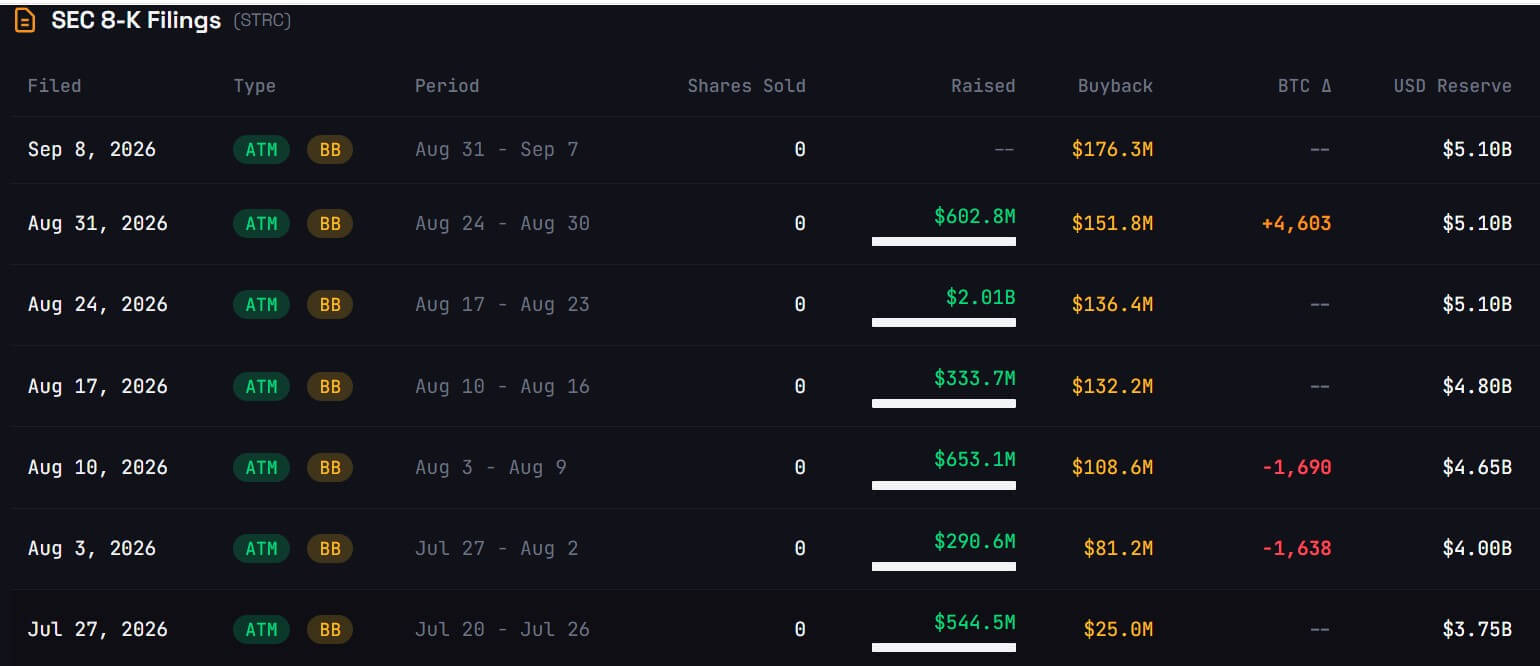
That means the dollar cost of supporting STRC has continued rising even as the discount Strategy is buying has collapsed from more than 13% during the opening week to less than 3%.
Each share retired below stated value removes $100 of preferred capital along with the associated dividend obligation at a discount, an advantage that diminishes as STRC approaches par.
The expanded authorization gives Strategy considerably more room to continue making that trade even after the original program has been more than 80% consumed.
Bitcoin goes back on pause
Meanwhile, the latest intervention has also produced a sharp reversal from the capital allocation Strategy displayed only one week earlier.
During the previous reporting period, the company raised $602.8 million through MSTR sales, spent $151.8 million repurchasing STRC and still directed $369.7 million toward 4,603 Bitcoin.
That purchase ended a roughly two-month pause in Bitcoin accumulation and suggested Strategy could once again finance both its preferred-stock obligations and expansion of the asset at the center of its treasury strategy.
However, the combination lasted only one week.
In the latest week, the Saylor-led company sold no shares through its at-the-market program between Aug. 31 and Sept. 7 and purchased no Bitcoin. The entire $176.3 million used for STRC repurchases came from its USD Cash balance.
That pool stood at $1.44 billion at period-end and has a broad mandate. Strategy says the cash can be used to acquire Bitcoin, increase its USD Reserve, manage its capital structure, and fund other Bitcoin treasury company purposes.
Its separate USD Reserve stood at $5.10 billion and is intended to support preferred-stock dividends and interest on outstanding debt.
The distinction puts the latest STRC spending into sharper focus. The buybacks are drawing from the same flexible liquidity pool Strategy can use to acquire more Bitcoin.
The company owned 845,050 Bitcoin as of Sept. 7, acquired for $63.73 billion at an average price of about $75,412.
But the past two weeks illustrate how STRC's struggles have altered the cadence of further accumulation. When fresh equity capital was available, Strategy funded both. Without MSTR issuance last week, STRC received the cash, and Bitcoin purchases stopped.
The $2 billion question
Strategy has a strong incentive to keep pushing STRC toward $100 because the security becomes far more useful once it can trade reliably around par.
STRC was designed as a perpetual funding vehicle whose variable dividend can be adjusted to encourage the market price to remain near its $100 stated value.
Strategy has also adopted a policy against issuing additional STRC below par, meaning the security cannot fully serve its intended financing role while it trades at a discount.
A sustained return to $100 would reopen that channel. Strategy could once again issue additional preferred shares to raise capital without relying as heavily on sales of MSTR common stock.
STRC has already shown the scale of capital it can attract. Its initial 2025 offering was expanded from an expected 5 million shares to more than 28 million after strong investor demand, ultimately raising about $2.52 billion.
The security has since grown to a market value of roughly $10 billion, making it Strategy’s flagship preferred-stock product and a key component of its broader capital structure.
That makes restoring STRC to issuance territory increasingly important.
Still, Saylor’s Sept. 8 marker was never a contractual deadline, and STRC has recovered sharply from its May lows to within a few dollars of par.
But the board’s decision to double the repurchase authorization shows that the final stage of that recovery may require substantially more balance-sheet support than Strategy initially anticipated.
Nevertheless, the next test is how much of the additional authorization Strategy must deploy before outside demand can hold the security at the $100 par, allowing STRC to shift back from absorbing corporate capital to raising it.
The post Strategy doubles its stock buyback to $2 billion to pull its STRC shares back to $100 appeared first on CryptoSlate.
Metaplanet’s Bitcoin expansion has exposed an executive compensation windfall that shareholders want the company to unwind.
The dispute centers on an executive options pool that expanded as the Tokyo-listed company repeatedly issued equity to finance its Bitcoin purchases.
Shareholders are now demanding the cancellation of roughly 273 million potential shares added to management’s compensation package during that expansion.
Bitcoin fundraising swelled the executive pay pool
The controversy centers on Metaplanet’s Series 10 stock acquisition rights. Shareholders approved the plan in early 2023, before the company’s pivot to digital assets, and it initially covered 46 million shares.
The plan also contained an adjustment mechanism designed to maintain the shares underlying the options at a benchmark equal to roughly 20% of a defined fully diluted share count.
The company’s capital needs changed dramatically when Chief Executive Simon Gerovich pivoted Metaplanet to a Bitcoin treasury model in April 2024. Metaplanet repeatedly tapped equity markets to fund purchases that eventually built its treasury to 43,000 BTC.
Issued shares climbed from approximately 153.9 million around the start of the Bitcoin strategy to 1.28 billion by the end of June 2026. Because the Series 10 formula adjusted alongside the company’s capital structure, the executive options pool expanded with it, rising from the original 46 million to 319.464 million potential shares.
Metaplanet eliminated the adjustment mechanism on Aug. 18, capping future expansion.
The company acknowledged in its notice that the clause “amplifies the dilution borne by existing shareholders” and could create concerns about the relationship between capital-raising decisions and the interests of the stock acquisition rights holders.
Yet, Metaplanet froze the compensation pool at its expanded size rather than rolling it back to its original level.
That left management with roughly 273 million additional potential shares generated before the mechanism was abolished.
Gerovich turns part of the award into 64 million shares
The shareholder pushback intensified after Gerovich exercised part of his compensation award just days after the August amendment.
On Aug. 28, the CEO exercised 92,000 Series 10 rights and received 64.032 million newly issued shares. The transaction lifted his direct holdings from 15.56 million shares to nearly 79.6 million.
Gerovich paid the legacy exercise price of ¥10 per share, bringing the total cost to approximately ¥640.3 million.
At a Metaplanet share price of ¥244, those newly issued shares carry a market value of roughly ¥15.6 billion, leaving a paper spread of nearly ¥15 billion between their market value and the amount paid to exercise the rights.
Those gains remain unrealized. The August amendment subjected shares obtained through the plan to a five-year lockup that generally prevents their sale or transfer until August 2031.
However, the dilution occurred when the new shares were issued.
Gerovich held 276,000 of the 459,000 outstanding Series 10 rights as of June 30. After exercising 92,000, he would retain about 184,000 rights, assuming no other changes. Other executives and employees hold additional rights, with further portions of the awards scheduled to vest through 2028.
The compensation overhang hits Bitcoin per share
Investors are particularly focused on the compensation pool because it directly affects one of Metaplanet’s central treasury metrics: Bitcoin per fully diluted share.
As of June 30, the company held 43,000 BTC against roughly 1.63 billion fully diluted shares, translating to about 2,635 satoshis per share. That denominator includes the potential dilution from the Series 10 awards.
Shareholder Ragnar is among those demanding the outright cancellation of the roughly 273 million potential shares created above the original size of the compensation plan. He wrote on X:
“The only way out is to roll back the 273 million extra shares, and to replace them with a new, retroactively applied incentive program.”
Removing those potential shares from the denominator would raise Metaplanet’s Bitcoin exposure to about 3,166 satoshis per share, roughly 20% higher, assuming no other changes.
Ragnar has questioned why executives should keep the additional compensation after Metaplanet concluded that the mechanism amplified shareholder dilution and raised concerns about the incentives around capital raising.
He also pointed to Metaplanet’s international offering last year, which he said generated another 96.25 million potential shares through the adjustment clause. According to him, shareholders publicly questioned the arrangement in September and October 2025, months before the company removed the mechanism.
The additional shares also carry no new performance conditions tied to Bitcoin-per-share growth or other shareholder-return metrics, although Metaplanet’s August changes introduced the five-year restriction on sales.
Ragnar argued that the company should replace the enlarged award with compensation tied directly to future performance rather than preserve benefits accumulated under the abandoned formula.
Governance scrutiny expands to MMXX
Compounding the compensation dispute is a separate governance debate surrounding MMXX Ventures, a recurring Metaplanet shareholder and former lender.
Gerovich recently said he is a “significant but non-majority shareholder” of MMXX’s parent company and does not participate in the entity’s investment or trading decisions.
Investors have continued to seek greater detail about MMXX’s ownership and voting structure, as well as Gerovich’s economic exposure to transactions involving Metaplanet.
Metaplanet has also proposed shifting up to 90,000 remaining Series 10 rights, representing 62.64 million potential shares, into a new long-term incentive vehicle for executives and employees. The structure could include performance and service conditions without creating shares beyond the existing ceiling.
Gerovich has acknowledged shortcomings in the company’s communication and said Metaplanet continues to review its governance and compensation
That response has yet to resolve the central shareholder demand. Metaplanet has stopped expanding its executive options pool with future equity raises, but management has not said it will surrender the roughly 273 million potential shares generated before it abolished the mechanism.
The post Metaplanet’s Bitcoin boom quietly turned a 46 million-share executive pay plan into a 319 million-share windfall appeared first on CryptoSlate.
A Sept. 2, 2026 analysis by New York Fed researchers shows how a few large reserve portfolios can lower the global dollar share without a broad retreat from dollars. For investors assessing future sovereign demand for Bitcoin, the distinction is between a changing average and an investment decision.
Linda S. Goldberg, Oliver Hannaoui and Sneha Parthasarathy report that the dollar share of global official foreign-exchange reserves fell from 64% at year-end 2015 to 56% at year-end 2025, using IMF COFER data.
Their country-level evidence points to concentrated decisions and changes in reserve sizes.
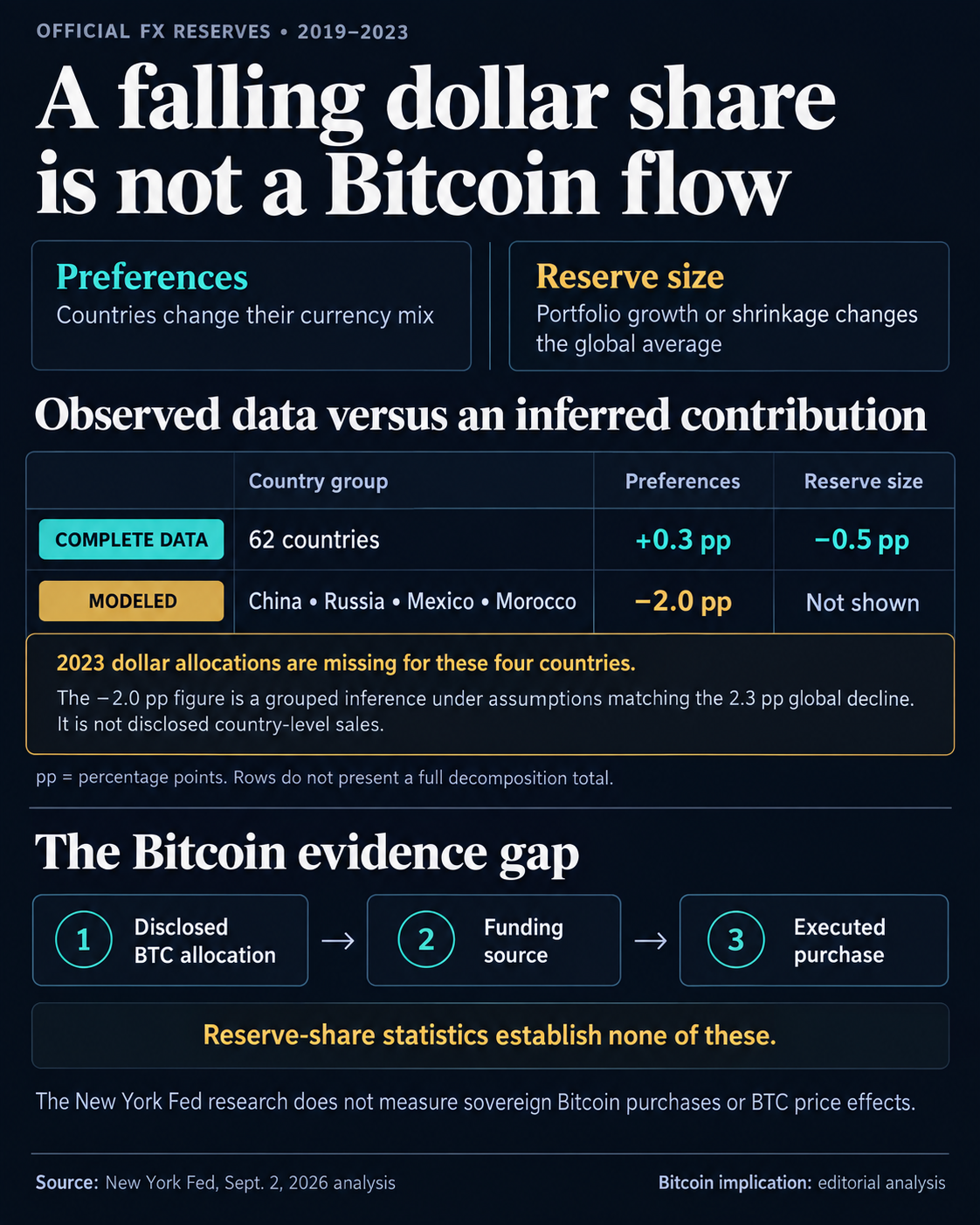
Countries can change the currency mix of their portfolios, the “preferences” channel. Alternatively, their total reserves can grow or shrink, changing their weight in the global average.
When a country with a below-average dollar allocation accumulates reserves, it can pull down the worldwide dollar share without cutting its own allocation. Switzerland did that between 2015 and 2019: its reserve growth pushed the aggregate share down even as its own dollar allocation rose.
For that period, 76 countries had complete endpoint data within a 79-country exercise. Their preferences and reserve-size contributions declined by 1.2 and 1.5 percentage points, respectively.
For 2019-2023, the 62 countries with complete data contributed a positive 0.3 percentage point through preferences and a negative 0.5 percentage point through reserve-size changes.
China, Russia, Mexico and Morocco lacked 2023 dollar-allocation data. Under assumptions matching the observed 2.3-percentage-point global decline, the researchers inferred a combined negative 2.0-percentage-point preferences contribution for that group.
A Bitcoin allocation needs its own evidence
The underlying Staff Report 1087, issued in March 2024 and revised in February 2026, separates reserves needed for liquidity from an investment portion above those needs. Trade payments, foreign-currency debt, and currency stabilization sustain the need for liquid reserves.
The paper models that investment portion using short-term external debt or three months of imports as alternative measures of liquidity needs.
Diversification is more prevalent when reserves can satisfy those needs. Its earlier decomposition covers 2015-2020, while its broader country panel spans 1999–2023.
The distinction also applies when a central bank actually buys Bitcoin. On Nov. 13, 2025, the Czech National Bank announced a $1 million digital-asset test portfolio including Bitcoin, with a dollar stablecoin and tokenized deposit also part of the project.
The amount covered the whole portfolio, and the purchase was explicitly outside international reserves.
Applied to Bitcoin, the reserve research supports a limited inference: diversification beyond liquidity needs does not identify the money's destination. Neither New York Fed source measures sovereign Bitcoin purchases or estimates a Bitcoin price effect.
A sovereign Bitcoin demand case needs separate evidence: a disclosed allocation, its funding source, and executed purchases, with official reserves distinguished from holdings outside them. A shrinking dollar share supplies none of those details.
The post Why Bitcoin bulls shouldn’t mistake a shrinking dollar reserve share for central bank buying appeared first on CryptoSlate.
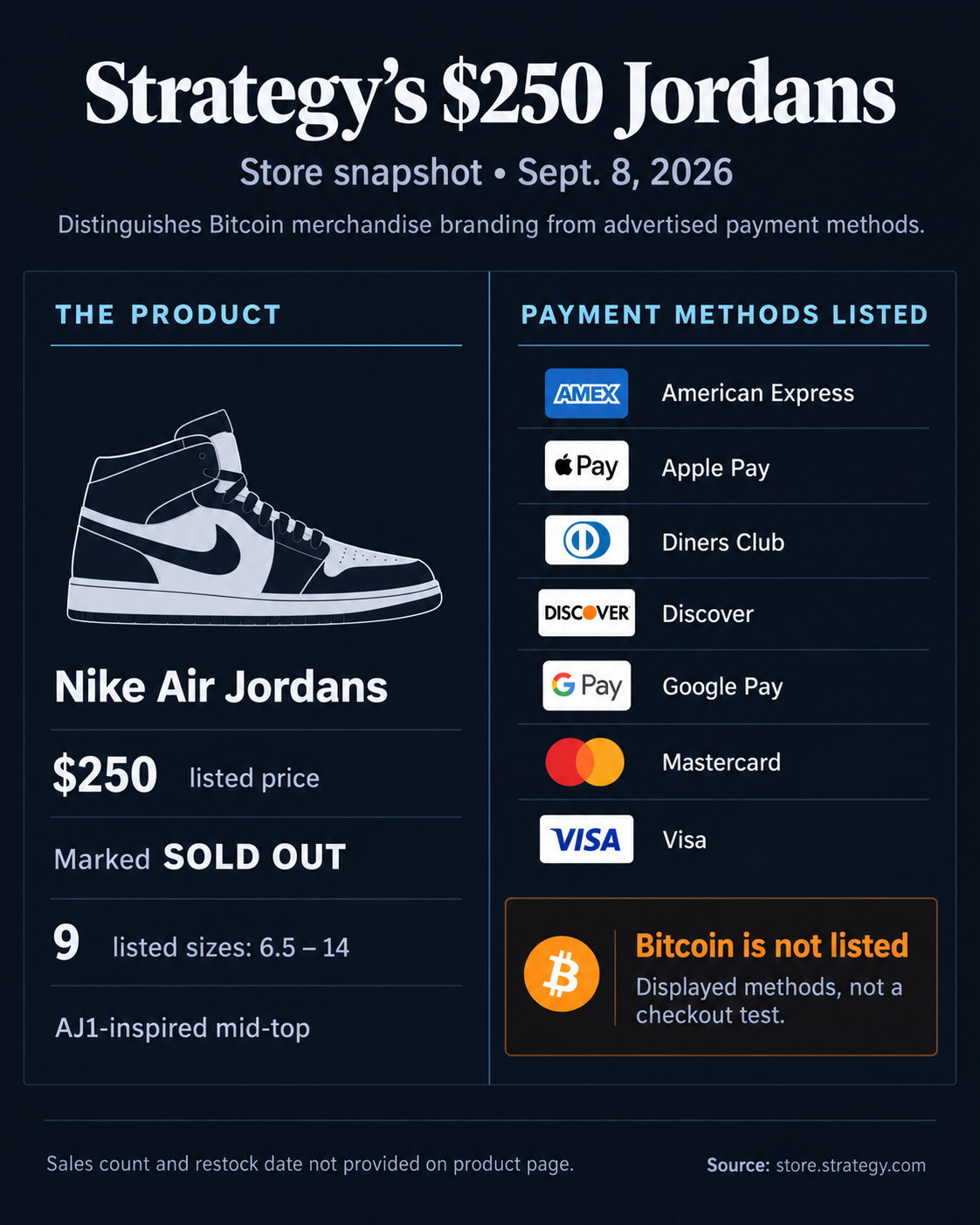
Strategy’s $250 Bitcoin-themed Air Jordans have sold out, extending Michael Saylor’s treasury brand from Wall Street into consumer culture.
The shoes, launched Sept. 4 through Strategy's online store, were sold out by Sept. 8, with all nine advertised sizes listed as unavailable. The company did not disclose how many pairs it offered or when inventory ran out.
The release pushes Strategy’s Bitcoin identity beyond its balance sheet and securities business into merchandise aimed directly at consumers.
The Saylor-led company holds 845,050 BTC, equivalent to about 4.02% of Bitcoin’s fixed 21 million supply, making its association with the asset central to both its financial strategy and corporate identity.
Since dropping the MicroStrategy name in February 2025, Strategy has increasingly built its public image around Bitcoin, turning what began as a treasury allocation into the company's defining feature.
Strategy turns Bitcoin into something customers can wear
The Air Jordans are the most prominent example yet of that branding effort.
Strategy describes the mid-top sneakers as inspired by the original Air Jordan 1, combining custom company branding with leather overlays, Nike Air cushioning, and the Air Jordan Wings logo. The store listed sizes ranging from 6.5 to 14 at $250 a pair.
They sit alongside a broader catalog built around the company and Saylor’s Bitcoin persona, including a $50 Bitcoin Strategy Game, a $125 Strategy hoodie, and a $35 organic cotton Saylor shirt.
The merchandise gives Strategy another way to capitalize on the audience built around its Bitcoin strategy without depending directly on MSTR shares, Bitcoin purchases, or the company’s expanding suite of preferred securities.
The Jordans’ sold-out status points to demand for premium products carrying that identity, though the undisclosed inventory makes the scale impossible to measure.
There is also an irony in how customers are being asked to buy into the Bitcoin brand.
Strategy’s storefront lists American Express, Apple Pay, Diners Club, Discover, Google Pay, Mastercard and Visa among its payment methods. Bitcoin does not appear among the displayed options.
That does not establish that Bitcoin cannot be used at checkout, since the published menu may not capture every possible payment method.
Still, the visible retail experience remains decidedly conventional: customers buying merchandise from the company holding more than 845,000 BTC are presented with cards and mainstream digital wallets rather than Bitcoin itself.
For would-be buyers, inventory is the more immediate constraint. Strategy has not posted a restock date, leaving it unclear whether the Jordans were a limited promotional drop or the start of a broader effort to turn its Bitcoin identity into a recurring consumer business.
The post Strategy’s $250 Bitcoin Jordans sold out as Saylor turns 4% of BTC supply into a consumer brand appeared first on CryptoSlate.
CryptoTicker.io
On September 11, 2026 at 11:15 UTC the amendment fixCleanup3_3_0 can go live on the XRP Ledger. For you as an investor that means very little in most cases and a great deal in one: if your XRP sits with an exchange or in a maintained wallet app, you have nothing to do. If you run your own node, if you reach the network through a self-hosted interface, or if you hold positions in the ledger's advanced features, then September 11 is your deadline for a version check.
This analysis was carried out by cryptoticker.io itself on September 9, 2026. We asked the chain directly instead of taking the state of play from news reports: through the public interface of an XRPL node, using the feature and ledger_entry calls against the amendments object of the validated ledger. What came out of it differs on two points from what is currently being written about the date.
Amendment fixCleanup3_3_0: what happens on the XRP Ledger on September 11
An amendment is a change to the rules of the XRP Ledger protocol. The network's validators vote on it, and once the vote passes it applies permanently to every following ledger version. Nobody deploys it centrally; it is a switch the majority of operators throw together.
fixCleanup3_3_0 is a bundle of corrections, not a new feature. It tidies up in six places: at the Single Asset Vaults (vault objects that hold a single asset for a protocol), at the Lending Protocol (the planned lending business directly at protocol level), at the Automated Market Makers (trading pools that quote prices through a formula rather than an order book), at the Permissioned DEX (a trading venue that only serves approved participants), at Checks (payment promises the recipient redeems themselves) and at pseudo-accounts (technical accounts that belong to no human being because a protocol object holds them).
In concrete terms, the bundle harmonises the freeze checks on transfers from pseudo-accounts, rejects malformed check identifiers at the preliminary stage, fixes an error when removing hybrid offers, and adds a check for rounding losses on deposits, withdrawals and clawbacks in AMM pools, provided the older amendment fixAMMv1_3 is active as well. On top of that comes a new invariant called ObjectHasPseudoAccount, which makes sure that deleting a ledger entry also removes the associated pseudo-account.
That sounds like detail work, and it is. Which is precisely why the news is not a price story for you, but a maintenance story with a hard deadline.
The 80 percent rule: how an XRPL amendment is activated in the first place
The procedure is set out in the amendment documentation of the XRP Ledger and it is strict. An amendment needs the approval of more than 80 percent of the validators a server listens to, and it needs that support for two weeks without interruption. If support drops to 80 percent or below in the meantime, the clock starts again from zero. An amendment can win and lose that majority several times before it finally goes through.
The count happens at so-called flag ledgers, meaning every 256th ledger, which on average works out at roughly a quarter-hour rhythm. At the flag ledger the validators cast their votes, one ledger later the network writes a pseudo-transaction with the result, and two ledgers after the flag ledger the new rule takes effect on transactions. Activation therefore follows a count, not a ceremony at a round hour.
Anyone who knows the pattern will recognise it from other networks. On Solana, the activation of a protocol change likewise hangs on the stake weighting of the operators; we wrote that up in our article on the Alpenglow activation. The difference lies in the detail: on the XRP Ledger the two-week period is anchored in the protocol and can therefore be read off the ledger itself.
Counted on the ledger ourselves: 93 active amendments, eleven open, one majority
On September 9, 2026 at 00:52 UTC we queried a public XRPL node which at that moment carried the validated ledger with the number 106,856,830 and reported server version 3.3.0. Method: a feature call for the list of all amendments known to the server, plus a ledger_entry call against the amendments object of the ledger for the official state. All 104 amendments this server knows about were checked.
The result in figures: 93 amendments are active, eleven are open. Of those eleven, exactly one carries a majority entry in the ledger, namely fixCleanup3_3_0. The closing time stored for that entry in the object converts to August 28, 2026, 11:15 UTC. Add the prescribed fourteen days and you get the earliest possible activation moment: September 11, 2026, 11:15 UTC.
That allows two figures currently in circulation to be set straight. First, the start of the vote is dated in some reports to August 6; what counts for the deadline, however, is solely the moment the majority first stood, and according to the ledger that is August 28. Second, several reports give 11:15 in US Eastern time. The ledger keeps its time in UTC, which puts the moment in the middle of the day on September 11 for readers in Europe.
One caveat belongs with this: what we measured was the state of one node; it does not cover the vote of every single validator. The most recently reported approval rate of 82.86 percent with 29 yes votes comes from third-party analysis and is a snapshot. Whether it stays above the threshold until September 11 is something nobody can promise today.

Single Asset Vault and Lending Protocol are not even live on mainnet yet
The most important finding of our query does not appear in the reports about the date. In the same list of eleven open amendments stand SingleAssetVault and LendingProtocol themselves. Both are therefore not yet switched on for mainnet. The same goes for ConfidentialTransfer, DynamicMPT, BatchV1_1, Sponsor, XChainBridge, PermissionDelegationV1_1, CryptoConditionsSuite and fixXChainRewardRounding. None of these ten amendments currently carries a majority entry.
From that follows a piece of reassurance worth remembering: if somebody tells you that you have to secure your vault or lending position on the XRP Ledger before September 11, they are describing a state of affairs that does not exist on the main network. You cannot hold a lending position directly on the XRPL protocol today, because the function is not active.
The fix, in other words, is being built in before the function opens. In software development that is the normal case and a good sign: errors found on test networks and in audits are cleared away before launch. For you it mainly means you should treat offers advertising XRPL-native lending today with scepticism. Anyone looking for yield on crypto assets will currently find it with custodians and trading venues, whose terms deserve a closer reading in every case than any announcement about a protocol function that is not yet switched on.
Amendment blocked: why an outdated node drops out of consensus
Amendment blocked is the state a server falls into when a rule its software version does not know becomes active on the network. The documentation is unambiguous on this point: a blocked server can no longer validate ledgers, can no longer submit or process transactions, can no longer take part in consensus and can no longer vote on future amendments. It stands still.
That is the real reason for the deadline. Anyone running a node has until activation to switch to a version that knows fixCleanup3_3_0. The public node we queried was running 3.3.0 at the time of measurement and reported no block. A server that lags behind will report one immediately after activation, and the disruption shows up at the moment an application runs into nothing.
The documentation also names a property many people underestimate: a server always follows the amendments the rest of the network has activated, regardless of how it voted itself. A no vote therefore does not protect an outdated server. Only an update does.
XRP on an exchange: what to check with your provider before September 11
If your XRP sits in the account of a trading platform, the node belongs to the provider. The duty to update therefore lies with them, and as a rule a switch like this passes unnoticed. Even so, a quick look before a protocol deadline is worth it, because platforms occasionally pause deposits and withdrawals for a chain for the duration of an upgrade.
The route to that is always the same. Open your provider's status or announcements page, search for the network name, and see whether a maintenance window is entered for September 11. If you find nothing, nothing is planned. Whether your provider announces such a window at all is one of the points on which platforms differ considerably.
Three questions to settle on your own account
The first question is whether you have any movements planned for September 11 at all. A withdrawal that runs a day earlier or a day later costs you nothing. The second question concerns automated orders: a savings plan or a recurring withdrawal that fires at that midday hour belongs in your calendar. The third question is the most uncomfortable and at the same time the most important: do you know for certain where your XRP is? Across several accounts held over years, that answer is less clear-cut more often than it should be.
A note on the scope of the effect. fixCleanup3_3_0 changes nothing about ordinary payments, nothing about balances and nothing about the validity of your addresses. Anyone who holds XRP and sends it will in all probability notice nothing whatsoever on September 11. The corrections bite on objects that play no part in the daily life of most investors.
Your own wallet and your own node: the version check in three steps
Things look different if you run infrastructure yourself. That affects more people than the term suggests: anyone using self-hosted wallet software with its own network access, anyone settling payments through their own interface, or anyone keeping a node running for a small service, is under the same obligation as a professional operator.
The first step is the version query on your own server. The server_info call returns the field build_version and also the field amendment_blocked, which shows the blocked state directly. If it says version 3.3.0 or higher, your software knows the amendment.
The second step applies to the wallet you use every day. Open the settings, find the version number and compare it with the provider's current release. Anyone who lets their wallet update automatically through the app store is usually on the safe side here; anyone maintaining a desktop version by hand often is not. Which wallet programs are properly maintained and which have stood still for months is shown by our software wallet comparison, with the update status of each.
The third step concerns everything that sits between you and the chain: a script, an accounting tool, a portfolio tracker with its own network access. Check which endpoint these tools talk to, and whether that endpoint is maintained. A blocked node will at some point simply stop answering, without spelling out an error message in plain language.

AMM positions on the XRP Ledger: what the precision fix changes on deposits and withdrawals
One part of the bundle concerns a function that really does run on mainnet: the Automated Market Maker of the XRP Ledger. An AMM is a trading pool into which two assets are deposited and which sets its prices through a fixed formula; whoever deposits receives shares in the pool and in return carries the risk of an unfavourable price move between the two assets.
The correction adds a check for rounding losses on deposit, withdrawal and clawback, specifically when the older amendment fixAMMv1_3 is active as well. Rounding losses arise when a calculation with a limited number of digits cuts off decimal places on very small or very unevenly distributed amounts. In total those are tiny sums, but in unfavourable combinations they can be exploited deliberately.
If you hold shares in an XRPL AMM pool, activation changes nothing about your holding. It may be, however, that a transaction which went through until now is rejected with an error after September 11 because the new check bites. That is the intended effect. So do not plan tightly timed reallocations for activation day, and expect a rejected transaction to need a second, adjusted attempt.
Timeline until activation: what happens between September 9 and September 11
Until the deadline the count simply carries on. Roughly every fifteen minutes the network reaches a flag ledger, the validators cast their votes, and the majority entry in the amendments object stays in place as long as approval is above 80 percent. If it falls below at one of those points, the entry disappears and the fourteen days start again.
That is why September 11 counts as the earliest possible date and not as a commitment. Whether activation actually takes place that midday can only be said on the day itself. Anyone who wants to know precisely can query the state at any time, exactly as we did for this article, or follow the developer blog of the XRP Ledger, where releases and activations are announced.
How to recognise that activation has happened
After activation, fixCleanup3_3_0 moves in the feature query from the list of open amendments to the list of active ones, and the number of active entries in the amendments object rises from 93 to 94. That is the cleanest confirmation there is, and it works without any report from outside.
What the date means for the XRP price, and what it does not
Restraint is in order here. A bundle of fixes that harmonises internal checks and catches rounding losses is not an event from which a price direction could be derived. It raises no transaction capacity, lowers no fees and unlocks no new function.
What it does is indirect and slow: it clears errors out of precisely those building blocks on which the still-pending functions for vaults and lending are meant to sit. Anyone who ties the valuation of a network to its future feature set will read that positively. Anyone looking for short-term movement will find nothing here. Both are assessments and not forecasts; the current price situation and the arguments on both sides are something we collect continuously on our XRP page.
A remark on how to read the coverage: over the past few days the date has been described in several places as a "major upgrade". Judging by what is in the bundle, that description does not hold. This is maintenance on advanced objects, two of which are central and not even switched on for the main network.
Checking the XRP Ledger amendment: what to take away
- First establish where your XRP is. On a trading platform the provider carries the duty to update, and all you check is their status page for a maintenance window on September 11. In self-custody the duty is yours. If this question makes you pause, that is the real finding of the day: sort out your holdings and look at which custody solution suits you, for instance in the hardware wallet comparison.
- Check the version of every piece of software that talks to the network itself. On your own server,
server_infoshows the fieldsbuild_versionandamendment_blocked; 3.3.0 or higher is the safe state. For wallets a glance at the settings is enough. Anyone noticing that their program has not seen an update in months will find maintained alternatives in the software wallet comparison. - Push planned reallocations back by a day. If you hold shares in an AMM pool or have larger movements planned for September 11, move them to September 10 or September 12. And if offers reach you that already advertise lending directly on the XRP Ledger, compare them with the routes actually available in the crypto lending comparison before you move any money.
(As of September 9, 2026. This article is not investment advice. Prices and fee structures change; check the terms with the provider before you buy.)
The deadline for the Mt. Gox repayments ends on October 31, 2026, Japan Time. In practice that means the cut-off has already passed on Friday, October 30, 2026, at 16:00 Central European Time. Anyone holding an approved claim against the former bitcoin exchange has to have their paperwork and their payout account in order by then. If you simply own Bitcoin and want to know whether selling pressure is heading your way: the 2024 precedent argues against it, and that can be evidenced.
The date is the largest crypto deadline of this autumn, and in German not a single text so far ties it to a concrete action. German-language coverage last touched the subject in early June 2026, when a wallet movement ran through the news. This guide closes that gap. It tells you what the deadline is in legal terms, what rehabilitation creditors have to have completed by then, how much BTC still sits in the estate of the proceedings, and what the date means for every other bitcoin holder. You will not find a price forecast here, because the process does not carry one.
When the Mt. Gox repayment deadline ends and why October 30 is the date that counts
The official page of the proceedings puts it in these words: "The Rehabilitation Trustee has changed the deadline of the Base Repayment, the Early Lump-Sum Repayment, and the Intermediate Repayment from October 31, 2025 (Japan Time) to October 31, 2026 (Japan Time), respectively." The decisive part sits in the brackets. Japan Time, JST for short, runs nine hours ahead of universal time. October 31, 2026 therefore ends in Tokyo at 15:00 UTC, and because European summer time expires on October 25, 2026, that is 16:00 Central European Time on Friday, October 30, 2026.
That conversion appears in none of the German reports we found, and it is the one point where a reader can lose a full day to nothing but time-zone carelessness. Anyone still planning to get something done on Saturday, October 31, is working against a deadline that expired the day before. If you keep an eye on dates like this one, our overview of the verified crypto deadlines and key dates this autumn helps, and this date was missing from it until now.
What the deadline means legally: Base Repayment, Early Lump-Sum Repayment, Intermediate Repayment
Mt. Gox has not operated as a crypto exchange since 2014. It runs as a Japanese civil rehabilitation proceeding. Three terms turn up in every notice from the process, and they are not synonyms.
- Base Repayment: the first, pro-rata payout to all approved rehabilitation creditors.
- Early Lump-Sum Repayment: an advance flat payment for creditors with smaller claims, who in return waive later top-up payments.
- Intermediate Repayment: further part payments out of the remaining estate, before the proceeding is settled for good.
- Rehabilitation creditor: anyone who filed their claim on time and had it approved. New claims have not been admissible for years.
The extended deadline covers all three payment types together. What is meant is the date by which the trustee is supposed to have completed those payments, not a date on which money automatically moves at the end. That distinction carries the rest of this article.
Who Nobuaki Kobayashi is and what the trustee actually decides
The proceeding is run by the court-appointed Rehabilitation Trustee, Nobuaki Kobayashi. He administers the holdings, checks creditors' documents and settles the payouts through mandated crypto platforms. He gave his reasoning for the latest extension in the announcement itself: many creditors had not completed the necessary procedural steps, others had run into problems along the way. The trade publication The Block reported on this on October 27, 2025 and put the number of creditors served by that point at around 19,500.
One point matters for context: an extension of the deadline is not a decision the trustee takes on his own. The competent court in Tokyo has to approve it. That is precisely why such announcements come at short notice, and precisely why the timing of an extension is hard to predict.

What Mt. Gox creditors have to have completed by the deadline
If you are affected yourself, everything hangs on three points you can check in the creditor portal of the proceeding. Work through them in this order, because each later step depends on the one before it.
- Access and identity. Check whether you can still log in to the claim filing system and whether the data on file is correct. An outdated address or a dead email address is the most common reason why notices never arrive.
- Payout account. The payments run through mandated exchanges and through banking channels. The account you have registered there has to be in the same name as your claim, it has to have passed the platform's verification, and it has to be able to accept the currency the payout is made in.
- Consent to the settlement route. A payout through a crypto exchange requires a separate declaration in which you agree to the settlement through that platform. Without it, your claim sits in the proceeding approved but unpaid.
What you can no longer do: file a new claim. The filing deadline expired years ago. Anyone learning today for the first time about an old balance has no route into the proceeding any more, and any offer promising them such a route should make them suspicious. Why, is set out further below.
Which crypto exchanges handle the payouts and how long they take
The payout runs through mandated platforms and not directly from the trustee to individual wallets. In the payout wave that began in July 2024, those were Kraken, Bitstamp, BitGo, SBI VC Trade and Bitbank. The processing windows reported at the time, counted from the arrival of the coins at the respective platform, were far apart: up to 90 days at Kraken, up to 60 days at Bitstamp, around 20 days at BitGo, and roughly 14 days at SBI VC Trade and Bitbank. Those figures come from the 2024 reporting and are no commitment for 2026, but they do show the order of magnitude.
For the deadline that carries a very practical consequence. If up to three months can pass between the trustee sending the coins and the credit reaching you, then October 30 is not a date you should be working towards. It is the date by which the trustee is supposed to be finished. Your own preparations belong weeks ahead of it.
Anyone whose balance sits on a trading platform anyway can use the occasion for a sober stocktake. Which providers in Europe are supervised and what safeguards they offer is broken down in our comparison of regulated crypto exchanges. Mt. Gox is the reason that question gets asked at all.
How many bitcoin Mt. Gox still holds: the balances according to Arkham
When the exchange collapsed in 2014, around 850,000 BTC had disappeared, of which roughly 200,000 later resurfaced. What is left in the proceeding today can only be estimated through the attribution of wallet addresses, and that work is done by analytics firms, not by the trustee. The provider Arkham tracks the Mt. Gox wallets as an entity of their own. The verifiable values diverge, which is why a range stands here instead of one smoothed number:
- 34,689 BTC according to Arkham data, as of October 2025, reported by The Block.
- around 34,500 BTC according to Arkham data, as of June 2026, consistent across several trade publications.
- 10,422 BTC as the size of a single wallet movement on June 2, 2026, worth roughly 739 million dollars at the time.
- 142,000 BTC and BCH as the size of the large payout wave from July 2024 onwards, for comparison.
Honesty requires the limits of these figures: we did not measure the current on-chain balance ourselves for this article, because the candidate addresses could not be attributed beyond doubt. The bitcoin transactions and holdings named here are therefore third-party measurements with a date attached, not our own survey. Anyone working with them should keep the range in mind rather than picking out the sharpest number.
A wallet movement, incidentally, is not a sale. Behind it there may be an internal reshuffle, preparation for distribution, or simply a change of custody technology. When the 10,422 BTC were moved in June 2026, the report ran through the crypto news without ever turning into a sale on the market. How quickly a price narrative grows out of such reports is shown by our look back at the day the bitcoin price slid below 70,000 dollars.
Selling pressure from Mt. Gox: what was actually measurable in 2024
The most searched question around this date is not about the proceeding at all, but about the price: do the payouts push the bitcoin price down? It can be answered without any forecast, because there is a precedent.
The large payout wave began in July 2024. Around 142,000 bitcoin and bitcoin cash went to creditors, with roughly 48,641 BTC transferred to Kraken alone. Market expectations were unambiguous: anyone getting their coins back after ten years sells. In the week the payouts started, the price did indeed fall sharply. Two weeks later, Blocktrainer summarised the measurement on July 24, 2024: trading volume at Kraken had not risen noticeably in the context of the repayments, according to CryptoQuant chief executive Ki Young Ju. What rose instead were the outflows from the exchange. Recipients moved their coins into self-custody.
That is an observation with a date and a source, not an expectation for the autumn of 2026. Two things about it hold up: the feared wave of selling did not materialise in 2024, and the remaining amount today is many times smaller than it was then. Anyone building a price statement for October out of that goes beyond what the data supports.

Why a fourth extension of the repayment deadline remains possible
October 31, 2026 is not the first end date of this proceeding. It is the fourth. Originally the accounts were meant to be settled by October 31, 2023, then it was pushed to 2024, then to 2025, and most recently to 2026. The latest postponement was announced on October 27, 2025, four days before the deadline then in force ran out.
No forecast follows from that, but a rule of caution for your own planning does. A text claiming that payouts will be made on October 31, 2026 and that this is the end of it stands a palpable chance of being proven wrong at the end of October. The more careful phrasing is the correct one: the proceeding is supposed to be completed by that date, and looking at the history, another extension cannot be ruled out. For you as a creditor that changes nothing about the preparation. For you as an observer it means that a date in this proceeding is not a deadline in the usual sense.
Phishing in the name of the trustee: the warning on the official site
Two separate warnings currently sit on the front page of the proceeding, and both are recent enough to be taken seriously. One concerns fake websites and emails posing as Mt. Gox or as the trustee. The other concerns a specific site that used the Mt. Gox name and logo without permission in order to collect creditors' data. In the notice, the trustee states unmistakably that those affected should not leave personal information on such sites and should not reply to such messages.
Three checks follow from that, each costing a second before any click and each making the difference:
- Open the claim filing system only through the address you saved yourself, never through a link in an email.
- Distrust every message that creates urgency, demands a fee for the payout, or asks for your seed, your password or remote access to your machine. The proceeding does not ask for anything of the kind.
- An offer to file your supposedly lost claim retroactively is not an offer. The filing period is closed.
- Compare the sender address of a notice character by character against the official domain. One swapped digit or one extra hyphen is enough for a forged message.
If you would rather not leave your balance sitting on the trading platform after a payout, the options and their trade-offs are in our hardware wallet comparison. This is exactly the route measurably many recipients took in 2024.
How a Mt. Gox payout is treated for tax purposes in Germany
Caution matters more here than a quick answer. Private crypto gains in Germany fall under the private disposal transaction of section 23 of the Income Tax Act, with the familiar holding period of one year. The contested point in an insolvency payout is a preliminary question: are you getting back the same assets you held in 2014, so that the original acquisition continues to run, or is there a new acquisition in the year of the payout? That determines when your holding period starts, and the answer decides the tax amount.
Honesty requires this: there is no settled answer here that fits every case, and this article is no substitute for tax advice. What you can do yourself is secure the evidence. Record when your claim was approved, when the credit arrived, in what amount and at what daily rate. Tools that document exactly this kind of event cleanly are set side by side in our comparison of crypto tax tools and portfolio trackers. Classifying the individual case then belongs in the hands of a tax adviser with crypto experience.
What the date means for bitcoin holders without a claim of their own
The vast majority of readers hold no claim in the proceeding. For them October 30 is interesting all the same, because a news pattern reliably forms around dates like this one: a wallet movement is reported, an expectation grows out of it, and a headline about selling pressure grows out of the expectation. What you can hold against it is a sense of the orders of magnitude. A balance of a good 34,000 BTC is a fraction of the 2024 wave of 142,000 coins, and the big test of that thesis is already behind us.
Soberly put: the proceeding returns coins to people who waited ten years for them. What those people do with them was observable in 2024, and the observation pointed to holding and self-custody. The process gives up nothing more than that, and everything beyond it is speculation dressed up as analysis.
Checking the Mt. Gox repayment deadline: what to take away
- Put October 30, 2026, 16:00, in your calendar, not the 31st. If you are a rehabilitation creditor, check your access, the data on file and your payout account by the beginning of October. If your payout runs through a trading platform, look first at which providers in Europe are supervised: comparison of regulated crypto exchanges.
- Document every credit on the day it arrives. Amount, date, daily rate, platform. These records decide your tax burden later, and they are hard to reconstruct after the fact. Suitable tools are in the comparison of crypto tax tools and portfolio trackers.
- Decide in advance where the coins go after the payout. Leaving them on the platform or moving them into self-custody is a decision better taken before the credit arrives than after it: hardware wallet comparison.
The official notices of the proceeding are published by the Rehabilitation Trustee at mtgox.com. Everything else you read about your claim, you check against that source.
(As of September 9, 2026. This article is not investment advice. Prices and fee structures change; check the terms with the provider before you buy.)
Anyone holding one of the 25 tokens that KuCoin removed from trading on September 7, 2026 has until October 7, 2026 at 8:00 UTC to withdraw them from the exchange. After that the withdrawal window closes. Selling is already off the table, because trading has been halted since September 7. That leaves exactly one action: move the tokens to an address of your own.
The second point is the more uncomfortable one, and it comes from our own count: on the evening of September 8, KuCoin's official deadline overview listed only ten of these 25 tokens. Anyone who looks there and fails to find their token might conclude that they are not affected. That would be an expensive mistake.
KuCoin delisting: these 25 tokens are affected
In its announcement of September 3, 2026, KuCoin names these tokens: ACX, HYDRA, KARRAT, PORTALS, GAFI, SCOR, AUDIO, BLUM, HONEY, SN3, NOBODY, TSTBSC, HPOS10I, LVVA, MTRG, EMYC, DUCK, J, MOVA, BFC, WEN, FWOG, GAIN, WAXP and REEF. Trading was discontinued on September 7, 2026 at 8:00 UTC.
These are mostly small projects, but not exclusively. AUDIO is the token of the music platform Audius, for which we maintain a price prediction of its own; WAXP belongs to the WAX blockchain, MTRG to Meter Governance, ACX to the cross-chain protocol Across. Anyone who has had these holdings sitting in a secondary account for years may not have looked at it for months.
The three key dates: trading halt, deposit halt, withdrawal deadline
A delisting does not happen in a single day; it runs in three stages. In this case they fall as follows:
- September 4, 2026, 8:00 UTC: deposits of the affected tokens were switched off. Anyone who still sent tokens to their KuCoin address after that point has to reckon with them not being credited.
- September 7, 2026, 8:00 UTC: trading was discontinued. From this point a sale through the exchange is no longer possible.
- October 7, 2026, 8:00 UTC: withdrawals close. That is the deadline that counts.
Thirty days lie between the trading halt and the withdrawal deadline. That is the usual shape, which other exchanges also choose, and it is more generous than what Bitfinex offered in August with 13 tokens. Generous does not mean harmless, though: the deadline runs whether you notice it or not, and an email reminder is no substitute for checking yourself. If you want to understand how exchanges behave in cases like this and what marks out a dependable platform, our comparison of the best crypto exchanges is the place to look.
Deadline list checked: only 10 of 25 tokens were listed there
Alongside the individual announcements, KuCoin maintains a continuously updated overview page carrying the trading, deposit and withdrawal deadlines of all delisted tokens. We retrieved that page on September 8, 2026 at around 21:50 UTC and compared it with the announcement of September 3.
The result: ten of the 25 announced tokens were entered there with complete deadlines — KARRAT, SCOR, REEF, GAFI, AUDIO, ACX, PORTALS, BLUM, WAXP and HYDRA. All ten carry the same three points in time: trading until September 7 at 8:00 UTC, deposits until September 4 at 8:00 UTC, withdrawals until October 7 at 8:00 UTC.
Fifteen tokens from the same announcement were not on that overview at the time of our retrieval: HONEY, SN3, NOBODY, TSTBSC, HPOS10I, LVVA, MTRG, EMYC, DUCK, J, MOVA, BFC, WEN, FWOG and GAIN. That is a snapshot and not an accusation — overview pages are updated after the fact, and it is quite possible that the missing entries have since been added. For you as a holder, a practical rule follows all the same: the announcement is the binding source, the overview page is the convenience. Check your holdings against the announcement, not against the list.
Special treatment: what lies behind the procedure
For this delisting KuCoin invokes its so-called Special Treatment Rules. That is an internal set of rules which places projects under observation when certain metrics break down — persistently low trading volume, absent development activity or a project team that stops responding. A definition in one sentence: special treatment is the warning status an exchange gives a token before it removes it for good.
For you as a holder, one thing above all matters here: a delisting under this procedure says something about tradability on this one exchange, not necessarily about the token itself. The token continues to exist on its blockchain. What disappears is the convenient access through the exchange interface.

ACX and J: two tokens already removed elsewhere
Two names on the list have crossed our path in the past four weeks. We reported on August 14 on the Binance delisting of August 17, 2026, in which ACX among others fell out of trading; and on August 22 on the OKX delisting of MAJOR and J with a withdrawal deadline of August 26. Both pieces of information come from our own reporting and are marked as such here.
No verdict on prices can be derived from this, but a practical consequence can: when a token is removed by several large exchanges one after another, the circle of places where you can still sell it at all shrinks. Anyone who only reacts after the third delisting may find no trading venue left with usable depth. That is the real reason the deadline matters more than the day's price.
Preparing the withdrawal: network, address and minimum amount
A withdrawal rarely fails because of the deadline and often because of a detail. There are three points you should settle before you start the process.
The network. Many of the affected tokens exist on several chains. If you pick a different network for the withdrawal than your destination address supports, in the worst case the tokens are lost. Check in the withdrawal dialogue which networks are offered and match that against your wallet.
The destination address. You need an address whose keys you hold yourself, or an account at another exchange that still lists the token. For the first option a hardware wallet is the most robust route; which devices support which chains is set out in our hardware wallet comparison. The second route sounds simpler but merely shifts the problem: the next exchange can delist too.
The minimum amount. Exchanges set a lower limit and a fixed fee for every withdrawal. With residual holdings worth a few euros, the fee can exceed the amount — the withdrawal is then technically possible but economically pointless. That is annoying, but it is a deliberate decision and not an omission.
When the withdrawal fails: the liability disclaimer in the small print
The deadline overview carries a sentence that is easy to skim past. KuCoin points out there that withdrawals can fail if a project team restricts activity on its own chain — by halting block production or transfers, for instance. In such a case the platform may suspend withdrawals and is not liable for any losses arising from that.
This is more than a formality. It means that the deadline of October 7 is an upper limit and not a promise. If the chain of a delisted project stops running before then, the chance to withdraw ends earlier — with the exchange taking no responsibility for it. For projects whose development is already stalling, that is not a theoretical risk. The conclusion is uncomfortable and simple: do not wait until early October.

KuCoin EU and kucoin.com: first check where your account sits
For users in Germany there is a particular point to settle before any further step: two operations exist. The announcement discussed here comes from the global platform. Alongside it stands KuCoin EU Exchange GmbH, which according to the public ESMA register holds a MiCA authorisation as a crypto service provider from the Austrian financial market authority, granted at the end of November 2025.
Whether a delisting announcement from the global platform applies one to one to customers of the European entity does not emerge from the announcement itself. So log in to the account where your tokens actually sit and check in the withdrawal dialogue there whether the token can still be withdrawn and until when. While you are at it, sort out which providers hold your remaining assets and which of them is authorised in the EU.
Tax: what the withdrawal means for your holding period
A pure transfer from the exchange to an address of your own is not a sale. In Germany it does not in principle trigger a taxable event, and it does not interrupt the one-year holding period under Section 23 of the Income Tax Act either. The only thing that matters is that you can still evidence the date and the cost of acquisition.
That is precisely where things often fail in practice. When a token is delisted, the trading data sooner or later disappears from the exchange interface as well. So download the complete transaction history for that token before you withdraw and file it with your tax records. Nobody will retrieve that file for you later.
Worthless residual holdings: withdraw or leave them?
Not every position is worth the effort. If your holding lands in the cents range after the withdrawal fee, the sober answer is: the economic damage has already occurred, and the deadline changes nothing about that.
Two reasons still speak for withdrawing. First, a token whose development continues can become tradable again later — on an address of your own you keep that option, on an exchange without a trading pair you do not. Second, for a tax loss to be recognised you need an event you can evidence; a holding that quietly expires in an account is harder to present than one you demonstrably still own. Whether that adds up for you depends on the size of the fee, and you see that in the withdrawal dialogue before you confirm.
How we counted: method and limits
This analysis was carried out by cryptoticker.io itself on September 8, 2026. Method: we retrieved the delisting announcement of September 3, 2026 and KuCoin's continuously updated deadline overview on September 8, 2026 at around 21:50 UTC, read out the visible text without the HTML scaffolding, and checked each of the 25 tokens named in the announcement individually against the entries on the overview page. Checked: 25 tokens, two pages, one retrieval time. Result: 10 tokens with a complete set of deadlines on the overview, 15 without an entry there at the time of retrieval.
What we could not check: any view behind a login, because we do not maintain customer accounts — that is, the actual withdrawal dialogue, the networks offered for your token and the specific fees. It also remains open whether and when the missing 15 entries will be added, and whether the announcement from the global platform applies unchanged to the European entity. Anyone relying on this article should therefore check their own holdings in their own account in any case.
Checking the KuCoin deadline: what to take away
- Look into your account today. Match your holdings against the list of 25 tokens from the announcement, not against the overview page — 15 of them were missing there on September 8. If you find a position, start the withdrawal immediately rather than shortly before October 7. If you are thinking about switching anyway while you are at it: our overview of regulated crypto exchanges sets out who is authorised in the EU.
- Set up the destination before you withdraw. You need an address on the matching network whose keys you hold yourself. For smaller amounts a vetted software solution from our software wallet comparison is enough; for anything that would hurt if it were gone, keeping it off the network still applies.
- Secure the records before the withdrawal. Download the transaction history for every affected token while it is still in the interface. A tool that carries acquisition dates and holding periods forward permanently takes that off your hands later — the common providers are in our comparison of crypto tax tools.
(As of September 8, 2026. This article is not investment advice. Prices and fee structures change; check the terms with the provider before you buy.)
Germany's Federal Ministry of Finance has sent its draft bill on the taxation of crypto assets into interdepartmental consultation. For the first time the paper states what the plan is meant to raise: 160 million euros from 2028, rising to around 350 million euros a year by 2031. On the morning of the same day, Finance Minister Lars Klingbeil presented a budget to the Bundestag with 555.4 billion euros in spending and 118.7 billion euros in new borrowing. Put the two figures side by side and you have the real news in this draft.
We covered the substance of the draft when the cutoff date became known: as the draft stands, crypto assets acquired up to December 31, 2026 stay under today's rules with a one-year holding period. The details are in our article on the cutoff date and grandfathering. This piece takes on the number that has been added since, and places it in the budget it is meant to serve.
What the crypto tax draft bill says
| Item | Draft bill of the Federal Ministry of Finance |
|---|---|
| Taxation | investment income, flat withholding tax of 25 percent plus solidarity surcharge |
| Cutoff date | acquisition after December 31, 2026 |
| Existing holdings | no retroactive inclusion |
| Entry into force | January 1, 2027 |
| Tax withheld at source | from January 1, 2028 |
| Loss offsetting | possible against shares and other securities |
| Favourability check | yes, where the personal tax rate is below 25 percent |
| Exempt amount | saver's allowance of 1,000 euros |
| Staking and lending | treated as investment income |
| Expected revenue | 160 million euros from 2028, around 350 million euros by 2031 |
The explanatory memorandum says crypto assets “increasingly represent a possible form of private capital investment and are acquired and disposed of on a growing market”. Ministry sources describe the intention like this: it is unfair for earned income and capital income to be taxed while gains on crypto assets remain largely untaxed.
On five points this draft is markedly friendlier to investors than the bill the Bundestag voted on in May. The cutoff date lies in the future, not in the past. The rate is 25 percent instead of up to 45 percent. Losses can be offset against securities instead of silting up in a pot of their own. There is a favourability check. And an allowance takes the place of the former exemption limit. That belongs in a sober assessment before anyone looks at the number.
The crypto tax revenue set against the federal budget
The 2027 federal budget provides for spending of 555.4 billion euros. Net borrowing in the core budget is 118.7 billion euros, of which 33.4 billion comes from the regular debt rule and 85.4 billion from the carve-out for defence and security. Add the special funds and new borrowing reaches 203.7 billion euros.
From this the comparison of scale can be recalculated, and the arithmetic belongs with it so that the figure stays verifiable:
- New borrowing per day: 118.7 billion euros divided by 365 days is around 325 million euros a day.
- Share taken by the crypto tax: 160 million euros therefore amount to 0.49 days, or roughly twelve hours of new borrowing.
- Share of total spending: 160 million euros out of 555.4 billion euros is 0.029 percent. Even the 350 million euros that are not due to be reached before 2031 come to 0.063 percent.
Anyone who takes total borrowing of 203.7 billion euros as the basis instead of the core budget arrives at around seven hours. We deliberately calculate with the lower figure, because it presents the plan more favourably and the statement still holds.
The crypto tax is part of an action plan against tax fraud and undeclared money that is meant to raise around one billion euros in total. At 160 million euros, the crypto share is the smaller part of it.
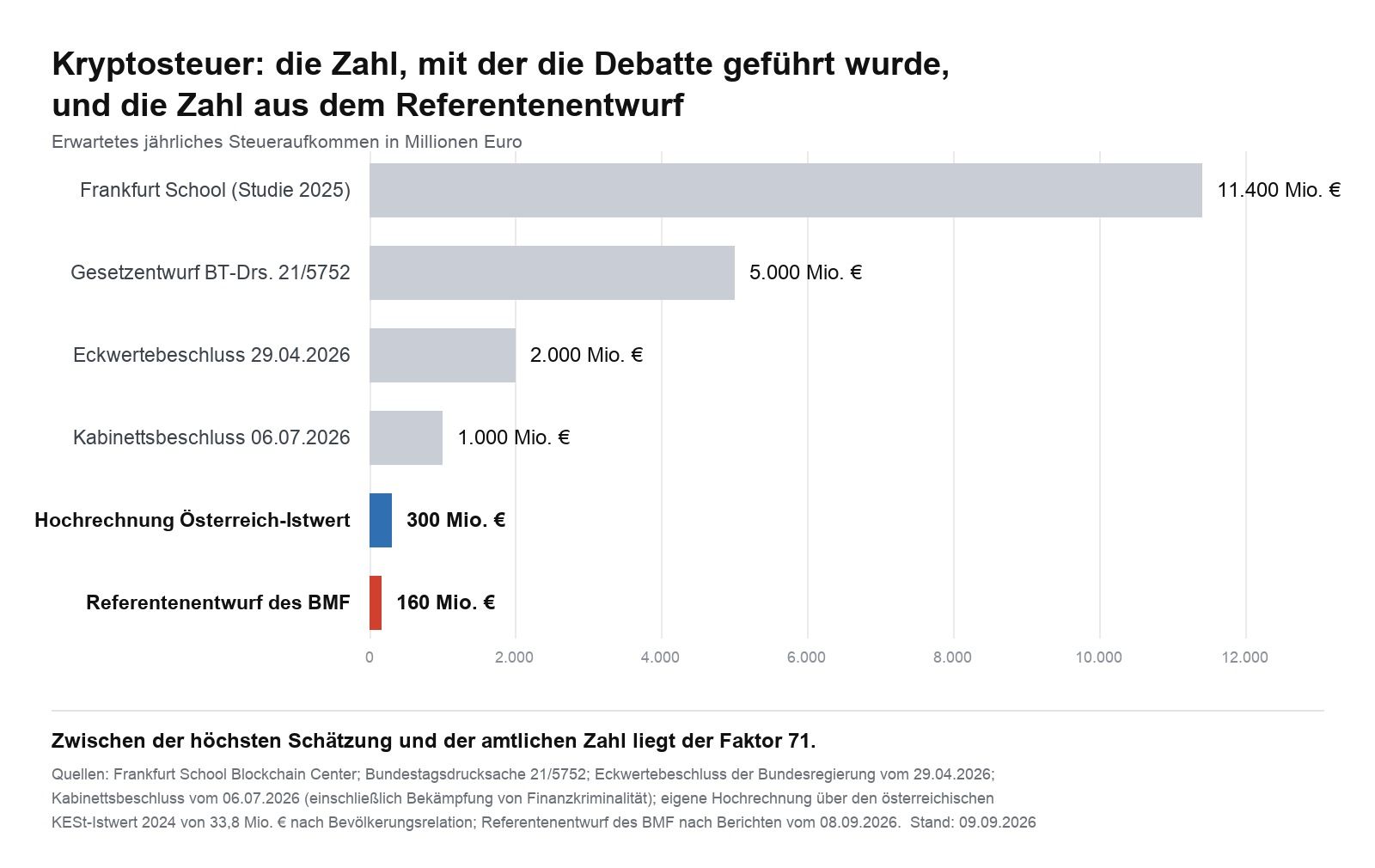
How 11.4 billion euros became 160 million
The debate about abolishing the holding period has been conducted since the spring of 2026 with figures many times higher. The trail can be traced without a gap:
| Date | Source | Expected revenue |
|---|---|---|
| 2025 | Frankfurt School Blockchain Center | up to 11.4 billion euros |
| May 5, 2026 | bill, Bundestag printed paper 21/5752 | at least 5 billion euros |
| April 29, 2026 | benchmark decision of the federal government | 2 billion euros |
| July 6, 2026 | cabinet decision, including financial crime | 1 billion euros |
| September 8, 2026 | draft bill of the Federal Ministry of Finance | 160 million euros |
Between the highest figure and the official one lies a factor of 71. That is no nuance within an estimate; it is the difference between a budget item and a rounding error.
All of this was open to verification early on. Austria abolished the holding period back in 2022 and is the only real-world test in Europe. There, service providers remitted 33.8 million euros of capital gains tax on cryptocurrencies in 2024. Scale that value up to Germany by population and you land at around 300 million euros. We published that extrapolation on August 12, 2026, four weeks before the draft appeared; it can be read in the statement on the reply from the Finance Committee. The Federal Ministry of Finance is today in the same order of magnitude, while the figures used politically were off by a factor of six to seventy.
The Bitcoin Bundesverband put fifteen questions on methodology to the estimate of 11.4 billion euros, among them the origin of the data, the representativeness of the sample and the missing margins of error. They remain unanswered to this day.
What Klingbeil said in his budget speech
In his introductory speech Klingbeil defended the new borrowing as investment, named infrastructure, hospitals and schools, and announced a relief package of ten billion euros that is to be financed by higher taxation of very high incomes. The balanced budget, he said, had become “a fetish” in a period of low interest rates.
Crypto assets, bitcoin, the holding period and Section 23 of the Income Tax Act did not appear in the speech. Nor does the crypto tax appear as a separate item in the 2027 budget. Both are explicable and are no contradiction: under the draft the revenue is not due to flow before 2028, which puts it outside the budget year the Bundestag is currently debating. Reading concealment into that overstates the case. The timing remains striking. The draft went into consultation on the day the minister spoke about the budget it is supposed to contribute to.

The conflict of aims inside the crypto tax model
The stated intention is to tax speculation. For short-term investors the chosen model achieves the opposite. Anyone who sells crypto assets within a year today pays their personal income tax rate of up to 45 percent plus the solidarity surcharge. Under the draft, the same investor will in future pay a flat 25 percent. Olav Gutting, a member of parliament for the CDU/CSU, had already worked that effect out on July 31, 2026.
The reform therefore relieves short-term trading and burdens long-term holding, which is tax-free after one year today. On a gain of 100,000 euros after more than a year of holding, the effect can be quantified: 0 euros of tax today, 26,375 euros including the solidarity surcharge under the draft.
What investors can take from the crypto tax plan
For holdings acquired up to December 31, 2026, nothing changes as the draft stands. They remain within today's system: hold for a year, then sell tax-free. That also applies to a purchase in December 2026 whose one-year period does not run out until December 2027. What counts is the day of acquisition, not the date of the sale and not the calendar year.
From this follows an incentive to bring planned purchases forward into the fourth quarter of 2026. Three things belong with that consideration:
- The cutoff date sits in a draft, not in the statute book. The paper is in early coordination between the departments. The cabinet, the Bundestag and the Bundesrat have not yet dealt with it.
- A cutoff date in the future can be brought forward. Where a legislature observes an announcement effect, moving the cutoff date to the day of the cabinet decision or of introduction is a common device in tax law. The bill of May 2026 expressly placed its cutoff date in the past. There is no assurance that the current date will hold to the end.
- With mixed holdings, the consumption sequence decides. Under the finance ministry circular of March 6, 2025, the holding period is assessed per wallet, with the crypto assets acquired first deemed to be the first ones sold. Anyone selling after 2027 therefore uses up the protected older holdings first. Whether the draft bill contains a rule of its own on this is not apparent from what is known so far.
On the market effect, about which a great deal is being written just now, a sober assessment: a pull-forward effect is plausible, and its size is limited. On the Frankfurt School's estimate, around seven million German investors hold crypto assets worth some 400 billion euros. Even if a high single-digit billion sum were additionally invested in the closing months of the year, it would spread across a global trading volume that runs into tens of billions of US dollars a day in bitcoin alone. Deriving a price forecast from that sells a supposition as a calculation.
What happens next with the crypto tax bill
The draft bill is the working version produced by a specialist unit. Ahead of it lie the interdepartmental consultation, the hearing of the associations, the cabinet decision, the three readings in the Bundestag and the consideration by the Bundesrat. At each of these stages the tax rate, the cutoff date and the transitional rules can still be changed.
In parallel, Bundestag petition 201716 is running. It reached the quorum of 30,000 signatures within 48 hours in August and is therefore entitled to a public hearing in the Petitions Committee. The signing period runs until September 15, 2026. We have set out where the procedure stands in a separate article.
Frequently asked questions about the German crypto tax
Do I have to pay tax on my crypto gains now?
No. Today's legal position is unchanged: gains from a sale of privately held assets are taxable where less than a year lies between acquisition and sale. Once a year has passed they remain tax-free.
I am buying in December 2026. Am I protected?
As the draft stands, yes, because the acquisition falls before the cutoff date. That is not legally binding as long as no law has been passed.
What happens to my savings plan over the turn of the year?
Every single execution is an acquisition in its own right with a date of its own. Instalments up to December 31, 2026 would fall under the old rule, instalments from January 2027 under the new one.
Does the tax apply from 2027 onwards?
The law is intended to enter into force on January 1, 2027, but it covers only assets acquired from that date. The automatic deduction of tax by the service providers is not due to begin before January 1, 2028.
How much does the tax bring the state?
On the estimate in the draft bill, 160 million euros from 2028 and around 350 million euros a year by 2031.
Sources
- German Bundestag, text archive on the introduction of the 2027 budget, Bundestag printed papers 21/7300, 21/7301 and 21/7650: bundestag.de
- Bundestag printed paper 21/5752, bill amending Section 23 of the Income Tax Act: dserver.bundestag.de
- German Bundestag, short report on the rejection of the bill on May 20, 2026: bundestag.de
- Circular of the Federal Ministry of Finance of March 6, 2025 on the income tax treatment of certain crypto assets, file reference IV C 1 - S 2256/00042/064/043
- Bitcoin Bundesverband, catalogue of questions on the estimate of 11.4 billion euros: bitcoin-bundesverband.de
- Details of the content of the draft bill according to the reporting of September 8, 2026. The full text of the draft has not been officially published so far.
(As of September 9, 2026. This article is not investment advice. Prices and fee structures change; check the terms with the provider before you buy.)
If you bought your crypto assets before December 31, 2026, or buy them by that date, then on the current state of the draft nothing changes for them: hold for a year, then sell tax-free. Only crypto assets acquired or received after December 31, 2026 would fall under the new treatment as investment income. That is what a draft bill from Germany's Federal Ministry of Finance dated mid-August says, first reported by WELT on September 8, 2026 and reproduced with an explicit source citation by the specialist outlet Blocktrainer. None of it has been passed into law, and those two halves together describe your position: a dated cut-off in a paper that still has the whole legislative route ahead of it.
This article sets out what the draft means for an ongoing savings plan, for staggered purchases and for coins from staking and lending, which records you should secure now, and why our own report from yesterday appears at first glance to say the opposite.
Crypto Holding Period, Grandfathering and Cut-Off Date: German Tax Law in 2026
As long as no law is in force, today's rules continue to apply unchanged. Gains from the sale of cryptocurrencies held privately are taxable under Section 23 of the German Income Tax Act (EStG) if less than a year lies between acquisition and sale. Hold for more than a year and you sell tax-free. This one-year holding period applies to Bitcoin just as it does to any other coin held privately.
For crypto investors that means, quite practically: the draft bill changes nothing about your 2026 tax return. Crypto gains you realise this year within the one-year window are still taxed at your personal income tax rate, and sales after the period has run remain tax-free. The tax change under discussion here would affect acquisitions from 2027 at the earliest.
The difference between short-term speculation and long-term holding matters, because today it decides the tax bill and the draft would level it out. That is exactly what turns the cut-off into an arithmetic problem for Bitcoin holders with large crypto positions: the value of the old rule rises with every year a position sits untouched anyway.
What the German Draft Bill Actually Lays Down on the Crypto Holding Period
A Referentenentwurf, or ministerial draft bill, is the working version of a law written by a specialist unit inside the responsible ministry before the cabinet, the Bundestag and the Bundesrat are involved at all. It is not law in force, but the first place where a political intention acquires sections and dates.
According to the WELT report, this draft contains three provisions that were not public before. First, gains from the sale of crypto assets are to be taxable in future regardless of the holding period and to fall in principle under the flat-rate withholding tax as investment income. Second, the law is to enter into force on January 1, 2027. Third, the new provisions are to cover only crypto assets acquired or received after December 31, 2026.
The reasoning the draft supplies, per the report, is remarkably sober: because of their speculative use, their high liquidity and their lack of wear, crypto assets resemble classic capital investments more than ordinary economic goods. That removes the doctrinal basis of today's treatment. Until now, Bitcoin and other coins held privately count as "other economic goods", the sale of which is a private disposal transaction under Section 23 of the Income Tax Act.
Why December 31, 2026 Is the Decisive Cut-Off Date
The one-year holding period, often called the one-year rule or speculation period, is the span between acquisition and sale after which a gain on privately held assets remains tax-free. That period hangs on the acquisition date of the individual coins, not on your sale date and not on the calendar year.
That is precisely why the cut-off in the draft acts like a dividing line straight through your portfolio. A Bitcoin you bought in March 2025 would be a legacy holding. A Bitcoin you buy on December 15, 2026 would also be a legacy holding, even though its one-year period does not run out until December 2027. A purchase on January 3, 2027 would be a new holding and therefore taxable under the draft, however long you leave it sitting.
For you that means: what counts is the day you buy, not the day the period expires. Anyone who was planning to add to their position in the first quarter of 2027 anyway now has an argument, on the current draft, for bringing that purchase forward. Anyone deciding a wealth question of that size should nonetheless keep two things apart: the cut-off sits in a draft, whereas your purchase decision is real and costs money.
A second point is often overlooked in the debate. The exemption limit of 1,000 euros for private disposal transactions under Section 23 EStG is a threshold, not an allowance: exceed it by one euro and you tax the entire gain, not just the excess. That threshold hangs on today's system. If crypto assets move into investment income, the saver's lump-sum allowance applies there instead, which covers all investment income together and which many investors already use up on interest and dividends.

Is There Grandfathering for Your Existing Holdings in Germany?
Grandfathering means, in tax law, that a new rule applies only to future circumstances and that positions already acquired are treated under the old law. On the reporting so far, the ministerial draft provides for exactly that: the federal government would forgo applying the change retroactively to existing holdings.
That is the most important substantive news in this draft, and it is the all-clear for everyone who has been holding for years. Until September 8, 2026 it was open whether legacy holdings would be protected at all. The specialist portal extraETF had explicitly called the question unresolved in July and named grandfathering "the most important question for many investors". The draft answers it for the first time with a date.
Legally the route is an obvious one. Protection of legitimate expectations is a constitutional principle that permits burdensome retroactivity only within narrow limits, and the legislator has already applied it in comparable reforms. When the flat-rate withholding tax was introduced in 2009, legacy holdings of shares and funds stayed under the old speculation period. The parallel is no guarantee, but it explains why a draft with a cut-off is more likely than a reform that reaches back over everything.
When Would the Crypto Holding Period End, and When Would Withholding Start?
The draft separates two dates that regularly get conflated in public debate. The law itself is to enter into force on January 1, 2027. The actual withholding at source, where crypto service providers deduct the tax directly and pass it to the tax office, is not to begin until January 2028 according to the report.
That transition period is not generosity but a technical concession. An exchange can only withhold correctly if it knows when and at what price you acquired your coins. For holdings deposited from your own wallet or from another platform, it does not know. The draft therefore provides that service providers may partly rely on your own statements of acquisition date and acquisition cost.
And if those details cannot be established? Then a flat assessment base is to apply: withholding on 50 percent of the proceeds from the sale. What is meant is not a tax rate of 50 percent, but the assumption that half your sale proceeds were gain. Sell a position with a small price gain and produce no records, and you would pay considerably too much tax and have to claim the money back through your tax return. That is the real reason your acquisition records are worth money from now on.
What the Cut-Off Means for Your Running Bitcoin Savings Plan
A savings plan does not buy once but every month, and each of those executions is a separate acquisition with its own date. If your savings plan runs across the 2026/2027 turn of the year, on the current draft it splits into two groups: every instalment up to and including December 2026 would be a legacy holding with a holding period, every instalment from January 2027 a new holding under the flat-rate withholding tax.
In practice that mainly means bookkeeping. On a sale, crypto assets in the same wallet are usually treated on the FIFO principle, under which the coins bought first count as sold first. When two tax regimes sit side by side, the allocation decides whether a sale is tax-free or subject to the withholding tax. We worked through how holding period, FIFO and the exemption limit interact with monthly purchases in detail in our guide to the Bitcoin savings plan and tax.
A clean record of your purchases is therefore no longer just diligence for the tax return, but the proof of which pot a position belongs in. Anyone who would rather not keep that in a spreadsheet will find programs in our comparison of crypto tax tools and portfolio trackers that pull acquisition data from the exchanges automatically and allocate FIFO sales correctly.
Staking, Lending and Airdrops: What Arrives Counts From the Cut-Off
On the reporting, the draft covers more than purchases. Income from classic lending, that is, lending coins out at interest, and from passive staking, where you pledge coins to secure a network and receive new units in return, is to be taxed as investment income in future. A transitional rule tied to the same cut-off is evidently envisaged for that as well: it covers crypto assets received after December 31, 2026.
The difference from a purchase lies in the word "received". A staking reward has no purchase date that you choose yourself; what counts is the day the units land within your power of disposal. Anyone who leaves their rewards sitting in the contract for months and only claims them later may thereby push the receipt beyond the cut-off. Whether that reading holds depends on the final version of the law and on the question of when power of disposal arises for tax purposes. For a decision on larger amounts, that is a case for a tax adviser, not for a rule of thumb.

Which Crypto Assets the Draft Expressly Excludes
The new category the draft is built around is called "exchange crypto assets" in the report. Not every digital asset falls under it. Excluded are to be, among others, non-fungible tokens, that is, non-interchangeable tokens representing a single digital object, plus security tokens, which digitally represent a securitised right such as a bond or a share, as well as other crypto assets intended to convey a real-world value. Certain stablecoins are also not to fall into the new category.
This delimitation is more than a footnote, because it helps decide which part of your portfolio would be affected at all. At the same time it is the point at which a draft, in experience, changes most in the further procedure: definitions that include or exclude an entire asset class attract the most comments during consultation.
Why Our Report From Yesterday Says Something Different, and Both Are True
On September 7, 2026 we reported that the Income Tax Reform Act 2027, which the federal cabinet waved through on September 2, leaves Section 23 EStG untouched and that the crypto holding period therefore stays for now. That was correct and remains so. A cabinet decision concerns precisely the law that is on the table, and that law said nothing about the holding period.
The ministerial draft at issue here is a different paper from a different procedural stage. According to the report it is in what is known as early coordination, that is, in the early alignment between the Federal Chancellery and the ministries involved, and it was not the subject of the cabinet decision on September 2. Two statements that appear to contradict each other therefore describe two different processes.
This double track is typical of crypto taxation in Germany and the reason why headlines on the subject so often stand against one another. The political intention has been documented since the government draft of the 2027 federal budget, which Finance Minister Lars Klingbeil explained himself at the federal press conference in July 2026. The route there runs through several legislative projects in parallel, and only one of them carries the crypto rules at any given moment.
A simple sequence helps in placing it. At the start stood the budget draft with the announced crypto tax reform. Out of that comes a ministerial draft inside the ministry, as now documented for mid-August 2026. Out of that, after inter-ministerial coordination, comes a government bill adopted by the cabinet, and only that goes to the Bundestag and Bundesrat as a bill. Each of those stages can still shift deadlines, definitions and the grandfathering.
Anyone wanting to gauge the consequences for their own crypto gains should therefore not read every headline as a decision, but pay attention to which stage a report is describing. We are following this procedure further in our crypto taxation cluster and recording the dates there.
Will There Be a Crypto Tax in Germany From 2027?
A crypto tax as a levy of its own does not exist and is not to exist under the draft either. What would change is the classification: away from private disposal transactions under Section 23 EStG, towards investment income with flat-rate withholding tax. Gains from crypto are already taxable today if you sell within a year and exceed the exemption limit.
For the question of whether the new rules from 2027 affect you at all, only one thing counts: the acquisition date of your coins. If they do affect you, the effect would cut both ways. The flat-rate withholding tax with its uniform rate can be cheaper than the personal income tax rate that a sale within the one-year window triggers today. The tax exemption after one year, which legacy holdings would keep, beats both.
What You Should Document by December 31, 2026
Whether or not the draft becomes law, one thing gains value in every scenario: a complete record of when you acquired what and at what price. If the cut-off becomes law, that date decides the pot. If it does not, you need the same records for the holding period.
So secure the complete transaction histories of every exchange you use as a file on your own computer, still this year. Platforms do not reliably provide old data after a change of provider or an account closure, and for holdings in your own wallet there is no body keeping it for you in any case. Record the acquisition date, quantity, acquisition cost in euros and the origin for each position, and document every transfer between your own addresses so that a move does not later look like a sale.
How seriously the legislator takes this subject is shown by a second front: through the European reporting obligations, the tax authorities are receiving increasing amounts of data from the platforms anyway. Anyone who knows their own figures can explain discrepancies. Anyone who does not is dependent on whatever the exchange has reported.
Crypto Holding Period and the December 31, 2026 Cut-Off: What to Take Away
- Check which of your positions fall before the cut-off. Pull the acquisition dates together from every exchange and wallet and mark everything bought before December 31, 2026. A tool from our comparison of crypto tax tools and portfolio trackers takes the collecting off your hands and allocates FIFO sales automatically.
- Decide deliberately about planned purchases for next year. If you wanted to add to your position in 2027 anyway, then on the current draft the question of bringing the purchase forward is a tax question, not a speculative one. How staggered purchases can be implemented is set out in our comparison of Bitcoin savings plans.
- Secure your records where you keep them. Download the complete transaction histories of your trading venues before accounts or providers change. Which platforms supply usable exports is shown by our crypto exchange comparison.
The draft is a working version, not a law. Until it is passed, a good deal can still change both on the abolition of the holding period and on grandfathering. What does not change is the value of clean acquisition data.
Sources for further reading: the report by the specialist outlet Blocktrainer on the ministerial draft of September 8, 2026, which reproduces the WELT report, and the assessment of the government draft of the 2027 federal budget at extraETF.
(As of September 8, 2026. This article is not investment advice. Prices and fee structures change; check the terms with the provider before you buy.)
Decrypt
NYU's Tristan Buckmaster accuses OpenAI's Sébastien Bubeck of racing to claim credit for a Navier-Stokes proof after learning about his unpublished work with Anthropic's Levent Alpöge.
The hackers have returned 3,400 of the roughly 4,000 BTC drained from the sidechain, but about 600 BTC remains outstanding—and some doubt the actors' "white hat" claims.
Bitcoin is defending its golden zone support while the S&P 500 grinds inside its tightest range yet, both waiting on Friday's inflation report before the Fed's September 16 rate call.
The payment processor giant is pairing payment settlement data with blockchain lending tools to help fintechs and stablecoin-linked card programs access working capital.
The Vivek Ramaswamy-founded asset manager added 1,375 BTC last week, its third straight week of 5%-plus growth.
U.Today - IT, AI and Fintech Daily News for You Today
Major altcoins remain broadly bullish, but cooling momentum and nearby resistance levels are raising the risk of short-term corrections.
Major crypto asset manager 21Shares is pushing back against one of XRP’s oldest controversies, arguing that Ripple does not control the XRP Ledger despite its deep ties to the cryptocurrency.
The CLARITY Act is facing a serious risk of failure as Republican senators warn that a lack of compromise over ethics rules could sink the landmark crypto bill.
Shiba Inu logs explosive surge in burn activity over the last 24 hours as nearly 47 million tokens were permanently destroyed from circulation within the period.
Mexican authorities have dismantled a massive clandestine crypto mining farm in Puebla equipped with around 300 computers and allegedly powered through stolen electricity linked to a federal hydroelectric complex.
Blockonomi
TLDR:
- Liquid Network exploit minted 4,000 unbacked LBTC via a range proof caching flaw.
- Attackers used SideSwap’s peg-out authorization to convert fake LBTC into real bitcoin.
- Blockstream patched the bug and recovered 3,400 BTC; 598.5 BTC remains outstanding.
- Elements v23.3.4 emergency release expected within 48 hours to restore full network function.
The Liquid Network suffered a major security breach on September 6, 2026, after attackers exploited a flaw in its Elements software.
The exploit allowed roughly 4,000 unbacked LBTC tokens to be minted and converted into real bitcoin through the network’s peg-out system.
Blockstream confirmed the Liquid Federation has since recovered most of the stolen funds, though the network remains offline while a patch is finalized.
How the Liquid Network Exploit Unfolded
The incident occurred at Liquid block 4,050,336, when a vulnerability in range proof verification caching went unnoticed by the system.
This flaw let attackers create LBTC that had no bitcoin reserves backing it. The unbacked tokens were then routed through SideSwap, a Liquid Federation member holding peg-out authorization.
Because the validation failure happened before the peg-out request was submitted, SideSwap’s node and the network’s functionaries treated the transaction as legitimate.
The peg-out mechanism itself worked exactly as intended, releasing bitcoin to a whitelisted address tied to SideSwap. From there, the funds were forwarded to an address controlled by the exploiters.
Blockstream clarified that no private keys were compromised during the attack. The Liquid Federation’s functionary nodes operated normally throughout the incident.
Before the breach, the Liquid reserve held close to 4,205 BTC in total. After the unauthorized peg-outs were processed, that balance dropped sharply to just 197 BTC.
Other assets issued on the Liquid Network, including USDT, were not directly affected by the vulnerability. However, those tokens remain temporarily unavailable since the entire network has been paused.
In its statement, Liquid Network said the failure came from several factors that “interacted in ways that ultimately defeated the system’s built-in redundancies.”
LIQUID NETWORK UPDATE: INCIDENT REPORT
Status as of September 8, 2026, 19:10 UTCWhat Happened?
On September 6, 2026 at 15:53:10 UTC (Liquid block 4,050,336), a vulnerability in the open-source Elements software related to how Liquid nodes cache range proof verifications was…
— Liquid Network
(@Liquid_BTC) September 8, 2026
Recovery Efforts and Network Restoration Plans
Shortly after the exploit, the responsible party left a message on the bitcoin mainchain. They identified themselves as white-hat security researchers and asked to coordinate with Blockstream on fixing the vulnerability. This message came before any funds had been returned to the network.
Blockstream moved quickly to contain the damage once the exploit was discovered. A patch for the Liquid Network’s bridge nodes was deployed by September 7 at 01:09 UTC. This update closed the vulnerability, preventing any further exploitation of the same flaw.
On September 7 at block 965,950, the exploiters returned 3,400 BTC to the Liquid Federation’s peg wallet. That leaves approximately 598.5 BTC, or 15% of the total taken, still outstanding.
Blockstream said discussions with the individuals involved are continuing in an effort to recover the remaining bitcoin.
Blockstream announced that an emergency release of Elements, version 23.3.4, is currently undergoing review. The update is expected within roughly 48 hours of the announcement.
Once deployed, functionary operators will apply further adjustments to restore full network operations. Liquid Network users have been told no proactive action is required to protect their existing funds at this time.
The post Liquid Network Exploit: Blockstream Recovers 3,400 BTC After $400M Bug appeared first on Blockonomi.
TLDR:
- Visa now runs 160+ stablecoin-linked card programs, up nearly 200% year over year.
- Cuy Sheffield calls stablecoin-linked cards a “hypergrowth” trend across Visa’s global network.
- Visa’s Credit Coop pilot has processed $2.7 billion with zero borrower defaults recorded.
- Nearly $700 billion in stablecoin loans have moved through onchain lending protocols since 2020.
Visa stablecoin-linked cards are expanding at a rapid pace, with the payments giant now supporting more than 160 card programs worldwide. Volume on these programs has climbed nearly 200% compared to last year.
Visa is also rolling out new data-sharing tools for blockchain lenders, aiming to support issuers as demand for stablecoin products accelerates across the fintech sector.
Visa Stablecoin-Linked Cards See Rapid Adoption
Visa now operates over 160 stablecoin-linked card programs for issuers and program managers globally. This marks close to a 200% increase in volume from the previous year.
Cuy Sheffield, Visa’s head of crypto, said “stablecoin-linked cards are in hypergrowth mode” during an interview with CNBC. He noted that new issuers are joining the network at a steady rate.
Sheffield explained that stablecoin neobanks and fintech firms are “launching cards every week” on Visa’s platform. He pointed to last year’s GENIUS Act as a major driver behind this shift.
The legislation established federal rules for stablecoin issuance in the United States. Sheffield called the law a “huge” turning point for the industry.
Several large financial institutions have since approached Visa about building stablecoin offerings. Sheffield said banks and major payment companies “want to be able to engage and work with Visa” on these products.
Alongside this growth, Visa has been piloting a lending partnership with Credit Coop, which supports card issuers with financing needs.
The pilot offers a credit facility for companies issuing stablecoin-linked cards. Sheffield described it as “a positive step forward for how onchain credit can start to come into our network.”
Credit Coop reports it has processed $2.7 billion in total volume through smart contracts, with no borrower defaulting to date.
Visa Expands Onchain Lending Data For Card Issuers
Visa announced it will share more settlement data with companies that lend on blockchain networks. This data will be paired with onchain lending infrastructure already used by digital asset lenders. The goal is to give lenders clearer insight into how card issuers and fintech firms are performing financially.
According to Visa, nearly $700 billion in stablecoin-denominated loans have moved through onchain lending protocols over six years.
Much of that lending activity has stayed concentrated within crypto-native markets. The new data offering is intended to help lenders evaluate financing requests from digital asset businesses more efficiently.
Card issuers such as Rain and FlexSuperApp are building tools for global payouts and business transactions using stablecoins.
These features are designed to simplify cross-border payments for companies operating in multiple regions. Analysts have noted that stablecoin adoption could reduce transaction costs for merchants in markets like South Korea.
Visa joins other payment companies investing in stablecoin infrastructure this year. Mastercard has built its own stablecoin platform, while PayPal and Circle operate separate systems for digital dollar transactions.
Visa shares have risen roughly 7% so far this year, reflecting investor interest in the company’s blockchain-related expansion plans.
The post Visa Stablecoin-Linked Cards Hit Hypergrowth With 160+ Programs Live Worldwide appeared first on Blockonomi.
The crypto market just received another major political warning, as Senator Cynthia Lummis says failure to pass the CLARITY Act in the current Congress could push the next serious attempt at U.S. crypto market-structure legislation all the way to 2030. The Senate is facing a crucial 60-vote cloture test on September 15, while the bill has already passed the House by 294 to 134. With the regulatory clock tightening, even established names such as Shiba Inu (SHIB) are part of a market where policy developments could shape the next wave of crypto attention.
While regulation takes center stage, the countdown is over, and Apeing is officially live. Its official presale has opened doors, with Stage 1 now at $0.0001. If you are watching the meme coin presale space for fresh projects entering the market, Apeing has now moved into its first active stage, with Banana Drop featuring a limited allocation.
Apeing’s Meme Coin Presale Is Now in the Banana Drop Stage
Apeing’s first official presale stage is live, bringing its meme culture, community energy, and utility into focus. With the project now in its active presale phase, attention is turning to the limited opening allocation. The Apeing meme coin presale is currently in Banana Drop Stage 1 at $0.0001, with a planned listing price of $0.01. With limited availability, the opening stage is already underway, giving you a reason to act while it lasts.

Bring One Ape. Build Your Place in the League.
Apeing’s referral system turns community growth into an active part of the presale, giving buyers and referrers rewards when purchases are completed through referral codes. The Ape Referral League takes that idea further with a live leaderboard that tracks referral activity throughout each monthly cycle. That creates a constantly changing contest where new referrals can shift positions and give active apes another reason to stay engaged. With Stage 1 underway, the league is ready to become part of the action from day one.
For someone choosing $300, the stated 10,000% ROI would represent $30,000 in potential profit if achieved, putting the total value at $30,300. The attraction of entering during a live opening phase is having the opportunity to participate while the presale is actually underway, rather than simply watching its progress from the outside.
How to Buy Apeing: Join Stage 1 in a Few Steps
Getting started with Apeing is simple. Visit the official website, connect your compatible wallet, choose your Stage 1 allocation, and complete the purchase using the supported payment option. Once you are in, you can also explore Apeing’s referral system and Ape Referral League, where sharing your referral code can add another layer of community participation.
SHIB Gains 0.33% as Exchange Flows Put the Recovery Under Pressure
Shiba Inu is pushing higher as fresh market activity gives its recovery another twist. SHIB is trading at $0.055451, up 0.33% in 24 hours, with a $3.21 billion market cap and $68.64 million in daily volume, which has jumped 24.74%. The volume-to-market-cap ratio stands at 2.13%, while recent on-chain data shows roughly 75 billion SHIB moved onto exchanges in a single day, raising questions about the amount of supply becoming available for trading.
The latest exchange-flow shift arrives as SHIB continues trying to build on its recent recovery. CoinMarketCap’s latest analysis says buyers are defending the $0.0000052 area while short-selling activity has declined, creating a tighter setup around nearby resistance. At the same time, the large inflow of tokens to exchanges introduces a counterpoint, as increased available supply could make it harder for the recovery to accelerate.
SHIB Buyers Are Back: Can This Recovery Build Real Momentum?
Technical signals are offering a more constructive backdrop. Investing.com currently rates SHIB’s technical setup as Strong Buy, with 10 technical indicators showing buy signals and RSI around 58.5. CoinLore also describes the broader setup as neutral but notes that SHIB has moved back above its 50-period EMA and recently formed a bullish engulfing pattern.
Volume Is Rising, Support Is Holding: Is SHIB Ready for More?
That leaves SHIB at an interesting crossroads. Rising volume and improving technical readings are supporting the recovery narrative, while elevated exchange flows add another variable to the setup. If buyers continue defending the current support structure, the latest move could develop into a stronger recovery attempt rather than simply another short-term bounce.

Meme Coin Presale Enters a New Chapter as Apeing Stage 1 Goes Live
Apeing brings a live meme coin presale built around meme culture, community engagement, and utility, while Shiba Inu continues to maintain its established role in the meme coin news sector. Shiba Inu’s community and ecosystem keep it relevant across ongoing meme coin news, while Apeing is now creating its own story through its active presale and Stage 1 Banana Drop.
The Apeing presale has officially started; Stage 1 is now live at $0.0001, with a limited allocation. If you are following the current meme coin presale activity, this is the active stage to watch rather than a future opening. Keep connected with official Apeing channels for the latest announcements and follow the live Stage 1 presale while the current allocation remains available.

For More Information:
Website: Visit the Official Apeing Website
Telegram: Join the Apeing Telegram Channel
Twitter: Follow Apeing ON X (Formerly Twitter)
FAQs About the Meme Coin Presale
What is a meme coin presale?
A meme coin presale is an early token sale where a crypto project makes its tokens available before a planned public listing or later market phase.
Is the Apeing meme coin presale live?
Yes. Apeing’s official presale started on September 8, and Stage 1, Banana Drop, is currently live at $0.0001.
What is a meme coin presale?
A meme coin presale is an early token offering where a project makes its tokens available before a planned exchange listing. Presales can use multiple stages with different prices and allocations.
How do you buy into a presale?
You typically visit the project’s official platform, connect a compatible crypto wallet such as MetaMask or Phantom, and use supported cryptocurrencies like ETH, BNB, or SOL to purchase the presale tokens.
The post The Apeing Meme Coin Presale Is Getting Attention: Can Its 10,000% ROI Target Stand Out as Lummis Warns of CLARITY Act Delays? appeared first on Blockonomi.
TLDR
- CHYM surged 10.38% after hours as Chime agreed to acquire Stride Bank for $590M.
- Chime will pay $590 million in cash to acquire longtime banking partner Stride Bank.
- The Stride deal could deliver more than $100 million in net synergies for Chime.
- Chime lifted its full-year 2026 revenue guidance to as much as $2.77 billion.
- The Stride Bank acquisition is expected to close during the first half of 2027.
Chime Financial shares surged after hours after the company agreed to acquire Stride Bank for $590 million in cash. CHYM closed at $32.31, down 4.30%, before jumping 10.38% after hours to $35.67. The deal gives Chime direct control of a national bank charter and strengthens its banking infrastructure.
Chime Financial, Inc. Class A Common Stock, CHYM
Chime Moves Toward Full-Stack Banking
Chime will acquire Stride Bank, its banking partner for seven years, through a cash agreement. After closing, Stride will become Chime Bank, N.A. and operate as Chime’s wholly owned subsidiary. The structure gives Chime a faster route to bank ownership than seeking a new charter.
Stride was founded in 1913 and operates from Enid, Oklahoma, with established banking and compliance capabilities. The bank already supports many Chime accounts, which contribute significantly to Stride’s deposit base. That relationship should help Chime integrate banking functions without rebuilding its operating model.
Chime expects bank ownership to remove partner fees, reduce funding costs, and improve unit economics. The company also plans to connect its ChimeCore technology stack with Stride’s banking infrastructure. As a result, Chime expects faster product development, simpler regulatory processes, and more direct account management.
$100M Synergies Support CHYM Stock Rally
Chime expects the acquisition to increase earnings per share immediately after the transaction closes. The company forecasts over $100 million in net synergies from fee savings, lending growth, and cheaper funding. Chime values Stride at about 1.5 times tangible book value and will use existing cash.
The company plans to keep its payments-led, asset-light model while gaining more control over banking operations. Direct ownership should also support lending growth through lower funding costs and integrated underwriting. Meanwhile, Chime expects to keep bank assets below $10 billion for the foreseeable future.
Chime serves more than 10 million active members through its digital banking and payments platform. Its business has relied on partner banks to hold deposits and provide regulated banking services. Buying Stride shifts key infrastructure inside Chime while preserving its consumer-focused operating strategy.
Chime Raises 2026 Revenue Guidance
Chime also raised third-quarter guidance, adding further support to the after-hours CHYM stock rally. The company now expects $705 million in revenue, representing about 30% year-over-year growth. Adjusted EBITDA should reach $117 million to $120 million, implying a margin near 17%.
For 2026, Chime projects revenue between $2.76 billion and $2.77 billion. That range represents annual growth of about 26% to 27% under the updated outlook. Adjusted EBITDA should reach $481 million to $489 million, with margins between 17% and 18%.
The transaction should close during the first half of 2027 after receiving required federal approvals. The OCC and Federal Reserve must approve the ownership change before Chime completes the deal. Both boards approved the transaction, while Stride will mainly support Chime’s consumer business after closing.
The post Chime Financial, Inc. (CHYM) Stock: Surge as $590M Stride Bank Acquisition Fuels Rally appeared first on Blockonomi.
TLDR
- Rocket Lab launches IMM Apex with 31.5% efficiency for space power systems.
- IMM Apex cuts solar cell mass by 40% while reducing reliance on germanium use.
- Rocket Lab targets higher satellite demand with scaled solar cell production.
- More than 1,100 satellites already use Rocket Lab solar power technologies.
- RKLB closed 2.51% higher as Rocket Lab expanded its space systems portfolio.
Rocket Lab expanded its space power business by releasing the new IMM Apex solar cell for production. The product combines higher efficiency, lower weight, and less dependence on germanium for spacecraft systems. RKLB closed at $65.87, up 2.51%, before falling 0.18% after hours to $65.75.
Rocket Lab USA, Inc., RKLB
IMM Apex Raises Space Power Efficiency
Rocket Lab designed IMM Apex with 31.5% beginning-of-life solar conversion efficiency for space missions. The company also cut cell mass by 40%, increasing specific power for satellites and exploration spacecraft. Higher specific power lets spacecraft builders generate more electricity without adding similar system weight.
The new design removes germanium substrates used in conventional multi-junction solar cells across the industry. Rocket Lab reduces exposure to rising material costs and supply constraints affecting germanium. The change also gives production teams more flexibility when planning larger manufacturing volumes.
Rocket Lab made IMM Apex compatible with mechanical and electrical systems built for germanium-based cells. As a result, customers can integrate the product without major redesigns or costly manufacturing changes. This approach simplifies adoption across established spacecraft platforms while preserving existing engineering processes.
Rocket Lab Expands Solar Cell Production
Rocket Lab improved manufacturing methods and invested in equipment to support demand for space power hardware. The company can produce IMM technology at volumes reaching several hundred kilowatts for customer programs. That capacity supports larger satellite fleets and exploration missions requiring reliable solar power systems.
Rocket Lab has developed and tested its IMM technology through more than a decade of space operations. Earlier IMM cells powered NASA’s Ingenuity Mars Helicopter during its historic mission on Mars. The technology has also supported satellites operating in orbit for more than ten years.
The company continues advancing IMM products for civil, commercial, security, and scientific space applications. Rocket Lab has completed extensive testing and qualification work across demanding mission environments. IMM Apex now enters production as the company expands solar manufacturing and customer reach.
RKLB Stock Reflects Broader Space Systems Push
Rocket Lab’s solar operations extend its business beyond launch services and strengthen its space systems portfolio. Its products have supported the James Webb Space Telescope and NASA’s Artemis lunar exploration program. The company has also supplied power technology for national security and interplanetary science missions.
More than 1,100 satellites currently use Rocket Lab solar products across commercial and government programs. IMM Apex adds a lighter option while addressing supply risks facing traditional solar cell production. Its germanium-free structure also supports more predictable sourcing, manufacturing schedules, and production costs.
RKLB stock finished higher as Rocket Lab added another product to its expanding space systems lineup. IMM Apex gives the company a new offering tied directly to satellite and exploration power demand. Future sales will depend on customer adoption, production scale, and growth across global spacecraft programs.
The post Rocket Lab (RKLB) Stock:Surge as New IMM Apex Solar Cell Targets Space Power Growth appeared first on Blockonomi.
CryptoPotato
All crypto eyes have turned to the two major events next week (and the CPI inflation data on Friday), with some favoring the FOMC meeting, while others put more emphasis on the CLARITY Act vote on September 15.
The XRP community appears to be in the second camp, as the countdown to the vote has become one of the biggest talking points among them, especially on X and Reddit.
One of the popular users going by the X handle RippleXity recently outlined the significance of the CLARITY Act on XRP since it could put the token “at the center.”
XRP Has an Advantage?
The highly anticipated legislation would establish a comprehensive framework dividing responsibility for crypto between the Securities and Exchange Commission and the Commodity Futures Trading Commission. For Ripple’s native token, one of those major regulatory questions has already been answered via a lengthy and painful lawsuit.
In March, the SEC explicitly identified XRP as a digital commodity, alongside BTC, ETH, SOL, ADA, and several other crypto assets. The watchdog said digital commodities derive their value primarily from the operation of their underlying networks and supply-and-demand dynamics rather than expectations of profits generated via the essential managerial efforts of others.
As such, the CLARITY Act could provide something more valuable over the long term: durability. Current SEC and CFTC interpretations can potentially be changed by future administrations, but federal legislation is considerably harder to reverse.
The bill would also establish a formal regulatory regime for digital commodity exchanges, brokers, and dealers, and give the CFTC an expanded role in overseeing spot digital commodities markets.
In a recent interview, Ripple’s CLO described September 15 as a “bellwether” for whether comprehensive crypto legislation can continue advancing through Congress. He also argued that the bill provides a much more permanent foundation than agency rulemaking alone.
Not the Final Vote
Although the XRP community is putting much hope on September 15, it’s worth explaining that the Senate will not vote on passing the CLARITY Act on that day. Instead, policymakers will vote on cloture on the motion to proceed to H.R. 3633, a measure that requires 60 votes and would allow the legislation to move toward formal Senate consideration.
Failure to move on, though, could effectively derail the bill’s chances of success this year, while the odds have significantly declined from over 70% to roughly 30% in months.
A major law-enforcement obstacle was removed last week when the National Sheriffs’ Association dropped its opposition, moving to a neutral position. However, a new report on Monday suggested that the unresolved ethics dispute may be even more serious.
Semafor claimed that several Republican senators now believe the legislation is likely to fail next week, especially if the White House doesn’t help bridge the divide over restrictions on government officials profiting from the industry.
Ultimately, XRP will likely benefit from a successful cloture vote, but in a more modest manner. The major impact can be expected once the bill becomes law. However, if the voting on September 15 fails, XRP, alongside the rest of the market, could fall hard. The situation can worsen a day later if the Fed hikes rates and displays an even more hawkish stance.
The post XRP and the CLARITY Act: Why September 15 Could Be a Major Test appeared first on CryptoPotato.
Bitcoin dipped below $80,000 as strong US jobs data raises the chances of another interest rate hike. Markets now put the odds of a Federal Reserve rate hike on September 16 at about 60%.
According to the recent Bitfinex Alpha report, the US added 162,000 jobs in August, while unemployment stayed at 4.1%. The data suggests the labor market remains strong, giving the Fed less reason to rush into cutting rates.
Strong Jobs Data Puts Bitcoin to the Test
The strong jobs report pushed two-year US Treasury yields above 4.34% as markets adjusted their expectations for the Fed. Higher rates can put pressure on Bitcoin because safer assets such as government bonds become more attractive.
Even so, Bitcoin held up for a while despite pressure. So far, it reached $82,400 on September 3 before pulling back and has since traded between roughly $77,200 and $82,100.
Meanwhile, the cryptocurrency remains about 42% above its July low. US spot Bitcoin ETFs have also continued to attract demand, recording nearly $1 billion in net inflows last week.
ETF Demand and Inflation Could Set the Next Move
Analysts at Bitfinex said this week’s inflation report will be an important test for Bitcoin. They are watching whether ETF demand can remain strong even while short-term interest rates stay high.
If ETF buying continues under those conditions, Bitfinex believes high rates may no longer be the main factor limiting Bitcoin’s recovery. A sustained flow of money into the ETFs could support Bitcoin if other market conditions remain favorable.
Bitcoin also faces a potential selling hurdle as more than 71% of its supply is currently in profit. That figure is approaching the historical average of 74.7%, a level Bitcoin has previously moved above during shifts from weaker markets to stronger ones.
For now, Bitcoin remains between $77,200 and $82,100 as markets wait for fresh inflation data. A weekly close above $82,100 could strengthen the recovery, while hotter inflation could increase pressure on the Fed to raise rates.
The post Bitcoin Calms Below $80K as Fed Hike Odds Climb: Bitfinex Alpha appeared first on CryptoPotato.
DBS and Citi settled a US dollar cross-border payment between Singapore and New York on September 5 using tokenized deposits on SWIFT’s shared ledger, clearing the transfer in minutes over a weekend when a conventional payment can take up to two business days.
The banks used tokenized deposits, commercial-bank money issued on a blockchain, with SWIFT’s ledger acting as an orchestration layer that matched and netted the obligations between the two institutions before final settlement ran through existing payment rails.
“In a global digital economy that never sleeps, businesses need to move money more quickly and efficiently across borders to stay competitive,” said Rachel Chew, Group Chief Operating Officer and Co-Head of Digital Assets, Global Transaction Services at DBS.
DBS Builds Out Tokenized Rails
DBS, Southeast Asia’s largest bank, launched DBS Token Services in 2024 and is the only Asian-headquartered bank in the 12-member core design group behind SWIFT’s ledger.
It also runs DBS Treasury Tokens, a permissioned blockchain for corporate treasury and liquidity management, and has teamed with Ripple and Franklin Templeton to launch tokenized repo markets on the XRP Ledger, listing Franklin’s sgBENJI money market token and Ripple’s RLUSD stablecoin on DBS Digital Exchange.
Asia’s outbound cross-border payments are projected to reach $24 trillion by 2033, up from $13.5 trillion in 2025, according to figures cited in the announcement, which also said half of finance leaders are exploring blockchain-based tools for liquidity and foreign exchange management.
“This milestone with DBS on Swift’s ledger reflects Citi’s commitment to building financial infrastructure for our clients and partners that is always-on, interoperable and fit for the future,” noted Mridula Iyer, Head of Services for Asia South at Citi.
Banks Line Up on Swift’s Ledger
The DBS-Citi payment follows the first live tokenized deposit transfer on the network, which HSBC and Standard Chartered ran on August 19.
“With our new ledger capability, we’re extending the trust and stability of established finance into the frontiers of digital money,” said Thierry Chilosi, Chief Business Officer at Swift. Seventeen banks from six continents, among them ANZ, BNP Paribas, MUFG, UBS and Wells Fargo, are piloting live transactions on the ledger, which Swift announced in September 2025 and had Consensys prototype.
Bank of America’s Mark Monaco has said clients are not “beating down the door” for tokenized deposits, though interest is growing. A competing US network, The Bridge, is being built by The Clearing House with JPMorgan, Bank of America, Citigroup, and Wells Fargo for the first half of 2027 and is open to all US banks.
The post DBS and Citi Settle 24/7 Cross-Border Dollar Payment on SWIFT’s Ledger appeared first on CryptoPotato.
Chainlink has staged a strong rally after the mid-August breakout. But its momentum may be cooling down.
A new analysis suggests that LINK’s latest price move is facing several signs of caution after it surged 95% from around $7 to a recent high of $13.77 in just two months.
Three Red Flags
Ali Martinez has flagged a sell signal from the TD Sequential on LINK’s weekly chart, which comes after the crypto asset’s sharp climb and raises the possibility of profit-taking. At the same time, activity from large holders has cooled noticeably. In fact, transactions worth more than $1 million have dropped from roughly 59 over the past two weeks to about 10 on September 7th.
Meanwhile, exchange deposits are adding to the concern, as Martinez found that 1.75 million LINK moved onto exchanges and the total exchange balance rose from 269.25 million to approximately 271 million units. The analyst explained that the combination of these developments could signal a cooldown after LINK’s strong advance.
So while short-term momentum is showing some strain, the broader setup remains constructive. The important development for LINK is that it has now closed above the $10.87 higher-timeframe level, which, according to Crypto Patel, keeps the bullish outlook intact as long as that level holds. With the asset trading above this mark, the current targets remain $50 and $100.
Michaël van de Poppe does not think that “LINK will stall much” and expects to see a strong continuation here towards the next area at $14.50-15 as a potential target zone.
Industry Developments
LINK is among the latest cryptocurrencies being added to Charles Schwab’s crypto trading service, alongside Solana and Avalanche. The expansion means eligible Schwab clients will soon have direct access to the token. The financial giant initially launched the service with Bitcoin and Ethereum in May.
Additionally, Wyoming is expanding its use of Chainlink to give near-real-time, on-chain visibility into the reserves backing its official Frontier Stable Token (FRNT). The state has adopted Chainlink Proof of Reserve after moving FRNT to CCIP in August, in a bid to make reserve verification more continuous by combining independent checks with automated on-chain monitoring.
The post 3 Red Flags Are Emerging for Chainlink After LINK’s Powerful 95% Rally appeared first on CryptoPotato.
Polymarket’s monthly trading volume fell to $8.41 billion in August, down about 35% from July’s $12.89 billion, as the post-World Cup rush that drove prediction markets earlier this summer faded.
Rival Kalshi barely flinched, closing the month at $38.67 billion, a gap that shows how unevenly the slowdown hit the two biggest platforms in the space.
Polymarket’s Volume Cools While Kalshi Holds Steady
According to data compiled by The Block, Polymarket’s combined volume, its core platform plus the separate Polymarket US product, ran $13.95 billion in June, dipped modestly to $12.89 billion in July, then dropped to $8.41 billion in August.
The core Polymarket platform did most of the falling, sliding from $7.89 billion in July to $4.59 billion in August, while Polymarket US held up better, going from $5 billion to $3.82 billion.
Kalshi’s numbers moved in almost the opposite direction. It closed June at $33 billion, climbed to $40.1 billion in July, and only eased back to $38.67 billion in August, a drop of roughly 4%. The gap between the two platforms has widened: Kalshi now processes close to five times Polymarket’s monthly volume, based on the same figures.
DeFiLlama’s tracking shows the pullback has continued into September too, with weekly volume across the industry running around $4 billion, well below the pace platforms saw during the tournament.
A Trading Slowdown That Hasn’t Scared Off Investors
As CryptoPotato reported in July, the World Cup pushed prediction market volume from about $65 million at the beginning of that month to a peak of $5.6 billion by the 22nd, with football pulling in a wave of first-time users across multiple platforms.
That run is the high point the industry has been coming down from. But the volume drop hasn’t dented interest from investors, though, with Donald Trump Jr.’s venture capital firm, 1789 Capital, leading a $1 billion funding round that values Polymarket at $21 billion, a 40% jump from the roughly $15 billion valuation it carried earlier this year.
Data from Predictefy puts Polymarket’s 30-day volume at $3.8 billion against Kalshi’s $11.28 billion, though Polymarket still counts more than 3 million users on its platform.
Legal pressure hasn’t gone away either. Recall that Baltimore sued both Kalshi and Polymarket last month, arguing the companies are running unlicensed sports betting operations, one of several lawsuits the two platforms are juggling.
Kalshi is also fighting a lawsuit from New York Attorney General Letitia James, prompting the CFTC to invoke emergency powers to keep it running in the state, all as trading volume settles into a quieter rhythm.
The post Polymarket Trading Slumps 35% as Post-World Cup Lull Hits Prediction Markets appeared first on CryptoPotato.