Cryptocurrency Posts
Crypto Briefing
The forum's collaboration between DeFi leaders and policymakers could shape future regulations, impacting the industry's growth and innovation.
The post 1inch hosts Groundwork forum in Washington to tackle DeFi policy and education appeared first on Crypto Briefing.
Meta's AI advancements could reshape competitive dynamics, emphasizing reliability and cost-effectiveness in AI-driven industries.
The post Meta’s Muse Wonder outperforms competitors in key AI benchmarks appeared first on Crypto Briefing.
Meta's aggressive AI expansion could intensify competition, reshape tech landscapes, and challenge calls for a coordinated development pause.
The post Meta says it has caught up in AI and has no plans to slow down appeared first on Crypto Briefing.
Argentina's crypto ban may drive users to decentralized platforms, highlighting the tension between regulatory caution and market demand.
The post Argentina’s central bank says no to crypto in banks this year appeared first on Crypto Briefing.
Zuckerberg's stance may influence AI governance debates, emphasizing internal safety over industry-wide pauses, impacting future regulations.
The post Zuckerberg says Meta has reached the AI frontier and rejects calls to slow down appeared first on Crypto Briefing.
Bitcoin Magazine
Bitcoin Magazine

Ledger Investigates Fund Losses Tied to Southeast Asian Reseller After Implant Found in Device
Ledger has said it is working with authorities after users last week reported losing funds and one received a tampered device. But the company reassured customers that the number of impacted products was “limited.”
The hardware wallet manufacturer added in an announcement on Sunday that it had reached out to affected customers.
Paris-based Ledger on Friday said it had started an investigation after customers in South East Asia reported they’d lost funds after buying from a reseller.
Then, on Saturday, Ledger said it confirmed that one of the impacted users’ devices contained an unauthorized hardware implant.
Ledger would not confirm the amount of money lost but blockchain investigator Specter said $86 million had been drained from devices.
“As the investigation continues, we are working with relevant authorities,” Ledger wrote on Sunday.
It added: “Also, we strongly advise users not to purchase from unauthorized resellers, where the risk of buying suspicious, counterfeit or modified devices is important as nothing operates under ledger security guidelines.
“Security isn’t static and this incident underscores why we continuously review and strengthen our distribution and anti-tamper processes.”
Customers in South East Asia last week reported losing funds after buying from Kuala Lumpur, Malaysia-based vendor CryptoBilis.
Ledger then advised customers who’d bought from CryptoBilis to not set up their devices.
CryptoBilis has since stopped selling its hardware wallets, Ledger said on Sunday.
People on social media posted picture evidence of devices implanted into Ledger products, claiming it could get users’ private keys. It isn’t clear how many of Ledger’s signing devices contained the implant.
Neither Ledger nor CryptoBilis immediately responded to questions from Bitcoin Magazine.
Hardware wallet security has been a hot topic ever since hackers in July were able to steal close to $120 million in bitcoin from Coldcard users.
The products, made by Canadian company Coinkite, contained a firmware bug which led to faulty seed generation, allowing hackers to essentially guess investor seedphrases.
In a separate incident, hardware wallet manufacturer Trezor last month reported that close to 81,000 customers had their details leaked after its third-party fulfillment partner had data stolen.
Criminals have been targeting data this year, with scammers getting hold of customer information via crypto wallet Ledger’s payment processor Global-e to send phishing emails.
This post Ledger Investigates Fund Losses Tied to Southeast Asian Reseller After Implant Found in Device first appeared on Bitcoin Magazine and is written by Mathew Di Salvo.
Bitcoin Magazine

Strategy Smash Buys $21.5M in Bitcoin as It Continues BTC Accumulation
Bitcoin juggernaut Strategy has bought more BTC as it pivots back to accumulating on a weekly basis.
The Nasdaq-listed bitcoin treasury spent $21.5 million on 250 bitcoins from October 5 and October 11, according to a Monday filing.
It added that it also spent $192.4 million repurchasing its STRC preferred stock.
Strategy now holds 848,250 bitcoins worth $70.2 billion at today’s prices. Its stock (MSTR) on Monday was trading nearly 2% higher.
The company — formerly MicroStrategy — has spent the past four weeks buying bitcoins after months of more sporadic buys or sometimes halting purchases for months altogether in order to build a bigger cash buffer.
Monday’s filing also shows that the company bought last week’s bitcoin using net proceeds from MSTR Stock sales with its USD Cash buffer. Strategy has two cash reserves: “USD Reserve”, used to support the payment of dividends on the company’s preferred stock offerings and interest on its outstanding indebtedness, and “USD Cash”, which it uses to buy bitcoin.
It first bought the cryptocurrency in 2020 to protect its shareholders from inflation. Since then, it has aggressively bought the asset and pivoted to being a bitcoin treasury.
Investors can now buy its shares to get heightened exposure to the cryptocurrency, or get paid a yield via its digital credit products.
The company is now focusing on products that pay investors yield via its STRF, STRC, STRK, and STRD preferred shares.
Its Nasdaq-listed stock is down over 50% over the past year after the price of bitcoin took a hit.
But since the company started buying bitcoin in August 2020, MSTR has appreciated by nearly 1,000%.
This post Strategy Smash Buys $21.5M in Bitcoin as It Continues BTC Accumulation first appeared on Bitcoin Magazine and is written by Mathew Di Salvo.
Bitcoin Magazine
Congressman Warren Davidson: The Future of Money Will Decide Western Civilization
America is carrying $40 trillion in debt, and the dollar has lost about 30% of its purchasing power since 2020. Rep. Warren Davidson, founder of the Sound Money Caucus, explains why rising default risk and inflation are pushing rates higher, and why he believes people without real assets will lose purchasing power. He also warns that the future of Western civilization is centrally tied to the future of money.
Chapters:
0:00 – Why the Future of Western Civilization Is Tied to the Future of Money
0:40 – Clarity Act Cloture Vote Fallout and Section 305’s Threat to Self-Custody
3:48 – Will the Clarity Act Return After the Midterms?
6:22 – Open-Source Developer Protections and Trump Family Ethics Provisions
9:46 – The American Reserve Modernization Act and U.S. Government Bitcoin
13:58 – Has Bitcoin Become a Partisan Issue?
16:31 – CBDCs, Financial Surveillance and Bank Secrecy Act Reform
21:34 – Stablecoins as a “Hydra” CBDC and the GENIUS Act
25:02 – Bitcoin, $40 Trillion in Debt and the Dollar’s Reserve Status
29:37 – Why Bitcoiners Should Defend Freedom in the Midterms
DISCLAIMER: The views and opinions expressed in this show are those of the participants and do not necessarily reflect the official policy or position of BTC Inc., Bitcoin Magazine, or any affiliated entities. This content is provided for informational and educational purposes only and should not be construed as investment, legal, tax, or accounting advice. Nothing contained in this show constitutes a solicitation, recommendation, endorsement, or offer to buy or sell any securities or financial instruments. Viewers should consult their own advisors before making financial or business decisions.
This post Congressman Warren Davidson: The Future of Money Will Decide Western Civilization first appeared on Bitcoin Magazine and is written by Mark Mason.
Bitcoin Magazine

Ark Invest’s Lorenzo Valente: Bitcoin’s 5-Year Forecast – Stablecoin & Gold Impacts
Bitcoin has been flat to down this year, but ARK Invest isn’t changing its view. Lorenzo Valente, Director of Research for Digital Assets at ARK Invest, explains why the firm looks at Bitcoin on a five-year horizon and still believes it’s very early in the Bitcoin journey. He discusses ARK’s Big Ideas report, Bitcoin’s role as digital gold and permissionless money, and what still keeps institutional money on the sidelines.
Chapters:
0:00 – ARK Invest’s Lorenzo Valente on How Wall Street Sees Bitcoin Now
1:36 – ARK’s Big Ideas Bitcoin Price Target for 2030
2:51 – How Stablecoins Changed ARK’s Emerging Market Bitcoin Thesis
4:53 – The Rise of Tokenized Stocks and Real-World Assets
7:13 – What Tokenized Stocks Can Do That Brokerage Accounts Can’t
9:35 – Higher Rates, Inflation, AI and Bitcoin’s Macro Outlook
12:49 – Which Tokenization Business Models Will Win?
15:41 – Exporting U.S. Assets Offshore Through Tokenization
17:34 – ARK’s Bitcoin Outlook for the Next 12 to 18 Months
18:29 – The Four-Year Cycle and What to Watch Next
DISCLAIMER: The views and opinions expressed in this show are those of the participants and do not necessarily reflect the official policy or position of BTC Inc., Bitcoin Magazine, or any affiliated entities. This content is provided for informational and educational purposes only and should not be construed as investment, legal, tax, or accounting advice. Nothing contained in this show constitutes a solicitation, recommendation, endorsement, or offer to buy or sell any securities or financial instruments. Viewers should consult their own advisors before making financial or business decisions.
This post Ark Invest’s Lorenzo Valente: Bitcoin’s 5-Year Forecast – Stablecoin & Gold Impacts first appeared on Bitcoin Magazine and is written by Patrick Green.
Bitcoin Magazine

Willem Middelkoop: Bitcoin is the Fastest Horse – Why the Debasement Trade Takes it to $1M
Central banks are buying gold at a record pace, so why won’t they touch Bitcoin? Willem Middelkoop, founder of the Commodity Discovery Fund and author of The Big Reset, explains that central banks want assets they can control. Bitcoin’s price, supply, and market are beyond their reach. He also shares why institutional investors, including his own fund, have embraced Bitcoin through ETFs.
Chapters:
0:00 – Willem Middelkoop on Oil Prices, Iran and the Gulf
1:19 – The Debasement Trade: Bitcoin, Gold and the Commodity Bull Market
2:20 – The Big Reset: Is the Dollar System in Its Last Inning?
3:58 – BRICS, De-Dollarization and Falling Demand for U.S. Treasuries
5:15 – Central Bank Gold Buying and China’s Accumulation
6:14 – The 25% Portfolio Model: Real Estate, Gold, Equities and Bitcoin
7:49 – Why Central Banks Won’t Hold Bitcoin They Can’t Control
9:29 – Bitcoin vs. Gold: Is Bitcoin’s Correction Over?
11:57 – Bitcoin Amsterdam and the “Mad Max” Bitcoin Scenario
13:30 – Why Willem Middelkoop Targets $1 Million Bitcoin by 2030
DISCLAIMER: The views and opinions expressed in this show are those of the participants and do not necessarily reflect the official policy or position of BTC Inc., Bitcoin Magazine, or any affiliated entities. This content is provided for informational and educational purposes only and should not be construed as investment, legal, tax, or accounting advice. Nothing contained in this show constitutes a solicitation, recommendation, endorsement, or offer to buy or sell any securities or financial instruments. Viewers should consult their own advisors before making financial or business decisions.
This post Willem Middelkoop: Bitcoin is the Fastest Horse – Why the Debasement Trade Takes it to $1M first appeared on Bitcoin Magazine and is written by Patrick Green.
CryptoSlate
Solana’s plan to retire durable nonces, which let transactions be signed offline and broadcast later, would preserve cold-key approval while changing which addresses control the affected assets. For exchanges, custodians and treasury operators using that signing method, the proposed replacement adds a program between the cold key’s approval and execution.
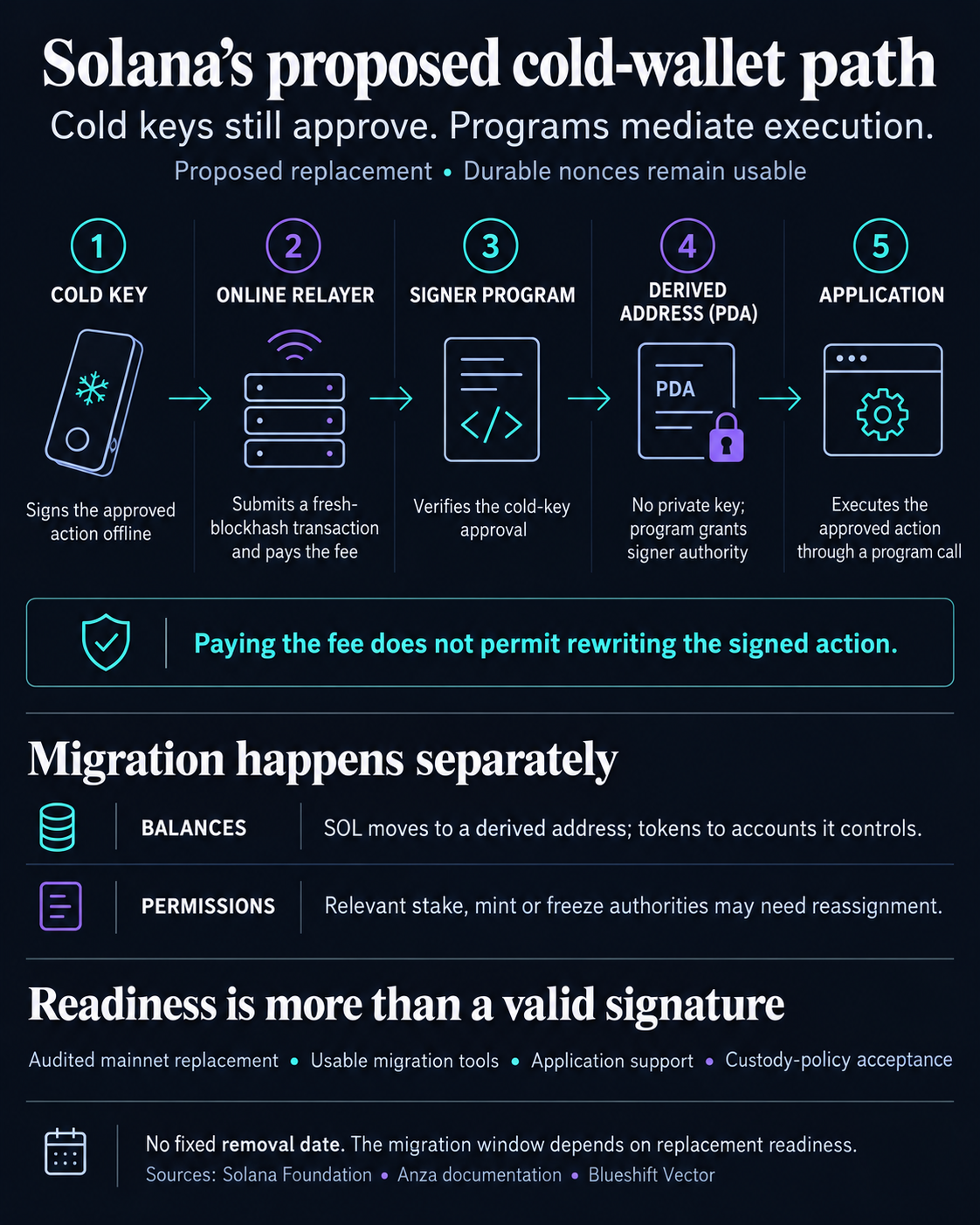
The Solana Foundation’s October deprecation plan points to onchain signer programs that verify an offline signature and execute its approved instructions. A program-derived address, or PDA, would control the affected accounts. The original key would still authorize actions, while a separate online operator submits them and pays the network fee.
The replacement creates a different custody architecture: operators must migrate the relevant assets or permissions, applications must accept actions arriving through another program, and risk teams must approve the new signing path.
Durable nonces remain usable. The Foundation has not set a removal date or made a final choice between Anza’s Programmatic Signer and Blueshift’s Vector. Its roughly six-month migration window is conditional on a suitable replacement being ready, audited and live on mainnet.
The key keeps approving, but the account changes
Durable nonces solve a timing problem. Instead of signing a transaction tied to a recent blockhash that soon expires, an offline signer can approve one using a stored nonce. That allows approval and broadcast to happen at different times.
Solana’s separate 200ms slot upgrade reached its final mainnet stage on Oct. 9. Faster block production leaves less wall-clock time for ordinary blockhash-based approvals, although expiry depends on block production rather than a guaranteed timer. CryptoSlate’s earlier coverage examined that timing change; the nonce proposal concerns the architecture used to avoid the short approval window.
Under Programmatic Signer, the cold key signs an authorization message rather than the transaction sent to the network. A relayer places that approval in a fresh-blockhash transaction. The signer program verifies the authorization and executes the approved instructions with the key’s derived address as signer.
The PDA has no private key of its own. Its ability to act comes from the signer program verifying the original key’s approval. Deriving the address does not move any assets or permissions: those must be transferred separately.
The migration guide describes moving native SOL into the derived address, transferring token balances into accounts controlled by it, and moving mint or freeze permissions to it. Stake accounts can move the staker authority, withdraw authority or both, depending on the permission being migrated. These are separate controls, rather than one universal wallet switch.
The Foundation proposes completing those handoffs while legacy durable nonces still work. For an affected treasury, approving the new signing software is therefore only part of the job. Its account inventory and the permissions each key currently holds determine what must change.
The two candidate designs also handle native SOL differently. Programmatic Signer’s derived SOL account is System-owned and can send SOL through an approved ordinary transfer. Vector initializes a program-owned account and releases SOL through its own authorized withdrawal or closing operation.
What the cold signature lets a relayer do
The implementation choice affects how tightly an approval constrains the transaction around it.
Programmatic Signer’s message documentation says the cold signatures bind the executor, nonce account and embedded execution message. A relayer cannot alter those authorized bytes while retaining valid signatures. It can, however, choose the outer fee payer and blockhash and add instructions before or after the submission.
Vector commits to the top-level instruction buffer, including the data and accounts used to pass approved actions into other programs. Instructions surrounding those actions must already be included when the cold key signs. A relayer cannot insert, remove or reorder them afterward without invalidating the approval.
Programmatic Signer allows an execution context to be assembled around an approved action; Vector requires the surrounding instruction sequence to be approved in advance. In both cases, paying for broadcast does not grant permission to rewrite the signed action.
| Control | Programmatic Signer | Vector |
|---|---|---|
| Cold approval covers | The authorization and embedded execution message | The committed top-level instruction buffer |
| Extra surrounding instructions | Relayer may add them outside the authorization | Must be included before signing |
| Replay state | A separate program nonce account | Nonce stored in the Vector account |
| Derived-address setup | No signer-address registration | Account initialized under the Vector program |
A failed execution attempt can leave a cold approval executable later. A current durable-nonce transaction that passes validation but fails during execution still consumes its nonce. Programmatic Signer’s architecture commits the nonce advance and application changes together, or rolls them back together. Vector documents the same ability to retry a failed action.
For operators, retryability means a failed submission has not necessarily invalidated the approval. Without an enforced deadline, it can remain available for later execution while its nonce is unchanged.
Vector explicitly warns that a relayer could withhold a transaction until conditions change, or that a signature exposed by a failed attempt could execute later. A timeout included in the signed instructions can reject execution after a deadline. Revocation requires a separately authorized nonce advance to land. A deadline rejection itself does not consume a nonce whose changes roll back with the failed transaction.
Application access is a separate custody test
The Foundation’s rationale is to simplify validator handling. Durable nonces require special replay-prevention rules, complicate asynchronous execution and make invalid transactions harder to filter. Moving approval and replay state into ordinary programs leaves validators processing normal blockhash transactions.
Applications then receive approved actions through cross-program invocation, or CPI: one program calls another. That can conflict with an application’s rule that an action must arrive directly as a top-level instruction. Checks that inspect only top-level repayment or signature-verification instructions can also miss an action nested inside the signer program.
More available call depth does not resolve a rule that rejects the call’s position or cannot inspect the nested instructions. The Foundation suggests supporting known signer programs or offering another execution path. Whether an application accepts a PDA’s signature is consequently a different question from whether the offline approval is cryptographically valid.
Token-2022’s CPI Guard shows why compatibility needs a precise account-level assessment. With the guard enabled, CPI transfers and burns require delegate authority; approvals through CPI are prohibited, and changing the owner is prohibited even outside CPI. Permanent delegates have transfer and burn exceptions.
Those rules are more specific than a blanket ban on every PDA action. A delegate-based transfer route may exist, but establishing or using that authority introduces its own permission and custody-policy decision.
Institutional concerns raised in March centered on application access and the controls under which funds may move. In the March 4 discussion, a participant identifying himself as Michael from Fireblocks supported nonce deprecation while objecting to CPI Passthrough’s migration, contract dependence and DeFi compatibility burdens. He favored transaction envelopes, with Sudo as an alternative, rather than the proposed CPI-based signing path.
Grant, who identified himself as being at Unit 410, said the same day that a small, auditable signer program might make authority migration acceptable. He rejected a workaround that temporarily moves assets to a hot signer, even for an atomic operation, because funds must remain associated with cold storage in its noncustodial model.
A testable design still needs a production migration path
Programmatic Signer’s current documentation reports devnet deployment and audits in progress, with remediation required before its v1 release and any mainnet deployment. Its interfaces may change. The usage documentation still marks simulation and relay submission as coming soon, while several migration operations are similarly unfinished in the guide.
Vector publishes implementation code and program IDs; its README does not state an audit or mainnet deployment status.
Meanwhile, Fireblocks’ current protocol onboarding kit still describes automatic durable-nonce injection for selected WalletConnect integrations, including Jupiter and Kamino, with a default provider-managed 15-minute validity window. That describes an existing approval workflow which a replacement must accommodate.
An operational migration needs an audited mainnet replacement, usable tools and application paths that retain each operator’s approval controls.
The post Solana’s offline-signing proposal would keep approvals valid after failed transactions appeared first on CryptoSlate.
Eclair, ACINQ's Lightning node software, has merged two repairs for gaps that could make a node lose Bitcoin through excessive mining fees during channel funding and splicing. One limits a peer's fee-bump demands when Eclair contributes funds; the other checks transactions from a compromised Bitcoin backend while Eclair retains the signing keys.
The repairs merged into the project's master branch on Oct. 2 and Oct. 5. As of Oct. 12, its release page still listed September's v0.14.3 as latest. The two October fixes postdate that packaged release.
Bitcoin Optech's Oct. 9 newsletter highlighted both changes as closing protection gaps during dual funding and splicing.
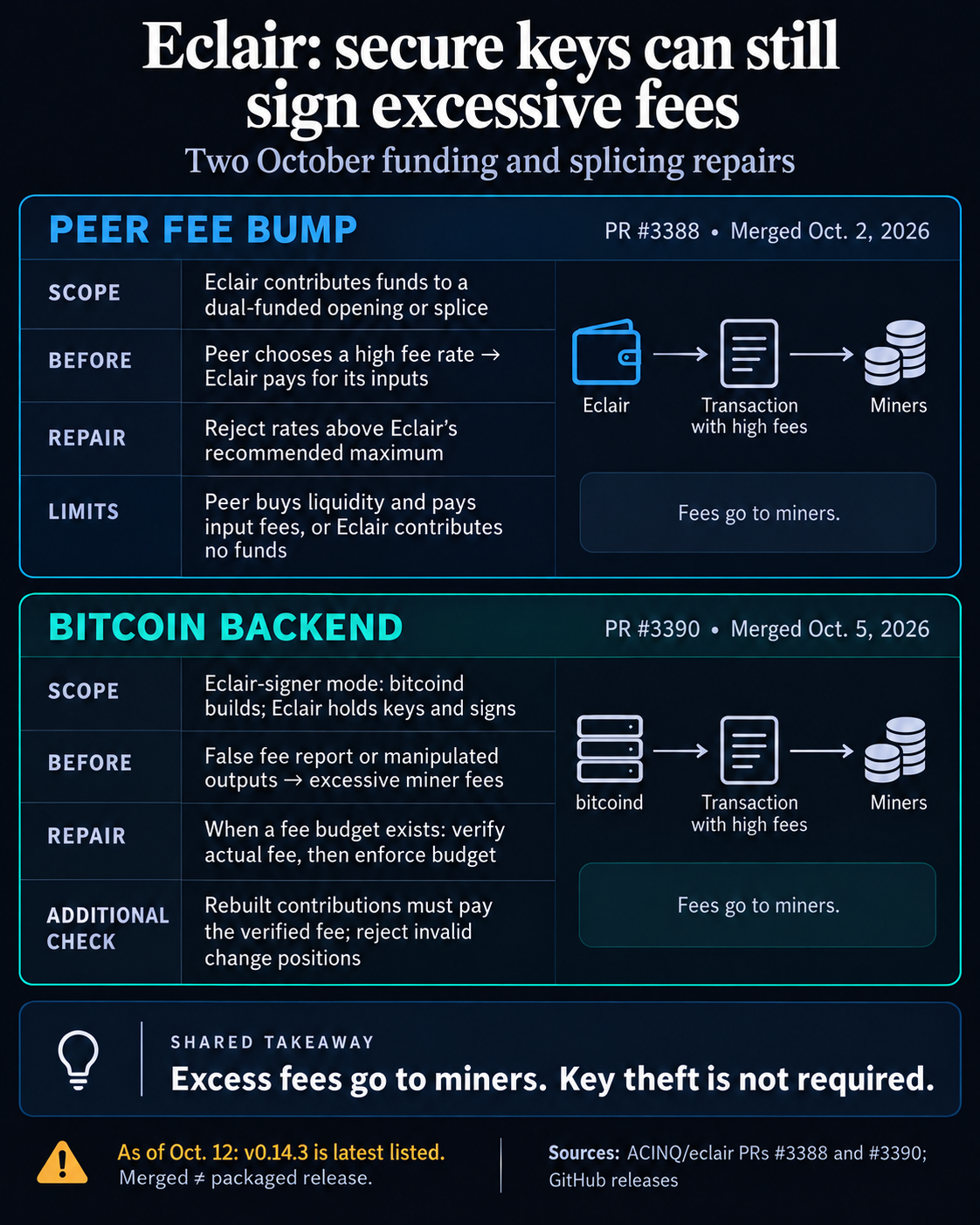
The first repair, PR #3388, concerns peer-initiated replace-by-fee, or RBF, attempts during a dual-funded channel opening or a splice that adjusts a channel's funding. A peer could request a replacement transaction with a higher fee rate. Eclair kept its wallet contribution and paid for its inputs at that rate, without an upper bound or fee budget on this path.
That let a malicious peer impose an arbitrary mining fee rate on the contributing node while contributing nothing itself. The loss would be paid as fees to miners rather than transferred directly to the peer.
The repair rejects attempts above the maximum funding fee rate Eclair recommends to its peer. Two exceptions remain: the peer buys liquidity and pays the fees for Eclair's inputs, or the Eclair node contributes no funds to the transaction. In those cases, Eclair does not bear the cost addressed by this limit.
Keeping keys is only part of the defense
PR #3390 addresses a separate threat in Eclair-signer mode. Bitcoin Core's backend, bitcoind, selects coins and builds transactions, while Eclair retains the keys and signs.
A compromised backend could report a fee within budget while constructing a transaction that actually paid more, including by dropping the change output. Under Bitcoin's transaction accounting, input value not assigned to outputs becomes a miner fee. Missing change can therefore spend funds without paying an attacker's address.
When a fee budget is supplied, the repair calculates the actual fee from the amounts of the coins being spent, fetched by transaction ID to authenticate their values. It checks that the backend's reported fee matches and applies the budget to the actual fee. It also checks that Eclair's rebuilt contributions pay the same verified fee and rejects invalid change-output positions.
These are distinct from the cooperative-closing fee flaw covered in CryptoSlate's September report and the restart denial-of-service issues covered Oct. 2.
These repairs address Eclair's dual-funding, splicing and signer configurations. Operators should check that their installed build contains the October changes.
The post Eclair merges fixes for Lightning flaws that could burn Bitcoin in fees appeared first on CryptoSlate.
France’s proposed crypto tax changes would make a move from Bitcoin or Ether into certain stablecoins a taxable disposal, even if the investor never withdraws cash.
The National Assembly’s Finance Committee adopted amendment I-CF1826 on Oct. 7, adding that proposed exception to a broader overhaul of how private crypto gains are calculated. The provision would apply to disposals and exchanges from Jan. 1, 2027 if enacted.
For an investor selling Bitcoin exposure into USDC, the consequence would be a change in the tax timing of a risk-reduction trade. A gain could become reportable while the proceeds remain in a crypto wallet or exchange account. But the proposal also changes the cost deducted from those proceeds, and gives older holdings a transition choice.
Under French tax authority guidance, covered crypto-to-crypto exchanges without a cash balancing payment receive tax deferral. Converting into fiat or using crypto to obtain other goods or services can already be taxable under the private-disposal regime, subject to its applicable exemption.
CF1826 would remove the exchange deferral when the investor receives e-money tokens as defined by the EU’s Markets in Crypto-Assets regulation, or related rights. The operative wording targets the asset received. A swap out of Bitcoin into a qualifying token could therefore recognize a gain before any later cash withdrawal.
MiCA’s definition describes a crypto-asset that seeks to maintain stable value by reference to one official currency. That legal definition sets the exception’s scope. The amendment invokes it without an express issuer-licensing condition.
USDC provides a concrete example: Circle’s European white paper identifies it as an e-money token under the same MiCA provision. The illustrations below use native USDC, with transactions measured in euros.
The amendment’s sponsors justify the change by describing deferral on fiat-backed stablecoin conversions as a legislative loophole. For an investor using a swap to reduce market exposure, the practical effect would be earlier recognition of any gain.
The proposed tax calculation concerns the gain above cost. It subtracts the acquisition basis of the assets surrendered from the disposal price. That basis is the cost recognized for tax purposes; a transaction can produce a gain, no gain or a loss.
Two ways to value older holdings
France’s existing portfolio-based calculation allocates part of the acquisition price of the entire crypto portfolio to each taxable disposal. Current guidance deducts total portfolio acquisition price multiplied by the ratio of disposal price to portfolio value immediately before the transaction.
The proposed replacement would focus on the crypto-assets actually disposed of. For assets of the same nature purchased at different prices, it specifies weighted-average acquisition value.
For holdings acquired before 2027, the amendment offers two routes. An investor could use evidenced actual acquisition costs, determined under the new basis rules. Alternatively, the investor could allocate the portfolio acquisition price calculated under the old rules at Dec. 31, 2026 among the assets held then, in proportion to their values on that date.
The allocation option preserves a pool of acquisition cost and distributes it among holdings. The available cost pool remains the acquisition price calculated under the old rules, rather than the portfolio’s full market value. The text makes that choice irrevocable for the entire portfolio when the first return reporting a taxable disposal after Jan. 1, 2027 is filed.
Consider a hypothetical investor whose Bitcoin cost €20,000 and is worth €60,000, while their Ether cost €40,000 and is worth €40,000 at the transition date. The portfolio has €60,000 of acquisition cost and a €100,000 value. Assume no prior disposals, fees or cash balancing payments, no other holdings of the same tokens, and unchanged euro values through the transactions.
Under the allocation option, Bitcoin represents 60% of the portfolio value and receives €36,000 of basis. Ether receives the remaining €24,000. Using actual costs instead would leave their bases at €20,000 and €40,000, respectively.
The same Bitcoin-to-USDC transaction would then produce different first-disposal gains:
| Hypothetical transaction or basis | Proposed actual-cost route | Proposed allocation route |
|---|---|---|
| Bitcoin basis before the swap | €20,000 | €36,000 |
| Gain on swap into €60,000 of native USDC | €40,000 | €24,000 |
| Basis of the USDC received | €60,000 | €60,000 |
| Gain on later Ether disposal for €40,000 | €0 | €16,000 |
The table compares hypothetical gross gains under the proposal. Under the current rules, the qualifying swap itself would receive deferral. Under either proposed transition route, the Bitcoin-to-USDC swap would become a taxable event.
Changing only the historical costs to €50,000 for Bitcoin and €10,000 for Ether reverses the first-disposal comparison: actual cost would produce a €10,000 Bitcoin gain against allocation’s €24,000. The remaining Ether gain at unchanged values would be €30,000 under actual cost or €16,000 under allocation. Historical costs determine which method recognizes more gain first.
Basis resets and the cost of loss timing
The proposal expressly distinguishes exchanges that retain deferral from exchanges that become taxable. A deferred exchange carries the surrendered assets’ basis into the assets received. A taxable exchange gives the received crypto-assets a basis based on the consideration value already used to calculate the gain, adjusted for any cash balancing payment.
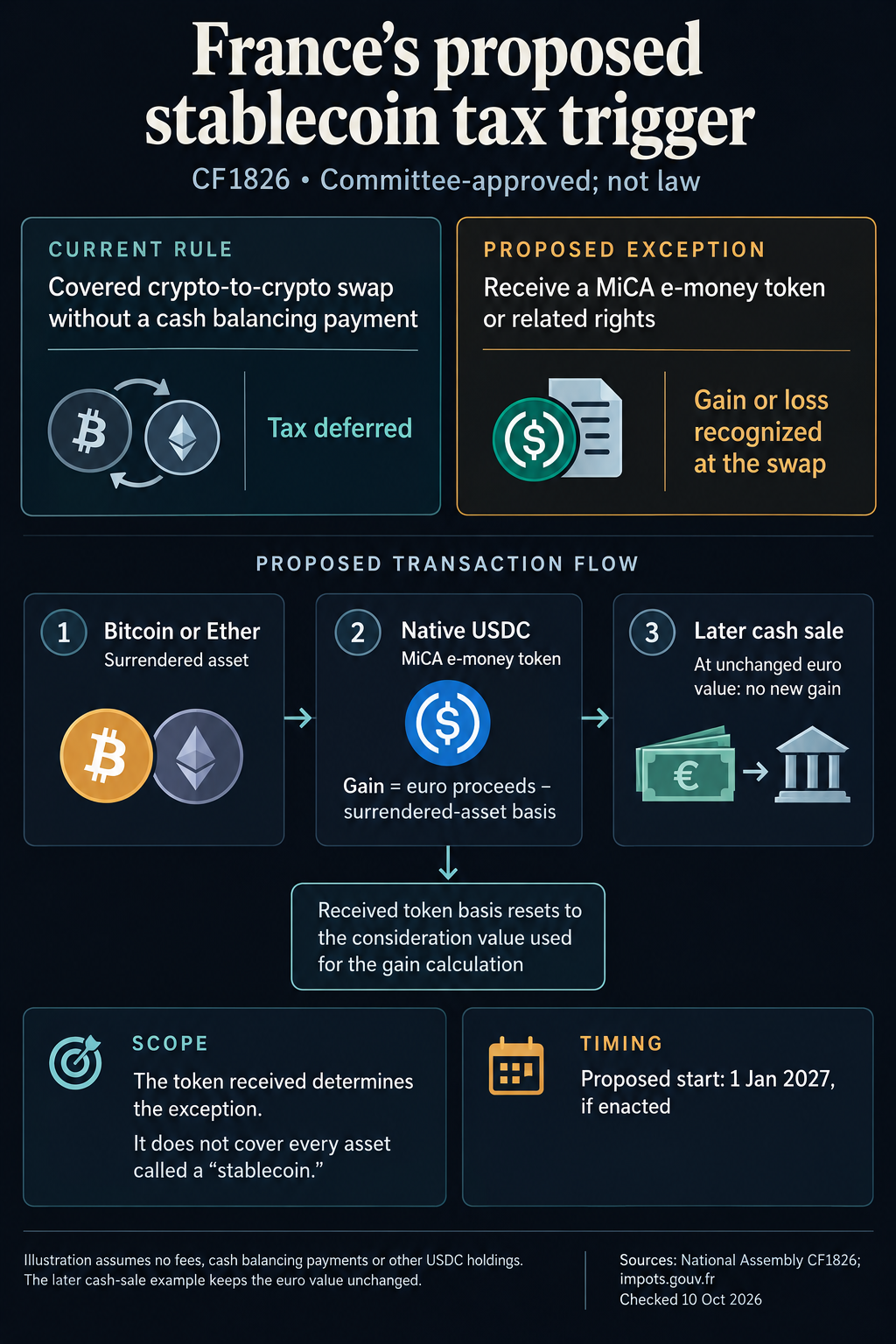
For the Bitcoin-to-USDC swap in the first example, the reset rule would give the USDC received €60,000 of basis under either transition route. Selling it later for the same €60,000 would produce no further gain. That reset would prevent repeat recognition of the original Bitcoin gain when the unchanged-value proceeds finally reached a bank account.
USDC references the dollar, so the unchanged-euro-value assumption is essential. A later disposal at a different euro value would require its own gain or loss calculation.
If the investor also sold the remaining Ether for €40,000, the first example would produce aggregate realized gains of €40,000 under either proposed transition route. Actual cost recognizes all of that in Bitcoin; allocation splits it between Bitcoin and Ether.
The amendment would change the swap exception and basis rules without rewriting the existing crypto loss restriction. The tax authority says crypto gains and losses offset within the same tax year, while a net crypto loss cannot be carried into later years or used against gains on other assets.
A separate hypothetical shows the effect of recognizing losses and gains in different years. Under the proposed actual-basis rules, a sole Bitcoin holding bought for €30,000 and swapped into €20,000 of native USDC would recognize a €10,000 loss. The USDC would receive €20,000 of basis.
If that USDC were later exchanged into Bitcoin without a cash balancing payment, the swap would retain deferral because Bitcoin is outside the received e-money-token exception. It would carry the €20,000 basis into Bitcoin. A subsequent taxable Bitcoin sale for €30,000 would recognize a €10,000 gain. Assume no fees, other token pools, cash adjustments or other gains and losses.
Those amounts could offset if realized in the same tax year. If the net loss arose in one year and the gain in a later year, the earlier loss would not shelter that later gain under the existing rule. Recognition in different years can therefore change the taxable result even when the transaction sequence returns the holding to its original value.
The reporting trade-off follows from the same mechanics. Asset-specific basis would remove the portfolio-wide allocation formula for new disposals, but investors would need to preserve acquisition evidence, weighted averages and the basis carried or reset through swaps. For older holdings, the proposed allocation route would also require a Dec. 31 valuation and a whole-portfolio decision that the text makes irrevocable.
The next legislative test remains ahead. The 2027 budget dossier, checked Oct. 12, lists National Assembly plenary discussion for Oct. 13.
The post France’s tax proposal would tax Bitcoin-to-USDC swaps before investors cash out appeared first on CryptoSlate.
Bitcoin and Ethereum extended their weekend recovery, although on-chain indicators and derivatives positioning suggest the rebound faces significant obstacles.
Data from CryptoSlate showed that Bitcoin briefly climbed above $84,000 after falling toward $80,000 during last week's selloff. Ethereum also recovered above $2,500, reversing part of its recent losses as buying activity returned to the cryptocurrency market.
However, Bitcoin's advance has brought it closer to a major concentration of investor acquisition costs between $84,000 and $85,000, where selling pressure could intensify. Meanwhile, Ethereum's recovery comes as larger derivatives traders appear to be reducing their bullish exposure despite substantial outstanding positions.
Bitcoin's $85,000 resistance threatens to stall recovery
Bitcoin's recovery gained momentum during Sunday's trading session as traders appeared to capitalize on a liquidity concentration above the prevailing market price.
CryptoQuant analyst J.A. Maartunn said on Oct. 11 that a liquidity cluster formed just above Bitcoin's trading level, giving traders an opportunity to push prices higher.
According to Maartunn, traders appeared to establish a substantial wall of buy orders beneath the market, providing support as Bitcoin advanced toward the overhead liquidity.
The spot Bid/Ask Ratio, which measures buying and selling liquidity within 1% of the prevailing price, rose to 0.3.
The increase indicated that visible buying interest had strengthened relative to selling orders. Such liquidity can also disappear if traders cancel their orders.
Checkonchain data highlighted by analyst Darkfost on Oct. 11 showed that approximately 53% of Bitcoin's invested capital had an estimated acquisition price above $83,000 when the cryptocurrency traded around that level.
The measure weights acquisition prices by invested capital, so larger positions carry more weight.
More importantly, the largest concentration of acquisition costs sits between $84,000 and $85,000, making the region a potential obstacle to further gains.
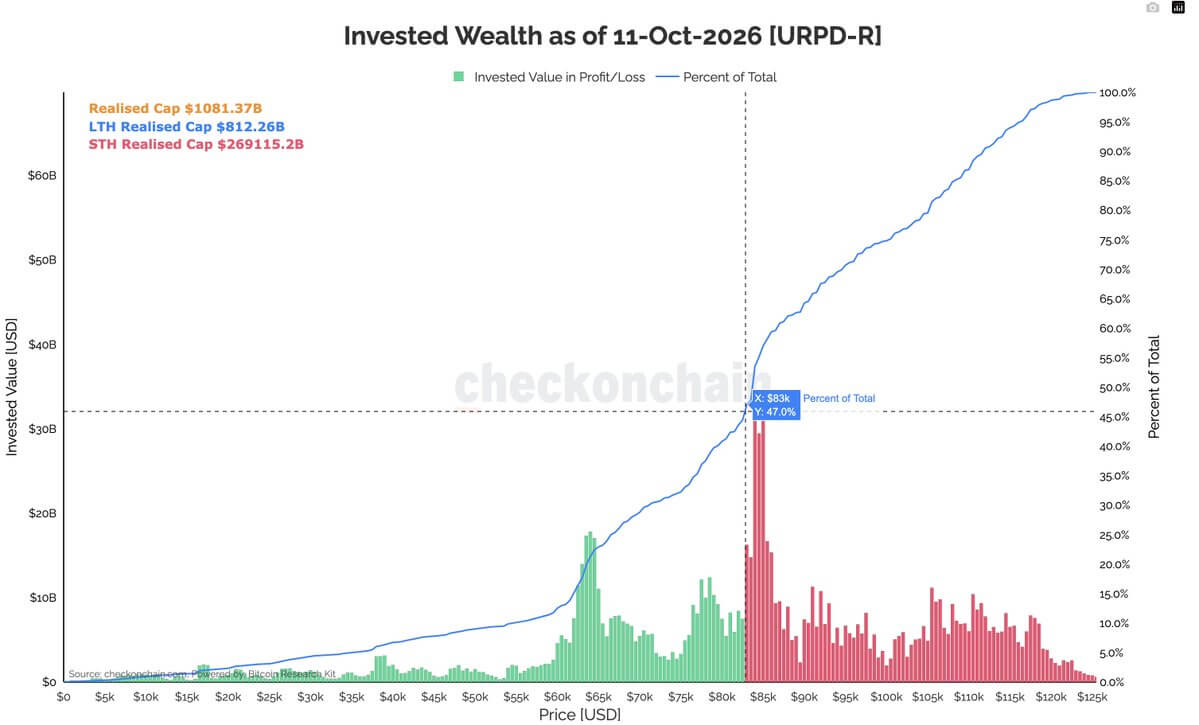
Investors who acquired Bitcoin around those levels could become more willing to sell as prices approach their estimated cost basis, increasing the supply that buyers must absorb.
A sustained move through the region would suggest buying demand is strong enough to overcome that potential selling pressure. If it fails to do so, Bitcoin could be vulnerable to another decline, with Darkfost identifying the $77,000 to $79,000 range as a possible support area.
Ethereum's $2,500 rebound faces risk from leveraged traders
Ethereum's recovery faces another challenge as derivatives positioning among larger market participants continues to deteriorate.
Alphractal CEO Joao Wedson noted on Oct. 10 that Ethereum's 30-day and 180-day open-interest deltas were both negative, along with weakening readings in its Whale vs. Retail Delta indicator.
He interpreted the combination as evidence that major traders have reduced their bullish exposure while increasingly favoring defensive or short positions.
The negative open-interest readings indicate that outstanding derivatives positions have contracted over the measured periods.
Despite the contraction, Ethereum's total futures open interest remained substantial at approximately 10.58 million ETH, indicating that considerable derivatives exposure was still outstanding.
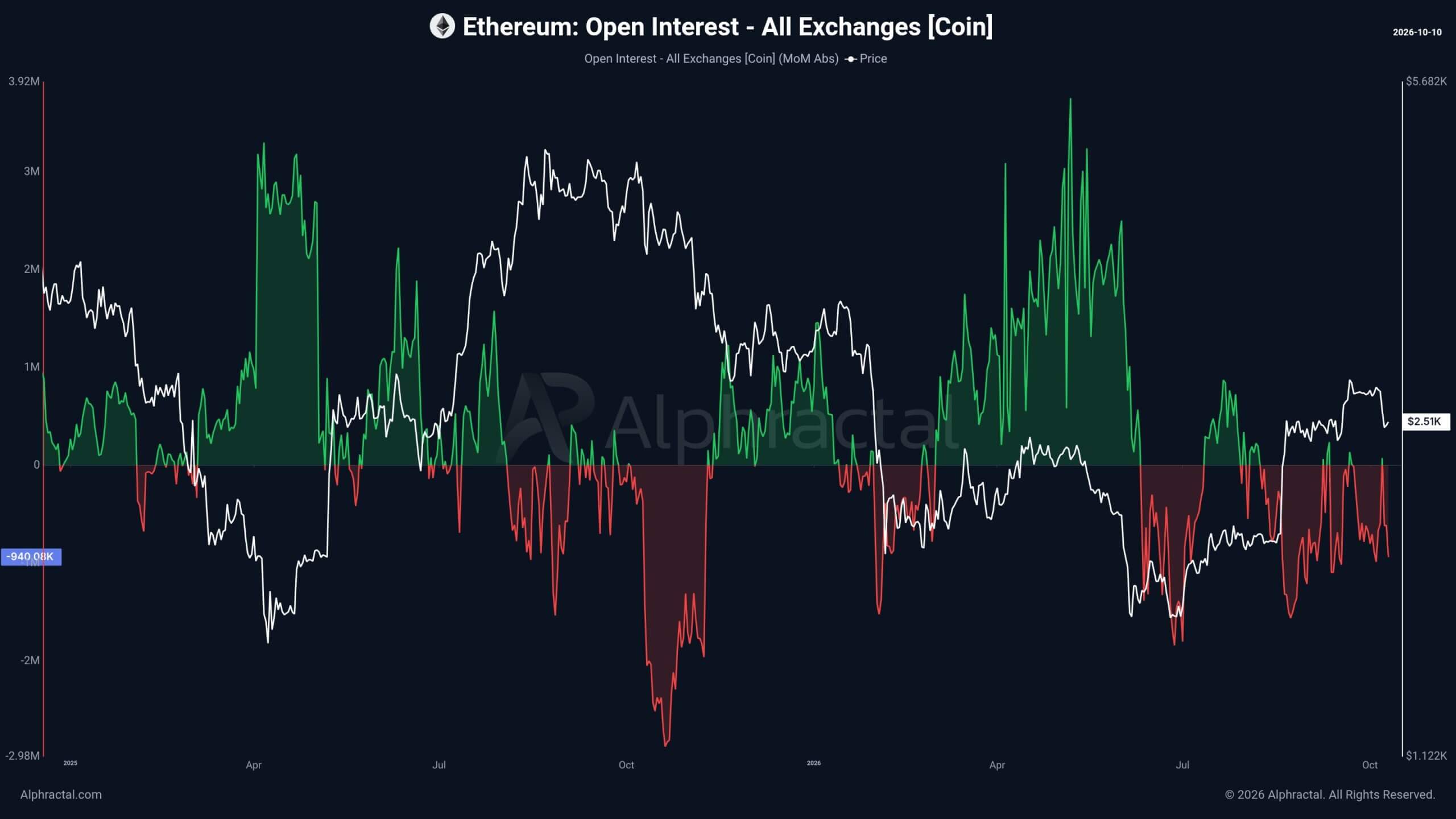
Valued at $2,500 per ETH, that represents roughly $26.5 billion in notional exposure.
The combination of weakening bullish positioning and substantial remaining exposure increases the potential for sharp price movements if volatility returns.
A renewed decline could push leveraged long positions toward forced liquidation, potentially adding selling pressure and accelerating losses. Conversely, a sustained recovery could force short sellers to close positions, contributing to further upward momentum.
Wedson warned that Ethereum's derivatives market remains vulnerable to further liquidations despite the recent reduction in outstanding positions.
The post Bitcoin’s rebound approaches the $85,000 zone where past buyers may sell appeared first on CryptoSlate.
EU finance ministers agreed to shift oversight of major crypto companies to a central watchdog, reshaping supervision under MiCA.
The Council of the European Union reached a political agreement on Oct. 9 to give the European Securities and Markets Authority (ESMA) direct responsibility for the bloc's most significant crypto-asset service providers, as part of a wider package to integrate European financial markets.
The proposed overhaul addresses a weakness in the Markets in Crypto-Assets Regulation (MiCA), which allows firms licensed in one member state to serve customers across the 27-country bloc while remaining primarily supervised by their home-country regulator.
The compromise, however, is considerably narrower than the European Commission's original plan to move all crypto service providers under ESMA. Officials estimate that only 10 to 15 of roughly 360 providers would qualify for centralized supervision, Reuters reported.
The agreement sets the Council's negotiating position rather than changing the law immediately. The Council must still negotiate the proposal with the European Parliament.
National licenses expose gap in EU-wide oversight
MiCA's passporting system was designed to provide crypto firms with a single route into the European market. Under the regulation, a provider authorized in one member state can offer approved services elsewhere in the EU without establishing a physical presence in every country it serves.
That arrangement reduces duplication for firms expanding across borders, but it also places considerable responsibility on the national authority issuing the initial approval. This is because a company's operations, client assets, and technology systems can grow well beyond the market where it was licensed.
The consequences emerged in a July 2025 ESMA review of the Malta Financial Services Authority's authorization of an unnamed crypto provider.
ESMA questioned why the company received approval while material issues remained unresolved. Its reviewers found insufficient evidence that the licensing assessment adequately addressed governance, potential conflicts of interest, technology infrastructure, custody arrangements and certain anti-money-laundering risks.
The review did not establish that every Maltese license was deficient. It also credited the Maltese regulator with sector expertise and sufficient supervisory resources, while recommending improvements to its authorization process.
Malta subsequently said it was implementing the recommendations but opposed transferring supervision to ESMA, arguing in September 2025 that MiCA was too new to justify an additional regulatory layer. The authority warned that centralization could introduce bureaucracy and hamper competitiveness.
The dispute highlighted a broader tension: one regulator's authorization decision can affect crypto customers across Europe, even when other national watchdogs view the required level of scrutiny differently.
Largest crypto providers face new thresholds and EU enforcement
In response, EU regulators are proposing a new framework to address these issues.
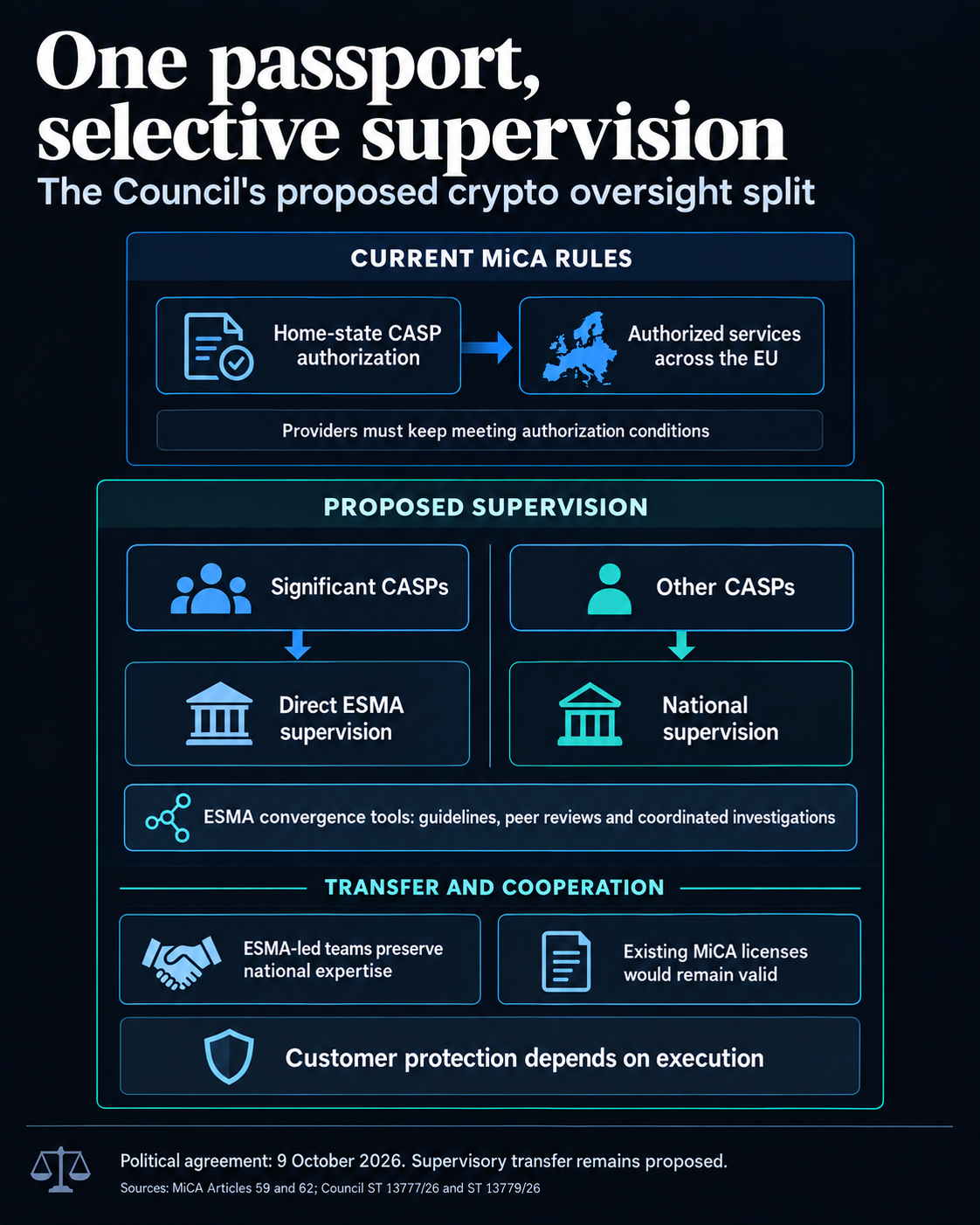
Under the Council's draft, ESMA would take direct oversight of crypto providers with at least 15 million active EU users, or those meeting three of five additional significance criteria covering their customer base, custody assets, transaction volumes and financial interconnectedness.
Those criteria include more than 1 million active users, over €1 billion in crypto assets under custody and more than €4 billion in annual client transactions.
Together, these factors mean a provider's overall scale and connections to the financial system, rather than its place of incorporation alone, would determine whether supervision moves to ESMA.
The agency would gain powers to request information from directly supervised firms, conduct inspections, investigate breaches, and impose financial penalties. The draft also envisages the authority to restrict services or withdraw authorization where firms do not meet regulatory requirements.
While most crypto service providers would remain under national regulators, ESMA would use guidelines, peer reviews, coordinated investigations, and certain intervention powers to address uneven enforcement across jurisdictions.
The overhaul would also create a full-time ESMA executive board, including a chair and five independent members, to handle operational and company-specific decisions. National regulators would continue participating in broader policy and supervisory coordination.
The Council envisages a two-year transition in which joint teams transfer information, operational responsibilities and expertise to ESMA. Existing MiCA licenses for companies brought under direct supervision would remain valid, avoiding the automatic need to seek new authorization.
The proposed structure would bring greater supervisory scrutiny to a small group of large firms while leaving the majority of the market within the current national model. The decisive questions now concern the final thresholds, ESMA's available resources, and how providers near the boundary are treated.
The Council must formally adopt its negotiating position before talks can begin once the European Parliament establishes its own. Those negotiations will determine how many crypto companies ultimately move from national to EU-level supervision and when the transfer can begin.
The post EU targets MiCA loophole that lets crypto exchanges serve 27 countries with one license appeared first on CryptoSlate.
CryptoTicker.io
No items found in feed after parsing.
Decrypt
The Crypto Fear and Greed Index has dropped to 56 from an August peak of 82, as oil, bond yields, and ETF outflows hit Bitcoin in October.
The wallet manufacturer said its own systems and direct sales are unaffected, and that the reseller has stopped selling hardware wallets.
Where event insurance deals with scrapped shows and what happens inside the venue, NEXTPredict is focusing on flight cancellations.
An integer overflow in the payment engine, dormant since 2015, could have let an attacker mint spendable XRP beyond the token’s total supply.
The Ethereum treasury firm now holds 6.03 million ETH, 4.9% of supply, as Lee predicts the biggest crypto bull market yet.
U.Today - IT, AI and Fintech Daily News for You Today
Peter Schiff has declared Michael Saylor’s Bitcoin strategy a failure in 2026.
Cardano logs a historic 1,780,896 transactions in Epoch 660, marking its highest network usage since late 2021.
Autonomous AI software drives record traffic on XRP Ledger, outspending human retail users via the new X402 standard.
Ethereum is posting extremely weak liquidity levels on Binance as its reserves on the exchange continue to decline despite market volatility.
Near Protocol's recovery might be complicated.
Blockonomi
TLDR
- Microsoft (MSFT) stock gains 0.88% as the company expands its AI chip strategy
- Microsoft’s Azure Maia 300 chips target lower AI costs and improved cloud efficiency
- Microsoft plans a multi-gigawatt rollout of its Maia 300 AI processors in 2027
- Azure Maia 300 targets 40% better energy efficiency and sevenfold higher throughput
- Microsoft’s custom AI processors aim to reduce reliance on Nvidia’s GPU hardware
Microsoft plans to expand its custom AI chip program as demand for computing power increases across its cloud business. The company expects to deploy its Azure Maia 300 processors globally starting in 2027 to reduce infrastructure costs. Meanwhile, Microsoft (MSFT) stock gained 0.88% to $539.79 during Monday’s intraday session, adding $4.72.
IonQ, Inc., IONQ
Microsoft Expands AI Infrastructure With Azure Maia 300
Microsoft announced plans to deploy its upcoming Maia 300 processors across global data centers at a multi-gigawatt scale. The company intends to power GitHub Copilot, Microsoft Foundry, and other enterprise applications through its proprietary hardware. This expansion supports Microsoft’s strategy to reduce dependence on external chip suppliers while managing growing computing requirements.
The announcement follows rising infrastructure expenses across the cloud computing industry as companies expand artificial intelligence services. Major technology companies continue investing in specialized processors because advanced AI models require substantial computing capacity and electricity. Consequently, Microsoft aims to improve operational efficiency and reduce exposure to graphics processor supply constraints.
The Maia 300 represents another stage in Microsoft’s development of specialized hardware for its Azure cloud platform. Its deployment will support inference workloads, which allow trained AI models to generate responses and process requests. Furthermore, the company expects these processors to handle increasingly complex applications while improving performance across its cloud infrastructure.
Maia 300 Targets Higher Efficiency and Processing Capacity
Microsoft plans to manufacture its Maia 300 processor using TSMC’s advanced N2P semiconductor production technology and chiplet architecture. The processor will incorporate eight HBM4 memory stacks to support faster data processing and demanding AI applications. According to company projections, the system will improve energy efficiency by 40% per megawatt against competing hardware.
Microsoft also expects the upcoming processor to deliver seven times greater rack-scale token throughput than its current system. Higher processing capacity could help Azure support more enterprise applications without proportionally increasing infrastructure power requirements. These improvements form part of Microsoft’s broader effort to control operating expenses as AI workloads expand.
Meanwhile, Microsoft continues deploying its Maia 200 processors across production environments in North America, Europe, and Australia. The company reports that Maia 200 delivers up to 1.7 times greater output per watt for selected workloads. These workloads include Microsoft Teams and Copilot applications, which already use the company’s expanding AI infrastructure.
Microsoft Strengthens Position Against Rival Cloud Providers
Microsoft’s custom processor strategy follows similar hardware investments by Google, Amazon, and Meta across their computing operations. These companies are developing specialized accelerators to reduce dependence on Nvidia’s widely used datacenter graphics processors. As competition increases, proprietary chip development has become central to managing performance, capacity, and infrastructure spending.
Microsoft expects its multi-gigawatt deployment to support continued growth across Azure and its enterprise software services. The company is designing its hardware for advanced reasoning tasks and applications that complete multiple automated steps. Therefore, its processor roadmap connects future computing capacity with efforts to improve cloud service economics and efficiency.
The planned 2027 expansion will require Microsoft to integrate new processors into its existing global infrastructure. Its experience operating Maia 200 provides a foundation for managing production workloads before the next processor generation arrives. Microsoft now aims to increase computing capacity while controlling energy consumption and supporting broader adoption of AI services.
The post Microsoft (MSFT) Stock: Gains as Azure Maia 300 Targets AI Costs appeared first on Blockonomi.
TLDR
- IonQ stock plunges 8.74% to $36.40 despite announcing a $1.3 billion acquisition.
- IonQ agrees to acquire Elisity to expand its quantum cybersecurity operations.
- The all-stock Elisity deal includes up to $150 million in performance-based payments.
- Elisity brings over 100 global deployments and strong enterprise security demand.
- IonQ targets a $10 billion cybersecurity market as its stock faces sharp declines.
IonQ (IONQ) stock plunged 8.74% to $36.40 during Monday’s intraday trading, losing $3.49 despite announcing a major acquisition. The quantum computing company agreed to acquire cybersecurity firm Elisity in an all-stock transaction worth up to $1.3 billion. The deal expands IonQ’s security business as the company targets growing demand for quantum-resistant cybersecurity solutions.
IonQ, Inc., IONQ
IonQ Announces $1.3 Billion Elisity Acquisition Deal
IonQ announced a definitive agreement to acquire Elisity, a company specializing in Zero Trust security technology. The acquisition combines IonQ’s post-quantum cryptography and quantum key distribution capabilities with Elisity’s enterprise security platform. Together, these technologies will help organizations protect sensitive data against existing cyberattacks and emerging quantum computing threats.
The transaction carries a maximum value of $1.3 billion, including $150 million in potential performance-based payments. IonQ will issue shares based on a predetermined pricing formula linked to its stock performance. The agreement establishes a share pricing range between $33.07 and $49.61.
IonQ expects to complete the acquisition during the fourth quarter of 2026, subject to regulatory approval. Following completion, Elisity will maintain its existing leadership team, including CEO James Winebrenner. Meanwhile, IonQ plans to expand its cybersecurity offerings across enterprise networks, government systems, and critical infrastructure.
Elisity Expands IonQ’s Enterprise Cybersecurity Business
Elisity brings an established enterprise security platform and more than 100 customer deployments worldwide. The company has doubled its revenue and customer base annually while reporting zero customer churn. Its customer relationships will provide IonQ with additional opportunities across the growing enterprise cybersecurity market.
Elisity’s IdentityGraph platform identifies devices, users, workloads, and artificial intelligence agents across connected networks. The technology applies identity-based access controls that restrict unauthorized communication and limit the spread of cyberattacks. IonQ plans to integrate cryptographic risk information into the platform to strengthen protection against future quantum threats.
The acquisition also opens opportunities within the enterprise microsegmentation market, which IonQ values above $10 billion. Additionally, the company expects to expand cross-selling opportunities across its existing cybersecurity and quantum computing products. IonQ reported 40% year-over-year growth in multiproduct revenue during the second quarter of 2026.
IonQ Strengthens Quantum Security Strategy Despite Stock Decline
IonQ has expanded its quantum security operations through computing, networking, sensing, and cryptographic protection technologies. The company already supports quantum-safe communications networks across Switzerland, Poland, Romania, and Slovakia. These deployments provide an established foundation for introducing additional enterprise cybersecurity services.
Furthermore, the Elisity acquisition follows IonQ’s broader strategy of expanding through strategic technology purchases. Its SkyWater Technology acquisition strengthened capabilities in semiconductor design, manufacturing, and advanced packaging. Elisity will extend that approach into enterprise network protection and security policy management.
IonQ shares declined sharply during Monday’s session despite the announcement of the proposed acquisition. The transaction introduces additional stock issuance as IonQ pursues expansion beyond its core quantum computing business. The company now targets stronger enterprise security operations while preparing to finalize the agreement before year-end.
The post IonQ (IONQ) Stock: Plunges 8.74% to $36.40 Despite $1.3 Billion Elisity Acquisition Deal appeared first on Blockonomi.
FUNToken has announced the addition of ENA to its growing list of supported tokens, further strengthening its commitment to improving token accessibility and simplifying participation across its ecosystem.
With this latest integration, users holding ENA can now deposit their tokens directly into the FUNToken platform, where they are automatically converted into $FUN with 0% conversion fees. The process eliminates the need for manual token swaps, offering users a straightforward way to access $FUN and explore its expanding range of utilities.
Making $FUN More Accessible Through Token Integration
As the digital asset landscape continues to evolve, users increasingly hold multiple tokens across different networks. FUNToken aims to simplify the experience of accessing its ecosystem by supporting a growing selection of tokens that can be converted into $FUN.
The addition of ENA (ERC-20) introduces another option for users looking to put their existing digital assets to use without navigating multiple conversion platforms.
Through FUNToken’s automatic conversion system, ENA holders can deposit their tokens and receive $FUN without incurring additional conversion fees.
This streamlined approach is part of FUNToken’s broader effort to reduce unnecessary steps, improve accessibility, and create a more connected experience for its users.
Expanding Utility Beyond Token Conversion
The integration of ENA goes beyond simply adding another supported asset. It creates an additional entry point into FUNToken’s growing ecosystem of gaming experiences, staking opportunities, and token-based rewards.
Once ENA is converted into $FUN, users can explore the different utilities available within the ecosystem.
FUNToken’s expanding Android gaming portfolio features nine titles designed around accessible, engaging gameplay, with no ads, no paywalls, and real $FUN rewards. The ecosystem also includes browser-based gaming experiences, staking features, and referral reward opportunities.
By connecting these experiences through a common token, FUNToken continues to build an environment where $FUN serves multiple purposes across different products and activities.
A Growing List of Supported Tokens
The addition of ENA reflects FUNToken’s ongoing strategy to expand the range of digital assets supported by its automatic conversion system.
Recent integrations have included ONDO, TRUMP, FARTCOIN, and JTO, alongside previously supported tokens such as USDT, USDC, SOL, LINK, UNI, AAVE, and others.
Each new integration provides users with additional flexibility in accessing $FUN while supporting the platform’s objective of making token conversion more convenient.
With 0% conversion fees remaining a central feature of the supported token system, FUNToken continues to focus on simplifying the transition from existing token holdings into its connected gaming and rewards ecosystem.
Continuing to Build a More Connected $FUN Ecosystem
The ENA integration represents another step in FUNToken’s ongoing ecosystem expansion.
Alongside its growing supported token list, FUNToken continues to develop new gaming experiences, expand token utility, and introduce additional opportunities for users to participate.
By combining accessible token conversion with an expanding range of products, FUNToken is working toward an ecosystem where users have greater flexibility in how they access, earn, hold, and use $FUN.
As further integrations and platform developments are introduced, the project remains focused on making participation simpler and creating more practical uses for $FUN.
About FUNToken
FUNToken is a blockchain-powered ecosystem built around $FUN, combining gaming, rewards, staking, and growing token utility within a connected experience.
With an expanding portfolio of Android and browser-based games, supported token integrations, multi-chain accessibility, and reward opportunities, FUNToken is focused on creating more ways for users to access, earn, hold, and use $FUN.
The ecosystem emphasizes accessible gaming experiences, including a growing selection of Android titles featuring no ads, no paywalls, and $FUN rewards.
Through continued product development and ecosystem expansion, FUNToken aims to strengthen the role of $FUN as a common token connecting its growing range of digital experiences.
Website: https://funtoken.io
The post FUNToken Expands Token Accessibility With ENA Integration and 0% Conversion Fees appeared first on Blockonomi.
TLDR:
- Bitcoin whales added 16,010 BTC over five days while the price fell from $87,000 toward $80,000.
- Whale holdings rose from 5,247,316 BTC to 5,263,326 BTC, a 0.305% increase, per Santiment data.
- Nearly 800,000 BTC were previously traded near $84,569, a supply zone Bitcoin must clear first.
- If support holds and $84,569 breaks, Ali Charts eyes $89,000, then $94,000, as Bitcoin upside targets.
Bitcoin whales added 16,010 BTC over five days while the asset fell from $87,000 toward $80,000, according to Santiment data.
Their combined holdings rose from 5,247,316 BTC to 5,263,326 BTC. That marks a 0.305% increase during a period of declining prices.
Bitcoin traded at $83,341.34 as of this writing, up 0.56% in 24 hours. However, the price is still down 3.19% over the past week. Analysts are now watching whether the buying can support a rebound toward higher resistance levels.
Bitcoin Whales Buy as Prices Decline
Ali Charts shared the findings in a five part thread on X. The opening post stated that whales bought the dip. It also said the next leg higher starts now. The thread contains five posts and combines on-chain data with technical chart analysis.
The thread cited Santiment data to support the claim. Bitcoin whales kept adding coins while the market moved lower. Their holdings grew even as the price fell. Santiment provided the holdings figures that Ali Charts used in the second post of the thread.
Market data provides further context for the move. Daily trading volume stands at $22,486,836,062. Trading volume reflects the amount of Bitcoin exchanged across markets over the previous 24 hours.
The 0.56% daily gain follows a 3.19% decline over seven days. These figures reflect the latest price data available at the time of writing.
Ali Charts closed the thread by saying the price now needs to confirm the buying by Bitcoin whales. The analyst listed three levels to monitor.
These levels connect to supply data and a rising channel. They range from a breakout point to two upside targets.
Resistance Near $84,569 Draws Attention
Glassnode data shows nearly 800,000 BTC were previously traded around $84,569. Ali Charts described this area as a supply zone.
Bitcoin must clear it before a move higher gains strength. Glassnode supplied the on-chain data in the third post, which focused on supply near that price.
A break above this level would strengthen the case for a rally, according to the thread. Until then, the zone remains a hurdle for buyers. Bitcoin currently trades just below it. The analyst presented this break as the first condition for the upside move.
Bitcoin is also testing the lower boundary of a rising channel. Support at this boundary needs to hold. A hold at that boundary would keep the rising channel structure intact.
Ali Charts tied the setup to the potential rebound. The fourth post of the thread presents this channel as part of the technical outlook.
If support holds and Bitcoin clears $84,569, the analyst is watching for a rally toward $89,000. That level sits near the channel’s mid-range.
The upper boundary around $94,000 serves as the next target. Ali Charts repeated these three levels in the final post as the key targets for the move.
The post Bitcoin Whales Accumulate 16,010 BTC During Pullback From $87,000 appeared first on Blockonomi.
TLDR:
- Hyperliquid matches orders block by block and prioritizes cancellations within each block, says Xu.
- Xu links Hyperliquid’s order book depth to its market maker friendly design versus many exchanges.
- Xu says the design offers another approach for long-tail assets that have limited liquidity.
- Xu blames the October 10 liquidations partly on USDe being treated like a stablecoin as collateral.
Star Xu says the Hyperliquid matching engine is more market maker friendly than the systems used by centralized exchanges. The OKX founder shared the view on the New Era Finance Podcast with host Michael.
He said Hyperliquid matches orders block by block and gives cancellations priority within each block. Market makers can therefore cancel orders ahead of takers. Xu also covered MiCA, customer protection, and the October 10 market turmoil during the discussion.
How the Hyperliquid Matching Engine Works
Xu said the Hyperliquid matching engine differs fundamentally from centralized order book exchanges in its technical design. Centralized exchanges process orders individually. Hyperliquid, by contrast, matches orders in blocks.
Within each block, the system prioritizes cancellations. Under the Hyperliquid matching engine, market makers can therefore cancel orders ahead of takers. Xu called this design market maker friendly.
Xu believes this design explains why Hyperliquid’s order book depth appears better than that of many centralized exchanges. He added that the Hyperliquid matching engine offers another approach for long-tail assets with limited liquidity.
Xu made the comments while discussing crypto’s evolution. He said repeated crises, from early Bitcoin attacks and Mt. Gox to FTX, tested the sector.
Each episode also prompted improvements, in his view. He sees blockchain as a base for more efficient finance through self-custody, stablecoins, and tokenized assets.
Trust, Risk Controls, and the October 10 Turmoil
Xu described MiCA as an important step toward consistent crypto regulation across Europe. He noted the compliance challenges OKX faced while entering the market.
He said international growth depends on earning customer and regulator trust through transparent operations and stronger governance.
He pointed to board oversight, compliance and risk functions, monthly proof-of-reserves reports, and external auditing. OKX also plans to pursue a public listing. Xu said these steps increase accountability.
Xu said safeguarding customer funds matters more than aggressive growth. Exchanges, he added, should follow financial rules and earn money from technology and services.
He recommends self-custody for users who can manage keys securely, though wallets can be vulnerable. He also warns against unusually high yields and demands to “just trust” an exchange.
Xu attributed the cascading October 10 liquidations partly to USDe being treated like a stablecoin and accepted as derivatives collateral. He described USDe as a higher-risk, hedge-fund-like product.
Leveraged borrowing against it could magnify returns but also amplify losses when prices moved. Xu argued that tighter risk controls and regulated derivatives venues could help prevent such episodes.
Looking ahead, Xu expects crypto to expand beyond trading into everyday financial services. These include wallets for holding money, blockchain payments, and tokenized equities.
He also expects on-chain asset-management tools that let users keep control of their funds. He is optimistic these technologies could become widely used financial infrastructure.
The post OKX founder Star Xu Says Hyperliquid’s Matching Engine Favors Market Makers appeared first on Blockonomi.
CryptoPotato
The popular altcoin is among the best-performing cryptocurrencies today (October 12), posting a double-digit increase to around $3.40.
Its pump has caught the eye of well-known analysts who believe it could rise further soon. Moreover, key technical indicators reinforce the bullish case.
More Room for Growth?
X user Lucky highlighted ICP’s solid uptrend, saying it has plenty of room to run and projecting a potential jump above $8. The analyst also told their nearly two million followers that the altcoin has “definitely one of the loudest and most passionate communities in crypto.”
CW also weighed in. A few days ago, the analyst predicted that a break above $3.39 (as it happened) would shift ICP back to a bullish mode. For their part, EliZ claimed the price has moved exactly as previously forecasted, expecting a further ascent beyond $4.
For their part, WIZZ argued that Internet Computer tends to perform well in the last quarter of the year, saying they have exposure to the asset and do not plan to sell in the next few months.
A closer look at the statement, though, shows some divergence. ICP finished Q4 deep in the red three out of five times, while the final quarter of 2023 was indeed very successful for the token, with its price exploding by more than 320%.

Additional Factors
ICP’s Relative Strength Index suggests the price may move in line with the aforementioned analysts’ optimistic expectations. The technical analysis tool measures the recent speed and magnitude of price changes to give traders a potential idea about reversal points. It ranges from 0 to 100, where anything around or below 30 is typically interpreted as a buying opportunity, while ratios above 70 signal an impending correction. Currently, the RSI stands just north of the bullish mark.

The asset’s exchange netflow should also be mentioned. Over the past several weeks, outflows have dominated inflows, suggesting investors have shifted from centralized platforms to self-custody, effectively reducing immediate selling pressure.

The post Internet Computer (ICP) Pumps 14% Daily: More Gains Ahead? appeared first on CryptoPotato.
[PRESS RELEASE – Moscow, Russia, October 12th, 2026]
On 13 October, the Russian international settlement system A7, created by Bank PSB, is set to present A7 International, a service enabling payments for a foreign counterparty’s invoice in USDT, with the funds arriving via a standard SWIFT bank transfer in the required currency.
The service will cater primarily to foreign trade operators, but individuals are also eligible customers. The fee remains fixed at 0.3 percent.
Petr Fradkov, Chairman of PJSC Bank PSB, and Ilan Shor, CEO of A7, will provide a glimpse into its new offering on 13 October at 13:13.
To join the live broadcast and learn about the new project, follow the links:
https://a7.biz/live
About A7:
A7 is a global financial technology company specializing in international payments and settlement solutions for international trade. It was established in 2024 with the involvement of PSB Bank.
A7 is developing an independent global payment infrastructure across more than 100 countries, combining global financial expertise, advanced technology and regulatory compliance. The company’s products include international payments, digital financial assets and promissory notes.
A7 Group works with 15,000 clients, with around 2,000 transactions processed through the system every day. In 2025, approximately 19% of Russian companies’ cross-border trade settlements were processed through A7. In October 2025, A7 received an AA(RU) credit rating with a Stable outlook from ACRA.
The post A7 to unveil a service that will re-invent the international payments market appeared first on CryptoPotato.
XRP’s rebound has stalled near $1.40 after a sharp decline from its recent consolidation. Buyers have responded around a major demand zone, but the price remains beneath nearby resistance and within a corrective structure.
Ripple Price Analysis: The Daily Chart
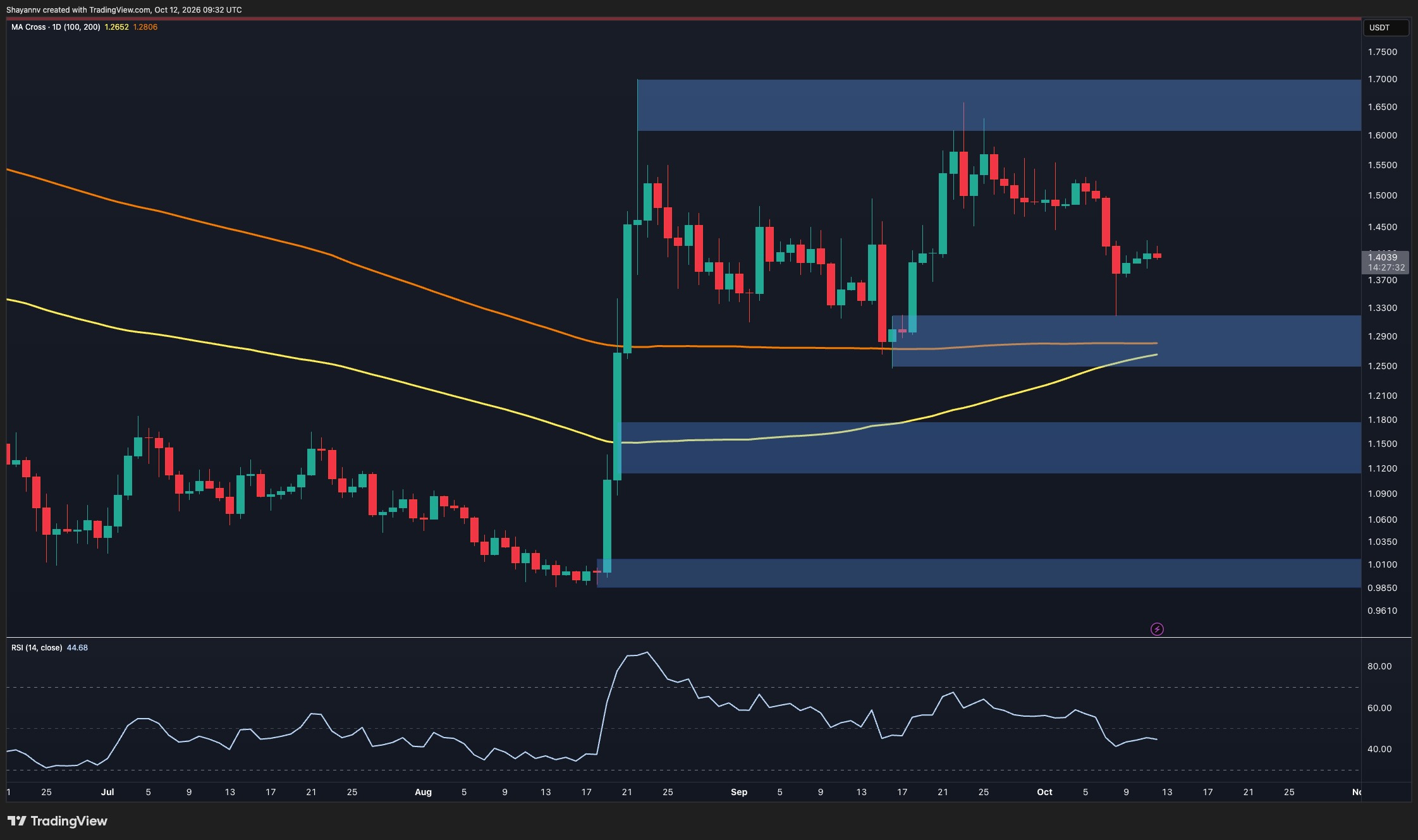
On the daily timeframe, Ripple’s token has extended its correction following the rejection from the $1.61–$1.70 resistance zone. The latest selloff pushed the price below the $1.48–$1.50 consolidation area, with a long lower wick reaching approximately $1.32 before buyers stepped in. Subsequent candles show stabilization around $1.40, although the recovery has so far lacked strong follow-through.
The $1.25–$1.32 demand zone remains particularly important. It overlaps with the 100-day and 200-day moving averages, positioned near $1.265 and $1.281, respectively. The rising 100-day average is approaching the 200-day average from below, suggesting a potential bullish crossover, but confirmation is still pending. Meanwhile, the daily RSI sits around 45, indicating that momentum remains below neutral despite the bounce.
Holding the demand zone could preserve the broader recovery and support another attempt toward the $1.48–$1.52 resistance area. Beyond that, the $1.61–$1.70 supply zone remains the main upside barrier. Conversely, a sustained break below $1.25 would weaken the recovery structure and expose the next highlighted support zone at $1.11–$1.18.
XRP/USDT 4-Hour Chart
The 4-hour chart shows XRP moving within a descending channel, with successive lower highs maintaining the corrective trend. The recent decline broke through the $1.43–$1.45 support zone before briefly reaching the channel’s lower boundary near $1.32. Buyers then drove a rebound toward $1.42, where the recovery encountered renewed selling pressure.
The former $1.43–$1.45 demand zone now represents an overhead resistance area. Its proximity to the descending channel’s upper boundary creates a significant obstacle for buyers. A sustained move above both would provide an initial signal that selling pressure is easing and could open the way toward the $1.48–$1.52 resistance region.
Until that breakout occurs, the rebound appears corrective. Losing nearby support around $1.38 would bring the $1.34–$1.35 area back into focus, followed by the broader $1.25–$1.32 demand zone. The reaction to the $1.43–$1.45 resistance area will therefore be important in determining whether XRP can escape the descending channel or remains vulnerable to another decline.

The post Ripple Price Analysis: What’s Next for XRP After Another Rejection at Key Resistance? appeared first on CryptoPotato.
Kraken is gearing up to launch its crypto services in the United Arab Emirates after receiving full market approval from Dubai’s Virtual Asset Regulatory Authority (VARA).
The approval clears the way for its parent company, Payward, to operate as a regulated virtual asset service provider in Dubai. The company will be able to serve retail, professional, and institutional investors in the region.
Kraken’s UAE Launch
Initially, UAE customers will get access to spot and margin trading, with trading pairs denominated in the UAE dirham (AED). Users will also be able to deposit and withdraw funds directly in dirhams. They may no longer need to rely on other currencies to fund their trading activity.
The launch lineup will also include on-chain staking, xStocks, and Krak, Kraken’s service for crypto transfers. Institutional clients will have access to over-the-counter (OTC) spot trading and Kraken Prime. The company also plans to introduce more products over time.
For instance, crypto derivatives and a wider range of yield opportunities are expected to arrive later in 2026 and into 2027. However, these services will depend on further regulatory approval. Payward also plans to offer its trading infrastructure to regional partners through an embedded trading-as-a-service model.
The latest approval is the final stage of VARA’s licensing process. It follows preliminary approval granted to Payward in May 2026, which allowed the company to complete its operational setup before bringing customers on board. Payward currently holds more than 100 licenses and registrations worldwide. Its regulatory footprint spans Europe, the Americas, Asia-Pacific and the Middle East.
Commenting on the development, Arjun Sethi, Co-CEO of Payward and Kraken, said,
“From launch, clients in the UAE get the same order book and multi-asset coverage we run in every other market, under one of the clearest regulatory frameworks in the world. Payward’s regulatory infrastructure now connects them directly to Kraken’s market-leading liquidity, along with a growing range of opportunities across digital assets.”
Other Major Deals
Kraken has had a busy year. Deutsche Börse kicked things off in April with a $200 million investment in the crypto exchange. In June, Kraken joined forces with Maple to bring institutional-style lending protections onto the blockchain through a facility for loans backed by digital assets.
Then came Nasdaq in September, which agreed to put another $100 million into Payward. That deal valued the parent company at $21 billion. The two entities are also working on tokenized stocks, and a launch is targeted for the second quarter of 2027.
The post Kraken Expands Into the UAE After Clearing Dubai’s Final Regulatory Hurdle appeared first on CryptoPotato.
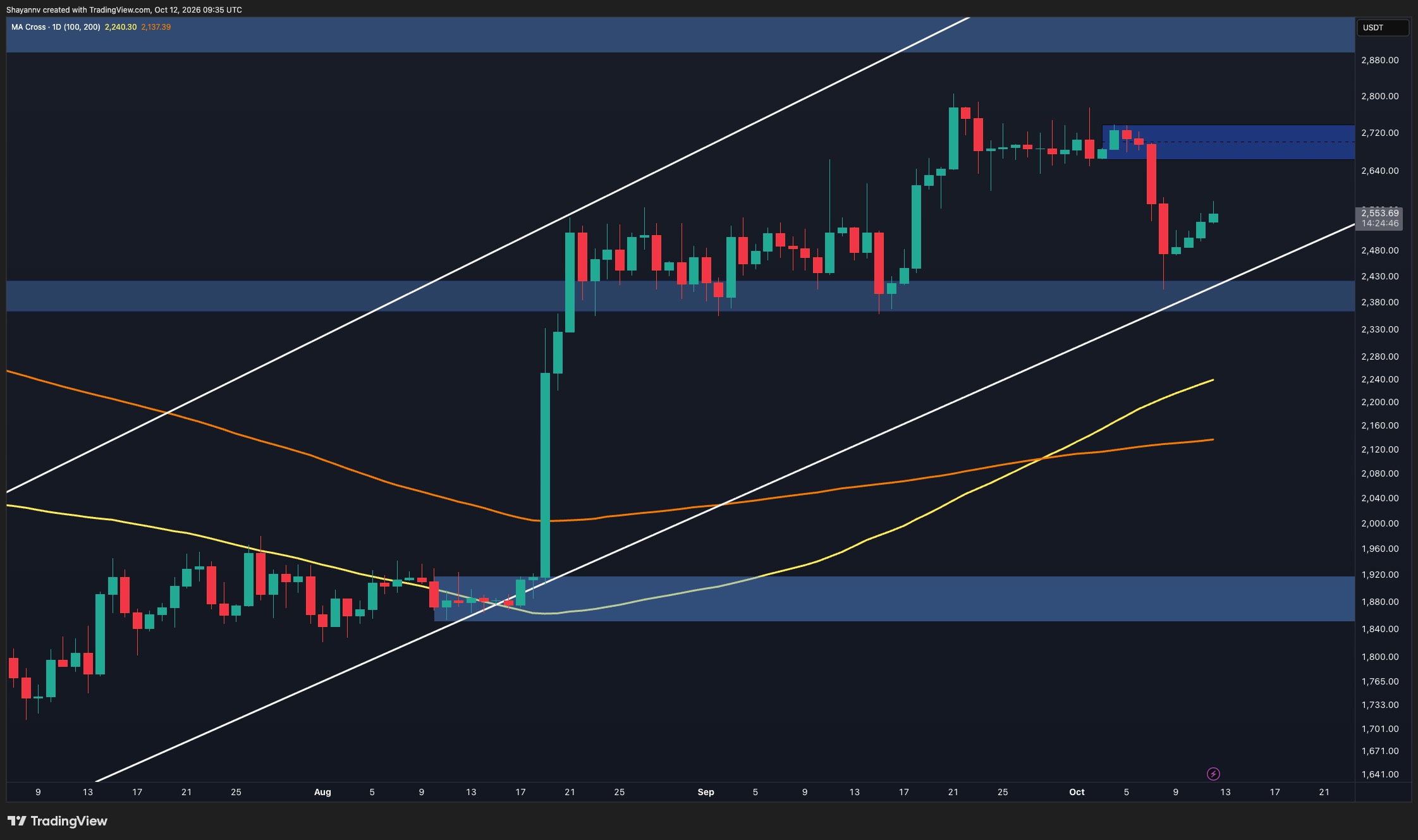
Ethereum is recovering toward $2.55K after buyers responded to the latest selloff near a key demand area. The rebound preserves the broader ascending structure, but ETH still needs to reclaim overhead supply to demonstrate a more durable recovery.
Ethereum Price Analysis: The Daily Chart
On the daily timeframe, Ethereum’s correction extended into the $2.36K–$2.42K demand zone before producing a notable lower wick and several recovery candles. The price has since climbed toward $2.55K, suggesting that buyers are defending the region following the sharp decline from the recent consolidation.
ETH also remains within the broader ascending channel and above both major moving averages. The 100-day average sits near $2.24K, above the 200-day average around $2.14K, maintaining the bullish crossover established earlier. However, this supportive backdrop has yet to translate into a recovery of the lost resistance levels.
The highlighted $2.66K–$2.74K supply zone represents the main nearby barrier. Reclaiming this area would strengthen the recovery scenario and allow another challenge of the recent $2.8K high, followed by the $2.9K–$3K resistance region.
Conversely, renewed selling would bring the $2.36K–$2.42K demand zone and nearby channel support back into focus. A sustained break below this confluence would weaken the broader structure and expose the moving-average region around $2.14K–$2.24K.
ETH/USDT 4-Hour Chart
The 4-hour chart shows Ethereum rebounding after briefly piercing the $2.43K–$2.48K demand zone and the lower ascending trendline. The subsequent recovery above both suggests rejection of lower prices, although the earlier selloff has left ETH trading beneath the rising structure’s middle trendline.
Holding the reclaimed trendline around $2.49K–$2.5K would support a continuation of the rebound toward the $2.6K area. Beyond that, the $2.66K–$2.74K supply zone overlaps with the broken middle trendline, creating an important resistance confluence where sellers could reappear.
Until Ethereum clears that region, the advance remains a recovery within a weakened short-term structure. Losing $2.49K would increase the likelihood of another test of the $2.43K–$2.48K demand zone. A decisive breakdown below the recent wick low around $2.4K could then expose the next highlighted support area at $2.22K–$2.28K.

Sentiment Analysis
The Ethereum Spot Average Order Size chart classifies spot activity by average trade size, distinguishing normal orders from retail-sized and whale-sized activity. It provides context for participant size, although it does not independently identify whether larger traders are buying or selling.
The latest observations remain predominantly in the normal-order category, including the recent advance toward $2.7K and the subsequent correction toward $2.5K. This contrasts with the frequent whale-sized readings visible during earlier periods, particularly around the June–August price base.
Consequently, the current rebound is not accompanied by a visible return of whale-sized average orders. This does not establish that large investors are absent or that the recovery must fail, but the metric offers limited confirmation of renewed large-order participation. A shift toward whale-sized readings alongside a sustained price recovery would provide additional context, while buying direction would still need confirmation from other data.

The post Ethereum Price Prediction: Relief Rally or Another ETH Dump Next? appeared first on CryptoPotato.


