Cryptocurrency Posts
Crypto Briefing
Rising gilt yields signal potential for sustained higher borrowing costs, impacting economic growth and influencing Bank of England's rate decisions.
The post UK four-year gilt yields rise amid rate hike expectations appeared first on Crypto Briefing.
Escalating Houthi-Saudi tensions may lead to airspace closures, impacting regional stability and international aviation market expectations.
The post Houthis target Saudi Aramco HQ with missile and drone attacks appeared first on Crypto Briefing.
This initiative accelerates European AI research but underscores reliance on US tech, highlighting the need for sovereign AI infrastructure development.
The post Google DeepMind and Google Cloud offer $3 million in compute credits to European researchers appeared first on Crypto Briefing.
Standard Chartered's move signals growing mainstream acceptance of crypto in banking, enhancing UAE's status as a regulated crypto hub.
The post Standard Chartered opens direct Bitcoin and ether trading to affluent UAE clients appeared first on Crypto Briefing.
The potential escalation in hostilities could destabilize the region, prompting shifts in military strategies and impacting geopolitical dynamics.
The post Yemeni Armed Forces to announce qualitative military operation deep inside Saudi territory appeared first on Crypto Briefing.
Bitcoin Magazine
Bitcoin Magazine
Kraken Parent Payward Wins Full Dubai License, Plans UAE Launch
Crypto exchange Kraken’s parent company Payward has said it has plans to launch in the United Arab Emirates.
After receiving full market approval from Dubai’s Virtual Asset Regulatory Authority, Payward said Tuesday that Payward can now operate as a regulated virtual asset service provider serving retail, professional and institutional investors.
It follows a preliminary approval in May that allowed the company to complete its operational set-up ahead of onboarding clients.
JUST IN:
— Bitcoin Magazine (@BitcoinMagazine) October 13, 2026Kraken has been approved to launch Bitcoin and crypto asset trading in the UAE
pic.twitter.com/H7gJNwK3KS
At launch, Kraken clients in the UAE will be able to trade spot and margin with dirham-denominated pairs and fund and withdraw directly in dirhams.
They’ll also have access to on-chain staking, xStocks tokenized equities and Krak for crypto transfers, while institutional clients gain OTC spot trading and Kraken Prime. Crypto derivatives and new yield products are expected later in 2026 and into 2027, subject to regulatory approval.
Payward holds more than 100 licenses and registrations worldwide, spanning Europe, the Americas, Asia-Pacific and the Middle East.
The expansion comes as the company increasingly makes a number of deals. In September, Bloomberg reported that Nasdaq Inc. was investing $100 million in Payward in a deal valuing the company at $21 billion. Kraken will distribute Nasdaq’s tokenized stocks on its own platform, according to the report.
Payward and SoFi Technologies also recently announced a deal to route SoFi customers’ crypto orders through Kraken Prime, Kraken’s prime brokerage arm launched in 2025, and to list SoFi’s stablecoin on the exchange.
Kraken, like other crypto exchanges, is pushing into the traditional finance world, allowing users to trade stocks, bonds and other assets. The company has sold its app as a “primary account for everything.”
This post Kraken Parent Payward Wins Full Dubai License, Plans UAE Launch first appeared on Bitcoin Magazine and is written by Mathew Di Salvo.
Bitcoin Magazine
Researchers Build First Working Post-Quantum Defense for Bitcoin’s Lightning Network
Whether or not quantum computers will break Bitcoin one day is a hot topic.
But what about second-layer solutions like Lightning?
Well, researchers from East Texas A&M University, North American University, Florida Gulf Coast University, and Florida Institute of Technology have been working on that.
JUST IN: East Texas A&M University students announce they've built the first post-quantum security solution for the Bitcoin Lightning Network
— Bitcoin Magazine (@BitcoinMagazine) September 22, 2026pic.twitter.com/GJYL2a9g2G
In an announcement Tuesday, the team of researchers said that they built what they describe as the first full post-quantum security design for the Lightning Network.
As first uncovered in a research paper in September, the team said they added post-quantum cryptography to Lightning’s communications, payment requests and related systems, implemented in Rust-Lightning.
It works like this: The solution layers new quantum-resistant cryptography on top of Lightning’s existing cryptography rather than replacing it. It uses ML-DSA digital signatures and ML-KEM key exchange, post-quantum algorithms standardized by the U.S. National Institute of Standards and Technology, alongside the classical methods Lightning already relies on.
In this hybrid design, an attacker would have to break both the new and the old cryptography to compromise a connection or forge a payment request.
According to the team led by Dr. Ahmet Kurt, an assistant professor in East Texas A&M’s Department of Computer Science and Information Systems, it took about three to four months and roughly 11,000 lines of code — and it’s a complete working implementation, not just a small demo.
Lightning lets users make fast, cheap Bitcoin payments through a network of off-chain channels instead of recording each one on the blockchain.
Its cryptography could eventually be broken by powerful quantum computers, and that risk exists even if Bitcoin itself gets upgraded, because Lightning has its own communication and payment systems, the team said.
They added that their work demonstrates that Lightning’s off-chain systems can begin preparing for the quantum era independently while others focus on solutions for the mainnet.
Quantum researchers have warned that a time will come when Bitcoin’s software — which underpins the biggest and strongest computer network in the world — will need to be upgraded to deal with quantum computing.
While some crypto VC firms have urged action, top developers in the space have argued that many of today’s quantum computers have limited capabilities.
Still, they have noted that their development could arrive unexpectedly — just like advances with artificial intelligence — and have started developing some solutions, including top Bitcoin infrastructure firm, Blockstream.
This post Researchers Build First Working Post-Quantum Defense for Bitcoin’s Lightning Network first appeared on Bitcoin Magazine and is written by Mathew Di Salvo.
Bitcoin Magazine
The Amount of Bitcoin on Exchanges Is Shrinking. Is a Rally Imminent?
Bitcoin’s price could be due a move upwards as the supply of the leading cryptocurrency on exchanges shrinks.
That’s according to a researcher at data firm CryptoQuant, who wrote in a Monday report that bitcoin on exchanges has dropped to 2.67 million from 2.8 million since February.
The price of bitcoin was recently $83,485, unmoved over a 24-hour period but up 8% over the past 30 days after having its best quarter in years. Its surge in August and September has led a number of analysts to declare the bear market is over.
“If buying demand continues to improve while exchange supply remains low, BTC could benefit from a supply-demand imbalance, creating favorable conditions for a longer-term upward trend,” the report by on-chain researcher Rei Researcher read.
It added: “More importantly, in recent weeks, bitcoin has recovered from its lows while exchange reserves have continued to decline. This is a notable development, suggesting that the supply readily available for trading is decreasing even as the market recovers.”
The report further noted that it was possible investors were taking bitcoin off exchanges to put in cold storage solutions.
Bitcoin’s price was mostly trading under $65,000 for the first half of 2026. The coin spent most of this year in a bear market following the all-time high of $126,080 it hit in October 2025.
But that all changed in August. News that the U.S. Treasury would double the size of its liquidity-support buyback operations, weakening the dollar but strengthening bitcoin and other non-yield bearing assets.
Now, the so-called debasement trade — where investors throw money at an asset to hedge against a currency losing its value — is hot again. Bitcoin is benefiting from the trade, analysts say, as it did in 2024 and 2025.
Bitcoin’s price is still more than 30% below its record.
This post The Amount of Bitcoin on Exchanges Is Shrinking. Is a Rally Imminent? first appeared on Bitcoin Magazine and is written by Mathew Di Salvo.
Bitcoin Magazine
Trezor Reduces Number of Resellers Following Ledger Drainage Incident
Hardware manufacturer Trezor has said it has reduced the number of resellers it works with following supply-chain incidents related to its competitor Ledger.
The Prague, Czech Republic-based company added in a Tuesday post on X that it was in the process of checking which vendors it works with.
It added that there were no reports of any issues with Trezor devices. “Let us be very clear: there is not a single piece of evidence that Trezor devices have been compromised,” the company wrote.
“This is a preventive step, taken out of an abundance of caution.”
Signing device manufacturer Ledger last week said it had started an investigation after customers in South East Asia reported they’d lost funds after buying from Malaysia-based reseller, CryptoBilis.
Ledger then said that one of the impacted users’ devices contained an unauthorized hardware implant.
More reports of what appear to be tampered devices have since surfaced on social media but Ledger said Tuesday that only devices sold through CryptoBilis have been linked to lost funds.
It added that it had only confirmed an unauthorized hardware implant in one affected user’s device. The implant, according to Ledger, was able to read a seedphrase when it appeared on the device.
Ledger did not reveal how much money had been lost but blockchain investigator Specter said $86 million had been drained from devices.
“We have not confirmed the total number of affected users or the total value lost,” Ledger added on X. “Figures circulating online come from third parties and Ledger has not fully verified them.”
Ledger did not respond to Bitcoin Magazine’s questions.
CryptoBilis has also stopped selling devices, Ledger added, and advised customers who bought from CryptoBilis to not set up their devices and contact the Ledger support team.
Criminals have been targeting hardware wallets this year. Hackers in July were able to steal close to $120 million in bitcoin from Coldcard users due to a firmware bug in the devices.
Canadian company Coinkite, which makes the popular products, said that the bug led to faulty seed generation, allowing hackers to guess investor seedphrases.
In a separate incident, hardware wallet manufacturer Trezor last month reported that close to 81,000 customers had their details leaked after its third-party fulfillment partner had data stolen.
Scammers earlier this year were able to get hold of customer information via crypto wallet Ledger’s payment processor Global-e to send phishing emails.
This post Trezor Reduces Number of Resellers Following Ledger Drainage Incident first appeared on Bitcoin Magazine and is written by Mathew Di Salvo.
Bitcoin Magazine
Strive Buys More Bitcoin, Crosses 30,000 BTC Mark
Nasdaq-listed Strive isn’t slowing down with its bitcoin buys.
The company now has more than 30,000 BTC after buying 3,311 coins last week, according to a Tuesday filing.
Strive now holds 32,773 coins worth $2.7 billion at today’s prices, keeping its position as the fifth biggest publicly traded bitcoin company, according to Bitcoin Treasuries.
Strategy, Twenty One, Metaplanet, and MARA all hold more bitcoin than Strive.
BREAKING:
— Bitcoin Magazine (@BitcoinMagazine) October 13, 2026Public company Strive purchases 3,311 Bitcoin worth $275 million!
This brings their total to 32,773 BTC
Strive’s stock (ASST) was trading slightly lower on Tuesday. Unlike other treasuries, though, Strive shares are up significantly this year: year-to-date, ASST has risen by close to 60%.
A number of top bitcoin treasuries have seen their stock plummet this year since the price of bitcoin took a hit. Some top treasuries have had to sell bitcoin or rethink their model altogether.
Dallas, Texas-based Strive debuted as an official bitcoin treasury last year, following in the footsteps of software company Strategy, the biggest corporate holder of bitcoin.
Unlike Strategy, though, Strive hasn’t used debt to buy the cryptocurrency. CEO Matt Cole has described the company as debt-free with zero margin requirements and zero encumbered bitcoin.
Like with other digital asset treasuries, the idea is that investors can get amplified returns from Strive’s stock.
In January 2026, it completed the acquisition of Semler Scientific in an all-stock deal — the first instance of a publicly traded Bitcoin treasury company acquiring another such company.
The company was founded by former Ohio gubernatorial candidate and tech entrepreneur Vivek Ramaswamy.
This post Strive Buys More Bitcoin, Crosses 30,000 BTC Mark first appeared on Bitcoin Magazine and is written by Mathew Di Salvo.
CryptoSlate
Shunyet Jan describes Binance’s perpetual pricing method, while 21Shares’ certificate adds issuer-only recourse, affiliated note terms and costs beyond the 1% fee.
Read the full story on CryptoSlate
Understand the crypto stories that matter and what to watch next. Get The Catalyst in your inbox
FIU plans withdrawal guidance through DAXA with operators’ cooperation as website restrictions raise access concerns for existing users.
Read the full story on CryptoSlate
Understand the crypto stories that matter and what to watch next. Get The Catalyst in your inbox
SkyAI reports about 80% of the required cash and approximately 600,000 SOL retained, while its proposed tender still carries waivable conditions.
Read the full story on CryptoSlate
Understand the crypto stories that matter and what to watch next. Get The Catalyst in your inbox
Metaplanet plans to raise $329 million to refinance Bitcoin-backed loans and fund share buybacks after its stock has declined 90% from its peak. On Oct. 13, the Japanese Bitcoin treasury company announced plans to issue ¥52 billion ($329 million) in unsecured, zero-coupon Euro-yen convertible bonds due in 2031. Expected to close on Oct. 29, the…
Read the full story on CryptoSlate
Understand the crypto stories that matter and what to watch next. Get The Catalyst in your inbox
Historical estimates point to stronger USDC growth sensitivity to deposit repricing, while exchange rewards complicate adoption forecasts.
Read the full story on CryptoSlate
Understand the crypto stories that matter and what to watch next. Get The Catalyst in your inbox
CryptoTicker.io
Telegram widened access to its own wallet, called Money, on Friday 9 October 2026. Since then, far more users can send and receive Gram directly inside the messenger and pay for digital collectibles with it. The price jumped to $1.4871 that Friday and is back at $1.3761 this Wednesday, according to CoinGecko on 14 October at around 01:00. The gain from the news has been given back in full within five days.
For holders in Europe, the wallet is still the more important half of the story. Money is built to be non-custodial: the private keys sit with the user alone. Telegram cannot view them, cannot reverse a transfer and cannot restore a lost balance. Switching the feature on means taking on a responsibility that someone else carries on an exchange account.
What Telegram changed about the Money wallet on 9 October
Money is not a new product but the new name of the former Gram Wallet. Telegram announced it in July, and a limited launch ran for selected accounts in August. On 9 October that limit largely fell away: access now reaches beyond the selected circle and is being rolled out more broadly across the messenger's audience, which numbers more than a billion people.
The wording matters. Neither Telegram nor the outlets reporting on it say that every account already has the feature. FinanceFeeds states explicitly that the announcement is no evidence of a full rollout, and crypto.news likewise speaks of an expansion beyond the users selected so far. If you cannot see the wallet in your app yet, you have done nothing wrong.
Functionally, Money does two things: it holds and sends Gram, and it buys Telegram gifts and collectible usernames. Transfers from an existing Walt account are described by the provider as a matter of a few steps, credited immediately and without a network fee.
Money and Walt: two Telegram wallets with two custody models
This is where most of the confusion arises, so here is the difference in one sentence per product. Money is the new, non-custodial wallet inside the messenger: the keys sit with the user. Walt is the older wallet service, which continues under its own brand and holds the balance on the user's behalf.
The term behind it: a non-custodial wallet is one in which only the user holds the private key and nobody else can reach the balance. The counterpart is custodial safekeeping, where a provider holds the key and moves the balance on request, much as a bank runs an account.
Both models have a price. With a custodial account you carry the risk that the provider fails, is suspended or halts withdrawals. With your own wallet you carry the risk of losing the key. Which design suits you depends less on the coin than on the sum involved and on how often you move it. An overview of the designs and their pitfalls is in the software wallet comparison.
Non-custodial means nobody can restore your balance
The sentence sounds technical and has a very practical consequence. If the phone is lost, stolen or ends up in the dishwasher, your Gram stands or falls with the recovery phrase, the sequence of words from which the private key can be recalculated. Telegram does not have it. There is no hotline, no ID upload and no form that could retrieve access for you.
A wrongly addressed transfer is just as final. A transaction on the blockchain cannot be cancelled, and with a non-custodial wallet there is nobody who could try on your behalf. The same mechanism has in the past left Gram transfers stuck in the network when a required comment was missing. We took that case apart on the network data at the end of September.
In practice, that means the recovery phrase belongs offline, on paper or better in metal, in two separate places. A screenshot in your photo library is not a backup but a copy in the cloud.

The Gram price this week: $1.38 and 9.5 percent below the weekly high
The figures for the past seven days, all from CoinGecko as of Wednesday 14 October at around 01:00: Gram stands at $1.3761, or roughly €1.23. The weekly high was $1.5198 on 7 October, the weekly low $1.3480 on 8 October. Over seven days that works out to a loss of 9.45 percent, over 30 days a gain of 2.47 percent.
Market capitalisation is around $3.89 billion, which corresponds to rank 32. Roughly 2.83 billion Gram are in circulation. Trading volume over 24 hours is around $31 million, so less than one percent of market capitalisation. The all-time high of $8.25 dates from 14 June 2024, leaving today's price 83.3 percent below it.
On the move on the day of the news itself, the figures diverge, and we are not smoothing them over. In the report linked above, crypto.news puts Friday at around nine percent. Our own count of CoinGecko's hourly values comes out somewhat lower: from $1.3762 at 01:00 to $1.4871 at 14:00, so a little over eight percent. Depending on which start and end point a newsroom picks, a different number comes out. The range from just under seven to just under nine percent describes the same event.
The Toncoin to Gram rename in June played out almost identically
For this article we set CoinGecko's daily values around this year's two big Telegram stories side by side. The pattern repeats strikingly closely.
On 15 June 2026 Toncoin was officially renamed Gram after a community vote passed; what the switch meant for holders in Europe is something we described on 27 September in Toncoin is now Gram. The price stood at $1.7529 that day, the highest point of that week. Two weeks later, on 29 June, it was at $1.5864. That is 9.5 percent lower.
On 9 October 2026 Telegram opened the Money wallet and the price rose to $1.4871. Five days later it is at $1.3761, so 7.5 percent lower. Two pieces of news, both read as milestones, and both times the premium was eaten up within two weeks.
A second point from the same rename is still visible today: the official guide recommended displaying "Gram (prev. Toncoin)" for a transitional period of three months. CoinGecko still carries the name in exactly that form four months after the cut-off date. The blockchain itself is still called The Open Network, or TON. Only the token's name and ticker were changed.
A wallet opening rarely carries the price for longer than a day
Why does news like this fizzle out? With infrastructure stories the mechanism is almost always the same. A wallet creates no additional demand for the token, it only lowers the barrier to using it. On the day of the news, buying comes from traders reacting to that very headline, and selling comes from the same traders as soon as the headline has run its course.
Add to that the size of the market. With daily volume of around $31 million against a market capitalisation of $3.89 billion, even a mid-sized sale moves the price noticeably. Inflows that come from actual use, by contrast, work slowly: first people have to have the feature switched on at all, then they have to buy Gram in order to pay for something with it.
That is exactly why the cautious wording of the announcement is no side issue. As long as there is no evidence of how many of the more than one billion accounts really see the wallet, the usage effect remains an expectation rather than a number.
Our assessment: distribution decides, not the announcement
From the newsroom's point of view, the Money opening is the most important Gram story since the rename, and it still does not justify a higher price while three pieces of evidence are missing. First, no source gives a figure for how many accounts actually have the wallet today; FinanceFeeds explicitly treats a full rollout as unproven. Second, the market itself shows that it does not trust the news: 7.5 percent below the high of the news day, on volume of less than one percent of market capitalisation. Third, 15 June offers a directly comparable case in which 9.5 percent was gone after two weeks.
There is a serious argument on the other side: a payment route built into a messenger with this reach starts from a different position than an app you first have to download. If Telegram really does switch the feature on across the board over the coming months, demand will come from payments rather than from a headline. That cannot be evidenced today; it can be measured later against the network's transaction counts. None of this is a recommendation to buy, and a total loss remains possible with any token.

Buying Gram in Europe: exchanges with MiCA authorisation
A wallet is no substitute for a way to buy. You still get Gram through a trading venue, and now that the European MiCA regulation applies in full, providers actively targeting customers in the EU need an authorisation as a crypto-asset service provider for it. MiCA is the EU regulation on markets in crypto-assets, which sets authorisation, capital requirements and disclosure duties uniformly across Europe.
In practice that means two things for your purchase. Before your first deposit you should check whether the provider holds a MiCA authorisation from a European supervisor, because deposit protection questions, complaint routes and tax documentation all depend on it. And you should look at total costs rather than the stated order fee alone: with smaller altcoins the larger share of the cost regularly sits in the spread, the gap between the buying and the selling price. Which venues hold the authorisation is set out in the overview of regulated crypto exchanges below.
Holding period and tax: what a transfer into your own wallet triggers
Moving from an exchange into the Money wallet regularly raises the same worry. The reassurance first: a transfer between two wallets that both belong to you is not a sale. In Germany it triggers no taxable event and does not restart the holding period under section 23 of the Income Tax Act.
Documentation is what counts. For the one-year holding period, the date of acquisition is what matters, and you have to be able to evidence it once the coins no longer sit on the platform where you bought them. So keep the exchange's purchase record and note the transaction ID of the transfer. Anyone moving coins between platforms and their own wallet more often loses that thread quickly.
Two points are less obvious. If you buy a digital collectible with Gram, for tax purposes that is a disposal of the Gram and not merely a purchase, because you are handing over a crypto asset. And network fees incurred when sending count towards acquisition costs or disposal costs respectively. With the fee-free transfers from a Walt account that Telegram describes, that item does not arise.
Levels above and below: $1.35 and $1.52
As an observation, not a price target: on the downside the next reference is the weekly low of $1.3480 from 8 October. The current price of $1.3761 sits only about two percent above it, so the distance is small. Below that comes the round level of $1.30.
On the upside the weekly high of $1.5198 from 7 October is the first hurdle, with the news day's intraday high of $1.4871 in between. The fact that this high was sold off completely within five days makes it the obvious yardstick: only above it would the wallet news really have carried the price.
Scams around the name change
A name change is an invitation to fraudsters, and the scheme has run unchanged since June. The official rename guide is explicit: balances never had to be swapped, claimed or moved, and holdings stayed as they were. Any site asking you to "migrate" or "claim" Gram is therefore an attempted fraud.
The wallet opening adds a second variant. Anyone who receives a message offering to help them "unlock" Money and asking for the recovery phrase in the process is dealing with an attack. No genuine wallet, no support desk and no messenger ever asks for that sequence of words. You enter it only in the device itself, when you are restoring a wallet.
An older principle still applies too: a second account with the same name and picture says nothing about authenticity. Always check features in the app itself and follow no link from an unsolicited message.
Money wallet: without the recovery phrase the balance is gone
The wallet opening is good news for how usable Gram is and, so far, none for the price. If you switch the feature on, the backup is what matters most.
- Secure the recovery phrase offline before you move any balance. Two copies in two places, on paper or in metal, never as a screenshot. For larger holdings a separate hardware solution remains the more robust choice; the designs are in the hardware wallet comparison.
- Start with a small amount. Send a sum whose loss would not hurt you first, and bring it back once. Only when both directions have worked should the rest follow. For the purchase itself, use a provider with European authorisation, as listed among the regulated crypto exchanges.
- Record the acquisition date and the transaction ID. That costs a minute during the move and later decides whether you can evidence the one-year holding period to the tax office. The tax tools take the note-keeping off your hands.
(As of October 14, 2026. This article is not investment advice. Prices and fee structures change; check the terms with the provider before you buy.)
One of the world's largest trading banks now holds a stablecoin that is hard to buy through regulated channels in Europe. Standard Chartered began institutional custody for Ripple USD, or RLUSD, on 12 October 2026, and specifically on the XRP Ledger. The mandate sits with the bank's branch in the Dubai International Financial Centre, which is supervised by the Dubai Financial Services Authority. For retail investors in Europe, availability does not change in the short term. What the move does show is where RLUSD is regulated today and where it is not: in Dubai and New York, not in the European Union.
A stablecoin is a crypto asset whose price is pegged to a currency, here the US dollar. RLUSD is issued by Ripple, the company behind XRP. The dollar peg does not hold by itself. It rests on reserves the issuer sets aside and on the promise to redeem tokens at face value at any time. That promise is exactly what the EU has regulated since 2024 under the Markets in Crypto-Assets Regulation, or MiCA.
What Standard Chartered launched on 12 October: custody for RLUSD on the XRP Ledger
The bank is adding RLUSD to its custody infrastructure for digital assets. Eligible institutional clients can now hold the stablecoin at the bank instead of keeping it on an exchange or in a wallet of their own. Custody means precisely that: the bank holds the keys and is liable to the client for the balance. It does not issue the stablecoin and it does not guarantee its backing.
Waqar Chaudry, Global Head of Digital Assets in Securities Services at Standard Chartered, framed the step as a response to client demand: institutional clients want to take part in digital asset markets. That is the logic behind the offering. A fund, an insurer or a payment service provider is often only allowed to hold positions if a supervised institution keeps them in custody. Without that route, a stablecoin stays out of reach for such firms, however well it works technically.
DIFC and DFSA: why custody sits in Dubai and not in Frankfurt
The Dubai International Financial Centre is a financial zone with its own law and its own supervisor. The Dubai Financial Services Authority issues licences there and oversees the institutions. Standard Chartered is using this branch because it is authorised for the custody of digital assets.
The difference from a launch in Frankfurt or Luxembourg is more than geographic. A custody licence in Dubai says nothing about whether the stablecoin held in custody may be issued or offered in the EU. Those are two separate questions, answered by two separate supervisors. If you are based in Europe, the Dubai custody arrangement gives you no new access to RLUSD.
RLUSD by the numbers: $2.41 billion market capitalisation and rank 44
RLUSD had a market capitalisation of roughly $2.41 billion on 13 October 2026 according to CoinGecko, at a price of $1.00 and around 2.41 billion tokens in circulation. Some $204 million changed hands over 24 hours. That puts RLUSD at number 44 in the ranking by market capitalisation.
For comparison, same source and same date: Tether stood at roughly $184 billion, USDC at roughly $72.7 billion. RLUSD has grown well, then, but remains a small issuer. Reports on the announcement put the entire stablecoin market at around $306 billion, leaving RLUSD at less than one percent of it. In August its market capitalisation passed two billion dollars for the first time; of that supply, roughly $988 million had been issued on the XRP Ledger, the rest on other blockchains.
That split matters more to the story than it first appears. Standard Chartered is explicitly taking custody of the version on the XRP Ledger. Anyone holding RLUSD on Ethereum is not covered by this offering.

Trading collateral at LMAX: what collateral mirroring means and what is still missing
Alongside custody, the announcement carries a second item, and that one is not yet in operation. Standard Chartered, Ripple and the LMAX Group want institutional clients to be able to post RLUSD as collateral for certain trading products at LMAX. The mechanism is called collateral mirroring: the bank mirrors the value of the eligible collateral to the trading venue while the tokens stay in the bank's custody.
Collateral is an asset you pledge so that your trading counterparty is covered if you make a loss. Normally that collateral moves to the trading venue. Mirroring is meant to remove that step, which lowers counterparty risk towards the platform.
One point decides how to read this: the integration is announced, not launched. According to the reporting, it depends on final documentation, successful testing, applicable law, internal approvals and the question of which jurisdictions are ready. No launch date was given. Readers should therefore keep the custody launch and the collateral function apart.
No entry in the ESMA register: RLUSD is absent from the authorised e-money tokens
This is where it gets concrete for investors in Europe. ESMA, the European securities regulator, maintains a register of e-money tokens for which a MiCA whitepaper has been filed. Only those may be offered publicly in the EU and listed by authorised service providers.
The cryptoticker.io stablecoin overview reviewed that register as of 30 September 2026. The result for RLUSD: no entry. New York and Dubai count as its supervisors there, not the EU. Authorised under the same review are USDC, EURC, Revolut's EURR, EURCV, USDG, EURe, EURI, EURQ and EURAU, among others. You can check the official register yourself at ESMA; it is republished at intervals.
Ripple has secured licences in Europe, and precision pays off here. According to reports, Luxembourg's regulator CSSF granted the company an e-money institution authorisation on 2 February 2026 and a MiCA crypto-asset service provider authorisation on 6 July 2026. On the status of the stablecoin itself, accounts diverge: some reports speak of full MiCA authorisation across 30 countries, others only of a provisional approval. The register check at the end of September shows no entry for RLUSD. We report that for what it is, an open question with conflicting sources.
E-money token and service provider licence: what MiCA keeps apart
Two terms are regularly confused, and the confusion leads to wrong conclusions.
An e-money token, or EMT, is a crypto asset that tracks the value of an official currency. Issuing one in the EU requires authorisation as an e-money institution or as a credit institution, plus a whitepaper that enters the ESMA register. That concerns the product.
A crypto-asset service provider, or CASP, is a company that holds, exchanges or brokers crypto assets. Its authorisation concerns the business, not an individual token. A CASP licence for Ripple therefore permits services in the EU, but it does not automatically turn RLUSD into an authorised e-money token. Which obligations apply in detail is set out in the MiCA licence rules.

Stablecoins in a European portfolio: where MiCA authorisation shows up in practice
In practice that leaves a simple order of checks. First, see whether the stablecoin appears in the ESMA register. Then see whether your provider carries it at all, because a regulated crypto exchange in Europe will usually drop an unauthorised token from its offering before the supervisor asks.
The USDT case showed that this is no grey theory. ESMA has set a deadline of 8 January 2027 for exiting unauthorised stablecoins; what that means in practice is something we described on 8 October in our piece on the ESMA deadline and the USDT exit. The Dubai custody launch has since added a second piece that shows the same dividing line from the other side: institutional routes appear first where supervisors allow them, and for RLUSD that is currently not the EU.
The difference between holding and buying matters. If you already own RLUSD, no rule forces you to sell. MiCA obligations are addressed to issuers and service providers, not to you as a private individual. The bottleneck shows up at the point of purchase, at listing, and in the question of who offers you the token in Europe at all.
Custody risk with stablecoins: issuer, custodian and backing viewed separately
With a stablecoin, three risks sit next to each other and are often lumped together.
Issuer risk sits with Ripple. It is the question of whether reserves are sufficient and whether redemption at face value works even when many holders want out at the same time. Custody risk sits with whoever holds the keys: an exchange, a bank such as Standard Chartered now, or you. Regulatory risk is that a token may be offered in one jurisdiction and not in another.
The news from Dubai improves the second point, for institutional clients of a supervised bank. It says nothing about the backing, and it does not change the third point in Europe. If you would rather handle custody yourself, the devices for it are in our hardware wallet comparison; the price is that losing the keys is then yours alone to bear.
Our assessment: a Dubai signal that makes the EU gap visible
From the newsroom's point of view, the custody launch is the smaller story and the gap behind it the larger one. The evidence: a major bank is building custody in Dubai under DFSA supervision, while the register check of 30 September shows no EU entry for RLUSD and the collateral function at LMAX remains undated. What follows for us is that RLUSD grows where a framework already stands, and European investors still reach it only by detours.
The case against, stated just as plainly: Ripple holds two licences in Luxembourg, and authorisation of the token may yet follow; the register is updated continuously. Anyone betting on that step, however, is betting on an administrative act with an open date rather than on an announced fact. None of this is a recommendation to buy or sell, and with crypto assets a total loss remains possible.
RLUSD in Europe: without an ESMA entry, access stays indirect
Three steps to settle the picture for your own portfolio:
- Check the authorisation. Look up the ESMA register to see whether your stablecoin is listed as an e-money token. The status and the names are collected in the stablecoin overview with MiCA status.
- Reconcile with your provider. Check in your account which stablecoins are still tradable and which have been flagged for exit. Which venues in Europe operate under authorisation is shown in the comparison of regulated crypto exchanges.
- Settle your custody. Decide whether to leave balances with your provider or hold them yourself, and write down the recovery. Devices and differences are in the hardware wallet comparison.
The next real test will not come from Dubai but from the register: only an entry for RLUSD as an e-money token opens the regular route in the EU. Until then, custody at Standard Chartered remains an offering for institutional clients in the Gulf.
(As of October 13, 2026. This article is not investment advice. Prices and fee structures change; check the terms with the provider before you buy.)
Morgan Stanley is bringing tokenized equities to its own trading venue later than announced. Instead of the second half of 2026, trading is now due to begin in the first quarter of 2027. Amy Oldenburg, who runs the bank's digital asset strategy, explained the delay on October 12, 2026 to the trade publication The Block with a simple gap: the products do not exist yet, and without products hardly any client asks for them. In Germany the bank does not sell equity tokens to retail clients in any case. Buy something like that here today, though, and you are not buying what Morgan Stanley is planning, and that difference decides what the instrument is worth if it comes to the test.
Morgan Stanley pushes the launch to the first quarter of 2027
The bank wants to make tokenized equities tradable on its own alternative venue, a so-called alternative trading system. Oldenburg first described the plan on March 24, 2026 at the Digital Asset Summit in New York, then with the second half of 2026 as the target. The Block now calls the first quarter of 2027 the more realistic timetable.
A delay of around six months sounds like little. The date falls, however, into a phase in which several large institutions are working on the same thing at once. The US Securities and Exchange Commission deliberated in September 2026 on an exemption for tokenized securities, and the service provider Securitize launched its own offering in October. Lose six months in this field and you lose them against competitors who deliver.
What exactly has been delayed
What has been delayed is support for tokenized equities on the trading venue, not the bank's digital asset business as a whole. Morgan Stanley already brings together equities, derivatives and swaps for clients through the same model. Tokenization extends that model with a second representation of the same securities; it does not replace it.
Alternative trading system: what sets the bank's own venue apart from Nasdaq
An alternative trading system is a venue that matches buy and sell orders away from the public exchanges. The Block describes it in exactly those terms: orders are matched outside public venues such as Nasdaq. In the United States this form has been regulated and widespread for decades, and it plays no part in retail business.
The mechanism matters more than the name, because it explains why the date hangs on a product at all. On a venue of this kind, no price arises out of nothing. It takes a security that exists in tokenized form, a custody route for it, and somebody on each side willing to buy or sell. Where the first link is missing, the rest runs empty, and that is precisely what Oldenburg's explanation points to.
A second point tends to get lost in the reporting. A bank-run venue serves institutional clients. Even a successful launch in the first quarter of 2027 would not mean that you could trade there as a retail client. To see where equities and crypto assets converge in one account today, the route runs through the brokers with a crypto offering, not through Wall Street.
The explanation in her own words: no product, no demand
Oldenburg is quoted by The Block with two sentences that belong together. On the product she says: "We need product in order to be able to support them within the ATS." And on demand: "And the client demand really isn't there because the product doesn't exist. So we just need a little more time to pass."
That is an unusually open account. In the tokenization debate, demand is normally described as given and only the technology as the obstacle. Oldenburg reverses the order: only once there is something to buy does it become clear whether anyone wants to. What that documents is the assessment of a manager responsible for the area, not the state of the wider market.

Fed permissibility and the failed Clarity Act: the open legal question in the US
As a third reason Oldenburg names supervision. Her words: "Permissibility from the Fed is also [a factor] with Clarity not going through." At issue is what a bank supervised by the US Federal Reserve is allowed to do if the planned market structure legislation does not arrive. The Block also names January as the point at which the GENIUS Act takes effect.
A look at the other side of the Atlantic helps place this. In the EU, the question of which rulebook applies to tokenized equities has been settled since MiCA, though not in the direction of crypto. More on that below.
The timeline: from the second half of 2026 into the first quarter of 2027
Comparing the dates shows how far the field has moved in six months while Morgan Stanley waited.
On March 24, 2026, Oldenburg held out the second half of 2026 as the launch window at the Digital Asset Summit. In September 2026 the SEC deliberated on an exemption for tokenized securities intended to set the framework for precisely such offerings. In October 2026 the service provider Securitize launched with tokenized equities. On October 12, 2026, Oldenburg then named the first quarter of 2027.
Alongside that, trading in equity tokens is already running, just not at the large investment banks. We described on October 5, 2026 how questions of collateral valuation arise there, taking the margin treatment of tokenized equities as the example. The market, in other words, is not waiting for Morgan Stanley; it keeps growing without the bank.
The DTCC tokenization service: the date Oldenburg points to
As the next milestone Oldenburg names the launch of the tokenization service of the US securities depository DTCC, which she expects for the end of October 2026. The DTCC is the central depository and settlement institution of the US equity market. What it supports counts there as marketable.
This is an expectation and not a completed step: no confirmation from the DTCC itself was available at the time of writing. The distinction is worth making, because in the tokenization debate announced and completed launches often end up in the same sentence.
On the order of magnitude, Oldenburg names a range of 3 to 10 trillion dollars for tokenized assets by 2030, adding: "We'll definitely be within that range without question." A range whose upper and lower bounds differ by a factor of three is an industry expectation and not a planning figure for a portfolio.
Tokenized equities in Germany: what retail investors can buy today
Replication and ownership: the difference is in the product sheet
Crypto venues and individual brokers have been selling products here for some time that track the price of a share. What matters is the construction underneath. Where a token tracks the price through a claim against the provider, you hold a replication and not the security. Voting rights and a direct dividend entitlement are then absent, and if the provider becomes insolvent the claim queues with all the others.
How far ownership and replication diverge is something we took apart on August 15, 2026 in our piece on ownership and issuer risk in tokenized equities. The question it opens with still applies: does the product sheet say you become a shareholder, or does it say the provider owes you the price?

MiFID II rather than MiCA: the legal framework for equity tokens in the EU
Here lies the point that counts in practice in Germany. Tokenized equities are financial instruments within the meaning of the MiFID II directive. That expressly puts them outside the scope of the MiCA crypto regulation. A MiCA authorization therefore says nothing about such a product.
That brings obligations that go beyond those for a crypto asset. For a first public offering, according to BTC-Echo, a securities prospectus approved by BaFin under the EU Prospectus Regulation is required, not a crypto whitepaper. Market abuse rules and the conduct obligations of securities trading apply on top.
In practice that means you recognize a serious offering by the documents it brings with it. A prospectus and an investment services licence are a different order from a whitepaper. Whether a provider is supervised can be checked in BaFin's register, not in the provider's advertising.
Issuer risk and custody: the two points that make the difference
Two factors determine whether an equity token is more than a bet on the price. The first is issuer risk. Depending on the construction, your claim hangs on the provider's solvency, and that is a risk a real share in a securities account does not carry.
The second is custody. Where the token sits in a wallet you control yourself, you carry the responsibility for the key. Where it sits with the provider, that provider's terms apply to freezes, withdrawals and conversions. Both are manageable, and both belong read before you buy, because in a dispute they decide what you can actually enforce.
Where legal title is recorded
On the route Morgan Stanley is planning, that question shifts. Where a supervised custodian such as the DTCC records legal title and the bank only organizes trading, counterparty risk drops markedly against today's replications. That is exactly why the DTCC's date matters more to Oldenburg than her own.
Our assessment: a postponed date is not a retreat
In our view, more points to an orderly catch-up than to a failure. The evidence: the bank is delaying only tokenization and not its digital asset business, it names a specific new window, and it does not soften the explanation but states plainly that products are missing and demand has not materialized. It fits that Oldenburg refers to an external date she does not control.
Against that stands the explanation itself. Saying after two and a half years of tokenization debate that the product is missing confirms that this market is smaller than its announcements. And the supervisory question is out of the bank's hands: if no market structure legislation arrives in the United States, the GENIUS Act's January date could shift the next timetable just as it shifted this one. This is an assessment of the situation, not a recommendation to buy or sell.
Tokenized equities: the offering stays institutional until Q1 2027
- Read the product sheet before money moves. With any equity token, check whether it transfers ownership or securitizes a claim against the provider. To see terms and licences side by side, look at the comparison of brokers with a crypto offering.
- Check the supervision, not the advertising. A MiCA authorization does not cover tokenized equities; what counts there is the investment services licence. Which venues in Germany operate under supervision is shown by the overview of regulated crypto exchanges.
- Keep an eye on the DTCC date. If the tokenization service launches at the end of October 2026 as Oldenburg expects, that is the most reliable indication of whether the first quarter of 2027 holds at Morgan Stanley. Until then, trading in equity tokens runs through the existing venues, which the overview of the major crypto exchanges sorts by fees and licensing.
(As of October 13, 2026. This article is not investment advice. Prices and fee structures change; check the terms with the provider before you buy.)
A single person stands behind Quant and the QNT token: Gilbert Verdian, founder and chief executive of Quant Network Ltd in London. He spent some twenty years in cybersecurity, most recently as security chief at the operator of the United Kingdom's payment infrastructure, and has run his company since September 2015. Search for the Quant founder and you mostly find what the company writes about him. This article sets the British companies register alongside that account, and the two versions diverge in two places.
That matters if you hold QNT or are considering it. The token is tied to a software company with exactly one appointed director, and the price reacts to news about the banking mandates that company wins. On October 13, 2026, QNT traded at around $216, or about 193 euros, with a market capitalization of roughly $3.1 billion and rank 35 in the market. If you are putting that much money behind a corporate history, it is worth knowing which part of it can be verified in a public register and which part exists only in a company biography.
Who is behind Quant? The Quant founder in three sentences
Quant founder Gilbert Verdian, who as CEO also chairs the board, is a British citizen, lives in the United Kingdom and has been an appointed director since September 28, 2015 of the company now called Quant Network Ltd. Before Quant he was security chief at Vocalink, the Mastercard-owned operator of the British payment infrastructure, and before that he worked at the UK Treasury, at HSBC and at the health department of the Australian state of New South Wales. His firm sells software that lets banks settle payments across different blockchains, and the QNT token is the means of payment for the licence to that software.
Quant Network Ltd is a British limited company with registration number 09798383, registered at 20-22 Wenlock Road in London. The register lists three activities as its business purpose: software publishing, information technology consultancy and other information service activities. The company is active, and its latest annual accounts were filed for the period ending September 30, 2025.
Quant Network Ltd in the register: incorporated 2015, renamed 2017
The company was incorporated on September 28, 2015. That matches the entry in Verdian's own curriculum vitae, which gives 2015 as the founding year of Quant. The register holds something else, though, that appears in no company biography: the firm carried a different name until June 2, 2017. The registered name was REMITT LTD, and only after a good twenty months did it become QUANT NETWORK LTD.
A second entry in the register fits with that. Alongside Verdian, a second director was appointed on September 28, 2015: Sassoon Grigorian, an Australian citizen resident in Australia. He resigned on May 26, 2017. A week later the company name changed. Verdian has run the company as its sole appointed director ever since.
Both versions of the history hold up, they simply stress different things. The company has indeed existed since 2015, as the firm says. Under the Quant name and with today's product, however, it only appears from mid-2017, which is why some profiles date the start of Quant to 2018, when Verdian left Vocalink. Where you read that Quant has been "on the market since 2015", that refers to the legal entity and not the brand.
Twenty years in cybersecurity: from HM Treasury to HSBC and Vocalink
Verdian's career before Quant is unusual for a crypto founder because it ran almost entirely through government bodies and banks. His own biography lists some twenty years in cybersecurity with C-level responsibility as CISO, CIO and CTO, along with postings in Downing Street, the Cabinet Office, HM Treasury and the Ministry of Justice. His CV begins in 2001 at Computer Sciences Corporation, followed by Ernst & Young, the UK Treasury as head of security and deputy chief technology officer, HSBC, and the British Ministry of Justice as head of security. From 2013 to 2014 he was director of cybersecurity at PwC. Those two early government postings explain why a fintech founder later sits on standards bodies: he came out of the apparatus that sets the standards.
From 2014 to 2016 he worked in Australia as Chief Information Security Officer, the most senior security role, at the New South Wales health department. A CISO decides which technical and organizational safeguards an institution adopts and is internally accountable for them. From 2016 to 2018 he held the same role at Vocalink, the operator of British payment traffic that carries salaries, standing orders and real-time payments across the country. In 2017 he was named CISO of the year at the Cyber Security Awards. A press release from 2018 announced his move from Vocalink to Quant Network.
That route explains the product. Anyone who has been accountable for the security of a national payment infrastructure for years knows the problem Quant sells into: banks run many separate systems that do not talk to each other, and every new connection costs money and opens a new attack surface.
The ISO standard TC 307: company claim and committee entry side by side
One point is worth checking particularly closely. In Verdian's biography, Quant writes that he initiated the Blockchain ISO Standard TC307 initiative in 2015 and is convenor, that is to say head, of Working Group 7 for Interoperability. ISO is the International Organization for Standardization, TC 307 is its technical committee for blockchain and distributed ledger technologies, and a convenor leads a working group within a committee.
ISO's own committee page gives 2016 as the founding year of TC 307 and Standards Australia as the secretariat. WG 7 is listed there as the working group for interoperability, but no head is named for any of the working groups. The title therefore appears in the company biography and not in the public committee entry.
That is not necessarily a contradiction. An ISO committee is formed only after an application by a national standards body, and more than a year regularly passes between application and formation. An initiative in 2015 and a committee formed in 2016 can both stand. Nor does ISO's practice of not publishing the names of working group leads mean there are none. What holds up here is only this: the claim comes from Quant, not from ISO. What is documented, by contrast, is Verdian's chairmanship of the British national committee DLT/1, which he held from January 2017 to June 2021.

Overledger: the product that carries the licence fee
Overledger is the software Quant earns its money with. The program sits as an intermediary layer above several blockchains and lets a company write one application that works on different networks without building a separate connection for each. Our explainer What Quant (QNT) is and what Overledger does for banks sets out the technical structure in detail.
For the token, the pricing page is what counts. In December 2021 Quant announced an annual licence fee for Overledger of 100 pounds, payable in QNT. Existing customers were given three months free, which put the first due date at March 15, 2022. That was the basis for the argument that every new Overledger customer has to buy QNT and take it off the market.
That argument holds only partly today. Quant's current FAQ page names two routes: a customer can pay the platform fee in US dollars or take out a subscription in QNT. Where a customer pays in dollars, no demand for the token arises in the market. The company does not publish how much runs through which route. We have written up the details of the fee and the tightness of supply in What the QNT token is needed for.
Fusion Rollup: 74 networks, according to the company
In June 2026 Quant brought the Fusion Rollup to mainnet. A rollup is a layer above a blockchain that bundles many operations and writes them to the main blockchain in batches, which saves fees. Quant describes Fusion as an execution environment that, by the company's own account, connects 74 public and private networks.
The figure of 74 comes from the company itself. No independent count of these networks has been published, and none of the trade reports covering the launch recounted the list. Where you read this number as evidence of Quant's reach, a company statement sits behind it. The primary source does not say explicitly what role QNT plays within Fusion, so this point remains open.
The Clearing House: tokenized deposits from the first half of 2027
The most important event in the company's history is only weeks old. In late September 2026 The Clearing House selected the firm as technology partner for a network for tokenized deposits. The Clearing House is a settlement company owned by large US banks that carries a substantial share of American payment traffic. A tokenized deposit is commercial bank money recorded as an entry on a blockchain, so not a coin of its own but a claim against that bank.
Quant supplies the layer for orchestration and transaction management. The network is due to be available to participating institutions in the first half of 2027. According to trade media reports, the project is explicitly not designed as a shared token but as interoperability between the deposit platforms of individual banks. A second strand of the project, a dedicated layer-2 blockchain, still has neither a provider nor a date.
Our report on the award is in Quant and tokenized deposits. We set Quant's approach against that of its competitor Chainlink in Quant or Chainlink.
Murex and Sibos: a repo against tokenized US Treasuries
In parallel, Quant works with Murex, a French supplier of trading and risk software for the capital markets whose MX.3 platform runs the capital markets business from order to settlement at many banks and institutional investors. For the Sibos banking conference, which opened in Miami on September 28, 2026, both firms announced a demonstration of programmable settlement for tokenized assets. The example shown: a repo in US dollars against a tokenized US Treasury, with the cash leg running through tokenized deposits.
A repo is a short-term loan against securities as collateral, the standard instrument banks use to fund themselves overnight with each other. Quant describes the integration as giving Murex clients access through MX.3 to the issuance and settlement of tokenized deposits and digital bonds. A demonstration at a trade fair is not yet live operation with real volumes.
The 2018 token sale: eleven million dollars instead of forty
The QNT token reached its first holders in the spring of 2018 through a public sale. According to data from the aggregator Coincodex, the team raised around 11 million US dollars and sold just under 9.97 million QNT at about $1.10 each, at an exchange rate of 430 QNT per ether. The original target was more than 40 million dollars and was therefore missed by a wide margin. Accounts differ on the exact window: most entries name May 2018, a few a start as early as the beginning of April.
We did not find a primary source for the sale result, so the sum should be read as an approximation. The gap remains striking: a project that failed to raise even a third of its target in 2018 today holds a mandate from a US clearing institution.

What QNT costs today and how tight the supply is
On October 13, 2026, QNT traded at around 216 US dollars, or about 193 euros, after a fall of a good 5 percent within a day. Over twelve months it is up around 130 percent. Market capitalization stood at roughly 3.1 billion dollars, which corresponds to rank 35. The all-time high of $427.42 dates from September 11, 2021 and sits around 49 percent above today's price.
On supply, QNT genuinely is tight, and tighter than most large crypto assets. CoinGecko data puts around 14.56 million tokens in circulation against a maximum supply of 14,612,493 units. More than 99 percent of the possible supply has therefore been issued, so future dilution through new tokens is barely to be expected. One caution on the cap: depending on the data service, a figure of around 14.88 million also appears there, and the circulating amount is calculated differently too. The range is known, and a smoothed number here would be false precision.
A tight supply on its own carries no price. It only prevents new tokens from diluting it. What the demand side actually delivers hangs on the question from the Overledger section: how many customers pay the licence in QNT rather than in dollars.
QNT in Germany: which venues list a euro pair
For buying from Germany, what counts above all is whether a venue offers a direct euro pair. Without one, the purchase runs through an intermediate currency, usually a dollar stablecoin, and a fee falls due twice: once on the exchange from euros into the stablecoin, and once on the purchase of the token.
A look at the trading pairs of the large venues on October 13, 2026 shows a mixed picture. At Kraken, QNT trades against both the euro and the US dollar. At Bitvavo, a euro pair is running in normal trading status. At Coinbase, by contrast, QNT is available only against the US dollar and the stablecoin USDT; a euro pair is missing there. For holders of a euro account, the route through Coinbase therefore costs one detour more than the other two.
Check two things yourself before your first purchase, because both can change. First, whether the venue holds authorization under the EU's MiCA regulation, which has applied to crypto service providers in the EU since 2025. Second, what fee applies to small amounts, since percentage rates and minimum fees hit small purchases harder. Which providers are worth considering from a German perspective and what they cost is set out in our comparison of the best crypto exchanges.
Holding period and tax: what applies to QNT gains in Germany
QNT is treated for tax purposes like other crypto assets. Gains on a sale count as a private disposal under section 23 of the German Income Tax Act. The holding period is decisive: sell a token after holding it for more than a year and no income tax falls due on the gain. Within the first year, the gain is taxable at your personal rate, provided the total of all private disposal gains in a year exceeds the 1,000 euro threshold.
Two points are regularly overlooked. The holding period runs per acquisition, not per wallet, so every additional purchase starts a period of its own. And swapping QNT for another token counts as a sale, even where no euros land in your account. Buying across several venues therefore calls for a clean record of acquisition dates. Tools that take that over can be found among the crypto tax tools. What is binding in the end is always the view of your tax office or your tax adviser.
Our assessment: a documented mandate and an open revenue question
In our view, Quant's founder story carries more substance than that of most projects of this size, and at the same time it has a gap at exactly the point where money is at stake for holders. Three verifiable points speak for it. The British register confirms the company from September 28, 2015 with Verdian as a continuously appointed director. His path through HM Treasury, HSBC and Vocalink is documented through his CV and a press release from 2018. And the mandate from The Clearing House is not a letter of intent but an award with a target date in the first half of 2027.
Against that stands a number nobody knows. The press releases on the mandate do not name the QNT token, the licence fee can now also be paid in dollars, and at least fifteen months lie between today and the launch of the network. Whether and to what extent revenue from the banking business will be settled in QNT appears in no primary source. Buy the token because of this mandate and you are buying an expectation the company has not so far published evidence for. Add to that the usual risk: a total loss is possible with any crypto asset, and particularly worth weighing in a project whose product hangs on a single major client. None of this is a recommendation to buy in either direction.
Quant and QNT: licence revenue only starts flowing in 2027
The corporate history can be verified cleanly; the route from mandate to revenue cannot. Three steps help keep the two apart:
- Separate product and token. Note down for yourself what is documented (the mandate, the target date in the first half of 2027, the existence of a licence fee) and what is open (the share of payments made in QNT). When a new report appears, look first at whether it fills the open column. For placing the competition, our comparison of trading venues and their fees helps.
- Check the buying route before the amount. A direct euro pair saves you one exchange fee. Look too at whether your provider holds MiCA authorization before money moves; an overview is available under MiCA-regulated crypto exchanges.
- Document every purchase the same day. Date, quantity and price per acquisition decide the holding period later. A tax tool or portfolio tracker takes over the record-keeping once you connect the accounts.
The register details in this article come from the Quant Network Ltd entry at Companies House, and the details on the mandate from the report by Ledger Insights.
(As of October 13, 2026. This article is not investment advice. Prices and fee structures change; check the terms with the provider before you buy.)
Anyone looking to buy a Ledger at MediaMarkt or Saturn today will find none. Since Tuesday, October 13, 2026, the electronics chain has stopped selling hardware wallets made by the French manufacturer in Germany, neither in its stores nor online. Ledger confirmed the step itself on X: MediaMarkt Saturn has halted sales "in coordination with Ledger" while the investigation runs. The trigger is the report of a customer in Germany who says he found an implant in his device.
The key context first: for the German case Ledger reports no lost customer funds and no indication of a breach of its own systems. All thefts confirmed so far go back to devices sold by the retailer CryptoBilis in Southeast Asia. The sales halt is a clear signal nonetheless, because it affects the country's largest electronics retailer. What follows is what is documented, what is open, and what to do if your Ledger came from a store.
Ledger at MediaMarkt and Saturn: what applies since October 13
Ledger made the sales halt public on October 13 in a post on X. According to it, MediaMarkt Saturn has discontinued the sale of Ledger devices while the investigation continues. The occasion is said to be the report of a customer in Germany about an implant. Ledger writes that there is no indication that infrastructure, systems or services were compromised, and that no customer funds were lost in this case. The security team Donjon is examining the devices sent in, and customer service is evaluating the reports.
MediaMarktSaturn confirmed to the industry service Cointelegraph that it had pulled all Ledger products from its stores and online platforms. It takes the incident "very seriously" and is in contact with the manufacturer, the crypto portal Blocktrainer quotes from the statement. Neither Ledger nor the retailer has said when the devices will return to the shelf. On returns of devices already sold there is likewise no information as of the afternoon of October 13.
How many devices have to be checked, and whether the German case is connected to the tampered devices from Southeast Asia, is open. The portal crypto.news, among the first outlets to report the halt, stresses that too.

The report from Germany: two devices from two stores
The case was made public by a user who writes on X under the name @0xJohannes_. At the weekend he reported a tampered device from a MediaMarkt store, and on Monday a second one from a different store, filming himself unboxing it. In both devices he says he found the same modifications: additional cables and a mobile network module. A member of staff confirmed to him that the second device was not another customer's return. By his own account he sent one device to Ledger and the other to Mark Karpelès, the former head of the exchange Mt. Gox, who has himself taken apart and documented tampered devices in recent days.
These details come from the customer himself. Ledger has not named the model, the store or the type of tampering in the German case. Our article of October 12 still carried the report from European retail as unconfirmed. With the sales halt the position has changed: manufacturer and retailer take the report seriously enough to sell nothing nationwide.
What Ledger has confirmed about the implant
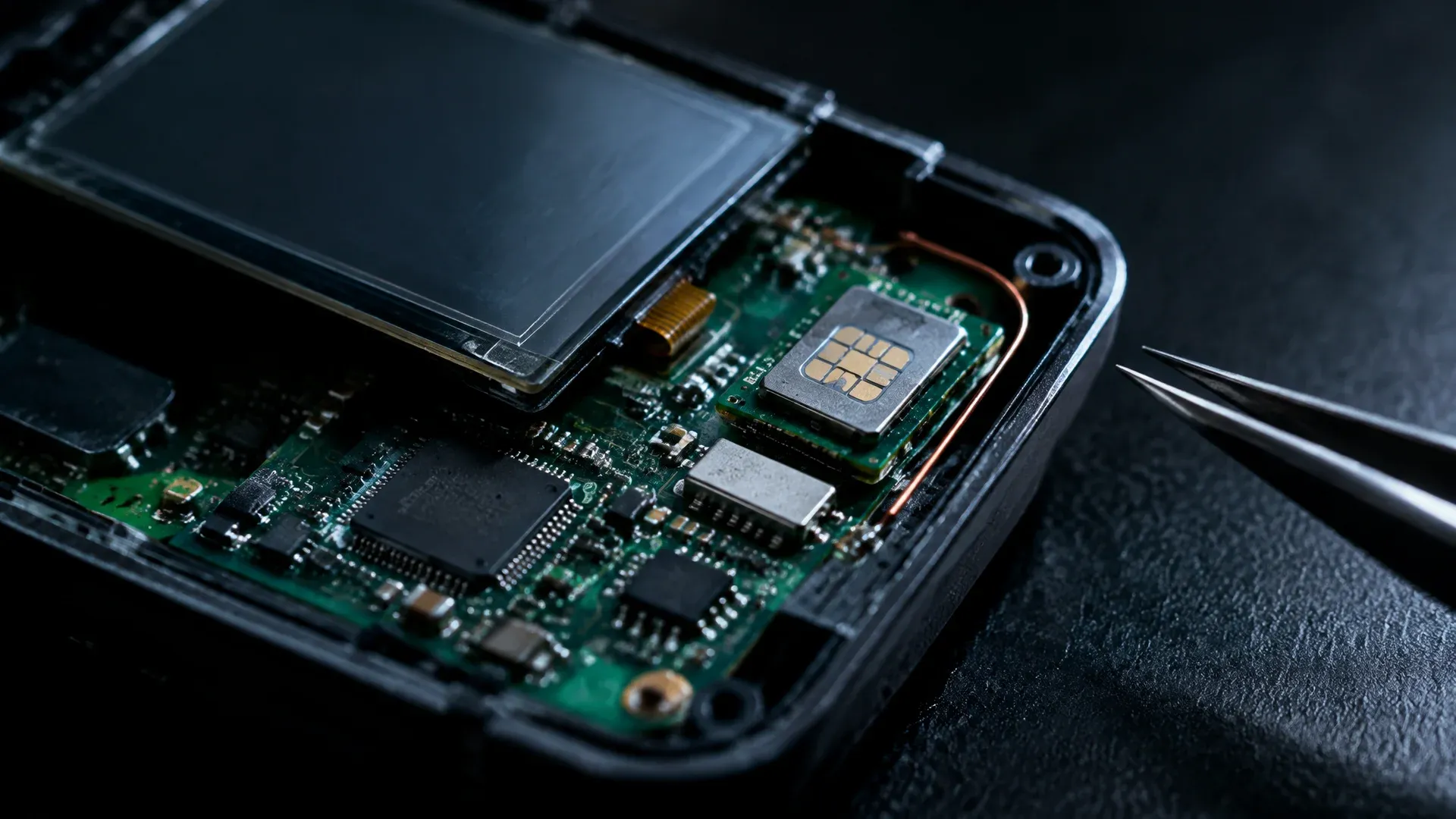
Behind the sales halt stands the CryptoBilis case, which we have been covering since October 9. On October 10 Ledger confirmed that an unauthorised additional circuit board sat inside a device from that Southeast Asian retailer. According to the manufacturer's account, which CoinDesk summarised on October 13, the implant works like this: a microcontroller of its own reads the 24 words of the recovery phrase off the display while the device is being set up, and sends them to the attackers over an eSIM via LTE mobile network.
The secure element, the operating system and the signatures of transactions were not altered, according to Ledger. Chief technology officer Charles Guillemet announced a review of reseller controls and of tamper protection. Chief executive Pascal Gauthier said the investigation should establish who tampered with the devices and at which point in distribution that happened. Ledger notes that every confirmed loss so far concerns a device from CryptoBilis. An outflow from a device bought elsewhere has not been verified.
Damage of more than $100 million, with no figure confirmed
There is no official damage total, and Ledger names none itself. The estimates of on-chain analysts diverge, because they attribute different numbers of wallets to the case:
| Source | Estimate | As of |
|---|---|---|
| Galaxy Research (Alex Thorn) | around $91 million | October 9 |
| On-chain researchers via CoinDesk | up to $93.2 million across more than 300 wallets | October 13 |
| Bitquery via crypto.news | around $102 million across 324 wallets | October 12 |
Tether has frozen USDT worth $10 million linked to the thefts, according to CoinDesk. For those affected that is a small ray of light, because frozen stablecoins can be returned later. Anything that flowed out in Bitcoin or Ether, by contrast, cannot be recovered.
Why the authenticity check does not help here
Many Ledger owners rely on the genuine check in the Ledger Live app. It verifies that the secure element is genuine and that the firmware comes from Ledger. Those are precisely the parts the implant left alone. A tampered device therefore passes the check, as Karpelès showed on his test unit. The additional board can only be spotted by opening the casing.
An uncomfortable truth follows from that: it is not the device that decides your security, but the route by which it reached you, and the moment the 24 words stand on the display. Set up a tampered device and you give away your recovery phrase at the instant you write it down. Background on the sequence is in our article on Ledger confirming the implant in a hardware wallet, and the prior history in the first report on the CryptoBilis case.
A Ledger from MediaMarkt or Saturn: return, new phrase, moving the coins
Ledger officially recommends swapping the device only to buyers from CryptoBilis. For devices from German retail there is no recommendation from the manufacturer yet. These steps serve as orientation for anyone who wants to be on the safe side:
- Device still shrink-wrapped or not set up: do not set it up. Ask the retailer whether it will take the device back, and contact official Ledger support. Devices bought online can usually be returned within 14 days.
- Device set up, bought at MediaMarkt or Saturn: the safest solution is a new device straight from the manufacturer, a freshly generated recovery phrase and moving all coins onto it. Important: restoring the old phrase on a new device is no protection. Once it has been read out, the attacker knows it.
- Device bought directly from Ledger: as things stand today there is no confirmed case from direct sales. Following the situation is enough here.
- In every case: never enter your 24 words anywhere, neither on a website nor in a form nor over the phone. Ledger never calls unprompted, sends no direct messages and never asks for the recovery phrase.
Fraudsters exploit situations like this deliberately. Fake Ledger pages turned up in Google search as early as October 11. How to spot them is in our guide to spotting a fake Ledger website in Google. We advise non-experts against unscrewing the device: the warranty can lapse in the process, and without a reference image an implant is hard to tell apart from genuine components.
Buying a hardware wallet directly from the manufacturer: what it achieves
The case shows that every additional stop between factory and customer is a risk. A purchase in the manufacturer's own shop shortens the route to the minimum. That holds for Ledger as much as for Trezor, Tangem or OneKey. Which devices exist, how they handle recovery and what they cost is shown in our comparison of hardware wallets. Our experience with the best-selling entry-level model is summarised in our test of the Ledger Nano S Plus.
A second protection is splitting up: larger amounts can be spread across several wallets, and anyone using a multisig setup needs several devices for a payout. A single tampered device then cannot give everything away.
Ledger sales halt: what to take away
The sales halt at MediaMarkt and Saturn is a precaution, not evidence of thefts in Germany. Losses are confirmed so far only for devices from Southeast Asia. What is also clear: an implant that passes the authenticity check makes the route of purchase the most important security question. Buy a hardware wallet and you are best served buying it directly from the manufacturer, setting it up yourself and keeping the 24 words to yourself. We will update this article as soon as Ledger or MediaMarktSaturn provide new information.
Decrypt
A Saudi national working at OpenAI allegedly hid an encrypted audio recorder behind a TV in an executive meeting room. OpenAI says its own models helped trace it back to him.
The chatbot app once valued at $1 billion is up for sale in a Delaware court, two weeks after launching new models. If nobody buys it, it shuts down.
Binance will discontinue Binance Pool, Pool Savings, Cloud Mining, and other related services in a retreat from mining infrastructure.
A wallet that received 4,581 BTC in March 2020, worth about $40 million then, moved its stash today when it was worth about $377 million.
The Nasdaq-listed asset manager bought the Bitcoin at an average of about $84,500 during a rough week for the market, lifting its total stash to 32,773 BTC.
U.Today - IT, AI and Fintech Daily News for You Today
Hyperliquid whales take profits after successfully shoveling the token at a relatively low price.
A massive Ethereum whale has completely liquidated its 52,001 ETH position, locking in a staggering $24.5 million profit after a series of major sell-offs.
Ripple has secured its first partnership with a South Korean securities firm, teaming up with Meritz Securities to explore institutional crypto custody and tokenization as it expands its footprint in the country's financial sector.
Cryptocurrency market stays under pressure that's coming from bears, but the recovery is still a possibility.
Ripple has partnered with Stripe-owned Privy to bring AI-powered payments to the XRP Ledger, expanding its push into agentic commerce.
Blockonomi
TLDR
- Walmart stock gains 0.25% as AI chatbot recommendations boost retail visibility.
- UBS research shows Walmart leads AI shopping suggestions for everyday products.
- Gartner finds 34% of US consumers willing to use AI for holiday gift shopping.
- Walmart’s strong retail presence supports its position in AI shopping results.
- High stock valuation remains a challenge despite new AI-driven growth prospects.
Walmart Inc. rose 0.25% to $113.36 during Tuesday’s intraday trading, gaining $0.28 as shares advanced modestly. The increase came as UBS research highlighted Walmart’s strong position in artificial intelligence-powered shopping recommendations. Analysts identified the retailer as a frequent recommendation across AI chatbots, creating another potential channel for attracting customers.
Walmart Inc., WMT
UBS Research Highlights Walmart’s Strength in AI Shopping
UBS analysts examined how leading AI chatbots recommend retailers when consumers search for everyday products and shopping advice. The research covered several shopping categories, including groceries, household supplies, and other essential consumer goods. Results showed Walmart frequently appeared among the leading recommendations, reflecting its established retail presence and competitive pricing.
The analysts tested 12 shopping questions across New Jersey, New York, and Minnesota to evaluate different recommendation patterns. They examined responses from ChatGPT, Claude, Gemini, and Muse to identify which retailers appeared most frequently. Walmart performed strongly across multiple categories, while Costco and Aldi also gained recognition for their respective retail strengths.
The findings highlight how artificial intelligence could influence where consumers begin their shopping journeys. Chatbots help users compare products, identify retailers, and narrow purchasing decisions without reviewing multiple websites. Walmart could attract additional customer interest as more households incorporate these tools into everyday shopping activities.
Gartner Survey Shows Growing Demand for AI Shopping Tools
A Gartner survey found that 34% of American consumers expressed strong willingness to use AI for holiday gift recommendations. Researchers surveyed 1,004 consumers in August 2026 to examine changing shopping habits ahead of the holiday season. The findings indicate growing acceptance of automated product suggestions, particularly among consumers seeking faster purchasing decisions.
Traditional shopping channels continue playing a central role despite increasing interest in artificial intelligence. Gartner found that 77% of respondents planned to shop in physical stores during the holiday period. Additionally, 75% expected to purchase products through Amazon, highlighting continued demand for established retail platforms.
Walmart’s extensive store network gives the company an established position across both physical and online retail markets. Its product selection covers groceries, electronics, clothing, household goods, and other frequently purchased consumer products. Customers can combine online searches with store visits, pickup services, and home delivery options.
Walmart Stock Valuation Remains a Key Growth Challenge
Despite the potential benefits of AI recommendations, Walmart shares have delivered relatively modest gains during 2026. The stock has advanced approximately 2% this year, trailing the broader market despite the company’s established retail operations. Its valuation exceeds 40 times trailing earnings, placing greater emphasis on future revenue and profit growth.
Walmart generated more than $730 billion in revenue over the preceding 12 months, reflecting its substantial operating scale. However, that size also means incremental sales from AI referrals may produce limited changes in overall growth. The company would need significant additional spending from customers to produce a meaningful improvement in its revenue trajectory.
Walmart continues developing its digital operations while maintaining its position in the competitive US retail market. Its broad product selection and established reputation for affordable goods support its visibility across emerging shopping platforms. The UBS findings identify another potential source of customer traffic, although they do not establish additional sales or earnings.
The post Walmart Inc. (WMT) Stock: AI Chatbot Recommendations Fuel Growth Potential appeared first on Blockonomi.
TLDR
- UnitedHealth stock rises 0.25% as management outlines stronger growth for 2027.
- UnitedHealth raises its 2026 earnings forecast following stronger Q3 results.
- Management targets 13% to 16% long-term earnings growth as operations improve.
- AI tools reduce clinical review times by 33% as UnitedHealth cuts paperwork.
- Optum expands pharmacy services while Medicare and Medicaid reforms advance.
UnitedHealth Group Incorporated (UNH) rose 0.25% to $379.47 on Tuesday following its third-quarter 2026 earnings announcement. The healthcare company raised its annual earnings outlook and outlined plans for stronger financial performance in 2027. Management emphasized operational improvements, artificial intelligence adoption, and medical cost controls as major drivers of future growth.
UnitedHealth Group Incorporated, UNH
UnitedHealth Group Raises Earnings Outlook After Strong Q3 Performance
UnitedHealth Group reported third-quarter revenue of $112.7 billion, while operating earnings reached $6.6 billion during the reporting period. Adjusted earnings reached $4.69 per share, exceeding Wall Street expectations as the company improved its cost management. Management raised its full-year 2026 adjusted earnings guidance to at least $20.50 per share.
The company also reduced its medical care ratio to 88.4%, compared with 89.9% a year earlier. Management attributed the improvement to pricing discipline, benefit adjustments, and stronger coordination across its healthcare operations. Specialty pharmacy expenses and higher treatment intensity continued to pressure medical spending across several business segments.
UnitedHealth expanded its operational modernization efforts across UnitedHealthcare and Optum to improve service delivery and efficiency. Approximately 40% of employed clinicians now use AI-powered documentation tools, reducing medical record review times by 33%. The company plans to eliminate 30% of prior authorization requirements by year-end to simplify patient access.
Management Targets Stronger Earnings Growth in 2027
UnitedHealth management expressed confidence in reaching the lower end of its long-term adjusted earnings growth target for 2027. The company maintains a growth framework of 13% to 16%, supported by stronger execution and operational improvements. Chief Financial Officer Wayne DeVeydt also indicated that current analyst earnings estimates may underestimate the company’s recovery potential.
The company’s Medicare Advantage strategy prioritizes health maintenance organizations and specialized plans serving patients with complex medical needs. These offerings include Chronic Special Needs Plans and Dual Special Needs Plans, which support targeted healthcare management. UnitedHealth expects its quality improvement programs to strengthen its competitive position across government-sponsored insurance markets.
Management also expects Optum Insight to advance its technology offerings through new AI-focused products during 2027. The company anticipates further expansion in 2028 as these services gain commercial traction across healthcare organizations. Optum Rx continues developing transparent pharmacy services, with external customers accounting for more than half its membership.
Medical Costs and Regulatory Reforms Shape Recovery
Despite improving operating performance, UnitedHealth continues managing medical expenses and regulatory requirements across its insurance businesses. Medicaid margins remain under pressure, although management expects them to reach their lowest point during 2026. The company targets stronger profitability by 2028 through reimbursement negotiations and improved care for patients with complex needs.
Management identified the No Surprises Act arbitration process as another source of elevated healthcare costs. The company reported that related disputes account for up to 6% of medical spending in certain regions. Consequently, UnitedHealth continues advocating regulatory changes while improving its internal claims management and payment processes.
UnitedHealth also expects 75% of its Medicare Advantage membership to enter plans with ratings of four stars or higher. The target applies to 2028 ratings and reflects continued spending on service quality and patient outcomes. Separately, the United Health Foundation committed $1 billion toward rural healthcare, workforce education, and broader community health programs.
Management expects fourth-quarter performance to reflect seasonal medical spending alongside additional investments in technology and clinical operations. The company will continue expanding administrative automation while strengthening its healthcare delivery network and insurance offerings. These initiatives form part of UnitedHealth’s broader plan to improve operating margins and support earnings growth beyond 2026.
The post UnitedHealth Group Incorporated (UNH) Stock: Climbs as Management Targets Strong 2027 Growth appeared first on Blockonomi.
TLDR
-
Applied Materials (AMAT) stock plunges 8.19% despite strong demand for AI chips.
-
Applied Materials targets over two percentage points of market share gains by 2030.
-
Applied Materials expects its eBeam equipment revenue to reach $2 billion in 2026.
-
Applied Materials projects semiconductor service revenue above $12 billion by 2030.
-
Applied Materials plans to more than double its research and production capacity by 2030.
Applied Materials (AMAT) stock plunged 8.19% to $456.77 during Tuesday’s intraday trading, losing $40.76 despite strong demand for AI chips. The decline followed the company’s presentation of ambitious semiconductor equipment growth targets through 2030. Meanwhile, Applied Materials outlined expansion plans across advanced manufacturing, research facilities, and semiconductor services.
Applied Materials, Inc., AMAT
Applied Materials Targets Stronger Growth in AI Chip Equipment
Applied Materials presented its long-term growth strategy during the 2026 SEMICON West Investor Breakfast on Tuesday. The company expects expanding AI infrastructure to support sustained demand for wafer fabrication equipment. Its strategy focuses on advanced chip production, memory technology, and semiconductor packaging.
CEO Gary Dickerson identified AI infrastructure development as a major driver of future semiconductor equipment spending. He emphasized the company’s leadership in technologies that improve computing performance, energy efficiency, and production costs. Applied Materials expects broader AI adoption to increase demand for advanced silicon manufacturing.
The company projects three semiconductor segments will generate approximately 75% of wafer fabrication equipment growth between 2025 and 2030. These segments include leading-edge foundry logic, DRAM memory, and advanced packaging technologies. Applied Materials aims to increase its equipment market share by more than two percentage points during this period.
Applied Materials Expands Semiconductor Services and eBeam Technology
Applied Materials expects its electron-beam inspection equipment business to generate $2 billion in revenue during calendar 2026. The technology helps semiconductor manufacturers identify production defects and improve yields during advanced chip manufacturing. Additionally, its imaging systems support faster production processes and more efficient factory operations.
The company also expects its semiconductor services revenue to increase more than 20% during 2026. Management projects annual services revenue will exceed $12 billion by 2030, supported by a mid-teens compound growth rate. These services help semiconductor manufacturers improve equipment performance, factory productivity, and manufacturing efficiency.
Chief Financial Officer Brice Hill outlined plans to strengthen profitability while expanding research and development spending. According to Hill, previous technology investments have established the company’s position across important semiconductor manufacturing processes. The company now plans to increase operating leverage as semiconductor equipment demand expands.
Applied Materials Plans Major Manufacturing Expansion Through 2030
Applied Materials plans to more than double its research laboratory and manufacturing capacity by 2030. The expansion supports expected growth in semiconductor production and demand for advanced manufacturing equipment. The company continues investing in facilities that support collaboration with semiconductor manufacturers.
On Monday, Applied Materials unveiled its Equipment and Process Innovation and Commercialization Center in Silicon Valley. The new facility supports joint research into semiconductor process technology and equipment development. The company has already announced 15 partnerships involving chipmakers, technology companies, equipment manufacturers, and universities.
Applied Materials has also expanded its manufacturing infrastructure across several international locations. These facilities include operations in Austin, Texas, Singapore, and Treviso, Italy. The investments support the company’s long-term production strategy as semiconductor manufacturers expand capacity for increasingly complex computing applications.
The post Applied Materials (AMAT) Stock: Sinks 8% Despite Strong AI Chip Demand appeared first on Blockonomi.
TLDR
- BigBear.ai (BBAI) stock climbs 3.83% as new government awards surpass $225M.
- BigBear.ai secures over 25 generative AI awards across major U.S. agencies.
- FBI, NASA, and the Coast Guard join BigBear.ai’s growing government client base.
- BigBear.ai expands defense operations with new military and intelligence awards.
- BigBear.ai reports a $270M backlog, with only 29% funded as of June 30, 2026.
BigBear.ai Holdings (BBAI) stock rose 3.83% to $2.3877 during Tuesday’s intraday trading, gaining $0.0877. Shares stabilized after an early surge above $2.50, following developments in the company’s government business. BigBear.ai announced more than $225 million in awards across several U.S. agencies since July.
BigBear.ai Holdings, Inc., BBAI
BigBear.ai Secures $225 Million in New Awards
BigBear.ai reported new business and renewals across homeland security, defense, intelligence, and civilian agencies. The agreements support its expansion in national security, trade, and travel technology markets. The latest wins also strengthen its relationships with existing customers while expanding its government presence.
According to the announcement, BigBear.ai secured more than 25 new generative AI awards. Customers include the FBI, NASA, U.S. Coast Guard, Department of Energy, and Department of Veterans Affairs. These projects cover specialized technology services for law enforcement, security operations, and civilian applications.
CEO Kevin McAleenan identified customer retention and new agency relationships as major drivers of the company’s recent activity. He highlighted continued work with Customs and Border Protection alongside new partnerships with security organizations. The developments reflect broader adoption of advanced technology across government operations.
BigBear.ai Expands Defense and Intelligence Operations
BigBear.ai also secured agreements supporting U.S. Central Command, U.S. Southern Command, and classified intelligence operations. These projects extend its services into additional military and intelligence environments. Meanwhile, demand for secure AI platforms continues to shape the company’s product offerings.
Its generative AI products provide access to models and automated tools from leading technology providers. Government teams can select available systems according to their operational requirements and security standards. The platforms also support disconnected networks and restricted environments that require tighter data controls.
BigBear.ai retained important work with U.S. Customs and Border Protection through two competitive renewals. The company supports border operations involving traveler screening, cargo movement, and customs security. Its technology helps personnel assess shipments, process information, and make operational decisions.
BigBear.ai Reports $270 Million Backlog
BigBear.ai reported approximately $270 million in total backlog as of June 30, 2026. The company identified only 29% of that amount as funded at the reporting date. This distinction separates secured financial commitments from the broader value of outstanding business.
The announced $225 million includes potential award values, unexercised options, and maximum contract limits. Consequently, actual revenue will depend on government funding decisions, project execution, and exercised options. Agencies also retain the authority to modify agreements, reduce spending, or terminate work.
The post BigBear.ai Holdings (BBAI) Stock: Gains on $225M Federal AI Contract Wins appeared first on Blockonomi.
TLDR
- Goldman Sachs (GS) stock rises 0.27% as Q3 revenue jumps 23% to $18.68 billion.
- Goldman Sachs reports $5.29 billion in Q3 profit as earnings reach $17.01 per share.
- Equities revenue surges 72% as stronger financing and derivatives lift results.
- Investment banking fees climb 21% as mergers and underwriting activity rebound.
- Goldman Sachs returns $4.49 billion to shareholders and declares a $5 dividend.
Goldman Sachs Group (GS) stock rose 0.27% to $896.36 during Tuesday’s intraday trading, gaining $2.41 after retreating from earlier highs. The bank reported third-quarter revenue growth of 23% to $18.68 billion, driven by stronger trading and investment banking activity. Meanwhile, net earnings reached $5.29 billion as its major business divisions delivered improved annual results.
The Goldman Sachs Group, Inc., GS
Goldman Sachs Reports Strong Q3 Earnings Growth
Goldman Sachs reported diluted earnings per share of $17.01, up from $12.25 during the same quarter last year. However, earnings declined sequentially from $20.98 per share in the second quarter. The bank recorded an annualized return on average common shareholders’ equity of 18.7%.
For the first nine months of 2026, the company generated $56.24 billion in revenue and $17.55 billion in earnings. Its book value per common share also increased 4.2% during the period to $372.64. These results reflected stronger banking operations and improved profitability compared with 2025.
Operating expenses increased 20% annually to $11.31 billion, primarily due to higher transaction costs and employee compensation. Meanwhile, provisions for credit losses reached $368 million, reflecting impairments related to wholesale loans. Despite these costs, the bank improved its nine-month efficiency ratio to 59.4% from 62.1%.
Investment Banking and Equities Support Revenue Growth
Global Banking & Markets generated $13.46 billion in quarterly revenue, representing a 32% increase from the previous year. Investment banking fees climbed 21%, supported by higher completed merger transactions and increased underwriting activity. Stronger initial public offerings and secondary share sales also contributed to the division’s performance.
Equities revenue surged 72% annually, supported by stronger financing operations and derivatives trading. Meanwhile, fixed income, currency, and commodities revenue remained largely unchanged despite mixed performance across trading products. Higher currencies and commodities revenue helped offset weaker mortgage, credit, and interest rate activity.
Asset & Wealth Management revenue increased 14% from the previous year, supported by higher management and incentive fees. Increased average assets under supervision contributed to stronger recurring fee income during the quarter. However, weaker investment returns and private banking revenue partly offset the division’s growth.
Goldman Sachs Announces Dividend and Capital Returns
Goldman Sachs declared a quarterly dividend of $5.00 per common share on October 12, 2026. The company scheduled payment for December 30 to shareholders of record on December 2. The announcement followed continued capital distributions through dividends and share repurchases.
During the third quarter, the bank returned $4.49 billion to common shareholders through its capital return program. Share repurchases accounted for $3 billion, while common stock dividends represented the remaining $1.49 billion. The company also maintained its shareholder payout strategy alongside increased investment banking activity.
Meanwhile, average global core liquid assets increased to $574 billion from $555 billion in the previous quarter. Headcount also rose 3% sequentially, reflecting the timing of new graduate recruitment. However, the investment banking backlog declined from the second quarter despite stronger completed transactions.
The post Goldman Sachs Group (GS) Stock: Gains as Q3 Revenue Jumps 23% and Profit Hits $5.29B appeared first on Blockonomi.
CryptoPotato
Ethereum is getting most of the attention from crypto traders, while Bitcoin and XRP are facing growing fear. According to Santiment, the world’s largest altcoin by market cap has 2.05 bullish comments for every bearish comment across X, Reddit, and Telegram.
The shift comes as ETH trades above key support, and traders are watching staking demand and upcoming network upgrades.
Ethereum FOMO
The same cannot be said for Bitcoin, however, as it struggles to attract the same confidence. Its bullish-to-bearish comment ratio has dropped to 0.82. Repeated rejection near $87,000, a brief plunge toward $81,000, and heavy long liquidations have added to market concerns.
XRP is also under pressure as it recorded a sentiment ratio of 0.92. The token has fallen more than 9% over the past week, while the $1.40 level remains difficult to reclaim. Santiment explained that this contrast could matter if prices recover. While fear around Bitcoin and XRP could create opportunities for a possible rebound, high optimism around Ethereum may signal overheating,
Meanwhile, Crypto Patel sees an ambitious upside for Ethereum. The analyst set a long-term target of $15,000 for the current bull cycle. The $1,600 to $2,000 range was identified as a potential re-accumulation zone, with intermediate targets at $3,270, $4,892, and $10,000.
According to Crypto Patel, a confirmed breakout above $4,892 could open the door to a broader rally. However, ETH will need to hold key support levels and overcome resistance to keep that outlook alive.
Mixed Picture
Spot Ethereum ETFs finally saw some money come in after ten straight days of outflows. The funds recorded $24.84 million in net inflows on October 13th, which, interestingly, was their only positive day so far in October. Grayscale’s ETH fund led the gains with $16.3 million, while Fidelity’s FETH raked in another $8.11 million. Other funds posted no flows for the day.
The rebound is a welcome change, but it has barely made a dent in the recent withdrawals. These ETFs still have around $695 million in net outflows so far in October, as investor demand remains under pressure.
A similar trend was seen across spot Bitcoin ETFs, which collectively attracted $175.6 million. Meanwhile, XRP funds recorded no flows for three straight days.
The post ETH Becomes the Crowd Favorite as BTC Slides and XRP Struggles appeared first on CryptoPotato.
Although bitcoin’s price has remained relatively sluggish on a 24-hour scale, without any significant moves in either direction, its dominance over the alts has risen to 60% on CMC.
The reason for this is that most alts are still in the red, especially the mid-cap ones.
BTC Dominance Reaches 60%
BTC was rejected at $87,000 on a couple of occasions at the start of the previous business week, and the second was particularly painful as it began a more profound leg down. It culminated on Thursday evening when the asset slumped to $80,400 to mark a multi-week low.
After losing nearly $7,000 in about 72 hours, the cryptocurrency finally rebounded and tapped $83,000 during the weekend. It remained there for the next 36 hours and even challenged $84,400 on Monday morning. Another rejection followed, though, and the bears seemed in complete control on Tuesday morning when they drove bitcoin to just under $81,000 once again.
Nevertheless, there were two positive outcomes: first, BTC rebounded just as quickly to over $83,000; second, it marked a higher low, which is typically considered a bullish signal. Since then, it has traded sideways between $83,000 and $84,000 and currently sits inches above the lower boundary. More volatility is expected later today when the CPI numbers for September will be announced.
Its dominance over the altcoins is on the rise. The metric tapped 60% on CMC, as most altcoins have struggled over the past few days. In the meantime, bitcoin’s market cap hasn’t moved much and stands at $1.670 trillion.

Alts Struggle, BTW?!
Most larger-cap alts continue to be in the red today, with ETH sliding back down to $2,500, XRP slipping further away from the $1.40 level, and SOL dropping to $107. RAIN has plummeted by almost 10%, while QNT is down by 7.5%. Further losses are evident from ADA, HYPE, LINK, XLM, NEAR, TAO, DOT, and others.
In contrast, ZEC, XMR, TRX, and BCH are slightly in the green, while BTW has skyrocketed by 47% to over $2.60. On the other hand, TIA, M, CRV, and RENDER have dropped by somewhere between 8%-10% daily.
The total crypto market cap has declined by another 0.5% to $2.790 trillion on CMC.

The post Bitcoin Dominance on the Rise as Altcoins Retreat Ahead of CPI: Market Watch appeared first on CryptoPotato.
OP, the native token of Optimism, climbed nearly 20% at one point in the last 24 hours after Uniswap announced that Unichain will hand its production operations to OP Enterprise.
The rally came as Bitcoin and several major altcoins faced renewed selling pressure, giving OP a rare boost.
Unichain Handover Sends OP Higher
CoinGecko reported in a post on October 14 a 19.4% daily gain for OP that took it to $0.1621, linking the move to Uniswap’s announcement that Unichain would transition to OP Enterprise.
However, at the time of writing, it had given up some of those gains and was trading at around $0.156, still a 14% jump in 24 hours and 28% in seven days. It also gained 64% in 30 days but remains down nearly 68% from a year ago.
Trading activity also rose alongside the price. OP recorded around $226 million in 24-hour volume, a 128% increase from the previous day. The last time the token went higher than it did today was in mid-May when it touched $0.166.
Uniswap’s October 9 announcement explained that Unichain’s testnet migration was scheduled for October 13, with mainnet migration set for October 29. The transition leaves Unichain’s chain ID, contracts, balances, and existing Uniswap v2, v3, and v4 deployments unchanged.
Under the arrangement, Optimism will operate the production infrastructure, including sequencers, remote procedure call services, monitoring, and incident response across mainnet and testnet. Unichain users are not expected to face changes to their existing experience.
The handover also prepares Unichain for native interoperability across the OP Stack. Once that functionality goes live, users will be able to transfer assets, starting with ETH, between Unichain and other OP Stack networks without relying on a bridge.
OP Rallies as Wider Market Struggles
The price move stands out against the conditions reported by CryptoPotato yesterday. Several major altcoins lost ground, with NEAR falling roughly 10%, Zcash dropping more than 6%, and both Cardano and Hyperliquid shedding around 5%. Ethereum also briefly dipped to $2,400 before recovering above $2,500.
Zcash seems to have turned things around, recouping more than 4% in the last 24 hours to go above $1,250, while NEAR dumped another 4% and was hovering just above $5 at the time of writing.
Meanwhile, Bitcoin had fallen as low as $80,850 before rebounding toward $84,000, while daily liquidations across crypto markets exceeded $800 million.
The post Optimism (OP) Price Jumps Nearly 20% as Unichain Moves to OP Enterprise appeared first on CryptoPotato.
[PRESS RELEASE – Dubai, United Arab Emirates, October 13th, 2026]
Bybit Co-founder and CEO Ben Zhou has outlined the latest stage of the company’s expansion from a crypto exchange into The New Financial Platform, highlighting new products and collaborations across traditional and digital markets.
The updates were presented during Bybit’s latest biannual “Keynote with Ben” session titled “Make Your Move”, where Ben discussed the convergence of financial markets and the company’s approach to building for that shift. Held outside the usual studio format, in a gathering with a live audience, the keynote brought Ben together with selected guests to discuss changes in the financial landscape, new technologies and the products shaping Bybit’s next phase.
Four Years of TradFi Expansion, With Stocks Now Live and mStocks Ahead
Four years after entering traditional finance with contracts for difference (CFDs) in 2022, Bybit has established itself as the largest crypto CFD platform, with trading volume reaching as much as $100 billion at its peak. On Oct. 12, the company expanded further into traditional markets with the launch of stock trading for eligible users, providing access to more than 1,000 U.S. stocks and ETFs. Users can trade using USDC, with fractional shares and 24/5 access covering U.S. pre-market, regular and after-hours sessions.
Bybit is also developing mStocks in collaboration with Mantle, with a targeted launch in November. The tokenized stock product is designed to be backed 1:1 by real stocks, with plans to support round-the-clock conversion between eligible stocks and mStocks on Bybit, as well as decentralized exchange trading through automated market maker (AMM) liquidity pools on Mantle. Converted mStocks are also expected to be transferable into Bybit’s Unified Trading Account (UTA) for use as trading collateral, subject to applicable terms and conditions.
Bybit launched IPO Express in June, giving eligible users access to selected IPO opportunities at the offering price through tokenized representations of the underlying securities. The service launched with SpaceX and is designed to extend Bybit’s access beyond secondary-market trading into selected primary-market opportunities.
The latest developments build on Bybit’s expansion into perpetuals, pre-market products, foreign exchange and options. Its TradFi offering now spans more than 600 products across equities, ETFs, indices, commodities and FX. TradFi perpetuals have recorded more than $180 billion in trading volume, while recent additions include Forex Perps and Perp Options, an industry-first options product built on TradFi perpetuals.
Bybit is continuing to develop new perpetual products linked to AI computing and commodities, extending its range of instruments beyond conventional crypto markets.
Extending the Platform into Payments
Beyond trading and investing, Bybit has expanded its payments infrastructure to help customers move funds with greater flexibility. Bybit Pay and Bybit Card support crypto and fiat transfers, merchant payments and everyday spending. The service now connects users with more than 5,000 merchants across 15+ countries and supports transfers to bank accounts and e-wallets, alongside QR payments and other payment services. Bybit has issued more than 4 million Bybit Cards, extending the platform’s use beyond financial markets into payments and spending.
Security and Regulatory Infrastructure
The expansion has been accompanied by investment in security, compliance and technology infrastructure.
In the first half of 2026, Bybit said it intercepted more than 30,000 suspicious withdrawal requests, protecting users from more than $700 million in potential losses.
Bybit also secured five new licenses and regulatory approvals across European Union, the Cayman Islands, Indonesia, South Africa and El Salvador during 2026. These regulatory developments support the company’s efforts to expand its presence across different markets, subject to local requirements.
The company launched Bybit AI in September as a conversational assistant across trading, account management and customer support, with further development planned around the platform’s wider financial services.
“Bybit is all about giving you the speed and scale you need when you Make Your Move. We have brought trading, investing, payments and AI together, and we are continuing to add more markets and more ways to use them. We built the platform. Now it is about giving people the financial freedom to make their own move,” said Ben Zhou, Co-founder and CEO of Bybit.
Building Beyond the Exchange
Four years after entering TradFi, Bybit now combines crypto markets with stocks and ETFs, derivatives, commodities, FX, selected pre-IPO access, payments and AI-powered services. The company’s focus is increasingly on bringing these capabilities together within a single platform while continuing to expand market access, product depth and the infrastructure supporting them.
For Bybit, the development of The New Financial Platform represents the next stage of its growth beyond crypto and into a broader role across global financial markets.
Watch the full keynote here: https://www.bybit.com/en/press/live/keynote-with-ben-h2-2026

#Bybit / #NewFinancialPlatform
About Bybit
Bybit is The New Financial Platform.
We believe every person should have access to every financial opportunity on earth. That’s why we’re building the first intelligent platform that connects anyone, anywhere to the world’s finance.
Trusted by more than 80 million users worldwide, Bybit brings together investing, trading, payments, and wealth-building in a single secure and intelligent ecosystem. Through the combination of AI-powered technology, deep global liquidity, robust security, and transparent operations, Bybit makes global finance more accessible, efficient, and empowering for everyone.
Built for everyone. Powered by intelligence. Open to the world.
Learn more at Bybit.com
For more details about Bybit, please visit Bybit Press
For media inquiries, please contact: media@bybit.com
For updates, please follow: Bybit’s Communities and Social Media
Discord | Facebook | Instagram | LinkedIn | Reddit | Telegram | TikTok | X | Youtube
The post Bybit Expands Beyond Crypto as CEO Outlines Next Phase of Financial Platform appeared first on CryptoPotato.
[PRESS RELEASE – Moscow, Russia, October 13th, 2026]
A7 International enables businesses and individuals to pay invoices with digital assets, while recipients receive a regular bank transfer, reflecting A7’s international positioning and expanding the geography of settlements available to foreign clients.
In two years of operation, A7 has become one of the key players in the international settlements market. Founded in 2024 to serve the foreign economic activity of Russian businesses, it currently serves around 15,000 companies, processing 10+ trillion roubles in 2025 alone. The services A7 offered domestically sparked interest among businesses from other countries, prompting the company to come up with a new product for foreign clients.
The launch of A7 International marks a new stage in A7’s journey. In response to requests from foreign entrepreneurs, the company is expanding its positioning and creating an export offering for businesses in various countries. It is a remote service compliant with local legislation on digital assets and available only in those jurisdictions where cryptocurrency circulation is permitted.
“We are presenting not just a new product in the lineup, but a new image of A7. We have adapted our service so that it can be used remotely from anywhere in the world. This is precisely the key demand of market participants today. They want to be able to transfer money around the world in a few clicks in the shortest possible time – directly from your smartphone, without lengthy paperwork, hidden fees, or unjustified holds on funds. And we are packaging this demand into a convenient and competitive form,” said Chairman of Bank PSB Petr Fradkov.
The mechanics of the service are simple: the client transfers USDT, and A7 arranges a bank transfer via SWIFT using the counterparty details specified in the invoice. The recipient does not need to accept cryptocurrency or open a crypto wallet: the funds arrive in their bank account.
To submit an application, you need to register in your personal account on the website a7.biz. Individuals undergo identity verification (KYC), and companies undergo corporate data verification (KYB). Then the client uploads the invoice and the necessary documents. The built-in algorithm automatically recognizes the invoice data and helps fill out the application.
“The system operates as follows. AI analyzes the sender and beneficiary, jurisdictions, and key risk factors of the transaction. Based on the verification results, a risk profile of the payment is formed and the available options for processing it are determined. The system compares compliance requirements with the capabilities of the existing payment infrastructure. After that, it recommends the optimal payment route taking into account its cost, speed, reliability, and applicable restrictions. Routing dynamically adapts to changes in conditions and the availability of payment channels. Data accumulated over the years makes it possible to continuously improve the quality of decisions made by the system,” noted A7 CEO Ilan Shor.
At launch, A7 International accepts USDT on the TRON network. Bank transfers are available in US dollars, euros, Chinese yuan, and UAE dirhams. Other currencies are available by prior agreement. The commission is 0.3% for both businesses and individuals. After uploading the invoice, the client sees the final cost of the payment, including commission, in advance.
Payment execution time is from one business day. After the operation is completed, the client receives a SWIFT message or another confirming document. For currency and customs control, the service also provides closing documents.
The presentation of the service took place on a symbolic date and time — October 13 at 13:13.
Video of the official presentation and Customer journey here.
About A7
A7 is a global financial technology company specializing in international payments and settlement solutions for international trade. It was established in 2024 with the involvement of PSB Bank.
A7 is developing an independent global payment infrastructure across more than 100 countries, combining global financial expertise, advanced technology and regulatory compliance. The company’s products include international payments, digital financial assets and promissory notes.
A7 Group works with 15,000 clients, with around 2,000 transactions processed through the system every day. In 2025, approximately 19% of Russian companies’ cross-border trade settlements were processed through A7. In October 2025, A7 received an AA(RU) credit rating with a Stable outlook from ACRA.
The post Meet A7 International, an Innovative Global Platform Designed to Reinvent the International Payments Market appeared first on CryptoPotato.