Cryptocurrency Posts
Crypto Briefing
Brighton and Leeds' pursuit of a top-half finish highlights the competitive nature of the Premier League, emphasizing squad depth's importance.
The post Brighton host Leeds in Premier League Matchweek 3 as both clubs chase top-half finish appeared first on Crypto Briefing.
The US's shift towards diplomacy in the Middle East could redefine regional alliances and impact future US-Iran relations significantly.
The post US drafting post-war Middle East plan amid regional tensions: Axios appeared first on Crypto Briefing.
Athletic Club's strategic retention of Nico Williams underscores the club's commitment to maintaining competitive edge and cultural identity.
The post Athletic Club locks down Nico Williams with decade-long deal worth over €200M appeared first on Crypto Briefing.
The strikes risk further destabilizing the region, potentially leading to economic disruptions and increased geopolitical tensions globally.
The post US military strikes Iranian oil carriers amid escalating tensions appeared first on Crypto Briefing.
Escalating US-Iran tensions risk disrupting global oil supply, heightening geopolitical instability and impacting international energy markets.
The post US Central Command strikes three Iranian oil tankers after missile attacks on Navy warships appeared first on Crypto Briefing.
Bitcoin Magazine
Bitcoin Magazine
Hargreaves Lansdown Reverses Course, Rolls Out Bitcoin Trading
British financial services firm Hargreaves Lansdown is letting retail investors buy bitcoin — nearly one year after it said the cryptocurrency was “not an asset class.”
The Bristol, UK-based investment firm’s website said it was offering bitcoin and other crypto exchange-traded notes to investors. ETNs are investment funds which trade on stock exchanges and track the prices of digital assets.
It comes after the firm, which manages nearly £173 billion (over $233 billion) in assets, last year warned customers about buying bitcoin.
NEW:
— Bitcoin Magazine (@BitcoinMagazine) September 4, 2026U.K.'s largest investment platform Hargreaves Lansdown is now offering Bitcoin products to 2 million clients!
pic.twitter.com/GgdeHK8vyM
“While longer-term returns of Bitcoin have been positive, Bitcoin has experienced several periods of extreme losses and is a highly volatile investment — much riskier than stocks or bonds,” the firm said at the time.
“The HL Investment view is that Bitcoin is not an asset class, and we do not think cryptocurrency has characteristics that mean it should be included in portfolios for growth or income and shouldn’t be relied upon to help clients meet their financial goals.”
Now, a number of ETNs tracking the price of bitcoin and other cryptocurrencies are available. The firm warns users that “crypto ETNs are considered high-risk and may be volatile.”
U.S. regulator the Securities and Exchange Commission in 2024 approved bitcoin exchange-traded funds for investors after a decade of saying no to the products.
The funds had the most successful debut in the history of ETFs as investors previously unable to buy exposure to the asset class rushed in to buy the products.
Run by top asset managers and banks like BlackRock, Fidelity, and Morgan Stanley, the investment vehicles now collectively manage over $100 billion in assets.
This post Hargreaves Lansdown Reverses Course, Rolls Out Bitcoin Trading first appeared on Bitcoin Magazine and is written by Mathew Di Salvo.
Bitcoin Magazine
Trezor Breach Worse Than Reported: Another 67,000 US Customers Exposed
Hardware wallet manufacturer Trezor has said that a data breach first announced last month is worse than originally reported.
The Prague, Czech Republic-based company said Friday that an additional 67,000 U.S. customers had their names, emails, phone numbers, shipping addresses and order numbers leaked. The leaked data came from orders made between November 2019 and August 2021, according to Trezor.
Trezor first announced in August that data from 11,742 customers from the U.S., UK, Sweden, Colombia, Brazil, Italy, and Portugal had been exposed — with names, emails, phone numbers and shipping addresses leaked.
Another 1,947 customers just had their names, cities and emails exposed in the breach.
In Friday’s announcement, Trezor said that its third-party fulfillment partner, ShipMonk, had falsely reassured the company about deleting customer data.
“Throughout our entire relationship with ShipMonk, we repeatedly requested and received written assurance confirming the deletion of the data, in line with our contract, data policy, and past communications,” Trezor wrote.
“We are very disappointed that, despite receiving this confirmation, the data was not deleted in their systems.”
Neither Trezor nor ShipMonk immediately responded to Bitcoin Magazine’s questions.
Trezor first announced in August that the data had been leaked because ShipMonk experienced “unauthorized access to their systems containing customer data.”
The company added that it had directly emailed all customers involved in the breach. Trezor’s parent company, SatoshiLabs, told Bitcoin Magazine last month that it was investigating the incident.
Trezor is one of the most popular Bitcoin hardware wallet solutions, and also has support for storing other cryptocurrencies.
Bitcoiners’ personal data has been targeted by cybercriminals in the past: back in 2020, an unauthorized party accessed popular hardware manufacturer Ledger’s e-commerce and marketing database, leaking over 1 million email addresses and the personal contact data of nearly 10,000 customers.
At the start of this year, customers reported receiving emails from Global-e, Ledger’s payment partner, that a data breach at its cloud systems leaked sensitive customer data.
This post Trezor Breach Worse Than Reported: Another 67,000 US Customers Exposed first appeared on Bitcoin Magazine and is written by Mathew Di Salvo.
Bitcoin Magazine
El Salvador Isn’t Buying Bitcoin With Public Money, Says IMF
El Salvador has not used public funds to accumulate bitcoin since the International Monetary Fund’s last review of its loan program, the fund said Thursday.
In a report Thursday, the body said that the Central American country had instead received bitcoin from private donations, citing documentation from the government. It added that “no further Bitcoin accumulation beyond the documented donations is expected.”
El Salvador made headlines in 2021 when it became the first country in the world to make bitcoin legal tender. Salvadoran president Nayib Bukele in 2022 said the country would buy one bitcoin per day but it was never clear where the money was coming from — or if he was actually buying at all.
“Documentation has been provided verifying that Bitcoin accumulation since the first review reflects private donations and that no public resources were used,” the IMF release said.
“Understandings were also reached on steps to modernize the legal, regulatory, and supervisory framework for digital assets and to further strengthen the governance and risk-management arrangements for public-sector crypto-asset holdings. Going forward, no further bitcoin accumulation beyond the documented donations is expected.”
The report added that public participation in the government-sponsored bitcoin wallet has been largely wound down, with majority ownership and operational control handed to a private operator.
El Salvador in 2021 debuted a state-sponsored wallet called Chivo for its citizens as part of its plan to increase bitcoin adoption in the country.
“IMF staff thank the Salvadoran authorities for the constructive discussions and excellent collaboration,” the report added.
The IMF El Salvador entered a $1.4 billion loan agreement at the end of December but the fund asked for the country to scale back certain aspects of its bitcoin strategy.
Institutions like the World Bank and the IMF have long criticized President Bukele’s Bitcoin law, which also asked businesses to accept the cryptocurrency if they had the technological means to do so.
President Bukele in 2024 admitted that Salvadorans weren’t using the cryptocurrency to buy things as expected, but always boasted that the government was still stacking sats.
Since launching a crime crackdown to tackle the country’s notorious crime gangs, murder rates in El Salvador have plunged. The country was once the most dangerous place in the Americas but President Bukele is now trying to turn it into a tech hub.
Crypto companies like Tether have since relocated to its capital, San Salvador.
This post El Salvador Isn’t Buying Bitcoin With Public Money, Says IMF first appeared on Bitcoin Magazine and is written by Mathew Di Salvo.
Bitcoin Magazine
Bitcoin Dips Below $80,000 on Strong US Jobs Report
Bitcoin slid Friday after a better-than-expected labor report showed that the U.S. job market accelerated in August.
The leading cryptocurrency was recently trading for close to $79,764 after dropping as low as $78,706 earlier in the morning in New York. It’s currently down over 1% over a 24-hour period. On Thursday, the coin soared above $82,000.
The Federal Reserve is typically more likely to raise interest rates when the labor market is strong, because more people employed means more spending, and more spending can push inflation up.
Federal Reserve Chair Kevin Warsh last week gave his first major speech as head of the U.S. central bank and said he had “more work to do” to fight inflation. Bitcoin has typically done well in a low-interest rate environment.
Traders currently view a U.S. Federal Reserve interest rate hike at the upcoming September 15–16 policy meeting as roughly a 50% to 60% probability.
But U.S. President Donald Trump on Friday demanded the Federal Reserve slash interest rates.
Writing on his social media platform Truth Social, Trump said: “Lower the interest rates because the U.S.A. is a much stronger credit than it was just a short time ago!”
He added: “We should have the LOWEST RATE of any country in the World, like ‘the old days.'”
Bitcoin has decoupled from stocks recently as investors have renewed concerns around dollar debasement.
The cryptocurrency started surging last month, after the U.S. Treasury Department said it would more than double the size of its government debt repurchases. The coin had its best run in three years and third best August ever.
The much-talked about debasement trade is back in the spotlight, and bitcoin has been trading in lockstep with gold, according to analysts. The so-called debasement trade is when investors buy an asset as a way to hedge against a currency losing value.
News dropped last month that U.S. public debt exceeded $40 trillion for the first time too. Excessive debt also undermines confidence in the dollar, making assets like bitcoin and gold attractive.
This post Bitcoin Dips Below $80,000 on Strong US Jobs Report first appeared on Bitcoin Magazine and is written by Mathew Di Salvo.
Bitcoin Magazine
National Sheriffs’ Association Drops Opposition to Clarity Act
The National Sheriffs’ Association this week dropped its opposition to the crypto Clarity Act, after having previously warned that the proposed bill could help criminals.
Writing Thursday to Senate Majority Leader John Thune and Minority Leader Chuck Schumer, the association said it was changing its stance to neutral given how complex the issue is.
A number of lawmakers were hoping to vote on the Clarity Act in August. After a delay, a vote will now go ahead this month. The bill will establish a framework for distinguishing between digital assets that are securities, commodities or payment stablecoins — legislation that the crypto industry has long called for.
“Given the complexity of the legislation and the number of important details that remain under consideration, the NSA is changing its position on the Clarity Act to neutral,” the letter from NSA President Sheriff Troy Wellman and Executive Director Justin Smith read.
JUST IN: Major U.S. law enforcement organization National Sheriffs’ Association no longer opposes The Clarity Act
— Bitcoin Magazine (@BitcoinMagazine) September 4, 2026
“We believe the most appropriate course is to step back and allow the legislative process to proceed to establish a…much needed regulatory framework.”pic.twitter.com/NBpKlrUsUj
“At this time, we believe the most appropriate course is to step back and allow the legislative process to proceed to establish a clear, effective, and much needed regulatory framework.”
The NSA had previously warned that the bill could create regulatory and anti-money laundering loopholes by exempting certain crypto developers and infrastructure providers from money transmitter rules.
Despite being passed in the house of representatives last year with strong bipartisan support, the Clarity Act has been in a deadlock for much of 2026. The banking lobby raised concerns over stablecoin yield and some lawmakers have said improvements need to be made surrounding ethics.
An updated bill of the Clarity Act was introduced in July that addressed some of these concerns — banning government officials and their families from issuing or promoting crypto.
Pro-crypto senator Cynthia Lummis wrote on Friday that the “bipartisan bill” gives “law enforcement real tools to fight the illicit finance crimes hurting hard working Americans.”
Major financial institutions, lawmakers and companies have said they support the latest draft of the new bill, but some Republicans have accused Democratic lawmakers of deliberately playing politics and holding the bill back.
This post National Sheriffs’ Association Drops Opposition to Clarity Act first appeared on Bitcoin Magazine and is written by Mathew Di Salvo.
CryptoSlate
Zcash broke above $1,000 on Sept. 4, pushing the asset value of Grayscale’s recently listed ZCSH ETF past $400 million less than two weeks after its debut.
ZEC registered an intraday high of $1,050.70, up roughly 20% over 24 hours and nearly 100% over the past month.
The move lifted ZCSH’s assets to $414.7 million as of Sept. 3, compared with about $304.6 million when the fund began trading on NYSE Arca on Aug. 25.
ZCSH inherited assets from the Grayscale Zcash Trust, and the sharp appreciation in ZEC accounts for much of the increase.
Still, the fund’s ZEC holdings rose from 387,849 at launch to 428,613 by Sept. 3, while shares outstanding increased to 5.35 million.
The Sept. 4 breakout came as Bitcoin surpassed $82,000 and ETH reclaimed $2,500, but Zcash’s move was considerably larger. Roughly $40 million of ZEC shorts were liquidated in 24 hours, adding fuel to a rally that had already gathered momentum before the latest market-wide advance.
Leverage has expanded with the price. CoinGlass data showed that Zcash futures open interest crossed $2 billion for the first time, while 24-hour futures volume climbed above $6 billion for the first time since mid-August.
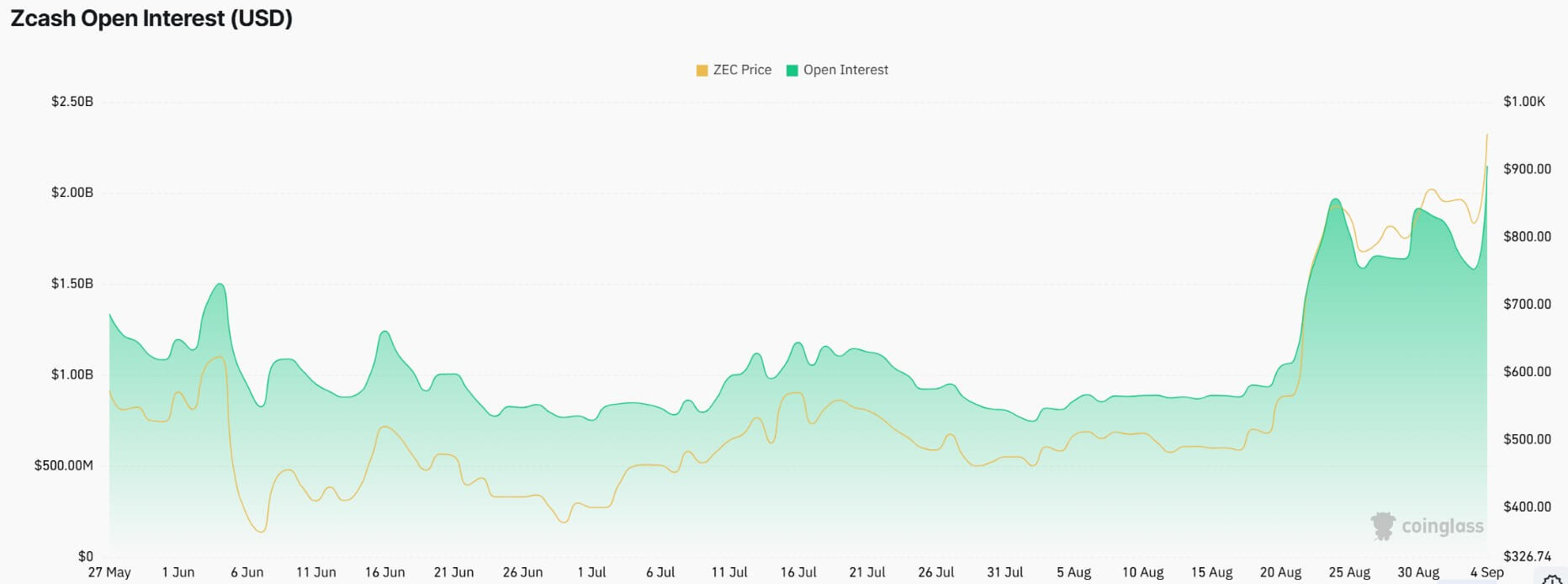
The combination suggests traders are committing substantially more capital to ZEC derivatives as the token tests levels it has not sustained in years.
The scale of the repricing is particularly stark over a longer horizon. ZEC was trading around $40 a year ago and has now returned to the top 10 largest cryptos by market cap for the first time since 2018.
That ascent has also brought increasingly aggressive forecasts. Cryptographer Arjun Khemani said characterizing the token's rally solely as a privacy-coin understates the case being made for Zcash.
He pointed to its fixed 21 million supply, Bitcoin-like emissions schedule, decade of distribution, work on quantum recoverability, plans for substantially higher transaction throughput and efforts to formally verify its shielded pool against undetectable inflation bugs.
Khemani said that “privacy is just one property of Zcash,” arguing that the larger bet is whether ZEC can develop into a form of sovereign money.
Grayscale sees AI opening a crack in Bitcoin’s dominance
The price move has revived a broader question around Zcash: whether its latest gains can translate into a lasting challenge to Bitcoin’s dominance of the digital-currency market.
Bitcoin accounts for about 93% of the market capitalization of Grayscale’s Currencies Crypto Sector, a level of dominance that alternatives such as Litecoin have failed to seriously disrupt. Zcash remains worth less than 1% of Bitcoin even after rising roughly 19-fold over the period covered by Grayscale’s latest research.
Grayscale argues Zcash has a better chance than previous challengers because it combines Bitcoin-like monetary properties with features that have become more relevant as the crypto market has matured.
Privacy is central to that thesis.
Bitcoin transactions are permanently recorded on a public ledger. Once an address is linked to an offchain identity, its balances and transaction history can potentially be reconstructed.
Grayscale argues advances in artificial intelligence could make that process faster, cheaper, and more widely accessible by improving address labeling and blockchain activity analysis.
The asset manager sees that technological shift as the beginning of a third major wave of concern over financial privacy, following the computerization of financial records in the 1970s and the growth of the internet in the 1990s.
Zcash approaches the problem differently. Its shielded transactions use zero-knowledge cryptography to conceal sending and receiving addresses and transaction amounts, allowing users to retain Bitcoin-like scarcity without making every transfer permanently visible.
Grayscale argued that distinction could become more valuable as AI makes surveillance of transparent blockchains increasingly sophisticated.
Its case extends beyond privacy. Grayscale describes Zcash as having several “second mover” advantages, including active development against emerging cybersecurity risks and cross-chain connectivity through intent-based technology that could allow wallets or AI agents to move value across networks while using Zcash as a private settlement layer.
Those features underpin the asset manager’s argument that Zcash could capture market share from Bitcoin even without reproducing Bitcoin’s merchant adoption or liquidity.
The same privacy architecture also presents one of Zcash’s largest obstacles. Shielded transactions can complicate sanctions screening, anti-money laundering controls, and efforts to trace illicit funds, creating regulatory and compliance concerns that have historically weighed more heavily on privacy-focused cryptocurrencies than on Bitcoin.
Bitcoin also retains advantages that are difficult to replicate. Its liquidity, infrastructure, brand recognition, and more than 15 years of network growth continue to reinforce its position at the center of the digital-currency market.
That leaves Zcash with a considerable gap to close.
Nevertheless, the move above $1,000 has made Grayscale’s thesis more consequential, as it puts greater weight on whether privacy and technological differentiation can produce durable market-share gains once the momentum behind the current rally cools.
The post Zcash breaks $1,000 as its spot ETF crosses $400 million in assets appeared first on CryptoSlate.
Imagine someone who bought ETH for $1,000, watched it climb to $4,000, and now wants to cash out $1,000. Selling one-quarter of the ETH would provide the cash, but it would also realize a $750 gain under US tax treatment of digital assets held for investment.
However, DeFi offers another way. The owner can deposit the full ETH into a lending protocol, use it as collateral, and borrow $1,000 in a stablecoin designed to track the dollar.
The loan doesn't count as taxable income, the ETH keeps its exposure to any future price increase, and the owner now has something they can spend or convert into dollars without selling the original asset.
| Decision | Cash received | Tax impact | ETH exposure | New risk created |
|---|---|---|---|---|
| Sell 25% of ETH | $1,000 | $750 realized gain | Reduced by 25% | No liquidation risk |
| Borrow stablecoin against ETH | $1,000 | No immediate taxable sale | Full ETH exposure retained | Debt, interest, liquidation risk |
While it saves the owner a lot of money in taxes, it also creates a fragile math problem. The $1,000 debt begins at 25% of collateral worth $4,000, but a fall in ETH to $2,000 doubles that loan-to-value ratio to 50%, and interest accumulating on the debt pushes it higher.
If the ratio crosses the protocol's limit, the code opens the collateral to liquidation, allowing an outside trader to repay part of the loan and claim some of the ETH at a discount.
The borrower might have deferred a taxable sale, but the lending pool has taken on the risk created by the collateral price, the size of the debt, and the borrower's willingness to act before liquidation.
One person's tax decision essentially became part of a shared credit market funded by other users, most of whom know the wallet only as a string of letters and numbers.
Lisa De Simone of the University of Texas at Austin, Peiyi Jin of the National University of Singapore, and Daniel Rabetti of NUS examined that connection in a working paper on tax planning and DeFi credit risk.
They studied Venus, a DeFi lending protocol on BNB Smart Chain that allowed users to pledge crypto and borrow other tokens through rules enforced by smart contracts.
Their sample runs from Nov. 12, 2020, through July 31, 2022, and covers the 15 largest tokens on Venus. Roughly 13 million transactions became 1.36 million daily borrower observations, which means the same wallet can appear once on every active day, and about 3% of traders experienced what the paper defines as a default.
That definition needs some translation because a DeFi default looks different from a missed mortgage payment.
The paper classified a borrower as defaulted when the loan remained above Venus's 60% loan-to-value limit for at least seven days without later borrowing or depositing, and its $133.34 million total adds outstanding defaulted debt across each day it persisted.
A single troubled loan can therefore contribute to several dates, making the total a measure of accumulated daily exposure rather than unique principal lost in one event.
| ETH collateral value | Stablecoin debt | Loan-to-value ratio | Borrower position |
|---|---|---|---|
| $4,000 | $1,000 | 25% | Comfortable cushion |
| $3,000 | $1,000 | 33% | Risk rising |
| $2,000 | $1,000 | 50% | Close to danger |
| $1,667 | $1,000 | 60% | Liquidation threshold |
| Below $1,667 | $1,000+ interest | Above 60% | Liquidation risk active |
The billionaire trade gets a wallet
The traditional version of this strategy is known as “buy, borrow, die.” Investors buy an asset, let it appreciate, and borrow against it to live without realizing the gain through a sale.
Continued borrowing can defer capital-gains tax for years, and US estate rules may reset the asset's tax basis when heirs inherit it, reducing the gain accumulated during the original owner's lifetime.
This has usually been a rich person's trade because a private bank wants a client with valuable collateral and enough wealth to survive a downturn. The bank can examine the client's broader finances, decide how much it will lend, and negotiate terms for the relationship, giving both sides room to deal with trouble before collateral has to be sold.
DeFi compresses that very human-centric relationship into code. Software doesn't need any of its elements because it just looks at the assets inside a wallet and applies the same collateral rules to everyone.
Access to this kind of service then widens, and the price of that openness is a system built around overcollateralization, where a borrower must pledge more value than the loan is worth from the start.
Under the Venus configuration described in the paper, approved collateral worth $10,000 could support up to $6,000 of debt. Borrowing the full amount left almost no room for a fall, while someone borrowing $2,000 had a much thicker cushion, and both accounts were monitored continuously by code using market prices supplied to the protocol.
When collateral weakened enough to break the limit, a liquidator could repay part of the debt and take collateral at a discount, earning a reward for restoring the account. This process is meant to protect the pool before the collateral falls below the debt, even though a fast selloff or thin market can make the sale less effective, and blockchain congestion can prevent liquidators from acting soon enough.
The tax incentive complicates the borrower's side of this system because reducing risk requires trading, repaying debt, or selling part of an appreciated holding.
Borrowers who took out the loan to defer a taxable sale will likely wait longer to unwind it, especially when the token has produced a large paper gain or the account has moved most of the way toward the lower long-term capital-gains rate.
What makes this trade especially attractive are stablecoins. Dollar-pegged coins turn otherwise volatile collateral into dollar spending power. So traders can keep ETH or another token pledged, borrow USDT or USDC, and use them elsewhere.
Large holders are borrowing stablecoins against crypto collateral to fund activity while preserving exposure to the underlying asset.
The protocol sees a healthy collateral ratio when the loan opens. But it can't see that the borrower bought ETH for a fraction of its current price, has a large gain waiting behind a sale, or sees another few months of holding as financially valuable, even though all of those facts can affect how the borrower behaves once the loan becomes dangerous.
The IRS turns Venus into an experiment
The researchers needed a way to separate tax-motivated behavior from the normal chaos of crypto markets, and they found one in the Infrastructure Investment and Jobs Act enacted on Nov. 15, 2021.
Section 80603 of the 2021 infrastructure law expanded information-reporting requirements for brokers handling digital assets, giving traders reason to expect that more of their activity would eventually be reported to the IRS.
The law changed the level of third-party reporting traders expected, giving the authors an external event that could affect the behavior of likely US taxpayers while international users saw no changes.
The reporting system took a long time to build. Custodial brokers began reporting gross proceeds from covered sales and exchanges completed from Jan. 1, 2025, on Form 1099-DA, and IRS broker rules added basis reporting for certain transactions completed from Jan. 1, 2026.
Those regulations cover firms that take possession of customers' assets, while noncustodial DeFi services fall outside their current scope.
For the paper, the research value comes from what people believed in November 2021, when the new law made future reporting feel more concrete.
The authors compare behavior around that enactment date, years before the final rules took effect, allowing the study to capture a reaction to expected visibility instead of an automatic response to a tax form already being issued.
Because the blockchain doesn't reveal anyone's nationality or tax residence, the researchers had to infer which wallets might belong to US users. They looked for activity concentrated during US business hours and unusual behavior on holidays observed only in the US, then added holdings of dollar stablecoins under US oversight as another clue.
Each measure can misclassify people, so the paper reports several versions and a stricter definition that combines them.
The basic comparison is like watching two groups use the same financial machine on either side of one legal event. Both groups faced the same token prices and the same Venus rules, while the probable US group had a stronger reason to care about the reporting provision, helping the authors isolate the tax channel from a broad market move.
Across their main designs, the authors report that US-linked borrowers became 24.5% less likely to trade assets relative to international users once the law was enacted.
Borrowers using stablecoin debt recorded an additional 23% decline, which fits the paper's argument because stablecoins offered immediate spending power while appreciated collateral stayed pledged.
The paper uses “liquidity” in a narrow, wallet-level sense: the daily probability that a borrower traded any asset. While most people associate the word with exchange depth, bid-ask spreads, or the cost of selling a large holding, this study is measuring how active the borrower's portfolio was and whether appreciated assets stayed locked in place.
The same pattern became stronger among borrowers with larger gains and higher loan-to-value ratios. Activity fell during December, especially in its final week, when investors often defer gains into a new tax year, then increased once holdings passed the one-year point associated with lower US long-term capital-gains rates.
Those behavioral checks give the tax interpretation support beyond the November 2021 comparison.
The authors estimate that US borrowers in the sample deferred an average of $3,357.42 in capital-gains tax per year, equal to about 17% of their trading portfolios during the period.
That estimate assumes the inferred wallets belong to US taxpayers, reconstructs their portfolios from blockchain activity, and applies the relevant tax brackets, so it is best read as a rough estimate of scale across the sample.
The bill comes due inside the pool
The final part of the paper follows the reduced trading into loan performance. Borrowers who rarely trade may leave a risky account open longer, miss chances to repay debt, or fail to add enough collateral before the ratio breaks its limit, allowing a tax preference that began outside Venus to influence the amount of unresolved debt inside it.
From that angle, it's obvious it's a major problem because causality can run the other way too: a default may cause someone to abandon a wallet and stop trading.
The researchers use the law-induced reduction in activity among US-linked borrowers to isolate a drop in trading that came from outside the protocol, a statistical method known as an instrumental-variable design.
Using that design, they estimate that a 1% increase in tax-induced illiquidity was associated with an 11.2% increase in defaulted accounts and a 39.6% increase in defaulted loan value. A one-standard-deviation increase corresponded to roughly $350 more defaulted debt per borrower, equal to 2.7 times the baseline value in the model.
Those percentages sound enormous because they describe the borrowers whose activity reacted to the reporting event, a group economists call compliers. Their proper scope is the tax-sensitive portion of the Venus sample, and the estimates help explain how behavior can affect credit outcomes rather than serving as a universal multiplier for every DeFi loan.
| Stage | Borrower incentive | Protocol sees | Hidden risk |
|---|---|---|---|
| Asset appreciates | Avoid selling and realizing gain | Healthy collateral value | Tax lock-in begins |
| Stablecoin loan opens | Access cash without sale | Acceptable LTV | Borrower may resist de-risking |
| Collateral falls | Delay repayment or sale | LTV deteriorates | Trading inactivity rises |
| Threshold breached | Preserve appreciated asset or abandon wallet | Liquidation condition triggered | Liquidators must act quickly |
| Liquidation fails or lags | Borrower loss becomes pool risk | Bad debt/defaulted exposure | Losses may hit reserves, token holders, or suppliers |
It exposes a blind spot in automated lending. Smart contracts know the collateral price, debt balance, interest owed, and liquidation threshold, but the borrower's purchase price and tax incentive never enter its calculation.
Two wallets with identical ETH collateral and identical loans can therefore look the same to Venus, even when one owner is comfortable selling, and the other is working hard to avoid it.
That difference is what becomes a borrower-selection problem. Overcollateralization protects the pool against ordinary price moves, but borrowers most attached to appreciated assets may keep debt open longer and trade less as their cushion narrows, concentrating risk among people whose motives the protocol cannot measure.
When liquidation works, an outside participant repays debt and removes collateral before lenders suffer a shortfall. When it fails, the cost can pass through protocol reserves, token holders, or the users who supplied assets to the pool, depending on how losses are allocated, which turns what was a personal tax preference into a financial outcome the entire pool shares.
The paper also found a much wider set of risks associated with this tax channel.
It studied one protocol during the boom and crash of 2020 through 2022, inferred US residence from behavior, and used a specialized definition of default based on unresolved high-LTV accounts. The researchers separately found that volatile collateral and liquidation flaws contributed to troubled Venus loans, giving tax sensitivity one role in a system that could fail for several reasons.
Another protocol with deeper liquidity or different collateral limits could produce a different result, and a later market with more professional liquidators may behave differently from Venus during the sample.
Nonetheless, the paper still offers something traditional lending data rarely provides: a public view of collateral, debt, borrower activity, liquidation, and abandonment at the individual-wallet level.
DeFi brought a private-bank borrowing strategy onto a public blockchain and opened it to people far outside private banking. In doing so, it also showed that automating the loan officer doesn't remove the human motives behind a loan, because tax bills, attachment to appreciated assets, and reluctance to sell continue through the code and eventually reach everyone funding the pool.
The post How the “buy, borrow, die” tax trade is quietly loading DeFi pools with hidden credit risk appeared first on CryptoSlate.
Social media crypto drama is heating up again. The latest spat is between Robinhood and the once ‘Prince of Meme Stocks' AMC.
Robinhood's top legal officer rejected AMC Entertainment CEO Adam Aron's demand to stop trading an AMC-linked Stock Token, and Robinhood CEO Vlad Tenev said the company stands behind the product.
The dispute centers on a basic distinction. Robinhood's instrument follows the economics of AMC shares, while its holders own debt issued by a Robinhood affiliate and receive no ownership rights in AMC.
Dan Gallagher, Robinhood's chief legal, compliance, and corporate affairs officer, said the company would not “DECIST,” echoing the misspelling in Aron's demand, and told AMC to send its lawyers. Tenev followed by saying, “We stand behind Stock Tokens.”
Aron first said AMC had no connection to the token and that the cinema operator's outside securities counsel would examine it. After Tenev asked, “What's the concern?” Aron listed several objections. He argued that the product could blur the line between economic exposure and share ownership, separate trading activity from AMC's capital-raising process, and deny token holders the rights attached to AMC shares. He also said AMC would take the matter to the Securities and Exchange Commission.
Aron's statements are, at this point, allegations from AMC. Robinhood's documents clarify the product distinction at issue in the fight.
What the AMC-linked token represents
Robinhood's documentation describes Stock Tokens as tokenized debt securities issued by Robinhood Assets (Jersey) Limited, or RHJ. The products are designed to provide economic exposure to a referenced stock or exchange-traded fund. Their holders receive no legal or beneficial interest in the company behind the reference security.
The AMC-specific final terms identify RHJ as the issuer and AMC common stock as the reference asset. Robinhood's asset registry listed the AMC-linked instrument as active when accessed Sept. 4.
| Product feature | Robinhood's disclosed structure |
|---|---|
| Issuer | Robinhood Assets (Jersey) Limited |
| Legal form | Debt security linked to AMC common stock |
| Holder relationship | Creditor of RHJ under the product terms, with no legal or beneficial ownership of AMC |
| Company rights | No AMC voting, meeting, pre-emption, or direct dividend rights |
| Corporate-action economics | Dividends and stock splits are reflected through the product's mechanics |
| U.S. distribution | The prospectus bars offering, sale, or delivery in the United States or to U.S. persons |
The RHJ base prospectus says token holders are creditors of RHJ under the debt product. Their claim runs through RHJ's terms, with no claim to AMC voting, meeting, pre-emption, or direct dividend rights. Dividends and stock splits are reflected economically through product mechanics that include an onchain multiplier.
That arrangement lets the token track aspects of AMC's economics while remaining outside AMC's shareholder register. The separation also explains the sharp disagreement. Aron sees an instrument using AMC as its reference point without giving holders ownership in the company. Robinhood offers it as a distinct security for economic exposure.
The prospectus says Stock Tokens remain unregistered under U.S. securities laws and cannot be offered, sold, or delivered in the United States or to U.S. persons. The product is issued through a Jersey entity for eligible customers outside that distribution boundary.
Those restrictions define the offering perimeter. Aron's broader challenge to the structure remains disputed, and the available evidence establishes no regulator decision on Robinhood's AMC-linked instrument. The public record at this stage consists of Aron's threatened legal and regulatory scrutiny and Robinhood's refusal to withdraw the product.
For investors, the practical divide is already clear. The token's name and reference asset supply AMC-linked economics; the rights come from RHJ's debt terms. That gap between exposure and ownership is the commercial issue driving the confrontation.
A meme-stock role reversal
The fight carries unusual historical weight because AMC was one of the defining companies of the 2021 meme-stock era, when retail traders organized online around a small group of volatile shares.
On Jan. 28, 2021, Robinhood placed AMC, GameStop and other securities into position-closing-only status, temporarily restricting purchases during the market frenzy. The SEC later examined the episode and the market-structure pressures surrounding broker restrictions.
Five years later, the same companies sit on opposite sides of a new access dispute. Robinhood operates the AMC-linked instrument, while the chief executive of AMC is demanding that it stop.
The parallel supplies historical context rather than a legal conclusion. The 2021 dispute focused on a broker limiting access to AMC shares. The current fight asks whether Robinhood can keep offering exposure linked to AMC through a separate debt instrument over the company's objection.
AMC's meme-stock rise made direct share ownership and retail market access central to its public identity. Robinhood's Stock Token model separates AMC-linked economics from the rights and corporate relationship attached to AMC shares.
Aron is contesting that separation. Robinhood is defending it.
The post Robinhood rejects AMC CEO’s demand to halt AMC tokenized ‘meme stock’ which offers no shareholder rights appeared first on CryptoSlate.
Every interaction with AI uses electricity in a data center. Servers calculate the answer, cooling equipment carries away the heat, and network connections send the result back to the user.
Multiply that process across millions of requests and the electric bill becomes one of the facility's highest costs, while access to enough power determines how much computing the building can support and how much money it can earn.
Wall Street is now packaging that income into bonds. Once a data center is open and has paying customers, its owner can transfer the facility and its contracts to a separate legal entity that issues debt. Investors are repaid from the rent and service fees paid by the data center's customers after expenses such as electricity, maintenance, taxes, and insurance are covered.
The collateral extends beyond rent, covering the property, its essential systems, customer agreements, and the business that keeps everything running. Electricity appears as an expense in the cash-flow waterfall, so power prices and deliverable megawatts can shape the bond almost as much as tenant credit.
In February, S&P assigned an A(sf) rating to Sabey Data Center Issuer's $475 million 2026-1 notes, backed by real estate and tenant lease payments. Across the sector, outstanding data-center securitizations expanded from roughly $4 billion in 2020 to $61 billion through July 2026, according to Structured Finance Association research drawing on Barclays data.
The bond gives investors a claim on real estate and operating revenue, though the economic unit underneath is nothing more than reliable electricity delivered to a creditworthy computing customer.
AI has turned the megawatt into something Wall Street can price and place in a fixed-income portfolio.
The new unit of real estate is a megawatt
Conventional property language struggles with a data center because square footage explains only the shell. Server campuses need a utility connection, substations, backup generation, cooling, security, and fiber routes designed around each rack's power draw.
Space with little usable electricity offers little to an AI company, while a secured megawatt in a region short on capacity can define the entire project.
The national totals show how fast that physical requirement is expanding. Lawrence Berkeley National Laboratory's 2025 update estimates that US data centers could consume 649 terawatt-hours in 2030 in its reference case, equal to 11.8% of total US electricity use.
The wider model range runs from 521 to 843 TWh, or 9.5% to 15.3%, depending partly on chip shipments, server use, equipment life, and cooling performance.
For bond investors, that wide range captures how far the industry's power needs could move during the life of a long-dated security.
More AI chips can lift revenue but also require extra power equipment, utility upgrades, and cooling. Even a facility with a long customer contract may need expensive retrofits as new processors pack more heat into each rack.
The customer agreement translates that computing demand into revenue. Large cloud and AI tenants lease a data hall or a block of capacity measured in megawatts, then pay for the space, available power, and operating services.
Those payments create recurring cash while tenant concentration ties an entire campus to a small number of technology companies.
The transaction structure described to the SEC starts with tenant and customer revenue, then deducts taxes, insurance, electricity, repairs, and operating costs before bondholders get paid.
The property and contracts form the collateral, while the electric bill controls how much revenue completes the trip from an AI tenant to an investor's coupon.
That leaves bond buyers with two connected underwriting jobs, since an investment-grade hyperscaler can make lease payments look dependable even when the building faces limits around power and technological usefulness.
Tenant credit asks whether the customer can pay, while facility design asks whether that customer will still want the building when denser chips demand another electrical and cooling configuration.
How an AI server hall becomes a bond
Data centers pass through several kinds of finance as their risk profile matures. Construction loans, project finance, private credit, or corporate bonds can fund the land, equipment, permits, and utility work.
Those early lenders bear the danger of a delayed grid connection, cost overruns, or a facility that opens without enough tenants.
Once the building is operating and leased, its owner can refinance through a data-center securitization or commercial mortgage-backed security. Corporate debt depends on the company's broad balance sheet, while a commercial mortgage-backed deal owns a mortgage loan secured by the property.
A data-center securitization places the facilities and operating assets themselves inside a ring-fenced issuer, giving investors recourse mainly to that pool.
The special-purpose issuer can own the property, power and cooling systems, fiber, leases, and service contracts, while an operator runs the facilities. A master trust lets the sponsor add qualifying data centers and issue more notes over time, turning a portfolio of server campuses into a repeat source of finance for another round of construction.
The Latham letter filed with the SEC says these transactions usually start with debt equal to no more than 70% of the appraised asset value, leaving at least 30% as sponsor equity. The notes often carry an expected repayment point around five years and a legal final maturity of 25 to 30 years.
Such a wide gap creates refinancing exposure because the business plan assumes the owner can issue new debt or repay early many years before the legal deadline.
Wall Street can divide the same pool into classes with different claims on the cash, allowing one building portfolio to serve pension funds, insurers, hedge funds, and other buyers with different risk appetites.
Senior classes receive their payments first and usually carry lower coupons, while junior classes collect more interest because they absorb losses sooner.
The Structured Finance Association's sector review puts average data-center ABS issuance near $600 million and average data-center CMBS issuance near $1.2 billion.
The market is still small beside the capital race feeding it. The Structured Finance Association cites a Morgan Stanley estimate of $2.9 trillion in global data-center spending through 2028, with about $1.4 trillion covered by cash generated at large cloud companies and another $1.5 trillion needing external finance.
Securitizations and commercial mortgage bonds could supply around $150 billion, leaving corporate debt, bank loans, project finance, private credit, and equipment lending to fund the rest.
Data centers already take up much more room in structured credit. The same paper puts data-center ABS at about 12% of the esoteric ABS market in 2026, up from 3% in 2020, while data-center CMBS represents about 6% of single-asset, single-borrower CMBS.
A Barclays projection cited in the report puts outstanding data-center securitizations as high as $180 billion by the end of 2028.
The AI bond market sheds an ABS label
A legal distinction gave this market a valuable opening on July 29, when the SEC's Office of Structured Finance agreed that data-center securitizations matching Latham's description fall outside the Exchange Act definition of an asset-backed security.
The SEC staff response applies only to the facts presented, carries no independent legal force, and leaves room for staff to reach another conclusion when a deal uses a different structure.
The reasoning depends on what is left once investors have been repaid. Conventional asset-backed securities often contain mortgages, car loans, or receivables that convert into cash and disappear as borrowers pay them down.
Data-center issuers still own and operate the facility once its notes have been repaid, and the land, power gear, cooling equipment, contracts, and business can keep producing value. That makes the structure much closer to financing an operating real-estate company.
It also creates a language issue because the market still refers to these instruments as data-center ABS, while the SEC letter deals with the narrower legal definition of an Exchange Act ABS. The familiar market label and the statutory category can now point to different things without either usage being wrong.
That classification lets qualifying deals avoid several ABS-specific obligations. Latham's explanation of the SEC view says market participants can stop voluntarily observing the federal rule requiring securitizers to retain 5% of the credit risk.
Rule 192, which bars certain conflicts of interest for covered securitizations, also falls outside the structure, along with disclosure provisions tied to repurchase activity and third-party due-diligence reports.
Typical data-center structures keep sponsor equity at 30% or more, giving owners plenty of their money at risk, though that feature differs from a statutory retention rule.
Federal antifraud law and the relevant registration or offering exemption still apply. The staff letter can reduce the cost and work of issuing the bonds while still leaving investors to study the deal documents for power contracts, tenant exposure, refinancing assumptions, and asset condition.
If lower issuance costs bring more operating facilities into the bond market, voluntary disclosure will carry more weight. Investors need enough information to compare deliverable power, tenant concentration, equipment age, and debt due at the expected repayment point.
Familiar ratings compress a complicated credit view into a letter, while the physical reasons behind that view can stay buried several layers down.
Those layers connect in ways that make AI credit different from an ordinary office mortgage. Delayed grid connections postpone the lease and the revenue that comes with it, while concentrated tenants can choose to renegotiate or leave. Higher electricity costs then reduce cash available for debt service, and denser chips can force expensive retrofits.
If the bond market also turns hostile near the five-year repayment point, the issuer may need another lender just as demand for its older facilities is weakening.
AI data centers are testing the power-saving playbook pioneered by Bitcoin miners, using flexible computing to cut electricity use when the grid is strained.
The bond version carries the same physical reality into credit markets. A facility that can manage power intelligently may preserve margins and improve reliability, while one built around uninterrupted maximum demand leaves the grid and its operating cash with less room.
The user who receives an AI-generated answer sees software moving at extraordinary speed. The investor holding a data-center note owns a claim that may stretch across decades.
Between them lies a chain of utilities, substations, leases, servers, and refinancing assumptions, all feeding one stream of operating cash. Wall Street has made AI's electric appetite investable, and every coupon now carries the physical constraints the interface leaves out.
The post Wall Street is turning AI’s massive electricity appetite into a $61 billion bond market appeared first on CryptoSlate.
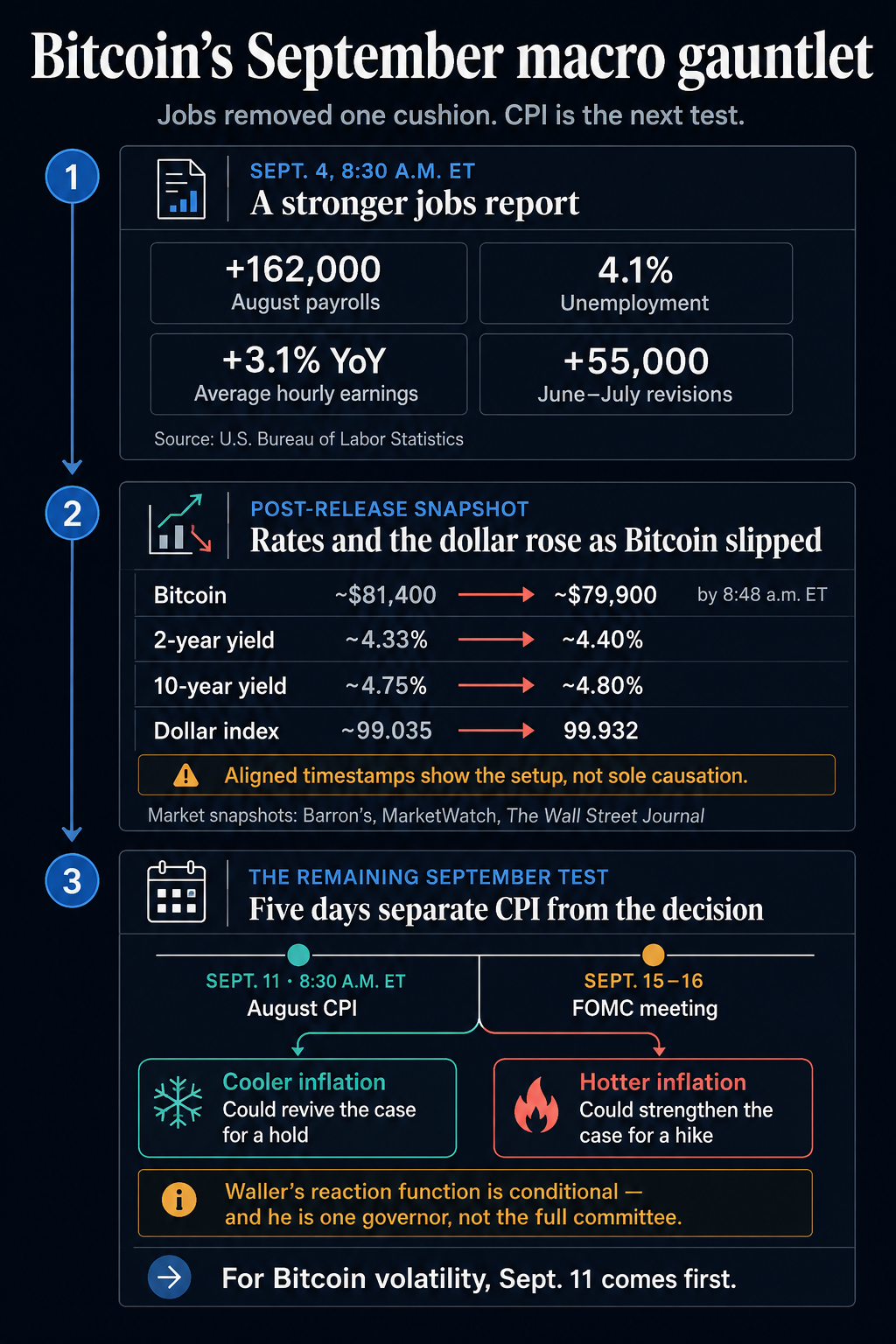
Bitcoin's push above $80,000 lost an important policy cushion on Sept. 4, when the August jobs report came in far stronger than the recent hiring trend. The result made it harder for the Fed to justify holding rates steady on labor-market weakness alone.
Bitcoin registered an intraday low of $78,660, but recovered to stay close to $80,000.
Within the same post-release window, MarketWatch reported the two-year Treasury yield near 4.40%, up from just above 4.33%, and the 10-year near 4.80%, up from just under 4.75%. The Wall Street Journal reported that the dollar index touched 99.932 from about 99.035 before the data.
Those aligned timestamps show that a more resilient labor market gave policymakers more room to focus on inflation, while higher short-term yields and a firmer dollar tightened the financial backdrop for a dollar-priced risk asset.
Payrolls narrowed the Fed question
The Bureau of Labor Statistics said nonfarm payrolls rose by 162,000 in August, more than five times the average monthly gain of 31,000 over the previous 12 months. The separately measured unemployment rate was unchanged at 4.1%.
BLS raised June payroll growth to 31,000 and July growth to 21,000, adding a combined 55,000 jobs to its earlier estimates.
Average hourly earnings for private nonfarm workers rose 0.3% in August to $37.75 and were 3.1% higher than a year earlier.
Food services and drinking places accounted for 59,000 jobs, and local government education added 42,000. Information employment fell by 23,000, while health care added 13,000, well below that sector's 32,000 average monthly gain over the prior year.
The report weakened the labor-market argument for an immediate pause without establishing that every corner of the economy was overheating. Inflation now has more weight in determining whether the Fed can stay patient.
Fed Governor Christopher Waller had laid out one visible version of that tradeoff the day before the release. His view does not bind the full Federal Open Market Committee, but his published remarks offered a clear reaction function.
Waller described the labor market as satisfactory and stable, with employment near its maximum sustainable level, and said that August inflation would heavily influence his September stance.
Continued progress toward the Fed's 2% goal would make him willing to hold the policy rate steady, while a hot reading, or evidence that progress had reversed, could make him consider a hike.
The payroll report removed the kind of obvious labor deterioration that could have outweighed an uncomfortable inflation print. September's decision now turns more cleanly on whether price pressures continue to ease.
CPI becomes Bitcoin's next September deadline
The BLS calendar schedules the August consumer price index for 8:30 a.m. ET on Sept. 11. The Federal Reserve calendar lists the FOMC meeting for Sept. 15-16, with decision-day events on Sept. 16.
The five-day gap makes CPI the last major scheduled inflation test before the meeting. For Bitcoin traders, Sept. 11 is when the September rate debate can absorb new evidence, rather than when policymakers formally settle it.
A cooler report would fit Waller's condition for supporting a hold and could relieve pressure transmitted through short-term yields and the dollar. A hotter print would strengthen the case that inflation progress has stalled just as the labor market has shown renewed resilience.
Waller spoke only for himself, and one inflation report will not erase the other evidence policymakers weigh. CPI can nevertheless change the balance because payrolls have already answered the labor side of the debate more firmly than the recent trend suggested.
Bitcoin had rallied above $80,000 before the two closely spaced macro tests. After payrolls, the asset fell back below it while yields and the dollar rose.
A softer CPI reading could reopen the hold narrative and give the rally breathing room. A hotter one could leave Bitcoin approaching the Sept. 16 decision with both labor resilience and inflation pressure pointing toward tighter policy.
The Fed meeting remains the policy deadline, but Sept. 11 comes first for Bitcoin volatility.
The post Bitcoin dips below $80,000 as a hot August jobs report shifts Fed policy expectations appeared first on CryptoSlate.
CryptoTicker.io
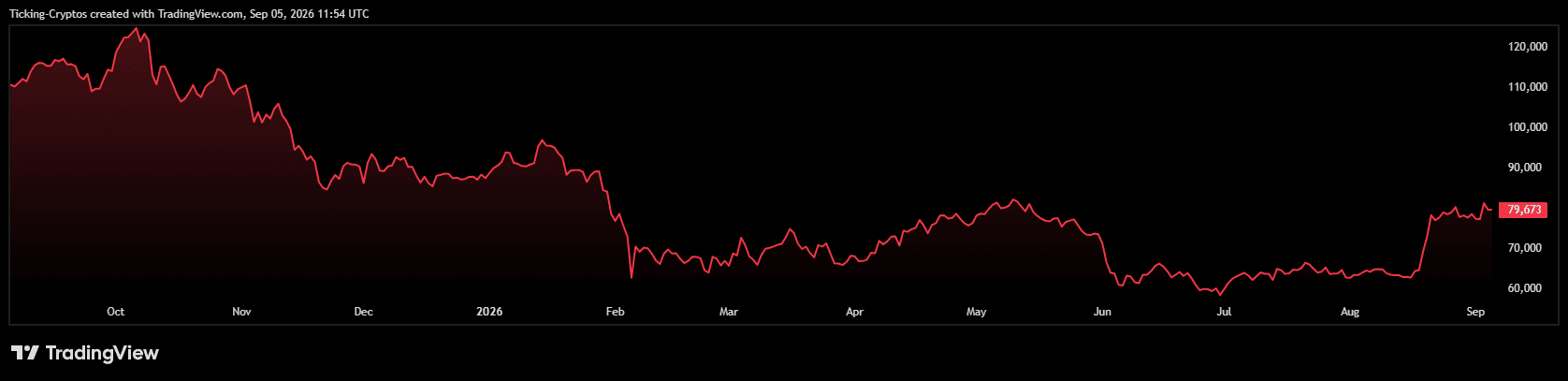
Bitcoin spent the first half of 2026 falling apart and the second half quietly putting itself back together. After bottoming near $58,000 in late June, its lowest level in 21 months, $BTC has clawed its way back to roughly $80,000. That is a gain of around 37% off the floor in a little over two months.
It is a real recovery. It is also nowhere near a victory lap. Bitcoin is still about 37% below the $126,200 record it set in October 2025, and Friday's US jobs report was a reminder that the macro backdrop has not turned friendly yet. Here is what is actually driving the market this month, and the five coins worth having on your screen.
Why Did The Bitcoin Price Rally From $58,000 To $80,000?
Three things did most of the work.
First, the June low was deep enough to bring buyers back. Glassnode's cycle indicators hit their coldest reading since the FTX collapse, long-term holders stopped selling, and roughly 844,000 BTC had already been accumulated in the $60,000 to $70,000 band earlier in the year. That range became a floor rather than a trapdoor.
Second, ETF money started returning. Spot Bitcoin ETFs shed a net $4.83 billion across 2026, but August flipped positive and recovered a chunk of it. Bitcoin ETF inflows in late August were the strongest since January.
Third, bond yields eased through August, which loosened financial conditions just enough for risk assets to breathe.
What Does The Macro Picture Mean For Crypto In September 2026?
This is where the story gets uncomfortable, and where a lot of the commentary this week is getting it wrong.
The August US jobs report, released Friday, was a blowout. Nonfarm payrolls rose 162,000 against a consensus of roughly 56,000. Unemployment held at 4.1%. Average hourly earnings rose 3.1% year on year. July's previously reported 23,000 job loss was revised up to a 21,000 gain, and June was revised higher too.
Strong labour data is good news for the economy and bad news for anyone hoping for cheap money. Odds of a Federal Reserve rate hike at the September meeting jumped to 59% from 52% immediately after the print. Treasury yields rose, the dollar firmed, and Bitcoin dropped from above $81,000 to under $80,000 in a single five-minute candle, with roughly $200 million in long positions liquidated inside the first hour.
So the honest framing for September is this: the supportive factors are structural, not monetary.
What is genuinely supporting the market:
- Regulatory clarity is arriving. On 2 September the SEC and CFTC launched a joint initiative on rules for leveraged and margined crypto transactions. The SEC separately proposed its first transfer agent overhaul in 40 years, a 421-page document that directly addresses blockchain-native fund administration.
- The ETF complex has broadened well beyond Bitcoin. Solana and XRP products both entered September with assets near the $1.5 billion mark.
- Post-halving supply dynamics continue to work quietly in the background.
What is working against it:
- The Fed under Kevin Warsh has held at 3.50% to 3.75% for five straight meetings and has not cut once in 2026. The median 2026 dot sits at 3.8%, which points to tightening rather than easing.
- Inflation is still running above target, and energy prices remain elevated.
- Bitcoin's correlation with rate-sensitive assets is higher than it has ever been, so Fed repricing hits crypto directly now.
Two dates matter: the August CPI print on 11 September, and the FOMC decision in the middle of the month. A soft CPI would do more for crypto than anything else on the calendar.
Which Are The Top 5 Cryptos To Watch This September?
1. Bitcoin (BTC)
Around $80,000, up roughly 37% from the June low, still down heavily from the October 2025 peak. The levels to watch are clean: $78,000 is where the 18 September options expiry has its max-pain level, $75,000 to $77,000 is the near-term support shelf, and $58,000 remains the structural line in the sand if the recovery fails. On the upside, a weekly close above $85,000 would be the first real evidence that the rebound is more than a bear market rally. $Bitcoin is on this list because it is currently setting the direction for everything else.
2. Ethereum (ETH)
Trading in the $2,400 to $2,500 area and lagging Bitcoin badly. Ethereum ETFs have seen outflows in most months of 2026, with May the worst at roughly $541 million, and money returning to Bitcoin during the summer lows largely skipped ETH. Prediction market traders still put high odds on ETH revisiting $2,250 before the year ends. The interesting question this month is whether ETH funds finally follow Bitcoin's flows back to positive. If they do not, the underperformance is likely to continue.
3. Solana (SOL)
Around $100, and this is the sharpest split in the market. Solana's on-chain activity has collapsed, with total value in Solana apps falling from about $11.5 billion in August 2025 to roughly $5.5 billion, and memecoin trading fees drying up with it. Yet Solana ETFs have recorded net outflows in only a single month since launching in October 2025, with cumulative inflows past $1.16 billion. Institutional demand and network usage are pointing in opposite directions. One of them is wrong.
4. XRP
Around $1.35 to $1.45, and the worst performer among the majors this year. Spot XRP ETFs have pulled in $1.51 billion since launching last November, which is not the problem. The problem is legislative: the CLARITY Act, which would give XRP permanent commodity status under federal law, has stalled in the Senate. That bill is the single catalyst institutions have been waiting on. Any movement on it in September would matter far more to XRP than anything on the chart.
5. Hyperliquid (HYPE)
The outlier, and the only major asset having a genuinely good year. HYPE set an all-time high of $88.04 on 3 September and is trading in the mid-$80s with a market cap around $21.8 billion, having outperformed BTC, ETH and SOL over recent weeks. The protocol is generating real revenue, roughly $2.8 million in fees over a recent 24-hour window. The catch is supply: a 9.92 million token unlock on 6 September releases about 1% of total supply to core contributors, worth around $820 million at current prices. How the market absorbs that unlock is the most informative single event in crypto this week.
Your ZIL sits on an exchange, the hard fork of September 2, 2026 has gone through, and you still cannot withdraw anything. This is not a fault in your account and not a sign that something has been lost: the hard fork was the protocol's step, reopening deposits and withdrawals is your exchange's step. The two do not happen on the same day.
On September 5, 2026, three days after the fork, we queried the public interfaces of three of the ten trading venues involved. At all three, ZIL deposits and withdrawals were halted at that point. At one of the three, trading was running normally at the same time. This article tells you why that is, what you can do right now, what you are better off avoiding, and what you are waiting for if you hold your ZIL in self-custody.
Why you still cannot withdraw your ZIL after the hard fork
A hard fork is a rule change in a blockchain's protocol that every node has to adopt, because only the new rule applies afterwards. The Zilliqa hard fork of September 2 did one single thing: it moved the ZIL balances of a first group of ten exchange partners from their old legacy addresses to their Zilliqa EVM addresses. Zilliqa describes this step as a protocol-level reassignment that required no action from users.
That puts the exchange's balance in the right place. What comes next, however, is no longer up to the protocol. In its own blog post of September 2, Zilliqa writes verbatim that exchanges are working through their own testing before they restore ZIL deposits and withdrawals on their platforms. In plain terms: the trading venue has to move its wallet system, its address management and its bookkeeping over to the new side of the chain and verify all of it. How long that takes is its own decision, and none of the ten exchanges has committed to a date.
For you as a holder, that leaves an uncomfortable but clear position. You can wait, and, provided your exchange keeps trading open, you can sell. What you cannot do is move your ZIL out. Anyone who would rather hold their balance on a different platform cannot get it there during this phase. An overview of the providers is still worth having, because after an incident like this the question of who you trust with your holdings comes up again (our overview: crypto exchanges compared).
What actually happened at protocol level on September 2, 2026
The fork was tied to a block height, not to a clock time: block 34,844,968, activated on September 2, 2026 at around 12:58 UTC. That number is the only hard marker in the whole process, and it can be checked independently. On September 5, 2026 at 06:37 UTC, the public Zilliqa node reported 35,045,411 transaction blocks. The chain is therefore a good 200,000 blocks past the fork height: the fork is unambiguously active, and anyone still waiting for it to activate is waiting for something that happened long ago.
According to the announcement, ten trading venues were affected: KuCoin, Binance.US, MEXC, OKCoin, Bitvavo, Korbit, WhiteBit, Bitrue, CoinSpot and CoinSwitch. In its blog post Zilliqa itself speaks only of a first group of ten exchange partners and does not name them there; the list comes from the announcement published in advance, which we analysed on August 29, 2026 in our overview of the Zilliqa hard fork and the ZIL migration. If your holdings sit with a different provider, you were not part of that day, and there is a reason for it further down.
Trading yes, moving no: what the exchange interfaces show on September 5
Rather than rely on announcements, on September 5, 2026 between 06:36 and 06:37 UTC we queried the public interfaces of three of the participating venues ourselves. The result is unambiguous and unwelcome for investors:
- Bitvavo already lists ZIL on the
ZILEVMnetwork, that is, on the new side of the chain. Even so, both the deposit status and the withdrawal status readMAINTENANCE. The ZIL against euro market is set totradingat the same moment. Trading works, moving does not. - WhiteBit reports both deposits and withdrawals for ZIL as disabled and still lists the old
ZILnetwork. - KuCoin likewise reports deposits and withdrawals for the
ZILchain as switched off.
This measurement is a snapshot, not a permanent state. What it does reveal, though, is something that appears in no announcement: three days after the fork, none of the three venues checked had released transfers again, and two of them still carried ZIL under the old network label. So check the status at your own provider instead of relying on reports about others. In the app it usually sits right next to the withdrawal button, otherwise on the provider's status page.
Legacy address or Zilliqa EVM: why your exchange's network label matters
Zilliqa has two address formats, and the entire process turns on the switch between them. A legacy address is the network's old address form, secured by Schnorr signatures; a Zilliqa EVM address is the new form, which follows the address format of the Ethereum Virtual Machine and therefore works with common wallets. The hard fork rewrote balances from the first form to the second.
For you, the network label is therefore a usable status indicator. If your provider already shows ZILEVM as the network, the reassignment has arrived there and only the transfer release is missing. If it still shows ZIL, the provider is not that far along with its migration. In practice both mean the same thing for you: wait. The difference lies in how far your provider has already got.
The second case matters and is often overlooked. Anyone holding ZIL not at an exchange but in their own wallet was not affected by the September 2 fork at all. For self-custodians, nothing changed that day. What happens to that group is covered further down.
Why your exchange sets the timing, not Zilliqa
This is the point at which most readers misread the process. A protocol can move balances; it cannot force an exchange to open its withdrawals. An exchange manages a pooled balance for its customers in its own wallets. If the address format underneath that balance changes, the venue has to bring its entire internal allocation across, test it and reconcile it against account balances before it lets money out again. If something goes wrong in the process, the exchange is liable, not the protocol.
That is exactly why Zilliqa's own text carries no date for the reopening, only the reference to the venues' ongoing testing. Anyone expecting Zilliqa to answer the question of when they can withdraw again is asking in the wrong place. Only your provider has that answer.
You may know the pattern from other cases: the balance is visible in the account but cannot be moved, and support names no date. We have described how to proceed sensibly in such situations and what you should document in a separate guide (crypto exchange: account frozen, what to do).
A second hard fork in mid-September: what that statement is worth
In its blog post of September 2, Zilliqa announced a second hard fork intended to migrate the next group of trading venues. The timing is given, verbatim, as "mid-September". The address mappings of further partners were still being collected and checked, and Zilliqa would confirm the exchanges and the exact date once those mappings were settled.
Take that statement for what it is: a declaration of intent without a deadline. "Mid-September" is not a date on which you could do or check anything. Anyone turning it into a specific day is inventing it. The only reliable part of the statement is its direction, and for those affected at providers left out so far that is at least good news. On this point Zilliqa writes verbatim that anyone holding ZIL at an exchange not covered on September 2 has not been forgotten: that exchange's submission is still being processed.
In practice that means: if your provider was not in the group of ten, your current situation is unchanged, and the next marker is an announcement that is still outstanding. Calendar entries for an invented date do not help. A look at your provider's status page every few days does.

What self-custodians do now, and why the ZIL migration tool is still missing
Self-custody means that you hold your coins in your own wallet and control the private key yourself instead of leaving it with a provider. In the Zilliqa incident this is the larger group, and it is waiting the longest. Zilliqa concedes as much in the blog post and describes it as the group that has been hardest to keep waiting.
The state of play according to Zilliqa: the self-service migration tool is in its final development phase and on track for a release in mid-September. It is to be built on zero-knowledge proofs. A zero-knowledge proof is a cryptographic proof with which you can demonstrate that you know or own something without disclosing the thing itself. For the migration that means, concretely: you should be able to move your stuck legacy balance to a Zilliqa EVM address yourself, without showing anyone your seed phrase or your private key, neither Zilliqa nor anybody else.
What you should not do until then
The most important warning in this text follows from that design. The real tool will never need your key. Every site, every form and every direct message that asks you during this waiting period for a seed phrase, a private key or a wallet approval in order to "migrate your ZIL" is therefore, by the project's own blueprint, not the announced tool. And as long as Zilliqa has published neither a start date nor an address, there is nothing you would have to unlock in advance. If you want to be safe, keep larger holdings on a device that does not release the private key in the first place, and do not type it in anywhere.
Trusted setup: why a ceremony decides the security of the ZIL tool
A trusted setup is the launch procedure of a zero-knowledge system in which several participants jointly generate secret starting values and then destroy their respective shares. The purpose: as long as even one participant honestly deletes their share, nobody can produce forged proofs later. Whoever held all the shares could evidence balances out of nothing.
Zilliqa writes that it is currently settling the circle of participants for this ceremony, and names as already confirmed the company itself, LTIN, an independent Web3 security audit, an exchange partner and participants from the community. The full list and the details of the ceremony are to be published before the tool launches. Zilliqa states the principle behind it explicitly: no single party should be able to act alone on a matter this sensitive.
For you this is not a technical detail at the margin but the question to ask before first use. If the tool appears without that list having been published beforehand, the whole thing is missing precisely the part that makes it verifiable. In that case it is worth waiting a few days rather than being the first to migrate.
Compensation through re-minting: the proposal nobody has voted on yet
The question that occupies those affected most is the one about the money that drained away in the incident. Zilliqa answers it in the blog post of September 2 in two parts, and both parts belong on the same line, otherwise the picture comes out skewed.
First, the legal route. Zilliqa describes the legal recovery of stolen assets through cross-border tracing and enforcement as a real path, but at the same time as a slow and uncertain one; anyone claiming otherwise about such proceedings is not being honest. That candour is unusual and, for you as a reader, the more useful information: no money will come from that route for the foreseeable future.
Second, the vote. In parallel, by its own account, Zilliqa is preparing a community vote on an adjustment to the tokenomics that would include re-minting tokens to compensate those harmed. The term tokenomics describes the rules by which a cryptocurrency is issued, distributed and capped. Zilliqa explicitly explains why this is not decided alone: the step changes the total supply and therefore affects every ZIL holder, not only those directly harmed. Mechanics, size and eligibility are to appear in the full proposal on the project's governance portal.
We queried that portal on September 5, 2026. The most recent post published there dates from April 10, 2026; a compensation proposal was not among the entries at that point. So there is currently nothing you could vote on and no text whose terms you could examine. Anyone telling you otherwise knows a source that does not exist.
What re-minting would mean for every other ZIL holder
Re-minting creates additional tokens that did not exist before. No existing holdings are redistributed in the process; the total supply grows. Every individual holder's share of the total therefore falls without the number of their tokens changing. The technical term for this effect is dilution.
The proposal thus has two sides, and an honest text names both. For those harmed it would be the faster route to compensation, probably considerably faster than any court proceedings; Zilliqa argues along those lines itself. For all other holders it is a burden they carry without having been harmed themselves. Zilliqa explicitly puts this trade-off to the community to decide rather than deciding it: the wording in the blog post is that it wants to give the community a genuine choice between speed and other trade-offs.
If you hold ZIL and this proposal appears, that is the moment when you have something to decide yourself. Until then the position is: there is no resolution, no promised sum and no defined group of eligible claimants. There is the announcement that there is to be a proposal.

ZIL withdrawal fee and minimum amount: what to check as soon as your exchange reopens
For the day on which transfers are switched back on, the terms are worth a look, particularly with a cryptocurrency at a very low unit price, where fees are stated in units rather than as a percentage. The values we read from the public interfaces on September 5, 2026 show the order of magnitude:
- Bitvavo states a withdrawal fee of 120 ZIL for ZIL and a minimum withdrawal amount of 420 ZIL. Two confirmations are on file for deposits.
- WhiteBit gives a minimum amount of 450 ZIL for withdrawals and 230 ZIL for deposits.
These figures change as soon as a provider resumes operations, and they are not a recommendation for or against any venue. The point behind them is a different one: with small holdings the fee can account for a noticeable part of the balance, and a balance below the minimum amount cannot be withdrawn at all. Anyone in that position is choosing between leaving it where it is and selling, not between withdrawing and waiting. Look at your own provider's terms on the day of the release instead of relying on older figures.
What this case shows about custody at exchanges
The Zilliqa case demonstrates a property that otherwise stays in the background: anyone holding coins at a trading venue holds a claim against that provider and not the coin itself. As long as everything is running, the difference is invisible. It becomes visible the moment the protocol changes something and the provider has to follow.
The reverse conclusion does not hold, however. On Zilliqa's account, the whole process was triggered by a signature bug in the Zilliqa application for Ledger devices, that is, in the self-custody area of all places. In this case those who self-custody are waiting even longer than the customers of the ten exchanges, because their tool does not yet exist. The more useful lesson is therefore that anyone who knows both routes and deliberately splits their holdings has more room to manoeuvre in phases like this than someone who keeps everything in one place.
ZIL migration: what to take away
- Check the status at your own provider, not at other people's. What matters is whether ZIL deposits and withdrawals are released there and which network label is listed. If this is prompting you to think about your trading venue anyway, a look at the alternatives helps: crypto exchanges compared.
- Give nobody your private key during the wait. The announced migration tool is built so that it does not need one. Anyone wanting to self-custody larger holdings should do so on a device that does not release the key: hardware wallets compared.
- Wait for the published proposal before counting on compensation. Until a text with mechanics, size and eligibility is on the governance portal, there is nothing to apply for. If oversight of your trading venue matters to you, you will find the assessment here: regulated crypto exchanges compared.
The primary sources for this article: Zilliqa's status report of September 2, 2026 and the project's governance portal, on which the compensation proposal is to appear.
(As of September 5, 2026. This article is not investment advice. Prices and fee structures change; check the terms with the provider before you buy.)
Data belonging to 5,411 customers of the Swiss Bitcoin service Pocket Bitcoin has been exposed, according to the company. For 291 of them, the provider's breakdown says the Bitcoin addresses they used for their purchases were also included, along with copies of identity documents and evidence on the source of funds. That combination is precisely the part that reaches beyond the individual case: a name next to a Bitcoin address cannot be taken back, because the blockchain preserves every movement of that address in public view.
The coins themselves are not affected, according to the company. Even so, the incident is worth reading for anyone who buys Bitcoin through a provider and has it paid out to their own wallet. The same pairing of identity data and receiving address arises with every purchase, every withdrawal and every address authorisation, in Germany as elsewhere. The incident shows what becomes of it once it leaves the building.
What happened in the Pocket Bitcoin data breach
Pocket Bitcoin is a Swiss provider that converts incoming bank transfers into Bitcoin and sends the coins directly to the customer's wallet. By its own account the company holds no keys; it is what is known as a non-custodial service. Non-custodial means the provider can no longer dispose of the coins after payout, because the private key stays with the user.
The company first made the incident public on August 21, 2026. A detailed interim report followed on August 31, which Pocket Bitcoin revised once more on September 3, 2026, thereby closing the investigation. That final version carries the figure that resizes the incident: 5,411 people affected instead of the smaller group named initially. It can be read in the company's security incident update.
The provider names its support system as the point of entry. Documents that had arisen in the exchange with partner banks were held there. The gap has since been closed. The incident was reported to the Federal Data Protection and Information Commissioner in Switzerland and to the data protection authority of Liechtenstein, and the company has also filed a criminal complaint.
Who is affected: 5,120 customers with account movements, 291 with ID copies
The company distinguishes two groups, and the difference matters more for assessing the risk than the headline total.
The larger group comprises 5,120 people. What is affected here are transaction lists the provider had received from partner banks. They contain names, addresses and individual transfers with amount and date, and for some of those affected the IBAN as well. Anyone in this group has their purchase history exposed in euro or franc amounts, but without any link to a specific Bitcoin address.
The smaller group comprises 291 people and weighs more heavily. Here it is a matter of correspondence that had gone to partner banks. According to the company's breakdown, it could contain names, postal addresses, the Bitcoin addresses used for transactions, copies of identity documents and evidence on the source of funds, in varying combinations. Evidence on the source of funds is a document with which a provider records where deposited money came from, a payslip or a purchase contract, for instance.
These 291 records are the real core of the incident. Everything else can be contained by the usual means: an exposed IBAN gets changed, an ID document gets reissued, an address changes with the next move. A Bitcoin address once linked to a name stays linked.
Am I affected by the Pocket Bitcoin data breach? How to tell
According to the company, every affected person was contacted individually, with a description of what had been exposed in their particular case. Anyone who has not received such a personal message is, by that logic, not on either list. This information comes from the provider itself; there is no independent lookup list in which you could check your own address.
In practice that means: look in the mailbox you registered with the provider, including the spam folder and the promotions tab. Check the date. A notification from the week after September 3, 2026 belongs to the closed investigation, an older one from August to the first interim report, which named the smaller figure. Both can apply to the same person, with different scope.
What you should never do in the process: follow a link that asks you to enter a recovery phrase. No reputable provider asks for one, and Pocket Bitcoin states this explicitly in its notice. The same goes for any demand to move a balance to an unfamiliar address for safekeeping.
What an exposed Bitcoin address reveals about your balance
What a Bitcoin address is
A Bitcoin address is a string of characters to which coins are sent. It is neither an account nor a secret, but a public receiving detail, comparable to an account number whose every entry anyone can inspect. That is exactly where it differs from a bank account: at a bank, only those with access see the movements. On the blockchain, everyone sees them, permanently and without logging in.
Anyone who knows an address can look up in any blockchain explorer how much sits on it, when funds went in and out, and where they went next. As long as nobody knows whom the address belongs to, it is an anonymous string among millions of others. Add a name and the assessment flips. The string becomes a statement of assets with a timestamp.
With the 291 records, precisely that attribution exists. How much is actually visible there depends on what the affected person has done since. Anyone who never moved the coins received has their balance sitting visibly on the address. Anyone who passed them on has lengthened the trail, but not ended it.

Why changing addresses cuts the trail only halfway
The obvious reaction runs: send the coins to a new address and be done. It is not that simple. A transfer on the blockchain does not delete the old connection, it attaches a new one to it. Anyone who knows the old address sees the outgoing movement and sees the receiving address too. The attribution travels with it.
What coin control means
Coin control is the ability to select, within a wallet, which individual holdings are used for a payment. The benefit lies in separation: anyone who never merges coins from an exposed address with coins from other sources in a single transaction prevents an observer from attributing both holdings to the same person. If they are spent together, on the other hand, chain analysis works from the obvious assumption that they belong to one hand.
For those affected that means, concretely: keep holdings separate and spend them separately. Setting up a new wallet with its own recovery phrase and routing only future purchases there cleanly separates the future from the past. The wallets that offer coin control at all differ considerably; which they are and how to recognise them is set out in the software wallet comparison.
What matters is an honest assessment: none of these measures undoes an attribution once published. It limits what gets added in future. Anyone expecting complete anonymity from it overestimates the tool.
What was not affected: private keys, customer database, balances
In its notice, the company sets out explicitly which systems were not compromised according to the findings of the investigation: the customer database holding identity data, the transaction database and the system access credentials. The private keys never left the users' devices at any point, because by design the service does not hold them at all. Access to balances is therefore not possible by this route. No misuse of the exposed data is discernible so far, the provider writes.
This distinction is not a whitewash but the difference between two very different damage profiles. At a custodial exchange, an attack on the customer database would have hung directly on the balances. Here the balance lies outside the provider's reach, and the damage is data damage. It hits privacy and creates a surface for fraud, not for theft at the click of a mouse.
The price of this design sits on the other side of the ledger. Anyone holding the coins themselves also carries responsibility for securing them. The address authorisation used to set up a payout is, moreover, precisely the process in which the data pairing exposed here arises in the first place.
How to spot forged letters after a data breach
The company warns its customers about forged letters and other post. The reason lies in the nature of the exposed data. Anyone who knows a name, an address, a transfer amount and a date can compose a letter that quotes a genuine transaction correctly. That removes the marker by which attempted fraud is otherwise easiest to identify: the sender's ignorance.
Usable checks for post relating to your crypto account:
- A QR code prompting the recovery, backup or migration of a wallet is an attack. There is no legitimate process that begins that way.
- Time pressure in the subject line, or a deadline of a few days, is a warning sign, especially when a suspension is threatened.
- A correctly quoted transfer proves nothing at all now that this data is exposed. Do not treat it as evidence of authenticity.
- Queries belong on a channel you chose yourself: the provider's address typed into the browser, or a phone number from your own records.
- A form asking for a recovery phrase, whether by post, web form or telephone call, is always fraudulent.
How professional such letters now look is shown by the case we described under crypto wallet phishing by post. There the demand arrived on printed paper with a corporate look, not by email.

Home address plus purchase amount: the physical risk
With data breaches in the crypto world, the digital consequences are usually the first thing people think of. The more unpleasant consequence is a different one. A list bringing together names, home addresses and transfer amounts is an address list that can be sorted by wealth. The same concern already applied in August to the buyer data of two hardware wallet manufacturers, which leaked through a shipping provider; it can be read in our report on the Trezor data breach.
The difference from those cases: there, the order revealed that someone had bought a hardware wallet and therefore probably holds crypto assets. Here the amount stands next to it. That is considerably more precise information, and it is the reason why those affected should not dismiss this point as overblown.
What helps is unspectacular and works nonetheless. Do not talk about your holdings at home or among friends. Do not leave hardware and backup copies in the obvious place. Anyone who keeps a recovery phrase physically separate from the device has already done the essential thing against a burglary.
What rights the GDPR gives you, and where the ten-year period applies
Anyone affected has a right of access against the company responsible: on request it must state which personal data it processes and which were exposed in the specific case. That is the most sensible first step, because only afterwards can you judge whether a Bitcoin address was involved or merely an account movement.
The second point disappoints many. A request for erasure regularly comes to nothing at financial service providers, because statutory retention obligations take precedence. Pocket Bitcoin itself points out in its notice that it must retain customer and transaction data for ten years after a transaction is completed. That obligation is the price of regulation, and it applies in the same sense to every authorised provider in the EU.
With a Swiss provider, the competent supervisory body is the Federal Data Protection and Information Commissioner, not a German state data protection authority. Those affected who reside in the EU can nonetheless turn to their home supervisory authority first, which will forward the case. Anyone considering a complaint should keep the company's notification; it is the evidence that they were affected.
What German investors should now check with their own provider
The incident concerns the customers of a Swiss provider. The data pairing at issue, however, arises everywhere. Every exchange and every broker stores its customers' payout addresses, usually in the address book of the withdrawal function, often permanently. Together with the identity data from account opening, that means every provider holds exactly the attribution that leaked here. Since January 1, 2026 the tax reporting obligation has been added, which sets the same identity data in motion in any case.
Four checks that can be done in half an hour:
- Go through the address book. Log in with your provider and open the list of stored payout addresses. Anything you no longer need there can be removed. That shrinks the set of addresses that could be attributed to your name in the worst case.
- Do not reuse addresses. If you use the same address for every payout, your entire holding accumulates at one point known to the provider. Modern wallets generate a new address for each receipt; use that function instead of typing in an address you noted down once.
- Fix your contact route. Save your provider's official point of contact yourself. Anyone who does not have to search in an emergency also does not click the first link in an email.
- Check your backup. Is your recovery phrase stored separately from the device, and do you know for certain that it is complete and legible? A data breach changes nothing about that, but it raises the probability that someone will try their luck with you.
One note on placing this: with a non-custodial service, as in this case, the balance stays in your own hands even when data is damaged. That is a structural advantage over permanent storage on a trading platform, and it weighs more than the difference in convenience. Anyone who buys regularly and withdraws the coins each time should select providers according to whether they support automatic payouts to your own wallet.
Pocket Bitcoin data breach: what to take away
- Check whether a personal notification reached you, and read it for whether a Bitcoin address is named. Only then does the critical attribution exist. If an address is affected, move future purchases to a freshly created wallet and do not merge old and new holdings in a single transaction. Which wallets support that separation cleanly is shown by the software wallet comparison.
- Treat all post about your crypto account as unverified from now on, even when it names a genuine transfer correctly. Queries only through channels you chose yourself. And store your backup copy so that it survives a burglary; the differences between the devices are set out in the hardware wallet comparison.
- Look at the address book of your own provider, regardless of whether you are a customer of the affected service. Anyone who has payouts made automatically to their own wallet in future shrinks the data trail with every single purchase; which providers offer that is set out in the savings plan comparison.
The provider's investigation is closed, and by its account no misuse is discernible so far. For those affected in the smaller group, the matter nonetheless does not end there, because the attribution of their name and address is out in the world. An independent summary of the figures can be found at crypto.news.
(As of September 4, 2026. This article is not investment advice. Prices and fee structures change; check the terms with the provider before you buy.)
Whether you are affected by the Trezor data breach comes down to a single question: is there an email from help@trezor.io about the incident in your inbox? Trezor says it notifies every affected person individually. Anyone who has not received that message is, according to the manufacturer, not in the exposed records.
On September 4, 2026, Trezor widened the incident for the second time. Around 67,000 further customers in the United States were added to the 13,689 reported in August, bringing the total to just over 80,000 people. Exposed were the full name, delivery address, phone number, email address and order number. Not exposed were the contents of the parcels, the devices themselves, private keys or wallet backups.
This article answers the question behind the headline that nobody has answered in German so far: whether German customers appear in this second wave at all, how you check that, and what an open address book means for someone who holds crypto assets in self-custody.
Am I affected by the Trezor data breach? The check takes two minutes
Trezor has taken the same route for both waves: those affected are informed directly by email, sent from help@trezor.io. The sentence appears verbatim in the blog post on the incident, and it works in both directions. No mail from that address means, in the manufacturer's account, that you are not affected.
The notification itself distinguishes two levels. With full exposure, the name, email address, phone number and delivery address are affected. With partial exposure, it is only the name, city and email address, with the street address missing. Which of the two applies to you is stated in the mail. That is not a formality: an exposed street address weighs considerably more heavily than an exposed city.
And if you are not sure about the mail
This is exactly where the real risk begins. A data breach that is reported publicly is an invitation to fraudsters, because thousands of people are expecting a warning email right now. So check the sender address character by character, open no attachments and follow no link from the mail. If you want to know whether a message is genuine, call up the Trezor site yourself through your browser's address bar and look for the blog post on the incident there. The route via the address bar is the only one an attacker cannot fake.
What was exposed at ShipMonk and what was not
ShipMonk is a fulfilment provider, a company that stores a manufacturer's goods, packs orders and ships them to customers. For that job such a provider needs precisely the data that has now leaked: name, delivery address, phone number for the courier, email address and order number. Trezor describes ShipMonk as one of its shipping partners for the United States, the United Kingdom and other countries.
On August 10, 2026, ShipMonk reported unauthorised access to systems holding customer data to the manufacturer. Trezor made the incident public on August 13. What was expressly not affected is the more important part of the disclosure: Trezor's own systems were not compromised, according to the company, the devices are safe, and private keys and wallet backups are untouched. The contents of the parcels do not appear in the data either. An attacker therefore knows that an order went to a particular address, but not which device was in it or how much sits on it today.
Why this still concerns you as a self-custodian
A hardware wallet is a device that keeps your private keys permanently offline and signs transactions only after confirmation on the device itself. That makes it the standard tool of self-custody, and it carries one unavoidable side effect: it remains a physical product. Anyone who buys one has to have it delivered, and in doing so leaves a name, an address and a phone number with at least one intermediary. That is exactly the trail exposed here. If you are currently weighing up which device and which purchase route suits you, the hardware wallet comparison helps with the choice. Since this incident, the data trail left by an order belongs among the criteria that go into that decision.

Why Germany appears on neither list of affected customers
Trezor names the countries affected in both waves, and the result is unambiguous for German readers. The first wave covered orders from the United States, the United Kingdom, Sweden, Colombia, Brazil, Italy and Portugal, delivered between May 10 and August 8, 2026. The second wave affects customers in the United States exclusively, according to the manufacturer. Germany appears in neither list.
That is a piece of information with a limit, and the limit belongs with it. What counts is the delivery address, not the place of residence or nationality. Anyone who had a device sent to an address in one of the countries named can be affected even if they live in Germany. And the country list does not replace the check: what matters remains the notification from help@trezor.io.
The second wave hits an entirely different group of buyers
The real finding in this update is not the number but the period. The first wave concerned fresh orders from the spring and summer of 2026. The roughly 67,000 new records come from an earlier collaboration between November 2019 and August 2021. These are people who ordered a device four to seven years ago and may never have bought there again since.
For this group the situation reverses. Anyone who read the first report in August 2026 and found that their last order was years back had good reason to consider themselves unaffected. Since September 4 that no longer holds. Our report on the first wave of the ShipMonk data breach gives the figure of 13,689 affected customers that applied at the time. That number has been overtaken by the update; the sequence of events and the mechanics described there hold unchanged.
Why this is more than a revised figure: the second wave consists throughout of full exposures, according to Trezor, so name, email, phone number, delivery address and order number as one package. And it hits orders from a time when crypto assets were worth considerably less than they are today. Someone who bought in 2020 and held is statistically sitting on a larger balance than someone who came in during 2026. Any attacker makes that connection unaided.
Deletion confirmed in writing, data present anyway
Trezor works, by its own account, with a retention period of 90 days: order data is to be deleted or anonymised 90 days after delivery, and the company says it agreed the same condition with its shipping partners. In the report of August 13 that very period was cited as the reason the damage was limited.
The update of September 4 pulls the ground out from under that argument. Trezor writes that it repeatedly requested, and received, written confirmation of deletion throughout the collaboration, and that it is deeply disappointed the data was not deleted in the provider's systems despite that confirmation. This account comes from the manufacturer; a statement from the provider on the matter is not available to us.
What you take from this for every other provider
The point generalises, which makes it the practically most valuable one in the whole affair: a contractual deletion period is a promise, not a guarantee. The contract describes what a provider is supposed to do, and says nothing about what is actually still sitting in its databases. You cannot check that from the outside. What you can control is the volume of data you hand over in the first place, and that is what the later part of this article is about.
Why an address leak is not a crypto loss
This distinction is the reason you do not need to move any coins after this report. An attacker who knows your name, your address and your phone number has no access whatsoever to your holdings. Access hangs solely on the wallet backup, the sequence of words your device displayed during setup and from which all private keys can be restored. That word sequence was never held by the shipping provider and is not part of the leak.
Anyone holding Bitcoin or other crypto assets on their own device therefore has no technical reason to swap the device or move holdings after this incident. A wallet whose backup was never recorded digitally and never typed in anywhere stays safe even if the delivery address is public. Only one thing has changed: the probability of being approached in a targeted way.

How to spot phishing after a data breach: the signs that count
Phishing describes the attempt to get you to hand over access credentials or keys through a faked message. After an address leak it becomes precision work: someone who knows your name, address, phone number and order number no longer writes a mass mail but composes a message containing genuine personal details, which is why it reads as credible. Trezor points explicitly to this heightened risk in its own blog post and names faked emails, fraudulent calls and letters.
How you recognise such a message:
- Urgency. Any message demanding immediate action because something is supposedly blocked, compromised or lost belongs on the test bench. Time pressure is the tool used to prevent checking.
- A request for recovery data. No reputable manufacturer ever asks for your wallet backup, your word sequence or your private key, not by mail, not on the phone and not on a website.
- Personal details as a trust anchor. After this leak, an address and an order number are no longer proof of authenticity but an indication that someone is working with leaked data.
- The link goes somewhere other than it promises. Hover over the link without clicking and read the actual destination. On a phone, a long press rather than a tap does the job.
- A device arrives unrequested. Anyone who receives a supposedly free or replacement device by post after a leak should not set it up. Tampered devices carrying a ready-made backup are a known line of attack.
- The call comes from support. Phone numbers are part of the leak. A call back on a number you looked up yourself on the manufacturer's site settles any doubt.
How concrete this can get is shown by the case we described in our article on phishing letters sent to wallet owners: there the attack reached its targets as a printed letter carrying the appearance of an official demand. An exposed home address is what makes that route possible in the first place.
Wallet backup: the one rule every attack fails against
The wallet backup is the recovery sequence of usually twelve or twenty-four words with which your entire wallet can be rebuilt on any other device. Whoever has it has the coins. Hence one rule that holds without exception: these words are never entered on a website, never photographed, never stored in a cloud and never told to anyone, support staff included.
This single rule neutralises practically every attack that follows from an address leak. An attacker can write to you, call you, impress you with your order number and show you a perfectly rebuilt page. As long as the word sequence does not leave your device, the attack has no effect. While you are at it, check where your backup physically sits and whether it would survive water damage or a house fire there.
An exposed home address: what the physical risk means in practice
Alongside phishing, Trezor explicitly names possible risks to the physical safety of those affected in its updated report, and trade media have picked the point up. It is the sober consequence of a data combination: a list of home addresses behind which someone holding crypto assets very probably stands is a different thing from a furniture retailer's customer address list.
In practice that means restraint above all. Anyone who talks publicly about their own holdings, shows them on social networks or appears under their real name in the relevant forums links the leaked address to an order of magnitude. That link is the actual risk factor, and it is the only variable in the equation you still control yourself. Where your backup sits is likewise nobody's business, and a location outside the home has a second advantage here beyond fire protection.
How to order a hardware wallet with a smaller data trail
Trezor itself lists several ways to give away less about yourself when buying. None is restricted to one manufacturer; all of them work with any mail-order retailer:
- A dedicated email address for orders that does not carry your name and is linked to no other account.
- Payment in cryptocurrency where the retailer offers it, otherwise a virtual single-use card instead of your main credit card.
- A pickup address instead of your home address. Trezor names the PO box; in Germany a parcel locker or branch delivery is also an option. Collection usually requires ID, and the courier stores that data in turn.
- Buying from the manufacturer rather than through marketplaces. That does not reduce the volume of data, but it does reduce the number of places holding it, and it rules out tampered second-hand devices.
The rest is a trade-off. Each of these measures costs convenience, and none of them makes you invisible. Anyone who wants to avoid the data aspect entirely arrives at a different form of custody: a software wallet is an application on a phone or a computer that stores the keys locally. Such an application is downloaded rather than delivered, so it leaves no delivery address, but it offers less protection against malware on the machine. Which application does what is set out in the software wallet comparison; for larger holdings the combination of both remains the usual route.
What Anonymous Delivery is and when Trezor plans to offer it in Europe
In the same blog post Trezor announces a shipping option called Anonymous Delivery: a separate ordering process with collection at a pickup point, neutral packaging, generic sender details and automatic deletion of the shipping identifiers after delivery. For the European Union the company gives September 2026 as its target, and the end of the year for the United States.
Two qualifications belong with that. First, this is a manufacturer's announcement and not an available product; whether the date holds cannot be checked today. Second, the option solves the underlying problem only in part: even with neutral packaging a courier needs a destination address, and deletion after delivery is once again a promise whose fulfilment you cannot verify from the outside. As an improvement on the current state it is relevant nonetheless, and for purchases in the EU it is worth looking before your next order to see whether the option has appeared in the checkout.
What the incident says about intermediaries in the crypto supply chain
The attack hit a provider two stations behind the manufacturer. For you as a customer that is the most uncomfortable part: you ordered from Trezor, but your data sat with a company whose name most of those affected learned only through this report. That applies to hardware wallets exactly as it does to any other online purchase.
What carries over is above all the question of how many places hold your data. With a trading platform it is the provider, the payment processor and the identity checker; with a device purchase it is the retailer, the fulfilment provider and the courier. Each is a separate point of attack, and you check none of them yourself. Anyone choosing a platform can at least look at the supervision: in a provider comparison, the question of domicile, licence and data processing now belongs to the selection just as much as the fee does.
Checking the Trezor data breach: what to take away
- Check your inbox first, not your wallet. A message from help@trezor.io decides whether you are affected; without it you are not in the data, according to the manufacturer. Your coins are safe regardless, as long as your backup was never typed in anywhere. If you are thinking about your device anyway, the hardware wallet comparison helps you place it.
- Expect targeted approaches, not mass mailings. Reckon with mails, calls and letters containing your genuine order data over the coming months. The word sequence of your backup never leaves your device. If you want to spread your custody more widely, the software wallet comparison shows what makes sense alongside the device.
- Reduce the data trail on your next order. A dedicated order address, a pickup point instead of your home address, buying direct from the manufacturer. And if part of your holdings sits on a platform, check in the exchange comparison who holds which data there and under whose supervision.
Sources and evidence for this article
Figures, periods, data fields and country details come from Trezor's blog post on the incident at the shipping provider, last updated on September 4, 2026. The independent assessment of the total figure and the period covered by the second wave draws on the CyberInsider report of September 4, 2026. Both sources were accessible on September 4, 2026.
(As of September 4, 2026. This article is not investment advice. Prices and fee structures change; check the terms with the provider before you buy.)
If you held SAND through the bridge on Base or on BNB Smart Chain, the short answer is this: you are due to get your balance back, one for one, paid out as SAND on Ethereum. According to The Sandbox, the money comes from its own treasury, meaning the company's existing holdings, and no new tokens will be minted for it. Whether you have to do anything yourself hinges on a single question: on the evening of August 21, was your SAND sitting at a centralised exchange or in your own wallet?
For most of those affected the answer is "at an exchange", and that majority does not need to file a claim at all. For everyone else, a claim window opens whose start date the operator has given only approximately and whose end is not fixed at all so far. This article sorts out what is documented, what is merely asserted, and which circulating date you are better off ignoring.
What happened in the SAND bridge exploit and why is your balance frozen?
A bridge is a pair of contracts that makes tokens transferable from one blockchain to another: on the origin chain a holding is locked, on the destination chain an equal amount is issued. The token you then hold on the destination chain is a bridged token and therefore a claim on the locked original, not an asset in its own right.
That issuing function is exactly what was attacked on August 21, 2026. Through a configuration flaw in the SAND contracts on Base and BNB Smart Chain, the attacker was able to become the sole validator of incoming bridge messages, according to consistent accounts in the trade press. Whoever holds that role can self-confirm arbitrary transfers and then issue unbacked tokens. The chain notices nothing, because formally everything runs correctly.
The timing can be proven to the second
The first unauthorised mint falls on Base block 50,283,176 and on block 117,321,965 of BNB Smart Chain. We queried both blocks on September 4, 2026 through public nodes of the respective chain: the Base block carries the timestamp August 21, 2026, 23:41:39 UTC, the block on BNB Smart Chain 23:42:17 UTC the same evening. That leaves 38 seconds between the two chains.
The following morning The Sandbox closed the affected contracts. Since then, bridged SAND on Base and BNB Smart Chain can neither be moved nor redeemed. Anyone holding a balance there sees a number in their wallet with nothing actionable behind it for the time being. How that freeze came about, and why trading in this state was not a good idea, we wrote up on August 23 in our report on the SAND bridge exploit; this article picks up where that one ends.
How much SAND was actually stolen and where do the trillion figures come from?
This is where the biggest misunderstanding of the whole episode sits, and it shaped the German headlines of August 22. The number printed there was the minted amount. The actual damage is something else entirely.
- Minted were unbacked tokens in astronomical quantities. crypto.news puts the amount at more than 339 trillion SAND across both chains; other analyses arrived at around 329 trillion. These tokens existed only on Base and BNB Smart Chain and were backed by nothing.
- Drained, by contrast, is the amount the attacker was actually able to pull out of the deposited holding on Ethereum: around 14.74 million SAND, worth roughly $700,000.
The difference is not a detail. Measured against the maximum supply of three billion SAND, the real outflow amounts to just under 0.5 percent, and the unbacked minted volume never reached the holding on Ethereum. SAND sitting directly on Ethereum or on Polygon was at no point touched by the flaw, according to both trade outlets. If you hold your tokens there, none of this concerns you.

Why the old bridge contracts on Base and BNB Chain will not reopen
The Sandbox says it has permanently shut down the affected contracts. The old contracts are not to be repaired or restarted. Two practical consequences follow for you, and the second is the more expensive one.
First: any later bridging of SAND would have to run through freshly deployed contracts at different contract addresses. Anything you send to the old address today lands, on the operator's account, in a contract that gives nothing back. Second: if you were entitled on the cut-off date and do not collect your claim on Ethereum, the amounts are said, on that same account, to become available later through the replacement contracts on Base and BNB Smart Chain. There is no date for that, and you should not plan around it.
Anyone self-custodying their SAND carries sole responsibility for the claim. That turns the question of how well your wallet access is secured into a money question here; our hardware wallet comparison shows where the devices differ in handling multiple chains.
Who is entitled to the SAND compensation and how was the cut-off date set?
A snapshot is a record of all balances at a particular block height. It decides who is owed what, and it is immutable, because a block height is not negotiable after the fact.
The cut-off for this compensation sits immediately before the first unauthorised mint, that is, at the two blocks named above. From that follows a property that is worth a great deal in practice: your claim is already fixed. Whatever you have tried to do with your frozen balance since August 22 changes nothing about the amount owed to you. Nor does the price SAND trades at today matter for the calculation, because the reimbursement is made in tokens and not in euros or dollars.
What the reimbursement explicitly is not
This is not price protection. You get back the same amount of SAND you held on August 21, on a different chain. Whether that amount is worth more or less today than before the attack remains your price risk. Compensation for trading opportunities missed during the weeks of the freeze is likewise not provided for.
Exchange or your own wallet: who has to file a SAND claim?
According to The Sandbox, more than 72 percent of eligible holdings sit at two centralised exchanges. Those two houses are to pay their affected customers directly, without the individual customers filing a claim. Which two exchanges are meant the operator has not stated publicly, and guesses are circulating for which there is no evidence. Go by what your own exchange writes to you, not by names from forums.
That produces a clear split in two:
- Your SAND was at an exchange. Then your job is to follow your provider's official notices and keep your account accessible. Check that the email address on file is current, because a credit is typically announced there. A credit as a rule arrives without any action by the customer and without a confirmation link.
- Your SAND was in your own wallet. Then you are responsible yourself. You still need access to exactly the address that held the balance on the cut-off date, and you need some ether for the transaction fee on Ethereum.
What self-custodians should prepare now
The claim attaches to the address, not to a person. Anyone who has changed wallets, reset a device or abandoned an address since the attack should restore access to the old address before the window opens. A second point is easily overlooked: the payout runs on Ethereum, and a transaction there costs fees in ether. Anyone holding balances exclusively on other chains would otherwise face a claim they cannot technically collect.

When does the SAND claim window open and which date should you not trust?
The operator's statement of August 27 says the claim process is to open "within two weeks" and then stay open for "another two weeks". Straight arithmetic puts the opening somewhere around September 10, 2026 and the end somewhere around September 24. The second value is a calculation, not a commitment.
More important is a mix-up now doing the rounds: in at least one large data aggregator, September 10 appears as the closing day of the claim period. That contradicts the operator's statement, under which the period only begins around that date. Anyone relying on the aggregator value takes a date to be a deadline that, on the only primary statement available, is a start date. Rely on The Sandbox's own channels and treat any deadline you meet elsewhere as unconfirmed until it appears there.
On the quality of the evidence: the operator's post-mortem is a post on X dated August 27, 2026. We were unable to open it ourselves in this environment; its content is documented by two independently reporting trade outlets, Cointelegraph and crypto.news. It remains in any case a company's statement about itself, and we therefore report it attributed throughout.
How to tell a real SAND claim page from a scam site
Every announced compensation attracts imitations, and the attackers are fast: search results and the replies under official posts fill up with copies, experience shows, before the real portal is even online. Three rules carry further here than any case-by-case check.
- A claim costs nothing beyond the network fee. Anyone asking you to send tokens first, to pay an "unlock fee" or to transfer a balance to an outside address is running a scam. With this reimbursement a prepayment would be pointless for the simple reason that your claim is already written on chain.
- Never enter your seed phrase. No legitimate claim requires your twelve or twenty-four words. A page that asks for them has exactly one goal.
- The address comes from the official channel, not from search. Open the claim page only through a link The Sandbox has published itself, and do not retype it from memory afterwards.
Anyone wanting to work with particular care sets up a fresh wallet application for the claim and connects only the one address that carries the entitlement. After the payout it is worth looking at the approvals granted: token approvals can be revoked individually in common wallets, and an approval nobody needs any more is an open door with no use.
What the case teaches about bridged tokens and wrapped coins
A bridged token is an IOU. As long as the pair of contracts works, you notice nothing, and the price moves in lockstep with the original. If one side falls away, you hold an entry on one chain whose backing sits elsewhere and for which you depend on the operator's cooperation.
This case is not a one-off. Only on September 1 we wrote up how many wrapped TON holdings were left stranded after the bridge shutdown on the cut-off date: there too what mattered was the end of redeemability rather than the price. Anyone working with bridges regularly should therefore keep two habits. First: larger holdings stay on the chain where the token is natively issued. Second: only as much sits on the destination chain as is genuinely needed for use there.
How to tell whether your token is native or bridged
A look at the block explorer of the chain in question is usually enough. If the token carries a contract address there that is marked as "bridged" or as a wrapper, you hold the derived version. In case of doubt the project's documentation decides which contract address on which chain is the native one.
Claiming SAND compensation: what to take away
- First establish where it was custodied on August 21. If your SAND was at a centralised exchange, you wait for its notice and keep your account reachable; a claim of your own is not even envisaged for the large majority. Which houses come into question for the European market at all is set out in the crypto exchange comparison.
- As a self-custodian, secure access to the cut-off address. The claim attaches to that address, and the payout runs over Ethereum, so you need some ether for the fee. If you use the occasion to rebuild your custody setup, the hardware wallet comparison helps with the choice.
- Take the deadline from the primary source, not from aggregators. September 10 is, on the operator's statement, the approximate start and not the end. Connect only the one address you need for the claim if you can, and revoke the approvals granted afterwards; which applications support that cleanly is shown in the software wallet comparison.
(As of September 4, 2026. This article is not investment advice. Prices and fee structures change; check the terms with the provider before you buy.)
Decrypt
Anthropic says Claude spent 11 days turning Fermat's Last Theorem into 13 million lines of code a computer can check itself, no human trust required
Nearly 30 banks backed the rare unsecured facility as TikTok’s parent company spends heavily on AI chips, models, and overseas data centers.
The group is urging organizations to adopt post-quantum security before powerful computers can compromise today’s encryption and digital signatures.
The prediction market platform's new Perps product scaled from 10 markets to 67 on its first day—though the 20x leverage ceiling only applies to some of them, and none of it reaches U.S. traders.
A meme coin called BONER cornered half of Hims & Hers Health's tokenized shares on Robinhood's new blockchain. It started a new trend that's spreading fast.
U.Today - IT, AI and Fintech Daily News for You Today
Robinhood Chain has unlocked a new level in its 24-hour DEX volume, as activity across its DeFi market continues to grow and adoption intensifies.
XRP Ledger foundation CTO reveals surprising effect after amendment board goes live.
Bitcoin has briefly fallen below $80,000 following a recent price correction, but traders on Kalshi have retained bullish sentiment as they bet on Bitcoin hitting $85,000 this month.
Ripple's CEO has spotlighted the XRP Ledger's growing capabilities and network strength, declaring that the BIS test on the network was proof.
SHIB community takes notice as Shytoshi Kusama changes X location.
Blockonomi
TLDR:
- Shiba Inu exchange outflows surged 121.26%, although faster inflow growth reduced the bullish impact of the withdrawal increase.
- SHIB exchange inflows climbed 182.3% to about 1.68 billion tokens, leaving significantly more liquidity available on trading platforms.
- Shiba Inu price remains focused on the $0.00000500 support area after rebounding nearly 6% from its recent August weakness.
- Shytoshi Kusama changed his X location to “close” and bio to “Polish,” but no confirmed announcement explains those updates.
Shiba Inu exchange outflows jumped sharply during the latest measured period, but heavier inflows limited the bullish impact for SHIB. CryptoQuant data showed the seven-day average outflow rising 121.26% to roughly 579 million tokens. However, exchange inflows increased much faster, climbing 182.3% to about 1.68 billion SHIB.
That imbalance left a positive net flow of 86.53 billion SHIB across monitored platforms. Rising reserves can keep more tokens available for sale if demand weakens. SHIB still traded 1.14% higher over 24 hours and remained almost 6% higher for the week. The rebound followed volatile trading after stronger August U.S. employment data.
Shiba Inu Exchange Outflows Rise as Inflows Accelerate
Shiba Inu exchange outflows often attract attention because withdrawals can reduce immediately tradable supply. Traders usually view sustained withdrawals as constructive when tokens move into private wallets. That pattern can signal lower near-term selling pressure and stronger holder conviction.
This time, however, the broader flow picture remained less supportive. SHIB exchange inflows climbed far faster than withdrawals during the same measured window. The seven-day average inflow reached about 1.68 billion tokens, compared with roughly 579 million leaving exchanges.
The difference matters because stronger deposits can raise the amount of SHIB available near current market prices. A positive exchange net flow means more tokens entered platforms than left them. That can create nearby supply even when headline outflow growth appears strong.
Cryptoquant data showed a positive net flow of 86.53 billion SHIB across monitored exchanges. Higher reserves do not guarantee immediate selling, since users may deposit tokens for several reasons. Still, the balance leaves traders watching whether buyers can absorb available liquidity without losing support.
Shiba Inu exchange outflows therefore offer only a partial bullish signal. The faster rise in SHIB exchange inflows weakens the case for a supply squeeze. Traders may need a sustained reversal in net flows before reading withdrawals as a stronger accumulation signal.
Shiba Inu Exchange Outflows Keep Price Support in Focus
Price action remains equally important while exchange activity stays mixed. SHIB recently recovered from an August thirty-day low near $0.00000488. The token gained almost 6% during the week and rose 1.14% over the latest 24 hours.
The recovery keeps $0.00000500 as an important support area for short-term traders. Holding that level could help buyers preserve the recent rebound. A break below it may expose lower price zones if exchange liquidity remains elevated.
Momentum still appears fragile because stronger inflows can place more inventory near the market. Buyers must absorb that supply to keep the rebound intact. Without stronger demand, rising reserves could limit upside even while withdrawals continue increasing.
Community attention has also shifted toward Shytoshi Kusama after subtle changes to his X profile. The Shiba Inu lead ambassador changed his listed location to “close” from an earlier project-related description. His bio also changed to the single word “Polish.”
Shytoshi Kusama's bio and current location is…
Polish
Close
pic.twitter.com/IqIlRyujHD
— KURO
SHIBARMY JPN
(@kuro_9696_9696) September 4, 2026
Prominent community members noticed the edits, but Kusama has not explained their meaning. The changes may point to project development, though no confirmed announcement has followed. Any direct link to a launch would remain speculative without additional communication.
Kusama previously discussed an AI-powered relationship platform during a February 2026 livestream. The project aimed to help couples identify behavioral patterns, friction points, and possible compatibility risks. His earlier profile language referenced final beta work and bug checks.
Shiba Inu exchange outflows will remain one useful indicator, but traders are also watching inflows and price structure. The next directional move may depend on whether exchange deposits slow and buyers defend $0.00000500. Kusama’s profile activity adds community interest, but on-chain liquidity remains the more measurable market signal.
For now, reserve growth keeps immediate selling risk firmly visible across major exchanges. A deposit slowdown could improve that market balance.
The post Shiba Inu Exchange Outflows Jump 121% as Selling Pressure Grows appeared first on Blockonomi.
TLD:
- Tokenized gold regained crypto-market attention as XAUT activity expanded across decentralized exchanges, lending platforms, and leveraged futures markets.
- XAUT and PAXG remain leading gold-backed assets on decentralized exchanges, while Uniswap liquidity and collateral integrations widened trading access.
- Hyperliquid gold open interest returned near $750 million, with whale positioning leaning long as traders reacted to inflation and geopolitical uncertainty.
- Antalpha-linked wallets accumulated large XAUT positions, while holder growth and rising activity across Ethereum, BNB Chain, and Monad broadened adoption.
Tokenized gold has returned to the center of crypto trading after a strong August revival. Traders are using blockchain-based gold for hedging, collateral, and leveraged speculation across decentralized markets. Tether Gold, known as XAUT, remains the largest focus of this renewed activity. CoinGecko shows XAUT trading near $4,430 after gold pulled back from recent highs.
Trading volumes also remain elevated compared with earlier periods this year. PAXG continues to attract decentralized liquidity alongside it. The shift reflects growing demand for assets linked to inflation protection. Crypto traders also seek new opportunities beyond Bitcoin and altcoins during uncertain global markets.
Tokenized Gold Demand Builds Across DEX and Lending Markets
XAUT has led the latest expansion in tokenized gold activity across decentralized finance. Tether increased supply during recent months as demand strengthened among traders and larger wallets.
Market activity accelerated in August, when trading volumes moved close to their 2026 highs. The token also became more useful inside lending platforms and collateral markets.
About $2.39 million in XAUT liquidity was trading through Uniswap V3 during the reported period. That activity helped deepen decentralized access beyond centralized exchanges.
XAUT and PAXG now rank among the most actively traded gold-backed assets on decentralized exchanges. Their liquidity gives crypto traders direct exposure without leaving blockchain markets.
Lighter also added XAUT as collateral, connecting gold exposure with perpetual futures trading. That integration widened the token’s role beyond simple spot ownership.
Holder activity expanded as well. RWA.xyz data showed XAUT reaching 84,756 wallets, representing growth above 16% over 30 days.
More than $4.6 billion in value moved on-chain globally during August. Active addresses topped 53,000 as demand spread across several networks.
Ethereum still hosts most of the token supply. However, BNB Chain and Monad gained more supply recently, suggesting broader use across newer decentralized applications.
Tokenized Gold Gains Momentum in Perpetual Futures Trading
Gold also returned as a major perpetual futures market on Hyperliquid through HIP-3. Open interest climbed back toward $750 million, while daily trading reached about $299 million.
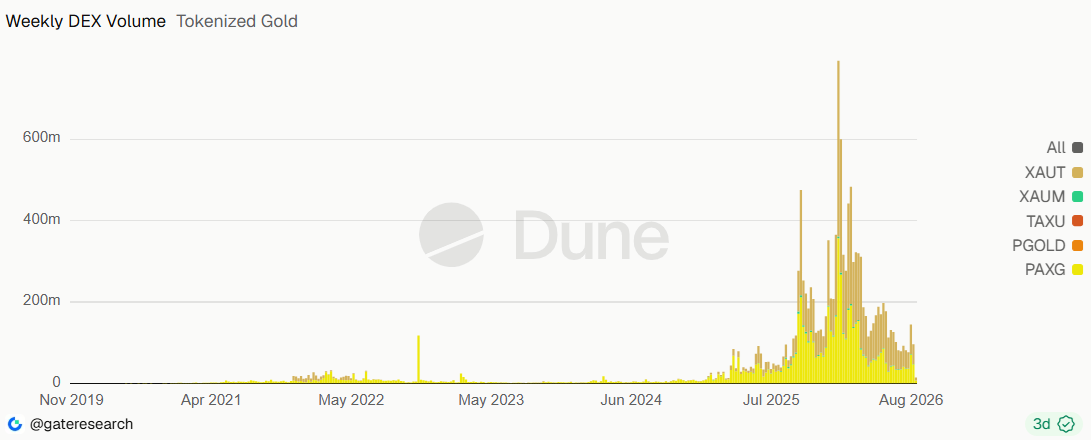
Large traders were mostly positioned on the long side. The biggest tracked long carried more than $273,000 in unrealized gains.
Short sellers faced heavier pressure. The largest reported short position showed unrealized losses near $2.2 million on September 4.
The renewed interest followed stronger demand for defensive assets during inflation concerns and geopolitical uncertainty. Gold also benefited from traders seeking alternatives to semiconductor-linked positions.
Tokenized gold gives those traders a familiar macro asset with crypto-native settlement. It also allows faster movement between collateral, spot trading, and leveraged markets.
A large wallet linked with high probability to Antalpha also attracted attention. The wallet accumulated repeated 1,000 unit tranches while gold traded closer to $4,000.
By September 4, that wallet held about 16,120 XAUT, worth more than $71 million. The wallet showed inflows without visible cash-out activity.
Another Antalpha-linked wallet held more than 33,000 units alongside other assets. Some related wallets actively traded gold and transferred funds toward Bitfinex.
Part of those holdings also moved into custody through Cobo.com. The activity suggests professional investors are using several routes for storage and execution.
The accumulation stands out because repeated purchases appeared during gold’s earlier climb. Those positions gained value as prices advanced through August.
XAUT remains the main tokenized gold asset driving crypto-market interest. Its expanding collateral role, DEX liquidity, and whale ownership are creating more trading paths.
The market is also becoming less dependent on centralized exchanges as decentralized liquidity improves across major chains. That shift may help tokenized gold compete more directly with stablecoins and other real-world assets used as trading collateral.
The post Tokenized Gold Returns as XAUT Drives Fresh Crypto Market Demand appeared first on Blockonomi.
Quick Overview
- Stifel increased Microsoft’s price target from $450 to $530 while maintaining its Hold rating on the stock.
- The firm’s analyst Brad Reback pointed to Azure’s expansion potential and Copilot’s growing momentum as catalysts for the higher valuation.
- Near-term concerns include Google’s market share gains and diminishing advantages from the OpenAI partnership.
- The Street’s consensus remains Strong Buy for MSFT, with analysts projecting an average target of $571.41.
- Azure’s expansion rate jumped to 43% in fiscal Q4 2026, with projections of 45% growth for fiscal Q1 2027.
Shares of Microsoft are currently hovering around $510, and Stifel recently elevated its valuation target to $530 from a previous $450 following discussions with company leadership this week. Despite the upgrade, the firm continues to recommend a Hold position rather than advocating for purchases.
Microsoft Corporation, MSFT
In his assessment, analyst Brad Reback acknowledged the possibility of additional gains, though he believes significant movement depends on changing market dynamics. He anticipates the stock will only experience a revaluation if Azure demonstrates substantially accelerated expansion or if capital expenditure growth decelerates to levels below Azure’s growth trajectory.
Reback’s primary reservation centers on intensifying competition. Google continues to capture market share, while the strategic alliance with OpenAI no longer delivers the competitive advantage it previously offered.
The executive briefings featured senior financial leadership from Microsoft, addressing subjects ranging from revenue generation tactics to infrastructure optimization and artificial intelligence product launches.
A significant portion of the discussion focused on M365 Copilot. Leadership indicated that adoption surged during the latter half of fiscal 2026, with weekly user engagement now matching established platforms such as Outlook and Teams.
Reback observed that enterprises are transitioning from limited trial programs to comprehensive enterprise-wide implementations. This represents a substantial evolution and served as the primary driver behind the optimistic tone in his updated analysis.
Copilot Monetization and Revenue Approach
Leadership also outlined the company’s monetization framework. Microsoft employs a hybrid seat-based and consumption-driven model, with performance-based pricing structures not anticipated in the immediate future.
Advanced tier offerings within M365, encompassing E5, M365 Copilot, and E7 licenses, are generating modest revenue acceleration. Given that seat expansion trends toward more affordable subscription tiers, management emphasized that revenue per user from premium conversions holds greater strategic importance than total subscriber counts.
Reback underscored that leadership intends to apply selective pricing strategies, concentrating on segments where Microsoft maintains distinctive product superiority.
Regarding infrastructure investment, management conveyed its priority on enhancing data center operational efficiency to generate additional capacity available for rapid monetization. Reback suggested this approach could mitigate margin compression more effectively than his earlier forecasts indicated.
Azure Performance and Analyst Sentiment
Azure’s expansion velocity reached 43% in fiscal Q4 2026, representing an increase from 39% in the preceding quarter. Forward guidance for fiscal Q1 2027 targets 45% growth.
BofA Securities elevated its Microsoft valuation target to $600, referencing Azure’s acceleration trajectory and the corporation’s artificial intelligence expansion initiatives.
KeyBanc maintained its Overweight recommendation alongside a $600 price objective after Microsoft’s recent operational segment reporting revisions.
The technology giant is restructuring its organizational reporting from three divisions into two for fiscal 2027, designed to more accurately represent management’s operational assessment framework, particularly concerning AI infrastructure and cloud-based productivity solutions.
G42, an Abu Dhabi-headquartered AI company with Microsoft backing, is pursuing a multi-billion dollar capital raising initiative, though no definitive arrangements have been finalized.
The broader analyst community maintains a Strong Buy consensus on MSFT, featuring 32 Buy recommendations and a single Hold rating. The average valuation target of $571.41 suggests potential upside of 14.4% from present trading levels. MSFT shares have appreciated only 4% since the beginning of the year.
The post Stifel Boosts Microsoft (MSFT) Price Target to $530 But Maintains Hold Rating appeared first on Blockonomi.
Key Takeaways
- Memory chip stocks experienced substantial gains Friday, with Micron up 6.1%, SanDisk soaring 11.9%, and SK Hynix climbing 8.1%
- Persistent demand from AI data centers combined with constrained HBM and NAND availability continues supporting elevated pricing
- Reports indicate Micron has completely sold out its cutting-edge memory production capacity through late 2026
- UBS analysts increased their HBM pricing growth projection to 79% annually, revised upward from a previous 67% estimate
- Lynx Equity released optimistic projections with price targets reaching $1,325 for Micron and $2,450 for SanDisk, forecasting extended memory supply constraints
The memory semiconductor sector experienced a significant resurgence Friday, with leading manufacturers Micron, SanDisk, and SK Hynix recording substantial price appreciation following several weeks of declining valuations.
Micron concluded trading with a 6.1% advance, while SanDisk jumped an impressive 11.9%, and SK Hynix posted gains of 8.1%. Western Digital similarly climbed approximately 6%. The Roundhill Memory ETF finished 6.6% higher, demonstrating widespread investor interest throughout the entire sector.
Micron Technology, Inc., MU
The upward movement occurred as market participants shifted capital back into memory and data storage companies, driven by robust artificial intelligence hardware requirements and limited supply availability.
Artificial Intelligence Investment Sustains Memory Requirements
High-bandwidth memory modules and NAND flash storage continue facing supply constraints. The rapid expansion of AI-focused data centers persists at an accelerated rate, maintaining significant pressure on available inventory.
Micron has allegedly exhausted allocation for its most sophisticated memory production facilities extending through 2026’s conclusion. This situation provides leading manufacturers with substantial pricing leverage throughout the remainder of the year.
Dell’s substantial $95 billion AI server order backlog was referenced as concrete proof that major technology corporations are purchasing every available memory wafer that manufacturers can produce.
Worldwide DRAM revenue increased 57% sequentially during Q2, while NAND revenue experienced a dramatic 70% surge, according to Barron’s reporting. Micron expanded its DRAM market position to 24% and captured a 15% NAND market share.
Mizuho has characterized memory as a “key bottleneck” throughout the semiconductor supply network and maintained an Outperform rating on Micron securities.
Nvidia revealed $279 billion in supply and capacity obligations, predominantly connected to memory components and production capabilities, emphasizing how essential component accessibility remains for artificial intelligence infrastructure development.
Wall Street Firms Increase Price Objectives and Projections
UBS analyst Timothy Arcuri suggested that worries regarding AI processors requiring reduced memory per unit might be overly simplistic. If Nvidia distributes more accelerators, aggregate HBM utilization could still expand despite individual chips containing less memory.
UBS elevated its HBM average selling price growth projection to 79% year-over-year from 67%, while also highlighting improving NAND market conditions as server and storage requirements strengthen.
Lynx Equity published positive research notes forecasting an extended multi-year memory shortage and established price objectives of $1,325 for Micron shares and $2,450 for SanDisk.
Bernstein maintained an Outperform rating on SanDisk with a $3,000 price objective, elevated from $1,700 in late June. The firm increased its fiscal 2027 earnings projections based on stronger NAND average selling prices.
Bernstein emphasized SanDisk’s recently established long-term supply contracts, which feature enhanced pricing safeguards and advance customer commitments.
One potential headwind investors are monitoring involves China. YMTC’s worldwide NAND market share climbed to 14% during Q2, increasing from 9% one year prior, while SanDisk’s share declined to 11% from 13%.
A stronger-than-anticipated U.S. employment report initially sparked interest rate concerns Friday morning. Nevertheless, investors rapidly shifted focus and purchased oversold growth stocks at discounted valuations.
The post Memory Chip Giants Micron (MU), SanDisk, and SK Hynix Rally on Supply Tightness and AI Demand appeared first on Blockonomi.
Key Highlights
- Hon Hai Precision (Foxconn) anticipates third-quarter results will surpass market forecasts, propelled by robust artificial intelligence infrastructure demand
- August revenue soared 52% from the prior year to T$921.8 billion (approximately $29.15 billion), setting a new August record
- The electronics manufacturer has now posted two consecutive months with revenue exceeding T$900 billion
- Management cautioned that “volatile” international political and economic circumstances pose potential challenges
- Shares of Foxconn advanced 3.4% in Friday trading, ahead of the monthly revenue announcement
Foxconn announced record-breaking August sales figures and indicated that its current quarter performance will likely exceed analyst projections, powered by accelerating demand for artificial intelligence hardware.
The Taiwan-based contract manufacturing powerhouse disclosed consolidated monthly revenue reaching T$921.8 billion (roughly $29.15 billion) in August, representing a remarkable 52% increase compared to the corresponding period last year. The figure represents both an all-time high for the month of August and marks consecutive months with sales surpassing the T$900 billion threshold.
Shares of Foxconn climbed 3.4% during Friday’s trading session, significantly outperforming Taiwan’s benchmark index which rose 1.5%. The company released its August financial data after markets had closed.
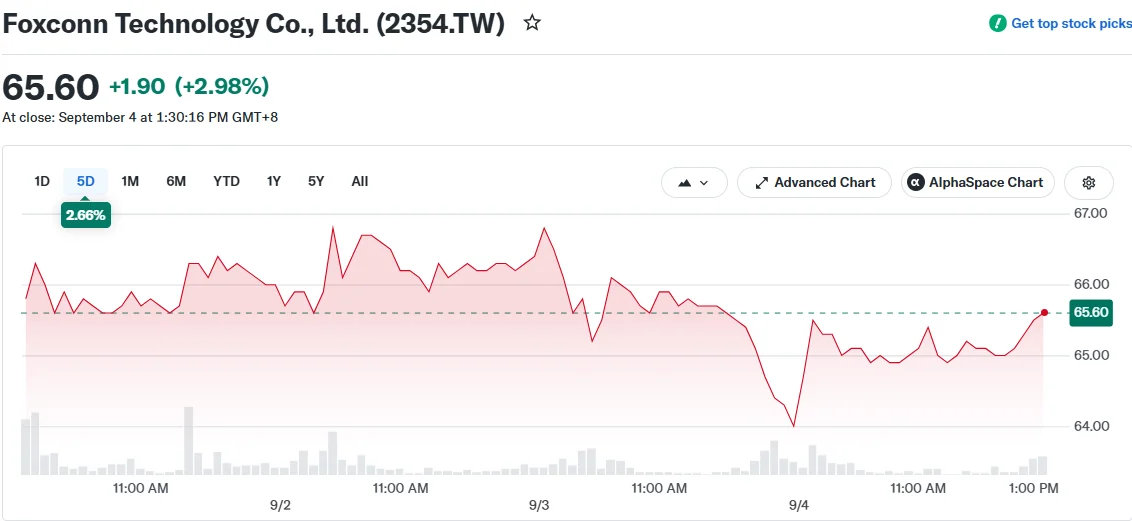
“In the third quarter, as AI demand continues to grow, and ICT products also enter the peak season of the second half of the year, operations are expected to gradually gain momentum,” the company said in a statement.
The manufacturer noted that its outlook for the third quarter has “improved compared to the previous month,” with aggregate performance projected to exceed what the market currently anticipates. Consistent with standard practice, Foxconn refrained from offering specific numerical forecasts.
Artificial Intelligence Infrastructure Fuels Expansion
Hon Hai Precision has emerged as among the most significant winners in the worldwide artificial intelligence infrastructure expansion. Serving as Nvidia’s primary server assembly partner, the corporation occupies a critical position within the supply ecosystem that enables global data center operations.
In the previous month, Foxconn disclosed a 35% increase in second-quarter earnings, exceeding Wall Street estimates. Those results validated that capital expenditures on AI infrastructure are generating tangible financial benefits for the contract manufacturer.
Beyond producing AI servers for Nvidia, the company maintains its position as a principal Apple supplier, providing dual exposure to both enterprise-grade AI equipment and consumer device seasonal peaks throughout the year’s latter half.
Potential Headwind on the Horizon
While maintaining an optimistic outlook, Foxconn stopped short of declaring smooth sailing ahead. Management emphasized the importance of monitoring “the impact of the volatile global political and economic situation,” without elaborating on specific geopolitical concerns.
Such cautionary language from an organization with Foxconn’s expansive international operations typically encompasses various concerns, ranging from shifting trade policies to potential supply chain interruptions.
Nevertheless, the fundamental financial performance speaks volumes. Back-to-back months exceeding T$900 billion in sales combined with an all-time August revenue record indicate the operation is functioning at peak capacity.
Market sentiment toward Foxconn shares has remained positive. Friday’s 3.4% stock price appreciation occurred even before the August revenue figures became publicly available.
The post Foxconn (2354.TW) Stock Surges on Record August Revenue and Strong AI Server Demand appeared first on Blockonomi.
CryptoPotato
Although it was rejected at $1.70 a couple of weeks ago after its major mid-August surge, Ripple’s cross-border token is still up by 40% from its multi-year lows marked less than a month ago.
This has turned numerous analysts highly bullish. While this sounds quite expected for market observers like EGRAG CRYPTO, Ali Martinez’s recent price target is what got the community going.
XRP to $60!?
Martinez has recently been quite convinced that Ripple’s native token has already bottomed out during this cycle and is on its path to recovery. In a previous post, he noted that XRP’s breakout is confirmed and outlined a more modest target of $1.70. This one came actually after the asset reached that level on August 21-22, following its 70% surge in less than 72 hours.
However, it was violently rejected there and pushed south to under $1.35 last week. Its ability to maintain that level and the subsequent rebound to the current $1.40 gave bulls more hope, and Martinez joined the party.
In a post from earlier today, the analyst told his 166,000 followers that XRP has been “forming a massive ascending triangle on the monthly chart.” If it breaks above and closes north of the key barrier at $3.66, then it would “confirm the breakout and activate a technical target near $60.” Yes, that’s $60 per XRP.
XRP BULL MARKET TARGET: $60
For nearly a decade, $XRP has been forming a massive ascending triangle on the monthly chart.
The $3.66 resistance level is the key barrier. A monthly close above it would confirm the breakout and activate a technical target near $60. pic.twitter.com/RpAnbER9cv
— Ali Charts (@alicharts) September 5, 2026
Now, we are not trying to be the bearer of bad news, but $60!? Even if it takes another 10 years, it would require a near-4,200% surge from current levels. Moreover, its market cap, even if XRP’s supply remains the same, which it won’t, would be at around $4 trillion (yes, with a T). This would make it 2-3 times bigger than BTC’s current market cap, and its valuation would top even giants like Amazon and Microsoft.
Maybe $25?
Similar highly bullish (and a bit far-fetched) predictions typically come from other analysts, such as EGRAG CRYPTO. But even his most recent analysis was more modest than Martinez’s.
Basing his findings on XRP’s previous expansions, in which the asset exploded by up to 2,400%, the analyst outlined some major targets in his September 5 analysis. The highest of which is at $25 if XRP is to mimic the most significant rally from its 2017-2018 bull phase.
The other, slightly less bullish, targets are set between $11 and $15.8. Naturally, all of those sound a bit unrealistic at the moment, even though the market structure has shifted significantly over the past several weeks.
The post XRP’s Breakout Rally Has Begun, Analysts Say – But Their Targets Will Shock You appeared first on CryptoPotato.
Following the strong US jobs report from Friday and the hawkish stance taken by Federal Reserve Chair Kevin Warsh the week prior, the odds for a rate hike have grown significantly in just seven days.
Bitcoin’s price reacted to both developments with a minor leg down before it recovered some of the losses. An actual rate increase, though, could have a much more profound effect.
What Happens to BTC
The previous FOMC meeting in July was quite condensed, as it was described as the most unpredictable one in over six years. At the end, though, the Fed refused to change the rates, leaving them at 3.50%-3.75% following a 9-3 vote.
However, the fact that there were 3 policymakers in favor of such a monetary pivot was the first hint at a potential change. The rest came in the past week or so, as Warsh was quite hawkish during his first Jackson Hole speech at the end of August. The blowout US jobs report from yesterday only tilted the odds further, currently being at over 50% for a hike, since it gives the central bank leeway to keep fighting the stubborn inflation through a tighter monetary policy.
Next week’s CPI data will be crucial. The FOMC meeting will take place on September 15-16, and ChatGPT believes BTC’s initial reaction will be a nosedive. However, the AI platform added that it “would not expect another catastrophic bear-market leg.”
Instead, it noted that the key part of bitcoin reaction will be from the fact of whether the hike is “already fully priced in by then, and what Kevin Warsh says about what comes next.”
“At the moment, markets are putting roughly a 60% probability on a September hike after the surprisingly strong August jobs report. BTC is around $79,650 after already falling from above $81,000 as that probability increased.”
Precise Prediction
The popular AI chatbot noted that another 2%-5% decline is expected in ten days after the conclusion of the FOMC meeting if the Fed indeed proceeds with hiking the rates. This means that bitcoin would test the $75,000 support at first.
Another leg down to $72,000 could be in the cards if yields continue climbing by the end of September. Moreover, it could slip below $70,000 for the first time since mid-August if Warsh remains hawkish. Those scenarios are in case the Fed increases the benchmark by 25 bps.
In the more unexpected scenario in which the central bank hikes it by 50 bps, then ChatGPT expects BTC to slump by up to 15% very quickly, going to under $70,000 within a day or so.
“A drop to $68,000 could be instant, with leveraged liquidations potentially producing a temporary wick into the mid-$60Ks,” it warned.
Although all of those predictions sound quite worrisome for BTC, which finally had some fresh air during the mid- to late-August rally, it’s worth noting that the cryptocurrency is known for often moving in the opposite direction of what people expect from it.
The post We Asked AI: What Happens to Bitcoin’s Price if the Fed Hikes Rates in 11 Days? appeared first on CryptoPotato.
Bitcoin’s price reacted immediately to the stronger-than-expected US jobs report on Friday, plunging from a multi-month high of over $82,000 to under $79,000 before it found some support.
Red dominates the larger-cap alts’ charts, with XRP dropping back to $1.40, ETH losing the $2,500 level, and XMR plunging by over 5%. BNB stands in the opposite corner with a 4.5% surge.
BTC Halted at $82K
The primary cryptocurrency faced a similar fate last Friday when it jumped to $81,500 only to be rejected and driven south to under $77,000 after the hawkish speech by Fed Chair Kevin Warsh at Jackson Hole. However, it rebounded during the weekend and even tapped $79,000 on Sunday.
The resumed military actions in the Middle East brought another leg down on Monday morning, with BTC slipping to $77,000 again. The bulls managed to defend that level again, and the cryptocurrency remained stuck between that lower boundary and the upper one at $79,000 for a few days.
The breakout began on Thursday when the asset surged past the latter level and kept climbing on Friday morning. The peak came at $82,400, which became BTC’s highest price tag in three and a half months. Although it was stopped there, it remained above $81,000 before the aforementioned jobs report went live and plunged immediately after it made the headlines to just under $79,000.
It has rebounded to $79,600 since then, with its market cap standing close to $1.6 trillion on CMC. Its dominance over the alts has retreated slightly to 59.45%.

PONS Keeps Rocking
The new rockstar of the altcoin space, PONS, is once again the top performer, surging by 30% in the past 24 hours to a new all-time high of almost $0.90. DASH follows suit, skyrocketing by 25% to over $65.
Binance Coin is up by 4.5%, being the biggest gainer among the larger caps, and now sits at $750. NEAR has gained 11% and is above $2.25. DOT, TAO, and LTC are also well in the green.
In contrast, ETH is down by 2.5% to $2,450, XRP has slipped by almost 3% to $1.40, and XMR is down by 5% to $525. RAIN, HYPE, and ADA are also in the red.

The post PONS Skyrockets Another 30% to New ATH, Bitcoin Loses $80K: Weekend Watch appeared first on CryptoPotato.
Less than two months after announcing a major partnership with the Kansas Jayhawks, the company behind XRP has doubled down on its US sports endeavors by collaborating with the Florida Gators.
Almost immediately after the news was announced, both parties shared a video showing that XRP’s logo was painted on the sports team’s ground.
$XRP and @FloridaGators.
Soon. https://t.co/AI7wKEy3xw— Ripple (@Ripple) September 4, 2026

Further details on the partnership indicate that the team will generate $5 million annually by placing the logos in the Swamp.
“Florida has a long history of embracing innovation and technology to enhance the experience of our fans and advance our programs,” athletic director Scott Stricklin said in a statement. “This partnership brings together two organizations that think boldly about the future, and we look forward to introducing XRP to our fans.”
The first game to host XRP’s logo will be played tonight at the Ben Hill Griffin Stadium, as the Florida Gators will face the Florida Atlantic Owls.
Recall that Ripple made a similar partnership with the Kansas Jayhawks, who represent the University of Kansas, and their teams have won 15 national championships, including 12 NCAA Division I titles. This one was more personal for Ripple’s CEO, who was raised in the state and holds a Bachelor of Arts in Economics from the University of Kansas.
The second news was shared by one of the most popular XRP Army members, BankXRP, on X. The user noted that Ripple will be the headline sponsor of Stable Launch – Stablecon USA’s startup competition.
The company’s Whittney Levitt will join the judging panel of the event, in which the winning startup gets a $200,000 investment.
The post 2 Major Ripple (XRP) News From The Past 24 Hours: Details appeared first on CryptoPotato.
The Core Team behind the popular project rolled out three new capabilities designed to make its ecosystem more attractive to app developers. The project also overhauled its developer documentation as it continues its broader push toward real-world utility.
The team said this update comes after several months of releases focused on enhancing Pi beyond simple crypto transactions and creating more reasons for users to actually explore and utilize the ecosystem.
3 New Features
The three new developer capabilities are local storage, access to app-specific staking data, and file and video sharing. Perhaps the most interesting is the first one.
Selected whitelisted Pi Browser apps can now store certain information directly on a user’s device instead of requiring devs to maintain their own backend infrastructure. Preferences, session inflation, and other applicable data can consequently be stored on the device, which can reduce infrastructure costs and complexity while providing a consistent experience across Android and iOS, added the post.
It’s worth noting that the data is not uploaded to Pi Network’s servers, even though the feature currently has several limitations. Only whitelisted apps have access, as storage capability is limited, and old data can eventually be removed.
Staking Data API, the second release, allows eligible developers to see how much effective Pi a user has staked specifically for their application through Ecosystem Directory Staking. Devs could potentially use this info to build app-specific features around their most committed supporters.
The last one, called Pi.shareFile, allows apps to use a phone’s native sharing functionality for files, images, and videos. Some of the examples outlined in the blog post range from marketplace customers sharing receipts or photos to gaming and content apps allowing users to share clips directly.
More Devs Wanted
In addition to the three new features, Pi Network announced that it has consolidated previously fragmented dev resources into a single documentation platform, which now covers everything from app registration and sandbox development to authentication, Pi payments, Mainnet preparation, and launch.
It also introduces AI-assisted guidance for integrating authentication and payments. The idea is quite clear as it reduces the friction involved in building applications for Pi and fits into the project’s broader strategy.
The team said that these releases tackle a problem that could be very important for the project and the native token’s long-term prospects: giving developers more tools and fewer technical obstacles to continue building apps that people actually want to use.
The post Pi Network Just Released 3 Major Upgrades: Here’s What They Mean for Pioneers appeared first on CryptoPotato.