Cryptocurrency Posts
Crypto Briefing
Iranian Parliament Speaker Ghalibaf warns of retaliation against Gulf energy assets and Strait of Hormuz disruption after US strikes on Iranian
The post Ghalibaf threatens US oil interests after Hegseth’s warning on Iranian tankers appeared first on Crypto Briefing.
The US, UK, France, and Germany push to refer Iran to the UN Security Council over blocked nuclear inspections, the first such referral in two
The post US proposes referring Iran to UN Security Council over nuclear inspections appeared first on Crypto Briefing.
The Fed's focus on inflation over jobs suggests potential market volatility, with rate-sensitive sectors bracing for possible rate hikes.
The post Jobs report fails to boost Fed rate hike odds, analysts say appeared first on Crypto Briefing.
This investment strengthens US-South Korea economic ties, boosts energy infrastructure, and supports growing AI-driven electricity demands.
The post South Korea and US finalize over $20B gas plant investment in Texas appeared first on Crypto Briefing.
Uber's euro bond offering signifies a strategic shift towards mitigating currency risk and optimizing financing for international expansion.
The post Uber taps European debt markets for first-ever euro bond offering appeared first on Crypto Briefing.
Bitcoin Magazine
Bitcoin Magazine
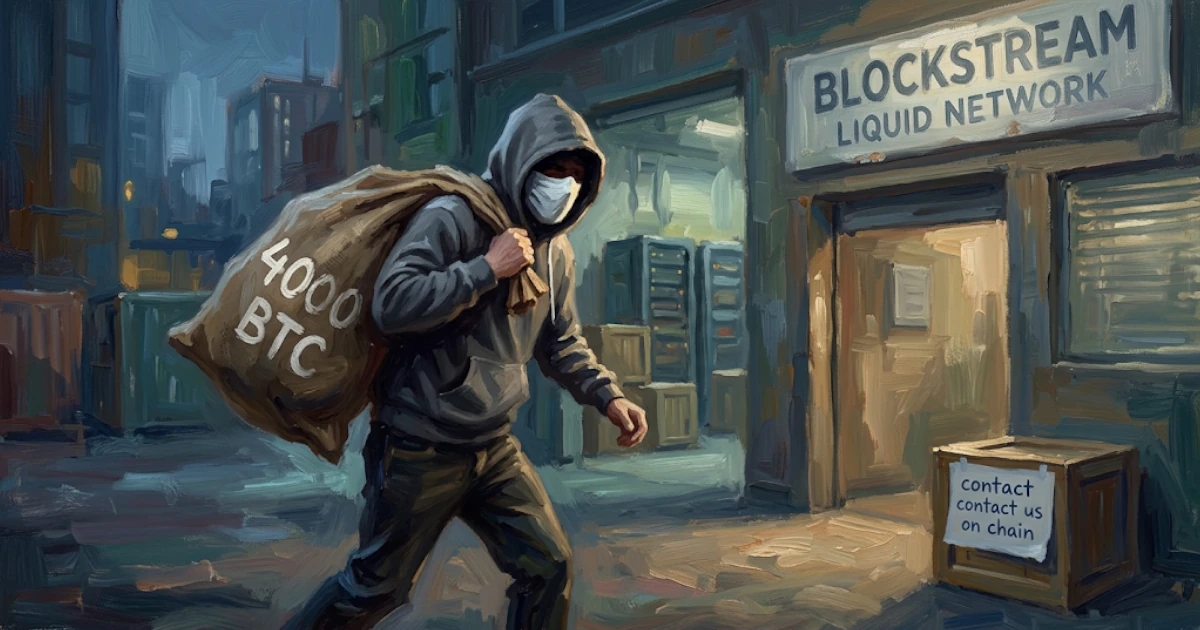
Alleged White-Hat Hackers Withdraw 4,000 bitcoin from Blockstream’s Liquid Network Federation Reserves
The Liquid Network said Sunday that purported white-hat hackers withdrew about 4,000 bitcoin, worth about $320 million, from the federation wallet that backs L-BTC. Bridge nodes were disabled, and the sidechain was paused. Other issued assets, including USDT, DePix and RWAs, were unaffected, the official account said on X.
The Liquid Network is a federated sidechain of Bitcoin, founded by Adam Back’s Blockstream. The Liquid chain issues a variety of assets such as LBTC, which it backs with BTC on the Bitcoin main chain, held in a large multisig of 15 corporate and known members. 11 of the 15 members need to sign a valid multi-signature transaction to move coins from the treasury. Before the hack, the treasury held over 4200 BTC; after the hack, Blockstream’s proof of reserves page reports a little over 207 BTC left.
The hackers withdrew 4,019.4 BTC from the reserve address in a peg-out transaction using the SideSwap Peg-out Authorization Key. SideWap is a bridge exchange and a member of the Liquid Federation. While details on the mechanism of the hack are not confirmed yet, it appears an inflation bug on the LBTC side chain was exploited by the hackers to create over 4,000 LBTC that did not exist before, and cash them out for on-chain bitcoin from the federation. Because the transaction appeared as valid, given the consensus bug, the federation members’ HSM security servers signed the BTC withdrawal transaction, worth roughly 320 million at the time.
The hacker moved the funds to an address ending in 6gyqjlte, from which they quickly signed a new transaction with a message on the OP_RETURN arbitrary data field saying “we are whitehats. contact us on chain.” Those coins were still at that address at the time of writing.
A small mainnet transaction to the hacker address followed by an OP_RETURN saying “Please contact security@blockstream.com”, presumably from a Blockstream public address, though that remains unconfirmed. A later OP_RETURN spend from the hacker address carried “Please contact us on Signal @m671aw.70”, however, this may be spam and does not share a link to the address with the stolen funds.
In response to the breach, exchanges were told to pause L-BTC deposits and withdrawals. Bridge nodes on the Liquid Network have been paused, limiting access to the side chain, which continues to produce blocks.
JAN3 CEO Samson Mow said Aqua’s Liquid features were affected and that on-chain bitcoin still worked. Other wallets in the industry that use the Liquid Network are expected to be affected. Users holding LBTC now effectively have their savings at risk, since the underlying BTC is currently not redeemable. Given the private nature of the Liquid chain, user onchain analytics are scarce and not much public information is known about how much LBTC is held by retail users versus corporations of Blockstream itself. Nevertheless, should the funds not be returned, it would be a heavy blow to the Liquid Network’s user base.
Users of LBTC don’t have many options but to wait for conversations with the hackers to resolve. Given the size of the hack, it would be difficult for the hackers to get away with stealing all that bitcoin, though perhaps not impossible. What may happen is that the hackers ask for a finder’s fee and return the majority of the funds.
This post Alleged White-Hat Hackers Withdraw 4,000 bitcoin from Blockstream’s Liquid Network Federation Reserves first appeared on Bitcoin Magazine and is written by Juan Galt.
Bitcoin Magazine
Hargreaves Lansdown Reverses Course, Rolls Out Bitcoin Trading
British financial services firm Hargreaves Lansdown is letting retail investors buy bitcoin — nearly one year after it said the cryptocurrency was “not an asset class.”
The Bristol, UK-based investment firm’s website said it was offering bitcoin and other crypto exchange-traded notes to investors. ETNs are investment funds which trade on stock exchanges and track the prices of digital assets.
It comes after the firm, which manages nearly £173 billion (over $233 billion) in assets, last year warned customers about buying bitcoin.
NEW:
— Bitcoin Magazine (@BitcoinMagazine) September 4, 2026U.K.'s largest investment platform Hargreaves Lansdown is now offering Bitcoin products to 2 million clients!
pic.twitter.com/GgdeHK8vyM
“While longer-term returns of Bitcoin have been positive, Bitcoin has experienced several periods of extreme losses and is a highly volatile investment — much riskier than stocks or bonds,” the firm said at the time.
“The HL Investment view is that Bitcoin is not an asset class, and we do not think cryptocurrency has characteristics that mean it should be included in portfolios for growth or income and shouldn’t be relied upon to help clients meet their financial goals.”
Now, a number of ETNs tracking the price of bitcoin and other cryptocurrencies are available. The firm warns users that “crypto ETNs are considered high-risk and may be volatile.”
U.S. regulator the Securities and Exchange Commission in 2024 approved bitcoin exchange-traded funds for investors after a decade of saying no to the products.
The funds had the most successful debut in the history of ETFs as investors previously unable to buy exposure to the asset class rushed in to buy the products.
Run by top asset managers and banks like BlackRock, Fidelity, and Morgan Stanley, the investment vehicles now collectively manage over $100 billion in assets.
This post Hargreaves Lansdown Reverses Course, Rolls Out Bitcoin Trading first appeared on Bitcoin Magazine and is written by Mathew Di Salvo.
Bitcoin Magazine
Trezor Breach Worse Than Reported: Another 67,000 US Customers Exposed
Hardware wallet manufacturer Trezor has said that a data breach first announced last month is worse than originally reported.
The Prague, Czech Republic-based company said Friday that an additional 67,000 U.S. customers had their names, emails, phone numbers, shipping addresses and order numbers leaked. The leaked data came from orders made between November 2019 and August 2021, according to Trezor.
Trezor first announced in August that data from 11,742 customers from the U.S., UK, Sweden, Colombia, Brazil, Italy, and Portugal had been exposed — with names, emails, phone numbers and shipping addresses leaked.
Another 1,947 customers just had their names, cities and emails exposed in the breach.
In Friday’s announcement, Trezor said that its third-party fulfillment partner, ShipMonk, had falsely reassured the company about deleting customer data.
“Throughout our entire relationship with ShipMonk, we repeatedly requested and received written assurance confirming the deletion of the data, in line with our contract, data policy, and past communications,” Trezor wrote.
“We are very disappointed that, despite receiving this confirmation, the data was not deleted in their systems.”
Neither Trezor nor ShipMonk immediately responded to Bitcoin Magazine’s questions.
Trezor first announced in August that the data had been leaked because ShipMonk experienced “unauthorized access to their systems containing customer data.”
The company added that it had directly emailed all customers involved in the breach. Trezor’s parent company, SatoshiLabs, told Bitcoin Magazine last month that it was investigating the incident.
Trezor is one of the most popular Bitcoin hardware wallet solutions, and also has support for storing other cryptocurrencies.
Bitcoiners’ personal data has been targeted by cybercriminals in the past: back in 2020, an unauthorized party accessed popular hardware manufacturer Ledger’s e-commerce and marketing database, leaking over 1 million email addresses and the personal contact data of nearly 10,000 customers.
At the start of this year, customers reported receiving emails from Global-e, Ledger’s payment partner, that a data breach at its cloud systems leaked sensitive customer data.
This post Trezor Breach Worse Than Reported: Another 67,000 US Customers Exposed first appeared on Bitcoin Magazine and is written by Mathew Di Salvo.
Bitcoin Magazine
El Salvador Isn’t Buying Bitcoin With Public Money, Says IMF
El Salvador has not used public funds to accumulate bitcoin since the International Monetary Fund’s last review of its loan program, the fund said Thursday.
In a report Thursday, the body said that the Central American country had instead received bitcoin from private donations, citing documentation from the government. It added that “no further Bitcoin accumulation beyond the documented donations is expected.”
El Salvador made headlines in 2021 when it became the first country in the world to make bitcoin legal tender. Salvadoran president Nayib Bukele in 2022 said the country would buy one bitcoin per day but it was never clear where the money was coming from — or if he was actually buying at all.
“Documentation has been provided verifying that Bitcoin accumulation since the first review reflects private donations and that no public resources were used,” the IMF release said.
“Understandings were also reached on steps to modernize the legal, regulatory, and supervisory framework for digital assets and to further strengthen the governance and risk-management arrangements for public-sector crypto-asset holdings. Going forward, no further bitcoin accumulation beyond the documented donations is expected.”
The report added that public participation in the government-sponsored bitcoin wallet has been largely wound down, with majority ownership and operational control handed to a private operator.
El Salvador in 2021 debuted a state-sponsored wallet called Chivo for its citizens as part of its plan to increase bitcoin adoption in the country.
“IMF staff thank the Salvadoran authorities for the constructive discussions and excellent collaboration,” the report added.
The IMF El Salvador entered a $1.4 billion loan agreement at the end of December but the fund asked for the country to scale back certain aspects of its bitcoin strategy.
Institutions like the World Bank and the IMF have long criticized President Bukele’s Bitcoin law, which also asked businesses to accept the cryptocurrency if they had the technological means to do so.
President Bukele in 2024 admitted that Salvadorans weren’t using the cryptocurrency to buy things as expected, but always boasted that the government was still stacking sats.
Since launching a crime crackdown to tackle the country’s notorious crime gangs, murder rates in El Salvador have plunged. The country was once the most dangerous place in the Americas but President Bukele is now trying to turn it into a tech hub.
Crypto companies like Tether have since relocated to its capital, San Salvador.
This post El Salvador Isn’t Buying Bitcoin With Public Money, Says IMF first appeared on Bitcoin Magazine and is written by Mathew Di Salvo.
Bitcoin Magazine
Bitcoin Dips Below $80,000 on Strong US Jobs Report
Bitcoin slid Friday after a better-than-expected labor report showed that the U.S. job market accelerated in August.
The leading cryptocurrency was recently trading for close to $79,764 after dropping as low as $78,706 earlier in the morning in New York. It’s currently down over 1% over a 24-hour period. On Thursday, the coin soared above $82,000.
The Federal Reserve is typically more likely to raise interest rates when the labor market is strong, because more people employed means more spending, and more spending can push inflation up.
Federal Reserve Chair Kevin Warsh last week gave his first major speech as head of the U.S. central bank and said he had “more work to do” to fight inflation. Bitcoin has typically done well in a low-interest rate environment.
Traders currently view a U.S. Federal Reserve interest rate hike at the upcoming September 15–16 policy meeting as roughly a 50% to 60% probability.
But U.S. President Donald Trump on Friday demanded the Federal Reserve slash interest rates.
Writing on his social media platform Truth Social, Trump said: “Lower the interest rates because the U.S.A. is a much stronger credit than it was just a short time ago!”
He added: “We should have the LOWEST RATE of any country in the World, like ‘the old days.'”
Bitcoin has decoupled from stocks recently as investors have renewed concerns around dollar debasement.
The cryptocurrency started surging last month, after the U.S. Treasury Department said it would more than double the size of its government debt repurchases. The coin had its best run in three years and third best August ever.
The much-talked about debasement trade is back in the spotlight, and bitcoin has been trading in lockstep with gold, according to analysts. The so-called debasement trade is when investors buy an asset as a way to hedge against a currency losing value.
News dropped last month that U.S. public debt exceeded $40 trillion for the first time too. Excessive debt also undermines confidence in the dollar, making assets like bitcoin and gold attractive.
This post Bitcoin Dips Below $80,000 on Strong US Jobs Report first appeared on Bitcoin Magazine and is written by Mathew Di Salvo.
CryptoSlate
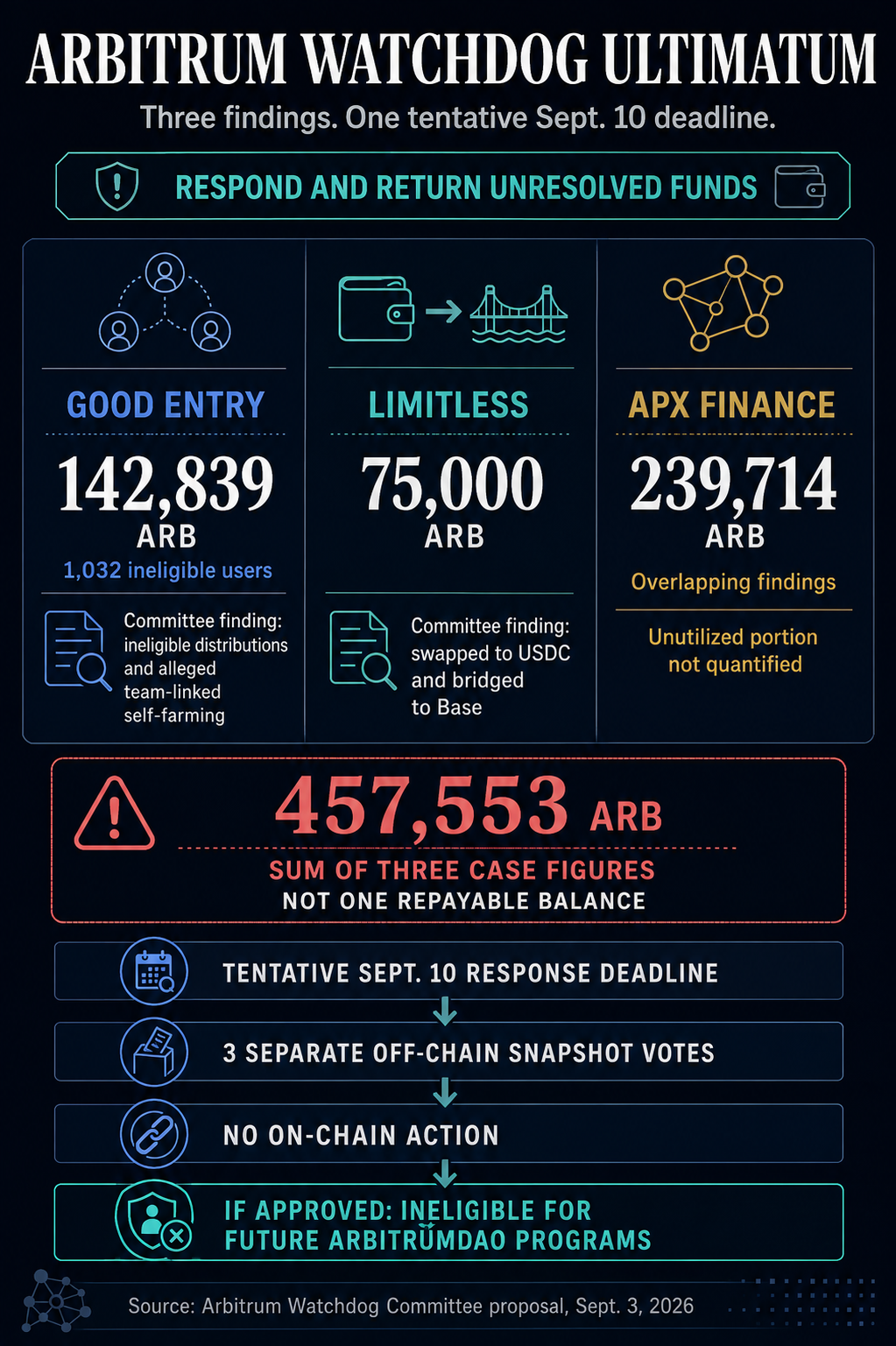
Arbitrum's Watchdog Committee, a grant oversight body, has given three DeFi projects until a tentative Sept. 10 deadline to answer high-severity misuse findings and return funds it considers unresolved, or face separate votes on permanent exclusion from future DAO programs.
The cases name Good Entry, Limitless and APX Finance, formerly ApolloX. Their cited figures add to 457,553 ARB, but that total combines different findings rather than representing one amount established as stolen, outstanding or recoverable.
As of Sept. 5, no response from any of the projects appeared in the proposal thread. The committee described the schedule as tentative and said a vote would follow only if a project's explanation is unsatisfactory and its respective funds are not returned within the one-week window. No ban has been approved.
For Good Entry, the committee said on-chain analysis found 142,839 ARB was distributed to 1,032 ineligible users during and after the Short-Term Incentives Program. It also alleged self-farming by wallets connected to team addresses and said the project refused to provide clarification. Good Entry's grant application requested 200,000 ARB, so the watchdog figure covers part of the grant and describes distributions rather than a remaining balance.
Limitless is accused of swapping 75,000 ARB into USDC and transferring the funds to Base. The watchdog said team members could not be reached for clarification or recovery. The figure matches the 75,000 ARB requested in the project's LTIPP application.
The APX Finance finding is less cleanly reducible to a repayment figure. The committee tied 239,714 ARB to overlapping issues, including an unspecified substantial portion left unutilized in treasury addresses. It also cited late transfers to distributor contracts and alleged team-linked Sybil activity. APX had requested 525,000 ARB in its application, but the proposal did not break down the 239,714 ARB by issue.
What the proposed bans can enforce
Each project would face its own off-chain Snapshot vote. The proposal says a ban involving an operating project would cover founders, current team members and affiliated contributors. For projects no longer operating, it would apply only to founders.
The votes would seek social consensus and require no on-chain action. Their stated consequence is that covered projects or people would become ineligible for future programs run by the Arbitrum DAO. That makes the measure a governance-access sanction; it would not itself execute a wallet freeze or disable a protocol.
The watchdog said that, as of Sept. 2, the broader program had received 90 reports, recovered about 532,000 ARB and distributed about 268,000 ARB in reporter bounties. The next signal is whether any of the three projects answers before Sept. 10, followed by whether the committee proceeds with its tentative Snapshot timetable.
The post Three DeFi projects face possible exclusion from future Arbitrum DAO programs appeared first on CryptoSlate.
Bitcoin's current rally started when the Treasury Department announced on Aug. 19 that, beginning Sept. 9, it would at least double the maximum size of certain buyback operations for government bonds with 10 to 30 years left to maturity, raising the cap from $2 billion to $4 billion per operation.
Simply put, the Treasury was offering to buy more older long-term bonds from dealers that wanted to sell them.
Later that day, the Federal Reserve released minutes from its July meeting, where three members had voted for a quarter-point rate increase, and many others thought another hike would be needed if inflation failed to retreat.
The central bank kept its target range at 3.50% to 3.75%, though the debate had already moved from how long rates should stay high to whether they should go higher.
At first, Washington seemed to be pushing bond markets in two directions. The Fed was trying to make money more expensive across the economy, while Treasury debt managers were trying to make older long-term government bonds easier to trade.
They have different jobs, though borrowers and investors experience both at once, as they affect everything from mortgage pricing to Bitcoin.
| Institution | Recent action | Direct market channel | What investors feel | Bitcoin relevance |
|---|---|---|---|---|
| Federal Reserve | Held rates at 3.50%–3.75%, while some officials favored another hike | Short-term money, real yields, dollar strength | Higher opportunity cost for risk assets | Pressure on BTC as a no-yield asset |
| Treasury | Raised selected long-bond buyback caps from $2B to $4B | Long-bond market liquidity and dealer balance sheets | Easier trading in older bonds, not lower debt supply | Liquidity support, but not a direct BTC tailwind |
| Private investors | Reprice 10- to 30-year debt | Term premium, inflation risk, fiscal risk | Higher long-term yields | Competes with BTC in the short run, supports fiscal-hedge narrative in the long run |
The 30-year Treasury yield closed at 5.28% on Aug. 18, fell to 5.19% on the announcement day, then returned to 5.27% by Sept. 2, according to the Treasury's daily yield data. Other forces were moving yields during those two weeks, and the larger buybacks hadn't begun, so the round trip can't be credited to the Treasury alone.
What it does show is that the announcement produced no lasting repricing of what investors charged to lend the government money for a generation.
The Treasury yield curve has two governments
Interest rates often get discussed as if the Fed chooses one number and the rest of finance just updates their own. That's partially true only at the shortest end of the market, where the central bank pays interest on reserve balances and uses overnight operations to keep the federal funds rate inside its chosen range.
The July implementation note set the rate paid on reserve balances at 3.65%, giving banks little reason to lend overnight for much less.
The 30-year Treasury yield, however, comes from a much more complex set of factors. Investors start with an estimate of where short-term rates might average across the coming decades, account for inflation, then demand extra compensation for locking up money while federal borrowing and the economy move in ways nobody can accurately predict.
Economists call that final piece the term premium, simply the price of waiting a very long time.
The distinction helps explain the recent bond selloff because the Fed minutes said nominal Treasury yields had gained 25 to 30 basis points during the July meeting window, driven mainly by higher real rates.
Inflation expectations moved much less, so investors demanded a better return once inflation was stripped out. Markets had also priced a quarter-point increase by the September Fed meeting and another by the end of the first quarter of 2027.
Bitcoin feels that change quickly because real yields tell investors how much they can earn while taking very little credit risk. Bitcoin offers no return, so a government bond offering a generous return above inflation makes holding it more expensive by comparison.
The same math reaches technology shares valued on profits many years away, since higher real yields give those future earnings a harsher discount in today's dollars.
Treasury has a different problem because Congress decides how much the federal government spends and collects in taxes, leaving debt managers to finance the gap, refinance maturing securities, and keep US government debt functioning as the world's main pool of collateral.
Treasury expects $739 billion of privately held net marketable borrowing from July through September, followed by another $628 billion from October through December. Its debt office has to move an enormous volume of securities into private hands while keeping older bonds from becoming awkward and expensive to trade.
The separation between the two institutions gets even stranger once the Fed's own purchases enter the picture. It buys Treasury bills and, when needed, other government securities with three years or less to maturity so the banking system keeps an ample supply of reserves.
Those purchases can coexist with a restrictive policy rate, allowing the Fed to supply overnight money while keeping it expensive, just as the Treasury can support trading in long bonds while issuing far more debt than it repurchases.
The key is maturities: the Fed sets the price of short money, the Treasury sets the volume and composition of federal debt, and private investors connect the two by deciding how much compensation they require at every point in between.
A $4 billion umbrella in a $739 billion rainstorm
Treasury buybacks sound more powerful than they are because they make it sound like debt disappears.
However, the operation is closer to exchanging one shape of debt for another: Treasury sells new benchmark securities, uses some of its cash to repurchase older issues, and gives dealers room to move inventory that has become harder to trade.
Newer bonds serve as current benchmarks, while older, off-the-run bonds can drift away from nearby prices and consume scarce room on dealer balance sheets.
The government still owes the replacement debt, and Treasury says buybacks should have little effect on net marketable borrowing because new issuance replaces the securities being repurchased.
The program can make older bonds easier to trade and reduce the risk that dealers retreat during a volatile session, while leaving the broad supply of federal obligations largely intact.
That also separates the program from quantitative easing because when the Fed expands its balance sheet, it creates reserve balances and buys securities as part of monetary policy.
Treasury spends cash from its own account and replenishes that cash through taxes or borrowing, so its buyback rearranges the government's liabilities while leaving the supply of central-bank money unchanged.
The difference becomes easier to see at full scale because Treasury's Aug. 5 refunding plan contemplated as much as $38 billion of off-the-run purchases for liquidity support during the quarter and another $25 billion of short-maturity purchases for cash management.
Two weeks later, Treasury raised the cap on selected long-end operations and is yet to publish a revised quarterly total. The same refunding plan included a $125 billion package of new 3-, 10-, and 30-year debt, while the department projected hundreds of billions in net borrowing.
A $4 billion operation can help dealers digest a difficult corner of the market, though the much larger supply of debt keeps setting the background price.
| Treasury figure | Amount | What it represents | Market meaning |
|---|---|---|---|
| Previous selected long-end buyback cap | $2B per operation | Earlier maximum for certain 10- to 30-year buybacks | Liquidity tool, limited scale |
| New selected long-end buyback cap | $4B per operation | Doubled cap beginning Sept. 9 | More room to support off-the-run bonds |
| Planned off-the-run liquidity purchases | Up to $38B for the quarter | Buybacks intended to improve Treasury-market functioning | Helps market plumbing |
| Short-maturity cash-management purchases | Up to $25B for the quarter | Treasury cash-management operations | Liability reshaping, not QE |
| July–September private net marketable borrowing | $739B | New borrowing need | Dominates the market backdrop |
| October–December projected borrowing | $628B | Next quarter’s expected borrowing wave | Keeps supply pressure alive |
Long-term yields also absorb several forces at once, with federal deficits competing for a finite pool of savings while the AI buildout pulls vast sums toward data centers and power generation. Investors have to price decades of inflation and political risk, while dealers and foreign reserve managers operate with their own limits.
The 30-year yield compresses all of that uncertainty into one quote, which helps explain why neither the Fed nor Treasury can control it on their own.
Bitcoin gets both versions of the dollar
Bitcoin usually feels the Fed side first because a higher expected policy path makes cash more attractive, supports the dollar, and raises the cost of holding leveraged crypto positions.
Kevin Warsh's less predictable Fed showed how a surprise increase could force traders to reprice monetary policy in a hurry. A high real return on government debt also creates a daily opportunity cost for owning an asset with no contractual income.
Treasury reaches Bitcoin through liquidity and fiscal credibility, since heavy issuance draws cash toward government auctions and, depending on the Treasury General Account and reserve conditions, can leave less balance-sheet room for risk.
An examination of the $739 billion borrowing wave explains why the buyback program can sound large while its net cash effect stays modest.
Across a longer horizon, persistent deficits and a larger federal interest bill can strengthen the case for holding a scarce asset outside the sovereign balance sheet.
That moves much slower than a bond selloff. Bitcoin can trade like a long-duration risk asset during a week when real yields jump, then draw support across years from investors who distrust the fiscal path that helped push those yields upward.
| Scenario | Rates and yields | Treasury-market backdrop | Likely Bitcoin interpretation |
|---|---|---|---|
| Base case | Real yields stay elevated but stable | Heavy issuance continues, buybacks support liquidity at the margin | BTC remains range-bound, pulled between opportunity cost and fiscal-hedge demand |
| Bull case | Real yields fall or Fed hike expectations fade | Debt concerns persist, but liquidity conditions ease | BTC benefits as risk appetite improves and fiscal-hedge demand remains intact |
| Bear case | Real yields rise further | Treasury supply keeps term premium elevated | BTC trades like a long-duration risk asset and faces valuation pressure |
| Stress case | Yields spike disorderly or liquidity worsens | Buybacks prove too small to calm market plumbing | BTC may sell off with risk assets first, then regain attention as a sovereign-balance-sheet hedge |
All this tells us to see the curve as one connected system. The 2-year yield carries much of the expected Fed path, while the 10- and 30-year yields add debt supply and term compensation.
Real yields show Bitcoin's opportunity cost, the Treasury General Account tracks cash moving between markets and the government, and bank reserves show how much funding room the financial system has.
Washington controls important pieces of that system. The Fed can make overnight dollars dearer, and the Treasury can decide which bonds to issue or repurchase. The long end still belongs to investors willing to part with money for decades.
Bitcoin now trades inside that market, receiving monetary restraint from one part of Washington and a fiscal sales pitch from another.
The post Bitcoin’s faces a weird new macro reality as the Fed turns off the tap and Treasury opens the floodgates appeared first on CryptoSlate.
Bitmine is still buying Ethereum, even as staking may make further purchases unnecessary to reach its 5% ownership target.
The Nasdaq-listed treasury company disclosed that it acquired 53,501 ETH in the week through Aug. 30, taking its holdings to 5.9 million tokens. More than 5.06 million ETH were already staked at an annualized seven-day yield of 2.67%.
The buying appears to have continued almost immediately.
On Sept. 1, blockchain analysis platform Lookonchain said wallets linked to Bitmine appeared to acquire another 51,000 ETH worth about $126 million from FalconX and BitGo. Bitmine had not formally confirmed that transaction in its latest corporate disclosure.
If the on-chain attribution is correct and the transfer represents an incremental purchase, Bitmine would hold roughly 5.95 million ETH. That would leave it considerably closer to its publicly stated goal of owning 5% of Ethereum.
Yet the size of the company’s existing position means buying may no longer be the only way to get there.
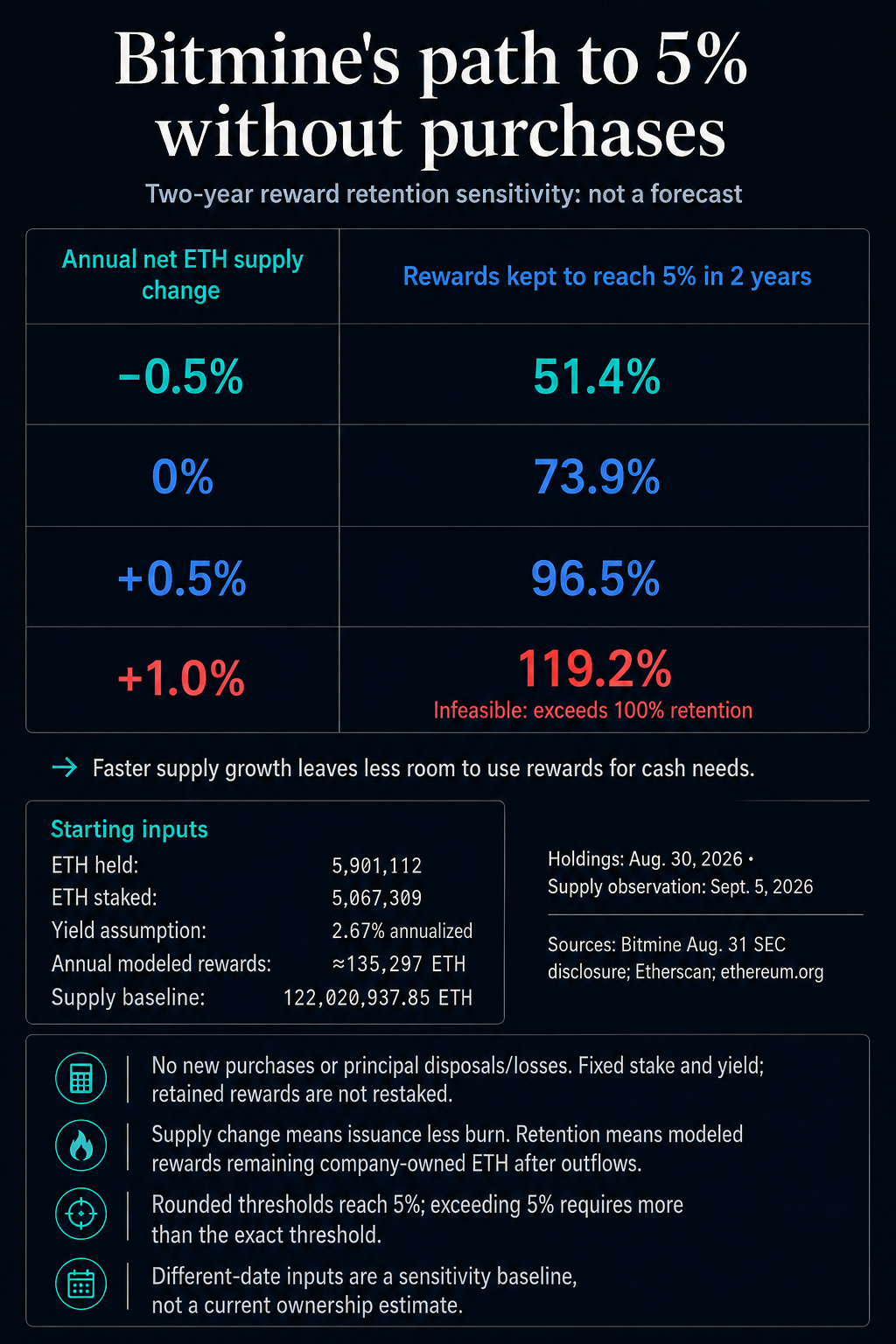
Bitmine had 5,067,309 ETH staked as of Aug. 30. Holding that balance and the disclosed yield constant would produce roughly 135,000 ETH in staking rewards over a modeled year.
At that scale, staking income itself can become a major acquisition engine.
Staking can finish what buying started
Using Bitmine’s own benchmark of 120.7 million ETH in circulation, owning 5% would require about 6.035 million tokens.
Against its officially disclosed 5.9 million ETH balance, Bitmine was about 134,000 ETH short, almost exactly equal to one year of modeled staking rewards. On that snapshot, the company would need to retain nearly 99% of those rewards to finish above 5% within a year if Ethereum supply stayed flat.
The reported Sept. 1 purchase would change that math substantially.
Adding another 51,000 ETH would reduce the gap to about 83,000 tokens using the same 120.7 million supply benchmark. Under the same fixed-yield, flat-supply assumptions, roughly 61% of one year’s modeled staking rewards would be enough to close it.
That illustrates why Bitmine can continue buying aggressively while becoming progressively less dependent on those purchases.
However, Ethereum’s expanding supply complicates that path because every increase in the network’s token count raises the amount Bitmine must hold to preserve a 5% share.
Etherscan showed roughly 122.02 million ETH outstanding on Sept. 5. Holding Bitmine’s Aug. 30 balance constant against that larger denominator would put its illustrative ownership share around 4.84% and widen the gap to nearly 200,000 ETH.
Over two years, relatively small supply changes have a large effect. Using the official Aug. 30 holdings and staking balance, Bitmine would need to retain about 74% of modeled rewards if ETH supply stayed flat.
At 0.5% annual supply growth, the requirement rises to roughly 96.5%. At 1% growth, even retaining every modeled reward would fall short without additional purchases.
| Assumed annual net ETH supply change | Reward retention needed to reach 5% after two years |
|---|---|
| −0.5% | About 51.4% |
| 0% | About 73.9% |
| +0.5% | About 96.5% |
| +1.0% | About 119.2%; not achievable under these assumptions. |
A lower staking yield would tighten the constraint further. At 2%, modeled annual rewards fall to roughly 101,000 ETH, pushing the flat-supply two-year retention threshold to almost 99%.
The harder question is how much ETH Bitmine keeps
For Bitmine, the path to 5% therefore increasingly becomes a capital-allocation decision rather than simply an acquisition target.
The company has disclosed that it periodically converts ETH-denominated staking rewards into US dollars and has not committed to a fixed percentage to keep on its balance sheet.
Every reward retained increases its Ethereum holdings without requiring another market purchase. Every reward converted into cash can instead support operating expenses and shareholder commitments.
Bitmine’s management agreement with Ethereum Tower includes reward-linked compensation as well as infrastructure and custody costs. The company has also declared 17 cash dividends on its BMNP preferred stock, with scheduled payments running through late December.
Its quarterly filing warns that changes in ETH prices and staking yields can affect its ability to fund operations and preferred dividends. Because staking rewards arrive in ETH, meeting those obligations can require selling tokens that would otherwise push the treasury closer to 5%.
That changes what investors should watch next. The key disclosure is no longer just how much ETH Bitmine buys, but how much of the ETH it earns the company actually keeps.
The post How Bitmine could surpass its 5% Ethereum goal without buying more ETH appeared first on CryptoSlate.
US spot Bitcoin exchange-traded funds recorded net inflows of $174.6 million on Friday, Sept. 4, 2026.
Only funds from BlackRock and Fidelity attracted positive net flows, according to Farside Investors' daily table, leaving the final US exchange session before Labor Day's closure dependent on two products for its net inflow.
The total was 76.1% below Thursday's net inflow of $730.8 million on Sept. 3. Positive flows narrowed from seven of the 12 tracked funds to two. The slowdown followed the Bitcoin and Ethereum ETF surge in the preceding session, with Friday's Bitcoin result smaller and less broadly shared across funds.
Thursday's seven positive funds were IBIT, FBTC, BITB, ARKB, MSBT, GBTC and BTC. By Friday, the five products beyond BlackRock and Fidelity in that group had all moved to zero net flows.
BlackRock's iShares Bitcoin Trust ETF, or IBIT, recorded net inflows of $117.4 million. The Fidelity Wise Origin Bitcoin Fund, or FBTC, recorded net inflows of $57.2 million. Those were the only positive entries in Farside's Sept. 4 row.
The other ten products each showed zero net flows: BITB, ARKB, BTCO, EZBC, BRRR, HODL, BTCW, MSBT, GBTC and BTC. None recorded a net outflow. The smaller positive total therefore signals a slower pace of money entering the group, rather than net withdrawals from it.
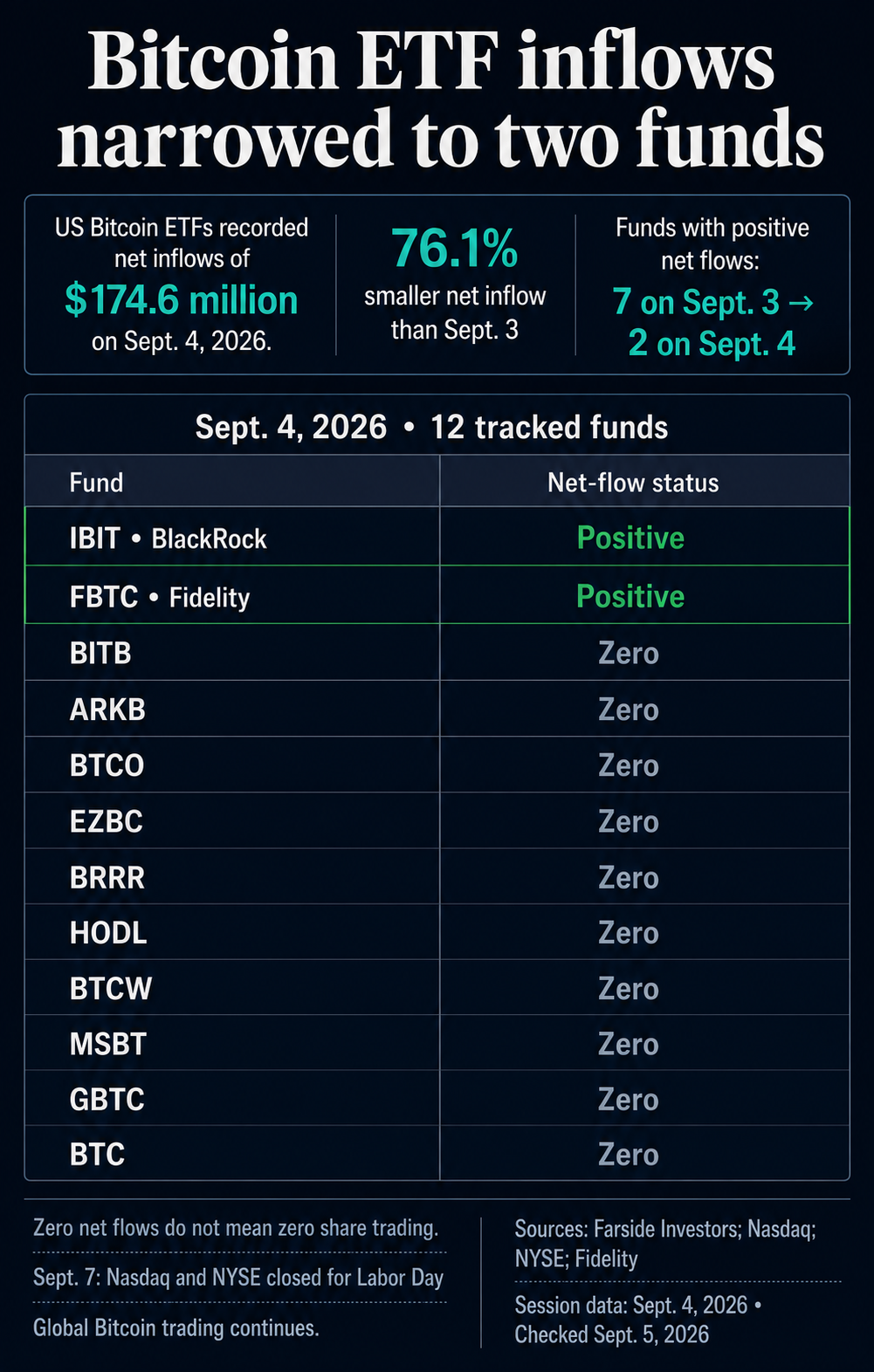
A zero net-flow reading does not mean a fund's shares went untraded. Fidelity explains that investors can buy and sell these products during stock-market hours, while authorized participants create and redeem fund shares. Those are separate activities: shares can change hands between investors without that trade itself creating or redeeming fund shares. The flow table measures the net result at fund level, rather than the volume of trading in its shares.
Bitcoin ETF inflows await Tuesday's next session
Both Nasdaq and the NYSE list Monday, Sept. 7, as closed for Labor Day, making Tuesday, Sept. 8, the next scheduled regular session. Friday's figures will remain the latest completed US exchange-session reading through the holiday break.
The closure does not stop global Bitcoin trading. Fidelity's comparison of direct crypto and exchange-traded products distinguishes direct crypto trading that may be available around the clock from funds that trade during stock-market hours. The holiday calendar limits that exchange-traded route, rather than shutting the underlying market.
Friday's figures do not identify the investors behind the flows or establish that a price move or payroll release caused the slowdown. The next completed session will show whether Bitcoin ETF inflows spread beyond IBIT and FBTC again; a single session cannot establish a lasting demand trend.
The post Bitcoin ETF inflows fall 76% entering Labor Day break as only BlackRock and Fidelity attract fresh money appeared first on CryptoSlate.
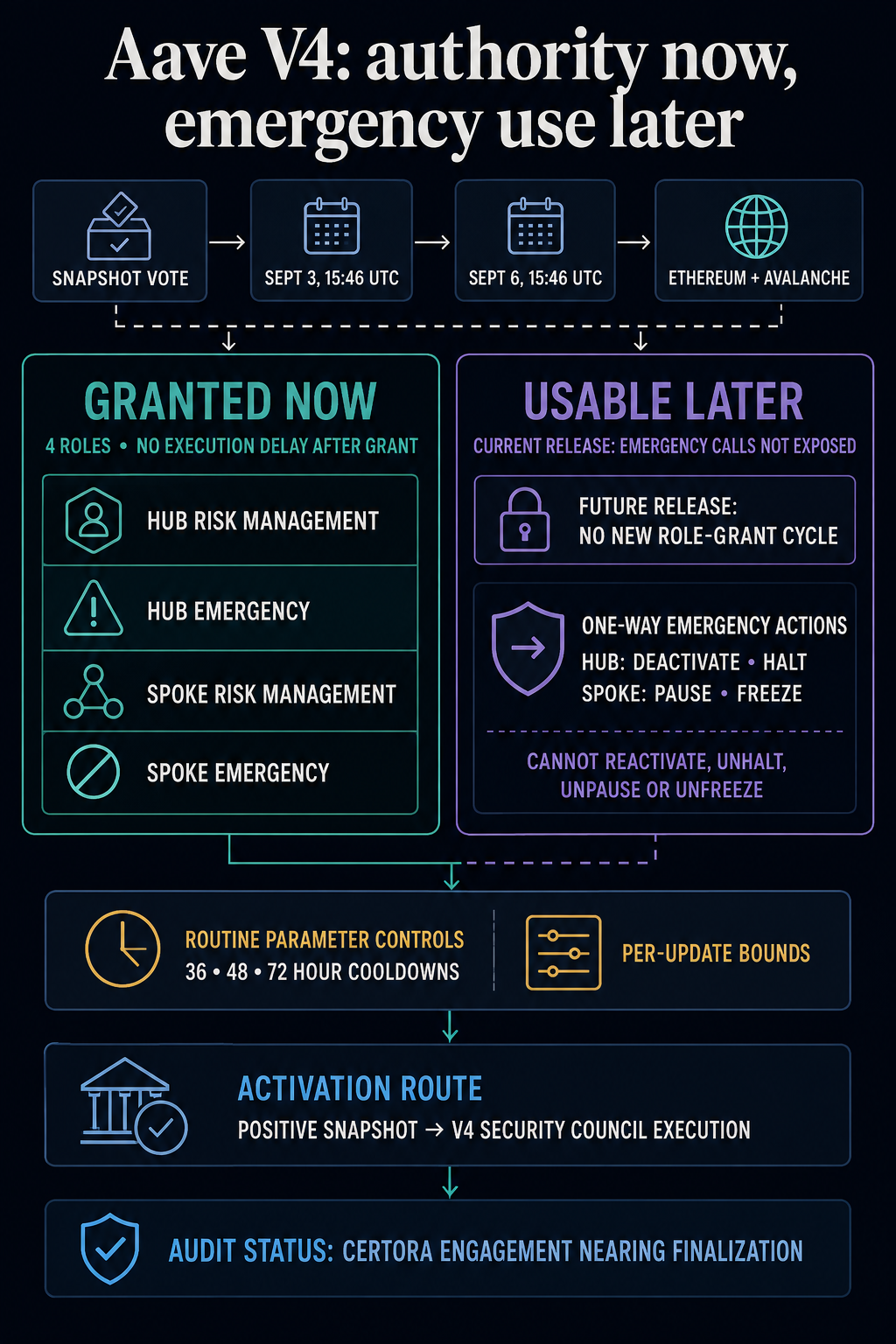
Aave DAO voters are deciding whether to delegate limited V4 risk controls on Ethereum and Avalanche to Risk Stewards, tools that let approved operators make constrained changes without taking every update through a full governance vote. The proposal would also assign no-delay emergency roles that the current steward software cannot use.
The Snapshot vote opened Sept. 3 at 3:46 p.m. UTC and is scheduled to close today, Sept. 6, at the same time. Approval would not activate the system by itself. Aave Labs said the corresponding payloads would still need to be executed through the V4 Security Council.
The code is also not being presented as fully audited. In its governance proposal, Aave Labs said the Risk Steward contracts were undergoing a Certora audit and that the engagement was nearing finalization.
The proposal's central tension is between authority assigned now and functionality available later. Each Risk Steward would receive Hub and Spoke risk-management roles plus Hub and Spoke emergency roles. Those four roles would have no execution delay after they are granted.
However, the release under consideration calls none of the emergency selectors, and the current steward documentation does not expose those methods. The emergency permissions would remain inert until a future release adds support. Assigning the roles now would allow that later version to respond to an emergency without waiting through another governance cycle for access.
The wider permission redesign would split each V4 instance's Hub and Spoke configurator controls into five granular categories: two flag-control roles, a listing role, an emergency role and a risk-management role. Selectors outside those categories would remain with residual domain-admin roles. Existing domain admins would receive the new roles so their current reach is preserved.
The proposed role definitions limit the emergency category to one-way safety actions. Hub calls can deactivate or halt assets and Spokes. Spoke calls can pause or freeze individual reserves or all reserves. Those functions cannot reactivate, unhalt, unpause or unfreeze the affected market. The separate flag-control roles, which can change states in both directions, would not be granted to the Risk Stewards.
Routine parameter updates would operate under different controls. The proposal sets minimum cooldowns of 36, 48 or 72 hours, depending on the parameter, and caps how far each update may move it. The same bounds would apply on Ethereum and Avalanche and cover interest-rate settings, collateral factors, liquidation settings and oracle caps. They do not constrain the emergency selectors.
That separation explains why the plan can combine slower bounded maintenance with immediate emergency authority on paper. It also creates an accountability question because the zero-delay roles would be in place before the steward can exercise them. Forum participants asked for public rationales, post-action reports, periodic reviews and reporting on the frequency and size of steward actions. None of those measures is a requirement in the current proposal.
If the Snapshot passes and the Security Council executes the payloads, the immediate change would be no-delay access to bounded parameter controls. The one-way emergency powers would be pre-positioned for a future steward release, but they would not yet be usable.
The post Aave crypto lending proposal would let emergency tools freeze markets – but not unfreeze them appeared first on CryptoSlate.
CryptoTicker.io
Crypto Airdrops in Week 37: These Deadlines Are Running Now
The hardest deadline this week concerns tokens that have long been sitting in the account. Anyone holding Beldex or Humanity at the crypto exchange Kraken in June had the replacement token credited automatically by airdrop – and has to withdraw it by September 25, 2026 at 14:00 UTC, otherwise the exchange liquidates it itself. An airdrop you never had to claim can therefore still expire.
And a warning up front that has shaped this edition: among the most frequently named “current” airdrops of the week in search engines is the genesis claim of Holoworld AI, supposedly starting on September 11. The project's post about it, however, dates from September 9, 2025, and the 60-day claim window expired in November 2025. In this format a year in the date costs the entire entry. With every airdrop tip you read anywhere, check the year first.
This overview lists the airdrops for which a claim window is open this week or a date is fixed within the coming 14 days. Every detail comes from the source linked in each case. Where a project has published no end date, it says so explicitly – there are no estimated deadlines here. Last week's position is in our article on the airdrops of week 36.
The Dates at a Glance
| Project | Status | Date / deadline |
|---|---|---|
| Beldex & Humanity (at Kraken) | Airdrop credited, withdrawal required | by September 25, 2026, 14:00 UTC |
| Plume (Season 2) | Claim open | no end date published; registration closed on May 27, 2026 |
| Grass (Stage 2) | Claim open | until January 22, 2027 |
| GRVT | Tranches continue | 30 days per tranche; date of the second release not published |
| dappOS (DOS) | Claim phase 2 open | since August 11, 2026, end not published |
1. Beldex and Humanity: The Airdrop That Expires on September 25
This entry is the most unusual on the list, because nobody had to claim anything here. Both projects were attacked in June 2026, both then rolled out a new token contract and distributed the replacement one to one to holders as of the record date. At Beldex the snapshot was taken on June 10, 2026 at 23:36 UTC, and the new token was credited on July 10, 2026 at 14:00 UTC. Kraken took over this distribution for its customers and booked it in automatically – which is why two lines have been sitting in the account there ever since.
The catch is the ending: trading and deposits have already been switched off for all the tickers concerned, and withdrawal is the only function left. It closes on September 25, 2026 at 14:00 UTC. From September 28 to October 2, 2026 the exchange liquidates remaining balances itself and points out expressly in the same notice that the proceeds may lie well below the prices last seen and may in individual cases be minimal or zero. For Beldex there is an additional point: anyone who bought only after the snapshot is not entitled according to the exchange, and there is no application portal.
What has to be done this week is therefore a single action with a date: withdraw before the window closes. We have written up the full process with both projects, the contract addresses distinguishing the old from the new token and the special route for Humanity separately, under “Kraken withdrawal deadline on September 25”.
Source: Kraken Support – “Notice of Beldex ($BDX) delisting and $BELDEX airdrop” (accessed September 7, 2026; snapshot, credit, withdrawal deadline and liquidation window are set out there verbatim)
2. Plume (Season 2): Claim Open, End Date Still Unpublished
Plume is a layer-1 chain for tokenized real-world assets. Season 2 of the points program ended on March 31, 2026, and registration for the distribution ran from April 29 to May 27, 2026. Anyone who missed that step is excluded according to the project; it cannot be remedied after the fact. Eligible were wallets with at least 10,000 Plume Points, in some cases additionally with verification through Human Passport.
The claim has been running since the end of May 2026 through the official portal, and the gap of recent weeks remains unchanged: Plume has at no point named an end date. The announcement text gives the registration deadline and says of the claim itself only that it is planned for “later in May” and that the exact date will follow through the official channels. It has not followed to this day. On checking on September 7, 2026, the most recent post on the project blog was from August 27, 2026 and concerned a partnership, not an airdrop deadline.
The figure circulating in secondary reports of a window of around three months, which on that arithmetic would have run out at the end of August, still does not come from Plume. We mention it only because it circulates, and expressly not as a deadline. In practice that changes nothing about the recommendation, on the contrary: a claim with no published end date can be closed at any time without prior announcement. Anyone eligible and registered should claim rather than wait.
Source: Plume – “Plume Points Season 2 Airdrop Registration Is Now Open” (checked again on September 7, 2026; the announcement still names no end date for the claim, and the project blog carries no more recent post on the subject since August 27)
3. Grass (Stage 2): Deadline of January 22, 2027
The Solana project Grass has been paying out the rewards of its Stage 2 since July 22, 2026. Epochs 1 to 19 are covered, that is the period from October 14, 2024 to June 8, 2026. The claim runs through the project's official dashboard.
Grass is one of the few projects with a cleanly published deadline: the claim is open until January 22, 2027, a full six months. Whatever has not been claimed by then stays with Grass – that is what the project documentation says word for word. This is the most comfortable entry on the list and nonetheless the one where, in our experience, the most is left lying, because half a year feels like unlimited time. Put the date in your calendar if you are eligible.
Source: Grass – “How Your Stage 2 Rewards Allocation Works” (checked again on September 7, 2026; deadline of January 22, 2027 and forfeiture unchanged in wording)
4. GRVT: Every Tranche Has Its Own 30-Day Clock
The derivatives exchange GRVT held its token generation event on July 30, 2026 and is distributing 280 million GRVT in total. The mechanics are the strictest on this list: distribution takes place in tranches over twelve months, and every released tranche has a claim window of 30 days. Once it runs out, the tranche is finally lost according to the project.
Two points are decisive here and are regularly confused. First, registration: it closed on July 27, 2026 at 00:00 UTC, and anyone who missed it has forfeited their allocation – no later claim changes that. Second, the automation: only the first tranche due is sent automatically, and even that only on a registration before July 17, 2026 with a target chain on file. The help text speaks expressly of the “first eligible tranche”; it says nothing about later releases. Assume therefore that you have to claim every further tranche yourself.
GRVT publishes no release schedule, and on checking again on September 7, 2026 the help section carried no date for the second tranche either. We deliberately do not calculate it here. What counts is solely the expiry date the reward portal shows you for your specific tranche. This is exactly where forfeited entitlements arise – set yourself a reminder, as the project itself recommends.
Source: GRVT Help Center – “How to Receive and Manage Your $GRVT Airdrop” (checked again on September 7, 2026)
5. dappOS (DOS): Phase 2 Open, Phase 3 Still Without a Date
The DOS token came out with its TGE on August 10, 2026, and since August 11, 2026 phase 2 has been running, in which eligible wallets can claim transferable DOS. A phase 3 has been announced but without a date, and for none of the phases so far has an end date been published. On checking on September 7, 2026 the claim portal on the project domain was reachable; it is the only official route.
What comes after is the real decision: a freshly distributed token with a small market capitalisation swings wildly in the first weeks, and selling pressure from an ongoing claim hits it on top of that. Anyone who wants to trade such a position at all needs access that covers the small pairs – pure charting tools such as Dexscreener or TradingView only display, no trading happens there. One alternative is the mobile app FOMO Family, in which meme and low-cap tokens can be discovered, swiped through and traded directly in the app, with fast deposits. Download the app through the link and secure yourself ten percent off trading fees. Sobriety belongs with it: trading meme and low-cap tokens is highly risky, volatility is extreme and a total loss is possible at any time. Where else DOS is traded is set out in our comparison of crypto exchanges.
Changed Since Last Week
- New on the list: Beldex and Humanity. The withdrawal deadline of September 25, 2026 is the only hard deadline of this edition that falls within the next 14 days.
- Midnight (NIGHT) drops out of the table. Not because anything has changed, but because we could not verify it for the third time running – more on that in the next section.
- GRVT, registration deadline clarified: registration closed on July 27, 2026 at 00:00 UTC; the separate cut-off for automatic dispatch of the first tranche was July 17, 2026.
What Is Deliberately Missing This Week
These candidates did not make the list. The reason differs in each case, and each is worth as much as an entry:
- Holoworld AI (HOLO) – wrong year. The genesis claim is carried in search results and on exchange learning pages as a current airdrop starting on September 11. The project's announcement, however, dates from September 9, 2025: claim start on September 11, 2025 at 11:00 UTC, window 60 days, hence expired in November 2025. Do not confuse it with a running claim – there is nothing left to collect here.
- Midnight (NIGHT) – source unverifiable three weeks running. The key data carried so far (thawing until December 4, 2026, then a 90-day grace period) come from a check in mid-August. Since then the server has answered from our environment only with a bot protection interstitial (HTTP 403 or 429), most recently on September 7, 2026; the developer documentation does not cover the subject. There is no indication of a change – but we can no longer substantiate the deadline, and an unsubstantiated deadline does not belong in the table in this format. Anyone relying on it should call up the project page themselves.
- AVANT – a period instead of a date. The TGE postponed to “mid-September” still has no calendar date, and the documentation expressly says claim mechanics and deadline will follow closer to the event. As soon as a day is named, the entry follows.
- Ink (INK) – TGE window, no deadline. A TGE in the third to fourth quarter of 2026 is expected for the Kraken layer-2, but no date has been published. Collecting points is not a claim date.
- Arcium (ARX) – open, but without a deadline. The retroactive token grants continue in rolling waves. Neither the project page nor the documentation names a point by which claiming must have happened. Unchanged from last week.
- RISEx, Canopy (CNPY), mint.io (MNTD) – points programs without a TGE date. Unchanged from last week; none of these candidates has published a date since.
- Kaidro (KDR) – over and not verifiable at the project source. The end of the play-to-airdrop program on September 4, 2026 is documented only through gaming portals, not through a project source we could reach. The date lies before this edition in any case.
- Exchange dates without an airdrop connection. The end of trading for 21 Kraken tokens, the VANRY migration and the expiring Binance withdrawals are real deadlines, but not airdrops. They are covered in our articles on exchange dates and do not belong on this list.
Along with the standing rule of this format: projects listed as “live” on aggregator pages but naming neither a snapshot nor a claim window at the project source do not get in. “Airdrop confirmed, date open” is not a deadline.
What to Watch Out for With Every Claim
Airdrops are the preferred hunting ground for wallet drainers, and the patterns repeat:
- Check the year first. This week's Holoworld case shows how an announcement a year old travels through search results as a fresh claim – and an expired claim is the perfect template for a cloned scam page.
- Always call up the claim page through the official project domain, never through links from direct messages, comments or search ads.
- No reputable airdrop asks for your seed phrase or your private key.
- Check what permission you are granting before you sign. An unlimited token approval is not necessary for a claim.
- Weigh the network fee against the value of the allocation. On very small amounts, claiming can cost more than it yields.
- Put every deadline in the calendar – with staggered distributions like GRVT's, every single tranche and not just the first.
- And the point that carries this week too: a claim without a published end date is not a claim with unlimited time, but one whose closure does not have to be announced.
Think About Tax Straight Away
An airdrop is not by definition a tax-free gift. Whether the allocation has to be treated as other income under Section 22 no. 3 of the German Income Tax Act depends above all on whether you provided something in return. This week's Beldex case also shows that two events have to be kept apart: the inflow of the replacement token in July and the later withdrawal or sale – a forced liquidation by the exchange is a transaction requiring documentation too, even if you did not trigger it.
So secure the time, quantity, market value, price source, transaction hash and the terms of participation right at the moment of claiming – the last of these tend to disappear first when a campaign page is switched off. Which details count individually is set out in our guide "Receiving airdrops: save this data immediately". That unsold tokens can also trigger a tax liability we explain under "Unsold airdrops: tax liability even without a sale".
That a distribution once promised can also be repurposed is shown by the Optimism case – set out in our article on the repurposing of the Optimism airdrop. An overview of further campaigns is in our section on crypto airdrops.
Conclusion
Week 37 is the week in which the date matters more than the project. The only hard deadline of the next 14 days concerns, with Beldex and Humanity, an airdrop nobody had to apply for and that can nonetheless be lost by doing nothing until September 25. Three further entries – Plume, GRVT and dappOS – have open windows with no published end, and only Grass names a clean closing date with January 22, 2027.
The second finding of the week is methodological and deserves more attention than any individual entry: a prominently traded “running” airdrop was in truth a year old. Search results, exchange learning pages and aggregators rarely carry years visibly. Check them before you connect a wallet.
And the necessary sobering note: most allocations move in the double to triple digit range, the fee for claiming eats a noticeable part of that, and a considerable share of all allocated tokens is never claimed. The effort pays off above all where you are already eligible anyway.
Disclosure: some of the providers named in this article work with us through partner programs. This has no influence on the editorial assessment.
(As of September 7, 2026. This article is not investment advice. Deadlines and terms of participation change; check them with the provider before taking part.)
The one-year holding period for private crypto gains still applies. On September 2, 2026 the German federal cabinet adopted the draft of an Income Tax Reform Act 2027, and it says nothing about the taxation of crypto assets. Anyone who holds a position for more than a year and then sells remains tax-free under the law as it stands.
That is the most useful piece of information this week for anyone who has been wondering since the summer whether to bring sales forward to get ahead of an announced reform. The announcement exists. The law that would implement it still does not.
What the Federal Cabinet Decided on September 2, 2026
The Federal Ministry of Finance published the cabinet decision the same day. The draft is called the Income Tax Reform Act 2027 and targets relief for low and middle incomes and for families with children. The ministry puts the total relief volume at around ten billion euros; the measures take full effect from 2028.
In detail the announcement names a basic tax-free allowance of 12,564 euros for 2027 and 12,900 euros for 2028, child benefit of 267 and 272 euros per month respectively, and an employee lump-sum allowance rising from 1,230 to 1,430 euros. At the upper end a new bracket of 47 percent from 280,000 euros of annual income is added, while the top rate of 45 percent is to apply from 250,000 euros in future. On the ministry's calculation, families with two children would keep over 600 euros more per year.
Crypto assets do not appear anywhere in that list. Neither Section 23 of the Income Tax Act nor a reclassification of private crypto gains as investment income forms part of the draft. The full announcement is on the site of the Federal Ministry of Finance.
Why an Omission Is News
Abolition of the holding period has been on the table since the spring. Every tax law that has passed cabinet since then is therefore a possible vehicle for that change. When one passes cabinet without it, the earliest possible date for entry into force moves further out. For tax planning in the current year that is a reliable statement.
Section 23 of the Income Tax Act: What the One-Year Holding Period Governs Today
A private disposal transaction is the sale of an asset held privately within a period set by law. On the tax administration's view, crypto assets fall under the other assets covered by Section 23(1) no. 2 of the Income Tax Act.
Two figures decide the outcome. First the period: a gain is taxable only if the interval between acquisition and disposal is no more than one year. Second the exemption threshold: under Section 23(3) sentence 5, gains remain tax-free if the total gain from private disposal transactions in the calendar year came to less than 1,000 euros. The statutory text is available at gesetze-im-internet.de.
An exemption threshold means this: once the amount is exceeded, the entire gain is taxable and not merely the excess. That is the difference from a tax-free allowance, and the two are regularly confused. On an annual gain of 999 euros from short-term sales nothing is due; at 1,001 euros the full amount is charged at your personal income tax rate.
Both figures apply unchanged and form the benchmark against which every sale you still make this year has to be measured. If you have lost track of acquisition dates and partial sales, our comparison of crypto tax software and portfolio trackers covers the programs that keep exactly this allocation automatically.
How Far Along Is the German Crypto Tax Reform Really?
The sequence of events can be documented. According to the tax firm Flick Gocke Schaumburg, Federal Finance Minister Lars Klingbeil announced the reform on April 29, 2026. In early July a budget draft followed whose key points for 2027 provide for the removal of the existing holding period; trade media report consistently that the federal cabinet approved those key points and that private crypto gains are in future to be charged at 26.375 percent regardless of the holding period. That rate is the 25 percent flat withholding tax plus the solidarity surcharge.
A key-points paper is not a legal basis. It describes a political intention and binds nobody. Between it and a tax liability lie a fully drafted bill, three readings in the Bundestag, the Bundesrat and promulgation in the Federal Law Gazette.
The ministerial draft of the Annual Tax Act 2026 published so far likewise does not contain the amendment to Section 23 of the Income Tax Act, according to a report by BTC-Echo of July 24, 2026. That means two legislative projects in 2026 that could have carried the overhaul are travelling without it.

Which Models Are Before the Bundestag
The direction of the reform is open, because several drafts sit side by side and differ on one decisive point: the treatment of existing holdings.
Abolition With Grandfathering
In Bundestag printed paper 21/5752, BÜNDNIS 90/DIE GRÜNEN propose abolishing the one-year holding period, combined with grandfathering for assets acquired before January 1, 2026. On that model anyone who bought early would stay inside the old system.
Reclassification as Investment Income
Die Linke goes further in printed paper 21/5824 and wants to allocate crypto gains to investment income, combined with a flat withholding tax and an exit tax. Exit tax means the taxation of unrealised gains at the moment a taxable person moves their residence abroad.
A Higher Rate Instead of a New System
From the SPD comes the additional demand to bring crypto into the capital gains tax regime and raise the rate from 25 to 30 percent. Within the coalition the project is contested according to reports in several trade media, with Klingbeil and the SPD pushing and the CDU/CSU holding back. No assessment of which version will prevail can be derived from that, and we offer none here.
How the two basic models would work out on a worked example we have calculated in our comparison of the two tax models. The course of the public debate is documented in our article on the petition against abolishing the holding period.
Why the Acquisition Date Matters More Than the Price
All three models attach to the moment of acquisition, either for calculating the period or for grandfathering. The cut-off date of January 1, 2026 in the Greens' proposal makes that particularly clear.
From this follows an unspectacular but effective step. Every position needs a documented acquisition date, a documented acquisition price and a traceable allocation of partial sales. That is already necessary today for the one-year period and would be all the more so under any conceivable reform model.
It becomes especially awkward with holdings that have been moved between several exchanges and wallets. A transfer to another address is not a sale and triggers no tax, but it frequently breaks the providers' automatic history. Anyone who made such transfers in recent years should close the gaps now, while records can still be obtained.
FIFO and the Question of Which Unit You Are Selling
FIFO stands for first in, first out and describes the assumption that the units acquired first are also the first to be disposed of. For the holding period the allocation is decisive, because it determines whether a unit sold had already passed the one-year mark. With a holding built up over years the acquisition dates lie far apart, and a single sale can affect units from several periods.
Anyone buying regularly, for instance through a Bitcoin savings plan, creates a separate period with every instalment. That is no disadvantage for tax purposes, but it does demand clean record keeping.
The Crypto Tax Transparency Act and DAC8: What Exchanges Report to the Tax Office From 2026
Alongside the debate about the holding period runs a project that is already law in force. The Crypto Asset Tax Transparency Act transposes the EU directive DAC8 into German law and obliges providers of crypto asset services to record and report tax-relevant transactions of their users.
The first reporting period is the calendar year 2026. The first electronic transmission to the Federal Central Tax Office takes place in 2027, by July 31 at the latest. According to the material available, what is reported covers personal data such as name, address, date of birth and tax identification number, together with transaction data. Breaches of the reporting and documentation duties expose providers to fines of up to 50,000 euros.
For you that has one plain consequence: the figures your exchange reports for 2026 will later meet the figures in your tax return. Where they diverge, explanation will be required. Whether your provider falls within the scope at all, and how cleanly it exports data, has therefore become a solid selection criterion; our overview of the best crypto exchanges ranks providers on this point too.

What a Sale Brought Forward Costs in Tax
Out of concern about the reform, many investors considered bringing gains forward over the summer. After the cabinet decision of September 2 it is settled that this step is at any rate not forced by this law.
In arithmetic terms a sale brought forward is free of tax consequences only if the units sold have already passed the one-year mark. If the acquisition was less than a year ago, a taxable gain arises at your personal income tax rate as soon as the exemption threshold of 1,000 euros in the calendar year is reached. A sale meant to avoid a reform can thus trigger a tax that would not have existed without it.
On top of that come trading costs and the spread, which fall due a second time on a later repurchase. With Bitcoin and other liquid assets that weighs less heavily than with smaller positions, but it does not disappear.
When a Sale Can Still Make Sense
There are reasons for selling that have nothing to do with legislation: a position that has grown too large, an upcoming need for liquidity, a changed assessment of risk. Those reasons are untouched by the reform debate. What changes is the urgency alone: there is currently no statutory reason to accelerate a decision.
What to Watch in the Coming Months
Three points decide whether the position changes. The first is a ministerial draft that actually contains an amendment to Section 23 of the Income Tax Act; so far none exists. The second is whether such a draft provides for grandfathering with a cut-off date, since that determines whether existing holdings would be affected. The third is the lead time between promulgation and entry into force.
As long as none of these points is established, the legal position remains the one written in the statute today. We deliberately do not write here how likely a reform is, because that cannot be derived from the documents available.
The Crypto Holding Period: What to Take Away
- Documentation before reaction. Pull together the acquisition date, acquisition price and partial sales for every position before you think about selling. You need this data under the law as it stands today and under every one of the models being discussed. Which programs keep it automatically is set out in the comparison of crypto tax software and portfolio trackers.
- No selling on suspicion. Before any sale brought forward, check whether the units concerned have already passed the one-year mark and whether the annual gain breaches the 1,000 euro exemption threshold. Trading costs and the spread belong in the same calculation; how they differ between providers is set out in the overview of the best crypto exchanges.
- Prepare for the 2027 data matching. Reconcile your provider's annual statement for 2026 with your own records while the year is still running and records are still within reach. If you buy regularly, it is best to set the periods up cleanly from the outset; how that works with ongoing instalments is set out in the comparison buying Bitcoin with a savings plan.
(As of September 7, 2026. This article is not investment advice and not tax advice. Prices, the legal position and fee structures change; check the terms with the provider before you buy, and have tax questions reviewed professionally in your individual case.)
Behind a stock token there are almost always four parties: an issuer that creates the instrument, a broker that sells it to you, a custodian that holds the real shares, and a blockchain on which your position is recorded. Once you know those four names, you know who your claim is actually against. Today they sit in the small print of the product documents, scattered across several files. The US Securities and Exchange Commission wants to change that, and since September 4, 2026 it has a hard deadline on the calendar: comments on its rule proposal can be filed until November 3, 2026.
This article explains who is liable for what in a stock token, how you can take the chain apart yourself in a few minutes, and what would change in the available data if the proposal is adopted as written. It is deliberately neither a buy recommendation nor a price analysis.
Who Stands Behind a Stock Token: The Short Answer
A stock token is almost never issued by the company whose name it carries. The issuer is a company set up specifically for that purpose, often in a different country from the broker you buy through. That company promises you economic exposure to a share price. It does not transfer ownership of the share to you.
From that follows the consequence that matters most in practice: your counterparty is the issuer, not the listed company. If the issuer becomes insolvent, the price of the underlying does you little good. If the broker becomes insolvent, what matters is how the product is held in custody. And if the token sits on a public blockchain, its transferability also depends on whether that chain is running and whether the provider has enabled transfers at all.
We have already answered the question of who owns the share behind the token in detail, including the role of the official share register: Tokenized Stocks: Who Owns the Share When the Register Sits on a Blockchain. This article deals with the stage before that, namely the parties themselves and how you identify them.
What Is a Stock Token and How Does It Differ From a Share?
A stock token is a security issued on a blockchain whose value tracks the price of a specific share. It is held and traded inside a crypto application, often around the clock and in fractions. In the models common today it is legally a debt security, that is, a payment promise from the issuer.
A share, by contrast, represents a stake in the company. Voting rights, a claim to dividends and the standing of a shareholder in an insolvency all attach to it. A token that merely mirrors the price does not carry those rights. Confusing the two means underestimating exactly one risk: the risk of the issuer.
A second term belongs here. The underlying is the security whose price the token tracks. In most models the underlying sits with a regulated custodian and backs the tokens in issue. That backing is a commercial undertaking by the issuer, not an automatic transfer of ownership to you.
The Four Parties Behind a Stock Token
Every stock token can be broken down into four roles. In practice several of them may belong to the same group, which makes the structure easier to follow but no less risky.
The Issuer Creates the Instrument
The issuer is the company whose name appears in the securities prospectus and in the key information document. It owes you the performance. Its country of domicile determines which insolvency law applies if things go wrong and how long proceedings take. An issuer on a Channel Island is not subject to the same regime as a company in the European Union.
The Broker Sells You the Product and Holds the Licence
The broker is the provider where you hold your account. It needs authorisation in the country from which it serves you, and that authorisation appears in the public register of the competent supervisor. For investors this is the decisive checkpoint: a provider with no traceable authorisation is a knock-out criterion, however polished the app looks. Which firms can point to a European licence is set out in our overview of regulated crypto exchanges.
The Custodian Holds the Real Shares
The custodian is the depositary bank or investment firm where the shares backing the token are kept. Its name often appears only in passing in the product documents. It matters nonetheless, because that is where the backing physically sits and where segregation would take place in a crisis.
The Blockchain Keeps the Token Account
The fourth role is technical. The token is recorded on a particular chain, and the properties of that chain determine whether and where you can move it at all. Several large providers rely on networks built with the technology of Arbitrum. Whether you may withdraw the token from the app into your own wallet is a decision of the provider, not a property of the blockchain.

A Look at the Small Print: What a Large Provider Writes About Its Own Stock Tokens
You do not have to guess at the structure. Providers disclose it, usually at the foot of their own announcements. In the press release of July 1, 2026 in which Robinhood presented its expanded offering, the decisive sentence sits in the legal notice: stock tokens are "tokenised debt securities issued by Robinhood Assets (Jersey) Limited that provide economic exposure to underlying securities but do not grant investors any legal or beneficial rights in, or against the issuer of, those underlying securities" (Robinhood Newsroom, July 1, 2026).
The same announcement names the remaining parties: for customers in the European Union the services are provided through Robinhood Europe UAB, supervised by the Bank of Lithuania as an investment firm, crypto service provider and payment institution. The associated chain, Robinhood Chain, is described there as a layer-2 network based on the Arbitrum platform.
That puts three of the four roles in a single source, stated by the provider itself. This is exactly how the check should always begin. We cite this example because it is well documented, not because it stands out; other providers work with comparable constructions.
What Is a Transfer Agent and Why Does the Whole Chain Hang on It?
In the United States, a transfer agent is the company that maintains the official register of shareholders on behalf of a share issuer. It records transfers, issues shares, cancels them and pays out distributions. There is no exact equivalent in European market infrastructure, because register keeping, custody and settlement are divided up differently there.
For stock tokens the transfer agent is interesting for one reason: if a token is ever to be more than a payment promise, it has to connect at the point where ownership is authoritatively recorded. That is why the regulation of transfer agents helps decide whether a class of stock tokens carrying ownership itself can exist at all in future.
What the SEC Set in Motion on September 4, 2026
On September 4, 2026 the rule proposal "Transfer Agent Rules" was printed in the Federal Register, the official gazette of US federal agencies. The file references are Release No. 34-106246 and File No. S7-2026-30. The deadline appears in the document verbatim: "This release was published in the Federal Register on September 4, 2026. Comments should be received on or before November 3, 2026."
The proposal would overhaul the rules for registered transfer agents, amend the registration forms TA-1 and TA-2 and rescind an existing rule. Anyone can file a comment, including from outside the United States. For that the SEC points to a comment form on its website under file number S7-2026-30, an email address and the postal route to the Secretary of the Commission; in every case the file number has to be quoted. Comments received are as a rule published in the public file.
Why the Announcement and the Printing Are Two Different Dates
The Commission had already announced the proposal by press release on September 1, 2026. The deadline, however, only starts to run with publication in the Federal Register. That distinction is more than a formality: anyone who takes the date of the press release as the starting point calculates the deadline wrongly. Reporting on September 1 and 2 could not yet name the date at all, because it had not been fixed at that point.
Question 6(b) in Form TA-2: How the Regulator Sorts Stock Tokens Into Two Classes
The part of the proposal most interesting for investors is a new table in the transfer agents' annual report. Proposed Question 6(b) to Form TA-2 would require them to break down the issues they service by tokenization model and by security type, in each case as of December 31. The two model columns are headed "Issuer-sponsored tokenized securities" and "Third-party-sponsored tokenized securities".
The reasoning sits in a subordinate clause of the proposal, and it is the heart of the matter: the models would be recorded separately "as the risks to investors differ depending on the tokenization model". In the accompanying footnote the SEC refers to a statement by its own staff divisions dated January 28, 2026. On third-party-sponsored models that statement says the crypto asset may, but need not, represent an ownership interest or a contractual obligation of the issuer of the underlying security; and that holders could be exposed to risks of the third party, such as its insolvency, to which a holder of the underlying would not necessarily be exposed.
In the same breath the SEC adds that such staff statements are not rules, have no legal effect and have been neither approved nor disapproved by the Commission. Anyone quoting the passage should carry that caveat with it.
The table would also be broken down by security type, among others into shares below and above a market capitalisation of 300 million US dollars, corporate bonds, exchange-traded funds, closed-end funds, limited partnership interests and municipal bonds. For understanding the market that would be a leap: so far there is no official count of how many tokenized issues follow which model.
Question 5(b): Why Tokenization Agents Would Have to Be Reported by Name
A second change concerns suppliers. Proposed Question 5(b) would require transfer agents to tick off their service providers and name them. The list covers banks, trustees, providers of register-keeping systems, search services for lost securityholders, printing and mailing firms and call centre operators, plus two new categories: tokenization agents and distributed ledger platforms.
With that the regulator formally acknowledges for the first time that technical service providers sit between the register and the investor without appearing on any form so far. The reasoning in the proposal is operational: if a register service provider fails, the Commission wants to know how many transfer agents depend on it.

What Would Become Public and What Would Not
This is the point at which careful reading pays off, because the two changes are treated differently. On the service provider names from Question 5(b) the proposal states expressly that this information would not be made publicly available through the SEC's EDGAR archive. It would therefore be reported for the regulator and not for the public.
For the model table from Question 6(b) the proposal names no such exception. Under the relevant Rule 17Ac2-2(a), TA-2 annual reports are publicly available once filed, and the proposal itself relies on precisely those publicly filed reports in several places. Publication of the model figures is not expressly promised in the text, however. Anyone counting on it should treat the point as open until the final version is available.
What the Proposal Does Not Mean for You in Europe
Three qualifications belong here, otherwise a false picture emerges.
First, this is a proposal and not law in force. Until November 3 the Commission is collecting comments, after which it can amend, postpone or drop the draft. The document contains no binding date for a final rule.
Second, it applies to the US market and to transfer agents registered there. It changes nothing directly about your rights from a stock token bought in the European Union. Those continue to follow the issuer's prospectus and the law of its country of domicile.
Third, it does not make tokenized shares safer. It creates reporting duties and an ordering of terms. Whether a particular product suits you is still decided by the key information document and not by a form in Washington.
What it does decide is the question of direction: whether the United States can in future have a class of stock tokens to which ownership itself attaches, rather than merely a claim against a third party. That is the reason it is worth following.
How to Identify Who Stands Behind Your Stock Token in Six Steps
For a single product this check takes about a quarter of an hour. It requires no specialist knowledge, only the documents the provider has to make available to you anyway.
- Open the key information document. In the EU such a document has to exist for every packaged investment product, usually two to three pages. Right at the top is the name of the manufacturer, that is the issuer, with its legal form and country of domicile. Note it down word for word.
- Read the section on risks. It sets out what happens if the issuer becomes unable to pay, and whether you rank as an ordinary creditor in an insolvency. If you find the word debt security there, or wording about economic exposure without shareholder rights, then you hold a claim and not a stake.
- Look up the broker's authorisation in the supervisory register. Every European supervisor maintains a publicly searchable register of the institutions it supervises. Search there for the exact company name from the documents, not the brand name of the app. If the two differ, that is not automatically suspicious, but it is a reason to look more closely.
- Search for the custodian. The detailed terms state where the backing shares are held. If the information is missing entirely, that is the most important open point of your check, and a question to support is in order.
- Clarify the chain and whether you can withdraw. Check which network the token is recorded on and whether you may transfer it to your own wallet. If the terms state that transfers are excluded, the token is tied to the platform, and the provider's default risk weighs accordingly more heavily.
- Write down the result. Four names and one sentence on transferability are enough. Once you have noted that, the next product from the same provider only has to be compared against it.
How the tax side differs from this was set out by our editorial team on August 10, 2026 in the article "Taxing Tokenized Stocks in Germany"; issuer risk itself we covered on August 16, 2026 under the title "Tokenized Stocks: Why You Do Not Own a Share".
The Timeline to November 3, 2026
For the coming weeks that produces a manageable schedule. On September 1, 2026 the SEC announced the proposal. On September 4, 2026 it appeared in the Federal Register, which started the clock. Comments can be filed until November 3, 2026; the public file carries the number S7-2026-30 and, experience suggests, fills up most towards the end of the period.
After that no date follows automatically. The Commission evaluates the submissions and decides whether and in what form it adopts a final rule. Between the close of comments and a final rule, comparable projects have often taken many months. Anyone wanting to follow the process needs only the file number: it stays the same throughout.
For you as an investor the practical benefit is independent of the outcome. The terms the proposal introduces already work as a checking grid. Ask of every stock token whether it is sponsored by the issuer of the underlying or by a third party. That single question sorts the market more reliably than any product description.
Checking Stock Tokens: What to Take Away
- First establish who the issuer is. Its name is in the key information document, and your claim is against it. If you find that your provider does not state this clearly, compare it with firms that do: overview of crypto exchanges.
- Check whether you are allowed to move the token. A token you cannot withdraw shares the fate of the platform. If you want to look seriously at self-custody, our hardware wallet comparison helps with the choice.
- Document the purchase, the model and the issuer from the outset. Debt securities on shares fall under different tax rules from crypto assets, and the burden of proof is on you. A tax tool or portfolio tracker takes the collecting of records off your hands.
(As of September 7, 2026. This article is not investment advice. Prices and fee structures change; check the terms with the provider before you buy.)
Router Protocol is ceasing operations on September 30, 2026. If you hold ROUTE, or if you have moved funds through the Router app, you have just under three and a half weeks to sell or withdraw. After that, no provider will help you do it, and no interface will show you what you own.
The team announced the wind-down on Friday, September 5, 2026, through its account on X. Two trade publications assessed the statement independently of each other: crypto.news and Crypto Briefing. The US industry service The Block also covered it on September 6. This article sets out what exactly is ending, where ROUTE can still be traded today, and in what order you should proceed.
Router Protocol is shutting down: what the announcement of September 5, 2026 says
Router Protocol was cross-chain infrastructure. That means software which moves funds and messages between different blockchains, so that a token on one chain arrives in usable form on another. Such a connection is known in the trade as a bridge: it locks your funds on the originating chain and hands you a claim on them on the destination chain.
By its own account, the team worked on the project for more than four years. The statement gives several reasons for the wind-down: liquidity across Web3 that has been thin for two years, a shift of capital towards artificial intelligence, falling revenue from bridge fees, high operating costs, and demand that has concentrated on a handful of large chains. According to Crypto Briefing, the team examined commercialisation, technology licensing and a sale, without finding a workable basis for continuing.
For you as a holder, one sentence in the statement matters most: Router will coordinate with centralised exchanges to remove ROUTE trading pairs. The exchanges set their own deadlines in doing so. There is therefore no single cut-off date on which trading ends everywhere. There are as many cut-off dates as there are exchanges. Anyone waiting for an official announcement may be waiting for something that will never come from their own provider.
What stood on the project's website on September 6, 2026 is worth noting. Our own request to the routerprotocol.com homepage that day returned HTTP 200 and was still promoting the app, the API and the widget. There was no reference to the wind-down to be found there. Anyone who looks only at the provider's own site learns nothing about the deadline.
Router Nitro and Router Chain: which parts of the infrastructure disappear, and when
The wind-down does not hit everything at once, and one part is already history. Router Chain, the project's own layer-1 blockchain, launched in 2024 and was switched off as early as September 2025, according to crypto.news. What is ending now is the operational core that remained.
- Router Nitro, the bridge itself, closes by September 30, 2026. After that, no funds can be moved between chains through it.
- The Router app, the interface for swaps and transfers, ends on the same date.
- Selected technical components are to be released by the team as open-source software. For you as an investor that changes nothing about the deadline: source code on the internet is not a running service.
- The ROUTE trading pairs expire according to the schedules of the individual exchanges, not according to a schedule set by Router.
Two security incidents listed by crypto.news belong to the back story. In February 2025 there was an exploit at the level of the so-called solvers, the market participants who actually execute a bridge request; around 80 percent of the funds were recovered, according to that report. In July 2025 an incident at chain level followed, in which the funds were not recovered according to the same report. Neither explains the closure on its own, but both fit the picture of a project whose revenue base has been eroding for more than two years.
The wind-down joins a series that has been strikingly dense this year. In early September the Silicon Network bridge went offline, and with wrapped TON holdings too, holders had to act for themselves. The pattern is the same every time: the chain stays, the connection to it disappears.

303,333,198 ROUTE in the treasury: why the token burn does not shrink the circulating supply
The part of the statement that travelled loudest through the coverage is a burn. A burn means permanently rendering tokens unusable, usually by sending them to an address from which nobody can move anything again. Router intends to destroy 303,333,198 ROUTE from the project treasury this way.
Measured against the maximum supply of one billion ROUTE cited in the reports, that is a good 30 percent. The figure sounds like a massive tightening of supply. A look at the circulating supply shows that it is not.
Our own request to the public CoinGecko interface on September 6, 2026 at 18:52 UTC showed a circulating supply of 678,739,153 tokens for ROUTE and a maximum supply, as listed there, of 982,072,351 tokens. Add the two figures together: 678,739,153 plus 303,333,198 gives exactly 982,072,351. The tokens due to be burned therefore lie entirely outside circulation. They were never on the market, and their disappearance takes nothing away from it.
Anyone who reads a burn of this magnitude as a signal of rising prices is assuming a scarcity that, arithmetically, does not occur here. This is not a price forecast but a statement about quantities: the circulating supply stays unchanged, while the service that gave the token its purpose is being switched off.
Two more figures from the same request, to put the scale in perspective. Market capitalisation stood at around $67,200, and trading volume over the preceding 24 hours at around $16,100. crypto.news cited a market capitalisation of roughly $40,000 in its report; the gap is explained by the interval between the measurement times and by the thin liquidity, in which even small orders move the price sharply.
Where ROUTE can still be traded today: ten crypto exchanges checked ourselves
What counts for you is less what Router is planning than the question of where you can still sell ROUTE at all. Instead of adopting a third-party figure, we looked for ourselves.
The method in one sentence: on September 6, 2026 the public market data interfaces of ten exchanges were queried and the responses searched for a trading pair with ROUTE as the base currency. This survey was carried out by cryptoticker.io itself on September 6, 2026.
| Exchange | Request | ROUTE pair found |
|---|---|---|
| KuCoin | HTTP 200 | yes (ROUTE-USDT) |
| Gate | HTTP 200 | yes (ROUTE_USDT) |
| Kraken | HTTP 200 | no |
| Coinbase | HTTP 200 | no |
| Bitvavo | HTTP 200 | no |
| Bitstamp | HTTP 200 | no |
| OKX | HTTP 200 | no |
| MEXC | HTTP 200 | no |
| Bitpanda | HTTP 401 | not verifiable |
| BISON | no public endpoint reachable | not verifiable |
Of the ten exchanges queried, eight could be evaluated. On two of them a ROUTE pair existed, on six it did not. Two providers we were unable to check: Bitpanda answered the request with HTTP 401, and for BISON no publicly readable market data endpoint was reachable. For those two, this survey allows no conclusion either way, neither a listing nor its absence; anyone holding an account there should search within the app itself.
The finding matches the market data site: on the same request, CoinGecko likewise listed only two active trading pairs, each against the stablecoin USDT.
No EU-licensed exchange in the test: what that means for selling your ROUTE
Neither of the two exchanges we found addresses German retail investors as a regulated provider. Anyone who keeps their portfolio exclusively with a provider licensed in the EU will, on the basis of this survey, simply find no ROUTE there. A transfer to another European provider therefore leads nowhere, because the token is neither accepted nor traded there. Which providers hold an EU licence is shown in our overview of regulated crypto exchanges.
If your ROUTE is already on KuCoin or Gate
Then you are in the comparatively fortunate position of having a sell button at all. Check first whether your provider has already published a date for the trading halt and for the withdrawal halt. Those two dates almost never coincide: trading usually ends first, while withdrawals remain possible for some weeks longer. How to work through such deadlines systematically is set out in our overview of crypto deadlines and cut-off dates.
If your ROUTE is in your own wallet
Then you first need a route onto an exchange that accepts the token, and that route costs fees and time. Weigh both against the value involved. Our own request on September 6, 2026 at 18:52 UTC returned a price of $0.00009897, or €0.00008522, per ROUTE. At that level, ten thousand tokens are worth less than one euro. For many holdings the network fee for the transfer exceeds the proceeds, and in that case doing nothing is the economically correct decision.
The price history needs context so that the figures do not mislead. crypto.news reported a drop of around 50 percent within 24 hours after the statement, and an all-time low at $0.00003970. Our own request on the evening of September 6 showed a gain of around 62 percent against the previous day and a loss of around 21 percent over seven days. There is no contradiction here: this is a counter-move from an all-time low which, according to the same data source, was reached on September 5 at 07:50 UTC. From the peak of $0.080785 on July 31, 2024, the price remains around 99.9 percent away.
Funds in Router Nitro or the Router app: how to get at your holdings
One point matters for context: your tokens sit on the respective blockchains, not with Router. The shutdown takes away the interface and the transfer path, not the ownership. As long as you hold the private key or the recovery phrase of your wallet, the holdings remain accessible, even once the app has gone.
In practice that means three things. First, check whether you still hold open positions or wrapped balances through Router, that is, tokens which give you a claim on a chain to funds locked elsewhere. It is precisely this construction that makes a bridge shutdown delicate. Second, unwind such positions while the bridge is still working. Third, note down the addresses and networks on which something sits before the interface is switched off, because after that you will have to know for yourself where to look.
A word on security, because wind-down deadlines reliably attract fraudsters. No reputable provider will ask you by direct message to enter your recovery phrase or to connect your wallet to a support page. Anyone who offers, unprompted, to rescue your holdings generally wants them for themselves. Should your account be restricted during this phase, the same steps apply as with any other account freeze: object in writing, gather evidence, document every deadline.
What such a process looks like in earnest has been visible several times this year, most recently with the shutdown of the Cypher wallet in early September, whose withdrawal window likewise closed on a fixed date.
Crypto tax on near-worthless tokens: what a sale for fractions of a cent triggers
The tax side is usually unspectacular at these amounts, but it should not be overlooked entirely. For privately held crypto assets in Germany, section 23 (1) no. 2 of the Income Tax Act applies: if more than one year lies between acquisition and disposal, the gain is tax free. Within the one-year period it counts as a private disposal transaction, for which section 23 (3) of the Income Tax Act provides an exemption threshold of 1,000 euros per calendar year.
Two points are especially relevant in a wind-down like this one.
- For tax purposes, a loss only arises through a transaction. A token that sits in your portfolio and is worth nothing is not a loss within the meaning of the provision. Only a sale or a swap within the one-year period turns it into a transaction that can be declared.
- Losses from private disposal transactions can only be used within narrow limits. Under section 23 (3) of the Income Tax Act they can be offset solely against gains from the same category of income, that is, against other private disposal transactions in the same year, carried back or carried forward. Against gains on shares or against employment income, that does not work.
Whether the effort is worth it depends simply on the size of the holding and on your wider position in the year concerned. Anyone carrying around a number of such positions should document the acquisition date, the quantity and the price properly, because these details often cannot be reconstructed once a service has been switched off. Binding advice, in the end, comes only from a tax adviser.
What the Router wind-down says about the business model of cross-chain bridges
The section that follows is explicitly an assessment and not a documented fact. The figures and dates above are documented; the interpretation that follows is ours.
Crypto Briefing points to a factor that weighs more heavily in the assessment than the trend in fees itself: Router is said to have channelled its historical revenue entirely into buyback and burn programmes, and to have built up no cash reserve as a result. A business model that pumps every euro it earns back into its own token looks excellent in a rising market and has nothing to draw on in a falling one. That is the most plausible explanation for why a project with prominent backers, among them Coinbase Ventures according to Crypto Briefing and The Block, is failing for want of capital.
At the same time, this case is no verdict on the technology. Competing providers such as LayerZero, Across, Axelar and deBridge continue to operate, according to the same report. What ends here is a particular way of financing a particular service, and it seems likely that consolidation in this segment will go on, because demand is contracting onto a few large chains and a few large providers.
For you as an investor, an unspectacular consequence follows. A token whose value hangs on a running service is tied to that service's survival, and that survival depends on revenue which can be worked out. The supply side of a token can be recalculated from the public figures on circulating supply, maximum supply and unlock schedules, exactly as was done above with the 303,333,198 tokens in the project treasury.
Checking the Router shutdown: what to take away
- Look today at whether you are affected at all. Check your accounts and wallets for ROUTE holdings and for open positions created through Router Nitro. If you find nothing, you are done. If you find something, September 30, 2026 is the outer limit, while your own exchange may close earlier. Which wallet actually shows you every network is covered in our software wallet comparison.
- Settle the exit route before you trade. According to our survey, a ROUTE pair exists on only two of the eight exchanges that could be evaluated, and none of them is a regulated provider aimed at German retail investors. Weigh the transfer fee against the value before you move any tokens. Where you want to trade over the longer term is best settled in principle through our crypto exchange comparison.
- Draw the lesson for the rest of your holdings. Whatever you hold in your own custody survives the shutdown of any provider, as long as you have the key. Which device is suited to that is shown in our hardware wallet comparison.
(As of September 6, 2026. This article is not investment advice. Prices and fee structures change; check the terms with the provider before you buy.)
If you had JUP staked in the second quarter of 2026, a share of 50 million JUP is in all likelihood waiting for you, and you can only reach it until October 8, 2026 at 14:00 UTC. After that the claim lapses. The awkward part: the button people used to collect this reward themselves has already gone. The campaign page has recently carried a note saying that the route through the Rewards Hub has ended and that the claim can now be made only through a support ticket. Jupiter names October 7 as the last day for that.
This text is the guide to it. It explains what the Active Staking Rewards actually are, who is entitled, how to check in a few minutes whether the deadline concerns you, which route you now have to take, and what the claim means for you in tax terms.
How much is still on the table can be worked out. The campaign page carries the state of the reward pot in machine-readable form. In our own retrieval on September 6, 2026 at 18:36 UTC, it showed 47,412,091 JUP as claimed and 2,587,908 JUP as not yet claimed, or roughly 5.2 percent of the pot. That is not a rounding error. It is an amount that falls back to the protocol’s community treasury in a good four weeks if nobody collects it.
What are Jupiter’s Active Staking Rewards (ASR)?
Active Staking Rewards, ASR for short, are a quarterly distribution of JUP to holders who staked their tokens and took part in the governance of the protocol. On its own page, Jupiter describes the programme as an incentive system that rewards users for voting activity and participation in decisions, thereby increasing the voting power of active participants.
So that the terms sit properly, here are the three that recur throughout this text. Staking in this context means depositing your JUP in a governance contract and receiving voting rights for it; this is not validator staking as in a proof-of-stake network. Governance is the whole body of votes through which holders decide on proposals concerning the protocol. A claim is the process by which you actually pull an already calculated allocation into your account; without that step the allocation remains no more than a number on a list.
Jupiter is the largest DEX aggregator on Solana. A DEX aggregator is a service that spreads an order across several decentralised trading venues and routes it to wherever the execution price is best. That explains why JUP is held comparatively widely in Germany: anyone trading on Solana has as a rule already come across the protocol.
Where the JUP in the ASR pot comes from
According to the campaign FAQ, the pot is fed by surplus, unclaimed JUP from the first Jupuary airdrop. In earlier periods, a share of fees from the in-house launchpad was added; for the period from April to June 2026, Jupiter expressly reports no such fee component. The size of the pot has stood constant at 50 million JUP for several quarters.
That is also why unclaimed rewards are no loss for the DAO: whatever is left behind travels back into the community treasury and becomes available again for later programmes. For you as a holder it is a final loss all the same, because there is no grace period.
Which deadline applies to the ASR from the second quarter of 2026?
The hard reference dates sit in the source of the campaign page as machine-readable fields and are therefore not dependent on any summary. We read them off there directly on September 6, 2026:
- Assessment period: April 1, 2026 to June 30, 2026
- Pot size: 50 million JUP
- Claim window opened: July 8, 2026, 14:00 UTC
- Claim window closes: October 8, 2026, 14:00 UTC
- The date that matters in practice: October 7, 2026, because Jupiter names that day in its warning notice as the last date for the ticket route
- Form of payout: staked JUP, added automatically to the existing stake account after the claim
Work to October 7 for yourself. A support ticket is not a press of a button: between sending it and its handling lies time you do not control. Anyone opening a ticket on the evening of October 7 has formally met the deadline and still has a practical problem if the handling comes only after the window closes. A buffer of several days is no luxury here.
Why the claim button has disappeared from the Rewards Hub
On the campaign page for the second quarter of 2026 sits a warning notice on a yellow background. In its own words: “ASR claims via the Rewards Hub have ended. To claim your ASR before October 7th, please open a support ticket at support.jup.ag.” You can read it directly on the official ASR page for April to June 2026.
The combination is what stands out: the official window still runs until October 8 according to Jupiter’s own time fields, yet the comfortable route to it is already shut. Anyone who wrote October 8 in the calendar and trusted that they could simply press a button in October will find none there.
We checked whether this notice applies across the site or only to this one quarter. It appears exclusively on the page for the second quarter of 2026. For other periods the interface does not carry it. The notice therefore belongs precisely to this campaign, and you cannot assume that you will meet it again in another period, or that it will disappear again in this one.

Who is entitled to ASR: the 50 JUP threshold on a time-weighted average
The eligibility condition is set low and clearly worded in the campaign FAQ: anyone who had at least 50 JUP staked on a daily time-weighted average across the quarter is entitled. Time-weighted average means that Jupiter averages your stake across all days of the quarter. A brief peak shortly before quarter end therefore helps you little; anyone who held a small position throughout the quarter, by contrast, makes the count with a few hundred tokens.
Participation in governance comes on top of that. The independent trade publication Cryptobriefing describes the condition as requiring participation in DAO votes during the quarter alongside the minimum stake. The campaign FAQ stress the same purpose: ASR is described there as a reward for voting activity and participation, so holding alone does not carry the claim. If you staked in the spring but never voted, check your result in the interface before writing a ticket.
A separate registration was never needed. The eligible wallets have been fixed since the calculation, and the allocation is already determined even if you have heard nothing of the programme to this day. That is exactly what makes the deadline dangerous: there is no action you could have refrained from in April that would get you off the hook now. The only mistake you can make is doing nothing.
How to check in a few minutes whether the deadline concerns you
Before you write to anyone, establish the position for yourself. The order is deliberately chosen so that you can drop out after each step once the result is clear.
Step 1: did you stake at all in the spring?
Open Jupiter’s governance interface with the same wallet you used in the spring of 2026. Your stake account is visible there. If no deposited holding appears for the period from April to June, you are out and can file this text as background.
Step 2: was your average above 50 JUP?
What counts is the daily average across the quarter. If you built up or ran down your stake during the quarter, your average sits below your peak. For amounts near the threshold it is worth looking at the campaign interface, which displays the calculated allocation for the connected wallet.
Step 3: is there an open allocation there?
If the campaign page shows an amount for your wallet that has not yet been claimed, the deadline concerns you directly. Note down the amount and the wallet address in a text file before you go further. You will need both shortly, and you do not want to reconstruct them from memory.
Step 4: check whether you had several wallets in play
This is the point at which most claims are lost. Anyone who worked with a second address in the spring, say a hardware wallet for the main holding and a software wallet for everyday use, may have two separate stake accounts. Each address is assessed individually, and each has to be checked individually.
A support ticket instead of a button: the route through Jupiter support
If step 3 produced an open amount, the route runs through support.jup.ag, as the warning notice on the campaign page prescribes. Do not expect immediate handling there: a person reads the ticket and works through it. What a ticket sensibly contains, so that it does not end up in a loop of follow-up questions:
- your public Solana address that was used for staking, in full and copied rather than typed out
- the name of the campaign, meaning the ASR period from April to June 2026
- the amount that the campaign interface shows as open for this address
- a brief note that the claim is no longer offered through the Rewards Hub
- a statement of whether an unstaking is currently running on the stake account
One security rule admits of no exception: a support ticket never contains your seed phrase, never a private key and never a signature whose purpose you do not understand. A public address is entirely sufficient for identification. Experience shows that around every well-known deadline, imitation support channels appear on social networks asking for exactly these details. Reach the support page through the link on the official campaign page, therefore, rather than through a search engine result or a link somebody sent you.
The most common stumbling block: a running unstaking blocks the claim
In the campaign FAQ, under the question of why JUP cannot be claimed, sits an answer that explains many cases in practice: if an unstaking is currently running on your account, you have to wait until it has completed or cancel it before you can collect the reward. An unstaking is the release of your deposited tokens, which with governance contracts typically carries a waiting period.
In practical terms that means: if you decided in recent weeks to pull your JUP out of the governance contract, and that process is still running, your claim is blocked for as long as it lasts. That costs days you do not have to spare with a deadline in early October. Check this point early enough.
A second point comes as a surprise: what you collect does not arrive as freely available balance. According to the FAQ, the claimed JUP is added automatically to your stake account. Anyone wanting to sell or move the amount therefore needs a further process afterwards, along with the waiting period that goes with it. That belongs in the scheduling too.

What happens to unclaimed JUP after October 8
The answer is unspectacular and final. Writing at the opening of the claim window, Cryptobriefing states that all rewards left behind after the cut-off on October 8 fall back to the community treasury of the DAO. The report can be read through the reprint of July 9, 2026 and confirms the deadline independently of Jupiter’s own interface.
In this construction there is no grace period, no hardship case and no second chance. The claim is tied to a window of time, and it ends with the window. That is exactly why the interim figure from our retrieval is so telling: if roughly 5.2 percent of the pot is still open at the beginning of September, then a number of holders are sitting on a claim they know nothing about.
How to avoid the same trap with other staking programmes
The Jupiter case is not an isolated one but a pattern. Many reward programmes work with a time-limited claim, and the deadline rarely sits where you see it in everyday use. Three habits reduce the risk considerably, and none of them costs more than a few minutes a quarter.
First: keep a plain list of all protocols where you have deposited tokens, with the address and the purpose. Second: set a recurring calendar entry two weeks before the usual end of the window for every programme on a quarterly rhythm. Third: on every change of provider, check whether open claims are left behind from the old arrangement. If you are comparing where to stake in future anyway, the providers’ terms are in our comparison of the best staking platforms; pay particular attention there to whether rewards are credited automatically or have to be actively claimed.
The difference between an automatic credit and an active claim matters more in daily life than it sounds. With an automatic credit nothing can lapse on you, but the taxable inflow arises without any action on your part. With an active claim you keep control of the timing and carry the risk of missing the date in return.
What the ASR claim means for you in tax terms
Caution is warranted here, because the treatment depends on the individual case and administrative practice can change. The rough direction that usually applies to staking rewards in Germany: rewards are valued at the moment of inflow and treated as other income; a later sale is a separate matter. We described the two pitfalls most often overlooked in this at length on July 23, 2026 in our article on selling staking rewards and the two tax traps to watch.
Two practical points follow from that for this particular case. The first concerns the timing: if you claim in October, the inflow falls into 2026 and therefore into the tax return for that year. The second concerns documentation. Because the claimed JUP lands directly in the stake account, there is no ordinary payout entry from which the process could later be read off easily. On the day of the claim, therefore, record what amount flowed in and what the price stood at that moment. A screenshot of the campaign page and the transaction signature are as a rule sufficient as evidence.
If you draw rewards from several programmes regularly, collecting such individual records quickly becomes unwieldy. Beyond a certain number of transactions, a tool that values inflows automatically at the price at the time of inflow is by far the more robust solution. Clarify the specific treatment of your case with tax advice all the same; this section does not replace it.
Claiming Jupiter ASR: what to take away
- Check today whether the deadline concerns you. Connect the wallet you staked with in the spring of 2026 to the campaign interface and look for an open amount. If in doing so you find you want to reorganise your staking anyway, use the comparison of the best staking platforms as a starting point.
- Open your ticket with a buffer. Take October 7 as the latest date and allow for processing time. Have the address, the amount and the status of any running unstaking to hand, and document the inflow cleanly afterwards; which tools take that off your hands is shown in our overview of crypto tax tools and portfolio trackers.
- Keep custody and everyday use properly separated. If your claim hangs on a second address you rarely use, that points to an unclear wallet structure. Which software wallets are suited to everyday use on Solana, and how to keep them apart from the main holding, is set out in our software wallet comparison.
(As of September 6, 2026. This article is not investment advice. Prices and fee structures change; check the terms with the provider before you buy.)
Decrypt
Early testers spent OpenAI's launch weekend pushing Astra through 3D cities, playable games, Bach chorales and research papers.
The multi-year deal will place the XRP logo on the field at Ben Hill Griffin Stadium starting this season, extending Ripple's push into college athletics.
With a growing number of institutions exploring stablecoins, the bottleneck is regulated infrastructure they can trust.
The team behind Pencil Finance says the financing supported thousands of Southeast Asian students, but it did not disclose borrower costs, defaults, or investor returns.
At least four more decade-old wallets moved a combined $15.7 million between Aug. 29 and Sept. 4, with one batch of coins sent to Coinbase in a likely sign of a sale.
U.Today - IT, AI and Fintech Daily News for You Today
The purported white-hat hackers behind the $320 million Liquid Network security incident have offered to return "most" of the nearly 4,000 BTC they withdrew, but only after Blockstream fixes the vulnerability that enabled the exploit.
The market is certainly moving in the direction of redistribution as bulls are trying to avoid an excessive bearish pressure.
Zcash (ZEC) has surged into the cryptocurrency top 10 after a sharp rally wiped out nearly $49 million worth of short positions over the past 24 hours.
Former Ripple dev conflict erupts as wallet bug affects 4,000 users, exposing long-standing XRP-focused project red flags.
Longtime Bitcoin figure CobraBitcoin has warned that the rapid rise of increasingly autonomous AI models could create a new security threat for Bitcoin.
Blockonomi
Key Takeaways
- SPCX shares currently sit at $147.95, reflecting an 18% increase over 30 days and trading above the $135 IPO level
- Analysts project a median 12-month target of $216, suggesting potential upside of 46% from present levels
- Second quarter revenue reached $7.81 billion, representing 92% year-over-year growth, with EPS exceeding forecasts by $0.17
- Bond Capital Management established a fresh $180.6 million stake in SPCX, representing 59.2% of their total holdings
- An upcoming share unlock scheduled for September 9 may trigger near-term downward pressure
SpaceX (SPCX) shares are currently valued at $147.95, marking an 18% appreciation over the previous 30 days. This upward momentum has lifted the stock beyond its initial public offering price of $135 following an earlier decline to $104.83 during its brief public trading period.
Space Exploration Technologies Corp., SPCX
Among the 41 Wall Street analysts tracking SPCX, the median price projection for the next twelve months stands at $216. This forecast implies a 46% increase from the September 4 close. The bearish end of estimates places a $75 target on the stock, while the most optimistic projection reaches $800, though most market observers consider this upper range a long-term scenario rather than an imminent outcome.
The mean consensus forecast among all analysts reaches $221.20, accompanied by a “Moderate Buy” recommendation. The rating distribution includes two Strong Buy recommendations, 25 Buy ratings, eight Hold positions, and seven Sell recommendations.
Impressive Revenue Expansion
SpaceX unveiled its Q2 financial results on August 4. The company generated $7.81 billion in revenue, marking a 91.9% year-over-year increase. Earnings per share registered at -$0.09, surpassing the analyst consensus of -$0.26 by $0.17.
While revenue exceeded expectations, SpaceX continues operating at a loss. The company’s net deficit improved from $1 billion in the previous year to $541 million in Q2 2026. Wall Street projects full-year EPS of -$0.15.
Quarterly expenditures totaled $18.4 billion, with $15.8 billion allocated toward AI infrastructure development. This substantial capital deployment raises concerns among certain analysts regarding sustainability.
Institutional Capital Flowing In
Bond Capital Management LP revealed a newly established position comprising 1,057,120 SPCX shares valued at roughly $180.6 million. This investment represents the firm’s largest individual holding, accounting for 59.2% of their entire portfolio.
Multiple smaller firms also initiated positions during Q2, including Dynamic Advisor Solutions ($3.38 million), KERR Financial Planning ($566,000), Apella Capital ($452,000), Dogwood Wealth Management ($139,000), and Burkett Financial Services ($70,000).
SpaceX has secured data center computing agreements with both Alphabet and Anthropic. Combined, these arrangements are projected to deliver $26 billion in yearly revenue. To provide perspective, the company recorded $18.7 billion in total revenue throughout 2025.
SpaceX aims to capture a $26.5 trillion total addressable market within AI infrastructure and intends to deploy more than 1 million satellites functioning as orbital data centers, with deployment beginning in 2028.
Regarding analyst activity, JPMorgan launched coverage in July with an “overweight” rating alongside a $225 price objective. Wells Fargo preserved its “overweight” stance while reducing its target from $230 to $215. Sanford C. Bernstein reaffirmed “outperform” on August 31. Phillip Securities assigned a “strong sell” rating on July 31, and Susquehanna downgraded from “neutral” to “underperform” on August 7.
The stock’s 50-day moving average currently rests at $136.15. Its 12-month trading range extends from $104.83 to $225.64. A possible Starship Test 14 launch scheduled for mid-September represents a near-term event that investors are monitoring closely.
The most pressing concern involves the September 9 share unlock event, which could expand available supply and generate selling pressure following the stock’s recent advance.
The post SpaceX (SPCX) Stock Analysis: 18% Monthly Surge Prompts Investment Questions appeared first on Blockonomi.
TLDR
- Benchmark Brent crude surged beyond $97 per barrel on Monday following military confrontations between American and Iranian forces near the Strait of Hormuz
- U.S. forces struck three Iranian oil vessels on Saturday; Tehran retaliated by attacking American Navy ships and an unmanned drone
- Approximately 20% of worldwide oil shipments typically transit through the Strait of Hormuz, with vessel movements now at five-month lows
- Tehran’s senior security advisor announced plans to establish a new maritime exclusion zone near the Strait of Hormuz within days
- OPEC+ maintained production levels for October, suspending a six-month run of output hikes while negotiating 2027 production allocations
Oil prices surged significantly on Monday following military exchanges between Washington and Tehran involving vessels in the Strait of Hormuz region, intensifying concerns about potential long-term interruptions to worldwide crude shipments.
Brent crude contracts climbed to a peak of $97.58 per barrel, marking approximately a 1.4% daily increase. West Texas Intermediate advanced 1.3% to approximately $92.69 per barrel. The two major benchmarks had already posted substantial gains in the prior week, with Brent jumping nearly 8% and WTI climbing close to 10%.
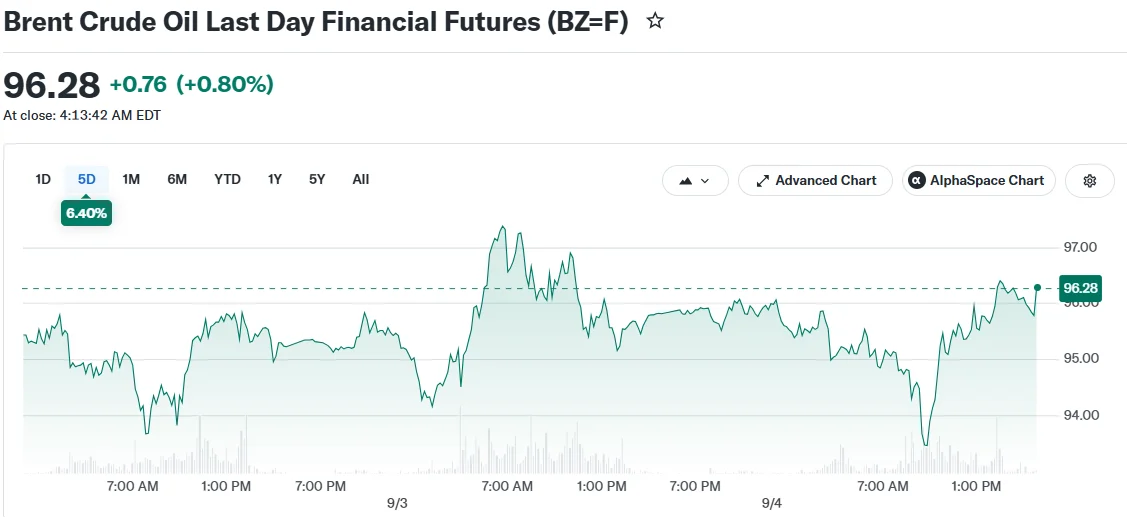
The recent confrontation erupted on Saturday when American military forces attacked three Iranian petroleum tankers. One vessel was struck near Kharg Island, positioned close to Iran’s primary crude export terminal.
Tehran responded swiftly. The Islamic Revolutionary Guard Corps Navy reported targeting three tankers navigating through what Iranian authorities deemed unauthorized shipping lanes within the Strait of Hormuz. Iranian forces also struck three additional American vessels in separate locations and subsequently attacked a U.S. naval unmanned aircraft.
Tehran’s senior security advisor issued a warning that any additional U.S. military operations would provoke a more forceful Iranian response. The official also announced that Iran intends to declare a new restricted maritime area adjacent to the Strait of Hormuz in the coming days. Ships entering this zone may be subject to punitive measures.
Maritime security firm Marisks characterized Saturday’s incidents as a “major escalation in the maritime conflict.” The firm noted that commercial oil tankers are increasingly being utilized as instruments of economic warfare, creating ambiguity between military operations and civilian shipping activities.
Vessel Movements Decline to Five-Month Low
The volume of commercial cargo vessels transiting the Strait of Hormuz has fallen to approximately 10 ships daily over the recent 10-day period, marking the lowest figure since May, based on information from analytics company Kpler.
The U.S. energy secretary reported that crude oil flowing through the waterway is currently running at just above 9 million barrels daily, sustained partially through American Navy convoy operations.
Market observers at Phillip Nova cautioned that additional declines in vessel traffic could prompt the market to incorporate expectations of a significantly larger supply disruption. Early indicators of this scenario are beginning to emerge.
ING market strategists noted the oil sector “remains well-supported with little sign of a peace between the U.S. and Iran,” while acknowledging that petroleum continues to flow currently.
ANZ researchers said an extended confrontation featuring sporadic military engagements represents the most probable scenario. They anticipate exports will remain limited throughout the remainder of 2026, with a slow reopening potentially beginning near the conclusion of the fourth quarter.
A complete restoration to pre-conflict transit volumes is not anticipated until late first quarter or early second quarter of 2027.
OPEC+ Maintains October Production Levels
OPEC+ convened on Sunday and chose to maintain production targets unchanged for October. The coalition had been incrementally increasing output over six consecutive months but suspended those increases to concentrate on finalizing new production allocations for 2027.
The alliance’s determination arrives as the Hormuz crisis introduces additional uncertainty to worldwide supply dynamics. Given Iran’s status as a significant OPEC participant, any further military escalation could constrict the market even more.
Currently, petroleum continues to transit through the strait with American naval assistance, though the possibility of more severe disruptions looms as 2026 approaches its final months.
The post Crude Oil Surges Past $97 Amid U.S.-Iran Naval Confrontation in Hormuz Strait appeared first on Blockonomi.
Key Points
- Five fatalities confirmed after Amazon Air cargo aircraft overran runway at Miami International Airport on Sunday
- Flight 7598, a Boeing 767-300 operated by 21 Air, was inbound from San Juan, Puerto Rico
- Aircraft collided with ground vehicles after departing runway, igniting a massive fire
- Five individuals sustained injuries, with three reported in critical condition
- Federal Aviation Administration and National Transportation Safety Board have initiated full investigations
A cargo aircraft operating under Amazon Air’s banner overran a runway at Miami International Airport on Sunday afternoon, resulting in at least five deaths and five additional injuries.
BREAKING: An Amazon cargo plane careened off a runway at Miami International Airport, struck several vehicles and burst into flames.
Thick black smoke filled the sky as officials closed all runways at one of America’s busiest airports. pic.twitter.com/fXxkbcBhtW
— Coin Bureau (@coinbureau) September 6, 2026
The incident involved Prime Air Flight 7598, a Boeing 767-300 freighter operated by contract carrier 21 Air. The aircraft was completing its journey from Luis Muñoz Marín International Airport in San Juan, Puerto Rico when it failed to stop on the runway at approximately 2 p.m.
After exiting the runway, the cargo jet collided with several ground vehicles in the vicinity of the airport. Emergency responders from Miami-Dade Fire Rescue encountered significant flames and dense smoke upon their arrival.
Multiple individuals became trapped within the vehicles impacted by the aircraft. The emergency response mobilized 60 fire units, with first responders reaching the crash site within half a minute of receiving the emergency call.
Fire Chief Ray Jadallah of Miami-Dade Fire Rescue characterized the situation as “a very complex fire,” noting that engine compartments were engulfed in flames while rescue teams worked to extract the pilot and co-pilot who remained trapped inside the cockpit.
Mayor Daniella Levine Cava of Miami-Dade County verified the death toll of five individuals, with an additional five sustaining injuries. Among the wounded, three remain in critical condition, while two others were admitted to hospitals with injuries of lesser severity.
Miami International Airport implemented a complete shutdown of all runways and taxiways starting at 3 p.m. Operations partially resumed several hours afterward, with at least two runways returning to service.
Statements from Amazon and Contract Carrier
Amazon acknowledged the accident through an official statement published on X. Company spokesperson Kelly Nantel emphasized that the organization is collaborating extensively with local officials and that “the safety, well-being, and care of everyone involved” remains their foremost concern.
21 Air, headquartered in Miami and operating Boeing 767-300 cargo aircraft, has provided services for Amazon since 2024. Company representatives have not yet responded to media inquiries regarding the incident.
Secretary of Transportation Sean Duffy advised passengers to anticipate disruptions and potential cancellations due to the airport closure.
Federal Probe Launched
The Federal Aviation Administration confirmed it will conduct a comprehensive investigation into the accident. The National Transportation Safety Board has similarly deployed investigators and announced plans for a press briefing scheduled for Monday.
Initial reports indicated an active fuel leak from the damaged aircraft, which emergency crews were working to contain.
Records show the Boeing 767 involved in the crash was manufactured over three decades ago, entering service in June 1994. The aircraft’s operational history includes service with Air Europa, Kenya Airways, and Atlas Air before undergoing conversion to cargo configuration in 2016.
Boeing discontinued commercial production of the 767 passenger variant, though limited manufacturing continues for military aerial refueling tankers.
Aviation experts are drawing parallels to the UPS Airlines Flight 2976 disaster in November 2025, which resulted in three crew fatalities and 11 ground casualties following departure from Louisville.
The Boeing 767 constitutes the backbone of Amazon’s air cargo operations, representing the majority of its fleet composition. The e-commerce giant supplements its 767 fleet with Airbus A330-300 freighters for long-haul routes and smaller Boeing 737 aircraft serving regional destinations.
Investigators have not yet determined what caused Sunday’s runway overrun as the inquiry progresses.
The post Fatal Crash at Miami Airport: Amazon Air Cargo Jet Overshoots Runway, Five Dead appeared first on Blockonomi.
TLDR:
- CZ says Bitcoin could overtake gold in importance as nations adopt it as a reserve asset.
- Gold’s advantage comes from custody and reserve systems already built, not the metal itself.
- CZ expects Bitcoin to approach $1 million sooner than most current market forecasts suggest.
- CZ urges governments to set clear crypto rules and weigh national Bitcoin reserve plans soon.
Bitcoin may overtake gold in importance during the next bull run, according to Binance founder Changpeng Zhao.
Speaking at a Bitcoin Asia fireside chat published by Bitcoin Magazine on Aug. 28, 2026, CZ said Bitcoin’s rise past gold depends on wider adoption as a strategic reserve asset among nations. He explained that gold’s advantage today comes from established systems, not from the asset itself.
Why Gold’s Lead Is Structural, Not Permanent
CZ said the real resistance to Bitcoin overtaking gold lies in existing infrastructure. Countries have spent decades building mature valuation, custody, and reserve systems around gold.
Replacing those systems takes time, particularly for large economies with established financial structures already in place.
Even so, CZ said Bitcoin holds the stronger long-term position between the two assets. He identified only one real risk to that outlook: a more advanced digital asset appearing before Bitcoin can close the gap with gold. He described that possibility as unlikely under current conditions.
Price served as a secondary marker of this shift. CZ said Bitcoin could reach $1 million sooner than most forecasts suggest, tied closely to broader adoption trends. He linked that trajectory to Bitcoin’s expanding role in national reserves and retirement pension funds.
Utility, not price alone, will decide the pace of that flip, CZ added. He pointed to large-scale payments as the clearest signal of Bitcoin closing the distance with gold. Markets tend to underestimate how much infrastructure can shift over extended periods, he said.
What Needs to Happen Before Bitcoin Overtakes Gold
Government behavior plays a direct role in this transition, CZ explained. Bitcoin itself does not weaken or strengthen state power, he said, since outcomes depend on individual government choices and policy direction.
CZ noted that more governments are starting to treat Bitcoin as a serious reserve candidate, even where formal regulation still lags.
Older officials shaped by negative coverage tend to adopt new technology more slowly, though he said that pattern is beginning to change.
To speed the shift, CZ recommended governments set clear crypto rules, weigh national Bitcoin reserves, and explore stablecoins or tokenized assets.
He cited the UAE, United States, Japan, and Hong Kong as examples of progressive movement, each pursuing a different strategy.
CZ also connected the flip scenario to emerging technology. He expects AI agents to transact increasingly in crypto, starting with stablecoins before extending to Bitcoin.
In that framing, Bitcoin functions primarily as a savings asset, positioned to gain ground on gold as global trust in digital reserves builds through broader institutional and governmental participation.
The post CZ Predicts Bitcoin Will Surpass Gold as Reserve Asset Grows appeared first on Blockonomi.
Key Highlights
- Apple’s annual flagship product showcase takes place Wednesday, September 9 at 10 a.m. Pacific from its Cupertino headquarters
- John Ternus, who became CEO on September 1, will present his inaugural major product keynote
- Anticipated announcements feature the iPhone 18 Pro lineup, a groundbreaking foldable iPhone, Apple Watch Series 12, and Apple Watch Ultra 4
- Customers can begin pre-ordering Saturday, September 12 at 12 a.m. Pacific, with devices shipping Friday, September 18
- The base iPhone 18 model is notably absent from this launch, with industry sources pointing to a delayed 2027 release
Apple prepares to host its most significant annual product showcase on Wednesday, September 9, with the presentation beginning at 10 a.m. Pacific from the company’s Apple Park campus in Cupertino, California. This marks the debut major keynote for John Ternus, who assumed the CEO position from Tim Cook at the start of September.
Former CEO Tim Cook, who now serves as executive chairman, will reportedly be present at the gathering in a VIP capacity but won’t participate in the keynote presentation. Mark Gurman from Bloomberg has indicated that Apple is deliberately showcasing Ternus as the leader of its next chapter in innovation.
The presentation is anticipated to last approximately 90 minutes, with Apple streaming the event directly from the Steve Jobs Theater.
Anticipated Product Announcements
The centerpiece announcement is widely expected to be Apple’s inaugural foldable iPhone, a product category that has generated years of anticipation. The lineup should also include the iPhone 18 Pro and Pro Max models, the Apple Watch Series 12, and the Apple Watch Ultra 4. New AirPods models may also debut.
Industry observers predict the foldable device will incorporate a cutting-edge 2-nanometer A20 Pro processor and introduce an enhanced “Siri AI” interface. Bank of America’s research team noted in August that Ternus could leverage this product launch to “solidify Apple’s leadership position in the AI-driven device landscape.”
Notably absent from this year’s announcement schedule is the standard iPhone 18 model. Multiple reports suggest this version has been pushed to a 2027 release, positioning this cycle as heavily focused on Pro-tier and foldable offerings.
Apple AAPL stock experienced a 2.51% decline in the days preceding the event week.
Important Timeline Details
Pre-orders will commence at 12 a.m. Pacific on Saturday, September 12. Apple adjusted its typical Friday pre-order schedule to respectfully distance the announcement from September 11, marking the 25th anniversary of the 2001 attacks.
The iOS 27 update should begin rolling out to compatible devices on Monday, September 14. Media reviews from selected outlets are projected for Tuesday, September 15, though the timeline may shift slightly due to the adjusted keynote schedule.
General availability for the iPhone 18 Pro models is scheduled for Friday, September 18. The launch date for the foldable iPhone remains unconfirmed and will likely be clarified during the event presentation.
Institutional investment in Apple has remained relatively stable approaching this launch window. According to Insider Monkey’s analysis, 169 hedge funds maintained AAPL positions during Q2 2026, essentially unchanged from 170 funds in the previous quarter.
Samsung maintains its position as the dominant player in the foldable smartphone sector. A Samsung executive recently commented to CNN that increased competition would benefit the entire category, stating “the more visibility there is on the category, the better.”
Apple’s entry into foldables comes several years behind Samsung’s pioneering efforts in this space. Expectations are exceptionally high, with pricing strategy and software execution likely to face immediate scrutiny from consumers and analysts alike.
The post Apple (AAPL) September 9 Product Launch: Everything Expected from John Ternus’s Debut Keynote appeared first on Blockonomi.
CryptoPotato
The altcoin market may be approaching a turning point after several major gauges broke out of year-long downtrends, according to analyst Matthew Hyland.
His charts suggest smaller cryptocurrencies are gaining ground against Bitcoin and traditional risk assets, although rising leverage also increases the odds of a painful correction.
Altcoin Gauges Break Long Downtrends
In a post published on September 7, Hyland said ETH, Total 2, Total 3, and OTHERS had all confirmed the end of their year-plus declines by forming higher highs. Let’s break that down a bit.
Total 2 tracks altcoins excluding Bitcoin, while Total 3 removes both BTC and Ethereum. OTHERS excludes the top 10 cryptocurrencies and therefore focuses more heavily on smaller tokens.
Hyland questioned whether the moves were simply a “bear market rally,” then followed up with a more bullish assessment.
In another post, the market watcher wrote, “The largest #Altcoin Bull Run of all time is loading,” and argued it could be “much larger than 2020-2021.” The accompanying OTHERS.D/SPX chart provided the basis for that view. It compares the dominance of cryptocurrencies outside the top 10 to that of the S&P 500.
The ratio has been falling for years after reaching a major peak during the 2017-2018 ICO period, and the chart places the current reading near the lower end of that long decline. A lower oscillator on the chart has also moved into an oversold area around 20-30, and the setup is being compared with the overbought reading near 80 seen in 2017.
But that does not prove that a new altcoin cycle has started. It does show why Hyland believes the market may be approaching a period of relative strength for smaller tokens.
There are already signs of increased trading activity, with data from Coinalyze showing altcoin perpetual futures open interest had overtaken Bitcoin’s for the first time since December 2024.
Leverage Adds Another Side to the Trade
The shift comes as altcoins outside the top 10 have pushed their combined market capitalization to $213 billion, up nearly 12% since the start of September.
Zcash has been one of the dramatic examples. Yesterday, as CryptoPotato reported, it surpassed $1,200, up 370% from its early-June low. Its market cap also moved above $20 billion, putting it ahead of Hyperliquid (HYPE) and Dogecoin (DOGE), both of which were still at the time of writing, having gained over 11% in 24 hours.
DOGE itself and BNB also posted strong moves in that period, with the former climbing 12% from its Friday low to $0.094, while BNB went close to $780, its highest level since early February.
But there’s a warning. ZEC perpetual futures open interest reached $2.7 billion per CoinGlass, while its move above $1,200 triggered $24 million in liquidations in the last 24 hours, more than $17 million of that being shorts, and historically, similar shifts in derivatives positioning have come right before corrections in mid-cap tokens.
That leaves two competing signals: the breadth of the altcoin move is improving, and several long-term charts have broken higher, but at the same time, leverage is building quickly. However, as things stand, Hyland sees the first as evidence that the market could be entering a much larger altcoin phase.
The post “Largest Altcoin Bull Run of All Time Is Loading,” Analyst Says as Key Charts Break Out appeared first on CryptoPotato.
Bitcoin Layer 2 network Liquid Network has reported a security incident in which purported white-hat hackers withdrew approximately 4,000 BTC, worth $320 million, from the Liquid Federation wallet.
Blockstream is attempting to contact the parties involved through a signed on-chain message.
Network Bug Must Be Fixed First
In an update, Liquid said the funds were withdrawn using the SideSwap PAK (Peg-out Authorization Key) but stated that the key itself was not compromised and that no other keys were in jeopardy. Crypto exchanges have been informed and have already suspended, or are preparing to suspend, LBTC deposits and withdrawals.
Liquid said other assets on the network, including USDT, DePix and real-world assets, were not affected. The network has also temporarily disabled its bridge nodes, meaning new transactions cannot be submitted. As a result, the sidechain is effectively paused while the issue is being addressed.
“Liquid wallets will be impacted, and we’re sorry for any inconvenience. Federation members are actively working on resolving this so we can restore normal network activity.”
The public back-and-forth between Blockstream and the party claiming to be the white-hat hacker behind the withdrawal is continuing on-chain. According to Samson Mow, the hacker appears to prefer communicating publicly rather than via email, and is posting messages via Bitcoin transaction data.
They even asked Blockstream to make contact on Signal at @m671aw.70″
The exchange began at 11:30 AM PDT, when the hacker wrote, “we are whitehats. contact us on chain.” Blockstream responded at 12:31 PM on September 6 and asked the hacker to contact its security team by email. Later, Blockstream sent an encrypted, PGP-signed message to the hacker’s key.
The discussion between @Blockstream and the white-hat hacker (WHH) regarding the ~4000 BTC from @Liquid_BTC is happening in public. It seems to be their preference over email. As it’s hard to follow the chain of messages in OP_RETURN, here’s a summary with links.
11:30 AM PDT -… https://t.co/IEXyFpBITx
— Samson Mow (@Excellion) September 7, 2026
At 7:20 PM, the hacker said they planned to send most of the funds back and asked whether a specified address was acceptable. About an hour later, they said the bug needed to be fixed first, and added,
“The chain is under risk at latest commit right now. Make sure every node is patched. Then we will transfer the money back safely after confirming the fix.”
Blockstream replied, “Yes, thank you,” at 8:30 PM. As of 9:12 PM PDT, around 3,998.5 BTC remained unmoved. There were no further messages from either side.
Unusual Hacker Behavior
Ledger CTO Charles Guillemet was skeptical of the white-hat claim and pointed out that legitimate security researchers would not typically drain a bridge and then ask to be contacted on-chain.
He drew parallels with the Ronin hack, in which attackers stole around $625 million after compromising validator keys, and the Euler exploit, where the attacker sought to negotiate the return of funds after the theft.
The move to Signal also did little to change Guillemet’s opinion that the behavior was unlike usual white-hat activity. Despite this, the exec noted that criminal groups do not typically reach out to their victims either.
The post Supposed White-Hat Hackers Drain $320 Million in BTC From Liquid Network, Say They’ll Return It After Fix appeared first on CryptoPotato.
Following last Friday’s strong US jobs report and the subsequent odd increase in expectations for an upcoming Fed rate hike, risk-on assets are entering the final week before the crucial FOMC meeting scheduled for September 15-16.
In the coming days, inflation data is likely to determine whether BTC continues its recovery or faces another major correction.
Big Week Ahead
Monday is expected to be an uneventful day since the US financial markets are closed on Labor Day. There are no major events scheduled for Tuesday, while the 10-Year US Note Auction on Wednesday is unlikely to impact crypto. The first major test comes on Thursday, with the release of the August PPI data, which measures inflation at the producer level.
Economists expect headline PPI to rise 0.4% month-over-month, compared with no actual increase in July. The core PPI is forecast at 0.3%. Annual producer inflation is likely to accelerate from 4.7% to 5.4%. A hotter reading could reinforce expectations that inflationary pressure is rebuilding, particularly as oil prices remain elevated due to the resumed conflict in the Middle East.
Friday will be an even more important day for all financial markets, especially risk-on alternatives like crypto. The CPI report goes live, which is estimated to point to inflation remaining at around 3.3%-3.4% annually, while core CPI is expected to ease from July’s 2.5%. The actual results could have a significant and immediate impact on Fed rate-hike expectations.
Once again, a higher-than-expected CPI reading would strengthen the argument for another rate increase and could pressure BTC while pushing Treasury yields higher, and vice versa.
Key Events This Week:
1. US Markets Closed, Labor Day – Monday
2. US 10Y Note Auction – Wednesday
3. August PPI Inflation data – Thursday
4. August Existing Home Sales data – Thursday
5. August CPI Inflation data – Friday
6. September MI Inflation Expectations data -…
— The Kobeissi Letter (@KobeissiLetter) September 6, 2026
Last Week Before FOMC
Given the hawkish stance taken by Fed Chair Kevin Warsh at the end of August and the strong US jobs report from last Friday, the inflation data coming in the following days will be crucial in determining the central bank’s next move. That move will come on September 16, making this week’s data even more important.
Bitcoin reacted to the hawkish speech by Warsh and the jobs report with an immediate leg down that drove it south by $2,000-$3,000 in hours. It managed to stabilize at around $80,000 even as bearish news and expectations mount, but a higher CPI reading is unlikely to help its bullish case ahead of the FOMC meeting, especially since the odds for a rate hike are well over 50%.
The post Bitcoin Faces a Crucial Week: These US Events Could Decide BTC’s Next Big Move appeared first on CryptoPotato.
El Salvador has significantly reduced public participation in its Chivo e-wallet as part of changes to the government’s involvement in Bitcoin, according to the International Monetary Fund.
The IMF said efforts are also underway to improve transparency around the country’s BTC holdings across its different wallets.
No Public Funds Bought Bitcoin
Majority ownership and operational control of Chivo have been transferred to a private operator, while the government has kept a minority stake and responsibility for holding customer assets. On Bitcoin accumulation, El Salvador provided documentation showing that the BTC acquired since the first review of its IMF program came from private donations, and no public funds were used for the purchases.
The IMF staff and the Salvadoran authorities have reached a staff-level agreement that also includes measures to strengthen the governance and risk management of crypto assets held by the public sector, along with plans to update the country’s digital-asset legal, regulatory and supervisory framework.
The IMF said no additional Bitcoin accumulation beyond the documented donations is expected. The developments come as El Salvador continues implementing reforms under its Extended Fund Facility arrangement with the international financial organization.
Zooming out, the IMF Mission Chief for El Salvador, Mr. Torres, stated that the country’s economy grew more than expected in 2025, and real GDP growth is expected to reach 4.5% this year. The outlook is being supported by investment and consumer spending, as well as remittances, tourism, and capital inflows. The IMF also pointed to improved security and higher investor confidence as factors supporting the economy. It said the government’s economic policies have helped strengthen fiscal and external buffers.
El Salvador Bitcoin’s Stash
El Salvador became the first country to make Bitcoin legal tender, but its use and accumulation have faced continued opposition from the International Monetary Fund. As part of negotiations for its $1.4 billion IMF program, the country agreed to limit public-sector involvement in BTC, make private-sector acceptance voluntary, and scale back parts of its crypto framework.
The National Bitcoin Office’s reserve tracker currently lists around 7,764 BTC. At the current price of $81,150, the holdings are worth roughly $630 million.
The post No Public Money Behind El Salvador’s New Bitcoin, IMF Confirms appeared first on CryptoPotato.
Crypto holders relied more on loans backed by digital assets as market conditions weakened in 2026, according to research from CryptoQuant.
The report analyzed data from crypto lender CoinRabbit. It found higher borrowing activity among both retail and high-net-worth users.
Borrowing Activity Rises
Crypto-backed loans allow holders to access cash without immediately selling their digital assets. Borrowers usually pledge more collateral than they receive, but falling prices can trigger liquidation or require more collateral.
According to the report, retail users recorded the biggest change in borrowing activity during the period. Their average number of loans rose 74%, from 30.8 per user in 2025 to 53.5 in 2026, while high-net-worth users rose 18%, from 16.5 to 19.4.
Repeat borrowing also became more common across the platform. The share of users taking multiple loans increased from 61.9% to 65.1%. Retail borrowers waited an average of 21 days between loans, compared with 11 days previously.
Beyond borrowing activity, collateral preferences also shifted, particularly among wealthier users. Bitcoin’s share of pledged assets among high-net-worth users fell from 57.8% to 30.5%, while Zcash reached 24.2% after not appearing among the previous top 10.
CryptoQuant linked part of Zcash’s rise in collateral use to its sharp price rally. Zcash climbed from about $50 in late 2025 toward $800, while Monero, Chainlink and Cardano also gained larger shares among high-net-worth collateral.
Shifting Asset Preferences
Retail users continued to rely heavily on XRP as collateral during the period. However, its share fell from 41.7% to 35.2%, while Bitcoin remained close behind. TRON, Stellar, BNB, Kaspa, and Velo also entered the mix.
Meanwhile, the assets users traded most frequently changed during the period as market conditions shifted. Tether and Bitcoin remained the two largest assets by volume, while USD Coin moved into third place. Flare, Ether, and Ondo also entered the top 10.
Solana, Stellar, and Shiba Inu dropped out of the top 10 by trading volume. Together, these changes show that users adjusted both their borrowing and asset preferences during the weaker market period.
The post Crypto Holders Turn to Loans as Markets Cool in 2026: CQ appeared first on CryptoPotato.