Cryptocurrency Posts
Crypto Briefing
The lawsuit highlights growing legal scrutiny on AI firms, potentially affecting OpenAI's market valuation and prompting industry-wide changes.
The post Seattle Times, Newsday sue OpenAI, Microsoft over AI copyright infringement appeared first on Crypto Briefing.
China's export model strain could destabilize global markets, impacting sectors reliant on Chinese goods amid sluggish global growth.
The post China’s export model nears breaking point, warns Michael Froman appeared first on Crypto Briefing.
China's strategic maritime shift east of Taiwan heightens regional tensions, potentially impacting global trade and security dynamics.
The post China shifts maritime pressure east of Taiwan, intensifying Pacific coast operations appeared first on Crypto Briefing.
Nvidia's ambitious revenue forecast highlights a transformative shift in tech industry dynamics, emphasizing AI's growing economic influence.
The post Nvidia forecasts year-ahead revenue, aims to surpass Apple and Alphabet appeared first on Crypto Briefing.
This settlement sets a precedent for stricter social media regulations, potentially reshaping industry standards and youth protection policies.
The post Meta’s $17.1 billion settlement marks a new chapter in social media regulation appeared first on Crypto Briefing.
Bitcoin Magazine
Bitcoin Magazine

Alleged White-Hat Hackers Withdraw 4,000 bitcoin from Blockstream’s Liquid Network Federation Reserves
The Liquid Network said Sunday that purported white-hat hackers withdrew about 4,000 bitcoin, worth about $320 million, from the federation wallet that backs L-BTC. Bridge nodes were disabled, and the sidechain was paused. Other issued assets, including USDT, DePix and RWAs, were unaffected, the official account said on X.
The Liquid Network is a federated sidechain of Bitcoin, founded by Adam Back’s Blockstream. The Liquid chain issues a variety of assets such as LBTC, which it backs with BTC on the Bitcoin main chain, held in a large multisig of 15 corporate and known members. 11 of the 15 members need to sign a valid multi-signature transaction to move coins from the treasury. Before the hack, the treasury held over 4200 BTC; after the hack, Blockstream’s proof of reserves page reports a little over 207 BTC left.
The hackers withdrew 4,019.4 BTC from the reserve address in a peg-out transaction using the SideSwap Peg-out Authorization Key. SideWap is a bridge exchange and a member of the Liquid Federation. While details on the mechanism of the hack are not confirmed yet, it appears an inflation bug on the LBTC side chain was exploited by the hackers to create over 4,000 LBTC that did not exist before, and cash them out for on-chain bitcoin from the federation. Because the transaction appeared as valid, given the consensus bug, the federation members’ HSM security servers signed the BTC withdrawal transaction, worth roughly 320 million at the time.
The hacker moved the funds to an address ending in 6gyqjlte, from which they quickly signed a new transaction with a message on the OP_RETURN arbitrary data field saying “we are whitehats. contact us on chain.” Those coins were still at that address at the time of writing.
A small mainnet transaction to the hacker address followed by an OP_RETURN saying “Please contact security@blockstream.com”, presumably from a Blockstream public address, though that remains unconfirmed. A later OP_RETURN spend from the hacker address carried “Please contact us on Signal @m671aw.70”, however, this may be spam and does not share a link to the address with the stolen funds.
In response to the breach, exchanges were told to pause L-BTC deposits and withdrawals. Bridge nodes on the Liquid Network have been paused, limiting access to the side chain, which continues to produce blocks.
JAN3 CEO Samson Mow said Aqua’s Liquid features were affected and that on-chain bitcoin still worked. Other wallets in the industry that use the Liquid Network are expected to be affected. Users holding LBTC now effectively have their savings at risk, since the underlying BTC is currently not redeemable. Given the private nature of the Liquid chain, user onchain analytics are scarce and not much public information is known about how much LBTC is held by retail users versus corporations of Blockstream itself. Nevertheless, should the funds not be returned, it would be a heavy blow to the Liquid Network’s user base.
Users of LBTC don’t have many options but to wait for conversations with the hackers to resolve. Given the size of the hack, it would be difficult for the hackers to get away with stealing all that bitcoin, though perhaps not impossible. What may happen is that the hackers ask for a finder’s fee and return the majority of the funds.
This post Alleged White-Hat Hackers Withdraw 4,000 bitcoin from Blockstream’s Liquid Network Federation Reserves first appeared on Bitcoin Magazine and is written by Juan Galt.
Bitcoin Magazine
Hargreaves Lansdown Reverses Course, Rolls Out Bitcoin Trading
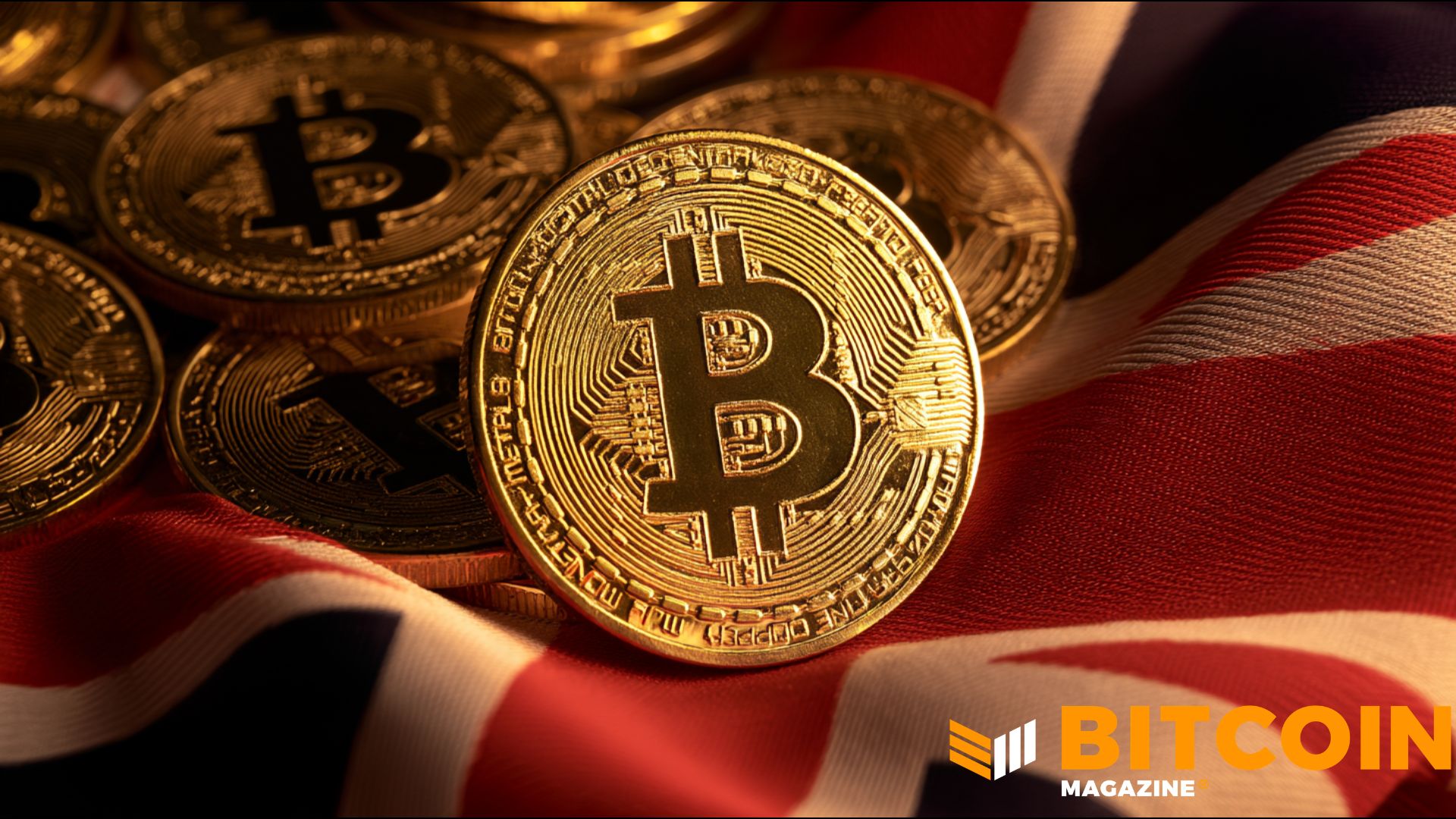
British financial services firm Hargreaves Lansdown is letting retail investors buy bitcoin — nearly one year after it said the cryptocurrency was “not an asset class.”
The Bristol, UK-based investment firm’s website said it was offering bitcoin and other crypto exchange-traded notes to investors. ETNs are investment funds which trade on stock exchanges and track the prices of digital assets.
It comes after the firm, which manages nearly £173 billion (over $233 billion) in assets, last year warned customers about buying bitcoin.
NEW:
— Bitcoin Magazine (@BitcoinMagazine) September 4, 2026U.K.'s largest investment platform Hargreaves Lansdown is now offering Bitcoin products to 2 million clients!
pic.twitter.com/GgdeHK8vyM
“While longer-term returns of Bitcoin have been positive, Bitcoin has experienced several periods of extreme losses and is a highly volatile investment — much riskier than stocks or bonds,” the firm said at the time.
“The HL Investment view is that Bitcoin is not an asset class, and we do not think cryptocurrency has characteristics that mean it should be included in portfolios for growth or income and shouldn’t be relied upon to help clients meet their financial goals.”
Now, a number of ETNs tracking the price of bitcoin and other cryptocurrencies are available. The firm warns users that “crypto ETNs are considered high-risk and may be volatile.”
U.S. regulator the Securities and Exchange Commission in 2024 approved bitcoin exchange-traded funds for investors after a decade of saying no to the products.
The funds had the most successful debut in the history of ETFs as investors previously unable to buy exposure to the asset class rushed in to buy the products.
Run by top asset managers and banks like BlackRock, Fidelity, and Morgan Stanley, the investment vehicles now collectively manage over $100 billion in assets.
This post Hargreaves Lansdown Reverses Course, Rolls Out Bitcoin Trading first appeared on Bitcoin Magazine and is written by Mathew Di Salvo.
Bitcoin Magazine
Trezor Breach Worse Than Reported: Another 67,000 US Customers Exposed
Hardware wallet manufacturer Trezor has said that a data breach first announced last month is worse than originally reported.
The Prague, Czech Republic-based company said Friday that an additional 67,000 U.S. customers had their names, emails, phone numbers, shipping addresses and order numbers leaked. The leaked data came from orders made between November 2019 and August 2021, according to Trezor.
Trezor first announced in August that data from 11,742 customers from the U.S., UK, Sweden, Colombia, Brazil, Italy, and Portugal had been exposed — with names, emails, phone numbers and shipping addresses leaked.
Another 1,947 customers just had their names, cities and emails exposed in the breach.
In Friday’s announcement, Trezor said that its third-party fulfillment partner, ShipMonk, had falsely reassured the company about deleting customer data.
“Throughout our entire relationship with ShipMonk, we repeatedly requested and received written assurance confirming the deletion of the data, in line with our contract, data policy, and past communications,” Trezor wrote.
“We are very disappointed that, despite receiving this confirmation, the data was not deleted in their systems.”
Neither Trezor nor ShipMonk immediately responded to Bitcoin Magazine’s questions.
Trezor first announced in August that the data had been leaked because ShipMonk experienced “unauthorized access to their systems containing customer data.”
The company added that it had directly emailed all customers involved in the breach. Trezor’s parent company, SatoshiLabs, told Bitcoin Magazine last month that it was investigating the incident.
Trezor is one of the most popular Bitcoin hardware wallet solutions, and also has support for storing other cryptocurrencies.
Bitcoiners’ personal data has been targeted by cybercriminals in the past: back in 2020, an unauthorized party accessed popular hardware manufacturer Ledger’s e-commerce and marketing database, leaking over 1 million email addresses and the personal contact data of nearly 10,000 customers.
At the start of this year, customers reported receiving emails from Global-e, Ledger’s payment partner, that a data breach at its cloud systems leaked sensitive customer data.
This post Trezor Breach Worse Than Reported: Another 67,000 US Customers Exposed first appeared on Bitcoin Magazine and is written by Mathew Di Salvo.
Bitcoin Magazine
El Salvador Isn’t Buying Bitcoin With Public Money, Says IMF
El Salvador has not used public funds to accumulate bitcoin since the International Monetary Fund’s last review of its loan program, the fund said Thursday.
In a report Thursday, the body said that the Central American country had instead received bitcoin from private donations, citing documentation from the government. It added that “no further Bitcoin accumulation beyond the documented donations is expected.”
El Salvador made headlines in 2021 when it became the first country in the world to make bitcoin legal tender. Salvadoran president Nayib Bukele in 2022 said the country would buy one bitcoin per day but it was never clear where the money was coming from — or if he was actually buying at all.
“Documentation has been provided verifying that Bitcoin accumulation since the first review reflects private donations and that no public resources were used,” the IMF release said.
“Understandings were also reached on steps to modernize the legal, regulatory, and supervisory framework for digital assets and to further strengthen the governance and risk-management arrangements for public-sector crypto-asset holdings. Going forward, no further bitcoin accumulation beyond the documented donations is expected.”
The report added that public participation in the government-sponsored bitcoin wallet has been largely wound down, with majority ownership and operational control handed to a private operator.
El Salvador in 2021 debuted a state-sponsored wallet called Chivo for its citizens as part of its plan to increase bitcoin adoption in the country.
“IMF staff thank the Salvadoran authorities for the constructive discussions and excellent collaboration,” the report added.
The IMF El Salvador entered a $1.4 billion loan agreement at the end of December but the fund asked for the country to scale back certain aspects of its bitcoin strategy.
Institutions like the World Bank and the IMF have long criticized President Bukele’s Bitcoin law, which also asked businesses to accept the cryptocurrency if they had the technological means to do so.
President Bukele in 2024 admitted that Salvadorans weren’t using the cryptocurrency to buy things as expected, but always boasted that the government was still stacking sats.
Since launching a crime crackdown to tackle the country’s notorious crime gangs, murder rates in El Salvador have plunged. The country was once the most dangerous place in the Americas but President Bukele is now trying to turn it into a tech hub.
Crypto companies like Tether have since relocated to its capital, San Salvador.
This post El Salvador Isn’t Buying Bitcoin With Public Money, Says IMF first appeared on Bitcoin Magazine and is written by Mathew Di Salvo.
Bitcoin Magazine
Bitcoin Dips Below $80,000 on Strong US Jobs Report
Bitcoin slid Friday after a better-than-expected labor report showed that the U.S. job market accelerated in August.
The leading cryptocurrency was recently trading for close to $79,764 after dropping as low as $78,706 earlier in the morning in New York. It’s currently down over 1% over a 24-hour period. On Thursday, the coin soared above $82,000.
The Federal Reserve is typically more likely to raise interest rates when the labor market is strong, because more people employed means more spending, and more spending can push inflation up.
Federal Reserve Chair Kevin Warsh last week gave his first major speech as head of the U.S. central bank and said he had “more work to do” to fight inflation. Bitcoin has typically done well in a low-interest rate environment.
Traders currently view a U.S. Federal Reserve interest rate hike at the upcoming September 15–16 policy meeting as roughly a 50% to 60% probability.
But U.S. President Donald Trump on Friday demanded the Federal Reserve slash interest rates.
Writing on his social media platform Truth Social, Trump said: “Lower the interest rates because the U.S.A. is a much stronger credit than it was just a short time ago!”
He added: “We should have the LOWEST RATE of any country in the World, like ‘the old days.'”
Bitcoin has decoupled from stocks recently as investors have renewed concerns around dollar debasement.
The cryptocurrency started surging last month, after the U.S. Treasury Department said it would more than double the size of its government debt repurchases. The coin had its best run in three years and third best August ever.
The much-talked about debasement trade is back in the spotlight, and bitcoin has been trading in lockstep with gold, according to analysts. The so-called debasement trade is when investors buy an asset as a way to hedge against a currency losing value.
News dropped last month that U.S. public debt exceeded $40 trillion for the first time too. Excessive debt also undermines confidence in the dollar, making assets like bitcoin and gold attractive.
This post Bitcoin Dips Below $80,000 on Strong US Jobs Report first appeared on Bitcoin Magazine and is written by Mathew Di Salvo.
CryptoSlate
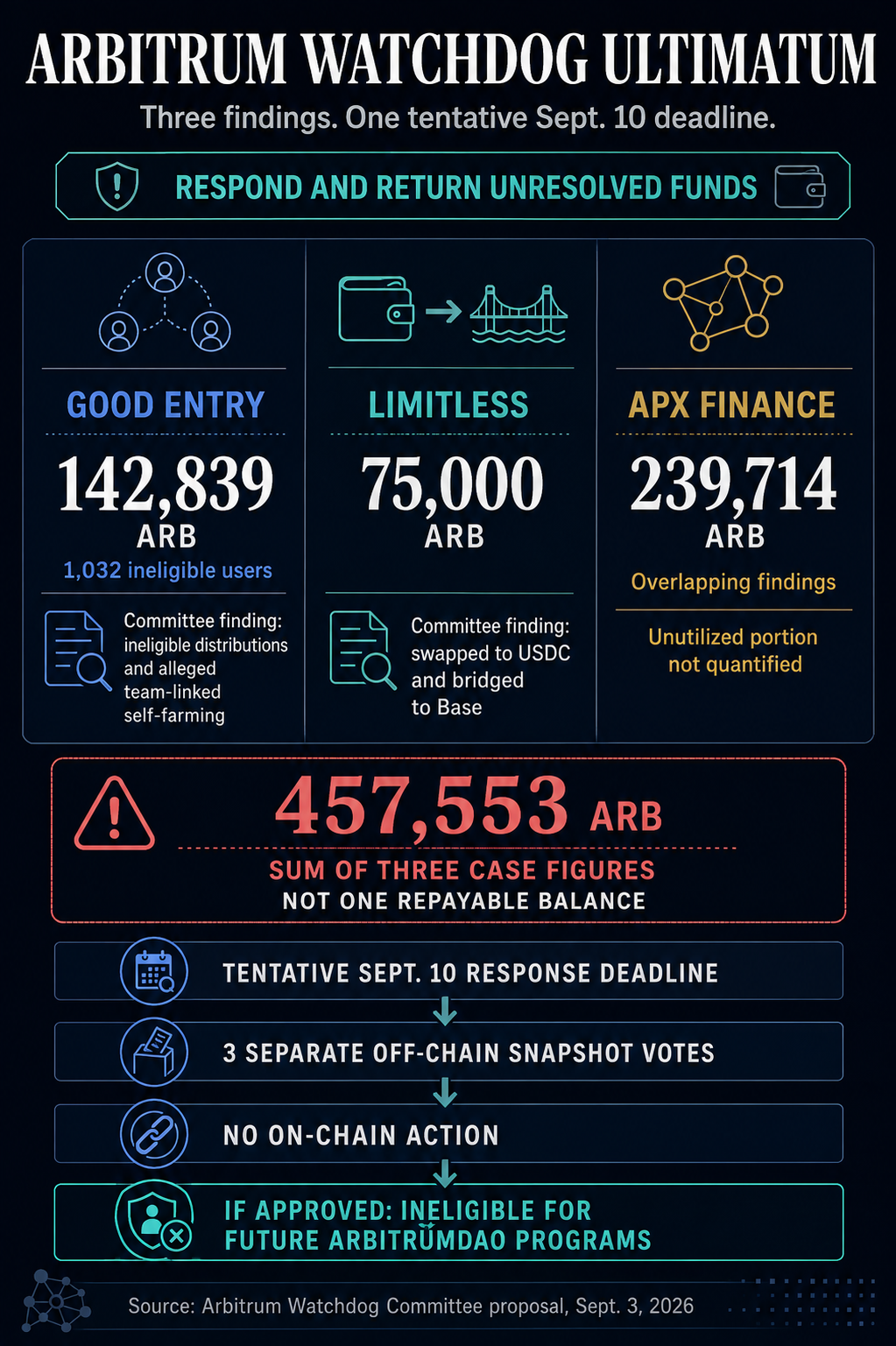
Arbitrum's Watchdog Committee, a grant oversight body, has given three DeFi projects until a tentative Sept. 10 deadline to answer high-severity misuse findings and return funds it considers unresolved, or face separate votes on permanent exclusion from future DAO programs.
The cases name Good Entry, Limitless and APX Finance, formerly ApolloX. Their cited figures add to 457,553 ARB, but that total combines different findings rather than representing one amount established as stolen, outstanding or recoverable.
As of Sept. 5, no response from any of the projects appeared in the proposal thread. The committee described the schedule as tentative and said a vote would follow only if a project's explanation is unsatisfactory and its respective funds are not returned within the one-week window. No ban has been approved.
For Good Entry, the committee said on-chain analysis found 142,839 ARB was distributed to 1,032 ineligible users during and after the Short-Term Incentives Program. It also alleged self-farming by wallets connected to team addresses and said the project refused to provide clarification. Good Entry's grant application requested 200,000 ARB, so the watchdog figure covers part of the grant and describes distributions rather than a remaining balance.
Limitless is accused of swapping 75,000 ARB into USDC and transferring the funds to Base. The watchdog said team members could not be reached for clarification or recovery. The figure matches the 75,000 ARB requested in the project's LTIPP application.
The APX Finance finding is less cleanly reducible to a repayment figure. The committee tied 239,714 ARB to overlapping issues, including an unspecified substantial portion left unutilized in treasury addresses. It also cited late transfers to distributor contracts and alleged team-linked Sybil activity. APX had requested 525,000 ARB in its application, but the proposal did not break down the 239,714 ARB by issue.
What the proposed bans can enforce
Each project would face its own off-chain Snapshot vote. The proposal says a ban involving an operating project would cover founders, current team members and affiliated contributors. For projects no longer operating, it would apply only to founders.
The votes would seek social consensus and require no on-chain action. Their stated consequence is that covered projects or people would become ineligible for future programs run by the Arbitrum DAO. That makes the measure a governance-access sanction; it would not itself execute a wallet freeze or disable a protocol.
The watchdog said that, as of Sept. 2, the broader program had received 90 reports, recovered about 532,000 ARB and distributed about 268,000 ARB in reporter bounties. The next signal is whether any of the three projects answers before Sept. 10, followed by whether the committee proceeds with its tentative Snapshot timetable.
The post Three DeFi projects face possible exclusion from future Arbitrum DAO programs appeared first on CryptoSlate.
Bitcoin's current rally started when the Treasury Department announced on Aug. 19 that, beginning Sept. 9, it would at least double the maximum size of certain buyback operations for government bonds with 10 to 30 years left to maturity, raising the cap from $2 billion to $4 billion per operation.
Simply put, the Treasury was offering to buy more older long-term bonds from dealers that wanted to sell them.
Later that day, the Federal Reserve released minutes from its July meeting, where three members had voted for a quarter-point rate increase, and many others thought another hike would be needed if inflation failed to retreat.
The central bank kept its target range at 3.50% to 3.75%, though the debate had already moved from how long rates should stay high to whether they should go higher.
At first, Washington seemed to be pushing bond markets in two directions. The Fed was trying to make money more expensive across the economy, while Treasury debt managers were trying to make older long-term government bonds easier to trade.
They have different jobs, though borrowers and investors experience both at once, as they affect everything from mortgage pricing to Bitcoin.
| Institution | Recent action | Direct market channel | What investors feel | Bitcoin relevance |
|---|---|---|---|---|
| Federal Reserve | Held rates at 3.50%–3.75%, while some officials favored another hike | Short-term money, real yields, dollar strength | Higher opportunity cost for risk assets | Pressure on BTC as a no-yield asset |
| Treasury | Raised selected long-bond buyback caps from $2B to $4B | Long-bond market liquidity and dealer balance sheets | Easier trading in older bonds, not lower debt supply | Liquidity support, but not a direct BTC tailwind |
| Private investors | Reprice 10- to 30-year debt | Term premium, inflation risk, fiscal risk | Higher long-term yields | Competes with BTC in the short run, supports fiscal-hedge narrative in the long run |
The 30-year Treasury yield closed at 5.28% on Aug. 18, fell to 5.19% on the announcement day, then returned to 5.27% by Sept. 2, according to the Treasury's daily yield data. Other forces were moving yields during those two weeks, and the larger buybacks hadn't begun, so the round trip can't be credited to the Treasury alone.
What it does show is that the announcement produced no lasting repricing of what investors charged to lend the government money for a generation.
The Treasury yield curve has two governments
Interest rates often get discussed as if the Fed chooses one number and the rest of finance just updates their own. That's partially true only at the shortest end of the market, where the central bank pays interest on reserve balances and uses overnight operations to keep the federal funds rate inside its chosen range.
The July implementation note set the rate paid on reserve balances at 3.65%, giving banks little reason to lend overnight for much less.
The 30-year Treasury yield, however, comes from a much more complex set of factors. Investors start with an estimate of where short-term rates might average across the coming decades, account for inflation, then demand extra compensation for locking up money while federal borrowing and the economy move in ways nobody can accurately predict.
Economists call that final piece the term premium, simply the price of waiting a very long time.
The distinction helps explain the recent bond selloff because the Fed minutes said nominal Treasury yields had gained 25 to 30 basis points during the July meeting window, driven mainly by higher real rates.
Inflation expectations moved much less, so investors demanded a better return once inflation was stripped out. Markets had also priced a quarter-point increase by the September Fed meeting and another by the end of the first quarter of 2027.
Bitcoin feels that change quickly because real yields tell investors how much they can earn while taking very little credit risk. Bitcoin offers no return, so a government bond offering a generous return above inflation makes holding it more expensive by comparison.
The same math reaches technology shares valued on profits many years away, since higher real yields give those future earnings a harsher discount in today's dollars.
Treasury has a different problem because Congress decides how much the federal government spends and collects in taxes, leaving debt managers to finance the gap, refinance maturing securities, and keep US government debt functioning as the world's main pool of collateral.
Treasury expects $739 billion of privately held net marketable borrowing from July through September, followed by another $628 billion from October through December. Its debt office has to move an enormous volume of securities into private hands while keeping older bonds from becoming awkward and expensive to trade.
The separation between the two institutions gets even stranger once the Fed's own purchases enter the picture. It buys Treasury bills and, when needed, other government securities with three years or less to maturity so the banking system keeps an ample supply of reserves.
Those purchases can coexist with a restrictive policy rate, allowing the Fed to supply overnight money while keeping it expensive, just as the Treasury can support trading in long bonds while issuing far more debt than it repurchases.
The key is maturities: the Fed sets the price of short money, the Treasury sets the volume and composition of federal debt, and private investors connect the two by deciding how much compensation they require at every point in between.
A $4 billion umbrella in a $739 billion rainstorm
Treasury buybacks sound more powerful than they are because they make it sound like debt disappears.
However, the operation is closer to exchanging one shape of debt for another: Treasury sells new benchmark securities, uses some of its cash to repurchase older issues, and gives dealers room to move inventory that has become harder to trade.
Newer bonds serve as current benchmarks, while older, off-the-run bonds can drift away from nearby prices and consume scarce room on dealer balance sheets.
The government still owes the replacement debt, and Treasury says buybacks should have little effect on net marketable borrowing because new issuance replaces the securities being repurchased.
The program can make older bonds easier to trade and reduce the risk that dealers retreat during a volatile session, while leaving the broad supply of federal obligations largely intact.
That also separates the program from quantitative easing because when the Fed expands its balance sheet, it creates reserve balances and buys securities as part of monetary policy.
Treasury spends cash from its own account and replenishes that cash through taxes or borrowing, so its buyback rearranges the government's liabilities while leaving the supply of central-bank money unchanged.
The difference becomes easier to see at full scale because Treasury's Aug. 5 refunding plan contemplated as much as $38 billion of off-the-run purchases for liquidity support during the quarter and another $25 billion of short-maturity purchases for cash management.
Two weeks later, Treasury raised the cap on selected long-end operations and is yet to publish a revised quarterly total. The same refunding plan included a $125 billion package of new 3-, 10-, and 30-year debt, while the department projected hundreds of billions in net borrowing.
A $4 billion operation can help dealers digest a difficult corner of the market, though the much larger supply of debt keeps setting the background price.
| Treasury figure | Amount | What it represents | Market meaning |
|---|---|---|---|
| Previous selected long-end buyback cap | $2B per operation | Earlier maximum for certain 10- to 30-year buybacks | Liquidity tool, limited scale |
| New selected long-end buyback cap | $4B per operation | Doubled cap beginning Sept. 9 | More room to support off-the-run bonds |
| Planned off-the-run liquidity purchases | Up to $38B for the quarter | Buybacks intended to improve Treasury-market functioning | Helps market plumbing |
| Short-maturity cash-management purchases | Up to $25B for the quarter | Treasury cash-management operations | Liability reshaping, not QE |
| July–September private net marketable borrowing | $739B | New borrowing need | Dominates the market backdrop |
| October–December projected borrowing | $628B | Next quarter’s expected borrowing wave | Keeps supply pressure alive |
Long-term yields also absorb several forces at once, with federal deficits competing for a finite pool of savings while the AI buildout pulls vast sums toward data centers and power generation. Investors have to price decades of inflation and political risk, while dealers and foreign reserve managers operate with their own limits.
The 30-year yield compresses all of that uncertainty into one quote, which helps explain why neither the Fed nor Treasury can control it on their own.
Bitcoin gets both versions of the dollar
Bitcoin usually feels the Fed side first because a higher expected policy path makes cash more attractive, supports the dollar, and raises the cost of holding leveraged crypto positions.
Kevin Warsh's less predictable Fed showed how a surprise increase could force traders to reprice monetary policy in a hurry. A high real return on government debt also creates a daily opportunity cost for owning an asset with no contractual income.
Treasury reaches Bitcoin through liquidity and fiscal credibility, since heavy issuance draws cash toward government auctions and, depending on the Treasury General Account and reserve conditions, can leave less balance-sheet room for risk.
An examination of the $739 billion borrowing wave explains why the buyback program can sound large while its net cash effect stays modest.
Across a longer horizon, persistent deficits and a larger federal interest bill can strengthen the case for holding a scarce asset outside the sovereign balance sheet.
That moves much slower than a bond selloff. Bitcoin can trade like a long-duration risk asset during a week when real yields jump, then draw support across years from investors who distrust the fiscal path that helped push those yields upward.
| Scenario | Rates and yields | Treasury-market backdrop | Likely Bitcoin interpretation |
|---|---|---|---|
| Base case | Real yields stay elevated but stable | Heavy issuance continues, buybacks support liquidity at the margin | BTC remains range-bound, pulled between opportunity cost and fiscal-hedge demand |
| Bull case | Real yields fall or Fed hike expectations fade | Debt concerns persist, but liquidity conditions ease | BTC benefits as risk appetite improves and fiscal-hedge demand remains intact |
| Bear case | Real yields rise further | Treasury supply keeps term premium elevated | BTC trades like a long-duration risk asset and faces valuation pressure |
| Stress case | Yields spike disorderly or liquidity worsens | Buybacks prove too small to calm market plumbing | BTC may sell off with risk assets first, then regain attention as a sovereign-balance-sheet hedge |
All this tells us to see the curve as one connected system. The 2-year yield carries much of the expected Fed path, while the 10- and 30-year yields add debt supply and term compensation.
Real yields show Bitcoin's opportunity cost, the Treasury General Account tracks cash moving between markets and the government, and bank reserves show how much funding room the financial system has.
Washington controls important pieces of that system. The Fed can make overnight dollars dearer, and the Treasury can decide which bonds to issue or repurchase. The long end still belongs to investors willing to part with money for decades.
Bitcoin now trades inside that market, receiving monetary restraint from one part of Washington and a fiscal sales pitch from another.
The post Bitcoin’s faces a weird new macro reality as the Fed turns off the tap and Treasury opens the floodgates appeared first on CryptoSlate.
Bitmine is still buying Ethereum, even as staking may make further purchases unnecessary to reach its 5% ownership target.
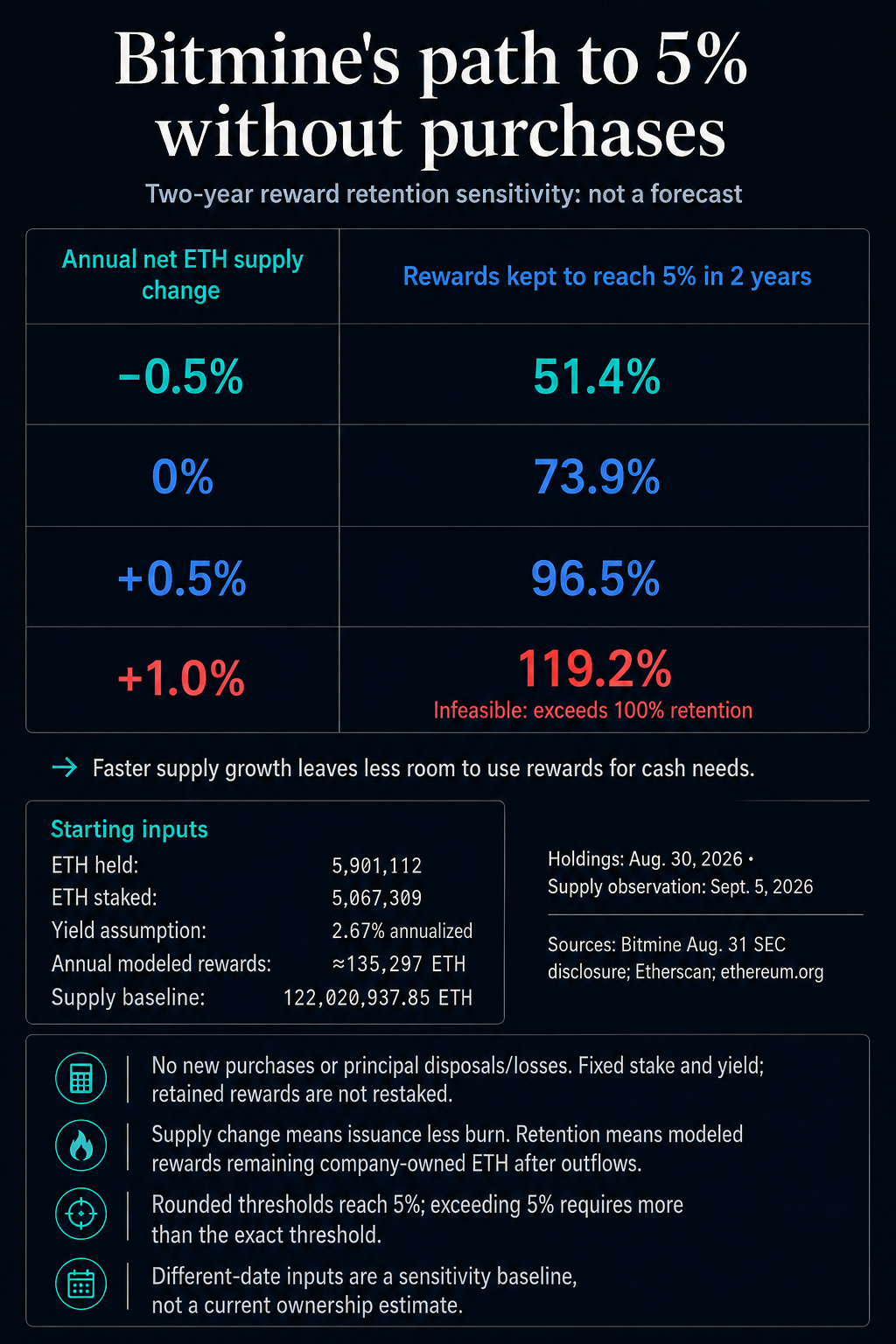
The Nasdaq-listed treasury company disclosed that it acquired 53,501 ETH in the week through Aug. 30, taking its holdings to 5.9 million tokens. More than 5.06 million ETH were already staked at an annualized seven-day yield of 2.67%.
The buying appears to have continued almost immediately.
On Sept. 1, blockchain analysis platform Lookonchain said wallets linked to Bitmine appeared to acquire another 51,000 ETH worth about $126 million from FalconX and BitGo. Bitmine had not formally confirmed that transaction in its latest corporate disclosure.
If the on-chain attribution is correct and the transfer represents an incremental purchase, Bitmine would hold roughly 5.95 million ETH. That would leave it considerably closer to its publicly stated goal of owning 5% of Ethereum.
Yet the size of the company’s existing position means buying may no longer be the only way to get there.
Bitmine had 5,067,309 ETH staked as of Aug. 30. Holding that balance and the disclosed yield constant would produce roughly 135,000 ETH in staking rewards over a modeled year.
At that scale, staking income itself can become a major acquisition engine.
Staking can finish what buying started
Using Bitmine’s own benchmark of 120.7 million ETH in circulation, owning 5% would require about 6.035 million tokens.
Against its officially disclosed 5.9 million ETH balance, Bitmine was about 134,000 ETH short, almost exactly equal to one year of modeled staking rewards. On that snapshot, the company would need to retain nearly 99% of those rewards to finish above 5% within a year if Ethereum supply stayed flat.
The reported Sept. 1 purchase would change that math substantially.
Adding another 51,000 ETH would reduce the gap to about 83,000 tokens using the same 120.7 million supply benchmark. Under the same fixed-yield, flat-supply assumptions, roughly 61% of one year’s modeled staking rewards would be enough to close it.
That illustrates why Bitmine can continue buying aggressively while becoming progressively less dependent on those purchases.
However, Ethereum’s expanding supply complicates that path because every increase in the network’s token count raises the amount Bitmine must hold to preserve a 5% share.
Etherscan showed roughly 122.02 million ETH outstanding on Sept. 5. Holding Bitmine’s Aug. 30 balance constant against that larger denominator would put its illustrative ownership share around 4.84% and widen the gap to nearly 200,000 ETH.
Over two years, relatively small supply changes have a large effect. Using the official Aug. 30 holdings and staking balance, Bitmine would need to retain about 74% of modeled rewards if ETH supply stayed flat.
At 0.5% annual supply growth, the requirement rises to roughly 96.5%. At 1% growth, even retaining every modeled reward would fall short without additional purchases.
| Assumed annual net ETH supply change | Reward retention needed to reach 5% after two years |
|---|---|
| −0.5% | About 51.4% |
| 0% | About 73.9% |
| +0.5% | About 96.5% |
| +1.0% | About 119.2%; not achievable under these assumptions. |
A lower staking yield would tighten the constraint further. At 2%, modeled annual rewards fall to roughly 101,000 ETH, pushing the flat-supply two-year retention threshold to almost 99%.
The harder question is how much ETH Bitmine keeps
For Bitmine, the path to 5% therefore increasingly becomes a capital-allocation decision rather than simply an acquisition target.
The company has disclosed that it periodically converts ETH-denominated staking rewards into US dollars and has not committed to a fixed percentage to keep on its balance sheet.
Every reward retained increases its Ethereum holdings without requiring another market purchase. Every reward converted into cash can instead support operating expenses and shareholder commitments.
Bitmine’s management agreement with Ethereum Tower includes reward-linked compensation as well as infrastructure and custody costs. The company has also declared 17 cash dividends on its BMNP preferred stock, with scheduled payments running through late December.
Its quarterly filing warns that changes in ETH prices and staking yields can affect its ability to fund operations and preferred dividends. Because staking rewards arrive in ETH, meeting those obligations can require selling tokens that would otherwise push the treasury closer to 5%.
That changes what investors should watch next. The key disclosure is no longer just how much ETH Bitmine buys, but how much of the ETH it earns the company actually keeps.
The post How Bitmine could surpass its 5% Ethereum goal without buying more ETH appeared first on CryptoSlate.
US spot Bitcoin exchange-traded funds recorded net inflows of $174.6 million on Friday, Sept. 4, 2026.
Only funds from BlackRock and Fidelity attracted positive net flows, according to Farside Investors' daily table, leaving the final US exchange session before Labor Day's closure dependent on two products for its net inflow.
The total was 76.1% below Thursday's net inflow of $730.8 million on Sept. 3. Positive flows narrowed from seven of the 12 tracked funds to two. The slowdown followed the Bitcoin and Ethereum ETF surge in the preceding session, with Friday's Bitcoin result smaller and less broadly shared across funds.
Thursday's seven positive funds were IBIT, FBTC, BITB, ARKB, MSBT, GBTC and BTC. By Friday, the five products beyond BlackRock and Fidelity in that group had all moved to zero net flows.
BlackRock's iShares Bitcoin Trust ETF, or IBIT, recorded net inflows of $117.4 million. The Fidelity Wise Origin Bitcoin Fund, or FBTC, recorded net inflows of $57.2 million. Those were the only positive entries in Farside's Sept. 4 row.
The other ten products each showed zero net flows: BITB, ARKB, BTCO, EZBC, BRRR, HODL, BTCW, MSBT, GBTC and BTC. None recorded a net outflow. The smaller positive total therefore signals a slower pace of money entering the group, rather than net withdrawals from it.
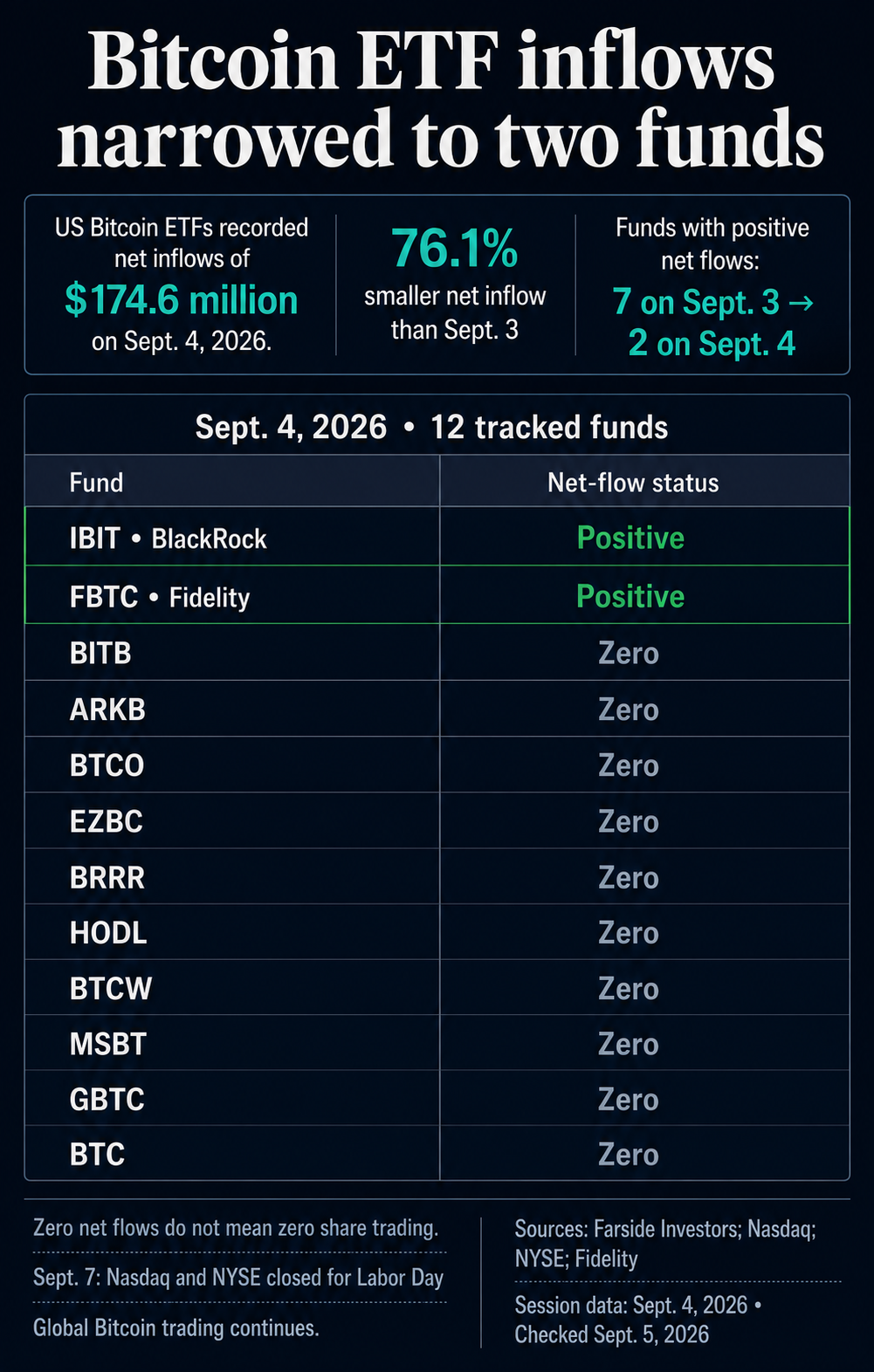
A zero net-flow reading does not mean a fund's shares went untraded. Fidelity explains that investors can buy and sell these products during stock-market hours, while authorized participants create and redeem fund shares. Those are separate activities: shares can change hands between investors without that trade itself creating or redeeming fund shares. The flow table measures the net result at fund level, rather than the volume of trading in its shares.
Bitcoin ETF inflows await Tuesday's next session
Both Nasdaq and the NYSE list Monday, Sept. 7, as closed for Labor Day, making Tuesday, Sept. 8, the next scheduled regular session. Friday's figures will remain the latest completed US exchange-session reading through the holiday break.
The closure does not stop global Bitcoin trading. Fidelity's comparison of direct crypto and exchange-traded products distinguishes direct crypto trading that may be available around the clock from funds that trade during stock-market hours. The holiday calendar limits that exchange-traded route, rather than shutting the underlying market.
Friday's figures do not identify the investors behind the flows or establish that a price move or payroll release caused the slowdown. The next completed session will show whether Bitcoin ETF inflows spread beyond IBIT and FBTC again; a single session cannot establish a lasting demand trend.
The post Bitcoin ETF inflows fall 76% entering Labor Day break as only BlackRock and Fidelity attract fresh money appeared first on CryptoSlate.
Aave DAO voters are deciding whether to delegate limited V4 risk controls on Ethereum and Avalanche to Risk Stewards, tools that let approved operators make constrained changes without taking every update through a full governance vote. The proposal would also assign no-delay emergency roles that the current steward software cannot use.
The Snapshot vote opened Sept. 3 at 3:46 p.m. UTC and is scheduled to close today, Sept. 6, at the same time. Approval would not activate the system by itself. Aave Labs said the corresponding payloads would still need to be executed through the V4 Security Council.
The code is also not being presented as fully audited. In its governance proposal, Aave Labs said the Risk Steward contracts were undergoing a Certora audit and that the engagement was nearing finalization.
The proposal's central tension is between authority assigned now and functionality available later. Each Risk Steward would receive Hub and Spoke risk-management roles plus Hub and Spoke emergency roles. Those four roles would have no execution delay after they are granted.
However, the release under consideration calls none of the emergency selectors, and the current steward documentation does not expose those methods. The emergency permissions would remain inert until a future release adds support. Assigning the roles now would allow that later version to respond to an emergency without waiting through another governance cycle for access.
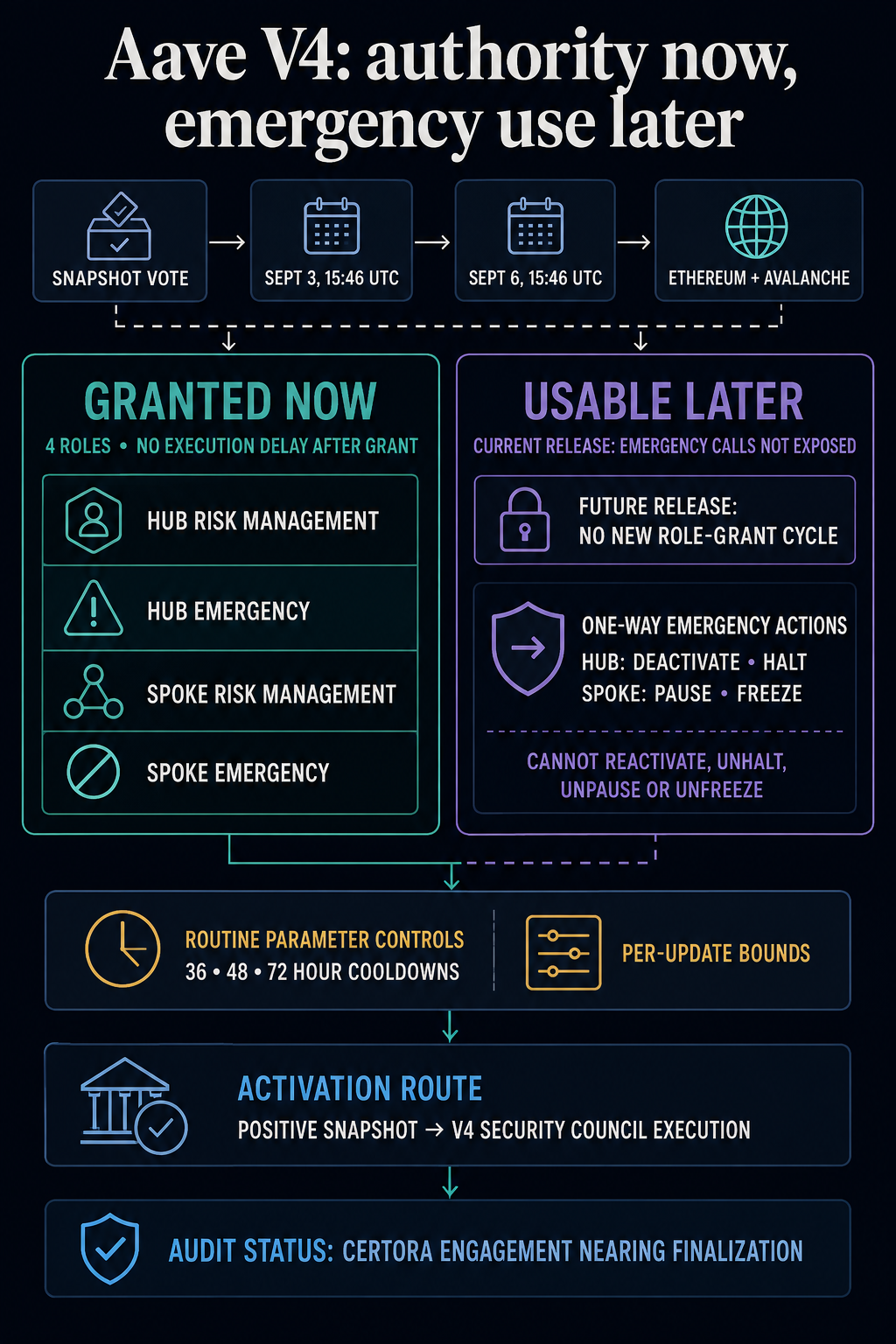
The wider permission redesign would split each V4 instance's Hub and Spoke configurator controls into five granular categories: two flag-control roles, a listing role, an emergency role and a risk-management role. Selectors outside those categories would remain with residual domain-admin roles. Existing domain admins would receive the new roles so their current reach is preserved.
The proposed role definitions limit the emergency category to one-way safety actions. Hub calls can deactivate or halt assets and Spokes. Spoke calls can pause or freeze individual reserves or all reserves. Those functions cannot reactivate, unhalt, unpause or unfreeze the affected market. The separate flag-control roles, which can change states in both directions, would not be granted to the Risk Stewards.
Routine parameter updates would operate under different controls. The proposal sets minimum cooldowns of 36, 48 or 72 hours, depending on the parameter, and caps how far each update may move it. The same bounds would apply on Ethereum and Avalanche and cover interest-rate settings, collateral factors, liquidation settings and oracle caps. They do not constrain the emergency selectors.
That separation explains why the plan can combine slower bounded maintenance with immediate emergency authority on paper. It also creates an accountability question because the zero-delay roles would be in place before the steward can exercise them. Forum participants asked for public rationales, post-action reports, periodic reviews and reporting on the frequency and size of steward actions. None of those measures is a requirement in the current proposal.
If the Snapshot passes and the Security Council executes the payloads, the immediate change would be no-delay access to bounded parameter controls. The one-way emergency powers would be pre-positioned for a future steward release, but they would not yet be usable.
The post Aave crypto lending proposal would let emergency tools freeze markets – but not unfreeze them appeared first on CryptoSlate.
CryptoTicker.io
If you had JUP staked in the second quarter of 2026, a share of 50 million JUP is in all likelihood waiting for you, and you can only reach it until October 8, 2026 at 14:00 UTC. After that the claim lapses. The awkward part: the button people used to collect this reward themselves has already gone. The campaign page has recently carried a note saying that the route through the Rewards Hub has ended and that the claim can now be made only through a support ticket. Jupiter names October 7 as the last day for that.
This text is the guide to it. It explains what the Active Staking Rewards actually are, who is entitled, how to check in a few minutes whether the deadline concerns you, which route you now have to take, and what the claim means for you in tax terms.
How much is still on the table can be worked out. The campaign page carries the state of the reward pot in machine-readable form. In our own retrieval on September 6, 2026 at 18:36 UTC, it showed 47,412,091 JUP as claimed and 2,587,908 JUP as not yet claimed, or roughly 5.2 percent of the pot. That is not a rounding error. It is an amount that falls back to the protocol’s community treasury in a good four weeks if nobody collects it.
What are Jupiter’s Active Staking Rewards (ASR)?
Active Staking Rewards, ASR for short, are a quarterly distribution of JUP to holders who staked their tokens and took part in the governance of the protocol. On its own page, Jupiter describes the programme as an incentive system that rewards users for voting activity and participation in decisions, thereby increasing the voting power of active participants.
So that the terms sit properly, here are the three that recur throughout this text. Staking in this context means depositing your JUP in a governance contract and receiving voting rights for it; this is not validator staking as in a proof-of-stake network. Governance is the whole body of votes through which holders decide on proposals concerning the protocol. A claim is the process by which you actually pull an already calculated allocation into your account; without that step the allocation remains no more than a number on a list.
Jupiter is the largest DEX aggregator on Solana. A DEX aggregator is a service that spreads an order across several decentralised trading venues and routes it to wherever the execution price is best. That explains why JUP is held comparatively widely in Germany: anyone trading on Solana has as a rule already come across the protocol.
Where the JUP in the ASR pot comes from
According to the campaign FAQ, the pot is fed by surplus, unclaimed JUP from the first Jupuary airdrop. In earlier periods, a share of fees from the in-house launchpad was added; for the period from April to June 2026, Jupiter expressly reports no such fee component. The size of the pot has stood constant at 50 million JUP for several quarters.
That is also why unclaimed rewards are no loss for the DAO: whatever is left behind travels back into the community treasury and becomes available again for later programmes. For you as a holder it is a final loss all the same, because there is no grace period.
Which deadline applies to the ASR from the second quarter of 2026?
The hard reference dates sit in the source of the campaign page as machine-readable fields and are therefore not dependent on any summary. We read them off there directly on September 6, 2026:
- Assessment period: April 1, 2026 to June 30, 2026
- Pot size: 50 million JUP
- Claim window opened: July 8, 2026, 14:00 UTC
- Claim window closes: October 8, 2026, 14:00 UTC
- The date that matters in practice: October 7, 2026, because Jupiter names that day in its warning notice as the last date for the ticket route
- Form of payout: staked JUP, added automatically to the existing stake account after the claim
Work to October 7 for yourself. A support ticket is not a press of a button: between sending it and its handling lies time you do not control. Anyone opening a ticket on the evening of October 7 has formally met the deadline and still has a practical problem if the handling comes only after the window closes. A buffer of several days is no luxury here.
Why the claim button has disappeared from the Rewards Hub
On the campaign page for the second quarter of 2026 sits a warning notice on a yellow background. In its own words: “ASR claims via the Rewards Hub have ended. To claim your ASR before October 7th, please open a support ticket at support.jup.ag.” You can read it directly on the official ASR page for April to June 2026.
The combination is what stands out: the official window still runs until October 8 according to Jupiter’s own time fields, yet the comfortable route to it is already shut. Anyone who wrote October 8 in the calendar and trusted that they could simply press a button in October will find none there.
We checked whether this notice applies across the site or only to this one quarter. It appears exclusively on the page for the second quarter of 2026. For other periods the interface does not carry it. The notice therefore belongs precisely to this campaign, and you cannot assume that you will meet it again in another period, or that it will disappear again in this one.

Who is entitled to ASR: the 50 JUP threshold on a time-weighted average
The eligibility condition is set low and clearly worded in the campaign FAQ: anyone who had at least 50 JUP staked on a daily time-weighted average across the quarter is entitled. Time-weighted average means that Jupiter averages your stake across all days of the quarter. A brief peak shortly before quarter end therefore helps you little; anyone who held a small position throughout the quarter, by contrast, makes the count with a few hundred tokens.
Participation in governance comes on top of that. The independent trade publication Cryptobriefing describes the condition as requiring participation in DAO votes during the quarter alongside the minimum stake. The campaign FAQ stress the same purpose: ASR is described there as a reward for voting activity and participation, so holding alone does not carry the claim. If you staked in the spring but never voted, check your result in the interface before writing a ticket.
A separate registration was never needed. The eligible wallets have been fixed since the calculation, and the allocation is already determined even if you have heard nothing of the programme to this day. That is exactly what makes the deadline dangerous: there is no action you could have refrained from in April that would get you off the hook now. The only mistake you can make is doing nothing.
How to check in a few minutes whether the deadline concerns you
Before you write to anyone, establish the position for yourself. The order is deliberately chosen so that you can drop out after each step once the result is clear.
Step 1: did you stake at all in the spring?
Open Jupiter’s governance interface with the same wallet you used in the spring of 2026. Your stake account is visible there. If no deposited holding appears for the period from April to June, you are out and can file this text as background.
Step 2: was your average above 50 JUP?
What counts is the daily average across the quarter. If you built up or ran down your stake during the quarter, your average sits below your peak. For amounts near the threshold it is worth looking at the campaign interface, which displays the calculated allocation for the connected wallet.
Step 3: is there an open allocation there?
If the campaign page shows an amount for your wallet that has not yet been claimed, the deadline concerns you directly. Note down the amount and the wallet address in a text file before you go further. You will need both shortly, and you do not want to reconstruct them from memory.
Step 4: check whether you had several wallets in play
This is the point at which most claims are lost. Anyone who worked with a second address in the spring, say a hardware wallet for the main holding and a software wallet for everyday use, may have two separate stake accounts. Each address is assessed individually, and each has to be checked individually.
A support ticket instead of a button: the route through Jupiter support
If step 3 produced an open amount, the route runs through support.jup.ag, as the warning notice on the campaign page prescribes. Do not expect immediate handling there: a person reads the ticket and works through it. What a ticket sensibly contains, so that it does not end up in a loop of follow-up questions:
- your public Solana address that was used for staking, in full and copied rather than typed out
- the name of the campaign, meaning the ASR period from April to June 2026
- the amount that the campaign interface shows as open for this address
- a brief note that the claim is no longer offered through the Rewards Hub
- a statement of whether an unstaking is currently running on the stake account
One security rule admits of no exception: a support ticket never contains your seed phrase, never a private key and never a signature whose purpose you do not understand. A public address is entirely sufficient for identification. Experience shows that around every well-known deadline, imitation support channels appear on social networks asking for exactly these details. Reach the support page through the link on the official campaign page, therefore, rather than through a search engine result or a link somebody sent you.
The most common stumbling block: a running unstaking blocks the claim
In the campaign FAQ, under the question of why JUP cannot be claimed, sits an answer that explains many cases in practice: if an unstaking is currently running on your account, you have to wait until it has completed or cancel it before you can collect the reward. An unstaking is the release of your deposited tokens, which with governance contracts typically carries a waiting period.
In practical terms that means: if you decided in recent weeks to pull your JUP out of the governance contract, and that process is still running, your claim is blocked for as long as it lasts. That costs days you do not have to spare with a deadline in early October. Check this point early enough.
A second point comes as a surprise: what you collect does not arrive as freely available balance. According to the FAQ, the claimed JUP is added automatically to your stake account. Anyone wanting to sell or move the amount therefore needs a further process afterwards, along with the waiting period that goes with it. That belongs in the scheduling too.

What happens to unclaimed JUP after October 8
The answer is unspectacular and final. Writing at the opening of the claim window, Cryptobriefing states that all rewards left behind after the cut-off on October 8 fall back to the community treasury of the DAO. The report can be read through the reprint of July 9, 2026 and confirms the deadline independently of Jupiter’s own interface.
In this construction there is no grace period, no hardship case and no second chance. The claim is tied to a window of time, and it ends with the window. That is exactly why the interim figure from our retrieval is so telling: if roughly 5.2 percent of the pot is still open at the beginning of September, then a number of holders are sitting on a claim they know nothing about.
How to avoid the same trap with other staking programmes
The Jupiter case is not an isolated one but a pattern. Many reward programmes work with a time-limited claim, and the deadline rarely sits where you see it in everyday use. Three habits reduce the risk considerably, and none of them costs more than a few minutes a quarter.
First: keep a plain list of all protocols where you have deposited tokens, with the address and the purpose. Second: set a recurring calendar entry two weeks before the usual end of the window for every programme on a quarterly rhythm. Third: on every change of provider, check whether open claims are left behind from the old arrangement. If you are comparing where to stake in future anyway, the providers’ terms are in our comparison of the best staking platforms; pay particular attention there to whether rewards are credited automatically or have to be actively claimed.
The difference between an automatic credit and an active claim matters more in daily life than it sounds. With an automatic credit nothing can lapse on you, but the taxable inflow arises without any action on your part. With an active claim you keep control of the timing and carry the risk of missing the date in return.
What the ASR claim means for you in tax terms
Caution is warranted here, because the treatment depends on the individual case and administrative practice can change. The rough direction that usually applies to staking rewards in Germany: rewards are valued at the moment of inflow and treated as other income; a later sale is a separate matter. We described the two pitfalls most often overlooked in this at length on July 23, 2026 in our article on selling staking rewards and the two tax traps to watch.
Two practical points follow from that for this particular case. The first concerns the timing: if you claim in October, the inflow falls into 2026 and therefore into the tax return for that year. The second concerns documentation. Because the claimed JUP lands directly in the stake account, there is no ordinary payout entry from which the process could later be read off easily. On the day of the claim, therefore, record what amount flowed in and what the price stood at that moment. A screenshot of the campaign page and the transaction signature are as a rule sufficient as evidence.
If you draw rewards from several programmes regularly, collecting such individual records quickly becomes unwieldy. Beyond a certain number of transactions, a tool that values inflows automatically at the price at the time of inflow is by far the more robust solution. Clarify the specific treatment of your case with tax advice all the same; this section does not replace it.
Claiming Jupiter ASR: what to take away
- Check today whether the deadline concerns you. Connect the wallet you staked with in the spring of 2026 to the campaign interface and look for an open amount. If in doing so you find you want to reorganise your staking anyway, use the comparison of the best staking platforms as a starting point.
- Open your ticket with a buffer. Take October 7 as the latest date and allow for processing time. Have the address, the amount and the status of any running unstaking to hand, and document the inflow cleanly afterwards; which tools take that off your hands is shown in our overview of crypto tax tools and portfolio trackers.
- Keep custody and everyday use properly separated. If your claim hangs on a second address you rarely use, that points to an unclear wallet structure. Which software wallets are suited to everyday use on Solana, and how to keep them apart from the main holding, is set out in our software wallet comparison.
(As of September 6, 2026. This article is not investment advice. Prices and fee structures change; check the terms with the provider before you buy.)
Anyone buying bitcoin through a Sparkasse or a Volksbank pays twice: a commission, and a spread on top of it. At Volksbank Raiffeisenbank Wuerzburg the commission stands at 1.5 percent per purchase and per sale, according to its schedule of prices and services for crypto asset trading, with the gap between the buying and the selling price coming on top. The Sparkassen start from mid-October with a flat order fee of 99 cents, likewise plus a spread. On the banks’ own product pages, that figure is as a rule nowhere to be found.
This is not a supposition. On September 6, 2026, cryptoticker.io retrieved and evaluated the crypto product pages of 41 cooperative banks. Seven of those pages were reachable and advertised the offering. Not one of them carried a percentage or a euro amount. Exactly one linked directly to the price schedule.
Commission and spread: what your bank charges for a crypto purchase
Two kinds of cost meet in a crypto purchase made through your own bank, and they work differently.
The commission is the fee the bank charges for executing your order. It appears in the schedule of prices and services, it is quantified, and it shows up on your statement as a separate item. At the Wuerzburg cooperative bank it amounts to 1.5 percent of the order volume.
The spread is the difference between the price at which you can buy and the price at which you could sell at that same moment. It never appears on a statement as a fee, because it is not a charge but something priced in. In economic terms you pay it all the same, once on the purchase and again on the sale.
A simple calculation makes the difference clear. On an order of €1,000, the commission of 1.5 percent costs you exactly €15. If the spread adds another one percent, a further €10 falls due that you will find on no invoice. After the purchase, roughly €975 of value sits in your custody account. Sell later, and both items apply again.
Why the bank names one figure and not the other
The commission is a fee charged by the bank, which is why it belongs in the schedule of prices and services. The spread, by contrast, arises at the trading counterparty that quotes the prices. The bank cannot guarantee it as a fixed value, because it moves with market conditions. The banks’ documents therefore carry a note saying that a spread applies in addition to the stated commission, without any order of magnitude being given for it.
That is unobjectionable in legal terms and awkward for the investor all the same: the item you are not given a figure for can be larger than the one you are.
meinKrypto and Krypto powered by Deka: how the banks’ offering is built
Both banking groups have chosen the same blueprint. Trading takes place in the app you already use for your current account, and the crypto assets are held by a specialised custodian.
At the Volksbanken and Raiffeisenbanken the offering is called meinKrypto and runs inside the VR banking app. Which institutions have switched it on is a decision each bank takes for itself; the rollout is spread across the year. How far it has come is traced by cryptoticker.io in a separate overview of meinKrypto from August 23, 2026.
At the Sparkassen the offering is called Krypto powered by Deka, is provided by DekaBank and is embedded in the Sparkasse app. The launch is announced for mid-October 2026, with an internal test phase due to run in September. Bitcoin, ethereum, XRP and solana are to be available when trading opens. Our assessment of that launch is in our article on the planned crypto trading at the Sparkasse from August 16, 2026.
What a custodian does in this chain
A custodian is the service provider that holds the cryptographic keys to your coins and keeps the holdings separate from its own assets. At both banking groups this role is taken by a provider from the Boerse Stuttgart group. You never hold a key yourself. What you hold is a position in your bank’s custody account.

The survey: on how many product pages does the price appear?
cryptoticker.io carried out this evaluation itself on September 6, 2026.
Method: for 41 cooperative banks, the product page on crypto asset trading was retrieved under the path that is uniform across the group, the status code was noted, the visible text was stripped of markup and then searched for percentages, euro amounts and for a link to the schedule of prices and services for crypto asset trading.
Result: 7 of the 41 addresses delivered a reachable product page advertising the offering. On 0 of those 7 was there a percentage or a euro amount for commission or spread. On 1 of the 7, the price schedule for crypto asset trading was linked directly. The remaining 34 addresses returned an error code, maintained no such page, or did not advertise the offering there.
The text on those pages is largely identical across all seven institutions and names the types of cost correctly: a commission applies, plus a spread. A figure is not given there, though the reference to the schedule of prices and services is.
What the Volksbank price schedule says: 1.5 percent and a €10 minimum order
The one directly linked document comes from Volksbank Raiffeisenbank Wuerzburg and is titled schedule of prices and services for crypto asset trading; it is linked on the product page of Volksbank Raiffeisenbank Wuerzburg. Four statements in it count for you before a first purchase.
- Registration for crypto asset trading is free of charge.
- The commission for the commission business on purchases and on sales amounts to 1.5 percent.
- A minimum order size of €10 applies to all purchases. Sales below that threshold are possible if you are closing the entire position.
- The bank additionally charges expenses and third-party costs that are billed to it by others on execution and settlement. On request it will provide the breakdown, so far as it is able to.
The last point is the vaguest. It means that alongside commission and spread a third layer of cost can arise, whose size does not emerge from the document in advance. Whether it arises in practice, and at what level, cannot be answered from the price schedule alone.
One point for context: 1.5 percent is the figure of a single institution. Every cooperative bank is legally independent and sets its own price schedule. For the other six institutions with a reachable product page, no directly linked crypto price schedule was available within this survey, and without a document there is no dependable figure.
Sparkasse from October: a 99-cent order fee plus a spread nobody quantifies
The Sparkassen take a different route on the visible part of the price. Instead of a percentage, a flat order fee of 99 cents per trading order is planned, regardless of whether you buy for €100 or for €5,000. These terms were reported by Blocktrainer on July 23, 2026; DekaBank sets the trading fee for the affiliated institutions.
A flat fee behaves entirely differently from a percentage. On an order of €100, 99 cents comes to just under one percent; on €5,000 it is 0.02 percent. Anyone moving large amounts in one go does considerably better on the visible part of the price with the Sparkasse model than with a percentage commission.
The catch sits in the same place as at the Volksbanken: here too a spread comes on top, and here too it has not been quantified so far. That leaves the comparison between the two banking groups only half possible until trading opens. The 99 cents are known. The second item is not.
What that means for choosing your order size
With a flat order fee it pays to buy less often and in larger amounts, because the 99 cents are spread across a bigger sum. With a percentage commission, by contrast, the splitting makes no difference: 1.5 percent stays 1.5 percent, whether you invest €1,200 once or €100 twelve times. Anyone considering a savings plan should know this difference before settling on the interval.
The spread explained: why the second fee never appears in the price schedule
The spread denotes the gap between the buying and the selling price that a trading counterparty quotes at the same time. It is the compensation for someone standing ready at any moment to sell you coins or take them off your hands.
At a classic exchange you see both sides of the order book, and with them the gap. In the app channel of your own bank you generally see a single price you can act on. That a margin is already inside it is standard practice in the industry and is named in the terms. It is not quantified there.
For comparison it helps to look at providers whose pricing model rests on exactly one of those two elements. According to the Handelsblatt crypto exchange comparison, the Bison app works without a classic transaction fee and charges a spread of around 1.25 percent instead; Bitpanda, conversely, levies a flat order fee of 1.49 percent with no additional spread. At the banks, both models meet in one product, and that is the real difference. Which providers in Germany work with which model is set out in our comparison of crypto exchanges.
Your bank against a crypto exchange: what 1.5 percent plus a spread means in comparison
Work the case through once for an amount many beginners choose. On an order volume of €1,000, the visible costs per purchase come out as follows:
- Volksbank at 1.5 percent commission: €15, plus an unquantified spread.
- Sparkasse from October at a 99-cent order fee: €0.99, plus an unquantified spread.
- Bison at a spread of around 1.25 percent: about €12.50, with no separate transaction fee.
- Bitpanda at a 1.49 percent order fee: €14.90, with no additional spread.
Two things stand out. First, on the quantifiable part the offerings sit close together, with the exception of the Sparkasse order fee, which falls out of line on larger amounts. Second, the comparison stays incomplete as long as the spread figures of the two banking groups are missing. One percent of spread would mean another €10 on €1,000 and would shift the picture noticeably.
At trading platforms there are also costs that arise only on withdrawal: a withdrawal fee charged by the provider and the network fee of the blockchain in question. With the banks’ offerings that question does not arise for the time being, and the reason for that is a different one.
Custody at your bank: why you cannot move your coins to your own wallet
Both banking groups offer the trading as custody account business. Your position is held by a custodian, you receive no private keys and, as a rule, no way to transfer the coins to a self-managed address either. Anyone leaving the offering sells.
For beginners that is an advantage: there is no seed phrase that can be lost and no address that can be mistyped. For anyone wanting to hold their assets themselves over the long term, it is a hard restriction. A sale is a taxable event; a transfer to your own address would not be. If you want to keep that route open, check which providers permit withdrawals to an address of your own, and which hardware wallet is a suitable destination for it.
The question you can put to your bank
Whether your institution provides for a withdrawal to a self-managed address is rarely stated on the product page. It is one of three questions that can be settled before a first purchase: the level of the commission, the order of magnitude of the spread, and whether a transfer to an address of your own is possible at all.
Before your first purchase: how to find your bank’s price schedule
The route is shorter than the search suggests, once you know what to ask for.
At the cooperative institutions, the product page on crypto asset trading carries a reference to the schedule of prices and services. In the survey that reference was present seven times, but only once as a direct link to the bank’s own crypto document. If the reference leads only to the general price display, searching within that document for the keyword crypto asset trading gets you further.
If that route does not get you there, asking your bank is the quickest step. Two pieces of information are worth requesting in writing: the percentage or amount of the commission, and the typical order of magnitude of the spread for the coins you intend to buy. The bank has to carry the first in its price schedule. The second it cannot guarantee, but it can give a range from experience.
Why the effort pays off
On a one-off purchase of €500 the difference runs to a few euros. Anyone investing monthly pays the commission again on every execution date. Over twelve months at €200 each, 1.5 percent adds up to €36 in visible commission alone, with the spread on top. That is the amount a price comparison before the start can bring in.
What this survey does not show: the limits of the exercise
Honesty about a survey of one’s own includes naming its reach.
A single page path, uniform across the group, was tested. Institutions that keep their crypto page at a different address ended up in the count as unreachable, even though they may well have the offering. The figure of 7 is therefore not a statement about how many Volksbanken offer meinKrypto, only about how many of the tested addresses served such a page on that day.
Nor was it tested whether the price schedules of the remaining institutions can be found by other routes, for instance through the general price display. Also open is the actual level of the spread at both banking groups: from the outside it can be measured only in live trading, and for the Sparkassen that begins only in October.
The figure of 1.5 percent comes from the document of a single institution, retrieved on September 6, 2026, and cannot be carried over to the group as a whole. It is a documented individual value, not a group average.
Crypto through your own bank: what to take away
- Ask for both figures, not just one. Commission and spread are two separate items, and with the banks’ offerings both apply. Knowing only the commission means knowing half the price. How other providers build their model is shown in our comparison of crypto exchanges.
- Settle before your first purchase whether you can get out again. In the banks’ custody model, the exit is a sale rather than a transfer. If you want to hold your assets yourself, you need a provider that permits withdrawal to an address of your own, and a suitable destination from the hardware wallet comparison.
- Keep your statements from the very beginning. Acquisition date, price and fees are what you will need later for the tax return, and in a bank custody account you do not get them automatically in the form tax software expects. Suitable tools for that are in the overview of crypto tax tools and portfolio trackers.
For many people their own bank lowers the barrier to entry, because no additional account is needed and the regulation appears settled. You pay for that convenience through two layers of cost, only one of which is disclosed. Anyone who works it out once before the first purchase then decides with the full set of figures.
(As of September 6, 2026. This article is not investment advice. Prices and fee structures change; check the terms with the provider before you buy.)
The information provided in this article is for informational purposes only and does not constitute financial advice. Investing in cryptocurrencies carries a high level of risk.
The Bison app belongs to the Boerse Stuttgart group, claims more than a million active users and advertises that crypto trading carries no order fees. That is true, and it is still only half an answer to the question of what the trading costs.
You pay through the spread, the gap between the buying and the selling price. Bison quantifies it itself: an average of 1.25 percent on bitcoin and ether, an average of 1.75 percent on every other cryptocurrency. Retrieved from the fee page on September 5, 2026.
This article is an assessment rather than a news report. It draws on the general terms and conditions in their versions of June 1, 2026, the special conditions for the pooled trust account of December 15, 2025, the basic and risk information of May 27, 2026, and the MiCA register of the European securities regulator ESMA. All sources are written out at the end.
Who stands behind the Bison app, and why that is more than a formality
Bison is a brand, not a company. Behind it sit several firms with clearly separated roles, and for the question of who is liable for what, that separation is decisive.
Your trading counterparty is EUWAX Aktiengesellschaft, based at Boersenstrasse 4 in Stuttgart. It does not act as an intermediary but as a direct counterparty. Clause 4.1 of the terms says expressly that customers buy crypto assets “from us” and sell them “to us”.
Your crypto assets are held by Boerse Stuttgart Digital Custody GmbH, on a fiduciary basis and as a separate company. It grew out of the former blocknox GmbH.
Your euro balance sits in a pooled trust account of EUWAX AG, maintained at Solaris SE and, since January 2025, additionally at Deutsche Bank. One point matters here: you have no contractual relationship of your own with these banks. That is set out in the special conditions for the pooled trust account.
The authorisations: four entries, four dates, one register
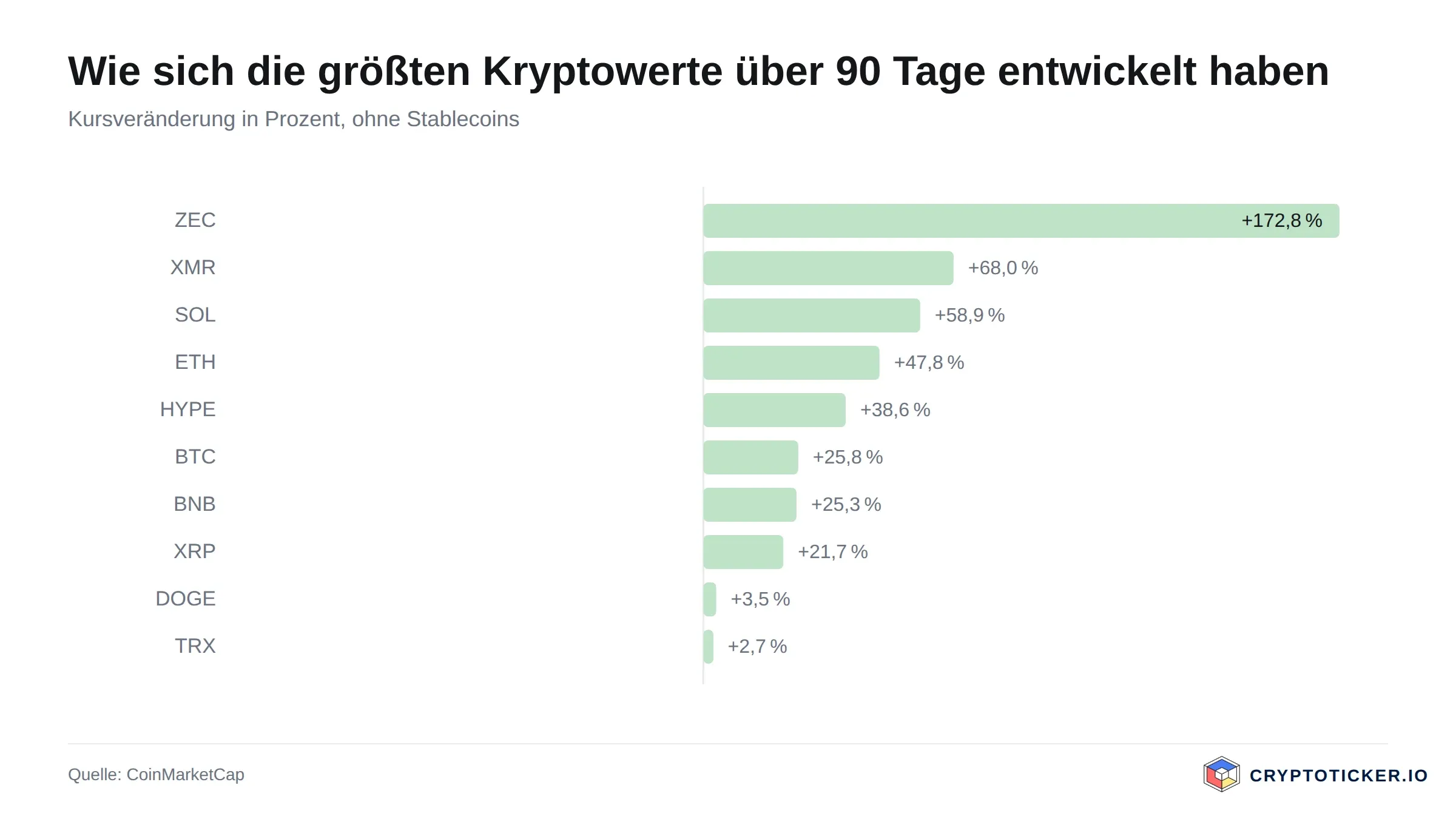
Bison was the first German provider to hold a MiCAR licence. That is often shortened to “Bison is licensed”. More precisely, and in a form you can verify, it looks like this, according to ESMA’s MiCA register with a data status of August 17, 2026:
| Company | Authorised since | Permitted services |
|---|---|---|
| Boerse Stuttgart Digital Custody GmbH | January 17, 2025 | custody and administration, transfer services |
| EUWAX AG | April 1, 2025 | exchange of crypto assets for funds and for other crypto assets |
| EUWAX AG, second entry | November 21, 2025 | execution of orders on behalf of clients |
| Baden-Wuerttembergische Wertpapierboerse (BSDEX) | July 3, 2025 | operation of a trading platform |
In all four cases the competent authority is BaFin. The custody company additionally holds a passport for 29 states, EUWAX AG for eight, and in one case for Germany alone.
The practical point that follows: the licence sits with the group companies, not with the app. When you compare providers, you are comparing these entries, and not brand names.
What trading through the Bison app costs
The fee page is easy to read, and most of what is on it really is free of charge. Retrieved on September 5, 2026:
| Item | Price |
|---|---|
| Account opening and maintenance | free |
| Crypto order fee | none |
| Spread on bitcoin and ether | 1.25 percent on average |
| Spread on all other cryptocurrencies | 1.75 percent on average |
| Euro deposits and withdrawals by SEPA | free |
| Instant deposit by credit card, Apple Pay, Google Pay | 2.49 percent |
| Crypto deposits and withdrawals | free |
| Custody including insurance | free |
| Staking | 27 percent of the rewards |
| Securities and ETFs | €1.99 per trade |
Scale the spread up to your own amount before you take comfort from the zero on the order fee. A full round trip, meaning a purchase and a later sale, works out at roughly 2.5 percent on bitcoin and ether and roughly 3.5 percent on the other coins. On a €5,000 stake that is €125 or €175 that never appears as a fee on the statement. It sits in the price.
Two qualifications, in fairness to that figure. Bison writes itself that the spread “fluctuates, as it can depend on market conditions and on the size of a trade”. And the fee page carries no date. The values therefore hold as of the retrieval date, not indefinitely.
No order book: why the price holds for only ten seconds
This is the difference you cannot see inside an app. For crypto trading, Bison runs no order book. Clause 4.3 of the terms calls the procedure a request for trade system.
How it works: you are shown an indicative price, that price holds for ten seconds, and EUWAX AG is entitled to reject your trade request. So you are not trading against other market participants. You are trading against your provider, which also sets the price.
That is standard for broker apps and no disadvantage in itself; for small amounts it is simpler. It does mean, though, that there is no market depth for you to examine, and that the price is a decision taken by the provider. If you want order book trading, the venues that offer it are in our comparison of the best crypto exchanges.
At least limit buy, stop buy, limit sell and stop loss are available, and they cost nothing beyond the spread.
Withdrawals to your own wallet: here Bison is unusually generous
This is the strongest point in the offering, and it is rarely highlighted. Withdrawing cryptocurrencies to a wallet of your own is not merely free: Bison even covers the blockchain fees.
Clause 4.3 of the custody company’s terms says it literally: “We bear the transaction costs arising on these transfers.” They are first charged to the trust assets and then settled out of the company’s own funds. At most providers you carry the network fee yourself, and on Ethereum that quickly runs to several euros depending on congestion.
Anyone who genuinely wants to move crypto assets into their own custody has one of the cheapest routes here. Suitable devices are listed in our hardware wallet comparison.
The limits on withdrawals you should know before your first attempt
Free does not mean unconditional. Five points from the documentation, as of September 4, 2026:
Minimum amounts per coin. A minimum withdrawal amount is documented for around 70 cryptocurrencies, for example 0.001 bitcoin, 0.01 ether, 0.1 solana, 10 XRP, 30 cardano or 100 dogecoin. Below that, the attempt fails with an error message.
Taproot is not supported for bitcoin. Withdrawals are designed for address formats beginning with 1, 3 and bc1q. Addresses starting with bc1p, meaning Taproot, do not work. If you use a modern wallet, you have to pick a suitable receiving address deliberately.
A 24-hour waiting period after a purchase. Freshly bought holdings cannot be withdrawn immediately.
Own wallets only. The terms expressly prohibit transfers to third-party wallets, service providers included.
Cancellable for one hour after you start it, and irrevocable after that. Release runs through a password, an SMS code and an email confirmation.
For euro withdrawals a closed-loop principle applies on top: money goes back only to an account that money was previously paid in from.
Staking through the Bison app: 27 percent, and without MiCAR protection
Bison offers staking for ethereum and solana, from 0.005 ether and 0.1 solana respectively. The company gives a yield range of 2 to 5 percent a year on ethereum and 4 to 8 percent on solana. Rewards arrive weekly on Mondays. Against the risk of a network penalty, known in the jargon as slashing, there is insurance with Munich Re.
Two figures belong alongside that, and both come from Bison itself.
First: Bison retains 27 percent of the rewards. A gross yield of 5 percent therefore becomes 3.65 percent by the time it reaches you.
Second, and this is the weightier point: its own staking page states in as many words that the service is “currently not regulated under MiCAR and does not offer the protection and supervision established by EU rules”. Trading and custody are licensed. The staking is not. If you are looking for staking as a core function, weigh that against the providers in our comparison of staking platforms.
Deposit protection: yes for euros, expressly not for crypto
On the euro balance, statutory deposit protection of €100,000 per investor and per bank applies, through Solaris SE and Deutsche Bank.
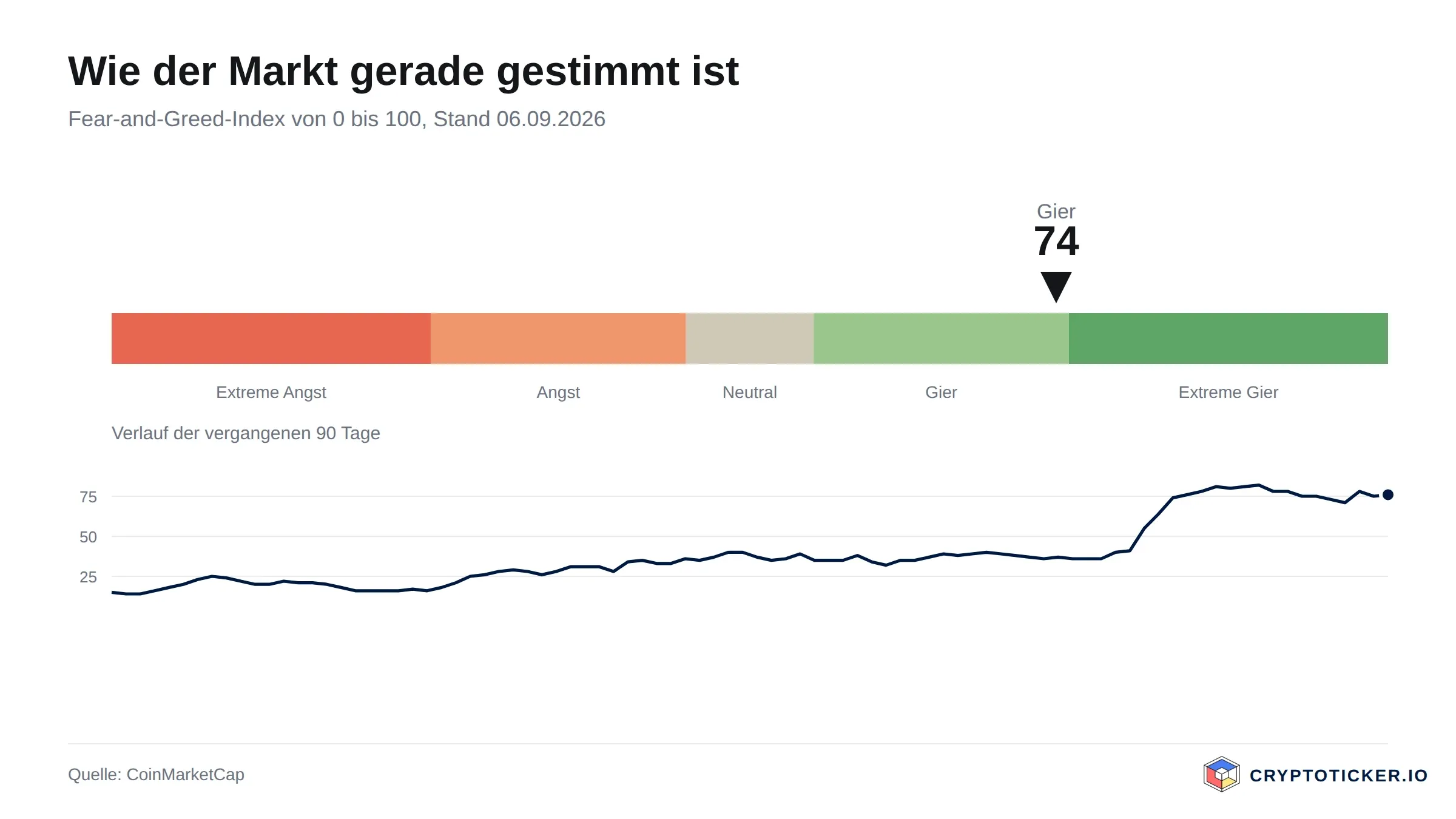
Two restrictions sit in the small print and are seldom quoted. The protection exists “only once for all balances of the customer held at the trustee bank”. Anyone who is already a Deutsche Bank customer is therefore sharing a single pot. And under clause 6.4 of the special conditions you carry the insolvency risk of the trustee bank, to the extent that the claim can be enforced neither against the deposit guarantee scheme nor against the insolvency administrator.
For crypto assets it does not apply at all, and the terms say so unmistakably under the heading “no compensation claim” in clause 12.12: there is no claim against the compensation scheme for securities trading firms, there is no guarantee fund and there is no other compensation arrangement. Fiduciary custody with private-sector insurance takes its place.
A side note for the cost calculation: interest on the euro balance is not yours. Clause 3.7 of the special conditions records that no claim to the release of interest arises and that EUWAX AG may keep it.
Tax: two worlds inside one app
Bison sells crypto and securities through the same interface. For tax purposes they are two entirely different matters.
On securities, Bison handles everything for you. Withholding tax is deducted automatically, the advance lump sum is taken into account, losses are offset monthly, an exemption order can be lodged in the app, and you receive an annual tax certificate at around April of the following year.
On crypto, Bison handles nothing for you. No tax deduction, no exemption order, no loss certificate, no offsetting against other asset classes. The basic and risk information of May 27, 2026 puts it this way: “Any tax that may arise is in principle to be paid by you to the tax office responsible for you.”
What you do get is a free information report as a PDF, available under account and reports. It contains a non-binding calculation using the FIFO method, separated by holding periods above and below one year, and it shows staking rewards separately. Alongside it comes a transaction history as a CSV file for external tax software.
The catch hits precisely the users who rely on the free withdrawal: coins for which an external deposit or withdrawal has taken place are shaded grey in the information report and do not enter the automatic profit and loss calculation. The holding period counter also restarts at zero once a coin comes back. Anyone using the transfer function therefore needs a tool of their own, or loses exactly the statement they need for the tax return. Which programs cover this is set out in our comparison of crypto tax tools.
The tax treatment itself follows the private disposal transaction under section 23 of the German Income Tax Act, with a one-year speculation period and an exemption threshold of €1,000.
Who the Bison app suits
It suits you if you want a German, supervised provider with a simple interface, if you save small amounts, use the savings plan from €0.01 upwards and move your crypto assets to a wallet of your own on a regular basis. The free withdrawal, network fee included, is a genuine argument.
It suits you less if you trade a lot. Roughly 2.5 to 3.5 percent per round trip adds up, and order book exchanges sit well below that. It also suits you less if staking is your main aim, because of the 27 percent and because this service sits outside the MiCAR framework.
Bison app: what to take away
- Scale the spread up to your amount before you buy. On €5,000, 1.25 percent is around €62 on the purchase and the same again on the sale. Compare that with a provider that charges a visible order fee.
- Check your receiving address before you withdraw. If it begins with bc1p, the bitcoin withdrawal will not work. Check the minimum amount for your coin as well, and allow for the 24-hour waiting period after a purchase.
- Secure your tax data yourself as soon as you transfer externally. The information report leaves transferred coins out. Export the transaction history as a CSV file regularly and bring it together in tax software.
Frequently asked questions
Is the Bison app really free of charge? There is no order fee, but there is a spread averaging 1.25 percent on bitcoin and ether and 1.75 percent on all other cryptocurrencies, as of September 5, 2026. Securities cost €1.99 per trade.
Who holds my crypto assets at Bison? Boerse Stuttgart Digital Custody GmbH, on a fiduciary basis. It has been authorised under MiCAR for custody and transfer services since January 17, 2025, with BaFin as the competent authority.
Can I withdraw crypto from Bison to my own wallet? Yes, free of charge, and Bison even covers the blockchain fees. Minimum amounts apply per coin, along with a 24-hour waiting period after a purchase, and Taproot addresses beginning with bc1p are not supported for bitcoin.
Is my money protected at Bison? The euro balance is, at €100,000 per investor and per bank through Solaris SE and Deutsche Bank. Crypto assets are not: the terms expressly exclude a compensation claim, and fiduciary custody with insurance takes its place.
How much is left from staking through Bison? Bison retains 27 percent of the rewards. On the stated range of 2 to 5 percent for ethereum, that leaves 1.46 to 3.65 percent on the arithmetic. According to Bison, the staking service is currently not regulated under MiCAR.
Does Bison pay the tax on crypto for me? No. On securities Bison deducts withholding tax and issues an annual tax certificate; on crypto assets it does not. You receive a non-binding information report as a PDF and have to file yourself.
MiCAR is being built out further, and Bison’s staking service expressly sits outside that framework for now. As soon as anything changes there, the conditions change with it. We follow this and summarise it, in German and in English. The current picture is on the front page of cryptoticker.io.
Sources
- Bison, fee overview, retrieved on September 5, 2026: https://bisonapp.com/gebuehren/
- Bison, general terms and conditions of EUWAX AG, version DE 13.2, as of June 1, 2026: https://bisonapp.com/wp-content/static/documents/202606/2026-06-01_BISON_EUWAX_AGB_v13.2_DE_clean.pdf
- Bison, general terms and conditions of Boerse Stuttgart Digital Custody GmbH, version 11.2, as of June 1, 2026: https://bisonapp.com/wp-content/static/documents/202606/2026-06-01_BISON_BSDC_AGB_v11.2_DE_clean.pdf
- Bison, special conditions for the pooled trust account of EUWAX AG, as of December 15, 2025: https://bisonapp.com/wp-content/static/documents/122025/sonderbedingungen-treuhandsammelkonto-euwax-ag.pdf
- Bison, basic and risk information, as of May 27, 2026: https://bisonapp.com/wp-content/static/documents/202606/bison-basis-und-risikoinformationen-stand-27.05.2026.pdf
- Bison, staking page with yield range and regulatory note: https://bisonapp.com/krypto/staking/
- Bison, help article on crypto withdrawals and address formats, updated on September 2 and 4, 2026: https://support.bisonapp.com/hc/de/articles/19332347529501
- Bison, blog post on the partnership with Deutsche Bank of January 13, 2025: https://bisonapp.com/blog/partnerschaft-deutsche-bank/
- ESMA, interim MiCA register of crypto asset service providers, file CASPS.csv, data status August 17, 2026: https://www.esma.europa.eu/sites/default/files/2024-12/CASPS.csv
- Regulation (EU) 2023/1114 on markets in crypto assets (MiCAR), Article 70: https://eur-lex.europa.eu/eli/reg/2023/1114/oj
(As of September 5, 2026. This article is not investment advice. Prices and fee structures change; check the terms with the provider before you buy.)
The information provided in this article is for informational purposes only and does not constitute financial advice. Investing in cryptocurrencies carries a high level of risk.
When you tap “Buy” inside a crypto wallet, in many cases you are not buying from the wallet at all. You are buying from MoonPay. The service is built into a large number of applications as a buy button, which is exactly why most users never see a price list before they pay.
One exists, and it is public. The MoonPay Europe Pricing Disclosure applies to customers in the European Economic Area and puts numbers on the page. The most important one first: up to 4.5 percent on card payments, up to 1 percent on bank transfers, and a minimum of €3.99 if your amount falls below a certain threshold.
That is only the first of four layers. This article is an assessment rather than a news report. All figures come from MoonPay’s own price list, retrieved on September 5, 2026, and from the MiCA register kept by the European securities regulator ESMA. Sources are written out at the end.
What MoonPay is, and why you may never have read the name
MoonPay is what the industry calls an on-ramp and off-ramp: a service that exchanges euros for crypto assets and back again. It rarely appears under its own name. It sits embedded in someone else’s interface instead. Wallet providers and platforms integrate it so their users can buy without the detour of an exchange. The company itself claims a presence in more than 160 countries and more than 300 integrated applications.
Names that can be documented include Ledger, which runs a dedicated product page for buying via MoonPay, and Trust Wallet, which lists the service alongside other providers in its purchase screen. At MetaMask, MoonPay appears expressly only in the list for users in the United States; MetaMask publishes no equivalent list for the EU. One formerly common use case has gone: NFT Checkout, the card payment option on NFT platforms, was discontinued on May 1, 2026.
For you as a user, that embedding means two things. First, your contractual counterparty is MoonPay Europe B.V. and not the wallet. Second, the operator of the wallet may be earning on your purchase through a fee layer of its own, which MoonPay collects on its behalf. More on that in a moment.
One note on the price list itself, because it bears on how long this article stays accurate: it carries no date and no version number. Every value here therefore applies as of the retrieval date of September 5, 2026, and can change without any visible announcement.
MoonPay fees: the four cost layers
The price list names four types of fee, in its own words “a network fee; a MoonPay fee; an Iron fee; and/or an ecosystem fee”. On top of those sits the spread. The first four appear as line items. The spread does not.
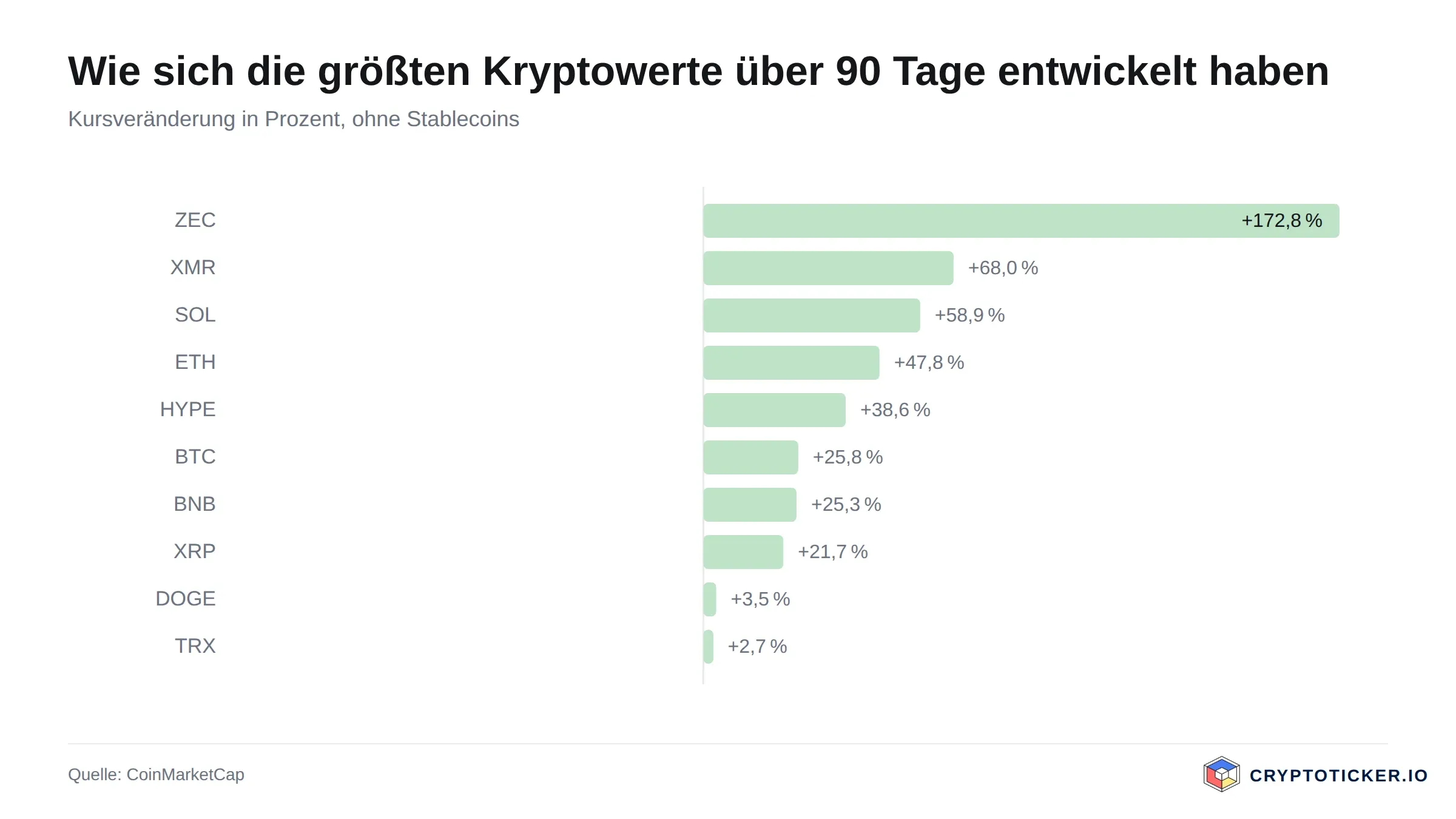
Layer 1, the MoonPay fee. It depends on how you arrived at the platform, and that is the detail most readers skim past.
If you buy directly through MoonPay’s website or app, this table applies:
| Payment method | on purchases | on sales |
|---|---|---|
| Cards and alternative payment methods | up to 4.5 percent | up to 4.5 percent |
| Bank transfer | up to 1 percent | up to 1 percent |
Across the board, the price list quotes a range of “between 0 and 5 percent” for direct access. If you arrive through a partner, meaning the buy button inside a wallet, the wording is “up to 4.5 percent”, with a minimum fee that “will never be more than €4.50”. For that route, MoonPay publishes no breakdown by payment method.
In both cases there is also a minimum fee of €3.99 if your amount falls below a threshold. How high that threshold is does not appear in the price list. If you pay in a currency other than euros, dollars or pounds, the document says the minimum fee rises “by 0.25 to 10 percent”.
Layer 2, the ecosystem fee. This is the partner’s margin. The price list says it is charged “by MoonPay Europe on behalf of some, but not all, of our partners”, that it is “set by each partner individually”, and that it may not exceed 10 percent, though it typically runs between 0 and 2 percent.
Translated: the operator of the wallet in which you have just tapped Buy can add up to ten percent. This fee is shown to you as a separate line item when you confirm the order, so it is visible. But it depends on which app you are using, rather than on what you are buying.
Layer 3, the transaction fee. According to the price list it sits “between 0 and 10 percent, typically around 1 percent”. It is disclosed at account opening and appears as a line item on the email receipt.
Layer 4, the spread. And this is the one that matters. The price list puts it like this: for all transactions, the rate displayed to you corresponds to the base price “inclusive of any spread”. And further: “All spreads are included in the price of the crypto asset displayed to you during the checkout process.”
A markup baked into the rate is not a line on the invoice. It is not hidden in the sense of being improper, since MoonPay discloses it. It simply cannot be quantified before you buy, and it stacks on top of the other three layers.
What MoonPay fees mean in euros
Work it through once for a typical case, using the values from the price list and leaving out the spread, which nobody knows in advance.
You buy €200 of bitcoin by card, through the buy button in a wallet:
- MoonPay fee, up to 4.5 percent: up to €9.00
- Ecosystem fee charged by the partner, typically 0 to 2 percent: up to €4.00
- Transaction fee, typically around 1 percent: roughly €2.00
- Spread: unknown, contained in the rate
In the unfavourable case that leaves you at around €15 on a €200 outlay, or roughly 7.5 percent, before the spread has even been counted. Paying by bank transfer instead of card cuts the largest layer from up to 4.5 percent to up to 1 percent.
The comparison that follows from this is straightforward. A regulated exchange with a published order fee or a published spread is almost always cheaper on the same €200. The providers and their terms are set out in our comparison of the best crypto exchanges. If you are looking to start through an app, the candidates are in the comparison of buying bitcoin by app.
What MoonPay is allowed to do in Europe, and what it expressly is not
Here it pays to look at the register, because it corrects a widespread assumption.
MoonPay Europe B.V., registered at Herengracht 420, 1017BZ Amsterdam, appears in ESMA’s MiCA register. The competent authority is the Dutch financial markets regulator AFM, and the date of authorisation is December 30, 2024. MoonPay itself gives the reference number 41000002 in its footer.
The register lists exactly three authorised services:
- exchange of crypto assets for funds
- exchange of crypto assets for other crypto assets
- provision of transfer services for crypto assets
Custody of crypto assets on behalf of clients is not among them. That is the service listed under letter a in the register, and MoonPay Europe does not hold it. The service is designed so that whatever you buy goes straight to an address you supply. Leaving holdings there is not what it was built for.
The authorisation is passported into 30 states of the European Economic Area, Germany included. In BaFin’s company database MoonPay Europe therefore appears under the category “cross-border service providers (Art. 65 MiCA-R)”, with three inbound permissions and an issue date of March 26, 2026. They match the three services from the Dutch register exactly. The service needs no German licence of its own; market access runs through the European passport.
One discrepancy you may run into while reading up: in a help article, MoonPay describes the scope of its own MiCA authorisation more broadly than the registers do, naming custody and the issuance of stablecoins as well. Neither service appears in the Dutch AFM register or in the BaFin database. In case of doubt, the supervisory authority’s register governs, and not the provider’s own description.
When reading the small print, watch which company you are dealing with. The US footer names MoonPay USA LLC as a registered money transmitter with an NMLS number. For a user in Germany, MoonPay Europe B.V. with company number 93501153 and the European price list apply, not the American one. Dutch law governs, the place of jurisdiction is Amsterdam, and where the language versions conflict, the English version of the terms of use prevails.
MoonPay Balance: the credit is not a deposit, and Germany has a special rule
The service offers an internal balance, MoonPay Balance. Two points about it sit in the terms of use and are worth knowing.
First, this credit is expressly neither e-money nor a bank account nor a deposit, and under the terms it is “not protected by any deposit guarantee scheme or investor compensation scheme”. It pays no interest.
Second, a separate clause applies to Germany. The balance may not exceed your average monthly trading volume or €1,000, whichever is higher, and it should not be held for longer than 30 calendar days. If it stays above €20 for more than 30 days, MoonPay may terminate access to this service after giving notice.
Together with the missing custody permission, that paints a clear picture. The service is built as a point of transit. Storage was never part of the design.
When MoonPay is still the right choice
The criticism of the costs would be incomplete without the reason the service is so widespread.
It is fast. It requires no account opening at an exchange, no transfer and no second app. And it delivers the crypto assets straight to an address of your choosing, which at an exchange would be an extra step carrying its own withdrawal fee.
That makes it sensible in three situations: small, infrequent amounts, where the effort of opening an account eats up the price difference. An urgent purchase, where verification at an exchange would take too long. And the case where you want the assets in your own custody anyway and can skip the exchange as an intermediate stop. Suitable devices are listed in our hardware wallet comparison.
It makes less sense for regular purchases, for savings plans and for larger amounts. There, every percentage point bites, and the saving at an exchange quickly outweighs the effort.
Three things to check before you tap
First: pay by bank transfer rather than by card, if you have the time. The difference according to the price list is up to 4.5 percent against up to 1 percent. On €500 that comes to as much as €17.50 for a few working days of waiting.
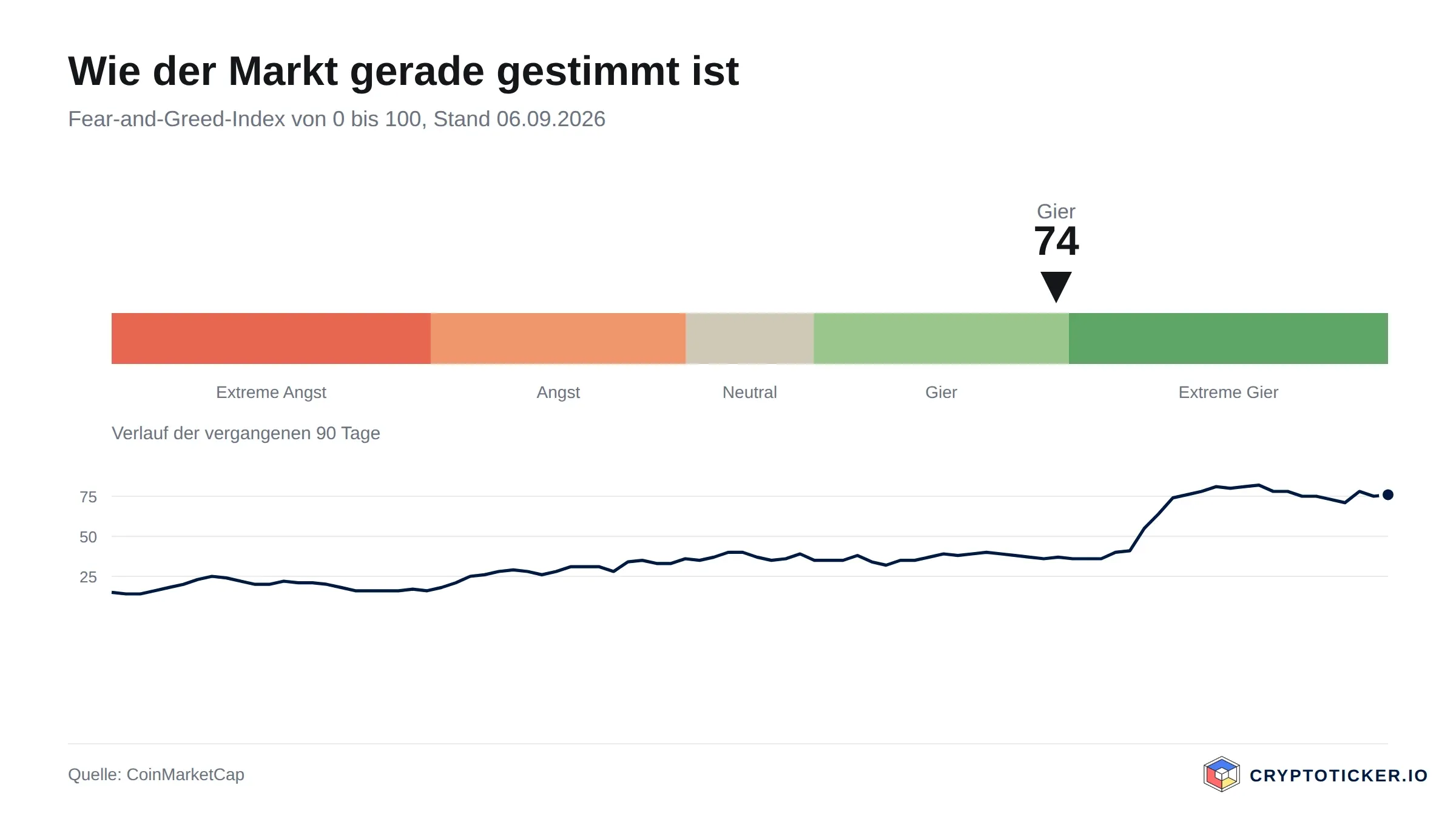
Second: look at the breakdown before you confirm. MoonPay shows its own fee, the partner’s ecosystem fee and the transaction fee as separate line items. What you do not see as a line item is the spread. The only reliable check is therefore to compare the displayed rate with the market rate before you confirm.
Third: measure the total against the amount of crypto that actually arrives. Do not add up the fee lines. Look afterwards at how much bitcoin your €200 left on the address, and divide that by the market rate. That is the only figure that contains all four layers.
For tax purposes, every MoonPay purchase counts as normal
A purchase through MoonPay is an acquisition for tax purposes like any other. What matters is that you document it: date, quantity, euro amount paid. Since MoonPay offers no custody, the assets land directly in your own wallet, and there is no automatic statement there.
Anyone buying through several routes, partly through an exchange and partly through an embedded buy button, has acquisition data sitting in more than one place. For the holding period and the FIFO ordering they have to be brought together. Which programs manage that is set out in our comparison of crypto tax tools.
MoonPay: what to take away
- Switch the payment method; that is the biggest lever. Card up to 4.5 percent, bank transfer up to 1 percent. Everything else is fine-tuning by comparison.
- Compare the displayed rate with the market rate before you confirm. The spread is the only layer that never appears as a line item, and the price list says expressly that it is contained in the rate you are shown.
- Use MoonPay for the rare, small or urgent purchase, not for a savings plan. For recurring purchases, opening an account with a provider that publishes its terms almost always pays off.
Frequently asked questions
How high are the fees at MoonPay? On a purchase made directly through MoonPay, the European price list names up to 4.5 percent for cards and alternative payment methods and up to 1 percent for bank transfer, in each case on both purchases and sales. If you arrive through a partner, “up to 4.5 percent” applies with no breakdown by payment method. On top of that comes a minimum fee of €3.99 below a certain amount. Retrieved on September 5, 2026; the price list is undated.
What is the minimum I have to buy? MoonPay names a minimum amount of 20 US dollars or the equivalent. On small amounts the minimum fee of €3.99 bites particularly hard: on €20 it works out at roughly 20 percent.
Why do I pay more in my wallet than on the MoonPay website? Because a purchase through a partner can attract an additional ecosystem fee. It is set by the partner, may not exceed 10 percent and, according to MoonPay, typically runs between 0 and 2 percent.
Is MoonPay regulated in Germany? Yes. MoonPay Europe B.V. has been authorised under MiCA by the Dutch regulator AFM since December 30, 2024, and is passported into 30 states of the European Economic Area, Germany included.
Does MoonPay hold my cryptocurrencies in custody? No. The MiCA register records only exchange for funds, exchange for other crypto assets and transfer services for MoonPay Europe. Custody on behalf of clients is expressly not part of it. Whatever you buy goes to an address you supply.
What is the spread at MoonPay and where do I see it? The spread is a markup contained in the rate you are shown, and it never appears as a fee line of its own. MoonPay writes itself that all spreads are included in the price of the crypto asset displayed during checkout. It becomes visible only in a comparison with the market rate.
Is MoonPay worth it compared with an exchange? On small, infrequent or urgent purchases, the effort saved can outweigh the higher costs, especially where the assets are headed straight into your own wallet anyway. On regular purchases and larger amounts, a provider with published terms is generally cheaper.
The price lists of on-ramp providers change without notice, and MiCA authorisations keep being added or altered in scope. We follow both and summarise the changes, in German and in English. The current picture is on the front page of cryptoticker.io.
Sources
- MoonPay, Europe Pricing Disclosure, retrieved on September 5, 2026, undated and without a version number: https://www.moonpay.com/legal/europe_pricing_disclosure
- MoonPay, terms of use for Europe, German version: https://www.moonpay.com/de/legal/terms_of_use
- MoonPay, risk disclosures: https://www.moonpay.com/legal/risk
- MoonPay, overview of legal documents: https://www.moonpay.com/legal
- AFM, register of authorised crypto asset service providers, file register-cryptopartijen.xlsx, as of August 25, 2026, entry MoonPay Europe B.V. with number 41000002: https://www.afm.nl/~/profmedia/files/registers/register-cryptopartijen.xlsx
- BaFin, company database, entry “Moonpay Europe B.V.”, category cross-border service providers under Article 65 MiCA-R, retrieved on September 5, 2026: https://portal.mvp.bafin.de/database/InstInfo/
- Ledger, product page for buying via MoonPay: https://www.ledger.com/buy-moonpay
- ESMA, interim MiCA register of crypto asset service providers, file CASPS.csv, entry MoonPay Europe B.V., LEI 254900KXWAZ3B1340G26, retrieved on September 5, 2026: https://www.esma.europa.eu/sites/default/files/2024-12/CASPS.csv
- ESMA, landing page on the MiCA regulation: https://www.esma.europa.eu/esmas-activities/digital-finance-and-innovation/markets-crypto-assets-regulation-mica
- Regulation (EU) 2023/1114 on markets in crypto assets (MiCAR), Articles 3 and 59: https://eur-lex.europa.eu/eli/reg/2023/1114/oj
(As of September 5, 2026. This article is not investment advice. Prices and fee structures change; check the terms with the provider before you buy.)
The information provided in this article is for informational purposes only and does not constitute financial advice. Investing in cryptocurrencies carries a high level of risk.
Trade Republic is Germany’s largest neobroker, and since November 14, 2025 you can not only buy around 50 cryptocurrencies there but also send them to a wallet of your own and receive them from it. That is what the company’s press release of the same day says.
What it does not say is the price. Trade Republic publishes no spread for crypto trading, and the official price overview on the website lists exactly six priced lines, not one of which concerns cryptocurrencies. In the small print the company writes it itself: the full price list is available in the app.
This article is an analysis, not a news item. It rests on three documents that Trade Republic makes public: the customer agreement in version 07.08 as of July 2026, the crypto execution policy of the same date, and the depositor information sheet. Added to that is BaFin’s company database, queried on September 5, 2026. All sources are listed in full at the end.
What actually belongs to you in Trade Republic crypto
The good news first, because it is often misrepresented: at Trade Republic you buy real crypto-assets, not a certificate and not a debt security. The customer agreement expressly assigns the trading to the European crypto regulation MiCAR, specifically to the term “crypto-asset” under Article 3(1)(5).
The qualification follows two paragraphs later. Trade Republic holds all customers’ balances “in one digital omnibus account per supported crypto-asset”, and the crypto-assets of different customers are “not segregated from one another”. The company’s own holdings sit separately, but your balance sits with everyone else’s at the same address.
From that follows the point that matters most to many people: you get no keys. The crypto custody policy puts it verbatim: “Customers do not receive their own public or private keys.” An individual wallet address exists only on request and only for transfers. Self-custody is not provided for at Trade Republic.
Who holds the assets, and why the name is missing from the contract
Trade Republic’s crypto page states that the bulk of holdings sits in cold wallets with the partner BitGo Europe GmbH, a custodian licensed under MiCAR. The same statement appears in the press release of November 14, 2025.
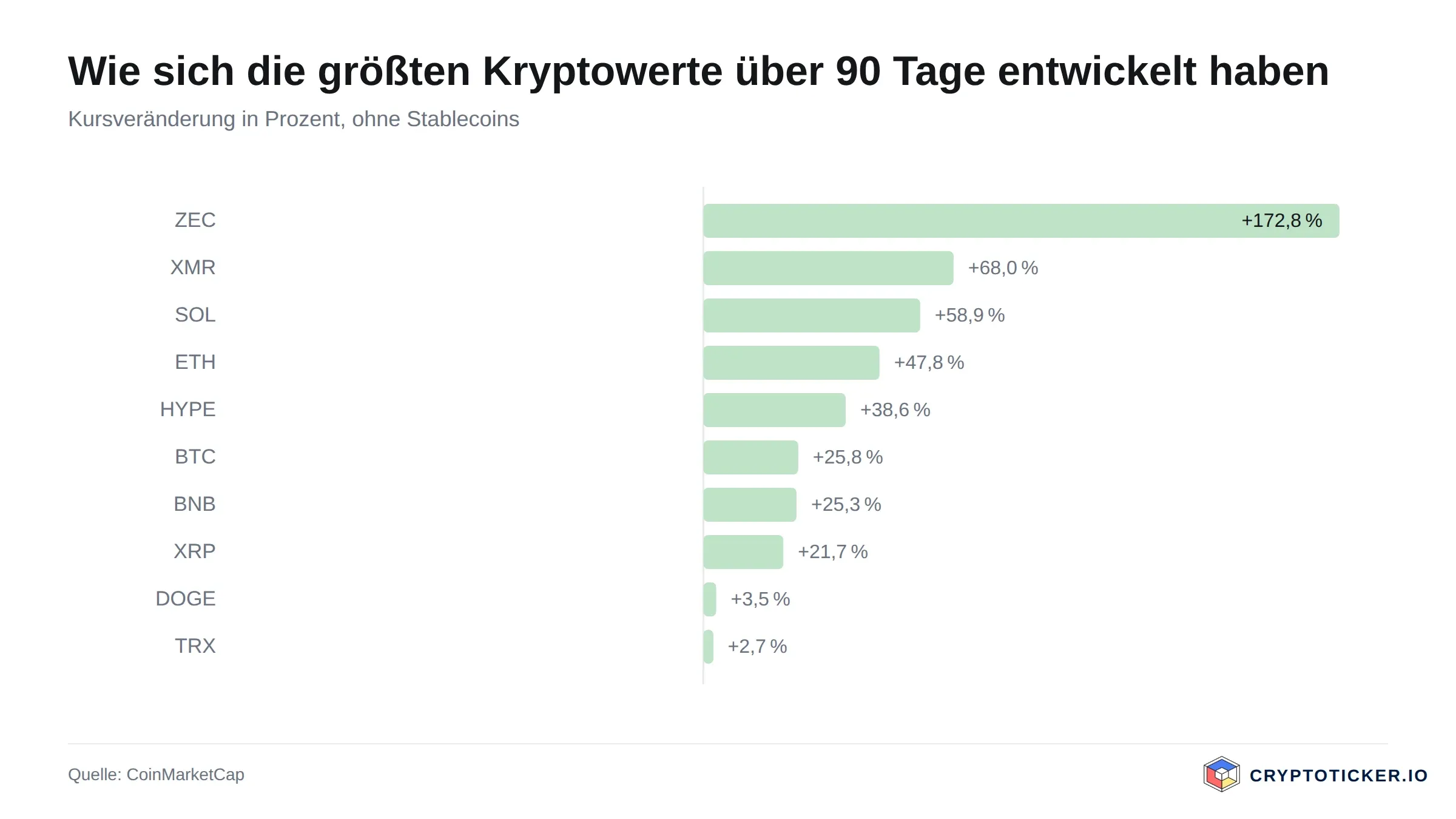
In the 108-page customer agreement, by contrast, the name BitGo does not appear. What it refers to there, in general terms, is “MiCAR-regulated sub-custodians” to which Trade Republic may delegate custody. That is not a contradiction, but it is a distinction worth knowing: the custody partner is a marketing statement and a press statement, not a contractual commitment. It can change without anything in the contract changing.
BitGo Europe GmbH, based in Frankfurt, is indeed regulated. BaFin’s company database lists eleven permission entries for the company, among them the custody and administration of crypto-assets for customers since May 9, 2025 and qualified crypto custody business under the German Banking Act since December 30, 2024.
The authorisation: a banking licence instead of its own CASP licence
Here lies a subtlety that comparison tables almost always miss. Trade Republic Bank GmbH holds four MiCAR permissions in the BaFin database, all since April 24, 2025: custody, execution of orders, reception and transmission of orders, and transfer services.
Those permissions rest on Article 59(1)(b) of the regulation. Point (b) is the route for credit institutions, which may provide crypto services after a notification. Trade Republic therefore holds no standalone authorisation as a crypto-asset service provider; it uses the banking licence it already has. BitGo Europe, by contrast, sits under point (a), which is the standalone authorisation.
For you as an investor that changes little about supervision, since both are supervised by BaFin. For placing them in a provider comparison it is still relevant, because “MiCA-licensed” applies to both and means two different things.
What trading costs, and what Trade Republic does not disclose
The official price overview names the same six items for every asset class:
| Item | Price |
|---|---|
| Order commission | free |
| Settlement fee | 1.00 euro, 2.00 euros for direct pricing on an exchange |
| Execution of savings plans for shares, ETFs or crypto | free |
| Monthly card fee | free |
| Cash withdrawals worldwide | free, 1.00 euro below 100 euros |
| Dividends or corporate actions | free |
This overview is as of September 5, 2026, retrieved from the company’s support page.
An important note on how to read this table: it applies generally and names cryptocurrencies expressly only in the savings-plan line. Whether the 1.00 euro settlement fee also applies to individual crypto orders is nowhere confirmed by Trade Republic in crypto-specific terms. Several trade publications report it consistently, and it fits the logic of the table, but it is not a statement by the provider. The only thing established is that the execution of crypto savings plans is free, because that line names crypto by name.
A dedicated crypto line is missing, and no spread is quantified anywhere. That is not a research failure but demonstrably deliberate: in the full text of the customer agreement, running to 395,744 characters, the word “spread” appears zero times. Trade Republic itself writes in several places that “apart from the spread, no further costs are incurred”, yet names no figure and refers to the price overview and the app.
That is why this article carries no spread figure. Values between 0.5 and 3 percent circulate in the trade press, they contradict each other, and none of them is a published condition. The robust statement is this: the spread is the main cost block in crypto trading, and you see it only in the app before the order. Anyone who wants to compare before opening an account cannot do so for crypto.
What is established: custody itself is free. The customer agreement says Trade Republic charges “no fees for the provision of crypto custody services”. Staking likewise incurs no additional fees.
Transfers to your own wallet: free today, chargeable under the contract
Since November 14, 2025 you can send crypto-assets to external wallets and receive them from there. The website advertises that Trade Republic charges no transaction fees for this. You bear the network fee of the respective blockchain yourself, as you do with every provider.
The customer agreement, however, adds a second sentence: “Trade Republic is entitled to charge a fee for the execution of crypto transfers. The fees stated in the price list and/or in the application at the time the service is provided shall apply.”
Free today, chargeable at any time. This is not hidden small print but a standard clause. It still belongs in your calculation if you are planning on Trade Republic as a permanent route to self-custody.
Three further points from the transfer chapter that matter day to day: transfers are irreversible and, once accepted, can neither be amended nor revoked. Incoming amounts are rounded down from the sixth decimal place. And commercial use of the transfer function is expressly prohibited.
Deposit protection does not apply, yet you are not unprotected
This is often presented in shortened form, so here is the precise position. The depositor information sheet names the compensation scheme of German banks with 100,000 euros per depositor and a repayment period of seven working days. It expressly covers deposits. Crypto-assets do not appear in it, and they are not a deposit within the meaning of the German Deposit Guarantee Act.
Trade Republic draws this line one step earlier and writes of securities that the instruments in the custody account do not fall under deposit protection but are owned by the customer. For crypto-assets that applies all the more.
The protection is instead a matter of insolvency law. The customer agreement says: “In the event of insolvency, customers’ crypto-assets do not form part of Trade Republic’s insolvency estate. They will be transferred to a licensed crypto custodian in accordance with applicable law.” Customers may object and then bear, where applicable, the costs of separation and transfer. Added to that is liability for loss under Article 75(8) MiCAR, capped at the market value at the time of the liability event.
The right way to put it is therefore not “unprotected” but protected differently: no 100,000 euro deposit guarantee, but separation from the insolvency estate and a statutory liability.
Taxes on Trade Republic crypto: the broker expressly does nothing
This is the point that calls for the most action, and the evidence is unambiguous. The customer agreement contains a tax clause of its own in three different places.
On trading, Annex 7 Section A reads: “Trade Republic is not responsible for remitting taxes on the customer’s sale proceeds. The customer must obtain tax advice independently. Trade Republic will, however, provide the customer with overviews of trading in crypto-assets.”
On transfers, Section D: “Trade Republic is not responsible for remitting taxes in connection with the execution of crypto transfers.”
On staking, Section E: “Trade Republic is not responsible for remitting taxes in connection with crypto staking.”
Three things follow from that, with no room for interpretation. First, Trade Republic withholds no capital gains tax on crypto, unlike with shares and ETFs. Second, you receive no tax certificate covering crypto, but expressly only “overviews”. Third, the filing obligation lies entirely with you.
Anyone holding shares and crypto in the same account thus has two completely different tax worlds in one app: with the shares, everything is settled once you sell; with crypto, that is where the work begins.
The case almost nobody has on their radar: paying with crypto
Trade Republic offers the option of paying by card and covering the amount from your crypto holdings. The company writes about this itself: “The use of crypto constitutes a sale of the respective crypto amount and may have tax implications.”
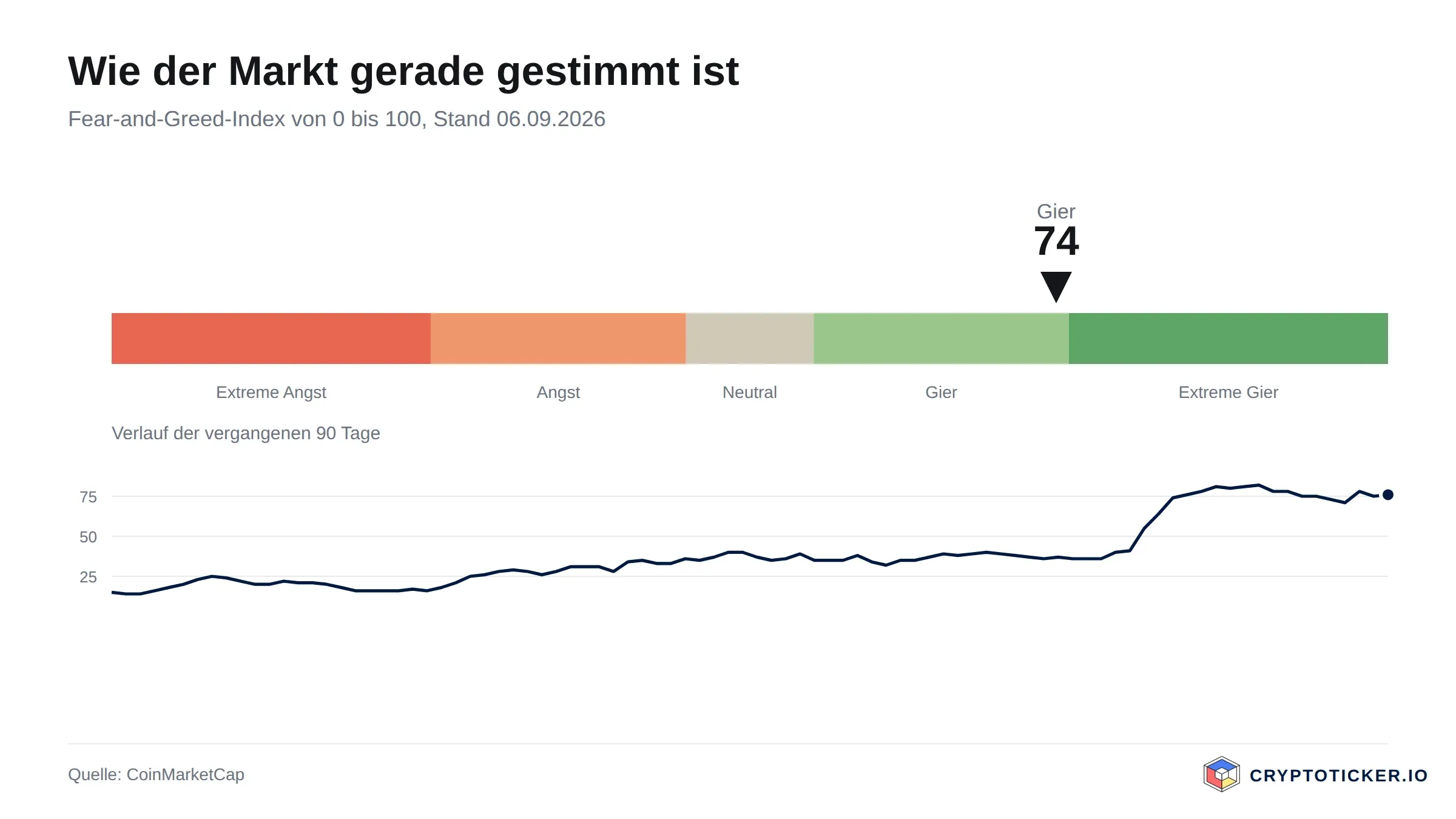
Translated, that means: every coffee you pay for with crypto is a sale. And because Trade Republic remits nothing and issues no tax certificate, you have to document each one of these events yourself, with the acquisition date, the acquisition price and the sale price. With a handful of orders a year that is manageable. With a card used daily it quickly turns into a three-figure number of events.
If you want to use this feature, you need a transaction export and a tool that builds a statement from it, from day one. Which programs do that and what they cost is set out in the comparison of crypto tax tools.
Five clauses you should have read before your first order
These points all appear in the customer agreement. They are not unusual for the industry, but they are rarely quoted.
Dealing on own account. Trade Republic acts as a commission agent and may declare that it is dealing on its own account, becoming your counterparty itself, even where no official exchange or market price has been established. You also agree to execution outside trading platforms for crypto-assets.
No customer instructions. The crypto execution policy states that Trade Republic does not execute crypto orders according to specific instructions from its customers. So you cannot demand a particular execution venue.
Delisting at short notice. If a coin is delisted, you have to sell within a set period, and the contract expressly says this period may be “very short”. After that, Trade Republic may sell on your behalf and is not liable for losses arising from it.
Airdrops and forks without entitlement. If an allocation is “not reasonably possible” in Trade Republic’s discretion, you waive the claim. There is no duty to inform you about blockchain events.
Transfers can be suspended. Trade Republic may refuse or suspend a transfer if the origin of the funds, the identity, or the power of disposal over the target wallet is not evidenced.
Who Trade Republic crypto suits, and who it does not
It suits you if you want to hold shares, ETFs and crypto in one app, save small amounts and use savings-plan execution without execution costs. Entry is possible from 1 euro, and crypto savings plans are free to execute.
It suits you less if you want to know the price in advance, because the spread is not published. It also suits you less if self-custody is your goal: you have been able to send to a wallet of your own since November 2025, but inside Trade Republic you never hold your own keys at any point. And it suits you only with preparation if you trade a lot or pay with crypto, because all of the tax work sits with you.
How Trade Republic stands against other German providers is set out in the comparison of crypto brokers. If you place value on a standalone authorisation as a crypto-asset service provider, you will find those firms in the comparison of regulated crypto exchanges.
Trade Republic crypto: what you take away from this
Three concrete steps:
- Look at the spread in the app before you place your first order, and scale it up to the amount you plan to invest. It is the main cost block, and it appears in no public document. Compare the result with a provider that publishes its terms.
- Set up your tax documentation before you buy, not the following year. Trade Republic remits nothing on crypto and issues no tax certificate, only overviews. Export your transactions regularly.
- Make a deliberate decision about paying by card with crypto. Every single payment is a sale for tax purposes. If you use the feature, you need a tool that records the events automatically.
Frequently asked questions
Do the cryptocurrencies at Trade Republic really belong to me? Yes, these are real crypto-assets under MiCAR and not a derivative. They sit in an omnibus account together with other customers’ holdings, though, and you receive no keys of your own.
Can I withdraw crypto from Trade Republic to my own wallet? Yes, since November 14, 2025. Trade Republic currently charges no fee of its own for this; you bear the network fee. The contract reserves the right to charge a fee in future.
How high is the spread at Trade Republic for crypto? Trade Republic does not publish it. Neither the price overview nor the customer agreement nor the execution policy names a figure. It only becomes visible in the app before the order.
Does Trade Republic remit tax on crypto? No. The customer agreement states expressly in three places that Trade Republic is not responsible for remitting taxes. You receive overviews of your trading, but no tax certificate, and you have to file yourself.
Does deposit protection apply to my crypto-assets? No. The depositor information sheet covers deposits, and crypto-assets are not a deposit. The protection instead consists in crypto-assets not forming part of the insolvency estate, plus liability under Article 75(8) MiCAR.
Is Trade Republic regulated for crypto? Yes. BaFin lists four MiCAR permissions for Trade Republic Bank GmbH since April 24, 2025. They rest on Article 59(1)(b), which is the route via the existing banking licence, not a standalone authorisation as a crypto-asset service provider.
The rules around MiCAR, custody and the taxation of crypto-assets continue to change, and Trade Republic adjusts its terms with every new version of the customer agreement. We follow these changes and summarise them, in German and in English. The current state of play is on the front page of cryptoticker.io.
Sources
- Trade Republic, customer agreement version 07.08 DE-de, as of 7/2026, Annex 7 “Special conditions for the provision of crypto-asset services”: https://assets.traderepublic.com/assets/files/CA_DE-de.pdf
- Trade Republic, crypto execution policy, as of 7/2026: https://assets.traderepublic.com/assets/files/DE_ExecutionPolicy.pdf
- Trade Republic, depositor information sheet: https://assets.traderepublic.com/assets/files/TradeRepublic_InformationsbogenfuerdenEinleger.pdf
- Trade Republic, press release of November 14, 2025 on the crypto wallet: https://assets.traderepublic.com/assets/files/251114_TradeRepublic_Crypto_PressRelease_DE_DE.pdf
- Trade Republic, crypto page with FAQ: https://traderepublic.com/de-de/crypto
- Trade Republic, support page with the official price overview: https://traderepublic.com/de-de/support
- BaFin, company database, query on Trade Republic Bank GmbH and BitGo Europe GmbH, retrieved on September 5, 2026: https://portal.mvp.bafin.de/database/InstInfo/
- Regulation (EU) 2023/1114 on markets in crypto-assets (MiCAR), Articles 3, 59 and 75: https://eur-lex.europa.eu/eli/reg/2023/1114/oj
Decrypt
Early testers spent OpenAI's launch weekend pushing Astra through 3D cities, playable games, Bach chorales and research papers.
The multi-year deal will place the XRP logo on the field at Ben Hill Griffin Stadium starting this season, extending Ripple's push into college athletics.
With a growing number of institutions exploring stablecoins, the bottleneck is regulated infrastructure they can trust.
The team behind Pencil Finance says the financing supported thousands of Southeast Asian students, but it did not disclose borrower costs, defaults, or investor returns.
At least four more decade-old wallets moved a combined $15.7 million between Aug. 29 and Sept. 4, with one batch of coins sent to Coinbase in a likely sign of a sale.
U.Today - IT, AI and Fintech Daily News for You Today
Zcash (ZEC) has surged into the cryptocurrency top 10 after a sharp rally wiped out nearly $49 million worth of short positions over the past 24 hours.
Former Ripple dev conflict erupts as wallet bug affects 4,000 users, exposing long-standing XRP-focused project red flags.
Longtime Bitcoin figure CobraBitcoin has warned that the rapid rise of increasingly autonomous AI models could create a new security threat for Bitcoin.
The immediate question is whether Dogecoin can convert its latest breakout into a sustained move above $0.10.
Peter Brandt’s famous 2019 Bitcoin chart returns to the spotlight as BTC eyes $80,000 under an institutional floor.
Blockonomi
TLDR:
- WOO X users reported withdrawals stuck for up to 3 days as ZachXBT amplified complaints on September 6.
- One WOO X user reported a 3-day pending withdrawal, while another waited over 6 hours for self-custody.
- WOO X has not disclosed how many users are affected, which networks face delays, or the backlog value.
- WOO X previously lost $14M from 9 accounts in July 2025, but no evidence links that breach to current delays.
WOO X is facing growing scrutiny after users reported withdrawals remaining stuck for hours or days in pending, processing, or submitted status. ZachXBT amplified the complaints on September 6, highlighting users who said transfers had not reached external wallets.
One verified user said a withdrawal had remained pending for three days, while another reported a self-custody transfer stuck for more than six hours. Other screenshots showed canceled withdrawal requests, although the reports do not establish a platform-wide freeze.
WOO X Withdrawal Delays Leave Users Waiting Up to 3 Days
WOO X said September 6 that it was reviewing withdrawal processing reports and checking individual cases alongside its system status. The exchange said some requests could still be under internal review or moving through on-chain processing.
Affected customers were asked for their user ID, withdrawal order ID, request time, asset, network, and transaction-status screenshot. WOO X also warned users about impersonators seeking passwords, seed phrases, private keys, or verification codes.
The exchange pointed customers toward its proof-of-reserves and liabilities dashboard, which it says shows asset backing. However, it did not disclose how many withdrawals were delayed, which networks were affected, or when outstanding transfers would clear.
An earlier exchange response reportedly reserved the right to pursue legal action over fabricated or malicious claims. That wording was missing from a later public notice, and ZachXBT questioned both the edit and the reported delays.
The current evidence does not show that WOO X is insolvent, short of customer assets, or dealing with another confirmed security breach. The total value of affected withdrawals also remains unknown.
FusionX Transition and $14M Breach Add Context
The dispute comes during a broader ownership transition involving FusionX Digital. WOO and FusionX announced in October 2025 that FusionX would acquire and operate the centralized exchange.
The companies said the transition would occur gradually over six months, while customer accounts, assets, trading, and support would continue without interruption. The deal also created a Global Strategy Committee that included BitMart founder Sheldon Xia.
Public acquisition materials identify Xia as a committee member but do not establish that he personally owns WOO X. ZachXBT has separately alleged closer links between Xia and FusionX Digital, increasing attention on the connection.
BitMart began an orderly wind-down on July 26, stopping new registrations and deposits before ending spot, futures, and other trading services on August 26. Withdrawals were intended to remain available, although compliance and risk reviews could extend processing times.
BitMart later shifted course on August 21, saying it was considering restructuring and a phased return of operations. It appointed White & Case as restructuring counsel and promised another update by September 9.
WOO X also carries recent security history. On July 24, 2025, attackers made $14 million in unauthorized withdrawals from nine accounts after a social-engineering compromise. The exchange suspended withdrawals temporarily, compensated every affected customer from its treasury, and later strengthened monitoring and withdrawal controls.
There is no evidence connecting that breach to the current withdrawal delays. The immediate issue remains whether pending transfers clear and whether WOO X explains the affected networks, backlog size, root cause, and resolution timeline publicly.
The post WOO X Users Report Days-Long Withdrawal Delays as ZachXBT Raises Alarm appeared first on Blockonomi.
TLDR:
- Solana news brings ARB trading through Sunrise, expanding access while drawing attention to competing claims about fees and execution.
- Steven Goldfeder emphasizes protection against harmful MEV, while Anatoly Yakovenko argues that Arbitrum offers worse spreads and higher fees.
- SOL trades at $106.02 after gaining 2.5%, while daily trading volume increases 63.8%, without establishing a direct link to the ARB listing.
- Support near $105 and resistance at $107.37 frame the immediate technical setup, with a decline below $104.94 weakening the recovery.
Solana news centers on ARB arriving through Sunrise while SOL trades at $106.02, up 2.5% over 24 hours. The listing gives traders another venue for the asset and brings trading costs into focus. Solana promotes better spreads and lower fees, while rival executives disagree over how those costs should be measured.
According to Coingecko data, SOL trading volume climbs 63.8% to $3.49 billion during the same period. That increase accompanies the price recovery, although it does not establish that the ARB launch caused either move. Attention now turns to execution quality, available liquidity, and support near the closely watched $105 level.
Solana news puts Sunrise ARB launch and fees in focus
Solana announced that ARB is available on its network through Sunrise, presenting the expansion as access to the same asset. Its message emphasizes tighter spreads and lower fees. The development concerns a new trading venue for ARB, rather than the creation of a new Solana token.
The Solana news story also intersects with a public disagreement between Steven Goldfeder and Solana cofounder Anatoly Yakovenko. Goldfeder argues that simple fee comparisons overlook protection against frontrunning and harmful maximal extractable value, commonly called MEV.
In his comments, Goldfeder describes the comparison as “apples and oranges.” He says Arbitrum protects users against trading practices that can create hidden execution costs. His argument focuses on the total cost experienced by traders, beyond the visible charge.
Yakovenko disputes that assessment, saying Arbitrum has worse spreads and higher fees. He cites a difference of roughly tenfold in his comparison. That statement represents his assessment, rather than an independently verified guarantee covering every ARB transaction.
For this Solana news development, the distinction matters because network fees and trading costs measure different things. A swap can involve a network charge, a liquidity provider fee, and price slippage. Available liquidity also affects execution, particularly for larger orders.
Solana documentation describes a base transaction fee alongside optional priority fees. Those charges alone do not establish the complete cost of buying ARB. Comparing equivalent order sizes and execution outcomes would provide a stronger basis for evaluating the competing claims.
The launch announcement does not specify a universal fee schedule. Making comparisons therefore requires examining actual trading costs across different venues and individual order sizes.
SOL price tests support after trading volume jumps higher
The SOL price increase places the token above $105, with the recent $107.37 swing high marking nearby resistance. A move from $106.02 to that level would represent approximately 1.3% upside. Holding support would keep that resistance test in view.
Meanwhile, a decline below $104.94 would weaken the immediate recovery setup. That threshold sits just beneath the broader $105 support area. These levels describe conditional trading scenarios; they do not establish that a breakout or deeper decline will occur.
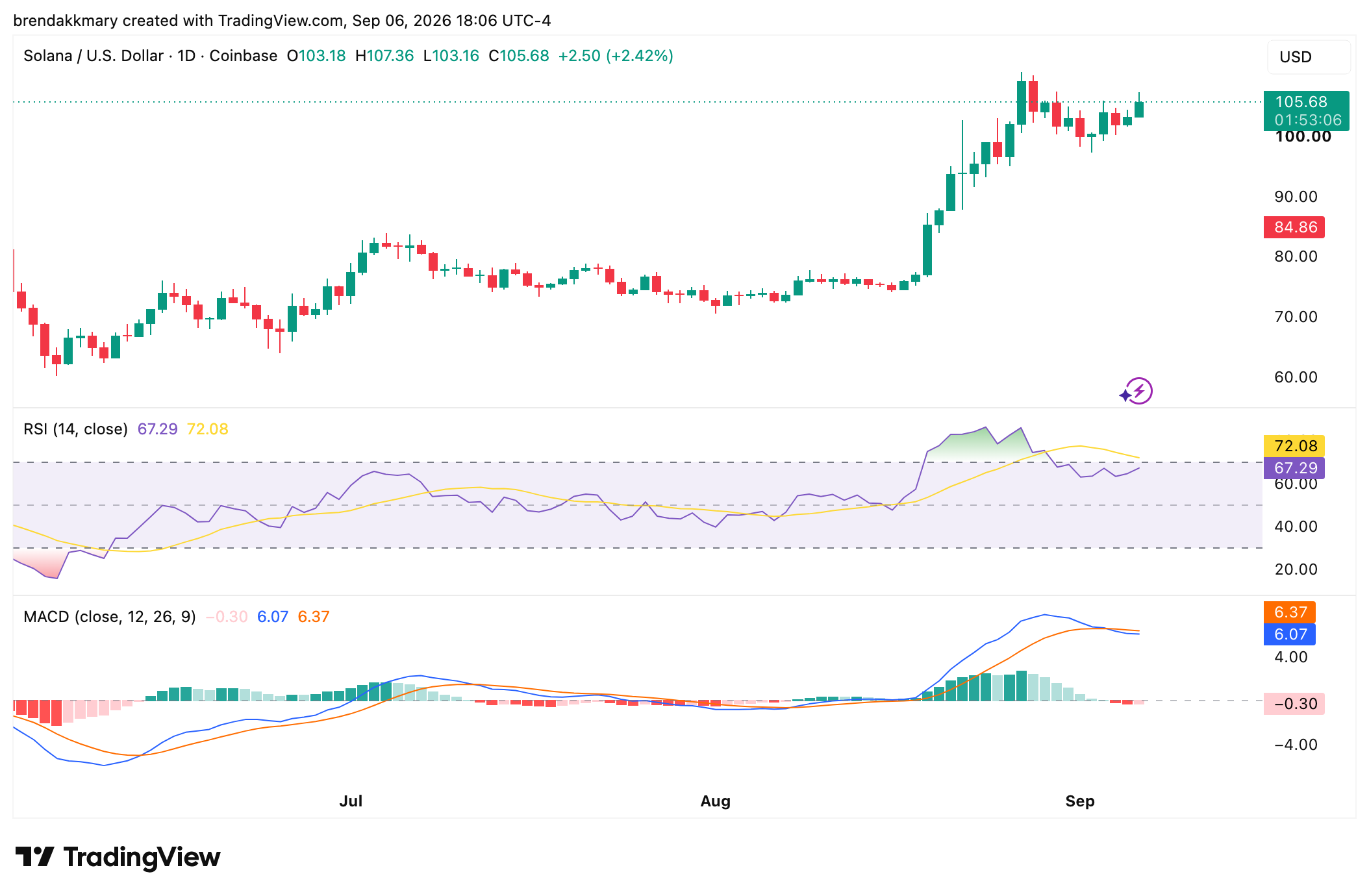
The latest Solana news arrives alongside stronger turnover, but the $3.49 billion figure requires careful interpretation. SOL trading volume measures activity in the token. It should not automatically be described as Solana network trading volume or ARB turnover.
Similarly, higher volume does not measure net capital inflows. Every completed trade involves both a buyer and a seller. The increase shows greater trading activity, while separate flow measurements would be necessary to establish fresh capital entering the ecosystem.
For the ARB token, adoption would be better assessed through actual trading activity and available market depth. Social engagement can show attention, but likes and reposts do not demonstrate lasting demand. The announcement alone provides no basis for estimating future user growth.
As Solana news shifts toward execution, the immediate technical markers stay close together. SOL trades $1.02 above $105 support and $1.35 below the recent $107.37 high. A price break below $104.94 would place the token beneath both nearby support references.
The post Solana News Brings ARB via Sunrise as Trading Fee Debate Grows appeared first on Blockonomi.
TLDR:
- Ledger CTO challenges the whitehat claim after Liquid’s 3,996 BTC peg-out was valued at $318.4 million.
- Liquid says the peg-out used SideSwap’s PAK, while the key itself and other authorization keys stayed secure.
- The 3,996 BTC transfer represented roughly 95% of Liquid’s Bitcoin reserves, intensifying control scrutiny.
- Liquid paused bridge activity as most withdrawn BTC remained concentrated and LBTC backing stayed matched.
Liquid Network is investigating an unusual peg-out involving roughly 4,000 BTC after actors behind the withdrawal described themselves as “whitehats.” Ledger CTO Charles Guillemet has challenged that description, arguing that legitimate researchers usually disclose vulnerabilities before moving substantial collateral.
The September 6 transaction moved about 3,996 BTC from federation-controlled reserves while Bitcoin traded near $79,675. The transfer was worth approximately $318.4 million. A later transaction carried an OP_RETURN message stating, “we are whitehats. contact us on chain.”
Ledger CTO Challenges Whitehat Claim After Liquid’s $318M Peg-Out
Guillemet argued that withdrawing hundreds of millions of dollars before opening communication differs sharply from conventional vulnerability disclosure practices. His comments shifted attention from the transfer itself toward the conduct of the actors controlling the funds.
The Ledger CTO compared the situation with major bridge and protocol exploits where attackers later communicated with affected projects. He cited the 2022 Ronin bridge attack and the 2023 Euler Finance exploit.
Ronin lost more than $600 million after stolen validator keys allowed unauthorized withdrawals. Euler Finance later recovered assets following negotiations after an exploit initially drained about $197 million.
However, those historical comparisons do not establish malicious intent in the Liquid Network incident. The roughly 4,000 BTC has not been reported as rapidly dispersed or laundered. Instead, most of the funds remained concentrated following the peg-out.
The actors also explicitly requested contact through the Bitcoin blockchain. Blockstream later responded using an on-chain message and asked the party controlling the funds to contact its security team.
However, no confirmed agreement or asset return has been reported. The central issue therefore remains whether the actors’ whitehat description matches their actions. That claim has not been independently verified.
Liquid Probes How 3,996 BTC Cleared Its Peg-Out Security Controls
The Liquid Network later confirmed a security incident and said the withdrawal passed through SideSwap’s Peg-out Authorization Key, known as PAK. Nevertheless, the network said SideSwap’s key itself was not compromised.
Other authorization keys were also reported as uncompromised. That finding has intensified scrutiny over how the transaction satisfied Liquid’s normal withdrawal requirements. Liquid uses a federated security model.
Fifteen functionaries operate the network, while an 11-of-15 quorum controls the Bitcoin peg. Normally, LBTC must be destroyed before matching BTC can leave federation-controlled reserves. PAK restrictions provide another layer by limiting peg-outs to authorized Bitcoin addresses.
On-chain analysis indicated that corresponding LBTC was burned during the withdrawal. That meant the remaining LBTC supply continued to retain matching Bitcoin backing. The distinction reduced immediate concerns about uncovered LBTC liabilities. However, the transaction still represented roughly 95% of Liquid’s Bitcoin reserves.
Liquid responded by notifying exchanges, which paused or prepared to pause LBTC deposits and withdrawals. Bridge nodes were also temporarily disabled while federation members continued investigating. Assets including USDT, DePix, and tokenized real-world assets were not affected, according to the network.
The incident now centers on two verified questions. Investigators must establish how the authorization process permitted the peg-out and whether the withdrawn BTC will be returned.
The post Ledger CTO Challenges ‘Whitehat’ Claim After Liquid’s 4,000 BTC Peg-Out appeared first on Blockonomi.
TLDR:
- Bitmine added 53,501 ETH through Aug. 30, lifting its disclosed Ethereum treasury to 5.9 million tokens.
- More than 5.06 million ETH are staked at a 2.67% annualized yield, creating a powerful rewards engine.
- A modeled year of staking could generate about 135,000 ETH, nearly matching Bitmine’s remaining gap.
- An additional 51,000 ETH purchase would cut the shortfall to about 83,000 tokens under Bitmine’s benchmark.
Bitmine is still expanding its Ethereum treasury even as staking rewards move the company closer to its stated goal of owning 5% of the ETH supply. The Nasdaq-listed treasury company bought 53,501 ETH in the week through Aug. 30, raising its officially disclosed holdings to 5.9 million tokens.
Of that total, Bitmine had already staked 5,067,309 ETH at an annualized seven-day yield of 2.67%. Meanwhile, on-chain data indicates that the company may have resumed buying almost immediately after the reported period ended. The staking base itself now produces a material stream of new ETH under the disclosed yield, changing the arithmetic behind the target.
Bitmine Adds 53,501 ETH as Staking Base Expands
On Sept. 1, blockchain analytics platform Lookonchain said wallets linked to Bitmine appeared to acquire another 51,000 ETH from FalconX and BitGo. The transaction carried an estimated value of about $126 million.
Bitmine had not formally confirmed that acquisition in its latest corporate disclosure. Therefore, the transfer remains separate from the company’s official 5.9 million ETH balance. If the attribution proves correct, and the transfer represents an incremental purchase, Bitmine would hold roughly 5.95 million ETH.
That would move it considerably closer to the 5% ownership target. Using Bitmine’s own benchmark of 120.7 million ETH in circulation, a 5% position would require about 6.035 million tokens. Against its disclosed holdings, the company remains about 134,000 ETH short of that threshold.
Bitmine’s large staking position could reduce that shortfall without requiring an equal amount of direct buying. The company had 5,067,309 ETH staked as of Aug. 30. If that balance and the disclosed 2.67% yield remained constant, the stake would generate roughly 135,000 ETH over a modeled year.
That amount nearly matches the gap between Bitmine’s official holdings and its stated ownership target. Under flat-supply and fixed-yield assumptions, the company would need to retain nearly 99% of one year’s modeled rewards.
If the additional 51,000 ETH acquisition is confirmed, the remaining gap would fall to about 83,000 tokens. Under the same assumptions, roughly 61% of the modeled annual staking rewards would cover that difference.
Tom Lee Links Regulation With Crypto Adoption Outlook
Bitmine chairman and Fundstrat managing partner Tom Lee has also tied the next phase of crypto adoption to U.S. regulation. During Monday’s Global Money Talk, Lee said the CLARITY Act could “open up the floodgates” for institutional adoption.
He said the current U.S. framework remains fragmented across states and argued that one federal agency should oversee the market. Lee pointed to Japan and Russia as countries that have moved toward broader national frameworks.
He also cited Ethereum’s sharp outperformance against memory stocks as evidence that investors have started positioning for another phase of crypto adoption. Russia, meanwhile, approved its first comprehensive digital asset legislation, allowing exchanges, depositories, and other providers to operate from Sept. 1.
It also caps annual retail purchases at about $3,800 through a licensed intermediary and gives digital-asset holders judicial protection. At the time of writing, Ethereum trades at $2,490.35, up 0.57% over 24 hours, according to CoinMarketCap.
Its market capitalization stands at $303.88 billion, while daily volume has risen 39.68% to $10.32 billion. The volume-to-market-cap ratio stands at 3.39%. CoinMarketCap’s chart shows ETH rose above $2,520 before retreating toward $2,490, while prices briefly fell near $2,478.
Ethereum’s circulating and total supply currently stand at 122.02 million ETH, with no fixed maximum supply.
The post Bitmine Nears 5% Ethereum Target as Staking Rewards Strengthen Its Position appeared first on Blockonomi.
TLDR:
- Ethereum price prediction keeps $2,750 in view, but bulls need a sustained breakout above the $2,545 to $2,567 resistance band.
- ETH continues to trade inside a $2,350 to $2,560 four-hour range after buyers defended the lower boundary near $2,380 again.
- Spot Average Order Size data shows normal-sized trades near $2,500, while the whale activity seen earlier in the recovery has faded.
- A break below $2,358 would weaken the bullish setup and expose the broader $2,179 to $2,367 support zone to renewed selling pressure.
Ethereum trades near $2,500 after buyers defended the floor of its recent range. The Ethereum price prediction now depends on whether demand can clear resistance between $2,545 and $2,567. ETH recovered from roughly $2,380, but repeated tests near $2,500 have failed to create sustained momentum. Daily candles show long wicks, reflecting uncertainty after August’s advance from below $2,000.
Whale participation has also faded during the latest recovery, limiting conviction behind the move. A breakout could expose $2,600 and $2,750. Conversely, a loss of $2,358 would weaken the structure and increase correction risks toward the $2,179 to $2,367 support zone.
Ethereum Price Prediction Tests Key Resistance Near $2,567
Ethereum’s daily structure still favors buyers after the breakout from the $1,850 to $1,920 accumulation base. Price has since entered the $2,440 to $2,520 resistance zone, where neither side has secured control. Several daily sessions tested this band without closing decisively above it. Buyers continue absorbing dips, while sellers respond near the upper boundary.
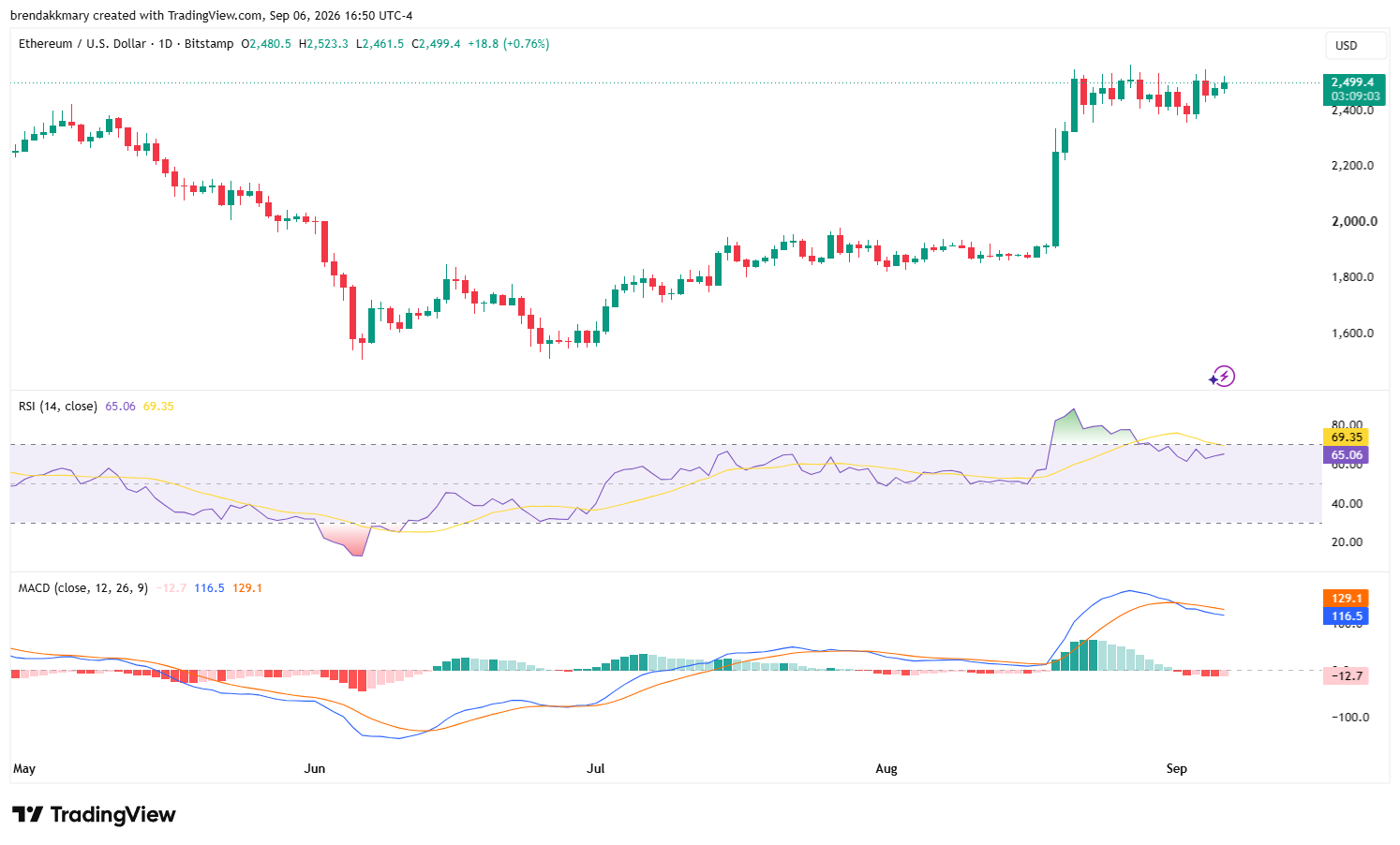
The Ethereum price prediction turns stronger if ETH records a daily close above $2,520 to $2,560. Such a move would confirm renewed demand and support another impulsive advance. The first liquidity target sits near $2,600, where analyst Ted identifies a small cluster. Clearing that area could open a path toward $2,750, the next projected resistance.
Ted notes that traders have already removed most upside liquidity. That condition leaves fewer nearby targets after $2,600. It may also increase volatility if buyers cannot attract fresh participation above the current range. Large long-side liquidity sits between $1,800 and $2,200, with additional clusters near $1,500.
The downside structure starts weakening below $2,390 to $2,440 on the daily chart. A firmer break under $2,358 would provide the first warning that the August breakout is failing. The Ethereum price prediction would then shift toward a broader fourth-wave correction. Major support extends from $2,179 to $2,367, while the former $2,080 to $2,150 resistance area offers deeper medium-term demand.
Whale Activity Fades While ETH Holds Its Trading Range
The four-hour chart places ETH inside a broad range between $2,350 and $2,560. Buyers have repeatedly defended the lower section, including the latest rebound from about $2,380. Still, previous pushes into $2,500 to $2,550 have ended without continuation. This pattern supports further sideways trading until price closes beyond either boundary.
For bulls, sustained acceptance above $2,545 to $2,567 would alter the short-term structure. It would also support the Ethereum price prediction for a move through $2,600 and toward $2,750. A rejection could send ETH back toward $2,440, followed by the crucial $2,358 floor. Below that level, the first pullback zone sits between $2,220 and $2,270.
Spot Average Order Size data adds another layer to the current setup. Recent activity near $2,400 to $2,500 mostly reflects normal-sized orders. The green whale orders recorded earlier in the recovery have largely disappeared. Retail orders also show no concentrated buildup, indicating limited aggressive positioning from either group.

That participation gap explains why ETH price action has turned choppy despite holding near resistance. Neither heavy whale demand nor concentrated supply currently dominates spot trading. Consequently, smaller orders can keep price moving within the established band without confirming a directional break.
The Ethereum price prediction needs renewed large-order activity to support a durable breakout. Strong whale buying near $2,567 would improve confirmation and reduce the risk of another failed attempt.
Conversely, large sell orders near resistance could reinforce the ceiling and redirect price toward support. Market participants are watching $2,358 as the key invalidation level, while $2,567 separates consolidation from the next upside extension. Broader trading volume confirmation would strengthen any sustained move beyond resistance.
The post Ethereum Price Prediction Signals $2,750 if ETH Clears $2,567 appeared first on Blockonomi.
CryptoPotato
El Salvador has significantly reduced public participation in its Chivo e-wallet as part of changes to the government’s involvement in Bitcoin, according to the International Monetary Fund.
The IMF said efforts are also underway to improve transparency around the country’s BTC holdings across its different wallets.
No Public Funds Bought Bitcoin
Majority ownership and operational control of Chivo have been transferred to a private operator, while the government has kept a minority stake and responsibility for holding customer assets. On Bitcoin accumulation, El Salvador provided documentation showing that the BTC acquired since the first review of its IMF program came from private donations, and no public funds were used for the purchases.
The IMF staff and the Salvadoran authorities have reached a staff-level agreement that also includes measures to strengthen the governance and risk management of crypto assets held by the public sector, along with plans to update the country’s digital-asset legal, regulatory and supervisory framework.
The IMF said no additional Bitcoin accumulation beyond the documented donations is expected. The developments come as El Salvador continues implementing reforms under its Extended Fund Facility arrangement with the international financial organization.
Zooming out, the IMF Mission Chief for El Salvador, Mr. Torres, stated that the country’s economy grew more than expected in 2025, and real GDP growth is expected to reach 4.5% this year. The outlook is being supported by investment and consumer spending, as well as remittances, tourism, and capital inflows. The IMF also pointed to improved security and higher investor confidence as factors supporting the economy. It said the government’s economic policies have helped strengthen fiscal and external buffers.
El Salvador Bitcoin’s Stash
El Salvador became the first country to make Bitcoin legal tender, but its use and accumulation have faced continued opposition from the International Monetary Fund. As part of negotiations for its $1.4 billion IMF program, the country agreed to limit public-sector involvement in BTC, make private-sector acceptance voluntary, and scale back parts of its crypto framework.
The National Bitcoin Office’s reserve tracker currently lists around 7,764 BTC. At the current price of $81,150, the holdings are worth roughly $630 million.
The post No Public Money Behind El Salvador’s New Bitcoin, IMF Confirms appeared first on CryptoPotato.
Crypto holders relied more on loans backed by digital assets as market conditions weakened in 2026, according to research from CryptoQuant.
The report analyzed data from crypto lender CoinRabbit. It found higher borrowing activity among both retail and high-net-worth users.
Borrowing Activity Rises
Crypto-backed loans allow holders to access cash without immediately selling their digital assets. Borrowers usually pledge more collateral than they receive, but falling prices can trigger liquidation or require more collateral.
According to the report, retail users recorded the biggest change in borrowing activity during the period. Their average number of loans rose 74%, from 30.8 per user in 2025 to 53.5 in 2026, while high-net-worth users rose 18%, from 16.5 to 19.4.
Repeat borrowing also became more common across the platform. The share of users taking multiple loans increased from 61.9% to 65.1%. Retail borrowers waited an average of 21 days between loans, compared with 11 days previously.
Beyond borrowing activity, collateral preferences also shifted, particularly among wealthier users. Bitcoin’s share of pledged assets among high-net-worth users fell from 57.8% to 30.5%, while Zcash reached 24.2% after not appearing among the previous top 10.
CryptoQuant linked part of Zcash’s rise in collateral use to its sharp price rally. Zcash climbed from about $50 in late 2025 toward $800, while Monero, Chainlink and Cardano also gained larger shares among high-net-worth collateral.
Shifting Asset Preferences
Retail users continued to rely heavily on XRP as collateral during the period. However, its share fell from 41.7% to 35.2%, while Bitcoin remained close behind. TRON, Stellar, BNB, Kaspa, and Velo also entered the mix.
Meanwhile, the assets users traded most frequently changed during the period as market conditions shifted. Tether and Bitcoin remained the two largest assets by volume, while USD Coin moved into third place. Flare, Ether, and Ondo also entered the top 10.
Solana, Stellar, and Shiba Inu dropped out of the top 10 by trading volume. Together, these changes show that users adjusted both their borrowing and asset preferences during the weaker market period.
The post Crypto Holders Turn to Loans as Markets Cool in 2026: CQ appeared first on CryptoPotato.
Given the nature of its blockchain, bitcoin was long considered to move around within a broader four-year cycle prompted by the halving, which takes place in general every four years. However, the pattern has been rejected in the past year or so, and popular on-chain analyst Willy Woo took the same approach in his latest opinion on the matter.
He suggested that BTC may be transitioning toward a six-to-eight-year cycle, increasingly influenced by the same debt and liquidity conditions that drive traditional financial markets.
From Halving to Liquidity?
Woo’s reasoning begins with the cryptocurrency’s diminishing supply shock. Following the latest halving in April 2024, new BTC issuance dropped to approximately 0.8% of the existing supply per year. The next event, scheduled to take place in early 2028, will reduce that figure to roughly 0.4%.
As newly mined supply becomes increasingly insignificant relative to the existing market, Woo argued that the halving’s ability to dictate BTC’s broader price cycle weakens. Instead, the asset may begin moving more closely with TradFi’s six-to-eight-year short-term debt cycle.
The halving framework worked remarkably well for much of bitcoin’s history. Now, though, the market structure has changed dramatically, perhaps mostly from the US spot Bitcoin ETFs. Current data shows that these financial products hold close to 1.3 million BTC, which is over 6% of the circulating supply. Public companies with at least 1,000 BTC currently own over a million units.
Together, ETFs and those corporate treasuries controlled almost 12% of circulating BTC – vastly more than miners now create annually.
Others who have supported the narrative that the four-year cycle is dead include Arthur Hayes, who claimed in 2025 that traders focus too heavily on it, and Fidelity Digital Assets. In a report from last year, the analysts questioned whether BTC’s maturing market could produce more gradual rallies and corrections rather than the violent boom-and-bust cycles of the past.
Not Everyone Is Convinced
Galaxy Research examined the same question in June this year, but concluded something different – BTC’s four-year cycle remains visible in the data. The researchers noted that bitcoin again peaked in October 2025, roughly 18 months after the April 2024 halving – precisely within the historical window.
The difference is that each cycle is becoming less extreme. Bitcoin’s previous bear markets produced drawdowns of approximately 85%, 84%, and 77%, while the decline to the July 1 low was considerably milder at just over 53%.
The post Bitcoin’s 4-Year Cycle Could Be Changing: Willy Woo Reveals What Could Replace It appeared first on CryptoPotato.
Ripple’s XRP remains in a corrective phase after its sharp August breakout, with buyers struggling to regain control of the key overhead supply zone. The current structure suggests that the market may need more consolidation before another sustained directional move develops.
XRP Price Analysis: The Daily Chart
On the daily timeframe, XRP’s explosive rally from the $0.94-$0.97 support zone broke the previous descending structure and pushed the price as high as roughly $1.70. However, the breakout was followed by an equally notable rejection, and the asset has since been unable to establish itself above the $1.45-$1.54 resistance zone.
The price is currently trading around $1.42, just below this major supply area. More importantly, XRP continues to hold above the long-term moving average near $1.27, which has flattened after previously trending lower. This level represents an important structural support for the ongoing recovery.
As long as the $1.27 area holds, the recent weakness can still be viewed as consolidation following an impulsive rally. A daily close above the $1.45-$1.54 resistance zone would strengthen the bullish case and could eventually bring the $1.70 high back into focus. Conversely, losing the $1.27 support would substantially weaken the structure and increase the probability of a deeper retracement toward the lower moving average around $1.15.
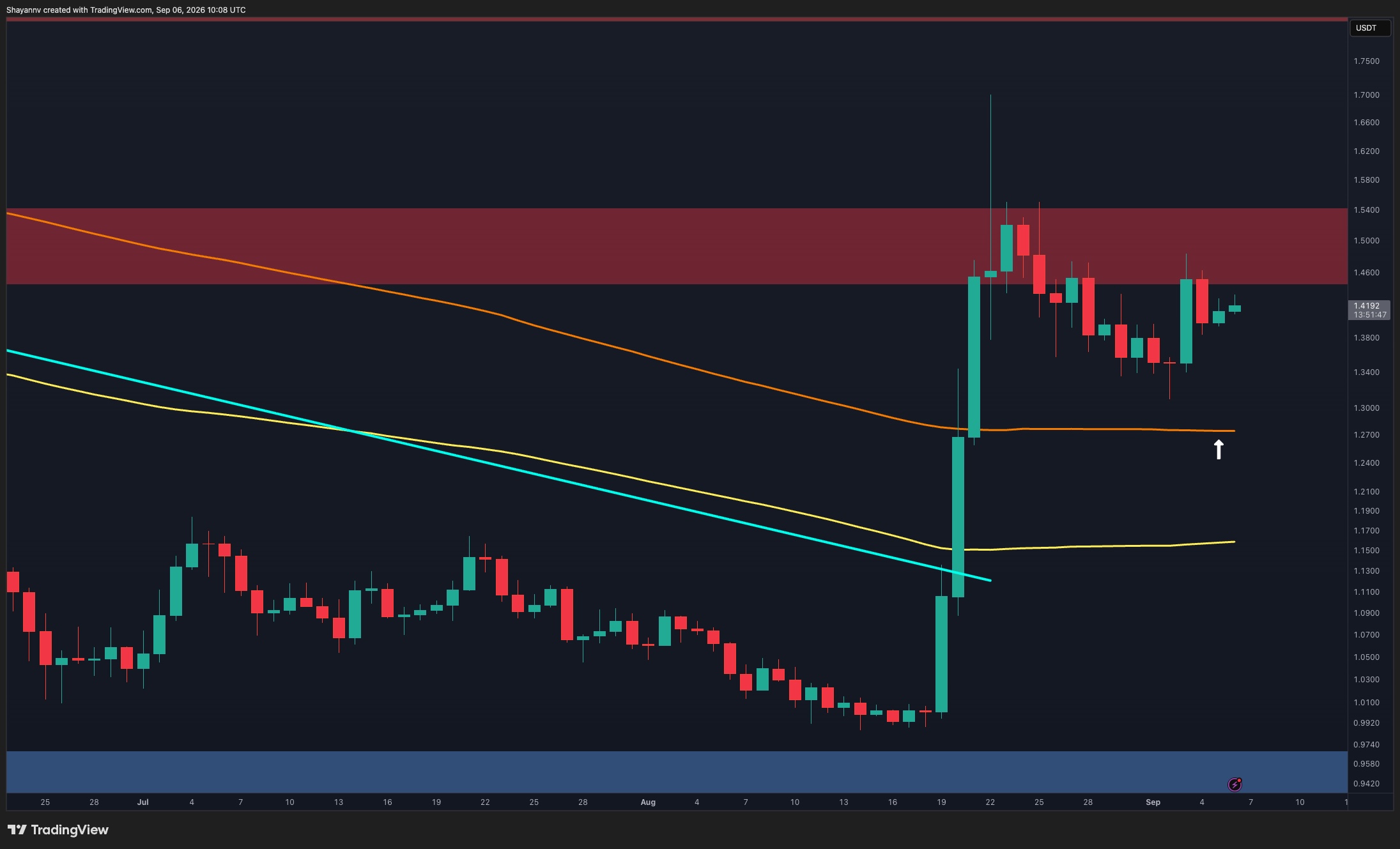
XRP/USDT 4-Hour Chart
The 4-hour chart highlights a descending channel that has contained XRP since the initial surge. The asset has repeatedly failed to break through the channel’s upper boundary, which is now converging with the crucial $1.45-$1.54 resistance zone.
The latest rebound from around $1.34 has brought XRP back toward $1.42, placing it directly beneath this descending resistance. This makes the current area particularly important. A breakout above the trendline followed by a successful reclaim of $1.45 could signal that the corrective structure is ending, with the $1.50-$1.54 zone becoming the next hurdle.
However, another rejection would preserve the descending structure and could send the token back toward $1.34-$1.38. Below there, the channel’s lower boundary is approaching the $1.27-$1.30 region, which overlaps with a clearly defined support zone.
Therefore, XRP remains caught between improving support underneath and persistent resistance overhead. Until the descending channel is broken, the short-term outlook appears more consistent with continued consolidation and potentially another corrective move rather than an immediate bullish continuation.

The post Ripple Price Analysis: Where Is XRP Heading Next Week After Defending Its 200-Day EMA? appeared first on CryptoPotato.
Ethereum is attempting to stabilize after its explosive August breakout, but the follow-through has remained limited. ETH is holding around $2.5K, yet repeated swings within the same range suggest the market is still digesting the rally rather than establishing a fresh directional trend.
Ethereum Price Analysis: The Daily Chart
ETH’s broader structure remains constructive after the powerful breakout from the $1.85K-$1.92K base. Yet, momentum has stalled inside the $2.44K-$2.52K resistance area. Several daily candles have tested this region without producing a sustained breakout, while repeated upper and lower wicks indicate considerable indecision. ETH is currently trading near $2.5K, close to the upper portion of this range.
A clean daily breakout above roughly $2.52K-$2.56K would be required to confirm that buyers have regained control and potentially initiate another impulsive leg higher. Until then, continued consolidation remains the more likely scenario.
On the downside, losing the $2.39K-$2.44K area would weaken the current setup and increase the probability of a deeper correction. In that case, the $2.08K-$2.15K former resistance zone would become the major medium-term support to watch.

ETH/USDT 4-Hour Chart
The 4-hour timeframe shows ETH trapped in a broad consolidation between approximately $2.35K and $2.56K following the vertical advance from below $2K.
The important development is that buyers have repeatedly stepped in near the lower portion of this range. The latest recovery from around $2.38K has carried ETH back toward $2.5K, placing the price once again near the upper resistance region. Yet multiple previous attempts around $2.5K-$2.55K have failed to generate continuation.
Therefore, another rejection could keep the market oscillating inside the existing range. A breakdown below the $2.35K-$2.39K floor would be more consequential and could expose the first major pullback zone around $2.22K-$2.27K.
Conversely, sustained acceptance above $2.52K-$2.56K would invalidate the near-term consolidation scenario and indicate that buyers are ready to resume the broader bullish move.
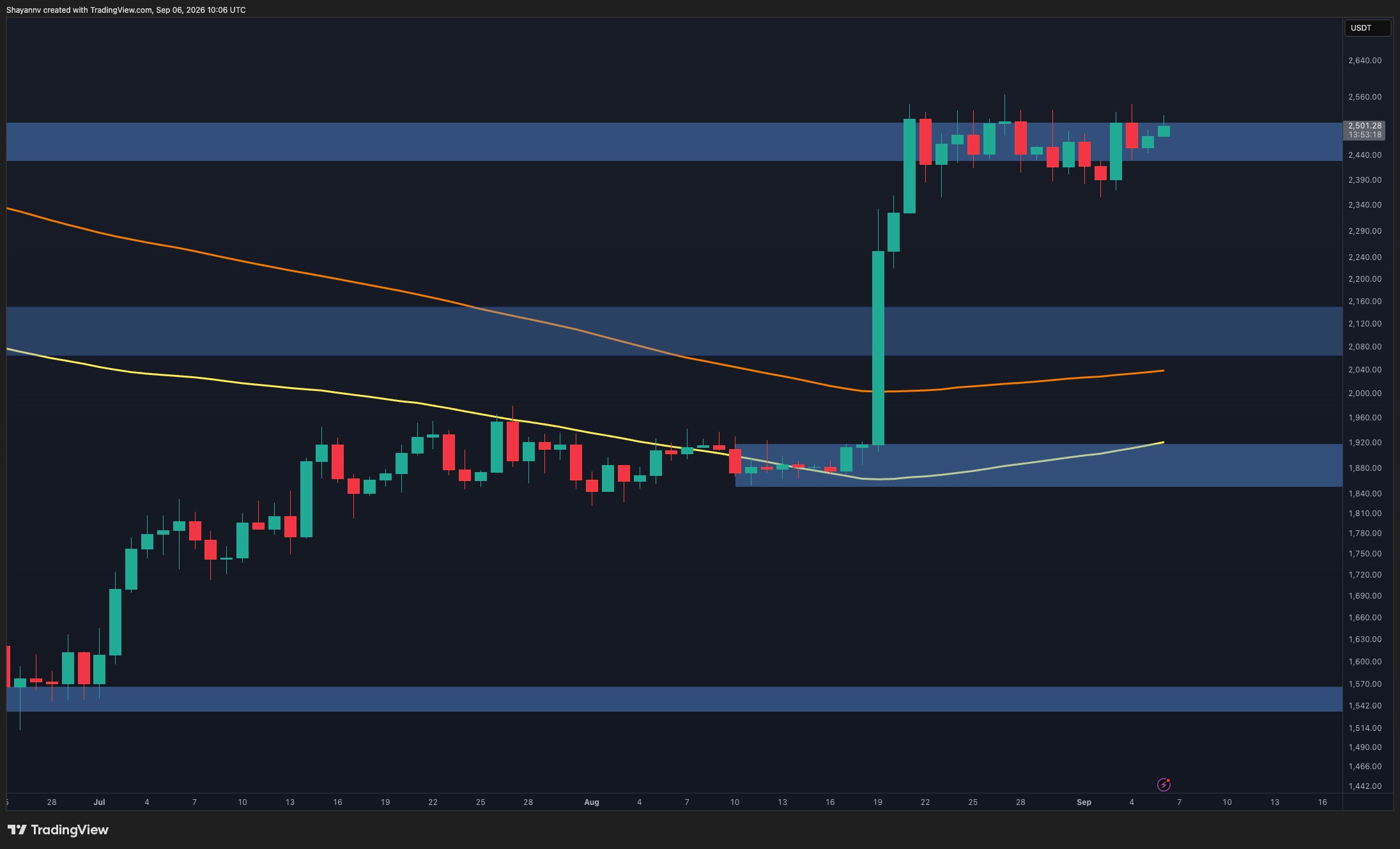
Sentiment Analysis
Ethereum’s Spot Average Order Size provides an important clue regarding the lack of follow-through. The latest observations around $2.4K-$2.5K are predominantly gray, classified as normal-sized orders, while the green whale-order activity visible during earlier portions of the recovery has largely disappeared.
This suggests that ETH’s recent push toward $2.5K has not been accompanied by notable large-player participation. There is also no visible concentration of retail orders in the latest data, pointing to an absence of aggressive positioning from either side.
The lack of dominant whale activity fits well with the price action. With neither substantial large-scale demand nor supply appearing in the metric, ETH may remain prone to low-conviction, choppy movements inside its current range. A renewed appearance of significant whale orders could therefore be an important signal that the consolidation is approaching a more decisive resolution.
The post Ethereum Price Analysis: ETH Consolidates at $2.5K as Whale Participation Stalls appeared first on CryptoPotato.