Cryptocurrency Posts
Crypto Briefing
Nvidia's AGI claim could reshape AI industry standards, emphasizing economic productivity over traditional benchmarks, impacting AI development.
The post Nvidia CEO Jensen Huang declares AGI has arrived for many practical tasks appeared first on Crypto Briefing.
Anthropic's IPO could redefine AI market valuations, but rapid revenue growth raises concerns about sustainability and financial transparency.
The post Potential Anthropic IPO investors seek detailed revenue metrics ahead of blockbuster listing appeared first on Crypto Briefing.
Ethereum's DeFi resurgence, fueled by meme coin interest, highlights shifting retail capital flows and potential volatility in crypto markets.
The post Ethereum sees resurgence as DeFi activity boosts meme coin interest appeared first on Crypto Briefing.
This innovation could democratize access to advanced AI by reducing resource demands, enabling broader deployment without infrastructure changes.
The post Microsoft, Cornell University unveil Free Pause Tokens method for efficient language model training appeared first on Crypto Briefing.
Iran's move may escalate regional instability, affecting global oil markets and complicating diplomatic efforts for U.S.-Iran agreements.
The post Iran to establish restricted zone near Strait of Hormuz amid US tensions appeared first on Crypto Briefing.
Bitcoin Magazine
Bitcoin Magazine
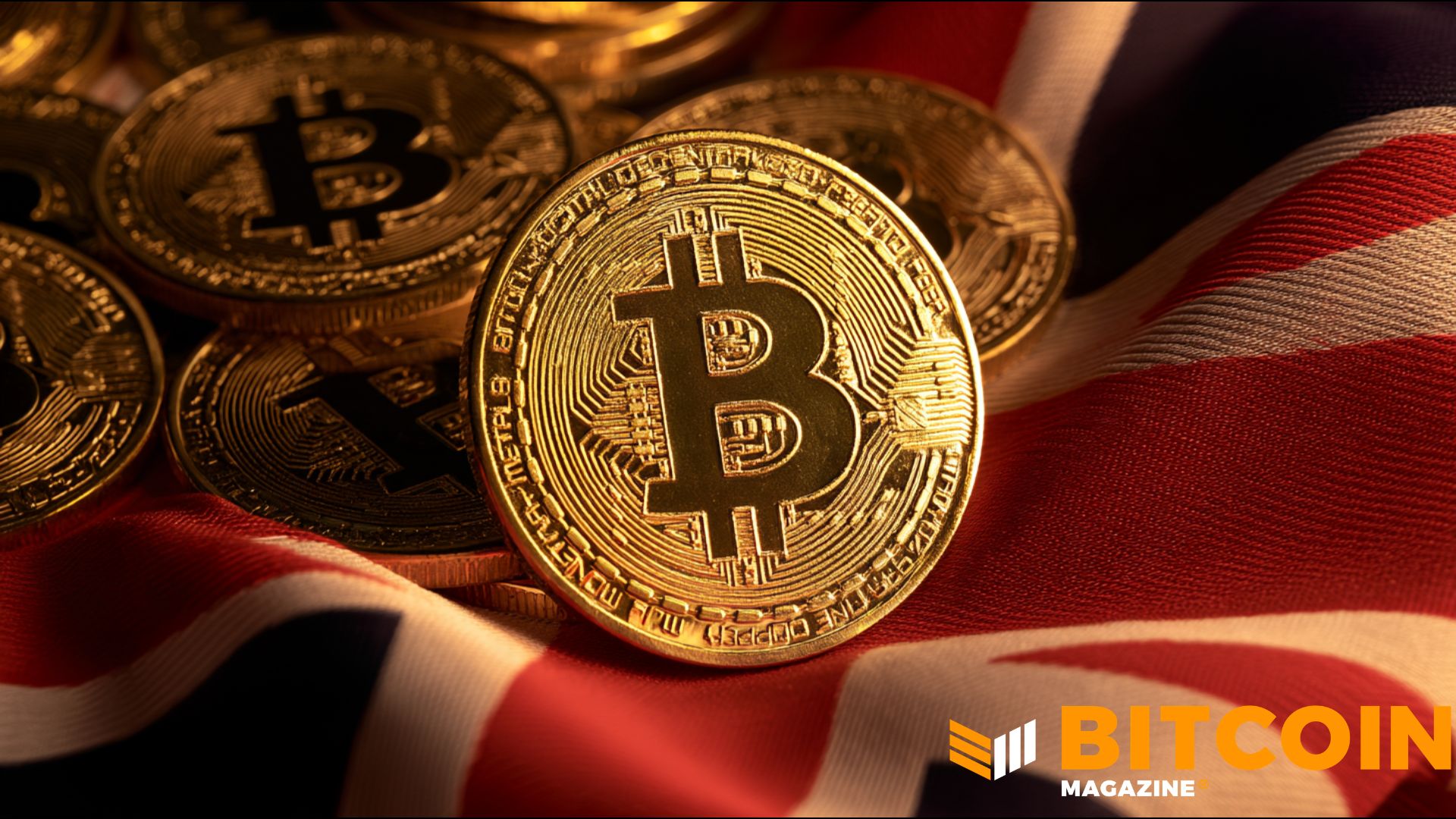
Hargreaves Lansdown Reverses Course, Rolls Out Bitcoin Trading
British financial services firm Hargreaves Lansdown is letting retail investors buy bitcoin — nearly one year after it said the cryptocurrency was “not an asset class.”
The Bristol, UK-based investment firm’s website said it was offering bitcoin and other crypto exchange-traded notes to investors. ETNs are investment funds which trade on stock exchanges and track the prices of digital assets.
It comes after the firm, which manages nearly £173 billion (over $233 billion) in assets, last year warned customers about buying bitcoin.
NEW:
— Bitcoin Magazine (@BitcoinMagazine) September 4, 2026U.K.'s largest investment platform Hargreaves Lansdown is now offering Bitcoin products to 2 million clients!
pic.twitter.com/GgdeHK8vyM
“While longer-term returns of Bitcoin have been positive, Bitcoin has experienced several periods of extreme losses and is a highly volatile investment — much riskier than stocks or bonds,” the firm said at the time.
“The HL Investment view is that Bitcoin is not an asset class, and we do not think cryptocurrency has characteristics that mean it should be included in portfolios for growth or income and shouldn’t be relied upon to help clients meet their financial goals.”
Now, a number of ETNs tracking the price of bitcoin and other cryptocurrencies are available. The firm warns users that “crypto ETNs are considered high-risk and may be volatile.”
U.S. regulator the Securities and Exchange Commission in 2024 approved bitcoin exchange-traded funds for investors after a decade of saying no to the products.
The funds had the most successful debut in the history of ETFs as investors previously unable to buy exposure to the asset class rushed in to buy the products.
Run by top asset managers and banks like BlackRock, Fidelity, and Morgan Stanley, the investment vehicles now collectively manage over $100 billion in assets.
This post Hargreaves Lansdown Reverses Course, Rolls Out Bitcoin Trading first appeared on Bitcoin Magazine and is written by Mathew Di Salvo.
Bitcoin Magazine
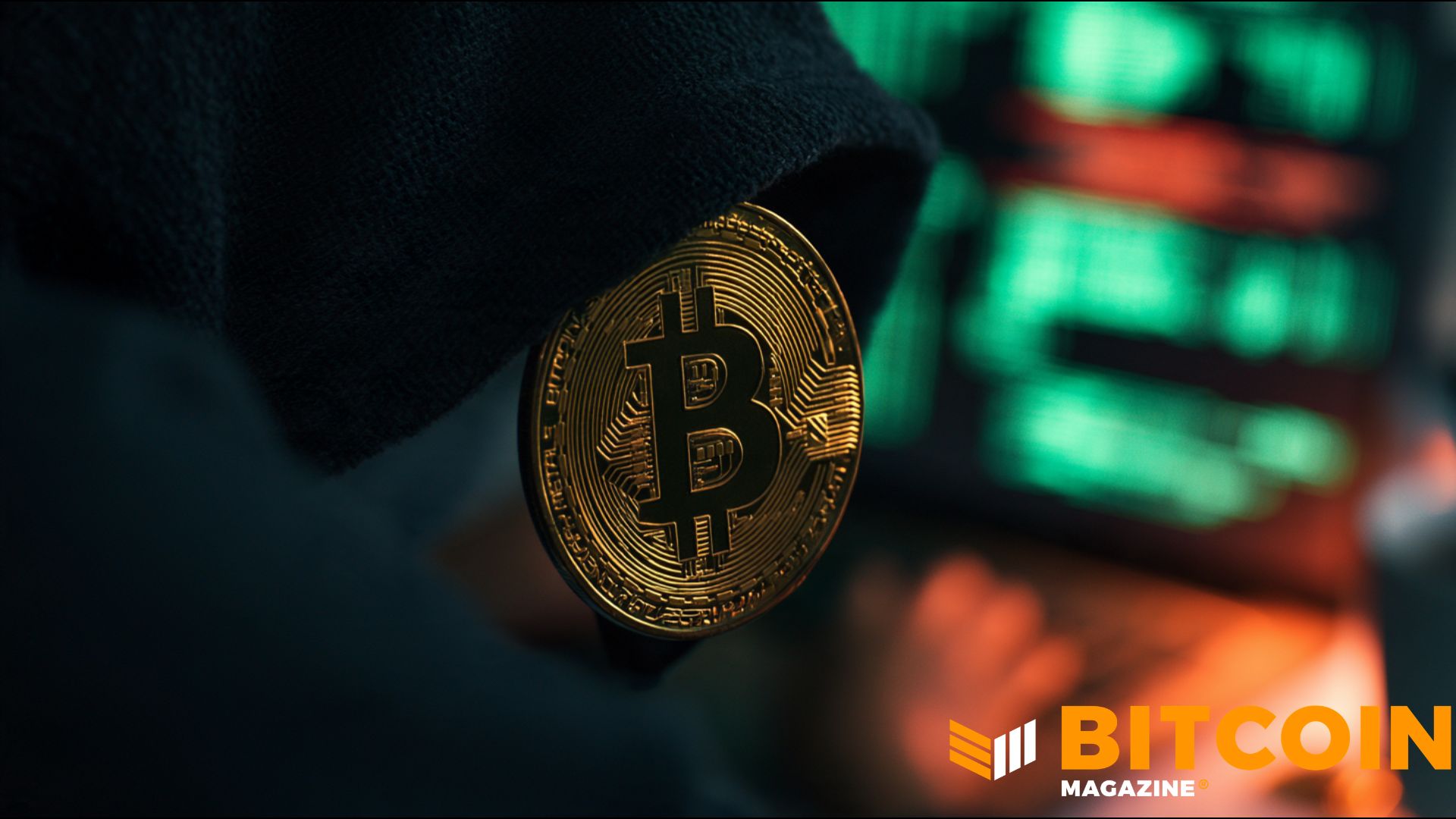
Trezor Breach Worse Than Reported: Another 67,000 US Customers Exposed
Hardware wallet manufacturer Trezor has said that a data breach first announced last month is worse than originally reported.
The Prague, Czech Republic-based company said Friday that an additional 67,000 U.S. customers had their names, emails, phone numbers, shipping addresses and order numbers leaked. The leaked data came from orders made between November 2019 and August 2021, according to Trezor.
Trezor first announced in August that data from 11,742 customers from the U.S., UK, Sweden, Colombia, Brazil, Italy, and Portugal had been exposed — with names, emails, phone numbers and shipping addresses leaked.
Another 1,947 customers just had their names, cities and emails exposed in the breach.
In Friday’s announcement, Trezor said that its third-party fulfillment partner, ShipMonk, had falsely reassured the company about deleting customer data.
“Throughout our entire relationship with ShipMonk, we repeatedly requested and received written assurance confirming the deletion of the data, in line with our contract, data policy, and past communications,” Trezor wrote.
“We are very disappointed that, despite receiving this confirmation, the data was not deleted in their systems.”
Neither Trezor nor ShipMonk immediately responded to Bitcoin Magazine’s questions.
Trezor first announced in August that the data had been leaked because ShipMonk experienced “unauthorized access to their systems containing customer data.”
The company added that it had directly emailed all customers involved in the breach. Trezor’s parent company, SatoshiLabs, told Bitcoin Magazine last month that it was investigating the incident.
Trezor is one of the most popular Bitcoin hardware wallet solutions, and also has support for storing other cryptocurrencies.
Bitcoiners’ personal data has been targeted by cybercriminals in the past: back in 2020, an unauthorized party accessed popular hardware manufacturer Ledger’s e-commerce and marketing database, leaking over 1 million email addresses and the personal contact data of nearly 10,000 customers.
At the start of this year, customers reported receiving emails from Global-e, Ledger’s payment partner, that a data breach at its cloud systems leaked sensitive customer data.
This post Trezor Breach Worse Than Reported: Another 67,000 US Customers Exposed first appeared on Bitcoin Magazine and is written by Mathew Di Salvo.
Bitcoin Magazine
El Salvador Isn’t Buying Bitcoin With Public Money, Says IMF
El Salvador has not used public funds to accumulate bitcoin since the International Monetary Fund’s last review of its loan program, the fund said Thursday.
In a report Thursday, the body said that the Central American country had instead received bitcoin from private donations, citing documentation from the government. It added that “no further Bitcoin accumulation beyond the documented donations is expected.”
El Salvador made headlines in 2021 when it became the first country in the world to make bitcoin legal tender. Salvadoran president Nayib Bukele in 2022 said the country would buy one bitcoin per day but it was never clear where the money was coming from — or if he was actually buying at all.
“Documentation has been provided verifying that Bitcoin accumulation since the first review reflects private donations and that no public resources were used,” the IMF release said.
“Understandings were also reached on steps to modernize the legal, regulatory, and supervisory framework for digital assets and to further strengthen the governance and risk-management arrangements for public-sector crypto-asset holdings. Going forward, no further bitcoin accumulation beyond the documented donations is expected.”
The report added that public participation in the government-sponsored bitcoin wallet has been largely wound down, with majority ownership and operational control handed to a private operator.
El Salvador in 2021 debuted a state-sponsored wallet called Chivo for its citizens as part of its plan to increase bitcoin adoption in the country.
“IMF staff thank the Salvadoran authorities for the constructive discussions and excellent collaboration,” the report added.
The IMF El Salvador entered a $1.4 billion loan agreement at the end of December but the fund asked for the country to scale back certain aspects of its bitcoin strategy.
Institutions like the World Bank and the IMF have long criticized President Bukele’s Bitcoin law, which also asked businesses to accept the cryptocurrency if they had the technological means to do so.
President Bukele in 2024 admitted that Salvadorans weren’t using the cryptocurrency to buy things as expected, but always boasted that the government was still stacking sats.
Since launching a crime crackdown to tackle the country’s notorious crime gangs, murder rates in El Salvador have plunged. The country was once the most dangerous place in the Americas but President Bukele is now trying to turn it into a tech hub.
Crypto companies like Tether have since relocated to its capital, San Salvador.
This post El Salvador Isn’t Buying Bitcoin With Public Money, Says IMF first appeared on Bitcoin Magazine and is written by Mathew Di Salvo.
Bitcoin Magazine

Bitcoin Dips Below $80,000 on Strong US Jobs Report
Bitcoin slid Friday after a better-than-expected labor report showed that the U.S. job market accelerated in August.
The leading cryptocurrency was recently trading for close to $79,764 after dropping as low as $78,706 earlier in the morning in New York. It’s currently down over 1% over a 24-hour period. On Thursday, the coin soared above $82,000.
The Federal Reserve is typically more likely to raise interest rates when the labor market is strong, because more people employed means more spending, and more spending can push inflation up.
Federal Reserve Chair Kevin Warsh last week gave his first major speech as head of the U.S. central bank and said he had “more work to do” to fight inflation. Bitcoin has typically done well in a low-interest rate environment.
Traders currently view a U.S. Federal Reserve interest rate hike at the upcoming September 15–16 policy meeting as roughly a 50% to 60% probability.
But U.S. President Donald Trump on Friday demanded the Federal Reserve slash interest rates.
Writing on his social media platform Truth Social, Trump said: “Lower the interest rates because the U.S.A. is a much stronger credit than it was just a short time ago!”
He added: “We should have the LOWEST RATE of any country in the World, like ‘the old days.'”
Bitcoin has decoupled from stocks recently as investors have renewed concerns around dollar debasement.
The cryptocurrency started surging last month, after the U.S. Treasury Department said it would more than double the size of its government debt repurchases. The coin had its best run in three years and third best August ever.
The much-talked about debasement trade is back in the spotlight, and bitcoin has been trading in lockstep with gold, according to analysts. The so-called debasement trade is when investors buy an asset as a way to hedge against a currency losing value.
News dropped last month that U.S. public debt exceeded $40 trillion for the first time too. Excessive debt also undermines confidence in the dollar, making assets like bitcoin and gold attractive.
This post Bitcoin Dips Below $80,000 on Strong US Jobs Report first appeared on Bitcoin Magazine and is written by Mathew Di Salvo.
Bitcoin Magazine
National Sheriffs’ Association Drops Opposition to Clarity Act
The National Sheriffs’ Association this week dropped its opposition to the crypto Clarity Act, after having previously warned that the proposed bill could help criminals.
Writing Thursday to Senate Majority Leader John Thune and Minority Leader Chuck Schumer, the association said it was changing its stance to neutral given how complex the issue is.
A number of lawmakers were hoping to vote on the Clarity Act in August. After a delay, a vote will now go ahead this month. The bill will establish a framework for distinguishing between digital assets that are securities, commodities or payment stablecoins — legislation that the crypto industry has long called for.
“Given the complexity of the legislation and the number of important details that remain under consideration, the NSA is changing its position on the Clarity Act to neutral,” the letter from NSA President Sheriff Troy Wellman and Executive Director Justin Smith read.
JUST IN: Major U.S. law enforcement organization National Sheriffs’ Association no longer opposes The Clarity Act
— Bitcoin Magazine (@BitcoinMagazine) September 4, 2026
“We believe the most appropriate course is to step back and allow the legislative process to proceed to establish a…much needed regulatory framework.”pic.twitter.com/NBpKlrUsUj
“At this time, we believe the most appropriate course is to step back and allow the legislative process to proceed to establish a clear, effective, and much needed regulatory framework.”
The NSA had previously warned that the bill could create regulatory and anti-money laundering loopholes by exempting certain crypto developers and infrastructure providers from money transmitter rules.
Despite being passed in the house of representatives last year with strong bipartisan support, the Clarity Act has been in a deadlock for much of 2026. The banking lobby raised concerns over stablecoin yield and some lawmakers have said improvements need to be made surrounding ethics.
An updated bill of the Clarity Act was introduced in July that addressed some of these concerns — banning government officials and their families from issuing or promoting crypto.
Pro-crypto senator Cynthia Lummis wrote on Friday that the “bipartisan bill” gives “law enforcement real tools to fight the illicit finance crimes hurting hard working Americans.”
Major financial institutions, lawmakers and companies have said they support the latest draft of the new bill, but some Republicans have accused Democratic lawmakers of deliberately playing politics and holding the bill back.
This post National Sheriffs’ Association Drops Opposition to Clarity Act first appeared on Bitcoin Magazine and is written by Mathew Di Salvo.
CryptoSlate
Bitcoin's current rally started when the Treasury Department announced on Aug. 19 that, beginning Sept. 9, it would at least double the maximum size of certain buyback operations for government bonds with 10 to 30 years left to maturity, raising the cap from $2 billion to $4 billion per operation.
Simply put, the Treasury was offering to buy more older long-term bonds from dealers that wanted to sell them.
Later that day, the Federal Reserve released minutes from its July meeting, where three members had voted for a quarter-point rate increase, and many others thought another hike would be needed if inflation failed to retreat.
The central bank kept its target range at 3.50% to 3.75%, though the debate had already moved from how long rates should stay high to whether they should go higher.
At first, Washington seemed to be pushing bond markets in two directions. The Fed was trying to make money more expensive across the economy, while Treasury debt managers were trying to make older long-term government bonds easier to trade.
They have different jobs, though borrowers and investors experience both at once, as they affect everything from mortgage pricing to Bitcoin.
| Institution | Recent action | Direct market channel | What investors feel | Bitcoin relevance |
|---|---|---|---|---|
| Federal Reserve | Held rates at 3.50%–3.75%, while some officials favored another hike | Short-term money, real yields, dollar strength | Higher opportunity cost for risk assets | Pressure on BTC as a no-yield asset |
| Treasury | Raised selected long-bond buyback caps from $2B to $4B | Long-bond market liquidity and dealer balance sheets | Easier trading in older bonds, not lower debt supply | Liquidity support, but not a direct BTC tailwind |
| Private investors | Reprice 10- to 30-year debt | Term premium, inflation risk, fiscal risk | Higher long-term yields | Competes with BTC in the short run, supports fiscal-hedge narrative in the long run |
The 30-year Treasury yield closed at 5.28% on Aug. 18, fell to 5.19% on the announcement day, then returned to 5.27% by Sept. 2, according to the Treasury's daily yield data. Other forces were moving yields during those two weeks, and the larger buybacks hadn't begun, so the round trip can't be credited to the Treasury alone.
What it does show is that the announcement produced no lasting repricing of what investors charged to lend the government money for a generation.
The Treasury yield curve has two governments
Interest rates often get discussed as if the Fed chooses one number and the rest of finance just updates their own. That's partially true only at the shortest end of the market, where the central bank pays interest on reserve balances and uses overnight operations to keep the federal funds rate inside its chosen range.
The July implementation note set the rate paid on reserve balances at 3.65%, giving banks little reason to lend overnight for much less.
The 30-year Treasury yield, however, comes from a much more complex set of factors. Investors start with an estimate of where short-term rates might average across the coming decades, account for inflation, then demand extra compensation for locking up money while federal borrowing and the economy move in ways nobody can accurately predict.
Economists call that final piece the term premium, simply the price of waiting a very long time.
The distinction helps explain the recent bond selloff because the Fed minutes said nominal Treasury yields had gained 25 to 30 basis points during the July meeting window, driven mainly by higher real rates.
Inflation expectations moved much less, so investors demanded a better return once inflation was stripped out. Markets had also priced a quarter-point increase by the September Fed meeting and another by the end of the first quarter of 2027.
Bitcoin feels that change quickly because real yields tell investors how much they can earn while taking very little credit risk. Bitcoin offers no return, so a government bond offering a generous return above inflation makes holding it more expensive by comparison.
The same math reaches technology shares valued on profits many years away, since higher real yields give those future earnings a harsher discount in today's dollars.
Treasury has a different problem because Congress decides how much the federal government spends and collects in taxes, leaving debt managers to finance the gap, refinance maturing securities, and keep US government debt functioning as the world's main pool of collateral.
Treasury expects $739 billion of privately held net marketable borrowing from July through September, followed by another $628 billion from October through December. Its debt office has to move an enormous volume of securities into private hands while keeping older bonds from becoming awkward and expensive to trade.
The separation between the two institutions gets even stranger once the Fed's own purchases enter the picture. It buys Treasury bills and, when needed, other government securities with three years or less to maturity so the banking system keeps an ample supply of reserves.
Those purchases can coexist with a restrictive policy rate, allowing the Fed to supply overnight money while keeping it expensive, just as the Treasury can support trading in long bonds while issuing far more debt than it repurchases.
The key is maturities: the Fed sets the price of short money, the Treasury sets the volume and composition of federal debt, and private investors connect the two by deciding how much compensation they require at every point in between.
A $4 billion umbrella in a $739 billion rainstorm
Treasury buybacks sound more powerful than they are because they make it sound like debt disappears.
However, the operation is closer to exchanging one shape of debt for another: Treasury sells new benchmark securities, uses some of its cash to repurchase older issues, and gives dealers room to move inventory that has become harder to trade.
Newer bonds serve as current benchmarks, while older, off-the-run bonds can drift away from nearby prices and consume scarce room on dealer balance sheets.
The government still owes the replacement debt, and Treasury says buybacks should have little effect on net marketable borrowing because new issuance replaces the securities being repurchased.
The program can make older bonds easier to trade and reduce the risk that dealers retreat during a volatile session, while leaving the broad supply of federal obligations largely intact.
That also separates the program from quantitative easing because when the Fed expands its balance sheet, it creates reserve balances and buys securities as part of monetary policy.
Treasury spends cash from its own account and replenishes that cash through taxes or borrowing, so its buyback rearranges the government's liabilities while leaving the supply of central-bank money unchanged.
The difference becomes easier to see at full scale because Treasury's Aug. 5 refunding plan contemplated as much as $38 billion of off-the-run purchases for liquidity support during the quarter and another $25 billion of short-maturity purchases for cash management.
Two weeks later, Treasury raised the cap on selected long-end operations and is yet to publish a revised quarterly total. The same refunding plan included a $125 billion package of new 3-, 10-, and 30-year debt, while the department projected hundreds of billions in net borrowing.
A $4 billion operation can help dealers digest a difficult corner of the market, though the much larger supply of debt keeps setting the background price.
| Treasury figure | Amount | What it represents | Market meaning |
|---|---|---|---|
| Previous selected long-end buyback cap | $2B per operation | Earlier maximum for certain 10- to 30-year buybacks | Liquidity tool, limited scale |
| New selected long-end buyback cap | $4B per operation | Doubled cap beginning Sept. 9 | More room to support off-the-run bonds |
| Planned off-the-run liquidity purchases | Up to $38B for the quarter | Buybacks intended to improve Treasury-market functioning | Helps market plumbing |
| Short-maturity cash-management purchases | Up to $25B for the quarter | Treasury cash-management operations | Liability reshaping, not QE |
| July–September private net marketable borrowing | $739B | New borrowing need | Dominates the market backdrop |
| October–December projected borrowing | $628B | Next quarter’s expected borrowing wave | Keeps supply pressure alive |
Long-term yields also absorb several forces at once, with federal deficits competing for a finite pool of savings while the AI buildout pulls vast sums toward data centers and power generation. Investors have to price decades of inflation and political risk, while dealers and foreign reserve managers operate with their own limits.
The 30-year yield compresses all of that uncertainty into one quote, which helps explain why neither the Fed nor Treasury can control it on their own.
Bitcoin gets both versions of the dollar
Bitcoin usually feels the Fed side first because a higher expected policy path makes cash more attractive, supports the dollar, and raises the cost of holding leveraged crypto positions.
Kevin Warsh's less predictable Fed showed how a surprise increase could force traders to reprice monetary policy in a hurry. A high real return on government debt also creates a daily opportunity cost for owning an asset with no contractual income.
Treasury reaches Bitcoin through liquidity and fiscal credibility, since heavy issuance draws cash toward government auctions and, depending on the Treasury General Account and reserve conditions, can leave less balance-sheet room for risk.
An examination of the $739 billion borrowing wave explains why the buyback program can sound large while its net cash effect stays modest.
Across a longer horizon, persistent deficits and a larger federal interest bill can strengthen the case for holding a scarce asset outside the sovereign balance sheet.
That moves much slower than a bond selloff. Bitcoin can trade like a long-duration risk asset during a week when real yields jump, then draw support across years from investors who distrust the fiscal path that helped push those yields upward.
| Scenario | Rates and yields | Treasury-market backdrop | Likely Bitcoin interpretation |
|---|---|---|---|
| Base case | Real yields stay elevated but stable | Heavy issuance continues, buybacks support liquidity at the margin | BTC remains range-bound, pulled between opportunity cost and fiscal-hedge demand |
| Bull case | Real yields fall or Fed hike expectations fade | Debt concerns persist, but liquidity conditions ease | BTC benefits as risk appetite improves and fiscal-hedge demand remains intact |
| Bear case | Real yields rise further | Treasury supply keeps term premium elevated | BTC trades like a long-duration risk asset and faces valuation pressure |
| Stress case | Yields spike disorderly or liquidity worsens | Buybacks prove too small to calm market plumbing | BTC may sell off with risk assets first, then regain attention as a sovereign-balance-sheet hedge |
All this tells us to see the curve as one connected system. The 2-year yield carries much of the expected Fed path, while the 10- and 30-year yields add debt supply and term compensation.
Real yields show Bitcoin's opportunity cost, the Treasury General Account tracks cash moving between markets and the government, and bank reserves show how much funding room the financial system has.
Washington controls important pieces of that system. The Fed can make overnight dollars dearer, and the Treasury can decide which bonds to issue or repurchase. The long end still belongs to investors willing to part with money for decades.
Bitcoin now trades inside that market, receiving monetary restraint from one part of Washington and a fiscal sales pitch from another.
The post Bitcoin’s faces a weird new macro reality as the Fed turns off the tap and Treasury opens the floodgates appeared first on CryptoSlate.
Bitmine is still buying Ethereum, even as staking may make further purchases unnecessary to reach its 5% ownership target.
The Nasdaq-listed treasury company disclosed that it acquired 53,501 ETH in the week through Aug. 30, taking its holdings to 5.9 million tokens. More than 5.06 million ETH were already staked at an annualized seven-day yield of 2.67%.
The buying appears to have continued almost immediately.
On Sept. 1, blockchain analysis platform Lookonchain said wallets linked to Bitmine appeared to acquire another 51,000 ETH worth about $126 million from FalconX and BitGo. Bitmine had not formally confirmed that transaction in its latest corporate disclosure.
If the on-chain attribution is correct and the transfer represents an incremental purchase, Bitmine would hold roughly 5.95 million ETH. That would leave it considerably closer to its publicly stated goal of owning 5% of Ethereum.
Yet the size of the company’s existing position means buying may no longer be the only way to get there.
Bitmine had 5,067,309 ETH staked as of Aug. 30. Holding that balance and the disclosed yield constant would produce roughly 135,000 ETH in staking rewards over a modeled year.
At that scale, staking income itself can become a major acquisition engine.
Staking can finish what buying started
Using Bitmine’s own benchmark of 120.7 million ETH in circulation, owning 5% would require about 6.035 million tokens.
Against its officially disclosed 5.9 million ETH balance, Bitmine was about 134,000 ETH short, almost exactly equal to one year of modeled staking rewards. On that snapshot, the company would need to retain nearly 99% of those rewards to finish above 5% within a year if Ethereum supply stayed flat.
The reported Sept. 1 purchase would change that math substantially.
Adding another 51,000 ETH would reduce the gap to about 83,000 tokens using the same 120.7 million supply benchmark. Under the same fixed-yield, flat-supply assumptions, roughly 61% of one year’s modeled staking rewards would be enough to close it.
That illustrates why Bitmine can continue buying aggressively while becoming progressively less dependent on those purchases.
However, Ethereum’s expanding supply complicates that path because every increase in the network’s token count raises the amount Bitmine must hold to preserve a 5% share.
Etherscan showed roughly 122.02 million ETH outstanding on Sept. 5. Holding Bitmine’s Aug. 30 balance constant against that larger denominator would put its illustrative ownership share around 4.84% and widen the gap to nearly 200,000 ETH.
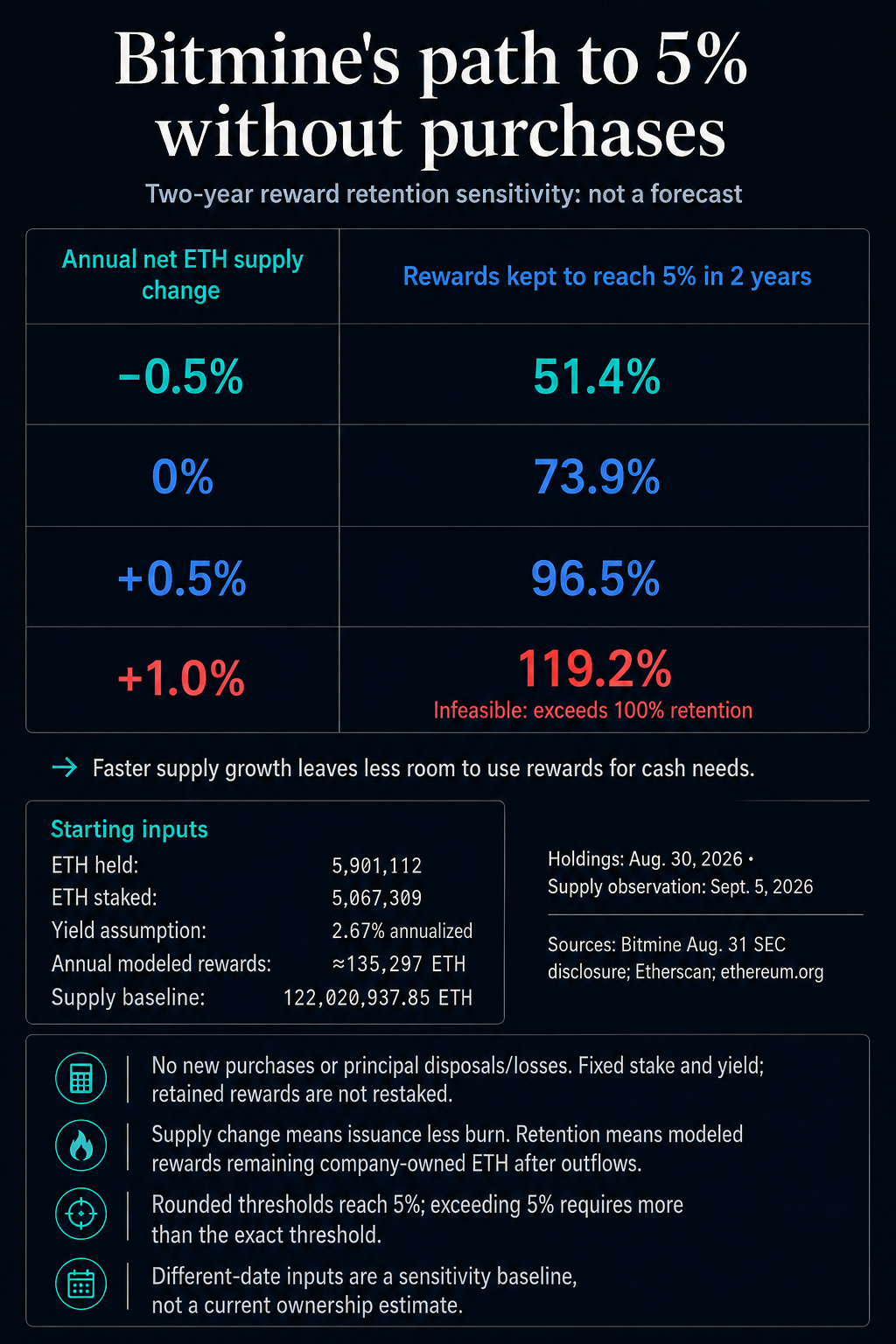
Over two years, relatively small supply changes have a large effect. Using the official Aug. 30 holdings and staking balance, Bitmine would need to retain about 74% of modeled rewards if ETH supply stayed flat.
At 0.5% annual supply growth, the requirement rises to roughly 96.5%. At 1% growth, even retaining every modeled reward would fall short without additional purchases.
| Assumed annual net ETH supply change | Reward retention needed to reach 5% after two years |
|---|---|
| −0.5% | About 51.4% |
| 0% | About 73.9% |
| +0.5% | About 96.5% |
| +1.0% | About 119.2%; not achievable under these assumptions. |
A lower staking yield would tighten the constraint further. At 2%, modeled annual rewards fall to roughly 101,000 ETH, pushing the flat-supply two-year retention threshold to almost 99%.
The harder question is how much ETH Bitmine keeps
For Bitmine, the path to 5% therefore increasingly becomes a capital-allocation decision rather than simply an acquisition target.
The company has disclosed that it periodically converts ETH-denominated staking rewards into US dollars and has not committed to a fixed percentage to keep on its balance sheet.
Every reward retained increases its Ethereum holdings without requiring another market purchase. Every reward converted into cash can instead support operating expenses and shareholder commitments.
Bitmine’s management agreement with Ethereum Tower includes reward-linked compensation as well as infrastructure and custody costs. The company has also declared 17 cash dividends on its BMNP preferred stock, with scheduled payments running through late December.
Its quarterly filing warns that changes in ETH prices and staking yields can affect its ability to fund operations and preferred dividends. Because staking rewards arrive in ETH, meeting those obligations can require selling tokens that would otherwise push the treasury closer to 5%.
That changes what investors should watch next. The key disclosure is no longer just how much ETH Bitmine buys, but how much of the ETH it earns the company actually keeps.
The post How Bitmine could surpass its 5% Ethereum goal without buying more ETH appeared first on CryptoSlate.
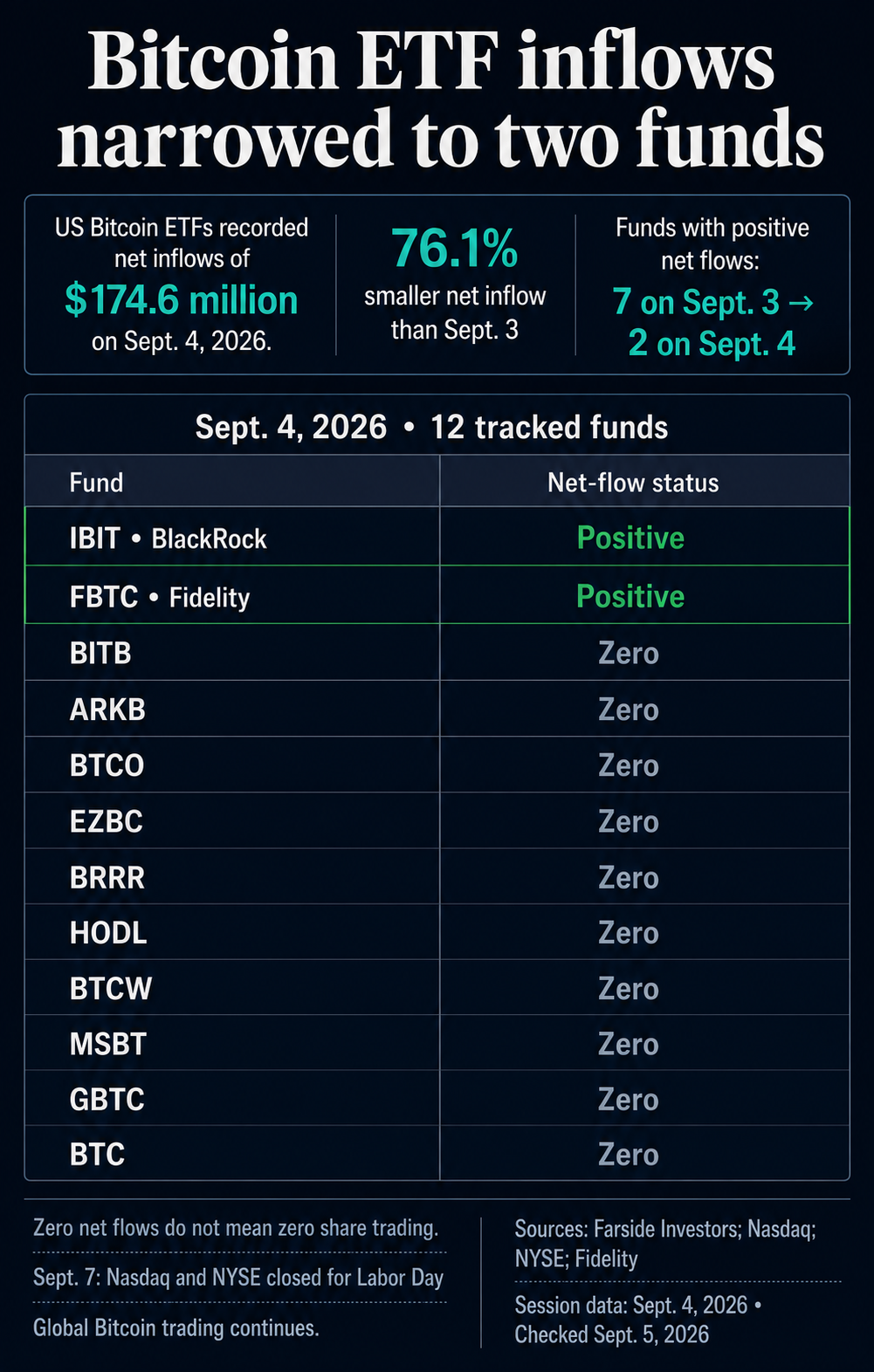
US spot Bitcoin exchange-traded funds recorded net inflows of $174.6 million on Friday, Sept. 4, 2026.
Only funds from BlackRock and Fidelity attracted positive net flows, according to Farside Investors' daily table, leaving the final US exchange session before Labor Day's closure dependent on two products for its net inflow.
The total was 76.1% below Thursday's net inflow of $730.8 million on Sept. 3. Positive flows narrowed from seven of the 12 tracked funds to two. The slowdown followed the Bitcoin and Ethereum ETF surge in the preceding session, with Friday's Bitcoin result smaller and less broadly shared across funds.
Thursday's seven positive funds were IBIT, FBTC, BITB, ARKB, MSBT, GBTC and BTC. By Friday, the five products beyond BlackRock and Fidelity in that group had all moved to zero net flows.
BlackRock's iShares Bitcoin Trust ETF, or IBIT, recorded net inflows of $117.4 million. The Fidelity Wise Origin Bitcoin Fund, or FBTC, recorded net inflows of $57.2 million. Those were the only positive entries in Farside's Sept. 4 row.
The other ten products each showed zero net flows: BITB, ARKB, BTCO, EZBC, BRRR, HODL, BTCW, MSBT, GBTC and BTC. None recorded a net outflow. The smaller positive total therefore signals a slower pace of money entering the group, rather than net withdrawals from it.
A zero net-flow reading does not mean a fund's shares went untraded. Fidelity explains that investors can buy and sell these products during stock-market hours, while authorized participants create and redeem fund shares. Those are separate activities: shares can change hands between investors without that trade itself creating or redeeming fund shares. The flow table measures the net result at fund level, rather than the volume of trading in its shares.
Bitcoin ETF inflows await Tuesday's next session
Both Nasdaq and the NYSE list Monday, Sept. 7, as closed for Labor Day, making Tuesday, Sept. 8, the next scheduled regular session. Friday's figures will remain the latest completed US exchange-session reading through the holiday break.
The closure does not stop global Bitcoin trading. Fidelity's comparison of direct crypto and exchange-traded products distinguishes direct crypto trading that may be available around the clock from funds that trade during stock-market hours. The holiday calendar limits that exchange-traded route, rather than shutting the underlying market.
Friday's figures do not identify the investors behind the flows or establish that a price move or payroll release caused the slowdown. The next completed session will show whether Bitcoin ETF inflows spread beyond IBIT and FBTC again; a single session cannot establish a lasting demand trend.
The post Bitcoin ETF inflows fall 76% entering Labor Day break as only BlackRock and Fidelity attract fresh money appeared first on CryptoSlate.
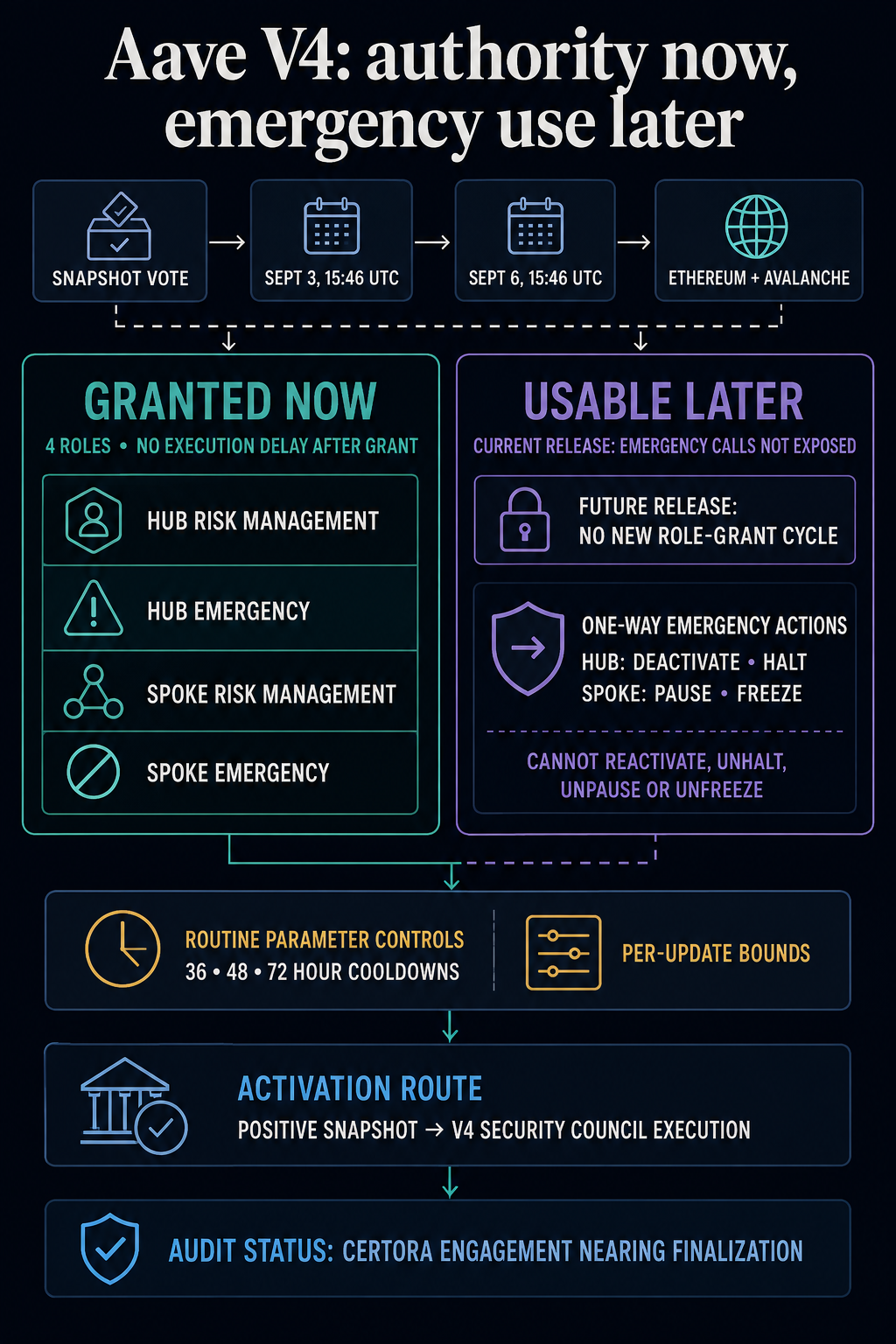
Aave DAO voters are deciding whether to delegate limited V4 risk controls on Ethereum and Avalanche to Risk Stewards, tools that let approved operators make constrained changes without taking every update through a full governance vote. The proposal would also assign no-delay emergency roles that the current steward software cannot use.
The Snapshot vote opened Sept. 3 at 3:46 p.m. UTC and is scheduled to close today, Sept. 6, at the same time. Approval would not activate the system by itself. Aave Labs said the corresponding payloads would still need to be executed through the V4 Security Council.
The code is also not being presented as fully audited. In its governance proposal, Aave Labs said the Risk Steward contracts were undergoing a Certora audit and that the engagement was nearing finalization.
The proposal's central tension is between authority assigned now and functionality available later. Each Risk Steward would receive Hub and Spoke risk-management roles plus Hub and Spoke emergency roles. Those four roles would have no execution delay after they are granted.
However, the release under consideration calls none of the emergency selectors, and the current steward documentation does not expose those methods. The emergency permissions would remain inert until a future release adds support. Assigning the roles now would allow that later version to respond to an emergency without waiting through another governance cycle for access.
The wider permission redesign would split each V4 instance's Hub and Spoke configurator controls into five granular categories: two flag-control roles, a listing role, an emergency role and a risk-management role. Selectors outside those categories would remain with residual domain-admin roles. Existing domain admins would receive the new roles so their current reach is preserved.
The proposed role definitions limit the emergency category to one-way safety actions. Hub calls can deactivate or halt assets and Spokes. Spoke calls can pause or freeze individual reserves or all reserves. Those functions cannot reactivate, unhalt, unpause or unfreeze the affected market. The separate flag-control roles, which can change states in both directions, would not be granted to the Risk Stewards.
Routine parameter updates would operate under different controls. The proposal sets minimum cooldowns of 36, 48 or 72 hours, depending on the parameter, and caps how far each update may move it. The same bounds would apply on Ethereum and Avalanche and cover interest-rate settings, collateral factors, liquidation settings and oracle caps. They do not constrain the emergency selectors.
That separation explains why the plan can combine slower bounded maintenance with immediate emergency authority on paper. It also creates an accountability question because the zero-delay roles would be in place before the steward can exercise them. Forum participants asked for public rationales, post-action reports, periodic reviews and reporting on the frequency and size of steward actions. None of those measures is a requirement in the current proposal.
If the Snapshot passes and the Security Council executes the payloads, the immediate change would be no-delay access to bounded parameter controls. The one-way emergency powers would be pre-positioned for a future steward release, but they would not yet be usable.
The post Aave crypto lending proposal would let emergency tools freeze markets – but not unfreeze them appeared first on CryptoSlate.
Bitcoin's best and newest large buyer has no face, no investment committee, and no public opinion about whether the price looks cheap.
It appears near the end of the US trading day as an entry beside an ETF ticker, and on Aug. 27 that entry showed $277.6 million flowing into IBIT while the entire US spot Bitcoin fund category saw $242.3 million in inflows.
That means the other products combined lost $35.3 million, leaving BlackRock's fund to carry the group through a difficult day.
The same pattern becomes much more interesting when you look across the market's full history.
From the January 2024 launch through Sept. 3, 2026, IBIT collected over $63.9 billion in cumulative net inflows, according to Farside Investors' fund ledger. The entire group, including IBIT, kept $55.5 billion, and subtracting one from the other leaves every fund outside IBIT with a combined $8.4 billion in net outflows.
That gives IBIT 115.2% of the category's net inflow, a percentage that sounds impossible until you include the withdrawals elsewhere.
If one person puts $115 on a table while everybody else removes a combined $15, the table ends with $100. IBIT is the person adding money, and the category total is what stays on the table.
The ledger shows that IBIT brought in enough to cover those withdrawals at the category level.
That's the case for treating one ETF as Bitcoin's buyer of last resort. IBIT has supplied every dollar the US fund group retained, plus enough to offset the net exits from all of its rivals.
The comparison has a firm limit because a central bank serving as a buyer of last resort has a public mandate and can create money, while IBIT expands only when investors ask for more shares. Its backstop comes from the repeated behavior of a large crowd, with BlackRock providing the vehicle.
| US spot Bitcoin ETF flows through Sept. 3, 2026 | Net flow |
|---|---|
| BlackRock's IBIT | $63.939 billion |
| Entire US spot Bitcoin ETF group | $55.512 billion |
| Every fund outside IBIT, combined | -$8.427 billion |
| Grayscale's GBTC | -$27.653 billion |
| All funds except IBIT and GBTC | $19.226 billion |
Source: Farside Investors' daily US spot Bitcoin ETF flow data. Figures are cumulative net creations and redemptions, not trading volume. The final row removes both IBIT and GBTC from the category total.
The ETF that swallowed everyone else's exits
Most of the negative column belongs to Grayscale Bitcoin Trust, which entered the ETF era carrying a huge pool of Bitcoin and a 1.50% fee. Its conversion finally gave shareholders a redemption route, while cheaper products gave those who wanted to stay invested an obvious place to move.
The flow data can't separate those migrations from outright Bitcoin sales, though it does show that GBTC has recorded $27.6 billion in net outflows since January 2024.
That history can make IBIT's 115.2% share look like an accounting trick built entirely around one expensive legacy fund, so a more accurate calculation removes both IBIT and GBTC. The rest of the market took in $19.2 billion across the cheaper field led by Fidelity and several smaller issuers. IBIT still brought in more than three times their combined sum.
Its current scale helps explain the gap because as of Sept. 3, BlackRock reported about $63.44 billion in IBIT net assets, 1.375 billion shares outstanding, a 0.25% sponsor fee, and a 0.02% 30-day median bid-ask spread.
The portfolio contained one asset, Bitcoin, while the wrapper offered an experience investors already knew from stock and bond ETFs, complete with a familiar ticker, conventional account statements, deep daily trading, and exposure without managing private keys.
The concentration has continued well beyond the launch, with IBIT drawing $2.843 billion of the group's $3.655 billion across the 14 trading sessions from Aug. 17 through Sept. 3, or 77.8%.
It frequently carried the category during positive sessions and offset redemptions elsewhere, continuing a pattern seen in July when one IBIT inflow revived an otherwise weak daily total.
The result tells us a lot about how new demand reaches Bitcoin. A dozen funds now offer separate entrances, but capital has clustered around the product with the biggest brand, deepest trading, and broadest access to conventional portfolios.
The network underneath can be distributed worldwide, while its main US financial entrance narrows to a single revolving door.
BlackRock is the ETF address
ETF activity happens in two related markets, and separating them makes the flow numbers much easier to understand.
During the trading day, investors buy and sell existing IBIT shares with one another on Nasdaq. Billions of dollars can trade in that secondary market while the number of shares and the trust's Bitcoin holdings stay the same.
The underlying pool expands through the primary market, where authorized participants submit orders for large blocks of new shares under the procedures in the IBIT prospectus. The trust receives Bitcoin or cash through the permitted creation process, while redemptions run the same mechanism in reverse.
Arbitrage gives participating firms an incentive to create shares when IBIT trades above the value of the Bitcoin represented by each share and redeem when it trades below, which keeps the fund close to its net asset value.
Daily flow estimates try to measure that primary-market expansion and contraction. Trading volume shows how many shares moved between investors, while net creations show whether the trust grew.
| Market signal | What happens | Does Bitcoin exposure in the trust change? | Why it matters |
|---|---|---|---|
| Secondary-market trading | Investors buy and sell existing IBIT shares | No | Shows turnover, liquidity, and demand between shareholders |
| Primary-market creations | Authorized participants create new ETF shares | Yes, trust expands | Indicates fresh capital entering the vehicle |
| Primary-market redemptions | Shares are redeemed through the ETF mechanism | Yes, trust contracts | Indicates capital leaving the vehicle |
| Premium/discount to NAV | ETF trades above or below underlying Bitcoin value | Not directly | Shows whether arbitrage is keeping the wrapper aligned |
| Shares outstanding | Total ETF shares rise or fall | Yes, over time | Confirms whether IBIT is actually growing or shrinking |
On a volatile day, a huge burst of share trading can reflect disagreement among existing owners, while a net inflow means fresh capital entered the vehicle and enlarged its claim on Bitcoin.
BlackRock built and sponsors the product, maintains its institutional relationships, earns the fee, and provides the name printed across the top. The economic buyers are the people and organizations whose orders drive creation, which makes “BlackRock bought Bitcoin” a convenient shorthand for a distribution machine combining thousands of separate decisions.
That machine has structural advantages because financial advisers can place IBIT inside model portfolios, companies can hold it through familiar custody arrangements, and retirement investors can gain exposure without learning wallet security or exchange operations.
Heavy daily trading makes big orders easier to execute, which attracts more large orders, while BlackRock's name lowers the amount of explaining an adviser must do before discussing an allocation.
The result is a unique split inside Bitcoin, where ownership of the network asset is still dispersed, and the protocol runs independently of BlackRock, while a large portion of fresh US investment passes through one sponsor, one trust, a concentrated custody chain, and a limited group of firms authorized to create or redeem shares.
Decentralization at the protocol layer can coexist with concentrated access at the capital-markets layer.
A backstop with a sell button
The same structure that makes IBIT feel dependable also defines its limits. It has no reserve fund waiting for a Bitcoin crash and no instruction to buy when the price falls.
BlackRock provides the vehicle while shareholders control the direction, so persistent inflows create the appearance of a backstop for as long as that crowd keeps adding money.
Sept. 1 showed the other side in one entry as IBIT lost $201.2 million, Fidelity's fund lost $43.7 million, and the group posted a $236.5 million outflow. One session later, IBIT brought in $115.4 million and helped the category finish positive even as GBTC lost $56.2 million, then added another $454 million on Sept. 3 as the group took in $730.8 million.
The fund can offset other products' selling one day and join it the next because the mechanism faithfully follows investors in both directions.
| Scenario | ETF flow pattern | Bitcoin market implication | Article takeaway |
|---|---|---|---|
| Base case | IBIT remains the dominant inflow vehicle | Bitcoin demand keeps routing through one main US ETF | Concentrated access becomes normal |
| Bull case | IBIT absorbs rival outflows and adds fresh capital | ETF demand strengthens Bitcoin’s marginal bid | BlackRock’s wrapper becomes the preferred institutional rail |
| Bear case | IBIT joins category-wide outflows | The “buyer of last resort” becomes a sell channel | The same structure can amplify downside |
| Stress case | Heavy redemptions meet weak liquidity or volatility | ETF flows add pressure during fragile market conditions | A backstop without a mandate can disappear quickly |
Creations can create demand for Bitcoin in the underlying market, though the price effect depends on available liquidity, how the order is executed, any derivatives hedges around it, and how much sellers will offer.
Flow data captures one powerful source of marginal demand within a much larger market, which is why Bitcoin can fall during an inflow day or climb during an outflow day.
IBIT's share of weekly flows shows how dependent the category has become on one product, while days when it offsets redemptions elsewhere show whether the informal backstop is active.
Shares outstanding show whether the trust is expanding, the premium or discount shows how tightly arbitrage is working, and trading volume belongs in its own column because activity between shareholders can create plenty of noise without adding Bitcoin to the trust.
Bitcoin spent its early life attracting people who wanted an exit from conventional finance. Its newest large buyer is a conventional product that lets a much wider population enter while keeping the same accounts, advisers, tax documents, and trading habits they already use.
The demand behind IBIT is broader than BlackRock's and more concentrated than the ticker makes it seem, which is why one ETF can now look like the buyer holding up an entire US fund category.
The post The $63 billion revolving door carrying the entire US Bitcoin ETF market appeared first on CryptoSlate.
CryptoTicker.io
The information provided in this article is for informational purposes only and does not constitute financial advice. Investing in cryptocurrencies carries a high level of risk.
Trade Republic is Germany’s largest neobroker, and since November 14, 2025 you can not only buy around 50 cryptocurrencies there but also send them to a wallet of your own and receive them from it. That is what the company’s press release of the same day says.
What it does not say is the price. Trade Republic publishes no spread for crypto trading, and the official price overview on the website lists exactly six priced lines, not one of which concerns cryptocurrencies. In the small print the company writes it itself: the full price list is available in the app.
This article is an analysis, not a news item. It rests on three documents that Trade Republic makes public: the customer agreement in version 07.08 as of July 2026, the crypto execution policy of the same date, and the depositor information sheet. Added to that is BaFin’s company database, queried on September 5, 2026. All sources are listed in full at the end.
What actually belongs to you in Trade Republic crypto
The good news first, because it is often misrepresented: at Trade Republic you buy real crypto-assets, not a certificate and not a debt security. The customer agreement expressly assigns the trading to the European crypto regulation MiCAR, specifically to the term “crypto-asset” under Article 3(1)(5).
The qualification follows two paragraphs later. Trade Republic holds all customers’ balances “in one digital omnibus account per supported crypto-asset”, and the crypto-assets of different customers are “not segregated from one another”. The company’s own holdings sit separately, but your balance sits with everyone else’s at the same address.
From that follows the point that matters most to many people: you get no keys. The crypto custody policy puts it verbatim: “Customers do not receive their own public or private keys.” An individual wallet address exists only on request and only for transfers. Self-custody is not provided for at Trade Republic.
Who holds the assets, and why the name is missing from the contract
Trade Republic’s crypto page states that the bulk of holdings sits in cold wallets with the partner BitGo Europe GmbH, a custodian licensed under MiCAR. The same statement appears in the press release of November 14, 2025.
In the 108-page customer agreement, by contrast, the name BitGo does not appear. What it refers to there, in general terms, is “MiCAR-regulated sub-custodians” to which Trade Republic may delegate custody. That is not a contradiction, but it is a distinction worth knowing: the custody partner is a marketing statement and a press statement, not a contractual commitment. It can change without anything in the contract changing.
BitGo Europe GmbH, based in Frankfurt, is indeed regulated. BaFin’s company database lists eleven permission entries for the company, among them the custody and administration of crypto-assets for customers since May 9, 2025 and qualified crypto custody business under the German Banking Act since December 30, 2024.
The authorisation: a banking licence instead of its own CASP licence
Here lies a subtlety that comparison tables almost always miss. Trade Republic Bank GmbH holds four MiCAR permissions in the BaFin database, all since April 24, 2025: custody, execution of orders, reception and transmission of orders, and transfer services.
Those permissions rest on Article 59(1)(b) of the regulation. Point (b) is the route for credit institutions, which may provide crypto services after a notification. Trade Republic therefore holds no standalone authorisation as a crypto-asset service provider; it uses the banking licence it already has. BitGo Europe, by contrast, sits under point (a), which is the standalone authorisation.
For you as an investor that changes little about supervision, since both are supervised by BaFin. For placing them in a provider comparison it is still relevant, because “MiCA-licensed” applies to both and means two different things.
What trading costs, and what Trade Republic does not disclose
The official price overview names the same six items for every asset class:
| Item | Price |
|---|---|
| Order commission | free |
| Settlement fee | 1.00 euro, 2.00 euros for direct pricing on an exchange |
| Execution of savings plans for shares, ETFs or crypto | free |
| Monthly card fee | free |
| Cash withdrawals worldwide | free, 1.00 euro below 100 euros |
| Dividends or corporate actions | free |
This overview is as of September 5, 2026, retrieved from the company’s support page.
An important note on how to read this table: it applies generally and names cryptocurrencies expressly only in the savings-plan line. Whether the 1.00 euro settlement fee also applies to individual crypto orders is nowhere confirmed by Trade Republic in crypto-specific terms. Several trade publications report it consistently, and it fits the logic of the table, but it is not a statement by the provider. The only thing established is that the execution of crypto savings plans is free, because that line names crypto by name.
A dedicated crypto line is missing, and no spread is quantified anywhere. That is not a research failure but demonstrably deliberate: in the full text of the customer agreement, running to 395,744 characters, the word “spread” appears zero times. Trade Republic itself writes in several places that “apart from the spread, no further costs are incurred”, yet names no figure and refers to the price overview and the app.
That is why this article carries no spread figure. Values between 0.5 and 3 percent circulate in the trade press, they contradict each other, and none of them is a published condition. The robust statement is this: the spread is the main cost block in crypto trading, and you see it only in the app before the order. Anyone who wants to compare before opening an account cannot do so for crypto.
What is established: custody itself is free. The customer agreement says Trade Republic charges “no fees for the provision of crypto custody services”. Staking likewise incurs no additional fees.
Transfers to your own wallet: free today, chargeable under the contract
Since November 14, 2025 you can send crypto-assets to external wallets and receive them from there. The website advertises that Trade Republic charges no transaction fees for this. You bear the network fee of the respective blockchain yourself, as you do with every provider.
The customer agreement, however, adds a second sentence: “Trade Republic is entitled to charge a fee for the execution of crypto transfers. The fees stated in the price list and/or in the application at the time the service is provided shall apply.”
Free today, chargeable at any time. This is not hidden small print but a standard clause. It still belongs in your calculation if you are planning on Trade Republic as a permanent route to self-custody.
Three further points from the transfer chapter that matter day to day: transfers are irreversible and, once accepted, can neither be amended nor revoked. Incoming amounts are rounded down from the sixth decimal place. And commercial use of the transfer function is expressly prohibited.
Deposit protection does not apply, yet you are not unprotected
This is often presented in shortened form, so here is the precise position. The depositor information sheet names the compensation scheme of German banks with 100,000 euros per depositor and a repayment period of seven working days. It expressly covers deposits. Crypto-assets do not appear in it, and they are not a deposit within the meaning of the German Deposit Guarantee Act.
Trade Republic draws this line one step earlier and writes of securities that the instruments in the custody account do not fall under deposit protection but are owned by the customer. For crypto-assets that applies all the more.
The protection is instead a matter of insolvency law. The customer agreement says: “In the event of insolvency, customers’ crypto-assets do not form part of Trade Republic’s insolvency estate. They will be transferred to a licensed crypto custodian in accordance with applicable law.” Customers may object and then bear, where applicable, the costs of separation and transfer. Added to that is liability for loss under Article 75(8) MiCAR, capped at the market value at the time of the liability event.
The right way to put it is therefore not “unprotected” but protected differently: no 100,000 euro deposit guarantee, but separation from the insolvency estate and a statutory liability.
Taxes on Trade Republic crypto: the broker expressly does nothing
This is the point that calls for the most action, and the evidence is unambiguous. The customer agreement contains a tax clause of its own in three different places.
On trading, Annex 7 Section A reads: “Trade Republic is not responsible for remitting taxes on the customer’s sale proceeds. The customer must obtain tax advice independently. Trade Republic will, however, provide the customer with overviews of trading in crypto-assets.”
On transfers, Section D: “Trade Republic is not responsible for remitting taxes in connection with the execution of crypto transfers.”
On staking, Section E: “Trade Republic is not responsible for remitting taxes in connection with crypto staking.”
Three things follow from that, with no room for interpretation. First, Trade Republic withholds no capital gains tax on crypto, unlike with shares and ETFs. Second, you receive no tax certificate covering crypto, but expressly only “overviews”. Third, the filing obligation lies entirely with you.
Anyone holding shares and crypto in the same account thus has two completely different tax worlds in one app: with the shares, everything is settled once you sell; with crypto, that is where the work begins.
The case almost nobody has on their radar: paying with crypto
Trade Republic offers the option of paying by card and covering the amount from your crypto holdings. The company writes about this itself: “The use of crypto constitutes a sale of the respective crypto amount and may have tax implications.”
Translated, that means: every coffee you pay for with crypto is a sale. And because Trade Republic remits nothing and issues no tax certificate, you have to document each one of these events yourself, with the acquisition date, the acquisition price and the sale price. With a handful of orders a year that is manageable. With a card used daily it quickly turns into a three-figure number of events.
If you want to use this feature, you need a transaction export and a tool that builds a statement from it, from day one. Which programs do that and what they cost is set out in the comparison of crypto tax tools.
Five clauses you should have read before your first order
These points all appear in the customer agreement. They are not unusual for the industry, but they are rarely quoted.
Dealing on own account. Trade Republic acts as a commission agent and may declare that it is dealing on its own account, becoming your counterparty itself, even where no official exchange or market price has been established. You also agree to execution outside trading platforms for crypto-assets.
No customer instructions. The crypto execution policy states that Trade Republic does not execute crypto orders according to specific instructions from its customers. So you cannot demand a particular execution venue.
Delisting at short notice. If a coin is delisted, you have to sell within a set period, and the contract expressly says this period may be “very short”. After that, Trade Republic may sell on your behalf and is not liable for losses arising from it.
Airdrops and forks without entitlement. If an allocation is “not reasonably possible” in Trade Republic’s discretion, you waive the claim. There is no duty to inform you about blockchain events.
Transfers can be suspended. Trade Republic may refuse or suspend a transfer if the origin of the funds, the identity, or the power of disposal over the target wallet is not evidenced.
Who Trade Republic crypto suits, and who it does not
It suits you if you want to hold shares, ETFs and crypto in one app, save small amounts and use savings-plan execution without execution costs. Entry is possible from 1 euro, and crypto savings plans are free to execute.
It suits you less if you want to know the price in advance, because the spread is not published. It also suits you less if self-custody is your goal: you have been able to send to a wallet of your own since November 2025, but inside Trade Republic you never hold your own keys at any point. And it suits you only with preparation if you trade a lot or pay with crypto, because all of the tax work sits with you.
How Trade Republic stands against other German providers is set out in the comparison of crypto brokers. If you place value on a standalone authorisation as a crypto-asset service provider, you will find those firms in the comparison of regulated crypto exchanges.
Trade Republic crypto: what you take away from this
Three concrete steps:
- Look at the spread in the app before you place your first order, and scale it up to the amount you plan to invest. It is the main cost block, and it appears in no public document. Compare the result with a provider that publishes its terms.
- Set up your tax documentation before you buy, not the following year. Trade Republic remits nothing on crypto and issues no tax certificate, only overviews. Export your transactions regularly.
- Make a deliberate decision about paying by card with crypto. Every single payment is a sale for tax purposes. If you use the feature, you need a tool that records the events automatically.
Frequently asked questions
Do the cryptocurrencies at Trade Republic really belong to me? Yes, these are real crypto-assets under MiCAR and not a derivative. They sit in an omnibus account together with other customers’ holdings, though, and you receive no keys of your own.
Can I withdraw crypto from Trade Republic to my own wallet? Yes, since November 14, 2025. Trade Republic currently charges no fee of its own for this; you bear the network fee. The contract reserves the right to charge a fee in future.
How high is the spread at Trade Republic for crypto? Trade Republic does not publish it. Neither the price overview nor the customer agreement nor the execution policy names a figure. It only becomes visible in the app before the order.
Does Trade Republic remit tax on crypto? No. The customer agreement states expressly in three places that Trade Republic is not responsible for remitting taxes. You receive overviews of your trading, but no tax certificate, and you have to file yourself.
Does deposit protection apply to my crypto-assets? No. The depositor information sheet covers deposits, and crypto-assets are not a deposit. The protection instead consists in crypto-assets not forming part of the insolvency estate, plus liability under Article 75(8) MiCAR.
Is Trade Republic regulated for crypto? Yes. BaFin lists four MiCAR permissions for Trade Republic Bank GmbH since April 24, 2025. They rest on Article 59(1)(b), which is the route via the existing banking licence, not a standalone authorisation as a crypto-asset service provider.
The rules around MiCAR, custody and the taxation of crypto-assets continue to change, and Trade Republic adjusts its terms with every new version of the customer agreement. We follow these changes and summarise them, in German and in English. The current state of play is on the front page of cryptoticker.io.
Sources
- Trade Republic, customer agreement version 07.08 DE-de, as of 7/2026, Annex 7 “Special conditions for the provision of crypto-asset services”: https://assets.traderepublic.com/assets/files/CA_DE-de.pdf
- Trade Republic, crypto execution policy, as of 7/2026: https://assets.traderepublic.com/assets/files/DE_ExecutionPolicy.pdf
- Trade Republic, depositor information sheet: https://assets.traderepublic.com/assets/files/TradeRepublic_InformationsbogenfuerdenEinleger.pdf
- Trade Republic, press release of November 14, 2025 on the crypto wallet: https://assets.traderepublic.com/assets/files/251114_TradeRepublic_Crypto_PressRelease_DE_DE.pdf
- Trade Republic, crypto page with FAQ: https://traderepublic.com/de-de/crypto
- Trade Republic, support page with the official price overview: https://traderepublic.com/de-de/support
- BaFin, company database, query on Trade Republic Bank GmbH and BitGo Europe GmbH, retrieved on September 5, 2026: https://portal.mvp.bafin.de/database/InstInfo/
- Regulation (EU) 2023/1114 on markets in crypto-assets (MiCAR), Articles 3, 59 and 75: https://eur-lex.europa.eu/eli/reg/2023/1114/oj
The information provided in this article is for informational purposes only and does not constitute financial advice. Investing in cryptocurrencies carries a high level of risk.
The EUDI Wallet has been written about for years, and rarely with a date attached that anyone can recalculate. There are two, and both can be derived from the text of the regulation and confirmed independently.
Member states must make at least one wallet available by December 24, 2026. Private parties must accept it from December 24, 2027, but only under conditions. Germany has set January 2, 2027 as its own target date, nine days after the European deadline.
This article is an analysis, not a news item. It answers three questions: where the deadlines come from, what they mean for crypto exchanges, and what the EUDI Wallet explicitly is not. Sources are listed in full at the end.
What the EUDI Wallet is, and what it is actually called in law
The legal basis is Regulation (EU) 2024/1183 of April 11, 2024, published on April 30, 2024 and in force since May 20, 2024. It is not a standalone regulation; it amends the earlier eIDAS Regulation 910/2014. Hence the name eIDAS 2.0.
One linguistic observation that helps when reading up on this: the word “wallet” does not appear a single time in the German text of the regulation. The official term there is “europäische Brieftasche für die Digitale Identität”, which occurs 245 times. The abbreviation EUDI does not appear in the text of the regulation either. Anyone searching the original is searching for the Brieftasche.
In substance, the wallet is an electronic identification means. Article 3 defines it as a means that allows personal identification data and electronic attestations of attributes to be stored, managed and validated, and qualified electronic signatures and seals to be created.
Where the deadlines come from, and why they do not hang on entry into force
This is the point at which most accounts turn imprecise. The deadlines do not hang on the regulation entering into force in May 2024, but on the entry into force of the implementing acts.
Article 5a(1) says verbatim that each member state shall provide at least one wallet “within 24 months after the date of entry into force of the implementing acts referred to in paragraph 23 and Article 5c(6)”.
Those implementing acts exist. The Commission adopted five of them on November 28, 2024, they were published on December 4, 2024 and entered into force on December 24, 2024. They are Regulations 2024/2977 to 2024/2982, and they govern identification data, core functionalities, notifications, certification, and protocols and interfaces.
24 months from December 24, 2024 gives December 24, 2026.
Two independent confirmations, so the arithmetic does not stand on its own. First, Implementing Regulation (EU) 2025/848 spells the date out in its Article 11: it applies from December 24, 2026. Second, the responsible German federal ministry refers in a press release to “the provision scheduled under Union law by December 24, 2026”.
A second batch of implementing acts dated May 6, 2025 did not move the deadline, because it rests on other legal bases and not on the two that Article 5a(1) attaches to.
The second deadline: who has to accept the EUDI Wallet
Article 5f(2) obliges private parties to accept the wallet, and to do so “at the latest 36 months after the date of entry into force of the implementing acts”. The same arithmetic gives December 24, 2027.
That obligation is limited in three ways, and the limitations matter more than the deadline:
First, micro and small enterprises are exempt.
Second, it only bites where strong user authentication for online identification is required under Union law, national law or a contractual obligation. Strong user authentication means, under Article 3, at least two independent factors from different categories.
Third, it applies only at the voluntary request of the user. Nobody has to use the wallet; Article 5a(15) states explicitly that use is voluntary.
The article names sectors in which this typically applies, and the list is introduced with “including” in the original, so it is not exhaustive: transport, energy, banking and financial services, social security, health, drinking water, postal services, digital infrastructure, education and telecommunications.
Do crypto exchanges have to accept the EUDI Wallet? The honest answer
Here is the place where many texts go further than the legal text carries them. So the findings first, and the interpretation after.
What is verifiable: eIDAS 2.0 says nothing about crypto. In the English full text of the regulation, “MiCA” appears zero times, the reference to Regulation 2023/1114 zero times, “crypto-asset” zero times and “virtual asset” zero times. The word “crypto” occurs only as part of “cryptographic”. For comparison, so that the search is calibrated: “banking” appears twice.
The neighbouring laws do not establish the connection either. The Transfer of Funds Regulation (EU) 2023/1113, known as the Travel Rule, nowhere refers to the eIDAS Regulation and does not mention “electronic identification”. MiCA itself likewise refers nowhere to 910/2014.
The only genuine point of contact sits in the anti-money laundering regulation, and it is a permission rather than a duty. Regulation (EU) 2024/1624 applies from July 10, 2027 and makes crypto-asset service providers obliged entities in explicit terms. Its Article 22(6) allows identity verification by one of two routes: either an identity document or “electronic identification means which meet the requirements of Regulation (EU) No 910/2014 with regard to the assurance levels substantial or high”. The EUDI Wallet is not named there, and the service provider is free to choose.
From this follows an answer in two parts. It is plausible that crypto exchanges will accept the wallet in future, because they are likely to fall under financial services and because a verified state identity makes account opening cheaper. Verifiably obliged is currently none of them. That would require two things to come together, and neither is written down anywhere: that a crypto exchange falls under Article 5f(2), which is a question of interpretation, and that it chooses the eID route under the anti-money laundering regulation, which is left to its discretion.
If you want to know which identification requirements actually apply at an exchange today, the providers and their requirements are set out in the comparison of regulated crypto exchanges.
The EUDI Wallet is not a crypto wallet
This mix-up is widespread and easy to clear up, because the word “wallet” denotes two completely different objects here.
The legal definition in Article 3 speaks of identification data, attestations of attributes, signatures and seals. Not a word about assets, about the custody of private keys or about transfers of value.
Counted in the EU architecture document for the wallet, the Architecture and Reference Framework in version 3.0.0 of July 23, 2026: the word “wallet” occurs 41 and 62 times in the first two chapters respectively, while “cryptocurrency”, “crypto-asset”, “bitcoin” and “blockchain” each occur zero times.
In the other direction, MiCA excludes providers of non-custodial wallets from its scope in explicit terms in recital 84. One set of rules governs identity, the other assets, and they do not overlap at any point. If you are looking for a wallet for crypto-assets, the candidates are set out in the comparison of software wallets.
Where Germany stands
Since 2025 the lead has passed from the Federal Ministry of the Interior to the Federal Ministry for Digital Affairs and State Modernisation. Technical implementation sits with the Federal Agency for Disruptive Innovation SPRIND, with the BSI, the Bundesdruckerei and the Fraunhofer Institute AISEC involved.
The German target date is January 2, 2027. A Bundestag printed paper states verbatim that the federal government is holding “unchanged to January 2, 2027 as the target date for providing the state EUDI Wallet to citizens”. That falls nine days after the European deadline.
Two figures from the same paper are rarely quoted.
Functions will be missing at launch. Verbatim: zero-knowledge proofs “are not yet available at the launch of the state EUDI Wallet, as discussions on this are still being conducted at European level”. Also unavailable at launch are qualified electronic signatures, pseudonyms and the exchange between two wallets.
The costs have been quantified. For the years 2023 to 2026 the federal government cites 79,335,664.44 euros plus VAT; for 2027 and 2028 a further 135,013,214.29 euros plus VAT are planned.
The national law that goes with it, the Digital Identities Act, passed the draft bill stage on March 26, 2026 and the cabinet decision on May 20, 2026; the government bill has been available as a Bundestag printed paper since July 29, 2026. As of September 5, 2026 it has not been adopted. It requires the consent of the Bundesrat and amends the Passport Act, the Identity Card Act and the Money Laundering Act, among others.
Data protection: what the regulation promises and where the promise ends
The regulation contains a series of hard commitments. The wallet is free of charge for users (Article 5a(13)). Data from the wallet must be kept logically separate and may not be combined with data from other services (paragraph 14). Use is voluntary (paragraph 15). Without explicit approval, nobody may track, link or correlate user behaviour (paragraph 16(a)), and paragraph 16(b) requires unlinkability.
The central mechanism for this is selective disclosure: you prove that you are over 18 without showing your date of birth. Recital 59 describes this as a concept that allows the data holder to disclose only certain parts of a larger data set. Article 5a(4)(a) turns it into an obligation.
The strongest criticism of this comes not from critics but from the EU architecture document itself. On the formats that are prescribed as binding and rest on salted hashes, it states that linkability by the issuer “cannot be technically prevented” for attestations that use salted attribute hashes, and that the only way to mitigate this risk technically is the use of zero-knowledge proofs.
Those very zero-knowledge proofs appear in recital 14 only as a should-provision, so they cannot be enforced in court, and according to the federal government they are not available in Germany at launch. Selective disclosure and unlinkability are therefore two different properties, and only the first is secured today.
Further verifiable criticism: the European Data Protection Supervisor warned as early as his formal comments of July 28, 2021 against a unique, permanent personal identifier. And an open letter of November 2, 2023 against the rule on website certificates in Article 45 carried 504 signatures from 39 countries.
EUDI Wallet: what you take away from this
- Remember two dates, not one. December 24, 2026 is the deadline for the member states, December 24, 2027 the one for private parties, and Germany is aiming for January 2, 2027. If you read a different year, check whether it was counted from the regulation entering into force instead of from the implementing acts.
- Do not expect an obligation for your crypto exchange. There is no provision that obliges crypto-asset service providers to accept the wallet. If an exchange offers it, that is a business decision, not the execution of a law.
- Do not mistake it for your crypto wallet. The EUDI Wallet holds proof of identity, no keys and no assets. Your seed phrase still belongs where it sits today.
Frequently asked questions
When is the EUDI Wallet coming? Member states must provide at least one wallet by December 24, 2026. The deadline follows from 24 months after the entry into force of the implementing acts of December 24, 2024. Germany names January 2, 2027 as its own target date.
Is use of the EUDI Wallet mandatory? No. Article 5a(15) of the regulation states explicitly that use is voluntary. The acceptance obligation for private parties from December 24, 2027 also bites only at the voluntary request of the user.
Does my crypto exchange have to accept the EUDI Wallet? On the current state of the law, that cannot be substantiated. The eIDAS Regulation nowhere names crypto-asset service providers or MiCA. The anti-money laundering regulation permits identity verification via electronic identification means from July 10, 2027, but does not require it.
Is the EUDI Wallet a crypto wallet? No. It stores identification data and attestations of attributes and creates signatures. In the EU architecture document, the terms cryptocurrency, crypto-asset, bitcoin and blockchain each occur zero times.
What is selective disclosure? The ability to show only individual details from an attestation, such as being of age without the date of birth. Article 5a(4) prescribes it as mandatory. It does not, however, prevent the issuer of an attestation from linking its uses; according to the EU architecture document, only zero-knowledge proofs achieve that.
What does the EUDI Wallet cost me? For natural persons, use is free of charge under Article 5a(13). The federal government puts the cost of the German implementation at around 79.3 million euros plus VAT for 2023 to 2026, and at a further 135 million euros or so for 2027 and 2028.
Up to December 24, 2026 the technical specifications will continue to be supplemented, the German Digital Identities Act has not yet been adopted, and whether the zero-knowledge proofs will be delivered later is open. We are tracking these deadlines and will report when one of them moves, in German and in English. The current state of play is on the front page of cryptoticker.io.
Sources
- Regulation (EU) 2024/1183 of April 11, 2024 amending Regulation (EU) No 910/2014, German version: https://eur-lex.europa.eu/legal-content/DE/TXT/HTML/?uri=OJ:L_202401183
- EUR-Lex, metadata on Regulation 2024/1183 with entry into force on May 20, 2024: https://eur-lex.europa.eu/legal-content/EN/ALL/?uri=CELEX:32024R1183
- Implementing Regulation (EU) 2024/2979 on integrity and core functionalities, in force since December 24, 2024: https://eur-lex.europa.eu/legal-content/DE/TXT/?uri=CELEX:32024R2979
- Implementing Regulation (EU) 2024/2981 on certification: https://eur-lex.europa.eu/legal-content/DE/TXT/?uri=CELEX:32024R2981
- Implementing Regulation (EU) 2025/848, whose Article 11 names December 24, 2026 itself: https://eur-lex.europa.eu/legal-content/DE/TXT/?uri=CELEX:32025R0848
- Regulation (EU) 2024/1624 on the prevention of the use of the financial system for the purposes of money laundering, Articles 19, 22 and 90: https://eur-lex.europa.eu/legal-content/DE/TXT/?uri=CELEX:32024R1624
- Regulation (EU) 2023/1113 on information accompanying transfers of funds and certain crypto-assets: https://eur-lex.europa.eu/eli/reg/2023/1113/oj
- Regulation (EU) 2023/1114 on markets in crypto-assets, recital 84: https://eur-lex.europa.eu/eli/reg/2023/1114/oj
- Federal Ministry for Digital Affairs and State Modernisation, EUDI Wallet topic page: https://bmds.bund.de/themen/digitaler-staat/digitale-identitaeten/eudi-wallet
- German Bundestag, printed paper 21/7319 with target date, scope of functions and costs: https://dserver.bundestag.de/btd/21/073/2107319.pdf
- German Bundestag, printed paper 21/7408, government bill for the Digital Identities Act of July 29, 2026: https://dserver.bundestag.de/btd/21/074/2107408.pdf
- Architecture and Reference Framework of the EU for the EUDI Wallet, version 3.0.0 of July 23, 2026, section on data protection risks: https://github.com/eu-digital-identity-wallet/eudi-doc-architecture-and-reference-framework
- European Data Protection Supervisor, Formal Comments of July 28, 2021: https://www.edps.europa.eu/system/files/2021-07/21-07-28_formal_comments_2021-0598_d-1609_european_digital_identity_en.pdf
On October 5, 2026, the Ethena Foundation will release every remaining locked token held by its original investors in a single step. The monthly release schedule the market has used as a reference since launch ends roughly 17 months ahead of plan. Many small tranches turn into one date, and that switch changes the arithmetic for anyone holding ENA or thinking about buying.
The key number first, with the caution it deserves: Ethena has not stated the size of the release itself. From the published vesting schedule, a remainder of roughly 1.41 billion ENA can be derived. Against a circulating supply that sits between 9.8 and 10.1 billion tokens depending on the data provider, that works out to about 14 percent of the float. This figure is calculated, not confirmed by the project. Anyone working with it should keep that in mind and avoid passing it on as an official metric.
What happens to the ENA investor tokens on October 5, 2026
A token unlock is the date on which previously locked tokens become transferable and can be sold, lent or posted as collateral for the first time. Until that day the tokens exist on paper, but they do not show up in trading.
At Ethena the process has run as linear vesting so far: a fixed share of the investor tranches came free month by month, spread across several years. The Foundation and the leading investors agreed in late August to end that calendar. The remaining tranches are accelerated and paid out in a single release from October 5. After that, no token from the original investor allocation remains locked.
The distinction matters, because the two are currently being conflated online: the decision covers only the investor allocation. Team tokens stay on their existing lock-up schedule. According to reporting on the announcement, around 12 percent of total supply remains locked and unvested after the change.
How big the ENA unlock really is, and why Ethena does not name the number
The Foundation gave no volume in its announcement of August 27, 2026. The 1.41 billion ENA now circulating comes from an independent derivation by the analytics service Unlocks, which extrapolates the published schedule to the cut-off date and states explicitly that Ethena has never quantified the size itself.
Convert that quantity into money and the result depends heavily on the price applied. In early September, ENA traded between roughly $0.15 and $0.17 depending on the survey date and the data provider. That puts the value of the release in the order of $210 million to $240 million. It is a range rather than a point estimate, and it shifts with every trading day until the date.
Why a derived number is still usable
A derived number is not an invented one. The vesting schedule is published, the date is named, the circulating supply is available on several data portals. Those three inputs determine the remainder. What is missing is confirmation from the project, and that gap belongs in any serious account. Present the 1.41 billion as fact and you overstate it; ignore it and you have no order of magnitude at all.
Why a one-off unlock behaves differently from twelve monthly tranches
Monthly releases have a property the market appreciates: selling pressure is predictable and spread out. Traders know the rhythm, market makers position for it, and the individual tranche often disappears into normal trading volume. A date on which the entire remainder becomes transferable at once overturns that logic.
In practice that means three things. First, the overhang drops out of the chart as a running theme, because nothing further arrives from this allocation afterwards. Second, the entire risk concentrates on one date and the days that follow. Third, the question shifts from how much per month to who is still selling at all. Transferable does not mean sold.
That last point is what many unlock write-ups miss. An unlock is a supply event at the level of possibility. Whether it turns into selling pressure depends on who holds the tokens, at what cost basis and over what time horizon. How to work that out for a specific date is set out in five steps below.
Who receives the tokens: seed investors, buyback and two groups
Ahead of the cut-off date, the Foundation says it spent more than two weeks buying locked holdings directly from early backers. The investors affected were those originally allocated more than 0.25 percent of ENA supply. The group was split: anyone who had already sold ENA after the price high of October 10, 2025 had their remaining locked holdings bought out.
For placing the October date in context, that is the central piece of information. A portion of the tokens becoming transferable on October 5 already sits with the Foundation itself following those purchases. How large that portion is has not been published. Without that figure the question of actual selling pressure stays open, and nobody should pretend it has been answered.

Why the approved ENA buyback does not cushion this date
Alongside the unlock change, the Foundation has proposed a fee switch. A fee switch is a governance decision that redirects part of the protocol's revenue, in this case into a programmatic buyback of the project's own token.
The catch sits in the threshold. The buyback starts only once the circulating supply of the synthetic dollar USDe reaches the $7.5 billion mark. From that point, 95 percent of the Foundation's net revenue is meant to flow into ENA purchases, with the remaining 5 percent going to the ecosystem. Further tiers are planned at $10 billion, $15 billion and $20 billion.
At the end of August, USDe supply stood at around $4.07 billion; in early September, price portals put it near $3.96 billion. Between the current level and the first trigger tier lies almost a doubling. On October 5 the buyback will not be active as things stand. Reading the two decisions as a package and concluding that one offsets the other means overlooking the threshold. Why it works this way, and what else hangs on the fee switch, is covered in detail in our analysis of the Ethena fee switch and the start of the ENA buyback.
One point of housekeeping belongs here: that piece, published on August 30, 2026, still spreads the investor overhang across a period of 705 days. That premise comes from the old monthly calendar and has been superseded by the decision of August 27.
What the fee switch is and the USDe supply level at which it kicks in
To place the threshold, it helps to look at the business model behind it. USDe is a synthetic dollar: a token whose value comes from a hedged position combining crypto holdings with offsetting positions in the futures market, without bank deposits in the background. The returns on that structure fund both the yield for holders and the protocol's revenue.
This is precisely why the buyback is tied to supply rather than to price. More USDe in circulation means more hedged volume, more revenue and therefore a base from which buybacks can be financed in the first place. The $7.5 billion threshold is a condition that has to be met, not a date that passes. How the USDe yield is generated and what it depends on is a topic in its own right: where the USDe yield comes from.
Governance status of the proposal
The proposal went to a vote, with the voting period running until September 2, 2026. Public voting data recorded 17.8 million ENA in favour and no votes against, across 87 ballots cast. Anyone interpreting that should weigh participation against circulating supply rather than reading broad approval into a unanimous result.
Team tokens and ecosystem allocation: what stays locked
After October 5 the investor allocation is entirely free. That does not close the lock-up schedule. Team tokens continue on their own timetable unchanged. For the ecosystem allocation, which funds incentives, partner programmes and growth budgets, no release schedule has been published.
That gap matters more for valuation than it sounds. An allocation without a published calendar cannot be built into a supply forecast. For any calculation reaching beyond October, an open variable remains at this point.
Dilution, float and FDV: the terms that matter here
Dilution describes the effect whereby an individual holder's share of total supply falls as new tokens enter circulation. Float is the quantity actually tradable, meaning circulating supply excluding locked holdings. Fully diluted valuation, or FDV, multiplies the price by total supply instead of by the circulating amount.
At ENA, float and total supply move considerably closer together as a result of the October date. For valuation that means the gap between market capitalisation and FDV shrinks without anything having changed at the protocol. This convergence is an accounting event. No judgement on price follows from it in either direction.
A worked example anyone can follow
Assume circulating supply sits at 10 billion ENA and 1.4 billion arrive in a single day. The tradable quantity then rises by 14 percent. A holder of 10,000 ENA still holds 10,000 ENA afterwards, but their share of the tradable stock falls from 0.0001 percent to about 0.0000877 percent. Whether the price responds is decided by demand on those particular days, not by the arithmetic.

How to run the numbers on an announced token unlock yourself
The same five quantities can be established for any unlock, and without a paid service:
- Quantity: how many tokens are being released? From the project's vesting schedule or from an unlock tracker, always with an eye on whether the figure is official or derived.
- Share of circulating supply: release quantity divided by current circulating supply. Anything above 10 percent is a meaningful order of magnitude.
- Value relative to trading volume: release quantity times price, divided by average daily volume. A result above one means the release would arithmetically fill more than a full trading day.
- Recipients: investors, team, ecosystem or foundation? Early backers with a very low cost basis behave differently from a foundation that has bought back holdings of its own.
- Counterweights: are there buybacks, staking incentives or lock-up periods after the date, and are their conditions actually met by the cut-off?
Point five is the crux in Ethena's case, and the answer as things stand is no. If you want to trade yourself, the venues with the necessary order books are listed in our overview of the best crypto exchanges; what counts there is order book depth for the pair in question, not the size of the advertised bonus.
What the funding rate and perp positioning reveal ahead of an unlock
The funding rate is the balancing payment that flows periodically between the long and short side in perpetual futures and ties the contract price to the spot price. At clearly negative readings, short positions receive the payment because the majority is betting on falling prices.
Ahead of announced unlocks, this shows how far the market has already priced the event in. A funding rate that stays negative over several days suggests hedging is already under way. In that case the date itself often turns out less dramatic than expected, while unremarkable positioning leaves room for more movement. It does not work as a forecast; as a temperature reading it does.
Three mistakes that keep recurring ahead of an announced unlock
The first mistake is equating transferable with sold. Released tokens can also sit still, be lent out or be staked. Inferring selling volume directly from the release quantity means taking an upper bound and treating it as an expected value.
The second mistake is trusting a single number with no stated provenance. In Ethena's case, a quantity derived from a schedule is doing the rounds. That is legitimate and traceable, yet it is not confirmation from the project.
The third mistake is assuming that two measures announced at the same time work together. Buyback and unlock were announced on the same day and have been mentioned in the same breath ever since. One decision takes effect on a fixed date, the other only once a condition is met that currently is not.
And a fourth, mentioned less often
Many people focus on the release day and overlook the week before it. When market participants expect an event, part of the move happens in advance. The cut-off is the date of transferability, and not necessarily the date of the price reaction.
ENA unlock: what to take away
- Put October 5, 2026 in the diary as a date to watch, not a date to act on. In the days beforehand, check whether your trading platform lists the pair with sufficient order book depth, so an order does not run into a thin market. The comparison of the best crypto exchanges shows where that is the case.
- If you want to hedge, find out what it costs first. An offsetting position in the futures market costs funding, and the rate can shift considerably ahead of an expected event. Which venues offer this and on what terms is set out in the overview of the best perp DEXs.
- Document every move around the date properly. Purchases, sales and hedging trades are treated separately for tax purposes, and the records are needed at year end. Suitable tools can be found among the crypto tax software and portfolio trackers.
Sources and what you can verify yourself
The announcement appears in the Ethena Foundation's ecosystem update of August 27, 2026. The derivation of the release quantity and the framing of the buyback threshold come from an independent analysis by Unlocks dated September 2, 2026. The wording on the release of all remaining investor tokens from October 5 was reported by the trade publication The Block on August 27, 2026.
Two quantities above all can be checked ahead of the date: the USDe circulating supply, on which the buyback threshold depends, and the ENA circulating supply, against which the release can be sized proportionally. Both appear on the common data portals and change daily. Anyone reading this article shortly before October 5 should pull both values again rather than carrying forward the levels quoted here.
(As of September 6, 2026. This article is not investment advice. Prices and fee structures change; check the terms with the provider before you buy.)
If you had a balance sitting at Zondacrypto, exactly one action now applies to you: you have to file your claim with the Estonian bankruptcy trustee yourself. It does not happen automatically, and it does not happen because your account once displayed a number in the app. The cut-off date for the regular filing is 27 October 2026. Anyone who wants to vote at the first creditors’ meeting needs a provisional filing by 11 September 2026.
Whether your balance was held in euros, in Bitcoin or in a smaller token changes nothing about that obligation. Claims are filed in euros, and they are filed in Estonia. This article explains what the court decided, which deadlines are running, in what language you may submit, and why filing still is not a promise of money.
What the court in Tallinn decided on 27 August
Harju Maakohus, the county court of the Estonian county of Harju in Tallinn, declared BB Trade Estonia OÜ insolvent on 27 August 2026 and opened bankruptcy proceedings. BB Trade Estonia OÜ is the operating company behind the Zondacrypto trading platform. The case runs under file number 2-26-14436. Margus Lentsius, who had already been appointed interim administrator, was named bankruptcy trustee, in Estonian pankrotihaldur.
These details can be checked independently of any press release. The Estonian commercial register e-Äriregister lists the company under registration number 14814864 with the status In bankruptcy, and has recorded Margus Lentsius as bankruptcy trustee with power of disposal over the estate since 28 August 2026. The same register extract states that the company was entered on 30 September 2019, shows share capital of 350,000 euros, was previously called Pinewood Estonia OÜ, and failed to file its 2025 annual accounts by the 30 June 2026 deadline.
What the ruling changed immediately
With the opening of proceedings, power of disposal over the company’s assets passed from the management to the trustee. Anyone who owes the company money can now discharge that debt only by paying the trustee. Payments to any other party have no effect against the estate. For you as a customer that means one thing above all: from now on there is no customer service deciding about your money, there is a procedure with forms and deadlines.
Why an Estonian bankruptcy binds you across the EU
The European Insolvency Regulation, Regulation (EU) 2015/848, recognises only one main insolvency proceeding per company. It is opened in the member state where the company has the centre of its main interests, abbreviated in the jargon as COMI. For BB Trade Estonia OÜ that is Estonia: the company is registered there, its operations were based there, it held its licence as a virtual currency service provider there, and its terms of use declared Estonian law applicable.
Two things follow, and both work in your favour. A main proceeding opened in Estonia is automatically recognised in every EU member state, without you having to do anything for it. And a claim filed there takes effect throughout the Union. So you do not have to file the same claim additionally with an insolvency court in your own country, and filing at home does not open a parallel proceeding that helps you.
How to check whether you are a creditor at all
You are a creditor if you had a claim against the company at the time proceedings were opened. That covers the euro balance in your trading account, the crypto assets booked there, withdrawal orders that were never executed, and claims arising from contracts with the company. The claim must have arisen before the opening; it does not have to be due. What you should gather before you fill in anything:
- account statements or transaction overviews from the platform, ideally as a file and with a visible timestamp
- proof of your deposits, meaning bank transfers or on-chain transactions with a transaction hash
- screenshots of the last balance you could reach, including the date
- email correspondence about rejected or stalled withdrawals
- your registration confirmation and anything that links your identity to the account
- a schedule of your own converting every position into euros and naming the rate used along with its source
That last point is often underestimated. A filing that states a position in coins rather than in euros does not meet the requirements.

What filing a claim is, and what it does not achieve
Filing a claim is the formal declaration to the bankruptcy trustee that you hold a quantified claim against the insolvent company, together with the evidence for it. That declaration is your ticket into the proceedings. Without it you do not share in the distribution of the estate, no matter how clear your balance was.
What it is not: an application for payout. Filing puts you in the queue of creditors. Whether anything is distributed in the end, and how much, depends on how much property the trustee can track down and realise. Keeping those two things apart saves you disappointment later, but it does not make filing any less important: whoever is not in the queue is guaranteed to get nothing.
What language must you file in, Estonian or your own?
This is the point where the publicly available accounts diverge, and the difference is the most expensive one in the whole procedure for you.
The Estonian firm Magnusson, which filed the bankruptcy petition and represents creditors, writes that the filing must be submitted in Estonian, that the amount must be quantified in euros, and that its form and content must satisfy the requirements of Estonian law and Estonian court practice. An incomplete or defective filing may be rejected or contested.
The Polish firm Skarbiec, by contrast, points to Articles 53 to 55 of Regulation (EU) 2015/848. Under those articles a foreign creditor may file a claim using an EU standard form that carries the heading “Lodgement of claims” in every official language of the Union, and may in principle submit it in any official language of the Union, English included. The court or the trustee may, however, require a translation into the official language of the state of opening. The regulation imposes no obligation to use a lawyer, and known foreign creditors are supposed to be notified individually.
Both accounts can be reconciled: EU law permits submission in your own language, and the Estonian procedure may then request a translation. In practice that means a filing in your own language is not invalid, but it can put you into a supplementary period that you cannot reliably meet shortly before the deadline expires. Anyone filing early can afford that route. Anyone starting in October should supply the Estonian version from the outset.
Why you should not wait for a letter
The regulation provides that known foreign creditors are to be informed individually. You cannot rely on it. Whether the company’s records list you as a known creditor at all depends on the state of its bookkeeping, and the deadline keeps running regardless. The expiry of the deadline is monitored by the creditor, not by the postal service.
The three dates in the procedure and what hangs on them
Three dates follow from the opening ruling and the statutory two-month period under the Estonian Bankruptcy Act. The period runs from publication in the Estonian official gazette Ametlikud Teadaanded, which took place on the day of the opening.
- 11 September 2026 – a provisional filing must be on file by this day for your claim to carry a voting right at the first creditors’ meeting. So far only the firm Magnusson, which is active in the proceedings, names this deadline.
- 17 September 2026 – first creditors’ meeting. The trustee is confirmed there and the creditors’ committee is elected. You do not have to attend in person; you can be represented.
- 27 October 2026 – closing date for the regular filing of claims. This date follows from two months after publication and is named identically by both firms.
11 September is the first edge, not the end of the matter. Anyone who lets it pass loses the voting right at the meeting but keeps the option of filing regularly until the end of October. That sequence is the reason to deal with your paperwork now rather than in the autumn.
A note on how solid these dates are
The three dates come from the publications of two mutually independent law firms, both of which are advertising for mandates from those affected. That is no reason to discard their information, since they agree on the court, the file number, the trustee and the two-month rule, and they match the commercial register. It is, however, a reason to look up the gazette notice yourself before submitting, or to ask the trustee directly, rather than relying on a summary alone. With a deadline that costs you money, the same principle applies as with the insolvency of a crypto exchange generally: check the primary source before you build on a retelling.
What happens if you miss 27 October?
Under Estonian bankruptcy law a late filing does not lead to the loss of the claim. It can still be reviewed and recognised; it is only served in the last rank, that is, after all claims filed on time. In proceedings with an ample estate that would be one disadvantage among several. In proceedings where the estate is likely to be thin, the last rank amounts in practice to a zero round.
The review itself is conducted in writing. After the two-month period expires the trustee draws up a provisional list of creditors; each claim is either recognised or contested in it. There is no hearing you would have to travel to.

Why your coins here will probably fall into the estate
The decisive question with any insolvent trading platform is whether your crypto assets can be segregated. Segregation means that an asset does not economically belong to the insolvent company but to you, and is therefore released from the estate instead of being distributed among all creditors. As a rule that requires customer holdings to have been kept separate from the company’s own assets and to have been individually attributable.
That is precisely what is missing here in the assessment of the firm Skarbiec. Its analysis states that if customer assets were commingled with the company’s assets, and the nature of the shortfall suggests they were, customers take part in the insolvency proceedings as creditors and not as owners of separately held property. That is a law firm’s assessment and not a judicial finding; the trustee will examine it. For your expectations the difference is large all the same, because it decides whether you get your balance back or a quota on a euro amount.
If you want to follow what this classification depends on in detail, and which custody models favour it, the groundwork is set out with the regulated trading venues, which keep customer holdings separate and have to prove it.
How much money there will be to distribute in the end
Caution is warranted here, because no reliable official figures on the estate are publicly available so far. What circulates about the shortfall are estimates that lie far apart and are confirmed by no official body. Rely on none of them as long as the insolvency trustee has published nothing. The number of customers affected is put at between roughly 30,000 and 57,000 depending on the source.
These ranges are third-party estimates and not established amounts. What can be taken from the commercial register is sober by comparison: registered tax arrears of 1,512 euros and annual accounts for 2025 that were never filed. How much the trustee actually collects will only become clear once he has tracked down and realised assets. In your own planning, do not count on a particular quota, and certainly not on a particular date.
Why the procedure still has time
A bankruptcy trustee’s remit also includes challenging asset transfers from the period before the opening and pursuing claims against the management. Such proceedings take years, and their proceeds flow into the estate. For you that means: filing is a decision for today, distribution a question for the day after tomorrow. The one does not depend on the other.
How to spot dubious offers of help in an insolvency case
Around every well-known insolvency a market of offers springs up promising a swift recovery of the money. A few features separate the serious ones from the rest fairly reliably:
- Anyone holding out a guarantee of success or a particular quota cannot know it; the estate has not been established yet.
- Anyone asking for your seed, your private keys or your login credentials does not need them to file a claim.
- Anyone pressing you to make an advance payment by crypto transfer is deliberately choosing a payment route with no way back.
- Anyone approaching you through a messenger channel and building time pressure is using the deadline as a tool against you.
Under the European Insolvency Regulation you can submit the filing itself without a lawyer. Whether you nevertheless get help is a cost-benefit question that depends above all on the size of your claim and on your willingness to engage with Estonian form requirements. There is no obligation, and nobody may tell you otherwise.
What the case says about choosing your trading platform
Zondacrypto started out in Poland in 2014 as BitBay and was for a time one of the largest trading platforms in Central and Eastern Europe. After warnings from the Polish financial supervisor KNF in 2018, the group moved its place of business to Estonia and later operated under the new name. In April 2026 the site was offline and customer assets stayed where they were; in June 2026 the Estonian financial supervision unit withdrew BB Trade Estonia OÜ’s licence. Two months later came the bankruptcy ruling.
There is something to learn from that sequence for your own practice, without having to name a culprit. A balance on a trading platform is a claim against a company and not ownership of a coin. That claim is worth exactly as much as the company’s solvency and the quality of its custody. A change of jurisdiction after a supervisory warning is a signal you are entitled to take seriously, and the question of who holds customer assets where and separated from what belongs before your first deposit, not in a bankruptcy case.
Filing your Zondacrypto claim: what to take away
- File your claim, and do it now. Assemble your evidence, convert every position into euros with a date and a rate source, and submit to the bankruptcy trustee. Anyone wanting to vote at the 17 September meeting needs the provisional filing by 11 September; the regular closing date is 27 October 2026. For everything you rebuild afterwards, the principle from the hardware wallet comparison applies: what you hold yourself falls into nobody else’s estate.
- Draw the conclusion for the rest of your holdings. Check how much of your assets sits permanently on trading platforms, and move that line deliberately. Where you have to trade, choose a venue with a European licence and segregated customer custody; the criteria are set out in the comparison of regulated crypto exchanges.
- Document the loss properly for tax purposes. Record the balance at the time proceedings were opened, your acquisition costs and the correspondence, so that you can prove anything at all later. How to carry that data with you permanently is shown in the overview of crypto tax tools and portfolio trackers. Whether and how a loss has tax effects is something to settle with a tax adviser; without records that question is decided before it is asked.
You can look up the status of the company, the name of the trustee and the date of his appointment yourself at any time in the Estonian commercial register. That is the source no summary replaces.
(As of September 6, 2026. This article is not investment advice. Prices and fee structures change; check the terms with the provider before you buy.)
Bitcoin is trading at $79,985, up 0.36% in 24 hours and around 2.5% on the week. That flat number hides a violent five days. BTC touched $82,240 on Friday, its highest level since May, then lost more than 4% in the space of an hour. Everything now hangs on a single inflation print.
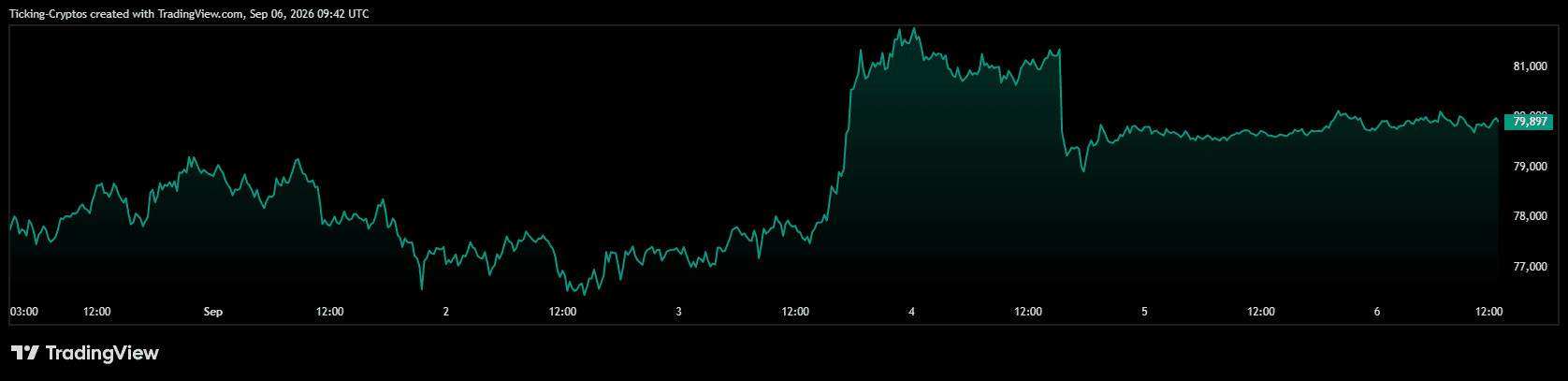
Where is the Bitcoin price today?
$BTC sits just above $79,900 with a market capitalisation of $1.6 trillion and 24-hour volume near $19.8 billion. The weekly gain of 2.5% makes Bitcoin one of the steadier large caps right now, but the year-to-date figure is still minus 8.6%.
That is the frame worth keeping. Bitcoin has recovered roughly 37% from its June low, and it is still deep in the red for 2026. This is a rebound inside a bear market until proven otherwise.
Why did the Bitcoin price fall after the jobs report?
Thursday set the trap. ADP employment came in at 38,000 against 47,000 expected, rate-hike expectations softened, and BTC broke $80,000 with roughly $93 million of short positions liquidated on the way up. It reclaimed the 200-day EMA for the first time since June. By early Friday in Europe it printed $82,240, a gain of 6.8% in 24 hours.
Then the August employment report landed. Nonfarm payrolls rose 162,000 against a consensus near 56,000, close to triple the estimate. Unemployment held at 4.1%, wage growth eased to 3.1% year on year, and June and July were revised higher by a combined 55,000 jobs.
$Bitcoin fell from $81,300 to $78,600 within minutes. CME FedWatch odds of a 25 basis point hike in September jumped from 49.4% to 58%. The ten-year Treasury yield sits at 4.73% and the thirty-year is at its highest level since 2007.
The logic is simple and it is not going away. Bitcoin pays no yield. When risk-free returns push toward 5%, holding a non-yielding asset costs more. A strong labour market is good news for the economy and bad news for anyone waiting on cheap money.
Are Bitcoin ETF inflows still supporting the price?
Yes, and this is the strongest argument for the bull case right now.
US spot Bitcoin ETFs took in a net $730.8 million on September 3, the largest single day since January, with BlackRock's IBIT accounting for $454 million of it. On the day of the selloff itself the desks bought again: $174.6 million net on September 4, a third straight session of inflows, taking the three-day total to roughly $1.01 billion.
The context matters. Spot Bitcoin ETFs have shed a net $4.83 billion across 2026 as a whole. August flipped positive and recovered a meaningful chunk. Institutions are not buying blindly anymore, they are buying weakness and trimming into strength. But the bid is real, and it absorbed a hawkish repricing without breaking the range.
What Bitcoin price levels matter this week?
On the three-hour chart the structure is intact. The 200 EMA sits at $74,971 and is rising, around $5,000 below spot. Bitcoin has held above it continuously since the vertical move from $64,000 to $77,000 between August 19 and 21.
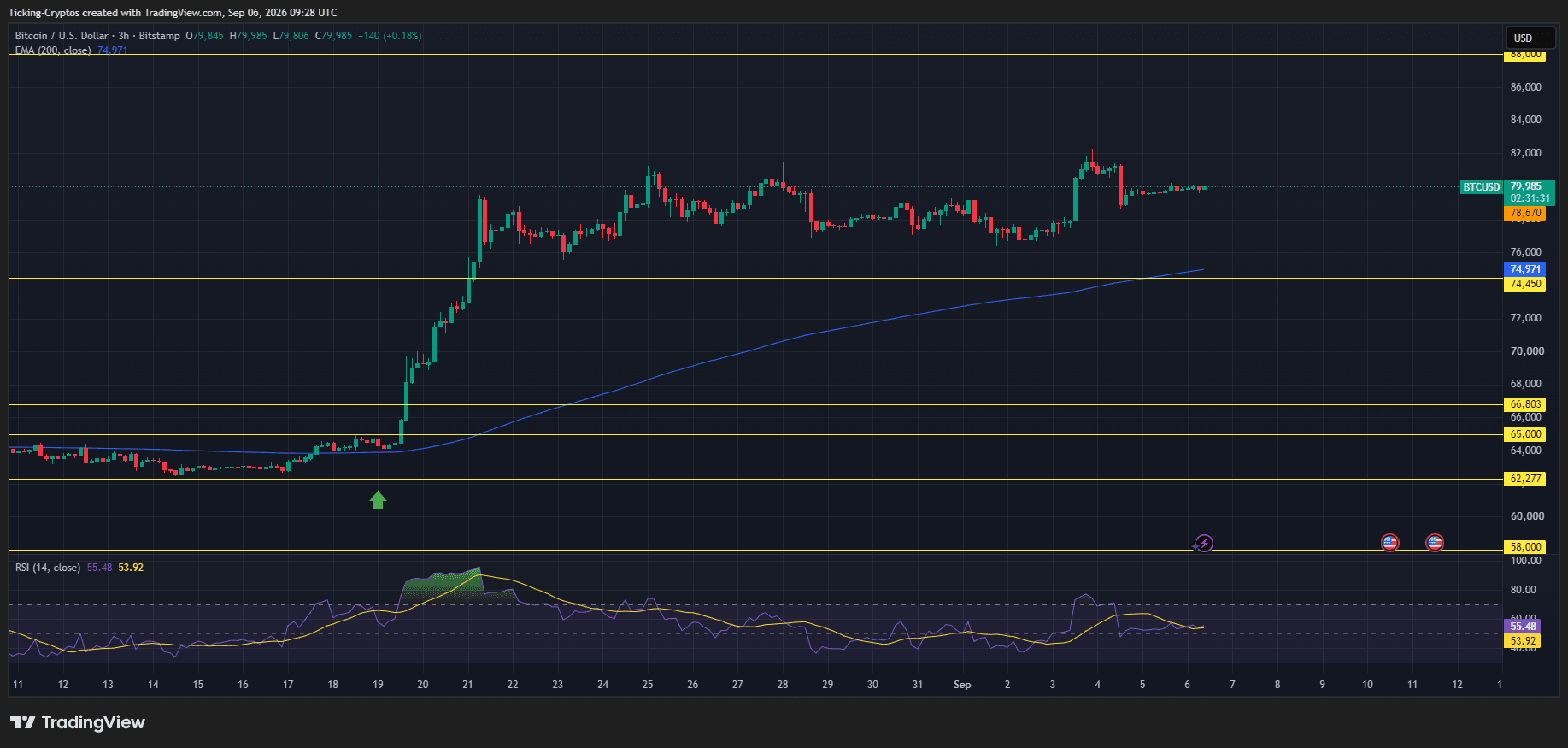
Since then BTC has been boxed between roughly $76,000 and $82,200.
- First support: $78,670. The line directly beneath price, flipped from resistance to support in early September. It sits close to the $78,000 max pain level for the September 18 options expiry, which tends to act as a magnet into expiry week.
- Next support: $76,000 to $77,000. Losing this shelf opens the gap toward the EMA cluster at $74,971 and the $74,450 line.
- First resistance: $82,200. Friday's high at $82,178 was the fourth failed attempt at the top of the range.
- The level that changes the story: $85,000. A weekly close above it would be the first real evidence that this is more than a bear market rally. The band up to $88,000 is the next obstacle after that.
- Structural line: $58,000. Only relevant if the entire recovery fails.
RSI reads 55.48 against a 53.92 signal line. Neutral, no divergence, no exhaustion. The candles since Friday are tiny and coiling directly on $78,670, which is textbook compression ahead of a data release.
Which news could move the Bitcoin price next week?
Four dates, in order of importance.
- September 11: US CPI. The single most important number of the month. Fed Governor Christopher Waller has said he would consider a hike if August inflation runs hot, which turns this print into the decider rather than a data point. A soft number takes the September hike off the table and gives Bitcoin room to attack $82,200. A hot number puts $76,000 in play quickly.
- September 15: the Clarity Act. SEC Chair Paul Atkins expects a Senate vote and has urged lawmakers to pass the bill before the month ends. He also confirmed the SEC is drafting its own complementary crypto legislation. Regulatory clarity is a slower-burning catalyst than CPI, but it is the one that shapes institutional allocation into 2027.
- September 15 to 16: the FOMC decision. The first hike under serious consideration since the tightening cycle ended in July 2023. Markets price it at 58%. Note that a hike being priced is not the same as a hike being absorbed. If the Fed hikes and signals more, the reaction is not in the current price.
- September 18: September options expiry. Max pain at $78,000. Expect price to gravitate toward that area into Friday unless CPI overwhelms it.
One more for the calendar: the MultiversX Supernova hard fork goes live on September 10, cutting block time from six seconds to 600 milliseconds. Not a BTC catalyst, but a real event for anyone holding EGLD on an exchange.
Bitcoin Price Prediction: What does this mean Bitcoin price?
Bitcoin is caught between two forces that are both genuine. Institutional demand through the ETFs is steady and absorbed a hawkish shock without a breakdown. Rate expectations are moving the wrong way, yields are at multi-year highs, and oil above $90 is adding to the inflation problem that started this whole chain.
The chart has no opinion, which is the honest read. Neutral RSI, intact trend, compressed range. Direction gets decided by Thursday's inflation number, not by anything technical.
Practical takeaway: $78,670 holding through CPI keeps the recovery structure alive. A weekly close above $85,000 confirms it. A break below $76,000 means the August rally was the bounce, not the bottom.
Decrypt
Early testers spent OpenAI's launch weekend pushing Astra through 3D cities, playable games, Bach chorales and research papers.
The multi-year deal will place the XRP logo on the field at Ben Hill Griffin Stadium starting this season, extending Ripple's push into college athletics.
With a growing number of institutions exploring stablecoins, the bottleneck is regulated infrastructure they can trust.
The team behind Pencil Finance says the financing supported thousands of Southeast Asian students, but it did not disclose borrower costs, defaults, or investor returns.
At least four more decade-old wallets moved a combined $15.7 million between Aug. 29 and Sept. 4, with one batch of coins sent to Coinbase in a likely sign of a sale.
U.Today - IT, AI and Fintech Daily News for You Today
Zcash (ZEC) has surged into the cryptocurrency top 10 after a sharp rally wiped out nearly $49 million worth of short positions over the past 24 hours.
Former Ripple dev conflict erupts as wallet bug affects 4,000 users, exposing long-standing XRP-focused project red flags.
Longtime Bitcoin figure CobraBitcoin has warned that the rapid rise of increasingly autonomous AI models could create a new security threat for Bitcoin.
The immediate question is whether Dogecoin can convert its latest breakout into a sustained move above $0.10.
Peter Brandt’s famous 2019 Bitcoin chart returns to the spotlight as BTC eyes $80,000 under an institutional floor.
Blockonomi
TLDR:
- Vitalik Buterin puts the odds of SNARKs, FHE and iO reaching sub-10x computing overhead at 60% overall.
- SNARKs are the likeliest to reach single-digit overhead by 2030, but no deadline applies to all three tools.
- Buterin assigns a 33% chance that SNARKs, FHE and iO eventually approach 1+ε overhead in real-world use.
- Lower-cost SNARKs could support higher Ethereum gas limits without proportional validator hardware increases.
Ethereum co-founder Vitalik Buterin has put numbers around a long-running cryptography question: how close advanced privacy and verification tools are to ordinary computing costs. In a September 6 post, Buterin assigned a 60% probability that SNARKs, FHE and indistinguishability obfuscation eventually operate below 10x computational overhead.
He measured that overhead through total energy use and amortized computing expenses. He also gave all three a 33% chance of approaching 1+ε overhead for average real-world computation.
That distinction matters as the timeline remains narrower than the headline probability suggests. Buterin did not say all three technologies would cross the sub-10x threshold by 2030. Instead, he said at least one could reach single-digit overhead by decade-end, with SNARKs the most likely candidate.
SNARKs Lead Buterin’s Push Toward Sub-10x Computing Costs
SNARKs allow a system to prove that a computation was performed correctly without requiring every verifier to repeat the entire process. As a result, they have become central to Ethereum’s zero-knowledge scaling model.
Zero-knowledge rollups already use this approach by processing batches of transactions away from Ethereum’s base layer. They then submit validity proofs to Mainnet, allowing the network to verify those transactions while preserving Ethereum’s security guarantees.
However, proof generation remains a major constraint. Complex proofs still require substantial computing power, while some workloads depend on specialized hardware. Even so, Buterin said the efficiency gap is beginning to narrow.
In August, he highlighted research showing that certain large language model inference workloads were approaching less than 10x proving overhead. He also pointed to specialized hash functions, where single-digit overhead has already been achieved.
As proving costs decline, the improvement could have direct implications for Ethereum’s future architecture. The network’s zkEVM roadmap envisions validators verifying proofs of entire blocks instead of independently replaying every transaction.
Consequently, sufficiently efficient proof generation could allow Ethereum to raise gas limits without requiring proportional increases in validator hardware. That would make lower-cost SNARKs increasingly relevant to both scalability and validator efficiency.
FHE and iO Face Higher Barriers to Practical Efficiency
While SNARKs focus on verifying computation, FHE addresses a different challenge: privacy. It allows calculations to run directly on encrypted data without first revealing the underlying information.
NIST describes FHE as a privacy-enhancing technology that can apply arbitrary functions to encrypted data without access to the secret decryption key. For blockchains, that capability could support private automated market makers, confidential lending markets and sealed-bid auctions.
Ethereum’s privacy roadmap identifies these applications directly. However, FHE still carries significantly higher computational costs than ordinary plaintext processing. As a result, reaching sub-10x overhead would represent a major step toward broader practical use.
Indistinguishability obfuscation, or iO, presents an even tougher challenge. The technology aims to transform software while preserving its functionality, making equivalent obfuscated programs computationally indistinguishable.
Although recent research has strengthened iO’s theoretical foundations, its practical costs remain extremely high. Buterin has described traditional constructions as effectively “galactic” in computational expense.
To reduce those costs, his recent work has explored approaches including diamond iO and local mixing. Diamond iO lowers the theoretical burden but remains impractical, while local mixing takes a different route whose security is still unproven.
Even so, each technology targets a distinct part of the broader cryptographic problem. Cheaper SNARKs could make verifiable computation more routine, while FHE could expand private computation across shared data.
Meanwhile, efficient iO could help protect the internal logic of executable software. For now, however, Buterin’s 60% estimate remains a personal probability assessment rather than an Ethereum roadmap commitment.
The post Vitalik Buterin Sees 60% Chance SNARKs, FHE, and iO Reach Sub-10x appeared first on Blockonomi.
TLDR:
- Curve price prediction signals upside while CRV holds above $0.3201. The rally faces its first major test near $0.3941.
- CRV gained 26.34% during the past week and reached $0.3785, supported by renewed DeFi interest and active spot trading today.
- Strong ADX and momentum readings favor buyers. RSI and CCI levels warn that the latest advance has entered overbought territory.
- Curve DAO appointed yRisk to oversee crvUSD and Llamalend risks under a $250,000 mandate backed through formal community governance.
Curve price prediction has turned bullish after CRV climbed 26.34% in seven days and reached $0.3785. Renewed interest in decentralized finance and steady trading activity supported the rebound. Buyers now face resistance at $0.3941, at the weekly high. A break could extend the move toward $0.4312 next week. Still, elevated momentum readings show the rally may need a pause.
The $0.3201 area offers technical support. Holding that level would preserve the recovery structure. A breakdown beneath it would provide the first warning that demand is weakening after the weekly advance. That balance makes price reactions at both boundaries especially important.
Curve Price Prediction Faces Key Resistance at $0.3941
Market data shows buyers control the daily technical trend. The Average Directional Index stands at 42.2194. MACD and Bull Bear Power readings also favor upside. Those signals support the Curve price prediction while CRV trades above short-term support.
Momentum has become stretched, though. The Relative Strength Index sits at 69.0286, close to the overbought threshold of 70. The Commodity Channel Index has moved deep into overbought territory. These readings do not confirm a reversal. Instead, they suggest buyers may encounter selling near $0.3941.
The 20-day average at $0.3201 provides support for the CRV price. The Ichimoku Kijun sits at $0.3147. These levels could absorb profit-taking. Weekly volatility reached 33.82%, so wide swings may continue.
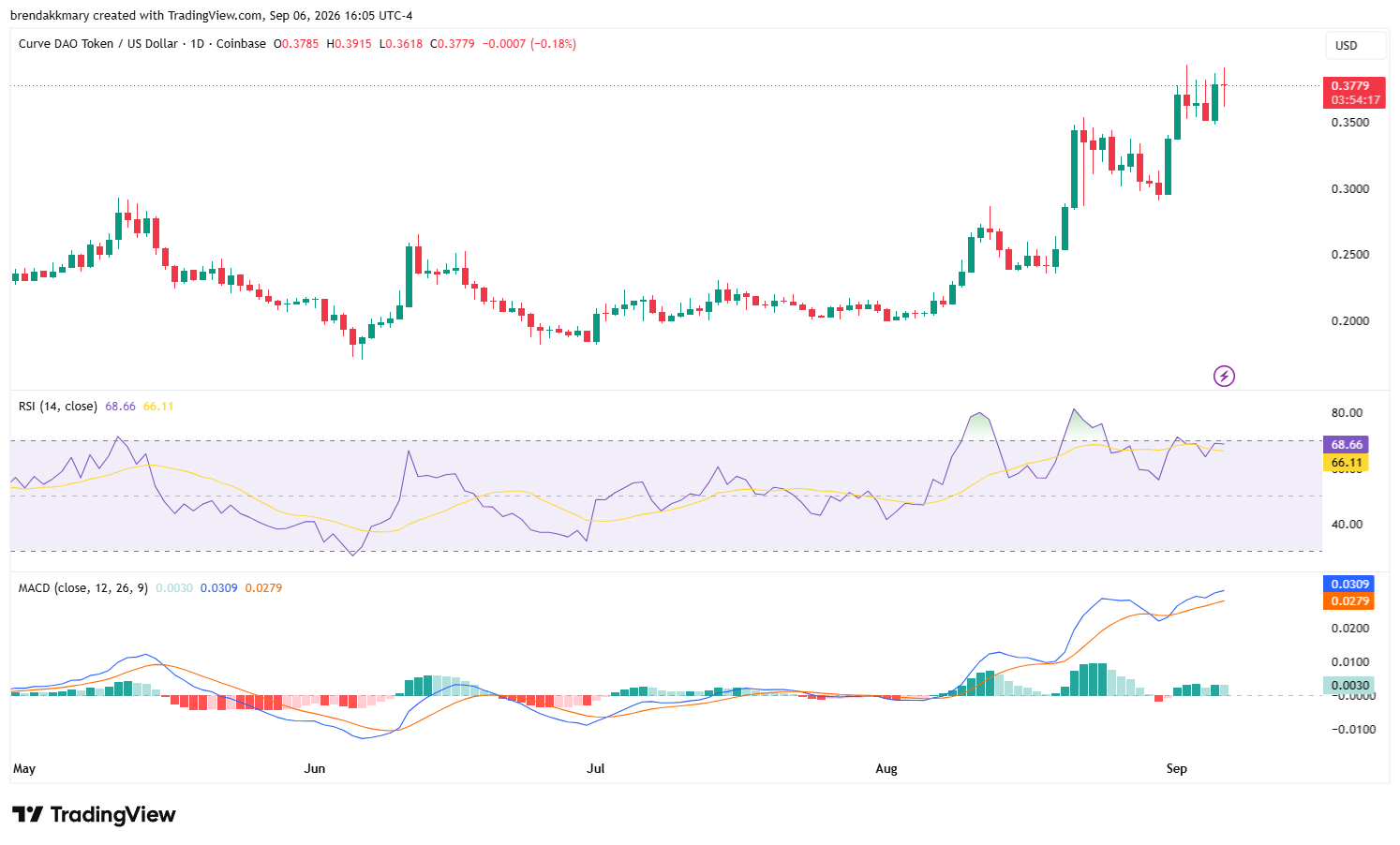
The range for next week runs from $0.3257 to $0.4312. A close above $0.3941 would improve the case for a move toward the boundary. Failure at resistance could produce consolidation without damaging the structure. A fall below $0.3201 would weaken the Curve price prediction and expose $0.3147.
Governance Vote Adds New Oversight to Curve Lending
Curve DAO has approved yRisk as the risk provider for crvUSD mint markets. Its mandate also covers Llamalend isolated lending markets. The team received a $250,000 mandate through governance approval. Its duties include collateral reviews, risk assessments, and governance monitoring across Curve lending products.
The appointment follows Llamalend upgrades and closer scrutiny of ecosystem safeguards. Attention increased after the March exploit involving the sDOLA-crvUSD pool. Oversight may help Curve DAO address collateral risks across isolated markets. The decision arrives during renewed DeFi activity.
Viktoras Karapetjanc, an expert at Traders Union, linked the 26% weekly rebound to stronger DeFi interest and solid participation. He said the yRisk appointment reinforced confidence in Curve’s ecosystem. His Curve price prediction keeps buyers in control while CRV holds above $0.3201.
Karapetjanc sees room for a retest and possible break above $0.3941. Such a move would bring $0.4312 into focus during the coming week. That target sits about 13.9% above the $0.3785 price. It also marks the upper boundary of the projected weekly range.
Earlier assessments identified bullish price action alongside mixed technical signals and governance execution risks. The latest setup keeps those concerns active. Overbought conditions may limit immediate gains, while the new risk mandate depends on effective reviews and timely governance responses.
Traders are therefore watching price behavior at $0.3941 and demand near $0.3201. These levels will define whether the CRV price extends its rebound or shifts into a broader pullback.
The post Curve Price Prediction Targets $0.4312 as Weekly Rally Extends appeared first on Blockonomi.
TLDR:
- MENA crypto transaction volume reached about $350B by 2025–2026, rising from roughly $100B recorded in 2022.
- Saudi Arabia led regional crypto growth at 154% YoY, ahead of Qatar’s 120% increase during the period.
- Turkey led MENA by transaction value, processing nearly $200B in annual crypto activity through mid-2025.
- The UAE handled more than $56B in 2024–2025 crypto volume, with activity rising 33% from the prior period.
Crypto activity across the Middle East and North Africa has expanded sharply, with annual on-chain transaction volume reaching about $350 billion by 2025–2026. The Bitcoin Policy Institute says that figure has climbed from roughly $100 billion in 2022, reflecting stronger investment activity and wider digital-asset use.
Saudi Arabia has emerged as the fastest-growing market in MENA, recording 154% year-over-year growth, while Qatar followed with a 120% increase. Turkey remains the regional leader by transaction value, processing nearly $200 billion annually despite faster growth elsewhere.
Saudi Arabia Leads MENA Crypto Growth as Turkey Tops $200B
The growth figures show that crypto expansion across MENA is not concentrated in a single market or driven by one adoption model. Instead, Gulf investment, inflation pressures, regulation, and cross-border activity are shaping different markets.
Saudi Arabia’s 154% growth rate came from Chainalysis data covering July 2023 through June 2024. That expansion coincided with broader investment in fintech, blockchain infrastructure, and digital payments.
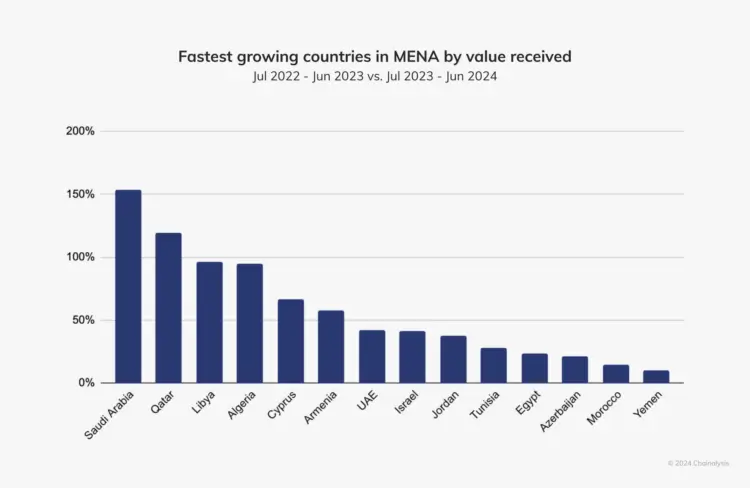
Source: Chainalysis
However, higher transaction activity has not translated into unrestricted cryptocurrency regulation. The IMF said in its 2026 consultation that cryptocurrencies remain prohibited in Saudi Arabia.
Authorities are instead developing a digital-asset strategy focused on financial stability, monetary sovereignty, consumer protection, and market integrity. At the infrastructure level, Saudi Arabia joined the BIS-backed mBridge project in 2024.
The project tests wholesale central bank digital currencies for cross-border payments between commercial banks. Qatar has, however, taken a more formal regulatory path. Its Qatar Financial Centre introduced a Digital Assets Framework in 2024 covering tokenization, custody, exchanges, transfers, and smart contracts.
Turkey remains substantially larger by transaction value. Chainalysis placed the country near $200 billion annually through mid-2025, making it MENA’s biggest crypto market. Persistent lira depreciation and inflation have helped support cryptocurrency demand as residents seek alternative investments and ways to preserve purchasing power.
Gulf Regulation and Stablecoins Reshape Regional Crypto Activity
The UAE represents another model built around institutional participation and regulated digital-asset businesses. Chainalysis measured more than $56 billion in transactions during 2024–2025, up 33%.
Large institutional transfers accounted for much of that increase. Meanwhile, the Bitcoin Policy Institute estimated the UAE market at approximately $150 billion using a different methodology.
That difference highlights a major limitation when comparing regional totals. Chainalysis previously measured $338.7 billion across MENA between July 2023 and June 2024. It later reported regional volume above $500 billion for the year ending June 2025.
Consequently, the $350 billion estimate should be viewed within its specific methodology. Asset composition also differs across Gulf markets. Bitcoin accounts for an estimated 38% of UAE activity, while Ethereum represents 22%, according to BPI data.
USDT and USDC together account for another 30%, showing the significant role of dollar-linked stablecoins in regional digital-asset activity. Broader geopolitical pressures have also influenced trading behavior.
During the June 2025 Israel-Iran conflict, Bitcoin fell about 2.3% to $105,200. Ether declined 7.5%, while Bitcoin later stabilized between $104,000 and $106,000. Its market dominance increased to 64.8% during the same period.
The data shows a MENA crypto market expanding through several distinct channels. Saudi Arabia leads percentage growth, Turkey dominates transaction value, while Gulf regulation supports institutional participation.
The post MENA Crypto Transaction Volume Hits $350B as Saudi Arabia Leads Growth appeared first on Blockonomi.
TLDR:
- ZEC led the $212M crypto liquidation wave with $45.32M wiped out as its price surged 15% to about $1,170.
- Short positions accounted for about $156M of $212M liquidations, showing bearish traders took most losses.
- ZEC open interest reached a record $2.4B on Sept. 4, up from roughly $700M in early July as leverage grew.
- Grayscale’s ZCSH drew at least $34.4M in net inflows after its Aug. 25 debut, adding institutional demand.
Zcash moved to the center of crypto derivatives trading on September 6 after a 15% rally pushed ZEC to about $1,170. The advance coincided with roughly $212 million in market-wide liquidations, with short positions accounting for about $156 million of the total.
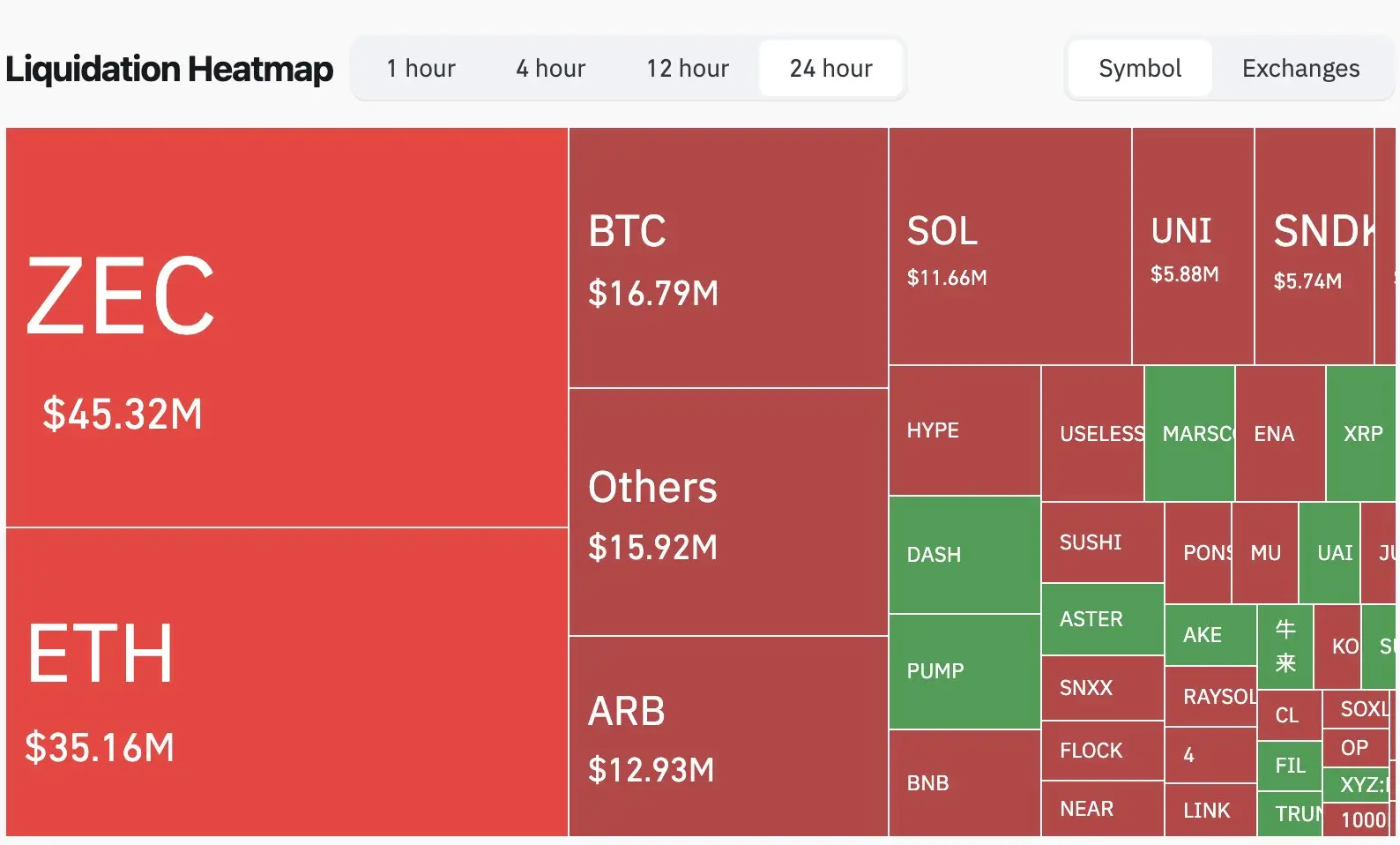
Source: X
ZEC alone generated approximately $45.32 million in liquidations, the largest total among major tokens in the reported data. Ethereum followed with $35.16 million, while Bitcoin recorded $16.79 million and Arbitrum posted $12.93 million. That placed ZEC at more than one-fifth of all liquidations during the period.
Short Squeeze Drives the Liquidation Imbalance
The liquidation data shows how heavily bearish positioning contributed to the move. As prices rose, leveraged short positions lost margin support and exchanges forcibly closed them.
Forced short closures require positions to be bought back, adding further buying pressure. Together, those figures showed pressure concentrated in bearish positions rather than long liquidations.
The imbalance was visible across the broader market as short liquidations represented nearly three-quarters of the $212 million total. ZEC stood out, however, because its liquidation figure exceeded Ethereum’s by more than $10 million.
The derivatives buildup had already accelerated before September 6. Open interest in ZEC perpetual futures reached a record of about $2.4 billion on September 4. That compared with roughly $700 million in early July, showing that leveraged exposure expanded sharply alongside the price rally.
The move also carried the token above $1,000 for the first time since its volatile launch-era trading. At around $1,170, its market capitalization briefly approached $19.8 billion and one snapshot showed it overtaking Hyperliquid.
Meanwhile, momentum indicators reflected the speed of the advance. The 14-day relative strength index rose above 82. ZEC also traded at more than 2.5 times its 200-day moving average of approximately $449.40.
ETF Inflows Add a Spot-Market Counterweight
Derivatives were not the only source of demand. Grayscale converted its long-running Zcash Trust into the Zcash ETF, or ZCSH, during August. Shares were registered for NYSE Arca trading after the trust changed its name on August 24.
The fund debuted on August 25 and attracted at least $34.4 million in net inflows. ZCSH gives brokerage investors exposure without requiring direct cryptocurrency custody.
Regulatory and network developments also formed part of the backdrop. In January, the Zcash Foundation said the SEC had ended a 2023 subpoena investigation without recommending enforcement action.
The network then completed its Ironwood NU6.3 upgrade on July 28. The release introduced a new shielded pool after an Orchard soundness vulnerability. It also aimed to make the integrity of the circulating supply independently verifiable.
Despite the latest rally, ZEC remained below CoinGecko’s recorded all-time high of $3,191.93. The immediate market structure instead remained defined by record derivatives exposure, ETF inflows and forced short closures.
The September 6 liquidation wave showed how strongly leverage shaped price discovery during the rally. With $45.32 million in ZEC liquidations, the token led a broader $212 million market reset that session.
The post Zcash Leads $212M Crypto Liquidation Wave as ZEC Surges 15% appeared first on Blockonomi.
The marriage of finance and technology has reshaped countless industries, but few have felt the impact as profoundly as online gaming. Blockchain transactions, instant settlement protocols, and AI-driven risk assessment are rewriting the rules of engagement for operators and players alike. I have watched this transformation unfold over the last few years, and the pace of change is staggering. For anyone exploring modern platforms, a Rocketplay casino no deposit bonus offers a practical entry point into this new financial ecosystem, letting you test games without committing real funds upfront. That single offer reflects a broader shift toward frictionless, transparent, and player-first financial mechanics.
Casinos no longer operate in a vacuum where slow bank transfers and opaque payout schedules are acceptable. Fintech innovations have turned the industry inside out, forcing legacy operators to adapt or lose their audience to more agile competitors. The result is a gaming environment where deposits clear in seconds, withdrawals arrive faster than ever, and every transaction leaves a verifiable trail on public ledgers. Let me break down the most significant changes and what they mean for your next session at the tables or slots.
Key Facts: Numbers That Define the Shift
Before I dive into the mechanics, consider these statistics that highlight how deeply fintech has penetrated casino operations. These figures come from industry reports and blockchain analytics firms tracking real-world adoption.
- In 2024, over 45% of all online casino deposits globally used cryptocurrency or instant payment methods, up from just 12% in 2020.
- Blockchain-based provably fair games processed 2.3 billion transactions in 2025, with an average settlement time of 1.8 seconds per bet.
- Smart contract casinos reduced operational costs by 38% in 2026 compared to traditional platforms, savings that translate directly into better bonuses and higher payout percentages.
- The global market for fintech-enabled gambling solutions reached $9.7 billion in early 2026, with projections showing a compound annual growth rate of 21% through 2030.
- A 2025 survey of 10,000 active players found that 67% ranked withdrawal speed as their top priority, ahead of game variety and customer support.
- Regulated jurisdictions using blockchain-based audit trails cut dispute resolution times from an average of 14 days to just 2 days in 2026.
These numbers paint a clear picture: players demand speed, transparency, and control. Fintech delivers all three, and the casino industry is scrambling to keep pace.
Smart Contracts Replace the Middleman
The most disruptive innovation comes from smart contracts – self-executing agreements coded directly onto blockchain networks. These digital protocols handle payouts automatically when conditions are met, removing the need for human verification or accounting departments to process every transaction. When you hit a winning combination on a slot, the contract verifies the result against the game’s logic and releases your funds instantly. No waiting for a casino employee to review your withdrawal request, no “manual checks” that stretch for days.
This shift matters because it changes the power dynamic between player and operator. With traditional systems, the house controls the ledger and can delay payments for any reason. Smart contracts flip that script. The code executes exactly as written, and both parties can verify the outcome on a public blockchain explorer. For players, this means true financial autonomy. For operators, it means lower overhead and a stronger trust proposition in a market where reputation is everything.
I have seen platforms adopt hybrid models where fiat deposits convert to stablecoins for gameplay, then back to local currency for withdrawals. This approach captures the speed of crypto while avoiding the volatility that scares off casual players. The user experience feels identical to a traditional casino, but the backend operates on rails that settle in seconds rather than days.
Instant Payments Reshape Player Loyalty
Remember the days when cashing out meant waiting three to five business days? That era is ending. Fintech innovations like open banking APIs and real-time payment networks have compressed withdrawal times to minutes, even for traditional currencies. European operators now integrate directly with banking systems, allowing instant transfers that appear in your account before you finish your coffee.
This speed transforms player psychology. When you know your winnings arrive immediately, you feel more confident chasing bigger jackpots or trying new game providers. The anxiety of “will they actually pay me?” evaporates, replaced by a straightforward trust in the system. Casinos that embrace instant payouts report higher retention rates and larger average deposits, because players reinvest money they know they can access at any moment.
The competitive pressure is real. If one operator offers same-minute withdrawals and another takes a week, the choice becomes obvious. Fintech has turned payment speed into a core product feature, not a back-office afterthought. Players now compare withdrawal times the same way they compare slot volatility or house edge.
Decentralized Identity and Fair Play Verification
Trust extends beyond payments into the very fairness of the games themselves. Blockchain technology enables provably fair systems where every card shuffle, dice roll, or spin generates a cryptographic hash that players can independently verify. You no longer need to trust that the casino runs honest software – you can check the math yourself using open-source verification tools.
Decentralized identity solutions add another layer of protection. Instead of uploading sensitive documents like passports and utility bills to every casino you join, fintech platforms now offer reusable identity credentials stored on your own device. You control what information you share and with whom. This reduces the risk of data breaches that have plagued the industry for years, where millions of players’ personal details leaked onto dark web forums.
For operators, this streamlines onboarding and compliance. Automated checks run against blockchain-based registries, flagging suspicious activity in real time without requiring manual review. The result is a safer ecosystem for everyone involved, with fewer fraudulent accounts and faster verification for legitimate players.
The Bottom Line on Fintech-Driven Casinos
The casino industry stands at a crossroads where financial technology determines who thrives and who fades into irrelevance. Smart contracts eliminate friction, instant payments build loyalty, and decentralized systems restore trust in an industry historically plagued by skepticism. These innovations do not just improve the experience – they redefine what players expect from every platform they touch.
My advice is simple: prioritize operators that leverage these technologies rather than resisting them. Look for provably fair certifications, instant withdrawal options, and transparent blockchain integration. The days of opaque casino operations are numbered, and the platforms that embrace fintech today will lead the market tomorrow. Whether you chase progressive jackpots or prefer low-stakes table games, the financial infrastructure behind your favorite casino matters just as much as the games themselves. Choose wisely, play smart, and enjoy the benefits of an industry finally catching up to the digital age.
The post How Fintech Innovations Are Changing the Casino Industry appeared first on Blockonomi.
CryptoPotato
Given the nature of its blockchain, bitcoin was long considered to move around within a broader four-year cycle prompted by the halving, which takes place in general every four years. However, the pattern has been rejected in the past year or so, and popular on-chain analyst Willy Woo took the same approach in his latest opinion on the matter.
He suggested that BTC may be transitioning toward a six-to-eight-year cycle, increasingly influenced by the same debt and liquidity conditions that drive traditional financial markets.
From Halving to Liquidity?
Woo’s reasoning begins with the cryptocurrency’s diminishing supply shock. Following the latest halving in April 2024, new BTC issuance dropped to approximately 0.8% of the existing supply per year. The next event, scheduled to take place in early 2028, will reduce that figure to roughly 0.4%.
As newly mined supply becomes increasingly insignificant relative to the existing market, Woo argued that the halving’s ability to dictate BTC’s broader price cycle weakens. Instead, the asset may begin moving more closely with TradFi’s six-to-eight-year short-term debt cycle.
The halving framework worked remarkably well for much of bitcoin’s history. Now, though, the market structure has changed dramatically, perhaps mostly from the US spot Bitcoin ETFs. Current data shows that these financial products hold close to 1.3 million BTC, which is over 6% of the circulating supply. Public companies with at least 1,000 BTC currently own over a million units.
Together, ETFs and those corporate treasuries controlled almost 12% of circulating BTC – vastly more than miners now create annually.
Others who have supported the narrative that the four-year cycle is dead include Arthur Hayes, who claimed in 2025 that traders focus too heavily on it, and Fidelity Digital Assets. In a report from last year, the analysts questioned whether BTC’s maturing market could produce more gradual rallies and corrections rather than the violent boom-and-bust cycles of the past.
Not Everyone Is Convinced
Galaxy Research examined the same question in June this year, but concluded something different – BTC’s four-year cycle remains visible in the data. The researchers noted that bitcoin again peaked in October 2025, roughly 18 months after the April 2024 halving – precisely within the historical window.
The difference is that each cycle is becoming less extreme. Bitcoin’s previous bear markets produced drawdowns of approximately 85%, 84%, and 77%, while the decline to the July 1 low was considerably milder at just over 53%.
The post Bitcoin’s 4-Year Cycle Could Be Changing: Willy Woo Reveals What Could Replace It appeared first on CryptoPotato.
Ripple’s XRP remains in a corrective phase after its sharp August breakout, with buyers struggling to regain control of the key overhead supply zone. The current structure suggests that the market may need more consolidation before another sustained directional move develops.
XRP Price Analysis: The Daily Chart
On the daily timeframe, XRP’s explosive rally from the $0.94-$0.97 support zone broke the previous descending structure and pushed the price as high as roughly $1.70. However, the breakout was followed by an equally notable rejection, and the asset has since been unable to establish itself above the $1.45-$1.54 resistance zone.
The price is currently trading around $1.42, just below this major supply area. More importantly, XRP continues to hold above the long-term moving average near $1.27, which has flattened after previously trending lower. This level represents an important structural support for the ongoing recovery.
As long as the $1.27 area holds, the recent weakness can still be viewed as consolidation following an impulsive rally. A daily close above the $1.45-$1.54 resistance zone would strengthen the bullish case and could eventually bring the $1.70 high back into focus. Conversely, losing the $1.27 support would substantially weaken the structure and increase the probability of a deeper retracement toward the lower moving average around $1.15.
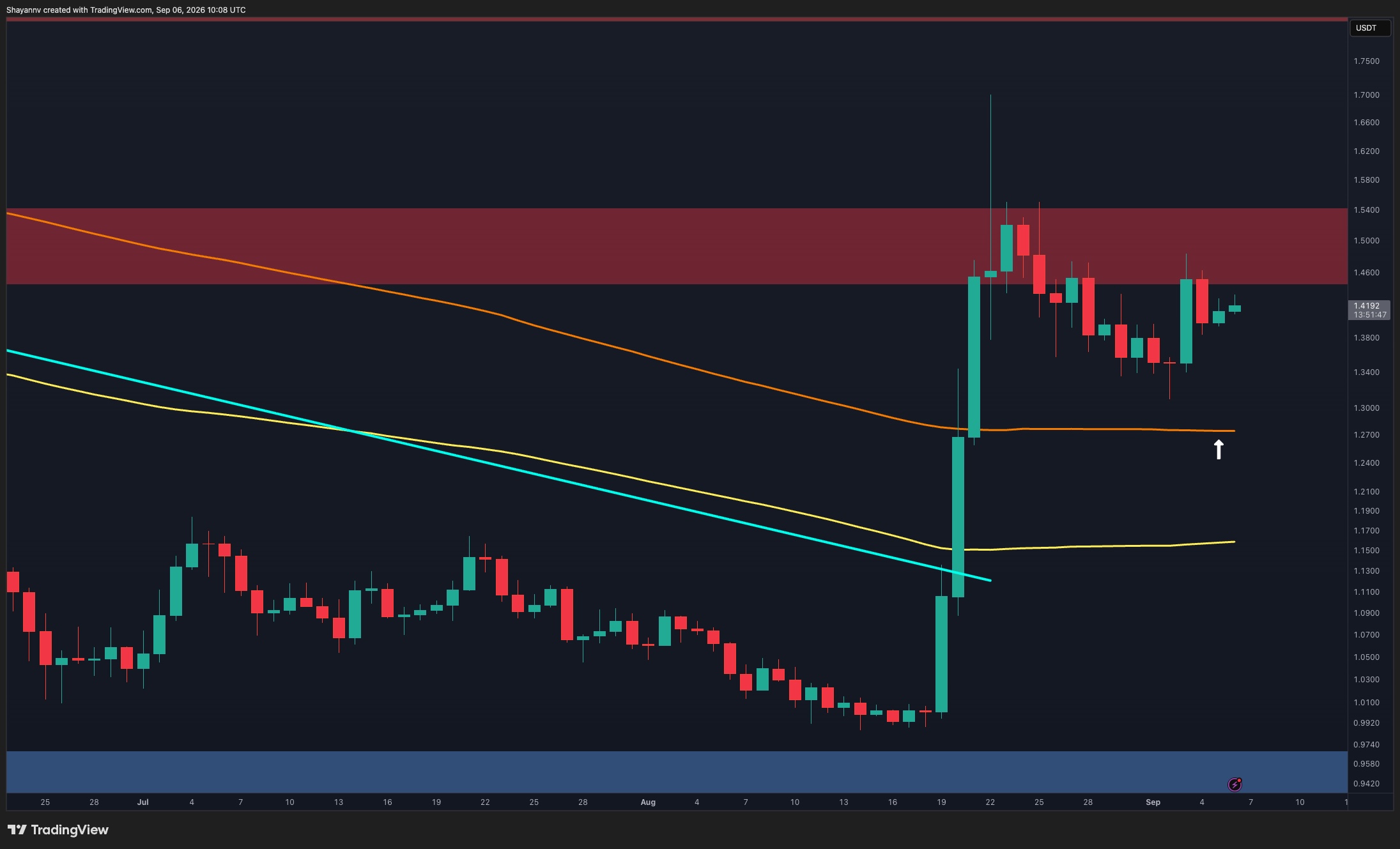
XRP/USDT 4-Hour Chart
The 4-hour chart highlights a descending channel that has contained XRP since the initial surge. The asset has repeatedly failed to break through the channel’s upper boundary, which is now converging with the crucial $1.45-$1.54 resistance zone.
The latest rebound from around $1.34 has brought XRP back toward $1.42, placing it directly beneath this descending resistance. This makes the current area particularly important. A breakout above the trendline followed by a successful reclaim of $1.45 could signal that the corrective structure is ending, with the $1.50-$1.54 zone becoming the next hurdle.
However, another rejection would preserve the descending structure and could send the token back toward $1.34-$1.38. Below there, the channel’s lower boundary is approaching the $1.27-$1.30 region, which overlaps with a clearly defined support zone.
Therefore, XRP remains caught between improving support underneath and persistent resistance overhead. Until the descending channel is broken, the short-term outlook appears more consistent with continued consolidation and potentially another corrective move rather than an immediate bullish continuation.

The post Ripple Price Analysis: Where Is XRP Heading Next Week After Defending Its 200-Day EMA? appeared first on CryptoPotato.
Ethereum is attempting to stabilize after its explosive August breakout, but the follow-through has remained limited. ETH is holding around $2.5K, yet repeated swings within the same range suggest the market is still digesting the rally rather than establishing a fresh directional trend.
Ethereum Price Analysis: The Daily Chart
ETH’s broader structure remains constructive after the powerful breakout from the $1.85K-$1.92K base. Yet, momentum has stalled inside the $2.44K-$2.52K resistance area. Several daily candles have tested this region without producing a sustained breakout, while repeated upper and lower wicks indicate considerable indecision. ETH is currently trading near $2.5K, close to the upper portion of this range.
A clean daily breakout above roughly $2.52K-$2.56K would be required to confirm that buyers have regained control and potentially initiate another impulsive leg higher. Until then, continued consolidation remains the more likely scenario.
On the downside, losing the $2.39K-$2.44K area would weaken the current setup and increase the probability of a deeper correction. In that case, the $2.08K-$2.15K former resistance zone would become the major medium-term support to watch.

ETH/USDT 4-Hour Chart
The 4-hour timeframe shows ETH trapped in a broad consolidation between approximately $2.35K and $2.56K following the vertical advance from below $2K.
The important development is that buyers have repeatedly stepped in near the lower portion of this range. The latest recovery from around $2.38K has carried ETH back toward $2.5K, placing the price once again near the upper resistance region. Yet multiple previous attempts around $2.5K-$2.55K have failed to generate continuation.
Therefore, another rejection could keep the market oscillating inside the existing range. A breakdown below the $2.35K-$2.39K floor would be more consequential and could expose the first major pullback zone around $2.22K-$2.27K.
Conversely, sustained acceptance above $2.52K-$2.56K would invalidate the near-term consolidation scenario and indicate that buyers are ready to resume the broader bullish move.
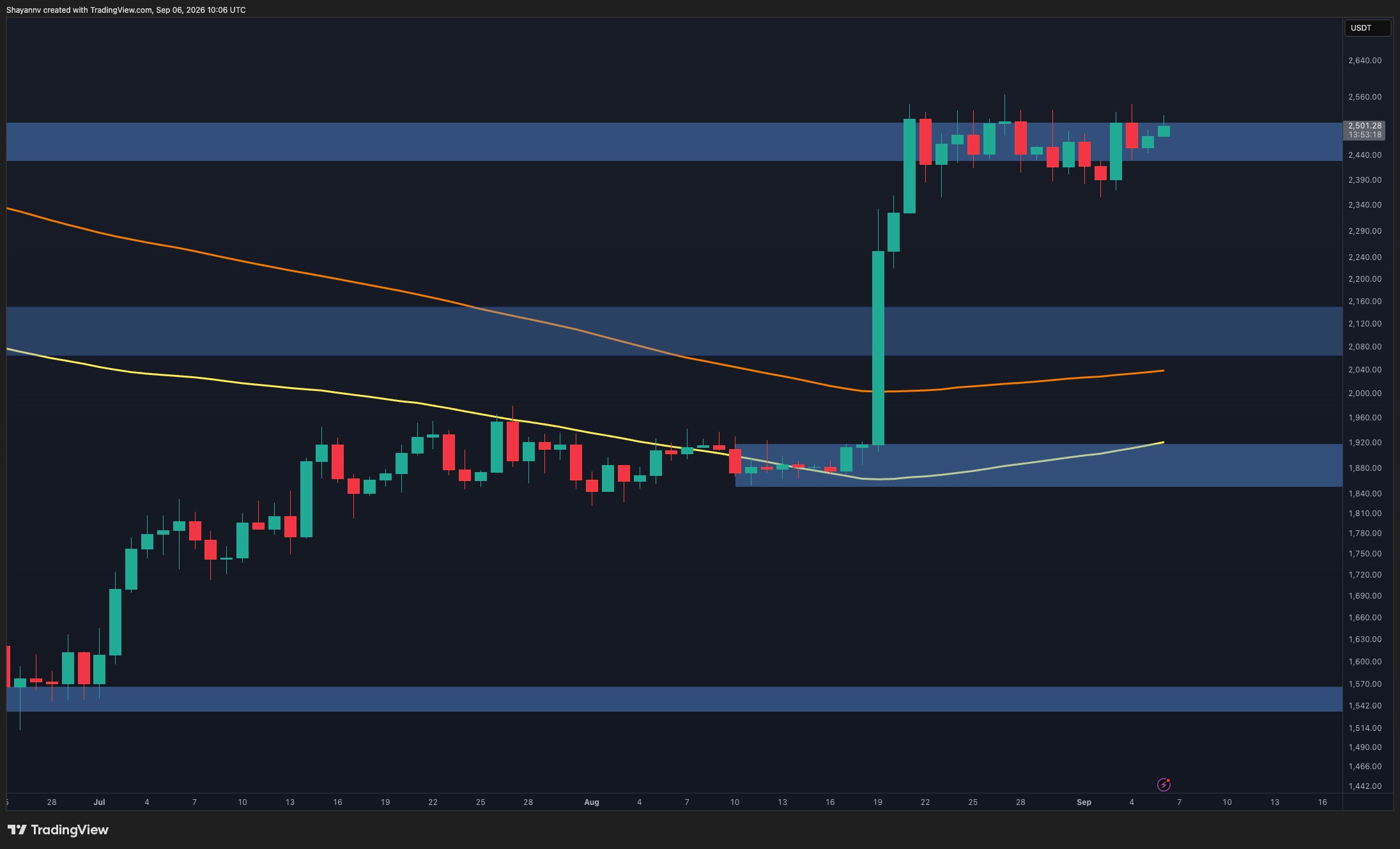
Sentiment Analysis
Ethereum’s Spot Average Order Size provides an important clue regarding the lack of follow-through. The latest observations around $2.4K-$2.5K are predominantly gray, classified as normal-sized orders, while the green whale-order activity visible during earlier portions of the recovery has largely disappeared.
This suggests that ETH’s recent push toward $2.5K has not been accompanied by notable large-player participation. There is also no visible concentration of retail orders in the latest data, pointing to an absence of aggressive positioning from either side.
The lack of dominant whale activity fits well with the price action. With neither substantial large-scale demand nor supply appearing in the metric, ETH may remain prone to low-conviction, choppy movements inside its current range. A renewed appearance of significant whale orders could therefore be an important signal that the consolidation is approaching a more decisive resolution.

The post Ethereum Price Analysis: ETH Consolidates at $2.5K as Whale Participation Stalls appeared first on CryptoPotato.
For the eighth consecutive week, the spot XRP ETFs ended in the green, attracting almost $19 million. Although this sounds impressive, the actual number was significantly lower than last week’s figure.
Moreover, Friday ended as a no-inflow day for the first time in about three weeks, reigniting an old dilemma about actual demand.
XRP ETFs Still in the Green
The last full week of August was the best for the XRP ETFs in 2026. They gained over $110 million, making it the most impressive one since early December 2025. The first slowdown during the previous business week was felt on August 31, when investors poured in a more modest $5.64 million.
The double-digit net inflows returned on September 1 with $14.38 million, but the trend changed on Wednesday when withdrawals were dominant with $7.20 million taken out. This was the first red day for the Ripple ETFs since August 5.
$6.14 million entered the funds on Thursday, but Friday was a no-show day with SoSoValue data showing flows of $0.00. The good news is that the cumulative total net inflows hit another all-time high of $1.68 billion.
The worrying part of the weekly performance is actually twofold. First, it was Wednesday’s net outflows, which broke a near-one-month streak. Second, it was Friday’s no-reportable flows, which raised concerns that had been forgotten in the past few weeks.
Before the market-wide revival experienced after August 19, the spot XRP ETFs had seven such days out of 11 trading days in August. Nevertheless, the broader weekly performance was still bullish with almost $19 million in net inflows. The streak of consecutive green weeks is up to eight.

XRP Defends $1.40
Despite the massive inflows of over $110 million during the previous business week, the underlying asset had failed to capitalize and had fallen below the key support at $1.40 last weekend. It dipped further to $1.33 during the new week, but finally found support and surged to $1.45 on Friday.
It was stopped there and pushed south to $1.41 as of press time, which means that it remains above the key support at $1.40. Analysts remain highly bullish on its recent performance, claiming that its bull phase has finally begun. Moreover, Ali Martinez and EGRAG CRYPTO outlined some mind-blowing price targets for the culmination of the bull market, of up to $60.
We break them down in more detail in this article, and review the actual obstacles XRP would have to face on its way to these levels.
The post 8 in a Row: Ripple (XRP) ETFs Record Another Green Week but Warning Signs Return appeared first on CryptoPotato.
The spot exchange-traded funds tracking the largest cryptocurrency attracted almost $1 billion in the past week, despite the $236 million in net outflows registered on September 1.
The Ethereum ETFs were also well in the green. They have marked more inflows than outflows for eight out of the past nine weeks.
BTC ETFs See Another $1B in Inflows
The previous business week ended with a $201.81 million net outflow from the spot BTC ETFs, but the overall performance was quite impressive. The inflows in the other four days offset all the losses on Friday, and the week ended with a net gain of $924.48 million. Thus, the funds built on the previous week’s major inflows of $1.92 billion.
August finished with net inflows of $216.70 million, followed by $236.46 million in net outflows on September 1. Investors shifted their stance in the following three days by attracting $101.15 million on Wednesday and $174.60 million on Friday. Thursday was particularly spectacular, as the funds gained $730.87 million, the highest amount since January.
Thus, the total number for the week was $986.85 million, bringing the cumulative net inflows to $55.62 billion. Recall that this number had plummeted to $51.79 billion in mid-August.
BlackRock’s IBIT remains the undisputed leader in the ETF space, with cumulative net assets exceeding $62.6 billion. Fidelity’s FBTC follows suit with $14.07 million, and Grayscale’s larger fund, GBTC, is next with $10.36 billion.

ETH ETFs in Green, Too
Given their size, the spot Ethereum ETFs have performed even better over the past several weeks. As mentioned above, they have had only one red week since early July, and even that was quite modest, with just $2.26 million in net inflows back in mid-August.
The financial vehicles gained $824.42 million during the week that ended on August 28, and another $218.41 million in the first week of September. Thursday was once again the most notable day in terms of net inflows, with $141.39 million entering the funds. Another $87.68 million went in on Monday, $10.95 million on Tuesday, and $26.46 million on Friday. The only red day was Wednesday with $48.08 million.
The cumulative total net inflows have skyrocketed from $10.89 billion in early July to $13.19 billion on September 4.

The post Bitcoin ETFs Rake In Nearly $1 Billion as Ethereum Funds Keep the Streak Alive appeared first on CryptoPotato.