Cryptocurrency Posts
Crypto Briefing
Sesko's impact highlights Manchester United's strategic depth, crucial for sustaining top-four ambitions and Champions League qualification.
The post Benjamin Sesko’s goal lifts Manchester United past Everton in crucial Premier League clash appeared first on Crypto Briefing.
The rise in tokenized stock trading on DEXs highlights a shift towards decentralized finance, potentially reshaping traditional equity markets.
The post Tokenized stocks generate $16B in DEX trading volume over 90 days appeared first on Crypto Briefing.
George's impact highlights the crucial role of substitutes in altering match dynamics, potentially affecting league standings and team strategies.
The post Everton’s Tyrique George equalizes against Manchester United in 1-1 draw appeared first on Crypto Briefing.
The differing stances on AI safety rules could shape future state regulations, impacting AI investments and setting precedents nationwide.
The post OpenAI, Google oppose Massachusetts AI safety rules backed by Anthropic appeared first on Crypto Briefing.
The incident heightens maritime tensions, potentially altering conflict dynamics and market perceptions of Ukraine's strategic capabilities.
The post Russia has hit Ukrainian cargo ship in Black Sea, TASS reports appeared first on Crypto Briefing.
Bitcoin Magazine
Bitcoin Magazine
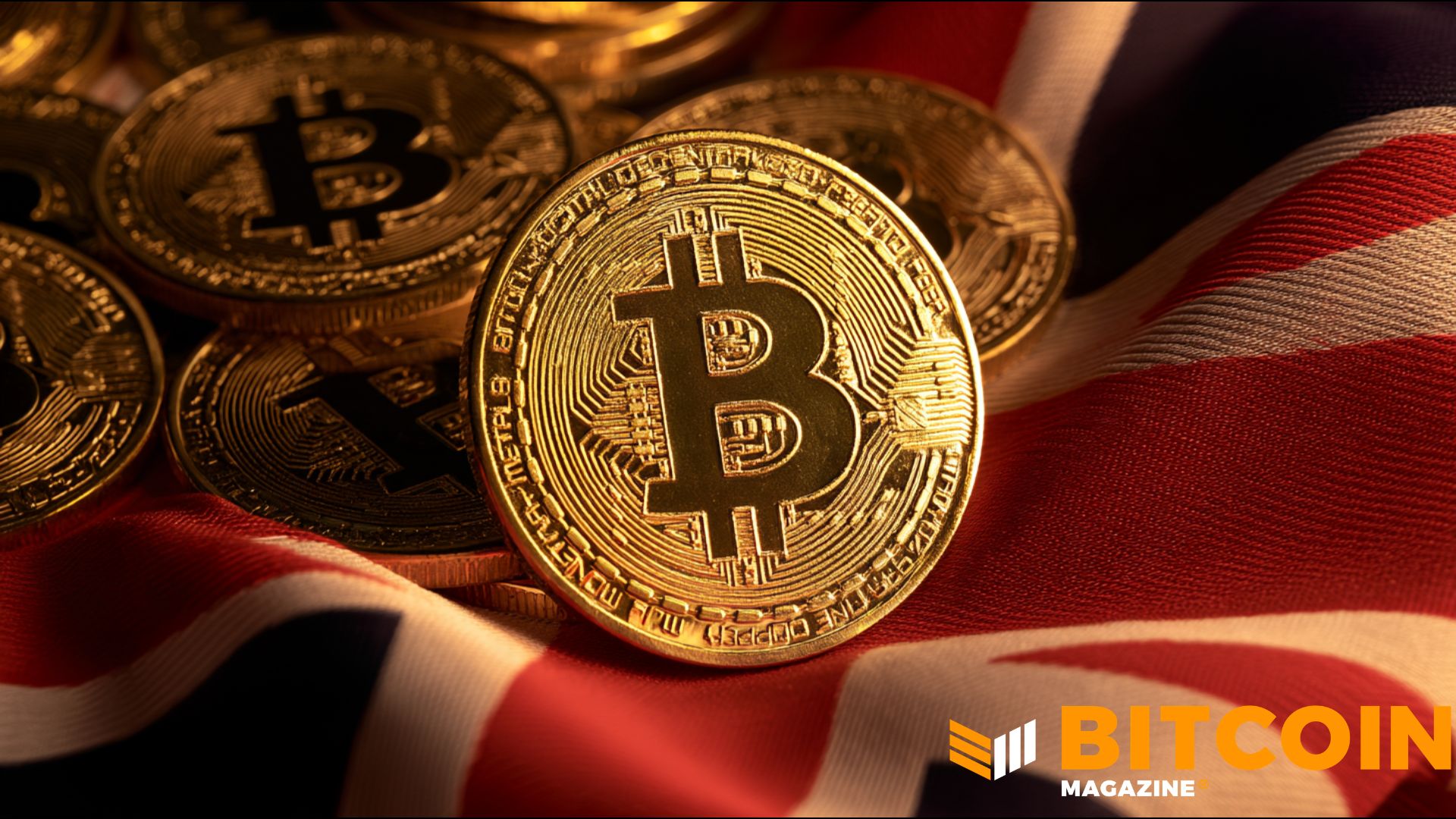
Hargreaves Lansdown Reverses Course, Rolls Out Bitcoin Trading
British financial services firm Hargreaves Lansdown is letting retail investors buy bitcoin — nearly one year after it said the cryptocurrency was “not an asset class.”
The Bristol, UK-based investment firm’s website said it was offering bitcoin and other crypto exchange-traded notes to investors. ETNs are investment funds which trade on stock exchanges and track the prices of digital assets.
It comes after the firm, which manages nearly £173 billion (over $233 billion) in assets, last year warned customers about buying bitcoin.
NEW:
— Bitcoin Magazine (@BitcoinMagazine) September 4, 2026U.K.'s largest investment platform Hargreaves Lansdown is now offering Bitcoin products to 2 million clients!
pic.twitter.com/GgdeHK8vyM
“While longer-term returns of Bitcoin have been positive, Bitcoin has experienced several periods of extreme losses and is a highly volatile investment — much riskier than stocks or bonds,” the firm said at the time.
“The HL Investment view is that Bitcoin is not an asset class, and we do not think cryptocurrency has characteristics that mean it should be included in portfolios for growth or income and shouldn’t be relied upon to help clients meet their financial goals.”
Now, a number of ETNs tracking the price of bitcoin and other cryptocurrencies are available. The firm warns users that “crypto ETNs are considered high-risk and may be volatile.”
U.S. regulator the Securities and Exchange Commission in 2024 approved bitcoin exchange-traded funds for investors after a decade of saying no to the products.
The funds had the most successful debut in the history of ETFs as investors previously unable to buy exposure to the asset class rushed in to buy the products.
Run by top asset managers and banks like BlackRock, Fidelity, and Morgan Stanley, the investment vehicles now collectively manage over $100 billion in assets.
This post Hargreaves Lansdown Reverses Course, Rolls Out Bitcoin Trading first appeared on Bitcoin Magazine and is written by Mathew Di Salvo.
Bitcoin Magazine
Trezor Breach Worse Than Reported: Another 67,000 US Customers Exposed
Hardware wallet manufacturer Trezor has said that a data breach first announced last month is worse than originally reported.
The Prague, Czech Republic-based company said Friday that an additional 67,000 U.S. customers had their names, emails, phone numbers, shipping addresses and order numbers leaked. The leaked data came from orders made between November 2019 and August 2021, according to Trezor.
Trezor first announced in August that data from 11,742 customers from the U.S., UK, Sweden, Colombia, Brazil, Italy, and Portugal had been exposed — with names, emails, phone numbers and shipping addresses leaked.
Another 1,947 customers just had their names, cities and emails exposed in the breach.
In Friday’s announcement, Trezor said that its third-party fulfillment partner, ShipMonk, had falsely reassured the company about deleting customer data.
“Throughout our entire relationship with ShipMonk, we repeatedly requested and received written assurance confirming the deletion of the data, in line with our contract, data policy, and past communications,” Trezor wrote.
“We are very disappointed that, despite receiving this confirmation, the data was not deleted in their systems.”
Neither Trezor nor ShipMonk immediately responded to Bitcoin Magazine’s questions.
Trezor first announced in August that the data had been leaked because ShipMonk experienced “unauthorized access to their systems containing customer data.”
The company added that it had directly emailed all customers involved in the breach. Trezor’s parent company, SatoshiLabs, told Bitcoin Magazine last month that it was investigating the incident.
Trezor is one of the most popular Bitcoin hardware wallet solutions, and also has support for storing other cryptocurrencies.
Bitcoiners’ personal data has been targeted by cybercriminals in the past: back in 2020, an unauthorized party accessed popular hardware manufacturer Ledger’s e-commerce and marketing database, leaking over 1 million email addresses and the personal contact data of nearly 10,000 customers.
At the start of this year, customers reported receiving emails from Global-e, Ledger’s payment partner, that a data breach at its cloud systems leaked sensitive customer data.
This post Trezor Breach Worse Than Reported: Another 67,000 US Customers Exposed first appeared on Bitcoin Magazine and is written by Mathew Di Salvo.
Bitcoin Magazine
El Salvador Isn’t Buying Bitcoin With Public Money, Says IMF
El Salvador has not used public funds to accumulate bitcoin since the International Monetary Fund’s last review of its loan program, the fund said Thursday.
In a report Thursday, the body said that the Central American country had instead received bitcoin from private donations, citing documentation from the government. It added that “no further Bitcoin accumulation beyond the documented donations is expected.”
El Salvador made headlines in 2021 when it became the first country in the world to make bitcoin legal tender. Salvadoran president Nayib Bukele in 2022 said the country would buy one bitcoin per day but it was never clear where the money was coming from — or if he was actually buying at all.
“Documentation has been provided verifying that Bitcoin accumulation since the first review reflects private donations and that no public resources were used,” the IMF release said.
“Understandings were also reached on steps to modernize the legal, regulatory, and supervisory framework for digital assets and to further strengthen the governance and risk-management arrangements for public-sector crypto-asset holdings. Going forward, no further bitcoin accumulation beyond the documented donations is expected.”
The report added that public participation in the government-sponsored bitcoin wallet has been largely wound down, with majority ownership and operational control handed to a private operator.
El Salvador in 2021 debuted a state-sponsored wallet called Chivo for its citizens as part of its plan to increase bitcoin adoption in the country.
“IMF staff thank the Salvadoran authorities for the constructive discussions and excellent collaboration,” the report added.
The IMF El Salvador entered a $1.4 billion loan agreement at the end of December but the fund asked for the country to scale back certain aspects of its bitcoin strategy.
Institutions like the World Bank and the IMF have long criticized President Bukele’s Bitcoin law, which also asked businesses to accept the cryptocurrency if they had the technological means to do so.
President Bukele in 2024 admitted that Salvadorans weren’t using the cryptocurrency to buy things as expected, but always boasted that the government was still stacking sats.
Since launching a crime crackdown to tackle the country’s notorious crime gangs, murder rates in El Salvador have plunged. The country was once the most dangerous place in the Americas but President Bukele is now trying to turn it into a tech hub.
Crypto companies like Tether have since relocated to its capital, San Salvador.
This post El Salvador Isn’t Buying Bitcoin With Public Money, Says IMF first appeared on Bitcoin Magazine and is written by Mathew Di Salvo.
Bitcoin Magazine
Bitcoin Dips Below $80,000 on Strong US Jobs Report
Bitcoin slid Friday after a better-than-expected labor report showed that the U.S. job market accelerated in August.
The leading cryptocurrency was recently trading for close to $79,764 after dropping as low as $78,706 earlier in the morning in New York. It’s currently down over 1% over a 24-hour period. On Thursday, the coin soared above $82,000.
The Federal Reserve is typically more likely to raise interest rates when the labor market is strong, because more people employed means more spending, and more spending can push inflation up.
Federal Reserve Chair Kevin Warsh last week gave his first major speech as head of the U.S. central bank and said he had “more work to do” to fight inflation. Bitcoin has typically done well in a low-interest rate environment.
Traders currently view a U.S. Federal Reserve interest rate hike at the upcoming September 15–16 policy meeting as roughly a 50% to 60% probability.
But U.S. President Donald Trump on Friday demanded the Federal Reserve slash interest rates.
Writing on his social media platform Truth Social, Trump said: “Lower the interest rates because the U.S.A. is a much stronger credit than it was just a short time ago!”
He added: “We should have the LOWEST RATE of any country in the World, like ‘the old days.'”
Bitcoin has decoupled from stocks recently as investors have renewed concerns around dollar debasement.
The cryptocurrency started surging last month, after the U.S. Treasury Department said it would more than double the size of its government debt repurchases. The coin had its best run in three years and third best August ever.
The much-talked about debasement trade is back in the spotlight, and bitcoin has been trading in lockstep with gold, according to analysts. The so-called debasement trade is when investors buy an asset as a way to hedge against a currency losing value.
News dropped last month that U.S. public debt exceeded $40 trillion for the first time too. Excessive debt also undermines confidence in the dollar, making assets like bitcoin and gold attractive.
This post Bitcoin Dips Below $80,000 on Strong US Jobs Report first appeared on Bitcoin Magazine and is written by Mathew Di Salvo.
Bitcoin Magazine
National Sheriffs’ Association Drops Opposition to Clarity Act
The National Sheriffs’ Association this week dropped its opposition to the crypto Clarity Act, after having previously warned that the proposed bill could help criminals.
Writing Thursday to Senate Majority Leader John Thune and Minority Leader Chuck Schumer, the association said it was changing its stance to neutral given how complex the issue is.
A number of lawmakers were hoping to vote on the Clarity Act in August. After a delay, a vote will now go ahead this month. The bill will establish a framework for distinguishing between digital assets that are securities, commodities or payment stablecoins — legislation that the crypto industry has long called for.
“Given the complexity of the legislation and the number of important details that remain under consideration, the NSA is changing its position on the Clarity Act to neutral,” the letter from NSA President Sheriff Troy Wellman and Executive Director Justin Smith read.
JUST IN: Major U.S. law enforcement organization National Sheriffs’ Association no longer opposes The Clarity Act
— Bitcoin Magazine (@BitcoinMagazine) September 4, 2026
“We believe the most appropriate course is to step back and allow the legislative process to proceed to establish a…much needed regulatory framework.”pic.twitter.com/NBpKlrUsUj
“At this time, we believe the most appropriate course is to step back and allow the legislative process to proceed to establish a clear, effective, and much needed regulatory framework.”
The NSA had previously warned that the bill could create regulatory and anti-money laundering loopholes by exempting certain crypto developers and infrastructure providers from money transmitter rules.
Despite being passed in the house of representatives last year with strong bipartisan support, the Clarity Act has been in a deadlock for much of 2026. The banking lobby raised concerns over stablecoin yield and some lawmakers have said improvements need to be made surrounding ethics.
An updated bill of the Clarity Act was introduced in July that addressed some of these concerns — banning government officials and their families from issuing or promoting crypto.
Pro-crypto senator Cynthia Lummis wrote on Friday that the “bipartisan bill” gives “law enforcement real tools to fight the illicit finance crimes hurting hard working Americans.”
Major financial institutions, lawmakers and companies have said they support the latest draft of the new bill, but some Republicans have accused Democratic lawmakers of deliberately playing politics and holding the bill back.
This post National Sheriffs’ Association Drops Opposition to Clarity Act first appeared on Bitcoin Magazine and is written by Mathew Di Salvo.
CryptoSlate
Bitcoin's best and newest large buyer has no face, no investment committee, and no public opinion about whether the price looks cheap.
It appears near the end of the US trading day as an entry beside an ETF ticker, and on Aug. 27 that entry showed $277.6 million flowing into IBIT while the entire US spot Bitcoin fund category saw $242.3 million in inflows.
That means the other products combined lost $35.3 million, leaving BlackRock's fund to carry the group through a difficult day.
The same pattern becomes much more interesting when you look across the market's full history.
From the January 2024 launch through Sept. 3, 2026, IBIT collected over $63.9 billion in cumulative net inflows, according to Farside Investors' fund ledger. The entire group, including IBIT, kept $55.5 billion, and subtracting one from the other leaves every fund outside IBIT with a combined $8.4 billion in net outflows.
That gives IBIT 115.2% of the category's net inflow, a percentage that sounds impossible until you include the withdrawals elsewhere.
If one person puts $115 on a table while everybody else removes a combined $15, the table ends with $100. IBIT is the person adding money, and the category total is what stays on the table.
The ledger shows that IBIT brought in enough to cover those withdrawals at the category level.
That's the case for treating one ETF as Bitcoin's buyer of last resort. IBIT has supplied every dollar the US fund group retained, plus enough to offset the net exits from all of its rivals.
The comparison has a firm limit because a central bank serving as a buyer of last resort has a public mandate and can create money, while IBIT expands only when investors ask for more shares. Its backstop comes from the repeated behavior of a large crowd, with BlackRock providing the vehicle.
| US spot Bitcoin ETF flows through Sept. 3, 2026 | Net flow |
|---|---|
| BlackRock's IBIT | $63.939 billion |
| Entire US spot Bitcoin ETF group | $55.512 billion |
| Every fund outside IBIT, combined | -$8.427 billion |
| Grayscale's GBTC | -$27.653 billion |
| All funds except IBIT and GBTC | $19.226 billion |
Source: Farside Investors' daily US spot Bitcoin ETF flow data. Figures are cumulative net creations and redemptions, not trading volume. The final row removes both IBIT and GBTC from the category total.
The ETF that swallowed everyone else's exits
Most of the negative column belongs to Grayscale Bitcoin Trust, which entered the ETF era carrying a huge pool of Bitcoin and a 1.50% fee. Its conversion finally gave shareholders a redemption route, while cheaper products gave those who wanted to stay invested an obvious place to move.
The flow data can't separate those migrations from outright Bitcoin sales, though it does show that GBTC has recorded $27.6 billion in net outflows since January 2024.
That history can make IBIT's 115.2% share look like an accounting trick built entirely around one expensive legacy fund, so a more accurate calculation removes both IBIT and GBTC. The rest of the market took in $19.2 billion across the cheaper field led by Fidelity and several smaller issuers. IBIT still brought in more than three times their combined sum.
Its current scale helps explain the gap because as of Sept. 3, BlackRock reported about $63.44 billion in IBIT net assets, 1.375 billion shares outstanding, a 0.25% sponsor fee, and a 0.02% 30-day median bid-ask spread.
The portfolio contained one asset, Bitcoin, while the wrapper offered an experience investors already knew from stock and bond ETFs, complete with a familiar ticker, conventional account statements, deep daily trading, and exposure without managing private keys.
The concentration has continued well beyond the launch, with IBIT drawing $2.843 billion of the group's $3.655 billion across the 14 trading sessions from Aug. 17 through Sept. 3, or 77.8%.
It frequently carried the category during positive sessions and offset redemptions elsewhere, continuing a pattern seen in July when one IBIT inflow revived an otherwise weak daily total.
The result tells us a lot about how new demand reaches Bitcoin. A dozen funds now offer separate entrances, but capital has clustered around the product with the biggest brand, deepest trading, and broadest access to conventional portfolios.
The network underneath can be distributed worldwide, while its main US financial entrance narrows to a single revolving door.
BlackRock is the ETF address
ETF activity happens in two related markets, and separating them makes the flow numbers much easier to understand.
During the trading day, investors buy and sell existing IBIT shares with one another on Nasdaq. Billions of dollars can trade in that secondary market while the number of shares and the trust's Bitcoin holdings stay the same.
The underlying pool expands through the primary market, where authorized participants submit orders for large blocks of new shares under the procedures in the IBIT prospectus. The trust receives Bitcoin or cash through the permitted creation process, while redemptions run the same mechanism in reverse.
Arbitrage gives participating firms an incentive to create shares when IBIT trades above the value of the Bitcoin represented by each share and redeem when it trades below, which keeps the fund close to its net asset value.
Daily flow estimates try to measure that primary-market expansion and contraction. Trading volume shows how many shares moved between investors, while net creations show whether the trust grew.
| Market signal | What happens | Does Bitcoin exposure in the trust change? | Why it matters |
|---|---|---|---|
| Secondary-market trading | Investors buy and sell existing IBIT shares | No | Shows turnover, liquidity, and demand between shareholders |
| Primary-market creations | Authorized participants create new ETF shares | Yes, trust expands | Indicates fresh capital entering the vehicle |
| Primary-market redemptions | Shares are redeemed through the ETF mechanism | Yes, trust contracts | Indicates capital leaving the vehicle |
| Premium/discount to NAV | ETF trades above or below underlying Bitcoin value | Not directly | Shows whether arbitrage is keeping the wrapper aligned |
| Shares outstanding | Total ETF shares rise or fall | Yes, over time | Confirms whether IBIT is actually growing or shrinking |
On a volatile day, a huge burst of share trading can reflect disagreement among existing owners, while a net inflow means fresh capital entered the vehicle and enlarged its claim on Bitcoin.
BlackRock built and sponsors the product, maintains its institutional relationships, earns the fee, and provides the name printed across the top. The economic buyers are the people and organizations whose orders drive creation, which makes “BlackRock bought Bitcoin” a convenient shorthand for a distribution machine combining thousands of separate decisions.
That machine has structural advantages because financial advisers can place IBIT inside model portfolios, companies can hold it through familiar custody arrangements, and retirement investors can gain exposure without learning wallet security or exchange operations.
Heavy daily trading makes big orders easier to execute, which attracts more large orders, while BlackRock's name lowers the amount of explaining an adviser must do before discussing an allocation.
The result is a unique split inside Bitcoin, where ownership of the network asset is still dispersed, and the protocol runs independently of BlackRock, while a large portion of fresh US investment passes through one sponsor, one trust, a concentrated custody chain, and a limited group of firms authorized to create or redeem shares.
Decentralization at the protocol layer can coexist with concentrated access at the capital-markets layer.
A backstop with a sell button
The same structure that makes IBIT feel dependable also defines its limits. It has no reserve fund waiting for a Bitcoin crash and no instruction to buy when the price falls.
BlackRock provides the vehicle while shareholders control the direction, so persistent inflows create the appearance of a backstop for as long as that crowd keeps adding money.
Sept. 1 showed the other side in one entry as IBIT lost $201.2 million, Fidelity's fund lost $43.7 million, and the group posted a $236.5 million outflow. One session later, IBIT brought in $115.4 million and helped the category finish positive even as GBTC lost $56.2 million, then added another $454 million on Sept. 3 as the group took in $730.8 million.
The fund can offset other products' selling one day and join it the next because the mechanism faithfully follows investors in both directions.
| Scenario | ETF flow pattern | Bitcoin market implication | Article takeaway |
|---|---|---|---|
| Base case | IBIT remains the dominant inflow vehicle | Bitcoin demand keeps routing through one main US ETF | Concentrated access becomes normal |
| Bull case | IBIT absorbs rival outflows and adds fresh capital | ETF demand strengthens Bitcoin’s marginal bid | BlackRock’s wrapper becomes the preferred institutional rail |
| Bear case | IBIT joins category-wide outflows | The “buyer of last resort” becomes a sell channel | The same structure can amplify downside |
| Stress case | Heavy redemptions meet weak liquidity or volatility | ETF flows add pressure during fragile market conditions | A backstop without a mandate can disappear quickly |
Creations can create demand for Bitcoin in the underlying market, though the price effect depends on available liquidity, how the order is executed, any derivatives hedges around it, and how much sellers will offer.
Flow data captures one powerful source of marginal demand within a much larger market, which is why Bitcoin can fall during an inflow day or climb during an outflow day.
IBIT's share of weekly flows shows how dependent the category has become on one product, while days when it offsets redemptions elsewhere show whether the informal backstop is active.
Shares outstanding show whether the trust is expanding, the premium or discount shows how tightly arbitrage is working, and trading volume belongs in its own column because activity between shareholders can create plenty of noise without adding Bitcoin to the trust.
Bitcoin spent its early life attracting people who wanted an exit from conventional finance. Its newest large buyer is a conventional product that lets a much wider population enter while keeping the same accounts, advisers, tax documents, and trading habits they already use.
The demand behind IBIT is broader than BlackRock's and more concentrated than the ticker makes it seem, which is why one ETF can now look like the buyer holding up an entire US fund category.
The post The $63 billion revolving door carrying the entire US Bitcoin ETF market appeared first on CryptoSlate.
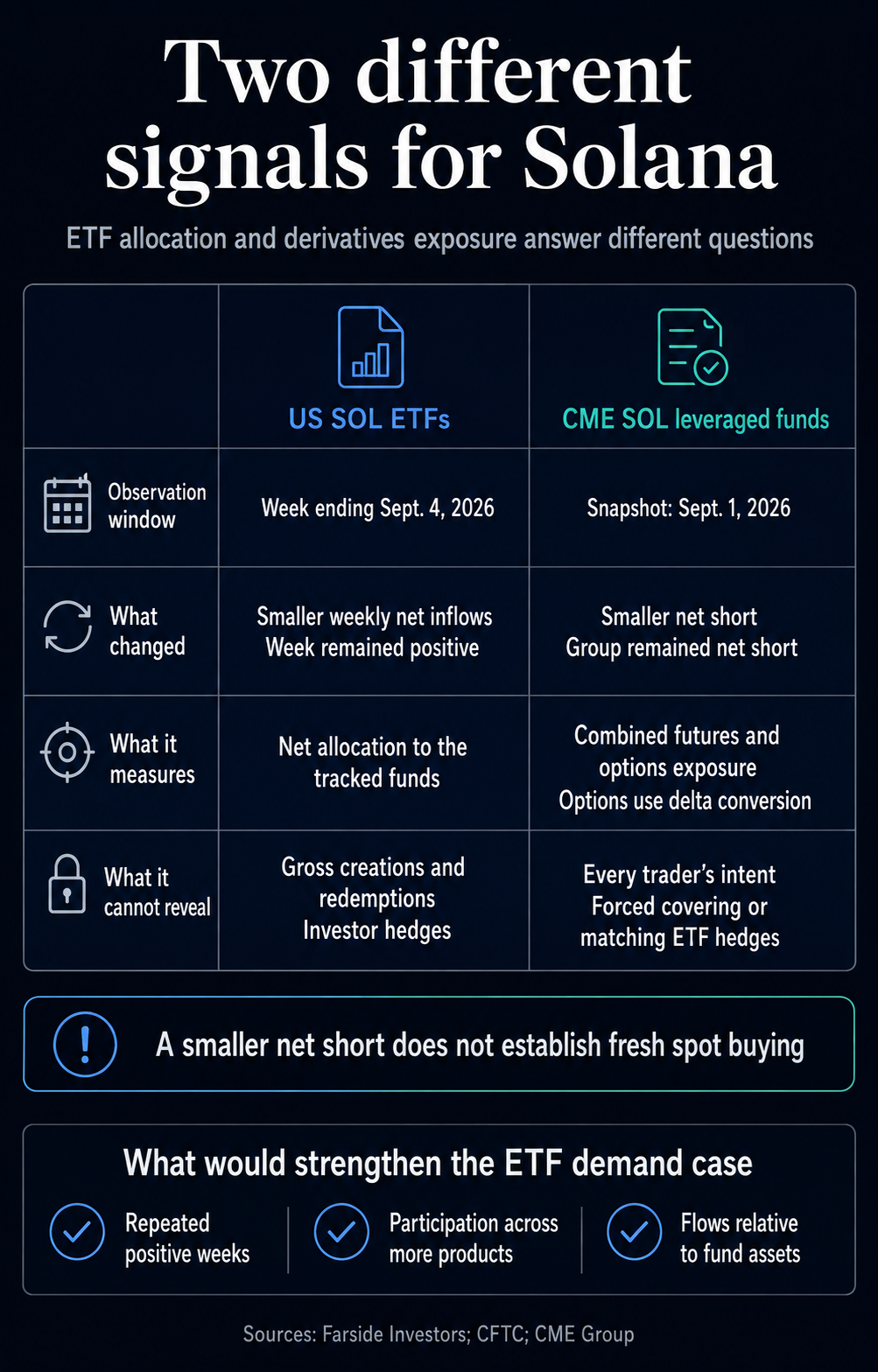
Solana’s US ETF inflows fell about 97% in the week ending Sept. 4, leaving the funds with a small positive balance as Bitcoin’s allocation pace strengthened.
A separate CME positioning report showed leveraged funds becoming less net short SOL. Together, the readings distinguish two sources of market exposure: capital entering ETF products and changes in derivatives positions. Solana’s weaker fund allocation makes that distinction central to assessing whether demand for the asset is broadening.
Solana ETF inflows lagged as the weekly allocation gap widened
The completed Solana ETF week brought net inflows of USD 4.9 million across the six products tracked by Farside Investors, compared with net inflows of USD 142.7 million in the previous five trading sessions. The rounded 97% decline measures the change in weekly net inflows. It does not measure a fall in fund assets, SOL’s price or the number of investors.
The same comparison shows a slowdown for Ethereum funds, while Bitcoin funds attracted more net capital:
| Farside US ETF cohort | Aug. 24–28, 2026 | Aug. 31–Sept. 4, 2026 |
|---|---|---|
| Solana | USD 142.7 million net inflow | USD 4.9 million net inflow |
| Ethereum | USD 815.7 million net inflow | USD 215.3 million net inflow |
| Bitcoin | USD 924.5 million net inflow | USD 986.7 million net inflow |
All three cohorts finished the latest week positive. Bitcoin’s stronger result therefore supports a narrower conclusion than a wholesale retreat from crypto funds: allocation momentum shifted in its favor within this comparison, while Solana and Ethereum absorbed less new net capital.
The totals cover Farside’s listed products for these three assets. They do not measure every crypto fund or show that investors sold one asset to buy another. They also compare dollar amounts without adjusting for each cohort’s assets under management. A larger dollar inflow does not, by itself, establish stronger demand relative to the size of the funds.
Earlier CryptoSlate coverage of altcoin inflows alongside a Bitcoin pullback captured a daily divergence. Its subsequent report on the Bitcoin and Ethereum ETF rebound also focused on one session. Completing the weekly window puts those changes in a broader frame without turning a handful of sessions into a lasting allocation trend.
Which Solana ETF products attracted flows?
Solana’s non-zero reported net-flow entries during the latest week were confined to BSOL, FSOL and GSOL. VSOL, TSOL and SOEZ showed zero net flow on every session. That makes product breadth a relevant part of the demand question, although a zero net figure does not demonstrate an absence of gross creations and redemptions.
The closing session also mattered. On Sept. 4, Solana ETFs recorded net outflows of USD 5.2 million, while Ethereum and Bitcoin ETFs recorded net inflows of USD 25.9 million and USD 174.6 million, respectively. Those are single-day readings; Solana’s full week remained net positive.
A fund can experience additions and withdrawals that offset each other, leaving a modest net number. Trading existing shares on an exchange is a separate activity from creating or redeeming shares with the fund.
Franklin’s Solana ETF illustrates the underlying mechanism: its quarterly filing describes authorized participants creating or redeeming units in exchange for SOL and/or cash, with cash redemptions requiring the sponsor to arrange sales of the represented SOL. That product-specific process connects fund activity to underlying assets, but the weekly net-flow table does not reveal the gross buying and selling involved or investors’ hedges.
CME funds were less net short, but still short
The separate derivatives snapshot points to less net short exposure as ETF allocation weakened. The CFTC’s combined positioning report shows leveraged funds holding 1,069 long and 3,615 short futures-equivalent contracts in standard CME SOL as of Sept. 1. At 500 SOL per contract, the difference represents a net short of 1,273,000 SOL, compared with 2,166,500 SOL on Aug. 25.
Both sides of the reported position changed. The residual long column increased by 577 contracts, while the residual short column fell by 1,210. The smaller net short therefore cannot be described entirely as funds reducing short positions. The long and short columns also exclude the offsetting positions classified as spreading, which cancel when calculating the net.
The group remained net short. This Sept. 1 positioning snapshot also predates the end of the ETF week on Sept. 4, so the observations cannot identify matching trades or explain SOL’s price movement.
Under the CFTC’s combined-report methodology, options positions are converted into futures equivalents using exchange-supplied delta factors. A change in combined exposure can therefore reflect more than straightforward futures purchases or sales. The report does not establish forced covering.
The regulator’s trader-classification notes add another limit. Leveraged funds can pursue outright positions, arbitrage or hedging, and the category describes the trader’s business rather than the intent behind every position. A net short in this category cannot identify a particular ETF hedge or be treated as a pure wager that SOL will fall.
CME’s financially settled SOL contracts allow investors to take price exposure without receiving the underlying tokens. A smaller short position in those contracts is consequently not equivalent to new spot allocation.
What would show sustained Solana ETF demand?
For sustained demand through Solana ETFs, the clearest next evidence would be repeated positive weeks with participation across more products. Comparing those flows against a consistent asset base would help distinguish a meaningful increase in allocation from a large-looking dollar figure in a much larger fund market.
Gross creations and redemptions would add detail that net totals cannot provide. The same principle applies to derivatives: subsequent changes in both long and short exposure matter, alongside the effect of options and offsetting positions.
The latest completed week leaves Bitcoin with the stronger incremental ETF allocation in this three-asset comparison. Solana still attracted net capital, but the evidence for a lasting broadening of demand needs more than a positive weekly balance and a less negative futures position.
The post Solana’s weekly ETF inflows fell 97% while CME funds became less net short appeared first on CryptoSlate.
At 14:59:59 UTC, Bitcoin perpetual futures look like any other electronic market, with prices flickering and orders flowing from traders around the world.
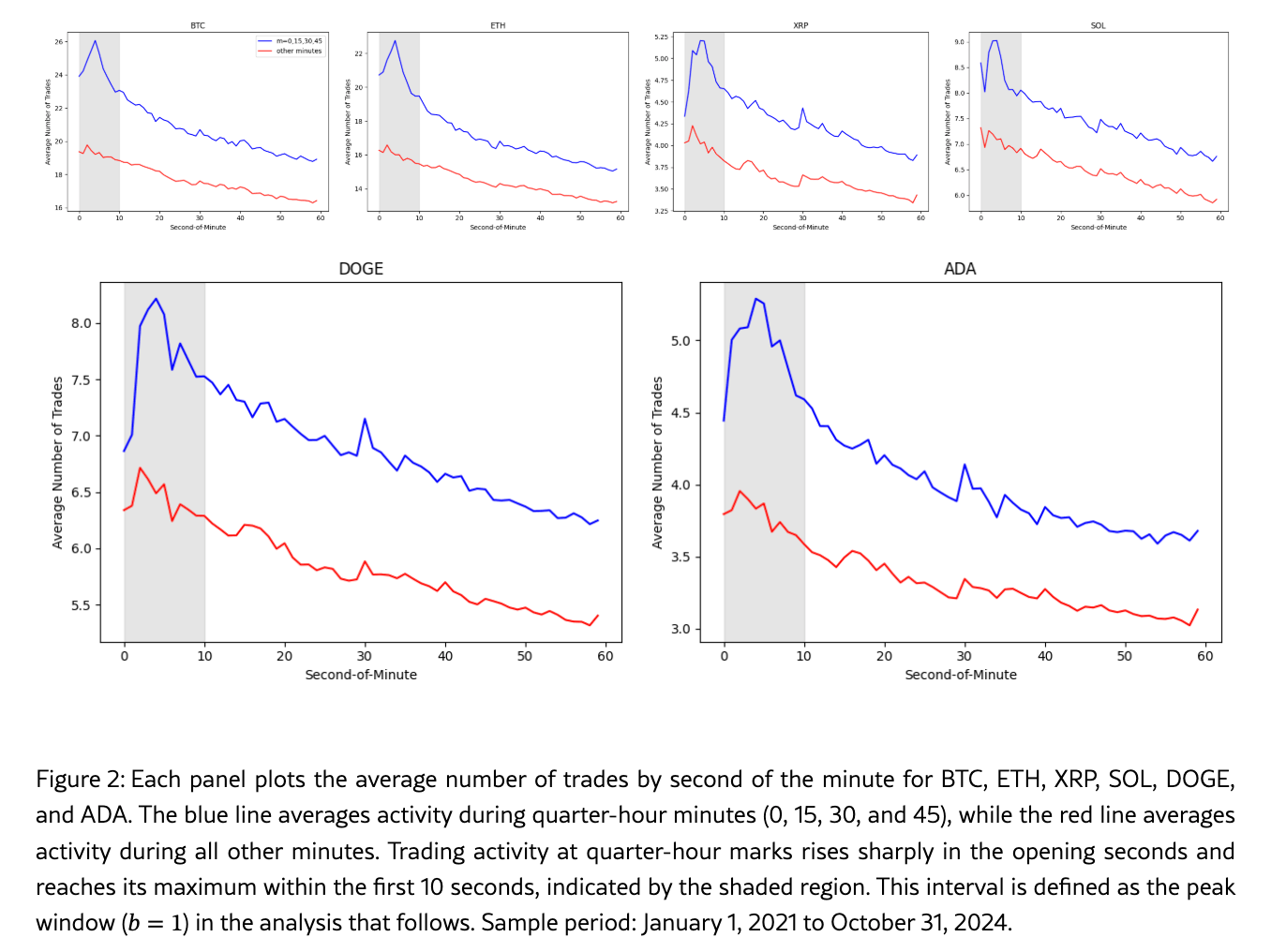
But when the clock turns to 15:00:00, the market instantly becomes busier: more trades go through, more money turns over, and prices cover more ground during the next ten seconds, even though nothing has given anyone a fresh reason to trade.
The same pulse returns at 15, 30, and 45 minutes past every hour. A smaller version appears at five-minute boundaries and at the start of every minute, but the top of the hour still produces the strongest burst, as though crypto's continuous market has been divided into thousands of tiny sessions by the software used to trade it.
Korean policy researcher Chan Kim and Peter Reinhard Hansen of the University of North Carolina documented the pattern in an August 2026 study of crypto futures. They examined records of completed trades in six Binance futures markets from Jan. 1, 2021, through Oct. 31, 2024, covering Bitcoin, Ethereum, XRP, Solana, Dogecoin, and Cardano across 1,400 full days of nonstop trading.
The contracts were perpetual futures, usually called perps, which let traders bet on whether an asset will move up or down and use borrowed exposure to make that bet larger.
While a conventional futures contract expires on a defined date, a perp can stay open as long as the trader has enough collateral, and recurring payments between long and short traders keep its price close to the underlying spot market.
When a perp trades above its spot index, traders betting on a higher price pay those betting on a lower one. When it trades below the index, the payment runs the other way.
Perpetual futures account for a large share of global crypto trading, which gives these brief bursts a much wider and deeper reach. Perp prices help guide arbitrage, hedging, and market-making across exchanges, so a pattern that begins in futures can feed into the Bitcoin market data and spot prices followed by everyone else.
Crypto found its opening bell(s)
The 15-minute pulse is easy to see when you draw an hour as a circle. The researchers' charts produce four points at minutes zero, 15, 30, and 45, creating a star-shaped pattern in trading volume and price movement, with most of each burst packed into the first ten seconds.
Across all six contracts, those ten seconds contained 26% more trades and 32% more dollar volume than the same ten-second window during ordinary minutes, while absolute returns were 26% larger.
Absolute return measures how far the price moved in either direction, so a 26% larger reading means a bigger move up or down during the quarter-hour window.
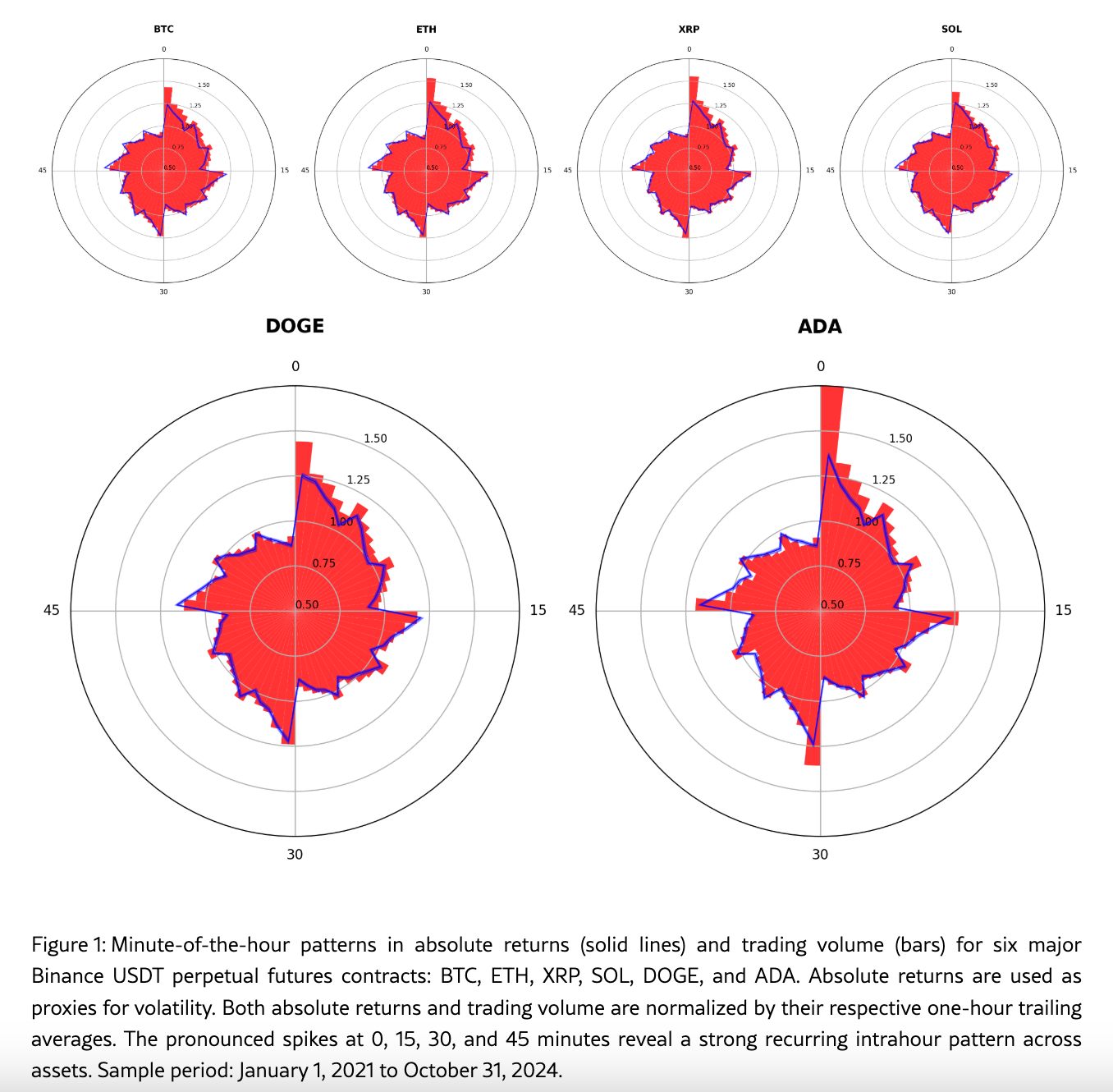
The pattern also crossed a wide gap in market size. Bitcoin averaged 1.54 million daily trades and $14.58 billion in contract volume during the sample, while Cardano averaged roughly 290,000 trades and $544 million in the same trading rhythm.
That consistency is the most important finding because it shows the convention is shared across trading systems rather than being a feature of one token.
Most trading apps turn a continuous stream of prices into candles covering one minute, five minutes, 15 minutes, or another familiar interval.
A 15-minute candle compresses everything that happened during that period into an opening price, a closing price, a high, and a low, giving humans a manageable picture of the market and giving software a standard block of data it can process.
At the end of each candle, technical indicators recalculate, and automated strategies receive fresh instructions from the same newly completed block.
Programs that divide a large trade into smaller pieces may release another piece on that boundary, while market makers can adjust their quotes for the flow they expect, and faster systems can trade in anticipation of both groups.
Once enough machines start following the same clock, a convenient way of displaying data becomes part of the market itself.
That's how an uneventful quarter-hour starts to look like a stock exchange opening. Traditional markets gather orders around a real opening bell because traders have spent hours waiting for the venue to reopen.
On the other hand, crypto creates a comparable rush through shared chart intervals and software defaults, repeating the process every 15 minutes while trading continues.
The machines have a tell
Binance's trade records show what was traded, how much, and at what price. However, they don't identify whether a human trader, a market-making firm, a liquidation engine, or another automated system initiated each transaction. Kim and Hansen looked for an indirect clue in trade size.
People tend to prefer round numbers because they are easier to choose and remember, so someone may trade 0.1 BTC or roughly $10,000 without calculating an awkward quantity to the final decimal place.
But algorithms usually start with a formula based on volatility, available capital, current exposure, or a target share of a larger order, which can produce quantities that look arbitrary to a human.
The researchers counted how often trade sizes ended in trailing zeros and found that round quantities were less common during the opening seconds of the recurring bursts.
They included only trades large enough to contain the number of zeros being measured, which kept tiny orders from being classified as irregular simply because the exchange's minimum increment made extra zeros impossible.
The decline grew with the importance of the boundary. Round quantities became slightly less common at the start of an ordinary minute, the gap widened every five minutes, and then again every 15 minutes, with the top of the hour producing the largest break from the usual pattern.
For Bitcoin trades that were eligible to end in at least two zeros, the round-size share fell by 0.04 standard deviations at an ordinary minute opening and by 0.20 at the top of the hour, making the hourly effect five times larger.
A standard deviation describes how far an observation moves from its usual range, so those numbers aren't the percentage of trades placed by machines. They show that the market moved farther from its normal preference for round quantities exactly when trading activity jumped, giving the authors a behavioral fingerprint of heavier automated participation.
Trade size still can't identify the source of every order. Large institutional executions and forced liquidations can produce irregular quantities, and funding arbitrage can do the same, so the paper uses roundness as indirect evidence associated with machine activity.
The authors ran several checks to see whether another recurring event was creating the pulse.
Binance processed funding payments at 00:00, 08:00, and 16:00 UTC during the sample, but removing those windows left the quarter-hour result largely intact, and the pattern at minutes 15, 30, and 45 survived when every top-of-hour observation was removed. A separate analysis of Bybit data produced a similar structure on another exchange.
Those checks describe a broad form of electronic coordination. Any trader can choose any interval, but exchange data, chart settings, and common indicators pull many systems toward the same boundaries, with the strongest concentration appearing at the clock points that receive the most shared attention.
A price forecast worth less than the trading fee
Once the researchers established that the pulse repeated, they asked whether data available before each quarter-hour could forecast the price move during its first ten seconds.
Their rolling model studied earlier quarter-hour returns alongside familiar price and volume indicators, then made a fresh out-of-sample forecast using information available at the time.
Across the six contracts, the model chose the correct direction 56.6% of the time. Its average out-of-sample R-squared was 3.4%, meaning it explained a small portion of the variation in those ten-second returns, while its area-under-the-curve score was 0.60 on a scale where 0.50 is a random guess, and 1.00 represents perfect classification.
In a market with enormous noise over ten-second intervals, those modest figures establish that the pattern contains repeatable information.
However, they don't establish an easy trading strategy because the predicted move was tiny. Trading in the model's chosen direction at every quarter-hour produced an average gross return of 0.51 basis points per trade before fees, equal to about 0.0051%, or roughly 51 cents on a $10,000 trade.
During the sample, Binance's base fee was 5 basis points for a taker order, which executes immediately against an existing quote, and 2 basis points for a maker order, which provides a quote for someone else to accept.
A $10,000 taker trade therefore cost about $5 to open and another fee to close, while the model's average gross return was roughly one-tenth of the first charge alone.
Given how small the gains are here, the most useful result from this dataset is the gap between statistical predictability and the money an ordinary trader can capture.
A pattern can repeat often enough to survive formal analysis while the expected move stays too small to cover basic trading costs, which is one reason highly automated markets can contain recognizable patterns without making any profits.
Market makers and large traders can still use the finding because they face a very particular problem.
If a company is quoting both sides of the market, it could demand a wider spread during those ten seconds or reduce how much it offers when one-sided flow becomes easier to anticipate, while a trader working through a large order may release pieces at less crowded points on the clock to reduce the price movement caused by its own activity.
The first ten seconds also carried information over a longer horizon. When buyer-initiated volume exceeded seller-initiated volume at a quarter-hour boundary, that imbalance was associated with returns over the next four to 12 hours, and the reverse relationship appeared when sellers dominated.
Order imbalance here means the difference between aggressive buying and aggressive selling relative to the total volume in that window, giving the researchers a way to measure which side was pushing harder.
At the four-hour horizon, much of the relationship came from earlier quarter-hour flow carrying into later boundaries. At eight and 12 hours, ordinary price and volume indicators explained more of it, which fits a market where algorithms use the quarter-hour as a shared moment to process information that has already been building across the wider market.
That longer-horizon result needs to be taken with a grain of salt because the four-, eight-, and 12-hour return windows overlap, allowing one market move to appear in several observations.
The authors used block-bootstrap methods designed for dependent data, though aggregate trade records still can't show whether the initiating orders contained private information, reacted to the same public inputs, or moved prices as market makers absorbed an uneven flow.
Nonetheless, the larger idea is easier to understand and eventually implement than the statistical machinery behind it.
Crypto removed the closing bell and made trading continuous, then its APIs, chart intervals, and automated strategies rebuilt miniature openings throughout the day.
Every 15 minutes, thousands of independent systems reach the same clock boundary, and for a few seconds a market designed to run without interruption behaves like a crowd pushing through the same door.
The post Inside the 15-minute trading pulse that moves $14 billion in Bitcoin perpetual futures appeared first on CryptoSlate.
A $4.5 billion US large-cap stock fund now has two crypto-sensitive companies at the top of its portfolio.
The Fundstrat Granny Shots US Large Cap ETF's Sept. 4 holdings snapshot ranked Bitcoin-treasury company Strategy (MSTR) first at 3.02% and retail financial platform Robinhood Markets (HOOD) second at 2.99%. Together they represented 6.01% of the portfolio. The fund, known by its ticker GRNY, reported $4.533 billion in assets and 42 holdings as of Sept. 3.
GRNY owns equities, not Bitcoin, and describes itself as an actively managed US large-cap fund. Yet its two largest holdings connect shareholders to crypto through public companies: Strategy through its Bitcoin treasury and Robinhood through a trading business that includes crypto.
The snapshot demonstrates one route by which crypto-linked volatility can reach investors in a generalist stock portfolio. One fund cannot establish that mainstream managers broadly are replacing direct crypto allocations with proxy stocks.
The ranking followed an equal-weight reset and an MSTR rally
GRNY's Aug. 21 rebalance notice said all holdings would be reset to equal weight. Strategy and Robinhood were already in the portfolio and remained there; neither was a new addition.
The reset added Freeport-McMoRan, Intel, Lockheed Martin, Micron Technology, SiriusPoint and Vertiv. It removed Air Products and Chemicals, American Express, Broadcom, Meta Platforms, Northrop Grumman, PNC Financial Services and Texas Pacific Land, according to the fund sponsor's full rebalance announcement.
With 42 positions reset to equal weight, a simple starting benchmark is about 2.38% per holding. MSTR rose from a $119.25 close on Aug. 21 to $144.82 on Sept. 3, a gain of about 21.4%, based on historical closing prices. That appreciation plausibly accounts for a substantial part of its rise above the equal-weight baseline and into first place.
The exact path is not public. ETF.com reported $334.82 million of net creations for GRNY on Aug. 20, one day before the reset, but that figure does not identify which securities absorbed the cash and is not a complete post-rebalance flow series. The available data cannot cleanly divide MSTR's current weight among purchases, fund creations or redemptions, and price appreciation.
The fund's governance also makes a singular “Tom Lee bet” an imprecise description. A June SEC filing says Lee and Ken Xuan are jointly and primarily responsible for day-to-day securities management, while Qiao Duan and Stephen Foy oversee trading and execution.
The record therefore supports a narrower reading: GRNY retained MSTR at an equal-weight rebalance, after which a sharp price increase helped push the stock to the top. It does not disclose enough to reconstruct every trade or assign the position to one individual.
Strategy and Robinhood transmit crypto risk in different ways and should not be treated as interchangeable proxies.
| Company | GRNY weight on Sept. 4 | Main crypto linkage | Important caveat |
|---|---|---|---|
| Strategy | 3.02% | Large corporate Bitcoin treasury | Shareholders also take financing and capital-structure risk |
| Robinhood | 2.99% | Crypto trading inside a retail financial platform | Crypto is one part of a diversified revenue base |
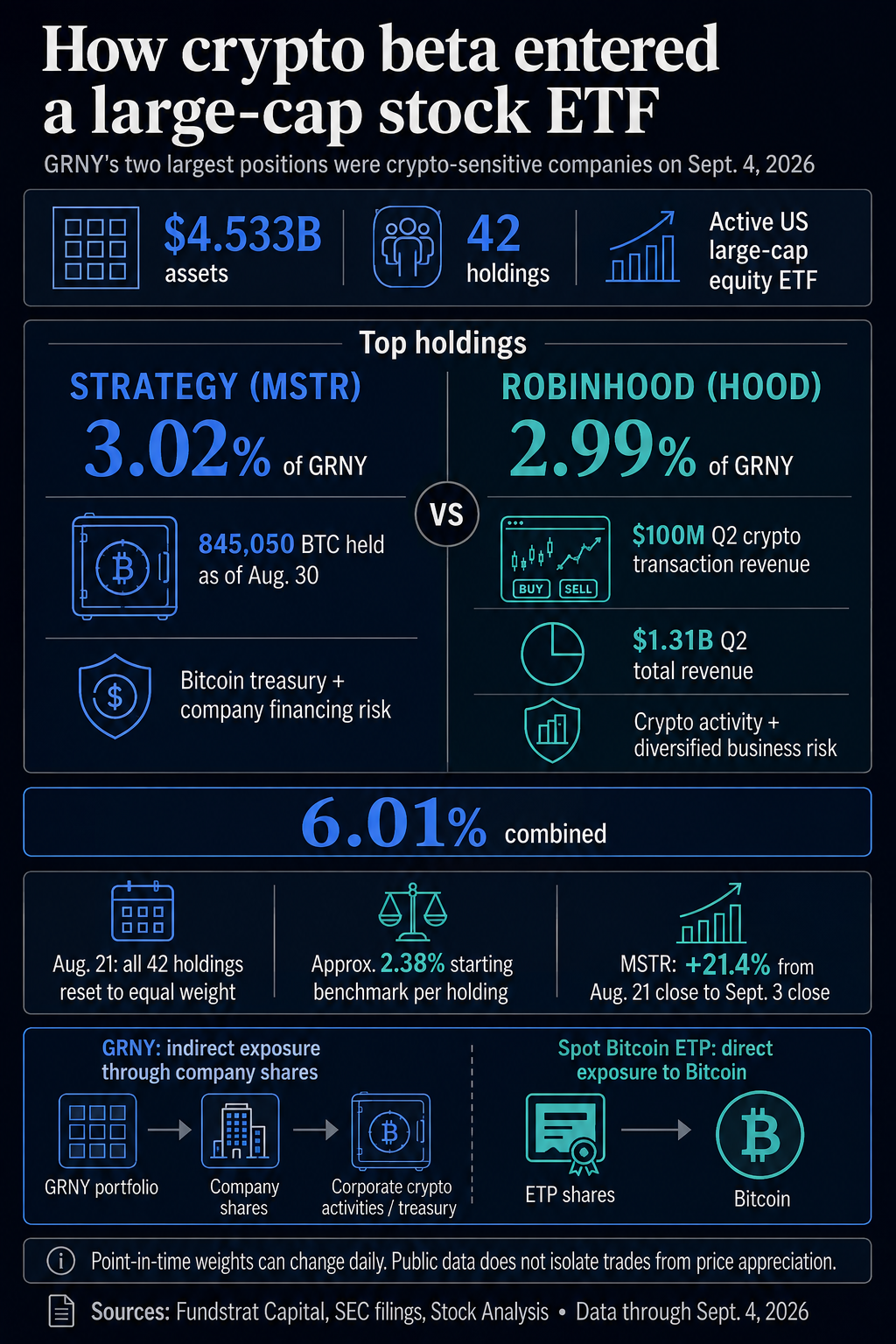
Strategy reported holding 845,050 BTC as of Aug. 30. Changes in Bitcoin's value are consequently central to the company's balance sheet. MSTR's price can also reflect leverage, financing terms, security issuance, its software business, and the premium or discount investors place on its treasury strategy.
Robinhood's connection is operational. The company reported $100 million of crypto transaction revenue in the second quarter, within total revenue of $1.31 billion. Crypto-market activity can affect its trading volumes and revenue, alongside equities, options, interest income, customer assets and the rest of its product mix.
The combined 6.01% is therefore not equivalent to a 6.01% Bitcoin allocation. It is exposure to two businesses whose sensitivity to crypto prices and activity arises through different channels and comes bundled with company-specific risks.
A direct spot-Bitcoin product is structurally different. BlackRock says the iShares Bitcoin Trust ETF seeks to reflect the price of Bitcoin and holds Bitcoin as its portfolio asset. GRNY's shareholders instead hold operating-company stocks chosen by an active manager. Its net asset value can transmit some combination of Bitcoin moves, crypto-trading activity and equity-specific valuation changes even when an investor never buys a spot-Bitcoin fund.
Crypto beta can thus extend beyond dedicated crypto products because listed companies carry that sensitivity into broader equity portfolios. The exposure is disclosed, and GRNY has not changed its stated mandate. The wrapper changes the character of the risk: a spot product largely tracks its underlying asset, while MSTR and HOOD add management, financing, regulation, execution and stock-market valuation.
GRNY remains one example rather than proof of an industry-wide migration. Establishing a broader shift would require comparable holdings and flow data across active equity funds over time. The Sept. 4 snapshot establishes the more limited point: after an equal-weight rebalance and an MSTR rally, a generalist large-cap ETF's two biggest positions were crypto-sensitive companies. Its shareholders were absorbing part of their volatility whether or not crypto exposure was why they bought the fund.
The post Strategy and Robinhood now lead a $4.5 billion large-cap ETF that was not built for crypto appeared first on CryptoSlate.
Bitcoin price forecasting has accumulated an unusually colorful collection of methods.
You have basic scarcity models that convert the halving schedule into a price, and run-of-the-mill on-chain models that turn address or transaction activity into value.
The highly contested power-law charts draw an ascending corridor through Bitcoin's history, and machine-learning systems feed market and macroeconomic data into incredibly complex software.
Each of those approaches enters the price-prediction contest against a very shallow, dumbed-down opponent: naive forecasts that use only current market information. A price forecast can use today's price, a return forecast can use zero, and a direction forecast can use a random walk.
Much of the academic literature has struggled to beat it once a model leaves the period in which it was designed.
A May 2026 preprint reviewing Bitcoin prediction research by Carlos Baquero of the University of Porto reached a pretty sobering conclusion: across the peer-reviewed record, no model had demonstrated durable superiority over the appropriate naive benchmark at horizons of one to six months across several market regimes.
The literature contains hundreds of papers, while Baquero selected 23 for close examination based on their methods, influence, or use of genuine out-of-sample evaluation. The review itself is still awaiting peer review, an important distinction when one of its central arguments is that forecasting claims need stronger evaluation.
Short-horizon order flow and daily return forecasts occupy a separate field, and some have produced real predictive value. Online discussions often blend them with longer-horizon price forecasts and valuation models, although each task asks for a different answer.
A formula describing Bitcoin's historical path tells us little about tomorrow's direction, while a daily direction model says little about the price six months from now.
The easiest rival in finance
Naive forecasting works because financial prices are persistent, so a model predicting $100,100 tomorrow when Bitcoin trades at $100,000 today can produce a tiny percentage error even when it has learned almost nothing about direction or return.
Today's price would have been nearly as accurate, and evaluating only the first model gives it credit for information the market had already supplied.
The benchmark becomes more demanding as the horizon expands because Bitcoin can move violently over a month, giving a forecaster room to add value, while the relationships the model learns decay as the market evolves.
A rule calibrated to the retail-led 2017 cycle encountered a different derivatives structure in 2021, and spot ETFs created another route for capital and price discovery in 2024. Each era supplies historical data from a version of the market that no longer exists in quite the same form.
This problem, known as non-stationarity, appears when the relationships between variables don't stay stable enough for past observations to describe the future.
Bitcoin's user base and liquidity have evolved over time, while regulation and access have changed who can trade it and how. A model can capture a relationship during one period and lose it when the market around the asset evolves.
Francesco Puoti, Fabrizio Pittorino, and Manuel Roveri reached a similar result in a study comparing statistical, machine-learning, and deep-learning forecasts. They applied 12 approaches to five major cryptocurrencies at one-day, seven-day, and 30-day horizons.
Simple naive models consistently produced better forecasts than ARIMA, Prophet, random forests, XGBoost, LSTM networks, and N-BEATS.
The result says more about the available information than the sophistication of each method. A complex model can add value when stable patterns exist for it to learn, and it can memorize noise when those patterns are weak or temporary.
Bitcoin offers enormous quantities of data, but the number of independent market cycles it went through is still quite small. Millions of minute bars keep repeating observations from the same 2018 bear market or the same 2020 liquidity shock.
How a backtest becomes a crystal ball for predicting Bitcoin price
Many Bitcoin models look strongest once their creators have seen the entire historical period used to build them. Researchers can try different variables and lookback windows, move the start date, or swap one architecture for another before publishing the best result.
The winner may have discovered a durable relationship, but it also could have won a large lottery conducted on the same price history, an outcome known as backtest overfitting.
David Bailey and his co-authors formalized the problem in their research on the probability of backtest overfitting. Trying more model variations raises the odds of finding an excellent historical result through chance. Selecting the winner and presenting its performance alone hides the number of failed attempts that made the winner possible.
A single chronological split offers little protection because a researcher can train through 2020 and evaluate the model in 2021, producing an apparently out-of-sample result that owes much of its performance to a single bull market.
Walk-forward evaluation is stronger because the model repeatedly retrains on past data and forecasts the next unseen period. Multiple non-overlapping holdout windows are stronger again because they force the same method to encounter bull markets, crashes, sideways periods, and different liquidity conditions.
Among the peer-reviewed papers Baquero examined, none evaluated the same approach across several non-overlapping holdout windows covering different regimes. The strongest papers used rolling or walk-forward evaluation over one continuous out-of-sample period.
Those methods provide real evidence, but a single aggregate error can still hide failure in one section behind success in another.
Information leakage can also lead to false confidence because a feature calculated with future data can give a model a faint view of the answer. You get the same problem when you normalize variables across the full sample, and overlapping return windows can carry future observations across the training boundary.
The error can be subtle enough to survive peer review, especially when a complicated architecture puts several transformations between the raw data and the reported forecast.
The metric itself can flatter the model when a 99% accuracy claim refers to how closely a predicted price level follows the actual price, a relatively easy task for a persistent series.
Traders care about the direction and size of the move, as well as the cost of acting on it. Models that predict $100,500 when Bitcoin moves from $100,000 to $99,500 have a small price error and still make the wrong trade.
The formulas that outlive their forecasts
Bitcoin's best-known valuation frameworks thrive because they turn what's obviously a very complicated asset into a nice, intuitive explanation.
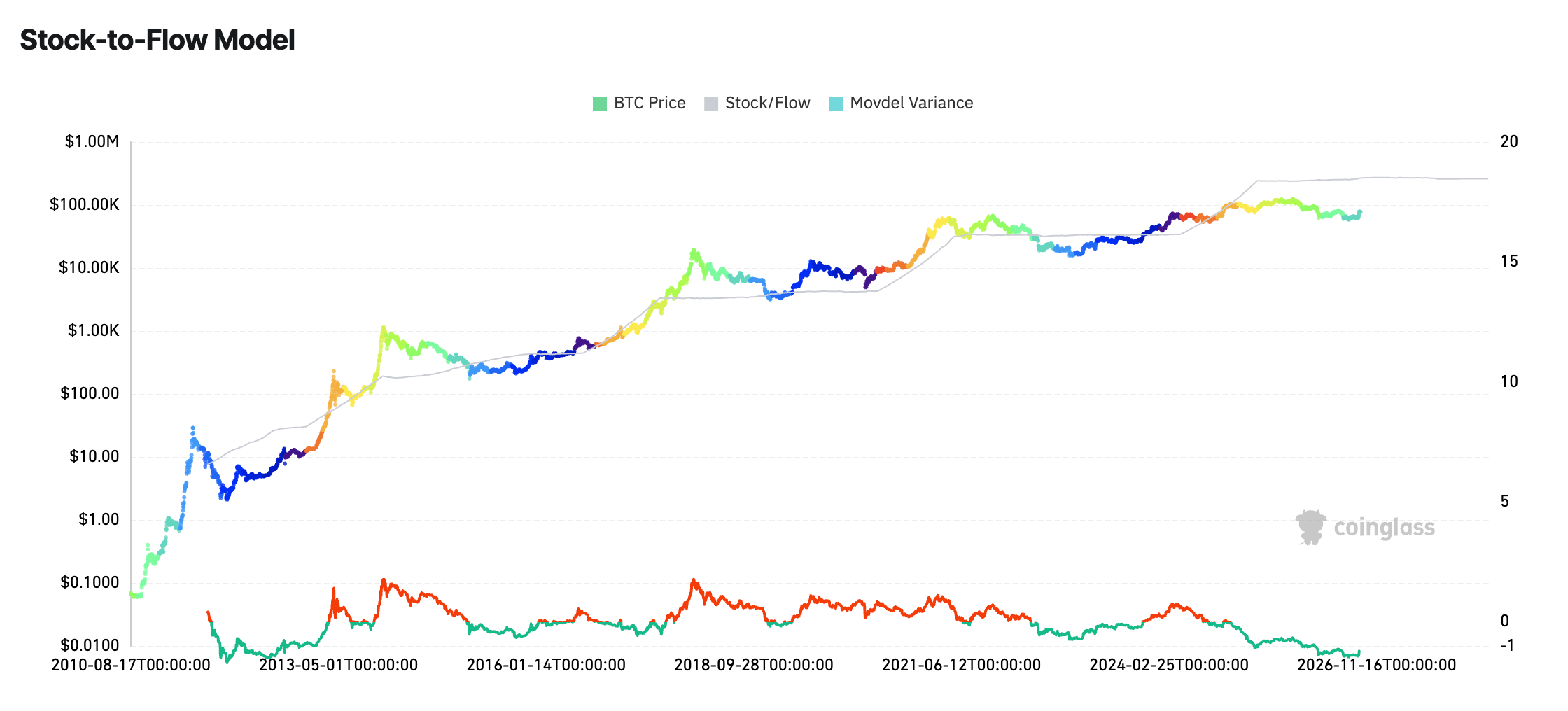
For example, stock-to-flow says scarcity is what drives value, with each halving reducing new supply relative to the existing stock.
Metcalfe-style models say a network becomes more valuable as its user base expands.
The power law says Bitcoin's long history follows a stable mathematical relationship between price and time.
Each of these ideas contains plausible economic intuition, but its forecasting record depends on whether the fitted relationship survives new data and whether simpler explanations account for the same result.
Alexander Shelton's 2024 peer-reviewed examination of Bitcoin return prediction found that stock-to-flow and Metcalfe variables helped explain returns in-sample, but offered limited or zero predictive ability out of sample.
Once time effects entered the stock-to-flow regression, its statistical force disappeared. Bitcoin's supply ratio increases on a predetermined schedule, and its price also climbed for much of its history, making two time-linked series look economically connected.
We saw that weakness in the market long before it appeared in a formal review. The stock-to-flow model diverged from Bitcoin's price as the asset traded below its projected path for years.
Persistent divergence can be absorbed by redefining the output as long-term value or a cycle average, though each redefinition makes the original price claim harder to evaluate.
Metcalfe's Law faces a related identification problem because network activity and price can climb together when adoption raises value, when a higher price attracts users, or when both variables follow a common time path.
Savva Shanaev and his co-authors used instrumental variables across six proof-of-work assets in a study of mining costs, network activity, and crypto value. Once they addressed autocorrelation and the two-way relationship between activity and price, the positive effects attributed to hashrate and transaction count disappeared.
Power-law models are in a much more complicated position because their corridors have captured much of Bitcoin's historical path and provide a practical visual language for discussing where price lies relative to a long-run curve.
Reports on the Bitcoin power-law model have also shown how ETF-era market structure can alter the forces moving price within that corridor.
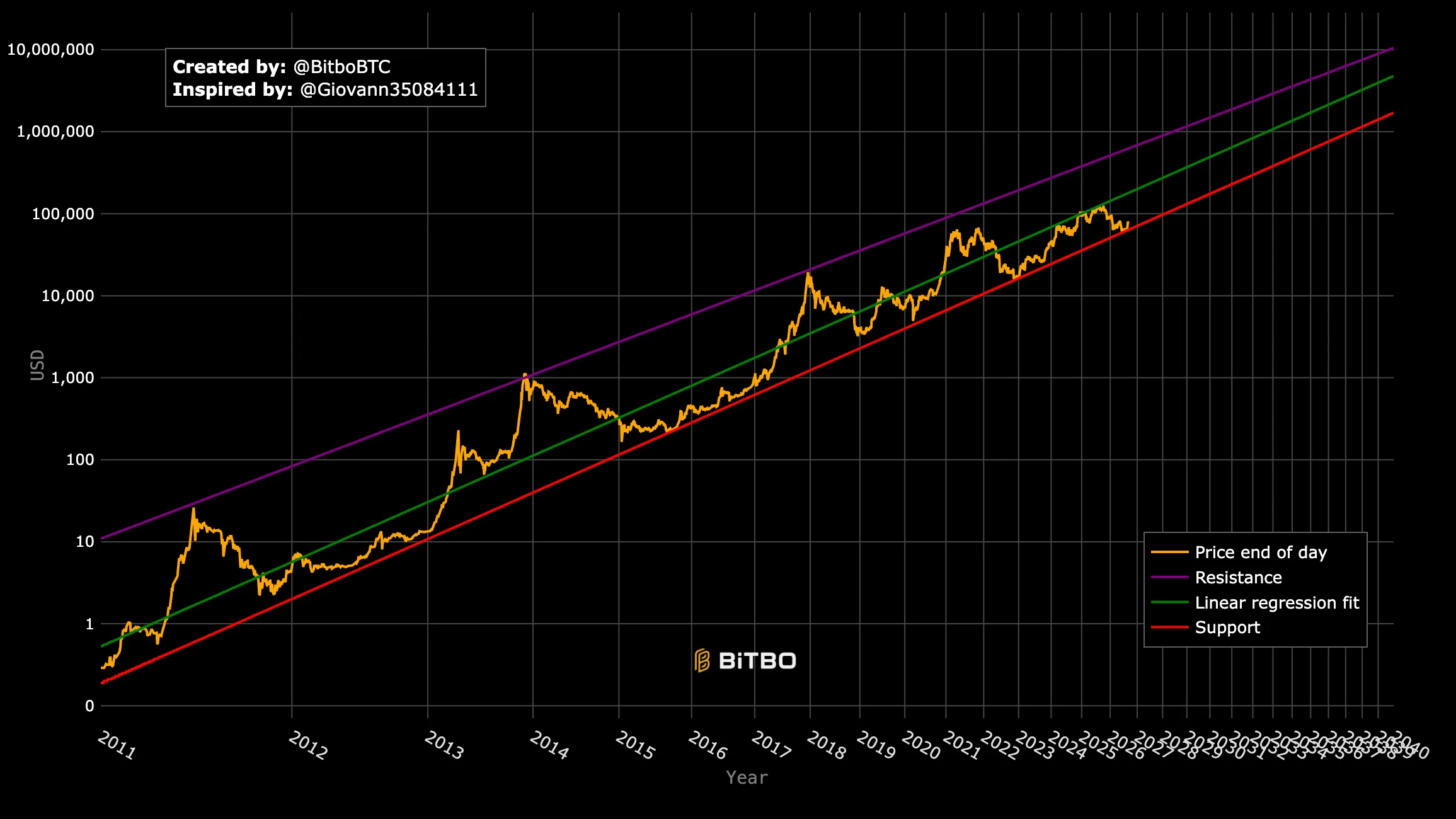
The academic issue lies in the strength of the inference. A high R-squared on a log-log chart establishes that a line fits the observed sample. Formal support for a power law also requires evidence about the distribution of residuals and comparisons with other time functions.
Researchers would then need to examine sensitivity to the starting date and performance on future observations. Baquero's review found that the current Bitcoin power-law literature had not yet completed that work.
An honest forecasting standard would publish the naive benchmark beside the model and report every market regime separately. Trading costs belong in the results, while public code and data let other researchers reproduce it.
The paper should also disclose how many variations were attempted, since that number determines how surprising the winning backtest really is. Valuation narratives need to be separated from point forecasts, and the reported range should reflect the asset's uncertainty.
Any correction term should allow a value of zero, letting the model conclude that today's price is its best forecast.
That conclusion will always struggle online because it offers no dramatic target and no date to circle. It has one advantage that the forecast bazaar rarely advertises: it tells us exactly how much the model knows beyond the price already visible to everyone.
The post From power laws to AI networks, why complex Bitcoin price models memorize market noise appeared first on CryptoSlate.
CryptoTicker.io
If you had a balance sitting at Zondacrypto, exactly one action now applies to you: you have to file your claim with the Estonian bankruptcy trustee yourself. It does not happen automatically, and it does not happen because your account once displayed a number in the app. The cut-off date for the regular filing is 27 October 2026. Anyone who wants to vote at the first creditors’ meeting needs a provisional filing by 11 September 2026.
Whether your balance was held in euros, in Bitcoin or in a smaller token changes nothing about that obligation. Claims are filed in euros, and they are filed in Estonia. This article explains what the court decided, which deadlines are running, in what language you may submit, and why filing still is not a promise of money.
What the court in Tallinn decided on 27 August
Harju Maakohus, the county court of the Estonian county of Harju in Tallinn, declared BB Trade Estonia OÜ insolvent on 27 August 2026 and opened bankruptcy proceedings. BB Trade Estonia OÜ is the operating company behind the Zondacrypto trading platform. The case runs under file number 2-26-14436. Margus Lentsius, who had already been appointed interim administrator, was named bankruptcy trustee, in Estonian pankrotihaldur.
These details can be checked independently of any press release. The Estonian commercial register e-Äriregister lists the company under registration number 14814864 with the status In bankruptcy, and has recorded Margus Lentsius as bankruptcy trustee with power of disposal over the estate since 28 August 2026. The same register extract states that the company was entered on 30 September 2019, shows share capital of 350,000 euros, was previously called Pinewood Estonia OÜ, and failed to file its 2025 annual accounts by the 30 June 2026 deadline.
What the ruling changed immediately
With the opening of proceedings, power of disposal over the company’s assets passed from the management to the trustee. Anyone who owes the company money can now discharge that debt only by paying the trustee. Payments to any other party have no effect against the estate. For you as a customer that means one thing above all: from now on there is no customer service deciding about your money, there is a procedure with forms and deadlines.
Why an Estonian bankruptcy binds you across the EU
The European Insolvency Regulation, Regulation (EU) 2015/848, recognises only one main insolvency proceeding per company. It is opened in the member state where the company has the centre of its main interests, abbreviated in the jargon as COMI. For BB Trade Estonia OÜ that is Estonia: the company is registered there, its operations were based there, it held its licence as a virtual currency service provider there, and its terms of use declared Estonian law applicable.
Two things follow, and both work in your favour. A main proceeding opened in Estonia is automatically recognised in every EU member state, without you having to do anything for it. And a claim filed there takes effect throughout the Union. So you do not have to file the same claim additionally with an insolvency court in your own country, and filing at home does not open a parallel proceeding that helps you.
How to check whether you are a creditor at all
You are a creditor if you had a claim against the company at the time proceedings were opened. That covers the euro balance in your trading account, the crypto assets booked there, withdrawal orders that were never executed, and claims arising from contracts with the company. The claim must have arisen before the opening; it does not have to be due. What you should gather before you fill in anything:
- account statements or transaction overviews from the platform, ideally as a file and with a visible timestamp
- proof of your deposits, meaning bank transfers or on-chain transactions with a transaction hash
- screenshots of the last balance you could reach, including the date
- email correspondence about rejected or stalled withdrawals
- your registration confirmation and anything that links your identity to the account
- a schedule of your own converting every position into euros and naming the rate used along with its source
That last point is often underestimated. A filing that states a position in coins rather than in euros does not meet the requirements.

What filing a claim is, and what it does not achieve
Filing a claim is the formal declaration to the bankruptcy trustee that you hold a quantified claim against the insolvent company, together with the evidence for it. That declaration is your ticket into the proceedings. Without it you do not share in the distribution of the estate, no matter how clear your balance was.
What it is not: an application for payout. Filing puts you in the queue of creditors. Whether anything is distributed in the end, and how much, depends on how much property the trustee can track down and realise. Keeping those two things apart saves you disappointment later, but it does not make filing any less important: whoever is not in the queue is guaranteed to get nothing.
What language must you file in, Estonian or your own?
This is the point where the publicly available accounts diverge, and the difference is the most expensive one in the whole procedure for you.
The Estonian firm Magnusson, which filed the bankruptcy petition and represents creditors, writes that the filing must be submitted in Estonian, that the amount must be quantified in euros, and that its form and content must satisfy the requirements of Estonian law and Estonian court practice. An incomplete or defective filing may be rejected or contested.
The Polish firm Skarbiec, by contrast, points to Articles 53 to 55 of Regulation (EU) 2015/848. Under those articles a foreign creditor may file a claim using an EU standard form that carries the heading “Lodgement of claims” in every official language of the Union, and may in principle submit it in any official language of the Union, English included. The court or the trustee may, however, require a translation into the official language of the state of opening. The regulation imposes no obligation to use a lawyer, and known foreign creditors are supposed to be notified individually.
Both accounts can be reconciled: EU law permits submission in your own language, and the Estonian procedure may then request a translation. In practice that means a filing in your own language is not invalid, but it can put you into a supplementary period that you cannot reliably meet shortly before the deadline expires. Anyone filing early can afford that route. Anyone starting in October should supply the Estonian version from the outset.
Why you should not wait for a letter
The regulation provides that known foreign creditors are to be informed individually. You cannot rely on it. Whether the company’s records list you as a known creditor at all depends on the state of its bookkeeping, and the deadline keeps running regardless. The expiry of the deadline is monitored by the creditor, not by the postal service.
The three dates in the procedure and what hangs on them
Three dates follow from the opening ruling and the statutory two-month period under the Estonian Bankruptcy Act. The period runs from publication in the Estonian official gazette Ametlikud Teadaanded, which took place on the day of the opening.
- 11 September 2026 – a provisional filing must be on file by this day for your claim to carry a voting right at the first creditors’ meeting. So far only the firm Magnusson, which is active in the proceedings, names this deadline.
- 17 September 2026 – first creditors’ meeting. The trustee is confirmed there and the creditors’ committee is elected. You do not have to attend in person; you can be represented.
- 27 October 2026 – closing date for the regular filing of claims. This date follows from two months after publication and is named identically by both firms.
11 September is the first edge, not the end of the matter. Anyone who lets it pass loses the voting right at the meeting but keeps the option of filing regularly until the end of October. That sequence is the reason to deal with your paperwork now rather than in the autumn.
A note on how solid these dates are
The three dates come from the publications of two mutually independent law firms, both of which are advertising for mandates from those affected. That is no reason to discard their information, since they agree on the court, the file number, the trustee and the two-month rule, and they match the commercial register. It is, however, a reason to look up the gazette notice yourself before submitting, or to ask the trustee directly, rather than relying on a summary alone. With a deadline that costs you money, the same principle applies as with the insolvency of a crypto exchange generally: check the primary source before you build on a retelling.
What happens if you miss 27 October?
Under Estonian bankruptcy law a late filing does not lead to the loss of the claim. It can still be reviewed and recognised; it is only served in the last rank, that is, after all claims filed on time. In proceedings with an ample estate that would be one disadvantage among several. In proceedings where the estate is likely to be thin, the last rank amounts in practice to a zero round.
The review itself is conducted in writing. After the two-month period expires the trustee draws up a provisional list of creditors; each claim is either recognised or contested in it. There is no hearing you would have to travel to.

Why your coins here will probably fall into the estate
The decisive question with any insolvent trading platform is whether your crypto assets can be segregated. Segregation means that an asset does not economically belong to the insolvent company but to you, and is therefore released from the estate instead of being distributed among all creditors. As a rule that requires customer holdings to have been kept separate from the company’s own assets and to have been individually attributable.
That is precisely what is missing here in the assessment of the firm Skarbiec. Its analysis states that if customer assets were commingled with the company’s assets, and the nature of the shortfall suggests they were, customers take part in the insolvency proceedings as creditors and not as owners of separately held property. That is a law firm’s assessment and not a judicial finding; the trustee will examine it. For your expectations the difference is large all the same, because it decides whether you get your balance back or a quota on a euro amount.
If you want to follow what this classification depends on in detail, and which custody models favour it, the groundwork is set out with the regulated trading venues, which keep customer holdings separate and have to prove it.
How much money there will be to distribute in the end
Caution is warranted here, because no reliable official figures on the estate are publicly available so far. What circulates about the shortfall are estimates that lie far apart and are confirmed by no official body. Rely on none of them as long as the insolvency trustee has published nothing. The number of customers affected is put at between roughly 30,000 and 57,000 depending on the source.
These ranges are third-party estimates and not established amounts. What can be taken from the commercial register is sober by comparison: registered tax arrears of 1,512 euros and annual accounts for 2025 that were never filed. How much the trustee actually collects will only become clear once he has tracked down and realised assets. In your own planning, do not count on a particular quota, and certainly not on a particular date.
Why the procedure still has time
A bankruptcy trustee’s remit also includes challenging asset transfers from the period before the opening and pursuing claims against the management. Such proceedings take years, and their proceeds flow into the estate. For you that means: filing is a decision for today, distribution a question for the day after tomorrow. The one does not depend on the other.
How to spot dubious offers of help in an insolvency case
Around every well-known insolvency a market of offers springs up promising a swift recovery of the money. A few features separate the serious ones from the rest fairly reliably:
- Anyone holding out a guarantee of success or a particular quota cannot know it; the estate has not been established yet.
- Anyone asking for your seed, your private keys or your login credentials does not need them to file a claim.
- Anyone pressing you to make an advance payment by crypto transfer is deliberately choosing a payment route with no way back.
- Anyone approaching you through a messenger channel and building time pressure is using the deadline as a tool against you.
Under the European Insolvency Regulation you can submit the filing itself without a lawyer. Whether you nevertheless get help is a cost-benefit question that depends above all on the size of your claim and on your willingness to engage with Estonian form requirements. There is no obligation, and nobody may tell you otherwise.
What the case says about choosing your trading platform
Zondacrypto started out in Poland in 2014 as BitBay and was for a time one of the largest trading platforms in Central and Eastern Europe. After warnings from the Polish financial supervisor KNF in 2018, the group moved its place of business to Estonia and later operated under the new name. In April 2026 the site was offline and customer assets stayed where they were; in June 2026 the Estonian financial supervision unit withdrew BB Trade Estonia OÜ’s licence. Two months later came the bankruptcy ruling.
There is something to learn from that sequence for your own practice, without having to name a culprit. A balance on a trading platform is a claim against a company and not ownership of a coin. That claim is worth exactly as much as the company’s solvency and the quality of its custody. A change of jurisdiction after a supervisory warning is a signal you are entitled to take seriously, and the question of who holds customer assets where and separated from what belongs before your first deposit, not in a bankruptcy case.
Filing your Zondacrypto claim: what to take away
- File your claim, and do it now. Assemble your evidence, convert every position into euros with a date and a rate source, and submit to the bankruptcy trustee. Anyone wanting to vote at the 17 September meeting needs the provisional filing by 11 September; the regular closing date is 27 October 2026. For everything you rebuild afterwards, the principle from the hardware wallet comparison applies: what you hold yourself falls into nobody else’s estate.
- Draw the conclusion for the rest of your holdings. Check how much of your assets sits permanently on trading platforms, and move that line deliberately. Where you have to trade, choose a venue with a European licence and segregated customer custody; the criteria are set out in the comparison of regulated crypto exchanges.
- Document the loss properly for tax purposes. Record the balance at the time proceedings were opened, your acquisition costs and the correspondence, so that you can prove anything at all later. How to carry that data with you permanently is shown in the overview of crypto tax tools and portfolio trackers. Whether and how a loss has tax effects is something to settle with a tax adviser; without records that question is decided before it is asked.
You can look up the status of the company, the name of the trustee and the date of his appointment yourself at any time in the Estonian commercial register. That is the source no summary replaces.
(As of September 6, 2026. This article is not investment advice. Prices and fee structures change; check the terms with the provider before you buy.)
Bitcoin is trading at $79,985, up 0.36% in 24 hours and around 2.5% on the week. That flat number hides a violent five days. BTC touched $82,240 on Friday, its highest level since May, then lost more than 4% in the space of an hour. Everything now hangs on a single inflation print.
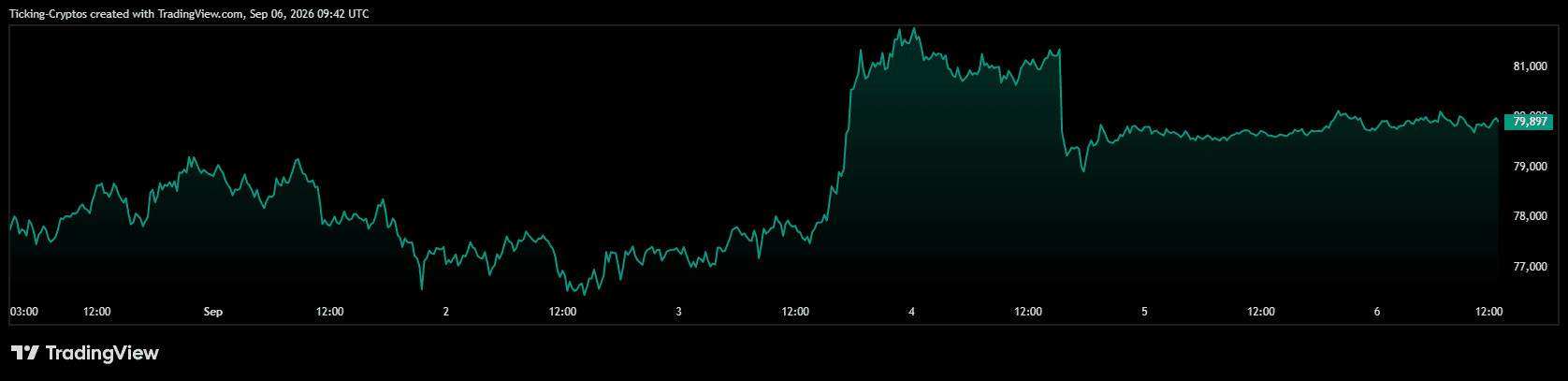
Where is the Bitcoin price today?
$BTC sits just above $79,900 with a market capitalisation of $1.6 trillion and 24-hour volume near $19.8 billion. The weekly gain of 2.5% makes Bitcoin one of the steadier large caps right now, but the year-to-date figure is still minus 8.6%.
That is the frame worth keeping. Bitcoin has recovered roughly 37% from its June low, and it is still deep in the red for 2026. This is a rebound inside a bear market until proven otherwise.
Why did the Bitcoin price fall after the jobs report?
Thursday set the trap. ADP employment came in at 38,000 against 47,000 expected, rate-hike expectations softened, and BTC broke $80,000 with roughly $93 million of short positions liquidated on the way up. It reclaimed the 200-day EMA for the first time since June. By early Friday in Europe it printed $82,240, a gain of 6.8% in 24 hours.
Then the August employment report landed. Nonfarm payrolls rose 162,000 against a consensus near 56,000, close to triple the estimate. Unemployment held at 4.1%, wage growth eased to 3.1% year on year, and June and July were revised higher by a combined 55,000 jobs.
$Bitcoin fell from $81,300 to $78,600 within minutes. CME FedWatch odds of a 25 basis point hike in September jumped from 49.4% to 58%. The ten-year Treasury yield sits at 4.73% and the thirty-year is at its highest level since 2007.
The logic is simple and it is not going away. Bitcoin pays no yield. When risk-free returns push toward 5%, holding a non-yielding asset costs more. A strong labour market is good news for the economy and bad news for anyone waiting on cheap money.
Are Bitcoin ETF inflows still supporting the price?
Yes, and this is the strongest argument for the bull case right now.
US spot Bitcoin ETFs took in a net $730.8 million on September 3, the largest single day since January, with BlackRock's IBIT accounting for $454 million of it. On the day of the selloff itself the desks bought again: $174.6 million net on September 4, a third straight session of inflows, taking the three-day total to roughly $1.01 billion.
The context matters. Spot Bitcoin ETFs have shed a net $4.83 billion across 2026 as a whole. August flipped positive and recovered a meaningful chunk. Institutions are not buying blindly anymore, they are buying weakness and trimming into strength. But the bid is real, and it absorbed a hawkish repricing without breaking the range.
What Bitcoin price levels matter this week?
On the three-hour chart the structure is intact. The 200 EMA sits at $74,971 and is rising, around $5,000 below spot. Bitcoin has held above it continuously since the vertical move from $64,000 to $77,000 between August 19 and 21.
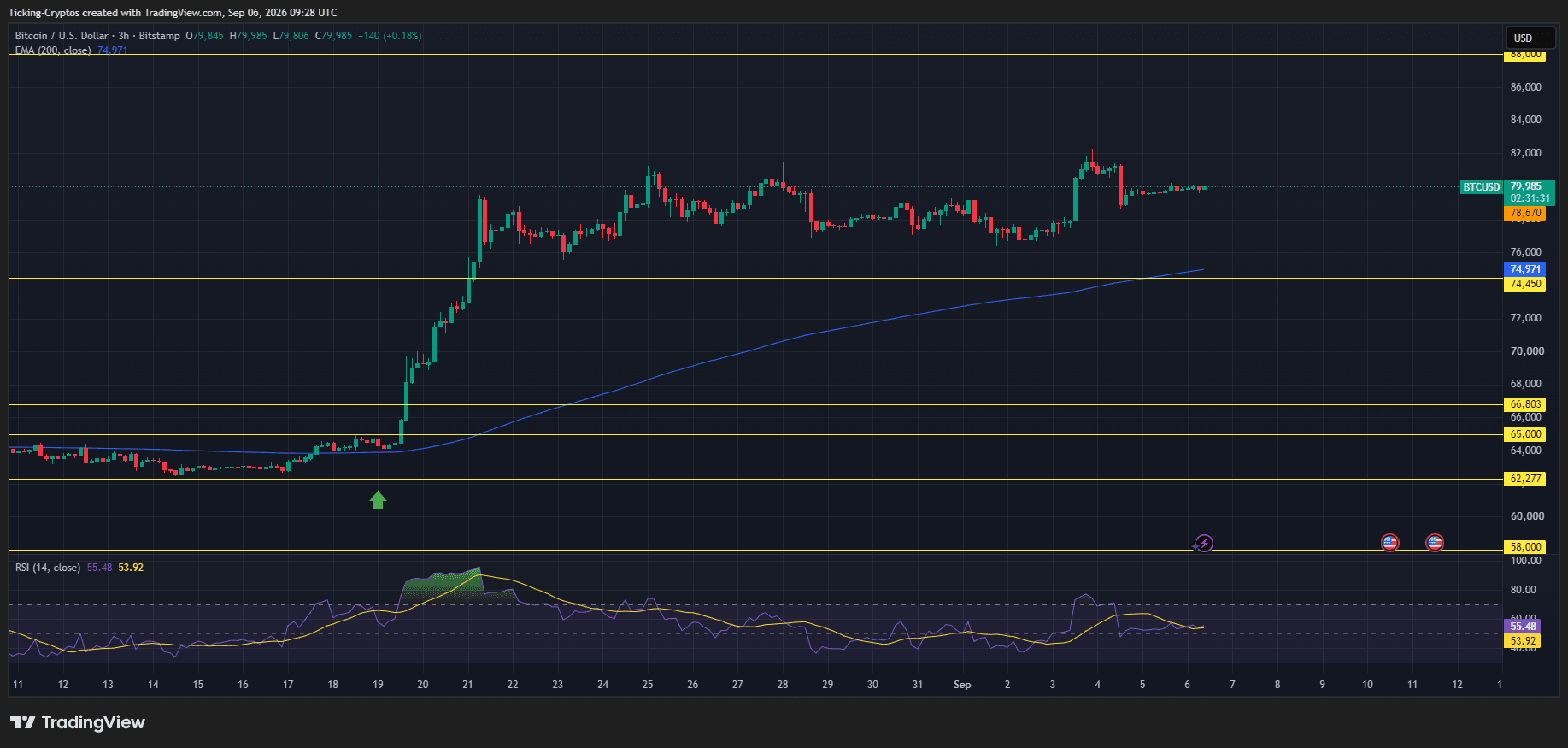
Since then BTC has been boxed between roughly $76,000 and $82,200.
- First support: $78,670. The line directly beneath price, flipped from resistance to support in early September. It sits close to the $78,000 max pain level for the September 18 options expiry, which tends to act as a magnet into expiry week.
- Next support: $76,000 to $77,000. Losing this shelf opens the gap toward the EMA cluster at $74,971 and the $74,450 line.
- First resistance: $82,200. Friday's high at $82,178 was the fourth failed attempt at the top of the range.
- The level that changes the story: $85,000. A weekly close above it would be the first real evidence that this is more than a bear market rally. The band up to $88,000 is the next obstacle after that.
- Structural line: $58,000. Only relevant if the entire recovery fails.
RSI reads 55.48 against a 53.92 signal line. Neutral, no divergence, no exhaustion. The candles since Friday are tiny and coiling directly on $78,670, which is textbook compression ahead of a data release.
Which news could move the Bitcoin price next week?
Four dates, in order of importance.
- September 11: US CPI. The single most important number of the month. Fed Governor Christopher Waller has said he would consider a hike if August inflation runs hot, which turns this print into the decider rather than a data point. A soft number takes the September hike off the table and gives Bitcoin room to attack $82,200. A hot number puts $76,000 in play quickly.
- September 15: the Clarity Act. SEC Chair Paul Atkins expects a Senate vote and has urged lawmakers to pass the bill before the month ends. He also confirmed the SEC is drafting its own complementary crypto legislation. Regulatory clarity is a slower-burning catalyst than CPI, but it is the one that shapes institutional allocation into 2027.
- September 15 to 16: the FOMC decision. The first hike under serious consideration since the tightening cycle ended in July 2023. Markets price it at 58%. Note that a hike being priced is not the same as a hike being absorbed. If the Fed hikes and signals more, the reaction is not in the current price.
- September 18: September options expiry. Max pain at $78,000. Expect price to gravitate toward that area into Friday unless CPI overwhelms it.
One more for the calendar: the MultiversX Supernova hard fork goes live on September 10, cutting block time from six seconds to 600 milliseconds. Not a BTC catalyst, but a real event for anyone holding EGLD on an exchange.
Bitcoin Price Prediction: What does this mean Bitcoin price?
Bitcoin is caught between two forces that are both genuine. Institutional demand through the ETFs is steady and absorbed a hawkish shock without a breakdown. Rate expectations are moving the wrong way, yields are at multi-year highs, and oil above $90 is adding to the inflation problem that started this whole chain.
The chart has no opinion, which is the honest read. Neutral RSI, intact trend, compressed range. Direction gets decided by Thursday's inflation number, not by anything technical.
Practical takeaway: $78,670 holding through CPI keeps the recovery structure alive. A weekly close above $85,000 confirms it. A break below $76,000 means the August rally was the bounce, not the bottom.
On September 10, 2026, the MultiversX network switches over to the Supernova hard fork. For you as an EGLD holder, the most important answer is a reassuring one: if your coins sit in your own wallet, you have nothing to do. There is no token swap, no migration and no claim you would have to register. Addresses, private keys and balances remain backwards compatible according to the project. Anyone who prompts you to take action over the coming days is trying to defraud you.
There is still something to be done, and it concerns three places: balances on an exchange, staking, and running a node of your own. The hard fork halts the network for roughly 24 minutes, during which no new transactions are accepted. Anyone needing a withdrawal in that window is better off arranging it beforehand. If you intend to move your coins from the exchange into self-custody anyway, a network upgrade is a good occasion for it; which devices come into question is set out in our hardware wallet comparison.
This text answers the questions that have not been put in writing anywhere so far: when the fork really takes effect according to the round arithmetic, how far node migration has actually come today, why the staking unbonding period still takes ten days despite a tenfold increase in speed, and how to recognize the fraud pattern that accompanies dates like this one.
What exactly happens at MultiversX on September 10, 2026
Supernova is a hard fork. That is a protocol change all nodes in a network have to adopt at the same time, because the new rules are no longer compatible with the old ones. Anyone leaving the old software running computes differently from the majority from the switchover point on and drops out of the shared chain.
What Supernova changes is the core of block production. Until now MultiversX produces a block every six seconds. After the switch it is 600 milliseconds, a tenth of that. This becomes possible because the protocol takes transaction execution out of the critical path of consensus: validators vote on a block while execution continues in parallel, instead of waiting for it.
For you as a user this means in everyday terms: a transfer within the same shard is final in fractions of a second rather than in several seconds. The figures for the targeted finality within a shard range between 100 and 300 milliseconds depending on the source; for a transaction across shard boundaries the sources give roughly 1.8 to 2.4 seconds against around 18 seconds so far. That range appears this way in the documents and is not smoothed to a single value here.
Supernova explained: why block time drops from six seconds to 600 milliseconds
A shard is a self-contained section of the blockchain that processes its own transactions; MultiversX currently operates three of them plus a coordinating metachain. This very division has been the bottleneck so far: a payment from shard A to shard B needed three rounds, because the metachain first had to certify the sending shard's block before the receiving shard was allowed to accept it.
Supernova speeds up both sides of that calculation. The rounds get shorter, and the order changes: validators start executing a block as soon as the local check is through, and only vote afterwards. Final clearance across shard boundaries remains tied to the metachain, so that a cross-shard payment counts as arrived only once the block in the sending shard is demonstrably final.
The path to this point was no short-term decision. According to the project documentation, the change was adopted in an on-chain vote between January 8 and 18, 2026 and received 99.64 percent approval at a quorum of 33.63 percent of the voting stake. A public stress test ran between March 11 and 31, 2026, in which the network carried 120,000 transactions per second on the final day according to the project. An external security audit was completed in June 2026.
When does the hard fork actually switch? The activation round recalculated
The switchover hangs on a round rather than on a clock time. A round is the fixed cadence in which the network is allowed to produce a block. The mainnet configuration of August 31, 2026 gives round 32,157,661 in epoch 2233 as the activation point. An epoch is the cycle after which MultiversX redistributes validators across the shards; it lasts 24 hours.
That number can be translated into a clock time, and we did so ourselves instead of copying it. Querying the official mainnet gateway on September 6, 2026 at 00:36:48 UTC returns: current round 32,089,568, epoch 2228, round duration 6,000 milliseconds, 14,400 rounds per epoch, start of the current epoch at round 32,085,434.
From this it follows: 68,093 rounds are missing until the activation round. Multiplied by six seconds, that is 408,558 seconds or 113.5 hours. The switchover therefore falls on September 10, 2026 at around 18:06 UTC, so around 8:06 p.m. German time. By the same calculation, epoch 2233 begins at round 32,157,434 and thus at around 17:43 UTC; the activation round lies 227 rounds behind it. The statement "epoch 2233" from the reports therefore agrees with the chain data.
One qualification belongs with this: that is round arithmetic, not a commitment. If a round is missed because a block producer does not use its slot, the point in time moves back. In practice it is a matter of minutes to a few hours. What holds up is "around 6 p.m. UTC on September 10", not the second.
Roughly 24 minutes without new transactions: what the network halt means
The changeover does not run through during ongoing operation. Ahead of activation, the network stops accepting new transactions into the pool for roughly 240 rounds, in order to work through those already in flight. At the old cadence of six seconds per round, that is 24 minutes.
What happens to your transfer during that time matters more than the duration itself: nothing is lost in the process. Newly submitted transactions stay in the queue until Supernova processes them. What you do not get in that window is a fast confirmation. Anyone wanting to trigger a payment with a deadline at that moment, a margin call on a collateralized position for instance, should bring it forward.

EGLD in your own wallet: why self-custodians have nothing to do
This is the core point for most readers. MultiversX explicitly maintains backwards compatibility for addresses, keys and balances. Your seed phrase stays valid, your address stays the same, your balance stays where it is. There is no new token and no need to move anything.
What changes for you is something you will notice after the fork at most in that confirmations arrive faster. A wallet app that connects to the network picks up the new cadence by itself. A hardware wallet keeps signing the same transaction formats; it knows nothing of block time.
One duty of care remains: keep your wallet application up to date. Applications that derive time windows or fees from the old block time may show incorrect estimates after the switch. That is a display error and no risk of loss, but it is irritating.
No token swap, no claim: how to recognize the hard fork scam
Ahead of network changes of this kind, websites and direct messages regularly appear demanding a "token migration", a "snapshot" or a "wallet upgrade". With Supernova there is none of that. There is no swap, no claim and no registration.
Three features let you recognize such offers without needing technical background knowledge. First, no genuine protocol change ever asks for your seed phrase; whoever asks for it wants your money. Second, there is no deadline for holders, and so no reason for time pressure. Third, a project communicates through its official channels and not through a direct message that writes to you first.
This warning refers to no known incident around Supernova. The note stands here because the pattern recurs with every announced fork. How it looked at other chains is shown by our account of the Zilliqa hard fork and the ZIL migration, where, unlike here, a migration genuinely did take place, and by the look at the Mina hard fork with its network halt.
EGLD on an exchange: why you should check the withdrawal window beforehand
If your coins sit with a trading platform, you hold no key of your own and therefore have no decision of your own. During network changes, exchanges usually suspend deposits and withdrawals for a window while trading continues. That is routine and no warning sign.
The state of play we checked ourselves: on September 6, 2026 at around 00:40 UTC, the Binance announcement directories for listings, delistings and general news carried no notice on EGLD or Supernova. That does not mean none is coming. Experience says such notices appear one to three days before the date. It means you cannot rely today on knowing a withdrawal window.
A simple rule follows from this in practice: if you want to pull EGLD out over the coming days anyway, do it before September 10 and not on September 10. Anyone wanting to seize the occasion and change provider will find the terms in our crypto exchange comparison. How often such deadlines actually get tight is something we worked out in our count of the crypto deadlines and cut-off dates currently running.
Staking and delegation: the unbonding period stays at ten days
Delegation means assigning your EGLD to a staking provider, which uses them to secure the network and passes you a share of the rewards for it. If you want them back, you start an unbonding, and a fixed waiting time then runs before you can move the money.
This is where the biggest misunderstanding around this upgrade sits. A network that ticks ten times faster does not release balances ten times faster. The unbonding period stays at exactly ten days.
We looked this up in the network configuration itself as well, instead of assuming it. The configuration currently carries two values side by side: erd_unbond_period at 144,000 rounds and erd_unbond_period_supernova at 1,440,000 rounds. Convert both into time and both give the same value: 144,000 rounds at six seconds are 864,000 seconds, and 1,440,000 rounds at 0.6 seconds are likewise 864,000 seconds. In both cases that is ten full days. The numeric value multiplies by ten because the rounds get shorter; the waiting time behind it stays the same.
For you this means: an unbonding you start today ends at the same moment whether or not the fork falls in between. And an unbonding you start after September 10 takes just as long as before. If you are currently reviewing where your stake sits and what it brings in, our staking platform comparison helps with the sorting. The question was of a similar kind at the Solana upgrade, which we worked through in our text on Alpenglow and the consequences for staking.
84 percent instead of 4.6: how far node migration has really come today
Whether a hard fork runs smoothly is decided by how many nodes move to the new software in time. As of September 1, 2026, the finding was sobering: according to an evaluation of the public network data, 95.35 percent of 5,171 nodes were still running the old version v1.11.11.0 at that point. A good four percent had migrated.
We repeated this measurement on September 6, 2026 at 00:37 UTC, through the public endpoint api.multiversx.com/nodes/versions. The picture has turned around in five days:
- 83.02 percent of the nodes run on v2.0.6.0, another 1.24 percent on a version reported as v2.0.6. Together that is 84.26 percent.
- A further 13.6 percent still stand on the old v1.11.11.0.
- The remaining 2.14 percent are spread across older versions of the 1.11 series, down to v1.11.0.0.
- The total number of nodes stands at 5,176. In absolute figures that is roughly 4,361 updated nodes and roughly 704 nodes on the old main version.
This figure is the real leading indicator for September 10, and anyone can follow it up themselves: the endpoint is public and supplies share values per software version. Whoever wants to know whether the switchover is running in an orderly way takes another look there on the day before.
What happens if too few nodes migrate in time?
Before activation, old and new program versions can run alongside one another without anything happening. Only from the activation round onwards do the new processing rules take hold. A node with old software can then arrive at a deviating result for the same transaction and loses its connection to the majority chain.
For an individual operator that means downtime and forgone rewards. For the network it only becomes delicate once a large share is left behind, because block production is then spread across fewer shoulders. Going by today's level of roughly 84 percent updated nodes, nothing points to this scenario.
As an EGLD holder you need to derive nothing from it. There is no button you could press and no choice between two chains. The question is relevant for operators and for judging whether longer waiting times are to be expected in the switchover window.
Node operators: which software version is mandatory from round 32,157,661
If you run a validator or an observer node yourself, the fork means work. A version from v2.0.5.0 onwards is required; the chain currently reports v2.0.6.0 as the current marker. This value sits in the network configuration in the field erd_latest_tag_software_version and was set at the time of the query on September 6 at 00:36 UTC.
The migration itself is uncritical before the activation round, because both versions can exist side by side. After it, the migration is no longer optional. Whoever misses the date catches up afterwards and has to let the node resynchronize. A validator with a minimum stake of 2,500 EGLD should not let this situation come to it.
Smart contracts and dApps: why timestamps are no longer unique after Supernova
This point concerns you indirectly, but it is the most underestimated part of the whole upgrade. A smart contract is a program that sits on the blockchain and executes rules automatically, the interest on a deposit or the deadline of an offer for instance.
Many such programs compute with timestamps in seconds. As long as a block is created every six seconds, a second-level timestamp identifies exactly one block. After the switch, ten blocks fit into the same second, and the timestamp is no longer unique. The project documentation names the consequences openly and gives examples: checks along the lines of "the new point in time must be greater than the last one" can fail, limits of one action per block can be circumvented if they are measured in seconds, expiry deadlines become longer than intended, and reward calculations that use a time difference as a divisor can run into a division by zero.
For you as a user of a DeFi application on MultiversX this means: expect isolated display errors in the days after September 10, or applications that pause as a precaution. Affected are programs whose operators have not prepared for the change. A balance in your own wallet is untouched by it. If you have larger amounts sitting in an application from a small provider, a look at its announcements ahead of the date is the cheapest precaution there is.
What the hard fork is not: no deadline, no price statement
Three clarifications, so that no false expectation arises from this date.
It is no deadline for holders. Unlike a migration with an exchange window, nothing expires here. Whoever does nothing until September 10 has exactly the same coins afterwards as before.
It is no price statement. EGLD was quoted at $4.61 on September 6, 2026 at 00:34 UTC according to CoinGecko, or 3.97 euros, around three percent below the previous day and around 27 percent above the level of seven days earlier, at a market capitalization of about $141.5 million. These figures stand here as a snapshot and not as the basis for a forecast. Whether a technical upgrade shows up in a price cannot be stated seriously in advance.
It is no foregone conclusion. The switchover hangs on the migration of the nodes, and while that is going well, it is not yet complete as of September 6. The date can shift by minutes to hours, because it hangs on rounds and not on the clock.
The schedule up to September 10 at a glance
What sensibly happens in the remaining days, in the order in which it comes up:
- Up to September 9: settle withdrawals from an exchange if you need them in these days. Keep an eye on your provider's announcements, because experience says they come at short notice.
- On the morning of September 10: take another look at the version status of the nodes if you are interested in whether the switchover is running in an orderly way.
- On September 10 at around 17:40 to 18:10 UTC: do not submit time-critical transactions. What you submit is not lost, but it will initially only be queued.
- Afterwards: update your wallet application if it visibly misjudges deadlines or fees.
MultiversX Supernova: what you take away from this
- Self-custody demands no action, but it does demand vigilance. There is no token swap and no claim. Every prompt to that effect is an attempted fraud, and the answer to it is always the same: no seed phrase, nowhere. If you take this occasion to move your coins from a provider into your own custody, you will find the devices in the hardware wallet comparison.
- Check before September 10 whether you can reach your balance. Exchanges announce withdrawal pauses at short notice, and on September 6 no notice was in place yet. Whoever wants to switch or withdraw does it beforehand; the terms are in the exchange comparison.
- Keep reckoning with ten days for staking. The faster chain does not shorten the unbonding period, even though the numeric value in the configuration now looks ten times larger. Where your stake sits and what it brings in is sorted out by the staking comparison.
(As of September 6, 2026. This article is not investment advice. Prices and fee structures change; check the terms with the provider before you buy.)
Sources and evidence: the chain data come from the official network configuration of the MultiversX mainnet gateway; the activation round, the 24-minute window and the version status of September 1 come from the report by CryptoSlate of September 2, 2026.
When a stablecoin issuer freezes an address, your balance does not disappear. It is still recorded on the blockchain, every wallet displays it, and yet no transfer will leave it. That is precisely what happened to twenty Ethereum addresses within 84 seconds on August 24, 2026, and two more were added on September 2. We read the chain ourselves to establish it.
The occasion is a lawsuit filed on August 31, 2026 with the US District Court for the Southern District of New York, publicly accessible under docket number 1:26-cv-07400. Two Thai businessmen accuse USDT issuer Tether of having frozen roughly 42.4 million USDT across ten Ethereum addresses on October 30, 2025, and of doing so at the informal request of an investigator. According to the complaint, the corresponding seizure order was only issued on February 19, 2026, 112 days later. This is the account of one party to a lawsuit, and no court has confirmed it: the case has yet to be decided. The matter is undecided, and this article does not decide it either. It answers the question that sits behind it for you as an investor: which stablecoins even carry a switch that can shut down a single address, how often is it used, and how do you check your own address without having to take anyone's word for it?
What a USDT address freeze means technically
An address freeze is an entry in the stablecoin's contract that bars a specific address from making any transfer. The issuer writes the address into a list held in contract storage. From that moment on, the contract rejects every transfer sent from that address. The blockchain itself stays out of it: Ethereum processes the attempt, and the token contract refuses to execute it.
The gap between this and everything else investors usually understand by a freeze is considerable. An account freeze at an exchange concerns an account held with a company, and your balance sits in someone else's custody there anyway. An address freeze reaches into a wallet that belongs to you alone and whose key nobody but you knows. The key still works, the signature is valid, the network accepts the transaction. Only the token contract says no.
This is a deliberate property of the design. A stablecoin is a claim against a company, and that company is subject to supervisory law, anti-money-laundering rules and official orders. Without such a switch, an issuer could not comply with a seizure order at all. Anyone holding stablecoins therefore always carries the issuer's counterparty risk as well, and the freeze function is its most visible form.
Freeze, burn and reissue: the three stages in one sentence each
The three terms are often conflated even though their consequences differ.
Freeze
A freeze enters an address into the contract's blocklist and blocks every outgoing transfer with immediate effect. The holding stays on the address and remains publicly visible. A freeze is reversible: the same issuer can remove the entry again.
Burn
A burn permanently removes the frozen holding from circulation, with the contract setting the tokens on the address to zero. At USDT this second stage presupposes an existing freeze. After the burn, those tokens no longer exist.
Reissue
A reissue creates the burned quantity anew elsewhere, so that the stablecoin's overall backing remains unchanged. This process allows seized amounts to be passed on to investigating authorities or to injured parties.
For you as a holder, it is above all the order of events that counts. Time passes between the freeze and the burn, and during that time the holding is immobilized but still present. Our measurement further down shows that this gap can run to weeks in practice.
The New York case: two plaintiffs, 42.4 million USDT and a question of sequence
The complaint was filed on August 31, 2026; CoinDesk and Cointelegraph, among others, reported on it on September 2, 2026, each with its own account of the matter. The two plaintiffs state that 42.4 million USDT spread across ten Ethereum addresses were frozen on October 30, 2025. Their allegation targets the sequence: the freeze is said to have followed an informal request from a US investigating authority, while the court order was only handed down months later. Such an order, they argue, cannot retroactively legitimize an earlier freeze.
According to the available reports, Tether rejects the lawsuit as baseless. One account therefore stands against the other, no court has established anything, and everything beyond that would be speculation. The case is of interest to a German investor for a different reason: the plaintiffs had no contractual relationship with Tether. They had acquired the tokens on the secondary market, the way you do when you buy USDT on an exchange. The case thus touches on how far an issuer's reach extends over people who never opened an account with it.
That question is why engaging with the freeze function is worthwhile, quite apart from how the proceedings turn out. The switch exists, it is used, and the conditions of its use are hard for outsiders to inspect. What can be inspected without difficulty is the chain itself.
Our September 3 survey: 32 freezes, one unfreeze, two burns
cryptoticker.io compiled this analysis itself on September 3, 2026. We read the event logs of the USDT contract on Ethereum through a public access point, for the window from August 20, 2026, 02:49 UTC, to September 3, 2026, 03:59 UTC. That corresponds to blocks 25,793,449 through 25,894,249, so fourteen days. We evaluated the three events with which the contract reports a freeze, a reversal and a burn to the outside world.

Why 20 of the 32 freezes fell within 84 seconds
The result for those fourteen days reads: 32 addresses were frozen, a single address was unfrozen, and two addresses were emptied. What stands out is the way these numbers are distributed over time.
On August 24, 2026 at 20:47:47 UTC, nine addresses were frozen in a single block. Eighty-four seconds later, at 20:49:11, eleven more followed in a further block. Twenty of the 32 freezes in this period therefore fell within barely more than a minute. The remainder is spread across twelve individual events on nine different days, most recently two freezes on September 2, 2026 at 13:49 UTC.
One practical observation can be drawn from this pattern, and we claim nothing more here: freezes usually arrive in batches and rarely one at a time over the course of a day. Whoever works through a bulk action enters all the addresses concerned in one go. For you, that means a freeze is as a rule the consequence of a list your address ended up on for some reason, and only rarely an individual decision about you personally. The chain says nothing about the reasons, and so neither do we.
The second ratio in our measurement is just as clear: 32 freezes stand against a single reversal. That one reversal fell on August 20, 2026 at 16:41 UTC. A freeze can therefore be lifted, and it does happen, but within the measured period it remained the exception. Anyone counting on such a state resolving itself is counting against the observed frequency.
174,055 USDT burned: what can follow a freeze
In the same window we found two burns. On August 24, 2026 at 17:03 UTC, 10,002.73 USDT were deleted from one address; on September 2, 2026 at 14:58 UTC, a further 164,052.30 USDT. Together that comes to 174,055.03 USDT.
The revealing part sits in a detail that only emerges when both lists are compared: neither of the two emptied addresses was frozen within our fourteen-day window. Both freezes must therefore be older. More than a two-week span lies between the entry in the blocklist and the deletion of the holding. The burn is a separate, later decision that does not follow automatically from the freeze.
For assessing your own risk, that is the more important of the two figures. In the measured period a freeze hits considerably more addresses than are subsequently emptied. Over longer stretches, affected holdings sit in a state of being immobilized, and only a fraction of them is ever deleted.
Which stablecoins carry a queryable freeze function and which do not
The second half of our survey asks whether this switch is a peculiarity of USDT. For that we queried twelve stablecoin contracts on Ethereum directly: first their ticker symbol, to be sure we had hit the right contract address, then twelve common naming variants of an address check. If a contract answers one of these queries with a boolean value, the function exists; if it does not answer at all, it does not exist under that name.
Seven of the twelve stablecoins examined carry a publicly queryable address check: USDT under the name isBlackListed, USDC and EURC under isBlacklisted, PYUSD, USDP and EURCV, the euro stablecoin issued by a French banking subsidiary, under isFrozen, and FDUSD under frozen. Five contracts answered none of the twelve signatures: DAI, USDS, EURS, USDe and RLUSD. At RLUSD and FDUSD we additionally found a function able to halt the entire contract, which is a different matter from a single address.
Caution is called for here, and we therefore state the limit explicitly: having no queryable check function is not the same as not being freezable. A contract may hold a freeze under a name we did not test, store it in a structure that is not publicly readable, or add one later through a replaceable implementation. Our measurement answers exactly one question, namely whether the state of an address can be queried from outside. For seven out of twelve the answer is yes, and that is the decisive point for the check in the next section.
It is worth noting that the dividing line does not follow origin. Among the seven with a check function you find US issuers as well as a European euro stablecoin, and among the five without stand both the best-known decentralized representative and younger offerings from large providers.
How to check an address in two minutes through the contract
The check works without registration, without any tool, and without you having to believe anyone's claim. You ask the contract itself, and the contract answers true or false. For USDT on Ethereum this runs through the contract page of a blockchain explorer such as Etherscan, where the contract's read functions are listed.
In the list of read functions you look for the entry isBlackListed, enter the address you want to check, and read off the result. A false means the address was not on the blocklist at the time of the query. A true means the opposite. At USDC and EURC the function is called isBlacklisted; at PYUSD and USDP, isFrozen. The procedure is the same in every case.
We additionally cross-checked these instructions so that they do not rest on an assumption. For six addresses demonstrably frozen within our measurement window, the query returns true. For a known, unremarkable address it returns false. The check therefore does show what it is meant to show.
Two limitations come with it. First, the answer holds for the moment of the query and for nothing else. Second, it refers to exactly one token on exactly one blockchain: USDT exists on several networks, and each version keeps its own list. Anyone holding USDT on Tron or on a layer-2 network has to query the contract there.
When a check is worth doing at all
For the entirely ordinary case in which you buy stablecoins on a regulated exchange and leave them there, the check yields little, because the address belongs to the exchange anyway. It becomes interesting when you hold a balance on an address of your own, when you have received larger amounts from an unfamiliar counterparty, or when a transfer fails for no discernible reason. That last case is the usual route by which affected users learn of a freeze.
What the freeze means for balances on an exchange
If your stablecoin balance sits in an exchange account, it stands on a pooled address belonging to the provider. A freeze of that address would be an event affecting the entire trading venue, and at a supervised European provider it is no realistic everyday risk. The risk lies elsewhere: withdrawals run through a screening step, and that step can catch a receiving address which appears on a sanctions list or a blocklist.
This mechanism is the neighbor of the address freeze, and it takes effect one level earlier. We described it in a separate piece on the EU sanctions against crypto platforms. A second case, far more common in practice, is the account freeze for missing information; how it comes about and what helps against it is set out in our article on self-certification at a crypto exchange.

Self-custody protects against the account, not against the address freeze
For most risks in the crypto space, holding your own keys is the right answer. It protects against a provider's insolvency, against an account freeze and against the wind-down of a trading venue. Against the freeze of a stablecoin contract it explicitly does not help, because the blocklist knows no wallets, only addresses. Whether your key sits on a device in your drawer or in a provider's data center makes no difference to the entry in the contract.
From this follows a distinction that often gets lost in everyday use. Bitcoin and Ether carry no such switch, because there is no issuer behind them who could operate one. Anyone holding these assets on a hardware wallet has genuinely shed the counterparty risk. With a stablecoin it remains in place, and in full, because the backing and the freeze function sit at the same company. With stablecoins, self-custody therefore shifts which risks you carry; it does not remove them.
In practice this means: anyone using stablecoins as a parking position between two purchases carries this risk for hours or days and needs to give it little thought. Anyone holding a substantial part of their wealth permanently in a stablecoin should know that they hold a claim against a company which can halt the holding on their address. Splitting across two issuers reduces this concentration risk without eliminating it.
MiCA, authorities and the question of who may trigger a freeze
Since the European regulation on markets in crypto-assets has applied in full, issuers of asset-referenced tokens and e-money tokens in the EU need an authorization, and trading venues may only offer authorized stablecoins. For the freeze question, however, the regulation is no safety promise. What it governs is authorization, backing and redemption. Whether and when an issuer shuts down a single address depends, alongside that, on anti-money-laundering law, on sanctions law, and on the orders of the authorities in whose jurisdiction it falls.
This is exactly what the real point of contention in the New York proceedings hangs on. The power to freeze is not what is disputed there. The dispute is about the form the order must take on which an issuer relies, and about the sequence in which the two must occur. For now, a German investor can draw only one conclusion from this: the issuer of your stablecoin brings along the legal order it operates under, and at the largest providers that order is not the European one.
Anyone taking this point seriously will look at the next purchase to see where the stablecoin comes from and which authorization it carries. An overview of regulated trading venues shows which providers work under European supervision and which stablecoins are still tradable there at all.
Tax treatment: what a frozen position does in your return
For tax purposes, the treatment of private crypto transactions in Germany attaches to the private disposal transaction under Section 23 of the German Income Tax Act. What matters there is disposal within one year of acquisition, and for the sum of gains from such transactions an exemption threshold of 1,000 euros applies per calendar year.
A freeze on its own is neither a sale nor a swap. The holding remains attributed to you, it still stands on your address, and nothing flows in. No disposal transaction arises from the freeze, and the one-year period keeps running regardless. If a frozen holding is burned later, the classification is considerably less clear-cut, because an asset then disappears without any consideration in return. Whether and how such a loss can be claimed for tax purposes depends on the individual case and belongs in the hands of a tax adviser. This section sets out the legal position in outline and replaces no advice in an individual case.
More important in practice than the classification is the documentation. Anyone affected by a freeze should record the state of affairs while it is still verifiable: the date of the finding, the address concerned, the holding at that point in time, and the acquisition data of the position. These details can hardly be reconstructed later if a provider is no longer reachable or an account no longer exists.
How we collected the data and what we could not check
The survey consists of two parts. For the first, we retrieved the event logs of the USDT contract on Ethereum in sections of 2,000 blocks each and counted the three freeze, reversal and burn events; each section was repeated through a second access point whenever it failed, until the window of 100,800 blocks was covered without gaps. For the second part, we queried twelve stablecoin contracts with twelve possible designations of an address check each, so 144 individual queries in total, each additionally secured by the ticker symbol reported by the contract.
There are four things we could not check, and they belong in this text just as much as the results do.
First, the reasons. The blockchain shows that an address was frozen, and it shows when. It says nothing about why this happened, who initiated it, or whether an official order was in place. We therefore attribute nothing to any of the addresses concerned or to any person behind them.
Second, the other networks. Our count concerns Ethereum only. USDT and the other stablecoins examined also exist on Tron, on Solana and on several layer-2 networks, and each of these versions keeps its own list. The total number of freezes across all networks is therefore higher than 32, and our measurement does not say how much higher.
Third, the completeness of the function names. We tested twelve common designations. A contract carrying none of them may still possess a freeze capability that goes by a different name or is not readable from outside. All that follows from a missing hit is that the state of an address cannot be queried there by this route.
Fourth, the prior history of the two burns. We know from the comparison that the associated freezes are older than our window. How much older would have required an evaluation of the entire contract history, which we did not carry out for this article.
Nor did we do anything that would go beyond what was measured: no extrapolation to annual figures, no estimate of how many investors are affected, and no statement about the market shares of the stablecoins examined. Price figures do not appear in this article, because a contract query yields none.
Checking a stablecoin freeze: what you take away from this
- Look up which stablecoin you actually hold and where. Seven of the twelve contracts we examined carry a queryable address check, and the issuer's legal order has a say in who can initiate a freeze. When you choose between two offerings at your next purchase, a look at our crypto exchange comparison helps you see which stablecoins are listed there and which supervision the trading venue works under.
- Separate what can be separated. Against the address freeze of a stablecoin, self-custody does not help; against a provider's insolvency and against an account freeze, it very much does. If you want to hold the part of your portfolio that manages without an issuer yourself, you will find the suitable devices in our hardware wallet comparison.
- Record your acquisition data before you need it. Date, quantity and acquisition cost of a position are the part that can no longer be reconstructed when it matters, and they are at the same time the basis of every later tax return. Ongoing tracking is taken off your hands by a tax and portfolio tool.
(As of September 3, 2026. This article is not investment advice. Prices and fee structures change; check the terms with the provider before you buy.)
If a letter reaches you demanding, in the name of the Federal Ministry of Finance, 19 percent VAT on your purchase of cryptocurrency, the answer is short: no such claim exists in German tax law, and the ministry does not send it. The Federal Ministry of Finance has listed this exact letter as a forgery on its warning page since September 1, 2026. Pay nothing, do not reply, click no link.
The case still deserves more than three sentences, because this wave is better built than the usual bulk emails. The perpetrators cite real transactions, they use official terminology, and they hit a nerve: since the start of 2026, trading platforms have been reporting user data to the tax authorities, and many investors are expecting mail from the authorities anyway. That expectation is exactly what the scam exploits.
Fake finance ministry letters on crypto VAT: what the ministry reported on September 1
On the page warnings from the Federal Ministry of Finance, as of September 1, 2026, the case is set out in spare words. In a forged letter, the ministry supposedly confirms that a company selling cryptocurrency, meaning a crypto exchange or a crypto broker, is authorised to collect 19 percent VAT on the acquisition of cryptocurrency. The letter refers to transactions that actually took place, and the accompanying email urges the recipient to get in touch as quickly as possible.
Three building blocks sit in that description, and each one works on its own. The first is the supposed authorisation, meant to explain why a trading venue rather than the tax office wants money. The second is the reference to a genuine purchase, which lends the letter a credibility no bulk email could ever have. The third is the demand to make contact quickly, because a conversation brings victims to pay faster than a form.
In the same warning, the ministry names further variants in circulation at the same time. They include invented special payments for the summer of 2026, for which recipients are asked to supply their tax identification number via a link, supposed investment offers in the name of the finance minister, and emails about refunds that allegedly could not be delivered. The crypto variant is therefore not an isolated case, but the part of a broader wave tailored to investors.
19 percent VAT on a crypto purchase: why German tax law knows no such claim
The core of the forgery is a tax assertion that can be refuted in a single sentence. Exchanging euros for Bitcoin and back is exempt from VAT. That is not a matter of interpretation, but has been settled for more than ten years.
What section 4 no. 8 letter b of the German VAT Act has to do with your purchase
On October 22, 2015, the European Court of Justice ruled in case C-264/14, known as the Hedqvist case, that exchanging conventional currencies for Bitcoin and vice versa is an exempt supply within the meaning of the VAT Directive. The Federal Ministry of Finance adopted that judgment into German administrative practice with its circular of February 27, 2018. Since then the position is: the exchange is a supply of services exempt under section 4 no. 8 letter b of the German VAT Act. Anyone using cryptocurrency as a means of payment likewise triggers no VAT.
A VAT charge of 19 percent on the acquisition of cryptocurrency would therefore not only be unusually high, it would contradict the applicable law on a point that has been in every tax handbook since 2018. A ministry does not authorise anyone to collect a tax that does not exist.
The one place where VAT really does appear
For the sake of completeness: the exemption applies to the exchange itself. VAT can arise on certain services around trading, for instance on services a platform bills separately. But that always runs through the provider's invoice or statement, in which the tax is shown openly. It is never claimed retrospectively through a letter from the ministry, and it never amounts to 19 percent of the purchase sum in any case. Anyone wanting to know which costs really arise with which provider will find the orderly overview in the comparison of crypto tax tools and portfolio trackers, because record-keeping for the tax return is considered there as well.
Reference to real transactions: why this detail makes the letter so dangerous
The most dangerous sentence in the warning is the one about transactions that actually took place. Anyone opening a letter that names a purchase with an approximate amount and date loses their natural scepticism. The usual reflex, that fraudsters know nothing about you, does not apply here.
Where such details can come from cannot be said with certainty, and we do not claim otherwise. Several routes are known by which purchase and address data belonging to crypto customers have entered circulation: data leaks at service providers who process orders on behalf of companies, compromised support systems, and the resale of older customer lists. How such an address list ends up in a physical letter was described by cryptoticker.io on August 25, 2026, using the example of the phishing letters sent to wallet owners. The pattern is the same, only the target differs: there it was about the recovery phrase, here about a bank transfer.
For you, an uncomfortable but useful assumption follows. Assume that a sender may know your name, your address and rough details of a purchase, without that saying anything about their authenticity. The check therefore has to start somewhere else, namely with jurisdiction and with the route the demand takes.
Who sets taxes in Germany and how the assessment arrives
In its warning, the Federal Ministry of Finance formulates a rule that works as a test: only the tax offices set taxes, and as a rule they always do so by post. Neither the ministry itself nor the Federal Central Tax Office charges fees to citizens or sets taxes. None of these bodies sends text messages, messenger messages or emails to private individuals on their own initiative.
That yields a simple test that works without specialist knowledge. If a payment demand names a sender other than your competent tax office, something is wrong. If the demand arrives by email or messenger, something is wrong. If the money is meant to go to a company rather than a tax office account, something is wrong. And a tax assessment that genuinely exists always names a tax number, a tax office and a notice of appeal explaining your right to object.
550 euros for a supposed account release: the second forged ministry letter
Running alongside the crypto variant is a letter with the English title Formal Notice of Final Statutory Tax Clearance Requirement and Reinstatement Assurance. In it, recipients are told to pay 550 euros to have a supposed block on their bank account lifted. The Federal Ministry of Finance also lists this letter in its warning as a forgery and refers to the Federal Financial Supervisory Authority for details.
The English title is a giveaway in itself. German tax authorities correspond with private individuals in German, and they do not invent labels that sound like international compliance. A title that manufactures authority through a foreign language is a warning sign, not proof of authenticity. The same goes for the invented procedure behind it: an account is blocked by the bank or by court order, and it is not unblocked by a payment to a ministry.
Forged Federal Central Tax Office notices: file reference 120. G59 201 729 as the tell
A second authority has been affected for months. On June 30, 2026, the Federal Central Tax Office issued a warning about a renewed wave of deception attempts. According to it, perpetrators are sending phishing emails carrying the authority's official logo, with a forged notice attached.
The content of these notices varies. Sometimes it concerns a fine for failing to disclose turnover figures, sometimes the verification of an IBAN in connection with a SEPA direct debit mandate. According to the authority, one detail stays the same across all variants, namely the file reference 120. G59 201 729. Anyone finding that reference on a letter is holding a forgery, no matter how good the rest looks.
In the same notice, the Federal Central Tax Office names three features that hold beyond this one wave. Payment demands by email or text message are unusual, because the authority sends them by post. Letters with language errors point to an attempted fraud. And transfers to accounts abroad do not occur with a German tax authority.
ELSTER phishing with the subject line security verification: why you never log in via a link
The third trail targets the tax portal itself. The ministry's warnings list forged emails that pose as coming from ELSTER, with a title along the lines of security verification required, release tax credit. A refund of income tax is promised, and a one-off digital identity confirmation is demanded, for which you are supposed to log in to your own account via a link.
The sequence matches what crypto investors know from fake verification pages. First comes a plausible pretext, then a link, then a login mask that rebuilds the original. cryptoticker.io described this pattern on August 31, 2026, in relation to the fake AML check pages for wallets. The protection is the same in both cases and it is boring: call up the portal yourself, through your own bookmark or by typing the address. A certificate, a tax account or a wallet approval is never confirmed through a link in an incoming message.
A special case concerns people who trade actively. According to the ministry, bank details belonging to the federal treasury are currently being misused, particularly in connection with the trading activities of private companies: customers are asked to make payments in favour of the federal treasury that have no connection with it whatsoever. If a trading provider asks you to transfer a tax or fee to a government account before a payout, that is not a formality but the end of the matter.

IMF, ECB and AMLA as supposed senders: institutions that levy no taxes
In its warning, the Federal Ministry of Finance repeats a note from the police that is particularly important for crypto investors. Perpetrators repeatedly try to collect fees or taxes, for instance for a supposed inheritance or a crypto gain, in the name of the ministry or of international institutions such as the International Monetary Fund, the European Central Bank or the European anti-money-laundering authority AMLA.
This construction turns up regularly at the end of an investment fraud. A portfolio shows a large gain, the payout supposedly fails because of a levy, and the levy is meant to go to an authority whose name makes an impression. None of the institutions named charges fees to private individuals or sets taxes. AMLA supervises obliged entities under anti-money-laundering law, the European Central Bank runs monetary policy and banking supervision, and the International Monetary Fund has nothing to do with your tax return. If a platform demands such a payment before a payout, first check whether it is licensed at all. The overview of regulated crypto exchanges with a European licence is the quickest way in.
Crypto and the tax office: what the state really wants from you
The scam also works because many people do not know exactly what is coming their way for tax purposes. A quick comparison helps separate the real from the invented.
Income tax instead of VAT
Gains from selling cryptocurrency are, in Germany, a private disposal transaction under section 23 of the Income Tax Act. If more than a year lies between purchase and sale, the gain remains tax-free. Within the one-year period it is taxable as soon as the sum of all private disposal gains in the calendar year reaches the exemption threshold of 1,000 euros, which has applied since the 2024 assessment period. That is a threshold, not an allowance: once it is reached, the entire gain is taxable, not merely the excess. Swapping one cryptocurrency for another counts as a sale.
You declare this tax yourself in your income tax return. It is collected neither by an exchange nor by a broker, and it is certainly not demanded through a letter from the ministry. Anyone who has documented their purchases and sales cleanly can identify an invented demand as such within minutes, because they know their own figures.
The platforms' reporting duty and what it does not mean
The second real process is the reporting duty of providers. cryptoticker.io described it in detail on February 22, 2026, in its article on the reporting duty under DAC8: platforms transmit details about their users and their transactions to the tax authorities, and for that purpose they ask their customers for a tax identification number and a self-certification. How closely that request is now tied to deadlines and account restrictions is shown in our article of August 17, 2026, on the self-certification at the crypto exchange.
What matters is the difference in the sequence. Your exchange asks for data inside the logged-in account, or by a message sent from within the account. The tax office asks for nothing by email and demands no payment via a link. If you receive a demand supposedly from an authority that wants to collect tax data for your exchange, it has swapped the two roles. That is exactly where the forgery can be pinned down.
Five features that identify a forged tax letter about your crypto account
The following points come from the warnings issued by the ministry and the Federal Central Tax Office. These features hold regardless of how professionally a letter is designed.
- The wrong sender for a tax demand. Only your competent tax office sets taxes. The ministry, the Federal Central Tax Office, the ECB, the IMF or AMLA do not.
- The wrong route. Payment demands come by post. A payment demand by email, text message or messenger is a warning sign.
- A recipient account that does not fit. Payments to a German tax authority never go to a foreign private or company account.
- Time pressure and a demand for contact. The instruction to get in touch as quickly as possible is there to draw you into a conversation before you check.
- A tax that does not exist. Nineteen percent VAT on the acquisition of cryptocurrency contradicts the applicable law.
If doubt remains, there is one route that always works: call your tax office on the number you look up yourself, not the number in the letter. Ask whether the case is known there. That costs ten minutes and settles the matter in the vast majority of cases.

If you have already paid or given away data: bank, police, tax office
For that case, the Federal Central Tax Office sets out a clear order. Anyone who has disclosed personal data or made payments because of a fraudulent message should inform the bank and the police immediately. With a transfer, speed decides whether the process can still be stopped, because a recall is only possible as long as the money has not been credited and passed on.
After that comes the report to the police, which you can also file online through your federal state's online police station. Keep everything you have: the envelope, the letter, the email with its full header, the transfer receipt. If you entered login details, change the passwords of the accounts concerned and check the two-factor settings of your exchange accounts. If tax data was involved, also inform your tax office, so that it knows your tax identification number may be in circulation.
One point remains unpleasant and should be said anyway: a transfer abroad that has already been executed is rarely recovered. That makes the step before it count all the more, namely checking before paying. Anyone who is unsure loses nothing by waiting a day, because a genuine tax demand does not expire overnight and does not become more expensive because you asked first.
Spotting forged ministry letters: what to take away
- Check the sender and the route before you read the content. Only your tax office sets taxes, and it does so by post. Anyone documenting their purchases and sales cleanly anyway will spot an invented demand at once. The right tools for that are in the comparison of crypto tax tools and portfolio trackers.
- Clarify whether your provider is licensed at all. If a platform demands a tax or fee to an authority before a payout, that is a reason to break off. Which providers hold a European licence is shown in the overview of regulated crypto exchanges.
- Keep your trading routes separate from your inbox. Log in to exchanges and to the tax portal only through bookmarks you set yourself, never through links in messages. Where to buy and which terms apply there is set out in the comparison of crypto exchanges.
(As of September 5, 2026. This article is not investment advice. Prices and fee structures change; check the terms with the provider before you buy.)
Decrypt
With a growing number of institutions exploring stablecoins, the bottleneck is regulated infrastructure they can trust.
The team behind Pencil Finance says the financing supported thousands of Southeast Asian students, but it did not disclose borrower costs, defaults, or investor returns.
At least four more decade-old wallets moved a combined $15.7 million between Aug. 29 and Sept. 4, with one batch of coins sent to Coinbase in a likely sign of a sale.
Robinhood Chain is an Ethereum layer-2 network built with Arbitrum technology for tokenized assets, crypto apps, and on-chain financial products.
The update fixes a high-severity flaw in Chrome’s V8 engine, but Google has not revealed who is using it or whom they targeted.
U.Today - IT, AI and Fintech Daily News for You Today
Peter Brandt’s famous 2019 Bitcoin chart returns to the spotlight as BTC eyes $80,000 under an institutional floor.
Shiba Inu's path is taking shape, according to $SHIB community veteran, with its ETF dream getting closer.
As the U.S. Treasury preps a $14.5 billion injection, traders brace for a Bitcoin short-squeeze and a pre-Senate XRP rally.
Countdown begins as key amendment bringing bundled fixes to the XRP Ledger set to activate in days.
Shiba Inu’s recovery faces a new test as roughly 75 billion SHIB moved toward exchanges, potentially increasing near-term selling pressure.
Blockonomi
Quick Summary
- PANW shares declined 10.3% this week even after surpassing Q4 revenue and earnings projections
- Quarterly revenue climbed 34.5% year-over-year to reach $3.41 billion in fiscal Q4
- FY2027 annual revenue forecast of $14.1B-$14.2B exceeded analyst expectations
- The company completed a $500 million acquisition of AI platform Console
- Year-to-date gains remain strong at approximately 81% despite recent decline
Shares of Palo Alto Networks (PANW) fell 10.3% over the week despite delivering impressive fiscal Q4 financial results. The cybersecurity giant’s stock began Friday’s session at $333.26.
Palo Alto Networks, Inc., PANW
The company exceeded expectations across key metrics. Quarterly revenue reached $3.41 billion, representing a 34.5% increase from the prior year and surpassing analyst projections by $60 million. Adjusted earnings per share landed at $1.02, beating the consensus forecast of $0.98 and improving from $0.95 reported in last year’s comparable period.
The market reaction stemmed primarily from elevated expectations. PANW had already rallied over 80% throughout 2026 before releasing earnings, creating an extremely high bar for the company to clear.
The next-generation security division showed particularly strong momentum, with annualized recurring revenue soaring 63% year-over-year to $9.1 billion. The company’s remaining performance obligations expanded 34% to reach $21.2 billion.
Forward Outlook Exceeds Projections
Looking ahead to fiscal 2027, Palo Alto projected total revenue between $14.1 billion and $14.2 billion, surpassing Wall Street’s previous consensus of $13.83 billion. The company’s adjusted EPS forecast of $4.16 to $4.19 also topped analyst expectations of $4.11.
For the first quarter of FY2027, management expects EPS in the range of $0.96 to $0.98.
Concurrent with the earnings release, Palo Alto disclosed its acquisition of Console, an agentic artificial intelligence platform designed to manage and address enterprise security alerts. The transaction was completed for approximately $500 million in a combination of cash and equity.
Wall Street’s Take
Most analysts maintained optimistic positions. DA Davidson increased its price objective to $420. Susquehanna elevated its target to $415. BTIG raised its forecast to $404 while reaffirming a buy recommendation. Cantor Fitzgerald maintained its overweight stance.
Scotiabank represented a contrarian view, cutting PANW from sector outperform to hold.
The aggregate rating from 49 analysts stands at “Moderate Buy” with a mean price target of $385.67, significantly above current trading levels.
Munich Reinsurance substantially trimmed its PANW holdings by 77.8% in Q2, divesting 237,634 shares and retaining 67,942 shares valued at approximately $23.2 million.
Throughout the past three months, company insiders offloaded $11.15 million in stock, including Director James Goetz selling 20,000 shares in June at $279.90 each.
PANW currently carries a price-to-earnings multiple of 653, establishing extraordinarily high performance expectations for each quarterly report.
The stock’s 52-week trading band spans from $139.57 to $398.88. Its 50-day moving average stands at $350.18, while the 200-day moving average rests at $254.82.
Broader industry headwinds contributed to this week’s decline. Zscaler’s tempered FY2027 growth projections created pressure across cybersecurity equities, dampening investor sentiment throughout the sector.
Notwithstanding the recent selloff, PANW maintains year-to-date gains of approximately 81%.
The post Why Palo Alto Networks (PANW) Stock Plunged 10% Despite Strong Earnings appeared first on Blockonomi.
Key Takeaways
- AVGO declined close to 3% following earnings results and has dropped approximately 15% in the last month, currently hovering near $358
- Third-quarter revenue reached an all-time high of $29.59 billion, representing an 85% year-over-year increase, while AI chip revenue skyrocketed 221% to $16.7 billion
- Fourth-quarter revenue projection of $34.8 billion fell marginally short of Street expectations hovering around $35 billion
- The company elevated its fiscal 2027 AI chip revenue forecast to $115 billion, establishing a 2028 goal of $230 billion
- Wall Street opinions vary widely, with analyst price targets spanning from $350 (DA Davidson, Neutral) up to $600 (Cantor Fitzgerald, Overweight)
Despite delivering what ranks among its most impressive quarterly performances ever on Thursday, Broadcom failed to win over the market. Shares of AVGO tumbled close to 3% in the aftermath of the earnings announcement and have declined roughly 15% throughout the past month, currently changing hands around $358 per share. This positions the stock more than 25% beneath the all-time peak it achieved in June.
Broadcom Inc., AVGO
Third-quarter revenue totaled $29.59 billion, marking an 85% jump from the same period last year and surpassing the Street’s $29.4 billion projection. Adjusted EPS landed at $3.32, topping the consensus estimate of $3.24. Free cash flow experienced a 95% surge, climbing to $13.7 billion.
The headline performer was AI semiconductor sales, which exploded 221% to reach $16.7 billion. Custom XPU products expanded 3.5-fold year over year and now represent 73% of total AI-related revenue.
Looking ahead to Q4, Broadcom provided revenue guidance of approximately $34.8 billion, representing 93% year-over-year growth. The issue? Several Wall Street analysts had positioned their estimates between $35 billion and $35.4 billion. This modest shortfall proved sufficient to rattle investor confidence.
Company Elevates Multi-Year AI Revenue Projections
Broadcom has revised its fiscal 2027 AI semiconductor revenue expectation to approximately $115 billion, an increase from its previous forecast of over $100 billion. The company also unveiled a fiscal 2028 projection of $230 billion, suggesting another doubling from the 2027 figure.
Major clients including Anthropic and OpenAI are fueling much of this bullish outlook. Anthropic entered into an agreement with Broadcom in April for multiple gigawatts of next-generation TPU infrastructure beginning in 2027. OpenAI is collaborating with Broadcom on 10 gigawatts of custom AI processing chips extending through 2029.
BMO Capital elevated its price objective to $575 from $455, highlighting Broadcom’s six primary AI customers and emphasizing Anthropic as among the most aggressive in scaling computing infrastructure. Macquarie upgraded AVGO to Outperform with a $490 target, estimating that Anthropic alone might acquire over $40 billion worth of products from Broadcom during fiscal 2028.
Wall Street Opinions Show Clear Division
The bullish narrative doesn’t have universal support. DA Davidson reduced its price objective to $350 from $400 while maintaining a Neutral stance, emphasizing concerns surrounding the guidance figures. RBC Capital maintained its $400 target with a Sector Perform rating, identifying component availability and infrastructure preparedness as possible headwinds.
RBC additionally observed that Broadcom is valued at approximately 18.5 times projected 2027 earnings, representing a premium exceeding 30% compared to Nvidia when adjusted for stock-based compensation.
Evercore ISI made a slight reduction to its target, moving to $578 from $582, while preserving an Outperform rating. TD Cowen decreased its target to $475 from $500 yet retained a Buy recommendation. Morgan Stanley increased its target to $505 from $502. Cantor Fitzgerald boosted its objective to $600 from $525.
AVGO currently commands a valuation of around 34 times forward earnings, sitting marginally below its semiconductor sector counterparts but significantly above the S&P 500’s 21 times multiple.
Truist Securities decreased its target to $520, pointing to a modest shortfall in software performance and an AI revenue forecast it deemed slightly conservative relative to consensus. KeyBanc maintained its Overweight recommendation and $575 target, highlighting the upgraded fiscal 2027 AI revenue guidance.
The post Broadcom (AVGO) Stock Drops 3% Despite Strong Earnings: Should Investors Buy the Dip? appeared first on Blockonomi.
Key Takeaways
- Apple’s Wednesday product reveal may showcase a groundbreaking foldable iPhone design
- Oracle’s Thursday earnings will spotlight AI cloud infrastructure revenue performance
- Adobe investors seek clarity on how AI innovations are affecting Creative Cloud subscriber momentum
- AeroVironment delivers results Wednesday following major Army contract win worth $51 million
- August CPI data on Friday will influence Federal Reserve policy expectations for September
Investors enter a condensed trading period this week with markets shuttered Monday in observance of Labor Day. The abbreviated schedule features critical economic releases, high-profile product announcements, and earnings reports from technology and defense sector leaders.
The most significant macroeconomic catalyst arrives Friday with the August Consumer Price Index release. Following a robust employment report that exceeded forecasts, market participants have recalibrated their expectations for Federal Reserve action at the upcoming September 15-16 policy meeting. Current fed funds futures pricing suggests approximately 57% probability of an interest rate increase. Thursday brings producer price figures, making the week’s final two sessions particularly consequential for growth-oriented equities.
Below are five companies commanding attention this week.
Apple
Apple stages its highly anticipated annual product showcase Wednesday. Market observers anticipate the technology giant will introduce the iPhone 18 Pro and Pro Max models, potentially alongside the company’s inaugural foldable iPhone design.
Such a release would represent Apple’s most substantial iPhone design evolution in several years. The presentation also marks the first significant product introduction under newly appointed CEO John Ternus’s leadership.
Market participants will scrutinize pricing strategy and product availability timelines. Additional uncertainty surrounds potential postponements of certain Apple Intelligence features, which could dampen investor enthusiasm surrounding the launch.
Oracle
Oracle unveils fiscal first-quarter financial performance Thursday following market close. Analyst consensus anticipates approximately $19.1 billion in revenue, representing roughly 28% year-over-year expansion.
Attention centers on Oracle Cloud Infrastructure metrics. Market watchers seek confirmation that the enterprise software company’s substantial AI-driven backlog is converting to recognized revenue at a pace justifying its aggressive data center capital expenditures.
Robust cloud expansion or optimistic forward guidance could provide momentum across AI and infrastructure-related equities. Conversely, execution challenges or capital allocation concerns might trigger selling pressure.
Adobe
Adobe similarly releases quarterly results Thursday after trading concludes. The digital media software provider previously issued guidance calling for quarterly revenue between $6.67 billion and $6.72 billion, alongside non-GAAP earnings per share ranging from $6.05 to $6.10.
Investor attention gravitates toward the company’s artificial intelligence positioning. Stakeholders seek evidence that Adobe’s Firefly generative AI offerings are successfully defending Creative Cloud market share against emerging lower-cost competitors.
Subscription momentum, annual recurring revenue figures, and management’s outlook commentary will prove more meaningful than headline earnings results.
AeroVironment
Defense technology specialist AeroVironment announces fiscal first-quarter performance Wednesday post-market. The company recently announced a $51 million contract award from the U.S. Army for Switchblade 600 loitering munition systems.
AeroVironment operates at the intersection of expanding defense appropriations and autonomous warfare technology development. Investors will scrutinize order backlog expansion and forward projections amid elevated global security concerns.
Exxon Mobil
Exxon Mobil releases no quarterly results this week yet warrants close monitoring. Crude oil markets remain responsive to escalating U.S.-Iran diplomatic friction and potential supply disruption risks surrounding the Strait of Hormuz shipping corridor.
OPEC+ members determined Sunday to maintain existing October production parameters. Elevated crude prices can enhance profitability for integrated producers including Exxon, though they simultaneously intensify inflation dynamics and potentially sustain elevated interest rate environments.
An unexpectedly high CPI print Friday could introduce additional complexity for energy sector equities and broader market indices.
The post Five Key Stocks on Investors’ Radars This Shortened Trading Week appeared first on Blockonomi.
Quick Summary
- Friday’s August CPI reading could influence the Federal Reserve’s decision on a potential September interest rate increase following robust employment figures
- August employment numbers came in at 162,000 new jobs, significantly exceeding the anticipated 55,000
- Oracle delivers quarterly results on Thursday; stock has declined almost 20% year-to-date amid balance sheet worries
- Diesel fuel reaches unprecedented $5.85 per gallon, fueled by Middle East tensions and ongoing Russia-Ukraine hostilities
- Apple prepares to launch the iPhone 18 Pro lineup and a foldable device during Wednesday’s presentation
Market participants are preparing for an action-packed week dominated by critical inflation metrics, significant corporate earnings announcements, and escalating energy expenses that could influence trading activity.
The headline event arrives Friday with the release of August’s Consumer Price Index figures. Following last month’s employment surge of 162,000 positions—far surpassing the projected 55,000—market watchers are questioning whether inflation trends will prompt the Federal Reserve to implement a rate increase in September.
Under Chairman Kevin Warsh’s leadership, the Fed has maintained its commitment to price stability. Inflation metrics have persistently exceeded the central bank’s 2% benchmark for approximately five years.
“Price stability is not self-executing, nor is inflation necessarily mean-reverting,” Warsh said. “It is the Fed’s job to deliver stable prices.”
Market expectations for a September rate adjustment stand at approximately even odds entering the week. Thursday’s Producer Price Index release will provide preliminary insights ahead of Friday’s consumer inflation data.
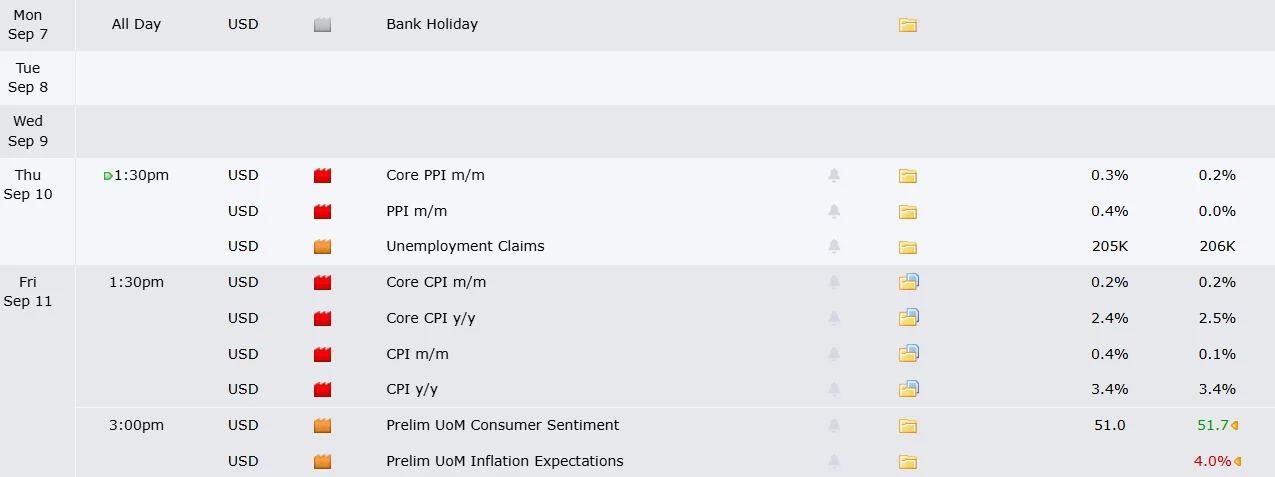
Oracle Earnings Under the Microscope
The corporate calendar’s marquee event Thursday features Oracle’s quarterly earnings announcement. The technology giant’s stock has tumbled nearly 20% in 2025 and approximately 30% over the trailing twelve months. Investor anxiety centers primarily on the substantial debt Oracle has accumulated to finance its aggressive data center expansion strategy.
Despite recent headwinds, Bank of America analyst Tal Liani maintains an optimistic outlook entering the earnings release. His projections include 25% sequential growth and 116% year-over-year expansion in infrastructure-as-a-service revenue. He anticipates Cloud SaaS revenue advancing roughly 12.8% for the reporting period.
“We favor the risk/reward of Oracle,” Liani wrote, noting that Wall Street may not be fully pricing in the company’s revenue growth potential tied to data center milestones.
Adobe is also scheduled to report Thursday, its first earnings since a recent leadership transition. Macy’s announces results the same day, offering insights into current consumer spending patterns.
Diesel Hits a Record High
American diesel prices climbed to an unprecedented $5.85 per gallon on Friday, surpassing the prior peak of $5.816 established in June 2022. Ongoing Iranian conflicts have disrupted refined petroleum product shipments from the Persian Gulf region, while Ukrainian strikes targeting Russian refining facilities have diminished output from a major global diesel supplier.
Diesel jumped to its highest price in history yesterday

— Barchart (@Barchart) September 4, 2026
Domestic distillate inventories have fallen to historically low levels for this period, with East Coast reserves at unprecedented lows. This supply crunch arrives as northeastern states approach the winter heating demand season.
“Record diesel will start funneling down into the economy,” said Patrick de Haan of GasBuddy.
Apple conducts its annual product showcase Wednesday, where analysts expect the company to introduce the iPhone 18 Pro, Pro Max, and a foldable iPhone model. The event marks the first major product debut under newly appointed CEO John Ternus.
Additional retail earnings from Casey’s General Stores, American Eagle Outfitters, and Kroger will complete the week’s corporate reporting schedule.
The post Markets Brace for CPI Data, Oracle (ORCL) Earnings, and Soaring Diesel Costs This Week appeared first on Blockonomi.
Key Highlights
- ANET shares have surged 37.3% in the last six months, significantly outpacing both the S&P 500 and technology sector benchmarks
- Second quarter revenue reached $3.04 billion, representing a 37.7% year-over-year increase and surpassing the $2.83 billion consensus estimate
- The company’s AI fabrics customer roster has expanded dramatically from 4-5 clients in 2024 to more than 100 cumulative customers
- The networking company will join the S&P 100 index on September 21, 2026
- Wall Street analysts maintain a collective “Buy” rating with a mean price target of $225.76
Arista Networks shares began trading at $193.54 on Friday, valuing the networking equipment manufacturer at $244.10 billion. The stock’s performance over the past half-year shows a remarkable 37.3% gain, dramatically exceeding the Internet software sector’s 7.8% advancement during the identical timeframe.
Arista Networks, Inc., ANET
This impressive rally is underpinned by robust financial performance. During the second quarter of 2026, Arista delivered earnings per share of $1.02, exceeding analyst expectations of $0.89 by $0.13. The company generated $3.04 billion in revenue, surpassing the $2.83 billion projection and representing a 37.7% year-over-year jump.
Looking ahead to Q3 2026, company leadership has projected EPS in the range of $1.06 to $1.08. The analyst community anticipates full-year EPS of $3.70 on average.
The firm’s artificial intelligence networking division is experiencing rapid expansion. Arista’s AI fabrics client base has exploded from merely four or five accounts in 2024 to over 100 cumulative customers. Leadership forecasts AI-related revenues will achieve at least $3.6 billion during 2026.
Supporting this growth trajectory, Arista unveiled the 7060XE7 switch, delivering 100-terabit capacity alongside 1.6-terabit throughput capabilities. Company executives anticipate 1.6T products will enter customer testing phases in the latter half of 2026, with full-scale production beginning in 2027.
S&P 100 Index Upgrade
Arista will officially enter the S&P 100 index before market opening on September 21, 2026, as part of the index’s quarterly reconstitution. Dell Technologies, Palo Alto Networks, and Sandisk are similarly being added to the benchmark, replacing Honeywell Aerospace, Nike, Simon Property Group, and Colgate-Palmolive.
Institutional ownership has intensified concurrent with the stock’s upward trajectory. Nilsine Partners expanded its holdings by 521.6% throughout Q2, while Norges Bank, Jupiter Topco, and Alyeska Investment Group all established fresh positions. Institutional shareholders now control 82.47% of outstanding ANET shares.
Wall Street Outlook and Executive Transactions
Analyst opinion remains predominantly bullish. TD Cowen elevated its price objective from $210 to $250 after reviewing the Q2 results. Jefferies established a $250 target. Deutsche Bank initiated coverage with a Buy recommendation and a $220 price objective. The overall consensus registers as “Buy” with an average target of $225.76.
One development meriting attention involves insider selling activity. During the previous 90 days, company insiders have divested $726.7 million in stock. CEO Jayshree Ullal disposed of 13,809 shares in late August at an average price of $191.79, decreasing her stake by 58.2%. CFO Chantelle Breithaupt sold 612 shares on September 1 at $195.77. Both sales were executed through predetermined Rule 10b5-1 trading plans.
Regarding supply chain matters, Arista has locked in memory supply commitments for 2026 and broadened its supplier base. Operating cash flow during the first half of 2026 totaled $2.78 billion, compared with $1.84 billion in the corresponding 2025 period. Cash and equivalents registered at $2.3 billion as of June 30, with marketable securities reaching $11.1 billion.
The equity currently trades at a price-to-sales multiple of 16.62 and a P/E ratio of 61.05, both substantially above industry norms.
The post Arista Networks (ANET) Stock Surges 37% Ahead of S&P 100 Entry appeared first on Blockonomi.
CryptoPotato
The spot exchange-traded funds tracking the largest cryptocurrency attracted almost $1 billion in the past week, despite the $236 million in net outflows registered on September 1.
The Ethereum ETFs were also well in the green. They have marked more inflows than outflows for eight out of the past nine weeks.
BTC ETFs See Another $1B in Inflows
The previous business week ended with a $201.81 million net outflow from the spot BTC ETFs, but the overall performance was quite impressive. The inflows in the other four days offset all the losses on Friday, and the week ended with a net gain of $924.48 million. Thus, the funds built on the previous week’s major inflows of $1.92 billion.
August finished with net inflows of $216.70 million, followed by $236.46 million in net outflows on September 1. Investors shifted their stance in the following three days by attracting $101.15 million on Wednesday and $174.60 million on Friday. Thursday was particularly spectacular, as the funds gained $730.87 million, the highest amount since January.
Thus, the total number for the week was $986.85 million, bringing the cumulative net inflows to $55.62 billion. Recall that this number had plummeted to $51.79 billion in mid-August.
BlackRock’s IBIT remains the undisputed leader in the ETF space, with cumulative net assets exceeding $62.6 billion. Fidelity’s FBTC follows suit with $14.07 million, and Grayscale’s larger fund, GBTC, is next with $10.36 billion.

ETH ETFs in Green, Too
Given their size, the spot Ethereum ETFs have performed even better over the past several weeks. As mentioned above, they have had only one red week since early July, and even that was quite modest, with just $2.26 million in net inflows back in mid-August.
The financial vehicles gained $824.42 million during the week that ended on August 28, and another $218.41 million in the first week of September. Thursday was once again the most notable day in terms of net inflows, with $141.39 million entering the funds. Another $87.68 million went in on Monday, $10.95 million on Tuesday, and $26.46 million on Friday. The only red day was Wednesday with $48.08 million.
The cumulative total net inflows have skyrocketed from $10.89 billion in early July to $13.19 billion on September 4.

The post Bitcoin ETFs Rake In Nearly $1 Billion as Ethereum Funds Keep the Streak Alive appeared first on CryptoPotato.
It was just three months ago that FUD around Zcash (ZEC) was running rampant, and a vulnerability in its Orchard privacy pool turned the tables and raised some uncomfortable questions.
The situation has taken a major turn, as the protocol patched the issue, and its privacy nature made it arguably the top performer in the large-cap altcoin space in the past three months.
The Meteoric Rise
Recall that the issue was first disclosed by Zcash founder Zooko Wilcox and members of Shielded Labs, who explained that a hacker could have used this weakness to make endless fake ZEC in Orchard, Zcash’s protected transaction area, without getting caught right away. Although by the time they made this public, the vulnerability was fixed, it still pushed some prominent names, such as Arthur Hayes, to dispose of their holdings, citing further potential issues.
The impact on the native token was felt immediately. The asset traded at $650 before the issue became public and tumbled by 60% within a day or so to $260 as FUD was being spread left and right.
That’s when the trend reversed for the privacy coin as it managed to stabilize at around $500, where it spent the next couple of months. The most significant leg up began with the August 19 market-wide breakout that drove it to $900. While the rest of the market stalled following the initial gains, ZEC kept climbing and briefly exceeded $1,200 earlier today for the first time in almost 10 years.
This means that the token has skyrocketed by 370% since the early June low. Its market cap now is above $20 billion, making it bigger than HYPE and DOGE.

Data from CoinGlass shows that ZEC’s spectacular surge over the past 24 hours has resulted in $46 million in short liquidations, the highest among all cryptocurrencies.
The Drivers and What’s Next
Shortly after the mid-August rally began, Grayscale debuted its Zcash ETF (on August 25), which has already raked in $34.4 million in net inflows.
“The bigger question isn’t whether Zcash can keep going up. It’s whether the ETF era is creating a new pathway for capital to rotate into crypto assets that were previously overlooked. ZEC may be an early test of that thesis,” commented The Wolf of All Streets.
Meanwhile, Ted Pillows noted that a major whale DCA-ed into ZEC between 2022 and 2024, accumulating 22,840 ZEC for about $1.1 million. The position had grown to $23 million by today, when they transferred the entire amount to Binance, potentially to cash in.
Crypto Patel weighed in on ZEC’s price potential, indicating that it has created a “Beautiful Cup & Handle Pattern” on the weekly scale. He added that the asset has broken the Neckline/Resistance of this pattern, which could materialize in another massive surge to $2,200.
As Per $ZEC Chart, you can see a Beautiful Cup & Handle Pattern formed on the Weekly Timeframe.@Zcash has already broken the Neckline/Resistance of this pattern, and if the pattern follows the 100% target, the target could be around $2,200.
No doubt, Cup & Handle is a strong… pic.twitter.com/Eys4EivIHQ
— Crypto Patel (@CryptoPatel) September 6, 2026
The post ZEC Just Hit $1,200: What You Need to Know About Its Meteoric 370% Surge in 3 Months appeared first on CryptoPotato.
The CLARITY Act received a potentially important boost ahead of its first Senate floor test, which was supposed to take place on September 15, but another scheduling setback is further threatening its chances of becoming law this year.
On the plus side, the National Sheriffs’ Association (NSA) has changed its tune on the landmark crypto market structure bill from opposition to neutral after previously raising concerns that it could make it more difficult for authorities to combat illicit finance involving digital assets.
NSA Turns Neutral
In the filing to the US Senate, the agency said that it believes the appropriate course is to step back and allow the legislative process to continue given the legislation’s complexity and the issues still being negotiated. This change matters because law enforcement concerns had become a major hurdle for some Senate Democrats whose votes could determine whether the bill advances.
Although the NSA’s move doesn’t mean that it now supports the legislation, its shift from opposition to neutrality removes a source of pressure on senators considering voting to advance it. Essentially, it removes another potential obstacle to attracting the Democratic support the bill needs when it reaches the Senate floor later this month.
Recall that the Senate Majority Leader John Thune filed a cloture vote motion to proceed with H.R. 3633 in early August so that the Senate can vote on the bill once recess ends.
The vote requires 60 senators and will not pass the CLARITY Act itself. Instead, success would limit debate on the motion to proceed and move the bill toward formal Senate consideration. Republicans hold 53 seats, meaning that Democratic or independent support will be necessary if the conference votes together.
Another Setback
House Republican leaders canceled voting sessions during the weeks of September 21 and 28, removing eight legislative days from the calendar, and the House is now scheduled to leave Washington on September 17, which is just two days after the Senate’s first procedural vote.
The new calendar leaves no time for the Senate negotiations to begin and conclude before lawmakers turn their attention to the November midterms. That makes a post-election lame-duck session an increasingly realistic path for the legislation if it clears the Senate.
Galaxy Research already reduced its estimated probability that the CLARITY Act will become law in 2026 from 50% to 30% after the Senate failed to vote on it before the August recess. Prediction markets are even less optimistic, with passage odds currently below 20%.
The post CLARITY Act Gets a Major Boost, But Another Setback Threatens Its 2026 Passage appeared first on CryptoPotato.
As with most previous weekends, this one is also quite sluggish for bitcoin, which continues to fight for $80,000 without making any major moves.
The same cannot be said for some altcoins, though. ZEC, for example, has skyrocketed by 17% daily, while ARB has stolen the show with a massive 42% surge.
BTC Fights for $80K
The primary cryptocurrency closed August (on Monday) in the green for the first time in a bear market, surging by over 25% for the month. This came even after its early Monday retracement from $79,000 to $77,000 as the US and Iran resumed the strikes against each other.
Bitcoin rebounded to $79,000 rather quickly, but it was rejected on Tuesday and driven south to under $76,500 by Wednesday. That’s when the bulls returned in full force, initiating a major leg up that drove the asset to $82,400. This became BTC’s highest price tag since mid-May.
However, the strong US jobs report from Friday led to a major decline, as bitcoin slipped by three grand as the odds for the Fed to hike the rates skyrocketed. Nevertheless, BTC managed to rebound from the drop to $78,600 and jumped to around $80,000, where it spent most of the weekend, even though the amount of bearish news that should push it south has risen significantly in the past week.
Its market capitalization is back at $1.6 trillion on CMC, while its dominance over the alts has declined slightly to 59.1%.

ZEC, ARB on a Roll
Ethereum has neared $2,500 again after a 1.75% increase daily. BNB, which touched $770 yesterday, is below $760 now, while XRP has defended the $1.40 support. SOL is well above $100 once again, and similar gains are evident from the likes of HYPE, DOGE, RAIN, XMR, LINK, and ADA.
Uniswap’s UNI has jumped to $7 after a 10% increase, while ZEC is close to $1,200 for the first time in almost a decade following a major 17% jump. Arbitrum’s native token has stolen the show, surging by 42% to over $0.19.
The total crypto market cap remains at just over $2.7 trillion on CMC after a 0.8% increase since yesterday.

The post Arbitrum (ARB) Rockets by 42% Daily, Bitcoin (BTC) Fights for $80K: Weekend Watch appeared first on CryptoPotato.
Bitcoin tried and failed on several occasions to decisively break above the crucial $80,000 level, but perhaps the more important question is why it hasn’t dumped much further.
After all, the macro landscape is anything but bullish given the renewed attacks between the US and Iran, the hawkish Fed, and the surprisingly strong jobs data.
BTC Should Be Hurting
The latest geopolitical developments arrived this weekend as the two warring parties exchanged fresh attacks after Iran’s Revolutionary Guard launched ballistic missiles against two US Navy vessels. The US subsequently struck three Iranian crude oil carriers, while the Middle Eastern country also targeted tankers and US-linked vessels in waters around the Strait of Hormuz.
The escalation matters far beyond geopolitics as Brent crude climbed toward $100 per barrel again amid renewed concerns about energy supplies. Higher oil prices can directly feed into inflation, making the Federal Reserve’s decision next week even harder.
The US central bank has become another issue for BTC. Chair Kevin Warsh adopted a distinctly more hawkish tone at Jackson Hole last week, emphasizing that inflation remains too high and that the Fed could still have “work to do.”
The odds for a September rate hike jumped after the speech and went even higher after Friday’s jobs report. It showed that the US economy added 162,000 jobs in August, almost triple expectations of 56,000, while unemployment remained unchanged at 4.1%.
Although that’s good news for the economy, risk assets do not benefit as the hope for easier monetary policy fades given the higher inflation.
September rate hike odds jumped to 65% at their peak. The two-year Treasury yield reached its highest level since January 2025, the greenback strengthened, and stocks came under pressure.
Bitcoin dropped by $3,000 initially, but rebounded swiftly.
Absorbing Bad News
All of the above creates an atmosphere highly unfavorable for risk-on assets like BTC. Yet it remains at $80,000 even during the weekend when the attacks in the Middle East resumed, and it’s up roughly 25% over the past month.
Part of the explanation for why the cryptocurrency has performed so well comes from the ETF performance. The funds continue to attract significant amounts, with Thursday being a prime example. Over $730 million entered the ETFs, the highest single-day level since January.
What’s even more impressive is that gold has lost a significant portion of its gains charted after the mid-August rally, while BTC holds strong. However, this doesn’t guarantee that BTC cannot fall. In fact, there are two major threats in the next 10 days or so.
First, it’s the CPI, which arrives on September 11. A hotter-than-expected inflation reading, especially after the rise in oil prices, could push expectations for a rate hike even further.
Then it’s the conclusion of the FOMC meeting on September 16. An increase in the rates combined with hawkish guidance from Warsh could finally push BTC through key support levels, as discussed yesterday.
The post Bitcoin at $80K Is Stronger Than It Looks: BTC Is Surviving a Perfect Storm of Bearish News appeared first on CryptoPotato.