Cryptocurrency Posts
Crypto Briefing
John Ternus's leadership may redefine Apple's AI strategy and product focus amid rising competition and regulatory challenges globally.
The post Apple appoints John Ternus as new CEO effective September 1, 2026 appeared first on Crypto Briefing.
The slight rise in labor force participation suggests cautious optimism, but persistent long-term unemployment highlights ongoing economic challenges.
The post US labor force participation rate climbs to 61.6% in August after five-year low appeared first on Crypto Briefing.
The shift from capitulation to profit-taking among Bitcoin holders suggests a recovering market, but risks of overheating could destabilize gains.
The post Bitcoin short-term holders shift from capitulation to profit-taking as BTC surges to $77K appeared first on Crypto Briefing.
Kalshi's regulated perpetuals trading could enhance US crypto market legitimacy, offering safer hedging tools and attracting institutional interest.
The post BNB Chain launches perpetuals trading on Kalshi as regulated US crypto derivatives expand appeared first on Crypto Briefing.
Ambient's blockchain innovation could decentralize AI processing, challenging centralized AI providers by enhancing privacy and reducing dependency.
The post Ambient develops Layer 1 blockchain where miners perform AI inference tasks appeared first on Crypto Briefing.
Bitcoin Magazine
Bitcoin Magazine
National Sheriffs’ Association Drops Opposition to Clarity Act
The National Sheriffs’ Association this week dropped its opposition to the crypto Clarity Act, after having previously warned that the proposed bill could help criminals.
Writing Thursday to Senate Majority Leader John Thune and Minority Leader Chuck Schumer, the association said it was changing its stance to neutral given how complex the issue is.
A number of lawmakers were hoping to vote on the Clarity Act in August. After a delay, a vote will now go ahead this month. The bill will establish a framework for distinguishing between digital assets that are securities, commodities or payment stablecoins — legislation that the crypto industry has long called for.
“Given the complexity of the legislation and the number of important details that remain under consideration, the NSA is changing its position on the Clarity Act to neutral,” the letter from NSA President Sheriff Troy Wellman and Executive Director Justin Smith read.
JUST IN: Major U.S. law enforcement organization National Sheriffs’ Association no longer opposes The Clarity Act
— Bitcoin Magazine (@BitcoinMagazine) September 4, 2026
“We believe the most appropriate course is to step back and allow the legislative process to proceed to establish a…much needed regulatory framework.”pic.twitter.com/NBpKlrUsUj
“At this time, we believe the most appropriate course is to step back and allow the legislative process to proceed to establish a clear, effective, and much needed regulatory framework.”
The NSA had previously warned that the bill could create regulatory and anti-money laundering loopholes by exempting certain crypto developers and infrastructure providers from money transmitter rules.
Despite being passed in the house of representatives last year with strong bipartisan support, the Clarity Act has been in a deadlock for much of 2026. The banking lobby raised concerns over stablecoin yield and some lawmakers have said improvements need to be made surrounding ethics.
An updated bill of the Clarity Act was introduced in July that addressed some of these concerns — banning government officials and their families from issuing or promoting crypto.
Pro-crypto senator Cynthia Lummis wrote on Friday that the “bipartisan bill” gives “law enforcement real tools to fight the illicit finance crimes hurting hard working Americans.”
Major financial institutions, lawmakers and companies have said they support the latest draft of the new bill, but some Republicans have accused Democratic lawmakers of deliberately playing politics and holding the bill back.
This post National Sheriffs’ Association Drops Opposition to Clarity Act first appeared on Bitcoin Magazine and is written by Mathew Di Salvo.
Bitcoin Magazine

Bitcoin Bear Market May Not Yet Be Over, Says Fidelity
Bitcoin may be rallying but that doesn’t mean the bear market is over. Not yet, anyway.
A new report from asset manager Fidelity said that while bitcoin was behaving like it did in previous cycles, it could still hit a bottom in November.
Bitcoin started rallying in mid-August after the U.S. Treasury Department said it would more than double the size of its government debt repurchases. The asset’s price recently stood at close to $81,639, up nearly 30% over a 30-day period.
Some have since argued that bitcoin is out of its bear market. The coin touched a record high in October last year, hitting $126,080.
“Given bitcoin’s recent performance, the bottom could already have occurred in July,” Chris Kuiper, Vice President of Research at Fidelity Digital Assets, wrote.
“It could also drop again to make another new low in November or later,” he continued, adding that bitcoin cycles have historically not been precisely four years long, so they “aren’t reliable for timing the market.”
Throughout most of June and July, bitcoin’s volatility was particularly muted, and the coin traded below $65,000.
But that all changed in August after the Treasury Department’s announcement, which has since brought the so-called debasement trade back in the picture again.
To get an idea of where bitcoin moves next, Kuiper argued that investors should pay attention to what happens with the crypto Clarity Act. Proponents argue it could provide “greater regulatory certainty and support continued innovation in the U.S. digital asset ecosystem,” he wrote.
President Donald Trump in August urged lawmakers to get the long-awaited crypto market structure bill over the line, helping spur bitcoin’s run. The president called the draft “very, very powerful” after meeting with crypto industry bigwigs at the White House.
The digital asset industry has long called for clear rules on how regulators should treat bitcoin, stablecoins and other cryptocurrencies.
Lawmakers will vote on the bill this month.
This post Bitcoin Bear Market May Not Yet Be Over, Says Fidelity first appeared on Bitcoin Magazine and is written by Mathew Di Salvo.
Bitcoin Magazine

Bitcoin-Gold Correlation Hits Six-Year High as Debasement Fears Mount
Bitcoin’s correlation with gold is at its highest in six years as investors increasingly look for ways to hedge against currency debasement.
That’s according to a new report from Bitwise, which this week pointed out that the precious metal and leading cryptocurrency are trading in lockstep because the U.S. government has “materially intervened in the macro picture.”
Bitcoin started surging last month, after the U.S. Treasury Department said it would more than double the size of its government debt repurchases. The coin had its best run in three years and third best August ever.
JUST IN: Bitcoin's correlation with gold hit a six-year high, according to Bitwise
— Bitcoin Magazine (@BitcoinMagazine) September 3, 2026
"The last time it was this high was 2020, after the Covid stimulus."pic.twitter.com/fHtQUlR9Ol
“The last time the bitcoin-gold correlation was that high was in 2020, following the rounds of fiscal and monetary stimulus during the Covid crisis,” Bitwise’s European Head of Research, André Dragosch, wrote.
He added that bitcoin’s correlation with the stock market dropped to a one-year low, “implying some kind of decoupling between hard assets and the stock market.”
Bitcoin has been pushed as “digital gold” for years but has sometimes traded with tech stocks as a “risk-on” asset.
But the so-called debasement trade — when investors buy an asset as a way to hedge against a currency losing value — was a much-talked about investment strategy last year and appears to be back.
The reason is down to the government intervening in markets, Dragosch argued. When the Treasury said it would try to rein in long-term borrowing costs, the dollar’s value slid and sent investors flooding back to gold — and bitcoin.
The Treasury the same week also said the U.S. public debt exceeded $40 trillion for the first time. Excessive debt also undermines confidence in the dollar.
“Investors are no longer asking whether to hedge currency debasement with gold or bitcoin. They’re simply hedging with both,” the report added.
“Bitcoin spent its first fifteen years being priced as a risk asset. If this correlation trend with gold holds, the next fifteen may look very different.”
The leading cryptocurrency again rallied this week, and was recently trading for close to $81,438 after jumping nearly 6% over a 24-hour period.
This post Bitcoin-Gold Correlation Hits Six-Year High as Debasement Fears Mount first appeared on Bitcoin Magazine and is written by Mathew Di Salvo.
Bitcoin Magazine
French Hill Eyes Bipartisan Path for Clarity Act Ahead of September Vote
U.S. congressman French Hill expressed the importance of bipartisan support to get the long-awaited crypto market structure bill, the Clarity Act, over the line before the midterms.
The lawmaker told Fox Business Thursday that Democrats and Republicans have come to “narrow their differences in getting the bill drafted.
Pro-crypto lawmakers were hoping the Clarity Act passed before Congress departed for August recess. After a delay, a vote will now go ahead on September 15.
“Can Democrats work with Republicans and make sure America leads the world in distributed ledger technology and financial services?” Hill said.
“This one remaining significant issue is the ethics provision, and that is best solved by passing the legislation because everybody — no matter what family they belong to, the Trumps or not — would then be under a regulatory framework fully scrutinized by the United States government in commodity and securities and banking regulators,” he added.
The Clarity Act was first introduced by Hill, the House Financial Services Chairman, last year.
Crypto companies have long called for clear regulations for the industry. The Clarity Act drafts a framework to formally divide oversight between regulators, distinguishing which digital assets are securities, commodities or stablecoins.
The House of Representatives passed the bill last July but it has been stalled this year, mostly because the banking lobby clashed with crypto companies over paying customers stablecoin yield.
A new draft tackling the issue of ethics started circulating in July. It bans government officials from promoting or making money from crypto — something Democrats have criticized the Trump family for doing.
A group of Democrats said the bill fell short and wanted amendments. Some were accused of deliberately holding it back by Republicans like Cynthia Lummis.
Some have praised the bipartisan work that has already gone into the bill, namely Coinbase, America’s biggest crypto exchange. The company’s Chief Policy Officer, Faryar Shirzad, said in July that while some Democratic lawmakers were holding back the long-awaited legislation, younger Democrats wanted to pass it.
President Donald Trump in August said that in order for the U.S. to remain the “undisputed leader in Bitcoin and crypto,” lawmakers had to pass the “very, very powerful legislation.”
This post French Hill Eyes Bipartisan Path for Clarity Act Ahead of September Vote first appeared on Bitcoin Magazine and is written by Mathew Di Salvo.
Bitcoin Magazine

Kraken and SoFi Link Crypto Trading To Banking Rails
Payward, the parent company of crypto exchange Kraken, and fintech company SoFi Technologies on Thursday announced a deal to route SoFi customers’ crypto orders through Kraken’s institutional trading platform and list SoFi’s stablecoin on the exchange.
Under the agreement, SoFi will send its digital asset order flow to Kraken Prime, Kraken’s prime brokerage arm, which launched in 2025.
Rather than filling trades against a single order book, Kraken Prime uses smart order routing to compare prices and depth across multiple venues and execute where the fill is best. SoFi said customers will see no change to the app itself.
Payward is also joining the SoFi Exchange Network, the bank’s real-time settlement system, and will list SoFiUSD — SoFi’s bank-issued stablecoin — on Kraken.
Kraken Prime’s institutional and business clients will in turn gain access to SoFi’s business banking services and round-the-clock fiat settlement. The companies said qualified custody services would follow later.
SoFi holds a national bank charter and has 15.8 million members. The partnership is the latest in a series of tie-ups between Kraken and established financial firms, following arrangements with Deutsche Börse on foreign exchange and derivatives infrastructure, Nasdaq on a tokenized equities gateway, and Franklin Templeton on tokenizing exchange-traded funds.
The news comes after SoFi, a purely digital lender, last year became the first nationally chartered bank in the United States to launch crypto services for retail customers.
The company’s new SoFi crypto platform allows members to buy, sell and hold bitcoin directly within their bank accounts.
Kraken — like other crypto exchanges — is pushing into the traditional finance world, allowing users to trade stocks, bonds and other assets. The company has sold its app as a “primary account for everything.”
This post Kraken and SoFi Link Crypto Trading To Banking Rails first appeared on Bitcoin Magazine and is written by Mathew Di Salvo.
CryptoSlate
Japan’s 30-year government-bond auction cleared at a 4.079% average yield on Sept. 3, underscoring a tougher backdrop for future capital raised by Metaplanet to buy Bitcoin. The long bond is a market signal; the nearer test for the company is the price of shorter-tenor debt and refinancing.
The average yield rose 14.2 basis points from 3.937% at the previous 30-year auction on Aug. 6. Japan’s Sept. 1 10-year auction averaged 2.995%, placing the 4% threshold at the long end rather than across the entire curve. The Bank of Japan, meanwhile, maintains an operating guideline of around 1% for the uncollateralized overnight call rate.
Metaplanet’s existing fixed obligations retain their contractual cash flows. Its ¥8 billion 20th-series ordinary bond is zero-coupon and matures on April 23, 2027, while its inaugural BitBonds carry fixed coupons. The shift in Japanese yields instead raises the benchmark for future issuance and refinancing.
That leaves a narrower version of Metaplanet’s funding advantage intact. The bilateral zero-coupon bond protects near-term cash flow, but repeating such favorable terms at the scale required for sustained Bitcoin purchases remains uncertain.
Metaplanet BitBonds face a shorter-tenor funding test
Metaplanet’s inaugural 21st through 24th-series BitBonds total ¥200 million, pay fixed coupons ranging from roughly 4.0% to 4.3%, and mature in about three years. Recent government auctions cleared at average yields of 1.708% for two-year debt and 2.163% for five-year debt.
A straight-line interpolation between those official results produces an estimated three-year sovereign benchmark of 1.8597%. The estimate is an analytical tenor comparison rather than a traded three-year quote or a cash-flow duration calculation.
Against it, the inaugural BitBonds pay an estimated premium of about 214 to 244 basis points. Future coupons would rise if the sovereign benchmark increased while Metaplanet’s credit spread stayed constant. A wider credit spread would add further pressure.
The bond terms explain why investors may require that premium. The BitBonds are unrated, unsecured and unguaranteed senior obligations. They carry transfer restrictions, and secondary-market liquidity is unassured. Metaplanet has said later series may differ in maturity and interest rate according to market conditions and investor demand.
Existing instruments face a different equation. Higher rates can affect their market value, while the stated coupon and principal cash flows remain fixed. The company’s 20th-series ordinary bond funded Bitcoin purchases before all expected cash arrived from its 27th-series stock acquisition rights. Part of the warrant proceeds was designated to repay the bond, allowing Metaplanet to bring forward funding without an annual coupon bill.
Metaplanet’s funding channels carry different costs
Metaplanet was already drawing on several channels at midyear. At June 30, it reported 43,000 BTC, $414 million drawn from a $500 million Bitcoin-collateralized credit facility, ¥67.486 billion of short-term borrowings, ¥8 billion of bonds due within one year and ¥1.805 billion of first-half interest expense.
Second-quarter Bitcoin purchases used proceeds from the 20th-series bond, the credit facility, the 27th-series rights and Bitcoin-income revenue. This mix kept purchases moving while mNAV remained below 1.0x for most of the half and the company made no discretionary common-share allotments during the quarter. The funding inventory therefore separates into two parts: fixed structures protect current economics, while each new round of capital faces prevailing market terms.
Scale turns a coupon into a constraint
The inaugural BitBond issue is too small to transform Metaplanet’s economics. At 4.15%, the midpoint of its coupon range, annual interest on ¥200 million is about ¥8.3 million, equivalent to roughly 0.07% of the company’s ¥11.4 billion full-year operating-profit forecast.
The same rate applied to larger illustrative programs produces a different result:
| Illustrative BitBond principal | Annual interest at 4.15% | Share of ¥11.4bn operating-profit forecast |
|---|---|---|
| ¥200 million | ¥8.3 million | About 0.07% |
| ¥10 billion | ¥415 million | About 3.6% |
| ¥100 billion | ¥4.15 billion | About 36.4% |
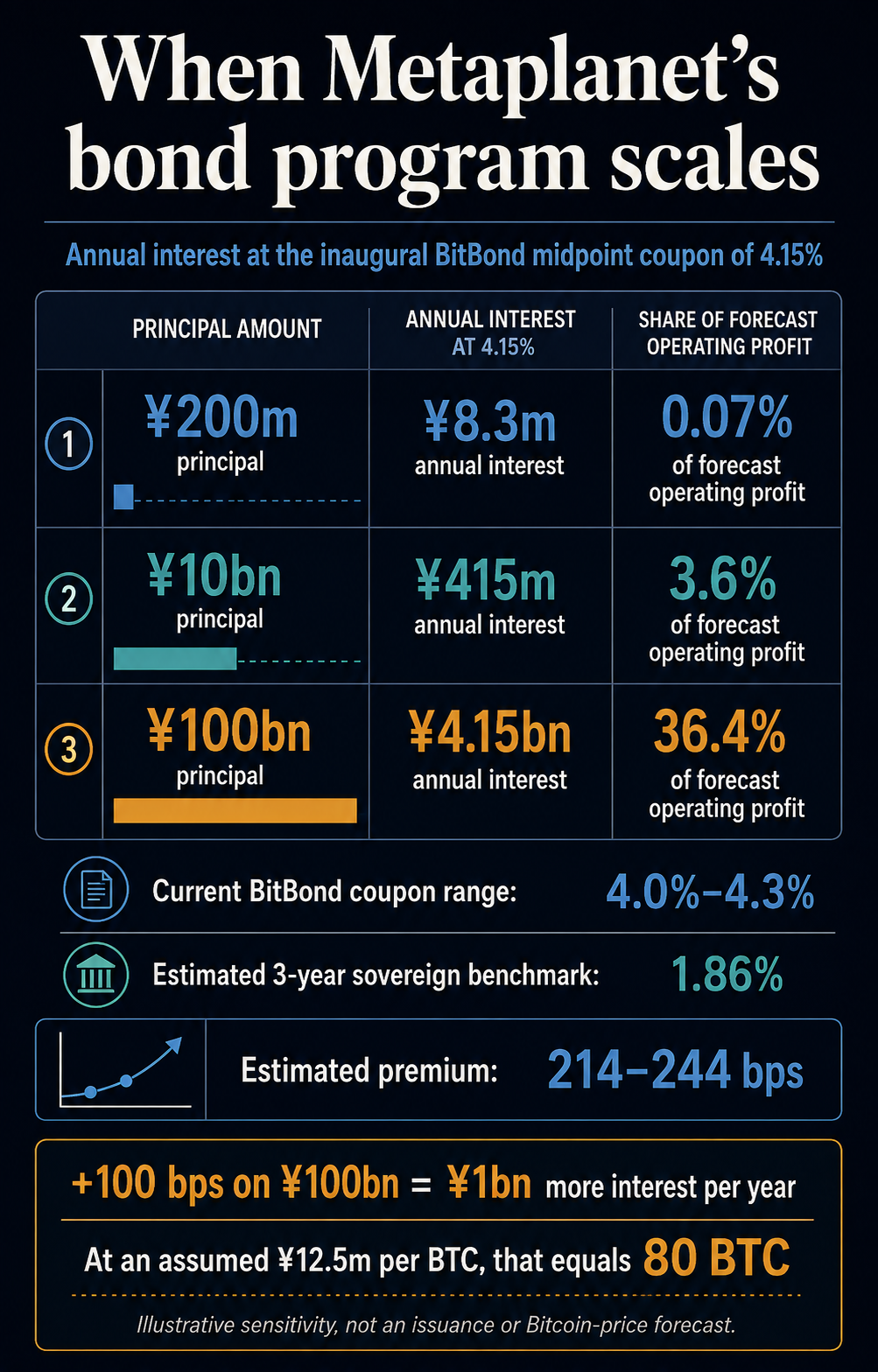
The ¥10 billion and ¥100 billion rows are sensitivities rather than issuance forecasts. They show why the ability to expand the program at acceptable rates matters more than the first tranche’s small coupon bill.
A one-percentage-point increase on an illustrative ¥100 billion program would add ¥1 billion to annual interest. At an assumed Bitcoin purchase price of ¥12.5 million, that amount equals 80 BTC a year when the additional interest comes entirely from cash otherwise available for accumulation.
Metaplanet could instead meet the expense through operating cash flow or another financing source. The 80 BTC figure applies only to the stated price and cash-use assumptions. Its purpose is to translate a rate move into the company’s capacity to add Bitcoin for each share outstanding.
The balance-sheet effect grows faster than the headline drama. A 4.079% 30-year sovereign yield changes little about a ¥200 million BitBond issue. A large future debt program near the current coupon range would consume a meaningful portion of forecast operating profit before any additional rise in the benchmark or credit spread.
Equity access depends on Metaplanet’s valuation
The 27th-series rights generally may be exercised only when company-notified mNAV is at least 1.01x. No rights were exercised in August. At Aug. 31, 947,300 rights representing 94.73 million potential shares remained, equal to about 7.0% of the company’s 1.345 billion issued shares.
That leaves a material but conditional dilution overhang. If the mNAV threshold prevents exercise, warrant-funded Bitcoin purchases may stall and the proceeds intended partly for repaying the zero-coupon bond arrive more slowly. If the threshold is satisfied and exercises resume, Metaplanet gains funding while existing holders absorb more shares.
The company also held authority to repurchase as many as 150 million shares for up to ¥75 billion through Oct. 28. It bought zero shares in August and zero cumulatively under that authorization through Aug. 31, leaving buybacks absent from the period’s offset to potential dilution.
For the first half, Metaplanet’s issuer-defined measure of Bitcoin holdings per 1,000 fully diluted shares increased 9.6% to 0.0263554 BTC. The reported funding mix was accretive over that period. Future accretion becomes harder as debt principal expands, coupons rise or more rights convert into shares.
Japan’s Sept. 3 auction therefore tests Metaplanet’s funding advantage at the margin. The zero-coupon bridge preserves the clearest benefit on existing terms, and the BitBond program demonstrates access to fixed-rate yen debt at a meaningful premium over a comparable sovereign tenor. The next funding round’s price and scale will determine how much of that advantage continues to reach Bitcoin per share.
The post Japan’s 4% bond yield spike threatens the low-cost borrowing strategy behind corporate Bitcoin buying appeared first on CryptoSlate.
Arthur Hayes has a new market alarm for crypto traders: EUR/JPY. The pair has started to fall, yet the Federal Reserve channels that would turn currency stress into dollar liquidity remain dormant.
The European Central Bank's reference rate fell from 185.63 yen per euro on Sept. 1 to 181.21 on Sept. 3, a 2.38% drop. Hayes says a fall to 140 or below by June 2027 would herald a much larger increase in dollar liquidity. The latest reading still sits 29.4% above that threshold.
That distance is crucial. The exchange rate is only the first link in a sequence that runs through French sovereign and bank funding, foreign central bank dollar borrowing at the Fed, and Fed purchases of Treasury securities. Current official data show vulnerability in France, but the rest of Hayes's proposed chain has yet to activate.
The four-part EUR/JPY trade behind Hayes's alarm
In his Sept. 2 essay “Atención,” Hayes argued that political and financial pressure in France would weaken the euro while Japanese capital repatriation strengthened the yen. A falling EUR/JPY would warn that French banks were nearing stress in sovereign and dollar repo markets.
Hayes then looks to two different Fed tools. The FIMA repo facility allows approved foreign monetary authorities to raise dollars temporarily against Treasuries. Reserve-management purchases, known as RMPs, add short-dated Treasury securities to the Fed's portfolio to maintain an ample supply of bank reserves.
In his scenario, those channels expand the supply of dollars and ultimately support risk assets. Hayes kept a structural Bitcoin long and reiterated a $10,000 Ether target for the end of 2026. Those positions depend on the proposed mechanism and provide no confirmation that it has started.
The public scorecard makes the gap visible:
| Link in the thesis | Current reading | Signal that would strengthen the case |
|---|---|---|
| EUR/JPY breaks lower | 181.21 on Sept. 3, down from 185.63 on Sept. 1 | A sustained move toward 140 would validate the currency leg alone |
| French funding stress spreads | Higher sovereign yields and known repo vulnerabilities alongside a covered OAT auction and resilient aggregate bank-liquidity measures | Disorderly sovereign funding, weaker bank liquidity or funding data, and evidence of French banks retreating from repo markets |
| FIMA supplies emergency dollars | $0 outstanding in the latest H.4.1 release | A positive and rising foreign-official repo balance |
| Fed Treasury buying accelerates | No RMPs scheduled for the current monthly window | Renewed purchases tied to persistent reserve or market pressure rather than routine portfolio reinvestment |
| Crypto responds | Research supports broad sensitivity to Fed conditions, with no historical test of this exact chain | A concurrent liquidity expansion and crypto move that holds after accounting for other risk drivers |
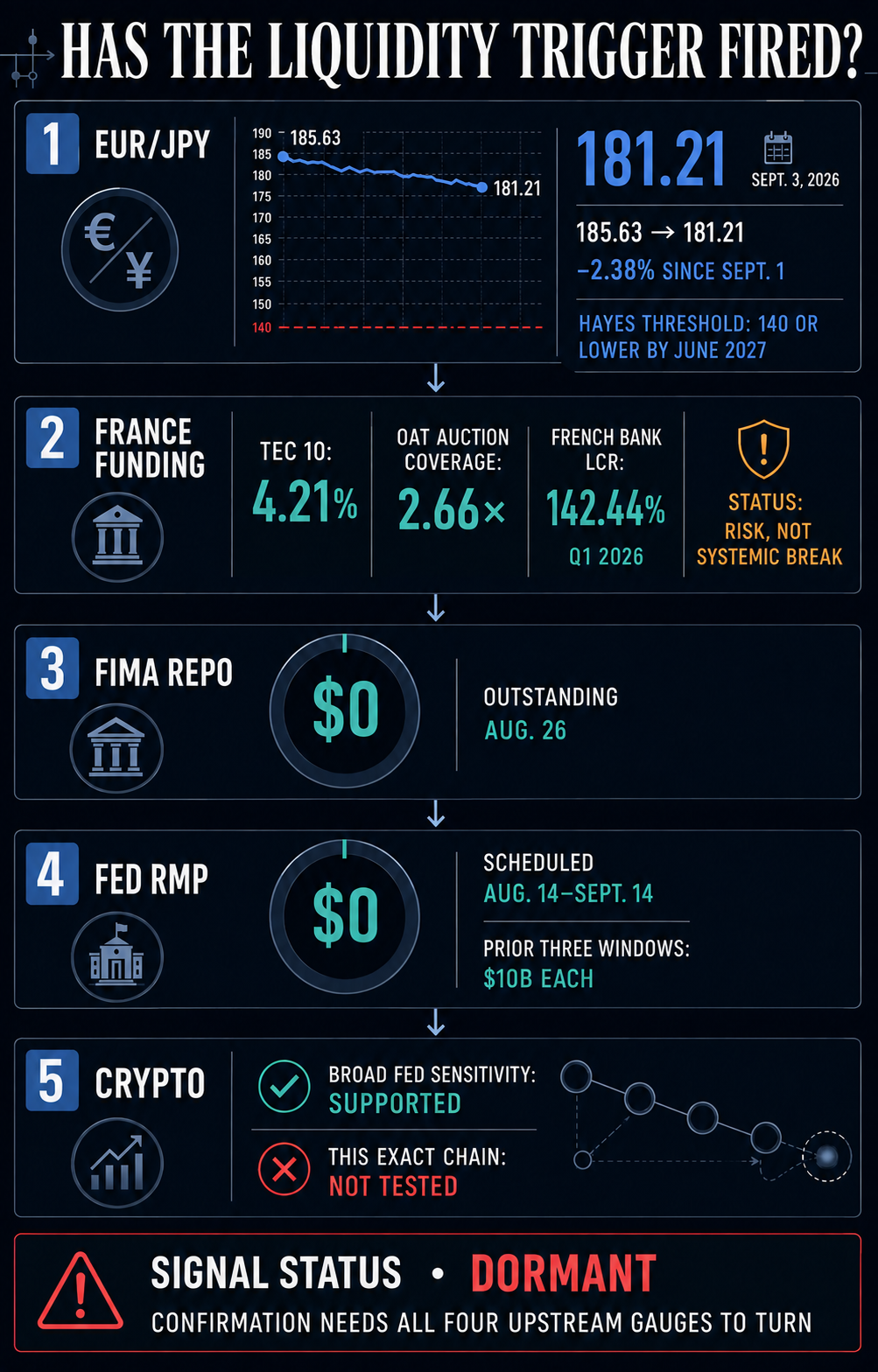
The table also shows why a lower currency pair cannot carry the argument by itself. Hayes's forecast spans markets with separate participants, mandates and disclosure schedules. Confirmation requires those independent gauges to turn in sequence.
The Fed plumbing behind EUR/JPY remains dormant
The Fed describes FIMA repo as a backstop for approved foreign monetary authorities. They can temporarily obtain dollars against Treasuries instead of selling the securities into the market. The facility is generally priced above private repo when markets function normally, directing its use toward periods of unusual stress.
The latest H.4.1 balance sheet reported zero under “Repurchase agreements: Foreign official” for Aug. 26. The Fed's accounting guidance identifies that line as outstanding FIMA repo. Central bank liquidity swaps were also small at $121 million.
A larger foreign-official figure in the same release measures the opposite transaction. Foreign-official and international-account reverse repurchase agreements averaged $361.883 billion for the week and stood at $355.456 billion on Wednesday. These reverse repos are a Fed liability used by foreign official institutions to invest cash. FIMA repo is an asset-side transaction in which the Fed supplies cash against Treasuries. Treating the reverse-repo balance as FIMA usage would invert the signal.
Hayes's larger scenario assumes removal of the FIMA facility's per-counterparty limit. The FOMC authorization in force as of Jan. 27 retained a $60 billion total outstanding limit per counterparty, although the relevant subcommittee can approve changes. Current policy therefore remains well short of the uncapped facility embedded in his forecast.
The RMP channel points in the same dormant direction. For the Aug. 14 to Sept. 14 window, the New York Fed scheduled about $17 billion of reinvestment purchases and zero reserve-management purchases. RMPs had already stepped down to $10 billion in each of the prior three monthly windows after running at $40 billion per month through mid-April.
Reinvestment replaces principal payments from maturing agency securities. RMPs increase Treasury holdings to maintain ample reserves. SOMA Manager Roberto Perli explained in March that the present program began after reserves entered the ample range in December 2025, with the initial $40 billion pace smoothing an expected April tax-season drain into the Treasury General Account.
Perli also placed RMPs outside the large-scale asset-purchase programs used to ease financial conditions during the global financial crisis and the pandemic. A renewed rise in RMPs would matter for Hayes's framework only when accompanied by evidence that reserve or repo pressure was driving it. The current schedule shows deceleration to zero.
France supplies the live risk
French sovereign markets give Hayes's thesis its strongest observable foundation. Agence France Trésor listed its 10-year benchmark yield at 4.21% on Sept. 3. The day's long-dated OAT auction nevertheless attracted €35.879 billion of purchase orders for €13.497 billion served, producing about 2.66 times coverage.
The Banque de France's June stability report had already identified the channel that could make future stress contagious. France's 10-year yield reached 3.75% on June 12, while the OAT-Bund spread widened 8 basis points over the conflict period analyzed. The report warned that leveraged hedge-fund trades in OAT repo, often using very short maturities and potentially procyclical margin practices, could amplify a liquidity shock.
A separate ECB study of dollar repo funding gives the mechanism scale. Euro-area banks had about €1.6 trillion of dollar repo exposure in November 2024, with 85% maturing within one week and most government-bond collateral consisting of Treasuries. French bank branches were the most active euro-area branches in the U.S. repo market. The study established a structural channel; it reported no current French retreat from that market.
Aggregate bank data remain resilient. The ECB reported a 142.44% liquidity coverage ratio for French significant institutions in the first quarter of 2026. France's bank supervisor said in July that liquidity and solvency were comfortable and that medium- and long-term funding programs were well advanced. Those lagged measures leave room for later strain, while offering no support for a systemwide funding break at the time measured.
France's average TARGET balance was a liability of about €195.239 billion in June. TARGET records the net result of cross-border payments between national central banks, and the ECB publishes the series monthly with a lag. The balance can serve as a directional gauge of cross-border flows. On its own, it cannot establish a bank run or an imminent rupture in the euro.
Together, the French indicators describe a market carrying more risk rather than a system already in flight. Yields and repo structure justify close attention. Auction demand, capital and liquidity figures define the counterweight.
Crypto is the last link
Crypto's sensitivity to Fed conditions gives the thesis an intuitive endpoint. International Monetary Fund research found that a common crypto factor explained 80% of price variation in its sample and that tighter U.S. monetary policy reduced that factor through the risk-taking channel.
That result links crypto broadly to monetary policy and global risk appetite. It falls short of establishing EUR/JPY as a reliable leading indicator for Bitcoin or Ether, and it does not test the path through French repo markets, FIMA and RMPs.
The proposed sequence also lacks enough direct history for a clean backtest. FIMA usage is currently zero, while the present RMP regime began only in December 2025. Repeated cases in which this exact sequence preceded crypto gains do not exist in the supplied evidence.
At the Sept. 3 research check, CryptoSlate's Bitcoin market data showed BTC near $81,008, while its Ethereum market data showed Ether near $2,498. Those prices locate the market when Hayes published his forecast. Future gains would still need to be paired with the balance-sheet signals he named before they could count as evidence for his mechanism.
EUR/JPY remains the simplest gauge in Hayes's framework, but its move only opens the test. A more persuasive signal would combine a sustained approach toward 140 with worsening French sovereign and bank-funding data, positive FIMA repo usage, and renewed RMPs tied to market pressure. Until those gauges turn together, Hayes's smoke alarm remains at the monitoring stage.
The post Arthur Hayes calls EUR/JPY prices crypto’s smoke alarm, but the Fed’s plumbing still shows no fire appeared first on CryptoSlate.
Bitcoin fell below $80,000 on Friday after a much stronger-than-expected US jobs report abruptly raised rate-pressure concerns across crypto and other markets.
The Bureau of Labor Statistics said nonfarm payrolls increased by 162,000 in August, compared with a Reuters consensus of 56,000. The release arrived at 8:30 a.m. ET, and was followed immediately by a sharp cross-asset reaction. Unemployment held at 4.1%, while earlier payroll estimates were revised up by a combined 55,000.
Bitcoin lost about 2% and slipped below $80,000 in the immediate reaction. Within hours Bitcoin market data from CryptoSlate put BTC back near $79,570, still up 0.83% over 24 hours. Ethereum market data showed Ethereum near $2,454 and up 1.41% over the same window, suggesting the immediate selloff cut into earlier 24-hour gains rather than producing a full-day crypto collapse.
Why good jobs news hit Bitcoin and gold
The market treated the payroll surprise as a reason the Federal Reserve could keep policy tighter. Reuters reported that the implied probability of a quarter-point September rate increase rose to 59% from 52% after the release.
The two-year Treasury yield, which is especially sensitive to Fed expectations, climbed 7.6 basis points. Ten-year and 30-year yields rose 3.2 basis points and 1 basis point, respectively, while the dollar index gained about 0.3% to 99.3.
That combination creates a familiar headwind for Bitcoin. Higher yields raise the return available on dollar assets, while a stronger dollar tightens financial conditions for assets priced in the currency. Gold faced the same pressure from a different angle: Reuters reported bullion down between 1.7% and 2.2% as higher rate expectations reduced the appeal of a non-yielding asset.
US stocks did not move in perfect unison. S&P 500 futures turned negative after the report and were down 0.22% at 8:33 a.m. ET, but Nasdaq 100 futures remained 0.07% higher. Average hourly earnings also rose a steady 0.3% for the month and 3.1% over the year. Those details show why the first reaction was not a one-way verdict across markets, even though the initial rate repricing was clear.
Oil was carrying its own catalyst. Brent was only slightly lower near $95 after the jobs report but remained more than 8% higher for the week amid renewed US-Iran hostilities and supply concerns. The payroll surprise offers the strongest explanation for the synchronized 13:30 BST jolt, but not for every move that followed.
The post Bitcoin falls below $80,000 as hot US payrolls revive Fed hike risk appeared first on CryptoSlate.
The Guiding and Establishing National Innovation for U.S. Stablecoins Act, or GENIUS Act, is the new federal framework for payment stablecoin issuers. Its reserve rules aim to make each token a safer dollar claim, while the public blockchains moving those tokens retain their own fee markets and capacity limits.
A Federal Reserve staff paper, first dated June 2, 2026, and updated Aug. 31, 2026, models how transaction congestion can destabilize even a perfectly backed digital dollar. The authors are Federal Reserve economists, and the paper carries the standard disclaimer that their views do not necessarily represent the Federal Reserve Board or Federal Reserve System.
When fees climb far enough, small payments become uneconomic and a token’s usefulness can fall. The model predicts that weak payment-network effects can then turn individual exits into coordinated redemptions. In the paper’s empirical work, however, “redemption” means a drop in Ethereum circulation and can include either a cash-out to fiat or migration to another blockchain.
The paper presents a latent mechanism, not a forecast of a current run. It sharpens an unresolved question as Treasury implements GENIUS: the law gives regulators broad tools for policing issuers, reserves and redemption promises, while its explicit reserve provisions and Treasury’s current section 3 proposal set no price or capacity standard for a public blockchain.
How congestion can trigger a run without bad reserves
Traditional stablecoin analysis starts with the issuer’s assets. If a token promises one dollar but its reserves lose value or cannot be sold quickly, holders have a reason to redeem before others do.
The Fed economists deliberately remove that problem from their model. The stablecoin is fully and safely backed. The source of fragility is instead the interaction between transaction fees and payment-network effects: people value a payment asset partly because other people accept and use it.
Under low congestion, that network can absorb a shock. Under high congestion and weak network effects, the paper finds a threshold beyond which redemptions can become coordinated and abrupt. Higher fees reduce use; reduced use makes the token less attractive; the weaker network then gives more holders a reason to leave.
“Redemption” needs care here. In the paper’s main empirical panel, it is measured as a negative change in a stablecoin’s Ethereum circulation. That can represent redemption for fiat, but it can also represent migration to another blockchain. The data therefore capture pressure on Ethereum-based circulation, not a clean count of customers cashing out at an issuer.
The study uses an unbalanced weekly panel of five stablecoins from November 2017 through December 2025 where data are available. Its starkest distributional result comes from 2021 through 2025: for below-median USDC transfers, the fee-to-value ratio at the 75th percentile frequently exceeded 100%. For above-median transfers, it was almost never more than 5%.
The statistic describes the distribution of attempted and completed transfer economics rather than a claim that users routinely paid more in fees than they sent. During expensive periods, a representative network fee could exceed the value of many small transfers. A holder can avoid completing such a transfer, wait, batch activity or move through a custodian. The pattern shows how congestion can ration access by transfer size even while the token remains redeemable.
What the evidence establishes
The paper combines a theoretical model with several empirical tests. Those pieces answer different questions and should not be collapsed into one causal claim.
| Evidence | Result | What it supports | Limit |
|---|---|---|---|
| Weekly stablecoin panel | A one-standard-deviation, $10.83 increase in gas was associated with a roughly 0.9 percentage-point rise in weekly redemptions when network effects were low | Fee sensitivity is strongest when a token’s payment network is weak | Gas alone was insignificant, and the result applies to the low-network-effects state |
| Ethereum empty-slot design | The raw empty-slot rate averaged 0.7%; a one-standard-deviation increase of 0.004 corresponded to about $0.77 more gas | A plausibly exogenous congestion shock raises fees | The design identifies the capacity-to-fee link, not the later redemption response |
| 1,230 matched ETH-Tron USDT transfers | From May 2020 through December 2025, the average matched transfer was about $176 million; $1 more in lagged, demeaned gas was associated with 3% to 4% more net matched value moving from Ethereum to Tron | Higher Ethereum fees coincide with cross-chain reallocation | The association cannot identify every owner or establish the motive behind every transfer |
Gas by itself was statistically insignificant in the weekly panel. The reported 0.9-point effect appeared only when high fees interacted with weak network effects, a state covering roughly 7% to 7.5% of observations. The pattern is consistent with the model’s threshold logic, while remaining a historical association rather than a universal causal estimate.
The empty-slot exercise offers a stronger causal design for the first link in the chain. Empty Ethereum blocks are plausibly unrelated to stablecoin demand but reduce capacity and push up gas. The design helps establish that a capacity shock can raise fees. It does not directly establish that the same shock caused every later redemption.
The matched-transfer analysis is an association as well. It links transfers of identical USDT amounts on Ethereum and Tron within a 60-minute window, consistent with a chain switch. The method cannot observe the beneficial owner behind every pair, establish the motive for each move or exclude every alternative explanation.
Together, the findings support a conditional warning, not a forecast: congestion can create an exit incentive, and some historical activity moved toward a cheaper rail when Ethereum became more expensive.
GENIUS protects the token, not every rail
The GENIUS Act requires permitted payment stablecoin issuers to maintain reserves at least one-to-one in specified liquid assets. It also requires public redemption procedures, disclosure of issuer purchase and redemption fees, monthly reporting, examination and certification, and regulatory standards covering capital, liquidity, diversification, operations and information technology.
Those rules address important failure modes: weak assets, opaque redemption promises, undercapitalized issuers and poor operational controls. They also give regulators a clearer path to supervise the entity that creates the dollar token.
Treasury’s Aug. 17 implementation proposal, published in the Federal Register on Aug. 18, focuses on section 3’s restrictions on offering or selling payment stablecoins in the United States. Comments are due Oct. 19. Treasury says the expected effective date for the issuer licensing framework is Jan. 18, 2027, with the broader digital asset service provider restriction expected July 18, 2028.
The proposed rule distinguishes direct transfers between two people acting on their own behalf, including self-custody transactions, from compensated services such as exchanges, transfer businesses and custodians that can qualify as digital asset service providers.
That division affects who carries compliance duties. The economics of a congested base layer persist across the categories. A reserve can remain liquid while a user still confronts a transaction fee larger than the intended payment.
The distinction is narrow. Issuer purchase and redemption fee disclosure covers different charges from blockchain gas and exchange withdrawal fees. The text now on the table leaves base-layer pricing and capacity outside its explicit stablecoin rules, while GENIUS also gives supervisors broad authority over an issuer’s operational and technological risks. Regulators could therefore scrutinize how an issuer manages rail exposure even though they do not control public blockspace. Treasury’s process remains open, and implementation choices can still change before the rules take effect.
That leaves two safety tests operating at once. Supervisors can examine whether an issuer can honor the dollar claim and manage its operations. Users also experience whether the chosen network can carry that claim at a price proportionate to the payment.

Calm fees show who would feel congestion first
Stablecoins are already spread across rails with different fee markets. A snapshot taken shortly before drafting from DefiLlama’s chain dashboard and API put stablecoin supply at roughly $147.3 billion on Ethereum, $93.2 billion on Tron and $15.7 billion on Solana. The dashboard’s displayed totals were slightly higher, at about $148.0 billion, $93.6 billion and $15.8 billion respectively, reflecting timing and methodology differences.
Ethereum was not congested in the snapshot. Etherscan showed roughly 0.127 to 0.128 gwei gas, while ETH traded near $2,404. Using an illustrative 65,000 gas units for an ERC-20 transfer, that implies a network cost around two cents. Actual gas use and wallet estimates vary.
Costs on the other two chains are structured differently. Tron charges 100 sun per Energy unit; a third-party estimator placed an unstaked USDT transfer around 65,000 Energy to an existing account and 131,000 to a new account, or roughly 6.5 and 13.1 TRX before staking or rented Energy. Solana’s base fee is 5,000 lamports per signature, while a recent analytics snapshot showed a median total fee near 5,800 lamports and a 99th-percentile fee of about 651,400 lamports.
A direct dollar-price comparison would be misleading because each network uses a different fee system and observation method, and all of the figures can change quickly. The useful comparison is structural: a “stablecoin fee” varies by rail and transaction conditions. Network charges also differ from exchange withdrawal or platform fees, which an intermediary sets separately.
The first direct effect of congestion falls on the transaction with the least value to absorb a fixed network charge. A small self-custody user may delay a payment, combine transfers, move to an exchange or stop using the chain. That response can be economically forced even if the token remains redeemable at par.
The visible balance movement is more likely to come next from larger intermediaries. Exchanges, market makers, bridges, issuers and corporate treasury desks can move enough liquidity to alter chain-level circulation or restore inventory where users want to transact. That ordering is an inference from how the market operates, not an owner-level finding in the Fed paper.
Destination chains can inherit both activity and pressure. A surge may deepen their stablecoin liquidity while testing the routes and intermediaries that rebalance inventory. Those second-order effects are analytical inferences rather than findings identified in the paper’s owner-level data. The policy question is broader than whether an issuer holds enough Treasury bills: users also need a tolerably priced route to the redeemable dollar claim when a rail is under stress.
The Sept. 3 snapshot establishes only that Ethereum fees were calm at the observation time; it does not measure systemwide redemption pressure. The paper turns the rail-safety gap into a monitorable risk rather than evidence of an imminent event. Regulators and market operators can watch fee-to-transfer-value ratios by transaction size, abrupt changes in chain-level stablecoin circulation, matched cross-chain flows and exchange wallet imbalances.
GENIUS can make a stablecoin safer without making every route to that stablecoin resilient. If implementation treats reserve quality as the full definition of safety, the next stress episode may reveal that the dollar token was sound while access to it was not.
The post Why GENIUS could leave digital dollars vulnerable to sudden blockchain network ‘bank runs’ appeared first on CryptoSlate.
B.AI, a next-generation AI infrastructure platform, recently set off a developer frenzy by offering free access to top-tier models. Within days, daily token throughput across the platform crossed 1.33 trillion—a historic milestone.
The record-breaking figure underscores the campaign's explosive rollout, but it marks only the first step in B.AI's broader strategic roadmap. Moving beyond traditional compute distribution pipelines, B.AI aims to build the global settlement layer for intelligence: a core infrastructure hub engineered to power cross-node collaboration, orchestration, and value distribution for AI agents across complex business workflows.
Positioning itself strategically above all models, below all agents, B.AI deeply integrates a diverse range of top-tier models with full-stack components, laying an unshakable, irreplaceable foundation for the mass adoption of autonomous agents and the productivity boom that follows.
Daily Token Throughput Tops 1.33 Trillion: B.AI's Free Access Rollout Fuels Usage Boom
B.AI's recent move to open free access to premium AI models has captivated developers and quickly taken over industry conversations. The push for accessible compute has not only fueled a surge in platform activity but also shattered usage records.
In a matter of days, soaring API demand pushed the platform's daily token throughput past a staggering 1.33 trillion. Over a 15-day window, cumulative volume reached 8.19 trillion tokens, drawing in more than 220,000 new API users. As of September 3, B.AI's total user base had officially surpassed 2.3 million.
That massive adoption traces directly to the platform's zero-cost model lineup, a strategic rollout built to erase developers' cost concerns. With every barrier removed, B.AI now offers unlimited free access to six leading frontier models: DeepSeek-V4-Flash, DeepSeek-V4-Flash-Vision-Exp, Tencent Hy3, Xiaomi MiMo-V2.5, GLM-5.3-Flash (Ox Alpha), and Qwen3.8-Flash.
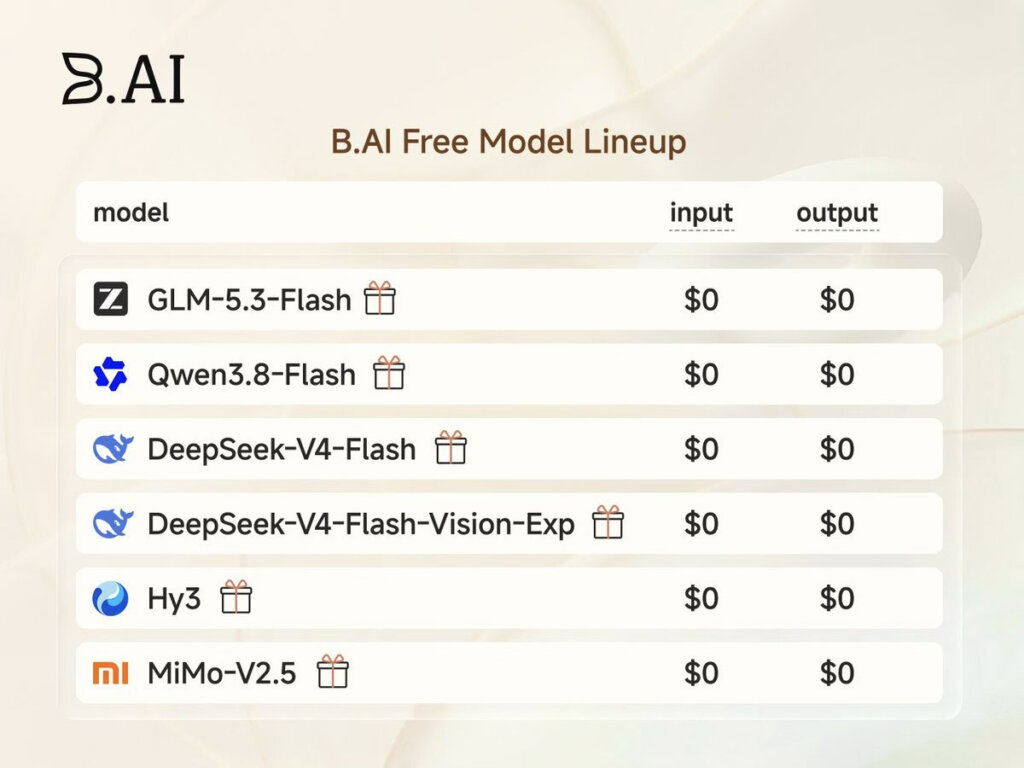
Notably, on September 3, B.AI rolled out a new pricing structure for DeepSeek-V4-Flash and DeepSeek-V4-Flash-Vision-Exp, introducing tiered discounts. Developers now receive a 50% discount during peak hours, with off-peak rates dropping to just 25% of standard peak pricing. At the same time, the platform has kept zero-cost access in place for GLM-5.3-Flash (Ox Alpha), Qwen3.8-Flash, Tencent Hy3, and Xiaomi MiMo-V2.5. Despite the shift toward commercialization, developer momentum hasn't wavered, with platform-wide token throughput continuing its steady climb.
This sustained momentum proves the campaign was far more than a short-term compute giveaway—it is a bellwether for the broader evolution of AI infrastructure. Cracking 1.33 trillion daily tokens makes one thing clear: AI applications are moving past basic chatbots. Powered by a high-performance technical stack and flexible service mechanics, B.AI is laying the groundwork for the next frontier—autonomous AI agents operating at scale.
Powering the “AI Grid”: B.AI Anchors the Global Settlement Layer for the Agent Economy
For B.AI, democratizing compute is only the prelude. Looking further ahead, the platform is committed to building full-stack infrastructure for the agentic era, cementing its position as the global settlement layer for intelligence.
In the agent era, a typical agent task calls for constant switching between models. No single provider can power a complete workflow on its own, so developers are left juggling fragmented API protocols, disjointed billing systems, and conflicting rate limits.
B.AI's settlement layer bridges this exact gap. Positioned strategically “above all models, below all agents,” B.AI abstracts models across different providers, capabilities, and cost structures into a unified pool of schedulable resources.
Powered by a dual-tier API structure offering official-route reliability alongside lowest-cost custom channels, developers can choose between guaranteed direct connections and deeply discounted options across a broad lineup of models. Combined with smart routing on the Chat interface, B.AI operates as a full-stack “AI grid,” ensuring every agent request lands on the optimal model to deliver reliable performance at maximum cost-efficiency.
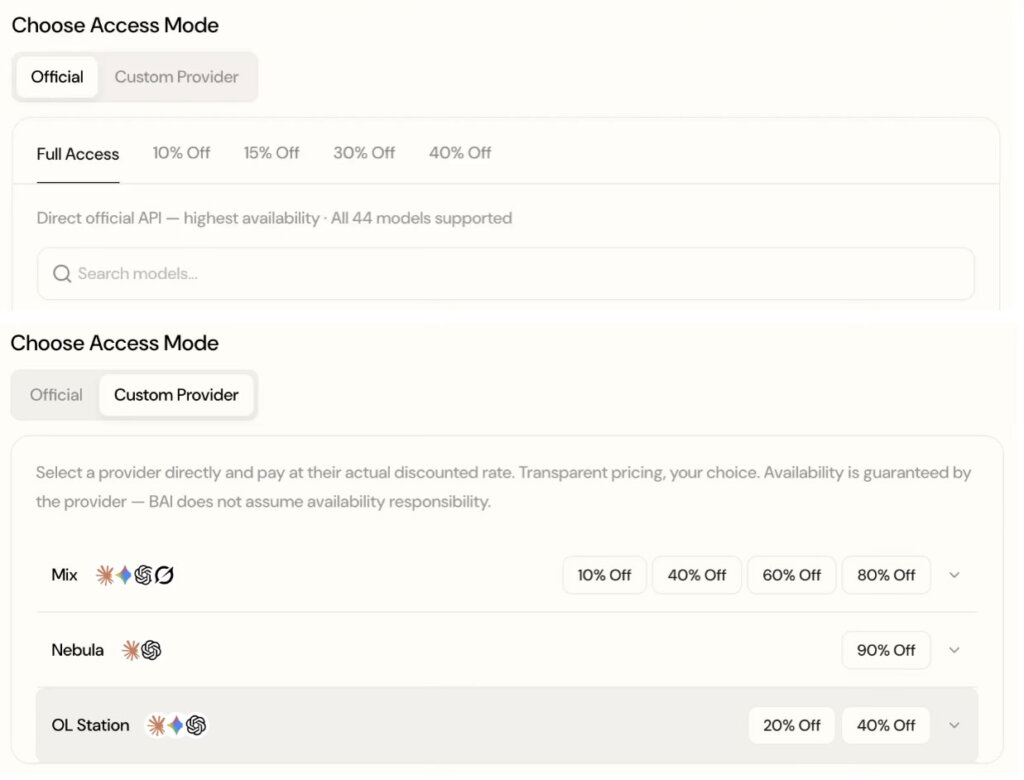
On the settlement front, this power grid seamlessly bridges both Web2 and Web3 models. For Web2, developers can rely on familiar traditional payment methods to top up with minimal friction. For Web3, B.AI leverages on-chain payment rails to offer global developers decentralized, verifiable, and low-friction payment options.
With dual payment systems running in parallel, B.AI enables developers and agent applications across any infrastructure setup to find their optimal settlement path on the grid, providing single-point integration with borderless global reach.
Driving Core Productivity: B.AI Reshapes Agent Collaboration
Beyond building a foundation for compute routing and global settlement, B.AI is moving past base infrastructure to power real-world productivity. By enabling seamless agent collaboration across complex workflows, it delivers the missing execution layer for the agent economy.
At the heart of this execution layer is native Codex integration. Full compatibility with the Responses API means developers can now use a single B.AI key inside Codex to run flagship GPT models and DeepSeek favorites side by side.

Engineers can now bring these powerhouse models straight into their daily dev stack. From code generation and reasoning to debugging and refactoring, B.AI unifies the entire workflow under one roof—delivering a direct line from model selection to shipped code.
Beyond coding, to keep agents running reliably in real-world production at scale, B.AI has built a full-stack infrastructure powered by five core components, equipping agents with a fine-tuned operational engine:
- x402 Payment Protocol: Introduces an innovative “pay-before-response” model that executes high-frequency, on-chain micro-settlements in the background during cross-agent API calls and compute orchestration.
- 8004 Identity Protocol: Issues verifiable on-chain credentials for every agent, logging execution history and credit scores to establish a reliable layer of trust for cross-node collaboration.
- Skills Matrix: Plug-and-play, standardized building blocks that interface directly with MCP servers to equip agents with instant, modular tool-calling capabilities.
- BAIclaw and BAIcode: Built-in platform assistants engineered for end-to-end execution. BAIclaw manages all-in-one terminal operations and multi-agent workflows, while BAIcode serves as an advanced developer engine that streamlines the full pipeline from task analysis and architecture design to coding and testing.
From the token surge sparked by zero-cost model access to its positioning as the global settlement layer for intelligence; from seamless Codex integration to full-stack infrastructure powered by x402, 8004, Skills, and native assistants—B.AI delivers far more than a battle-tested technical stack; it unveils a clear blueprint for what lies ahead. B.AI is building not just accessible compute today, but the definitive launchpad for a thriving agent economy. The future is here—and this is only the beginning.
B.AI Team
Singapore
support@b.ai
Disclaimer: This was a sponsored post brought to you by B.AI.
The post Cracking 1.33 Trillion Daily Tokens: B.AI Powers the “AI Grid” with Full-Stack Infrastructure to Fuel the Agentic Era appeared first on CryptoSlate.
HTTP error 429 on https://cryptoticker.io/en/feed/
Failed to fetch feed: https://cryptoticker.io/en/feed/
Failed to fetch feed.
Decrypt
The privacy coin's squeeze rode a Fed-driven crypto rally that reversed hours later, when a stronger-than-expected jobs report sent Bitcoin back under $80,000.
The activity began in May and remained undisclosed until Friday, a day after OpenAI launched Astra and U.S. lawmakers proposed restrictions on advanced AI.
The Dow dropped 226 points and Bitcoin erased some of its gains after August payrolls tripled estimates, pushing September rate-hike odds to 58%.
Two April payments supplied three-quarters of the party's donations for the quarter, where the next largest single gift was £180,000.
Bitcoin soared past $81k, HYPE and ZEC hit smashing new ATHs and the onchain rally leveled up. Is this the first stage of the next leg up?
U.Today - IT, AI and Fintech Daily News for You Today
Robinhood's Vlad Tenev backs the $104 million "stock token" market, defying AMC's legal threats over on-chain trading.
Ripple has landed a multi-year partnership with the University of Florida’s athletic department.
Binance has listed twelve cryptocurrencies that it will remove from its crypto trading platform, specifically on Binance Alpha, later today.
Nasdaq micro-cap AIXC dumps its crypto treasury for a robotics pivot, locking in a bruising 50% loss.
Critical security alert issued as XRP Ledger based wallet users get Hit by unauthorized transactions.
Blockonomi
TLDR
- SoundHound closes LivePerson deal and targets over $500M in future revenue.
- LivePerson acquisition expands SoundHound’s enterprise reach and AI platform.
- SoundHound retires LivePerson debt and starts integration with a clean balance sheet.
- John Collins becomes CFO as SoundHound begins post-deal financial integration.
- Combined platform brings voice, chat, SMS and social engagement under one system.
SoundHound AI (SOUN) shares closed its LivePerson acquisition, expanding its enterprise reach and customer engagement platform. The combined company now targets over $500 million in future revenue from existing customers. SOUN shares fell 1.11% to $6.66 after trading near $6.78 earlier in the session.
SoundHound AI, Inc., SOUN
SoundHound Expands Enterprise Reach After LivePerson Deal
The transaction adds LivePerson’s digital messaging tools to SoundHound’s voice and automation capabilities. Together, the businesses now serve customers across voice, web, mobile, SMS, and social channels. The combined customer base also includes 25 of the Fortune 100 companies.
SoundHound plans to integrate LivePerson’s platform into OASYS, its system for automated customer interactions. The integration will give enterprise clients one platform for customer service across several channels. It also expands SoundHound’s intellectual property portfolio to more than 750 patents.
The deal broadens SoundHound’s presence across enterprise sectors and creates new cross-selling opportunities. Management expects the existing customer base to support over $500 million in future revenue. Meanwhile, the company plans to use its larger scale to capture rising demand for automated customer service.
Combined Company Starts With Debt-Free Balance Sheet
SoundHound retired LivePerson’s outstanding debt during the transaction, leaving the combined business debt-free. That structure gives management more flexibility for product development, integration spending, and commercial expansion. It also reduces financing pressure as SoundHound works toward stronger margins and sustainable profitability.
The company has started integrating operations after receiving regulatory and shareholder approvals. Product teams are combining voice automation, digital chat, and social messaging into one customer engagement offering. SoundHound expects expanded capabilities to reach global customers during the coming quarters.
The merged platform aims to improve resolution speeds, containment rates, and service consistency across channels. LivePerson customers will gain access to SoundHound’s broader automation tools and voice capabilities. Meanwhile, SoundHound can extend its technology across LivePerson’s established enterprise relationships.
John Collins Takes CFO Role After Transaction Close
SoundHound appointed John Collins as chief financial officer following completion of the acquisition. Collins previously held senior roles at LivePerson, including chief financial officer and chief operating officer. He also served as interim chief executive officer and worked across finance, data science, and enterprise software.
Collins will lead financial integration while focusing on margins, cost controls, capital allocation, and profitability. His previous work included restructuring debt, reducing costs, and improving free cash flow at LivePerson. That background gives SoundHound direct financial leadership from the acquired company during integration.
The acquisition marks a major expansion step for SoundHound’s customer service business. LivePerson common shares will stop trading on Nasdaq following the completed transaction. SoundHound will now focus on product integration, enterprise sales, and converting its larger customer base into future revenue.
The post SoundHound AI Inc (SOUN) Stock: LivePerson Acquisition Targets Over $500M in Future Revenue appeared first on Blockonomi.
Key Takeaways
- Major indexes declined Friday following August employment data that significantly exceeded analyst predictions
- Payrolls expanded by 162,000 positions in August, nearly tripling the anticipated 55,000
- Market participants increased September Fed rate hike probability to approximately 60%
- Lululemon shares plummeted 16% following downward revisions to revenue and earnings forecasts
- Bond yields climbed as markets adjusted expectations for tighter monetary conditions
U.S. equity markets experienced broad declines Friday following robust August employment figures that prompted investors to reassess Federal Reserve policy expectations.
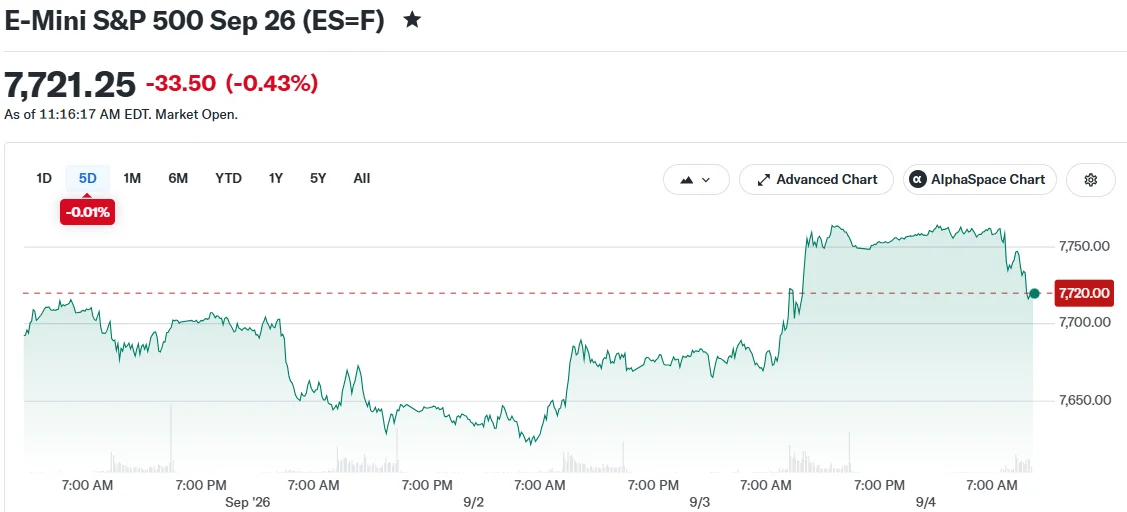
The Dow Jones Industrial Average retreated approximately 0.7%, shedding roughly 380 points. The S&P 500 declined 0.5%, while the Nasdaq Composite gave up around 0.4%.
The monthly employment situation report revealed 162,000 positions were created in August. Wall Street analysts had projected only 55,000 additions. This substantial upside surprise reinforced the resilience of the employment landscape.
The robust employment figures prompted an important debate among market participants: would Federal Reserve officials interpret this strength as justification for additional monetary tightening?
Data from CME Group indicated that market participants elevated the probability of a September rate increase to around 60% in the wake of the employment release. This represented a notable adjustment from sentiment earlier in the trading week.
Central Bank Outlook and Upcoming Catalysts
Federal Reserve Chair Kevin Warsh has indicated he avoids overreacting to individual economic releases. He has additionally noted that wage trends may have a weaker correlation with inflation than conventional wisdom suggests, potentially reducing the impact of employment data on policy decisions.
Several market observers contend that Friday’s employment report may not provide sufficient justification for policy action on its own. The next critical data release will be the August Consumer Price Index report, scheduled for September 11.
The Personal Consumption Expenditures price index, which serves as the Federal Reserve’s primary inflation gauge, isn’t scheduled until September 30. This timing places it after the upcoming policy meeting, suggesting officials might decide without access to this preferred metric.
Government bond yields advanced Friday as market participants recalibrated their interest rate outlook.
Even with Friday’s retreat, all three benchmark indexes remained within proximity of their all-time peaks. The modest nature of the selloff could suggest investor belief that the economy possesses sufficient strength to absorb higher borrowing costs.
Employment statistics are frequently adjusted in subsequent months. Some market participants may be adopting a wait-and-see approach before the August figure is confirmed.
Lululemon Weighs on Market Mood
Beyond macroeconomic developments, Lululemon emerged as Friday’s most significant individual equity story. The athletic apparel retailer’s stock collapsed approximately 16% after management reduced full-year revenue and earnings projections and disclosed a second quarter sales decline.
No other significant corporate earnings announcements were scheduled for Friday’s session.
The S&P 500 finished trading near 7,708, the Dow closed around 53,301, and the Nasdaq settled near 26,463.
The post Wall Street Tumbles as Robust Employment Data Sparks Rate Hike Speculation appeared first on Blockonomi.
Key Highlights
- SNDK shares climbed as high as 8.9% during Friday’s session, reaching approximately $1,687
- Nvidia announced a $12.9 billion deal to purchase AI development platform Hugging Face
- AI-driven data center expansion continues driving robust NAND flash demand, with global sector revenue climbing roughly 70% sequentially in Q2
- Dell Technologies’ Chief Operating Officer identified memory as the primary bottleneck: “DRAM, DRAM, DRAM, followed by NAND, NAND, NAND”
- Wall Street firm Bernstein continues projecting a $3,000 target for SNDK shares
Shares of SanDisk experienced a significant rally Friday, climbing as much as 8.9% and touching an intraday peak of $1,693.71 before stabilizing near $1,687 during mid-morning hours. The advance left SNDK up approximately 8.5% for the session, though trading volume remained notably below its typical 13.9 million share average.
Sandisk Corporation, SNDK
What sparked the rally? Nvidia revealed Thursday evening its plans to purchase Hugging Face in a transaction valued at $12.9 billion. The widely-used open-source AI development platform boasts more than 18 million registered users, hosts 3 million AI models, and serves over 200,000 enterprises building and launching artificial intelligence solutions.
Nvidia CEO Jensen Huang emphasized that over half the company’s revenue stems from customers “largely driven by open models,” noting that Nvidia ranks as Hugging Face’s top contributor of open-source models. Industry observers interpret the acquisition as Nvidia’s strategic play to strengthen its position within the AI developer community.
What’s the connection to SanDisk? The insatiable appetite for Nvidia’s graphics processing units has created corresponding demand for SanDisk’s NAND flash memory products, essential building blocks for modern AI-focused data centers. Essentially, whatever benefits Nvidia’s artificial intelligence strategy typically translates into stronger demand for SanDisk’s components.
This relationship received validation earlier this week when Dell Technologies’ Chief Operating Officer Jeffrey Clarke identified memory as the critical constraint facing AI server production. “The constraints remain the same,” Clarke explained. “DRAM, DRAM, DRAM, followed by NAND, NAND, NAND.”
Strong Sector Fundamentals Support Rally
Looking past the Nvidia announcement, underlying NAND market conditions remain robust. Worldwide NAND flash revenue jumped approximately 70% on a sequential basis during Q2, powered by continued AI infrastructure expansion requiring substantial flash storage capacity. Industry supply remains constrained while pricing holds steady.
Investment firm Bernstein continues recommending SNDK with a $3,000 price objective, citing what analysts describe as a sustained, multi-year NAND supply shortage scenario.
Industry peer Micron Technology similarly gained ground Friday, advancing roughly 4%, indicating the momentum extends across the entire memory chip sector rather than being isolated to SanDisk alone.
Favorable Macro Conditions Provide Additional Support
U.S. Treasury yields declined ahead of Friday’s crucial economic releases, giving market participants another incentive to return to high-growth semiconductor stocks that had suffered recently amid climbing interest rates.
The wider market provided minimal assistance. The S&P 500 declined 0.5% while the Nasdaq Composite fell 0.48%, underscoring that SanDisk’s strength stemmed clearly from sector-specific factors.
Despite Friday’s gains, SNDK remains more than 30% beneath its 52-week peak of $2,354.39. Trading at 23 times trailing earnings and merely 8 times forward earnings estimates, the shares appear reasonably valued compared to other AI-focused memory chip manufacturers.
Regarding insider activity, SanDisk Chief Legal Officer Bernard Shek divested 600 share units at $1,525.60 on September 1 through a previously established Rule 10b5-1 trading arrangement, representing standard administrative activity without meaningful market implications.
Bernstein’s $3,000 price objective for SNDK stands unchanged, with shares currently trading around $1,687.
The post SanDisk (SNDK) Shares Surge 8% Following Nvidia’s Massive Hugging Face Deal appeared first on Blockonomi.
Key Highlights
- Planet Labs delivered Q2 revenue of $116.1 million, surpassing Wall Street’s $104.5 million forecast by a significant margin, representing 58% growth year-over-year.
- The company’s adjusted EBITDA reached $13.9 million, substantially exceeding the consensus expectation of $2.3 million.
- Revenue from defense and intelligence clients now represents 70% of the company’s total revenue, climbing from 57% in the prior year, with the segment nearly doubling to $81 million.
- The company’s Q3 revenue forecast of $101 million to $105 million fell short of analyst expectations of $114 million.
- Shares of PL climbed approximately 11% during premarket hours Friday, reaching $20.44, recovering from Thursday’s more than 8% decline before earnings.
Planet Labs announced second-quarter revenue totaling $116.1 million, representing 58% year-over-year growth and easily surpassing Wall Street’s $104.5 million projection. The company’s adjusted EBITDA of $13.9 million significantly outperformed expectations of $2.3 million.
PLANET LABS $PL Q2’27 EARNINGS HIGHLIGHTS
Revenue: $116.1M (Est. $104M)
; +58% YoY
FY27 Guide:
— Wall St Engine (@wallstengine) September 3, 2026

On a non-GAAP basis, earnings per share reached 2 cents, compared to the consensus forecast calling for a 2-cent loss. This represents a comprehensive earnings beat across all major metrics.
The defense and intelligence division experienced explosive growth exceeding 90% year-over-year, expanding to represent 70% of total company revenue compared to 57% during the same period last year. The segment generated approximately $81 million, nearly doubling from the previous year.
Planet Labs PBC, PL
The commercial segment posted growth exceeding 15%, while civil government revenue expanded by more than 5%. From a geographic perspective, the Europe, Middle East and Africa region delivered the strongest performance with revenue surging over 130%.
The satellite imagery company also secured an $8 million agreement with the National Geospatial-Intelligence Agency for its Global Monitoring Service. Additional wins include a seven-figure European defense contract and a German government satellite-services tender valued at up to 25 million euros spanning five years.
The company’s backlog expanded 11% year-over-year to $815 million. Remaining performance obligations increased 9% to approximately $753 million. Management anticipates recognizing over $400 million in revenue during the next four quarters based solely on existing backlog.
Third-Quarter Forecast Falls Short
Management provided Q3 revenue guidance ranging from $101 million to $105 million, missing the $114 million analyst consensus. The company also anticipates a Q3 EBITDA loss of approximately $3.5 million, contrasting with Wall Street’s projection of positive $2.5 million EBITDA.
Citi analyst John Godyn indicated that a portion of the Q2 outperformance resulted from revenue pulled forward from the third quarter, accounting for some of the guidance miss. He maintained that the investment case remains “intact.”
Needham analyst Ryan Koontz pointed out that Q2 revenue benefited from accelerated recognition related to Sweden’s inaugural sovereign satellite. When combining actual Q2 and projected Q3 revenue, year-over-year growth still stands at 42%.
Annual Outlook Updated
Planet Labs increased the lower bound of its fiscal 2027 revenue guidance to $430 million from $425 million, while maintaining the upper end at $441 million. Current analyst consensus stands at $435.67 million.
Management is aiming to achieve the Rule of 40 benchmark in fiscal 2027, measured by combining revenue growth percentage and adjusted EBITDA margin.
Adjusted gross margin decreased modestly to 59% from 61% in the prior year, attributed to investments in satellite services agreements and AI-powered partner solutions.
Through the first half of the fiscal year, the company produced approximately $68 million in operating cash flow. Free cash flow amounted to $21 million, while adjusted free cash flow totaled $29 million.
Planet Labs closed the quarter with approximately $865 million in cash and short-term investments, and generated around $120 million through its at-the-market equity offering at an average net price of $31.95 per share.
Management has identified satellite-services opportunities exceeding $4 billion in its pipeline.
PL stock traded down approximately 1.25% at $18.12 at the time of publication Friday, following its more than 11% premarket surge. The stock has appreciated over 180% during the past 12 months.
The post Planet Labs (PL) Stock Surges 11% on Strong Q2 Beat Fueled by Defense Sector Growth appeared first on Blockonomi.
Key Takeaways
- Shares of Oracle climbed 2% to reach $157.13, extending momentum from Thursday’s 5.7% surge linked to Federal Reserve commentary
- Morgan Stanley elevated its price objective to $210 from $207, pointing to enhanced margins in GPU-as-a-Service operations
- Bernstein maintained its Outperform stance, indicating Oracle could be approaching the conclusion of its capital-raising phase
- Jefferies preserved its Buy recommendation while adjusting its target downward to $290 from $320, emphasizing OCI revenue expansion and margin performance as critical indicators
- The company is scheduled to announce Q1 fiscal 2027 earnings on September 10, 2026, following the closing bell
Shares of Oracle experienced a 2% uptick during morning hours, reaching $157.13, as Wall Street firms issued updated research notes and market participants prepared for the company’s upcoming quarterly report.
Oracle Corporation, ORCL
The gain extends Thursday’s robust 5.7% advance, which was sparked by Federal Reserve Governor Christopher Waller’s comments favoring stable interest rates pending additional inflation information. This development carries particular weight for Oracle, given the company’s substantial debt load accumulated to finance its artificial intelligence data center expansion.
Morgan Stanley increased its price objective to $210 from $207 while maintaining an Equalweight stance. The adjustment reflects an enhanced margin forecast for Oracle’s GPU-as-a-Service operations. The firm applied approximately 19 times its calendar 2028 non-GAAP earnings per share projection of $10.98 in its valuation model.
The shares remain approximately 20% lower year-to-date, trading below historical valuation benchmarks. Oracle’s PEG ratio stands at 0.77, with InvestingPro identifying the equity as undervalued when measured against near-term earnings expansion potential. The company’s gross profit margin has maintained a level of 66% throughout the trailing twelve months.
Wall Street Weighs In Before Results
Bernstein reaffirmed its Outperform designation and indicated Oracle may be nearing the conclusion of its capital-raising requirements. This would represent a significant transition for an organization that has relied extensively on borrowing to support its AI infrastructure objectives. Bernstein also observed that Oracle has the potential to emerge as the third-largest hyperscaler.
Jefferies maintained its Buy recommendation while reducing its price objective to $290 from $320. The firm identified 115% OCI revenue growth and a 41% operating margin as the critical metrics to monitor.
Mizuho similarly reaffirmed an Outperform rating with a $320 target, highlighting an enhanced agreement with the Department of Veterans Affairs. The contract’s maximum value increased by approximately $17 billion and may continue through May 2031.
September 10 Earnings Preview
Options market activity suggests a possible 10% price swing in either direction when Oracle unveils its Q1 fiscal 2027 performance on September 10, following the market close.
Broader equity markets are providing minimal support today. The S&P 500 has declined 0.1% while the Nasdaq trades marginally higher. Oracle’s movement appears driven by company-specific developments.
Execution challenges and constrained free cash flow throughout the forecast horizon represent the primary concerns Morgan Stanley highlighted in justifying its Equalweight rating despite the increased price target.
Jefferies is monitoring OCI expansion and margin trends as the most transparent indicators of whether Oracle’s AI data center capital deployment is producing tangible outcomes.
The Veterans Affairs contract enhancement, which Mizuho emphasized this week, incorporates optional extensions that could prolong the arrangement through May 2031, providing Oracle with a durable government revenue stream.
The post Oracle (ORCL) Stock Climbs 2% as Wall Street Analysts Update Targets Before Quarterly Report appeared first on Blockonomi.
CryptoPotato
The OG meme coin has jumped by 5% over the past 24 hours following the renewed green wave sweeping through the broader cryptocurrency market.
According to Ali Martinez, several key factors suggest a much more substantial rally may unfold in the near future.
Ready to Breakout?
As of press time, DOGE is worth approximately $0.087 (per CoinGecko), representing a 24% increase over the past month. Martinez revealed that the asset’s Tom DeMark Sequential has flashed a buy signal on the daily timeframe, suggesting that the meme coin could be preparing to resume its uptrend.
His second optimistic element is the formation of a so-called “morning doji star” on the 24-hour chart. The analyst claimed that this reversal pattern usually occurs near the end of a downtrend, signaling that selling momentum may be fading as buyers step in.
Next on Martinez’s list is whale activity. He disclosed that large holders have scooped up more than 400 million DOGE over the last five days, “adding meaningful buying pressure at current levels.”
The analyst opined that the accumulation has reinforced a major on-chain support near $0.0813, where almost 35 million units were previously traded.
“As long as this level holds, the bullish setup remains intact, with $0.1552 and $0.1774 as the next upside targets,” he concluded.
Interestingly, earlier this week, Martinez suggested that the $15 Dogecoin target he has been tracking for a long time was invalidated after the price briefly plunged below the lower boundary of the channel that had defined the thesis for such a potential explosion.
Additional Forecasts
Other X users who recently made DOGE predictions include Crypto With Gopal and Celal Kucuker. The former claimed the meme coin has formed a massive falling wedge, with the price compressing near the $0.08 support zone and sellers gradually losing momentum.
He claimed that a breakout above the upper trendline (which sits at over $0.10) could trigger a major reversal toward the $0.40 target. “Bulls are waiting for confirmation – long-term sentiment is turning bullish,” the analyst added.
For their part, Celal Kucuker envisioned a 10x expansion in DOGE’s market cap, which could push the price to a new historic record beyond the $1 milestone.
The asset’s recent exchange netflow supports the bullish perspective. Over the past several days, outflows have outpaced inflows, indicating that investors have shifted from centralized platforms to self-custody, which in turn has reduced immediate selling pressure.

The post 3 Reasons Why Dogecoin (DOGE) Is Ready for a Breakout appeared first on CryptoPotato.
It was another eventful week in the cryptocurrency markets as August closed, with BTC ending in the green for the first time during a bear market, further signaling a major shift in sentiment. However, Friday’s jobs report flipped the script again.
Before we dive into all of that, let’s rewind the clock by a week and see what the landscape was last Friday. Despite briefly surging past $81,000 on a couple of occasions, BTC was quickly halted and driven south to just under $80,000. Most altcoins, though, produced major weekly gains.
The rejection at the time came after the hawkish stance taken by Fed Chair Kevin Warsh, and the leg down drove BTC to just under $77,000 on Saturday morning. However, the asset rebounded swiftly and tapped $79,000 on Sunday. Another leg down to $77,000 took place on Monday morning as the US and Iran initiated new attacks against each other.
The primary cryptocurrency remained volatile in the following few days, but was contained in a relatively tight range between $76,400 and $79,000. It last tested the upper boundary on Wednesday morning, and the bulls managed to defend it. The subsequent leg up came on Thursday and was significantly more successful.
Bitcoin broke out of its $79,000 barrier and surged past $80,000. It kept going during the early hours on Friday and jumped to $82,400 for the first time since mid-May. Although it was stopped there, it remained above $81,000 until earlier today, when the much stronger-than-expected US jobs report came out.
BTC slumped immediately by two grand as the general assumption is that the Fed will be more inclined to raise the hikes at the end of the month. The weekly performance shows a few clear winners – ZEC has gained 20%, and it even surpassed $1,000 earlier today, XMR is up by 10%, while UNI has rocketed by almost 40%.
Market Data

Market Cap: $2.775T | 24H Vol: $121B | BTC Dominance: 57.6%
BTC: $79,270 (-0.35%) | ETH: $2,450 (-2.5%) | XRP: $1.39 (-1.5%)
This Week’s Crypto Headlines You Can’t Miss
Strategy Is Buying Bitcoin Again After 2-Month Pause: Here’s How Much. Monday began with a bang as the world’s largest corporate holder of BTC resumed its purchases for the first time in over two months, accumulating 4,603 BTC for $370 million. The problem for the company is that it sold at low prices only to buy back at much higher levels.
Gold Just Erased All Its August Gains – Bitcoin Is Holding Up Better at $77K. The precious metal exploded alongside BTC in the middle of August, hitting $4,700 for the first time in months. However, it lost all gains, even dipping below its starting price of $4,360 earlier this week. In contrast, BTC is up by roughly 25% even after today’s correction.
Arthur Hayes Says Ignore Warsh and Watch EUR/JPY for Bitcoin’s Next Move. BitMEX’s former CEO believes the Fed and Kevin Warsh are not the most important factors to determine BTC’s next move. Instead, he urged investors to pay more attention to the euro-yen exchange rate.
Trezor Breach Is Much Bigger Than Initially Thought: Another 67,000 Customers Exposed. The hardware wallet manufacturer admitted today that the ShipMonk breach was significantly more worrisome than initially believed. Its latest update showed that the actual number of affected US customers from the data leaks is over 80,000, not 13,689.
Bitcoin Makes History With First-Ever Green August During a Bear Market. As mentioned above, bitcoin ended August in a highly unexpected manner. History suggested that the asset wouldn’t enjoy the eighth month of the year, but reality was much different. BTC closed with a near-25% surge for the first time in bear market years.
Bitcoin Is Back Above $80,000, But Fidelity Says the Bear Market May Not Be Over Yet. The flagship digital asset surged past $80,000, as explained earlier, but analysts at Fidelity weren’t convinced BTC is out of the woods. They outlined some historical references and determined that the bear market might not be over yet.
Charts
This week, we have a chart analysis of Ethereum, Ripple, Cardano, Binance Coin, and Hyperliquid – click here for the complete price analysis.
The post BTC Stopped at $82K as Strong US Jobs Report Shakes Markets, Strategy Resumes Buying: Weekly Recap appeared first on CryptoPotato.
Ethereum has staged a sharp recovery from the June lows and is now consolidating below $2.5K after reclaiming several important technical levels. The daily structure has improved materially, but ETH is still struggling at a key resistance area, while the latest taker-flow data suggests that aggressive buying has not yet fully confirmed the move.
Ethereum Price Analysis: The Daily Chart
The daily chart shows a clear structural recovery from the $1.5K area. ETH subsequently reclaimed the $1.9K zone and pushed above the $2K mark, with the latest impulsive move taking price toward $2.5K.
The most important development is the price moving above the previous swing-high area around $2.45K and finally creating a higher high after months of decline. However, the asset is still sitting directly below the $2.5K resistance zone and has not yet cleared it after it was rejected again today. Therefore, further upside may require a decisive daily breakout rather than another rejection from the same area.
The 100-day and 200-day moving averages have also become more constructive. Both are now sloping upward after being reclaimed, with the 200-day moving average around the $2K region being the most important support element buyers should defend.
If ETH establishes a daily close above the $2.5K resistance zone, the next major upside area visible on the chart is the next swing high at $3.4K. Conversely, a rejection could send ETH back toward the $2K-$2.1K region, which appears to be the key structural support that must be held at all costs.
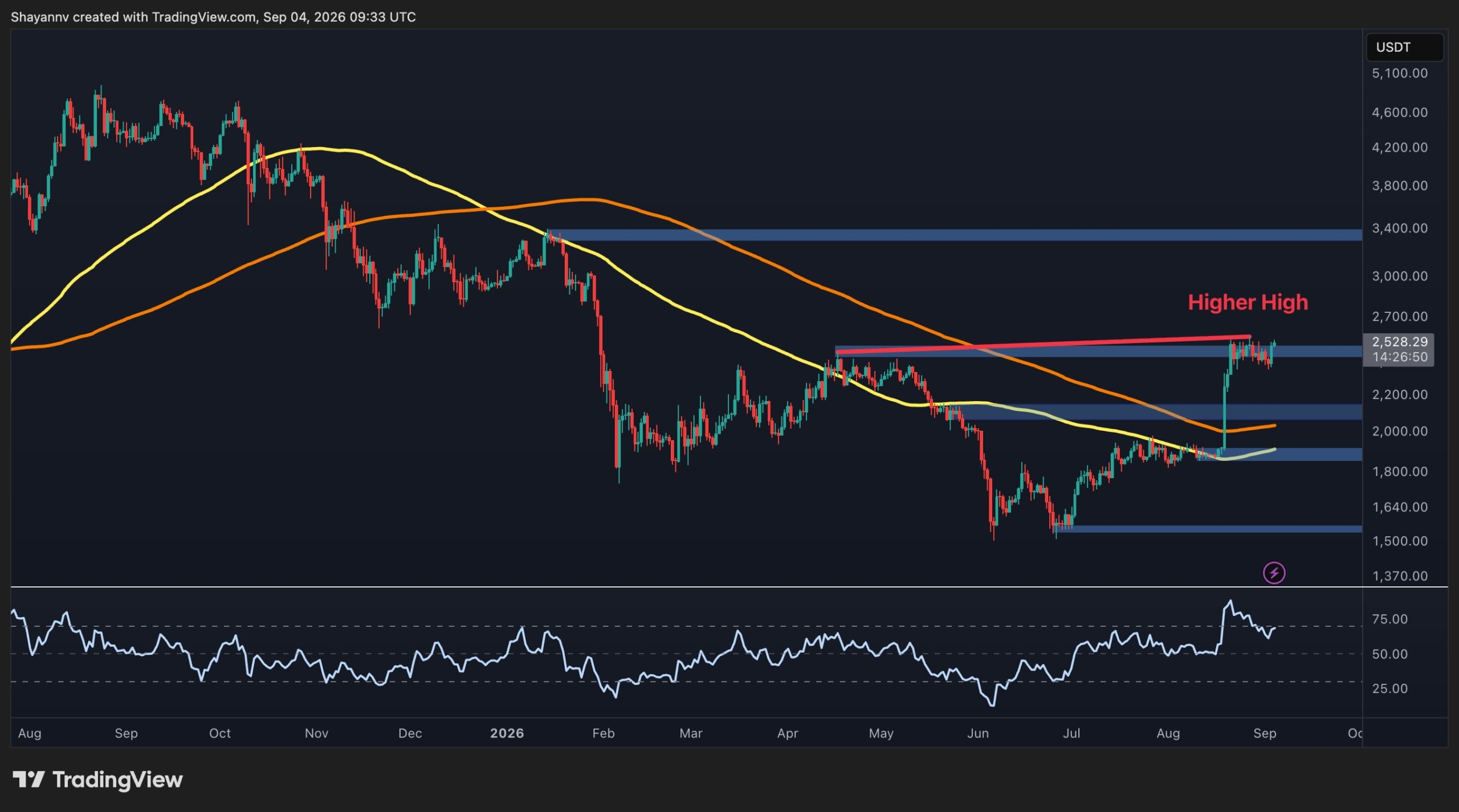
ETH/USDT 4-Hour Chart
The 4-hour chart shows that most of the recent advance occurred through a very aggressive vertical move from roughly $1.9K toward $2.5K. Since then, ETH has been consolidating inside a tight range, roughly between $2.35K and $2.55K.
This consolidation is important because it follows a strong impulsive breakout. Rather than immediately giving back the entire move, ETH has spent several weeks holding above the previous breakout area. The latest candles are also moving toward the upper boundary of the range.
The $2.4K-$2.5K area is therefore the key near-term pivot. Holding around this region would preserve the bullish structure and could allow another attempt to break out higher. This would strengthen the continuation case and potentially expose the $2.8K area before the larger $3.4K resistance zone.
On the downside, a loss of the consolidation range’s low around $2.4K would weaken the immediate setup and could trigger a deeper retracement toward the $2.25K order block. Meanwhile, the 4-hour RSI remains constructive, although it has cooled from its recent spike. This suggests that momentum is still positive without being as stretched as it was immediately after the breakout.

Sentiment Analysis
The Ethereum Taker Buy/Sell Ratio chart provides a more cautious signal. The 30-day moving average of the metric has recently dropped below the neutral 1.0 level again and appears to be hovering around 0.995, meaning aggressive sell orders have slightly outweighed aggressive buy orders across exchanges.
This is notable because ETH has simultaneously remained close to $2.5K. In other words, the latest price strength has not been accompanied by a strong increase in taker buying pressure.
The divergence does not necessarily invalidate the bullish technical structure, but it does suggest that the current consolidation may need another wave of genuine spot or aggressive futures demand before ETH can sustain a larger breakout. A move back above 1.0 in the taker buy/sell ratio alongside a decisive break above $2.5K would provide stronger confirmation for continuation and potentially lead to a genuine market recovery after months of downtrend.

The post Ethereum Price Analysis: ETH Rejected at $2.5K Again – What Happens Next? appeared first on CryptoPotato.
[PRESS RELEASE – Chicago, United States, September 4th, 2026]
Liquid Mercury today announced that ACQUA1, LLC completed the initial closing of its MERC exchange offering on September 1, 2026.
ACQUA1 is a Liquid Mercury subsidiary that operates Liquid Mercury’s Lab Company program, licensing Liquid Mercury technology to companies primarily tokenizing real-world assets and receiving fees plus a minority equity stake in return. Liquid Mercury is the majority holder and Manager.
“Over the past 18 months, dozens of companies have approached Liquid Mercury seeking to tokenize their assets,” said Tony Saliba, CEO and founder of Liquid Mercury. “Many assumed they would need to raise capital and build this infrastructure from scratch. Licensing Mercury RWA lets them launch on systems that were already live and proven, at a fraction of the time and cost. ACQUA1 token holders now own a slice of the business that earns equity, plus fees from the companies in the Lab Company program.”
Verified accredited investors subscribed by exchanging MERC for non-voting Class B units of ACQUA1 at the initial conversion rate of 10 MERC per unit. Under its operating agreement, ACQUA1 must burn 100% of the MERC it receives at each closing within five business days and may not transfer, trade, lend, stake, pledge, or otherwise deploy it.
On September 2, all 563,230,000 MERC received at the initial closing were burned via a transfer to the dead address, as the offering documents require.
Initial Closing Highlights
- Initial closing: September 1, 2026
- MERC burned: 563,230,000
- Transferred to the dead address September 2, 2026
- Units issued: 56,323,000
- Non-voting Class B units of ACQUA1, LLC under Rule 506(c) of Regulation D
- 10 MERC per unit
- Evidenced on-chain by ACQUA1-C tokens
- ACQUA1-C tokens convert one-for-one into ACQUA1 tokens upon issuance
- Remaining closings: On or about October 30 and December 31, 2026
- ACQUA1 may skip or terminate at its discretion
- The conversion rate at subsequent closings may differ
Verification Links
Burn transaction
ACQUA1-C contract
Verified accredited investors can request full terms at acqua1.liquidmercury.com/contact.
About Liquid Mercury
Liquid Mercury powers professional crypto trading and digital asset marketplaces. The company delivers institutional-grade infrastructure, access to deep liquidity, and best-in-class trading tools and workflow automation across its Pro, OTC, and RWA platforms. Through Mercury RWA, Liquid Mercury is extending that infrastructure into tokenized real-world assets, with $MERC serving as the access and platform layer token. For more information, visit www.liquidmercury.com.
Investor Notice
This press release does not constitute an offer to sell or the solicitation of an offer to buy any securities. Class B units of ACQUA1, LLC and the ACQUA1 tokens representing them are offered and sold in reliance on the exemption from registration provided by Rule 506(c) of Regulation D under the Securities Act of 1933, solely to verified accredited investors as defined in Rule 501(a) of Regulation D, and solely pursuant to ACQUA1’s confidential private placement memorandum, as supplemented, and definitive subscription documents, which contain important information, including risk factors. ACQUA1 tokens are restricted securities, are subject to transfer restrictions under ACQUA1’s operating agreement and may remain illiquid indefinitely; investors should not assume that Rule 144 will be available. Statements regarding future revenues, valuations, portfolio performance, and subsequent closings are forward-looking and subject to risks and uncertainties; actual results may differ materially. The MERC contract has no burn function; tokens are removed from circulation by transferring to the dead address. Supply outstanding excluding the dead address is 5,436,770,000 MERC, as of the date of publication.
The post Liquid Mercury Announces Initial Closing of ACQUA1 Offering appeared first on CryptoPotato.
This Friday, we examine Ethereum, Ripple, Cardano, Binance Coin, and Hyperliquid in greater detail.
Ethereum (ETH)
Ethereum was flat this week. Still, the price held well above the support at $2,400. However, the volume has been falling since the initial rally, and volatility has decreased significantly compared to the early days.
While a consolidation period is normal, this is also a period of weakness in the price action when sellers could make their return. Nevertheless, as long as the key support is not challenged, buyers continue to have the upper hand.
Looking ahead, ETH must stay above $2,400 if it wants the rally to continue. So far, buyers appear in control, but the road towards $2,800 could be bumpier compared to the past few weeks.

Ripple (XRP)
XRP was also mostly flat this week, booking a modest 2% gain. The price has been moving sideways between $1.3 and the resistance at $1.6. This range also kept the price in check between February and May this year.
To get momentum back, this cryptocurrency will need to break away from this range. That will likely see volume and volatility return as well. Based on the current price action, buyers have the advantage, but this could change if they fail to clear $1.6.
Looking ahead, the market is showing some indecision here after a strong pump. While a continuation would put an end to the bear market, it is still too early to say this is it. That’s why buyers may be hesitating here.

Cardano (ADA)
ADA closed 5% higher this week after a good push from buyers, with the price retesting resistance at $0.23. At the time of this post, the resistance remains intact but could be put under pressure by any renewed buying.
For Cardano to confirm a bottom under $0.15, the price has to move beyond its current resistance. Buyers were rejected there in August. However, another push in September could be successful.
Looking ahead, this cryptocurrency is ripe for a strong rally as soon as $0.23 turns into a key support. That can easily see ADA move towards $0.30 and $0.40 if buying volume picks up.

Binance Coin (BNB)
This week, Binance Coin held well above the support at $690, but did not manage to distance itself much beyond that. That’s the reason why the price is up only 1% in the past seven days.
While momentum has been decreasing, BNB is very close to making a higher high. Any price above $745 would confirm it and likely see this cryptocurrency continue its rally towards $900 next.
Looking ahead, the market may be taking a pause right now before momentum returns. While the price action favors a continuation of the rally, a higher high is needed to give it confidence.

Hype (HYPE)
This week, Hyperliquid managed to break above the $85 resistance and closed 4% higher. This both confirmed a higher high and new price record. The question is if this level can hold as support or sellers will turn it into a resistance again.
If the latter, then buyers will likely move to the support at $76 next to defend the recent gains. Still, HYPE has been in a rally for weeks without any significant pullback or correction. One should be expected eventually.
Looking ahead, HYPE could continue its push higher until it hits the psychological level at $100. Sellers could be making a stand there if buyers decide to go for it. But for now, best to watch the price reaction at $85 in the coming days.

The post Crypto Price Analysis Sep-04: ETH, XRP, ADA, BNB, and HYPE appeared first on CryptoPotato.