Cryptocurrency Posts
Crypto Briefing
The ceasefire acknowledgment may enhance diplomatic efforts, potentially leading to a formal peace agreement and stabilizing regional tensions.
The post US envoy thanks Putin for ceasefire in Russia-Ukraine conflict appeared first on Crypto Briefing.
Heightened tensions could lead to regional instability, impacting airspace decisions and influencing geopolitical and market dynamics significantly.
The post Iran warns of broader strikes if US persists in vessel ‘harassment’ appeared first on Crypto Briefing.
Hyperliquid's U.S. entry via Bitnomial licenses may signal increased regulatory compliance efforts among decentralized crypto platforms.
The post Hyperliquid plans US entry using Kraken’s Bitnomial licenses: CoinDesk appeared first on Crypto Briefing.
AI's integration into the workforce could significantly shift economic power, potentially boosting GDP growth and transforming labor markets.
The post ARK Invest’s Brett Winton outlines $30T AI market potential appeared first on Crypto Briefing.
Napoli's lead over Inter Milan could shift Serie A dynamics, intensifying pressure on Inter ahead of their crucial Champions League clash.
The post Napoli leads 1-0 against Inter Milan after Matteo Politano’s goal appeared first on Crypto Briefing.
Bitcoin Magazine
Bitcoin Magazine
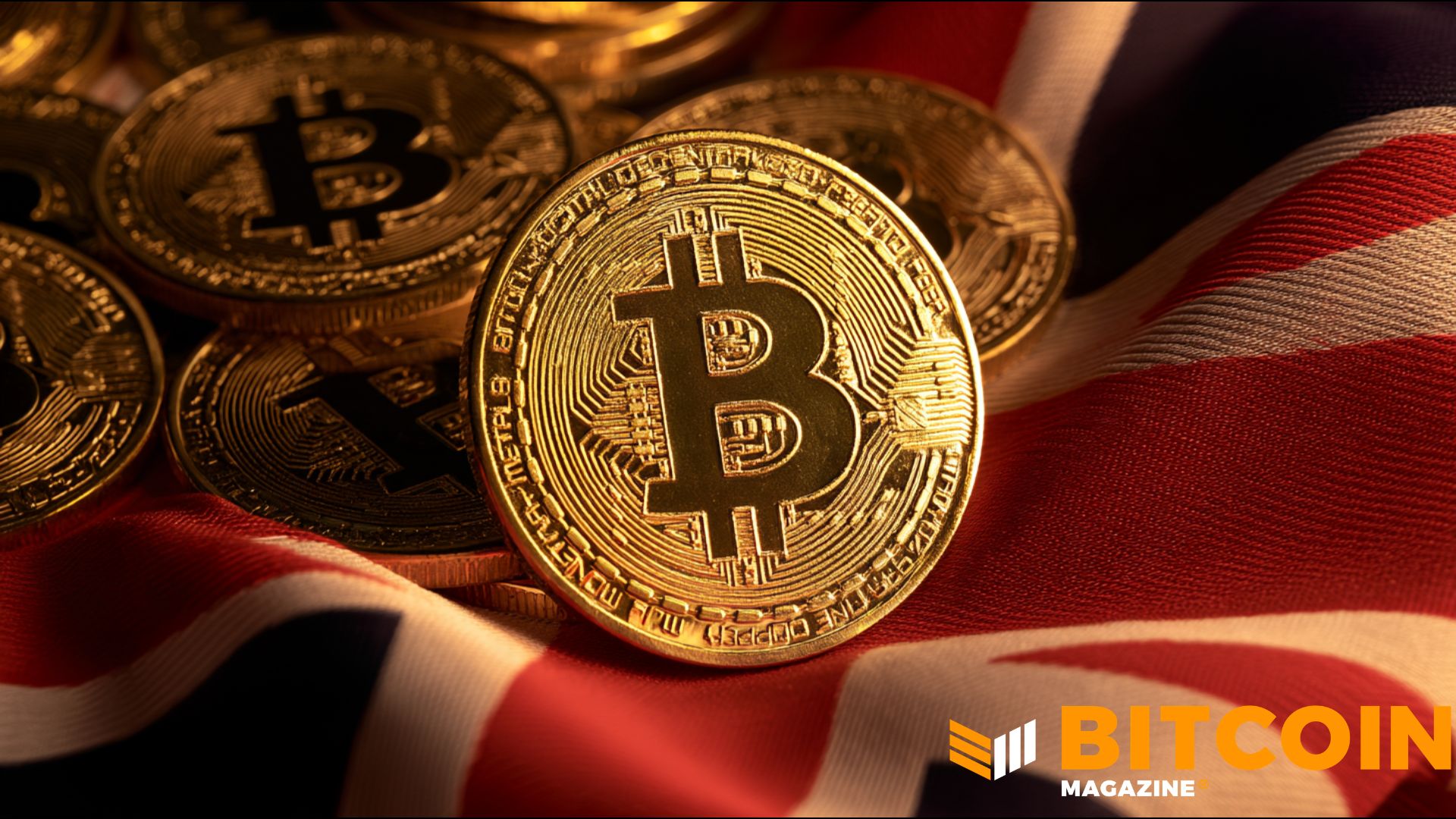
Hargreaves Lansdown Reverses Course, Rolls Out Bitcoin Trading
British financial services firm Hargreaves Lansdown is letting retail investors buy bitcoin — nearly one year after it said the cryptocurrency was “not an asset class.”
The Bristol, UK-based investment firm’s website said it was offering bitcoin and other crypto exchange-traded notes to investors. ETNs are investment funds which trade on stock exchanges and track the prices of digital assets.
It comes after the firm, which manages nearly £173 billion (over $233 billion) in assets, last year warned customers about buying bitcoin.
NEW:
— Bitcoin Magazine (@BitcoinMagazine) September 4, 2026U.K.'s largest investment platform Hargreaves Lansdown is now offering Bitcoin products to 2 million clients!
pic.twitter.com/GgdeHK8vyM
“While longer-term returns of Bitcoin have been positive, Bitcoin has experienced several periods of extreme losses and is a highly volatile investment — much riskier than stocks or bonds,” the firm said at the time.
“The HL Investment view is that Bitcoin is not an asset class, and we do not think cryptocurrency has characteristics that mean it should be included in portfolios for growth or income and shouldn’t be relied upon to help clients meet their financial goals.”
Now, a number of ETNs tracking the price of bitcoin and other cryptocurrencies are available. The firm warns users that “crypto ETNs are considered high-risk and may be volatile.”
U.S. regulator the Securities and Exchange Commission in 2024 approved bitcoin exchange-traded funds for investors after a decade of saying no to the products.
The funds had the most successful debut in the history of ETFs as investors previously unable to buy exposure to the asset class rushed in to buy the products.
Run by top asset managers and banks like BlackRock, Fidelity, and Morgan Stanley, the investment vehicles now collectively manage over $100 billion in assets.
This post Hargreaves Lansdown Reverses Course, Rolls Out Bitcoin Trading first appeared on Bitcoin Magazine and is written by Mathew Di Salvo.
Bitcoin Magazine
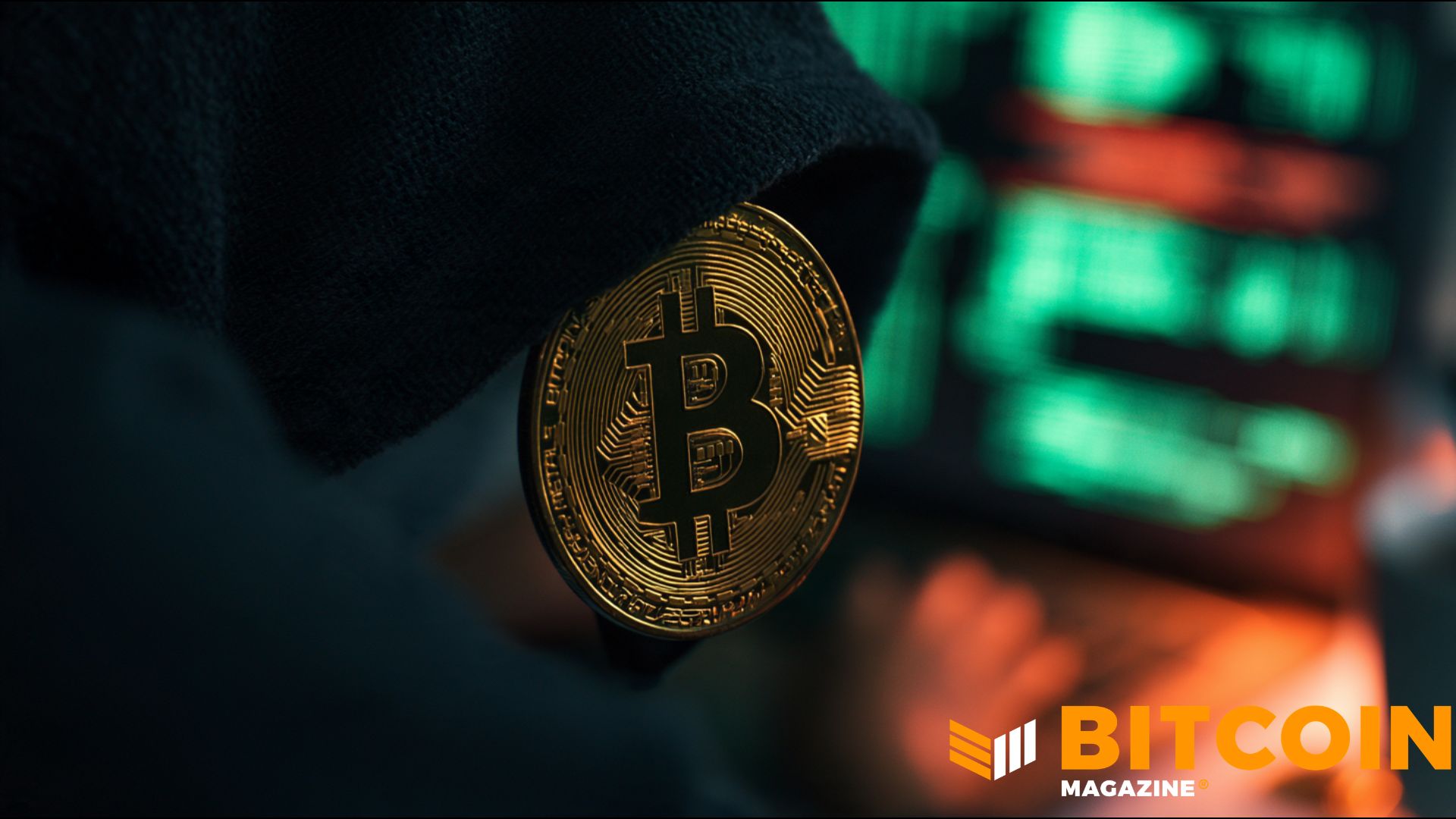
Trezor Breach Worse Than Reported: Another 67,000 US Customers Exposed
Hardware wallet manufacturer Trezor has said that a data breach first announced last month is worse than originally reported.
The Prague, Czech Republic-based company said Friday that an additional 67,000 U.S. customers had their names, emails, phone numbers, shipping addresses and order numbers leaked. The leaked data came from orders made between November 2019 and August 2021, according to Trezor.
Trezor first announced in August that data from 11,742 customers from the U.S., UK, Sweden, Colombia, Brazil, Italy, and Portugal had been exposed — with names, emails, phone numbers and shipping addresses leaked.
Another 1,947 customers just had their names, cities and emails exposed in the breach.
In Friday’s announcement, Trezor said that its third-party fulfillment partner, ShipMonk, had falsely reassured the company about deleting customer data.
“Throughout our entire relationship with ShipMonk, we repeatedly requested and received written assurance confirming the deletion of the data, in line with our contract, data policy, and past communications,” Trezor wrote.
“We are very disappointed that, despite receiving this confirmation, the data was not deleted in their systems.”
Neither Trezor nor ShipMonk immediately responded to Bitcoin Magazine’s questions.
Trezor first announced in August that the data had been leaked because ShipMonk experienced “unauthorized access to their systems containing customer data.”
The company added that it had directly emailed all customers involved in the breach. Trezor’s parent company, SatoshiLabs, told Bitcoin Magazine last month that it was investigating the incident.
Trezor is one of the most popular Bitcoin hardware wallet solutions, and also has support for storing other cryptocurrencies.
Bitcoiners’ personal data has been targeted by cybercriminals in the past: back in 2020, an unauthorized party accessed popular hardware manufacturer Ledger’s e-commerce and marketing database, leaking over 1 million email addresses and the personal contact data of nearly 10,000 customers.
At the start of this year, customers reported receiving emails from Global-e, Ledger’s payment partner, that a data breach at its cloud systems leaked sensitive customer data.
This post Trezor Breach Worse Than Reported: Another 67,000 US Customers Exposed first appeared on Bitcoin Magazine and is written by Mathew Di Salvo.
Bitcoin Magazine
El Salvador Isn’t Buying Bitcoin With Public Money, Says IMF
El Salvador has not used public funds to accumulate bitcoin since the International Monetary Fund’s last review of its loan program, the fund said Thursday.
In a report Thursday, the body said that the Central American country had instead received bitcoin from private donations, citing documentation from the government. It added that “no further Bitcoin accumulation beyond the documented donations is expected.”
El Salvador made headlines in 2021 when it became the first country in the world to make bitcoin legal tender. Salvadoran president Nayib Bukele in 2022 said the country would buy one bitcoin per day but it was never clear where the money was coming from — or if he was actually buying at all.
“Documentation has been provided verifying that Bitcoin accumulation since the first review reflects private donations and that no public resources were used,” the IMF release said.
“Understandings were also reached on steps to modernize the legal, regulatory, and supervisory framework for digital assets and to further strengthen the governance and risk-management arrangements for public-sector crypto-asset holdings. Going forward, no further bitcoin accumulation beyond the documented donations is expected.”
The report added that public participation in the government-sponsored bitcoin wallet has been largely wound down, with majority ownership and operational control handed to a private operator.
El Salvador in 2021 debuted a state-sponsored wallet called Chivo for its citizens as part of its plan to increase bitcoin adoption in the country.
“IMF staff thank the Salvadoran authorities for the constructive discussions and excellent collaboration,” the report added.
The IMF El Salvador entered a $1.4 billion loan agreement at the end of December but the fund asked for the country to scale back certain aspects of its bitcoin strategy.
Institutions like the World Bank and the IMF have long criticized President Bukele’s Bitcoin law, which also asked businesses to accept the cryptocurrency if they had the technological means to do so.
President Bukele in 2024 admitted that Salvadorans weren’t using the cryptocurrency to buy things as expected, but always boasted that the government was still stacking sats.
Since launching a crime crackdown to tackle the country’s notorious crime gangs, murder rates in El Salvador have plunged. The country was once the most dangerous place in the Americas but President Bukele is now trying to turn it into a tech hub.
Crypto companies like Tether have since relocated to its capital, San Salvador.
This post El Salvador Isn’t Buying Bitcoin With Public Money, Says IMF first appeared on Bitcoin Magazine and is written by Mathew Di Salvo.
Bitcoin Magazine
Bitcoin Dips Below $80,000 on Strong US Jobs Report
Bitcoin slid Friday after a better-than-expected labor report showed that the U.S. job market accelerated in August.
The leading cryptocurrency was recently trading for close to $79,764 after dropping as low as $78,706 earlier in the morning in New York. It’s currently down over 1% over a 24-hour period. On Thursday, the coin soared above $82,000.
The Federal Reserve is typically more likely to raise interest rates when the labor market is strong, because more people employed means more spending, and more spending can push inflation up.
Federal Reserve Chair Kevin Warsh last week gave his first major speech as head of the U.S. central bank and said he had “more work to do” to fight inflation. Bitcoin has typically done well in a low-interest rate environment.
Traders currently view a U.S. Federal Reserve interest rate hike at the upcoming September 15–16 policy meeting as roughly a 50% to 60% probability.
But U.S. President Donald Trump on Friday demanded the Federal Reserve slash interest rates.
Writing on his social media platform Truth Social, Trump said: “Lower the interest rates because the U.S.A. is a much stronger credit than it was just a short time ago!”
He added: “We should have the LOWEST RATE of any country in the World, like ‘the old days.'”
Bitcoin has decoupled from stocks recently as investors have renewed concerns around dollar debasement.
The cryptocurrency started surging last month, after the U.S. Treasury Department said it would more than double the size of its government debt repurchases. The coin had its best run in three years and third best August ever.
The much-talked about debasement trade is back in the spotlight, and bitcoin has been trading in lockstep with gold, according to analysts. The so-called debasement trade is when investors buy an asset as a way to hedge against a currency losing value.
News dropped last month that U.S. public debt exceeded $40 trillion for the first time too. Excessive debt also undermines confidence in the dollar, making assets like bitcoin and gold attractive.
This post Bitcoin Dips Below $80,000 on Strong US Jobs Report first appeared on Bitcoin Magazine and is written by Mathew Di Salvo.
Bitcoin Magazine
National Sheriffs’ Association Drops Opposition to Clarity Act
The National Sheriffs’ Association this week dropped its opposition to the crypto Clarity Act, after having previously warned that the proposed bill could help criminals.
Writing Thursday to Senate Majority Leader John Thune and Minority Leader Chuck Schumer, the association said it was changing its stance to neutral given how complex the issue is.
A number of lawmakers were hoping to vote on the Clarity Act in August. After a delay, a vote will now go ahead this month. The bill will establish a framework for distinguishing between digital assets that are securities, commodities or payment stablecoins — legislation that the crypto industry has long called for.
“Given the complexity of the legislation and the number of important details that remain under consideration, the NSA is changing its position on the Clarity Act to neutral,” the letter from NSA President Sheriff Troy Wellman and Executive Director Justin Smith read.
JUST IN: Major U.S. law enforcement organization National Sheriffs’ Association no longer opposes The Clarity Act
— Bitcoin Magazine (@BitcoinMagazine) September 4, 2026
“We believe the most appropriate course is to step back and allow the legislative process to proceed to establish a…much needed regulatory framework.”pic.twitter.com/NBpKlrUsUj
“At this time, we believe the most appropriate course is to step back and allow the legislative process to proceed to establish a clear, effective, and much needed regulatory framework.”
The NSA had previously warned that the bill could create regulatory and anti-money laundering loopholes by exempting certain crypto developers and infrastructure providers from money transmitter rules.
Despite being passed in the house of representatives last year with strong bipartisan support, the Clarity Act has been in a deadlock for much of 2026. The banking lobby raised concerns over stablecoin yield and some lawmakers have said improvements need to be made surrounding ethics.
An updated bill of the Clarity Act was introduced in July that addressed some of these concerns — banning government officials and their families from issuing or promoting crypto.
Pro-crypto senator Cynthia Lummis wrote on Friday that the “bipartisan bill” gives “law enforcement real tools to fight the illicit finance crimes hurting hard working Americans.”
Major financial institutions, lawmakers and companies have said they support the latest draft of the new bill, but some Republicans have accused Democratic lawmakers of deliberately playing politics and holding the bill back.
This post National Sheriffs’ Association Drops Opposition to Clarity Act first appeared on Bitcoin Magazine and is written by Mathew Di Salvo.
CryptoSlate
Compound is a crypto lending protocol governed by holders who delegate their COMP tokens, a setup known as a decentralized autonomous organization, or DAO. It works like an online republic, with token holders debating proposals, voting, and letting software carry out the result.
In July 2024, that republic nearly sent a fortune to a small group of voters. Proposal 289 asked Compound to transfer 499,000 COMP, then worth about $24 million, into a yield-bearing vehicle they controlled. Two earlier versions had failed, and the third seemed headed the same way.
Then, during the final 34 minutes, supporting addresses cast 563,591 votes, equal to 82% of all support for the proposal. The last big block landed eight minutes before the deadline, and the measure passed by 682,191 votes to 633,636.
While this was extremely controversial and remains highly contested, there was no issue with the code, as it worked exactly as intended.
But that was the problem: the wallets had gathered enough COMP and delegated their voting power before the period closed, but Compound lacked an emergency authority that could pause the software. Several reasonable rules had combined into a convenient path for a treasury raid.
Compound reached a settlement that canceled the allocation and later added a veto role, placing a brake in the system built around automatic token-holder rule.
That captures the central DAO dilemma, because most defenses against rushed or hostile votes give somebody more control over participation or the final result.
Two 2026 studies from the Max Planck Institute for Software Systems and Vrije Universiteit Amsterdam traced a similar problem across 48 large Ethereum DAOs. One examined how registration, staking, and delegation concentrate voting power, while the other mapped attacks that use valid governance rules.
The ballot has a velvet rope
Calling a governance token a vote isn't really correct. Depending on the DAO, a holder may need to register a wallet, lock tokens, delegate them, maintain a minimum balance, or pay for an on-chain transaction before they can actually cast that vote.
Proposals face obstacles of their own, because someone needs enough tokens or delegated support to introduce them in the first place, and the idea may pass through a forum and informal poll before a binding vote on the blockchain or through an off-chain service such as Snapshot.
Once the tally clears the quorum and approval formula, a smart contract, multisignature wallet, or named person carries the result into effect.
While each of these gates solves a real problem, it also favors a particular participant or type of participant.
Proposal thresholds discourage spam and malicious code, but they inadvertently reserve authorship for wealthy holders and established delegates. On-chain voting makes those results enforceable, but transaction fees favor people with enough money and conviction to use it. Free off-chain polls draw a wider crowd, then depend on a smaller group for execution.
The researchers found an even split: 24 DAOs used on-chain voting and 24 used off-chain systems.
Uniswap showed how different electorates can form inside the same organization: more wallets joined its free off-chain polls, while much larger blocks of voting power appeared during the paid on-chain phase that could make a proposal binding.
Turnout is only one small part of this, because a protocol may have thousands of token holders while a few addresses control proposals, votes, and execution. By the time the public tally appears, the rules have already picked the electorate.
The security rules pick the ruling class
DAOs often keep tokens in treasury contracts, and founding teams or investors may hold allocations that have yet to vest, so registration separates circulating tokens from balances that currently carry voting rights.
Among the 48 DAOs, 36 required some form of registration, and only four had registered more than half of their outstanding supply. Across those 36 organizations, the average registered share was 21%, meaning the practical electorate usually covered a small fraction of all tokens.
Much of the missing supply belonged to users whose coins were held by exchanges or deposited into DeFi protocols. Centralized exchanges held more than 10% of outstanding tokens on average across the sample, and DeFi contracts held another 3.5%.
In 14 registration-based DAOs, those intermediary wallets controlled more tokens than the entire registered electorate.
That creates a very strange and rather unique custody problem, because an exchange wallet can represent thousands of customers even though the blockchain sees one address with one giant balance.
Letting the exchange vote turns a custodian into a political heavyweight, while excluding it strips customers of governance rights attached to tokens they paid for. Most DAOs also let one wallet send all its power to a single delegate, which makes splitting votes among the underlying owners difficult.
Staking tackles a different vulnerability by making voting power expensive to build and slow to unwind. A would-be attacker can buy or borrow a large position, approve a favorable proposal, and sell once the vote ends, while a lock keeps that voter financially exposed to the result for longer.
Fifteen DAOs required staking, with a median of 27.4% of tokens locked. Some imposed a one- or two-week withdrawal wait, while Curve, Angle, and Frax offered stronger voting power for locks lasting up to four years. The system rewards patience and turns liquid wealth into a prerequisite for political influence.
Crypto soon produced middlemen for people who wanted influence and the freedom to trade. These services maintain long locks, issue tradable substitutes, and keep the original voting rights. The arrangement concentrated enormous voting blocs inside a few services, according to the researchers’ measurements:
| DAO | Service controlling the votes | Share of voting power | Maximum native lock |
|---|---|---|---|
| Curve | Convex | 53% | 4 years |
| Frax | Convex | 46% | 4 years |
| Angle | StakeDAO | 57% | 4 years |
| Balancer | Aura | 65% | 1 year |
Delegation works the same because most holders have limited appetite for forum arguments about collateral ratios. Handing votes to a professional participant makes sense, and repeated delegation builds durable political blocs.
The ten largest holders controlled more than half of voting power in 39 of the 48 DAOs, while delegated voting was usually more concentrated than direct voting.
Registration protects treasury balances, staking makes a quick attack costlier, and delegation gives passive holders a voice through someone who pays attention. Put them together, and the people with the most capital, time, technical fluency, or control over customer assets tend to run the place.
A legal DAO vote can still be a raid
The second paper defines a governance attack as an actor using the authorized process to win an outcome that harms the wider organization.
Among 28 DAO incidents, researchers classified 16 as attacks that a different mechanism could have prevented. Six involved contract bugs, while ten depended on buying or borrowing enough tokens to influence a vote.
Compound is the best example because the wallets associated with Proposal 289 gathered more than 680,000 COMP over four months.
Researchers traced 563,790 tokens through four centralized exchanges and another 118,089 borrowed through Compound itself, even though those addresses had held only 853 COMP before the buildup and had little history in the protocol's politics.
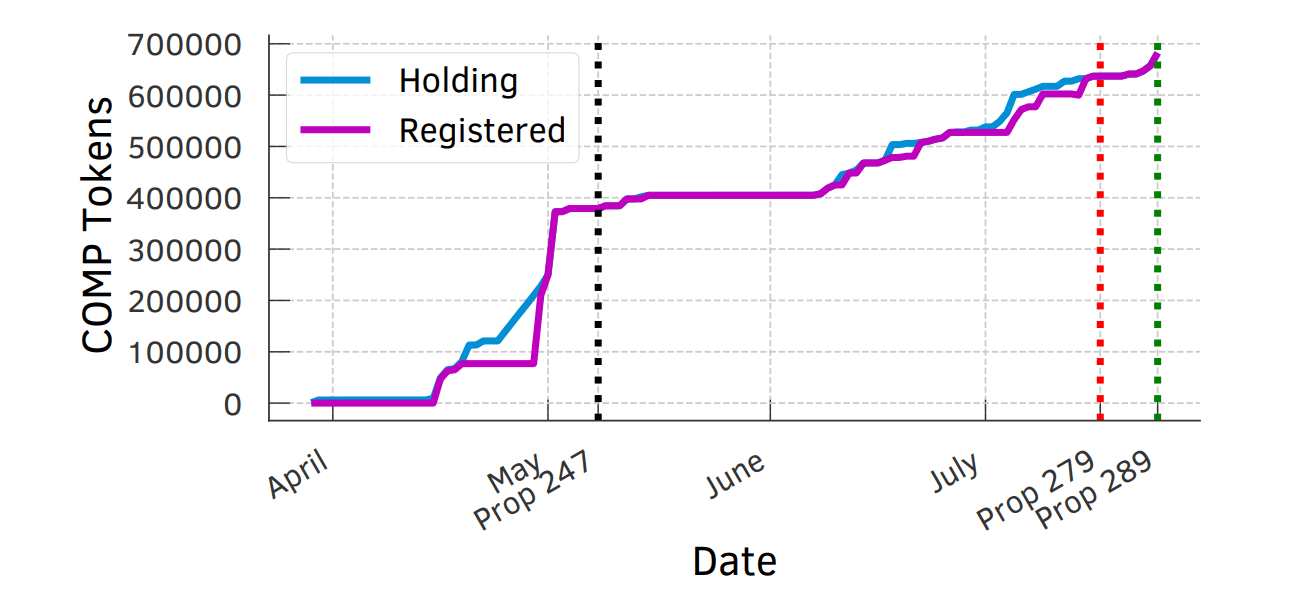
The late burst took advantage of a community that expected the third proposal to fail. Compound could have extended the vote when a large bloc appeared near the deadline, required longer staking, or allowed a trusted council to pause execution.
Every option would have moved power toward reactive voters, committed holders, locking services, or a small emergency body.
But Compound chose the emergency brake, and in the 2024 configurations researchers reviewed, seven other DAOs shared its exposure to readily available voting power and late vote accumulation: Uniswap, Radicle, Gitcoin, Silo, Ampleforth, Hop, and Cryptex.
Those systems can evolve through governance, so the list records a moment in 2024, while a current security rating would require a fresh review.
Decentralization needs a richer accounting than token distribution alone. A good governance report would show how much supply can vote, how much power the largest delegates control, which intermediaries hold staked tokens, and who can introduce, execute, or veto proposals.
Smart contract audits already ask whether governance code follows its specification, while a constitutional audit would ask where that specification sends authority.
DAOs can spread ownership across thousands of wallets and still funnel practical control toward a few dozen professionals, custodians, and large holders, with software that performs flawlessly all the way through.
The post DAOs are forcing crypto protocols to choose between code and emergency brakes appeared first on CryptoSlate.
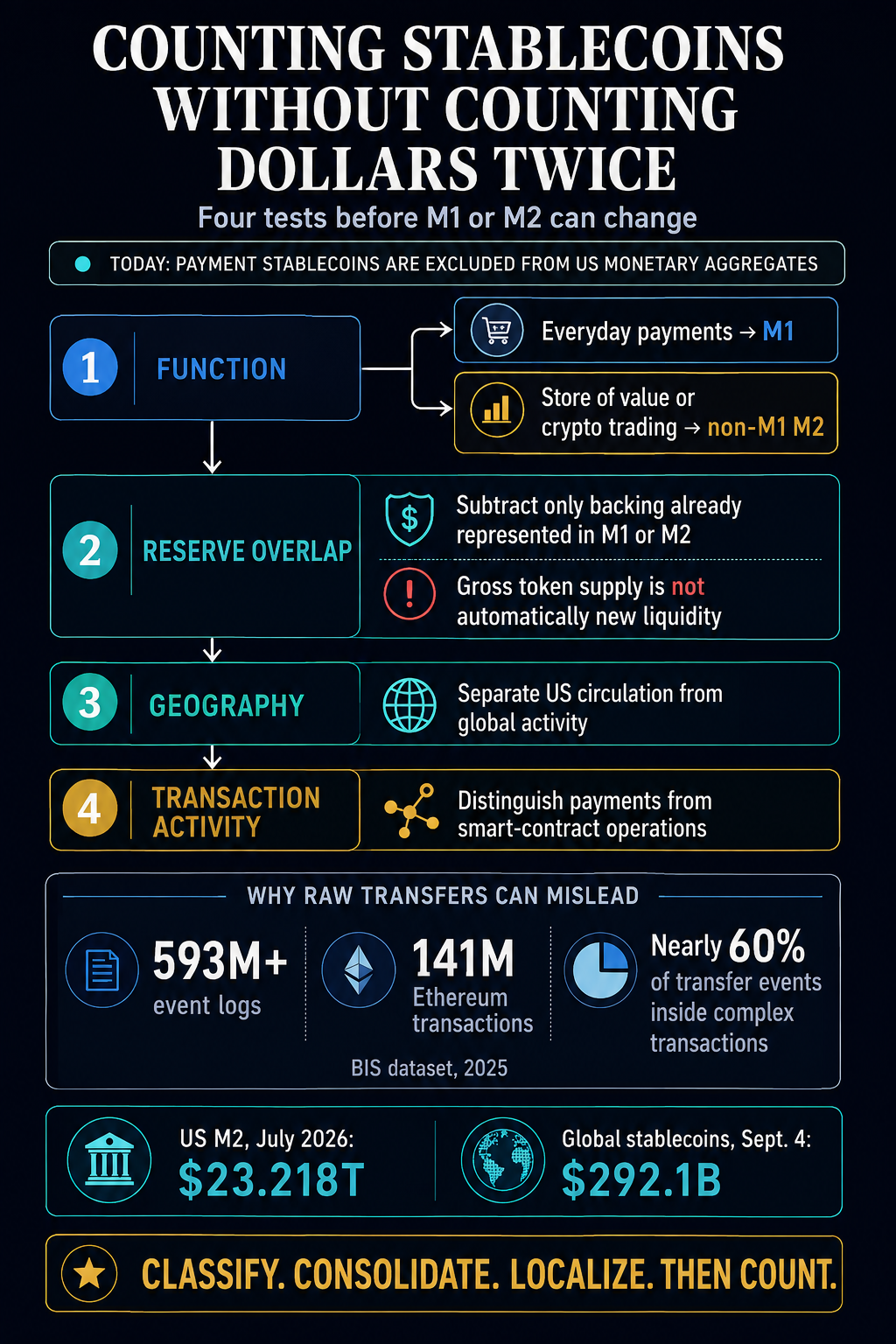
A Federal Reserve staff note published Sept. 4 sketches a route for regulated payment stablecoins to enter M1 or the broader M2 money supply. Its accounting framework requires adjustments before gross circulation could enter either measure.
Payment stablecoins are excluded from the US monetary aggregates today. The new note makes future treatment depend on economic use, alongside adjustments for reserve assets already counted elsewhere and the separation of US circulation from global activity. Otherwise, a larger money-supply figure could partly reflect a new wrapper around dollars the system already measured.
The distinction matters for anyone using M1 or M2 to judge dollar liquidity. A statistical increase driven by reclassification says little about newly created purchasing power.
The note is independent staff research, reflects only its authors' views, and is not part of a Federal Reserve policy deliberation. Existing definitions remain unchanged, and the analysis presents conditional possibilities.
How stablecoins could fit, and what could be counted twice
M1 is the narrowest official US money measure. It contains currency and highly liquid balances that households and businesses can use for transactions. M2 includes M1 plus less liquid savings-type assets, including small-denomination time deposits and retail money market funds.
The Fed authors apply that functional split to payment stablecoins. If the coins are used predominantly as a stable store of value or as liquidity for crypto trading, non-M1 M2 may be the better fit. If they become a common medium of exchange for household and business payments, their immediate transferability could support an M1 classification.
The framework remains conditional. The GENIUS Act requires permitted issuers to maintain at least 1:1 identifiable reserves and publish monthly reserve information, and leaves M1 or M2 assignment to a separate statistical decision. The Fed says standardized circulation data and a reporting chain suitable for monetary-statistics compilation would still be required.
The central stock-measurement problem sits on the reserve side. Under GENIUS, permitted reserves can include bank deposits, Treasury instruments, and government money funds. The Fed note says some bank deposits and money-fund net assets are already captured in M1 or M2.
If an issuer receives dollars, places part of them in a bank deposit or money fund, and issues stablecoins against that reserve, counting the tokens at face value could add a new line to the aggregate while part of the backing remains in another counted component. That is the same-dollar problem.
Only reserve assets already represented in M1 or M2 create overlap. The overlap depends on the backing composition and the statistical treatment of each reserve asset. The Fed note says the extent must be assessed before any adjustment is chosen.
| Question | What it determines | Evidence needed |
|---|---|---|
| Function | Whether the balance belongs with transaction money in M1 or savings-type money in non-M1 M2 | Reliable evidence on predominant economic use |
| Reserve overlap | How much gross issuance is already represented in counted components | Issuer-level reserve composition matched to M1 and M2 definitions |
| Geography | How much circulation belongs inside a US measure | Reporting that can separate US activity from global circulation |
| Transaction activity | Whether observed transfers resemble standalone payments or complex financial operations | Transaction-level classification rather than raw event counts |
USDC shows that a single headline number answers only part of the reserve question. Circle says most of its reserve is held in the Circle Reserve Fund, an SEC-registered government money market fund that can hold cash, short-dated US Treasuries, and overnight US Treasury repurchase agreements. Its July assurance also lists Treasury securities outside the fund, alongside cash held at regulated financial institutions.
Circle's latest active monthly assurance on the transparency page covered July 31. It reported 71.826 billion USDC in circulation and reserve assets with a fair value of $71.904 billion. Those figures document backing at a point in time. A net addition to M1 or M2 requires a separate consolidation calculation.
A defensible net estimate would have to match the reported reserve categories against the exact money-stock components already counted, remove only genuine overlaps, and preserve backing assets outside the aggregates. The current sources leave that increment unquantified.
The data gaps behind a national money measure
Geography is a separate problem from reserve overlap. A dollar stablecoin issued by a US-regulated company can move globally on a public blockchain, while transaction records generally lack enough geographic information to identify the portion that belongs inside a US measure.
The Fed note says GENIUS applies to US-regulated issuers without distinguishing domestic from international circulation. Additional reporting may therefore be needed to isolate US circulation from global activity. An issuer's total outstanding tokens map imperfectly onto US-held money.
Economic use requires a separate dataset. The Fed's functional test asks whether stablecoins behave more like transaction money or savings. Raw blockchain transfer counts are insufficient because a single smart-contract transaction can emit several transfer events.
A Bank for International Settlements working paper published in June analyzed more than 593 million event logs from 141 million Ethereum transactions executed in 2025 involving USDT, USDC, and PayPal USD. Roughly one third of the transactions generated multiple steps or event logs, while nearly 60% of transfer events occurred inside complex transactions.
Those bundles can combine trading, lending, arbitrage, liquidity provision, and settlement. Treating every emitted event as a standalone payment can exaggerate both activity counts and the apparent payment role of stablecoins.
The 60% statistic describes event structure alone. Functional classification under the Fed staff framework requires separate evidence about economic use.
The scale makes these distinctions consequential. CryptoSlate's Sept. 4 market snapshot listed the global stablecoin category at $292.1 billion across 73 assets. Its USDC market page showed about $74.5 billion of market capitalization and 74.51 billion tokens in supply.
Those global market figures say nothing about US-resident ownership or usage. They also differ in date and purpose from Circle's July 31 assurance, so the values should not be treated as interchangeable observations.
For comparison, FRED reported seasonally adjusted US M2 at $23.218 trillion for July 2026, updated Aug. 25. That establishes the scale of the official aggregate while leaving the required stablecoin net-addition adjustment unresolved.
The Fed staff framework therefore points to three different accounting jobs before any classification change: determine how the tokens function, consolidate reserve assets already represented in the aggregates, and isolate the circulation relevant to the United States. Transaction-level analysis informs the first job; reserve and residency data remain essential for the other two.
Stablecoins could eventually make M1 or M2 more complete. Skipping those adjustments would blur already-counted balances with genuinely new dollar liquidity.
The post Fed stablecoin research exposes how the same dollar could count twice in M1 or M2 appeared first on CryptoSlate.
Eligible Solana token-account owners can reclaim excess SOL previously needed to keep their token accounts open after the network's first rent reduction went live Sept. 3. For businesses funding new accounts, the same change lowers the upfront capital required to create them.
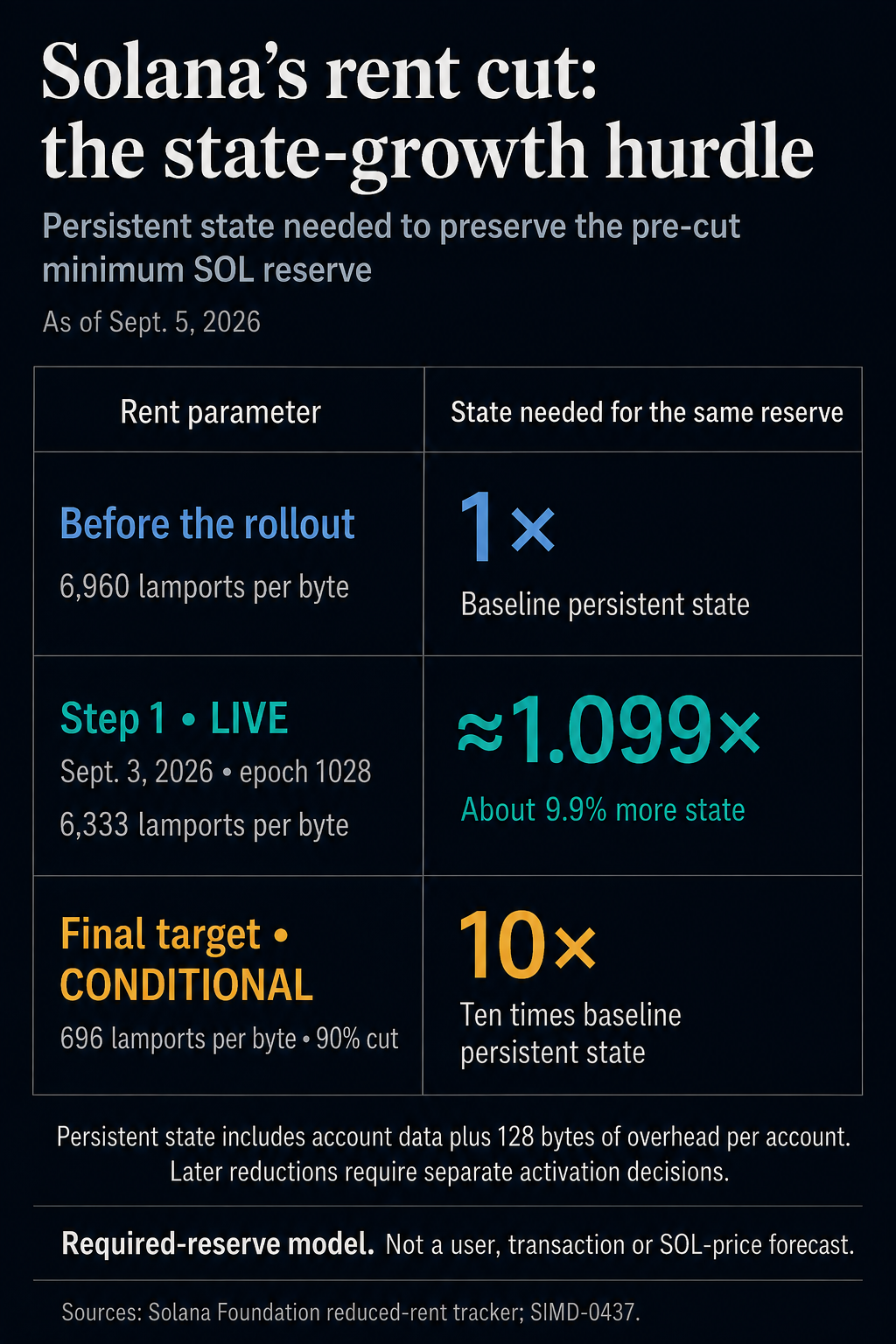
The full plan would change how account growth translates into SOL held against storage. If Solana completes its proposed 90% reduction, total persistent account state, including each account's storage overhead, would have to grow tenfold to require the same minimum SOL reserves as before the rollout. Adoption could expand substantially while the minimum SOL needed for this reserve channel falls.
The Solana Foundation's tracker confirms that only the first reduction, approximately 9%, is live on mainnet. The tenfold comparison applies to the conditional final target, while the initial cut already lowers reserve requirements.
Solana rent reduction and the 10× hurdle
Solana's “rent” is a balance held against account storage. It is generally recoverable when an account closes, rather than an ongoing bill paid to validators. Reducing the required balance lets new accounts begin with less SOL and can leave existing accounts holding more than their minimum.
At epoch 1028 on Sept. 3, Solana lowered the reserve parameter from 6,960 to 6,333 lamports per byte. The five-stage plan's final target is 696.
Under SIMD-0437, the rent-reduction specification, that minimum equals the account's data size plus 128 bytes of overhead, multiplied by the current lamports-per-byte parameter. A standard token account has 165 data bytes, making its effective size 293 bytes.
Applying that formula to one million identical standard token accounts gives the following illustration:
| Scenario | Lamports per byte | Required reserve | Reduction versus original |
|---|---|---|---|
| Before the rollout | 6,960 | 2,039.28 SOL | Baseline |
| First step, live Sept. 3 | 6,333 | 1,855.569 SOL | 183.711 SOL |
| Final target, conditional | 696 | 203.928 SOL | 1,835.352 SOL |
These are calculated minimum requirements for a fixed account population, not measured withdrawals. The final row assumes all five reductions activate. Different account sizes would produce different totals.
The million-account example illustrates operating capital, but it cannot establish a network-wide supply effect. Its conditional final reduction of 1,835.352 SOL represents about 0.000314% of the approximately 585.36 million circulating SOL shown in CryptoSlate's Sept. 5 market data. The actual aggregate reserve channel requires a broader account inventory, with account sizes, balances and reclaimability taken into account.
The tenfold threshold follows from the same relationship. At one-tenth the original reserve rate, ten times as many rent-bearing bytes would be needed to keep the aggregate minimum unchanged. It measures the total stock of persistent state, including per-account overhead. User counts, transaction counts and SOL prices are separate measures; the tenfold comparison describes storage requirements.
The live first step sets a smaller hurdle: about 9.9% more rent-bearing state would preserve the original minimum requirement at 6,333 lamports per byte. Both comparisons concern required reserves. Actual account balances can remain above those floors.
For payments, this reserve demand arises mainly when accounts are opened. The Foundation's July account-state study explains that an associated token account normally serves a particular wallet and token mint. Once it exists, later payments in the same token do not require another account-creation deposit. More payments through existing accounts therefore need not produce a proportional increase in storage reserves.
Withdrawal authority decides who gets the capital
The immediate benefit is access to capital already on-chain. The Foundation's Sept. 3 reclamation guide describes an instruction called WithdrawExcessLamports that moves SOL above the current minimum without closing a token account or changing its token balance. The Token-2022 program offers the same instruction.
For a token account, its owner must authorize the withdrawal. For a mint, authorization comes from the mint authority, or from the mint account itself signing if that authority has been revoked. Accounts owned by custom programs need the owning program to provide withdrawal logic and check the relevant authority.
That makes control of the account economically significant. A payments provider that funded a customer's token account cannot assume that paying the original deposit gives it the right to reclaim the excess. The party entitled to authorize the withdrawal may be different from the party that supplied the SOL.
Moving a surplus balance requires an authorized transaction that leaves the minimum intact. It transfers existing SOL between accounts while conserving the total; it does not issue new tokens. The guide provides no aggregate measure of completed withdrawals or subsequent sales.
For future onboarding, the benefit is more direct: whoever funds an account needs less SOL upfront. Providers can potentially support more customer accounts with the same capital, even when customers themselves do not purchase SOL. Whether existing surplus can be redeployed depends on the authority and program arrangements above.
How long those accounts survive will determine the continuing reserve requirement. Gross account creation can give a very different impression from state that remains on-chain.
In his July 20 analysis, Solana Foundation researcher Umberto Natale found that 75.5% of account-creation events in the analyzed cohort closed within the same transaction. The observations were not deduplicated by address: repeated creation and closure could count as separate events.
Those workflows can generate activity while leaving little persistent account storage behind. The finding does not predict how users will respond to September's reduction. The study also cautions that its weak, unstable correlations between SOL prices and account activity are descriptive, rather than a causal estimate of how cheaper rent changes demand.
A useful test of the policy will therefore track persistent account bytes and their associated minimum reserves alongside activity. Counting new accounts alone cannot establish whether the network has absorbed the lower reserve rate.
SOL demand extends beyond account reserves
Other uses of SOL also continue. Under Solana's fee rules, transactions require SOL: half the base fee is burned and half goes to the validator, while the entire priority fee goes to the validator. Fee payments are a separate demand channel from refundable account reserves. More activity could increase fee use, but throughput alone does not establish the amount users pay or the balances they retain.
SOL holders can also delegate stake to validators to help secure the network and become eligible for rewards. Reclaimed capital could be staked or used to fund more accounts. The cited material does not establish either outcome as a result of the cut, so these possibilities provide no quantified offset to lower reserve requirements.
CryptoSlate's recent analysis of activity and fee economics examined a related distinction: network usage and token economics can move differently. Rent reduction adds a specific reason why growth can require less SOL per unit of persistent state.
As of Sept. 5, the second reduction, to 5,080 lamports per byte, is on testnet, with mainnet expected in mid-September. The last three steps are expected with Agave 4.4 in November. Each activation remains subject to review of state growth, and a fallback can restore the original parameter.
The next gates will determine how far the capital saving goes. Persistent state growth and actual reclamation will then show how much of that saving becomes new account capacity, reusable working capital or reduced SOL held against storage.
The post Solana’s plan to cut account deposits by 90% could weaken a reason to hold SOL appeared first on CryptoSlate.
Zcash broke above $1,000 on Sept. 4, pushing the asset value of Grayscale’s recently listed ZCSH ETF past $400 million less than two weeks after its debut.
ZEC registered an intraday high of $1,050.70, up roughly 20% over 24 hours and nearly 100% over the past month.
The move lifted ZCSH’s assets to $414.7 million as of Sept. 3, compared with about $304.6 million when the fund began trading on NYSE Arca on Aug. 25.
ZCSH inherited assets from the Grayscale Zcash Trust, and the sharp appreciation in ZEC accounts for much of the increase.
Still, the fund’s ZEC holdings rose from 387,849 at launch to 428,613 by Sept. 3, while shares outstanding increased to 5.35 million.
The Sept. 4 breakout came as Bitcoin surpassed $82,000 and ETH reclaimed $2,500, but Zcash’s move was considerably larger. Roughly $40 million of ZEC shorts were liquidated in 24 hours, adding fuel to a rally that had already gathered momentum before the latest market-wide advance.
Leverage has expanded with the price. CoinGlass data showed that Zcash futures open interest crossed $2 billion for the first time, while 24-hour futures volume climbed above $6 billion for the first time since mid-August.
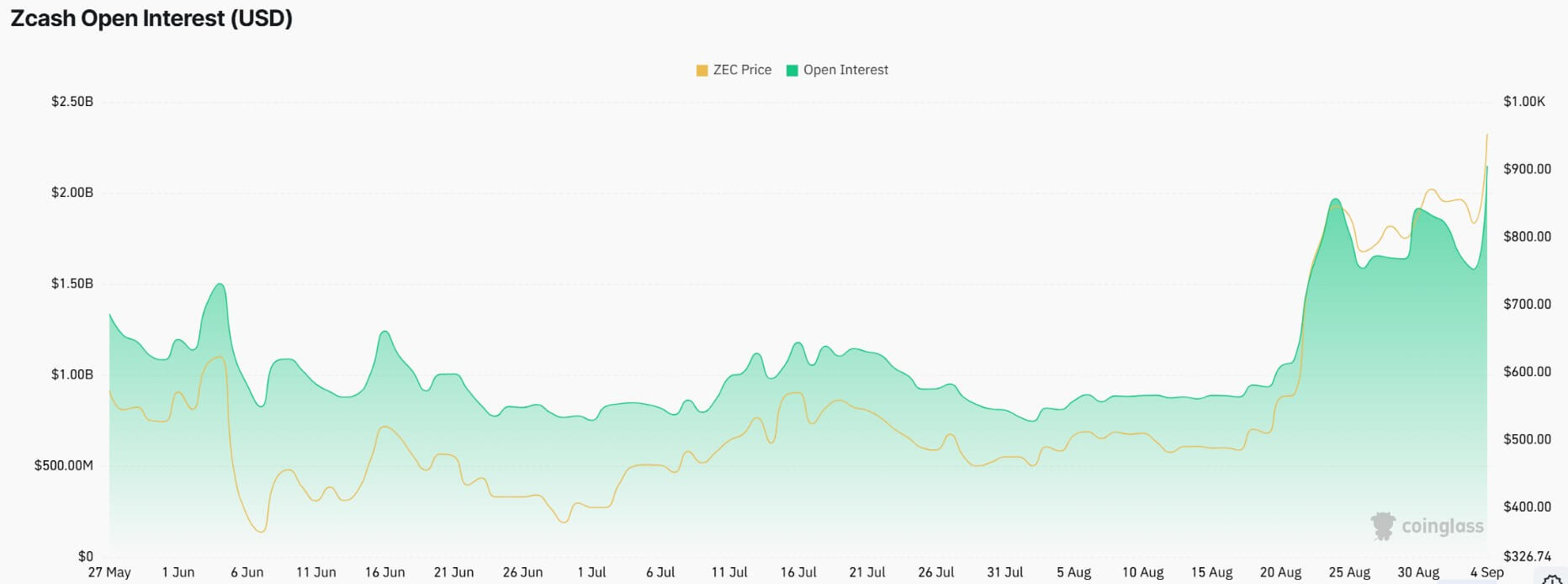
The combination suggests traders are committing substantially more capital to ZEC derivatives as the token tests levels it has not sustained in years.
The scale of the repricing is particularly stark over a longer horizon. ZEC was trading around $40 a year ago and has now returned to the top 10 largest cryptos by market cap for the first time since 2018.
That ascent has also brought increasingly aggressive forecasts. Cryptographer Arjun Khemani said characterizing the token's rally solely as a privacy-coin understates the case being made for Zcash.
He pointed to its fixed 21 million supply, Bitcoin-like emissions schedule, decade of distribution, work on quantum recoverability, plans for substantially higher transaction throughput and efforts to formally verify its shielded pool against undetectable inflation bugs.
Khemani said that “privacy is just one property of Zcash,” arguing that the larger bet is whether ZEC can develop into a form of sovereign money.
Grayscale sees AI opening a crack in Bitcoin’s dominance
The price move has revived a broader question around Zcash: whether its latest gains can translate into a lasting challenge to Bitcoin’s dominance of the digital-currency market.
Bitcoin accounts for about 93% of the market capitalization of Grayscale’s Currencies Crypto Sector, a level of dominance that alternatives such as Litecoin have failed to seriously disrupt. Zcash remains worth less than 1% of Bitcoin even after rising roughly 19-fold over the period covered by Grayscale’s latest research.
Grayscale argues Zcash has a better chance than previous challengers because it combines Bitcoin-like monetary properties with features that have become more relevant as the crypto market has matured.
Privacy is central to that thesis.
Bitcoin transactions are permanently recorded on a public ledger. Once an address is linked to an offchain identity, its balances and transaction history can potentially be reconstructed.
Grayscale argues advances in artificial intelligence could make that process faster, cheaper, and more widely accessible by improving address labeling and blockchain activity analysis.
The asset manager sees that technological shift as the beginning of a third major wave of concern over financial privacy, following the computerization of financial records in the 1970s and the growth of the internet in the 1990s.
Zcash approaches the problem differently. Its shielded transactions use zero-knowledge cryptography to conceal sending and receiving addresses and transaction amounts, allowing users to retain Bitcoin-like scarcity without making every transfer permanently visible.
Grayscale argued that distinction could become more valuable as AI makes surveillance of transparent blockchains increasingly sophisticated.
Its case extends beyond privacy. Grayscale describes Zcash as having several “second mover” advantages, including active development against emerging cybersecurity risks and cross-chain connectivity through intent-based technology that could allow wallets or AI agents to move value across networks while using Zcash as a private settlement layer.
Those features underpin the asset manager’s argument that Zcash could capture market share from Bitcoin even without reproducing Bitcoin’s merchant adoption or liquidity.
The same privacy architecture also presents one of Zcash’s largest obstacles. Shielded transactions can complicate sanctions screening, anti-money laundering controls, and efforts to trace illicit funds, creating regulatory and compliance concerns that have historically weighed more heavily on privacy-focused cryptocurrencies than on Bitcoin.
Bitcoin also retains advantages that are difficult to replicate. Its liquidity, infrastructure, brand recognition, and more than 15 years of network growth continue to reinforce its position at the center of the digital-currency market.
That leaves Zcash with a considerable gap to close.
Nevertheless, the move above $1,000 has made Grayscale’s thesis more consequential, as it puts greater weight on whether privacy and technological differentiation can produce durable market-share gains once the momentum behind the current rally cools.
The post Zcash breaks $1,000 as its spot ETF crosses $400 million in assets appeared first on CryptoSlate.
Imagine someone who bought ETH for $1,000, watched it climb to $4,000, and now wants to cash out $1,000. Selling one-quarter of the ETH would provide the cash, but it would also realize a $750 gain under US tax treatment of digital assets held for investment.
However, DeFi offers another way. The owner can deposit the full ETH into a lending protocol, use it as collateral, and borrow $1,000 in a stablecoin designed to track the dollar.
The loan doesn't count as taxable income, the ETH keeps its exposure to any future price increase, and the owner now has something they can spend or convert into dollars without selling the original asset.
| Decision | Cash received | Tax impact | ETH exposure | New risk created |
|---|---|---|---|---|
| Sell 25% of ETH | $1,000 | $750 realized gain | Reduced by 25% | No liquidation risk |
| Borrow stablecoin against ETH | $1,000 | No immediate taxable sale | Full ETH exposure retained | Debt, interest, liquidation risk |
While it saves the owner a lot of money in taxes, it also creates a fragile math problem. The $1,000 debt begins at 25% of collateral worth $4,000, but a fall in ETH to $2,000 doubles that loan-to-value ratio to 50%, and interest accumulating on the debt pushes it higher.
If the ratio crosses the protocol's limit, the code opens the collateral to liquidation, allowing an outside trader to repay part of the loan and claim some of the ETH at a discount.
The borrower might have deferred a taxable sale, but the lending pool has taken on the risk created by the collateral price, the size of the debt, and the borrower's willingness to act before liquidation.
One person's tax decision essentially became part of a shared credit market funded by other users, most of whom know the wallet only as a string of letters and numbers.
Lisa De Simone of the University of Texas at Austin, Peiyi Jin of the National University of Singapore, and Daniel Rabetti of NUS examined that connection in a working paper on tax planning and DeFi credit risk.
They studied Venus, a DeFi lending protocol on BNB Smart Chain that allowed users to pledge crypto and borrow other tokens through rules enforced by smart contracts.
Their sample runs from Nov. 12, 2020, through July 31, 2022, and covers the 15 largest tokens on Venus. Roughly 13 million transactions became 1.36 million daily borrower observations, which means the same wallet can appear once on every active day, and about 3% of traders experienced what the paper defines as a default.
That definition needs some translation because a DeFi default looks different from a missed mortgage payment.
The paper classified a borrower as defaulted when the loan remained above Venus's 60% loan-to-value limit for at least seven days without later borrowing or depositing, and its $133.34 million total adds outstanding defaulted debt across each day it persisted.
A single troubled loan can therefore contribute to several dates, making the total a measure of accumulated daily exposure rather than unique principal lost in one event.
| ETH collateral value | Stablecoin debt | Loan-to-value ratio | Borrower position |
|---|---|---|---|
| $4,000 | $1,000 | 25% | Comfortable cushion |
| $3,000 | $1,000 | 33% | Risk rising |
| $2,000 | $1,000 | 50% | Close to danger |
| $1,667 | $1,000 | 60% | Liquidation threshold |
| Below $1,667 | $1,000+ interest | Above 60% | Liquidation risk active |
The billionaire trade gets a wallet
The traditional version of this strategy is known as “buy, borrow, die.” Investors buy an asset, let it appreciate, and borrow against it to live without realizing the gain through a sale.
Continued borrowing can defer capital-gains tax for years, and US estate rules may reset the asset's tax basis when heirs inherit it, reducing the gain accumulated during the original owner's lifetime.
This has usually been a rich person's trade because a private bank wants a client with valuable collateral and enough wealth to survive a downturn. The bank can examine the client's broader finances, decide how much it will lend, and negotiate terms for the relationship, giving both sides room to deal with trouble before collateral has to be sold.
DeFi compresses that very human-centric relationship into code. Software doesn't need any of its elements because it just looks at the assets inside a wallet and applies the same collateral rules to everyone.
Access to this kind of service then widens, and the price of that openness is a system built around overcollateralization, where a borrower must pledge more value than the loan is worth from the start.
Under the Venus configuration described in the paper, approved collateral worth $10,000 could support up to $6,000 of debt. Borrowing the full amount left almost no room for a fall, while someone borrowing $2,000 had a much thicker cushion, and both accounts were monitored continuously by code using market prices supplied to the protocol.
When collateral weakened enough to break the limit, a liquidator could repay part of the debt and take collateral at a discount, earning a reward for restoring the account. This process is meant to protect the pool before the collateral falls below the debt, even though a fast selloff or thin market can make the sale less effective, and blockchain congestion can prevent liquidators from acting soon enough.
The tax incentive complicates the borrower's side of this system because reducing risk requires trading, repaying debt, or selling part of an appreciated holding.
Borrowers who took out the loan to defer a taxable sale will likely wait longer to unwind it, especially when the token has produced a large paper gain or the account has moved most of the way toward the lower long-term capital-gains rate.
What makes this trade especially attractive are stablecoins. Dollar-pegged coins turn otherwise volatile collateral into dollar spending power. So traders can keep ETH or another token pledged, borrow USDT or USDC, and use them elsewhere.
Large holders are borrowing stablecoins against crypto collateral to fund activity while preserving exposure to the underlying asset.
The protocol sees a healthy collateral ratio when the loan opens. But it can't see that the borrower bought ETH for a fraction of its current price, has a large gain waiting behind a sale, or sees another few months of holding as financially valuable, even though all of those facts can affect how the borrower behaves once the loan becomes dangerous.
The IRS turns Venus into an experiment
The researchers needed a way to separate tax-motivated behavior from the normal chaos of crypto markets, and they found one in the Infrastructure Investment and Jobs Act enacted on Nov. 15, 2021.
Section 80603 of the 2021 infrastructure law expanded information-reporting requirements for brokers handling digital assets, giving traders reason to expect that more of their activity would eventually be reported to the IRS.
The law changed the level of third-party reporting traders expected, giving the authors an external event that could affect the behavior of likely US taxpayers while international users saw no changes.
The reporting system took a long time to build. Custodial brokers began reporting gross proceeds from covered sales and exchanges completed from Jan. 1, 2025, on Form 1099-DA, and IRS broker rules added basis reporting for certain transactions completed from Jan. 1, 2026.
Those regulations cover firms that take possession of customers' assets, while noncustodial DeFi services fall outside their current scope.
For the paper, the research value comes from what people believed in November 2021, when the new law made future reporting feel more concrete.
The authors compare behavior around that enactment date, years before the final rules took effect, allowing the study to capture a reaction to expected visibility instead of an automatic response to a tax form already being issued.
Because the blockchain doesn't reveal anyone's nationality or tax residence, the researchers had to infer which wallets might belong to US users. They looked for activity concentrated during US business hours and unusual behavior on holidays observed only in the US, then added holdings of dollar stablecoins under US oversight as another clue.
Each measure can misclassify people, so the paper reports several versions and a stricter definition that combines them.
The basic comparison is like watching two groups use the same financial machine on either side of one legal event. Both groups faced the same token prices and the same Venus rules, while the probable US group had a stronger reason to care about the reporting provision, helping the authors isolate the tax channel from a broad market move.
Across their main designs, the authors report that US-linked borrowers became 24.5% less likely to trade assets relative to international users once the law was enacted.
Borrowers using stablecoin debt recorded an additional 23% decline, which fits the paper's argument because stablecoins offered immediate spending power while appreciated collateral stayed pledged.
The paper uses “liquidity” in a narrow, wallet-level sense: the daily probability that a borrower traded any asset. While most people associate the word with exchange depth, bid-ask spreads, or the cost of selling a large holding, this study is measuring how active the borrower's portfolio was and whether appreciated assets stayed locked in place.
The same pattern became stronger among borrowers with larger gains and higher loan-to-value ratios. Activity fell during December, especially in its final week, when investors often defer gains into a new tax year, then increased once holdings passed the one-year point associated with lower US long-term capital-gains rates.
Those behavioral checks give the tax interpretation support beyond the November 2021 comparison.
The authors estimate that US borrowers in the sample deferred an average of $3,357.42 in capital-gains tax per year, equal to about 17% of their trading portfolios during the period.
That estimate assumes the inferred wallets belong to US taxpayers, reconstructs their portfolios from blockchain activity, and applies the relevant tax brackets, so it is best read as a rough estimate of scale across the sample.
The bill comes due inside the pool
The final part of the paper follows the reduced trading into loan performance. Borrowers who rarely trade may leave a risky account open longer, miss chances to repay debt, or fail to add enough collateral before the ratio breaks its limit, allowing a tax preference that began outside Venus to influence the amount of unresolved debt inside it.
From that angle, it's obvious it's a major problem because causality can run the other way too: a default may cause someone to abandon a wallet and stop trading.
The researchers use the law-induced reduction in activity among US-linked borrowers to isolate a drop in trading that came from outside the protocol, a statistical method known as an instrumental-variable design.
Using that design, they estimate that a 1% increase in tax-induced illiquidity was associated with an 11.2% increase in defaulted accounts and a 39.6% increase in defaulted loan value. A one-standard-deviation increase corresponded to roughly $350 more defaulted debt per borrower, equal to 2.7 times the baseline value in the model.
Those percentages sound enormous because they describe the borrowers whose activity reacted to the reporting event, a group economists call compliers. Their proper scope is the tax-sensitive portion of the Venus sample, and the estimates help explain how behavior can affect credit outcomes rather than serving as a universal multiplier for every DeFi loan.
| Stage | Borrower incentive | Protocol sees | Hidden risk |
|---|---|---|---|
| Asset appreciates | Avoid selling and realizing gain | Healthy collateral value | Tax lock-in begins |
| Stablecoin loan opens | Access cash without sale | Acceptable LTV | Borrower may resist de-risking |
| Collateral falls | Delay repayment or sale | LTV deteriorates | Trading inactivity rises |
| Threshold breached | Preserve appreciated asset or abandon wallet | Liquidation condition triggered | Liquidators must act quickly |
| Liquidation fails or lags | Borrower loss becomes pool risk | Bad debt/defaulted exposure | Losses may hit reserves, token holders, or suppliers |
It exposes a blind spot in automated lending. Smart contracts know the collateral price, debt balance, interest owed, and liquidation threshold, but the borrower's purchase price and tax incentive never enter its calculation.
Two wallets with identical ETH collateral and identical loans can therefore look the same to Venus, even when one owner is comfortable selling, and the other is working hard to avoid it.
That difference is what becomes a borrower-selection problem. Overcollateralization protects the pool against ordinary price moves, but borrowers most attached to appreciated assets may keep debt open longer and trade less as their cushion narrows, concentrating risk among people whose motives the protocol cannot measure.
When liquidation works, an outside participant repays debt and removes collateral before lenders suffer a shortfall. When it fails, the cost can pass through protocol reserves, token holders, or the users who supplied assets to the pool, depending on how losses are allocated, which turns what was a personal tax preference into a financial outcome the entire pool shares.
The paper also found a much wider set of risks associated with this tax channel.
It studied one protocol during the boom and crash of 2020 through 2022, inferred US residence from behavior, and used a specialized definition of default based on unresolved high-LTV accounts. The researchers separately found that volatile collateral and liquidation flaws contributed to troubled Venus loans, giving tax sensitivity one role in a system that could fail for several reasons.
Another protocol with deeper liquidity or different collateral limits could produce a different result, and a later market with more professional liquidators may behave differently from Venus during the sample.
Nonetheless, the paper still offers something traditional lending data rarely provides: a public view of collateral, debt, borrower activity, liquidation, and abandonment at the individual-wallet level.
DeFi brought a private-bank borrowing strategy onto a public blockchain and opened it to people far outside private banking. In doing so, it also showed that automating the loan officer doesn't remove the human motives behind a loan, because tax bills, attachment to appreciated assets, and reluctance to sell continue through the code and eventually reach everyone funding the pool.
The post How the “buy, borrow, die” tax trade is quietly loading DeFi pools with hidden credit risk appeared first on CryptoSlate.
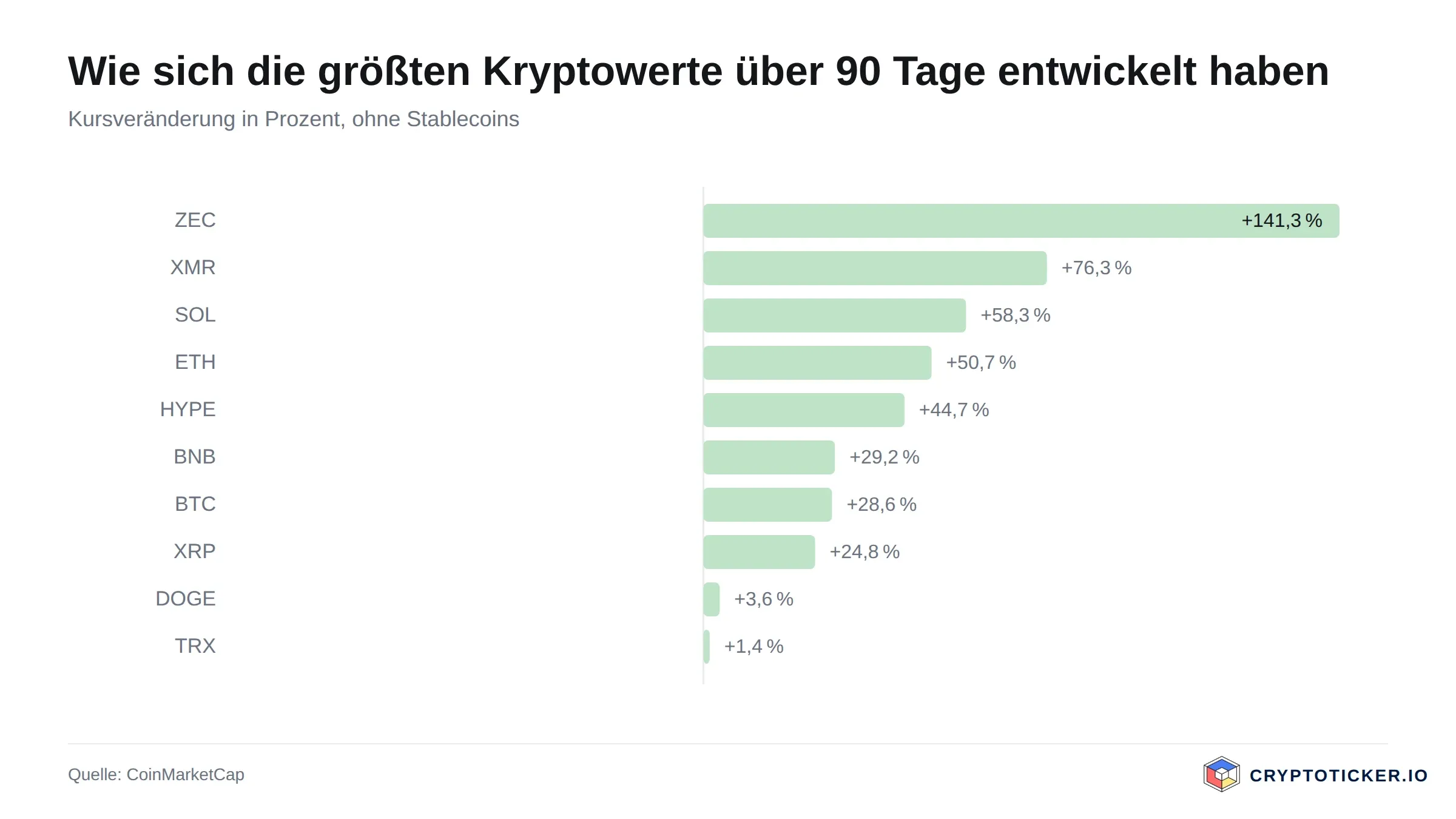
CryptoTicker.io
You are entitled to take part in the Zcash vote on NU7 if, on 24 August 2026 at around 19:00 UTC, you held spendable shielded ZEC in the Ironwood pool of a wallet of your own. Anyone who had nothing there at that moment can no longer change it before the voting window closes on 14 September at 19:00 UTC, however much Zcash (ZEC) they buy today. There is a relief in the other direction that many overlook: anyone who was eligible on the cut-off date may move, sell or reallocate their coins afterwards without losing the right to vote. In the words of the organisers: "If you have spendable funds in Ironwood at that height, your ZEC is eligible even if you move your funds after the snapshot."
That is the practical core of a process on which almost nothing has been written in English so far. On 22 August we explained what ZEC holders are voting on. The question that has arisen since is a different one: who is allowed to vote and how it works technically. The text below answers it step by step, names the points where the primary source and the trade press contradict each other, and draws the line beyond which the vote no longer changes anything.
Who may take part in the Zcash vote: the three conditions at the snapshot block
The eligibility rule sits in a single English clause, and that clause contains three conditions that had to be met at the same time: "spendable shielded funds in Ironwood at Mainnet block height 3459350". In plain terms:
Spendable
A shielded note is the protected equivalent of an account entry at Zcash: an encrypted record in the blockchain that only the holder of the matching key can read and spend. "Spendable" means these notes were actually available to spend on the cut-off date, meaning confirmed and not tied up in a transaction still in flight. Funds that were in transit at the snapshot moment do not count.
Shielded
Zcash has two types of address. Transparent addresses work as they do at Bitcoin: amount, sender and recipient sit openly in the blockchain. Shielded addresses hide that information behind a zero-knowledge proof. Only shielded balances count for the vote. Anyone holding ZEC on a transparent address was not eligible to vote on 24 August, not even with six-figure amounts.
In the Ironwood pool
A shielded pool is the technical generation a shielded address belongs to. Zcash has introduced four of them one after another, and only the most recent one counts for the vote. More on that shortly, because this point excluded most holders.
The cut-off date itself can be measured without having to believe any announcement. The public chain statistics from Blockchair showed block height 3,467,063 on 31 August 2026 at 12:37:46 UTC. The snapshot at 3,459,350 is therefore 7,713 blocks back, which at a target block time of 75 seconds works out to roughly 160 hours, just under seven days. It is irrevocably past.
Why ZEC on an exchange has no vote: self-custody as a precondition
This is the point at which most retail investors drop out without knowing it. If your ZEC sits at an exchange, the private key belongs to the exchange rather than to you. Your position there is a claim against the house, not a shielded balance in a Zcash pool. That is precisely why reporting notes that ZEC "kept on exchanges or other networks needs to be transferred into Ironwood's self-custody" in order to be eligible to vote.
In practice that means governance at Zcash is tied to self-custody. Anyone who wants a say has to withdraw their coins from the custodial account and put them in a wallet whose keys they control themselves. With that they also take on responsibility for the seed phrase, the sequence of words from which a wallet can be restored if it is lost. For newcomers the transition is the real hurdle, rather than the vote itself. If you are taking that step for the first time, our software wallet comparison is worth a look, and for larger holdings the hardware wallet comparison is worthwhile, because the key never leaves the device there.
In the other direction, the note this text opens with applies: after the snapshot the tie is released. You do not have to leave the coins untouched until 14 September; the balance may go back to an exchange, into another wallet or into a sale, and the voting right stays attached to the snapshot moment. So anyone who withdrew their ZEC only for the vote may long since have moved it back. Which trading venues come into question for the return trip is covered in our exchange comparison.
Ironwood, Orchard, Sapling, Sprout: only one shielded pool is eligible to vote
Zcash has developed its shielded addresses across four generations. Sprout was the first, from 2016, Sapling followed in 2018, Orchard in 2022, and Ironwood went live with the upgrade of the same name on 28 July 2026. Each generation is a separate pot with its own cryptography, and funds do not migrate from one to the next on their own.
For the NU7 vote, Ironwood alone counts. Balances in Orchard, Sapling and Sprout were as mute on the cut-off date as transparent addresses. That is no formality, and it has a measurable effect on participation: the migration out of the sealed Orchard pool into Ironwood was only around 85 percent complete at the end of August, with roughly three percent of the total supply still sitting in Orchard. Every one of those balances was worthless for the vote on 24 August, even though it was shielded and belonged to the right person.
So if you read in July or August that you should "shield" your ZEC, that was only half the advice. What mattered was which pool. Anyone who postponed the migration to Ironwood because it costs fees and takes time gave up their voting right unintentionally in doing so.
Which wallets support the Zcash vote: primary source and press contradict each other
Precision is worth it here, because a mistake costs you your vote. The organisers' announcement names two applications explicitly: "We have confirmed that Vizor and Zodl will support the voting process." Two names, and the primary source confirms no more than that.
The trade press additionally lists Zashi, Zkool and the hardware wallet Keystone as supported, the latter with the note that users can take part "without removing their keys from the device". That divergence deserves naming rather than smoothing over: between "confirmed by the organisers" and "named in the press" lies a practical difference for you. If your wallet does not show the voting function, that is not a fault in your device but possibly simply missing support.
In the Zcash community forum, at least one participant confirms the route via Zodl with the words "Voting with Zodl worked well". That is a user report rather than a vendor commitment, but it matches the primary source.
What to check before you try
Open your wallet and see whether it offers a voting function. If you cannot find one, the detour via one of the confirmed applications is the safe route. Your shielded notes stay where they are; you do not need a transfer to cast your vote.
How to cast your vote with Zodl or Keystone
The procedure is short and works without a transaction to any third-party address. The application describes it in five steps:
- Open settings in Zodl or on the Keystone device.
- Select "Beta: Coinholder Polling" to see the polls under way.
- Read the proposals and the linked ZIPs. A ZIP is a Zcash Improvement Proposal, the formal document in which a protocol change is spelled out technically. Anyone who knows only the headline is voting on a text they have not read.
- Cast your shielded vote. The vendor notes: "Votes are private. Your funds never leave your wallet."
- Track open, completed and closed polls, all in one place.
Two things regularly cause confusion here. First: your wallet has to be fully synchronised with the blockchain, otherwise it does not know the position as at the cut-off date. With shielded addresses that reconciliation takes noticeably longer than with transparent ones, because the wallet has to decrypt every note itself. Second: your vote weighs as much as your shielded balance at the snapshot block, rather than as much as your account balance today. Buying more after 24 August does not increase the weight.
The five questions ZEC holders decide on for the NU7 upgrade
The ballot comprises five separate questions, each with an abstention option. You do not have to answer them all.
Question 1: issuance smoothing under the NSM
The Network Sustainability Mechanism (NSM) is the proposal to govern the issuance of new ZEC via a smooth curve instead of abrupt halvings. The options are the smooth curve, keeping the halvings, dropping this point from NU7, and abstention.
Question 2: start date for reissuance
Reissuance means returning previously burned transaction fees to future block rewards. Options: as early as possible, February 2027, February 2031, abstention.
Question 3: shutting down Sprout
The oldest shielded pool is to be dropped from the protocol. Options: immediately with NU7, one year after the vote, set no date, abstention.
Question 4: shorter block time
Block time is to fall from 75 to 25 seconds, so transactions would be confirmed faster. Options: yes, no, abstention.
Question 5: scope and readiness of NU7
If individual features are not ready by 30 September: ship and drop the unfinished parts, wait until everything is in place, reject the plan, abstention.
Questions 1 and 2 are the economically weightiest, because they concern the future issuance of new coins. Circulating supply stood at around 16.91 million ZEC on 31 August against a cap of 21 million (CoinGecko). The price on the same day was 829.90 US dollars, or 715.72 euros, with a market capitalisation of 14.05 billion US dollars, after a decline of around two percent within 24 hours.
The quorum of 1,000,000 ZEC and the size of the Ironwood pool
For the result to count as representative, at least 1,000,000 ZEC have to take part in at least one of the five questions. That figure sounds abstract until you measure it against the eligible supply.
The Ironwood pool had taken in more than 3.7 million ZEC by the end of August, according to the trade press. The quorum therefore corresponds to a good quarter of the entire eligible holdings. By comparison: measured against the circulating supply of 16.91 million ZEC it would be just under six percent. Both figures describe the same threshold, but only the first describes the actual hurdle, because Ironwood alone counts.
If the quorum is missed, the vote is not invalid in a legal sense. The result then counts as unrepresentative, and for the developers who are meant to evaluate it that is a considerable difference. For you as a holder it means this: an abstention that is cast as a vote also feeds into participation, while doing nothing lowers it.
An advisory signal rather than a protocol change: what the coinholder vote does not do
This is where the text becomes uncomfortable, but without this part it would be wrong. The vote does not change the Zcash protocol. The procedure collects an opinion that developers can subsequently take into account, or not.
In the community forum, one post reduces it to the formula "a poll, not a vote", and the developer Daira notes there: "There is no ZIP that approves making Zcash protocol decisions by vote." So there is no formal document that provides for protocol decisions by vote at all. Several participants have stated that they would need extraordinary grounds to override a clear vote by holders. That is not a binding commitment, but a voluntary undertaking without an enforcement mechanism.
Approved proposals then have to be written up as a ZIP, developed, reviewed and rolled out via a network upgrade. Between the result on 14 September and a visible change to block time or the issuance curve, then, lie months, and in the case of the reissuance options even years.
Anyone who nonetheless takes the process seriously does so for a different reason: a coinholder vote with high participation is the strongest signal that governance without a foundation majority can produce. It is coordinated by the Valar Group and Project Tachyon, which have built their own coinholder voting chain for it. This voting chain is a separate chain purely for the count and takes the place of Zcash's previous governance procedure. Zcash co-founder Sean Bowe has accompanied the launch.
Two votes, one closing date: coinholder vote and the Zcash Foundation's ZCAP poll
Anyone searching for "the Zcash vote" actually finds two procedures running in parallel that end on the same day at the same minute. Confusing the two is the most common source of error.
The coinholder vote is the coin-weighted part this text is about. It runs from 25 August to 14 September, 19:00 UTC, and your weight is your shielded Ironwood balance at the snapshot block.
The ZCAP poll is the Zcash Foundation's survey of the Zcash Community Advisory Panel. It opened on 27 August and likewise closes on 14 September at 19:00 UTC. The Foundation runs it as an SIV poll, in full a single iterative vote; that is its own survey format for panel consultations and has nothing to do with the coin-weighted count of the coinholder vote. Only members of the panel, who receive their instructions by email, may take part there; holding ZEC alone confers no entitlement. The Foundation places the procedure itself: "Though advisory in nature, these votes play a vital role in informing decisions across the ecosystem." Both procedures address the same five substantive questions from different angles, once weighted by capital and once by people. The questions are not new: the Foundation had already surveyed the scope of NU7 earlier in 2026 in a sentiment poll and published its results. The current procedure is meant to settle the points left open after that.
How homomorphic encryption keeps your vote secret
Homomorphic encryption is a technique in which encrypted values can be added together without decrypting them first. For a vote that is the decisive property: the count can run without anyone seeing an individual vote.
In the NU7 vote, both the chosen answer and the associated ZEC amount are processed in encrypted form. All that becomes visible at the end is the total per answer option. In addition, each vote is split into 16 ballots that cannot be linked to one another, so that no conclusion about the size of an individual balance can be drawn from voting behaviour.
The count itself rests with a distributed election authority of at least ten validators, each holding only part of the decryption key. The overall result can be reconstructed only when two thirds of those validators agree. This means no single operator can tap interim results and influence the course of the vote. For a privacy coin this design is less an optional extra than a requirement, because an open list of votes would have put every participant's balance in the shop window.
What this additionally means for European holders
The vote falls in a phase in which European investors have to think about the custody of their privacy coins anyway. What role the planned EU rules play in that, and what happens to holdings on regulated platforms from July 2027, we have written up in a separate article. Anyone moving their ZEC into self-custody in any case settles both questions with the same step.
Zcash vote: what to take away
- First check whether you are eligible to vote at all. Open your wallet, let it synchronise fully and see whether spendable shielded funds sat in the Ironwood pool on 24 August. If they sat at an exchange, in Orchard, Sapling, Sprout or on a transparent address, the vote is out of reach this time round. For the next attempt the choice of wallet is decisive: the hardware wallet comparison shows which devices support shielded Zcash addresses at all.
- Vote while the window is open. Until 14 September, 19:00 UTC, the route runs via settings and "Beta: Coinholder Polling" in a supported application. Read the linked ZIPs before you click, and use the abstention option on questions you have no view on. If you first have to withdraw funds from a custodial account for that, you will find the candidates for the later return trip in the exchange comparison.
- Do not expect an immediate change from the result. The vote is advisory, not a protocol decision. Treat it as a sentiment reading rather than a date for a price reaction, and separate the custody question from the voting question: you need a suitable storage arrangement regardless of how NU7 is scoped in the end. The software wallet comparison offers a way in.
The primary source with the full wording of the announcement, the five questions and the eligibility rule is in the Zcash community forum. The parallel survey of the advisory panel is documented in a separate forum post by the Zcash Foundation.
(As of August 31, 2026. This article is not investment advice. Prices and fee structures change; check the terms with the provider before you buy.)
Anyone holding Humanity or Beldex balances at the crypto exchange Kraken has to withdraw them by 25 September 2026 at 14:00 UTC. After that, Kraken liquidates whatever remains itself, between 28 September and 2 October. The exchange states in its own notice that proceeds may fall well below recently seen prices and, in individual cases, may be minimal or zero. Four tickers are affected, although only two projects are involved: $H and $HUMANITY on one side, $BDX and $BELDEX on the other.
The reason for the duplicate positions goes back months. Both projects were attacked in June 2026, both responded by rolling out a new token contract, and Kraken credited the replacement to customer accounts automatically. Anyone who held Humanity or Beldex at Kraken in June has had two lines in their portfolio ever since, without doing anything to get them. Both lines expire on the same day at the same minute.
What actually happens at Kraken on 25 September 2026 at 14:00 UTC
Kraken has published one support notice for each project, and both carry the same sequence of dates. Trading and deposits are already permanently disabled for all four tickers; the only remaining function is withdrawal, meaning a transfer to an address outside the exchange. That withdrawal window closes on 25 September 2026 at 14:00 UTC. From 28 September to 2 October 2026 the liquidation phase then runs, during which Kraken sells any remaining balances without involvement from the account holder.
For you that means there is exactly one action left that changes anything, and one date on which it ends. A sale through the exchange order book is no longer an option, because trading stopped long ago. Letting the deadline pass does not convert your tokens into cash; it hands Kraken the timing and the price.
Why two positions suddenly sit in the account: snapshot, airdrop and a new contract
Both cases follow the same pattern. An attacker exploits a weakness in the project's bridge infrastructure, unbacked tokens are created, the project then retires the old contract and publishes a new one. To make sure nobody is expropriated, the project falls back on a record of balances taken before the attack and distributes the new token against it at a one-to-one ratio. Kraken handled that distribution for its customers and credited the new tokens directly.
The order of events matters, and it often gets reversed: the cut-off date lies before the attack, not after it. For Humanity it is 8 June 2026 at 17:25 UTC, for Beldex 10 June 2026 at 23:36 UTC. Anyone holding a balance at that moment is eligible. Anyone who bought later is not, under the rules of both projects.
Snapshot, airdrop and forced liquidation: three terms in one sentence each
A snapshot is a record of all balances on the blockchain at a fixed moment in time; it decides who is entitled to something later. An airdrop is the allocation of a token without consideration to the addresses in that record, here at a one-to-one ratio. Forced liquidation, called "liquidation" in Kraken's notices, refers to the sale of remaining customer balances by the exchange after a deadline expires, at a price neither you nor the exchange knows in advance. And a delisting is the permanent removal of an asset from the trading venue, which here has already taken place.
The Humanity case: what Kraken says about $H and $HUMANITY
According to Kraken's notice as of 26 June 2026, the old $H has been delisted, trading and deposits are permanently disabled, and withdrawals remain open. The exchange lists the new token under its own ticker $HUMANITY, to keep the two distinguishable in the account. The airdrop ran automatically on 1 July 2026 at 14:00 UTC, without any customer action. The new token is also scheduled for delisting at Kraken and supports withdrawals only.
On the incident itself: according to the crypto.news report of 16 June 2026, an attacker drained roughly 141 million H from the bridge on Ethereum and minted additional tokens on the BNB Smart Chain. Damage estimates diverge: crypto.news cites 36 million US dollars, while our own report of 9 June 2026 on the Humanity Protocol price crash cited 31 million. The project attributes the incident to stolen credentials and explicitly not to a flaw in the contracts themselves. Who is behind the attack has not been conclusively established.

The Beldex case: what Kraken says about $BDX and $BELDEX
Kraken's second notice, as of 9 July 2026, describes the same sequence with different dates. The snapshot is dated 10 June 2026 at 23:36 UTC, the airdrop of the new $BELDEX ran on 10 July 2026 at 14:00 UTC, and both tickers support withdrawals only. Kraken refers to the trigger briefly as "an incident" and gives no further detail.
The project supplies those details itself. In a blog post dated 16 June 2026, the Beldex team writes that on 12 June it identified an unauthorised minting of BDX tokens on the BNB Smart Chain, caused by a problem in its own bridge infrastructure. The preliminary assessment puts the figure at roughly 38.2 million tokens created without authorisation. The team dates the first related transactions to shortly after 10 June 2026 around 23:36 UTC, the start of selling to 11 June at around 23:10 UTC, and the bridge was halted in the early hours of 12 June. The native Beldex blockchain, according to the team, was not affected; the incident was confined to the bridge environment.
Zero trading pairs: what we measured on Kraken's public trading API
That "withdrawals only" really means what it says can be verified without an account. On 5 September 2026 we queried Kraken's public trading API. In the asset directory, all four tickers, $H, $HUMANITY, $BDX and $BELDEX, are still listed individually. In the directory of trading pairs, which held 1,446 entries at that point, there is not a single pair for any of these four tickers.
That is the measurable evidence for the situation: the balances still exist in the account and can be moved, but there is no market left on which you could exchange them for euros or dollars at Kraken. We describe a similar combination of halted trading and a later withdrawal deadline for a different case in our piece on the trading halt for 21 Kraken tokens; there, trading is still due to end, while here it stopped long ago.
If you bought after the snapshot: a claims process at Humanity, none at Beldex
This is where the two cases part ways, and for those affected the difference is the most important part of the whole process. On Beldex, Kraken states explicitly that anyone who acquired $BDX after the snapshot is not eligible, and that there is no claims portal and no other route. Those holders own a token their own project has replaced, and they do not receive the replacement.
With Humanity it works differently. In its notice, Kraken points to a project portal through which affected parties can file a claim themselves, while making clear that the exchange is not involved in that process and cannot assist with it. The portal itself names three groups it is intended for: balances that sat in liquidity pools or contracts at the cut-off date and cannot be assigned to a person, balances from certain integrations with other protocols, and buyers who acquired after the snapshot and still hold the token. According to the project, identity verification is a prerequisite. All other holders, the portal stresses, need do nothing.
This is a declaration of intent by the project and not a guaranteed payout claim. How large any compensation would be, when it would flow and by what procedure it is decided has not been published as far as we can tell. And one practical note that is unfortunately necessary: only ever open such a portal via the link in your exchange's official notice, never via an address from a direct message, a comment or a forwarded screenshot.

Why selling at Kraken is not a way out, and what remains instead
In most delisting cases trading continues for a while, and the most convenient route is a sale through the order book. That route is closed here. Anyone wanting to keep the four tickers has to transfer them to an address of their own; anyone wanting to turn them into cash needs a different trading venue where the new token is listed, and still has to withdraw the tokens first. Both cases begin with the same action, and it ends on 25 September.
Whether a second trading venue exists at all, and how deep its order book is, determines what a sale ultimately yields. With assets of this size, neither can be taken for granted. If you are checking where a token remains tradable after withdrawal, our crypto exchange comparison is the starting point; the asset listings of trading venues change constantly, though, and deserve a fresh check of your own before any transfer.
Withdrawing step by step: where the tokens belong before 25 September
The procedure is the same in both cases. First, check in your Kraken account which of the four tickers actually show a balance for you; because of the automatic crediting, there may be two lines where you expect only one. Next, set up a withdrawal address that you control yourself, on the network Kraken offers for the token in question. Then carry out the withdrawal, ideally with a small test amount first, and keep the confirmation.
If you have not set up your own custody for this step, you have to set it up now, and there is less time for that than it looks: a hardware wallet has to be ordered, delivered and set up before it can supply an address. Which devices are worth considering and how they differ is covered in our hardware wallet comparison. A software wallet will also do for this purpose, as long as you record the recovery words securely.
The ticker deceives: why the new token still carries the same name on chain
For both projects, Kraken points out that the new token may still appear under the old name outside the exchange. On the blockchain and on some platforms, the new Humanity token is still called $H; the ticker $HUMANITY is Kraken's own invention, meant to keep the two lines in the account apart. The same applies to $BELDEX versus $BDX.
The only reliable way to distinguish the old token from the new one is therefore the contract address. For
Humanity, Kraken gives the old contract as 0xcf5104D094e3864CfCBDa43B82e1cEFD26A016eB and the new
one as 0xE76c5b78f93909d34404E9eb4C1f19e7582a5dE1; for Beldex the old one as
0x6ad12E761b438beA3EA09F6C6266556Bb24C2181 and the new one as
0x9d10a1ec41Fe7878429BB457e31F9b050D38c633. Anyone checking their wallet after withdrawal, or
buying more somewhere, should compare these strings and not rely on the displayed name.
What "minimal or no proceeds" means in practice in a forced liquidation
Both Kraken notices contain the same warning, and it is unusually blunt for an exchange document: liquidation prices could be significantly below recently seen reference prices and could, in individual cases, result in minimal or no proceeds, because there is not enough market liquidity at the time of execution. In the same paragraph, Kraken recommends acting before the deadline rather than relying on the liquidation.
The sentence describes a simple mechanism. When an exchange puts all remaining balances of a barely traded token onto the market at once on the cut-off date, a large supply meets a thin order book. What comes out of it depends on the accident of the execution moment. That is why proceeds from a forced liquidation are not a figure you can plan with.
Tax documentation: why the airdrop and the withdrawal belong in your own file
For a tax return, two events matter here and deserve to be kept apart: the inflow of the new token via airdrop in July, and the later withdrawal or sale. For both events, record the date, time, quantity and origin, along with the account statements from the exchange and the transaction IDs of the withdrawal. A forced liquidation is also an event that belongs in the documentation, even if you did not trigger it yourself.
How these events are to be classified in an individual case depends on circumstances only you and your tax adviser know. No article can take that classification off your hands, and this one does not attempt to. What you can do yourself is secure the records while they are still retrievable in the account, because after a delisting they do not stay available indefinitely.
What is documented in this case and what remains open
Documented are the dates, the tickers, the contract addresses and the eligibility rules: all of it appears verbatim in the two Kraken support notices linked below. Also documented is the course of events at Beldex, as far as the project describes it itself, along with the existence and purpose of the claims portal at Humanity, which we opened ourselves on 5 September 2026. The figure of 1,446 trading pairs without a single entry for the four tickers is our own measurement from the same day.
Three things remain open. First, the scale of the damage at Humanity, for which 31 to 36 million US dollars are cited depending on the source. Second, the size, timing and procedure of any compensation via the portal; we have no publication on that. Third, the question of who is responsible for the attacks: attributions are circulating that we cannot verify, and for that reason we do not name them here. Holders do not need these answers for their decision anyway, because the deadline stands regardless.
Kraken withdrawal deadline on 25 September: what to take away
- Look in your account today, not shortly before the deadline. Check whether you have one position or two, and add both together. If you are going through your portfolio anyway: which exchange suits the rest of your holdings can be checked against our crypto exchange comparison.
- Set up the destination address before you start the withdrawal. Without a wallet of your own there is no target for the transfer, and delivery times for a device are part of the deadline. The selection is in the hardware wallet comparison, including the question of when a software wallet is enough.
- Withdraw and document the process instead of waiting for the liquidation. Kraken itself advises this and justifies it with potentially minimal proceeds. Record the date, quantity and transaction ID of the airdrop and the withdrawal; which tools handle that for you is covered in our comparison of tax tools and portfolio trackers.
The two authoritative notices in full: Kraken's update on Humanity (H) and Kraken's notice on Beldex (BDX).
(As of September 5, 2026. This article is not investment advice. Prices and fee structures change; check the terms with the provider before you buy.)
Bitcoin spent the first half of 2026 falling apart and the second half quietly putting itself back together. After bottoming near $58,000 in late June, its lowest level in 21 months, $BTC has clawed its way back to roughly $80,000. That is a gain of around 37% off the floor in a little over two months.
It is a real recovery. It is also nowhere near a victory lap. Bitcoin is still about 37% below the $126,200 record it set in October 2025, and Friday's US jobs report was a reminder that the macro backdrop has not turned friendly yet. Here is what is actually driving the market this month, and the five coins worth having on your screen.
Why Did The Bitcoin Price Rally From $58,000 To $80,000?
Three things did most of the work.
First, the June low was deep enough to bring buyers back. Glassnode's cycle indicators hit their coldest reading since the FTX collapse, long-term holders stopped selling, and roughly 844,000 BTC had already been accumulated in the $60,000 to $70,000 band earlier in the year. That range became a floor rather than a trapdoor.
Second, ETF money started returning. Spot Bitcoin ETFs shed a net $4.83 billion across 2026, but August flipped positive and recovered a chunk of it. Bitcoin ETF inflows in late August were the strongest since January.
Third, bond yields eased through August, which loosened financial conditions just enough for risk assets to breathe.
What Does The Macro Picture Mean For Crypto In September 2026?
This is where the story gets uncomfortable, and where a lot of the commentary this week is getting it wrong.
The August US jobs report, released Friday, was a blowout. Nonfarm payrolls rose 162,000 against a consensus of roughly 56,000. Unemployment held at 4.1%. Average hourly earnings rose 3.1% year on year. July's previously reported 23,000 job loss was revised up to a 21,000 gain, and June was revised higher too.
Strong labour data is good news for the economy and bad news for anyone hoping for cheap money. Odds of a Federal Reserve rate hike at the September meeting jumped to 59% from 52% immediately after the print. Treasury yields rose, the dollar firmed, and Bitcoin dropped from above $81,000 to under $80,000 in a single five-minute candle, with roughly $200 million in long positions liquidated inside the first hour.
So the honest framing for September is this: the supportive factors are structural, not monetary.
What is genuinely supporting the market:
- Regulatory clarity is arriving. On 2 September the SEC and CFTC launched a joint initiative on rules for leveraged and margined crypto transactions. The SEC separately proposed its first transfer agent overhaul in 40 years, a 421-page document that directly addresses blockchain-native fund administration.
- The ETF complex has broadened well beyond Bitcoin. Solana and XRP products both entered September with assets near the $1.5 billion mark.
- Post-halving supply dynamics continue to work quietly in the background.
What is working against it:
- The Fed under Kevin Warsh has held at 3.50% to 3.75% for five straight meetings and has not cut once in 2026. The median 2026 dot sits at 3.8%, which points to tightening rather than easing.
- Inflation is still running above target, and energy prices remain elevated.
- Bitcoin's correlation with rate-sensitive assets is higher than it has ever been, so Fed repricing hits crypto directly now.
Two dates matter: the August CPI print on 11 September, and the FOMC decision in the middle of the month. A soft CPI would do more for crypto than anything else on the calendar.
Which Are The Top 5 Cryptos To Watch This September?
1. Bitcoin (BTC)
Around $80,000, up roughly 37% from the June low, still down heavily from the October 2025 peak. The levels to watch are clean: $78,000 is where the 18 September options expiry has its max-pain level, $75,000 to $77,000 is the near-term support shelf, and $58,000 remains the structural line in the sand if the recovery fails. On the upside, a weekly close above $85,000 would be the first real evidence that the rebound is more than a bear market rally. $Bitcoin is on this list because it is currently setting the direction for everything else.
2. Ethereum (ETH)
Trading in the $2,400 to $2,500 area and lagging Bitcoin badly. Ethereum ETFs have seen outflows in most months of 2026, with May the worst at roughly $541 million, and money returning to Bitcoin during the summer lows largely skipped ETH. Prediction market traders still put high odds on ETH revisiting $2,250 before the year ends. The interesting question this month is whether ETH funds finally follow Bitcoin's flows back to positive. If they do not, the underperformance is likely to continue.
3. Solana (SOL)
Around $100, and this is the sharpest split in the market. Solana's on-chain activity has collapsed, with total value in Solana apps falling from about $11.5 billion in August 2025 to roughly $5.5 billion, and memecoin trading fees drying up with it. Yet Solana ETFs have recorded net outflows in only a single month since launching in October 2025, with cumulative inflows past $1.16 billion. Institutional demand and network usage are pointing in opposite directions. One of them is wrong.
4. XRP
Around $1.35 to $1.45, and the worst performer among the majors this year. Spot XRP ETFs have pulled in $1.51 billion since launching last November, which is not the problem. The problem is legislative: the CLARITY Act, which would give XRP permanent commodity status under federal law, has stalled in the Senate. That bill is the single catalyst institutions have been waiting on. Any movement on it in September would matter far more to XRP than anything on the chart.
5. Hyperliquid (HYPE)
The outlier, and the only major asset having a genuinely good year. HYPE set an all-time high of $88.04 on 3 September and is trading in the mid-$80s with a market cap around $21.8 billion, having outperformed BTC, ETH and SOL over recent weeks. The protocol is generating real revenue, roughly $2.8 million in fees over a recent 24-hour window. The catch is supply: a 9.92 million token unlock on 6 September releases about 1% of total supply to core contributors, worth around $820 million at current prices. How the market absorbs that unlock is the most informative single event in crypto this week.
Your ZIL sits on an exchange, the hard fork of September 2, 2026 has gone through, and you still cannot withdraw anything. This is not a fault in your account and not a sign that something has been lost: the hard fork was the protocol's step, reopening deposits and withdrawals is your exchange's step. The two do not happen on the same day.
On September 5, 2026, three days after the fork, we queried the public interfaces of three of the ten trading venues involved. At all three, ZIL deposits and withdrawals were halted at that point. At one of the three, trading was running normally at the same time. This article tells you why that is, what you can do right now, what you are better off avoiding, and what you are waiting for if you hold your ZIL in self-custody.
Why you still cannot withdraw your ZIL after the hard fork
A hard fork is a rule change in a blockchain's protocol that every node has to adopt, because only the new rule applies afterwards. The Zilliqa hard fork of September 2 did one single thing: it moved the ZIL balances of a first group of ten exchange partners from their old legacy addresses to their Zilliqa EVM addresses. Zilliqa describes this step as a protocol-level reassignment that required no action from users.
That puts the exchange's balance in the right place. What comes next, however, is no longer up to the protocol. In its own blog post of September 2, Zilliqa writes verbatim that exchanges are working through their own testing before they restore ZIL deposits and withdrawals on their platforms. In plain terms: the trading venue has to move its wallet system, its address management and its bookkeeping over to the new side of the chain and verify all of it. How long that takes is its own decision, and none of the ten exchanges has committed to a date.
For you as a holder, that leaves an uncomfortable but clear position. You can wait, and, provided your exchange keeps trading open, you can sell. What you cannot do is move your ZIL out. Anyone who would rather hold their balance on a different platform cannot get it there during this phase. An overview of the providers is still worth having, because after an incident like this the question of who you trust with your holdings comes up again (our overview: crypto exchanges compared).
What actually happened at protocol level on September 2, 2026
The fork was tied to a block height, not to a clock time: block 34,844,968, activated on September 2, 2026 at around 12:58 UTC. That number is the only hard marker in the whole process, and it can be checked independently. On September 5, 2026 at 06:37 UTC, the public Zilliqa node reported 35,045,411 transaction blocks. The chain is therefore a good 200,000 blocks past the fork height: the fork is unambiguously active, and anyone still waiting for it to activate is waiting for something that happened long ago.
According to the announcement, ten trading venues were affected: KuCoin, Binance.US, MEXC, OKCoin, Bitvavo, Korbit, WhiteBit, Bitrue, CoinSpot and CoinSwitch. In its blog post Zilliqa itself speaks only of a first group of ten exchange partners and does not name them there; the list comes from the announcement published in advance, which we analysed on August 29, 2026 in our overview of the Zilliqa hard fork and the ZIL migration. If your holdings sit with a different provider, you were not part of that day, and there is a reason for it further down.
Trading yes, moving no: what the exchange interfaces show on September 5
Rather than rely on announcements, on September 5, 2026 between 06:36 and 06:37 UTC we queried the public interfaces of three of the participating venues ourselves. The result is unambiguous and unwelcome for investors:
- Bitvavo already lists ZIL on the
ZILEVMnetwork, that is, on the new side of the chain. Even so, both the deposit status and the withdrawal status readMAINTENANCE. The ZIL against euro market is set totradingat the same moment. Trading works, moving does not. - WhiteBit reports both deposits and withdrawals for ZIL as disabled and still lists the old
ZILnetwork. - KuCoin likewise reports deposits and withdrawals for the
ZILchain as switched off.
This measurement is a snapshot, not a permanent state. What it does reveal, though, is something that appears in no announcement: three days after the fork, none of the three venues checked had released transfers again, and two of them still carried ZIL under the old network label. So check the status at your own provider instead of relying on reports about others. In the app it usually sits right next to the withdrawal button, otherwise on the provider's status page.
Legacy address or Zilliqa EVM: why your exchange's network label matters
Zilliqa has two address formats, and the entire process turns on the switch between them. A legacy address is the network's old address form, secured by Schnorr signatures; a Zilliqa EVM address is the new form, which follows the address format of the Ethereum Virtual Machine and therefore works with common wallets. The hard fork rewrote balances from the first form to the second.
For you, the network label is therefore a usable status indicator. If your provider already shows ZILEVM as the network, the reassignment has arrived there and only the transfer release is missing. If it still shows ZIL, the provider is not that far along with its migration. In practice both mean the same thing for you: wait. The difference lies in how far your provider has already got.
The second case matters and is often overlooked. Anyone holding ZIL not at an exchange but in their own wallet was not affected by the September 2 fork at all. For self-custodians, nothing changed that day. What happens to that group is covered further down.
Why your exchange sets the timing, not Zilliqa
This is the point at which most readers misread the process. A protocol can move balances; it cannot force an exchange to open its withdrawals. An exchange manages a pooled balance for its customers in its own wallets. If the address format underneath that balance changes, the venue has to bring its entire internal allocation across, test it and reconcile it against account balances before it lets money out again. If something goes wrong in the process, the exchange is liable, not the protocol.
That is exactly why Zilliqa's own text carries no date for the reopening, only the reference to the venues' ongoing testing. Anyone expecting Zilliqa to answer the question of when they can withdraw again is asking in the wrong place. Only your provider has that answer.
You may know the pattern from other cases: the balance is visible in the account but cannot be moved, and support names no date. We have described how to proceed sensibly in such situations and what you should document in a separate guide (crypto exchange: account frozen, what to do).
A second hard fork in mid-September: what that statement is worth
In its blog post of September 2, Zilliqa announced a second hard fork intended to migrate the next group of trading venues. The timing is given, verbatim, as "mid-September". The address mappings of further partners were still being collected and checked, and Zilliqa would confirm the exchanges and the exact date once those mappings were settled.
Take that statement for what it is: a declaration of intent without a deadline. "Mid-September" is not a date on which you could do or check anything. Anyone turning it into a specific day is inventing it. The only reliable part of the statement is its direction, and for those affected at providers left out so far that is at least good news. On this point Zilliqa writes verbatim that anyone holding ZIL at an exchange not covered on September 2 has not been forgotten: that exchange's submission is still being processed.
In practice that means: if your provider was not in the group of ten, your current situation is unchanged, and the next marker is an announcement that is still outstanding. Calendar entries for an invented date do not help. A look at your provider's status page every few days does.

What self-custodians do now, and why the ZIL migration tool is still missing
Self-custody means that you hold your coins in your own wallet and control the private key yourself instead of leaving it with a provider. In the Zilliqa incident this is the larger group, and it is waiting the longest. Zilliqa concedes as much in the blog post and describes it as the group that has been hardest to keep waiting.
The state of play according to Zilliqa: the self-service migration tool is in its final development phase and on track for a release in mid-September. It is to be built on zero-knowledge proofs. A zero-knowledge proof is a cryptographic proof with which you can demonstrate that you know or own something without disclosing the thing itself. For the migration that means, concretely: you should be able to move your stuck legacy balance to a Zilliqa EVM address yourself, without showing anyone your seed phrase or your private key, neither Zilliqa nor anybody else.
What you should not do until then
The most important warning in this text follows from that design. The real tool will never need your key. Every site, every form and every direct message that asks you during this waiting period for a seed phrase, a private key or a wallet approval in order to "migrate your ZIL" is therefore, by the project's own blueprint, not the announced tool. And as long as Zilliqa has published neither a start date nor an address, there is nothing you would have to unlock in advance. If you want to be safe, keep larger holdings on a device that does not release the private key in the first place, and do not type it in anywhere.
Trusted setup: why a ceremony decides the security of the ZIL tool
A trusted setup is the launch procedure of a zero-knowledge system in which several participants jointly generate secret starting values and then destroy their respective shares. The purpose: as long as even one participant honestly deletes their share, nobody can produce forged proofs later. Whoever held all the shares could evidence balances out of nothing.
Zilliqa writes that it is currently settling the circle of participants for this ceremony, and names as already confirmed the company itself, LTIN, an independent Web3 security audit, an exchange partner and participants from the community. The full list and the details of the ceremony are to be published before the tool launches. Zilliqa states the principle behind it explicitly: no single party should be able to act alone on a matter this sensitive.
For you this is not a technical detail at the margin but the question to ask before first use. If the tool appears without that list having been published beforehand, the whole thing is missing precisely the part that makes it verifiable. In that case it is worth waiting a few days rather than being the first to migrate.
Compensation through re-minting: the proposal nobody has voted on yet
The question that occupies those affected most is the one about the money that drained away in the incident. Zilliqa answers it in the blog post of September 2 in two parts, and both parts belong on the same line, otherwise the picture comes out skewed.
First, the legal route. Zilliqa describes the legal recovery of stolen assets through cross-border tracing and enforcement as a real path, but at the same time as a slow and uncertain one; anyone claiming otherwise about such proceedings is not being honest. That candour is unusual and, for you as a reader, the more useful information: no money will come from that route for the foreseeable future.
Second, the vote. In parallel, by its own account, Zilliqa is preparing a community vote on an adjustment to the tokenomics that would include re-minting tokens to compensate those harmed. The term tokenomics describes the rules by which a cryptocurrency is issued, distributed and capped. Zilliqa explicitly explains why this is not decided alone: the step changes the total supply and therefore affects every ZIL holder, not only those directly harmed. Mechanics, size and eligibility are to appear in the full proposal on the project's governance portal.
We queried that portal on September 5, 2026. The most recent post published there dates from April 10, 2026; a compensation proposal was not among the entries at that point. So there is currently nothing you could vote on and no text whose terms you could examine. Anyone telling you otherwise knows a source that does not exist.
What re-minting would mean for every other ZIL holder
Re-minting creates additional tokens that did not exist before. No existing holdings are redistributed in the process; the total supply grows. Every individual holder's share of the total therefore falls without the number of their tokens changing. The technical term for this effect is dilution.
The proposal thus has two sides, and an honest text names both. For those harmed it would be the faster route to compensation, probably considerably faster than any court proceedings; Zilliqa argues along those lines itself. For all other holders it is a burden they carry without having been harmed themselves. Zilliqa explicitly puts this trade-off to the community to decide rather than deciding it: the wording in the blog post is that it wants to give the community a genuine choice between speed and other trade-offs.
If you hold ZIL and this proposal appears, that is the moment when you have something to decide yourself. Until then the position is: there is no resolution, no promised sum and no defined group of eligible claimants. There is the announcement that there is to be a proposal.
ZIL withdrawal fee and minimum amount: what to check as soon as your exchange reopens
For the day on which transfers are switched back on, the terms are worth a look, particularly with a cryptocurrency at a very low unit price, where fees are stated in units rather than as a percentage. The values we read from the public interfaces on September 5, 2026 show the order of magnitude:
- Bitvavo states a withdrawal fee of 120 ZIL for ZIL and a minimum withdrawal amount of 420 ZIL. Two confirmations are on file for deposits.
- WhiteBit gives a minimum amount of 450 ZIL for withdrawals and 230 ZIL for deposits.
These figures change as soon as a provider resumes operations, and they are not a recommendation for or against any venue. The point behind them is a different one: with small holdings the fee can account for a noticeable part of the balance, and a balance below the minimum amount cannot be withdrawn at all. Anyone in that position is choosing between leaving it where it is and selling, not between withdrawing and waiting. Look at your own provider's terms on the day of the release instead of relying on older figures.
What this case shows about custody at exchanges
The Zilliqa case demonstrates a property that otherwise stays in the background: anyone holding coins at a trading venue holds a claim against that provider and not the coin itself. As long as everything is running, the difference is invisible. It becomes visible the moment the protocol changes something and the provider has to follow.
The reverse conclusion does not hold, however. On Zilliqa's account, the whole process was triggered by a signature bug in the Zilliqa application for Ledger devices, that is, in the self-custody area of all places. In this case those who self-custody are waiting even longer than the customers of the ten exchanges, because their tool does not yet exist. The more useful lesson is therefore that anyone who knows both routes and deliberately splits their holdings has more room to manoeuvre in phases like this than someone who keeps everything in one place.
ZIL migration: what to take away
- Check the status at your own provider, not at other people's. What matters is whether ZIL deposits and withdrawals are released there and which network label is listed. If this is prompting you to think about your trading venue anyway, a look at the alternatives helps: crypto exchanges compared.
- Give nobody your private key during the wait. The announced migration tool is built so that it does not need one. Anyone wanting to self-custody larger holdings should do so on a device that does not release the key: hardware wallets compared.
- Wait for the published proposal before counting on compensation. Until a text with mechanics, size and eligibility is on the governance portal, there is nothing to apply for. If oversight of your trading venue matters to you, you will find the assessment here: regulated crypto exchanges compared.
The primary sources for this article: Zilliqa's status report of September 2, 2026 and the project's governance portal, on which the compensation proposal is to appear.
(As of September 5, 2026. This article is not investment advice. Prices and fee structures change; check the terms with the provider before you buy.)
Data belonging to 5,411 customers of the Swiss Bitcoin service Pocket Bitcoin has been exposed, according to the company. For 291 of them, the provider's breakdown says the Bitcoin addresses they used for their purchases were also included, along with copies of identity documents and evidence on the source of funds. That combination is precisely the part that reaches beyond the individual case: a name next to a Bitcoin address cannot be taken back, because the blockchain preserves every movement of that address in public view.
The coins themselves are not affected, according to the company. Even so, the incident is worth reading for anyone who buys Bitcoin through a provider and has it paid out to their own wallet. The same pairing of identity data and receiving address arises with every purchase, every withdrawal and every address authorisation, in Germany as elsewhere. The incident shows what becomes of it once it leaves the building.
What happened in the Pocket Bitcoin data breach
Pocket Bitcoin is a Swiss provider that converts incoming bank transfers into Bitcoin and sends the coins directly to the customer's wallet. By its own account the company holds no keys; it is what is known as a non-custodial service. Non-custodial means the provider can no longer dispose of the coins after payout, because the private key stays with the user.
The company first made the incident public on August 21, 2026. A detailed interim report followed on August 31, which Pocket Bitcoin revised once more on September 3, 2026, thereby closing the investigation. That final version carries the figure that resizes the incident: 5,411 people affected instead of the smaller group named initially. It can be read in the company's security incident update.
The provider names its support system as the point of entry. Documents that had arisen in the exchange with partner banks were held there. The gap has since been closed. The incident was reported to the Federal Data Protection and Information Commissioner in Switzerland and to the data protection authority of Liechtenstein, and the company has also filed a criminal complaint.
Who is affected: 5,120 customers with account movements, 291 with ID copies
The company distinguishes two groups, and the difference matters more for assessing the risk than the headline total.
The larger group comprises 5,120 people. What is affected here are transaction lists the provider had received from partner banks. They contain names, addresses and individual transfers with amount and date, and for some of those affected the IBAN as well. Anyone in this group has their purchase history exposed in euro or franc amounts, but without any link to a specific Bitcoin address.
The smaller group comprises 291 people and weighs more heavily. Here it is a matter of correspondence that had gone to partner banks. According to the company's breakdown, it could contain names, postal addresses, the Bitcoin addresses used for transactions, copies of identity documents and evidence on the source of funds, in varying combinations. Evidence on the source of funds is a document with which a provider records where deposited money came from, a payslip or a purchase contract, for instance.
These 291 records are the real core of the incident. Everything else can be contained by the usual means: an exposed IBAN gets changed, an ID document gets reissued, an address changes with the next move. A Bitcoin address once linked to a name stays linked.
Am I affected by the Pocket Bitcoin data breach? How to tell
According to the company, every affected person was contacted individually, with a description of what had been exposed in their particular case. Anyone who has not received such a personal message is, by that logic, not on either list. This information comes from the provider itself; there is no independent lookup list in which you could check your own address.
In practice that means: look in the mailbox you registered with the provider, including the spam folder and the promotions tab. Check the date. A notification from the week after September 3, 2026 belongs to the closed investigation, an older one from August to the first interim report, which named the smaller figure. Both can apply to the same person, with different scope.
What you should never do in the process: follow a link that asks you to enter a recovery phrase. No reputable provider asks for one, and Pocket Bitcoin states this explicitly in its notice. The same goes for any demand to move a balance to an unfamiliar address for safekeeping.
What an exposed Bitcoin address reveals about your balance
What a Bitcoin address is
A Bitcoin address is a string of characters to which coins are sent. It is neither an account nor a secret, but a public receiving detail, comparable to an account number whose every entry anyone can inspect. That is exactly where it differs from a bank account: at a bank, only those with access see the movements. On the blockchain, everyone sees them, permanently and without logging in.
Anyone who knows an address can look up in any blockchain explorer how much sits on it, when funds went in and out, and where they went next. As long as nobody knows whom the address belongs to, it is an anonymous string among millions of others. Add a name and the assessment flips. The string becomes a statement of assets with a timestamp.
With the 291 records, precisely that attribution exists. How much is actually visible there depends on what the affected person has done since. Anyone who never moved the coins received has their balance sitting visibly on the address. Anyone who passed them on has lengthened the trail, but not ended it.

Why changing addresses cuts the trail only halfway
The obvious reaction runs: send the coins to a new address and be done. It is not that simple. A transfer on the blockchain does not delete the old connection, it attaches a new one to it. Anyone who knows the old address sees the outgoing movement and sees the receiving address too. The attribution travels with it.
What coin control means
Coin control is the ability to select, within a wallet, which individual holdings are used for a payment. The benefit lies in separation: anyone who never merges coins from an exposed address with coins from other sources in a single transaction prevents an observer from attributing both holdings to the same person. If they are spent together, on the other hand, chain analysis works from the obvious assumption that they belong to one hand.
For those affected that means, concretely: keep holdings separate and spend them separately. Setting up a new wallet with its own recovery phrase and routing only future purchases there cleanly separates the future from the past. The wallets that offer coin control at all differ considerably; which they are and how to recognise them is set out in the software wallet comparison.
What matters is an honest assessment: none of these measures undoes an attribution once published. It limits what gets added in future. Anyone expecting complete anonymity from it overestimates the tool.
What was not affected: private keys, customer database, balances
In its notice, the company sets out explicitly which systems were not compromised according to the findings of the investigation: the customer database holding identity data, the transaction database and the system access credentials. The private keys never left the users' devices at any point, because by design the service does not hold them at all. Access to balances is therefore not possible by this route. No misuse of the exposed data is discernible so far, the provider writes.
This distinction is not a whitewash but the difference between two very different damage profiles. At a custodial exchange, an attack on the customer database would have hung directly on the balances. Here the balance lies outside the provider's reach, and the damage is data damage. It hits privacy and creates a surface for fraud, not for theft at the click of a mouse.
The price of this design sits on the other side of the ledger. Anyone holding the coins themselves also carries responsibility for securing them. The address authorisation used to set up a payout is, moreover, precisely the process in which the data pairing exposed here arises in the first place.
How to spot forged letters after a data breach
The company warns its customers about forged letters and other post. The reason lies in the nature of the exposed data. Anyone who knows a name, an address, a transfer amount and a date can compose a letter that quotes a genuine transaction correctly. That removes the marker by which attempted fraud is otherwise easiest to identify: the sender's ignorance.
Usable checks for post relating to your crypto account:
- A QR code prompting the recovery, backup or migration of a wallet is an attack. There is no legitimate process that begins that way.
- Time pressure in the subject line, or a deadline of a few days, is a warning sign, especially when a suspension is threatened.
- A correctly quoted transfer proves nothing at all now that this data is exposed. Do not treat it as evidence of authenticity.
- Queries belong on a channel you chose yourself: the provider's address typed into the browser, or a phone number from your own records.
- A form asking for a recovery phrase, whether by post, web form or telephone call, is always fraudulent.
How professional such letters now look is shown by the case we described under crypto wallet phishing by post. There the demand arrived on printed paper with a corporate look, not by email.

Home address plus purchase amount: the physical risk
With data breaches in the crypto world, the digital consequences are usually the first thing people think of. The more unpleasant consequence is a different one. A list bringing together names, home addresses and transfer amounts is an address list that can be sorted by wealth. The same concern already applied in August to the buyer data of two hardware wallet manufacturers, which leaked through a shipping provider; it can be read in our report on the Trezor data breach.
The difference from those cases: there, the order revealed that someone had bought a hardware wallet and therefore probably holds crypto assets. Here the amount stands next to it. That is considerably more precise information, and it is the reason why those affected should not dismiss this point as overblown.
What helps is unspectacular and works nonetheless. Do not talk about your holdings at home or among friends. Do not leave hardware and backup copies in the obvious place. Anyone who keeps a recovery phrase physically separate from the device has already done the essential thing against a burglary.
What rights the GDPR gives you, and where the ten-year period applies
Anyone affected has a right of access against the company responsible: on request it must state which personal data it processes and which were exposed in the specific case. That is the most sensible first step, because only afterwards can you judge whether a Bitcoin address was involved or merely an account movement.
The second point disappoints many. A request for erasure regularly comes to nothing at financial service providers, because statutory retention obligations take precedence. Pocket Bitcoin itself points out in its notice that it must retain customer and transaction data for ten years after a transaction is completed. That obligation is the price of regulation, and it applies in the same sense to every authorised provider in the EU.
With a Swiss provider, the competent supervisory body is the Federal Data Protection and Information Commissioner, not a German state data protection authority. Those affected who reside in the EU can nonetheless turn to their home supervisory authority first, which will forward the case. Anyone considering a complaint should keep the company's notification; it is the evidence that they were affected.
What German investors should now check with their own provider
The incident concerns the customers of a Swiss provider. The data pairing at issue, however, arises everywhere. Every exchange and every broker stores its customers' payout addresses, usually in the address book of the withdrawal function, often permanently. Together with the identity data from account opening, that means every provider holds exactly the attribution that leaked here. Since January 1, 2026 the tax reporting obligation has been added, which sets the same identity data in motion in any case.
Four checks that can be done in half an hour:
- Go through the address book. Log in with your provider and open the list of stored payout addresses. Anything you no longer need there can be removed. That shrinks the set of addresses that could be attributed to your name in the worst case.
- Do not reuse addresses. If you use the same address for every payout, your entire holding accumulates at one point known to the provider. Modern wallets generate a new address for each receipt; use that function instead of typing in an address you noted down once.
- Fix your contact route. Save your provider's official point of contact yourself. Anyone who does not have to search in an emergency also does not click the first link in an email.
- Check your backup. Is your recovery phrase stored separately from the device, and do you know for certain that it is complete and legible? A data breach changes nothing about that, but it raises the probability that someone will try their luck with you.
One note on placing this: with a non-custodial service, as in this case, the balance stays in your own hands even when data is damaged. That is a structural advantage over permanent storage on a trading platform, and it weighs more than the difference in convenience. Anyone who buys regularly and withdraws the coins each time should select providers according to whether they support automatic payouts to your own wallet.
Pocket Bitcoin data breach: what to take away
- Check whether a personal notification reached you, and read it for whether a Bitcoin address is named. Only then does the critical attribution exist. If an address is affected, move future purchases to a freshly created wallet and do not merge old and new holdings in a single transaction. Which wallets support that separation cleanly is shown by the software wallet comparison.
- Treat all post about your crypto account as unverified from now on, even when it names a genuine transfer correctly. Queries only through channels you chose yourself. And store your backup copy so that it survives a burglary; the differences between the devices are set out in the hardware wallet comparison.
- Look at the address book of your own provider, regardless of whether you are a customer of the affected service. Anyone who has payouts made automatically to their own wallet in future shrinks the data trail with every single purchase; which providers offer that is set out in the savings plan comparison.
The provider's investigation is closed, and by its account no misuse is discernible so far. For those affected in the smaller group, the matter nonetheless does not end there, because the attribution of their name and address is out in the world. An independent summary of the figures can be found at crypto.news.
(As of September 4, 2026. This article is not investment advice. Prices and fee structures change; check the terms with the provider before you buy.)
Decrypt
At least four more decade-old wallets moved a combined $15.7 million between Aug. 29 and Sept. 4, with one batch of coins sent to Coinbase in a likely sign of a sale.
Robinhood Chain is an Ethereum layer-2 network built with Arbitrum technology for tokenized assets, crypto apps, and on-chain financial products.
The update fixes a high-severity flaw in Chrome’s V8 engine, but Google has not revealed who is using it or whom they targeted.
Anthropic says Claude spent 11 days turning Fermat's Last Theorem into 13 million lines of code a computer can check itself, no human trust required
Nearly 30 banks backed the rare unsecured facility as TikTok’s parent company spends heavily on AI chips, models, and overseas data centers.
U.Today - IT, AI and Fintech Daily News for You Today
Solana is strengthening its position in the rapidly expanding real-world asset (RWA) sector, attracting $348 million in fresh capital.
Recent buying pressure has reinforced a major on-chain support floor for Dogecoin, where almost 35 billion DOGE were previously traded.
AI agents continue to use XRP and RLUSD to pay for services directly onchain, with transactions on the verge of 4 million.
Robinhood Chain has unlocked a new level in its 24-hour DEX volume, as activity across its DeFi market continues to grow and adoption intensifies.
XRP Ledger foundation CTO reveals surprising effect after amendment board goes live.
Blockonomi
TLDR:
- Shiba Inu exchange outflows surged 121.26%, although faster inflow growth reduced the bullish impact of the withdrawal increase.
- SHIB exchange inflows climbed 182.3% to about 1.68 billion tokens, leaving significantly more liquidity available on trading platforms.
- Shiba Inu price remains focused on the $0.00000500 support area after rebounding nearly 6% from its recent August weakness.
- Shytoshi Kusama changed his X location to “close” and bio to “Polish,” but no confirmed announcement explains those updates.
Shiba Inu exchange outflows jumped sharply during the latest measured period, but heavier inflows limited the bullish impact for SHIB. CryptoQuant data showed the seven-day average outflow rising 121.26% to roughly 579 million tokens. However, exchange inflows increased much faster, climbing 182.3% to about 1.68 billion SHIB.
That imbalance left a positive net flow of 86.53 billion SHIB across monitored platforms. Rising reserves can keep more tokens available for sale if demand weakens. SHIB still traded 1.14% higher over 24 hours and remained almost 6% higher for the week. The rebound followed volatile trading after stronger August U.S. employment data.
Shiba Inu Exchange Outflows Rise as Inflows Accelerate
Shiba Inu exchange outflows often attract attention because withdrawals can reduce immediately tradable supply. Traders usually view sustained withdrawals as constructive when tokens move into private wallets. That pattern can signal lower near-term selling pressure and stronger holder conviction.
This time, however, the broader flow picture remained less supportive. SHIB exchange inflows climbed far faster than withdrawals during the same measured window. The seven-day average inflow reached about 1.68 billion tokens, compared with roughly 579 million leaving exchanges.
The difference matters because stronger deposits can raise the amount of SHIB available near current market prices. A positive exchange net flow means more tokens entered platforms than left them. That can create nearby supply even when headline outflow growth appears strong.
Cryptoquant data showed a positive net flow of 86.53 billion SHIB across monitored exchanges. Higher reserves do not guarantee immediate selling, since users may deposit tokens for several reasons. Still, the balance leaves traders watching whether buyers can absorb available liquidity without losing support.
Shiba Inu exchange outflows therefore offer only a partial bullish signal. The faster rise in SHIB exchange inflows weakens the case for a supply squeeze. Traders may need a sustained reversal in net flows before reading withdrawals as a stronger accumulation signal.
Shiba Inu Exchange Outflows Keep Price Support in Focus
Price action remains equally important while exchange activity stays mixed. SHIB recently recovered from an August thirty-day low near $0.00000488. The token gained almost 6% during the week and rose 1.14% over the latest 24 hours.
The recovery keeps $0.00000500 as an important support area for short-term traders. Holding that level could help buyers preserve the recent rebound. A break below it may expose lower price zones if exchange liquidity remains elevated.
Momentum still appears fragile because stronger inflows can place more inventory near the market. Buyers must absorb that supply to keep the rebound intact. Without stronger demand, rising reserves could limit upside even while withdrawals continue increasing.
Community attention has also shifted toward Shytoshi Kusama after subtle changes to his X profile. The Shiba Inu lead ambassador changed his listed location to “close” from an earlier project-related description. His bio also changed to the single word “Polish.”
Shytoshi Kusama's bio and current location is…
Polish
Close
pic.twitter.com/IqIlRyujHD
— KURO
SHIBARMY JPN
(@kuro_9696_9696) September 4, 2026
Prominent community members noticed the edits, but Kusama has not explained their meaning. The changes may point to project development, though no confirmed announcement has followed. Any direct link to a launch would remain speculative without additional communication.
Kusama previously discussed an AI-powered relationship platform during a February 2026 livestream. The project aimed to help couples identify behavioral patterns, friction points, and possible compatibility risks. His earlier profile language referenced final beta work and bug checks.
Shiba Inu exchange outflows will remain one useful indicator, but traders are also watching inflows and price structure. The next directional move may depend on whether exchange deposits slow and buyers defend $0.00000500. Kusama’s profile activity adds community interest, but on-chain liquidity remains the more measurable market signal.
For now, reserve growth keeps immediate selling risk firmly visible across major exchanges. A deposit slowdown could improve that market balance.
The post Shiba Inu Exchange Outflows Jump 121% as Selling Pressure Grows appeared first on Blockonomi.
TLD:
- Tokenized gold regained crypto-market attention as XAUT activity expanded across decentralized exchanges, lending platforms, and leveraged futures markets.
- XAUT and PAXG remain leading gold-backed assets on decentralized exchanges, while Uniswap liquidity and collateral integrations widened trading access.
- Hyperliquid gold open interest returned near $750 million, with whale positioning leaning long as traders reacted to inflation and geopolitical uncertainty.
- Antalpha-linked wallets accumulated large XAUT positions, while holder growth and rising activity across Ethereum, BNB Chain, and Monad broadened adoption.
Tokenized gold has returned to the center of crypto trading after a strong August revival. Traders are using blockchain-based gold for hedging, collateral, and leveraged speculation across decentralized markets. Tether Gold, known as XAUT, remains the largest focus of this renewed activity. CoinGecko shows XAUT trading near $4,430 after gold pulled back from recent highs.
Trading volumes also remain elevated compared with earlier periods this year. PAXG continues to attract decentralized liquidity alongside it. The shift reflects growing demand for assets linked to inflation protection. Crypto traders also seek new opportunities beyond Bitcoin and altcoins during uncertain global markets.
Tokenized Gold Demand Builds Across DEX and Lending Markets
XAUT has led the latest expansion in tokenized gold activity across decentralized finance. Tether increased supply during recent months as demand strengthened among traders and larger wallets.
Market activity accelerated in August, when trading volumes moved close to their 2026 highs. The token also became more useful inside lending platforms and collateral markets.
About $2.39 million in XAUT liquidity was trading through Uniswap V3 during the reported period. That activity helped deepen decentralized access beyond centralized exchanges.
XAUT and PAXG now rank among the most actively traded gold-backed assets on decentralized exchanges. Their liquidity gives crypto traders direct exposure without leaving blockchain markets.
Lighter also added XAUT as collateral, connecting gold exposure with perpetual futures trading. That integration widened the token’s role beyond simple spot ownership.
Holder activity expanded as well. RWA.xyz data showed XAUT reaching 84,756 wallets, representing growth above 16% over 30 days.
More than $4.6 billion in value moved on-chain globally during August. Active addresses topped 53,000 as demand spread across several networks.
Ethereum still hosts most of the token supply. However, BNB Chain and Monad gained more supply recently, suggesting broader use across newer decentralized applications.
Tokenized Gold Gains Momentum in Perpetual Futures Trading
Gold also returned as a major perpetual futures market on Hyperliquid through HIP-3. Open interest climbed back toward $750 million, while daily trading reached about $299 million.
Large traders were mostly positioned on the long side. The biggest tracked long carried more than $273,000 in unrealized gains.
Short sellers faced heavier pressure. The largest reported short position showed unrealized losses near $2.2 million on September 4.
The renewed interest followed stronger demand for defensive assets during inflation concerns and geopolitical uncertainty. Gold also benefited from traders seeking alternatives to semiconductor-linked positions.
Tokenized gold gives those traders a familiar macro asset with crypto-native settlement. It also allows faster movement between collateral, spot trading, and leveraged markets.
A large wallet linked with high probability to Antalpha also attracted attention. The wallet accumulated repeated 1,000 unit tranches while gold traded closer to $4,000.
By September 4, that wallet held about 16,120 XAUT, worth more than $71 million. The wallet showed inflows without visible cash-out activity.
Another Antalpha-linked wallet held more than 33,000 units alongside other assets. Some related wallets actively traded gold and transferred funds toward Bitfinex.
Part of those holdings also moved into custody through Cobo.com. The activity suggests professional investors are using several routes for storage and execution.
The accumulation stands out because repeated purchases appeared during gold’s earlier climb. Those positions gained value as prices advanced through August.
XAUT remains the main tokenized gold asset driving crypto-market interest. Its expanding collateral role, DEX liquidity, and whale ownership are creating more trading paths.
The market is also becoming less dependent on centralized exchanges as decentralized liquidity improves across major chains. That shift may help tokenized gold compete more directly with stablecoins and other real-world assets used as trading collateral.
The post Tokenized Gold Returns as XAUT Drives Fresh Crypto Market Demand appeared first on Blockonomi.
Quick Overview
- Stifel increased Microsoft’s price target from $450 to $530 while maintaining its Hold rating on the stock.
- The firm’s analyst Brad Reback pointed to Azure’s expansion potential and Copilot’s growing momentum as catalysts for the higher valuation.
- Near-term concerns include Google’s market share gains and diminishing advantages from the OpenAI partnership.
- The Street’s consensus remains Strong Buy for MSFT, with analysts projecting an average target of $571.41.
- Azure’s expansion rate jumped to 43% in fiscal Q4 2026, with projections of 45% growth for fiscal Q1 2027.
Shares of Microsoft are currently hovering around $510, and Stifel recently elevated its valuation target to $530 from a previous $450 following discussions with company leadership this week. Despite the upgrade, the firm continues to recommend a Hold position rather than advocating for purchases.
Microsoft Corporation, MSFT
In his assessment, analyst Brad Reback acknowledged the possibility of additional gains, though he believes significant movement depends on changing market dynamics. He anticipates the stock will only experience a revaluation if Azure demonstrates substantially accelerated expansion or if capital expenditure growth decelerates to levels below Azure’s growth trajectory.
Reback’s primary reservation centers on intensifying competition. Google continues to capture market share, while the strategic alliance with OpenAI no longer delivers the competitive advantage it previously offered.
The executive briefings featured senior financial leadership from Microsoft, addressing subjects ranging from revenue generation tactics to infrastructure optimization and artificial intelligence product launches.
A significant portion of the discussion focused on M365 Copilot. Leadership indicated that adoption surged during the latter half of fiscal 2026, with weekly user engagement now matching established platforms such as Outlook and Teams.
Reback observed that enterprises are transitioning from limited trial programs to comprehensive enterprise-wide implementations. This represents a substantial evolution and served as the primary driver behind the optimistic tone in his updated analysis.
Copilot Monetization and Revenue Approach
Leadership also outlined the company’s monetization framework. Microsoft employs a hybrid seat-based and consumption-driven model, with performance-based pricing structures not anticipated in the immediate future.
Advanced tier offerings within M365, encompassing E5, M365 Copilot, and E7 licenses, are generating modest revenue acceleration. Given that seat expansion trends toward more affordable subscription tiers, management emphasized that revenue per user from premium conversions holds greater strategic importance than total subscriber counts.
Reback underscored that leadership intends to apply selective pricing strategies, concentrating on segments where Microsoft maintains distinctive product superiority.
Regarding infrastructure investment, management conveyed its priority on enhancing data center operational efficiency to generate additional capacity available for rapid monetization. Reback suggested this approach could mitigate margin compression more effectively than his earlier forecasts indicated.
Azure Performance and Analyst Sentiment
Azure’s expansion velocity reached 43% in fiscal Q4 2026, representing an increase from 39% in the preceding quarter. Forward guidance for fiscal Q1 2027 targets 45% growth.
BofA Securities elevated its Microsoft valuation target to $600, referencing Azure’s acceleration trajectory and the corporation’s artificial intelligence expansion initiatives.
KeyBanc maintained its Overweight recommendation alongside a $600 price objective after Microsoft’s recent operational segment reporting revisions.
The technology giant is restructuring its organizational reporting from three divisions into two for fiscal 2027, designed to more accurately represent management’s operational assessment framework, particularly concerning AI infrastructure and cloud-based productivity solutions.
G42, an Abu Dhabi-headquartered AI company with Microsoft backing, is pursuing a multi-billion dollar capital raising initiative, though no definitive arrangements have been finalized.
The broader analyst community maintains a Strong Buy consensus on MSFT, featuring 32 Buy recommendations and a single Hold rating. The average valuation target of $571.41 suggests potential upside of 14.4% from present trading levels. MSFT shares have appreciated only 4% since the beginning of the year.
The post Stifel Boosts Microsoft (MSFT) Price Target to $530 But Maintains Hold Rating appeared first on Blockonomi.
Key Takeaways
- Memory chip stocks experienced substantial gains Friday, with Micron up 6.1%, SanDisk soaring 11.9%, and SK Hynix climbing 8.1%
- Persistent demand from AI data centers combined with constrained HBM and NAND availability continues supporting elevated pricing
- Reports indicate Micron has completely sold out its cutting-edge memory production capacity through late 2026
- UBS analysts increased their HBM pricing growth projection to 79% annually, revised upward from a previous 67% estimate
- Lynx Equity released optimistic projections with price targets reaching $1,325 for Micron and $2,450 for SanDisk, forecasting extended memory supply constraints
The memory semiconductor sector experienced a significant resurgence Friday, with leading manufacturers Micron, SanDisk, and SK Hynix recording substantial price appreciation following several weeks of declining valuations.
Micron concluded trading with a 6.1% advance, while SanDisk jumped an impressive 11.9%, and SK Hynix posted gains of 8.1%. Western Digital similarly climbed approximately 6%. The Roundhill Memory ETF finished 6.6% higher, demonstrating widespread investor interest throughout the entire sector.
Micron Technology, Inc., MU
The upward movement occurred as market participants shifted capital back into memory and data storage companies, driven by robust artificial intelligence hardware requirements and limited supply availability.
Artificial Intelligence Investment Sustains Memory Requirements
High-bandwidth memory modules and NAND flash storage continue facing supply constraints. The rapid expansion of AI-focused data centers persists at an accelerated rate, maintaining significant pressure on available inventory.
Micron has allegedly exhausted allocation for its most sophisticated memory production facilities extending through 2026’s conclusion. This situation provides leading manufacturers with substantial pricing leverage throughout the remainder of the year.
Dell’s substantial $95 billion AI server order backlog was referenced as concrete proof that major technology corporations are purchasing every available memory wafer that manufacturers can produce.
Worldwide DRAM revenue increased 57% sequentially during Q2, while NAND revenue experienced a dramatic 70% surge, according to Barron’s reporting. Micron expanded its DRAM market position to 24% and captured a 15% NAND market share.
Mizuho has characterized memory as a “key bottleneck” throughout the semiconductor supply network and maintained an Outperform rating on Micron securities.
Nvidia revealed $279 billion in supply and capacity obligations, predominantly connected to memory components and production capabilities, emphasizing how essential component accessibility remains for artificial intelligence infrastructure development.
Wall Street Firms Increase Price Objectives and Projections
UBS analyst Timothy Arcuri suggested that worries regarding AI processors requiring reduced memory per unit might be overly simplistic. If Nvidia distributes more accelerators, aggregate HBM utilization could still expand despite individual chips containing less memory.
UBS elevated its HBM average selling price growth projection to 79% year-over-year from 67%, while also highlighting improving NAND market conditions as server and storage requirements strengthen.
Lynx Equity published positive research notes forecasting an extended multi-year memory shortage and established price objectives of $1,325 for Micron shares and $2,450 for SanDisk.
Bernstein maintained an Outperform rating on SanDisk with a $3,000 price objective, elevated from $1,700 in late June. The firm increased its fiscal 2027 earnings projections based on stronger NAND average selling prices.
Bernstein emphasized SanDisk’s recently established long-term supply contracts, which feature enhanced pricing safeguards and advance customer commitments.
One potential headwind investors are monitoring involves China. YMTC’s worldwide NAND market share climbed to 14% during Q2, increasing from 9% one year prior, while SanDisk’s share declined to 11% from 13%.
A stronger-than-anticipated U.S. employment report initially sparked interest rate concerns Friday morning. Nevertheless, investors rapidly shifted focus and purchased oversold growth stocks at discounted valuations.
The post Memory Chip Giants Micron (MU), SanDisk, and SK Hynix Rally on Supply Tightness and AI Demand appeared first on Blockonomi.
Key Highlights
- Hon Hai Precision (Foxconn) anticipates third-quarter results will surpass market forecasts, propelled by robust artificial intelligence infrastructure demand
- August revenue soared 52% from the prior year to T$921.8 billion (approximately $29.15 billion), setting a new August record
- The electronics manufacturer has now posted two consecutive months with revenue exceeding T$900 billion
- Management cautioned that “volatile” international political and economic circumstances pose potential challenges
- Shares of Foxconn advanced 3.4% in Friday trading, ahead of the monthly revenue announcement
Foxconn announced record-breaking August sales figures and indicated that its current quarter performance will likely exceed analyst projections, powered by accelerating demand for artificial intelligence hardware.
The Taiwan-based contract manufacturing powerhouse disclosed consolidated monthly revenue reaching T$921.8 billion (roughly $29.15 billion) in August, representing a remarkable 52% increase compared to the corresponding period last year. The figure represents both an all-time high for the month of August and marks consecutive months with sales surpassing the T$900 billion threshold.
Shares of Foxconn climbed 3.4% during Friday’s trading session, significantly outperforming Taiwan’s benchmark index which rose 1.5%. The company released its August financial data after markets had closed.
“In the third quarter, as AI demand continues to grow, and ICT products also enter the peak season of the second half of the year, operations are expected to gradually gain momentum,” the company said in a statement.
The manufacturer noted that its outlook for the third quarter has “improved compared to the previous month,” with aggregate performance projected to exceed what the market currently anticipates. Consistent with standard practice, Foxconn refrained from offering specific numerical forecasts.
Artificial Intelligence Infrastructure Fuels Expansion
Hon Hai Precision has emerged as among the most significant winners in the worldwide artificial intelligence infrastructure expansion. Serving as Nvidia’s primary server assembly partner, the corporation occupies a critical position within the supply ecosystem that enables global data center operations.
In the previous month, Foxconn disclosed a 35% increase in second-quarter earnings, exceeding Wall Street estimates. Those results validated that capital expenditures on AI infrastructure are generating tangible financial benefits for the contract manufacturer.
Beyond producing AI servers for Nvidia, the company maintains its position as a principal Apple supplier, providing dual exposure to both enterprise-grade AI equipment and consumer device seasonal peaks throughout the year’s latter half.
Potential Headwind on the Horizon
While maintaining an optimistic outlook, Foxconn stopped short of declaring smooth sailing ahead. Management emphasized the importance of monitoring “the impact of the volatile global political and economic situation,” without elaborating on specific geopolitical concerns.
Such cautionary language from an organization with Foxconn’s expansive international operations typically encompasses various concerns, ranging from shifting trade policies to potential supply chain interruptions.
Nevertheless, the fundamental financial performance speaks volumes. Back-to-back months exceeding T$900 billion in sales combined with an all-time August revenue record indicate the operation is functioning at peak capacity.
Market sentiment toward Foxconn shares has remained positive. Friday’s 3.4% stock price appreciation occurred even before the August revenue figures became publicly available.
The post Foxconn (2354.TW) Stock Surges on Record August Revenue and Strong AI Server Demand appeared first on Blockonomi.
CryptoPotato
CryptoQuant data shows that bitcoin investors started realizing major profits after the explosive August rally, disposing of roughly 110,000 BTC in just a few weeks.
Such highly concentrated profit-taking developments have historically been followed by substantial price correction for the underlying asset, the analysts warned. Moreover, several demand indicators have weakened, which could add to the selling pressure.
110K BTC Profit Taken
The major run that began on August 19 at prices of under $65,000 drove the leading cryptocurrency to almost $80,000 in just two days. According to CQ’s latest weekly report, holders realized net profits of 23,000 BTC on that day alone (August 21), which became the largest single-day profit realization this year.
The asset indeed dipped in the following days as it felt almost inevitable after such a gigantic jump, but went on the offensive once again in the following week or so. It rocketed past $82,000 on Friday before it was rejected following the US jobs report, and now sits below $80,000.
The report described the major profit-taking as a classic characteristic of a bullish cooldown, but warned that if they continue at such a rapid pace, the asset’s price could be primed for another correction. Historical occurrences have shown that BTC tends to dump hard after a major rally if investors are not convinced about its potential.
“It is a hallmark of a bullish cooldown: bullish because it happens into strength, cautionary because concentrated realization can cap near-term upside,” reads the report.

Cooling Demand
CryptoQuant outlined another reason why BTC could be primed for a more profound correction, even though it already slipped from $82,400 to $79,600. Its apparent spot demand briefly expanded by 43,000 units, marking its fastest growth pace of the year. However, that metric has lost its momentum and is now back in contraction.
US investors’ demand has weakened as well. The most used metric for this, the Coinbase Premium, measuring the price difference between the asset on the leading US exchange and other trading platforms, has returned to slightly negative territory at -0.05.
The analysts said similar periods of soft US spot demand have capped the cryptocurrency’s rallies three other times this year alone.
Nevertheless, the short-term picture does not necessarily mean that BTC’s run is over and that it will return to a bearish phase. The Bull Score currently stands at 70, which is above the 60 threshold historically associated with sustainable bull markets.
” This keeps the broader picture constructive: Bitcoin remains in the early phase of a new bull market even as short-term momentum cools. The “official” bull market begins once price closes above its 365-day moving average,” they added, outlining that this key MA is located at around $83,000 – the level that stopped BTC in May.
The post Bitcoin Holders Just Cashed Out 110,000 BTC in Profits: Is a Bigger Price Drop Coming? appeared first on CryptoPotato.
Bitcoin remains locked in a post-breakout consolidation phase, but the latest rejection from the upper end of the structure shows that buyers are still struggling to generate sustained momentum above $80K. The broader trend remains constructive, although the current range leaves BTC vulnerable to further liquidity-driven swings before its next directional move.
Bitcoin Price Analysis: The Daily Chart
Bitcoin’s daily structure remains significantly stronger than it was before the August breakout. The asset is holding well above the former $72K-$74.5K resistance zone and both moving averages, preserving the broader bullish shift despite the recent loss of momentum.
However, BTC has repeatedly encountered selling pressure inside the $80.5K-$82.5K resistance zone. The latest attempt briefly pushed toward $82K before being rejected, sending the price back below $80K. This inability to establish acceptance above the resistance area suggests that supply remains active at higher prices.
At the same time, the asset continues to trade within a gradually ascending channel. Its lower boundary currently sits around the $76K-$77K region, making this the most important nearby structural support. As long as BTC remains above this area, the ongoing price action can still be interpreted as consolidation following the sharp rally rather than a confirmed bearish reversal.
A decisive breakout above the $80.5K-$82.5K zone would strengthen the continuation scenario. Conversely, losing the channel support around $76K-$77K could trigger a more substantial correction, with the former $72K-$74.5K breakout zone becoming the next major area of interest.
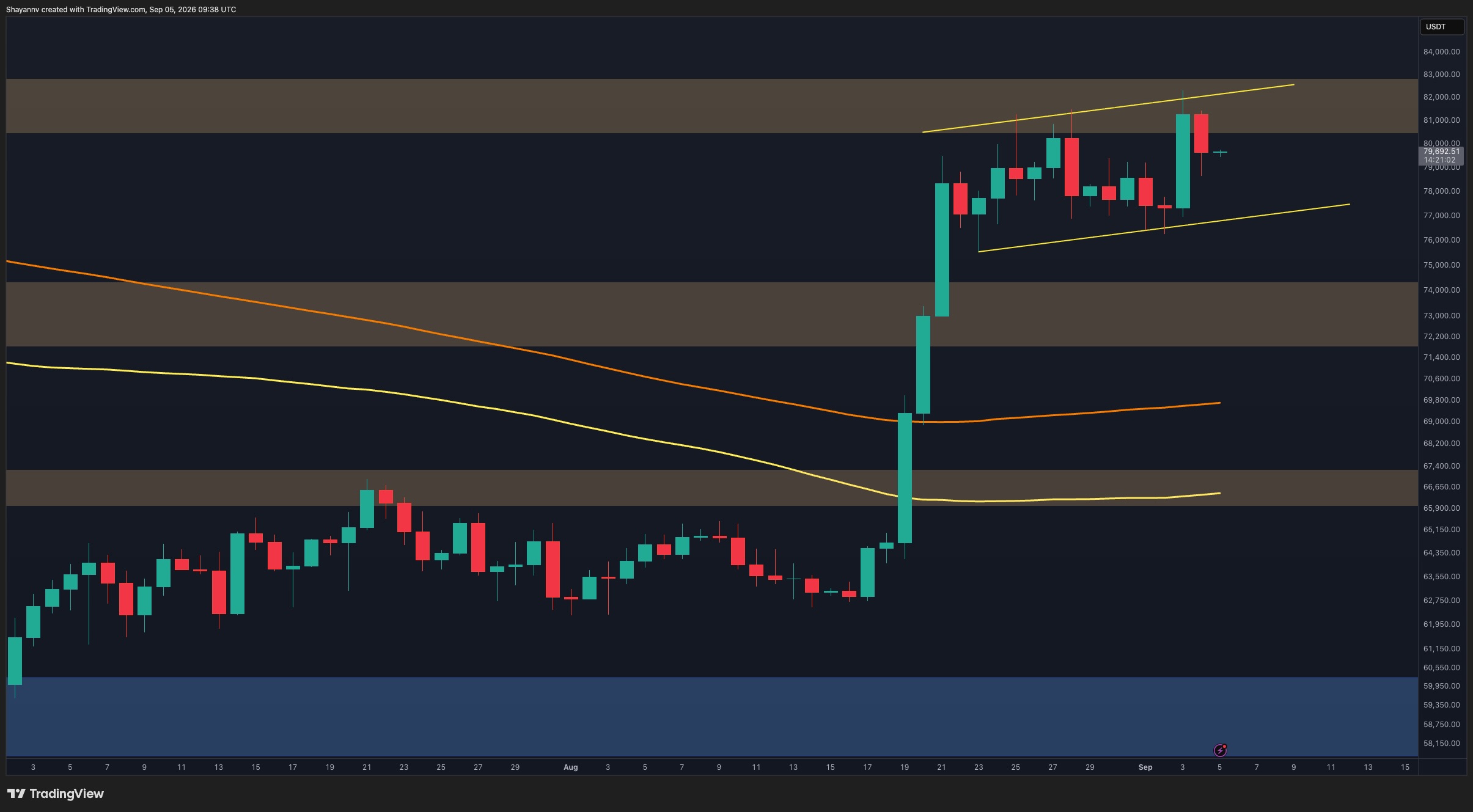
BTC/USDT 4-Hour Chart
The 4-hour chart highlights the market’s current indecision more clearly. BTC rallied from the lower boundary of the ascending structure near $76.5K-$77K and quickly tested the $81K-$82K area, only for sellers to reject the move once again.
Price subsequently dropped toward $79.5K and has entered a tight short-term consolidation. This creates a notable contrast between the rising channel structure and the repeated failures near its upper boundary. Buyers are still defending higher lows, but they have yet to demonstrate enough momentum to convert the $80.5K-$82.5K supply area into support.
The $76.5K-$77.5K region therefore remains crucial. Another test of this zone could determine whether the ascending structure survives. A strong reaction would keep a renewed push toward $81K-$82K in play, whereas a breakdown would indicate that the consolidation is transitioning into a deeper corrective phase.

Sentiment Analysis
The one-week BTC liquidation heatmap shows substantial liquidity on both sides of the current price, which supports the possibility of continued choppy trading and liquidity sweeps.
Above the market, notable liquidation concentrations appear around $81K-$82K and extend toward approximately $84K. These clusters could attract price if buyers regain momentum.
However, the downside liquidity is particularly relevant following the latest rejection. A broad and comparatively dense concentration is visible below the market, especially around the $76K-$78K region. This aligns closely with the lower boundary of the ascending technical structure.
As a result, a downside liquidity sweep toward $76K-$78K remains a plausible near-term scenario before another recovery attempt. Such a move would not automatically invalidate the broader bullish setup, but a sustained breakdown beneath this region would increase the probability of a deeper retracement toward the $72K-$74.5K support zone.

The post Bitcoin Price Analysis: The Good and the Bad for BTC After Latest $82.4K Rejection appeared first on CryptoPotato.
Binance Coin is among the top performers in the past 24 hours in the altcoin space, surging by over 6% and further extending its lead above XRP in terms of market cap placement.
This impressive rally on a rather dull Saturday after the Friday market rejection came following some positive news from Kalshi and the overall growth of the BNB Chain.
BNB Pops
The native token of the broader Binance ecosystem traded at $725 yesterday amid the market-wide revival that drove BTC to $82,400. However, the subsequent retracement prompted by the strong US jobs report pushed it south to $710. The asset found solid support there and exploded out of the gate, surging to $770 minutes ago for the first time since early February.

This Saturday’s rally is quite unexpected since most of the market is still in the red following yesterday’s bad news for risk-on assets. As such, the reason for BNB’s defiance is likely coming from outside factors, such as Kalshi’s move to launch perpetual futures contracts for the asset in the US, regulated by the Commodity and Futures Trading Commission.
Leverage is capped at around 4.5x for eligible US traders and comes after the platform added support for other altcoins such as ADA, AAVE, WLD, and VVV. Kalshi also supports BNB Smart Chain (BSC) integrations for managing deposits and withdrawals on international accounts.
BNB Chain Growth
The other probable reason comes from a Grayscale report cited by Wu Blockchain. As explained, BNB Chain is among the most widely used networks for trading tokenized equities.
The paper reveals that the weekly spot volume peaked at almost $3 billion in August, while only 5% of the market is currently deployed in on-chain finance. Robinhood Chain leads the pack, followed by BNB Chain and Solana.
Grayscale explained that further US regulatory clarity could “expand tokenized stocks from global, around-the-clock trading products into productive on-chain financial assets.”
Grayscale: Tokenized Equity Weekly Spot Volume Nears $3B, Only 5% Used in Onchain Finance
Grayscale said tokenized equity trading reached record highs in August, with weekly spot volume peaking near $3 billion, while only about 5% of the market is currently deployed in onchain… pic.twitter.com/ZcVA72DYTX
— Wu Blockchain (@WuBlockchain) September 4, 2026
The post BNB Hits 7-Month High After Major Kalshi Move and Explosive Chain Growth appeared first on CryptoPotato.
Although it was rejected at $1.70 a couple of weeks ago after its major mid-August surge, Ripple’s cross-border token is still up by 40% from its multi-year lows marked less than a month ago.
This has turned numerous analysts highly bullish. While this sounds quite expected for market observers like EGRAG CRYPTO, Ali Martinez’s recent price target is what got the community going.
XRP to $60!?
Martinez has recently been quite convinced that Ripple’s native token has already bottomed out during this cycle and is on its path to recovery. In a previous post, he noted that XRP’s breakout is confirmed and outlined a more modest target of $1.70. This one came actually after the asset reached that level on August 21-22, following its 70% surge in less than 72 hours.
However, it was violently rejected there and pushed south to under $1.35 last week. Its ability to maintain that level and the subsequent rebound to the current $1.40 gave bulls more hope, and Martinez joined the party.
In a post from earlier today, the analyst told his 166,000 followers that XRP has been “forming a massive ascending triangle on the monthly chart.” If it breaks above and closes north of the key barrier at $3.66, then it would “confirm the breakout and activate a technical target near $60.” Yes, that’s $60 per XRP.
XRP BULL MARKET TARGET: $60
For nearly a decade, $XRP has been forming a massive ascending triangle on the monthly chart.
The $3.66 resistance level is the key barrier. A monthly close above it would confirm the breakout and activate a technical target near $60. pic.twitter.com/RpAnbER9cv
— Ali Charts (@alicharts) September 5, 2026
Now, we are not trying to be the bearer of bad news, but $60!? Even if it takes another 10 years, it would require a near-4,200% surge from current levels. Moreover, its market cap, even if XRP’s supply remains the same, which it won’t, would be at around $4 trillion (yes, with a T). This would make it 2-3 times bigger than BTC’s current market cap, and its valuation would top even giants like Amazon and Microsoft.
Maybe $25?
Similar highly bullish (and a bit far-fetched) predictions typically come from other analysts, such as EGRAG CRYPTO. But even his most recent analysis was more modest than Martinez’s.
Basing his findings on XRP’s previous expansions, in which the asset exploded by up to 2,400%, the analyst outlined some major targets in his September 5 analysis. The highest of which is at $25 if XRP is to mimic the most significant rally from its 2017-2018 bull phase.
The other, slightly less bullish, targets are set between $11 and $15.8. Naturally, all of those sound a bit unrealistic at the moment, even though the market structure has shifted significantly over the past several weeks.
The post XRP’s Breakout Rally Has Begun, Analysts Say – But Their Targets Will Shock You appeared first on CryptoPotato.
Following the strong US jobs report from Friday and the hawkish stance taken by Federal Reserve Chair Kevin Warsh the week prior, the odds for a rate hike have grown significantly in just seven days.
Bitcoin’s price reacted to both developments with a minor leg down before it recovered some of the losses. An actual rate increase, though, could have a much more profound effect.
What Happens to BTC
The previous FOMC meeting in July was quite condensed, as it was described as the most unpredictable one in over six years. At the end, though, the Fed refused to change the rates, leaving them at 3.50%-3.75% following a 9-3 vote.
However, the fact that there were 3 policymakers in favor of such a monetary pivot was the first hint at a potential change. The rest came in the past week or so, as Warsh was quite hawkish during his first Jackson Hole speech at the end of August. The blowout US jobs report from yesterday only tilted the odds further, currently being at over 50% for a hike, since it gives the central bank leeway to keep fighting the stubborn inflation through a tighter monetary policy.
Next week’s CPI data will be crucial. The FOMC meeting will take place on September 15-16, and ChatGPT believes BTC’s initial reaction will be a nosedive. However, the AI platform added that it “would not expect another catastrophic bear-market leg.”
Instead, it noted that the key part of bitcoin reaction will be from the fact of whether the hike is “already fully priced in by then, and what Kevin Warsh says about what comes next.”
“At the moment, markets are putting roughly a 60% probability on a September hike after the surprisingly strong August jobs report. BTC is around $79,650 after already falling from above $81,000 as that probability increased.”
Precise Prediction
The popular AI chatbot noted that another 2%-5% decline is expected in ten days after the conclusion of the FOMC meeting if the Fed indeed proceeds with hiking the rates. This means that bitcoin would test the $75,000 support at first.
Another leg down to $72,000 could be in the cards if yields continue climbing by the end of September. Moreover, it could slip below $70,000 for the first time since mid-August if Warsh remains hawkish. Those scenarios are in case the Fed increases the benchmark by 25 bps.
In the more unexpected scenario in which the central bank hikes it by 50 bps, then ChatGPT expects BTC to slump by up to 15% very quickly, going to under $70,000 within a day or so.
“A drop to $68,000 could be instant, with leveraged liquidations potentially producing a temporary wick into the mid-$60Ks,” it warned.
Although all of those predictions sound quite worrisome for BTC, which finally had some fresh air during the mid- to late-August rally, it’s worth noting that the cryptocurrency is known for often moving in the opposite direction of what people expect from it.
The post We Asked AI: What Happens to Bitcoin’s Price if the Fed Hikes Rates in 11 Days? appeared first on CryptoPotato.