Cryptocurrency Posts
Crypto Briefing
Strive's innovative capital strategy could influence corporate Bitcoin adoption, balancing high-yield dividends with potential market volatility.
The post Strive’s SATA raises enough to buy 143 Bitcoin in 10-day streak appeared first on Crypto Briefing.
Payward's IPO delay underscores the volatility and structural challenges in the crypto market, impacting investor confidence and future listings.
The post Payward delays IPO to second quarter of 2027 at earliest appeared first on Crypto Briefing.
The deployment of advanced AI in cybersecurity could set a precedent for enhanced protection across various critical sectors globally.
The post New York Stock Exchange uses Anthropic’s Project Glasswing to enhance cybersecurity appeared first on Crypto Briefing.
Anthropic's AI collaboration with NYSE may enhance its market valuation and IPO prospects, influencing the cybersecurity landscape.
The post NYSE taps Anthropic’s AI to bolster cybersecurity defenses appeared first on Crypto Briefing.
The surge in DEX volume and TVL indicates growing confidence in DeFi, potentially leading to increased innovation and mainstream adoption.
The post August DEX volume hits highest level since March as TVL climbs $18B appeared first on Crypto Briefing.
Bitcoin Magazine
Bitcoin Magazine

Mexican Billionaire Ricardo Salinas Tells People To Escape Fiat Inflation With Bitcoin
Mexican billionaire Ricardo Salinas is at it again.
This time, the third richest man in Mexico told his followers that “fiat inflation is a hidden tax,” and the way to hedge against it was to buy bitcoin.
Salinas, the former chairman of home appliance and electronics retailer Grupo Elektra and Banco Azteca founder, told his followers to opt out and start protecting their savings.
“Bitcoin changes one fundamental rule: no one can print more just because they want to,” Salinas said in a video on X on Monday.
“While you have to work to earn more money, the system can simply create more of it. Don’t be fooled: learn, protect your savings, and defend your freedom, buy bitcoin and hold it.”
It’s not the first time Salinas has told his followers to be aware of government monetary policy.
The billionaire posts on X almost daily to millions of followers, and criticizing central bank money creation is one of his recurring themes, appearing in tweets, interviews, conference keynotes, and video messages.
In recent years, the entrepreneur has stepped up his criticisms of governments — and his praises of bitcoin. Earlier this year admitted he had increased his allocation in the asset from 10% to 70% of his portfolio.
Salinas’ bitcoin enthusiasm all stems from central bank monetary policy. Speaking at Bitcoin 2022, Salinas described traditional money as “the fiat fraud.”
“What they are doing is printing money out of thin air, and then making fake purchases,” he said of the Federal Reserve.
The business magnate has also talked about his success in “orange pilling” his friends and family.
“I convinced my wife to mortgage the house that she has and take a loan to buy bitcoin,” he once boasted in an interview.
This post Mexican Billionaire Ricardo Salinas Tells People To Escape Fiat Inflation With Bitcoin first appeared on Bitcoin Magazine and is written by Mathew Di Salvo.
Bitcoin Magazine

When the Banks Don’t Work, Bitcoin Does: Cornell University’s Adoption Index
A lot of people have heard of Bitcoin but even among those who hold it, knowledge is shallow.
Though for those holding the leading cryptocurrency, it appears to be solving a problem: getting around failing banking rails or inflation.
That’s according to new findings from the U.S. Ivy League research university Cornell, which spoke to nearly 26,000 around the globe about Bitcoin.
In its new Bitcoin Adoption Index report, the top college found that El Salvador, Venezuela and Nigeria were the countries that had the highest number of people who had ever owned bitcoin.
“Ranked by the share of all respondents who have ever owned bitcoin, the leaders are not wealthy financial centers — they are economies where the national currency has been unstable and everyday access to dollars or reliable banking is hard,” the report read.
“In each, bitcoin functions less as a speculative bet and more as a practical workaround.”
Still, Cornell found that actually being able to explain the fundamentals of the protocol was difficult for most — including how many bitcoins would ever be minted in existence. In fact, 58% of those surveyed said they didn’t know the supply was capped at 21 million coins.
But technicalities aside, the cryptocurrency has still proved helpful to people wanting to use it, the report found.
One Venezuelan — who wasn’t named — told interviewers that Bitcoin was “faster, cleaner, and much less risky” than other methods of getting dollars in the country.
While another Salvadoran was quoted saying: “When nobody controls [bitcoin], it means we all have control of it.”
And a Nigerian interviewee reportedly told Cornell researchers: “I’ve been to six African countries and whenever I go there, I don’t fear it because I know I can spend my bitcoin.”
Bitcoin adoption started growing in Venezuela ahead of other countries years ago, when hyperinflation crippled the economy and strict government currency controls meant getting dollars became difficult.
El Salvador made bitcoin legal tender — along with the dollar — in 2021. The country’s leader admitted that getting its citizens to use the cryptocurrency was difficult but the Central American nation still says it buys the asset for its government coffers.
In Nigeria, which has had some of the highest transaction volumes in the world, saving in bitcoin has been used by some to get around the collapse of the naira.
Cornell University’s research was fielded by Morning Consult in partnership with the Tech Policy Institute in Cornell University’s Jeb E. Brooks School of Public Policy, the Cornell Bitcoin Club, the Human Rights Foundation and the Reynolds Foundation.
Researchers interviewed 25,880 people in 25 countries between December 16, 2024 to March 10, 2025, asking 125 individual questions.
This post When the Banks Don’t Work, Bitcoin Does: Cornell University’s Adoption Index first appeared on Bitcoin Magazine and is written by Mathew Di Salvo.
Bitcoin Magazine

Capital B Raises €7.6M From Adam Back to Fund Another Bitcoin Buy
Top bitcoiner Adam Back has invested €7.6 million ($8.8 million) in Capital B, the Euronext Growth-listed company that bills itself as Europe’s first bitcoin treasury company.
The company said Wednesday that the investment will be used to buy more bitcoin. Adam Back is the CEO of bitcoin infrastructure company Blockstream, and one of the biggest and well-known figures in the space
Capital B’s announcement comes after the company last week said it had raised €21 million ($24 million) in a private placement backed by Blockstream’s Adam Back and asset manager TOBAM.
— Capital B (@_ALCPB) August 28, 2026
Capital B announces a €21.0 million capital raise with global institutional investors, including strategic investors Adam Back and TOBAM, to accelerate its Bitcoin Treasury Company strategy
Full Press Release (EN): https://t.co/XQGT44ma4d
Full Press Release (FR):…

“The proceeds of the Private Placement will be used primarily to strengthen Capital B’s balance sheet through the accumulation of bitcoin as a long-term reserve asset,” the company said in a statement.
“This capital increase is a key step in implementing the company’s Bitcoin Treasury Company strategy, focused on increasing the number of bitcoin per share on a fully diluted basis over time.”
It added that the placement would fund it buying 376 additional bitcoins, taking its potential holdings to 3,521 coins from its current stash of 3,145.
Capital B is the 26th biggest publicly traded bitcoin treasury in the world, according to Bitcoin Treasuries, with a total of 3,145 bitcoins in its coffers — worth $242 million at today’s bitcoin price of $76,959.
Capital B built much of that position through fundraising rounds during the first half of 2026.
In May, it acquired 192 coins for €13 million after completing three capital raises.
Capital B’s is trying to build a bigger bitcoin position as other treasuries look to raise funds and accelerate their buys.
NYSE-listed AI-powered education company Genius Group last week said it was aiming to build parallel AI and bitcoin treasuries worth a combined $1.6 billion, after the company sold its entire bitcoin reserves to repay $8.5 million in debt.
The Bitcoin treasury model has taken a hit since last year when the price of the leading cryptocurrency took a hit.
A number of companies in the space have had to liquidate their holdings — including the biggest corporate holder of bitcoin, Nasdaq-listed Strategy.
This post Capital B Raises €7.6M From Adam Back to Fund Another Bitcoin Buy first appeared on Bitcoin Magazine and is written by Mathew Di Salvo.
Bitcoin Magazine

The Quantum Issue: Letter From The Editor
Quantum this, quantum that…who put a stupid cat on-chain!?
Ahem.
Alright, let’s be serious. The threat that a viable, actually functioning, quantum computer would pose to Bitcoin if it were to be built is very serious. It is the concrete example of an existential threat, in every sense of the word.
One of the bedrock foundations that Bitcoin rests upon is the assumption of a functioning cryptographic system that can be used to produce unforgeable signatures, i.e. that if you follow that system’s protocol properly when signing things, there is no way that anyone but a bitcoin’s rightful owner could produce a signature needed to spend it unless the rightful owner failed to secure their private key from theft.
Quantum computers toss that right out the window. There goes the integrity of the entire mechanism that is used for owners of bitcoin to authenticate their ownership for the protocol to process their legitimately authorized transactions, and ONLY their legitimately authorized transactions. There’s no way for anyone to actually own anything in the context of the Bitcoin protocol if that assumption breaks.
Bitcoin breaks if that assumption breaks.
Thankfully, there are many different cryptographic systems that exist, and not all of them rest on assumptions that a quantum computer breaks. That’s the good news. The bad news is that its all a set of tradeoffs, none of them are ideal, and there are going to be some hard choices that have to be made.
But there are solutions to just about every one of the problems that a viable quantum computer would create…except the problem of choosing which solutions to use. So in light of that, here is The Quantum Issue.
This issue is a lot more structured than most past issues, and that is to ensure that it guides a reader through the entirety of the problem space and solution space without assuming any prior understanding (this is a very deep and technical subject).
The first set of articles goes through the general issue of quantum computing itself, how it differs from classical computing, why that matters, how likely it is one is developed soon, etc.
The second set examines Bitcoin’s exposure. How is it exposed? How badly is it exposed? How can that degree of exposure change?
The third set examines concrete (or developed enough to not be too hard to get to a concrete place) solutions to securing your bitcoin in a quantum safe way, and handling a network wide migration to those solutions.

Don’t miss your chance to own The Quantum Issue — featuring articles written by many influential figures in the space working on the necessary pieces for a post-quantum Bitcoin!
This piece is the Letter from the Editor featured in the latest Print edition of Bitcoin Magazine, The Quantum Issue. We’re sharing it here as an early look at the ideas explored throughout the full issue.
This post The Quantum Issue: Letter From The Editor first appeared on Bitcoin Magazine and is written by Shinobi.
Bitcoin Magazine

Strategy CEO Defends Bitcoin Sale as the ‘Right Trade’
The CEO of bitcoin treasury Strategy brushed off concerns investors may have about the company selling some of its stash, instead telling reporters that the move was to strengthen its balance sheet.
Speaking to Bloomberg on Tuesday, Phong Le said that the company now has a “bullet-proof balance sheet” and it was the “right trade at the time” to sell bitcoin when it did.
Strategy, the largest corporate holder of bitcoin, restarted its buying the cryptocurrency on Monday after a 10-week pause. After halting its buys in June, it instead sold small amounts of its bitcoin and built two cash reserves.
“We don’t really make decisions specifically on bitcoin’s price,” Le said.
He added: “We’re a net accumulator, and so I don’t sit around and say, ‘Well, when am I going to sell Bitcoin next?’ It comes down to a bit of a capital management mathematical equation of when we would do it.”
“I don’t foresee us selling bitcoin as we enter into what I consider a pretty heavy bull market.”
Strategy — formerly MicroStrategy — is an enterprise software company that pivoted to buying and holding bitcoin in 2020.
It first bought the cryptocurrency to protect its shareholders from inflation but has since aggressively bought the asset and pivoted to being a bitcoin treasury. It is now the largest corporate holder of the cryptocurrency, with 845,050 bitcoins worth $65.1 billion at today’s prices.
Investors can buy Strategy’s Nasdaq-listed stock (MSTR) to get heightened exposure to bitcoin’s performance.
This year, Strategy has bought back some of its preferred stock, STRC, which is trading at a discount, and increasing its dollar cushion.
In the company’s quarterly earnings in July, Strategy posted a $8.22 billion loss. But Le said the firm’s current paper loss wasn’t important for the time being, and that next year, its stock would soar again.
“We’re the J.P. Morgan of the crypto economy, so whether we sell 1,000 Bitcoin out of 840,000 to me is irrelevant to the conversation,” Le said.
Strategy stock (NASDAQ: MSTR) was trading 2% lower on Wednesday. Year-to-date, the stock is down 22%.
This post Strategy CEO Defends Bitcoin Sale as the ‘Right Trade’ first appeared on Bitcoin Magazine and is written by Mathew Di Salvo.
CryptoSlate
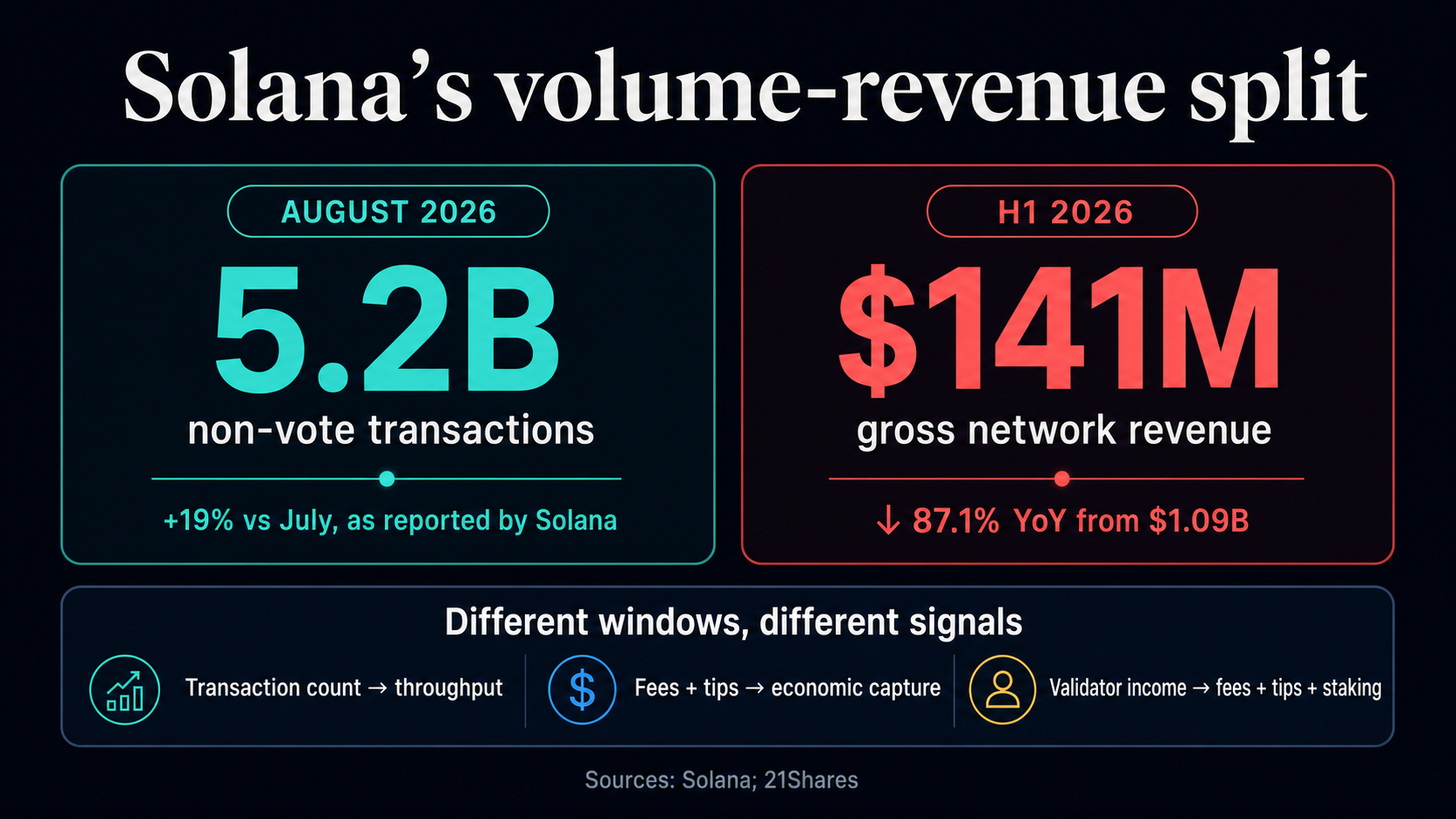
Solana says it processed a record 5.2 billion non-vote transactions in August, a total it described as 19% above July.
The milestone arrived with a sharply different measure: 21Shares calculated that gross network revenue, including fees and tips generated by network use, fell to $141 million in the first half of 2026 from $1.09 billion a year earlier.
The figures cover different periods. The transaction count captures the month ended Aug. 31, while the revenue comparison covers the six months through June. Together, they show activity accelerating after a half-year in which Solana generated far less fee and tip revenue than during the memecoin boom a year earlier.
Why Solana’s activity and revenue diverged
Non-vote transactions remove validators' consensus messages from the count, giving a cleaner view of application activity. The metric can still include successful and failed transactions, and it measures neither unique users nor value transferred. Identifying transfers, trades and other actions requires program-level analysis, according to documentation from Dune and Token Terminal.
21Shares traced the revenue decline to weaker competition for blockspace. It said priority fees and Jito tips, extra payments routed through Solana's transaction-ordering infrastructure, produced 95% of H1 2025 gross revenue, split 40% and 55%. Memecoin traders paid those charges to move ahead in crowded blocks; that high-value fee stream contracted as the frenzy cooled.
The trading mix changed as well. The firm said memecoins fell from 40% of Solana spot trading volume in H1 2025 to 16% in H1 2026, while stablecoin swaps rose from 6% to 19%. 21Shares said the categories replacing memecoins generated less revenue per trade.
A like-for-like quarterly comparison supports the same trend. A DeFi Development Corp. shareholder letter filed with the SEC put Solana's Q2 network revenue at $51 million, down 43% from the first quarter and 81% year over year, while the median transaction fee was $0.00043.
Shorter-term validator fee data improved by late August. Solana Compass reported that a seven-day average reached about 9,200 SOL per day, more than 80% above three months earlier. That SOL-denominated figure includes priority fees and Jito tips, while the 21Shares measure covers six-month gross revenue in dollars, leaving the two unsuitable for direct comparison.
Validator economics extend beyond those charges. Under Solana's fee rules, half of the base fee goes to the block producer and half is burned, while the full priority fee goes to the validator. Validators can also earn commissions on inflationary staking rewards.
For SOL, the throughput record is operationally positive. Economic capture still depends on what users pay for blockspace, how much SOL is burned or staked, and whether rising stablecoin, DeFi and payment activity produces durable fees. Transaction count alone remains a weak proxy for validator income or token demand.
The post Solana processed 5.2 billion transactions after revenue collapsed 87% – here’s what changed appeared first on CryptoSlate.
Uniswap's new swap record is testing whether the protocol's wider fee footprint can turn rising activity into measurable UNI burns.
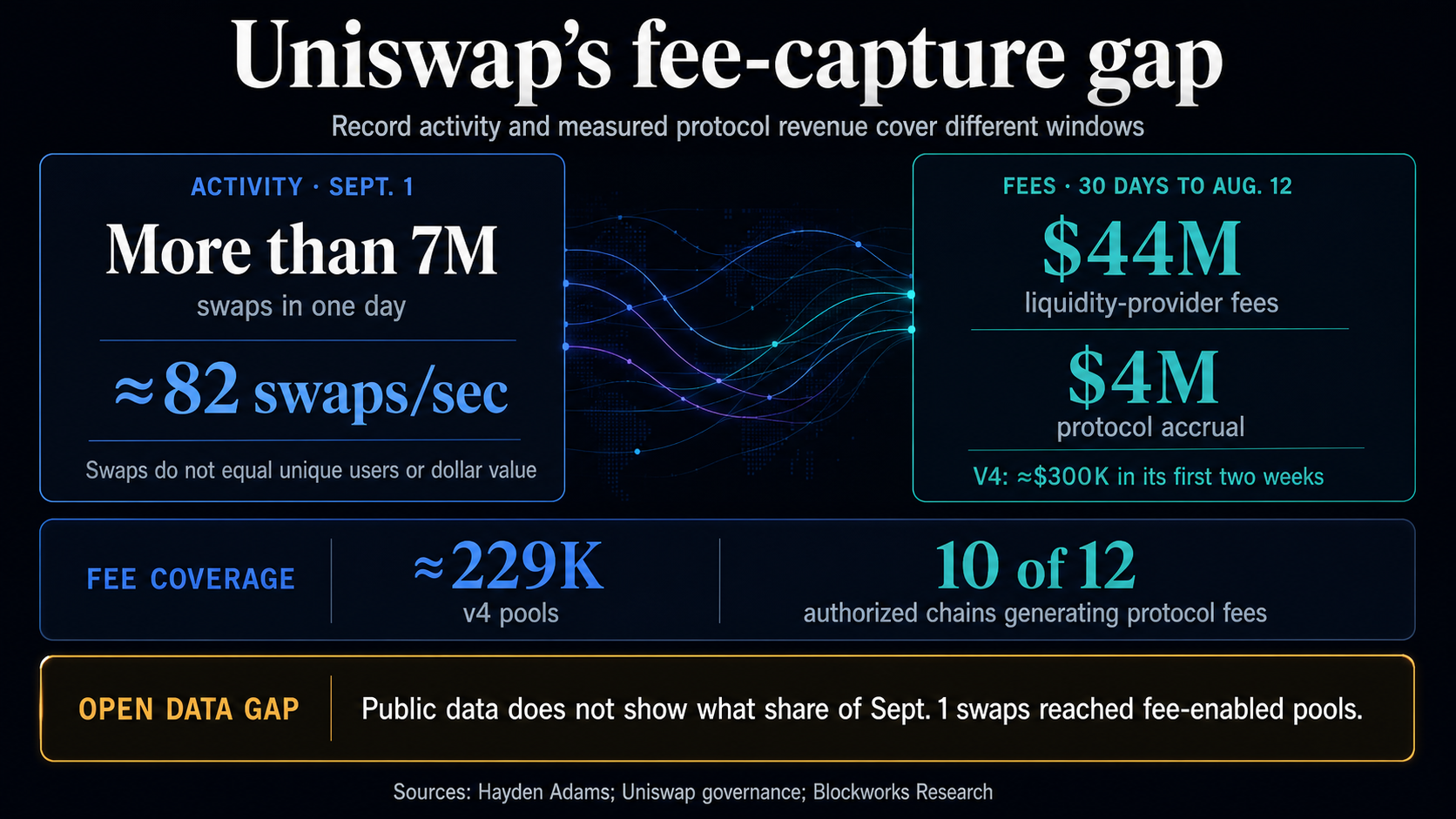
Uniswap founder Hayden Adams said Tuesday that the decentralized exchange was handling roughly 82 swaps per second across chains. He was responding to Blockworks Research analyst Marc Arjoon, who said Uniswap had recorded more than 7 million swaps in one day and its two busiest days by swap count.
Seven million swaps over 24 hours works out to at least 81 per second, making Adams' rounded rate consistent with the reported daily total. The metric counts swaps, however, not unique users or the dollar value traded.
The milestone follows a rapid expansion of protocol fees. A July 7 governance discussion said fees were live across all v2 and v3 pools on 11 chains. On July 27, governance separately added Robinhood Chain for v2 and v3.
Governance also executed the first part of the v4 fee proposal that day, activating fee controllers on Ethereum, Arbitrum, Base, BNB Chain, Polygon, Optimism and Robinhood Chain. Five other chains were deferred to a later proposal.
Blockworks reported Aug. 12 that v4 fees had been activated across roughly 229,000 v4 pools, 10 of 12 authorized chains were generating protocol fees and nearly all pools across Uniswap versions contributed some portion of swap fees to the UNI burn.
Broad coverage does not establish that most of the record day's swaps occurred in fee-enabled pools or show how much protocol revenue they generated. Available public Uniswap and Blockworks pages do not join the Sept. 1 swap count with fee status, volume and protocol fees over the same window.
What the Uniswap swap record says about protocol revenue
Blockworks' Aug. 12 data primer measured about $44 million in fees earned by liquidity providers over 30 days and roughly $4 million accruing to the protocol. V2 and v3 produced $3.64 million of the protocol total, while v4 added about $300,000 during its first two weeks.
The $4 million figure is protocol accrual and the $44 million figure is LP fees. Neither is gross trading volume, router flow or swap count. Under Uniswap's fee design, liquidity providers retain most v2 and v3 swap fees while the protocol receives a defined share. V4 applies a governance-controlled protocol fee separately.
In a July 18 update, Uniswap Labs said protocol fees had funded about 7.5 million UNI in burns since December, worth roughly $25.6 million at the valuation it used. It said monthly protocol fees rose from about $3.1 million in February to $5.1 million in June.
For recurring burns, fee assets accumulate in TokenJar. A third party can claim those assets by burning UNI through Firepit. That process is separate from the one-time 100 million UNI treasury burn approved through UNIfication as a retroactive estimate.
Record activity could expand Uniswap's fee base, but the available data does not quantify how much Sept. 1 activity reached it. For now, value capture is measurable through the dollars accrued to the protocol and the UNI burned, not as a percentage of the latest swaps.
The post Uniswap trading volume explodes to record levels over 7 million per day – but actual fees lag far behind appeared first on CryptoSlate.
The TAC network halt continues at block 24,671,475, more than 10 days after an exploit emptied the bonded staking pool. The network is an EVM-compatible Layer 1 connected to the TON ecosystem. An RPC query by CryptoSlate at 2:33 a.m. UTC still showed the final block from Aug. 22, meaning normal block production had not resumed.
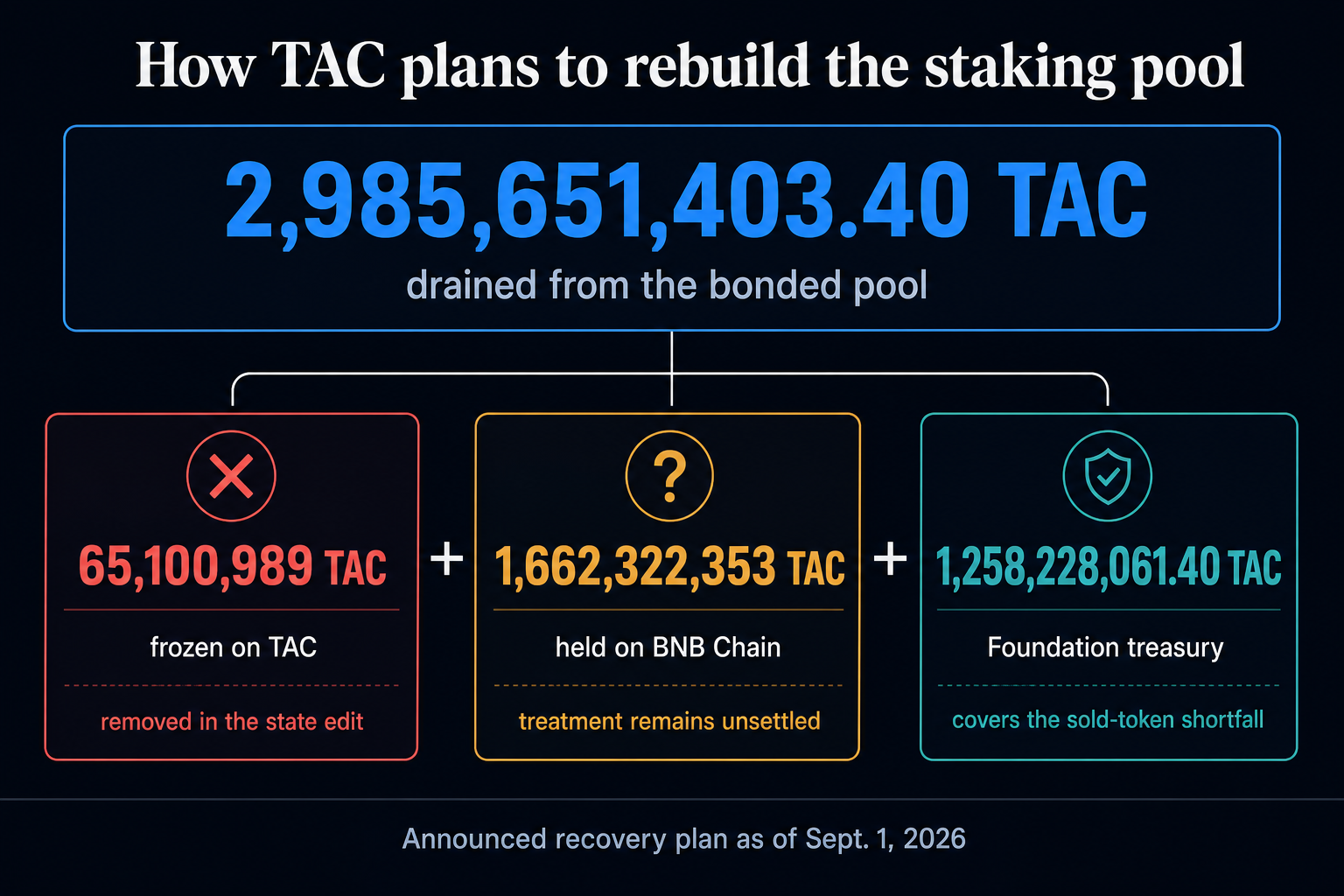
The network's Sept. 1 postmortem put the drain at 2,985,651,403.40 TAC, or 28.6% of supply. TAC said one transaction reduced the bonded pool to zero without changing total token supply, leaving the chain's delegation records without the tokens that backed them.
The upstream Cosmos EVM advisory attributed the attack path to a mismatch between two balance records. The EVM StateDB tracked only an account's spendable tokens, while the Cosmos SDK ledger also tracked locked vesting tokens that could be delegated. Delegating more than the spendable amount caused an unchecked subtraction to wrap toward an enormous number close to 2^256.
Cosmos Labs said a second overflow operation then let an attacker zero a victim account while retaining its legitimate tokens. TAC identified the protocol-controlled staking pool as the victim account on its network. The advisory classed the flaw as critical and said Cosmos EVM versions below 0.6.2, plus versions 0.7.0 and 0.7.1, were vulnerable.
The disclosure trail predates the attack. Cosmos Labs' postmortem said the bug reached its bounty program on April 25, was patched on the main branch May 15 and was backported into releases on Aug. 19. A Push Chain fork publicly described the path on Aug. 20. TAC separately said it sent a maintainer an analysis of two related defects in July without acknowledgement.
TAC network halt recovery leaves BNB Chain balance unresolved
TAC said the attacker sold 1,208,329,197 TAC on BNB Chain for 950,293 USDT and another 49.9 million TAC on TON for 55,481 USDT. The reported proceeds total 1,005,774 USDT.
The proposed recovery splits the drained pool three ways. A targeted state edit would remove 65,100,989 incident-linked TAC frozen on TAC. Another 1,662,322,353 TAC remains in incident-associated BNB Chain addresses and will be handled separately. TAC said the remaining 1,258,228,061.40 TAC, representing tokens sold from the pool, would be replaced in full from TAC Foundation treasury reserves.
Unlike a rollback, the proposed edit would correct specified balances at the halt block without rewinding the chain. TAC said that would restore the bonded pool and delegator balances while preserving 7,772 legitimate transactions from 218 unrelated addresses.
Ending the TAC network halt still depends on validators adopting TAC's patched binary, resuming block production and executing the edit. Bridging and redemption remain disabled, and TAC has not settled how the 1.662 billion TAC on BNB Chain will be treated. The treasury commitment therefore addresses the sold-token shortfall, not the larger attacker-held balance outside the network.
The post TAC blockchain remains frozen for over 10 days after a massive exploit forces a 1.26 billion token bailout appeared first on CryptoSlate.
The US Securities and Exchange Commission (SEC) wants to let Wall Street’s official shareholder records move onchain while keeping regulated transfer agents in control.
On Sept. 1, the financial regulator proposed its first major overhaul of transfer-agent rules since regulations were adopted in the late 1970s and early 1980s, explicitly allowing blockchain or other distributed-ledger technology to serve as a company’s master securityholder file, or part of it.
That would bring tokenized securities deeper into the machinery that determines who legally owns shares, rather than limiting blockchain to a parallel record or digital representation.
One recordkeeping transfer agent would still retain exclusive control over the official shareholder file and remain responsible for its accuracy, security, and production to regulators.
SEC Chairman Paul Atkins said the proposal reflects the growing use of electronic communications and blockchain technology in securities offerings and share transfers. The broader rewrite would also replace paper-based requirements with electronic recordkeeping standards and update reporting around tokenization and distributed ledgers.
Securitize, a registered transfer agent already using blockchain infrastructure for digital securities, said the proposal moves regulation toward a model it has advocated to the SEC. Securitize is a tokenized real-world asset manager, with over $4 billion in assets under management.
The company has previously argued that public blockchains should be incorporated into securities recordkeeping while transfer agents continue overseeing the official ownership record.
“Modernization should raise standards, not lower them,” Securitize said, calling the regulatory shift and growing adoption of digital securities a tailwind for the sector.
Blockchain enters the official shareholder ledger
The proposal would formalize a direction SEC staff had already signaled.
Staff guidance has allowed registered transfer agents to use distributed-ledger technology as the official master securityholder file without maintaining a separate offchain duplicate, provided they meet existing regulatory requirements.
Transaction data, including wallet addresses, balances, ownership percentages, and purchase information, can reside onchain while sensitive personal information remains in separate systems.
The proposed rules would put that approach directly into the transfer-agent framework.
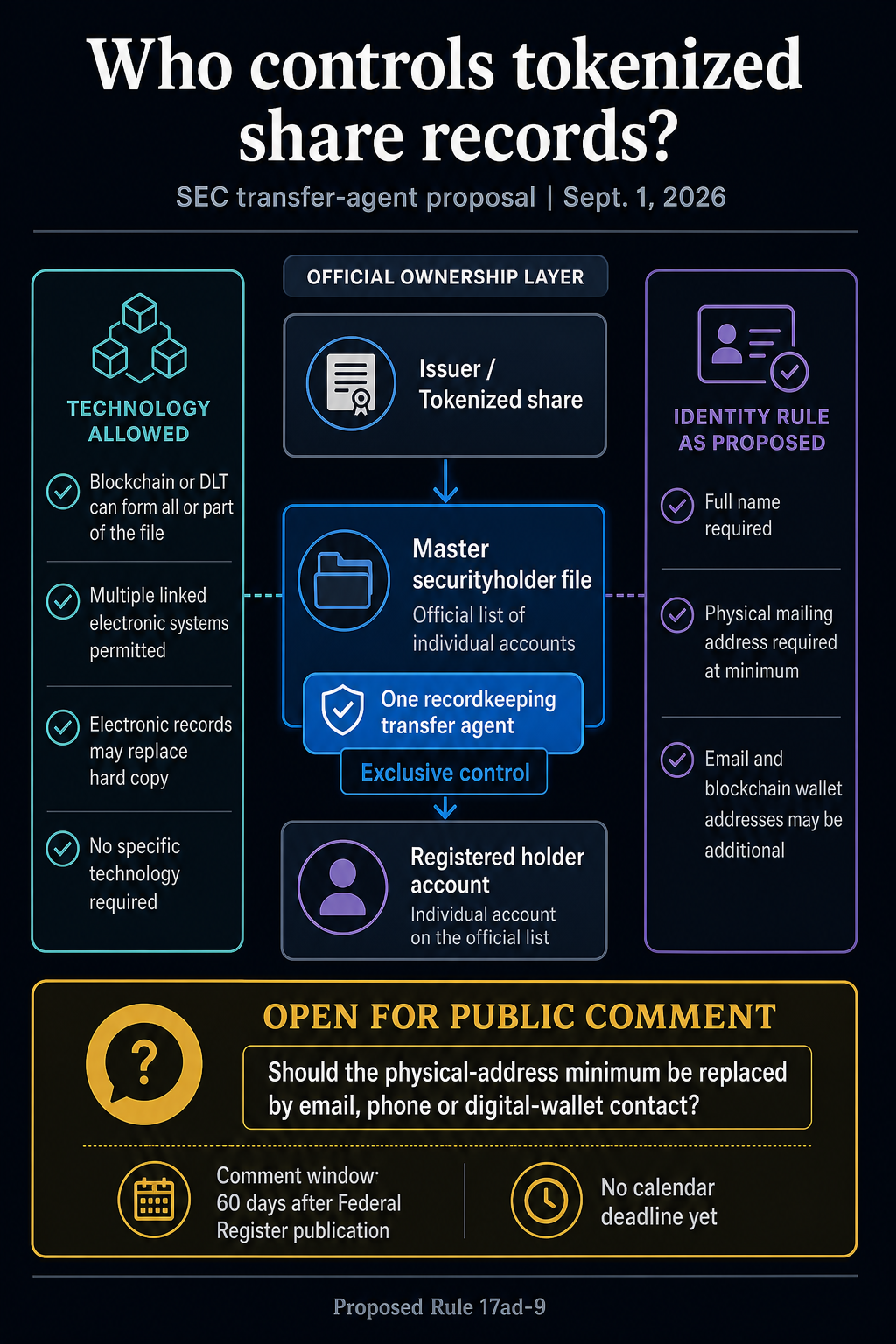
However, they would not mandate blockchain. Instead, transfer agents could choose the technology used to maintain their records, but the SEC said the system must remain secure, current, and accessible whether the underlying infrastructure is a conventional database or a distributed ledger.
Transfer agents would also have to give regulators more visibility into tokenization. Proposed changes to Form TA-2 would require reporting around securities using distributed ledgers, tokenization agents and platforms involved in those arrangements.
The technology provider would not inherit the transfer agent’s regulatory responsibility simply because the shareholder record runs through its infrastructure.
Wallet-only shareholders will have to wait
The proposal stops short of making corporate ownership fully wallet-native.
The SEC’s drafted framework would continue requiring the master securityholder file to include a holder’s full name and contact information, including a physical mailing address.
This means that a digital-wallet address can form part of the identifying information attached to a tokenized security, but it would not replace those traditional identity requirements.
The agency is nevertheless asking whether that should change.
Among the questions opened for public comment is whether transfer agents should have to collect a shareholder’s full name and physical mailing address and what consequences eliminating those requirements could have for other securities laws and market participants.
Commissioner Hester Peirce has separately raised the possibility of using email or digital-wallet addresses instead of names and physical addresses in some circumstances to facilitate onchain securities trading.
That leaves the SEC drawing a line between modernizing the shareholder ledger and replacing the identity system built around it.
Under the proposal, blockchain could become the authoritative infrastructure recording legal share ownership. The regulated transfer agent, however, would remain the gatekeeper connecting those on-chain positions to identifiable shareholders.
Comments are due 60 days after publication in the Federal Register. As of Sept. 1, the SEC had not provided a fixed publication date.
The post The SEC is rewriting 50-year-old Wall Street rules to let public blockchains decide who legally owns a stock appeared first on CryptoSlate.
Corporate political donations hit a record $646 million over the 18 months through June, according to Public Citizen's analysis of FEC filings. Crypto political spending led every other corporate sector at $206 million, while crypto, AI, and online betting together accounted for $344 million, more than half the total.
The GENIUS Act already created a federal regulatory framework for payment stablecoins, the SEC is rewriting crypto rules under Chair Paul Atkins, and the CFTC is pushing to bring more digital asset trading onshore. The Senate also faces a Sept. 15 cloture vote on the motion to proceed to the CLARITY Act, a procedural step requiring 60 votes to limit debate.
Three years ago, the industry's Washington agenda was simple: stop regulating through enforcement and say what rules apply. Founders interviewed for this piece describe a different ask now, one that treats today's wins as a starting point Congress needs to make permanent.
Crypto political spending seeks durable rules
Utkarsh Ahuja, founder of Moon Pursuit Capital, said the industry has moved past asking for rules.
He told CryptoSlate:
“Founders are building companies on five- and ten-year timelines, and investors are deploying capital on similar horizons.”
A regulatory framework that can swing with each new administration gets priced directly into where that capital goes. Serious long-term bets are hard to make when asset classification, agency jurisdiction, and compliance requirements could all move again in four years.
Ahuja framed the goal in terms of credibility:
“The US doesn't need to be the easiest jurisdiction for crypto, but it should aim to be the most credible and predictable.”
SEC Chair Paul Atkins said on Aug. 18 that legislation remains indispensable to creating rules “future-proofed” enough that a future regulator cannot simply undo the current SEC's work.
That an administration official and an industry investor are converging on the same point independently gives the durability argument real weight beyond standard lobbying language.
| Earlier crypto agenda | New congressional agenda |
|---|---|
| Stop regulation by enforcement | Make today’s rules durable through statute |
| Define whether tokens are securities or commodities | Lock in SEC/CFTC jurisdiction before administrations change |
| Get a federal stablecoin framework | Keep stablecoin rules open to new entrants |
| Win permission to operate | Gain access to banking, charters and payment rails |
| Protect exchanges and issuers | Protect noncustodial software and settlement infrastructure |
| Make crypto payments usable | Update tax rules for microtransactions and machine payments |
The Sept. 15 vote shapes what comes next
The House passed the CLARITY Act 294-134 in July 2025. The bill would create a system letting the SEC and CFTC jointly regulate the offer and sale of digital commodities, resolving the jurisdictional fight that has defined crypto lobbying for years.
Ahuja, Ryan Kirkley of Global Settlement Network, and Parth Kapadia of OpenVPP all named finishing market structure as their priority, independently of each other.
Whether the Senate clears cloture on Sept. 15 will shape which fight the next Congress inherits.
If cloture clears and the bill later becomes law, market structure could stop being the answer to every question about crypto's agenda, freeing attention for banking access, tax rules, and noncustodial protections.
Fail it, and finishing market structure remains the industry's dominant fight straight through the midterms, with committee control and chamber leadership suddenly carrying much higher stakes for crypto than they did a year ago.
| Scenario | What happens politically | What crypto focuses on next |
|---|---|---|
| CLARITY clears cloture and advances | Market structure looks more likely to be settled before the midterms | Banking access, payment rails, tax treatment, noncustodial protections and implementation |
| CLARITY clears cloture but stalls later | The industry gains momentum but not permanence | Keeping pressure on Senate leadership and preventing the bill from being rewritten |
| CLARITY fails cloture | Market structure remains unresolved heading into the election | SEC/CFTC jurisdiction, asset classification and committee-control fights |
| CLARITY fails after control of Congress shifts | Negotiations may reset under new leadership | Rebuilding the coalition and defending earlier policy gains |
Crypto wants infrastructure access
Kirkley wants federal regulatory sandboxes that let startups test settlement infrastructure under supervision “without needing a megabank's compliance budget on day one,” modernized bank charters, and direct access to payment rails.
He added that “ambiguity taxes every founder building here.”
That means crypto companies want the same infrastructure access banks already have, well beyond a regulator's acknowledgment that they can operate legally.
Kirkley also warned that stablecoin rules need to stay workable for new entrants, since GENIUS implementation could otherwise harden into an incumbent moat and close off the open market it was supposed to create.
Total stablecoin market capitalization sits near $303.7 billion, and 21 financial institutions, including Goldman Sachs, Bank of America, Citi and Deutsche Bank, announced on Sept. 1 plans to launch a jointly owned dollar-pegged stablecoin by early 2027.
BIS chief Pablo Hernández de Cos has separately argued that stablecoins do not yet credibly function as a means of payment at scale, while presenting tokenized deposits as a more promising path. That view reminds us that Washington's stablecoin enthusiasm is not universally shared.
Congress still writes crypto tax law for people
Kapadia's example involves a homeowner's battery enrolled in a virtual power plant, automatically earning thousands of tiny crypto-denominated payments for exporting electricity or responding to grid conditions.
Cynthia Lummis's pending digital asset tax proposal includes a $300 de minimis exemption meant to spare consumers from tracking every small crypto transaction, but it excludes property held for income production.
Kapadia argued that the carve-out excludes households earning automated crypto income from physical infrastructure, since the enrolled battery counts as income-producing property.
His proposed fix is an aggregation rule treating a year of micro-settlements as a single basis event, though how any enrolled battery gets classified in practice still needs confirmation from tax counsel.
Kapadia also wants a federal path for noncustodial settlement platforms, arguing a system that orchestrates payments without ever holding customer funds should not need money-transmitter licenses in fifty states. Congress has already begun addressing this.
The Blockchain Regulatory Certainty Act, introduced by Lummis and Wyden, would exempt developers and infrastructure providers without control over user funds from money-transmitter status.
CLARITY's Senate materials describe similar protections for software developers who never control customer assets. Kapadia's request builds on that foundation, aiming to make those protections durable enough to survive state-by-state licensing fights that recreate the same problem elsewhere.
His final ask involves tokenized assets tied to physical performance, like renewable energy certificates and verified megawatt-hour receipts, which he wants classified on the commodity side of the line.
Tokenized real-world assets have already more than tripled since the start of 2025, reaching nearly $39 billion as of Sept. 1.
Market structure, in other words, also touches receipts for electricity, grid capacity and other machine-measured outputs.
| Policy area | Industry ask | Why it matters |
|---|---|---|
| Banking and payment rails | Modernized charters and direct access to payment infrastructure | Prevents crypto firms from depending entirely on incumbent banks |
| Stablecoins | Rules workable for startups, not only large banks and issuers | Keeps GENIUS from becoming an incumbent moat |
| Federal sandboxes | Supervised testing for settlement and tokenized products | Lets startups experiment without megabank-scale compliance costs |
| Crypto taxes | Aggregation or de minimis treatment for machine-scale payments | Makes thousands of tiny automated transactions economically usable |
| Noncustodial settlement | Federal protection for platforms that never control user funds | Avoids 50-state money-transmitter fights for software-based systems |
| Tokenized physical assets | Commodity-side treatment for verified energy and performance receipts | Extends market structure beyond tokens, stocks and Treasuries |
Whether crypto political spending delivers durable rules
One path has cloture clearing Sept. 15 and the bill later becoming law, giving the next Congress room to work through banking access, tax treatment and noncustodial protections beyond relitigating basic jurisdiction.
Under that path, institutional capital gains the predictability Ahuja describes, and the industry's political spending starts converting into legislation a future administration cannot casually unwind.
Another path has cloture failing, or CLARITY stalling short of full passage, leaving market structure as the industry's dominant fight into a midterm election that could hand committee gavels to different hands entirely.
In that scenario, Ahuja's durability problem stays unresolved, capital keeps discounting US crypto policy for its volatility, and the industry's record political spending buys attention without buying the permanence founders say they need.
Crypto's next fight is over how much of the financial system it gets permitted to help rebuild.
The post What the $344M crypto political spending spree wants from Congress next appeared first on CryptoSlate.
HTTP error 429 on https://cryptoticker.io/en/feed/
Failed to fetch feed: https://cryptoticker.io/en/feed/
Failed to fetch feed.
Decrypt
The bank-led consortium wants a U.S. dollar token live by the first half of 2027, with a euro version queued up next.
Phong Le said Strategy’s cost of capital—not Bitcoin’s price—drove its decision to sell nearly 7,000 BTC before resuming purchases above $80,000.
Bitcoin traders are calling August's spike-and-fade a Bart Simpson hairline. Here's what separates an actual flash crash from an ordinary correction.
Groups including The Crypto Council for Innovation, Grayscale, and a16z urged the regulator to preserve existing fund classifications and streamline reviews for new exchange-traded products.
The unreleased model can find zero-day vulnerabilities and chain them into working exploits without a human walking it through each step, and access to that capability is starting with a small group of testers.
U.Today - IT, AI and Fintech Daily News for You Today
Tether’s USDT ecosystem is expanding to Stellar, giving users access to more than $180 billion in stablecoin liquidity through USDT0.
Trading activity on the XRP Ledger surged in the second quarter, with average daily order-book volume rising 79% from a year earlier even as the number of accounts executing trades fell.
Bitcoin is breaking out of its bear market as giant buyers completely absorb the retail panic.
Kalshi traders are betting on Bitcoin reaching a high of $82,000 this month, amid growing expectations for another price recovery across major assets.
Former Ripple CTO backs Tether's $42 million warrantless freeze in SDNY lawsuit, warning of massive anti-money laundering risks.
Blockonomi
TLDR
- Wise sets its Q2 FY27 trading update for October 15 after the US market close.
- WSE stock rises 1.31% as Wise outlines its next major financial reporting dates.
- Wise will report H1 FY27 results on November 12 after the US market closes.
- CFO Emmanuel Thomassin will speak at Goldman Sachs on September 8 in California.
- Wise processed over $240 billion in cross-border transactions during fiscal 2026.
Wise Group plc (WSE) shares traded at $13.11, up 1.31%, as the company set several key reporting dates. Wise will release its Q2 FY27 trading update on October 15 after the US market closes . The update will return attention to transaction growth, customer activity, and operating progress across its expanding global payments network.
Wise Group plc Class A Ordinary Shares, WSE
Wise Q2 FY27 Trading Update Sets October Focus
Wise will publish its second-quarter trading update on Thursday, October 15, after the US market closes for regular trading. The company will then host a results call at 4:30 p.m. ET on the same day for participants. That schedule gives shareholders a fresh operating snapshot before Wise reports its broader half-year financial performance during November.
The October update will cover a period following strong activity across Wise’s international money transfer and account services business. Wise supported about 19 million people and businesses during fiscal year 2026 across its growing international financial technology platform. The company also processed more than $240 billion in cross-border transactions during that fiscal year across its expanding network.
Those figures provide useful context for the upcoming trading update because Wise continues expanding its payments and account network globally. The company serves consumers, small businesses, large companies, and banks through several products and infrastructure services across multiple markets. The he October release will show how transaction activity developed as Wise entered its new fiscal year and reporting cycle.
Wise CFO Heads to Goldman Sachs Conference
Before the October release, Chief Financial Officer Emmanuel Thomassin will attend a major technology and communications conference next week. Thomassin will present at the Goldman Sachs Communacopia and Technology Conference on Tuesday, September 8, during the scheduled program. The presentation starts at 1:00 p.m. PT and 4:00 p.m. ET, giving Wise another public appearance.
The conference appearance gives Wise another scheduled corporate event before the company issues its second-quarter trading update in October. Wise has not announced separate financial results for the event, and the presentation remains part of its corporate calendar. The event therefore adds another corporate milestone between the current reporting period and the company’s October trading announcement.
Wise will stream the conference presentation through its Owner Relations website alongside its other scheduled corporate events and financial materials. The company will also provide related materials on the same platform when those documents become available for public viewing. Wise plans to keep event replays and supporting presentation materials available through the website for at least 30 days afterward.
H1 FY27 Results Extend Wise Reporting Calendar
Wise will release its first-half fiscal 2027 results on Thursday, November 12, after the US market closes for regular trading. Management will host another conference call at 4:30 p.m. ET following the results announcement on the same day. That report will provide more complete financial detail than the earlier October trading update covering the second quarter period.
The half-year results will follow Wise’s fiscal 2026 performance, which showed continued scale across its international payments and accounts business. During that year, Wise helped customers save more than $3 billion through its cross-border money services and pricing structure. The company also continued supporting accounts that allow customers to hold and manage 40 different currencies within one platform.
Wise has developed into a large technology platform for international money movement and financial account services. Wise offers Wise Account and Wise Business, while companies and financial institutions use its infrastructure services across multiple countries. These services connect users across countries while supporting transfers, spending, currency holding, and other international payment needs through Wise.
The post Wise Group plc (WSE) Stock: October Trading Update Puts Growth Back in Focus appeared first on Blockonomi.
TLDR
- LivePerson shareholders approve the SoundHound AI deal ahead of its closing.
- LPSN stock trades at $3.12 as the deal advances toward its planned closing.
- LivePerson and SoundHound AI expect the transaction to close on September 4.
- LivePerson will report certified shareholder voting results through Form 8-K.
- The approved deal would place LivePerson within SoundHound AI’s larger business.
LivePerson stock traded at $3.12 after shareholders approved the proposed transaction with SoundHound AI at a special meeting. The shares gained $0.14 as the vote moved the planned combination toward its expected September 4 closing. The approval clears a major corporate step, while customary closing conditions still remain before completion.
LivePerson, Inc., LPSN
Shareholder Vote Advances SoundHound AI Transaction
LivePerson shareholders approved the proposed SoundHound AI transaction during the company’s special meeting held on September 2. The vote gives LivePerson authority to continue the transaction under terms the company previously presented to shareholders. The company can now focus on completing the remaining steps required before the planned closing.
LivePerson expects the transaction to close on September 4 if both companies satisfy or waive customary closing conditions. The company will also disclose certified voting results through a Form 8-K filing with the Securities and Exchange Commission. That filing will provide the formal record of shareholder participation and final voting totals from the special meeting.
The approval brings the transaction closer to completion after both companies advanced the proposed combination through the required shareholder process. SoundHound AI and LivePerson operate in conversational technology, although they serve customers through different products and business structures. As a result, the planned deal brings together two established platforms serving enterprise communication and automated customer engagement markets.
LivePerson Deal Adds Scale to Conversational Technology Business
LivePerson provides conversational technology tools that help large companies communicate with customers across digital channels and service operations. Its Conversational Cloud and Syntrix platforms support customer engagement, data analysis, workforce training, and automated service evaluation. The company says its systems handle nearly one billion messages each month across its customer network.
SoundHound AI has expanded beyond voice technology and now targets several commercial markets through conversational and enterprise software products. The combination would broaden operating scale while bringing both customer bases and technology portfolios under one corporate structure. The transaction could increase the combined company’s reach across customer service, voice interfaces, and enterprise communication applications.
LivePerson has positioned the transaction as a way to strengthen its standing while operating within a larger technology business. The company also expects the combination to improve its ability to serve customers and partners across larger deployments. The immediate corporate focus remains on completing the agreed transaction and satisfying the remaining closing requirements.
Closing Process Moves Toward September 4 Target
The September 4 target gives both companies a short window to complete remaining administrative and legal requirements. Customary conditions can include regulatory steps, corporate documentation, and other obligations contained within the definitive transaction agreement. LivePerson has not announced any new condition that would change the expected closing timetable stated after the shareholder vote.
The upcoming Form 8-K will provide another formal update by reporting the certified results from the September 2 meeting. That filing should confirm how shareholders voted on the proposed transaction and other matters presented during the meeting. It will also create a public regulatory record of the approval before the companies complete the planned combination.
The shareholder decision marks an important milestone for LivePerson after years of operating as an independent conversational technology provider. The company built its business around digital customer engagement and tools designed for large corporate users. LivePerson also developed enterprise messaging operations that support large communication volumes across multiple customer service channels.
The post LivePerson (LPSN) Stock: Investors Back SoundHound AI Acquisition Deal appeared first on Blockonomi.
TLDR
- Uber plans to cut 10% of its workforce as it reshapes operations and staffing
- UBER stock gains 1.75% to $76.56 while the company announces major job cuts
- Uber targets middle management as it works to simplify teams and reduce layers
- Uber plans to limit remote work to about 1% of employees under its new policy
- The restructuring aims to reduce costs and direct resources toward future growth
Uber (UBER) shares trade at $76.56, up 1.75%, as the company prepares to cut 10% of its workforce. The stock has rebounded from $75.50, while $77.00 remains the nearby resistance level. Meanwhile, Uber plans the workforce reduction as part of a broader effort to simplify its structure.
Uber Technologies, Inc., UBER
The company employed about 36,600 people globally as of June 30, according to its public filing. Therefore, a 10% reduction would affect roughly 3,660 positions if applied across the workforce. However, the company has not said that every job category will face equal reductions.
Uber has not linked the workforce cuts to artificial intelligence, despite growing debate about technology and employment. Instead, the company plans changes across management, team structures, locations, and workplace arrangements. Consequently, the restructuring targets how Uber organizes its employees and allocates resources.
Uber Targets Management Layers
Uber plans to reduce middle management and remove small teams with limited reporting structures. Some managers oversee only one or two employees, creating additional management layers within the organization. The company is therefore targeting structures that add coordination without supporting larger teams.
Uber has also reduced the number of employees positioned at least seven layers below its chief executive. That group has declined by 20% as the company moves toward a flatter organizational structure. Additionally, the changes aim to give teams clearer responsibilities and reduce internal coordination.
The restructuring also changes Uber’s workplace policy for most employees. Under the new arrangement, only about 1% of employees will work remotely, according to the company. As a result, most employees will return to company offices as Uber changes how teams operate.
Uber Seeks Leaner Operations and More Investment
Uber says the restructuring will simplify operations and speed up internal decisions. The company also expects the changes to create savings that it can direct toward growth and new products. Moreover, Uber plans to focus employees and spending on areas it considers important for future expansion.
The company said the workforce reduction does not reflect weaker business performance. Uber continues to add products while operating at a larger scale than in previous years. Uber significantly expanded its workforce in recent years.
The latest changes address organizational structures that Uber says no longer fit its current size. The company will remove layers, adjust its global location strategy, and simplify team structures. Meanwhile, UBER shares remain above $76.00, leaving $77.00 as the next key price level on the chart.
The post Uber (UBER) Stock: Cuts 10% of Workforce as It Reshapes Operations appeared first on Blockonomi.
TLDR
- New Jersey has asked the U.S. Supreme Court to review who has authority over prediction markets and sports-related event contracts.
- The state is challenging an April Third Circuit ruling that placed Kalshi’s contracts under federal commodities law.
- The Ninth Circuit recently reached a different conclusion, creating a split between federal appeals courts over prediction market regulation.
- New Jersey argues that sports event contracts should remain subject to state gambling laws, even when offered through CFTC-registered platforms.
- Kalshi maintains that it operates as a nationwide financial exchange and says federal CFTC oversight should preempt state rules.
New Jersey has asked the U.S. Supreme Court to settle a growing legal fight over prediction markets and sports-related event contracts. The state wants the court to decide whether federal commodities law blocks states from applying their own gambling rules to these platforms.
The petition follows conflicting federal appeals court rulings that have created uncertainty over who should regulate prediction markets. New Jersey argues that states should retain authority over sports betting within their borders, while Kalshi says federal law gives the Commodity Futures Trading Commission exclusive control.
New Jersey Challenges Prediction Markets Ruling
New Jersey asked the Supreme Court to review an April decision from the Third U.S. Circuit Court of Appeals. That court ruled that Kalshi’s event contracts fall under the Commodity Exchange Act and that federal law preempts New Jersey gambling rules.
Attorney General Jennifer Davenport said prediction market firms should not avoid state sports-betting laws simply by operating on a CFTC-registered exchange. New Jersey’s petition argues that Congress did not remove state authority over sports wagering when it passed the Dodd-Frank Act in 2010.
The legal dispute widened after the Ninth U.S. Circuit Court of Appeals reached a different view last week. That court said the Commodity Exchange Act likely does not preempt Nevada rules covering sports-related event contracts.
The Ninth Circuit also rejected requests from Kalshi and Crypto.com for relief against the Nevada Gaming Control Board. Its ruling conflicts with the Third Circuit decision, creating a split between federal appeals courts over how sports contracts should be classified and regulated.
Supreme Court Review Remains Uncertain
Kalshi said it disagrees with New Jersey’s filing and continues to view itself as a nationwide financial exchange. Company spokeswoman Dani Lever said the platform cannot operate under 50 separate regulatory systems and argued that the CFTC has exclusive jurisdiction.
A Supreme Court review is not guaranteed. The justices receive many petitions each term and may wait for more lower courts to rule. Bank of America said the court could delay action until next year because other federal cases remain pending.
The dispute has also drawn support from many state officials. Forty-four state attorneys general say sports event contracts amount to sports betting and should remain under state oversight.
Shares of DraftKings and Flutter Entertainment, FanDuel’s parent company, rose more than 5% after New Jersey filed its petition during trading following the legal development Tuesday.
The post New Jersey Takes Prediction Markets Fight to Supreme Court appeared first on Blockonomi.
TLDR
- Nakamoto held 4,467 Bitcoin worth about $343.2 million, far above its roughly $126.2 million market capitalization.
- The company posted a $133 million net loss in Q2 2026, following a $238.8 million loss in the previous quarter.
- About 3,805 Bitcoin are pledged as collateral, while Nakamoto reported total debt of $164.7 million.
- Nakamoto bought Bitcoin at an average price of $118,204, leaving much of its treasury below the original purchase level.
- Adjusted operating income reached $7.3 million, marking the company’s first positive adjusted operating result as a Bitcoin-focused business.
- Media and information services generated $25.1 million in revenue, including $22.6 million from the Bitcoin 2026 conference.
Nakamoto trades at a discount to its Bitcoin holdings after a fall in its share price and quarterly losses. The company, chaired by President Donald Trump crypto adviser David Bailey, held 4,467 Bitcoin worth $343.2 million on September 2. Its market value stood near $126.2 million on September 1, according to Yahoo Finance.
Nakamoto Reports $133 Million Quarterly Loss
Nakamoto reported a $133.0 million net loss for the second quarter of 2026, after losing $238.8 million in the first quarter. Revenue reached $35.9 million, while the company recorded a $149.1 million operating loss. Shares closed at $7.05 on September 1, down 5.87% for the session.
Two non-cash charges drove most of the loss. The company recorded $105.2 million in goodwill write-downs and $48.7 million in losses on digital assets. Excluding those items, adjusted operating income reached $7.3 million, the first positive result since Nakamoto became a Bitcoin operating company.
Bitcoin Holdings Back Large Debt Load
BitcoinTreasuries data shows Nakamoto held 4,467 Bitcoin, with 3,805 coins pledged as collateral. Total debt stood at $164.7 million, while cash reached $19.1 million. The company reported a 56% net leverage to digital assets ratio.
During the quarter, Nakamoto repaid 45 million USDT of a Bitcoin-backed loan. It funded most of the repayment by selling about 600 Bitcoin and derivative positions for roughly $48 million. The company also extended about 105 million USDT of principal to June 30, 2027.
Share Price Collapse Follows Bitcoin Strategy
Nakamoto built its strategy around issuing shares and using the proceeds to buy Bitcoin. The model works best when the stock trades above the value of its Bitcoin holdings. The current discount makes that approach harder to maintain.
The company bought 5,743 Bitcoin for about $679 million after its merger with KindlyMD in August 2025. The average purchase price was $118,204 per coin. Bitcoin later fell below $60,000 before recovering toward $80,000, leaving much of the treasury below its purchase price.
Media Business Drives Revenue
Nakamoto completed the closure of its healthcare clinics in June and shifted toward Bitcoin, media, and asset management. Media and information services generated $25.1 million of revenue, including $22.6 million from the Bitcoin 2026 conference.
The company acquired BTC Inc and UTXO Management in February for $107 million in stock. Those businesses now provide operating revenue. The board also approved a share repurchase programme of up to $25 million.
The post Nakamoto Stock Slumps as Bitcoin Strategy Strains appeared first on Blockonomi.
CryptoPotato
August has been the best month for the second-largest cryptocurrency so far this year, and now bulls have set their attention on September, expecting additional gains in the next four weeks.
Check out what suggests that a further green wave could indeed be in the cards.
The Positive Factors
As of this writing, ETH trades at around $2,380 (per CoinGecko), representing a 28% monthly pump. Its strong performance comes on the back of a broader market resurgence witnessed during the second half of August. Recall that BTC briefly jumped past $81,000; one can explore the exact catalysts in our detailed article here.
For its part, ETH temporarily climbed above $2,550, while growing institutional demand suggests the local peak may be surpassed this month. SoSoValue’s data shows that spot ETH ETFs have closed 12 consecutive green days, attracting over $1.5 billion in capital within that period. The last time the funds recorded such a sustained run was in July 2025.

Next on the list is the amount of ETH stored on cryptocurrency exchanges. Just a few days ago, the figure dropped to around 14.9 million coins, the lowest since the summer of 2016. Currently, it stands at around 14.99 million, which is quite close to the depicted bottom. Such a development signals that investors have abandoned centralized platforms in favor of self-custody, thereby reducing immediate selling pressure.

Last but not least, we will outline the whale activity. X user CW claimed that large investors have continued accumulating in the current price range, while Arkham recently revealed that some mysterious market participants have bought more than $100 million in ETH.
Speaking of whales, one should observe BitMine’s actions. The company scooped up an additional 53,501 ETH over the past week, increasing its total stash to 5,901,112 coins, or very close to its goal of owning 5% of the entire Ethereum supply. What’s more interesting is that this was the 65th consecutive week in which BitMine acquired ETH.
Something for the Bears
Contrary to the aforementioned bullish signals, the seasonal character of Ethereum hints that bears may regain control in the following weeks.
September is traditionally a weak period for the cryptocurrency, with its price ending in the red 7 out of 11 times. What makes the current setup even more concerning is that August finished positive, and throughout the asset’s entire historical record, there hasn’t been a year in which both August and September closed with gains. We have yet to see whether 2026 will finally break the negative trend.

Separately, if you want to know about the market state, the recent Iran-US tension, and other hot crypto news, please check our video below.
The post 3 Reasons Why September Could Be Bullish for Ethereum (ETH) appeared first on CryptoPotato.
Analyst Ali Martinez says the $15 Dogecoin target he has been tracking since the token’s early days is dead, now that DOGE has broken below the long-term rising channel the whole thesis was built on.
The call undoes months of bullish setups other analysts pointed to through August, from whale accumulation to a technical buy signal that had suggested a rally back toward that same structure.
The Channel That Defined the $15 Case Just Broke
The channel in question is a rising parallel one that Martinez says has defined Dogecoin’s price action since inception. Every time the price touched its lower boundary, it marked what he calls a generational buying opportunity, pointing to gains of 9,221% in 2017 and 30,694% in 2020.
When DOGE returned to that support in February 2026, the setup pointed to the possibility of another historic run, with $15 as the projected target. Now that DOGE has broken below the boundary, Martinez says the move has removed “the technical foundation behind the $15 thesis.”
The OG meme coin was trading around $0.0806 at the time of writing, down about 6.6% for the week and 3% on the day, sitting just below the $0.0813 level several analysts had flagged earlier this month as the line to hold.
Against Bitcoin, the token is almost flat, down about half a percent, so this isn’t a case of DOGE lagging some broader market pullback so much as losing a level tied to its own chart. It also remains 89% below its all-time high of $0.7316, set in May 2021.
How the Bullish Case Built Up Through August
The bullish case has been building for weeks. On August 15, Martinez pointed to a monthly TD Sequential buy signal alongside an inverted hammer and a developing doji candle, a combination he compared to a setup from August 2022 that preceded a 145% monthly rally.
He also flagged whale wallets adding more than 430 million DOGE that week. As CryptoPotato reported, the meme coin had slumped below $0.07 days earlier, its lowest level in almost three years, with active addresses climbing from 38,000 in July to 44,000, and other analysts, including Crypto Patel, marking the $0.07 to $0.10 range as a long-term accumulation zone.
By late August, DOGE had rallied 30% in a week to near $0.09, clearing that $0.0813 level the market was watching. More aggressive traders went further still, with MikybullCrypto calling for $3 and Vuori Trading predicting $10, a target that would require Dogecoin’s market cap to top $1.5 trillion.
That rally has since faded, with DOGE back under the same resistance it broke through weeks earlier.
The post Analyst Says $15 Dogecoin Target Is Dead After Long-Term Channel Break appeared first on CryptoPotato.
The cryptocurrency market took another step back today (September 2) as the USA and Iran exchanged more strikes in the Middle East.
Despite that, certain digital assets like Filecoin (FIL) remain in green territory and even posted double-digit increases on a daily scale. Here’s what may come next for the token.
How Much More?
FIL outperformed all top 100 cryptocurrencies today after jumping by 15% and briefly surpassing $0.80. As of this writing, it trades at around $0.77 (per CoinGecko), representing a 25% increase over the past two weeks.

It remains unclear exactly what triggered the resurgence, but according to numerous market observers, the upward move may not be over yet. X user Crypto GVR recently claimed that FIL is moving toward a zone that could be important for “the next major trend shift.”
The analyst said they are paying close attention to the $0.50-$0.70 zone as “the potential reversal area,” arguing that a strong recovery and strengthening momentum could open the door to a further push toward $2 in the long term.
The Boss also chipped in. The analyst opined that FIL is nearing a major technical decision as its descending wedge has compressed further and price is now much closer to the apex.
“The lower boundary has continued to act as support, while the upper trendline keeps pressure on the recovery. What has changed is the degree of compression. Price is spending more time near the lower part of the structure instead of expanding lower, making the wedge increasingly important,” they added.
The X user claimed that a breakout from the upper boundary would be the “first meaningful structural confirmation,” but until then “the descending wedge remains intact.”
JAVON MARKS was much more bullish. The analyst believes that if FIL continues to hold the key breakout, “sights remain on a major reversal & run,” especially given the improved condition of the crypto market lately. The X user envisioned a 1,200% jump to $2.94, followed by an explosion to $7.50 and $11.40.
“We could be right at the start of this process, right now,” they concluded.
Pullback Ahead?
It is important to note that some market participants used the recent price uptrend to lock in profits. Crypto trader Mehmet GIZIK revealed that he closed his FIL position, resulting in a $10,200 gain.
His decision isn’t illogical, given the asset’s Relative Strength Index (RSI), which briefly rose above 80 and now stands beyond 70. Such readings mean the asset has entered overbought territory and could be due for a correction. On the other hand, anything below 30 is typically viewed as a buying opportunity.

Separately, if you want to know about the market state, the recent Iran-US tension, and other hot crypto news, please check our video below.
The post Filecoin (FIL) Jumps 15% Daily: Here Are the Next Bullish Targets appeared first on CryptoPotato.
Tether is facing a lawsuit in the Southern District of New York over the freeze of $42.4 million in USDT belonging to two Thai businessmen, Nutthawat Rukthammachalern and Natthawat Kasamvilas.
The plaintiffs allege that Tether blacklisted their Ethereum addresses in late October 2025 after receiving an informal request from an agent with the US Department of Homeland Security (HSI). A total of 42.4 million USDT was frozen. According to the businessmen, the stablecoin issuer took the action without a warrant, court order, or notice to them.
Funds Linked to Pig-Butchering Investigation
According to an update from Attorney Ariel Givner, the funds appear to be connected to an HSI Raleigh investigation into a pig-butchering case. The investigation began after a victim tip involving romance and investment fraud, a fake trading platform, and the movement of stolen USDT through multiple wallets in an effort to make the funds appear clean.
One of the wallets linked to the plaintiffs held about $26.1 million and had already been identified as a consolidation address in an “accumulate, layer, integrate” flow.
A warrant came later. On February 19, 2026, the Eastern District of North Carolina issued warrant 5:26-MJ-1267-JG, directing Tether to burn the frozen USDT and remint the tokens to a government wallet. Five days later, EDNC and HSI announced a $61 million USDT seizure traced to addresses allegedly associated with laundering proceeds stolen from pig-butchering victims. Tether was publicly thanked for carrying out the transfer.
The lawsuit, however, does not dispute the government’s claim that the funds are connected to scam proceeds. Instead, the plaintiffs have challenged Tether’s authority to freeze, burn, and reissue USDT that they say was purchased on the secondary market. The duo argued,
“Defendants are profiting directly from the freeze itself. Defendants use the actual U.S. dollars they receive when they mint USDT to purchase interest-bearing financial instruments, predominantly United States Treasury securities custodied in New York.”
Their claims include declaratory judgment, conversion, trespass to chattels, unjust enrichment, and injunctive relief. The duo is seeking to lift the freeze, damages if the tokens are destroyed, repayment of reserve interest earned during the freeze, and punitive damages.
Tether Defends Law Enforcement Role
The stablecoin issuer has defended the freeze. In a statement to CryptoPotato, the stablecoin issuer said,
“The new lawsuit against Tether is a baseless attempt to interfere with Tether’s important work with global law enforcement, including the Department of Justice, to prevent the unlawful use of USDT.”
The post Two Thai Businessmen Sue Tether Over $42.4M USDT Freeze as Issuer Calls Case ‘Baseless’ appeared first on CryptoPotato.
[PRESS RELEASE – HONG KONG, HONG KONG, September 2nd, 2026]
New suite of standalone products gives institutions principal OTC dealing and LP connectivity alongside Liminal’s existing wallet and key-management infrastructure
Today, Liminal, a provider of institutional digital asset wallet and key-management infrastructure, announced the launch of Liminal Prime, an enterprise software suite designed to provide stablecoin liquidity connectivity. It is built exclusively to enable locally licensed exchanges, financial institutions, payment providers, fintechs, market makers, corporate treasuries and OTC trading desks to access principal-to-principal OTC dealing and LP connectivity alongside Liminal’s existing wallet and key-management infrastructure. Liminal’s technology is delivered strictly as a tech infrastructure solution to authorised entities responsible for their own local regulatory compliance.
As cross-border payments, tokenized assets and enterprise blockchain applications move from pilot projects into production deployments, financial institutions increasingly need trading and liquidity infrastructure designed to integrate with the governance and compliance controls institutions have already established. Liminal Prime has been built to address that gap precisely.
For many institutions, secure wallet infrastructure is no longer the primary challenge. As digital asset operations mature, attention is shifting toward trading, liquidity access, and operational efficiency. Liminal Prime has been developed to address this next phase of institutional adoption.
This launch marks the next phase of Liminal’s evolution as an institutional partner, expanding its core wallet and key-management offering with OTC and liquidity connectivity. Each product operates as an independent module, licensed and deployed separately, giving institutions the flexibility to adopt what fits their operational and regulatory requirements, without displacing existing infrastructure
Liminal Prime is built by the team behind Liminal’s institutional wallet infrastructure and key-management infrastructure, which has processed more than US$100 billion in on-chain transactions across more than 20 blockchain networks for institutions in over 12 countries.
The products have been shaped by direct engagement with the licensed exchanges, payment companies, financial institutions and digital asset businesses that form Liminal’s client base. What those clients identified consistently was a common operational gap: institutional-grade trading and liquidity access that works within, not alongside, their existing governance and compliance frameworks.
“What we keep hearing from institutions, across markets, is that the wallet question is largely settled. The conversation has moved on. They are now asking how they actually operationalise digital assets at scale — how they trade, how they manage liquidity, and how they do all of that without introducing new counterparty risk or compliance gaps. Liminal Prime is built to close that gap. We have the relationships and the trust already in place. This is a natural next step.” Rajesh Sabari, Chief Commercial Officer, Liminal
Liminal Prime comprises three products, each addressing a distinct institutional operating requirement:
White-Glove OTC supports high-value, complex, and time-sensitive block trades through a dedicated dealing desk. A desk reaches Liminal directly, gets a price, and confirms the trade; no automated flow, a human on the other end for every transaction. Where regulatory frameworks permit, Liminal acts as principal counterparty for its own account on every trade, buying and selling digital assets. Designed for licensed institutions where transaction size, confidentiality and tailored workflow requirements are paramount.
Electronic OTC (eOTC) provides GUI and API-driven access to streaming and firm quotes for organisations managing recurring, high- frequency digital asset transaction flows at scale. A GUI and API connection enables automated, always-on pricing; a web platform provides a self-serve, screen-based experience for systematic dealing without a manual conversation for every trade. Subject to applicable local licensing, Liminal acts as principal counterparty for its own account.
Bridge is a technology platform that gives institutions a single screen or API to request quotes from, and trade directly with, liquidity providers they have separately onboarded with and been approved by. Liminal is not the counterparty to the trade, does not operate an exchange, brokerage or trading venue, and takes no custody of assets. Liminal’s role is limited to routing quote requests, displaying prices and supporting communication between the two parties; the trade and its settlement happen directly between the institution and its chosen liquidity provider, off-platform, under their own bilateral agreement.
Across all three products, Liminal Prime delivers configurable reporting, audit-ready workflows and integration with Liminal’s wallet and key-management infrastructure. The products support multiple blockchain networks and major digital asset pairs, providing the transparency, governance and operational controls that institutions require.
“The time for discussing institutional digital assets in theory is over. Institutions now need practical solutions that can be deployed against real treasury, payment and liquidity requirements. Whether you are managing stablecoin flows, entering a new market or looking for more efficient execution, bring us the challenge. Liminal Prime is ready to help you put into action.” Clarence Leong, Senior Manager – Institutional Markets, Liminal
Liminal Prime is the first step in a broader infrastructure strategy. As institutional participation in digital asset markets deepens across tokenization, cross-border payment infrastructure and enterprise treasury management, Liminal will continue building out its product offering. The company’s objective is to serve as a trusted infrastructure partner for licensed institutions at every stage of their digital asset operations, from wallet and key-management infrastructure to OTC and liquidity connectivity solutions.
Important Notice
White-Glove OTC and Electronic OTC (eOTC) are restricted and unavailable to entities operating or residing in the UAE, India, Singapore and Taiwan, as well as any jurisdiction where local laws prohibit their use. Bridge is available subject to local regulatory requirements. Note: Users are solely responsible for ensuring compliance with all local regulations before attempting to access any of our services.
Communication Notice: The following Important Notice is an integral part of this release and must be reproduced in full wherever this release, or any substantial portion of it, is published or reproduced.
About Liminal Prime
Liminal Prime is a suite of institutional OTC and liquidity connectivity products comprising three distinct offerings: White-Glove OTC, Electronic OTC and Bridge. Where regulatory frameworks permit, White-Glove OTC and eOTC are principal-to-principal dealing products in which Liminal acts as counterparty for its own account. Bridge is a technology platform through which institutions can request quotes from, and trade directly with, approved and licensed liquidity providers of their choosing; the legal trade is formed and settled bilaterally between the institution and its chosen LP under their own agreements. Each product is operated and assessed independently and is designed to complement existing institutional infrastructure. Institutions may adopt individual products independently, based on their operational and regulatory requirements.
About Liminal
Liminal is an institutional digital asset infrastructure provider offering enterprise-grade wallet infrastructure, key management and governance solutions for exchanges, financial institutions, fintech companies, digital asset businesses and enterprises. Liminal has processed over US$100 billion in on-chain transaction volume across more than 20 blockchain networks for institutions in over 12 countries.
The post Liminal Launches Liminal Prime for Institutional OTC and Stablecoin Liquidity appeared first on CryptoPotato.