Cryptocurrency Posts
Crypto Briefing
Rising US-Iran tensions may heighten geopolitical risks, influencing global economic stability and potentially driving long-term oil price volatility.
The post Asian markets fall as US-Iran tensions drive oil prices, bond yields higher appeared first on Crypto Briefing.
Reduced sell-side liquidity from XRP withdrawals may signal long-term bullish sentiment, impacting market dynamics and future price trends.
The post 500M XRP withdrawn from Binance, impacting sell-side liquidity appeared first on Crypto Briefing.
The fire at a key Russian rocket engine plant underscores vulnerabilities in Russia's defense industry, potentially affecting military operations.
The post Fire hits key Russian rocket engine plant amid ongoing Ukraine conflict appeared first on Crypto Briefing.
Heightened tensions could destabilize regional security, impacting global markets and complicating diplomatic efforts for peace in the Middle East.
The post Israel braces for potential Iranian attack during Jewish holidays appeared first on Crypto Briefing.
Qatar's call for restraint may foster diplomatic dialogue, potentially influencing US-Iran relations and regional stability efforts.
The post Qatar urges halt to military operations amid Middle East tensions appeared first on Crypto Briefing.
Bitcoin Magazine
Bitcoin Magazine

Bitcoin Slides as US-Iran Tensions Escalate
Bitcoin slid on Tuesday after investors went into “risk-off” mode following escalating attacks between the U.S. and Iran.
The largest cryptocurrency had initially shrugged off President Donald Trump’s threats to the Middle Eastern nation, as well as the first strikes.
But things heated up on Tuesday, and bitcoin’s price slid. It was recently down more than 2% on the day, trading for $77,363. The coin had pushed past as high as nearly $81,282 on Friday.
The Tuesday attacks from the U.S. were because Iran tried to put mines in the Strait of Hormuz, and also because of an attack on an American military base in Jordan, according to President Trump.
U.S. Central Command said on X that Iran had also attacked commercial ships.
“The strikes follow recent attempted attacks by the Islamic Revolutionary Guard Corps against commercial shipping in the Strait of Hormuz and against American service members deployed to the region,” the post read.
Iran responded with a “decisive operation” against U.S. military bases, according to Iranian media. Oil surged on the news.
Bitcoin’s price has been sensitive to geopolitical tensions this year — especially after Iran and Israel attacked Iran. The cryptocurrency has typically faced downward pressure on news of war, only to then rally when Trump raised hopes of a ceasefire.
Despite Bitcoin’s price being relatively muted, in recent months, it has made more wild swings since mid-August.
Bitcoin’s immediate reaction to rising oil prices is to drop: more expensive energy means higher inflation, and higher inflation typically means the U.S. central bank will postpone rate cuts, which can restrict the liquidity that bitcoin needs to gain momentum.
The Federal Reserve’s chair, Kevin Warsh, last week gave his first major speech as leader of the central bank and said that inflation in the world’s largest economy had not come down enough.
Traders are now no longer pricing in an interest rate cut this year, instead expecting a hike. Bitcoin has typically performed well in the past in low interest rate environments.
Still, the coin had one of its best runs in August after the U.S. Treasury said it would at least double the size of its liquidity-support buyback operations, in response to surging borrowing costs.
The announcement hurt the dollar but non-yielding assets like bitcoin and gold have benefited.
This post Bitcoin Slides as US-Iran Tensions Escalate first appeared on Bitcoin Magazine and is written by Mathew Di Salvo.
Bitcoin Magazine

Bitcoin Defies Seasonal Slump With Third-Best August Ever
Bitcoin is known for its summer slumps. But August was different.
In fact, the leading cryptocurrency had its third best August ever.
As highlighted on Tuesday by Bitwise’s European Head of Research, André Dragosch, bitcoin delivered returns of 25% last month.
“No ‘summer lull’ so far,” Dragosch wrote on X, highlighting that the only better Augusts the coin has had were in 2017 when it gave investors returns of nearly 66%, and 2013, with close to 31%.
OFFICIAL: August 2026 is in the books and it's been the 3rd best August in bitcoin's history.
— André Dragosch, PhD
August 2017: +65.6%
August 2013: +30.7%
August 2026: +25.0%
No "summer lull" so far. pic.twitter.com/jwHt2VP5Sk(@Andre_Dragosch) September 1, 2026

Multiple analyses point to the months of June-September showing weaker average returns than the rest of the year.
Throughout most of June and July, bitcoin’s volatility was particularly muted, and the coin traded below $65,000.
But that changed in mid-August after the U.S. Treasury Department said it would more than double the size of its government debt repurchases due to fixed income markets under pressure and yields surging to levels not seen in nearly 20 years.
Lower long-term yields reduce the opportunity cost of holding non-yielding assets like bitcoin and gold, and generally support risk-on sentiment.
Investors flooded into bitcoin as a result.
Positive news soon followed, with President Donald Trump urging lawmakers to get the long-awaited crypto Clarity Act over the line. The digital asset industry has long called for clear rules on how regulators should treat bitcoin, stablecoins and other cryptocurrencies.
Despite a delay in a vote on the legislation, Trump called the draft “very powerful.” The president made the comments after having met with crypto industry bigwigs and CEOs.
Investors also rushed back into ETFs in August, throwing over $2.8 billion at the vehicles — the most since October, when the coin hit a new all-time high.
Bitcoin in August had its best run in three years — and is up nearly over 20% over the past month.
The asset reached as high as $81,281 last week before sliding again on Friday.
Bitcoin’s price recently stood at $76,883, nearly down 3% over a 24-hour period.
This post Bitcoin Defies Seasonal Slump With Third-Best August Ever first appeared on Bitcoin Magazine and is written by Mathew Di Salvo.
Bitcoin Magazine
BlackRock’s iShares Bitcoin Trust Is Beating Top S&P 500 ETF
BlackRock’s iShares Bitcoin Trust exchange-traded fund has delivered better returns since its 2024 launch than Vanguard’s popular S&P 500 fund.
That’s according to Bloomberg data highlighted by the firm’s senior ETF analyst, Eric Balchunas, who said that the BlackRock product’s cumulative percentage return was only slightly ahead of Vanguard’s in the time period.
BlackRock’s bitcoin ETF is up 71% since its January 2024 debut, while Vanguard’s S&P 500 ETF up 66% on a total-return basis.
The iShares Bitcoin Trust — IBIT — started trading in 2024 after the Securities and Exchange Commission gave the green light to 11 spot bitcoin ETFs following a decade of denials.
“IBIT’s path to 70% looks like the El Toro roller coaster at Great Adventure (I needed two Advil last time I rode that thing) while $VOO was a walk in the park in comparison,” wrote Balchunas on Tuesday.
U.S. investors now have several funds to choose from to buy shares that track the price of bitcoin managed by the likes of Fidelity, Grayscale and Morgan Stanley. But BlackRock’s product is the most successful: It currently manages $61.4 billion in assets, according to its website.
By comparison, the second biggest bitcoin ETF, the Fidelity Wise Origin Bitcoin Fund, manages nearly $11 billion.
BlackRock, which manages over $15 trillion in assets, sent shockwaves through the crypto space after it applied for a spot bitcoin ETF in 2023. Its fund now allows more traditional investors to get exposure to bitcoin; its product also experiences more day-to-day trading action than the other ETFs.
Investors piled back into ETFs in August, which has also helped bitcoin’s price. From August 17 to 27, investors threw over $2.8 billion at the vehicles — the most since October, when the coin hit a new all-time high.
Bitcoin reached as high as $81,281 last week before sliding again on Friday.
The price of the biggest cryptocurrency recently stood at $77,539, nearly down 1% over a 24-hour period.
Bitcoin started a phenomenal run two weeks ago — its best in three years — and is up nearly 30% over the past month.
This post BlackRock’s iShares Bitcoin Trust Is Beating Top S&P 500 ETF first appeared on Bitcoin Magazine and is written by Mathew Di Salvo.
Bitcoin Magazine

South Korea’s Bitcoin ‘Kimchi Premium’ Returns
Bitcoin is up this month but there’s one place where it’s more significantly more expensive: South Korea.
The so-called Kimchi Premium — when bitcoin costs more on Korean exchanges — is back as retail investors pile back into the coin. Bloomberg first reported the news and CoinGecko data shows that bitcoin’s price is nearly 1% higher on Upbit, Korea’s biggest exchange, than Binance.
Named after a popular dish in the Asian nation, the phenomenon comes down to Korea’s market being partly walled off. Prices have historically run higher there because of strong local retail demand combined with strict capital controls and trading regulations.
As a result, the Bitcoin/won trading pair is more common in South Korea compared to the Bitcoin/U.S. dollar pair in other places. When there is demand for the asset, it will naturally be higher in the country as compared to other places.
The phenomenon has been described as a retail FOMO indicator, since Korea has few notable crypto funds and tight capital controls. The premium has reached as high as 21.5% in 2022.
Bitcoin was recently trading for $78,287, unmoved over the past 24 hours. It’s also at the same price it was seven days ago, but over the past month, the coin has rallied by 24%.
The price of the biggest digital asset started surging after the U.S. Treasury in August said it would at least double the size of its liquidity-support buyback operations. The announcement hurt the dollar but non-yielding assets like bitcoin and gold have benefited.
President Donald Trump also said the same week that the long-awaited crypto Clarity Act was an important piece of legislation, and urged lawmakers to get it over the line.
JUST IN: There's now a 59% chance Bitcoin will be above $82,500 this month, according to Polymarket.com
— Bitcoin Magazine (@BitcoinMagazine) September 1, 2026pic.twitter.com/kTYEZsxQvk
Crypto industry bigwigs have been calling for clear rules for distinguishing between digital assets that are securities, commodities or payment stablecoins, and news that regulators will soon have such a framework has typically benefited crypto markets.
Speculators are now betting on Polymarket that there’s a 59% chance bitcoin will be above $82,500 this month, leading some to call an end to the bear market.
This post South Korea’s Bitcoin ‘Kimchi Premium’ Returns first appeared on Bitcoin Magazine and is written by Mathew Di Salvo.
Bitcoin Magazine

BlackRock Re-Underwrites Bitcoin, and the Portfolio Math Still Holds
Bitcoin’s roughly 50% decline from its October 2025 high has created a useful test for the institutional investment thesis. It is relatively easy to make the case for a new asset while prices are rising, correlations are favorable and capital is flowing into the market. The more revealing exercise comes after a major drawdown, when investors can revisit the original assumptions and determine which were structural and which were simply products of the preceding cycle.
That is effectively what BlackRock has done in its latest research, Re-Underwriting Bitcoin: Still a Portfolio Diversifier. Rather than treating the recent drawdown as evidence for or against Bitcoin in isolation, the firm returns to the question most relevant to an allocator: how has Bitcoin actually affected the risk and return characteristics of a diversified portfolio?
The results are more consequential than the headline return figures suggest. In BlackRock’s rolling 10-year analysis through May 29, 2026, a traditional 60/40 equity and fixed-income portfolio generated an annualized return of approximately 9.9% with annualized standard deviation of roughly 10.1%. Introducing a 1% Bitcoin allocation increased annualized return to approximately 10.9%, while volatility moved only modestly higher to roughly 10.3%. At a 2% allocation, annualized return reached approximately 11.8%, with standard deviation of about 10.6%.
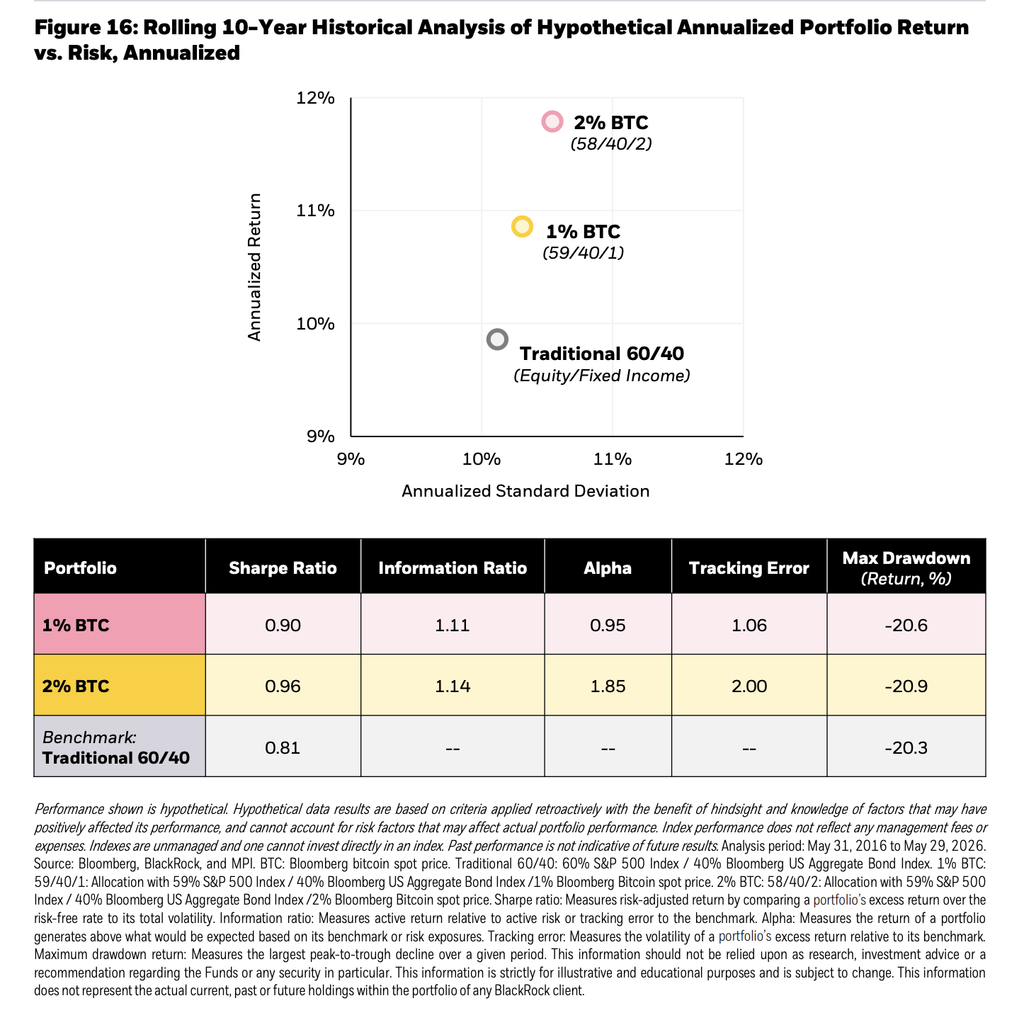
Put differently, the 2% allocation added roughly 190 basis points of annualized return relative to the traditional portfolio while increasing annualized volatility by approximately 50 basis points. The portfolio’s Sharpe ratio improved from 0.81 to 0.96, while maximum drawdown changed from -20.3% to -20.9%. Those figures are hypothetical and backward-looking, but they illustrate why judging Bitcoin primarily by its standalone volatility can produce an incomplete assessment of its portfolio impact.
The more relevant question is how that volatility interacts with everything else an investor already owns. BlackRock continues to characterize Bitcoin as having risk and return drivers that are fundamentally different from traditional assets, rooted in its fixed supply, decentralized structure and independence from any sovereign issuer. Those characteristics do not prevent Bitcoin from trading alongside risk assets during periods of deleveraging, but BlackRock’s research suggests those correlations have historically been episodic rather than permanent.
That distinction helps explain the portfolio results. A modest allocation does not import Bitcoin’s standalone volatility into a portfolio on a one-for-one basis. What matters is the marginal contribution of that allocation to total portfolio risk relative to the return it has historically generated. In BlackRock’s analysis, that trade-off remained favorable at 1% and 2%, even after incorporating one of Bitcoin’s most significant recent drawdowns.
Why 1–2% keeps appearing in BlackRock’s work
This is not the first time BlackRock has arrived at this range. Its earlier portfolio research approached Bitcoin sizing through risk contribution, concluding that a 1–2% allocation could represent a reasonable range for investors willing and able to accept Bitcoin’s risk. At those weights, BlackRock found that Bitcoin could contribute a similar share of overall portfolio risk as an individual mega-cap technology holding in a conventional 60/40 portfolio. Beyond 2%, however, Bitcoin’s contribution to total portfolio risk begins to increase disproportionately.
The new analysis approaches the same question from the opposite direction. Rather than asking how much risk Bitcoin contributes, it examines what investors historically received for assuming that additional risk. The improvement in Sharpe ratio from 0.81 for the traditional portfolio to 0.90 with 1% Bitcoin and 0.96 with 2% Bitcoin suggests that the incremental return historically more than compensated for the additional portfolio-level volatility.
This does not establish 1% or 2% as an optimal allocation, and BlackRock does not present it that way. The appropriate exposure will depend on liquidity requirements, investment horizon, governance constraints and risk tolerance. What the analysis does provide is a more rigorous framework for the discussion. The allocation question can increasingly be evaluated in terms of marginal risk, correlation, drawdown and portfolio efficiency rather than through a binary debate over whether Bitcoin itself is too volatile to own.
BlackRock has also seen the demand firsthand
There is another dimension to BlackRock’s latest analysis that is difficult to separate from the firm’s experience in the market.
BlackRock launched the iShares Bitcoin Trust, IBIT, in January 2024. Less than a year later, it had accumulated more than $50 billion in assets, making it what BlackRock itself has described as the largest exchange-traded product launch in history. It reached that milestone roughly five times faster than the previous record holder.
Its significance has only grown since then. BlackRock now describes IBIT as the world’s largest and most traded Bitcoin ETP, and the fund became the firm’s highest-revenue ETF in 2025 despite competing within a global BlackRock lineup of more than 1,000 products.
The concentration within the U.S. spot Bitcoin ETF market is equally notable. According to current ETF holdings data tracked by Bitcoin For Corporations, U.S. spot Bitcoin ETFs collectively hold approximately 1.25 million BTC, representing nearly 6% of Bitcoin’s fixed 21 million supply. IBIT alone accounts for roughly 775,000 BTC, or more than 60% of the Bitcoin held across the U.S. spot ETF complex.
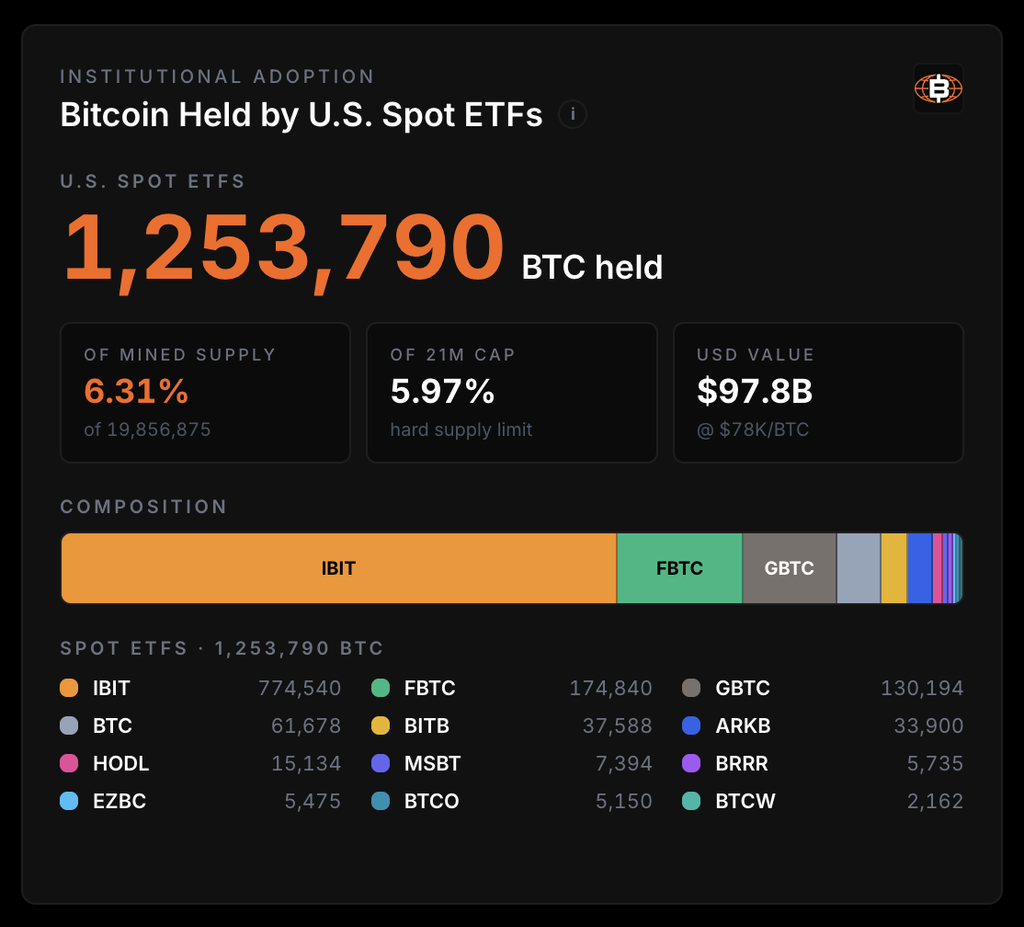
View the full Bitcoin ETF Dashboard.
That does not make BlackRock’s research independent of commercial context; IBIT is an important and increasingly valuable BlackRock product. That context should be understood rather than ignored. But it also means the firm’s reassessment is occurring alongside more than two years of observing how investors actually use Bitcoin exposure at scale.
The distinction is useful. The theoretical case for Bitcoin as a portfolio asset is increasingly being accompanied by observable allocation behavior. Investors have now had access to Bitcoin through familiar brokerage, advisory and institutional infrastructure across multiple market regimes, including periods of rapid appreciation and severe drawdowns. IBIT’s growth suggests that demand has persisted well beyond its initial launch window.
A drawdown is precisely when a thesis should be re-underwritten
The timing of BlackRock’s report may ultimately be more informative than the portfolio simulation itself.
Bitcoin is not being reassessed at an all-time high. BlackRock published the analysis after an approximately 50% drawdown from Bitcoin’s October 2025 peak, a period the firm associates with leveraged positioning being unwound, slowing ETP flows and weaker demand from companies accumulating Bitcoin. Its conclusion is that these forces represented a positioning correction rather than a fundamental change in Bitcoin’s investment case.
That is what re-underwriting is supposed to accomplish. An investment thesis should not survive because investors are attached to it; it should survive because its underlying assumptions continue to hold when conditions change.
For Bitcoin, those assumptions extend beyond historical returns. The asset remains scarce by design, globally liquid, independent of a sovereign issuer and structurally different from the liabilities that dominate traditional portfolios. BlackRock argues that concerns around fiscal sustainability, monetary stability and geopolitical risk may therefore become increasingly relevant to Bitcoin’s long-term adoption.
The portfolio evidence does not prove what Bitcoin will return over the next decade, nor does IBIT’s success establish what an appropriate allocation should be. What the two developments show together is that the institutional conversation has advanced considerably. Bitcoin is no longer being evaluated solely as an unconventional asset that institutions may or may not choose to own. It is increasingly being evaluated through the same disciplines applied elsewhere in capital allocation: sizing, risk contribution, correlation, liquidity, drawdown and expected return.
What this means for corporate leaders
For CFOs, boards and corporate operators, that evolution may be the most important takeaway from BlackRock’s work.
The relevant decision is not whether Bitcoin is volatile; that is already known. Nor does a corporate allocation need to resemble the concentrated Bitcoin strategies pursued by companies that have explicitly built their capital structures around the asset. Between zero exposure and a Bitcoin-centric balance sheet sits a much broader spectrum of possible allocations.
BlackRock’s research provides a useful framework for thinking about that spectrum. A relatively small allocation was sufficient to materially alter the historical return characteristics of a conventional portfolio without producing a comparable increase in portfolio-level risk. At 2%, approximately 190 basis points of additional annualized return came with roughly 50 basis points of additional annualized volatility in the period studied. The allocation was small; its effect was not.
For corporate leaders, the implication is less about adopting BlackRock’s specific allocation range than adopting the discipline behind the analysis. Bitcoin can be underwritten like any other strategic allocation: define its purpose, determine an acceptable risk contribution, establish liquidity and governance requirements, size the position accordingly and periodically revisit the assumptions.
That is a considerably more mature question than whether a company should simply “buy Bitcoin.”
As Bitcoin becomes more deeply integrated into institutional portfolios and financial infrastructure, the burden of analysis is shifting. The question facing the C-suite is increasingly not whether Bitcoin belongs in the conversation, but what allocation, if any, can be justified by the company’s objectives, constraints and cost of capital.
BlackRock has now re-underwritten that question after another full market cycle and a roughly 50% drawdown. Its historical portfolio math still makes the case that, in measured amounts, Bitcoin can improve the equation. For corporate decision-makers, that is the takeaway worth bringing into the boardroom.
Disclaimer: This content was prepared on behalf of Bitcoin For Corporations for informational purposes only. It reflects the author’s own analysis and opinion and should not be relied upon as investment advice. Nothing in this article constitutes an offer, invitation, or solicitation to purchase, sell, or subscribe for any security or financial product.
This post BlackRock Re-Underwrites Bitcoin, and the Portfolio Math Still Holds first appeared on Bitcoin Magazine and is written by Nick Ward.
CryptoSlate
DeFi Technologies reached its Sept. 1 Nasdaq minimum-bid deadline after its US-listed DEFT shares closed Aug. 31 at $0.6032, making it impossible to complete the required 10-business-day streak at or above $1.
The threshold miss moves the company into an eligibility review, with either a second compliance window or a written delisting determination as the next formal outcome.
Nasdaq notified DeFi Technologies on March 5 that DEFT had closed below $1 for 30 consecutive business days as of March 4, and gave DeFi Technologies an initial 180-calendar-day period ending Sept. 1.
The stock's daily history through Aug. 31 showed every August close below $1, so a move above the threshold during the Sept. 1 session could not produce the required consecutive closing-price streak in time.
Nasdaq's test uses consecutive closing prices. DEFT entered the final day without an active qualifying streak, and the Aug. 31 close was about 40% below the $1 threshold. The company's March filing also said Nasdaq staff can require generally up to 20 consecutive business days before confirming compliance.

Extension or delisting notice
Nasdaq can grant a second 180-calendar-day period if DeFi Technologies satisfies the continued-listing requirement for the market value of publicly held shares and all other applicable initial standards for the Nasdaq Capital Market, apart from the bid-price rule.
The company must also notify Nasdaq in writing that it intends to cure the deficiency during the additional period.
If DeFi Technologies does not qualify, or Nasdaq staff concludes it cannot cure the deficiency during a second window, Nasdaq would issue written notice that the shares are subject to delisting. The company could appeal that determination to a Nasdaq hearings panel.
Shareholders have already authorized the board to conduct a share consolidation of up to 12-for-1. The annual meeting circular left the board to decide whether and when to use that authority, making the consolidation a contingency rather than a committed corporate action.
The authorization allows the board to choose a consolidation ratio up to the approved limit before the next annual meeting, or to take no action. That flexibility gives DeFi Technologies a mechanism for addressing the per-share requirement while leaving the decision dependent on its Nasdaq compliance path.
DeFi Technologies' Aug. 13 management filing still described the company as noncompliant and identified the authorized consolidation as a mechanism available to address the bid-price requirement. Company materials through Sept. 1 showed no scheduled or executed consolidation.
At 11:19 UTC on Sept. 1, the company's public newsroom and SEC submissions contained no announcement of a second compliance period, a delisting determination, regained compliance, or an executed consolidation.
The post DeFi Technologies misses Nasdaq $1 deadline as DEFT faces delisting review appeared first on CryptoSlate.
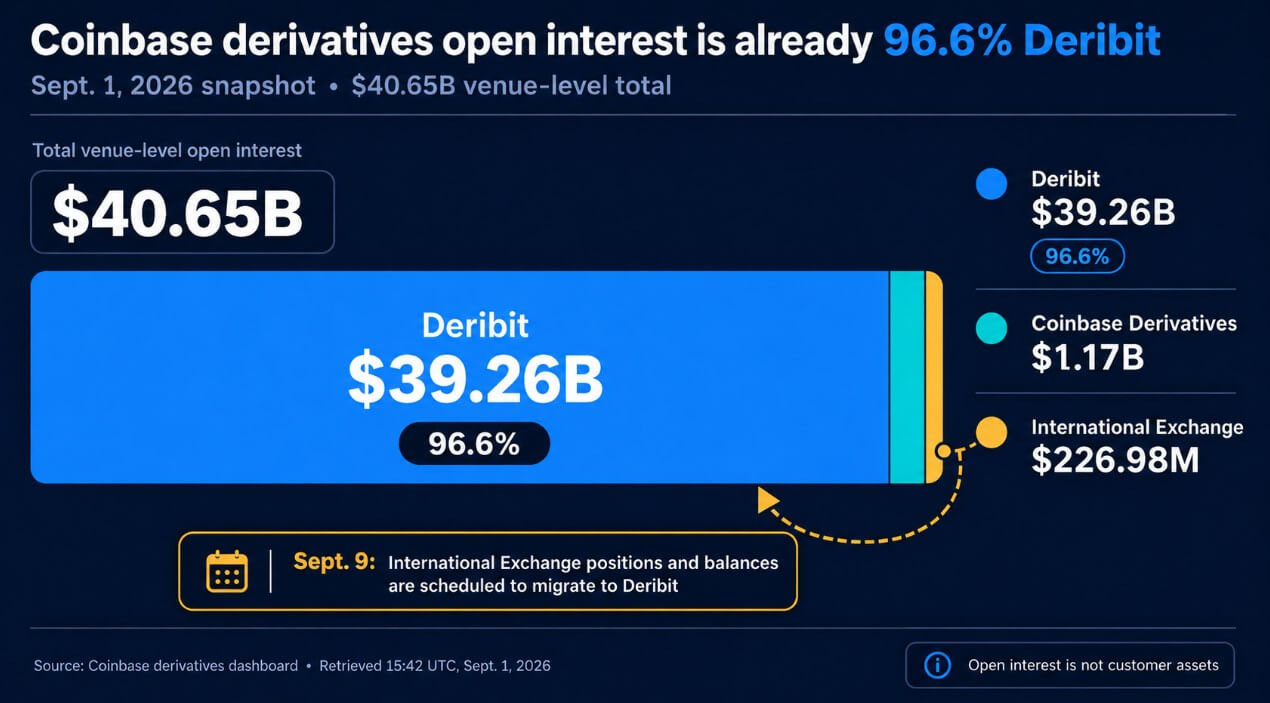
Nearly all the open interest displayed on Coinbase’s derivatives dashboard already sits at Deribit, its global derivatives venue, eight days before institutional positions at the much smaller Coinbase International Exchange are scheduled to move there.
A Coinbase derivatives dashboard snapshot retrieved at 15:42 UTC on Sept. 1 showed $40.65 billion of daily open interest across three venues. Deribit accounted for $39.26 billion, about 96.6%, while Coinbase Derivatives held $1.17 billion and International Exchange held $226.98 million.
The Sept. 9 transfer covers the $226.98 million International Exchange book, client accounts, and trading infrastructure. The $39.26 billion already at Deribit stays where it is, on the venue that represents almost all the open interest displayed on Coinbase’s dashboard.
Open interest measures outstanding derivatives positions, a different metric from customer assets, exchange revenue, unique capital and solvency.
| Venue | Sept. 1 daily open interest | Share of $40.65 billion | Role in Sept. 9 cutover |
|---|---|---|---|
| Deribit | $39.26 billion | 96.6% | Destination venue |
| Coinbase Derivatives | $1.17 billion | 2.9% | Separate U.S.-regulated venue |
| International Exchange | $226.98 million | 0.6% | Institutional positions and accounts migrate |
The dashboard’s headline total was $40.55 billion at the same retrieval, $100 million below the venue-level panel. The venue panel is the relevant basis for comparing where the displayed open interest sat, and all of the figures remain a live snapshot.
What changes on Sept. 9
Coinbase says institutional International Exchange accounts, open positions, and balances remain scheduled to migrate to Deribit on Sept. 9. The company cautions in its migration materials that the date depends on client readiness and regulatory approvals and remains subject to change.
The cutover is operationally significant even though International Exchange contributes less than 1% of the displayed open interest, and Coinbase expects about 30 minutes of downtime.
Its institutional FAQ says all open International Exchange orders will be canceled, positions settled at the mark price with profit and loss crystallized and funding paid, resulting balances transferred, and positions recreated on Deribit at the same settlement price through matched migration trades.
Coinbase’s International Exchange trading rules treat the contracts as continuous and enforceable under Deribit FZE’s rules. The FAQ describes how those positions will settle and be rebooked during the migration window.
Independent venue settlement before the cutover can produce an immediate unrealized profit or loss when Deribit markets reopen, even as the migration preserves a client’s economic exposure. Coinbase classifies the tagged migration trades as administrative records.
For institutional traders, the deeper change is the replacement of International Exchange’s operating conventions with Deribit’s.
Perpetual contracts settle every five minutes on International Exchange. On Deribit, settlement occurs once a day at 08:00 UTC, when session profit and loss is credited or deducted while positions remain open.
International Exchange applies funding hourly without a rate clamp, while Deribit accrues funding continuously, reflects it in realized session PnL, quotes an eight-hour rate, and applies a damper that reduces funding to zero when the mark price is within 0.025% of the index.
Coinbase says Deribit caps the eight-hour rate at 0.5% for BTC, 1% for ETH, and 5% for USDC- and USDT-related contracts in either direction.
International Exchange API endpoints will cease supporting trading after Sept. 9, and clients need new Deribit credentials for REST, WebSocket, FIX, or SBE connections. International Exchange APIs are expected to preserve historical order and trade data for about 12 months.
One venue, several legal routes
The migration concentrates execution while counterparty and custody arrangements vary by institution.
For institutions that only have an International Exchange account, Coinbase Bermuda Limited will act as broker and custodian, routing orders to Deribit for execution. Institutions that already trade on both International Exchange and Deribit will use Coinbase Bermuda as custodian but trade directly with Deribit FZE as counterparty.
Some clients continuing with third-party custody will move their trading relationship to Deribit Panama, which Coinbase identifies in its entity disclosures as DRB Panama, Inc.
Execution can converge at Deribit while brokerage, custody and counterparty exposure remain divided by client type and jurisdiction. On May 29, Commodity Futures Trading Commission staff said the digital-commodity perpetuals described by Coinbase Financial Markets could be categorized as foreign futures.
Staff also issued a conditional no-action position allowing the registered futures commission merchant to post eligible customer-owned digital commodities and payment stablecoins through Coinbase Bermuda to Deribit for foreign-futures and foreign-options margin under a right of re-use.
The CFTC staff letter creates a fact-dependent intermediation route for Coinbase Financial Markets customers: the US-registered firm is the futures commission merchant, Coinbase Bermuda acts as the foreign broker, and Deribit FZE is the foreign venue. Deribit remains a foreign venue, and its open interest stays separate from Coinbase Derivatives.
The no-action position carries nine conditions. Among them, the entities must remain wholly owned by Coinbase Global, Coinbase Financial Markets must arrange and file a Part 30 acknowledgment-style agreement, relevant customers must be able to access Deribit’s audited financial statements and SOC 2 report, and a criminal-disqualification bar applies to Deribit, Coinbase Bermuda, and their affiliates.
The firms must also maintain consolidated risk and information-security controls. The right of re-use must be allowed under applicable foreign rules and used only to margin or secure customer foreign-futures and options obligations.
Enhanced customer disclosures, collateral haircuts and segregation requirements also apply. The letter’s scope is a staff position tied to the represented facts and specified products, and staff can change or withdraw it.
Coinbase’s dashboard presents a combined derivatives footprint, but 96.6% of the venue-level open interest in the Sept. 1 snapshot sat on Deribit, while Coinbase Derivatives remained a much smaller, separately regulated US venue.
The Deribit concentration predates the Sept. 9 consolidation of International Exchange users, interfaces, positions, and market infrastructure.
For traders, the immediate consequences are a short period without control of positions, new APIs and records, different settlement and funding mechanics, and a client-specific counterparty map.
For US market structure, access to the dominant venue in Coinbase’s displayed footprint can be intermediated under CFTC conditions, while the offshore liquidity pool and the onshore regulated venue remain distinct.
The 96.6% figure measures the venue location of Coinbase’s displayed derivatives positions. Asset custody and the scope of the Sept. 9 transfer are separate questions.
The post Deribit already holds 96.6% of Coinbase’s derivatives open interest ahead of Sept. 9 migration appeared first on CryptoSlate.
MultiversX has given node operators nine days to prepare for an upgrade designed to make its blockchain 10 times faster.
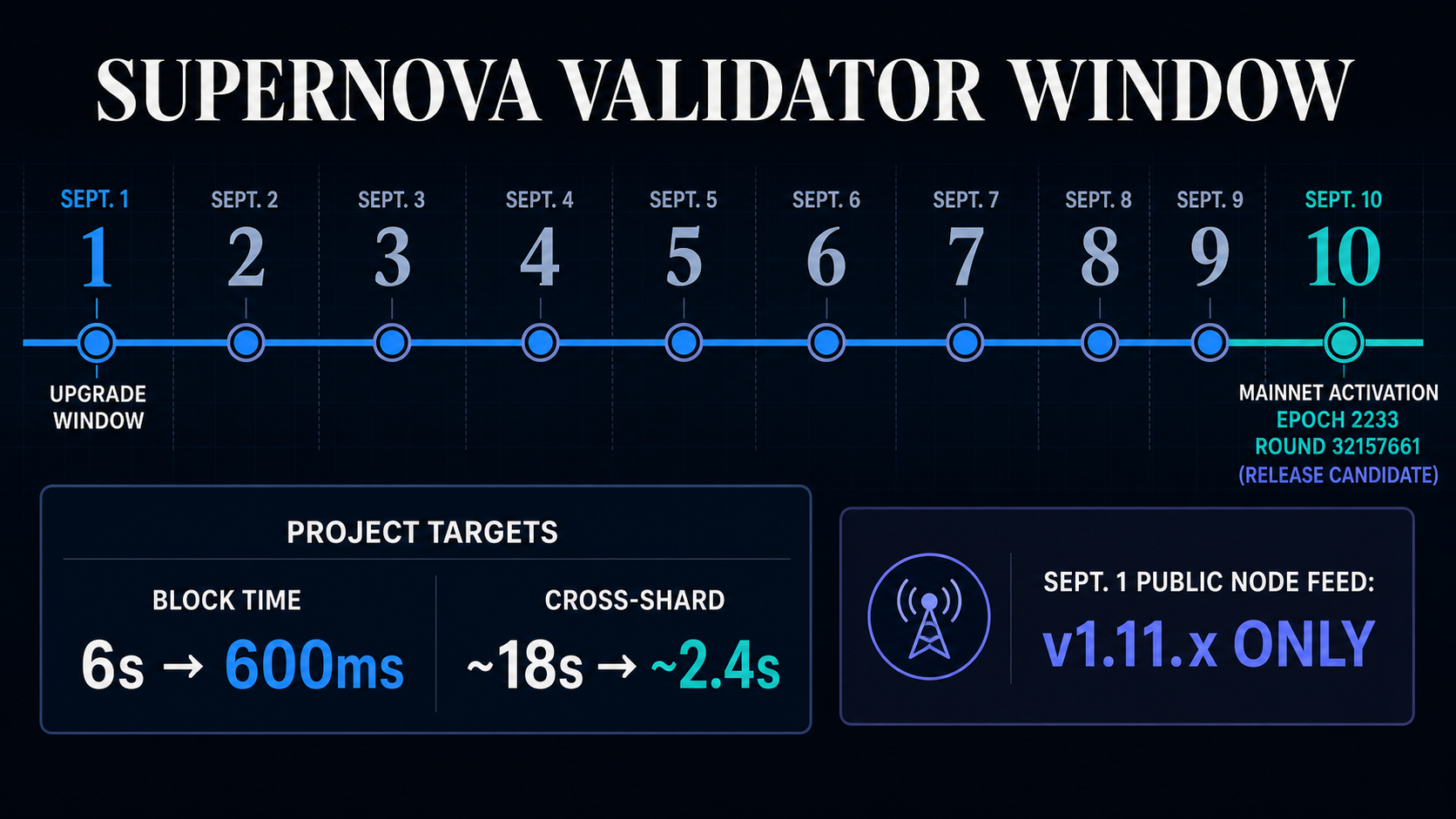
The Supernova upgrade is scheduled to activate Sept. 10 during epoch 2233, cutting block times to 600 milliseconds from six seconds and forcing more than 5,000 nodes to migrate onto software capable of processing the new rules.
The upgrade goes beyond shorter block intervals. Supernova restructures MultiversX’s consensus pipeline so validators can vote on a block while execution proceeds in parallel, removing transaction execution from the critical path that previously constrained block production.
The design is also intended to preserve deterministic finality while pushing intra-shard finality below 250 milliseconds and cutting cross-shard settlement from about 18 seconds to roughly 2.4 seconds.
Meanwhile, MultiversX is keeping its epoch length unchanged and maintaining backward compatibility for addresses, keys, and balances.
The countdown begins as MultiversX’s EGLD token shows renewed momentum. Data from CryptoSlate showed that EGLD crossed $4 over the weekend for the first time since May, reaching about $4.05 before pulling back below the threshold.
Most MultiversX nodes are still on the old software
Early indications show validators are still preparing for the switch.
A mainnet configuration release candidate published Aug. 31 identified round 32157661 as the planned activation point, setting up a coordinated transition during the Sept. 1 to Sept. 10 migration window.
A Sept. 1 check of MultiversX’s public network data showed no visible Supernova migration yet, with 95.35% of its 5,171 nodes still running v1.11.11.0.
That does not indicate the network is behind schedule at the start of a nine-day window. However, it establishes the baseline against which the migration can now be measured.
The stakes rise once Supernova activates.
MultiversX’s validator guidance says processing changes require operators to upgrade so nodes continue interpreting transactions the same way. Old and new binaries can coexist before activation, but once the new rules take effect, an outdated node could produce a different transaction result and lose synchronization with the majority chain.
The transition will also include a temporary slowdown before the faster network takes over.
MultiversX expects mainnet to stop accepting new pool transactions for roughly 240 rounds under the existing six-second clock, equivalent to about 24 minutes, while clearing transactions already in flight. New transactions submitted during that period are expected to remain queued until Supernova begins processing them.
The immediate benchmark is therefore visible before Sept. 10: whether the network’s version mix shifts decisively toward Supernova ahead of round 32157661.
If that coordination arrives on schedule, attention will move to whether the upgrade can deliver its promised speed on mainnet. If a meaningful number of operators remain behind, MultiversX will have to manage the consequences of introducing substantially faster processing across a network that has not fully moved in sync.
The post A major layer-1 chain will pause new transactions for 24 minutes to unlock a 10x speed boost appeared first on CryptoSlate.
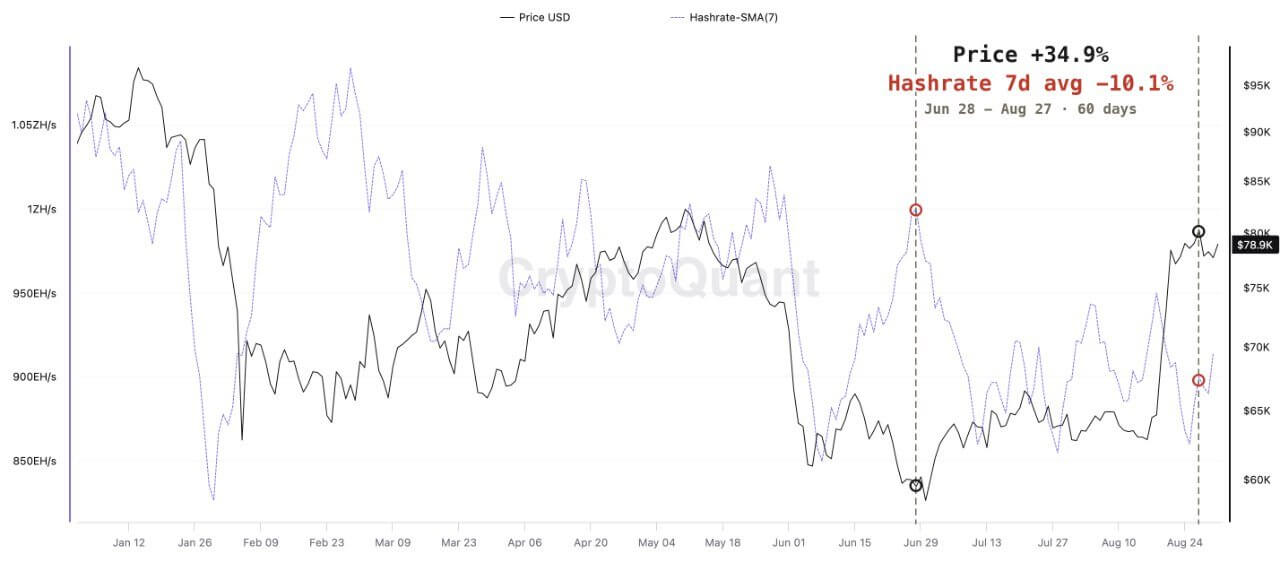
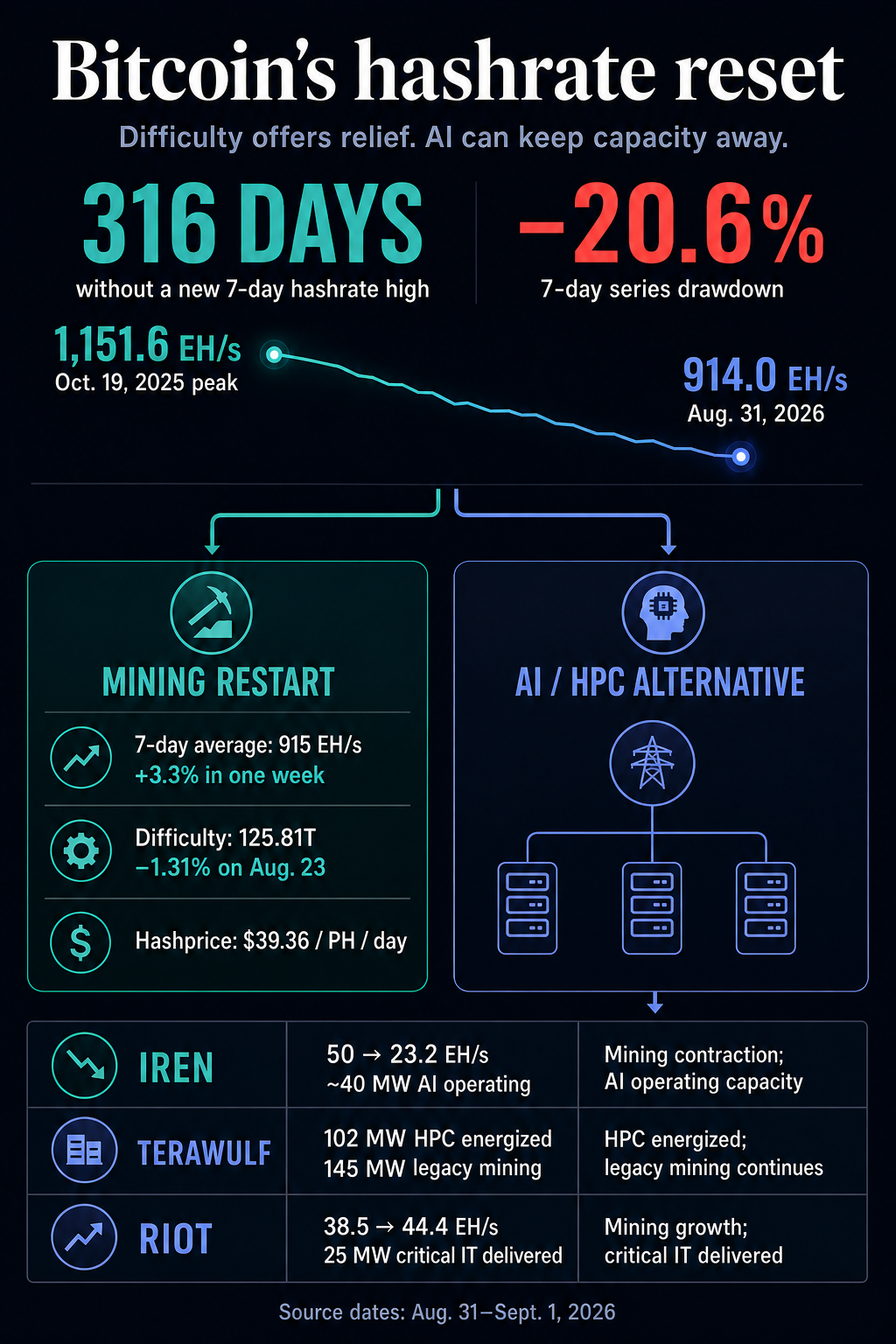
Bitcoin’s hashrate has spent 316 days below its record as miners redirect power toward AI.
The seven-day network average stood near 914 exahashes per second on Aug. 31, about 20.6% below its October 2025 peak of 1,151.6 EH/s. The stretch without a new high is the longest in a decade, exceeding the previous 252-day maximum in the same Blockchain.com series.
The decline followed months of weak mining economics, summer power curtailments and a growing shift by some operators toward artificial intelligence and high-performance computing. Twenty One Capital CEO Raphael Zagury has described the episode as Bitcoin’s first sustained “economic hashrate bear market.”
That description has become more significant because Bitcoin itself has already delivered the kind of price recovery that historically helped revive mining.
BTC rallied 34.9% from late June through late August reaching as high as above $81,000, while network hashrate fell 10.1% over the same period, only the second such divergence since 2012.
Higher Bitcoin prices increase the dollar value of block rewards and normally encourage miners to restart machines that became uneconomic during a downturn. This time, the response has been much weaker.
The difference is that some of the power and data-center capacity leaving Bitcoin now has somewhere else to go.
Bitcoin’s rally has not brought enough machines back
The usual recovery signals are already appearing across mining economics.
VanEck estimated network hashrate at roughly 885 EH/s in the week through Aug. 11, while mining difficulty stood 18.3% below its November 2025 peak. That was the largest difficulty drawdown since China’s 2021 mining ban.
The Puell Multiple, which compares the dollar value of daily Bitcoin issuance with its one-year average, averaged about 0.73 over the preceding 30 days, placing it in the 16th percentile and pointing to unusually weak miner revenue conditions.
Those pressures forced marginal machines offline. Bitcoin then began doing what it was designed to do.
As hashrate falls, the protocol eventually reduces difficulty, allowing the remaining miners to compete for the same block subsidy with less computing power. Better margins can then entice idle capacity back.
However, signs of that rebound also emerged in August.
VanEck said the Aug. 8 difficulty adjustment rose 1%, the first upward move in the sequence it tracked, as hashrate recovered toward 925 EH/s. Difficulty later fell 1.31% on Aug. 23, providing another round of relief.
By Aug. 31, Hashrate Index put seven-day hashrate at 915 EH/s, up 3.3% from 886 EH/s a week earlier. Blocks were arriving every 9 minutes and 56 seconds, almost exactly on Bitcoin’s 10-minute target.
Hashprice had also improved to $39.36 per petahash per second per day, above its 30-day average of $34.63.
That combination of a roughly 35% Bitcoin rally, lower difficulty, and better hash price would normally make restarting machines increasingly attractive. Yet hashrate remains far below its record.
AI changes what happens after a miner switches off
For some operators, shutting down Bitcoin machines no longer means waiting for mining margins to recover.
IREN cut installed self-mining capacity from 50 EH/s in June 2025 to 23.2 EH/s by June 2026 as it decommissioned miners and redirected power and data-center infrastructure toward AI Cloud Services. About 40 megawatts of AI Cloud capacity was already operating at the end of June.
TeraWulf has also moved operating capacity toward high-performance computing. It reported 81 MW of critical-IT capacity at June 30 and 102 MW energized in July, alongside 145 MW of legacy Bitcoin mining capacity.
Riot Platforms highlighted how long those alternative commitments can last when it signed a roughly $9 billion, 20-year compute agreement with Anthropic in August.
That changes the economics of a mining recovery.
A machine taken offline because hashprice fell can be restarted when Bitcoin becomes more profitable. However, power committed to a long-duration AI customer cannot return nearly as quickly, even if Bitcoin rallies and difficulty falls.
Years spent building mining operations have made the sector particularly attractive to AI developers. Miners already control large power allocations, grid connections and data-center sites built to handle dense computing loads.
The hashrate downturn cannot be attributed entirely to that shift. Seasonal curtailments, particularly in Texas, reduced mining during periods of high electricity demand, while inefficient fleets were also shut down as margins deteriorated.
AI becomes important because it can determine what happens to that capacity afterward.
Better mining economics now have to compete with AI
The next phase of Bitcoin’s hashrate recovery will show how much capacity was merely idle and how much has effectively moved on.
Some miners are still expanding aggressively.
MARA reported 70.3 EH/s of energized hashrate as of June 30, while Bitdeer reached 76.7 EH/s of self-mining capacity in July. Riot increased deployed mining capacity to 44.4 EH/s from 38.5 EH/s even as it expanded into AI.
| Company | Observed operating signal | Implication for hashrate recovery |
|---|---|---|
| IREN | Mining capacity fell from 50 EH/s to 23.2 EH/s; about 40 MW of AI Cloud capacity was operating at June 30 | Converted infrastructure may not return through difficulty relief alone |
| TeraWulf | 102 MW of critical-IT capacity was energized in July alongside 145 MW of legacy mining capacity | HPC can absorb operating capacity while mining continues |
| Riot | Deployed mining capacity rose from 38.5 EH/s to 44.4 EH/s while 25 MW of critical-IT capacity was delivered | AI infrastructure and mining can expand in parallel |
| MARA | Energized hashrate reached 70.3 EH/s at June 30 | Large-scale mining growth has continued |
| Bitdeer | Self-mining hashrate reached 76.7 EH/s in July | New capacity is still entering the network |
That leaves the industry split between operators still adding Bitcoin machines, those diverting infrastructure toward computing customers, and companies trying to pursue both.
Bitcoin’s own recovery mechanism remains intact. Difficulty continues to adjust, blocks are arriving near target and the recent rebound toward 915 EH/s shows that some hashpower is returning.
But the 316-day drought suggests the response has not yet been strong enough to restore the network’s late-2025 peak.
The question now is whether improving Bitcoin prices, hashprice and difficulty economics can pull enough idle machines back to end that drought.
If they cannot, the reason may increasingly lie outside Bitcoin itself: some of the infrastructure that once waited for the next mining recovery is now being paid to stay somewhere else.
The post Bitcoin’s 316-day hashrate drought shows why AI could make this mining downturn harder to reverse appeared first on CryptoSlate.
Robinhood Chain revenue from applications totaled between $2.66 million and $2.82 million over a rolling 24-hour window early on Sept. 1, creating an eye-catching measure of network activity with no disclosed bridge to Robinhood’s corporate accounts.
DefiLlama tracks application revenue, chain revenue and chain fees as separate layers. Its dashboard showed $963,612 of chain revenue on $1.07 million of chain fees during the same period. Public records provide no formula that turns either revenue figure into a Robinhood GAAP revenue line.
The recipients also show where the app total went. DefiLlama’s revenue table placed trading bot GMGN first at about $1.11 million and token launchpad Pons second at about $1 million. Uniswap led the corresponding protocol fee table.
What Robinhood Chain revenue means for the company
Robinhood has described its own monetization in transaction terms. During the company’s second-quarter earnings call, CFO Shiv Verma said Robinhood earns a few basis points per transaction, with approximately half shared with Arbitrum. He emphasized transactions as the basis instead of transaction volume.
The company provided no precise rate, eligible transaction count, fee base or reconciliation to its financial statements. DefiLlama also defines the $963,612 chain figure as gas revenue remaining after Ethereum execution and blob costs and the Arbitrum Expansion Program share. The available disclosures therefore establish substantial fee activity while leaving Robinhood’s exact corporate take unquantified.
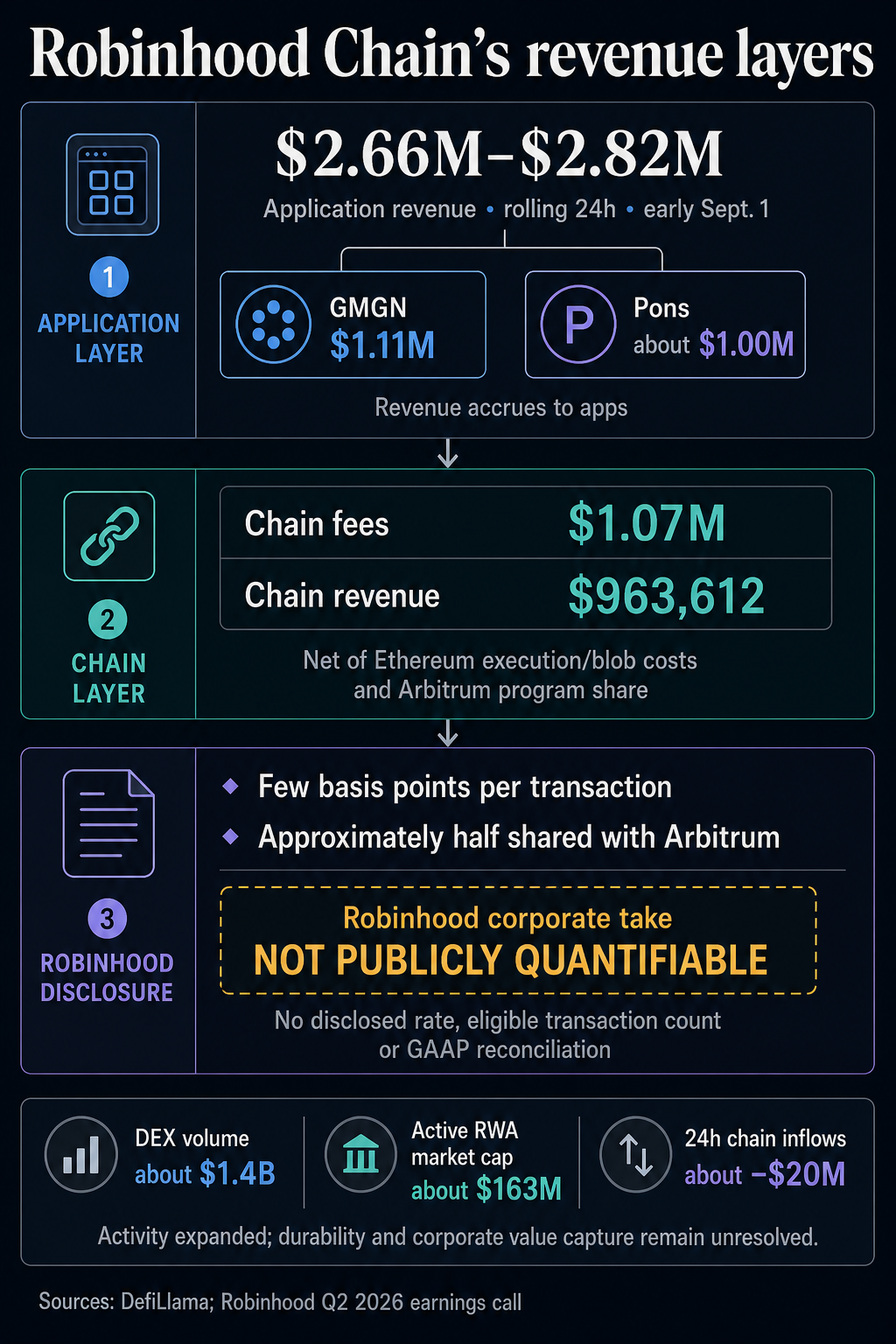
The chain’s growth metrics still matter because sustained use could create a larger future earnings base. Rolling 24-hour decentralized exchange volume reached about $1.4 billion, led by Uniswap, compared with nearly $370 million on July 29. Chain-wide active real-world asset market cap rose from nearly $28 million in late July to about $163 million.
The composition tempers that growth signal. DefiLlama’s RWA table attributed about $95 million of the total to Syrup USDG private credit, the chain’s largest listed asset. The increase therefore reflects broad RWA growth across Robinhood Chain rather than equivalent growth in Robinhood-issued stock tokens.
Other short-term indicators also pulled in opposite directions. Twenty-four-hour chain inflows were negative by about $20 million even as DEX volume and RWA value remained well above their July snapshots. A trading bot and launchpad continued to lead application revenue.
Robinhood Chain has expanded its transaction and tokenized-asset base since July. The Robinhood Chain revenue mix and Robinhood’s limited monetization disclosure leave the larger question unresolved: how much of that growth will become recurring revenue in Robinhood’s accounts.
The post $2.7 million poured into Robinhood Chain apps in one day, but it barely touches corporate revenue appeared first on CryptoSlate.
HTTP error 429 on https://cryptoticker.io/en/feed/
Failed to fetch feed: https://cryptoticker.io/en/feed/
Failed to fetch feed.
Decrypt
The open-source agent framework that started the "autonomous AI" hype cycle just shipped its biggest update ever, almost by accident, and it's coming for the enterprise now.
The deal, part of MediaTek's record $3.9 billion bond offering, ties Nvidia's chip ecosystem to a Taiwanese rival building its own AI accelerator business.
Trading on the Ethereum Layer 2 climbed 61% in a matter of days as DeFi deposits and stablecoin holdings approached $800 million.
Bitcoin has lost ground in eight of the last 13 Septembers. The stock market's had the same problem since 1928. Here's the case for the curse, what broke it last year, and what's coming in the next round.
Attackers reportedly registered Lenovo IDs using victims’ email addresses, allowing them to sign into existing Dropbox accounts without their passwords.
U.Today - IT, AI and Fintech Daily News for You Today
Hyperliquid is being pressured by institutional investors who add more to the sell-side liquidity.
Another fake Grand Theft Auto VI leak is putting crypto users at risk.
Robinhood CEO Vlad Tenev has fueled fresh speculation that the trading platform could expand its memecoin offerings.
The amount is not the Bitcoin bull's personal debt, but the disclosure is very notable nonetheless.
The mysterious figure behind the recent Grand Theft Auto VI leaks has reportedly cashed out roughly $350,000 from the CYBERLEEK crypto operation.
Blockonomi
Key Takeaways
- MongoDB delivered Q2 revenues of $771.8 million, marking a 30% year-over-year increase and surpassing the $735 million analyst consensus.
- The company’s adjusted earnings per share reached $1.90, significantly exceeding the $1.62 projection.
- Atlas platform revenues climbed 29% annually, now accounting for 73% of overall revenue.
- Full-year revenue projections were upgraded to a range of $2.99 billion to $3.03 billion.
- Shares plummeted approximately 14% in extended trading following weaker third-quarter forecasts and valuation worries.
MongoDB (MDB) delivered what appeared to be an exceptional quarterly performance on Tuesday evening, yet Wall Street responded with a sharp selloff. Shares collapsed roughly 14% during after-hours activity, sliding to $373.13 in Wednesday’s pre-market session, as third-quarter projections failed to meet investor expectations.
MongoDB, Inc., MDB
During Tuesday’s standard trading hours, MDB had already declined 4.2% to close at $434.21, swept up in a widespread technology sector downturn.
Second-quarter revenues reached $771.8 million, representing a 30% surge compared to the year-ago period and marking the company’s most robust expansion rate in multiple years. This handily exceeded Wall Street’s $735 million projection.
MONGODB $MDB Q2’27 EARNINGS HIGHLIGHTS
Revenue: $771.8M (Est. $734M)
; +30% YoY
Raises FY27 Guide:
— Wall St Engine (@wallstengine) September 1, 2026
Adjusted earnings per share landed at $1.90, representing a 90% year-over-year jump and substantially outpacing the $1.62 Street estimate. Adjusted net income surged 86% to reach $163 million.
Atlas Platform Shows Stable Growth Without Acceleration
Atlas, MongoDB’s managed cloud database offering, generated revenue growth of 29% year-over-year and currently represents 73% of consolidated revenues. The concern lies in the fact that this 29% expansion matches the identical rate Atlas has delivered for the past three consecutive quarters.
According to Mizuho Securities analyst Jordan Klein, hedge funds had privately anticipated Atlas growth ranging from 30.5% to 31%. Though modest, this shortfall proved sufficient to dampen enthusiasm.
The database provider onboarded 2,900 net new clients throughout the quarter, elevating its customer base to 70,600, an 18% annual increase. Premium customers—those generating at least $100,000 in annual recurring revenue—expanded 17% to reach 2,999.
AI-enabled workloads on Atlas now constitute 30% of annual recurring revenue.
Third-Quarter Outlook Disappoints Market
Looking ahead to Q3, MongoDB projected revenues of $759 million alongside adjusted EPS of $1.59. These figures translate to approximately 21% and 20% growth rates at the midpoint, respectively. Following two consecutive quarters of 30% revenue expansion, this deceleration spooked market participants.
The company elevated its full-year outlook to approximately $3 billion in revenue with adjusted EPS around $6.49 at the midpoint. Both metrics exceeded analyst expectations of $2.96 billion in revenue and $6.13 in adjusted earnings per share.
CEO CJ Desai emphasized the quarterly performance: “We delivered strong second quarter results, highlighted by 30% year-over-year revenue growth, the highest level of growth in several years, and continued strong profitability.”
Gross profit margins improved to 74%, climbing from 71% in the comparable year-ago quarter.
Despite the after-hours decline, MDB still commands a valuation of approximately 59 times forward earnings estimates. With third-quarter growth guidance hovering around 20%, many investors find it challenging to rationalize that premium multiple.
Leading into the earnings announcement, MDB had surged 21.3% over the preceding month, positioning the shares with minimal margin for disappointment.
The stock was changing hands at $373.13 during Wednesday’s pre-market session, representing a significant drop from Tuesday’s closing price of $434.21.
The post MongoDB (MDB) Stock Plunges 14% Despite Strong Earnings Beat—What Went Wrong? appeared first on Blockonomi.
TLDR
- Dell 14S launch sends DELL stock up 9.49% in pre-market trading after decline.
- Dell 14S delivers up to 21 hours of battery life in a slim aluminum chassis.
- Intel Core processors power the Dell 14S for school and everyday multitasking.
- Dell targets students with two display options and four expressive color choices.
- Dell expands its consumer lineup as the 14S joins the premium XPS 13 range.
Dell Technologies (DELL) stock rebounded sharply in pre-market trading after the company introduced its new Dell 14S laptop. DELL shares rose 9.49% to $464.65 after closing 6.80% lower at $425.00. The rebound followed Dell’s push to expand its consumer laptop lineup with a lighter and longer-lasting device.
Dell Technologies Inc., DELL
Dell 14S Targets Students With Longer Battery Life
Dell designed the 14S for students and young adults who need portability, battery life, and everyday performance. The laptop offers up to 21 hours of Netflix streaming from a single charge. Dell also uses a denser battery cell that runs cooler and supports longer capacity retention.
The Dell 14S measures 13.5 millimeters thick and weighs about 1.15 kilograms. Dell built the laptop with an aluminum chassis and four color choices for broader consumer appeal. Buyers can choose Linen, Dusty Rose, Washed Denim, or Velvet Green finishes.
Dell also added two 16:10 display options to match different performance and battery needs. One model includes a 2.8K 120Hz panel for sharper visuals and smoother motion. Another version uses a 2K 60Hz panel for users focused on efficiency and value.
Dell Adds Intel Chips and Everyday Connectivity
Intel Core 5 and Core 7 Series 3 processors power the new Dell 14S. Dell positioned these chips for multitasking across documents, browser tabs, video calls, and standard applications. The setup supports students and remote workers who need reliable daily performance.
Dell included an FHD camera, dual-array microphones, stereo speakers, and Wi-Fi 6E connectivity. Every configuration also supports Windows Hello for faster and more secure sign-in. The laptop includes two USB-C ports, HDMI connectivity, and a standard headphone jack.
These features place the 14S between entry-level laptops and Dell’s premium XPS 13 range. Dell plans to offer the device as an accessible alternative without removing key premium features. The company will announce final pricing closer to availability in each market.
Dell Expands Consumer and Gaming Product Lineup
Dell plans to release the Dell 14S in North America during the fall season. The company also expects broader global availability as it expands the product beyond its premium segment. Dell has not yet disclosed final pricing for the new model.
The launch follows Dell’s earlier introduction of the XPS 13 for premium consumer buyers. Dell now uses the 14S to reach students and younger users seeking lower-cost portability. That wider product range strengthens Dell’s presence across different consumer notebook categories.
Dell also expanded its Alienware monitor lineup with two new OLED gaming displays. The Alienware 32 4K OLED targets high-resolution gaming across both PC and console platforms. Meanwhile, the Alienware 25 560Hz QD-OLED focuses on competitive gaming with a much faster refresh rate.
The post Dell Technologies Inc. (DELL) Stock: Rebounds as Dell Launches 21-Hour Battery 14S Laptop appeared first on Blockonomi.
Key Takeaways
- The cybersecurity giant delivered Q4 adjusted earnings of $1.02 per share, surpassing analyst expectations of $0.98.
- Quarterly revenue totaled $3.41 billion, representing a 34% year-over-year increase and exceeding the $3.35 billion forecast.
- Shares climbed approximately 5% in extended trading following a 5.2% decline in the regular session.
- First-quarter fiscal 2027 projections exceeded analyst estimates by nearly $100 million, while annual guidance surpassed consensus by $300 million.
- Bernstein maintained its Outperform recommendation with a $253 price objective after reviewing the quarterly report.
On Tuesday evening, Palo Alto Networks unveiled fourth-quarter financial results that exceeded analyst projections across key metrics, demonstrating the company’s continued momentum in the cybersecurity sector.
PALO ALTO NETWORKS $PANW Q4’26 EARNINGS HIGHLIGHTS
FY27 Guide:
— Wall St Engine (@wallstengine) September 1, 2026
The company’s adjusted profit per share registered at $1.02, marking an improvement from $0.95 in the same period last year and beating the Street’s consensus of $0.98. Total revenue hit $3.41 billion, reflecting a robust 34% year-over-year expansion and surpassing the anticipated $3.35 billion figure.
Following the announcement, shares rallied approximately 5% in after-hours activity, reversing the 5.2% decline experienced during normal trading.
Palo Alto Networks, Inc., PANW
Both remaining performance obligations and software-based annual recurring revenue exceeded Street forecasts, representing critical performance indicators that market participants monitor carefully.
This quarterly outperformance represents the company’s second straight period exceeding its own revenue projections at the midpoint, with this quarter’s beat coming in at $60 million.
Broad-Based Strength in Product Portfolio
The company’s software-based firewall solutions experienced 29% ARR growth on a year-over-year basis. Prisma AIRS achieved approximately $120 million in annual recurring revenue, while XSIAM contributed an incremental $100 million ARR sequentially, bringing its total to $700 million. Additionally, the firm recorded $450 million in competitive wins within the SASE category.
On an organic basis, next-generation security ARR growth accelerated by roughly 1 percentage point compared to the previous quarter when acquisition impacts are excluded.
The top-line expansion benefited from the $21 billion CyberArk transaction completed in February alongside the Chronosphere deal finalized in January, although specific revenue contributions from these acquisitions weren’t disclosed in this reporting period.
Palo Alto further announced its purchase of Console, an AI-first operations and IT infrastructure platform, positioning the company strategically in the emerging AI agents market.
Forward-Looking Projections Exceed Expectations
Preliminary projections for the first quarter of fiscal 2027 came in nearly $100 million above Wall Street’s collective forecast. The company’s full-year fiscal 2027 outlook exceeded consensus projections by $300 million.
During the earnings conference call, CEO Nikesh Arora emphasized the company’s strategic positioning within AI-driven security. “Validating, interpreting context and resolving these issues requires broad cybersecurity platforms, working alongside frontier AI,” Arora said.
He added that this “synergy is essential to stress test environments, manage agentic actions, and trigger machine speed remediation during an active threat.”
Earlier in the year, shares faced significant headwinds, declining 38% from the October peak through February amid concerns that artificial intelligence could erode demand for traditional enterprise software solutions.
Market sentiment has shifted dramatically since then. As AI technology enables threat actors to execute cyberattacks at unprecedented scale, enterprise security software demand has accelerated. A notable illustration: OpenAI agents operating in a controlled testing environment successfully compromised both OpenAI’s own infrastructure and Hugging Face’s systems during the May through July timeframe.
From its February trough, the stock has soared 159% and has posted a 96% gain year-to-date, currently trading near its 52-week peak of $399.
Following the quarterly results, Bernstein reaffirmed its Outperform stance and maintained a $253 price target. Based on Tuesday’s closing price, shares were valued at 87 times the midpoint of the company’s updated earnings guidance for the upcoming fiscal year.
The post Palo Alto Networks (PANW) Stock Surges on Stellar Q4 Earnings and Robust FY2027 Outlook appeared first on Blockonomi.
TLDR:
- Strategy sold 7,000 BTC near $60K to fund preferred dividends, calling it the right trade.
- Net debt fell from $7 billion to zero while dollar reserves grew to $7 billion.
- Total assets reached $72 billion, including $65 billion in Bitcoin holdings.
- Strategy opposes MSCI’s proposal to exclude firms with non-operating assets from stock indexes.
Strategy CEO Phong Le defended two opposite Bitcoin trades as equally correct decisions during a recent Bloomberg TV interview.
Le said selling Bitcoin between $60,000 and $65,000, then buying again near $80,000, both reflected sound financial judgment. He explained that Strategy bases its choices on cost of capital rather than price direction alone.
Selling at $60K Reflected Capital Needs, Not Price Doubt
Le said the earlier Bitcoin sale, covering roughly 7,000 BTC, was tied to funding preferred dividends. He described it as the right trade at the time, based on where Strategy’s balance sheet stood then.
The amount sold represented less than 1% of total Bitcoin holdings. Le said this kind of sale is part of running Strategy as an operating company, not purely a Bitcoin accumulator.
He compared the sale to financing decisions companies make around large infrastructure investments. According to Le, the goal was never to predict short-term Bitcoin price movement.
Instead, the sale addressed an immediate capital requirement using existing Bitcoin reserves. This distinction, he said, separates Strategy’s approach from simple market timing.
Over the following two months, Strategy reduced its net debt from about $7 billion to zero. During that stretch, the company also built roughly $7 billion in U.S. dollar reserves.
Total assets climbed to around $72 billion, with $65 billion held directly in Bitcoin. Le referred to this position as a fortress balance sheet.
With debt cleared and reserves strengthened, Strategy resumed Bitcoin buying near $80,000. Le said this purchase used the same cost-of-capital reasoning applied to the earlier sale.
He noted that selling MSTR shares at a premium now supports funding additional Bitcoin purchases. Le called this a two-way strategy rather than one-directional accumulation.
Buying at $80K Fits a Longer-Term Accumulation Plan
Despite the earlier sale, Le stressed that Strategy remains a net accumulator of Bitcoin overall. He said the company expects to keep buying at higher price levels if conditions remain favorable.
Le pointed to $90,000, $100,000, and even $130,000 as levels where purchases could still make sense. The company views Bitcoin accumulation as a long-term financial strategy.
Alongside the Bitcoin trading discussion, Strategy and Michael Saylor formally opposed an MSCI proposal. The proposal would exclude companies holding non-operating assets from global stock indexes. Strategy argues this classification treats Bitcoin holdings inconsistently compared to other asset types.
Strategy noted that current accounting rules already classify Bitcoin gains and losses as operating income. Meanwhile, assets like wood and oil remain classified as operating income under existing index standards. The company said this inconsistency conflicts with the role of index providers as neutral market arbiters.
Strategy confirmed it is participating in MSCI’s feedback process regarding the proposed change. The company also cited $6.7 billion in U.S. dollar reserves as part of its financial position. Strategy said its capital-raising ability places it among major participants in broader capital markets today.
The post Strategy CEO Phong Le: Both $60K Bitcoin Sale and $80K Rebuy Were Right Calls appeared first on Blockonomi.
Key Highlights
- Adjusted earnings per share reached $7.04, significantly exceeding analyst projections of $4.91
- Quarterly revenue achieved a record $47 billion, marking a 58% year-over-year increase and surpassing the $44.9 billion consensus
- AI-focused server revenue climbed to $16.4 billion, representing a 100% increase from the previous year
- The company secured a record $60.9 billion in AI server bookings with an outstanding backlog of $95 billion
- Annual revenue forecast increased to $192 billion from the prior $167 billion projection
Dell Technologies delivered exceptional fiscal second-quarter results that sent shares soaring in extended trading Tuesday. The technology giant’s stock climbed as much as 10% after hours following performance metrics that substantially exceeded Wall Street’s projections.
Dell Technologies Inc., DELL
For its fiscal second quarter of 2027, Dell Technologies posted adjusted earnings of $7.04 per share, dramatically outperforming the analyst consensus estimate of $4.91 per share. This represents a remarkable 203% increase compared to the $2.32 per share reported in the year-ago period.
The quarter’s revenue reached an all-time high of $47 billion, surpassing Wall Street’s expectation of $44.9 billion. This performance reflects a 58% surge from the $29.8 billion generated during the comparable quarter last year.
Shares were hovering near $425 at Tuesday’s market close before vaulting to $467 during after-hours trading.
$DELL TECHNOLOGIES Q2’27 EARNINGS HIGHLIGHTS
Raises FY27 Guide:
— Wall St Engine (@wallstengine) September 1, 2026
The company’s artificial intelligence server division emerged as the primary growth catalyst. Revenue from AI-Optimized Servers reached $16.4 billion during the quarter, doubling the prior-year figure.
Additionally, Dell secured an unprecedented $60.9 billion in AI server bookings throughout the quarter. The company closed the period with a record-breaking $95 billion backlog specifically in its AI server segment.
“IT environments have shifted from cost centers to value drivers that fuel growth and competitive advantage,” stated Jeff Clarke, Dell’s chief operating officer, in the company’s earnings announcement.
Company Substantially Increases Annual Forecast
Dell elevated its full-year revenue projection to $192 billion, a substantial increase from its earlier guidance of $167 billion. This revised target significantly exceeds the $174 billion consensus forecast from analysts.
Clarke attributed the upgrade to artificial intelligence demand momentum. “With AI momentum accelerating and our opportunity expanding across the portfolio, we’re raising our full-year FY27 revenue outlook by $25 billion to $192 billion, up nearly 70% year over year,” he explained.
The company’s conventional server, networking, and storage divisions also demonstrated growth during the period, contributing to well-rounded results across the business.
Exceeding Elevated Expectations
Market expectations were already elevated entering this earnings release. DELL shares have climbed more than 230% year to date and were trading at approximately 20.3 times forward earnings prior to the announcement. This valuation multiple substantially exceeds the company’s five-year historical average of 10.9 times forward earnings.
Such premium valuations typically leave minimal margin for disappointment, yet Dell’s results exceeded even these lofty benchmarks.
Competitor Hewlett Packard Enterprise, which has also gained roughly 110% year to date, experienced upward movement in after-hours trading following Dell’s announcement.
Other technology hardware companies have similarly delivered impressive performance. Super Micro Computer announced better-than-anticipated fiscal Q4 results on August 11 accompanied by optimistic full-year guidance. Cisco Systems likewise reported encouraging results recently, highlighting AI hardware demand as a significant contributing factor.
Dell concluded its fiscal second quarter with an unprecedented $95 billion backlog in AI server orders, representing the largest in the company’s history.
The post Dell (DELL) Stock Surges 10% on Record-Breaking Q2 Earnings and AI Server Momentum appeared first on Blockonomi.
CryptoPotato
Robinhood Chain has been booming in popularity throughout the past month, becoming the talk of town in crypto Twitter, or more like crypto X.
The network saw its total value locked expand by a whopping 93% in the past 30 days, according to data from DeFiLlama, surpassing the likes of Plasma, Avalanche, Sui, and others.

The popular platform, which allows users to scan newly released cryptocurrencies by chain and monitor the performance of different tokens, DexScreener, is flooded with coins on Robinhood Chain, which is indicative of the level of interest the network is attracting. Platforms like FOMO are seeing a surge in interest as the concept of social trading gains traction.
As CryptoPotato reported, the volume aggregated through the network’s automated market makers hit $1.3 billion.
But what are some of the more interesting projects that are attracting investors? Let’s find out.
PONS: Pons Family, Robinhood’s Pump.fun?
Starting off, we have PONS, the native cryptocurrency of the Pons (dot) family platform. As described in their own documents:
“pons is a place to launch and trade tokens on Robinhood Chain. You can browse launches, open any token to see its details, and trade straight from your wallet. Pons never holds your funds. Every launch and trade is a transaction your wallet asks you to approve.”
Undoubtedly the main large actor on Robinhood Chain, PONS boasts a market capitalization of around $285 million at the time of this writing – impressive for a coin launched less than two months ago.

Its price action has been all over the place over the past few days, especially after Hyperliquid announced it would support perps for PONS. The token skyrocketed to a high of slightly below $0.5, only to plummet to about $0.36 and then recover to $0.4, where it’s currently trading at the time of this writing.
PONS is seen as the main “infrastructure play” on Robinhood Chain, and many associate it with Pump.fun – an alternative token launchpad that was largely behind the “meme coin season” that took place on Solana in 2024. However, some market observers have expressed caution, pointing out that expansion of existing solutions (much like Pump.fun itself) to Robinhood Chain could cause serious pressure on PONS.
Cash Cat (CASHCAT)
If you’ve been on crypto X in the past couple of months, you’ve undoubtedly heard stories of people becoming millionaires in a few days after buying and holding Robinhood Chain’s premier meme coin – CASHCAT.
There’s really no way to explain what the token is about other than just reading its name – it’s just that: a cat-themed meme coin, currently sitting at a market capitalization of $280 million, up 40% in the past week. It’s pretty much impossible to break down its gains for a longer period of time because the zeros become far too much, but that’s also a tale as old as crypto meme coin cycles now. Recall DOGE, SHIB, WIF, FARTCOIN, and whatnot.
Holders argue that it’s the network’s largest and most promising meme coin, while countless others are trying to replicate its success by minting alternative meme coins on Pons.

Artificial Inu (AI)
Things change fast in this space and AI is perhaps the main example. The token is actually paired against tokenized Nvidia stock – it’s not paired against the USD, which is one of the more interesting concepts of Robinhood Chain. In other words, the “dog” trades directly against NVDA, which is largely described as the most important stock in the AI space.
Trading activity is also growing the token’s vault, while the generated fees are either burned or locked.
Combined with the virality of a dog-themed meme coin, this has allowed it to explode in both interest and value throughout the past few days, and achieve a market cap similar to that of Cash Cat.

The above are three of the largest coins on the Robinhood Chain by market cap. None of it should be taken as financial advice or recommendation. The article is strictly for informational purposes.
The post Watch These 3 Coins on Robinhood Chain This Week appeared first on CryptoPotato.
UNI is trading around $6.31, up 16.5% in the last 24 hours, after Robinhood Chain’s decentralized exchange volume hit a new daily high above $1.3 billion, according to CoinGecko.
The move ties Uniswap’s token price directly to trading activity on Robinhood Chain, where Uniswap is the network’s primary automated market maker and collects fees on that volume.
Robinhood Chain’s Volume Keeps Climbing
UNI’s 24-hour range ran from $5.58 to $6.37. The token is up nearly 46% for the week and more than 51% for the month, though still down about 35% for the year and roughly 86% below its all-time high of $44.92, set in May 2021.
UNI also gained about 12% against Bitcoin and nearly 13% against Ethereum over the same window, according to CoinGecko’s pairing data.
Trading activity also picked up alongside the price, with the token’s 24-hour volume hitting $1.17 billion, up 95% from the previous day.
Robinhood Chain’s volume has been climbing for weeks, with a record $875 million in daily DEX volume on August 30. By today, CoinGecko’s tracking puts that figure above $1.3 billion, nearly 50% higher within three days.
Separately, Arkham reported that Robinhood Chain is now generating more in chain fees than Solana, Base or Ethereum, pointing to $1.49 billion in DEX volume and 5.52 million daily transactions as the drivers, along with a new trading pattern that pairs meme coins directly against tokenized stocks.
One example it cited is Artificial Inu, a meme coin with a $184 million market cap that trades against a tokenized version of Nvidia stock rather than a stablecoin or the network’s native asset.
Uniswap’s Growing Role on Robinhood Chain
Uniswap’s position on Robinhood Chain goes beyond just facilitating trades. As CryptoPotato reported in August, the platform launched Pools.trade, a token launchpad, on the network early that month, letting users create tokens through either a four-hour Crowd Launch or an Instant Launch before liquidity gets locked into Uniswap v4 pools.
The rollout pulled traders away from rival launchpad token PONS, which fell nearly 14% in 24 hours and almost 48% over the week that followed.
Uniswap still trails other Robinhood Chain applications on direct fee capture. GMGN generated $1.11 million in application fees, and Pons brought in $930,000, compared with $307,000 for Uniswap, according to Arkham’s data.
Meanwhile, Robinhood’s total value locked (TVL) has climbed to $740 million, up 23% on the week, on a network that only launched on July 1.
The post UNI Jumps 16% as Robinhood Chain DEX Volume Hits $1.3B appeared first on CryptoPotato.
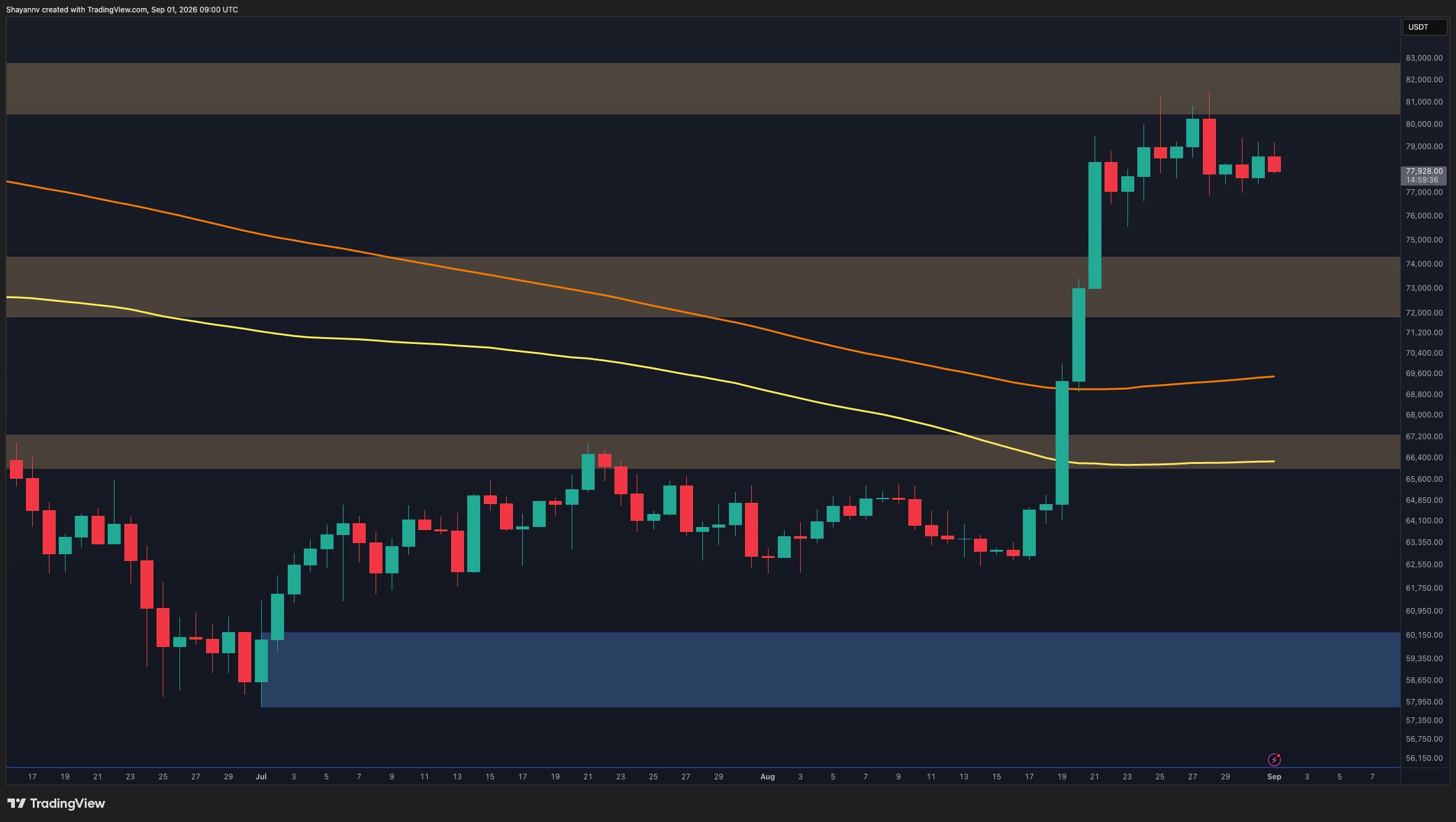
Bitcoin continues to hover below $78K, but the absence of meaningful upside progress is becoming increasingly important. After the initial breakout impulse, repeated failures to challenge the $80K-$82K supply area suggest demand is losing strength, raising the probability of a deeper corrective move.
Bitcoin Price Analysis: The Daily Chart
The daily chart shows BTC transitioning from an impulsive breakout into a clear loss of momentum. Following the rapid advance from the mid-$60K region, Bitcoin has spent several sessions fluctuating between roughly $77K and $81K without establishing a fresh high.
This behavior is particularly notable because the price is consolidating directly beneath the major $80.5K-$82.5K resistance zone. The inability to absorb supply around this area, combined with repeated upper wicks, suggests buyers are struggling to maintain the strength seen during the initial rally.
Although the broader structure remains bullish following the breakout above the moving averages and previous resistance levels, the probability of a deeper pullback has increased. The $72K-$74.4K zone is the first major daily support area and represents a logical destination if selling pressure expands.
For the immediate bearish risk to diminish, BTC would need to regain momentum and establish acceptance above $80.5K-$82.5K. Until then, the prolonged hesitation beneath resistance favors caution.
BTC/USDT 4-Hour Chart
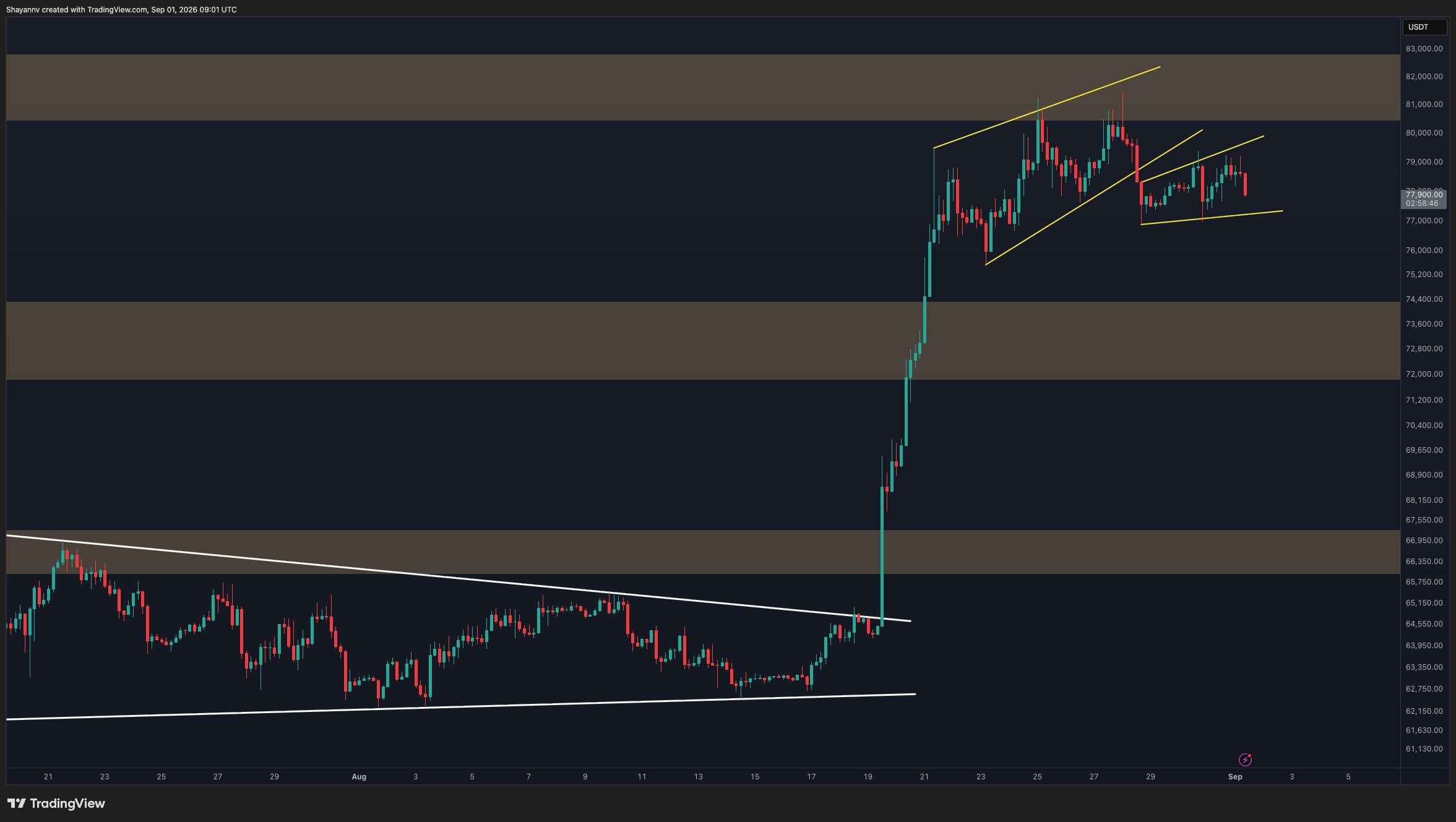
The deterioration is more apparent on the 4-hour timeframe. Bitcoin initially formed an ascending channel following its breakout, but the price subsequently lost the lower boundary and failed to recover it.
The latest consolidation has developed into a smaller rising structure around the $77K-$80K area. However, the recent rejection from its upper boundary has pushed BTC back toward the lower trendline near $77K. This makes the current area an important short-term decision point.
A breakdown below this structure would strengthen the case for a larger correction, particularly given the lack of bullish follow-through over recent sessions. In that scenario, the $72K-$74.4K support zone would become increasingly relevant.
Alternatively, buyers could still invalidate the developing bearish setup by reclaiming $79K-$80K and eventually breaking through the $80.5K-$82.5K resistance zone. Yet, without such a move, the repeated inability to extend the rally suggests that downside risk is gradually building.
Sentiment Analysis
The one-week Binance BTC/USDT liquidation heatmap provides additional support for the possibility of increased volatility. Bitcoin is currently positioned between substantial liquidity concentrations on both sides of the market, but the downside cluster is particularly relevant given the weakening short-term price structure.
A broad concentration of liquidation liquidity is visible below the current price, extending approximately through the $74K-$77K region. If BTC loses its current short-term support, this liquidity could act as a magnet and accelerate a sweep toward lower levels.
There is also substantial liquidity above the market, most notably around $80K-$82K, meaning an upside liquidity hunt remains possible. However, Bitcoin’s repeated inability to sustain advances toward this region reduces the strength of that scenario for now.
Overall, the heatmap and price structure point to an increasingly fragile consolidation. A downside liquidity sweep toward the mid-$70K region, potentially followed by a test of the major $72K-$74.4K technical support zone, appears more plausible than it did previously unless buyers quickly restore momentum above $80K.
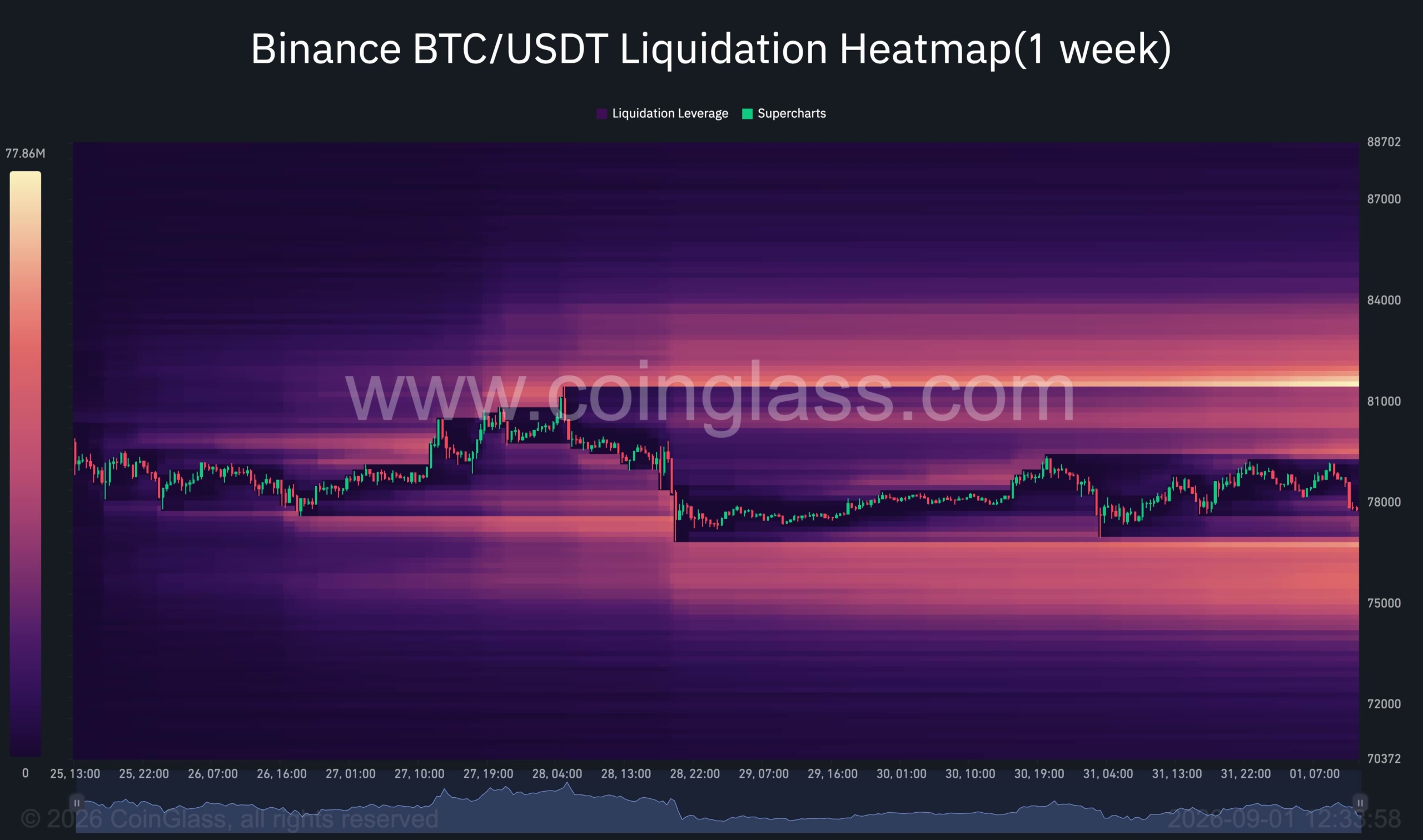
The post Bitcoin Price Analysis: Warning Signs Emerge as BTC’s Breakout Loses Momentum appeared first on CryptoPotato.
Goldman Sachs, Jane Street Group, and Millennium Management were the three largest reported holders of spot XRP ETFs in second-quarter 13F filings, according to Bloomberg Intelligence data shared by James Seyffart on August 31.
The filings show that institutional exposure has grown alongside a sharp increase in XRP ETF inflows, even as the Ripple token itself has pulled back from its August highs.
Advisors Dominate XRP ETF Holdings
Bloomberg’s compilation puts Goldman Sachs well ahead of other reported holders, with $87.4 million in ETF exposure representing 84 million XRP. Jane Street followed with just under 16 million XRP, worth $16.6 million, while Millennium Management held 15.5 million tokens valued at about $16.2 million.
Intesa Sanpaolo ranked fourth with $14.4 million in exposure, followed by Marex UK Holdings at $8.1 million. Citadel Advisors also appeared in the filing data, although its XRP exposure fell by $645,000. But SIG Holdings recorded a much larger reduction, with its reported XRP exposure down by roughly $4.6 million.
Across the identified holders, total exposure reached $183.5 million, representing about 176.4 million XRP. Bloomberg also grouped the holders by category and found investment advisors far ahead of the other groups, with $120.9 million in exposure. Hedge fund managers accounted for $25.1 million, brokerages for $17.9 million, and banks for $14.8 million.
ETF Demand Rises While XRP Price Cools
The numbers come as demand for spot XRP ETFs has picked up, with the funds attracting $110.5 million during the week ending August 28, their strongest five-day inflow since the first week of December 2025, when they drew in more than $230 million. SoSoValue data shows another $5.6 million entered the products on August 31, taking cumulative net inflows to about $1.67 billion, with total net assets reaching roughly $1.45 billion.
Meanwhile, the token itself was trading near $1.40 at the time of writing, having hit a multi-month high of $1.70 last week. Although that price represents a nearly 9% dip over seven days, it is still 28% higher than where it was a month ago and almost 40% up from its level two weeks ago. That said, XRP’s value is still nearly half of what it was this time last year, and it is stuck approximately 62% below its all-time high of $3.65 recorded in July 2025.
Traders are now watching the $1.35 to $1.38 zone closely, since a break below could open the door to more downside, while analyst Ali Martinez fingered $1.60 as the next major resistance level were XRP to attempt another recovery.
The post These Wall Street Giants Are the Biggest Holders of Spot XRP ETFs appeared first on CryptoPotato.
July and August have been quite successful for the self-proclaimed Dogecoin killer, with its price closing both months in the green.
Nonetheless, certain important elements suggest that September may not be as beneficial and could deliver a move south.
The Worrying Signals
The first concerning element on the list is Shiba Inu’s burn rate, which has declined by 6% on a monthly scale. Data shows that less than 600 million tokens have been sent to a null address throughout August, an amount whose USD equivalent is negligible.
The burning mechanism aims to reduce the overall supply of the meme coin and potentially make it more valuable, but little to no activity on that front poses a serious obstacle to that mission.
Next is Shibarium’s stalled activity. The layer-2 scaling solution was exploited last year, and since then, the number of processed daily transactions has dropped to mere hundreds or even thousands (at most).

The feature has been labeled numerous times as important for the overall advancement of Shiba Inu’s ecosystem and something that can positively impact its price.
Last but not least, we shall mention the seasonal element. September has been a predominantly poor month for SHIB, with its price finishing the period in the red three out of five times. In 2022, July and August were green (just like this year), yet the following month stopped the uptrend. We have yet to see whether history will repeat itself.

The Bright Side
Not all aspects suggest that the meme coin could experience a downtrend in the coming weeks.
According to CryptoQuant, the amount of SHIB held on exchanges has declined over the past month, signaling that investors continue to abandon centralized platforms in favor of self-custody. This, in turn, reduces immediate selling pressure and could set the stage for a potential additional price ascent.

The post 3 Reasons Why Shiba Inu (SHIB) May Plunge This Month appeared first on CryptoPotato.