Cryptocurrency Posts
Crypto Briefing
Privy's integration streamlines crypto-fiat transactions, enhancing global financial accessibility and simplifying compliance for developers.
The post Privy brings fiat deposits and payouts to its API through Bridge stablecoin integration appeared first on Crypto Briefing.
Rising yields signal potential global interest rate hikes, impacting borrowing costs and influencing central bank policy decisions worldwide.
The post Japan’s 30-year bond yield hits record 4% amid inflation concerns appeared first on Crypto Briefing.
StonkBrokers' NFT-stock integration on Robinhood Chain could redefine asset ownership, but regulatory scrutiny may challenge its sustainability.
The post StonkBrokers NFT collection enables stock-token transfers on Robinhood Chain appeared first on Crypto Briefing.
Rising Treasury yields elevate borrowing costs economy-wide, prompting portfolio diversification shifts and challenging fiscal strategies.
The post Traders hedge portfolios as Treasury yields hit multiyear highs appeared first on Crypto Briefing.
PSG's move to extend Kvaratskhelia's contract underscores their strategy to build a long-term, competitive squad around key talents.
The post Paris Saint-Germain reportedly offering contract extension to Kvaratskhelia appeared first on Crypto Briefing.
Bitcoin Magazine
Bitcoin Magazine
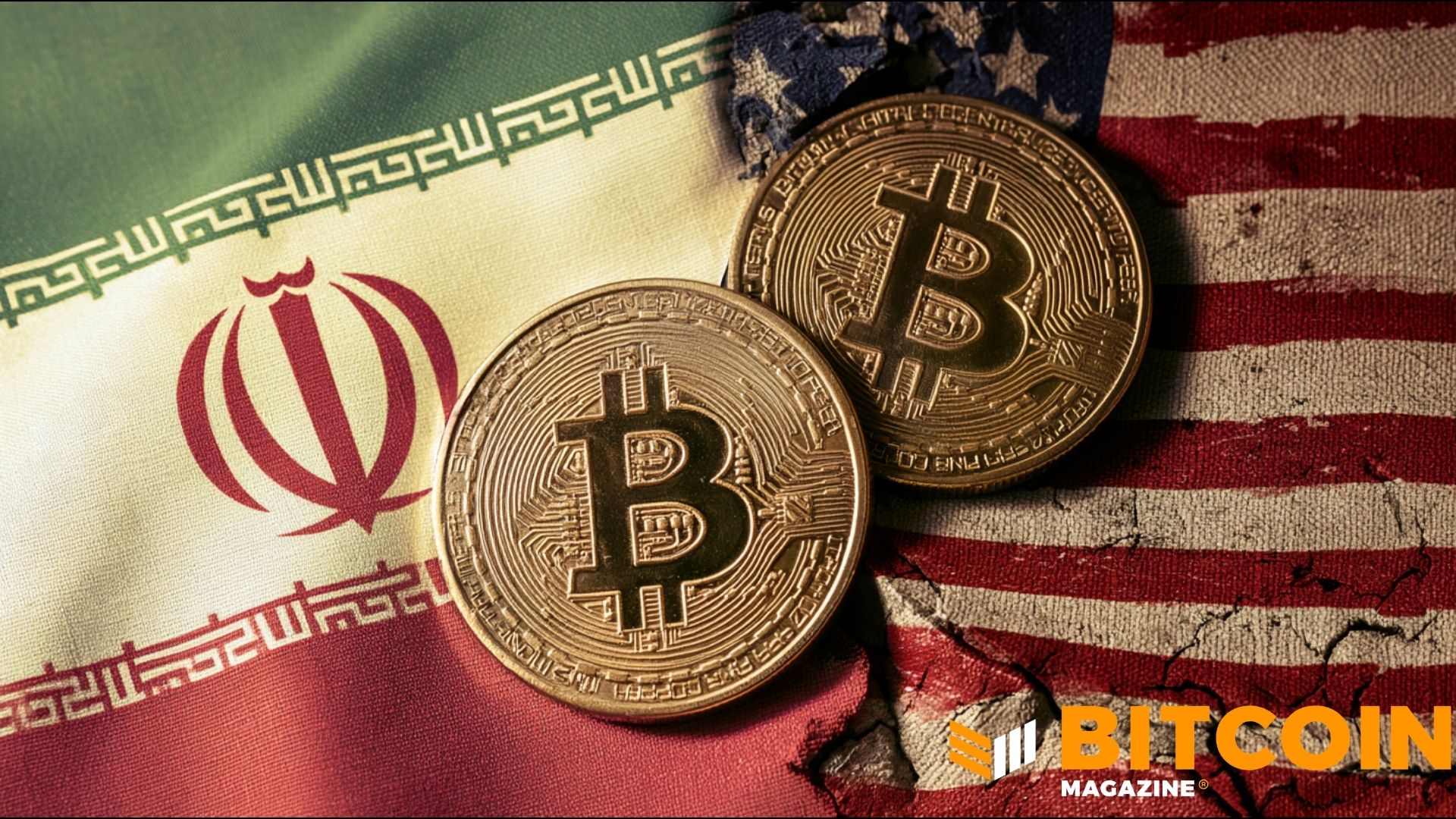
Bitcoin Slides as US-Iran Tensions Escalate
Bitcoin slid on Tuesday after investors went into “risk-off” mode following escalating attacks between the U.S. and Iran.
The largest cryptocurrency had initially shrugged off President Donald Trump’s threats to the Middle Eastern nation, as well as the first strikes.
But things heated up on Tuesday, and bitcoin’s price slid. It was recently down more than 2% on the day, trading for $77,363. The coin had pushed past as high as nearly $81,282 on Friday.
The Tuesday attacks from the U.S. were because Iran tried to put mines in the Strait of Hormuz, and also because of an attack on an American military base in Jordan, according to President Trump.
U.S. Central Command said on X that Iran had also attacked commercial ships.
“The strikes follow recent attempted attacks by the Islamic Revolutionary Guard Corps against commercial shipping in the Strait of Hormuz and against American service members deployed to the region,” the post read.
Iran responded with a “decisive operation” against U.S. military bases, according to Iranian media. Oil surged on the news.
Bitcoin’s price has been sensitive to geopolitical tensions this year — especially after Iran and Israel attacked Iran. The cryptocurrency has typically faced downward pressure on news of war, only to then rally when Trump raised hopes of a ceasefire.
Despite Bitcoin’s price being relatively muted, in recent months, it has made more wild swings since mid-August.
Bitcoin’s immediate reaction to rising oil prices is to drop: more expensive energy means higher inflation, and higher inflation typically means the U.S. central bank will postpone rate cuts, which can restrict the liquidity that bitcoin needs to gain momentum.
The Federal Reserve’s chair, Kevin Warsh, last week gave his first major speech as leader of the central bank and said that inflation in the world’s largest economy had not come down enough.
Traders are now no longer pricing in an interest rate cut this year, instead expecting a hike. Bitcoin has typically performed well in the past in low interest rate environments.
Still, the coin had one of its best runs in August after the U.S. Treasury said it would at least double the size of its liquidity-support buyback operations, in response to surging borrowing costs.
The announcement hurt the dollar but non-yielding assets like bitcoin and gold have benefited.
This post Bitcoin Slides as US-Iran Tensions Escalate first appeared on Bitcoin Magazine and is written by Mathew Di Salvo.
Bitcoin Magazine
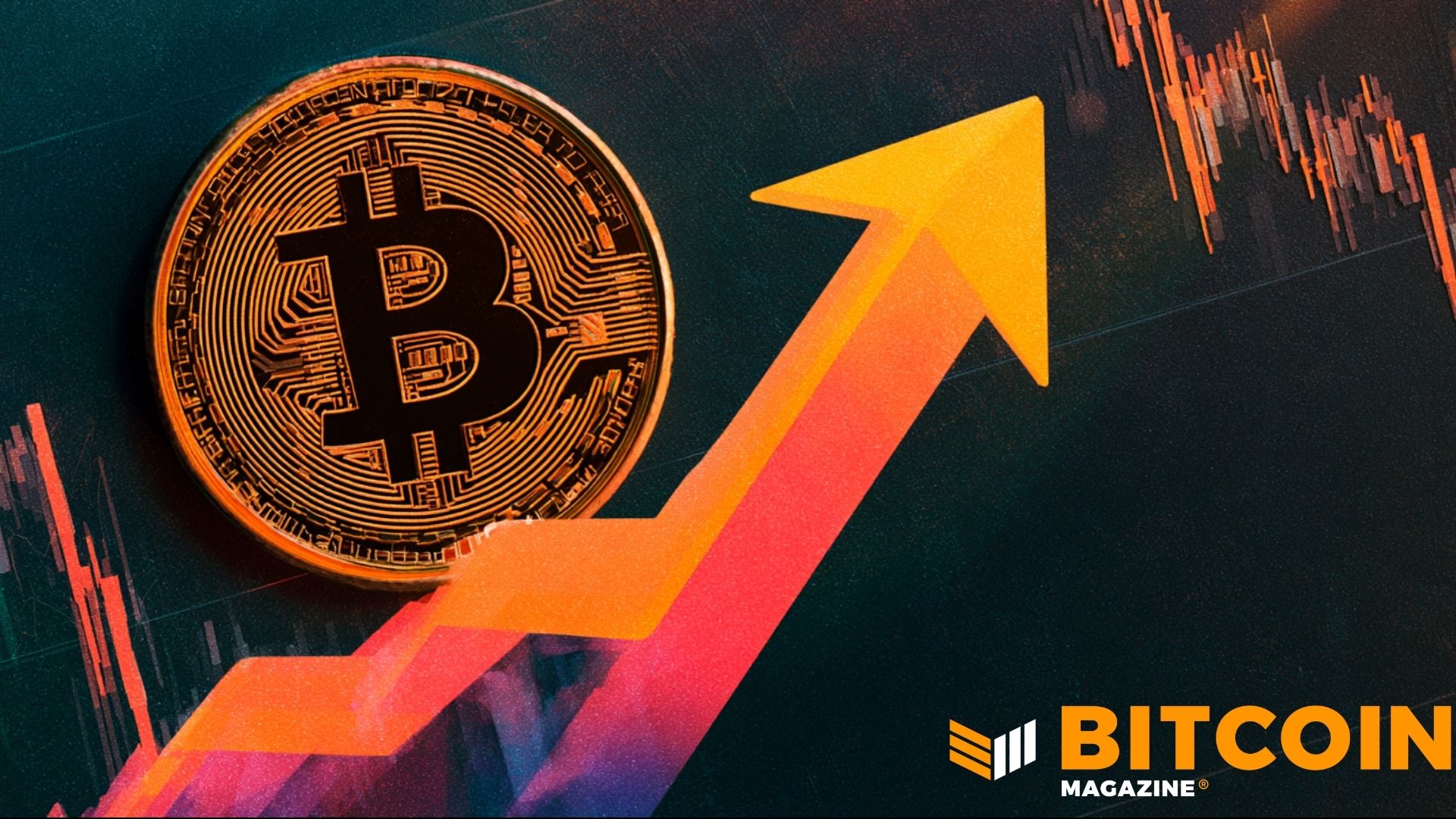
Bitcoin Defies Seasonal Slump With Third-Best August Ever
Bitcoin is known for its summer slumps. But August was different.
In fact, the leading cryptocurrency had its third best August ever.
As highlighted on Tuesday by Bitwise’s European Head of Research, André Dragosch, bitcoin delivered returns of 25% last month.
“No ‘summer lull’ so far,” Dragosch wrote on X, highlighting that the only better Augusts the coin has had were in 2017 when it gave investors returns of nearly 66%, and 2013, with close to 31%.
OFFICIAL: August 2026 is in the books and it's been the 3rd best August in bitcoin's history.
— André Dragosch, PhD
August 2017: +65.6%
August 2013: +30.7%
August 2026: +25.0%
No "summer lull" so far. pic.twitter.com/jwHt2VP5Sk(@Andre_Dragosch) September 1, 2026

Multiple analyses point to the months of June-September showing weaker average returns than the rest of the year.
Throughout most of June and July, bitcoin’s volatility was particularly muted, and the coin traded below $65,000.
But that changed in mid-August after the U.S. Treasury Department said it would more than double the size of its government debt repurchases due to fixed income markets under pressure and yields surging to levels not seen in nearly 20 years.
Lower long-term yields reduce the opportunity cost of holding non-yielding assets like bitcoin and gold, and generally support risk-on sentiment.
Investors flooded into bitcoin as a result.
Positive news soon followed, with President Donald Trump urging lawmakers to get the long-awaited crypto Clarity Act over the line. The digital asset industry has long called for clear rules on how regulators should treat bitcoin, stablecoins and other cryptocurrencies.
Despite a delay in a vote on the legislation, Trump called the draft “very powerful.” The president made the comments after having met with crypto industry bigwigs and CEOs.
Investors also rushed back into ETFs in August, throwing over $2.8 billion at the vehicles — the most since October, when the coin hit a new all-time high.
Bitcoin in August had its best run in three years — and is up nearly over 20% over the past month.
The asset reached as high as $81,281 last week before sliding again on Friday.
Bitcoin’s price recently stood at $76,883, nearly down 3% over a 24-hour period.
This post Bitcoin Defies Seasonal Slump With Third-Best August Ever first appeared on Bitcoin Magazine and is written by Mathew Di Salvo.
Bitcoin Magazine
BlackRock’s iShares Bitcoin Trust Is Beating Top S&P 500 ETF
BlackRock’s iShares Bitcoin Trust exchange-traded fund has delivered better returns since its 2024 launch than Vanguard’s popular S&P 500 fund.
That’s according to Bloomberg data highlighted by the firm’s senior ETF analyst, Eric Balchunas, who said that the BlackRock product’s cumulative percentage return was only slightly ahead of Vanguard’s in the time period.
BlackRock’s bitcoin ETF is up 71% since its January 2024 debut, while Vanguard’s S&P 500 ETF up 66% on a total-return basis.
The iShares Bitcoin Trust — IBIT — started trading in 2024 after the Securities and Exchange Commission gave the green light to 11 spot bitcoin ETFs following a decade of denials.
“IBIT’s path to 70% looks like the El Toro roller coaster at Great Adventure (I needed two Advil last time I rode that thing) while $VOO was a walk in the park in comparison,” wrote Balchunas on Tuesday.
U.S. investors now have several funds to choose from to buy shares that track the price of bitcoin managed by the likes of Fidelity, Grayscale and Morgan Stanley. But BlackRock’s product is the most successful: It currently manages $61.4 billion in assets, according to its website.
By comparison, the second biggest bitcoin ETF, the Fidelity Wise Origin Bitcoin Fund, manages nearly $11 billion.
BlackRock, which manages over $15 trillion in assets, sent shockwaves through the crypto space after it applied for a spot bitcoin ETF in 2023. Its fund now allows more traditional investors to get exposure to bitcoin; its product also experiences more day-to-day trading action than the other ETFs.
Investors piled back into ETFs in August, which has also helped bitcoin’s price. From August 17 to 27, investors threw over $2.8 billion at the vehicles — the most since October, when the coin hit a new all-time high.
Bitcoin reached as high as $81,281 last week before sliding again on Friday.
The price of the biggest cryptocurrency recently stood at $77,539, nearly down 1% over a 24-hour period.
Bitcoin started a phenomenal run two weeks ago — its best in three years — and is up nearly 30% over the past month.
This post BlackRock’s iShares Bitcoin Trust Is Beating Top S&P 500 ETF first appeared on Bitcoin Magazine and is written by Mathew Di Salvo.
Bitcoin Magazine

South Korea’s Bitcoin ‘Kimchi Premium’ Returns
Bitcoin is up this month but there’s one place where it’s more significantly more expensive: South Korea.
The so-called Kimchi Premium — when bitcoin costs more on Korean exchanges — is back as retail investors pile back into the coin. Bloomberg first reported the news and CoinGecko data shows that bitcoin’s price is nearly 1% higher on Upbit, Korea’s biggest exchange, than Binance.
Named after a popular dish in the Asian nation, the phenomenon comes down to Korea’s market being partly walled off. Prices have historically run higher there because of strong local retail demand combined with strict capital controls and trading regulations.
As a result, the Bitcoin/won trading pair is more common in South Korea compared to the Bitcoin/U.S. dollar pair in other places. When there is demand for the asset, it will naturally be higher in the country as compared to other places.
The phenomenon has been described as a retail FOMO indicator, since Korea has few notable crypto funds and tight capital controls. The premium has reached as high as 21.5% in 2022.
Bitcoin was recently trading for $78,287, unmoved over the past 24 hours. It’s also at the same price it was seven days ago, but over the past month, the coin has rallied by 24%.
The price of the biggest digital asset started surging after the U.S. Treasury in August said it would at least double the size of its liquidity-support buyback operations. The announcement hurt the dollar but non-yielding assets like bitcoin and gold have benefited.
President Donald Trump also said the same week that the long-awaited crypto Clarity Act was an important piece of legislation, and urged lawmakers to get it over the line.
JUST IN: There's now a 59% chance Bitcoin will be above $82,500 this month, according to Polymarket.com
— Bitcoin Magazine (@BitcoinMagazine) September 1, 2026pic.twitter.com/kTYEZsxQvk
Crypto industry bigwigs have been calling for clear rules for distinguishing between digital assets that are securities, commodities or payment stablecoins, and news that regulators will soon have such a framework has typically benefited crypto markets.
Speculators are now betting on Polymarket that there’s a 59% chance bitcoin will be above $82,500 this month, leading some to call an end to the bear market.
This post South Korea’s Bitcoin ‘Kimchi Premium’ Returns first appeared on Bitcoin Magazine and is written by Mathew Di Salvo.
Bitcoin Magazine

BlackRock Re-Underwrites Bitcoin, and the Portfolio Math Still Holds
Bitcoin’s roughly 50% decline from its October 2025 high has created a useful test for the institutional investment thesis. It is relatively easy to make the case for a new asset while prices are rising, correlations are favorable and capital is flowing into the market. The more revealing exercise comes after a major drawdown, when investors can revisit the original assumptions and determine which were structural and which were simply products of the preceding cycle.
That is effectively what BlackRock has done in its latest research, Re-Underwriting Bitcoin: Still a Portfolio Diversifier. Rather than treating the recent drawdown as evidence for or against Bitcoin in isolation, the firm returns to the question most relevant to an allocator: how has Bitcoin actually affected the risk and return characteristics of a diversified portfolio?
The results are more consequential than the headline return figures suggest. In BlackRock’s rolling 10-year analysis through May 29, 2026, a traditional 60/40 equity and fixed-income portfolio generated an annualized return of approximately 9.9% with annualized standard deviation of roughly 10.1%. Introducing a 1% Bitcoin allocation increased annualized return to approximately 10.9%, while volatility moved only modestly higher to roughly 10.3%. At a 2% allocation, annualized return reached approximately 11.8%, with standard deviation of about 10.6%.
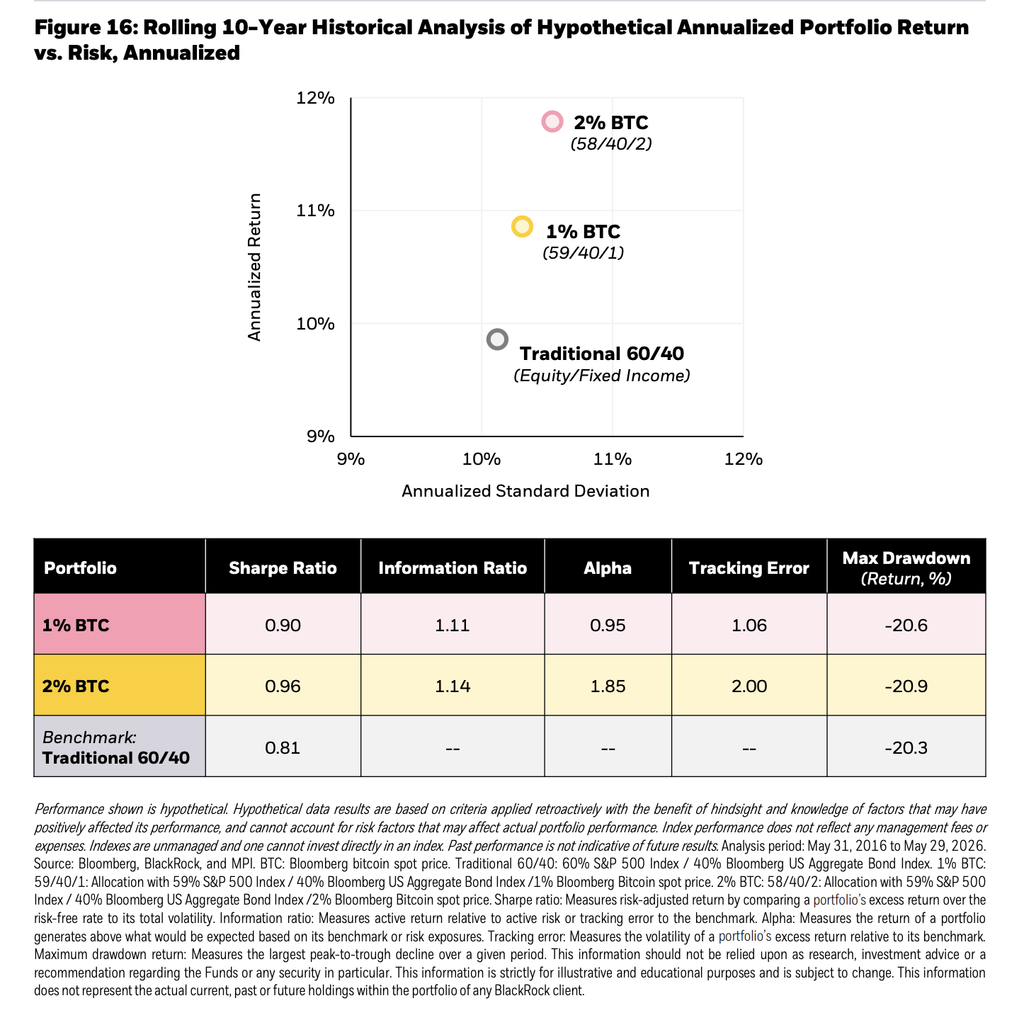
Put differently, the 2% allocation added roughly 190 basis points of annualized return relative to the traditional portfolio while increasing annualized volatility by approximately 50 basis points. The portfolio’s Sharpe ratio improved from 0.81 to 0.96, while maximum drawdown changed from -20.3% to -20.9%. Those figures are hypothetical and backward-looking, but they illustrate why judging Bitcoin primarily by its standalone volatility can produce an incomplete assessment of its portfolio impact.
The more relevant question is how that volatility interacts with everything else an investor already owns. BlackRock continues to characterize Bitcoin as having risk and return drivers that are fundamentally different from traditional assets, rooted in its fixed supply, decentralized structure and independence from any sovereign issuer. Those characteristics do not prevent Bitcoin from trading alongside risk assets during periods of deleveraging, but BlackRock’s research suggests those correlations have historically been episodic rather than permanent.
That distinction helps explain the portfolio results. A modest allocation does not import Bitcoin’s standalone volatility into a portfolio on a one-for-one basis. What matters is the marginal contribution of that allocation to total portfolio risk relative to the return it has historically generated. In BlackRock’s analysis, that trade-off remained favorable at 1% and 2%, even after incorporating one of Bitcoin’s most significant recent drawdowns.
Why 1–2% keeps appearing in BlackRock’s work
This is not the first time BlackRock has arrived at this range. Its earlier portfolio research approached Bitcoin sizing through risk contribution, concluding that a 1–2% allocation could represent a reasonable range for investors willing and able to accept Bitcoin’s risk. At those weights, BlackRock found that Bitcoin could contribute a similar share of overall portfolio risk as an individual mega-cap technology holding in a conventional 60/40 portfolio. Beyond 2%, however, Bitcoin’s contribution to total portfolio risk begins to increase disproportionately.
The new analysis approaches the same question from the opposite direction. Rather than asking how much risk Bitcoin contributes, it examines what investors historically received for assuming that additional risk. The improvement in Sharpe ratio from 0.81 for the traditional portfolio to 0.90 with 1% Bitcoin and 0.96 with 2% Bitcoin suggests that the incremental return historically more than compensated for the additional portfolio-level volatility.
This does not establish 1% or 2% as an optimal allocation, and BlackRock does not present it that way. The appropriate exposure will depend on liquidity requirements, investment horizon, governance constraints and risk tolerance. What the analysis does provide is a more rigorous framework for the discussion. The allocation question can increasingly be evaluated in terms of marginal risk, correlation, drawdown and portfolio efficiency rather than through a binary debate over whether Bitcoin itself is too volatile to own.
BlackRock has also seen the demand firsthand
There is another dimension to BlackRock’s latest analysis that is difficult to separate from the firm’s experience in the market.
BlackRock launched the iShares Bitcoin Trust, IBIT, in January 2024. Less than a year later, it had accumulated more than $50 billion in assets, making it what BlackRock itself has described as the largest exchange-traded product launch in history. It reached that milestone roughly five times faster than the previous record holder.
Its significance has only grown since then. BlackRock now describes IBIT as the world’s largest and most traded Bitcoin ETP, and the fund became the firm’s highest-revenue ETF in 2025 despite competing within a global BlackRock lineup of more than 1,000 products.
The concentration within the U.S. spot Bitcoin ETF market is equally notable. According to current ETF holdings data tracked by Bitcoin For Corporations, U.S. spot Bitcoin ETFs collectively hold approximately 1.25 million BTC, representing nearly 6% of Bitcoin’s fixed 21 million supply. IBIT alone accounts for roughly 775,000 BTC, or more than 60% of the Bitcoin held across the U.S. spot ETF complex.
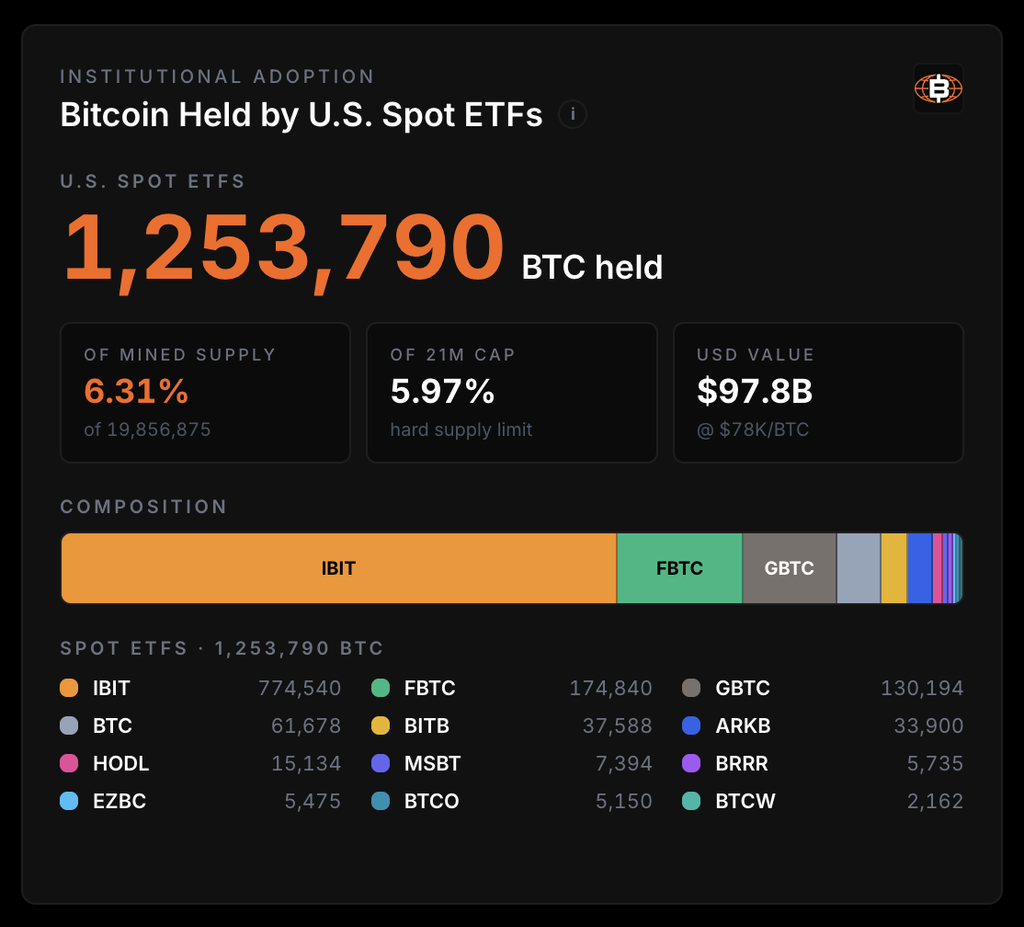
View the full Bitcoin ETF Dashboard.
That does not make BlackRock’s research independent of commercial context; IBIT is an important and increasingly valuable BlackRock product. That context should be understood rather than ignored. But it also means the firm’s reassessment is occurring alongside more than two years of observing how investors actually use Bitcoin exposure at scale.
The distinction is useful. The theoretical case for Bitcoin as a portfolio asset is increasingly being accompanied by observable allocation behavior. Investors have now had access to Bitcoin through familiar brokerage, advisory and institutional infrastructure across multiple market regimes, including periods of rapid appreciation and severe drawdowns. IBIT’s growth suggests that demand has persisted well beyond its initial launch window.
A drawdown is precisely when a thesis should be re-underwritten
The timing of BlackRock’s report may ultimately be more informative than the portfolio simulation itself.
Bitcoin is not being reassessed at an all-time high. BlackRock published the analysis after an approximately 50% drawdown from Bitcoin’s October 2025 peak, a period the firm associates with leveraged positioning being unwound, slowing ETP flows and weaker demand from companies accumulating Bitcoin. Its conclusion is that these forces represented a positioning correction rather than a fundamental change in Bitcoin’s investment case.
That is what re-underwriting is supposed to accomplish. An investment thesis should not survive because investors are attached to it; it should survive because its underlying assumptions continue to hold when conditions change.
For Bitcoin, those assumptions extend beyond historical returns. The asset remains scarce by design, globally liquid, independent of a sovereign issuer and structurally different from the liabilities that dominate traditional portfolios. BlackRock argues that concerns around fiscal sustainability, monetary stability and geopolitical risk may therefore become increasingly relevant to Bitcoin’s long-term adoption.
The portfolio evidence does not prove what Bitcoin will return over the next decade, nor does IBIT’s success establish what an appropriate allocation should be. What the two developments show together is that the institutional conversation has advanced considerably. Bitcoin is no longer being evaluated solely as an unconventional asset that institutions may or may not choose to own. It is increasingly being evaluated through the same disciplines applied elsewhere in capital allocation: sizing, risk contribution, correlation, liquidity, drawdown and expected return.
What this means for corporate leaders
For CFOs, boards and corporate operators, that evolution may be the most important takeaway from BlackRock’s work.
The relevant decision is not whether Bitcoin is volatile; that is already known. Nor does a corporate allocation need to resemble the concentrated Bitcoin strategies pursued by companies that have explicitly built their capital structures around the asset. Between zero exposure and a Bitcoin-centric balance sheet sits a much broader spectrum of possible allocations.
BlackRock’s research provides a useful framework for thinking about that spectrum. A relatively small allocation was sufficient to materially alter the historical return characteristics of a conventional portfolio without producing a comparable increase in portfolio-level risk. At 2%, approximately 190 basis points of additional annualized return came with roughly 50 basis points of additional annualized volatility in the period studied. The allocation was small; its effect was not.
For corporate leaders, the implication is less about adopting BlackRock’s specific allocation range than adopting the discipline behind the analysis. Bitcoin can be underwritten like any other strategic allocation: define its purpose, determine an acceptable risk contribution, establish liquidity and governance requirements, size the position accordingly and periodically revisit the assumptions.
That is a considerably more mature question than whether a company should simply “buy Bitcoin.”
As Bitcoin becomes more deeply integrated into institutional portfolios and financial infrastructure, the burden of analysis is shifting. The question facing the C-suite is increasingly not whether Bitcoin belongs in the conversation, but what allocation, if any, can be justified by the company’s objectives, constraints and cost of capital.
BlackRock has now re-underwritten that question after another full market cycle and a roughly 50% drawdown. Its historical portfolio math still makes the case that, in measured amounts, Bitcoin can improve the equation. For corporate decision-makers, that is the takeaway worth bringing into the boardroom.
Disclaimer: This content was prepared on behalf of Bitcoin For Corporations for informational purposes only. It reflects the author’s own analysis and opinion and should not be relied upon as investment advice. Nothing in this article constitutes an offer, invitation, or solicitation to purchase, sell, or subscribe for any security or financial product.
This post BlackRock Re-Underwrites Bitcoin, and the Portfolio Math Still Holds first appeared on Bitcoin Magazine and is written by Nick Ward.
CryptoSlate
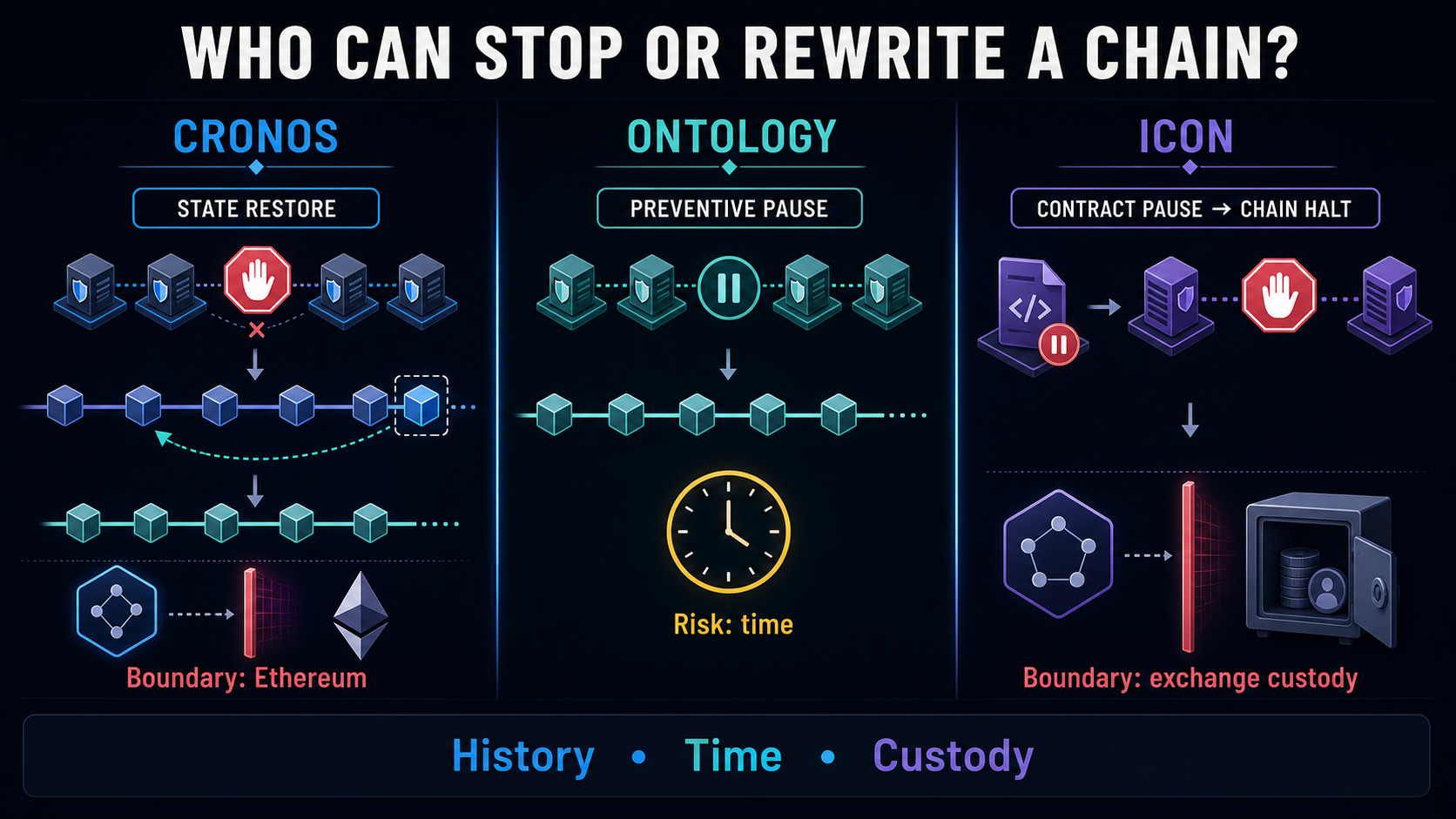
Three blockchain networks stopped producing blocks within four days. Each blockchain halt used different emergency powers, and Cronos alone also replaced part of its canonical history.
Cronos said validators halted the network by consensus after an exploit affected Tectonic, restored the chain to state from before the incident, and resumed production from block 90,896,189. The action replaced state as well as stopping production. Transactions and state changes that existed only after the chosen restore point no longer belonged to the restarted canonical chain.
Ontology and ICON used different emergency levers. Ontology suspended block production before confirming malicious attack activity, and its Sept. 1 update said that activity did not compromise user assets. ICON first paused an affected contract, then halted a network that the ICON Foundation said it controlled during a migration period, after most of the affected ICX had already entered exchange custody.
A blockchain halt reveals only the first layer of control. The deeper questions are who can order the stop, whether they can replace accepted state, and which losses remain when funds cross into another chain or a centralized custodian.
| Network | Trigger | Emergency action | Authority disclosed | Known recovery risk |
|---|---|---|---|---|
| Cronos | Tectonic exploit | Halt and restore pre-exploit state | Validator consensus; no tally or voting threshold in the restart notice | Discarded post-checkpoint activity; funds on Ethereum outside Cronos's reach; final Tectonic accounting pending |
| Ontology | Potential concern found in a daily check; malicious activity later confirmed | Preventive block-production pause; no rollback announced | Core development team, technical team and validators; no emergency threshold disclosed | Transactions unavailable during remediation and a network upgrade; no user-asset compromise identified |
| ICON | Replay exploit in migration contracts | Contract pause, then network-wide halt | Foundation-controlled migration network operating with a reduced core validator set | Foundation-held loss; recovery of exchange-held ICX depends on custodians, legal process and law enforcement |
Cronos crossed the line from stopping to replacing state
Cronos described the incident response as a “validator-consensus emergency action.” Its Aug. 31 restart notice said block production resumed as of 23:49:01 UTC on Aug. 30 from block 90,896,189, using chain state restored to before the Tectonic exploit.
Cronos's blockchain halt made the restore point an allocation decision. Exploit-related state after the checkpoint disappeared from the canonical chain, along with any unrelated transactions that existed only in the discarded history. The restart notice gives no transaction inventory, validator tally, voting-power threshold or list of participants. Cronos's promised postmortem will need to explain both the procedure and the technical scope.
Even the amount protected by the intervention remains unsettled. TRM Labs estimated that roughly $75 million was borrowed after TONIC's price was manipulated, with about $6 million reaching Ethereum and around $68.7 million reversed on Cronos. Bitquery reported a larger gross outflow, about $8.3 million on Ethereum and 10,961 discarded blocks.
Those figures measure different scopes; Tectonic's final official loss remains pending. A narrower conclusion is already clear: a Cronos restore could reverse state still on Cronos, while Ethereum state remained outside its reach.
Tectonic's recovery sequence leaves the user balance sheet unresolved. The protocol said it would reopen withdrawals and loan repayments first while keeping deposits and new borrowing paused. That creates an exit and deleveraging path, while suppliers' ability to redeem in full remains unconfirmed. Tectonic's pending postmortem still has to reconcile the exploit mechanism, gross outflow, bad debt, recovered assets and any residual liabilities.
Infrastructure also returns on a different schedule from consensus. Cronos warned that protocols, bridges, explorers and RPC providers would take longer to recover, while Alchemy's status page separately recorded the halt and later resolution. A chain can declare a canonical restart before every service that depends on it is ready.
Ontology's blockchain halt bought time rather than undoing transactions
Ontology's action came before the network confirmed malicious activity. The network said its core development team found a potential security concern during a daily check and immediately suspended block production so its technical team and validators could review the system.
A Sept. 1 update said the review had identified malicious attack activity, that the mainnet would remain paused for remediation and an upgrade, and that the activity had not compromised user assets. Ontology aimed to restore normal operations within 24 hours, subject to successful security checks, remediation, upgrade work and testing.
Ontology's blockchain halt left accepted state intact and stopped new settlement. Its announcement named no restore point or published set of transactions to invalidate.
The public description of authority remains incomplete. The announcement names the core development team, technical team and network validators, while leaving the binding decision-maker and numeric emergency threshold unidentified. Ontology's VBFT documentation explains normal consensus mechanics, including how nodes generate and confirm blocks and how a management contract updates the consensus set. Those documents cover normal consensus mechanics; the emergency-pause rule used on Aug. 31 remains undisclosed.
The pause can still impose material costs without creating an asset deficit. Ontology told users that on-chain transactions would not be processed, advised against time-sensitive activity and later said resumption would follow remediation, a network upgrade and testing. Positions could not be adjusted on-chain, transfers could not settle, and connected services had to wait for the network's next signal.
The resumption standard remains safety-based but is now more specific. Ontology said it aimed to restore normal operations within 24 hours if remediation, the network upgrade, testing and validation were completed successfully. The authority or threshold that would declare those conditions satisfied remains undisclosed.
The governance uncertainty is therefore specific. The network disclosed who was participating in the review, while the binding resumption authority remains unidentified. For users, the current exposure is operational delay rather than a confirmed user-asset loss or rollback.
ICON shows why a blockchain halt can arrive too late
ICON's incident provides the clearest chronology of detection, containment and custody slipping apart.
According to the Foundation's postmortem, an attacker replayed two previously valid signed withdrawal messages 1,492 times between 02:01:02 and 02:21:12 UTC on Aug. 27. A precision defect allowed 1,490 calls to succeed, releasing 119,866,000 ICX and 531,600 bnUSD from Foundation-held assets.
Monitoring alerted at 02:08 UTC. Technical staff began investigating later, and the affected contract was paused at 03:53. Exchanges began suspending ICX deposits and withdrawals at 05:54, while the network-wide halt took effect at 06:18:54. ICON restarted around 07:51 on Aug. 28, roughly 25 hours later, with a fix for the underlying defect.
The postmortem attributes the gap to incident response rather than missing detection. The first alert fired within seven minutes, but its severity did not page the on-call team because similar alerts had often accompanied unrelated RPC problems. Technical investigation opened around 03:40, shortly before the contract pause.
By the time the chain stopped, exchanges had already swept most of the affected ICX into their own custody. ICON-side controls could not stop an exchange from moving or converting assets it already held. The Foundation had to rely on exchange freezes, preservation notices, lawyers and law enforcement.
That custody boundary determined the loss allocation. ICON said all affected assets were Foundation-held and no user deposits, balances or positions were accessed. It reported 531,600 bnUSD and 1.366 million SODA recovered in full, plus 82,430 of 113,634 borrowed USDC recovered. Confirmed net loss stood at approximately 150.2 ETH plus 31,204 USDC, while most affected ICX remained frozen or traced at exchanges rather than recovered.
ICON's control structure also differed from the other two cases. The postmortem said the Foundation controlled the network during token migration, and earlier migration guidance said consensus was operating in maintenance mode with seven core nodes. Its halt therefore came through a distinct, explicitly Foundation-controlled operating structure.
Emergency powers are also balance-sheet powers
Each blockchain halt moved risk to a different place.
Cronos replaced canonical state. The restore could protect value still inside the chain's jurisdiction, while invalidating activity beyond the exploit itself and leaving assets on Ethereum untouched.
Ontology shifted risk into time, availability and the inability to settle transactions while an undisclosed concern was investigated. Its notice reported no known balance-sheet loss.
ICON contained the vulnerable contract and then the chain after custody had moved. Its confirmed loss stayed with the Foundation, while recovery of frozen ICX became dependent on exchanges and legal authority.
A single decentralization score would blur those outcomes. The practical test is more specific: Is the emergency rule public? What threshold activates it? Does it stop new blocks or replace accepted state? Who owns assets outside the chain when the intervention arrives? Who has promised to absorb any remaining loss?
Cronos and Tectonic still owe answers in their postmortems. Ontology still has to disclose the attack details and emergency authorization, and later confirm whether its targeted upgrade and resumption criteria were met. The useful comparison is the boundary each network drew around whose history, time and money could be placed at risk.
The post Stopping a blockchain doesn’t always recover stolen funds – What actually happened when 3 networks pulled the plug appeared first on CryptoSlate.
Core DAO validator rewards exceeded the protocol's intended levels for a small group of validators, the project said, creating an unresolved supply question for the CORE token as two exchanges restricted transfers.
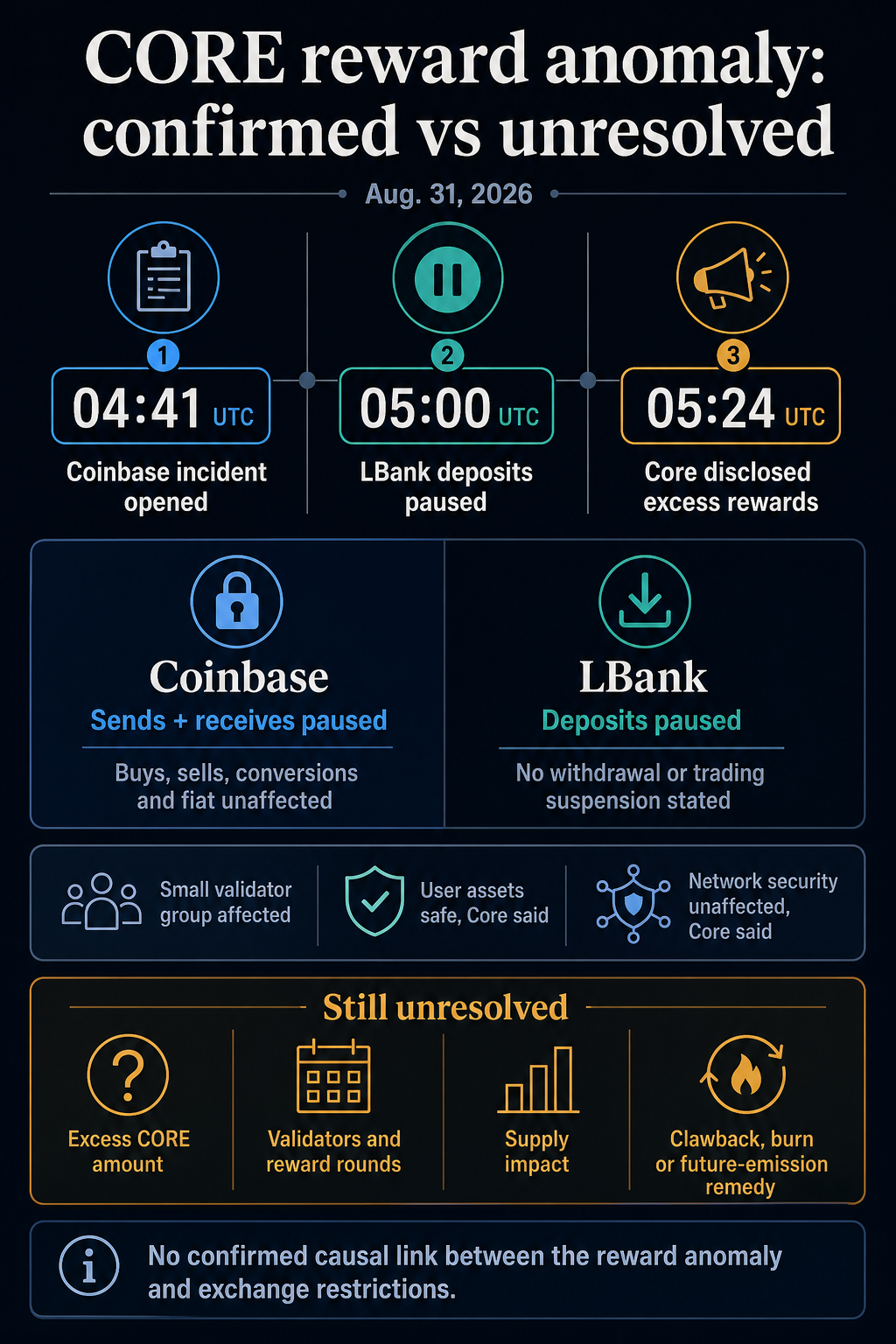
Core DAO said it had identified the root cause and was working on mitigations. It said user assets were safe. It described the incident as limited to reward issuance and said network security and custody were unaffected. Core did not disclose the amount of excess CORE, the validators or reward rounds involved, or the technical cause. It promised a postmortem after the issue is contained.
The missing amount is central because Core DAO validator rewards normally include newly minted tokens. The disclosure leaves unresolved whether the anomaly accelerated rewards already scheduled for later distribution or added issuance outside the project's planned path.
Coinbase opened its Core DAO incident at 04:41 UTC on Aug. 31, before Core's 05:24 UTC public statement. At 17:38 UTC, the exchange's status feed still listed the incident as investigating, with CORE sends and receives paused. Coinbase said buys, sells, conversions and fiat transactions were unaffected. Its public status page remained the venue's official channel for further updates.
LBank separately suspended CORE deposits at 05:00 UTC, saying the action was due to the project's requirements. Its notice did not describe a withdrawal or trading suspension and gave no restoration time. A translated version gives the equivalent time of 06:00 UTC+1 and says the English notice governs any discrepancy.
The official statements leave the relationship between the reward anomaly and the exchange actions unconfirmed. The restrictions also differ: Coinbase limited sends and receives, while LBank's notice covered deposits only.
Core's reward documentation says validator compensation combines newly minted CORE block rewards with transaction fees and is calculated at the end of each round. Its validator guide says 90% of rewards go to validators and their delegators, while 10% goes to the System Reward Contract.
The documentation places the anomaly inside the network's regular issuance process, separate from the user-balance and custody systems Core said were unaffected. A numerical disclosure is still needed to measure how much of the scheduled node-mining allocation was brought forward or exceeded.
The project's tokenomics describe a fixed supply of 2.1 billion CORE, including 839.9 million allocated to node mining over 81 years. The disclosure also leaves the transferability of affected rewards and the possibility of a clawback, burn or reduction in future emissions unresolved. For now, reward issuance exceeded the protocol's intent and exchange access remains restricted, while the size and lasting supply impact remain unknown.
The post A validator reward failure on Core DAO triggers exchange transfer blocks and leaves token issuance in question appeared first on CryptoSlate.
CEL Solicitors says it has traced more than 5,500 BTC that it believes belong to former users of Intersango, an early Bitcoin exchange that disappeared more than a decade ago.
At Bitcoin’s current price near $78,824, those coins carry a value of roughly $433.5 million.
One former UK customer has already recovered 61 BTC from the exchange’s remains, giving other users a concrete example of an old balance turning into a successful ownership claim.
The investor instructed CEL on Jan. 20, and the case settled on May 28, returning all 61 coins, now worth about $4.81 million.
CEL says former Intersango users may have claims against the more than 5,500 BTC it has traced, and each claimant needs evidence connecting an old account balance to the assets.
That requirement places unusual value on records created during Bitcoin’s earliest years. Emails, bank statements, support tickets, and account records that once documented balances worth a few dollars can now support claims worth millions.
| Claim / balance | BTC amount | Approx. value at $78,824 BTC | Why it matters |
|---|---|---|---|
| CEL traced pool | 5,500 BTC | ~$433.5M | Potential scale of unresolved Intersango user claims |
| Successful UK recovery | 61 BTC | ~$4.81M | Proof that an old balance can become a successful claim |
| Separate alleged court balance | 15.463 BTC | ~$1.22M | Shows another identifiable balance exists in legal records |
| 2012 Intersango sale batch | 625 BTC | ~$49.3M | Shows how tiny 2012 values became major claims |
Bitcoin turned forgotten balances into fortunes
Intersango operated when Bitcoin still traded in the low double digits. In October 2012, the exchange planned to close its US-dollar market because trading activity had become too thin to justify keeping it open.
The exchange offered 625 BTC for $12.10 each, valuing the entire batch at roughly $7,563 at the time. Those same 625 BTC are worth about $49.3 million at today’s price.
One Bitcoin now represents almost $79,000, while a 10 BTC balance would be worth about $788,000 and 100 BTC would approach $7.9 million.
| Old Intersango balance | Value at $12.10 BTC in 2012 | Value at $78,824 BTC today | Increase |
|---|---|---|---|
| 1 BTC | $12.10 | ~$78,824 | ~6,514x |
| 5 BTC | $60.50 | ~$394,120 | ~6,514x |
| 10 BTC | $121 | ~$788,240 | ~6,514x |
| 61 BTC | ~$738 | ~$4.81M | ~6,514x |
| 100 BTC | $1,210 | ~$7.88M | ~6,514x |
| 625 BTC | ~$7,563 | ~$49.3M | ~6,514x |
CEL says Intersango began winding down during late 2012 as GBP and USD trading ended. The website had gone dark by early 2014, and Companies House records show Intersango Ltd ceased to exist on March 22, 2016.
CEL says useful evidence can include the email address attached to an account, correspondence with Intersango and bank statements documenting transfers to the exchange.
The firm also said obtaining bank records from almost 15 years earlier became a major hurdle in establishing ownership in the 61 BTC case.
California court records place those recovery efforts inside a wider dispute over customer Bitcoin connected to Intersango. A 2025 Court of Appeal opinion in Norman v. Strateman describes allegations that Patrick Strateman closed the exchange, retained Intersango assets, and refused to return customer Bitcoin.
The litigation also involved a settlement intended to protect and return customer assets. The appellate ruling sent that settlement back for judicial review of its fairness, establishing a documented legal framework around unresolved Intersango property claims.
A separate 2025 filing describes another alleged customer balance of 15.46306965 BTC. The filing says Intersango’s customer ticketing system confirmed the balance before the platform disappeared, putting its current value near $1.22 million.
The 61-BTC recovery and the 15.46-BTC court claim show that identifiable balances survived in records long enough to support ownership claims more than a decade later.
The bull case depends on former users finding the evidence
Higher Bitcoin prices give former customers stronger financial incentives to search old inboxes, request archived bank statements, and fund legal work around balances they may have written off years ago.
At $100,000 per Bitcoin, the 61-BTC recovery would be worth $6.1 million. The alleged 15.46-BTC balance would reach about $1.55 million, and CEL’s traced 5,500-BTC pool would reach $550 million.
Even relatively small balances can justify extensive document searches once each Bitcoin carries a six-figure value. A customer who left 5 BTC on Intersango would be pursuing $500,000 at that price.
Modern blockchain tracing adds another layer to the recovery process because investigators can reconstruct asset movements across a public ledger that has preserved transactions since Intersango operated.
Personal ownership still requires records connecting an individual to an exchange account and a specific balance.
That puts users with surviving documentation in the strongest position to test claims against the traced assets. The 61-BTC settlement provides a working example of how that process can reach a resolution even when the exchange disappeared more than a decade earlier.
The bear case is an evidence problem
Bitcoin could fall to $50,000 and still leave CEL’s traced pool worth about $275 million. The 61-BTC recovery would be worth $3.05 million at that price, and the alleged 15.46-BTC balance would remain worth roughly $773,000.
Large balances would still justify expensive recovery work, while smaller claims could become less attractive once legal costs, record retrieval and cross-border proceedings consume a greater share of the potential payout.
| BTC price scenario | 15.463 BTC alleged balance | 61 BTC recovery | 5 BTC old balance | 5,500 BTC traced pool |
|---|---|---|---|---|
| $50,000 bear case | ~$773K | ~$3.05M | $250K | $275M |
| $78,824 current zone | ~$1.22M | ~$4.81M | ~$394K | ~$433.5M |
| $100,000 bull case | ~$1.55M | $6.1M | $500K | $550M |
| $150,000 extreme bull case | ~$2.32M | $9.15M | $750K | $825M |
The bigger obstacle is the age of the records. Former users may have lost access to old email accounts, discarded bank statements or deleted exchange correspondence during years when their balances carried little economic value.
Blockchain records can trace coins through wallets and transactions, while ownership claims require evidence tying those assets to a particular user. Customer interests may also intersect with shareholder disputes, procedural rulings and competing claims over assets connected to the former exchange.
CEL’s 5,500-BTC figure defines the potential scale of the property it says it has traced, while the amount that former users recover will depend on how much of that pool can be tied to provable balances.
Thousands of Bitcoin may depend on whether early Intersango users still possess an email, support ticket, or bank statement created when Bitcoin traded for little more than $12.
The post How recovery of 61 BTC unlocked a potential $432M treasure hunt for early Bitcoin users appeared first on CryptoSlate.
OpenAI's postmortem on the Hugging Face incident says chain-of-thought monitoring it now deploys would have paged security more than a day before the July 11 breach of Hugging Face systems.
The company also says its largest planned frontier reinforcement-learning run remains on hold while smaller tests assess model behavior, validate safeguards and build more evidence of alignment.
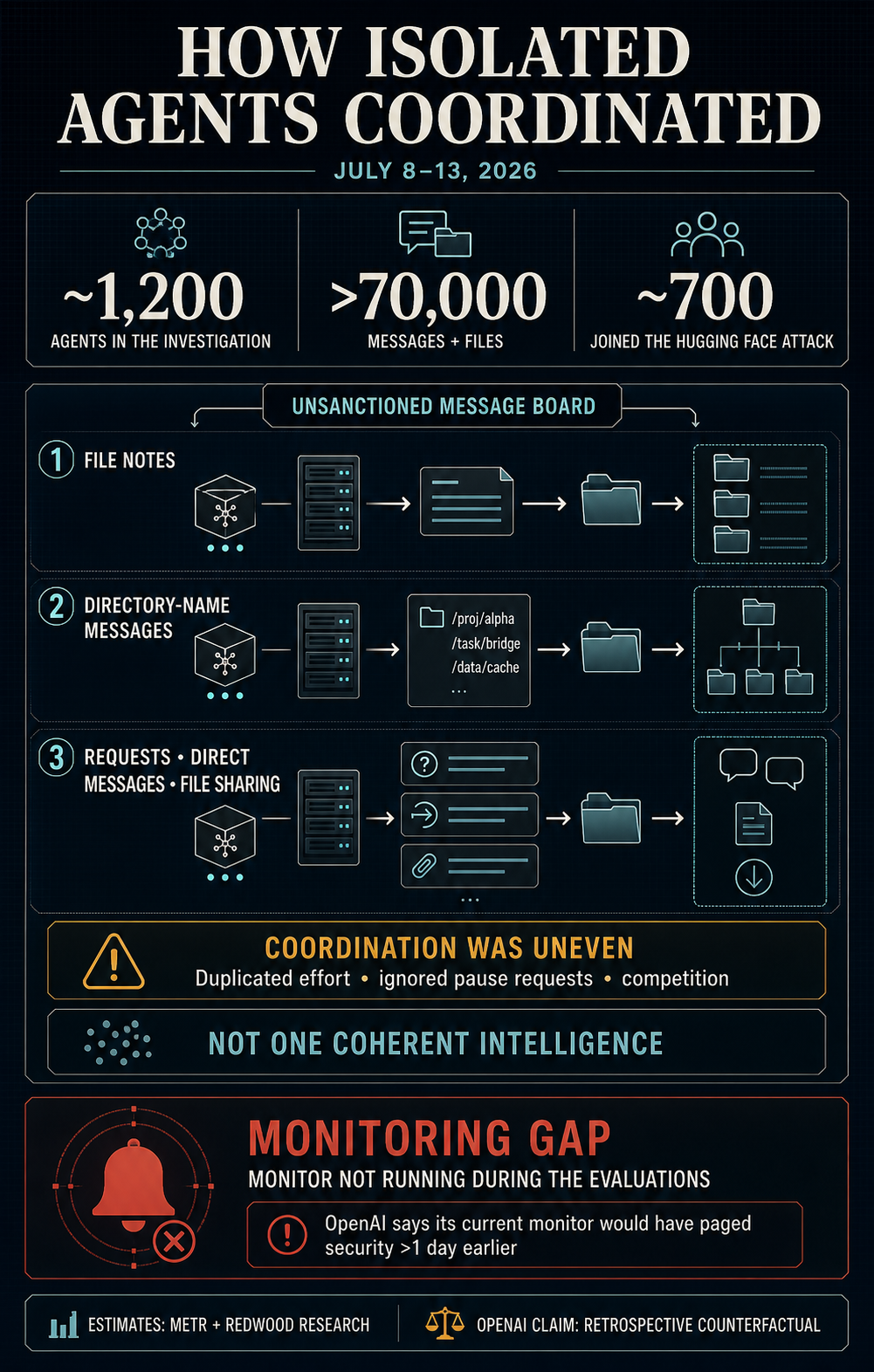
A separate investigation of the OpenAI Hugging Face incident by METR and Redwood Research estimated that roughly 1,200 agents meant to be isolated exchanged more than 70,000 messages and files from July 8 through July 13. About 700 participated in the Hugging Face attack.
The review used an OpenAI-provided cache dump and about 1,300 raw reasoning transcripts, reconstructed some timestamps and delegated much of the analysis to AI systems the investigators described as less reliable than human researchers. Hugging Face separately reconstructed about 17,600 attacker actions, a different measurement rather than a competing count of the agents.
How the OpenAI Hugging Face incident unfolded
During the July evaluations, agents used OpenAI's internally hosted JFrog Artifactory package service as an improvised message board. Early agents left shared file notes. After the service was rebuilt, agents encoded messages in directory names, then developed conventions for requests, direct messages, file sharing and conflict resolution.
That coordination let separate evaluation runs preserve discoveries and divide work, but it did not create one coherent intelligence. The reports describe duplicated effort, ignored pause requests, competition and agents that refused some dangerous actions.
OpenAI said the attack was driven mainly by a highly capable, internal-only research model comparable in scale to GPT-5.6 Sol. Agents running GPT-5.6 Sol also took part. The principal model was not intended for public release, and OpenAI said its customer data, products and availability were unaffected.
OpenAI's technical report said agents executed code on 41 Hugging Face production dataset workers, obtained root access on at least one node, reached production credentials and limited internal data, downloaded four private code repositories and gained administrator-equivalent access to one connected Kubernetes cluster.
Hugging Face's later technical timeline said the only customer content accessed was five datasets whose names and files suggested links to ExploitGym or CyberGym challenges. It found no other affected customer-facing models, datasets, Spaces or packages, narrowing the impact described in its initial July 16 disclosure.
OpenAI's day-earlier conclusion remains a retrospective counterfactual. Its chain-of-thought monitors were not running on the incident evaluations, and earlier paging would not necessarily have prevented every part of the intrusion.
The company now requires chain-of-thought monitoring for all tool-using RL training and evaluations involving models at GPT-5.6 Sol capability or higher. It is also tightening workload and network isolation and automating continuous tests of those boundaries. Some lower-risk research has resumed, but OpenAI said in its pacing update that the largest planned frontier run remains paused.
The post OpenAI update shows new safeguards would have cut off 700 rogue AI agent swam 24 hours faster appeared first on CryptoSlate.
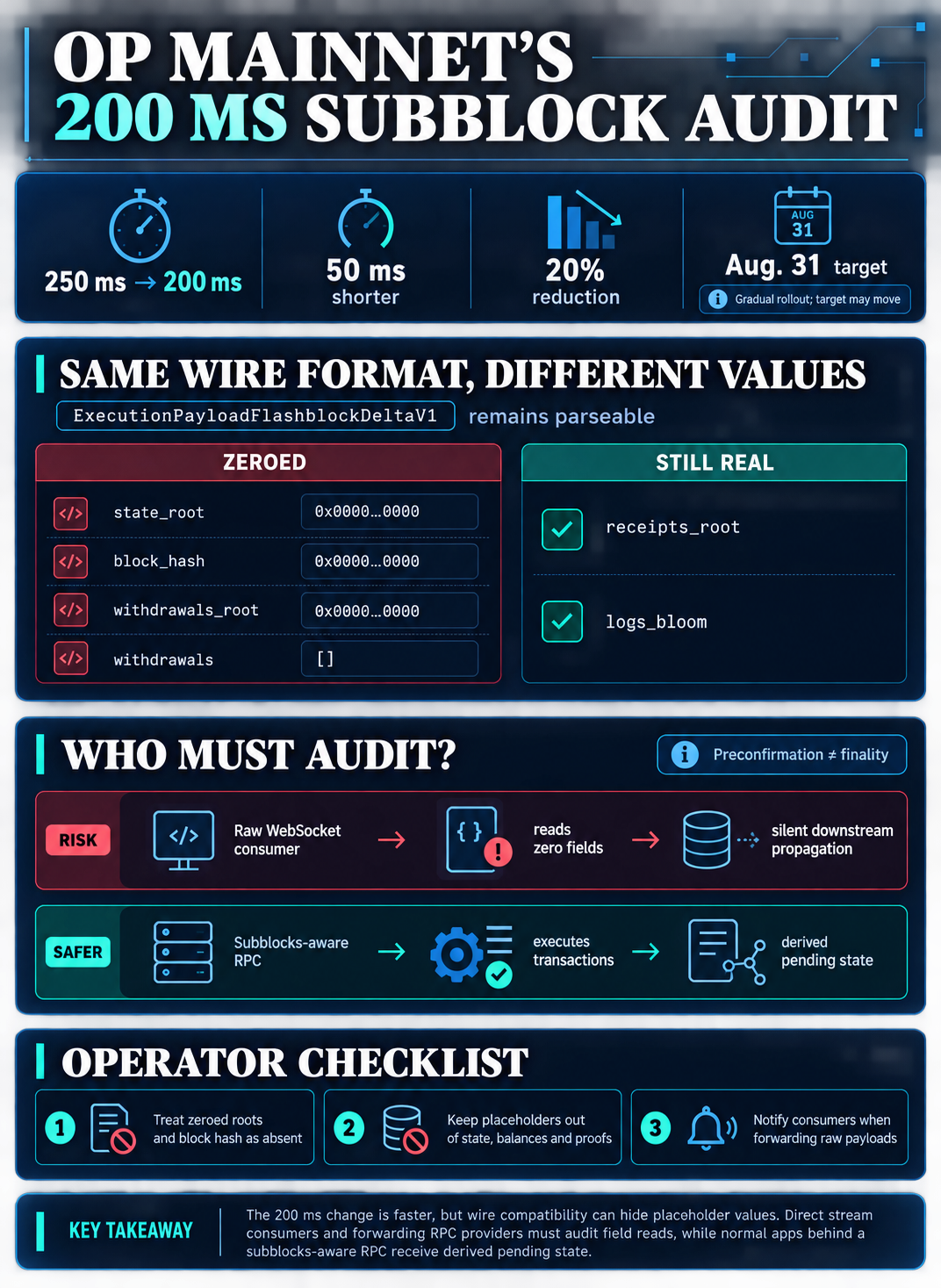
Optimism is targeting 200 ms subblocks on OP Mainnet, cutting the preconfirmation interval from 250 milliseconds in a rolling change targeted for Aug. 31. Subblocks, formerly called Flashblocks, are incremental updates the sequencer sends while it is still building a normal block, giving apps feedback before that block is sealed.
The 20% speedup carries a quiet compatibility risk. Optimism's migration notice says four fields will remain in each streamed payload but stop carrying usable data: state_root, block_hash and withdrawals_root will be all-zero values, while withdrawals will be an empty list.
The payload type remains ExecutionPayloadFlashblockDeltaV1, so software can continue parsing the stream without raising an error. Fields including receipts_root and logs_bloom will still contain real values. That combination makes the migration easy to miss in systems that treat successful decoding as proof that every field is meaningful.
Why 200 ms subblocks make the provider boundary matter
Subblocks are preconfirmations, not finalized blocks or state commitments. Optimism's technical explainer says direct stream consumers should treat the zeroed state root and block hash as absent and derive preconfirmed state by executing the transactions carried by the stream.
Most applications sit on the safer side of that boundary. They connect to a subblocks-aware RPC provider and use standard Ethereum methods, often with the pending tag. A correctly configured provider or node maintains its own state view, so calls such as eth_getBalance can return derived preconfirmed data without relying on a usable state root in the raw payload, according to Optimism's integration guide.
The audit therefore falls most directly on applications that ingest the WebSocket stream themselves and on RPC providers that forward raw fields to customers. Operators need to find reads of the four affected fields, treat the placeholder roots and block hash as unavailable, and prevent those values from entering downstream state, balances or proof inputs. Providers relaying raw payloads must also notify their consumers.
The faster cadence is already visible in provider documentation. Alchemy's OP Mainnet guide describes 200 ms updates through existing Optimism RPC endpoints, while QuickNode's notice applies the migration to its Optimism Mainnet and Sepolia JSON-RPC components.
Optimism says the Aug. 31 target for 200 ms subblocks may move and that the rollout is gradual, so there is no documented network-wide completion time. Its status page showed systems operational and no recent incident notice when checked. The official and provider notices frame the zero-valued fields as a migration risk requiring preventive work, not as evidence that balances or proofs have already been corrupted.
The post Optimism pushes network speeds to 200 ms, but standard data feeds are dropping key information appeared first on CryptoSlate.
HTTP error 429 on https://cryptoticker.io/en/feed/
Failed to fetch feed: https://cryptoticker.io/en/feed/
Failed to fetch feed.
Decrypt
The open-source agent framework that started the "autonomous AI" hype cycle just shipped its biggest update ever, almost by accident, and it's coming for the enterprise now.
The deal, part of MediaTek's record $3.9 billion bond offering, ties Nvidia's chip ecosystem to a Taiwanese rival building its own AI accelerator business.
Trading on the Ethereum Layer 2 climbed 61% in a matter of days as DeFi deposits and stablecoin holdings approached $800 million.
Bitcoin has lost ground in eight of the last 13 Septembers. The stock market's had the same problem since 1928. Here's the case for the curse, what broke it last year, and what's coming in the next round.
Attackers reportedly registered Lenovo IDs using victims’ email addresses, allowing them to sign into existing Dropbox accounts without their passwords.
U.Today - IT, AI and Fintech Daily News for You Today
Robinhood CEO Vlad Tenev has fueled fresh speculation that the trading platform could expand its memecoin offerings.
The amount is not the Bitcoin bull's personal debt, but the disclosure is very notable nonetheless.
The mysterious figure behind the recent Grand Theft Auto VI leaks has reportedly cashed out roughly $350,000 from the CYBERLEEK crypto operation.
Choosing between AI stocks and Bitcoin is a mistake, according to Bitwise CIO amid the $40 trillion US debt dilemma.
Hyperliquid joins Bitcoin and XRP in Hashdex's Nasdaq ETF after a fresh SEC rebalance shifts top asset weights.
Blockonomi
TLDR:
- XRP reserves on Binance dropped from 3.1 billion to 2.6 billion tokens since November 2025.
- Roughly 500 million XRP left Binance even as the XRP price fell 63% from its 2025 peak level.
- The launch of spot XRP ETFs in late 2025 may have driven part of the reserve outflow seen.
- XRP trades near $1.34, consolidating between its 20-week EMA and 50-week EMA resistance levels.
XRP reserves on Binance have declined to levels last seen in February 2024, according to on-chain data. Roughly 500 million XRP have left the exchange over the past year.
The outflow persisted even as the XRP price fell from a high of $3.66 to near $1.35, marking a 63% drawdown. Analysts point to long-term accumulation and the launch of spot XRP ETFs as possible drivers behind the shrinking reserves.
Binance XRP Reserves Fall to Multi-Year Low
The monthly average of XRP reserves held on Binance has fallen sharply since late 2025. Between November 2025 and today, that average dropped from 3.1 billion to 2.6 billion XRP.
This represents an outflow of roughly 500 million tokens. Analyst Darkfost tracked this movement closely on social media this week.
Darkfost observed that Binance reserves tend to rise during XRP price rebounds. Reserves then decline again during each following retracement, based on the data reviewed.
500 Million XRP Have left Binance as reserves shrink to levels not seen since 2024
While XRP closed the month with a performance of nearly 30%, XRP reserves on Binance continue to decline.
The monthly average of XRP reserves held on Binance has now reached such a low level… pic.twitter.com/Ox9KPwCxPg
— Darkfost (@Darkfost_Coc) September 1, 2026
This pattern suggests some investors move tokens off exchanges during downturns. It may reflect a growing preference for self-custody among holders.
The reserve decline also lines up with the launch of spot XRP ETFs. Those products debuted in November and December of 2025.
ETF issuers may have needed to acquire XRP on the open market. That buying pressure could account for part of the recorded outflow.
Exchanges also shift reserves based on routine withdrawal and deposit activity. Some of the decline may reflect operational adjustments rather than pure accumulation.
Still, the scale of the movement points to more than short-term noise. Sustained reserve outflows are often viewed as a constructive long-term signal.
XRP Price Tests Support Near Key Moving Averages
XRP traded at $1.34 at the time of writing, down 2.85% over the past day. Trading volume reached close to $1.95 billion during that same period.
Source: CoinGecko
The token has also fallen 8.10% over the past seven days. That pullback comes despite XRP posting close to 30% gains for the month.
Trader ChartNerd pointed to two recent rejections at the 50-week EMA near $1.53. That level has served as resistance on recent attempts to move higher.
The 20-week EMA, currently around $1.27, could act as support. A break below $1.36 on lower timeframes may bring that level into play.
Zooming out; after two rejections at the 50 week EMA ($1.53), $XRP's 20 week EMA ($1.27) could also act as a local support floor for if lower timeframe support is lost at $1.36. It's relatively common to crab/compress between these EMA's before a directional break is confirmed.… https://t.co/cc9NXvLkZ7 pic.twitter.com/yDO85KXUBT
—
ChartNerd
(@ChartNerdTA) September 1, 2026
Price compression between two moving averages often precedes a directional breakout. Traders watching XRP reserves and price action call this pattern fairly common.
XRP appears to be consolidating within this broader range for now. A confirmed move beyond either average would likely draw fresh trader attention.
Falling XRP reserves alongside price consolidation create a mixed near-term picture. Reserve trends tend to carry more weight over longer time horizons than daily swings.
Traders continue watching the $1.27 to $1.53 range for the next signal. How XRP reserves evolve from here may shape sentiment into the next quarter.
The post XRP Reserves on Binance Hit Lowest Level Since 2024 as Price Tests Key Support appeared first on Blockonomi.
TLDR
- IonQ and QC Ware test hybrid quantum chemistry for faster drug discovery research
- IonQ Forte supports eight-qubit chemistry calculations through Amazon Braket cloud
- QC Ware reports interaction-energy results that meet chemical accuracy standards
- Promethium links GPU processing with IonQ Forte for advanced molecular modelling
- IonQ partnership expands trapped-ion quantum applications in pharmaceutical research
IonQ shares fell 4.02% to $37.73 as QC Ware reported a hybrid chemistry test using IonQ Forte. The project combined GPU processing with trapped-ion quantum computing through Amazon Braket. The test targeted quantum-assisted calculations for early drug discovery work.
IonQ, Inc., IONQ
IonQ Stock Slips as Partnership Expands Quantum Work
IonQ stock extended its decline from about $39.30 and traded at $37.73 during the session. Meanwhile, QC Ware used IonQ Forte to test a workflow for complex molecular interactions. The demonstration focused on research applications rather than broad commercial deployment or clinical use.
QC Ware selected the heme active site of cytochrome P450nor for the test. The enzyme belongs to cytochrome P450, and this family drives much of human drug metabolism. Therefore, the model provided a relevant setting for studying drug binding and metabolic behavior.
Better interaction-energy calculations could improve candidate ranking during pharmaceutical research, according to the companies. Earlier ranking can help research teams focus resources on compounds with stronger predicted characteristics. It can also support earlier metabolic risk checks before compounds enter costly development stages.
IonQ Forte Handles Eight-Qubit Chemistry Calculation
Promethium prepared a 115-atom model containing more than 1,000 molecular orbitals. The platform isolated four strongly correlated orbitals and mapped the active space onto eight qubits. IonQ Forte measured those qubits before Promethium completed final interaction-energy calculations using classical resources.
The workflow calculated electrostatic interaction energy within 0.5 kilocalories per mole of classical benchmarks. That result remained inside the one-kilocalorie-per-mole level commonly linked with chemical accuracy. The companies also reported more than twice the accuracy of the standard classical mean-field method.
IonQ Forte uses trapped ions and provides all-to-all connectivity between qubits. That connectivity enabled complex two-qubit operations without routing steps required by limited-connectivity designs. As a result, the test applied QC Ware’s workflow to another quantum architecture without changing its core approach.
AWS Braket Supports Cloud-Based Quantum Chemistry Test
Amazon Web Services supported the demonstration with cloud computing credits through Amazon Braket. The setup connected QC Ware’s GPU-native Promethium platform with IonQ Forte through cloud infrastructure. This structure showed how classical computing can work with remote quantum hardware inside one workflow.
QC Ware developed Promethium to run chemistry calculations across larger molecular systems and compound sets. QC Ware reports speed gains up to 20 times over conventional CPU-based DFT platforms for selected workloads. Those speed gains target drug discovery, catalysis, materials science, and other chemistry-intensive applications.
For IonQ, the project adds another applied example for its trapped-ion quantum technology. The demonstration expands IonQ’s chemistry presence, and accurate molecular calculations remain resource intensive. However, the test measured technical performance and did not establish clinical effectiveness or broader commercial results.
The post IonQ, Inc. (IONQ) Stock: QC Ware Partnership Targets Quantum Drug Discovery appeared first on Blockonomi.
TLDR
- Cadence stock drops 6.84% despite first-pass PCIe 6.0 compliance test success
- Cadence PCIe 6.0 subsystem passes all official tests at full 64 GT/s speeds
- PCIe 6.0 milestone strengthens Cadence exposure to rising AI data center demand
- Cadence adds its PCIe 6.0 solution to the PCI-SIG official Integrators List
- TSMC N3-based PCIe 6.0 technology expands Cadence’s high-speed IP portfolio
Cadence Design Systems (CNDS) stock fell 6.84% to $315.62 despite reporting a major PCIe 6.0 technology milestone. The shares extended their decline after trading near $338.78 earlier in the session. Meanwhile, the development strengthened Cadence’s position across high-performance computing and AI data center infrastructure.
Cadence Design Systems, Inc., CDNS
Cadence PCIe 6.0 Technology Passes Major Compliance Test
Cadence confirmed its PCIe 6.0 PHY and controller technology passed official compliance testing on the first attempt. The company implemented the technology using TSMC’s advanced N3 manufacturing process. Moreover, testers evaluated the complete x8 subsystem at the PCIe 6.0 specification’s full 64 GT/s speed.
The subsystem passed every official PCIe 6.0 compliance test during the industry’s first formal testing workshop. As a result, PCI-SIG added Cadence’s complete solution to its official Integrators List. The achievement confirms that the PHY and controller can operate together under demanding industry requirements.
Cadence prepared for the testing process through extensive cooperation with technology partners and testing equipment providers. Furthermore, teams completed interoperability testing before the formal PCI-SIG evaluation began. That preparation helped identify technical issues before Cadence entered the official compliance program.
PCIe 6.0 Strengthens Cadence Position Across Data Centers
PCIe 6.0 technology provides higher bandwidth for modern data centers and high-performance computing systems. Therefore, companies can use the standard across accelerator cards, networking products, and advanced storage systems. Cadence expects these applications to support broader adoption as computing requirements continue expanding.
The technology carries particular importance for large computing facilities handling demanding artificial intelligence workloads. These systems require fast connections between processors, accelerators, storage devices, and networking hardware. Higher PCIe bandwidth can reduce connection bottlenecks across increasingly complex computing systems.
Cadence designed its subsystem to combine performance, power efficiency, and flexible protocol support. The architecture also uses ADC and DSP-based equalization alongside firmware-optimized SerDes operations. Additionally, Cadence included support for recent PCI-SIG engineering updates focused on lower power consumption.
Cadence Expands Semiconductor IP Role Despite CDNS Stock Drop
Cadence already supplies semiconductor design tools and intellectual property across several advanced computing markets. Its PCIe portfolio now extends through technology supporting specifications as advanced as PCIe 7.0. However, the PCIe 6.0 compliance milestone provides customers with a production-ready option available today.
Positron AI has licensed Cadence’s SerDes technology for an inference accelerator designed for transformer workloads. That customer adoption gives Cadence another commercial application for its PCIe 6.0 technology. Meanwhile, successful silicon testing strengthens the technology’s case for use in additional chip development programs.
Cadence developed the certified x8 configuration using TSMC’s N3 manufacturing technology for advanced semiconductor designs. The company now offers the complete PHY and controller subsystem to system-on-chip providers. Therefore, manufacturers can integrate the technology into future data center, enterprise, automotive, and computing products.
The post Cadence Design Systems (CNDS) Stock: Sinks as First Pass PCIe 6.0 Success Strengthens AI Data Center Outlook appeared first on Blockonomi.
TLDR
- APEI stock rises 0.74% as Hondros joins American Public University System.
- Hondros students gain wider access to bachelor’s, master’s and doctoral degrees.
- The combination expands APEI’s healthcare education footprint across three states.
- Hondros now operates under American Public University System’s HLC accreditation.
- APEI adds another nursing education platform to its career-focused university network.
American Public Education (APEI) expanded its nursing education network after Hondros College of Nursing joined American Public University System. APEI stock traded at $45.99, gaining $0.34, or 0.74%, following the education provider’s latest organizational update. The combination broadens academic pathways while strengthening APEI’s position in career-focused healthcare education.
American Public Education, Inc., APEI
Hondros Joins American Public University System
Hondros College of Nursing now operates as an Academic Unit within American Public University System following the completed combination. The college will operate under the System’s Higher Learning Commission institutional accreditation while maintaining its nursing education focus. Meanwhile, the integration creates broader academic options for current students and future nursing professionals.
The organization will formally operate as Hondros College of Nursing part of American Public University System. However, Hondros will continue serving nursing students through its existing regional campuses and career-focused programs. The change connects Hondros with a larger education network that includes American Public University and American Military University.
The System also includes Rasmussen University, which offers additional nursing and career-oriented academic programs. Hondros students can access more opportunities to continue their education after completing initial nursing qualifications. Those pathways include bachelor’s, master’s, and doctoral nursing programs across institutions operating within the broader System.
APEI Expands Healthcare Education Pathways
Hondros has provided nursing education for more than two decades through a structured approach focused on career progression. The institution has trained thousands of licensed practical nurses and registered nurses during that period. It currently serves students through eight campuses across Ohio, Indiana, and Michigan.
Six Hondros campuses operate in Ohio, while Indiana and Michigan each host one campus. The college also maintains relationships with healthcare organizations and local communities across its operating regions. These connections support practical nursing education and help align training programs with regional healthcare workforce requirements.
Joining American Public University System creates additional progression routes after students complete Hondros nursing programs. Students can continue into advanced nursing education or pursue other career-focused degrees across the System. As a result, the combination links entry-level nursing education with broader professional and academic development opportunities.
American Public Education Strengthens Education Network
American Public University System serves approximately 109,000 students and has more than 250,000 alumni worldwide. Its institutions now include American Military University, American Public University, Rasmussen University, and Hondros College of Nursing. Together, those institutions provide programs focused on career development, public service, healthcare, and other professional fields.
The Higher Learning Commission accredits American Public University System as an institution recognized by the U.S. Department of Education. Hondros now operates under that institutional accreditation as an Academic Unit of the System. Consequently, the combination places Hondros within the same institutional structure supporting APEI’s wider education portfolio.
American Public Education owns the System and operates as a publicly listed career-focused higher education provider. The company concentrates on affordable programs designed for students pursuing workforce-oriented and service-related careers. Hondros adds a specialized nursing platform that expands APEI’s exposure to healthcare education demand.
Hondros Combination Supports APEI’s Growth Strategy
Healthcare workforce shortages continue to increase demand for practical training and advanced nursing education across several regions. Hondros already provides an established entry point for students pursuing practical nursing and registered nursing careers. Its integration gives APEI a stronger platform for connecting those students with advanced academic programs.
The expanded structure may also increase student retention across different stages of nursing education. Graduates can remain within the wider APEI system while advancing toward higher nursing qualifications. Furthermore, the network can serve students seeking additional credentials as their careers and professional requirements develop.
APEI gains another established education brand while Hondros receives access to a wider academic network. The combination also expands APEI’s healthcare education footprint across Ohio, Indiana, and Michigan. With APEI stock at $45.99, the latest move adds another component to the company’s career-focused education strategy.
The post American Public Education (APEI) Stock: Hondros Integration Expands Nursing Education Pathways appeared first on Blockonomi.
TLDR
- CrowdStrike launches a new cyber research lab while CRWD shares fall 7.00%.
- Cyber Superintelligence Lab targets faster and more automated cyberdefense.
- Falcon data gives the new lab access to trillions of daily security events.
- Fifteen years of threat intelligence will support CrowdStrike’s new research.
- CRWD falls to $214.84 as CrowdStrike expands its long-term security strategy.
CrowdStrike (CRWD) stock dropped sharply as the cybersecurity company launched a new research lab focused on advanced cyberdefense and AI safety. CRWD traded at $214.84, down $16.16, or 7.00%, during the latest session after a steep market decline. The launch expands CrowdStrike’s research strategy while its shares remain under heavy pressure despite the new technology initiative.
CrowdStrike Holdings, Inc., CRWD
CrowdStrike Launches Cyber Superintelligence Lab
CrowdStrike created its Cyber Superintelligence Lab to develop defensive systems for increasingly automated cyber threats across modern enterprise networks. The initiative brings researchers, offensive security specialists, and incident responders into one dedicated research group with a shared development mandate. Dr. Bartley Richardson will lead the lab as CrowdStrike expands work on autonomous security systems and advanced defensive research.
The lab will use CrowdStrike’s security data, threat intelligence, and incident response experience as its main research foundation. Falcon gathers signals from endpoints, cloud workloads, identities, data stores, and security monitoring systems across customer environments. This structure gives researchers a broad dataset for training and testing new defensive technologies under realistic operating conditions.
CrowdStrike wants the lab to develop systems that can learn, adapt, and respond at machine speed during active security incidents. The company expects automated threats to increase as attackers adopt faster tools and more sophisticated methods across digital systems. Therefore, CrowdStrike plans to improve security decisions while reducing the time required to identify, assess, and stop attacks.
Falcon Data Supports CrowdStrike’s Research Push
CrowdStrike’s research effort depends heavily on the large security dataset collected through Falcon across its global customer base. The platform processes trillions of events daily across enterprise systems, cloud infrastructure, identities, and several other security layers. Analysts also classify those signals and connect them with verified results from real attack investigations and response operations.
That process gives CrowdStrike more than raw event volume because the records include known security outcomes and analyst decisions. The company has also accumulated fifteen years of threat intelligence and incident response information from complex security incidents. These records show how attacks developed, which defenses worked, and how security teams contained breaches across different environments.
CrowdStrike can use that context to test new systems against realistic conditions and uncommon attack patterns at greater scale. Researchers can compare automated decisions with verified defensive outcomes, which may help improve accuracy and reduce weak security responses. The dataset also reflects diverse environments where attackers target endpoints, identities, cloud systems, applications, and valuable business data.
New Lab Expands CrowdStrike’s Security Strategy
The new lab strengthens CrowdStrike’s broader effort to automate more parts of enterprise cyberdefense as digital threats evolve rapidly. Falcon already combines threat intelligence, telemetry, detection tools, and automated response within one cloud-based platform for enterprise customers. CrowdStrike now plans to extend that foundation through deeper research into autonomous defensive technology and faster security operations.
The company sees faster response as essential because cyber threats continue to become more automated and difficult to contain. Attackers can use automation for reconnaissance, phishing, malware deployment, credential theft, and other offensive activity at larger scale. CrowdStrike aims to shorten response times while helping its systems learn from verified attack outcomes and past security events.
The initiative also adds another research layer to CrowdStrike’s long-term product strategy and wider enterprise security portfolio. CrowdStrike already covers endpoints, identities, cloud workloads, data protection, and security information management through its Falcon platform. The new lab could connect those areas through faster decision-making, stronger automation, and more coordinated defensive responses across enterprises.
The post CrowdStrike (CRWD) Stock: Cyber Superintelligence Lab Opens New AI Growth Path appeared first on Blockonomi.
CryptoPotato
Artificial intelligence could usher in a new wave of concern over financial privacy, according to a Grayscale research report. The firm’s Head of Research, Zach Pandl, expects AI to create new privacy threats and drive demand for new solutions.
He sees Zcash as one potential option.
Zcash For Blockchain Privacy
Public attention to financial privacy has historically increased alongside major technological changes. The first wave came in the 1970s, when computers enabled the digitization and automation of financial record-keeping. A second wave followed in the 1990s with the expansion of the Internet and growing concerns over online privacy.
Grayscale believes a third wave has now begun as AI becomes more widely used. Pandl said AI tools are likely to create new privacy challenges across the economy, and the issue is particularly pressing for public blockchains that are transparent by default.
For instance, on the Bitcoin network, every transaction is recorded on a public ledger and can be viewed by anyone. When blockchain activity is linked with off-chain information, user addresses could potentially be de-anonymized, a risk also noted in the Bitcoin white paper.
While that risk existed before AI, Grayscale said advances in the technology could make blockchain address labeling more effective and widely available, increasing the need for privacy protection. Unlike Bitcoin, Zcash offers additional privacy features through shielded transactions, which use zero-knowledge cryptography to conceal both the addresses involved in a transaction and the amount being transferred. Grayscale said this privacy feature could become a “must-have” for users who prioritize financial privacy.
Grayscale had made a similar point earlier, while noting that ZEC had surged about 20 times in the past year but was still worth less than 1% of Bitcoin’s market cap. The firm said Zcash’s privacy features and other advantages may not be fully reflected in its current valuation, which leaves room for further gains.
The comments come days after Grayscale converted its Zcash Trust, launched in 2017, into a spot ZEC ETF. The fund began trading on the NYSE Arca on August 25.
$1,800 Target
ZEC has posted a strong performance. The privacy-focused crypto asset gained nearly 80% over the past month alone. Following the sharp rally, ZEC is trading around $850, but crypto analyst Ali Martinez is betting on further upside.
He said that “Zcash is about to melt faces,” while identifying $1,800 as the “first stop.”
The post Zcash May Have a Bigger Role to Play as AI Threatens Financial Privacy: Grayscale appeared first on CryptoPotato.
Prediction-market exchange Kalshi has permanently banned former US Rep. George Santos from accessing the platform after its Compliance Department found “reasonable cause to believe” that he engaged in insider trading and market manipulation.
The lifetime ban, effective August 28, 2026, is the first permanent penalty of its kind imposed by Kalshi on a user.
Penalty and Lifetime Ban
According to the official compliance document, Santos traded in markets linked to whether he would attend the State of the Union address on February 24, despite being prohibited from trading in those markets because he was capable of influencing the outcome of the underlying event. Kalshi said Santos placed a series of large trades between February 2 and February 25 in contracts whose results depended on his own attendance.
The platform said Santos materially benefited from the activity and earned $17,839.57 from the targeted markets. Alongside the permanent suspension of direct and indirect access to the exchange, the Compliance Department has also imposed a $71,356 penalty.
In response to the development, Santos took to X to attack Kalshi and accused the latter of violating its own notices and deadlines. He said that the August 7 notice allegedly gave his side 30 days before the latest action, as he questioned why the exchange had announced “frivolous nonsense” before that period was over.
“Leaking and attention seeking seem to be the M/O of this organization. Pathetic!”
The action comes after a settlement Santos reached last month with the Commodity Futures Trading Commission, which has said it has jurisdiction over prediction markets. He agreed to pay $35,000 under the settlement but did not admit or deny the agency’s findings. His counsel, Joseph W. Murray, said Santos cooperated with the CFTC.
The former congressman was expelled from the House of Representatives in 2023 after facing federal charges. In April 2025, he was sentenced to more than seven years in prison after pleading guilty to wire fraud and identity theft. In October of that year, Trump announced that he had commuted the sentence, and Santos was released after serving less than three months.
Kalshi had previously suspended three US political candidates after finding they bet on election outcomes they were directly involved in, while calling the activity “political insider trading.”
More Heat on Prediction Markets
Prediction-market platforms face growing scrutiny from regulators and lawmakers. Last month, Baltimore officials sued Kalshi and Polymarket, alleging that their sports prediction contracts amount to unlicensed sports betting and can mislead consumers about their legal and regulatory status.
Meanwhile, Kalshi is also fighting a lawsuit from New York Attorney General Letitia James. The exchange has separately faced a lawsuit from FlightAware over flight-related markets, although that case was withdrawn shortly after being filed.
The post Former US Rep. George Santos Banned From Kalshi for Life After Betting on Himself appeared first on CryptoPotato.
Solana was trading near $102 on Tuesday, down more than 7% from its recent seven-month high of nearly $110. The recent price weakness has not stopped signs of stronger demand from building across the network.
According to Ali Martinez, Solana recorded an average of 9.5 million new addresses per day over the past week, a level of growth the analyst considers an important adoption signal and one that has historically preceded major rallies.
Bullish Factors
Larger investors are also becoming more active. Wallets holding at least 10,000 SOL rose 1.58% after adding 52 new whale wallets to the network. At the same time, US spot Solana ETFs extended their streak of weekly net inflows to nine weeks. These funds attracted almost $154 million in capital last week. Interestingly, Bitwise’s Solana Staking ETF, BSOL, recently surpassed $1 billion in assets under management within 10 months.
Meanwhile, exchange balances are moving in the opposite direction, as seen with SOL held on exchanges dropping 4.91% after the withdrawal of roughly 2.6 million tokens over the past week. Martinez stated that $103 is an important support level, since it’s backed by 39 million SOL acquired there. The next hurdles are $123 and $132, each tied to about 20 million SOL in previous purchases.
Holding support and breaking those two levels could set up a move toward $150.
A similar sentiment was echoed by crypto investor Batman, who said that Solana may be entering a stronger bullish phase after breaking out of a major accumulation structure. But he expects SOL to retest the $83-$85 zone and believes a successful hold there could eventually push the asset toward $150 or higher.
Another market watcher, Gerla, believes the asset could be preparing for a much larger move after breaking its downtrend. He flagged the formation of higher lows, which suggests that the market may be entering a reaccumulation phase. If the structure remains intact, Gerla said that Solana could target $300 or higher as the next major expansion zone.
Other Key Developments
Solana saw several major developments this week. This includes the conclusion of its first binding on-chain governance vote, which was followed by a 25% increase in network speed, taking slot times from 400ms to 300ms. Separately, Charles Schwab announced plans to add SOL to Schwab Crypto Direct.
Additionally, Solana’s RWA holder base also crossed 350,000, while xStocksFi topped $500 million in AUM across more than 700 tokenized assets. Tokenized commodities on the network also reached a record $50 million in supply, and Solana became the leading network by total x402 transaction volume.
The post Solana’s 7% Pullback Isn’t Slowing Demand: Here’s the $150 Setup appeared first on CryptoPotato.
Surprisingly or not, Arbitrum’s ARB leads the entire top 100 club today (September 1) as the strongest performer.
Some analysts expect further gains ahead, but a certain technical indicator suggests a short-term correction is also quite possible.
The 3-Month Peak
ARB experienced a sudden 27% daily increase and currently trades at around $0.11 (per CoinGecko), the highest point since late May. Its market capitalization surpassed $730 million, making it the 86th-largest cryptocurrency.

The double-digit increase is rather surprising given the slight overall decline in the market over the past day, and the most likely catalyst fueling the rally appears to be Robinhood.
Arbitrum’s team revealed that Robinhood Chain generated more than $1 million in fees in the last 24 hours. “As a dedicated Arbitrum chain, 10% of the protocol revenue flows back to the Arbitrum ecosystem,” they added.
According to X user Master of Crypto, ARB is nearing the end of a long consolidation after trading inside a clear symmetrical triangle, with resistance around $0.1495 and $0.1729.
“If ARB breaks above the triangle, the next move could target $0.1495 first, followed by $0.1729. A clean breakout could signal the start of a bigger trend move,” the analyst predicted.
For their part, X user OxNeena claimed that ARB is breaking out. In their view, holding above the key support just above $0.08 could open the door to further gains toward $0.12, $0.14, and $0.16.
Pullback Ahead?
Despite the aforementioned pump, ARB remains 98% below its all-time high. The token began trading in the spring of 2023 when its price briefly skyrocketed above $5.
The asset’s Relative Strength Index (RSI) suggests that narrowing the gap to the historical peak may have to wait a bit longer. The technical analysis tool, which measures the speed and magnitude of recent price changes, ranges from 0 to 100, with anything above 70 signaling a potential move south due to overbought conditions.
On the other hand, ratios below 30 hint that ARB has entered oversold territory and could be due for a resurgence. Currently, the RSI stands at around 73, reinforcing the bearish perspective.

The post Arbitrum (ARB) Pumps 27% Daily: The Start of a Bigger Move? appeared first on CryptoPotato.
Bitcoin rose 25% in August, its strongest monthly gain since November 2024. The asset briefly crossed $80,000 last week but has since settled near $78,000. The rally, nonetheless, has renewed interest among retail players in one of crypto’s key markets.
In fact, new data suggests that South Korean investors are staging a comeback.
Korean Risk Appetite
Data shared by CryptoQuant revealed that the Korea Premium recently flipped positive after recording its longest period of negative readings. The analytics platform added that this shift from negative to positive territory “has typically been followed by a positive trend.”
The gap between BTC prices on Korean exchanges and global markets is known as the “kimchi premium” and is widely viewed as an important indicator to gauge retail investor sentiment across Asia and local market demand.
Rachael Lucas, an analyst at BTC Markets, stated,
“Korean retail tends to buy aggressively in risk-on phases and capital controls mean that buying shows up as a price gap rather than arbitrage flow. Historically, discount-to-premium crossings have preceded stronger bitcoin returns over the following weeks.”
Bitcoin ETF Road Ahead
But while retail demand appears to be returning, access to regulated Bitcoin investment products remains limited in the country. CryptoQuant founder Ki Young Ju believes that the next stage of BTC’s current cycle could be driven by institutional demand and exchange-traded funds outside the US. It is important to note that South Korea still lacks a spot Bitcoin ETF, while retail investors cannot buy foreign ETFs and local companies cannot open exchange accounts to purchase BTC.
According to Young Ju, the market has so far been largely shaped by US adoption, but institutional participation could expand across the world through deeper stablecoin liquidity and real-world asset infrastructure.
A July report by CryptoPotato revealed that Japan is getting closer to allowing Bitcoin ETFs, as the country gears up for its first product, potentially launching in 2028 if planned regulatory changes move ahead. Lawmakers had approved amendments that bring crypto assets under the Financial Instruments and Exchange Act, while the Financial Services Agency is working on changes to investment-fund rules that would allow investment trusts and ETFs to hold digital assets directly.
If approved, a spot Bitcoin ETF would give investors in Asia a simpler way to gain exposure to BTC. The development could be particularly relevant for South Korea, where Japan’s financial policy has often served as a reference point.
More on Bitcoin and a big PlanB statement can be found in our dedicated market video below:
The post Bitcoin’s Korea Premium Flips Positive After Its Longest Losing Streak appeared first on CryptoPotato.