Cryptocurrency Posts
Crypto Briefing
The integration enhances clinical efficiency and decision-making, potentially transforming healthcare workflows while ensuring data security compliance.
The post OpenAI integrates Epic Systems to give clinicians read-only patient data access in ChatGPT Health appeared first on Crypto Briefing.
Sentora's milestone highlights DeFi's growing integration with real-world assets, but also underscores the emerging credit risks involved.
The post Sentora vaults on Morpho surpass $1B in total deposits appeared first on Crypto Briefing.
Bitwise's rise as a major Solana validator highlights growing centralization risks and the impact of large-scale financial products on blockchain ecosystems.
The post Bitwise records 1.27M SOL in net staking inflows in August, becomes fifth-largest Solana validator appeared first on Crypto Briefing.
Nvidia's focus on physical AI could revolutionize industries, but geopolitical challenges and market dynamics may impact growth projections.
The post Nvidia forecasts physical AI could surpass digital AI by 10x appeared first on Crypto Briefing.
Iran's military response to US actions risks escalating regional tensions, potentially disrupting global oil supply and broadening conflict zones.
The post Iran asserts military strength after US strike on Larak Island appeared first on Crypto Briefing.
Bitcoin Magazine
Bitcoin Magazine
BlackRock’s iShares Bitcoin Trust Is Beating Top S&P 500 ETF
BlackRock’s iShares Bitcoin Trust exchange-traded fund has delivered better returns since its 2024 launch than Vanguard’s popular S&P 500 fund.
That’s according to Bloomberg data highlighted by the firm’s senior ETF analyst, Eric Balchunas, who said that the BlackRock product’s cumulative percentage return was only slightly ahead of Vanguard’s in the time period.
BlackRock’s bitcoin ETF is up 71% since its January 2024 debut, while Vanguard’s S&P 500 ETF up 66% on a total-return basis.
The iShares Bitcoin Trust — IBIT — started trading in 2024 after the Securities and Exchange Commission gave the green light to 11 spot bitcoin ETFs following a decade of denials.
“IBIT’s path to 70% looks like the El Toro roller coaster at Great Adventure (I needed two Advil last time I rode that thing) while $VOO was a walk in the park in comparison,” wrote Balchunas on Tuesday.
U.S. investors now have several funds to choose from to buy shares that track the price of bitcoin managed by the likes of Fidelity, Grayscale and Morgan Stanley. But BlackRock’s product is the most successful: It currently manages $61.4 billion in assets, according to its website.
By comparison, the second biggest bitcoin ETF, the Fidelity Wise Origin Bitcoin Fund, manages nearly $11 billion.
BlackRock, which manages over $15 trillion in assets, sent shockwaves through the crypto space after it applied for a spot bitcoin ETF in 2023. Its fund now allows more traditional investors to get exposure to bitcoin; its product also experiences more day-to-day trading action than the other ETFs.
Investors piled back into ETFs in August, which has also helped bitcoin’s price. From August 17 to 27, investors threw over $2.8 billion at the vehicles — the most since October, when the coin hit a new all-time high.
Bitcoin reached as high as $81,281 last week before sliding again on Friday.
The price of the biggest cryptocurrency recently stood at $77,539, nearly down 1% over a 24-hour period.
Bitcoin started a phenomenal run two weeks ago — its best in three years — and is up nearly 30% over the past month.
This post BlackRock’s iShares Bitcoin Trust Is Beating Top S&P 500 ETF first appeared on Bitcoin Magazine and is written by Mathew Di Salvo.
Bitcoin Magazine
South Korea’s Bitcoin ‘Kimchi Premium’ Returns
Bitcoin is up this month but there’s one place where it’s more significantly more expensive: South Korea.
The so-called Kimchi Premium — when bitcoin costs more on Korean exchanges — is back as retail investors pile back into the coin. Bloomberg first reported the news and CoinGecko data shows that bitcoin’s price is nearly 1% higher on Upbit, Korea’s biggest exchange, than Binance.
Named after a popular dish in the Asian nation, the phenomenon comes down to Korea’s market being partly walled off. Prices have historically run higher there because of strong local retail demand combined with strict capital controls and trading regulations.
As a result, the Bitcoin/won trading pair is more common in South Korea compared to the Bitcoin/U.S. dollar pair in other places. When there is demand for the asset, it will naturally be higher in the country as compared to other places.
The phenomenon has been described as a retail FOMO indicator, since Korea has few notable crypto funds and tight capital controls. The premium has reached as high as 21.5% in 2022.
Bitcoin was recently trading for $78,287, unmoved over the past 24 hours. It’s also at the same price it was seven days ago, but over the past month, the coin has rallied by 24%.
The price of the biggest digital asset started surging after the U.S. Treasury in August said it would at least double the size of its liquidity-support buyback operations. The announcement hurt the dollar but non-yielding assets like bitcoin and gold have benefited.
President Donald Trump also said the same week that the long-awaited crypto Clarity Act was an important piece of legislation, and urged lawmakers to get it over the line.
JUST IN: There's now a 59% chance Bitcoin will be above $82,500 this month, according to Polymarket.com
— Bitcoin Magazine (@BitcoinMagazine) September 1, 2026pic.twitter.com/kTYEZsxQvk
Crypto industry bigwigs have been calling for clear rules for distinguishing between digital assets that are securities, commodities or payment stablecoins, and news that regulators will soon have such a framework has typically benefited crypto markets.
Speculators are now betting on Polymarket that there’s a 59% chance bitcoin will be above $82,500 this month, leading some to call an end to the bear market.
This post South Korea’s Bitcoin ‘Kimchi Premium’ Returns first appeared on Bitcoin Magazine and is written by Mathew Di Salvo.
Bitcoin Magazine
BlackRock Re-Underwrites Bitcoin, and the Portfolio Math Still Holds
Bitcoin’s roughly 50% decline from its October 2025 high has created a useful test for the institutional investment thesis. It is relatively easy to make the case for a new asset while prices are rising, correlations are favorable and capital is flowing into the market. The more revealing exercise comes after a major drawdown, when investors can revisit the original assumptions and determine which were structural and which were simply products of the preceding cycle.
That is effectively what BlackRock has done in its latest research, Re-Underwriting Bitcoin: Still a Portfolio Diversifier. Rather than treating the recent drawdown as evidence for or against Bitcoin in isolation, the firm returns to the question most relevant to an allocator: how has Bitcoin actually affected the risk and return characteristics of a diversified portfolio?
The results are more consequential than the headline return figures suggest. In BlackRock’s rolling 10-year analysis through May 29, 2026, a traditional 60/40 equity and fixed-income portfolio generated an annualized return of approximately 9.9% with annualized standard deviation of roughly 10.1%. Introducing a 1% Bitcoin allocation increased annualized return to approximately 10.9%, while volatility moved only modestly higher to roughly 10.3%. At a 2% allocation, annualized return reached approximately 11.8%, with standard deviation of about 10.6%.
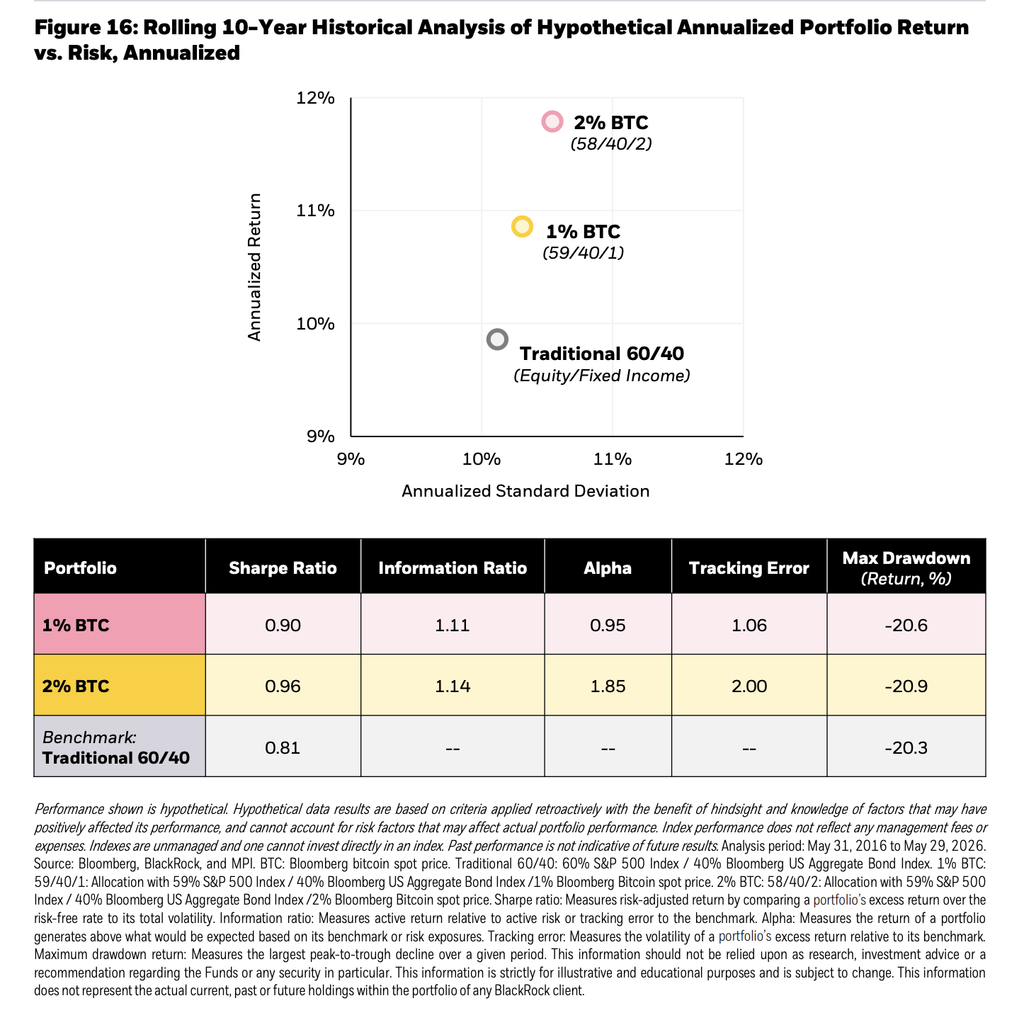
Put differently, the 2% allocation added roughly 190 basis points of annualized return relative to the traditional portfolio while increasing annualized volatility by approximately 50 basis points. The portfolio’s Sharpe ratio improved from 0.81 to 0.96, while maximum drawdown changed from -20.3% to -20.9%. Those figures are hypothetical and backward-looking, but they illustrate why judging Bitcoin primarily by its standalone volatility can produce an incomplete assessment of its portfolio impact.
The more relevant question is how that volatility interacts with everything else an investor already owns. BlackRock continues to characterize Bitcoin as having risk and return drivers that are fundamentally different from traditional assets, rooted in its fixed supply, decentralized structure and independence from any sovereign issuer. Those characteristics do not prevent Bitcoin from trading alongside risk assets during periods of deleveraging, but BlackRock’s research suggests those correlations have historically been episodic rather than permanent.
That distinction helps explain the portfolio results. A modest allocation does not import Bitcoin’s standalone volatility into a portfolio on a one-for-one basis. What matters is the marginal contribution of that allocation to total portfolio risk relative to the return it has historically generated. In BlackRock’s analysis, that trade-off remained favorable at 1% and 2%, even after incorporating one of Bitcoin’s most significant recent drawdowns.
Why 1–2% keeps appearing in BlackRock’s work
This is not the first time BlackRock has arrived at this range. Its earlier portfolio research approached Bitcoin sizing through risk contribution, concluding that a 1–2% allocation could represent a reasonable range for investors willing and able to accept Bitcoin’s risk. At those weights, BlackRock found that Bitcoin could contribute a similar share of overall portfolio risk as an individual mega-cap technology holding in a conventional 60/40 portfolio. Beyond 2%, however, Bitcoin’s contribution to total portfolio risk begins to increase disproportionately.
The new analysis approaches the same question from the opposite direction. Rather than asking how much risk Bitcoin contributes, it examines what investors historically received for assuming that additional risk. The improvement in Sharpe ratio from 0.81 for the traditional portfolio to 0.90 with 1% Bitcoin and 0.96 with 2% Bitcoin suggests that the incremental return historically more than compensated for the additional portfolio-level volatility.
This does not establish 1% or 2% as an optimal allocation, and BlackRock does not present it that way. The appropriate exposure will depend on liquidity requirements, investment horizon, governance constraints and risk tolerance. What the analysis does provide is a more rigorous framework for the discussion. The allocation question can increasingly be evaluated in terms of marginal risk, correlation, drawdown and portfolio efficiency rather than through a binary debate over whether Bitcoin itself is too volatile to own.
BlackRock has also seen the demand firsthand
There is another dimension to BlackRock’s latest analysis that is difficult to separate from the firm’s experience in the market.
BlackRock launched the iShares Bitcoin Trust, IBIT, in January 2024. Less than a year later, it had accumulated more than $50 billion in assets, making it what BlackRock itself has described as the largest exchange-traded product launch in history. It reached that milestone roughly five times faster than the previous record holder.
Its significance has only grown since then. BlackRock now describes IBIT as the world’s largest and most traded Bitcoin ETP, and the fund became the firm’s highest-revenue ETF in 2025 despite competing within a global BlackRock lineup of more than 1,000 products.
The concentration within the U.S. spot Bitcoin ETF market is equally notable. According to current ETF holdings data tracked by Bitcoin For Corporations, U.S. spot Bitcoin ETFs collectively hold approximately 1.25 million BTC, representing nearly 6% of Bitcoin’s fixed 21 million supply. IBIT alone accounts for roughly 775,000 BTC, or more than 60% of the Bitcoin held across the U.S. spot ETF complex.
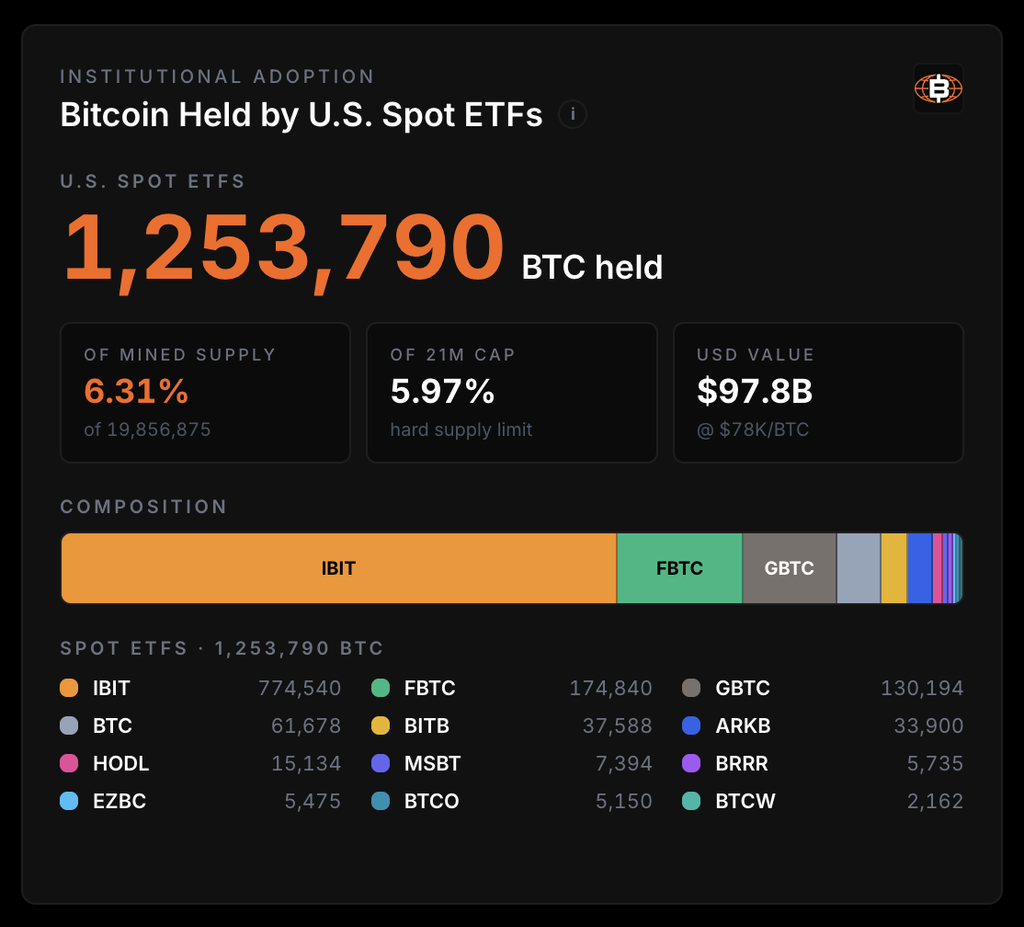
View the full Bitcoin ETF Dashboard.
That does not make BlackRock’s research independent of commercial context; IBIT is an important and increasingly valuable BlackRock product. That context should be understood rather than ignored. But it also means the firm’s reassessment is occurring alongside more than two years of observing how investors actually use Bitcoin exposure at scale.
The distinction is useful. The theoretical case for Bitcoin as a portfolio asset is increasingly being accompanied by observable allocation behavior. Investors have now had access to Bitcoin through familiar brokerage, advisory and institutional infrastructure across multiple market regimes, including periods of rapid appreciation and severe drawdowns. IBIT’s growth suggests that demand has persisted well beyond its initial launch window.
A drawdown is precisely when a thesis should be re-underwritten
The timing of BlackRock’s report may ultimately be more informative than the portfolio simulation itself.
Bitcoin is not being reassessed at an all-time high. BlackRock published the analysis after an approximately 50% drawdown from Bitcoin’s October 2025 peak, a period the firm associates with leveraged positioning being unwound, slowing ETP flows and weaker demand from companies accumulating Bitcoin. Its conclusion is that these forces represented a positioning correction rather than a fundamental change in Bitcoin’s investment case.
That is what re-underwriting is supposed to accomplish. An investment thesis should not survive because investors are attached to it; it should survive because its underlying assumptions continue to hold when conditions change.
For Bitcoin, those assumptions extend beyond historical returns. The asset remains scarce by design, globally liquid, independent of a sovereign issuer and structurally different from the liabilities that dominate traditional portfolios. BlackRock argues that concerns around fiscal sustainability, monetary stability and geopolitical risk may therefore become increasingly relevant to Bitcoin’s long-term adoption.
The portfolio evidence does not prove what Bitcoin will return over the next decade, nor does IBIT’s success establish what an appropriate allocation should be. What the two developments show together is that the institutional conversation has advanced considerably. Bitcoin is no longer being evaluated solely as an unconventional asset that institutions may or may not choose to own. It is increasingly being evaluated through the same disciplines applied elsewhere in capital allocation: sizing, risk contribution, correlation, liquidity, drawdown and expected return.
What this means for corporate leaders
For CFOs, boards and corporate operators, that evolution may be the most important takeaway from BlackRock’s work.
The relevant decision is not whether Bitcoin is volatile; that is already known. Nor does a corporate allocation need to resemble the concentrated Bitcoin strategies pursued by companies that have explicitly built their capital structures around the asset. Between zero exposure and a Bitcoin-centric balance sheet sits a much broader spectrum of possible allocations.
BlackRock’s research provides a useful framework for thinking about that spectrum. A relatively small allocation was sufficient to materially alter the historical return characteristics of a conventional portfolio without producing a comparable increase in portfolio-level risk. At 2%, approximately 190 basis points of additional annualized return came with roughly 50 basis points of additional annualized volatility in the period studied. The allocation was small; its effect was not.
For corporate leaders, the implication is less about adopting BlackRock’s specific allocation range than adopting the discipline behind the analysis. Bitcoin can be underwritten like any other strategic allocation: define its purpose, determine an acceptable risk contribution, establish liquidity and governance requirements, size the position accordingly and periodically revisit the assumptions.
That is a considerably more mature question than whether a company should simply “buy Bitcoin.”
As Bitcoin becomes more deeply integrated into institutional portfolios and financial infrastructure, the burden of analysis is shifting. The question facing the C-suite is increasingly not whether Bitcoin belongs in the conversation, but what allocation, if any, can be justified by the company’s objectives, constraints and cost of capital.
BlackRock has now re-underwritten that question after another full market cycle and a roughly 50% drawdown. Its historical portfolio math still makes the case that, in measured amounts, Bitcoin can improve the equation. For corporate decision-makers, that is the takeaway worth bringing into the boardroom.
Disclaimer: This content was prepared on behalf of Bitcoin For Corporations for informational purposes only. It reflects the author’s own analysis and opinion and should not be relied upon as investment advice. Nothing in this article constitutes an offer, invitation, or solicitation to purchase, sell, or subscribe for any security or financial product.
This post BlackRock Re-Underwrites Bitcoin, and the Portfolio Math Still Holds first appeared on Bitcoin Magazine and is written by Nick Ward.
Bitcoin Magazine
Strategy Opposes MSCI Proposal, Says Bitcoin Treasury Firms Are Being Targeted a Second Time
Bitcoin treasury Strategy has blasted Morgan Stanley Capital International’s proposal to exclude it from its Global Investable Market Indexes, calling it “misguided” and “flawed.”
Writing in a letter to MSCI Monday, the Nasdaq-listed Bitcoin behemoth’s founder, Michael Saylor, and CEO, Phong Le, said that the company was discriminating against digital asset businesses.
MSCI said earlier this month that it was consulting on a plan to define “non-operating companies” and make them ineligible for its Global Investable Market Indexes. The removal of such companies would exclude firms like Strategy from indexes visible to a large pool of institutional investors.
MSCI’s latest proposal comes after the company in 2025 proposed excluding from its indices all companies whose digital-asset holdings represent 50% or more of total assets.
“MSCI’s continued effort to discriminate against digital assets is misguided and calls into question MSCI’s neutrality and reliability,” Strategy’s letter read.
It added: “The proposal, like the 2025 proposal that MSCI withdrew, is discriminatory, arbitrary, and misguided. If adopted, the proposal would have no meaningful impact on Strategy’s business, but it would profoundly harm MSCI’s reputation as a reliable and neutral index provider. Like the 2025 proposal, the current proposal should be withdrawn.”
Strategy argued that MSCI was relying on unprecedented classifications to define Bitcoin as a “non-operating” asset. Strategy said it reports its Bitcoin business as an operating segment and its Bitcoin gains and losses as operating expenses.
The company said that MSCI’s methodology for targeting “non-operating companies” was “arbitrary and unexplained,” and was just a way of unfairly targeting digital asset treasuries.
Strategy further argued that the company is an operating one, employing 1,500 people across the globe and actively using its Bitcoin to “create shareholder value.”
Strategy — formerly MicroStrategy — is an enterprise software company that pivoted to buying and holding bitcoin in 2020. It first bought the cryptocurrency to protect shareholders but has since aggressively bought the asset and is now the largest corporate holder of the cryptocurrency, with 845,050 bitcoins worth $65.8 billion at today’s prices.
Investors can buy Strategy’s Nasdaq-listed stock (MSTR) to get heightened exposure to bitcoin’s performance.
MSTR closed Monday trading 4% higher. Year-to-date, the stock is down 15%.
This post Strategy Opposes MSCI Proposal, Says Bitcoin Treasury Firms Are Being Targeted a Second Time first appeared on Bitcoin Magazine and is written by Mathew Di Salvo.
Bitcoin Magazine
Bitcoin Unfazed by Trump’s Iran Threats
Bitcoin on Monday shrugged off tensions in the Middle East, barely moving despite U.S. President Donald Trump vowing to hit Iran hard.
The price of the biggest cryptocurrency recently stood at $79,076, unmoved over a 24-hour period. The coin also hasn’t budged from where it stood seven days ago.
Geopolitical strife has this year hurt Bitcoin’s price, with the cryptocurrency typically facing downward pressure on news of war and rallied in hopes of a ceasefire.
When the U.S. and Israel first attacked Iran in February, the coin nosedived, and had been shaky on news of war in March and April.
But in recent months, Bitcoin’s volatility has been muted, according to analysts, and Monday was no different: President Trump promised to hit Iran again but the asset didn’t flinch.
“We’re going to hit them hard,” President Trump was quoted telling a Fox News reporter on Monday. The U.S. and Iran started strikes again on Sunday — the first in over one month.
Bitcoin started a phenomenal run two weeks ago — its best in three years — and is up nearly 30% over the past month.
Its price started surging after the U.S. Treasury would at least double the size of its liquidity-support buyback operations. The announcement hurt the dollar but non-yielding assets like bitcoin and gold have benefited.
Positive regulatory news has also helped bitcoin this month: President Donald Trump this month said that the long-awaited crypto Clarity Act was a “very, very powerful” piece of legislation, and urged lawmakers to get it over the line.
The Clarity Act aims to establish a framework for distinguishing between digital assets that are securities, commodities or payment stablecoins — legislation that the crypto industry has long called for.
JUST IN: Crypto ETFs attracted $3.2 billion in inflows last week, "their largest weekly intake since October 2025", The Kobeissi Letter reports.
— Bitcoin Magazine (@BitcoinMagazine) August 31, 2026
BlackRock's IBIT led with $928 million last week, adding to their $1.3 billion from the prior week, and marking the biggest 2-week… pic.twitter.com/ROC9tYPMGN

Investors have piled back into exchange-traded funds this month, too, which has also helped bitcoin’s price. From August 17 to 27, investors threw over $2.8 billion at the vehicles — the most since October.
Bitcoin reached as high as $81,281 last week before sliding again on Friday.
This post Bitcoin Unfazed by Trump’s Iran Threats first appeared on Bitcoin Magazine and is written by Mathew Di Salvo.
CryptoSlate
Russia opens digital ruble access to customers of connected banks today, Sept. 1, moving the central bank digital currency beyond restricted pilot access as major banks and the first covered retailers activate payment infrastructure.
The Bank of Russia said on Aug. 31 that individuals will be able to open a digital-ruble wallet through a participating bank's mobile app. The wallet sits on the central bank's platform, while commercial banks provide access. Customers will need to confirm that their bank is connected before trying to use the service.
Consumer participation remains voluntary. A bank, employer or other party cannot open a wallet automatically for an individual, even as covered banks and merchants face legal duties to provide the infrastructure.
This split is the central feature of the rollout. The law compels covered banks and merchants to build access, while customers decide whether to use it. Consumers face no enrollment deadline, and banks cannot switch them into a wallet automatically. A customer whose bank is not yet connected will not gain app access simply because the legal phase has begun.
All 12 of Russia's systemically significant banks are ready to offer digital-ruble accounts and transactions from Sept. 1, according to an Aug. 21 Bank of Russia interview. The regulator said those banks represent more than 80% of the country's payments market.
The obligation also covers nine banks designated significant in the payments market. Most are ready, the Bank of Russia said, but three institutions that received the designation this year may need until the end of 2026 to finish connecting. The legal requirement and operational readiness therefore do not line up perfectly across every covered bank on day one.
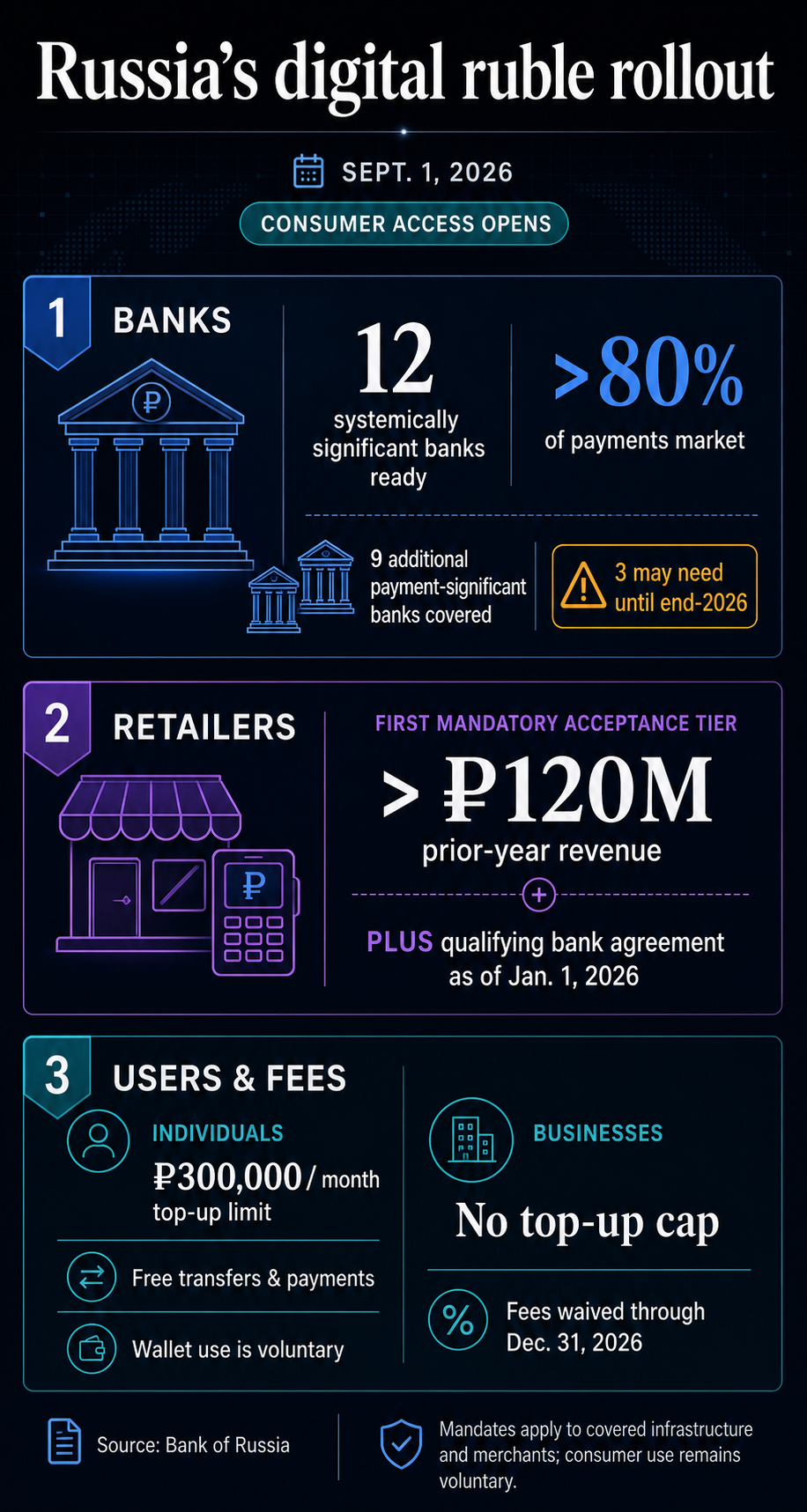
The retailer rule is narrower than a ₽120 million revenue threshold alone. Bank of Russia guidance says the Sept. 1 mandate covers consumer-facing sellers whose prior-year revenue exceeded ₽120 million and that, as of Jan. 1, 2026, had an agreement to accept electronic payment instruments with a payment-services-significant bank. Those covered sellers must accept digital rubles, while each customer remains free to ignore the option.
Individuals may add up to ₽300,000 per calendar month to a wallet from bank accounts or electronic money under an Aug. 28 central bank decision. The cap applies to top-ups, not to spending or transfers from funds already in the wallet. Business top-ups are uncapped.
Payments and transfers are free for individuals. Businesses receive a fee holiday through Dec. 31, 2026, after which the published 2027 tariff schedule takes effect, although some operations may retain zero rates. The immediate change is access, not compulsory consumer adoption.
The post Russia opens central bank digital currency to millions as 12 major banks and top retailers face rollout rules appeared first on CryptoSlate.
Strategy has challenged MSCI's proposed “non-operating company” screen by tying it to a regulatory argument MSCI made four years ago in a letter shared on Aug. 31.
The Bitcoin treasury company says the new methodology requires MSCI to judge whether Bitcoin belongs inside an operating business. That puts MSCI's 2022 defense to the Securities and Exchange Commission (SEC) at the center of the dispute.
MSCI told the agency that index providers “express no opinion or view as to whether any market, company, strategy or investment is good or bad,” a position Strategy says becomes harder to reconcile with a test that classifies corporate assets as operating or non-operating.
MSCI's latest 10-K says adviser-style obligations could increase the costs and complexity of its operations, giving Strategy a financial consequence to attach to its regulatory argument.
The index provider opened the consultation on Aug. 3 as part of a plan to expand existing exclusions for investment funds and business development companies. The proposal would use a core screen and five financial ratios to identify additional “non-operating companies,” with four triggered flags making a company ineligible for Global Investable Market Indexes.
Strategy argues that GAAP and IFRS provide no definitions for the operating and non-operating asset categories MSCI wants to use.
Under Strategy's reading, MSCI would therefore create its own standard for determining whether Bitcoin belongs inside an operating company, then use that classification to decide which securities qualify for its indexes.
It stated:
“The proposal, like the 2025 proposal that MSCI withdrew, is discriminatory, arbitrary, and misguided. If adopted, the proposal would have no meaningful impact on Strategy’s business, but it would profoundly harm MSCI’s reputation as a reliable and neutral index provider.”
| Piece of the dispute | MSCI’s position / disclosure | Strategy’s counterargument | Why it matters |
|---|---|---|---|
| Index neutrality | MSCI says index providers do not judge whether a company, market, strategy, or investment is good or bad | Strategy says the new screen requires MSCI to judge whether Bitcoin is an operating asset | Turns index methodology into a neutrality problem |
| Adviser regulation | MSCI says index providers do not recommend investments or allocations | Strategy says subjective asset classification makes that harder to defend | Links the rule to the SEC’s 2022 index-provider inquiry |
| Business risk | MSCI says adviser-style obligations could raise costs and complexity | Strategy says MSCI is moving closer to a risk it already discloses | Gives the dispute a financial consequence |
Strategy is using MSCI's SEC defense against the new screen
The SEC opened a request for comment in 2022 examining circumstances that could bring information providers, including index providers, within the Investment Advisers Act. Then-SEC Chair Gary Gensler focused on the economic power of index construction because inclusion and exclusion decisions can cause investors to buy or sell securities.
MSCI answered by presenting index providers as neutral market measurers. Its comment letter said it expresses no view on whether a company, market, strategy, or investment is good or bad and makes no recommendations about investments or asset allocations.
Strategy says the proposed screen conflicts with that position because MSCI would decide whether Bitcoin qualifies as an operating corporate asset.
The Bitcoin treasury's latest 10-Q strengthens its argument by reporting two operating segments, Software and Bitcoin, with the Bitcoin segment covering treasury operations, acquisitions, capital markets, and capital management.
MSCI could still classify the asset base behind that segment differently for index purposes. Strategy argues that doing so would require the index provider to impose its own definition of an operating business on a company whose SEC filings already treat Bitcoin activity as an operating segment.
That distinction gives Strategy a route into the regulatory debate surrounding index providers.
The SEC's 2022 inquiry remains general, and the agency has issued no determination on MSCI's current proposal. Strategy is using an existing regulatory issue to make MSCI defend the degree of discretion embedded in its methodology.
MSCI told shareholders that investment-adviser obligations could raise costs and complexity across its business and could create conflicts with other regulatory duties.
Strategy is pointing MSCI toward a risk the index provider already recognizes in its public disclosures.
Strategy says 87% of the affected value points back to MSTR
Citing MSCI figures, Strategy says its float-adjusted market capitalization totals over $23.9 billion among six companies that would initially face deletion or watchlisting, compared with nearly $3.6 billion for the other five combined.
Strategy accounts for about 86.9% of the affected float-adjusted market value. That concentration gives the company evidence for its claim that an industry-neutral methodology would fall overwhelmingly on the largest Bitcoin treasury company, though the figure alone establishes nothing about MSCI's intent.
| Affected group | Float-adjusted market cap cited by Strategy | Share of affected value |
|---|---|---|
| Strategy | $23.931B | 86.9% |
| Other five affected companies combined | $3.618B | 13.1% |
| Total affected group | $27.549B | 100% |
The dispute points to a wider issue for corporate Bitcoin models, as MSCI defines how companies built around large digital-asset holdings fit inside broad equity benchmarks.
Strategy has incorporated Bitcoin into its treasury operations, capital markets activity and segment reporting, while MSCI's proposal could classify the assets supporting that business as non-operating for index eligibility.
Strategy's letter also asks MSCI to publish more of the consultation record, identify which companies would trigger the proposed screen, and explain the reasoning behind those classifications.
Near the end, Strategy asks MSCI to place a legal hold on documents connected to the purpose, creation, and issuance of the final eligibility test.
The company has announced no litigation, though the preservation request ensures that MSCI retains the internal record behind a methodology Strategy is attacking on regulatory grounds.
The bull case gives Bitcoin treasury companies a benchmark
Strategy's bull case depends on MSCI softening or withdrawing the current framework before the consultation concludes. MSCI could narrow the screen, define operating assets more precisely, or redesign the methodology so that corporate Bitcoin activity receives clearer treatment.
A softer framework would reduce immediate deletion risk for Strategy and give other Bitcoin treasury companies more room inside broad equity benchmarks. It could also establish an early precedent for companies that present Bitcoin acquisition and capital management as part of their operating structure.
The 86.9% concentration gives MSCI another factor to consider because a general methodology would produce a highly concentrated initial result.
Strategy's SEC argument adds a separate regulatory consideration by forcing MSCI to reconcile the proposed asset classification with the neutrality defense it presented in 2022.
The bear case leaves Strategy exposed to deletion
MSCI can proceed with the current framework and defend asset classification as part of ordinary index construction.
Under that outcome, Strategy could face deletion or watchlist treatment once MSCI applies the screen, which could require index-linked portfolios to adjust their MSTR holdings. The methodology could then become a template for evaluating other Bitcoin treasury companies as digital assets occupy larger portions of corporate balance sheets.
Strategy could continue contesting the framework through the consultation process or pursue a broader legal route, with its document-preservation request keeping MSCI's internal methodology record intact.
| MSCI decision path | What MSCI does | Effect on Strategy | Broader consequence |
|---|---|---|---|
| Withdraws proposal | Drops or pauses the screen | Removes immediate deletion risk | Bitcoin treasury companies keep more room inside broad benchmarks |
| Revises proposal | Defines operating assets more clearly or phases implementation | Reduces near-term cliff risk | Creates a more formal framework for DAT eligibility |
| Proceeds unchanged | Applies current core screen and five-ratio test | Strategy may face deletion or watchlist treatment | Index-linked portfolios may need to adjust MSTR exposure |
| Escalation path | Strategy continues legal/regulatory challenge | Dispute moves beyond consultation | MSCI’s internal methodology record becomes more important |
MSCI is accepting feedback through Sept. 30 and expects to announce its decision on or before Oct. 16, with implementation proposed for the November 2026 Index Review.
Those dates give Strategy only weeks to persuade MSCI that its Bitcoin screen creates a problem extending beyond MSTR's eligibility.
MSCI will ultimately have to defend the classification framework alongside the regulatory position it previously presented to the SEC. Strategy has made that consistency part of the price of proceeding.
The post Strategy turns MSCI’s own SEC words against its $24 billion MSTR threat appeared first on CryptoSlate.
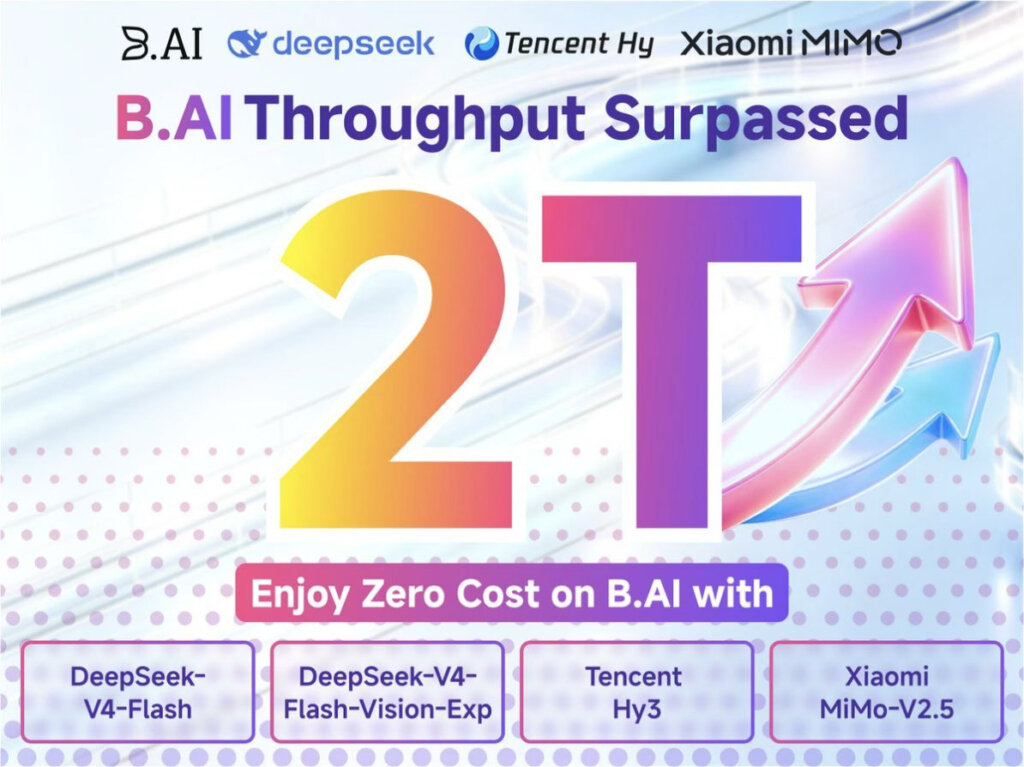
On August 24, next-gen AI infrastructure platform B.AI hit a major milestone: cumulative token throughput across its sitewide free-access campaign officially crossed the 2 trillion threshold. The record-breaking run follows a series of aggressive, developer-first plays that have turned heads across the industry.
While rising prices from leading model providers have sparked cost anxiety across the ecosystem, B.AI took the opposite approach. The momentum kicked off on August 17, when B.AI opened up free access to DeepSeek V4 Flash—shattering platform throughput records at 220 billion tokens in a single day. That was followed by sitewide free access to Tencent Hy3, DeepSeek-V4-Flash-Vision-Exp, and Xiaomi MiMo-V2.5. The resulting traffic surge didn't just showcase developer demand; it proved B.AI's underlying architecture can comfortably handle massive, concurrent production loads at scale.
Anchored in its strategy as a global compute distribution hub, B.AI is stepping up as an industry disruptor to unleash the full efficiency of underlying infrastructure. It guarantees enterprise-grade availability while driving costs down by up to 90% through its hybrid API model, featuring direct official routing for stability alongside budget-optimized custom pipelines. Backed by seamless Web2 and Web3 dual-rail payment integrations and ongoing user rebates, B.AI is building a seamless pipeline for truly accessible AI compute.
B.AI Unveils Super Compute Distribution Hub to Overhaul AI Infrastructure via Tiered APIs and Smart Routing
As compute demands become increasingly specialized, B.AI is cementing its status as the foundational infrastructure for next-gen AI development. To solve the exponential inference costs tied to AI agent workloads, B.AI is moving beyond basic API aggregation—evolving into a high-throughput distribution hub that dynamically routes compute across global networks.

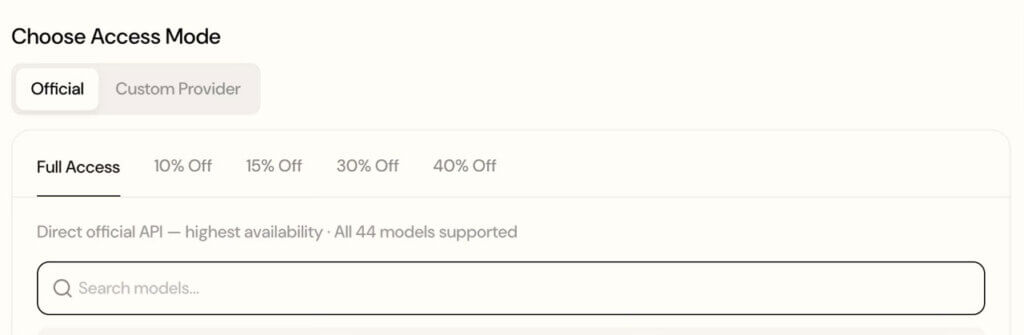
To back this vision, B.AI introduced a dual-tier API access model—Official and Custom Provider—offering developers flexible compute options that maximize cost efficiency and lower the cost barrier for building the foundation of tomorrow's AGI.
Designed for core production environments and complex inference tasks, B.AI's Official channel features direct API connections, guaranteeing maximum platform availability. Leveraging massive economies of scale, B.AI passes raw volume discounts directly to developers—offering baseline price cuts from 10% to 40% off market rates. This allows enterprise teams to slash base compute overhead while securing ironclad operational stability.
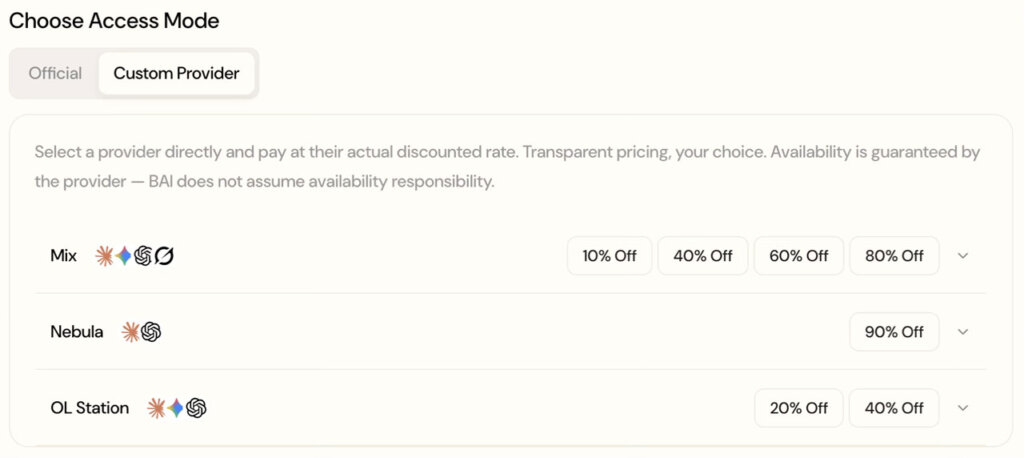
For non-critical workflows that prioritize cost control over absolute uptime, B.AI introduces the Custom Provider option. Developers can route traffic directly through vetted third-party vendors—including Mix, Nebula, and OL Station—at live-discounted rates. With seven discount tiers available, rates can plunge as low as 90% off standard pricing. This dual-option approach gives users total routing granularity, slashing total compute spend to the absolute floor.
Beyond rock-solid, developer-facing API infrastructure, B.AI streamlines everyday front-end user workflows with its native Auto mode embedded in the Chat interface. Tailored for natural language chat, text analytics, and daily business tasks, the system analyzes user intent per prompt and dynamically routes queries to the optimal underlying model in real time. This eliminates wasted capacity while making enterprise-grade AI models easier to use for non-technical users.
Crossing the 2-Trillion Token Milestone in 7 Days: How B.AI Is Democratizing Compute Through Radical Subsidies
B.AI has never wavered from its core thesis: building the definitive hub for accessible, high-performance compute. By consistently rolling out zero-cost campaigns for flagship foundational models and aggressively discounting API pipelines, B.AI delivers real, bottom-line savings to lower the barrier for enterprise AI deployment—earning widespread adoption and market validation along the way.
When DeepSeek recently announced price hikes, B.AI tapped its deep resource aggregation and ecosystem liquidity to make a bold market response. On August 17, B.AI made DeepSeek V4 Flash completely free for a limited period, opening up both Web and API access so enterprises could run production-grade AI workloads with zero overhead.
This contrarian move sent shockwaves through the market. Within 24 hours of launch, B.AI's core performance metrics shattered all-time highs across the board, with daily token volume surging past the 220 billion mark.
The momentum didn't stop there. On August 21, Tencent's highly anticipated Hy3 model went live on B.AI—fully free and open to all users. The very next day, on August 22, DeepSeek-V4-Flash-Vision-Exp followed suit, bringing cutting-edge visual reasoning into the zero-cost tier to further lower the compute cost for enterprise multimodal pipelines.
As access expanded, developer demand exploded. On August 24, B.AI hit a major milestone: cumulative token throughput across its sitewide free-access campaign officially crossed the 2 trillion threshold. Beyond setting new records for developer traction, these raw numbers deliver concrete proof of B.AI's resilience, scalability, and dynamic load-balancing power under sustained, ultra-high concurrency, which is engineered into its core infrastructure.
In fact, B.AI has consistently operated at an aggressive, high-frequency pace of delivering value back to the community. Prior to this, the platform continually shared value with the market through major initiatives like limited-time free access to MiniMax M3 and Qwen-3.8 MAX, the exclusive 10% discount on GLM 5.3, and generous top-up bonuses. But this is just the beginning. Moving forward, B.AI will continue to scale its ecosystem perks, rolling out multi-tiered free access events and deep-discount campaigns. Working side by side with developers, B.AI remains committed to driving down AI deployment costs with a steady stream of subsidized compute.
This expanded commitment goes beyond standalone model promotions—it runs straight through core daily API operations. Recently, B.AI's official API services underwent a major upgrade, expanding steep price discounts across mainstream foundation models. While guaranteeing direct-from-source stability, B.AI delivers significantly more cost-efficient compute configurations for enterprises and builders alike.
To serve a global, diverse developer ecosystem, B.AI has fully unified Web2 and Web3 payment rails, breaking down financial barriers worldwide. The platform integrates traditional fiat channels like Visa, WeChat Pay, Alipay, and UnionPay alongside high-efficiency crypto settlement networks—enabling builders worldwide to secure the compute resources they need with minimal transaction friction.
In an era where tokens are currency, B.AI is dedicated to serving as the foundational compute layer for AI innovators, continuously strengthening its super-compute hub to power thousands of industries. Here, accessible compute is no longer just a narrative—it is tangible infrastructure driving productivity and intelligent transformation for enterprises worldwide.
B.AI Team
Singapore
support@b.ai
Disclaimer: This was a sponsored post brought to you by B.AI.
The post 2 Trillion Tokens in 7 Days: B.AI Sparks Developer Frenzy With Accessible Compute appeared first on CryptoSlate.
Switchboard, an oracle provider that supplies price data to DeFi applications, said contributors halted its deployments on Aptos, Sui, IOTA and Movement after reports of a potential Switchboard Move oracle compromise in its Move-language implementations.
At least three applications reported losses, freezes or precautionary access restrictions as Switchboard advised users to migrate temporarily to alternatives. The provider said it had not received similar reports about its Solana implementation, but it has not published a root cause or a timetable for restoring the four Move deployments.
Switchboard Move oracle compromise hits DeFi apps
Sui-based exchange Full Sail confirmed that its vaults lost funds and said deposits and withdrawals would remain paused until oracle integrity was restored and verified. Its disclosure did not identify the affected vaults or assets, provide transaction records, or quantify the loss.
Full Sail's vault documentation says users delegate liquidity management to an automated system that rebalances concentrated positions using real-time market data. Separate oracle-protection documentation describes checks that compare Switchboard prices with on-chain pool prices, test updates against 50 to 70 recent observations, and can block prices or pause emissions. Full Sail has not explained whether those controls fired, applied to the affected vaults, or were related to the reported losses.
On Aug. 31, DefiLlama placed Full Sail at roughly $229,000 in total value locked. Its rolling DEX volume was about $50 over 24 hours, $2.99 million over seven days and $9.10 million over 30 days. Those windows include pre-incident activity and do not establish how much value changed because of the event.
Virtue details IOTA price manipulation
The most detailed account came from IOTA credit protocol Virtue. It said an attacker gained control of the signing keys used by all 14 oracles on Switchboard's IOTA mainnet queue and pushed IOTA's reported price to $10 million. The attacker then deposited 1 IOTA and minted about 4.94 million VUSD, according to Virtue.
Virtue said the feed was later pushed near zero, triggering 47 liquidations that affected 45 users. It froze borrowing, repayment, deposits, withdrawals, liquidations and flash loans, and warned that VUSD was materially undercollateralized while remediation was pending. Those figures relate to Virtue, not Full Sail's undisclosed loss.
Volo pauses access as networks stay online
On Sui, Volo said it paused vault deposits and withdrawals as a precaution because of a Switchboard dependency. Volo said its vaults were unaffected and user funds were safe.
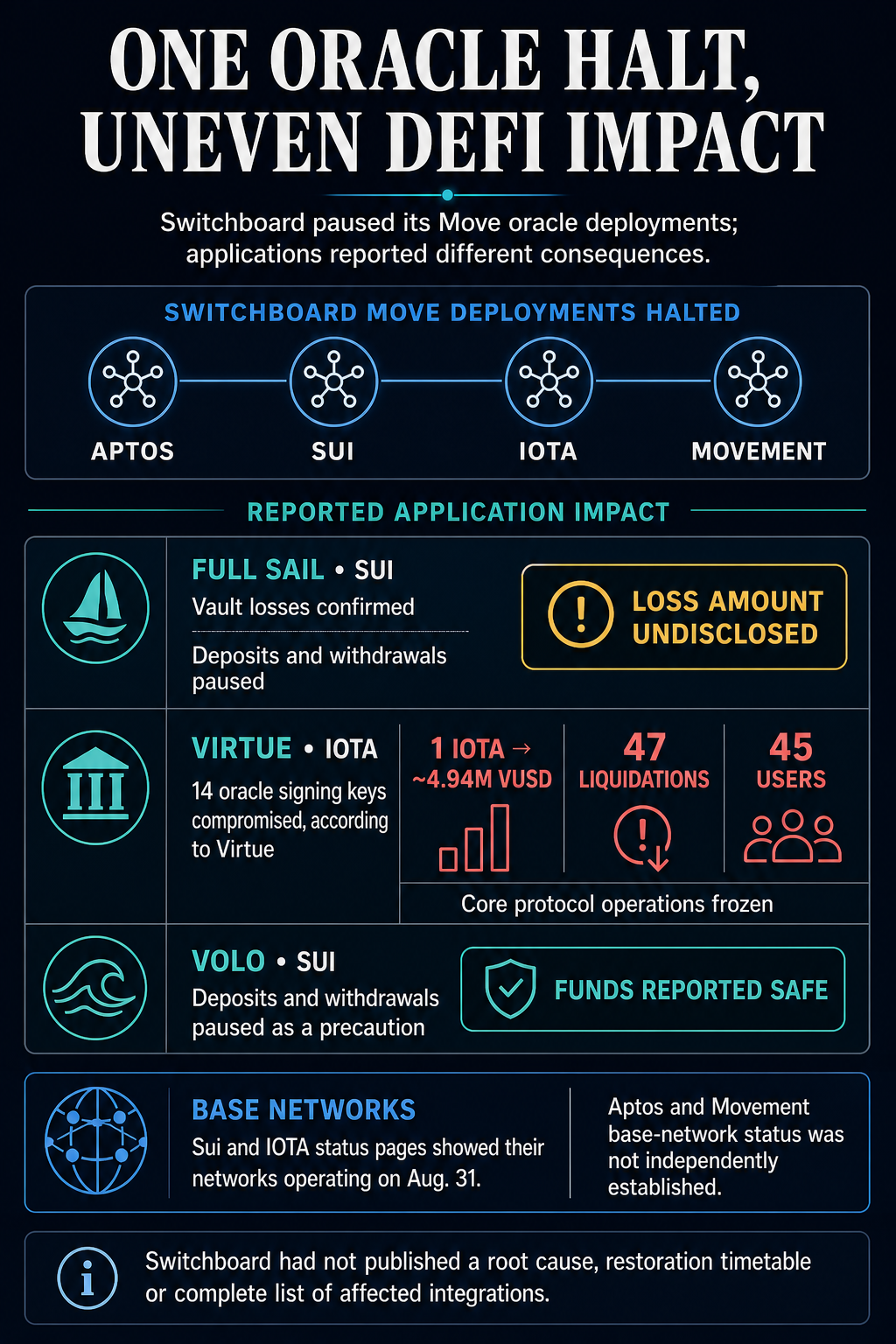
Sui's status page showed all systems operational on Aug. 31, while IOTA's page showed mainnet services operating with listed incidents resolved. Equivalent status evidence was not established for Aptos or Movement.
The verified impact is uneven but material: a confirmed yet unquantified Full Sail loss, a detailed manipulation and protocol freeze at Virtue, and a preventive access pause at Volo. Switchboard has not published a complete list of affected integrations, leaving the full application footprint of the suspected Switchboard Move oracle compromise unresolved.
The post Cross-chain oracle compromise triggers liquidations and frozen vaults across multiple DeFi networks appeared first on CryptoSlate.
Britain is widening its Russia sanctions crackdown from named entities to the payment routes that keep sanctioned networks moving money.
On Aug. 31, the National Crime Agency issued its first nationwide industry alert on the A7 network, directing banks, payment providers and crypto firms to examine counterparties, intermediary wallets and cross-border infrastructure linked to Russia-related transactions.
Rachael Herbert, Director of the National Economic Crime Centre (NECC) at the National Crime Agency, said:
“The National Crime Agency and the National Economic Crime Centre are committed to targeting the nexus between organized crime and sanctions evasion. Last year, our Operation Destabilize targeted and disrupted a major Russian-speaking professional money laundering network, making it harder for them to operate and degrading the threat they posed.”
The move comes alongside a government plan to double the maximum civil penalty available to the Office of Financial Sanctions Implementation for breaches involving measurable funds or economic resources. The proposed ceiling would rise to the greater of £2 million or 100% of the breach value, from £1 million or 50% today.
A7 operates a cross-border settlement network that UK authorities say has used financial institutions in third countries, SWIFT and other international payment infrastructure to help Russian clients move funds around sanctions.
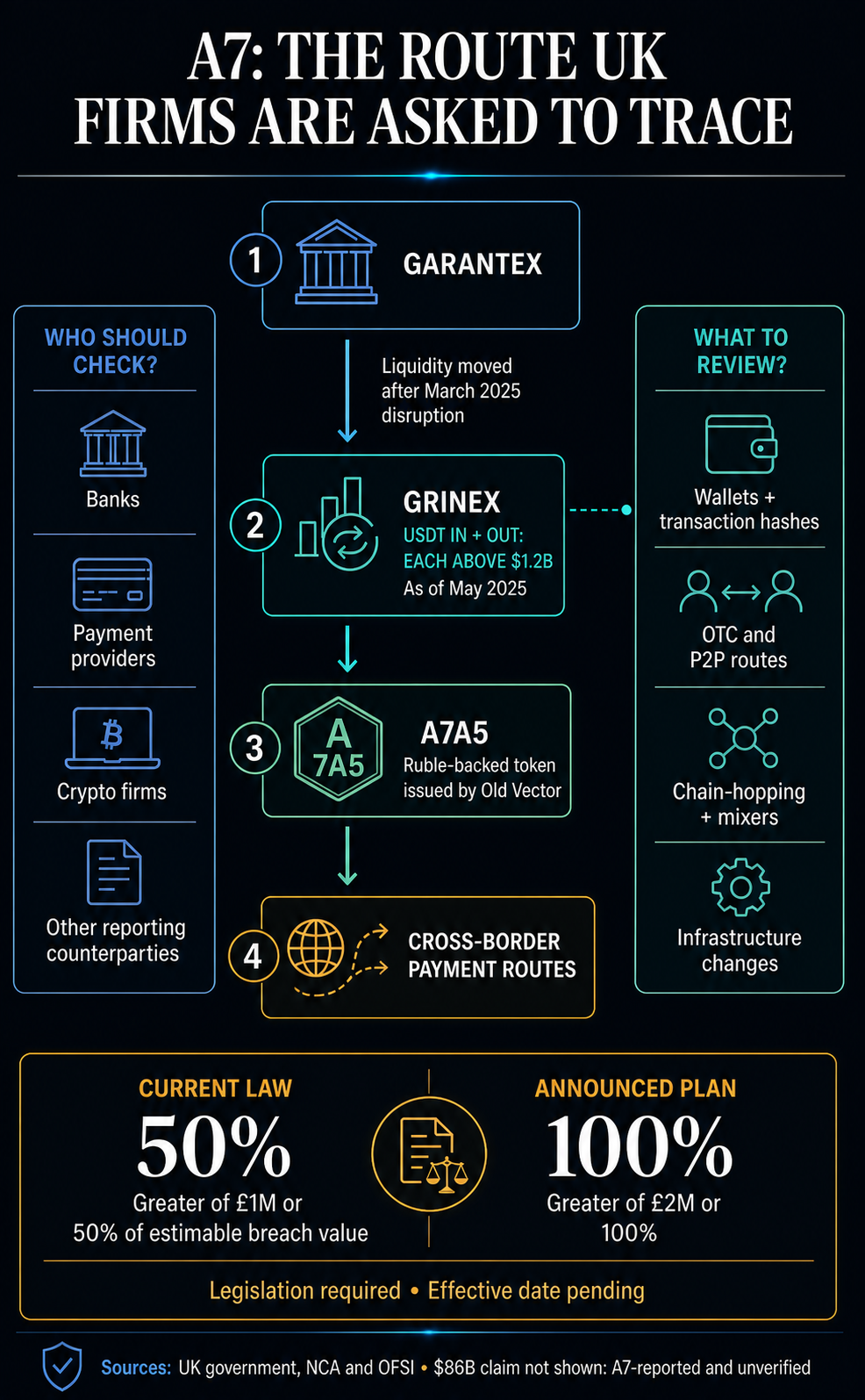
The network says it processed more than $86 billion in its first year, though that figure is self-reported and does not represent a verified measure of illicit flows.
The alert pushes compliance teams beyond conventional name screening. Authorities highlighted intermediary wallets, transaction hashes, decentralized exchanges, mixers, over-the-counter and peer-to-peer routes, services without know-your-customer controls, chain-hopping, VPN use and repeated infrastructure changes as signals that may warrant further scrutiny.
That approach reflects how sanctioned crypto infrastructure has evolved under pressure.
UK authorities previously assessed that crypto liquidity moved from Garantex to Kyrgyzstan-registered Grinex through A7A5, a ruble-backed token, after Garantex faced enforcement action. By May 2025, Grinex had recorded more than $1.2 billion each in incoming and outgoing USDT transaction volume.
The US Treasury separately said Garantex employees helped create Grinex infrastructure and that users regained account access or received equivalent value through A7A5.
For UK firms, the implication is that sanctions exposure may persist even after a crypto exchange, wallet or payment service changes names, jurisdictions or rails.
The tougher penalty proposal reinforces that shift. If enacted, firms could face fines equal to the full value of an estimable breach rather than half.
The change still requires legislation and has no effective date. OFSI would also retain discretion to impose penalties below the statutory maximum.
For now, the Aug. 31 alert marks a broader enforcement turn: Britain is asking financial and crypto firms to follow the route of Russia-linked money, not merely check whether the destination already appears on a sanctions list.
The post UK is hunting the $86 billion Russia-linked crypto pipeline as it moves to double sanctions fines appeared first on CryptoSlate.
CryptoTicker.io
If you hold Wrapped TON on Ethereum or on BNB Smart Chain, you are facing a closed door today. The old TON bridge at bridge-v3.ton.org is being shut down permanently as of September 1, 2026. The wrapped token does not disappear from your wallet as a result, but the route by which it can be turned back into real Toncoin is no longer being operated.
How much is affected had not been published anywhere. So we counted on the morning of the deadline: at 06:56 UTC, Ethereum and BNB Smart Chain together held 11,344,908.81 Wrapped TON in wrapped form. Two weeks of reminders, waived fees and a fixed date have changed that figure barely at all.
TON Bridge and Wrapped TON: What Ends on September 1, 2026
The announcement dates from May 23, 2026. The operator of the TON bridge said it would permanently retire version 3 of the bridge at bridge-v3.ton.org, and named September 1, 2026 for it. Two directions are affected: Wrapped TON on Ethereum and on BNB Smart Chain is meant to go back to the TON network, and the so-called j-tokens on TON, meaning jUSDT, jUSDC, jDAI and jWBTC, are meant to go back to Ethereum. For the transition period the pro-rata bridge fees were waived, so that the return trip would not fail on price.
This is neither a failure nor an attack. A bridge is infrastructure, and infrastructure gets replaced. That does not make the process any more harmless for you as a holder, because a planned shutdown hits holdings just as an unplanned one does.
What a Bridge Does Technically
A cross-chain bridge is a pair of contracts that locks an amount on one blockchain and issues a proxy token of the same size on another. The proxy is worthless in itself; its entire value consists of the claim to get the locked original back. Remove the redemption route and what remains is a token that looks exactly as it did before and has lost the function it was built for.
We flagged the deadline on August 21, 2026 in a separate piece setting out the shutdown of the TON bridge and the j-tokens affected in detail. This article is the follow-up to it, and it rests not on an announcement but on a measurement of our own.
How Much Wrapped TON Is Still Stuck? The Count of September 1
This analysis was carried out by cryptoticker.io itself on September 1, 2026. The method in one sentence: through public access to both networks, the issued total supply of the two Wrapped TON contracts was queried, and in addition every redemption of the wrapped token was counted across a window of 100,801 Ethereum blocks.
Two token contracts on two networks were examined, each with name, ticker, decimals and issued supply, plus one continuous window of events on Ethereum. Both contracts report the name Wrapped TON Coin, the ticker TONCOIN and nine decimals. The position as of September 1, 2026, 06:56 UTC:
- Ethereum: 9,292,636.88 Wrapped TON
- BNB Smart Chain: 2,052,271.93 Wrapped TON
- Combined: 11,344,908.81 Wrapped TON
That figure is a net value. It falls when someone redeems their wrapped token and collects the original on the TON network, and it would rise again if new tokens were still being wrapped. On the deadline itself the second direction of travel is practically meaningless, because nobody crosses a bridge for the first time shortly before it closes.
What We Could Not Check
Three things lie beyond what public access can measure cleanly, and we name them rather than paper over them. First, the event history on BNB Smart Chain: the freely available network endpoints limit queries of historical events so severely there that a complete time series over two weeks did not come together. Second, the number of individual holders behind the balances; a holding of eleven million tokens may sit at a handful of addresses or at many thousands, and without evaluating every address the two cannot be told apart. Third, the j-token side on TON, which has a different data structure and cannot be read out comparably with the same tools.
Ethereum and BNB Smart Chain: Where the Remaining Balances Sit
Of the balances left, around 81.9 percent sit on Ethereum and around 18.1 percent on BNB Smart Chain. The split matters in practice, because the two networks cost different amounts. On Ethereum a return trip can easily cost a multiple of what it costs on BNB Smart Chain, and on small balances that fee can be larger than the value at stake.
That point explains part of the stranded supply without justifying it. For someone holding 30 tokens in an old Ethereum wallet, the return trip was an arithmetic problem well before the deadline. For someone holding 30,000, it never was.

Redemptions Counted: How Little Came Back in the Past Two Weeks
A redemption is easy to spot on the blockchain: the wrapped token is transferred to the zero address and thereby retired. Across the window from August 19, 2026 to September 1, 2026, specifically Ethereum blocks 25,779,977 to 25,880,777, we counted 74 such redemptions covering 236,588.24 tokens in total. That is the entire movement on Ethereum in fourteen days.
More revealing than the total is how it is spread across the days:
- August 19: 12,736.67
- August 20: 105,496.38
- August 21: 71,156.90
- August 22: 3,306.00
- August 23: 6,709.50
- August 24: 1,003.40
- August 25: 22,059.20
- August 26: 5,002.28
- August 27: 5,349.49
- August 28: no redemption
- August 29: 11.00
- August 30: no redemption
- August 31: 3,757.41
- September 1 up to 06:56 UTC: no redemption
The weight falls on August 20 and 21, the days on which the trade press picked the subject up. After that the movement dries up. On two of the last four days before the deadline not a single token was redeemed on Ethereum, and on another there were eleven. On the last full day before the end, 3,757.41 tokens came back, less than a tenth of what a single average day in mid-August brought.
For comparison: in our piece of August 21, 2026 we reported 11,476,155.84 wrapped tokens for both networks together. Against today's measured level of 11,344,908.81, that is 131,247.03 tokens, or around 1.1 percent, that have found their way back over the past eleven days. This comparative figure comes from our own reporting and is not independent outside confirmation. How the decline splits between the two networks cannot be broken down cleanly without the BNB Smart Chain event history.
Wrapped Tokens Without a Bridge: How a Claim Becomes a Slip With No Counter
The most important thought about this episode has little to do with TON. A wrapped token is a receipt. Its price on any given marketplace says nothing about whether the desk that redeems it will still be open tomorrow. As long as the bridge runs, the two values move in step. The moment it is switched off, they part company, and the market price of the wrapped token then hangs solely on the expectation that somebody will reopen the redemption route.
For you as a holder that implies a checking routine which reaches beyond this single case. If a token in your wallet is a proxy, often recognisable by a prefixed letter or by the word Wrapped, then the question of who operates the redemption, and for how long, always belongs to that holding. With native holdings on a regulated trading platform with its own custody the question does not arise in the same sharp form, because no second contract stands between you and the original there.
How to Recognise a Proxy Token
Three features are enough in most cases. The name carries an addition such as Wrapped or Bridged, or a prefixed letter. The token sits on a different network from the one the project actually calls home, Toncoin on Ethereum for instance. And the quantity of the token is capped nowhere by the protocol itself, but by the locked amount on the other side. If all three apply, you hold a claim, not a holding.
J-Tokens Such as jUSDT and jDAI: The Same Deadline in the Other Direction
The second half of the announcement is easily overlooked, because it concerns the audience that is on TON anyway. Anyone holding jUSDT, jUSDC, jDAI or jWBTC on TON also holds proxies, only with the sign reversed: the original in this case sits on Ethereum, locked by the same bridge. According to the announcement these balances too should have been returned before September 1.
Unlike Wrapped TON, we could not count this side, because the token structure on TON cannot be read out comparably with the tools used here. The fact that we quote no figure expressly does not mean that little is sitting there. It only means that we do not know.
What Is Still Possible After the Deadline
Two observations from the morning of September 1, both checked by us. The address bridge-v3.ton.org still answered with a regular page at 06:57 UTC. The former collective address bridge.ton.org, by contrast, redirects to an overview page that answers with a 404 error and therefore leads nowhere.
From that follows an uncomfortable but honest answer: whether the return trip still works in the course of today is the operator's decision, not a matter of calendar logic. A reachable web interface is no proof that the contracts behind it still settle. If you are affected, the attempt is still the first step, and it belongs today rather than tomorrow. An attempt that fails costs you a network fee; an attempt not made may cost the entire holding.
Wrapped TON: What Is Established and What Remains Interpretation
The data is established: the announced shutdown as of September 1, 2026, the tokens affected in both directions, the waived bridge fees and every figure in this piece that comes from our own measurement on the deadline. It is also established that redemptions on Ethereum came almost entirely to a standstill in the final days before the cut-off.
Interpretation, and labelled as such, is the question of why. That a balance stays put can have many causes: lost access to old wallets, holdings in contracts nobody maintains any more, holders who never saw the announcement, or simply amounts for which the fee is not worth it. Which of these reasons weighs how much cannot be derived from the quantity curve alone, and we therefore do not claim it. What can be said: a fixed date with waived fees and more than three months' notice moved around one percent of the balance. That is a finding about the reach of such announcements, not about the diligence of individual holders.
Checking Your Wallet for Wrapped TON: What to Do Today
The check takes a few minutes and is worth doing even if you are fairly sure you hold nothing wrapped. Old wallets from a time when bridges were common contain leftovers more often than their owners expect.
Three Checks That Take a Few Minutes
First: open every wallet you have ever used on Ethereum or BNB Smart Chain and look through the token list for entries with the ticker TONCOIN. Some wallets hide unknown tokens; in that case a look at your address through a public block explorer helps. The contract in question is found on Ethereum under the identifier 0x582d872A1B094FC48F5DE31D3B73F2D9bE47def1, and its public contract page shows the same total supply on which this analysis rests.
Second: if you find something, attempt the return through the TON bridge interface for as long as it responds. Expect the process to break off, and treat the network fee as a possible loss.
Third: document what you see before anything changes. A screenshot of the balance with the date, and the identifier of your address, are the basis for any later enquiry with an operator. Someone who notices in six months that something is missing no longer has that basis.
Deadlines in Everyday Crypto: The Pattern Behind the Single Case
Shutting down a bridge is only one type of deadline. Delistings at trading venues, exchange windows after a contract migration, the wind-down of entire platforms and the removal of individual networks from a wallet application all follow the same course: there is an announcement, a generous period, a cut-off date, and after that a remainder that stays put. September 2026 carries several such dates, and we track them in a running overview of deadlines and balances at crypto exchanges.
Today's measurement supplies an empirical value you can apply to your own holdings. Do not rely on a deadline reaching you by itself. The announcement had been running since May 23, the trade press reported at the end of August, and even so more than eleven million tokens sat unchanged on the deadline. Your own list of holdings that depend on someone else's infrastructure is the only mechanism that works regardless of whether a piece of news reaches you. For the Toncoin price itself, incidentally, the changeover carries no direct implication: what is affected is the redemption route of a proxy, not the protocol behind it.

Checking Wrapped TON: What to Take Away
- Look today, not later. Check every wallet on Ethereum and BNB Smart Chain for balances with the ticker TONCOIN and attempt the return for as long as the interface responds. If you would rather hold native assets than proxies in future, the routes there are in our comparison of the best crypto exchanges.
- Draw up a list of dependencies. Note for every holding whether it is native or has to be redeemed by somebody else's contract. Holdings you intend to keep for the long term belong under your own key management; which devices are suitable is shown in the crypto hardware wallet comparison.
- Collect deadlines in one place. Put the cut-off dates of bridges, delistings and platform wind-downs into a calendar of your own instead of waiting for notifications. If you check at the same time which supervision your trading venues sit under, the overview of regulated crypto exchanges takes you further.
(As of September 1, 2026. This article is not investment advice. Prices and fee structures change; check the terms with the provider before you buy.)
On September 25, 2026, Plasma frees 1,805,555,556 XPL in a single day. These are the tokens held by the team and by investors, subject to a one-year lock-up that has run since the mainnet beta launched on September 25, 2025. Measured against the amount in circulation today, that is around 65 percent. Add the ecosystem tranche falling on the same day and the total comes to 1,894,444,445 XPL, or 18.94 percent of the maximum supply.
The figures come from two independent places: Plasma's own tokenomics documentation and an emissions dataset that recalculates the rule independently. Both name the same day and the same amounts. This piece shows where the quantity comes from, what follows month by month afterwards, and how to check the date without relying on anyone else.
One term first, because everything else builds on it: an unlock is the moment at which contractually locked tokens become transferable. Unlocked expressly does not mean sold — it is a statement about quantity, not about price.
What Happens at Plasma on September 25, 2026: 1.81 Billion XPL for Team and Investors
Plasma is a layer-1 blockchain which, according to its own documentation, is built around stablecoin payments and optimised for stablecoins; the XPL token is its gas token, the currency used to pay for transactions on the network and to reward validators. The initial supply at the mainnet launch was 10,000,000,000 XPL. We covered that launch on September 25, 2025; the date now approaching is its first anniversary, to the day.
How those 10 billion are divided is set out in the project documentation, in four pools: public sale 10 percent, ecosystem and growth 40 percent, team 25 percent, investors 25 percent. Two of these pools matter for September 25, 2026.
One third of the team allocation of 2,500,000,000 XPL comes free, which is 833,333,333 XPL. The investor allocation, also 2,500,000,000 XPL, follows the same schedule according to the documentation and therefore contributes another 833,333,333 XPL. On top of that, each pool releases its first monthly instalment of 69,444,444 XPL. Together that gives 1,805,555,556 XPL.
| Item | Amount in XPL |
|---|---|
| Team, cliff portion | 833,333,333 |
| Team, first monthly instalment | 69,444,444 |
| Investors, cliff portion | 833,333,333 |
| Investors, first monthly instalment | 69,444,444 |
| Total team and investors | 1,805,555,556 |
| Ecosystem and growth, separate event on the same day | 88,888,889 |
| Total on the day | 1,894,444,445 |
To put the amount in context: at the price of $0.084301 that CoinGecko showed on September 1, 2026 at 06:37 UTC, the insider tranche is worth around $152 million. XPL's market capitalisation at the same moment stood at around $234 million. The relationship between those two figures is the real reason this date is news at all.
Who Stands Behind the Investor Allocation
The documentation names Founders Fund, Framework and Bitfinex among the backers. For the date itself the list of names makes no difference, because all investor tokens follow the same schedule. It still helps with context: these are professional holders with their own lock-ups and their own reporting duties, whose behaviour differs from that of a retail investor.
Why Today's Circulating Supply Proves That Not a Single Team Token Is Free Yet
That claim can be checked with a single number. The circulating supply is the quantity of tokens that is actually transferable; the maximum supply is the ceiling that will ever exist. For XPL on September 1, 2026, CoinGecko shows a circulating supply of 2,777,777,778 XPL.
That figure is not an odd number. It is made up of 1,000,000,000 XPL from the public sale plus exactly twenty ecosystem tranches of 88,888,888.89 XPL each. The arithmetic works out to the decimal place. Two things are therefore established without having to take anyone's word for it: Plasma has followed the documented schedule precisely so far, and nothing from the team and investor pools has reached circulation to date.
The independent emissions dataset confirms this from another direction. For the current distribution it puts the team at 0 percent and investors at 0 percent, while the public sale stands at 100 percent and the ecosystem at 44.4 percent. Two sources, two routes through the arithmetic, the same result.
In practice that means September 25 is not one tranche among many at XPL; it is the day these two pools open for the first time at all. Anyone comparing the date with the small monthly ecosystem releases of recent months is comparing two very different orders of magnitude. If you hold XPL through an exchange and want to know which venues list the token at all, you will find the overview in our crypto exchange comparison.
Cliff or Linear: How the XPL Vesting Schedule Is Actually Built
Vesting describes the schedule under which locked tokens are released step by step. A cliff is the lock-up period before that, during which nothing at all is released and at the end of which a larger block opens at once. XPL combines the two, and the order is the point at which many summaries lose precision.
For the team and investors the documentation states: one third of the tokens is subject to a one-year cliff from the public launch of the mainnet beta on September 25, 2025 and is released on September 25, 2026. The remaining two thirds then follow pro rata each month over two years, so that three years after the mainnet launch, on September 25, 2028, everything is unlocked.
The ecosystem and growth pool runs to a different rhythm: 8 percent of the total supply, or 800,000,000 XPL, was free immediately at launch; the remaining 32 percent follows monthly over three years and is likewise fully unlocked on September 25, 2028.
The public sale had a third rule, which we will come to separately, because a widespread misconception has attached itself to it.

The Ecosystem Tranche on the Same Day: Why 1.81 Billion Becomes 1.89 Billion
The emissions dataset lists three separate events for September 25, 2026: the team tranche, the investor tranche and an ecosystem tranche of 88,888,889 XPL. The last of these belongs to the regular monthly rhythm of the growth pool and would be unremarkable on its own; it merely happens to fall on the same calendar day.
The distinction still matters for the arithmetic, because both figures circulate in summaries. Anyone speaking of 1.81 billion XPL means the team and investors. Anyone quoting 1.89 billion has included the ecosystem tranche. Both figures are correct, they simply answer different questions.
Measured against today's circulating supply of 2,777,777,778 XPL, the insider tranches alone come to 65.0 percent, and all three events together to 68.2 percent. After the cut-off date the circulating supply works out at around 4,672,222,222 XPL, which is 46.7 percent of the maximum supply of 10 billion. Before it, the figure was 27.8 percent.
A note on precision that appears in almost no overview: the emissions dataset carries a time for the date, namely 05:48 UTC. That minute comes from projecting forward the moment of the mainnet launch, not from any statement by Plasma. The project's documentation names the calendar day only.
The July Misconception: Which XPL Lock-Up Really Ended on July 28, 2026
Several summaries of the subject claim that the unlock for team and investors had already begun in July 2026. That reading cannot be reconciled with the documentation, and it cannot be reconciled with the measured circulating supply either, which is explained in full by the public sale and the ecosystem tranches.
A July date does exist, but it concerns a different pool. From the documentation: public sale buyers outside the United States received their tokens in full at the mainnet launch on September 25, 2025. Buyers from the United States were subject to a twelve-month lock-up, which ended on July 28, 2026.
Conflating the two dates leads to a false picture of the state of supply. The July date concerned part of 1 billion public sale tokens; September 25 concerns 5 billion tokens from two insider pools. That distinction is why it pays to do the arithmetic against the circulating supply rather than lift a number from an aggregator.
Unlocked Does Not Mean Sold: What a Token Unlock Means Economically
An unlock lifts a transfer restriction. It obliges nobody to sell anything, and on its own it moves not a single token to an exchange. What changes on the day is solely the number of tokens that could be sold.
That this distinction is not academic becomes clear from the structure of the recipients. Team tokens are, according to the documentation, subject to further vesting rules tied to joining dates on top of this schedule. Investors hold stakes whose sale is governed by fund lifetimes and internal rules. Experience suggests that some of these tokens will never reach the market and others certainly will, and nobody knows the split in advance.
What can be said responsibly is the quantity side: how much is released when, and what share of what it represents. Anything beyond that would be a price forecast, and this piece deliberately does not offer one. How far the pure question of quantity can diverge from the question of price is something we have written up at greater length on the relationship between circulating supply and fully diluted valuation.
Why Liquidity Makes the Difference Here
Whether a large release is noticed in the market depends less on its absolute size than on its relationship to daily trading volume and to the depth of the order book. A tranche worth $152 million lands differently in thin liquidity than in deep liquidity. That is why two nominally equal unlocks in two different tokens can have completely different effects.
Measure Dilution Instead of Guessing: Circulating Supply, Maximum Supply and FDV at XPL
The fully diluted valuation, or FDV, is the value a project would have if every token were already in circulation today: price times maximum supply. For XPL on September 1, 2026 that was around $843 million, while the market capitalisation stood at around $234 million.
The gap between the two figures shows how much supply is still outstanding. A ratio of roughly one to 3.6 means, in this case, that for every token circulating today there are around 2.6 more still locked. September 25 shifts that ratio to about one to 2.1 in a single step.
For forming your own view that is a firmer basis than any headline, because both figures can be looked up at any time. The only thing that matters is not to confuse maximum supply with total supply: at XPL the two are identical, at many other tokens they are not.
What the Unlock Has to Do With Validator Reward Inflation
Alongside the vesting schedule, Plasma has a second source of new tokens, and it is not yet active. The documentation describes validator rewards starting at 5 percent annual inflation and falling by 0.5 percentage points a year until a long-term baseline of 3 percent is reached.
The condition under which this starts is decisive: inflation only takes effect once external validators and stake delegation go live. Until then the emissions side is determined by the vesting schedule alone. Locked tokens held by the team and investors are, according to the documentation, expressly not eligible for rewards.
What is still missing for this is stake delegation. The documentation lists it as an intention: XPL holders are to be able to take part in consensus by assigning their share to a validator and receiving part of the rewards. Only when this staking goes live alongside external validators do the validator rewards begin to run. Any later change to this reward schedule must, according to the documentation, be voted on by the validators, which amounts to a piece of governance for users of the network: the emissions side is then no longer a fixed plan, but something decided within the network.
On the other side stands a burn mechanism modelled on EIP-1559: the base fee paid for transactions on the network is destroyed permanently. Whether this mechanism offsets the emissions depends on how far the network is actually used for stablecoin transfers. Only the rule can be evidenced today, not its result.

What Comes After the Cut-Off Date: Monthly Tranches Until September 2028
September 25 does not close the subject; it is where it begins. From October 25, 2026 the remaining two thirds of the team and investor pools follow monthly, at 69,444,444 XPL per pool. Together that is 138,888,889 XPL a month.
The monthly ecosystem tranche of 88,888,889 XPL continues on top of that. In total, from the end of October, around 227,777,778 XPL a month flow into circulation, without interruption, until the schedule expires three years after the mainnet launch.
| Period | Monthly amount released in XPL |
|---|---|
| until September 24, 2026 | 88,888,889 (ecosystem only) |
| September 25, 2026 (cut-off date) | 1,894,444,445 one-off |
| from October 25, 2026 | 227,777,778 |
| until September 25, 2028 | fully unlocked thereafter |
No headline that names only the cut-off date answers this follow-up question. For context it matters more than the day itself, because it shows that the supply pressure from the vesting schedule persists for two further years. Anyone looking at XPL over a longer period reckons with that monthly rate rather than with a one-off event.
Where to Check the XPL Unlock Calendar Yourself
You need no second-hand summary for this date. A search for Plasma XPL leads almost exclusively to price pages; two addresses spare you that detour, and both are reachable without registering.
The first is Plasma's tokenomics documentation. The rules are set out there in full: the four pools, their size, the cliff for team and investors, the monthly rhythm afterwards and the end date. That is the authoritative source, because it comes from the issuer.
The second is the public emissions dataset for Plasma. It contains every single release event with a timestamp, a category and an amount, along with an overview of the current distribution. Open the file and you can check the amounts in this article line by line.
The Documentation's Key Terms, Briefly Explained
Open the primary source and you meet labels that do not explain themselves. The vesting schedule is a token's release plan. The ecosystem and growth pool is the growth pool from which the monthly tranches come. Base fees are the basic fees on a transaction, which Plasma destroys. And in the emissions dataset circulating supply stands for the transferable quantity and maxSupply for the ceiling. With those four expressions the documentation reads without further help.
The One Calculation That Makes the Rest Unnecessary
If you want to know for any token whether an announced release has already happened, a simple test helps: compare the current circulating supply with the sum of all tranches due to date. If the arithmetic works out, the project is following its plan. If it diverges, the question is worth asking. At XPL it works out to the decimal place, and that is precisely why the claim that insider tokens are already in circulation can be cleanly refuted.
Anyone wanting to keep track of such dates across several tokens will not get far with a calendar in their head. Tools that bring together release dates, circulating supplies and holdings take that bookkeeping off your hands; the selection is covered in the final section below.
The XPL Price Since the Mainnet Launch and What It Reveals About Expectations
A look at the price history belongs to the context, without turning into a forecast. According to CoinGecko, XPL reached an all-time high of $1.68 on September 27, 2025, two days after the mainnet launch. On September 1, 2026 the price stood at $0.084301, or 0.072666 euros. That is a fall of around 95 percent from the peak.
In the seven days before this article's cut-off date the token was down around 14.5 percent, and over thirty days up around 9.6 percent. What these numbers do not answer is whether the coming unlock is already priced in. Price data cannot answer that question in principle, because it presupposes a statement about the expectations of other market participants.
What can be observed are indications: how trading volume develops in the days before the date, how deep the order books are at the largest venues, and whether and how many of the freed tokens actually move to exchange addresses after the cut-off. That movement is visible on chain and therefore verifiable after the fact.
Four Common Errors in Reading a Large Token Unlock
First: percentages without a reference figure. 18.06 percent of the maximum supply and 65 percent of the circulating supply describe the same event and sound entirely different. Quote a number and you quote the reference alongside it.
Second: equating release with sale. A tranche worth $152 million does not automatically become selling pressure of that size. What the date creates is the possibility, not the event.
Third: ignoring the instalments that follow. The cliff is the visible part; the monthly 138,888,889 XPL afterwards are the permanent one. Over two years they add up to a multiple of the one-off tranche.
A fourth point stands out at Plasma in particular: the project has published a white paper under the EU regulation on markets in crypto-assets. That document covers the 2025 public sale only and does not contain the schedule for team and investors. As evidence for September 25 it is therefore of no use, even if it is valuable elsewhere.
XPL Unlock: What to Take Away
- Do the arithmetic on the date once yourself. Open the tokenomics page and the emissions dataset, and compare the circulating supply with the sum of the tranches due to date. For this kind of ongoing observation across several tokens a tool is worth having: which ones deliver is set out in the comparison of analytics platforms.
- Settle where your tokens sit before the date arrives. Holding XPL on an exchange means carrying that exchange's counterparty risk; holding it yourself means carrying responsibility for the keys. Which devices are suitable and what separates them is shown in the hardware wallet comparison.
- Check your venue's terms before the cut-off date, not after it. Fees, withdrawal limits and the available trading pairs differ considerably, and a volatile day is when you notice it first. The overview is in the crypto exchange comparison.
(As of September 1, 2026. This article is not investment advice. Prices and fee structures change; check the terms with the provider before you buy.)
Bitcoin Tax Report Wrong: What Austrian Investors Must Correct
For income from 2025 onwards, Austrian investors can request standardised tax reporting from certain parties obliged to withhold Austrian capital gains tax (KESt). The document is meant to make crypto income, and the capital gains tax attributable to it, traceable.
Even so, the report should not be adopted without checking it. Incorrect acquisition costs, transfers from external wallets or incomplete tax data can all mean that the Bitcoin gain shown does not match the actual tax position.
Bitcoin Held Outside the Provider Is the Critical Case
Problems arise above all where Bitcoin was originally bought outside the Austrian provider.
In that case the crypto service provider may not automatically know:
- the actual acquisition costs,
- the original purchase date,
- earlier crypto-to-crypto swaps,
- whether the coins count as old or new holdings.
Where data required for the capital gains tax deduction is missing, statutory flat-rate valuation rules can apply.
Which Tax Report Entries Investors Should Check
In the tax report, and in the underlying exchange data, the following in particular should be checked:
- taxable gains,
- realised losses,
- capital gains tax withheld,
- the acquisition costs applied,
- the allocation of wallet transfers,
- the treatment of old holdings,
- loss offsetting.
An Error in the Tax Report Can Mean Too Much Tax
An example:
- actual acquisition costs: 30,000 euros
- sale: 50,000 euros
- actual gain: 20,000 euros
If the provider instead applies only 20,000 euros as the acquisition costs, it would report a gain of 30,000 euros.
At 27.5 percent, considerably more tax would initially have been accounted for than was actually owed.
Discrepancies of that kind should not simply be accepted.
Correction Through the Provider or the Tax Assessment
Depending on the error and on the timing, a correction by the crypto service provider may be possible first. Where acquisition data is substantiated after the event, corrections to the capital gains tax deduction can be possible.
If a correction through the provider is no longer available, an income tax assessment may become necessary.
Your Own Records Remain Essential
Standardised tax reporting therefore does not replace your own crypto documentation.
You should keep in particular:
- the original purchase statements,
- CSV exports,
- bank transfers,
- wallet addresses,
- transaction IDs,
- evidence of self-transfers,
- historical tax reports.
The more complex the history, the more important a comparison between the report and your own data becomes.
Conclusion
An Austrian Bitcoin tax report is a valuable aid, but it is no guarantee that every historical figure is correct. Above all with Bitcoin transferred in from elsewhere, older holdings and missing acquisition costs, investors should check which values the provider has actually used. If the capital gains tax deduction is wrong as a result, a correction through the provider or through the income tax assessment may be necessary.
(As of September 1, 2026. This article is not investment advice. Prices and fee structures change; check the terms with the provider before you buy.)
The President of the European Commission stood in front of a room full of French business leaders last week and said the quiet part out loud. Europeans have roughly 10 trillion euros parked in bank accounts, that money is "sitting idle", and Europe now needs to put it to work for European companies.
She was not proposing to raid anyone's account. But the language matters, because it tells you exactly how your savings are viewed from Brussels: not as your money, but as a national resource that is currently being wasted. Here is what is actually happening, and what you can do about it that does not involve waiting for a policy to be designed for you.
What Did Von der Leyen Actually Say About Europe's Savings?
Speaking at the La REF business conference in Paris on 27 August, Ursula von der Leyen argued that Europe's old economic model is finished. Cheap imported energy is gone, easy access to global trade is gone, and the assumption that someone else would handle Europe's security is gone.
Her answer is money. Specifically, your money. Around 10 trillion euros in household savings sit in European bank deposits, and a large share of Europe's savings ends up invested outside the continent, mostly in the United States. Meanwhile European companies stall out, get bought, or move abroad for funding.
The President of the European Commission stood in front of a room full of French business leaders last week and said the quiet part out loud. Europeans have roughly 10 trillion euros parked in bank accounts, that money is "sitting idle", and Europe now needs to put it to work for European companies.
She was not proposing to raid anyone's account. But the language matters, because it tells you exactly how your savings are viewed from Brussels: not as your money, but as a national resource that is currently being wasted. Here is what is actually happening, and what you can do about it that does not involve waiting for a policy to be designed for you.
What Did Von der Leyen Actually Say About Europe's Savings?
Speaking at the La REF business conference in Paris on 27 August, Ursula von der Leyen argued that Europe's old economic model is finished. Cheap imported energy is gone, easy access to global trade is gone, and the assumption that someone else would handle Europe's security is gone.
Her answer is money. Specifically, your money. Around 10 trillion euros in household savings sit in European bank deposits, and a large share of Europe's savings ends up invested outside the continent, mostly in the United States. Meanwhile European companies stall out, get bought, or move abroad for funding.
The vehicle for fixing this is the Savings and Investments Union, or SIU. The Commission says the package of measures on securitisation, bank and insurance investment rules, market integration and supervision could unlock up to 470 billion euros in additional investment.
Is the EU Really Taking Money From Your Savings Account?
No, and anyone telling you otherwise is selling something. There is no confiscation, no forced conversion, no deposit levy in the SIU.
What the SIU does is change the plumbing. It makes it easier and cheaper for banks, insurers and asset managers to move retail money into capital markets, it pushes simplified investment products and pension wrappers, and it leans hard on financial literacy campaigns to convince you that your deposit account is underperforming.
On the last point, they are not wrong. The Commission's own framing is that bank deposits are safe and easy to access but usually earn less than capital market investments. That is true. The awkward part is the second half of the pitch: the goal is not only better returns for you, it is cheaper capital for European companies. You are being asked to become the funding source for an industrial policy.
There is also a detail that rarely gets mentioned. Your savings were never idle. Banks lend deposits out. They always have. What Brussels means by "idle" is that the money is not flowing into the specific channels the EU wants it to flow into.
Why Are Bank Deposits Losing You Money Anyway?
Forget the politics for a second. The case against leaving everything in a savings account is much older than the SIU.
A euro sitting in a deposit account earns a nominal rate. Inflation eats the real value. Across most of the last decade, the combination has meant a slow, quiet loss of purchasing power for European savers, even during periods when headline rates looked respectable. You do not see it, because the number on your statement never goes down. Only what it buys does.
That is the actual problem. Von der Leyen is right that 10 trillion euros of deposits is a bad outcome for savers. Where reasonable people disagree is on the solution.
What Does It Actually Mean to Control Your Own Money?
Here is the test. If someone else can change the rules, freeze the account, redirect the flow, or inflate away the value while you sleep, you do not fully control that money. You have a claim on it.
That applies to a bank deposit, and it applies just as much to whichever tidy EU investment wrapper gets rolled out in 2027 with a nice acronym and a tax incentive attached.
Bitcoin is the opposite design. Fixed supply of 21 million, no issuer, no board meeting that can change the schedule, and if you hold your own keys, no intermediary that can freeze it. That is the entire point of the asset. Whether you like the volatility or not, nobody in Brussels, Frankfurt or Washington can decide that your bitcoin is sitting idle and needs to be redirected.
How Does a Bitcoin Savings Plan Work?
A Bitcoin savings plan is the least dramatic way to own bitcoin. You set a fixed amount, weekly or monthly, and it buys automatically. That is it.
The mechanism is dollar cost averaging. When the price drops you buy more sats for the same money, when it rises you buy fewer. Over a full cycle your average entry smooths out, and more importantly, you stop trying to time a market that has humiliated far better traders than you.
It also fixes the behavioural problem. Most people who say they want to buy bitcoin never do, because there is never a comfortable moment. An automated plan removes the decision entirely. At the time of writing bitcoin trades around 78,000 dollars, roughly 37 percent below its all time high near 126,000 dollars. Uncomfortable for lump sum buyers. Exactly the environment a savings plan is built for.
We compared the main providers offering Bitcoin savings plans in Europe, including minimum amounts, fees and whether you can actually withdraw to your own wallet: Bitcoin savings plan comparison
Where Can You Build the Rest of the Portfolio?
$Bitcoin should not be the whole plan. The boring part of a portfolio still matters, and the same automated logic works for stocks and ETFs.
If you want the equity side handled in one place, XTB offers commission free investing in real shares and ETFs up to a monthly turnover threshold, with fractional shares and recurring investment plans, so you can run an ETF savings plan next to your Bitcoin savings plan.
👉 Open an XTB account here

What Are the Risks of a Bitcoin Savings Plan?
This is the part most articles skip, so here it is plainly.
- Bitcoin is volatile. Drawdowns of 50 percent or more have happened repeatedly and will happen again. A savings plan reduces timing risk, it does not remove market risk, and it does not guarantee a profit.
- Never automate money you need soon. Emergency fund first, in cash, in a bank account, boring and accessible. Savings plans are for capital you can leave alone through a full cycle.
- Custody is a real decision. If your provider holds the coins, you are trusting that provider. Check before you sign up whether you can withdraw to your own wallet, because a plan you cannot withdraw from is an IOU, not bitcoin.
- Tax rules differ by country. Holding periods, exemptions and reporting obligations vary across the EU, so check your local rules or ask an advisor.
XRP is down 8.48 percent over the past seven days, trading around $1.3672 after a daily candle that opened at $1.3793, tapped $1.3963 and closed 0.91 percent lower. On a screener full of red numbers that looks like just another altcoin bleeding out.
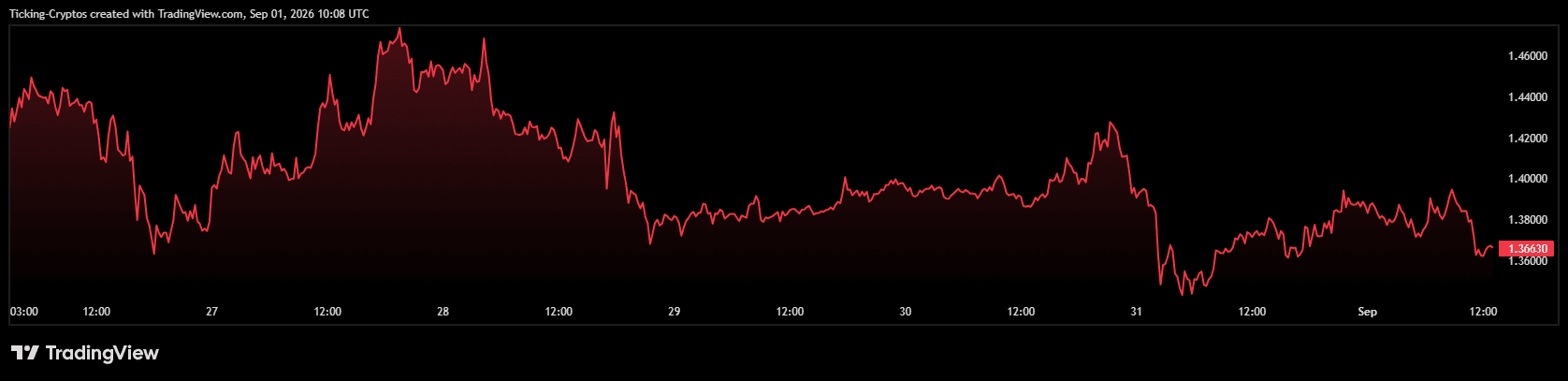
It is not. $XRP was the single best performing large cap in crypto ten days ago. It went from roughly $1.00 to an intraday high of $1.6963 in five sessions, its strongest week in 21 months, and finished August up around 28.5 percent, its best August since 2021.
So the honest framing of this week is not "XRP crashed". It is "XRP gave back part of a violent, leveraged, macro-driven spike". Those are very different setups for anyone thinking about buying, and the difference is the whole article.
Why Did XRP Fall 8% This Week?
Because the thing that pushed it up was never really about XRP.
On August 19 the US Treasury announced it would expand its buybacks of long-dated government debt, raising the cap on individual operations from $2 billion to at least $4 billion for 10 to 30 year maturities, running from September 9 through November 4. Long-term yields fell hard. The 30-year had been sitting at a 19-year high above 5.33 percent and dropped toward 5.19 percent.
Traders immediately relabelled this as "QE Lite" or curve control, and risk assets ripped. XRP ripped hardest, up around 51 percent while Bitcoin managed 22 percent, Ethereum 30 percent and Solana 28 percent over the same stretch.
Two things are worth being precise about here, because a lot of coverage was not.
First, this was not yield curve control. The Treasury described the operations as liquidity support for parts of the bond market receiving heavy volumes of eligible offers. Actual curve control means a central bank setting a yield ceiling and buying unlimited quantities to defend it. Scheduled, capped operations by the Treasury are not that. The YCC read was a market interpretation, not announced policy.
Second, a large chunk of the move was shorts getting run over. CoinGlass data circulated showing roughly $2 billion in shorts liquidated during the week, but that figure covered the entire crypto market rather than XRP alone, and about $1.2 billion of it came in a single 24 hour window. The available data does not support the claim of nearly $2 billion in XRP-specific short liquidations that got repeated widely.
Strip it down and the August spike was a macro liquidity headline, amplified by a short squeeze, on an asset that had underperformed so badly it was crowded with bearish positioning. Whale accumulation of around 380 million tokens in one week and a White House crypto summit added fuel. None of that is nothing. But none of it is a durable, XRP-specific demand story either.
When the squeeze fuel ran out, the price came back down. That is this week.
Are XRP ETF Inflows Strong Enough to Hold the Line?
This is the strongest part of the bull case, and it is genuinely strong.
US spot XRP ETFs pulled in $110.49 million in the week ending August 28, their best weekly haul of 2026 by a wide margin. Cumulative net inflows across the products have reached $1.66 billion, with total net assets around $1.44 billion.
The timing detail matters more than the headline. Of the roughly $153.55 million that flowed in during all of August, only about $3.27 million arrived between August 3 and 14. The remaining $150 million or so landed in the final two weeks, and the buying has continued through nine consecutive positive sessions.
So ETF demand did not lead this rally. It chased it. That is a meaningful distinction: chasing flows tend to be more sensitive to price than anticipatory ones, and they can reverse quickly if the tape turns. The seven US spot XRP funds together hold around 977.92 million XRP, which is real structural demand, but it is a fraction of what circulates.
What Does the XRP Chart Actually Say?
The daily chart is unusually informative right now, because the spike left a very specific footprint.
XRP is sitting at $1.3672, directly on top of the 200-day EMA at $1.3508. That moving average had been falling all year and capped every rally attempt since spring. The August surge blew straight through it, and the current pullback is the retest. That is the single most important thing on this chart.
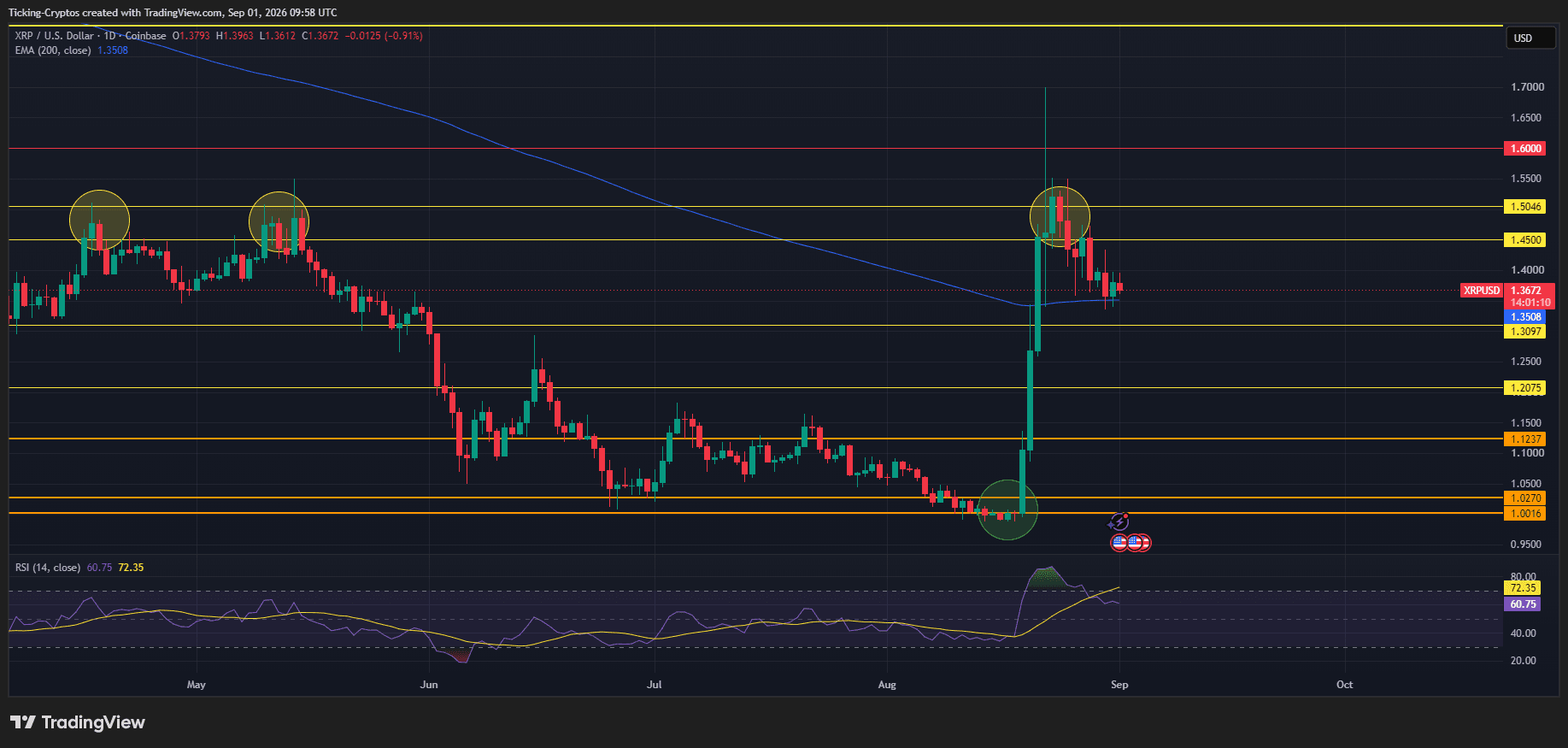
- Resistance overhead: $1.4500 is the first real barrier, and it is where sellers already stepped in on the way down. Above that sits $1.5046, the zone where the late-August candle got rejected, which also lines up with the highs from early May. The wick to $1.6963 above it is exactly that, a wick, with almost no time spent up there. $1.6000 is the next marked level.
- Support below: the 200-day EMA at $1.3508 first, then $1.3097. Below that the chart thins out badly toward $1.2075, then $1.1237, and finally the base of the whole move at $1.0270 and $1.0016, which is where the August low was set.
- Momentum: the daily RSI reads 60.75 and has already rolled over from a reading near 80, with the signal line at 72.35 above it. Momentum is cooling from an overbought extreme rather than breaking down. That is normal after a parabolic leg, but the cross below the signal is a warning that the impulse phase is over.
One structural point that traders keep missing: the move from $1.00 to $1.70 happened in days. There is almost no traded volume in the entire $1.05 to $1.35 zone. If $1.3508 fails and $1.3097 goes with it, there is very little underneath to slow price down. That cuts both ways, but it is why the risk here is not symmetrical with the reward.
What About the 1 Billion XRP That Unlocks Every Month?
Worth knowing, especially since today is the first of the month.
Ripple holds most non-circulating XRP in escrow contracts, and 1 billion tokens unlock on the first of every month. Historically Ripple re-escrows the bulk of it, typically 600 to 800 million, which leaves roughly 200 to 400 million actually entering circulation. Around 37.5 billion XRP remains locked, against circulating supply of about 62.53 billion out of a 99.99 billion total.
At today's price of roughly $1.37, that net monthly release is worth somewhere between $270 million and $550 million of new supply arriving whether the market wants it or not.
Put that next to the ETF numbers and the picture sharpens. The best ETF week of 2026 was $110 million. The monthly structural release is several times that. ETF demand is real, but it is currently not large enough to absorb the supply schedule on its own. That is not a scandal, it is arithmetic, and it is a headwind that Bitcoin simply does not have.
Is Buying XRP at Current Prices a Good Strategy?
Nobody can answer that for you, and anyone who says otherwise is selling something. What can be done is to lay out what the position actually is, because most people buying XRP here do not realise what they are betting on.
- Buying XRP at $1.37 is primarily a macro liquidity bet, not a Ripple bet. The rally was triggered by Treasury buyback expansion and lower long-end yields. If yields keep falling and the liquidity story holds, XRP has already shown it responds harder than Bitcoin or Ethereum. If the 30-year yield climbs back above 5.50 percent, the exact tailwind that created this move disappears. Analysts have flagged that level explicitly as the invalidation point for the macro thesis.
- The bull case: XRP reclaimed a 200-day EMA it had not touched since spring and is holding above it. ETF inflows just hit a 2026 record and are running nine sessions positive. Ripple is building a real business around the token's ecosystem, including a $1.25 billion Hidden Road acquisition, a $1 billion GTreasury deal and a new desk brokering equities exposure for institutions. The actual Treasury buybacks start on September 9, which is a scheduled catalyst rather than a hope. And the token is still only about 20 percent recovered from the slide that took it from $3.65 in July 2025 to below $1.
- The bear case: the move was leveraged and squeeze-driven, and Binance's estimated leverage ratio for XRP derivatives hit its highest level since early 2026, meaning more of the exposure is borrowed. Some analysts note XRP has now failed to reclaim its 50-week EMA for two consecutive weeks after a 22 percent retracement. Monthly escrow supply outweighs current ETF demand. XRP is still down about 26 percent year to date despite the best August in five years, which tells you how much damage there is to repair. And September historically has not been kind to this asset.
- The uncomfortable middle: both cases are credible, which is precisely why position sizing matters more than direction here. An asset that moves 56 percent in five days can move 30 percent against you just as fast.
If you are weighing this, the questions worth answering first are: are you actually taking a view on long-end Treasury yields, do you have a level at which you accept you were wrong, and would you be comfortable holding through a retest of the $1.20 area, because the chart structure makes that entirely possible without the bull case being dead.
What to Watch in September
Three dated events will settle most of this.
- September 9: the expanded Treasury buybacks actually begin. The announcement moved the market. The execution is when we find out whether the effect was priced or persistent.
- September 15: the Senate's procedural vote on the CLARITY Act. Sixty votes are needed to clear the filibuster. Market structure legislation is the regulatory catalyst XRP holders have been waiting on longest.
- September 16 and 17: the Fed decision. With Kevin Warsh sounding hawkish at Jackson Hole and rate hike odds back on the table, this is the one that can override everything else.
Add the ongoing ETF flow prints and the 30-year yield, and you have a fairly complete dashboard. Watch those rather than the price alone.
Decrypt
X engineers have acknowledged the issue, but have not confirmed a new data breach of its systems.
The investment firm bought 456,059 Block shares across three ETFs and added $3.4 million in Circle stock.
The actor’s lawyers spent six months negotiating the contract for “Bitcoin: Killing Satoshi” in order to “protect” her performance.
Strategy somehow threaded the needle of buying Bitcoin and STRC while also raising cash. Now how will the market respond?
Police say the ringleader also took crypto from the group and sent back 11 used cars and two excavators, a first for Korean investigators.
U.Today - IT, AI and Fintech Daily News for You Today
Choosing between AI stocks and Bitcoin is a mistake, according to Bitwise CIO amid the $40 trillion US debt dilemma.
Hyperliquid joins Bitcoin and XRP in Hashdex's Nasdaq ETF after a fresh SEC rebalance shifts top asset weights.
Solana has made a new record in its network activity in August after it processed over 5.2 billion non-vote transactions, up about 19% from last month's figures.
A decisive break above these levels will target $0.00001, removing a zero from Shiba Inu's price tag.
As the Fed triggers a traditional market selloff, whales are quietly loading up on Solana and XRP, Wintermute data shows.
Blockonomi
Quick Summary
- The 10-year Treasury yield reached 4.77%, pressuring technology shares in the S&P 500 and Nasdaq
- Crude oil prices rallied 2% amid escalating U.S.-Iran conflict, with Brent crossing $92/barrel
- Dell Technologies disclosed a massive $51.3 billion AI server backlog alongside 250% stock appreciation in 2026
- Robinhood Markets received an upgrade to Overweight from Morgan Stanley with a $150 target, suggesting 43% potential gains
- Apple announced John Ternus as its new CEO, with Tim Cook transitioning to executive chairman
Tuesday marked a turbulent start to September for equity markets. A confluence of rising bond yields, climbing energy prices, corporate earnings releases, analyst rating changes, and a transformative executive transition dominated financial headlines.
Bond Yields Weigh on Equity Markets
The benchmark 10-year Treasury yield advanced to approximately 4.77% during Tuesday’s session. Elevated yields increase financing expenses and enhance the relative appeal of fixed-income securities versus equities.
The tech-heavy Nasdaq declined about 0.7% while the broader S&P 500 retreated roughly 0.4% during morning trading. Major chip manufacturers such as Nvidia, Intel, and AMD experienced downward pressure.
Persistent worries about federal debt levels, entrenched inflation, and projections for sustained elevated interest rates continue driving yields upward.
Crude Prices Rally on Geopolitical Conflict
Oil prices surged following intensified military confrontations between the United States and Iran, heightening anxieties regarding Middle Eastern supply disruptions.
Brent crude climbed past $92 per barrel while West Texas Intermediate neared $88, marking approximately 2% gains for the session.
Elevated crude prices can accelerate inflation through increased fuel and logistics expenses. Energy sector equities benefited from the rally, though growth-oriented and technology stocks encountered additional headwinds.
Dell’s AI Server Backlog Under Investor Scrutiny
Dell Technologies commanded market attention Tuesday as quarterly results approached. Analysts anticipated approximately $45 billion in revenue, propelled predominantly by robust demand for AI-enhanced server infrastructure.
The company commenced the quarter holding an AI server order backlog totaling roughly $51.3 billion. Market participants are eager to assess whether Dell can transform this pipeline into actual sales while preserving profitability.
Dell shares have surged over 250% during 2026. Given such substantial optimism embedded in current valuations, forward guidance for upcoming quarters could prove equally significant as historical performance.
Robinhood Receives Bullish Rating With Substantial Upside Potential
Robinhood Markets gained momentum following Morgan Stanley’s upgrade from Equal Weight to Overweight. The investment bank elevated its price objective from $124 to $150, implying roughly 43% appreciation from prevailing levels.
Morgan Stanley highlighted Robinhood’s decreasing dependence on cryptocurrency trading as the platform diversifies into additional financial services. The analyst emphasized increased user engagement, expanding platform assets, and prediction market offerings as primary catalysts.
Robinhood’s customer base now encompasses approximately 28 million users. Morgan Stanley forecasts the firm will achieve compound annual revenue growth of about 23% extending through 2028.
Apple Ushers in New Leadership Era With Ternus Appointment
One of technology’s most significant executive transitions materialized Tuesday. John Ternus assumed the role of CEO of Apple, succeeding Tim Cook following his 15-year tenure. Cook will continue serving as executive chairman.
Ternus inherits leadership during a critical juncture for the technology giant. Apple confronts mounting pressure to bolster its artificial intelligence capabilities while simultaneously navigating a legal confrontation with OpenAI regarding alleged misappropriation of trade secrets involving ex-Apple personnel.
Market observers will closely monitor Ternus’s strategic direction as Apple navigates an increasingly dynamic technological environment.
The post Market Movers: Treasury Yields Spike, Oil Climbs, and Apple’s Leadership Transition Rocks Markets appeared first on Blockonomi.
Key Takeaways
- Bank of America upgraded Microsoft’s price target from $500 to $600 while reaffirming its Buy recommendation
- Microsoft’s Azure platform posted 43% growth acceleration in fiscal Q4 2026, improving from the previous quarter’s 39%
- The company forecasts 45% Azure expansion for fiscal Q1 2027
- Paid Microsoft 365 Copilot user seats exceeded 30 million, with net growth more than doubling from the previous quarter
- Year-to-date, MSFT shares have climbed 4.2%, significantly trailing the S&P 500’s approximate 12% advance
After a year of stagnant performance, Microsoft (MSFT) stock may be ready to break out, according to Bank of America. On Tuesday, analyst Tal Liani boosted his valuation target on MSFT to $600 from $500 while maintaining his Buy recommendation. This updated target represents a 19% premium to Tuesday’s trading price of $502.43, which closed down 1% for the session.
Microsoft Corporation, MSFT
Year-to-date gains stand at a modest 4.2%, while the trailing twelve-month return shows a 0.5% decline. By comparison, the S&P 500 has delivered nearly 12% returns during the same timeframe, positioning Microsoft as a notable underperformer. Liani believes current financial metrics now warrant a valuation reassessment.
His bullish stance centers primarily on Azure performance. Microsoft’s cloud infrastructure platform achieved 43% growth during the fiscal fourth quarter ending June 30, representing an acceleration from the previous quarter’s 39% expansion. Management has projected 45% growth for fiscal Q1 2027, signaling continued momentum.
The Copilot AI assistant is also contributing meaningfully. Paid Microsoft 365 Copilot subscriptions crossed the 30 million threshold, with net subscriber additions more than doubling sequentially. Remaining performance obligations surged 84% year-over-year, indicating robust future revenue streams.
Cloud Platform Delivers Measurable Results
BofA’s updated valuation applies a 28x multiple to its calendar year 2027 earnings projection, elevated from the previous 24x multiple. This adjustment reflects accelerated cloud expansion and improved transparency regarding returns from Microsoft’s artificial intelligence infrastructure investments.
Liani highlighted Microsoft’s strategy of deploying a diverse range of AI models, enabling enterprise clients to select the most economically efficient solution for specific use cases.
“Not every workload requires a complex and expensive frontier model, and Microsoft’s approach helps optimize performance while reducing token consumption,” he wrote.
Morgan Stanley analyst Adam Wood shares this optimistic outlook. He maintained his own $600 valuation following late July fiscal Q4 results, noting that the “growth thesis” is “taking shape.” Wood emphasized that Microsoft preserved profit margins despite escalating AI-related expenditures, particularly noteworthy given capital spending reached approximately $41 billion in Q4 alone and $145 billion across the full fiscal year.
Analyst Consensus Supports Upside Potential
Wall Street sentiment broadly favors Microsoft. Among 60 firms monitored by FactSet, the average recommendation on MSFT registers as Buy, with a mean price target of $565.88. BofA’s $600 projection now ranks among the more optimistic forecasts in that distribution.
Seventeen analysts have recently increased their earnings projections for upcoming periods, per InvestingPro data. The stock currently carries a P/E ratio of 28.5 alongside a PEG ratio of 0.89, which InvestingPro characterizes as undervalued when measured against growth prospects.
Meta Platforms has emerged as a significant Azure client, allocating hundreds of millions in annual spending to the platform. Moody’s recently reaffirmed Microsoft’s Aaa credit rating while maintaining a stable outlook.
The post Microsoft (MSFT) Stock Poised for Breakout as BofA Elevates Price Target to $600 appeared first on Blockonomi.
Key Takeaways
- CBRS shares declined 3.6% to $177.50 on Tuesday following announcement of a new Finland AI data center partnership
- The Mikkeli facility will achieve 165 MW of IT capacity, with initial 50 MW phase already in development
- Cathie Wood’s Ark Invest purchased approximately $17 million worth of CBRS shares on Aug. 25, signaling confidence in AI inference
- Second quarter revenue reached $180.1 million, representing 74% year-over-year growth, while cloud revenue soared 287% YOY
- Analysts maintain consensus “Strong Buy” rating with average price target of $283.91, suggesting approximately 59% upside potential
Shares of Cerebras Systems (CBRS) retreated 3.6% to $177.50 during Tuesday’s trading session, despite the artificial intelligence chip maker unveiling a significant data center partnership in Finland. The stock has tumbled more than 42% over the trailing twelve months and currently trades over 15% beneath its 20-day moving average.
Cerebras Systems Inc., CBRS
The Finnish collaboration involves Compute Nordic Finland and encompasses a new artificial intelligence data center located in Mikkeli. Planned for phased development, the installation will ultimately deliver 165 MW of contracted IT capacity. Development of the initial 50 MW phase is currently in progress.
Under the agreement’s structure, each service order includes a seven-year commitment, providing Cerebras with stable, long-term infrastructure to power its AI computing platform. The initiative is anticipated to generate employment opportunities throughout the Mikkeli area.
The share price decline accompanying favorable news isn’t particularly unusual. Market conditions were challenging overall, with the Nasdaq (QQQ) sliding 1.5% and the S&P 500 retreating 0.76%. AI infrastructure stocks typically track broader growth sentiment.
From a technical perspective, CBRS is positioned below both its 20-day SMA of $212.57 and its 50-day SMA of $203.90. The MACD indicator sits beneath its signal line accompanied by a negative histogram, suggesting weakening momentum. Critical support exists at $173.50, just above the 52-week low of $160.81.
Ark Invest Increases Position
Despite the stock’s decline, Ark Invest was actively accumulating shares. On Aug. 25, Ark acquired 93,290 CBRS shares distributed across several ETFs, totaling approximately $17.2 million. This follows previous purchases completed earlier in August.
Cathie Wood’s investment rationale focuses on Cerebras’ competitive advantage in AI inference. The company’s CS-4 system reportedly delivers up to 30 times faster inference performance compared to GPU-based solutions. Cerebras is also collaborating with AMD on a disaggregated inference architecture that provides up to five times greater throughput per watt in specific configurations.
The firm maintains strategic partnerships with OpenAI, AWS, and AMD, while simultaneously developing an inference cloud business to complement its hardware revenue streams.
Impressive Growth, Premium Pricing
Cerebras disclosed Q2 revenue of $180.1 million, reflecting 74% year-over-year expansion. Core revenue climbed to $209.9 million, up 103% YOY. Cloud and services revenue exploded 287% YOY to $127.7 million, while core gross margin advanced to 41%.
Leadership increased full-year fiscal 2026 core revenue projections to a range of $880 million to $890 million. Third quarter core revenue guidance was established at $214 million to $216 million.
The company concluded Q2 holding $8.6 billion in cash, restricted cash, and short-term investments, alongside $25.4 billion in remaining performance obligations. Additionally, it has secured more than 600 MW of data center capacity either operational or contractually committed.
The valuation commands a significant premium. With a market capitalization around $42.5 billion against annual sales of approximately $510 million, the price-to-sales multiple stands at 60 times. The company continues reporting GAAP losses.
Wall Street maintains an optimistic stance despite the elevated valuation. Among 11 analysts covering the stock, eight assign “Strong Buy” ratings, one “Moderate Buy,” and two “Hold.”
The consensus price target stands at $283.91. UBS maintains a $330 objective, Morgan Stanley elevated its target to $279, and Wedbush increased its forecast to $290.
The upcoming earnings announcement is projected for November 19, 2026, with analyst consensus anticipating revenue of $214.90 million and an EPS loss of 14 cents.
The post Cerebras (CBRS) Stock Dips Despite Finland AI Data Center Expansion and Ark Invest Buying Spree appeared first on Blockonomi.
Key Takeaways
- The European Union has officially designated Roblox as a “very large online platform” under its Digital Services Act, providing regulatory clarity for the company’s 45 million European monthly active users.
- Shares experienced upward momentum driven by technical factors and significant short covering after a notable decline in bearish positioning throughout August.
- The company’s previously announced $3 billion stock repurchase program continues to provide underlying support for share prices.
- Second-quarter results showed a per-share loss of $0.26, which exceeded expectations, though revenue of $1.47 billion fell below the anticipated $1.60 billion mark.
- Wall Street maintains a collective “Hold” stance with a mean price target of $60.89; Morgan Stanley recently adjusted its outlook downward from $62 to $55.
Shares of Roblox (RBLX) started trading Tuesday at $41.32, recovering from their recent slump following the European Union’s formal designation of the gaming platform as a “very large online platform” under the Digital Services Act. This regulatory classification establishes a defined compliance framework for the company’s substantial European user base of 45 million monthly active participants, a development that market participants have interpreted positively.
Roblox Corporation, RBLX
The gaming platform’s equity has faced considerable headwinds throughout the current year. Shares have declined more than 52% since the beginning of 2024, falling from a 12-month peak of $142.00 to a recent trough of $33.88. The company’s current valuation stands at approximately $27.52 billion.
The recent price recovery extends beyond just the European regulatory announcement. Technical dynamics have also contributed significantly. Bears substantially reduced their positions following aggressive shorting activity in August, and this unwinding of short positions provided additional upward momentum.
Management’s $3 billion stock repurchase authorization, which received board approval in May, permits the acquisition of up to 9.5% of shares outstanding. The board’s willingness to allocate capital toward buybacks at current price levels communicates management’s belief that shares are trading below intrinsic value.
Quarterly Results Fall Short on Revenue
When Roblox disclosed its latest quarterly performance on July 30th, the company reported a per-share loss of $0.26 for the second quarter, surpassing analyst expectations which had anticipated a $0.34 loss. Nevertheless, revenue totaling $1.47 billion came in below the Street’s $1.60 billion projection.
Despite the shortfall, revenue demonstrated year-over-year growth of 8.3%. During the comparable period last year, the company recorded a per-share loss of $0.41, indicating improvement in bottom-line performance. Current analyst projections forecast a full-year per-share loss of $1.39.
The company’s balance sheet reflects a debt-to-equity ratio of 7.82 alongside a net margin of negative 17.60%. Technical indicators show the 50-day moving average at $45.92 and the 200-day moving average at $51.39, both positioned above current trading levels.
Institutional Positioning and Wall Street Perspectives
The Public Employees Retirement System of Ohio acquired 181,051 RBLX shares during the second quarter, representing an investment of approximately $9.85 million. Institutional shareholders and hedge funds maintain ownership of 94.46% of outstanding shares.
Additional second-quarter purchasers included Kinetic Partners Management LP, which established a position valued at roughly $6.57 million, and S&CO Inc., which initiated a holding worth about $921,000.
Wall Street sentiment remains divided. Morgan Stanley reduced its price objective from $62 to $55 while maintaining an “overweight” rating. DA Davidson established a $40 target. Arete Research projects a $95 price point with a “buy” recommendation. Piper Sandler assigns a “neutral” rating with a $47 target.
Among 31 analysts providing coverage, 12 recommend buying, 15 suggest holding, and 3 advise selling. The average price target across all analysts is $60.89.
Insider transactions merit attention. Chief Financial Officer Naveen Chopra divested 17,509 shares at $37.96 on August 20th, totaling approximately $664,641. Matthew Kaufman, another insider, similarly sold 14,904 shares at the identical price. Both transactions were executed to satisfy tax liabilities associated with vesting equity awards.
Cumulative insider selling during the trailing 90-day period reached 168,213 shares with an aggregate value of roughly $6.83 million.
The post Roblox (RBLX) Stock Climbs After EU Digital Services Act Classification appeared first on Blockonomi.
TLDR
- Navitas sets September shipments for its first U.S.-made Gen 5 GaNFast wafers
- GlobalFoundries partnership brings Navitas Gen 5 GaNFast into U.S. production
- Navitas expands U.S. GaN supply with first Gen 5 wafer shipments in September
- Gen 5 GaNFast rollout targets computing, industrial and defense power markets
- NVTS falls 3.93% as Navitas advances U.S. Gen 5 GaNFast wafer production plans
Navitas Semiconductor will begin shipping its first U.S.-made Gen 5 GaNFast wafers in September through GlobalFoundries. The milestone moves Navitas deeper into domestic power semiconductor production for data centers, computing, industrial systems, and defense applications. NVTS traded at $11.14, down 3.93%, after a sharp intraday drop and a partial recovery.
Navitas Semiconductor Corp, NVTS
U.S. Gen 5 GaNFast Production Moves Forward
Navitas developed its fifth-generation GaNFast platform for production at GlobalFoundries’ 200mm GaN-on-silicon facility in Burlington, Vermont. The manufacturing plan expands domestic capacity for advanced gallium nitride power devices used in high-efficiency electrical systems. It also gives Navitas a U.S.-based production source for future GaNFast generations.
The companies formed a long-term strategic partnership in November 2025 to accelerate domestic GaN development and manufacturing. Since then, Navitas has adapted its device designs and process technology for GlobalFoundries’ manufacturing platform. The collaboration combines Navitas’ power semiconductor designs with GlobalFoundries’ established high-volume production capabilities.
The first product family will include 650-volt GaN FETs across several on-resistance specifications for different power requirements. Navitas expects resistance options of 11, 18, 50, 120, and 150 milliohms within the initial lineup. This range targets power systems that require different balances between efficiency, switching performance, size, and thermal control.
September Wafers Start a Broader Sampling Schedule
Navitas expects the first Gen 5 wafers to leave the Vermont production line during September. Internal samples should follow in October as the company moves through testing and qualification work. Strategic customer samples are planned before year-end, supporting wider evaluation across targeted markets.
The September shipment marks the first production step under the Navitas and GlobalFoundries manufacturing partnership. It also brings Navitas’ newest GaNFast architecture into a domestic commercial foundry for the first time. That transition gives the company a clearer path from design development to U.S.-based wafer production.
Navitas designed the platform for data center power, high-performance computing, industrial electrification, and national security systems. These applications need efficient power conversion as electricity demand rises across advanced computing and industrial equipment. GaN devices can support smaller power systems while reducing energy losses during high-frequency switching.
Navitas Builds on Long-Term GaN and SiC Development
Navitas has developed gallium nitride power products since 2014 and also operates a silicon carbide technology portfolio. The company holds more than 300 issued and pending patents across GaN and SiC technologies. Its portfolio covers device structures, process design kits, integrated power circuits, control features, sensing, and protection functions.
The Gen 5 program extends that technical base into a manufacturing process designed for 200mm GaN-on-silicon wafers. Larger wafer formats can support greater production scale when fabrication yields and customer demand reach commercial targets. GlobalFoundries adds manufacturing infrastructure that can support higher volumes as Navitas expands customer qualification.
The U.S. production effort also gives Navitas another supply option for markets that value domestic semiconductor sourcing. That factor matters for computing, industrial, and defense programs that require dependable component availability and traceable manufacturing. The September wafer shipment therefore adds a production milestone alongside the company’s broader technology and supply-chain strategy.
The post Navitas Semiconductor (NVTS) Stock: First Gen 5 GaNFast Wafers Set for September appeared first on Blockonomi.
CryptoPotato
Bitcoin rose 25% in August, its strongest monthly gain since November 2024. The asset briefly crossed $80,000 last week but has since settled near $78,000. The rally, nonetheless, has renewed interest among retail players in one of crypto’s key markets.
In fact, new data suggests that South Korean investors are staging a comeback.
Korean Risk Appetite
Data shared by CryptoQuant revealed that the Korea Premium recently flipped positive after recording its longest period of negative readings. The analytics platform added that this shift from negative to positive territory “has typically been followed by a positive trend.”
The gap between BTC prices on Korean exchanges and global markets is known as the “kimchi premium” and is widely viewed as an important indicator to gauge retail investor sentiment across Asia and local market demand.
Rachael Lucas, an analyst at BTC Markets, stated,
“Korean retail tends to buy aggressively in risk-on phases and capital controls mean that buying shows up as a price gap rather than arbitrage flow. Historically, discount-to-premium crossings have preceded stronger bitcoin returns over the following weeks.”
Bitcoin ETF Road Ahead
But while retail demand appears to be returning, access to regulated Bitcoin investment products remains limited in the country. CryptoQuant founder Ki Young Ju believes that the next stage of BTC’s current cycle could be driven by institutional demand and exchange-traded funds outside the US. It is important to note that South Korea still lacks a spot Bitcoin ETF, while retail investors cannot buy foreign ETFs and local companies cannot open exchange accounts to purchase BTC.
According to Young Ju, the market has so far been largely shaped by US adoption, but institutional participation could expand across the world through deeper stablecoin liquidity and real-world asset infrastructure.
A July report by CryptoPotato revealed that Japan is getting closer to allowing Bitcoin ETFs, as the country gears up for its first product, potentially launching in 2028 if planned regulatory changes move ahead. Lawmakers had approved amendments that bring crypto assets under the Financial Instruments and Exchange Act, while the Financial Services Agency is working on changes to investment-fund rules that would allow investment trusts and ETFs to hold digital assets directly.
If approved, a spot Bitcoin ETF would give investors in Asia a simpler way to gain exposure to BTC. The development could be particularly relevant for South Korea, where Japan’s financial policy has often served as a reference point.
More on Bitcoin and a big PlanB statement can be found in our dedicated market video below:
The post Bitcoin’s Korea Premium Flips Positive After Its Longest Losing Streak appeared first on CryptoPotato.
Ethena (ENA) has officially launched Ethena Pay, a self-custodial money app the project bills as “the internet money neobank,” advertising a 6% dollar savings rate, 5% card cashback.
It even has free transfers across roughly 50 countries at launch. It also comes with dollar savings, card spending, international transfers and free onramps in dollars, pounds and euros, with fiat account numbers tied to self-custodial stablecoin wallets.
Though access starts with 400 early users and expands weekly through a September beta. Notably, Avalanche (AVAX) is the exclusive settlement network, and a feature called Buy Now Pay Never puts savings rewards toward purchases without touching the principal.
Tiers and Caps
As mentioned, Ethena’s card cashback is at a flat 5%. The product page breaks it into tiers: the free Standard plan pays 4% on spending with cashback capped at $100 a month, while the Pro and VIP plans lift the monthly caps to $360 and $1,000, with 5% reserved for the top tier.
Savings follow the same pattern: Standard accounts earn 5%, upper tiers get the advertised 6%, and rewards pay out daily. A footnote says the rates rest on Ethena-reported weekly data and assume no net staking activity during reward vesting.
Introducing @EthenaPay: the internet money neobank.
→Card spend cashback at 5.0%
→Best-in-class 6.0% dollar savings rate
→Borderless, free, instant global money transfers
→Free global onramps in USD, GBP, EUR and local FX
→Multi-currency high-rewards savings accounts in… https://t.co/d76b1Gul4V pic.twitter.com/1gpw7zS2cZ— Ethena (@ethena) September 1, 2026
Users can generate a virtual Visa card in under a minute, spend it at more than 130 million merchants, and add it to Apple Pay, with Google Pay to follow. Third National issues the card under license from Visa, with program management from Signify Holdings, operating as Rain.
The card is not offered to US persons, and users must be 18 to register. Transfers between Ethena Pay users are free, with no monthly account fees, and euro, yen, and Brazilian real accounts are listed as coming soon.
Not a Bank, Though
Ethena Pay Ltd, incorporated in Malta, has clearly stated that it is not a bank, holds no customer funds, and provides fiat account numbers through licensed banking partners, while wallet keys stay with the user behind passkeys and biometrics.
Moreover, the official site flags that balances carry no coverage from the FDIC, the UK’s Financial Services Compensation Scheme or Malta’s depositor scheme, and the savings rate flows from the yield engine behind USDe, Ethena’s synthetic dollar, which has drawn its returns from a crypto basis trade.
USDe’s circulating supply stands near $4.2 billion, per DefiLlama, and Ethena says it has paid holders more than $750 million in rewards on over $30 billion of mints and redemptions. Ethena has widened its lineup before, launching USDtb, a stablecoin backed primarily by BlackRock’s BUIDL fund.
ENA, which recorded its biggest single day of network growth in more than three months in May after Grayscale added the token to its DeFi Fund, traded 8.6% higher on launch day, per CoinGecko.
The post Ethena Expands Ecosystem With Launch of Self-Custodial Money App appeared first on CryptoPotato.
Ripple Labs and SettleMint have announced a strategic partnership that plugs Ripple Custody into SettleMint’s Digital Asset Lifecycle Platform (DALP), giving regulated financial institutions a single system to custody, issue and manage tokenized assets across their full lifecycle.
Announced from Singapore, the offering has already commenced in Asia, and the companies plan to extend it to other markets as institutional demand develops. Beyond banks, the stack targets market infrastructure operators and sovereign entities, adding compliance, settlement and servicing to the custody and issuance layer so institutions can drop separate vendors for each function.
“Financial institutions across Asia Pacific are putting digital assets to work. They are asking how to do more without stitching together separate solutions for custody, issuance and governance,” said Fiona Murray, Managing Director, Asia Pacific at Ripple.
The Very Lucrative Tokenization Market
The joint release cites Boston Consulting Group’s May 2026 report, “The Future of Digital Assets,” which describes the shift toward digital assets as a fundamental restructuring of financial infrastructure.
Today, we’re proud to announce a landmark partnership between SettleMint and @Ripple that offers regulated financial institutions a single, connected foundation for digital asset custody, issuance and lifecycle management.
Read the announcement: https://t.co/QkLvqg50Xl pic.twitter.com/1CVO1wCakf
— SettleMint (@SettleMintCom) September 1, 2026
BCG projects that tokenized real-world assets could reach $88 trillion by 2035, and estimates that banks failing to adapt could see profits fall by as much as 30% over the same horizon. The release also names RLUSD, Ripple’s stablecoin, and the cryptocurrency XRP as assets underpinning the company’s solutions.
Elsewhere in the region, Ripple piloted RLUSD in Singapore’s central bank sandbox with supply chain finance firm Unloq in March, and its XRP Ledger featured in a cross-border pilot with JPMorgan, Mastercard and Ondo Finance that settled tokenized US Treasuries in under five seconds.
Custody Stack Assembled Through Deals
Ever since it was founded, Ripple has been selling payments, custody, liquidity and treasury infrastructure to banks and payment providers, and has assembled the custody line through a run of transactions. Moreover, Ripple has put its cumulative M&A and corporate venture spending on crypto infrastructure at around $4 billion.
Those include partnerships with Securosys and Figment, an integration with compliance analytics firm Chainalysis, and the acquisition of wallet infrastructure provider Palisade, which added MPC-based key sharding and multi-chain support.
SettleMint supplies the lifecycle side. Headquartered in Leuven, Belgium (though it has offices in the UAE, Singapore and Japan), the company stated that its composable DALP already runs in production and pre-production deployments across North America, Europe, the Middle East and Asia Pacific for banks, market operators and governments.
“Global capital markets are moving fully on-chain, and that shift only works when digital asset custody and lifecycle management operate as one system rather than two,” noted Adam Popat, CEO of SettleMint.
The post New Important Ripple (XRP) Partnership Targets Banks and Institutional Clients appeared first on CryptoPotato.
[PRESS RELEASE – George Town, British Virgin Islands, September 1st, 2026]
Aster, the privacy-first onchain trading platform backed by YZi Labs, today announced the kickoff of USD1 RWA Boost: Phase 1 with World Liberty Financial (WLFI), featuring 125,000,000 $WLFI and 6,250,000 USD1 in rewards.
The campaign builds on AOS-2, Aster’s earlier expansion of its Aster Open Standards (AOS) framework from spot markets to perpetuals.
Leonard, CEO at Aster, said: “AOS-2 is turning Aster from a decentralized perp exchange into an open infrastructure layer where anyone can launch and operate their own perpetual markets on top of Aster Chain. The first USD1 RWA perpetuals show that model is already working.”
AOS-2: A Published Standard for Perpetual Listings
AOS-2 is Aster’s standardized, onchain framework for initiating perpetual market listings, enabling projects to propose new markets through a transparent and automated process.
Applicants stake 1 million $ASTER, locked for four years with no early exit, before the proposal goes to an onchain validator vote. If approved, Aster’s risk team configures the market and the perpetual can go live as early as T+1; if rejected, the stake is returned in full.
Listing access runs on published onchain rules, while leverage and other trading parameters stay under Aster’s risk controls, letting Aster bring new markets to traders faster without giving up risk management.
USD1 RWA Boost Phase 1: 125M $WLFI + 6.25M USD1 in Rewards
The campaign runs from August 31 through December 31, 2026, covering SPCX/USD1, CL/USD1, XAU/USD1, SNDK/USD1, SKHYNIX/USD1, and MU/USD1.
Users earn Trading Points through taker volume on eligible USD1 pairs, which determine their share of the USD1 reward pool, while Open Interest (OI) Points are earned by holding eligible positions and determine their share of the $WLFI reward pool. Traders using Single Asset Mode with USD1 as collateral receive a 2x boost on OI Points. Rewards are calculated across weekly epochs and distributed the following week.
“When real-world assets trade onchain, the settlement asset matters as much as the market itself. Perpetuals on gold, energy, and equities, all denominated in USD1, give traders one dollar instrument across every one of these markets, and that is what stablecoins were built to do. We are supporting these markets because this is where onchain market structure is heading, and Phase 1 is only the start,” said Zach Witkoff, Co-Founder and CEO at World Liberty Financial.
Building the Frontier of Onchain Trading
AOS-2 gives Aster a repeatable, onchain path for bringing new markets to the platform, and the first USD1 RWA perpetual listings show that path is already at work. Paired with the ecosystem support from Aster and WLFI, the launch turns a new listing framework into real trading activity from day one.
As more real-world and crypto-native assets move onchain, Aster aims to become a leading venue for bringing new asset markets onchain. The map gets bigger from here.
About Aster
Aster is a privacy-first onchain trading platform backed by YZi Labs, with unique features like Hidden Orders to protect user trading activity. It pioneers the frontier of on-chain trading through perpetual futures, spots, and earn products for top-trending assets, including RWAs, memes, and core crypto markets. It is powered by Aster Chain, a Layer 1 blockchain built to power the future of decentralized finance.
Users can learn more about Aster on the official website or follow Aster on X.
*Disclaimer: Eligible pairs, reward parameters, and campaign rules are subject to change during the campaign. Please refer to the official campaign page for the latest eligible pair list and campaign details. Trading cryptocurrencies and leveraged products involves significant risk and may result in the loss of capital. This announcement is for informational purposes only and does not constitute investment or financial advice.
The post Aster and World Liberty Financial Launch USD1 RWA Boost: Phase 1, Offering 125M $WLFI + 6.25M USD1 in Rewards appeared first on CryptoPotato.
[PRESS RELEASE – London, London, September 1st, 2026]
ALKEMYA METACORE SCSp SECURES INITIAL USD 50 MILLION INVESTMENT AHEAD OF LISTING OF TOKENISED EQUITY NICKEL OFFERING
Alkemya Luxembourg S.à.r.l. (“Alkemya”), the sponsor, is pleased to announce that Alkemya Metacore SCSp has secured USD 50 million in a pre-launch capital raise for its precision industrial nickel wire business backed by Class 1 nickel wire. It is announcing the sale of additional ALKN tokens in a new tranche (the “Token”) at USD 1.0 per Token.
The offer, which is being arranged by Hanover Square Capital (UK) Ltd, will take place on Bitfinex Securities. The offer is available to institutional and professional investors and will close on 15 October 2026.
The Tokens are issued by Alkemya Metacore SCSp (“Alkemya Metacore”), a special limited partnership based in Luxembourg, which is registered as an Issuer with CNAD (National Commission of Digital Assets) in El Salvador.
Alkemya Metacore is a Luxembourg-based investment and operating platform focused on the industrial development, commercialisation, and financial structuring of high-technology metals. It owns approximately 7 million metres of 99.99% ultra-pure nickel wire with 0.025 mm diameter, which has been independently verified and valued at approximately USD 1.64 billion. The asset is held in institutional custody in Lugano, Switzerland.
Alkemya will use part of the initial capital raise and further funds raised in additional tranches to invest working capital in Alkemya Metacore to finance its commercialisation strategy of transforming its ultra-pure wire into engineered mesh products tailored to high-growth applications across seven sectors: EMI shielding, aerospace and defence, marine and desalination, power and industrials, semiconductors, green hydrogen and rare/precious metals recovery.
The successful capital raise, before secondary market listing, represents a major milestone for the offering and demonstrates confidence in the underlying exposure to high-purity nickel and the structure of the issue. The Token affords investors a combination of an asset-backed investment and a thematic play on energy transition and electronic security technologies.
The listing on Bitfinex Securities of the Token will enable Alkemya to leverage tokenisation to access a wider pool of global investors and be part of a regulated, 24/7 trading venue.
The Tokens aim to provide long-term investment value linked to real-world applications and technology.
Cash distributions will be governed by a strict waterfall that first returns investor capital in full, cumulative distributions equal to a 6% per annum compound interest calculated annually (i.e., the preferred return) on the investor capital at any time outstanding, from the date of payment of the same up to the date of final repayment of the invested capital and an additional 80/20 profit split with a carry partner in favour of Token holders from the commercial business.
Carlo Guido Della Peruta, Manager of the General Partner of Alkemya Metacore, commented: “Securing this initial investment is a significant milestone for Alkemya and validates both the quality of our asset and the strength of our commercialisation strategy. We chose to list on Bitfinex Securities because tokenisation offers us access to a genuinely global investor base within a regulated framework, and because it reflects the innovative approach we are taking across all aspects of our business. This raise will allow us to begin transforming our nickel wire asset into high-value engineered products serving some of the fastest-growing sectors in the global economy, and we look forward to welcoming further investors as the listing progresses.”
Jesse Knutson, Head of Operations at Bitfinex Securities, commented: “Bitfinex Securities exists to connect exciting investment opportunities with a broader and deeper investor base, giving more people access to investments that were previously out of reach and giving businesses access to a wider pool of capital. Alkemya Metacore will represent yet another example of how we’re using blockchain technology to bring previously inaccessible asset classes to market within stringent regulatory guardrails, and Alkemya’s initial $50 million capital raise is a sign of appetite for this exciting opportunity.”
Arvinder Sood, CEO and Director at Hanover Square Capital (UK) Ltd, said: “Hanover Square Capital is delighted to announce this transaction in collaboration with Bitfinex Securities and its successful pre-launch close of USD 50 million investment, which not only underscores the evolving direction of global capital markets but also establishes a compelling foundation for a groundbreaking transaction with the launch of ALKN tokens. This milestone reflects a broader structural shift in how financial assets are created, accessed, and exchanged, as traditional frameworks increasingly converge with digital innovation. By embracing tokenised equity, the transaction highlights a more efficient, transparent, and accessible model for capital formation, one that is better aligned with the demands of modern investors and issuers alike, with the capacity to trade on a peer-to-peer basis.
Hanover Square Capital believes that this transaction not only validates that trajectory but also signals the growing importance of blockchain-enabled solutions in redefining how assets are issued, managed, and traded on a global scale.”
Bitfinex Securities provides a regulated venue for the issuance and trading of tokenised securities, combining blockchain technology with regulated market access for issuers and eligible investors.
The offering was advised by the following law firms: CMS DeBacker in Luxembourg (as regards Luxembourg law aspects), Dentons El Salvador (as regards El Salvador law aspects), Foley and Lardner in the US (as regards US law aspects), and CNPLaw LLP in Singapore (as regards Singapore law aspects). Winston Taylor acted for Bitfinex Securities. The Edison Group advised on investor relations and issued a pre-IPO research note. The ALKN tokens will be available for trading across three regulated exchanges: Bitfinex Securities, AGX (operated by LabyrinthX Technologies Pte Ltd, a company in the Hydra X group) and Archax Ltd. HydraX Digital Assets Pte. Ltd. is the custodian and distribution partner in Asia, with Archax playing a similar role in the UK. Scytale, the technology firm, is providing onboarding technology services for compliance to Alkemya Metacore under Luxembourg and EU law.
About Hanover
Hanover Square Capital (UK) Ltd (“HSC”) is an independent, regulated advisory firm headquartered in London, comprising a small team of highly experienced finance professionals. The firm provides strategic advice across a broad range of areas, including energy transition and climate-related solutions, public and private debt and equity placements, bank financing, and both project and commodity finance, alongside advisory services on financial investments. HSC brings deep sector expertise spanning environment-related projects, infrastructure development, next-generation technologies with applications to electromagnetic shielding and efficient green energy production, with a particular emphasis on sustainability and the global energy transition.
As a member of the UK Sustainable Investment and Finance Association (UKSIF), the firm is closely aligned with leading sustainability practices. Its client base is global, encompassing large and mid-cap corporations, government and state agencies, selected institutional investors, and professional investors. HSC is further supported by its connected company, Hanover Square Investments Pte. Ltd, based in Singapore.
About Bitfinex Securities
Bitfinex Securities provides a regulated platform for the issuance, listing and trading of tokenised securities. Licensed in El Salvador and Kazakhstan, Bitfinex Securities gives issuers and eligible investors access to digital securities markets within established regulatory frameworks.
The platform supports capital raising and secondary market trading for tokenised securities, including real-world asset-linked opportunities. By combining market infrastructure, technology and regulatory oversight, Bitfinex Securities aims to make capital formation more efficient, transparent and accessible for issuers and investors.
Media Contact:
Richard Morgan Evans
rmorganevans@sapiencecomms.co.uk
Jonathan Batchelor
jbatchelor@sapiencecomms.co.uk
Sapience Communications
+44 (0) 203 841 7610
Disclaimer:
No offering is being made in the European Union or the European Economic Area, and no retail investors within the meaning of Directive 2014/65/EU (as amended, “MiFID II”) will be admitted as purchasers of the ALKN Tokens. The ALKN Tokens are also exempt from the obligation to publish a prospectus for offers to the public under Regulation (EU) 2017/1129, as amended (the “Prospectus Regulation”), as the offering will only be addressed to qualified investors in the EEA/EU. The offering is limited to institutional investors in Singapore. This news release does not constitute an offer to sell or a solicitation of an offer to buy, nor shall there be any sale of any of the ALKN Tokens in any jurisdiction in which such offer, solicitation or sale would be unlawful. These securities have not been and will not be registered under the US Securities Act of 1933, as amended (the “Securities Act”), the securities laws of any U.S. state or the securities laws of any other jurisdiction outside El Salvador, nor is such registration contemplated. The ALKN Tokens will only be offered and sold outside the United States (as defined in Regulation S under the Securities Act (“Regulation S”)) in offshore transactions pursuant to Rule 903 or Rule 904 of Regulation S and in accordance with any other applicable securities laws where such offers and sales are made. The ALKN Tokens have not been and will not be offered or sold within the United States.
Forward-Looking Statements: Information outlined in this news release may involve forward-looking statements under applicable securities laws. The forward-looking statements contained herein are expressly qualified in their entirety by this cautionary statement. The forward-looking statements included in this document are made as of the date of this document, and Alkemya Metacore and Alkemya disclaim any intention or obligation to update or revise any forward-looking statements, whether because of new information, future events or otherwise, except as expressly required by applicable securities legislation. Although management believes that the expectations represented in such forward-looking statements are reasonable, there can be no assurance that such expectations will prove to be correct.
Notice: None of Bitfinex Securities, Archax Ltd or the Hydra X group accepts responsibility for the adequacy or accuracy of this news release.
Since this offering is not targeting US investors as it is made under Regulation S and similarly it is not targeting EU retail investors under the EU Directive 2014/65/EU (as amended, “MiFID II”) or non-institutional investors in Singapore, this announcement is not intended for US investors, retail investors in the EU or non-institutional investors in Singapore. US investors, EU retail investors and non-institutional investors in Singapore are considered prohibited investors under the ALKN Token offering.
The post Alkemya Metacore Secures $50M via Tokenised Equity to Scale Nickel Energy and Security Tech appeared first on CryptoPotato.