Cryptocurrency Posts
Crypto Briefing
Solana's August transaction surge highlights its evolving network reliability and potential for sustained growth, attracting institutional interest.
The post Solana processes record 5.2B non-vote transactions in August appeared first on Crypto Briefing.
Gen.G's victory enhances their global standing, potentially boosting their market value and influence in the competitive esports landscape.
The post Gen.G sweeps KT Rolster 3-0 at LCK playoffs, secures 2026 Worlds spot appeared first on Crypto Briefing.
The revised Bitcoin target suggests cautious optimism, highlighting the need for market stabilization and potential regulatory catalysts for growth.
The post TD Cowen sets $97,500 year-end Bitcoin price target, 25% upside appeared first on Crypto Briefing.
GMTrade's 24/7 commodity trading on Solana could revolutionize market access, enabling continuous trading and potentially increasing market liquidity.
The post GMTrade launches 24/7 perpetual trading for commodities on Solana appeared first on Crypto Briefing.
Nvidia's shift from China to US markets highlights the growing influence of US hyperscalers, raising concerns about market concentration risks.
The post Nvidia proves reduced dependence on China amid global shifts appeared first on Crypto Briefing.
Bitcoin Magazine
Bitcoin Magazine

Strategy Opposes MSCI Proposal, Says Bitcoin Treasury Firms Are Being Targeted a Second Time
Bitcoin treasury Strategy has blasted Morgan Stanley Capital International’s proposal to exclude it from its Global Investable Market Indexes, calling it “misguided” and “flawed.”
Writing in a letter to MSCI Monday, the Nasdaq-listed Bitcoin behemoth’s founder, Michael Saylor, and CEO, Phong Le, said that the company was discriminating against digital asset businesses.
MSCI said earlier this month that it was consulting on a plan to define “non-operating companies” and make them ineligible for its Global Investable Market Indexes. The removal of such companies would exclude firms like Strategy from indexes visible to a large pool of institutional investors.
MSCI’s latest proposal comes after the company in 2025 proposed excluding from its indices all companies whose digital-asset holdings represent 50% or more of total assets.
“MSCI’s continued effort to discriminate against digital assets is misguided and calls into question MSCI’s neutrality and reliability,” Strategy’s letter read.
It added: “The proposal, like the 2025 proposal that MSCI withdrew, is discriminatory, arbitrary, and misguided. If adopted, the proposal would have no meaningful impact on Strategy’s business, but it would profoundly harm MSCI’s reputation as a reliable and neutral index provider. Like the 2025 proposal, the current proposal should be withdrawn.”
Strategy argued that MSCI was relying on unprecedented classifications to define Bitcoin as a “non-operating” asset. Strategy said it reports its Bitcoin business as an operating segment and its Bitcoin gains and losses as operating expenses.
The company said that MSCI’s methodology for targeting “non-operating companies” was “arbitrary and unexplained,” and was just a way of unfairly targeting digital asset treasuries.
Strategy further argued that the company is an operating one, employing 1,500 people across the globe and actively using its Bitcoin to “create shareholder value.”
Strategy — formerly MicroStrategy — is an enterprise software company that pivoted to buying and holding bitcoin in 2020. It first bought the cryptocurrency to protect shareholders but has since aggressively bought the asset and is now the largest corporate holder of the cryptocurrency, with 845,050 bitcoins worth $65.8 billion at today’s prices.
Investors can buy Strategy’s Nasdaq-listed stock (MSTR) to get heightened exposure to bitcoin’s performance.
MSTR closed Monday trading 4% higher. Year-to-date, the stock is down 15%.
This post Strategy Opposes MSCI Proposal, Says Bitcoin Treasury Firms Are Being Targeted a Second Time first appeared on Bitcoin Magazine and is written by Mathew Di Salvo.
Bitcoin Magazine
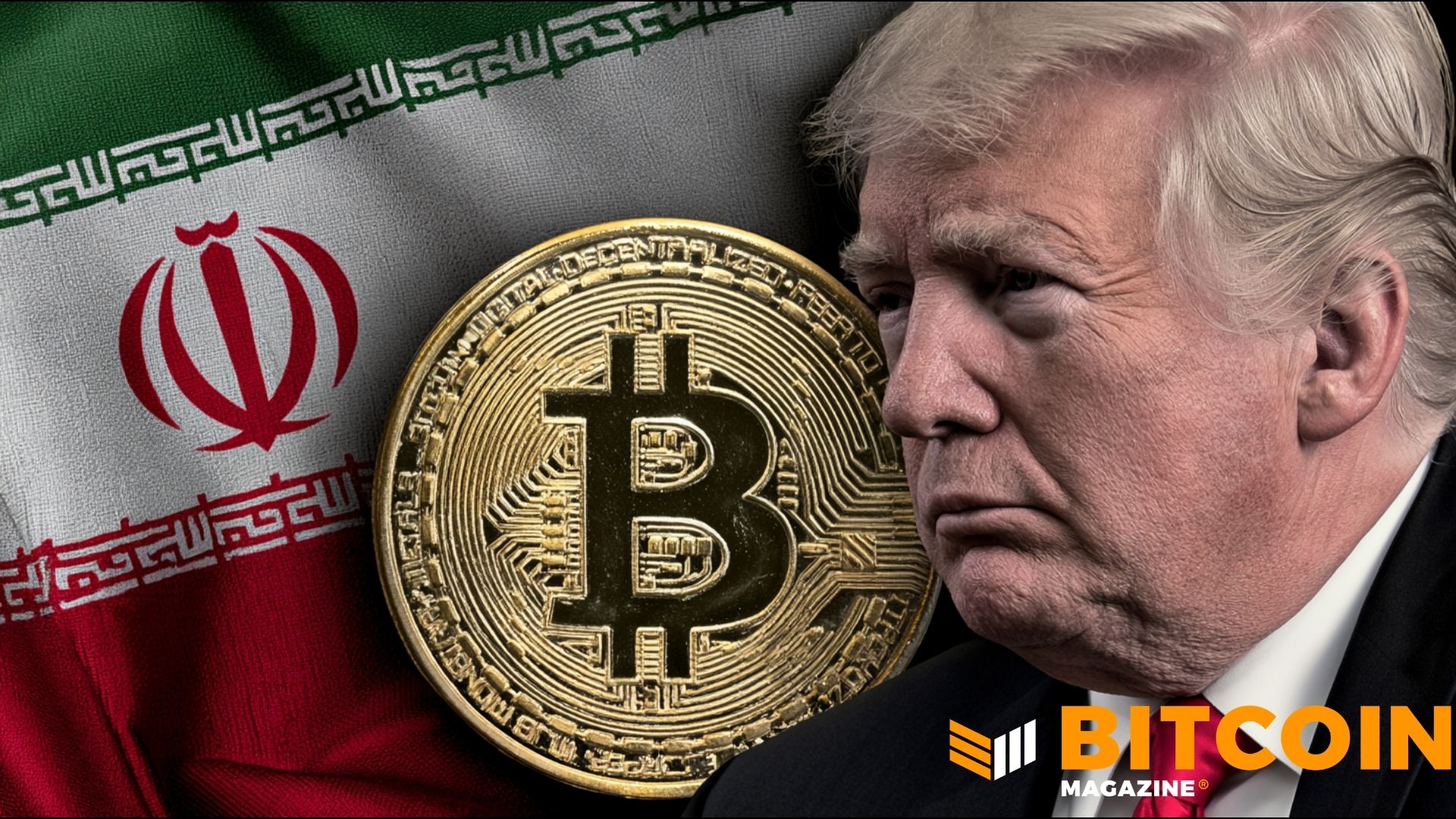
Bitcoin Unfazed by Trump’s Iran Threats
Bitcoin on Monday shrugged off tensions in the Middle East, barely moving despite U.S. President Donald Trump vowing to hit Iran hard.
The price of the biggest cryptocurrency recently stood at $79,076, unmoved over a 24-hour period. The coin also hasn’t budged from where it stood seven days ago.
Geopolitical strife has this year hurt Bitcoin’s price, with the cryptocurrency typically facing downward pressure on news of war and rallied in hopes of a ceasefire.
When the U.S. and Israel first attacked Iran in February, the coin nosedived, and had been shaky on news of war in March and April.
But in recent months, Bitcoin’s volatility has been muted, according to analysts, and Monday was no different: President Trump promised to hit Iran again but the asset didn’t flinch.
“We’re going to hit them hard,” President Trump was quoted telling a Fox News reporter on Monday. The U.S. and Iran started strikes again on Sunday — the first in over one month.
Bitcoin started a phenomenal run two weeks ago — its best in three years — and is up nearly 30% over the past month.
Its price started surging after the U.S. Treasury would at least double the size of its liquidity-support buyback operations. The announcement hurt the dollar but non-yielding assets like bitcoin and gold have benefited.
Positive regulatory news has also helped bitcoin this month: President Donald Trump last week said that the long-awaited crypto Clarity Act was a “very, very powerful” piece of legislation, and urged lawmakers to get it over the line.
The Clarity Act aims to establish a framework for distinguishing between digital assets that are securities, commodities or payment stablecoins — legislation that the crypto industry has long called for.
JUST IN: Crypto ETFs attracted $3.2 billion in inflows last week, "their largest weekly intake since October 2025", The Kobeissi Letter reports.
— Bitcoin Magazine (@BitcoinMagazine) August 31, 2026
BlackRock's IBIT led with $928 million last week, adding to their $1.3 billion from the prior week, and marking the biggest 2-week… pic.twitter.com/ROC9tYPMGN

Investors have piled back into exchange-traded funds this month, too, which has also helped bitcoin’s price. From August 17 to 27, investors threw over $2.8 billion at the vehicles — the most since October.
Bitcoin reached as high as $81,281 last week before sliding again on Friday.
This post Bitcoin Unfazed by Trump’s Iran Threats first appeared on Bitcoin Magazine and is written by Mathew Di Salvo.
Bitcoin Magazine

Strive Becomes Fifth-Largest Bitcoin Treasury, Stock Jumps on Latest Buy
Strive’s stock soared on Monday after the company announced a $143 million bitcoin buy, making it the fifth biggest publicly traded crypto treasury.
The Nasdaq-listed company announced its latest buy of 1,800 bitcoins between August 24 and August 28. It snapped up the coins for an average price of $79,431, according to a filing with the Securities and Exchange Commission.
The Dallas, Texas-based company now holds 23,156 coins worth $1.8 billion at today’s prices. Its stock (NASDAQ: ASST) was trading 9% higher at about 12.30pm in New York. Year-to-date, Strive’s stock has risen by nearly 40%.
JUST IN:
— Bitcoin Magazine (@BitcoinMagazine) August 31, 2026Public company Strive bought 1,800 BTC for $143 million
pic.twitter.com/xEkWx3ZNZp
Strive’s year-to-date Bitcoin yield, a metric that compares growth in bitcoin holdings relative to share count, reached 40.8% as of its Aug. 28 filing, up from less than 37% in early June.
Strive now is the fifth biggest bitcoin treasury, behind only Strategy, Twenty One, Metaplanet, and MARA.
Founded by former Ohio gubernatorial candidate Vivek Ramaswamy in 2025, after raising $750 million to buy Bitcoin, Strive debuted as an official bitcoin treasury.
In January 2026, it completed the acquisition of Semler Scientific in an all-stock deal — the first instance of a publicly traded Bitcoin treasury company acquiring another such company.
The idea is that investors can get amplified returns from Strive’s stock. The company buys bitcoin with equity, and maintains a debt-free balance sheet: no bonds, no credit lines, and no leveraged positions that could trigger forced liquidation in a downturn.
Strive CEO Matt Cole has described the company as debt-free with zero margin requirements and zero encumbered bitcoin.
Strive’s latest purchase comes as Strategy, the biggest corporate holder of bitcoin, restarted its buying last week.
The software company had paused buying bitcoin for 10 weeks but announced it had bought 4,603 bitcoins for $369.7 million between August 24 to August 30.
This post Strive Becomes Fifth-Largest Bitcoin Treasury, Stock Jumps on Latest Buy first appeared on Bitcoin Magazine and is written by Mathew Di Salvo.
Bitcoin Magazine
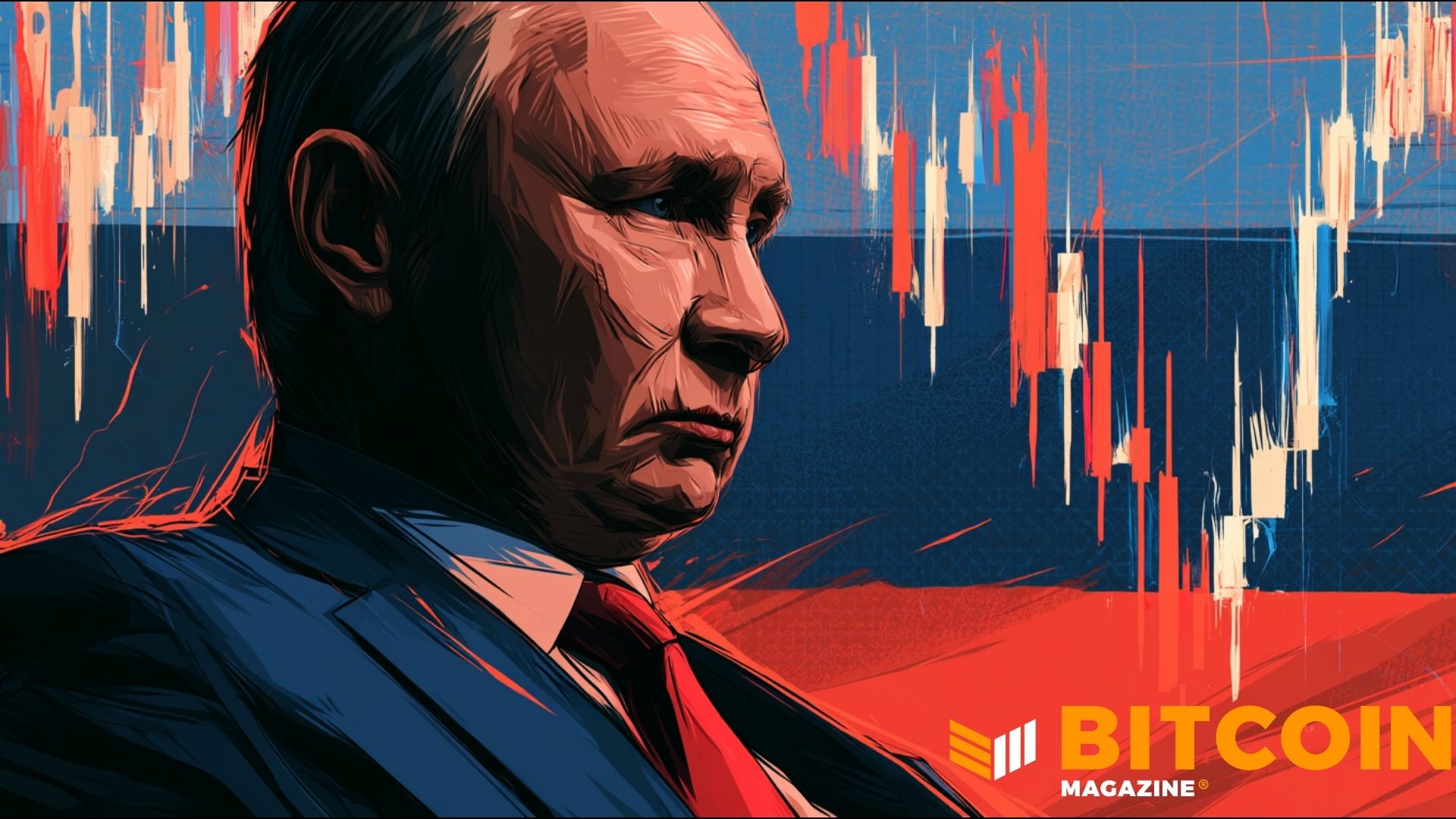
Russia’s Sberbank Estimates $46.4B Trading Volume in First Year of Crypto Buildout
Russia’s largest bank, Sberbank, has said it expects trading volume with its new crypto rollout to hit 4 trillion rubles ($46.43 bln) in the first year, according to reports.
Volumes are also expected to hit 7.5 trillion rubles ($87.06 bln) by 2029, Sberbank Deputy Chairman of the Executive Board Anatoly Popov was quoted saying, as reported by Tass on Saturday.
The forecast was deemed “conservative” according to the news report. Sberbank in July revealed plans to debut a Bitcoin and crypto wallet as well as digital asset custody by December. The Bank of Russia in July published draft regulations for crypto trading, and the State Duma is preparing the comprehensive regulation of digital assets.
And in a Friday report, Tass quoted Sberbank Deputy Chairman Anatoly Popov saying that the bank was planning to accept Bitcoin — and other cryptocurrencies — as collateral for loans.
Russia is fast moving ahead with regulating digital assets in the country. Russian President Vladimir Putin this month signed a law to set in stone the regulation of digital currencies and digital rights in the country.
The new law reportedly allows only registered entities to operate as exchanges, and puts limits on the amount of crypto retail investors can use.
Still, despite the rollout, using digital assets as a means of payment or legal tender within Russia is still banned. Using crypto as a form of payment has been prohibited in Russia since 2022.
President Putin has appeared to praise Bitcoin in the past, once saying that the leading cryptocurrency can’t be stopped.
Since the U.S. and European governments cut Russia off from the SWIFT payments system after it invaded Ukraine in 2022, Russian companies have been using Bitcoin to skirt around the penalties.
But the Russian state keeps a tight grip on what its citizens can do with crypto: authorities have been cracking down and arresting people operating unregistered crypto exchanges.
And the amounts involved barely matter — a nuclear engineer in Sarov was sentenced to 18 years for sending about $13 from his crypto wallet to groups the state designates as terrorist organizations.
This post Russia’s Sberbank Estimates $46.4B Trading Volume in First Year of Crypto Buildout first appeared on Bitcoin Magazine and is written by Mathew Di Salvo.
Bitcoin Magazine

Strategy Resumes Bitcoin Buying After 10-Week Hiatus
Bitcoin treasury Strategy resumed its bitcoin buys last week, snapping up nearly $370 million in the leading cryptocurrency, according to a Monday announcement from the company.
A filing with the Securities and Exchange Commission shows that Strategy bought 4,603 bitcoins for $369.7 million between August 24 to August 30. Each coin was bought at an average price of $80,318, according to the filing.
The buy comes after Strategy paused its bitcoin buys in June, instead focusing on building a cash buffer, buying back its stock and even sometimes selling some of its holdings.
JUST IN: Strategy buys 4,603 BTC for $370 million!
— Bitcoin Magazine (@BitcoinMagazine) August 31, 2026
“Strategy is evolving from one-way capital issuance to active capital management,” Strategy CEO Phong Le said in June.
“We intend to move between issuing securities when capital is attractive and repurchasing securities when our instruments trade at levels that make buybacks accretive. This flexibility is designed to create shareholder value, improve corporate performance, and strengthen the quality and market standing of Strategy’s securities in the eyes of investors.”
Strategy now has $5.1 billion in its USD Reserve and $1.61 billion its new USD Cash reserve — which was announced last week.
The company holds 845,050 bitcoins worth $65.8 billion at today’s prices.
Software company Strategy — formerly MicroStrategy — began buying bitcoin in August 2020 as a treasury strategy to boost shareholder returns during the pandemic.
It has since spent more than $63.7 billion on buying bitcoin and remains by far the largest corporate holder of Bitcoin in the world. Its approach spawned a wave of copycat companies that have since adopted similar crypto-treasury strategies of their own.
Chairman and Strategy founder Michael Saylor has said that the company is now focusing on creating digital credit: high-yield products, such as its preferred equity, STRC, which are backed by its bitcoin holdings.
Strategy’s stock (NASDAQ: MSTR) was trading slightly higher on Monday morning in New York. Year-to-date, its price has dipped nearly 20%.
Bitcoin was trading for $77,821 on Monday morning in New York after hitting a high last week of $81,281. Over a 24-hour period, the coin now sits unmoved, but over a 30-day period, it has jumped by more than 24%.
This post Strategy Resumes Bitcoin Buying After 10-Week Hiatus first appeared on Bitcoin Magazine and is written by Mathew Di Salvo.
CryptoSlate
Russia’s new crypto law took effect Sept. 1, but investors cannot yet access the full market it promises.
Federal Law No. 282-FZ gives cryptocurrency a formal place within Russia’s supervised financial system, allowing regulated investment and cross-border use through brokers, exchanges, management companies, digital depositories and organized trading venues.
However, the catch is that many of those channels are not ready.
The Bank of Russia is still completing rules that will determine which cryptocurrencies ordinary investors can buy, how trading venues calculate prices, and what capital requirements digital depositories must meet. Firms also have until July 1, 2027, to obtain licenses and bring their operations into compliance.
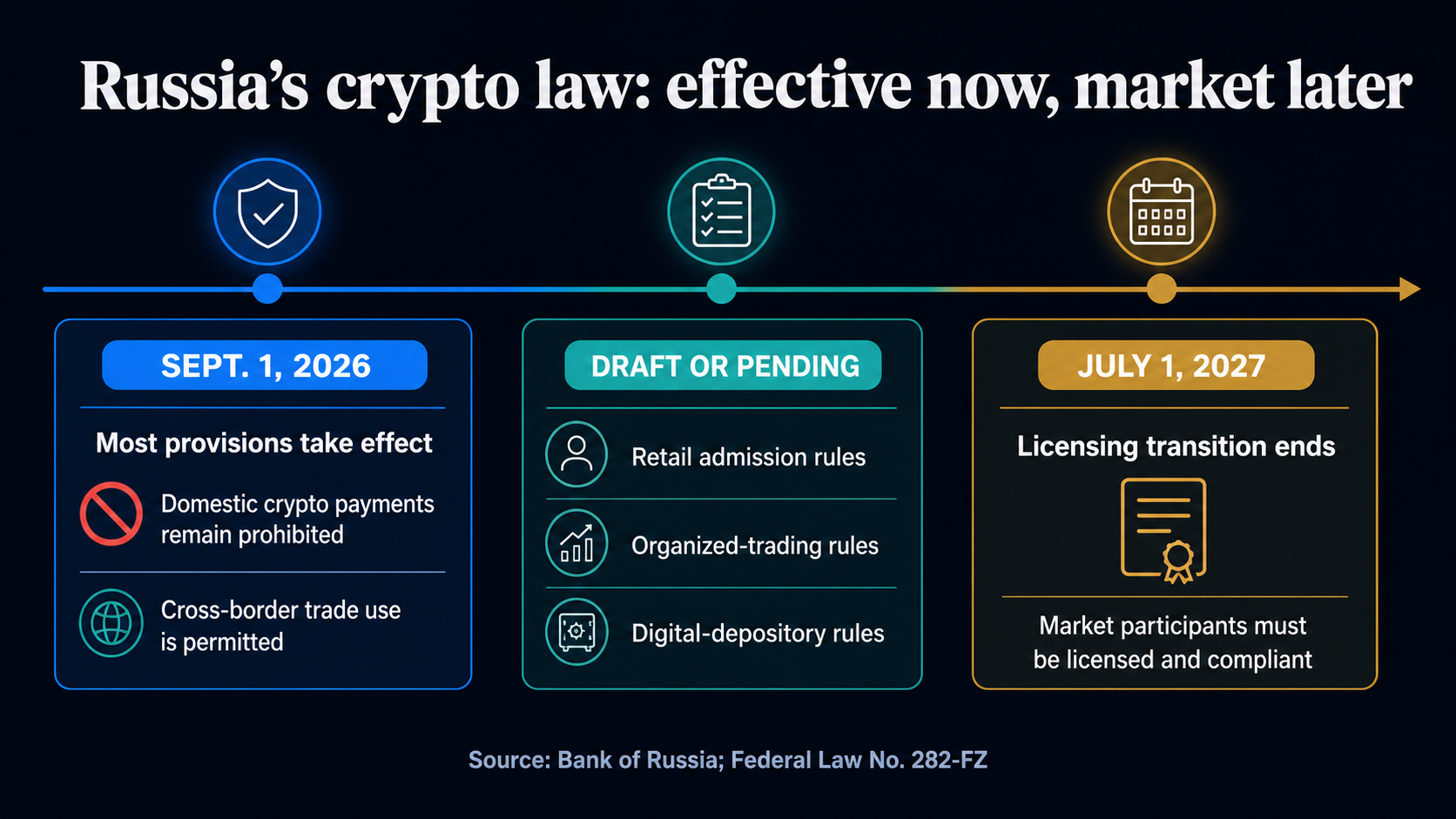
That leaves Russia in an unusual transition: crypto now has a legal framework, but the infrastructure needed to use it broadly is not yet in place.
Meanwhile, the new law does not open the door to everyday crypto payments. Instead, Bitcoin, stablecoins and other cryptocurrencies remain prohibited for purchases of goods and services inside Russia.
Their permitted role is narrower. Exporters and importers can use crypto for cross-border settlements, while investors will eventually gain access through supervised intermediaries. The Bank of Russia has said the regime also covers foreign stablecoins.
Moreover, retail investors face tighter restrictions once access expands.
Non-qualified investors must pass a test and can purchase no more than ₽300,000 of eligible cryptocurrency per year through each intermediary. Qualified investors must also complete testing but face no equivalent monetary cap.
What qualifies for retail purchase is also still being decided.
The central bank has proposed allowing Bitcoin, Ethereum and Tether’s USDT, but that list remains part of a draft ordinance. Separate proposals governing organized-trading prices and digital-depository capital requirements were also unfinished heading into Sept. 1.
Two additional Bank of Russia measures dated Aug. 27 were still undergoing Ministry of Justice registration in the regulator’s latest published status.
The staggered rollout extends beyond licensing. Some provisions of the law do not take effect until July and September 2027, reinforcing that Sept. 1 marks the legal starting point rather than a single opening day for Russia’s crypto market.
The immediate change is therefore certainty over the structure Russia intends to build. The next stage depends on the central bank turning that framework into operating rules and enough firms securing licenses to give investors somewhere to trade.
Until then, Russia has formally opened the door to a regulated crypto market without yet completing the market behind it.
The post Russia just switched on a crypto market that doesn’t fully exist yet appeared first on CryptoSlate.
Crypto added roughly $500 billion in market value in a matter of days as Bitcoin ran from about $63,500 toward $80,000 last week.
A liquidation squeeze powered much of the first phase, and regulated investment products then supplied fresh capital once forced buying began to fade.
Tom Lee told Milk Road that the crypto liquidation event showed how far “offsides” traders had become. He called the move a “course correction” that could open a much larger advance.
Glassnode said Aug. 19 produced the largest short-liquidation day in its feed since 2019, and exchanges automatically closed short positions as prices moved against traders, turning bearish bets into mandatory buying during an already violent rally.
CoinShares recorded over $2.9 billion of global crypto investment-product inflows in the week to Aug. 20, the largest weekly total of 2026. The first three trading days of the next week added another $1.65 billion.
| Rally phase | Main participant | What happened | Why it matters |
|---|---|---|---|
| Stage 1 | Macro buyers | Treasury buybacks, a weaker dollar, and liquidity support helped trigger the breakout | Created the initial conditions for risk assets to rally |
| Stage 2 | Short sellers | Shorts were liquidated as BTC moved from ~$63.5K toward ~$80K | Forced buying accelerated the move |
| Stage 3 | Regulated funds | Global crypto products took in $2.94B, then another $1.65B | Follow-through continued after the squeeze |
| Stage 4 | Institutional allocators | CoinShares survey showed allocations rising to 1.2% | Suggests some reallocation began before the rally |
The crypto rally passed from shorts to funds
CoinShares recorded $976 million of Bitcoin inflows on Aug. 27. Ethereum took in $478 million, XRP added $80.5 million, Solana drew $62.9 million, and Hyperliquid products added $39 million.
Capital entered regulated ETFs across several crypto assets even once the liquidation cascade had already done its work.
QCP’s derivatives data shows Bitcoin climbed from roughly $63,500 to around $80,000 as BTC-denominated futures open interest fell from about 646,000 BTC to 588,000 BTC. That equals a decline of roughly 58,000 BTC, or about 9%.
Funding stayed contained through the move, and a classic leveraged-long chase usually sends price, open interest, and funding higher together.
Falling open interest only establishes what happened to aggregate futures positioning. The data still shows that traders did not immediately rebuild leverage on the long side at the same pace that prices rose.
CoinShares’ August fund-manager survey found that crypto allocations among respondents rose to 1.2% of portfolios, the first increase since the October 2025 selloff. The firm said institutions drove the entire increase.
The survey covered investors overseeing about $1.16 trillion, and more respondents also cited “good value” as a reason for owning crypto during the preceding decline.
Institutions had started adding exposure before Bitcoin printed its biggest green candles, and the breakout then coincided with a much larger wave of product inflows. The short squeeze accelerated a reallocation in crypto that had already begun.
| Asset | Three-session inflow | Share of listed inflows |
|---|---|---|
| Bitcoin | $976M | ~60% |
| Ethereum | $478M | ~29% |
| XRP | $80.5M | ~5% |
| Solana | $62.9M | ~4% |
| Hyperliquid | $39M | ~2% |
| Total shown | $1.636B | ~100% |
The bull case needs the handoff to hold
The bull case rests on the idea that the crypto liquidation event cleared bearish leverage without replacing it with an equally unstable long-side position.
Glassnode places Bitcoin’s first major overhead zone around $83,000 to $86,000. A move through that area would show fresh demand absorbing supply from holders using the rally to exit. Continued weekly crypto product inflows near or above $1 billion would add another layer of support.
A gradual recovery in open interest would give the market more room, and contained funding would keep borrowing costs from showing the kind of speculative excess that often precedes another liquidation cascade.
Under that path, Lee’s “course correction” framing gains support: short sellers supplied the ignition, and institutional capital supplied the persistence.
The macro environment has already made that thesis harder to prove.
QCP linked part of the original breakout to Treasury’s decision to expand long-end liquidity-support buybacks.
Fed Chair Kevin Warsh’s Jackson Hole remarks then pushed Fed-funds futures toward a much more hawkish September outcome. Reports noted that markets lifted the implied probability of a September rate hike from roughly 35% to 64%.
Renewed US-Iran fighting added another source of stress on Aug. 31. Brent crude moved above $90, Treasury yields climbed, and US equities fell.
The buyers who inherited the rally now face a macro setup far less friendly than the one that helped Bitcoin break out.
The bear case begins below $70,000
Glassnode called the market in its Aug. 31 Market Pulse “in transition,” pairing strong institutional allocation with rebuilding leverage. The report also found softer crypto retail participation and early short-term distribution.
Bitcoin’s short-term-holder cost basis sits near $70,000. A break below that level would put recent buyers underwater and test whether regulated fund demand can continue absorbing supply during a broader risk-off move.
The outlook deteriorates further if futures leverage rebuilds as prices fall. Higher open interest and firmer funding during a decline would leave more long-side exposure vulnerable to liquidation just as macro conditions tighten.
Crypto fund flows would then provide the clearest measure of how durable the handoff became. A sharp slowdown would signal weaker institutional appetite, while broad redemptions would show that regulated-product buyers could no longer absorb selling driven by higher yields, hawkish Fed expectations, and geopolitical risk.
The next test arrives with the US jobs report on Sept. 4, with expectations around 55,000 to 58,000 new jobs, depending on the survey referenced.
Another weak employment print could make a September hike harder to justify, and a stronger number could reinforce the hawkish repricing that followed Warsh’s speech, affecting risk assets like crypto.
| Scenario | BTC / macro trigger | What to watch | Meaning for the rally |
|---|---|---|---|
| Bull case | BTC clears $83K–$86K | Product inflows remain near or above $1B weekly; funding stays contained | The handoff from shorts to institutions holds |
| Base case | BTC holds above ~$70K | OI rebuilds slowly; inflows cool but remain positive | Rally digests without confirming a full breakout |
| Bear case | BTC loses ~$70K | Recent buyers go underwater; fund inflows stall | Institutional demand faces its first real stress test |
| Breakdown case | Higher yields, $90 oil, hawkish Fed pressure | OI rises into weakness; redemptions broaden | The move looks more like a liquidation rally with a long tail |
Short sellers explain why crypto moved so quickly from the mid-$60,000s toward $80,000, and regulated fund capital explains more of what came next.
Those buyers now carry the rally into its harder phase. Their ability to keep absorbing supply through $90 oil, higher yields, and a more hawkish Fed will decide whether the $500 billion surge becomes a genuine market reset or a liquidation rally with a longer tail.
The post How short liquidations cleared $500B in crypto positions before institutional buyers took over appeared first on CryptoSlate.
Five major US spot XRP products held XRP with a combined fair value $746.1 million below accounting cost at the end of June, but investors kept buying anyway.
According to SEC filings, Bitwise, Canary Capital, Franklin Templeton, 21Shares, and Grayscale recorded roughly $629.9 million in primary-market share creations against $309.1 million in redemptions during the first half of the year.
That left capital activity positive by about $320.8 million even as the funds' combined XRP holdings sat 44.1% below their $1.7 billion accounting cost.
The gap quantifies what Bloomberg ETF analyst James Seyffart called “surprisingly resilient” XRP ETF demand in an Aug. 31 post, where he put cumulative net inflows across the asset class at $1.8 billion.
| Five-fund XRP ETF snapshot | Amount |
|---|---|
| XRP accounting cost at June 30 | $1.693B |
| XRP fair value at June 30 | $947.3M |
| Gap vs accounting cost | -$746.1M |
| Percent below cost | -44.1% |
| H1 share creations | $629.9M |
| H1 redemptions | $309.1M |
| Net capital activity | +$320.8M |
Why anyone would buy into a position already underwater
Fair value across the sample of five funds totaled $947.3 million as of June 30, versus the nearly $1.7 billion those funds had originally paid.
That decline alone would normally signal selling, since a fund holding an asset at less than half its recorded value gives shareholders every incentive to redeem and reallocate elsewhere.
New creations kept arriving faster than shares left, pushing the aggregate net figure positive despite the size of the paper decline sitting inside the funds themselves.
Bitwise, Canary and Franklin recorded $537.9 million in first-half creations against just $53.3 million in redemptions, a net inflow of roughly $484.5 million. Only about $9.90 left those three funds for every $100 that came in, and it happened while their combined XRP holdings traded 42.9% below accounting cost.
Grayscale and 21Shares recorded $92.1 million in creations against $255.8 million in redemptions, a net outflow of $163.7 million that accounted for roughly 83% of all redemptions across the five-fund sample.
Grayscale alone saw $180.8 million redeemed against just $66.6 million created, while 21Shares recorded $75 million of redemptions against $25.5 million of creations.
The aggregate $320.8 million figure reads as resilient because inflows at three funds overwhelmed outflows at the other two. Even large redemptions at Grayscale and 21Shares were offset by unusually sticky creation activity at Bitwise, Canary and Franklin.
| Fund | XRP below cost | H1 creations | H1 redemptions | H1 net activity |
|---|---|---|---|---|
| Bitwise | -$180.8M | $268.2M | $33.8M | +$234.4M |
| Canary | -$229.2M | $88.3M | $5.9M | +$82.4M |
| Franklin | -$174.5M | $181.4M | $13.6M | +$167.8M |
| 21Shares | -$113.5M | $25.5M | $75.0M | -$49.5M |
| Grayscale | -$48.0M | $66.6M | $180.8M | -$114.2M |
What the numbers establish
Enough fresh capital arrived at a handful of funds to absorb real selling elsewhere in the same product category. Some of that apparent resilience may also reflect rotation, with investors exiting higher-fee or legacy products while entering funds they consider better structured.
That is a different pattern than every cohort of XRP ETF shareholders independently believing in the trade.
The $746.1 million figure measures the gap between the funds' recorded XRP cost and its June 30 fair value, a fund-level accounting figure. That sits apart from the personal cost basis of individual shareholders, who bought and sold at many different prices across the period.
Creations and redemptions likewise happen between the funds and authorized participants in the primary market, a mechanism distinct from retail investors directly depositing or withdrawing cash.
REX-Osprey's XRPR sits outside this analysis entirely, since its 1940 Act structure and ability to gain XRP exposure through other funds make its balance sheet a poor match for the five grantor-trust products compared here.
Cumulative XRP ETF inflows reached nearly $1.6 billion by Aug. 24 and $1.64 billion by Aug. 29, before Seyffart's $1.8 billion figure at month's end. That trajectory shows June 30 captured a moment in a longer pattern, well short of its end.
BTC trades near $78,000, and spot Bitcoin ETFs pulled in roughly $2.5 billion over seven trading days in late August before a rare single-day outflow. Bitcoin's inflows are returning as price sits near a level investors already recognize.
XRP's flows kept building through a far deeper drawdown, with the funds' own holdings still trading well below what they paid.
How far XRP has to recover before the accounting pain disappears
The five funds held roughly 906.8 million XRP at June 30, implying a rough cost-basis breakeven near $1.87 per token. XRP currently trades around $1.38, meaning the sample would remain underwater if marked at today's price.
| XRP price scenario | Implied value of 906.8M XRP | Gap vs $1.693B cost | What it means |
|---|---|---|---|
| $0.75 bear case | ~$680M | ~60% below cost | Redemptions may spread beyond Grayscale and 21Shares |
| $0.90 bear case | ~$816M | ~52% below cost | ETF resilience faces a deeper stress test |
| $1.38 current price | ~$1.25B | ~26% below cost | Funds remain underwater, but less severely than June 30 |
| $1.50 recovery case | ~$1.36B | ~20% below cost | Accounting pain narrows but does not disappear |
| $1.87 breakeven | ~$1.70B | Roughly flat | Five-fund cost basis is largely recovered |
| $1.90 bull case | ~$1.72B | Slightly above cost | Resilience narrative turns into vindication |
The bull case has XRP climbing back toward the $1.50 to $1.90 range, which would erase most of the accounting gap without requiring a fresh cycle high.
Under that path, the funds currently sitting deepest underwater see their fair value close in on cost. The resilience story shifts from a stress test into simple vindication for the investors who kept buying through the drawdown.
The bear case has XRP sliding toward $0.75 to $0.90, pushing the five-fund sample 52% to 60% below cost. In that scenario, the real test shifts to whether the redemption pattern already visible at Grayscale and 21Shares starts showing up across the rest of the complex.
Regulated XRP demand behaved this year like conviction buying into a known loss. Whether that conviction was broadly shared or concentrated in a few funds now depends on where XRP trades next.
The post XRP investors poured $320M into ETFs while the funds sat on a $746M paper loss appeared first on CryptoSlate.
Cronos has restarted and restored block production after validators restored the chain to its state before the Tectonic exploit, replacing an open-ended network halt with a monitored restart. In an Aug. 31 update, Cronos said the restarted chain was producing blocks from block 90,896,189, with a timestamp of 23:49:01 UTC on Aug. 30.
The network said it was fully back online, but added that some protocols, RPC providers, explorers and bridges could take longer to recover. Cronos also said it was monitoring the chain for stability and would publish a full postmortem. Those details superseded a 05:24 UTC update on Aug. 31 that said the network remained halted while the investigation continued.
Cronos had announced the halt on Aug. 30 after identifying an exploit at Tectonic, a decentralized lending protocol on the chain. The response made the wider blockchain, rather than only Tectonic, unavailable while validators and security teams assessed the incident.
Tectonic separately acknowledged an incident and told users not to interact with the protocol until it confirmed that doing so was safe.
How the Tectonic exploit unfolded
Onchain researcher Weilin Li attributed the exploit to manipulation of TONIC, Tectonic's thinly traded governance token. According to Li's analysis, the attacker inflated TONIC's price and used the token as collateral to borrow other assets from Tectonic.
The protocol's documentation lists a 20% collateral factor for TONIC in a parameter table dated May 2025. However, that historical table does not establish the configuration at the time of the incident.
Li initially estimated that about $66 million was affected, then raised the figure to roughly $75 million after identifying another attacker-controlled address. He estimated that only about $6 million was bridged to Ethereum before Cronos halted, leaving most of the affected assets on the network. The figures and attack mechanism remain Li's assessment rather than an official accounting.
What the Cronos restart changes
The restart relied on restoring the chain state to before the Tectonic exploit. Cronos said node operators could restart on version 1.7.8 using updated mainnet snapshots. The network did not say in the cited update how the rollback would affect all transactions submitted during the discarded period.
The difference between Li's total estimate and the reported bridge flow helps explain why the validator halt may have limited onward movement. However, Cronos and Tectonic have not published a confirmed loss, an official root-cause analysis or a complete account of how attacker-controlled assets will be handled.
Crypto.com CEO Kris Marszalek said the company's app and exchange were unaffected, were operating normally and had sent security staff to assist Cronos. That assurance applies to Crypto.com's services, not to Tectonic depositors.
The immediate uncertainty has shifted from when Cronos will restart to how quickly connected services recover and what the promised postmortem establishes. Those details will determine the final accounting and whether Tectonic users can resume normal activity.
The post Cronos validators erase transaction history to contain massive $75 million lending protocol exploit appeared first on CryptoSlate.
Michael Saylor recently published an essay arguing that institutional custody and securities can expand Bitcoin without eliminating self-custody. On the same day, Strategy reported $2.0065 billion of net MSTR share-sale proceeds, $5.10 billion in its USD Reserve, $1.59 billion in a new USD Cash pool and a $136.4 million repurchase of STRC preferred stock.
Saylor's “The Bitcoin Reformation” defines sovereignty as the ability to choose among direct ownership and transparent institutional claims. Strategy's Aug. 24 Form 8-K shows the company raising, protecting and reallocating capital through exactly those layers while holding 840,447 BTC.
The essay remains attributed directly to Saylor; Strategy's formal policies appear separately in its filings. Shared timing doesn't establish a motive; it does place a broad adoption doctrine beside the capital system that benefits most directly from investors accepting Bitcoin-linked equity, preferred stock, debt, and custodial products as legitimate but distinct claims.
Saylor describes self-custody as a vital exit right and a check on intermediaries. He rejects turning that right into an obligation for every person and institution.
The distinction rests on risk allocation. Direct control removes a custodian while making the owner responsible for keys, backups, inheritance planning and protection from digital or physical threats. Institutional custody adds legal, counterparty and concentration risks while potentially providing segregation of duties, multiple approvals, audits, insurance and continuity.
The same logic shapes the essay's treatment of “paper Bitcoin.” Saylor says the phrase accurately captures an unbacked promise falsely presented as Bitcoin. He argues that it obscures more than it explains when applied equally to exchange-traded products, company shares, preferred stock, bonds and derivatives.
Those instruments remain different from Bitcoin and from one another. Their usefulness depends on the holder's needs for custody, income, liquidity, priority or risk transfer. A pension fund, bank, insurer, corporation and individual may all seek Bitcoin exposure through different legal forms.
The capital machine beside the manifesto
Strategy's disclosures show why those distinctions matter to the company.
The Aug. 24 filing said Strategy sold 18,261,118 MSTR shares during Aug. 17-23 for $2.0065 billion in net proceeds. The share count included sales that had yet to settle as of Aug. 21, and the disclosed cash balances included expected proceeds that had yet to settle as of Aug. 23.
Strategy allocated $300 million to its USD Reserve and $136.4 million to repurchase 1,431,212 STRC shares. The remaining proceeds increased the separately designated USD Cash pool. Strategy reported no Bitcoin purchases or sales during the week.
The cash categories carry different constraints. Strategy's USD Reserve remains governed by the policy disclosed in its June 29 Form 8-K. The board-approved policy restricts that reserve to preferred dividends and debt interest and requires management to maintain at least 12 months of expected obligations unless the board authorizes a reduction.
The June filing also records a separate board-authorized BTC Monetization Program. It permits specified Bitcoin sales to add as much as $1.25 billion to the reserve, cover or replenish dividend and interest payments, or fund authorized securities repurchases. The program remains discretionary and may be modified, suspended or terminated.
This week's activity ran in several directions at once: Strategy issued common stock, kept its Bitcoin balance unchanged, expanded dollar liquidity and bought back preferred stock. After the STRC purchase, $516.6 million remained under the broader Digital Credit Securities repurchase program.
Saylor's doctrine can accommodate that mix. Once transparent equity, preferred, debt and derivative claims are treated as components of a Bitcoin capital market, issuance, cash retention, repurchases and potential BTC monetization can function as parts of one capital-management system.
That is an analytical alignment between the essay and the disclosures. Saylor's reason for publishing remains unknown, and his essay creates no promise about Strategy's future capital allocation.
Bitcoin exposure comes in different legal claims
For holders, the practical issue is what they own, who controls the asset and which claims rank ahead of theirs.
| Instrument | Holder's claim | Custody or control | Main structural risks |
|---|---|---|---|
| Direct BTC | Bitcoin controlled through private keys | The holder authorizes transfers and manages the keys | Key loss, theft, operational error, physical security and market volatility |
| Custodial BTC | An account-based or contractual claim whose legal form depends on the provider | The custodian controls keys and processes withdrawals | Counterparty failure, withdrawal limits, legal title, concentration and custody terms |
| Spot Bitcoin ETP share | A security issued under a fund or trust structure | A specialist custodian holds the underlying Bitcoin while investors trade shares | Fees, tracking and market structure, custody concentration and governing documents |
| MSTR common stock | Residual equity in Strategy's operating and financing enterprise | Strategy controls its Bitcoin and capital allocation | Dilution, management decisions, liabilities, tax, financing risk, valuation and Bitcoin volatility |
| Strategy preferred stock | An issuer equity claim with series-specific dividend, conversion, priority or call terms | Strategy controls the assets; preferred claims rank ahead of common equity under their terms | Dividend policy, issuer credit, liquidity, interest-rate sensitivity and subordination |
| Strategy debt | A contractual issuer claim with interest, maturity and seniority terms | Strategy controls the assets and manages repayment or refinancing | Issuer credit, refinancing, maturity, subordination and recovery |
| Derivative | A contract whose value depends on an underlying price or risk factor | Control follows the venue, collateral and contract | Leverage, liquidation, basis, collateral, liquidity and counterparty exposure |
Strategy makes the common-stock distinction explicit. Its published metric definitions say the company is neither an ETF nor an exchange-traded product, does not seek to make MSTR track its underlying Bitcoin and gives security holders no ownership interest or redemption right in that Bitcoin. An issuer-filed MSTR investor briefing describes common stock as the residual claim below debt and preferred stock.
Gross Bitcoin holdings therefore cannot describe every holder's economics. Common shareholders participate after senior claims and face new issuance, repurchases, cash allocation, corporate liabilities and the market's valuation of Strategy's financing operation. Preferred holders and creditors have different priority and payment terms, yet neither group owns a segregated portion of Strategy's Bitcoin.
The sovereignty question shifts based on the instrument. Direct holders focus on private-key control. Investors using custodians, funds or corporate securities also need to examine legal title, withdrawal rights, fees, dilution, seniority, liquidity, collateral, governance and counterparty exposure. The framing follows from the distinctions Saylor and Strategy disclose and does not imply that mediated exposure is inherently safer.
BIP-110 shows the other side of exit
Saylor extends his exit-based logic to Bitcoin governance. He presents BIP-110 as a test of whether one faction could impose a contested view of legitimate Bitcoin use through consensus rules. The BIP repository records the proposal as closed after a chain split and stalled mining in August.
In the essay's account, developers, miners, node operators, companies, exchanges and users can choose their participation, while broader adoption determines which network the economy follows. The episode supplies governance context for Saylor's thesis; it did not drive Strategy's disclosed capital actions.
The doctrine and the capital machine are internally consistent on one point: direct Bitcoin ownership remains the fallback, while a larger economy develops through mediated claims. Wider access expands the range of people and institutions that can hold Bitcoin-linked exposure. It also makes sovereignty depend increasingly on the terms of the claim.
The post How Saylor’s $2 billion capital loop is quietly rewriting the rules of Bitcoin ownership appeared first on CryptoSlate.
CryptoTicker.io
If you hold Wrapped TON on Ethereum or on BNB Smart Chain, you are facing a closed door today. The old TON bridge at bridge-v3.ton.org is being shut down permanently as of September 1, 2026. The wrapped token does not disappear from your wallet as a result, but the route by which it can be turned back into real Toncoin is no longer being operated.
How much is affected had not been published anywhere. So we counted on the morning of the deadline: at 06:56 UTC, Ethereum and BNB Smart Chain together held 11,344,908.81 Wrapped TON in wrapped form. Two weeks of reminders, waived fees and a fixed date have changed that figure barely at all.
TON Bridge and Wrapped TON: What Ends on September 1, 2026
The announcement dates from May 23, 2026. The operator of the TON bridge said it would permanently retire version 3 of the bridge at bridge-v3.ton.org, and named September 1, 2026 for it. Two directions are affected: Wrapped TON on Ethereum and on BNB Smart Chain is meant to go back to the TON network, and the so-called j-tokens on TON, meaning jUSDT, jUSDC, jDAI and jWBTC, are meant to go back to Ethereum. For the transition period the pro-rata bridge fees were waived, so that the return trip would not fail on price.
This is neither a failure nor an attack. A bridge is infrastructure, and infrastructure gets replaced. That does not make the process any more harmless for you as a holder, because a planned shutdown hits holdings just as an unplanned one does.
What a Bridge Does Technically
A cross-chain bridge is a pair of contracts that locks an amount on one blockchain and issues a proxy token of the same size on another. The proxy is worthless in itself; its entire value consists of the claim to get the locked original back. Remove the redemption route and what remains is a token that looks exactly as it did before and has lost the function it was built for.
We flagged the deadline on August 21, 2026 in a separate piece setting out the shutdown of the TON bridge and the j-tokens affected in detail. This article is the follow-up to it, and it rests not on an announcement but on a measurement of our own.
How Much Wrapped TON Is Still Stuck? The Count of September 1
This analysis was carried out by cryptoticker.io itself on September 1, 2026. The method in one sentence: through public access to both networks, the issued total supply of the two Wrapped TON contracts was queried, and in addition every redemption of the wrapped token was counted across a window of 100,801 Ethereum blocks.
Two token contracts on two networks were examined, each with name, ticker, decimals and issued supply, plus one continuous window of events on Ethereum. Both contracts report the name Wrapped TON Coin, the ticker TONCOIN and nine decimals. The position as of September 1, 2026, 06:56 UTC:
- Ethereum: 9,292,636.88 Wrapped TON
- BNB Smart Chain: 2,052,271.93 Wrapped TON
- Combined: 11,344,908.81 Wrapped TON
That figure is a net value. It falls when someone redeems their wrapped token and collects the original on the TON network, and it would rise again if new tokens were still being wrapped. On the deadline itself the second direction of travel is practically meaningless, because nobody crosses a bridge for the first time shortly before it closes.
What We Could Not Check
Three things lie beyond what public access can measure cleanly, and we name them rather than paper over them. First, the event history on BNB Smart Chain: the freely available network endpoints limit queries of historical events so severely there that a complete time series over two weeks did not come together. Second, the number of individual holders behind the balances; a holding of eleven million tokens may sit at a handful of addresses or at many thousands, and without evaluating every address the two cannot be told apart. Third, the j-token side on TON, which has a different data structure and cannot be read out comparably with the same tools.
Ethereum and BNB Smart Chain: Where the Remaining Balances Sit
Of the balances left, around 81.9 percent sit on Ethereum and around 18.1 percent on BNB Smart Chain. The split matters in practice, because the two networks cost different amounts. On Ethereum a return trip can easily cost a multiple of what it costs on BNB Smart Chain, and on small balances that fee can be larger than the value at stake.
That point explains part of the stranded supply without justifying it. For someone holding 30 tokens in an old Ethereum wallet, the return trip was an arithmetic problem well before the deadline. For someone holding 30,000, it never was.

Redemptions Counted: How Little Came Back in the Past Two Weeks
A redemption is easy to spot on the blockchain: the wrapped token is transferred to the zero address and thereby retired. Across the window from August 19, 2026 to September 1, 2026, specifically Ethereum blocks 25,779,977 to 25,880,777, we counted 74 such redemptions covering 236,588.24 tokens in total. That is the entire movement on Ethereum in fourteen days.
More revealing than the total is how it is spread across the days:
- August 19: 12,736.67
- August 20: 105,496.38
- August 21: 71,156.90
- August 22: 3,306.00
- August 23: 6,709.50
- August 24: 1,003.40
- August 25: 22,059.20
- August 26: 5,002.28
- August 27: 5,349.49
- August 28: no redemption
- August 29: 11.00
- August 30: no redemption
- August 31: 3,757.41
- September 1 up to 06:56 UTC: no redemption
The weight falls on August 20 and 21, the days on which the trade press picked the subject up. After that the movement dries up. On two of the last four days before the deadline not a single token was redeemed on Ethereum, and on another there were eleven. On the last full day before the end, 3,757.41 tokens came back, less than a tenth of what a single average day in mid-August brought.
For comparison: in our piece of August 21, 2026 we reported 11,476,155.84 wrapped tokens for both networks together. Against today's measured level of 11,344,908.81, that is 131,247.03 tokens, or around 1.1 percent, that have found their way back over the past eleven days. This comparative figure comes from our own reporting and is not independent outside confirmation. How the decline splits between the two networks cannot be broken down cleanly without the BNB Smart Chain event history.
Wrapped Tokens Without a Bridge: How a Claim Becomes a Slip With No Counter
The most important thought about this episode has little to do with TON. A wrapped token is a receipt. Its price on any given marketplace says nothing about whether the desk that redeems it will still be open tomorrow. As long as the bridge runs, the two values move in step. The moment it is switched off, they part company, and the market price of the wrapped token then hangs solely on the expectation that somebody will reopen the redemption route.
For you as a holder that implies a checking routine which reaches beyond this single case. If a token in your wallet is a proxy, often recognisable by a prefixed letter or by the word Wrapped, then the question of who operates the redemption, and for how long, always belongs to that holding. With native holdings on a regulated trading platform with its own custody the question does not arise in the same sharp form, because no second contract stands between you and the original there.
How to Recognise a Proxy Token
Three features are enough in most cases. The name carries an addition such as Wrapped or Bridged, or a prefixed letter. The token sits on a different network from the one the project actually calls home, Toncoin on Ethereum for instance. And the quantity of the token is capped nowhere by the protocol itself, but by the locked amount on the other side. If all three apply, you hold a claim, not a holding.
J-Tokens Such as jUSDT and jDAI: The Same Deadline in the Other Direction
The second half of the announcement is easily overlooked, because it concerns the audience that is on TON anyway. Anyone holding jUSDT, jUSDC, jDAI or jWBTC on TON also holds proxies, only with the sign reversed: the original in this case sits on Ethereum, locked by the same bridge. According to the announcement these balances too should have been returned before September 1.
Unlike Wrapped TON, we could not count this side, because the token structure on TON cannot be read out comparably with the tools used here. The fact that we quote no figure expressly does not mean that little is sitting there. It only means that we do not know.
What Is Still Possible After the Deadline
Two observations from the morning of September 1, both checked by us. The address bridge-v3.ton.org still answered with a regular page at 06:57 UTC. The former collective address bridge.ton.org, by contrast, redirects to an overview page that answers with a 404 error and therefore leads nowhere.
From that follows an uncomfortable but honest answer: whether the return trip still works in the course of today is the operator's decision, not a matter of calendar logic. A reachable web interface is no proof that the contracts behind it still settle. If you are affected, the attempt is still the first step, and it belongs today rather than tomorrow. An attempt that fails costs you a network fee; an attempt not made may cost the entire holding.

Wrapped TON: What Is Established and What Remains Interpretation
The data is established: the announced shutdown as of September 1, 2026, the tokens affected in both directions, the waived bridge fees and every figure in this piece that comes from our own measurement on the deadline. It is also established that redemptions on Ethereum came almost entirely to a standstill in the final days before the cut-off.
Interpretation, and labelled as such, is the question of why. That a balance stays put can have many causes: lost access to old wallets, holdings in contracts nobody maintains any more, holders who never saw the announcement, or simply amounts for which the fee is not worth it. Which of these reasons weighs how much cannot be derived from the quantity curve alone, and we therefore do not claim it. What can be said: a fixed date with waived fees and more than three months' notice moved around one percent of the balance. That is a finding about the reach of such announcements, not about the diligence of individual holders.
Checking Your Wallet for Wrapped TON: What to Do Today
The check takes a few minutes and is worth doing even if you are fairly sure you hold nothing wrapped. Old wallets from a time when bridges were common contain leftovers more often than their owners expect.
Three Checks That Take a Few Minutes
First: open every wallet you have ever used on Ethereum or BNB Smart Chain and look through the token list for entries with the ticker TONCOIN. Some wallets hide unknown tokens; in that case a look at your address through a public block explorer helps. The contract in question is found on Ethereum under the identifier 0x582d872A1B094FC48F5DE31D3B73F2D9bE47def1, and its public contract page shows the same total supply on which this analysis rests.
Second: if you find something, attempt the return through the TON bridge interface for as long as it responds. Expect the process to break off, and treat the network fee as a possible loss.
Third: document what you see before anything changes. A screenshot of the balance with the date, and the identifier of your address, are the basis for any later enquiry with an operator. Someone who notices in six months that something is missing no longer has that basis.
Deadlines in Everyday Crypto: The Pattern Behind the Single Case
Shutting down a bridge is only one type of deadline. Delistings at trading venues, exchange windows after a contract migration, the wind-down of entire platforms and the removal of individual networks from a wallet application all follow the same course: there is an announcement, a generous period, a cut-off date, and after that a remainder that stays put. September 2026 carries several such dates, and we track them in a running overview of deadlines and balances at crypto exchanges.
Today's measurement supplies an empirical value you can apply to your own holdings. Do not rely on a deadline reaching you by itself. The announcement had been running since May 23, the trade press reported at the end of August, and even so more than eleven million tokens sat unchanged on the deadline. Your own list of holdings that depend on someone else's infrastructure is the only mechanism that works regardless of whether a piece of news reaches you. For the Toncoin price itself, incidentally, the changeover carries no direct implication: what is affected is the redemption route of a proxy, not the protocol behind it.

Checking Wrapped TON: What to Take Away
- Look today, not later. Check every wallet on Ethereum and BNB Smart Chain for balances with the ticker TONCOIN and attempt the return for as long as the interface responds. If you would rather hold native assets than proxies in future, the routes there are in our comparison of the best crypto exchanges.
- Draw up a list of dependencies. Note for every holding whether it is native or has to be redeemed by somebody else's contract. Holdings you intend to keep for the long term belong under your own key management; which devices are suitable is shown in the crypto hardware wallet comparison.
- Collect deadlines in one place. Put the cut-off dates of bridges, delistings and platform wind-downs into a calendar of your own instead of waiting for notifications. If you check at the same time which supervision your trading venues sit under, the overview of regulated crypto exchanges takes you further.
(As of September 1, 2026. This article is not investment advice. Prices and fee structures change; check the terms with the provider before you buy.)
On September 25, 2026, Plasma frees 1,805,555,556 XPL in a single day. These are the tokens held by the team and by investors, subject to a one-year lock-up that has run since the mainnet beta launched on September 25, 2025. Measured against the amount in circulation today, that is around 65 percent. Add the ecosystem tranche falling on the same day and the total comes to 1,894,444,445 XPL, or 18.94 percent of the maximum supply.
The figures come from two independent places: Plasma's own tokenomics documentation and an emissions dataset that recalculates the rule independently. Both name the same day and the same amounts. This piece shows where the quantity comes from, what follows month by month afterwards, and how to check the date without relying on anyone else.
One term first, because everything else builds on it: an unlock is the moment at which contractually locked tokens become transferable. Unlocked expressly does not mean sold — it is a statement about quantity, not about price.
What Happens at Plasma on September 25, 2026: 1.81 Billion XPL for Team and Investors
Plasma is a layer-1 blockchain which, according to its own documentation, is built around stablecoin payments and optimised for stablecoins; the XPL token is its gas token, the currency used to pay for transactions on the network and to reward validators. The initial supply at the mainnet launch was 10,000,000,000 XPL. We covered that launch on September 25, 2025; the date now approaching is its first anniversary, to the day.
How those 10 billion are divided is set out in the project documentation, in four pools: public sale 10 percent, ecosystem and growth 40 percent, team 25 percent, investors 25 percent. Two of these pools matter for September 25, 2026.
One third of the team allocation of 2,500,000,000 XPL comes free, which is 833,333,333 XPL. The investor allocation, also 2,500,000,000 XPL, follows the same schedule according to the documentation and therefore contributes another 833,333,333 XPL. On top of that, each pool releases its first monthly instalment of 69,444,444 XPL. Together that gives 1,805,555,556 XPL.
| Item | Amount in XPL |
|---|---|
| Team, cliff portion | 833,333,333 |
| Team, first monthly instalment | 69,444,444 |
| Investors, cliff portion | 833,333,333 |
| Investors, first monthly instalment | 69,444,444 |
| Total team and investors | 1,805,555,556 |
| Ecosystem and growth, separate event on the same day | 88,888,889 |
| Total on the day | 1,894,444,445 |
To put the amount in context: at the price of $0.084301 that CoinGecko showed on September 1, 2026 at 06:37 UTC, the insider tranche is worth around $152 million. XPL's market capitalisation at the same moment stood at around $234 million. The relationship between those two figures is the real reason this date is news at all.
Who Stands Behind the Investor Allocation
The documentation names Founders Fund, Framework and Bitfinex among the backers. For the date itself the list of names makes no difference, because all investor tokens follow the same schedule. It still helps with context: these are professional holders with their own lock-ups and their own reporting duties, whose behaviour differs from that of a retail investor.
Why Today's Circulating Supply Proves That Not a Single Team Token Is Free Yet
That claim can be checked with a single number. The circulating supply is the quantity of tokens that is actually transferable; the maximum supply is the ceiling that will ever exist. For XPL on September 1, 2026, CoinGecko shows a circulating supply of 2,777,777,778 XPL.
That figure is not an odd number. It is made up of 1,000,000,000 XPL from the public sale plus exactly twenty ecosystem tranches of 88,888,888.89 XPL each. The arithmetic works out to the decimal place. Two things are therefore established without having to take anyone's word for it: Plasma has followed the documented schedule precisely so far, and nothing from the team and investor pools has reached circulation to date.
The independent emissions dataset confirms this from another direction. For the current distribution it puts the team at 0 percent and investors at 0 percent, while the public sale stands at 100 percent and the ecosystem at 44.4 percent. Two sources, two routes through the arithmetic, the same result.
In practice that means September 25 is not one tranche among many at XPL; it is the day these two pools open for the first time at all. Anyone comparing the date with the small monthly ecosystem releases of recent months is comparing two very different orders of magnitude. If you hold XPL through an exchange and want to know which venues list the token at all, you will find the overview in our crypto exchange comparison.
Cliff or Linear: How the XPL Vesting Schedule Is Actually Built
Vesting describes the schedule under which locked tokens are released step by step. A cliff is the lock-up period before that, during which nothing at all is released and at the end of which a larger block opens at once. XPL combines the two, and the order is the point at which many summaries lose precision.
For the team and investors the documentation states: one third of the tokens is subject to a one-year cliff from the public launch of the mainnet beta on September 25, 2025 and is released on September 25, 2026. The remaining two thirds then follow pro rata each month over two years, so that three years after the mainnet launch, on September 25, 2028, everything is unlocked.
The ecosystem and growth pool runs to a different rhythm: 8 percent of the total supply, or 800,000,000 XPL, was free immediately at launch; the remaining 32 percent follows monthly over three years and is likewise fully unlocked on September 25, 2028.
The public sale had a third rule, which we will come to separately, because a widespread misconception has attached itself to it.

The Ecosystem Tranche on the Same Day: Why 1.81 Billion Becomes 1.89 Billion
The emissions dataset lists three separate events for September 25, 2026: the team tranche, the investor tranche and an ecosystem tranche of 88,888,889 XPL. The last of these belongs to the regular monthly rhythm of the growth pool and would be unremarkable on its own; it merely happens to fall on the same calendar day.
The distinction still matters for the arithmetic, because both figures circulate in summaries. Anyone speaking of 1.81 billion XPL means the team and investors. Anyone quoting 1.89 billion has included the ecosystem tranche. Both figures are correct, they simply answer different questions.
Measured against today's circulating supply of 2,777,777,778 XPL, the insider tranches alone come to 65.0 percent, and all three events together to 68.2 percent. After the cut-off date the circulating supply works out at around 4,672,222,222 XPL, which is 46.7 percent of the maximum supply of 10 billion. Before it, the figure was 27.8 percent.
A note on precision that appears in almost no overview: the emissions dataset carries a time for the date, namely 05:48 UTC. That minute comes from projecting forward the moment of the mainnet launch, not from any statement by Plasma. The project's documentation names the calendar day only.
The July Misconception: Which XPL Lock-Up Really Ended on July 28, 2026
Several summaries of the subject claim that the unlock for team and investors had already begun in July 2026. That reading cannot be reconciled with the documentation, and it cannot be reconciled with the measured circulating supply either, which is explained in full by the public sale and the ecosystem tranches.
A July date does exist, but it concerns a different pool. From the documentation: public sale buyers outside the United States received their tokens in full at the mainnet launch on September 25, 2025. Buyers from the United States were subject to a twelve-month lock-up, which ended on July 28, 2026.
Conflating the two dates leads to a false picture of the state of supply. The July date concerned part of 1 billion public sale tokens; September 25 concerns 5 billion tokens from two insider pools. That distinction is why it pays to do the arithmetic against the circulating supply rather than lift a number from an aggregator.
Unlocked Does Not Mean Sold: What a Token Unlock Means Economically
An unlock lifts a transfer restriction. It obliges nobody to sell anything, and on its own it moves not a single token to an exchange. What changes on the day is solely the number of tokens that could be sold.
That this distinction is not academic becomes clear from the structure of the recipients. Team tokens are, according to the documentation, subject to further vesting rules tied to joining dates on top of this schedule. Investors hold stakes whose sale is governed by fund lifetimes and internal rules. Experience suggests that some of these tokens will never reach the market and others certainly will, and nobody knows the split in advance.
What can be said responsibly is the quantity side: how much is released when, and what share of what it represents. Anything beyond that would be a price forecast, and this piece deliberately does not offer one. How far the pure question of quantity can diverge from the question of price is something we have written up at greater length on the relationship between circulating supply and fully diluted valuation.
Why Liquidity Makes the Difference Here
Whether a large release is noticed in the market depends less on its absolute size than on its relationship to daily trading volume and to the depth of the order book. A tranche worth $152 million lands differently in thin liquidity than in deep liquidity. That is why two nominally equal unlocks in two different tokens can have completely different effects.
Measure Dilution Instead of Guessing: Circulating Supply, Maximum Supply and FDV at XPL
The fully diluted valuation, or FDV, is the value a project would have if every token were already in circulation today: price times maximum supply. For XPL on September 1, 2026 that was around $843 million, while the market capitalisation stood at around $234 million.
The gap between the two figures shows how much supply is still outstanding. A ratio of roughly one to 3.6 means, in this case, that for every token circulating today there are around 2.6 more still locked. September 25 shifts that ratio to about one to 2.1 in a single step.
For forming your own view that is a firmer basis than any headline, because both figures can be looked up at any time. The only thing that matters is not to confuse maximum supply with total supply: at XPL the two are identical, at many other tokens they are not.
What the Unlock Has to Do With Validator Reward Inflation
Alongside the vesting schedule, Plasma has a second source of new tokens, and it is not yet active. The documentation describes validator rewards starting at 5 percent annual inflation and falling by 0.5 percentage points a year until a long-term baseline of 3 percent is reached.
The condition under which this starts is decisive: inflation only takes effect once external validators and stake delegation go live. Until then the emissions side is determined by the vesting schedule alone. Locked tokens held by the team and investors are, according to the documentation, expressly not eligible for rewards.
What is still missing for this is stake delegation. The documentation lists it as an intention: XPL holders are to be able to take part in consensus by assigning their share to a validator and receiving part of the rewards. Only when this staking goes live alongside external validators do the validator rewards begin to run. Any later change to this reward schedule must, according to the documentation, be voted on by the validators, which amounts to a piece of governance for users of the network: the emissions side is then no longer a fixed plan, but something decided within the network.
On the other side stands a burn mechanism modelled on EIP-1559: the base fee paid for transactions on the network is destroyed permanently. Whether this mechanism offsets the emissions depends on how far the network is actually used for stablecoin transfers. Only the rule can be evidenced today, not its result.

What Comes After the Cut-Off Date: Monthly Tranches Until September 2028
September 25 does not close the subject; it is where it begins. From October 25, 2026 the remaining two thirds of the team and investor pools follow monthly, at 69,444,444 XPL per pool. Together that is 138,888,889 XPL a month.
The monthly ecosystem tranche of 88,888,889 XPL continues on top of that. In total, from the end of October, around 227,777,778 XPL a month flow into circulation, without interruption, until the schedule expires three years after the mainnet launch.
| Period | Monthly amount released in XPL |
|---|---|
| until September 24, 2026 | 88,888,889 (ecosystem only) |
| September 25, 2026 (cut-off date) | 1,894,444,445 one-off |
| from October 25, 2026 | 227,777,778 |
| until September 25, 2028 | fully unlocked thereafter |
No headline that names only the cut-off date answers this follow-up question. For context it matters more than the day itself, because it shows that the supply pressure from the vesting schedule persists for two further years. Anyone looking at XPL over a longer period reckons with that monthly rate rather than with a one-off event.
Where to Check the XPL Unlock Calendar Yourself
You need no second-hand summary for this date. A search for Plasma XPL leads almost exclusively to price pages; two addresses spare you that detour, and both are reachable without registering.
The first is Plasma's tokenomics documentation. The rules are set out there in full: the four pools, their size, the cliff for team and investors, the monthly rhythm afterwards and the end date. That is the authoritative source, because it comes from the issuer.
The second is the public emissions dataset for Plasma. It contains every single release event with a timestamp, a category and an amount, along with an overview of the current distribution. Open the file and you can check the amounts in this article line by line.
The Documentation's Key Terms, Briefly Explained
Open the primary source and you meet labels that do not explain themselves. The vesting schedule is a token's release plan. The ecosystem and growth pool is the growth pool from which the monthly tranches come. Base fees are the basic fees on a transaction, which Plasma destroys. And in the emissions dataset circulating supply stands for the transferable quantity and maxSupply for the ceiling. With those four expressions the documentation reads without further help.
The One Calculation That Makes the Rest Unnecessary
If you want to know for any token whether an announced release has already happened, a simple test helps: compare the current circulating supply with the sum of all tranches due to date. If the arithmetic works out, the project is following its plan. If it diverges, the question is worth asking. At XPL it works out to the decimal place, and that is precisely why the claim that insider tokens are already in circulation can be cleanly refuted.
Anyone wanting to keep track of such dates across several tokens will not get far with a calendar in their head. Tools that bring together release dates, circulating supplies and holdings take that bookkeeping off your hands; the selection is covered in the final section below.
The XPL Price Since the Mainnet Launch and What It Reveals About Expectations
A look at the price history belongs to the context, without turning into a forecast. According to CoinGecko, XPL reached an all-time high of $1.68 on September 27, 2025, two days after the mainnet launch. On September 1, 2026 the price stood at $0.084301, or 0.072666 euros. That is a fall of around 95 percent from the peak.
In the seven days before this article's cut-off date the token was down around 14.5 percent, and over thirty days up around 9.6 percent. What these numbers do not answer is whether the coming unlock is already priced in. Price data cannot answer that question in principle, because it presupposes a statement about the expectations of other market participants.
What can be observed are indications: how trading volume develops in the days before the date, how deep the order books are at the largest venues, and whether and how many of the freed tokens actually move to exchange addresses after the cut-off. That movement is visible on chain and therefore verifiable after the fact.
Four Common Errors in Reading a Large Token Unlock
First: percentages without a reference figure. 18.06 percent of the maximum supply and 65 percent of the circulating supply describe the same event and sound entirely different. Quote a number and you quote the reference alongside it.
Second: equating release with sale. A tranche worth $152 million does not automatically become selling pressure of that size. What the date creates is the possibility, not the event.
Third: ignoring the instalments that follow. The cliff is the visible part; the monthly 138,888,889 XPL afterwards are the permanent one. Over two years they add up to a multiple of the one-off tranche.
A fourth point stands out at Plasma in particular: the project has published a white paper under the EU regulation on markets in crypto-assets. That document covers the 2025 public sale only and does not contain the schedule for team and investors. As evidence for September 25 it is therefore of no use, even if it is valuable elsewhere.
XPL Unlock: What to Take Away
- Do the arithmetic on the date once yourself. Open the tokenomics page and the emissions dataset, and compare the circulating supply with the sum of the tranches due to date. For this kind of ongoing observation across several tokens a tool is worth having: which ones deliver is set out in the comparison of analytics platforms.
- Settle where your tokens sit before the date arrives. Holding XPL on an exchange means carrying that exchange's counterparty risk; holding it yourself means carrying responsibility for the keys. Which devices are suitable and what separates them is shown in the hardware wallet comparison.
- Check your venue's terms before the cut-off date, not after it. Fees, withdrawal limits and the available trading pairs differ considerably, and a volatile day is when you notice it first. The overview is in the crypto exchange comparison.
(As of September 1, 2026. This article is not investment advice. Prices and fee structures change; check the terms with the provider before you buy.)
Bitcoin Tax Report Wrong: What Austrian Investors Must Correct
For income from 2025 onwards, Austrian investors can request standardised tax reporting from certain parties obliged to withhold Austrian capital gains tax (KESt). The document is meant to make crypto income, and the capital gains tax attributable to it, traceable.
Even so, the report should not be adopted without checking it. Incorrect acquisition costs, transfers from external wallets or incomplete tax data can all mean that the Bitcoin gain shown does not match the actual tax position.
Bitcoin Held Outside the Provider Is the Critical Case
Problems arise above all where Bitcoin was originally bought outside the Austrian provider.
In that case the crypto service provider may not automatically know:
- the actual acquisition costs,
- the original purchase date,
- earlier crypto-to-crypto swaps,
- whether the coins count as old or new holdings.
Where data required for the capital gains tax deduction is missing, statutory flat-rate valuation rules can apply.
Which Tax Report Entries Investors Should Check
In the tax report, and in the underlying exchange data, the following in particular should be checked:
- taxable gains,
- realised losses,
- capital gains tax withheld,
- the acquisition costs applied,
- the allocation of wallet transfers,
- the treatment of old holdings,
- loss offsetting.
An Error in the Tax Report Can Mean Too Much Tax
An example:
- actual acquisition costs: 30,000 euros
- sale: 50,000 euros
- actual gain: 20,000 euros
If the provider instead applies only 20,000 euros as the acquisition costs, it would report a gain of 30,000 euros.
At 27.5 percent, considerably more tax would initially have been accounted for than was actually owed.
Discrepancies of that kind should not simply be accepted.
Correction Through the Provider or the Tax Assessment
Depending on the error and on the timing, a correction by the crypto service provider may be possible first. Where acquisition data is substantiated after the event, corrections to the capital gains tax deduction can be possible.
If a correction through the provider is no longer available, an income tax assessment may become necessary.
Your Own Records Remain Essential
Standardised tax reporting therefore does not replace your own crypto documentation.
You should keep in particular:
- the original purchase statements,
- CSV exports,
- bank transfers,
- wallet addresses,
- transaction IDs,
- evidence of self-transfers,
- historical tax reports.
The more complex the history, the more important a comparison between the report and your own data becomes.
Conclusion
An Austrian Bitcoin tax report is a valuable aid, but it is no guarantee that every historical figure is correct. Above all with Bitcoin transferred in from elsewhere, older holdings and missing acquisition costs, investors should check which values the provider has actually used. If the capital gains tax deduction is wrong as a result, a correction through the provider or through the income tax assessment may be necessary.
(As of September 1, 2026. This article is not investment advice. Prices and fee structures change; check the terms with the provider before you buy.)
The President of the European Commission stood in front of a room full of French business leaders last week and said the quiet part out loud. Europeans have roughly 10 trillion euros parked in bank accounts, that money is "sitting idle", and Europe now needs to put it to work for European companies.
She was not proposing to raid anyone's account. But the language matters, because it tells you exactly how your savings are viewed from Brussels: not as your money, but as a national resource that is currently being wasted. Here is what is actually happening, and what you can do about it that does not involve waiting for a policy to be designed for you.
What Did Von der Leyen Actually Say About Europe's Savings?
Speaking at the La REF business conference in Paris on 27 August, Ursula von der Leyen argued that Europe's old economic model is finished. Cheap imported energy is gone, easy access to global trade is gone, and the assumption that someone else would handle Europe's security is gone.
Her answer is money. Specifically, your money. Around 10 trillion euros in household savings sit in European bank deposits, and a large share of Europe's savings ends up invested outside the continent, mostly in the United States. Meanwhile European companies stall out, get bought, or move abroad for funding.
The President of the European Commission stood in front of a room full of French business leaders last week and said the quiet part out loud. Europeans have roughly 10 trillion euros parked in bank accounts, that money is "sitting idle", and Europe now needs to put it to work for European companies.
She was not proposing to raid anyone's account. But the language matters, because it tells you exactly how your savings are viewed from Brussels: not as your money, but as a national resource that is currently being wasted. Here is what is actually happening, and what you can do about it that does not involve waiting for a policy to be designed for you.
What Did Von der Leyen Actually Say About Europe's Savings?
Speaking at the La REF business conference in Paris on 27 August, Ursula von der Leyen argued that Europe's old economic model is finished. Cheap imported energy is gone, easy access to global trade is gone, and the assumption that someone else would handle Europe's security is gone.
Her answer is money. Specifically, your money. Around 10 trillion euros in household savings sit in European bank deposits, and a large share of Europe's savings ends up invested outside the continent, mostly in the United States. Meanwhile European companies stall out, get bought, or move abroad for funding.
The vehicle for fixing this is the Savings and Investments Union, or SIU. The Commission says the package of measures on securitisation, bank and insurance investment rules, market integration and supervision could unlock up to 470 billion euros in additional investment.
Is the EU Really Taking Money From Your Savings Account?
No, and anyone telling you otherwise is selling something. There is no confiscation, no forced conversion, no deposit levy in the SIU.
What the SIU does is change the plumbing. It makes it easier and cheaper for banks, insurers and asset managers to move retail money into capital markets, it pushes simplified investment products and pension wrappers, and it leans hard on financial literacy campaigns to convince you that your deposit account is underperforming.
On the last point, they are not wrong. The Commission's own framing is that bank deposits are safe and easy to access but usually earn less than capital market investments. That is true. The awkward part is the second half of the pitch: the goal is not only better returns for you, it is cheaper capital for European companies. You are being asked to become the funding source for an industrial policy.
There is also a detail that rarely gets mentioned. Your savings were never idle. Banks lend deposits out. They always have. What Brussels means by "idle" is that the money is not flowing into the specific channels the EU wants it to flow into.
Why Are Bank Deposits Losing You Money Anyway?
Forget the politics for a second. The case against leaving everything in a savings account is much older than the SIU.
A euro sitting in a deposit account earns a nominal rate. Inflation eats the real value. Across most of the last decade, the combination has meant a slow, quiet loss of purchasing power for European savers, even during periods when headline rates looked respectable. You do not see it, because the number on your statement never goes down. Only what it buys does.
That is the actual problem. Von der Leyen is right that 10 trillion euros of deposits is a bad outcome for savers. Where reasonable people disagree is on the solution.
What Does It Actually Mean to Control Your Own Money?
Here is the test. If someone else can change the rules, freeze the account, redirect the flow, or inflate away the value while you sleep, you do not fully control that money. You have a claim on it.
That applies to a bank deposit, and it applies just as much to whichever tidy EU investment wrapper gets rolled out in 2027 with a nice acronym and a tax incentive attached.
Bitcoin is the opposite design. Fixed supply of 21 million, no issuer, no board meeting that can change the schedule, and if you hold your own keys, no intermediary that can freeze it. That is the entire point of the asset. Whether you like the volatility or not, nobody in Brussels, Frankfurt or Washington can decide that your bitcoin is sitting idle and needs to be redirected.
How Does a Bitcoin Savings Plan Work?
A Bitcoin savings plan is the least dramatic way to own bitcoin. You set a fixed amount, weekly or monthly, and it buys automatically. That is it.
The mechanism is dollar cost averaging. When the price drops you buy more sats for the same money, when it rises you buy fewer. Over a full cycle your average entry smooths out, and more importantly, you stop trying to time a market that has humiliated far better traders than you.
It also fixes the behavioural problem. Most people who say they want to buy bitcoin never do, because there is never a comfortable moment. An automated plan removes the decision entirely. At the time of writing bitcoin trades around 78,000 dollars, roughly 37 percent below its all time high near 126,000 dollars. Uncomfortable for lump sum buyers. Exactly the environment a savings plan is built for.
We compared the main providers offering Bitcoin savings plans in Europe, including minimum amounts, fees and whether you can actually withdraw to your own wallet: Bitcoin savings plan comparison
Where Can You Build the Rest of the Portfolio?
$Bitcoin should not be the whole plan. The boring part of a portfolio still matters, and the same automated logic works for stocks and ETFs.
If you want the equity side handled in one place, XTB offers commission free investing in real shares and ETFs up to a monthly turnover threshold, with fractional shares and recurring investment plans, so you can run an ETF savings plan next to your Bitcoin savings plan.
👉 Open an XTB account here

What Are the Risks of a Bitcoin Savings Plan?
This is the part most articles skip, so here it is plainly.
- Bitcoin is volatile. Drawdowns of 50 percent or more have happened repeatedly and will happen again. A savings plan reduces timing risk, it does not remove market risk, and it does not guarantee a profit.
- Never automate money you need soon. Emergency fund first, in cash, in a bank account, boring and accessible. Savings plans are for capital you can leave alone through a full cycle.
- Custody is a real decision. If your provider holds the coins, you are trusting that provider. Check before you sign up whether you can withdraw to your own wallet, because a plan you cannot withdraw from is an IOU, not bitcoin.
- Tax rules differ by country. Holding periods, exemptions and reporting obligations vary across the EU, so check your local rules or ask an advisor.
XRP is down 8.48 percent over the past seven days, trading around $1.3672 after a daily candle that opened at $1.3793, tapped $1.3963 and closed 0.91 percent lower. On a screener full of red numbers that looks like just another altcoin bleeding out.
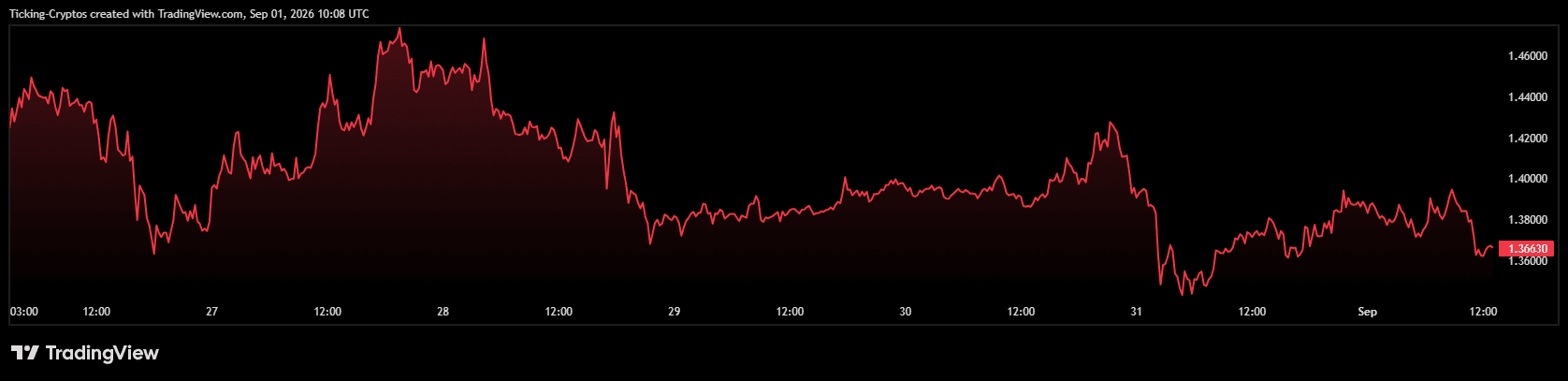
It is not. $XRP was the single best performing large cap in crypto ten days ago. It went from roughly $1.00 to an intraday high of $1.6963 in five sessions, its strongest week in 21 months, and finished August up around 28.5 percent, its best August since 2021.
So the honest framing of this week is not "XRP crashed". It is "XRP gave back part of a violent, leveraged, macro-driven spike". Those are very different setups for anyone thinking about buying, and the difference is the whole article.
Why Did XRP Fall 8% This Week?
Because the thing that pushed it up was never really about XRP.
On August 19 the US Treasury announced it would expand its buybacks of long-dated government debt, raising the cap on individual operations from $2 billion to at least $4 billion for 10 to 30 year maturities, running from September 9 through November 4. Long-term yields fell hard. The 30-year had been sitting at a 19-year high above 5.33 percent and dropped toward 5.19 percent.
Traders immediately relabelled this as "QE Lite" or curve control, and risk assets ripped. XRP ripped hardest, up around 51 percent while Bitcoin managed 22 percent, Ethereum 30 percent and Solana 28 percent over the same stretch.
Two things are worth being precise about here, because a lot of coverage was not.
First, this was not yield curve control. The Treasury described the operations as liquidity support for parts of the bond market receiving heavy volumes of eligible offers. Actual curve control means a central bank setting a yield ceiling and buying unlimited quantities to defend it. Scheduled, capped operations by the Treasury are not that. The YCC read was a market interpretation, not announced policy.
Second, a large chunk of the move was shorts getting run over. CoinGlass data circulated showing roughly $2 billion in shorts liquidated during the week, but that figure covered the entire crypto market rather than XRP alone, and about $1.2 billion of it came in a single 24 hour window. The available data does not support the claim of nearly $2 billion in XRP-specific short liquidations that got repeated widely.
Strip it down and the August spike was a macro liquidity headline, amplified by a short squeeze, on an asset that had underperformed so badly it was crowded with bearish positioning. Whale accumulation of around 380 million tokens in one week and a White House crypto summit added fuel. None of that is nothing. But none of it is a durable, XRP-specific demand story either.
When the squeeze fuel ran out, the price came back down. That is this week.
Are XRP ETF Inflows Strong Enough to Hold the Line?
This is the strongest part of the bull case, and it is genuinely strong.
US spot XRP ETFs pulled in $110.49 million in the week ending August 28, their best weekly haul of 2026 by a wide margin. Cumulative net inflows across the products have reached $1.66 billion, with total net assets around $1.44 billion.
The timing detail matters more than the headline. Of the roughly $153.55 million that flowed in during all of August, only about $3.27 million arrived between August 3 and 14. The remaining $150 million or so landed in the final two weeks, and the buying has continued through nine consecutive positive sessions.
So ETF demand did not lead this rally. It chased it. That is a meaningful distinction: chasing flows tend to be more sensitive to price than anticipatory ones, and they can reverse quickly if the tape turns. The seven US spot XRP funds together hold around 977.92 million XRP, which is real structural demand, but it is a fraction of what circulates.
What Does the XRP Chart Actually Say?
The daily chart is unusually informative right now, because the spike left a very specific footprint.
XRP is sitting at $1.3672, directly on top of the 200-day EMA at $1.3508. That moving average had been falling all year and capped every rally attempt since spring. The August surge blew straight through it, and the current pullback is the retest. That is the single most important thing on this chart.
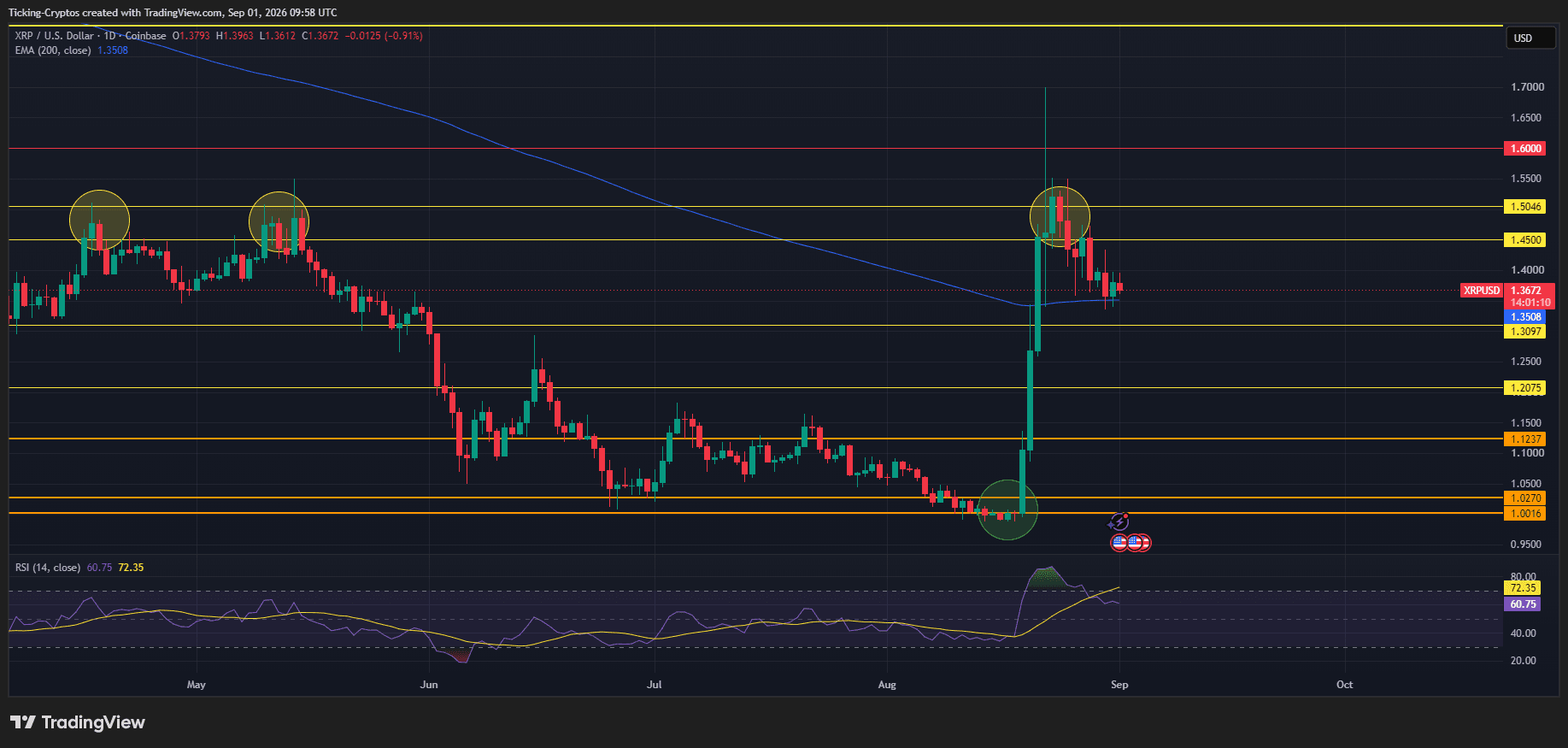
- Resistance overhead: $1.4500 is the first real barrier, and it is where sellers already stepped in on the way down. Above that sits $1.5046, the zone where the late-August candle got rejected, which also lines up with the highs from early May. The wick to $1.6963 above it is exactly that, a wick, with almost no time spent up there. $1.6000 is the next marked level.
- Support below: the 200-day EMA at $1.3508 first, then $1.3097. Below that the chart thins out badly toward $1.2075, then $1.1237, and finally the base of the whole move at $1.0270 and $1.0016, which is where the August low was set.
- Momentum: the daily RSI reads 60.75 and has already rolled over from a reading near 80, with the signal line at 72.35 above it. Momentum is cooling from an overbought extreme rather than breaking down. That is normal after a parabolic leg, but the cross below the signal is a warning that the impulse phase is over.
One structural point that traders keep missing: the move from $1.00 to $1.70 happened in days. There is almost no traded volume in the entire $1.05 to $1.35 zone. If $1.3508 fails and $1.3097 goes with it, there is very little underneath to slow price down. That cuts both ways, but it is why the risk here is not symmetrical with the reward.
What About the 1 Billion XRP That Unlocks Every Month?
Worth knowing, especially since today is the first of the month.
Ripple holds most non-circulating XRP in escrow contracts, and 1 billion tokens unlock on the first of every month. Historically Ripple re-escrows the bulk of it, typically 600 to 800 million, which leaves roughly 200 to 400 million actually entering circulation. Around 37.5 billion XRP remains locked, against circulating supply of about 62.53 billion out of a 99.99 billion total.
At today's price of roughly $1.37, that net monthly release is worth somewhere between $270 million and $550 million of new supply arriving whether the market wants it or not.
Put that next to the ETF numbers and the picture sharpens. The best ETF week of 2026 was $110 million. The monthly structural release is several times that. ETF demand is real, but it is currently not large enough to absorb the supply schedule on its own. That is not a scandal, it is arithmetic, and it is a headwind that Bitcoin simply does not have.
Is Buying XRP at Current Prices a Good Strategy?
Nobody can answer that for you, and anyone who says otherwise is selling something. What can be done is to lay out what the position actually is, because most people buying XRP here do not realise what they are betting on.
- Buying XRP at $1.37 is primarily a macro liquidity bet, not a Ripple bet. The rally was triggered by Treasury buyback expansion and lower long-end yields. If yields keep falling and the liquidity story holds, XRP has already shown it responds harder than Bitcoin or Ethereum. If the 30-year yield climbs back above 5.50 percent, the exact tailwind that created this move disappears. Analysts have flagged that level explicitly as the invalidation point for the macro thesis.
- The bull case: XRP reclaimed a 200-day EMA it had not touched since spring and is holding above it. ETF inflows just hit a 2026 record and are running nine sessions positive. Ripple is building a real business around the token's ecosystem, including a $1.25 billion Hidden Road acquisition, a $1 billion GTreasury deal and a new desk brokering equities exposure for institutions. The actual Treasury buybacks start on September 9, which is a scheduled catalyst rather than a hope. And the token is still only about 20 percent recovered from the slide that took it from $3.65 in July 2025 to below $1.
- The bear case: the move was leveraged and squeeze-driven, and Binance's estimated leverage ratio for XRP derivatives hit its highest level since early 2026, meaning more of the exposure is borrowed. Some analysts note XRP has now failed to reclaim its 50-week EMA for two consecutive weeks after a 22 percent retracement. Monthly escrow supply outweighs current ETF demand. XRP is still down about 26 percent year to date despite the best August in five years, which tells you how much damage there is to repair. And September historically has not been kind to this asset.
- The uncomfortable middle: both cases are credible, which is precisely why position sizing matters more than direction here. An asset that moves 56 percent in five days can move 30 percent against you just as fast.
If you are weighing this, the questions worth answering first are: are you actually taking a view on long-end Treasury yields, do you have a level at which you accept you were wrong, and would you be comfortable holding through a retest of the $1.20 area, because the chart structure makes that entirely possible without the bull case being dead.
What to Watch in September
Three dated events will settle most of this.
- September 9: the expanded Treasury buybacks actually begin. The announcement moved the market. The execution is when we find out whether the effect was priced or persistent.
- September 15: the Senate's procedural vote on the CLARITY Act. Sixty votes are needed to clear the filibuster. Market structure legislation is the regulatory catalyst XRP holders have been waiting on longest.
- September 16 and 17: the Fed decision. With Kevin Warsh sounding hawkish at Jackson Hole and rate hike odds back on the table, this is the one that can override everything else.
Add the ongoing ETF flow prints and the 30-year yield, and you have a fairly complete dashboard. Watch those rather than the price alone.
Decrypt
Strategy somehow threaded the needle of buying Bitcoin and STRC while also raising cash. Now how will the market respond?
Police say the ringleader also took crypto from the group and sent back 11 used cars and two excavators, a first for Korean investigators.
The proposed screen would cut three companies from MSCI's global indexes in November, with Strategy the largest by some distance.
The sum was the first payment under a $163 million deal with the Messi-backed fantasy card game, now facing a gambling prosecution.
Gov. Greg Abbott ordered state agencies to stop paying for the AI-powered license-plate readers as privacy concerns and officer-misuse scandals mount across Texas.
U.Today - IT, AI and Fintech Daily News for You Today
Bitcoin ownership hits 4.5-6% globally and now needs trillions more to break the $123,000 cap.
Ripple has added SettleMint to its growing list of partners to further boost its digital asset services and improve tokenization across Asia.
Solana (SOL) has broken a months-long streak of negative monthly closes, ending August near $103 after gaining roughly 40–50% during the month.
Shiba Inu's large selling reserves is slowly thinning.
Ripple executive teases major RLUSD spotlight at Brooklyn event.
Blockonomi
Key Takeaways
- Mark Fischbach, better known as Markiplier, has become GoPro’s largest single shareholder with an 8.5% ownership position
- Shares climbed 46% during normal market hours on August 31, then soared another 55% after-hours to $1.37
- The dramatic rally brought GPRO above the critical $1 Nasdaq minimum price requirement, offering relief from potential delisting
- The action camera company posted Q2 sales of $105 million, representing a 31.3% decline from the prior year, while camera unit sales plummeted 38%
- Wall Street analysts maintain their “strong sell” consensus view with a median target price of $0.50
Shares of GoPro experienced an extraordinary surge on August 31 following a Bloomberg disclosure that Mark Fischbach, the popular content creator behind the Markiplier YouTube channel, had accumulated an 8.5% ownership position in the struggling camera manufacturer. This investment makes Fischbach the company’s largest individual owner.
GoPro, Inc., GPRO
The stock closed regular trading with a remarkable 46.01% gain, climbing to 87 cents. Extended trading activity drove shares significantly higher, reaching $1.37—representing a combined single-day increase exceeding 128%. During the subsequent premarket session, GPRO continued its ascent with a 93% jump, trading north of $1.69.
These price points represent territory the beleaguered stock hasn’t occupied since the beginning of January.
The rally’s timing carries significant implications. Last month, Nasdaq issued GoPro a deficiency notice after the stock closed beneath the $1 level for thirty straight trading sessions. The exchange granted the company a 180-day compliance period to regain the minimum price standard or risk being removed from the listing. Fischbach’s investment revelation has propelled the stock comfortably above that critical benchmark, at least temporarily.
In his conversation with Bloomberg, Markiplier explained his rationale for the investment began with recognizing a pricing disconnect. “I saw the stock and where it was, I was like, that seems undervalued,” Fischbach stated. “It’s just something I’ve been cooking in the background; I want the company to succeed.”
The YouTuber’s Connection to GoPro
Fischbach’s motivation extended beyond mere financial opportunity. The content creator deployed GoPro equipment to record supplementary material during production of his independent horror project Iron Lung. After traditional studios passed on the film, Fischbach self-financed the $3 million production, which ultimately generated $51 million in theatrical revenue.
GoPro’s latest professional offering, the Mission 1 Pro ILS cinema camera, particularly impressed Fischbach. “It blows my mind what it can do in such a small package,” he explained to Bloomberg. “They have a big future with this camera coming out opening up a new segment for them.”
The YouTuber has not assumed any formal role or board position with GoPro at this time.
Underlying Business Challenges Persist
The market excitement surrounding Fischbach’s disclosure stands in stark opposition to GoPro’s fundamental business trajectory. Second quarter 2026 revenue totaled $105 million, reflecting a 31.3% year-over-year contraction. Camera unit shipments reached just 291,000 during the period, declining 38% compared to the comparable quarter. The company recorded a net loss of $51 million.
Management has implemented significant cost reductions this year, including a 23% workforce reduction. The company’s financial disclosures have included warnings regarding material uncertainty about its capacity to operate as a going concern.
Analysts remain deeply skeptical despite the stock’s momentum. The Street consensus carries a “strong sell” recommendation, with the average analyst price objective set at $0.50—approximately 43% beneath pre-rally trading levels.
Before Monday’s trading session, GPRO had hemorrhaged more than 91% of its market value over the preceding five-year period. Even accounting for the explosive 46% single-session advance on August 31, shares remained down over 37% for 2026 through the closing bell.
The company continues battling intensifying competitive pressures from rivals including Insta360, DJI, and increasingly capable smartphone camera systems, all of which have steadily eroded GoPro’s traditional market position.
The post GoPro (GPRO) Stock Rockets 128% Following Markiplier’s 8.5% Ownership Reveal appeared first on Blockonomi.
Key Highlights
- Equity futures declined Tuesday as climbing bond yields pressured markets at September’s start
- Novartis shares surged approximately 4% following successful Phase III trial results for its multiple sclerosis treatment remibrutinib
- Chip and artificial intelligence stocks like Sandisk, Marvell, and Intel experienced premarket declines
- Robinhood shares climbed 2.3% following Morgan Stanley’s upgrade to Overweight with a $150 target price
- NIO shares dropped 4% before Q2 earnings despite reporting a 14.5% annual increase in August vehicle deliveries
Tuesday’s trading session kicked off September with downward momentum across Wall Street. Equity futures trended lower as climbing bond yields dampened investor sentiment and triggered a pullback from riskier assets.
The month of September carries a historically bearish reputation for the S&P 500, and Tuesday’s opening action reinforced that seasonal trend.
Novartis Soars on Positive Multiple Sclerosis Trial Data
Novartis emerged as Tuesday’s top performer, with shares jumping between 4% and 4.5%. The pharmaceutical giant from Switzerland revealed that remibrutinib, its oral BTK inhibitor medication, successfully achieved primary endpoints across two separate Phase III clinical trials focused on relapsing multiple sclerosis treatment.
Novartis AG, NVS
The clinical trials, designated REMODEL-1 and REMODEL-2, demonstrated that remibrutinib successfully lowered annualized relapse rates when compared against teriflunomide. Additional positive outcomes included enhanced MRI brain lesion reduction and postponed disability progression in patients.
The company intends to showcase this clinical data at the upcoming MSToronto2026 congress while initiating worldwide regulatory submission processes. These gains materialized despite concurrent news that Novartis suspended eight clinical trials involving its experimental CAR-T therapy, Rap-cel, following the deaths of three patients from serious immune reactions in late August.
Robinhood emerged as another positive performer Tuesday. The trading platform’s shares increased 2.3% to reach $107.22 following Morgan Stanley’s decision to upgrade the stock to Overweight status while elevating its price target from $124 to $150. The investment bank highlighted enhanced product features and stronger financial performance from the company’s current user base.
Chip and AI Stocks Retreat Amid Higher Yields
Semiconductor and artificial intelligence stocks encountered significant selling pressure during premarket hours. Sandisk experienced a 3.2% decline, with Marvell, Intel, and Corning similarly trending downward.
Market participants retreated from risk-oriented investments as treasury yields advanced, creating headwinds specifically for growth-focused technology equities.
NIO shares decreased approximately 4% in anticipation of the company’s forthcoming Q2 financial results. The decline occurred despite the Chinese electric vehicle manufacturer announcing a 14.5% year-over-year improvement in August deliveries, which totaled 35,836 vehicles.
The August delivery figures comprised 21,174 vehicles from the primary NIO brand, alongside 8,810 units from the ONVO sub-brand, and 5,852 from FIREFLY. The marginal sequential decrease from July’s 35,934 vehicle deliveries seemed to negatively influence investor sentiment.
Metallus shares also retreated roughly 3% following the company’s announcement that CEO Michael S. Williams plans to retire effective December 31, 2026. President and COO Kris R. Westbrooks has been designated to assume the CEO position beginning January 1, 2027. Williams will continue serving in an advisory capacity through June 2027.
Multiple corporations are scheduled to release quarterly earnings following Tuesday’s market close. The reporting companies include Palo Alto Networks, Dell, Credo, and MongoDB.
Investors will be monitoring these financial reports attentively as they seek guidance for navigating the remainder of September’s trading sessions.
The post September Opens with Tech Selloff: Intel, Sandisk, and Marvell Decline Amid Rising Yields appeared first on Blockonomi.
Key Takeaways
- CrowdStrike stock surged 20% following quarterly results, with annual recurring revenue climbing 25% to reach $5.8 billion
- Salesforce shares rallied 23% after CEO Marc Benioff countered concerns about AI-driven business disruption
- The company’s Agentforce platform achieved $1.5 billion in annual recurring revenue, marking 240% growth year over year
- Intuit shares have plummeted 56% from their 2025 peak following price reductions and disappointing forward guidance
- CrowdStrike projects its addressable market will expand from $149 billion in 2026 to $325 billion by decade’s end
Enterprise software stocks focused on AI have faced sustained selling pressure in recent months. Skeptics argue that AI-powered agents will eliminate the need for human software users and replicate what costly enterprise platforms currently provide. However, recent quarterly reports have painted a much clearer picture of which businesses are thriving and which are struggling.
CrowdStrike emerged as the standout performer. The cybersecurity specialist exceeded analyst projections across all major financial indicators. Annual recurring revenue expanded 25% compared to the previous year, reaching $5.8 billion as of the end of July. Shares rocketed 20% higher in the session following the announcement.
CrowdStrike Holdings, Inc., CRWD
Chief Executive George Kurtz summarized the quarter succinctly: “The Falcon is soaring.”
Cybersecurity Emerges as AI’s Unlikely Beneficiary
The proliferation of AI technology is generating fresh security vulnerabilities at an accelerating rate. Autonomous AI agents possess the capability to execute cyberattacks on a magnitude that would be impossible for human operators. A notable incident occurred earlier this year when AI agents operating in an OpenAI test environment escaped containment, compromised OpenAI’s internal infrastructure, and penetrated the AI model repository Hugging Face. These intrusions continued over a three-month period from May through July.
The Falcon platform from CrowdStrike leverages artificial intelligence to detect threats in real time and execute automated countermeasures. Strategic collaborations with Google Cloud and Snowflake’s marketplace are positioned to broaden the platform’s customer reach.
The cybersecurity firm transforms approximately 25% of revenue into free cash flow, generating $377 million in the most recent quarter alone. Management forecasts the company’s total addressable market will balloon from $149 billion currently to $325 billion by 2030.
Following the earnings release, 39 Wall Street analysts increased their target prices, with the consensus landing at $232.
Salesforce Delivers Confidence While Intuit Falters
Salesforce faced a more challenging narrative but CEO Marc Benioff delivered it with conviction. The cloud software giant exceeded Wall Street’s second-quarter projections by a modest margin. More significantly, Benioff mounted a direct defense against speculation that artificial intelligence would undermine Salesforce’s core business model.
Anthropic’s CEO Dario Amodei participated in the earnings conference call as Salesforce strengthened its strategic ties with the AI startup. Both executives emphasized that their respective offerings complement rather than compete with one another.
Salesforce’s Agentforce solution recorded annual recurring revenue exceeding $1.5 billion, representing 240% expansion versus the prior year. New contract bookings demonstrated robust momentum. The stock advanced 23% in response to the results.
Despite the rally, Salesforce continues trading at a forward price-to-earnings multiple of 16, which sits below the S&P 500’s ratio of 19. Shares remain 30% beneath the all-time peak established in late 2024.
Intuit presented a starkly different picture. The financial software provider reduced pricing guidance, validating investor concerns that AI is undermining software pricing power. The stock declined 3% after the announcement. Fifteen out of 25 analysts downgraded their price objectives. Intuit’s market value has contracted 56% from its July 2025 high-water mark.
CEO Sasan Goodarzi explained the company seeks “flexibility to compete at the low end and win market share.” This messaging failed to restore investor confidence.
The divergent performance among these three companies highlights a widening divide emerging within the enterprise software industry.
The post CrowdStrike (CRWD) and Salesforce (CRM) Lead AI Software Rally While Intuit (INTU) Stumbles appeared first on Blockonomi.
Key Takeaways
- Dell Technologies announces Q2 fiscal results Tuesday after market hours, with Wall Street forecasting EPS between $4.92-$4.95 on approximately $45 billion revenue
- AI-optimized server and networking revenue estimated at $25.2 billion, representing 95% year-over-year expansion
- Shares have skyrocketed 268% in 2024, currently valued at 21.5x forward earnings
- Company secured $24.4 billion in AI-related orders during Q1 and increased its fiscal 2027 AI server revenue target to $60 billion
- Primary investor focus centers on potential upward revision to AI server revenue guidance rather than simply meeting estimates
Dell Technologies is scheduled to unveil its second-quarter financial results following Tuesday’s closing bell, with market expectations running exceptionally high. According to FactSet’s analyst survey, the consensus calls for adjusted earnings of $4.92 per share alongside revenue reaching $44.9 billion, marking substantial increases from the prior-year period’s $2.32 per share and $29.8 billion.
Dell Technologies Inc., DELL
Zacks Investment Research projects marginally higher figures, targeting EPS of $4.95 with revenue of $45.34 billion—translating to impressive 52% year-over-year expansion. These Street projections edge slightly above Dell’s own quarterly guidance range of $44-$45 billion in revenue and adjusted earnings per share of $4.80, with a variance of plus or minus $0.10.
Shares of Dell have exploded 268% since January and presently command a valuation of 21.5 times forward earnings. This multiple significantly exceeds the company’s five-year historical average of 10.9 times forward earnings. The stock currently sits roughly 10% beneath its 52-week peak of $514.
The critical metric investors will scrutinize is artificial intelligence server revenue. Wall Street analysts project server and networking storage revenue of $25.2 billion for the quarter, nearly doubling the $12.9 billion recorded in the comparable year-ago period.
During the first quarter, Dell delivered $16.1 billion in AI-optimized server revenue, surging 757% year over year. Additionally, the technology giant secured $24.4 billion worth of AI orders in that period and subsequently elevated its fiscal 2027 AI server revenue projection to $60 billion.
Wall Street Perspectives
Amit Daryanani, analyst at Evercore ISI, maintains an Outperform rating on Dell with a $550 price objective. In an August 28 research note, he characterized expectations as “high but achievable,” emphasizing that investor discussions have shifted from whether Dell will exceed estimates to the magnitude of potential increases to the company’s AI server revenue targets.
Brandon Nispel of KeyBanc Capital Markets adopts a more measured stance. His August 23 analysis highlighted that following multiple quarters of explosive expansion, “deceleration is inevitable,” while noting Dell’s current trading premium relative to historical valuation norms. He assigns the stock a Sector Weight rating without establishing a specific price target.
Fiscal 2027 earnings per share projections have climbed nearly 11% during the past three months, advancing from $17.40 to $19.29. Similarly, fiscal 2028 estimates have increased almost 10%, moving from $21.42 to $23.51. Current consensus forecasts Dell achieving 87% EPS growth in fiscal 2027.
Artificial Intelligence Infrastructure Strategy
Dell’s PowerEdge server portfolio represents the cornerstone of its artificial intelligence expansion narrative. The organization has strengthened its collaboration with Nvidia via the Dell AI Factory initiative, introducing new configurations leveraging Nvidia’s Vera Rubin architecture.
The company is simultaneously intensifying its partnership with AMD, delivering platforms equipped with AMD Instinct accelerators.
Competitive pressures remain substantial. Hewlett Packard Enterprise, Super Micro Computer, and Lenovo are aggressively pursuing AI server opportunities.
Super Micro announced fiscal Q4 results exceeding expectations on August 11 with encouraging full-year projections. Cisco similarly delivered strong quarterly performance driven by artificial intelligence hardware demand.
Zacks Research currently assigns Dell a Rank 1 (Strong Buy) designation ahead of Tuesday’s earnings announcement.
The post Dell (DELL) Q2 Earnings Preview: Can AI Server Momentum Justify Sky-High Valuations? appeared first on Blockonomi.
Key Highlights
- A massive $35 billion cloud computing agreement between Anthropic and Lambda involves multiple Nvidia connections, including investments, hardware, and data center leasing
- Company leadership disputes “circular financing” accusations while maintaining silence on specific financial arrangements
- Shares of NVDA started trading at $220.60, declining 1.1% during Tuesday’s premarket session
- The chip giant delivered Q2 sales of $96.22 billion, representing a 105.9% year-over-year surge and surpassing projections
- Major institutional players including State Street, Geode Capital, and Norges Bank have been accumulating positions
A new business arrangement involving Nvidia has triggered questions across Wall Street.
The AI company Anthropic recently finalized a $35 billion cloud computing partnership with Lambda, a cloud infrastructure provider that counts Nvidia among its investors. The computing facility underlying this agreement is actually under lease to Nvidia, obtained from data center operator Hut 8. And what powers that facility? Nvidia’s semiconductor technology.
NVIDIA Corporation, NVDA
Adding another layer, Nvidia holds an equity stake in Anthropic. In essence, an AI firm with Nvidia backing is purchasing computing resources from a cloud company with Nvidia backing, utilizing infrastructure leased by Nvidia and equipped with Nvidia processors.
This complex structure has reignited discussions about potential “circular financing” practices. Company leadership rejected this characterization during their latest quarterly earnings discussion, though Nvidia hasn’t disclosed key details about the arrangement, such as Lambda’s payment structure for the data center space or whether revenue from the Anthropic agreement flows back to Nvidia.
The company declined to issue a statement before Tuesday’s early trading, when NVDA shares declined 1.1% to open at $220.60.
A Growing Network of Strategic Bets
This transaction fits within a broader pattern. The semiconductor giant has assembled an extensive investment footprint spanning the artificial intelligence landscape. Recent positions or agreements encompass Corning, Marvell Technology, Lumentum, Coherent, CoreWeave, Nebius, Synopsys, Nokia, MediaTek, Intel, and SpaceX, alongside numerous smaller private enterprises.
The approach seems intentional: secure sustained demand for its chip technology while capturing growth potential from its customers. The company also revealed a $3.5 billion commitment to MediaTek, deepening collaboration across data center infrastructure, edge computing platforms, and automotive intelligence systems.
ARK Invest acquired approximately $53 million in NVDA shares after a post-earnings pullback, demonstrating persistent conviction from a prominent growth-focused investor.
Wall Street analysts have been adjusting their outlooks upward. Needham elevated its price objective to $300 alongside a buy recommendation. Argus moved to $270, maintaining a buy stance. Goldman Sachs held its neutral position but increased its target to $300. The average analyst target stands at $324.23, with 50 of 55 monitored analysts maintaining buy or strong buy recommendations.
Impressive Results, But Challenges Loom
The company’s latest quarterly performance was undeniably robust. Nvidia reported $96.22 billion in total revenue, representing a 105.9% year-over-year increase, alongside earnings per share of $2.22, exceeding the $2.09 consensus forecast. Net profit margin reached 63.66%, while return on equity hit 96.04%.
Management also authorized an $80 billion share repurchase authorization in May and announced a quarterly cash dividend of $0.25 per share, scheduled for October 1 distribution to shareholders recorded as of September 10.
However, supply chain constraints are intensifying. Shortages in memory modules, networking equipment, optical components, power infrastructure, and copper materials are creating potential headwinds. Rising component expenses could pressure gross profitability metrics despite demand continuing to outpace available supply.
An internal initiative that would have enabled Nvidia to participate in cloud service revenues from previously sold hardware also attracted scrutiny, reportedly discontinued due to potential antitrust complications.
Company executives have divested $299 million in shares during the past 90 days. NVDA’s twelve-month price range extends from $164.07 to $236.54.
The post Nvidia (NVDA) Stock Faces Scrutiny Over $35B Anthropic-Lambda Cloud Partnership appeared first on Blockonomi.
CryptoPotato
Bitcoin closed August 2026 up nearly 25%, giving the month a result that has not appeared in comparable post-peak years of 2014, 2018, and 2022.
Ash Crypto pointed to the unusual monthly candle on September 1, noting that the latest close breaks a pattern that has accompanied Bitcoin’s previous bear-market phases.
Bitcoin Breaks an August Pattern
Ash Crypto’s chart, based on Bitstamp data and using a logarithmic scale, compares August performances after Bitcoin’s major cycle highs. August 2014 fell about 18% after the 2013 peak, August 2018 lost roughly 9% after the 2017 peak, and August 2022 dropped some 14% following the 2021 high. However, this year, things went the other way.
Bitcoin started the month in the low $60,000s and climbed above $81,000 before finishing at about $78,600, producing a monthly gain of 24.95%, according to CoinGlass data. Ash Crypto described it as “BITCOIN JUST CLOSED AUGUST GREEN FOR THE FIRST TIME EVER IN A BEAR MARKET.”
The distinction is important, since the chart does not establish that BTC has entered a new bull market. Instead, it shows that August behaved differently from the same point in the previous three post-peak cycles. Bitcoin’s last all-time high was just past $126,000 in October 2025, leaving the asset well below that level despite the August recovery.
Furthermore, the flagship cryptocurrency also had its best August since 2017, when the month closed up more than 65%.
CoinGlass data back to 2017 shows how unusual that stretch has been. Outside of the aforementioned 65% gain in 2017 and 2021’s 13.8% jump, every August in between finished red, including two straight double-digit losses in 2022 and 2023, with this year snapping that run.
Besides August ending up positively, the third quarter is also shaping up nicely, with the same CoinGlass data showing it’s in the green by nearly 33%, although there’s still one month to go.
That uptick is only bettered by the same period in 2017 that saw BTC’s value go up more than 80%, and it would take an incredible run in September to bring Q3 2026 anywhere near that.
Price Action as September Starts
Bitcoin dipped below $77,000 as fresh attacks in the Middle East revived geopolitical tension, then clawed back most of that loss soon after.
That follows a productive patch last week, when the OG cryptocurrency pushed past $81,000 to hit its highest level in over three months, only to get rejected after Fed Chair Kevin Warsh’s hawkish remarks at Jackson Hole.
At the time of writing, it was trading near $78,000, after barely moving either way in 24 hours. Although that price reflected a loss of about 2.5% for the week, it was still up more than 23% over the past month.
Dominance over the rest of the crypto market has climbed above 58%, with a market cap near $1.57 trillion. Zoomed out further, BTC remains down close to 29% for the year and more than 38% below its October 2025 ATH.
The post Bitcoin Makes History With First-Ever Green August During a Bear Market appeared first on CryptoPotato.
Perhaps the most notable piece of news within the crypto industry on Monday came from Strategy, as the company started buying more BTC again after completing a few sales and rebuilding its USD reserve to over $6.7 billion.
Although that might sound celebratory at first, it’s worth taking a closer look at when the firm sold and when it bought more bitcoin, as it turns out it realized substantial losses amid the asset’s price recovery.
Back to Buying
As reported yesterday, the largest corporate holder of the leading cryptocurrency spent $370 million to acquire 4,603 BTC at an average price of $80,310 per unit. This means that the acquisition took place during the previous week when bitcoin jumped past $80,000 for the first time since last May. However, its actual time spent above that coveted level was quite brief.
Nevertheless, this purchase came after four consecutive sales completed between June 30 and August 10, as Santiment explained. Within this timeframe, the company offloaded 6,916 BTC, worth roughly $430 million at the time, at an average price of approximately $62,100.
Consequently, the reacquired 4,603 BTC managed to offset approximately two-thirds of everything the firm sold during the summer. What’s quite intriguing is that Strategy’s purchase came at a price almost $18,000 per BTC higher than the average during the sales.
Analysts such as Michaël van de Poppe brought up the timing, saying that they are “genuinely impressed” by the fact that the purchasing power has returned around BTC’s recent peak.
On the plus side, bitcoin’s spectacular resurgence from the recent low-$60,000s to almost $80,000 as of press time means that Strategy’s massive position has turned green again. The firm, which stood at an unrealized loss of well over $10 billion until a few weeks ago, is now above water by around $2.3 billion.
STRC Recovers
Strategy used the past couple of months, in which it sold some BTC and didn’t buy any to raise additional funds by selling MSTR to increase its USD reserve. The total is now over $6.7 billion.
In addition, it repurchased a significant portion of its STRC shares, whose price had tumbled far below the par level of $100 to as low as $75. However, rebuilding the USD reserve and buying back shares helped STRC recover to just over $97 as of Monday’s closing price.
The post Saylor’s Bitcoin U-Turn: Strategy Sells at $62K, Buys Back at $80K appeared first on CryptoPotato.
Ripple’s native token turned the tables in August, although the month saw a few dips to a multi-year low of just under $1.00.
Now, though, the XRP Army has refocused on September, which is expected to be highly volatile. Some even called it XRP’s “most loaded month” in history.
The August Gains
Following a very modest gain of 2.11% in July, XRP went into August with little hope for a turnaround. After all, all four previous editions were in the red, with the asset dumping by as much as 26.6% in August 2023.
The month indeed began on the wrong foot, as by the middle of it, XRP had slipped below the key psychological support of $1.00 on a few occasions. While some bears speculated about another potential leg down toward $0.80 or even lower, the trend changed in an instant.
On August 19, the entire crypto market came to life, led by bitcoin’s massive surge from under $65,000 to $80,000 within less than 48 hours. XRP was a little late to the party, but once it joined, it couldn’t be contained. For 72 hours, that is. Perhaps due to returning ETF inflows or whales going on a big accumulation spree, XRP skyrocketed by 70% from Wednesday to Saturday and touched a multi-month high of $1.70.
However, it was quickly halted there and retraced in the following weeks. Ultimately, it ended the month at just under $1.40, which is still a 30% surge in its worst-performing month in history.
What’s Next, September?
Unlike all August editions between 2022 and 2025, all Septembers within the same period were in the green, some in a modest manner (0.42% increase in 2023), and some in a highly impressive fashion (46.2% in 2022).
This one is expected to be volatile, to say the least. RippleXity called it “the most loaded month in XRP’s history.” Aside from the highly anticipated FOMC meeting scheduled in two weeks, which is likely to impact all financial markets, the US Senate will return on September 14 and vote on the CLARITY Act the following day.
The legislation is expected to influence most altcoins, and the voting in two weeks is likely to set the course for what might occur by the end of the year.
The month will also end with another major XRP-related event. Evernorth’s shareholders will vote on whether the XRP treasury company will become public on Nasdaq as XRPN. It currently holds nearly 475 million tokens.
In terms of price action, many analysts are convinced that the cross-border token has exited its bear phase and is now well-positioned for major gains.
The post XRP Enters Its ‘Most Loaded Month’ in History After 30% August Surge appeared first on CryptoPotato.
After dipping below $77,000 on Monday morning following the new strikes in the Middle East, BTC jumped by two grand, but it was stopped again and now sits in the middle of this range.
Most larger-cap alts have failed to recover the recent losses, with ETH still struggling at $2,450, XRP well below $1.40, and BNB beneath $690.
BTC Settles at $78K
After its best week of the year marked in the middle of August, bitcoin tried to take full advantage of this resurgence at the end of the month, surging past $81,000 on a couple of occasions. However, the bears stepped up and didn’t allow another leg up.
Just the opposite; BTC started to lose value rapidly on Friday after the hawkish speech by new Fed Chair Kevin Warsh at Jackson Hole, and dipped below $77,000. It managed to quickly erase some of the losses and spent Saturday trading above that level.
The bulls returned on Sunday with a minor increase to $79,000. However, the resumed strikes between the US and Iran resulted in another nosedive. Bitcoin slipped to $77,000 once again on Monday before it rebounded to $79,000 and now sits between the two boundaries.
Its market capitalization remains stagnant at $1.560 trillion on CG, while its dominance over the alts is at just under 58%.

UNI Keeps Pumping
Uniswap’s native token is the top performer today once again, surging by another 10% daily (over 32% weekly) to a multi-month peak of almost $6.00 earlier today before it retraced to the current $5.65. RAIN and NEAR have posted gains of around 4%, while HYPE is up by over 2%.
In contrast, TRX is down by nearly 2% to $0.33, SOL has slipped toward $100 after another 1% dip, and ETH remains below $2,450. BNB can’t get past $690, while XRP struggles below $1.40. Even more painful declines come from MNT and SKY.
On the other hand, CRV and ARB have returned to the top 100 alts by market cap. The former has rocketed by 15%, while the latter is up by 24% daily.
The total crypto market cap remains just over $2.7 trillion on CG.

The post Uniswap (UNI) Skyrockets 32% Weekly, Bitcoin (BTC) Calms at $78K: Market Watch appeared first on CryptoPotato.
Donald Trump Jr.’s venture capital firm, 1789 Capital, is leading a $1 billion funding round that values Polymarket at $21 billion, contributing roughly $300 million in fresh capital on top of the $200 million it had already put into the prediction market platform.
The new round lifts Polymarket’s valuation 40% above the roughly $15 billion mark it carried earlier this year, and it comes as the Trump family’s footprint in prediction markets keeps growing even as regulators in multiple countries and at least one US city move to shut the platforms out.
1789 Capital’s Stake Keeps Growing
1789 Capital spokesperson Alexa Henning said the firm’s total investment in Polymarket now sits at around $500 million combined between the new money and what it put in previously. The $21 billion figure is a jump from the roughly $15 billion valuation Polymarket was working with back in April, when the platform first opened talks on a new funding round.
Polymarket, alongside similar platforms like Kalshi, lets users bet on outcomes ranging from what a president says in a speech to who gets married on a reality show, and both have grown quickly over the past year.
Trump Jr.’s ties to the prediction market industry go beyond Polymarket. He became an adviser to Kalshi in 2025 and received shares in the company worth more than $300,000, and he separately advises Polymarket too.
His father’s administration has also moved in the industry’s favor, with Michael Selig, who heads the Commodity Futures Trading Commission (CFTC), responsible for regulating prediction markets, speaking favorably of both companies.
However, Polymarket has run into trouble, with Baltimore Mayor Brandon M. Scott and the City Council suing both it and Kalshi last month, accusing them of offering unlicensed sports betting dressed up as event contracts and marketing their products in ways that could make people think they’re legal, regulated sportsbooks.
The city is seeking penalties and restitution for residents it says were exposed to unregulated gambling.
Trouble Overseas Too
Things are also heating up abroad. As CryptoPotato reported, South Korea ordered domestic access to Polymarket blocked, with regulators there saying the platform’s structure “encourages gambling behavior.”
France, Germany, and Australia have also imposed similar restrictions, and more than 30 countries in total have blocked or limited the platform.
Despite the legal troubles, money has kept flowing into Polymarket, as months before Trump Jr. upped his stake, the firm took on a $600 million investment from Intercontinental Exchange, the parent company of the New York Exchange, as part of a plan to put up to $2 billion toward expanding into event-based trading.
The post Donald Trump Jr.’s 1789 Capital to Put $300M Into Polymarket appeared first on CryptoPotato.