Cryptocurrency Posts
Crypto Briefing
Trump's vow for a strong military response may escalate US-Iran tensions, impacting global markets and increasing regional instability.
The post Trump vows strong US military response to attack on forces appeared first on Crypto Briefing.
Amazon's approach could revolutionize AI efficiency, enabling models to handle vast data with improved memory management and inference speed.
The post Amazon paper reveals KV-cache policy influences inference and training of long-context models appeared first on Crypto Briefing.
Kalshi's exclusive US Open partnership could redefine prediction markets' role in sports, enhancing visibility and regulatory acceptance.
The post Kalshi becomes exclusive prediction market partner for US Open appeared first on Crypto Briefing.
The surge in Solana ETF inflows highlights growing institutional interest, potentially boosting Solana's market position and network security.
The post US spot Solana ETFs see record $153M in net inflows during strongest week of 2026 appeared first on Crypto Briefing.
Strive's aggressive Bitcoin acquisition strategy may boost market confidence but risks shareholder dilution, highlighting a volatile investment approach.
The post Strive buys 1,110 Bitcoin, becomes fifth-largest BTC treasury company appeared first on Crypto Briefing.
Bitcoin Magazine
Bitcoin Magazine
Bitcoin Cools Off After $3 Billion ETF-Driven Surge
Bitcoin slid Friday afternoon, cooling down after a phenomenal run following huge investment from U.S. ETF buyers.
The leading cryptocurrency was trading for $77,379 on Friday afternoon in New York after dropping more than 3% over a 24-hour period.
Bitcoin hit a high this week of $81,281 but slowed down after Federal Reserve Chair Kevin Warsh gave his first major speech as head of the central bank — saying on Friday that he had “more work to do” to fight inflation.
The Bitcoin price has in the past dropped when the Federal Reserve thinks inflation is too high because it means less chance of a rate cut; the leading cryptocurrency typically does better in a low-interest rate environment.
JUST IN:
— Bitcoin Magazine (@BitcoinMagazine) August 28, 2026U.S. Bitcoin ETFs have brought in $1.14 billion in inflows this week.
Over $3 billion has been added in the past 9 days!pic.twitter.com/ri1jE7enTZ
Bitcoin started surging last week after the U.S. Treasury would at least double the size of its liquidity-support buyback operations. The announcement last week hurt the dollar but non-yielding assets have benefited.
Exchange-traded funds, managed by the likes of BlackRock, Fidelity, and Grayscale have received net positive inflows for nine days in a row, according to Farside Investors data. Last week was their best week since October — when bitcoin hit a new all-time high — and that run has continued into this week.
Since August 17, investors have thrown over $3 billion at the funds. BlackRock’s iShares Bitcoin Trust received the lion’s share of the investment, but Morgan Stanley’s new Bitcoin Trust — which debuted this year — also experienced significant inflows.
Analysts have said that the so-called debasement trade — when investors buy an asset as a way to hedge against a currency losing value — was leading investors to eye-up bitcoin again.
Investors taking part in the trade think that bitcoin, gold and other precious metals are a good way to protect themselves from excessive government spending.
Total U.S. debt crossed $40 trillion for the first time this month.
This post Bitcoin Cools Off After $3 Billion ETF-Driven Surge first appeared on Bitcoin Magazine and is written by Mathew Di Salvo.
Bitcoin Magazine
Debasement Trade Is Here Thanks to Government Debt — And Bitcoin Will Benefit: Grayscale
The debasement trade is back — and will benefit bitcoin.
That’s according to asset manager Grayscale’s crypto research team, who wrote in a note this week that the U.S. government debasing its currency would lead to cash hitting digital assets.
“Unchecked government debt growth undermines the credibility of fiat currencies and drives investors to seek out alternative stores of value like physical gold and certain cryptocurrencies,” the note by the firm’s head of research, Zach Pandl, read, adding that primarily bitcoin would benefit.
The so-called debasement trade is when investors buy an asset as a way to hedge against a currency losing value. The trade was hot last year, and helped bitcoin’s run, but the digital asset’s run lost steam after October as traders turned their attention to stocks related to artificial intelligence.
But since last week, bitcoin has benefited from news that the U.S. Treasury would at least double the size of its liquidity-support buyback operations. The announcement last week hurt the dollar but non-yielding assets have benefited.
“That buybacks are needed at all is the problem: heavy growth in government debt is driving up the cost of borrowing,” the note continued. “The Treasury is treating the symptoms (rising bond yields) because they cannot cure the disease (structural deficits).”
The note added that on the same day last week as the buyback announcement, the Treasury also said the U.S. public debt exceeded $40 trillion for the first time.
As debt and interest payments grow, the government needs to either raise taxes, cut spending, or issue more debt.
Bitcoiners see the more politically likely path as expanding the dollar supply — which is ultimately bad for the dollar, and good for scarce assets like bitcoin.
After bitcoin started surging last week, the dollar had its worst week of August and was trading at a three-month low.
Bitcoin was trading for $77,493 on Friday afternoon in New York after hitting a high this week of $81,281. Over a 24-hour period, the coin now sits unmoved, but over a 30-day period, it has jumped by more than 20%.
This post Debasement Trade Is Here Thanks to Government Debt — And Bitcoin Will Benefit: Grayscale first appeared on Bitcoin Magazine and is written by Mathew Di Salvo.
Bitcoin Magazine
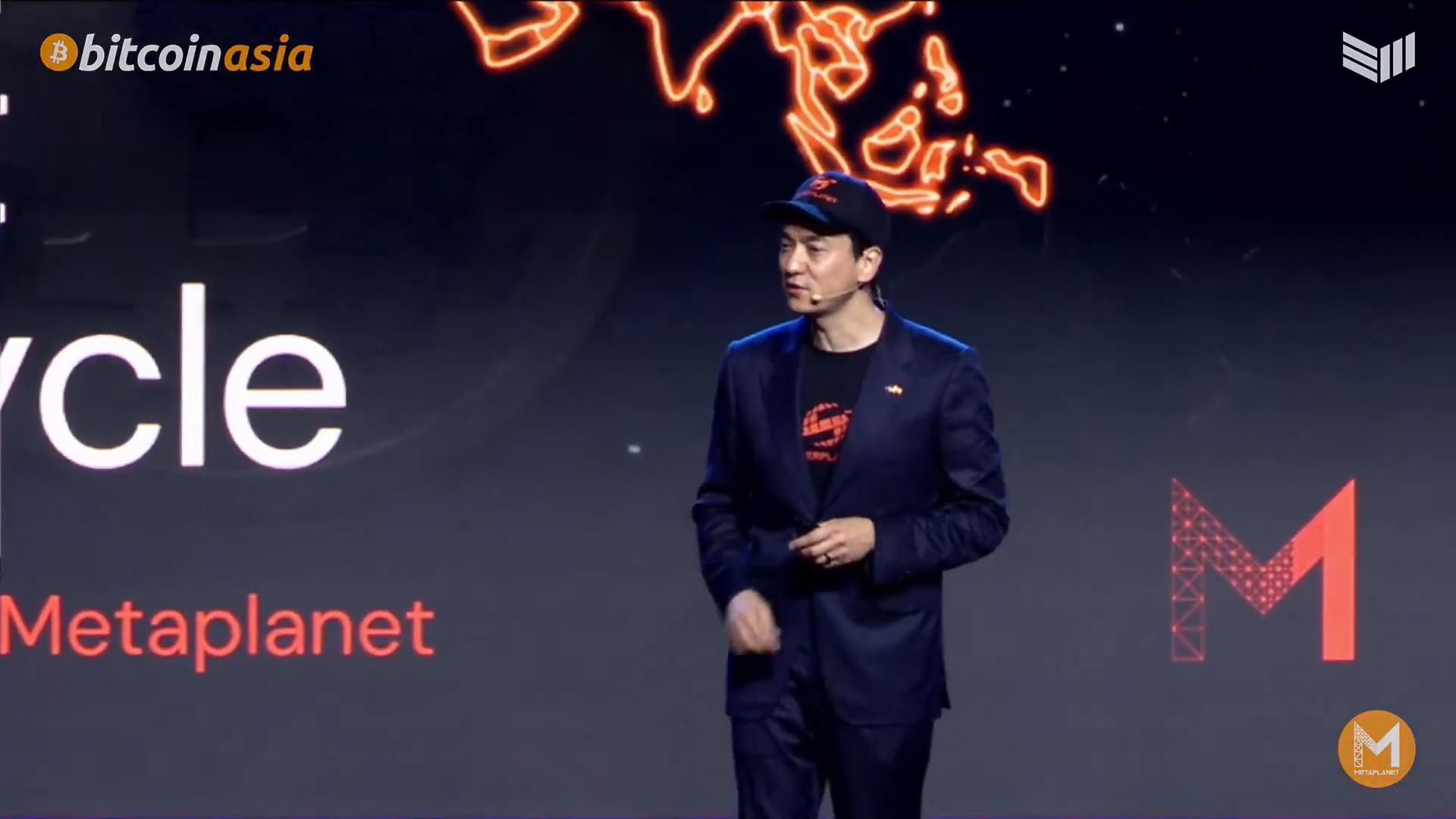
Bitcoin’s Moment Has Come for the Far East, Says Metaplanet CEO
Bitcoin’s time has come in Asia — especially with a changing regulatory landscape — and its people and companies should take advantage.
That was the message Metaplanet CEO Simon Gerovich gave at this year’s Bitcoin Asia conference, where on Friday he spoke of how his company went from failing to the third biggest bitcoin treasury in the world.
Bitcoin Asia kicked off on Thursday in Hong Kong, bringing the biggest names in the space to Hong Kong to talk about everything from treasury companies to building apps from scratch.
JUST IN:
— Bitcoin Magazine (@BitcoinMagazine) August 28, 2026Japanese public company Metaplanet CEO says the bottom for Bitcoin's price is in
"The buyers arriving now aren't going anywhere. I believe the bottom is in. And I'm expecting a much brighter rest of the year."

“The previous cycles belonged to the West, and the first Asian cycle has already started,” Gerovich said. “The only question left is who builds it. Will you?”
Often dubbed Asia’s answer to Nasdaq-listed Bitcoin treasury Strategy, Metaplanet pivoted from its core hotel and technology business to buying Bitcoin in 2024. The Tokyo Stock Exchange now holds 43,000 bitcoins worth about $3.3 billion at today’s prices.
Gerovich said in his speech that his company was small and going nowhere fast until it started putting bitcoin on its balance sheet, basically allowing investors to buy exposure to the biggest digital coin via its regulated shares.
He said that the strategy is a major opportunity for Asian companies, which can now capitalize on the changing regulatory landscape and the growing interest in Bitcoin.
Asian nations, including Japan, Hong Kong, and Singapore, are making regulatory changes to support digital assets.
Gerovich noted that Japan in particular is a country where its citizens have saved like no other part of the world — and that capital can now be put to good use.
“Hoarding cash has stopped making sense, and every household in Japan can now feel it,” he said.
“Japanese households hold roughly 14 trillion dollars in financial assets. About half of that sits in bank deposits, earning almost nothing, and that’s just Japan, add Korea, Southeast Asia, and the wealth managed out of this place, Hong Kong, and you’re looking at the deepest pools of patient savings on Earth.
“And for the first time in a generation, these savings are looking for somewhere to go.”
Gerovich added that Asian companies, institutions, and savers should take advantage of the current market conditions and build the Bitcoin infrastructure in their own regions.
“The end of the cash hoarding strategy and new rules are arriving at exactly the same time, and together, they set up what I think is the single biggest opportunity in Asian markets today,” he added.
This post Bitcoin’s Moment Has Come for the Far East, Says Metaplanet CEO first appeared on Bitcoin Magazine and is written by Mathew Di Salvo.
Bitcoin Magazine
Capital B Raises €21M From Adam Back and TOBAM To Buy More BTC
Capital B, the Euronext Growth-listed company that bills itself as Europe’s first bitcoin treasury company, has raised €21 million ($24 million) in a private placement backed by Blockstream’s Adam Back and asset manager TOBAM — money it says could buy 270 more bitcoin and push its stack to roughly 3,415 BTC.
The company said Friday that a total of 36,219,070 shares were sold at €0.58 each as part of the deal, a 6.45% discount to Wednesday’s closing price.
Capital B said the net proceeds are expected to reach about €19.9 million after fees and transaction costs.
JUST IN:
— Bitcoin Magazine (@BitcoinMagazine) August 28, 2026French company Capital B announces a €21.0 million capital raise to "accelerate its Bitcoin Treasury Company strategy"
Capital B is the 27th biggest publicly traded bitcoin treasury in the world, according to Bitcoin Treasuries, with a total of 3,145 bitcoins in its stash — worth $245 million at today’s bitcoin price of $77,960.
Capital B, which describes itself as Europe’s first bitcoin treasury, built much of that position through fundraising rounds during the first half of 2026.
In May, it acquired 192 coins for €13 million after completing three capital raises.
Capital B’s announcement as other treasuries look to raise funds and accelerate their buys. Just this week, NYSE-listed AI-powered education company Genius Group said it was aiming to build parallel AI and bitcoin treasuries worth a combined $1.6 billion, after the company sold its entire bitcoin reserves to repay $8.5 million in debt.
Bitcoin treasuries have faced headwinds since 2025 when the price of the leading cryptocurrency took a hit. A number of companies in the space have had to liquidate their holdings, including the biggest corporate holder of bitcoin, Nasdaq-listed Strategy.
This post Capital B Raises €21M From Adam Back and TOBAM To Buy More BTC first appeared on Bitcoin Magazine and is written by Mathew Di Salvo.
Bitcoin Magazine
Bitcoin Drops Before Shrugging Off Fed Chair’s Inflation Comments
Bitcoin dropped, then popped after Federal Reserve Chair Kevin Warsh gave his first major speech as head of the U.S. central bank and said he had “more work to do” to fight inflation.
The leading cryptocurrency was recently trading for $79,474 after dropping as low as $78,630 before quickly rising again.
Bitcoin has typically done well in a low interest rate environment but the Federal Reserve has been reluctant to lower borrowing costs due to sticky inflation in the world’s biggest economy.
“But on the price-stability side of our mandate, the numbers are more concerning,” Warsh said after talking about employment.
He added: “We must be confident that underlying inflation is moving to our objective, clearly and at sufficient speed. Otherwise, we have work to do.”
Bitcoin has in the past dropped on news that the Federal Reserve thinks inflation is too high because it means less chance of a rate cut. Following Warsh’s speech, traders priced in a 50% chance of rate hike in September.
But Bitcoin has appeared to — at least for now — shrug off the speech.
Bitcoin’s started surging last week after the U.S. Treasury Secretary Scott Bessent announced the department would double the size of its long-dated bond buybacks.
The news sent yields down lower, and the dollar slid while non-yielding assets like bitcoin and gold jumped.
Positive regulatory news also helped the coin: President Donald Trump last week said that the long-awaited crypto Clarity Act was a “very, very powerful” piece of legislation, and urged lawmakers to get it over the line.
The proposed law will establish a framework for distinguishing between digital assets that are securities, commodities or payment stablecoins — legislation that the crypto industry has long called for.
The Federal Reserve Bank of Kansas City is on Friday holding the annual event at Jackson Hole, Wyoming, where central bankers, Federal Reserve officials, policymakers and academics will gather to discuss “Financial Innovation: Implications for Payments and Policy.”
According to the Federal Reserve Bank of Kansas City website, this year’s event will touch on how “recent years have seen a dramatic increase in innovation in financial intermediation and payments,” including new technologies such as “cryptocurrencies and stablecoins.”
This post Bitcoin Drops Before Shrugging Off Fed Chair’s Inflation Comments first appeared on Bitcoin Magazine and is written by Mathew Di Salvo.
HTTP error 429 on https://cryptoslate.com/feed/
Failed to fetch feed: https://cryptoslate.com/feed/
Failed to fetch feed.
CryptoTicker.io
Cosmostation is shutting down its wallet. From September 1, 2026, a single function will remain reachable in the app: the export of the recovery phrase and of the private key. Everything else will be wound down in stages, according to the provider. If you manage holdings from the Cosmos ecosystem through Cosmostation, you still have time today for the step that matters: secure your key material and check in another wallet whether it shows the same addresses and the same balances.
Nothing is lost in the process. Cosmostation is a non-custodial wallet, and your holdings sit on the respective blockchains, not in the app. That is precisely the point at which shutdowns of this kind become expensive: anyone who never wrote the recovery phrase down, or can no longer find it, loses access along with the interface. This article sets out what ends on September 1, what you should export before then, and where a migration fails in practice.
Cosmostation wallet shutdown: what ends on September 1, 2026
Cosmostation announced the discontinuation of its wallet on August 14, 2026, through its own @IBCwallet account on X. The wording of the notice is brief: „After careful consideration, we have decided to discontinue Cosmostation Wallet.“ The iOS app, the Android app and the Chrome extension are affected, which covers every route through which users have operated the wallet so far.
September 1 is not a switch-off date in the sense of a hard ending, but the start of a wind-down. From that date on, only the export of the recovery phrase and the export of the private key remain operable; the remaining functions will be dismantled in stages, according to the provider, until the applications disappear entirely. Cosmostation has not published a timetable for those stages, and the company has not commented on the reasons for the decision either. Crypto Briefing, among others, reported on the announcement.
For you, that staged logic means one thing above all: September 1 is the last date on which you can still rely on a complete set of functions. Whether a transaction, the unbonding of a staking position or a change of validator will still work on September 5 or on September 20 has not been promised. Anyone who waits is waiting on an interface whose range of functions is shrinking.
Non-custodial wallet explained: why your coins are not held in the app
A non-custodial wallet is a program that holds your private keys on your device and signs transactions with them. The holdings themselves sit on the respective blockchain and are tied to an address that is derived from the key. The provider therefore custodies nothing and cannot pay anything out to you; it supplies an interface and a connection to the networks.
From this follows the good news of this shutdown. Your ATOM, and everything else you managed through Cosmostation, stays exactly where it is. There is no deadline by which you would have to „withdraw“, as would be the case with an exchange, and there is no provider with control over your balance. What you lose is the keyring manager, not the key.
But the uncomfortable side follows from it as well. There is nobody you can write to if you no longer have your recovery phrase. A custodial exchange has customer support, an identity check and, in case of doubt, a procedure. Here there is none of that. This is why the order matters: export first and verify the export, then take the app off your device.
Recovery phrase and private key: what to export before the deadline
The recovery phrase, often also called a seed phrase, is the sequence of words from which all keys and addresses of a wallet account can be derived. The private key, by contrast, belongs to exactly one account. Cosmostation will continue to offer both exports after September 1, and both are important for a simple reason: the recovery phrase brings you to the same state in another wallet, while a single key rescues only one account.
In practice that means: write the recovery phrase down on paper or in metal, not as a screenshot, not in a notes app and not in cloud storage. A screenshot ends up in the photo gallery and therefore often in an automatic backup that more programs can reach than you are aware of. How to solve storage permanently, what role an additional passphrase plays and when splitting it across several places is worthwhile is described at length in our guide to storing your seed phrase safely.
If you have created several accounts in the app, check each one individually to see whether it derives from the same recovery phrase. Wallets allow you to import a single key or a second phrase on top. Accounts like these are not attached to the main phrase and simply will not show up after a restore. A list of all accounts with their addresses, drawn up before you delete anything, costs ten minutes and saves you a long search in case of doubt.
How to verify the export before the deadline runs out
An export is only worth something once it can be loaded back in. Install a second wallet that supports the Cosmos ecosystem, import the recovery phrase there and compare the addresses with those in Cosmostation. If they match and the new wallet shows the same balances, the migration is technically done and you can remove the old app. Which software wallets are suited to which purpose, and how they differ in handling and supported networks, is shown by our software wallet comparison.
Run this test while Cosmostation is still fully operational. Only then can you place both interfaces side by side and see the differences. If the old app has already lost functions, you have no benchmark, and in case of doubt you will not know whether a missing position is down to the new wallet or to the dismantled old one.
Coin type 118: why the new wallet has to show the same addresses
A recovery phrase on its own does not yet determine which addresses a wallet calculates from it. That is what the derivation path does. This path contains a number that designates the network, and for Cosmos that number is 118. It is recorded in the SLIP-0044 registry, in which the common networks register their identifying numbers.
That sounds technical but has a very practical consequence. If you load your recovery phrase into a wallet that uses a different path for the Cosmos ecosystem, you will see correct but empty addresses. The balance is not gone; the wallet is simply looking in the wrong place. Anyone unaware of this takes the migration for a failure and falls into exactly the panic in which mistakes happen.
The countermeasure is unspectacular. Before the import, check whether the new wallet supports the Cosmos path, and then compare the first address character by character with the one from Cosmostation. Many wallets also let you state the path explicitly during the import. If the address is identical, all further accounts from the same phrase are reachable too.
Delegated ATOM: what happens to staking positions and rewards
If you have delegated ATOM, you are not managing a position in the app but an entry on the chain. The delegation is tied to your address and remains in place no matter which wallet you use. The accrued rewards do not disappear when Cosmostation shuts down either. As soon as your new wallet holds the same key, you will see the same delegations and can carry on managing them there.
The order is what matters. Do not unbond a delegation in a panic shortly before the deadline just to „be on the safe side“. The Cosmos Hub provides for an unbonding period of 21 days for ATOM, held as a parameter in the chain’s staking configuration. During that time the balance earns no rewards, cannot be transferred, and remains exposed to the validator’s slashing risk. An unnecessary unbonding therefore costs you three weeks of yield without making anything safer.
The sensible route runs through the key and not through the position: export the key material, load it into another wallet, check the delegations there, done. If you are thinking about where your holdings should generate returns in future anyway, it is worth a look at the overview of staking platforms before you dissolve an existing delegation.
What the 21-day unbonding period means for your schedule
The unbonding period is the reason why a wallet migration and a change of staking strategy do not belong in the same week. A migration concerns only the management of your keys and is done in half an hour. A reallocation in staking ties up your balance for three weeks. Anyone who mixes the two ends up with a new wallet and a locked balance, and cannot react to price movements during that time.
Our own survey: which Cosmostation addresses still respond today
To gauge how far the wind-down has already progressed, on August 31, 2026 at 06:59 UTC we checked eight hostnames belonging to the provider: for each one the name resolution on the network and, where a record existed, a retrieval over HTTPS with the response code noted. Seven addresses in the cosmostation.io space were checked, along with the Mintscan blockchain explorer operated by the same company. cryptoticker.io collected this survey itself on August 31, 2026.
The result is mixed. The provider’s main site answers with code 200, as does the version with a leading www and the Mintscan explorer. Four further hostnames, by contrast, could no longer be resolved at all, among them the address of the web wallet, the address of the guides section and the address of the blog. A fifth address in the documentation area still resolved but no longer returned an answer.
These figures say nothing about whether the apps on your phone still work today; applications do not run through these hostnames, and we were unable to check either the app stores or the extension marketplace reliably. What the measurement shows is something else: parts of the environment have already vanished, and they did so before the announced date. Anyone looking for a manufacturer guide today will no longer find it at its previous address. That is a good reason not to push the export back to the last day.
Hardware wallet or software wallet: what the migration changes about custody
A shutdown is a good occasion to rethink your own custody, because you are holding the recovery phrase in your hands anyway. With a software wallet the key sits on a device that goes online; with a hardware wallet it sits in a separate element that never releases it and displays transactions for confirmation on a screen of its own. The difference becomes noticeable precisely when your computer or your phone has been compromised without your noticing.
For the migration itself that means an additional consideration. If you want to use a hardware wallet in future, generate a new recovery phrase on the device and move your holdings in a regular transaction. Simply loading the old phrase into the device would be convenient, but it spent years stored on an ordinary phone and carries that whole history with it. Which devices come into question, and how they differ in handling, supported networks and price, is shown by the hardware wallet comparison.
Anyone staying with software should at least take the separation along: one account for small amounts and everyday use, a second for holdings that stay untouched for a long time. This split costs nothing and limits the damage if an approval ever falls into the wrong hands.

Leap and Cosmostation: why the wallet layer around Cosmos is shrinking
Cosmostation is not the first departure of this year. Leap Wallet, likewise geared towards the Cosmos ecosystem, ceased operations on May 28, 2026, and back then also called on its users to export the recovery phrase or the private key. Within a few months, two providers from the same ecosystem that had been standard tools for years have therefore closed down.
For you as an investor, a rule can be derived from this that reaches beyond this case: the wallet is a tool with a limited lifespan, your key material is not. If you keep your backup in a way that works independently of any particular app, the next shutdown will hit you as a scheduling matter and not as an emergency. Anyone who has never given the recovery phrase a thought, because the app was running, ends up under time pressure with every new announcement.
A second point belongs to the assessment. Cosmostation has not commented on the reasons for the decision, and we are not speculating about them here. All that can be established is the sequence: announcement on August 14, start of the wind-down on September 1, and parts of the web environment had already vanished beforehand, according to our measurement today.
Changing wallets and tax: why a migration is not a sale
If you transfer your balance from one wallet to another and both belong to you, the beneficial owner does not change. Such a transaction is not a disposal, and in particular it does not start a new holding period. The acquisition date of the individual holdings remains the date on which you acquired them.
The case is different as soon as the migration turns into a swap. Anyone who takes the opportunity to swap one token for another in order to hold it more conveniently in the new wallet has, for tax purposes, carried out a sale and a purchase, with all the consequences for the holding period and the calculation of gains. How quickly that line is crossed in practice was shown by Phantom Wallet dropping Sui and Monad, where of the two routes offered only one remained free of tax consequences.
In practical terms, for the Cosmostation case that means: document the plain migration with the date, the sender and recipient address and the transaction identifier, and keep the records. If you hold balances across several wallets, a portfolio tool helps to carry acquisition dates and holding periods cleanly across the change; which programs manage that is set out in our overview of crypto tax and portfolio tools. For questions of doubt about your own tax assessment, your tax adviser remains responsible; this text is no substitute for advice.
Phishing around shutdowns: how to spot a fake migration request
Announced shutdowns are a template for fraudsters, because they supply a genuine deadline on which pressure can be built. The pattern is always the same: a message in the provider’s name, a reference to the upcoming date, a pointer to a supposed migration tool and the request to enter the recovery phrase there or to connect the wallet.
Two sentences are enough to fend that off. First: no reputable provider ever asks for your recovery phrase, in no form and in no conversation. Whoever asks for it wants your balance. Second: a migration between wallets needs no tool on the web. You load your phrase locally into an application that you selected yourself and installed from the official source.
More dangerous than the crude request is the variant that only wants to move you to a confirmation. A token approval that has been granted keeps working even after you have long closed the window, and it cannot be withdrawn without action on your part. What happens technically with a confirmation of this kind, and how to collect old approvals back in, we described in our article on wallet drainers and signature approvals.
Cosmostation shutdown: what to take away from it
- Export today, not tomorrow. Secure the recovery phrase and the private key from Cosmostation, note them down away from your devices and load them into a second application as a test. Which software wallet comes into question for that is set out by the software wallet comparison.
- Check addresses before you delete. In the new wallet, compare the first address with the old one and make sure that the Cosmos derivation path is supported. Only once addresses and balances match do you take the old app off the device. If you want to raise your custody standard while you are at it, the hardware wallet comparison helps with the choice.
- Leave delegations in place for now. Staking positions hang on your address and not on the app; unbonding locks your ATOM for three weeks. Decide on validator and platform only after the migration, with an eye on the overview of staking platforms.
(As of August 31, 2026. This article is not investment advice. Prices and fee structures change; check the terms with the provider before you buy.)
The nominal staking yield of Solana (SOL) stands at around 5.25 percent a year today. In three years it will be roughly 2.25 percent, according to the calculation of the asset manager 21Shares. The decision behind it was taken on August 28, 2026: in the network's first binding vote, validators doubled what is known as the disinflation rate. A start date for the reduction still does not exist.
That is the short answer. The longer one matters more, because two things were decided on the same night and only one of them appears in the German-language reports. The cut to new issuance has been approved. The fee reform, which was meant to cushion the loss of income on the other side of the equation, failed. Anyone reading only the first half will consider the matter half as serious as it is for stakers.
How high the Solana staking yield is today and where it is heading
The staking yield is the annual return in percent that you receive for depositing your SOL in the network and thereby supporting the security of the blockchain. This return is usually quoted as APY, the effective annual rate including compounding.
The asset manager 21Shares put a figure on the path after the decision, quoted at Decrypt: from around 5.25 percent today to roughly 2.25 percent within three years. Intermediate steps lie at approximately 4.34 percent in the first year and 3 percent in the second. These numbers are one provider's projection, not a guaranteed quantity: what ends up in your stake account also depends on your validator's commission, its uptime and MEV earnings.
What matters for understanding this is where the yield comes from. The return stems almost entirely from newly issued SOL and only to a small extent from users' transaction fees. When the network prints fewer new tokens, the pot from which all stakers are paid shrinks. That is exactly what has been decided.
What SGP-0002 decided: disinflation rate from 15 to 30 percent
The disinflation rate is the annual pace at which new SOL issuance shrinks. The figure therefore describes the speed of the decline, not the level of issuance itself. Solana had set it at 15 percent a year so far; the proposal SGP-0002 doubles it to 30 percent.
Technically this is implemented by proposal SIMD-0550, submitted by engineers of the infrastructure company Helius. The consequence: according to the figures in the proposal, Solana reaches its fixed inflation floor of 1.5 percent as early as 2029 instead of 2032. Over the next six years this means around 18.9 million fewer SOL will come into existence than would have under the old schedule.
For holders who simply leave their SOL untouched this is good news: less new supply means less dilution. For stakers it is a cut to their ongoing income. Both sides sit inside the same decision, and whoever stakes feels the cut first.
Why the counterweight is missing: the fee reform SGP-0003 failed
The second economic proposal of the same evening was called SGP-0003, technically SIMD-0553, submitted by the research firm Temporal. It would have split the transaction fee on Solana into two parts: a base fee for inclusion in a block, which continues to go to validators, and a new resource fee measured by a transaction's computational cost, which would have been burned outright.
Burning here means that the coins disappear from circulation permanently. According to the figures in the application, this would have raised the daily burn from about 650 SOL to as much as 9,000 SOL, twelve to fourteen times as much. That would have been the counterweight to the reduced issuance, because a higher burn tightens supply without any intervention in staking rewards.
The proposal failed and ended at 53.9 percent approval: 142.84 million SOL in favor, 50.15 million against and a heavy 72.03 million abstentions. That was not enough for the required two-thirds majority. What is notable is that the proposal had already passed the code review of both client teams, Anza and Firedancer, on July 20. The vote was not about technical maturity, only about switching it on.
It is precisely this split that is missing from the German coverage of August 27 and 28, which describes both proposals as a single package. Anyone reading them as a package assumes that the cut and the compensation arrive together. Only the cut arrived.
How close the vote was: 0.334 percentage points above the threshold
SGP-0002 cleared the two-thirds hurdle of 66.67 percent with 67.0 percent approval. In absolute numbers: 176.29 million SOL in favor against 66.19 million opposed, spread across 1,326 votes at a turnout of 60.7 percent. The on-chain analysis by Solana Compass puts the result at 67.001 percent and the margin at 0.334 percentage points.
A custodian tipped the balance. The exchange Kraken, whose voting weight stood at 8.92 million SOL, voted against throughout the entire count and only withdrew that vote shortly before the close. Kraken's co-chief executive Arjun Sethi justified the step publicly with the line that custodians should be conduits and not votes. The asset manager Galaxy had initially abstained, which counts like a rejection under this method, and likewise changed its position in the final hour.
For comparison, the third proposal of the same evening: SGP-0001, the Solana constitution, passed with 86.0 percent approval, 193.65 million SOL in favor against 4.63 million opposed across 1,153 votes. It governs how votes will be held in future. The network was divided only on the two proposals with money attached to them.
Institutional holders also pulled in different directions. The listed Solana Company voted for the constitution and against both economic proposals, arguing that the timing was wrong for institutional stakers, who need a plannable yield. DeFi Development Corp voted the other way and subsequently bought 19,000 SOL for $1.86 million.
When the cut takes effect: the feature gate and the open precondition SIMD-0607
Here is the point that no German-language report has named so far: the disinflation rate has not changed yet. No date for it has been published.
SIMD-0550 is implemented through a feature gate, a switch in the network that arms an already shipped change for everyone simultaneously at a set moment. It takes effect at an epoch boundary. An epoch is Solana's settlement period, at the end of which staking rewards are distributed; it currently lasts a good two days. All epochs up to the flipping of the switch settle under the old schedule, all following ones under the faster one.
A hard precondition stands before that switch. The two productive validator clients on mainnet, Agave and Firedancer, must deliver bit-for-bit identical results in every reward calculation. Those results feed into the bank hashes through which validators agree on the state of the chain. If one client's calculation deviates even in the last digit, that is a consensus failure.
Floating-point arithmetic cannot guarantee this, because the same operation can produce different results on different hardware and with different compilers. That is why SIMD-0607 has to be merged first: it replaces the floating-point calculation in the reward computation with deterministic integer mathematics and targets client version Agave v4.4. The associated pull request is open and awaits sign-off from one representative each of the Anza and Firedancer teams. Anza has named the order itself in a thread: the implementation is a single permanent feature gate, one precondition is under review, and the switch can be scheduled after that.
In practice this means for you: your yield does not fall on a known cut-off date. The decline sets in as soon as this technical chain has been worked through, and then runs down in steps over years. Anyone who gives you a date has made it up. How such an activation date comes about at Solana is something we wrote up using the Alpenglow upgrade as an example in our article on the Solana upgrade and your SOL staking.
How Solana staking rewards come about in the first place
Solana works on the proof of stake method: whoever deposits tokens may help decide on the order and validity of transactions and is paid for it. The machines that do this are called validators. As an ordinary holder you do not run your own validator but delegate your stake to one. Your SOL do not leave your control in the process.
Three quantities matter for the payout. The commission is the share of the reward your validator keeps as an operating fee. Uptime describes how reliably it is online and confirming blocks; one that fails often earns less for its delegators. MEV stands for additional income from the ordering of transactions within a block, which some validators pass on to their delegators and others do not.
Because the reward comes from new issuance, the decision affects every route through which you stake in the same way. A better validator can soften the decline; none can stop it.
What the cut means concretely for 100 SOL
A worked example, deliberately rough and without any price assumption for the future. Anyone staking 100 SOL receives around 5.25 SOL a year at 5.25 percent. At 2.25 percent it is 2.25 SOL. The quantity of new coins flowing to you each year therefore falls by about 57 percent once the end point of the reduction is reached.
Measured against the price of $102.55 per SOL on August 31, 2026 at 06:40 UTC according to CoinGecko data, that would be roughly $538 a year compared with around $231. Price performance is expressly not included in this calculation, and it can completely override the figure in either direction. The point of the example is solely the order of magnitude of the cut, not a yield forecast. If you want to know how the return differs between providers, a look at our comparison of staking platforms helps, where commission and payout mode stand side by side.

Native staking, liquid staking and staking through an exchange
With native staking you create your own stake account in your wallet and delegate it to a validator of your choice. The keys stay with you. Activation and deactivation each take effect only at the next epoch boundary, so your stake is not immediately available for around two days.
With liquid staking you hand your SOL to a protocol and receive a tradable token that represents your share including accrued rewards. JitoSOL is one of these instruments, and in the vote it was more than an investment product: according to the analysis by Solana Compass, JitoSOL stakers outvoted their validators. The price of that flexibility is an additional smart contract risk, because your claim hangs on the protocol's code.
With staking through an exchange the provider handles everything. That is convenient and costs you custody: the coins sit with a third party, and in case of doubt that third party votes on the rules of the network, as the Kraken case showed that evening.
Which risks remain in Solana staking
The most common worry is whether the stake itself can be lost. With native staking your deposited amount is not automatically seized if your validator performs badly or is temporarily offline. What you lose during that time are rewards, not the stake itself.
The real risks lie elsewhere. Price risk is the largest: a yield of 5 percent does not carry a price decline of 30 percent. Added to that is custody risk when a third party holds your coins, along with smart contract risk in liquid staking. And there is an availability risk, because your stake is tied up until the next epoch boundary and you cannot sell immediately in a fast-moving market.
Since August 28 a planning risk has been added: the yield you are counting on today is a falling quantity with no known schedule. Anyone budgeting firmly for staking income should adjust that number downwards.
How you as a delegator outvote your validator
The vote ran according to the voting weight of the deposited stake. By default the validator you delegated to votes on behalf of your share. You can, however, cast that vote yourself and thereby replace your validator's vote for your share. That is exactly what happened in this vote, when JitoSOL stakers outvoted the position of their validators.
A practical consequence follows from this that reaches beyond this single vote. If your provider holds custody for you, you effectively surrender that vote. Anyone who wants a say in future proposals needs their own stake account and has to keep an eye on the voting period. The decision here came down to a margin of 0.334 percentage points, and single votes the size of a custodian's tipped it.
Tax on staking rewards in Germany
Staking rewards are other income in Germany under section 22 number 3 of the Income Tax Act. They are taxable at the moment of receipt, valued at the market price at that time. An exemption limit of 256 euros a year applies. Exemption limit means: if the amount is exceeded by even one cent, the entire amount is taxable and not merely the excess.
If you sell the coins you received later, the one-year holding period for private disposal transactions applies. Under the prevailing administrative view, staking does not extend that period to ten years. The authority here is the Federal Ministry of Finance circular of March 6, 2025 on individual questions in the taxation of crypto assets, which also describes the record-keeping obligations. Because every single credit has to be valued, clean record-keeping of the rewards is the actual work; suitable tools are listed in our comparison of crypto tax tools. For your specific case, a visit to a tax adviser remains the safe route.
One side effect of the cut is notable at this point: anyone who was just above the 256-euro exemption limit may slip below it as the yield falls. That is no cause for celebration, but it is a point for your tax planning in the coming year.
How this decision fits into Solana's recent weeks
The decision is the provisional end point of a debate that has been running for weeks. For context on the price move around the vote and on the relationship between SOL and Bitcoin, we described the situation in our article on the SOL/BTC breakout, which still lists the two proposals as an ongoing vote. The result is now in, and it is split.
For you as a holder, the combination of an approved cut and a failed fee reform means that the argument about a supply squeeze stands on one leg. Fewer new SOL really are coming. The additional burn that many observers had factored in is not coming for now. Whether and when a revised version of SIMD-0553 will be put to a vote again is open.
Reviewing your Solana staking: what to take away
- Recalculate your staking expectation. For the coming years assume a declining path towards 2.25 percent instead of today's 5.25 percent, and take the opportunity to check your provider's commission. The comparison of staking platforms shows where that deduction stands at what level.
- Get your records in order. Every credit counts at the moment of receipt, and the 256-euro exemption limit decides the tax liability of the entire amount. A tool from the comparison of crypto tax tools takes the collecting work off your hands.
- Decide who votes for you. If the rules of the network matter to you, your stake belongs in your own stake account rather than in third-party custody. Where you can obtain SOL and then hold it yourself is set out in the comparison of crypto exchanges.
The sources for this text: the voting result with all vote counts at Decrypt and the technical precondition for activation in the analysis by Solana Compass.
(As of August 31, 2026. This article is not investment advice. Prices and fee structures change; check the terms with the provider before you buy.)
Bitcoin abroad: the tax duty Austrian users carry themselves
Anyone who is tax-resident in Austria and sells bitcoin through a foreign crypto platform does not escape Austrian taxation by doing so. The decisive difference from many domestic providers lies rather in the fact that often no Austrian capital gains tax is withheld automatically.
Taxable bitcoin gains must then, as a matter of principle, be recorded by the investor personally through the income tax assessment. For private crypto income the special tax rate of 27.5 percent continues to apply in principle.
A foreign platform does not mean tax-free
Austria taxes income from cryptocurrencies as income from capital assets. This covers both certain ongoing income and realized increases in value. A taxable sale exists in particular where bitcoin is disposed of for euros or another legal currency. Using it to purchase goods or services can also constitute a realization.
Example:
- bitcoin bought for 20,000 euros
- later sold for 50,000 euros through a foreign platform
- taxable gain: 30,000 euros
At 27.5 percent this results in principle in a tax of 8,250 euros.
The fact that the platform is based outside Austria does not, in principle, change this calculation.
When does the exchange not take care of the tax?
Where a domestic crypto service provider is involved, an obligation to deduct capital gains tax applies to certain crypto income. The provider withholds the tax and remits it to the tax office. With a foreign platform, such an Austrian withholding agent is often absent.
The investor must then, in particular, do the following personally:
- determine the sale proceeds in euros,
- establish the acquisition costs for tax purposes,
- calculate gains and losses,
- record the taxable income in the assessment.
Acquisition costs remain decisive
The tax is not levied on the entire sale proceeds but, in principle, on the gain. Where several purchases of bitcoin of the same kind have been made on the same relevant wallet or address, the moving average price applies in principle to new assets.
Particular care should therefore be taken in documenting:
- date of purchase,
- quantity of bitcoin purchased,
- acquisition costs in euros,
- fees,
- wallet transfers,
- earlier crypto-to-crypto exchanges.
Foreign platforms do not necessarily supply reporting that corresponds exactly to Austrian tax rules.
Losses must also be evidenced by the investor
An advantage of the assessment can arise where a bitcoin loss for tax purposes was realized on the foreign platform. Crypto losses can in principle be offset against certain other capital income. A loss offset across providers is not carried out automatically, however; it takes place through the income tax assessment. Reliable transaction data is particularly important for that.
Conclusion
Austrian investors must in principle pay tax on taxable bitcoin gains even where the sale takes place through a foreign crypto platform. The essential difference lies in the procedure: without an Austrian capital gains tax deduction, the investor regularly has to determine their taxable income themselves and declare it through the income tax assessment. The tax rate for private taxable crypto gains remains in principle 27.5 percent.
(As of August 31, 2026. This article is not investment advice. Prices and fee structures change; check the terms with the provider before you buy.)
A legitimate AML check on a crypto address needs exactly one thing from you: the public address. It needs no access to your wallet, no connection, no signature and certainly no advance payment. Anyone who asks you to connect your wallet for a money-laundering check is not running a check at all. That is exactly what a wave of fraud relies on, described by the security firm Malwarebytes on August 19, 2026, with infrastructure that our own measurement found still running twelve days later.
Fake AML check: what Malwarebytes found in August 2026
Stefan Dasic, a malware researcher at Malwarebytes, has documented a series of websites that pose as screening services for crypto addresses. They imitate the legitimate provider AMLBot or operate under colorless generic names such as "AML Check". The setup is similar in every case: you select a cryptocurrency, click a button labeled "Check Wallet", and are then asked to connect your wallet.
From that point on the site is no longer a screening tool. It is a stage. A progress bar runs, accompanied by status messages such as "Checking wallet history…" and "Verifying compliance…". Then comes an invented error message: the check cannot be completed, the balance is too low, a small top-up is needed to cover the fee. Click "Retry" and you see the same animation once more, followed by a reassuring result, usually a "Clean, Low Risk".
That result is pure invention. There is no check, no database query and no assessment. What there is, is a connection between your wallet and someone else's website, and that connection is the real purpose of the whole arrangement.
AML check explained: why a wallet address gets screened at all
AML stands for anti-money laundering. An AML check for crypto is a report on whether a public blockchain address has been connected in the past to suspicious counterparties, for example a hacked trading venue, a mixing service or a sanctioned address. Providers of such reports evaluate publicly visible transaction data and assign addresses to known actors.
The decisive part of that definition is already in the word "public". Everything such a report needs is lying in the open on the blockchain anyway. The address is the key to the query, and the address is a string of characters that you can copy and paste into a field. Access to your balance is no more necessary for this than a power of attorney over a bank account is necessary to request a public land registry extract.
Why do retail investors care in the first place? Because an address flagged as suspicious can cause trouble. Deposit funds at a regulated trading venue and you may face a query from the compliance department, and in the worst case a withdrawal is delayed until the origin of the funds has been clarified. That worry is real, and it is the lever the scam sites pull.
How to recognize a genuine screening page
A legitimate report requires an input field and nothing else. You paste in the address, you get an assessment, and your wallet software is not opened once during the entire process. If your wallet's connection window appears instead, the check is already over at that moment, and not in your favor. Malwarebytes puts it as a plain rule of thumb: anyone demanding a wallet connection instead of the public address is a warning sign.
Enter an address or connect a wallet: the one difference that decides everything
Two actions that look similar in a browser have fundamentally different consequences. Entering an address is a read operation. You hand over information that every blockchain explorer displays anyway, and the other side can do nothing with it that it could not do without you.
Connecting a wallet is something else. Doing so permits a website to talk to your wallet software. The site then sees your address and your balance, and above all it may present transactions to you for confirmation. It cannot trigger those transactions itself, but it can prepare and label them so that a single click from you is enough. A wallet's security architecture is incorruptible at this point: it executes what you approve.
That is why the documented sites build their staging so carefully. They need no vulnerability in your wallet. They need a moment in which a confirmation window looks to you like a normal step in a security check. Once you grasp that you believe yourself to be in a screening process while you are in fact signing a power of attorney, the trick is seen through.

How the scam site works: from the progress bar to the alleged fee
The order of the steps is no accident, it follows a dramaturgy. First comes the choice of cryptocurrency, a harmless act that builds trust and pulls you into a sequence of clicks. Then follows the connection, which seems plausible in the context of a supposed check. Only after that does the actual manipulation begin.
The progress bar serves two purposes. It makes the site appear to work where nothing is working, and it buys the other side time to look at your address and prepare a suitable transaction. What is then put in front of you is tailored to your balance. The subsequent error message about a missing fee is the pretext meant to justify a payment or an approval. And the closing "Clean, Low Risk" makes sure you leave the site reassured, without checking what you confirmed along the way.
What is remarkable about this scheme is whom it hits. It does not target carelessness, it targets caution. Anyone looking for an AML check has already given thought to how clean their address is. That audience is better informed than average, and it arrives of its own accord, without an attacker having to write to it.
Token approval instead of a password: how the outflow works technically
In an attack of this kind no password and no recovery phrase is lost. The usual route runs through a token approval. An approval is a permission you grant to a third-party address to move a particular kind of token out of your wallet. That permission is necessary in everyday use, every decentralized exchange needs it, and it remains in place until you revoke it.
The danger lies in the amount and in the duration. Many approvals are granted without a limit, because that is convenient and because the confirmation window does not always display the amount in an understandable way. An unlimited approval, once granted, keeps working after you have long closed the site, after a restart of your computer, and even when you disconnect the site in your wallet menu. Disconnecting ends the channel of conversation; it does not withdraw the power of attorney.
What such a confirmation looks like in the window, and which fields you should read before clicking, we described in detail in our article on wallet drainers and signature approvals. If there is a single technical skill to take away from this subject, it should be that one. On a chain such as Ethereum and the networks compatible with it, the approval is the standard mechanism by which balances change hands without any key having to be stolen.
What an approval technically permits
An approval names three things: which token it covers, which third-party address may dispose of it, and up to what amount. If the amount limit is missing, the third-party address may withdraw the entire holding of that token, at any time and without asking you again. Wallets with a good interface show you these three details in plain language. Older or plainly designed confirmation windows show you a string of characters, and that is precisely what the operators of such sites count on.
Our own survey: three of the five named domains still respond twelve days later
This analysis was carried out by cryptoticker.io itself on August 31, 2026. Method: we checked the five domains that Malwarebytes names explicitly in its report once on August 31, 2026 at 03:53 UTC, by HTTP request and by name resolution, and recorded the response code. Five domains from the report were checked, plus the domain of the imitated legitimate provider as a reference value, so six objects in total.
The result: two of the five domains can no longer be resolved, their name entries have vanished. Two more respond with code 200 and therefore serve a page. A fifth responds with code 403 and rejects our automated request, but has an active name entry and a responding server. Sorted by name: amlbot-clear[.]com responds, bitget-aml[.]com responds, swapstoken[.]app rejects, audittrust[.]shop and search-aml[.]net can no longer be resolved. The domain of the genuine provider also responds, as expected.
What these figures mean, and what they do not: we measured reachability only, that is, whether a server responds under the name. We did not open the pages served, did not assess their content and therefore did not establish whether the described scheme is still running there, whether a parking page stands in its place or whether a third party has taken the domain over. Nor can we say how many people visited the sites in that period or what damage was caused. Only one statement is solid: twelve days after the public warning, the infrastructure named there has not been fully cleared away. For you as a reader that is the relevant measure, because a warning whose targets have long been offline would be history. This one is not.
Imitated names: what a domain says about a company
One of the domains named combines the name of a well-known trading platform with the abbreviation AML. That deserves a clear classification, because a domain can be chosen freely, and whoever registers it needs neither the permission nor the knowledge of the name's owner. Nothing about a company itself follows from its name appearing in an address bar. On the contrary: firms whose names are used in this way are victims of the scheme, because trust they built over years is turned into a tool against their own customers. That applies here to the imitated screening platform just as much as to the trading platform whose name appears in one of the domains.
In practice that means this for you: a familiar name in a web address is not a seal of approval. What counts is the complete address line, and what counts above all is how you arrived at the page. A link from a message, from a post on a social network or from a paid search ad deserves more suspicion on principle than a bookmark you set yourself.
Why the scheme falls on prepared ground in Germany
Since the beginning of 2026, German investors have been asked by their providers for documentation in a way that was previously unusual. With the implementation of the EU directive DAC8, crypto service providers have had to identify their customers, record transactions and obtain tax self-declarations since January 1, 2026. Anyone who fails to respond is reminded, then warned, and the provider can restrict accounts.
That creates a habituation worth its weight in gold to fraudsters. Demands for documentation, checks and confirmations currently sound less like an alarm signal than like administrative routine. A site offering a money-laundering check fits that picture, and the thought "I suppose I have to do this" comes more readily than it did a year ago. We observed a similar pattern with the crypto job offers involving your own bank account, where an official-sounding procedure likewise provided the frame for the actual damage.
It helps to make the difference clear to yourself once. When your trading venue wants something from you, you find that request inside your account after logging in. No regulated provider sends you to a third-party website to fulfill an obligation, and none demands a wallet connection for it. Where these obligations are actually laid down, and which providers operate under European supervision, you can read in our overview of regulated crypto exchanges.
Checking and revoking token approvals: how to proceed
The most effective step after an unclear encounter with such a site is to review the approvals you have granted. Every major chain has an area in its blockchain explorer where you enter your address and get a list of all open approvals together with the authorized counterpart address. A revocation is an ordinary transaction and costs the usual network fee.
Work through the list calmly and watch for two things: unlimited amounts, and counterpart addresses you cannot assign to any transaction of yours. An approval whose occasion you no longer remember is a candidate for revocation, even if nothing has happened so far. The effort is small; the possible damage is not.
Where you keep your keys also determines how expensive a mistaken click can become. An overview of the devices and how they are operated can be found in our hardware wallet comparison; anyone working without an additional device will find in the software wallet comparison the differences in how confirmation windows are displayed, and that display is precisely the security-relevant point here.
After a confirmed transaction: why disconnecting alone is not enough
Suppose you have confirmed and notice it shortly afterwards. Then the order of your steps matters more than their speed. Disconnecting in the wallet menu is sensible, but it is the smallest of the steps, because it leaves the granted power of attorney untouched. More important is revoking the approval, and more important still is the question of whether only an approval was granted or a recovery phrase was entered.
If an approval was granted, revoking it is usually enough. If, on the other hand, a recovery phrase or a private key was typed in somewhere, the wallet is permanently lost, and the remaining balance belongs on a freshly created wallet with a new recovery phrase. A recovery phrase knows no revocation; it can only be replaced.
You should be prepared for what comes next: offers of supposed recovery. Anyone approached in forums or by message after an incident, promising to retrieve funds against an advance payment, is running the second stage of the same scheme. Confirmed transactions on a blockchain are final, and nobody can reverse them for a fee.

Separate wallets and small amounts: what limits the damage
No single measure fully protects against a mistaken click, but splitting your holdings helps reliably. Anyone who keeps the largest part of their balance on an address that is never connected to a website can experiment calmly without risking everything. A second address with a manageable amount then handles contact with applications, and any damage stays limited to that amount.
A hardware device strengthens this effect, because it moves the confirmation to a display outside the computer. It is still no free pass: even with a hardware wallet you grant an approval when you confirm it on the device. The gain lies in the fact that the details appear there in a form a manipulated website cannot overwrite. Anyone who reads that display, instead of pressing the same button twice, has done the greater part of the work.
Recurring approval reviews: when a check makes sense
Approvals accumulate without being noticed. Every application you use leaves one behind, and after two years of use an active address easily carries several dozen open powers of attorney. Many of them belong to projects that no longer exist, and an abandoned application is an attractive target for a takeover by third parties.
A review twice a year is a sensible measure, plus one after any unusual event: after visiting a site you reached through someone else's link, after a confirmation whose purpose you cannot recall afterwards, and after every report of a compromised application you have used yourself. The time required is a few minutes, once you know the procedure.
Spotting a fake AML check: what to take away
- Remember the dividing line. A genuine check on a crypto address asks only for the public address in an input field. As soon as a supposed screening service asks you to connect your wallet, confirm a transaction or advance a fee, stop. If you are unsure where such checks are handled by the provider anyway, our overview of regulated crypto exchanges helps.
- Review your open approvals. Open your chain's blockchain explorer, enter your address and revoke every unlimited or unexplained approval. How to read a confirmation window properly beforehand, so that no new ones are added in the first place, is set out in the software wallet comparison and in our article on signature approvals.
- Separate storage from use. Keep the larger part of your holdings on an address that is never connected to a website, and use a second address for applications with an amount whose loss you could cope with. Which devices support this separation and how they are operated is shown in the hardware wallet comparison.
The sources for this article: the report by Malwarebytes of August 19, 2026 and the independent write-up at Decrypt of August 20, 2026. The reachability measurement of the named domains comes from cryptoticker.io.
(As of August 31, 2026. This article is not investment advice. Prices and fee structures change; check the terms with the provider before you buy.)
If you run a crypto wallet as a browser extension, today is the day to open your extension list. In August 2026 the security firm Socket disclosed two separate campaigns in which extensions for Firefox, Chrome and Edge harvested recovery phrases, private keys and login credentials for crypto exchanges. The second of those reports was written up on August 30 and is therefore one day old. What is affected is precisely the place where many investors handle their wallet every day.
A browser extension is a small add-on program that runs inside the browser and holds permission to read and change the content of the pages you visit. That same permission is what makes it useful to wallet providers and valuable to attackers.
Browser Extensions as Wallet Thieves: What Socket Found in August 2026
Socket is a security firm specialising in software supply chains that examines packages and extensions for malicious code. Its researchers published two findings within ten days that show the same pattern and yet do not belong together.
The first report is dated August 20, 2026 and concerns the Firefox marketplace: 77 extension identities are connected according to Socket's analysis, 40 of them confirmed malicious. The second report circulated between August 28 and 30 and concerns Chrome and Edge: 19 extensions, 18 of them for Chrome and one for Edge, carried a wallet drainer. A wallet drainer is malicious code that empties a balance to an outside address in a single operation instead of siphoning off individual amounts.
Both cases share one thing that matters more to you than any number: the extensions sat in the official marketplaces of the browser makers. Anyone who installed them did nothing wrong, downloaded no dubious file and clicked no link in an email.
Offside Wallet Theft Factory: How 77 Firefox Extensions Are Connected
Socket calls the Firefox campaign Offside Wallet Theft Factory and explicitly does not attribute it to any known actor. The researchers also do not write that the same operator stands behind every single extension; what links them is shared code and shared infrastructure.
The 40 confirmed extensions fall into four groups. Seven posed as crypto products and served as remotely controlled phishing loaders, among them an entry called 0KX WEB3, which used a zero in place of the letter O and so imitated the name of the exchange OKX. Fifteen carried the theft code directly inside them. Thirteen of those fifteen were altered rebuilds of the Rabby wallet software. Five more collected access credentials and the contents of the clipboard. The remaining 37 of the 77 identities appeared as VPN tools, password generators or sports apps and did in fact display match scores.
According to Socket, the interfaces of OKX, Rabby Wallet and TronLink were imitated. In this affair those three providers are the injured parties, not the cause: their name and their appearance were used as bait without any involvement on their part.
The technical basis was provided by projects on the database service Supabase, which acted as remote switches, together with Cloudflare Workers and Pages for the forged interfaces as well as control servers written directly into the code. Such control servers are known in the field as C2 servers, short for command and control; they receive the stolen data and send new instructions back. The signature data of the extensions covers the period from March 9 to August 3, 2026, with clusters in April and at the end of July. Mozilla removed the reported add-ons from the marketplace after the report.
What a Browser Extension Is Actually Allowed to Do
An extension with permission to read and change data on all websites sits technically on the same level as the page itself. It sees what you type, it sees what the page shows you, and it can alter both before either reaches the other. For a wallet extension that is normal and unavoidable. For an extension that unlocks right-clicks or displays football scores, it is not.
From Match Score to Seed Phrase Collector: Why the Update Is More Dangerous Than the Installation
The most instructive part of the Firefox finding has nothing to do with crypto at first. Nine of the confirmed malicious extensions began life as harmless sports applications and displayed results from football, basketball and American football. Only later updates replaced that function with wallet theft code, and did so under the same identifier. The malicious version thereby inherited the entire installed base and the accumulated positive reviews of its harmless predecessor. The campaign owes its name to that trick.
For your own practice this means that the check you carried out at installation does not hold indefinitely. Reviews, user numbers and the age of an extension describe its past. An update can replace the code completely, and by default extension updates run through automatically without your being asked.
With five of the 19 Chrome and Edge extensions it went much the same way, only one step earlier: according to Socket's analysis they were genuine, already published extensions by other developers that were taken over and then rebuilt. The remaining 14 the attackers had built themselves from scratch.
Altered Rabby Rebuilds: How the Keyring Leaks Before Encryption
The thirteen altered Rabby rebuilds are the technically most delicate part of the Firefox finding. Rabby is open-source wallet software; its code may legally be copied and changed. The attackers rewrote exactly one function, namely the one that stores the keyring permanently. A keyring is the data record in which a wallet holds its private keys and the recovery phrase together.
In the original, this keyring is converted into text and then encrypted with your password before it lands on the hard drive. In the altered versions it is, as Socket describes it, sent off at precisely the moment when it exists in text form, that is, before encryption. Your wallet password protects nothing at this point, because it would only come into play afterwards. The same versions also intercept the recovery phrase when a wallet is created and when one is imported.

19 Chrome and Edge Extensions: The Drainer That Rebuilds Ledger and Trezor Pages
The second finding is the more recent one and concerns two further marketplaces in Chrome and Edge. According to Socket's analysis the 19 extensions contained a drainer that serves several chains at once: wallets on Ethereum and all networks compatible with it, wallets on Solana and wallets on Tron.
Added to this were rebuilt recovery and update pages that looked like the official interfaces of the hardware wallet makers Ledger and Trezor. Their sole purpose was to collect the recovery phrase. Here too, the two manufacturers are victims of imitation. Anyone who uses a hardware wallet and wonders which models exist at all and how they differ will find the overview in our comparison of crypto hardware wallets.
On reach there is one solid individual figure and one estimate. Solid is the extension named Enable Right Click & Copy, Smart Unlock + OCR: it had more than 70,000 users on Chrome and more than 10,000 on Edge when it turned malicious. For the campaign as a whole, one trade report cites around 80,000 affected users. The starting point is also disputed: BleepingComputer writes that the operation may have been running since the beginning of 2024, while another assessment of the same Socket analysis speaks of roughly six months of active operation and names February 2024 as the likely beginning. Both readings stand side by side, and neither of them is confirmed.
At the time of publication, according to BleepingComputer, none of the extensions was still available in the Chrome Web Store. The Edge version still was.
CSP Header Removed: What an Extension Can Do on Every Page You Visit
The sequence in the Chrome and Edge case is worth going through calmly, because it explains why a single bad extension reaches so far. After installation it opens an encrypted permanent connection to a control server, a so-called WebSocket connection. Over that line it loads individual JavaScript building blocks that were not contained in the marketplace package at all. A reviewer who looks only at the submitted package therefore finds little there.
It then removes the CSP header from every page you call up. The Content Security Policy is a protective instruction with which a website tells the browser which sources scripts may be executed from at all. If it falls away, the browser accepts outside code as well. That code is then injected into the page through hidden HTML elements.
The result is uncomfortably concrete. The bank, the exchange and the wallet interface you open in the same browser are, from that moment on, no longer the pages the provider delivers. They are what the extension makes of them. That is exactly why an approval that looks harmless on screen can mean something quite different in the background. How to read such an approval in detail is set out in our article on what you really approve when you confirm.
Session Tokens Instead of Passwords: Why Two-Factor Authentication Does Not Protect Here
According to Socket, the drainer attacks not only wallets but also accounts at trading venues. Coinbase, Binance, Kraken, OKX, MEXC, KuCoin and Bybit are named, along with the MetaMask wallet. What it collects are access credentials, session tokens, browser history, account information from Facebook and LinkedIn, and form entries across a range of websites.
The term session token deserves an explanation of its own, because it is what sets this apart from ordinary password theft. A session token is the pass that a website issues to your browser after a successful login so that you do not have to enter your password and second factor again with every click. Whoever holds that token is already logged in as far as the website is concerned. Two-factor authentication has happened by then and is not requested a second time.
That is why changing your password is not enough when you suspect something. You have to end all active sessions as well. Most trading venues offer this function in their security settings under labels such as active devices, sessions or logged-in devices. Which providers come into question for customers in Germany at all, and which security features they bring with them, is shown in the overview of crypto exchanges.
Checking Installed Extensions: How to Reach the List in Firefox, Chrome and Edge
The check takes a few minutes and costs nothing. In Firefox you open the address about:addons and select Extensions on the left. In Chrome it is chrome://extensions, in Edge edge://extensions. In all three browsers the detail view can be opened for each entry, showing permissions, publisher and installation source.
Go through the list from top to bottom and ask yourself two questions about every entry: do you still remember why you installed this extension? And have you actually used it in recent weeks? Anything that stumbles on either question goes. An extension you do not need is still an open door that nobody is guarding.
How to Recognise a Hijacked Extension
There is unfortunately no clean identifying mark for the update trick, and that belongs to the truth of the matter. There are, however, indications that are worth something taken together. It is striking when an extension with a banal function suddenly demands far-reaching permissions, or when the publisher name has changed. It is striking too when a review column shows older enthusiastic voices and more recent complaints about altered behaviour side by side. And any extension whose name matches a well-known product but for a single character is striking, as with the zero in the entry 0KX WEB3.

Reading Permissions: Which Access Rights Are Normal for a Wallet Extension
A genuine wallet extension needs far-reaching rights, otherwise it could not do its job. Access to data on all websites is therefore no alarm signal in its case. The real question is a different one: why does a screenshot tool, a translator or a right-click unlocker need the same permission?
In practice this means you sort your extensions by purpose and not by provider. Every extension that may read and change all pages although its function is needed only on a single page or at the push of a button is a candidate for deletion. Chrome and Edge additionally allow you to limit an extension's access to individual pages or to grant it only after a click. That setting costs you two days of getting used to it and takes most of its reach away from a hijacked extension.
Hardware Wallet or Browser Wallet: What the Difference Means When It Counts
The two Socket findings lead to a distinction that often blurs in everyday use. With a wallet as a browser extension the private key lies encrypted on the computer, and the software in the browser decrypts it in order to sign. With a hardware wallet the key never leaves the device; the computer sends the transaction over and gets the finished signature back.
This difference decides how an attack of the kind described turns out for you. Against harvested key material the hardware wallet helps, because there is simply nothing there to harvest. Against a manipulated interface that shows you a false recipient address it helps only if you read the details on the display of the device and not on the screen. And against a rebuilt recovery page that asks you to enter your recovery phrase, no technology helps at all. There, only one rule carries: never type that phrase anywhere. Which software wallets exist for everyday use and where their limits lie is set out in the comparison of software wallets.
After a Suspicion: Why Uninstalling Alone Saves Nothing
For the Firefox case Socket makes a clear recommendation: anyone who has entered a recovery phrase or a private key into one of these extensions should treat the data as permanently compromised and move the balance to a newly created wallet. The reason is simple and readily overlooked. Deleting the extension takes back nothing that has already been transmitted. A recovery phrase cannot be revoked, only replaced.
The order matters when you suspect something. Create the new wallet on a device that is not affected, and only transfer afterwards. Anyone who sets up the new wallet in the same infected browser merely repeats the exercise with fresh keys. Then come the accounts at the trading venues: new password, end all sessions, set up the second factor again and check the withdrawal addresses on file.
A word on handling the agitation such reports set off. In precisely the days after an incident becomes public, messages multiply that promise help to those affected and ask for the recovery phrase in the process. That scam now runs on paper as well, as the case of wallet phishing by letter shows. No reputable provider and no authority ever asks for that phrase.
Tax and Evidence: What to Document After a Crypto Theft
If something has in fact flowed out, secure the evidence before you tidy up. That includes the time of the outflow, the addresses affected, the transaction identifiers from the relevant block explorer, the name and identifier of the extension together with a screenshot of the marketplace page if the entry is still reachable, and the file number of a police report.
How such a loss works out for tax purposes depends on the individual case and belongs in the hands of a tax adviser. Without complete evidence that question cannot be settled at all, and the evidence is considerably harder to obtain weeks later than on the day after. A portfolio tool that records your movements anyway spares you the reconstruction by hand when it counts.
Checking Browser Extensions: What to Take Away
- Clear out your extension list today. Open about:addons, chrome://extensions or edge://extensions and delete everything you do not actively use or can no longer place. Pay particular attention to entries with a banal function and far-reaching permissions. If you keep your wallet in the browser, check in the comparison of software wallets whether your setup still fits your holdings.
- Separate the amounts you do not move from the browser. The part of your holdings you do not touch weekly belongs on a device whose key never sees the browser. The models and their differences are set out in the comparison of crypto hardware wallets.
- End your open sessions at the trading venues. A new password alone is not enough as long as an old session token is still valid. Go into the security settings of every account, throw out all devices and log in again. Which providers offer which security features is shown in the overview of crypto exchanges.
The month's two findings arose independently of each other and affect all three major browsers. They say the same thing: a browser maker's marketplace is a pre-selection and not a guarantee, and the check made at installation ages faster than the extension itself.
The original reports are available at Socket on the Firefox campaign and in the write-up by BleepingComputer on the Chrome and Edge case.
(As of August 31, 2026. This article is not investment advice. Prices and fee structures change; check the terms with the provider before you buy.)
Decrypt
The 4,603 BTC cost an average of $80,318, some 29% above what the company took for the coins it sold this summer.
Shares, bonds, funds, ETFs and insurance products will qualify for the tax-advantaged accounts, which open next year.
Some $6 million reached Ethereum before validators froze the chain, stranding the rest on a network that still is not producing blocks.
Gabriel Perez used his access to Trump's speeches before delivery to bet on "presidential mention market" contracts, profiting more than $107,500 before the CFTC caught up with him.
The Austin and Kyoto hard forks, deployed quietly on the Bor and Heimdall clients before public disclosure, closed denial-of-service and consensus-hardening flaws that Polygon says were never exploited.
U.Today - IT, AI and Fintech Daily News for You Today
FBI and Australian Police crush a global cyber syndicate laundering millions in crypto via open-source hacks.
A second breakaway hard fork is prepared for September 1, 2026 after BIP-110's initial failure, aiming to move Bitcoin's proof-of-work mechanism to the Blake2b Mining Algorithm.
XRP remains in the bullish mode as reflected in the growth of key metrics.
Bitcoin is on track to record its strongest August performance in nine years.
XRP Ledger finally votes on native credit as a validator split decides what comes next for XRP holders and DeFi lending.
Blockonomi
Key Takeaways
- Benjamin Silbermann, Pinterest co-founder, divested 93,750 shares valued at approximately $2.2 million during late August through a pre-arranged 10b5-1 plan.
- Julia Brau Donnelly, CFO, announced her resignation to pursue opportunities in the private sector; Vikram Naidu will assume interim financial leadership starting Oct. 30.
- Following the CFO announcement, Baird maintained its Neutral stance with a $26 price objective.
- Over the past twelve months, PINS has depreciated 35%, with current trading levels hovering near $23.66.
- Second quarter revenues climbed 18% annually to $1.2 billion, though third quarter projections of 13-15% growth fell short of market expectations.
A challenging period continues for Pinterest (PINS) as the social media platform confronts dual challenges that emerged on a single Friday—a significant insider stock transaction and the departure of its chief financial officer. These developments arrive at an inopportune moment for shareholders already nursing substantial losses exceeding one-third of their investment value year-over-year.
Shares of PINS closed at $23.66 on Aug. 25.
Pinterest, Inc., PINS
Benjamin Silbermann, the company’s co-founder and current Board Chair, executed a sale of 93,750 Pinterest shares totaling approximately $2.2 million across two consecutive trading days—Aug. 25 and 26, 2026. The average transaction price registered at $23.55 per share. This divestiture occurred through the Benjamin and Divya Silbermann Family Trust, following the standard conversion process from Class B Common Stock to Class A Common Stock.
The sale followed protocols established under a Rule 10b5-1 trading arrangement, which Silbermann implemented on Feb. 27, 2026. Such predetermined trading plans allow executives to schedule transactions in advance, insulating them from accusations of trading on material non-public information.
Following this transaction, Silbermann’s direct holdings stand at 13,996 Class A Common Stock shares. However, his substantial stake remains largely intact with approximately 1.2 million Class B shares held directly, plus roughly 78.2 million shares maintained through various trusts and related entities, ensuring continued alignment with shareholder interests.
Financial Leadership Transition Announced
Pinterest simultaneously revealed that Julia Brau Donnelly, its Chief Financial Officer, will be departing to accept a position at a privately held organization. The company explicitly stated her resignation stems from no conflicts regarding operational matters, financial reporting practices, or corporate governance issues.
Taking the interim reins as Principal Financial Officer on Oct. 30 will be Vikram Naidu, who currently serves as VP of Finance and Business Operations. Naidu’s professional background includes finance leadership positions at Verkada and Lyft.
In a concurrent appointment, Pinterest designated Renee Jewell as Chief Accounting Officer, effective Aug. 26. Jewell arrives with an impressive resume spanning roles at Airbnb, eBay, and PricewaterhouseCoopers.
Following the CFO transition announcement, Baird analyst Colin Sebastian reaffirmed a Neutral rating alongside a $26 price objective for PINS. Across the broader analyst community, price targets span a wide range from $22 to $42.36.
Strong Q2 Performance Overshadowed by Conservative Q3 Outlook
Pinterest delivered second quarter revenue of $1.2 billion, representing an 18% year-over-year increase that surpassed analyst projections. The robust performance stemmed from exceptional results in U.S. and Canadian markets, coupled with ongoing enhancements to its advertising infrastructure.
Nevertheless, management’s third quarter revenue growth forecast of 13% to 15% underwhelmed market participants who had anticipated more aggressive expansion. This projected slowdown dampened investor enthusiasm.
The platform achieved a milestone with 640 million global monthly active users in Q2, marking an 11% annual increase and representing a new company record. Despite impressive user expansion, Pinterest recorded a Q2 net loss of $46.7 million.
Following second quarter results, DA Davidson elevated its price target to $27 while maintaining a Buy recommendation. Susquehanna affirmed its Positive outlook with a $32 objective. Mizuho similarly established a $32 target, highlighting solid quarterly performance and a 1 percentage point improvement in 2026 adjusted EBITDA margin guidance.
Pinterest maintains a market capitalization of $15.1 billion, supported by trailing twelve-month revenue of $4.6 billion and net income totaling $248.9 million.
The post Pinterest (PINS) Stock Under Pressure as Leadership Changes Unfold appeared first on Blockonomi.
Key Highlights
- Brent crude surged more than 2% beyond $90 per barrel following August 31 US military action against Iranian rocket installations in the Strait of Hormuz
- ExxonMobil shares started trading at $156.88, compared to a consensus analyst target of $166.10
- Second quarter 2026 earnings per share reached $3.52, more than doubling the $1.64 reported last year, though falling short of the $3.56 Street estimate
- TD Cowen upgraded its XOM price objective to $168 with a Buy recommendation on August 7
- The company announced a $1.03 quarterly dividend per share, representing a 2.6% annual yield, with payment scheduled for September 10
Shares of ExxonMobil (XOM) began trading at $156.88 on August 31, 2026, as energy markets responded to escalating tensions in the Persian Gulf, with Brent crude climbing back above the $90 threshold after US forces struck Iranian military targets near the Strait of Hormuz.
Exxon Mobil Corporation, XOM
Oil benchmarks surged over 2% during morning trading sessions after Washington confirmed military operations against Iranian installations, prompting retaliatory measures from Tehran against American military facilities. The Strait of Hormuz serves as a critical chokepoint for global oil shipments, and any instability in this region typically triggers immediate reactions across energy equities.
This geopolitical escalation compounds what has already been a turbulent period for the energy giant. ExxonMobil’s operations at Upper Zakum in the Gulf region, where the company maintains a 28% ownership interest, experienced production constraints from March through May 2026 due to compromised export channels.
Second Quarter 2026 Results: Revenue Exceeds, Earnings Fall Short
ExxonMobil posted second quarter 2026 earnings of $3.52 per share, coming in $0.04 below the Wall Street consensus of $3.56. However, the company’s quarterly revenue of $114.53 billion surpassed analyst projections of $109.94 billion.
From a year-over-year perspective, the earnings trajectory shows remarkable strength. The company’s Q2 2025 EPS of $1.64 means profitability per share has increased by more than 114% over the twelve-month period.
Looking ahead to the upcoming earnings announcement, Wall Street analysts are projecting EPS of $3.60, indicating expectations for continued solid operational performance.
ExxonMobil reported an 8.88% net margin and a 13.14% return on equity during the quarter.
Wall Street Targets and Shareholder Returns
On August 7, TD Cowen increased its price objective for XOM from $155 to $168, maintaining its Buy recommendation. Royal Bank of Canada maintains a $180 target alongside a Sector Perform rating. Conversely, Bank of America shifted its stance in late July, moving from Buy to Neutral while simultaneously raising its target to $158.
The prevailing analyst consensus sits at Hold, with the mean price target landing at $166.10. This suggests approximately $9 of upside potential from the current opening price level.
Regarding shareholder returns, ExxonMobil announced a quarterly distribution of $1.03 per share, translating to $4.12 on an annualized basis and yielding 2.6%. Shareholders of record as of August 17 will receive payment on September 10.
The company maintains a debt-to-equity ratio of 0.12, with shares trading between a 52-week range of $108.35 and $176.41. The company’s market capitalization currently stands at $650.26 billion.
Van ECK Associates significantly reduced its XOM holdings by 95.4% during the second quarter, divesting 3.79 million shares while maintaining 183,518 shares worth approximately $25.09 million. Institutional ownership of XOM currently represents 61.8% of outstanding shares.
For the full fiscal year, analysts are projecting ExxonMobil will deliver earnings per share of $11.86.
The post ExxonMobil (XOM) Stock Surges as Brent Crude Breaks $90 Amid Iran Conflict appeared first on Blockonomi.
Key Highlights
- ServiceNow shares advanced 4.5% on Friday, finishing at $144.71 with trading volume reaching 29 million shares.
- Subscription revenue for Q2 jumped 24.5% year-over-year to $3.88 billion; overall revenue reached $3.99 billion.
- The company’s AI-related annual contract value surpassed the $1 billion mark; executives project $1.5 billion by December.
- Current valuation stands at approximately 89x trailing earnings, significantly higher than competitors including Salesforce and Oracle.
- Multiple institutional funds, including Moore Capital, expanded their stakes during the second quarter; Wall Street maintains a “Moderate Buy” consensus.
ServiceNow (NYSE: NOW) finished Friday’s trading session at $144.71, marking a 4.5% gain for the day. Trading activity hit 29 million shares, substantially exceeding the typical average of 22.4 million.
ServiceNow, Inc., NOW
Despite the recent rally, shares remain approximately 26% under the 52-week peak of $194.73, though they’ve surged roughly 70% from the annual bottom of $81.24.
The company’s subscription revenue for the second quarter increased 24.5% to reach $3.88 billion. Overall revenue hit $3.99 billion, representing 24% year-over-year growth and surpassing Wall Street’s $3.93 billion projection.
Earnings per share landed at $0.90, exceeding analyst expectations of $0.86. The firm delivered a return on equity of 16.45% alongside a net profit margin of 11.34%.
The company’s remaining performance obligations totaled $29 billion, including $13.2 billion in current obligations. Both metrics expanded by 21%.
Artificial intelligence capabilities have emerged as the company’s central growth narrative. The annual contract value for AI-focused products exceeded $1 billion during the quarter, with leadership aiming for $1.5 billion before year-end. Achieving this goal would represent approximately 50% expansion from the Q2 trajectory.
ServiceNow elevated its full-year subscription revenue forecast to a band between $15.76 billion and $15.78 billion.
Premium Valuation Draws Attention
Shares currently command a multiple of roughly 89x trailing earnings. This valuation significantly exceeds Workday’s 41x, Oracle’s 27x, and Salesforce‘s 23x.
The company’s non-GAAP operating margin registered at 29.5%, while free cash flow for the first six months amounted to $2.3 billion. ServiceNow maintains a debt-to-equity ratio of 0.43.
The platform currently facilitates over 450 integrations, with its AI Control Tower linking artificial intelligence-powered workflows to corporate data systems, approval mechanisms, and governance structures.
Major Institutional Investors Increase Stakes
Moore Capital Management established a fresh position during Q2, acquiring 152,268 shares valued at approximately $15.1 million. Alyeska Investment Group similarly opened a new position worth around $142 million.
Jasper Ridge Partners expanded its stake by 201.5%. Flputnam Investment Management boosted its holdings by an impressive 1,748.5%. Institutional ownership now represents 87.18% of outstanding shares.
Regarding analyst coverage, Bank of America elevated its price objective from $130 to $150 while maintaining a Buy recommendation. Evercore reaffirmed its Outperform stance with a $160 target. Barclays modestly increased its target to $134, retaining an Overweight rating. The Street consensus stands at “Moderate Buy” with a mean price target of $144.24.
A noteworthy concern: ServiceNow recently revealed three critical-severity security flaws that could enable unauthorized attackers to run arbitrary code or gain access to SQL databases. While patches have been released, these disclosures present potential reputation and client retention challenges.
Director Paul Edward Chamberlain divested 1,500 shares on August 13th at $125.60 per share, executed through a predetermined 10b5-1 trading arrangement. Company insiders collectively hold 0.34% of shares.
The 50-day moving average currently rests at $112.33, while the 200-day moving average stands at $106.61. The analyst consensus price target of $144.24 now closely aligns with the stock’s current trading level.
The post ServiceNow (NOW) Stock Surges Nearly 5% as AI Revenue Reaches $1 Billion Benchmark appeared first on Blockonomi.
Key Highlights
- Shares of Intel advanced 1.5% in premarket sessions following reports SK Hynix may use Intel Foundry for HBM4E base-die manufacturing
- Base dies manufactured by TSMC for HBM4 reportedly carry costs 3-4 times higher than SK Hynix’s in-house core die production
- On August 31, SK Hynix stated it cannot verify the reported details and noted some information conflicts with actual facts
- Intel’s CEO Lip-Bu Tan acquired roughly $10 million in INTC shares at $95 each in early August
- Year-to-date, INTC has soared 142.5%, carrying a Hold consensus with an average analyst target of $116.84
Shares of Intel experienced a 1.5% uptick during Monday’s premarket session, reaching approximately $89.47 at the opening bell, following reports that South Korean memory manufacturer SK Hynix is exploring the possibility of partnering with Intel Foundry for base-die components in its upcoming HBM4E memory technology.
Intel Corp., INTC
The base die serves as the foundational logic component positioned at the base of an HBM stack, facilitating data transfer between memory layers and processing units such as GPUs. With each generation of HBM technology, these components have become increasingly sophisticated and costly to manufacture.
Currently, Taiwan Semiconductor Manufacturing Company (TSMC) handles base-die production for SK Hynix’s HBM4 offerings utilizing a 12-nanometer-class manufacturing process. According to industry insiders quoted in a Herald Economy article, these TSMC-manufactured components reportedly carry price tags approximately three to four times higher than the core dies that SK Hynix produces in-house.
This substantial pricing differential is allegedly driving SK Hynix to explore alternative manufacturing partners, with Intel Foundry now appearing on the radar as a viable candidate.
Securing even a portion of this manufacturing contract would represent a significant achievement for Intel’s contract chipmaking division, which continues efforts to expand its roster of external clients.
SK Hynix has already distributed samples of its 12-layer HBM4E technology, featuring transfer rates reaching 16Gbps per pin alongside enhanced power efficiency characteristics.
No Official Partnership Announcement Yet
Market participants should exercise caution before drawing firm conclusions from these reports. On August 31, SK Hynix released a statement indicating it cannot verify the specifics of its technology development plans, and noted that certain information circulating in media reports contradicts actual circumstances. Neither Intel nor SK Hynix has formally announced any partnership agreement.
Nevertheless, the speculation alone proved sufficient to drive INTC higher during premarket hours, underscoring the market’s keen interest in Intel’s foundry business development.
Growing Institutional Interest and Executive Purchases
Intel has attracted considerable institutional attention in recent months. Oxford Financial Group initiated a fresh position valued at approximately $1.15 million during the second quarter. NewEdge Advisors expanded its holdings by 29.6% over the same timeframe, while Sei Investments increased its position by 9.9%. Institutional ownership of INTC currently stands at 64.53%.
Regarding insider transactions, CEO Lip-Bu Tan purchased 105,263 shares of INTC at $95 apiece on August 11, representing an investment of approximately $10 million. Current trading levels sit below that purchase price.
Intel’s latest quarterly results, disclosed on July 23, significantly exceeded Wall Street projections. The chipmaker delivered earnings per share of $0.42 versus analyst estimates of $0.21, while revenue reached $16.13 billion, surpassing the consensus forecast of $14.43 billion. Revenue climbed 25.2% compared to the prior-year period.
Intel provided third-quarter 2026 EPS guidance of $0.38, while the analyst community anticipates full-year earnings per share of $1.00.
From an analyst perspective, the stock maintains a Hold rating consensus on TipRanks, supported by five Buy recommendations, 24 Hold ratings, and two Sell opinions. The consensus price objective of $116.84 suggests potential upside of approximately 31% from present trading levels.
According to MarketBeat data, the broader analyst community assigns one Strong Buy, 15 Buy ratings, 31 Hold recommendations, and three Sell ratings, with a mean price target of $107.46.
INTC has rallied 142.5% year-to-date, trading within a 12-month range spanning $23.68 to $142.35.
The post Intel (INTC) Stock Gains Momentum on Potential SK Hynix Manufacturing Partnership appeared first on Blockonomi.
Key Takeaways
- Q2 revenue reached $1.94 billion, representing a 92.8% year-over-year increase and surpassing analyst projections of $1.81 billion
- The Maven Smart System is closing in on $1 billion in yearly revenue and approaching official Pentagon program-of-record designation
- Shares started Monday trading at $186.29, within a 52-week trading band between $106.37 and $207.52
- Institutional investors control 45.65% of outstanding shares, with significant additions from State Street, Norges Bank, and Arrowstreet Capital
- The primary investor concern centers on valuation, as shares trade at approximately 159x earnings compared to sector average in the low-20s range
Shares of Palantir Technologies (PLTR) kicked off Monday’s session at $186.29, hovering near its 52-week peak of $207.52. The stock has surged more than 100% from its yearly low of $106.37, propelled by exceptional quarterly performance and increasing investor optimism surrounding its artificial intelligence initiatives.
Palantir Technologies Inc., PLTR
The second-quarter financial results commanded attention. Revenue climbed to $1.94 billion, marking a 92.8% year-over-year expansion and significantly exceeding Wall Street’s $1.81 billion forecast. The company delivered earnings of $0.41 per share, beating consensus expectations of $0.34 by seven cents. Adjusted free cash flow surged to $1.22 billion, achieving a robust 63% margin.
Palantir’s Rule of 40 metric reached an impressive 155%, powered by a 62% adjusted operating margin. The net margin stood at 49%. Such financial metrics place the company in rarified territory among enterprise software firms.
Within the defense sector, Palantir’s Maven Smart System is approaching the $1 billion annual revenue threshold. The Department of Defense is advancing efforts to designate it as an official program of record, potentially releasing up to $2.3 billion in funding across a five-year period. An independent Pentagon directive has allocated $240 million in additional contracts to Palantir through a non-competitive process.
Truist and similar research firms highlight Palantir’s network of forward-deployed technical personnel as a strategic advantage that competitors such as OpenAI and Anthropic cannot easily duplicate. The Street’s consensus rating registers as Moderate Buy, with a mean price objective of $192.19.
Institutional Investors Expand Holdings
Institutional accumulation has accelerated in recent quarters. RPg Family Wealth Advisory expanded its holdings by 78.6% during Q2, purchasing 25,162 additional shares to bring its total to 57,173, representing approximately $6.67 million in market value.
Major institutional players have also taken action. Norges Bank established a fresh position valued above $5.1 billion. Arrowstreet Capital expanded its stake by 277.4% in the first quarter. Cardano Risk Management increased its holdings by 917.4% in Q4. State Street currently maintains ownership of more than 101 million shares. Total institutional ownership represents 45.65% of shares outstanding.
Premium Valuation Draws Scrutiny
Trading at approximately 159 times trailing earnings, Palantir commands a substantial premium to industry peers. The software sector median hovers in the low-20s range. Jefferies maintains a sell recommendation with an $80 price objective. Royal Bank of Canada holds an underperform stance with a $90 target. Conversely, UBS projects a $215 valuation.
Several analysts point out that Palantir’s remarkably low effective tax rate contributes significantly to its margin superiority, questioning whether this advantage remains sustainable as operations expand. Investor Steve Eisman has separately voiced concerns regarding AI revenue dependency on a limited group of major cloud infrastructure providers.
Executive Stock Transactions
Chief Executive Officer Alexander Karp divested 492,348 shares on August 20th at an average transaction price of $174.79, totaling approximately $86 million. This transaction occurred under a previously established Rule 10b5-1 trading arrangement designed to satisfy tax obligations related to vesting equity compensation. Insider Jeffrey Buckley sold 1,250 shares at $174.29 on August 21st. Combined insider sales have totaled roughly $116.8 million during the past three-month period. Company insiders collectively control 9.53% of outstanding equity.
Wall Street analysts project full-year earnings of $1.27 per share for Palantir.
The post Palantir (PLTR) Stock Surges on Pentagon AI Deal and Explosive Revenue Growth appeared first on Blockonomi.
HTTP error 429 on https://cryptopotato.com/feed/
Failed to fetch feed: https://cryptopotato.com/feed/
Failed to fetch feed.