Cryptocurrency Posts
Crypto Briefing
SLB's acquisition of Kelvion highlights a strategic shift towards enhancing AI infrastructure, emphasizing the growing importance of advanced cooling solutions.
The post SLB agrees to acquire Kelvion for $4.1B to boost data center cooling capabilities appeared first on Crypto Briefing.
The surge in token creation on Solana highlights the network's capacity for high-volume activity but raises concerns about sustainability and value.
The post Solana trenches revive as 313K tokens created in one week appeared first on Crypto Briefing.
The escalating US-Iran conflict risks destabilizing Gulf alliances and threatens global energy markets via the strategic Strait of Hormuz.
The post Iran targets US allies in overnight attacks after American strikes appeared first on Crypto Briefing.
Hull City's inability to secure Vagnoman highlights the challenges clubs face in strengthening squads amid transfer market complexities.
The post Hull City fail to sign Josha Vagnoman as Stuttgart block transfer appeared first on Crypto Briefing.
Pons' rapid revenue growth highlights the volatile potential of DeFi platforms, raising questions about sustainability and market stability.
The post Pons generates $950K in daily revenue, outpacing Jupiter and Axiom on the back of Robinhood Chain’s token frenzy appeared first on Crypto Briefing.
Bitcoin Magazine
Bitcoin Magazine
Bitcoin Cools Off After $3 Billion ETF-Driven Surge
Bitcoin slid Friday afternoon, cooling down after a phenomenal run following huge investment from U.S. ETF buyers.
The leading cryptocurrency was trading for $77,379 on Friday afternoon in New York after dropping more than 3% over a 24-hour period.
Bitcoin hit a high this week of $81,281 but slowed down after Federal Reserve Chair Kevin Warsh gave his first major speech as head of the central bank — saying on Friday that he had “more work to do” to fight inflation.
The Bitcoin price has in the past dropped when the Federal Reserve thinks inflation is too high because it means less chance of a rate cut; the leading cryptocurrency typically does better in a low-interest rate environment.
JUST IN:
— Bitcoin Magazine (@BitcoinMagazine) August 28, 2026U.S. Bitcoin ETFs have brought in $1.14 billion in inflows this week.
Over $3 billion has been added in the past 9 days!pic.twitter.com/ri1jE7enTZ
Bitcoin started surging last week after the U.S. Treasury would at least double the size of its liquidity-support buyback operations. The announcement last week hurt the dollar but non-yielding assets have benefited.
Exchange-traded funds, managed by the likes of BlackRock, Fidelity, and Grayscale have received net positive inflows for nine days in a row, according to Farside Investors data. Last week was their best week since October — when bitcoin hit a new all-time high — and that run has continued into this week.
Since August 17, investors have thrown over $3 billion at the funds. BlackRock’s iShares Bitcoin Trust received the lion’s share of the investment, but Morgan Stanley’s new Bitcoin Trust — which debuted this year — also experienced significant inflows.
Analysts have said that the so-called debasement trade — when investors buy an asset as a way to hedge against a currency losing value — was leading investors to eye-up bitcoin again.
Investors taking part in the trade think that bitcoin, gold and other precious metals are a good way to protect themselves from excessive government spending.
Total U.S. debt crossed $40 trillion for the first time this month.
This post Bitcoin Cools Off After $3 Billion ETF-Driven Surge first appeared on Bitcoin Magazine and is written by Mathew Di Salvo.
Bitcoin Magazine
Debasement Trade Is Here Thanks to Government Debt — And Bitcoin Will Benefit: Grayscale
The debasement trade is back — and will benefit bitcoin.
That’s according to asset manager Grayscale’s crypto research team, who wrote in a note this week that the U.S. government debasing its currency would lead to cash hitting digital assets.
“Unchecked government debt growth undermines the credibility of fiat currencies and drives investors to seek out alternative stores of value like physical gold and certain cryptocurrencies,” the note by the firm’s head of research, Zach Pandl, read, adding that primarily bitcoin would benefit.
The so-called debasement trade is when investors buy an asset as a way to hedge against a currency losing value. The trade was hot last year, and helped bitcoin’s run, but the digital asset’s run lost steam after October as traders turned their attention to stocks related to artificial intelligence.
But since last week, bitcoin has benefited from news that the U.S. Treasury would at least double the size of its liquidity-support buyback operations. The announcement last week hurt the dollar but non-yielding assets have benefited.
“That buybacks are needed at all is the problem: heavy growth in government debt is driving up the cost of borrowing,” the note continued. “The Treasury is treating the symptoms (rising bond yields) because they cannot cure the disease (structural deficits).”
The note added that on the same day last week as the buyback announcement, the Treasury also said the U.S. public debt exceeded $40 trillion for the first time.
As debt and interest payments grow, the government needs to either raise taxes, cut spending, or issue more debt.
Bitcoiners see the more politically likely path as expanding the dollar supply — which is ultimately bad for the dollar, and good for scarce assets like bitcoin.
After bitcoin started surging last week, the dollar had its worst week of August and was trading at a three-month low.
Bitcoin was trading for $77,493 on Friday afternoon in New York after hitting a high this week of $81,281. Over a 24-hour period, the coin now sits unmoved, but over a 30-day period, it has jumped by more than 20%.
This post Debasement Trade Is Here Thanks to Government Debt — And Bitcoin Will Benefit: Grayscale first appeared on Bitcoin Magazine and is written by Mathew Di Salvo.
Bitcoin Magazine
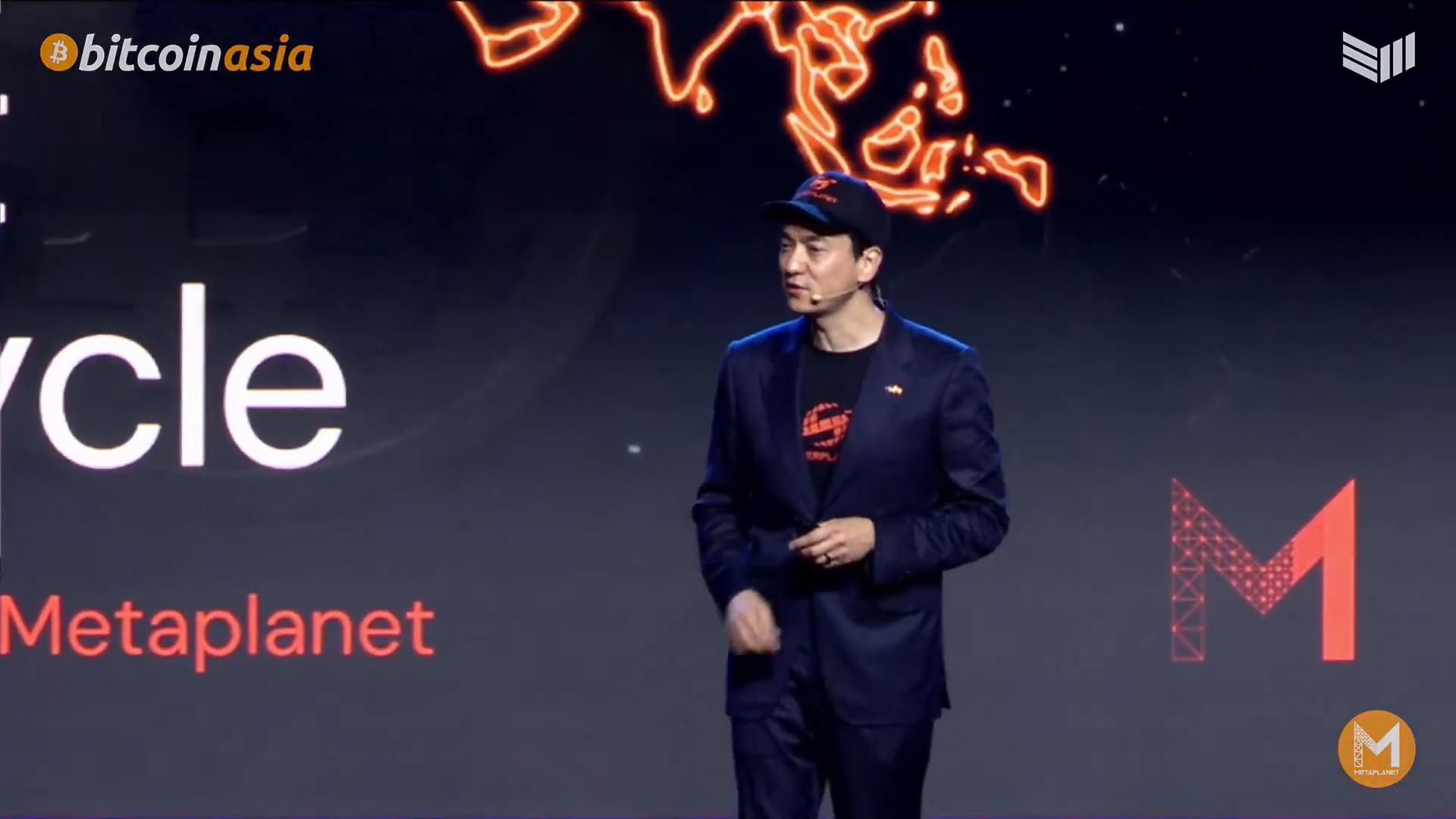
Bitcoin’s Moment Has Come for the Far East, Says Metaplanet CEO
Bitcoin’s time has come in Asia — especially with a changing regulatory landscape — and its people and companies should take advantage.
That was the message Metaplanet CEO Simon Gerovich gave at this year’s Bitcoin Asia conference, where on Friday he spoke of how his company went from failing to the third biggest bitcoin treasury in the world.
Bitcoin Asia kicked off on Thursday in Hong Kong, bringing the biggest names in the space to Hong Kong to talk about everything from treasury companies to building apps from scratch.
JUST IN:
— Bitcoin Magazine (@BitcoinMagazine) August 28, 2026Japanese public company Metaplanet CEO says the bottom for Bitcoin's price is in
"The buyers arriving now aren't going anywhere. I believe the bottom is in. And I'm expecting a much brighter rest of the year."

“The previous cycles belonged to the West, and the first Asian cycle has already started,” Gerovich said. “The only question left is who builds it. Will you?”
Often dubbed Asia’s answer to Nasdaq-listed Bitcoin treasury Strategy, Metaplanet pivoted from its core hotel and technology business to buying Bitcoin in 2024. The Tokyo Stock Exchange now holds 43,000 bitcoins worth about $3.3 billion at today’s prices.
Gerovich said in his speech that his company was small and going nowhere fast until it started putting bitcoin on its balance sheet, basically allowing investors to buy exposure to the biggest digital coin via its regulated shares.
He said that the strategy is a major opportunity for Asian companies, which can now capitalize on the changing regulatory landscape and the growing interest in Bitcoin.
Asian nations, including Japan, Hong Kong, and Singapore, are making regulatory changes to support digital assets.
Gerovich noted that Japan in particular is a country where its citizens have saved like no other part of the world — and that capital can now be put to good use.
“Hoarding cash has stopped making sense, and every household in Japan can now feel it,” he said.
“Japanese households hold roughly 14 trillion dollars in financial assets. About half of that sits in bank deposits, earning almost nothing, and that’s just Japan, add Korea, Southeast Asia, and the wealth managed out of this place, Hong Kong, and you’re looking at the deepest pools of patient savings on Earth.
“And for the first time in a generation, these savings are looking for somewhere to go.”
Gerovich added that Asian companies, institutions, and savers should take advantage of the current market conditions and build the Bitcoin infrastructure in their own regions.
“The end of the cash hoarding strategy and new rules are arriving at exactly the same time, and together, they set up what I think is the single biggest opportunity in Asian markets today,” he added.
This post Bitcoin’s Moment Has Come for the Far East, Says Metaplanet CEO first appeared on Bitcoin Magazine and is written by Mathew Di Salvo.
Bitcoin Magazine
Capital B Raises €21M From Adam Back and TOBAM To Buy More BTC
Capital B, the Euronext Growth-listed company that bills itself as Europe’s first bitcoin treasury company, has raised €21 million ($24 million) in a private placement backed by Blockstream’s Adam Back and asset manager TOBAM — money it says could buy 270 more bitcoin and push its stack to roughly 3,415 BTC.
The company said Friday that a total of 36,219,070 shares were sold at €0.58 each as part of the deal, a 6.45% discount to Wednesday’s closing price.
Capital B said the net proceeds are expected to reach about €19.9 million after fees and transaction costs.
JUST IN:
— Bitcoin Magazine (@BitcoinMagazine) August 28, 2026French company Capital B announces a €21.0 million capital raise to "accelerate its Bitcoin Treasury Company strategy"
Capital B is the 27th biggest publicly traded bitcoin treasury in the world, according to Bitcoin Treasuries, with a total of 3,145 bitcoins in its stash — worth $245 million at today’s bitcoin price of $77,960.
Capital B, which describes itself as Europe’s first bitcoin treasury, built much of that position through fundraising rounds during the first half of 2026.
In May, it acquired 192 coins for €13 million after completing three capital raises.
Capital B’s announcement as other treasuries look to raise funds and accelerate their buys. Just this week, NYSE-listed AI-powered education company Genius Group said it was aiming to build parallel AI and bitcoin treasuries worth a combined $1.6 billion, after the company sold its entire bitcoin reserves to repay $8.5 million in debt.
Bitcoin treasuries have faced headwinds since 2025 when the price of the leading cryptocurrency took a hit. A number of companies in the space have had to liquidate their holdings, including the biggest corporate holder of bitcoin, Nasdaq-listed Strategy.
This post Capital B Raises €21M From Adam Back and TOBAM To Buy More BTC first appeared on Bitcoin Magazine and is written by Mathew Di Salvo.
Bitcoin Magazine
Bitcoin Drops Before Shrugging Off Fed Chair’s Inflation Comments
Bitcoin dropped, then popped after Federal Reserve Chair Kevin Warsh gave his first major speech as head of the U.S. central bank and said he had “more work to do” to fight inflation.
The leading cryptocurrency was recently trading for $79,474 after dropping as low as $78,630 before quickly rising again.
Bitcoin has typically done well in a low interest rate environment but the Federal Reserve has been reluctant to lower borrowing costs due to sticky inflation in the world’s biggest economy.
“But on the price-stability side of our mandate, the numbers are more concerning,” Warsh said after talking about employment.
He added: “We must be confident that underlying inflation is moving to our objective, clearly and at sufficient speed. Otherwise, we have work to do.”
Bitcoin has in the past dropped on news that the Federal Reserve thinks inflation is too high because it means less chance of a rate cut. Following Warsh’s speech, traders priced in a 50% chance of rate hike in September.
But Bitcoin has appeared to — at least for now — shrug off the speech.
Bitcoin’s started surging last week after the U.S. Treasury Secretary Scott Bessent announced the department would double the size of its long-dated bond buybacks.
The news sent yields down lower, and the dollar slid while non-yielding assets like bitcoin and gold jumped.
Positive regulatory news also helped the coin: President Donald Trump last week said that the long-awaited crypto Clarity Act was a “very, very powerful” piece of legislation, and urged lawmakers to get it over the line.
The proposed law will establish a framework for distinguishing between digital assets that are securities, commodities or payment stablecoins — legislation that the crypto industry has long called for.
The Federal Reserve Bank of Kansas City is on Friday holding the annual event at Jackson Hole, Wyoming, where central bankers, Federal Reserve officials, policymakers and academics will gather to discuss “Financial Innovation: Implications for Payments and Policy.”
According to the Federal Reserve Bank of Kansas City website, this year’s event will touch on how “recent years have seen a dramatic increase in innovation in financial intermediation and payments,” including new technologies such as “cryptocurrencies and stablecoins.”
This post Bitcoin Drops Before Shrugging Off Fed Chair’s Inflation Comments first appeared on Bitcoin Magazine and is written by Mathew Di Salvo.
HTTP error 429 on https://cryptoslate.com/feed/
Failed to fetch feed: https://cryptoslate.com/feed/
Failed to fetch feed.
CryptoTicker.io
The nominal staking yield of Solana (SOL) stands at around 5.25 percent a year today. In three years it will be roughly 2.25 percent, according to the calculation of the asset manager 21Shares. The decision behind it was taken on August 28, 2026: in the network's first binding vote, validators doubled what is known as the disinflation rate. A start date for the reduction still does not exist.
That is the short answer. The longer one matters more, because two things were decided on the same night and only one of them appears in the German-language reports. The cut to new issuance has been approved. The fee reform, which was meant to cushion the loss of income on the other side of the equation, failed. Anyone reading only the first half will consider the matter half as serious as it is for stakers.
How high the Solana staking yield is today and where it is heading
The staking yield is the annual return in percent that you receive for depositing your SOL in the network and thereby supporting the security of the blockchain. This return is usually quoted as APY, the effective annual rate including compounding.
The asset manager 21Shares put a figure on the path after the decision, quoted at Decrypt: from around 5.25 percent today to roughly 2.25 percent within three years. Intermediate steps lie at approximately 4.34 percent in the first year and 3 percent in the second. These numbers are one provider's projection, not a guaranteed quantity: what ends up in your stake account also depends on your validator's commission, its uptime and MEV earnings.
What matters for understanding this is where the yield comes from. The return stems almost entirely from newly issued SOL and only to a small extent from users' transaction fees. When the network prints fewer new tokens, the pot from which all stakers are paid shrinks. That is exactly what has been decided.
What SGP-0002 decided: disinflation rate from 15 to 30 percent
The disinflation rate is the annual pace at which new SOL issuance shrinks. The figure therefore describes the speed of the decline, not the level of issuance itself. Solana had set it at 15 percent a year so far; the proposal SGP-0002 doubles it to 30 percent.
Technically this is implemented by proposal SIMD-0550, submitted by engineers of the infrastructure company Helius. The consequence: according to the figures in the proposal, Solana reaches its fixed inflation floor of 1.5 percent as early as 2029 instead of 2032. Over the next six years this means around 18.9 million fewer SOL will come into existence than would have under the old schedule.
For holders who simply leave their SOL untouched this is good news: less new supply means less dilution. For stakers it is a cut to their ongoing income. Both sides sit inside the same decision, and whoever stakes feels the cut first.
Why the counterweight is missing: the fee reform SGP-0003 failed
The second economic proposal of the same evening was called SGP-0003, technically SIMD-0553, submitted by the research firm Temporal. It would have split the transaction fee on Solana into two parts: a base fee for inclusion in a block, which continues to go to validators, and a new resource fee measured by a transaction's computational cost, which would have been burned outright.
Burning here means that the coins disappear from circulation permanently. According to the figures in the application, this would have raised the daily burn from about 650 SOL to as much as 9,000 SOL, twelve to fourteen times as much. That would have been the counterweight to the reduced issuance, because a higher burn tightens supply without any intervention in staking rewards.
The proposal failed and ended at 53.9 percent approval: 142.84 million SOL in favor, 50.15 million against and a heavy 72.03 million abstentions. That was not enough for the required two-thirds majority. What is notable is that the proposal had already passed the code review of both client teams, Anza and Firedancer, on July 20. The vote was not about technical maturity, only about switching it on.
It is precisely this split that is missing from the German coverage of August 27 and 28, which describes both proposals as a single package. Anyone reading them as a package assumes that the cut and the compensation arrive together. Only the cut arrived.
How close the vote was: 0.334 percentage points above the threshold
SGP-0002 cleared the two-thirds hurdle of 66.67 percent with 67.0 percent approval. In absolute numbers: 176.29 million SOL in favor against 66.19 million opposed, spread across 1,326 votes at a turnout of 60.7 percent. The on-chain analysis by Solana Compass puts the result at 67.001 percent and the margin at 0.334 percentage points.
A custodian tipped the balance. The exchange Kraken, whose voting weight stood at 8.92 million SOL, voted against throughout the entire count and only withdrew that vote shortly before the close. Kraken's co-chief executive Arjun Sethi justified the step publicly with the line that custodians should be conduits and not votes. The asset manager Galaxy had initially abstained, which counts like a rejection under this method, and likewise changed its position in the final hour.
For comparison, the third proposal of the same evening: SGP-0001, the Solana constitution, passed with 86.0 percent approval, 193.65 million SOL in favor against 4.63 million opposed across 1,153 votes. It governs how votes will be held in future. The network was divided only on the two proposals with money attached to them.
Institutional holders also pulled in different directions. The listed Solana Company voted for the constitution and against both economic proposals, arguing that the timing was wrong for institutional stakers, who need a plannable yield. DeFi Development Corp voted the other way and subsequently bought 19,000 SOL for $1.86 million.
When the cut takes effect: the feature gate and the open precondition SIMD-0607
Here is the point that no German-language report has named so far: the disinflation rate has not changed yet. No date for it has been published.
SIMD-0550 is implemented through a feature gate, a switch in the network that arms an already shipped change for everyone simultaneously at a set moment. It takes effect at an epoch boundary. An epoch is Solana's settlement period, at the end of which staking rewards are distributed; it currently lasts a good two days. All epochs up to the flipping of the switch settle under the old schedule, all following ones under the faster one.
A hard precondition stands before that switch. The two productive validator clients on mainnet, Agave and Firedancer, must deliver bit-for-bit identical results in every reward calculation. Those results feed into the bank hashes through which validators agree on the state of the chain. If one client's calculation deviates even in the last digit, that is a consensus failure.
Floating-point arithmetic cannot guarantee this, because the same operation can produce different results on different hardware and with different compilers. That is why SIMD-0607 has to be merged first: it replaces the floating-point calculation in the reward computation with deterministic integer mathematics and targets client version Agave v4.4. The associated pull request is open and awaits sign-off from one representative each of the Anza and Firedancer teams. Anza has named the order itself in a thread: the implementation is a single permanent feature gate, one precondition is under review, and the switch can be scheduled after that.
In practice this means for you: your yield does not fall on a known cut-off date. The decline sets in as soon as this technical chain has been worked through, and then runs down in steps over years. Anyone who gives you a date has made it up. How such an activation date comes about at Solana is something we wrote up using the Alpenglow upgrade as an example in our article on the Solana upgrade and your SOL staking.
How Solana staking rewards come about in the first place
Solana works on the proof of stake method: whoever deposits tokens may help decide on the order and validity of transactions and is paid for it. The machines that do this are called validators. As an ordinary holder you do not run your own validator but delegate your stake to one. Your SOL do not leave your control in the process.
Three quantities matter for the payout. The commission is the share of the reward your validator keeps as an operating fee. Uptime describes how reliably it is online and confirming blocks; one that fails often earns less for its delegators. MEV stands for additional income from the ordering of transactions within a block, which some validators pass on to their delegators and others do not.
Because the reward comes from new issuance, the decision affects every route through which you stake in the same way. A better validator can soften the decline; none can stop it.
What the cut means concretely for 100 SOL
A worked example, deliberately rough and without any price assumption for the future. Anyone staking 100 SOL receives around 5.25 SOL a year at 5.25 percent. At 2.25 percent it is 2.25 SOL. The quantity of new coins flowing to you each year therefore falls by about 57 percent once the end point of the reduction is reached.
Measured against the price of $102.55 per SOL on August 31, 2026 at 06:40 UTC according to CoinGecko data, that would be roughly $538 a year compared with around $231. Price performance is expressly not included in this calculation, and it can completely override the figure in either direction. The point of the example is solely the order of magnitude of the cut, not a yield forecast. If you want to know how the return differs between providers, a look at our comparison of staking platforms helps, where commission and payout mode stand side by side.

Native staking, liquid staking and staking through an exchange
With native staking you create your own stake account in your wallet and delegate it to a validator of your choice. The keys stay with you. Activation and deactivation each take effect only at the next epoch boundary, so your stake is not immediately available for around two days.
With liquid staking you hand your SOL to a protocol and receive a tradable token that represents your share including accrued rewards. JitoSOL is one of these instruments, and in the vote it was more than an investment product: according to the analysis by Solana Compass, JitoSOL stakers outvoted their validators. The price of that flexibility is an additional smart contract risk, because your claim hangs on the protocol's code.
With staking through an exchange the provider handles everything. That is convenient and costs you custody: the coins sit with a third party, and in case of doubt that third party votes on the rules of the network, as the Kraken case showed that evening.
Which risks remain in Solana staking
The most common worry is whether the stake itself can be lost. With native staking your deposited amount is not automatically seized if your validator performs badly or is temporarily offline. What you lose during that time are rewards, not the stake itself.
The real risks lie elsewhere. Price risk is the largest: a yield of 5 percent does not carry a price decline of 30 percent. Added to that is custody risk when a third party holds your coins, along with smart contract risk in liquid staking. And there is an availability risk, because your stake is tied up until the next epoch boundary and you cannot sell immediately in a fast-moving market.
Since August 28 a planning risk has been added: the yield you are counting on today is a falling quantity with no known schedule. Anyone budgeting firmly for staking income should adjust that number downwards.
How you as a delegator outvote your validator
The vote ran according to the voting weight of the deposited stake. By default the validator you delegated to votes on behalf of your share. You can, however, cast that vote yourself and thereby replace your validator's vote for your share. That is exactly what happened in this vote, when JitoSOL stakers outvoted the position of their validators.
A practical consequence follows from this that reaches beyond this single vote. If your provider holds custody for you, you effectively surrender that vote. Anyone who wants a say in future proposals needs their own stake account and has to keep an eye on the voting period. The decision here came down to a margin of 0.334 percentage points, and single votes the size of a custodian's tipped it.
Tax on staking rewards in Germany
Staking rewards are other income in Germany under section 22 number 3 of the Income Tax Act. They are taxable at the moment of receipt, valued at the market price at that time. An exemption limit of 256 euros a year applies. Exemption limit means: if the amount is exceeded by even one cent, the entire amount is taxable and not merely the excess.
If you sell the coins you received later, the one-year holding period for private disposal transactions applies. Under the prevailing administrative view, staking does not extend that period to ten years. The authority here is the Federal Ministry of Finance circular of March 6, 2025 on individual questions in the taxation of crypto assets, which also describes the record-keeping obligations. Because every single credit has to be valued, clean record-keeping of the rewards is the actual work; suitable tools are listed in our comparison of crypto tax tools. For your specific case, a visit to a tax adviser remains the safe route.
One side effect of the cut is notable at this point: anyone who was just above the 256-euro exemption limit may slip below it as the yield falls. That is no cause for celebration, but it is a point for your tax planning in the coming year.
How this decision fits into Solana's recent weeks
The decision is the provisional end point of a debate that has been running for weeks. For context on the price move around the vote and on the relationship between SOL and Bitcoin, we described the situation in our article on the SOL/BTC breakout, which still lists the two proposals as an ongoing vote. The result is now in, and it is split.
For you as a holder, the combination of an approved cut and a failed fee reform means that the argument about a supply squeeze stands on one leg. Fewer new SOL really are coming. The additional burn that many observers had factored in is not coming for now. Whether and when a revised version of SIMD-0553 will be put to a vote again is open.
Reviewing your Solana staking: what to take away
- Recalculate your staking expectation. For the coming years assume a declining path towards 2.25 percent instead of today's 5.25 percent, and take the opportunity to check your provider's commission. The comparison of staking platforms shows where that deduction stands at what level.
- Get your records in order. Every credit counts at the moment of receipt, and the 256-euro exemption limit decides the tax liability of the entire amount. A tool from the comparison of crypto tax tools takes the collecting work off your hands.
- Decide who votes for you. If the rules of the network matter to you, your stake belongs in your own stake account rather than in third-party custody. Where you can obtain SOL and then hold it yourself is set out in the comparison of crypto exchanges.
The sources for this text: the voting result with all vote counts at Decrypt and the technical precondition for activation in the analysis by Solana Compass.
(As of August 31, 2026. This article is not investment advice. Prices and fee structures change; check the terms with the provider before you buy.)
Bitcoin abroad: the tax duty Austrian users carry themselves
Anyone who is tax-resident in Austria and sells bitcoin through a foreign crypto platform does not escape Austrian taxation by doing so. The decisive difference from many domestic providers lies rather in the fact that often no Austrian capital gains tax is withheld automatically.
Taxable bitcoin gains must then, as a matter of principle, be recorded by the investor personally through the income tax assessment. For private crypto income the special tax rate of 27.5 percent continues to apply in principle.
A foreign platform does not mean tax-free
Austria taxes income from cryptocurrencies as income from capital assets. This covers both certain ongoing income and realized increases in value. A taxable sale exists in particular where bitcoin is disposed of for euros or another legal currency. Using it to purchase goods or services can also constitute a realization.
Example:
- bitcoin bought for 20,000 euros
- later sold for 50,000 euros through a foreign platform
- taxable gain: 30,000 euros
At 27.5 percent this results in principle in a tax of 8,250 euros.
The fact that the platform is based outside Austria does not, in principle, change this calculation.
When does the exchange not take care of the tax?
Where a domestic crypto service provider is involved, an obligation to deduct capital gains tax applies to certain crypto income. The provider withholds the tax and remits it to the tax office. With a foreign platform, such an Austrian withholding agent is often absent.
The investor must then, in particular, do the following personally:
- determine the sale proceeds in euros,
- establish the acquisition costs for tax purposes,
- calculate gains and losses,
- record the taxable income in the assessment.
Acquisition costs remain decisive
The tax is not levied on the entire sale proceeds but, in principle, on the gain. Where several purchases of bitcoin of the same kind have been made on the same relevant wallet or address, the moving average price applies in principle to new assets.
Particular care should therefore be taken in documenting:
- date of purchase,
- quantity of bitcoin purchased,
- acquisition costs in euros,
- fees,
- wallet transfers,
- earlier crypto-to-crypto exchanges.
Foreign platforms do not necessarily supply reporting that corresponds exactly to Austrian tax rules.
Losses must also be evidenced by the investor
An advantage of the assessment can arise where a bitcoin loss for tax purposes was realized on the foreign platform. Crypto losses can in principle be offset against certain other capital income. A loss offset across providers is not carried out automatically, however; it takes place through the income tax assessment. Reliable transaction data is particularly important for that.
Conclusion
Austrian investors must in principle pay tax on taxable bitcoin gains even where the sale takes place through a foreign crypto platform. The essential difference lies in the procedure: without an Austrian capital gains tax deduction, the investor regularly has to determine their taxable income themselves and declare it through the income tax assessment. The tax rate for private taxable crypto gains remains in principle 27.5 percent.
(As of August 31, 2026. This article is not investment advice. Prices and fee structures change; check the terms with the provider before you buy.)
A legitimate AML check on a crypto address needs exactly one thing from you: the public address. It needs no access to your wallet, no connection, no signature and certainly no advance payment. Anyone who asks you to connect your wallet for a money-laundering check is not running a check at all. That is exactly what a wave of fraud relies on, described by the security firm Malwarebytes on August 19, 2026, with infrastructure that our own measurement found still running twelve days later.
Fake AML check: what Malwarebytes found in August 2026
Stefan Dasic, a malware researcher at Malwarebytes, has documented a series of websites that pose as screening services for crypto addresses. They imitate the legitimate provider AMLBot or operate under colorless generic names such as "AML Check". The setup is similar in every case: you select a cryptocurrency, click a button labeled "Check Wallet", and are then asked to connect your wallet.
From that point on the site is no longer a screening tool. It is a stage. A progress bar runs, accompanied by status messages such as "Checking wallet history…" and "Verifying compliance…". Then comes an invented error message: the check cannot be completed, the balance is too low, a small top-up is needed to cover the fee. Click "Retry" and you see the same animation once more, followed by a reassuring result, usually a "Clean, Low Risk".
That result is pure invention. There is no check, no database query and no assessment. What there is, is a connection between your wallet and someone else's website, and that connection is the real purpose of the whole arrangement.
AML check explained: why a wallet address gets screened at all
AML stands for anti-money laundering. An AML check for crypto is a report on whether a public blockchain address has been connected in the past to suspicious counterparties, for example a hacked trading venue, a mixing service or a sanctioned address. Providers of such reports evaluate publicly visible transaction data and assign addresses to known actors.
The decisive part of that definition is already in the word "public". Everything such a report needs is lying in the open on the blockchain anyway. The address is the key to the query, and the address is a string of characters that you can copy and paste into a field. Access to your balance is no more necessary for this than a power of attorney over a bank account is necessary to request a public land registry extract.
Why do retail investors care in the first place? Because an address flagged as suspicious can cause trouble. Deposit funds at a regulated trading venue and you may face a query from the compliance department, and in the worst case a withdrawal is delayed until the origin of the funds has been clarified. That worry is real, and it is the lever the scam sites pull.
How to recognize a genuine screening page
A legitimate report requires an input field and nothing else. You paste in the address, you get an assessment, and your wallet software is not opened once during the entire process. If your wallet's connection window appears instead, the check is already over at that moment, and not in your favor. Malwarebytes puts it as a plain rule of thumb: anyone demanding a wallet connection instead of the public address is a warning sign.
Enter an address or connect a wallet: the one difference that decides everything
Two actions that look similar in a browser have fundamentally different consequences. Entering an address is a read operation. You hand over information that every blockchain explorer displays anyway, and the other side can do nothing with it that it could not do without you.
Connecting a wallet is something else. Doing so permits a website to talk to your wallet software. The site then sees your address and your balance, and above all it may present transactions to you for confirmation. It cannot trigger those transactions itself, but it can prepare and label them so that a single click from you is enough. A wallet's security architecture is incorruptible at this point: it executes what you approve.
That is why the documented sites build their staging so carefully. They need no vulnerability in your wallet. They need a moment in which a confirmation window looks to you like a normal step in a security check. Once you grasp that you believe yourself to be in a screening process while you are in fact signing a power of attorney, the trick is seen through.

How the scam site works: from the progress bar to the alleged fee
The order of the steps is no accident, it follows a dramaturgy. First comes the choice of cryptocurrency, a harmless act that builds trust and pulls you into a sequence of clicks. Then follows the connection, which seems plausible in the context of a supposed check. Only after that does the actual manipulation begin.
The progress bar serves two purposes. It makes the site appear to work where nothing is working, and it buys the other side time to look at your address and prepare a suitable transaction. What is then put in front of you is tailored to your balance. The subsequent error message about a missing fee is the pretext meant to justify a payment or an approval. And the closing "Clean, Low Risk" makes sure you leave the site reassured, without checking what you confirmed along the way.
What is remarkable about this scheme is whom it hits. It does not target carelessness, it targets caution. Anyone looking for an AML check has already given thought to how clean their address is. That audience is better informed than average, and it arrives of its own accord, without an attacker having to write to it.
Token approval instead of a password: how the outflow works technically
In an attack of this kind no password and no recovery phrase is lost. The usual route runs through a token approval. An approval is a permission you grant to a third-party address to move a particular kind of token out of your wallet. That permission is necessary in everyday use, every decentralized exchange needs it, and it remains in place until you revoke it.
The danger lies in the amount and in the duration. Many approvals are granted without a limit, because that is convenient and because the confirmation window does not always display the amount in an understandable way. An unlimited approval, once granted, keeps working after you have long closed the site, after a restart of your computer, and even when you disconnect the site in your wallet menu. Disconnecting ends the channel of conversation; it does not withdraw the power of attorney.
What such a confirmation looks like in the window, and which fields you should read before clicking, we described in detail in our article on wallet drainers and signature approvals. If there is a single technical skill to take away from this subject, it should be that one. On a chain such as Ethereum and the networks compatible with it, the approval is the standard mechanism by which balances change hands without any key having to be stolen.
What an approval technically permits
An approval names three things: which token it covers, which third-party address may dispose of it, and up to what amount. If the amount limit is missing, the third-party address may withdraw the entire holding of that token, at any time and without asking you again. Wallets with a good interface show you these three details in plain language. Older or plainly designed confirmation windows show you a string of characters, and that is precisely what the operators of such sites count on.
Our own survey: three of the five named domains still respond twelve days later
This analysis was carried out by cryptoticker.io itself on August 31, 2026. Method: we checked the five domains that Malwarebytes names explicitly in its report once on August 31, 2026 at 03:53 UTC, by HTTP request and by name resolution, and recorded the response code. Five domains from the report were checked, plus the domain of the imitated legitimate provider as a reference value, so six objects in total.
The result: two of the five domains can no longer be resolved, their name entries have vanished. Two more respond with code 200 and therefore serve a page. A fifth responds with code 403 and rejects our automated request, but has an active name entry and a responding server. Sorted by name: amlbot-clear[.]com responds, bitget-aml[.]com responds, swapstoken[.]app rejects, audittrust[.]shop and search-aml[.]net can no longer be resolved. The domain of the genuine provider also responds, as expected.
What these figures mean, and what they do not: we measured reachability only, that is, whether a server responds under the name. We did not open the pages served, did not assess their content and therefore did not establish whether the described scheme is still running there, whether a parking page stands in its place or whether a third party has taken the domain over. Nor can we say how many people visited the sites in that period or what damage was caused. Only one statement is solid: twelve days after the public warning, the infrastructure named there has not been fully cleared away. For you as a reader that is the relevant measure, because a warning whose targets have long been offline would be history. This one is not.
Imitated names: what a domain says about a company
One of the domains named combines the name of a well-known trading platform with the abbreviation AML. That deserves a clear classification, because a domain can be chosen freely, and whoever registers it needs neither the permission nor the knowledge of the name's owner. Nothing about a company itself follows from its name appearing in an address bar. On the contrary: firms whose names are used in this way are victims of the scheme, because trust they built over years is turned into a tool against their own customers. That applies here to the imitated screening platform just as much as to the trading platform whose name appears in one of the domains.
In practice that means this for you: a familiar name in a web address is not a seal of approval. What counts is the complete address line, and what counts above all is how you arrived at the page. A link from a message, from a post on a social network or from a paid search ad deserves more suspicion on principle than a bookmark you set yourself.
Why the scheme falls on prepared ground in Germany
Since the beginning of 2026, German investors have been asked by their providers for documentation in a way that was previously unusual. With the implementation of the EU directive DAC8, crypto service providers have had to identify their customers, record transactions and obtain tax self-declarations since January 1, 2026. Anyone who fails to respond is reminded, then warned, and the provider can restrict accounts.
That creates a habituation worth its weight in gold to fraudsters. Demands for documentation, checks and confirmations currently sound less like an alarm signal than like administrative routine. A site offering a money-laundering check fits that picture, and the thought "I suppose I have to do this" comes more readily than it did a year ago. We observed a similar pattern with the crypto job offers involving your own bank account, where an official-sounding procedure likewise provided the frame for the actual damage.
It helps to make the difference clear to yourself once. When your trading venue wants something from you, you find that request inside your account after logging in. No regulated provider sends you to a third-party website to fulfill an obligation, and none demands a wallet connection for it. Where these obligations are actually laid down, and which providers operate under European supervision, you can read in our overview of regulated crypto exchanges.
Checking and revoking token approvals: how to proceed
The most effective step after an unclear encounter with such a site is to review the approvals you have granted. Every major chain has an area in its blockchain explorer where you enter your address and get a list of all open approvals together with the authorized counterpart address. A revocation is an ordinary transaction and costs the usual network fee.
Work through the list calmly and watch for two things: unlimited amounts, and counterpart addresses you cannot assign to any transaction of yours. An approval whose occasion you no longer remember is a candidate for revocation, even if nothing has happened so far. The effort is small; the possible damage is not.
Where you keep your keys also determines how expensive a mistaken click can become. An overview of the devices and how they are operated can be found in our hardware wallet comparison; anyone working without an additional device will find in the software wallet comparison the differences in how confirmation windows are displayed, and that display is precisely the security-relevant point here.
After a confirmed transaction: why disconnecting alone is not enough
Suppose you have confirmed and notice it shortly afterwards. Then the order of your steps matters more than their speed. Disconnecting in the wallet menu is sensible, but it is the smallest of the steps, because it leaves the granted power of attorney untouched. More important is revoking the approval, and more important still is the question of whether only an approval was granted or a recovery phrase was entered.
If an approval was granted, revoking it is usually enough. If, on the other hand, a recovery phrase or a private key was typed in somewhere, the wallet is permanently lost, and the remaining balance belongs on a freshly created wallet with a new recovery phrase. A recovery phrase knows no revocation; it can only be replaced.
You should be prepared for what comes next: offers of supposed recovery. Anyone approached in forums or by message after an incident, promising to retrieve funds against an advance payment, is running the second stage of the same scheme. Confirmed transactions on a blockchain are final, and nobody can reverse them for a fee.

Separate wallets and small amounts: what limits the damage
No single measure fully protects against a mistaken click, but splitting your holdings helps reliably. Anyone who keeps the largest part of their balance on an address that is never connected to a website can experiment calmly without risking everything. A second address with a manageable amount then handles contact with applications, and any damage stays limited to that amount.
A hardware device strengthens this effect, because it moves the confirmation to a display outside the computer. It is still no free pass: even with a hardware wallet you grant an approval when you confirm it on the device. The gain lies in the fact that the details appear there in a form a manipulated website cannot overwrite. Anyone who reads that display, instead of pressing the same button twice, has done the greater part of the work.
Recurring approval reviews: when a check makes sense
Approvals accumulate without being noticed. Every application you use leaves one behind, and after two years of use an active address easily carries several dozen open powers of attorney. Many of them belong to projects that no longer exist, and an abandoned application is an attractive target for a takeover by third parties.
A review twice a year is a sensible measure, plus one after any unusual event: after visiting a site you reached through someone else's link, after a confirmation whose purpose you cannot recall afterwards, and after every report of a compromised application you have used yourself. The time required is a few minutes, once you know the procedure.
Spotting a fake AML check: what to take away
- Remember the dividing line. A genuine check on a crypto address asks only for the public address in an input field. As soon as a supposed screening service asks you to connect your wallet, confirm a transaction or advance a fee, stop. If you are unsure where such checks are handled by the provider anyway, our overview of regulated crypto exchanges helps.
- Review your open approvals. Open your chain's blockchain explorer, enter your address and revoke every unlimited or unexplained approval. How to read a confirmation window properly beforehand, so that no new ones are added in the first place, is set out in the software wallet comparison and in our article on signature approvals.
- Separate storage from use. Keep the larger part of your holdings on an address that is never connected to a website, and use a second address for applications with an amount whose loss you could cope with. Which devices support this separation and how they are operated is shown in the hardware wallet comparison.
The sources for this article: the report by Malwarebytes of August 19, 2026 and the independent write-up at Decrypt of August 20, 2026. The reachability measurement of the named domains comes from cryptoticker.io.
(As of August 31, 2026. This article is not investment advice. Prices and fee structures change; check the terms with the provider before you buy.)
If you run a crypto wallet as a browser extension, today is the day to open your extension list. In August 2026 the security firm Socket disclosed two separate campaigns in which extensions for Firefox, Chrome and Edge harvested recovery phrases, private keys and login credentials for crypto exchanges. The second of those reports was written up on August 30 and is therefore one day old. What is affected is precisely the place where many investors handle their wallet every day.
A browser extension is a small add-on program that runs inside the browser and holds permission to read and change the content of the pages you visit. That same permission is what makes it useful to wallet providers and valuable to attackers.
Browser Extensions as Wallet Thieves: What Socket Found in August 2026
Socket is a security firm specialising in software supply chains that examines packages and extensions for malicious code. Its researchers published two findings within ten days that show the same pattern and yet do not belong together.
The first report is dated August 20, 2026 and concerns the Firefox marketplace: 77 extension identities are connected according to Socket's analysis, 40 of them confirmed malicious. The second report circulated between August 28 and 30 and concerns Chrome and Edge: 19 extensions, 18 of them for Chrome and one for Edge, carried a wallet drainer. A wallet drainer is malicious code that empties a balance to an outside address in a single operation instead of siphoning off individual amounts.
Both cases share one thing that matters more to you than any number: the extensions sat in the official marketplaces of the browser makers. Anyone who installed them did nothing wrong, downloaded no dubious file and clicked no link in an email.
Offside Wallet Theft Factory: How 77 Firefox Extensions Are Connected
Socket calls the Firefox campaign Offside Wallet Theft Factory and explicitly does not attribute it to any known actor. The researchers also do not write that the same operator stands behind every single extension; what links them is shared code and shared infrastructure.
The 40 confirmed extensions fall into four groups. Seven posed as crypto products and served as remotely controlled phishing loaders, among them an entry called 0KX WEB3, which used a zero in place of the letter O and so imitated the name of the exchange OKX. Fifteen carried the theft code directly inside them. Thirteen of those fifteen were altered rebuilds of the Rabby wallet software. Five more collected access credentials and the contents of the clipboard. The remaining 37 of the 77 identities appeared as VPN tools, password generators or sports apps and did in fact display match scores.
According to Socket, the interfaces of OKX, Rabby Wallet and TronLink were imitated. In this affair those three providers are the injured parties, not the cause: their name and their appearance were used as bait without any involvement on their part.
The technical basis was provided by projects on the database service Supabase, which acted as remote switches, together with Cloudflare Workers and Pages for the forged interfaces as well as control servers written directly into the code. Such control servers are known in the field as C2 servers, short for command and control; they receive the stolen data and send new instructions back. The signature data of the extensions covers the period from March 9 to August 3, 2026, with clusters in April and at the end of July. Mozilla removed the reported add-ons from the marketplace after the report.
What a Browser Extension Is Actually Allowed to Do
An extension with permission to read and change data on all websites sits technically on the same level as the page itself. It sees what you type, it sees what the page shows you, and it can alter both before either reaches the other. For a wallet extension that is normal and unavoidable. For an extension that unlocks right-clicks or displays football scores, it is not.
From Match Score to Seed Phrase Collector: Why the Update Is More Dangerous Than the Installation
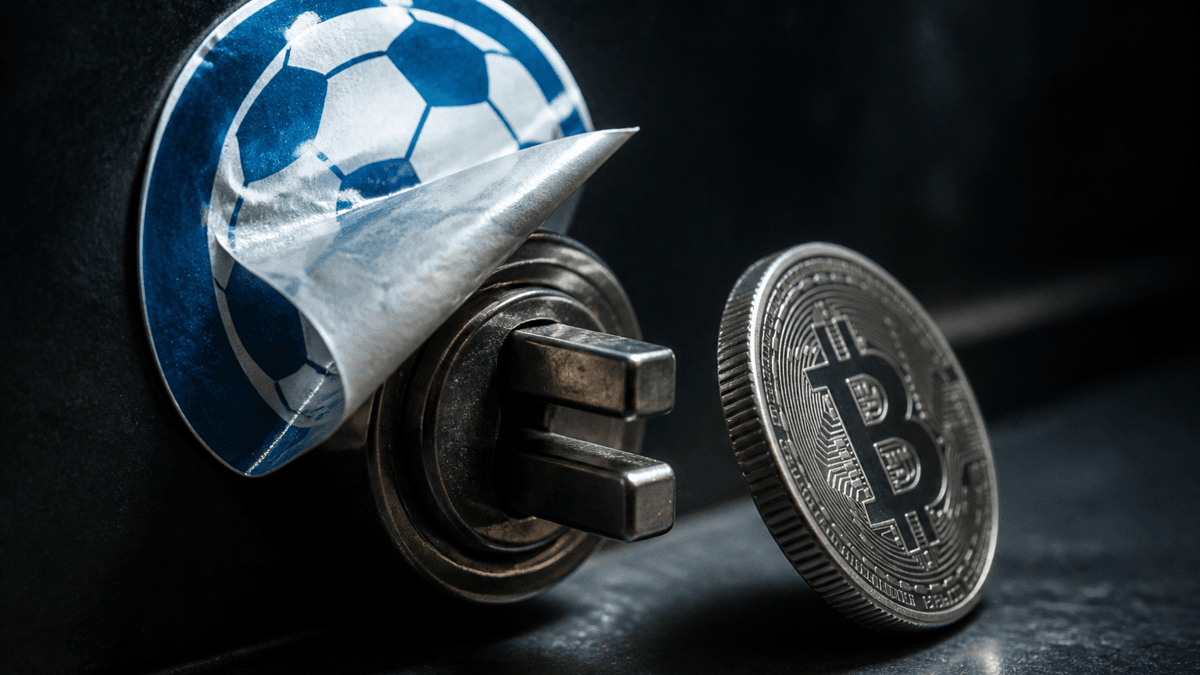
The most instructive part of the Firefox finding has nothing to do with crypto at first. Nine of the confirmed malicious extensions began life as harmless sports applications and displayed results from football, basketball and American football. Only later updates replaced that function with wallet theft code, and did so under the same identifier. The malicious version thereby inherited the entire installed base and the accumulated positive reviews of its harmless predecessor. The campaign owes its name to that trick.
For your own practice this means that the check you carried out at installation does not hold indefinitely. Reviews, user numbers and the age of an extension describe its past. An update can replace the code completely, and by default extension updates run through automatically without your being asked.
With five of the 19 Chrome and Edge extensions it went much the same way, only one step earlier: according to Socket's analysis they were genuine, already published extensions by other developers that were taken over and then rebuilt. The remaining 14 the attackers had built themselves from scratch.
Altered Rabby Rebuilds: How the Keyring Leaks Before Encryption
The thirteen altered Rabby rebuilds are the technically most delicate part of the Firefox finding. Rabby is open-source wallet software; its code may legally be copied and changed. The attackers rewrote exactly one function, namely the one that stores the keyring permanently. A keyring is the data record in which a wallet holds its private keys and the recovery phrase together.
In the original, this keyring is converted into text and then encrypted with your password before it lands on the hard drive. In the altered versions it is, as Socket describes it, sent off at precisely the moment when it exists in text form, that is, before encryption. Your wallet password protects nothing at this point, because it would only come into play afterwards. The same versions also intercept the recovery phrase when a wallet is created and when one is imported.
19 Chrome and Edge Extensions: The Drainer That Rebuilds Ledger and Trezor Pages
The second finding is the more recent one and concerns two further marketplaces in Chrome and Edge. According to Socket's analysis the 19 extensions contained a drainer that serves several chains at once: wallets on Ethereum and all networks compatible with it, wallets on Solana and wallets on Tron.
Added to this were rebuilt recovery and update pages that looked like the official interfaces of the hardware wallet makers Ledger and Trezor. Their sole purpose was to collect the recovery phrase. Here too, the two manufacturers are victims of imitation. Anyone who uses a hardware wallet and wonders which models exist at all and how they differ will find the overview in our comparison of crypto hardware wallets.
On reach there is one solid individual figure and one estimate. Solid is the extension named Enable Right Click & Copy, Smart Unlock + OCR: it had more than 70,000 users on Chrome and more than 10,000 on Edge when it turned malicious. For the campaign as a whole, one trade report cites around 80,000 affected users. The starting point is also disputed: BleepingComputer writes that the operation may have been running since the beginning of 2024, while another assessment of the same Socket analysis speaks of roughly six months of active operation and names February 2024 as the likely beginning. Both readings stand side by side, and neither of them is confirmed.
At the time of publication, according to BleepingComputer, none of the extensions was still available in the Chrome Web Store. The Edge version still was.
CSP Header Removed: What an Extension Can Do on Every Page You Visit
The sequence in the Chrome and Edge case is worth going through calmly, because it explains why a single bad extension reaches so far. After installation it opens an encrypted permanent connection to a control server, a so-called WebSocket connection. Over that line it loads individual JavaScript building blocks that were not contained in the marketplace package at all. A reviewer who looks only at the submitted package therefore finds little there.
It then removes the CSP header from every page you call up. The Content Security Policy is a protective instruction with which a website tells the browser which sources scripts may be executed from at all. If it falls away, the browser accepts outside code as well. That code is then injected into the page through hidden HTML elements.
The result is uncomfortably concrete. The bank, the exchange and the wallet interface you open in the same browser are, from that moment on, no longer the pages the provider delivers. They are what the extension makes of them. That is exactly why an approval that looks harmless on screen can mean something quite different in the background. How to read such an approval in detail is set out in our article on what you really approve when you confirm.
Session Tokens Instead of Passwords: Why Two-Factor Authentication Does Not Protect Here
According to Socket, the drainer attacks not only wallets but also accounts at trading venues. Coinbase, Binance, Kraken, OKX, MEXC, KuCoin and Bybit are named, along with the MetaMask wallet. What it collects are access credentials, session tokens, browser history, account information from Facebook and LinkedIn, and form entries across a range of websites.
The term session token deserves an explanation of its own, because it is what sets this apart from ordinary password theft. A session token is the pass that a website issues to your browser after a successful login so that you do not have to enter your password and second factor again with every click. Whoever holds that token is already logged in as far as the website is concerned. Two-factor authentication has happened by then and is not requested a second time.
That is why changing your password is not enough when you suspect something. You have to end all active sessions as well. Most trading venues offer this function in their security settings under labels such as active devices, sessions or logged-in devices. Which providers come into question for customers in Germany at all, and which security features they bring with them, is shown in the overview of crypto exchanges.
Checking Installed Extensions: How to Reach the List in Firefox, Chrome and Edge
The check takes a few minutes and costs nothing. In Firefox you open the address about:addons and select Extensions on the left. In Chrome it is chrome://extensions, in Edge edge://extensions. In all three browsers the detail view can be opened for each entry, showing permissions, publisher and installation source.
Go through the list from top to bottom and ask yourself two questions about every entry: do you still remember why you installed this extension? And have you actually used it in recent weeks? Anything that stumbles on either question goes. An extension you do not need is still an open door that nobody is guarding.
How to Recognise a Hijacked Extension
There is unfortunately no clean identifying mark for the update trick, and that belongs to the truth of the matter. There are, however, indications that are worth something taken together. It is striking when an extension with a banal function suddenly demands far-reaching permissions, or when the publisher name has changed. It is striking too when a review column shows older enthusiastic voices and more recent complaints about altered behaviour side by side. And any extension whose name matches a well-known product but for a single character is striking, as with the zero in the entry 0KX WEB3.

Reading Permissions: Which Access Rights Are Normal for a Wallet Extension
A genuine wallet extension needs far-reaching rights, otherwise it could not do its job. Access to data on all websites is therefore no alarm signal in its case. The real question is a different one: why does a screenshot tool, a translator or a right-click unlocker need the same permission?
In practice this means you sort your extensions by purpose and not by provider. Every extension that may read and change all pages although its function is needed only on a single page or at the push of a button is a candidate for deletion. Chrome and Edge additionally allow you to limit an extension's access to individual pages or to grant it only after a click. That setting costs you two days of getting used to it and takes most of its reach away from a hijacked extension.
Hardware Wallet or Browser Wallet: What the Difference Means When It Counts
The two Socket findings lead to a distinction that often blurs in everyday use. With a wallet as a browser extension the private key lies encrypted on the computer, and the software in the browser decrypts it in order to sign. With a hardware wallet the key never leaves the device; the computer sends the transaction over and gets the finished signature back.
This difference decides how an attack of the kind described turns out for you. Against harvested key material the hardware wallet helps, because there is simply nothing there to harvest. Against a manipulated interface that shows you a false recipient address it helps only if you read the details on the display of the device and not on the screen. And against a rebuilt recovery page that asks you to enter your recovery phrase, no technology helps at all. There, only one rule carries: never type that phrase anywhere. Which software wallets exist for everyday use and where their limits lie is set out in the comparison of software wallets.
After a Suspicion: Why Uninstalling Alone Saves Nothing
For the Firefox case Socket makes a clear recommendation: anyone who has entered a recovery phrase or a private key into one of these extensions should treat the data as permanently compromised and move the balance to a newly created wallet. The reason is simple and readily overlooked. Deleting the extension takes back nothing that has already been transmitted. A recovery phrase cannot be revoked, only replaced.
The order matters when you suspect something. Create the new wallet on a device that is not affected, and only transfer afterwards. Anyone who sets up the new wallet in the same infected browser merely repeats the exercise with fresh keys. Then come the accounts at the trading venues: new password, end all sessions, set up the second factor again and check the withdrawal addresses on file.
A word on handling the agitation such reports set off. In precisely the days after an incident becomes public, messages multiply that promise help to those affected and ask for the recovery phrase in the process. That scam now runs on paper as well, as the case of wallet phishing by letter shows. No reputable provider and no authority ever asks for that phrase.
Tax and Evidence: What to Document After a Crypto Theft
If something has in fact flowed out, secure the evidence before you tidy up. That includes the time of the outflow, the addresses affected, the transaction identifiers from the relevant block explorer, the name and identifier of the extension together with a screenshot of the marketplace page if the entry is still reachable, and the file number of a police report.
How such a loss works out for tax purposes depends on the individual case and belongs in the hands of a tax adviser. Without complete evidence that question cannot be settled at all, and the evidence is considerably harder to obtain weeks later than on the day after. A portfolio tool that records your movements anyway spares you the reconstruction by hand when it counts.
Checking Browser Extensions: What to Take Away
- Clear out your extension list today. Open about:addons, chrome://extensions or edge://extensions and delete everything you do not actively use or can no longer place. Pay particular attention to entries with a banal function and far-reaching permissions. If you keep your wallet in the browser, check in the comparison of software wallets whether your setup still fits your holdings.
- Separate the amounts you do not move from the browser. The part of your holdings you do not touch weekly belongs on a device whose key never sees the browser. The models and their differences are set out in the comparison of crypto hardware wallets.
- End your open sessions at the trading venues. A new password alone is not enough as long as an old session token is still valid. Go into the security settings of every account, throw out all devices and log in again. Which providers offer which security features is shown in the overview of crypto exchanges.
The month's two findings arose independently of each other and affect all three major browsers. They say the same thing: a browser maker's marketplace is a pre-selection and not a guarantee, and the check made at installation ages faster than the extension itself.
The original reports are available at Socket on the Firefox campaign and in the write-up by BleepingComputer on the Chrome and Edge case.
(As of August 31, 2026. This article is not investment advice. Prices and fee structures change; check the terms with the provider before you buy.)
Crypto airdrops in week 36: the deadlines that are running now
The most uncomfortable deadline of this week is one that officially does not exist. At Plume, the Season 2 claim has been open since the end of May 2026 – and the project has never published an end date, neither as a day nor as a period. Secondary reporting, meanwhile, circulates a window of roughly three months, which would run out with August, that is, today. That figure cannot be substantiated at the project source. Which is exactly why there is only one sensible way to handle it: if you are registered and have not claimed yet, check the portal now instead of waiting for an announcement that may never come.
This overview lists the airdrops that either have a claim window open this week or a date fixed within the next 14 days. Every detail comes from the source linked alongside it. Where a project has published no end date, that is stated explicitly – there are no estimated deadlines here. For last week's status, see our piece on the airdrops of week 35.
The dates at a glance
| Project | Status | Date / deadline |
|---|---|---|
| Plume (Season 2) | Claim open | no end date published; registration closed May 27, 2026 |
| Grass (Stage 2) | Claim open | until January 22, 2027 |
| GRVT | First tranche expired, more to follow | 30 days per tranche; date of the second unlock not published |
| Midnight (NIGHT) | Thawing running | until December 4, 2026, then a 90-day grace period |
| dappOS (DOS) | Claim phase 2 open | since August 11, 2026, end not published |
1. Plume (Season 2): claim open, end date unpublished
Plume is a layer-1 chain for tokenised real-world assets. Season 2 of its points programme ended on March 31, 2026; registration for the distribution then ran from April 29 to May 27, 2026. Anyone who missed that step is, by the project's own account, excluded from the distribution – there is no way to fix it after the fact. Eligible wallets needed at least 10,000 Plume Points, in some cases plus verification via Human Passport.
The claim itself has been running since the end of May 2026 through the official portal. And here is the gap that puts this entry at the top of the list this week: Plume has never named an end date. The announcement gives a start and the registration deadline, nothing more; when we retrieved it on August 31, 2026, the project blog carried no newer post supplying a claim deadline either.
A number is circulating regardless: secondary reports and aggregator pages mention a window of about three months, which by arithmetic would expire at the end of August. That figure does not come from Plume. We list it here only because it circulates, and expressly not as a deadline. In practice it changes nothing about the advice – on the contrary: a claim with no published end date can be closed at any time, without prior notice. If you are eligible and registered, claim today, not at some point.
Source: Plume – "Plume Points Season 2 Airdrop Registration Is Now Open" (project blog, retrieved again on August 31, 2026; the blog index contains no newer airdrop post)
2. Grass (Stage 2): deadline January 22, 2027
The Solana project Grass has been paying out its Stage 2 rewards since July 22, 2026, covering epochs 1 to 19, that is, the period from October 14, 2024 to June 8, 2026. Claiming runs through the project's official dashboard.
Grass is one of the few projects that names a clean, published deadline: the claim is open until January 22, 2027, a full six months. Whatever is not claimed by then is retained by Grass. It is the most comfortable entry on this list – and, experience suggests, the one where most is left on the table, because half a year of time feels like unlimited time. Put the date in your calendar if you are eligible.
Source: Grass – "How Your Stage 2 Rewards Allocation Works" (retrieved again on August 31, 2026)
3. GRVT: 30 days per tranche, and the first one is gone
The derivatives exchange GRVT held its token generation event on July 30, 2026 and is distributing 280 million GRVT in total. What makes this airdrop distinctive is its mechanics, and they are stricter than in any other entry here: the distribution runs in tranches over twelve months, and every unlocked tranche has a claim window of 30 days. Once it closes, the tranche is gone for good; the project explicitly rules out exceptions.
The first tranche was unlocked at the TGE, and its window ran out by arithmetic at the end of August. Important detail: GRVT never published a calendar date for it – the 30 days follow from the published rule. What counts is solely the expiry date the Reward Portal shows for your specific tranche.
For this week, what matters most is what is still to come: after the first, further unlocks follow over twelve months, each with its own 30-day clock. GRVT publishes no unlock schedule, and when we checked the help centre on August 31, 2026, there was no date for the second tranche. We deliberately do not calculate one here. Anyone who registered before July 17, 2026 and stored a destination chain is credited each due tranche automatically; everyone else has to claim manually at every unlock. That is exactly where forfeited claims come from – set a reminder, as the project itself recommends.
Source: GRVT Help Center – "How to Receive and Manage Your $GRVT Airdrop" (retrieved again on August 31, 2026)
4. Midnight (NIGHT): thawing until December 4, 2026
At Midnight, the privacy network from the Cardano ecosystem, NIGHT tokens are redeemed through a thawing procedure. According to the project, the frame for it runs until December 4, 2026, followed by a grace period of 90 days. If you are eligible, this gives you the longest lead time on this list – and you still should not push it, because redemption involves several steps.
One caveat, in our own cause, that belongs in this format: the project source was not reachable when we tried on August 31, 2026 – from our environment the server answers with a bot-protection interstitial (HTTP 429) instead of the article. The dates given here therefore come from the last successful check of that same page. There is no indication that anything has changed, but we cannot re-verify it today. If you are relying on the deadline, open the page yourself.
Source: Midnight – "Guide to the NIGHT Token Launch and Redemption" (retrieval on August 31, 2026 blocked by bot protection; details from the last successful check)
5. dappOS (DOS): phase 2 open, phase 3 without a date
The DOS token launched with its TGE on August 10, 2026, and phase 2 has been running since August 11, 2026, letting eligible wallets claim transferable DOS. dappOS has announced a phase 3, but without a date, and no end date has been published for any of the phases so far. The only official route is the claim portal on the project's own domain.
What comes after that is the real decision: a freshly distributed token with a small market capitalisation swings violently in its first weeks, and the selling pressure from an ongoing claim hits it on top. Anyone who wants to trade such a position at all needs access that actually covers the small pairs – pure charting tools like Dexscreener or TradingView only display, they do not trade. One alternative for that is the mobile app FOMO Family, which lets you discover, swipe through and trade meme and low-cap tokens directly in the app, with fast deposits; download the app through this link and you get ten percent off trading fees. The sober part belongs with it: trading meme and low-cap tokens is highly risky, volatility is extreme and a total loss is possible at any time. Where else DOS trades, see our crypto exchange comparison.
Settled since last week
- Propr (PROPR) drops off the list. The token generation event announced for August 24, 2026 has remained unconfirmed a week later. What matters more is what happened to the source: the project's proposal page is reachable again, but when retrieved on August 31, 2026 it carries no token, no tokenomics, no TGE and no claim portal – only the ordinary offering of the prop trading platform. The basis for the original announcement no longer exists at the project source, and without evidence there is no entry. Should Propr hold and document the TGE, the entry comes back.
- GRVT, first tranche: the 30-day window of the July 30 unlock expired at the end of August. The mechanism itself stays active, see above.
- DGrid (DGAI): the claim has been closed since August 22, 2026, 8:00 UTC. For anyone who had not picked a staking plan by then, the allocation moved automatically into the 360-day plan, according to the project.
What is deliberately missing this week
Six much-discussed candidates did not make the list. The reason differs in each case, and each one is worth as much as an entry:
- RISEx: a major aggregator lists a "confirmed airdrop" for August 31, 2026. That does not hold up: RISEx has no token to date, Season 1 of its points programme runs into the second quarter of 2027 according to the project, and no TGE date or tokenomics breakdown has been published. Collecting points is not a claim date.
- Arcium (ARX): the claim via Retroactive Token Grants is genuinely open, but it runs in rolling waves. Neither the project site nor the documentation names a deadline by which you must have claimed. No date, no entry in this format.
- AIW3: TGE and claim fell on August 3, 2026 and therefore before this edition's window. Further monthly distributions are announced, but without dates.
- Canopy (CNPY) and mint.io (MNTD): both with a running points programme, both without a TGE date. At mint.io the snapshot date is unconfirmed on top of that.
- Ink (INK) and AVANT: two projects offering a period instead of a date – "July to September" for one, "mid-September" for the other. We will look again as soon as a day is named.
- Ethos Network (WHUF) and ARC (Circle): the Ethos date of September 1, 2026 is real, but it is an auction of 20 percent of supply, that is, a sale requiring your own capital, not a claim. And ARC's public mainnet starts on September 16 – a mainnet launch is not a distribution date, the TGE has no date and an airdrop allocation is unconfirmed.
Plus this format's standing rule: projects listed as "live" on aggregator pages that name neither a snapshot nor a claim window at the project source do not get in. "Airdrop confirmed, date open" is not a deadline.
What to watch on every claim
Airdrops are the preferred hunting ground for wallet drainers, and the patterns repeat:
- Always open the claim page via the official project domain, never through links from direct messages, comments or search ads.
- No legitimate airdrop asks for your seed phrase or your private key.
- Check which permission you are granting before you sign. An unlimited token approval is not necessary for a claim.
- Weigh the network fee against the value of the allocation. On small amounts, claiming can cost more than it returns.
- Put every deadline in the calendar – with staggered distributions like GRVT's, every single tranche, not just the first.
- And the point that carries this week: a claim without a published end date is not a claim with unlimited time, it is one whose closure does not have to be announced.
Think about tax straight away
An airdrop is not by definition a tax-free gift. Whether an allocation counts as taxable income depends above all on whether you provided something in return. With this week's campaigns that is not a marginal question: anyone who collected points through trading volume or by running a network node stands differently from someone who received an allocation without doing anything.
So secure the timestamp, quantity, market value, price source, transaction hash and the terms of participation right at the moment of claiming – the terms in particular tend to disappear first once a campaign page is taken down. An overview of further campaigns is available in our section on crypto airdrops.
Conclusion
Week 36 is the week of unspoken deadlines. Two entries on this list – Plume and dappOS – have an open claim window with no published end, and at GRVT the clock on every future tranche runs 30 days without any unlock schedule existing. In all three cases the same applies: a missing date is not a reprieve, it is a risk. Only Grass and Midnight name hard dates with January 22, 2027 and December 4, 2026 – and even there a large share of allocations is routinely left unclaimed.
And the sobering part: most allocations sit in the two- to three-figure range, the fee for claiming eats a noticeable share of that, and a substantial proportion of all allocated tokens is never claimed at all. The effort pays off mainly where you are already eligible.
Disclosure: some of the providers mentioned in this article work with us through partner programmes. This has no influence on our editorial assessment.
(As of August 31, 2026. This article is not investment advice. Deadlines and terms of participation change; check them with the provider before taking part.)
Decrypt
Shares, bonds, funds, ETFs and insurance products will qualify for the tax-advantaged accounts, which open next year.
Some $6 million reached Ethereum before validators froze the chain, stranding the rest on a network that still is not producing blocks.
Gabriel Perez used his access to Trump's speeches before delivery to bet on "presidential mention market" contracts, profiting more than $107,500 before the CFTC caught up with him.
The Austin and Kyoto hard forks, deployed quietly on the Bor and Heimdall clients before public disclosure, closed denial-of-service and consensus-hardening flaws that Polygon says were never exploited.
Spot Bitcoin ETFs shed $201.9 million on Aug. 28, ending a nine-day inflow run, even as Ethereum funds extended a 10-day streak with fresh cash.
U.Today - IT, AI and Fintech Daily News for You Today
FBI and Australian Police crush a global cyber syndicate laundering millions in crypto via open-source hacks.
A second breakaway hard fork is prepared for September 1, 2026 after BIP-110's initial failure, aiming to move Bitcoin's proof-of-work mechanism to the Blake2b Mining Algorithm.
XRP remains in the bullish mode as reflected in the growth of key metrics.
Bitcoin is on track to record its strongest August performance in nine years.
XRP Ledger finally votes on native credit as a validator split decides what comes next for XRP holders and DeFi lending.
Blockonomi
Key Highlights
- Oil prices surged past $90 per barrel following U.S. military action against Iranian targets, benefiting energy sector equities
- Major energy companies including Chevron, Halliburton, and Exxon Mobil posted gains in early trading
- PG&E shares plunged 10% following the collapse of California’s wildfire liability legislation
- Pinterest declined 2% as the company announced its CFO’s departure
- Software equities retreated while chip manufacturers posted modest gains as August trading concluded
Equity futures declined during Monday’s early session following U.S. military operations against Iran, which triggered a significant spike in crude oil prices and heightened market volatility as August drew to a close.
The military operation focused on two Iranian rocket launch sites located in the Strait of Hormuz region over the weekend. Tehran launched retaliatory strikes against American installations in the area. Brent crude advanced over 2% to surpass the $90-per-barrel threshold, with certain market data indicating prices exceeding $91.
Energy Sector Rallies on Crude Oil Price Jump
Energy sector equities led premarket advances. Chevron climbed approximately 2%, while Halliburton posted increases of 2.4% to 2.5% across various trading platforms. Exxon Mobil registered gains ranging from 1.5% to 1.6%.
Chevron Corporation, CVX
Occidental Petroleum advanced 1.8% with ConocoPhillips adding 1.3%. Oilfield services provider SLB increased 1.7%. Refinery operators also demonstrated strength, as Phillips 66 rose approximately 1% and Marathon Petroleum added 0.6%.
The sector-wide rally reflected market concerns regarding potential supply chain disruptions through the Strait of Hormuz, a critical passageway for international petroleum transport.
Utility Stocks Sink Following Failed Wildfire Reform Legislation
PG&E shares tumbled 10% after California state legislators rejected Governor Gavin Newsom’s wildfire liability proposal. The legislation aimed to transfer a portion of wildfire liability expenses from investor-owned utility companies to insurance providers.
Legislative negotiations collapsed in the previous week. State lawmakers expressed apprehension that the existing framework could deplete California’s wildfire liability reserve fund in the event of a catastrophic utility-sparked fire.
Edison International declined 4% on the legislative news. Sempra also experienced downward pressure, falling approximately 1%. The legislative session’s Monday deadline passed without action on the measure.
Software sector stocks faced headwinds. ServiceNow retreated 2%, while Oracle, Salesforce, and Palantir each lost roughly 1%. The iShares Expanded Tech-Software Sector ETF had posted impressive 16% gains throughout August.
Chip manufacturers demonstrated contrasting momentum. Intel climbed 1.3% and ranked as the most actively traded security in premarket activity. Nvidia advanced 0.6%. The iShares Semiconductor ETF had declined more than 3% during Friday’s session.
Strategy shares gained over 2% in early trading after Friday’s 7% decline. Bitcoin recovered to approximately $78,500 Monday morning, up from roughly $77,500 at the previous week’s conclusion.
Pinterest shares fell 2% following the company’s announcement that CFO Julia Brau Donnelly would depart to explore other professional opportunities. She will remain in her position through October 30 to facilitate a smooth transition. Vikram Naidu, Vice President of Finance, will assume interim principal financial officer responsibilities. The company clarified that the resignation was unrelated to any operational or accounting disputes.
BioMarin Pharmaceutical climbed 5% after revealing it would receive 20% royalty payments from Ascendis Pharma on sales of yuviwel, a therapeutic treatment for achondroplasia, the most prevalent form of dwarfism in pediatric patients.
Market expectations for a September interest rate increase continued gaining momentum following Federal Reserve Chairman Kevin Warsh’s remarks at the Jackson Hole symposium during the previous week.
The post Stock Market Today: Intel (INTC) and Nvidia (NVDA) Gain as Energy Sector Surges on Iran Tensions appeared first on Blockonomi.
Key Takeaways
- Friday’s August employment data will be critical in determining whether the Federal Reserve implements a September rate increase
- Market expectations for a September rate hike surged to 60% following Fed Chair Kevin Warsh’s remarks at Jackson Hole
- Technology companies including Dell, Broadcom, and Hewlett Packard Enterprise release quarterly results, with artificial intelligence growth under scrutiny
- Apple’s leadership transition becomes official as John Ternus assumes the CEO position from Tim Cook
- Consumer-focused companies Lululemon, Five Below, and cybersecurity firm Palo Alto Networks also announce earnings
Investors face a consequential stretch as multiple market-moving catalysts converge, including pivotal employment statistics, corporate earnings announcements, and a historic leadership change at one of the world’s most valuable companies.
Equity markets enter the period hovering approximately 1% beneath all-time peaks. Sentiment improved during the previous week following Nvidia’s impressive quarterly performance and improving oil transportation through the Strait of Hormuz, which Goldman Sachs estimates has recovered to roughly two-thirds of volumes seen before recent conflicts.
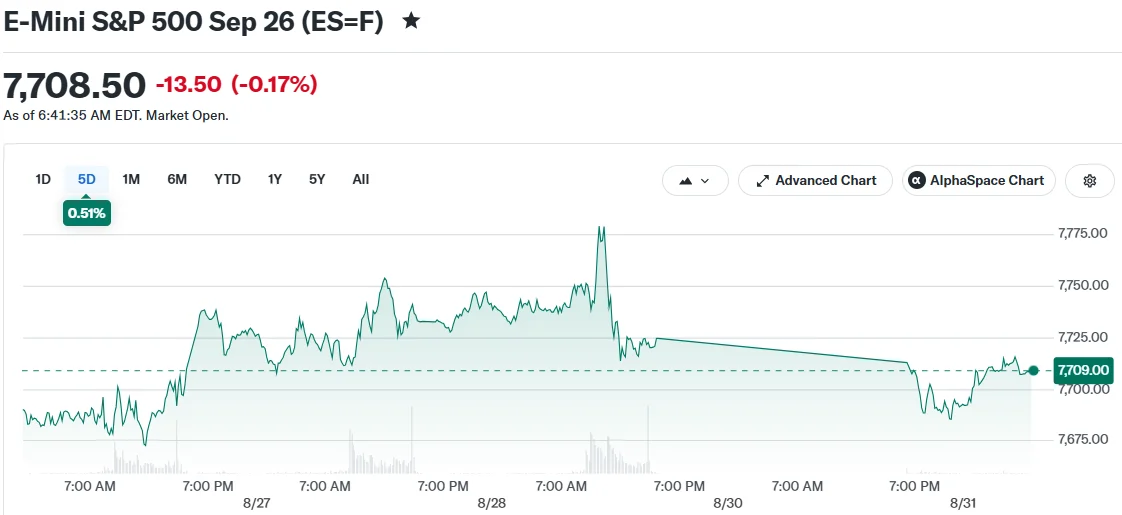
Jackson Hole Remarks Shift Rate Expectations Higher
Federal Reserve policy has taken center stage following Friday’s Jackson Hole speech by Chair Kevin Warsh. Market participants interpreted his remarks as tilting toward tighter monetary conditions, despite the absence of explicit forward guidance.
Probability indicators from the CME FedWatch tool reflected this shift, with September rate hike chances climbing from 35% to 60% immediately following Warsh’s address. The Fed Chair emphasized that inflation pressures persist and suggested current policy settings remain relatively accommodative.
BlackRock’s Rick Rieder characterized the speech as leaning “hawkish” while noting that a September increase remains uncertain. Additional economic indicators, particularly employment and inflation metrics, will arrive before the central bank convenes.
The Bureau of Labor Statistics will release August employment figures Friday morning at 8:30 a.m. Eastern Time. July’s report showed an unexpected contraction of 23,000 positions, while the unemployment rate registered 4.1%, marginally better than projections.
ING’s chief economist James Knightley anticipates modest improvement with approximately 65,000 new positions in August. His analysis points to trade policy uncertainty and elevated financing costs as factors constraining employment growth.
Workforce participation rates have declined as well, attributed partly to immigration policy shifts and individuals exiting the labor market altogether.
Technology and Retail Companies Take Center Stage
Dell kicks off Tuesday’s earnings calendar. During its previous quarter, the company reported a remarkable 750% annual increase in AI-optimized server revenue and raised full-year projections. Broadcom and Hewlett Packard Enterprise follow on Wednesday, with analysts focused on continued momentum in AI infrastructure spending.
Palo Alto Networks delivers results Tuesday as well. The cybersecurity leader exceeded Wall Street estimates in its most recent quarter while providing encouraging forward guidance.
Among consumer-oriented businesses, Five Below announces results Wednesday. The value retailer surpassed expectations during the spring period as budget-conscious consumers sought affordability. Lululemon follows Thursday after reducing its outlook during June. Heidi O’Neill, a Nike veteran, officially becomes CEO on September 8.
Historic Transition at Apple
Tim Cook’s tenure as Apple chief executive concludes this week as John Ternus formally assumes control. Under Cook’s leadership, the technology giant’s valuation expanded from $350 billion to a range of $4 trillion to $5 trillion.
Ternus previously served as Apple’s senior vice president overseeing hardware engineering operations.
Additional events include the Federal Reserve’s Beige Book publication on Wednesday and Tesla’s Thursday presentation in Austin, where the electric vehicle manufacturer is anticipated to reveal further information about its autonomous Cybercab taxi service.
Friday’s employment report remains the week’s most significant event, given its potential to shape Federal Reserve policy decisions for September.
The post Markets Brace for Critical Jobs Data as Fed Rate Decision Looms appeared first on Blockonomi.
Key Takeaways
- Gold has surged approximately 10% during August, marking its most robust monthly performance since January
- Federal Reserve Chair Kevin Warsh’s aggressive inflation stance catalyzed a 3.2% decline on Friday
- Futures markets currently assign a 57% probability to a September interest rate increase, creating headwinds for gold
- Escalating crude oil values following U.S.-Iran military confrontations are intensifying inflation worries
- Earlier Treasury bond-buying operations this month contributed momentum to August’s strong performance
Gold experienced downward pressure Monday as market participants assessed the Federal Reserve’s most recent monetary policy indications. Notwithstanding this retreat, the precious metal remains positioned for its strongest monthly showing since January, climbing roughly 10% throughout August.
During Monday’s trading session, spot gold declined 0.4% to settle at $4,438.30 per ounce. Meanwhile, gold futures contracts decreased 0.9% to reach $4,488.41.
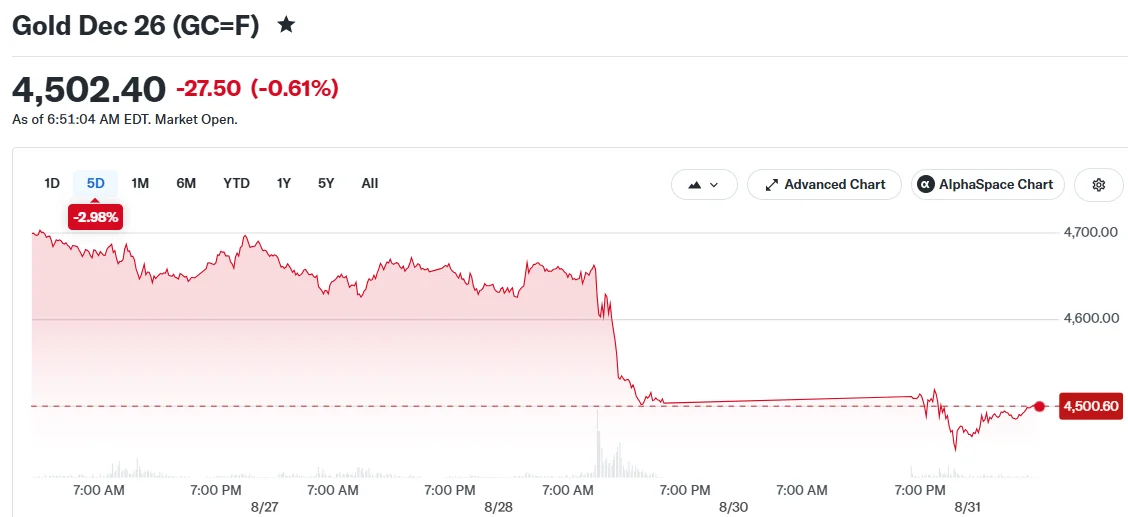
This downturn follows Friday’s substantial 3.2% plunge, representing gold’s steepest single-session loss since the beginning of June. The Friday selloff materialized after Federal Reserve Chair Kevin Warsh communicated at Jackson Hole that the central bank maintains additional responsibilities in reducing inflation toward its 2% objective.
Market Reprices September Rate Increase Likelihood
Warsh’s Jackson Hole statements rapidly transformed market sentiment. Trading activity now reflects approximately 57% odds favoring a September interest rate elevation, based on CME’s FedWatch analytical tool.
Since gold generates no yield, anticipated interest rate elevations enhance the relative appeal of bonds and alternative income-producing instruments. This expectation adjustment redirects investment capital away from precious metals.
Dollar strength, which materialized following Warsh’s statements, additionally constrains gold valuations. Dollar appreciation increases gold’s cost for international purchasers utilizing alternative currencies.
ANZ research professionals attributed the pullback directly to Warsh’s cautionary messaging. Nevertheless, they anticipate limited downside potential, maintaining that gold’s fundamental long-term investment rationale persists.
The benchmark 10-year Treasury yield hovered around 4.71% Monday morning, per ING commodities analyst Ewa Manthey. She noted that ongoing inflationary pressures combined with additional rate increase possibilities could sustain downward pressure on precious metals.
Treasury Operations and Energy Markets Influence Dynamics
Gold’s impressive August advance received support earlier this month following the U.S. Treasury’s unanticipated expansion of longer-maturity government bond acquisitions. This action suppressed yields while simultaneously pressuring the dollar downward.
The Treasury intervention simultaneously heightened apprehensions regarding expanding government obligations and whether strategies aimed at managing borrowing expenses might erode confidence in U.S.-denominated assets. This development reinvigorated the currency debasement investment narrative.
The debasement investment thesis powered gold’s approximately 65% appreciation throughout 2025. Market participants accumulated gold positions as protection against fiscal deficits, monetary depreciation, and diminishing real purchasing capacity.
Oil prices introduced additional complexity to the situation. Brent crude advanced to approximately $89.38 per barrel while U.S. crude achieved $84.50 following American military operations targeting Iranian launch facilities on Larak Island Sunday. Iran subsequently allegedly counterattacked U.S. personnel in Jordan, heightening concerns regarding broader regional conflict that could sustain elevated energy costs.
Elevated crude prices contribute to inflationary dynamics, thereby complicating the Federal Reserve’s policy trajectory and maintaining elevated rate increase expectations.
Gold had staged an impressive recovery from late June’s trough near $3,942 before encountering Friday’s sharp reversal. Market participants will now scrutinize forthcoming U.S. employment and inflation releases closely for indications regarding potential September Federal Reserve action.
The post Gold Retreats as Fed Chair Warsh’s Hawkish Stance Revives Rate Hike Expectations appeared first on Blockonomi.
Key Highlights
- Military strikes on Iranian targets in the Strait of Hormuz sent oil prices surging more than 2%
- Fed Chair Kevin Warsh’s Jackson Hole remarks sparked concerns about imminent rate increases
- September Fed rate hike odds surged to approximately 57-60%
- Dow futures declined 85 points, while S&P 500 and Nasdaq futures retreated 0.2% before market open
- Global bond yields climbed to multi-year peaks in Japan and Germany amid widespread inflation worries
Major U.S. equity index futures tumbled during Monday’s pre-market session as heightened geopolitical tensions in the Middle East converged with increasingly hawkish Federal Reserve policy signals, shaking investor sentiment on the month’s final trading day.
Futures tied to the Dow Jones Industrial Average slipped 85 points, representing a 0.2% decline. Both S&P 500 and Nasdaq-100 futures similarly retreated 0.2% during early morning trading.
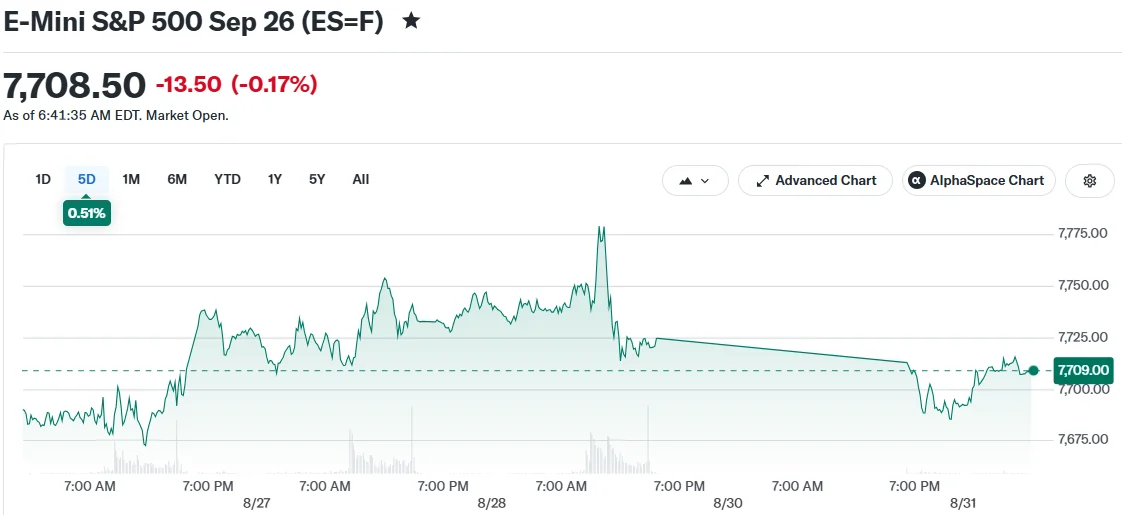
Crude Prices Jump Following Military Action Against Iran
American military forces conducted strikes targeting two Iranian rocket launching facilities located on Larak Island within the strategically vital Strait of Hormuz over the weekend. Tehran retaliated with attacks on U.S. military positions in Jordan and asserted responsibility for striking a commercial tanker in regional waters.
BREAKING:
U.S. official, speaking to Axios:
"Earlier today U.S. forces struck two Iranian launchers on Larak Island.
Islamic Revolutionary Guard Corps forces were observed preparing to launch rockets with sea mines into Strait of Hormuz."
Source: @BarakRavid, Axios,… pic.twitter.com/xyAh2PNU6Z
— Mario Nawfal (@MarioNawfal) August 30, 2026

President Trump announced via social media that Iran’s primary oil export facility on Kharg Island was being “blown to smithereens,” although no official military sources have verified this assertion.
Brent crude advanced 2.3% to reach $90.17 per barrel. West Texas Intermediate gained 2.3% to settle at $85.32. Given that the Strait of Hormuz serves as a critical global energy transportation corridor, any potential disruptions typically trigger swift market reactions.
Rate Hike Expectations Soar Following Warsh Remarks
Federal Reserve Chair Kevin Warsh delivered remarks at the annual Jackson Hole symposium last Friday, indicating that market participants may be underestimating persistent inflation threats. His statements dampened expectations for monetary easing while elevating the likelihood of additional tightening.
Financial markets reacted immediately. The implied probability of a September interest rate increase jumped from approximately 40% one week earlier to between 57-60% by Monday’s opening, based on CME FedWatch tool data.
Barclays analysts revised their forecast to anticipate 25 basis point rate increases at both the September and December Federal Open Market Committee meetings. JPMorgan’s lead U.S. economist characterized the September gathering as “live” while maintaining an expectation for the initial hike to occur in December.
Two-year Treasury note yields stabilized at 4.34% following a sharp 12 basis point surge on Friday. Japan’s equivalent 2-year government bond yield touched a 31-year peak. Germany’s 2-year yield climbed to levels not witnessed since July 2024.
Elevated interest rate projections typically weigh on equity valuations, particularly impacting growth-oriented and technology sector stocks, which accounts for Monday’s early session weakness.
Notwithstanding Monday’s retreat, August has delivered positive performance overall. The Dow has climbed 2% during the month and appears positioned for a fifth consecutive monthly advance. The S&P 500 has appreciated nearly 3% while the Nasdaq has registered approximately 4% gains.
Critical employment data releases are scheduled for this week, including Tuesday’s JOLTS Job Openings report and Friday’s comprehensive U.S. Employment Report. Quarterly earnings announcements from Broadcom and Dell Technologies will also draw attention as investors assess ongoing artificial intelligence infrastructure investment trends.
Gold declined 0.3% to $4,437 per ounce but maintains approximately 10% gains for August.
The post Stock Futures Slide as Middle East Tensions and Fed Hawkishness Weigh on Markets appeared first on Blockonomi.
Key Highlights
- BYD shares tumbled close to 5% in Hong Kong trading following disclosure of a 20.5% decline in first-half net profit to 12.33 billion yuan
- Revenue for the first six months declined 7.1% to 344.82 billion yuan, pressured by softening domestic market conditions and intense industry rivalry
- Second-quarter net profit climbed 30% year over year to 8.2 billion yuan, providing positive momentum within the broader results
- International revenue reached 181.27 billion yuan, representing over 52% of total first-half revenue—a milestone achievement
- Citi projects annual net profit of 41.2 billion yuan, approximately 8% higher than current market expectations
BYD shares declined nearly 5% during Monday’s Hong Kong trading session after the Chinese electric vehicle manufacturer revealed a significant downturn in first-half financial performance, reflecting difficult conditions in its home market.
BYD Company Limited, BYDDF
The shares retreated to approximately HK$86.65, positioning the company among the Hang Seng index’s largest decliners, with the benchmark down 0.4% for the session.
During the first six months ending June 30, 2026, net profit attributable to shareholders contracted 20.5% year over year to 12.33 billion yuan ($1.83 billion). Total revenue decreased 7.1% to 344.82 billion yuan.
BYD identified “sluggish domestic demand and robust export growth” as defining characteristics of the reporting period. Escalating expenses for commodities, raw materials, and semiconductor components also compressed profit margins throughout the sector.
China’s electric vehicle sector has faced headwinds throughout the past year following Beijing’s reduction of certain trade-in incentive programs. Domestic consumers have adopted a more conservative spending approach, forcing EV manufacturers to implement aggressive pricing reductions to maintain sales momentum. While this tactic boosted unit sales, it negatively impacted bottom-line profitability.
Looking beyond the overall figures, the second quarter presented a more encouraging narrative. Net profit for Q2 totaled 8.2 billion yuan, representing a 30% increase compared to the prior-year period, according to Citi analysis. Second-quarter revenue stood at 194.6 billion yuan, declining only 3% year on year.
International Operations Emerge as Primary Revenue Source
BYD’s global expansion has evolved into a critical component of its business narrative. International revenue totaled 181.27 billion yuan during the first half, comprising more than 52% of consolidated revenue. This represents the first instance where overseas sales have surpassed domestic revenue generation.
Export volumes surged 67.8% year on year to 792,000 vehicles in the first six months. The company has identified international market penetration as its primary growth catalyst, and these figures demonstrate meaningful progress in executing that strategic vision.
Upmarket Brands Deliver Strong Domestic Performance
Within China’s borders, BYD’s premium brand portfolio demonstrated resilience. Aggregate sales across FANGCHENGBAO, Denza, and Yangwang increased 61% year on year during the first half, representing 12.8% of the group’s total passenger vehicle deliveries.
This expansion illustrates BYD’s successful positioning in higher price segments domestically, even as the mainstream market category faces ongoing competitive pressures.
Citi anticipates BYD’s third-quarter core earnings will total 13.5 billion yuan. The financial institution projects full-year net profit of 41.2 billion yuan, representing approximately 8% above prevailing market consensus estimates.
BYD’s first-half international revenue of 181.27 billion yuan surpassing domestic revenue represents a fundamental transformation in the company’s geographic earnings composition.
The post BYD (BYDDF) Shares Tumble 5% Following 20% Decline in First-Half Earnings appeared first on Blockonomi.
HTTP error 429 on https://cryptopotato.com/feed/
Failed to fetch feed: https://cryptopotato.com/feed/
Failed to fetch feed.