Cryptocurrency Posts
Crypto Briefing
Aave's dominance in DeFi lending highlights the growing centralization within decentralized finance, impacting market dynamics and competition.
The post Aave accounts for 48% of active loans as DeFi lending surges 30% to $26.1B appeared first on Crypto Briefing.
The economy's resilience may be overshadowed by looming debt challenges, potentially straining fiscal policies and investor confidence.
The post Richmond Fed’s Tom Barkin highlights resilience in real economy, but warns of debt ‘reckoning’ appeared first on Crypto Briefing.
The widening US-Japan rate gap may trigger capital shifts, impacting global bond markets and pressuring Japan's economic stability.
The post Japanese bonds and yen pressured after Jackson Hole meeting appeared first on Crypto Briefing.
AI-driven cyber risks could destabilize global finance, highlighting urgent need for robust regulatory frameworks and diversified tech reliance.
The post Financial Stability Board warns AI-driven cyber risk threatens global stability appeared first on Crypto Briefing.
The surge in crypto token buybacks highlights a growing trend of supply compression strategies, potentially stabilizing token values and attracting investors.
The post Hyperliquid and pump.fun lead $640M crypto token buyback surge appeared first on Crypto Briefing.
Bitcoin Magazine
Bitcoin Magazine
Bitcoin Cools Off After $3 Billion ETF-Driven Surge
Bitcoin slid Friday afternoon, cooling down after a phenomenal run following huge investment from U.S. ETF buyers.
The leading cryptocurrency was trading for $77,379 on Friday afternoon in New York after dropping more than 3% over a 24-hour period.
Bitcoin hit a high this week of $81,281 but slowed down after Federal Reserve Chair Kevin Warsh gave his first major speech as head of the central bank — saying on Friday that he had “more work to do” to fight inflation.
The Bitcoin price has in the past dropped when the Federal Reserve thinks inflation is too high because it means less chance of a rate cut; the leading cryptocurrency typically does better in a low-interest rate environment.
JUST IN:
— Bitcoin Magazine (@BitcoinMagazine) August 28, 2026U.S. Bitcoin ETFs have brought in $1.14 billion in inflows this week.
Over $3 billion has been added in the past 9 days!pic.twitter.com/ri1jE7enTZ
Bitcoin started surging last week after the U.S. Treasury would at least double the size of its liquidity-support buyback operations. The announcement last week hurt the dollar but non-yielding assets have benefited.
Exchange-traded funds, managed by the likes of BlackRock, Fidelity, and Grayscale have received net positive inflows for nine days in a row, according to Farside Investors data. Last week was their best week since October — when bitcoin hit a new all-time high — and that run has continued into this week.
Since August 17, investors have thrown over $3 billion at the funds. BlackRock’s iShares Bitcoin Trust received the lion’s share of the investment, but Morgan Stanley’s new Bitcoin Trust — which debuted this year — also experienced significant inflows.
Analysts have said that the so-called debasement trade — when investors buy an asset as a way to hedge against a currency losing value — was leading investors to eye-up bitcoin again.
Investors taking part in the trade think that bitcoin, gold and other precious metals are a good way to protect themselves from excessive government spending.
Total U.S. debt crossed $40 trillion for the first time this month.
This post Bitcoin Cools Off After $3 Billion ETF-Driven Surge first appeared on Bitcoin Magazine and is written by Mathew Di Salvo.
Bitcoin Magazine
Debasement Trade Is Here Thanks to Government Debt — And Bitcoin Will Benefit: Grayscale
The debasement trade is back — and will benefit bitcoin.
That’s according to asset manager Grayscale’s crypto research team, who wrote in a note this week that the U.S. government debasing its currency would lead to cash hitting digital assets.
“Unchecked government debt growth undermines the credibility of fiat currencies and drives investors to seek out alternative stores of value like physical gold and certain cryptocurrencies,” the note by the firm’s head of research, Zach Pandl, read, adding that primarily bitcoin would benefit.
The so-called debasement trade is when investors buy an asset as a way to hedge against a currency losing value. The trade was hot last year, and helped bitcoin’s run, but the digital asset’s run lost steam after October as traders turned their attention to stocks related to artificial intelligence.
But since last week, bitcoin has benefited from news that the U.S. Treasury would at least double the size of its liquidity-support buyback operations. The announcement last week hurt the dollar but non-yielding assets have benefited.
“That buybacks are needed at all is the problem: heavy growth in government debt is driving up the cost of borrowing,” the note continued. “The Treasury is treating the symptoms (rising bond yields) because they cannot cure the disease (structural deficits).”
The note added that on the same day last week as the buyback announcement, the Treasury also said the U.S. public debt exceeded $40 trillion for the first time.
As debt and interest payments grow, the government needs to either raise taxes, cut spending, or issue more debt.
Bitcoiners see the more politically likely path as expanding the dollar supply — which is ultimately bad for the dollar, and good for scarce assets like bitcoin.
After bitcoin started surging last week, the dollar had its worst week of August and was trading at a three-month low.
Bitcoin was trading for $77,493 on Friday afternoon in New York after hitting a high this week of $81,281. Over a 24-hour period, the coin now sits unmoved, but over a 30-day period, it has jumped by more than 20%.
This post Debasement Trade Is Here Thanks to Government Debt — And Bitcoin Will Benefit: Grayscale first appeared on Bitcoin Magazine and is written by Mathew Di Salvo.
Bitcoin Magazine
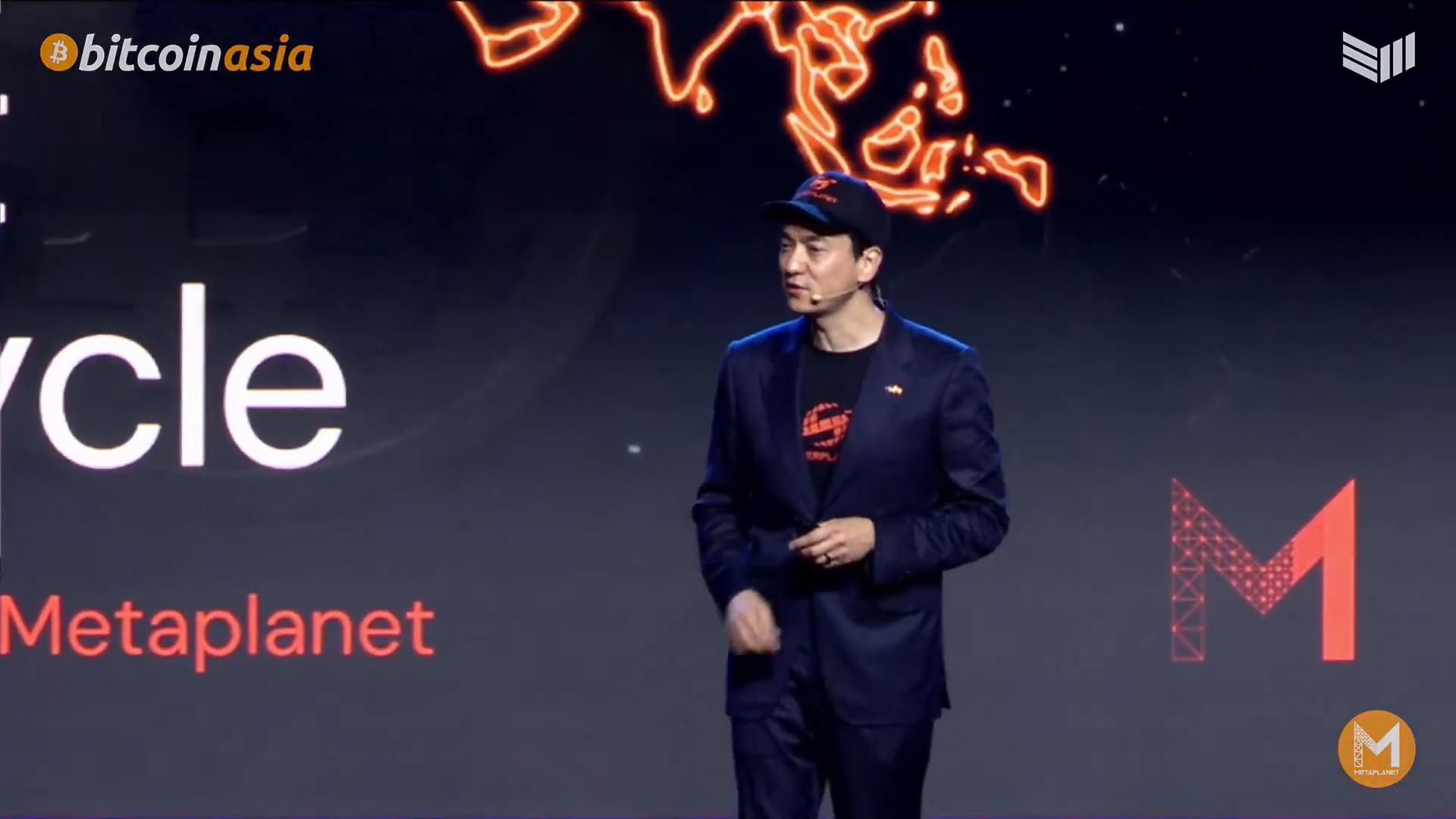
Bitcoin’s Moment Has Come for the Far East, Says Metaplanet CEO
Bitcoin’s time has come in Asia — especially with a changing regulatory landscape — and its people and companies should take advantage.
That was the message Metaplanet CEO Simon Gerovich gave at this year’s Bitcoin Asia conference, where on Friday he spoke of how his company went from failing to the third biggest bitcoin treasury in the world.
Bitcoin Asia kicked off on Thursday in Hong Kong, bringing the biggest names in the space to Hong Kong to talk about everything from treasury companies to building apps from scratch.
JUST IN:
— Bitcoin Magazine (@BitcoinMagazine) August 28, 2026Japanese public company Metaplanet CEO says the bottom for Bitcoin's price is in
"The buyers arriving now aren't going anywhere. I believe the bottom is in. And I'm expecting a much brighter rest of the year."

“The previous cycles belonged to the West, and the first Asian cycle has already started,” Gerovich said. “The only question left is who builds it. Will you?”
Often dubbed Asia’s answer to Nasdaq-listed Bitcoin treasury Strategy, Metaplanet pivoted from its core hotel and technology business to buying Bitcoin in 2024. The Tokyo Stock Exchange now holds 43,000 bitcoins worth about $3.3 billion at today’s prices.
Gerovich said in his speech that his company was small and going nowhere fast until it started putting bitcoin on its balance sheet, basically allowing investors to buy exposure to the biggest digital coin via its regulated shares.
He said that the strategy is a major opportunity for Asian companies, which can now capitalize on the changing regulatory landscape and the growing interest in Bitcoin.
Asian nations, including Japan, Hong Kong, and Singapore, are making regulatory changes to support digital assets.
Gerovich noted that Japan in particular is a country where its citizens have saved like no other part of the world — and that capital can now be put to good use.
“Hoarding cash has stopped making sense, and every household in Japan can now feel it,” he said.
“Japanese households hold roughly 14 trillion dollars in financial assets. About half of that sits in bank deposits, earning almost nothing, and that’s just Japan, add Korea, Southeast Asia, and the wealth managed out of this place, Hong Kong, and you’re looking at the deepest pools of patient savings on Earth.
“And for the first time in a generation, these savings are looking for somewhere to go.”
Gerovich added that Asian companies, institutions, and savers should take advantage of the current market conditions and build the Bitcoin infrastructure in their own regions.
“The end of the cash hoarding strategy and new rules are arriving at exactly the same time, and together, they set up what I think is the single biggest opportunity in Asian markets today,” he added.
This post Bitcoin’s Moment Has Come for the Far East, Says Metaplanet CEO first appeared on Bitcoin Magazine and is written by Mathew Di Salvo.
Bitcoin Magazine
Capital B Raises €21M From Adam Back and TOBAM To Buy More BTC
Capital B, the Euronext Growth-listed company that bills itself as Europe’s first bitcoin treasury company, has raised €21 million ($24 million) in a private placement backed by Blockstream’s Adam Back and asset manager TOBAM — money it says could buy 270 more bitcoin and push its stack to roughly 3,415 BTC.
The company said Friday that a total of 36,219,070 shares were sold at €0.58 each as part of the deal, a 6.45% discount to Wednesday’s closing price.
Capital B said the net proceeds are expected to reach about €19.9 million after fees and transaction costs.
JUST IN:
— Bitcoin Magazine (@BitcoinMagazine) August 28, 2026French company Capital B announces a €21.0 million capital raise to "accelerate its Bitcoin Treasury Company strategy"
Capital B is the 27th biggest publicly traded bitcoin treasury in the world, according to Bitcoin Treasuries, with a total of 3,145 bitcoins in its stash — worth $245 million at today’s bitcoin price of $77,960.
Capital B, which describes itself as Europe’s first bitcoin treasury, built much of that position through fundraising rounds during the first half of 2026.
In May, it acquired 192 coins for €13 million after completing three capital raises.
Capital B’s announcement as other treasuries look to raise funds and accelerate their buys. Just this week, NYSE-listed AI-powered education company Genius Group said it was aiming to build parallel AI and bitcoin treasuries worth a combined $1.6 billion, after the company sold its entire bitcoin reserves to repay $8.5 million in debt.
Bitcoin treasuries have faced headwinds since 2025 when the price of the leading cryptocurrency took a hit. A number of companies in the space have had to liquidate their holdings, including the biggest corporate holder of bitcoin, Nasdaq-listed Strategy.
This post Capital B Raises €21M From Adam Back and TOBAM To Buy More BTC first appeared on Bitcoin Magazine and is written by Mathew Di Salvo.
Bitcoin Magazine
Bitcoin Drops Before Shrugging Off Fed Chair’s Inflation Comments
Bitcoin dropped, then popped after Federal Reserve Chair Kevin Warsh gave his first major speech as head of the U.S. central bank and said he had “more work to do” to fight inflation.
The leading cryptocurrency was recently trading for $79,474 after dropping as low as $78,630 before quickly rising again.
Bitcoin has typically done well in a low interest rate environment but the Federal Reserve has been reluctant to lower borrowing costs due to sticky inflation in the world’s biggest economy.
“But on the price-stability side of our mandate, the numbers are more concerning,” Warsh said after talking about employment.
He added: “We must be confident that underlying inflation is moving to our objective, clearly and at sufficient speed. Otherwise, we have work to do.”
Bitcoin has in the past dropped on news that the Federal Reserve thinks inflation is too high because it means less chance of a rate cut. Following Warsh’s speech, traders priced in a 50% chance of rate hike in September.
But Bitcoin has appeared to — at least for now — shrug off the speech.
Bitcoin’s started surging last week after the U.S. Treasury Secretary Scott Bessent announced the department would double the size of its long-dated bond buybacks.
The news sent yields down lower, and the dollar slid while non-yielding assets like bitcoin and gold jumped.
Positive regulatory news also helped the coin: President Donald Trump last week said that the long-awaited crypto Clarity Act was a “very, very powerful” piece of legislation, and urged lawmakers to get it over the line.
The proposed law will establish a framework for distinguishing between digital assets that are securities, commodities or payment stablecoins — legislation that the crypto industry has long called for.
The Federal Reserve Bank of Kansas City is on Friday holding the annual event at Jackson Hole, Wyoming, where central bankers, Federal Reserve officials, policymakers and academics will gather to discuss “Financial Innovation: Implications for Payments and Policy.”
According to the Federal Reserve Bank of Kansas City website, this year’s event will touch on how “recent years have seen a dramatic increase in innovation in financial intermediation and payments,” including new technologies such as “cryptocurrencies and stablecoins.”
This post Bitcoin Drops Before Shrugging Off Fed Chair’s Inflation Comments first appeared on Bitcoin Magazine and is written by Mathew Di Salvo.
CryptoSlate
Leveraged funds more than doubled their CME XRP net short as open interest surged nearly 40% in one week.
Last week, the Commodity Futures Trading Commission (CFTC) reported that XRP open interest increased by 2,206 from a week earlier, to 7,783 futures-equivalent contracts. At 50,000 XRP per standard contract, the increase represented about 110.3 million tokens and lifted total exposure to roughly 389.2 million XRP.
The expansion came during a sharp recovery in the token. CryptoSlate previously reported that the digital asset had rebounded about 32% from $1 this month, trading near $1.38 as of press time.
Leveraged funds moved against that momentum, holding 892 long contracts and 3,206 shorts. Their net short widened to 2,314 contracts, equivalent to about 115.7 million XRP, from 57.35 million XRP a week earlier.
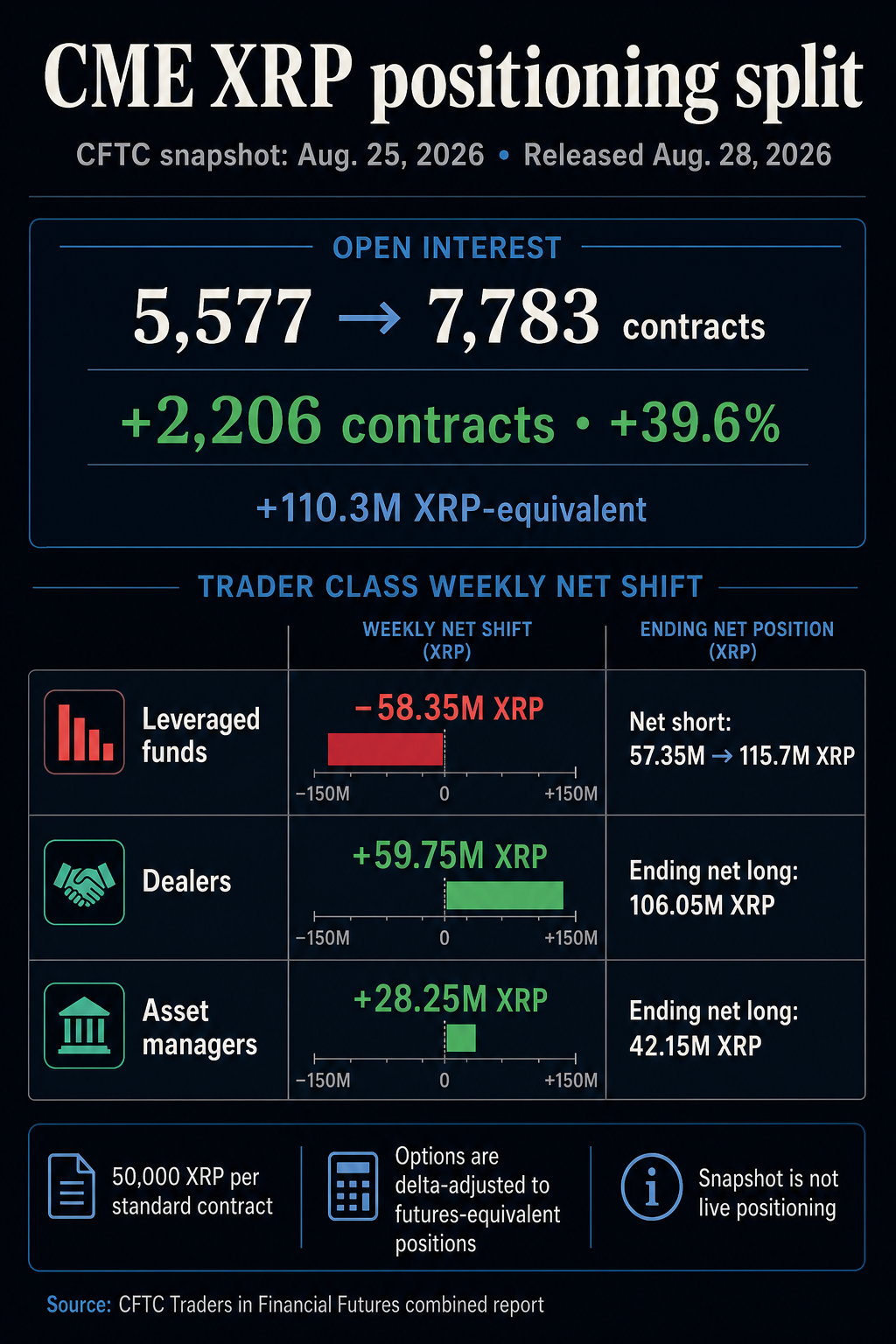
The increase added 58.35 million XRP-equivalent of net short exposure and left leveraged funds with the largest directional short among the reportable CFTC categories.
Dealers and asset managers moved the other way.
Dealers increased their net-long position by 1,195 contracts, equivalent to 59.75 million XRP, ending at 2,121 contracts net long. Asset managers added 565 net contracts, or 28.25 million XRP-equivalent, to finish 843 contracts net long.
The positioning split shows CME’s rapidly expanding XRP market is producing sharply different institutional exposures rather than a uniform view on the token’s direction. The CFTC does not disclose whether leveraged-fund shorts are outright bearish bets or hedges against positions elsewhere.
Their growing exposure nevertheless leaves leveraged funds more vulnerable to another advance of the Ripple-linked token.
This is because the category added 58.35 million token net shorts during a week when the token was already recovering, while dealers and asset managers increased their net longs.
If XRP keeps rising while leveraged funds maintain or expand their short exposure, the gap between price momentum and institutional positioning will widen further. A retreat in those shorts would instead show that the rebound has begun forcing a change in how leveraged funds are positioned.
The post XRP’s next rally could put this 115 million-token short under pressure appeared first on CryptoSlate.
Circle's wrapped Bitcoin product entered the market with unusually strong institutional credentials and almost no visible scale.
The company paired cirBTC with segregated reserves, a federally supervised custodian, direct minting and redemption for eligible businesses, and the distribution infrastructure behind USDC. Circle's Aug. 27 reserve panel nevertheless showed just 40.02450077 cirBTC outstanding about 11 weeks after its Ethereum launch.
The same panel showed 42.5114162 BTC in reserve, equal to about 106.2% coverage and a 2.48691543 BTC cushion across 14 disclosed Bitcoin addresses. The reserve cushion settled the backing question at that snapshot. The 40-token float exposed the harder problem: Circle had built a credible institutional wrapper but had barely begun to build a market around it.
That gap turns cirBTC into a test of a broader Circle thesis. Jeremy Allaire said in the company's second-quarter results that Circle had built “the platform for the internet financial system.” He was describing Circle's larger platform, including its trust charter, USDC and planned Arc network. cirBTC now has to show whether that infrastructure can produce the liquidity and integrations that make wrapped Bitcoin useful as collateral.
A 40-BTC float enters a market measured in six figures
cirBTC is Circle's tokenized representation of Bitcoin on Ethereum. WBTC and Coinbase's cbBTC serve the same basic purpose, allowing Bitcoin value to move through smart-contract networks, but their scale makes the competitive gap stark.
| Token | Outstanding supply at check | Underlying BTC reserves | Scale versus cirBTC |
|---|---|---|---|
| cirBTC | 40.02450077 | 42.5114162 | 1x |
| WBTC | 116,499.2018 | 116,512.0029 | About 2,911x |
| cbBTC | 98,668.19 | 98,678.96 | About 2,465x |
The cirBTC figures are from Aug. 27. The WBTC transparency dashboard and Coinbase's cbBTC reserve page were checked Aug. 29, making this a close two-day comparison. Coinbase's total covered cbBTC across Ethereum, Base, Solana and Arbitrum and was counted once, avoiding double-counting of its multichain representations.
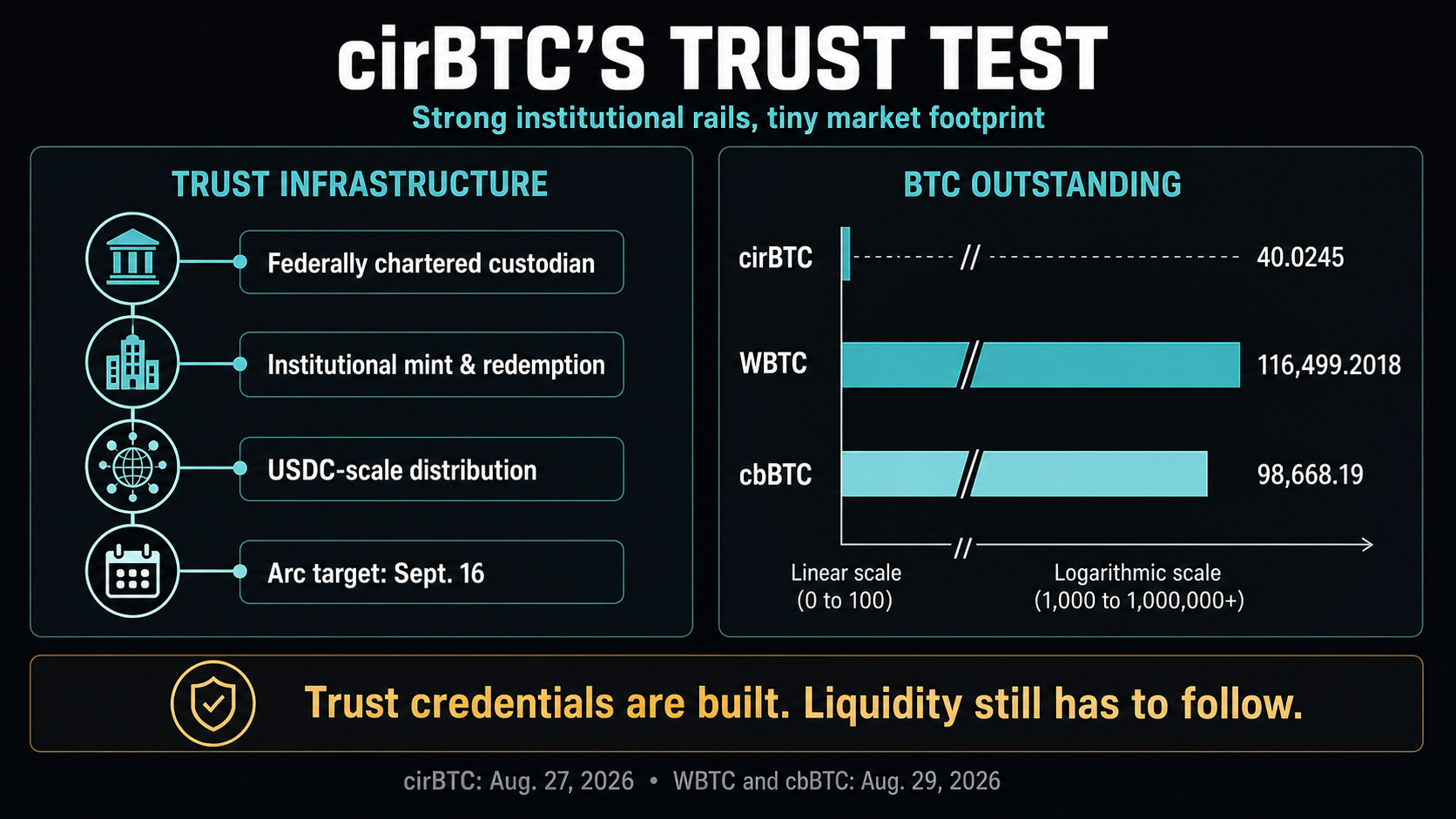
Supply is only one measure of a wrapped token's usefulness, but it is also evidence of distribution. Each token in circulation reflects demand to mint, acquire or deploy that representation of Bitcoin. The incumbents' six-figure supplies give venues and protocols far larger pools from which to build trading and lending markets.
Public activity data reinforced the scale difference. At the Aug. 29 check, DefiLlama showed about $110.49 million in 24-hour WBTC trading volume and $3.12 billion in maximum observed lending exposure. Its cbBTC page showed about $338.55 million of volume and $2.817 billion in maximum observed lending exposure. Those exposure figures describe DefiLlama's recorded maxima, rather than live lending balances or market share.
CoinGecko's verified cirBTC contract page showed no tracked 24-hour trading volume, liquidity or transactions. CoinGecko captures public tracked activity, leaving private, over-the-counter or untracked flows outside that observation. Its empty market fields still showed that cirBTC had yet to develop visible liquidity on a major public tracker.
A public Aave governance proposal sought to onboard cirBTC. The proposal status meant live collateral support, borrowing demand and risk parameters remained pending. For institutions, prospective support becomes useful only when positions can be opened, financed and unwound through functioning markets.
Circle's integrated stack combines trust with platform control
The adoption gap stands out because cirBTC arrived with a deliberately formal operating structure.
Circle's whitepaper identifies Circle International Bermuda Limited as the legal issuer. Circle National Trust holds the underlying Bitcoin as custodian, while Circle Internet Financial, LLC provides Circle Mint and related distribution services. The Ethereum token is an eight-decimal ERC-20 at 0x72DFB2E44f59C5AD2bAFE84314E5b99a7cd5075E, an identity also reflected on Etherscan.
Circle National Trust received final approval from the Office of the Comptroller of the Currency in July. The approval applied to the national trust bank, not to cirBTC as a separately approved financial product. It gave Circle a recognizable custody credential: underlying Bitcoin held by a federally chartered trust bank, paired with an issuer-operated transparency panel and direct conversion for qualified customers.
Circle Mint is designed for eligible institutions and is unavailable to individuals. Secondary-market users can transfer the ERC-20 token, while direct issuance and redemption depend on institutional eligibility, supported jurisdictions and Circle's compliance process.
That model may appeal to regulated funds and businesses that value a known redemption counterparty. It also creates a more selective path to primary-market access. WBTC and cbBTC already sit inside established exchange, wallet and lending networks. cirBTC needs dealers, market makers, protocols and custodial platforms to add another Bitcoin representation before its trust architecture can become useful collateral at scale.
Circle brings substantial distribution experience to that challenge. It reported $73.3 billion of USDC in circulation at the end of the second quarter and $14.8 trillion of USDC onchain transaction volume during the period. Those figures establish Circle's ability to operate a large token network. Demand for cirBTC will depend on whether venues and customers find comparable utility in its Bitcoin product.
Circle argues that wrapped Bitcoin should be “strategically neutral.” In its Aug. 11 thesis, the company focused on conflicts that can arise when a wrapped asset is controlled by an operator with its own centralized exchange, decentralized exchange or lending protocol. Under that definition, Circle can pursue broad distribution without steering users toward an affiliated trading or lending venue.
The operating structure defines neutrality as a commercial rather than structural condition. Circle-affiliated entities occupy each major point in cirBTC's design: issuance, custody, direct redemption and distribution. Circle also supplies USDC, the dollar liquidity that could pair with cirBTC, and is building Arc, a network that may become another venue for the token.
Circle can therefore claim commercial neutrality among third-party venues while retaining an integrated operating stack. Institutions may see that concentration as efficient accountability or as platform dependence. Adoption will decide which interpretation carries more weight.
The current numbers show that trust credentials have yet to overcome incumbent network effects. A reserve dashboard establishes backing. A collateral standard also needs broad acceptance, borrowing demand, deep trading and inexpensive redemption.
Arc gives Circle a future distribution checkpoint
Arc could connect Circle's custody, stablecoin and wrapped Bitcoin products inside one settlement environment. Circle said the network's public mainnet was on track for Sept. 16, with more than 100 builders and a validator cohort that included major financial and payments companies.
The Aug. 29 reporting cutoff came before that scheduled launch. Circle's cirBTC documentation described Arc testnet support and broader Arc availability as forthcoming, leaving cirBTC's day-one public-mainnet availability unconfirmed.
Arc is therefore a future checkpoint rather than evidence of present distribution. Live cirBTC support, USDC markets, institutional participants and borrowing or trading integrations would shorten the route from minting to utility. Continued supply near 40 BTC after those rails arrive would make the gap between Circle's infrastructure and cirBTC adoption harder to explain as an early-launch condition.
For now, Circle's reserve panel supports two simultaneous conclusions. cirBTC was backed by more Bitcoin than Circle had issued, validating the disclosed reserve position at that moment. Relative to the dominant alternatives, almost nobody had minted it.
Circle has built the institutional plumbing. cirBTC still has to prove that users, venues and protocols want to connect to it.
The post CEO Jeremy Allaire says Circle built “the platform for the internet financial system”, but cirBTC has only 40 BTC appeared first on CryptoSlate.
Stablecoin demand is becoming consequential in the U.S. government debt market, but the maturity of that demand matters more than the headline total.
Washington now has two debt-market stories running at once. The federal framework for permitted payment stablecoins channels reserves into cash-like instruments and Treasuries with no more than 93 days remaining. Farther out on the curve, the Treasury Department said on Aug. 19 that it would at least double the maximum size of liquidity-support buybacks in the 10- to 20-year and 20- to 30-year nominal sectors beginning Sept. 9.
Together, those developments test a broad claim about digital dollars funding the United States. Stablecoin growth can reinforce demand for bills and overnight Treasury financing. Direct support for long-duration bonds remains outside the reserve mandate, while any connection to Bitcoin runs through wider financial conditions rather than a reserve trade.
The 93-day wall defines the stablecoin bid
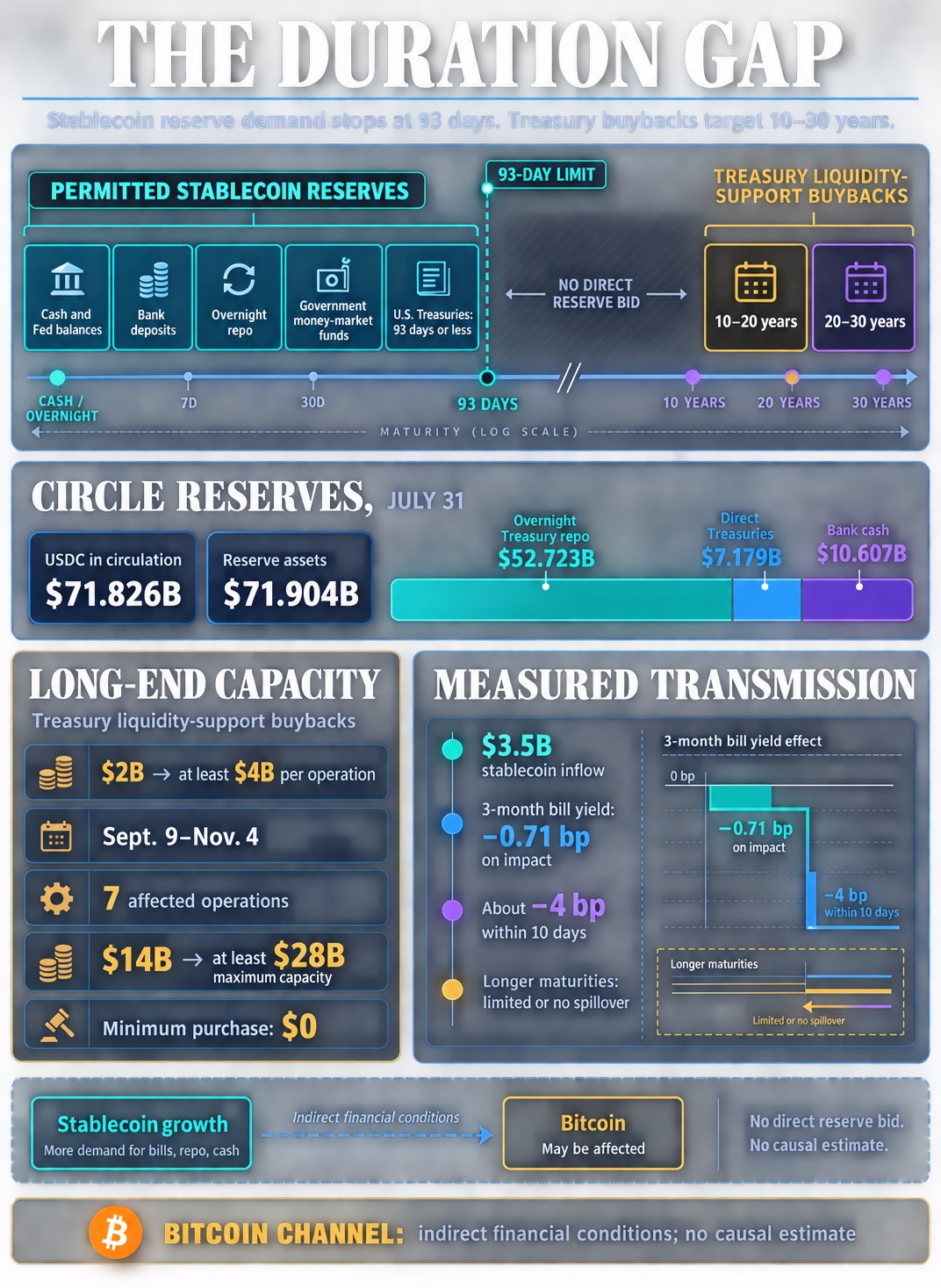
The GENIUS Act requires permitted issuers to maintain identifiable reserves of at least one dollar for every payment stablecoin outstanding. Eligible assets include U.S. currency and Federal Reserve balances, withdrawable bank deposits, Treasuries with an original or remaining maturity of 93 days or less, qualifying overnight repo and reverse repo, government money-market funds invested in those instruments, regulator-approved similarly liquid federal assets, and qualifying tokenized versions.
The menu extends beyond Treasury bills, yet it remains built around liquidity and short duration. A newly issued 10-year note or 30-year bond falls outside the direct Treasury reserve category.
Implementation is still in progress. The law was enacted in July 2025, but its general effective date is the earlier of Jan. 18, 2027, or 120 days after final implementing rules. The Office of the Comptroller of the Currency issued its framework as a proposal in February. On Aug. 19, the Comptroller said the final OCC rule was expected by November. Current issuer portfolios show how short-duration reserves work in practice; they do not establish that every issuer already operates under a completed federal regime.
| Claim | Relevant market segment | Primary evidence | What it supports | What it leaves unresolved |
|---|---|---|---|---|
| GENIUS reserves favor cash-like assets | Cash, deposits, overnight repo and Treasuries at or below 93 days | Official statute | A direct front-end demand channel | Demand for 10- to 30-year bonds |
| Circle's reserves are short duration | Overnight Treasury repo, short Treasuries and bank cash | July USDC reserve report) | A large issuer already uses a cash-like mix | How much reserve growth is new Treasury demand |
| Treasury is expanding long-end buybacks | Off-the-run 10- to 30-year nominal coupons | Treasury announcement | More potential liquidity support for long bonds | A guaranteed purchase total or central-bank easing |
| Stablecoin flows move bill yields | Three-month Treasury bills | BIS working paper | A measurable front-end price effect | Reliable transmission to longer maturities or Bitcoin |
Circle provides a live example of short-duration reserve behavior rather than proof of systemwide demand. Its second-quarter filing put USDC circulation at $73.269 billion on June 30. A more detailed July assurance report) showed $71.826 billion in circulation and $71.904 billion of reserve assets on July 31.
Of that reserve, $60.717 billion sat in the Circle Reserve Fund, including $52.723 billion of overnight Treasury repo and $7.179 billion of Treasuries. Another $11.187 billion was held outside the fund, dominated by $10.607 billion of cash at regulated financial institutions. Every direct Treasury listed in the report matured by Sept. 22. The repo exposure involved lending cash against Treasury collateral. Both categories kept Circle's duration close to the front end of the market.
Those balances show the scale and boundary of the bid. Additional USDC can direct more cash toward bills, repo or bank deposits. The destination depends on the issuer's reserve allocation, and long coupons remain outside the direct channel.
The flow data add a second constraint: stablecoin market growth and fresh federal financing are different quantities. Circle customers minted $83.004 billion of USDC and redeemed $86.784 billion during the second quarter, leaving $3.780 billion of net redemptions. Quarter-end circulation was still 19% above a year earlier, but it stood about $2 billion below December. Gross issuance measures activity, and even net growth leaves the source of the dollars unknown.
The Treasury Borrowing Advisory Committee, a private-sector group that advises Treasury on debt management, has drawn the same distinction. Stablecoin issuance could add short-maturity Treasury demand. Part of that effect may be displaced when users move balances out of bank deposits, money-market funds or other cash-like instruments that already finance bills. Demand from new offshore dollar users would be more additive, but the official evidence does not quantify that share.
Stablecoins can therefore change which balance sheet holds a bill without giving Treasury a wholly new lender for every dollar of token growth.
Long-end buybacks address a separate market
Treasury's planned operations target off-the-run nominal coupons in the 10- to 20-year and 20- to 30-year sectors. The department described the purpose as liquidity support: providing dealers and investors a predictable outlet for older securities that may trade less readily than the newest issue.
The tentative calendar lists seven affected long-end operations on Sept. 10, Sept. 24, Oct. 1, Oct. 8, Oct. 15, Oct. 27 and Nov. 4. Raising each maximum from $2 billion to at least $4 billion lifts aggregate capacity across those operations from $14 billion to at least $28 billion.
That figure is a ceiling. Treasury's buyback guidance sets the minimum for an operation at zero and allows the department to accept less than the maximum when offers are unattractive.
The program also differs from quantitative easing. Treasury retires the securities it accepts and finances buybacks like other outlays. All else equal, each dollar bought back requires another dollar of Treasury issuance. The department can choose the mix of bills and coupons used to meet its overall financing needs. Stablecoin demand could absorb part of the bill component if that mix leans toward the front end, but the government's borrowing requirement remains and stablecoin reserves never enter the long-bond buyback as direct purchasers.
Empirical work reinforces the maturity divide. A Bank for International Settlements working paper using data through March 2026 found that a $3.5 billion stablecoin inflow lowered three-month bill yields by 0.71 basis points on impact, about 4 basis points within 10 days and roughly 5 basis points at the estimated trough. The effect strengthened under some conditions of market stress and bill scarcity.
Longer maturities showed limited or no spillover in the same research. That pattern fits the assets issuers buy: cash placed into securities that mature within weeks can compress bill yields while leaving investors to bear the duration risk in 10-, 20- and 30-year debt.
The official yield curve offers current context rather than causal proof. On Aug. 28, Treasury data put the 10-year yield at 4.73%, the 20-year at 5.21% and the 30-year at 5.22%. Each maturity sits far beyond the GENIUS ceiling for direct Treasury reserve assets. The levels reflect many forces; they simply locate the part of the curve where a direct stablecoin bid is absent.
Bitcoin feels the curve only through indirect channels
For Bitcoin, the defensible mechanism begins with broad financial conditions. Long-term Treasury yields can influence credit costs, the discount rates applied to risky assets and investors' appetite for volatile positions. Better trading conditions in older long bonds can improve market functioning, while a larger bill buyer base can support Treasury's front-end financing.
Those links create a possible macro channel, not a mechanical price signal. A stablecoin inflow may compress bill yields without lowering long-term yields. A Treasury buyback may improve liquidity without reducing net borrowing. Bitcoin can respond to changes in rates, dollar liquidity and risk appetite while moving for many unrelated reasons at the same time.
The evidence here provides no causal estimate connecting stablecoin flows, long-end buybacks or long yields to the price of Bitcoin. It therefore supports no fixed prediction for BTC from either stablecoin growth or the expanded buyback schedule.
The measurable conclusion is narrower. Stablecoins can become a larger source of demand for Washington's bills, especially when growth represents new dollar demand. The long-bond market still depends on investors willing to hold duration, leaving Treasury's liquidity operations and Bitcoin's financial-conditions channel separate from the regulated stablecoin reserve bid.
The post US treasury relies on stablecoins to fund short-term debt, but they can’t fix its $28B long-bond problem appeared first on CryptoSlate.
BitGo's NYDIG deal transfers its institutional trading business to the digital-asset custody and trading infrastructure provider, while NYDIG says it is concentrating resources on power, Bitcoin mining and high-performance-computing data centers.
The closing terms disclosed by BitGo put roughly $42.5 million of consideration upfront. BitGo is adding an institutional team, client relationships and financial products around its custody and settlement platform. NYDIG is directing attention toward a company-described power-and-compute footprint exceeding 3 GW.
The deal makes each company’s resource allocation clear while leaving the margin comparison unresolved. BitGo’s filings show that very large digital-asset sales can carry a thin gross spread. NYDIG describes a large infrastructure footprint without disclosing the returns attached to it. The useful comparison is between the proof points each side must deliver.
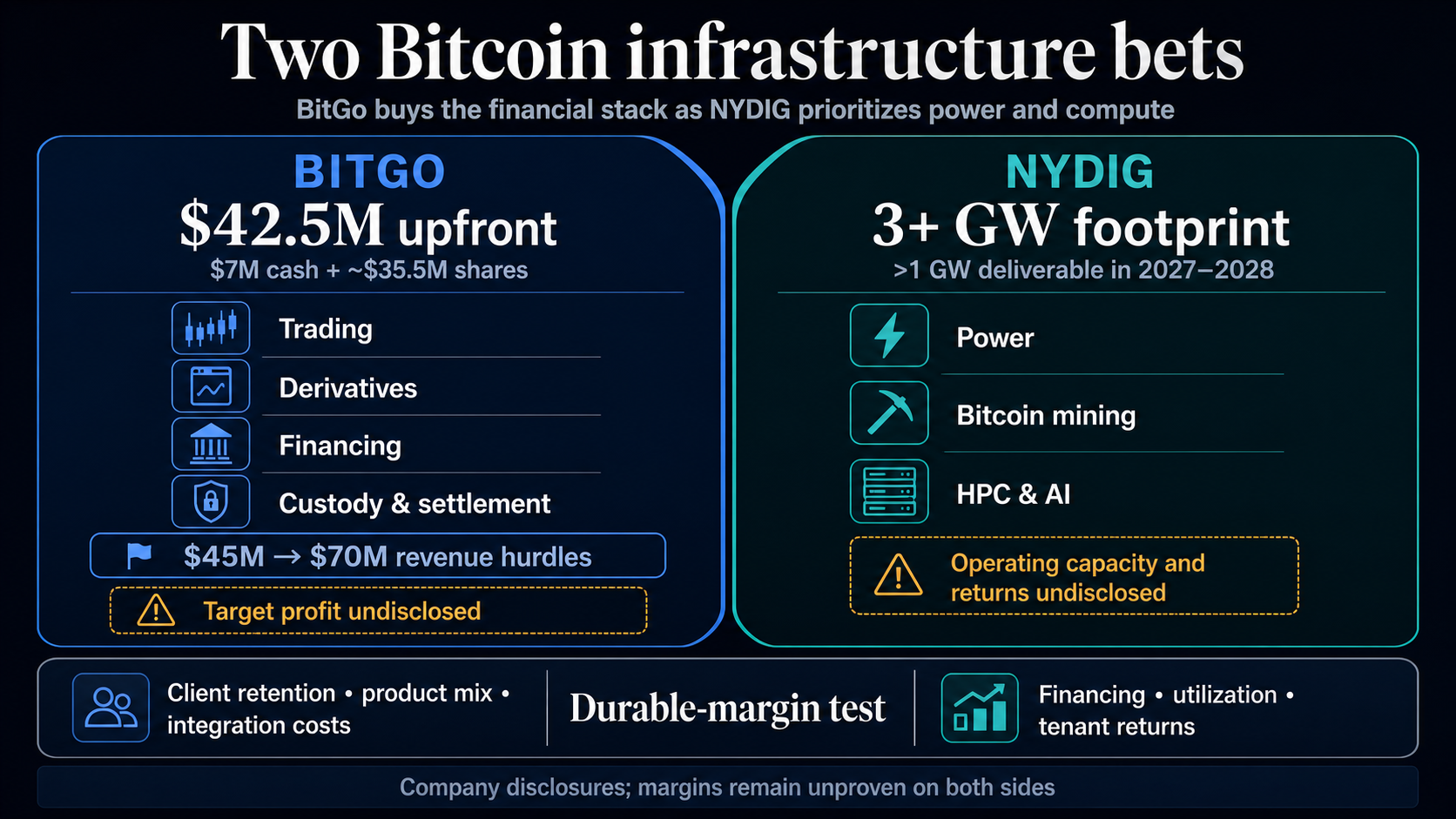
What the BitGo NYDIG deal discloses, and leaves unresolved
The merger agreement defines the acquired business as spot and derivatives trading, virtual-currency asset management, borrowing and lending, and loan servicing. It explicitly excludes NYDIG’s Bitcoin mining and custody businesses, keeping the power-and-compute footprint outside BitGo’s purchase.
Approximately 30 NYDIG employees and institutional client trading relationships joined BitGo, according to the deal announcement. The team adds derivatives, structured products, financing and capital-markets capabilities to a platform that already offers institutional custody, trading and settlement.
The upfront consideration consists of $7 million in cash, subject to holdback and adjustments, plus 5,933,577 BitGo shares. The agreement uses a $5.9829 reference price, which values those closing shares at about $35.5 million and brings the disclosed upfront amount to roughly $42.5 million before cash adjustments.
The seller can receive more. A first earn-out pays $10 million in cash. A second provides $5 million in cash plus 835,715 BitGo shares, worth roughly another $5 million at the agreement reference price. Separate awards targeting $10 million are intended for transferred employees rather than the seller, so they sit outside the seller’s purchase price.
Those earn-outs are tied to trailing-12-month revenue hurdles of $45 million and $70 million through February 2028. The thresholds create a visible growth test for the acquired business. Expenses tied to reaching either mark remain undisclosed, leaving profitability and any margin improvement for later results to establish.
| What is disclosed | What remains undisclosed |
|---|---|
| Roughly $42.5 million of upfront consideration before cash adjustments | The target’s historical revenue, direct costs and operating profit |
| $45 million and $70 million trailing-12-month revenue hurdles | The cost and margin attached to reaching either hurdle |
| The acquired services, approximately 30 employees and client relationships | The target’s asset contribution and integration costs |
| NYDIG’s claimed 3+ GW footprint and 2027-2028 delivery goal | How much capacity is operating, contracted or financed and at what return |
A revenue-based earn-out rewards scale more directly than efficiency. BitGo can meet its disclosed growth tests while still facing integration, compliance, technology and financing costs. Investors will need later filings to connect any acquired revenue to profit and to distinguish organic growth from activity transferred with the NYDIG client book.
BitGo’s existing spread is context, not a target proxy
BitGo’s second-quarter filing offers one reason the company may want more products around institutional trading. Its Digital Asset Sales line generated $4.197517 billion of revenue against $4.190435 billion of direct cost in the three months ended June 30. The $7.082 million difference equals about 16.9 basis points of that revenue line.
BitGo’s consolidated margin is a separate measure. The company says it presents most digital-asset sales on a gross basis because it acts as principal, which puts both the asset sale and the corresponding direct cost through revenue and expenses. The accounting produces billions of dollars of reported sales even when the difference between the two lines is comparatively small. BitGo separately recorded a $19.025 million consolidated net loss for the quarter.
The timing and scope prevent those figures from being assigned to the acquisition. The quarter ended before BitGo announced the completed transaction on Aug. 27. The public filings do not disclose the target unit’s historical revenue, profit, asset contribution or cost structure, and its derivatives, financing and lending activities may have a different revenue-recognition pattern from BitGo’s existing Digital Asset Sales line.
The 16.9-basis-point figure warns against equating gross transaction volume with durable economics. Target margins, acquisition accretion and any change in BitGo’s overall revenue mix require separate post-deal disclosures.
BitGo’s strategic case is that a broader set of trading, financing and structured products can deepen relationships across custody and settlement. The company described that as greater asset stickiness. The thesis becomes measurable when later disclosures show revenue contribution, integration costs and whether clients adopt several services without pushing risk or operating expenses up just as quickly.
Those disclosures will also need to separate the effects of the acquired client book from BitGo’s pre-existing trading activity. Higher revenue could otherwise reflect more gross principal volume rather than better pricing, higher-value services or improved profitability.
NYDIG is putting its scarcity thesis in power
NYDIG’s Power & Compute page says the company owns generation assets, grid positions and data-center halls supporting high-performance computing, AI training and inference, and Bitcoin mining. It describes a North American footprint exceeding 3 GW.
The acquisition announcement says more than 1 GW is deliverable in 2027 and 2028. These are company statements about footprint, pipeline and timing. Current online capacity remains unspecified, along with contracted capacity, tenant revenue, construction cost, financing cost, utilization and project returns.
NYDIG’s direction predates the trading-unit sale. In March 2025, the company announced an agreement to acquire Crusoe’s Bitcoin mining business, subject to approvals, as part of an expansion in power and mining technology. The BitGo transaction sharpens an existing infrastructure priority rather than creating it from scratch.
The current transaction covers only institutional trading and related assets. Mining and custody are excluded from the agreement, supporting a shift in priority rather than a clean exit from every Bitcoin financial-infrastructure activity.
That leaves NYDIG with a different and more capital-intensive scorecard. It must turn claimed footprint into financed, contracted and operating capacity, then show what tenants pay, how fully facilities are used and what returns remain after construction and financing. A gigawatt figure indicates potential scale while leaving the cash flow from that scale unknown.
BitGo’s scorecard is closer to the income statement. The acquired unit must retain institutional relationships, reach the $45 million and $70 million revenue hurdles and turn a broader service stack into profit. Later filings can show whether those products deliver better economics than the company’s existing Digital Asset Sales activity.
The BitGo NYDIG deal identifies two bets and two pending scorecards. BitGo has disclosed the price and revenue tests for adding more financial services. NYDIG has disclosed the size of its infrastructure ambition and a delivery window. Target margins and NYDIG project returns will decide the durable-margin comparison as those figures become visible.
The post Wall Street’s favorite Bitcoin broker just walked away from institutional trading to chase gigawatts of power appeared first on CryptoSlate.
PowerCompute, a Bitcoin treasury and mining company, added $3.765 million to its debt after an early Bitcoin collar reset involving 307 BTC. The executed schedule records the unwind cost as added principal rather than cash or USDC.
The company’s Aug. 28 filing disclosed a $21,892,131.88 replacement 30-day collar balance with Arch Lending, up from $18,127,131.88. The facility remains secured by 307 BTC, but its annual interest rate rose from 2% to 6.5%.
How the Bitcoin collar reset raised principal
PowerCompute’s borrowing subsidiary, US Digital Mining and Hosting Co., elected to add the unwind cost to the balance. The annex says the cost was agreed in place of any separate excess-appreciation settlement for the terminated period.
The prior collar began Aug. 3 and was due to reset Sept. 2. PowerCompute ended it Aug. 25, 22 days into the period, at a $78,500 reference price. That was above its always-on $66,370 ceiling, as shown in the prior reset confirmation. The original loan filing carried the $18.13 million balance and 2% rate.
The replacement loan’s full Aug. 25 to Sept. 24 interest bill is $118,582.38 under the contract’s 30/360 calculation. The annex governs the collar’s 30-day mechanics, while its reset schedule supplies the commercial figures despite longer-form language in the master agreement.
The new collar moves the next decision to Sept. 24. It sets a $71,112 floor, a $75,000 ceiling and a $93,500 knock-in barrier. Arch will test the reference price once, at 8:00 a.m. EST.
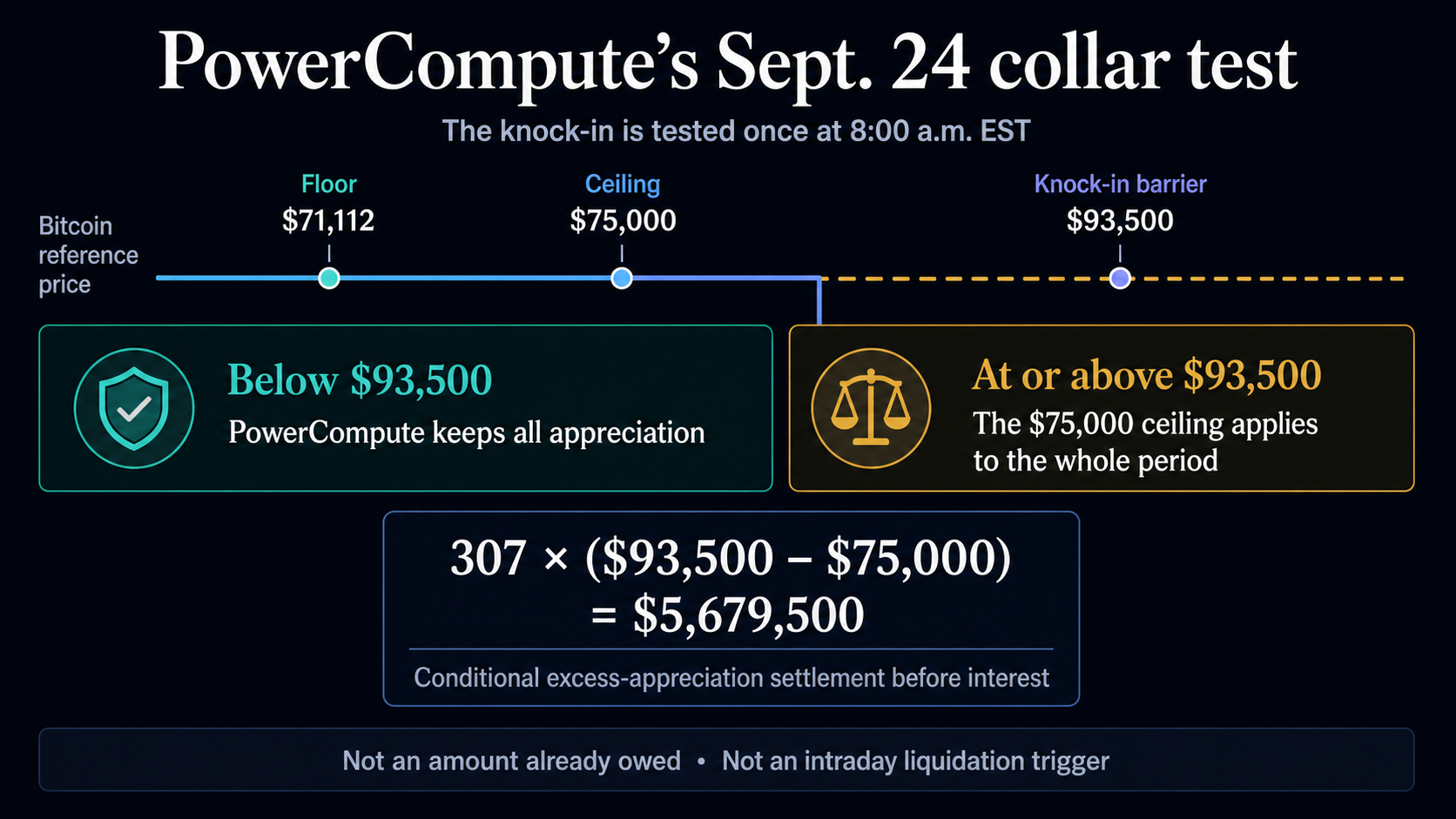
Below $93,500, the ceiling has no effect. PowerCompute keeps all Bitcoin appreciation, even if the reference price is above $75,000. At or above $93,500, however, the ceiling applies to the whole period.
Only if the Sept. 24 reference price reaches at least $93,500 does excess appreciation arise. At the barrier exactly, the formula is:
307 × ($93,500 − $75,000) = $5,679,500
That is conditional settlement arithmetic before interest, not an amount already owed. PowerCompute can settle it through retained BTC or USD/USDC. If it rolls the loan, it can instead add the amount to principal or incorporate it into the next ceiling and rate quote.
The barrier is not an intraday liquidation line. The annex bars ordinary margin calls and liquidations during the rolling period, limits ordinary recourse to the pledged Bitcoin subject to stated carve-outs and tests the collar only at reset. A voluntary mid-period exit would bring the test forward.
At 2:23 a.m. UTC on Aug. 29, CryptoSlate’s live Bitcoin page displayed $77,808.23, putting the barrier about 20.2% above that snapshot. The comparison is context, not a Sept. 24 price forecast.
CryptoSlate covered the initial collar after tracking PowerCompute’s earlier bridge-loan chain. The Aug. 28 filing converts the first structure’s modeled trade-off into a realized financing cost and starts a new 30-day test.
The post One mid-tier Bitcoin treasury just gambled its entire BTC reserve on a single 30-day reset price appeared first on CryptoSlate.
CryptoTicker.io
If you run a crypto wallet as a browser extension, today is the day to open your extension list. In August 2026 the security firm Socket disclosed two separate campaigns in which extensions for Firefox, Chrome and Edge harvested recovery phrases, private keys and login credentials for crypto exchanges. The second of those reports was written up on August 30 and is therefore one day old. What is affected is precisely the place where many investors handle their wallet every day.
A browser extension is a small add-on program that runs inside the browser and holds permission to read and change the content of the pages you visit. That same permission is what makes it useful to wallet providers and valuable to attackers.
Browser Extensions as Wallet Thieves: What Socket Found in August 2026
Socket is a security firm specialising in software supply chains that examines packages and extensions for malicious code. Its researchers published two findings within ten days that show the same pattern and yet do not belong together.
The first report is dated August 20, 2026 and concerns the Firefox marketplace: 77 extension identities are connected according to Socket's analysis, 40 of them confirmed malicious. The second report circulated between August 28 and 30 and concerns Chrome and Edge: 19 extensions, 18 of them for Chrome and one for Edge, carried a wallet drainer. A wallet drainer is malicious code that empties a balance to an outside address in a single operation instead of siphoning off individual amounts.
Both cases share one thing that matters more to you than any number: the extensions sat in the official marketplaces of the browser makers. Anyone who installed them did nothing wrong, downloaded no dubious file and clicked no link in an email.
Offside Wallet Theft Factory: How 77 Firefox Extensions Are Connected
Socket calls the Firefox campaign Offside Wallet Theft Factory and explicitly does not attribute it to any known actor. The researchers also do not write that the same operator stands behind every single extension; what links them is shared code and shared infrastructure.
The 40 confirmed extensions fall into four groups. Seven posed as crypto products and served as remotely controlled phishing loaders, among them an entry called 0KX WEB3, which used a zero in place of the letter O and so imitated the name of the exchange OKX. Fifteen carried the theft code directly inside them. Thirteen of those fifteen were altered rebuilds of the Rabby wallet software. Five more collected access credentials and the contents of the clipboard. The remaining 37 of the 77 identities appeared as VPN tools, password generators or sports apps and did in fact display match scores.
According to Socket, the interfaces of OKX, Rabby Wallet and TronLink were imitated. In this affair those three providers are the injured parties, not the cause: their name and their appearance were used as bait without any involvement on their part.
The technical basis was provided by projects on the database service Supabase, which acted as remote switches, together with Cloudflare Workers and Pages for the forged interfaces as well as control servers written directly into the code. Such control servers are known in the field as C2 servers, short for command and control; they receive the stolen data and send new instructions back. The signature data of the extensions covers the period from March 9 to August 3, 2026, with clusters in April and at the end of July. Mozilla removed the reported add-ons from the marketplace after the report.
What a Browser Extension Is Actually Allowed to Do
An extension with permission to read and change data on all websites sits technically on the same level as the page itself. It sees what you type, it sees what the page shows you, and it can alter both before either reaches the other. For a wallet extension that is normal and unavoidable. For an extension that unlocks right-clicks or displays football scores, it is not.
From Match Score to Seed Phrase Collector: Why the Update Is More Dangerous Than the Installation
The most instructive part of the Firefox finding has nothing to do with crypto at first. Nine of the confirmed malicious extensions began life as harmless sports applications and displayed results from football, basketball and American football. Only later updates replaced that function with wallet theft code, and did so under the same identifier. The malicious version thereby inherited the entire installed base and the accumulated positive reviews of its harmless predecessor. The campaign owes its name to that trick.
For your own practice this means that the check you carried out at installation does not hold indefinitely. Reviews, user numbers and the age of an extension describe its past. An update can replace the code completely, and by default extension updates run through automatically without your being asked.
With five of the 19 Chrome and Edge extensions it went much the same way, only one step earlier: according to Socket's analysis they were genuine, already published extensions by other developers that were taken over and then rebuilt. The remaining 14 the attackers had built themselves from scratch.
Altered Rabby Rebuilds: How the Keyring Leaks Before Encryption
The thirteen altered Rabby rebuilds are the technically most delicate part of the Firefox finding. Rabby is open-source wallet software; its code may legally be copied and changed. The attackers rewrote exactly one function, namely the one that stores the keyring permanently. A keyring is the data record in which a wallet holds its private keys and the recovery phrase together.
In the original, this keyring is converted into text and then encrypted with your password before it lands on the hard drive. In the altered versions it is, as Socket describes it, sent off at precisely the moment when it exists in text form, that is, before encryption. Your wallet password protects nothing at this point, because it would only come into play afterwards. The same versions also intercept the recovery phrase when a wallet is created and when one is imported.

19 Chrome and Edge Extensions: The Drainer That Rebuilds Ledger and Trezor Pages
The second finding is the more recent one and concerns two further marketplaces in Chrome and Edge. According to Socket's analysis the 19 extensions contained a drainer that serves several chains at once: wallets on Ethereum and all networks compatible with it, wallets on Solana and wallets on Tron.
Added to this were rebuilt recovery and update pages that looked like the official interfaces of the hardware wallet makers Ledger and Trezor. Their sole purpose was to collect the recovery phrase. Here too, the two manufacturers are victims of imitation. Anyone who uses a hardware wallet and wonders which models exist at all and how they differ will find the overview in our comparison of crypto hardware wallets.
On reach there is one solid individual figure and one estimate. Solid is the extension named Enable Right Click & Copy, Smart Unlock + OCR: it had more than 70,000 users on Chrome and more than 10,000 on Edge when it turned malicious. For the campaign as a whole, one trade report cites around 80,000 affected users. The starting point is also disputed: BleepingComputer writes that the operation may have been running since the beginning of 2024, while another assessment of the same Socket analysis speaks of roughly six months of active operation and names February 2024 as the likely beginning. Both readings stand side by side, and neither of them is confirmed.
At the time of publication, according to BleepingComputer, none of the extensions was still available in the Chrome Web Store. The Edge version still was.
CSP Header Removed: What an Extension Can Do on Every Page You Visit
The sequence in the Chrome and Edge case is worth going through calmly, because it explains why a single bad extension reaches so far. After installation it opens an encrypted permanent connection to a control server, a so-called WebSocket connection. Over that line it loads individual JavaScript building blocks that were not contained in the marketplace package at all. A reviewer who looks only at the submitted package therefore finds little there.
It then removes the CSP header from every page you call up. The Content Security Policy is a protective instruction with which a website tells the browser which sources scripts may be executed from at all. If it falls away, the browser accepts outside code as well. That code is then injected into the page through hidden HTML elements.
The result is uncomfortably concrete. The bank, the exchange and the wallet interface you open in the same browser are, from that moment on, no longer the pages the provider delivers. They are what the extension makes of them. That is exactly why an approval that looks harmless on screen can mean something quite different in the background. How to read such an approval in detail is set out in our article on what you really approve when you confirm.
Session Tokens Instead of Passwords: Why Two-Factor Authentication Does Not Protect Here
According to Socket, the drainer attacks not only wallets but also accounts at trading venues. Coinbase, Binance, Kraken, OKX, MEXC, KuCoin and Bybit are named, along with the MetaMask wallet. What it collects are access credentials, session tokens, browser history, account information from Facebook and LinkedIn, and form entries across a range of websites.
The term session token deserves an explanation of its own, because it is what sets this apart from ordinary password theft. A session token is the pass that a website issues to your browser after a successful login so that you do not have to enter your password and second factor again with every click. Whoever holds that token is already logged in as far as the website is concerned. Two-factor authentication has happened by then and is not requested a second time.
That is why changing your password is not enough when you suspect something. You have to end all active sessions as well. Most trading venues offer this function in their security settings under labels such as active devices, sessions or logged-in devices. Which providers come into question for customers in Germany at all, and which security features they bring with them, is shown in the overview of crypto exchanges.
Checking Installed Extensions: How to Reach the List in Firefox, Chrome and Edge
The check takes a few minutes and costs nothing. In Firefox you open the address about:addons and select Extensions on the left. In Chrome it is chrome://extensions, in Edge edge://extensions. In all three browsers the detail view can be opened for each entry, showing permissions, publisher and installation source.
Go through the list from top to bottom and ask yourself two questions about every entry: do you still remember why you installed this extension? And have you actually used it in recent weeks? Anything that stumbles on either question goes. An extension you do not need is still an open door that nobody is guarding.
How to Recognise a Hijacked Extension
There is unfortunately no clean identifying mark for the update trick, and that belongs to the truth of the matter. There are, however, indications that are worth something taken together. It is striking when an extension with a banal function suddenly demands far-reaching permissions, or when the publisher name has changed. It is striking too when a review column shows older enthusiastic voices and more recent complaints about altered behaviour side by side. And any extension whose name matches a well-known product but for a single character is striking, as with the zero in the entry 0KX WEB3.

Reading Permissions: Which Access Rights Are Normal for a Wallet Extension
A genuine wallet extension needs far-reaching rights, otherwise it could not do its job. Access to data on all websites is therefore no alarm signal in its case. The real question is a different one: why does a screenshot tool, a translator or a right-click unlocker need the same permission?
In practice this means you sort your extensions by purpose and not by provider. Every extension that may read and change all pages although its function is needed only on a single page or at the push of a button is a candidate for deletion. Chrome and Edge additionally allow you to limit an extension's access to individual pages or to grant it only after a click. That setting costs you two days of getting used to it and takes most of its reach away from a hijacked extension.
Hardware Wallet or Browser Wallet: What the Difference Means When It Counts
The two Socket findings lead to a distinction that often blurs in everyday use. With a wallet as a browser extension the private key lies encrypted on the computer, and the software in the browser decrypts it in order to sign. With a hardware wallet the key never leaves the device; the computer sends the transaction over and gets the finished signature back.
This difference decides how an attack of the kind described turns out for you. Against harvested key material the hardware wallet helps, because there is simply nothing there to harvest. Against a manipulated interface that shows you a false recipient address it helps only if you read the details on the display of the device and not on the screen. And against a rebuilt recovery page that asks you to enter your recovery phrase, no technology helps at all. There, only one rule carries: never type that phrase anywhere. Which software wallets exist for everyday use and where their limits lie is set out in the comparison of software wallets.
After a Suspicion: Why Uninstalling Alone Saves Nothing
For the Firefox case Socket makes a clear recommendation: anyone who has entered a recovery phrase or a private key into one of these extensions should treat the data as permanently compromised and move the balance to a newly created wallet. The reason is simple and readily overlooked. Deleting the extension takes back nothing that has already been transmitted. A recovery phrase cannot be revoked, only replaced.
The order matters when you suspect something. Create the new wallet on a device that is not affected, and only transfer afterwards. Anyone who sets up the new wallet in the same infected browser merely repeats the exercise with fresh keys. Then come the accounts at the trading venues: new password, end all sessions, set up the second factor again and check the withdrawal addresses on file.
A word on handling the agitation such reports set off. In precisely the days after an incident becomes public, messages multiply that promise help to those affected and ask for the recovery phrase in the process. That scam now runs on paper as well, as the case of wallet phishing by letter shows. No reputable provider and no authority ever asks for that phrase.
Tax and Evidence: What to Document After a Crypto Theft
If something has in fact flowed out, secure the evidence before you tidy up. That includes the time of the outflow, the addresses affected, the transaction identifiers from the relevant block explorer, the name and identifier of the extension together with a screenshot of the marketplace page if the entry is still reachable, and the file number of a police report.
How such a loss works out for tax purposes depends on the individual case and belongs in the hands of a tax adviser. Without complete evidence that question cannot be settled at all, and the evidence is considerably harder to obtain weeks later than on the day after. A portfolio tool that records your movements anyway spares you the reconstruction by hand when it counts.
Checking Browser Extensions: What to Take Away
- Clear out your extension list today. Open about:addons, chrome://extensions or edge://extensions and delete everything you do not actively use or can no longer place. Pay particular attention to entries with a banal function and far-reaching permissions. If you keep your wallet in the browser, check in the comparison of software wallets whether your setup still fits your holdings.
- Separate the amounts you do not move from the browser. The part of your holdings you do not touch weekly belongs on a device whose key never sees the browser. The models and their differences are set out in the comparison of crypto hardware wallets.
- End your open sessions at the trading venues. A new password alone is not enough as long as an old session token is still valid. Go into the security settings of every account, throw out all devices and log in again. Which providers offer which security features is shown in the overview of crypto exchanges.
The month's two findings arose independently of each other and affect all three major browsers. They say the same thing: a browser maker's marketplace is a pre-selection and not a guarantee, and the check made at installation ages faster than the extension itself.
The original reports are available at Socket on the Firefox campaign and in the write-up by BleepingComputer on the Chrome and Edge case.
(As of August 31, 2026. This article is not investment advice. Prices and fee structures change; check the terms with the provider before you buy.)
Crypto airdrops in week 36: the deadlines that are running now
The most uncomfortable deadline of this week is one that officially does not exist. At Plume, the Season 2 claim has been open since the end of May 2026 – and the project has never published an end date, neither as a day nor as a period. Secondary reporting, meanwhile, circulates a window of roughly three months, which would run out with August, that is, today. That figure cannot be substantiated at the project source. Which is exactly why there is only one sensible way to handle it: if you are registered and have not claimed yet, check the portal now instead of waiting for an announcement that may never come.
This overview lists the airdrops that either have a claim window open this week or a date fixed within the next 14 days. Every detail comes from the source linked alongside it. Where a project has published no end date, that is stated explicitly – there are no estimated deadlines here. For last week's status, see our piece on the airdrops of week 35.
The dates at a glance
| Project | Status | Date / deadline |
|---|---|---|
| Plume (Season 2) | Claim open | no end date published; registration closed May 27, 2026 |
| Grass (Stage 2) | Claim open | until January 22, 2027 |
| GRVT | First tranche expired, more to follow | 30 days per tranche; date of the second unlock not published |
| Midnight (NIGHT) | Thawing running | until December 4, 2026, then a 90-day grace period |
| dappOS (DOS) | Claim phase 2 open | since August 11, 2026, end not published |
1. Plume (Season 2): claim open, end date unpublished
Plume is a layer-1 chain for tokenised real-world assets. Season 2 of its points programme ended on March 31, 2026; registration for the distribution then ran from April 29 to May 27, 2026. Anyone who missed that step is, by the project's own account, excluded from the distribution – there is no way to fix it after the fact. Eligible wallets needed at least 10,000 Plume Points, in some cases plus verification via Human Passport.
The claim itself has been running since the end of May 2026 through the official portal. And here is the gap that puts this entry at the top of the list this week: Plume has never named an end date. The announcement gives a start and the registration deadline, nothing more; when we retrieved it on August 31, 2026, the project blog carried no newer post supplying a claim deadline either.
A number is circulating regardless: secondary reports and aggregator pages mention a window of about three months, which by arithmetic would expire at the end of August. That figure does not come from Plume. We list it here only because it circulates, and expressly not as a deadline. In practice it changes nothing about the advice – on the contrary: a claim with no published end date can be closed at any time, without prior notice. If you are eligible and registered, claim today, not at some point.
Source: Plume – "Plume Points Season 2 Airdrop Registration Is Now Open" (project blog, retrieved again on August 31, 2026; the blog index contains no newer airdrop post)
2. Grass (Stage 2): deadline January 22, 2027
The Solana project Grass has been paying out its Stage 2 rewards since July 22, 2026, covering epochs 1 to 19, that is, the period from October 14, 2024 to June 8, 2026. Claiming runs through the project's official dashboard.
Grass is one of the few projects that names a clean, published deadline: the claim is open until January 22, 2027, a full six months. Whatever is not claimed by then is retained by Grass. It is the most comfortable entry on this list – and, experience suggests, the one where most is left on the table, because half a year of time feels like unlimited time. Put the date in your calendar if you are eligible.
Source: Grass – "How Your Stage 2 Rewards Allocation Works" (retrieved again on August 31, 2026)
3. GRVT: 30 days per tranche, and the first one is gone
The derivatives exchange GRVT held its token generation event on July 30, 2026 and is distributing 280 million GRVT in total. What makes this airdrop distinctive is its mechanics, and they are stricter than in any other entry here: the distribution runs in tranches over twelve months, and every unlocked tranche has a claim window of 30 days. Once it closes, the tranche is gone for good; the project explicitly rules out exceptions.
The first tranche was unlocked at the TGE, and its window ran out by arithmetic at the end of August. Important detail: GRVT never published a calendar date for it – the 30 days follow from the published rule. What counts is solely the expiry date the Reward Portal shows for your specific tranche.
For this week, what matters most is what is still to come: after the first, further unlocks follow over twelve months, each with its own 30-day clock. GRVT publishes no unlock schedule, and when we checked the help centre on August 31, 2026, there was no date for the second tranche. We deliberately do not calculate one here. Anyone who registered before July 17, 2026 and stored a destination chain is credited each due tranche automatically; everyone else has to claim manually at every unlock. That is exactly where forfeited claims come from – set a reminder, as the project itself recommends.
Source: GRVT Help Center – "How to Receive and Manage Your $GRVT Airdrop" (retrieved again on August 31, 2026)
4. Midnight (NIGHT): thawing until December 4, 2026
At Midnight, the privacy network from the Cardano ecosystem, NIGHT tokens are redeemed through a thawing procedure. According to the project, the frame for it runs until December 4, 2026, followed by a grace period of 90 days. If you are eligible, this gives you the longest lead time on this list – and you still should not push it, because redemption involves several steps.
One caveat, in our own cause, that belongs in this format: the project source was not reachable when we tried on August 31, 2026 – from our environment the server answers with a bot-protection interstitial (HTTP 429) instead of the article. The dates given here therefore come from the last successful check of that same page. There is no indication that anything has changed, but we cannot re-verify it today. If you are relying on the deadline, open the page yourself.
Source: Midnight – "Guide to the NIGHT Token Launch and Redemption" (retrieval on August 31, 2026 blocked by bot protection; details from the last successful check)
5. dappOS (DOS): phase 2 open, phase 3 without a date
The DOS token launched with its TGE on August 10, 2026, and phase 2 has been running since August 11, 2026, letting eligible wallets claim transferable DOS. dappOS has announced a phase 3, but without a date, and no end date has been published for any of the phases so far. The only official route is the claim portal on the project's own domain.
What comes after that is the real decision: a freshly distributed token with a small market capitalisation swings violently in its first weeks, and the selling pressure from an ongoing claim hits it on top. Anyone who wants to trade such a position at all needs access that actually covers the small pairs – pure charting tools like Dexscreener or TradingView only display, they do not trade. One alternative for that is the mobile app FOMO Family, which lets you discover, swipe through and trade meme and low-cap tokens directly in the app, with fast deposits; download the app through this link and you get ten percent off trading fees. The sober part belongs with it: trading meme and low-cap tokens is highly risky, volatility is extreme and a total loss is possible at any time. Where else DOS trades, see our crypto exchange comparison.
Settled since last week
- Propr (PROPR) drops off the list. The token generation event announced for August 24, 2026 has remained unconfirmed a week later. What matters more is what happened to the source: the project's proposal page is reachable again, but when retrieved on August 31, 2026 it carries no token, no tokenomics, no TGE and no claim portal – only the ordinary offering of the prop trading platform. The basis for the original announcement no longer exists at the project source, and without evidence there is no entry. Should Propr hold and document the TGE, the entry comes back.
- GRVT, first tranche: the 30-day window of the July 30 unlock expired at the end of August. The mechanism itself stays active, see above.
- DGrid (DGAI): the claim has been closed since August 22, 2026, 8:00 UTC. For anyone who had not picked a staking plan by then, the allocation moved automatically into the 360-day plan, according to the project.
What is deliberately missing this week
Six much-discussed candidates did not make the list. The reason differs in each case, and each one is worth as much as an entry:
- RISEx: a major aggregator lists a "confirmed airdrop" for August 31, 2026. That does not hold up: RISEx has no token to date, Season 1 of its points programme runs into the second quarter of 2027 according to the project, and no TGE date or tokenomics breakdown has been published. Collecting points is not a claim date.
- Arcium (ARX): the claim via Retroactive Token Grants is genuinely open, but it runs in rolling waves. Neither the project site nor the documentation names a deadline by which you must have claimed. No date, no entry in this format.
- AIW3: TGE and claim fell on August 3, 2026 and therefore before this edition's window. Further monthly distributions are announced, but without dates.
- Canopy (CNPY) and mint.io (MNTD): both with a running points programme, both without a TGE date. At mint.io the snapshot date is unconfirmed on top of that.
- Ink (INK) and AVANT: two projects offering a period instead of a date – "July to September" for one, "mid-September" for the other. We will look again as soon as a day is named.
- Ethos Network (WHUF) and ARC (Circle): the Ethos date of September 1, 2026 is real, but it is an auction of 20 percent of supply, that is, a sale requiring your own capital, not a claim. And ARC's public mainnet starts on September 16 – a mainnet launch is not a distribution date, the TGE has no date and an airdrop allocation is unconfirmed.
Plus this format's standing rule: projects listed as "live" on aggregator pages that name neither a snapshot nor a claim window at the project source do not get in. "Airdrop confirmed, date open" is not a deadline.
What to watch on every claim
Airdrops are the preferred hunting ground for wallet drainers, and the patterns repeat:
- Always open the claim page via the official project domain, never through links from direct messages, comments or search ads.
- No legitimate airdrop asks for your seed phrase or your private key.
- Check which permission you are granting before you sign. An unlimited token approval is not necessary for a claim.
- Weigh the network fee against the value of the allocation. On small amounts, claiming can cost more than it returns.
- Put every deadline in the calendar – with staggered distributions like GRVT's, every single tranche, not just the first.
- And the point that carries this week: a claim without a published end date is not a claim with unlimited time, it is one whose closure does not have to be announced.
Think about tax straight away
An airdrop is not by definition a tax-free gift. Whether an allocation counts as taxable income depends above all on whether you provided something in return. With this week's campaigns that is not a marginal question: anyone who collected points through trading volume or by running a network node stands differently from someone who received an allocation without doing anything.
So secure the timestamp, quantity, market value, price source, transaction hash and the terms of participation right at the moment of claiming – the terms in particular tend to disappear first once a campaign page is taken down. An overview of further campaigns is available in our section on crypto airdrops.
Conclusion
Week 36 is the week of unspoken deadlines. Two entries on this list – Plume and dappOS – have an open claim window with no published end, and at GRVT the clock on every future tranche runs 30 days without any unlock schedule existing. In all three cases the same applies: a missing date is not a reprieve, it is a risk. Only Grass and Midnight name hard dates with January 22, 2027 and December 4, 2026 – and even there a large share of allocations is routinely left unclaimed.
And the sobering part: most allocations sit in the two- to three-figure range, the fee for claiming eats a noticeable share of that, and a substantial proportion of all allocated tokens is never claimed at all. The effort pays off mainly where you are already eligible.
Disclosure: some of the providers mentioned in this article work with us through partner programmes. This has no influence on our editorial assessment.
(As of August 31, 2026. This article is not investment advice. Deadlines and terms of participation change; check them with the provider before taking part.)
If you are holding VANRY on KuCoin, a different deadline applies to you than the one the exchange gives you. What counts is September 10, 2026 at 13:00 UTC. By then your VANRY has to be sitting in your own wallet and swapped through the project's portal. KuCoin itself allows withdrawals until September 14, 2026 at 08:00 UTC, roughly four days longer. Anyone who goes by that later date will collect tokens for which no swap route exists any more by that point.
The reason is an announcement KuCoin published on August 13, 2026, which German-language coverage has so far passed over. The exchange has delisted the token and stated explicitly that it will not handle the swap for its customers. That puts the entire action on you. This piece explains what to do, in which order, and where the established facts end and the uncertainty begins.
KuCoin is not handling the VANRY swap: the wording of the announcement
In the delisting notice of August 13, 2026, KuCoin first describes the starting position: according to the Vanar Chain team the VANRY token is being migrated to the Base network, and KuCoin had worked with the project team on the terms of the token swap. Then comes the sentence that makes the difference. After several discussions, the project team had been unable to meet the conditions KuCoin requires in order to process a swap on behalf of users. The exchange draws the conclusion from this that it will not support the swap.
What matters is how you read that paragraph. It is the account of one of the two parties involved. KuCoin attributes the failed agreement to the project team; a public rebuttal from Vanar addressing this passage specifically is not available. For your decision the question of blame is secondary in any case. What is decisive is the practical consequence, and it is stated unambiguously in the same notice: VANRY deposits remain closed, withdrawals are possible via the Ethereum network as an ERC20 token, and users are strongly advised to withdraw their holdings as soon as possible.
That recommendation is right, but it is incomplete. Nowhere does the notice name a date by which the withdrawal has to be done for the swap to still work. That date sits with the project.
Three dates you have to keep apart: August 14, September 10, September 14
In the interplay between exchange and project there are three points in time. These three belong to different senders and mean different things.
August 14, 2026, 08:00 UTC. KuCoin removed VANRY from spot trading. Since then you can neither buy nor sell the token there. Deposits had already been closed beforehand and stay closed. This date has passed and matters only as context.
September 10, 2026, 13:00 UTC. The project's swap window closes. It was opened on August 11, 2026 at 13:00 UTC and runs for 30 days. The portal states unmistakably that there is only a single window and that no subsequent migration via the portal will be offered once the 30 days have elapsed. This is the deadline you have to orient yourself by.
September 14, 2026, 08:00 UTC. KuCoin closes the withdrawal service for VANRY. Up to that point you can get at your balance. After that, no longer by the normal route.
The last two dates lie roughly 91 hours apart, that is three days and 19 hours. During that period the withdrawal still works, but the swap does not.
Why the 91 hours between the swap deadline and the withdrawal deadline are the real trap
Pairs of deadlines of this kind turn up regularly in delistings, and most of the time they are harmless. Here they are not, because the order is the wrong way round. The exit from the exchange stays open longer than the entrance to the swap. A customer who reads their exchange's announcement attentively and sticks to the date named there can do everything correctly and still end up with tokens that can no longer be migrated.
It is worth looking at Binance for comparison. There, five weeks lie between the end of the swap window and the end of the withdrawal deadline. A gap like that stands out; you can see that two different clocks are running. We have written up what that case looks like in detail in our piece on the VANRY migration to Base and the Binance withdrawal deadline. At KuCoin it is four days instead of five weeks, and the exchange urges customers in the same notice to withdraw. The gap is small enough to feel like a buffer, and large enough to become expensive.
In practice that means: count backwards from September 10, not forwards from today. And count with a buffer, because between clicking "withdraw" and the moment the tokens are available in your wallet, an exchange has verification steps, security checks and, if in doubt, a manual approval.

What a token swap is and why an exchange can handle one at all
A token swap is the move of a token from one smart contract to another, as a rule because the project is changing blockchain. The old units are locked, and the same number of new units are created on the target network. With VANRY this happens at a ratio of one to one: for every old token locked you receive one new token on Base.
A centralized exchange can carry out this process for its customers because it holds the tokens in its own pooled wallets anyway. The trading venue locks the total holding, receives the new units and credits them back to the accounts. From your side it looks like nothing at all: the balance stays the same, trading carries on. It is precisely this convenience that falls away when an exchange declines the swap. Then you are the custodian yourself, and the action that would otherwise run in the background is one you have to trigger.
Self-custody is the technical term for holding your tokens in a wallet whose private key only you know. The project's swap portal can work exclusively with wallets of that kind, because it requires a signature from the address the tokens are sitting on. An exchange address cannot provide that signature for you.
Withdrawing VANRY from KuCoin: the route via your own wallet, step by step
The procedure consists of two operations that have to run one after the other. First the withdrawal from the exchange, then the swap in the portal. Both together have to be completed before September 10, 2026 at 13:00 UTC.
Step one: prepare your own wallet
You need a wallet that supports the Ethereum network, because KuCoin pays VANRY out as an ERC20 token on Ethereum. Whether that is a software wallet on your phone or a hardware device makes no difference to the swap; what matters is that you control the private key and that the wallet can connect to a web application. If you are setting things up afresh at this point anyway, our hardware wallet comparison sets out the criteria that count here. Have the receiving address ready and check it twice.
Step two: withdraw and choose the right network
For the withdrawal you select Ethereum, or ERC20, as the network. That is the only option KuCoin names for VANRY. Reckon with a network fee that the exchange deducts from the amount paid out, and with a processing time that, depending on load, can range from a few minutes to several hours. Small holdings can become uneconomic at this point if the fee eats up the value of the position. You should do that calculation beforehand.
Step three: lock in the portal and receive on Base
As soon as the tokens have arrived in your wallet, you connect it to the swap portal, select Ethereum as the source chain, enter the amount, grant the approval and confirm the lock transaction. The new tokens are then sent automatically to the same address on Base. The portal gives around four hours after confirmation of the lock transaction as the figure from experience. There is no manual collection step.
One warning is stated so plainly in the portal that it belongs here again: never send tokens directly from an exchange into the swap. The detour via your own wallet is not a recommendation but a precondition, because the new tokens go to the sending address and you have no access to an exchange address.
Which exchanges handle the VANRY swap and which do not
On its portal page the project keeps a list of the trading venues that, by their own announcement, will process the swap. Six names are on it: Paribu, Bitvavo, LBank, Indodax, BingX and WEEX. For German investors Bitvavo is the one that matters most among them, because this provider serves the German-speaking market directly.
KuCoin is not on this list, and the exchange has since explained why itself. That answers a question that was still open in August: English-language reporting on August 10 had said that KuCoin would handle the migration automatically. That statement had no counterpart in the project's own list, and we flagged it at the time for what it was. The announcement of August 13 resolves the contradiction in the other direction.
A rule follows from this that holds beyond this case. What counts is always the announcement of your own trading venue, not a project's collected list, and certainly not a media report. If you spread your holdings across several venues anyway, a look at our overview of crypto exchanges compared helps you see which provider communicates how on delistings and migrations. VANRY was, incidentally, also one of six tokens that were dropped from spot trading at Binance in August; the list is in our piece on the Binance delisting of six tokens.
Staking and the 21-day cooldown: the deadline that bites even earlier
If your VANRY is in the project's staking rather than on an exchange, a second timetable applies. Staking means that you deposit tokens in a contract and receive a reward for it; the contract only releases them again after a lock-up period. This lock-up period, the so-called cooldown, is 21 days at Vanar.
According to the project, staking was closed on August 19, 2026; that was also the last day for which rewards accrue. Anyone who initiates unstaking by September 10, 2026 at the latest remains eligible for the swap, even if the 21 days have not elapsed by then. For these wallets an airdrop on Base is planned for September 11, 2026. Anyone who does not initiate unstaking by September 10 will, on the project's account, not be included in that airdrop.
In practice that means: the click on "unstake" is the actual cut-off, not the withdrawal itself. If you have not done anything here yet, that is the most urgent point on the whole list.
What happens to old VANRY on Ethereum, Polygon and VanarChain after September 10
At this point precision matters more than drama, because a lot of half-knowledge is circulating here. The old tokens do not disappear on September 10, and nobody declares them worthless by decree. The project writes explicitly that it can neither block nor freeze, claw back or alter individual holders' balances. What ends is the swap route via the portal.
What the project goes on to write: after the migration the old contracts on Ethereum, Polygon and VanarChain are no longer to represent the active VANRY economy; the new token on Base becomes the definitive token for the coming phase. Full contract details and any final measures for the old contracts are to be published through the official channels. The project has not yet named a date for that.
That also leaves open whether there will be a case-by-case solution for latecomers after the deadline. The portal says neither yes nor no on this. Anyone who misses the swap should neither rely on goodwill nor assume it is ruled out. All that is established is that the route via the portal is closed at that point. More important than any speculation about it is the plain observation that liquidity follows the active token: the DEX liquidity on Ethereum was, according to the project, already removed on August 10, 2026.
Old and new contract address: how to identify the real Base token
Migrations attract imitators. As soon as a project announces a new contract, tokens with the same name and the same ticker appear that have nothing to do with the original. The only reliable test is the contract address, meaning the unique identifier of the smart contract on the chain in question.
For the old token on Ethereum and on Polygon the project names the same address, beginning with 0x8de5b80a. The new token on Base carries an address that begins with 0x07848a7b. On VanarChain itself there was no token contract, because VANRY was the native currency of that chain. Check the full address against the entry on the official portal page before every operation, and never take it from a message, a screenshot or a comment.
The portal itself warns with unusual clarity against using links from comments, direct messages, Telegram messages or unofficial websites. That warning is not there without reason: a deadline is the moment when attempted fraud works best, because time pressure crowds out checking.
Fees, network costs and the four hours until the credit arrives
The swap itself costs no fee according to the project; the ratio stays one to one. You still have to pay, in three places. First, the exchange's withdrawal fee. Second, the network fee for the approval and the lock transaction on Ethereum, which you bear yourself and which fluctuates with load. Third, if you want to move the new tokens on Base later, the network costs there, which are however markedly lower.
Keep a small amount of the relevant fee currency ready on the Base side, otherwise you will see your new tokens in the wallet but will not be able to move them. And build the four hours the portal gives as its experience figure for delivery into your schedule. Anyone starting around midday on September 10 no longer has that buffer.
Tax records: why you should document the swap
How a one-to-one swap in the course of a network migration is to be treated for tax purposes depends on the individual case and is not something that can be answered across the board. What you can do in any event is make sure your records are complete. Note down when you originally acquired the tokens, when they left the exchange, when the lock transaction was confirmed and when the new units arrived on Base. Save the transaction identifiers for both chains.
The reason is pragmatic: a change of chain tears apart the automatic matching in many analysis tools. The old holding disappears, a new one turns up, and without your note that looks like a sale followed by a purchase. Our overview of tax tools and portfolio trackers shows how to represent operations like this cleanly. Classifying your specific case belongs in the hands of a tax adviser.
Limits of this analysis: what is not established here
Honesty requires marking the edges. The dates, addresses and procedural details in this text come from two primary sources: KuCoin's delisting announcement and the project's swap portal. Both were retrievable on August 31, 2026. The two sides have opposing interests in how the failed swap agreement is presented, and neither of the two deadlines appears at the respective other party.
What we cannot establish is whether KuCoin will still change its position before September 14, whether the project will grant a grace period, and when the old contracts will be switched off. Nor do we make any statement about the token's price development; this text is a matter of deadlines and custody. And we do not judge who is in the right in the dispute between exchange and project team. Before every step, check the current announcement at KuCoin and the details in the official Vanar Chain swap portal.
Withdrawing VANRY from KuCoin: what to take away
- Set September 10, 2026, 13:00 UTC as your deadline, not September 14. Withdraw VANRY from KuCoin now to a wallet whose key you hold yourself, and factor in the exchange's processing time. Which devices are suitable and what to watch out for when setting one up is covered in the hardware wallet comparison.
- Initiate any running staking immediately and then swap via the official portal. The 21-day cooldown may still be running on September 10, but the initiation has to have happened by then. While you are at it, check whether your remaining holdings sit with a provider that handles migrations itself; the differences are shown in the comparison of crypto exchanges.
- Document every step with the date and the transaction identifier. Time of purchase, withdrawal, lock transaction and the credit on Base belong in your records, so that the change of chain is not read later as a sale. You will find suitable tools among the tax tools and portfolio trackers.
(As of August 31, 2026. This article is not investment advice. Prices and fee structures change; check the terms with the provider before you buy.)
The Cronos blockchain has stopped. On Sunday, August 30, 2026, the chain's validators halted block production after an attacker had emptied the lending market Tectonic. Estimates of the damage range from roughly $66 million to $75 million, and a second on-chain analysis arrives at a considerably larger outflow from the lending pools. For you, a single distinction comes first: if your balance sits on the chain itself, it is not moving right now, whether or not you ever had anything to do with Tectonic. If it sits in the Crypto.com app or on the company's exchange, it is untouched, according to the company.
Cronos chain halt: what happened on August 30, 2026
Tectonic is the largest lending protocol on Cronos. A lending protocol is an application into which users deposit funds so that other users can borrow them against posted collateral; the depositors earn interest in return. Before the attack it held roughly $121.7 million, according to Blockonomi, which amounted to about 46 percent of all capital deposited in Cronos DeFi. Outstanding loans at that point stood at roughly $82.7 million.
The attacker drove up the price of TONIC, the protocol's own governance token, posted the revalued holding as collateral and borrowed the hard assets out of the pools against it. He then began to move the proceeds out across a bridge. A bridge is a service that transfers value from one blockchain to another; it is the only way to get proceeds off a chain.
That is exactly where the validators stepped in. The Cronos account wrote on X the same day: "We identified an exploit in Tectonic. The Cronos Network has been halted and we'll provide updates here." Tectonic itself reported shortly afterwards that it was dealing with an incident, and asked users to leave the protocol alone for the time being: "As a precaution, please do not interact with the protocol until we confirm it is safe to do so."
The price of CRO, the chain's base asset, incidentally did not give way that day. Blockonomi reports a gain of around five percent over the course of the day. That is an indication of how little a chain halt can be read off the market price in the first moment.
TONIC price manipulation: how $11,000 in daily volume became a multimillion-dollar loan
The numbers that explain the attack are not in the damage report but in the market data of the manipulated token. TONIC had trading liquidity of roughly $1.34 million and a daily volume of about $11,000, according to Blockonomi. A token with that volume can be pushed in any direction with comparatively little capital.
According to the analysis by on-chain analyst Weilin Li, which several trade publications rely on, the TONIC price rose roughly a hundredfold in about 20 minutes. The attacker then posted that holding as collateral and withdrew from the pools the assets that were actually worth something. Blockonomi puts the window between the start of the manipulation and the end of the withdrawals at around 65 minutes.
The procedure has a name, and it is an old one. An attacker inflates the price of a thinly traded piece of collateral, borrows real assets against it and leaves the worthless position standing. Anyone who knows the Moonwell case on Base will recognize the pattern immediately: there too, barely traded collateral was the way in, as our analysis of the Moonwell exploit of August 27 shows.
Why this is not a hack in the narrow sense
No key was stolen and no security flaw in the program code was exploited. The contracts did what they were supposed to do. What was wrong was the assumption they operated on: that the reported price of a piece of collateral matches what it actually sells for. That is a valuation question, not a key question, and that is why no hardware wallet protects you here.
Loan-to-value of 20 percent: the parameter that carried the attack
Every lending protocol sets a loan-to-value ratio for each piece of approved collateral. The loan-to-value ratio states what share of the deposited value you are actually allowed to borrow; at 20 percent, $1,000 of collateral gives you $200 of credit. For TONIC that value stood at 20 percent, according to Blockonomi.
A low ratio sounds cautious, and it is, as long as the underlying price holds. Against a manipulated price, however, the ratio no longer helps at all. Twenty percent of a value inflated a hundredfold is still a multiple of what the collateral really yields. The ratio caps the leverage, not the error.
Anyone who wants to see how differently providers handle exactly this question will find the range of approved collateral and terms in our comparison of crypto lending providers. The gap between a protocol that admits only a few deeply traded assets and one that accepts its own governance token as collateral is considerable.
$66 million, $75 million or $119.5 million: why the Tectonic exploit damage figures diverge
Several amounts are in circulation, and they contradict each other only in appearance. Weilin Li's first estimate came to roughly $66 million and was raised to about $75 million after a further attacker address holding roughly $8 million could be attributed. That figure appears in most of the day's reports, among them The Block.
A second analysis, which Cryptobriefing attributes to on-chain analyst Awoo, arrives at an outflow of roughly $120 million from the pools in a single transaction, plus around $2 million through copycats and a stake of about $5.6 million from the attacker. Other houses name $119.5 million as the amount that was at risk.
The two figures measure different things. One describes what was left as proceeds at the end, the other what was moved out of the pools in total. Tectonic itself had confirmed neither a sum nor a cause by press time. As long as that is the case, the range belongs in every account, and not a smoothed average.
Chain halt by validator agreement: what Tendermint and the cap of 100 have to do with it
That a blockchain can be halted within minutes is not a matter of course but a property of how it is built. Cronos runs on Tendermint Core, a consensus mechanism in which a fixed, permissioned group of validators produces the blocks. The number of these validators is capped at 100.
A validator is a machine that proposes and confirms new blocks. With a hundred known operators, an agreement can be organized within a few minutes. With a chain of hundreds of thousands of independent participants it cannot be, and that is precisely why Bitcoin cannot be halted and Cronos can. That is neither a flaw nor a merit but a trade-off: speed and the ability to act, in exchange for unstoppability.
The case of August 30 is not the first of its kind this month. Only the day before, three chains from the Cosmos ecosystem pulled the emergency brake for a different reason, as set out in our analysis of the Cosmos EVM vulnerability. The chain halt has thus been used as a tool twice within two days.
Six million across the bridge, sixty million frozen: what the halt saved
The arithmetic of the day is unusually clear. Before block production ended, the attacker had moved roughly $6 million across a bridge to Ethereum, according to consistent reports. Around $60 million stayed behind on the stalled chain and is as unreachable there for the attacker as it is for everyone else.
The halt has thereby held on to the greater part of the proceeds. But it has also frozen every other position on Cronos along with it: every open loan, every trading position, every scheduled payout, every automated process. A user who wanted to sell on Sunday afternoon and had nothing to do with the incident could not.
Neither Cronos nor Tectonic had published a restart date or a final post-mortem by press time. A post-mortem is a project's retrospective report on the course, cause and consequences of an incident. Nor had any party committed by then to compensating Tectonic's depositors.
Crypto.com app or Cronos chain: what your exposure depends on
Cronos is often mentioned in the same breath as Crypto.com, and for placing your own situation it is precisely that closeness that produces the most common mix-up. Crypto.com chief executive Kris Marszalek stated on X on August 30 that the company's app and exchange had not been compromised, that customer funds there were safe, and that its own security team was supporting the investigation. He promised a full post-mortem once the investigation is complete.
In practice that means: anyone holding CRO through the app or the exchange holds an entry in a company's database and is not affected by the state of the chain for now. Anyone running their own wallet on Cronos, by contrast, holds their assets on exactly the chain that has stopped. The same coin, two entirely different situations.
That distinction is the core of the case for you, and it has a flip side. A balance held with a provider is insensitive to a chain halt, but dependent on the provider. A balance in your own wallet is independent of the provider, but tied to the fate of the chain. You do not get both at once.
What a chain halt means for your own balance
A halted network behaves differently from what most people expect. Your assets have not disappeared, the last valid balance is fixed, and it stands. What is missing is the ability to change it. There is no transfer, no sale, no repayment and no margin top-up as long as no block is being produced.
Three things follow from this that can affect you directly. A loan that stood just short of the liquidation threshold cannot be rescued by a top-up during the standstill. A price you saw on an external market can no longer be realized on the chain. And an application that depends on data from this chain carries on working with a frozen state, even if it runs on a different network itself.
At the restart a further question arises that is still open in the Cronos case: what happens to the attacker's balances that sit on the chain? A chain that can be halted can also alter states at the restart. Whether that happens here has not been announced so far.
Spotting haltable chains: how to check a blockchain's validator count
What counts for you in this case is above all a question that goes beyond Cronos: how much of your own holdings sits on networks that can be halted by agreement? That is not a matter of guesswork but a property you can look up, and you need no technical knowledge for it.
The block explorer of the chain in question, meaning the public search interface for blocks and transactions, usually carries a validator list. Four data points are enough for an assessment: the number of active validators, whether access is open or permissioned, how much share the largest operators hold between them, and whether the chain has ever been halted before. A double-digit or barely triple-digit validator count with permissioned access means, in practice: this chain can be halted.
No instruction to sell follows from that. What follows is that you know which part of your holdings can become immobile in an emergency, and that you choose that part deliberately rather than by accident.
Thin collateral in the lending market: the three figures you will find in every protocol
When you put funds into a lending protocol, you are on the hook for the quality of the collateral that protocol admits, even if you hold none of it yourself. If the proceeds from a piece of collateral are not enough after a collapse to cover the loan, an uncollectible residual claim stays in the system, and that comes at the depositors' expense.
Three data points appear in almost every protocol's documentation and largely answer the question. First, the list of approved collateral together with the loan-to-value ratio: if the protocol's own governance token is on it, that is a warning sign, because its price moves with the protocol's fortunes. Second, the price source: a price that comes from a single thin trading venue is easier to move than a value averaged over time from several sources. Third, the separation of markets: some protocols isolate risky collateral in pots of their own, so that a failure there does not feed through to the remaining depositors.
The same type of attack is landing in series
The case is part of a run that has been going on for weeks. On August 23 it hit Term Finance through voting rights, on August 27 Moonwell through the price source of a thinly traded piece of collateral, on August 30 Tectonic by the same route. The attacks differ in detail but always hit the same spot: the valuation of what is posted as collateral.
Tax and records: what to document when holdings are frozen
A chain halt creates a gap in your records, and that gap catches up with you later, not today. As long as no blocks are being produced, the chain supplies no new data, and portfolio and tax programs that draw their values from there show a frozen state or none at all.
So write down now what cannot be reconstructed later: the time of the halt as you observed it, your positions and open loans as of the last valid block, all project announcements with their dates, and every operation you could not carry out because of the standstill. If compensation follows later, or something is changed at the restart, you will need this starting state to explain the difference.
A note for context, not tax advice: whether a loss from an incident of this kind is recognized for tax purposes, and under which type of income, has to be assessed case by case and belongs in the hands of a tax adviser. What you can contribute is a complete set of records.
Checking the Cronos chain halt: what to take away
- Separate provider balances from chain balances. Look through your statement for which part of your holdings sits with a provider and which sits in your own wallet on a particular chain. Only the second part is affected by a chain halt. If you are reordering that split anyway, our hardware wallet comparison helps with the question of what should be permanently out of third-party reach.
- Check the validator count of the chains you sit on. Two minutes in the block explorer tell you whether a chain can be halted by agreement. Where you settle your purchases and which chains your provider supports at all help determine how often this question affects you; the differences are set out in the exchange comparison.
- Secure your state as of the last valid block. Export positions, open loans and transactions before a restart changes the data. A tool that keeps the history independently of the chain takes this work off your hands; we have set the common programs side by side in our comparison of tax and portfolio tools.
Further reading: the write-up by TFTC on the chain halt and Tectonic's share of Cronos DeFi liquidity and the compilation by Blockonomi on the loan-to-value ratio, trading volume and time window of the attack.
(As of August 30, 2026. This article is not investment advice. Prices and fee structures change; check the terms with the provider before you buy.)
When you pay with a crypto card, the money backing that card frequently does not sit in your own wallet. It sits in a separate container operated by the card platform and filled by you when you top up. On August 28, 2026 an attack on exactly such a container showed what that means when things go wrong: users' self-custodied wallets were left untouched, and the loaded card balance was gone.
The provider concerned is not available in Germany. The construction behind it, however, is. This piece places the incident in context, explains the terms and shows you how to tell which custody model your own card uses and who would be responsible in the event of a loss.
What happened in Avici's Solana card contract on August 28, 2026
Avici is a so-called neobank on the Solana blockchain: an app that attaches a Visa card to an on-chain account of its own. On August 28, 2026 the provider disclosed that there was a problem with card payouts. According to the reconstruction by crypto.news, the first malicious transaction occurred at 16:49:48 UTC, and reporting began in the early evening.
On the provider's account, what was affected was neither the Solana network nor the users' app wallet, but a single smart contract in which the backing for the cards is held. Anyone who left their funds in the app without loading them onto the card stood outside the attack. Anyone who had topped up stood inside it.
How the attack worked technically
On the account given by Cryptopolitan, the attacker exploited the payout logic of the program written in Rust by calling the functions SubmitSignatures, AddCollateralAdmin and WithdrawCollateralAsset one after another. The middle step is the decisive one: with it the attacker entered himself as an authorised administrator of the collateral and could then withdraw what had been deposited through the regular route.
The episode was not a single grab. According to the breakdown Avici published later, the attack series comprised 14,672 transactions, of which 2,344 failed. That points to an automated script working through the contract systematically over hours rather than to a one-off strike.
Card balance contract: what it is and why it is not your wallet
A card balance contract is a standalone program on a blockchain into which you transfer funds so that a payment card can draw on them. As soon as you top up, the money leaves your wallet and sits in that contract until a card payment is settled or you pull it back.
The difference from a wallet is practical rather than theoretical. Your wallet is protected by a key only you hold. The card contract has an access logic of its own, usually with roles for the operator so that settlement works at all. Whoever defeats that role management reaches the balances of every user without knowing a single private key.
That is exactly what happened at Avici. The app's self-custodied Solana and EVM wallets were left untouched according to the provider. What was attacked was solely the separate contract into which users had transferred funds for the card. The widespread notion that a self-custodial product is automatically self-custodial as a whole does not hold at this point.
How large the damage was: why $500,000 and $1.07 million can both be right
Two orders of magnitude are circulating about the scale, and both rest on a traceable basis. On the day of the incident crypto.news counted an outflow of 10,005.03 SOL plus around $11,600 in USDC and USDT, together roughly $1.07 million at the price of the time. Avici itself named 1,685 affected users and $500,859.22 in card balances after its internal reconciliation.
The range of roughly $0.5 million to $1.07 million resolves once you look at the reference quantity. The higher figure measures what flowed out of the contract in assets. The lower one measures how much of that could be assigned to individual customer accounts as card balance. Both figures come from different ways of counting, and neither is the "correct" one in the sense of the other.
For you as a reader the lesson matters more than the exact sum: in the first hours of an incident like this, on-chain estimates and the provider's later reconciliation stand side by side, and they rarely coincide. Anyone making decisions in that phase should know which of the two figures they are looking at.

Rain as card issuer: the role the infrastructure in the background plays
The name on the card is the app's. Issuing and technical operation are as a rule handled by a specialised card issuer in the background. At Avici that is the firm Rain, which supplies card programmes for companies and maintains contracts of its own on several blockchains for the purpose.
According to the companies involved, Rain located the fault itself and traced it to an outdated version of its Solana contracts, used besides Avici by a small number of other programmes. The company says all deployments still running on that version were subsequently updated and external forensic specialists brought in. Which other programmes were affected, and whether damage arose there, has not been named publicly.
Avici has undertaken to reimburse all affected card balances in full and says it has filed a report with the FBI's Internet Crime Complaint Center. Whether and when reimbursements have actually been made cannot be verified from outside; the undertaking is an announcement by the company rather than an accomplished fact.
Why Jupiter halted card payouts as a precaution
On the same day the card programme of the Solana trading platform Jupiter also briefly paused payouts of card balances. The platform explained this as a precautionary measure while its card partner completed security checks of its own, and stated that its own users' accounts and funds had at no point been affected. Payouts then resumed as normal.
This episode is more instructive than it first appears. The brief halt shows that a fault in a shared contract version reaches several card programmes at once, including ones from which nothing ultimately flows out. The card in your hand can come from a provider whose software you never chose.
What a precautionary payout halt means for you
Such a halt amounts in effect to a temporary block on your card balance. The money is not lost, but it is unavailable for the duration of the check. Anyone parking a whole month's spending on a crypto card notices the difference from a current account in exactly this situation.
Which crypto cards use this model and where Rain issues at all
For German readers the availability question is the first filter, and it comes out clearly for the two programmes named. Avici's documentation lists 47 territories in which the card can be used, among them countries in Latin America, Africa and Asia and individual US states. Europe, the European Economic Area and Germany appear in neither the permitted nor the prohibited list. The Jupiter card, issued by Rain or by DCS depending on country of residence, likewise does not list the EEA among its supported regions.
The model itself is nevertheless available in Germany. The card from ether.fi, for instance, is also issued through Rain, holds the balance in a smart contract vault controlled by the user, and settles on the Ethereum layer 2 Scroll. The provider's help page lists twenty unsupported countries, among them Estonia, Finland, the Netherlands and Hungary; Germany is not on it. Because this programme does not settle on Solana, it falls outside the contract version at issue in the Avici case.
Anyone looking around this product group finds cards with quite different mechanics side by side. Which models exist and how fees and cashback differ is set out in the overview of crypto credit cards. The custody question is only one of several there, but it is the one that decides responsibility when something goes wrong.
MiCA and the e-money licence: which rules apply to a card balance in Europe
In the EU a payment card with a loaded balance is normally an e-money product. The issuer needs authorisation as an e-money institution for it, must separate customer funds from its own assets and hold them at a bank or in safe investments. Where crypto enters the picture, authorisation as a crypto-asset service provider has been added since the MiCA transition period ended on July 1, 2026.
The difference from deposit protection matters: segregated custody means that customer funds do not fall into the estate if the provider becomes insolvent. It does not mean that a state guarantee scheme steps in for losses, as it does for bank deposits up to 100,000 euros. Advertising for payment cards regularly conflates the two.
If your card balance sits in an on-chain contract instead, this framework does not apply in that form. There is then no custodied customer money at an institution, but assets in a program whose security depends on the code and on its role management. Reimbursement in that case is a matter of goodwill and of the provider's contractual undertaking, as the Avici case shows, and not a matter of supervisory law.

Custodied account or on-chain contract: the two models at a glance
Under the first model you top up a card, your crypto is sold either at top-up or at payment, and what sits on the card is electronic money at a licensed issuer. The provider keeps an account for you, the supervisor watches over the separation of customer funds, and in a dispute you have a named contractual partner holding authorisation.
Under the second model you transfer crypto into a contract that serves as collateral or as the balance for the card. The appeal lies in keeping control for longer and not having to sell assets in order to be able to pay. The price lies in the security of that contract becoming your risk, regardless of how well you look after your own keys.
Hybrid forms exist. Some providers hold the balance in fiat at an institution and additionally let you post crypto as collateral. Others convert only at the moment of payment. Which variant applies is stated in the terms, and reading those repays the effort more than the product description on the home page.
Tax when paying by crypto card: why every payment can be a disposal
Regardless of the custody model, paying with crypto in Germany has a tax dimension that many discover only at the tax return. If crypto is exchanged into euros at the card payment or at top-up, that is a disposal in the sense of private assets. Whether a taxable gain results depends on the holding period, the acquisition costs and the exemption threshold.
In practice that means a card converting a small amount at every purchase generates many individual events that want documenting. Anyone not recording them continuously faces a reconstruction from bank statements and blockchain data at the end of the year. Models in which you pay against posted collateral instead of selling behave differently for tax purposes; here an assessment of the individual case repays the effort, because it turns on the specific contractual arrangement.
Checked in ten minutes: how to find out which model your card uses
You answer the following questions for your own card from the provider's documents rather than from memory.
First: who issues the card? The terms name an institution with a registered office and an authorisation. If an EEA e-money institution is named there, that points to the first model. If an infrastructure provider without any stated authorisation is named, read on.
Second: what happens when you top up? If your crypto is converted into euros or dollars and carried as a balance, e-money is involved. If it stays as crypto and is described as collateral, you are working with an on-chain contract.
Third: do the terms name a contract with an address? Providers of the second model give the contract address or a vault. That is a reliable identifying mark.
Fourth: how is reimbursement handled when things go wrong? Search the terms for the words liability, reimbursement and exclusion. A provider expressly excluding losses from faults in smart contracts is telling you where your risk lies.
Fifth: how much is on the card at all? A card balance is cash in your jacket pocket and not a portfolio. Loading only the next few weeks' needs limits the possible damage to an amount you can absorb.
If this check brings you up against approvals and signatures you are asked to confirm, read carefully first what you are approving. How to recognise an abusive approval is set out at length in our guide to wallet drainers and signature approvals.
Crypto cards and card balances: what to take away
The August 28 incident does not concern you directly as a German card user, because the two programmes named are not available here. The construction that made the damage possible in the first place, however, is also found in cards you can obtain in this country. Three steps take you further:
- Determine your card model. Take your card's terms and answer the five questions from the previous section. If you find in the process that the card does not suit the way you use it, the alternatives are in the overview of crypto credit cards.
- Separate balance from custody. Hold on the card only what you will spend in the coming weeks, and leave the rest where you control the keys. Which wallet is suited to that is shown by the comparison of software wallets.
- Record payments for tax as you go. Capture top-ups and conversions continuously rather than once a year. Which tools handle that automatically is set out in the overview of crypto tax tools and portfolio trackers.
(As of August 30, 2026. This article is not investment advice. Prices and fee structures change; check the terms with the provider before you buy.)
Decrypt
Gabriel Perez used his access to Trump's speeches before delivery to bet on "presidential mention market" contracts, profiting more than $107,500 before the CFTC caught up with him.
The Austin and Kyoto hard forks, deployed quietly on the Bor and Heimdall clients before public disclosure, closed denial-of-service and consensus-hardening flaws that Polygon says were never exploited.
Spot Bitcoin ETFs shed $201.9 million on Aug. 28, ending a nine-day inflow run, even as Ethereum funds extended a 10-day streak with fresh cash.
A Bitcoin rally to around $79,000 lifted the company's 840,447 BTC roughly $2.8 billion above its cost basis, as Saylor's "We're Back" post fueled speculation that Strategy may resume buying.
More than 100 AI, security, finance, and technology organizations want governments and industry to prepare for attacks powered by increasingly capable models.
U.Today - IT, AI and Fintech Daily News for You Today
Ripple is accelerating the expansion of its RLUSD stablecoin, with millions of tokens minted across the XRP Ledger and Ethereum in recent days as the dollar-pegged asset’s total supply climbs above $2 billion.
Market feels stronger than any point in 2026, however, the clear picture is yet to be painted out there.
Ripple Chief Legal Officer Stuart Alderoty has argued that passing the CLARITY Act could boost job creation and economic growth in the United States.
Gold investor and longtime Bitcoin critic Peter Schiff has renewed his criticism of the cryptocurrency.
XRP at decisive moment as its next move might depend on it holding 3.2 billion support.
Blockonomi
Key Points
- American military operations targeted Iranian weapons systems on Larak Island within the Strait of Hormuz this past Sunday
- Tehran launched ballistic missile attacks on American military installations in Jordan in retaliation
- The Iranian Revolutionary Guard Corps reported two fatalities and two wounded from the American operation
- This represents the first confirmed American military operation against Iranian territory since the end of July
- Washington continues enforcing a maritime blockade of Iran alongside an expanded sanctions regime initiated on August 24
American military forces executed a strike against Iranian rocket launching systems positioned on Larak Island within the Strait of Hormuz this past Sunday, representing the first confirmed American offensive action against Iranian territory in more than thirty days.
According to statements from US Central Command, American forces conducted “limited, precise action” targeting mine deployment capabilities that represented an “imminent threat” to maritime traffic navigating the strategic waterway.
Captain Tim Hawkins, serving as US Central Command’s spokesperson, indicated that forces from Iran’s Revolutionary Guard Corps were actively preparing to deploy rockets equipped with naval mines into the critical shipping channel.
Iran’s Islamic Revolutionary Guard Corps acknowledged that two individuals lost their lives while two others sustained injuries during the operation. The IRGC issued statements promising “response and punishment.”
Iran fired ballistic missiles at 2 U.S. bases overnight. A few hours later, its president was on his way to a summit saying Tehran doesn’t want war:
“We are not seeking war, and this is a clear message we have sent to the world.
However, we will never stand idly by in the… pic.twitter.com/EMmcCyrx1R
— Mario Nawfal (@MarioNawfal) August 31, 2026
Within hours of the American strike, Iranian forces launched ballistic missile attacks targeting American military facilities in Jordan, specifically the King Hussein and al-Azraq air installations. Jordan’s military reported successfully intercepting eight incoming missiles during the early hours of Monday morning.
Iranian state television additionally claimed that Iranian military forces targeted a UAE air installation using unmanned aerial vehicles. The UAE’s Ministry of Defence rejected these claims while acknowledging the interception of a single drone.
Strategic Significance of the Hormuz Waterway
Larak Island occupies a critical position directly within the Strait of Hormuz, situated just offshore from the strategically important port facility at Bandar Abbas. Prior to the outbreak of hostilities, approximately 20% of global petroleum and liquefied natural gas shipments transited through this narrow waterway.
Iranian forces have been intercepting commercial tankers and allegedly demanding payments reaching $2 million per vessel for safe passage through the strait.
During the previous week, American forces completed operations to remove Iranian naval mines from commercial shipping lanes throughout the strait. President Trump had issued warnings that any vessel deploying additional mines would face destruction.
Economic and Diplomatic Strategies
The American military operation occurred as the Trump administration continues implementing an economic warfare strategy against Iran rather than pursuing sustained military campaigns.
Treasury Secretary Scott Bessent has pledged an “economic onslaught” targeting Iran and nations conducting trade with Tehran, particularly China, which purchases approximately 90% of Iranian petroleum exports.
An expanded American sanctions initiative was unveiled on August 24, designed to further isolate Tehran economically and broaden secondary sanctions affecting third-party nations.
Iran’s Foreign Minister Abbas Araghchi stated on Friday that renewed diplomatic engagement with Washington “isn’t impossible,” referencing what he characterized as “creative discussions” conducted with Qatari intermediaries.
Nevertheless, Araghchi emphasized that meaningful progress requires Washington to acknowledge that “pressure doesn’t work.”
Iranian President Masoud Pezeshkian declared in an official statement: “We are not seeking war, but we will deliver a decisive response to the aggressors.”
Washington continues maintaining a naval blockade surrounding Iran. On Saturday, Central Command announced it had disabled three maritime vessels, conducted boarding operations on two others, and redirected 82 ships as components of the ongoing blockade operations.
The ongoing confrontation involving the United States, Israel, and Iran has now exceeded the six-month threshold, having commenced with coordinated military strikes on February 28.
The post Pentagon Launches Strike on Iranian Weapons Facility in Hormuz Strait Amid Rising Hostilities appeared first on Blockonomi.
Key Takeaways
- Billionaire Dan Loeb’s Third Point LLC has taken strategic positions in four former cryptocurrency mining companies now building AI infrastructure
- Third Point increased its Hut 8 holdings to $151.8 million while establishing fresh positions in Riot Platforms, Core Scientific, and Applied Digital
- The hedge fund maintains a $194.47 million stake in Jack Dorsey’s Block
- Each of the four mining companies has secured substantial long-term contracts for AI data center services totaling billions of dollars
- This investment thesis centers on the transition from volatile crypto mining operations to more profitable AI computing services
Prominent hedge fund manager Dan Loeb has strategically positioned his firm in four companies that have transformed from cryptocurrency miners into AI infrastructure providers. Third Point LLC revealed these holdings in its most recent 13F regulatory filing.
Hut 8 represents the largest commitment, with Third Point increasing its ownership by 51% to reach $151.8 million. The investment firm simultaneously established new stakes in Riot Platforms, Core Scientific, and Applied Digital.
Hut 8 Corp., HUT
Additionally, Third Point maintains a substantial $194.47 million investment in Block, Jack Dorsey’s financial technology enterprise.
The Strategic Shift From Crypto Mining to AI Computing
The Bitcoin mining sector once generated impressive returns, but profitability has eroded due to declining cryptocurrency valuations, escalating electricity expenses, and diminishing mining rewards. Meanwhile, the explosive growth of artificial intelligence presented these companies with an alternative path forward.
These former miners possess existing data center facilities and substantial power infrastructure that translate perfectly to AI computational needs. This pivot delivers more predictable revenue streams with superior profit margins compared to cryptocurrency mining.
Recent financial results demonstrate the momentum behind this transformation.
Hut 8 generated $74.9 million in second-quarter revenue, representing an 81% year-over-year increase. The company continues developing its River Bend data center facility in Texas.
Riot Platforms delivered second-quarter revenue of $174.2 million, surpassing Wall Street projections by 14.6%. The company recently finalized a two-decade agreement with AI firm Anthropic valued at $9.1 billion.
Multi-Billion Dollar Contracts Validate the Transformation
Core Scientific achieved 109% revenue expansion to $164.2 million during the second quarter. This growth was partially fueled by a data center collaboration with AMD that could generate $14 billion in contracted revenue.
Applied Digital posted even more impressive results. Fourth-quarter fiscal revenue soared 407% year-over-year to $258.7 million, exceeding analyst expectations by 181.5%. In June, the company secured a 15-year lease agreement with a major U.S. hyperscaler worth $5.2 billion.
Hut 8 followed suit in July, signing a 15-year, $9.8 billion lease arrangement to expand its Texas operations.
These long-term agreements provide revenue certainty for businesses that previously relied exclusively on volatile Bitcoin pricing.
Block separately reported second-quarter revenue reaching $6.62 billion with earnings per share of $1.02, exceeding forecasts in both categories. The company reduced its workforce by over 4,000 positions this year, attributing the cuts to AI automation.
While Third Point’s stakes in the three smaller mining companies each total less than $7 million, collectively they demonstrate a thoughtful, diversified approach to this emerging opportunity. Instead of concentrating risk on a single company, Loeb has distributed his exposure across multiple firms executing the identical strategy of transitioning from Bitcoin mining operations to AI infrastructure provision.
The post Dan Loeb’s Third Point Makes Strategic Bet on Bitcoin Miners Turned AI Infrastructure Giants appeared first on Blockonomi.
Key Takeaways
- Following rejection at $0.100 resistance, DOGE has retreated to $0.086, representing a 14% decline from its August high
- Open interest in perpetual futures contracts declined to 15.7 billion DOGE, indicating reduced leverage and speculative interest
- Despite the pullback, DOGE maintains a 25% gain in August, positioning it for the strongest monthly performance in 2026
- On-chain accumulation metrics reached a perfect score of 100, reflecting consistent buying pressure throughout the correction
- Critical technical zones: $0.081 must hold as support while a decisive break above $0.09 could catalyze a move toward $0.115
Following an impressive August surge that propelled it to a three-month peak of $0.100, Dogecoin has entered a consolidation phase. The popular meme cryptocurrency is currently changing hands in the $0.084–$0.086 range, representing approximately a 14% correction from its recent high.
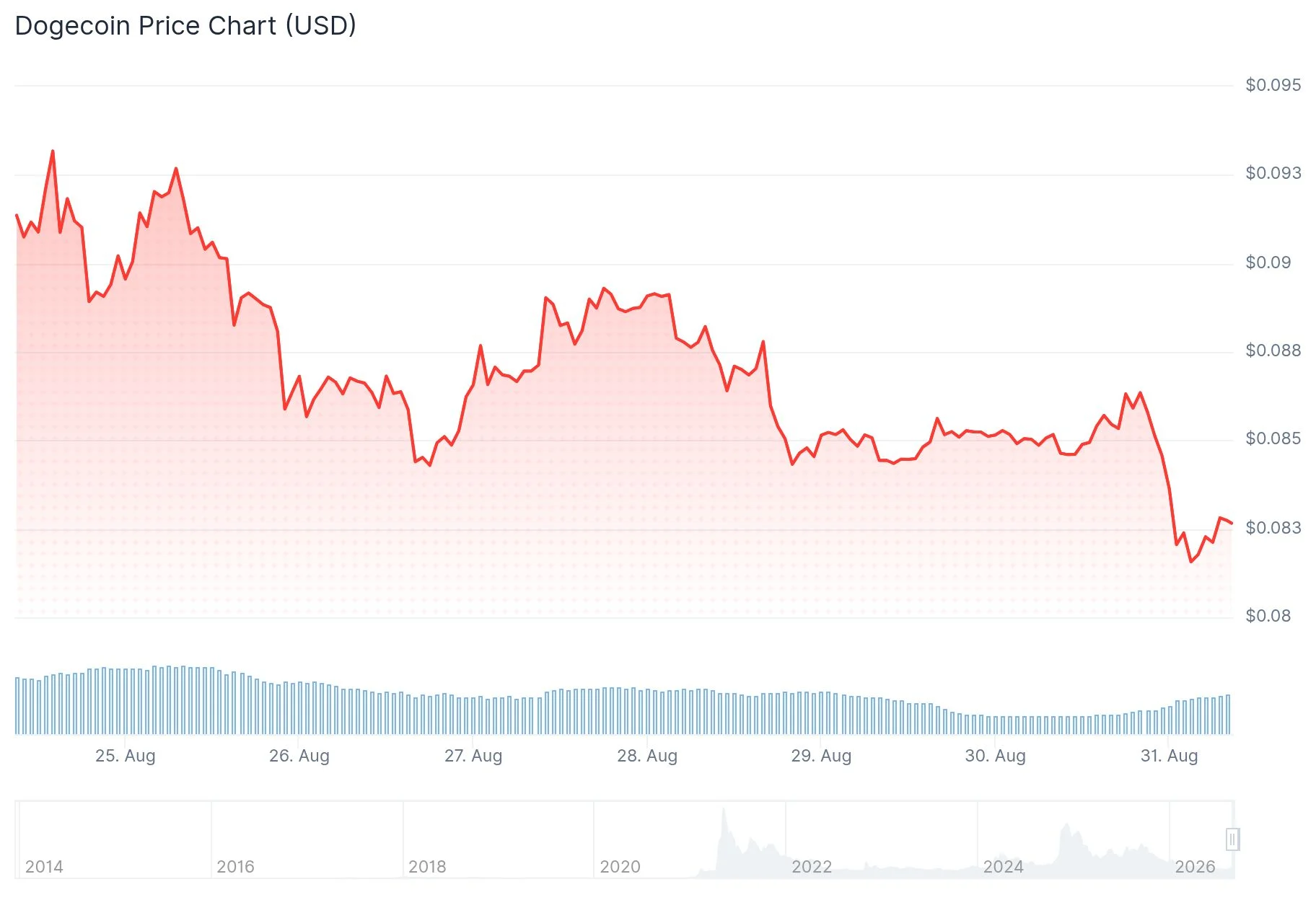
The retracement hasn’t erased August’s gains entirely. DOGE maintains a 25% monthly increase, setting up what could be its strongest monthly close in 2026 while ending a three-month downtrend.
Market activity metrics reveal cooling momentum. Daily trading volume has contracted dramatically from $5.2 billion on August 23 to approximately $1.5 billion currently. Similarly, perpetual futures open interest decreased from 17.3 billion DOGE to 15.7 billion DOGE during the same timeframe, suggesting traders are reducing leveraged positions.
Despite these bearish signals, on-chain data provides a counternarrative. According to blockchain analyst CW, DOGE’s accumulation metric has climbed to a maximum reading of 100. This indicates sustained buying pressure distributed across the week rather than isolated bursts of demand.
From a moving average perspective, DOGE maintains position above both its 50-day EMA ($0.078) and 100-day EMA ($0.082). The 200-day EMA situated around $0.095 continues to present overhead resistance.
Technical Formations Point to Potential Breakout
Multiple chart patterns are emerging that could signal DOGE’s next directional move. Technical analyst Crypto Tony has identified a developing inverse head-and-shoulders structure, with a neckline breach potentially targeting $0.098. This setup awaits final confirmation.
Chart analyst Ali Charts has spotted a bullish flag pattern taking shape following the recent upward movement. According to this analysis, $0.09 represents the pivotal threshold — a sustained hourly close above this level could unlock price objectives at $0.096, $0.105, and ultimately $0.115. Critical downside protection rests at $0.081.
Contributing to the optimistic outlook, analyst MikybullCrypto shared on X that $DOGE possesses potential to exceed $1 during the next major bull cycle, emphasizing a crucial price zone that shouldn’t be overlooked — further reinforcing positive expectations for the digital asset.
Bitcoin Pair Shows Historical Extremes
Examining the DOGE/BTC trading pair reveals interesting historical context. The monthly Relative Strength Index has fallen beneath the 40 threshold. According to analyst Crypto Surf, this technical condition has materialized only twice previously in the pair’s entire trading history. However, this rare occurrence doesn’t automatically guarantee a trend reversal.
The RSI against the US dollar measures approximately 63, remaining below overbought levels, while the MACD indicator continues showing positive momentum.
As of August 31, DOGE is navigating the zone between $0.081 floor support and $0.09 ceiling resistance, with current pricing hovering near $0.08447.
The post Dogecoin (DOGE) Price Analysis: Critical Support Zones That Could Define Next Rally appeared first on Blockonomi.
Key Takeaways
- Gabriel Perez, who operated teleprompters at the White House, received a $172,000 penalty from the CFTC for exploiting insider knowledge on Kalshi prediction markets
- He accessed President Trump’s prepared speeches approximately 60 minutes before public delivery and wagered on markets predicting presidential word usage
- His illicit trading activity generated profits exceeding $107,500 during a three-month period spanning late 2025 through early 2026
- The platform’s internal monitoring systems identified the irregular trading patterns and alerted federal authorities
- This marks the second CFTC enforcement action against event contract manipulation within a month
The prediction market industry faces intensifying regulatory oversight following revelations that a White House staff member exploited privileged information about presidential addresses to generate substantial betting profits.
Gabriel Perez, whose responsibilities included managing teleprompter systems, reached a settlement agreement requiring him to remit $172,000 to resolve allegations filed by the Commodity Futures Trading Commission. The settlement encompasses $107,539 in disgorgement of ill-gotten gains plus a $65,000 monetary sanction. Additionally, he faces a three-year prohibition from conducting transactions on any CFTC-regulated trading venue.
Perez established his Kalshi trading account during December 2025. His professional position provided him visibility into the president’s scripted statements approximately 60 minutes prior to their public presentation.
He exploited this informational advantage to execute trades on Kalshi’s “presidential mention markets.” These derivative instruments settle based on whether particular terminology or expressions appear in presidential communications. With advance knowledge of speech content, Perez could place virtually risk-free wagers.
His trading activities spanned from December 2025 through March 2026, generating aggregate profits surpassing $107,500 before regulatory intervention occurred.
Platform’s Internal Controls Identified the Scheme
The detection came from within Kalshi itself. The platform’s compliance and surveillance department identified the anomalous trading behavior and subsequently notified the CFTC. Robert DeNault, who heads enforcement at Kalshi, confirmed via social media that the company’s monitoring infrastructure successfully identified the violation.
“It doesn’t matter who you are: violate our rules or federal law and you will face the consequences,” DeNault declared.
Perez provided complete assistance to investigators throughout the inquiry. The CFTC characterized his level of cooperation as “exemplary,” which resulted in approximately 40% mitigation of his financial penalty. He agreed to the settlement terms while neither confirming nor denying the regulatory findings.
Growing Trend of Prediction Platform Violations
This enforcement action represents part of a broader pattern of misconduct. On July 31, former representative George Santos reached an approximately $35,000 settlement with the CFTC concerning Kalshi transactions related to State of the Union address markets. Regulators determined he misrepresented his attendance status on social platforms while maintaining active positions in those contracts.
During May, federal authorities indicted a Google software engineer for leveraging proprietary search analytics to generate roughly $1.2 million through Polymarket trades. The CFTC simultaneously pursued civil enforcement proceedings in that matter.
Earlier this year, prosecutors also brought charges against a military servicemember over Polymarket positions connected to Venezuelan military operations. A content editor employed by MrBeast lost their position following a Kalshi insider trading investigation.
Both Kalshi and Polymarket implemented enhanced compliance protocols in March 2026, deploying additional verification systems and revising their codes of conduct.
The CFTC continues developing comprehensive regulatory guidelines for prediction markets under Chairman Michael Selig’s leadership. In related developments, a federal appellate court issued an unfavorable ruling for Kalshi regarding its legal conflict with Nevada gaming authorities, determining the company failed to establish federal preemption over state gambling statutes.
The post Ex-White House Staffer Slapped with $172K Fine for Kalshi Prediction Market Fraud appeared first on Blockonomi.
Key Takeaways
- HYPE currently trades at approximately $82.92, registering a 3.98% gain over 24 hours, with total market capitalization reaching $20.87 billion
- Market analyst Crypto Patel cautions that inability to surpass $87 may drive HYPE down to $60 or potentially $50
- The release of 14.18 million tokens valued at roughly $1.2 billion caused downward pressure from the $86.71 peak
- The platform dominated with $249.2 billion in notional trading activity, significantly outpacing its closest rival’s $106 billion
- Growing institutional interest evident through Hyperliquid Strategies’ 29.3 million HYPE holdings and Bitwise’s new spot ETF
The HYPE token from Hyperliquid is currently positioned at $82.92 as of this writing, following its peak performance of $86.71 reached on August 27, 2026. This milestone occurred simultaneously with the protocol’s most substantial scheduled token distribution since its initial deployment.
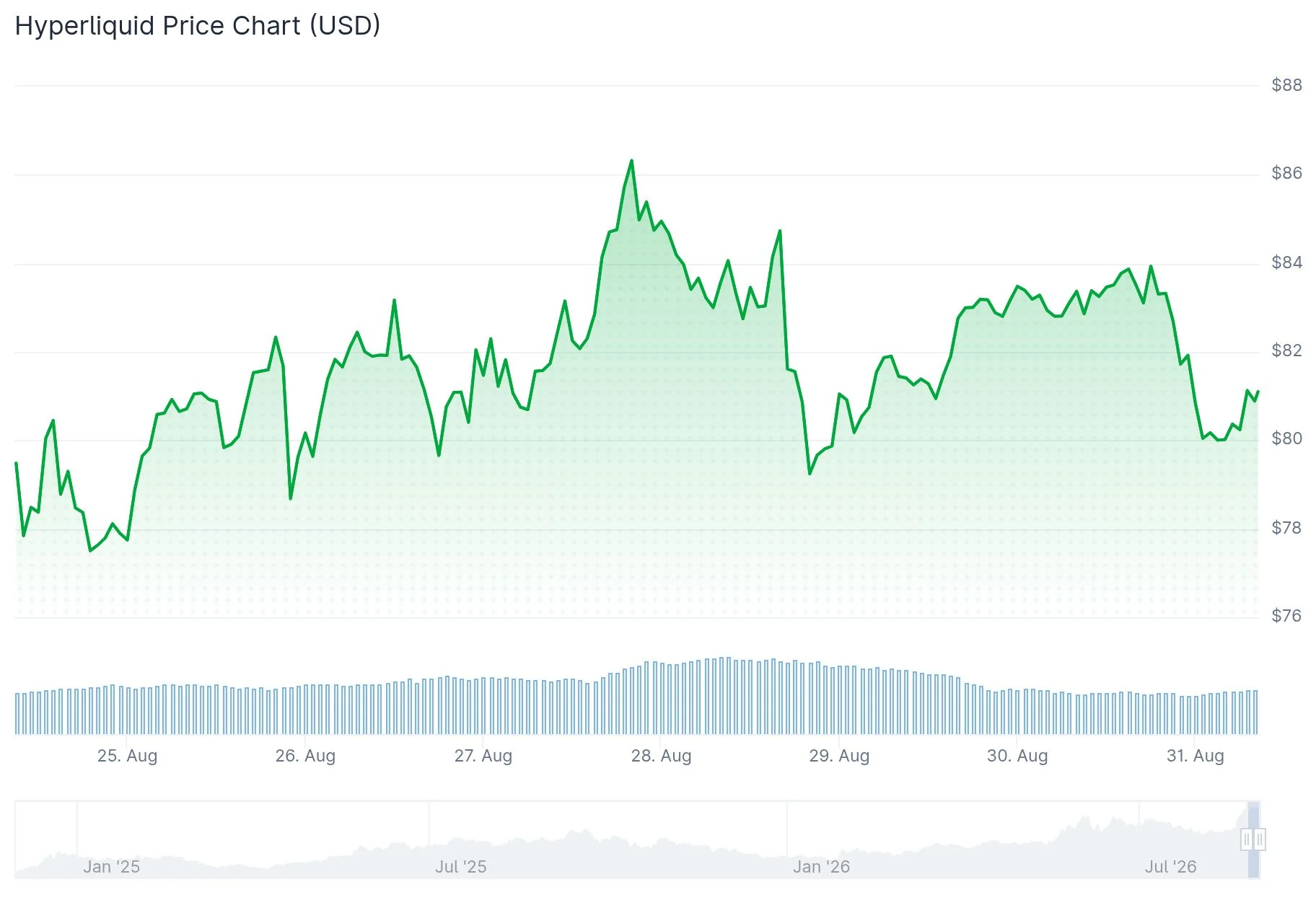
Current 24-hour trading activity totals $863.67 million, while the total market valuation sits at $20.87 billion. HYPE continues maintaining its position among the top 10 cryptocurrency assets ranked by market capitalization.
The pullback stems from the introduction of 14.18 million HYPE tokens into active circulation — representing approximately 1.4% of the complete 1 billion token maximum supply. Based on present valuations, this release equates to roughly $1.2 billion in value.
Approximately half of these distributed tokens were designated for insiders and initial backers. An equivalent portion targets the community segment, while the Hyper Foundation receives a smaller allocation.
Critical $87 Threshold Remains the Focal Point
Cryptocurrency market analyst Crypto Patel identified the $87 mark as a significant resistance barrier. HYPE attempted to reclaim that territory before experiencing a sharp reversal that brought prices down to approximately $78.50.
Is $HYPE Actually Setting Up For A Bigger Breakdown?
On Aug 26, I Warned That TL Was The Key Support And #HYPE Now Went To $87 Before Dumping Back To $78.5.
The $82 Support Has Broken, And We Can Now See The Previous Support Turning Into Resistance.
$84–$85 Retest →… https://t.co/XnD2y48epf pic.twitter.com/WgQTT7B7W6
— Crypto Patel (@CryptoPatel) August 29, 2026

Patel observed that the $82 level, previously functioning as support, could now serve as resistance. A move toward the $84–$85 zone might present another exit opportunity should the price face rejection.
While HYPE remains below the $87 threshold, Patel projects potential downside objectives at $60 and $50.
According to analyst Ted Pillows on X, a major holder acquired $20,500,000 worth of HYPE within a single trading day, characterizing this as “smart money accumulating quality alts.” Such substantial accumulation from significant players indicates underlying conviction despite current market headwinds.
Corporate Acquisition and Token Burns Create Buying Pressure
From the institutional perspective, Nasdaq-traded Hyperliquid Strategies has accumulated a reserve of 29.3 million HYPE tokens following successful equity fundraising rounds totaling hundreds of millions. Additionally, Bitwise’s Hyperliquid ETF has been actively staking a substantial HYPE allocation, as indicated by recent disclosures.
LATEST:
Hyperliquid Strategies more than doubled its HYPE treasury to 29.3M coins in the past fiscal year while raising $647M in equity. pic.twitter.com/FcTwAZZw7a
— CoinMarketCap (@CoinMarketCap) August 28, 2026
The protocol has implemented its AQAv2 mechanism, which channels returns from billions in USDC holdings into systematic HYPE token repurchases and permanent burns. The initial execution phase is scheduled for early October.
Protocol-generated fees are already being directed to an Assistance Fund designed to permanently eliminate tokens from circulating supply.
Platform Leads Decentralized Perpetuals Trading Landscape
From a volume perspective, Hyperliquid processed $249.2 billion in notional trading activity, substantially exceeding its nearest competitor’s $106 billion. This disparity highlights the platform’s commanding position within the decentralized perpetuals sector.
President Trump referenced CFTC Chair Michael Selig’s efforts to establish a regulatory framework for Hyperliquid within U.S. markets, statements that contributed to the token breaking through earlier resistance zones.
Currently, no U.S. retail access has received regulatory clearance.
Short-term price trajectory will probably hinge on whether the recently unlocked tokens face market selling pressure or get absorbed through staking mechanisms, ETF purchases, and corporate treasury acquisitions.
The post Hyperliquid (HYPE) Navigates $1.2B Token Unlock: What Investors Need to Know appeared first on Blockonomi.
CryptoPotato
Cronos halted its blockchain on Sunday after an exploit hit Tectonic, which happens to be its largest lending protocol. Experts estimated that roughly $75 million in assets were affected.
So far, no timeline has been provided for when the network will resume. The blockchain has also not said what will happen to the assets linked to the attacker after the chain is restarted.
Third Mango-Style DeFi Attack?
Crypto.com CEO Kris Marszalek confirmed the security breach and said that the Cronos team was investigating the incident. The Cronos app and exchange were not affected and continued operating as usual, and Marszalek asserted that all funds were safe.
On-chain tracking platform LookonChain reported that the attacker was only able to bridge $6.29 million to Ethereum. These funds were swapped for 2,592 ETH when the network was halted. As a result, the remaining $68.7 million is stuck on the Cronos Network.
Meanwhile, researcher Weilin Li said the attack was linked to Tectonic’s TONIC governance token, which has a 20% collateral factor despite having very thin liquidity. According to Li, the attacker carried out a Mango Markets-style pump-and-borrow price manipulation attack, which caused TONIC’s price to surge 100-fold within 20 minutes.
Similar price-manipulation attacks have also affected other DeFi platforms recently. For instance, Moonwell, a lending protocol on the Base network, lost over $8 million last week after an attacker manipulated the collateral price of MAMO, a small-cap token with thin liquidity. In response, Moonwell cut borrow caps for all Core Markets on Base to 1 wei, which effectively stopped new borrowing across the deployment. It also reduced supply caps for MAMO and WELL to 1 wei, while leaving other supply caps unchanged.
Another recent case involved a low-liquidity Pendle market, where price manipulation led to about $36 million in liquidations of leveraged PT-reUSD positions on Morpho.
Aftermath
Tectonic’s locked assets have dropped sharply following the exploit. According to the latest stats by DefiLlama, the lending protocol held around $121 million on August 29.
Two days later, that figure had fallen to roughly $3 million.
The post Cronos Halts Network as Tectonic Faces Mango-Style Attack: $75M in Assets Reportedly Affected appeared first on CryptoPotato.
Bitcoin ends August and enters September under renewed pressure, but geopolitics won’t be the only factor traders need to watch this week.
Several important US economic reports are due between Tuesday and Friday, culminating with the August jobs report, which could significantly shift expectations for the Fed’s September meeting.
First Tests Arrive Tuesday
Monday is likely to be a quiet day on the economic front, but it saw military action between the US and Iran as both countries resumed attacks against each other. The impact on BTC was felt immediately, with the asset slipping by over two grand to just under $77,000.
Tuesday brings two reports capable of moving markets: the July JOLTS Job Openings and August ISM Manufacturing PIM, both scheduled for 10:00 ET. Economists expect job openings to decline slightly to around 7.27 million, from 7.36 million previously.
A stronger labor market could reinforce expectations that the Fed has room to raise rates again, potentially supporting Treasury yields and the greenback. Such environments are typically not favorable for risk assets like bitcoin.
The ADP Private Employment Report will go live on Wednesday, which offers another indication of labor-market strength. Thursday delivers weekly jobless claims and the ISM Services PMI.
Key Events This Week:
1. August Chicago PMI data – Monday
2. August ISM Manufacturing PMI and Prices data – Tuesday
3. July JOLTS Job Openings data – Tuesday
4. August ADP Nonfarm Employment data – Wednesday
5. August ISM Non-Manufacturing PMI and Prices data – Thursday
6.…
— The Kobeissi Letter (@KobeissiLetter) August 30, 2026
All Eyes on Friday
The most important macro event on US soil arrives on Friday at 8:30 ET: The August employment report. General expectations suggest that the world’s largest economy has added approximately 58,000 jobs in August, while unemployment is anticipated to remain at 4.1%. The July report showed that the US actually lost 23,000 jobs, adding to existing concerns that the labor market is losing momentum.
Friday’s numbers could therefore significantly reshape the debate surrounding the Fed’s September 15-16 meeting. A stronger-than-expected report could suggest employment remains resilient despite restrictive monetary policy. This could be bearish for risk assets, as if it’s combined with stubborn inflation, it could strengthen the case for a rate hike.
In contrast, a weaker report could reduce those expectations and provide some relief for the crypto market, although an unexpectedly sharp deterioration could instead raise recession concerns and trigger another risk-off reaction.
The post Will Bitcoin Bounce or Dump? All Eyes Are on This Week’s Major Economic Events appeared first on CryptoPotato.
After jumping past $79,000 on Sunday evening, bitcoin entered the new business week on the wrong foot, slipping below $77,000 in an hour or so as geopolitical tensions returned to financial markets.
The decline came amid renewed fighting between the United States and Iran, following nearly a month of relative calm as the US reportedly focused only on increasing economic pressure. US Forces struck two Iranian launchers on the island of Larak on Sunday, while the latter retaliated with strikes against military targets stationed in Jordan.
US President Trump’s AI video of how Kharg Island, Iran’s key oil region, is being “blown to smithereens” didn’t help defuse the situation either.
Oil Up, Asian Markets Down
Brent crude reacted immediately with a near-3% surge to over $90 per barrel, reviving concerns about another energy-driven inflation shock. This is particularly worrisome following Fed Chair Kevin Warsh’s hawkish speech at Jackson Hole on Friday, as higher oil prices deteriorate the inflation picture.
In contrast to oil, Asian stock markets headed south after the attacks went public, with Japan’s Nikkei falling by roughly 2%. South Korea’s Kospi and Chinese equities also turned red, while US and European stock futures followed suit. The Japanese yen weakened beyond 160 against the greenback.
Bitcoin dipped below $77,000, losing over $2,000 of value. Additional pressure came from Wintermute, as on-chain data showed that the entity transferred 5,100 BTC, worth almost $400 million, to Binance over the past two days, likely intending to sell.
Although this transfer doesn’t guarantee that Wintermute has sold, recall that similar actions taken by the market maker last week resulted in another leg down for BTC and the alts.
Ethereum’s situation was even worse, as it plunged from over $2,500 to under $2,400 in an hour. Lookonchain reported that a whale or an institution had deposited almost 41,000 ETH (worth over $100 million) onto exchanges, a move typically made before selling.
Liquidations on the Rise
The sharp move south led to over $400 million in wrecked positions on a daily scale, with the lion’s share coming earlier this morning. Interestingly, ETH longs are responsible for almost $100 million, while BTC longs are just $62.60 million, according to CoinGlass.
The single-largest wrecked position also involved the leading altcoin, with a trader getting liquidated for $6.12 million on Aster. In total, more than 100,000 over-leveraged traders were wiped out in the past day.

The post Bitcoin Dumps Below $77K as US-Iran Strikes Resume: Who Else Might Be Behind the Drop? appeared first on CryptoPotato.
DeFi tokens have climbed nearly 38% since August 17 as investors reassess how US crypto policy could affect protocol revenue and token value.
SoSoValue says the rally is moving DeFi closer to a market where fees, buybacks and on-chain activity can play a larger role in how tokens are valued.
Policy Shift and Protocol Revenue Behind the Rally
In a post on X, SoSoValue said its DeFi sector index, $DEFI.ssi, rose from 0.3616 on August 17 to around 0.498 after reaching 0.511, for a cumulative gain of about 37.7%.
The move came alongside Bitcoin and Ethereum’s recovery and broader short covering, but the research firm argues that investors are also reassessing whether mature DeFi protocols can return more of their revenue to tokenholders.
That issue has limited DeFi valuations for years. Protocols could generate substantial trading fees, lending income, and other revenue while tokenholders had little direct claim on those economics.
Fee distributions and buybacks could also create securities-law concerns in the US, leaving many protocols reluctant to activate mechanisms that tie revenue to their tokens. But that may be changing, considering that last week, the SEC proposed its “Regulation Crypto Assets” framework, which includes exemptions and a conditional safe harbor for certain crypto-asset offerings.
Under the proposal, once a project has completed or permanently stopped the essential managerial work it had promised, its token may no longer remain part of an investment contract.
The Senate’s CLARITY Act draft goes further for DeFi, with protections for noncontrolling developers, validators, node operators, oracle providers and self-custody wallet software.
That draft also leaves room for rewards linked to trading, staking, governance, and liquidity provision. However, it still needs 60 votes in the Senate, while the SEC proposal is subject to public comment, but according to SoSoValue, markets are already assigning more confidence to the direction of US policy, even though legal certainty is still not there.
Revenue and Buybacks Give DeFi Tokens a Different Valuation Case
When you consider protocol revenue, the case becomes even more interesting, with Uniswap generating about $7.18 million during the past 30 days, followed by PancakeSwap at $5.16 million, Jupiter at $4.69 million, Aave at $4.12 million, and Aerodrome at $4.11 million.
Several of these protocols now have mechanisms that connect those economics to their tokens. For example, Hyperliquid uses part of trading fees to buy HYPE, Uniswap has linked revenue to UNI burns, and Jupiter allocates 50% of protocol fees to JUP purchases. PancakeSwap also uses part of its fees for CAKE buybacks and burns.
Meanwhile, Ethena has proposed an even larger allocation. Once USDe reaches its stated supply threshold, 95% of net revenue paid to the foundation across its three core business lines would go towards ENA buybacks.
According to SoSoValue, the next phase depends on whether those protocol revenues keep rising and whether tokenholders can get a larger share of it.
The post DeFi Sector Jumps 38% as US Policy Shift Unlocks Token Value Capture appeared first on CryptoPotato.
Crypto company BitGo has officially acquired NYDIG’s Bitcoin-focused institutional trading business. The deal was signed and completed on Thursday and reported on Friday, paying $7 million in cash and about $35.5 million in stock at closing, with up to $15 million more in cash tied to two revenue milestones.
The purchase brings NYDIG’s derivatives, structured products, financing, and capital markets operations to the custody company, along with roughly 30 employees.
NYDIG Turns to Power and Compute
Around 250 institutional client relationships were moved across, though they appear in the 8-K filed the same day, which also grants seller NYDIG IHC LLC earn-out shares on the second milestone and sets aside staff retention awards targeting $5 million each in stock and cash.
“Institutions increasingly want to work with a trusted partner that can support the full lifecycle of digital assets,” said Mike Belshe, CEO and Co-founder of BitGo. The firm went public on the NYSE at the start of the year and had a market value below $1 billion as of Thursday, per CNBC.
NYDIG, an affiliate of Stone Ridge Holdings Group, said the sale lets it concentrate on power generation, Bitcoin mining and high-performance computing data centers, a development pipeline it puts above 3 gigawatts, with more than 1 gigawatt deliverable in 2027 and 2028.
“Our team built NYDIG’s institutional trading business into something exceptional: proven execution expertise with derivatives and financing capabilities,” said Tejas Shah, CEO of NYDIG, adding that the data center business is “where we see one of the most significant opportunities ahead.”
Belshe Pushes Senators on CLARITY
Belshe went on CNBC’s Squawk Box on Friday, days after Bitcoin briefly topped $80,000. Asked about a crypto winter, he said the markets “have had high highs and low lows” while “the thesis behind Bitcoin continues to grow,” pointing to tokenized equity plans from Morgan Stanley, Charles Schwab and DTCC.
.@BitGo CEO @mikebelshe breaks down its acquisition of $BTC miner NYDIG: https://t.co/coIINsM3RZ pic.twitter.com/ZqyUsNCkOu
— Squawk Box (@SquawkCNBC) August 28, 2026
On the CLARITY Act, which faces a Senate cloture vote on September 15, Belshe said everyone should want the market structure bill to pass. “This is what gives a legislative path forward to help rein that in, prevent any FTX from ever happening again,” he said, estimating 12 to 18 months of rulemaking after passage and noting he was at the White House with President Trump last week.
Belshe confirmed BitGo runs infrastructure for USD1, the stablecoin behind the Trump family’s World Liberty Financial, and said BitGo just received a license in South Korea. “People don’t realize this, but America actually is behind,” he added.
The post BitGo Buys NYDIG’s Institutional Trading Arm for $7M Cash and $35.5M in Stock appeared first on CryptoPotato.


