Cryptocurrency Posts
Crypto Briefing
Rising US borrowing costs and AI demand shifts could strain Asian economies, highlighting vulnerabilities despite stronger financial systems.
The post HSBC’s chief economist warns of parallels to 1997 Asian crisis appeared first on Crypto Briefing.
The escalating settler activity in the West Bank may hinder diplomatic efforts and delay international recognition of Palestinian sovereignty.
The post Young squatters claim divine right to West Bank land amid rising tensions appeared first on Crypto Briefing.
Iran's diplomatic outreach to regional powers may signal a strategic shift towards de-escalation and broader peace efforts in the Middle East.
The post Iran engages Saudi, Turkish ministers amid US-Iran tensions appeared first on Crypto Briefing.
The escalation in U.S.-Iran tensions could destabilize Iran's regime, heightening risks of unrest and impacting regional geopolitical dynamics.
The post Photos show the aftermath of US attacks in Kuhestak, Iran, which struck a wedding party and a telecommunications tower appeared first on Crypto Briefing.
The unexpected job growth strengthens the case for Fed rate hikes, potentially affecting borrowing costs and economic growth strategies.
The post US August job gains surpass forecasts, impacting Fed rate hike expectations appeared first on Crypto Briefing.
Bitcoin Magazine
Bitcoin Magazine
Hargreaves Lansdown Reverses Course, Rolls Out Bitcoin Trading
British financial services firm Hargreaves Lansdown is letting retail investors buy bitcoin — nearly one year after it said the cryptocurrency was “not an asset class.”
The Bristol, UK-based investment firm’s website said it was offering bitcoin and other crypto exchange-traded notes to investors. ETNs are investment funds which trade on stock exchanges and track the prices of digital assets.
It comes after the firm, which manages nearly £173 billion (over $233 billion) in assets, last year warned customers about buying bitcoin.
NEW:
— Bitcoin Magazine (@BitcoinMagazine) September 4, 2026U.K.'s largest investment platform Hargreaves Lansdown is now offering Bitcoin products to 2 million clients!
pic.twitter.com/GgdeHK8vyM
“While longer-term returns of Bitcoin have been positive, Bitcoin has experienced several periods of extreme losses and is a highly volatile investment — much riskier than stocks or bonds,” the firm said at the time.
“The HL Investment view is that Bitcoin is not an asset class, and we do not think cryptocurrency has characteristics that mean it should be included in portfolios for growth or income and shouldn’t be relied upon to help clients meet their financial goals.”
Now, a number of ETNs tracking the price of bitcoin and other cryptocurrencies are available. The firm warns users that “crypto ETNs are considered high-risk and may be volatile.”
U.S. regulator the Securities and Exchange Commission in 2024 approved bitcoin exchange-traded funds for investors after a decade of saying no to the products.
The funds had the most successful debut in the history of ETFs as investors previously unable to buy exposure to the asset class rushed in to buy the products.
Run by top asset managers and banks like BlackRock, Fidelity, and Morgan Stanley, the investment vehicles now collectively manage over $100 billion in assets.
This post Hargreaves Lansdown Reverses Course, Rolls Out Bitcoin Trading first appeared on Bitcoin Magazine and is written by Mathew Di Salvo.
Bitcoin Magazine
Trezor Breach Worse Than Reported: Another 67,000 US Customers Exposed
Hardware wallet manufacturer Trezor has said that a data breach first announced last month is worse than originally reported.
The Prague, Czech Republic-based company said Friday that an additional 67,000 U.S. customers had their names, emails, phone numbers, shipping addresses and order numbers leaked. The leaked data came from orders made between November 2019 and August 2021, according to Trezor.
Trezor first announced in August that data from 11,742 customers from the U.S., UK, Sweden, Colombia, Brazil, Italy, and Portugal had been exposed — with names, emails, phone numbers and shipping addresses leaked.
Another 1,947 customers just had their names, cities and emails exposed in the breach.
In Friday’s announcement, Trezor said that its third-party fulfillment partner, ShipMonk, had falsely reassured the company about deleting customer data.
“Throughout our entire relationship with ShipMonk, we repeatedly requested and received written assurance confirming the deletion of the data, in line with our contract, data policy, and past communications,” Trezor wrote.
“We are very disappointed that, despite receiving this confirmation, the data was not deleted in their systems.”
Neither Trezor nor ShipMonk immediately responded to Bitcoin Magazine’s questions.
Trezor first announced in August that the data had been leaked because ShipMonk experienced “unauthorized access to their systems containing customer data.”
The company added that it had directly emailed all customers involved in the breach. Trezor’s parent company, SatoshiLabs, told Bitcoin Magazine last month that it was investigating the incident.
Trezor is one of the most popular Bitcoin hardware wallet solutions, and also has support for storing other cryptocurrencies.
Bitcoiners’ personal data has been targeted by cybercriminals in the past: back in 2020, an unauthorized party accessed popular hardware manufacturer Ledger’s e-commerce and marketing database, leaking over 1 million email addresses and the personal contact data of nearly 10,000 customers.
At the start of this year, customers reported receiving emails from Global-e, Ledger’s payment partner, that a data breach at its cloud systems leaked sensitive customer data.
This post Trezor Breach Worse Than Reported: Another 67,000 US Customers Exposed first appeared on Bitcoin Magazine and is written by Mathew Di Salvo.
Bitcoin Magazine
El Salvador Isn’t Buying Bitcoin With Public Money, Says IMF
El Salvador has not used public funds to accumulate bitcoin since the International Monetary Fund’s last review of its loan program, the fund said Thursday.
In a report Thursday, the body said that the Central American country had instead received bitcoin from private donations, citing documentation from the government. It added that “no further Bitcoin accumulation beyond the documented donations is expected.”
El Salvador made headlines in 2021 when it became the first country in the world to make bitcoin legal tender. Salvadoran president Nayib Bukele in 2022 said the country would buy one bitcoin per day but it was never clear where the money was coming from — or if he was actually buying at all.
“Documentation has been provided verifying that Bitcoin accumulation since the first review reflects private donations and that no public resources were used,” the IMF release said.
“Understandings were also reached on steps to modernize the legal, regulatory, and supervisory framework for digital assets and to further strengthen the governance and risk-management arrangements for public-sector crypto-asset holdings. Going forward, no further bitcoin accumulation beyond the documented donations is expected.”
The report added that public participation in the government-sponsored bitcoin wallet has been largely wound down, with majority ownership and operational control handed to a private operator.
El Salvador in 2021 debuted a state-sponsored wallet called Chivo for its citizens as part of its plan to increase bitcoin adoption in the country.
“IMF staff thank the Salvadoran authorities for the constructive discussions and excellent collaboration,” the report added.
The IMF El Salvador entered a $1.4 billion loan agreement at the end of December but the fund asked for the country to scale back certain aspects of its bitcoin strategy.
Institutions like the World Bank and the IMF have long criticized President Bukele’s Bitcoin law, which also asked businesses to accept the cryptocurrency if they had the technological means to do so.
President Bukele in 2024 admitted that Salvadorans weren’t using the cryptocurrency to buy things as expected, but always boasted that the government was still stacking sats.
Since launching a crime crackdown to tackle the country’s notorious crime gangs, murder rates in El Salvador have plunged. The country was once the most dangerous place in the Americas but President Bukele is now trying to turn it into a tech hub.
Crypto companies like Tether have since relocated to its capital, San Salvador.
This post El Salvador Isn’t Buying Bitcoin With Public Money, Says IMF first appeared on Bitcoin Magazine and is written by Mathew Di Salvo.
Bitcoin Magazine
Bitcoin Dips Below $80,000 on Strong US Jobs Report
Bitcoin slid Friday after a better-than-expected labor report showed that the U.S. job market accelerated in August.
The leading cryptocurrency was recently trading for close to $79,764 after dropping as low as $78,706 earlier in the morning in New York. It’s currently down over 1% over a 24-hour period. On Thursday, the coin soared above $82,000.
The Federal Reserve is typically more likely to raise interest rates when the labor market is strong, because more people employed means more spending, and more spending can push inflation up.
Federal Reserve Chair Kevin Warsh last week gave his first major speech as head of the U.S. central bank and said he had “more work to do” to fight inflation. Bitcoin has typically done well in a low-interest rate environment.
Traders currently view a U.S. Federal Reserve interest rate hike at the upcoming September 15–16 policy meeting as roughly a 50% to 60% probability.
But U.S. President Donald Trump on Friday demanded the Federal Reserve slash interest rates.
Writing on his social media platform Truth Social, Trump said: “Lower the interest rates because the U.S.A. is a much stronger credit than it was just a short time ago!”
He added: “We should have the LOWEST RATE of any country in the World, like ‘the old days.'”
Bitcoin has decoupled from stocks recently as investors have renewed concerns around dollar debasement.
The cryptocurrency started surging last month, after the U.S. Treasury Department said it would more than double the size of its government debt repurchases. The coin had its best run in three years and third best August ever.
The much-talked about debasement trade is back in the spotlight, and bitcoin has been trading in lockstep with gold, according to analysts. The so-called debasement trade is when investors buy an asset as a way to hedge against a currency losing value.
News dropped last month that U.S. public debt exceeded $40 trillion for the first time too. Excessive debt also undermines confidence in the dollar, making assets like bitcoin and gold attractive.
This post Bitcoin Dips Below $80,000 on Strong US Jobs Report first appeared on Bitcoin Magazine and is written by Mathew Di Salvo.
Bitcoin Magazine
National Sheriffs’ Association Drops Opposition to Clarity Act
The National Sheriffs’ Association this week dropped its opposition to the crypto Clarity Act, after having previously warned that the proposed bill could help criminals.
Writing Thursday to Senate Majority Leader John Thune and Minority Leader Chuck Schumer, the association said it was changing its stance to neutral given how complex the issue is.
A number of lawmakers were hoping to vote on the Clarity Act in August. After a delay, a vote will now go ahead this month. The bill will establish a framework for distinguishing between digital assets that are securities, commodities or payment stablecoins — legislation that the crypto industry has long called for.
“Given the complexity of the legislation and the number of important details that remain under consideration, the NSA is changing its position on the Clarity Act to neutral,” the letter from NSA President Sheriff Troy Wellman and Executive Director Justin Smith read.
JUST IN: Major U.S. law enforcement organization National Sheriffs’ Association no longer opposes The Clarity Act
— Bitcoin Magazine (@BitcoinMagazine) September 4, 2026
“We believe the most appropriate course is to step back and allow the legislative process to proceed to establish a…much needed regulatory framework.”pic.twitter.com/NBpKlrUsUj
“At this time, we believe the most appropriate course is to step back and allow the legislative process to proceed to establish a clear, effective, and much needed regulatory framework.”
The NSA had previously warned that the bill could create regulatory and anti-money laundering loopholes by exempting certain crypto developers and infrastructure providers from money transmitter rules.
Despite being passed in the house of representatives last year with strong bipartisan support, the Clarity Act has been in a deadlock for much of 2026. The banking lobby raised concerns over stablecoin yield and some lawmakers have said improvements need to be made surrounding ethics.
An updated bill of the Clarity Act was introduced in July that addressed some of these concerns — banning government officials and their families from issuing or promoting crypto.
Pro-crypto senator Cynthia Lummis wrote on Friday that the “bipartisan bill” gives “law enforcement real tools to fight the illicit finance crimes hurting hard working Americans.”
Major financial institutions, lawmakers and companies have said they support the latest draft of the new bill, but some Republicans have accused Democratic lawmakers of deliberately playing politics and holding the bill back.
This post National Sheriffs’ Association Drops Opposition to Clarity Act first appeared on Bitcoin Magazine and is written by Mathew Di Salvo.
CryptoSlate
Hardware wallet maker Trezor says a breach at logistics provider ShipMonk exposed contact and order data for another approximately 67,000 U.S. customers after years-old records remained in the vendor's systems despite written deletion assurances.
The Sept. 4 update expands an incident Trezor initially said affected 13,689 people. The two disclosed groups imply a total of roughly 80,689, although Trezor has not issued a single combined figure or published underlying data showing whether the groups overlap. Its use of “another” indicates that it considers the new records additional to the original cohort.
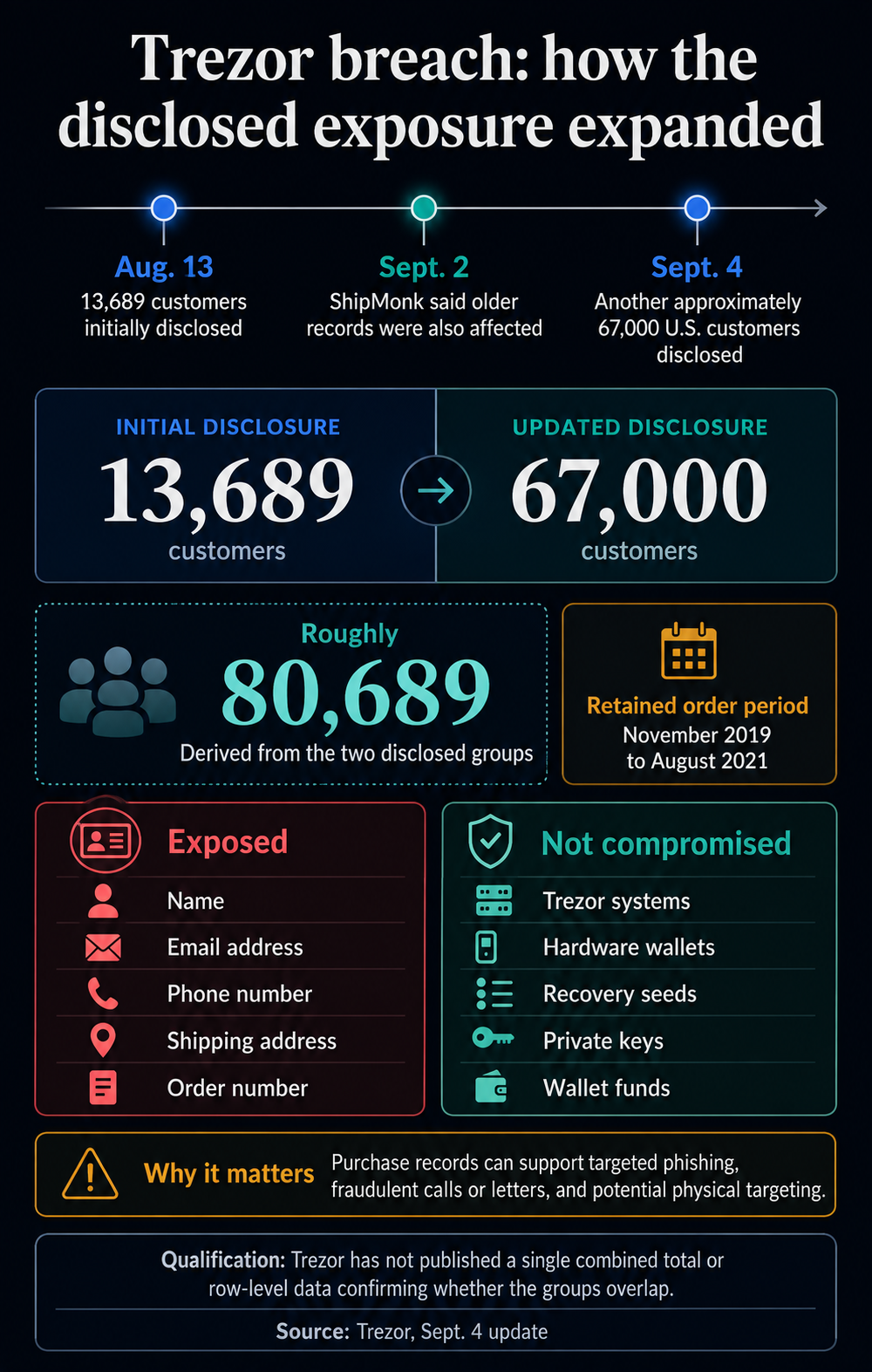
The newly disclosed records cover U.S. orders from November 2019 through August 2021 and include names, email addresses, phone numbers, shipping addresses and order numbers. The data can connect an identifiable person and physical location with a hardware-wallet purchase, creating risks beyond a conventional email leak.
Old data outlived a 90-day policy
When Trezor first disclosed the breach on Aug. 13, it counted 11,742 customers with full exposure and 1,947 with partial exposure. Trezor's Aug. 13 account said older order data had already been deleted. An Aug. 14 clarification acknowledged that some partially exposed records included older orders.
The Sept. 4 update reverses that understanding. Trezor said it repeatedly requested and received written assurances that ShipMonk had deleted the data, yet records from 2019 to 2021 remained. Trezor's published delivery-data policy says customer details should be deleted from both its own and its fulfillment partner's systems after 90 days, with exceptions for ongoing order issues. The assurance letters and their dates have not been made public.
BleepingComputer reported that a ShipMonk notification attributed the original unauthorized access to a vulnerability in analytics platform Metabase. Metabase said the August zero-day could create a session tied to an administrator account and allow bulk table downloads. Once the provider incident was reassessed, the retained historical data expanded the number of Trezor customers known to be exposed.
The breach did not reach Trezor's wallet systems. The company said its systems, products and services were not compromised and its devices remained secure. The listed exposed fields were contact and order data, not recovery seeds, private keys or wallet funds.
The risk instead sits around the wallet. Trezor warned that the information could support convincing scam emails, fraudulent calls or letters and potential physical targeting. Its Sept. 4 update did not identify a confirmed downstream attack caused by this dataset, so those outcomes remain risks rather than documented consequences.
Trezor said it emailed every newly affected customer directly and that anyone who did not receive its incident notice was not affected. It urged customers never to share a wallet backup or enter it on a website.
For hardware-wallet owners, the episode shows that protecting keys does not erase the purchase trail created by fulfillment. A deletion policy offers little protection if a vendor's compliance is not verified.
The post Users exposed by Trezor breach grows sixfold after supposedly deleted shipping logs are found appeared first on CryptoSlate.
Compound is a crypto lending protocol governed by holders who delegate their COMP tokens, a setup known as a decentralized autonomous organization, or DAO. It works like an online republic, with token holders debating proposals, voting, and letting software carry out the result.
In July 2024, that republic nearly sent a fortune to a small group of voters. Proposal 289 asked Compound to transfer 499,000 COMP, then worth about $24 million, into a yield-bearing vehicle they controlled. Two earlier versions had failed, and the third seemed headed the same way.
Then, during the final 34 minutes, supporting addresses cast 563,591 votes, equal to 82% of all support for the proposal. The last big block landed eight minutes before the deadline, and the measure passed by 682,191 votes to 633,636.
While this was extremely controversial and remains highly contested, there was no issue with the code, as it worked exactly as intended.
But that was the problem: the wallets had gathered enough COMP and delegated their voting power before the period closed, but Compound lacked an emergency authority that could pause the software. Several reasonable rules had combined into a convenient path for a treasury raid.
Compound reached a settlement that canceled the allocation and later added a veto role, placing a brake in the system built around automatic token-holder rule.
That captures the central DAO dilemma, because most defenses against rushed or hostile votes give somebody more control over participation or the final result.
Two 2026 studies from the Max Planck Institute for Software Systems and Vrije Universiteit Amsterdam traced a similar problem across 48 large Ethereum DAOs. One examined how registration, staking, and delegation concentrate voting power, while the other mapped attacks that use valid governance rules.
The ballot has a velvet rope
Calling a governance token a vote isn't really correct. Depending on the DAO, a holder may need to register a wallet, lock tokens, delegate them, maintain a minimum balance, or pay for an on-chain transaction before they can actually cast that vote.
Proposals face obstacles of their own, because someone needs enough tokens or delegated support to introduce them in the first place, and the idea may pass through a forum and informal poll before a binding vote on the blockchain or through an off-chain service such as Snapshot.
Once the tally clears the quorum and approval formula, a smart contract, multisignature wallet, or named person carries the result into effect.
While each of these gates solves a real problem, it also favors a particular participant or type of participant.
Proposal thresholds discourage spam and malicious code, but they inadvertently reserve authorship for wealthy holders and established delegates. On-chain voting makes those results enforceable, but transaction fees favor people with enough money and conviction to use it. Free off-chain polls draw a wider crowd, then depend on a smaller group for execution.
The researchers found an even split: 24 DAOs used on-chain voting and 24 used off-chain systems.
Uniswap showed how different electorates can form inside the same organization: more wallets joined its free off-chain polls, while much larger blocks of voting power appeared during the paid on-chain phase that could make a proposal binding.
Turnout is only one small part of this, because a protocol may have thousands of token holders while a few addresses control proposals, votes, and execution. By the time the public tally appears, the rules have already picked the electorate.
The security rules pick the ruling class
DAOs often keep tokens in treasury contracts, and founding teams or investors may hold allocations that have yet to vest, so registration separates circulating tokens from balances that currently carry voting rights.
Among the 48 DAOs, 36 required some form of registration, and only four had registered more than half of their outstanding supply. Across those 36 organizations, the average registered share was 21%, meaning the practical electorate usually covered a small fraction of all tokens.
Much of the missing supply belonged to users whose coins were held by exchanges or deposited into DeFi protocols. Centralized exchanges held more than 10% of outstanding tokens on average across the sample, and DeFi contracts held another 3.5%.
In 14 registration-based DAOs, those intermediary wallets controlled more tokens than the entire registered electorate.
That creates a very strange and rather unique custody problem, because an exchange wallet can represent thousands of customers even though the blockchain sees one address with one giant balance.
Letting the exchange vote turns a custodian into a political heavyweight, while excluding it strips customers of governance rights attached to tokens they paid for. Most DAOs also let one wallet send all its power to a single delegate, which makes splitting votes among the underlying owners difficult.
Staking tackles a different vulnerability by making voting power expensive to build and slow to unwind. A would-be attacker can buy or borrow a large position, approve a favorable proposal, and sell once the vote ends, while a lock keeps that voter financially exposed to the result for longer.
Fifteen DAOs required staking, with a median of 27.4% of tokens locked. Some imposed a one- or two-week withdrawal wait, while Curve, Angle, and Frax offered stronger voting power for locks lasting up to four years. The system rewards patience and turns liquid wealth into a prerequisite for political influence.
Crypto soon produced middlemen for people who wanted influence and the freedom to trade. These services maintain long locks, issue tradable substitutes, and keep the original voting rights. The arrangement concentrated enormous voting blocs inside a few services, according to the researchers’ measurements:
| DAO | Service controlling the votes | Share of voting power | Maximum native lock |
|---|---|---|---|
| Curve | Convex | 53% | 4 years |
| Frax | Convex | 46% | 4 years |
| Angle | StakeDAO | 57% | 4 years |
| Balancer | Aura | 65% | 1 year |
Delegation works the same because most holders have limited appetite for forum arguments about collateral ratios. Handing votes to a professional participant makes sense, and repeated delegation builds durable political blocs.
The ten largest holders controlled more than half of voting power in 39 of the 48 DAOs, while delegated voting was usually more concentrated than direct voting.
Registration protects treasury balances, staking makes a quick attack costlier, and delegation gives passive holders a voice through someone who pays attention. Put them together, and the people with the most capital, time, technical fluency, or control over customer assets tend to run the place.
A legal DAO vote can still be a raid
The second paper defines a governance attack as an actor using the authorized process to win an outcome that harms the wider organization.
Among 28 DAO incidents, researchers classified 16 as attacks that a different mechanism could have prevented. Six involved contract bugs, while ten depended on buying or borrowing enough tokens to influence a vote.
Compound is the best example because the wallets associated with Proposal 289 gathered more than 680,000 COMP over four months.
Researchers traced 563,790 tokens through four centralized exchanges and another 118,089 borrowed through Compound itself, even though those addresses had held only 853 COMP before the buildup and had little history in the protocol's politics.
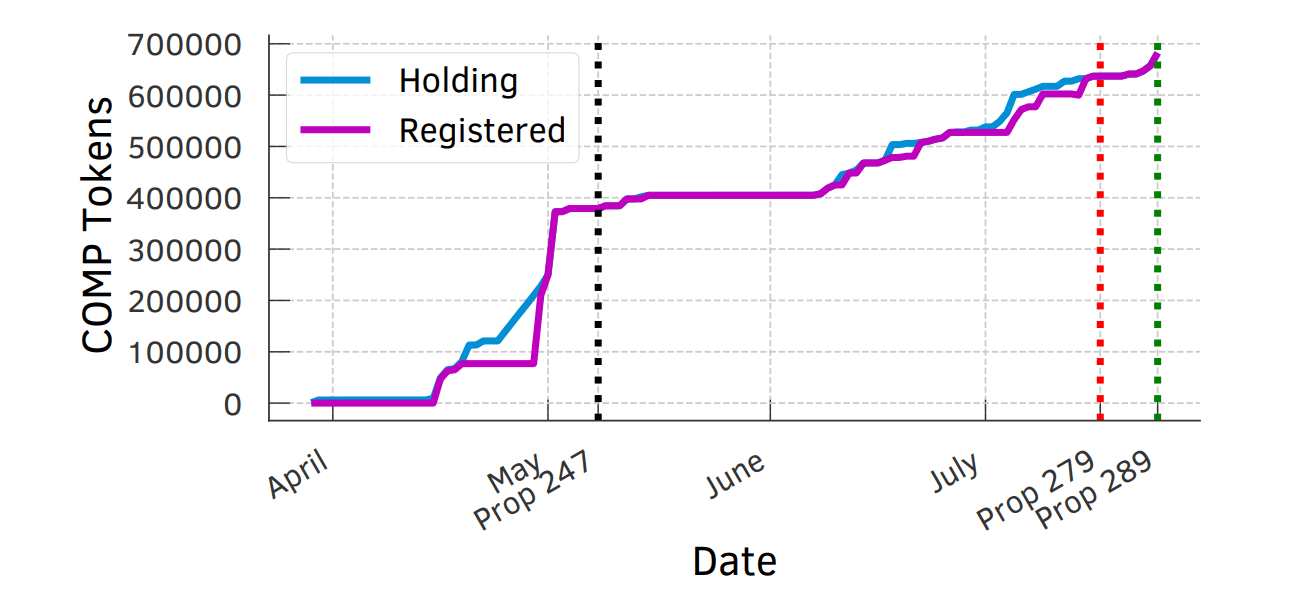
The late burst took advantage of a community that expected the third proposal to fail. Compound could have extended the vote when a large bloc appeared near the deadline, required longer staking, or allowed a trusted council to pause execution.
Every option would have moved power toward reactive voters, committed holders, locking services, or a small emergency body.
But Compound chose the emergency brake, and in the 2024 configurations researchers reviewed, seven other DAOs shared its exposure to readily available voting power and late vote accumulation: Uniswap, Radicle, Gitcoin, Silo, Ampleforth, Hop, and Cryptex.
Those systems can evolve through governance, so the list records a moment in 2024, while a current security rating would require a fresh review.
Decentralization needs a richer accounting than token distribution alone. A good governance report would show how much supply can vote, how much power the largest delegates control, which intermediaries hold staked tokens, and who can introduce, execute, or veto proposals.
Smart contract audits already ask whether governance code follows its specification, while a constitutional audit would ask where that specification sends authority.
DAOs can spread ownership across thousands of wallets and still funnel practical control toward a few dozen professionals, custodians, and large holders, with software that performs flawlessly all the way through.
The post DAOs are forcing crypto protocols to choose between code and emergency brakes appeared first on CryptoSlate.
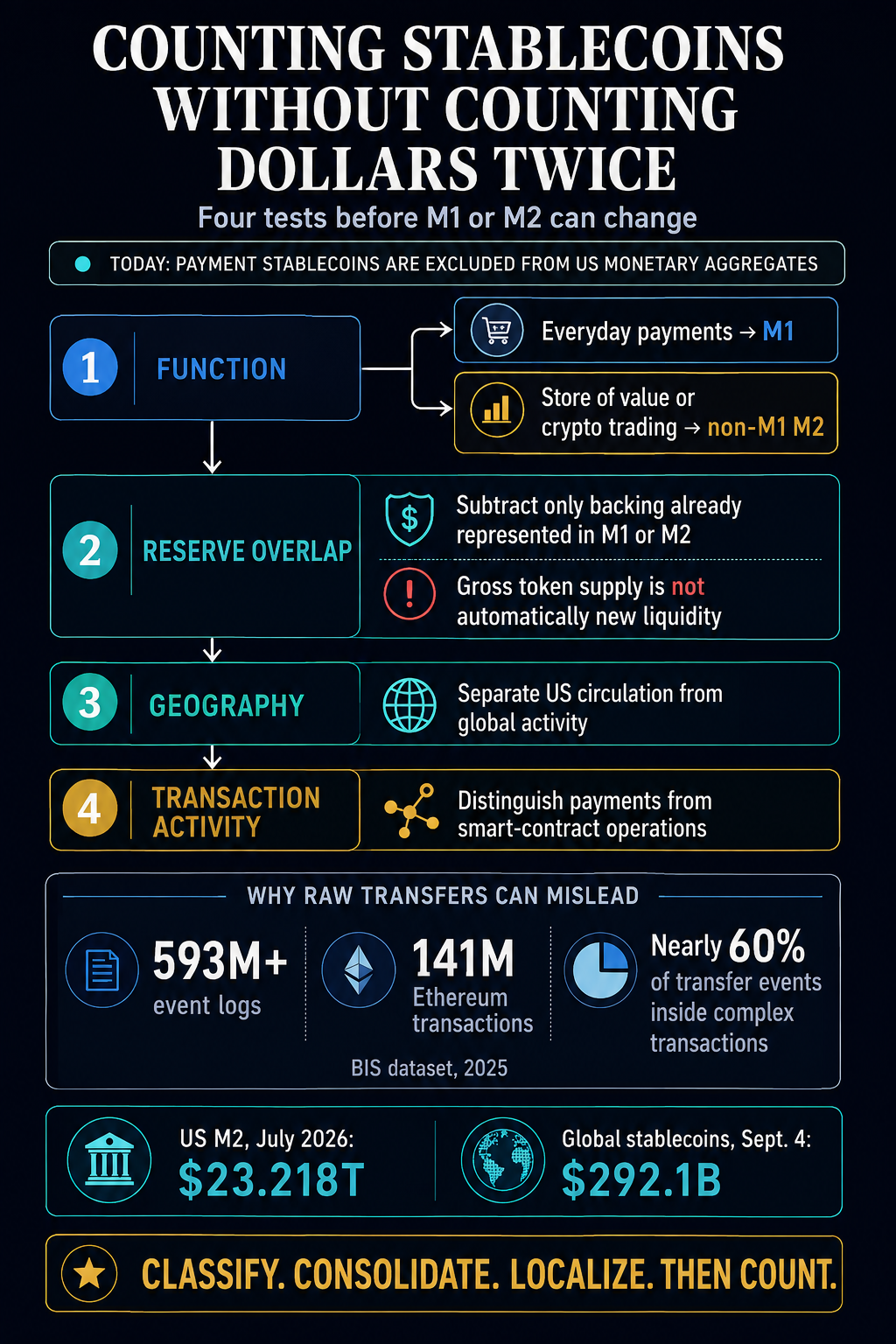
A Federal Reserve staff note published Sept. 4 sketches a route for regulated payment stablecoins to enter M1 or the broader M2 money supply. Its accounting framework requires adjustments before gross circulation could enter either measure.
Payment stablecoins are excluded from the US monetary aggregates today. The new note makes future treatment depend on economic use, alongside adjustments for reserve assets already counted elsewhere and the separation of US circulation from global activity. Otherwise, a larger money-supply figure could partly reflect a new wrapper around dollars the system already measured.
The distinction matters for anyone using M1 or M2 to judge dollar liquidity. A statistical increase driven by reclassification says little about newly created purchasing power.
The note is independent staff research, reflects only its authors' views, and is not part of a Federal Reserve policy deliberation. Existing definitions remain unchanged, and the analysis presents conditional possibilities.
How stablecoins could fit, and what could be counted twice
M1 is the narrowest official US money measure. It contains currency and highly liquid balances that households and businesses can use for transactions. M2 includes M1 plus less liquid savings-type assets, including small-denomination time deposits and retail money market funds.
The Fed authors apply that functional split to payment stablecoins. If the coins are used predominantly as a stable store of value or as liquidity for crypto trading, non-M1 M2 may be the better fit. If they become a common medium of exchange for household and business payments, their immediate transferability could support an M1 classification.
The framework remains conditional. The GENIUS Act requires permitted issuers to maintain at least 1:1 identifiable reserves and publish monthly reserve information, and leaves M1 or M2 assignment to a separate statistical decision. The Fed says standardized circulation data and a reporting chain suitable for monetary-statistics compilation would still be required.
The central stock-measurement problem sits on the reserve side. Under GENIUS, permitted reserves can include bank deposits, Treasury instruments, and government money funds. The Fed note says some bank deposits and money-fund net assets are already captured in M1 or M2.
If an issuer receives dollars, places part of them in a bank deposit or money fund, and issues stablecoins against that reserve, counting the tokens at face value could add a new line to the aggregate while part of the backing remains in another counted component. That is the same-dollar problem.
Only reserve assets already represented in M1 or M2 create overlap. The overlap depends on the backing composition and the statistical treatment of each reserve asset. The Fed note says the extent must be assessed before any adjustment is chosen.
| Question | What it determines | Evidence needed |
|---|---|---|
| Function | Whether the balance belongs with transaction money in M1 or savings-type money in non-M1 M2 | Reliable evidence on predominant economic use |
| Reserve overlap | How much gross issuance is already represented in counted components | Issuer-level reserve composition matched to M1 and M2 definitions |
| Geography | How much circulation belongs inside a US measure | Reporting that can separate US activity from global circulation |
| Transaction activity | Whether observed transfers resemble standalone payments or complex financial operations | Transaction-level classification rather than raw event counts |
USDC shows that a single headline number answers only part of the reserve question. Circle says most of its reserve is held in the Circle Reserve Fund, an SEC-registered government money market fund that can hold cash, short-dated US Treasuries, and overnight US Treasury repurchase agreements. Its July assurance also lists Treasury securities outside the fund, alongside cash held at regulated financial institutions.
Circle's latest active monthly assurance on the transparency page covered July 31. It reported 71.826 billion USDC in circulation and reserve assets with a fair value of $71.904 billion. Those figures document backing at a point in time. A net addition to M1 or M2 requires a separate consolidation calculation.
A defensible net estimate would have to match the reported reserve categories against the exact money-stock components already counted, remove only genuine overlaps, and preserve backing assets outside the aggregates. The current sources leave that increment unquantified.
The data gaps behind a national money measure
Geography is a separate problem from reserve overlap. A dollar stablecoin issued by a US-regulated company can move globally on a public blockchain, while transaction records generally lack enough geographic information to identify the portion that belongs inside a US measure.
The Fed note says GENIUS applies to US-regulated issuers without distinguishing domestic from international circulation. Additional reporting may therefore be needed to isolate US circulation from global activity. An issuer's total outstanding tokens map imperfectly onto US-held money.
Economic use requires a separate dataset. The Fed's functional test asks whether stablecoins behave more like transaction money or savings. Raw blockchain transfer counts are insufficient because a single smart-contract transaction can emit several transfer events.
A Bank for International Settlements working paper published in June analyzed more than 593 million event logs from 141 million Ethereum transactions executed in 2025 involving USDT, USDC, and PayPal USD. Roughly one third of the transactions generated multiple steps or event logs, while nearly 60% of transfer events occurred inside complex transactions.
Those bundles can combine trading, lending, arbitrage, liquidity provision, and settlement. Treating every emitted event as a standalone payment can exaggerate both activity counts and the apparent payment role of stablecoins.
The 60% statistic describes event structure alone. Functional classification under the Fed staff framework requires separate evidence about economic use.
The scale makes these distinctions consequential. CryptoSlate's Sept. 4 market snapshot listed the global stablecoin category at $292.1 billion across 73 assets. Its USDC market page showed about $74.5 billion of market capitalization and 74.51 billion tokens in supply.
Those global market figures say nothing about US-resident ownership or usage. They also differ in date and purpose from Circle's July 31 assurance, so the values should not be treated as interchangeable observations.
For comparison, FRED reported seasonally adjusted US M2 at $23.218 trillion for July 2026, updated Aug. 25. That establishes the scale of the official aggregate while leaving the required stablecoin net-addition adjustment unresolved.
The Fed staff framework therefore points to three different accounting jobs before any classification change: determine how the tokens function, consolidate reserve assets already represented in the aggregates, and isolate the circulation relevant to the United States. Transaction-level analysis informs the first job; reserve and residency data remain essential for the other two.
Stablecoins could eventually make M1 or M2 more complete. Skipping those adjustments would blur already-counted balances with genuinely new dollar liquidity.
The post Fed stablecoin research exposes how the same dollar could count twice in M1 or M2 appeared first on CryptoSlate.
Eligible Solana token-account owners can reclaim excess SOL previously needed to keep their token accounts open after the network's first rent reduction went live Sept. 3. For businesses funding new accounts, the same change lowers the upfront capital required to create them.
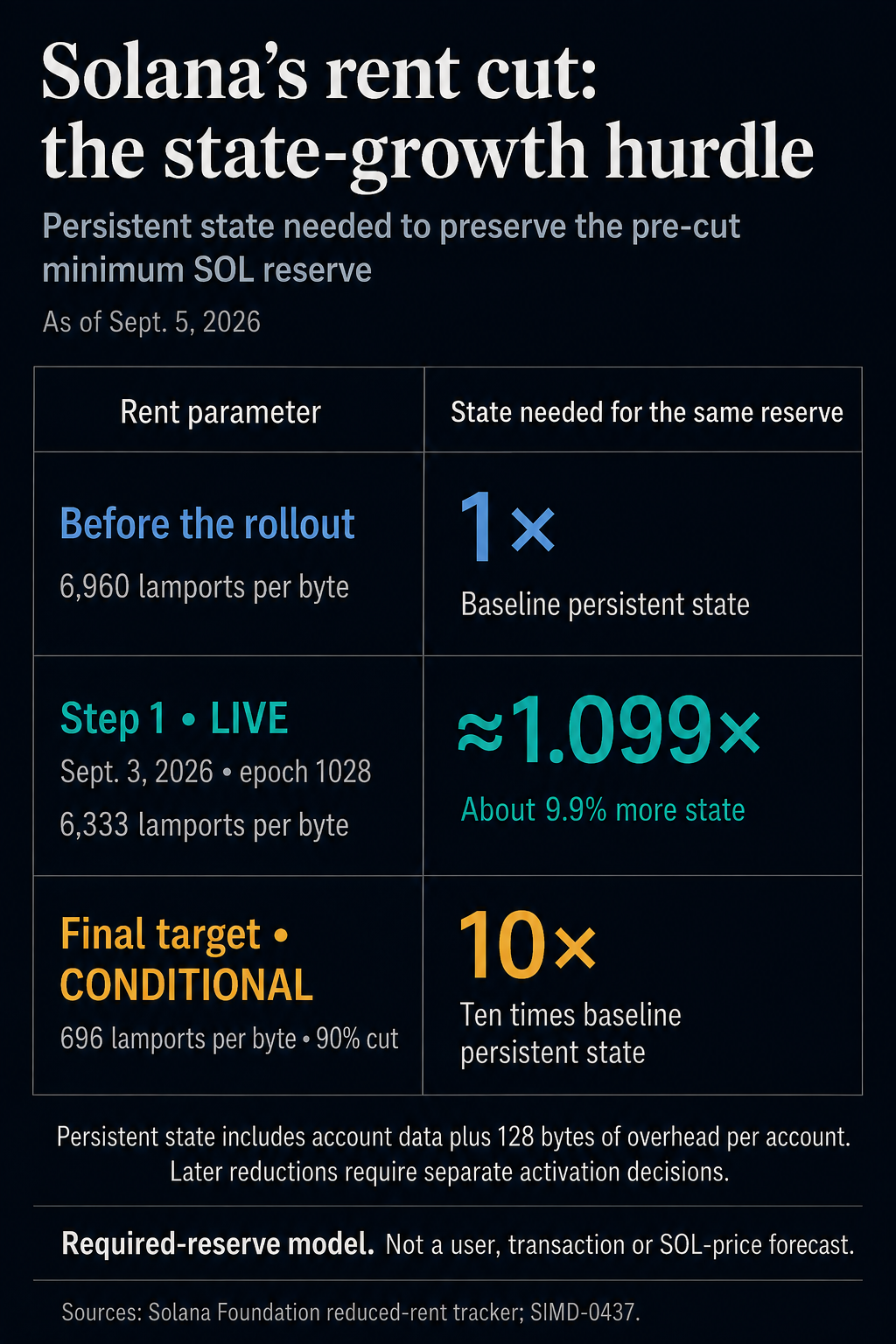
The full plan would change how account growth translates into SOL held against storage. If Solana completes its proposed 90% reduction, total persistent account state, including each account's storage overhead, would have to grow tenfold to require the same minimum SOL reserves as before the rollout. Adoption could expand substantially while the minimum SOL needed for this reserve channel falls.
The Solana Foundation's tracker confirms that only the first reduction, approximately 9%, is live on mainnet. The tenfold comparison applies to the conditional final target, while the initial cut already lowers reserve requirements.
Solana rent reduction and the 10× hurdle
Solana's “rent” is a balance held against account storage. It is generally recoverable when an account closes, rather than an ongoing bill paid to validators. Reducing the required balance lets new accounts begin with less SOL and can leave existing accounts holding more than their minimum.
At epoch 1028 on Sept. 3, Solana lowered the reserve parameter from 6,960 to 6,333 lamports per byte. The five-stage plan's final target is 696.
Under SIMD-0437, the rent-reduction specification, that minimum equals the account's data size plus 128 bytes of overhead, multiplied by the current lamports-per-byte parameter. A standard token account has 165 data bytes, making its effective size 293 bytes.
Applying that formula to one million identical standard token accounts gives the following illustration:
| Scenario | Lamports per byte | Required reserve | Reduction versus original |
|---|---|---|---|
| Before the rollout | 6,960 | 2,039.28 SOL | Baseline |
| First step, live Sept. 3 | 6,333 | 1,855.569 SOL | 183.711 SOL |
| Final target, conditional | 696 | 203.928 SOL | 1,835.352 SOL |
These are calculated minimum requirements for a fixed account population, not measured withdrawals. The final row assumes all five reductions activate. Different account sizes would produce different totals.
The million-account example illustrates operating capital, but it cannot establish a network-wide supply effect. Its conditional final reduction of 1,835.352 SOL represents about 0.000314% of the approximately 585.36 million circulating SOL shown in CryptoSlate's Sept. 5 market data. The actual aggregate reserve channel requires a broader account inventory, with account sizes, balances and reclaimability taken into account.
The tenfold threshold follows from the same relationship. At one-tenth the original reserve rate, ten times as many rent-bearing bytes would be needed to keep the aggregate minimum unchanged. It measures the total stock of persistent state, including per-account overhead. User counts, transaction counts and SOL prices are separate measures; the tenfold comparison describes storage requirements.
The live first step sets a smaller hurdle: about 9.9% more rent-bearing state would preserve the original minimum requirement at 6,333 lamports per byte. Both comparisons concern required reserves. Actual account balances can remain above those floors.
For payments, this reserve demand arises mainly when accounts are opened. The Foundation's July account-state study explains that an associated token account normally serves a particular wallet and token mint. Once it exists, later payments in the same token do not require another account-creation deposit. More payments through existing accounts therefore need not produce a proportional increase in storage reserves.
Withdrawal authority decides who gets the capital
The immediate benefit is access to capital already on-chain. The Foundation's Sept. 3 reclamation guide describes an instruction called WithdrawExcessLamports that moves SOL above the current minimum without closing a token account or changing its token balance. The Token-2022 program offers the same instruction.
For a token account, its owner must authorize the withdrawal. For a mint, authorization comes from the mint authority, or from the mint account itself signing if that authority has been revoked. Accounts owned by custom programs need the owning program to provide withdrawal logic and check the relevant authority.
That makes control of the account economically significant. A payments provider that funded a customer's token account cannot assume that paying the original deposit gives it the right to reclaim the excess. The party entitled to authorize the withdrawal may be different from the party that supplied the SOL.
Moving a surplus balance requires an authorized transaction that leaves the minimum intact. It transfers existing SOL between accounts while conserving the total; it does not issue new tokens. The guide provides no aggregate measure of completed withdrawals or subsequent sales.
For future onboarding, the benefit is more direct: whoever funds an account needs less SOL upfront. Providers can potentially support more customer accounts with the same capital, even when customers themselves do not purchase SOL. Whether existing surplus can be redeployed depends on the authority and program arrangements above.
How long those accounts survive will determine the continuing reserve requirement. Gross account creation can give a very different impression from state that remains on-chain.
In his July 20 analysis, Solana Foundation researcher Umberto Natale found that 75.5% of account-creation events in the analyzed cohort closed within the same transaction. The observations were not deduplicated by address: repeated creation and closure could count as separate events.
Those workflows can generate activity while leaving little persistent account storage behind. The finding does not predict how users will respond to September's reduction. The study also cautions that its weak, unstable correlations between SOL prices and account activity are descriptive, rather than a causal estimate of how cheaper rent changes demand.
A useful test of the policy will therefore track persistent account bytes and their associated minimum reserves alongside activity. Counting new accounts alone cannot establish whether the network has absorbed the lower reserve rate.
SOL demand extends beyond account reserves
Other uses of SOL also continue. Under Solana's fee rules, transactions require SOL: half the base fee is burned and half goes to the validator, while the entire priority fee goes to the validator. Fee payments are a separate demand channel from refundable account reserves. More activity could increase fee use, but throughput alone does not establish the amount users pay or the balances they retain.
SOL holders can also delegate stake to validators to help secure the network and become eligible for rewards. Reclaimed capital could be staked or used to fund more accounts. The cited material does not establish either outcome as a result of the cut, so these possibilities provide no quantified offset to lower reserve requirements.
CryptoSlate's recent analysis of activity and fee economics examined a related distinction: network usage and token economics can move differently. Rent reduction adds a specific reason why growth can require less SOL per unit of persistent state.
As of Sept. 5, the second reduction, to 5,080 lamports per byte, is on testnet, with mainnet expected in mid-September. The last three steps are expected with Agave 4.4 in November. Each activation remains subject to review of state growth, and a fallback can restore the original parameter.
The next gates will determine how far the capital saving goes. Persistent state growth and actual reclamation will then show how much of that saving becomes new account capacity, reusable working capital or reduced SOL held against storage.
The post Solana’s plan to cut account deposits by 90% could weaken a reason to hold SOL appeared first on CryptoSlate.
Zcash broke above $1,000 on Sept. 4, pushing the asset value of Grayscale’s recently listed ZCSH ETF past $400 million less than two weeks after its debut.
ZEC registered an intraday high of $1,050.70, up roughly 20% over 24 hours and nearly 100% over the past month.
The move lifted ZCSH’s assets to $414.7 million as of Sept. 3, compared with about $304.6 million when the fund began trading on NYSE Arca on Aug. 25.
ZCSH inherited assets from the Grayscale Zcash Trust, and the sharp appreciation in ZEC accounts for much of the increase.
Still, the fund’s ZEC holdings rose from 387,849 at launch to 428,613 by Sept. 3, while shares outstanding increased to 5.35 million.
The Sept. 4 breakout came as Bitcoin surpassed $82,000 and ETH reclaimed $2,500, but Zcash’s move was considerably larger. Roughly $40 million of ZEC shorts were liquidated in 24 hours, adding fuel to a rally that had already gathered momentum before the latest market-wide advance.
Leverage has expanded with the price. CoinGlass data showed that Zcash futures open interest crossed $2 billion for the first time, while 24-hour futures volume climbed above $6 billion for the first time since mid-August.
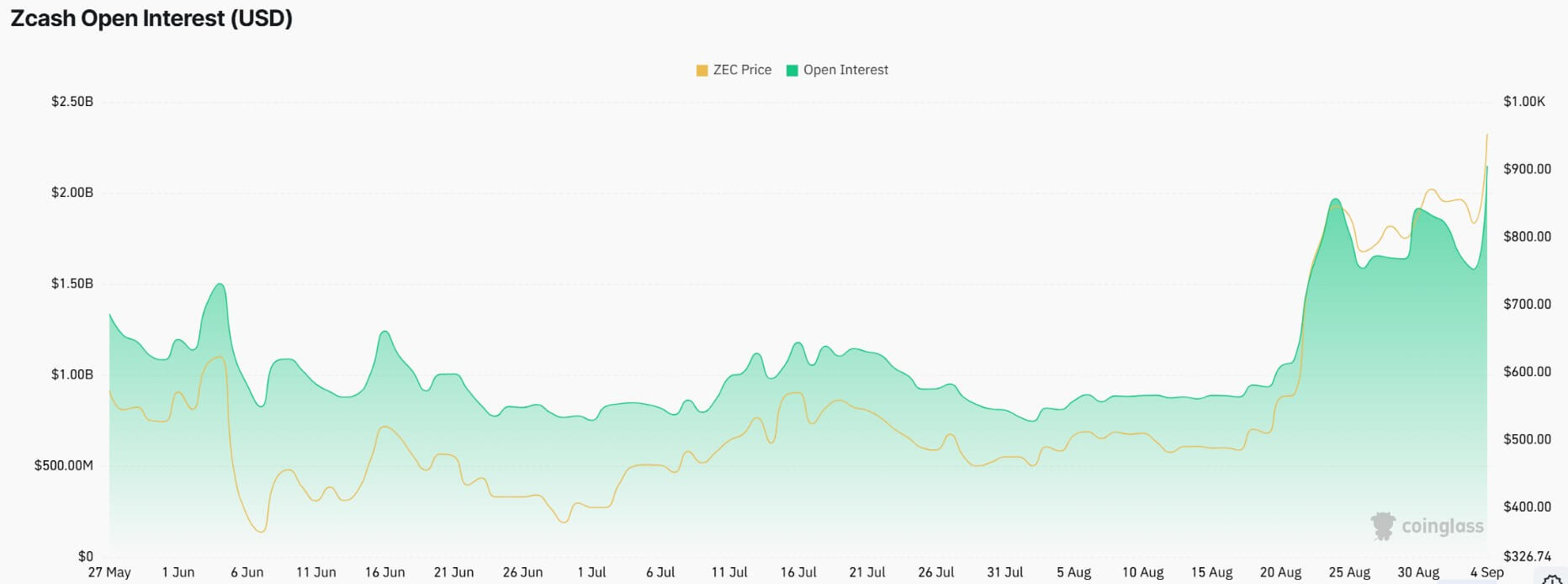
The combination suggests traders are committing substantially more capital to ZEC derivatives as the token tests levels it has not sustained in years.
The scale of the repricing is particularly stark over a longer horizon. ZEC was trading around $40 a year ago and has now returned to the top 10 largest cryptos by market cap for the first time since 2018.
That ascent has also brought increasingly aggressive forecasts. Cryptographer Arjun Khemani said characterizing the token's rally solely as a privacy-coin understates the case being made for Zcash.
He pointed to its fixed 21 million supply, Bitcoin-like emissions schedule, decade of distribution, work on quantum recoverability, plans for substantially higher transaction throughput and efforts to formally verify its shielded pool against undetectable inflation bugs.
Khemani said that “privacy is just one property of Zcash,” arguing that the larger bet is whether ZEC can develop into a form of sovereign money.
Grayscale sees AI opening a crack in Bitcoin’s dominance
The price move has revived a broader question around Zcash: whether its latest gains can translate into a lasting challenge to Bitcoin’s dominance of the digital-currency market.
Bitcoin accounts for about 93% of the market capitalization of Grayscale’s Currencies Crypto Sector, a level of dominance that alternatives such as Litecoin have failed to seriously disrupt. Zcash remains worth less than 1% of Bitcoin even after rising roughly 19-fold over the period covered by Grayscale’s latest research.
Grayscale argues Zcash has a better chance than previous challengers because it combines Bitcoin-like monetary properties with features that have become more relevant as the crypto market has matured.
Privacy is central to that thesis.
Bitcoin transactions are permanently recorded on a public ledger. Once an address is linked to an offchain identity, its balances and transaction history can potentially be reconstructed.
Grayscale argues advances in artificial intelligence could make that process faster, cheaper, and more widely accessible by improving address labeling and blockchain activity analysis.
The asset manager sees that technological shift as the beginning of a third major wave of concern over financial privacy, following the computerization of financial records in the 1970s and the growth of the internet in the 1990s.
Zcash approaches the problem differently. Its shielded transactions use zero-knowledge cryptography to conceal sending and receiving addresses and transaction amounts, allowing users to retain Bitcoin-like scarcity without making every transfer permanently visible.
Grayscale argued that distinction could become more valuable as AI makes surveillance of transparent blockchains increasingly sophisticated.
Its case extends beyond privacy. Grayscale describes Zcash as having several “second mover” advantages, including active development against emerging cybersecurity risks and cross-chain connectivity through intent-based technology that could allow wallets or AI agents to move value across networks while using Zcash as a private settlement layer.
Those features underpin the asset manager’s argument that Zcash could capture market share from Bitcoin even without reproducing Bitcoin’s merchant adoption or liquidity.
The same privacy architecture also presents one of Zcash’s largest obstacles. Shielded transactions can complicate sanctions screening, anti-money laundering controls, and efforts to trace illicit funds, creating regulatory and compliance concerns that have historically weighed more heavily on privacy-focused cryptocurrencies than on Bitcoin.
Bitcoin also retains advantages that are difficult to replicate. Its liquidity, infrastructure, brand recognition, and more than 15 years of network growth continue to reinforce its position at the center of the digital-currency market.
That leaves Zcash with a considerable gap to close.
Nevertheless, the move above $1,000 has made Grayscale’s thesis more consequential, as it puts greater weight on whether privacy and technological differentiation can produce durable market-share gains once the momentum behind the current rally cools.
The post Zcash breaks $1,000 as its spot ETF crosses $400 million in assets appeared first on CryptoSlate.
CryptoTicker.io
On September 10, 2026, the MultiversX network switches over to the Supernova hard fork. For you as an EGLD holder, the most important answer is a reassuring one: if your coins sit in your own wallet, you have nothing to do. There is no token swap, no migration and no claim you would have to register. Addresses, private keys and balances remain backwards compatible according to the project. Anyone who prompts you to take action over the coming days is trying to defraud you.
There is still something to be done, and it concerns three places: balances on an exchange, staking, and running a node of your own. The hard fork halts the network for roughly 24 minutes, during which no new transactions are accepted. Anyone needing a withdrawal in that window is better off arranging it beforehand. If you intend to move your coins from the exchange into self-custody anyway, a network upgrade is a good occasion for it; which devices come into question is set out in our hardware wallet comparison.
This text answers the questions that have not been put in writing anywhere so far: when the fork really takes effect according to the round arithmetic, how far node migration has actually come today, why the staking unbonding period still takes ten days despite a tenfold increase in speed, and how to recognize the fraud pattern that accompanies dates like this one.
What exactly happens at MultiversX on September 10, 2026
Supernova is a hard fork. That is a protocol change all nodes in a network have to adopt at the same time, because the new rules are no longer compatible with the old ones. Anyone leaving the old software running computes differently from the majority from the switchover point on and drops out of the shared chain.
What Supernova changes is the core of block production. Until now MultiversX produces a block every six seconds. After the switch it is 600 milliseconds, a tenth of that. This becomes possible because the protocol takes transaction execution out of the critical path of consensus: validators vote on a block while execution continues in parallel, instead of waiting for it.
For you as a user this means in everyday terms: a transfer within the same shard is final in fractions of a second rather than in several seconds. The figures for the targeted finality within a shard range between 100 and 300 milliseconds depending on the source; for a transaction across shard boundaries the sources give roughly 1.8 to 2.4 seconds against around 18 seconds so far. That range appears this way in the documents and is not smoothed to a single value here.
Supernova explained: why block time drops from six seconds to 600 milliseconds
A shard is a self-contained section of the blockchain that processes its own transactions; MultiversX currently operates three of them plus a coordinating metachain. This very division has been the bottleneck so far: a payment from shard A to shard B needed three rounds, because the metachain first had to certify the sending shard's block before the receiving shard was allowed to accept it.
Supernova speeds up both sides of that calculation. The rounds get shorter, and the order changes: validators start executing a block as soon as the local check is through, and only vote afterwards. Final clearance across shard boundaries remains tied to the metachain, so that a cross-shard payment counts as arrived only once the block in the sending shard is demonstrably final.
The path to this point was no short-term decision. According to the project documentation, the change was adopted in an on-chain vote between January 8 and 18, 2026 and received 99.64 percent approval at a quorum of 33.63 percent of the voting stake. A public stress test ran between March 11 and 31, 2026, in which the network carried 120,000 transactions per second on the final day according to the project. An external security audit was completed in June 2026.
When does the hard fork actually switch? The activation round recalculated
The switchover hangs on a round rather than on a clock time. A round is the fixed cadence in which the network is allowed to produce a block. The mainnet configuration of August 31, 2026 gives round 32,157,661 in epoch 2233 as the activation point. An epoch is the cycle after which MultiversX redistributes validators across the shards; it lasts 24 hours.
That number can be translated into a clock time, and we did so ourselves instead of copying it. Querying the official mainnet gateway on September 6, 2026 at 00:36:48 UTC returns: current round 32,089,568, epoch 2228, round duration 6,000 milliseconds, 14,400 rounds per epoch, start of the current epoch at round 32,085,434.
From this it follows: 68,093 rounds are missing until the activation round. Multiplied by six seconds, that is 408,558 seconds or 113.5 hours. The switchover therefore falls on September 10, 2026 at around 18:06 UTC, so around 8:06 p.m. German time. By the same calculation, epoch 2233 begins at round 32,157,434 and thus at around 17:43 UTC; the activation round lies 227 rounds behind it. The statement "epoch 2233" from the reports therefore agrees with the chain data.
One qualification belongs with this: that is round arithmetic, not a commitment. If a round is missed because a block producer does not use its slot, the point in time moves back. In practice it is a matter of minutes to a few hours. What holds up is "around 6 p.m. UTC on September 10", not the second.
Roughly 24 minutes without new transactions: what the network halt means
The changeover does not run through during ongoing operation. Ahead of activation, the network stops accepting new transactions into the pool for roughly 240 rounds, in order to work through those already in flight. At the old cadence of six seconds per round, that is 24 minutes.
What happens to your transfer during that time matters more than the duration itself: nothing is lost in the process. Newly submitted transactions stay in the queue until Supernova processes them. What you do not get in that window is a fast confirmation. Anyone wanting to trigger a payment with a deadline at that moment, a margin call on a collateralized position for instance, should bring it forward.
EGLD in your own wallet: why self-custodians have nothing to do
This is the core point for most readers. MultiversX explicitly maintains backwards compatibility for addresses, keys and balances. Your seed phrase stays valid, your address stays the same, your balance stays where it is. There is no new token and no need to move anything.
What changes for you is something you will notice after the fork at most in that confirmations arrive faster. A wallet app that connects to the network picks up the new cadence by itself. A hardware wallet keeps signing the same transaction formats; it knows nothing of block time.
One duty of care remains: keep your wallet application up to date. Applications that derive time windows or fees from the old block time may show incorrect estimates after the switch. That is a display error and no risk of loss, but it is irritating.
No token swap, no claim: how to recognize the hard fork scam
Ahead of network changes of this kind, websites and direct messages regularly appear demanding a "token migration", a "snapshot" or a "wallet upgrade". With Supernova there is none of that. There is no swap, no claim and no registration.
Three features let you recognize such offers without needing technical background knowledge. First, no genuine protocol change ever asks for your seed phrase; whoever asks for it wants your money. Second, there is no deadline for holders, and so no reason for time pressure. Third, a project communicates through its official channels and not through a direct message that writes to you first.
This warning refers to no known incident around Supernova. The note stands here because the pattern recurs with every announced fork. How it looked at other chains is shown by our account of the Zilliqa hard fork and the ZIL migration, where, unlike here, a migration genuinely did take place, and by the look at the Mina hard fork with its network halt.
EGLD on an exchange: why you should check the withdrawal window beforehand
If your coins sit with a trading platform, you hold no key of your own and therefore have no decision of your own. During network changes, exchanges usually suspend deposits and withdrawals for a window while trading continues. That is routine and no warning sign.
The state of play we checked ourselves: on September 6, 2026 at around 00:40 UTC, the Binance announcement directories for listings, delistings and general news carried no notice on EGLD or Supernova. That does not mean none is coming. Experience says such notices appear one to three days before the date. It means you cannot rely today on knowing a withdrawal window.
A simple rule follows from this in practice: if you want to pull EGLD out over the coming days anyway, do it before September 10 and not on September 10. Anyone wanting to seize the occasion and change provider will find the terms in our crypto exchange comparison. How often such deadlines actually get tight is something we worked out in our count of the crypto deadlines and cut-off dates currently running.
Staking and delegation: the unbonding period stays at ten days
Delegation means assigning your EGLD to a staking provider, which uses them to secure the network and passes you a share of the rewards for it. If you want them back, you start an unbonding, and a fixed waiting time then runs before you can move the money.
This is where the biggest misunderstanding around this upgrade sits. A network that ticks ten times faster does not release balances ten times faster. The unbonding period stays at exactly ten days.
We looked this up in the network configuration itself as well, instead of assuming it. The configuration currently carries two values side by side: erd_unbond_period at 144,000 rounds and erd_unbond_period_supernova at 1,440,000 rounds. Convert both into time and both give the same value: 144,000 rounds at six seconds are 864,000 seconds, and 1,440,000 rounds at 0.6 seconds are likewise 864,000 seconds. In both cases that is ten full days. The numeric value multiplies by ten because the rounds get shorter; the waiting time behind it stays the same.
For you this means: an unbonding you start today ends at the same moment whether or not the fork falls in between. And an unbonding you start after September 10 takes just as long as before. If you are currently reviewing where your stake sits and what it brings in, our staking platform comparison helps with the sorting. The question was of a similar kind at the Solana upgrade, which we worked through in our text on Alpenglow and the consequences for staking.
84 percent instead of 4.6: how far node migration has really come today
Whether a hard fork runs smoothly is decided by how many nodes move to the new software in time. As of September 1, 2026, the finding was sobering: according to an evaluation of the public network data, 95.35 percent of 5,171 nodes were still running the old version v1.11.11.0 at that point. A good four percent had migrated.
We repeated this measurement on September 6, 2026 at 00:37 UTC, through the public endpoint api.multiversx.com/nodes/versions. The picture has turned around in five days:
- 83.02 percent of the nodes run on v2.0.6.0, another 1.24 percent on a version reported as v2.0.6. Together that is 84.26 percent.
- A further 13.6 percent still stand on the old v1.11.11.0.
- The remaining 2.14 percent are spread across older versions of the 1.11 series, down to v1.11.0.0.
- The total number of nodes stands at 5,176. In absolute figures that is roughly 4,361 updated nodes and roughly 704 nodes on the old main version.
This figure is the real leading indicator for September 10, and anyone can follow it up themselves: the endpoint is public and supplies share values per software version. Whoever wants to know whether the switchover is running in an orderly way takes another look there on the day before.
What happens if too few nodes migrate in time?
Before activation, old and new program versions can run alongside one another without anything happening. Only from the activation round onwards do the new processing rules take hold. A node with old software can then arrive at a deviating result for the same transaction and loses its connection to the majority chain.
For an individual operator that means downtime and forgone rewards. For the network it only becomes delicate once a large share is left behind, because block production is then spread across fewer shoulders. Going by today's level of roughly 84 percent updated nodes, nothing points to this scenario.
As an EGLD holder you need to derive nothing from it. There is no button you could press and no choice between two chains. The question is relevant for operators and for judging whether longer waiting times are to be expected in the switchover window.
Node operators: which software version is mandatory from round 32,157,661
If you run a validator or an observer node yourself, the fork means work. A version from v2.0.5.0 onwards is required; the chain currently reports v2.0.6.0 as the current marker. This value sits in the network configuration in the field erd_latest_tag_software_version and was set at the time of the query on September 6 at 00:36 UTC.
The migration itself is uncritical before the activation round, because both versions can exist side by side. After it, the migration is no longer optional. Whoever misses the date catches up afterwards and has to let the node resynchronize. A validator with a minimum stake of 2,500 EGLD should not let this situation come to it.
Smart contracts and dApps: why timestamps are no longer unique after Supernova
This point concerns you indirectly, but it is the most underestimated part of the whole upgrade. A smart contract is a program that sits on the blockchain and executes rules automatically, the interest on a deposit or the deadline of an offer for instance.
Many such programs compute with timestamps in seconds. As long as a block is created every six seconds, a second-level timestamp identifies exactly one block. After the switch, ten blocks fit into the same second, and the timestamp is no longer unique. The project documentation names the consequences openly and gives examples: checks along the lines of "the new point in time must be greater than the last one" can fail, limits of one action per block can be circumvented if they are measured in seconds, expiry deadlines become longer than intended, and reward calculations that use a time difference as a divisor can run into a division by zero.
For you as a user of a DeFi application on MultiversX this means: expect isolated display errors in the days after September 10, or applications that pause as a precaution. Affected are programs whose operators have not prepared for the change. A balance in your own wallet is untouched by it. If you have larger amounts sitting in an application from a small provider, a look at its announcements ahead of the date is the cheapest precaution there is.
What the hard fork is not: no deadline, no price statement
Three clarifications, so that no false expectation arises from this date.
It is no deadline for holders. Unlike a migration with an exchange window, nothing expires here. Whoever does nothing until September 10 has exactly the same coins afterwards as before.
It is no price statement. EGLD was quoted at $4.61 on September 6, 2026 at 00:34 UTC according to CoinGecko, or 3.97 euros, around three percent below the previous day and around 27 percent above the level of seven days earlier, at a market capitalization of about $141.5 million. These figures stand here as a snapshot and not as the basis for a forecast. Whether a technical upgrade shows up in a price cannot be stated seriously in advance.
It is no foregone conclusion. The switchover hangs on the migration of the nodes, and while that is going well, it is not yet complete as of September 6. The date can shift by minutes to hours, because it hangs on rounds and not on the clock.
The schedule up to September 10 at a glance
What sensibly happens in the remaining days, in the order in which it comes up:
- Up to September 9: settle withdrawals from an exchange if you need them in these days. Keep an eye on your provider's announcements, because experience says they come at short notice.
- On the morning of September 10: take another look at the version status of the nodes if you are interested in whether the switchover is running in an orderly way.
- On September 10 at around 17:40 to 18:10 UTC: do not submit time-critical transactions. What you submit is not lost, but it will initially only be queued.
- Afterwards: update your wallet application if it visibly misjudges deadlines or fees.
MultiversX Supernova: what you take away from this
- Self-custody demands no action, but it does demand vigilance. There is no token swap and no claim. Every prompt to that effect is an attempted fraud, and the answer to it is always the same: no seed phrase, nowhere. If you take this occasion to move your coins from a provider into your own custody, you will find the devices in the hardware wallet comparison.
- Check before September 10 whether you can reach your balance. Exchanges announce withdrawal pauses at short notice, and on September 6 no notice was in place yet. Whoever wants to switch or withdraw does it beforehand; the terms are in the exchange comparison.
- Keep reckoning with ten days for staking. The faster chain does not shorten the unbonding period, even though the numeric value in the configuration now looks ten times larger. Where your stake sits and what it brings in is sorted out by the staking comparison.
(As of September 6, 2026. This article is not investment advice. Prices and fee structures change; check the terms with the provider before you buy.)
Sources and evidence: the chain data come from the official network configuration of the MultiversX mainnet gateway; the activation round, the 24-minute window and the version status of September 1 come from the report by CryptoSlate of September 2, 2026.
When a stablecoin issuer freezes an address, your balance does not disappear. It is still recorded on the blockchain, every wallet displays it, and yet no transfer will leave it. That is precisely what happened to twenty Ethereum addresses within 84 seconds on August 24, 2026, and two more were added on September 2. We read the chain ourselves to establish it.
The occasion is a lawsuit filed on August 31, 2026 with the US District Court for the Southern District of New York, publicly accessible under docket number 1:26-cv-07400. Two Thai businessmen accuse USDT issuer Tether of having frozen roughly 42.4 million USDT across ten Ethereum addresses on October 30, 2025, and of doing so at the informal request of an investigator. According to the complaint, the corresponding seizure order was only issued on February 19, 2026, 112 days later. This is the account of one party to a lawsuit, and no court has confirmed it: the case has yet to be decided. The matter is undecided, and this article does not decide it either. It answers the question that sits behind it for you as an investor: which stablecoins even carry a switch that can shut down a single address, how often is it used, and how do you check your own address without having to take anyone's word for it?
What a USDT address freeze means technically
An address freeze is an entry in the stablecoin's contract that bars a specific address from making any transfer. The issuer writes the address into a list held in contract storage. From that moment on, the contract rejects every transfer sent from that address. The blockchain itself stays out of it: Ethereum processes the attempt, and the token contract refuses to execute it.
The gap between this and everything else investors usually understand by a freeze is considerable. An account freeze at an exchange concerns an account held with a company, and your balance sits in someone else's custody there anyway. An address freeze reaches into a wallet that belongs to you alone and whose key nobody but you knows. The key still works, the signature is valid, the network accepts the transaction. Only the token contract says no.
This is a deliberate property of the design. A stablecoin is a claim against a company, and that company is subject to supervisory law, anti-money-laundering rules and official orders. Without such a switch, an issuer could not comply with a seizure order at all. Anyone holding stablecoins therefore always carries the issuer's counterparty risk as well, and the freeze function is its most visible form.
Freeze, burn and reissue: the three stages in one sentence each
The three terms are often conflated even though their consequences differ.
Freeze
A freeze enters an address into the contract's blocklist and blocks every outgoing transfer with immediate effect. The holding stays on the address and remains publicly visible. A freeze is reversible: the same issuer can remove the entry again.
Burn
A burn permanently removes the frozen holding from circulation, with the contract setting the tokens on the address to zero. At USDT this second stage presupposes an existing freeze. After the burn, those tokens no longer exist.
Reissue
A reissue creates the burned quantity anew elsewhere, so that the stablecoin's overall backing remains unchanged. This process allows seized amounts to be passed on to investigating authorities or to injured parties.
For you as a holder, it is above all the order of events that counts. Time passes between the freeze and the burn, and during that time the holding is immobilized but still present. Our measurement further down shows that this gap can run to weeks in practice.
The New York case: two plaintiffs, 42.4 million USDT and a question of sequence
The complaint was filed on August 31, 2026; CoinDesk and Cointelegraph, among others, reported on it on September 2, 2026, each with its own account of the matter. The two plaintiffs state that 42.4 million USDT spread across ten Ethereum addresses were frozen on October 30, 2025. Their allegation targets the sequence: the freeze is said to have followed an informal request from a US investigating authority, while the court order was only handed down months later. Such an order, they argue, cannot retroactively legitimize an earlier freeze.
According to the available reports, Tether rejects the lawsuit as baseless. One account therefore stands against the other, no court has established anything, and everything beyond that would be speculation. The case is of interest to a German investor for a different reason: the plaintiffs had no contractual relationship with Tether. They had acquired the tokens on the secondary market, the way you do when you buy USDT on an exchange. The case thus touches on how far an issuer's reach extends over people who never opened an account with it.
That question is why engaging with the freeze function is worthwhile, quite apart from how the proceedings turn out. The switch exists, it is used, and the conditions of its use are hard for outsiders to inspect. What can be inspected without difficulty is the chain itself.
Our September 3 survey: 32 freezes, one unfreeze, two burns
cryptoticker.io compiled this analysis itself on September 3, 2026. We read the event logs of the USDT contract on Ethereum through a public access point, for the window from August 20, 2026, 02:49 UTC, to September 3, 2026, 03:59 UTC. That corresponds to blocks 25,793,449 through 25,894,249, so fourteen days. We evaluated the three events with which the contract reports a freeze, a reversal and a burn to the outside world.

Why 20 of the 32 freezes fell within 84 seconds
The result for those fourteen days reads: 32 addresses were frozen, a single address was unfrozen, and two addresses were emptied. What stands out is the way these numbers are distributed over time.
On August 24, 2026 at 20:47:47 UTC, nine addresses were frozen in a single block. Eighty-four seconds later, at 20:49:11, eleven more followed in a further block. Twenty of the 32 freezes in this period therefore fell within barely more than a minute. The remainder is spread across twelve individual events on nine different days, most recently two freezes on September 2, 2026 at 13:49 UTC.
One practical observation can be drawn from this pattern, and we claim nothing more here: freezes usually arrive in batches and rarely one at a time over the course of a day. Whoever works through a bulk action enters all the addresses concerned in one go. For you, that means a freeze is as a rule the consequence of a list your address ended up on for some reason, and only rarely an individual decision about you personally. The chain says nothing about the reasons, and so neither do we.
The second ratio in our measurement is just as clear: 32 freezes stand against a single reversal. That one reversal fell on August 20, 2026 at 16:41 UTC. A freeze can therefore be lifted, and it does happen, but within the measured period it remained the exception. Anyone counting on such a state resolving itself is counting against the observed frequency.
174,055 USDT burned: what can follow a freeze
In the same window we found two burns. On August 24, 2026 at 17:03 UTC, 10,002.73 USDT were deleted from one address; on September 2, 2026 at 14:58 UTC, a further 164,052.30 USDT. Together that comes to 174,055.03 USDT.
The revealing part sits in a detail that only emerges when both lists are compared: neither of the two emptied addresses was frozen within our fourteen-day window. Both freezes must therefore be older. More than a two-week span lies between the entry in the blocklist and the deletion of the holding. The burn is a separate, later decision that does not follow automatically from the freeze.
For assessing your own risk, that is the more important of the two figures. In the measured period a freeze hits considerably more addresses than are subsequently emptied. Over longer stretches, affected holdings sit in a state of being immobilized, and only a fraction of them is ever deleted.
Which stablecoins carry a queryable freeze function and which do not
The second half of our survey asks whether this switch is a peculiarity of USDT. For that we queried twelve stablecoin contracts on Ethereum directly: first their ticker symbol, to be sure we had hit the right contract address, then twelve common naming variants of an address check. If a contract answers one of these queries with a boolean value, the function exists; if it does not answer at all, it does not exist under that name.
Seven of the twelve stablecoins examined carry a publicly queryable address check: USDT under the name isBlackListed, USDC and EURC under isBlacklisted, PYUSD, USDP and EURCV, the euro stablecoin issued by a French banking subsidiary, under isFrozen, and FDUSD under frozen. Five contracts answered none of the twelve signatures: DAI, USDS, EURS, USDe and RLUSD. At RLUSD and FDUSD we additionally found a function able to halt the entire contract, which is a different matter from a single address.
Caution is called for here, and we therefore state the limit explicitly: having no queryable check function is not the same as not being freezable. A contract may hold a freeze under a name we did not test, store it in a structure that is not publicly readable, or add one later through a replaceable implementation. Our measurement answers exactly one question, namely whether the state of an address can be queried from outside. For seven out of twelve the answer is yes, and that is the decisive point for the check in the next section.
It is worth noting that the dividing line does not follow origin. Among the seven with a check function you find US issuers as well as a European euro stablecoin, and among the five without stand both the best-known decentralized representative and younger offerings from large providers.
How to check an address in two minutes through the contract
The check works without registration, without any tool, and without you having to believe anyone's claim. You ask the contract itself, and the contract answers true or false. For USDT on Ethereum this runs through the contract page of a blockchain explorer such as Etherscan, where the contract's read functions are listed.
In the list of read functions you look for the entry isBlackListed, enter the address you want to check, and read off the result. A false means the address was not on the blocklist at the time of the query. A true means the opposite. At USDC and EURC the function is called isBlacklisted; at PYUSD and USDP, isFrozen. The procedure is the same in every case.
We additionally cross-checked these instructions so that they do not rest on an assumption. For six addresses demonstrably frozen within our measurement window, the query returns true. For a known, unremarkable address it returns false. The check therefore does show what it is meant to show.
Two limitations come with it. First, the answer holds for the moment of the query and for nothing else. Second, it refers to exactly one token on exactly one blockchain: USDT exists on several networks, and each version keeps its own list. Anyone holding USDT on Tron or on a layer-2 network has to query the contract there.
When a check is worth doing at all
For the entirely ordinary case in which you buy stablecoins on a regulated exchange and leave them there, the check yields little, because the address belongs to the exchange anyway. It becomes interesting when you hold a balance on an address of your own, when you have received larger amounts from an unfamiliar counterparty, or when a transfer fails for no discernible reason. That last case is the usual route by which affected users learn of a freeze.
What the freeze means for balances on an exchange
If your stablecoin balance sits in an exchange account, it stands on a pooled address belonging to the provider. A freeze of that address would be an event affecting the entire trading venue, and at a supervised European provider it is no realistic everyday risk. The risk lies elsewhere: withdrawals run through a screening step, and that step can catch a receiving address which appears on a sanctions list or a blocklist.
This mechanism is the neighbor of the address freeze, and it takes effect one level earlier. We described it in a separate piece on the EU sanctions against crypto platforms. A second case, far more common in practice, is the account freeze for missing information; how it comes about and what helps against it is set out in our article on self-certification at a crypto exchange.

Self-custody protects against the account, not against the address freeze
For most risks in the crypto space, holding your own keys is the right answer. It protects against a provider's insolvency, against an account freeze and against the wind-down of a trading venue. Against the freeze of a stablecoin contract it explicitly does not help, because the blocklist knows no wallets, only addresses. Whether your key sits on a device in your drawer or in a provider's data center makes no difference to the entry in the contract.
From this follows a distinction that often gets lost in everyday use. Bitcoin and Ether carry no such switch, because there is no issuer behind them who could operate one. Anyone holding these assets on a hardware wallet has genuinely shed the counterparty risk. With a stablecoin it remains in place, and in full, because the backing and the freeze function sit at the same company. With stablecoins, self-custody therefore shifts which risks you carry; it does not remove them.
In practice this means: anyone using stablecoins as a parking position between two purchases carries this risk for hours or days and needs to give it little thought. Anyone holding a substantial part of their wealth permanently in a stablecoin should know that they hold a claim against a company which can halt the holding on their address. Splitting across two issuers reduces this concentration risk without eliminating it.
MiCA, authorities and the question of who may trigger a freeze
Since the European regulation on markets in crypto-assets has applied in full, issuers of asset-referenced tokens and e-money tokens in the EU need an authorization, and trading venues may only offer authorized stablecoins. For the freeze question, however, the regulation is no safety promise. What it governs is authorization, backing and redemption. Whether and when an issuer shuts down a single address depends, alongside that, on anti-money-laundering law, on sanctions law, and on the orders of the authorities in whose jurisdiction it falls.
This is exactly what the real point of contention in the New York proceedings hangs on. The power to freeze is not what is disputed there. The dispute is about the form the order must take on which an issuer relies, and about the sequence in which the two must occur. For now, a German investor can draw only one conclusion from this: the issuer of your stablecoin brings along the legal order it operates under, and at the largest providers that order is not the European one.
Anyone taking this point seriously will look at the next purchase to see where the stablecoin comes from and which authorization it carries. An overview of regulated trading venues shows which providers work under European supervision and which stablecoins are still tradable there at all.
Tax treatment: what a frozen position does in your return
For tax purposes, the treatment of private crypto transactions in Germany attaches to the private disposal transaction under Section 23 of the German Income Tax Act. What matters there is disposal within one year of acquisition, and for the sum of gains from such transactions an exemption threshold of 1,000 euros applies per calendar year.
A freeze on its own is neither a sale nor a swap. The holding remains attributed to you, it still stands on your address, and nothing flows in. No disposal transaction arises from the freeze, and the one-year period keeps running regardless. If a frozen holding is burned later, the classification is considerably less clear-cut, because an asset then disappears without any consideration in return. Whether and how such a loss can be claimed for tax purposes depends on the individual case and belongs in the hands of a tax adviser. This section sets out the legal position in outline and replaces no advice in an individual case.
More important in practice than the classification is the documentation. Anyone affected by a freeze should record the state of affairs while it is still verifiable: the date of the finding, the address concerned, the holding at that point in time, and the acquisition data of the position. These details can hardly be reconstructed later if a provider is no longer reachable or an account no longer exists.
How we collected the data and what we could not check
The survey consists of two parts. For the first, we retrieved the event logs of the USDT contract on Ethereum in sections of 2,000 blocks each and counted the three freeze, reversal and burn events; each section was repeated through a second access point whenever it failed, until the window of 100,800 blocks was covered without gaps. For the second part, we queried twelve stablecoin contracts with twelve possible designations of an address check each, so 144 individual queries in total, each additionally secured by the ticker symbol reported by the contract.
There are four things we could not check, and they belong in this text just as much as the results do.
First, the reasons. The blockchain shows that an address was frozen, and it shows when. It says nothing about why this happened, who initiated it, or whether an official order was in place. We therefore attribute nothing to any of the addresses concerned or to any person behind them.
Second, the other networks. Our count concerns Ethereum only. USDT and the other stablecoins examined also exist on Tron, on Solana and on several layer-2 networks, and each of these versions keeps its own list. The total number of freezes across all networks is therefore higher than 32, and our measurement does not say how much higher.
Third, the completeness of the function names. We tested twelve common designations. A contract carrying none of them may still possess a freeze capability that goes by a different name or is not readable from outside. All that follows from a missing hit is that the state of an address cannot be queried there by this route.
Fourth, the prior history of the two burns. We know from the comparison that the associated freezes are older than our window. How much older would have required an evaluation of the entire contract history, which we did not carry out for this article.
Nor did we do anything that would go beyond what was measured: no extrapolation to annual figures, no estimate of how many investors are affected, and no statement about the market shares of the stablecoins examined. Price figures do not appear in this article, because a contract query yields none.
Checking a stablecoin freeze: what you take away from this
- Look up which stablecoin you actually hold and where. Seven of the twelve contracts we examined carry a queryable address check, and the issuer's legal order has a say in who can initiate a freeze. When you choose between two offerings at your next purchase, a look at our crypto exchange comparison helps you see which stablecoins are listed there and which supervision the trading venue works under.
- Separate what can be separated. Against the address freeze of a stablecoin, self-custody does not help; against a provider's insolvency and against an account freeze, it very much does. If you want to hold the part of your portfolio that manages without an issuer yourself, you will find the suitable devices in our hardware wallet comparison.
- Record your acquisition data before you need it. Date, quantity and acquisition cost of a position are the part that can no longer be reconstructed when it matters, and they are at the same time the basis of every later tax return. Ongoing tracking is taken off your hands by a tax and portfolio tool.
(As of September 3, 2026. This article is not investment advice. Prices and fee structures change; check the terms with the provider before you buy.)
If a letter reaches you demanding, in the name of the Federal Ministry of Finance, 19 percent VAT on your purchase of cryptocurrency, the answer is short: no such claim exists in German tax law, and the ministry does not send it. The Federal Ministry of Finance has listed this exact letter as a forgery on its warning page since September 1, 2026. Pay nothing, do not reply, click no link.
The case still deserves more than three sentences, because this wave is better built than the usual bulk emails. The perpetrators cite real transactions, they use official terminology, and they hit a nerve: since the start of 2026, trading platforms have been reporting user data to the tax authorities, and many investors are expecting mail from the authorities anyway. That expectation is exactly what the scam exploits.
Fake finance ministry letters on crypto VAT: what the ministry reported on September 1
On the page warnings from the Federal Ministry of Finance, as of September 1, 2026, the case is set out in spare words. In a forged letter, the ministry supposedly confirms that a company selling cryptocurrency, meaning a crypto exchange or a crypto broker, is authorised to collect 19 percent VAT on the acquisition of cryptocurrency. The letter refers to transactions that actually took place, and the accompanying email urges the recipient to get in touch as quickly as possible.
Three building blocks sit in that description, and each one works on its own. The first is the supposed authorisation, meant to explain why a trading venue rather than the tax office wants money. The second is the reference to a genuine purchase, which lends the letter a credibility no bulk email could ever have. The third is the demand to make contact quickly, because a conversation brings victims to pay faster than a form.
In the same warning, the ministry names further variants in circulation at the same time. They include invented special payments for the summer of 2026, for which recipients are asked to supply their tax identification number via a link, supposed investment offers in the name of the finance minister, and emails about refunds that allegedly could not be delivered. The crypto variant is therefore not an isolated case, but the part of a broader wave tailored to investors.
19 percent VAT on a crypto purchase: why German tax law knows no such claim
The core of the forgery is a tax assertion that can be refuted in a single sentence. Exchanging euros for Bitcoin and back is exempt from VAT. That is not a matter of interpretation, but has been settled for more than ten years.
What section 4 no. 8 letter b of the German VAT Act has to do with your purchase
On October 22, 2015, the European Court of Justice ruled in case C-264/14, known as the Hedqvist case, that exchanging conventional currencies for Bitcoin and vice versa is an exempt supply within the meaning of the VAT Directive. The Federal Ministry of Finance adopted that judgment into German administrative practice with its circular of February 27, 2018. Since then the position is: the exchange is a supply of services exempt under section 4 no. 8 letter b of the German VAT Act. Anyone using cryptocurrency as a means of payment likewise triggers no VAT.
A VAT charge of 19 percent on the acquisition of cryptocurrency would therefore not only be unusually high, it would contradict the applicable law on a point that has been in every tax handbook since 2018. A ministry does not authorise anyone to collect a tax that does not exist.
The one place where VAT really does appear
For the sake of completeness: the exemption applies to the exchange itself. VAT can arise on certain services around trading, for instance on services a platform bills separately. But that always runs through the provider's invoice or statement, in which the tax is shown openly. It is never claimed retrospectively through a letter from the ministry, and it never amounts to 19 percent of the purchase sum in any case. Anyone wanting to know which costs really arise with which provider will find the orderly overview in the comparison of crypto tax tools and portfolio trackers, because record-keeping for the tax return is considered there as well.
Reference to real transactions: why this detail makes the letter so dangerous
The most dangerous sentence in the warning is the one about transactions that actually took place. Anyone opening a letter that names a purchase with an approximate amount and date loses their natural scepticism. The usual reflex, that fraudsters know nothing about you, does not apply here.
Where such details can come from cannot be said with certainty, and we do not claim otherwise. Several routes are known by which purchase and address data belonging to crypto customers have entered circulation: data leaks at service providers who process orders on behalf of companies, compromised support systems, and the resale of older customer lists. How such an address list ends up in a physical letter was described by cryptoticker.io on August 25, 2026, using the example of the phishing letters sent to wallet owners. The pattern is the same, only the target differs: there it was about the recovery phrase, here about a bank transfer.
For you, an uncomfortable but useful assumption follows. Assume that a sender may know your name, your address and rough details of a purchase, without that saying anything about their authenticity. The check therefore has to start somewhere else, namely with jurisdiction and with the route the demand takes.
Who sets taxes in Germany and how the assessment arrives
In its warning, the Federal Ministry of Finance formulates a rule that works as a test: only the tax offices set taxes, and as a rule they always do so by post. Neither the ministry itself nor the Federal Central Tax Office charges fees to citizens or sets taxes. None of these bodies sends text messages, messenger messages or emails to private individuals on their own initiative.
That yields a simple test that works without specialist knowledge. If a payment demand names a sender other than your competent tax office, something is wrong. If the demand arrives by email or messenger, something is wrong. If the money is meant to go to a company rather than a tax office account, something is wrong. And a tax assessment that genuinely exists always names a tax number, a tax office and a notice of appeal explaining your right to object.
550 euros for a supposed account release: the second forged ministry letter
Running alongside the crypto variant is a letter with the English title Formal Notice of Final Statutory Tax Clearance Requirement and Reinstatement Assurance. In it, recipients are told to pay 550 euros to have a supposed block on their bank account lifted. The Federal Ministry of Finance also lists this letter in its warning as a forgery and refers to the Federal Financial Supervisory Authority for details.
The English title is a giveaway in itself. German tax authorities correspond with private individuals in German, and they do not invent labels that sound like international compliance. A title that manufactures authority through a foreign language is a warning sign, not proof of authenticity. The same goes for the invented procedure behind it: an account is blocked by the bank or by court order, and it is not unblocked by a payment to a ministry.
Forged Federal Central Tax Office notices: file reference 120. G59 201 729 as the tell
A second authority has been affected for months. On June 30, 2026, the Federal Central Tax Office issued a warning about a renewed wave of deception attempts. According to it, perpetrators are sending phishing emails carrying the authority's official logo, with a forged notice attached.
The content of these notices varies. Sometimes it concerns a fine for failing to disclose turnover figures, sometimes the verification of an IBAN in connection with a SEPA direct debit mandate. According to the authority, one detail stays the same across all variants, namely the file reference 120. G59 201 729. Anyone finding that reference on a letter is holding a forgery, no matter how good the rest looks.
In the same notice, the Federal Central Tax Office names three features that hold beyond this one wave. Payment demands by email or text message are unusual, because the authority sends them by post. Letters with language errors point to an attempted fraud. And transfers to accounts abroad do not occur with a German tax authority.
ELSTER phishing with the subject line security verification: why you never log in via a link
The third trail targets the tax portal itself. The ministry's warnings list forged emails that pose as coming from ELSTER, with a title along the lines of security verification required, release tax credit. A refund of income tax is promised, and a one-off digital identity confirmation is demanded, for which you are supposed to log in to your own account via a link.
The sequence matches what crypto investors know from fake verification pages. First comes a plausible pretext, then a link, then a login mask that rebuilds the original. cryptoticker.io described this pattern on August 31, 2026, in relation to the fake AML check pages for wallets. The protection is the same in both cases and it is boring: call up the portal yourself, through your own bookmark or by typing the address. A certificate, a tax account or a wallet approval is never confirmed through a link in an incoming message.
A special case concerns people who trade actively. According to the ministry, bank details belonging to the federal treasury are currently being misused, particularly in connection with the trading activities of private companies: customers are asked to make payments in favour of the federal treasury that have no connection with it whatsoever. If a trading provider asks you to transfer a tax or fee to a government account before a payout, that is not a formality but the end of the matter.

IMF, ECB and AMLA as supposed senders: institutions that levy no taxes
In its warning, the Federal Ministry of Finance repeats a note from the police that is particularly important for crypto investors. Perpetrators repeatedly try to collect fees or taxes, for instance for a supposed inheritance or a crypto gain, in the name of the ministry or of international institutions such as the International Monetary Fund, the European Central Bank or the European anti-money-laundering authority AMLA.
This construction turns up regularly at the end of an investment fraud. A portfolio shows a large gain, the payout supposedly fails because of a levy, and the levy is meant to go to an authority whose name makes an impression. None of the institutions named charges fees to private individuals or sets taxes. AMLA supervises obliged entities under anti-money-laundering law, the European Central Bank runs monetary policy and banking supervision, and the International Monetary Fund has nothing to do with your tax return. If a platform demands such a payment before a payout, first check whether it is licensed at all. The overview of regulated crypto exchanges with a European licence is the quickest way in.
Crypto and the tax office: what the state really wants from you
The scam also works because many people do not know exactly what is coming their way for tax purposes. A quick comparison helps separate the real from the invented.
Income tax instead of VAT
Gains from selling cryptocurrency are, in Germany, a private disposal transaction under section 23 of the Income Tax Act. If more than a year lies between purchase and sale, the gain remains tax-free. Within the one-year period it is taxable as soon as the sum of all private disposal gains in the calendar year reaches the exemption threshold of 1,000 euros, which has applied since the 2024 assessment period. That is a threshold, not an allowance: once it is reached, the entire gain is taxable, not merely the excess. Swapping one cryptocurrency for another counts as a sale.
You declare this tax yourself in your income tax return. It is collected neither by an exchange nor by a broker, and it is certainly not demanded through a letter from the ministry. Anyone who has documented their purchases and sales cleanly can identify an invented demand as such within minutes, because they know their own figures.
The platforms' reporting duty and what it does not mean
The second real process is the reporting duty of providers. cryptoticker.io described it in detail on February 22, 2026, in its article on the reporting duty under DAC8: platforms transmit details about their users and their transactions to the tax authorities, and for that purpose they ask their customers for a tax identification number and a self-certification. How closely that request is now tied to deadlines and account restrictions is shown in our article of August 17, 2026, on the self-certification at the crypto exchange.
What matters is the difference in the sequence. Your exchange asks for data inside the logged-in account, or by a message sent from within the account. The tax office asks for nothing by email and demands no payment via a link. If you receive a demand supposedly from an authority that wants to collect tax data for your exchange, it has swapped the two roles. That is exactly where the forgery can be pinned down.
Five features that identify a forged tax letter about your crypto account
The following points come from the warnings issued by the ministry and the Federal Central Tax Office. These features hold regardless of how professionally a letter is designed.
- The wrong sender for a tax demand. Only your competent tax office sets taxes. The ministry, the Federal Central Tax Office, the ECB, the IMF or AMLA do not.
- The wrong route. Payment demands come by post. A payment demand by email, text message or messenger is a warning sign.
- A recipient account that does not fit. Payments to a German tax authority never go to a foreign private or company account.
- Time pressure and a demand for contact. The instruction to get in touch as quickly as possible is there to draw you into a conversation before you check.
- A tax that does not exist. Nineteen percent VAT on the acquisition of cryptocurrency contradicts the applicable law.
If doubt remains, there is one route that always works: call your tax office on the number you look up yourself, not the number in the letter. Ask whether the case is known there. That costs ten minutes and settles the matter in the vast majority of cases.
If you have already paid or given away data: bank, police, tax office
For that case, the Federal Central Tax Office sets out a clear order. Anyone who has disclosed personal data or made payments because of a fraudulent message should inform the bank and the police immediately. With a transfer, speed decides whether the process can still be stopped, because a recall is only possible as long as the money has not been credited and passed on.
After that comes the report to the police, which you can also file online through your federal state's online police station. Keep everything you have: the envelope, the letter, the email with its full header, the transfer receipt. If you entered login details, change the passwords of the accounts concerned and check the two-factor settings of your exchange accounts. If tax data was involved, also inform your tax office, so that it knows your tax identification number may be in circulation.
One point remains unpleasant and should be said anyway: a transfer abroad that has already been executed is rarely recovered. That makes the step before it count all the more, namely checking before paying. Anyone who is unsure loses nothing by waiting a day, because a genuine tax demand does not expire overnight and does not become more expensive because you asked first.
Spotting forged ministry letters: what to take away
- Check the sender and the route before you read the content. Only your tax office sets taxes, and it does so by post. Anyone documenting their purchases and sales cleanly anyway will spot an invented demand at once. The right tools for that are in the comparison of crypto tax tools and portfolio trackers.
- Clarify whether your provider is licensed at all. If a platform demands a tax or fee to an authority before a payout, that is a reason to break off. Which providers hold a European licence is shown in the overview of regulated crypto exchanges.
- Keep your trading routes separate from your inbox. Log in to exchanges and to the tax portal only through bookmarks you set yourself, never through links in messages. Where to buy and which terms apply there is set out in the comparison of crypto exchanges.
(As of September 5, 2026. This article is not investment advice. Prices and fee structures change; check the terms with the provider before you buy.)
If you hold your own Bitcoin, the most important question in the quantum debate is not a question about the future. It is one you can answer today on a block explorer: has your address ever revealed its public key? That single fact decides whether a future quantum computer could attack your coins at all. Addresses that have never sent anything do not show their key. Addresses you have spent from show it permanently.
The occasion for this article is a paper that, at first glance, has nothing to do with cryptocurrencies. On September 3, 2026, the G7 Cybersecurity Working Group, chaired by France, published the joint statement "Preparing for the Post-Quantum Era: A Call to Action". The message: do not wait for the first capable quantum machine, but take stock of your own encryption now and start migrating. For you as a holder of Bitcoin, that is not an abstract matter for government agencies. The first European milestone for the switch expires at the end of this year, and the question of which of your addresses are exposed is a question of custody.
This article answers three things: what on a blockchain would actually be vulnerable, how you can check your own position in a few minutes, and which deadlines the regulators have set. No price forecast, no doomsday.
What the G7 statement of September 3, 2026 calls for
The G7 nations are urging public authorities and companies to begin the migration to post-quantum cryptography immediately. Post-quantum cryptography is the umbrella term for encryption and signature schemes that remain secure even once a sufficiently large quantum computer exists. The paper names five fields of action: raising awareness of quantum-related risks, developing national strategies, advancing research and practical adoption, strengthening cooperation between government and industry, and anchoring post-quantum methods in security requirements and procurement.
Not one of those points is addressed to retail investors. The direction they point in still concerns you: once banks, exchanges and wallet providers have to rebuild their signature schemes, the way your coins are secured will change over the medium term. What the statement explicitly does not say has a section of its own further down. That honesty belongs here, because several articles in recent days have read the paper as a warning aimed at the crypto industry.
Harvest now, decrypt later: why migration starts before the quantum computer
The technical term that explains the urgency appears verbatim in the G7 statement. Harvest now, decrypt later describes an attack in which data is captured and stored in encrypted form today, to be decrypted later with a quantum computer. The statement puts it this way: "In these attacks, threat actors collect encrypted data now, with the intention of decrypting it in the future using quantum computing capabilities."
For confidential communication, that is the core of the problem. For a public blockchain the case is different, and rather more uncomfortable: there, nobody needs to capture anything. Every transaction, every public key and every signature has been visible to everyone in the chain since the day it was created. An attacker does not need to collect the data, because it is already there in full. The only thing missing is the computing power.
How a quantum computer would get at a Bitcoin address
Bitcoin secures balances with a key pair. The private key is the secret number you use to sign spends; the public key is the counterpart derived from it, against which the network verifies the signature. Deriving the public key from the private one takes seconds. The reverse is considered practically impossible with classical computers, because it rests on the discrete logarithm problem over an elliptic curve.
It is exactly that reverse path a quantum computer would short-cut. Shor's algorithm is a quantum method that solves factorisation and discrete logarithms efficiently, and therefore makes today's common signature schemes RSA and ECDSA vulnerable. A cryptographically relevant quantum computer is a machine large enough and error-free enough to run that method against real key lengths. No such machine is publicly known to exist.
What matters is the second line of defence Bitcoin has had from the start: a classic Bitcoin address is not a public key, but its hash. A hash is a one-way function that turns an input into a fixed fingerprint from which the input cannot be recovered. As long as only the hash is known, even a quantum computer has nothing for Shor's algorithm to work on. The key becomes visible only when you spend from the address for the first time, because your transaction then supplies the public key for verification.
Which Bitcoin addresses already expose their public key
That leaves three groups, and only the first two are of interest for an attack on dormant balances.
First, P2PK. Pay-to-public-key is Bitcoin's oldest output format, in which the public key sits unwrapped in the script, with no hash in front of it. It was common in 2009 and 2010, above all for mining payouts, and is no longer used for new payments today. Anyone holding such coins has had the key exposed permanently without ever having spent anything.
Second, reused addresses. Every address that has sent at least once and holds a balance again afterwards has revealed its key. This group is the larger one, and the only one you can do something about directly. Address reuse means using the same receiving address several times instead of generating a new one for each incoming payment.
Third, Taproot. Pay-to-Taproot, recognisable by the bc1p prefix, puts the public key directly into the output by design, because the format is built on it. Taproot addresses therefore share the property of P2PK, but account for only a small share of all Bitcoin.
Not on that list are the common formats P2PKH (prefix 1), P2SH (prefix 3) and P2WPKH (prefix bc1q), as long as nothing has ever flowed out of them. With those, the chain sees only the hash. If your balance sits on a fresh address of that kind and you have never sent from it, you are in the group an attacker cannot reach with Shor's algorithm alone.

6.8 million Bitcoin on exposed keys: where the number comes from
The most frequently quoted estimate comes from the Bitcoin firm River and splits into two items: roughly 1.72 million BTC in P2PK outputs and a further 4.9 million BTC on reused addresses in other formats, together about 6.8 million BTC open to an attack with a long run-up. Other analyses arrive at slightly different figures, because they treat addresses without balances or dust amounts differently; the order of magnitude of roughly a third of the circulating supply is stable across the surveys.
A substantial part of that sits in the earliest mining payouts, untouched for a decade and a half, among them the holdings attributed to Satoshi Nakamoto. Nobody can move those coins, because nobody moves the keys. That is precisely what fuels the debate over whether the network should one day freeze such outputs to keep them out of the wrong hands. What that proposal looks like and why it is contested is set out in our analysis of the possibly frozen 6.7 million Bitcoin from August 12, 2026.
For your own position, though, the large number is secondary. It does not tell you whether your coins are among them. You check that yourself, and here is how.
Checked in five minutes: is your address's key exposed?
For the check you need nothing but your receiving addresses and a block explorer. A block explorer is a website that makes the contents of the blockchain searchable; mempool.space and blockstream.info are widely used. You enter nothing secret there: an address is public, while your seed phrase and your private key never belong in a web form.
- Read the address format. Open the receive function in your wallet and look at the start of the address. If it begins with bc1p, it is Taproot, and the key is visible. If it begins with 1, 3 or bc1q, the next step decides.
- Look for outgoing transactions. Enter the address in the explorer and go through the transaction list. If it shows incoming payments only, the public key has not been published. If you find even a single outgoing transaction, it has been published for good, and nothing can undo that retroactively.
- Match the balance. What counts is not whether the address was ever used, but whether anything still sits on it today. An exposed but empty address is not a risk.
- Do not forget old holdings. Paper wallets from the early days, a long-retired wallet program or an inherited storage medium often contain exactly the formats at issue here.
Anyone with many addresses works with the xpub, the extended public key from which all addresses of an account can be derived. Some explorers accept it and show the entire history at once. Be aware that you are handing your complete payment history to the operator of the site. They cannot spend anything from it, but they can see everything.
Moving to a fresh address: what it gains you and what it costs
The only lever you hold as an owner is mundane and effective: move the balance from an exposed address to one that has never sent, and use a new address for every incoming payment afterwards. Modern wallets do this automatically, because they work as an HD wallet, deriving all addresses deterministically from a single seed phrase and moving on to the next one after each payment.
Three points deserve a sober look. First: during the migration transaction, your public key sits exposed in the mempool until the block is confirmed. The mempool is the waiting area for transactions not yet in a block. Against an attacker able to break a key within that window of a few minutes, no change of address helps; then again, such a machine would be a problem for the entire network anyway. Changing addresses protects against the slow attack on dormant balances, and that is the realistic case.
Second, the move costs network fees, and anyone consolidating many small amounts pays for every single input. When the network is busy, it can pay to wait for a quiet phase. Third, it remains an operation you should document cleanly: moving between your own addresses changes no owner, but a new transaction shows up in your records. Note down which address belongs to you, so the trail can be followed later and the attribution in your tax return does not fall apart; which tools take over that bookkeeping is shown in our comparison of crypto tax tools and portfolio trackers.
If you are thinking about custody anyway: a device that never hands the private key to an internet-connected computer changes nothing about the quantum risk, but it lowers the risk that actually affects you today. How the various models perform is set out in our hardware wallet comparison.
What your seed phrase has to do with the quantum risk
A misunderstanding persists here. The seed phrase is the sequence of words from which your wallet derives all keys. That sequence of words is not itself a signature scheme, and is therefore not directly affected by Shor's algorithm. What would be vulnerable are the public keys derived from it, once they are in the chain.
For hash functions there is a second quantum method, Grover's algorithm, which speeds up searching a data set quadratically. It halves the effective security level of symmetric schemes, turning 256 bits into 128 bits on paper. That remains beyond anything searchable in the foreseeable future. The same applies to mining: SHA-256 does not lose its value to quantum computers; at best it becomes somewhat faster to attack, and the effort stays astronomical.
So you do not need to replace your 24 words. The only thing you can change is which addresses hold your balance.

Coins on an exchange: the question you can put to your provider
If your holdings sit with a trading venue, you have no access to the addresses. The exchange manages its own wallets, usually with a few large pooled addresses that have long been exposed by their very nature. In return, it has staff who can carry out the rebuild as soon as quantum-safe methods are available in the protocol.
Two questions are worth putting to support: is there a published roadmap for post-quantum migration, and are customer holdings kept on addresses whose keys are not already exposed? Answers are rare at present, and the question itself is a usable selection criterion: a provider that can say nothing about its own custody technology says something about itself too. If you are putting the provider to the test anyway, the regulatory key data is in our overview of crypto exchanges.
For most investors the point still stands: the quantum risk is not a reason to switch exchanges today. Access and insolvency risks are the more immediate reasons to look into self-custody.
The deadlines in plain terms: end of 2026, 2030 and 2035
Behind the G7 appeal are dates that have long been set. In its roadmap for the transition to post-quantum cryptography, the European Commission has stated that all member states should begin the switch by the end of 2026. For critical infrastructure the rule is: as early as possible, and by the end of 2030 at the latest. By 2035, the transition should be completed as far as is practically feasible.
Technical standardisation is running in parallel. The US standards body NIST published the first three standards on August 13, 2024: FIPS 203 for key exchange, FIPS 204 as the primary signature scheme and FIPS 205 as a hash-based fallback. In its transition paper, RSA and today's common curve cryptography are deemed deprecated from 2030 and disallowed from 2035. That puts a date on the table from which the schemes underpinning Bitcoin signatures may no longer be used in government systems.
For Germany, the Federal Office for Information Security frames the rebuild. The BSI notes that "the question of whether or when quantum computers will exist is no longer the central one", and recommends a gradual switch: "Post-quantum methods should where possible be used only in combination with classical methods, in other words hybrid." A hybrid scheme combines an established method with a new one, so that security is preserved if one of the two turns out to be weak.
None of these deadlines obliges you to do anything. But the dates set the pace at which banks, payment service providers and custodians will work, and they show that the authorities consider the window to be limited.
What the G7 statement explicitly does not say
A caveat belongs here, because it gets lost in the coverage: the G7 statement does not mention cryptocurrencies, blockchain or the financial sector at all. The paper is addressed to state bodies and companies in general. Anyone turning it into a call to action for the crypto industry is putting words in the source's mouth.
The connection between the two is nevertheless substantive, just indirect: both sides rest on the same mathematics. If curve cryptography falls, it falls for government certificates as much as for Bitcoin signatures. The difference lies in how easily each can be changed. A public authority swaps out its software; an open network with millions of participants first has to agree on what it wants to swap out at all.
BIP-360 and BIP-361: Bitcoin's own way out of the signature problem
That agreement is already under way, in the form of improvement proposals. A BIP is a Bitcoin Improvement Proposal, a formalised proposed change to the protocol that is discussed in public and implemented only with broad support.
BIP-360 describes a new, quantum-resistant output format into which holders could voluntarily move their coins in future. The proposal was added to the official repository in early 2026. BIP-361 builds on it, going further and providing for an orderly exit from the old signature types. The consequence would be that coins on exposed keys could no longer be spent after a transition period, effectively freezing them to keep them away from an attacker.
That is exactly what ignites the sharpest dispute in the Bitcoin world: on one side stands the argument that a theft running into the millions would destroy trust in the scarcity of the money. On the other stands the objection that a network able to freeze balances breaks its central promise. How the camps argue is set out in our assessment of the security debate from March 2026. Neither proposal has been adopted to date.
Ethereum and other chains: why migration works differently there
On Ethereum the same question arises with a different sign. Account addresses are likewise derived from a public key that becomes visible on the first send. Unlike Bitcoin, however, rules can be changed through scheduled network upgrades at shorter intervals, and the Ethereum Foundation's research agenda has listed quantum-safe signatures as a separate item for some time.
For you as a holder, nothing follows from that beyond what applies to Bitcoin: a balance on an address that has never sent is better off. Anyone working through smart contracts does not have that choice anyway, because every interaction exposes keys. What matters is the perspective that no major chain currently signs in a quantum-safe way. That is not a distinguishing feature of Bitcoin and not an argument for switching between chains.
When will the cryptographically relevant quantum computer arrive?
Estimates diverge widely here, and the only serious approach is to show both sides. In its recommendations, the BSI works on the assumption that such machines may be available in the 2030s, and concludes that systems with a long service life have to be migrated today. NIST's standardisation planning points in the same direction with its reference years of 2030 and 2035.
Against that stand experts who point to the gap between laboratory records and the number of error-corrected computing units required: today's systems work with a few hundred to a few thousand physical qubits, while estimates for an attack on real key lengths run into the hundreds of thousands. On that view, the danger is a matter of decades, not years. What is striking is that both camps give the same practical recommendation: start early, because a rebuild of that size takes years and because data captured today can be decrypted later.
What you take away from this dispute is modest and robust: changing addresses costs you a transaction fee and makes sense regardless, because it also improves your privacy. Everything else is reading the future.
The "quantum upgrade" scam: how to spot the fraud
Every major security debate attracts fraudsters, and this one in particular, because it combines fear with technology. The pattern is always the same: an email, a direct message or a fake wallet alert tells you to "migrate your balance to quantum safety", and leads to a page that asks for the seed phrase or requests an approval for your tokens.
Three features expose that reliably. There is no quantum-safe Bitcoin address you could move into today, because the format has not been agreed. No genuine protocol upgrade ever asks you to enter your word list. And no wallet you own sends you deadlines by message. If you want to be sure, type in the address of your wallet's website yourself and, in case of doubt, check with the manufacturer. The clipboard scam works along similar lines, and we described it in our guide to the unnoticed address swap.
Bitcoin and the quantum computer: what to take away
- Check your addresses before you do anything else. Read the address format, look for outgoing transactions in the block explorer, match the balance. Only where a balance sits on an exposed address today is there anything to do at all. How best to store your keys while doing so is shown in our hardware wallet comparison.
- Stop reusing addresses. Move affected holdings to fresh addresses during a quiet fee phase, and let your wallet generate a new one for every incoming payment from now on. That lowers the quantum risk and improves your privacy along the way.
- Ask your custodian for its roadmap. Anyone holding funds on an exchange cannot choose the addresses and should know how the provider is handling the switch. The key data for the major trading venues is in our overview of crypto exchanges.
(As of September 5, 2026. This article is not investment advice. Prices and fee structures change; check the terms with the provider before you buy.)
You are entitled to take part in the Zcash vote on NU7 if, on 24 August 2026 at around 19:00 UTC, you held spendable shielded ZEC in the Ironwood pool of a wallet of your own. Anyone who had nothing there at that moment can no longer change it before the voting window closes on 14 September at 19:00 UTC, however much Zcash (ZEC) they buy today. There is a relief in the other direction that many overlook: anyone who was eligible on the cut-off date may move, sell or reallocate their coins afterwards without losing the right to vote. In the words of the organisers: "If you have spendable funds in Ironwood at that height, your ZEC is eligible even if you move your funds after the snapshot."
That is the practical core of a process on which almost nothing has been written in English so far. On 22 August we explained what ZEC holders are voting on. The question that has arisen since is a different one: who is allowed to vote and how it works technically. The text below answers it step by step, names the points where the primary source and the trade press contradict each other, and draws the line beyond which the vote no longer changes anything.
Who may take part in the Zcash vote: the three conditions at the snapshot block
The eligibility rule sits in a single English clause, and that clause contains three conditions that had to be met at the same time: "spendable shielded funds in Ironwood at Mainnet block height 3459350". In plain terms:
Spendable
A shielded note is the protected equivalent of an account entry at Zcash: an encrypted record in the blockchain that only the holder of the matching key can read and spend. "Spendable" means these notes were actually available to spend on the cut-off date, meaning confirmed and not tied up in a transaction still in flight. Funds that were in transit at the snapshot moment do not count.
Shielded
Zcash has two types of address. Transparent addresses work as they do at Bitcoin: amount, sender and recipient sit openly in the blockchain. Shielded addresses hide that information behind a zero-knowledge proof. Only shielded balances count for the vote. Anyone holding ZEC on a transparent address was not eligible to vote on 24 August, not even with six-figure amounts.
In the Ironwood pool
A shielded pool is the technical generation a shielded address belongs to. Zcash has introduced four of them one after another, and only the most recent one counts for the vote. More on that shortly, because this point excluded most holders.
The cut-off date itself can be measured without having to believe any announcement. The public chain statistics from Blockchair showed block height 3,467,063 on 31 August 2026 at 12:37:46 UTC. The snapshot at 3,459,350 is therefore 7,713 blocks back, which at a target block time of 75 seconds works out to roughly 160 hours, just under seven days. It is irrevocably past.
Why ZEC on an exchange has no vote: self-custody as a precondition
This is the point at which most retail investors drop out without knowing it. If your ZEC sits at an exchange, the private key belongs to the exchange rather than to you. Your position there is a claim against the house, not a shielded balance in a Zcash pool. That is precisely why reporting notes that ZEC "kept on exchanges or other networks needs to be transferred into Ironwood's self-custody" in order to be eligible to vote.
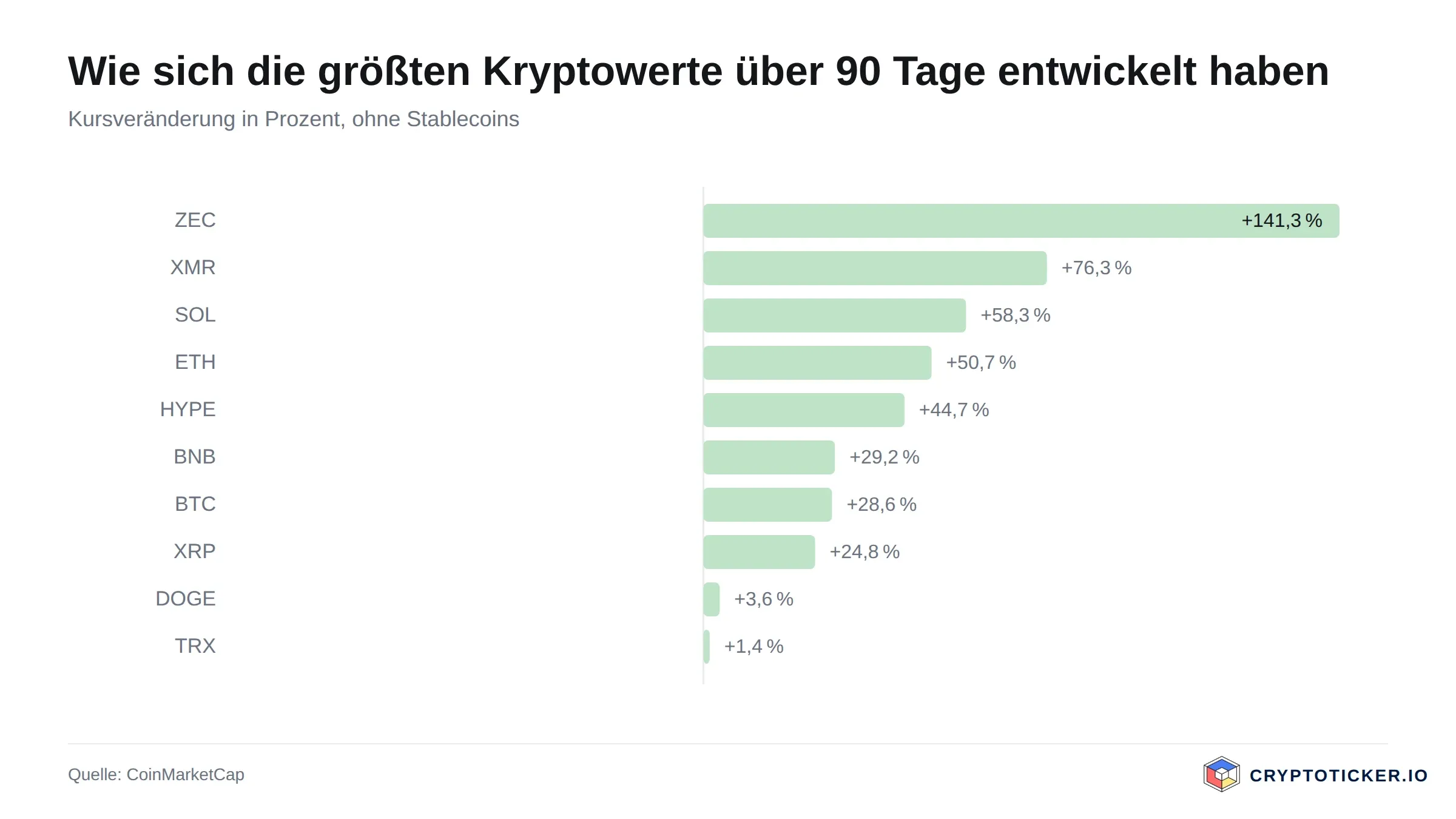
In practice that means governance at Zcash is tied to self-custody. Anyone who wants a say has to withdraw their coins from the custodial account and put them in a wallet whose keys they control themselves. With that they also take on responsibility for the seed phrase, the sequence of words from which a wallet can be restored if it is lost. For newcomers the transition is the real hurdle, rather than the vote itself. If you are taking that step for the first time, our software wallet comparison is worth a look, and for larger holdings the hardware wallet comparison is worthwhile, because the key never leaves the device there.
In the other direction, the note this text opens with applies: after the snapshot the tie is released. You do not have to leave the coins untouched until 14 September; the balance may go back to an exchange, into another wallet or into a sale, and the voting right stays attached to the snapshot moment. So anyone who withdrew their ZEC only for the vote may long since have moved it back. Which trading venues come into question for the return trip is covered in our exchange comparison.
Ironwood, Orchard, Sapling, Sprout: only one shielded pool is eligible to vote
Zcash has developed its shielded addresses across four generations. Sprout was the first, from 2016, Sapling followed in 2018, Orchard in 2022, and Ironwood went live with the upgrade of the same name on 28 July 2026. Each generation is a separate pot with its own cryptography, and funds do not migrate from one to the next on their own.
For the NU7 vote, Ironwood alone counts. Balances in Orchard, Sapling and Sprout were as mute on the cut-off date as transparent addresses. That is no formality, and it has a measurable effect on participation: the migration out of the sealed Orchard pool into Ironwood was only around 85 percent complete at the end of August, with roughly three percent of the total supply still sitting in Orchard. Every one of those balances was worthless for the vote on 24 August, even though it was shielded and belonged to the right person.
So if you read in July or August that you should "shield" your ZEC, that was only half the advice. What mattered was which pool. Anyone who postponed the migration to Ironwood because it costs fees and takes time gave up their voting right unintentionally in doing so.
Which wallets support the Zcash vote: primary source and press contradict each other
Precision is worth it here, because a mistake costs you your vote. The organisers' announcement names two applications explicitly: "We have confirmed that Vizor and Zodl will support the voting process." Two names, and the primary source confirms no more than that.
The trade press additionally lists Zashi, Zkool and the hardware wallet Keystone as supported, the latter with the note that users can take part "without removing their keys from the device". That divergence deserves naming rather than smoothing over: between "confirmed by the organisers" and "named in the press" lies a practical difference for you. If your wallet does not show the voting function, that is not a fault in your device but possibly simply missing support.
In the Zcash community forum, at least one participant confirms the route via Zodl with the words "Voting with Zodl worked well". That is a user report rather than a vendor commitment, but it matches the primary source.
What to check before you try
Open your wallet and see whether it offers a voting function. If you cannot find one, the detour via one of the confirmed applications is the safe route. Your shielded notes stay where they are; you do not need a transfer to cast your vote.
How to cast your vote with Zodl or Keystone
The procedure is short and works without a transaction to any third-party address. The application describes it in five steps:
- Open settings in Zodl or on the Keystone device.
- Select "Beta: Coinholder Polling" to see the polls under way.
- Read the proposals and the linked ZIPs. A ZIP is a Zcash Improvement Proposal, the formal document in which a protocol change is spelled out technically. Anyone who knows only the headline is voting on a text they have not read.
- Cast your shielded vote. The vendor notes: "Votes are private. Your funds never leave your wallet."
- Track open, completed and closed polls, all in one place.
Two things regularly cause confusion here. First: your wallet has to be fully synchronised with the blockchain, otherwise it does not know the position as at the cut-off date. With shielded addresses that reconciliation takes noticeably longer than with transparent ones, because the wallet has to decrypt every note itself. Second: your vote weighs as much as your shielded balance at the snapshot block, rather than as much as your account balance today. Buying more after 24 August does not increase the weight.
The five questions ZEC holders decide on for the NU7 upgrade
The ballot comprises five separate questions, each with an abstention option. You do not have to answer them all.
Question 1: issuance smoothing under the NSM
The Network Sustainability Mechanism (NSM) is the proposal to govern the issuance of new ZEC via a smooth curve instead of abrupt halvings. The options are the smooth curve, keeping the halvings, dropping this point from NU7, and abstention.
Question 2: start date for reissuance
Reissuance means returning previously burned transaction fees to future block rewards. Options: as early as possible, February 2027, February 2031, abstention.
Question 3: shutting down Sprout
The oldest shielded pool is to be dropped from the protocol. Options: immediately with NU7, one year after the vote, set no date, abstention.
Question 4: shorter block time
Block time is to fall from 75 to 25 seconds, so transactions would be confirmed faster. Options: yes, no, abstention.
Question 5: scope and readiness of NU7
If individual features are not ready by 30 September: ship and drop the unfinished parts, wait until everything is in place, reject the plan, abstention.
Questions 1 and 2 are the economically weightiest, because they concern the future issuance of new coins. Circulating supply stood at around 16.91 million ZEC on 31 August against a cap of 21 million (CoinGecko). The price on the same day was 829.90 US dollars, or 715.72 euros, with a market capitalisation of 14.05 billion US dollars, after a decline of around two percent within 24 hours.
The quorum of 1,000,000 ZEC and the size of the Ironwood pool
For the result to count as representative, at least 1,000,000 ZEC have to take part in at least one of the five questions. That figure sounds abstract until you measure it against the eligible supply.
The Ironwood pool had taken in more than 3.7 million ZEC by the end of August, according to the trade press. The quorum therefore corresponds to a good quarter of the entire eligible holdings. By comparison: measured against the circulating supply of 16.91 million ZEC it would be just under six percent. Both figures describe the same threshold, but only the first describes the actual hurdle, because Ironwood alone counts.
If the quorum is missed, the vote is not invalid in a legal sense. The result then counts as unrepresentative, and for the developers who are meant to evaluate it that is a considerable difference. For you as a holder it means this: an abstention that is cast as a vote also feeds into participation, while doing nothing lowers it.
An advisory signal rather than a protocol change: what the coinholder vote does not do
This is where the text becomes uncomfortable, but without this part it would be wrong. The vote does not change the Zcash protocol. The procedure collects an opinion that developers can subsequently take into account, or not.
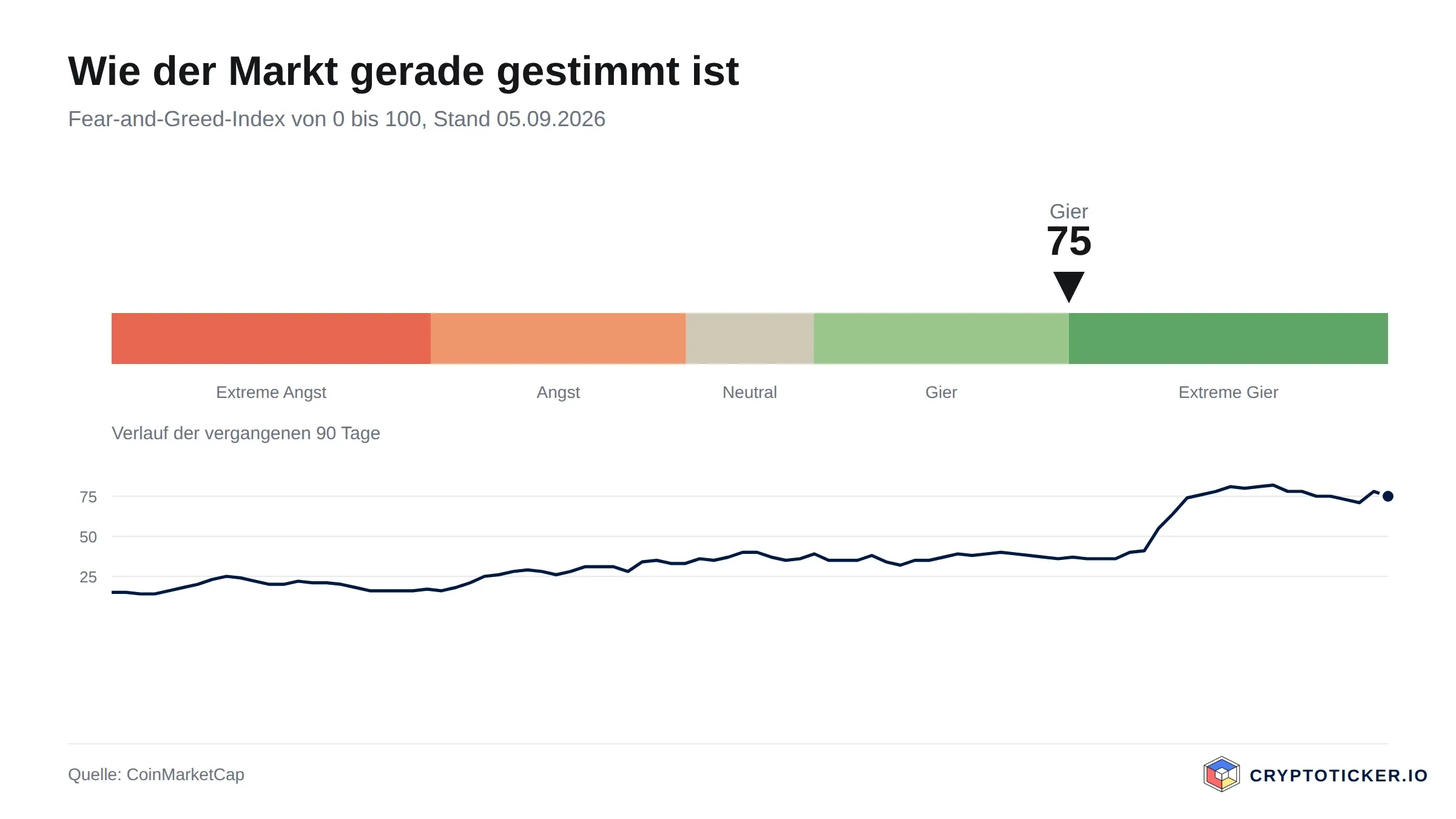
In the community forum, one post reduces it to the formula "a poll, not a vote", and the developer Daira notes there: "There is no ZIP that approves making Zcash protocol decisions by vote." So there is no formal document that provides for protocol decisions by vote at all. Several participants have stated that they would need extraordinary grounds to override a clear vote by holders. That is not a binding commitment, but a voluntary undertaking without an enforcement mechanism.
Approved proposals then have to be written up as a ZIP, developed, reviewed and rolled out via a network upgrade. Between the result on 14 September and a visible change to block time or the issuance curve, then, lie months, and in the case of the reissuance options even years.
Anyone who nonetheless takes the process seriously does so for a different reason: a coinholder vote with high participation is the strongest signal that governance without a foundation majority can produce. It is coordinated by the Valar Group and Project Tachyon, which have built their own coinholder voting chain for it. This voting chain is a separate chain purely for the count and takes the place of Zcash's previous governance procedure. Zcash co-founder Sean Bowe has accompanied the launch.
Two votes, one closing date: coinholder vote and the Zcash Foundation's ZCAP poll
Anyone searching for "the Zcash vote" actually finds two procedures running in parallel that end on the same day at the same minute. Confusing the two is the most common source of error.
The coinholder vote is the coin-weighted part this text is about. It runs from 25 August to 14 September, 19:00 UTC, and your weight is your shielded Ironwood balance at the snapshot block.
The ZCAP poll is the Zcash Foundation's survey of the Zcash Community Advisory Panel. It opened on 27 August and likewise closes on 14 September at 19:00 UTC. The Foundation runs it as an SIV poll, in full a single iterative vote; that is its own survey format for panel consultations and has nothing to do with the coin-weighted count of the coinholder vote. Only members of the panel, who receive their instructions by email, may take part there; holding ZEC alone confers no entitlement. The Foundation places the procedure itself: "Though advisory in nature, these votes play a vital role in informing decisions across the ecosystem." Both procedures address the same five substantive questions from different angles, once weighted by capital and once by people. The questions are not new: the Foundation had already surveyed the scope of NU7 earlier in 2026 in a sentiment poll and published its results. The current procedure is meant to settle the points left open after that.
How homomorphic encryption keeps your vote secret
Homomorphic encryption is a technique in which encrypted values can be added together without decrypting them first. For a vote that is the decisive property: the count can run without anyone seeing an individual vote.
In the NU7 vote, both the chosen answer and the associated ZEC amount are processed in encrypted form. All that becomes visible at the end is the total per answer option. In addition, each vote is split into 16 ballots that cannot be linked to one another, so that no conclusion about the size of an individual balance can be drawn from voting behaviour.
The count itself rests with a distributed election authority of at least ten validators, each holding only part of the decryption key. The overall result can be reconstructed only when two thirds of those validators agree. This means no single operator can tap interim results and influence the course of the vote. For a privacy coin this design is less an optional extra than a requirement, because an open list of votes would have put every participant's balance in the shop window.
What this additionally means for European holders
The vote falls in a phase in which European investors have to think about the custody of their privacy coins anyway. What role the planned EU rules play in that, and what happens to holdings on regulated platforms from July 2027, we have written up in a separate article. Anyone moving their ZEC into self-custody in any case settles both questions with the same step.
Zcash vote: what to take away
- First check whether you are eligible to vote at all. Open your wallet, let it synchronise fully and see whether spendable shielded funds sat in the Ironwood pool on 24 August. If they sat at an exchange, in Orchard, Sapling, Sprout or on a transparent address, the vote is out of reach this time round. For the next attempt the choice of wallet is decisive: the hardware wallet comparison shows which devices support shielded Zcash addresses at all.
- Vote while the window is open. Until 14 September, 19:00 UTC, the route runs via settings and "Beta: Coinholder Polling" in a supported application. Read the linked ZIPs before you click, and use the abstention option on questions you have no view on. If you first have to withdraw funds from a custodial account for that, you will find the candidates for the later return trip in the exchange comparison.
- Do not expect an immediate change from the result. The vote is advisory, not a protocol decision. Treat it as a sentiment reading rather than a date for a price reaction, and separate the custody question from the voting question: you need a suitable storage arrangement regardless of how NU7 is scoped in the end. The software wallet comparison offers a way in.
The primary source with the full wording of the announcement, the five questions and the eligibility rule is in the Zcash community forum. The parallel survey of the advisory panel is documented in a separate forum post by the Zcash Foundation.
(As of August 31, 2026. This article is not investment advice. Prices and fee structures change; check the terms with the provider before you buy.)
Decrypt
At least four more decade-old wallets moved a combined $15.7 million between Aug. 29 and Sept. 4, with one batch of coins sent to Coinbase in a likely sign of a sale.
Robinhood Chain is an Ethereum layer-2 network built with Arbitrum technology for tokenized assets, crypto apps, and on-chain financial products.
The update fixes a high-severity flaw in Chrome’s V8 engine, but Google has not revealed who is using it or whom they targeted.
Anthropic says Claude spent 11 days turning Fermat's Last Theorem into 13 million lines of code a computer can check itself, no human trust required
Nearly 30 banks backed the rare unsecured facility as TikTok’s parent company spends heavily on AI chips, models, and overseas data centers.
U.Today - IT, AI and Fintech Daily News for You Today
Shiba Inu's futures market is seeing a rapid surge in trading activity after its price suddenly flipped positive, surging by nearly 5% over the last 24 hours.
Zcash rose above the landmark $1000 price point as a sharp rally forced short traders out of leveraged positions.
Solana is strengthening its position in the rapidly expanding real-world asset (RWA) sector, attracting $348 million in fresh capital.
Recent buying pressure has reinforced a major on-chain support floor for Dogecoin, where almost 35 billion DOGE were previously traded.
AI agents continue to use XRP and RLUSD to pay for services directly onchain, with transactions on the verge of 4 million.
Blockonomi
TLDR:
- The Solana price prediction stays bullish while SOL holds the $90.50 to $100.48 support band, with buyers targeting $110 to $113.
- A confirmed move above $113 could expose Fibonacci resistance at $132.93 and $160.42 before the conditional $200 to $230 region.
- Solana processed about five billion transactions in August, while its applications produced $42.28 million in weekly revenue.
- Derivatives activity remains mixed because volume fell 42.33% to $4.44 billion while open interest rose 2.86% to $6.38 billion.
Solana trades near $103.25 after gaining 1.3% in 24 hours. The latest advance keeps the Solana price prediction focused on resistance between $110 and $113. Buyers also continue defending the broader $90.50 to $100.48 support band. That structure supports another breakout attempt after months of consolidation.
SOL records about $2.15 billion in daily trading volume and holds a $60.45 billion market value. Market data also shows strong application revenue and heavy transaction activity across the network. Derivatives indicators remain mixed, though rising open interest suggests traders expect a larger move. Bitcoin’s broader recovery also provides a firmer backdrop for buyers.
Solana Price Prediction Tests Resistance Near $110 to $113
The three-day SOL chart shows a breakout from a pattern formed after the June low. There, sellers produced lower highs while buyers gradually raised support. SOL price has crossed the pattern’s descending boundary and improved its short-term position.
The first upside objective stands near $113, above the immediate $110.15 resistance. A decisive close above this region could establish a higher range. It would also direct attention toward the next Fibonacci target at $132.93.
Higher resistance appears at $160.42 and $209.63. Analyst More Crypto Online identifies $200 as the long-term objective, while the chart marks $230. Those targets remain conditional because SOL still faces a descending trendline extending from its 2025 highs.
The daily chart defines the downside levels clearly. Initial support sits at $100.48, matching the 23.6% Fibonacci retracement. Further demand zones appear at $94.83 and $90.50, aligned with 38.2% and 50% retracements.
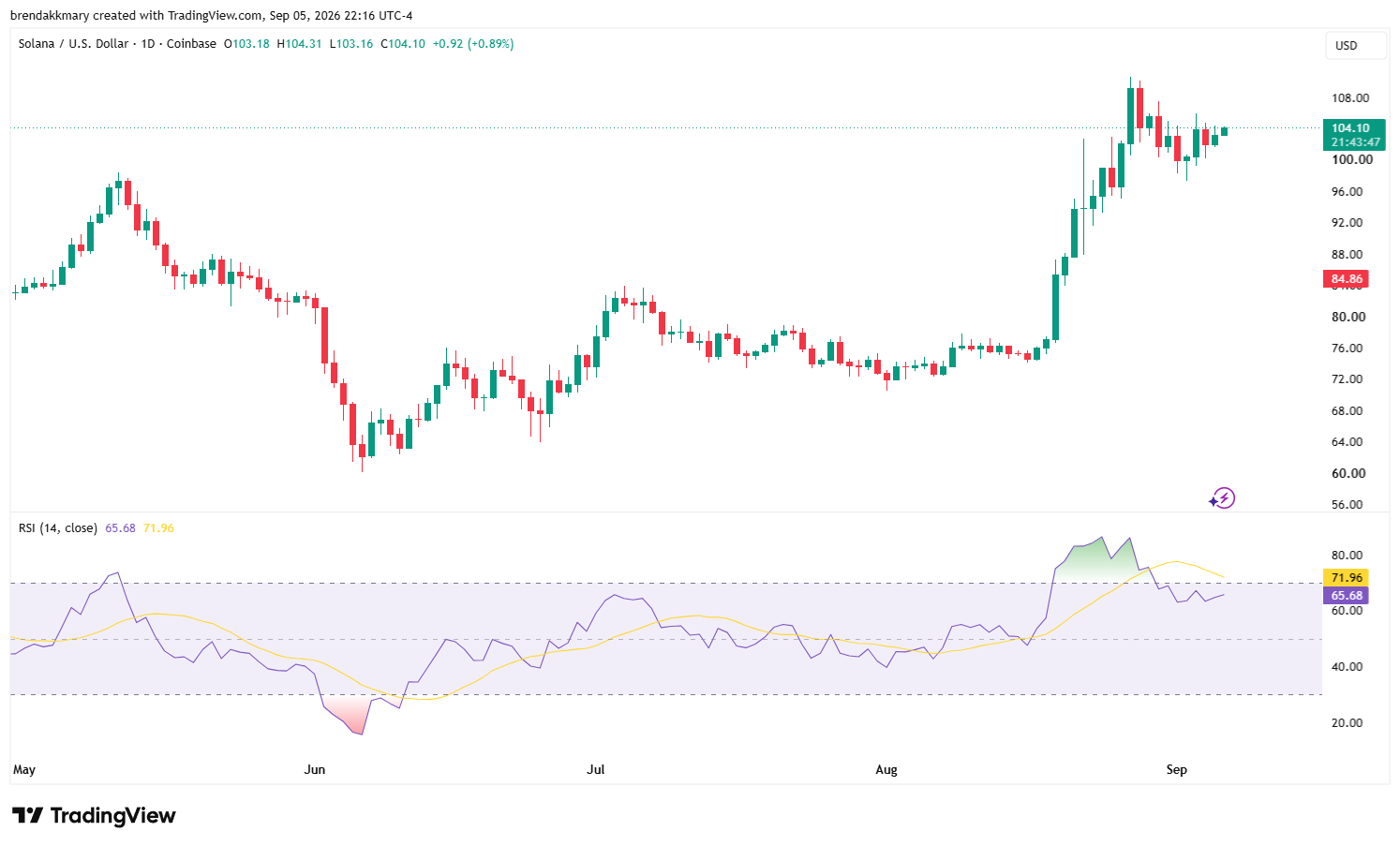
Holding this band would preserve the latest higher-high scenario. A sustained loss of $90.50 would weaken the bullish setup and increase the risk of a deeper reset. Therefore, the Solana price prediction depends first on support holding, then on buyers clearing $110 to $113.
The Solana price prediction also reflects cooling momentum. SOL recently climbed from a June low near $57.50 to $114.80. It also moved above its 20-day simple moving average, recently shown near $96.98.
The Relative Strength Index has eased to 65 after previously entering overbought territory above 70. This decline suggests momentum has moderated without reversing. SOL price holding above key moving averages keeps the recovery structure intact.
Solana Network Activity Supports the Bullish Price Setup
Solana network activity adds a fundamental layer to the Solana price prediction. The blockchain processed about five billion transactions during August, exceeding 100,000 transactions per minute. It achieved that volume while maintaining fees below those charged by several competing networks.
Application revenue provides another measure of demand. Solana applications generated $42.28 million during the week, placing the network above rival chains. Trading platforms, decentralized finance services, and consumer applications contributed to that total.
Consistent application earnings indicate that users continue interacting with the network beyond speculative token trading. High throughput and low transaction costs help applications support frequent activity. Continued demand could strengthen the Solana price prediction.
Derivatives markets present a less uniform picture. Trading volume fell 42.33% to $4.44 billion, indicating weaker short-term participation. Meanwhile, open interest increased 2.86% to $6.38 billion, showing that traders kept positions active despite lower turnover.
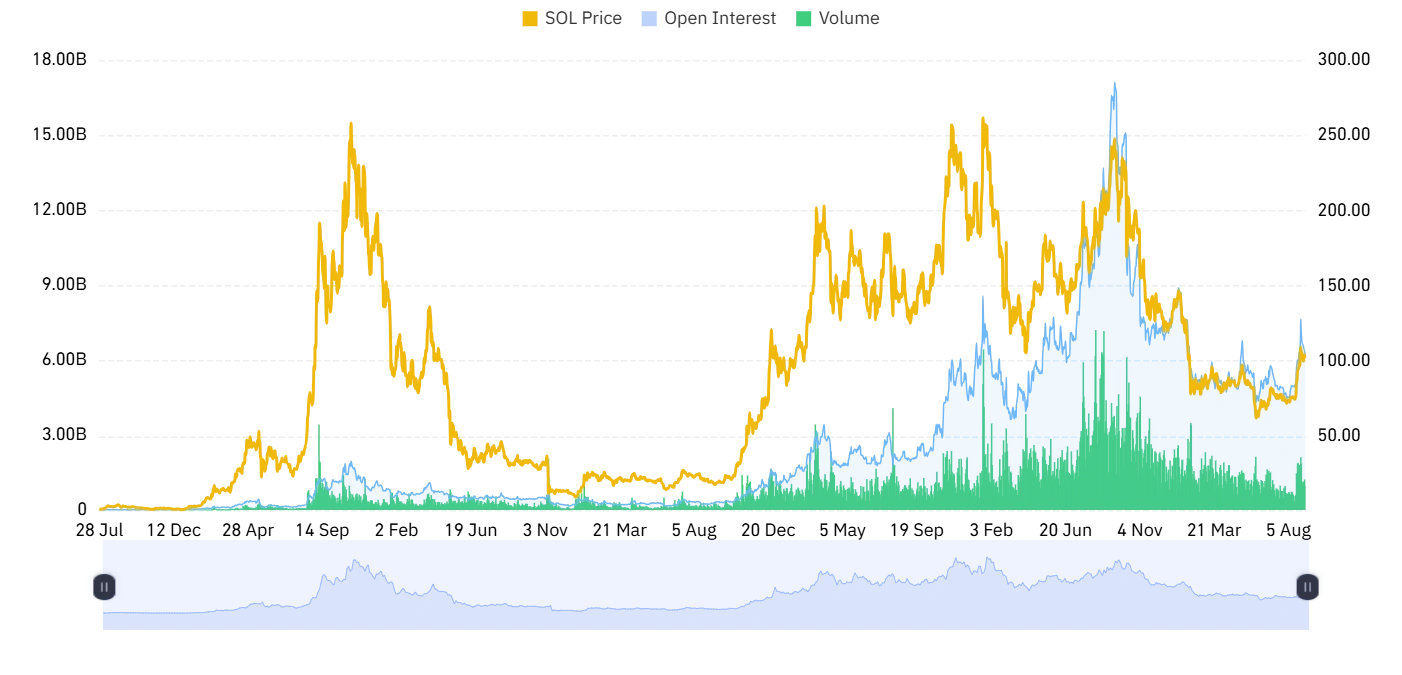
The combination can precede a sharper price move because leverage stays open while immediate activity declines. It does not confirm direction, making spot support and resistance especially important. Buyers need sustained volume above $113 to validate the breakout and reduce false-move risk.
The near-term roadmap now centers on three zones over the coming sessions. SOL must defend $100.48 to preserve immediate momentum and hold $90.50 to protect the wider structure. A confirmed push through $110 to $113 would expose $132.93, with $160.42 becoming the next technical barrier.
The post Solana Price Prediction Eyes $113 as Network Activity Surges appeared first on Blockonomi.
TLDR:
- Bitcoin’s 90-day correlation with gold reached +0.50, more than doubling from early 2026 levels.
- Bitcoin’s Nasdaq 100 correlation fell to about 0.30, marking its lowest level in one year.
- The correlation surge accelerated after Treasury debt buybacks doubled to at least $4 billion.
- Gold and Bitcoin are drawing attention as scarce assets amid currency and fiscal concerns.
Bitcoin and gold are moving closer together as investors shift toward scarce assets amid growing fiscal and currency concerns. The 90-day correlation between Bitcoin and gold has reached +0.50, more than doubling since the start of 2026.
At the same time, Bitcoin’s correlation with the Nasdaq 100 has fallen to about 0.30, marking a one-year low. The divergence signals a sharp change in how BTC has traded alongside traditional markets this year.
Bitcoin Gold Correlation Reaches +0.50
The Kobeissi Letter reported that Bitcoin’s 90-day correlation with gold now stands at +0.50. The figure nearly matches the record reached during the 2020 pandemic.
The current reading has more than doubled from the start of 2026. After the 2022 bear market recovery, Bitcoin’s 90-day correlation with gold reached only +0.30.
Bitwise and Bloomberg data through August 31 also put the Bitcoin gold correlation at +0.50. The data shows the relationship has strengthened considerably in recent months.
The shift accelerated after the US Treasury announced changes to its long-dated debt buyback operations. On August 19, the Treasury said it would double buybacks from $2 billion to at least $4 billion per operation.
Bitcoin Correlation With Nasdaq Falls to One-Year Low
Bitcoin’s relationship with the Nasdaq 100 has moved in the opposite direction. The 90-day correlation has declined to roughly 0.30, according to the Kobeissi Letter.
That marks Bitcoin’s lowest correlation with the Nasdaq 100 in one year. The divergence puts greater focus on BTC’s relationship with gold and other scarce assets.
Investors increasingly view both Bitcoin and gold as potential hedges against currency debasement. US debt has reached about $40 trillion, adding to concerns surrounding long-term fiscal pressures.
Gold has also attracted central-bank demand amid geopolitical uncertainty. The Netherlands, for example, moved 86 tonnes of gold to London, reflecting continued activity around the traditional reserve asset.
Crypto Tice separately argued that gold’s recent pause could precede greater attention toward Bitcoin. Its analysis points to previous periods when profits from gold shifted toward BTC after gold reached new highs.
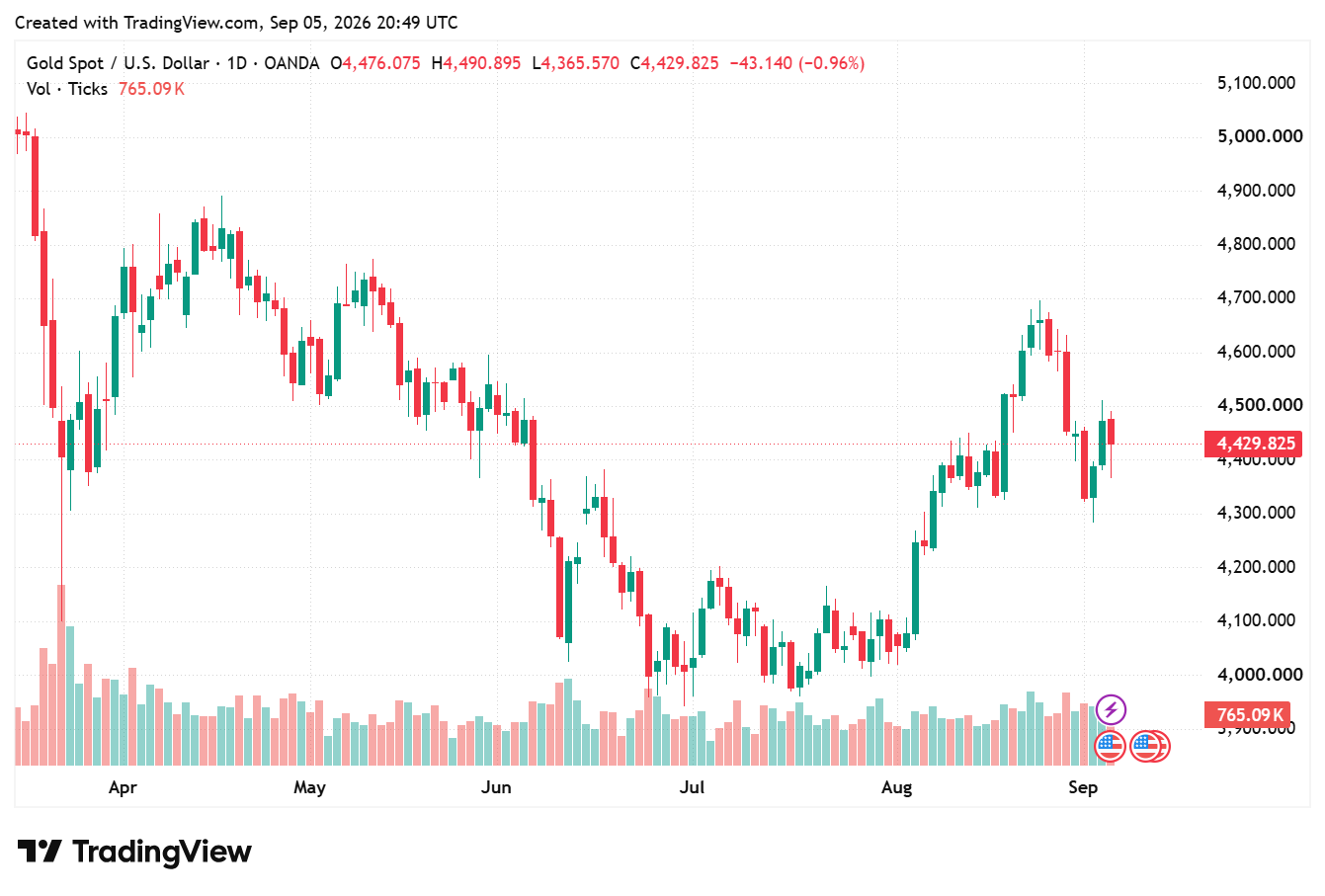
Gold currently trades near $4,430 per ounce, while Bitcoin hovers around $81,000. The two assets now show a much closer 90-day price relationship than earlier this year.
The post Bitcoin Gold Correlation Climbs to 0.50 as Nasdaq Link Hits Yearly Low appeared first on Blockonomi.
TLDR:
- SEC ISS action seeks court enforcement after the firm declined to fully satisfy a July subpoena.
- The SEC says missing ISS records have hindered its securities-law examination and oversight work.
- ISS faces scrutiny over proxy influence as regulators pursue documents tied to federal securities laws.
- Comments from Balchunas and Sigel broaden attention toward concentration among major proxy advisers.
Institutional Shareholder Services faces an SEC enforcement action over its refusal to provide documents requested by the regulator. The Securities and Exchange Commission filed the action on September 4, 2026, in federal court.
The case seeks to compel ISS to comply with an administrative subpoena issued in July. The dispute puts renewed regulatory attention on the proxy advisory firm’s operations.
SEC ISS Action Targets ISS Subpoena Compliance
The SEC filed its application in the U.S. District Court for the Eastern District of Pennsylvania. The agency seeks an order requiring Institutional Shareholder Services to produce outstanding records.
According to the SEC filing, agency examination staff initially made routine information requests to ISS. The firm declined to fully comply with those requests, according to the regulator.
The SEC later issued an administrative subpoena on July 21, 2026. The agency says ISS has continued refusing to provide all requested materials.
The subpoena seeks documents connected to an investigation into ISS’s compliance with federal securities laws. The SEC said the missing records have slowed its examination and enforcement work.
ISS operates as an investment adviser registered with the SEC. The regulator described itself as the firm’s primary regulator in the court filing.
The SEC said the requested records relate directly to its statutory oversight responsibilities. The agency also linked the investigation to its investor protection duties.
ISS Proxy Recommendations Draw Regulatory Attention
ISS has faced broader scrutiny over its influence on corporate shareholder votes. Eric Balchunas recently reported the SEC action and pointed to the firm’s market position.
Balchunas described ISS as controlling about half of the proxy voting outsourcing market. He also referenced recent criticism surrounding the firm’s approach to environmental, social, and governance issues.
Matthew Sigel separately discussed the wider scrutiny facing proxy advisory firms. He pointed to Glass Lewis recommendations involving gender-diversity targets for corporate boards.
Sigel also described a policy at VanEck requiring portfolio managers to explain overrides of Glass Lewis recommendations. His comments placed ISS and Glass Lewis within the same broader debate.
ISS and Glass Lewis remain prominent names in proxy advisory services. Their recommendations can influence how shareholders approach corporate voting decisions.
Elon Musk previously criticized the influence of proxy advisers and passive fund structures. Balchunas referenced those earlier comments while discussing the latest SEC action.
The current case centers on subpoena compliance rather than the merits of any specific proxy recommendation. The SEC now seeks judicial enforcement of its outstanding information request.
The post SEC ISS Subpoena Action Puts Proxy Advisor Under Regulatory Scrutiny appeared first on Blockonomi.
TLDR:
- RedSonic Vault lost 9.25 ETH after an attacker exploited a dual-asset pricing flaw entirely.
- A permissionless registerErc20 function let the attacker add a second, conflicting stETH share class.
- The attacker flash-loaned 1,139 WETH from Balancer and needed zero starting capital of their own.
- ExVulSec traced the full exploit, including the Curve swap and the final loan repayment step.
A flash loan attacker drained 9.25 ETH from Ethereum’s RedSonic Vault in a single transaction. Blockchain security firm ExVulSec identified the exploit and published a full technical breakdown.
The attacker manipulated a permissionless asset-registration function to double count the same underlying collateral. On-chain records show the entire operation executed inside one self-contained transaction.
How the RedSonic Vault Exploit Unfolded
The attacker flash-loaned 1,139 WETH from Balancer to fund the entire operation. No upfront capital of their own was required.
RedSonic’s vault prices its rsvETH shares through a function called getTotalAssetBalance. For the Lido position, that function reads the vault’s raw stETH balance directly.
That design choice became the exploit’s foundation. Share prices tied directly to a raw balance can shift if that balance changes unexpectedly. No corresponding shares need to be minted or burned.
The vault’s registerErc20 function carried no access restrictions, according to ExVulSec. Anyone could register a brand new asset class inside the vault.
The attacker registered stETH as a second asset, creating a class called rsvstETH. Both share types then drew from the exact same underlying stETH balance.
The exploit contract self-destructed once execution finished. Security researchers note that self-destructing contracts often complicate later on-chain tracing efforts.
Flash loans let borrowers access large sums without posting collateral, provided the loan gets repaid within the same transaction. Attackers commonly use this mechanism to fund exploits that would otherwise demand substantial capital.
ALERT — Exploit on Ethereum @reddio_com RedSonic Vault was drained for ~9.25 ETH. A no-capital attacker flash-loaned 1,139 WETH from Balancer, inflated the vault's share price, and cashed out. The exploit ran inside a self-destructing contract's constructor.
Root cause:
the…— ExVul (@exvulsec) September 5, 2026
RedSonic Vault Exploit Exposes a Dual-Asset Flaw
The attacker deposited 1,130 ETH first, acquiring close to 99% of all outstanding rsvETH shares. That position set up the rest of the exploit.
Next, the attacker deposited 9.34 stETH directly into the vault. That single deposit inflated the stETH balance without minting any new rsvETH shares.
Because rsvETH pricing reads the raw stETH balance, the extra deposit pushed the share price higher artificially. The attacker’s existing rsvETH holdings gained value instantly as a result, without any new rsvETH being issued.
The attacker then redeemed rsvETH for 1,139.5 ETH, according to ExVulSec’s transaction analysis. That single redemption produced the full 9.25 ETH profit.
The same attacker also redeemed the rsvstETH shares for stETH separately. The identical underlying collateral effectively paid out twice from one shared, pooled vault balance.
ExVulSec reported that the recovered stETH was swapped for ETH on Curve. The attacker repaid the Balancer flash loan within that same transaction.
Etherscan data lists the attacker’s wallet as 0x70f2333d21Ed7E7D105F6578227A9A747687982C. The RedSonic Vault contract itself sits at 0x4315990d9eeaffdfafd49958b4851f203fa1126f.
The attack transaction carries the hash 0xe3cba90e865c6cba950ebce36a52607f51f1fd33cd9fb920c78803f19b57791a. It remains publicly viewable on Etherscan for anyone verifying the exploit’s details.
The post RedSonic Vault Exploit Drains 9.25 ETH in Ethereum Flash Loan Attack appeared first on Blockonomi.
TLDR:
- The XRP price prediction places $3.66 as the decisive monthly resistance that buyers must break before the projected path toward $60 becomes active.
- XRP dropped to $1.41 after strong employment data and long liquidations, although elevated spot volume suggests traders remain active.
- United States spot XRP ETFs attracted $110.49 million during the week ending August 28, lifting cumulative inflows beyond $1.66 billion.
- RLUSD growth and planned XRPL lending features could expand network activity while XRP tests support near $1.30 and resistance around $1.70.
XRP trades near $1.41 after losing 2.83% over 24 hours, following stronger United States employment data and heavy long liquidations. The latest XRP price prediction centers on $3.66, a resistance level that has capped the token for years. Analyst Ali Martinez says a monthly close above that barrier would confirm an ascending triangle breakout.
His chart places the long-term technical target near $60. The projection is conditional, while nearer levels still determine whether buyers can regain control. Rising spot activity, exchange outflows, ETF demand, and growth across Ripple’s ecosystem provide a backdrop for the contested technical setup.
XRP Price Prediction Depends on a Close Above $3.66
The latest decline followed a United States jobs report showing 162,000 new positions. That figure exceeded market expectations, while unemployment held at 4.1%. The release pressured risk assets by strengthening expectations for tighter monetary policy.
XRP briefly fell toward $1.33 during the sell-off. Liquidations reached about $14.82 million, with long positions representing 95.8% of the total. Forced closures added selling pressure before the token recovered toward $1.41.
Trading activity nevertheless stayed elevated during August. Binance processed about $7.28 billion in XRP spot volume, while Upbit recorded roughly $4.68 billion. Around 500 million tokens also left Binance during the month. Lower exchange balances can reflect transfers into self-custody, although they do not guarantee immediate price gains.
Martinez’s XRP price prediction draws on an ascending triangle visible on the monthly chart. XRP has produced higher lows while repeatedly meeting resistance near its previous record zone. A monthly close above $3.66 would provide stronger confirmation than a brief intraday move.
The projected path does not send XRP directly to $60. Martinez’s chart identifies possible stages near $9.49 and $15.60, followed by a potential pullback. Higher extensions appear around $31.87 and $60 if the long-term structure continues.
Nearer resistance remains more relevant for current traders. XRP must first reclaim $1.70, then clear potential targets around $1.90, $2.13, $2.80, and $3.40. Failure to hold the $1.30 area could expose the broader $1.10 to $1.38 support zone.
XRP Price Prediction Gains Support From ETF Demand
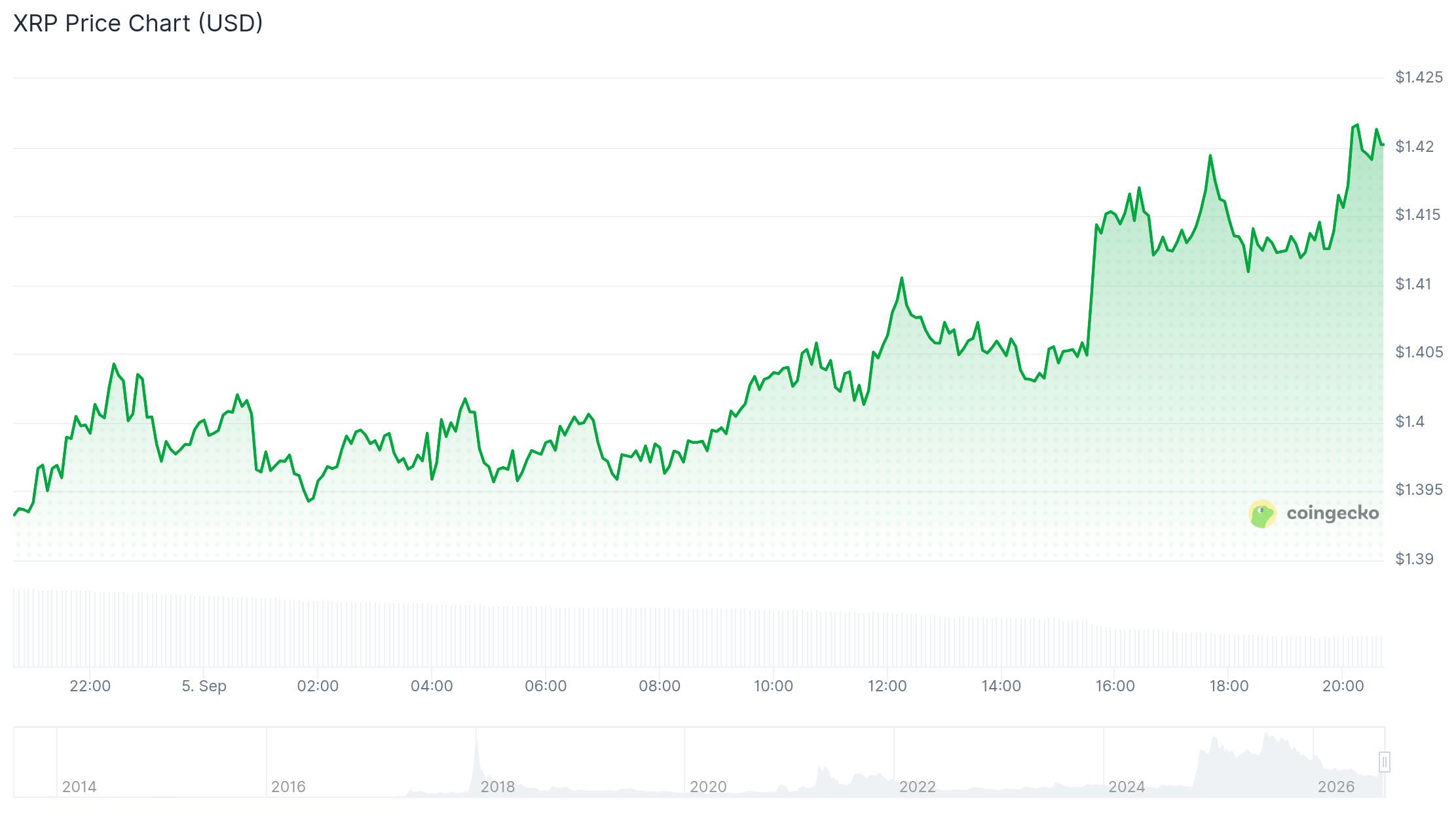
Fundamental developments provide a second part of the XRP price prediction. United States spot XRP ETFs attracted $110.49 million during the week ending August 28. Total net inflows surpassed $1.66 billion, showing continued institutional demand despite short-term price weakness.
Ripple USD has also expanded across the ecosystem. RLUSD supply rose 51% during the past 30 days to a record $2.4 billion. About $1.1 billion of those assets now sit on the XRP Ledger, alongside growth in holders and transaction volume.
Meanwhile, XRPL developers are testing a Lending Protocol and Single Asset Vaults. The upgrades could bring more lending, yield products, and institutional activity onto the network. Greater usage may support demand, but adoption will depend on liquidity, security, and participation.
Regulation provides another potential catalyst. A United States Senate cloture vote on the CLARITY Act is scheduled for September 15, 2026. The procedural vote requires 60 votes and would determine whether the bill advances.
Short-term chart readings remain divided. One bearish view treats the latest rebound as a three-wave corrective move rather than a confirmed trend reversal. Under that interpretation, XRP has not established a durable bottom within the $1.10 to $1.38 region.
The daily chart offers a firmer bullish signal. XRP trades above its 200-day exponential moving average and has held support near $1.3093. A bullish flag also points to $1.6975, the August high, as the first major test. Only sustained closes above nearby resistance would strengthen the larger breakout case and bring Martinez’s $3.66 trigger into focus.
The post XRP Price Prediction Targets $60 From Decade Long Chart Pattern appeared first on Blockonomi.
CryptoPotato
The monetary landscape in the United States changed in the past week or so, first after the hawkish stance taken by the current Federal Reserve Chairman, Kevin Warsh, and then following last Friday’s strong US jobs report.
As such, the expectations have changed, with investors and experts pricing in a potential rate hike for the next FOMC meeting scheduled to take place on September 15-16. After answering how this could impact BTC, we turned our focus to XRP, whose case was described as “arguably more interesting than bitcoin’s,” by ChatGPT.
What Happens to XRP Then?
With the current odds on prediction markets at well over 50% for a rate hike in September, the warning signs for risk-on assets are fully flashing. This was felt on Friday briefly after the jobs report, with BTC dropping by $3,000 and XRP slumping from $1.45 to under $1.40, where it found support.
ChatGPT estimated that the cross-border token is likely to react “more violently to a Fed hike” even though it has two cushions: strong ETF demand and the CLARITY Act process. The initial reaction to a 25 bps increase on September 16 would be a 4%-8% decline, the AI predicted. From the current levels, this would materialize in a dip below $1.30.
The situation could worsen in the following days and weeks, with $1.20 emerging as the first major support to be tested. If Warsh takes an even more hawkish approach in his post-FOMC meeting speech, XRP could “fall further toward $1.05-$1.15.”
One of the cushions mentioned above, the CLARITY Act, has not made any real progress lately. It was delayed once again in early August, and its September vote, scheduled for just a day before the conclusion of the FOMC meeting, is no longer guaranteed after the latest developments. As such, XRP could be primed for even more painful performance in case of a rate hike.
The Dark Horse
ChatGPT believes that the spot XRP ETFs could be the silver lining for the underlying asset, as they have remained relatively solid even during market distress, and their performance has picked up after the August rally. The cross-border token could quickly bounce after the initial shock if the Fed signals no immediate second hike and the ETF demand is still intact.
If that’s the case, $1.50-$1.60 will come into focus as this level has halted many of XRP’s previous breakout attempts. However, if the Fed surprises the market and raises rates by 50 bps, while Warsh goes fully hawkish, the altcoin’s future could quickly deteriorate, with another leg down to and even below $1.00, ChatGPT warned.
The post Fed Rate Hike Could Hit XRP Hard: ChatGPT Reveals How Low Ripple’s Price Could Go appeared first on CryptoPotato.
A Bank for International Settlements (BIS) working paper tests the XRP Ledger (XRPL) as a proof-of-concept for verifying official statistics on-chain, recording cryptographic fingerprints of public datasets that publish in three to five seconds and verify in one to two.
The Working Paper No 1374 essentially asks how statistical agencies can give users an independent way to check the origin and integrity of published data without changing their existing dissemination systems.
International organizations (the BIS among them) rely on the SDMX standard to exchange official statistics, and the prototype binds each SDMX dataset to its source by hashing it and writing a single summary value to the ledger.
Though only the fingerprints reach the chain, never the underlying numbers, so confidential data stays off-ledger, and the method extends to formats such as XBRL. The BIS has tested public blockchains before, including Project Mariana, which trialed wholesale central bank digital currency settlement on a public chain with the central banks of France, Singapore, and Switzerland.
The system normalizes each file with Canonical XML 1.1, hashes it with SHA3-512 at the whole-file and per-series level, and collapses those hashes into one Merkle root written to the Memos field of an XRPL Payment transaction. Each file also carries a W3C Verifiable Credential in its header, signed by the publisher’s identity keys.
Cost and Simplicity
The memo approach needs no smart contracts, so the authors avoided gas costs and contract risk, and XRPL’s base fee of 10 drops, or 0.00001 XRP, put anchoring close to free. Batching compounds that.
A single ledger entry can cover thousands of datasets, dropping the on-chain cost to a fraction of a cent each. The paper also cites the ledger’s fast consensus finality and the published technical analysis of its consensus protocol.
XRPL has taken on other institutional workloads this year. CryptoPotato reported on a pilot that linked the ledger to interbank rails with JPMorgan, Mastercard and Ondo, which settled tokenized Treasury bills in under five seconds, and Ripple has published an institutional roadmap adding compliance credentials and permissioned trading. The BIS tests ran on XRPL’s DevNet, a test network.
It notes that DevNet shares the mainnet’s transaction format and close cadence, so the latency figures carry over, and mainnet fees stay in the sub-cent range.
A Few Firm Limits
The paper also describes the build as an experimental proof-of-concept, stating a production service would need hardware-backed signing, pinned validator nodes and formal load testing.
Though keep in mind the ledger certifies only what was published, by whom and when, so the paper reaches no adoption decision and gives no endorsement of XRP, and the authors attribute the views to themselves, not to the BIS or its member central banks.
The post BIS Tests XRP Ledger to Anchor Official Statistics On-Chain in Proof-of-Concept Paper appeared first on CryptoPotato.
The largest meme coin by market cap has soared on Saturday evening to $0.094, hitting a two-week high. The move is rather unexpected given the typically calm nature of the weekends.
However, there were certain signs about a potential rally, even though DOGE has slipped from its local high to $0.09 as of press time.

CryptoPotato outlined yesterday the three major signals that flashed for DOGE, including the TD Sequential. Analysts quickly determined that the OG meme coin is primed for another leg up.
However, that didn’t transpire at first, as the asset was rejected at $0.088 and slipped back down to $0.084 as the entire market bled following the strong US jobs report, which was considered bearish for risk-on assets.
Nevertheless, DOGE exploded on Saturday evening, gaining 12% from its low yesterday to the two-week high at $0.094. Popular analyst CW noted that the meme coin has reached the first major sell wall on its path forward, which is too solid to be broken now. If it falls, though, the next such wall sits all the way up at $0.14.
Fellow analyst Alex Marzell believes DOGE did “exactly what it needed to,” as it rebounded from the Friday lows to reclaim a key resistance.
$DOGE did exactly what it needed to.
Friday’s jobs print dumped it back to the $0.083 base, six flat 4H candles held it, and today one 4H candle ripped $0.0876 to $0.0952 straight back through $0.088.
Old resistance is the new line. Hold $0.088 and I think $0.095 goes next and… pic.twitter.com/y7hW91yCek
— Alex Marzell (@MarzellCrypto) September 5, 2026
Max Crypto also weighed in on DOGE’s impressive move and even suggested that its breakouts have been the “best indicator” for the start of an Altseason.
The post Dogecoin (DOGE) Suddenly Pumps by Double Digits as Analysts Declare the Start of Altseason appeared first on CryptoPotato.
Standard Chartered extended its deliverable Bitcoin (BTC) and Ether (ETH) spot trading to institutional clients in the United Arab Emirates on September 3, becoming the first Global Systemically Important Bank (G-SIB) to offer the service in the country.
The offering runs through Standard Chartered DIFC, the bank’s arm in the Dubai International Financial Center (DIFC), which said it is the only global bank currently providing institutional digital asset spot trading in the region.
Built on the UK Launch
The launch adds trade execution to a custody service the bank already runs in the UAE. The trades are deliverable, so clients take possession of the underlying Bitcoin and Ether at settlement, and they can settle through a custodian of their choice, including Standard Chartered’s own digital asset custody solution that went live in September 2024.
Trades run through the bank’s electronic channels and sit inside its existing platforms, letting clients access the two assets through the same FX interfaces they already use. Standard Chartered DIFC is regulated by the Dubai Financial Services Authority (DFSA).
“The UAE has developed a clear digital assets regulatory framework that supports institutional participation and innovation,” said Rola Abu Manneh, Chief Executive Officer for the UAE, Middle East and Pakistan at Standard Chartered. She said pairing execution with custody, governance, and the bank’s global connectivity gives clients a more integrated way to participate in digital asset markets.
Standard Chartered first introduced institutional Bitcoin and Ether spot trading through its UK branch in July 2025, the first G-SIB to offer deliverable spot crypto trading to institutional clients.
“DIFC provides an established platform for international financial institutions to deploy global capabilities across markets,” said Christopher Parsons, Senior Executive Officer at Standard Chartered DIFC. He said the arrangement combines the bank’s global markets network with a regulated base for serving clients across the region.
A Wider UAE Digital Asset Push
The trading service sits inside a broader digital asset strategy that spans custody, trading and tokenization through Standard Chartered’s Corporate and Investment Bank, with its ventures ecosystem reaching into Zodia Markets and Libeara.
The bank already lets institutional clients mint and redeem USDC directly through its DIFC platform, a service it built with Circle. SC Ventures, its innovation arm, has backed a $100 million digital asset joint venture in the UAE with Japan’s SBI Holdings that targets market infrastructure, compliance tools, DeFi and tokenization.
The post Standard Chartered Extends Institutional Bitcoin and Ether Spot Trading to the UAE appeared first on CryptoPotato.
CryptoQuant data shows that bitcoin investors started realizing major profits after the explosive August rally, disposing of roughly 110,000 BTC in just a few weeks.
Such highly concentrated profit-taking developments have historically been followed by substantial price correction for the underlying asset, the analysts warned. Moreover, several demand indicators have weakened, which could add to the selling pressure.
110K BTC Profit Taken
The major run that began on August 19 at prices of under $65,000 drove the leading cryptocurrency to almost $80,000 in just two days. According to CQ’s latest weekly report, holders realized net profits of 23,000 BTC on that day alone (August 21), which became the largest single-day profit realization this year.
The asset indeed dipped in the following days as it felt almost inevitable after such a gigantic jump, but went on the offensive once again in the following week or so. It rocketed past $82,000 on Friday before it was rejected following the US jobs report, and now sits below $80,000.
The report described the major profit-taking as a classic characteristic of a bullish cooldown, but warned that if they continue at such a rapid pace, the asset’s price could be primed for another correction. Historical occurrences have shown that BTC tends to dump hard after a major rally if investors are not convinced about its potential.
“It is a hallmark of a bullish cooldown: bullish because it happens into strength, cautionary because concentrated realization can cap near-term upside,” reads the report.

Cooling Demand
CryptoQuant outlined another reason why BTC could be primed for a more profound correction, even though it already slipped from $82,400 to $79,600. Its apparent spot demand briefly expanded by 43,000 units, marking its fastest growth pace of the year. However, that metric has lost its momentum and is now back in contraction.
US investors’ demand has weakened as well. The most used metric for this, the Coinbase Premium, measuring the price difference between the asset on the leading US exchange and other trading platforms, has returned to slightly negative territory at -0.05.
The analysts said similar periods of soft US spot demand have capped the cryptocurrency’s rallies three other times this year alone.
Nevertheless, the short-term picture does not necessarily mean that BTC’s run is over and that it will return to a bearish phase. The Bull Score currently stands at 70, which is above the 60 threshold historically associated with sustainable bull markets.
” This keeps the broader picture constructive: Bitcoin remains in the early phase of a new bull market even as short-term momentum cools. The “official” bull market begins once price closes above its 365-day moving average,” they added, outlining that this key MA is located at around $83,000 – the level that stopped BTC in May.
The post Bitcoin Holders Just Cashed Out 110,000 BTC in Profits: Is a Bigger Price Drop Coming? appeared first on CryptoPotato.