Cryptocurrency Posts
Crypto Briefing
The reshuffle aims to enhance governance and stability, potentially reducing political risks and reinforcing U.S. ties amid economic challenges.
The post South Korea reshuffles Cabinet, appoints new finance and defense ministers appeared first on Crypto Briefing.
Finland's policy shift heightens regional tensions, potentially altering NATO-Russia dynamics and escalating security concerns in Europe.
The post Moscow vows effective measures in response to Finland’s nuclear weapons policy change appeared first on Crypto Briefing.
Rising bond yields strain G7 budgets, diverting funds from critical areas and reshaping investment landscapes with higher sovereign debt appeal.
The post Rising bond yields add billions to G7 countries’ debt costs appeared first on Crypto Briefing.
The rapid growth of tokenized assets and stablecoins highlights a transformative shift in financial markets, prompting new regulatory and liquidity challenges.
The post Binance’s CZ admits underestimating growth of real-world assets appeared first on Crypto Briefing.
Continued military actions in Lebanon risk prolonged instability, undermining ceasefire efforts and complicating future diplomatic resolutions.
The post Israel continues military operations in southern Lebanon despite ceasefire appeared first on Crypto Briefing.
Bitcoin Magazine
Bitcoin Magazine
Bitcoin Cools Off After $3 Billion ETF-Driven Surge
Bitcoin slid Friday afternoon, cooling down after a phenomenal run following huge investment from U.S. ETF buyers.
The leading cryptocurrency was trading for $77,379 on Friday afternoon in New York after dropping more than 3% over a 24-hour period.
Bitcoin hit a high this week of $81,281 but slowed down after Federal Reserve Chair Kevin Warsh gave his first major speech as head of the central bank — saying on Friday that he had “more work to do” to fight inflation.
The Bitcoin price has in the past dropped when the Federal Reserve thinks inflation is too high because it means less chance of a rate cut; the leading cryptocurrency typically does better in a low-interest rate environment.
JUST IN:
— Bitcoin Magazine (@BitcoinMagazine) August 28, 2026U.S. Bitcoin ETFs have brought in $1.14 billion in inflows this week.
Over $3 billion has been added in the past 9 days!pic.twitter.com/ri1jE7enTZ
Bitcoin started surging last week after the U.S. Treasury would at least double the size of its liquidity-support buyback operations. The announcement last week hurt the dollar but non-yielding assets have benefited.
Exchange-traded funds, managed by the likes of BlackRock, Fidelity, and Grayscale have received net positive inflows for nine days in a row, according to Farside Investors data. Last week was their best week since October — when bitcoin hit a new all-time high — and that run has continued into this week.
Since August 17, investors have thrown over $3 billion at the funds. BlackRock’s iShares Bitcoin Trust received the lion’s share of the investment, but Morgan Stanley’s new Bitcoin Trust — which debuted this year — also experienced significant inflows.
Analysts have said that the so-called debasement trade — when investors buy an asset as a way to hedge against a currency losing value — was leading investors to eye-up bitcoin again.
Investors taking part in the trade think that bitcoin, gold and other precious metals are a good way to protect themselves from excessive government spending.
Total U.S. debt crossed $40 trillion for the first time this month.
This post Bitcoin Cools Off After $3 Billion ETF-Driven Surge first appeared on Bitcoin Magazine and is written by Mathew Di Salvo.
Bitcoin Magazine
Debasement Trade Is Here Thanks to Government Debt — And Bitcoin Will Benefit: Grayscale
The debasement trade is back — and will benefit bitcoin.
That’s according to asset manager Grayscale’s crypto research team, who wrote in a note this week that the U.S. government debasing its currency would lead to cash hitting digital assets.
“Unchecked government debt growth undermines the credibility of fiat currencies and drives investors to seek out alternative stores of value like physical gold and certain cryptocurrencies,” the note by the firm’s head of research, Zach Pandl, read, adding that primarily bitcoin would benefit.
The so-called debasement trade is when investors buy an asset as a way to hedge against a currency losing value. The trade was hot last year, and helped bitcoin’s run, but the digital asset’s run lost steam after October as traders turned their attention to stocks related to artificial intelligence.
But since last week, bitcoin has benefited from news that the U.S. Treasury would at least double the size of its liquidity-support buyback operations. The announcement last week hurt the dollar but non-yielding assets have benefited.
“That buybacks are needed at all is the problem: heavy growth in government debt is driving up the cost of borrowing,” the note continued. “The Treasury is treating the symptoms (rising bond yields) because they cannot cure the disease (structural deficits).”
The note added that on the same day last week as the buyback announcement, the Treasury also said the U.S. public debt exceeded $40 trillion for the first time.
As debt and interest payments grow, the government needs to either raise taxes, cut spending, or issue more debt.
Bitcoiners see the more politically likely path as expanding the dollar supply — which is ultimately bad for the dollar, and good for scarce assets like bitcoin.
After bitcoin started surging last week, the dollar had its worst week of August and was trading at a three-month low.
Bitcoin was trading for $77,493 on Friday afternoon in New York after hitting a high this week of $81,281. Over a 24-hour period, the coin now sits unmoved, but over a 30-day period, it has jumped by more than 20%.
This post Debasement Trade Is Here Thanks to Government Debt — And Bitcoin Will Benefit: Grayscale first appeared on Bitcoin Magazine and is written by Mathew Di Salvo.
Bitcoin Magazine

Bitcoin’s Moment Has Come for the Far East, Says Metaplanet CEO
Bitcoin’s time has come in Asia — especially with a changing regulatory landscape — and its people and companies should take advantage.
That was the message Metaplanet CEO Simon Gerovich gave at this year’s Bitcoin Asia conference, where on Friday he spoke of how his company went from failing to the third biggest bitcoin treasury in the world.
Bitcoin Asia kicked off on Thursday in Hong Kong, bringing the biggest names in the space to Hong Kong to talk about everything from treasury companies to building apps from scratch.
JUST IN:
— Bitcoin Magazine (@BitcoinMagazine) August 28, 2026Japanese public company Metaplanet CEO says the bottom for Bitcoin's price is in
"The buyers arriving now aren't going anywhere. I believe the bottom is in. And I'm expecting a much brighter rest of the year."

“The previous cycles belonged to the West, and the first Asian cycle has already started,” Gerovich said. “The only question left is who builds it. Will you?”
Often dubbed Asia’s answer to Nasdaq-listed Bitcoin treasury Strategy, Metaplanet pivoted from its core hotel and technology business to buying Bitcoin in 2024. The Tokyo Stock Exchange now holds 43,000 bitcoins worth about $3.3 billion at today’s prices.
Gerovich said in his speech that his company was small and going nowhere fast until it started putting bitcoin on its balance sheet, basically allowing investors to buy exposure to the biggest digital coin via its regulated shares.
He said that the strategy is a major opportunity for Asian companies, which can now capitalize on the changing regulatory landscape and the growing interest in Bitcoin.
Asian nations, including Japan, Hong Kong, and Singapore, are making regulatory changes to support digital assets.
Gerovich noted that Japan in particular is a country where its citizens have saved like no other part of the world — and that capital can now be put to good use.
“Hoarding cash has stopped making sense, and every household in Japan can now feel it,” he said.
“Japanese households hold roughly 14 trillion dollars in financial assets. About half of that sits in bank deposits, earning almost nothing, and that’s just Japan, add Korea, Southeast Asia, and the wealth managed out of this place, Hong Kong, and you’re looking at the deepest pools of patient savings on Earth.
“And for the first time in a generation, these savings are looking for somewhere to go.”
Gerovich added that Asian companies, institutions, and savers should take advantage of the current market conditions and build the Bitcoin infrastructure in their own regions.
“The end of the cash hoarding strategy and new rules are arriving at exactly the same time, and together, they set up what I think is the single biggest opportunity in Asian markets today,” he added.
This post Bitcoin’s Moment Has Come for the Far East, Says Metaplanet CEO first appeared on Bitcoin Magazine and is written by Mathew Di Salvo.
Bitcoin Magazine
Capital B Raises €21M From Adam Back and TOBAM To Buy More BTC
Capital B, the Euronext Growth-listed company that bills itself as Europe’s first bitcoin treasury company, has raised €21 million ($24 million) in a private placement backed by Blockstream’s Adam Back and asset manager TOBAM — money it says could buy 270 more bitcoin and push its stack to roughly 3,415 BTC.
The company said Friday that a total of 36,219,070 shares were sold at €0.58 each as part of the deal, a 6.45% discount to Wednesday’s closing price.
Capital B said the net proceeds are expected to reach about €19.9 million after fees and transaction costs.
JUST IN:
— Bitcoin Magazine (@BitcoinMagazine) August 28, 2026French company Capital B announces a €21.0 million capital raise to "accelerate its Bitcoin Treasury Company strategy"
Capital B is the 27th biggest publicly traded bitcoin treasury in the world, according to Bitcoin Treasuries, with a total of 3,145 bitcoins in its stash — worth $245 million at today’s bitcoin price of $77,960.
Capital B, which describes itself as Europe’s first bitcoin treasury, built much of that position through fundraising rounds during the first half of 2026.
In May, it acquired 192 coins for €13 million after completing three capital raises.
Capital B’s announcement as other treasuries look to raise funds and accelerate their buys. Just this week, NYSE-listed AI-powered education company Genius Group said it was aiming to build parallel AI and bitcoin treasuries worth a combined $1.6 billion, after the company sold its entire bitcoin reserves to repay $8.5 million in debt.
Bitcoin treasuries have faced headwinds since 2025 when the price of the leading cryptocurrency took a hit. A number of companies in the space have had to liquidate their holdings, including the biggest corporate holder of bitcoin, Nasdaq-listed Strategy.
This post Capital B Raises €21M From Adam Back and TOBAM To Buy More BTC first appeared on Bitcoin Magazine and is written by Mathew Di Salvo.
Bitcoin Magazine
Bitcoin Drops Before Shrugging Off Fed Chair’s Inflation Comments
Bitcoin dropped, then popped after Federal Reserve Chair Kevin Warsh gave his first major speech as head of the U.S. central bank and said he had “more work to do” to fight inflation.
The leading cryptocurrency was recently trading for $79,474 after dropping as low as $78,630 before quickly rising again.
Bitcoin has typically done well in a low interest rate environment but the Federal Reserve has been reluctant to lower borrowing costs due to sticky inflation in the world’s biggest economy.
“But on the price-stability side of our mandate, the numbers are more concerning,” Warsh said after talking about employment.
He added: “We must be confident that underlying inflation is moving to our objective, clearly and at sufficient speed. Otherwise, we have work to do.”
Bitcoin has in the past dropped on news that the Federal Reserve thinks inflation is too high because it means less chance of a rate cut. Following Warsh’s speech, traders priced in a 50% chance of rate hike in September.
But Bitcoin has appeared to — at least for now — shrug off the speech.
Bitcoin’s started surging last week after the U.S. Treasury Secretary Scott Bessent announced the department would double the size of its long-dated bond buybacks.
The news sent yields down lower, and the dollar slid while non-yielding assets like bitcoin and gold jumped.
Positive regulatory news also helped the coin: President Donald Trump last week said that the long-awaited crypto Clarity Act was a “very, very powerful” piece of legislation, and urged lawmakers to get it over the line.
The proposed law will establish a framework for distinguishing between digital assets that are securities, commodities or payment stablecoins — legislation that the crypto industry has long called for.
The Federal Reserve Bank of Kansas City is on Friday holding the annual event at Jackson Hole, Wyoming, where central bankers, Federal Reserve officials, policymakers and academics will gather to discuss “Financial Innovation: Implications for Payments and Policy.”
According to the Federal Reserve Bank of Kansas City website, this year’s event will touch on how “recent years have seen a dramatic increase in innovation in financial intermediation and payments,” including new technologies such as “cryptocurrencies and stablecoins.”
This post Bitcoin Drops Before Shrugging Off Fed Chair’s Inflation Comments first appeared on Bitcoin Magazine and is written by Mathew Di Salvo.
CryptoSlate
Deribit will remove its public Proof of Reserves page on Sept. 1, ending a daily check customers could use to verify balance inclusion and compare aggregate liabilities with published wallet holdings. Regulator-required reserve, reconciliation and audit controls will remain, but they do not provide the same daily public visibility.
The exchange said the change reflects a wallet infrastructure overhaul during its integration with Coinbase. Deribit said roughly 90% of client assets have moved into Coinbase custody arrangements since Coinbase acquired the derivatives platform in August 2025. Its disclosures name Coinbase at the brand level but do not identify the specific Coinbase legal entity holding the migrated assets.
Deribit's existing system uses a privacy-preserving binary Merkle tree and a daily snapshot. Each client can use a unique proof identifier to find the hashed entries representing their balances, while anyone can sum the file's liabilities and compare the total with wallet balances published by Deribit.
The public snapshot was already narrower than Deribit's full custody footprint. Its methodology says assets held with third-party custodians are excluded because they are outside Deribit's direct control, naming Copper ClearLoop as an example. It does not say whether every Coinbase-held asset was already excluded.
After Sept. 1, Deribit has not promised a replacement public dashboard or continued client-level Merkle verification. It said clients and counterparties may request audited financial statements and other due-diligence material, a less frequent and less directly verifiable form of evidence.
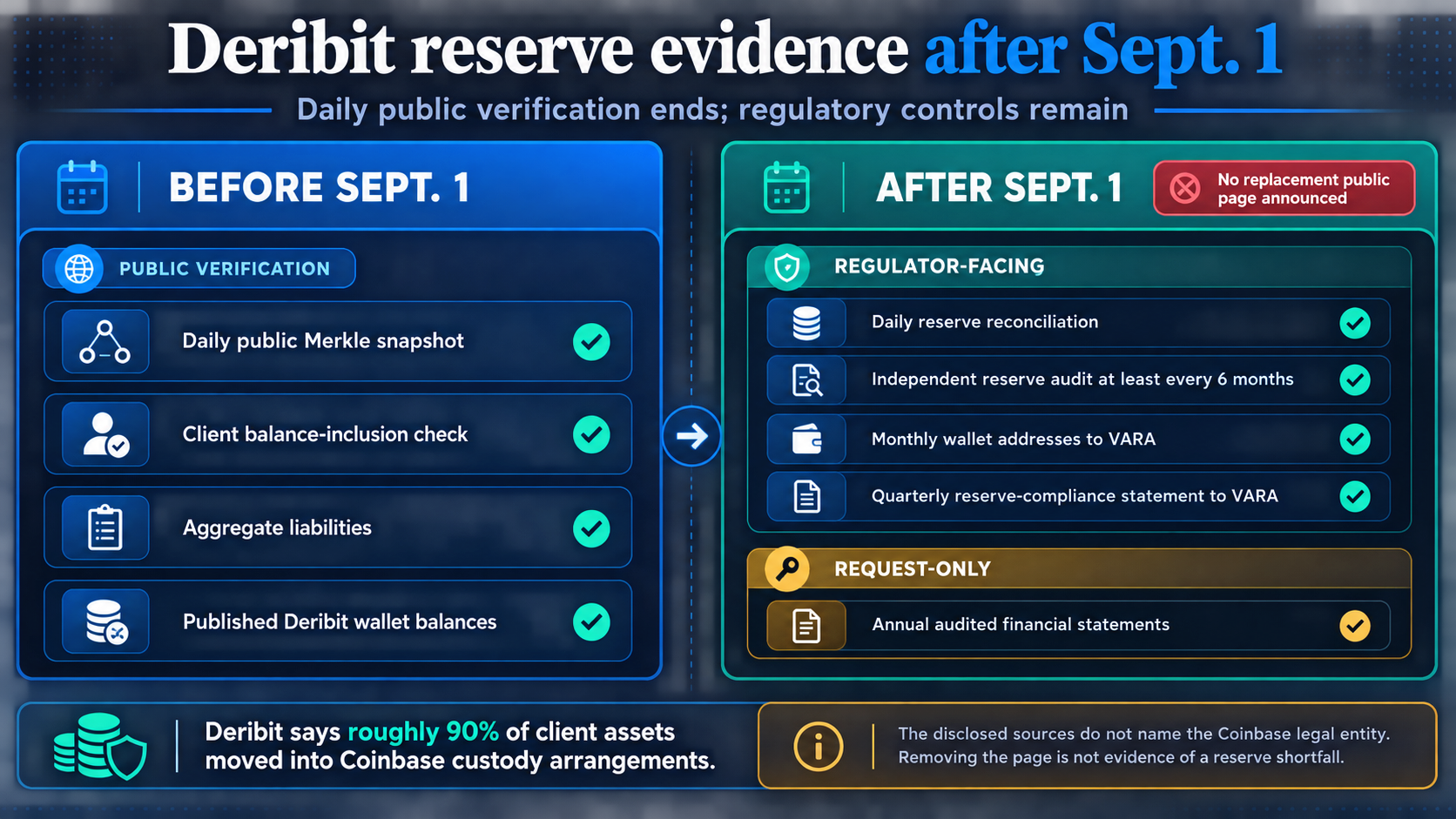
The removal does not cancel the obligations applying to Deribit FZE. Dubai's Virtual Assets Regulatory Authority requires covered virtual asset service providers to maintain reserves equal to 100% of client liabilities, hold them one-to-one in the same asset, reconcile them daily and obtain an independent third-party reserve audit at least every six months.
Deribit's notice refers both to annual and twice-yearly Proof of Reserves audits. The VARA rule sets the reserve-audit minimum at once every six months. A separate VARA provision requires an annual financial-statement audit and says the annual report must be available to clients and the regulator on request.
Other evidence is regulator-facing rather than public. Covered firms must submit wallet addresses monthly and statements demonstrating compliance with financial requirements, including reserve assets, quarterly to VARA.
VARA's register lists Deribit FZE as an active exchange and broker-dealer VASP. Its membership terms allow assets to be held directly or through third-party custodians while requiring segregation from company assets and preserving clients' legal title. A separate service-provider list names Coinbase for custody and self-custody technology without specifying the Coinbase entity.
The page's removal is not evidence of a reserve shortfall. It is a reduction in what customers can test for themselves each day, leaving controls and reports that are less public, less frequent or available only on request.
The post Deribit moved 90% of client assets to Coinbase, then killed its daily proof-of-reserves check appeared first on CryptoSlate.
IREN is still mostly a Bitcoin miner by revenue, even as it retires mining hardware to make room for AI infrastructure and grow IREN's AI cloud revenue.
The company’s fiscal 2026 results, filed Aug. 27, show Bitcoin mining generated $578.2 million of IREN’s $707 million in annual revenue, or about 81.8%. AI Cloud Services contributed $128.8 million.
That ongoing transition produced a $638.8 million non-cash impairment, primarily tied to decommissioning miners as data center sites were converted for AI workloads. IREN also reported a $702.6 million net loss, which was affected by the impairment and other items. The charge was not a $638.8 million cash outflow, but it put an accounting value on assets retired before the replacement business had fully entered service.
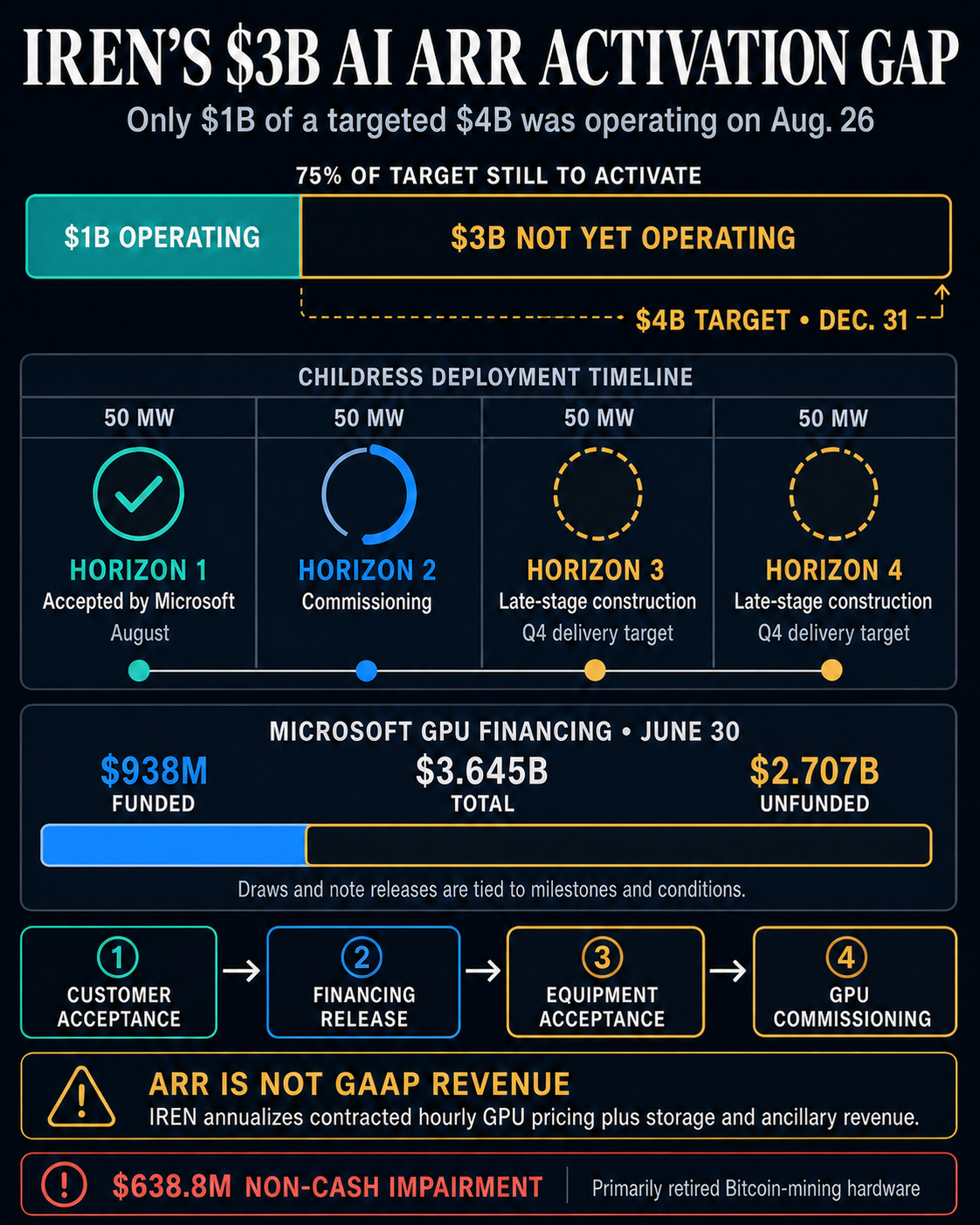
IREN AI cloud revenue faces a $3 billion operating gap
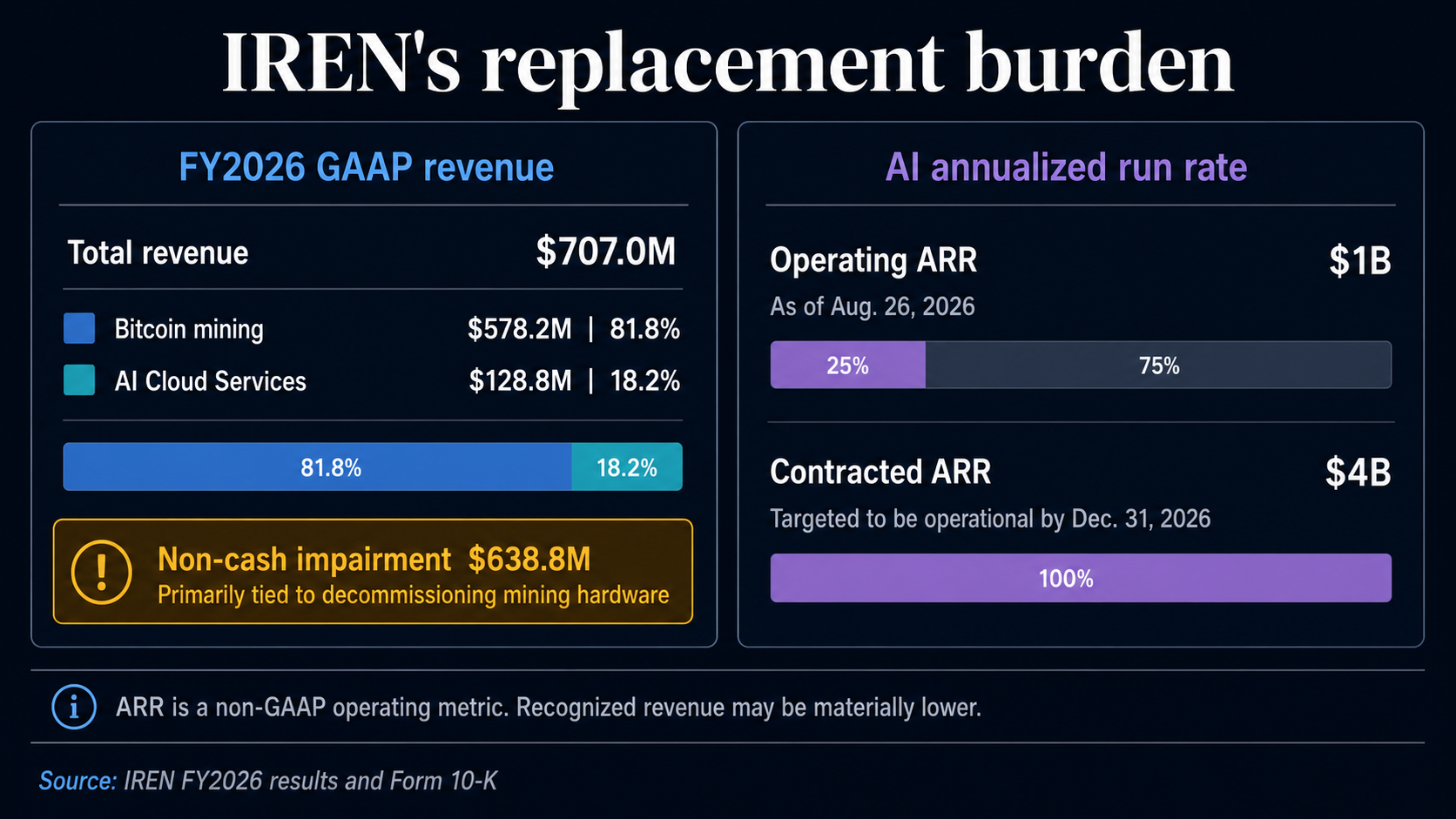
As of Aug. 26, IREN had $1 billion of operating annualized run-rate revenue, or ARR, against $4 billion of contracted ARR for its 2026 capacity. IREN targets the larger run rate to be operational by Dec. 31.
The company calculates ARR from contracted GPU pricing multiplied by a full year of hours, including storage and related services. It is an operating measure, not GAAP revenue, and IREN warns that recognized revenue may be materially lower. Closing the gap depends on physical infrastructure being delivered and accepted, as well as the company’s utilization and pricing assumptions.
IREN’s Form 10-K says revenue generally starts only after data centers are built and energized, equipment is installed and commissioned, performance testing is complete and customers accept the capacity. Delays can postpone revenue while financing and operating costs continue, and can trigger delay or service credits.
The timeline is staged. Microsoft accepted Horizon 1 in August. Horizons 2 through 4 were targeted for phased delivery in calendar Q4 2026, with contractual grace periods extending into the beginning of calendar Q2 2027.
At June 30, IREN still had installed Bitcoin mining capacity of about 23.2 EH/s across roughly 380MW. The company aimed to substantially complete the transition of that data center capacity toward AI Cloud Services by year-end.
Delay also carries a financing cost. IREN raised GPU financing to support the Microsoft contract through a delayed-draw loan priced at one-month SOFR plus 2.25% and senior notes at 5.96%, with tranches subject to conditions. A separate Mackenzie financing of up to $2.4 billion carries a 9% fixed rate and matures 30 months after each relevant staged funding date.
Microsoft and NVIDIA together represented a substantial majority of contracted revenue, according to IREN. New customers diversify the roster, but acceptance, performance and counterparty risks remain concentrated.
IREN has contracts that could replace the mining business on a run-rate basis. The filing does not show that replacement as completed. The next proof is customer acceptance of the remaining deployments and the GAAP AI revenue they begin to produce.
The post Bitcoin miner IREN still gets 82% of revenue from BTC after clearing room for Microsoft AI cloud appeared first on CryptoSlate.
Coinbase US500 futures reached a $100 million milestone, giving the exchange an early test of whether a crypto-native trading mechanism can travel into regulated US equity markets.
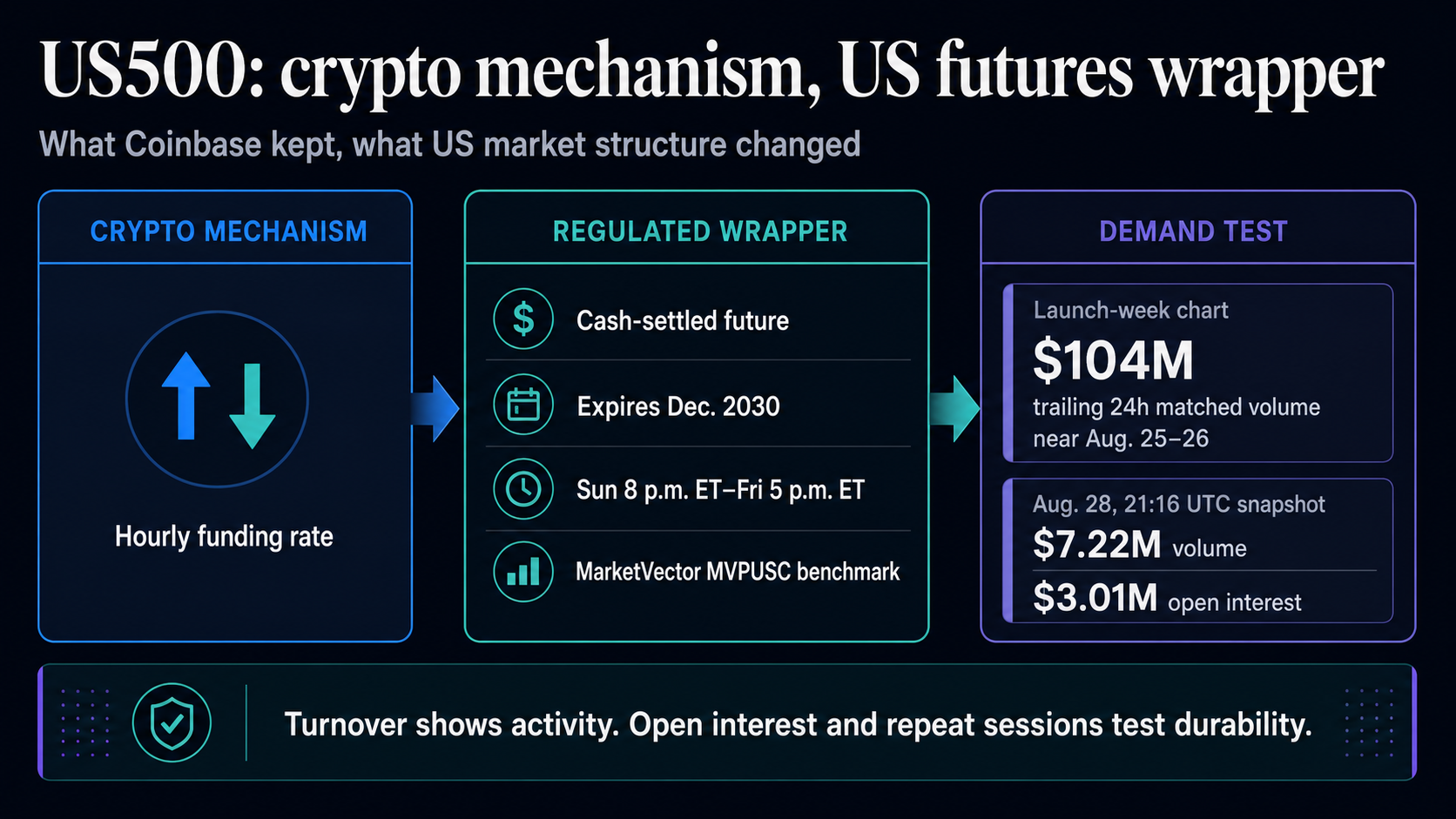
The chart attached to Armstrong’s Aug. 28 post tracked trailing 24-hour matched volume after US500 began trading on Aug. 17. It ended at an annotated $104 million near Aug. 25-26, after lower readings across most of the contract’s first week.
Coinbase product-page, roughly 15 hours after Armstrong posted, showed $7.22 million in 24-hour volume and $3.01 million in open interest. Funding was negative 0.0001%, with shorts paying longs.
The data covers different rolling windows, so the later number does not reverse the earlier one. Together, they place the launch headline in context. Armstrong’s chart establishes that turnover surged. The later page shows how quickly rolling volume can change and provides only one reading of positions still open.
The product itself explains why the experiment reaches beyond a launch statistic. Coinbase imported the funding-rate mechanism associated with crypto perpetuals, then placed it inside a long-dated, cash-settled futures contract governed by US market rules.
How Coinbase US500 futures fit US market rules
Coinbase US500 futures use what the company calls a “perp style” design. Its July 30 self-certification filed with the CFTC defines the instrument as a five-year, US dollar-settled equity-index future that was offered on or after Aug. 17.
The initial contract expires on the third Thursday of December 2030. Final settlement uses the value of the reference index, and open positions are settled in cash. A holder receives price exposure through the futures contract rather than delivery of the component shares, so the position carries no ownership or shareholder voting rights in those companies.
Funding supplies the crypto-style link. Coinbase Derivatives calculates the rate hourly from the difference between the futures and spot marks. The clearing house then aggregates those hourly funding payments at its midday and end-of-day margin runs and applies the amounts through cash adjustments.
That system can pull a long-dated contract toward its reference index while leaving the rest of the futures structure intact. The contract has an expiry, clears through Nodal Clear and operates under exchange position limits, price limits and market-wide circuit breakers.
Its detailed session also follows a regulated market calendar. Trading runs from Sunday at 8 p.m. Eastern Time to Friday at 5 p.m. Eastern Time, with market holidays and other closures. Coinbase’s consumer page uses “24/7” language elsewhere, but the listed session and the CFTC filing establish a Sunday-to-Friday market.
The benchmark adds another layer to the design. US500 references the MarketVector Top 500 US Profitable Companies Continuous Index, identified as MVPUSC in the filing.
MarketVector describes MVPUSC as a continuous index tracking the largest securities of profitable US companies. The benchmark began on Aug. 7, 10 days before the futures contract started trading, and its page listed 501 components at the Aug. 28 reading.
The separate provider, methodology and index identity distinguish US500 from the S&P 500. Traders receive cash-settled exposure to MarketVector’s benchmark rather than a tokenized basket of S&P 500 shares.
Crypto’s contribution is therefore specific. The funding rate and long trading session carry over; the legal object is a regulated equity-index future with a fixed term, cash settlement and a proprietary reference.
The volume milestone needs a longer record
For Coinbase US500 futures, Armstrong’s chart measures matched turnover. Gross volume can include repeated trading with the same capital, so it does not reveal unique deposits, unique users or retained exposure.
Open interest captures outstanding positions instead of all trades completed during a rolling window. At the preserved Aug. 28 reading, $7.22 million in 24-hour volume was about 2.4 times the $3.01 million in open interest. The calculation describes the scale of the two metrics at one moment; it does not convert turnover into a count of traders or capital.
| Metric | Observed signal | Limit |
|---|---|---|
| Trailing 24-hour matched volume | $104 million near Aug. 25-26; $7.22 million at the later Aug. 28 reading | Different windows; no unique-user or unique-capital count |
| Open interest | $3.01 million at the later reading | No multi-session trend or position-concentration data |
| Funding | Negative 0.0001%, with shorts paying longs, at the preserved reading | One point cannot establish a lasting directional imbalance |
| Contract structure | Five-year, cash-settled future with hourly funding calculations | Price exposure rather than share ownership |
Repeat volume through ordinary sessions would show that trading survived the launch window. Stable or rising open interest across multiple days would show that traders continued to hold exposure. Order-book depth and spreads would reveal whether liquidity remained usable when the opening burst faded.
A longer funding history will add another signal. Persistent payments from one side of the market could show a repeated directional imbalance, while rates oscillating around zero could point to more balanced positioning. One funding reading cannot settle that question.
Participant breadth and concentration would complete the picture. Armstrong’s chart and Coinbase’s public page do not show how many traders produced the turnover or how positions were distributed.
US500 already demonstrates that a crypto funding mechanism can operate inside regulated US equity-index risk. The translation changed the product around that mechanism: a December 2030 expiry replaced permanence, scheduled sessions replaced uninterrupted access, cash settlement replaced share delivery, and MarketVector’s benchmark replaced the S&P 500 shorthand.
The $104 million point shows that traders tested the contract. Sustained volume, persistent open interest and durable liquidity will determine whether they keep using it.
The post Coinbase’s $104M US500 trading spike hits an early reality check appeared first on CryptoSlate.
HMRC has disclosed £1.38 billion in reported UK crypto gains, with just 240 investors accounting for more than half.
The figures mark the first time HM Revenue & Customs has published crypto-specific Capital Gains Tax data, giving the agency a formal baseline before new reporting rules begin supplying it with information directly from crypto providers.
For the 2024 to 2025 tax year, 17,600 individuals reported £13.8 billion of cryptoasset disposal proceeds and £1.38 billion of gains. Of that total, 240 people who each reported more than £1 million in gains accounted for £717 million.
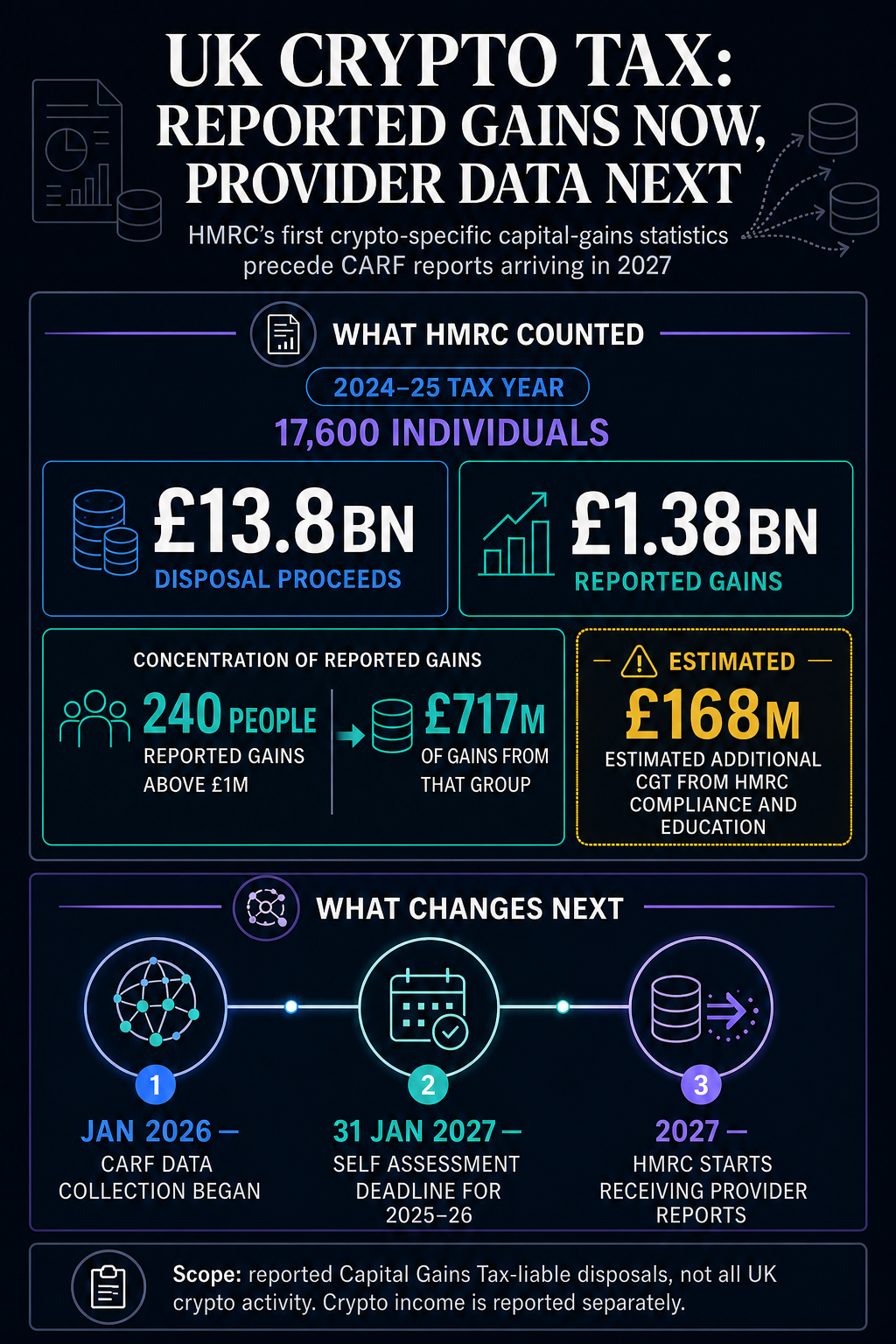
The data comes from a dedicated crypto section added to Self Assessment returns. It therefore captures declared Capital Gains Tax-liable disposals rather than every crypto transaction in Britain and cannot show how much activity went unreported.
HMRC is building a second data trail
That limitation is set to narrow as the UK implements the OECD’s Cryptoasset Reporting Framework.
Crypto businesses covered by CARF began collecting customer and transaction information in January 2026, while HMRC expects to start receiving provider reports in 2027.
The change will give the tax authority a separate dataset alongside taxpayers’ own declarations, increasing its ability to identify discrepancies between reported gains and activity recorded by crypto platforms.
The reporting timetable does not delay existing tax obligations. Crypto owners with reportable gains or income for the 2025 to 2026 tax year must still file their Self Assessment return and pay tax due by Jan. 31, 2027.
HMRC separately estimated that its crypto compliance and education work generated £168 million of additional Capital Gains Tax during 2024 to 2025.
The capital-gains figures also exclude some other crypto-related tax liabilities, including income from employment, mining, staking and lending, which can fall under Income Tax rules instead.
The new statistics therefore provide HMRC with a declared baseline before standardized third-party reporting begins. From 2027, the agency will increasingly be able to compare what crypto investors say they earned with what platforms say they did.
The post UK crypto investors declared £1.38B in gains, but half came from just 240 people appeared first on CryptoSlate.
Bitcoin Knots is preparing a Sunday rehearsal for a BLAKE2b fork after its previous breakaway BIP-110 chain stalled.
On Aug. 29, Bitcoin developer Luke Dashjr told SHA-2 miners to stop mining ahead of an Aug. 30 test that would replace Bitcoin’s SHA-256d proof of work with BLAKE2b on the proposed breakaway network.
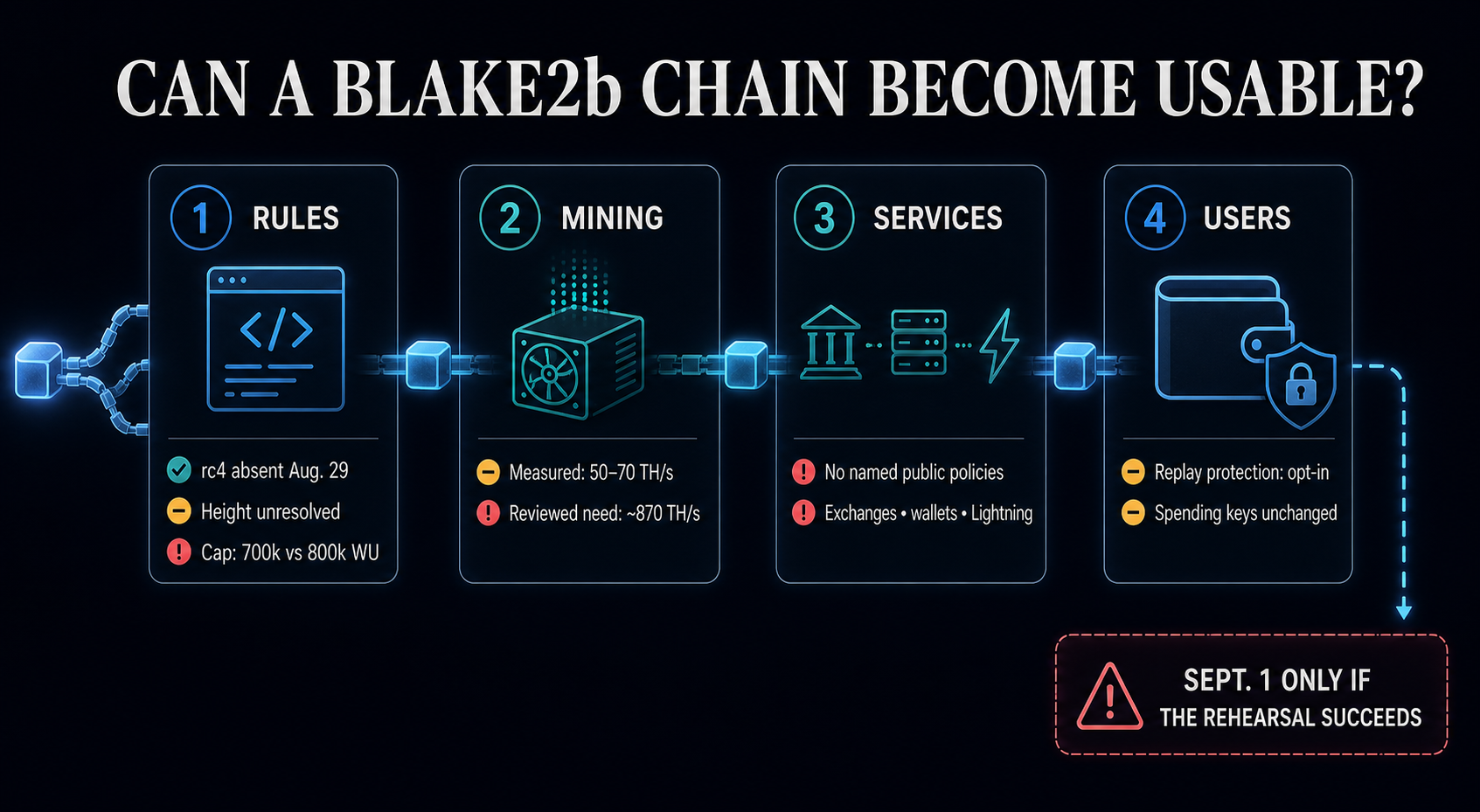
Dashjr said Bitcoin Knots 29.4.1rc4 would establish the final SHA-2 block before the switch. If the rehearsal succeeds, a final 29.4.1 release could preserve the new chain on Sept. 1. However, problems would trigger another release candidate and a reset to the last SHA-2 block.
The attempt comes three weeks after BIP-110 split from the dominant Bitcoin chain and stalled after producing only two blocks. The new proposal seeks to avoid another dependence on existing Bitcoin miners by permanently moving the breakaway network to hardware using BLAKE2b proof of work.
But the weekend test begins with several questions still unresolved. As of Aug. 29, the public Bitcoin Knots release page did not show rc4 or a final 29.4.1 build, while key proof-of-work changes remained open.
The proposal had also not publicly identified a major exchange, wallet, custodian, explorer, or Lightning implementation committed to supporting the new chain.
A successful BLAKE2b block would therefore show that the fork can run. However, it would not establish that enough miners, infrastructure providers, and users are prepared to keep it economically viable.
BLAKE2b tries to solve the miner problem
The central change addresses the weakness that crippled the earlier BIP-110 branch.
Instead of asking SHA-256d miners securing Bitcoin to continue producing blocks for a minority fork, the new chain would reject SHA-256d blocks after activation and rely on BLAKE2b hardware.
Backers say machines originally built to mine Sia, including Bitmain’s Antminer A3 and Goldshell SC5 models, can support the new proof-of-work system. Testnet4 mining instructions and a compatible DATUM Gateway fork have also been published.
Whether enough miners will actually participate remains unclear.
A reviewer of the open implementation calculated that one version of the proposed initial difficulty would require roughly 870 terahashes per second to maintain 10-minute block intervals. Measured testnet4 capacity was estimated at only 50 to 70 TH/s.
Those figures were based on unfinished code and are not final launch parameters. But they expose the problem facing Sunday’s test: compatible mining machines do not guarantee committed hash rate. The public discussion did not disclose how much capacity operators had pledged to the mainnet fork.
That makes block production one of the first measures of whether the new design has improved on BIP-110 rather than simply replacing one mining constituency with another.
The fork still needs final consensus rules
Bitcoin Knots also has to settle exactly which rules participating nodes will enforce.
The BLAKE2b implementation and a related reduced-data proposal were still open as of Aug. 29, while the reviewed public materials had not yet fixed the mainnet activation height.
There was also a discrepancy over the temporary block-weight limit.
The proposal’s FAQ and pull request described a 700,000-weight-unit cap, while a pinned source commit set the limit at 800,000. Nodes enforcing different values could disagree over whether a block is valid, making the final rc4 configuration critical before participants attempt to follow the same chain.
The proof-of-work change itself would be permanent. The reduced-data restrictions, including the smaller block cap, are scheduled to expire in 2027.
Sunday’s rehearsal should therefore clarify the activation height, block limit, and other parameters that determine whether participating nodes can remain on one ledger.
A working chain still needs an economy
Even if miners produce blocks under a common ruleset, the harder coordination test begins outside Bitcoin Knots.
The proposed fork changes the block header to a 164-byte format using BLAKE2b, while existing Electrum-style clients expect Bitcoin’s 80-byte SHA-256d headers.
That means light wallets, indexers, explorers, and related infrastructure may need changes before they can follow the new ledger. Dashjr said light-client compatibility falls outside Bitcoin Knots’ scope.
The project’s FAQ tells exchanges to pause deposits and withdrawals around the split and announce which chain they will recognize. Lightning channels created before the fork would also exist on the BLAKE2b chain, requiring both peers to use compatible software and agree on the same ledger.
The two networks would also inherit the same pre-fork transaction history and coin balances.
That creates replay risk because a transaction spending pre-fork coins could potentially be valid on both chains.
Bitcoin Knots has proposed a SIGHASH_UNIFIED signing mode that can provide directional replay protection when explicitly selected, but it would not automatically protect every existing wallet or transaction.
The switch to BLAKE2b also addresses only proof of work. It does not replace Bitcoin’s existing addresses, private keys, or transaction signatures, meaning it does not make ownership keys quantum-safe.
The immediate question this weekend is whether Bitcoin Knots can produce and maintain a BLAKE2b chain after BIP-110 failed.
The larger test begins if it succeeds: whether miners keep producing blocks and exchanges, wallets, custodians and users recognize enough economic value in the new ledger to keep it alive.
The post Bitcoin Knots is trying to fork Bitcoin again after its last chain died in two blocks appeared first on CryptoSlate.
CryptoTicker.io
If you hold tokens on a smaller blockchain, your balance depends on two things: on that blockchain, and on the software it shares with many others. August made exactly that visible. A flaw in a shared building block called Cosmos EVM was exploited on six blockchains between August 20 and 25, 2026. Around $5.72 million drained away, three chains halted operations, and Cosmos Labs says it contacted 40 networks. On August 28 the team published a post-mortem that describes the sequence openly. This article sets out what happened, why the damage figures in circulation diverge so widely, and what you can check if you hold tokens on an affected chain.
The Cosmos EVM vulnerability at a glance: $5.72 million from six chains
Cosmos EVM is a software module that extends a Cosmos blockchain with an Ethereum-compatible execution environment. A module in this sense is a finished code package that a chain team builds into its own blockchain instead of writing the function itself. The advantage is speed. The price is a shared dependency: a flaw in the module is a flaw in every chain that uses it.
The vulnerability carries the identifier GHSA-7g4w-cg88-2cq2 and is classified as critical by Cosmos Labs itself. According to The Hacker News it was published without a CVE number, without a vulnerability classification and without a CVSS score. Affected are the versions below 0.6.2 as well as those from 0.7.0 up to but not including 0.7.2; the flaw was fixed in v0.6.2 and v0.7.2, which appeared on August 19, 2026.
Not affected is the Cosmos Hub with its token ATOM, which runs without this module. If you are looking for the price page on it, you will find it in our ATOM price prediction. The risk of confusion is real, because the word Cosmos appears in the name of both things, and it explains part of last week's uncertainty.
Balance reconciliation and overflow: how the Cosmos EVM gap works technically
The flaw sits at the seam between two sets of books. A Cosmos blockchain keeps balances in the x/bank module, while the Ethereum environment keeps them in parallel in its own state database, the StateDB. Both have to show the same figure after every transaction, and that reconciliation is where things jammed.
According to The Hacker News, the problem arises when a so-called vesting account delegates more than its freely available balance allows. A vesting account is an address whose tokens are released only on a schedule; part of the holding is locked, part is available. When writing back after the delegation, the code subtracted the full delegated amount from the smaller available amount, without checking whether the result could be positive at all.
What follows is a classic of computer arithmetic. Subtract more from an unsigned number than it contains and it does not go negative but jumps to the top end of its value range. A tiny shortfall turns into a balance on the order of 2 to the power of 256. The attacker could then either withdraw funds from this overflowed account or send another account an amount calculated so that the reconciliation destroyed that account's holding.
What a shared module in a blockchain is
A shared module is program code that several independent blockchains draw from the same source and build into their own software. For you as a holder this means the question of whether your chain is secure cannot be answered from the reputation of its team alone. It also depends on which external building blocks that team uses and how quickly it applies updates.
Why vesting accounts were the way in
Vesting accounts are widespread in young networks, because teams, investors and early contributors usually receive their allocations in stages. They are therefore a regular account type that almost every new chain maintains, not a marginal special case. That is one reason Cosmos Labs recommends, among other things, that affected networks temporarily reject the creation of new vesting accounts.
Four months between report and alarm: the timeline from the post-mortem
The sequence comes from the post-mortem that Cosmos Labs published itself on August 28, 2026, and from the trade reports that evaluated it. It is the actual reason the case is being discussed beyond the individual incident.
On April 25, 2026 the report came in through the bug bounty programme. It was assessed at the time as posing no risk to funds on productive networks. On May 15, according to CryptoSlate, a correction flowed into the main branch as a silent public patch, meaning without being marked as security-critical. On August 13 the team confirmed internally that all Cosmos EVM chains are affected, regardless of their decimal configuration.
On August 19 the corrected versions appeared. On August 20 at 07:16 UTC a first public description of the attack route became accessible; the same day at 19:06 UTC the first unauthorised operation ran on MANTRA. The first private notification of affected chains went out, by this reconstruction, on August 21 at 03:36 UTC, roughly two hours after MANTRA had reported the incident. The public call for validators to halt their chains followed on August 24.
Nominal value versus proceeds: why the damage figures for the Cosmos EVM hack diverge
Anyone reading through the coverage comes across amounts between just under two and well over nine million dollars. That is a question of what is being measured and no contradiction; the distinction is worth making, because it recurs in every exploit report.
The frequently cited sum of around $5.72 million refers to what the attacker actually turned into money: about $2.87 million through decentralised exchanges and about $2.85 million through centralised trading venues, calculated at the rates of August 19. The considerably higher figures, by contrast, represent the nominal value of the drained tokens at the price before the incident.
The difference arises from the selling pressure itself. At KiiChain, according to the report by Protos, the chain names 148,326,583.15 KII as having drained away, with a face value of around nine million dollars, while selling them brought in about 1.6 million. Anyone reading such reports should therefore always check whether the subject is stolen tokens or realised proceeds.
MANTRA, KiiChain and TAC: what happened on the three known chains
Three of the six exploited networks have been named publicly so far. MANTRA halted its chain on August 21 at block 17,449,398 and resumed block production on August 22 with version 8.4.0. Figures between 03:38 and 05:30 UTC are circulating for the restart time; we described the event on August 22 in our report on the MANTRA chain halt and the frozen withdrawal, using the earlier of these two values. The team stated that user balances were not altered and that two addresses under its own control were affected. CryptoSlate, by contrast, puts the MANTRA side of the incident at around $3.6 million in nominal value across 720.9 million tokens. Both figures stand side by side, and we are not smoothing them over.
KiiChain halted at block 9,355,723. By its own account the same technique was applied there eighteen times in succession. TAC stopped on August 22 at block 24,671,475, according to the team after an account had been emptied. In both cases the chain teams traced the cause to the shared Cosmos EVM code rather than to their own logic.
Beyond the three named, Cosmos Labs reported that 13 further potentially affected chains were updated, halted or secured before an attack occurred. Eleven installations of the module were not known to the team at all before the incident and were found only in the course of the review.
The chain halt as an emergency brake: why Cosmos Labs advised validators to stop
A chain halt means validators cease block production; the network processes no more transactions until it restarts in a coordinated way. To outsiders that looks like a loss of control. In this case it was the conservative choice.
The reason lies in the sequence. A regular network upgrade through a governance vote takes hours to days, and during that time the gap would stay open while the attack route was already publicly described. Cosmos Labs therefore advised operators to update immediately to v0.6.2, v0.7.2 or later, and, if that was not immediately possible, to halt block production rather than attempt a coordinated vote. In addition the team recommended rejecting the creation of vesting accounts in the ante handler, checking the fix in exported as well as non-exported code paths, and registering a security contact.
For you as a holder this has a practical consequence that is easily missed: a halted chain is a warning signal about the state of the software, but it is not automatically a signal about your account balance. Whether your holding was altered is a separate matter from whether blocks are currently being produced.
Silent patch and bug bounty: what the case shows about disclosure processes
The programming error itself is undisputed among those involved. What is being debated is the order in which it was made public. A silent patch is the common practice of applying a fix inconspicuously so that attackers do not learn from the notice itself where to strike. This practice works only under one condition: the operators running the code have to know beforehand that they need to act.
KiiChain put this point plainly in its own post-mortem. Publishing a security fix openly before the chains running that code have been informed privately and given time to update, it argued, passes the vulnerability on to anyone who reads the commit. As causes the chain named the lack of advance notice, the failure to mark the fix as critical and the delay in communication. That is the value judgement of an affected party, and we reproduce it as such.
Cosmos Labs points in its own bounty rules to initiating emergency measures where there is immediate or network-wide risk. The post-mortem describes how the standard route for cases without loss of funds was chosen instead. How that assessment came about is the open question the document raises, and it cannot be conclusively judged from outside. The sequence is documented; the evaluation remains a matter for the teams involved.
What holders of affected tokens should check right now
If you hold OM, KII, TAC or another token on a Cosmos EVM chain, the first concern is clarity about the state of things, not a quick reaction in the market. In order.
As a first step, check the network status. A public block explorer for the chain in question shows you whether the block height is still rising or has stopped at a value. If it is standing still, the chain is producing no blocks, and no transaction is confirmed during that time.
As a second step, check the version your chain is running and whether the team has announced a restart on one of the corrected releases. Chain teams usually publish this through their status page or their official channels. If such a statement is missing, that in itself is information.
As a third step, and separately from the above, check whether your trading venue has released deposits and withdrawals for the affected token. These two states are connected but not the same, and that is exactly where most misjudgements arise. If you want to keep your holding available independently of an exchange, the route runs through self-custody; which devices come into question is shown by our comparison of crypto hardware wallets.
Three states you have to keep apart
The first state concerns the chain: is it producing blocks? The second concerns your balance: does your address still show the amount you expect? The third concerns the trading venue: can you deposit and withdraw? A running chain alongside a frozen exchange withdrawal is a common combination, because trading venues decide independently after an incident when to reopen their gateway. Conversely, a halted chain can carry unchanged balances.
How to tell whether a blockchain depends on a shared building block
You can settle this question before buying, and it costs a few minutes. The first indication is the chain's documentation: if it says the chain builds on a framework such as the Cosmos SDK and obtains EVM compatibility through a module, it shares code with other networks.
The second indication is the public code repository. Blockchains as a rule publish their software openly, and the dependency files name which external packages are included in which version. You do not need to be able to read the code; it is enough to see the version number and compare it with the currently recommended one.
The third indication is the communication route. Does the chain have a status page, a security contact and a history of earlier incidents with follow-up analysis? The present case shows how much depends on this: eleven installations of the module were not even known to the publisher, which means it could not have warned their operators in an emergency either. The technical description of the gap can be read in security advisory GHSA-7g4w-cg88-2cq2, and the placing of the timeline in The Hacker News reconstruction.
Tax and evidence: what to document after a chain halt
A network halt is initially no event for tax purposes. As long as nothing about your holding changes, neither a disposal nor a loss you could claim arises. It becomes relevant only once you actually sell in response to the incident, or once tokens disappear from your address.
In practice this means: secure the records now, while they are within reach. That includes screenshots of your account balance with date and time, the transaction identifiers of the operations concerned, your exchange's status notice on the frozen gateway, and the chain team's public statement. If you later close a position at a loss, or have to explain to the tax authorities why a holding no longer exists, the evidence is only as good as what you captured at the moment of the incident.
One note on placing this, because the question comes up regularly: whether a holding lost through an exploit is deductible for tax purposes depends on the individual case and is not settled in blanket terms. This assessment is no substitute for tax advice, and we are not asserting a legal position here that does not exist as such.
Checking the Cosmos EVM vulnerability: what to take away
The case is less a story about a single flaw than one about shared dependencies and about how quickly information reaches its recipients. Three steps you can draw from it:
- Check the state of your chain and of your exchange separately from each other. Block height in the explorer, balance at your address and gateway status at the trading venue are three readings that measure different things. If in the process you notice that your provider communicates poorly after incidents, our overview of regulated crypto exchanges helps you place it.
- Before your next purchase, look at which external building blocks a chain uses. Framework, module version and a registered security contact say more about a network's resilience than its announcements do. For storage outside an exchange you will find the options in the comparison of software wallets.
- Keep holdings you do not actively trade outside anyone else's control. A frozen exchange gateway affects only what is sitting there. Which devices are suitable and what distinguishes them is covered in the hardware wallet comparison.
(As of August 29, 2026. This article is not investment advice. Prices and fee structures change; check the terms with the provider before you buy.)
If you have funds sitting in the DeFi lending protocol Ajna v2, withdraw them now. The development team itself called for exactly that on August 29, 2026 at 04:58 UTC: withdraw all quote tokens, repay outstanding loans and stop every further interaction with the protocol. Between August 28 and 29, roughly $775,400 drained out of seven pools on the Ethereum blockchain. Measured by the sum, this is a small incident. Measured by what it reveals about a particular way of building DeFi protocols, it is among the most instructive of this summer.
The reason lies in the construction. Ajna v2 is built to be immutable: no governance body, no upgrade path, no administrator key that could halt the contract. A security update while the protocol runs is therefore technically ruled out. The only party that can stop the outflow is the users, by taking their capital out. The team's call is consequently not one precaution among others. It is the only available response.
The Ajna exploit at a glance: $775,400 from seven Ethereum pools
A DeFi lending protocol is a set of smart contracts through which users can lend crypto assets and borrow against posted collateral, with no bank or company in between. At Ajna the lent capital sits in pools, each of which brings together one collateral asset and one loan asset.
The security firm Defimon published a per-pool breakdown on August 29 at 09:29 UTC. According to it, the damage is distributed as follows: the syrupUSDC pool lost the most at around $173,700, followed by wstETH at about $159,800 and rETH at roughly $143,000 in total across two transactions. cbETH accounted for around $136,900, likewise in two steps, the WBTC pool for around $101,800, WETH/USDC for around $42,000 and sDAI for around $18,000. Together that produces the $775,400 mentioned above. The outlet Cryptopolitan, citing DefiLlama, gives a slightly different figure of around $775,000; the difference lies in how the affected tokens are priced and is immaterial for the assessment.
The timeline is tight. On August 28 at 15:16 UTC the attack contracts were deployed on Ethereum. A good hour later, at 16:19 UTC, the first extraction ran through the cbETH pool, recorded in block 25854888. The team's public statement did not follow until the next morning. In the meantime the outflow continued.
That leaves marks on the size of the protocol. Total value locked, meaning the sum of all assets deposited in the protocol, stood at about $246,880 after the incident. Over the preceding thirty days that amounts to a decline of 71.3 percent. Ajna was already a small protocol before the attack. Now it is a very small one.
Liquidation math rather than an oracle: how the attack worked
According to the analysis by the trade publication The Crypto Times, this was a manipulation of the liquidation accounting rather than an attack on a price source. That distinction is the core of the case, and it calls for two short definitions.
What an oracle does in a lending protocol
An oracle is a service that feeds a smart contract with prices from the outside world, such as the current rate of Ether in US dollars. Almost every lending protocol needs something of the kind in order to decide when a position is undercollateralised. That is precisely why oracles are a favoured target: anyone who briefly bends the supplied price can have healthy positions liquidated or pass off worthless collateral as valuable.
Ajna deliberately does without oracles. Valuation follows from the bids of the lenders in the pool itself. This design rules out the most common class of attack, and in that respect it held up. The attacker had to take a different route.
Why the liquidation mathematics was the point of attack
A liquidation is the process in which a protocol realises a borrower's collateral because their position breaches the permitted limit. In doing so the contract calculates how much collateral is surrendered for how much debt and what happens to the remainder. In every lending protocol this calculation is the most demanding place in the code, because it has to keep interest, fees, partial liquidations and rounding straight all at once.
That is exactly where the attack came in. The attacker triggered liquidations and exploited how the protocol books the residual quantities that arise in the process, in order to have more value assigned to himself than he was owed. Repeated across seven pools, that produced the observed sum. What stands out is that no stolen keys and no compromised infrastructure were involved. The contract did precisely what its code provided for.
It is also worth noting that Ajna v2 had been audited. The case thus joins an observation that CoinGecko records in its report on the state of crypto security in 2026: of 245 incidents logged between January 2025 and July 2026, with total damage of $3.63 billion, 147 hit audited protocols, which accounted for 88.44 percent of the stolen capital. A passed audit is a quality signal. It is not a guarantee.

An immutable protocol without governance: why the pause button is missing
An immutable smart contract is a contract whose code can no longer be changed after deployment. There is no address permitted to push new logic in, and no function that halts operation. In parts of the DeFi scene this construction is an explicit ideal, because it makes trust in a team unnecessary. Nobody can change the rules after the fact to their own advantage, the developers included.
The price of that shows up when damage occurs. With an upgradeable protocol, a team could have taken the affected pools offline around 16:30 UTC on August 28 and fixed the flaw. At Ajna v2 that route was not open. The Crypto Times puts it that a code patch during operation is not the usual response here and that users themselves take on the function of the pause button. This is not negligence on the team's part but the consequence of a deliberate design decision.
For you as an investor this leads to a question that comes before any thought about returns: who can halt this protocol in an emergency, and how quickly? The answer differs completely from provider to provider, and it rarely appears on the landing page. Our comparison of crypto lending providers shows which models work with custody and emergency mechanics and which leave you entirely on your own.
Defimon warned an hour beforehand: what the timeline says about response routes
The security firm Defimon states that its monitoring detected the prepared attack contracts more than an hour before the first extraction and notified the Ajna team through its Discord channel, and that no response to this message followed. This account comes from a provider that markets precisely such early detection, and it has so far not been independently confirmed. No public statement from the Ajna team on this point is available.
Even if the description is accurate in every detail, the decisive limitation remains. A warning only helps if its recipient can act. With an immutable contract and no governance, the team could not have switched anything off even with an immediate response. It could merely have warned earlier, and users would have had to withdraw earlier. In this building principle the warning chain always ends with you.
That sets the case apart from incidents in which a network can be stopped centrally. In the Maya Protocol exploit, for instance, operations were halted to prevent further damage. That option does not exist everywhere, and it is itself contested, because it presupposes that somebody has the power to stop an open system.
What Ajna users have to do right now
The team's instruction is brief and unambiguous. It consists of three actions, and the order is not arbitrary.
First: withdraw quote tokens. Quote token is Ajna's term for the asset in a pool that is being lent, meaning the side on which a lender contributes capital. Anyone standing as a lender in one of the pools should unwind that position. This explicitly applies to pools that do not appear in the Defimon breakdown: the breakdown documents where money has already drained out, not where it sits safely.
Second: repay outstanding loans. Anyone who has posted collateral as a borrower gets it back only through repayment. As long as the debt is open, the collateral stays in the contract and therefore in a system whose liquidation math is demonstrably open to attack.
Third: no new interactions. No new loan, no new deposit, no adjustment of existing bids. Every further transaction exposes capital to the open flaw once more.
For carrying this out, the same principle applies as to any emergency action in DeFi: call up addresses only from your own bookmarks and never from search results or from messages that reach you unsolicited. After an exploit becomes known, the number of fake rescue pages rises regularly, because fraudsters bank on precisely the urgency that has arisen.
How to check whether your lending protocol has an emergency exit
The question of the pause button can be settled in a few minutes once you know what to look for. Three points are enough for a first assessment.
Three questions to put to the documentation
First: is there a pause function, and who may trigger it? The documentation usually lists it under headings such as emergency pause, guardian or circuit breaker. If any reference to it is missing, assume an immutable design.
Second: is the contract upgradeable, and who holds the keys? An upgrade path means a flaw can be fixed. It also means somebody can change the rules while your money sits in the contract. The two belong together and form no contradiction, but a trade-off you should make deliberately.
Third: how does a warning reach you? If the only reporting chain is a Discord channel you do not read, it practically does not exist for you. A notification service for your own addresses costs nothing and buys you the head start that matters when it counts.
Anyone who shies away from this check will find the simpler answer with supervised providers: there a company is liable under supervision, and responding to an incident is part of the business model. This route costs return and takes control away from you. It also takes away the job of being the emergency switch yourself at 16:19 UTC.
Ajna in context: a summer of many small incidents
The Ajna exploit does not stand alone. A day earlier, on August 28, 2026, the Solana-based card application Avici lost $500,859.22 in card balances by DefiLlama's count, affecting 1,685 users. Initial estimates had ranged between $600,000 and more than a million; the lower figure prevailed after the review. The cause, according to the card partner Rain, was a faulty version of a card contract that a few other programs also used. Avici has undertaken to reimburse all affected card balances in full.
The two cases differ in exactly the point at issue here. At Avici there is a company that can make an undertaking and whose partner names the flaw. At Ajna there is a contract that keeps running and a team asking people to withdraw. A reimbursement is not provided for in a protocol with no treasury and no governance.
To place the order of magnitude, the statistics help. The CoinGecko report already mentioned counts 245 incidents with $3.63 billion in damage for January 2025 through July 2026. Against that yardstick, $775,400 is a footnote. For those affected the sum is lost in full, and what decides its significance is its share of their own portfolio, not its share of the annual statistics.
Tax and evidence: what investors should document after an exploit
A loss through an exploit is not a straightforward matter for tax purposes, and this article is no substitute for tax advice. What is worth doing regardless is securing the evidence, and immediately, while the data is still within reach.
Save the transaction hashes of your deposits and withdrawals, the account balance of the affected position before August 28, 2026, the protocol's public statement with date and time, and proof of the outflows from a blockchain explorer. You will need these documents should a reimbursement, a settlement or a tax treatment come into play later. Anyone who only gathers them at that point is working against deleted web interfaces and archived Discord channels.
What matters is keeping two events apart: the outflow through the attack and the later sale of a rescued position are two different things for tax purposes. Record both separately, with date, quantity and value in your reporting currency.
Placing the Ajna exploit: what to take away
- If you are invested in Ajna v2, act today. Withdraw quote tokens, repay loans, stop interacting, in that order. Where to place your capital instead and on what terms is set out in our crypto lending comparison.
- Settle the emergency question for every protocol before you deposit. Pause function, upgrade path, reporting route. Anyone unwilling to carry out this check themselves is better served by supervised providers; which platforms are licensed is shown by our overview of regulated crypto exchanges.
- Separate trading balances from holdings. What you are not actively deploying belongs not in a smart contract but in your own custody. Which devices come into question and how they differ is covered in the hardware wallet comparison.
The per-pool breakdown and the timeline come from the analysis by The Crypto Times of August 29, 2026. The project published its call to users the same day at 04:58 UTC on its account @ajnafi on X.
(As of August 29, 2026. This article is not investment advice. Prices and fee structures change; check the terms with the provider before you buy.)
If you hold ZIL on a crypto exchange and have been unable to deposit or withdraw for weeks, September 2, 2026 is the day that is meant to change. On that date, at block height 34,844,968 and an estimated 12:58 UTC, Zilliqa executes a hard fork that moves the ZIL balances of ten exchanges out of the old wallets into new addresses. The venues involved then intend to reopen deposits and withdrawals. You do not have to do anything yourself.
If you keep your ZIL in your own wallet on the old network, a second and larger process applies to you, and it still carries no date: every holder on the old side will have to migrate later, including everyone who was never robbed. Neither event is a planned upgrade. Both go back to a signing flaw in the Zilliqa Ledger app. By Zilliqa's own accounting, 683,130,969.66 ZIL drained out of 6,772 accounts as a result.
This article separates the two levels: what actually happens on September 2, and what remains open afterwards.
What a hard fork is and what happens at Zilliqa on September 2, 2026
A hard fork is a rule change to a blockchain that makes old and new software incompatible: from a set block onwards only the new rulebook applies, and anyone who does not follow drops out of the network. It is triggered by block height, meaning the sequential number of the most recently written block, rather than by a clock time. Every time estimate attached to it is a projection.
The fork in question changes little about the protocol itself. Its job is a transfer. The ZIL holdings that ten centralised exchanges keep for their customers in the old, Schnorr-based wallets are written to new wallet addresses on the Zilliqa EVM network. Each exchange supplies and confirms these destination addresses in advance. A Schnorr signature is the signing scheme of the old Zilliqa network, through which a transaction proves that it comes from the account holder.
One point matters for context: this fork is an administrative measure for exchange balances. It is not a network upgrade that brings you new features, and it is not a recovery of stolen funds. We described how a regular, planned hard fork unfolds, and what holders, traders and delegators need to think about, using the BNB Pasteur hard fork as a checklist. The difference in the Zilliqa case lies in the occasion, not in the mechanics.
What Zilliqa is and why the network has two sides
Zilliqa is a layer-1 blockchain, an independent chain with its own consensus and its own coin, and it launched with a technical selling point: sharding. Sharding means a network splits its nodes into groups that process transactions in parallel, instead of every node verifying every transaction. That raises throughput while making the protocol considerably more complex. ZIL is the native coin of this network and pays the transaction fees on it.
The rebuild into Zilliqa 2.0 added EVM compatibility, and since then the project has run two environments side by side. That shift was already under way before the incident. The incident accelerated it and made it irreversible: the mainnet, meaning the productive main network as opposed to a testnet, is to consist solely of the EVM side in future, and the old side will be shut down rather than repaired.
Why your ZIL has been stuck on the exchange for weeks
On July 20, 2026, Zilliqa halted all transactions on the old side of the network. Nothing has moved there since, neither your balance nor an attacker's. That pause is precisely why exchanges suspended ZIL deposits and withdrawals. The venues can no longer operate on the old side technically.
The flaw sat in eight bytes
Every Schnorr signature consumes a nonce, a fresh random number that must be used exactly once and never reused. The Zilliqa Ledger app generated that number correctly and then copied it into the signature buffer incorrectly. In doing so, the app kept eight padding bytes of zeros and discarded eight bytes of genuine randomness. That fixed the top 64 bits of every nonce at zero.
Zilliqa's post-mortem describes the consequence precisely: every signature produced this way leaks roughly 64 bits about the private key, and from four or more signatures of the same account the key can be reconstructed on ordinary hardware in seconds. Doing so requires only data that already sits publicly in the blockchain. Nobody was deceived, no device was hacked, no recovery phrase was stolen. The information leaked through the transactions themselves.
Who wrote the app
Precise attribution is worth the space here, because the Ledger name is involved. According to Zilliqa, the original implementation of the affected application came from Zilliqa itself, the defect was present in every released version, and the fix was written by a Zilliqa developer and submitted as a pull request to Ledger. Your recovery phrase was never affected, and holdings you keep on the same device on other blockchains are not at risk on this account. The flaw reaches into exactly one signing path and not a step further.
The numbers, and why they are lower bounds
Proven losses stand at 683,130,969.66 ZIL across 66 transactions. 6,772 accounts count as demonstrably exposed, 51 of them were emptied completely. Zilliqa explicitly calls both figures lower bounds, arrived at through proof rather than estimation. By the same accounting, 73.9 percent of the attributable old addresses are safe by construction, because they never signed through the affected app.
The timeline explains why this went unnoticed for so long. The first proven theft falls on March 4, 2026. The exploitation was reported on July 19, 2026 by the exchange KuCoin, after it had seen unusual outflows from one of its own cold wallets. A day later, old transactions were switched off. There is a technical reason nobody raised the alarm earlier: in this scheme the check value is derived from the message, so the usual search for duplicate values, with which many chains routinely hunt for signature faults, finds nothing here.

Which ten exchanges are in the first hard fork batch
According to the Zilliqa team's announcement, the first batch that the fork processes on September 2 covers ten trading venues:
- KuCoin
- Binance.US
- MEXC
- OKCoin
- Bitvavo
- Korbit
- WhiteBit
- Bitrue
- CoinSpot
- CoinSwitch
For European readers, Bitvavo is the most relevant name on this list, because the exchange serves the European market. If your trading venue is not on the list, that does not mean it has been excluded. Zilliqa expressly speaks of a first batch and has so far named no date for further venues.
What you can expect after the fork is not a switch being flipped. The exchanges in the first batch intend to resume deposits and withdrawals on Zilliqa EVM once their own migration and integration tests are complete. Zilliqa itself writes that timelines may differ between venues. Plan in days rather than minutes, and check your own provider's status page instead of relying on a general date.
Legacy Zilliqa or Zilliqa EVM: which side your ZIL sits on
The whole affair only makes sense once you take one distinction with you. Zilliqa runs two sides. Legacy Zilliqa is the older, non-EVM-compatible side with its own accounts, its Schnorr signatures and the Ledger application built for them. Zilliqa EVM, also called Zilliqa 2.0, is the newer side that uses the same execution environment as Ethereum.
EVM stands for Ethereum Virtual Machine and denotes the standardised runtime in which smart contracts execute. A chain that is EVM-compatible can take over contracts and address formats from the Ethereum world directly. The difference shows in the address format: old Zilliqa addresses begin with zil1, EVM addresses with 0x.
The incident affects the old side only. Anyone who was active on Zilliqa EVM alone is untouched by it. The same holds for staked ZIL: if it sits in staking on the EVM side, it keeps running. If it sits in an old staking contract, it is paused along with everything else on the old side and will need the recovery route later. Incidentally, it is not only ZIL transfers that are affected but every kind of transaction, including moving ZRC-2 tokens. ZRC-2 is the token standard of the old Zilliqa network and does roughly what ERC-20 does on Ethereum.
For you this leads to a practical question you should answer before September 2: does your holding sit at an exchange, in your own software wallet or on a hardware device? Only the first case is settled by this fork. If the occasion has you thinking about how you store your holdings in future, our comparison of crypto hardware wallets helps sort through the criteria.
The terms you will meet on the official page
Zilliqa communicates in English only, and the status page leans on vocabulary whose meaning is not always obvious in this context. This mapping helps: a hard fork is the rule change described above, block height is the running number of the last block written, exchange balances are the customer holdings the venues keep, deposits and withdrawals are paying in and paying out, legacy denotes the old side of the network and recovery the planned restoration procedure. The address checker and the post-mortem add accounts for the individual wallets and vulnerability for the flaw itself.
Are you affected? What the Zilliqa address checker can do
Since August 11, 2026, Zilliqa has offered an address checker. You enter an old Zilliqa address and the tool examines its public signing history for traces of the flaw. No wallet connection is required, and neither seed phrase nor private key is requested. According to the operator, only the address is sent to the server, answered there and not stored.
You come into question as affected if you ever used the Zilliqa Ledger app to sign, whatever the purpose: sending ZIL, moving ZRC-2 tokens and NFTs, or staking. It becomes critical from around four transactions signed this way, because at that point reconstructing the key becomes practically feasible. The app version does not matter, because every version carried the defect.
By the same accounting you are not affected if one of these points applies to you:
- You have never used a Ledger device with Zilliqa.
- You used a Ledger device but never the Zilliqa application on it.
- You were active exclusively on the EVM side.
- You signed only through the software SDKs, meaning zilliqa-js, gozilliqa-sdk or pyzil.
- You stake through Zilliqa's official staking portal.
Why a clean result is not a clean bill of health
Zilliqa names this limit itself, and it belongs in every account of the case: signatures created off the chain leave no trace on it. The checker consequently does not see them. An unremarkable result therefore means that no exposure was found, not that none exists. Treat the finding as an indication rather than a certificate, and answer the additional question for yourself of whether you ever used the app.
The second point is more uncomfortable. The exposure is permanent. Signatures that are once in the chain cannot be withdrawn. A corrected app therefore protects new keys and changes nothing about keys that have already signed. An account that was exposed once will eventually have to be retired and its contents moved to a fresh address. That is precisely the job of the migration tool that is still outstanding.

What you can concretely do before September 2
The honest answer is: not much, but that little is worth doing. Four things are possible today.
First, check your old addresses in the checker and note the result with the date. If a recovery procedure starts later, your own record is worth more than memory. Second, establish where your holding actually sits, and separate exchange balances from self-custody. Third, find your trading venue's status page and check whether it is in the first batch. Fourth, keep your hands off any tool that someone sends you privately.
What you should not do is equally clear: do not try to move old holdings by workarounds. It does not work anyway while the pause is running, and any service promising you otherwise is not working in your interest.
What the September 2 hard fork does not solve
The fork brings ten exchanges back into business. Three larger questions remain open afterwards, and none of them carries a firm date so far.
There is, first, the migration tool for self-custodians. As of the status report of August 11, 2026, it was in an external security audit whose report is expected in early September. Only after that does Zilliqa intend to name a start date. Second, the recovery procedure for holders of affected accounts: the plan is a route in which you prove ownership of an account without disclosing your seed phrase. Exactly what that proof looks like is still being worked out. Third, an updated tokenomics model meant to reflect the holdings of the retired side.
Zilliqa itself writes that no date is deliberately attached to this list. As a reader you should treat that neither as reassurance nor as an alarm, but as what it is: an open position. September 2 ends the freeze for one group of holders and leaves the other group waiting.
Why block height 34,844,968 is not a fixed date
Deadlines tied to a block height shift when the network runs faster or slower than assumed. We therefore measured rather than adopting the figure. A query of the eth_blockNumber method against Zilliqa's mainnet node returned block height 34,541,838 on August 29, 2026 at 18:36 UTC. That left 303,130 blocks to the target block of 34,844,968.
At the block time of roughly one second that Zilliqa 2.0 works with, that corresponds to about three and a half days. Counting from the moment of measurement, this lands on September 2, 2026, exactly the announced day. The 12:58 UTC time is the least certain quantity in this calculation. Shifts of a few hours are normal; a jump of days would not be.
In practice this means: if you see no release on the afternoon of September 2, that is no cause for concern. Only once the target block has been passed and your exchange stays silent for several days does a support enquiry make sense.
Why fraudsters love deadlines like this one
A date on which thousands are waiting for the release of their money is an open goal for fraudsters. Zilliqa warns explicitly on its own status page about impersonators offering help with supposed recovery, and names two rules worth remembering: the team never contacts anyone first, and it never asks for a seed phrase, private key or recovery phrase under any circumstances.
A simple stance for the coming weeks follows from this. Every recovery form, every migration link and every tool that reaches you privately counts as hostile, even if it looks official or comes from a supposed moderator. Use only what has been announced through the project's official channels, and check the page address in your browser before you enter anything.
What this case teaches about deadlines at crypto exchanges
The Zilliqa case is unusual in its cause and entirely ordinary in its effect. A balance sits with a third party, a technical process freezes it, and the holder finds out last. You know the same pattern from migration deadlines for individual tokens and from trading suspensions where a holding can no longer be moved after a cut-off date. We have gathered the recurring dates on which exchange balances come under time pressure in a separate overview of deadlines at crypto exchanges.
The lesson is uncomfortable, because it creates work. A balance on an exchange is a claim against a company and not ownership on the chain. As long as everything runs, the difference is theoretical. On a day like this one it turns practical, because whether and when you get back in is decided by the trading venue and not by you. Anyone holding larger amounts is therefore well advised to spread them across several routes, and anyone choosing an exchange should look at domicile, supervision and communication behaviour in a crisis alongside the fees.
Checking the Zilliqa hard fork: what to take away
- Establish by September 1 where your ZIL sits. If your trading venue is in the first batch, you need do nothing and simply wait for the release. If it is not, plan for a longer wait. Anyone who wants to compare where they trade in future will find the criteria in our comparison of the best crypto exchanges.
- Check your old addresses in the checker and write down the result with the date. A clean finding is no clean bill of health, but it is a documented starting position should a recovery procedure begin. If the incident prompts you to rethink your custody, the comparison of software wallets helps with the choice.
- Wait for the audit report on the migration tool before you migrate. As long as there is no official start date, every tool on offer is a risk. Anyone wanting to reduce counterparty risk in general sorts their trading venues by supervision and domicile, for which our overview of regulated crypto exchanges provides the frame.
The two primary sources to read up on: the official Zilliqa status page on the incident with the address checker and the action plan, and the report on the hard fork date with block height and the exchange list.
(As of August 29, 2026. This article is not investment advice. Prices and fee structures change; check the terms with the provider before you buy.)
On September 15, the US Senate holds a procedural vote that will decide whether the crypto industry gets the regulatory framework it has been chasing for five years, or whether the whole thing dies until at least 2027.
The bill is the Digital Asset Market Clarity Act. Prediction markets currently price its chance of becoming law this year at 14%, down from a peak of 82% in February. That gap between how important this bill is and how little the market believes in it is the story.
Here is what is actually on the table.
What Does The CLARITY Act Actually Do?
Strip away the politics and the bill answers one question: who regulates crypto in the United States, the SEC or the CFTC?
Right now the answer is "both, unpredictably, through enforcement actions." The CLARITY Act replaces that with a split. The CFTC gets exclusive authority over digital commodities, which covers spot trading of assets like Bitcoin. The SEC keeps authority over digital securities and over issuers. The bill also sets out criteria for when an asset is decentralized enough to stop being treated as a security and start being treated as a commodity.
The Senate version introduced a term that matters more than it sounds: the ancillary asset. That covers a network token whose value depends on the entrepreneurial or managerial efforts of an originator or a related person. Those assets get tailored SEC disclosure requirements rather than the full securities regime. If you have ever wondered which bucket your favourite altcoin lands in, this definition is where it gets decided.
Around that core sit the provisions that will actually change day-to-day operations:
- Registration for intermediaries. Exchanges, brokers and dealers face registration requirements and operational standards, plus consumer protection, AML and disclosure obligations.
- Custody treatment. Customer assets held in custody would not count as assets or liabilities of the custodian, which brings crypto custody in line with how traditional custody has always been treated.
- Insider resale restrictions, aimed squarely at the pattern where early holders quietly exit into retail demand.
- The DINO fix. Senator Lummis has described a loophole that let platforms claim decentralized status while running the show behind the interface. The revised bill pulls exchanges, DeFi platforms and crypto ATMs inside the Bank Secrecy Act and the sanctions framework.
- Roughly $150 million allocated to anti-fraud work.
Why Has The CLARITY Act Taken So Long?
The House passed this bill 294 to 134 in July 2025. That was more than a year ago.
It then sat. The Senate Banking Committee finally advanced it on May 14, 2026 by a vote of 15 to 9, with all 13 Republicans joined by two Democrats. Even those two signalled that a committee vote did not guarantee support on the floor.
The blockage has not been technical. It has been one provision: ethics. Democrats want stronger conflict-of-interest and illicit-finance safeguards, specifically around how much government officials can profit from crypto while in office. Elizabeth Warren has argued repeatedly that the draft falls short given the Trump family's crypto holdings. Republicans want a bipartisan coalition and the market certainty that comes with it. Neither side has moved far enough.
President Trump gathered regulators and exchange executives at the White House on August 19 and pressed the Senate to act. It did not unblock the negotiation.
What Happens On September 15?
September 15 is not a vote on the bill. It is a cloture vote on the motion to proceed, which is the vote on whether to allow debate on the bill to begin. It requires 60 votes to overcome a filibuster. Republicans hold enough seats to bring it forward but need roughly ten Democratic senators to cross over.
Thune filed the cloture motion before the Senate left for recess, which is why the date is locked in. The Senate returns on September 14.
If cloture fails, the bill is effectively dead for 2026. If it passes, the Senate still has to get through floor debate, a possible amendment process and a final passage vote. Then the Senate version has to be reconciled with the House version, most likely through a conference committee, before anything reaches the president.
And here is the calendar problem. When lawmakers reconvene, there are only 14 working days before an October election recess, and 22 in total through the end of the year. They also have to fund the government in that window.
Why Do Prediction Markets Give It Only 14%?
Because 14% is not a bet on the September 15 vote. It is the compound probability of every step in the chain happening in sequence: cloture, floor passage, reconciliation with the House, both chambers approving the conference report, and a presidential signature on a bill that contains restrictions on his own financial activities.
Each link multiplies the risk. That is how a bill can be genuinely likely to clear one hurdle and still be unlikely to become law.
The trajectory tells its own story. The contract peaked at 82% in February, sat at 43% after reports of an ethics breakthrough in July, fell to 32%, then to 16% once the August recess arrived without a vote. It now sits at 14% with more than $11 million traded. Polymarket called several procedural outcomes on the GENIUS Act correctly weeks ahead of traditional analysts, so this is not a crowd with a bad track record on congressional timing.
One more factor sits behind the number. If Democrats take the House in November, they are expected to prioritise oversight investigations over crypto legislation. That closes the window rather than reopening it in 2027.
What Does This Mean For Crypto Prices?
A failed cloture vote on September 15 is unlikely to crash the market on its own. At 14% odds, failure is already the base case, which means it is largely priced in. The asymmetry runs the other way. Passage would be the surprise, and surprises move markets.
The assets with the most riding on the outcome are the ones whose classification is genuinely ambiguous. $Bitcoin is a commodity under any framework anyone has proposed. The tokens that would benefit most from a clear ancillary-asset definition are the large-cap altcoins that have spent years in a regulatory grey zone, along with the exchanges and custodians that would finally get a registration path instead of an enforcement risk.
Watch September 15 for the cloture count, not for the price. If ten Democrats cross over, the odds on everything downstream reprice immediately.
Aster costs $0.6976 on August 29, 2026. That leaves the token around 69.8 percent below its high of $2.3076, reached on September 25, 2025, a few days after its debut, and at the same time around 79.9 percent above its low of $0.3878 on September 18, 2025. Over 30 days it is up 16.2 percent; over 90 days it is down 5.4 percent. The token ranks 39th by market capitalisation, at $1.89 billion. The question here is not a forecast but an assessment: is Aster a good buy at the current price?
The price data was collected by cryptoticker.io on August 29, 2026. The source is market data from CoinMarketCap, retrieved via the numeric identifier 36341 rather than the ticker, because ticker symbols can be assigned more than once. The basis is daily closing prices and the standard industry formulas for moving averages and the relative strength index. One caveat belongs with that: the time series covers 345 daily closes from September 18, 2025. High and low are therefore values since the debut and not quite a full calendar year.
Aster Price Analysis: Where the Price Stands and Which Levels Count
The current price of $0.6976 sits above both moving averages. The 200-day average stands at $0.6608, the 50-day average at $0.6257. The price is therefore around 5.6 percent above the long line and 11.5 percent above the short one. That is the first solid observation: Aster no longer trades in the range the market has lately treated as a fair average, but above it.
The zone between $0.62 and $0.66 is thus the level at which it will be decided whether the recovery holds. A fall back below the 50-day average is not yet a break; a fall below the 200-day average would strip the recovery of its technical basis. On the upside the next hurdle is far away: the token covered the distance to the high of $2.3076 only in September 2025 and not since.
The movement of recent weeks has been quiet: up 0.1 percent over 24 hours, up 4.6 percent over seven days. For a token of this size that is an unremarkable week, and after a decline of almost 70 percent from the high, unremarkable is not bad news.
Is the Aster Downtrend Broken or Merely Interrupted?
It is worth looking closely here, because the two moving averages tell two different stories. The price sits above both, which argues for an intact recovery. The 50-day average of $0.6257 nevertheless remains below the 200-day average of $0.6608. The short line has therefore not yet crossed the long one from below. In the language of chart analysis, the signal a trend change usually leaves behind is missing.
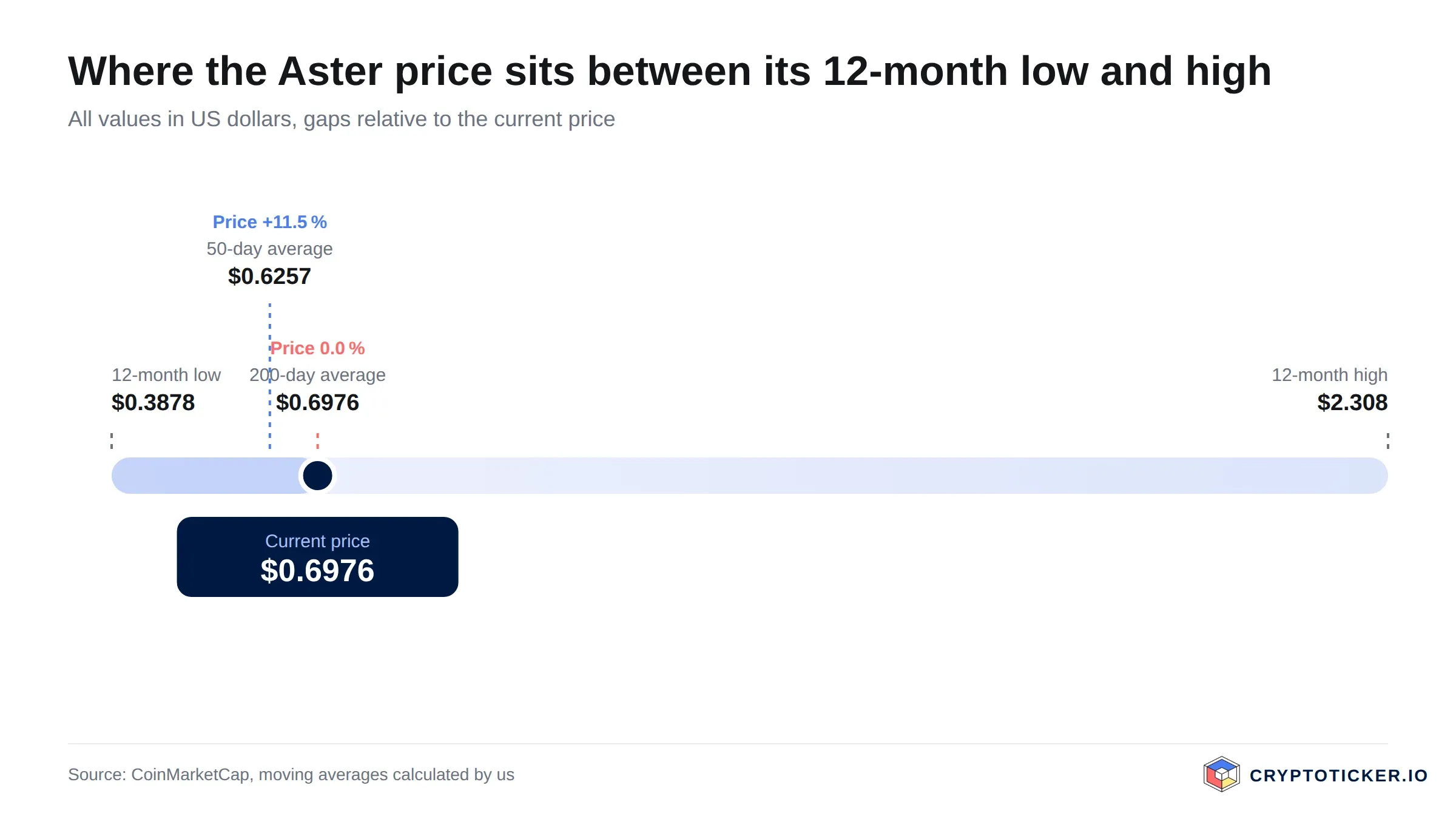
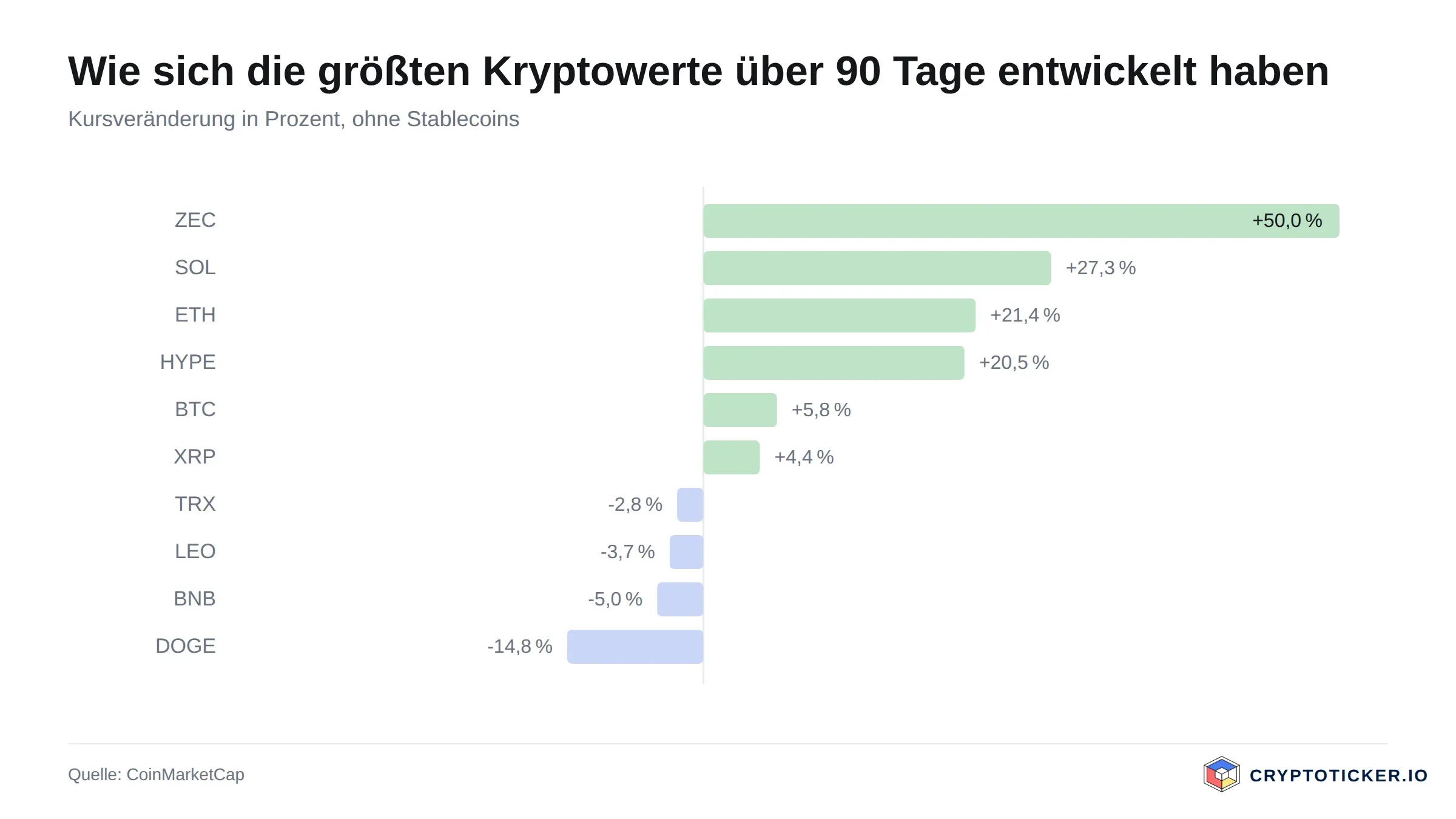
The price has detached itself from the low and caught up with the averages, but the averages themselves have not yet confirmed the direction. That is the condition of an interruption rather than a completed trend change. Only once the 50-day average rises above the 200-day average would the recovery be structurally established.
The assumption in this section counts as refuted if the price falls back below $0.6257 and stays there for several weeks. The movement of recent months would then have been a counter-move within a downtrend and not a bottoming out.
What RSI and Moving Averages Mean for an Aster Entry
The relative strength index stands at 63.6, in the upper part of the neutral zone. Overbought would be a reading of 70 or more, oversold one below 30. Aster is therefore neither a bargain in the technical sense nor an overheated instrument. Anyone who was waiting to enter in oversold territory missed that moment over the past year.
In practice that means two things. The timing is technically unremarkable, and unremarkable moments suit staggered purchases better than a single large entry. And an RSI of 63.6 leaves room on the upside. An RSI is, however, a momentum indicator and not a valuation: it says how fast the price has moved, not whether the price is appropriate.
What Trading Volume Reveals About Demand for Aster
Over the past 24 hours, around $105.9 million worth of Aster changed hands. Measured against a market capitalisation of $1.89 billion, that is a turnover of around 5.6 percent a day, and it is the most important difference from many another token of this size.
Why that counts: a thinly traded token can be bought at any given price but not necessarily sold at any given price. Where daily turnover runs in fractions of a percent, even a medium-sized order moves the price against its own instruction. At 5.6 percent that problem is effectively absent for private order sizes. Tradability therefore belongs among the solid arguments in favour of Aster.
Which Structural Factors Argue in Favour of Aster
Aster is the token of a decentralised derivatives exchange, that is, a trading venue for perpetual futures contracts without a central custodian. This segment has a directly comprehensible source of income: trading fees. Unlike tokens whose value rests solely on the expectation of future use, here an activity can be measured that is taking place today. Anyone wanting to compare the segment will find the platforms side by side in the comparison of the best perp DEXs.
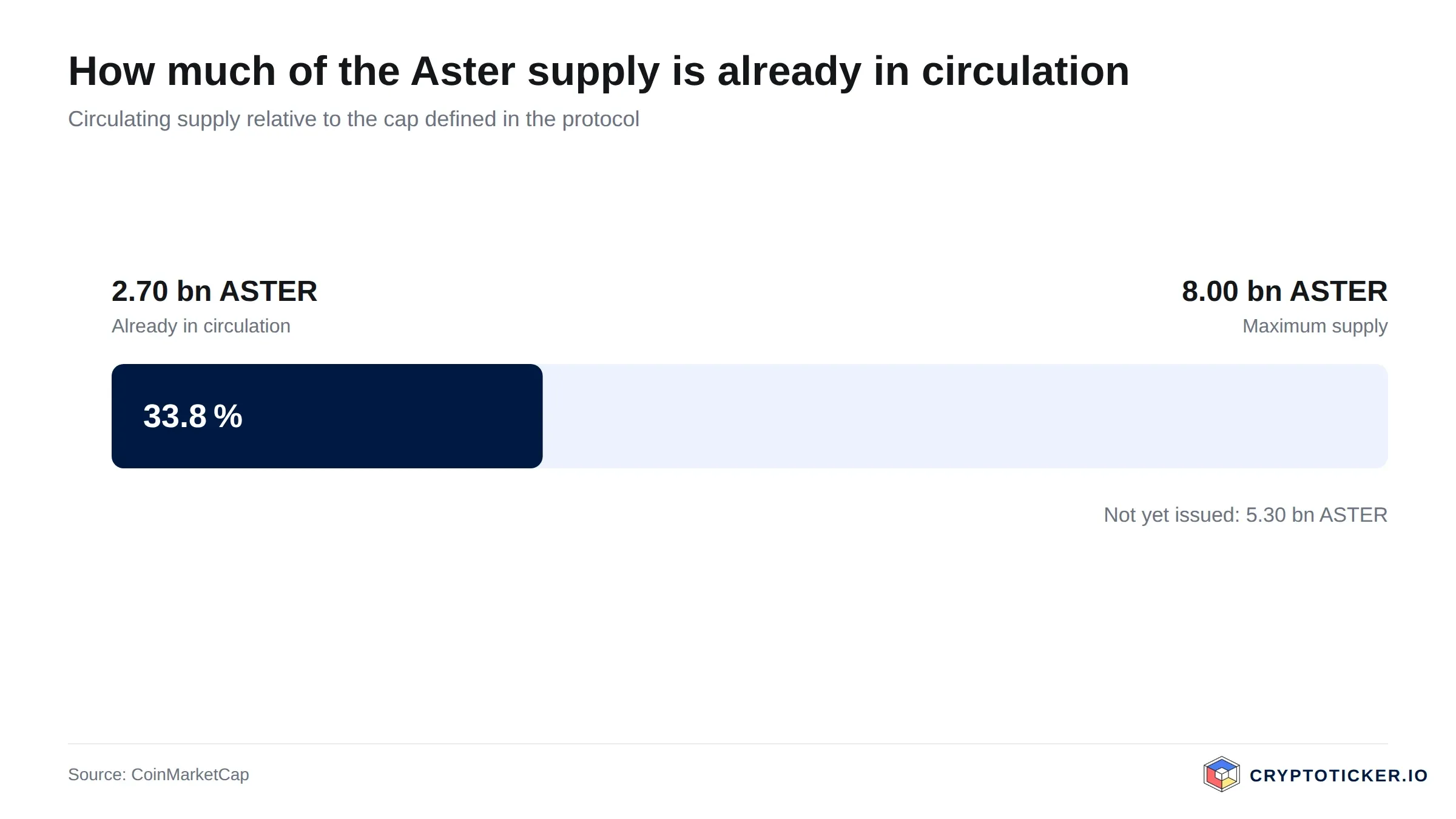
The second point is the supply mechanics, and that one cuts both ways. Around 2.70 billion tokens are in circulation against a hard cap of 8 billion, or 33.8 percent. The hard cap is a positive: there is a defined final quantity. The flip side follows in the next section.
The third point is the regulatory position. In the European Union, the MiCA regulation provides a uniform legal framework for crypto assets, whose technical standards the European securities regulator ESMA publishes on an ongoing basis. Trading through regulated providers is thus more clearly governed than it was two years ago, and the counterparty risk of an exchange is easier to assess. MiCA has no influence on the valuation of the token itself; the regulation governs the providers, not the price outlook.
What Argues For Buying Aster at the Current Price
- The price sits above both moving averages. At $0.6976, Aster is above the 200-day average of $0.6608 and the 50-day average of $0.6257. The 16.2 percent gain over 30 days expresses that movement.
- Tradability is good. Daily turnover of 5.6 percent of market capitalisation means positions can be unwound again at predictable prices. Among tokens outside the top twenty that is not a given.
- The distance from the high is large. Around 69.8 percent below $2.3076 is a price that no longer contains the euphoria of the debut. That is expressly not an argument that the old peak will be reached again.
What Argues Against Buying Aster at the Current Price
- Two thirds of the supply is still outstanding. Of 8 billion tokens, 2.70 billion are in circulation; the remaining 5.30 billion or so will reach the market step by step under the release schedules. Every release increases supply without demand automatically growing with it. This is the weightiest objection, and it applies regardless of how the platform develops.
- The time series is short. 345 daily closes do not cover a full market cycle. How the token behaves in a longer downward phase has not been observed. Any statement about it is a supposition, including the ones in this article.
- The trend change is not technically confirmed. The 50-day average remains below the 200-day average. The decentralised derivatives exchange segment is also fiercely contested; a competitor with better terms can pull trading volume away quickly, and trading volume is the basis of income in this business model. For comparison, it is worth looking at Hyperliquid at its current price.
How to Buy Aster at the Current Price
The purchase runs through a crypto exchange. Which platforms list the token changes; check availability before buying rather than assuming it. An overview of fees, deposit routes and regulatory status is provided by the comparison of the best crypto exchanges; anyone who values European supervision will find the relevant providers in the comparison of regulated crypto exchanges.
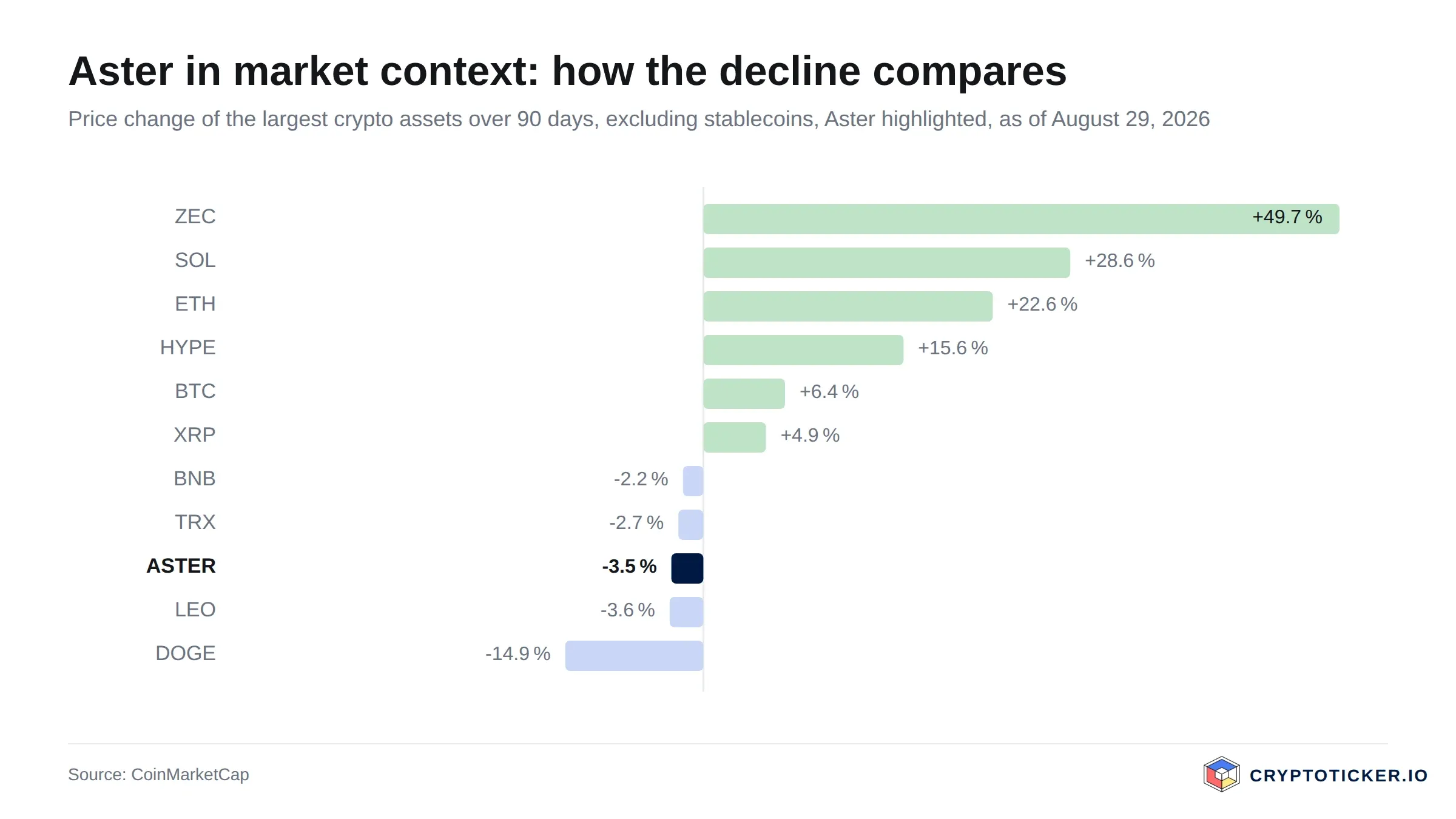
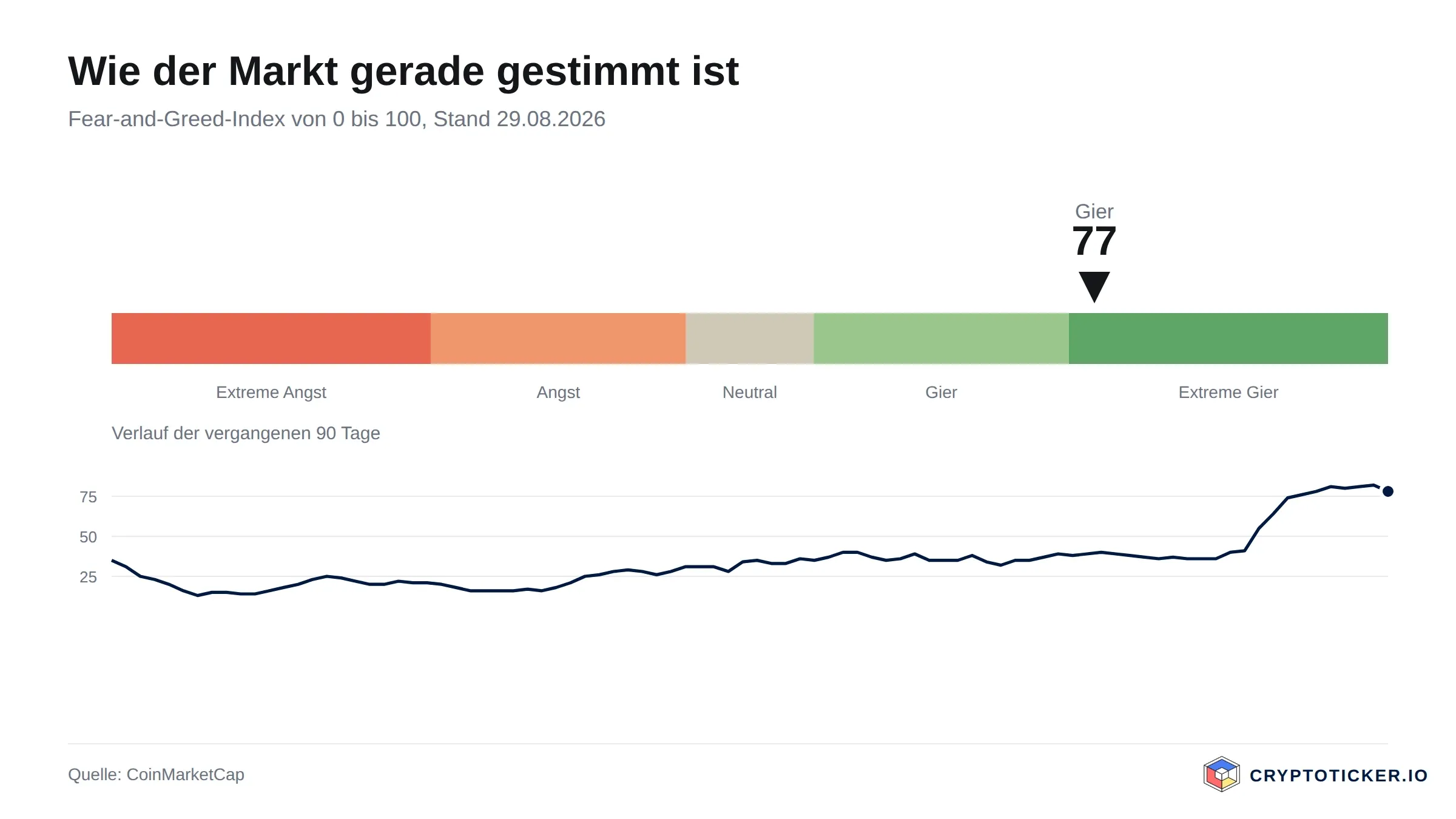
On costs, three items should be kept apart: the trading fee, the spread between buying and selling price, and the withdrawal fee if you later move the token to your own wallet. With smaller tokens the spread weighs more heavily than the stated fee and rarely appears in the price list. How the providers work in detail is set out in the reviews of Bitvavo, Kraken and Bitpanda.
On custody: anyone holding larger amounts does not leave them on the exchange permanently. The basic idea of self-custody is as old as the Bitcoin whitepaper and comes down to the point that only the holder of the private key can dispose of the funds. Which devices are suitable is shown by the hardware wallet comparison. Anyone intending to hold for years should not depend on the survival of a single trading platform.
So Is Aster a Good Buy at the Current Price?
In the short term, over a horizon of weeks, the finding is neutral to mildly friendly: the price sits above both averages, the RSI of 63.6 leaves room on the upside, and tradability is good. Against that stands the fact that the 50-day average has not yet crossed the long line and that market sentiment, with a Fear and Greed reading of 76, sits in greed territory. High greed is not a sell signal, but it is an indication that a good deal of confidence is priced in. A fall back below $0.6257 would be the first sign that the short-term assumption does not hold.
In the long term, over a horizon of years, everything hangs on one question: can the platform hold enough trading volume to absorb the outstanding 5.30 billion tokens without the price giving way under the growing supply? Anyone answering yes is buying today at around 70 percent below the high. Anyone answering no is buying into a scheduled expansion of supply. The price data does not answer it; it only shows that the market currently prefers the friendlier reading.
The friendly reading counts as refuted if the price falls below the 200-day average of $0.6608 while the circulating supply rises and trading volume drops well below the current $105.9 million a day. It counts as confirmed if the 50-day average rises above the 200-day average and volume does not fall in the process.
Buying Aster: What to Take Away
- The position is a recovery without confirmation. Price $0.6976, 200-day average $0.6608, 50-day average $0.6257, RSI 63.6: above both lines, but without the crossover that would evidence a trend change. For comparison it is worth looking at Ethereum at its current price.
- Supply is the decisive reservation. 2.70 of 8 billion tokens are in circulation. Anyone buying Aster is buying a position whose circulating supply can still triple as scheduled. That belongs in every position size, unlike assets with largely issued supply such as Bitcoin at its current price.
- Tradability argues for a staggered approach. At $105.9 million of daily turnover, partial purchases spread over several weeks are possible without appreciable price impact. At a price 69.8 percent below the high and 79.9 percent above the low, that is the more sober choice than a single entry point. Which exchange suits is settled by the perp DEX comparison.
Disclosure: some of the providers named in this article work with us through partner programmes. This has no influence on the price analysis or on the assessment of the chart position; the price data comes from a public market data source and can be verified there.
(As of August 29, 2026. This article is not investment advice. Prices and fee structures change; check the terms with the provider before you buy. Crypto assets are subject to sharp price swings, and a total loss is possible.)
Decrypt
The Vermont senator warned that the surveillance company's 120,000-plus AI cameras are pushing the US toward a "surveillance state," adding a prominent voice to a growing bipartisan backlash.
Galaxy Research shows coins untouched for 10-plus years moving at an unusual pace in 2026, with six ancient wallets shifting $40 million in a single 10-day stretch this month.
The roughly $42.5 million cash-and-stock deal adds derivatives, structured products and capital-markets capabilities, while letting NYDIG focus on its power and data-center business.
BTC gave back some of its gains after Fed Chair Kevin Warsh talked tough on inflation, but prediction market traders are still leaning bullish.
The company says it needs more skilled workers as its AI infrastructure expands, but employees fear automation could reduce or eliminate some roles.
U.Today - IT, AI and Fintech Daily News for You Today
Cardano's latest liquidation imbalance suggests ADA's next move may be more volatile than the price chart alone indicates.
Demand for Shiba Inu appears to be slowing as exchange activity shows that traders are beginning to dump more tokens on exchanges after a recent price breakout.
Renowned Bitcoin miner Metaplanet has made a big deposit of $237 million worth of Bitcoin, reducing its holdings amid the asset's price reversal.
Bitwise continues to double down on XRP despite its sudden reversal from the recent price rally, purchasing $15.4 million worth of the token.
Ripple CTO emeritus David Schwartz challenges 'Major Questions' take in Kalshi case.
Blockonomi
TLDR:
- RWA.xyz tracked $38.35B in distributed assets on-chain, up 1.54% in 30 days as holders neared 3 million.
- Ethereum led distributed RWAs with $17.3B, ahead of BNB Chain at $5.8B and Solana at roughly $4.1B on-chain.
- Tokenized stock transfer volume jumped over 415% to $29.5B in 30 days, while distributed value hit $2.54B.
- Ondo Finance offers 440+ tokenized stocks and ETFs, showing how RWAs are expanding beyond Treasury products.
Binance co-founder Changpeng Zhao has acknowledged that he underestimated real-world asset tokenization as on-chain assets approach a $39 billion market value. Speaking during a Binance Clubhouse Bali 2026 community Q&A published August 23, Zhao said he paid little attention to RWAs 18 months earlier.
That view has changed as traditional financial instruments increasingly move onto blockchain networks. Zhao said 24/7 trading, transparency, lower fees, and global access now give tokenization clear advantages over traditional market structures. He also noted that earlier crypto trends, including NFTs and memecoins, grew far beyond his initial expectations.
CZ Reassesses RWA Growth as On-chain Value Nears $39B
The market data now helps explain CZ’s shift in perspective. RWA.xyz recorded $38.35 billion in distributed real-world assets on-chain as of August 28, excluding stablecoins. That total increased 1.54% over 30 days, while the number of asset holders more than doubled during the same period.
Nearly 3 million wallets now hold distributed RWAs, reflecting a 104% monthly increase. Separately, RWA.xyz tracked $380.88 billion in represented asset value across the broader tokenization market.
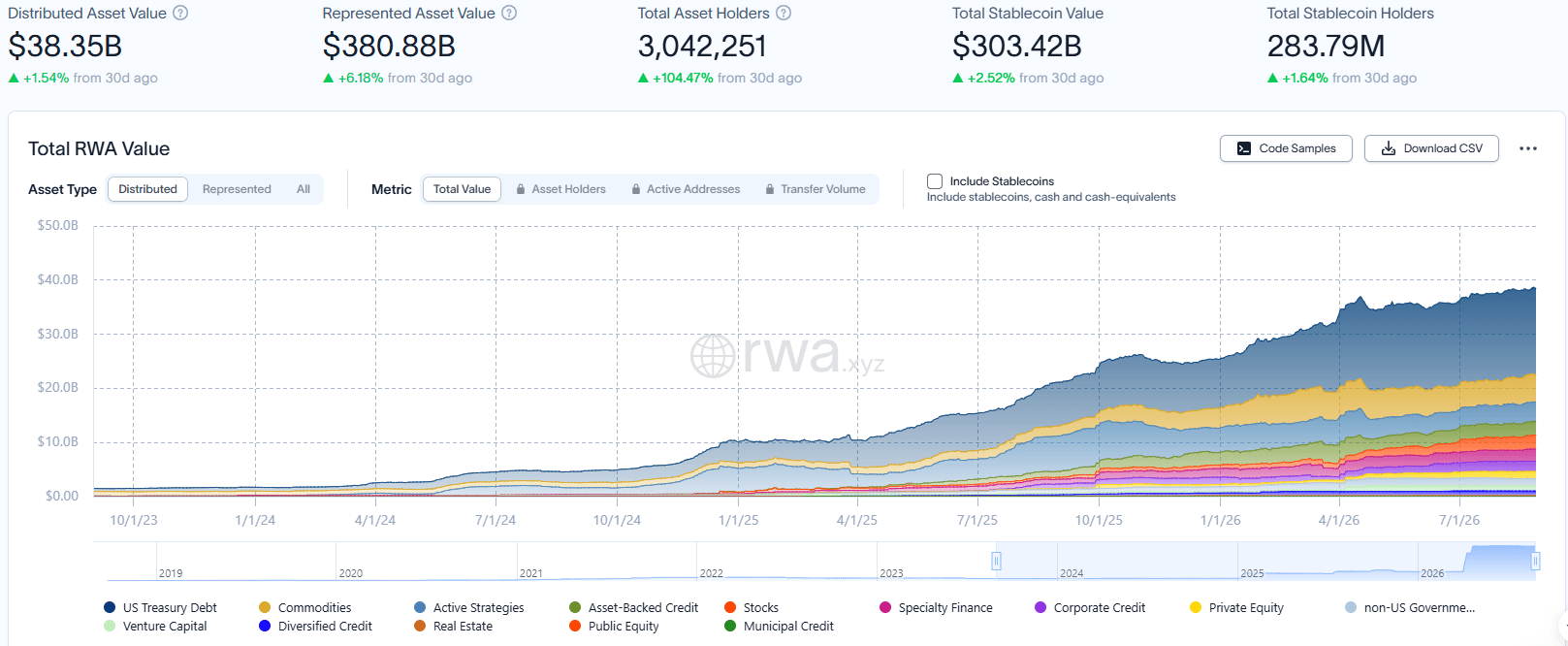
Source: RWA.xyz
Ethereum remained the largest blockchain for distributed RWAs, holding about $17.2 billion. BNB Chain followed with $5.7 billion, while Solana accounted for approximately $4.1 billion. Within that market, tokenized Treasury products remain among the sector’s largest individual assets.
Circle’s USYC stood near $2.88 billion, while BlackRock’s BUIDL reached roughly $2.76 billion. Ondo Finance’s USDY followed at about $2.19 billion. However, tokenized equities are becoming a faster-growing segment.
Monthly transfer volume for tokenized stocks surged more than 415% to $29.5 billion during the latest 30-day period. Their distributed value reached $2.54 billion, representing growth of about 637% from one year earlier.
Ondo Finance has also expanded the practical reach of tokenized equities. The platform now offers more than 440 tokenized stocks and exchange-traded funds to eligible non-U.S. investors across several blockchains.
Tokenized Stocks Surge as Regulation Moves Closer
The expansion of Tokenized Assets is also unfolding alongside clearer regulatory discussion in the United States. The Securities and Exchange Commission issued January guidance explaining how federal securities laws apply to tokenized securities.
The guidance distinguished issuer-sponsored tokens from third-party tokenized products, giving the market a clearer framework for understanding different token structures. SEC Chair Paul Atkins later said the agency’s 2026 agenda includes clearer rules covering custody and trading of tokenized securities on-chain .
Meanwhile, CZ did not describe RWA growth as crypto’s next guaranteed dominant trend. Instead, he grouped RWAs with perpetual decentralized exchanges and AI agents as emerging sectors that could shape the industry’s next phase.
His reassessment nevertheless reflects a measurable shift in the market. Tokenized Assets now span government debt, equities, commodities, credit, and other traditional instruments, while distributed value has moved close to $39 billion.
For CZ, the change is less about predicting the next crypto narrative and more about recognizing an existing market transformation. RWAs have moved from a niche concept toward financial infrastructure with rapidly growing users, assets, and transaction activity.
The post CZ Admits He Underestimated RWA Growth as Tokenized Assets Near $39 Billion appeared first on Blockonomi.
TLDR:
- Bitcoin-Nasdaq ratio fell 62.2%, nearing the 68.5% drop recorded during the previous 2021-2022 crypto cycle.
- The 62.2% ratio decline is roughly 90% as deep as the prior cycle’s 68.5% Bitcoin-Nasdaq relative drawdown.
- Bitcoin rebounded from about $58,500 in late June to above $80,000 in August as ETF demand strengthened.
- U.S. spot Bitcoin ETFs drew $1.92B from Aug. 17-21, their strongest weekly inflow since October 2025.
Bitcoin’s performance against the Nasdaq has returned to territory previously seen near the depths of previous major crypto bear markets. A Rand Group chart, sourced to The DeFi Report, shows the BTC/Nasdaq ratio down 62.2% from its latest peak.
That decline compares with 75.7% in 2018 and 68.5% during the 2021-2022 cycle. The current contraction is smaller, yet it has already reached much of the scale recorded around those earlier market lows.
Bitcoin-Nasdaq Ratio Nears Past Bear-Market Extremes
The DeFi Report discussed the measure on August 5 and said its 2026 low may have formed around June 30. Michael Nadeau noted that the 62.2% decline was roughly 90% as deep as the previous cycle’s 68.5% drop.
However, the 62.2% figure was already circulating in early August. It therefore represents a snapshot of relative weakness before the sharp recovery later that month. The chart also requires an important distinction.
It measures how BTC performed against a technology-heavy equity benchmark rather than showing the asset’s standalone price drawdown. Wells Fargo Investment Institute estimates the cryptocurrency lost about 83% between its December 2017 peak and December 2018 low.
It later declined roughly 77% between November 2021 and November 2022. By contrast, the ratio tracks a competition between two markets. Earlier this year, that contest moved decisively toward technology shares.
NYDIG reported the cryptocurrency fell 13.4% during the second quarter, while the Nasdaq 100 surged 27.7%. By July, the asset was down 32.9% for the year.
NYDIG linked the divergence to weaker structural demand, tighter liquidity and concerns about selling by digital-asset treasury companies. Those pressures left crypto trailing despite strength in growth equities.
Bitcoin’s August Rebound Revives Focus on the June Cycle Low
The relative picture changed after June. Bitcoin rebounded from about $58,500 near month-end and climbed above $80,000 during August, narrowing the earlier performance gap.
Moreover, U.S. spot BTC ETFs added $1.92 billion between August 17 and 21. That marked their strongest weekly inflow since October 2025 and strengthened demand during the rebound.
By August 26, The DeFi Report said Nadeau’s crypto outlook had turned more bullish following the rapid recovery. The asset traded near $78,200 on August 30 after exceeding $81,000 earlier.
Macro conditions nevertheless remained important. Federal Reserve Chair Kevin Warsh’s Jackson Hole remarks increased expectations for tighter monetary policy after he emphasized persistent inflation.
The Nasdaq fell 0.52% on Friday, while Bitcoin dropped more than 3%. Traders also raised the probability of a September rate increase from about 35% to above 55%.
The historical comparison therefore carries context, not confirmation. BTC underperformance has reached levels associated with previous bear-market extremes, but the 62.2% ratio decline alone does not establish a bottom.
The June low remains the central reference point. Sustained relative outperformance, continuing ETF demand and stronger liquidity would provide firmer evidence than the historical ratio comparison by itself.
The post Bitcoin-Nasdaq Ratio Drops 62% as 2018, 2022 Bottom Signals Return appeared first on Blockonomi.
TLDR:
- The Ripple donation sends $300,000 to World Central Kitchen and Mercy Corps for meals, safe water and sanitation in affected communities.
- World Central Kitchen has activated restaurant partners in Rasuwa and Nuwakot, while its relief team travels to reinforce local meal operations.
- UNICEF says at least 17,000 children need support after floods destroyed 18 schools, damaged 20 more and disrupted health services.
- The funding extends Ripple partnerships that previously tested blockchain payments and stablecoin-based tools for humanitarian assistance.
Ripple has committed $300,000 to support urgent flood operations in Nepal and Tibet after a deadly Himalayan disaster. The Ripple donation will go to World Central Kitchen and Mercy Corps. Both groups already work with communities across the damaged region. Ripple announced the funding on August 28, two days after the floods struck.
The money targets emergency meals, safe drinking water, and sanitation services where transport and utility networks have failed. World Central Kitchen has activated local restaurant partners, while Mercy Corps is assessing needs with authorities and aid groups. This links funding to groups moving supplies through disrupted corridors.
Ripple Donation Funds Meals, Clean Water and Sanitation
Ripple said the $300,000 grant will support meal distribution and water and sanitation work. Ripple did not publish a split between the recipients. The Ripple donation directs emergency aid toward meals, clean water and sanitation through both organizations.
Our thoughts are with those impacted by the devastating floods in Nepal and Tibet.
Ripple is donating $300,000 to @WCKitchen and @MercyCorps to support emergency meal distribution and water and sanitation efforts on the ground.
— Ripple (@Ripple) August 28, 2026

World Central Kitchen said its restaurant partners were serving meals in Rasuwa and Nuwakot. Its relief team was traveling there to reinforce local operations. The model uses nearby kitchens and suppliers, shortening delivery routes when highways and bridges are unusable.
Mercy Corps has worked in Nepal for more than 20 years. The group is coordinating with local authorities and humanitarian partners while assessing gaps. Its work covers water, sanitation and recovery needs beyond hot meal distribution.
The Ripple donation extends established partnerships rather than creating new ones during the crisis. Ripple has supported World Central Kitchen since 2020. The nonprofit later began testing Ripple Payments and RLUSD with local restaurant partners. Ripple said the system can settle payments in hours instead of days.
Ripple has also funded a Mercy Corps Ventures drought project in Kenya. The pilot insured 517 pastoralists with RLUSD and used satellite data to monitor vegetation. No payment triggered since conditions stayed above the set threshold. The project tested automated emergency aid before households faced deeper losses.
Nepal Flood Relief Expands Across Damaged River Corridors
The flooding began August 26 after part of a Himalayan glacier collapsed, sending ice, rock, mud and water into valleys. Satellite analysis indicated material fell about 1,200 metres from the glacier to the valley floor. River levels then rose rapidly along the Lhende Khola, Bhote Koshi and Trishuli systems.
Communities in Rasuwa, Nuwakot and Dhading suffered severe damage. Floodwater washed out or disabled roads, bridges, power systems, health facilities and communications links. The same event also struck the Gyirong border port in Tibet. Those losses have slowed access for rescue teams, including emergency aid funded by the Ripple donation.
By August 29 that more than 600 people had reportedly died across Nepal and Tibet. More than 2,000 people remained missing, and authorities expected the figures to change. The Ripple donation addresses immediate survival needs while national agencies continue search and recovery work.
UNICEF said the floods affected at least 17,000 children in Nepal. The floods destroyed 18 schools and damaged another 20. Four health facilities also suffered severe damage. The agency requested $17.2 million for health, nutrition, sanitation, education, protection and early recovery.
UNICEF is dispatching hygiene kits, medical tents, newborn supplies and therapeutic food. It is also supporting family reunification, temporary learning spaces and emergency cash assistance. Nepal flood relief therefore requires more than immediate food delivery. Clean water and sanitation stay central after water systems fail and disease risks rise.
The Ripple donation provides $300,000 to two operating partners within a much larger response. Ripple named emergency meal distribution, drinking water access and sanitation services on the ground as the funded priorities. Neither Ripple nor the recipients published a timetable or allocation breakdown.
The post Ripple Donation Sends $300K Aid to Nepal and Tibet Flood Relief appeared first on Blockonomi.
TLDR:
- Sberbank plans BTC, ETH and USDT-backed loans as Russia’s regulated crypto framework starts September 1.
- Non-qualified investors face a 300,000-ruble annual crypto purchase cap through each approved intermediary.
- SberCIB sees Russian crypto exchange trading at 3.5-4 trillion rubles in the first year after legalization.
- Professional firms have until July 1, 2027, to secure licenses as crypto enters Russia’s regulated market.
Sberbank is preparing to bring digital assets into conventional banking by accepting Bitcoin, Ethereum, and Tether’s USDT as collateral for loans. The plan would extend an earlier lending pilot as Russia begins operating a framework for cryptocurrency trading and ownership.
Anatoly Popov, deputy chairman of Sberbank’s management board, said the lender intends to broaden eligible crypto collateral beyond Bitcoin to Ethereum and USDT. The expansion depends on central-bank rules becoming fully operational when the law takes effect September 1.
Sberbank Expands Crypto-Backed Loans Under New Russia Rules
Russia’s new regime creates regulated channels for buying, selling, and holding digital currencies through approved intermediaries. Non-qualified investors must pass testing and face an annual purchase limit of 300,000 rubles through each intermediary.
Qualified investors will also undergo testing, although they will not face the same purchase cap. Meanwhile, the Bank of Russia identified Bitcoin, Ethereum, and USDT for public exchange trading.
The central bank selected those assets using market capitalization, average daily volume, and at least five years of foreign-market price history. That designation gives Sberbank a clearer regulatory basis for using the three assets in secured lending.
However, any broader rollout will still depend on custody standards, risk calculations, and collateral-management requirements. These safeguards are particularly important as crypto prices can move sharply, potentially reducing collateral values before borrowers repay their loans.
Against that regulatory backdrop, Sberbank has already tested the lending model with corporate clients. In December 2025, the bank completed a pilot loan secured by cryptocurrency mined by Intelion Data, providing an early example of how digital assets could support corporate financing.
Interfax reported that Sberbank used its Rutoken storage system to safeguard the collateral throughout the loan period. Building on that pilot, Popov said the model could eventually serve a wider range of companies holding digital assets, rather than remaining limited to cryptocurrency miners.
Russia Tightens Risk Controls as Crypto Trading Expands
The lending push comes as regulators connect crypto markets with traditional finance. In July, the Bank of Russia drafted rules allowing brokers to accept cryptocurrencies and digital rights as margin collateral.
Those proposals require risk-coverage calculations to determine leverage levels and forced-liquidation thresholds. In August, the regulator went further by proposing limits on how crypto assets can count toward prudential requirements.
Under the proposal, professional market participants could include exchange-approved cryptocurrencies in eligible assets. However, their contribution would be capped at 25%, limiting balance-sheet exposure to volatile digital assets.
At the same time, the potential market remains significant. Popov said SberCIB analysts expect cryptocurrency trading on Russian exchanges to reach between 3.5 trillion and 4 trillion rubles in the first year.
That figure could rise to 7.5 trillion rubles by 2029 as the regulated market develops. Meanwhile, professional market participants have until July 1, 2027, to obtain the required licenses.
Even as the market expands, Russia continues to draw a clear distinction between crypto investment and domestic payments. Cryptocurrency remains prohibited for local transactions, although exporters and importers can use digital assets for cross-border settlements.
Against that regulatory backdrop, Sberbank’s planned BTC, ETH, and USDT-backed loans would push crypto further into conventional finance. Rather than functioning as payment money, those assets would serve as collateral for bank lending.
The structure could allow corporate holders to raise liquidity without immediately selling their digital assets. However, custody standards, collateral valuation, liquidation procedures, and lending limits would remain central to managing risk.
If implemented under the new framework, Bitcoin, Ethereum, and USDT would gain a broader role in Russia’s financial system as recognized collateral for regulated bank loans.
The post Sberbank Eyes BTC, ETH, USDT-Backed Loans as Russia’s Crypto Rules Take Effect appeared first on Blockonomi.
TLDR:
- The tokenized stock market generated $29.5 billion in 30-day transfers, rising more than 415%. Active use grew faster than value.
- Monthly active addresses climbed over 209% to 1.3 million. The holder count advanced 167% to 2.36 million during the same period.
- Ondo, Kraken xStocks, and Binance bStocks held about 81% of distributed value. Their combined balance exceeded $2.05 billion.
- Coinbase and Bitwise expanded self-custodied equity products for eligible non-U.S. users. DeFi use adds custody and smart-contract risks.
The tokenized stock market recorded $29.5 billion in on-chain transfers during the 30-day period, an increase of more than 415%. RWA.xyz figures show participation expanding beyond transaction volume. Monthly active addresses rose more than 209% to about 1.3 million, while holders increased 167% to 2.36 million.
The value distributed on-chain reached $2.54 billion, only 1.45% higher during the month but 637% above its year-earlier level. That contrast matters: activity grew much faster than outstanding value. The tokenized stock market is therefore seeing heavier circulation, broader wallet use, and new product integration. Outstanding on-chain value did not record an equivalent surge.
Tokenized Stock Market Growth Broadens On-Chain Demand
The latest market composition shows both scale and concentration. Ondo led with $842.8 million in distributed value. Kraken’s xStocks held $609.3 million, while Binance’s bStocks reached $599.9 million. Combined, those platforms controlled roughly 81% of the $2.54 billion market. The tokenized stock market has expanded, but its infrastructure and issuance remain clustered around three providers.
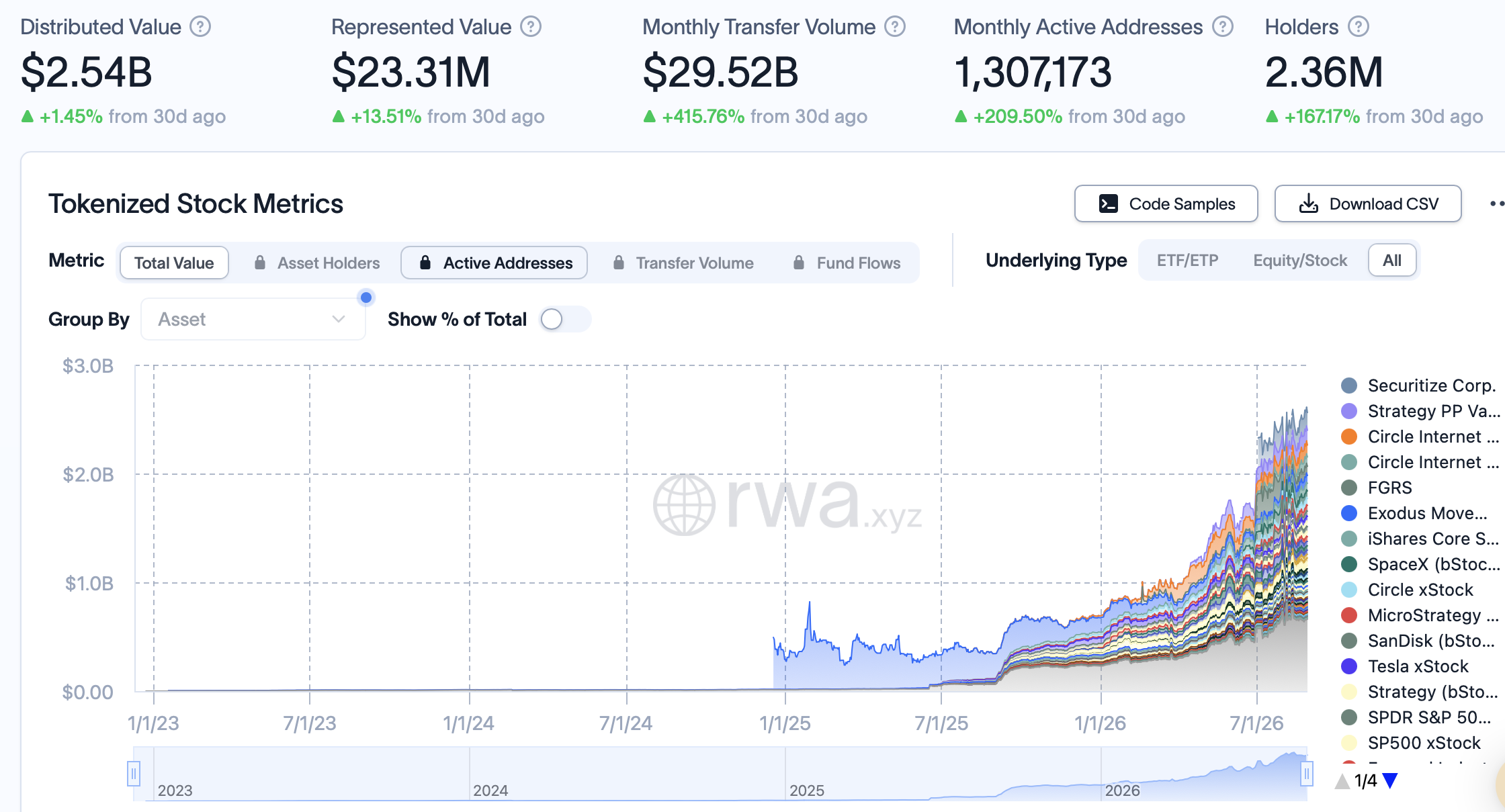
Tokenized stocks show a separate ranking. Securitize Corp. represented about $163 million, followed by Strategy PP Variable xStock at $136 million. Ondo’s tokenized Circle Internet Group shares held $109 million. These balances identify where value sits, while transfer volume measures how often assets move between wallets and applications.
Monthly transfers equaled about 11.6 times the sector’s distributed value. That ratio should not be read as $29.5 billion of new investment. It can include repeated trades, wallet transfers, redemptions, liquidity operations, and collateral movements. Even so, rising active addresses and holders provide separate evidence that participation widened alongside turnover.
The year-over-year increase from $344 million to $2.54 billion gives the tokenized stock market a larger base than last summer. The sharper monthly jump in activity suggests users are finding more ways to trade and deploy tokenized stocks.
Crypto Platforms Extend On-Chain Equities Into DeFi
Coinbase added tokenized U.S. stocks to Base on August 24 for eligible users outside the United States. Initial assets covered Apple, Nvidia, Meta, and Alphabet. Base says each B20 token represents a real share held one-for-one through a regulated custody structure. Holders can keep the assets in self-custody wallets, trade through supported venues, or connect them with decentralized applications.
Bitwise followed one day later with Automated Token Portfolios built from Coinbase-issued assets. Glider executes rules-based rebalancing while users retain their tokens. Mag7X launched first. Robotics and artificial intelligence models were still forthcoming. Access is limited to eligible non-U.S. persons, and Bitwise states that its SEC registration does not mean regulators approved these portfolios.
Other platforms are moving on-chain equities beyond spot trading. Bybit added tokenized shares, including Nvidia, Apple, and Tesla, as collateral for margin borrowing in July. Robinhood-backed Arcus also introduced more than 95 stock tokens and perpetual markets. On-chain equities may generate transfers without raising distributed value by the same amount.
Several offerings support extended trading outside normal U.S. exchange hours. That access lets users respond to events sooner. Still, thinner off-hours liquidity can widen spreads and weaken price tracking until markets reopen.
The tokenized stock market also offers different structures. Some products provide direct claims on custodied shares, while others deliver synthetic price exposure or cash redemption. Trading hours, dividend handling, voting rights, redemption terms, and investor protections can therefore vary by issuer and jurisdiction.
DeFi use adds smart-contract, oracle, liquidity, and liquidation risks. Market concentration creates another dependency, since three platforms hold most distributed value. Investors must assess the issuer, backing arrangements, custody, transfer restrictions, and redemption process. They should not treat tokenized stocks like brokerage holdings. Coinbase’s Base offering, for example, restricts availability to eligible jurisdictions outside the United States.
The post Tokenized Stock Market Activity Surges Over 415% to $29.5 Billion appeared first on Blockonomi.
CryptoPotato
Bitcoin’s gradual price recovery after Friday’s dip below $77,000 continues into the weekend, with the asset barely moving past $78,000 today.
Most larger-cap alts have posted minor gains as well, but ETH remains below $2,500, BNB is still beneath $700, and XRP keeps fighting for $1.40.
BTC Taps $78K
The price explosion that took place within 48 hours in the middle of the month drove bitcoin out of its slumber, surging from under $65,000 to $80,000. Although the asset was stopped there at first and slipped below $75,500 last weekend, the bulls returned during the business week.
This time, they managed to push it beyond $80,000 and even $81,000 on a couple of occasions. The last attempt was on Thursday morning when BTC reached $81,500 for the first time in 15 weeks. However, its ascent was halted at this point, and it retraced hard on Friday to under $77,000.
This correction occurred after Kevin Warsh’s first speech at Jackson Hole, in which he maintained a hawkish stance. Nevertheless, the cryptocurrency has managed to reclaim some ground since then, rising above $77,000 yesterday and up to $78,150 as of press time on Sunday morning.
Its market capitalization has increased by roughly $15 billion in a day and is up to $1.570 trillion on CG. Its dominance over the alts is also on the rise, touching 58% on the same data aggregator.

PI Above $0.09, UNI Rockets
Ethereum is slightly in the green and now sits above $2,450, but it’s still below the key $2,500 level. BNB eyes $700 once again, while XRP can’t reclaim the $1.40 line. SOL, TRX, and HYPE are also slightly in the green, while ZEC is up by 3.5% to $830.
UNI has rocketed the most from this cohort of assets, surging by 11% to $4.9. CC and PUMP follow suit, while ENA has dumped the most, losing 3.3% of value.
Pi Network’s native token slipped below the crucial $0.09 support on Friday but has managed to defend it and now trades above $0.091.
The total crypto market cap has added around $30 billion daily, and is up to $2.740 trillion.

The post Pi Network’s PI Defends a Critical Support, Bitcoin (BTC) Reclaims $78K: Weekend Watch appeared first on CryptoPotato.
With the eighth month of the year almost behind us, it’s worth exploring what really took place as it turned out to be among the most eventful ones, especially when it comes to price pumps.
Ripple’s XRP was no exception as it rode the mid-month wave hard, surging from $1.00 to $1.70 within days before it was eventually stopped. History didn’t see this coming, but what does it say about September?
Great August
CryptoPotato reported at the start of the month that August was not a particularly optimistic period for XRP. After July, which is actually quite bullish for the token, it entered August having closed all four previous editions in the red. Some of the losses, as in 2022 and 2023, were in the double digits.
As such, there were no high hopes for the 2026 edition. Its start was quite sluggish. XRP kept losing value and eventually dipped below $1.00 on a couple of occasions for the first time in almost two years.
However, the bulls reacted in a remarkable manner. Fueled by the overall market resurgence, the return of ETF inflows, and reaccumulating whales, XRP bounced hard from that key psychological level and skyrocketed by 70% within less than 72 hours between August 19 and August 22 to a multi-month peak of $1.70.
Although it was stopped there (and the month is not officially over yet), XRP remains up by around 33% so far in August, according to data from CryptoRank.
Unless a major cataclysm takes place in the next 36 hours or so, XRP is primed to enter September in a considerably stronger position than it went into August.
What’s Next?
Unlike August, the past four Septembers have all been in the green for XRP. Admittedly, the one in 2023 brought a minor increase of 0.42%, while last year saw a jump of 2.5%. However, the ones in 2018, 2016, and all the way back in 2013 were significantly more bullish, with gains of 73%, 47%, and 94.4%, respectively. 2022 was also highly impressive, with a surge of over 46%.
As popular analyst EGRAG CRYPTO recently outlined, Septembers in even years were substantially more bullish for the asset. In addition, he said that whenever August was in the green, September followed suit 66.7% of the time. In contrast, almost 86% of subsequent Septembers were in the red following such an August.
With the August recess almost over in the US Senate, all eyes will return to the CLARITY Act in September. After failing to advance the key crypto legislation, the Senate is expected to revisit it as soon as September 15. XRP has been heavily influenced by the developments on the bill front, and a positive turnaround could lead to another leg up and vice versa.
The post XRP’s Crazy August Is Almost Over – September Could Be Even Bigger appeared first on CryptoPotato.
Zcash has been one of the best-performing assets this year. It has managed to attract significant institutional capital. This week, asset manager Grayscale Investments launched the first exchange-traded fund that tracks the spot price of ZEC.
But interest in the privacy-focused token peaked shortly before its price reached a recent high.
Zcash Crowd Showed Up Early
Data shared by Santiment revealed that social chatter faded by the time the ZEC spot ETF launched. Grayscale converted its 2017 Zcash trust into a spot ETF, which began trading on NYSE Arca on August 25.
Ahead of the launch, the asset climbed from around $509 on August 18 to about $878 on August 23, posting a gain of roughly 72%. Social mentions reached 232 on August 22, which is around six times the usual August baseline. However, that surge in attention did not last.
Mentions had returned to their baseline level by the ETF’s launch day. According to Santiment, social activity peaked one day before ZEC’s price high, which suggested that much of the crowd interest arrived ahead of the market’s high.
Since reaching about $878, the token has pulled back to roughly $789, a decline of around 10% from the recent peak.
Zcash Challenging Bitcoin?
Grayscale Research believes ZEC could emerge as a serious challenger to Bitcoin’s network effects as demand for financial privacy grows. In a report by Head of Research Zach Pandl, the firm said Bitcoin remains dominant among digital currencies. While alternatives such as Litecoin have emerged, none has seriously challenged BTC’s position.
Grayscale, however, stated that Zcash could be different because it combines Bitcoin-like characteristics with privacy features that may become more important as AI-powered surveillance expands. The report also points to the ecosystem’s active development, which aims to address cybersecurity risks, including potential threats to traditional cryptography from quantum computing.
Another advantage is its cross-chain reach through “intents” technology built into modern blockchain wallets, which allows Zcash to function as a private asset hub without requiring broad merchant adoption. ZEC has already gained around 19 times over the past year but remains worth less than 1% of Bitcoin’s market capitalization. Grayscale said Zcash’s financial privacy and other features may be undervalued, thereby leaving room for further upside.
The post Zcash (ZEC) Social Buzz Vanished Before Its ETF Even Launched: Data appeared first on CryptoPotato.
Just a few months after it launched its first notable cryptocurrency-focused platform, the Wall Street behemoth has expanded its offering beyond Bitcoin and Ethereum.
The giant recently announced that its Schwab Crypto trading service will add Solana (SOL), Chainlink (LINK), and Avalanche (AVAX) in the coming months.
Adding More Alts
The new additions will allow eligible company clients direct access to five cryptocurrencies after the product launched with only Bitcoin and Ethereum in May this year. What’s even more notable now is that Charles Schwab said these won’t necessarily be the last added altcoins, as it plans to introduce more digital assets over time.
“With this expansion, clients will have more choices to build a digital asset allocation alongside the investing and banking experience they know and trust at Schwab. These additions are consistent with our approach to provide clients with access to familiar cryptocurrencies backed by an ecosystem of education, tools, resources, and support to make informed decisions about how crypto might fit into their broader investing goals,” said the entity’s Head of Digital Assets, Joe Vietri.
Charles Schwab clients can view and trade their crypto holdings alongside traditional investments on its website, mobile application, and thinkorswim platform. The company explained that crypto trades carry a fee of 75 basis points on the dollar value of each transaction.
It’s worth noting that certain geographical limitations are still in place. Schwab Crypto remains unavailable to residents of New York and Louisiana, as well as customers in US territories and international jurisdictions.
The statement also clarified that support for any of the announced digital assets could still be delayed, changed, or withdrawn depending on regulatory, market, operational, or risk-related developments.
Market Revival
The BTC- and ETH-only launch of the company’s crypto platform came just ahead of the May rally, which drove the leading digital asset to almost $83,000. What followed were three months of selling pressure and new lows, with BTC dipping below $58,000 on July 1.
However, the new altcoin additions find the market in a much better state. BTC broke out of its consolidation range and rocketed to $81,000 on a couple of occasions. Most altcoins have followed suit, including the ones mentioned above. SOL is up by over 40% in the past month, LINK has gained 38%, while AVAX has added a more modest 15%.
The post Wall Street Giant Charles Schwab Makes Major Crypto Move Beyond Bitcoin and Ethereum appeared first on CryptoPotato.
US consumer advocacy group Public Citizen reported that crypto ventures linked to Donald Trump and his family have left investors with at least $4.7 billion underwater since 2022.
Most of the losses remain unrealized.
Trump’s Crypto Empire
Public Citizen estimated that investors in Trump Digital Trading Cards, launched in December 2022, have suffered at least $9.3 million in losses, while the WLFI token has left investors at least $1 billion underwater.
The largest amount came from the TRUMP meme coin, which Public Citizen estimated had resulted in $3.2 billion in losses for investors. Since its all-time high of $73 back in January 2025, the token has lost over 97% of its value. Earlier this month, US Senators Elizabeth Warren and Richard Blumenthal asked SEC Chair Paul Atkins to investigate the meme coin. They said that it may have enabled fraud or unfairly enriched people at the expense of everyday investors.
The advocacy group put losses tied to Trump Media’s digital-asset treasury at $450 million, while it estimated no losses for USD1, which brings the total to at least $4.7 billion.
Trump is said to have made at least $1.4 billion from crypto in 2025, based on his latest financial disclosure released in June 2026. But the disclosure does not indicate that he invested any of his own money in these ventures, according to Public Citizen.
While the White House has said neither the president nor his family have engaged or will engage in conflicts of interest, the report said Trump continues to own and control his businesses. The group said his stakes in the digital trading cards, the meme coin, World Liberty Financial’s two tokens, as well as Trump Media & Technology Group, are held through a revocable trust in which the president is the sole donor and beneficiary. His eldest child, Donald Trump Jr., meanwhile, serves as the sole trustee.
Clash Over Clarity
The push to strengthen the US crypto industry and advance the Digital Asset Market Clarity Act has continued to draw criticism over the family’s financial ties to digital assets. Last week, Trump met with executives from Coinbase, Ripple, Gemini, and other crypto firms at the White House, calling on Congress to pass a “fair version” of CLARITY while adding that it would help keep the US ahead of China.
But critics, including Ben McKenzie and Chris Van Hollen, warned that the bill could leave loopholes allowing Trump to profit from his ventures.
Previously, prominent comedian and political commentator John Oliver also described crypto as “a perfect vehicle to funnel money” to the US President’s family, while adding that Trump is “exploiting crypto sketchiness for maximum profit.”
The post Trump-Linked Crypto Ventures Leave Investors at Least $4.7B Underwater: Public Citizen appeared first on CryptoPotato.


