Cryptocurrency Posts
Crypto Briefing
Institutional enthusiasm for crypto ETFs highlights the volatility and risk of market timing amid regulatory and policy shifts impacting digital assets.
The post Institutions poured $580M into crypto ETFs right before Warsh’s hawkish speech cratered the market appeared first on Crypto Briefing.
Bamboo's IPO highlights the growing importance of tech-driven solutions in adapting to climate risks and reshaping the insurance industry landscape.
The post Bamboo Insurance Services files for $100M IPO on NYSE appeared first on Crypto Briefing.
The ongoing conflict has intensified global energy insecurity, prompting a shift towards alternative energy sources and impacting fiscal stability.
The post Iran’s war reshapes global energy economics after six months appeared first on Crypto Briefing.
Rising VLCC rates due to Iran conflict highlight potential global oil supply disruptions and increased geopolitical tensions in maritime trade.
The post Iran conflict pushes VLCC rates to $650,000 per day amid Strait of Hormuz risks appeared first on Crypto Briefing.
AI-driven purchasing via Grok Bot could revolutionize e-commerce, raising both efficiency and security concerns in automated transactions.
The post Grok Bot enables online purchases with Stripe Link integration in the US appeared first on Crypto Briefing.
Bitcoin Magazine
Bitcoin Magazine
Bitcoin Cools Off After $3 Billion ETF-Driven Surge
Bitcoin slid Friday afternoon, cooling down after a phenomenal run following huge investment from U.S. ETF buyers.
The leading cryptocurrency was trading for $77,379 on Friday afternoon in New York after dropping more than 3% over a 24-hour period.
Bitcoin hit a high this week of $81,281 but slowed down after Federal Reserve Chair Kevin Warsh gave his first major speech as head of the central bank — saying on Friday that he had “more work to do” to fight inflation.
The Bitcoin price has in the past dropped when the Federal Reserve thinks inflation is too high because it means less chance of a rate cut; the leading cryptocurrency typically does better in a low-interest rate environment.
JUST IN:
— Bitcoin Magazine (@BitcoinMagazine) August 28, 2026U.S. Bitcoin ETFs have brought in $1.14 billion in inflows this week.
Over $3 billion has been added in the past 9 days!pic.twitter.com/ri1jE7enTZ
Bitcoin started surging last week after the U.S. Treasury would at least double the size of its liquidity-support buyback operations. The announcement last week hurt the dollar but non-yielding assets have benefited.
Exchange-traded funds, managed by the likes of BlackRock, Fidelity, and Grayscale have received net positive inflows for nine days in a row, according to Farside Investors data. Last week was their best week since October — when bitcoin hit a new all-time high — and that run has continued into this week.
Since August 17, investors have thrown over $3 billion at the funds. BlackRock’s iShares Bitcoin Trust received the lion’s share of the investment, but Morgan Stanley’s new Bitcoin Trust — which debuted this year — also experienced significant inflows.
Analysts have said that the so-called debasement trade — when investors buy an asset as a way to hedge against a currency losing value — was leading investors to eye-up bitcoin again.
Investors taking part in the trade think that bitcoin, gold and other precious metals are a good way to protect themselves from excessive government spending.
Total U.S. debt crossed $40 trillion for the first time this month.
This post Bitcoin Cools Off After $3 Billion ETF-Driven Surge first appeared on Bitcoin Magazine and is written by Mathew Di Salvo.
Bitcoin Magazine
Debasement Trade Is Here Thanks to Government Debt — And Bitcoin Will Benefit: Grayscale
The debasement trade is back — and will benefit bitcoin.
That’s according to asset manager Grayscale’s crypto research team, who wrote in a note this week that the U.S. government debasing its currency would lead to cash hitting digital assets.
“Unchecked government debt growth undermines the credibility of fiat currencies and drives investors to seek out alternative stores of value like physical gold and certain cryptocurrencies,” the note by the firm’s head of research, Zach Pandl, read, adding that primarily bitcoin would benefit.
The so-called debasement trade is when investors buy an asset as a way to hedge against a currency losing value. The trade was hot last year, and helped bitcoin’s run, but the digital asset’s run lost steam after October as traders turned their attention to stocks related to artificial intelligence.
But since last week, bitcoin has benefited from news that the U.S. Treasury would at least double the size of its liquidity-support buyback operations. The announcement last week hurt the dollar but non-yielding assets have benefited.
“That buybacks are needed at all is the problem: heavy growth in government debt is driving up the cost of borrowing,” the note continued. “The Treasury is treating the symptoms (rising bond yields) because they cannot cure the disease (structural deficits).”
The note added that on the same day last week as the buyback announcement, the Treasury also said the U.S. public debt exceeded $40 trillion for the first time.
As debt and interest payments grow, the government needs to either raise taxes, cut spending, or issue more debt.
Bitcoiners see the more politically likely path as expanding the dollar supply — which is ultimately bad for the dollar, and good for scarce assets like bitcoin.
After bitcoin started surging last week, the dollar had its worst week of August and was trading at a three-month low.
Bitcoin was trading for $77,493 on Friday afternoon in New York after hitting a high this week of $81,281. Over a 24-hour period, the coin now sits unmoved, but over a 30-day period, it has jumped by more than 20%.
This post Debasement Trade Is Here Thanks to Government Debt — And Bitcoin Will Benefit: Grayscale first appeared on Bitcoin Magazine and is written by Mathew Di Salvo.
Bitcoin Magazine

Bitcoin’s Moment Has Come for the Far East, Says Metaplanet CEO
Bitcoin’s time has come in Asia — especially with a changing regulatory landscape — and its people and companies should take advantage.
That was the message Metaplanet CEO Simon Gerovich gave at this year’s Bitcoin Asia conference, where on Friday he spoke of how his company went from failing to the third biggest bitcoin treasury in the world.
Bitcoin Asia kicked off on Thursday in Hong Kong, bringing the biggest names in the space to Hong Kong to talk about everything from treasury companies to building apps from scratch.
JUST IN:
— Bitcoin Magazine (@BitcoinMagazine) August 28, 2026Japanese public company Metaplanet CEO says the bottom for Bitcoin's price is in
"The buyers arriving now aren't going anywhere. I believe the bottom is in. And I'm expecting a much brighter rest of the year."

“The previous cycles belonged to the West, and the first Asian cycle has already started,” Gerovich said. “The only question left is who builds it. Will you?”
Often dubbed Asia’s answer to Nasdaq-listed Bitcoin treasury Strategy, Metaplanet pivoted from its core hotel and technology business to buying Bitcoin in 2024. The Tokyo Stock Exchange now holds 43,000 bitcoins worth about $3.3 billion at today’s prices.
Gerovich said in his speech that his company was small and going nowhere fast until it started putting bitcoin on its balance sheet, basically allowing investors to buy exposure to the biggest digital coin via its regulated shares.
He said that the strategy is a major opportunity for Asian companies, which can now capitalize on the changing regulatory landscape and the growing interest in Bitcoin.
Asian nations, including Japan, Hong Kong, and Singapore, are making regulatory changes to support digital assets.
Gerovich noted that Japan in particular is a country where its citizens have saved like no other part of the world — and that capital can now be put to good use.
“Hoarding cash has stopped making sense, and every household in Japan can now feel it,” he said.
“Japanese households hold roughly 14 trillion dollars in financial assets. About half of that sits in bank deposits, earning almost nothing, and that’s just Japan, add Korea, Southeast Asia, and the wealth managed out of this place, Hong Kong, and you’re looking at the deepest pools of patient savings on Earth.
“And for the first time in a generation, these savings are looking for somewhere to go.”
Gerovich added that Asian companies, institutions, and savers should take advantage of the current market conditions and build the Bitcoin infrastructure in their own regions.
“The end of the cash hoarding strategy and new rules are arriving at exactly the same time, and together, they set up what I think is the single biggest opportunity in Asian markets today,” he added.
This post Bitcoin’s Moment Has Come for the Far East, Says Metaplanet CEO first appeared on Bitcoin Magazine and is written by Mathew Di Salvo.
Bitcoin Magazine
Capital B Raises €21M From Adam Back and TOBAM To Buy More BTC
Capital B, the Euronext Growth-listed company that bills itself as Europe’s first bitcoin treasury company, has raised €21 million ($24 million) in a private placement backed by Blockstream’s Adam Back and asset manager TOBAM — money it says could buy 270 more bitcoin and push its stack to roughly 3,415 BTC.
The company said Friday that a total of 36,219,070 shares were sold at €0.58 each as part of the deal, a 6.45% discount to Wednesday’s closing price.
Capital B said the net proceeds are expected to reach about €19.9 million after fees and transaction costs.
JUST IN:
— Bitcoin Magazine (@BitcoinMagazine) August 28, 2026French company Capital B announces a €21.0 million capital raise to "accelerate its Bitcoin Treasury Company strategy"
Capital B is the 27th biggest publicly traded bitcoin treasury in the world, according to Bitcoin Treasuries, with a total of 3,145 bitcoins in its stash — worth $245 million at today’s bitcoin price of $77,960.
Capital B, which describes itself as Europe’s first bitcoin treasury, built much of that position through fundraising rounds during the first half of 2026.
In May, it acquired 192 coins for €13 million after completing three capital raises.
Capital B’s announcement as other treasuries look to raise funds and accelerate their buys. Just this week, NYSE-listed AI-powered education company Genius Group said it was aiming to build parallel AI and bitcoin treasuries worth a combined $1.6 billion, after the company sold its entire bitcoin reserves to repay $8.5 million in debt.
Bitcoin treasuries have faced headwinds since 2025 when the price of the leading cryptocurrency took a hit. A number of companies in the space have had to liquidate their holdings, including the biggest corporate holder of bitcoin, Nasdaq-listed Strategy.
This post Capital B Raises €21M From Adam Back and TOBAM To Buy More BTC first appeared on Bitcoin Magazine and is written by Mathew Di Salvo.
Bitcoin Magazine
Bitcoin Drops Before Shrugging Off Fed Chair’s Inflation Comments
Bitcoin dropped, then popped after Federal Reserve Chair Kevin Warsh gave his first major speech as head of the U.S. central bank and said he had “more work to do” to fight inflation.
The leading cryptocurrency was recently trading for $79,474 after dropping as low as $78,630 before quickly rising again.
Bitcoin has typically done well in a low interest rate environment but the Federal Reserve has been reluctant to lower borrowing costs due to sticky inflation in the world’s biggest economy.
“But on the price-stability side of our mandate, the numbers are more concerning,” Warsh said after talking about employment.
He added: “We must be confident that underlying inflation is moving to our objective, clearly and at sufficient speed. Otherwise, we have work to do.”
Bitcoin has in the past dropped on news that the Federal Reserve thinks inflation is too high because it means less chance of a rate cut. Following Warsh’s speech, traders priced in a 50% chance of rate hike in September.
But Bitcoin has appeared to — at least for now — shrug off the speech.
Bitcoin’s started surging last week after the U.S. Treasury Secretary Scott Bessent announced the department would double the size of its long-dated bond buybacks.
The news sent yields down lower, and the dollar slid while non-yielding assets like bitcoin and gold jumped.
Positive regulatory news also helped the coin: President Donald Trump last week said that the long-awaited crypto Clarity Act was a “very, very powerful” piece of legislation, and urged lawmakers to get it over the line.
The proposed law will establish a framework for distinguishing between digital assets that are securities, commodities or payment stablecoins — legislation that the crypto industry has long called for.
The Federal Reserve Bank of Kansas City is on Friday holding the annual event at Jackson Hole, Wyoming, where central bankers, Federal Reserve officials, policymakers and academics will gather to discuss “Financial Innovation: Implications for Payments and Policy.”
According to the Federal Reserve Bank of Kansas City website, this year’s event will touch on how “recent years have seen a dramatic increase in innovation in financial intermediation and payments,” including new technologies such as “cryptocurrencies and stablecoins.”
This post Bitcoin Drops Before Shrugging Off Fed Chair’s Inflation Comments first appeared on Bitcoin Magazine and is written by Mathew Di Salvo.
HTTP error 429 on https://cryptoslate.com/feed/
Failed to fetch feed: https://cryptoslate.com/feed/
Failed to fetch feed.
CryptoTicker.io
Selling Bitcoin Privately: What Tax Applies to Direct Sales in Austria
Bitcoin does not have to be sold through a crypto exchange. Buyer and seller can also agree directly and move the coins from one private wallet to another.
For tax purposes in Austria, however, that generally makes no difference. Anyone who disposes of bitcoin for euros or another legal currency generally realises a taxable event, regardless of whether a crypto exchange sits in between.
The Gain Is Taxed, Not the Sale Price
What matters is the difference between the sale proceeds and the acquisition cost for tax purposes.
Example:
- bitcoin bought for 15,000 euros
- later sold directly to a private buyer for 30,000 euros
- taxable gain: 15,000 euros
For bitcoin acquired after February 28, 2021, the special tax rate of 27.5 percent generally applies. In the example, that would generally come to 4,125 euros in tax.
Cash Changes Nothing About the Bitcoin Tax
Payment in cash does not make the transaction tax-free either.
Whether the buyer:
- transfers euros,
- hands over cash,
- pays in another legal currency,
generally makes no difference to the fact that bitcoin has been disposed of for fiat money. A swap for goods or services can likewise constitute a taxable realisation event.
How a Private Sale Differs From Selling on an Austrian Exchange
The decisive practical difference lies in the tax deduction. Where a domestic crypto service provider is involved, the tax is in many cases withheld automatically as capital gains tax and paid over to the tax office. In a direct private sale, by contrast, there is regularly no party obliged to withhold it.
The seller therefore has to:
- determine the sale proceeds,
- establish the acquisition cost,
- calculate the gain,
- account for the taxable income in the assessment.
Worked Example: Tax on a Private Bitcoin Sale in Austria
Bar length relative to the sale proceeds. Source: worked example and tax rate from this article (special tax rate of 27.5 percent for bitcoin acquired after February 28, 2021), as of August 28, 2026.
Written Proof Matters Especially Here
Private bitcoin sales should be documented in detail.
The following are particularly worth recording:
- date of the sale
- BTC amount
- agreed euro price
- proof of payment
- transaction ID
- sender and recipient address
- original acquisition cost
- any fees
Where payment is made in cash, a written receipt should be drawn up as well. Years later the blockchain will still show that the bitcoin was transferred, but not automatically which purchase price was agreed and actually paid.
What Happens When You Swap Bitcoin for Other Cryptocurrencies?
A direct private sale has to be distinguished from a swap into another cryptocurrency. Swapping bitcoin for another cryptocurrency that qualifies for tax purposes is generally not a taxable disposal in Austria. The existing acquisition cost carries over to the cryptocurrency received instead. Bitcoin for euros and bitcoin for ether can therefore have completely different tax consequences.
Legacy Holdings Can Still Be Free of Bitcoin Tax
Bitcoin acquired up to and including February 28, 2021 generally counts as a legacy holding and does not automatically fall under the current crypto tax regime. For legacy holdings held privately, a sale can generally be tax-free under the earlier rules once the speculation period that applied back then has expired. Anyone selling old bitcoin privately in 2026 should therefore document the original date of acquisition with particular care.
Selling Bitcoin to Friends Counts as a Sale Too
Whether buyer and seller are related or friends is generally not decisive for the question of a disposal for consideration. Anyone who sells bitcoin to a friend at the market price has made a sale.
Where bitcoin is genuinely transferred without consideration, it is a gift. The Austrian rules on reporting gifts can then become relevant in place of the taxation of a sale.
Documentation deserves particular care where bitcoin is transferred well below its market value. Depending on how the transfer is arranged, it can be partly for consideration and partly without.
Conclusion
For tax purposes in Austria, a direct bitcoin sale between private individuals generally has to be taken just as seriously as a sale through a crypto exchange. For bitcoin acquired after February 28, 2021, a realised capital gain is generally taxed at 27.5 percent.
The key difference: in a private sale there is regularly no Austrian crypto service provider that handles the capital gains tax deduction automatically. The seller therefore has to document the taxable gain and, where applicable, declare it through the income tax assessment.
(As of August 28, 2026. This article is not investment advice. Prices and fee structures change; check the terms with the provider before you buy.)
Bitcoin is holding just above $80,000 after climbing from the low $60,000s earlier this month. That is a gain of about 23% in August, putting it on track for its best August since 2017, in a month whose median historical return is actually negative 7%. The total crypto market sits near $2.75 trillion.
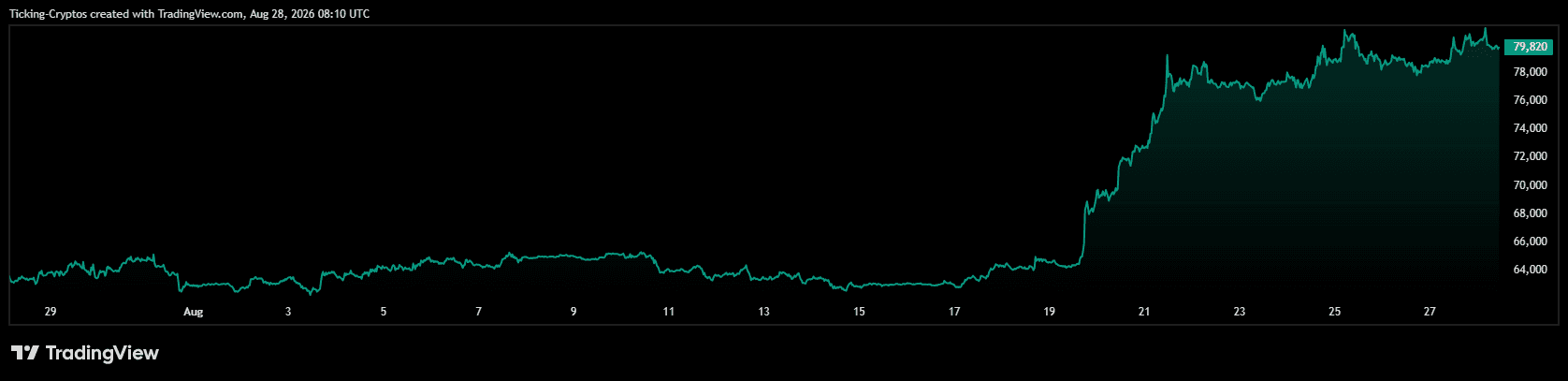
Almost all of it comes down to three things. Notably, only one of them has anything to do with crypto itself.
Top 3 Reasons Why Crypto Prices Are Up
1. The Treasury pushed liquidity into the system
This is the trigger, and it is the one most people are underweighting.
The rally started when the US Treasury expanded its bond buyback operations, which pushed long-term yields and the dollar lower. Cheaper money and a weaker dollar send capital toward risk assets, and crypto sits at the far end of that curve. Adding to it are reports that the Treasury could draw on its cash account of nearly $1 trillion, which would put more money into financial markets still.
Samir Kerbage, CIO at Hashdex, described the move as mostly a liquidity event. That is the cleanest summary available. $Bitcoin did not rally because something changed about Bitcoin. It rallied because the cost of money changed.
Worth knowing: the Fed has held its benchmark rate at 3.50% to 3.75%, and three policymakers voted for a quarter-point increase in July. Traders currently price September rate-hike odds at roughly one in three. This is not a market with confirmed monetary support behind it.
2. ETF inflows came back, and they are large
US spot Bitcoin ETFs pulled in $2.72 billion during August, taking total assets under management to $98.56 billion and within reach of the $100 billion mark. BlackRock's IBIT alone accounted for $1.33 billion of weekly inflows, and total ETF turnover hit $22.1 billion last week.
That matters because ETF flows were negative for part of 2026. Their return means the institutional bid is back rather than merely holding steady. CryptoQuant data shows capital in the Bitcoin market rising from $20.6 billion to $24.9 billion.
This is the most durable of the three reasons, because it reflects allocation decisions rather than positioning. It is also the slowest to reverse.
3. Short sellers were forced out
The third reason amplified the first two rather than causing anything.
Traders positioned for further downside after Bitcoin's June low near $59,300 were caught badly. Billions of dollars in short positions were force-closed as the price climbed, and each liquidation becomes a forced buy order. That is what turns a steady rise into a vertical one, and it explains why the sharpest part of the move came in a single week rather than spread across the month.
Squeeze-driven gains are the least reliable kind. Once the shorts are gone, that particular buying pressure is gone with them. The Crypto Greed index has climbed to 74 out of 100, its highest in nearly 11 months, which tells you the positioning that fuelled this move has already flipped to the other side.
Will Crypto Prices stay UP?
Two things decide the near term. Fed Chair Kevin Warsh delivers his first Jackson Hole keynote today at 10am ET, and he has given markets very little forward guidance since taking office in May. He described the speech in July as a blank piece of paper. That leaves unusually wide room for a surprise in either direction.
The levels traders are watching are $82,800 on the upside and the $74,000 to $75,000 zone on the downside. Losing the latter would put the move in question.
The honest framing is this: a rally built primarily on liquidity conditions lasts exactly as long as those conditions do. The ETF flows are real and the on-chain activity is real, but neither started this, and neither is large enough to hold it up alone if the macro picture turns.
Anyone who sets out to send crypto and picks the wrong network along the way will as a rule lose the balance for good. The exchange executes the withdrawal correctly, the chain confirms it, and still nothing arrives at the other end. Kraken puts this in its own withdrawal guide without softening it: a withdrawal to an unsuitable network can lead to the permanent loss of the funds.
How large that risk is across the market is a question nobody had counted out. We have. Of the 100 largest crypto assets by market capitalisation, 51 exist on two or more blockchains at the same time, 22 of them on five or more. For every one of those 51, the network selector in the withdrawal form is not a detail. It is the decision over whether the money arrives. cryptoticker.io compiled this analysis itself on August 26, 2026; the method and its limits are set out openly further down.
The timing is no coincidence. Several transfer deadlines are running out at once in these weeks, and tens of thousands of accounts have to move holdings that sat untouched on an exchange for years. Anyone who rarely transfers meets the network question for the first time at exactly the moment when the pressure is greatest.
Sending Crypto: What Technically Happens With the Wrong Network
A withdrawal consists of two entries that have to match each other: the destination address and the network the exchange sends over. Both are asked for separately, and the exchange checks only the form of the address, not where it belongs.
That is the core of the problem. An address beginning with 0x is valid on Ethereum, on BNB Smart Chain, on Arbitrum, on Base, on Polygon and on a dozen further chains. All of these chains use the same address format. The withdrawal form therefore has no way of recognising that you have entered an address belonging to an account on a chain other than the one being sent over.
The transfer then goes through cleanly. A valid transaction to a valid address comes into being on the chosen chain. It is just that nobody controls that address there, or it belongs to an exchange that accepts no deposits for this token on this chain at all. The balance is visible on the chain and out of reach all the same.
Why Nobody Retrieves the Transfer
A confirmed transaction on a blockchain cannot technically be reversed. Whoever holds the private key to the receiving address can move the balance. Whoever does not hold it cannot. There is nothing in between.
In a share of cases an exchange controls the key, because the address belongs to its deposit system. A way back then exists in theory, but it runs through support, takes weeks, costs fees and is expressly voluntary. Several large providers rule out recovery outside a list of supported chains from the outset.
Network, Chain and Layer 2: What These Terms Mean for a Transfer
Three terms turn up in the withdrawal form and are regularly confused with one another. A brief clarification, because the rest does not hold without it.
A network, in the withdrawal form, is the transfer route over which the exchange sends your coins. A blockchain, or chain, is the independent ledger on which that transfer is recorded. A layer 2 is a chain of its own that passes its results to a larger chain for security, but appears in the withdrawal form as its own entry and carries a balance of its own.
A wrapped token is an issue of a crypto asset on a foreign chain, backed by the original on its home chain. It often carries the same name and, in case of doubt, the same ticker, yet it is a different asset with a contract address of its own.
For a transfer this yields a single rule, and Kraken writes it into its guide in exactly those terms: always choose the same network your receiving wallet uses. Not the cheapest, not the fastest, not the preselected one.
Our Own Analysis: 51 of the 100 Largest Crypto Assets Sit on Several Chains
To put a figure on the risk, on August 26, 2026 we retrieved two public data sets from the CoinGecko programming interface and set them against each other. The first supplies the 100 largest crypto assets by market capitalisation, the second the complete list of all crypto assets held there, together with the chains on which they are recorded as a contract. On the day of collection that list ran to 18,684 entries. Both retrievals answered with HTTP 200.
For each of the 100 assets we evaluated how many different chains carry a contract entry. All 100 could be matched, and there was no gap. The result:
- 51 crypto assets are recorded on two or more chains.
- 22 of those on five or more chains.
- 10 of those on ten or more chains.
- 23 crypto assets sit on exactly one chain.
- 26 crypto assets carry no contract entry at all, because they run a blockchain of their own. Among them are Bitcoin, Ethereum, XRP, Solana, Litecoin and Monero.
Ethereum appears most often as the host chain: 57 of the 100 largest crypto assets are recorded there. BNB Smart Chain follows with 25, Solana with 23, Arbitrum with 19 and Base with 16.
What the Numbers Do Not Say
The analysis measures how many chains record a crypto asset as a contract. The count does not measure which networks a particular exchange actually offers for withdrawing that asset. An exchange can support considerably fewer chains than there are contract issues, and precisely that gap is a source of error in its own right: the token exists on the destination chain, but your exchange does not send there.
Second, the figure is a snapshot from August 26, 2026. New issues on further chains are added continuously.
Third, we did not check whether every recorded contract actually carries trading volume. For the question of whether a misdirected transfer is possible, that plays no role, because an address on a chain accepts a transfer even when nobody trades there.
Chainlink, USDC and Tether: The Crypto Assets With the Most Chains
The top of the analysis shows how far a single crypto asset can spread. Chainlink leads the field with contract entries on 87 different chains, well clear of USDC with 34 and Ethena USDe with 30. Then come Ethena with 19, Aave with 15, Ondo US Dollar Yield with 14, Uniswap with 13 and Tether with 11 chains. Cosmos Hub and PancakeSwap reach ten each.
The stablecoins on this list deserve a look of their own, because they are moved most often. Withdraw USDC or Tether from an exchange and you are choosing from a dozen chains or more, and the balances on those chains are entirely separate. A Tether holding on Tron does not exist for a wallet that knows only Ethereum.

Why Bitcoin and Ethereum Are Special Cases in This Count
The 26 assets without a contract entry are the point at which the numbers are easily misread. These assets run a blockchain of their own, which is why the database lists no host chain for them. That does not remotely mean the network question fails to arise for them.
With Ethereum the opposite is true. Withdraw ether from an exchange and you will usually be choosing between Ethereum mainnet, Arbitrum, Base, Optimism and further layer 2 networks. All of them carry genuine ether, all use the same address format, and the balances are separate. That choice does not show up in our count, because these are not contract issues.
With Bitcoin there are additionally wrapped issues on foreign chains, which the database keeps as entries of their own and which therefore also fall outside the count. In practice that means the 51 is a lower bound. The number of cases in which the network choice decides between arrival and loss is higher.
Withdrawal Deadlines When an Exchange Closes: Why the Network Choice Counts Right Now
Misdirected transfers pile up when many people transfer at the same time and under time pressure. That is exactly the situation in August 2026. On August 20 Binance announced that it would end trading in ICON, Secret and Storj on September 3 at 03:00 UTC; deposits will no longer be credited after September 4, withdrawals remain possible until November 3, after which the exchange automatically converts residual holdings into stablecoins. Several trade publications reproduced this schedule independently of one another from the announcement.
Further transfer deadlines are running in parallel. Our own reporting has documented them one by one, most recently on August 22 on the withdrawal cut-off at OKX for MAJOR and J and on August 11 on the Kraken forced liquidation of 56 tokens. Anyone clearing several accounts faces the network decision repeatedly in short order, and each time in a different form with a different default.
On top of that comes a cost effect that tempts people into the wrong decisions. The fee differs between networks by a factor of a hundred in some cases, as we broke down in our overview of withdrawal fees at crypto exchanges. The cheapest chain is tempting, but it only serves if the receiving side carries it too. If you do not yet have a suitable destination address, it is better to look for one beforehand among the regulated crypto exchanges with EU authorisation, or to set up a wallet of your own, rather than improvising under deadline pressure.
The Reflex That Costs the Most
Under time pressure many people reach for the preselected chain, because the form suggests it anyway. That default follows what is favourable for the exchange, not what your receiving address accepts. This preselection is the most common starting point of a misdirected transfer.
Checking the Address Format: How to Recognise the Right Chain
The receiving side dictates the chain, not the sending side. Every withdrawal therefore begins with you having your wallet or the destination exchange display the deposit address for exactly this crypto asset and exactly this network. Most wallets name the network directly above the address.
The address format gives a first indication, but it does not replace the check. An address with the prefix 0x and 42 characters belongs to the Ethereum family and therefore to dozens of possible chains. Bitcoin addresses begin with 1, 3 or bc1. Solana addresses are a longer character string with no fixed prefix. Tron addresses begin with T.
What is practically useful above all is the direction of exclusion: if the format does not fit, the chain is certainly wrong. If it does fit, the chain may be right. With all addresses in the Ethereum family, the only remaining route is to look the network up explicitly in the receiving wallet.
Three Entries That Have to Match
Before sending, you reconcile three things: the crypto asset, the network and the address. All three appear both in the exchange's withdrawal form and in the receiving wallet. If one of them fails to match, you break off. This check takes a minute and is the only step that reliably prevents a misdirected transfer.
Sending a Test Amount: When It Pays Off and What It Costs
A test amount is a small advance transfer over the same route, with which you play through the whole path once before the main amount follows. It costs the network fee a second time, and that is exactly why many people do without it.
The arithmetic is unambiguous all the same. With a fee in the range of a few euros and a holding in the four- or five-figure range, the price of the insurance lies in the per-mille range. It pays off whenever you are using this route for the first time, whenever you have newly created the destination address, or whenever the crypto asset exists on several chains according to our analysis.
What matters is that the test amount lies above the other side's minimum deposit. Many exchanges do not credit amounts below their threshold, and then you have no misdirected transfer but no confirmation either. Wait for the credit as well, not merely the confirmation on the chain. Only the credit proves that the receiving side really carries the chain.
Anyone taking their holding off the exchange anyway should think a step further at this point. A transfer to a wallet of your own does not dissolve the network question, but it moves it into your hands; which devices and programs come into consideration for that is covered in the hardware wallet comparison and in the software wallet comparison.
Memo and Tag: The Second Common Source of Error in a Transfer
Not every misdirected transfer goes back to the network. With some crypto assets the receiving side additionally requires a second entry, called a memo, a tag or a destination tag depending on the chain. That entry assigns the transfer to your account within the exchange, because many customers there share the same deposit address.
If the entry is missing, the balance does land on an address the exchange controls, but with no assignment to you. The way back then runs through support and is an application, not an entitlement. Affected assets include XRP, Stellar and Cosmos Hub, along with some exchanges on deposits to their own chains.

Caught by the Wrong Network: Which Routes Are Left
Once the transfer has gone out, everything turns on who holds the key to the receiving address. That yields three situations whose prospects differ markedly.
If the address belongs to your own wallet and that wallet also handles the chain the balance landed on, the case is harmless. You add the network in the wallet, along with the token's contract where necessary, and the holding appears. To move it on you then need some of that chain's fee currency.
If the address belongs to an exchange, everything hangs on its recovery procedure. Some providers offer one for a fee, many only for a limited list of chains, and some not at all. The application belongs submitted immediately in any case, with the transaction identifier, the time, the chosen network and the destination address.
If the address belongs to nobody who can be reached, there is no route. All that remains then is documentation. Record the process in full regardless, because for tax purposes a loss can only be presented with supporting evidence; how that looks in combination with a forced sale is something we described in our article on the forced sale at a crypto exchange.
What You Should Secure Immediately
Secure the transaction identifier, the screenshot of the withdrawal form showing the chosen network, and the exchange's confirmation email. You need these documents both for a recovery application and for the tax file. Anyone closing an account anyway should take the complete history along while access still exists.
When the Exchange Itself Closes: Order Before Haste
In a closure two deadlines come together that are often confused: the end of trading and the end of withdrawals. Depending on the provider, hours or weeks lie between them. For the network question it is the withdrawal cut-off that counts, because the transfer has to be initiated by then.
A fixed order makes sense. First you settle where the holding is to go and create the deposit address there. Then you check which networks both sides carry and look for the overlap. Only after that do you send the test amount, and last of all the remainder. What happens when this order can no longer be kept is something we described in the article Crypto Exchange Shutting Down: What to Do Now; for holdings with no remaining trading venue, what stands in the article on transferring delisted tokens applies in addition.
One special case deserves attention: some providers require proof that the destination address belongs to you before the withdrawal. That costs additional time, which is missing when a deadline is tight. We gathered the requirements for it in the article on proof of ownership for your own wallet.
What the Network Choice Means for Tax
A transfer between your own addresses is not a sale and triggers no tax in itself. The holding period runs on. That applies regardless of the network you send over.
Two points remain to be observed all the same. The network fee is not to be treated identically for tax purposes in every case; we broke the question down in the article on sending bitcoin between wallets. And a switch between an original and its wrapped issue on another chain is not mere transport, because a different asset comes into being in the process. Anyone taking that route should settle the classification beforehand rather than at the tax return.
For record-keeping the same applies in both cases: every movement needs a date, an amount, an address and a network. Anyone using several chains loses that overview quickly, and a portfolio tracker with a tax function takes the assignment off your hands.
Sending Crypto Without a Misdirected Transfer: What to Take Away
- Before every withdrawal, check whether your crypto asset exists on several chains. For 51 of the 100 largest that is the case, and the network selector in the form then decides between arrival and loss. If you lack a reliable destination address, set one up beforehand, for instance at one of the regulated crypto exchanges with EU authorisation.
- Look the network up in the receiving wallet and send a test amount. The receiving side dictates the chain, and only the credit proves that the route carries. Anyone taking a holding into their own custody will find the matching devices in the hardware wallet comparison.
- Document every movement with the network and the transaction identifier. You need those entries for a recovery application just as much as for the tax file. The running assignment across several chains is handled by a portfolio tracker with a tax function.
To place our own analysis in context: the basis was the public data sets of the CoinGecko programming interface, retrieved on August 26, 2026. The network rule itself stands in Kraken's withdrawal guide, which expressly names the permanent loss that follows from an unsuitable network.
(As of August 26, 2026. This article is not investment advice. Prices and fee structures change; check the terms with the provider before you buy.)
The deadline that Cardano's self-governance is hanging on right now does not fall on September 1. It falls on September 6, 2026, at around 21:45 UTC. By then a governance action has to be ratified on chain that fills four of the seven seats on the constitutional committee. If that does not happen, the committee shrinks to three members and drops below the minimum size the protocol requires. From that moment on it can no longer confirm any governance action. This piece sets out what is actually happening, where the vote stands, and what you as an ADA holder can genuinely do in the days that remain.
Cardano Constitutional Committee: What Really Expires on September 6, 2026
Every governance action on Cardano has a fixed lifespan. The protocol parameter govActionLifetime is set to six epochs: if an action is not ratified within that window, it lapses with nothing to replace it, and the 100,000 ADA deposit returns to the submitting address.
The action at issue here is of the type NewCommittee. It was submitted in epoch 646 and carries epoch 653 as its expiry mark. An on-chain query of our own through the public Koios interface on August 27, 2026 at 00:38 UTC shows it still open: neither ratified_epoch nor enacted_epoch nor expired_epoch carries a value.
The exact window can be calculated from the chain tip. Epoch 651 began on August 22, 2026 at 21:44:51 UTC, and an epoch on Cardano lasts exactly five days. That places epoch 653 between September 1, 2026, 21:44:51 UTC, and September 6, 2026, 21:44:51 UTC. The deadline is therefore a piece of chain mechanics that runs down on its own. No editorial calendar governs it, and nobody can move it.
Four of the Seven Seats Expire: What the Constitutional Committee on Cardano Actually Does
The constitutional committee is a body of elected members whose only task in a governance action is to check whether a proposal is compatible with the Cardano constitution. It does not comment on the merits of a proposal; its sole yardstick is constitutionality.
On-chain governance means that the rules of self-governance sit in the protocol itself and every decision is recorded as a transaction on the blockchain. On Cardano that has applied to all governance actions since the move into the Conway era. There is no parallel body that could decide around the chain.
The committee is therefore the third chamber alongside the delegated representatives and the stake pool operators. Most governance actions need the approval of two or three of these groups, and the committee is involved in almost all of them.
The current line-up can be read straight off the chain. It lists eight entries, one of them marked resigned, meaning that member stepped down voluntarily. Of the seven remaining active members, four carry expiration epoch 653 and three carry expiration epoch 726. That is the figure at issue: four of the seven seats expire in the same epoch in which the renewal action lapses.
Why the Reports Say September 1 and What the Chain Says
Practically every German-language report on this subject names September 1 as the cut-off. That is understandable but imprecise: September 1 is the start of epoch 653, not its end. Anyone going by that date gives away five days.
The difference is not academic. Five days is a full epoch on Cardano, and the movement in the vote count over the past week shows that double-digit percentage points can accumulate in that span. Give up on September 1 and you give up an epoch too early.
One qualification belongs here, and I am not smoothing it over: what I measured was the expiration field of the governance action together with the epoch boundaries taken from the chain tip. Whether the ledger discards an action at the beginning or at the end of its expiration epoch is a question of ledger semantics that I have not worked through myself. The window between September 1 and September 6 is certain; the later date is the conservative reading.

Governance Standstill Explained: What Happens if the Committee Falls Below Five Members
The protocol parameter committeeMinSize is set to five. That figure has the standing of a hard ledger rule, not of a recommendation.
CIP-1694, the underlying standard, spells out the consequence unambiguously: if the number of non-expired committee members falls below the minimum size, the constitutional committee can no longer ratify governance actions. Only those actions that manage without committee votes can still proceed.
Governance standstill therefore does not mean the blockchain halts. Blocks continue to be produced, transactions confirmed, staking rewards paid out. What comes to a stop is the administration of the network: parameter changes, treasury withdrawals and the initiation of a hard fork all require the committee's approval.
Two types of action manage without it, and both are aimed at the committee itself: the no-confidence motion and the action that installs a new body. That is the built-in emergency brake. The way out of a standstill therefore runs through the very same vote that is currently not getting through, only under time pressure and by way of a fresh submission with a fresh deposit.
The On-Chain Vote Count: 51.68 Percent Among DReps, 18.16 Percent Among Stake Pool Operators
The figures below come from a query of our own on the Koios interface on August 27, 2026 at 00:38 UTC, epoch 651. They shift with every vote cast; anyone who wants to look them up runs the same query again.
| Group | Approval | Threshold required | Votes cast |
|---|---|---|---|
| Delegated representatives (DReps) | 51.68 percent | 67 percent | 115 in favour, 3 against, 11 abstentions |
| Stake pool operators (SPOs) | 18.16 percent | 51 percent | 79 pools in favour, 1 pool against |
The direction is right, the pace is an open question. The trade publication CryptoSlate still reported 32.46 percent approval among DReps for August 17. An on-chain measurement by this desk on August 24 produced 39.52 percent. On August 27 the chain shows 51.68 percent. That amounts to roughly 19 percentage points in ten days.
Whether that will be enough cannot responsibly be forecast, and both readings are defensible. The optimistic calculation sees an accelerating pace and around fifteen points still missing with ten days to go. The sceptical one looks at the stake pool operators: more than thirty points are missing there, and that group has moved considerably more slowly so far.
The 67 and 51 Percent Thresholds: How a Governance Action Is Ratified on Cardano
Both thresholds sit on the chain as protocol parameters and can be read off it. For a committee change under normal conditions, dvt_committee_normal stands at 0.67 and pvt_committee_normal at 0.51.
Stake pool operators are the operators of the nodes that produce blocks on Cardano. In governance they form a chamber of their own with a threshold of their own; their voting weight follows from how much stake is delegated to them.
Both thresholds have to be cleared at the same time. An action that would sail through among the delegated representatives while staying below 51 percent among the stake pool operators is not ratified. That second threshold is the larger one at present.
The count works in voting power, not in heads. A DRep with a great deal of ADA delegated to them weighs more heavily than one with little delegation. That is how 115 votes in favour against 3 votes opposed can still add up to no more than 51.68 percent.
What Delegating to Always Abstain Does to Your Voting Power
Always abstain is a predefined delegation option. Give your voting power to it and you remain registered for staking rewards, but under CIP-1694 your ADA expressly do not count towards active voting power.
The ADA token carries two functions at once: it is the means of payment on the network and at the same time the weight by which governance is counted. Anyone who holds the cryptocurrency automatically holds voting power, whether they use it or not.
And this is where the real obstacle to this vote lies. Around 9.75 billion ADA of voting power sits on always abstain among the DReps. At the stake pools, a further 10.51 billion ADA from 563 pools sit passively on the same option.
These amounts are not missing from the count; they have been taken out of it. The percentages above refer to active voting power, which is to say to whatever is left. Move your delegation from always abstain to an active DRep and you enlarge the denominator, which shifts those percentages.
The second option belongs in the picture as well: delegating to always no confidence does count towards active voting power, but it automatically casts a no to everything except a no-confidence motion. That is a deliberate vote against rather than an abstention.

What You as an ADA Holder Can Do Right Now
The honest answer first: if your coins are sitting on an exchange, you have no vote. Voting power attaches to the stake address in your own wallet, not to an account balance with a provider. Anyone who wants a say needs a wallet in self-custody.
Step 1: Check where your voting power is delegated
The common Cardano wallets have a governance section of their own. It shows whether your voting power points to a named DRep, to always abstain or to always no confidence. The community's official governance explorer carries the same information along with each DRep's voting record.
Step 2: Check whether your DRep is still active at all
The parameter drepActivity is set to twenty epochs, roughly a hundred days. A DRep who has not voted for that long counts as inactive, and the voting power delegated to them no longer counts towards active voting power. That is the most common quiet reason for a delegation running into the void.
Step 3: Change your delegation if that is what you want
Re-delegating costs network fees in the cent range and changes nothing about your staking: vote delegation and stake delegation are two separate processes. Your rewards carry on unchanged while you move your voting power. If you want to know how rewards are put together in the first place, the basics are in the comparison of staking platforms.
Becoming a DRep yourself is possible too, but it costs a deposit of 500 ADA. For most holders, delegating to an active representative is the more practical route.
Dijkstra Upgrade and Hard Fork: What a Standstill Means for Cardano's Next Upgrade
Cardano currently runs on protocol version 11, which can be read off in the epoch parameters. That version comes out of the van Rossem hard fork and is the basis the next set of rules builds on. The next major upgrade goes by the name Dijkstra and is meant to lift the network to protocol version 12 in a first phase, together with the Ouroboros Linear Leios scaling method. The development teams involved name the fourth quarter of 2026 as their target and point out expressly that this is a target corridor and not a fixed date.
The connection to the constitutional committee is direct: a hard fork on Cardano is initiated through a governance action of the type HardForkInitiation, and that action needs committee votes. A body below the minimum size cannot confirm it. The same applies to the parameter change through which the Dijkstra parameters are to be written into the constitution.
A governance standstill from September onwards would therefore reach beyond procedure and hit the network's upgrade schedule as well. How long it would last depends solely on how quickly a new renewal action is submitted and ratified.
Putting the Governance Risk in Context: What This Means for Staking and Custody of Your ADA
For the everyday life of an ADA holder, a standstill changes little at first. Staking carries on, rewards continue to be paid out, transactions are confirmed. What does change is the network's ability to react to problems: fee parameters, block sizes and treasury withdrawals are then fixed in place.
For assessing this cryptocurrency as an investment, this is one governance risk among several, and a different one from the risk of a technical fault. If your question is about the current valuation, the arguments are laid out in our stocktake, Is Cardano a Good Buy at Current Prices?
What this piece deliberately does not contain is any statement about how the market will react to one outcome or the other. The chain data says something about procedure and deadlines. About prices it says nothing.
Cardano Constitutional Committee: What to Take Away
- Remember September 6, not September 1. The renewal action can still be ratified up to the end of epoch 653. Anyone holding ADA in self-custody should look into the governance section of their wallet during this period; the hardware for it is covered in the hardware wallet comparison.
- Check where your voting power sits. If it rests on
always abstainor with a representative who has been inactive for more than twenty epochs, it does not count. Re-delegating costs a matter of cents and leaves your staking rewards untouched, as the comparison of staking platforms shows. - Keep procedural risk separate from the price question. A governance standstill blocks upgrades and treasury withdrawals, not block production. If you are drawing conclusions from it for your own choice of provider, work with the comparison of regulated crypto exchanges.
The rules at issue here are publicly available to read: the Cardano constitution in its German version and the governance standard CIP-1694, the source of the rule on the committee's minimum size.
(As of August 27, 2026. This article is not investment advice. Prices and fee structures change; check the terms with the provider before you buy.)
Solana traded at $109.41 on 27 August at 17:08 UTC, its highest level of the year. Bitcoin was hovering just below $80,000 at the same time. For the first sustained stretch in months, the larger asset is not setting the pace. The timing is not a coincidence. Solana's first formal on-chain governance vote closed at roughly 15:30 UTC on 27 August, at the end of epoch 1023. SOL cleared $109 within about two hours of that deadline, taking out the $102.70 level that had rejected it a day earlier.
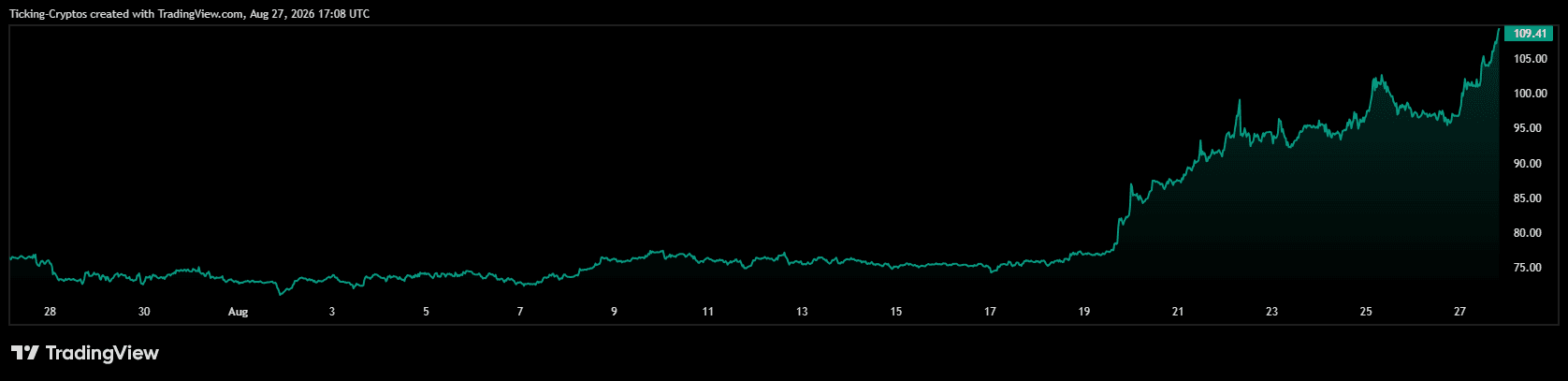
How far has Solana actually run?
$SOL has gained roughly 46% since mid-August, rising from near $75 to above $109.
The move has three distinct phases visible on the chart. Through late July and the first half of August, SOL held a tight range around $75, drifting slightly lower into the 7 August low. From 9 to 18 August it ground upward to about $78, still without much conviction. Then on 19 August the character of the move changed completely: an almost vertical leg carried SOL from the high $70s into the $90s within days.
That third phase is what most traders are reacting to. The 7-day gain sat at 31.87% as of 25 August, with a 30-day move near 35.6%. Both figures are now higher after today's push.
It is worth being precise about what got broken. SOL briefly touched $102.88 on 26 August and was immediately rejected, falling back to the mid-$90s while leveraged longs took $17.51 million in liquidations in a single day. Resistance around $102.70 marked a 13-week high. Today's move through $109 is the second attempt at that level, and this time it held.
Is Solana really outperforming Bitcoin?
Yes, on both the weekly and monthly view, though the gap is narrower than it feels.
Over the seven days to 25 August, Solana rose about 27% against Bitcoin's 23%. On 26 August, SOL gained 1.5% while $Bitcoin lost 0.2% and slipped back below $79,000. Today's move widens that spread further.
The nuance worth holding onto is that this is not capital leaving Bitcoin for Solana. On 24 August, US-listed Bitcoin, Ether, Solana and Hyperliquid products drew nearly $192.6 million in combined demand. Bitcoin ETFs alone took $208.9 million that day, following roughly $1.6 billion the previous week. Both assets are absorbing inflows at the same time.
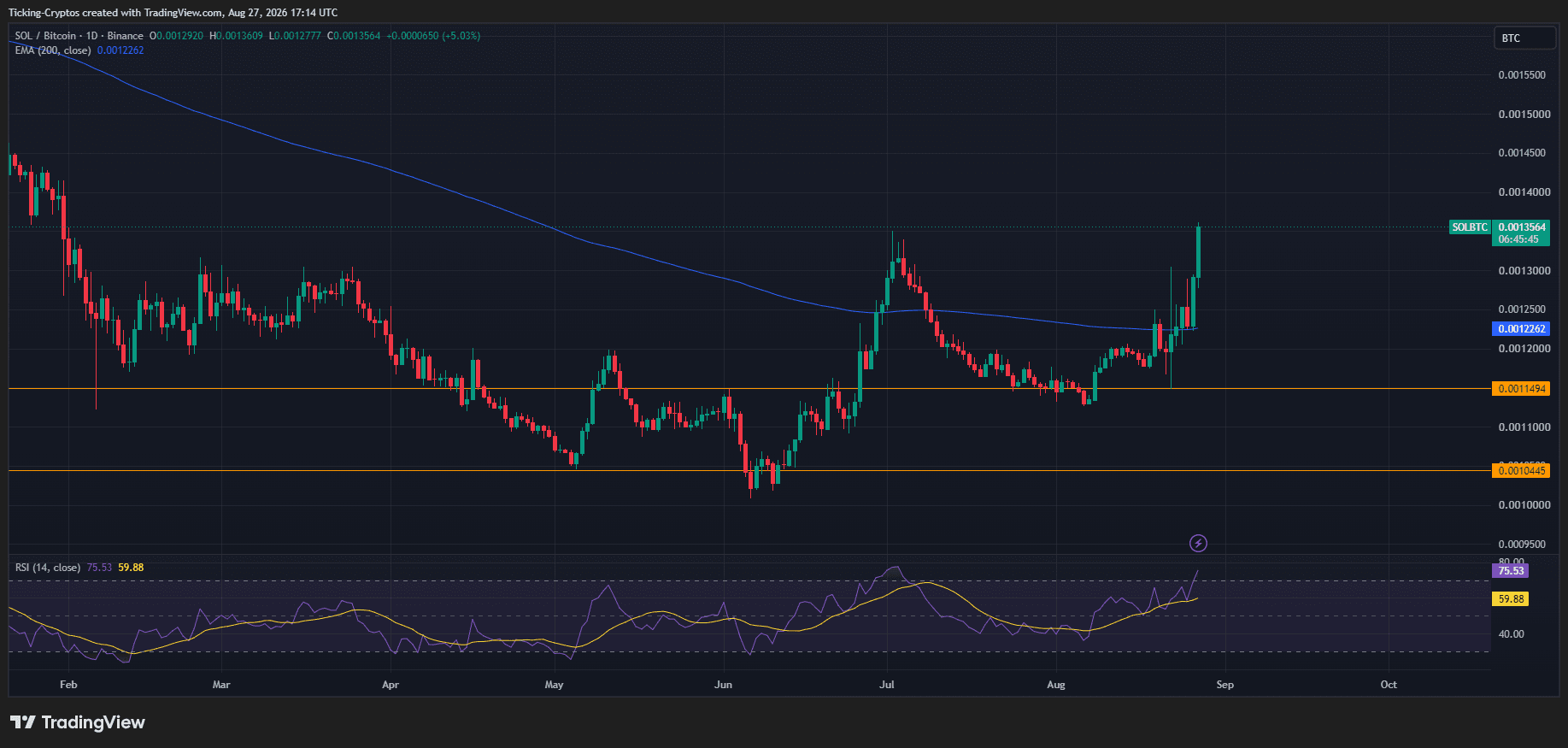
That distinction matters for how you read the ratio. A genuine rotation means money moving out of one asset and into another. What is happening here looks more like fresh capital arriving across the board, with Solana capturing a disproportionate share of it relative to its size. The outperformance is real. The rotation framing is not, at least not yet.
What did the governance vote actually decide?
Three proposals went to a stake-weighted vote between 22 and 27 August, two of which would tighten SOL supply meaningfully.
This is the substance behind the price move, and it is the part most of the commentary is skipping.
- SGP-0001, the Solana Constitution. Ratifies a canonical governance framework and activates Solana's on-chain governance system, svmgov.
- SGP-0002, faster disinflation. Doubles the annual disinflation rate from 15% to 30%. Under SIMD-0550, this would cut future issuance by roughly 18.9 million SOL over six years, worth around $1.7 billion at current prices.
- SGP-0003, fee restructuring. SIMD-0553 proposes a fixed inclusion fee of 2,500 lamports per transaction, with a resource component scaling to computational demand and burned rather than paid out. This could lift daily burns from roughly 648 SOL toward 9,000, close to a fourteenfold increase.
Two caveats deserve more weight than they are getting. First, an approving vote only green-lights development. Technical implementation, testing and on-chain activation all follow separately through the SIMD process, so nothing changes about SOL's supply the moment the vote closes. Second, Solana Company, listed on Nasdaq as HSDT, backed the constitution but voted against both the faster disinflation and the fee changes. When a major stakeholder splits its vote that way, the supply-shock narrative is less unanimous than the price action suggests.
Do the three technical claims hold up?
Partly, and one of them cuts both ways.
Three claims are circulating alongside this move: that SOL/BTC hit a seven-month high, that RSI broke out of a five-year downtrend, and that SOL bounced from support held since 2021. All three come from chart reading rather than reported data, so treat them as one analyst's interpretation rather than established fact.
The SOL/BTC observation is directionally consistent with the price data. At $109.41 against Bitcoin near $79,000, the ratio sits around 0.00138, and SOL last traded above $100 in February 2026. Whether that constitutes a clean seven-month high depends on where you measure Bitcoin, and we have not independently verified the exact reading.
The support claim rests on a trendline drawn from 2021. SOL/BTC has been in a broad downtrend since mid-2021, so a bounce from a level with that much history would be meaningful if it holds. It also cannot be confirmed from reported data, and trendlines drawn across five years are unusually sensitive to where you place them.
The RSI claim is the one that needs care, because it points in two directions at once. A breakout from a long-term RSI downtrend is a momentum signal. But the same indicator on the 14-day timeframe recently read 84.31, and touched roughly 79 during the 26 August rejection. Both readings are deep in overbought territory. Anyone citing RSI as evidence of strength here should also be citing it as evidence of exhaustion, because it is the same number.
Is the ETF bid real money?
This is the most solid part of the case, because it is reported rather than inferred.
US spot Solana ETFs took $33.5 million on 24 August, the largest single-day inflow since December 2025 and the biggest of the year to date. That extended the streak to five consecutive sessions and pushed cumulative net inflows to a record $1.22 billion.
The on-chain picture supports it. Solana processed 4.2 billion transactions in July. Stablecoins on the network sit around $15.94 billion, with weekly DEX volume near $19.74 billion, and tokenized assets on Solana are approaching $4 billion. Galaxy Digital launched SOL-backed lending on 26 August, letting holders borrow against staked SOL without selling, which adds a channel for holding rather than rotating out.
Corporate treasury demand is present too. Forward Industries holds over 6.9 million SOL and runs its own validator.
What could break this?
The overbought reading, the gap between voting and shipping, and Bitcoin itself.
The most immediate risk is positioning. An RSI in the 80s after a 46% run is the textbook setup for a sharp unwind, and yesterday's $17.51 million in long liquidations showed how quickly it happens when a breakout fails. The first attempt at $102.88 was rejected within hours.
The second risk is the gap between a vote passing and supply actually changing. If traders bought a supply shock that will not touch circulating SOL for months, the catalyst is spent while the fundamentals are unchanged. Votes that only authorise development are the easiest kind to overprice.
On the downside, the levels to watch are $94.42, the 23.6% Fibonacci retracement, then $88.18, and the 200-day EMA near $81.15 below that.
The third risk is the one nobody controls. Bitcoin needs to hold the $75,000 to $76,000 zone. High-beta assets that have run 46% do not fall proportionally when the market turns, they fall harder, and SOL currently carries elevated funding. Fed Chair Kevin Warsh delivers his first Jackson Hole keynote on 28 August, which puts a macro event directly in front of a heavily positioned market.
Solana is outperforming Bitcoin, and unlike most claims of that kind this month, it has identifiable reasons behind it: record ETF demand, genuine network usage, and a credible supply argument. Whether the outperformance survives contact with an overbought chart and a governance process that has only just begun is a separate question.
Decrypt
BTC gave back some of its gains after Fed Chair Kevin Warsh talked tough on inflation, but prediction market traders are still leaning bullish.
The company says it needs more skilled workers as its AI infrastructure expands, but employees fear automation could reduce or eliminate some roles.
Evernorth has gained SEC clearance, teeing up a shareholder vote on its Nasdaq listing—while the firm's XRP stash sits well below what it paid for it.
Austin is the latest city to consider restrictions as communities challenge the water and electricity demands of AI infrastructure.
The "Double Disinflation" proposal squeaked through by a razor-thin margin after Kraken nearly sank it, while a separate fee-burning measure failed.
U.Today - IT, AI and Fintech Daily News for You Today
Cybersecurity researchers have uncovered 19 malicious Chrome and Edge extensions capable of stealing crypto wallet secrets.
XRP has come under renewed selling pressure after Federal Reserve Chair Kevin Warsh delivered a notably hawkish message on inflation during his first Jackson Hole speech.
Michael Saylor has responded to a viral AI-generated video featuring Fundstrat co-founder Tom Lee with a video of his own, using the joke to double down on his long-standing Bitcoin maximalist stance.
Lazarus Group moves $19.4 million in dormant Bitcoin, leaving the market guessing if this sudden North Korean transfer is enough to trigger a crash.
Shiba Inu has slowed down on its recent price rally as selling pressure appears to be mounting again, suggesting that investors may be taking profits.
Blockonomi
Key Highlights
- PayPal plunged approximately 12% following the breakdown of acquisition discussions with Advent International and Stripe
- Marvell declined more than 8% even after increasing guidance, with AI chip revenue timeline extending to fiscal 2029
- Gap rallied following an upgraded annual profit forecast and announcement of new Old Navy leadership
- Fed Chair Kevin Warsh indicated September rate increase probability now stands at approximately 55%
- Broadcom emerges as the critical next indicator for AI infrastructure investor sentiment
Markets wrapped up the trading week with a volatile combination of collapsed deals, earnings-driven volatility, retail sector strength, and hawkish monetary policy signals.
PayPal Plummets Following Buyout Breakdown
PayPal experienced a decline of roughly 12% following news that a buyer group spearheaded by Advent International alongside Stripe terminated their acquisition pursuit of the digital payments platform.
The consortium had allegedly proposed an acquisition price near $60.50 per share, which would have valued the company at over $53 billion.
Sources indicate that funding challenges and regulatory hurdles played significant roles in the transaction’s collapse.
Without the acquisition premium supporting the stock, PayPal’s leadership now faces renewed scrutiny to demonstrate standalone growth potential and margin expansion.
Marvell Declines Despite Upgraded Outlook
Marvell Technology saw shares fall over 8% despite delivering better-than-expected results and increasing forward guidance.
The problem centered on revenue timing. Market participants had anticipated that the company’s Google custom AI chip partnership would deliver substantial revenue more quickly.
Company executives indicated that significant financial contributions from this arrangement might not materialize until approximately fiscal 2029.
This timeline disappointment triggered the selloff despite robust demand signals across networking products, custom accelerators, and data center solutions.
The market’s response highlights the elevated expectations surrounding AI-linked equities. Superior quarterly performance isn’t sufficient when anticipated future expansion is already incorporated into valuations.
Gap Climbs on Financial Upgrade and Management Appointment
Gap shares jumped following an increased full-year earnings forecast and the appointment of seasoned retail executive Michael Francis to lead Old Navy, the company’s flagship division.
The Gap nameplate delivered comparable sales growth of roughly 10%, while the corporation elevated its annual profit expectations.
Old Navy has represented the underperforming segment of the brand portfolio. Market participants are optimistic that experienced leadership can bridge the performance gap between the brand’s capabilities and recent results.
This management transition represents a crucial evaluation of whether the company-wide revival strategy can extend successfully across all divisions.
Fed Chair Warsh Leaves Door Open for Additional Tightening
Federal Reserve Chair Kevin Warsh utilized his Jackson Hole speech to maintain optionality for additional interest rate increases should inflationary pressures persist.
Trading activity adjusted to reflect approximately 55% probability of a September rate increase, climbing from about 40% preceding the remarks.
Treasury yields and the dollar strengthened. Gold prices retreated.
Elevated interest rates create headwinds for premium-valued growth equities, and forthcoming inflation and employment data will carry heightened significance following Warsh’s messaging.
Broadcom Represents Critical AI Barometer
Following earnings releases from Nvidia and Marvell, market attention shifts to Broadcom and its forthcoming financial disclosure.
Broadcom occupies a strategic position in AI infrastructure investment themes, with business lines spanning custom silicon, networking solutions, and hyperscale cloud provider relationships.
Market participants are seeking confirmation that AI capital investment from leading cloud platforms remains resilient.
A robust Broadcom report could alleviate apprehension generated by Marvell’s post-earnings decline. A disappointing outcome could amplify investor caution regarding AI sector valuations.
The upcoming employment report also commands attention as markets conclude a week characterized by Nvidia results, AI infrastructure spending trends, and Federal Reserve policy signals.
The post Market Movers: PayPal (PYPL) Tumbles on Failed Buyout, Marvell (MRVL) Disappoints, Gap (GPS) Shines appeared first on Blockonomi.
Key Takeaways
- The Wall Street Journal reports that Nvidia has suspended its revenue-sharing financing initiative with artificial intelligence cloud providers.
- Introduced fewer than eight weeks ago, the initiative provided financial support to smaller AI cloud enterprises in return for a percentage of their earnings.
- Internal staff members expressed worries that the program might trigger regulatory antitrust investigations.
- The arrangement would have granted Nvidia half of cloud revenues generated above a predetermined benchmark.
- Nvidia maintains that the overarching business strategy remains active and is “continuing to develop.”
The semiconductor giant has suspended a financial arrangement that would have secured the company a portion of revenue from artificial intelligence cloud providers, according to a Thursday Wall Street Journal report.
NVIDIA Corporation, NVDA
The arrangement aimed to provide smaller AI cloud businesses with funding access for purchasing Nvidia’s semiconductor products. As compensation, Nvidia would receive a percentage of the cloud earnings those semiconductors enabled.
The Journal indicated that Nvidia withdrew from these arrangements last week. The chipmaker may potentially restructure the initiative or integrate it into another offering in the future.
This development follows barely eight weeks after Nvidia unveiled the initiative. The company’s shares (NVDA) maintained their recent trading range when the report emerged late Thursday.
Program Structure and Mechanics
The business model involved Nvidia selling processors to cloud clients and subsequently leasing back excess computing power if those clients failed to sell it independently. This arrangement provided cloud companies with a reliable purchaser and simplified their ability to secure financing for chip acquisitions.
Nvidia would profit from both the initial hardware transaction and from receiving half of cloud income generated by Nvidia-equipped infrastructure exceeding a specific threshold.
During this week’s earnings discussion, Nvidia indicated the framework possessed the capacity to generate revenue in the billions throughout the medium and long-term timeframe.
However, the initiative encountered resistance from its inception. Nvidia allegedly instructed cloud providers they could exclusively lease processors to vetted clients. The company also advocated for distributing capacity among several smaller companies instead of concentrating it with a single major customer.
Certain prospective partners resisted this degree of oversight.
Internal Regulatory Warnings
Several Nvidia staff members alerted existing and prospective clients that the program might attract regulatory antitrust examination. The Journal emphasized the delicate issues surrounding how extensively a chip manufacturer can control its customers’ operational practices.
Investor examination has intensified as Nvidia expands its financial involvement throughout the artificial intelligence sector. Detractors have suggested the possibility of self-referential transactions that might artificially boost demand for Nvidia semiconductors.
Earlier this month, Nvidia facilitated $500 billion in credit from prominent American financial organizations for its clientele. The company also committed to backing up to $105 billion to assist OpenAI in leasing a substantial data facility.
An Nvidia spokesperson stated: “The new business model that opens up compute access to the fast-growing AI ecosystem is still in place and continues to evolve due to high demand.”
The Journal referenced individuals with knowledge of the situation for its coverage. Nvidia has not publicly acknowledged the suspension beyond the provided statement.
The post Nvidia (NVDA) Halts AI Cloud Revenue-Sharing Initiative Amid Regulatory Worries appeared first on Blockonomi.
TLDR
- Amazon stock climbs as AWS revenue surges 37% and AI spending continues to expand
- Amazon raises AI spending as AWS revenue reaches $42.2 billion in the second quarter
- Amazon’s AI and chips businesses each exceed a $25 billion annual revenue run rate
- Amazon stock holds near $265 as $267.50 remains the key resistance level
- Amazon’s heavy AI spending pushes free cash flow into negative territory
Amazon (AMZN) stock rose 3.49% to $265.21 during Friday’s trading session as strong buying pushed shares above $260 and toward $267.50 resistance. The move placed the stock near $265, while $262.50 and $260 remained key support levels for the day. Meanwhile, Amazon’s expanding AI spending coincides with faster AWS growth and rising revenue from its AI and chip businesses.
Amazon.com, Inc., AMZN
Amazon Expands AI Infrastructure Spending
Amazon spent $131 billion on capital expenditures in 2025, compared with $83 billion in 2024. The company initially projected about $200 billion in 2026 capital spending, but later raised that figure to nearly $220 billion. Consequently, the company could spend as much as $628 billion through 2028 as it expands computing capacity and related infrastructure.
The higher spending has reduced Amazon’s free cash flow despite strong operating cash generation. Amazon generated $161.4 billion in operating cash flow during the 12 months ended June 30, while free cash flow fell to negative $7.6 billion. However, the spending supports data centers, chips, networking equipment, and other infrastructure needed for cloud and AI services.
Amazon has also linked much of its 2026 AWS capital spending to customer commitments. Therefore, the company expects much of that capacity to generate revenue during 2027 and 2028. This approach connects the infrastructure buildout with existing demand for cloud computing and AI capacity.
AWS Revenue Accelerates With AI Demand
AWS revenue increased 37% year over year to $42.2 billion in the second quarter. The increase marked AWS’s fastest growth rate in 18 quarters, while AWS operating income reached $16.6 billion from $10.2 billion. Amazon said its AI and chips businesses each exceeded a $25 billion annual revenue run rate.
The AWS results show stronger demand alongside Amazon’s higher infrastructure spending. Moreover, the cloud unit continues to provide a major source of operating income as Amazon expands its AI capabilities. The company’s infrastructure investments therefore support services that already generate substantial sales and operating earnings.
Amazon’s retail business also uses AI to influence product discovery and shopping activity. In an online retail survey, 57% of Alexa AI users reported purchasing a product they previously did not know about. Consequently, Amazon’s AI tools can affect product discovery while the company expands its broader AI infrastructure.
The latest figures connect Amazon’s stock performance with stronger cloud growth and expanding AI-related operations. However, negative free cash flow remains a direct result of the company’s heavy capital spending. Amazon’s $265.21 share price reflects a strong move above $260, while $267.50 remains the nearest stated resistance level.
The post Amazon (AMZN) Stock:AI Investment Gains Momentum as AWS Revenue Surges appeared first on Blockonomi.
Key Takeaways
- Shares of Take-Two (TTWO) jumped 2.6% to $239.93 on Friday following the third GTA VI trailer launch
- A 26-minute gameplay trailer premiered exclusively on Netflix before becoming available on YouTube later that day
- Rockstar Games confirmed November 19, 2026 as the official release date for the first new GTA title in over thirteen years
- J.P. Morgan maintained its Overweight rating and set a $310 price target through December 2027
- Internet search activity for “GTA VI” surged 200%, exceeding 200,000 queries on Friday morning
Shares of Take-Two Interactive (TTWO) advanced 2.6% to reach $239.93 during Friday’s session after Rockstar Games unveiled the third official trailer for Grand Theft Auto VI. The gaming stock had closed at $233.00 on Wednesday before pre-market trading lifted it to $239.50, marking a 2.79% increase.
Take-Two Interactive Software, Inc., TTWO
The extensive 26-minute gameplay trailer premiered exclusively on Netflix’s platform Thursday afternoon before expanding to YouTube for wider distribution that same evening. Showcasing PlayStation 5 gameplay footage set in Vice City—the franchise’s fictional Miami-inspired location—the trailer officially announced the November 19, 2026 release date.
The timing proved beneficial for Take-Two. The company had experienced approximately $2.83 billion in market capitalization losses after unauthorized gameplay footage surfaced online on August 18. Thursday’s official presentation effectively helped restore investor confidence.
Online search interest for “GTA VI” jumped 200% on Friday morning, surpassing 200,000 queries according to Google Search trends, demonstrating substantial public engagement with the new trailer.
Wall Street Weighs In
J.P. Morgan’s Bryan Smilek indicated the latest trailer should amplify consumer interest in the upcoming release. He highlighted the strategic value of the Netflix collaboration, noting its “extensive reach and subscriber base” could stimulate pre-launch orders. Smilek maintained his Overweight rating alongside a December 2027 price objective of $310.
Morgan Stanley’s Matt Cost anticipates “investor excitement” surrounding the game will drive share price appreciation. He referenced historical data showing publisher stocks typically gained approximately 13% during the three-month period preceding major game releases.
Current analyst consensus price targets range from $270 to $313, suggesting approximately 24.5% potential upside from recent trading levels. The optimistic scenario assumes 37 million units sold during FY2027 at an $80 retail price point.
Financial Performance Context
Take-Two’s financial metrics show positive momentum. Free cash flow shifted from negative $235 million in FY2025 to positive $434 million in FY2026. Total revenue expanded from $5.35 billion in FY2024 to $6.66 billion in FY2026. Net profit margins, though still negative at -4.5%, demonstrate meaningful improvement.
Wall Street consensus projects Q3 FY2027 revenue—the period encompassing GTA VI’s release—at $3.38 billion. This represents a significant jump from the company’s standard quarterly revenue range of $1.7 to $2.0 billion.
Investment considerations include Take-Two’s $2.94 billion debt load. The company’s EV/EBITDA multiple of 58.3x reflects expectations of flawless execution. FinQL’s valuation analysis estimates intrinsic value at $203.70, approximately 12.6% below current market prices.
Grand Theft Auto VI was initially scheduled for release last autumn before delays pushed it to May 2026, and subsequently to the current November 19 date. The previous mainline GTA entry launched in 2013.
Despite sustained GTA VI anticipation throughout the market, the stock has remained relatively stagnant over the past twelve months, declining 0.8%.
The post Take-Two Interactive (TTWO) Stock Jumps Following GTA VI Netflix Trailer Release appeared first on Blockonomi.
TLDR:
- Core Lightning 26.06.7 fixes multiple vulnerabilities while technical details remain under a 14-day embargo.
- Developers urged every Core Lightning node runner to upgrade immediately and avoid waiting for Docker images.
- AI-generated vulnerability reports increased the volume and pace of security findings across open-source Bitcoin projects.
- Signed binaries let operators upgrade and verify releases before full vulnerability details become publicly available.
Core Lightning has released version 26.06.7, urging every node runner to upgrade immediately. The update fixes multiple vulnerabilities reported during the past three weeks.
Developers will keep technical details and source code private for 14 days. The embargo aims to prevent attackers from exploiting unpatched nodes before operators complete upgrades.
Core Lightning Security Update Starts Two-Week Embargo
The release arrives amid a rise in AI-generated vulnerability reports targeting open-source Bitcoin projects.
According to Core Lightning, increasingly capable AI models have increased both the volume and pace of security reports.
The development team received and triaged several vulnerability reports from multiple sources. Developers then resolved the issues before compiling the emergency point release.
Core Lightning said it withheld technical details because attackers could reverse-engineer the fixes. That process could expose node operators who delay their upgrades.
The embargo will last 14 days from the release. Developers will publish the full vulnerability details and source code afterward.
Core Lightning previously warned operators about the upcoming security release. Blockonomi reported that developers had received several AI-generated reports within a 10-day period.
The earlier report also said developers planned to distribute signed binaries before publishing source-level details. No confirmed fund losses or active exploitation had been reported.
The latest release now puts that plan into action. Node runners can access the binaries while developers maintain the temporary disclosure restrictions.
Core Lightning 26.06.7 is out and recommended for every node runner.
It fixes vulnerabilities reported over the past three weeks, during a sharp rise in AI-generated reports across open source Bitcoin. Details stay under embargo for two weeks, then all published.…
— Core Lightning
(@Core_LN) August 28, 2026
Core Lightning 26.06.7 Upgrade Instructions Target Node Runners
Core Lightning has told all node runners not to delay the upgrade. The team specifically warned users against waiting for Docker images.
Docker images were unavailable when the release launched. Developers instead directed operators to use the available tarballs for immediate upgrades.
The upgrade process requires downloading and verifying the appropriate platform tarball. Operators then unpack it over their existing installation and restart lightningd.
Core Lightning said the update requires no manual database migration. The software automatically handles the required migration steps during startup.
The release also includes signed manifests for binary verification. Operators can check file integrity through checksums and verify signatures with GPG.
The project listed separate signed files for amd64 and arm64 builds. Maintainers provided signing fingerprints to help users verify authentic releases.
The security update follows a broader period of change for Bitcoin’s Lightning Network. Blockonomi reported Lightning capacity had fallen to 3,998 BTC from 5,891 BTC in December 2025.
That represented a 32.1% decline during the period. Meanwhile, Core Lightning’s latest stable public release before this update was version 26.06.6.
Version 26.09 remains scheduled for September, according to the earlier report. For now, version 26.06.7 remains the immediate priority for Core Lightning node operators.
The post Core Lightning Security Update Urges Immediate Node Upgrade appeared first on Blockonomi.
CryptoPotato
Most leading cryptocurrencies have posted minor gains or losses over the past 24 hours, suggesting the broader market has consolidated after recent turbulence.
However, Official Trump (TRUMP) has defied the ongoing calm after pumping by double digits within the timeframe. Check out what triggered the move and whether this is the start of a major bull run.
‘Big Manipulation’ Ahead?
The meme coin briefly touched $2.90 before retreating to the current $2.75 (per CoinGecko), representing a roughly 20% daily increase. Its market capitalization has surged to almost $700 million, making it the 90th-largest cryptocurrency and the sixth-biggest in its niche.
The most obvious catalyst for the rally appears to be the announcement that Official Trump will make an appearance at Korea Blockchain Week (a major blockchain event taking place between September 29 and October 1 in Seoul).
According to numerous analysts, the meme coin may chart much more substantial gains in the near future. X user Cyriptoman4 noted that the price hasn’t broken the $3-$3.15 resistance level yet, envisioning a rally above $10 if it stays persistently above the upper boundary.
Crypto Patel claimed the asset has decisively broken out of the crucial zone at $2.055, arguing that if this level holds as support, it could open the door to a parabolic surge toward $15.
“TRUMP is already up 160% from the bottom in just 10 days. Don’t chase the green candle. Wait for a healthy retracement and let price come to you,” the analyst added.
X user Crypto with Haris ₿ also gave his two cents on the matter, forecasting a price explosion for the meme coin to $20 before Donald Trump steps down as the President of the United States.
The token saw the light of day right before his inauguration in January 2025 and entered the space with a storm. At one point, its price skyrocketed to nearly $70, while its market capitalization soared past $14 billion. Thus, TRUMP briefly became the second-largest meme coin after flipping Shiba Inu (SHIB). Since then, though, the token has experienced a massive overall downfall, currently trading 96% below its historic peak.
Is It a Scam Token?
“Real values of TRUMP lie below $1 and MELANIA below $0.01,” he concluded.

- TRUMP Holders Distribution, Source: CoinMarketCap
The post Meme Coin TRUMP Soars 20% Daily After a Major Announcement: What Are the Next Targets? appeared first on CryptoPotato.
Bitcoin and Ethereum have picked up momentum over the past two weeks after months of choppy prices. Both posted significant gains during this period, and their rise has brought fresh movement to the market.
But data highlighted contrasting exchange inventory trends between the world’s two largest cryptocurrencies.
Different Exchange Trends
According to Santiment’s latest findings, there is a clear divergence in exchange balances for Ethereum and Bitcoin since June. ETH balances on exchanges fell by roughly 1.4 million coins during the period, from about 7.69 million on June 3 to 6.28 million on August 27. The outflow continued even as the leading altcoin’s price climbed. Another 275,000 coins were withdrawn after August 19, which pushed exchange holdings to their lowest level.
ETH has gained about 30% since August 16, indicating that the withdrawals happened during the price rise rather than a decline.
Bitcoin, on the other hand, moved in the opposite direction over the same 12 weeks. Santiment found that exchange balances increased by around 0.25% and remained near the upper end of their recent range. Its price, meanwhile, rose by 26%.
The relative strength has led to a bullish outlook from crypto analyst Credible Crypto, who believes Ethereum could reach $20,000 in the next few years. His thesis is based on the altcoin’s five-year trading range, its weaker performance against BTC, and the potential for capital to rotate into higher-risk assets.
Speaking on the No Bs Crypto podcast, Credible Crypto explained that ETH has traded between roughly $1,500 and $5,000 for about five years, and has reached both ends of the range several times. He considers $10,000 a basic target, as doubling the previous range high near $5,000 would take the asset to that level. A larger expansion of the range could push the price to $8,000 or $9,000 before other factors are taken into account.
This target depends heavily on Bitcoin’s performance. If it stays around $80,000 and the ETH/BTC ratio returns to its previous high of 0.156, he expects the altcoin to rise above $12,000. A BTC price of $100,000 would put ETH above $15,000, while a move beyond Bitcoin’s previous high near $126,000 could take Ethereum to $20,000 or higher.
Nine-Day Inflow Streak
On the institutional side, CryptoPotato previously reported that institutional demand has reached its strongest level since October 2025 for US-based spot Bitcoin and Ethereum ETFs. The funds have recorded nine consecutive days of inflows.
BTC funds have attracted more than $3.5 billion in capital so far, while ETH products have secured $1.66 billion.
Meanwhile, if you want to check out some major Ethereum predictions, you can take a look at our video below.
The post 1.4M ETH Gone From Exchanges Since June as BTC Moves in Reverse appeared first on CryptoPotato.
Just a few days ago, Ripple’s cross-border token jumped to a multi-month high of around $1.70 but later retreated to the current 1.42.
The move south hasn’t changed the predominant bullish tone across analysts on X, as some expect a price explosion in the near future. Here are some of the most optimistic (and even ridiculous) targets.
Giant Surge on the Way?
X user JAVON MARKS, who bragged about successfully calling XRP’s bull run in the past, returned with another big prediction. The analyst claimed that the asset’s current structure is showing signs of a breakout from a smaller bullish wedge/flag formation, which could initiate a major continuation above the all-time high and open the door to a rally towards $15. The market observer said this is “a measured-move target” and reminded of what happened nine years ago.
“After breaking out of a much larger structure in 2017, XRP reached a similar measured-move objective before going on to greatly exceed it. Today, XRP is holding a breakout of an extremely similar larger structure,” they stated.
The analyst believes that if the ongoing structure holds and the smaller formation confirms its breakout, the asset’s valuation could indeed rocket to the aforementioned peak, representing a nearly 1,000% increase from current levels.
Amonyx is also highly optimistic, envisioning a pump to $20 and “there’s nothing anyone can do about it.” It is important to note that such an astronomical surge would require XRP’s market cap to jump beyond $1 trillion. As of press time, only the market’s undisputed leader, Bitcoin (BTC), has a higher market capitalization, making the forecast a bit far-fetched (to say the least).
$15 and $20 may sound like implausible targets (for the moment), but Ripple’s token may indeed head north in the short term, considering the solid institutional interest. Last week, spot XRP ETFs saw their best week since May, while the positive performance continued. Data show that these products have posted eight consecutive green days; the last time this was observed was at the very start of the year.

Major Walls Ahead
According to X user CW, the bulls might struggle to initiate a new leg up since the sell wall near $1.49 “remains solid.” Shortly after, the analyst claimed that XRP failed to break through the “point of control” once again, arguing that the biggest resistance blocked the rise.
“$1.4692 and $1.53 are currently the biggest resistance levels. To rise, these two lines must be broken,” they added.
The post Crazy Ripple Prediction: Is XRP Preparing for a 1,000% Explosion? appeared first on CryptoPotato.
Crypto analyst Sykodelic says Bitcoin has now cleared roughly 80% of the technical conditions needed to confirm that its recent low is in, with the final answer likely to arrive in the next few days as the weekly and monthly candles close.
Whether BTC can close above $82,700 in that window will decide if the bottom has locked in for good or if there is still room for one more drop toward $75,000 first.
Where the Confirmation Case Stands
In a post on August 28, Sykodelic laid out which boxes have already been checked. For one, Bitcoin has reclaimed the $67,000 local structure level and the $74,400 higher-timeframe structure level.
It has also moved back above its daily 200 SMA and EMA, reclaimed its weekly 50 EMA, and pushed its daily RSI above 85, something the analyst says never happens during a bear-market bounce.
What is still missing is a weekly close above the 50 SMA at $82,000, a weekly close above the Supertrend line at $79,000, a higher low set above $82,700, and a monthly close above $76,463.
“Bitcoin has put in 80% of the data needed to confirm the low,” Sykodelic wrote. “However, for this low to be undeniable, we need to close above $82,700.”
The analyst mapped out two paths from here: a push back above $82,000 this week could send price toward $90,000 quickly, while chopping below the aforementioned $82,700 could mean there’s still one more leg down to around $75,000 to go before that level eventually gets taken out.
In another post, the analyst added that he’d seen another bottom signal. Short-term holder MVRV Bollinger Bands have entered an overheated zone for the first time since November 2024. He pointed out that similar readings appeared near the ends of the 2018 and 2022 bear markets and described the latest reading as the third-largest in nine years.
He also described the broader setup as healthy on multiple fronts, with funding rates having eased even as prices pushed higher, open interest cooling off and stabilizing instead of piling on leverage, and the Coinbase premium turning positive for the first time in three and a half months. Additionally, spot volume has stayed strong throughout.
How We Got Here
Bitcoin broke above $65,000 roughly two weeks ago, as CryptoPotato reported, then ran to $70,000 within hours and touched almost $80,000 by that Friday before slipping to $75,500 over the weekend.
It found buyers there, climbed past $81,000 for the first time since mid-May, dipped back under $78,000, and has since recovered to trade just under $79,000. At the time of writing, the primary crypto was up by slightly over 1% in 24 hours and more than 5% across seven days, per CoinGecko data. It was also up nearly 24% over 30 days, although it is still about 36% below its October 2025 all-time high.
If you are interested in learning more about the current market rally and a major Bitcoin protection development, check out the video below.
The post These Four Signals Could Confirm if Bitcoin’s Low Is Locked In: Analyst appeared first on CryptoPotato.
Bitcoin’s rather stable price moves over the past day or so were disrupted after Kevin Warsh finished his speech at Jackson Hole, as the asset slumped by a few grand in an hour.
Its move south dragged many altcoins with it, resulting in over $200 million in liquidated positions at one point, according to data from CoinGlass.
BREAKING: Bitcoin falls -$3,000 in 60 minutes as $200 million worth of levered longs are liquidated. pic.twitter.com/6FuQCUnzeu
— The Kobeissi Letter (@KobeissiLetter) August 28, 2026
The primary cryptocurrency traded at around $79,500 before the speech began, dipped to $78,500 during, and returned to its starting point after its completion. However, the market reacted in the following hour or so, as it mimicked Wall Street.
During his first speech at the helm of the US Federal Reserve, Warsh remained hawkish while the markets expected him to follow the example set by US Treasury Secretary Scott Bessent.
Instead, he reaffirmed the Fed’s 2% inflation target and called it “firm and fixed.” He believes the current figures of around 3.7% remain too high.
Although there was no official confirmation that the central bank would hike the rates at the upcoming FOMC meeting next month, the odds on prediction markets increased.
Aside from BTC, most other large-cap alts turned red as well. Ethereum lost the $2,500 level after a 3% decline, while BNB slumped below $700. XRP has lost the most value from this cohort of assets, dumping by 5% to under $1.40.
Further losses are evident from ADA, XLM, and BCH. Bitcoin Cash has plunged by almost 9% daily to under $250.
In the video below, we discussed the potential impact of the Warsh speech on the markets.
The post Bitcoin Suddenly Dumped by $3K as Liquidations Hit $200M Hourly: Is the Fed to Blame? appeared first on CryptoPotato.


