Cryptocurrency Posts
Crypto Briefing
Russia's soaring military expenditure strains its fiscal stability, risking economic vulnerabilities and potential long-term financial instability.
The post Russia’s war spending hits record 10.7 trillion rubles in first half of 2026 appeared first on Crypto Briefing.
The Hegot upgrade's prioritization process highlights Ethereum's evolving governance, emphasizing decentralization and future-proofing.
The post Protocol Cluster releases Hegotá EIP tier list and priorities for Ethereum’s 2027 upgrade appeared first on Crypto Briefing.
The integration of major financial players into the tokenized RWA market signals a shift towards mainstream adoption, potentially revolutionizing financial infrastructure.
The post J.P. Morgan, Binance, Coinbase, Robinhood, and Revolut are reshaping the tokenized RWA market appeared first on Crypto Briefing.
The collaboration between Ledger and Trezor highlights the urgent need for industry-wide security standards as AI accelerates vulnerability exploitation.
The post Ledger and Trezor urge responsible disclosure of security vulnerabilities as AI threats mount appeared first on Crypto Briefing.
The Kremlin's openness to talks may signal a diplomatic shift, impacting geopolitical stability and market perceptions of conflict resolution.
The post Kremlin open to trilateral talks with US, Ukraine amid ongoing conflict appeared first on Crypto Briefing.
Bitcoin Magazine
Bitcoin Magazine

Alleged White-Hat Hackers Withdraw 4,000 bitcoin from Blockstream’s Liquid Network Federation Reserves
The Liquid Network said Sunday that purported white-hat hackers withdrew about 4,000 bitcoin, worth about $320 million, from the federation wallet that backs L-BTC. Bridge nodes were disabled, and the sidechain was paused. Other issued assets, including USDT, DePix and RWAs, were unaffected, the official account said on X.
The Liquid Network is a federated sidechain of Bitcoin, founded by Adam Back’s Blockstream. The Liquid chain issues a variety of assets such as LBTC, which it backs with BTC on the Bitcoin main chain, held in a large multisig of 15 corporate and known members. 11 of the 15 members need to sign a valid multi-signature transaction to move coins from the treasury. Before the hack, the treasury held over 4200 BTC; after the hack, Blockstream’s proof of reserves page reports a little over 207 BTC left.
The hackers withdrew 4,019.4 BTC from the reserve address in a peg-out transaction using the SideSwap Peg-out Authorization Key. SideWap is a bridge exchange and a member of the Liquid Federation. While details on the mechanism of the hack are not confirmed yet, it appears an inflation bug on the LBTC side chain was exploited by the hackers to create over 4,000 LBTC that did not exist before, and cash them out for on-chain bitcoin from the federation. Because the transaction appeared as valid, given the consensus bug, the federation members’ HSM security servers signed the BTC withdrawal transaction, worth roughly 320 million at the time.
The hacker moved the funds to an address ending in 6gyqjlte, from which they quickly signed a new transaction with a message on the OP_RETURN arbitrary data field saying “we are whitehats. contact us on chain.” Those coins were still at that address at the time of writing.
A small mainnet transaction to the hacker address followed by an OP_RETURN saying “Please contact security@blockstream.com”, presumably from a Blockstream public address, though that remains unconfirmed. A later OP_RETURN spend from the hacker address carried “Please contact us on Signal @m671aw.70”, however, this may be spam and does not share a link to the address with the stolen funds.
In response to the breach, exchanges were told to pause L-BTC deposits and withdrawals. Bridge nodes on the Liquid Network have been paused, limiting access to the side chain, which continues to produce blocks.
JAN3 CEO Samson Mow said Aqua’s Liquid features were affected and that on-chain bitcoin still worked. Other wallets in the industry that use the Liquid Network are expected to be affected. Users holding LBTC now effectively have their savings at risk, since the underlying BTC is currently not redeemable. Given the private nature of the Liquid chain, user onchain analytics are scarce and not much public information is known about how much LBTC is held by retail users versus corporations of Blockstream itself. Nevertheless, should the funds not be returned, it would be a heavy blow to the Liquid Network’s user base.
Users of LBTC don’t have many options but to wait for conversations with the hackers to resolve. Given the size of the hack, it would be difficult for the hackers to get away with stealing all that bitcoin, though perhaps not impossible. What may happen is that the hackers ask for a finder’s fee and return the majority of the funds.
This post Alleged White-Hat Hackers Withdraw 4,000 bitcoin from Blockstream’s Liquid Network Federation Reserves first appeared on Bitcoin Magazine and is written by Juan Galt.
Bitcoin Magazine
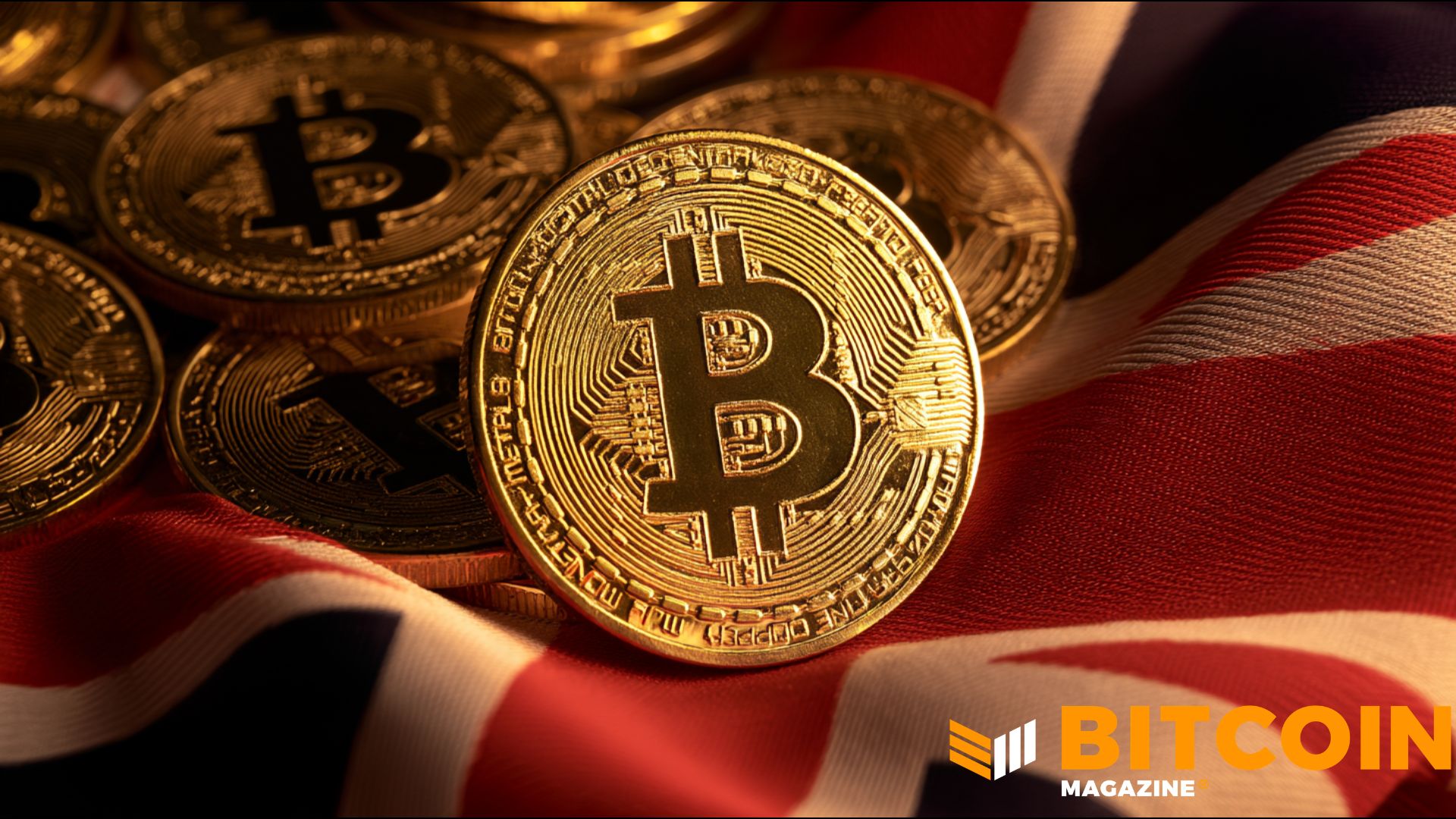
Hargreaves Lansdown Reverses Course, Rolls Out Bitcoin Trading
British financial services firm Hargreaves Lansdown is letting retail investors buy bitcoin — nearly one year after it said the cryptocurrency was “not an asset class.”
The Bristol, UK-based investment firm’s website said it was offering bitcoin and other crypto exchange-traded notes to investors. ETNs are investment funds which trade on stock exchanges and track the prices of digital assets.
It comes after the firm, which manages nearly £173 billion (over $233 billion) in assets, last year warned customers about buying bitcoin.
NEW:
— Bitcoin Magazine (@BitcoinMagazine) September 4, 2026U.K.'s largest investment platform Hargreaves Lansdown is now offering Bitcoin products to 2 million clients!
pic.twitter.com/GgdeHK8vyM
“While longer-term returns of Bitcoin have been positive, Bitcoin has experienced several periods of extreme losses and is a highly volatile investment — much riskier than stocks or bonds,” the firm said at the time.
“The HL Investment view is that Bitcoin is not an asset class, and we do not think cryptocurrency has characteristics that mean it should be included in portfolios for growth or income and shouldn’t be relied upon to help clients meet their financial goals.”
Now, a number of ETNs tracking the price of bitcoin and other cryptocurrencies are available. The firm warns users that “crypto ETNs are considered high-risk and may be volatile.”
U.S. regulator the Securities and Exchange Commission in 2024 approved bitcoin exchange-traded funds for investors after a decade of saying no to the products.
The funds had the most successful debut in the history of ETFs as investors previously unable to buy exposure to the asset class rushed in to buy the products.
Run by top asset managers and banks like BlackRock, Fidelity, and Morgan Stanley, the investment vehicles now collectively manage over $100 billion in assets.
This post Hargreaves Lansdown Reverses Course, Rolls Out Bitcoin Trading first appeared on Bitcoin Magazine and is written by Mathew Di Salvo.
Bitcoin Magazine
Trezor Breach Worse Than Reported: Another 67,000 US Customers Exposed
Hardware wallet manufacturer Trezor has said that a data breach first announced last month is worse than originally reported.
The Prague, Czech Republic-based company said Friday that an additional 67,000 U.S. customers had their names, emails, phone numbers, shipping addresses and order numbers leaked. The leaked data came from orders made between November 2019 and August 2021, according to Trezor.
Trezor first announced in August that data from 11,742 customers from the U.S., UK, Sweden, Colombia, Brazil, Italy, and Portugal had been exposed — with names, emails, phone numbers and shipping addresses leaked.
Another 1,947 customers just had their names, cities and emails exposed in the breach.
In Friday’s announcement, Trezor said that its third-party fulfillment partner, ShipMonk, had falsely reassured the company about deleting customer data.
“Throughout our entire relationship with ShipMonk, we repeatedly requested and received written assurance confirming the deletion of the data, in line with our contract, data policy, and past communications,” Trezor wrote.
“We are very disappointed that, despite receiving this confirmation, the data was not deleted in their systems.”
Neither Trezor nor ShipMonk immediately responded to Bitcoin Magazine’s questions.
Trezor first announced in August that the data had been leaked because ShipMonk experienced “unauthorized access to their systems containing customer data.”
The company added that it had directly emailed all customers involved in the breach. Trezor’s parent company, SatoshiLabs, told Bitcoin Magazine last month that it was investigating the incident.
Trezor is one of the most popular Bitcoin hardware wallet solutions, and also has support for storing other cryptocurrencies.
Bitcoiners’ personal data has been targeted by cybercriminals in the past: back in 2020, an unauthorized party accessed popular hardware manufacturer Ledger’s e-commerce and marketing database, leaking over 1 million email addresses and the personal contact data of nearly 10,000 customers.
At the start of this year, customers reported receiving emails from Global-e, Ledger’s payment partner, that a data breach at its cloud systems leaked sensitive customer data.
This post Trezor Breach Worse Than Reported: Another 67,000 US Customers Exposed first appeared on Bitcoin Magazine and is written by Mathew Di Salvo.
Bitcoin Magazine
El Salvador Isn’t Buying Bitcoin With Public Money, Says IMF
El Salvador has not used public funds to accumulate bitcoin since the International Monetary Fund’s last review of its loan program, the fund said Thursday.
In a report Thursday, the body said that the Central American country had instead received bitcoin from private donations, citing documentation from the government. It added that “no further Bitcoin accumulation beyond the documented donations is expected.”
El Salvador made headlines in 2021 when it became the first country in the world to make bitcoin legal tender. Salvadoran president Nayib Bukele in 2022 said the country would buy one bitcoin per day but it was never clear where the money was coming from — or if he was actually buying at all.
“Documentation has been provided verifying that Bitcoin accumulation since the first review reflects private donations and that no public resources were used,” the IMF release said.
“Understandings were also reached on steps to modernize the legal, regulatory, and supervisory framework for digital assets and to further strengthen the governance and risk-management arrangements for public-sector crypto-asset holdings. Going forward, no further bitcoin accumulation beyond the documented donations is expected.”
The report added that public participation in the government-sponsored bitcoin wallet has been largely wound down, with majority ownership and operational control handed to a private operator.
El Salvador in 2021 debuted a state-sponsored wallet called Chivo for its citizens as part of its plan to increase bitcoin adoption in the country.
“IMF staff thank the Salvadoran authorities for the constructive discussions and excellent collaboration,” the report added.
The IMF El Salvador entered a $1.4 billion loan agreement at the end of December but the fund asked for the country to scale back certain aspects of its bitcoin strategy.
Institutions like the World Bank and the IMF have long criticized President Bukele’s Bitcoin law, which also asked businesses to accept the cryptocurrency if they had the technological means to do so.
President Bukele in 2024 admitted that Salvadorans weren’t using the cryptocurrency to buy things as expected, but always boasted that the government was still stacking sats.
Since launching a crime crackdown to tackle the country’s notorious crime gangs, murder rates in El Salvador have plunged. The country was once the most dangerous place in the Americas but President Bukele is now trying to turn it into a tech hub.
Crypto companies like Tether have since relocated to its capital, San Salvador.
This post El Salvador Isn’t Buying Bitcoin With Public Money, Says IMF first appeared on Bitcoin Magazine and is written by Mathew Di Salvo.
Bitcoin Magazine
Bitcoin Dips Below $80,000 on Strong US Jobs Report
Bitcoin slid Friday after a better-than-expected labor report showed that the U.S. job market accelerated in August.
The leading cryptocurrency was recently trading for close to $79,764 after dropping as low as $78,706 earlier in the morning in New York. It’s currently down over 1% over a 24-hour period. On Thursday, the coin soared above $82,000.
The Federal Reserve is typically more likely to raise interest rates when the labor market is strong, because more people employed means more spending, and more spending can push inflation up.
Federal Reserve Chair Kevin Warsh last week gave his first major speech as head of the U.S. central bank and said he had “more work to do” to fight inflation. Bitcoin has typically done well in a low-interest rate environment.
Traders currently view a U.S. Federal Reserve interest rate hike at the upcoming September 15–16 policy meeting as roughly a 50% to 60% probability.
But U.S. President Donald Trump on Friday demanded the Federal Reserve slash interest rates.
Writing on his social media platform Truth Social, Trump said: “Lower the interest rates because the U.S.A. is a much stronger credit than it was just a short time ago!”
He added: “We should have the LOWEST RATE of any country in the World, like ‘the old days.'”
Bitcoin has decoupled from stocks recently as investors have renewed concerns around dollar debasement.
The cryptocurrency started surging last month, after the U.S. Treasury Department said it would more than double the size of its government debt repurchases. The coin had its best run in three years and third best August ever.
The much-talked about debasement trade is back in the spotlight, and bitcoin has been trading in lockstep with gold, according to analysts. The so-called debasement trade is when investors buy an asset as a way to hedge against a currency losing value.
News dropped last month that U.S. public debt exceeded $40 trillion for the first time too. Excessive debt also undermines confidence in the dollar, making assets like bitcoin and gold attractive.
This post Bitcoin Dips Below $80,000 on Strong US Jobs Report first appeared on Bitcoin Magazine and is written by Mathew Di Salvo.
CryptoSlate
A customer using a Solana payment channel can stop buying AI services before the channel has finished paying for them. If the operator goes silent in between, the customer needs a way to recover the remaining deposit, while the merchant needs its last bill to reach the blockchain before the recovery window closes.
That division of risk sits behind Solana Foundation’s Sept. 3 payment-channel announcement, which reported more than one million payments per second through a proxy using 100,000 unique wallets. The system lets agents spend against a prepaid ceiling through signed messages, reducing the need for a separate blockchain transaction for every delivery.
The customer funds the channel, the merchant supplies the service, and the operator runs the payment process. Each finances a different part of the interval between authorization and collection: customer deposits, operator advances of SOL for fees and refundable account rent, and merchant service awaiting on-chain payment.
A warning in the Foundation-linked benchmark template makes that interval consequential: restarting its default in-memory store can forfeit vouchers accepted but not yet settled.
The benchmark template reports about 1.09 million verified vouchers per second on a 128-core AVX-512 host during a sustained 10-minute run. It measures the payment gate returning a response without an upstream service. The result does not measure a million AI completions or independently settled mainnet transactions each second.
The gateway checks a signature and advances the channel’s cumulative spending record off-chain. That arrangement lets many small authorizations share the cost of on-chain operations. But the template says a deployment with durable session storage must be benchmarked separately because a durable write becomes part of the request path.
For a merchant, that distinction connects speed to recoverability. A fast acceptance record is useful for deciding whether to serve the next request. A surviving voucher is needed to support collection after a restart. The headline throughput figure does not establish the performance of both together.
The Foundation said Alibaba Cloud API endpoints were live at launch, and the program repository lists a mainnet deployment. The benchmark describes a test workload rather than measured commercial demand.
A refund has two routes
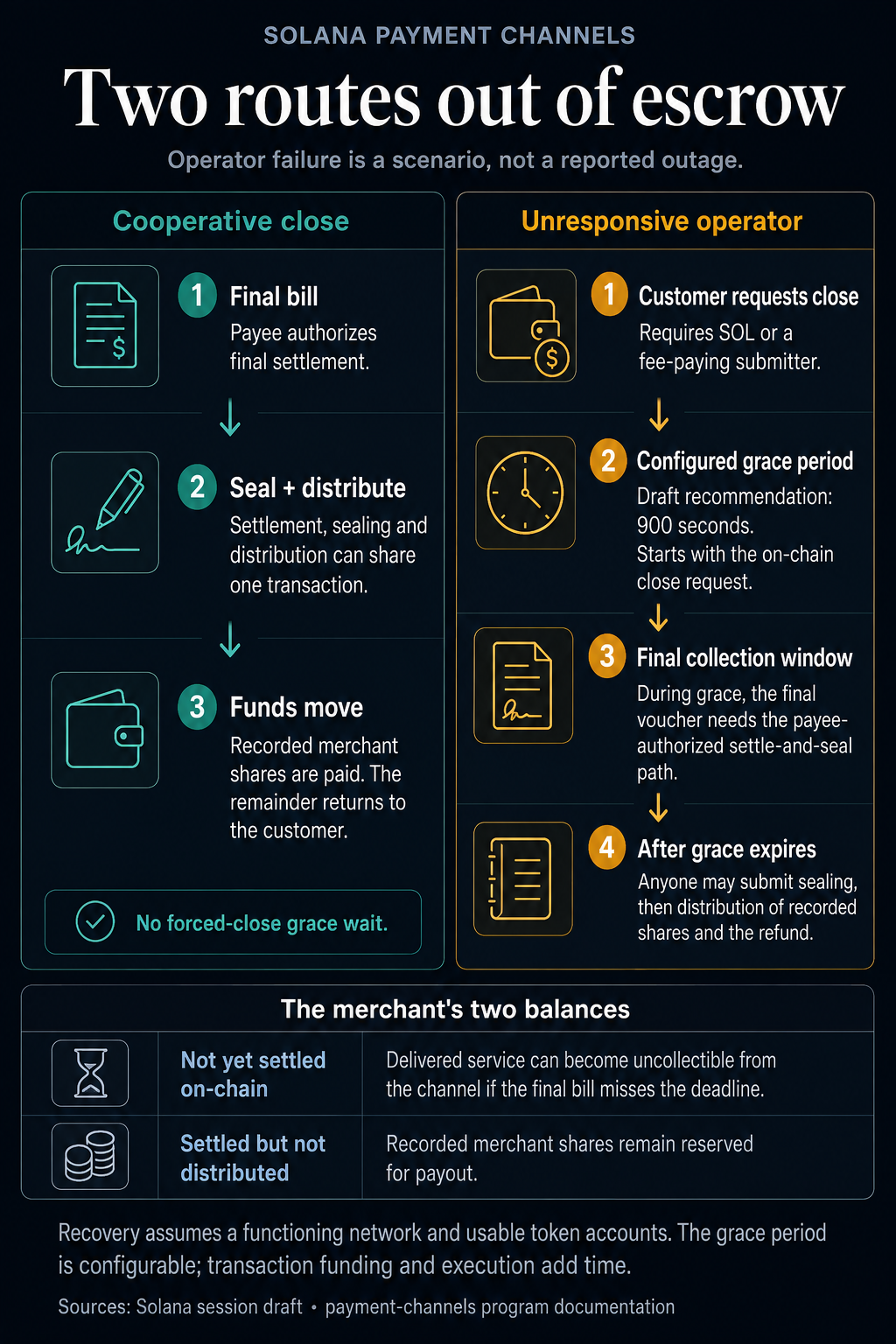
A payment channel starts with the customer depositing a ceiling into escrow held by the on-chain program. The program controls the balance and enforces its payment rules. Spending authorizations accumulate against that deposit, and closure provides a route back for the portion not recorded as settled.
When both sides cooperate, the designated payee, whose signature authorizes final closure, can submit final settlement, seal the channel and distribute the funds in a single transaction. Sealing freezes the settled total; distribution transfers the tokens. Merchant payout and customer refund can land together without a forced-close grace wait.
The September 3 session draft, a work-in-progress specification, describes the alternative for an unresponsive server: the customer requests forced close and starts a grace period. It recommends 900 seconds, or 15 minutes, configured per channel. The clock starts when the request is recorded on-chain, not when the customer first notices a stalled service.
In a sponsored stablecoin session, the operator pays normal fees and rent. A customer holding no SOL must therefore obtain SOL or a fee-paying submitter to initiate escape if that operator is unavailable. Permissionless recovery allows another party to help; a replacement submitter still has to be available and willing to pay the transaction fees.
After grace expires, anyone can submit the sealing instruction. The customer can then withdraw the deposit minus the on-chain settled amount. Alternatively, anyone can submit a distribution transaction that pays recorded merchant shares and the pending refund, using the payout split committed in the public opening transaction.
These recovery paths assume a functioning network and usable token accounts. The program documentation warns that an issuer-frozen escrow can block transfers and that distribution can redirect an unusable beneficiary or refund account’s share to the treasury. Those are separate limits on recovery, even when no operator signature is needed.
For the customer, practical delay includes arranging and landing the transactions as well as the configured timer. The fee burden depends on who submits them. The 15-minute recommendation describes one possible protocol wait; the per-authorization benchmark cost measures a different operation.
The merchant’s collection window narrows
The merchant’s position depends on which record its bill has reached. An off-chain voucher, an amount recorded as settled on-chain, and tokens already distributed to a recipient are three different things.
The current settlement implementation lets anyone present a valid voucher while the channel remains open. Once the payer requests close, that ordinary instruction stops accepting new settlement. During grace, the final voucher must instead pass through the payee-authorized settle-and-seal path described in the state-machine rules.
During grace, the payee has time to record its final bill. A third party able to pay transaction fees cannot necessarily replace a missing payee signature. Keeping a copy of the voucher helps only if the authorized settlement path can still use it before the deadline.
If delivered service never reaches the final on-chain settlement total before the deadline, it can become uncollectible from that channel. Once the channel is sealed, the customer’s refund is calculated against the recorded total, not an operator’s later reconstruction of what should have been billed.
Already-settled merchant funds have a different outcome. They remain reserved for distribution after sealing, subject to the required token accounts being usable. The customer’s refund does not include those recorded merchant shares. Operator failure therefore does not imply that every unpaid merchant balance disappears.
A missing payout transaction can therefore be completed through permissionless distribution once the channel is sealed, with usable accounts and a funded transaction. A missing final on-chain settlement is harder: after forced close begins, adding it requires a valid voucher and the payee-authorized path before grace expires.
The session draft offers two signing arrangements. In client mode, the customer controls the voucher-signing key; this is the default when the challenge omits a mode. In operator mode, the customer presents a reusable bearer proof and the operator signs the spending vouchers.
The escrow ceiling bounds settlement in either mode. The signing choice determines who creates the payment authorization. The published material does not establish a single live grace period or signing mode for every Alibaba or pay.sh channel, so the customer’s and merchant’s exposure depends on their particular channel terms.
The operator’s separate financing cost
There is also a separate operator financing cost. The instruction reference allows the drained channel account’s refundable SOL rent to remain committed until a 1,500-slot opening window has passed. That timer concerns account deallocation. Customer token refunds and merchant token payouts proceed independently of that rent timer.
For operators, durable voucher records and timely settlement address different problems: preserving the bill and getting it recognized on-chain. Distribution then completes payment. More frequent settlement can reduce the service value waiting to enter the record, while earlier distribution reduces the time recorded proceeds remain in escrow.
For customers, smaller committed balances reduce the money tied to a session, but the ability to exit still depends on the channel’s timer and access to a funded transaction submitter. The merchant, meanwhile, needs a collection process that can survive a restart and operate within the close window.
Solana’s payment channels move repeated authorizations out of the blockchain’s immediate workload. The financing remains visible in three places: the customer’s deposit, the merchant’s service awaiting collection and the operator’s SOL advance. A useful measure of the system’s economics is how reliably those three balances reach their intended owners when the fast path stops.
The post Solana’s “million-payments-a-second” AI system can leave sellers unpaid even after they deliver appeared first on CryptoSlate.
An Ethereum prototype that divides blob-recovery duties among nodes reported an 11–18× reduction in estimated reconstruction computing work across 1,000-node simulations. The results suggest operators could reduce duplicated work through a smaller change than the full RowDAS networking proposal.
Researcher Csaba Kiraly's Sept. 3 report describes the reduced design as a possible first step toward RowDAS. It assigns recovery duties without introducing the new row-networking channels in the full proposal.
Blobs carry data used by layer-2 rollups. PeerDAS, Ethereum's system for checking that blob data is available, lets nodes download only part of it. High-custody nodes hold at least 64 of the 128 data columns, enough to rebuild missing blob data; supernodes hold all 128.
Many high-custody nodes can repeat the same reconstruction. The reduced design assigns particular blobs to them first, allowing others to receive the recovered data instead of immediately rebuilding it themselves.
What the Ethereum blob-recovery simulations show
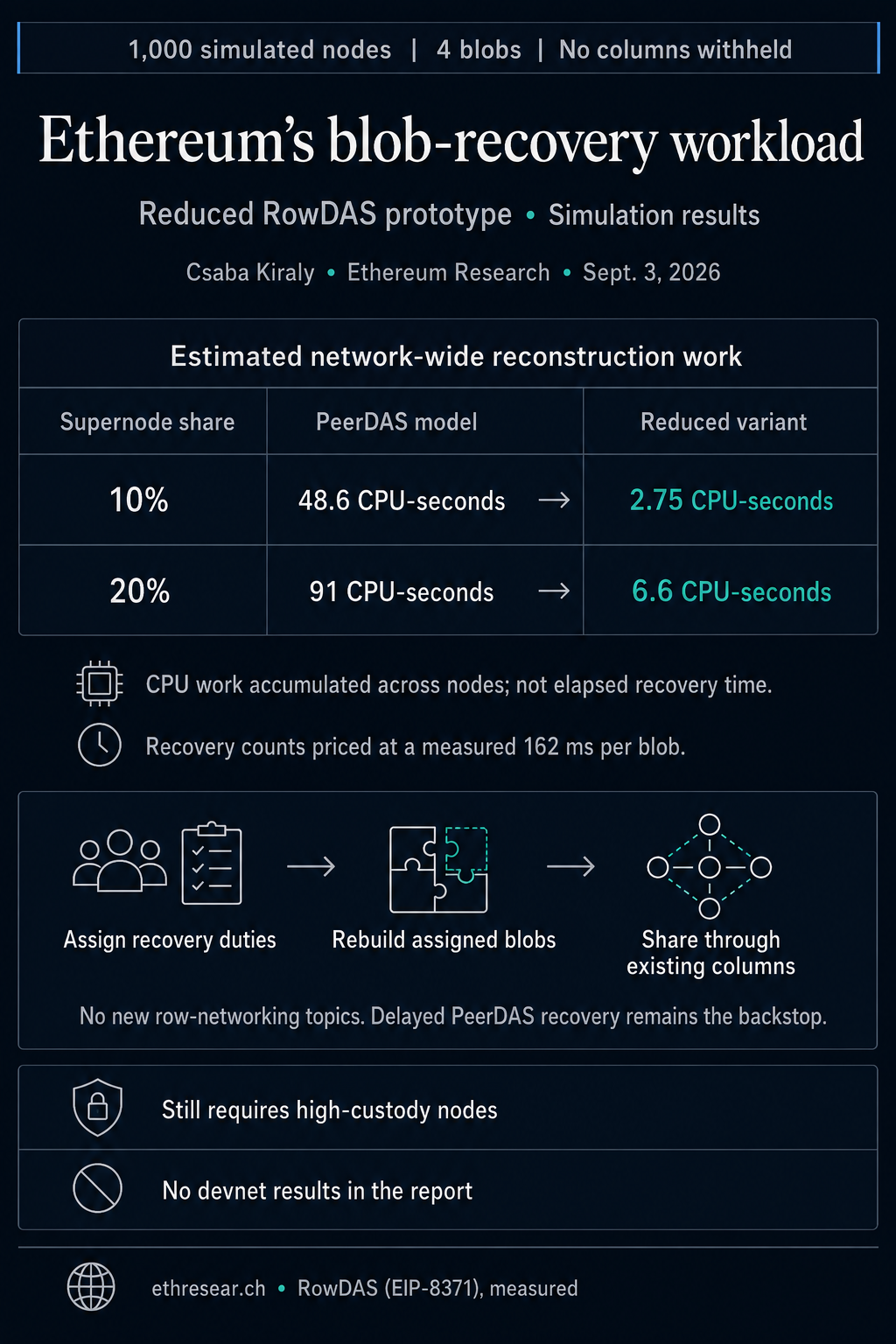
In one configuration with four blobs, 10% supernodes and no columns withheld, the estimated network-wide reconstruction cost fell from 48.6 CPU-seconds under the PeerDAS model to 2.75 CPU-seconds under the reduced design. At a 20% supernode share, the corresponding figures were 91 and 6.6 CPU-seconds.
Those totals describe accumulated computing work across the simulated network, rather than elapsed recovery time. The accounting applies a measured 162-millisecond cost per blob recovery on a Ryzen 9 8945HS processor. Transaction speeds and fee savings were outside the reported measurements.
The PeerDAS baseline already includes randomized waiting and checks that suppress duplicate reconstruction. The comparison therefore gives existing client behavior credit for the work those delays save.
Under the reduced variant, assigned nodes share recovered cells through existing column-distribution channels. High-custody nodes retain a delayed recovery role for anything still missing, preserving a PeerDAS-style backstop.
Full RowDAS, specified in draft EIP-8371, would add another recovery route: row channels let smaller nodes pool their data and reconstruct collectively when their combined holdings clear the recovery threshold. The reduced design retains today's dependence on high-custody nodes and cannot provide that additional resilience.
The measurements remain limited to simulated, in-process networks using real cryptography. Kiraly reported no devnet results, and the full design's 128-row-subnet configuration remains an extrapolation from smaller subnet counts. Larger simulations and real-network tests are still ahead.
EIP-8371 leaves blob limits unchanged, and the proposed split between duty assignment and row networking has yet to be incorporated into its draft text. The immediate opportunity is narrower: reducing the processor work needed for recovery, with the broader resilience benefits dependent on a later row layer.
The post Ethereum may have a simpler way to ease the computing burden of its growing rollup ecosystem appeared first on CryptoSlate.
Researchers examining the roughly $320 million Liquid Network incident have identified an alleged failure in the software’s transaction-validation cache, offering a more specific explanation for how unbacked tokens could be redeemed for real Bitcoin.
Accounts also raise a deployment question. Mononaut said the exploited bug had entered Elements’ master development branch the previous week but had never appeared in a tagged release. Liquid’s federation functionaries apparently ran that code, he said, while other nodes rejected the invalid transactions.
That deployment account remains unconfirmed by Blockstream in the available statements. If established, it would put the software rollout at the center of an incident in which valid signing credentials authorized the release of Bitcoin against allegedly bug-created L-BTC.
Liquid is a Bitcoin sidechain whose L-BTC tokens are intended to be backed one-for-one by BTC held by its federation. As CryptoSlate previously reported, SideSwap said a customer submitted 4,000 L-BTC through its peg-out service on Sept. 6, prompting the release of approximately 3,996 BTC.
Liquid said neither SideSwap’s peg-out authorization key nor other federation keys had been compromised.
The emerging technical accounts focus on how the tokens reached that withdrawal process.
Calle described a flaw involving range proofs, which let nodes check that hidden transaction amounts fall within an allowed range without revealing those amounts.
Liquid’s confidential transactions require more than a check that inputs and outputs balance. A hidden negative output could otherwise offset a larger positive output, making newly created tokens appear to balance mathematically.
Range proofs are intended to prevent that outcome. Because checking them is computationally expensive, nodes cache successful verification results for reuse.
According to Calle’s account, the attacker could construct an invalid output and proof that matched the cache key associated with a previously valid check. A node finding that cached result would skip the verification that should have rejected the inflationary output.
Charles Guillemet endorsed the explanation, describing a crafted cache-key collision that allowed an invalid confidential transaction to bypass a range check. Calle cautioned that his account simplified the mechanism and could contain errors.
A separate transaction reconstruction by Stu identified setup transactions followed by an allegedly invalid transaction at Liquid block 4,050,336. Stu said the transaction created approximately 3,996.0183 L-BTC before the subsequent withdrawal through SideSwap.
Mononaut’s account adds a distinction between the nodes that accepted the transaction and those that did not.
He said federation functionaries accepted the exploit transactions, approved withdrawals, and continued building blocks. Other nodes, including those powering mempool’s Liquid explorer, rejected the affected block. That would explain why an explorer following the rejecting nodes could omit transactions visible elsewhere.
The reported divergence makes the affected software versions material to understanding the failure. A postmortem would need to establish which code functions ran, why it was deployed, and how its validation behavior differed from the nodes that rejected the block.
Meanwhile, the actors controlling the withdrawn Bitcoin have described themselves as whitehats and conditioned the return of most funds on the bug being fixed across affected nodes. The available reporting does not establish a completed return or patch rollout.
Recovering the Bitcoin would address the reserve shortfall. Explaining why federation nodes accepted the transactions and demonstrating that the corrected software rejects them would address the failure that allowed those reserves to leave.
The post Tokens created out of thin air may explain how $320 million in Bitcoin left the Liquid sidechain appeared first on CryptoSlate.
In a Sept. 3 developer update, Hyperliquid API Announcements said the onchain derivatives exchange was adding optional wallet allowlists to builder-run perpetual markets. The testnet-only extension, called HIP-3*, would let a market deployer decide which wallets may trade on its venue without imposing the same access policy across Hyperliquid.
HIP-3 is Hyperliquid's framework for perpetual markets deployed by independent builders. The current API reference says a new venue can be designated HIP-3* when it is created, enabling an onchain allowlist and proxied user actions. Hyperliquid described the feature as optional and strictly additive, with existing markets unchanged. The specification is preliminary, available only on testnet and has no announced mainnet date.
How HIP-3* wallet allowlists work
A HIP-3* deployer can act for a user in five defined ways: add or remove allowlist approval, cancel specified resting orders, cancel all of the user's resting orders and time-weighted average price orders on the venue, place reduce-only orders, and move collateral to another account on the same venue.
Each power is limited by the venue boundary. The documented bulk-cancellation tool leaves orders on other DEXs untouched, the collateral-transfer function is venue-scoped, and every proxied order must be reduce-only. That last restriction allows an operator to reduce a position but not increase one through the proxy function.
A deployer may use all five tools itself or delegate them one by one to approved sub-deployers. One address could administer the allowlist while another handles cancellations, without receiving every available permission.
The reference does not enumerate every action a wallet outside the allowlist may still perform on its own. HIP-3* should therefore be understood as access control and operator powers for one newly created venue, not as a wallet freeze across Hyperliquid.
The design could give firms with customer or jurisdiction restrictions a technical way to build gated perpetual markets while other deployers continue using ordinary HIP-3. It does not amount to regulatory approval, protocol-wide know-your-customer checks or evidence that an institution has adopted HIP-3*. Hyperliquid said the tools are intended to help independent deployers operate under requirements applicable to them, leaving legal and operational choices with each deployer.
That separation also leaves the economic responsibility with the market operator. Under the existing HIP-3 specification, deployers define contracts, maintain oracles, set leverage limits and settle markets. Each deployer DEX has independent margining, order books and settings.
A mainnet HIP-3 deployer must currently maintain 500,000 HYPE in stake. Validators can slash that stake for irregular inputs that jeopardize protocol correctness, uptime or performance. HIP-3* adds access controls to that operator model; it does not shift responsibility for a restricted venue to Hyperliquid or alter permissionless markets elsewhere on the network.
The post Hyperliquid tests allowlists that let operators restrict access to their own markets appeared first on CryptoSlate.
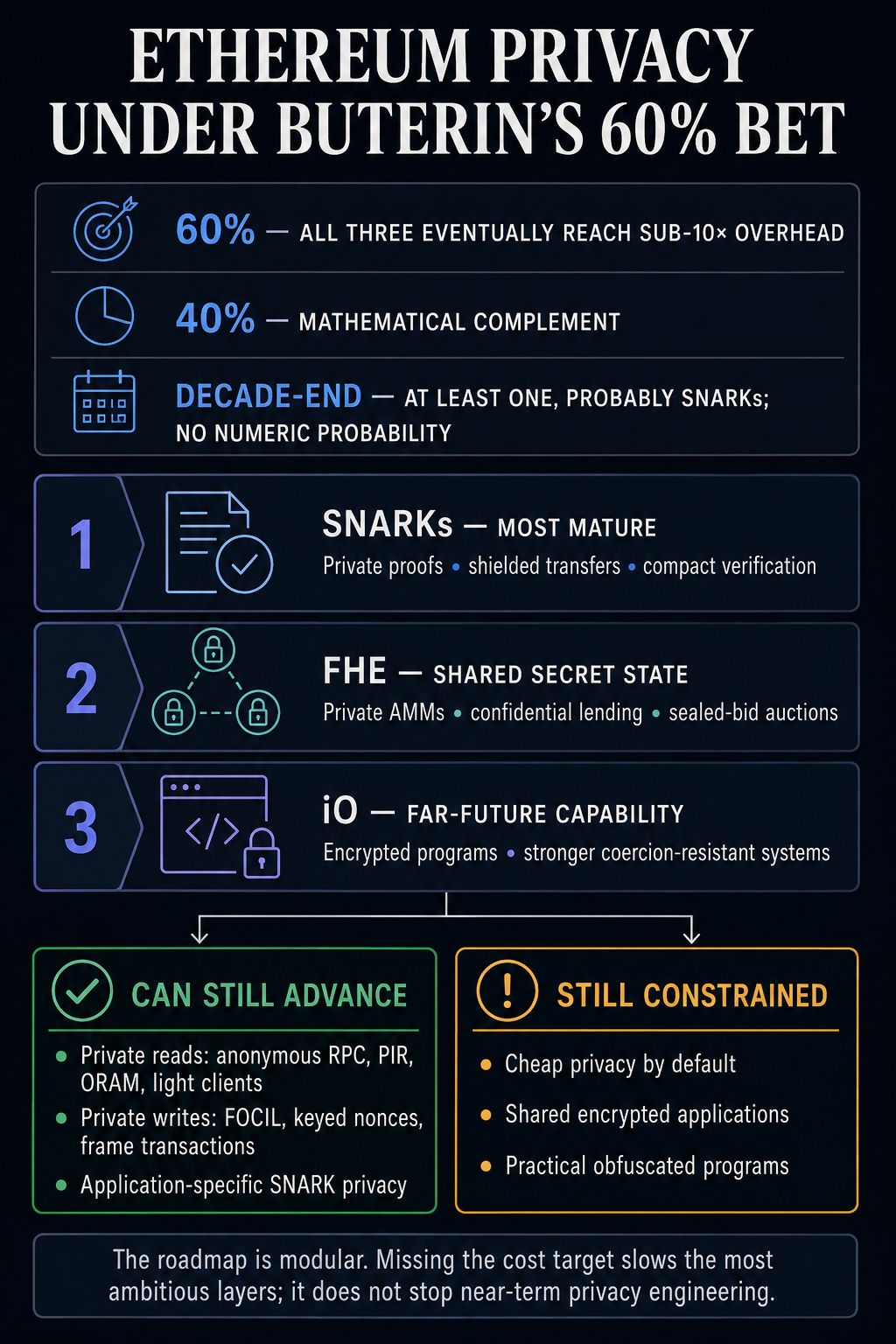
Vitalik Buterin sees a 60% chance that advanced cryptography becomes cheap enough to reshape Ethereum privacy.
On Sept. 6, the Ethereum co-founder said there is a 60% probability that SNARKs, fully homomorphic encryption and indistinguishability obfuscation will eventually operate at less than 10 times the cost of ordinary computation. He put the odds at 33% that all three could approach near-zero additional overhead at sufficient scale.
The forecast reaches well beyond hiding transactions.
Cheap SNARKs could make private proofs easier to generate. Fully homomorphic encryption (FHE) could let applications compute directly on encrypted data. Indistinguishability obfuscation (iO) aims to let software run without exposing its internal logic.
Together, the technologies could move privacy from a specialized feature toward a default layer for financial and computational systems.
Buterin’s timeline is more cautious than the probability headline suggests. He said there is a good chance that at least one of the three, probably SNARKs, reaches single-digit overhead by the end of the decade. He did not assign a probability to that specific deadline.
Ethereum can improve privacy before the big breakthrough
Ethereum does not need all three technologies to become cheap before meaningful privacy improvements arrive.
Its roadmap separates privacy into private reads, private writes, and private proving, allowing progress in one area without waiting for a universal cryptographic cost collapse.
Anonymous RPC systems, private information retrieval, oblivious RAM, and light clients can improve how users access blockchain data without exposing as much information about who they are or what they are querying.
Private transactions have their own constraints. A transfer can still be censored before inclusion, linked through its fee payer or correlated through sequential account nonces.
Ethereum researchers have proposed frame transactions that separate fee payment from the account performing an action, inclusion lists that force builders to include eligible transactions seen by validator committees, and keyed nonces that make activity harder to correlate. Those mechanisms remain proposals rather than guaranteed upgrades.
Application-specific zero-knowledge systems are further ahead.
SNARKs already allow users to prove that a private computation or statement is valid without revealing the underlying information.
Ethereum’s existing design patterns can support uses such as anonymous voting, private claims, and shielded withdrawals, though privacy can still leak through wallet reuse, RPC providers, public inputs, or weak anonymity sets.
That makes SNARKs the most mature part of Buterin’s three-way bet.
FHE and iO could take privacy beyond transactions
The more consequential leap for decentralized finance would come from making FHE substantially cheaper.
Unlike application-specific proofs, FHE allows multiple users to interact with shared data while keeping that state encrypted.
That capability is essential for applications such as private automated market makers, confidential lending pools, and sealed-bid auctions, where the system must process several users’ inputs without revealing them.
However, the obstacle is cost.
One 2026 benchmark required multi-gigabyte cryptographic artifacts and more than six hours of encrypted computation for a small BERT workload. The result reflects a single application rather than a universal performance measure, but it illustrates how far some FHE workloads remain from ordinary computation.
Developers can work around those constraints with specialized coprocessors, narrower workloads, or threshold-decryption systems. Those approaches can make encrypted applications practical today, but they add infrastructure and, in some cases, new trust assumptions.
Bringing FHE into single-digit overhead would change that tradeoff. Shared encrypted state could become a routine application primitive rather than something reserved for specialized systems, making confidential financial applications cheaper and easier to deploy.
The third technology, indistinguishability obfuscation, pushes that idea further.
FHE seeks to keep data private while it is being processed. iO aims to conceal the program itself, allowing users to execute software and verify its behavior without exposing the underlying logic.
That capability remains much further away. Buterin has previously described this rigorous approach as carrying “galactic” runtimes, while newer methods remain promising but unproven.
If practical iO eventually emerges, software could begin performing roles now assigned to trusted intermediaries without revealing how it makes decisions internally. Potential applications include more coercion-resistant voting, tightly controlled encrypted protocols and systems that disclose only authorized outputs.
Those possibilities extend beyond the private-read, private-write and private-proving tools currently emphasized in Ethereum’s privacy roadmap. They also broaden the implications beyond Ethereum itself.
Christopher Inks, founder of Texas West Capital, said cheaper cryptography could allow proprietary financial models to run on outside infrastructure without exposing private data, model mechanics or intellectual property.
He argued that such systems could eventually weaken the role of intermediaries including auditors, custodians, clearinghouses and exchanges, whose businesses partly depend on serving as trusted observers or validators.
The progression is therefore from hiding user data to hiding shared financial state and, eventually, the logic of the programs operating on it. If the cost of those protections falls far enough, the result could be a new class of financial infrastructure rather than simply more private blockchain transactions.
The privacy roadmap does not depend on one outcome
Ethereum’s privacy path is therefore better understood as a progression rather than a single breakthrough.
Anonymous access, censorship resistance, shielded transfers and specialized proofs can advance with technologies that already exist. Cheaper SNARKs would expand those capabilities. FHE would determine whether confidential shared-state applications can become practical at scale. iO would open a much more distant class of encrypted software.
Buterin’s 60% scenario would accelerate all three layers, potentially making privacy far cheaper and more composable.
The remaining 40% does not imply Ethereum privacy fails. It means progress would likely stay uneven, with useful protections arriving through specialized systems while general encrypted computation remains expensive.
The post Ethereum’s Vitalik Buterin puts 60% odds on a cryptography breakthrough that could weaken Wall Street middlemen appeared first on CryptoSlate.
CryptoTicker.io
On the Liquid Network, the best-known Bitcoin sidechain, around 4,000 Bitcoin drained out of the shared reserve on September 6, 2026. The network has been halted since then, L-BTC currently cannot be swapped back into real Bitcoin, and several trading venues have stopped deposits and withdrawals of the token. If you hold L-BTC or use a wallet that supports Liquid, your most important task today is taking stock rather than trading.
The incident is unusual because no key was stolen. The payout was cryptographically valid. That is precisely what makes the case interesting for anyone who holds Bitcoin through a second layer.
What happened on the Liquid Network on September 6
According to several specialist outlets, between 3,998.5 and 4,019.4 Bitcoin were withdrawn from what is known as the federation wallet of the Liquid Network. At the time of the outflow the value stood at roughly $319 million to $320 million. The range arises because individual newsrooms draw the boundaries of the movement differently: tftc.io counts 3,998.5 BTC based on the on-chain data, while Bitcoin Magazine cites 4,019.4 BTC. The Liquid team itself officially speaks of around 4,000 Bitcoin.
Cryptopolitan dates the decisive transaction to Bitcoin block 965,783, confirmed on September 6, 2026 at 14:28:56 UTC. According to the analysis by tftc.io, 207.275 BTC remained in the federation wallet afterwards. Before that there were around 4,200 BTC. So roughly five percent of the reserve was left standing.
Shortly afterwards the network pulled the emergency brake. The bridge nodes were shut down, and new deposits and withdrawals between Bitcoin and Liquid are blocked. The sidechain itself continues to produce blocks, but the route back into the Bitcoin network is closed. No date for a restart has been given so far.
Peg-out, federation and PAK: how the Liquid Bitcoin bridge normally works
To understand why this case is different from an ordinary exchange hack, you need three terms.
A sidechain is an independent blockchain that is docked onto a main chain and represents its coins in wrapped form. L-BTC is the Bitcoin proxy on Liquid: a token that is meant to be backed one to one by real Bitcoin held jointly by a group of companies. That group is called the federation, and it is the actual custodian.
The way in is called a peg-in, the way out a peg-out: you lock real Bitcoin, are credited with the same amount of L-BTC, and can reverse the process later. In a peg-out the L-BTC on the sidechain are destroyed and the federation releases the real Bitcoin in return. So that no single party can do this alone, Liquid requires, as tftc.io describes it, a multisignature from eleven of the fifteen federation members plus authorisation via an allow list, the Peg-out Authorization Key, or PAK for short. A PAK is therefore the registered key that determines which Bitcoin address may be paid out to at all.
On September 6 the payout ran through the PAK of the SideSwap service. The network stresses that this key was not compromised, and that no key otherwise fell into the wrong hands. The signatures were genuine, the authorisation formally correct, and the federation did what it was built to do. The gap sat one layer earlier.
The flaw was in the software, not in the keyring
Several reports trace the process back to a bug in Elements, the open-source software Liquid is built on. The accounts differ in detail, and that difference is worth knowing rather than skimming past.
Bitcoin Magazine describes an inflation bug: more than 4,000 L-BTC are said to have been created without real Bitcoin behind them, and these were then paid out via the SideSwap PAK. A second reading, quoted in several reports, describes the sequence as an apparently regular process in which L-BTC were properly burned and just under 4,000 real Bitcoin were released as a result. Both variants lead to the same outcome: the sidechain's accounting and the federation's actual Bitcoin holdings no longer matched.
A conclusive technical post-mortem by the operators was not available at the time of writing. As long as it is missing, any statement about the exact place in the code is conjecture, and we treat it as such here.

"We are whitehats": what this on-chain message actually proves
In a follow-up transaction the other side left the message "we are whitehats. contact us on chain". In IT security a white hat is someone who finds a vulnerability and discloses it instead of exploiting it. Here the label is a self-description, no more than that.
What can be established: according to consistent reports, the Bitcoin are sitting untouched at the receiving address. Blockstream and the Liquid team are trying to make contact through signed on-chain messages. One of the reports states that the other side has held out the prospect of returning most of the sum once the Elements vulnerability is closed network-wide. That undertaking is not confirmed, and no repayment has been made to date.
For you as a holder, the choice of words changes nothing. Whether someone calls themselves a white hat does not decide whether your money comes back. Only the actual return decides that.
L-BTC is frozen: what holders should check right now
The unpleasant news first: anyone holding L-BTC can do little at the moment. The peg-out is blocked, so a swap into real Bitcoin is not possible for the time being. There is no button that solves the problem for you.
An orderly stocktake still makes sense. Open your wallets and look at whether there is any Liquid balance among them at all. The wallets mainly affected are those that support Liquid, such as SideSwap, Blockstream Green or Aqua, along with balances at trading venues that list L-BTC. If you are unsure whether a holding sits on Liquid or on the Bitcoin base layer, a look at the address format and the block explorer used will help. Note down the position with date and time so that you have a solid starting figure later, should any settlement arrangement come about.
Refrain from attempting new peg-ins now. As long as the bridge nodes are switched off, the best case is that you are sending Bitcoin into a queue whose resolution nobody can schedule. And treat offers that promise you a quick payout of your L-BTC for a fee with caution. Situations like this tend to attract fraud attempts posing as support.
USDt, DePix and RWAs on Liquid: why these assets are affected differently
Liquid carries more than wrapped Bitcoin. The official network account has stated that other issued assets are unaffected, among them the stablecoin USDt, the Brazilian DePix and tokenised real-world assets.
That is technically plausible: these tokens do not hang on the federation's Bitcoin reserve, and their backing sits with the respective issuers. The outflow from the federation wallet therefore does not touch them. In practice a problem remains, because as long as the network is halted you can move these assets only to a limited extent as well. Being unaffected and being freely available are two different things at the moment.
Exchanges halt L-BTC deposits and withdrawals: where to check the status
Several trading venues have suspended deposits and withdrawals of L-BTC or announced that they will. What counts here is solely the status page of your own provider together with its announcements, and not the summary in a news feed. That is where you will find whether only transfers are affected or trading too, and whether withdrawals in real Bitcoin remain possible by another route.
In a situation like this, pay particular attention to which networks a provider supports for deposits and withdrawals at all, and how quickly and openly it communicates about disruptions. Anyone with balances spread across several venues should go through this check today for every one of them, and not only for the one they use daily.
Sidechain, bridge, wrapped token: the counterparty risk behind every wrapped Bitcoin
The sentence that sticks from this case comes from the analysis by tftc.io: L-BTC holders had no direct claim on the underlying Bitcoin, and their risk was against a consortium of companies rather than against the Bitcoin protocol.
This is not a peculiarity of Liquid. It applies to every wrapped Bitcoin on every foreign chain. A wrapped token is a placeholder that represents on one blockchain the quantity of a coin held somewhere else. Its value hangs on two conditions: the backing has to exist, and redemption has to work. If either falls away, you hold a claim whose enforceability you may well not know.
Sidechains and bridges buy you something with real advantages in return: faster and cheaper transfers, confidential amounts, applications that do not run on the Bitcoin base layer. Anyone using them should make that trade deliberately rather than in passing. A useful rule of thumb: what sits on a second layer is working capital. What is meant to stay put for the long run belongs on the base layer in your own custody, as we described after the Coldcard incident in our assessment of the hardware wallet choice.
What the case means for your own custody
The key difference between this incident and a classic theft is the point of attack. Storing good keys well was of no help here, because the keys were fine. What broke is the rule that decides when those keys are allowed to sign.
From that follows an uncomfortable insight: the security of your holdings does not end at your own wallet. What matters is the whole chain of systems standing between you and the base layer. For a Bitcoin in your hardware wallet that chain is short. For an L-BTC in a software wallet, backed by a federation, secured through an allow list, paid out via a service with its own registered key, it is long.
In practice that means three things. Keep the amount on second layers small enough that a total loss does not knock you off course. For every wrapped token, check who the custodian is and whether one is even named. And document your holdings regularly, so that in an incident you have figures rather than memories.
What remains open
Three points were unresolved at the time of writing. There is no date for the network to restart. There is no commitment from the operators on how L-BTC balances will be handled if the Bitcoin do not come back. And there is no independent confirmation that the other side will actually repay. Anyone telling you today that the case is settled knows more than can be evidenced.
Liquid peg-out and checking your L-BTC: what to take away
- Establish and document your holdings. Open every wallet and every account today and record whether and how much L-BTC or other Liquid balance is sitting there, with date and time. Our crypto exchange comparison helps when you reconcile the networks and withdrawal routes of your trading venues.
- Send nothing new into the blocked bridge. Avoid peg-ins as long as the bridge nodes are switched off, and read the status exclusively at your provider and at the network operator. Which wallet supports Liquid at all, and how transparently it discloses that, is shown in our software wallet comparison.
- Bring long-term holdings onto the base layer. Separate working capital from reserves and self-custody the part that is meant to stay put. Which devices come into question and how to tell them apart is in our hardware wallet comparison.
(As of September 7, 2026. This article is not investment advice. Prices and fee structures change; check the terms with the provider before you buy.)
Filecoin's vesting of Protocol Labs and the Filecoin Foundation ends on October 15, 2026. It is the largest inflow channel for new FIL since mainnet launched, and it dries up completely on that day. Gross emission, meaning the volume of FIL that enters circulation each year, falls by roughly 75 percent as a result: from about 88 million to about 22 million tokens a year. As a holder you need to do nothing on that date. No deadline expires, no swap is required. What changes is the mechanism behind it, and that is worth understanding before the day arrives.
The Filecoin price stood at $0.8173, or €0.7034, on September 7, 2026 at 06:36 UTC, up 1.69 percent over 24 hours, with a market capitalisation of around $676 million (source: CoinGecko API, own query at that time). Circulating supply was 826,950,326 FIL. That figure is the denominator for everything that follows, because emission numbers say little without a reference to circulating supply. If you hold FIL or want to build a position, what matters most is where you buy and how cheaply you get in: our comparison of the best crypto exchanges shows which venues list FIL and what they charge in fees.
What happens to Filecoin vesting on October 15, 2026
Vesting describes a lock-up period over which allocated tokens are released step by step instead of becoming available all at once. At Filecoin it covers the allocations to the development team Protocol Labs and to the Filecoin Foundation. The official documentation states the period in plain terms: a defined share of the FIL minted at genesis is released to Protocol Labs teams and the Filecoin Foundation over six years, and to SAFT investors over three years (docs.filecoin.io).
Six years from the mainnet launch land in precisely this October. Mainnet started at epoch 148,888, which corresponds to October 15, 2020 at 14:44 UTC. The announced end date therefore follows straight from a schedule that has sat in the protocol since 2020. Nothing about it is new except the fact that it now comes due.
Where new FIL has come from so far: vesting and block rewards
New FIL arises from two sources at Filecoin. One is block rewards, the payments storage providers receive for supplying and proving storage capacity. The other is that vesting. According to figures from the project source FilecoinTLDR, vesting from Protocol Labs and the Filecoin Foundation contributes around 66.7 million FIL a year, block rewards around 21.7 million. Together that is just under 10 percent of circulating supply per year, as the source puts it.
Measured against current circulating supply, the figure holds up: 66.7 million equals 8.07 percent of 826,950,326 FIL, and the 22 million from block rewards equal 2.66 percent. Together, 10.73 percent. For anyone who prefers a daily number: at 88.4 million FIL a year that works out at roughly 242,000 new FIL per day, after which about 60,000 remain. The difference of some 182,000 FIL a day was worth about €128,000 on September 7.
Why gross FIL emission falls by roughly 75 percent
The arithmetic behind it is unspectacular. Of the two inflows, the larger one disappears and the smaller one stays. 66.7 out of 88.4 million is a good 75 percent, and that is exactly how the primary source states it: on October 15 this source dries up and cuts gross emission by about 75 percent. What remains is block rewards alone, around 22 million FIL a year, or a little over 2 percent of circulating supply.
Gross emission here refers exclusively to the inflow: everything that newly enters circulation, without netting off what leaves it. This distinction is the heart of the whole topic, and it gets lost in most headlines.
Vesting, emission and circulating supply: the terms kept apart
Three terms are regularly thrown together around this date. It helps to pin each of them down.
Circulating supply is the volume of FIL that is freely tradable. On September 7 that value stood at 826,950,326 tokens. Total supply of all FIL ever minted is 1,957,088,873 tokens, so roughly 42 percent of it is in circulation. Emission describes the speed at which new tokens are added. And net supply is emission less whatever disappears from circulation.
Only emission changes on October 15. Circulating supply does not fall that day; it simply grows more slowly afterwards. Anyone waiting for a jump in the statistics in October will wait in vain. The effect shows up as a flatter curve over months rather than as an edge on a single day.

Why lower emission does not automatically mean less FIL supply
This is where the real stumbling block lies, and the project source spells it out itself: the end of vesting changes what comes into circulation, but not what circulating supply does afterwards. Burns and the locking of collateral decide the rest.
That is not a footnote but the condition attached to every statement about future supply. A network can halve its emission and still have more liquid tokens in the market if locked holdings are freed at the same time. The reverse also holds: available supply can shrink at unchanged emission when more tokens are locked or destroyed than are added.
Collateral locking and burns: the other side of the FIL supply calculation
Two mechanisms continuously withdraw tokens from Filecoin circulation. The first is collateral locking: storage providers have to post FIL as collateral before they may offer storage capacity, and that pledge stays locked for the term of the storage commitment. As long as the volume of offered storage rises, the locked balance grows with it. The second mechanism is burns: part of the network fees is destroyed permanently, and collateral is forfeited when storage commitments are breached.
Both quantities depend on actual use of the network, and they move independently of the vesting calendar. That is why the October 15 date supports no statement about how the freely tradable volume of FIL develops afterwards. What can be said is this: the one large factor that has so far pulled reliably in a single direction falls away, and the remaining calculation is settled by demand.
What the FIL supply simulation says and what it expressly is not
On future net supply, FilecoinTLDR cites a range from its own tokenomics simulator: depending on the state of the network, daily net growth in supply could sit some 86 to 119 percent below the August 2026 level by the end of 2027. At the upper end of that range the daily balance turns negative, meaning more FIL would leave circulation than enters it.
The source flags these figures in the same breath as modelled scenarios and expressly not as forecasts. The outcome hangs on factors such as demand within the network, block rewards, collateral and burns. Anyone passing this range on as a price target has suppressed the source's own framing. We therefore reproduce it exactly as it stands there: an arithmetic exercise under assumptions, and no statement about the market.
That caution is the exception in the German-language space. On the emission date itself there is so far practically nothing in German, while search results on Filecoin are dominated by chart technicals and price targets. Precisely for that reason, the distinction between mechanism and forecast matters more here than any single number.

FIP-0118 Solstice: the second change to Filecoin economics in Q4
The vesting date is not the only change to the economics of the network this quarter. The improvement proposal FIP-0118, named Solstice, was accepted in September and is waiting to be scheduled into a network upgrade. The state of the specification we refer to here is that of September 1, 2026, and details may still change before delivery.
Substantively it concerns the question of what block rewards are paid out for. Today storage providers receive rewards based on their storage performance, regardless of whether anyone pays for that storage. Under Solstice a share of block rewards would flow to services that bring paying usage into the network, and that share would only be paid out if the payment volume settled through Filecoin Pay reaches targets set in advance. If the targets are missed, the corresponding share is burned instead of paid. In addition, the human review in the Fil+ process would fall away: every new sector would start automatically with the tenfold quality-adjusted power multiplier.
For the supply side this means a further part of emission would be tied to actual demand, with burning as the fallback. Whether and when this arrives is still open.
How demand for Filecoin storage is developing right now
Because future net supply hangs on usage, the figures the project publishes on it are worth a look. The annualised run rate of Filecoin Pay, through which payments in the network are settled, rose from $663 in January to $59,327 at the end of August 2026, according to FilecoinTLDR. The number of actively paying addresses grew from 73 to 119 over the same period, and the number of active settlement channels stood at 865 in August.
That is growth from a very small base, and it should be read that way: a run rate in the low five-figure dollar range sits against a market capitalisation of around $676 million. Alongside it, Fil One has offered an S3-compatible object store since June, priced at $4.99 per terabyte per month with no charges for outbound data transfer. Whether that turns into paying demand on a scale that noticeably drives burns is open, and it can be tracked through exactly these figures.
How to check the date and the FIL emission yourself
You do not have to take any report on trust to verify the date. Filecoin writes a block every 30 seconds, and these blocks are numbered consecutively. Epoch 0 falls on August 24, 2020 at 22:00 UTC. From the current block height, any date can be calculated in either direction.
On September 7, 2026 at 06:36 UTC the chain stood at height 6,348,552, retrieved via the public Glif node. Counting up from epoch 0 at 30 seconds per block lands exactly on that time, so the calculation holds to the second. October 15, 2026 at 00:00 UTC corresponds to epoch 6,457,200. Between the two points lie 108,648 epochs, or 37.7 days. If you want to follow the number yourself, pull the block height and divide the difference to the target moment by 30 seconds.
The second verifiable quantity is circulating supply. Note it down today and compare it in November: at an emission of around 88 million FIL a year, circulation grows by about 7.4 million a month, and at 22 million a year by only some 1.8 million. You will see that difference in the data set of any major market data source within a few weeks. We have described at length how to recalculate such release volumes yourself instead of trusting an aggregator, using one concrete unlock as the example: recalculating a token unlock. The method is the same here, only the direction is reversed.
Do FIL holders need to act before October 15?
No. There is no deadline that expires for you, no swap, no registration and no freeze on deposits or withdrawals. The date concerns the release of tokens to the team and the foundation behind the project, and not the holdings of investors. Anyone with FIL sitting on an exchange or in their own wallet can do exactly the same on October 15 as on the 14th.
This is the point where the date differs from those events that do create pressure to act. With an announced trading halt or a withdrawal deadline at an exchange you have to react, otherwise your balance is blocked. Here it works the other way round: doing nothing costs you nothing. It is still worth knowing the difference between the two cases, because headlines tend to treat them alike.
What the date means for custody and tax
Indirectly there are two points of contact. The first concerns custody. If you want to hold FIL for years because the supply mechanism convinces you, the question becomes where those tokens sit. Holdings on a trading platform belong to you economically but carry the platform's risk. Anyone who wants to separate the two holds their own coins and needs a wallet that supports FIL at all. Not every device does, and the differences lie less in the price than in which networks the manufacturer maintains.
The second point is tax. In Germany, selling crypto assets after a holding period of more than one year is tax-free for private individuals, and within that period the exemption limit for private disposal transactions applies. Anyone reallocating because of an expected supply squeeze may trigger a taxable event by doing so, regardless of whether the expectation is borne out. Clean records of acquisition dates are therefore the precondition for knowing what a sale actually costs.
How this date fits the run of FIL supply events
At many projects, releases and lock-ups shape supply more strongly than any partnership announcement. Usually the subject is additional tokens coming to market, as with the monthly releases we last worked through using LayerZero and its ZRO token. Filecoin now stands at the other end of that pattern: here an inflow ends that ran reliably for six years.
For context that means two things. First, the effect is structural and works over months, whereas a single unlock is measurable on one day. Second, the end of an inflow is the weaker of the two statements, because it touches only one half of the equation. What counts in the end is the balance of inflow, locking and burning, and at Filecoin that balance depends more heavily on network usage from mid-October than ever before.
Filecoin vesting: what to take away
- Check the date yourself instead of taking it over. The block height and the 30-second epochs give you the date to the second, and circulating supply will show you from November whether emission has actually flattened. If you need a venue that lists FIL for this, you will find the terms in our crypto exchange comparison.
- Keep emission and supply apart. The 75 percent refers to the inflow, and not to the tradable volume. Anyone holding for the long run should set up custody accordingly; the differences between devices are in our hardware wallet comparison.
- Factor in tax before you reallocate. If you sell on a supply expectation, you should know the holding period of each individual purchase. Tools that track this automatically are in our comparison of tax tools and portfolio trackers.
(As of September 7, 2026. This article is not investment advice. Prices and fee structures change; check the terms with the provider before you buy.)
Bitcoin's oldest sidechain just lost almost everything it was holding, and the person who took it is asking politely how to give it back.
On Saturday, 6 September 2026, roughly 4,000 $BTC worth about $320 million left the federation wallet that backs Liquid Network, the Blockstream-built Bitcoin sidechain that has been running since 2018. The wallet held around 4,200 BTC before the incident. It now holds a little over 200. That is about 95% of every Bitcoin ever pegged into Liquid, gone in the space of 23 minutes.
Then things got strange. The attacker attached a message to a Bitcoin transaction announcing himself as a white hat and inviting Blockstream to get in touch. Blockstream did. The two sides have spent the weekend negotiating a $320 million return in public, one small Bitcoin transaction at a time.
What Actually Happened In The Liquid Network Hack?
The timeline is unusually clean, because most of it is on the Bitcoin blockchain.
At 14:05 UTC on 6 September, a customer sent 4,000 L-BTC to SideSwap's peg-out service. SideSwap is a Liquid Federation member and a normal, approved route for converting L-BTC back into real Bitcoin. It processed the order like any other: the L-BTC was burned on Liquid, a valid peg-out authorisation was attached, and 23 minutes later the federation paid out roughly 3,996 BTC on the Bitcoin mainchain.
Nothing about that transaction looked wrong. It was confirmed in Bitcoin block 965,783 at 14:28:56 UTC, and the coins landed in a single address holding just under 4,000 BTC.
Shortly afterwards, that same address broadcast a tiny second transaction carrying an OP_RETURN message: the sender identified himself as a white hat and asked to be contacted on-chain. Blockstream replied the same way, sending 1,000 satoshis to the address in block 965,822 with a message pointing to its security contact. The conversation has since moved into PGP-signed notes passed back and forth.
Liquid disabled its bridge nodes and paused the network. Exchanges were notified, and several have suspended L-BTC deposits and withdrawals.
How Did The Elements Bug Let 4,000 BTC Out?
This is the part that should worry people more than the missing money.
Liquid's security model looks solid on paper. The Bitcoin backing L-BTC sits in an 11-of-15 multisig controlled by vetted federation members, and peg-outs back to Bitcoin are gated by a second layer called Peg-out Authorisation Keys. Neither of those layers broke. No key was stolen, no signer was phished, no hardware security module was tricked.
Instead, Blockstream has attributed the incident to a software bug in Elements, the open-source codebase Liquid runs on. Independent analysis points to a consensus-level inflation bug in how confidential transaction rangeproofs were cached. A cache key that left out asset and script context meant a previously verified proof could be reused, which let unbacked L-BTC be created out of nothing and accepted by a subset of nodes.
From there the attacker did not need to hack anything else. He simply redeemed his counterfeit L-BTC through the front door. SideSwap has said it had no way to tell the exploit-created coins apart from real ones, so it treated them the same, and the federation's HSMs signed a withdrawal that was perfectly valid under Liquid's consensus rules at the time.
The uncomfortable footnote: a fix had reportedly already been merged into the Elements repository days earlier, but had not yet shipped in a tagged release.
Is The Liquid Network Hacker Really A White Hat?
He says he will return most of the funds once the bug is patched and every node has updated. He has not said how much "most" means, has not given a deadline, and has not revealed who he is. As of Monday, the Bitcoin has not moved.
Plenty of people in the industry are not buying the framing. Ledger CTO Charles Guillemet pointed out that genuine white hats disclose a flaw before moving hundreds of millions in collateral, not after, and compared the situation to the Ronin bridge hack and the Euler Finance attacker's post-exploit change of heart. Draining a bridge and then asking for a chat looks less like responsible disclosure and more like leverage.
Former Blockstream CSO Samson Mow added another wrinkle, saying a Signal contact request that surfaced during the negotiation did not come from the address actually holding the coins. Which is a good reminder that in a public negotiation with an anonymous counterparty, anyone can pretend to be either side.
What Does This Mean For Bitcoin And L-BTC Holders?
Bitcoin itself is fine. The exploit never touched the base layer, and BTC has been sitting comfortably near $80,000 through the whole episode. This was a bug in a system built on top of Bitcoin, not in Bitcoin.
The damage is concentrated where you would expect: L-BTC liquidity, and any business or token that depends on Liquid as a settlement layer. Liquid exists to give exchanges fast settlement by issuing L-BTC against locked Bitcoin, and a reserve that is 95% empty is not a functioning peg. Until the coins come back, or the federation explains how it will cover the hole, L-BTC redemptions are stuck.
There is also a broader point about federated bridges. Liquid's federation did nothing wrong in the sense that everyone followed the rules. The rules themselves were wrong for a few blocks, and that was enough. For anyone holding assets through a bridge, custodian, or wrapper, a protocol-level bug in a shared reserve is a risk no amount of personal opsec can audit away.
What Happens Next?
Three things to watch:
- A confirmed return transaction. Nothing else counts. Until Bitcoin moves from that address back to the federation, the promise is just text in an OP_RETURN field.
- Blockstream's post-mortem. The company has not yet published a full technical account, including exactly how the peg-out cleared normal controls and why the Elements fix had not shipped.
- Reconciliation. Even in the best case, someone has to explain the gap between 4,000 BTC and "most" of 4,000 BTC, whether any of it is being kept as a self-awarded bounty, and how the remaining reserves are accounted for.
This story is not over when the hacker says nice things. It is over when the Bitcoin is back and the numbers add up.
Gifting bitcoin to children: the tax rules that apply in Austria
Transferring bitcoin to your own children is generally possible in Austria without the gift alone triggering income tax on any price gain accrued up to that point. There is no general gift tax either.
Even so, a larger transfer is not automatically without tax consequences. For one thing, a gift reporting obligation can arise. For another, in the case of a genuine gift the child generally takes over the tax history of the bitcoin, including the parent's acquisition costs.
The 50,000 euro threshold applies to parents and children
Children belong to the circle of relatives covered by the Austrian gift notification rules.
Gifts between relatives are generally exempt from the reporting obligation as long as the fair market value of the transfers between the same persons within one year does not exceed 50,000 euros in total. If that threshold is exceeded, the gift generally has to be reported.
Example:
- A parent gifts bitcoin worth 30,000 euros: generally no report on the basis of this gift alone.
- Later in the same relevant period, further bitcoin worth 25,000 euros follow.
- Total value: 55,000 euros.
The reporting threshold may thus have been exceeded.
Which bitcoin value counts?
For the gift reporting obligation, what generally counts is the fair market value at the time of the transfer. With bitcoin this can regularly be determined from a traceable market price.
- The following should therefore be documented:
- date and time of the gift,
- the amount of BTC transferred,
- the euro price used,
- the price source,
- wallet addresses,
- transaction ID.
This data can also help later on to demonstrate the origin of the bitcoin to the tax office.
The child does not get a new tax cost base
The later taxation is particularly important.
A genuine gift does not mean that the bitcoin market value on the day of the gift automatically becomes the new acquisition cost. Under the Austrian income tax guidelines, the recipient instead continues the acquisition costs of the donor.
Example:
- The parent bought bitcoin for 10,000 euros.
- At the time of the gift they are worth 30,000 euros.
- The child later sells them for 40,000 euros.
- The tax base value generally remains 10,000 euros, not 30,000 euros.
With taxable new holdings this can produce a gain of 30,000 euros on the later sale.
Legacy holdings also remain relevant for tax
The same principle makes the date of acquisition particularly relevant. If the transferred bitcoin were already acquired before March 1, 2021, their status as legacy holdings for tax purposes can likewise remain significant. A gratuitous transfer generally does not simply reset that history. Parents should therefore hand the child not only the bitcoin but also the historical purchase records.
Three months to file the report
If the reporting threshold is exceeded, the gift generally has to be reported within three months. If the threshold is only exceeded through several transfers, the deadline starts with the gift that pushes it over the line. The report is generally filed with the Austrian tax office, regularly via FinanzOnline. Wilfully failing to report can carry consequences under fiscal criminal law.
Conclusion
Bitcoin can generally be gifted to children in Austria without the gift alone realising a bitcoin price gain. With larger amounts, however, the gift reporting obligation has to be observed. For relatives the relevant threshold is generally 50,000 euros within one year. More important still for a later sale: in the case of a genuine gift the child generally takes over the parent's acquisition costs for tax purposes. Purchase date, cost basis and transaction history should therefore be documented together with the bitcoin.
Harmony is giving up its own blockchain. On September 6, 2026 the team behind the network announced that it will shut down the mainnet it launched in 2019 and reissue the ONE token as an ERC-20 token on Ethereum. For you as a holder, one point matters above all: if your ONE sit inside a smart contract, meaning a liquidity pool, a multisig wallet or a DeFi position, you have to pull them out beforehand. Those positions do not travel with the migration. Balances in an ordinary wallet and on an exchange, by contrast, are captured by a snapshot and credited again on Ethereum without you having to apply for anything.
The window is tight. Reports name both September 9 and September 10, 2026, and they do not name them consistently. Anyone affected should therefore not wait until the last day.
Harmony mainnet shutdown: what happens on September 9 and 10, 2026
A mainnet is the productive main network of a blockchain, where real balances and real transactions live, as opposed to a testnet. Harmony runs such a mainnet as an independent layer 1 chain. Layer 1 describes a blockchain that settles and secures its transactions itself instead of attaching itself to another chain.
That independence is now ending. According to the announcement, the final blocks are to be processed on September 9, 2026; validators may shut down their nodes afterwards. On the exact cut-off date the available reports diverge, and you should know that rather than have it smoothed over: The Block writes that users should exit all smart contracts before September 10, 2026, and names September 10 as the day validators are allowed to cease operations. ETHNews describes September 9 as the day of the final blocks and September 10 as a hard boundary after which funds in certain positions are lost. The Chinese-language industry outlet WuBlockchain names September 9 in its summary as the deadline for exiting smart contracts.
In practice the spread means this: anyone holding a position on Harmony has until September 8 to unwind it safely. After that it depends on whether the chain is still producing blocks, and that is not something to rely on when money is at stake.
Why Harmony is abandoning its own chain: the cross-shard exploit of August 12
The trigger lies four weeks back. On August 12, 2026 Harmony was attacked through a flaw in what is called cross-shard verification. Harmony splits its network into shards, several parallel sub-chains that settle transactions among themselves via receipts. The attacker was able to have valid receipts redeemed more than once. The result was new ONE with no offsetting entry: the attack touched not a single smart contract. It struck one level deeper, at the consensus layer, the place where the network's nodes agree on the valid state.
The scale is the reason an in-flight repair was ruled out. The first confirmed wave covered around 4 billion ONE, which against a total supply of roughly 15.01 billion works out at about 26 percent. Reconstructing the full attack, the security firm Verichains arrived at roughly 3.01 trillion forged ONE. The two figures do not contradict each other; they describe different stages of the post-mortem.
Harmony then opted for a rollback, winding the chain back to a state before the attack. Shard 0 was reset to block 92,730,034 and shard 1 to block 94,978,278; both checkpoints carry the same timestamp, 23:25:37 UTC on August 11, 2026, shortly before the first confirmed forgery. More than 141,000 consecutive blocks and over 109,000 regular transactions were discarded, 109,441 exactly according to ETHNews, along with several hundred staking operations. What such a reversal means for your own holdings and for your holding period is set out in our explainer on the blockchain rollback after an exploit.
The reasoning behind the current shutdown reaches beyond this single case. In the project's words: “The threats posed by state actors and AI agents are too great.” That is the team's assessment, not a verified fact, and it stands that way in the announcement.
Snapshot and airdrop: how ONE becomes an ERC-20 token on Ethereum
A snapshot is a point-in-time record of all balances at a defined block. Harmony intends to take that record at the chain's final block and then distribute new ONE as an ERC-20 token on Ethereum to the same addresses. ERC-20 is the standard on which the vast majority of tokens on Ethereum are built; it defines how a token is transferred and queried, so that wallets and exchanges can support it without special handling.
For the majority of holders that is the good news: there is no claim process, no form, no redemption deadline. Anyone holding ONE in a self-custodied wallet whose address also works on Ethereum will be credited the new tokens there automatically. Total supply and issuance rate are to remain unchanged. Newly issued tokens are to be allocated to Harmony's own new venture, an initiative around AI-assisted video production that the team describes as a “remix economy”. Whether that pivot carries is an open question, and not a decisive one for the deadline at issue here.

Not every address is alike: the difference between the ONE and Ethereum formats
Harmony uses two notations for addresses: the familiar Ethereum format beginning with 0x, and its own format with the prefix one1. Both denote the same key, merely encoded differently. If you hold your ONE in a wallet where you own the private key or the seed phrase yourself, that is uncritical for the migration, because the same key also controls the matching 0x address on Ethereum.
It becomes critical somewhere else: with addresses that belong to a program and not to a key. That is exactly what the next section is about.
Balances on an exchange: why you usually have nothing to do here
If your ONE sit on a centralised trading platform, the address belongs to the exchange, not to you. According to the announcement the snapshot also captures holdings on centralised exchanges, and Harmony intends to switch the listings over to the new token. In that case the exchange credits you the ERC-20 token once it has worked through the changeover.
Even so, you should not rely on that blindly. A chain shutdown is a separate operation for every platform: it has to halt deposits and withdrawals on the old network, add the new contract and trigger the credit. Experience shows that exchanges announce this in their announcements section, often only a few days in advance, and that the suspension of deposits usually comes first. So check your platform's notices, and move no ONE to or from it in the days around the cut-off. If in doing so you find that your exchange does not list the token at all, or that its communication stays thin, a sober look at the alternatives helps: our comparison of the best crypto exchanges shows which providers handle changes of this kind cleanly on a regular basis.
Liquidity pools, multisig and DeFi: what the migration leaves behind
This is where the actual work lies. According to the announcement, multisig safes, liquidity pools and on-chain applications cannot be migrated. Users are told to exit all smart contracts before the cut-off date.
A liquidity pool is a contract into which several users deposit two tokens so that others can swap between them for a fee; your share of it is represented by a dedicated pool token. A multisig safe is a wallet that requires several signatures for a payout, technically also a contract rather than an ordinary address. What both have in common is that program code sits behind the address instead of a private key. That is precisely why a snapshot can allocate nothing to you there: on Ethereum that contract does not exist, and no one can rebuild it for you.
The task is therefore clearly defined. Go through the applications in which you have ever deposited anything on Harmony, and pull the holdings back to an address whose key you hold yourself. That applies to pool shares as much as to collateral posted in lending contracts, to wrapped tokens and to anything you brought onto the chain via a bridge. If you no longer remember where everything sits, the chain's block explorer helps: it lists all token balances for your address and the contracts you have interacted with.
For the wallet you pull everything back into, one plain rule applies: it has to be an address whose seed phrase you own. An address inside an application that has never shown you the private key is not a safe choice for this purpose.
Staking delegations and validators: where the rewards end up
Anyone who has staked ONE has as a rule delegated them. Delegation means assigning your tokens to a validator who takes part in consensus on your behalf, without you giving up control over them. The validator in turn is the operator of a node that proposes and confirms blocks and is rewarded for doing so.
A special rule applies to these holdings, and it is the point at which many holders are likely to be unpleasantly surprised: delegated stakes and rewards not yet claimed are not to flow directly to wallets, but into governance treasuries, referred to in the announcement as governor vaults. A treasury in this context is a jointly managed pot whose use the community decides on. Your delegated ONE will therefore not land automatically in your wallet as a freely available ERC-20 token.
If you want to keep control, undelegate before the cut-off date and claim your outstanding rewards, so that both sit as ordinary balance on your own address. Bear in mind that unwinding a delegation carries a waiting period on many networks. Check in your wallet menu how long yours runs before you count on the final day. Harmony has pledged to support validators in moving into roles within the new venture; for you as a delegator that is no substitute for exiting yourself.

ONE in trading: what our count of trading venues on September 7 shows
This analysis was carried out by cryptoticker.io itself on September 7, 2026. At 03:50 UTC we retrieved CoinGecko's public dataset on Harmony (HTTP 200) and counted every trading pair listed there, each with its trading venue, currency pair and reported daily volume.
The result is sobering, and directly relevant to the question of how you act now. Thirty trading pairs across 23 trading venues were recorded. The price stood at $0.00073244, or €0.0006309, the market capitalisation at around €9.38 million, rank 1168. For comparison: before the attack ONE was still traded as a project with a billion-dollar valuation. The dilution from the forged tokens and the rollback have all but wiped out the market value.
Two things stand out when you look at the venues. First, volume is heavily concentrated: Binance accounted for around $481,000 in daily volume with ONE/USDT and around $212,000 with ONE/TRY, followed by Pionex, OKX, Gate, KuCoin and MEXC in the mid five-figure to low six-figure range. Second, there is almost no euro access: among the 30 pairs we found exactly one euro pair, ONE/EUR on OKX, with a reported daily volume of around $533. Providers through which German investors usually trade did not appear in the list at all.
What we could not check belongs here too: we did not evaluate the announcement pages of the individual trading venues one by one, so we cannot say which exchange has already committed to the switch to the ERC-20 token. Three entries were flagged as anomalies in the dataset and one more as stale; we left them in the count but did not use them as a reliable volume figure. And the volume figures come from the trading venues themselves, they are not independently audited.
What follows for you is above all an expectation: selling larger holdings in euros will founder on these volumes. Anyone wanting to sell has to go via a stablecoin, and anyone unwilling to do that holds the position and waits for the migration.
Tax and holding period: what the swap can trigger for German investors
Caution is warranted here, and in both directions. The framework is settled: in Germany, gains from selling crypto assets held as private assets count as a private disposal transaction under section 23 of the Income Tax Act, with a holding period of one year, after which a disposal gain remains tax-free. The Federal Ministry of Finance last set out the cooperation and record-keeping obligations for crypto assets in more detail in its circular of March 6, 2025.
What is not settled is how this particular event is classified. Whether crediting a new ERC-20 token after the original chain is shut down is to be treated for tax purposes as a swap that starts a fresh holding period, or as a mere continuation of the same asset, has not been decided for this case. We are not asserting a legal position that does not exist in this form. What you can do in practice is document: record which holdings you had at which point in time on which address, when the credit occurred and at what price. Without those records, any later classification, whichever way it falls, is barely traceable. Only a tax adviser can give you binding advice on your own case.
Layer 1 shutdown as a risk: how to spot an endangered chain early
The Harmony case stands at the end of a development that is visible across several smaller chains. From the sequence of events you can derive markers that you can check on any chain where you hold meaningful balances.
How many validators actually carry the network?
A rollback across 141,000 blocks presupposes that a manageable number of operators can agree on a new version within days. That is practical when an attack has to be repelled, and at the same time it shows how narrow the circle is that decides on the valid state. Check how many independent validators there are and how much stake falls to the largest among them.
How much of your holdings sits in contracts rather than in a wallet?
The expensive part of this migration hits positions in smart contracts and nothing else. Anyone simply holding a balance in a self-custodied wallet gets through by doing nothing. This asymmetry applies to almost every chain wind-down. On a small chain the extra yield from a liquidity pool is rarely worth the risk of no longer being able to pull it out when it matters.
How quickly do the trading venues react?
For most holders the exchange is the real lifeline, because it goes through the snapshot and handles the changeover. The fewer venues list a token, the greater the chance that nobody takes on the work. Our count above shows how thin that cover has become for ONE.
Is there a bridge, and where does it end?
A bridge connects two blockchains and gives you on the destination chain a claim on a holding that is locked on the origin chain. If the origin chain is switched off, the value of that claim depends on whether anyone can still release the lock. Wrapped tokens are therefore among the positions you unwind first.
Checking the Harmony shutdown: what to take away
- Open your wallet today and look for contract positions. Pool shares, collateral in lending contracts, wrapped tokens and multisig holdings all go back to an address whose seed phrase you hold yourself. If you notice in the process that your current wallet setup does not even show you what you have deposited where, that is the real finding: our software wallet comparison ranks the common applications by exactly that question.
- Undelegate your staking positions and claim outstanding rewards. Delegated holdings and unclaimed rewards are to go into governance treasuries, not into your wallet. Factor in the waiting period when unwinding. For amounts you then want to hold longer term, separate custody is the soberer choice; which devices are suited to it is covered in the hardware wallet comparison.
- Check your exchange's notices and move nothing in the days around the cut-off date. Deposits and withdrawals on the old network are, in experience, halted first, and a transfer that falls into that window is the most common way to lose holdings. If your platform is regularly late or silent on changes like this, the exchange comparison lists the providers that handle it more reliably.
You can read the announcement itself in the project's own channel: Harmony on X, September 6, 2026. A detailed write-up of the figures on the rollback and the compensation has been published by ETHNews; it also puts a number on the compensation of $1.372 million, which is to be paid out over four quarters.
(As of September 7, 2026. This article is not investment advice. Prices and fee structures change; check the terms with the provider before you buy.)
Decrypt
EIP-8141 has been a draft since January, and its authors pitch it first as a defense against quantum computers.
Keys are going into rented boxes alongside cash, watches and passports, Ireland’s Criminal Assets Bureau says.
The attacker built 293 separate vaults for the stolen Bitcoin and is emptying them in order of size, largest first.
Blockstream and the hackers are engaging with each other through PGP-signed messages in Bitcoin transactions.
Early testers spent OpenAI's launch weekend pushing Astra through 3D cities, playable games, Bach chorales and research papers.
U.Today - IT, AI and Fintech Daily News for You Today
Zcash is up 2389% over the past year, with its recent rise at September's start trapping bears.
Cardano unveils key network developments anticipated in the coming months.
Shiba Inu might enter reversal periods way sooner than most of us anticipated.
Key crypto updates for Sep. 7: Lummis warns on 2030 freeze, XRP holds $1.40 against Fed hikes, GPT-6 Astra sparks AI rally, and ETFs cross $101 billion.
Ripple appears to be deflating the supply of RLUSD on the XRP Ledger while pumping the supply on Ethereum, as a massive cross-chain movement involving the stablecoin was noticed.
Blockonomi
Key Takeaways
- PATH started trading at $16.24, down from its previous closing price of $18.22, and slid further to approximately $15.66 following the earnings release
- Second-quarter revenue reached $410.3 million, representing a 13.3% year-over-year increase and surpassing the Street estimate of $397.8 million
- Billings came in slightly below expectations at $375.5 million, with growth rates trailing behind other AI-focused software companies
- The company increased its fiscal 2027 revenue projection to $1.789-$1.794 billion
- Wall Street consensus stands at “Hold” with an average price target of $15.73; CEO Daniel Dines recently offloaded more than $22 million worth of shares
Shares of UiPath (PATH) tumbled more than 16% on September 4 following the release of second-quarter fiscal 2027 results that, while beating revenue projections, fell short of investor expectations for a company positioned in the AI automation space.
UiPath Inc., PATH
Trading commenced at $16.24, marking a significant decline from the previous session’s close of $18.22, with shares eventually settling around $15.12. This pricing positions PATH approximately 21.6% beneath its 52-week peak of $19.29, which was recorded in December 2025.
The company delivered quarterly revenue of $410.3 million, marking a 13.3% year-over-year expansion and exceeding analyst projections of $397.8 million. Non-GAAP earnings per share of $0.15 aligned with consensus forecasts.
However, billings figures disappointed at $375.5 million, falling marginally short of expectations. Company leadership attributed this to extended sales cycles as corporate clients evaluate traditional automation platforms against emerging AI-powered alternatives.
CEO Daniel Dines emphasized that 18 of the company’s 20 largest transactions this quarter incorporated AI components, positioning UiPath as a participant in—rather than a casualty of—the enterprise AI revolution. Nevertheless, market participants remained unconvinced.
Expansion Rate Trails AI-Era Benchmarks
Annual recurring revenue expanded 12% to reach $1.938 billion, while UiPath delivered its fourth consecutive quarter of GAAP profitability. The automation software provider also elevated its full-year revenue forecast to $1.789-$1.794 billion and projected approximately $445 million in non-GAAP operating income.
Third-quarter guidance calling for $440 million to $445 million in revenue slightly exceeded consensus estimates, yet investors had anticipated more substantial projections following the stock’s approximately 9% advance just over a week prior.
The fundamental issue is clear: growth in the 12-13% range appears underwhelming when compared to faster-expanding AI software competitors, and uncertainty persists regarding whether artificial intelligence will ultimately erode demand for conventional automation platforms.
Newly appointed CFO Hitesh Ramani addressed these concerns, stating that UiPath is adopting a “prudent approach” to guidance in light of macroeconomic uncertainty and evolving customer adoption dynamics.
Wall Street Maintains Cautious Stance
Analyst responses were restrained. BMO Capital Markets increased its price objective from $13 to $18 while maintaining a Market Perform designation. Wells Fargo adjusted its target from $13 to $15 with an Equal Weight rating. Royal Bank of Canada shifted from $15 to $17 while retaining Sector Perform. DA Davidson lifted its target from $12 to $16 at Neutral, and TD Cowen moved from $13 to $16 with a Hold rating.
Among 19 analysts tracking the stock, 16 assign it a Hold rating, two recommend Buy, and one advises Sell. The average price target stands at $15.73.
Contributing to the cautious sentiment, CEO Daniel Dines divested 1.4 million shares on August 19 at an average price of $16.07, a sale valued at over $22.5 million. He retains ownership of more than 26 million shares.
Institutional stakeholders including State Street, Morgan Stanley, and AQR Capital have all expanded their holdings in recent quarters. Institutional ownership now comprises 62.5% of outstanding shares.
PATH has declined 4.8% year to date, and investors who purchased $1,000 of the stock five years ago would currently hold approximately $242.
The post UiPath (PATH) Stock Plunges 16%: Should Investors Buy the Dip After Q2 Earnings? appeared first on Blockonomi.
TLDR
- Solana plans to raise its maximum transaction size from 1,232 bytes to 4,096 bytes on Wednesday.
- The upgrade will allow some complex Solana transactions to be completed in one operation instead of several.
- Transaction v1 is already active on Solana’s test and development networks.
- Existing transaction formats will remain supported, so wallets and apps do not need to switch immediately.
- Larger transactions can support cryptographic proofs, multi-approval payments, and some confidential transfers.
Solana is preparing to raise its maximum transaction size from 1,232 bytes to 4,096 bytes on Wednesday. The change will give developers more room to place instructions inside Solana transactions while keeping older transaction formats active.
The upgrade uses Transaction v1, which is already running on Solana’s test and development networks. Developers can continue using existing formats unless an application needs the larger transaction limit across the network.
Solana Transactions Get More Space
The higher limit allows some operations that once required several transactions to run as one. These can include large cryptographic proofs, multi-approval payments, and some confidential transfers.
Solana previously limited every transaction to 1,232 bytes. Ethereum does not use the same fixed protocol limit, giving developers more room for data-heavy operations when they pay the required fees.
Software Providers Need Updates
The change also affects services that read Solana blocks and transaction data. These systems must support Transaction v1, or requests may fail when they encounter the new format.
Some providers must also update how they read priority-fee data. Transaction v1 stores this information in a different location. Older software may therefore report a zero priority fee even when a user paid one.
Wallets, explorers, and trading applications often depend on these services. Incorrect backend data can therefore produce inaccurate transaction details on user-facing platforms.
Larger Transactions Raise Bandwidth Use
Bigger Solana transactions will require more network bandwidth. Developers expect users may need to pay higher priority fees when large transactions compete for limited processing space.
The upgrade does not add a new fee based on transaction size. Priority fees will remain optional and will continue to depend on network demand and transaction processing needs.
Solana’s original 1,232-byte ceiling came from a networking design that required transactions to fit inside an internet data packet of about 1,280 bytes.
Proposals Define New Transaction Limit
Solana changed its transaction traffic system in 2022, reducing the need for the older cap. The new 4,096-byte limit matches a common four-kilobyte memory-page size used by validator hardware.
SIMD-0296 and SIMD-0385 define the change. Jacob Creech and Andrew Fitzgerald co-authored the proposals. The transaction upgrade remains separate from recent Solana governance votes involving SOL issuance and fee-related supply changes.
The post Why Solana Is Tripling Transaction Capacity appeared first on Blockonomi.
Key Takeaways
- Shein’s stock finished its first trading week 19% under the HK$48.56 offering price
- Market capitalization plummeted approximately $5 billion, falling from $26 billion to $21 billion
- Q1 2026 results showed a $99 million loss versus $395 million profit in the prior-year period
- 2025 revenue growth decelerated to just 8%, down from 21% in 2024 and missing internal forecasts
- Market sentiment damaged by tariff concerns, decelerating expansion, and investor preference for AI stocks
The inaugural trading week proved brutal for Shein on the Hong Kong Stock Exchange. The online fashion retailer watched approximately $5 billion evaporate from its valuation, recording one of the most disappointing five-day stretches for any significant Hong Kong initial public offering.
By week’s end, shares settled 19% beneath the HK$48.56 IPO price, despite managing a 3.2% recovery on Monday. This performance marks the second-poorest debut over five sessions among companies raising a minimum of $1 billion through Hong Kong listings. Only Baidu’s 19.9% decline proved worse, based on Bloomberg’s compiled data.
The retailer’s valuation currently stands near $21 billion, representing a steep decline from approximately $26 billion at the time of listing.
Mounting Operational Challenges
During the pandemic-driven e-commerce surge, Shein commanded a valuation approaching $100 billion. Those days have ended. The retailer currently grapples with decelerating expansion, stricter trade policies, and intensifying market rivalry.
First quarter 2026 financials revealed a net loss of $99 million for Shein. This represents a dramatic reversal from the $395 million profit recorded during the identical quarter twelve months prior. Annual revenue advanced just 8% throughout 2025, representing a significant deceleration from the previous year’s 21% increase and missing the company’s own projections.
According to Bloomberg Intelligence analyst Catherine Lim, the stock decline stemmed primarily from business-specific issues. These encompass tariff exposure, fulfillment expenses, and difficulties associated with transitioning toward a marketplace-oriented business structure.
Capital Flight to Emerging Technologies
Market enthusiasm for conventional e-commerce businesses has diminished considerably. Investment capital continues flowing toward enterprises connected to artificial intelligence and robotics technologies, forcing retailers like Shein to fight for investor attention in an increasingly challenging environment.
Lim noted that modifications to de minimis trade regulations and enhanced cross-border oversight have compounded difficulties for Shein’s operational approach.
The shares plunged as much as 10% during initial trading on launch day. Though a late-afternoon surge trimmed losses to merely 0.1% by closing, that momentum failed to sustain throughout subsequent sessions.
Shein pursued public listing status for several years, with multiple previous attempts at overseas debuts collapsing. Its Hong Kong launch represented the culmination of that extended effort. However, the public market entry has failed to address fundamental uncertainties about the company’s strategic direction.
Expansion is decelerating, operational expenses are climbing, and the global e-commerce competitive environment has transformed substantially. Shein concluded its debut trading week as a publicly-traded entity facing more uncertainty than clarity regarding its route to sustained profitability.
Current market data indicates shares remain substantially underwater relative to the offering price, with no obvious catalyst emerging to reverse the downward momentum.
The post Shein Loses $5 Billion in Turbulent Hong Kong Trading Debut appeared first on Blockonomi.
TLDR
- Liquid reported that attackers removed about 4,000 Bitcoin, worth roughly $320 million, from its federation wallet.
- The funds moved through SideSwap’s Peg-out Authorization Key service, although Liquid and SideSwap said the PAK itself was not compromised.
- SideSwap linked the affected L-BTC to a reported vulnerability in Elements, the Bitcoin-based software behind Liquid.
- Liquid disabled bridge nodes and paused network activity while federation members investigated the incident.
- Charles Hoskinson used the breach to warn that AI could make software vulnerabilities easier to discover and exploit.
Cardano founder Charles Hoskinson has responded to reports that attackers removed about 4,000 Bitcoin from the Liquid Network federation wallet. The reported loss totaled roughly $320 million and prompted Liquid to pause network activity while federation members reviewed the incident.
Charles Hoskinson linked the breach to wider concerns about artificial intelligence and software security. His response focused on whether traditional testing can keep pace as AI tools become better at finding code weaknesses and automating attacks.
Charles Hoskinson Raises AI Security Concerns
Liquid said the attackers moved the funds through SideSwap’s Peg-out Authorization Key service. SideSwap and Liquid both said attackers did not compromise the PAK itself. SideSwap instead pointed to a vulnerability in Elements, the Bitcoin-based software that Liquid uses.
We are aware of a security incident on @Liquid_BTC. Purported white-hat hackers have withdrawn ~4,000 BTC (~$320 million) from the Liquid Federation wallet. The @Blockstream team is working on contacting them on-chain with a signed message.
What we know so far is that the funds…
— Liquid Network
(@Liquid_BTC) September 6, 2026
After the transaction, Liquid disabled bridge nodes and paused network operations. Exchanges also received alerts and began suspending, or preparing to suspend, L-BTC deposits and withdrawals while the investigation continued.
The transaction also carried an OP_RETURN message from the attackers, who described themselves as white hats and asked for contact through the blockchain. Liquid has not said that claim changes its investigation. The network continues to treat the transfer as an unauthorized movement of federation-held Bitcoin, still under review.
Formal Methods Enter the Security Debate
Charles Hoskinson said formal methods could offer stronger protection as AI-driven security risks increase. Formal methods use mathematical specifications and proofs to check whether software follows its intended design before developers release it.
AI systems can now review source code, search for weaknesses, and automate parts of phishing and social-engineering attacks. The reported Coldcard theft of about $130 million in Bitcoin has also added attention to the role advanced tools may play in future crypto attacks.
Cardano’s Focus on Formal Verification
Cardano has used academic research, peer review, and formal verification as part of its development process. Its Ouroboros consensus protocol came from formal research, while Cardano developers have used mathematical methods to test important protocol properties.
The network also uses Haskell and Plutus, which rely on strong type systems and functional programming. These tools can help developers find some software errors earlier. Charles Hoskinson has long presented this model as a way to reduce weaknesses before code reaches production safely.
The post Charles Hoskinson Sounds Alarm After Liquid Hack appeared first on Blockonomi.
Quick Summary
- GameStop announces Q2 2026 financial results Tuesday, September 8, following market close
- Analyst consensus points to $0.27 earnings per share with $756.85 million in total revenue
- Net income forecast ranges from $290M to $310M, significantly enhanced by approximately $238M from eBay investment returns
- Total revenue anticipated between $780M and $800M, representing a decline from last year’s $972.2M
- Option traders are anticipating a 7.31% price movement following the earnings announcement
GameStop will unveil its second-quarter fiscal 2026 financial performance following Tuesday’s closing bell on September 8. Shares of GME finished Friday’s session trading at $19.16, hovering close to the 52-week bottom of $17.79.
GameStop Corp., GME
Financial analysts are forecasting adjusted earnings per share of $0.27 alongside revenue totaling $756.85 million. Given that preliminary Q2 metrics were disclosed on August 31, major surprises appear unlikely.
The company’s net income projection sits between $290 million and $310 million. A substantial portion stems from approximately $238 million in earnings connected to GameStop’s eBay holdings and associated derivative positions.
However, these investment profits are partially counterbalanced by approximately $75 million in write-downs related to cryptocurrency holdings and corresponding accounts receivable.
Total revenue projections fall within the $780 million to $800 million range, marking a significant decrease from the prior year’s $972.2 million for the comparable period. GameStop identified three primary drivers behind this decline: challenging year-over-year comparisons following the previous year’s Nintendo Switch 2 debut, strategic retail location closures, and the divestiture of its French business operations.
Financial Strength Becomes Key Focus
GameStop’s capital position has emerged as a critical element worth examining. According to August 1 figures, the retailer maintained approximately $5 billion in liquid assets alongside nearly $5 billion worth of eBay equity. This substantial reserve provides strategic options even as traditional retail operations experience headwinds.
Projected operating income ranges between $150 million and $170 million, representing more than a 125% increase compared to the $66.4 million recorded in the year-ago quarter. Per-share earnings projections have climbed 42% during the last 60 days as Wall Street incorporated the eBay-driven profits.
Conversely, revenue projections have contracted 29% across the same two-month window, underscoring concerns about the traditional brick-and-mortar business trajectory.
Critical Factors for Tuesday’s Report
Tuesday’s central question revolves around whether GameStop can demonstrate tangible business progress independent of investment portfolio performance. Market participants will scrutinize comparable-store sales metrics and emerging business segments including collectibles merchandise and the recently launched Uber Eats collaboration for gaming products and consumer electronics delivery.
Profitability metrics will attract particular attention. Despite sequential revenue growth, earnings per share declined from Q1’s $0.30 figure, prompting questions about whether rising expenses or intensifying competition are pressuring the core retail operations.
The potential eBay acquisition represents another discussion point. Shareholders granted authorization for additional share issuance in July to facilitate transaction financing, though specific timeline and integration strategies remain undisclosed.
Historical performance patterns suggest potential upside for shareholders. The stock has appreciated following five of its previous eight quarterly reports, including positive reactions after the last four consecutive releases. Those post-earnings gains measured 7.58%, 11.65%, 1.18%, and 6.02% respectively.
Options pricing models indicate an expected volatility of 7.31%, translating to approximately $1.40 movement in either direction after Tuesday’s disclosure.
According to TipRanks AI Analyst, GME receives an Outperform rating of 71 out of 100, with a $24 price objective suggesting roughly 25% appreciation potential from present levels. However, technical analysis indicators flash a “Strong Sell” warning.
The company has surpassed adjusted earnings per share expectations in seven of its last eight reporting periods while exceeding revenue forecasts just once during that timeframe.
The post GameStop (GME) Stock: Should You Invest Ahead of Tuesday’s Q2 Earnings Release? appeared first on Blockonomi.
CryptoPotato
Bitcoin is consolidating around $80K after a sharp recovery from the $60K area. While the broader structure has shifted constructively, BTC is now facing a significant resistance zone near $80K-$82K, while momentum indicators suggest that the latest advance is losing strength.
Bitcoin Price Analysis: The Daily Chart
The daily chart shows a clear structural improvement following the strong breakout from the $66K consolidation area. BTC has reclaimed both major moving averages shown on the chart, with the 200-day moving average now around $70K and the 100-day average near $66K. As long as the asset remains above these levels, the broader recovery structure remains intact.
The immediate obstacle, however, is the $80K-$82K resistance zone, which has repeatedly capped the recent leg up. BTC briefly pushed into this area but failed to establish a sustained breakout and has since moved sideways around $79K-$80K. A decisive daily close above $82K would likely strengthen the bullish case and expose the next major resistance area around $95K.
Conversely, rejection from the current zone could trigger a deeper retracement toward the $72K-$74K area, which represents the first major daily support zone. Below that, the $66K region becomes particularly important as the last line of defense before the base of BTC’s recent rally.
The RSI has also cooled considerably from its recent overbought reading above 80. More importantly, the indicator is making lower highs while BTC is testing or approaching previous highs, creating a bearish momentum divergence. This does not necessarily signal an imminent reversal, but it suggests that upside momentum is becoming less convincing and that a breakout may require renewed buying pressure following a short-term consolidation or correction.
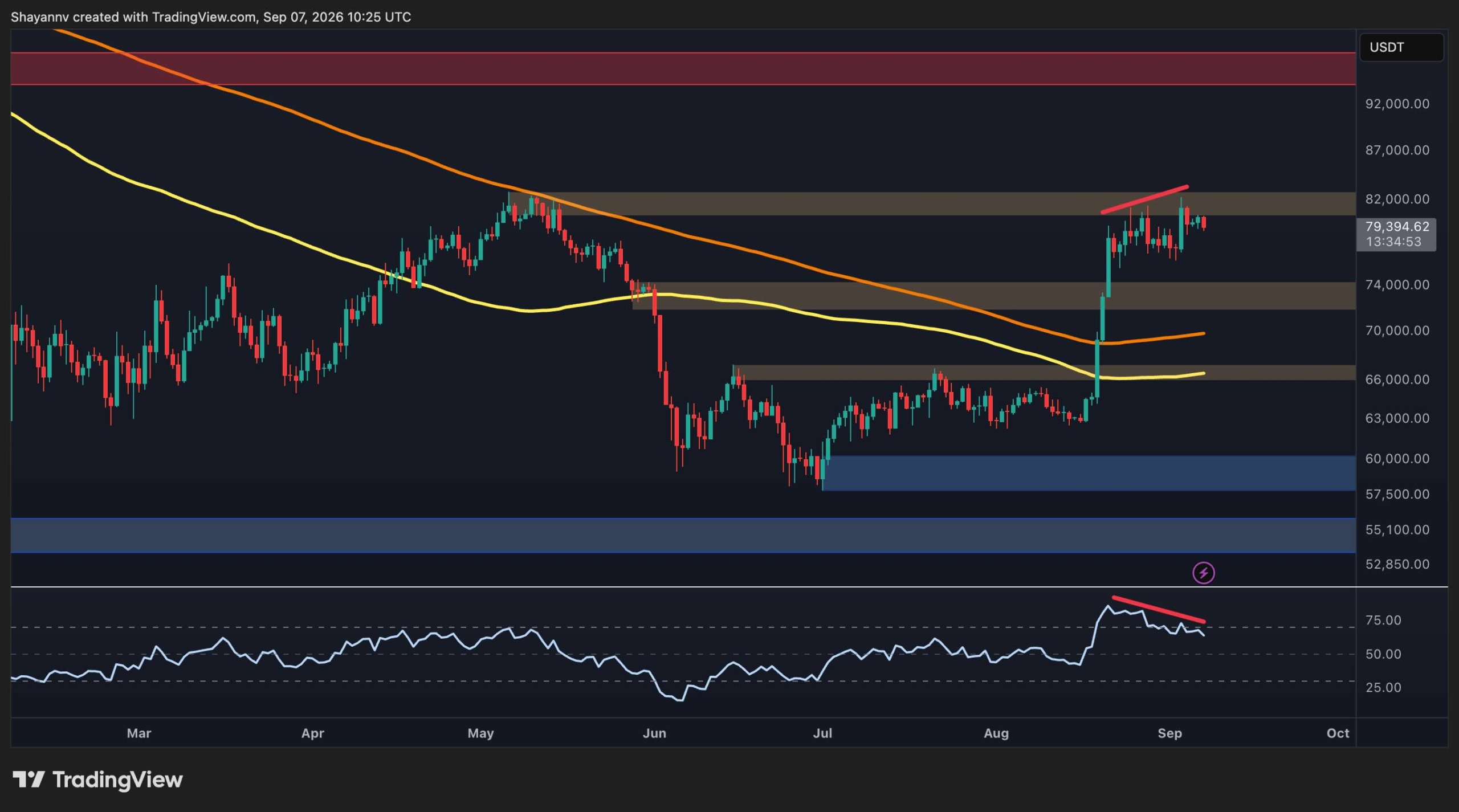
BTC/USDT 4-Hour Chart
The 4-hour structure presents a more clearly defined ascending channel. Following the sharp breakout from the $72K-$74K region, BTC has been oscillating between the rising channel boundaries, with the lower trendline currently situated around $77K and the upper boundary at $82K.
The price is currently around $79.4K, leaving BTC roughly in the middle-to-upper portion of this range. The $80K level is therefore an important near-term threshold, while the $82K level remains the primary resistance area.
A clean break above $82K, preferably accompanied by sustained 4-hour closes above the channel’s upper boundary, would invalidate the immediate range-bound setup and could open the door toward higher levels. On the other hand, a rejection followed by a loss of the lower trendline at $77K would increase the probability of a move back toward the $72K-$74K support zone.
The latest price action also indicates that the strong impulsive move higher has transitioned into consolidation. This can be constructive if BTC continues to hold the upper part of the range, but a breakdown through the lower channel boundary would suggest that the market needs a deeper correction before another attempt at the highs.

On-Chain Analysis
The Spot Average Order Size chart shows relatively little whale activity around Bitcoin’s current $77K-$80K trading range. In contrast, there was significantly more whale activity around the $60K-$65K lows, where larger orders were heavily concentrated. This positioning may have reflected accumulation near the market bottom, as Bitcoin subsequently rallied sharply from that area toward $80K.
The relatively limited whale activity at current levels could suggest that large participants are not aggressively adding exposure around the recent highs. This does not necessarily imply distribution, but it indicates that the current rally has not been accompanied by the same degree of whale activity seen near the lows.
From a broader perspective, the concentration of larger orders around the $60K-$65K area is notable because it preceded Bitcoin’s substantial recovery. If that activity represented accumulation, the subsequent rally could indicate that some of those positions are now in profit. Meanwhile, the lack of significant whale activity around $77K-$80K leaves the market more dependent on whether buyers can generate enough momentum to break the $80K-$82K resistance zone.

The post Bitcoin Price Analysis: BTC Bulls Need to Break This Key Level to Regain Momentum appeared first on CryptoPotato.
[PRESS RELEASE – Willemstad, Curaçao, September 7th, 2026]
1win is expanding its crypto offering by introducing USDC deposits and withdrawals via the Solana network and by participating in new Web3 community initiatives, including Sona’s fundraising campaign supporting emergency efforts in Nepal. The developments come as the company continues to broaden the role of digital assets across its products, with 1win Token also approaching its upcoming TGE.
1win users can now make both deposits and withdrawals in USDC via the Solana network, with the functionality available across all geographies currently serviced by the platform. The integration provides users with another option for moving stablecoins onto and off the platform while benefiting from Solana’s high-speed, low-cost infrastructure.
USDC deposits via Solana start at 5 USDC, while SOL deposits are available from approximately 0.0099353 SOL, equivalent to around $1 at the time the threshold was set. These are almost the lowest minimum deposit requirements currently available on 1win.
The update comes as 1win continues to develop its broader crypto offering. The company has also announced that 1win Token is set to launch on Solana, with further details on the upcoming TGE and listing to be shared through the project’s official channels, including the @1winToken account on X.
Alongside its latest crypto product updates, 1win has also joined a fundraising initiative launched by the Solana Foundation following the major flooding emergency in Nepal on August 26.
The campaign turned the profile picture of Solana’s official X account into a charity auction, divided into nine zones that companies and Web3 projects could bid on for logo placements. All funds raised through the initiative were directed toward emergency relief efforts in Nepal.
1win secured the Top Center placement with a $16,276 contribution, the second-largest donation made through the initiative. Overall, the auction raised $166,946.50 for relief efforts in Nepal. In parallel, 1win has supported relief efforts on the ground through separate donations to the charitable organization Mountain Heart Nepal.
The new payment option and participation in the Nepal initiative add to 1win’s expanding crypto activities, while further developments around 1win Token are expected to be announced closer to its TGE
About 1win
Founded in 2016, 1win is a global crypto entertainment platform operating across Asia, Latin America, and Africa. 1win offers a wide range of products adapted to regional audiences. The brand has active collaborations with international public figures, including football legend Luis Suarez. In 2026, 1win welcomed rapper Tyga, UFC legend Ilia Topuria, Olympic champion and UFC fighter Gable Steveson, and reggaeton star Nicky Jam as members of the 1win VIP community.
The post 1win Expands Crypto Offering With USDC on Solana and New Ecosystem Developments appeared first on CryptoPotato.
Bitcoin has spent the past several days struggling to decisively break past $80,000, and options traders don’t appear too concerned about an imminent volatility explosion despite the major economic events in the next ten days.
QCP Capital’s latest market analysis suggests that BTC’s 18-day at-the-money implied volatility currently sits at just 37%-38%, despite the upcoming US inflation report and the subsequent FOMC meeting.
Waiting for Clarity
The analysts believe the volatility compression reflects a market waiting for additional information rather than traders expressing strong directional conviction. This narrative received some confirmation last week after the release of the August jobs report, which significantly exceeded expectations, with the US economy adding 162,000 jobs compared to forecasts of around 55,000. Unemployment remained at 4.1% while average hourly earnings increased 0.3% MoM.
The reading strengthened the argument that the US remains resilient and shifted attention back toward inflation and the Fed’s next move. Markets now assign a 58% probability of a 25-basis-point rate hike at the September 15-16 meeting.
Major institutions have also turned hawkish, especially after Kevin Warsh’s speech at the end of August. UBS expects the central bank to raise rates in September and also in December after previously forecasting no changes this year.
Aside from a brief retracement by a few grand, Bitcoin has remained resilient, surging past $82,000 last week before it calmed at just under $80,000.
CPI Can Tilt the Market
The next big test comes with the August inflation data, to be announced during the current big economic week. Producer inflation will provide the first signal on Thursday, followed by the considerably more important Consumer Price Index on Friday.
The latter could materially alter expectations surrounding the upcoming Fed decision. As usual, a hotter-than-expected reading would provide the central bank more leeway for a rate hike, potentially pushing Treasury yields higher and creating additional pressure on risk assets like bitcoin.
The inflation threat has become particularly relevant as oil prices continue climbing amid renewed US-Iran strikes. Brent crude neared $100 per barrel on Monday, while markets are already assigning increasing probabilities to rate hikes from several major central banks.
A softer reading could reduce the pressure on policymakers to act and potentially provide BTC with the catalyst to finally break through $82,000. Nevertheless, QCP’s analysts do not expect a dramatic breakout in either direction.
The post Bitcoin Traders Are Surprisingly Calm Ahead of CPI and the Fed: Is a Big Move Coming? appeared first on CryptoPotato.
Popular analyst Ali Martinez outlined that more than 116,000 ETH were withdrawn from crypto exchanges in just two days. The stash was worth roughly $300 million at current prices.
This has reduced the amount of ETH immediately available for trading, potentially easing sell-side pressure. Although exchange withdrawals alone do not necessarily indicate accumulation, as assets can also be moved for staking, custody, or other purposes, the timing is peculiar, as ETH is making another attempt to break above the $2,500 threshold.
What’s the Next Target?
In a separate analysis also dedicated to ETH’s performance, Martinez noted that the asset has traded between $2,370 and $2,530 since its breakout during the last week of August. Recall that Ethereum, alongside the rest of the market, exploded after August 19, surging from $1,900 to the aforementioned upper boundary.
However, it was unable to break through despite trying on several occasions, and each subsequent rejection drove it south toward $2,400 or slightly below. The analyst believes ETH is now gradually rebuilding momentum for its next move, and the direction should be confirmed by an hourly close outside that range. The current structure, he added, appears to favor buyers.
If the largest altcoin is indeed able to break through $2,530, Martinez noted that the next immediate target would be $2,700. The one after that would be at $2,822, where more than 10 million tokens were last transacted, making it a major supply zone that could trigger “a rejection or, at the very least, slow advance.”
Ethereum is sitting on a major support zone around $2,475, where roughly 2.86 million ETH have previously changed hands.
As long as this level holds, the path toward $2,722 remains relatively clear.
The real test comes between $2,723 and $2,822, where more than 10 million $ETH… https://t.co/kwLrVWl186 pic.twitter.com/ffwai9aOpn
— Ali Charts (@alicharts) September 7, 2026
ETF Still Green
The other piece of good news for ETH investors comes from the ETF net inflows. As reported yesterday, the past week was also quite beneficial for the funds tracking the altcoin, as they gained $218.41 million. In the past two weeks alone, the net inflows have skyrocketed to well over $1 billion.
Moreover, the Ethereum ETFs have been in the red only once weekly since the beginning of July, and even that streak-breaker was quite modest, with net outflows of just $2.26 million.
The post Ethereum Breakout Incoming? $300M in ETH Leaves Exchanges as Analyst Eyes Next Big Target appeared first on CryptoPotato.
XRP futures trading had a much busier August as volume climbed to its highest level in six months. This marked the strongest activity since February, according to data shared by CryptoQuant.
The jump was not limited to one exchange.
August Volume Surges
Activity increased across some of the biggest names in crypto, which brought more liquidity and interest back into the XRP derivatives market. CryptoQuant found that Binance dominated the market. The exchange recorded roughly $37 billion in XRP futures volume during August. Bybit was a distant second at around $14.54 billion, followed by OKX at approximately $12.88 billion.
These three exchanges alone handled more than $64.6 billion worth of XRP futures trades during the month.
The change is especially noticeable as XRP futures activity had been running at lower levels, but August brought traders back in a much bigger way. The stronger price action around the crypto asset likely played a role here. It climbed nearly 30%, rising from $1.06 at the start of the month to a high of $1.50 on August 24 before ending at $1.35.
Alongside futures, spot trading volume also reached its highest level since February. Binance, as usual, accounted for the biggest share, posting around $7.28 billion in XRP trades. Next up was Upbit with $4.68 billion, while Bithumb Korea posted nearly $2.59 billion. Bybit, Gate.io, and KuCoin trailed with roughly $1.4 billion, $1.33 billion, and $1.23 billion, respectively. Bitget and Coinbase each came in just below the $1 billion mark.
However, the technical picture is less convincing. Crypto analyst ChartNerd noted that XRP has stayed below its 50-week WEMA for three straight weeks, while the weekly Stoch RSI remains overbought. The 20-week WEMA at $1.29 is now the support level. A continued break below the 50 could lead to a deeper correction.
Weekly Slowdown
On the institutional front, the XRP ETF market remained positive for another week, but the pace of inflows clearly slowed. The funds attracted nearly $19 million over the latest period, and extended their winning streak to eight consecutive weeks.
That result was a sharp step down from the previous week, when inflows topped $110 million and were the strongest weekly performance of 2026.
After $5.64 million entered the funds on August 31, inflows jumped to $14.38 million on September 1. The momentum then broke on Wednesday, when investors pulled $7.2 million from the products. It was the first day of net outflows since August 5. Thursday brought some relief as another $6.14 million flowed into the funds. Friday, however, produced no movement at all.
The post XRP Futures Just Posted Their Biggest Month in 6 Months: Here’s What Changed appeared first on CryptoPotato.