Cryptocurrency Posts
Crypto Briefing
The UK's actions may catalyze a shift in global diplomatic stances, potentially influencing broader recognition of Palestinian statehood.
The post UK sanctions Israeli settlements, calls occupation illegal after ICJ ruling appeared first on Crypto Briefing.
The prolonged conflict may strain international relations, impact global markets, and necessitate sustained diplomatic and humanitarian efforts.
The post Russia-Ukraine conflict expected to persist into 2024, officials say appeared first on Crypto Briefing.
The expanded buyback program may stabilize bond market liquidity, but ongoing tech sector demands could sustain pressure on long-term yields.
The post US government doubles Treasury buyback program to stabilize bond market appeared first on Crypto Briefing.
India's global UPI expansion could revolutionize cross-border payments, reducing remittance costs and challenging traditional financial systems.
The post India PM Modi seeks global expansion for retail payment platform appeared first on Crypto Briefing.
Ramp's rapid valuation growth highlights the increasing investor confidence in AI-driven fintech solutions, potentially accelerating its IPO plans.
The post Ramp in talks for new funding at $60B valuation appeared first on Crypto Briefing.
Bitcoin Magazine
Bitcoin Magazine

Capital B Buys 376 Bitcoins in Its Biggest Purchase of 2026
European bitcoin treasury Capital B has announced a BTC buy, snapping up 376 coins — one week after it said Blockstream boss Adam Back was investing in the company.
The Euronext Growth-listed company said Tuesday that it now owns 3,521 bitcoins — worth over $277 million at today’s prices — making it the 25th biggest publicly traded bitcoin treasury in the world, according to Bitcoin Treasuries data.
Capital B’s buy was for €25.3 million (over $29 million), according to its announcement.
— Capital B (@_ALCPB) September 7, 2026
Capital B confirms the acquisition of 376 BTC for €25.3 million, the holding of a total of 3,521 BTC, and a BTC Yield of 2.17% YTD
Full Release (EN): https://t.co/PQDwqfWX9a
Full Release (FR): https://t.co/SrVf8lvp8Q
BTC Strategy (EN): https://t.co/P5j3GA76kt

Just last week, the company said that top bitcoiner Adam Back, who heads up bitcoin infrastructure company Blockstream, had invested €7.6 million ($8.8 million) in Capital B to help with its buys.
The firm in August said it had raised €21 million ($24 million) in a private placement backed by Back and asset manager TOBAM.
The bitcoin treasury’s stock was trading 2% lower on Tuesday.
Capital B built most of its bitcoin position through fundraising rounds during the first half of 2026.
In May, it snapped up 192 coins for €13 million after completing three capital raises.
The company, which calls itself “Europe’s first Bitcoin treasury company,” is trying to build a bigger bitcoin position as other treasuries look to raise funds and accelerate their buys.
Capital B says on its website that it wants to eventually hold 210,000 bitcoins. “Our objective is simple: accumulate 1% of Bitcoin’s total supply by 2033,” it reads.
Digital asset treasuries became big in 2025 as more publicly traded companies tried to follow in the footsteps of Nasdaq-listed Strategy (formerly MicroStrategy), which started buying bitcoin in 2025.
Hundreds of publicly traded companies started buying bitcoin — with many buying other cryptocurrencies — to boost their stock prices. But since the price of bitcoin started dropping, a number of them are now under water or have had to sell their holdings.
Strategy, the largest corporate holder of the asset, has this year slowed down its bitcoin buys and instead pivoted to building a stronger cash balance and buying back its stock as the price of its shares has tumbled.
This post Capital B Buys 376 Bitcoins in Its Biggest Purchase of 2026 first appeared on Bitcoin Magazine and is written by Mathew Di Salvo.
Bitcoin Magazine

Castle Opens Its Bitcoin Savings Stack to Individuals
Castle, the company behind an automated bitcoin financial stack for businesses, has said it is opening its platform to individuals, bringing its high-yield product to personal accounts along with a first for the category: the option to take dividend income in bitcoin at whatever ratio the customer picks.
The yield comes from STRC, Strategy‘s perpetual preferred stock, which Castle added earlier this year and which currently pays a 12% annual dividend on a semi-monthly schedule.
Holders can take 100% of that payout in cash, 100% in bitcoin, or anything in between, according to a Tuesday statement. Most Castle customers land in the middle, the company said, covering operating expenses with cash while the remainder compounds into bitcoin automatically at every payout.
“Investors have long faced a choice between earning steady yield and holding bitcoin. Castle eliminates that trade-off,” co-founder and CTO João Almeida said. “By enabling a portion of dividend income to be automatically converted into bitcoin, so customers get both cash flow and long-term upside.”
The broader pitch is consolidation: Castle puts operating cash, fixed income, and bitcoin accumulation on one platform, cutting out the shuffle between a bank, an onramp, and a brokerage. The system is built automation-first: users define a strategy once and the platform executes it.
Until now, Castle served business entities exclusively — restaurants, gyms, churches, accounting firms, e-commerce shops, auto dealers, SaaS companies, real estate, and non-profits among them. The push into personal accounts came from those same customers.
“Feedback we heard over and over from business owners was: ‘I love this stack — when can I use it personally?'” co-founder and CEO Stephen Cole said. “Today we’re answering that. The same automated bitcoin-powered financial stack that runs their company’s balance sheet can now run their personal finances.”
Castle was founded by Cole and Almeida and is backed by Boost VC and Winklevoss Capital. More information about the company’s product can be found here.
This post Castle Opens Its Bitcoin Savings Stack to Individuals first appeared on Bitcoin Magazine and is written by Mathew Di Salvo.
Bitcoin Magazine

Strategy Halted Its Bitcoin Buys Again Last Week
Bitcoin treasury Strategy has halted stacking sats — again.
Just one week after resuming its bitcoin buying following a 10-week hiatus, the Nasdaq-listed company has put its BTC purchases on hold again.
Instead, the firm continued buying back its stock, repurchasing $176 million of STRC and increasing the size of its digital credit securities repurchase program from $1 billion to $2 billion, according to a Tuesday regulatory filing and announcement from founder and chairman Michael Saylor.
The company still holds 845,050 bitcoins worth over $66 billion at today’s prices and $6.5 billion in dollar reserves. The bitcoins were bought at an average price of $63.73 billion, according to Tuesday’s filing.
Strategy shares (NASDAQ: MSTR) were trading more than 3% lower Tuesday morning in New York.
The company paused its bitcoin buys in June, instead focusing on building a cash buffer, buying back its stock and even sometimes selling some of its holdings.
Strategy has defended its bitcoin sales, with CEO Phong Le saying that the company now has a “bullet-proof balance sheet” because of the move, and that it was the “right trade at the time” to sell when it did.
In the company’s quarterly earnings in July, Strategy posted a $8.22 billion loss. But Le reassured investors that the firm’s current paper loss was nothing to worry about.
“We’re the J.P. Morgan of the crypto economy, so whether we sell 1,000 Bitcoin out of 840,000 to me is irrelevant to the conversation,” Le said.
Strategy — formerly MicroStrategy — is an enterprise software company that pivoted to buying and holding bitcoin in 2020.
It first bought the cryptocurrency to protect its shareholders from inflation. Since then, it has aggressively bought the asset and pivoted to being a bitcoin treasury.
Investors can now buy its shares to get heightened exposure to the cryptocurrency, or get paid a yield via its digital credit products.
This post Strategy Halted Its Bitcoin Buys Again Last Week first appeared on Bitcoin Magazine and is written by Mathew Di Salvo.
Bitcoin Magazine

How One Executive Recruitment Firm Is Using M&A to Turn Earnings Into Bitcoin
Connecting Excellence Group (XCE) has signed binding Heads of Terms for its first proposed recruitment acquisition, targeting a specialist UK and U.S. recruitment business that generated £1.79 million in revenue and £431,000 in EBITDA over the last 12 months. The target also holds 8.216 Bitcoin.
The deal has not yet closed and remains subject to further due diligence, funding and a definitive purchase agreement. [Read XCE’s full announcement.]
Beyond the headline, the structure of the deal offers an interesting look at how an operating company can use M&A as part of a broader Bitcoin strategy.
XCE (AQSE: XCE | OTCQB: XCELF) wants to acquire profitable recruitment businesses, retain much of the earnings they generate, and expand the pool of internally generated capital available for growth and Bitcoin.
There is also a notable symmetry between buyer and target. XCE’s existing operating business, Spencer Riley, grew revenue 20.6% over its latest 12-month period. The acquisition target grew revenue 21.5% over the same period.
XCE is not simply looking to add scale. It is attempting to acquire growing, profitable businesses and bring them into a listed group with Bitcoin on its balance sheet.
Acquiring Earnings Power
XCE expects to pay £575,000 in initial cash consideration at completion. Approximately £425,000 would settle amounts owed to the target companies by the vendors and return to the group, resulting in an estimated net cash outflow of roughly £150,000 before transaction costs.
Another £60,000 cash payment is due in 2028, while much of the remaining consideration is deferred and tied to EBITDA performance through fiscal 2029. XCE expects to retain approximately 75% to 85% of the acquired business’s cumulative EBITDA during the earn-out period.
Compare that with the business being acquired: £1.79 million in trailing revenue, £1.27 million in gross profit and £431,000 in EBITDA, with revenue growing 21.5% year over year.
The objective isn’t simply to buy more revenue. XCE is attempting to acquire additional earnings power while preserving as much capital as possible.
If the business continues performing after completion, those earnings become another source of capital available for reinvestment, additional acquisitions and Bitcoin.
That is where M&A starts to become part of the Bitcoin strategy.
Acquiring the Balance Sheet, Too
The model can extend beyond revenue and earnings.
When an acquisition target holds cash reserves, XCE can structure a transaction to acquire that reserve from the seller and then change how that capital is held once it sits inside the group. In practice, that could mean raising capital to acquire £1 million of existing cash reserves and subsequently converting that reserve to Bitcoin.
The result is different from simply raising £1 million and spending it on Bitcoin. XCE is acquiring the operating business around the reserve as well: its revenue, earnings and future cash-generating capacity.
This proposed deal provides a direct example of the same principle, except the target has already made the conversion.
It holds 8.216 BTC.
Under the proposed terms, XCE would purchase that Bitcoin at market value with no premium. The cash paid would be matched by Bitcoin of equivalent value moving onto XCE’s balance sheet.
So the Bitcoin isn’t being acquired for free with the operating business. XCE is effectively exchanging cash for an equivalent amount of Bitcoin while separately acquiring the underlying earnings stream.
If completed, however, the transaction would expand both sides of XCE at once: another growing, profitable operating business and another 8.216 BTC on its balance sheet.
That combination is central to the model. An acquisition can potentially add revenue, EBITDA and balance-sheet assets at the same time.
A Decentralized Acquisition Compounder
How XCE intends to operate the businesses after acquisition is another important part of the strategy.
The company is targeting profitable, owner-managed specialist recruitment businesses, but it does not intend to absorb them into a single centralized operating brand.
Acquired companies retain their existing brands, management teams and operating independence while joining a publicly listed group backed by a Bitcoin balance sheet. That makes XCE’s model closer to a decentralized acquisition compounder.
Rather than attempting to create value primarily through integration and cost cutting, the strategy is designed to let individual businesses continue operating with autonomy while XCE provides permanent ownership, access to the listed group and centralized capital allocation.
XCE’s existing business gives some context for the type of growth it is looking to add. Spencer Riley generated approximately £1.84 million in revenue during the 12 months ended June 30, up 20.6% from the prior year. The proposed acquisition target grew at a similar rate, with revenue rising 21.5%.
If XCE can continue acquiring businesses with similar economics, the group can potentially compound by adding new earnings streams without dismantling the businesses producing them. Those earnings then feed into a common capital allocation framework in which Bitcoin is one potential destination.
Building More Than One Source of Capital
XCE isn’t relying on operating earnings alone to grow its Bitcoin position. The company reported 72.94 BTC as of September 1, up from 9.27 BTC at its December 2025 IPO. Capital markets activity has contributed to that growth.
Most recently, longtime investor Adam Back subscribed for new XCE shares through the transfer of 10 BTC to the company, increasing its Bitcoin holdings by 15.9%.
M&A introduces another source of potential capital alongside those transactions: earnings and balance-sheet assets acquired with the operating businesses themselves.
Put together, the model looks something like this:
Acquire profitable businesses → retain their autonomy and earnings power → grow group cash generation → allocate capital across further acquisitions and Bitcoin → repeat.
External capital can provide immediate purchasing power, as the Adam Back transaction demonstrates. Acquired reserves can add balance-sheet capital. Profitable operating businesses can continue generating capital as long as they perform. XCE is attempting to combine all three.
The Operating Economics Come First
Bitcoin does not make a poor acquisition a good one. XCE still has to acquire quality businesses at sensible prices, preserve their earnings power and allocate the resulting capital effectively. But the strategy illustrates how Bitcoin can fit inside a traditional operating company without becoming disconnected from the business underneath it.
The decentralized structure is important here. XCE does not need every acquired company to become a “Bitcoin business.” The recruitment companies can continue serving their customers, operating under their existing brands and generating earnings. Bitcoin sits at the group level as part of the broader capital allocation strategy.
That creates a different way to think about Bitcoin on a corporate balance sheet.
The company can raise outside capital. It can acquire existing reserves and change how they are held. It can acquire profitable businesses and retain the cash they generate. Management can then allocate capital between operations, additional acquisitions, other corporate needs and Bitcoin. That is how XCE is using M&A to turn earnings into Bitcoin.
Not by automatically converting every pound of profit into BTC, but by building a decentralized group of profitable businesses capable of producing more earnings and making Bitcoin one destination for the capital they generate.
For operators, that may be the more interesting question: not simply how to find more capital to buy Bitcoin, but how to build a business capable of generating more capital in the first place.
Disclaimer: This content was prepared on behalf of Bitcoin For Corporations for informational purposes only. It reflects the author’s own analysis and opinion and should not be relied upon as investment advice. Nothing in this article constitutes an offer, invitation, or solicitation to purchase, sell, or subscribe for any security or financial product.
This post How One Executive Recruitment Firm Is Using M&A to Turn Earnings Into Bitcoin first appeared on Bitcoin Magazine and is written by Nick Ward.
Bitcoin Magazine
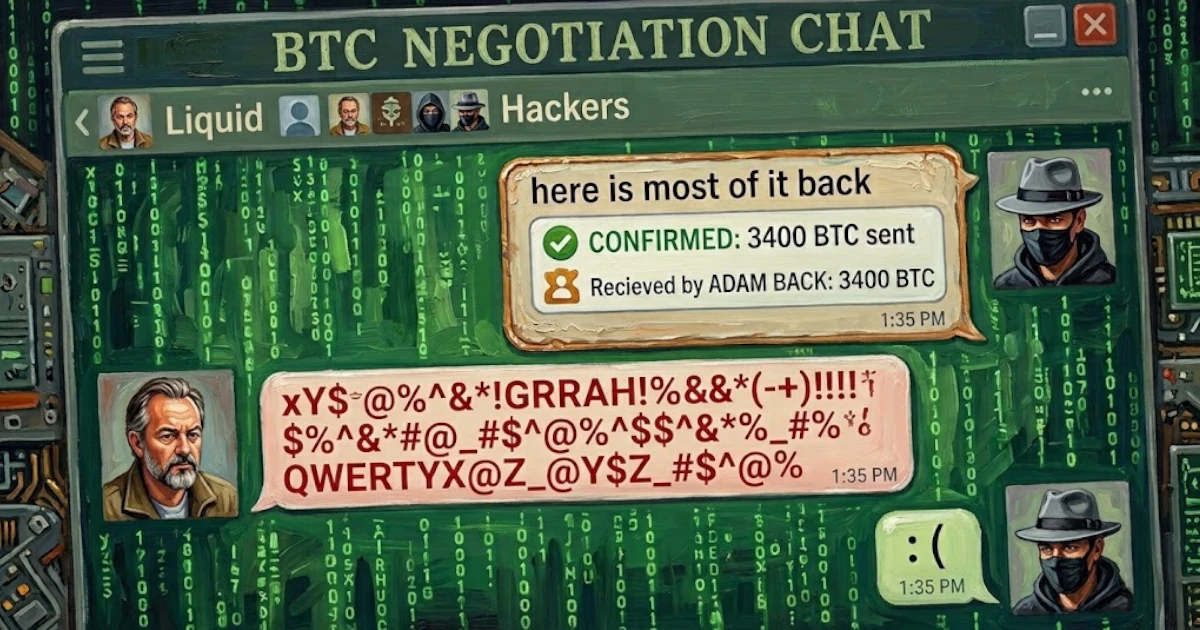
Liquid Gets 3,400 BTC Back After On-Chain Talks; White Hats Keep 598.5 BTC
The “White hat” party that withdrew nearly 4,000 bitcoin from the Liquid Network federation wallet on Sunday returned 3,400 BTC to the wallet on Monday. About 598 BTC, or 15% of the consolidated pile, stayed at the same holder address as an implied bounty fee worth 48 million dollars.
The return transaction (bc49a46d), confirmed at 16:09 UTC on September 7. It returned exactly 3,400 BTC to the labeled Liquid peg script address and sent the 598.5 BTC change back to the “White hat” hacker address as change.
The transfer followed a day of messages written into Bitcoin blocks. The White hats first published transaction on chain with a message in the OP_RETURN arbitrary data field “contact us on chain”; the message came from the address holding the 4000 BTC taken from the Liquid Network.
A Blockstream-linked address answered with “Please contact security@blockstream.com”. Later notes from that sender carried Electrum-encrypted payloads and PGP signatures that can be verified against Blockstream’s published security key.
In block 965869, the White hats asked in the clear text whether sending “most” back to the federation script was acceptable. The 1,000-sat output on that transaction was only a message carrier.
Soon after, the White hats wrote “Please fix the bug first. The chain is under risk at latest commit right now. Make sure every node is patched. Then we will transfer the money back safely after confirming the fix.” followed by an encrypted blurb of text to Blockstream’s PGP key.
In the same block, a clear-signed reply from the Blockstream sender said “Yes, thank you.” Hours later, the same Blockstream posted another clear-text note: “Bridge nodes are patched, safe to return the funds”.
Minutes after the 3,400 BTC landed. The white hats sent back 85% of the funds, keeping 15% as an implied finder’s fee. The choice was celebrated by some on X as ‘better than keeping 100%’ while others were a bit shocked at the amount. While 15% might sound reasonable, the total sum is so large that it nears $50 million at today’s prices. Blockstream was clearly not happy about the finder’s fee, as four encrypted messages followed onchain a few hours later, likely after the main fires had been put out at the office and the lawyers had a chance to have a say in the matter. An hour later, one more encrypted message was posted from Blockstream.
The White hats replied with two encrypted messages. Blockstream replied once an hour later. Then the White hats published a simple yet meaningful “  ” sad face emoji. This emoji does a lot of work. It suggests that negotiations did not go well over reducing the size of the bounty. Blockstream wizards are clearly ‘big mad’ about the size of that finder’s fee. What exactly was said in those encrypted messages is not known and Blockstream has made no public statements on the matter. But we can only assume the saga is not over.
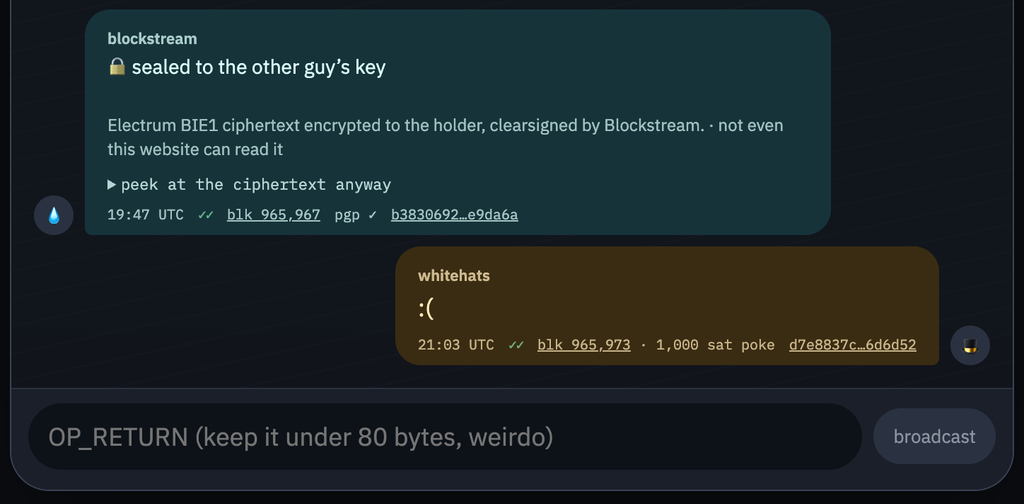
The full chat can be easily followed on this vibe-coded site (by yours truly). A couple of other researchers are keeping tabs on the conversation and on-chain data, such as Sjors’s GitHub gist and Alex Thorn from Galaxy Research.
Liquid’s Sunday statement is still the network’s last official account post: purported whitehats withdrew about 4,000 BTC through the SideSwap peg-out path, the PAK itself was not compromised, other issued assets were unaffected, and the sidechain was paused. Liquid and Blockstream had not posted a new statement on the 3,400 BTC return as of this writing. SideSwap had said the L-BTC in the original peg-out “came from an Elements bug.”
This post Liquid Gets 3,400 BTC Back After On-Chain Talks; White Hats Keep 598.5 BTC first appeared on Bitcoin Magazine and is written by Juan Galt.
CryptoSlate
An AI-payment hub on the XRP Ledger has recorded almost 4.5 million transactions while settling only a few thousand XRP.
Near press time, the XRPL AI Hub, a dashboard run by t54 labs, showed 4,491,820 all-time transactions alongside cumulative settlements of 5,836.71 XRP and 4,125.29 RLUSD, Ripple’s dollar stablecoin. The figures cover the hub’s tracked activity, not all payments on the ledger.
For XRP holders, the distinction is between a service processing frequent payments and one generating substantial demand to buy and hold the token. The hub’s activity establishes the former; its counters alone cannot establish the latter.
XRP traded around $1.40 on Sept. 8, with an $87.5 billion market capitalization and $2 billion in reported 24-hour trading volume. CryptoSlate’s price-based market signal rated conditions bullish at 66 out of 100. That measures market conditions, not a survey of holders or a prediction of where XRP goes next.
The market data and the hub’s cumulative payment amounts measure different things. They are not a valuation ratio. But the small settled amounts show why transaction headlines alone offer little evidence that AI usage is driving demand for the token.
Why millions of payments can move little XRP
The design helps explain the numbers. Ripple introduced its XRPL AI Starter Kit on June 9, enabling software agents to use x402 payments for API calls, AI inference and other digital services. Agents can pay in XRP or RLUSD.
That allows frequent, tiny payments without requiring each service purchase to involve a meaningful amount of XRP. The hub’s transaction list displays fractional XRP and RLUSD transfers. Its homepage also reported 152 registered merchants and a seven-day average of 199,059 payments per day.
Small payments are the point of this service: software can pay for individual digital services in tiny increments. The distinction matters when that activity becomes an argument for XRP’s price: a payment in RLUSD is not the same thing as purchasing XRP.
XRPL transaction fees still require XRP. XRPL’s standard minimum fee is 10 drops, although it can rise under load. Fees are destroyed rather than distributed to holders or validators.
For the adoption argument to become more compelling for XRP holders, the informative signals are how much XRP settles and whether usage produces sustained token demand. More transactions alone cannot answer either question.
The September snapshot shows that the hub is recording micropayments. Whether those payments grow into substantial XRP settlement activity is the next economic test, separate from how bullish the token’s market signal looks today.
The post AI agents are executing millions of micro-payments on XRP Ledger, but hardly any tokens are being bought appeared first on CryptoSlate.
Bitcoin trades below $80,000 on Sept. 8 as oil approached $100 a barrel following a fresh disruption to Saudi energy facilities. The new energy shock could complicate the inflation outlook even if Friday's US consumer-price report brings encouraging news.
Bitcoin's price stood near $78,300 at press time, down 1.52% over 24 hours, although it remained up 20% over the past 30 days. Its monthly gains therefore remained intact as the latest energy disruption added uncertainty.
Reuters reported that operations at some Saudi energy facilities halted Tuesday following attacks by Yemen's Houthi movement, citing Saudi authorities. Brent crude futures touched $99.46 a barrel before trading at $98.63 around press time. Spot Brent price touched $101 intraday before European trading began.
For Bitcoin's recovery, the distinction is between inflation already measured and price pressure still developing. A softer August reading could ease interest-rate concerns without resolving the newer risk from oil.
Friday's CPI looks backward
The Bureau of Labor Statistics calendar schedules August's Consumer Price Index for Sept. 11 at 8:30 a.m. Eastern. It measures August prices, so it cannot reflect a disruption that happened on Sept. 8. September's CPI is not scheduled until Oct. 14.
That creates a gap between the inflation data arriving before the Federal Reserve's Sept. 15-16 meeting and the energy risk developing now. Bitcoin would enter that policy decision with the latest consumer-price figures describing conditions before Tuesday's attacks.
The inflation backdrop was already uneven. July CPI rose 0.1% over the month and 3.4% over the year. Excluding food and energy, prices increased 0.2% monthly and 2.5% annually. None of those figures tells investors how much the new disruption will affect subsequent inflation.
Fed Governor Christopher Waller said Sept. 3 that continued disinflation would incline him to support holding rates, while hot August inflation could lead him to consider a hike.
He also identified renewed energy-price increases as an upside risk. But he said earlier fears that energy costs would spread more broadly through goods and services had not materialized so far. His comments describe a conditional position, not a commitment by the committee.
The labor backdrop remains part of that decision: BLS reported 162,000 additional jobs in August and unemployment of 4.1% on Sept. 4. Those figures sit alongside the tension between oil and labor data that predated Tuesday's fresh disruption.
For Bitcoin, the near-term question is whether cooler inflation data arrives alongside easing energy pressure. Persistent expensive oil could complicate the case for a Fed hold; a retreat in crude would reduce that particular risk.
Friday's release will provide the August figures. Whether the new energy shock persists remains a separate question for the inflation outlook facing Bitcoin.
The post Fed inflation trap threatens Bitcoin below $80k as $100 oil blindsides Friday’s CPI report appeared first on CryptoSlate.
Tether CEO Paolo Ardoino’s vision of financial autonomy for people and machines puts a practical decision in developers’ hands: how much spending authority should an AI agent receive when a wallet’s owner unlocks it?
Tether’s Sept. 3 explanation of WDK CLI, the local command-line wallet built with its Wallet Development Kit, gives a concrete answer for that product. The human opens a timed session. On macOS and Linux, another process running as the wallet owner can request transactions if it can reach the unlocked wallet’s local endpoint. The CLI daemon does not require fresh approval of each payment.
That distinction matters for anyone building an assistant that can move money. Keeping wallet keys under the owner’s control establishes custody. Deciding which recipient, amount and operation an automated system may authorize is a separate design choice.
Ardoino set out the broader ambition when Tether announced WDK on Nov. 11, 2024. His statement described programmable monetary systems connecting people, machines and AI agents while preserving financial control. The September explanation shows how that longstanding strategy translates into one local wallet interface.
It also shows why the answer cannot be reduced to whether WDK “has safeguards.” Its CLI, software development kit and customizable MCP Toolkit offer different controls at different points in the transaction process. A developer’s choice of integration determines which protections apply.
Unlocking grants a session
The CLI documentation describes three components: terminal commands, a background process called a daemon that holds the unlocked wallet, and a bundled Model Context Protocol server. MCP lets an AI client call structured software tools. Both interfaces use the same local wallet.
Under the documented security model, a locked seed is encrypted with AES-256-GCM using a key derived through scrypt. Unlocking changes the access model. On macOS and Linux, the daemon’s socket is restricted to its operating-system owner, but it has no separate credential for each program.
A process running as that owner, if it can reach the socket, can ask the unlocked wallet to sign without knowing or re-entering the passphrase. The account boundary therefore matters alongside the wallet password.
The default session lasts five minutes from unlock. Ordinary activity does not extend it. The user can lock the wallet sooner, explicitly unlock it again to reset the timer, or disable automatic expiry with a zero lifetime.
These are useful session controls. They determine when access begins and ends. A short timer, however, does not by itself establish an amount limit or require a fresh decision about each recipient.
Tether describes the same-user access as an accepted hot-wallet trade-off. Its precautions include a dedicated wallet with limited funds, short sessions and separation under a dedicated operating-system account. These are disclosed operating constraints, not a reported theft or exploit.
The bundled MCP interface keeps wallet creation, seed export, unlocking and other administration outside its tool menu. That reduces what an agent can request through that server. It does not confine an AI client that also has independent shell access.
For transfers, the MCP guide says send_token defaults to a dry run. The recommended sequence is to preview a payment, show its network, token, recipient, amount and estimated fee, obtain confirmation, then execute.
The daemon does not require proof that those earlier steps happened. An otherwise valid execution request can broadcast from an unlocked wallet. A second route, call_method, can invoke declared chain-specific write operations without a dry run or enforced confirmation.
That makes the location of the check consequential. A client can present a careful approval screen while the underlying wallet remains willing to accept requests through another permitted path. For that screen to define spending authority, the product must control the other paths too.
The documentation’s tool counts need a qualification. The September blog mixes references to eleven tools with a nine-tool table, while the current MCP guide lists eleven. The additional entries are list_methods and call_method. Their significance is the ability to discover and invoke declared methods, rather than the size of the menu.
There is also a version mismatch. The CLI guide describes 1.0.0-beta.3, while Tether’s Aug. 27 changelog records beta.4. That entry describes a configuration-override fix and says public commands, configuration keys and stored-data behavior are otherwise unchanged. The guide’s beta.3 label therefore should not be read as the latest release number.
WDK offers more than the CLI’s controls
Developers building an application can use WDK’s SDK directly. Its local transaction policies provide configurable ALLOW and DENY rules before governed wallet or protocol operations execute. Examples cover approved recipients and amount conditions.
Those checks can block a governed call. They are opt-in local controls, with a defined scope, rather than rules enforced on the blockchain. The documentation says they are not a complete sandbox: separately retained raw account references and certain internal module calls remain outside their interception.
The SDK also leaves important inputs to the application. It does not automatically maintain recipient lists, fetch prices, decode contract-call data or persist spending counters. Developers own durability and concurrency when a limit depends on cumulative activity.
A daily budget illustrates the consequence. Checking the size of one payment cannot establish how much an agent has already spent that day. A product must record prior spending and handle simultaneous requests consistently if it promises a cumulative ceiling. The implication is that a cumulative budget needs application-level accounting as well as a check on each payment.
The separate MCP Toolkit, documented as beta.1, provides another approach. Tether says its built-in write tools use MCP elicitations to obtain explicit user approval before broadcasting. Its configuration options let developers expose read-only tools, choose individual operations or add their own.
These approval flows deserve to be distinguished from the bundled CLI server’s recommended preview sequence. Customization also means the developer must decide what any added operation is allowed to do.
Tether’s own division of uses places the CLI in local operator workflows, the SDK inside applications and the Toolkit in custom agent servers. That gives builders options as they move from experimentation to a product handling user funds.
The choice involves a practical trade-off. Requiring a person to approve every payment gives that person a transaction-level decision. Allowing an agent to operate within a preset budget permits more automation, but requires a reliable rule for what counts against the budget and which operations it covers.
For a user, the meaningful promise is therefore specific: what can this assistant spend, where can it send funds, and what ends its authority? A wallet password or an approval prompt answers only part of that question unless the surrounding software makes the intended restriction effective.
Ardoino’s self-custody strategy gives developers the means to build without handing wallet ownership to a custodian. The next responsibility sits with the product: make the authority delegated to the agent match the limits the owner believes they have set.
The post Paolo Ardoino wants AI agents to hold Tether, but developers are left on the hook for overspending appeared first on CryptoSlate.
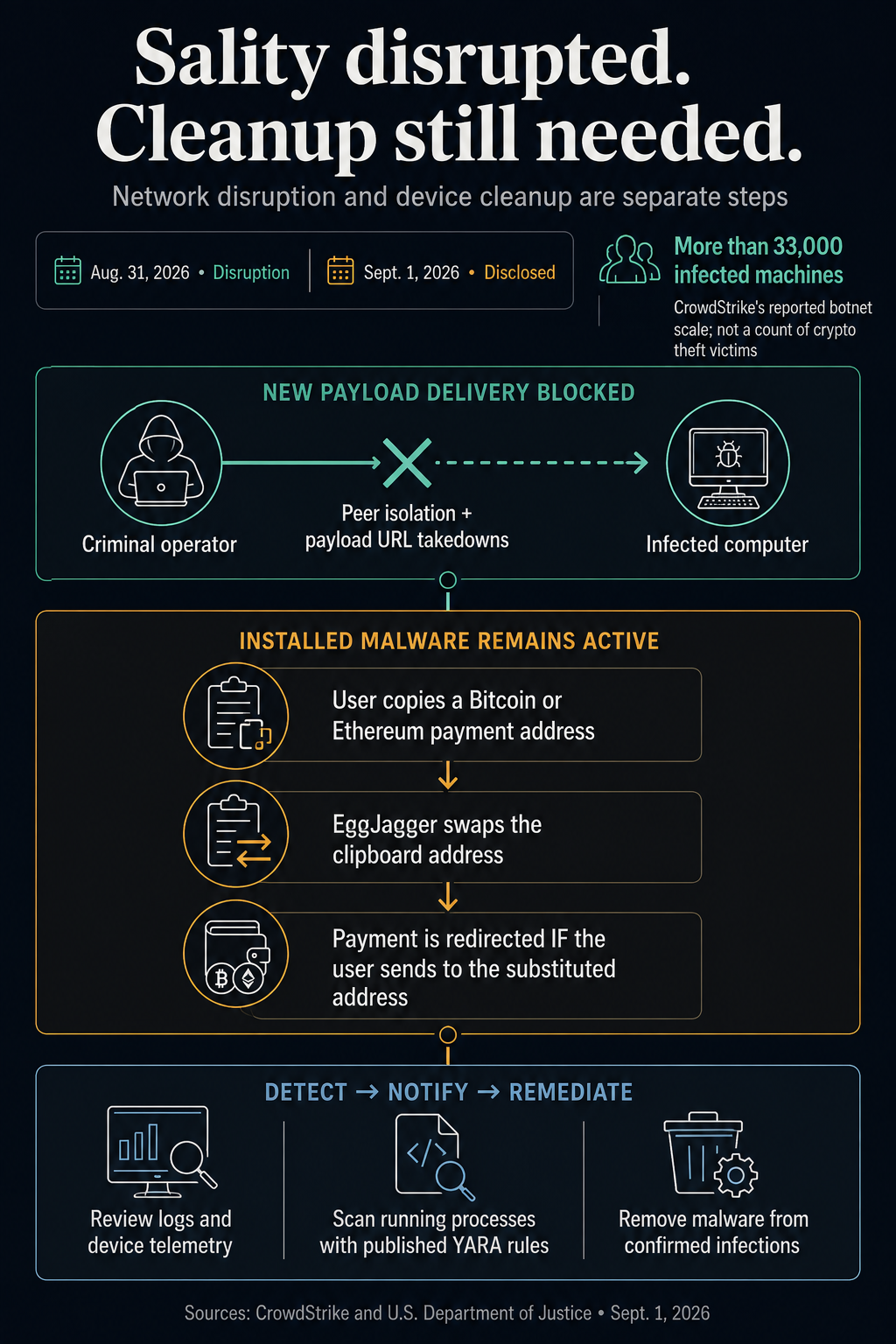
The Aug. 31 disruption of the Sality botnet cut off its operator's ability to deliver new malicious software to infected computers, while malware already on those devices remained active, according to CrowdStrike's Sept. 1 report. Users of infected machines still need to remove the installed malware, including a tool that swaps cryptocurrency addresses and can redirect payments.
CrowdStrike said the botnet enabled payload distribution to more than 33,000 infected machines worldwide. The figure measures compromised computers; the number of users who lost cryptocurrency remains unspecified.
The Justice Department announced the multinational operation on Sept. 1, 2026, following the action the previous day. U.S. authorities seized Sality-linked domains, while partners in Bulgaria, Hungary and Romania acted against additional domains.
How the payment risk survives
CrowdStrike identified EggJagger as Sality's primary payload over the preceding eight years. The tool watches the clipboard for cryptocurrency addresses and substitutes ones controlled by the operator, including when someone copies a Bitcoin or Ethereum address for a payment.
The dangerous step is sending to the substituted address. A user can intend to pay the correct recipient yet paste a different destination into the payment form. The redirection takes effect if the user sends funds to that destination.
Address-swapping software already installed on a computer can keep operating after Sality's communications are cut off. Users with a confirmed infection therefore still need to have the malware removed from their devices.
CrowdStrike describes Sality as a file infector: it attaches to executable files and spreads through network shares, removable drives and file sharing. Those infected files are a separate problem from the network connections disrupted by the operation.
The disruption changed the lists of peers that infected machines use to communicate, isolating them from the operator and inserting defender-controlled servers known as sinkholes. CrowdStrike said isolated bots could no longer receive payload download instructions or direct transfers of malicious files. Partners also took down URLs hosting payloads.
For network operators, CrowdStrike recommends checking network logs and device telemetry for UDP traffic to its lighthouse address, 188.166.101[.]148. The company says a match indicates a Sality infection requiring remediation. Its technical report also provides YARA detection rules for scanning running processes.
The Justice Department said the Shadowserver Foundation is working with internet service providers and computer security incident response teams to identify infections and help notify affected users and support remediation.
For users of infected computers, remediation addresses the malware that can still replace a copied payment address. The botnet disruption alone leaves that local threat in place.
The post Active crypto address “copy and paste attack” threatens users even after major malware cleanup cut off hackers appeared first on CryptoSlate.
BitFuFu, a Bitcoin miner and cloud-mining provider, reported a 55.4% rebound in August production as additional capacity came online. Cloud-mining customers accounted for about three quarters of the extra output, while the company's Bitcoin holdings increased by 59 BTC.
The unaudited Sept. 3 operating update put total production at 174 BTC, up from 112 BTC in July. Cloud-mining production rose from 40 to 86 BTC, contributing 46 BTC of the 62 BTC increase. Self-mining added the remaining 16 BTC, rising from 72 to 88 BTC.
That split matters for shareholders assessing BitFuFu's decision to spend Bitcoin on future mining capacity. The company defines cloud output as Bitcoin produced by customers using purchased hashrate. Those coins are excluded from BitFuFu's holdings. Customer activity supports a separately reported revenue business, but its production cannot be counted as company treasury replenishment.
Capacity arrives, reserves partly recover
BitFuFu ended August with 1,373 BTC, up 59 BTC from July's 1,314 BTC. Both balances include 44 BTC pledged for loans and miner procurement payables. The increase in holdings is a net balance change, distinct from the 88 BTC produced through self-mining.
The reserve remains 298 BTC below June's 1,671 BTC. In its July disclosure, BitFuFu attributed that month's decline primarily to advance payments for hashrate capacity scheduled to start in August and run for 330 days. The 357 BTC net decline does not identify the exact contract price or establish an open-market sale.
The operating expansion is now visible. Managed hashrate, a measure of mining computing capacity, reached 20.6 EH/s at Aug. 31, compared with 14.2 EH/s a month earlier. BitFuFu said capacity secured in June and July had come online.
Management had already reported progress before month-end: in the Aug. 17 earnings release, CEO Leo Lu said managed hashrate had returned to approximately 20 EH/s by mid-August. The September update adds the full-month production and holdings result to the capacity question covered in CryptoSlate's Aug. 9 report.
Shareholders gained a larger operating platform, higher self-mining output and a partial reserve recovery. Yet the August release supplies no incremental profit or payback figure for the capacity funded with Bitcoin.
Further operating updates can show whether the recovery continues. For shareholders, the next test is whether the expanded business generates earnings that justify the Bitcoin committed, which requires contract economics and financial results beyond the monthly production total.
The post Bitcoin miner burns through millions in BTC to buy compute, but new coins are not returning to treasury appeared first on CryptoSlate.
CryptoTicker.io
If you are holding Steelcoin (STEEL) on Bitpanda, a single date matters: September 30, 2026, 23:59 CET. Until then you can sell your tokens yourself, and without any selling fee. After that, the trading platform switches the sell button off for good. On October 1, 2026, all remaining holdings are converted into euros automatically and credited to your fiat wallet.
Your money is not gone. What you lose after September 30 is something else, and for the value of your holding it can matter a great deal more: the choice of moment. Sell for yourself and you pick your price. Wait, and you get whatever the market pays on the day of the forced liquidation.
That is the complete set of instructions, and it fits into a single paragraph. The rest of this article answers the questions that come afterwards, the ones that have had no answer in the German-speaking market so far. Why is a regulated product being withdrawn when nobody is insolvent? Is there a swap into the successor? What about the Steelcoin ETP in your securities account, which carries the same name and is still a different thing? And why can a payout of one euro be unreachable in practice?
The process is also a lesson in a mechanism that affects every holder who keeps coins with a broker instead of in their own wallet. A listing is not a permanent state. When a platform drops an asset from its programme, what follows is almost always the same pattern: buying stops, a selling window opens, and then automatic disposal. We have written that sequence up in general terms in Delisting explained: what happens when your token can no longer be traded. If you want to spread your custody risk on principle, you will find the licensed providers in our comparison of regulated crypto exchanges.
The three Steelcoin delisting dates at a glance
Bitpanda keeps a timeline in its helpdesk article that carries the whole process, last updated on August 31, 2026. This is how it stands:
| Date | What happens |
|---|---|
| September 8, 2025, 13:00 CET | Buying STEEL was switched off. That step is already a year in the past. |
| September 3, 2026 | All holdings worth less than one euro were liquidated automatically. The accounts affected received a flat payment of one euro. |
| September 30, 2026, 23:59 CET | Last moment to sell for yourself. The selling fee inside this window is zero percent. After that, the sell function is disabled permanently. |
| October 1, 2026 | Final liquidation of all remaining holdings at the prevailing market price. The proceeds go into the Bitpanda fiat wallet. |
Two of these four dates have already passed at the time of writing. The only one that calls for action is the line in the middle, and it leaves you a good three weeks.
What happens if you do nothing at all?
Then the forced liquidation applies. Forced liquidation means the platform sells your position without your consent and credits you the euro equivalent. Bitpanda words it in its helpdesk as the holding being converted on October 1, 2026 at the, literally, “live market price”.
That half-sentence carries the only economic difference between the two routes. For an asset whose buy side has been switched off for a year and whose trading is running out, the prevailing market price is not a particularly robust figure. It may be above today's price on October 1. It may also be below it. Nobody who is honest can predict that for you, and this article does not try.
What can be said is something else, and it needs no forecast: when you sell for yourself, you control a variable that you hand over in an automatic disposal. That is not a statement about the price. It is a statement about who pulls the trigger. The same constellation came up in August at another trading platform, and we described it in Kraken delisting with forced liquidation.
One common misunderstanding belongs out of the way at this point: a delisting is no expropriation. Your tokens are not taken away without compensation, you receive their equivalent value. The loss investors are afraid of is created by the price at which the process happens, not by the process itself.
Security token, utility token and ETP: three wrappers for the same steel promise
To understand why this product is disappearing, you have to keep three terms apart that all appear in the Steelcoin case and are regularly confused.
A security token is a security mapped onto a blockchain. Legally it falls under capital markets law rather than crypto law, which is why it usually needs a prospectus approved by a regulator. A utility token, by contrast, certifies no investor right but a claim to use something, a good or a service. Since the European regulation on markets in crypto-assets took effect, it falls under MiCAR and needs a whitepaper in place of a prospectus. An ETP, finally, is an exchange-traded bearer instrument that you hold in an ordinary securities account and buy through your bank or your broker, with no crypto account at all.
Tokenising a commodity can therefore come in very different legal forms, and the name on the packaging says nothing about which one it is. Steelcoin carries that name in at least three versions, and only one of them is affected by the Bitpanda deadline. Anyone tidying up their assets by the name instead of by the wrapper is tidying up in the wrong place.

Why Bitpanda is delisting Steelcoin: the capital markets prospectus has expired
The reason is stated word for word in the trading platform's FAQ, and it is remarkably unspectacular: “The validity of the prospectus for STEELCOIN has run out, and the asset can no longer be listed on Bitpanda as a result.”
A capital markets prospectus is the document approved by the competent supervisor that allows a security to be offered publicly. Under European law it is valid for twelve months. After that it has to be updated and approved again, otherwise the basis for the public offer falls away. If that does not happen, the product disappears from the shelf without anyone having to have made a mistake.
That makes this case more interesting than an ordinary delisting. The usual reasons an asset is dropped by a platform are thin volume, regulatory pressure or a problem at the project itself. Here it is an expired deadline inside an administrative procedure. The product is not failing, it is losing its authorisation. For you as a holder the outcome is the same; for how the case should be read it is not, and for the question of whether a successor product deserves your trust it certainly is not.
The one-euro flat payment meets the ten-euro minimum withdrawal
On September 3, 2026, Bitpanda automatically wound up all STEEL holdings worth less than one euro and credited the accounts affected with a flat one euro. That sounds like a generous rounding up, and taken on its own it is exactly that.
It becomes interesting in combination with a second rule on the same platform. Its helpdesk states that the minimum amount for deposits and withdrawals in fiat currencies is ten euros. So anyone who holds one euro in their account because of this flat payment and nothing else cannot have it transferred to their bank account. The balance exists, it is simply trapped below the threshold at which a withdrawal can be triggered at all.
In practice that means the one euro works as a balance you can go on using inside the platform, on your next purchase for instance, rather than as a payout. If you were planning to close your account anyway, factor that in. And anyone still holding a larger STEEL position has one more reason not to push the sale to the last minute, because the proceeds land in that same fiat wallet first and not in your current account.
Is there a swap into Steelcoin X (SCX)?
Everyone who has read the delisting notice asks this question, because the name lives on. The issuer, SC Steelcoin GmbH, based in Vienna, today runs Steelcoin X (SCX). By its own account the company is an independent subsidiary of the Frankstahl group, a European steel trader in business for some 140 years, and is run by its founder Marcel Javor.
What matters is the legal form of the successor, because it is a different one. The company page describes Steelcoin X as a “MiCAR-regulated utility token” that gives its holder the right to obtain hot-rolled strip steel. One token stands for one metric tonne of steel; a full coil takes roughly twenty to thirty tokens depending on weight, and physical delivery is provided for across the entire European Economic Area. Access is limited to investors from the EU and the EEA.
An investment product under capital markets law has thereby become a right to obtain goods under MiCAR. That goes beyond a change of label: the rulebook under which you hold your claims is a different one.
No swap offer for legacy holdings can be found on the issuer's publicly reachable pages. On September 8, 2026 we called up the provider's addresses for its legal information, for the ETP and for the ETP's FAQ. All three now redirect to a single landing page for Steelcoin X. Anyone looking there for the old prospectus or for a redemption rule for STEEL will no longer find them. For you as a holder, the practical answer to the opening question follows from that: do not count on being able to grow into the new product. You have the selling window, and if the commodity still interests you, entering SCX is a separate, fresh purchase with due diligence of its own.
If you want to switch platforms for such a fresh start anyway, our comparison of the best crypto brokers is worth a look before you tie yourself to the first provider you come across. Fees for buying, custody and withdrawals differ far more between houses than the advertising suggests.
How long does a payout at Bitpanda take?
A clean distinction pays off here, because in the context of the delisting the question can mean two completely different things.
The first step is the conversion of STEEL into euros, and that happens either the moment you sell for yourself or automatically on October 1. After that the amount sits as a fiat balance in your account on the platform. The second step is the transfer of that balance to your bank account, and only there do the rules for withdrawals apply: the minimum of ten euros mentioned above, plus the daily limits that depend on your verification status and your chosen payment method. How long the transfer itself takes depends on the method and on the banking route, not on the delisting.
The practical advice is therefore this: think of the process in two stages. If you really need the proceeds in your current account, do not leave the sale to the last day, but plan both steps one after the other.
Steelcoin ETP (ISIN DE000A3G9Q60): why your securities account is a separate question
Alongside the token on the trading platform there is a second product of the same name, and many German investors hold that one rather than the token: the Steelcoin ETP with the ISIN DE000A3G9Q60 and the WKN A3G9Q6. It is an exchange-traded bearer instrument with no maturity and no interest that tracks the performance of certain steel products, listed on the Stuttgart stock exchange since November 29, 2023 and likewise issued by SC Steelcoin GmbH. The price sheets name a future on Northern European hot-rolled strip steel as its underlying.
That is a different instrument in a different wrapper, bought through a bank or a broker and held in a securities account. The Bitpanda deadline of September 30 does not affect it. The trading platform's notice speaks explicitly of STEEL holdings on Bitpanda and mentions the ETP nowhere.
What follows from that for the instrument itself cannot be answered credibly from the outside, and here honesty matters more than a tidy answer. Whether the expiry of the prospectus also touches the ETP's listing we were unable to establish: the issuer's legal information page is, as described above, no longer reachable, and the trading venue's own pages answered our requests on September 8, 2026 with an access block. So we claim neither that the ETP is affected nor that it is not.
What we did measure is the state of the freely accessible price sheets, and you should know it if the instrument is sitting in your account. On September 8, 2026, at around 12:40, a common financial portal showed no ask price for the ETP, meaning no price at which anyone is selling. The most recent bid shown there, at 11.84 euros, carried a timestamp of August 14, 2025. Daily turnover stood at zero.
For you that means: a security with no quoted ask price and no turnover is, in case of doubt, not sellable within seconds, whatever your account statement says it is worth. If you hold this ETP, the right next step is a question to your custodian bank about tradability and current pricing, rather than a hunt for a deadline. That is a question for your broker, not one for Bitpanda.
The date trap: deadlines from 2025 no longer apply
Search for this topic and you quickly run into a second pair of dates, and it leads you astray. The delisting is running in two waves. Back in the autumn of 2025 there was already a selling deadline and a withdrawal deadline, in September and October of that year respectively. Those dates have passed and carry no meaning for you.
What counts is the current timeline alone, which Bitpanda itself describes as the conclusion of the process begun in October 2025. If a search engine summary or an older forum post sells you a date from 2025 as current, ignore it. Check the provider's notice in the original instead, and look there for the field with the update date. Where deadlines are concerned, that care is no luxury. This is why we keep the running key dates in a list of their own, see Crypto deadlines and key dates at a glance.
What this case shows about tokenised securities
The launch of Steelcoin in October 2024 was a media event, accompanied by an opening ceremony and by coverage in major business newsrooms. The ending is taking place without an audience. At the time of writing, no German-language media house has reported on the wind-down, not even those that covered the launch in detail. Comparison pages at large business titles are still promoting the product.
From that follows a lesson that reaches beyond this one case and that you can apply to any tokenised product you come across. Attention is at its greatest at the launch and at its smallest at the end. If you hold a product tied to an authorisation, you are responsible for the expiry of that authorisation yourself, because nobody has an economic interest in reminding you of it.
There are three questions you should be able to answer up front for any tokenised security. Which rulebook governs it, capital markets law or MiCAR? How long does the authorisation run, and who renews it? And what happens to your position if the platform drops the product from its programme? The answers are in the prospectus or in the whitepaper, not in the product advertising. If you cannot find them, you already have an answer.
One last point that is easily overlooked: for tax purposes a forced liquidation is a sale like any other. Whether it produces a taxable gain depends on your holding period, your acquisition history and your personal situation. Secure the settlement as soon as it is available, and clarify the assessment with a tax adviser.
Checking the Steelcoin deadline: what to take away
- Put September 30, 2026 in your calendar, not October 1. Until 23:59 CET you can sell STEEL yourself free of charge and set the moment. After that, the automatic disposal decides. If you are rethinking where you keep your assets anyway, compare the licensed providers in our overview of regulated crypto exchanges.
- Check which Steelcoin wrapper you actually hold. The token on the trading platform, the ETP in your securities account and the new utility token SCX are three different things, and only the first of them has a deadline now. If yours is the ETP, address your question about tradability and pricing to your custodian bank; which houses offer which terms is shown by the crypto broker comparison.
- Document the process before the position disappears. Secure your purchase receipts, your holdings statement and the settlement of the sale or the liquidation while they are still retrievable. For keeping track of such events across several platforms, the tools in our comparison of crypto tax tools and portfolio trackers will help.
The primary sources to read up on: the delisting notice in the Bitpanda helpdesk with the full timeline, and the company page of the issuer SC Steelcoin on the successor product.
(As of September 8, 2026. This article is not investment advice. Prices and fee structures change; check the terms with the provider before you buy.)
Bitcoin mining in Austria: when rewards are taxed at 27.5 percent and when at the income tax rate
Anyone who receives bitcoin through mining does not automatically end up with tax-free coins in Austria. Tax law treats the acquisition of cryptocurrencies through a technical process for transaction processing as current income from cryptocurrencies as a matter of principle.
As long as the activity can still be assigned to private asset management for tax purposes, crypto income of this kind is in principle subject to the special tax rate of 27.5 percent. If, by contrast, the mining becomes a commercial business by its nature and scale, different rules apply.
Mining rewards are valued as soon as they are received
Unlike in certain staking or airdrop situations, with mining it can be the receipt of the new bitcoin itself that is taxable. What matters, in principle, is the market value of the coins received at the time they are received. That value then also forms the acquisition cost of the bitcoin received for tax purposes.
Example:
- mining reward on receipt: 1,000 euros
- taxable current crypto income: 1,000 euros
- acquisition cost of the bitcoin for tax purposes: 1,000 euros
If the value then rises to 1,500 euros and the bitcoin are sold, a further capital gain of 500 euros can arise.
When does the 27.5 percent rate apply?
Income from cryptocurrencies is in principle subject to the special tax rate of 27.5 percent. That covers both current crypto income and later realised gains in value, provided no statutory exception applies. A smaller mining setup is therefore not automatically taxed at the progressive income tax rate.
When does mining become a commercial business?
The decisive line runs where the activity goes beyond pure asset management by its nature and scale.
The Austrian Ministry of Finance points out explicitly that income from a commercial business can then be present.
The following can be relevant, for example:
- the scale and organisation of the mining,
- substantial use of your own infrastructure,
- sustained professional activity,
- entrepreneurial organisation,
- overall economic scale.
There is, however, no simple statutory threshold along the lines of "commercial from three mining devices upwards". What is decisive is the overall picture.
Commercial mining changes the taxation
If the activity is classified as a commercial business, the mining proceeds become part of business income. The general income tax rate and the rules on determining business profits can then become relevant.
Costs such as hardware, electricity or depreciation can also be treated differently from the way they are treated for private investment income. That is a material difference: for investment income taxed at the special rate, the restrictions on deducting running expenses are considerably tighter.
Which bitcoin price is used?
The coins received have to be valued in euros for tax purposes. In principle an available exchange price is used for this. If no suitable exchange price exists, the Austrian rules provide for further valuation options via crypto dealers or recognised price sources.
Miners should therefore document on a regular basis:
- the time the reward was received,
- the BTC amount,
- the euro value,
- the price source used,
- the wallet address,
- mining pool statements.
Conclusion
Bitcoin mining does not become relevant for tax in Austria only when the coins are sold. Mining rewards can already be taxed as current crypto income when they are received. As long as the activity remains within asset management for tax purposes, the special tax rate of 27.5 percent is in principle the one to consider.
If the mining grows into a commercial activity, on the other hand, the progressive income tax rate can apply. With larger mining setups in particular, this distinction should be clarified early.
On September 21, 2026, the swap window from STPT to AWE closes for good. Anyone still holding the old STPT tokens in self-custody after that date can no longer exchange them for AWE. The AWE set aside for those tokens but never collected will then be decided by a vote of token holders. You are affected only if your STPT sit in a wallet you control, or on an exchange that did not carry out the swap in spring 2025.
This guide answers four questions: whether you need to act at all, how the swap works through the official portal, why your personal deadline can fall a week earlier depending on the network, and how the process is treated for tax purposes. In that order.
What happens to your STPT tokens on September 21, 2026
Since its rebranding, the project behind the token has been called AWE Network; before that it ran as STP Network. On August 20, 2026, it set the closing date in a blog post of its own: after September 21, 2026, STPT is no longer eligible to be swapped for AWE. The swap window has been open since May 2025, it is now being closed, and after that there is no official route left from the old token to the new one.
A quick definition: a token migration is the exchange of an old project token for a new one, usually because the project is switching blockchain or changing its name. The old token loses its role and the new one takes it over. Here the ratio is 1 STPT on Ethereum to 1 AWE on Base. The project charges no fee of its own for the swap; you pay the network fees on both chains yourself, and on Ethereum those are noticeably higher than on Base.
One detail is missing from the primary source, and no text should invent it: the blog post gives no time of day and no time zone for September 21. The safe reading follows from that. Treat September 20, 2026 as your last working day and do not plan the swap for the final hour. Anyone who starts on the deadline itself is relying on it still being midnight somewhere in the world.
Are you affected? The five-minute check for wallet and exchange account
The large majority of holders have nothing to do, and that is why the topic has gone unnoticed in the German-speaking market so far. The project names the venues that handled the swap automatically in 2025 in its official migration guide: Binance, Upbit, HTX, MEXC, Gate, Bitget and Bithumb. If your balance sat with one of them during that period, you have held AWE for a long time and can stop reading here.
You need to act in three situations. First, if STPT sit in a wallet of your own, whether software or hardware. Second, if your exchange did not support the swap and still displays an STPT balance for you. Third, if you withdrew STPT from an exchange in 2025 and have not looked at them since. That third group is the one that regularly slips through in deadline cases: the money is not gone, it has merely dropped out of sight.
The check takes a few minutes. Open your wallet and look for STPT in the token list. If your wallet only displays known tokens, check the balance through a block explorer for the address you traded under in 2025. The relevant contract on Ethereum carries the address 0xde7d85157d9714eadf595045cc12ca4a5f3e2adb; on Base there is a second, older version of STPT at 0x4489d0a0345eCB216A3994De780d453c7fA6312C. Both addresses appear in exactly that form in the project's technical documentation. If you are sorting through your holdings anyway, the hardware wallet comparison lists the devices that allow such a check without the detour through an exchange.

Why the Ethereum contract still reports 1.94 billion STPT
Here lies the misunderstanding that leaves most holders feeling safe. The project states that around 99 percent of the tokens have already migrated. That figure comes from the project itself and has not been independently verified by us. It also describes AWE claimed on Base rather than STPT destroyed on Ethereum. The old contract is in fact not reduced by the swap at all.
You can check that arithmetic yourself. On September 8, 2026 at 06:38 UTC we queried the totalSupply() function of the STPT contract through a public Ethereum node, at block 25,930,906: the result reads 1,942,419,283.03 STPT at 18 decimal places. For comparison we queried the same function on the AWE contract on Base, at block 51,030,084: a round 2,000,000,000 AWE there. The supply of the old token therefore stands unchanged in the books of the chain.
totalSupply denotes the total quantity of a token that a contract reports. If that value stays constant through a migration, the swap is a portal exchange and not a burn, meaning there is no destruction at contract level. In practice that means your STPT will not disappear from your wallet on September 21. The tokens stay visible, keep their number and lose only their claim to the new token. A glance into your wallet after the deadline will therefore reassure you about something that no longer holds true.
How the swap works through the official swap portal
For self-custody holders the route runs through the project's official portal, reachable at the address upgrade.stp.network. A swap portal is a web application operated by the project, to which you send the old token and through which you then collect the new one. The process has three stations: you deposit your STPT on Ethereum through the portal, wait for the automatic confirmation, which the project puts at around three minutes, and then claim your AWE on Base through the same interface.
The migration guide stresses two points explicitly, and both are security points. There is no separate contract address to which you are supposed to send tokens manually. And you should not use third-party bridges. Anyone who transfers STPT on their own initiative to some address that another person has given them has no claim to AWE and, as a rule, no one left to talk to either.
If you would rather take the detour through an exchange: a few venues folded the swap into their own processes at the time. Whether that is still offered today, shortly before the deadline, is for each exchange to decide and can change at short notice. Check it in your provider's support section instead of assuming it. And if you are thinking about switching venues anyway, the overview of crypto exchanges in comparison helps with the question of which venue handles such changeovers cleanly in the first place.
The hidden deadline: seven days of bridge time for STPT on Base
This calculation has not appeared in German anywhere so far, and it is the most practically important part of this text. There is an older version of STPT on Base. Anyone holding it cannot swap directly, because a Base-to-Base swap does not exist. The guide prescribes the route: first you have to bridge your STPT from Base back to Ethereum, then you can submit them through the portal and claim your AWE on Base.
A bridge is an application that transfers tokens from one blockchain to another. For the return trip from Base to Ethereum the project explicitly names a waiting period of seven days and urges you to factor it into your planning. Those seven days are not an estimate by the project; they are the usual challenge period for return routes of this kind.
September 21 minus seven days of bridge time makes September 14, 2026 the realistic last starting date, and only if everything goes smoothly. Anyone who discovers STPT sitting on Base on September 18 will not make it, arithmetically speaking. Anyone whose holdings are on Ethereum has an easier time and is well served by September 20. So clarify first of all which chain your balance sits on, because your calendar depends on it.

What happens to unclaimed AWE after the deadline?
The project puts it this way: unclaimed AWE that was earmarked for the migration will become the subject of a community governance proposal once the window closes. A governance proposal is a motion that the holders of a token vote on; the outcome then binds the project. Which options will be put to the vote is open. Destruction, redistribution or a lock-up over a longer period are all conceivable. The project intends to publish further details after the deadline.
For you as a holder this amounts to a plain shift of responsibility. Until September 21 you decide whether to collect your share. After that a vote decides, one you cannot take part in with an unswapped token, because voting rights attach to AWE and not to STPT. That is no reproach to the project; it is the normal mechanics of windows like this one. It is, however, the reason why working through such a deadline pays off even when the balance is small.
What the swap means for taxes
Caution is warranted here, and this section does not replace tax advice. The starting point: on March 6, 2025 the German Federal Ministry of Finance published a circular on individual questions of the income tax treatment of crypto assets. It confirms the familiar line that swapping one crypto asset for another within the one-year holding period triggers a private disposal transaction, while gains remain tax-free after a year has elapsed.
Whether a pure one-to-one migration even counts as a swap in that sense is answered inconsistently in the specialist literature. Tax firms and crypto tax providers largely take the view that in a migration the acquisition date and acquisition costs carry over to the new token, and that no taxable event therefore occurs. That view is well founded, but it is an interpretation and not an explicit statement by the ministry on this precise case.
In practice what mainly follows from this is a duty to document things for yourself. Record when you originally bought STPT, what quantity you submitted and when, and when you claimed AWE, together with the transaction identifiers on both chains. A tax tool with portfolio tracking takes that matching off your hands and carries the old holding period correctly over to the new position. Anyone who reconstructs it only next spring will be searching two blockchains for transactions they no longer remember.
How to tell a genuine migration page from a fake
Deadlines that create pressure to act are the preferred setting for counterfeit portals, and that applies to every migration. Four checks cost you under two minutes in total and rule out the most common cases.
- Take the address from the source, not from a search. Open the portal address via the project's blog post or documentation and, if in doubt, type it out. Paid search ads on typed brand names are a known attack route.
- Never enter your recovery words. A swap portal never asks for your seed. It connects to your wallet and lets you confirm a transaction, nothing more.
- No manual transfers to addresses someone names. The project's guide states explicitly that there is no separate deposit address.
- Read the approval you are signing. Check in your wallet which contract you are approving for which amount, and cap the approval at the amount you actually intend to swap.
Anyone who observes these four points has cleared away the largest part of the risk that lies in your own hands during a migration at all.
What this deadline has in common with the year's other migration dates
The STPT case is no one-off; it is the latest in a series. In August we covered the VANRY migration to Base, where the swap window likewise dragged on for weeks and self-custody holders were the real target group. In early September we checked nine crypto deadlines this autumn in an overview; September 21 was not among them at the time and is now the next of those to fall due.
The pattern repeats with remarkable regularity. An exchange or a project announces a changeover, the large trading venues handle it automatically for their customers, coverage ends at that point, and what remains is precisely the group that did everything right: the self-custody holders. Anyone who takes their tokens into their own keeping also takes on the dates that an exchange would otherwise work through in the background. That is the price of independence, and it is low as long as you know about it.
From this follows a habit worth more than any single deadline: go through your self-custodied holdings once a quarter and check, for every project you have not watched for a while, whether there has been an announcement. For dormant positions, half an hour per quarter is a good trade.
Checking the STPT swap: what to take away
- Check today whether you hold STPT at all, and on which chain. If the balance sits on Base, your starting date is September 14 because of the seven-day bridge time, and not September 21. If you find in the process that your custody arrangements have become hard to survey, the hardware wallet comparison lists the devices that handle such checks without an exchange account.
- Swap through the official portal and plan for September 20 as your latest date. Check your exchange's support section beforehand to see whether it will handle the swap for you; the comparison of crypto exchanges shows which venues see changeovers through reliably.
- Document the process immediately, and not at tax return time. Acquisition date, quantity, both transaction identifiers. A tax tool with portfolio tracking transfers the holding period to the new position instead of leaving you to guess in the spring.
Two sources for further reading, both from the project itself: the announcement on the close of the swap window dated August 20, 2026 and the official migration guide setting out the process for self-custody holders, exchange customers and liquidity providers.
(As of September 8, 2026. This article is not investment advice. Prices and fee structures change; check the terms with the provider before you buy.)
If someone has your password and your second factor, only one question still decides whether your balance leaves the exchange: is the attacker's destination address already in your account, or do they have to enter it first? This is exactly where the withdrawal whitelist comes in. It is a list of approved destination addresses, and while it is active, withdrawals go solely to addresses on that list. Everything else is refused, even with the correct password.
September 2026 has made this question very practical. On September 7, Bloomberg reported the outflow of around $320 million from a Liquid Network wallet, in which, according to the operator, roughly 4,000 of 4,200 bitcoin were moved. TRM Labs puts the damage from the wave of attacks on Coldcard devices at $116 million. Neither case was an account takeover at an exchange, but both have the same effect on reader behaviour: many are shifting balances between exchanges and their own wallets these days, and every one of those movements runs through precisely the withdrawal path at issue here.
Withdrawal whitelist: what the function blocks and what it leaves open
Definition in one sentence: a withdrawal whitelist is an address book in the exchange account that permits withdrawals only to recipient addresses approved beforehand.
The protection works against two very different attacks. The first is account takeover: anyone who can log in can, without a whitelist, immediately enter an address of their own and withdraw. The second is the swapped address, for instance through malware that replaces the contents of the clipboard, or through a prepared address taken from the transaction history. How this second trick works and how to spot a slipped-in address is set out at length in our article on checking recipient addresses.
The whitelist leaves open everything that happens within the approved addresses. Anyone who gets you to enter and approve their address yourself bypasses the protection entirely. That is the usual course of support fraud over the phone, and it is the reason a whitelist is a barrier against strangers and not against deception.
Why two-factor sign-in does not secure the withdrawal
Two-factor sign-in and a withdrawal whitelist solve different problems. The second factor decides who gets in. The whitelist decides where something goes out. If the second factor falls, for example because it runs by SMS and the phone number has been taken over, the withdrawal path is open immediately without a whitelist. Why SMS is the weakest variant here, we took apart in our overview of two-factor methods at crypto exchanges.
The German Federal Office for Information Security recommends two-factor authentication as basic protection for accounts involving money. That recommendation remains correct. But it describes only the front door. For an exchange account you additionally need a rule for the exit, and that is precisely what is missing from most default settings: among providers that offer a whitelist at all, it is in practice always voluntary and switched off by default.
A second point is often overlooked. The whitelist also protects you from yourself. An address checked and saved once does not have to be copied afresh out of an app for every withdrawal, which removes the occasion on which a wrong address gets into the form in the first place. Anyone withdrawing regularly to the same hardware wallet reduces the number of risky moments to a single one, namely the first. Which devices come into question and how they differ is set out in the hardware wallet comparison.

The time lock in the exchange account: why the waiting period is the real protection
A whitelist on its own has a weak spot every attacker knows: it can be changed. Whoever is sitting in the account enters a new address and waits for confirmation. That is why providers who are serious about it tie the address list to a delay. New or altered entries take effect only after a fixed period, and that period runs regardless of whether the attacker is still in the account.
The effect is simple to describe. An attacker who wants to withdraw at once fails against the clock. An attacker who waits risks the notification about the change reaching you before the period expires. That does presuppose, though, that you actually receive that notification, meaning that the address on file is current and the mail account itself is well protected.
Kraken's global settings lock: what the help page actually promises
The most thoroughly documented of the providers examined is Kraken. The function is called Global Settings Lock there, GSL for short. According to the description on the help page on preventing unwanted withdrawals, last updated on March 23, 2026, the lock prevents changes to the account and hides sensitive account information.
You set the waiting period yourself
When switching it on you determine how long unlocking takes without a master key. Kraken describes this waiting period in the instructions as a mandatory entry during setup. The decisive sentence in the documentation is that support cannot help remove the lock when the unlock period lies between one and thirty days. That is unusually plainly put and the actual core of the function: the lock works against the provider as well, and thus against the route attackers take in support fraud.
With the lock active, no new address can be entered
The instructions for adding a new withdrawal address carry the note that no withdrawal address can be added while the global settings lock is active. That closes the chain: withdrawals go to entered addresses, and nothing can be entered while the lock stands. Every newly added address has to be confirmed via a link in an email in any case.
Even without the lock, a short holding period applies
Independently of the global settings lock, Kraken describes a delay after a password change: for anyone who changes their password and has set up neither two-factor sign-in nor a master key, withdrawals to new addresses are held back for 24 hours. Addresses already entered are not affected. That is exactly the pattern that makes a whitelist so valuable: the trouble hits the new destinations, while the familiar route to your own wallet keeps working.
Master key: the spare key that lifts the waiting period again
The lock comes with a counterpart that the documentation names openly. The master key can switch off the global settings lock at any time. Kraken writes expressly that this convenient option comes with an increased security risk should the master key be compromised. And there is an order of operations you only get wrong once: once the lock is active, no master key can be created any more.
From this follows a decision nobody takes off your hands. With a master key you stay able to act if you change your mind, and your protection is only as good as the safekeeping of that key. Without one the lock is harder, and you have to sit out the period you set yourself if it comes to it, even as the rightful account holder. A long period is therefore no pure gain, it is a trade: more protection against strangers, less freedom of movement for you.
In practice this means: choose the period by the amount you leave on the exchange, and not by feel. Anyone who keeps only trading balance there and withdraws regularly to the same wallet gets by with a short period. Anyone leaving larger holdings on the account should first check whether those holdings need to be there at all.

The survey: 13 providers, 23 pages, three explicit statements
This evaluation was carried out by cryptoticker.io itself on September 8, 2026. The method in one sentence: for thirteen providers with a German-language presence, the publicly reachable security and help pages were retrieved with an ordinary browser identifier, the HTTP status code was noted and the visible text without HTML scaffolding was searched for any mention of a whitelist, an allowlist or an address book for withdrawals.
Examined were 23 pages from 13 providers: Kraken, Binance, Coinbase, Bitpanda, Bitvavo, BISON, OKX, Bybit, Bitget, Crypto.com, KuCoin, Bitstamp and Nexo. Evaluable in terms of the method were four provider pages. Three of them name the function explicitly, one does not. Nine providers could not be examined by this procedure.
Crypto.com and Nexo: what the readable security pages say
The security page of Crypto.com carries the sentence that approving external addresses via an email confirmation is mandatory. It is the only finding in the survey that describes a whitelist not as an option but as a requirement. The same page also names passkeys, hardware security modules and FIDO2 as sign-in methods.
Nexo lists an address whitelist as a point of its own on its security page and describes it as managing your own crypto addresses for error-free transfers. The emphasis there is recognisably on the typo and not on the attacker. The page additionally names an anti-phishing code for the authenticity of messages and an automatic check of every withdrawal.
The security page of Bitpanda was likewise reachable, but its visible text contains no statement on a withdrawal whitelist. That is a finding about the page and not a statement about the function: from a missing sentence on a marketing page it does not follow that the setting is absent from the account.
For Binance, the relevant help page on the whitelist for withdrawal addresses is publicly available, but it could not be retrieved by machine in the test: the response came back without content. Via web search the content is confirmed, namely that with the function activated no withdrawals are possible to addresses that are not on the list. We therefore list this as a confirmed indication and not as a measurement of our own.
Nine provider pages could not be examined: what this evaluation does not show
Honesty about the gaps is part of the survey. At Coinbase and Bitvavo the help pages answered with a defence against automated retrieval, visible as status code 403. At OKX the addresses checked led nowhere. Bybit, KuCoin, Bitget and Bitstamp did return a successful status code, but their content is loaded only later in the browser, so the retrieved document holds no evaluable text. The security address checked at BISON did not exist.
From this follows a clear limit to the statement. What was measured is what a provider documents publicly and machine-readably, not which settings actually exist inside a logged-in account. Several of the providers that could not be examined very probably do offer address approval. Anyone wanting to know for certain finds the answer in one place no survey from outside can reach: in the security settings of their own account.
The distribution is striking all the same. Of thirteen large providers, at four it is possible to read up at all on how the withdrawal path is secured, and at only one is the lock described in enough detail that you know what you are letting yourself in for before switching it on. For a function that in an emergency decides over the entire account balance, that is thin.
Switching on the whitelist: the order that does not lock you out
Depending on the provider the settings are called address book, address whitelist, allowlist or withdrawal addresses, and they nearly always sit in the security area of the account, not in the withdrawal form. The order matters more than the label, because two of the steps are hard to make up later.
- First enter the receiving address of your own wallet and test it with a minimal amount, while nothing is locked yet.
- Then check whether the provider offers a master key or a comparable emergency function, and set it up before the lock becomes active.
- Only after that arm the whitelist and, where available, set the waiting period for changes.
- Finally check the email address on file, because confirmation and warning both run through it.
- If your provider runs several networks for the same coin, enter and label each address separately.
What you see in the withdrawal form afterwards
After switching it on, the free input field for the address disappears at most providers and is replaced by a selection list. That visible difference is precisely your check: if you can still type in a foreign address and use it straight away, the whitelist is not active, whatever the settings say.
Withdrawing this week: the sequence from request to confirmation
September brings many readers a concrete occasion to move balances. When an exchange discontinues trading in a coin, a longer withdrawal window often remains, and experience from recent weeks shows that many holders react only shortly before it closes. Which deadlines are currently running we keep in our continuously checked deadline overview.
For the sequence this means: set up the whitelist before you are under time pressure. A newly entered address needs a confirmation by email, and where a waiting period applies, it comes on top. Anyone entering an address for the first time on the last day of a deadline is working against the very delay that is supposed to protect them.
And if something does flow out, speed counts. Lock the account, secure the records from the activity log and document the destination address before you change anything. How to proceed afterwards and what a police report achieves in practice, we described in a separate article on what to do after a crypto theft.
Setting up a withdrawal whitelist: what to take away
- Open your account's security settings today and see whether address approval exists. It is publicly documented at only four of thirteen providers examined; in the account itself you see it in two minutes. If your provider offers none, that is an argument for your next switch, and the selection is in the crypto exchange comparison.
- Enter your own wallet address, test it and only then lock. A minimal amount up front costs fees in the cent range and rules out the most expensive mistake. Which device is suitable is set out in the hardware wallet comparison.
- Choose the waiting period deliberately and create the master key beforehand. Anyone holding larger balances on an exchange should additionally check whether the provider is supervised at all; the starting point for that is our list of regulated crypto exchanges.
A closing note, because it often gets lost in the discussion about security functions: every one of these locks works only on balances held at a provider. What sits in your own wallet is protected by no whitelist; different rules apply there. Protecting the withdrawal path is therefore no substitute for the decision about how much stays on an exchange at all.
(As of September 8, 2026. This article is not investment advice. Prices and fee structures change; check the terms with the provider before you buy.)
When customer holdings are stolen from a crypto exchange, the exchange as a rule does not make good the loss, and no state body steps in either. That is the short answer, and it appears in those or similar words in the providers' own public documents. On September 8, 2026 we retrieved the security, legal and protection-fund pages of twelve providers that address customers in Germany with German-language sites, and looked at what is actually promised there. For seven of them a solid statement could be evaluated. Exactly one provider names a fund of its own with a figure attached. Not a single one promises a private account reimbursement for stolen coins.
The occasion is recent. In the first week of September 2026, around $322 million flowed out of crypto systems according to a count by The Crypto Times, of which roughly $320 million came from the Liquid Network peg-out alone, reported by Bloomberg on September 7. We described the incident the same day in our report on the Liquid Network peg-out. The second half of the question stayed open there, and it is the subject here: who actually pays when your balance is hit?
Who reimburses stolen coins? The legal position in three sentences
Germany has two statutory safety nets for money held at a financial company. Deposit guarantee is the statutory claim to have your bank balance replaced up to a fixed amount if the bank fails. Investor compensation is the counterpart for securities business: it applies when an investment firm can no longer hand over securities or funds from such business.
Both nets are tied to a precondition that crypto-assets usually do not meet. On its consumer page on deposit guarantee and investor compensation, BaFin writes on the question of whether these systems cover crypto-assets: “As a rule, no. In particular, the assets known as cryptocurrencies, which became popular recently, are mostly not protected. Protection applies only if the crypto-asset counts as a security or if it involves fund units investing in crypto-assets.” The consumer association Verbraucherzentrale puts the same point more briefly in its risk overview: crypto investments have no deposit guarantee.
The difference between failure and theft
Even where a net applies, it covers a different case from the one at issue here. Deposit guarantee and investor compensation are built for the failure of the company, meaning insolvency or an officially established inability to pay. A theft at a provider that stays open afterwards and remains solvent does not trigger these nets at all. How the insolvency case differs from this, and what segregation of your coins means there, we took apart on August 18, 2026 in our article on segregation at an insolvent crypto exchange.
Deposit guarantee and the 100,000 euros: what the amount really covers
The figure almost everyone knows appears on the same BaFin page: the statutory compensation claim for deposits amounts to a maximum of 100,000 euros per customer and per bank, regardless of the number of accounts. With a joint account each holder has a claim of their own, so with two holders the amount doubles to 200,000 euros.
The decisive word is deposits. What is meant is a balance in a currency such as the euro in an account at a CRR credit institution. Bitcoin, ether and the rest of your portfolio are not deposits in this sense, which is why the holdings you keep on a trading platform do not count towards this pot. If you want to know how the price of the largest of these assets is currently moving, our Bitcoin price prediction keeps it continuously updated; for the compensation question, however, the size of the holding makes no difference. It is unprotected either way.
The survey: twelve provider sites, seven evaluable statements
This evaluation was carried out by cryptoticker.io itself on September 8, 2026. The method in one sentence: for twelve providers with a German-language presence we retrieved the publicly reachable security, legal or protection-fund page over HTTP, noted the response code and searched the visible text on it for any mention of compensation, insurance or a protection fund for customer holdings.
Objects examined: twelve provider sites, seventeen pages retrieved in total. The result was evaluable for seven providers. For five it was not, for reasons that have nothing to do with the content of the pages. We set that part out openly further below, because a survey that conceals its gaps is no survey.
What we counted and what we did not
Only what stands on the page itself was counted. A statement in the promotional text of a comparison portal or in an interview does not count here, because it does not bind the provider and cannot be looked up. Nor did we count details of technical security. Cold storage, two-factor sign-in and penetration tests say something about how likely a loss is, and nothing about who bears it if it happens anyway.

Kraken writes it out itself: “No Insurance” in the legal disclosures
The clearest statement in the whole survey comes from Kraken, and it does not sit in the small print of a footnote but as a paragraph of its own in the exchange's Legal Disclosures. It reads: “No Insurance. Digital assets and Kraken accounts are not covered by insurance against losses.” The paragraph then states expressly that the US systems FDIC and SIPC do not apply either, and that there is no comparable protection.
The security page of the same exchange carries the second half of the same thought: for many products and countries the customer may not be protected by state compensation or supervisory systems. One can read that as uncomfortable candour. For the question this article asks, it is the most usable answer in the entire field, because it is unambiguous and can be quoted.
Trust arrangement and cold storage at Bitpanda: segregation is no substitute
On its German security page, Bitpanda describes two things that are frequently confused. First, crypto holdings are said to lie in cold storage, meaning stores without a permanent network connection, whose contents are checked externally at intervals. Second, Bitpanda states that it holds its customers' crypto assets as a trustee on the basis of a legally binding trust agreement; the customer remains the beneficial owner, and there is a legally binding separation between the company's own assets and customer holdings.
This separation is valuable, but it answers a different question. It ensures that your coins do not fall into the estate in an insolvency. Against theft it does not help: what flows out of a separately kept holding is gone just as surely as from a commingled one. The term insurance also appears on the page, though there in connection with Bitpanda Custody, the safekeeping offer for institutional clients. For a private trading account, no promise follows from it.
BISON and the 100,000 euros: the protection applies to the euro balance
On the site of BISON, the trading platform from the Börse Stuttgart group, the familiar figure stands right beside the crypto offering: the euro balance is said to be kept by Solaris SE and at Deutsche Bank, and up to 100,000 euros per investor and bank are protected by German law.
The sentence is correct, and it is meant exactly as narrowly as it stands. What is protected is the euro balance at the partner bank. The crypto-assets displayed on the same interface are not covered by that sentence. Anyone who reads the 100,000 euros in passing and applies it to their entire portfolio has miscalculated on precisely the part at issue here. This mix-up is the most common error we met in this survey. It arises from the proximity of two pieces of information on one screen, not from any incorrect statement by the provider.
Protection fund at Bitget, proof of reserves at OKX: two promises that are not the same
Bitget runs a German-language page on a protection fund of its own and puts it there at $300 million; the page notes that users can file a claim through this fund in the event of a loss. It is the only figure named in the entire survey. A fund of this kind is a voluntary undertaking by the company and not a legal entitlement: how an individual case is decided does not emerge from the page, and it is not a state-supervised compensation system.
OKX takes a different route. The provider's German-language page describes a one-to-one reserve for all holdings in platform accounts and publishes regular reports on it; at the time of retrieval the 46th of these reports was shown, with $22.96 billion in primary holdings. Proof of reserves is the demonstration that a custodian actually holds its customers' assets. It answers the coverage question, not the liability question. How to recompute such a proof yourself, we showed step by step on August 18, 2026 in our guide to proof of reserves.
Crypto.com and the FDIC line: why US deposit insurance is of no use here
The security page of Crypto.com carries a paragraph that is often quoted in comparisons as a protection promise, and that on close reading says the opposite. Fiat balances are said to be held in accounts at regulated custodian banks; for customers resident in the United States, dollar balances are passed on to partner banks that are members of the FDIC. The qualification follows immediately: FDIC protection applies only if the member bank concerned fails, and it protects the funds neither against a failure of Crypto.com nor against the risk of theft or fraud.
For an account in Germany the paragraph is therefore doubly without effect. It concerns persons resident in the US, it concerns fiat balances only, and it expressly excludes the theft case. Anyone who takes such a line as cover for their crypto holdings is reading a promise that is not there.
Naming custodians is not the same as being liable
On its security page, Nexo lists by name the custodians it works with, among them a Munich company licensed as a custodian for digital assets under MiCAR and supervised by BaFin, plus a further custodian for the US business. That is a useful disclosure, because it makes it verifiable who holds the keys. It is not a statement about who replaces a loss, and the page does not claim otherwise.
Five provider pages could not be examined: what this survey does not show
For five of the twelve providers we could evaluate no statement on the survey date. At Bitvavo and Coinbase the servers answered the automated retrieval with code 403 and delivered no page content; in a browser both pages are normally reachable for readers. At Bitstamp and Bybit the server did answer with code 200, but returned virtually no evaluable text, because the content is loaded only later in the browser. A security page at Trade Republic did not exist under the address checked and answered with code 404.
Expressly, nothing follows from this about the security of these providers. All that follows is that we could not capture their promises that day with the same method as those of the other seven. For Bitvavo, German-language comparison portals report a voluntary account guarantee of up to 100,000 euros that is said to include crypto-assets as well. We list this as an unconfirmed indication and not as a finding, because we could not read the statement on a page of the provider itself on September 8.
The result in one line
Of seven evaluable providers, exactly one names a protection fund of its own with a figure. Two point to protective mechanisms that cover a different case from theft, namely separation from own assets and cover for the euro balance at a partner bank. One cites a deposit guarantee that does not apply to German customers. One demonstrates coverage without assuming liability. One names its custodians. And one states in bare words that there is no insurance.

What to check at your own provider in ten minutes
The survey above is a snapshot of seven providers. Yours may not be among them, and terms change. The check can be carried out yourself in a few minutes, though, and it works the same way at every provider.
Open the legal documents, not the security page. The security page is marketing and describes measures; the liability question sits in the terms of use, in the risk warnings or in a document called legal disclosures or risk disclosure. Search there for the words insurance, compensation and liability. If you find none of these terms in connection with your holdings, that is already the answer.
Then check what any figure named actually refers to. If a sum such as 100,000 euros appears on the page, read the sentence before and after it in full and establish whether it speaks of deposits, of euro balances or of crypto-assets. If a bank name appears there, the protection applies to the account at that bank and not to your portfolio. If you are minded to switch provider anyway, a look at our overview of the best regulated crypto exchanges helps, because an authorisation under MiCA brings no compensation with it, but it does bring duties to segregate customer holdings and to report.
The part only you can handle
The most solid protection against a theft at a custodian is to leave no more there than necessary. Holdings you are not trading belong in a wallet whose keys you hold yourself; which devices come into question and how they differ is set out in our hardware wallet comparison. That shifts the risk, it does not remove it: if you lose the key or let it out of your hands, there is all the less any body to compensate you. And if something does go missing, filing a criminal complaint is the first step, as we described on August 21, 2026 in our guide to reporting a crypto theft.
Compensation after crypto theft: what to take away
- Expect no statutory compensation. On crypto-assets and deposit guarantee, BaFin says “as a rule, no”, and the providers examined do not contradict it. If you want to use a platform at all, choose it deliberately by authorisation and duties, for instance via our overview of the best regulated crypto exchanges.
- Read the legal documents rather than the security page. Search for insurance, compensation and liability, and check for every figure named whether it applies to the euro balance or to the coins. If comparing several providers interests you, the terms are gathered under best crypto exchanges.
- Move what you are not trading into your own custody. What is not held at a third party cannot flow out there either. Suitable devices and their differences are set out in the hardware wallet comparison; responsibility for the key then rests entirely with you.
(As of September 8, 2026. This article is not investment advice. Prices and fee structures change; check the terms with the provider before you buy.)
Decrypt
The payment processor giant is pairing payment settlement data with blockchain lending tools to help fintechs and stablecoin-linked card programs access working capital.
The Vivek Ramaswamy-founded asset manager added 1,375 BTC last week, its third straight week of 5%-plus growth.
The rollback reversed legitimate activity alongside the attack, while $9.19 million remains unrecovered, according to Cronos.
Memos from the NYPD to Homeland Security warn the devices could be used for covert filming inside jails and police facilities.
The multi-year deal makes OG.com the infrastructure and clearing engine behind Robinhood's fastest-growing business.
U.Today - IT, AI and Fintech Daily News for You Today
The CLARITY Act is facing a serious risk of failure as Republican senators warn that a lack of compromise over ethics rules could sink the landmark crypto bill.
Shiba Inu logs explosive surge in burn activity over the last 24 hours as nearly 47 million tokens were permanently destroyed from circulation within the period.
Mexican authorities have dismantled a massive clandestine crypto mining farm in Puebla equipped with around 300 computers and allegedly powered through stolen electricity linked to a federal hydroelectric complex.
5.5 billion XRP suddenly added to Coinbase balance with real trigger explained.
Wintermute explains why the $80,000 Bitcoin run isn't over and breaks down the exact scenarios for investors who fear they missed the rally.
Blockonomi
TLDR
- LITE stock surged 11.14% on September 8, extending its recent strong upward move.
- Deutsche Bank started coverage with a Buy rating and a $1,200 price target.
- Evercore ISI launched coverage with an Outperform rating and a $1,100 target.
- Management pointed to stronger orders and potential earnings of about $40 per share in fiscal 2028.
- AI data center demand is supporting interest in Lumentum’s optical networking and laser products.
Lumentum Holdings shares climbed 11.14% on September 8, 2026, as investors responded to stronger analyst coverage and a brighter long-term earnings outlook. LITE stock moved toward $980 after opening near $898, extending a rally that has pushed the shares sharply higher in recent weeks. Recent closes have risen from about $827 toward $979, showing strong demand for the optical networking company.
Lumentum Holdings Inc., LITE
The move followed steady buying throughout Tuesday’s session. Shares advanced through the $950 area before approaching $994 during intraday trading. The daily chart has also shown higher lows, while buyers have continued to return during recent pullbacks. That pattern has kept Lumentum among the stronger technology names during the current market session.
LITE Stock Gains on Analyst Support
Deutsche Bank initiated coverage on Lumentum with a Buy rating and a $1,200 price target on August 31. The bank focused on Lumentum’s laser technology and its role across several possible optical networking designs for next-generation data centers.
Evercore ISI also started coverage with an Outperform rating and a $1,100 target. Its research centered on rising connectivity needs inside AI data centers. Faster processors require stronger optical links, creating demand for suppliers that serve high-speed networking systems.
Management added to the positive outlook during the Deutsche Bank Technology Conference on August 27. Chief Executive Michael Hurlston said the company had seen a large increase in orders and order rates, giving management more confidence in future growth.
Lumentum now sees potential earnings power of about $40 per share in fiscal 2028. Management linked that forecast mainly to stronger demand for optical products. Investors have focused on whether expanding AI infrastructure spending can support that longer-term target.
Valuation and Insider Activity Remain in Focus
Lumentum reported about $3.01 billion in revenue and a gross margin near 41.7%. However, current profitability measures remain weak, while valuation ratios show that the market already prices in strong future growth. Its price-to-sales and price-to-cash-flow multiples remain elevated, leaving the shares sensitive to changes in earnings expectations and demand forecasts.
Recent Form 4 filings also showed share sales by senior executives, including the general counsel and an operating executive. Their combined sales totaled about $11.5 million, although both retained sizable holdings. Traders may continue watching insider activity, order growth, analyst revisions, and AI networking demand as LITE stock tests the upper end of its recent trading range after its latest sharp daily advance.
The post Lumentum Holdings (LITE) Stock Nears $1,000 After Analyst Boost appeared first on Blockonomi.
TLDR
- Bitmine expands its Ethereum treasury to 5.93 million ETH as holdings surge.
- BMNR stock trades at $24.99 while Bitmine expands its vast crypto treasury.
- Bitmine stakes 5.07 million ETH as annual staking revenue projections rise.
- Total Bitmine holdings reach $15.7 billion across crypto, cash and investments.
- BMNR gains support from Ethereum exposure and expanding staking income streams.
Bitmine Immersion Technologies (BMNR) shares expanded its Ethereum treasury to 5.93 million ETH, strengthening its pACosition among major corporate crypto holders. BMNR stock traded at $24.99, up 0.06%, after recovering from an intraday low near $24.25. The company valued its combined crypto, cash, securities, and strategic holdings at $15.7 billion.
Bitmine Immersion Technologies, Inc., BMNR
Ethereum Treasury Reaches 5.93 Million ETH
Bitmine held 5,929,198 ETH as of September 7, with Ethereum trading near $2,495 at the reported valuation time. The position represented about 4.9% of Ethereum’s estimated 122 million circulating supply. Meanwhile, Bitmine added another 28,086 ETH during the latest reporting week.
The company has expanded its Ethereum position regularly since launching its ETH treasury strategy in June 2025. Bitmine said its purchases have continued every week since the strategy started. Therefore, Ethereum remains the largest component of the company’s digital asset portfolio.
Ethereum has also delivered strong performance during the third quarter of 2026. Bitmine said ETH outperformed the S&P 500 by 5,430 basis points through September 4. Management expects blockchain tokenization and growing network activity to support Ethereum demand during coming market cycles.
Ethereum Staking Expands Through MAVAN
Bitmine has also increased the amount of Ethereum generating staking rewards through its treasury operations. The company reported 5,067,309 staked ETH, valued at roughly $12.6 billion. That amount represented around 85% of Bitmine’s total Ethereum holdings.
Bitmine reported a seven-day annualized staking yield of 2.61% across its operations. Based on current staking levels, annualized revenue could reach approximately $330 million. Full deployment through Bitmine’s staking infrastructure could increase projected annual rewards to about $386 million.
The company launched its Made in America Validator Network, known as MAVAN, earlier in 2026. Bitmine originally developed the platform to support its own growing Ethereum treasury. However, MAVAN now also serves institutions, custodians, and other blockchain ecosystem participants.
Bitcoin Holdings Add Broader Crypto Exposure
Bitmine also held 211 Bitcoin alongside its much larger Ethereum position. Bitcoin ranked among the strongest major assets during the third quarter, according to company market analysis. Bitmine also highlighted Solana among the quarter’s leading crypto assets alongside Ethereum and Bitcoin.
Beyond crypto, Bitmine reported $593 million in cash and marketable securities. The company also held a $180 million stake in Beast Industries and $91 million in Eightco Holdings. These positions contributed to Bitmine’s reported $15.7 billion total holdings value.
BMNR has also recorded strong trading activity during its rapid treasury expansion. Its five-day average daily dollar volume reached approximately $1.10 billion through September 4. Bitmine ranked 81st among 5,704 listed United States stocks by that trading measure.
Bitmine now operates the world’s largest publicly reported Ethereum corporate treasury. Strategy remains the larger overall crypto treasury because of its substantial Bitcoin holdings. However, Bitmine’s expanding ETH position and staking revenue continue supporting the bullish outlook surrounding BMNR stock.
The post Bitmine (BMNR) Stock: 5.93M ETH Treasury Strengthens Bullish Outlook appeared first on Blockonomi.
TLDR
- ARM stock remains more than 100% higher YTD despite falling about 40% from its 2026 peak.
- The stock is trading within a broad $234.80 to $252.10 range.
- Arm posted fiscal Q1 2027 EPS of $0.45, beating the $0.36 estimate.
- Raymond James raised its ARM price target to $272, while HSBC maintained a Hold rating.
- AI-related CPU royalties remain a key growth driver as hyperscalers increase Arm-based deployments.
ARM Holdings PLC is trading within a broad $234.80 to $252.10 range after a recent pullback. ARM stock remains more than 100% higher year to date, despite falling about 40% from its earlier 2026 peak. The wider trend still shows strength, while short-term price action remains weaker.
Arm Holdings plc American Depositary Shares, ARM
ARM Stock Holds Long-Term Uptrend
Arm reported fiscal first-quarter 2027 earnings per share of $0.45, beating the $0.36 estimate. Earnings also improved from $0.35 a year earlier. The company will report its next results on November 4, 2026, giving investors another update on royalty growth and demand.
AI infrastructure remains a key growth area for Arm. Large technology companies, including Nvidia, Google, Microsoft, and Amazon, continue to use Arm-based designs. Some forecasts expect CPU royalties tied to this market to represent more than 30% of total revenue by 2031.
Raymond James raised its ARM stock price target from $244 to $272 and kept an Outperform rating. The firm cited growing server royalty exposure as a key driver. That view supports expectations for stronger revenue from data-center and cloud customers over time.
HSBC maintained a Hold rating and pointed to foundry capacity limits. The bank expects those limits to restrict near-term earnings growth. Arm also trades near 298 times earnings, which leaves less room for weak results or slower growth.
Arm is also expanding into AI accelerators through a new partnership with Samsung. The move adds another source of potential revenue. However, some analysts view the partnership as more focused on mobile inference than on higher-value data-center computing.
Insider activity has also drawn attention. Chief Financial Officer Jason Child sold about $2.65 million worth of shares in late August. The sale came while ARM stock remained volatile and investors continued to assess the company’s valuation and growth outlook.
Technical Signals Show Near-Term Pressure
ARM stock has moved below its 20-day EMA near $254.30 and its 50-day SMA near $268.90. That shift points to weaker short-term momentum. However, the stock remains above its 200-day SMA near $200.20, which supports the broader upward trend.
The 14-day RSI stands between 39.0 and 42.5, while the CCI sits near -115.1. Both readings reflect recent selling pressure. MACD remains negative, but the histogram shows that bearish momentum has started to ease.
The post ARM Stock Near Key Levels Before November Earnings appeared first on Blockonomi.
TLDR
- MRVL stock has fallen more than 31% from its year-to-date high.
- Second-quarter revenue rose 37% to $2.73 billion.
- Data center revenue jumped 46% to a record $2.17 billion.
- Management expects third-quarter revenue of about $3.15 billion.
- Marvell secured a $12.2 billion custom chip deal with Google.
Marvell Technology (MRVL) stock has fallen more than 31% from its year-to-date high as semiconductor shares face a broad pullback. Marvell Technology recently traded near $223, about 32% below its peak this year. Semiconductor ETFs have also weakened, with SOXX down more than 19% and SMH off over 15% from their yearly highs. The decline comes even as Marvell reports faster sales growth and maintains ambitious longer-term revenue targets tied to artificial intelligence infrastructure spending.
Marvell Technology, Inc., MRVL
MRVL Stock Falls Despite Revenue Growth
Marvell Technology continues to report strong sales growth across data centers, networking, storage, and custom chip products. Second-quarter revenue rose 37% to $2.73 billion. Data center revenue reached a record $2.17 billion, up 46%, while communications revenue increased 10% to $568 million.
MRVL stock came under pressure after management issued guidance that failed to meet market expectations. The company expects third-quarter revenue of about $3.15 billion, representing 50% growth. Management also projects annual revenue growth of around 60% this year, with fiscal 2027 and 2028 revenue targets of $12 billion and $18 billion.
Hyperscaler Deals Support Future Sales
Marvell’s long-term growth plan relies heavily on large customers including Google, Amazon, and Microsoft. The company recently secured a $12.2 billion custom chip agreement with Google. A Reuters report said the business could generate more than $120 billion through fiscal 2033, with annual revenue reaching $25 billion from 2028.
Marvell also maintains similar relationships with Amazon and Microsoft. These deals give the company exposure to rising demand for custom silicon and data center infrastructure. Analysts expect revenue to reach about $12 billion this year before climbing to roughly $18.2 billion the following year.
Valuation Remains a Key Concern
Profit expectations have also moved higher alongside revenue forecasts. Analysts expect earnings per share to reach about $4.20 in 2025 and $6.72 in 2026. Stronger data center demand and custom chip orders remain central to these estimates.
However, Marvell trades at valuation levels above many semiconductor and technology peers. Its forward price-to-earnings ratio stands near 75, compared with an industry average around 22. On a GAAP basis, its forward ratio is about 124 versus a sector median near 28. These figures remain above the valuation levels of Microsoft, Nvidia, and Google, keeping pricing risk in focus for MRVL stock investors. That premium leaves shares sensitive to earnings guidance, customer spending, and market expectations. Investors are watching whether results can support forecasts during the semiconductor correction.
The post Marvell Stock Falls Despite Surging Data Center Sales appeared first on Blockonomi.
TLDR
- LRCX stock gained 3.79%, beating the Technology Equipment sector’s 0.86% rise.
- AI, high-bandwidth memory and advanced DRAM spending supported semiconductor equipment demand.
- Higher earnings estimates strengthened expectations around Lam Research’s business outlook.
- Upcoming management presentations could offer new details on customer spending trends.
- MACD and RSI remain neutral, while Williams %R currently signals buying strength.
Lam Research Corp (LRCX) stock gained 3.79%, outpacing the Technology Equipment sector, which rose 0.86%. The move placed Lam Research ahead of several major semiconductor names during the session. Micron Technology gained 0.61%, SanDisk rose 2.36%, while NVIDIA fell 1.29%.
Lam Research Corporation, LRCX
The advance followed stronger sentiment across semiconductor equipment stocks. Investors responded to positive management comments from industry peers at major technology conferences. Suppliers reported better customer forecasts as chipmakers increased spending on artificial intelligence, high-bandwidth memory, and advanced DRAM production. That backdrop gave LRCX stock support as markets reassessed near-term semiconductor capital spending.
AI and Memory Spending Support Demand
Lam Research benefits from rising investment in advanced chip production. Chipmakers continue to spend on leading-edge logic, memory upgrades, and more complex manufacturing processes. These trends support demand for the company’s etch and deposition equipment used across modern semiconductor fabs. Sector demand remains tied to chipmaker budgets and memory pricing trends.
High-bandwidth memory remains an important driver as AI systems require faster memory and greater processing capacity. Advanced DRAM production also needs more precise manufacturing steps. Lam Research serves these areas through equipment designed for complex chip structures and newer process nodes.
LRCX Stock Eyes Fresh Guidance From Management
Analyst earnings estimates have moved higher as expectations improve for semiconductor equipment demand. Strong fab utilization and continued spending on advanced packaging have supported forecasts for Lam Research. Demand for high-aspect-ratio etching also remains tied to more complex memory and logic designs.
Investors are also watching upcoming management presentations at institutional technology conferences. These events may provide more detail on customer spending and order trends. Recent dividend increases and multi-quarter financial projections have also kept attention on the company’s expected cash generation and operating performance. Any updated guidance could shape near-term expectations for LRCX stock and the wider equipment group.
Technical Signals Remain Mixed
Lam Research shares still faced intraday swings as broader markets reacted to changing Treasury yields and valuation concerns. Semiconductor equipment stocks can move quickly when interest-rate expectations shift. Despite that pressure, buyers supported the stock as investors focused on AI infrastructure spending and the memory recovery.
Technical readings show a mixed setup. The MACD reading of 0.271 points to a neutral signal, while the RSI of 53.104 also suggests neutral conditions. Williams %R stands at 20.582, indicating a buy signal. Traders may continue watching price action, sector momentum, and broader market conditions closely.
The post Why Is Lam Research Corp (LRCX) Stock Suddenly Gaining Momentum? appeared first on Blockonomi.
CryptoPotato
Polymarket’s monthly trading volume fell to $8.41 billion in August, down about 35% from July’s $12.89 billion, as the post-World Cup rush that drove prediction markets earlier this summer faded.
Rival Kalshi barely flinched, closing the month at $38.67 billion, a gap that shows how unevenly the slowdown hit the two biggest platforms in the space.
Polymarket’s Volume Cools While Kalshi Holds Steady
According to data compiled by The Block, Polymarket’s combined volume, its core platform plus the separate Polymarket US product, ran $13.95 billion in June, dipped modestly to $12.89 billion in July, then dropped to $8.41 billion in August.
The core Polymarket platform did most of the falling, sliding from $7.89 billion in July to $4.59 billion in August, while Polymarket US held up better, going from $5 billion to $3.82 billion.
Kalshi’s numbers moved in almost the opposite direction. It closed June at $33 billion, climbed to $40.1 billion in July, and only eased back to $38.67 billion in August, a drop of roughly 4%. The gap between the two platforms has widened: Kalshi now processes close to five times Polymarket’s monthly volume, based on the same figures.
DeFiLlama’s tracking shows the pullback has continued into September too, with weekly volume across the industry running around $4 billion, well below the pace platforms saw during the tournament.
A Trading Slowdown That Hasn’t Scared Off Investors
As CryptoPotato reported in July, the World Cup pushed prediction market volume from about $65 million at the beginning of that month to a peak of $5.6 billion by the 22nd, with football pulling in a wave of first-time users across multiple platforms.
That run is the high point the industry has been coming down from. But the volume drop hasn’t dented interest from investors, though, with Donald Trump Jr.’s venture capital firm, 1789 Capital, leading a $1 billion funding round that values Polymarket at $21 billion, a 40% jump from the roughly $15 billion valuation it carried earlier this year.
Data from Predictefy puts Polymarket’s 30-day volume at $3.8 billion against Kalshi’s $11.28 billion, though Polymarket still counts more than 3 million users on its platform.
Legal pressure hasn’t gone away either. Recall that Baltimore sued both Kalshi and Polymarket last month, arguing the companies are running unlicensed sports betting operations, one of several lawsuits the two platforms are juggling.
Kalshi is also fighting a lawsuit from New York Attorney General Letitia James, prompting the CFTC to invoke emergency powers to keep it running in the state, all as trading volume settles into a quieter rhythm.
The post Polymarket Trading Slumps 35% as Post-World Cup Lull Hits Prediction Markets appeared first on CryptoPotato.
BitMine Immersion Technologies (BMNR) reported an Ethereum (ETH) treasury of 5,929,198 tokens and combined crypto, cash, and moonshot holdings of $15.7 billion as of September 7, in an 8-K filed September 8 that also disclosed the end of the outside agreement running its staking operations.
BitMine marked its ETH at $2,495 per token, per Coinbase, leaving the total little changed from the $15.6 billion it reported a week earlier, when the stash crossed 5.9 million tokens on a 53,501 ETH purchase. The company added 28,086 ETH over the past week and has bought Ether every week since the strategy began on June 30, 2025.
Those holdings equal 4.9% of the 122.0 million ETH in supply, which BitMine puts at 97% of the way to its goal of owning 5% of all ETH, a target it calls the Alchemy of 5%.
Staking Fee Switches to Flat Rate
BMNR Subsidiary One and Ethereum Tower LLC signed a mutual termination agreement on September 4, ending a management services agreement from March 24 under which Ethereum Tower collected a revenue participation fee, a share of net staking revenue on company-owned ETH.
The original contract carried an initial ten-year term and let BitMine exit for convenience on 180 days’ notice, a period both sides waived. BitMine said it paid no material early termination penalties and that amounts accrued through September 3 remain payable.
A BitMine subsidiary then signed a new advisory agreement with American Validator LLC, an affiliate of Ethereum Tower, effective September 4, for a flat fee of 1.50% of staking rewards on staked ether.
BitMine stakes 5,067,309 ETH, worth $12.6 billion at its mark and about 85% of the treasury, through MAVAN, the in-house Made in America Validator Network it built this year. Chairman Tom Lee put projected annualized staking revenue at $330 million, rising to $386 million once the ether is fully staked, at a 2.61% seven-day yield.
Cash Rebuilds to $593 Million
Total cash and marketable securities reached $593 million on September 7, up from $541 million a week earlier and $78 million on August 16. Alongside the ether, BitMine held 211 Bitcoin (BTC), a $180 million stake in Beast Industries and a $91 million stake in Eightco Holdings (ORBS), which the release described as one of the only listed equities offering indirect exposure to OpenAI.
BitMine is among the most heavily traded US stocks, at $1.10 billion in average daily dollar volume in the five days to September 4, according to Fundstrat. Its holdings rank first among corporate ether treasuries and second among all crypto treasuries, behind Strategy (MSTR), which the release said owns 840,447 Bitcoin worth about $66 billion
The post BitMine Now Holds $15.7 Billion in Various Assets as Massive ETH Buying Spree Continues appeared first on CryptoPotato.
Ethereum has entered a consolidation phase after a sharp recovery from the $1.5K area.
The cryptocurrency is now trading slightly below $2.5K, holding relatively firm despite repeated tests of the upper end of its recent range. Meanwhile, exchange reserves continue to decline, pointing to a potentially constructive supply-side backdrop.
Ethereum Price Analysis: The Daily Chart
The daily structure has improved significantly over the past several weeks. ETH broke out of the prolonged base around the $1.9K zone and then reclaimed the $2.1K area, which had previously acted as major resistance.
The breakout was particularly strong, with ETH moving almost vertically from roughly $1.9K toward $2.5K. The price has since established itself above the moving averages shown on the chart, with both the 100-day and 200-day moving averages turning upward. This shows that the broader trend is transitioning from recovery toward a potentially bullish structure.
ETH is now trading inside a significant resistance zone around $2.4K-$2.5K, with the current price near $2.47K. The market has tested this area several times without a decisive daily breakout, making it the key level to watch. A sustained move above $2.5K could open the way toward the next resistance area, which sits around $3.3K.
On the downside, the first important support is the former breakout area around $2.1K. As long as ETH remains above this region, the recent structural improvement remains intact. The daily RSI is also noteworthy, as it has risen considerably from the deeply weak levels seen during the June bottom but has retreated below the traditional overbought threshold.
This points to a potential consolidation or correction until the market cools off and fresh buying pressure emerges.
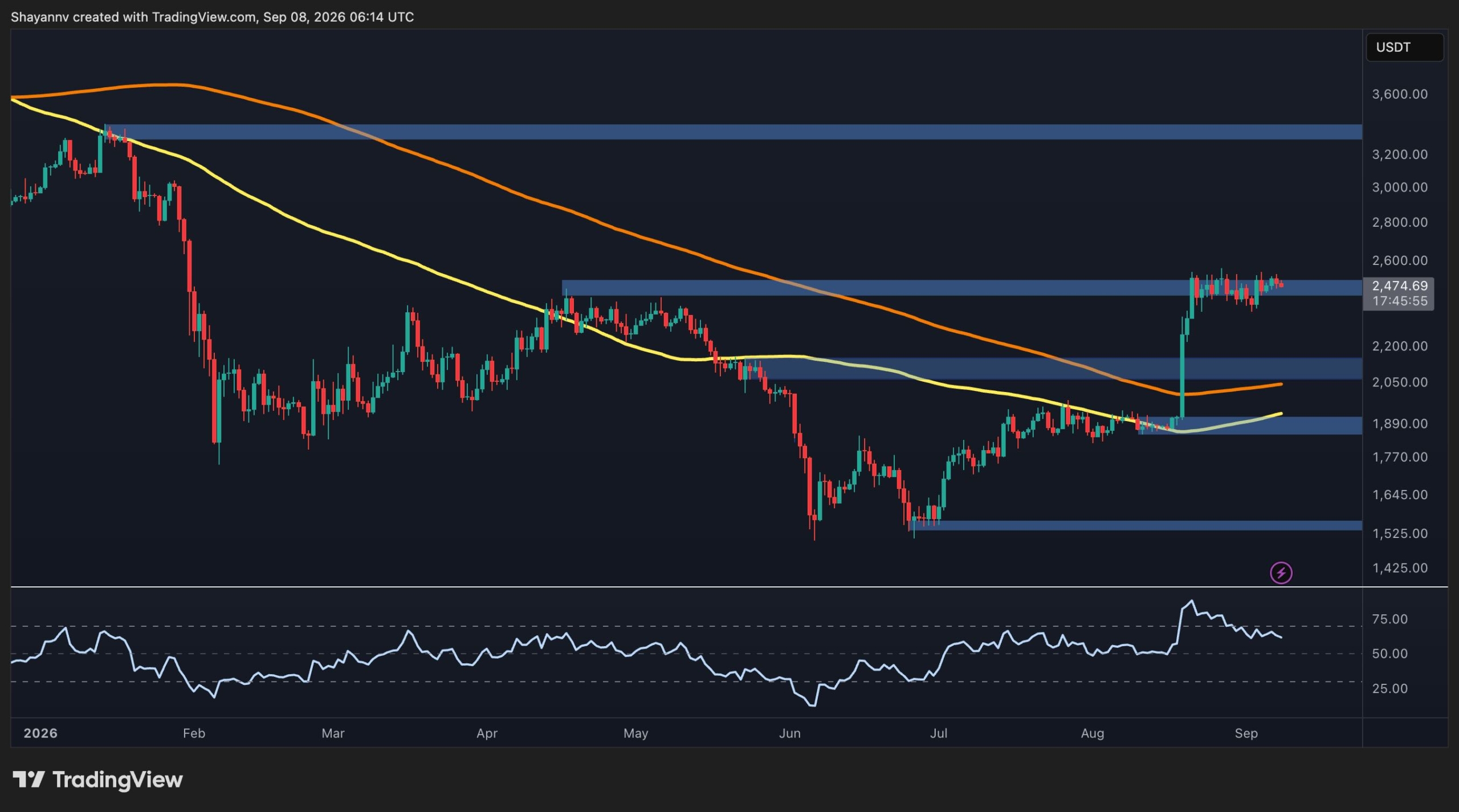
ETH/USDT 4-Hour Chart
The 4-hour chart shows a much clearer consolidation structure. Following the explosive move from the $1.9K area, ETH has been moving sideways inside a roughly $2.35K-$2.55K range.
Repeated reactions from the upper end of this range suggest sellers remain active around $2.45K-$2.5K, while buyers have consistently defended the lower boundary near $2.35K-$2.4K. ETH is currently positioned toward the middle of the range, as indecisiveness is also evident in the 4-hour RSI, which is hovering around 50.
A confirmed breakout above $2.5K would strengthen the continuation setup and potentially expose higher resistance levels. Conversely, a break below $2.4K would suggest that the consolidation is turning into a deeper correction, with the $2.25K demand zone becoming the next major area of interest.

On-Chain Analysis
The exchange reserve chart provides an interesting backdrop to the technical picture. Ethereum’s exchange reserves have fallen steadily from above 21M ETH during 2025 to approximately 14.9M ETH currently, even as ETH has recovered toward $2.4K.
Exchange reserves measure the amount of ETH held on centralized exchanges. A persistent decline generally means fewer coins are immediately available on exchanges for potential selling, although the metric alone does not prove investors are accumulating.
The divergence is particularly notable in the latest portion of the chart. ETH has recovered sharply from its earlier lows while exchange reserves have continued trending downward. This suggests that the supply available on exchanges has not increased alongside the price recovery.
From a market-structure perspective, that can be supportive if demand continues to expand. With fewer ETH sitting on exchanges, a sustained increase in spot demand could potentially make it easier for price to move higher. However, treat the declining reserve trend as a supporting factor rather than a standalone bullish signal.

The post Ethereum Price Analysis: ETH Struggles Below $2.5K, Is a Deeper Pullback Coming? appeared first on CryptoPotato.
Robinhood is expanding its push into prediction markets through a new multi-year partnership with OG-com, the recently spun-off trading platform from Crypto.com.
Under the agreement, announced minutes ago, Vlad Tenev’s company will route retail event-contract volume through OG.com’s CFTC-regulated derivatives exchange and clearing infrastructure. The rollout begins on September 8 for eligible US customers.
The joint statement reads that this will be OG.com’s largest business-to-business prediction-markets partnership by transaction volume.
Additionally, Robinhood will receive equity stakes in both OG.com and Crypto.com as part of the deal. The stakes will be priced in line with Citadel Securities’ recent investment in Crypto.com Group, which valued the broader entity at $20 billion. OG.com’s valuation was set at $5 billion following the spin-off.
“This is the beginning of a strategic partnership between both companies,” said Kris Marszalek, Founder and CEO of Crypto.com and OG.com. “We’re looking forward to making OG.com the most liquid venue globally for innovative derivative instruments, starting with prediction markets and quickly expanding into futures and perpetuals.”
In reaction to the news going live, the native token of the broader Crypto.com ecosystem, CRO, rocketed from $0.057 to a weekly peak at $0.063. Although it was stopped there, it still sits well above $0.06.
The asset took a major hit a month ago when Trump Media Group, the entity behind Truth Social, canceled two of its deals with Crypto.com, including establishing a company accumulating CRO as a strategic asset. At the time, the token slumped to a three-year low of under $0.045.
The post CRO Rockets as Robinhood Takes Stakes in Crypto.com and OG.com appeared first on CryptoPotato.
Bybit announced today that it’s launching Forex Perpetual Contracts for EUR/USD, GBP/USD, and USD/JPY, extending its derivatives business into the trillion-a-day global forex market.
All the contracts will be settled in USDT. They have no expiry date and track the underlying spot currency pairs, while allowing traders to use crypto assets as collateral.
The move builds on a broader shift in which major cryptocurrency exchanges and trading venues, in general, are increasingly offering access to traditional financial assets through derivatives and tokenization.
FX Perpetuals Expand Bybit’s TradFi Suite
The first listings are EURUSDUSDT, GBPUSDUSDT, and USDJPYUSDT, with leverage of up to 100x, according to a statement by Bybit shared with CryptoPotato.
Unlike conventional Forex markets, Bybit’s contracts can be traded around the clock.
This would allow traders to react to decisions, geopolitical developments, and other macro events, even when the underlying FX market is currently closed.
The exchange also said that these products are designed to potentially help users hedge currency exposure while keeping their collateral in crypto.
Keep in mind that the launch follows the debut of the exchange’s TradFi Perpetual suite in April 2026.
Crypto Platforms Keep Expanding to TradFi Solutions
With the booming sector of real-world assets, more and more crypto-first exchanges are pushing towards traditional finance.
But that’s perhaps to be expected. Crypto traders want access to traditional markets, and providing that access from a single account seems like the most logical next step.
That said, FX perpetuals remain leveraged derivatives, which means that users face funding costs and liquidation risks rather than simply owning the underlying currencies.
It’s interesting to see whether these contracts can attract meaningful, sustained liquidity outside conventional FX trading hours as well.
The post Bybit Launches FX Perpetual Contracts, Starting With EUR, GBP, and USD Pairs appeared first on CryptoPotato.