Cryptocurrency Posts
Crypto Briefing
Bastion's challenge could prompt increased scrutiny on corporate governance and transparency, influencing shareholder activism trends.
The post Bastion Trading challenges SkyAI’s $201M tender offer and demands transparency appeared first on Crypto Briefing.
The integration of bStocks on Metric's DEX could enhance DeFi's versatility, making tokenized equities more integral to the ecosystem.
The post BNB Chain users can now trade bStocks on Metric’s new DEX appeared first on Crypto Briefing.
Strive's increased Bitcoin holdings highlight the growing trend of corporate investment in cryptocurrencies, impacting market dynamics and competition.
The post Strive stacks 2,822 more Bitcoin, edging past MARA in treasury rankings appeared first on Crypto Briefing.
Harmonic Security's funding boost highlights the growing need for robust AI governance, potentially reshaping enterprise security strategies.
The post Harmonic Security raises $50M to govern how employees use AI appeared first on Crypto Briefing.
Inadequate logging in AI frameworks like OpenClaw could hinder compliance verification, impacting trust and adoption in regulated industries.
The post OpenClaw logs can’t prove most policy violations, new study warns appeared first on Crypto Briefing.
Bitcoin Magazine
Bitcoin Magazine

Capitalism is Broken and Bitcoin is the Great Equalizer | Natalie Brunell
Young people are angry at capitalism, billionaires, and even their parents, but Natalie Brunell says they’re blaming the wrong thing. The Bitcoin Is for Everyone author explains how our financial system has become “socialism for the banks,” with privatized gains and socialized losses. She shares why Bitcoin could be the greatest equalizer for a generation that’s lost hope of owning a home or starting a family.
Chapters:
0:00 – Natalie Brunell on Leaving Legacy News for Bitcoin
1:09 – Fleeing Communism in Poland and Chasing the American Dream
2:17 – Losing Everything in the Great Financial Crisis
3:37 – Why People Still Don’t Understand Bitcoin
7:01 – Bitcoin as a Savings Technology: Start Small, Stack Sats
9:40 – What “Broken Money” and the Cantillon Effect Really Mean
12:33 – Why Young People Are Losing Hope in Capitalism
14:40 – Socialism for the Banks: Privatized Gains, Socialized Losses
17:56 – Is Bitcoin Being Painted as Partisan?
20:46 – Decentralized Media and the Collapse of Trust in Legacy News
DISCLAIMER: The views and opinions expressed in this show are those of the participants and do not necessarily reflect the official policy or position of BTC Inc., Bitcoin Magazine, or any affiliated entities. This content is provided for informational and educational purposes only and should not be construed as investment, legal, tax, or accounting advice. Nothing contained in this show constitutes a solicitation, recommendation, endorsement, or offer to buy or sell any securities or financial instruments. Viewers should consult their own advisors before making financial or business decisions.
This post Capitalism is Broken and Bitcoin is the Great Equalizer | Natalie Brunell first appeared on Bitcoin Magazine and is written by Mark Mason.
Bitcoin Magazine
Blue Coin Capital CIO: MSTR’S BTC Buying Engine is About to IGNITE | Mike Treidl
Bitcoin treasury companies have moved from convertible bonds to perpetual preferred equity, and Mike Treidl explains why. He breaks down how preferreds let issuers like Strategy defer payments without defaulting, and why preferreds returning to par could give Strategy a second engine for buying Bitcoin. He also explains how sats per share and leverage without margin calls add value beyond holding Bitcoin directly.
Chapters:
0:00 – Mike Treidl on Bitcoin’s Rebound to $83K
0:50 – From Morgan Stanley to Blue Coin Capital: Bridging Wall Street and Bitcoin
1:49 – Risk Budget First: How to Size a Bitcoin Allocation
4:11 – Seller Exhaustion and Bitcoin Treasury Companies
5:27 – Why Treasury Companies Moved From Convertibles to Preferreds
6:47 – What Strategy’s Preferreds Returning to Par Means for Bitcoin
8:13 – Sats Per Share: Leverage Without Margin Calls
9:11 – Pensions, Endowments and the Next Wave of Institutional Adoption
11:23 – Blue Coin’s BarclayHedge Ranking and Buying STRC Below Par
12:30 – Bitcoin’s Biggest Opportunities and Risks Over the Next Two Years
DISCLAIMER: The views and opinions expressed in this show are those of the participants and do not necessarily reflect the official policy or position of BTC Inc., Bitcoin Magazine, or any affiliated entities. This content is provided for informational and educational purposes only and should not be construed as investment, legal, tax, or accounting advice. Nothing contained in this show constitutes a solicitation, recommendation, endorsement, or offer to buy or sell any securities or financial instruments. Viewers should consult their own advisors before making financial or business decisions.
This post Blue Coin Capital CIO: MSTR’S BTC Buying Engine is About to IGNITE | Mike Treidl first appeared on Bitcoin Magazine and is written by Patrick Green.
Bitcoin Magazine
Kraken Parent Payward Wins Full Dubai License, Plans UAE Launch
Crypto exchange Kraken’s parent company Payward has said it has plans to launch in the United Arab Emirates.
After receiving full market approval from Dubai’s Virtual Asset Regulatory Authority, Payward said Tuesday that Payward can now operate as a regulated virtual asset service provider serving retail, professional and institutional investors.
It follows a preliminary approval in May that allowed the company to complete its operational set-up ahead of onboarding clients.
JUST IN:
— Bitcoin Magazine (@BitcoinMagazine) October 13, 2026Kraken has been approved to launch Bitcoin and crypto asset trading in the UAE
pic.twitter.com/H7gJNwK3KS
At launch, Kraken clients in the UAE will be able to trade spot and margin with dirham-denominated pairs and fund and withdraw directly in dirhams.
They’ll also have access to on-chain staking, xStocks tokenized equities and Krak for crypto transfers, while institutional clients gain OTC spot trading and Kraken Prime. Crypto derivatives and new yield products are expected later in 2026 and into 2027, subject to regulatory approval.
Payward holds more than 100 licenses and registrations worldwide, spanning Europe, the Americas, Asia-Pacific and the Middle East.
The expansion comes as the company increasingly makes a number of deals. In September, Bloomberg reported that Nasdaq Inc. was investing $100 million in Payward in a deal valuing the company at $21 billion. Kraken will distribute Nasdaq’s tokenized stocks on its own platform, according to the report.
Payward and SoFi Technologies also recently announced a deal to route SoFi customers’ crypto orders through Kraken Prime, Kraken’s prime brokerage arm launched in 2025, and to list SoFi’s stablecoin on the exchange.
Kraken, like other crypto exchanges, is pushing into the traditional finance world, allowing users to trade stocks, bonds and other assets. The company has sold its app as a “primary account for everything.”
This post Kraken Parent Payward Wins Full Dubai License, Plans UAE Launch first appeared on Bitcoin Magazine and is written by Mathew Di Salvo.
Bitcoin Magazine
Researchers Build First Working Post-Quantum Defense for Bitcoin’s Lightning Network
Whether or not quantum computers will break Bitcoin one day is a hot topic.
But what about second-layer solutions like Lightning?
Well, researchers from East Texas A&M University, North American University, Florida Gulf Coast University, and Florida Institute of Technology have been working on that.
JUST IN: East Texas A&M University students announce they've built the first post-quantum security solution for the Bitcoin Lightning Network
— Bitcoin Magazine (@BitcoinMagazine) September 22, 2026pic.twitter.com/GJYL2a9g2G
In an announcement Tuesday, the team of researchers said that they built what they describe as the first full post-quantum security design for the Lightning Network.
As first uncovered in a research paper in September, the team said they added post-quantum cryptography to Lightning’s communications, payment requests and related systems, implemented in Rust-Lightning.
It works like this: The solution layers new quantum-resistant cryptography on top of Lightning’s existing cryptography rather than replacing it. It uses ML-DSA digital signatures and ML-KEM key exchange, post-quantum algorithms standardized by the U.S. National Institute of Standards and Technology, alongside the classical methods Lightning already relies on.
In this hybrid design, an attacker would have to break both the new and the old cryptography to compromise a connection or forge a payment request.
According to the team led by Dr. Ahmet Kurt, an assistant professor in East Texas A&M’s Department of Computer Science and Information Systems, it took about three to four months and roughly 11,000 lines of code — and it’s a complete working implementation, not just a small demo.
Lightning lets users make fast, cheap Bitcoin payments through a network of off-chain channels instead of recording each one on the blockchain.
Its cryptography could eventually be broken by powerful quantum computers, and that risk exists even if Bitcoin itself gets upgraded, because Lightning has its own communication and payment systems, the team said.
They added that their work demonstrates that Lightning’s off-chain systems can begin preparing for the quantum era independently while others focus on solutions for the mainnet.
Quantum researchers have warned that a time will come when Bitcoin’s software — which underpins the biggest and strongest computer network in the world — will need to be upgraded to deal with quantum computing.
While some crypto VC firms have urged action, top developers in the space have argued that many of today’s quantum computers have limited capabilities.
Still, they have noted that their development could arrive unexpectedly — just like advances with artificial intelligence — and have started developing some solutions, including top Bitcoin infrastructure firm, Blockstream.
This post Researchers Build First Working Post-Quantum Defense for Bitcoin’s Lightning Network first appeared on Bitcoin Magazine and is written by Mathew Di Salvo.
Bitcoin Magazine
The Amount of Bitcoin on Exchanges Is Shrinking. Is a Rally Imminent?
Bitcoin’s price could be due a move upwards as the supply of the leading cryptocurrency on exchanges shrinks.
That’s according to a researcher at data firm CryptoQuant, who wrote in a Monday report that bitcoin on exchanges has dropped to 2.67 million from 2.8 million since February.
The price of bitcoin was recently $83,485, unmoved over a 24-hour period but up 8% over the past 30 days after having its best quarter in years. Its surge in August and September has led a number of analysts to declare the bear market is over.
“If buying demand continues to improve while exchange supply remains low, BTC could benefit from a supply-demand imbalance, creating favorable conditions for a longer-term upward trend,” the report by on-chain researcher Rei Researcher read.
It added: “More importantly, in recent weeks, bitcoin has recovered from its lows while exchange reserves have continued to decline. This is a notable development, suggesting that the supply readily available for trading is decreasing even as the market recovers.”
The report further noted that it was possible investors were taking bitcoin off exchanges to put in cold storage solutions.
Bitcoin’s price was mostly trading under $65,000 for the first half of 2026. The coin spent most of this year in a bear market following the all-time high of $126,080 it hit in October 2025.
But that all changed in August. News that the U.S. Treasury would double the size of its liquidity-support buyback operations, weakening the dollar but strengthening bitcoin and other non-yield bearing assets.
Now, the so-called debasement trade — where investors throw money at an asset to hedge against a currency losing its value — is hot again. Bitcoin is benefiting from the trade, analysts say, as it did in 2024 and 2025.
Bitcoin’s price is still more than 30% below its record.
This post The Amount of Bitcoin on Exchanges Is Shrinking. Is a Rally Imminent? first appeared on Bitcoin Magazine and is written by Mathew Di Salvo.
CryptoSlate
Bitcoin whales are accumulating before Wednesday's US inflation report, despite $744 million in recent spot ETF withdrawals. According to an Oct. 13 CryptoQuant report, large holders have increased their combined Bitcoin holdings to 3.03 million BTC, with accumulation accelerating to its fastest monthly pace since February. The buying contrasts with $744.3 million in net withdrawals…
Read the full story on CryptoSlate
Understand the crypto stories that matter and what to watch next. Get The Catalyst in your inbox
At unchanged Bitcoin price, subsidy and fees, the projected Oct. 16 retarget could push 20 J/TH equipment paying 8 cents/kWh below its electricity-only threshold.
Read the full story on CryptoSlate
Understand the crypto stories that matter and what to watch next. Get The Catalyst in your inbox
Strive added 3,311 BTC, but gross Bitcoin per effective common share increased just 1.72% as common and preferred share counts grew.
Read the full story on CryptoSlate
Understand the crypto stories that matter and what to watch next. Get The Catalyst in your inbox
In December 2023, Senator Elizabeth Warren asked Bank of America CEO Brian Moynihan whether crypto companies handling financial transactions should follow the same anti-money-laundering rules as banks. “Absolutely,” he said. On Oct. 13, Treasury announced more than $1.2 billion in penalties against his bank. FinCEN found that Bank of America admitted to willfully violating the…
Read the full story on CryptoSlate
Understand the crypto stories that matter and what to watch next. Get The Catalyst in your inbox
Zerohash rewards can compound after fees, while eligibility rules and unstaking delays limit access to the service and funds.
Read the full story on CryptoSlate
Understand the crypto stories that matter and what to watch next. Get The Catalyst in your inbox
CryptoTicker.io
A hardware wallet is a small device that generates the private key to your cryptocurrencies, stores it and never releases it. It looks like a USB stick or a chip card, usually carries a small display, and is connected to a computer or a phone only when you want to sign something. Everything that follows explains why this particular design makes the difference.
The question has a practical side right now. Reports of tampered devices, fake manufacturer websites and drained wallets have piled up through October 2026. To work out which of those attacks a device can actually fend off, you need to know what happens inside it.
A hardware wallet holds keys, not coins
The first and most important point contradicts the name. There is no money inside a wallet. Bitcoin and every other cryptocurrency exist purely as entries in a blockchain, a ledger kept on thousands of machines at once. Those entries cannot be moved and cannot be slotted into a device.
What a wallet holds is the private key: a very large number that proves you are entitled to dispose of a particular entry. Whoever holds that key can spend the associated coins. Whoever loses it can no longer reach them, and nobody can reset it. There is no bank here to issue a new password for a forgotten one.
That sets the entire engineering task for such a device: the key has to be usable without ever becoming visible.
The private key never leaves the device
Hardware wallets solve this by generating the key inside the device and keeping it there. Manufacturer Trezor describes the procedure in its own documentation: the private key never leaves the hardware wallet and at no point comes into direct contact with the internet-connected device.
A computer the wallet is plugged into therefore never sees the key, even with malware running on it. It receives only the result: a finished signature. Historically this answers a concrete problem. In the early years, private keys sat in encrypted files on ordinary computers, and malware emptying an entire wallet was nothing unusual. The first hardware wallet, the Trezor Model One, was built in 2014 at SatoshiLabs in Prague as a counter-design.
What really happens when a transaction is signed
The sequence has four steps, and it explains why an infected computer is less dangerous than it sounds.
First you assemble the transfer in an application on the computer or phone: recipient address, amount, fee. Those details go to the hardware wallet. Its display shows them there, independently of the computer. You confirm with a button on the device. Only then does the chip compute the signature and hand it back, at which point the application broadcasts the signed transfer to the network.
The third step is the decisive one. Because the display belongs to the device and not to the computer, malware can propose a false recipient address, but it cannot stop the real address from appearing on that small screen. Read it there and compare, and the swap shows up. Press the button blind, and it does not. The device moves security to a place the attacker cannot reach, and asks for a glance at the display in return.

Secure element and PIN: the two locks inside the device
Two layers of protection work against direct access to the device, and they work differently.
The first is the PIN. Without it the device cannot be operated, and after a manufacturer-dependent number of failed attempts it wipes its memory. A stolen device is therefore worthless to the thief at first.
The second is the secure element, a dedicated chip of the kind also found in bank cards and passports. It is designed to withhold secrets even when somebody grinds it open, measures its power draw or knocks it off its clock with targeted voltage spikes. Not every device on the market carries one; some manufacturers rely on open-source components instead and argue for verifiability over tamper resistance. Which route is better has been disputed in the industry for years, and the answer depends on the attack you want protection from.
Both locks share one limit: they protect the device, and the recovery phrase sits outside their reach.
The recovery phrase: 12 or 24 words under BIP-39
During initial setup the device shows a sequence of words, usually twelve or twenty-four. This recovery phrase, often called a seed phrase, is the key in human-readable form. From it the entire set of keys can be rebuilt at any time, on any device, including one from a different manufacturer.
Behind the procedure stands an open standard called BIP-39, published in 2013 and in use ever since. It defines how a random number becomes a sequence of words and how the words become a key again. That is exactly why no manufacturer can lock you in: if a device breaks, you restore your holdings onto a new one with the same phrase.
The standard is also clear about what it is not meant for. It exists to make randomness generated by the device readable, and expressly not to turn a self-invented sentence into a key. Inventing a phrase instead of having one generated defeats the whole protection.
2048 words, 11 bits per word: where the phrase gets its strength
A short calculation pays off here, because it makes clear why guessing is out of the question.
The standard's word list contains exactly 2,048 entries. 2,048 is the eleventh power of two, so each word carries precisely 11 bits of information. Twelve words give 132 bits, of which 128 are the actual random number and four form a checksum; twenty-four words give 264 bits, 256 of them random and eight a checksum. That checksum is why a device usually spots a mistyped phrase immediately.
128 bits of randomness mean around 340 sextillion possible phrases, a number with 39 digits. At 256 bits it has 78 digits. For comparison, the visible universe holds somewhere around 10 to the power of 80 atoms on common estimates. Working through a 24-word phrase exceeds any conceivable computing power; the limit here is set by physics.
The practical consequence is an uncomfortable one. Since nobody will guess the phrase, every successful attack runs through the human being: a photographed phrase, a fake website, a tampered device. That is exactly where the losses happen.

Hot wallet, software wallet, hardware wallet: where the difference lies
Three terms get mixed up regularly, and the difference always comes down to one question: where does the private key sit?
With an exchange wallet it sits with the provider. You have an account and a password, but no key. If the exchange fails or is attacked, you are a creditor. In exchange you can buy and sell there, and a forgotten password can be reset. Provider terms are set out in our comparison of crypto exchanges.
With a software wallet, or hot wallet, the key sits on your computer or phone, encrypted, but on a device with an internet connection. You control it yourself, while sharing the device with everything else running on it.
With a hardware wallet the key sits on a device that does nothing else and stays disconnected most of the time. The technical terms for this are cold storage, for custody without a network connection, and air gap, for the space in between.
In practice this does not make one of them right and the others wrong. A split is common: the amount being traded stays at the exchange or in the software wallet, and the holding meant to sit still goes into the device. Everyone decides for themselves at what sum the effort pays off; the devices cost between roughly 50 and 200 euros depending on the model.
Blind signing: the gap the device does not close
One weakness concerns the very step that is supposed to carry the security. For simple transfers the display shows the address and amount in plain text. For more complicated operations, such as approving a program on Ethereum, the device runs out of space or of the ability to translate, and shows nothing but an unreadable block of data. Confirm then, and you sign something you have not read. This is called blind signing.
Several manufacturers have improved on it in recent months and can now display considerably more operations in plain text. What can be changed in your own device settings we set out in detail in September.
Supply chain and fake sites: the real attack routes of 2026
This year's attacks target the device's route to the buyer and the person in front of it, leaving the mathematics untouched.
In October 2026 Ledger confirmed that an additional component had been found inside devices where it does not belong; reports of it reached Europe too. We gathered the case and the checks to run on the device. Shortly before that, according to those affected, 86 million dollars disappeared from wallets, and that case too ran through tampered devices rather than broken encryption. In parallel a fake manufacturer site topped the Google results and asked visitors there for recovery phrases.
An earlier case pointed to the same lesson, one in which a faulty random number generator made keys computable and cost 130 million dollars: a device is only as good as its provenance. Buy from the manufacturer or a named reseller, never second hand, and set it up yourself. A device that arrives with a recovery phrase already printed on it is always an attempted fraud; no manufacturer mails out phrases.
What a hardware wallet does not do
Four things are beyond even the best device, and they belong in an honest answer to the question in the title.
It offers no protection against price falls, because it stores value without judging it. It offers none against a transfer to the wrong address, because a confirmed transaction cannot be recalled. It offers none against a phrase somebody else has seen, whether in cloud storage, in a photo or on a note in a drawer. And it offers none against your own forgetting: without the phrase and without the PIN, the holding is gone once the device fails. What to do in that case, and how the tax office treats such a loss, we wrote up separately.
Tax and the holding period: what the move to your own device triggers
For investors in Germany, moving from an exchange to a device of your own is uncritical for tax purposes. A transfer between your own wallets is not a sale and triggers no taxable event; the one-year holding period under Section 23 of the German Income Tax Act keeps running and does not restart.
Two things still need attention. The acquisition date has to remain provable, because gains are tax-free after a year has passed, and the proof is yours to supply. Keep the exchange statements that show date and quantity. Second, allocating holdings remains your job once they sit spread across several wallets.
Our assessment: the device is the smaller half of security
From the newsroom's perspective, a hardware wallet makes sense for anyone holding a position for the longer term and not moving it constantly. The reason differs from the one in the advertising.
This year's evidence supports it. None of the large losses traced back to broken encryption. The causes were tampered devices, a fake site in search results and a faulty random number generator. The protection the device provides mathematically failed in none of those cases.
Nothing argues against the device itself, but plenty against the expectations placed on it. Buy a hardware wallet and then photograph the phrase, and you have spent money for nothing. Security emerges only from the combination: a device from a known source, set up by you, a phrase kept only on paper or metal, and the display read at every confirmation. Drop one of those four and the rest will not carry.
No recommendation for a particular model follows from this, and a total loss remains possible with any cryptocurrency, however well it is stored.
Hardware wallet: the phrase decides, not the device
If you want to take the step, three steps in this order are enough:
- Choose a device and buy it directly. From the manufacturer or a reseller it names, never second hand and never from a marketplace third party. Which models offer which protection is set out in our comparison of hardware wallets.
- Set it up yourself and write the phrase down by hand. Paper or a metal plate, two locations, no photo, no cloud storage and no typing it into a computer. For smaller amounts that stay in motion, a software wallet still does the job alongside.
- Transfer a small amount first. Send it back once before the rest follows, and keep the purchase statements for the holding period. The matching tax tools take the allocation off your hands later.
How randomness becomes a sequence of words and then a key again is set out verbatim in the BIP-39 specification; the description of the signing process comes from Trezor's documentation.
(As of October 14, 2026. This article is not investment advice. Prices and fee structures change; check the terms with the provider before you buy.)
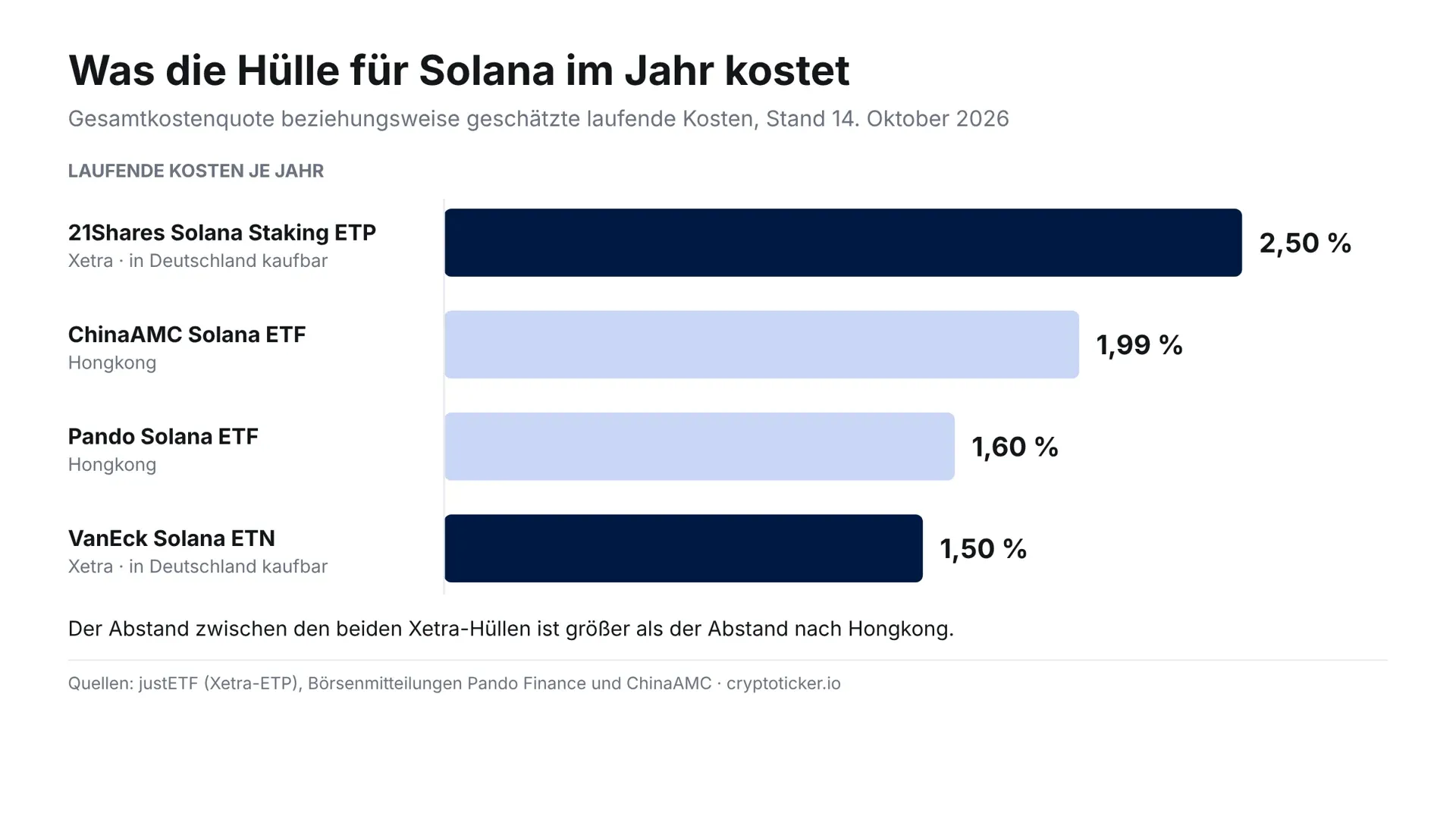
Hong Kong saw the launch of its second spot ETF on Solana on October 13, issued by Pando Finance under the ticker 02831. The management fee is 0.6 percent a year. You cannot buy this product from Europe. The number still matters, because it shows the range in which the cost of a Solana wrapper now sits. On Xetra the spread runs from 1.50 to 2.50 percent a year, and over ten years that gap costs more than any single day's move.
Pando lists Hong Kong's second Solana spot ETF
The fund was introduced on the Hong Kong Stock Exchange after a subscription period running from October 6 to 12. That makes it the city's second spot ETF on Solana after the ChinaAMC product, and Pando Finance's third exchange-traded product on a single cryptocurrency, following Bitcoin and Ethereum.
The construction is deliberately plain. The fund may hold up to 100 percent of its net asset value in SOL, but uses no derivatives and no leverage. It also runs no staking, forgoing the network rewards a Solana position can otherwise earn. The reference is the CME CF Solana Dollar Reference Rate at the Asia-Pacific close. HashKey Exchange handles trading of the coins, HashKey Custody Services the custody, and BOCI-Prudential Trustee acts as trustee.
A spot ETF is an exchange-traded fund that actually buys and holds the cryptocurrency rather than tracking its price through futures. The share price therefore follows the coin price directly, less the running costs.
0.6 percent management and 1.6 percent running costs are two different numbers
The management fee is only part of the bill. Pando puts estimated total running costs at 1.6 percent a year. The gap to the 0.6 percent comes from custody, trusteeship, audit and trading-related costs, which the fund also pays out of its assets. At ChinaAMC, a 0.99 percent management fee sits next to an estimated 1.99 percent in total costs.
Comparing two products therefore means taking the total expense ratio, not the management fee. The first number leads every press release; the second decides the return. In Europe this figure is called the total expense ratio, or TER, and it covers every cost taken from the product on an ongoing basis.
Why the Hong Kong fund is not an option here
An ETF authorised in Hong Kong may not be distributed to retail investors in the European Union. German brokers therefore do not carry such products. The same applies to the US spot ETFs on Solana: those funds do not meet European distribution rules, and a German brokerage account will not even display them.
The European route runs instead through exchange-traded notes, called ETPs or ETNs depending on the issuer. Legally these are not funds but collateralised bearer notes, backed by real coins held at a custodian. In practice you buy them like a share through an ordinary brokerage account. Which products those are, and what matters about the collateral, is set out in the overview of crypto ETFs in Germany.
Solana ETPs on Xetra: 1.50 percent against 2.50 percent
Two large Solana products sit side by side on Xetra, separated by a full percentage point a year. The 21Shares Solana Staking ETP (ISIN CH1114873776, ticker ASOL) costs 2.50 percent a year and holds around 588 million euros. The VanEck Solana ETN (ISIN DE000A3GSUD3, ticker VS0L) costs 1.50 percent and holds around 76 million euros.
The split is striking: the more expensive product holds roughly eight times the money. Part of that has a sound basis, because the 21Shares product runs staking and passes some of the network rewards to investors, which can offset at least part of the higher fee. What counts is therefore what remains after the fee and after the reward, and that number sits in the factsheet, not in the marketing.
21Shares has also launched a cheaper Solana product, the Core Staking ETP (ISIN CH1385084384). At launch the issuer quoted a total expense ratio of 0.35 percent. Because fee models change and comparison sites have recently carried differing figures, check the current rate in the issuer's factsheet before you buy.
How the fee shrinks a Solana holding
With a physically backed product the fee is not debited from your account. The manager takes it out of the deposited holdings. Each share therefore stands behind slightly fewer coins with every year that passes. The price of the note does not fall as a result, but the claim on SOL shrinks, and it does so quietly.
In numbers: at 2.50 percent a year, 77.6 percent of the original coin quantity remains after ten years; at 1.50 percent it is 86.0 percent. The difference is 8.3 percentage points. On an investment of 10,000 euros with an unchanged price, that comes to around 834 euros, the cost of the wrapper alone. In the first year the gap is still modest at 250 against 150 euros, but in every following year it works on an already smaller holding.
This model calculation assumes an unchanged price and leaves staking rewards aside. It does not show what an investor earns, but what the wrapper consumes regardless of the price direction.

The capital gains holding period under Section 23 EStG applies only outside the wrapper
This is where the cost question turns. Holding SOL directly in your own wallet or at an exchange brings Section 23 of the German Income Tax Act into play. Sell after more than one year and the gain is tax-free, whatever its size. Within the year, an exemption limit of 1,000 euros applies to all private disposals together. The German Federal Ministry of Finance confirmed this line in its circular of March 6, 2025.
An exemption limit means all or nothing. One euro above it and the entire gain becomes taxable, not just the excess. The period is counted to the day: buy on March 15 and the earliest tax-free sale is March 16 of the following year.
With an ETP or ETN this treatment is not assured. Whether the one-year period applies there is widely held to depend on whether the note carries a claim to delivery of the actual coins. Without that claim, taxation as investment income under Section 20 EStG is the likely outcome, meaning 25 percent withholding tax plus the solidarity surcharge, even after ten years. A definitive ruling covering every product variant is still missing. Settle the point before you buy, in the securities prospectus and, if in doubt, with a tax adviser, because it usually weighs more than a percentage point of fees.
Staking income and the 256-euro exemption limit
Holding Solana directly allows the coins to be staked for network rewards. For tax purposes those rewards are other income under Section 22 No. 3 EStG, taxable at the personal rate in the year they arrive. A separate exemption limit of 256 euros applies, independent of the 1,000 euros under Section 23.
Two points are regularly confused. First, staking does not extend the holding period of the coins involved. The ten-year period once discussed is off the table; the 2025 ministry circular expressly keeps to one year. Second, the rewards received start their own one-year clock from the day they arrive, so they are fresh coins with a fresh clock. Anyone collecting rewards regularly needs a clean record of each inflow, and that is what crypto tax software and portfolio trackers are for. How staking offers differ is shown in the overview of staking platforms.
What the outflows from the US funds say about demand
The Hong Kong opening falls in a week when institutional money was pulled elsewhere. The US spot ETFs on Solana saw net outflows of 24.8 million dollars in the week of October 5 to 9, the first negative week after 14 weeks of inflows. Bitwise's BSOL fund accounted for the largest share at around 21 million dollars. We set out those figures in detail on October 11.
The picture has not turned since. October 12 added a further 0.7 million dollars in outflows, taking the run to six consecutive trading days. For context, the US spot ETFs on Bitcoin and Ethereum together saw around 1.22 billion dollars leave over the same period. That points to a broad retreat from crypto funds rather than a Solana-specific problem.
At midday on Wednesday SOL trades at around 106.62 dollars, or 95.24 euros, 0.6 percent below the previous day and 63.6 percent below its record of 293.31 dollars (data from CoinGecko). The price here is the occasion, not the news. The news is that the supply of wrappers is growing while demand for them is easing.
Our assessment: the wrapper is a cost question, not the price question
From the newsroom's perspective, the most interesting number of the week is not the 0.6 from Hong Kong but the split on Xetra. That around 588 million euros sits in the product charging 2.50 percent and around 76 million in the one charging 1.50 percent can only partly be explained by staking rewards. Much suggests that name recognition and first listing weigh more heavily than the cost ratio.
There is a serious objection on the other side: a staking product with a higher fee can end up ahead of a cheaper one without staking once rewards are counted. Whether that holds can only be read from the net result reported in each factsheet, not from the fee alone. The 1.50 to 2.50 percent spread is documented, the difference in fund size is documented, and the ten-year calculation is documented. What is not documented is that the more expensive wrapper earns its premium. We are assessing the situation and making no buy or sell recommendation.
Solana ETP fees: 1.50 versus 2.50 percent adds up over a decade
- Check your product's factsheet for the total expense ratio rather than the management fee. Which wrappers are tradable in Germany is set out in the overview of crypto ETFs in Germany.
- Check the prospectus for whether your ETP carries a claim to delivery of the coins. That determines whether the one-year period is reachable at all. Recording each purchase and each inflow is handled by crypto tax software and portfolio trackers.
- Price up the direct purchase: holding SOL yourself for more than a year means no annual fee and, under Section 23 EStG, no tax on the gain. For a trading venue, see the overview of crypto exchanges.
(As of October 14, 2026. This article is not investment advice. Prices and fee structures change; check the terms with the provider before you buy.)
PENGU is the token of the Pudgy Penguins brand, and the brand is losing its technical foundation: Igloo, the company behind the penguins, is shutting down its own layer-2 blockchain Abstract on December 15, 2026. Anyone who leaves holdings on it until then will not be able to reach them after that date. For holders of PENGU and of Pudgy Penguins NFTs, that is the only hard deadline in the whole process. Everything else about it can wait. The current price level and the ranges appear on our Pudgy Penguins price prediction page.
What remains of the ecosystem is quickly listed: a brand with plush toys in retail, a free browser game, 8,888 images on the Ethereum blockchain and a token with a market value of just under $500 million. All figures are as of October 14, 2026.
Where Pudgy Penguins comes from and what Igloo earns from it today
Pudgy Penguins launched in July 2021 as a collection of 8,888 drawn penguin images on the Ethereum blockchain. An NFT is a proof of ownership for a single digital object, stored on a blockchain and therefore transferable on its own. After a change of owner in 2022, Luca Netz took over the project and rebuilt it in a direction rarely seen in the industry: away from the pure collectible, towards a licensing brand with physical products.
Plush penguins have been in retail since 2023. The sales launch ran through 2,000 Walmart stores in the US, and by July 2026 the plush toys were in more than 1,800 Target branches according to publicly available figures. This toy business is the part of the company that brings money in, and it is the reason the blockchain is now going: Igloo paid for the blockchain out of the brand's earnings.
Abstract shuts down on December 15, despite 325 million transactions
Abstract went live as a mainnet in January 2025. A layer-2 blockchain is a network of its own that settles transactions cheaply and passes them on to Ethereum in bundles for security. The bet behind it: the penguins' audience, people with no crypto history, would find their way into blockchain applications. Technically the bet paid off. According to the team, Abstract processed more than 325 million transactions, counted four million wallets, and the projects on it generated over $40 million in revenue combined. Brands such as Disney and Red Bull Racing were present.
Commercially it did not pay off. The team cites stagnating growth, a limited supply of financial applications, thin liquidity, little institutional participation and a smaller budget than the competition. The announcement came on October 6, 2026 through Abstract's channels and those of the company's chief executive. On the day of the announcement, roughly $76 million were still on the network according to data service DefiLlama, as CoinDesk reported.
Abstract was not the only case that week. Blast had already given up its own layer-2 blockchain on October 2, because operating costs exceeded revenues.
Why Igloo is giving up its own blockchain and selling no token for it
Chief executive Luca Netz has explained the decision publicly. Igloo financed the blockchain for around 18 months and lost an eight-figure sum over two years in the process. He rejected the obvious way out, a token of its own for Abstract or an initial offering to the community: “Even after a loss in the eight figures we could have launched a token or pursued an initial offering. In the end we decided against it,” he wrote. A token only works, he argued, when something drives demand for it.
That reasoning is the more interesting part of the news for investors. A company that could have issued a token and does not forgo fresh money and accept the retreat instead. The funds, according to Netz, now go entirely into the penguins, into the NFT collection and into PENGU. We covered what this about-turn means for the token in detail in our article on the Abstract shutdown.
The Migration Hub and the bridge's three-hour delay
There are two routes for the move. The first is the Migration Hub, which Abstract runs at the address migrate.abs.xyz. The second is the network's own bridge, where the team says around three hours of delay should be expected. A bridge is a service that locks a token on one blockchain and releases a counterpart on another.
Two points here deserve attention. First, the team has itself warned about fake migration pages and about people posing as staff. Open the hub only through Abstract's official channels and never type in an address someone sends in a message. Second, users reported that a waiver of class action rights has to be confirmed before the move. Anyone moving holdings of any size should read that text before agreeing.
How to check which blockchain your PENGU sit on
PENGU does not exist only on Abstract. The token is present on Solana, on Ethereum, on BNB Chain, on HyperEVM, on Hyperliquid and on the Robinhood Chain. Only the holdings on Abstract are affected by the deadline. Three steps settle whether this concerns you at all:
- Open the wallet holding your PENGU and look at which network is selected there. If it says Abstract, you are affected.
- If the tokens sit in a customer account at an exchange, the deadline does not normally concern you, because the exchange handles custody. A short question to the provider settles it.
- The same applies separately to NFTs: a Pudgy Penguins NFT on Ethereum stays where it is. A collectible minted on Abstract has to move.
PENGU in figures: 62.86 of 88.89 billion tokens in circulation
PENGU trades at $0.0079, or 0.0071 euros. That gives a market value of roughly $497 million, which means 118th place in the field of all crypto assets. There are 62.86 billion tokens in circulation and the maximum supply is 88.89 billion. Between those two numbers sit a good 26 billion tokens still to be released. The team and company allocations follow a staggered plan with monthly releases, and each one raises the circulating amount.
The distance to the peak is large. On December 17, 2024 a PENGU cost $0.0684, which is 88.4 percent above today's level. Over a year the token is down 70.0 percent, while over the past 30 days it is up 13.2 percent, with 5.7 percent added within a day. Trading turnover of roughly $173.6 million in a single day shows that the token trades liquidly despite the retreat.
The 8,888 Pudgy Penguins NFTs and the floor price of 2.39 ether
The original collection still comprises 8,888 pieces, spread across 5,059 holder addresses. The floor price, meaning the cheapest piece currently offered, stands at 2.39 ether. At an ether price of $2,513 that is around $6,000 to get in. The value of all 8,888 pieces together therefore comes to about $53.4 million, and 73 penguins changed hands within a day.
That ratio is the real finding: the collection is worth around a ninth of the token. Anyone thinking about the ecosystem thinks about PENGU first and about the images only afterwards. Which venues for NFTs are even still open in 2026 is set out in our NFT marketplace comparison.

Pudgy World in the browser, after Pudgy Party was shut down in June
Little is left of the ecosystem's gaming side. Pudgy Party, a mobile game, arrived in 2025 and was discontinued on June 12, 2026, before its first birthday. It vanished from the iOS and Android app stores with no wind-down period, and no refund was promised. Netz gave figures for it: the game had cost millions, a sequel would have demanded a further $2.5 million, and the number of active players had fallen to a little over 200.
What remains is Pudgy World, a free browser game running since March 2026 and reachable without installation. Alongside it, outside projects also used Abstract, among them the gaming platform YGG Play as well as Gigaverse and Cambria. Some of them have already announced a switch to the Robinhood Chain.
Where investors in Europe can get hold of PENGU
For a purchase from Germany what counts above all is whether a venue offers a euro pair, because otherwise an additional conversion applies. Two venues list PENGU directly against the euro: Kraken with the pair PENGU/EUR and Bitvavo with PENGU-EUR, there from a minimum order of five euros. Beyond that the token is listed at large international exchanges such as Binance, Coinbase, OKX, Bybit and Crypto.com, mostly against dollars or stablecoins. Before buying it is worth a look at the fees and at the distance between the buy and sell price, which for a token of this size is considerably wider than for Bitcoin.
MiCA and custody: which licence stands behind the euro pairs
The Markets in Crypto-Assets Regulation, MiCA for short, has applied in the European Union since December 30, 2024. The regulation requires service providers serving customers in the EU to hold authorisation from a national supervisor; in Germany that is BaFin. Which providers hold that authorisation is listed in the supervisor's public registers, and a look inside belongs before a first purchase at a provider you do not yet know.
Custody is a separate question from licensing. When tokens sit in a customer account at an exchange, the provider holds the keys. Holding them yourself requires a wallet of your own, and a move from one blockchain to another additionally requires a receiving address on the destination network. The differences between the devices are set out in the hardware wallet comparison.

Holding period and tax: what a move to another blockchain triggers
In Germany crypto assets count as other assets within the meaning of section 23 of the Income Tax Act. A gain on sale stays tax-free when more than a year lies between acquisition and sale; within the year the personal tax rate applies, and an exemption limit of 1,000 euros applies to the sum of all private disposals in a year.
Swapping one crypto asset for another starts the clock again, because a swap counts as a disposal for tax. Whether bridging the same token to another blockchain is treated the same way has not been conclusively settled; there is no established line from the tax authorities on this case so far. Anyone moving PENGU off Abstract should therefore record the transaction with the date, the amount, both addresses and the price on the day of the move. Those records cost ten minutes now and later decide whether an existing holding can be proven. Tools for that appear in the comparison of tax software and portfolio trackers. None of this replaces tax advice.
What is left of Abstract after December 15
After the shutdown nothing usable remains of the blockchain. Holdings still on it at that point are no longer reachable according to the team, and that applies to tokens as well as NFTs. Staff from engineering and the ecosystem are helping projects switch to other networks, not individual users with forgotten holdings.
Two risks remain beyond the deadline. The first is supply: 26 billion tokens are still due for release, and every tranche meets a market that already values the token 88.4 percent below its peak. The second is dependence on a single brand. PENGU no longer has a technical job to do in a network, now that the network of its own is going; its value hangs on demand for the Pudgy Penguins brand. A total loss is possible with a token of this kind.
Our assessment: $497 million in market value against a shut-down blockchain
From the newsroom's point of view the retreat is the more honest of two bad options. The evidence sits in the figures: of the roughly $76 million still on Abstract on the day of the announcement, about $3.9 million were left as of October 14 according to DefiLlama. Capital has therefore left the network almost entirely within a week, and a network without capital carries no applications. A new token would not have stopped that outflow but paid for it with fresh money from investors.
Against that stands what the brand now lacks. The $497 million market value of PENGU rests, as of December 15, on plush toys, a browser game and 8,888 images. The toy business in 1,800 Target branches is a real business, only it pays no dividend to token holders. Holding PENGU means holding a bet on the brand, not a share of revenue. That gap between brand success and token value stays open, and it is why we name no price direction here. An assessment of the four large companies in blockchain gaming, Igloo included, appears in our review of the Web3 gaming companies.
PENGU after December 15: the brand stays, the blockchain goes
The deadline is the only point where holders themselves decide anything in the coming weeks. Three steps are enough:
- Sort the holdings. Check by the end of November whether any PENGU or NFTs of yours sit on Abstract, and move them out via the official route. If everything sits at an exchange, a question there is enough; which providers work how is shown in the exchange comparison.
- Settle custody. Decide before the move where the tokens are going and set up the receiving address beforehand. The devices for that appear in the hardware wallet comparison.
- Secure the records. Note the date, the amount and the price of the move so the holding period stays provable later. Suitable tools are listed in the comparison of tax software.
(As of October 14, 2026. This article is not investment advice. Prices and fee structures change; check the terms with the provider before you buy.)
Bitway (BTW) hit an all-time high of $2.77 overnight into Wednesday, putting it 50.03 percent above where it stood 24 hours earlier. No announcement from the project explains the jump. Something else matters more: what BTW costs right now depends on where you look. On the two largest venues the token trades at around $2.61, on a third at $1.50. cryptoticker.io compiled this analysis itself on October 14, 2026, drawing on the prices and order books of the venues themselves as well as public market data on BTW; 16 trading pairs across 13 venues were reviewed.
Bitway at $2.77: a 50 percent daily gain while Bitcoin stands still
With a market value of roughly $7.26 billion the token is the 19th largest cryptocurrency by market value. Over seven days BTW has gained 118.98 percent, over 30 days around 255 percent. The all-time high of $2.77 came in the early hours of October 14.
This move stands alone. Bitcoin trades at $83,395, 0.35 percent below the previous day, and Ethereum at $2,503.74, down 1.17 percent. A broad upswing across the market that might have carried BTW along is therefore absent.
What does not hold up as an explanation
The project launched an interest-bearing staking programme on August 13 that offered a base rate of 8 percent in USDT plus a bonus of 4 percent in the provider's points. That programme expired on September 1 and does not explain today's jump. The publicly available documentation on the token lists nothing new for October 14. The fundamentals of the token are set out in the project documentation on BTW.
In practice that means buying a price move here, not a piece of news. The distinction counts at the next reversal, because there is no documented trigger to anchor an expectation to.
91.3 percent of daily turnover sits with two venues
Across all 16 trading pairs, daily turnover adds up to roughly $167.5 million. Of that, $95.4 million runs through Gate, or 56.95 percent, and $57.5 million through Bitget, or 34.34 percent. Together these two venues carry 91.3 percent of all trading.
The rest is spread across eleven further addresses. MEXC accounts for 2.72 percent, the decentralised venues on BNB Chain for around 2.7 percent combined, DigiFinex for 1.52 percent and HTX for 0.89 percent. After that it thins out sharply: Toobit 0.38 percent, KCEX 0.27 percent, BitKan and Ourbit 0.12 percent each, Poloniex 0.02 percent.
Turnover ratio: 2.31 percent of market value
Set daily turnover against market value and the turnover ratio comes to 2.31 percent. For this token that is a strikingly high figure. cryptoticker.io measured a turnover ratio of 0.55 percent for BTW on October 11, 2026; the details of that survey appear in the October 11 report on daily turnover and the token release. Trading has therefore multiplied since then, and at precisely two addresses.
Concentration at this level is above all a question of access. If one of the two venues is unavailable to you, perhaps because you cannot open an account there, practically only the other one remains for an order.

The price gap: $2.61 at Gate, $1.50 at DigiFinex
Here lies the real finding of the day. At Gate BTW costs $2.6116, at Bitget $2.6165. Those two values are less than half a cent apart, so the market between them is in balance. At DigiFinex a price of $1.4951 stands at the same moment. That is 42.75 percent below Gate, a gap of 43 percent when rounded.
Nor is the gap a snapshot taken mid-way through a fast move. The daily high at DigiFinex is $1.5294 and the daily low $1.3649. That venue did not join the upward move at any point: while BTW ran from $1.756 up to $2.7996 at Gate, the price there moved in a range whose upper bound still sits below the daily low of the large venues.
A quote is not a price as long as nobody trades
The term price gap describes a state in which the same asset is quoted at the same time on different venues at markedly different prices. Traders normally close such a gap within seconds, because the difference can be turned into money. When it stays open for hours, the precondition for that is usually missing, namely tradable goods on both sides.
An order book with no bid and no ask
That is exactly the case at DigiFinex. In the order book for BTW there is neither a bid nor an ask, so no offer to buy and none to sell. The quoted price of $1.4951 is therefore the price of the last trade, not a price at which anyone could buy or sell now.
The distinction has practical weight. A portfolio tracker that pulls this venue as its source will show a position 43 percent below what the large venues quote for the same token. In the other direction, an optically low price is worth nothing when nobody there is selling.
How to spot an empty book
Open the order book in the trading window and look at the top line on both sides. If no quantity appears there, or a zero, trading is dormant. A second clue is the daily range: if it diverges sharply from the range other venues show for the same token, something there is not keeping up.
The top of the book carries $732 on the buy side
At the two large addresses, too, the book is thin at the surface. At Gate the best buy side holds 280.3 BTW, which at a price of $2.6102 comes to roughly $732. The best sell side holds 146 BTW, about $382. At Bitget both sides hold 89.18 BTW each, around $233.
These figures describe only the best price level in each case, not the depth of the whole book. What they show is the amount at which the first price level is used up. Anyone buying $2,000 of BTW at Gate in one go clears the top level several times over and reaches into the ones above it.
The spread is tight, the quantity behind it small
The distance between the buy and sell offers at Gate is 0.13 percent. That sounds like a liquid market and at the surface it is one. What decides the matter, though, is how much stock stands ready at that tight distance, and in this case that is a few hundred dollars.
Partial fills and the spread: one order runs across several price levels
A market order takes everything in the book until it is filled. With a thin book that means the first part of an order executes at the quoted price and the rest at progressively worse ones. The difference between the price seen and the average price paid is called slippage.
A limit order guards against that. It sets the maximum price to pay and accepts that the order may be filled only partly or not at all. For a token swinging 59 percent between daily low and daily high in a single day, that is the quieter option.
Leveraged products sharpen both
Futures contracts without an expiry date, known as perpetuals, exist on BTW. There the position value is multiplied via a margin deposit. If the price moves against the position, it is closed out forcibly as soon as the margin is used up. With a daily range of $1.756 to $2.7996, even modest leverage is enough for that.

Licensing and trading pair: the purchase route from Europe
BTW trades predominantly against USDT, that is against a stablecoin rather than against euros. A purchase from Germany therefore runs in two steps: euros into the stablecoin first, then the stablecoin into BTW. Each step costs a fee and a spread, and the first step moves funds into a foreign currency.
The second point is licensing. Under the EU Markets in Crypto-Assets Regulation, providers addressing customers in the EU need authorisation as a crypto-asset service provider. cryptoticker.io reported on October 11, 2026 that none of the venues listing BTW holds such authorisation. Before placing an order, check in your provider's register which supervisor your account sits under, and bear in mind that EU deposit and investor protection does not apply outside it. An overview of providers with EU authorisation appears in our comparison of regulated crypto exchanges.
What runs differently with an account outside the EU
Without EU authorisation there is no claim to the regulation's disclosure and custody duties, and in a dispute the law of the home country applies. That is not a reproach to the providers but a consequence of where they are licensed. It is one item on the list before money moves.
27.08 percent in circulation and the next release on November 2
Of a maximum supply of 10 billion BTW, 2.708 billion are in circulation, or 27.08 percent. The remaining 7.29 billion tokens are still locked and arrive on a fixed schedule. The fully diluted value stands at roughly $26.79 billion, 3.69 times today's market value.
The next release is set for November 2 and covers 101.63 million BTW. That equals 3.75 percent of the amount circulating today and 1.02 percent of maximum supply. A release is not a sale, but it does raise the supply that can be sold. The figures on circulating supply and the release schedule can be checked on the market data page for Bitway.
Custody: two blockchains, two contract addresses
BTW exists on BNB Chain and on Ethereum, each under its own contract address. The risk there is mixing them up: tokens sent to an address on the wrong blockchain are usually lost. Before every withdrawal, check which blockchain the exchange specifies for the transfer and which one the receiving wallet expects.
Anyone who does not want to leave larger holdings on a trading account holds them in self-custody. The keys then sit with the holder, and so does responsibility for securing them. Which devices qualify depends on the amount and on how often the holder trades.
Tax: the one-year deadline and the swap into stablecoins
In Germany, gains from selling crypto assets fall under private disposals. Sell within a year of buying and the gain is taxable; after a year has passed it stays tax-free. An exemption limit of 1,000 euros per calendar year applies to these transactions as a whole.
One point matters on the route via USDT: swapping a stablecoin into BTW counts for tax as a sale of the stablecoin and a purchase of the token. The one-year clock for BTW starts with that swap. Frequent reshuffling in a token with this swing range accumulates a correspondingly large number of individual transactions to document at year end. This section does not replace tax advice.
The daily range from $1.756 to $2.7996
On the upside the all-time high of $2.77 is the mark against which the move can be measured; the highest daily level traded at Gate was $2.7996. On the downside the daily low is $1.756, and at Bitget the day opened at $1.783. Between those values lie 59 percent.
The current price of around $2.61 therefore sits some 6 percent below the daily high. Whether the move holds can be read from the turnover ratio: should it fall back towards the 0.55 percent of October 11, interest has faded, and the thin book then works in the other direction.
Bitway price gap: 43 percent difference depending on the venue
Three steps to make something of this day:
- Compare the price at two addresses before placing an order. If they differ markedly, trade at the address with the higher turnover and attach a limit. Which venues work at which costs is shown in our crypto exchange comparison.
- Separate custody from trading. Anything meant to be held longer does not belong on a trading account, if only because a token with 16 trading pairs depends on individual addresses. Suitable devices appear in the hardware wallet comparison.
- Document every transaction from the first swap on. The one-year clock runs per purchase, and the route via USDT creates two transactions instead of one. Tools for that appear in the comparison of tax software and portfolio trackers.
November 2 stands as the next documented date in the calendar. Until then the question remains open whether a price rise of 255 percent in 30 days without a nameable trigger will hold.
(As of October 14, 2026. This article is not investment advice. Prices and fee structures change; check the terms with the provider before you buy.)
The Dogecoin price stands at $0.084464 on Wednesday morning, or 0.075351 euros. Where it sits matters more than the level itself: 5.6 percent above $0.0800. That mark is the low of February 6, and on Tuesday it was tested for the first time in eight months. On the upside the 50-day line at $0.0876 caps the room. The two lines are 9.5 percent apart, and Dogecoin has been stuck in that corridor since October 9.
There is also a shift among the largest holders that the price data does not show yet: addresses holding more than 100 million DOGE now control 69.74 percent of the supply, against 70.02 percent on September 1. That sounds marginal, and on 156.32 billion DOGE in circulation it works out at roughly 438 million coins, about $37 million at the current price. This article places both lines in context, measures the Bitwise fund wind-down against daily turnover, and shows what an investor in Europe can realistically check at the mark.
Dogecoin price on Wednesday morning: $0.084464, 5.6 percent above the February low
The figures behind this level come from CoinGecko. On Wednesday morning DOGE trades at $0.084464, 0.58 percent below the previous day. The daily high was $0.085161, the daily low $0.082997. In euros that is 0.075351, with a daily range of 0.074051 to 0.075982 euros. Market capitalisation stands at $13.20 billion, turnover over the past 24 hours at $457.96 million.
The decline over the past week is clear: on October 7 DOGE stood at $0.093678, 9.8 percent above today's level. From the interim high of $0.095843 on October 5 the gap is 11.9 percent. The all-time high of $0.731578 from May 2021 sits 88.45 percent away. Keep that span in view and the past few days read differently: the pullback remains a pullback inside a long distance to the record.
Turnover ratio is the term for daily turnover measured against market capitalisation. For DOGE it stands at 3.5 percent today. For comparison, measured the same morning: Bitcoin 1.6 percent, Ethereum 3.2 percent, Solana 4.5 percent, XRP 2.0 percent. DOGE therefore trades more actively than Bitcoin but more quietly than Solana. That figure is exactly what counts for the question of whether a mark holds: the higher the turnover at a line, the more reliable whatever happens there.
The $0.0800 mark dates from February 6 and held on Tuesday
Where a mark comes from decides how much it is worth. $0.0800 is neither rounded nor derived from a chart pattern; it is the daily low of February 6 this year. CoinJournal names that origin explicitly on October 13 and reports that DOGE hit a daily low around $0.0800 on Tuesday and pulled away from it. The relative strength index stood at about 39 at the time. The relative strength index measures on a scale of 0 to 100 how heavily a period's up days weigh against its down days; below 30 a market counts as oversold.
A reading of 39 means selling pressure on Tuesday was strong but not exhausted. That fits the price action. On October 13 the daily level was $0.082182, the lowest point of the past two weeks. Today the price sits 2.8 percent above it. The mark has therefore carried once, and it carried in a market where the large caps gave ground on the same day.
What that means in practice shows in the distance: 5.6 percent down to $0.0800. Anyone planning an order near that line works with that span rather than a round number. Should the price break below it, no further daily low from 2026 remains as a catch point; the next reference then lies in December of the previous year.

The 50-day EMA at $0.0876 has been the ceiling since October 8
The exponential moving average weights recent prices more heavily than older ones and therefore reacts faster than a simple average. CoinJournal puts the 50-day value at $0.0876 and the 200-day value at $0.0923 on October 13. The price is thus 3.7 percent below the shorter line and 9.3 percent below the longer one.
The shorter line is the more interesting one. On October 8 DOGE fell from $0.088994 to $0.083977 and with that below this area. Since then the price has not closed above it on five trading days. A line that has resisted five times is no longer coincidence; it is the point where sellers show up reliably.
| Mark | Price | Distance | Where it comes from |
|---|---|---|---|
| 200-day line | $0.0923 | 9.3 percent above | Moving average, CoinJournal October 13 |
| 50-day line | $0.0876 | 3.7 percent above | Moving average, ceiling since October 8 |
| Wednesday morning level | $0.084464 | - | CoinGecko |
| Tuesday daily low | $0.082997 | 1.7 percent below | Own measurement, 24 hours |
| February low | $0.0800 | 5.6 percent below | Daily low of February 6 |
Large addresses hold 69.74 percent: 438 million DOGE less than on September 1
The figure missing from this week's price reports comes from Santiment data and appears at CoinJournal: addresses holding more than 100 million DOGE control 69.74 percent of the supply. On September 1 it was 70.02 percent. The difference of 0.28 percentage points looks small, which is precisely why the arithmetic is worth doing. On 156.32 billion DOGE in circulation one percentage point equals 1.56 billion coins. So 0.28 points amount to roughly 438 million DOGE, about $37 million at Wednesday morning's price.
In absolute terms the large addresses still hold around 109.0 billion DOGE. The direction over six weeks is downward, at a rate of roughly 73 million DOGE or a good $6 million a week. This is not a sell-off but a slow dispersal. Whether the coins given up were sold or merely spread across several addresses cannot be read from the metric, and nobody should claim otherwise.
How concentration affects exit liquidity
The mechanism behind it is rarely explained, yet it determines how violently a mark breaks. When almost 70 percent of a supply sits in very large addresses, the mass of small holders faces little depth in the order book. If a single one of those addresses sells part of its holding, it meets a book that cannot absorb the volume without a price concession. The price then slips not because of news but because of the size of the order.
The reverse also holds: as concentration falls, the same supply spreads across more hands and each individual order weighs less. On that logic the 0.28 points of the past six weeks are a slight easing, not a turn. For a sense of scale: the largest single transfer of the past 24 hours was worth $47.81 million, more than a tenth of total daily turnover across all venues combined. One movement of that size is enough to occupy an order book.

Funding rate at 0.0044 percent: the futures market is empty after October 9
Beyond the chart there is a second angle that often explains more for meme coins: the futures market. The funding rate is the payment holders of long positions make to holders of short positions every eight hours when the futures price trades above the spot price. That rate is the most direct measure of how expensive a bet on rising prices currently is.
At OKX the rate for the perpetual DOGE contract stands at 0.0044 percent per eight-hour period on Wednesday morning. Annualised that is 4.9 percent, and therefore close to the exchange's base rate itself. Open positions on the same exchange add up to 1.08 billion DOGE, or $91.3 million, which equals 0.69 percent of market capitalisation.
These numbers are the counterpart to what happened on October 9. We reported that day that 94 percent of liquidations in DOGE hit long positions. Leverage has largely left the market since: a funding rate near the base rate means almost nobody is still paying for a leveraged bet on the upside. For the mark at $0.0800 that is the most important relief, because the usual trigger of a breakdown, a cascade of liquidations in overstretched long positions, is absent for now.
Bitwise converts $725,870 into cash today, 0.16 percent of daily turnover
Today is the final trading day of the Bitwise Dogecoin ETF on NYSE Arca, and on that day the fund's DOGE holding is converted into cash. We described the wind-down in detail on October 10, with the date still ahead. What can be answered since is the question of weight: fund assets stood at roughly $725,870 on October 7. Against daily turnover of $457.96 million that is 0.16 percent.
That calculation is why the date barely matters for the price. A sale of this size disappears into the day's business. Reading the wind-down as a burden on the price confuses the headline with the amount. Unit holders in the US follow a different timetable: net asset value is determined as of October 21, and payment then runs through the broker. An investor in Europe is generally unaffected, because this US product was never authorised for distribution here.
Ongoing flows in the remaining products are small as well. CoinJournal reports a net outflow of $399,460 from the DOGE spot funds for Monday, October 12, after a week without notable movement. For comparison on the exchange side: on October 11 we reported $57.2 million of net outflows from trading venues over seven days. Fund flows are therefore the smaller part of the picture; movements on the exchanges are larger by a factor of 140.
Blockchain figures: 33,197 transactions, 32 in the mempool, 13.7 million new DOGE a day
The Dogecoin blockchain itself shows quiet operation on Wednesday morning. In 24 hours 1,370 blocks were found and 33,197 transactions processed. The block count implies an average block time of 63 seconds; the protocol targets 60 seconds. Network hash rate stands at 3.3 petahashes per second, difficulty at 48.3 million. There are 482 reachable nodes.
The mempool is the waiting area for transactions that are not yet in a block. For Dogecoin it currently holds 32 transactions. A network with a practically empty waiting area means two things for a holder: a transfer confirms within the next minute, and raising the fee buys no advantage. The median fee is 0.0052 DOGE, less than half a US cent. That the average fee, at 0.2659 DOGE, is fifty-one times higher comes down to a handful of very large payments and says nothing about the cost of an ordinary transfer.
One figure stays unchanged and belongs in any look at the DOGE price: 13.7 million new DOGE are created every day, with no upper limit. Over a year that is roughly 5.0 billion coins, or 3.2 percent of today's supply. For the price to hold steady, demand worth a good $1.1 million has to meet those new coins every single day.
Purchase route, fees and custody: what the spread costs at the mark
Buying near $0.0800 costs more at execution than it does at the quoted price. On a regulated venue in the EU, licensed under the Markets in Crypto-Assets Regulation, an instant buy typically costs around one percent, while a limit order in the book costs considerably less. With a 5.6 percent distance to the mark, one percent in fees is almost a fifth of the stretch. That is why the fee models are worth a look before an order goes in, and our crypto exchange comparison covers them.
Custody carries a particularity with DOGE: Dogecoin has no staking, so there is no yield on idle holdings and therefore no reason to leave them on an exchange. Anyone holding for longer moves them to a wallet of their own. At the current mempool the network fee for that runs to fractions of a cent.
For tax, holding period is what counts in Germany: under the Income Tax Act, gains from private disposals of crypto assets are tax-free after a holding period of one year, and below that an exemption limit of 1,000 euros a year applies. For every order that means the purchase date has to be documented, and separately for each partial purchase. Buying repeatedly inside a corridor creates several deadlines. The tools for that appear in our overview of tax software and portfolio trackers.
Our assessment: the corridor holds as long as the funding rate stays flat
From the newsroom's point of view the situation in DOGE is currently less fragile than the price suggests. Three pieces of evidence support that: the funding rate of 0.0044 percent per eight-hour period shows that leveraged long positions have been unwound since October 9, and without them the usual trigger for a break to the downside is missing. Concentration among large addresses has fallen from 70.02 to 69.74 percent since September 1, so distribution has widened slightly. And the Bitwise fund wind-down, traded as a burden, weighs nothing at 0.16 percent of daily turnover.
Against that stands the upside. Five trading days without a close above $0.0876 are solid selling interest, and the running issuance of 13.7 million DOGE a day demands fresh demand every day. As long as the price fails to reclaim the 50-day line, the move remains a sideways move inside the corridor, and none of this is a recommendation to buy or sell. A total loss is possible at any time with crypto assets.
Dogecoin corridor: above $0.0876 the picture turns, below $0.0800 it does not
Three steps to sort the situation out for yourself:
- Weigh the fee against the stretch. At a 5.6 percent distance to the mark, a one percent purchase fee eats almost a fifth of the way. Which venue runs which model appears in the crypto exchange comparison.
- Keep the funding rate in view. If it climbs clearly above today's 0.0044 percent, fresh leverage is building and the risk of a liquidation cascade at the $0.0800 mark returns. Where that value can be seen and at what cost appears in our overview of perp DEXs.
- Record the purchase date for each partial buy. Every order starts its own one-year clock. Which tool tracks that automatically appears with the tax software and portfolio trackers.
(As of October 14, 2026. This article is not investment advice. Prices and fee structures change; check the terms with the provider before you buy.)
Decrypt
Turkish police and intelligence officers reportedly seized cash, phones, jewelry and firearms at the crypto founder's address in Beşiktaş.
European electronics chain MediaMarkt Saturn has also halted Ledger sales after a customer in Germany reported finding an implant.
Sahil Arora says he's not done with celebrity meme coins, and that Fomo presents new possible strategies for his controversial schemes.
With Strategy's preferred stock STRC closing in on $100 par, Saylor might not be the number two buyer for long...
Co-CEO Arjun Sethi says customers want cash, crypto, tokenized stocks and credit in one place, starting with lending and cards.
U.Today - IT, AI and Fintech Daily News for You Today
Bitcoin's network hashrate is showing signs of recovery after a sharp plunge, as miners grapple with declining profitability.
Ripple backed Evernorth set to begin deploying 473 million XRP treasury.
Crypto news this morning, Oct 14: Hot US CPI drops Bitcoin to $82,856 as StanChart opens UAE trading desks following Ripple XRPL pivot.
Binance has planned to reduce its list of crypto offerings this October as it seeks to delist two major assets after conducting certain reviews.
Shiba Inu is back at the level where recovery potential is a longer-term target rather than something with a short-term potential.
Blockonomi
TLDR
- HONA stock slipped 0.82% to $156.88 during Wednesday’s early trading session.
- Honeywell Technologies unveiled Forge Cognition with NVIDIA and Dell support.
- Forge Cognition uses AI agents to improve building maintenance and energy use.
- NVIDIA’s Voyager pilot reduced unnecessary facility alerts by up to 90% on average.
- HONA operates separately from Honeywell Technologies after its June spin-off.
Honeywell Aerospace (HONA) stock fell 0.82% to $156.88 during Wednesday’s early trading, losing $1.29 after retreating from above $159. Meanwhile, Honeywell Technologies introduced Forge Cognition, an AI platform developed using NVIDIA and Dell Technologies infrastructure. The announcement expands Honeywell Technologies’ automation business, although Honeywell Aerospace now operates as a separate publicly traded company.
Honeywell Aerospace Inc, HONA
Honeywell Technologies Launches AI Platform With NVIDIA and Dell
Honeywell Technologies introduced Forge Cognition to improve building management, industrial operations, and equipment maintenance through automated systems. The platform combines digital simulations with AI agents to analyze facility conditions and coordinate operational responses. Furthermore, it connects with existing infrastructure to support equipment reliability, energy management, and maintenance planning.
The system helps facility operators identify equipment problems, assess operational conditions, and respond to building management alerts. Its predictive maintenance features analyze HVAC equipment data to detect potential failures before major disruptions occur. Meanwhile, energy management tools simulate operational adjustments to identify opportunities for lower consumption without compromising comfort.
Honeywell Technologies developed the platform using NVIDIA’s computing technology and Dell’s enterprise infrastructure. NVIDIA Nemotron models support automated analysis, while Omniverse tools provide simulations of physical environments. Dell contributes PowerEdge servers, data storage systems, and supporting services through its Dell AI Factory.
Honeywell Reports Early Results From Forge Cognition Deployments
Honeywell Technologies has started testing Forge Cognition across several commercial, educational, and industrial facilities. These locations include NVIDIA’s Voyager campus, Dubai’s Fairmont Hotel, Singapore’s NEX Mall, and Vanderbilt University. The company also operates pilot programs at its facilities in Bangalore and Richardson, Texas.
At NVIDIA’s Voyager campus, the platform reduced unnecessary operational alerts by up to 90% on average. The pilot also identified opportunities to reduce energy and utility consumption by up to 10%. Furthermore, facility operators maintained comfort scores above 95% across monitored building zones.
The platform offers manual, semi-autonomous, and autonomous operating modes, allowing facility teams to determine appropriate oversight levels. Operators can also override automated decisions when operational conditions require direct intervention. Honeywell Technologies plans to expand deployment capabilities across its existing customer network of more than 300,000 sites.
Honeywell Aerospace Operates Independently Following June Spin-Off
Honeywell Aerospace became an independent public company on June 29, 2026, following its separation from Honeywell Technologies. The aerospace business began trading under HONA, while Honeywell Technologies retained the HON ticker. The Forge Cognition announcement concerns Honeywell Technologies rather than Honeywell Aerospace’s direct product portfolio.
Honeywell Aerospace focuses on aviation and defense technologies, including systems supporting commercial aircraft and military operations. Its separation established a dedicated aerospace company with independent management and business priorities. Meanwhile, Honeywell Technologies continues developing automation solutions for buildings, industrial facilities, and connected infrastructure.
The latest stock decline follows Honeywell Aerospace’s transition into an independent aerospace and defense supplier. However, the Forge Cognition announcement does not establish a direct connection between the platform and HONA’s financial performance. Honeywell Technologies continues pursuing industrial automation opportunities through its collaboration with NVIDIA and Dell Technologies.
The post Honeywell Aerospace (HONA) Stock: Falls Despite Major AI Launch With NVIDIA and Dell appeared first on Blockonomi.
TLDR
- Wells Fargo plans to issue a stablecoin with 20 other financial institutions in the first half of 2027.
- CEO Charlie Scharf said stablecoin use cases in the US “remain unclear,” but the bank is preparing.
- The consortium will start with a US dollar token and may later add the euro and other G7 currencies.
- Wells Fargo launched tokenized deposits for corporate and commercial clients in September.
- Third-quarter net income rose to $5.95 billion from $5.59 billion a year earlier.
Wells Fargo is preparing to issue stablecoins with 20 other financial institutions in the first half of 2027. The plan moves ahead even as CEO Charlie Scharf says stablecoin use cases in the United States are still unclear.
Scharf spoke during the bank’s earnings call on Oct. 13. He said Wells Fargo is building digital payment services while studying where stablecoins could help American customers.
“Use cases in the US for stablecoins remain unclear, but we’re building solutions to be prepared as opportunities potentially unfold,” Scharf said.
He added that the bank is speeding up investment in traditional and digital payments for consumers and businesses.
Stablecoin Venture Targets 2027 Launch
Wells Fargo and its partners announced the plan on Sept. 1. The group expects to set up the new company in the second half of 2026, subject to closing conditions.
The company will start with a US dollar token. It may later add other Group of Seven currencies, with the euro as a priority.
The group plans to serve wholesale, institutional and retail customers. This includes people making cross-border payments or settling digital asset trades.
Members include Bank of America, Citi, Goldman Sachs, Capital One, Fidelity Investments and WisdomTree. European members include Deutsche Bank, Santander, BBVA, Lloyds Banking Group and UBS, while MUFG, Standard Bank and Sirius International Holding represent other regions.
The group said the service would follow the GENIUS Act in the US and the Markets in Crypto-Assets regulation in Europe, where applicable. The company’s name will be shared later.
Tokenized Deposits and Third-Quarter Results
Scharf said Wells Fargo launched tokenized deposits in September for corporate and commercial clients. The bank expects the service to allow transfers between accounts and across borders at any time.
The rollout began with a limited US dollar to British pound exchange service for selected clients. Wells Fargo plans to add customers, countries and currencies during 2027.
The platform supports bank-held wallets and payment instructions that run when set conditions are met. In September, a Cosmos executive said Wells Fargo uses Cosmos ledger technology for the project.
Wells Fargo is also part of a separate shared deposit token network with JPMorgan Chase, Bank of America and Citigroup. The Clearing House would run that system, which also targets the first half of 2027.
Tokenized deposits are claims on funds held at commercial banks. They let customers use blockchain payment tools while keeping their money inside the banking system.
On the financial side, Wells Fargo reported net income of $5.95 billion for the quarter ended Sept. 30. That is up from $5.59 billion a year earlier.
Diluted earnings per share rose to $1.87 from $1.66. Quarterly revenue reached $21.87 billion, up 2% from $21.44 billion in the same period of 2025.
The post Wells Fargo Earnings Beat Last Year as Bank Plans 2027 Stablecoin Launch appeared first on Blockonomi.
TLDR
- Binance will close Binance Pool, Pool Savings, Cloud Mining and Transaction Accelerator at 07:00 UTC on Nov. 10.
- Miners must move their hardware to another pool before the cutoff, and Pool Savings users must redeem their positions.
- Binance Pool launched in April 2020 and ranked ninth among Bitcoin pools at the end of 2025, with about 2.3% of the network.
- The closure follows Binance’s July shutdown of its NFT service and its June launch of US stock trading for non-US users.
- Binance Pool pages will stay viewable until Nov. 24, then become permanently inaccessible.
Binance will shut down its Bitcoin mining pool and several related services on Nov. 10. The crypto exchange shared the news in an announcement published Tuesday.
The closure covers Binance Pool, Pool Savings, Cloud Mining and Transaction Accelerator. Telegram hashrate alerts, email notifications and the pool’s API will also end.
“As part of our ongoing review of products and services, Binance will discontinue Binance Pool and related services on 2026-11-10,” the company wrote.
A mining pool combines the computing power of many miners. It then splits block rewards among them based on the work each one adds.
Cloud Mining let users buy hashrate, or a slice of mining power, without owning any hardware. Transaction Accelerator helped users push through Bitcoin transactions that were slow to confirm because of low fees or a busy network.
Binance Pool launched in April 2020. At the end of 2025, it ranked ninth among Bitcoin pools with about 26 exahashes per second, or 2.3% of the network, according to Hashrate Index.
The same report called Binance Pool the last pool still standing from a time when exchanges rushed into mining. It said the pool’s value was tied to Binance’s exchange and custody business rather than mining technology.
Binance Shifts Toward Stocks
The shutdown comes as Binance expands into traditional finance. On June 1, the exchange opened access to more than 7,000 US stocks and ETFs for customers outside the United States.
Co-CEO Richard Teng said the trades carry zero commission, and users can buy fractional shares starting at $5. Binance also previewed bStocks, a coming feature that lets users mint tokenized versions of their shares on the BNB blockchain.
Quantmap co-founder Ivan Patriki told Decrypt at the time that large exchanges are moving into stocks because they no longer want to depend on crypto market cycles.
Vytautas Mackonis, COO of the RWA protocol ALCUM, said the setup is more complex than it looks. Binance acts as the interface, Nest Trading serves as the broker-dealer and Alpaca Securities is the custodian.
Binance also closed its centralized NFT service on July 3. It told users to move their tokens to Binance Wallet, its self-custody wallet.
What Miners Need to Do
At 07:00 UTC on Nov. 10, Binance Pool will begin disconnecting miners. It will also disable its Stratum URLs, the server addresses miners use to connect to the pool.
Shares submitted after that time will not be credited. Shares submitted earlier will count toward final rewards.
Miners must point their hardware to another pool before the cutoff. Pool Savings users need to unsubscribe or redeem their positions before the service ends.
Binance said the pool will keep running normally until then. Eligible rewards, balances and refunds will be processed afterward, subject to product rules, account status and compliance checks.
Anyone expecting a final payout has until 23:59 UTC on Nov. 10 to finish any required identity verification. Binance Pool pages will stay viewable until 07:00 UTC on Nov. 24, after which they will be permanently inaccessible.
The post Binance Shuts Down Bitcoin Mining Pool on Nov. 10 as It Expands Into US Stocks appeared first on Blockonomi.
TLDR
- Coinbase took part in a four-day operation in London from Oct. 6 to 9 targeting West African scam networks.
- The UK’s National Crime Agency hosted the event with the U.S. Department of Justice’s Scam Center Strike Force.
- Coinbase traced illicit funds, supported asset freezes and shared intelligence with police in real time.
- Targeted schemes included fake crypto investments, police impersonation and fake video-call arrests.
- The DOJ said U.S. losses from online investment fraud reached $8.65 billion in 2025.
Coinbase has taken part in a joint operation with U.S. and UK law enforcement aimed at scam networks in West Africa. The exchange shared details of its role in a post on Oct. 13.
The four-day operation, called Joint Disruption Week, took place in London from Oct. 6 to 9. The UK’s National Crime Agency hosted it in partnership with the U.S. Department of Justice’s Scam Center Strike Force.
Other participants included the Tech Against Scams coalition and international law enforcement partners. Coinbase said African law enforcement partners also took part.
How Coinbase Traced Scam Funds
Coinbase said its Global Intelligence team followed illicit financial activity during the week. The team also supported efforts to freeze assets tied to scam networks and passed information to police in real time.
The company said it linked blockchain transfers with evidence from fake profiles, messaging accounts and websites. Combining these records helped teams find connections between activities that might look unrelated.
The schemes targeted included fake cryptocurrency investments and criminals posing as police officers. Some scammers also staged fake arrests over video calls to pressure victims into sending money.
According to Coinbase, scammers use social media to find victims and messaging apps to build trust. They then use financial services to move stolen funds.
Coinbase Vice President Leah Bressack said earlier work in Southeast Asia showed that “coordinated action across industry and law enforcement works.” She described the London effort as “sustained pressure.”
Coinbase said criminal networks were moving into West Africa as authorities pursued their operations in Southeast Asia.
Earlier Actions Against Scam Networks
The London event followed a Sep. 3 DOJ announcement of an agreement between U.S. and UK authorities. The deal covers joint investigations into crypto investment fraud and other online scams.
Under the agreement, investigators will share information, pursue common targets and decide which country should prosecute overlapping cases. The DOJ said reported U.S. losses from online investment fraud reached $8.65 billion in 2025, up 89% from $4.57 billion in 2023.
In June, Coinbase said it had frozen over $3 million in crypto linked to Southeast Asian scam networks. In that effort, Meta disabled more than 1.4 million accounts, pages and groups, while Microsoft suspended about 20,000 fraudulent accounts.
On Sep. 9, the DOJ said an operation against Xinbi Guarantee and its vendors had restrained over $52 million in crypto. Prosecutors said the vendors advertised money laundering and fake investment websites for scam compounds.
The Treasury’s Financial Crimes Enforcement Network also flagged $12.7 billion in suspicious activity linked to digital asset investment scams. The agency said scam proceeds were usually converted into stablecoins, almost always USDT.
FinCEN noted that these totals do not directly measure victim losses. Some filings include attempted transfers or transactions reported by more than one institution.
Coinbase said investigative work from the London operation is still ongoing. The company said it will keep working with Tech Against Scams and law enforcement partners to target these networks wherever they operate next.
The post Coinbase Joins DOJ and UK Crime Agency to Target West Africa Crypto Scams appeared first on Blockonomi.
TLDR
- Stripe-owned Privy is bringing its programmable wallet tools to the XRP Ledger through a partnership with Ripple.
- Developers will be able to create and manage XRPL wallets, sign transactions, and build with XRP, RLUSD and other assets.
- Ripple says AI agents have made 13 million payments on the XRP Ledger, about 25% of network activity.
- Server-side wallets will support AI agents using payment systems such as x402.
- Standard Chartered launched institutional RLUSD custody on the XRP Ledger on Oct. 12.
Ripple has partnered with Privy, a wallet company owned by Stripe, to bring XRP and RLUSD wallet tools into apps built on the XRP Ledger. Privy announced the deal on Oct. 13.
The integration is meant to help developers build payment services directly inside their applications. It will support both consumer financial products and apps that let AI agents make payments.
What Privy Will Offer XRP Ledger Developers
Privy said its infrastructure will handle wallet creation, wallet management and transaction signing through software. Developers will be able to build around XRP, Ripple’s RLUSD stablecoin and other assets on the ledger.
“With Privy, developers will be able to create and manage XRPL wallets programmatically, sign transactions, and build experiences using XRP, RLUSD, and other digital assets on XRPL,” the company said.
For consumer apps, fintech companies could offer embedded wallets for stablecoin payments. Customers would not need to manage their own cryptographic keys.
Privy also plans to offer server-side wallets. Businesses could use these to support AI agents that pay through systems such as x402.
Markus Infanger, senior vice president of RippleX at Ripple, said the combination gives developers a base for building financial products that can scale. He pointed to the ledger’s fast settlement, low costs and native support for digital assets.
Ripple Reports 13 Million AI Agent Payments
Ripple said AI agents have processed 13 million payments on the XRP Ledger. “To date, it has processed 13M agent payments, which now account for roughly 25% of network activity,” the company said.
Ripple joined the x402 Foundation as a Premier Member on July 14. The Linux Foundation oversees x402 under open governance after Coinbase contributed the protocol.
Other Premier Members include Stripe, Coinbase, Circle, Google, Visa and Mastercard. In June, Ripple released its XRPL AI Starter Kit to help software agents send and receive payments in XRP and RLUSD.
Stripe agreed to buy Privy in June 2025, after its $1.1 billion purchase of stablecoin provider Bridge. The terms of the Privy deal were not disclosed.
Privy was founded in 2021 and builds tools that let companies add crypto wallets to their platforms. Stripe said Privy would keep operating independently, as Bridge does.
A Sep. 26 report put RLUSD’s supply near $2.5 billion, citing CoinMarketCap. DefiLlama data placed stablecoins on the XRP Ledger at about $1.19 billion, including roughly $1.10 billion in RLUSD.
In the U.S., RLUSD is issued by Standard Custody & Trust Company under New York State Department of Financial Services supervision. Ripple says the stablecoin does not carry FDIC insurance or SIPC protection.
On Oct. 12, Standard Chartered launched institutional RLUSD custody on the XRP Ledger through its Dubai International Financial Centre branch. Eligible institutional clients can now hold the stablecoin there.
The bank is also working with Ripple and LMAX Group on a collateral arrangement. It would let institutions use RLUSD for trading while the tokens stay in custody, pending testing, approvals and regulatory requirements.
The post Ripple Partners With Stripe’s Privy to Bring XRP Payments to Apps appeared first on Blockonomi.
CryptoPotato
Ethereum is stabilizing around $2.5K after another sharp test of demand near $2.4K. Buyers have defended the recent lows, but the recovery remains below key resistance, leaving the market caught between a potential base and another leg lower.
Ethereum Price Analysis: The Daily Chart
On the daily timeframe, Ethereum remains within its broader ascending channel despite the recent correction. The decline from approximately $2.8K pushed the price below the channel’s midpoint and into the highlighted $2.36K–$2.46K demand zone. Two pronounced lower wicks into this region suggest buyers are responding to selling pressure, though subsequent rebounds have remained relatively modest.
The latest recovery toward $2.52K keeps ETH above demand, but a move through the recent rebound highs around $2.56K–$2.58K is needed to demonstrate improving momentum. Beyond that, the former consolidation around $2.67K–$2.75K represents an important resistance area. Reclaiming it could support another challenge of the broader $2.79K–$3.05K supply zone.
Conversely, renewed weakness would bring the $2.36K–$2.46K demand zone back into focus. This area overlaps with the channel’s rising lower boundary, making it a significant support confluence. A sustained breakdown beneath both would weaken the broader recovery structure and increase the risk of a deeper correction toward $2.3K and $2.2K.
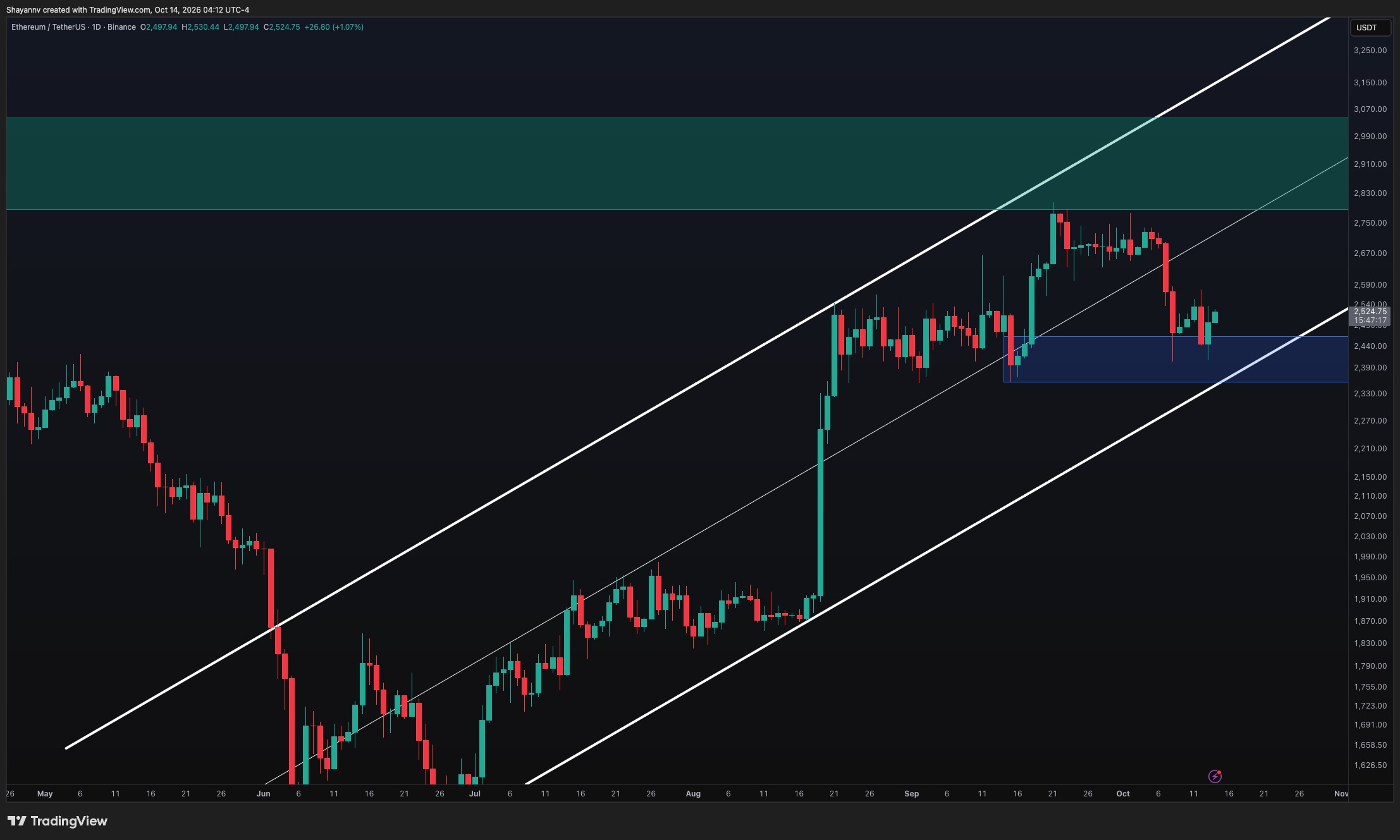
ETH/USDT 4-Hour Chart
The 4-hour chart highlights two sharp declines toward the rising lower trendline around $2.4K–$2.42K, each followed by a rebound. These reactions suggest that buyers are defending the lower portion of the structure, but the latest recovery has yet to clear the previous rebound high near $2.58K.
In the immediate term, ETH is consolidating around $2.5K–$2.53K. A sustained break above this narrow range could bring the $2.56K–$2.58K resistance area into play. Clearing that barrier would strengthen the base-building scenario and open the way toward the marked $2.68K–$2.74K supply zone, where the earlier consolidation broke down.
On the downside, losing $2.48K would expose the upper boundary of demand near $2.46K and potentially trigger another test of the rising trendline around $2.41K. Repeated tests make the response at this support increasingly important. A decisive loss of the trendline and the $2.36K demand boundary would undermine the current stabilization attempt.

Sentiment Analysis
The two-week Binance ETH/USDT liquidation heatmap shows substantial estimated liquidation concentrations above the current price. The nearest prominent overhead band sits around $2.58K–$2.6K, followed by another strong cluster near $2.63K–$2.65K. Additional concentrations remain higher around $2.74K–$2.8K.
The nearby $2.58K–$2.6K cluster aligns with the recent rebound high, making this region relevant to both price structure and leveraged positioning. A sustained advance through it could trigger short liquidations and accelerate the recovery toward the next overhead pool. However, reaching these levels would not itself confirm a lasting bullish reversal.
Below price, estimated liquidation bands remain around $2.47K–$2.49K and the broader $2.37K–$2.4K region. Another loss of nearby support could expose these concentrations and amplify selling through long liquidations. The heatmap therefore highlights potential volatility on both sides, with a break above $2.58K or renewed weakness beneath $2.48K likely to clarify the immediate direction.

The post Ethereum Price Analysis: What’s the Worst-Case Scenario if ETH Loses $2.5K Support? appeared first on CryptoPotato.
After the release of the PPI and US jobs report at the end of September and the beginning of October, all eyes turned to the next key factor that will determine the Fed’s next move: the Consumer Price Index.
The US Bureau of Labor Statistics just released the data, showing that the actual year-over-year increase of 3.7% is slightly higher than the estimated 3.6%, while the month-over-month rise matched expectations at 0.6%.
Core CPI, which excludes more volatile sectors such as energy and food, rose 2.6% YoY and 0.3% MoM. Estimates were again slightly lower at 2.5% and 0.2%, respectively.
Bitcoin reacted with an immediate nosedive that pushed it south by a grand. The asset stood at around $83,800 before it dropped to $82,800 in the initial minutes after the CPI data went live.
Lacie Zhang, Research Analyst at Bitget Wallet, told CryptoPotato that a similar reading (higher than expected) could “trigger a sharper repricing.”
“The biggest risk investors may be underpricing is that sticky core inflation — driven by energy spillovers, tariffs or sustained demand — keeps the Fed on a higher-for-longer path beyond the single additional hike many still expect later this year,” she added.
She outlined the next major support line for BTC at $81,000-$82,000, suggesting that the cryptocurrency could soon retest it if selling pressure intensifies after the CPI.
The post Bitcoin Price Plunges as September CPI Comes Out Higher Than Expected appeared first on CryptoPotato.
The viral altcoin BTW is the best-performing cryptocurrency today (October 14), up nearly 40% in a single day and 250% over the last month. It currently trades around $2.50 and has a market capitalization of almost $4 billion.
The triple-digit monthly increase has put the token in the spotlight, fueling expectations that the price could climb even higher in the near future. However, many think now is the perfect time to open short positions, and certain indicators support a bearish scenario.
Major Red Candle Incoming?
Despite the crypto market’s heightened volatility, Bitway has experienced a nearly uninterrupted upward trajectory lately and is now the 32nd-largest digital asset, after flipping popular altcoins like Bittensor (TAO), Shiba Inu (SHIB), Cronos (CRO), and many more.
The impressive price increase has rewarded early buyers with significant profits (at least on paper), leaving many market participants wondering if the asset’s uptrend still has room to continue. Nonetheless, multiple analysts warn that a short-term correction, and even a major collapse, are now more likely.
X user Zayn noted that BTW has posted eight consecutive green candles, signaling extremely overbought conditions. The analyst expects a “hard correction” to $2 and below but alerted traders to be careful when opening positions:
“Everyone will be looking to short here, so don’t go all in. Keep your position small and keep your stop-loss and liquidation levels above $3.50.”
UMER (THE BULL) issued the next warning, anticipating a short setup and monitoring the $2-$2.05 zone. The X user went even further, calling BTW a “scam coin” that can print “massive wicks” in either direction, so people should always trade it with a stop-loss.
Crypto With Gopal also chipped in. He said BTW has formed a double-top pattern after the price was rejected near $2.75-$2.80, signaling possible profit-booking pressure.
“Bears are watching the $2.40 neckline – a breakdown could trigger a deeper pullback toward $2.10. BTW is at a critical decision zone – bulls must defend support to keep the rally alive,” he concluded.
Additional Red Flags
BTW’s Relative Strength Index (RSI) supports Zayn’s theory that the token has entered extreme overbought territory. Latest data shows the ratio has surged past 80, suggesting the price has pumped too much in a short period and may be due for a short-term pullback.

- BTW RSI, Source: RSI Hunter
Another concerning factor is the high concentration of token ownership. According to CoinMarketCap, the top 10 addresses control more than 96% of BTW’s supply, making the coin highly vulnerable to potential price manipulation.

- BTW Holders Distribution, Source: CoinMarketCap
The post Bitway (BTW) Rockets 250% in a Month: Perfect Time to Short? appeared first on CryptoPotato.
Large Bitcoin (BTC) holders have resumed accumulation after months of selling, according to an analysis published by CryptoQuant. The shift comes as the cryptocurrency recovered from lows near $62,000 to highs around $87,000 and moved above its 365-day moving average.
Other market and on-chain indicators also point to improving conditions. CryptoQuant’s Bull Score Index, which combines ten market and on-chain indicators, climbed from 20 in late July to 90 on September 26. The index now stands at 80, which the firm says signals the early stages of a potential bull cycle.
Whale Accumulation and ETF Flows Signal Renewed Demand
Whale wallets, excluding exchanges and mining pools, now hold 3.03 million BTC, their highest combined balance since November 21, 2025. Their monthly accumulation rate has also reached its fastest pace since February 11, 2026.
Long-term data also show a shift in whale behavior after holdings began contracting in September 2025. The annual change in whale balances has returned close to zero and moved above its 365-day moving average, suggesting accumulation is strengthening.
Bitcoin ETF flows provide another indication of renewed demand. U.S. spot Bitcoin exchange-traded funds have recorded approximately 2,300 BTC in net inflows so far in 2026, worth around $1.5 billion. This follows earlier outflows that reached 83,000 BTC, valued at approximately $5.1 billion.
Bitcoin-Backed Borrowing Rises
Data from crypto lending platform CoinRabbit provides another indication of changing activity among large holders. In September, borrowers with BTC-backed loans exceeding $10 million increased their total USDT borrowing by 83%, following a 9% decline in July. Their average loan size also rose 33% after falling 8% in August.
Smaller borrowers showed a different pattern, with retail customers holding loans below $100,000 reducing their total borrowing by 17% in September. However, their average loan size increased, highlighting differences in borrowing behavior between large and small customers.
Taken together, these figures suggest that some large holders may be borrowing against Bitcoin for liquidity rather than selling, although the data cannot confirm their intentions. These developments also align with CryptoQuant’s broader assessment of market conditions.
The post Bitcoin Whales Resume Buying After Months of Selling: CryptoQuant appeared first on CryptoPotato.
Ethereum is getting most of the attention from crypto traders, while Bitcoin and XRP are facing growing fear. According to Santiment, the world’s largest altcoin by market cap has 2.05 bullish comments for every bearish comment across X, Reddit, and Telegram.
The shift comes as ETH trades above key support, and traders are watching staking demand and upcoming network upgrades.
Ethereum FOMO
The same cannot be said for Bitcoin, however, as it struggles to attract the same confidence. Its bullish-to-bearish comment ratio has dropped to 0.82. Repeated rejection near $87,000, a brief plunge toward $81,000, and heavy long liquidations have added to market concerns.
XRP is also under pressure as it recorded a sentiment ratio of 0.92. The token has fallen more than 9% over the past week, while the $1.40 level remains difficult to reclaim. Santiment explained that this contrast could matter if prices recover. While fear around Bitcoin and XRP could create opportunities for a possible rebound, high optimism around Ethereum may signal overheating,
Meanwhile, Crypto Patel sees an ambitious upside for Ethereum. The analyst set a long-term target of $15,000 for the current bull cycle. The $1,600 to $2,000 range was identified as a potential re-accumulation zone, with intermediate targets at $3,270, $4,892, and $10,000.
According to Crypto Patel, a confirmed breakout above $4,892 could open the door to a broader rally. However, ETH will need to hold key support levels and overcome resistance to keep that outlook alive.
Mixed Picture
Spot Ethereum ETFs finally saw some money come in after ten straight days of outflows. The funds recorded $24.84 million in net inflows on October 13th, which, interestingly, was their only positive day so far in October. Grayscale’s ETH fund led the gains with $16.3 million, while Fidelity’s FETH raked in another $8.11 million. Other funds posted no flows for the day.
The rebound is a welcome change, but it has barely made a dent in the recent withdrawals. These ETFs still have around $695 million in net outflows so far in October, as investor demand remains under pressure.
A similar trend was seen across spot Bitcoin ETFs, which collectively attracted $175.6 million. Meanwhile, XRP funds recorded no flows for three straight days.
The post ETH Becomes the Crowd Favorite as BTC Slides and XRP Struggles appeared first on CryptoPotato.