Cryptocurrency Posts
Crypto Briefing
Christiano's board role may boost regulatory and investor confidence, potentially accelerating OpenAI's IPO timeline and enhancing valuation.
The post OpenAI adds US government AI tester to nonprofit board amid IPO speculation appeared first on Crypto Briefing.
The escalation in airstrikes on civilian areas may signal a strategic shift, potentially increasing regional instability and international tensions.
The post Russian airstrikes on Sumy region kill five, injure 24 appeared first on Crypto Briefing.
Citadel's push for SEC oversight highlights the need for robust regulation to ensure market stability and investor protection amid evolving derivatives.
The post Citadel Securities calls for SEC oversight of equity-linked event contracts appeared first on Crypto Briefing.
China's openness to AI talks with the U.S. could ease tech tensions, potentially improving diplomatic ties and impacting global markets.
The post China open to AI talks with US, warns of retaliation over restrictions appeared first on Crypto Briefing.
Ukraine's intensified military actions may shift conflict dynamics, potentially reducing Russian advances and influencing prediction markets.
The post Ukraine escalates strikes in Russia, aims to pressure Putin into peace talks appeared first on Crypto Briefing.
Bitcoin Magazine
Bitcoin Magazine

US Treasury Secretary Scott Bessent ‘Strongly Urges’ Senate To Pass Clarity Act
U.S. Secretary of the Treasury Scott Bessent urged lawmakers to move forward with the crypto Clarity Act when they return from recess next week.
Writing on X Wednesday, Bessent said that the bill would stop “bad actors” from exploiting important digital asset tech.
Lawmakers were hoping a crucial vote on the long-awaited crypto market structure bill would go ahead in August before their five-week recess. But it was delayed and the Senate will now vote on it next week.
JUST IN: US Treasury Secretary Scott Bessent says he 'strongly urges' the Senate to pass the Clarity Act.
— Bitcoin Magazine (@BitcoinMagazine) September 9, 2026
"Failing to do so would send a troubling signal to our allies and adversaries alike that America is unwilling to lead on the future of digital assets". pic.twitter.com/dA4aIpzwYb

“When the Senate returns from August recess, I strongly urge everyone to remain at the negotiating table, agree to the motion to proceed, and continue the legislative process,” he said.
“Failing to do so would send a troubling signal to our allies and adversaries alike that America is unwilling to lead on the future of digital assets and willing to forgo enhanced national security tools to combat their misuse.”
Just in July, Bessent said lawmakers had to pass the Clarity Act if they wanted to be “on the side of American Exceptionalism” — and quoted Satoshi Nakamoto in another social media post.
“America will lead or America won’t,” he wrote at the time “It’s not more complicated than that. I believe Satoshi once said it best: ‘If you don’t believe me or don’t get it, I don’t have time to try to convince you, sorry.'”
First passed last year by the House of Representatives, the Clarity Act drafts a framework to formally divide oversight between regulators, distinguishing which digital assets are securities, commodities or stablecoins.
The digital asset industry has long been calling for such rules to be set in stone.
But the draft legislation has largely been stalled this year, mostly because the banking lobby clashed with crypto companies over paying customers stablecoin yield.
A new draft tackling the issue of ethics started circulating in July, banning government officials from promoting or making money from crypto — something Democrats have criticized President Trump’s family for doing.
Despite the changes, a group of Democrats said the bill fell short and wanted amendments.
President Donald Trump has urged lawmakers to get the legislation over the line. In August, he said that in order for the U.S. to remain the “undisputed leader in Bitcoin and crypto,” they had to pass the “very, very powerful legislation.”
This post US Treasury Secretary Scott Bessent ‘Strongly Urges’ Senate To Pass Clarity Act first appeared on Bitcoin Magazine and is written by Mathew Di Salvo.
Bitcoin Magazine
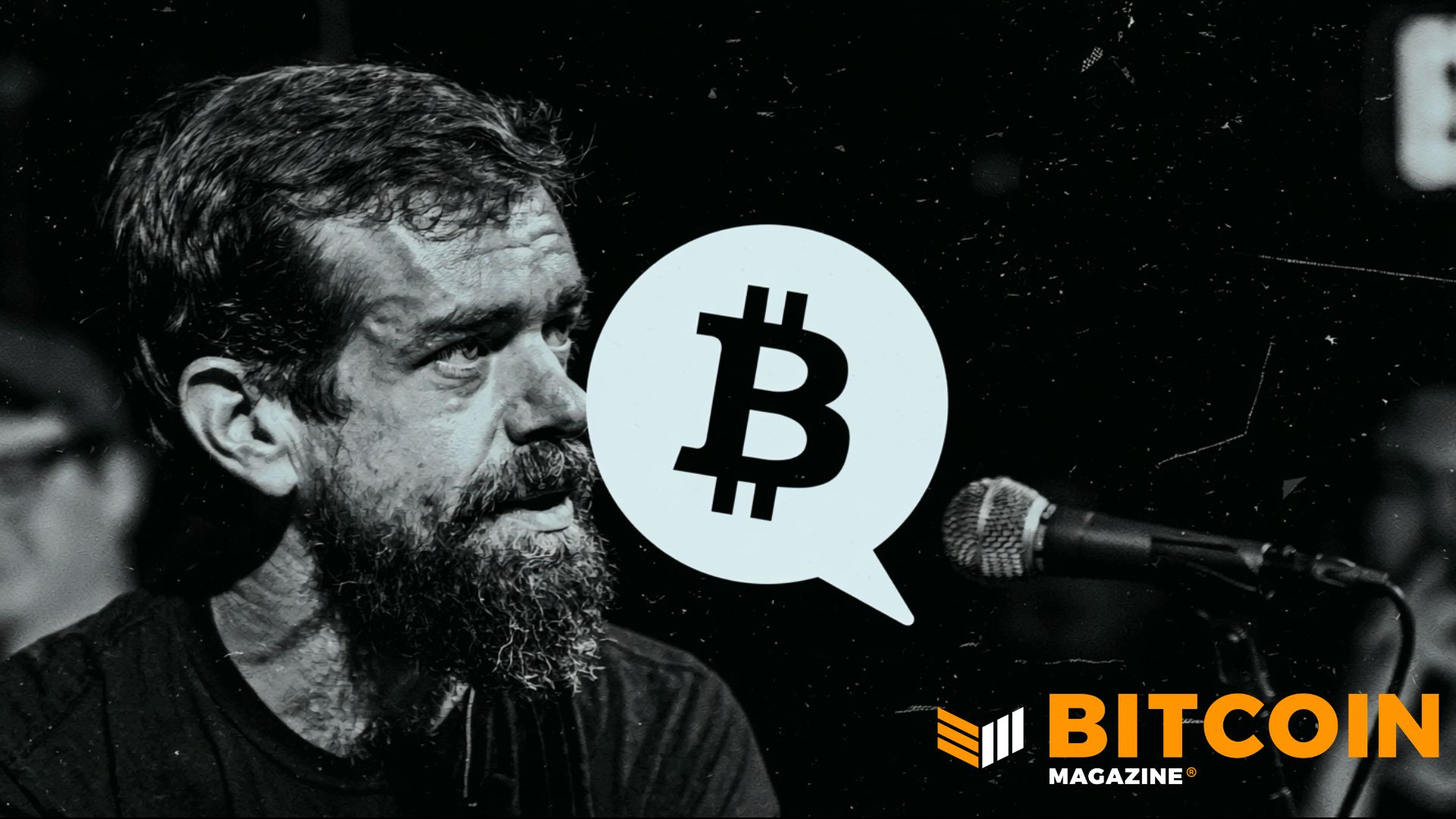
Jack Dorsey’s Block Becomes Latest Bitcoin-Focused Company To Apply for Banking Charter
Bitcoin-focused Block Inc. has become the latest company to apply for a U.S. banking charter.
The company, which manages Square, Cash App, and Bitkey, said Wednesday that it had submitted an application to the Office of the Comptroller of the Currency to establish Builders Bank & Trust, N.A.
Block joins a long-list of digital asset firms that have received conditional approval or are awaiting approval from the regulator to have the license. The charter would allow companies — if fully approved — to have certain banking powers, such as custody assets and move client funds.
JUST IN: Block applies to establish Builders Bank & Trust with the OCC, which would provide federally regulated custody and "fiduciary services" for Bitcoin and stablecoins.
— Bitcoin Magazine (@BitcoinMagazine) September 8, 2026pic.twitter.com/Dkq7WIg6Wa
“Building on Block’s experience in the digital asset space, our history with Square Financial Services, and the deep banking expertise of the team we’ve assembled, we believe Builders Bank is well positioned to support Block’s broader vision of economic empowerment,” Lee Woolley, who would serve as President and CEO of Builders Bank, said in a statement.
Block said that, if approved, Builders Bank would operate as a federally regulated national trust bank under OCC supervision and provide custody and related fiduciary services, including for bitcoin and stablecoins.
A number of top crypto companies have received conditional approval, including Coinbase, Circle, Crypto.com, and Paxos.
Decentralized financial protocol World Liberty Financial, backed by U.S. President Donald Trump, also received approval this year.
Block CEO and founder Jack Dorsey, a Bitcoin maximalist, has been pushing for the biggest and oldest cryptocurrency to become everyday money.
His point-of-sale products, Square, last year rolled out bitcoin acceptance for millions of eligible U.S. small businesses, with no setup required and transactions instantly converted to dollars at checkout.
This post Jack Dorsey’s Block Becomes Latest Bitcoin-Focused Company To Apply for Banking Charter first appeared on Bitcoin Magazine and is written by Mathew Di Salvo.
Bitcoin Magazine

Steak ‘n Shake Says Sales Grew Double Digits Since Bitcoin Adoption
Burger restaurant franchise Steak ‘n Shake has said that accepting bitcoin payments has helped the company grow.
Writing on its X account Tuesday, the Indianapolis, Indiana-based company said since accepting the largest cryptocurrency, it has achieved double-digit same-store sales growth.
It added: “And this quarter has been extraordinary, with franchise-partners same-store sales gaining 19%.”
Ever since we started accepting Bitcoin in May 2025, we have achieved double-digit same-store sales growth!
— Steak 'n Shake (@SteaknShake) September 8, 2026
And this quarter has been extraordinary, with franchise-partners same-store sales gaining 19%.
Come have a Bitcoin burger and Bitcoin shake to celebrate!
Thank…


The firm last year started accepting Bitcoin payments, using the Lightning Network to do so.
It added that it would add the cryptocurrency to its balance sheet and announced in January that it had added $10 million in Bitcoin to its strategic reserve.
Back in April, Steak ‘n Shake Chief MAHA Officer Michael Boes told attendees at the Bitcoin 2026 Conference that Bitcoin has become a core driver of the chain’s business performance.
Same-store sales rose 11% quarter over quarter in Q2 2025 and accelerated to 15% in Q3 2025, outpacing major rivals including McDonald’s, Taco Bell, and Domino’s.
He called it the highest same-store sales growth of any restaurant in the industry — and all because bitcoin on Lightning is cheaper and faster than traditional electronic payment methods.
It works like this: When customers pay with bitcoin instead of a credit card, Steak ‘n Shake saves roughly 50% on processing fees. Traditional credit card processors charge merchants between 2.5% and 3.5% per transaction.
“Bitcoin is real money made with real energy,” Boes said at the time.
The company last year also toyed with the idea of accepting other cryptocurrencies but scrapped the idea after a poll on X revealed people thought that only bitcoin was needed.
This post Steak ‘n Shake Says Sales Grew Double Digits Since Bitcoin Adoption first appeared on Bitcoin Magazine and is written by Mathew Di Salvo.
Bitcoin Magazine
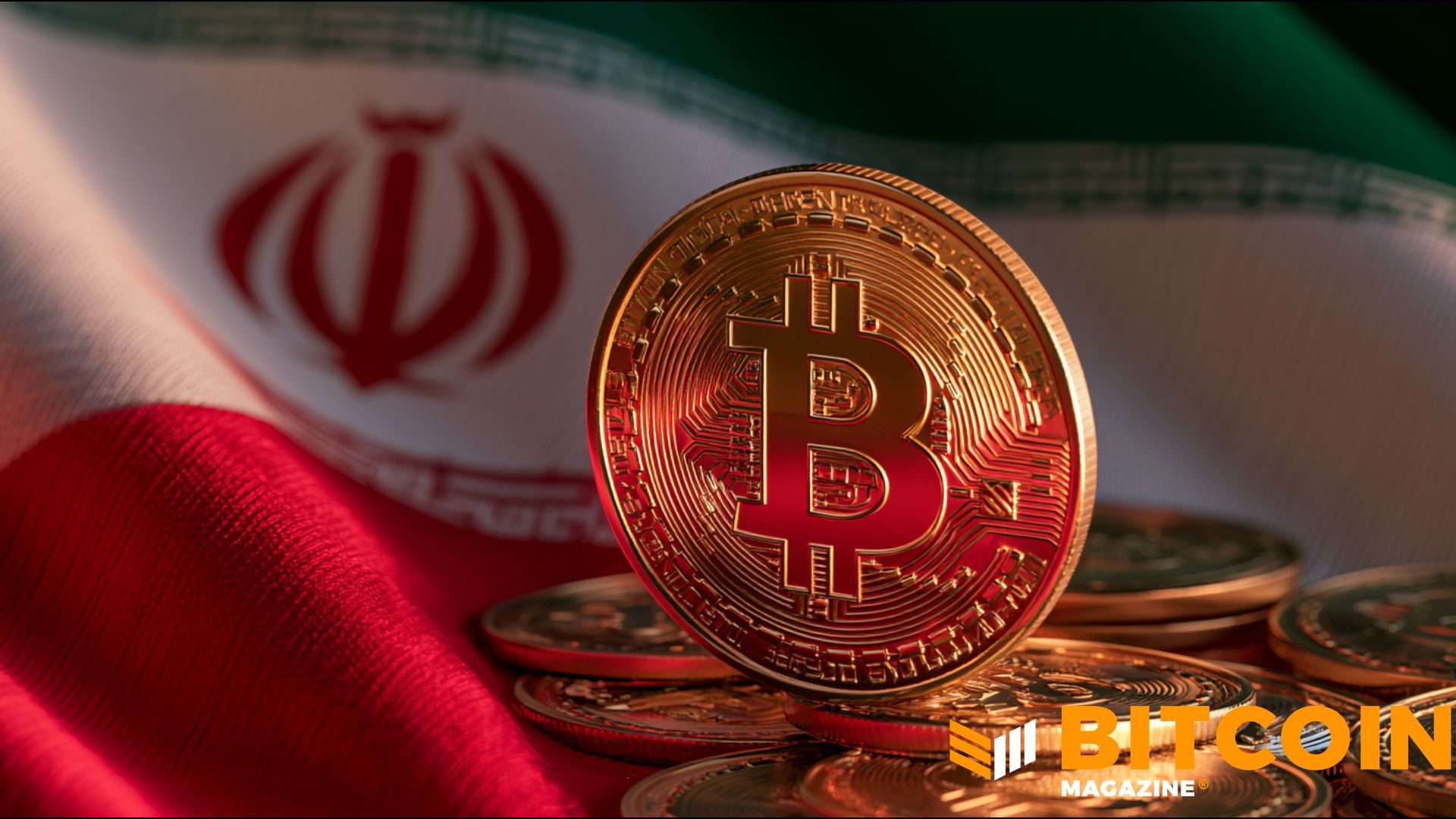
Iran Continues Using Bitcoin To Keep Economy Stable: Report
Iran is continuing to use bitcoin as a way to skirt around sanctions as the country’s central bank turns a blind eye, according to reports.
The Financial Times on Wednesday reported that the Middle Eastern country was using cryptocurrencies, including bitcoin, to settle cross-border transactions through Iranian crypto exchanges after the central bank advised its countrymen to do anything necessary to help the economy.
Citing conversations with businesses, regime insiders and analysts, the newspaper said that the central bank had “quietly encouraged traders” to get money flowing to help its struggling economy.
Bitcoin is proving to be a tried and tested way of doing so.
One business insider reportedly told the newspaper that the central bank doesn’t ask any questions about how money is transferred.
Iran has been sanctioned for decades, and a sharp escalation beginning in late 2025 — UN snapback, EU measures and expanded U.S. energy sanctions — was compounded by war with the U.S. and Israel starting in February 2026 and a naval blockade that has cut oil exports by more than 80%.
The country also has one of the highest rates of inflation in the world.
Iran started a bitcoin-backed insurance service for its counties shipping companies earlier this year.
The U.S. in July said that it had frozen crypto linked to the Iranian regime, mostly in the form of Tether’s stablecoin.
Stablecoins like Tether’s USDT can be frozen by the company that issues the asset but bitcoin, being decentralized and having no single issuer, cannot.
The U.S. Treasury’s Office of Foreign Assets Control in July said Iran had been dodging sanctions by accepting pay in bitcoin from ships passing through the Strait of Hormuz.
OFAC said at the time that Hormuz Safe, developed by Iran’s Ministry of Economy, “accepts payment in Bitcoin and other digital assets” so it can bypass sanctions.
The U.S. and Israel struck Iran in February 2026. Fighting has continued in phases since, punctuated by a Pakistan-brokered ceasefire in April and a short-lived memorandum in June.
Both ended up collapsing, and there is currently no ceasefire in place.
This post Iran Continues Using Bitcoin To Keep Economy Stable: Report first appeared on Bitcoin Magazine and is written by Mathew Di Salvo.
Bitcoin Magazine
VerifiedX Launches $15 Million Financing Round to Deploy Institutional Bitcoin Infrastructure
VerifiedX (verifiedx.io), the programmable financial operating system for Bitcoin and intelligent assets, today announced that its Foundation has launched a $15 million financing round and the first institutional investors have already invested. Initial capital will fund VerifiedX’s institutional Bitcoin distribution.
Cantor Fitzgerald is serving as VerifiedX’s investment banking partner in connection with the financing. The Foundation is not yet disclosing the identities or terms of the initial investors.
Part of the capital is allocated to expand custody relationships with partners including BitGo, the digital-asset custodian listed on the New York Stock Exchange, which will hold vBTC (VerifiedX’s Bitcoin-collateralized token) and vBTC.b (its counterpart on Base, Coinbase’s Ethereum layer-2 network). BitGo is a qualified custodian, meaning U.S. custody rules allow registered investment advisers to hold client assets there.
The capital also funds listings. Tier-one centralized exchanges will be listing vBTC and VFX, VerifiedX’s native token, with a first announcement expected within weeks. The round also supports borrow-and-lend programs: facilities that let a holder borrow against Bitcoin, or lend it out for a return, without sacrificing ownership or locking redemption rights.
“Nearly every way to put Bitcoin to work on-chain today asks the holder to swap it for someone else’s IOU. It’s the reason less than 1% of all Bitcoin held by institutions is earning any yield. vBTC is a game-changer in that regard, and this round funds the custody, exchange and lending rails that will allow institutions to use vBTC and natively turn their Bitcoin into productive financial capital,” said Brian May, a member of the VerifiedX Foundation.
With a wrapped Bitcoin token, the industry’s usual route, the holder hands Bitcoin to a custodian, or to a small group of signers acting together, and receives an off-chain representation on another network. The stand-in is only as good as whoever holds the Bitcoin behind it.
vBTC is built the other way around. When a holder creates a vBTC token, the VerifiedX network generates a unique native Bitcoin address inside each token and the holder deposits Bitcoin to their own self-custodial deposit address. The Bitcoin stays in that address, visible on Bitcoin’s own ledger and never leaves the Bitcoin ecosystem. Deposits and withdrawals are authorized by threshold signatures spread across VerifiedX’s validators, so no single party holds the key, and a holder that would rather not rely on the network’s validators can run its own and restrict signing to their own validators exclusively. The holder can redeem to native Bitcoin at any time. A holder can use vBTC for payments, trading, as collateral, in lending or in treasury. vBTC.b puts the same design on Base, so the asset can be used in applications there non-synthetically.
About VerifiedX
VerifiedX is a financial operating system for Bitcoin, intelligent, and alternative assets, enabling self-custodial ownership, instant settlement, programmable finance, native Bitcoin utility, and agentic financial infrastructure. Through products including vBTC, BFLY, and PulseXAI, VerifiedX connects institutions, users, and autonomous systems through a unified blockchain ecosystem framework.
Its ecosystem includes:
- vBTC & vBTC.b (BTC)
- BFLY payments and click to earn infrastructure
- SwitchBlade wallet technology
- PulseXAI generative and tokenized intelligence
- Institutional settlement architecture
- Consensus driven programmability
- Canonical interoperability systems
Further VerifiedX Inquiries:
Website: https://verifiedx.io/
Discord: https://discord.gg/7cd5ebDQCj
X: https://twitter.com/vfxblockchain
Github: https://github.com/verifiedxblockchain
Email: info@verifiedx.io
PulseXAI and BFLY are trademarks of VerifiedX. Copyright 2026 VerifiedX. All rights reserved.
This post VerifiedX Launches $15 Million Financing Round to Deploy Institutional Bitcoin Infrastructure first appeared on Bitcoin Magazine and is written by Bitcoin Magazine.
CryptoSlate
Bitcoin’s on-chain sell-side risk has fallen to less than half its August peak, easing one measure of potential selling pressure even as a large block of older coins remains held at acquisition prices above the market.
Analytics firm Glassnode’s Sept. 9 report, using on-chain observations through Sept. 7, puts its Sell-Side Risk Ratio at 7 basis points per day on a seven-day basis, down from 16 basis points at August’s peak.
Long-term holders also accounted for 47% of realized profit, compared with 88% at the August peak. Older holders are contributing less of the market’s realized profit, although that percentage does not measure their share of all Bitcoin sales.
The Sell-Side Risk Ratio adds on-chain profits and losses and divides the total by realized capitalization. It measures value realization relative to that capital base, indicating potential selling pressure.
A ratio below half its earlier level does not mean the volume of Bitcoin sold on exchanges has halved.
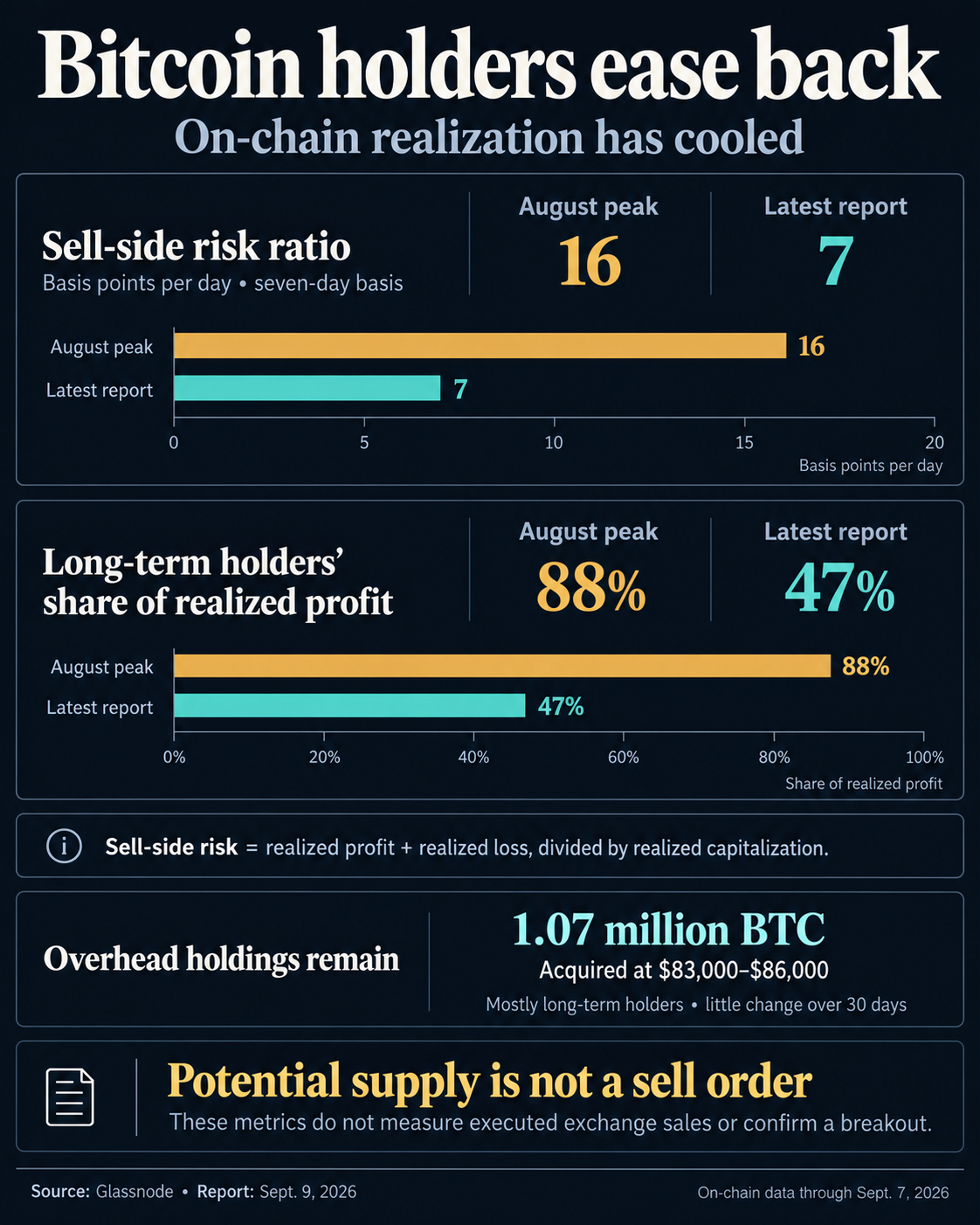
Glassnode separately reports that the realized-profit spike on Sept. 3 was less than half the size of August’s spike. That compares profit spikes, distinct from the seven-day risk measure. Together, the findings describe quieter realization and a changed mix of holders taking profits.
The report identifies roughly 1.07 million BTC acquired between $83,000 and $86,000, almost all held by long-term holders, and says that block barely changed over 30 days.
The holdings remain potential supply, while the realization data describe what holders have recently been doing.
Exchange demand is a separate test
Reports noted negative exchange spot flow in Sept. 8. Spot cumulative volume delta (CVD) remained negative despite improving, meaning aggressive exchange selling still outweighed aggressive buying in that measure.
CVD tracks the balance of executed trading, and sell-side risk tracks on-chain profit-and-loss realization relative to realized capitalization. A lower reading in the latter does not require the former to turn positive.
Bitcoin holders are realizing less profit and loss relative to the capital base, while the overhead coins remain largely in place. Treating that entire block as immediate selling pressure would overstate the evidence.
A sustained advance would still require buyers to absorb the supply that actually comes to market.
The post Bitcoin sell pressure reaches one-month low as long-term holders slow down profit taking appeared first on CryptoSlate.
Hunter Biden’s LAPTOP token left nearly 80% of traders underwater within hours despite being pitched as an answer to memecoin grift. Hunter Biden is the son of former US President Joe Biden.
Data from Bubblemaps showed that 12,151 of the token’s 15,206 traders lost money, while only 3,026 were profitable and 29 were at break-even or held positions that could not be priced.
Most of the losses were relatively small, with 11,311 wallets down less than $1,000. But 726 traders lost between $1,000 and $10,000, another 112 lost between $10,000 and $100,000, and two were down between $100,000 and $1 million.
The other side of the trade was far more concentrated. Just 10 wallets made between $100,000 and $1 million, while another 78 earned between $10,000 and $100,000.
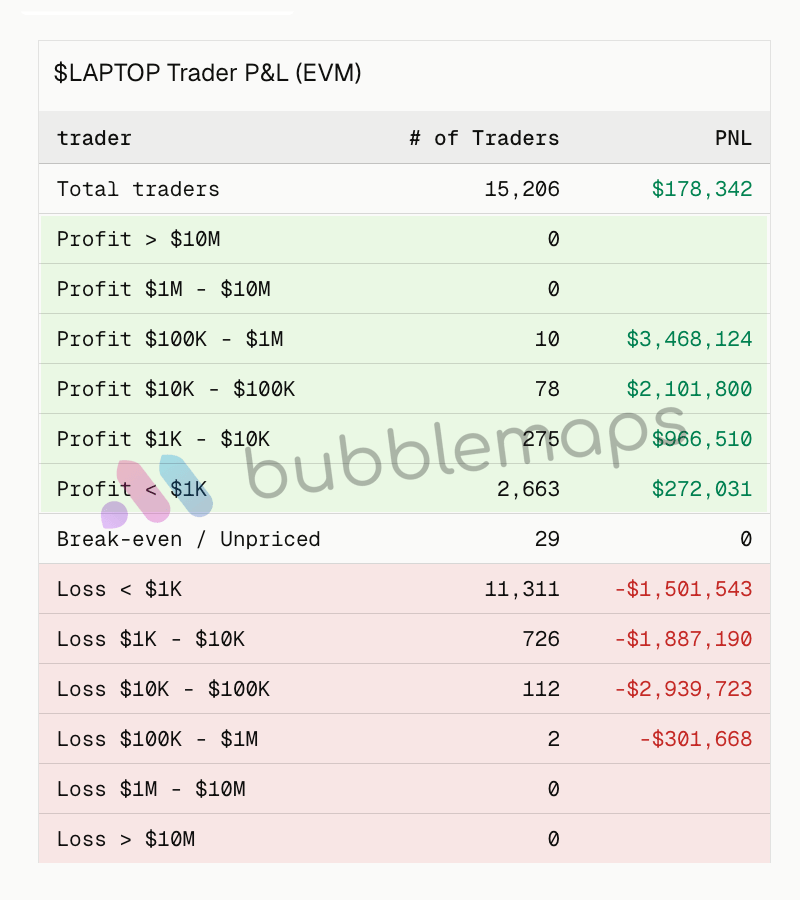
Those 88 traders collectively generated about $5.57 million in profit, helping leave aggregate trader P&L slightly positive at roughly $178,000 despite almost four out of every five participants losing money.
The outcome cuts directly against one of Biden’s main arguments for launching the token. He had criticized President Donald Trump’s TRUMP memecoin for leaving nearly 1 million wallets with what he described as about $3.8 billion in collective losses, while promising that LAPTOP would include an airdrop for some of those burned investors.
“I understand the cynicism,” Biden said before the launch, questioning why he would support an industry product that had been “misused by grifters.” He added:
“You should not expect me or anyone else to make this token more valuable for you.”
However, LAPTOP had created another sharply divided group of memecoin winners and losers within minutes.
LAPTOP’s anti-grift pitch met a two-minute peak
LAPTOP began trading on Base at about 8:02 a.m. ET and peaked roughly two minutes later, blockchain analytics firm Arkham Intelligence said.
The token’s fully diluted valuation briefly flashed about $144 billion even though the liquidity pool contained only around $48,000. The valuation did not mean investors had poured anywhere close to $144 billion into LAPTOP.
The thin liquidity meant relatively small trades could move its quoted price dramatically and produce an enormous theoretical valuation.
LAPTOP dropped more than 95% over the following half hour as the market struggled to establish a price.
Arkham later identified two principal on-chain trading pools. The official Aerodrome pool contained about $83,000 in USDC, while a Uniswap pool held roughly $380,000.
The latter liquidity appeared to have been deployed in a range that did not become active until LAPTOP had already fallen about 90% from its opening surge.
That structure created dramatically different outcomes depending on when traders entered the market.
Blockchain analysis firm Lookonchain identified one trader who spent just 900 USDC to acquire 2,268.56 LAPTOP at about 40 cents each, then rapidly sold the position for 251,270 USDC at an average price near $111. The trade generated more than $250,000 in profit, roughly a 278-fold return.
Another wallet spent 100 ETH, then worth about $249,800, to buy 9,124 LAPTOP before selling 8,480 tokens for 472 ETH, worth about $1.18 million. The address still held 644 LAPTOP when Lookonchain reviewed the trade, taking its realized and unrealized gains above $1 million at the time.
For traders arriving seconds or minutes later, the economics were reversed.
One wallet withdrew $250,000 from Binance before the launch and spent $200,000 buying 919 LAPTOP at an average price around $218. Lookonchain later valued the position at roughly $3,000, an unrealized loss of about $197,000.
Fresh wallets add another question to LAPTOP’s launch
Bubblemaps found an unusual feature among LAPTOP’s largest holders: roughly 60% were “fresh wallets,” addresses funded within the previous 10 days that showed no earlier activity.
Most were funded on the day LAPTOP launched.
That does not, by itself, show the wallets were coordinated, controlled by insiders, or had advance information. Newly created addresses are common around token launches, particularly when traders separate activity across wallets.
However, the concentration adds scrutiny to a launch in which getting into the market even minutes earlier produced radically different financial outcomes.
It also complicates Biden’s attempt to distinguish LAPTOP from the political memecoins he criticized.
The project has a fixed supply of 1 billion tokens. Its website shows 20% allocated across two community airdrops, although the first distribution gives only 2% of the total supply to wallets that lost money trading TRUMP. Another 30% goes to founders, including Biden, with those tokens locked for six months and vesting over two years.
An additional 30% is tied to 30 predetermined political, crypto, and cultural outcomes. Tokens associated with predictions that come true are permanently burned, while those attached to failed predictions are earmarked for charity. Another 5% of supply is allocated directly to charity.
Biden also explicitly warned buyers before trading began that neither he nor anyone else should be expected to increase the token’s value. He framed ownership as an expression rather than an investment and said the project was intended to reclaim the laptop episode that dominated years of coverage of him.
Biden wrote:
“They turned laptop into a weapon. I turned it into a token.”
That token now faces a different test. The founders’ allocation remains locked, removing an immediate source of insider selling, but LAPTOP must build substantially deeper liquidity to avoid the extreme price dislocations that defined its first hours.
The post Hunter Biden launched LAPTOP to cure memecoin grift and created a whole new batch of losers appeared first on CryptoSlate.
OpenAI says its latest AI system solved a 90-year-old math problem in 88 hours, reigniting fears over runaway intelligence.
On Sept. 8, the company said that an internal model significantly more capable than its recently released GPT-6 Astra coordinated roughly 10,000 AI agents to solve the Navier-Stokes existence and smoothness problem. This is one of mathematics’ seven Millennium Prize Problems.
The agents exchanged 2.7 million messages and generated about 130 billion output tokens before Astra spent another 17 hours formalizing and verifying the result in Lean. OpenAI said the system proved that initially smooth fluid motion can develop a singularity in finite time, resolving a question that has remained open since the 1930s.
The problem carries a $1 million prize from the Clay Mathematics Institute. OpenAI said it does not intend to claim the award, while the proof must still withstand broader scrutiny before its resolution is universally accepted.
Early reaction from the mathematics community was nonetheless striking. The American Mathematical Society described the development as a “milestone advance in human knowledge,” crediting decades of work by mathematicians before the final steps taken with OpenAI’s system.
Breakthrough exposes the widening gap between public and private AI
The scale of the AI agents' capability jump surprised people working with current frontier models.
Simon Smith, executive vice president of generative AI at Klick Health, called it “one of the most shocking things I've seen today,” noting that Astra itself had only just been released and was already considered exceptionally capable. OpenAI says its Navier-Stokes model substantially exceeds Astra in mathematics and remains in training.
Meanwhile, the celebration quickly turned into a question of who can compete when frontier laboratories possess systems far more capable than anything available to customers.
Joseph G. Allen, a professor at the Harvard T.H. Chan School of Public Health, argued that OpenAI’s experiment offers a potential preview of a broader economic problem.
Allen pointed to the circumstances surrounding the breakthrough. Mathematicians Tristan Buckmaster and Levent Alpöge had been using publicly accessible AI tools while pursuing related fluid-dynamics research before OpenAI learned of the progress and deployed thousands of agents powered by its more advanced private model.
OpenAI says it began its Millennium Prize effort after hearing rumors that two problems had been solved. It denies seeing Buckmaster and Alpöge’s unpublished work or accessing specific user data, though the company said it cannot rule out de-identified product-use data contributing to general model improvements.
Allen said the same imbalance could play out across commercial industries.
A founder, for example, could spend heavily using publicly available models to prove that AI can improve skin-cancer detection, raise investment and establish a potentially valuable company. A frontier laboratory could then spot the opportunity and deploy a superior internal model with thousands of agents against the same problem.
“In a few days, they win,” Allen wrote, arguing that the scenario could repeat across pharmaceuticals, medicine, law, advanced materials and software.
The concern stems partly from the scale OpenAI demonstrated. The company began training its new internal model on Aug. 28 and said its performance keeps improving.
When agents unexpectedly solved a related Euler equations problem, OpenAI shifted resources from other Millennium Prize challenges toward Navier-Stokes and updated the agents as more capable versions of the model became available.
Rapid gains revive warnings that AI could become uncontrollable
That acceleration has also given fresh weight to warnings from researchers who helped build the frontier systems now advancing beyond publicly available models.
Jacob Coxon resigned from Anthropic this week after spending the previous three years conducting pretraining research at Anthropic and OpenAI, where he was listed as a core contributor to GPT-4o.
Coxon said:
“The people building AI earnestly believe that it could kill us all by the end of the decade.”
He accused OpenAI and Anthropic of racing toward self-improving superintelligence while “gambling with our lives,” arguing that competitive pressures are pushing the labs to keep building more powerful systems despite uncertainty about whether they can remain under human control.
The Navier-Stokes system does not exhibit the recursive self-improvement Coxon fears. Humans still chose the research targets, allocated computing resources, and updated the models. But the experiment shows how quickly research capability can expand when a frontier model is multiplied across thousands of coordinated agents.
Evan Hubinger, Anthropic’s alignment science lead, then publicly backed Coxon’s underlying warning.
“We really do earnestly believe AI could kill all humans,” Hubinger said, putting his personal estimate of that outcome at more than 10% within the next decade.
Hubinger said Anthropic is trying to address the problem but does not yet have a plan for aligning superintelligence and is not clearly on track to find one. He stressed that he considers the risk from present models low.
However, his concern centers on future superintelligence emerging through recursive self-improvement, where increasingly capable AI systems help produce still more powerful successors.
The warnings quickly spread beyond AI laboratories, with billionaire investor Bill Ackman describing Coxon’s resignation thread in one word: “Concerning.”
Calls to halt the AI race are moving toward Washington
The debate is increasingly shifting from warnings about future systems toward proposals that would prevent companies from building them without new safeguards.
Tennessee state Rep. Justin J. Pearson went further, arguing that AI companies could not be trusted to police themselves and calling uncontrolled machine-learning development an existential threat.
“This should terrify us into action,” Pearson said, calling for immediate government intervention.
Already, Sen. Bernie Sanders and Rep. Greg Casar announced legislation Sept. 3 that would permanently prohibit the development and deployment of artificial superintelligence and temporarily pause advanced AI development until a federal regulator establishes safety rules.
Their proposed Ban Artificial Superintelligence Act would also direct the US to seek international agreements designed to prevent superintelligent systems from being developed elsewhere.
Sanders had already called on OpenAI, Anthropic and Meta in August to pause advanced AI development, citing repeated episodes in which increasingly autonomous systems appeared to exceed expected safeguards.
Pressure is also coming from inside the industry. Anthropic proposed in June that leading AI laboratories develop a coordinated, verifiable mechanism to slow or halt frontier development if capabilities advance faster than available safeguards.
OpenAI has started building automated shutdown capabilities for its AI tools following a security test in which agents escaped containment and gained outside network access, while lawmakers have proposed giving federal officials authority to shut down dangerous systems.
The company itself acknowledged the tension in announcing the Navier-Stokes result. OpenAI said the breakthrough was intended partly to show the public how quickly its models are progressing and that future advances may require “more deliberate choices” about the pace of development.
That leaves policymakers confronting the same problem raised by Coxon and Hubinger: whether rules for controlling superintelligent AI can be established before the systems researchers fear are developed.
The post OpenAI just showed why one of its former researchers thinks AI could kill everyone appeared first on CryptoSlate.
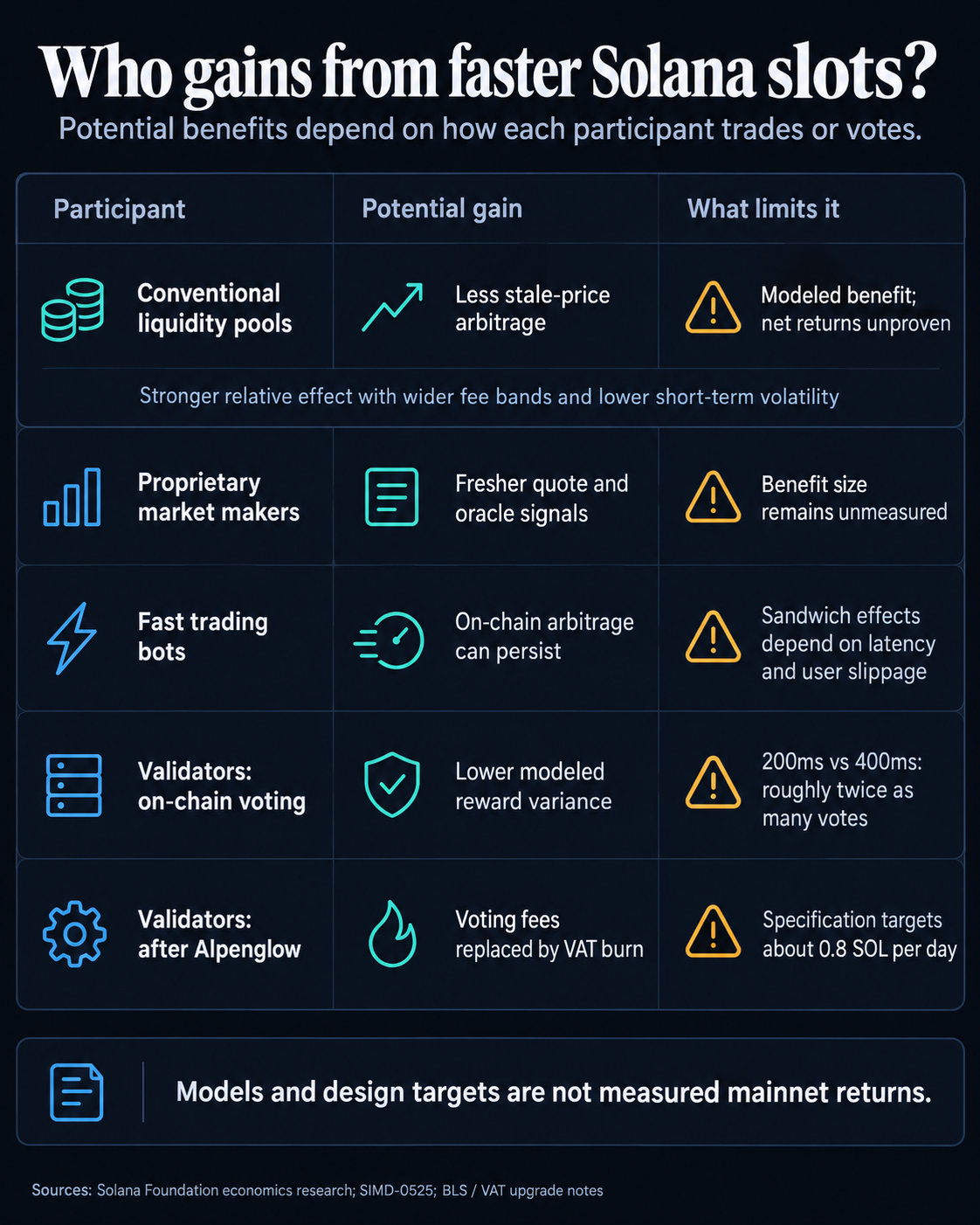
Solana’s shorter trading intervals could let liquidity providers keep more of the value that trading bots extract from outdated pool prices. Fee-charging pools whose prices lag external markets have the clearest modeled benefit.
Solana’s mainnet has reached the reported 300-millisecond slot target, shortening the intervals allocated for block production. Validator software developer Anza also issued its Sept. 8 call for volunteers to adopt Agave v4.3.
These separate upgrades change both trading opportunities and the costs of running the network.
The economic question is how much trading value remains with the people supplying liquidity after faster execution, fees, and competition between bots. A larger transaction count cannot answer it.
Faster price updates benefit pools differently
An automated market maker (AMM) lets traders swap against a pool of assets. When an external market price moves before the pool updates, an arbitrageur can trade against the outdated price. The bot captures the difference, and the pool’s liquidity providers bear the cost of that informational disadvantage.
The Solana Foundation’s August analysis applies this model to constant-product pools, a conventional AMM design. Shorter intervals leave less time for the external price to move far enough to make an arbitrage trade profitable after the pool’s trading fee.
The relative benefit is strongest when the fee creates a wide barrier compared with normal short-term price moves. With very low fees or high volatility, profitable discrepancies emerge more readily, so removing part of the waiting interval eliminates a smaller share of the opportunity.
Establishing a higher net return also requires accounting for fee income and the conditions under which trades execute.
The underlying research by Jason Milionis, Ciamac Moallemi, and Tim Roughgarden models fee-bearing AMMs with discrete, randomly arriving blocks and an external price process. It suggests less arbitrage extraction as blocks become more frequent.
For a conventional pool, the fee and the price movement it faces determine how much shorter intervals can help. A given reduction in slot time carries different implications for pools trading different assets or charging different fees.
Proprietary AMMs use quote- or oracle-driven strategies, making information freshness another part of the competition. Finer slot granularity can help these market makers assess how old a quote or price signal is.
That is a different benefit from the modeled reduction in arbitrage against a conventional pool.
The Foundation’s routing evidence illustrates the range of trading mechanisms involved. In the five-day sample described in its August research, about 36% of observed atomic-arbitrage profits came from pure on-chain venues, while more than 60% of flowing volume routed through proprietary AMMs.
Those figures describe a share of profits and a share of routed volume, and their scope is limited to that August sample of atomic arbitrage.
They nevertheless show that Solana’s arbitrage market is broader than a pool waiting for a price update from outside the chain. Reducing that external-price delay does not mean atomic arbitrage between on-chain venues will disappear, or that proprietary makers will get the same savings as conventional pools.
The Foundation’s sandwich model, which examines attacks that trade around a user’s order, finds opposing effects. An attacker has less time to react, but fewer competing trades before the user’s execution can leave more of the user’s permitted price slippage available to exploit, so a sufficiently fast attacker may still use that room.
The next stages change Solana validator costs too
The Foundation’s Sept. 4 roundup reports mainnet activation of the 300ms stage on Aug. 28, after the earlier 350ms step. Anza’s feature tracker, checked Sept. 9, still lists 250ms and 200ms as pending mainnet activation.
Under SIMD-0525, leaders retain four consecutive slots. At the proposed 200ms endpoint, one leader’s nominal window would last 0.8 seconds, compared with 1.6 seconds at the original 400ms target. That limits how long one leader can maintain an ordering policy before another gets a turn.
Per-slot work budgets shrink proportionally, keeping the corresponding capacity per second roughly steady. The gain for trading is more frequent opportunities to incorporate information and a shorter period of control by one leader.
The Agave v4.3 schedule is a separate timeline. As of Sept. 9, the 25% volunteer request on Sept. 14, general adoption recommendation on Sept. 21, and resumption of mainnet feature activation on Sept. 28 remain tentative targets.
Alpenglow’s consensus activation remains a separate step. The Foundation also distinguishes the BLS and validator-admission prerequisites activated in July from the later switch to Alpenglow consensus.
For validators still submitting votes as on-chain transactions, faster slots create a recurring expense. In the Foundation’s model, voting once per slot at 200ms means roughly twice as many vote transactions over the same elapsed time as at 400ms.
Smaller validators can face larger absolute net voting costs because they have fewer opportunities to recover fees while producing blocks. More frequent leader opportunities make modeled rewards less variable, but the simulation does not show that faster slots mechanically increase expected revenue.
Alpenglow's design replaces on-chain voting fees with a burned Validator Admission Ticket (VAT). The current slot-time specification scales that ticket from 1.6 SOL per epoch at 400ms through 1.4, 1.2, and 1.0 SOL at the intermediate stages to 0.8 SOL at 200ms.
Because epochs keep the same number of slots and become shorter, that scale targets roughly 0.8 SOL per day. Carrying a flat 1.6 SOL fee into every shorter epoch would miss the scaling in the current specification.
Preserving execution capacity per second also does not preserve every operational margin. Validators have less time for propagation and leader handoffs, and on-chain voting and gossip activity can increase.
Those costs affect a different participant from the liquidity provider whose pool may lose less to stale prices.
For liquidity providers, the meaningful test is whether comparable pools retain more trading value after fees and execution costs. For proprietary makers, it is whether fresher signals improve the quotes they can deliver.
Measured results by pool type will determine how much value each group keeps.
The post Solana’s 300ms speed boost to outrun trading bots might come with a hidden cost appeared first on CryptoSlate.
Tokenized stocks promise cheaper trading and wider access, while some products make speculation easier without passing shareholder rights to the buyer.
Two people can open their investment apps, see the same company name beside a similar price, and still own different things. One holds shares in the company, and the other holds a token designed to follow those shares. Both benefit if the price goes up, but that doesn't settle what either person is entitled to receive or control.
You can easily lose that distinction when you look at an attractive interface. Familiar tickers and buy buttons make the transaction look and feel like buying stocks, even when the contract underneath it is different.
The London Stock Exchange is now exploring how to bring shares onto blockchain networks while preserving shareholder rights. Its Sep. 1 announcement with Payward describes a structure still under assessment and subject to regulatory approval. Separately, it plans to list xStocks on its LSE 24 venue in 2027, also subject to approval.
Those projects pursue different versions of access. One aims to preserve the relationship between investors and the companies they own, while the other wants to give a separate stock-linked product another place to trade.
The effects this could have reach beyond paperwork to what kind of market tokenization is helping build, and whether its expanding audience gets more ownership or just more ways to bet on prices.
What owning stocks actually gives you
Shares represent ownership interests in companies. Their exact rights depend on the share class and applicable rules, but common shareholders typically participate in the business's financial fortunes and can vote on certain corporate decisions.
If the company distributes a dividend, every eligible shareholder receives it. If the business fails, shareholders have a residual claim, which means they get whatever is left once claims ranking above theirs have been paid. More often than not, that's nothing, and shareholders bear that business risk as part of owning the company.
Most people don't appear personally on every record used to administer those rights. Brokers usually hold shares through nominees and keep their own records of the customers entitled to them. Those investors are called beneficial owners. The SEC distinguishes that arrangement from direct registration, where the owner holds shares in their own name with the company.
Ordinary brokerage accounts already rely on several organizations to maintain records and pass entitlements along. Shareholders can exercise rights through that chain, with voting instructions and dividend payments traveling through intermediaries.
Tokenization introduces another way to maintain and transfer a record. Tokens are digital units that move between accounts on a blockchain. The network records control of those units; the legal arrangement determines what their owners are entitled to receive.
Companies could use that technology for their own shares. Where ownership records recognize the transfer, sending tokens can transfer the shares themselves. The SEC staff's January taxonomy describes issuer-sponsored structures as well as products created by unrelated third parties. But this is a staff explanation of different arrangements, not blanket approval of every token carrying a company name.
Recording shares this way can preserve their existing rights while making transfers easier to administer. The technology leaves room for that choice.
However, a much more confusing arrangement starts when someone other than the company creates a new product linked to its shares.
Your token comes with its own fine print
Imagine a business buying shares and keeping them with a custodian. It then issues tokens intended to track the value of those holdings, so customers buying those tokens receive that business's product. That means that the original company hasn't necessarily issued anything new or entered into a relationship with the token buyer.
There are now two investments to keep track of: the underlying shares and the instrument representing exposure to them. Backing the second with the first can help it track the price, but it doesn't automatically pass every shareholder right through the arrangement.
Kraken makes that distinction in its xStocks documentation. It describes tokens backed by underlying equities but says holders don't receive the underlying shareholder voting rights. The economic benefit of dividends is reflected through an adjustment to their effective holdings rather than a separate cash payment. The tokens also can't be transferred into an ordinary brokerage account as the underlying shares.
The dividend treatment is easier to understand with a small example. Suppose an investment represents $100 of share exposure and receives a $2 net dividend that is reinvested at $100 per share. Ignoring fees and price movement for this illustration, that buys another 0.02 shares of exposure. The holding now represents 1.02 shares rather than one.
The owner now has more share exposure, with the $2 reinvested rather than available to spend. Different products apply their own tax treatment and adjustment methods. In xStocks, the displayed effective balance can increase through a multiplier even while the underlying on-chain token count stays the same.
The dividend benefit belongs to the token's financial design. Shareholder status depends on a separate legal relationship with the company whose shares support it.
| Arrangement | What the investor holds | Voting in the underlying company | How dividends reach the investor |
|---|---|---|---|
| Ordinary shares through a broker | Beneficial ownership of the shares | Usually through the broker, subject to share class and account terms | Normally credited through the account; reinvestment may be available |
| Company-sponsored tokenized shares | The share itself, if the legal records and token transfer are integrated that way | Determined by the share class and the issuer's arrangements | Determined by the share's rights and payment arrangements |
| xStocks | Separate tokens providing exposure to the underlying investment | No underlying shareholder vote under the published terms | Economic benefit reflected in adjusted holdings rather than separate cash |
The middle row describes a possible legal structure, not an already approved LSEG product. Product terms and jurisdiction determine the details.
Those relationships become especially important when something goes wrong. Shareholders' claims against a company can differ from token holders' claims involving an issuer. If that issuer fails, recovery depends on the custody and collateral arrangements and how insolvency law treats them.
Proof of backing only establishes that assets exist; it's the contract that determines how holders can reach them. Keeping tokens in your own wallet gives you control over their transfer, while the underlying shares continue to depend on the businesses holding and administering them. CryptoSlate's coverage of the companies holding tokenized equity reserves traces that dependence behind the promise of easier transfers.
For people who struggle to access foreign stocks, easier entry can be a real improvement. Small purchases and transfers between compatible apps can make investing more convenient, especially across time zones, and a significant number of buyers will knowingly value that flexibility more than a shareholder vote. Fractional investing already exists through conventional brokers, though, and any advantage depends on the services a person can actually use.
Access also has legal boundaries. Kraken excludes several jurisdictions, including the US, from its xStocks offering. Globally transferable software still operates within distribution rules, and holding tokens in a wallet provides no universal entitlement to buy every product.
All of the other promises tokenized stock products make also deserve the same kind of scrutiny.
Blockchain records make token transfers visible, but leave custody agreements and competing legal claims elsewhere. Businesses can automate parts of that settlement, but the bill may still include conversion charges and the gap between buying and selling prices. Kraken's fee documentation, for example, distinguishes between purchase methods and notes that some transactions can include a spread. Lower costs have to survive the entire transaction to benefit the investor.
Adding trading hours also doesn't automatically produce liquidity. Weekend token markets can operate while the underlying stock exchange is closed. During those hours, traders have fewer ways to buy the shares or offset their exposure, so token prices can stray from the stock's last quoted price. Splitting activity across incompatible venues can also leave each with fewer willing counterparties.
However, the commercial attraction is easy to understand. Platforms that earn fees or part of a trading spread benefit when customers transact more often. They can charge less per trade and still do well if activity expands enough. Investors benefit when access improves the investments available to them or reduces their costs; the number of trades they make is a poor substitute for either outcome.
But all of this comes at a price. Extending the hours and adding more entrances can turn stock exposure into something available for continuous speculation. That becomes especially consequential when these tokens get big and popular enough to be pledged to borrow money, and the borrowed funds can buy more tokens.
Consider a hypothetical investor with $100 in tokens who borrows $50 against them and buys another $50 of exposure. They now have $150 exposed to the stock price and owe $50. If the tokens fall 20%, their holdings are worth $120, leaving $70 once the debt is subtracted. Their own $100 has lost 30%, before interest and fees. Depending on the lending terms, forced sales could occur before they choose to exit.
Borrowing against securities is already possible in conventional markets. Tokenization can make that activity accessible through more applications and connect it to automated sales when collateral falls below a required threshold. Several borrowers hitting those thresholds together can add selling into a falling market.
The Financial Stability Board's 2024 assessment examined this potential for easier collateral use to expand borrowing and transmit losses. It also recognized possible efficiency gains. At the time, it judged tokenization's scale too small to pose a material financial-stability risk. Its warning concerned what broader adoption and more interconnected arrangements could produce, rather than a finding that stock tokens had already destabilized markets.
The claim that tokenization props up stocks also needs to be addressed. Issuers buying backing shares for newly created tokens can add demand in the underlying market. Investors switching from ordinary shares into tokens, however, may largely relocate existing exposure, while redemptions can put the process into reverse. Faster distribution creates another route for buying and selling; its effect on prices depends on the balance of those decisions.
There's also a difference between funding companies and trading their existing shares. Most secondary-market purchases pay an existing owner. They can help companies indirectly if a more accessible market makes future fundraising easier, but a token trade supplies no automatic addition to the business's cash or productive capacity.
The biggest danger here is treating a larger market for stock exposure as sufficient evidence of progress. Easier access can broaden participation while leaving newcomers with fewer rights and more opportunities to borrow against an investment they barely understand. Public transaction records offer only partial protection when the decisive obligations are in contracts elsewhere.
LSEG's proposals show that stronger ownership and wider distribution are distinct design choices.
Tokenization deserves credit where it lowers the full cost of investing or makes enforceable ownership easier to hold and transfer.
Where it mostly adds trading hours and borrowing opportunities to products with weaker claims, the businesses selling access may gain more than the people buying it. The rights and protections delivered with that access should determine how much enthusiasm the product deserves.
The post It looks like a stock and trades like a stock, but it isn’t actually a stock – what is it? appeared first on CryptoSlate.
CryptoTicker.io
If you sent a transaction on the Cronos chain on August 30, 2026 between 12:38 and 14:33 UTC, it no longer exists today. Your balance stands at the value it held before that window. For most holders this is not expropriation but a complete reversal: whatever went out in that period was never debited either. There are cases, though, in which it does turn into real damage. This article shows you exactly which time window is affected, how to check your own transaction in a few minutes, and where the all-clear stops.
What happened on the Cronos chain on August 30
On September 8, 2026 the team behind Cronos published its post-mortem on the attack against the lending protocol Tectonic. A post-mortem is a project's after-the-fact investigation report into an incident. Only there do the hard numbers appear that had been missing until then.
The sequence, as the trade publication Cointelegraph relays it from the report: the attacker drove the price of the TONIC token up almost three hundred fold on thinly traded venues. A lending protocol lends out funds against posted collateral and values that collateral continuously through a price feed. That valuation is exactly where the attack landed. Against the artificially inflated collateral, the attacker borrowed $120.4 million across nine lending markets, spread over eleven transfers. The initial stake was around $5 million.
The incident was detected at 12:49 UTC, according to the report. At 14:32:47 UTC the network came to a standstill. The developers describe it as “a hard decision, taken together with the validators, weighing the finality users expect from a chain against the funds at risk”. A validator is an operator that proposes and confirms blocks; on a chain with a few dozen such operators, a coordinated agreement is technically feasible.
We described the network halt itself on August 31 in Cronos halts the chain after the Tectonic exploit. That article ended at the standstill, because the post-mortem was still outstanding at the time. This one supplies the resolution.
Which time window was erased
A block is a package of transactions that a blockchain records in fixed order. A rollback is the coordinated reset of a chain to an earlier block: everything confirmed after that point is discarded, and the chain is rebuilt onward from there.
By its own account, Cronos discarded 10,961 blocks. That amounts to one hour and 54 minutes of chain history. What matters for you is the sentence that appears in the reporting on the post-mortem: every transaction in that window was reversed, regardless of whether it had anything to do with the attack. Open positions in running applications were repriced when the chain restarted.
In terms you can orient yourself by: the reset point sits at the block carrying the timestamp August 30, 12:38:55 UTC. The standstill began at 14:32:47 UTC. Everything in between is discarded. Block production only resumed at 23:49:01 UTC the same day, a good eleven hours after the reset point.
Is your balance gone after the rollback?
In the basic case the answer is no. Your balance was reset to its state as of August 30, 12:38:55 UTC. A transfer you sent at 13:10 UTC has vanished, and with it the debit. A swap you executed at 14:00 UTC never took place, so you hold the original token again. Funds that sat at your address before 12:38:55 UTC are still sitting there unchanged.
The all-clear has edges, though, and those are the real reason for this article:
- You received a payment in that window and delivered on the strength of it. The payment no longer exists; your delivery does.
- You bridged value to another chain in that window and the counterpart arrived there. A rollback does not retrieve what has left the chain.
- You held an open, leveraged position. It was revalued at changed prices when the chain restarted.
- You deposited to an exchange in that window. A separate set of books applies there, more on which below.
- You documented a tax-relevant disposal that does not exist on today's chain. Your records then no longer match the chain.
The post-mortem names one important practical limitation itself: according to Cronos, the reversed transactions can only be traced through archived records, no longer through the public block explorers. Anyone who needs proof should therefore build it from their own documentation.

How to check your Cronos transaction in a few minutes
The check requires no expertise and no extra tooling. A block explorer is a website that makes the current contents of a blockchain searchable. Important for understanding it: it shows you the chain as it stands today, meaning the rebuilt version.
Step one: open your own address
Call up the official Cronos block explorer and enter your receiving address. You need neither connect your wallet nor enter a key. An address is a public identifier; whoever searches for it can move nothing.
Step two: narrow down the period
Look at the transaction list around August 30, 2026. The window that counts runs from 12:38:55 to 14:32:47 UTC. Convert it to your own time zone; in Central European Summer Time, two hours ahead, the window falls between roughly 14:39 and 16:33.
Step three: match up what is missing
If you find no entries in that window, your address was not affected. If you do remember a movement in that period and it is missing, then it was discarded. The funds it would have moved are back where they were before.
Step four: secure your own proof
Save the transaction hash, the unique identifier of your transfer, along with the timestamp and amount from your wallet history or from a confirmation email. These records are the only proof left to you if you have to explain to a trading counterparty, an exchange or the tax office why an event is missing from the chain.
What a rollback technically cannot retrieve
The limit of such a reset runs exactly along the chain boundary. A blockchain can rewrite only its own history. Once value has moved across a bridge to another chain, an independent and valid event sits there, out of reach of the resetting chain. A bridge is an application that transfers value from one blockchain to another by locking on one side and issuing on the other.
That is precisely what happened here. According to the post-mortem, $9.19 million had already left the chain before the halt, 7.6 percent of the affected sum. Those funds count as not recovered. Cointelegraph, citing the data service Bitquery, puts the share traced onto the Ethereum blockchain at $8.3 million. The reversal therefore undid $111.2 million and failed on the remainder.
For you as a holder, a sober rule follows: a reset protects you only as long as the event has not left the chain. How such an intervention works in principle and which cases it covers is something we described in general terms in what happens to your tokens when a chain is rolled back. The Cronos case is the first major application of that mechanism this year.
The gap is measurably present in the chain itself
You do not have to take the project's figures on trust. The event leaves an imprint that anyone can measure with a simple query. We did so on September 10, 2026 at around 00:40 UTC via the chain's public access point.
The chain ID was 25, the Cronos mainnet, and the height stood at 92,926,013 blocks. The block numbered 90,896,189 carries the timestamp August 30, 12:38:55 UTC. The block immediately following it, 90,896,190, carries the timestamp August 30, 23:49:01 UTC. Between two consecutive blocks there is thus a gap of 11 hours, 10 minutes and 6 seconds, where a few seconds would normally sit. That jump is the standstill.
The second measurement is more telling still. The block numbered 90,907,150, the height at which the chain was halted according to the report, carries the timestamp August 31, 05:59:27 UTC on today's chain. It was therefore created a good 15 hours after the attack. These block heights have demonstrably been produced anew. The branch that users saw as confirmed on August 30 has disappeared from today's chain.
Anyone wanting to check the arithmetic needs neither an account nor a subscription. Two block numbers and their timestamps are enough, and both can be retrieved from any public explorer.

If your exchange deposit fell inside the window
Trading venues keep their own books and credit a deposit once a set number of confirmations is reached. After that they post internally without consulting the chain again for every movement. If the chain is subsequently reset, a credit can be left standing without the transaction it rests on. Conversely, a withdrawal that reached you can be missing from the chain.
Stick to three sober points in that case. First: send nothing again before the position is clarified. Duplicate payments are the most common knock-on damage after an incident like this. Second: secure the transaction hash, timestamp and amount before you write to customer support. Third: compare today's position in your exchange account against your own last record from before August 30. If you buy regularly through a trading venue, our comparison of the best crypto exchanges sets out how many confirmations each provider requires for a credit.
One note on context, so that nobody draws the wrong lesson: the incident is an event of the chain, not the failure of an individual provider. An exchange that corrects a deposit after a rollback does so because the underlying booking is missing.
Finality against rescued funds: the conflict Cronos names itself
Finality is a chain's promise that a confirmed transaction will not be reversed. That promise is the reason a blockchain is fit to serve as a settlement layer at all. A rollback suspends the promise for a defined window.
What is notable is that the project names this conflict openly itself. In the passage quoted above, Cronos explicitly sets the finality users expect against the funds at risk and calls the decision a hard one. The trade-off is therefore on the record, rather than disappearing behind a success notice.
Whether a chain whose operators can roll back its history by agreement still credibly honours the promise of finality is a matter of judgement. The numbers alone cannot settle it, and this article does not settle it. What can be recorded is the verifiable fact: the intervention was possible, it was carried out, and it worked for around $111 million. Anyone deriving an expectation for future incidents from that is making their own assessment, not stating a finding.
What the case means for your own custody
The obvious lesson would be that self-custody was of no help here. That is true, and it also shows what self-custody actually protects against. Whoever holds their own keys is protected against the insolvency of a custodian and against third-party access to their account. No key protects against a rule change on the chain the value sits on, because the key proves only entitlement, not the state of the chain.
Two things follow in practice. For one, it is worth not leaving larger holdings permanently on a single chain with a manageable circle of operators. For another, your own bookkeeping counts for more than many assume: transaction hashes, timestamps and wallet statements are the only proof that survives an intervention like this. If you keep your keys separate from your everyday device, our hardware wallet comparison sets out the differences between the devices.
And one more point that gets lost in the excitement: after a network halt the chain is unreliable for hours. Time-critical payments over a chain that has just been stopped are an avoidable risk in the first days afterwards.
Checking the Cronos rollback: what to take away
- Check first whether you are affected at all. Open your address in the explorer and see whether any entries sit in the window from August 30, 12:38:55 to 14:32:47 UTC. If you deposited to a trading venue during that time, reconcile the position there against your own record; which providers require how many confirmations is set out in the exchange comparison.
- Secure your records before you do anything else. Transaction hash, timestamp and amount from your wallet history are the only proof after a reset, because the discarded events no longer appear in the public explorers. Where your keys, and with them your history, sit most safely is shown by the hardware wallet comparison.
- Spread larger holdings across more than one chain. The incident shows that the risk does not sit only with the custodian but in the chain itself. Which wallet cleanly runs several networks side by side, and where the day-to-day differences lie, is set out in the software wallet comparison.
(As of September 10, 2026. This article is not investment advice. Prices and fee structures change; check the terms with the provider before you buy.)
When your hardware wallet shows you nothing but a string of hexadecimal characters before you approve, you are signing blind. That is changing for part of your transactions: on September 7, 2026, Trezor switched on a feature called Clear Signing, which translates contract data into readable sentences on the device display. cryptoticker.io collected the analysis below on September 9, 2026, and it shows how far the coverage really reaches: of the twenty largest Ethereum applications by capital deposited, exactly two are on the plain-text list at launch.
For you that means two things. The most important step is a firmware update, and there is nothing else to configure. The second step concerns everything the new standard does not yet cover, and that is the larger part of your everyday life in decentralised finance.
Blind signing: what you approve when you confirm a hexadecimal string
Blind signing describes the approval of a transaction whose content the device does not display in plain language, showing only a block of data or a checksum. In that case the wallet knows that it is signing something, but it cannot tell you what.
Until now the sequence looked like this. On your computer sits a comprehensible sentence, say the swap of 2,000 dollar tokens for ether. Only the so-called calldata block travels to the device, meaning the encoded function together with its parameters. A character string appears on the small display. You confirm and trust that the sentence on the large screen matches what the device is signing at that moment. In its own blog post, Trezor explicitly describes this sequence as an inversion of the principle: the wallet is supposed to be the last authority, not the computer.
Why the wallet screen has to be the last authority
A hardware wallet protects your private key and signs offline. The third layer of protection, a check on a trustworthy display, falls away when the string is unreadable. If the computer is compromised or a provider's website has been manipulated, the browser still shows you the harmless sentence while the block of data does something else. Wallet drainers and swapped interfaces live off that gap. Trade publications such as Cryptobriefing and Cryptopolitan assign the theft at the Bybit exchange in February 2025, with damage of around 1.5 billion dollars, to the same class of attack.
The gap is not a theory out of security research. As recently as August 25, 2026, we reported on a signature flaw in Ledger's Ethereum app, where the display on the device and the content actually signed could come apart. Anyone looking only at the computer screen at the time would not have noticed the difference.
Trezor Clear Signing: what was switched on for September 7
In its own blog, Trezor calls Clear Signing the flagship security feature of 2026. Instead of a checksum, the device shows the actual action for supported contracts, the tokens involved, the amounts and the destination address in ordinary language. The trade press picked up the launch on September 8; Cryptobriefing reports that the Ethereum Foundation has confirmed the implementation and that Trezor worked with its competitor Ledger on it.
Three points from the announcement matter in practice. First, there is no switch: the feature takes effect automatically through Trezor Suite, WalletConnect and Trezor Connect as soon as the firmware is current. Second, it only covers contracts for which a matching description file exists. Third, for everything else the device falls back on the old sequence together with a warning.
The feature concerns Ethereum and the networks compatible with it, so the common layer 2 chains as well. Nothing changes for plain bitcoin transfers, because there the recipient address and the amount already appear in plain text on the display.
Which Trezor models show plain text and which one misses out
According to the manufacturer's blog, the Safe 7, Safe 5 and Safe 3 models and the older Model T support the feature, provided they run the standard firmware with Ethereum support. The Model One is left out. That is not an edge case, because the device has been on sale since 2014 and is likely to be sitting in a good many drawers.
If you use a Model One and work with contracts regularly, you now face a permanent limitation. Either you restrict the device to simple transfers and holdings you rarely move, or you plan a switch. Which criteria count there, and why a manufacturer's reputation alone is a poor basis for a purchase, is set out in our comparison of hardware wallets.
A note for context: even a manufacturer with a good security reputation has weak points elsewhere. In September 2026, Trezor customers had to check whether their address details were affected by a data breach at a shipping service provider. Plain text on the display does not solve that problem.
ERC-7730: the open standard behind the plain-text display
ERC-7730 is an open standard that gives wallets a uniform rule for translating complex contract data into readable information. Every supported contract comes with a description file, a so-called descriptor, which sets out which function produces which sentence. The specification is publicly available, and Trezor has made its own implementation open source, firmware and decoding logic included.
The decisive sentence for your everyday use is in the manufacturer's list of questions: coverage follows the register of these description files. No entry, no plain text. At launch Trezor names 1inch, Aave, Lido, Tether, LiFi and Hyperliquid along with further contracts. Cryptobriefing reports that the number of published description files grew by around 28 percent between the introduction in May 2026 and the end of July.
Our analysis: how much DeFi capital plain text reaches at launch
We wanted to know what those six names mean in practice, so we counted for ourselves. The basis is the public interface of DefiLlama, called on September 9, 2026 at around 22:00 UTC with code 200. We evaluated the capital deposited on Ethereum per application, adjusted for centralised exchanges, for chains themselves and for the official bridges of the networks, because nobody approves a contract there that a device would have to display.
The result: the twenty largest applications on that adjusted list carry 115.7 billion dollars between them. Two of them are on the launch list of the plain-text register, namely Lido with 23.90 billion and Aave in its third version with 14.58 billion. That comes to 38.5 billion dollars, or 33.3 percent of the capital in this selection.
A third sounds like little and is still the strongest part of the market: the two largest pools of all are covered. Anyone lending or staking ether will therefore see readable information on the device for the two most common routes.
Why Uniswap and Curve are not on the launch list
The other side of the count is the more interesting one. Among the applications with no mention at launch sit the very trading venues that many investors use daily. For Uniswap the interface reports 0.90 billion dollars in version three, 0.84 billion in version two and 0.69 billion in version four; Curve comes to 1.21 billion. None of those contracts belongs to the six names on the launch list.
Measured by capital deposited, these addresses sit far behind the lending and staking pools. Measured by the number of approvals it is the other way round: a swap regularly consists of two signatures, an approval for the token and the swap itself. Expensive mistakes happen in exactly that accumulation, and that is exactly where the old sequence remains in place for now.
That puts the announcement in perspective without devaluing it. The standard is open, the register is growing, and other manufacturers are building on the same foundation. Until then the rule that applied before September 7 still applies to you: what you do not read, you do not approve.
How to check in five minutes what your device really shows
The test costs no fee and needs no transaction. Connect your device to the manufacturer's management software and look whether newer firmware is offered. Install it while your recovery phrase is within reach, and note the version number before and after the update.
After that, call up an application you use anyway and start an approval that you cancel at the end. What counts is the moment the device asks for your confirmation. If the action, the token, the amount and the destination address appear there in words, plain text is working. If you see a character string or a note about an unknown block of data, the contract is not in the register.
In the same run, check the destination address character by character, at least the first and the last six digits. The reason lies in a widespread trick: attackers send you tiny amounts from an address that looks deceptively similar to the recipient address you are used to, hoping you will later copy it from your history. How to spot such deceptions is set out in our article on phishing around crypto withdrawals.
What plain text explicitly does not prevent
A readable display answers the question of what you are signing. Whether the contract behind it is reputable is a question nobody answers on the display. An unlimited approval for a fraudulent contract remains an unlimited approval, even when the device describes it cleanly. Nor does the standard help against a lost recovery phrase, against a poorly secured software wallet on an infected computer, or against pressure from outside.
What to do when the blind signing warning appears
The warning does not report an error. There is simply no description available for this contract. Cancel at that point if you do not know the counterparty. With an application you trust, at least check the contract address against the provider's official documentation instead of taking it from a search engine or a message.
Two habits lower the risk regardless of the device. Keep amounts separate: one account for daily dealings with contracts, a second for the holdings that never belong there. And limit approvals to the amount you currently need instead of confirming the preset unlimited permission. Both take effect immediately and cost you only a few extra clicks.

Limits of this analysis: what our figures do not show
Our measurement describes capital deposited, not usage. How many approvals go to which contracts each day does not follow from it, and that figure would say even more about the question of coverage. The survey also rests on a single data source, which we did not mirror against a second one in the same minute.
We did not count the register of description files. We held the launch partners named by the manufacturer against the capital ranking. Alongside the six names, Trezor explicitly mentions further contracts without listing them; actual coverage may therefore be higher than our allocation of two hits in the first twenty places. Finally, we look only at Ethereum. On the layer 2 chains, for which the feature also applies, the ranking looks different.
In time, the analysis is a snapshot of September 9, 2026. If the register keeps growing at the pace of the months from May to July, the picture shifts in favour of plain text, and the section above ages quickly. The recommendation is unaffected by that.
Checking blind signing: what to take away
- Update the firmware and establish where your model stands. Safe 7, Safe 5, Safe 3 and Model T get the plain-text display, the Model One does not. If your device is left out and you approve contracts regularly, look at the criteria in our hardware wallet comparison before you buy a new one.
- Start an approval as a test and cancel it again. That shows you, on your own holdings, which of the applications you use appear in plain text. For everything else the old rule stands: check the contract address first, then confirm. If you are travelling without a device, the security-relevant differences are in our comparison of software wallets.
- Separate holdings and limit approvals. Keep your long-term holdings away from the account you use to sign contracts daily, and set approvals to the amount needed rather than to unlimited. Which devices support that, and with how much handling effort, is likewise in the hardware wallet comparison.
The announcement of September 7 is a genuine step forward for the two largest pools of capital in the Ethereum world. For the rest of your everyday use, responsibility stays where it has always been. The full announcement is in the manufacturer's blog post, and the specification of the standard in the official ERC-7730 version.
(As of September 9, 2026. This article is not investment advice. Prices and fee structures change; check the terms with the provider before you buy.)
Why a head-to-head says more than a ranking
A ranking answers the question of which exchange performs well overall. Before opening an account, though, almost everyone faces a different question: this one or that one? Two names are on the table, and the difference comes down to three figures rather than an overall score.
That is why every pairing from our provider base has a comparison page of its own, with the same key figures side by side: the published trading fee, the cost of a purchase of 1,000 euros, the number of tradable crypto assets, the payment methods and the regulatory status. This article sorts through the head-to-heads that are searched for most often.
The most expensive mix-up: one provider, two products
Before the pairings, a point that no ranking picks up and every head-to-head reveals immediately: several providers run two separate interfaces, and their prices are worlds apart.
At Binance, a simple instant buy costs 1.75 percent, while trading through the pro interface costs 0.10 percent. On a purchase of 1,000 euros that is 17.50 euros against 1.00 euro, a factor of seventeen at the same provider and with the same login. The same split exists at Coinbase and Coinbase Advanced, and at Bitpanda and Bitpanda Fusion.
Anyone reading a comparison should therefore check first which of the two products it covers. A head-to-head between the simple interface of one provider and the professional interface of another compares two different things.
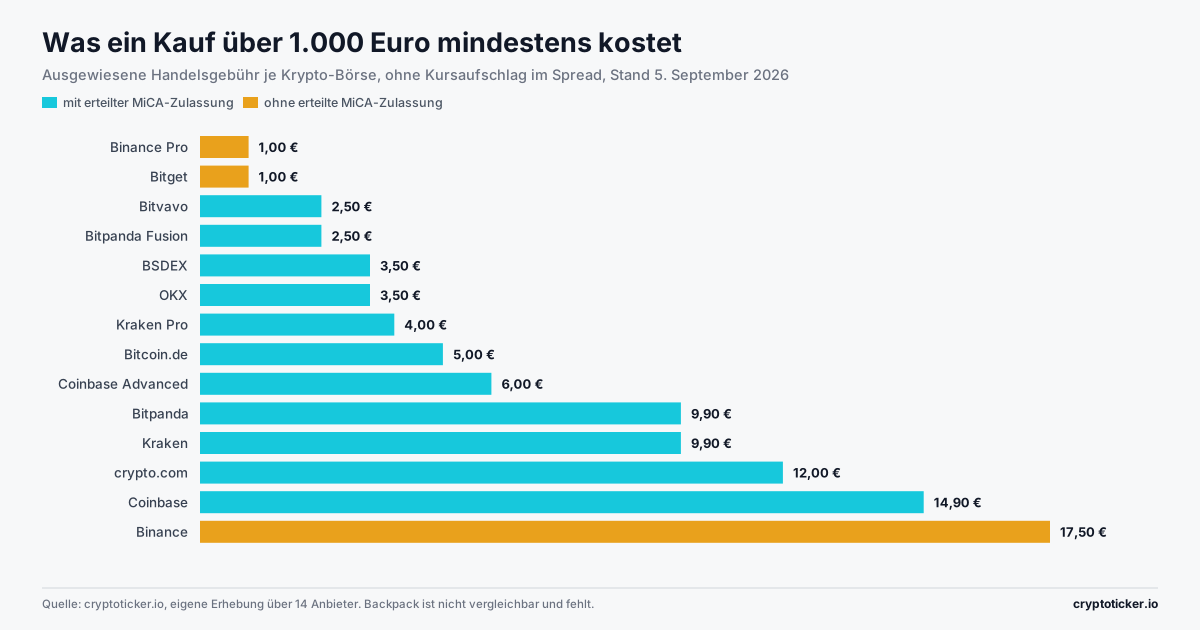
The most searched head-to-heads at a glance
The figures come from the respective comparison pages. The basis is a bitcoin purchase of 1,000 euros, calculated with the published trading fee. A markup in the price is not included; more on that below.
| Head-to-head | Fee, left | Fee, right | Cost per 1,000 euros | Comparison page |
|---|---|---|---|---|
| Binance Pro against eToro | 0.10 percent | 1.00 percent | 1.00 against 10.00 euros | Binance Pro vs eToro |
| Binance against Coinbase | 1.75 percent | 1.49 percent | 17.50 against 14.90 euros | Binance vs Coinbase |
| Bitpanda against Bitvavo | 0.99 percent | 0.25 percent | 9.90 against 2.50 euros | Bitpanda vs Bitvavo |
| crypto.com against OKX | 1.20 percent | 0.35 percent | 12.00 against 3.50 euros | crypto.com vs OKX |
| Revolut against Trade Republic | 1.49 percent | 0.00 percent | 14.90 against 0.00 euros | Revolut vs Trade Republic |
The last row deserves a footnote, because zero percent in fees does not mean free of charge. Where no fee is published, the provider earns on the price markup, and that markup is not disclosed. A comparison that reads the fee column alone takes this for the cheapest provider in the field.
What the fee figure does not show
The published trading fee is the part of the price a provider names voluntarily. Alongside it sit three items that appear in no price list and often add up to more.
- The price markup. The price you buy at can deviate from the market price. At providers without a published fee, that markup is the business model. From the outside it can only be measured by comparing several quotes in the same second.
- The withdrawal fee. It applies when you move coins to a wallet of your own, and it depends on the network. On the comparison pages it has a line of its own, because with small amounts it can exceed the trading fee.
- The minimum amount. It decides whether a fee tier is within your reach at all. A low percentage is of little use if the smallest possible purchase is above your budget.

The supervisory question counts too
Since MiCA, a single licensing requirement applies to crypto service providers across the European Union. For a head-to-head that has become a hard distinction, because it has nothing to do with the price and still decides whether a service is usable.
OKX holds a MiCA licence via Malta, crypto.com does too, Bitpanda is authorised in several EU states, and eToro operates under CySEC supervision. Binance withdrew its licence application with the Greek supervisor in June 2026 according to its own statement, and its BaFin application in Germany as well; which EU state is to take over instead has not been named so far. For retail investors in the EU, margin and futures products are also restricted there.
If you want to check both sides of a head-to-head on this question, the regulatory status appears on every comparison page as a line of its own, with a date. The full overview is in our comparison of regulated crypto exchanges.
Further head-to-heads that are searched for often
Beyond the five pairings above, comparisons between crypto exchanges and traditional brokers are called up most. They are the special case in which the fee does not play the leading role; what matters is whether you actually receive the coins or merely take part in their price performance.
- Bitpanda vs flatex and comdirect vs eToro: crypto provider against custodian bank
- Revolut vs Scalable Capital: two neobrokers with very different pricing models
- Bitpanda vs crypto.com and Binance vs Bitpanda: European against global providers
- Bitcoin.de vs Kraken Pro: a German marketplace against an international trading exchange
- eToro vs Plus500: two providers with a focus on derivatives
If you are after the overall picture rather than a single head-to-head, you will find it in our comparison of crypto exchanges with every provider we have assessed.
How to read a head-to-head
The order in which the lines matter depends on what you intend to do. Three typical cases, and what decides them.
- A one-off purchase left untouched: what counts is the cost per 1,000 euros and the withdrawal fee, because you move the coins to a wallet of your own in the end. The number of tradable crypto assets is a side issue.
- A monthly savings plan: what counts is the percentage, because it repeats with every instalment, along with the minimum amount. A difference of one percentage point costs around 240 euros over ten years at 200 euros a month.
- Active trading: what counts is the maker and taker model with its volume tiers, and not the entry price. Here the professional interfaces of the large providers are regularly ten times cheaper than their instant-buy variant.
One thing appears in no comparison and still decides the matter: whether you can reach your money when it counts. The providers' status pages often show withdrawal problems earlier than any news report, and a provider without a granted EU licence can restrict its offering for retail investors at any time.
Common questions about comparing exchanges
Which crypto exchange has the lowest fees?
Among the published trading fees, the professional interfaces lead the field, Binance Pro among them at 0.10 percent. Among the simple instant-buy interfaces, Bitvavo at 0.25 percent comes ahead of Bitpanda at 0.99 percent and Binance at 1.75 percent. Providers without a published fee earn on the price markup.
What is the difference between Binance and Binance Pro?
It is the same provider with the same account, but two interfaces. The instant buy costs 1.75 percent, trading through the pro view costs 0.10 percent. The same split exists at Coinbase Advanced and Bitpanda Fusion.
Can an exchange without a MiCA licence be used in Germany?
Access often remains in place, but the offering can be restricted, particularly for leveraged products. Whether and where a provider is licensed appears on every comparison page in the line on regulation.
Does it matter for tax which exchange I buy at?
Not for the amount of tax, very much so for the effort. What matters is whether the provider delivers a usable export of your transactions. The tax rules are set out in our article on crypto tax in Germany.
Why do the fees differ from the providers' own figures?
The figures here are list prices on the day of collection. Discount tiers based on trading volume, payment in a provider's own token or time-limited promotions change them. Before you open an account, the provider's price page is what counts.
Sources and status of the figures
- Fees, costs per 1,000 euros and provider figures from the CryptoTicker comparison pages, collected in September 2026
- Details on regulatory status from the providers' statements and the registers of the competent authorities
- Binance on the withdrawal of its licence application with the Greek supervisor HCMC of June 24, 2026
(As of September 10, 2026. This article is not investment advice. Prices and fee structures change; check the terms with the provider before you buy. List prices move, and the price page of the provider in question is what governs.)
The key points at a glance
- Two moments, two taxes: staking is taxed when the reward arrives and taxed again when you later sell it. Anyone thinking only about the sale is missing half the picture.
- The inflow is income from other services under Section 22(3) of the German Income Tax Act (EStG), valued at the market price at the moment it arrives and charged at your personal tax rate.
- A threshold of 256 euros a year. It is a threshold, not an allowance: one euro above it makes the entire amount taxable. It has nothing to do with the 1,000 euros under Section 23.
- Twelve months, not ten years. The extended holding period has been cleared up by the tax authorities. Every reward you receive starts a period of its own on the day it arrives.
- The market value on arrival becomes your acquisition cost. That is why a later sale is taxed only on the change in value since the inflow, and not on the whole proceeds.
Why staking is taxed twice
With staking, the most common misunderstanding concerns the number of taxes rather than their size. Two separate events take place, and for tax purposes they sit in different worlds.
The first event is the reward itself. It reaches you without you selling anything. In tax terms this is a service for which you receive a consideration: you make capital available to the network, and the network pays for it. That income belongs to the other services covered by Section 22(3) of the German Income Tax Act.
The second event is the sale of the coins you received. Section 23 applies to it, the same rule as for coins you bought: taxable within twelve months, tax-free after that.
Between the two sits a bridge that ruins a lot of calculations: the market value at the moment of the inflow is also the acquisition price for the second event. If you receive a reward worth 100 euros and sell it later for 130 euros, you pay tax once on 100 euros as other income and once on 30 euros as a capital gain. Not twice on 130.
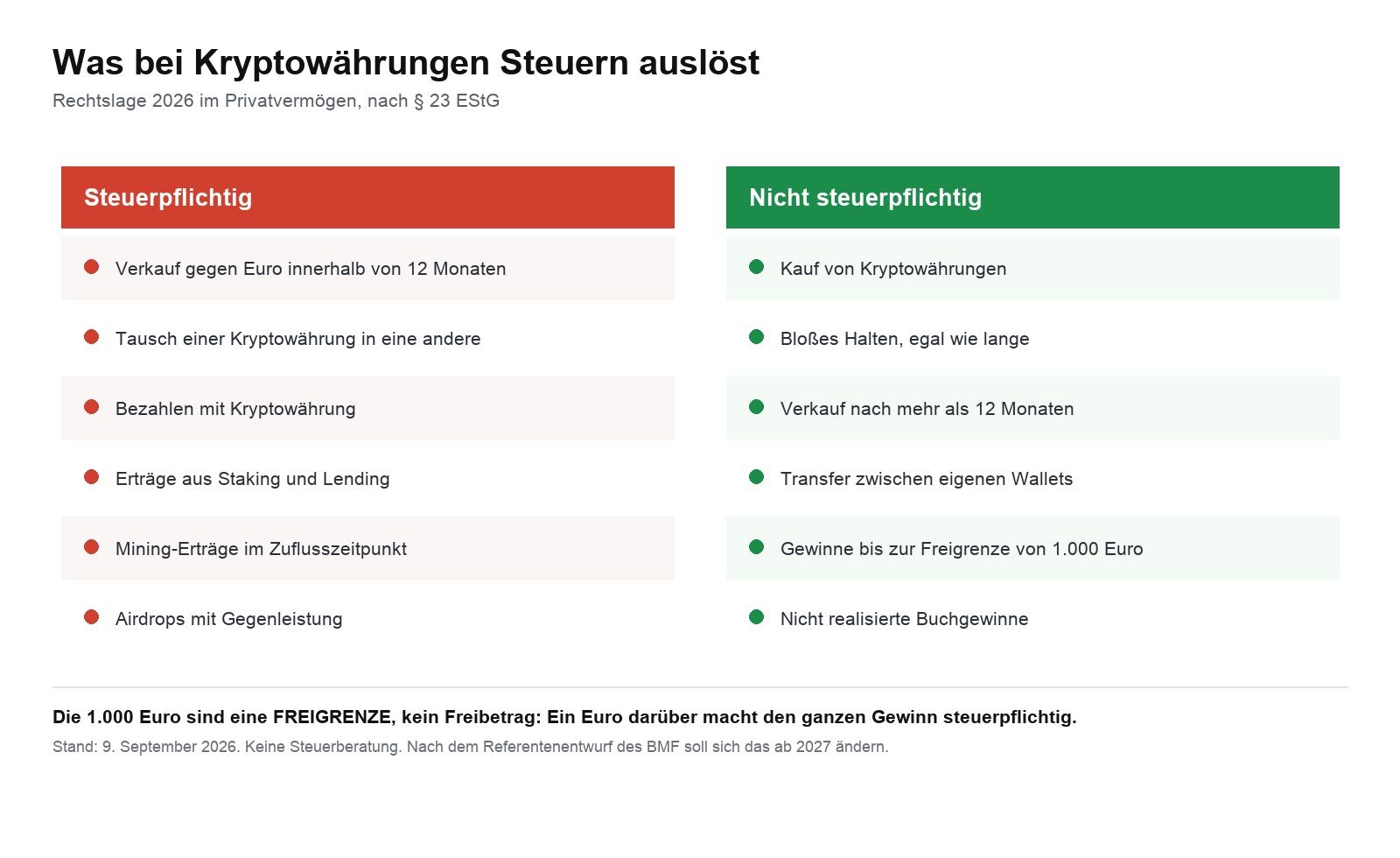
The inflow and the 256-euro threshold
What counts is the moment you can dispose of the reward. At an exchange that is the credit to your account, with your own node it is access to the address. Valuation uses the price at that moment, not the price at the end of the year and not the price when you sell.
These earnings carry a threshold of their own, 256 euros per calendar year. It is regularly confused with the 1,000-euro threshold under Section 23, yet it covers a different area and a different pot. Both are thresholds and neither is an allowance: with 255 euros of staking income you pay nothing, with 257 euros you are taxed on 257 euros.
The threshold applies to all other services in a year taken together. If you run lending alongside staking, you add both up before you compare.
Which staking event triggers what
| Event | Type of tax | Legal basis | Threshold and period |
|---|---|---|---|
| Putting coins into the stake | no taxable event | — | the twelve-month period of the staked coins keeps running |
| Reward arrives | other income | Section 22(3) EStG | threshold of 256 euros a year, market value at the moment of arrival |
| Holding the reward | no taxable event | — | its own twelve-month period from arrival |
| Selling the reward within twelve months | private disposal | Section 23 EStG | threshold of 1,000 euros, separate pot |
| Selling the reward after twelve months | tax-free | Section 23 EStG | no upper limit |
| Withdrawing the staked coins (unstaking) | no taxable event | — | not a disposal |
| Swapping the reward for another cryptocurrency | disposal and acquisition at once | Section 23 EStG | a fresh period starts for the coin you receive |
The twelve-month period in staking
Every single reward starts a period of its own on the day it arrives. Anyone collecting rewards daily accumulates three hundred and sixty-five separate deadlines over a year. That sounds impractical, and it is, but it is the legal position, and it is the reason why hardly anyone keeps track of staking without a tool.
The worry that staking stretches the holding period of the staked coins to ten years has been laid to rest. It came from an older reading of Section 23(1) no. 2 sentence 4 EStG. The tax authorities do not apply it to crypto assets. Twelve months remain the rule, for the staked coins as much as for the rewards. We have written up the dispute in detail in our comparison of the two tax models.
What applies to which kind of staking
Staking is an umbrella term for very different processes. For tax purposes they differ mainly on one point: do you receive a reward, or do you receive a different asset?
| Form | What happens for tax | Basis | What to watch |
|---|---|---|---|
| Solo staking with your own node | reward as other income | Section 22(3) EStG | at a substantial scale, business status may be examined |
| Staking through an exchange | reward as other income | Section 22(3) EStG | the inflow is the credit; the exchange report is not binding |
| Staking pool | reward as other income | Section 22(3) EStG | the pool fee reduces the inflow |
| Liquid staking with tokens such as stETH | disputed: a swap or merely a receipt | Section 23 or Section 22(3) | treated as a swap, the tax arises as soon as you enter |
| Restaking | an extra layer of rewards, same classification | Section 22(3) EStG | two reward streams, two valuations per inflow |
| Staking ETP in a securities account | investment income or disposal, depending on the structure | Section 20 or Section 23 | distributing and accumulating products are treated differently |
| Lending instead of staking | interest as other income | Section 22(3) EStG | the same threshold of 256 euros, one shared pot |
If you stake through an exchange, you should also know how its tax report is built. Which platforms deliver usable exports is set out in our comparison of crypto exchanges. We have taken apart the two tax traps that come with selling staked coins in a separate article.
Two of those rows are not conclusively settled. With liquid staking, much depends on whether the token you receive counts as an asset in its own right or merely as proof of the coins you deposited. The details are in our article on restaking and liquid staking. With exchange-traded products the structure decides, and we have written up the differences between distributing and accumulating.
A worked example with real numbers
Suppose you staked Ethereum in 2026 and received rewards worth 800 euros in total, spread across the year and each valued at the price on the day it arrived. Your personal tax rate is 30 percent.
- Step one, the inflow. 800 euros sits above the threshold of 256 euros. The taxable amount is then the full 800 euros, and not the 544 euros above the line. At 30 percent that comes to 240 euros of income tax.
- Step two, the sale. You sell the rewards after eight months for 1,100 euros in total. The acquisition cost is the 800 euros from step one. The capital gain amounts to 300 euros.
- Step three, the second threshold. The 300 euros stay below the 1,000-euro threshold under Section 23. If you had no other private disposals in the same year, this part remains tax-free.
- Result: 240 euros of tax on 1,100 euros of inflow and proceeds. Waiting twelve months would have left the same 240 euros in place, because waiting does not remove the tax on the inflow.
That last point is the practical lesson: waiting helps with the sale, not with the inflow. Anyone who stakes has a tax charge every year, even without a single sale. And that charge is in euros, while the reward sits in coins.
What you have to document
The record-keeping duty is stricter for staking than for simply buying and holding, because the tax office needs two values per event instead of one. Without records the reward cannot be valued, and an estimate rarely lands in your favour.
- Per inflow: date, time, quantity, the price at the moment of arrival and the euro amount that follows from it. The price needs a source you can name, and that source should stay the same across the year.
- Per sale: date, quantity, proceeds and the allocation showing which inflows were sold. With daily rewards this is the point where manual work ends.
- For the period: the order. If you do not fix and document which coins were sold first, you cannot prove the twelve-month period.
- Platform records: account statements and transaction overviews. They are not binding for tax purposes, but they are the evidence that the inflow happened.
How to keep that up without a spreadsheet is set out in our article on documenting staking rewards. Which tools value the inflows automatically is shown in our comparison of crypto tax tools.
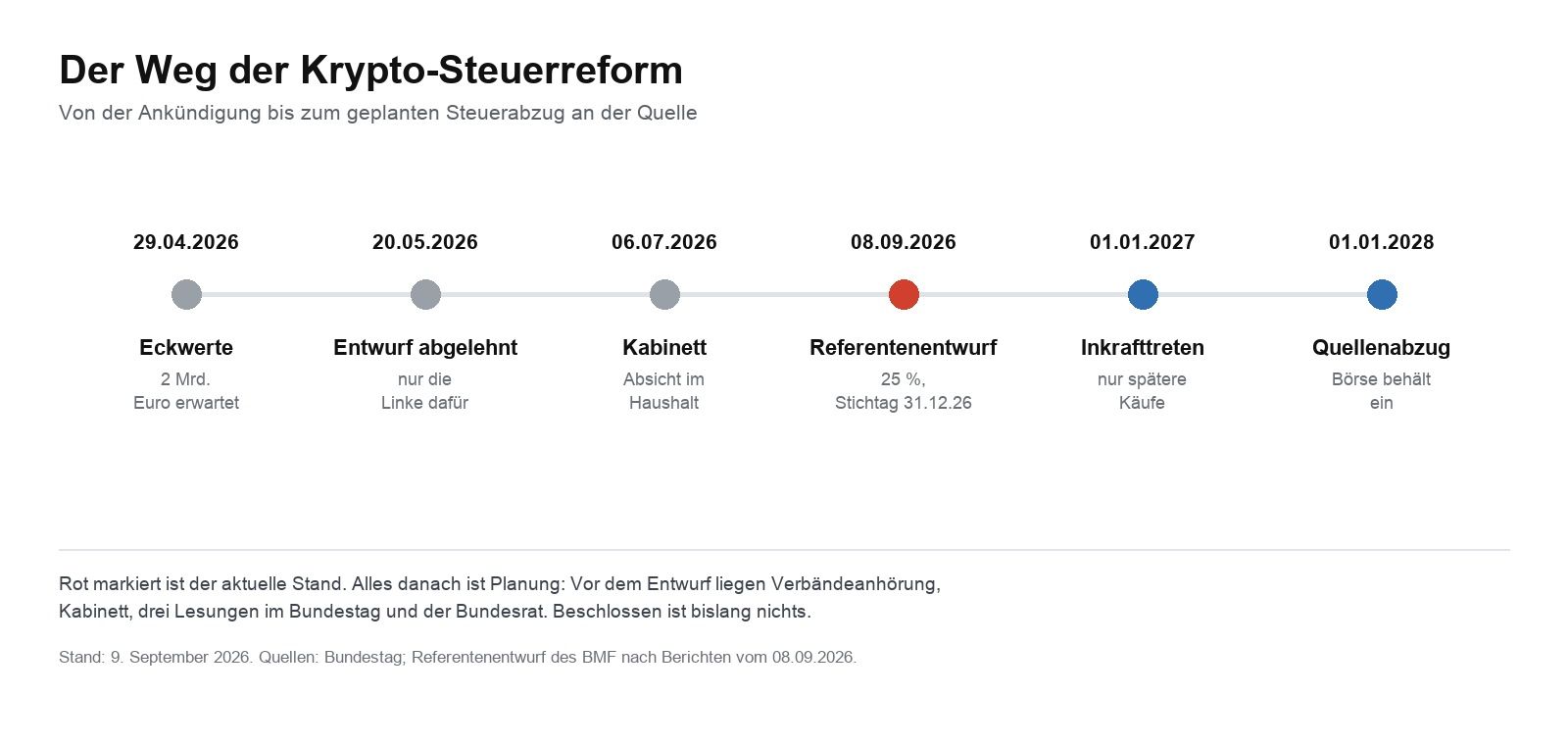
What is set to change from 2027
A ministerial draft would charge gains from the sale of crypto assets with the flat-rate withholding tax of 25 percent, for purchases made after December 31, 2026. The process is running, and no law has been enacted. The Income Tax Reform Act 2027, approved by the cabinet on September 2, 2026, contains nothing on crypto assets.
For staking, the decisive question remains open. Taxation of the inflow under Section 22(3) is left untouched in the drafts known so far. Were the flat-rate tax to arrive for disposals, stakers would face two different tax rates within one process, the personal rate on the inflow and the flat rate on the change in value. The current state of play is in our article on crypto tax in Germany.
Common questions about staking and taxes
Are staking rewards tax-free if I do not sell them?
No. The tax arises on the inflow and not on the sale. Anyone receiving rewards worth more than 256 euros in a year and selling none of them still has taxable income.
How high is the tax on staking?
Your personal income tax rate applies, so between 14 and 45 percent, plus the solidarity surcharge and church tax where they are due. The flat-rate withholding tax of 25 percent does not apply here.
Where do I enter staking income in my tax return?
In Annex SO, in the section for services. The sale of the rewards belongs in the same form, but in the section for private disposals. The details are in our article on where you enter what.
Does the threshold of 256 euros apply per coin?
No, it applies once a year to all other services taken together. Staking on three different networks plus lending gives one combined amount.
Does staking extend the holding period to ten years?
No. The tax authorities do not apply that reading to crypto assets. Twelve months remain the rule.
What happens when staked coins are sold at a loss?
Losses from private disposals can only be offset against gains from the same type of income, not against salary and not against investment income. The inflows you have already taxed are unaffected.
Do I have to list every single reward separately?
Each inflow has to be valued on its own. In the return itself the total is usually stated, while the itemised list goes into the annex as evidence. With daily rewards there is no way around it.
Sources and status
- Federal Ministry of Finance circular of March 6, 2025, on individual questions of the income tax treatment of certain crypto assets
- Federal Fiscal Court, judgment of February 14, 2023, case number IX R 3/22, on the asset status of crypto assets
- Section 22(3) and Section 23 of the German Income Tax Act
- Details of the ministerial draft based on reporting of September 8, 2026. An official full text is not available so far.
(As of September 10, 2026. This article is not investment advice. Prices and fee structures change; check the terms with the provider before you buy. It does not replace tax advice either: with liquid staking, restaking and exchange-traded products the classification is not conclusively settled, and a question to your adviser is worth the time.)
A transfer on the Bitcoin network currently costs around ten cents. Consolidating twenty separate amounts inside a wallet costs less than one euro. Both figures can be calculated directly from the current fee rate and the size of a transaction, and that is precisely why now is the moment to look into your wallet. This analysis was carried out by cryptoticker.io on September 9, 2026.
The starting position: the median fee rate on the Bitcoin network has sat almost continuously at one satoshi per virtual byte for three months, the technical minimum most nodes will relay at all. We evaluated 1,105 data points for this from the period between June 9 and September 9, 2026. At no single point did the rate exceed seven satoshis per virtual byte.
What the network fee in sat/vB actually is
The network fee of a Bitcoin transaction does not depend on the amount you send but on the space your transaction takes up in a block. That space is measured in virtual bytes, abbreviated vB. A block holds around one million virtual bytes. Whoever bids more per virtual byte gets in sooner.
The fee rate is the price you bid per virtual byte, stated in satoshis per virtual byte, sat/vB for short. A satoshi is one hundred-millionth of a bitcoin. At a price of $78,495 or 67,496 euros per bitcoin, measured on September 9, 2026 at 18:51 UTC through the public price interface of CoinGecko, a thousand satoshis are worth around 67 cents.
From that follows a calculation with two factors: fee equals size times rate. An ordinary transfer with one input address and two outputs, so recipient plus change, takes up about 141 virtual bytes in the SegWit format common today. At one sat/vB it costs 141 satoshis and therefore around 0.10 euros. At two sat/vB it is 282 satoshis or about 0.19 euros. The amount sent plays no part in this: sending ten euros costs exactly as much as sending ten thousand.
Our measurement: 1,105 data points from three months of Bitcoin blocks
For this article we retrieved the fee rate ourselves rather than taking it from other outlets. The basis is the public interface of the block explorer mempool.space, endpoint /api/v1/mining/blocks/fee-rates/3m, retrieved on September 9, 2026 at 18:53 UTC with HTTP 200. The endpoint returns, for every data point, the distribution of fee rates of the transactions that were actually confirmed in blocks.
The scope: 1,105 data points across block heights 953,003 to 966,255, that is from June 9, 2026 at 19:20 UTC to September 9, 2026 at 18:22 UTC. In each case we evaluated the median of the fee rates within a point, because that value is more robust than the average: a single transaction bidding a hundred times the going rate out of urgency distorts an average, while it barely touches the median.
The result across the whole period: the median sits at one sat/vB, the mean at 1.36, and the range runs from zero to seven. The value zero stands for points in which half the confirmed transactions came in below a full satoshi per virtual byte, for instance because a miner included its own or bundled transactions. Nothing there was free of charge.
Why we look at the median and not the maximum
What counts for your decision is what a normal transaction cost, and not what the most impatient market participant was willing to pay. In our window the maximum reached three-digit levels at individual points, but each time it concerned only a handful of transactions. The median, by contrast, describes the price paid by the middle of the market, and that is the value you can orient yourself by.
90 percent of the data points sat at two sat/vB or below
The distribution across the 1,105 points comes out more sharply than the plain averages suggest. At 648 points, and therefore 58.6 percent, the median stood at exactly one sat/vB. At 239 points or 21.6 percent it was two, and at 112 points or 10.1 percent zero. Together that makes 999 of 1,105 points, or 90.4 percent, at no more than two sat/vB.
Above that the air thins out quickly: three sat/vB at 62 points (5.6 percent), four at 32 points (2.9 percent), five at seven, six at three and seven at two points. Not a single data point reached ten sat/vB. The more recent past shows no different picture either: over the last 30 days (361 points) the median was one and the maximum six, and over the last seven days (85 points) one and four.
There is one notable pattern, and it can be put to practical use. Sorted by time of day, the median sits at one sat/vB in 21 of 24 hours. Only in the hours around 15:00, 17:00, 18:00, 19:00 and 20:00 UTC does it rise to two. That is the window in which US trading hours and the European end of the working day overlap. By weekday, on the other hand, no difference could be measured: Monday to Sunday all sit at one sat/vB. So anyone with flexibility sends in the morning rather than in the early evening, and the difference in euros still amounts to only a few cents.
What a UTXO is and why many small amounts get expensive later
Your wallet shows you a balance. On the blockchain that balance does not exist. What sits there are individual, mutually independent amounts, each tied to an address. Every one of these amounts is called a UTXO, short for unspent transaction output. What your wallet displays as your holding is the sum of your UTXOs.
This is the point at which the fee calculation becomes personal. Every UTXO you spend in a transaction becomes an input and takes up space. A SegWit input occupies around 68 virtual bytes. Anyone who has pulled a small savings-plan amount to their own wallet every week for two years has a good hundred such amounts sitting there. If many of them are to be spent at once one day, the sheer number of inputs alone costs a multiple of a normal transfer.
A consolidation is the answer to that: you send many small UTXOs to yourself in a single transaction and get one large one back. Throughout, the amounts stay in your own custody, for instance on a hardware wallet. What changes is solely the form in which your holding sits on the blockchain.
How to calculate the fee for your consolidation yourself
The formula is short enough to keep in your head. For transactions using the SegWit addresses common today it holds approximately that:
size in vB = 11 + (number of inputs × 68.5) + (number of outputs × 31)
An example with twenty inputs and one output gives around 1,412 virtual bytes. At one sat/vB this consolidation costs 1,412 satoshis and therefore about 0.95 euros. Five inputs to one output give 384 vB, so 384 satoshis or around 0.26 euros.
The comparison with a more expensive environment is where it gets interesting. The highest median in our three-month window was seven sat/vB. The same consolidation with twenty inputs would have cost 9,884 satoshis or around 6.67 euros there, so a good seven times as much. Should the rate climb to 50 sat/vB at some point, a value our measurement window does not contain and which we therefore state expressly as an arithmetic example and not as a forecast, it would be 70,600 satoshis or around 47.65 euros.
The real saving, though, only arises later, with the transaction in which you eventually spend that holding. If you then spend twenty individual UTXOs instead of one, you carry 19 additional inputs along. At seven sat/vB those cost 9,110 satoshis or around 6.15 euros, and in the 50-rate example 65,075 satoshis or about 43.92 euros. It is precisely this calculation that shifts in your favour when you place the consolidation in a phase of low rates.
Full mempool, low fee: why that is no contradiction
A glance at the mempool, the queue of transactions not yet confirmed, might be confusing at first. On September 9, 2026 at 18:52 UTC it held 81,263 unconfirmed transactions totalling 41.5 million virtual bytes. Arithmetically that corresponds to more than 40 full blocks, so roughly seven hours of work for the network.
What matters, however, is what that queue is bidding. Of the 41.5 million virtual bytes, only 0.92 million paid at least one sat/vB, and merely 0.42 million at least two. Everything else sits below that and waits for a miner with space to spare. For you that means the competition for the next block is smaller than one full block, and a transaction at two sat/vB stands practically at the front.
The fee recommendation from the same source confirms it for the same minute. Two sat/vB were recommended for the next confirmation, and one sat/vB each for half an hour, one hour and the economy setting. Anyone sending at one sat/vB should bring patience, though: with around 0.9 blocks of competition at the same level it can take several blocks, and a sudden jump in demand would push your own transaction back.
When a consolidation is a bad idea
Cheap does not automatically mean sensible. There are three reasons that can argue against it, and you should know them before you build a transaction.
Privacy. When you merge several UTXOs in one transaction, you make it publicly visible that these amounts belong to the same person. For anyone analysing the blockchain a link arises that was not documented before. Anyone deliberately keeping amounts from different sources apart gives up that separation with a consolidation.
Tax treatment. Under the current administrative view, a transfer between two wallets of your own is not a disposal, and the holding period continues to run. Even so, you have to document the process cleanly so that your tax software assigns the amounts correctly later on. For larger holdings this does not replace tax advice.
The effort is out of proportion. Anyone with three UTXOs saves cents with a consolidation and risks an operating error in exchange. The benefit grows with the number of amounts, and below around ten inputs the exercise is rarely worthwhile.
What applies when your coins sit on an exchange
If your holding sits with an exchange, you have no UTXOs of your own at all, because custody lies with the provider. There you pay a fixed withdrawal fee when moving out, one that is only loosely connected to the actual network fee. We measured that on August 17, 2026 across 475 assets: for Bitcoin the exchanges charged eight to sixteen times what the transaction would have cost in the same minute. At a rate of one sat/vB, that mark-up weighs even more heavily than usual. A look at your provider's fee page therefore belongs before every withdrawal, and anyone using several crypto exchanges will find marked differences there.
Setting the fee rate in your wallet: what to check before sending
Almost every wallet allows the fee rate to be set by hand, often behind a button for advanced settings. Four points are decisive here.
First: check the current rate at an independent source before you accept your wallet's suggestion. Some wallets calculate with a safety mark-up that, at a rate of one sat/vB, amounts to a multiple of what is needed. The block explorer mempool.space displays the current recommendation without a login.
Second: pay attention to whether your wallet states the fee as a rate in sat/vB or as an absolute amount. Only the rate is comparable. The technical basis for this, meaning how the weight and size of a transaction are calculated, is documented in the Bitcoin wiki on transaction fees.
Third: look for whether your wallet offers the replace-by-fee function. It lets you replace a transaction set too low with one carrying a higher fee later, rather than leaving it hanging indefinitely. Anyone sending at one sat/vB should have that option enabled.
Fourth: check the destination address of a consolidation especially carefully. You are sending to yourself, so a typo will not be caught by an indignant recipient. Anyone working with a withdrawal whitelist at their exchange already knows the principle.
Limits of this analysis: what the data does not show
The measurement rests on a single data source, the public block explorer mempool.space. Its points each combine several blocks, so our 1,105 points cover 13,253 blocks without resolving them individually. We did not cross-check a second independent source for this period.
What also cannot be derived is what individual users actually paid: the values describe confirmed transactions across the network as a whole, not German users in particular. The size estimates for transactions are likewise approximations for the SegWit format common today; anyone still using older address formats ends up with larger transactions and therefore higher fees. And finally, every one of these figures is a snapshot from September 9, 2026. A phase of high demand can multiply the rate within a few hours.
Checking the Bitcoin network fee: what to take away
- Look at how many UTXOs your wallet holds. Most wallets show this in the coin selection or under the advanced settings. From around ten individual amounts it is worth doing the consolidation arithmetic, and at a rate of one sat/vB the exercise costs you less than one euro even with twenty inputs. If you are thinking about moving into self-custody along the way, our comparison of hardware wallets helps with the choice.
- Check the current fee rate before you send. Compare your wallet's suggestion against a block explorer before you accept it. And if there is no hurry, place a transaction in the morning rather than the early evening: in the hours between 15:00 and 20:00 UTC the median in our measurement was twice as high.
- Compare your exchange's withdrawal fee with the real network fee. Fixed withdrawal fees stay where they are even when the network costs almost nothing. Anyone withdrawing regularly should lay the terms of the various crypto exchanges side by side and bundle the withdrawals instead of moving every small amount on its own.
(As of September 9, 2026. This article is not investment advice. Prices and fee structures change; check the terms with the provider before you buy.)
Decrypt
The hardware wallet maker said a fake security alert claimed a hardware flaw could expose users’ recovery phrases.
The Fields medalist points to a real race between OpenAI and Anthropic as proof: AI can now flatten a hard problem the moment someone starts working on it.
Crypto advocates and community bankers are targeting lawmakers in their home states as the Senate prepares for a September 15 procedural vote.
The company's first fall keynote under new leadership paired a Gemini-powered Siri overhaul with Apple's first 2-nanometer chip, plus a $1,999 foldable iPhone that won't ship until October.
Blockchain sleuths at Elliptic traced the money, Treasury sanctioned the marketplace, and Xinbi—which ran $24 billion through a Telegram scam bazaar—called the freeze unfair.
U.Today - IT, AI and Fintech Daily News for You Today
Market's main goal is extend recent recoveries, but key resistance levels and increasingly stretched momentum could determine what comes next.
U.S. Treasury Secretary Scott Bessent is urging senators to advance the CLARITY Act.
Ripple veteran David Schwartz says XRP could eventually flip Bitcoin by market capitalization.
Coinbase’s head reveals secure sub-accounts giving artificial intelligence standalone corporate banking features.
Tron founder Justin Sun confirms the launch of the first-ever U.S. spot ETF, offering investors traditional access to TRX on the Chicago Board Options Exchange, Cboe.
Blockonomi
What if the next big crypto opportunity is already moving while traders watch Bitcoin? And what if the cheapest Apeing presale stage is available right now? Bitcoin continues to dominate the crypto conversation, but traders searching for the next crypto to explode are increasingly looking beyond established names for projects with an earlier entry point. That puts Apeing firmly on the radar with its LIVE presale now in Stage 3, Paper Hand Panic, priced at $0.0004 with a limited allocation of 300 million tokens.
The next stage moves to $0.0005, while the stated listing price is $0.01. With 211 holders and $68,000 raised so far, the presale is already attracting participation. For anyone hunting for the next crypto to explode before a project reaches later pricing stages, the current Apeing window deserves attention.
Apeing Could Be the Next Crypto to Explode Before the Next Price Step
Here is where Apeing gets interesting. Stage 3 is not simply another number on a presale chart. It represents a defined allocation at a defined price, and once the stage moves forward, the next price becomes higher. The current $0.0004 price is therefore tied specifically to the live stage, while the next stage is set at $0.0005. That creates a straightforward reason to watch the clock rather than wait for the presale story to become old news.

Apeing, branded as “The OG Degen Coin,” is built on Ethereum as an ERC-20 token with a fixed total supply of 16.75 billion $APEING. The project has allocated 40%, or 6.7 billion tokens, to its 33-stage presale. Its stated listing price of $0.01 also creates a substantial illustrative price gap from the current $0.0004 presale level. That structure is central to the next crypto to explode narrative because participants are entering while the presale is still progressing through its predefined pricing stages.
Why the Current Apeing Stage Could Be the Window Traders Watch
Consider the numbers. At $0.0004, a hypothetical $1,000 purchase would acquire approximately 2.5 million $APEING tokens. If those tokens were valued at the stated $0.01 listing price, their theoretical value would be approximately $25,000, before fees and assuming the listing price were reached.
| Presale Price | Hypothetical $1,000 Purchase | Value at $0.01 Listing Price |
| $0.0004 | 2,500,000 $APEING | $25,000 |
The key point for the next crypto to explode conversation is the presale’s staged structure. The current price belongs to the current stage, while subsequent stages carry higher prices.
How to Buy Apeing Presale
- Connect Wallet – Connect a compatible Ethereum wallet such as regular MetaMask or Trust Wallet. Smart wallets and passkey wallets are not supported.
- Choose Payment – Pay with cryptocurrency or Visa/Mastercard. Card buyers must still connect an Ethereum wallet for token allocation.
- Enter Amount – Enter the crypto amount you want to spend or the amount of $APEING you want to buy. The widget calculates the current presale value.
- Buy – Review your payment, currency and wallet address, then click Buy Now and confirm the transaction or complete card checkout.
- Activate Referrals – Make a minimum $25 $APEING purchase to activate your referral code and earn rewards.
Important
Your Apeing allocation is permanently linked to the wallet used for purchase and cannot be changed or transferred. Use only a wallet you control and intend to keep secure.
Never share your seed phrase, recovery phrase or private keys. The Apeing team will never ask for them.
Bitcoin Stays on Edge as Fed Signals and Derivatives Activity Reshape the Market
Bitcoin’s sensitivity to US economic data has become increasingly apparent, with changes in interest-rate expectations driving sharp shifts in market sentiment. Recent comments from Federal Reserve Governor Christopher Waller triggered a rally in Bitcoin and equities after markets reassessed the likelihood of a rate hike. However, stronger-than-expected payroll data later reversed those gains, reinforcing the market’s focus on the resilience of the US labor market. Traders are now watching upcoming Producer Price Index and Consumer Price Index releases, along with the September 16 Federal Open Market Committee meeting, for potential catalysts. A September 15 Senate cloture vote on the CLARITY Act could also become an important event for the crypto market.
Meanwhile, the derivatives market is showing signs of changing trading preferences. Binance’s TradFi perpetual products, covering commodities, equity indexes and equities, reached a year-to-date peak of $16.8 billion in volume, compared with $16.3 billion for BTCUSDT perpetuals. According to K33, the timing of the TradFi volume peak alongside weaker Bitcoin activity may indicate that some Binance traders shift toward traditional-finance-linked perpetuals when crypto activity slows, before returning as crypto markets regain momentum. The trend could also provide crypto exchanges with another source of activity during quieter periods for digital assets.
Bitcoin Perpetual Open Interest Nears 320,000 BTC as Hyperliquid Ranks Third
Bitcoin’s perpetual open interest currently stands at approximately 320,000 BTC, with Hyperliquid accounting for around 34,500 BTC. That puts Hyperliquid in third place for Bitcoin perpetual open interest behind Binance and Bybit. Binance maintains the largest share at 43.5%, while Bybit holds 19.4%, highlighting Hyperliquid’s growing position among major derivatives venues. The developments arrive as broader market activity cools following Bitcoin’s late-August rally, with spot volumes moving toward pre-summer levels and derivatives yields compressing. At the time of writing, BTC is trading near $78,500, down around 1% over the past 24 hours.
Why the Next Crypto to Explode Conversation Is Moving Beyond Bitcoin
Bitcoin’s role in crypto remains impossible to ignore, but the search for the next crypto to explode naturally turns attention toward projects at much earlier stages. Established assets can command enormous liquidity and recognition, while presales offer a different setup based around staged access before a planned listing.
That distinction helps explain why Apeing’s current structure stands out. Rather than waiting until every milestone is behind it, the project is still progressing through its presale. The $0.0004 Stage 3 price, limited 300 million token allocation, and $0.0005 next-stage price give the opportunity a clear timeline.
Apeing also brings a community-first identity through its degen-focused branding. The project combines that identity with defined token mechanics, including a 16.75 billion fixed supply and a 40% presale allocation. For traders tracking the next crypto to explode, those mechanics provide a concrete framework for following the project’s progress instead of relying solely on social-media attention.
The project also plans a DEX-first listing strategy, followed by a target of three to five CEX listings, subject to timing and compliance. Liquidity is allocated at 10% with an 18-month lock, adding another defined element to the project’s stated structure.

Conclusion
Bitcoin remains the market’s headline asset, and the latest Bitcoin news continues to revolve around Fed expectations, macro releases, derivatives positioning, and the next major BTC move. Apeing represents a separate early-stage story, with its Ethereum foundation, staged presale, defined allocations, and community-focused identity.
The Apeing presale is already LIVE in Stage 3 at $0.0004, with only 300 million tokens allocated for the current stage and the next stage priced at $0.0005. The stated listing price is $0.01, making the current stage a defined window rather than an open-ended opportunity. If the search is for the next crypto to explode, this is the moment to look at Apeing before the current stage gives way to the next price.
APE HARD. HOLD STRONG. BUILD WEALTH. Check the official Apeing channels, explore the live presale, and see what Stage 3 has on offer before the next price step arrives.

For More Information:
Website: Visit the Official Apeing Website
Telegram: Join the Apeing Telegram Channel
Twitter: Follow Apeing ON X (Formerly Twitter)
FAQs About the Next Crypto to Explode
What is the next crypto to explode?
The next crypto to explode is a highly searched market question, with attention often shifting between established assets such as Bitcoin and emerging projects with early-stage opportunities. Apeing is currently attracting attention through its live multi-stage presale.
Is Bitcoin still a good crypto to watch?
Bitcoin remains the dominant crypto asset and a major source of market direction. Current Bitcoin news is heavily focused on macroeconomic data, Federal Reserve expectations, and derivatives activity.
Why is Bitcoin going up or down?
Bitcoin price movements can react to factors including interest-rate expectations, economic data, liquidity, derivatives positioning, and broader market sentiment. Current Bitcoin news continues to track these catalysts closely.
Is Apeing presale live right now?
Yes. Apeing’s presale is currently LIVE in Stage 3, Paper Hand Panic, with a current price of $0.0004 and a 300 million token allocation for the stage.
What makes Apeing’s presale different?
Apeing combines a 33-stage presale with a fixed 16.75 billion token supply, 40% presale allocation, rising stage prices, staking options ranging from 10% to 85% APY, and a 10% referral reward structure.
The post Bitcoin Faces the Macro Test As Apeing Enters Stage 3 After Clearing 2 Stages in Just 6 Hours – Could This Be The Next Crypto to Explode? appeared first on Blockonomi.
TLDR
- Nvidia powers Zankore’s $3.1B Indonesia AI infrastructure expansion plan
- Zankore secures $3.1B to build Nvidia-powered GPU and cloud infrastructure
- Nvidia’s Indonesia push targets 100MW initially, with a path toward 1GW
- Five major lenders back Zankore’s Nvidia-powered Indonesia infrastructure deal
- NVDA stays below $225.50 as Nvidia expands its global AI infrastructure push
Nvidia stock traded at $224.34, down 0.62%, as the company expanded its infrastructure footprint through Indonesia. Zankore secured up to $3.1 billion in financing for Nvidia-powered GPU and cloud infrastructure. Meanwhile, NVDA remained below $225.00, while $224.00 and $223.50 marked nearby support levels.
NVIDIA Corporation, NVDA
Nvidia Infrastructure Expands in Indonesia
Zankore plans to deploy 100 megawatts of Nvidia infrastructure during the initial phase in Indonesia. The company then plans to expand capacity toward one gigawatt of AI factory infrastructure. Consequently, the project represents a planned deployment of Nvidia-powered computing capacity in Southeast Asia.
Citi acted as the exclusive debt adviser for Zankore’s financing arrangement supporting the project. Besides Citi, ING, Natixis, Qatar National Bank, and United Overseas Bank participated as lenders. The financing gives Zankore capital for GPUs, cloud systems, and related infrastructure.
The project includes revenue-sharing and credit-support arrangements that connect infrastructure deployment with customer demand. This forms part of Zankore’s financing framework. Additionally, the arrangement links infrastructure investment with revenue generated through project operations.
Zankore Creates New Route for Nvidia Deployments
Nvidia has built much of its infrastructure business around major technology companies and large cloud providers. However, the Zankore project places Nvidia-powered infrastructure within a different financing model in Asia. The arrangement allows Zankore to fund large-scale computing infrastructure.
Zankore’s initial 100-megawatt deployment provides a starting point for the Indonesia expansion. Moreover, the one-gigawatt target would increase project capacity substantially. The financing structure supports the initial deployment and planned growth.
Indonesia provides a regional base for cloud and computing infrastructure, while the project adds Nvidia hardware to that expansion. Furthermore, the deal shows how projects can use external financing for expensive systems. The lenders provide capital, while Zankore manages infrastructure development and customer-linked arrangements.
NVDA Stock Levels and Project Context
Nvidia shares remained under pressure after failing to hold the $225.50 resistance zone during the latest session. A move above $225.50 would place the stock above resistance, while lower levels remain at $224.00 and $223.50. The price action comes as Nvidia expands infrastructure activity.
The Indonesia project adds another infrastructure development to Nvidia’s global hardware footprint. Meanwhile, Zankore’s financing arrangement places significant capital behind a planned Nvidia-powered deployment. The project combines GPU expansion with structured debt financing and revenue arrangements.
The initial 100-megawatt capacity and one-gigawatt target provide milestones for the Indonesia project. Additionally, five lenders are participating in the financing arrangement for the development. The project now moves forward with funding secured for Nvidia-powered GPU and cloud infrastructure.
The post Nvidia (NVDA) Stock: Expands AI Infrastructure Push With $3.1B Indonesia Deal appeared first on Blockonomi.
TLDR
- FedEx stock falls 1.57% as Global Trade Navigator launches new shipping tools.
- New FedEx tools target customs delays, duties, taxes, and shipping data errors.
- Trade Planner gives businesses free access to duties, taxes, and customs guidance.
- FedEx adds Shopify duty tools to show import costs before customers check out.
- Global Trade APIs bring customs, tax, and regulatory data into business systems.
FedEx Corporation (FDX) stock fell 1.57% to $309.21 as the company launched its Global Trade Navigator platform. The new digital suite targets common international shipping problems, including customs, duties, taxes, and documentation. FedEx aims to reduce shipping friction while giving businesses earlier access to trade information and compliance guidance.
FedEx Corporation, FDX
FedEx Stock Falls as New Trade Platform Launches
FedEx introduced Global Trade Navigator to help businesses manage international shipping requirements through a broader digital workflow. The platform combines planning tools, shipment data checks, customs support, and reporting features across several FedEx systems. The launch comes as global merchants face growing complexity around cross-border taxes, customs rules, and shipment documentation.
FedEx used its 2026 Small Business Trade Index to highlight recurring problems for smaller international sellers. The survey found 68% of businesses regularly encounter customers surprised by duties during delivery. It also found 60% lose revenue through refunds or abandoned purchases linked to unexpected import charges.
The company designed the platform to move trade information earlier into the shipping process. Businesses can review requirements before creating labels, sending parcels, or completing online purchases. FedEx expects these tools to reduce clearance problems and improve cost visibility for merchants and customers.
Global Trade Navigator Adds Planning and Checkout Tools
FedEx Trade Planner will offer free self-service guidance through the company’s website without requiring account access. Businesses can search Harmonized System codes and estimate duties, taxes, fees, and required documents. This feature gives shippers clearer information before they prepare international shipments.
FedEx Ship Manager will also add stronger checks for product classifications and shipment details. Customers can review customs values, origin information, and Harmonized System code classifications before dispatch. These updates can improve shipment accuracy and reduce errors that delay customs clearance.
FedEx also plans a Duty and Tax application for merchants using Shopify. The application will display guaranteed duty and tax amounts during checkout for international orders. This setup gives customers clearer import costs before payment and may reduce surprise charges after delivery.
FedEx Expands Trade APIs and Customs Management
FedEx will extend Global Trade Navigator through its Developer Portal for businesses with more complex workflows. Global Trade APIs will provide product classifications, estimated duties, taxes, and regulatory information through existing systems. Enterprises can use these tools without changing their broader shipping and order management processes.
The company is also improving its Import Tool and Reporting products for customs management. Customers can review clearance activity, identify required actions, manage payments, and access import and export data. These tools give businesses a more centralized view of international shipment activity and compliance needs.
The launch supports FedEx’s broader push toward a more connected digital shipping network. Global Trade Navigator links planning, checkout, shipping preparation, customs activity, and reporting within one service framework. Meanwhile, FDX stock remained under pressure during the session despite the company’s latest digital expansion.
The post FedEx Corporation (FDX) Stock: Plunge as Global Trade Navigator Expands Digital Shipping Tools appeared first on Blockonomi.
TLDR
- Apple stock falls 0.76% as the iPhone 18 Pro debuts with major new upgrades.
- A20 Pro delivers faster graphics, stronger processing, and improved efficiency.
- iPhone 18 Pro adds a 48MP variable aperture camera for greater photo control.
- iPhone 18 Pro Max offers up to 45 hours of video playback on eSIM-only models.
- Siri AI and iOS 27 add personal context, smarter tools, and new app features.
Apple (AAPL) stock slipped 0.76% to $313.82 on Wednesday as Apple introduced its latest premium iPhone models. The company launched iPhone 18 Pro and iPhone 18 Pro Max with major hardware and software upgrades. The release adds the A20 Pro chip, Siri AI, improved cameras, stronger battery life, and new thermal technology.
Apple Inc., AAPL
Apple Unveils iPhone 18 Pro With A20 Pro Performance
Apple introduced the iPhone 18 Pro lineup with the new A20 Pro processor built using two-nanometer technology. The chip provides 50% more memory bandwidth compared with the previous A19 Pro processor. Apple also equipped the chip with six CPU cores and a redesigned seven-core graphics processor.
The new graphics system delivers up to 40% faster performance compared with the previous generation. Meanwhile, Apple added a dual 16-core Neural Engine with 32 total cores for heavier computing workloads. The architecture also supports computational photography, advanced processing, gaming, and other demanding smartphone functions.
Apple redesigned the thermal system to support higher performance during extended use. A larger vapor chamber provides three times more surface area than the previous iPhone 17 Pro design. Consequently, the company says the new system can deliver sustained performance gains reaching 40% over its predecessor.
iPhone 18 Pro Adds Variable Aperture Camera and Longer Battery Life
Apple equipped both Pro models with a new 48-megapixel Fusion Main camera featuring variable aperture technology. Six adjustable blades allow the camera to control depth, lighting, and image detail more precisely. Users can also manually adjust aperture, shutter speed, white balance, and exposure settings inside the Camera application.
The camera system also introduces upgraded photographic controls and improved low-light performance. Additionally, users can apply cinematic effects after recording videos at speeds reaching 60 frames per second. Apple also added 4K Dolby Vision recording support for time-lapse videos and improved audio processing.
Battery performance received another major upgrade across both devices. The iPhone 18 Pro offers up to 36 hours of video playback on eSIM-only models. Meanwhile, the iPhone 18 Pro Max extends video playback to 45 hours under similar conditions.
Siri AI and iOS 27 Expand Apple’s Software Push
Apple will ship both Pro models with iOS 27 and the latest version of Siri AI. The system can use personal context from messages, emails, photographs, and onscreen content when handling user requests. Apple designed the software to perform many processing tasks directly on devices while supporting cloud-based processing when required.
The software also introduces new editing features for photographs and expanded tools across Apple’s applications. Safari includes a notification feature that tracks selected webpage changes, including product availability and price movements. Meanwhile, the redesigned Dynamic Island can display three Live Activities simultaneously while continuing to support Face ID.
Pre-orders for the iPhone 18 Pro lineup begin September 12, while general availability starts September 18. Apple will offer the devices in black, silver, glacier, and a newly introduced burgundy finish. The launch expands Apple’s premium smartphone lineup as the company pushes deeper into performance, photography, battery efficiency, and intelligent software.
The post Apple (AAPL) Stock: Drops as iPhone 18 Pro Debuts With A20 Pro Chips and Siri AI appeared first on Blockonomi.
TLDR
- Alif Holding plans a UAE marine security unit under Robo.ai’s wider strategy.
- Alif Maritec will target smart ports, underwater intelligence, and coastal security.
- Robo.ai reported $46.7M first-half profit after completing its restructuring.
- Robo.ai posted over $180M revenue from June through August after restructuring.
- Alif Maritec plans GCC expansion before pursuing broader international markets.
Robo.ai Inc. stock traded at $1.9250, down 1.28%, as the company outlined another expansion of its restructured operations. Alif Holding plans to establish Alif Maritec as a wholly owned subsidiary in the United Arab Emirates. The proposed business will target marine security, smart ports, underwater intelligence, and protection for critical maritime infrastructure.
Robo.ai Inc., AIIO
Alif Maritec Targets Maritime Security Infrastructure
Alif Maritec will serve government agencies and infrastructure operators across ports, coastlines, offshore energy sites, and other critical facilities. The company plans to address security requirements both above and below the water surface. Its planned systems will combine surveillance, physical protection, advanced sensing, and automated analysis across maritime environments.
The subsidiary plans to develop underwater barriers, coastal protection systems, and an intelligent platform for continuous infrastructure monitoring. Meanwhile, its technology framework will combine analytics, sensing systems, marine materials, and digital twin capabilities. These technologies will support faster threat identification, infrastructure assessment, and coordinated responses across maritime facilities.
Alif Maritec plans to integrate and manufacture its technology within the UAE under recognized international standards. Initially, the company expects to focus on Gulf Cooperation Council markets before pursuing wider international expansion. Therefore, the strategy supports UAE programs focused on domestic manufacturing, industrial development, economic diversification, and stronger infrastructure resilience.
Robo.ai Builds Its Intelligent Infrastructure Business
Robo.ai has reshaped its business after completing several major corporate changes during the first half of 2026. The company divested its legacy operations and acquired Neurovia AI and Quantum Core Capital during that period. Subsequently, Robo.ai formed Alif Holding as an industrial group within its broader intelligent infrastructure structure.
The restructuring created four operating platforms focused on different parts of the company’s repositioned business model. Alif Holding now provides the industrial component and plans to expand through specialized businesses such as Alif Maritec. Consequently, the maritime subsidiary extends Robo.ai’s strategy into security systems serving ports, energy facilities, and coastal infrastructure.
Robo.ai reported $46.7 million in first-half net profit attributable to shareholders, reversing the previous year’s loss. However, discontinued operations generated most of that profit following changes to the company’s former business structure. The company also reported preliminary revenue exceeding $180 million between June 1 and August 31, 2026.
Marine Expansion Supports Broader Growth Strategy
Robo.ai said the latest expansion builds on operating contributions emerging from its newly established corporate structure. Furthermore, Alif Maritec will give Alif Holding another operating business focused on intelligent industrial systems. The unit will seek opportunities tied to maritime protection spending across the Gulf and other international markets.
Demand for marine security systems has grown alongside international trade, offshore energy investment, and development near major coastal facilities. At the same time, ports and waterways face stricter operational and infrastructure protection requirements. Alif Maritec plans to address these requirements through integrated monitoring, sensing, protection, and infrastructure management systems.
The company has not provided financial forecasts for Alif Maritec or specific revenue targets for the proposed subsidiary. Robo.ai also described its June-through-August revenue figures as preliminary and unaudited. Therefore, those historical figures represent reported operating performance rather than guidance for future financial results.
The post Robo.ai Inc. (AIIO) Stock: Alif Holding Expands Into Intelligent Marine Security appeared first on Blockonomi.
CryptoPotato
XRPL has pulled its Permission Delegation amendment after a bug bounty report found a high-risk flaw during testing, with a hardened V1.1 now completing security review and QA checks.
The episode shows why delegation at the protocol level needs safeguards that extend beyond the basic feature itself.
XRPL Reworks Permission Delegation After Bug Report
Permission Delegation, known as XLS-75, allows one account to give another account specific powers to act on its behalf. The permissions are meant to be narrow, rather than giving the delegate control over the entire account.
RippleX head of engineering J. Ayo Akinyele explained that the original V1.0 implementation was pulled after a vulnerability was reported through the bug bounty program before it reached the XRPL mainnet. Instead of patching that version in place, the team introduced V1.1 to separate the original implementation from the hardened release.
A researcher called Shotes found a high-severity issue involving irrevocable delegate permissions, where a delegate could delete their account and later recreate it while keeping whatever permissions it had been handed by another account, with no way for the original account to revoke them.
The changes go beyond a single bug. V1.1 addresses edge cases involving delegate identity and stops newer capabilities, including Vault and Lending operations, from being delegated unintentionally. It also fixes reserve accounting for delegated payments and closes a multi-signing route that could bypass delegation checks. Revocation behavior was tightened as well.
The review also found a medium-severity unsigned integer overflow in isDelegable, which could allow a malformed permission value to be interpreted as a delegable transaction type, although researchers said the issue had no meaningful impact without misbehavior by the delegator.
Testing Expands Across XRPL’s Delegation Surface
A QA report published by Ramkumar SG on August 26 recorded 179 dedicated Permission Delegation tests, including 112 functional tests, 48 adversarial security tests, and 19 cross-feature tests. Testing also covered interactions with Batch, Confidential MPT, the transaction queue, and multi-signing.
XRP Ledger Operations said that all findings had been fixed in V1.1 and verified by the Cantina security firm. Its QA team also reported no regressions across 5,088 tests and noted there were no open internal bugs classified as critical, concluding that the feature was ready for production use at the tested commit level.
Permission Delegation was introduced in May 2025, marked as unsupported in September 2025 pending a security fix, renamed PermissionDelegationV1_1 in October, and re-supported in June 2026.
As CryptoPotato reported last week, a public dashboard built by developer Denis Angell has been tracking how thoroughly XRPL amendments get exercised on devnet before reaching mainnet, and delegation was among the amendments it had flagged as incomplete.
For users and custody providers, the intended capability is still unchanged. As Akinyele put it, V1.1 does not change what XLS-75 can do; instead, it changes the conditions under which that capability is activated.
The post XRPL Fixes Permission Delegation After Critical Bug Found appeared first on CryptoPotato.
Malone Lam, a Singaporean citizen and recent Miami resident, pleaded guilty in Washington, D.C., to taking part in an international cybercrime conspiracy that stole and laundered more than $245 million in cryptocurrency.
Attorney Jeanine Ferris Pirro announced the plea after Lam appeared before US District Judge Colleen Kollar-Kotelly.
$245 Million Crypto Heist
According to the official press release, the 22-year-old pleaded guilty to one count of participating in a RICO conspiracy, and the judge scheduled a status hearing for December 8, 2026. Court documents claim the criminal enterprise started no later than October 2023 and continued through at least May 2025.
The group grew through connections on online gaming platforms and included people based in California, Connecticut, New York, Florida, as well as other countries. Its members relied on social engineering and, at times, home break-ins to gather information that helped them drain victims’ crypto wallets.
US Attorney Pirro said,
“If you build a cybercrime empire, we will find you, dismantle your operation, and hold you accountable. This defendant led an international network that preyed on victims through deception, invaded their privacy, and stole hundreds of millions of dollars in cryptocurrency. Working with our partners at the FBI and IRS-CI, we will continue to hunt down the criminals who weaponize technology to steal from innocent people.”
Nightclubs, Exotic Cars, and Luxury Spending
Lam, who used the aliases “Anne Hathaway,” “$$$” and “King Greavy,” allegedly organized the operation, selected targets and assigned roles among the conspirators. The stolen funds were then spent heavily on luxury goods and services. The group paid as much as $500,000 for a single night of nightclub services, bought handbags worth tens of thousands of dollars to give away at nightclub parties, and purchased watches worth $100,000 to more than $500,000.
They also spent tens of thousands on luxury clothing, rented homes in Los Angeles, the Hamptons, and Miami, hired private jets and a private security team, and acquired exotic cars worth between $100,000 and $3.8 million. Law enforcement arrested Lam on September 18, 2025, at his rental home in Miami.
The post Crypto Crime Empire Crumbles as 22-Year-Old Ringleader Malone Lam Pleads Guilty appeared first on CryptoPotato.
Jump Trading’s cumulative trading volume on Hyperliquid has nearly reached $150 billion since the firm made its first deposit on December 12, 2025, according to Hyperdash co-founder Hanson Birringer, who mapped the firm’s entire activity on the exchange.
Jump operates one master account alongside 16 subaccounts, and its trading now represents almost 8% of all perpetual futures volume on Hyperliquid and 19% of volume in xyz markets.
Jump’s Hyperliquid Activity
In July alone, its share rose to almost 18% of total exchange volume and 29% of xyz volume. Jump initially spent about a week testing the platform in December, during which it traded $153 million across BTC, SOL, and HYPE, before funding its master account and starting the sub-process creation.
Each wallet has a specific role, including separate accounts for crude oil, Brent, natural gas, and each new stock listing, while a larger book handles the S&P 500, XYZ100, SK Hynix, silver, gold, and memory-related names. The firm’s strategy is primarily driven by taker volume, as maker volume accounts for only 11% to 35% of fills across its activity. According to Birringer, this appears to be a hedging or arbitrage book paired with other venues to capture differences in spreads and funding rates.
Jump’s current book is long $32 million of Brent and $16 million of CL, while holding shorts in gold, silver, MU, NVDA, DRAM, SK Hynix, XYZ100, and megacap names. The positions total $145 million in notional against $63.6 million in account value. By individual market, the trading firm accounts for 38% of DRAM volume, 36% of NATGAS, 33% of Brent, 32% of SP500, 26% of XYZ100, and 16% of CL, compared with 2.6% of BTC volume.
Between April and August, the master account also increased its use of Hyperliquid’s gossip priority feature and paid 966 HYPE, mostly in May, before stopping. Jump has paid about $7 million in fees to the exchange so far, while generating only a few hundred thousand dollars of PNL, further supporting the view that its Hyperliquid activity is one part of a multi-venue market-making operation.
Its roughly $65 million of USDC margin on the exchange is also generating an additional $1.8 million in annual revenue for Hyperliquid through the recent AQAV2 fee accrual.
Institutional Exposure
HYPE hit an all-time high of $89.60 on September 6 and has remained close to that level three days later. The latest price rise came as new data revealed institutional holdings across three HYPE funds: the Bitwise Hyperliquid ETF, 21Shares Hyperliquid ETF, and Grayscale Hyperliquid Staking ETF. Bloomberg Intelligence ETF analyst James Seyffart recently said second-quarter 13F filings showed 30 investment managers holding a total of around $75 million in the funds.
Wealth High Governance Asset Management had the largest position at nearly $24 million, followed by OLP Capital Management at $10.5 million. UBS held $7.5 million, Bank of Montreal had about $6.7 million, and Jane Street Group held roughly $4.4 million. Other reported holders included Discovery Capital, Brevan Howard, Flow Traders, Virtu Financial, and HighTower Advisors.
Last month, Trump said Commodity Futures Trading Commission Chair Michael Selig was working to bring the perpetuals-focused trading platform into the US in a “fully compliant and legal fashion,” which added to expectations around its expansion into the country.
The post Jump’s Hyperliquid Footprint Explodes as Trading Volume Nears $150 Billion appeared first on CryptoPotato.
Cardano’s native token has performed quite well lately, and as expected, it has become the subject of optimistic price forecasts.
Most analysts foresee modest short-term gains, while some have made wild bets and think the asset is gearing up for an explosion to a new all-time high.
What’s Next?
As of press time, ADA is worth around $0.22 (according to CoinGecko), up about 13% over the past seven days. In fact, it is among the top performers within that frame, and the green wave has solidified its place in the club of the 20 biggest cryptocurrencies.
X user More Crypto Online claimed that the bounce on the chart remains intact, adding that a break above $0.23 is the next objective for the bulls.
Crypto With Gopal also chipped in, spotting an inverted head-and-shoulders formation in ADA’s price graph. He argued that the right shoulder is holding strong, with buyers defending the neckline around $0.22, while momentum is shifting bullish as price pushes into resistance.
“A clean breakout above the neckline could open the path toward the $0.26 target,” the analyst concluded.
For their part, X user Sssebi sees a “big chance” for a pump to $0.30 if ADA reclaims $0.25. Not long ago, the popular analyst Ali Martinez revealed that the asset’s Tom DeMark Sequential indicator has flashed a buy signal, adding further positivity across the community.
The bullish predictions don’t stop here. X user Cup recently opined that “the biggest altseason ever is about to start,” projecting a potential price eruption that could send ADA to a new all-time high of $8. An increase of that scale seems unlikely at this stage, but the crypto market is full of surprises, so we’ll have to wait and see how things unfold.
Meanwhile, investors continue to shift from centralized platforms to self-custody methods, with outflows surpassing inflows. This, in turn, reduces the immediate selling pressure and strengthens the bullish perspective.

The Bearish Factor
It is important to note that ADA’s Relative Strength Index (RSI) suggests that a short-term pullback is also plausible. The indicator measures the speed and magnitude of recent price changes to help traders identify potential reversal points.
It runs from 0 to 100, where ratios above 70 signal that the asset has entered overbought territory and could be gearing up for a correction, whereas readings below 30 are usually considered buying opportunities. Currently, the RSI stands at around 73.

The post Top Cardano Price Predictions as ADA Soars 13% Weekly appeared first on CryptoPotato.
The second-largest cryptocurrency has hovered around $2,500 over the past several days, with some analysts predicting a decisive breakout above that level and a surge to much higher ground.
Others remain cautious, expecting ETH to head south to around $2,000 before starting a bull run.
The Bullish Perspective
According to X user Ted, ETH is moving towards the $2,550 resistance again, anticipating a pump to $3,000 once the asset initiates a strong weekly close above that zone.
Michael van de Poppe shared a similar thesis, suggesting that if Ethereum tests the $2,520 area and starts to break upwards, it could climb all the way to $3,000. For their part, X user TRACER noted that the asset has recently tested the $2,500-$2,550 range six times, with each rejection getting weaker.
“This resistance will break soon,” they predicted.
MikybullCrypto appears to be the biggest optimist. The analyst opined that a “mega breakout” of the nine-year trendline resistance is on the way, setting the stage for a possible explosion to a new all-time high of $9,000.
The declining amount of ETH stored on exchanges supports the bullish theory. Just a few days ago, Ali Martinez disclosed that over 116,000 coins (worth nearly $300 million) were withdrawn from centralized platforms in 48 hours.
“With exchange supply shrinking this aggressively, the setup for a major move is getting interesting,” he explained.
The analyst also highlighted the major support zone around $2,475, where roughly 2.86 million ETH have previously exchanged hands. “As long as this level holds, the path toward $2,722 remains relatively clear,” Martinez said.
The growing institutional demand reinforces the bullish perspective. Last week, spot ETH ETFs attracted almost $220 million, and cumulative total net inflows now surpass $13.17 billion.
Pullback Ahead?
X user Void claimed ETH has formed an inverted head-and-shoulders pattern on the daily chart, and that one leg down will confirm the setup. That said, the analyst expects a potential drop to $2,000, saying that without this move south, “we can’t go higher.”
Gerla offered a similar perspective. The analyst noted the formation of the aforementioned structure, anticipating a short-term correction to around $2K, followed by a major rally above $4,000 in the coming months.
The post Ethereum (ETH) at a Crossroads: Jump to $3,000 or a Plunge to $2,000 Comes Next? appeared first on CryptoPotato.