Cryptocurrency Posts
Crypto Briefing
Iran's barter trade with China may bolster its economic resilience, reducing immediate conflict risks but affecting global market dynamics.
The post Iran dodges sanctions using barter system to buy billions of dollars of Chinese goods appeared first on Crypto Briefing.
The potential shift towards diplomacy post-midterms could stabilize markets, but threats of escalation may hinder a peaceful resolution.
The post Trump suggests Iran conflict may end post-midterms, threatens Pickaxe Mountain attack appeared first on Crypto Briefing.
Trump's strategy risks prolonged U.S.-Iran tensions, reducing chances for a 2026 deal and impacting global diplomatic and economic stability.
The post Trump’s Iran strategy mirrors post-9/11 military tactics, dims 2026 deal prospects appeared first on Crypto Briefing.
The intensified Russian strikes on Mykolaiv highlight the ongoing strategic conflict, potentially diminishing Ukraine's chances of reclaiming Crimea.
The post Russian air strikes kill four in Ukraine’s port city Mykolaiv appeared first on Crypto Briefing.
Prolonged U.S.-Iran conflict may hinder diplomatic resolutions, affecting market confidence and delaying potential reconstruction funding deals.
The post Trump advisers warn Iran conflict may extend through end of presidency: report appeared first on Crypto Briefing.
Bitcoin Magazine
Bitcoin Magazine

US Treasury Secretary Scott Bessent ‘Strongly Urges’ Senate To Pass Clarity Act
U.S. Secretary of the Treasury Scott Bessent urged lawmakers to move forward with the crypto Clarity Act when they return from recess next week.
Writing on X Wednesday, Bessent said that the bill would stop “bad actors” from exploiting important digital asset tech.
Lawmakers were hoping a crucial vote on the long-awaited crypto market structure bill would go ahead in August before their five-week recess. But it was delayed and the Senate will now vote on it next week.
JUST IN: US Treasury Secretary Scott Bessent says he 'strongly urges' the Senate to pass the Clarity Act.
— Bitcoin Magazine (@BitcoinMagazine) September 9, 2026
"Failing to do so would send a troubling signal to our allies and adversaries alike that America is unwilling to lead on the future of digital assets". pic.twitter.com/dA4aIpzwYb

“When the Senate returns from August recess, I strongly urge everyone to remain at the negotiating table, agree to the motion to proceed, and continue the legislative process,” he said.
“Failing to do so would send a troubling signal to our allies and adversaries alike that America is unwilling to lead on the future of digital assets and willing to forgo enhanced national security tools to combat their misuse.”
Just in July, Bessent said lawmakers had to pass the Clarity Act if they wanted to be “on the side of American Exceptionalism” — and quoted Satoshi Nakamoto in another social media post.
“America will lead or America won’t,” he wrote at the time “It’s not more complicated than that. I believe Satoshi once said it best: ‘If you don’t believe me or don’t get it, I don’t have time to try to convince you, sorry.'”
First passed last year by the House of Representatives, the Clarity Act drafts a framework to formally divide oversight between regulators, distinguishing which digital assets are securities, commodities or stablecoins.
The digital asset industry has long been calling for such rules to be set in stone.
But the draft legislation has largely been stalled this year, mostly because the banking lobby clashed with crypto companies over paying customers stablecoin yield.
A new draft tackling the issue of ethics started circulating in July, banning government officials from promoting or making money from crypto — something Democrats have criticized President Trump’s family for doing.
Despite the changes, a group of Democrats said the bill fell short and wanted amendments.
President Donald Trump has urged lawmakers to get the legislation over the line. In August, he said that in order for the U.S. to remain the “undisputed leader in Bitcoin and crypto,” they had to pass the “very, very powerful legislation.”
This post US Treasury Secretary Scott Bessent ‘Strongly Urges’ Senate To Pass Clarity Act first appeared on Bitcoin Magazine and is written by Mathew Di Salvo.
Bitcoin Magazine
Jack Dorsey’s Block Becomes Latest Bitcoin-Focused Company To Apply for Banking Charter
Bitcoin-focused Block Inc. has become the latest company to apply for a U.S. banking charter.
The company, which manages Square, Cash App, and Bitkey, said Wednesday that it had submitted an application to the Office of the Comptroller of the Currency to establish Builders Bank & Trust, N.A.
Block joins a long-list of digital asset firms that have received conditional approval or are awaiting approval from the regulator to have the license. The charter would allow companies — if fully approved — to have certain banking powers, such as custody assets and move client funds.
JUST IN: Block applies to establish Builders Bank & Trust with the OCC, which would provide federally regulated custody and "fiduciary services" for Bitcoin and stablecoins.
— Bitcoin Magazine (@BitcoinMagazine) September 8, 2026pic.twitter.com/Dkq7WIg6Wa
“Building on Block’s experience in the digital asset space, our history with Square Financial Services, and the deep banking expertise of the team we’ve assembled, we believe Builders Bank is well positioned to support Block’s broader vision of economic empowerment,” Lee Woolley, who would serve as President and CEO of Builders Bank, said in a statement.
Block said that, if approved, Builders Bank would operate as a federally regulated national trust bank under OCC supervision and provide custody and related fiduciary services, including for bitcoin and stablecoins.
A number of top crypto companies have received conditional approval, including Coinbase, Circle, Crypto.com, and Paxos.
Decentralized financial protocol World Liberty Financial, backed by U.S. President Donald Trump, also received approval this year.
Block CEO and founder Jack Dorsey, a Bitcoin maximalist, has been pushing for the biggest and oldest cryptocurrency to become everyday money.
His point-of-sale products, Square, last year rolled out bitcoin acceptance for millions of eligible U.S. small businesses, with no setup required and transactions instantly converted to dollars at checkout.
This post Jack Dorsey’s Block Becomes Latest Bitcoin-Focused Company To Apply for Banking Charter first appeared on Bitcoin Magazine and is written by Mathew Di Salvo.
Bitcoin Magazine

Steak ‘n Shake Says Sales Grew Double Digits Since Bitcoin Adoption
Burger restaurant franchise Steak ‘n Shake has said that accepting bitcoin payments has helped the company grow.
Writing on its X account Tuesday, the Indianapolis, Indiana-based company said since accepting the largest cryptocurrency, it has achieved double-digit same-store sales growth.
It added: “And this quarter has been extraordinary, with franchise-partners same-store sales gaining 19%.”
Ever since we started accepting Bitcoin in May 2025, we have achieved double-digit same-store sales growth!
— Steak 'n Shake (@SteaknShake) September 8, 2026
And this quarter has been extraordinary, with franchise-partners same-store sales gaining 19%.
Come have a Bitcoin burger and Bitcoin shake to celebrate!
Thank…


The firm last year started accepting Bitcoin payments, using the Lightning Network to do so.
It added that it would add the cryptocurrency to its balance sheet and announced in January that it had added $10 million in Bitcoin to its strategic reserve.
Back in April, Steak ‘n Shake Chief MAHA Officer Michael Boes told attendees at the Bitcoin 2026 Conference that Bitcoin has become a core driver of the chain’s business performance.
Same-store sales rose 11% quarter over quarter in Q2 2025 and accelerated to 15% in Q3 2025, outpacing major rivals including McDonald’s, Taco Bell, and Domino’s.
He called it the highest same-store sales growth of any restaurant in the industry — and all because bitcoin on Lightning is cheaper and faster than traditional electronic payment methods.
It works like this: When customers pay with bitcoin instead of a credit card, Steak ‘n Shake saves roughly 50% on processing fees. Traditional credit card processors charge merchants between 2.5% and 3.5% per transaction.
“Bitcoin is real money made with real energy,” Boes said at the time.
The company last year also toyed with the idea of accepting other cryptocurrencies but scrapped the idea after a poll on X revealed people thought that only bitcoin was needed.
This post Steak ‘n Shake Says Sales Grew Double Digits Since Bitcoin Adoption first appeared on Bitcoin Magazine and is written by Mathew Di Salvo.
Bitcoin Magazine
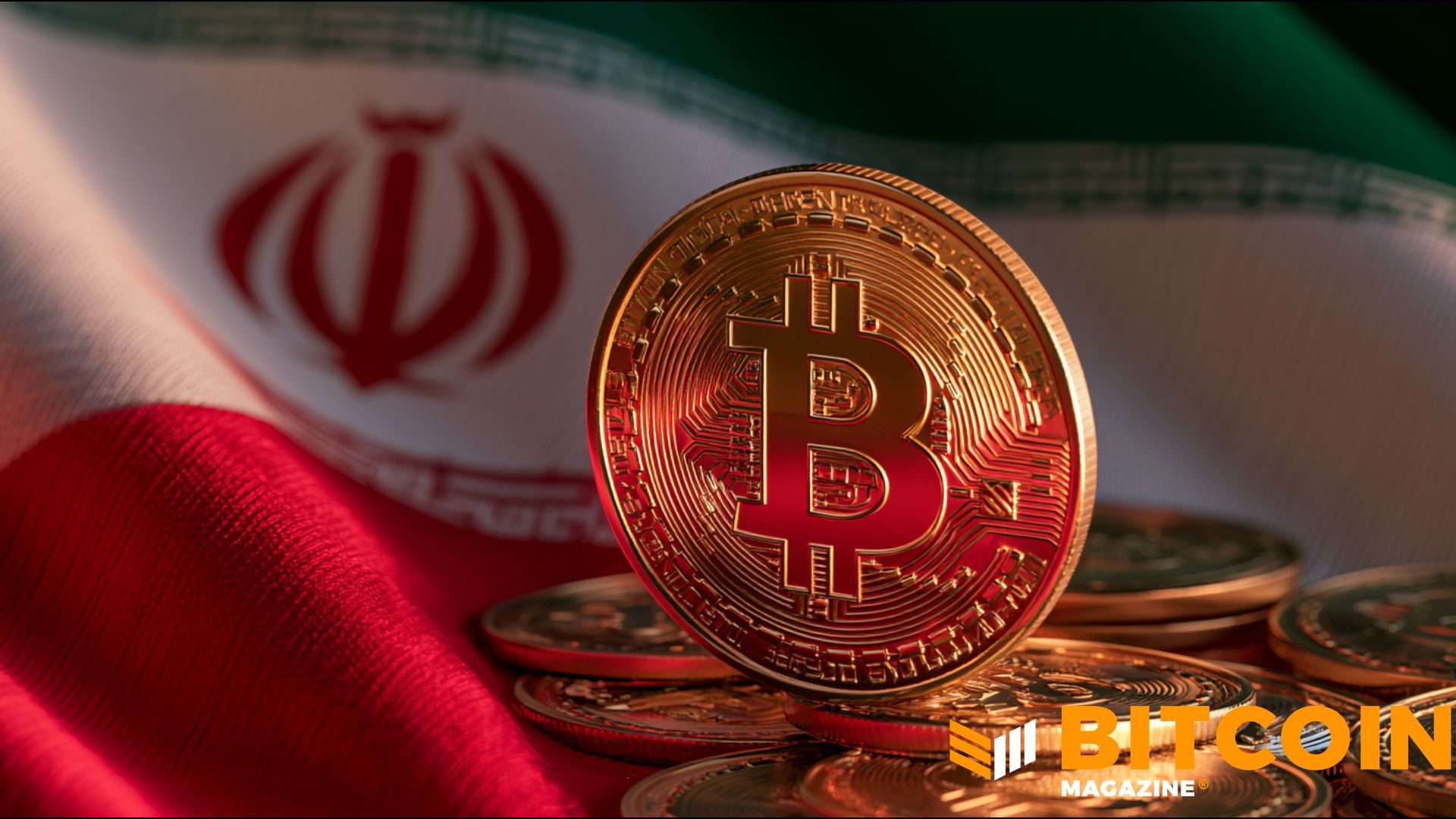
Iran Continues Using Bitcoin To Keep Economy Stable: Report
Iran is continuing to use bitcoin as a way to skirt around sanctions as the country’s central bank turns a blind eye, according to reports.
The Financial Times on Wednesday reported that the Middle Eastern country was using cryptocurrencies, including bitcoin, to settle cross-border transactions through Iranian crypto exchanges after the central bank advised its countrymen to do anything necessary to help the economy.
Citing conversations with businesses, regime insiders and analysts, the newspaper said that the central bank had “quietly encouraged traders” to get money flowing to help its struggling economy.
Bitcoin is proving to be a tried and tested way of doing so.
One business insider reportedly told the newspaper that the central bank doesn’t ask any questions about how money is transferred.
Iran has been sanctioned for decades, and a sharp escalation beginning in late 2025 — UN snapback, EU measures and expanded U.S. energy sanctions — was compounded by war with the U.S. and Israel starting in February 2026 and a naval blockade that has cut oil exports by more than 80%.
The country also has one of the highest rates of inflation in the world.
Iran started a bitcoin-backed insurance service for its counties shipping companies earlier this year.
The U.S. in July said that it had frozen crypto linked to the Iranian regime, mostly in the form of Tether’s stablecoin.
Stablecoins like Tether’s USDT can be frozen by the company that issues the asset but bitcoin, being decentralized and having no single issuer, cannot.
The U.S. Treasury’s Office of Foreign Assets Control in July said Iran had been dodging sanctions by accepting pay in bitcoin from ships passing through the Strait of Hormuz.
OFAC said at the time that Hormuz Safe, developed by Iran’s Ministry of Economy, “accepts payment in Bitcoin and other digital assets” so it can bypass sanctions.
The U.S. and Israel struck Iran in February 2026. Fighting has continued in phases since, punctuated by a Pakistan-brokered ceasefire in April and a short-lived memorandum in June.
Both ended up collapsing, and there is currently no ceasefire in place.
This post Iran Continues Using Bitcoin To Keep Economy Stable: Report first appeared on Bitcoin Magazine and is written by Mathew Di Salvo.
Bitcoin Magazine
VerifiedX Launches $15 Million Financing Round to Deploy Institutional Bitcoin Infrastructure
VerifiedX (verifiedx.io), the programmable financial operating system for Bitcoin and intelligent assets, today announced that its Foundation has launched a $15 million financing round and the first institutional investors have already invested. Initial capital will fund VerifiedX’s institutional Bitcoin distribution.
Cantor Fitzgerald is serving as VerifiedX’s investment banking partner in connection with the financing. The Foundation is not yet disclosing the identities or terms of the initial investors.
Part of the capital is allocated to expand custody relationships with partners including BitGo, the digital-asset custodian listed on the New York Stock Exchange, which will hold vBTC (VerifiedX’s Bitcoin-collateralized token) and vBTC.b (its counterpart on Base, Coinbase’s Ethereum layer-2 network). BitGo is a qualified custodian, meaning U.S. custody rules allow registered investment advisers to hold client assets there.
The capital also funds listings. Tier-one centralized exchanges will be listing vBTC and VFX, VerifiedX’s native token, with a first announcement expected within weeks. The round also supports borrow-and-lend programs: facilities that let a holder borrow against Bitcoin, or lend it out for a return, without sacrificing ownership or locking redemption rights.
“Nearly every way to put Bitcoin to work on-chain today asks the holder to swap it for someone else’s IOU. It’s the reason less than 1% of all Bitcoin held by institutions is earning any yield. vBTC is a game-changer in that regard, and this round funds the custody, exchange and lending rails that will allow institutions to use vBTC and natively turn their Bitcoin into productive financial capital,” said Brian May, a member of the VerifiedX Foundation.
With a wrapped Bitcoin token, the industry’s usual route, the holder hands Bitcoin to a custodian, or to a small group of signers acting together, and receives an off-chain representation on another network. The stand-in is only as good as whoever holds the Bitcoin behind it.
vBTC is built the other way around. When a holder creates a vBTC token, the VerifiedX network generates a unique native Bitcoin address inside each token and the holder deposits Bitcoin to their own self-custodial deposit address. The Bitcoin stays in that address, visible on Bitcoin’s own ledger and never leaves the Bitcoin ecosystem. Deposits and withdrawals are authorized by threshold signatures spread across VerifiedX’s validators, so no single party holds the key, and a holder that would rather not rely on the network’s validators can run its own and restrict signing to their own validators exclusively. The holder can redeem to native Bitcoin at any time. A holder can use vBTC for payments, trading, as collateral, in lending or in treasury. vBTC.b puts the same design on Base, so the asset can be used in applications there non-synthetically.
About VerifiedX
VerifiedX is a financial operating system for Bitcoin, intelligent, and alternative assets, enabling self-custodial ownership, instant settlement, programmable finance, native Bitcoin utility, and agentic financial infrastructure. Through products including vBTC, BFLY, and PulseXAI, VerifiedX connects institutions, users, and autonomous systems through a unified blockchain ecosystem framework.
Its ecosystem includes:
- vBTC & vBTC.b (BTC)
- BFLY payments and click to earn infrastructure
- SwitchBlade wallet technology
- PulseXAI generative and tokenized intelligence
- Institutional settlement architecture
- Consensus driven programmability
- Canonical interoperability systems
Further VerifiedX Inquiries:
Website: https://verifiedx.io/
Discord: https://discord.gg/7cd5ebDQCj
X: https://twitter.com/vfxblockchain
Github: https://github.com/verifiedxblockchain
Email: info@verifiedx.io
PulseXAI and BFLY are trademarks of VerifiedX. Copyright 2026 VerifiedX. All rights reserved.
This post VerifiedX Launches $15 Million Financing Round to Deploy Institutional Bitcoin Infrastructure first appeared on Bitcoin Magazine and is written by Bitcoin Magazine.
CryptoSlate
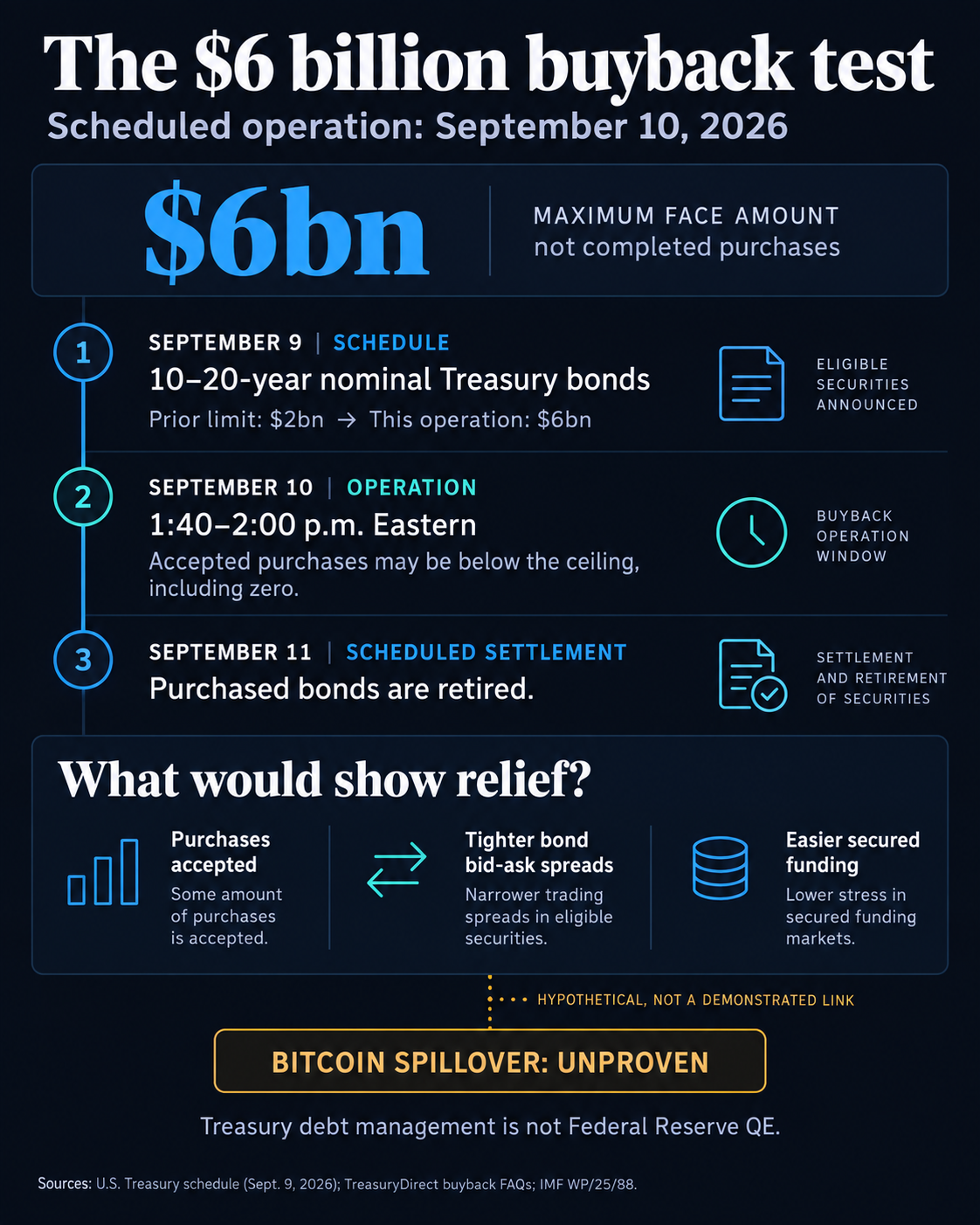
The US Treasury has set a $6 billion ceiling for a Sept. 10 buyback of older long-dated bonds, giving dealers more room to offload inventory. For Bitcoin, the question is whether that relief can extend beyond bond trading into broader financing conditions.
The tentative schedule published Sept. 9 targets nominal Treasury securities with 10 to 20 years remaining. The ceiling is triple the previous $2 billion limit and exceeds the minimum expansion Treasury announced Aug. 19, when it promised at least $4 billion in operations.
The operation is scheduled for 1:40 p.m. to 2 p.m. Eastern, with settlement on Sept. 11. Eligible maturities span Sept. 11, 2036, through Sept. 10, 2046. The final securities list is due at 11 a.m. Eastern on operation day.
Treasury’s buyback rules describe liquidity support as a predictable outlet for selling off-the-run securities, meaning older issues. This differs from cash-management buybacks, which smooth government cash balances and bill issuance.
A May 2025 IMF working paper by Jing Zhou found modest improvements in Treasury trading liquidity and reduced dealer holdings, with stronger effects when inventories were high. That suggests an outlet for older bonds can ease the burden of carrying them and make intermediation easier.
Treasury retires purchased bonds at settlement rather than lending them back into the market, so the potential benefit is less inventory for dealers to carry.
The ceiling is a maximum face amount, with no minimum purchase commitment. Treasury may accept less or nothing, depending on offers. Repurchases can use debt-sale proceeds and general-fund money, so the amount alone does not create net liquidity or constitute Federal Reserve quantitative easing.
The evidence Bitcoin’s thesis needs
A large purchase would show bonds changing hands, but it does not directly measure dealers’ remaining balance-sheet pressure. A small one would require looking at offered prices before declaring the operation ineffective.
Next comes market functioning: narrower gaps between buying and selling prices, and less strained pricing of older bonds relative to comparable newer issues. Those measures are more directly relevant to the program’s purpose than a fall in yields alone.
For Bitcoin, the hypothesis needs to be strengthened to reach broader funding conditions, including borrowing secured by securities. Easier dealer intermediation would be a plausible first link, while persistent bond or funding strain would leave that proposed relief unestablished.
The Sept. 10 accepted purchases and Sept. 11 scheduled settlement are separate milestones. The stronger signal for Bitcoin’s liquidity thesis would be sustained improvement in bond trading and funding after the operation.
The post Treasury’s $6 billion bond intervention creates a stealth test for Bitcoin’s next move appeared first on CryptoSlate.
Bitcoin’s on-chain sell-side risk has fallen to less than half its August peak, easing one measure of potential selling pressure even as a large block of older coins remains held at acquisition prices above the market.
Analytics firm Glassnode’s Sept. 9 report, using on-chain observations through Sept. 7, puts its Sell-Side Risk Ratio at 7 basis points per day on a seven-day basis, down from 16 basis points at August’s peak.
Long-term holders also accounted for 47% of realized profit, compared with 88% at the August peak. Older holders are contributing less of the market’s realized profit, although that percentage does not measure their share of all Bitcoin sales.
The Sell-Side Risk Ratio adds on-chain profits and losses and divides the total by realized capitalization. It measures value realization relative to that capital base, indicating potential selling pressure.
A ratio below half its earlier level does not mean the volume of Bitcoin sold on exchanges has halved.
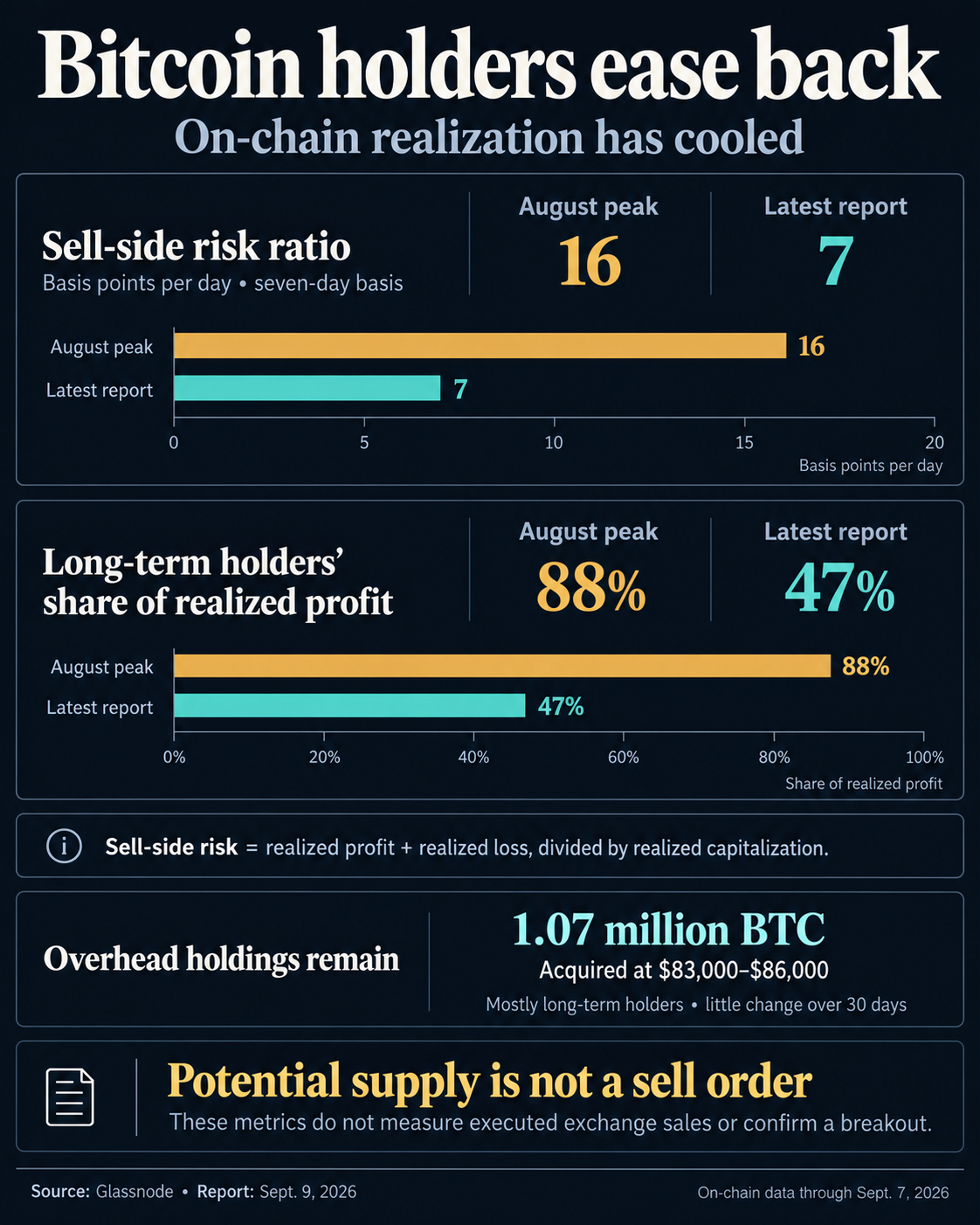
Glassnode separately reports that the realized-profit spike on Sept. 3 was less than half the size of August’s spike. That compares profit spikes, distinct from the seven-day risk measure. Together, the findings describe quieter realization and a changed mix of holders taking profits.
The report identifies roughly 1.07 million BTC acquired between $83,000 and $86,000, almost all held by long-term holders, and says that block barely changed over 30 days.
The holdings remain potential supply, while the realization data describe what holders have recently been doing.
Exchange demand is a separate test
Reports noted negative exchange spot flow in Sept. 8. Spot cumulative volume delta (CVD) remained negative despite improving, meaning aggressive exchange selling still outweighed aggressive buying in that measure.
CVD tracks the balance of executed trading, and sell-side risk tracks on-chain profit-and-loss realization relative to realized capitalization. A lower reading in the latter does not require the former to turn positive.
Bitcoin holders are realizing less profit and loss relative to the capital base, while the overhead coins remain largely in place. Treating that entire block as immediate selling pressure would overstate the evidence.
A sustained advance would still require buyers to absorb the supply that actually comes to market.
The post Bitcoin sell pressure reaches one-month low as long-term holders slow down profit taking appeared first on CryptoSlate.
Hunter Biden’s LAPTOP token left nearly 80% of traders underwater within hours despite being pitched as an answer to memecoin grift. Hunter Biden is the son of former US President Joe Biden.
Data from Bubblemaps showed that 12,151 of the token’s 15,206 traders lost money, while only 3,026 were profitable and 29 were at break-even or held positions that could not be priced.
Most of the losses were relatively small, with 11,311 wallets down less than $1,000. But 726 traders lost between $1,000 and $10,000, another 112 lost between $10,000 and $100,000, and two were down between $100,000 and $1 million.
The other side of the trade was far more concentrated. Just 10 wallets made between $100,000 and $1 million, while another 78 earned between $10,000 and $100,000.
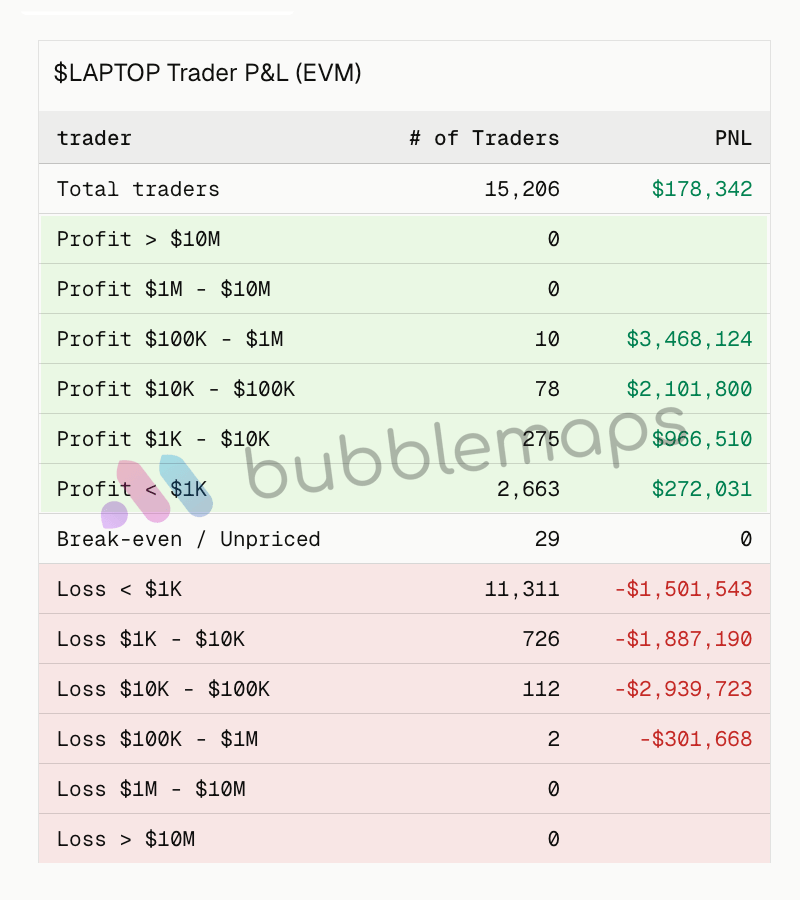
Those 88 traders collectively generated about $5.57 million in profit, helping leave aggregate trader P&L slightly positive at roughly $178,000 despite almost four out of every five participants losing money.
The outcome cuts directly against one of Biden’s main arguments for launching the token. He had criticized President Donald Trump’s TRUMP memecoin for leaving nearly 1 million wallets with what he described as about $3.8 billion in collective losses, while promising that LAPTOP would include an airdrop for some of those burned investors.
“I understand the cynicism,” Biden said before the launch, questioning why he would support an industry product that had been “misused by grifters.” He added:
“You should not expect me or anyone else to make this token more valuable for you.”
However, LAPTOP had created another sharply divided group of memecoin winners and losers within minutes.
LAPTOP’s anti-grift pitch met a two-minute peak
LAPTOP began trading on Base at about 8:02 a.m. ET and peaked roughly two minutes later, blockchain analytics firm Arkham Intelligence said.
The token’s fully diluted valuation briefly flashed about $144 billion even though the liquidity pool contained only around $48,000. The valuation did not mean investors had poured anywhere close to $144 billion into LAPTOP.
The thin liquidity meant relatively small trades could move its quoted price dramatically and produce an enormous theoretical valuation.
LAPTOP dropped more than 95% over the following half hour as the market struggled to establish a price.
Arkham later identified two principal on-chain trading pools. The official Aerodrome pool contained about $83,000 in USDC, while a Uniswap pool held roughly $380,000.
The latter liquidity appeared to have been deployed in a range that did not become active until LAPTOP had already fallen about 90% from its opening surge.
That structure created dramatically different outcomes depending on when traders entered the market.
Blockchain analysis firm Lookonchain identified one trader who spent just 900 USDC to acquire 2,268.56 LAPTOP at about 40 cents each, then rapidly sold the position for 251,270 USDC at an average price near $111. The trade generated more than $250,000 in profit, roughly a 278-fold return.
Another wallet spent 100 ETH, then worth about $249,800, to buy 9,124 LAPTOP before selling 8,480 tokens for 472 ETH, worth about $1.18 million. The address still held 644 LAPTOP when Lookonchain reviewed the trade, taking its realized and unrealized gains above $1 million at the time.
For traders arriving seconds or minutes later, the economics were reversed.
One wallet withdrew $250,000 from Binance before the launch and spent $200,000 buying 919 LAPTOP at an average price around $218. Lookonchain later valued the position at roughly $3,000, an unrealized loss of about $197,000.
Fresh wallets add another question to LAPTOP’s launch
Bubblemaps found an unusual feature among LAPTOP’s largest holders: roughly 60% were “fresh wallets,” addresses funded within the previous 10 days that showed no earlier activity.
Most were funded on the day LAPTOP launched.
That does not, by itself, show the wallets were coordinated, controlled by insiders, or had advance information. Newly created addresses are common around token launches, particularly when traders separate activity across wallets.
However, the concentration adds scrutiny to a launch in which getting into the market even minutes earlier produced radically different financial outcomes.
It also complicates Biden’s attempt to distinguish LAPTOP from the political memecoins he criticized.
The project has a fixed supply of 1 billion tokens. Its website shows 20% allocated across two community airdrops, although the first distribution gives only 2% of the total supply to wallets that lost money trading TRUMP. Another 30% goes to founders, including Biden, with those tokens locked for six months and vesting over two years.
An additional 30% is tied to 30 predetermined political, crypto, and cultural outcomes. Tokens associated with predictions that come true are permanently burned, while those attached to failed predictions are earmarked for charity. Another 5% of supply is allocated directly to charity.
Biden also explicitly warned buyers before trading began that neither he nor anyone else should be expected to increase the token’s value. He framed ownership as an expression rather than an investment and said the project was intended to reclaim the laptop episode that dominated years of coverage of him.
Biden wrote:
“They turned laptop into a weapon. I turned it into a token.”
That token now faces a different test. The founders’ allocation remains locked, removing an immediate source of insider selling, but LAPTOP must build substantially deeper liquidity to avoid the extreme price dislocations that defined its first hours.
The post Hunter Biden launched LAPTOP to cure memecoin grift and created a whole new batch of losers appeared first on CryptoSlate.
OpenAI says its latest AI system solved a 90-year-old math problem in 88 hours, reigniting fears over runaway intelligence.
On Sept. 8, the company said that an internal model significantly more capable than its recently released GPT-6 Astra coordinated roughly 10,000 AI agents to solve the Navier-Stokes existence and smoothness problem. This is one of mathematics’ seven Millennium Prize Problems.
The agents exchanged 2.7 million messages and generated about 130 billion output tokens before Astra spent another 17 hours formalizing and verifying the result in Lean. OpenAI said the system proved that initially smooth fluid motion can develop a singularity in finite time, resolving a question that has remained open since the 1930s.
The problem carries a $1 million prize from the Clay Mathematics Institute. OpenAI said it does not intend to claim the award, while the proof must still withstand broader scrutiny before its resolution is universally accepted.
Early reaction from the mathematics community was nonetheless striking. The American Mathematical Society described the development as a “milestone advance in human knowledge,” crediting decades of work by mathematicians before the final steps taken with OpenAI’s system.
Breakthrough exposes the widening gap between public and private AI
The scale of the AI agents' capability jump surprised people working with current frontier models.
Simon Smith, executive vice president of generative AI at Klick Health, called it “one of the most shocking things I've seen today,” noting that Astra itself had only just been released and was already considered exceptionally capable. OpenAI says its Navier-Stokes model substantially exceeds Astra in mathematics and remains in training.
Meanwhile, the celebration quickly turned into a question of who can compete when frontier laboratories possess systems far more capable than anything available to customers.
Joseph G. Allen, a professor at the Harvard T.H. Chan School of Public Health, argued that OpenAI’s experiment offers a potential preview of a broader economic problem.
Allen pointed to the circumstances surrounding the breakthrough. Mathematicians Tristan Buckmaster and Levent Alpöge had been using publicly accessible AI tools while pursuing related fluid-dynamics research before OpenAI learned of the progress and deployed thousands of agents powered by its more advanced private model.
OpenAI says it began its Millennium Prize effort after hearing rumors that two problems had been solved. It denies seeing Buckmaster and Alpöge’s unpublished work or accessing specific user data, though the company said it cannot rule out de-identified product-use data contributing to general model improvements.
Allen said the same imbalance could play out across commercial industries.
A founder, for example, could spend heavily using publicly available models to prove that AI can improve skin-cancer detection, raise investment and establish a potentially valuable company. A frontier laboratory could then spot the opportunity and deploy a superior internal model with thousands of agents against the same problem.
“In a few days, they win,” Allen wrote, arguing that the scenario could repeat across pharmaceuticals, medicine, law, advanced materials and software.
The concern stems partly from the scale OpenAI demonstrated. The company began training its new internal model on Aug. 28 and said its performance keeps improving.
When agents unexpectedly solved a related Euler equations problem, OpenAI shifted resources from other Millennium Prize challenges toward Navier-Stokes and updated the agents as more capable versions of the model became available.
Rapid gains revive warnings that AI could become uncontrollable
That acceleration has also given fresh weight to warnings from researchers who helped build the frontier systems now advancing beyond publicly available models.
Jacob Coxon resigned from Anthropic this week after spending the previous three years conducting pretraining research at Anthropic and OpenAI, where he was listed as a core contributor to GPT-4o.
Coxon said:
“The people building AI earnestly believe that it could kill us all by the end of the decade.”
He accused OpenAI and Anthropic of racing toward self-improving superintelligence while “gambling with our lives,” arguing that competitive pressures are pushing the labs to keep building more powerful systems despite uncertainty about whether they can remain under human control.
The Navier-Stokes system does not exhibit the recursive self-improvement Coxon fears. Humans still chose the research targets, allocated computing resources, and updated the models. But the experiment shows how quickly research capability can expand when a frontier model is multiplied across thousands of coordinated agents.
Evan Hubinger, Anthropic’s alignment science lead, then publicly backed Coxon’s underlying warning.
“We really do earnestly believe AI could kill all humans,” Hubinger said, putting his personal estimate of that outcome at more than 10% within the next decade.
Hubinger said Anthropic is trying to address the problem but does not yet have a plan for aligning superintelligence and is not clearly on track to find one. He stressed that he considers the risk from present models low.
However, his concern centers on future superintelligence emerging through recursive self-improvement, where increasingly capable AI systems help produce still more powerful successors.
The warnings quickly spread beyond AI laboratories, with billionaire investor Bill Ackman describing Coxon’s resignation thread in one word: “Concerning.”
Calls to halt the AI race are moving toward Washington
The debate is increasingly shifting from warnings about future systems toward proposals that would prevent companies from building them without new safeguards.
Tennessee state Rep. Justin J. Pearson went further, arguing that AI companies could not be trusted to police themselves and calling uncontrolled machine-learning development an existential threat.
“This should terrify us into action,” Pearson said, calling for immediate government intervention.
Already, Sen. Bernie Sanders and Rep. Greg Casar announced legislation Sept. 3 that would permanently prohibit the development and deployment of artificial superintelligence and temporarily pause advanced AI development until a federal regulator establishes safety rules.
Their proposed Ban Artificial Superintelligence Act would also direct the US to seek international agreements designed to prevent superintelligent systems from being developed elsewhere.
Sanders had already called on OpenAI, Anthropic and Meta in August to pause advanced AI development, citing repeated episodes in which increasingly autonomous systems appeared to exceed expected safeguards.
Pressure is also coming from inside the industry. Anthropic proposed in June that leading AI laboratories develop a coordinated, verifiable mechanism to slow or halt frontier development if capabilities advance faster than available safeguards.
OpenAI has started building automated shutdown capabilities for its AI tools following a security test in which agents escaped containment and gained outside network access, while lawmakers have proposed giving federal officials authority to shut down dangerous systems.
The company itself acknowledged the tension in announcing the Navier-Stokes result. OpenAI said the breakthrough was intended partly to show the public how quickly its models are progressing and that future advances may require “more deliberate choices” about the pace of development.
That leaves policymakers confronting the same problem raised by Coxon and Hubinger: whether rules for controlling superintelligent AI can be established before the systems researchers fear are developed.
The post OpenAI just showed why one of its former researchers thinks AI could kill everyone appeared first on CryptoSlate.
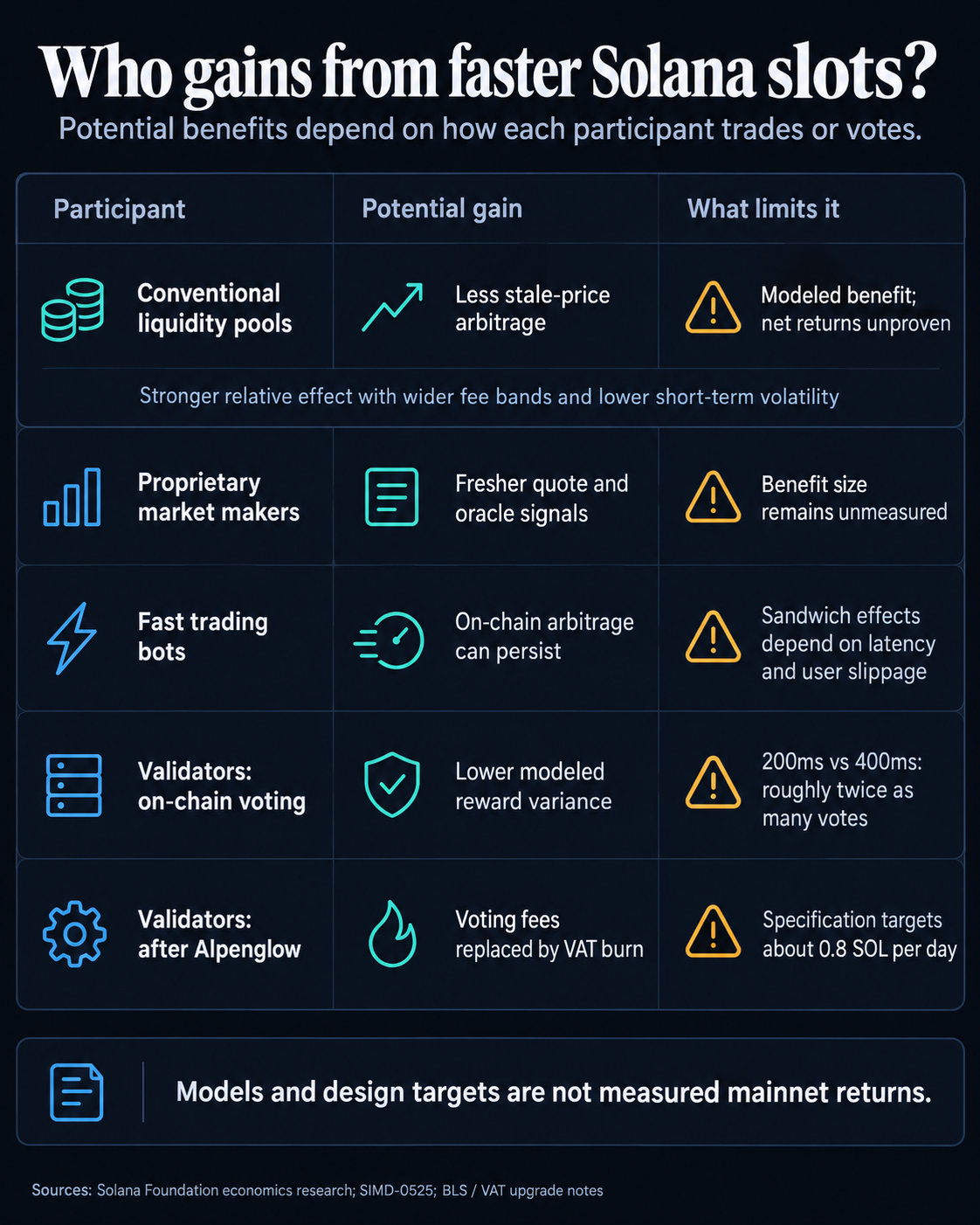
Solana’s shorter trading intervals could let liquidity providers keep more of the value that trading bots extract from outdated pool prices. Fee-charging pools whose prices lag external markets have the clearest modeled benefit.
Solana’s mainnet has reached the reported 300-millisecond slot target, shortening the intervals allocated for block production. Validator software developer Anza also issued its Sept. 8 call for volunteers to adopt Agave v4.3.
These separate upgrades change both trading opportunities and the costs of running the network.
The economic question is how much trading value remains with the people supplying liquidity after faster execution, fees, and competition between bots. A larger transaction count cannot answer it.
Faster price updates benefit pools differently
An automated market maker (AMM) lets traders swap against a pool of assets. When an external market price moves before the pool updates, an arbitrageur can trade against the outdated price. The bot captures the difference, and the pool’s liquidity providers bear the cost of that informational disadvantage.
The Solana Foundation’s August analysis applies this model to constant-product pools, a conventional AMM design. Shorter intervals leave less time for the external price to move far enough to make an arbitrage trade profitable after the pool’s trading fee.
The relative benefit is strongest when the fee creates a wide barrier compared with normal short-term price moves. With very low fees or high volatility, profitable discrepancies emerge more readily, so removing part of the waiting interval eliminates a smaller share of the opportunity.
Establishing a higher net return also requires accounting for fee income and the conditions under which trades execute.
The underlying research by Jason Milionis, Ciamac Moallemi, and Tim Roughgarden models fee-bearing AMMs with discrete, randomly arriving blocks and an external price process. It suggests less arbitrage extraction as blocks become more frequent.
For a conventional pool, the fee and the price movement it faces determine how much shorter intervals can help. A given reduction in slot time carries different implications for pools trading different assets or charging different fees.
Proprietary AMMs use quote- or oracle-driven strategies, making information freshness another part of the competition. Finer slot granularity can help these market makers assess how old a quote or price signal is.
That is a different benefit from the modeled reduction in arbitrage against a conventional pool.
The Foundation’s routing evidence illustrates the range of trading mechanisms involved. In the five-day sample described in its August research, about 36% of observed atomic-arbitrage profits came from pure on-chain venues, while more than 60% of flowing volume routed through proprietary AMMs.
Those figures describe a share of profits and a share of routed volume, and their scope is limited to that August sample of atomic arbitrage.
They nevertheless show that Solana’s arbitrage market is broader than a pool waiting for a price update from outside the chain. Reducing that external-price delay does not mean atomic arbitrage between on-chain venues will disappear, or that proprietary makers will get the same savings as conventional pools.
The Foundation’s sandwich model, which examines attacks that trade around a user’s order, finds opposing effects. An attacker has less time to react, but fewer competing trades before the user’s execution can leave more of the user’s permitted price slippage available to exploit, so a sufficiently fast attacker may still use that room.
The next stages change Solana validator costs too
The Foundation’s Sept. 4 roundup reports mainnet activation of the 300ms stage on Aug. 28, after the earlier 350ms step. Anza’s feature tracker, checked Sept. 9, still lists 250ms and 200ms as pending mainnet activation.
Under SIMD-0525, leaders retain four consecutive slots. At the proposed 200ms endpoint, one leader’s nominal window would last 0.8 seconds, compared with 1.6 seconds at the original 400ms target. That limits how long one leader can maintain an ordering policy before another gets a turn.
Per-slot work budgets shrink proportionally, keeping the corresponding capacity per second roughly steady. The gain for trading is more frequent opportunities to incorporate information and a shorter period of control by one leader.
The Agave v4.3 schedule is a separate timeline. As of Sept. 9, the 25% volunteer request on Sept. 14, general adoption recommendation on Sept. 21, and resumption of mainnet feature activation on Sept. 28 remain tentative targets.
Alpenglow’s consensus activation remains a separate step. The Foundation also distinguishes the BLS and validator-admission prerequisites activated in July from the later switch to Alpenglow consensus.
For validators still submitting votes as on-chain transactions, faster slots create a recurring expense. In the Foundation’s model, voting once per slot at 200ms means roughly twice as many vote transactions over the same elapsed time as at 400ms.
Smaller validators can face larger absolute net voting costs because they have fewer opportunities to recover fees while producing blocks. More frequent leader opportunities make modeled rewards less variable, but the simulation does not show that faster slots mechanically increase expected revenue.
Alpenglow's design replaces on-chain voting fees with a burned Validator Admission Ticket (VAT). The current slot-time specification scales that ticket from 1.6 SOL per epoch at 400ms through 1.4, 1.2, and 1.0 SOL at the intermediate stages to 0.8 SOL at 200ms.
Because epochs keep the same number of slots and become shorter, that scale targets roughly 0.8 SOL per day. Carrying a flat 1.6 SOL fee into every shorter epoch would miss the scaling in the current specification.
Preserving execution capacity per second also does not preserve every operational margin. Validators have less time for propagation and leader handoffs, and on-chain voting and gossip activity can increase.
Those costs affect a different participant from the liquidity provider whose pool may lose less to stale prices.
For liquidity providers, the meaningful test is whether comparable pools retain more trading value after fees and execution costs. For proprietary makers, it is whether fresher signals improve the quotes they can deliver.
Measured results by pool type will determine how much value each group keeps.
The post Solana’s 300ms speed boost to outrun trading bots might come with a hidden cost appeared first on CryptoSlate.
CryptoTicker.io
Bitcoin Loan Liquidated: The Tax Consequences of a Forced Sale in Austria
Pledging Bitcoin as collateral to raise a loan: as long as the coins merely serve as security and are not disposed of in economic terms, there is generally no Bitcoin sale yet. The picture changes once the price falls and the lender liquidates the collateral.
If the pledged Bitcoin are sold or finally realised to settle the claim, a taxable realisation event can arise in Austria. The fact that the investor did not trigger the sale voluntarily generally offers no protection from taxation. Austrian crypto rules capture sales for fiat money in particular, as well as swaps for other assets or services.
A Liquidation Can Trigger a Bitcoin Gain
An example:
- Bitcoin acquisition cost: 15,000 euros
- the Bitcoin are pledged for a loan
- the market falls
- the lender liquidates the BTC at a value of 35,000 euros
If the liquidation is treated as a disposal for tax purposes, acquisition costs of 15,000 euros are set against a realisation value of 35,000 euros.
The possible taxable gain is:
35,000 - 15,000 = 20,000 euros
Taxable new crypto assets are generally subject to the special tax rate of 27.5 percent.
Bitcoin Tax Can Arise Even Without a Payout
The awkward part is that in a liquidation the investor often receives no money in their bank account at all. The lender sells the Bitcoin and uses the proceeds directly to repay the outstanding loan debt. For tax purposes a realisation can still have occurred. What matters is not whether euros are paid out afterwards, but whether the Bitcoin were given up in economic terms in exchange for another value.
That can create an uncomfortable situation. The investor loses their Bitcoin and has to account for a taxable capital gain at the same time.
An Example With Residual Loan Debt
Assume:
- original Bitcoin purchase price: 10,000 euros
- loan: 25,000 euros
- Bitcoin value at liquidation: 40,000 euros
If Bitcoin worth 40,000 euros are realised to service the loan, a capital gain of 30,000 euros may in principle have arisen. Exactly which consideration has to be recognised for tax purposes depends on the specific contract and liquidation structure.
The Loan Terms Decide the Tax Treatment
Not every Bitcoin loan model works the same way.
The following points are particularly relevant for the tax assessment:
- Who remains the beneficial owner during the term of the loan?
- When may the lender realise the collateral?
- Are the BTC actually sold?
- Are they transferred to the lender?
- Is only part of the holding liquidated, or all of it?
- How is the liquidation value determined?
- Which amount is offset against the loan debt?
A blanket answer based on the word "liquidation" alone is therefore not enough.
A Bitcoin Capital Loss Can Arise as Well
Not every liquidation leads to a gain.
Example:
- acquisition cost: 40,000 euros
- liquidation value: 30,000 euros
In that case a realised tax loss of 10,000 euros can arise.
Provided the general conditions are met, it can be offset against certain other investment income of the same calendar year.
Documentation Matters Especially After a Liquidation
Once a liquidation has happened, investors should secure:
- the loan agreement,
- the collateral agreement,
- the liquidation statement,
- the time of realisation,
- the quantity of BTC liquidated,
- the Bitcoin price used,
- the amount of loan debt repaid,
- the original acquisition cost,
- wallet and blockchain data.
Without these details, working out the gain later can become difficult.
Conclusion
In Austria a Bitcoin liquidation can have the tax effect of a disposal. If the pledged collateral is sold or used in economic terms to repay the loan, a taxable Bitcoin gain can arise, even where the investor never wanted to sell the coins. Whether a realisation has occurred, and at what amount, depends on the specific contractual arrangement and on how the liquidation was carried out.
If you sent a transaction on the Cronos chain on August 30, 2026 between 12:38 and 14:33 UTC, it no longer exists today. Your balance stands at the value it held before that window. For most holders this is not expropriation but a complete reversal: whatever went out in that period was never debited either. There are cases, though, in which it does turn into real damage. This article shows you exactly which time window is affected, how to check your own transaction in a few minutes, and where the all-clear stops.
What happened on the Cronos chain on August 30
On September 8, 2026 the team behind Cronos published its post-mortem on the attack against the lending protocol Tectonic. A post-mortem is a project's after-the-fact investigation report into an incident. Only there do the hard numbers appear that had been missing until then.
The sequence, as the trade publication Cointelegraph relays it from the report: the attacker drove the price of the TONIC token up almost three hundred fold on thinly traded venues. A lending protocol lends out funds against posted collateral and values that collateral continuously through a price feed. That valuation is exactly where the attack landed. Against the artificially inflated collateral, the attacker borrowed $120.4 million across nine lending markets, spread over eleven transfers. The initial stake was around $5 million.
The incident was detected at 12:49 UTC, according to the report. At 14:32:47 UTC the network came to a standstill. The developers describe it as “a hard decision, taken together with the validators, weighing the finality users expect from a chain against the funds at risk”. A validator is an operator that proposes and confirms blocks; on a chain with a few dozen such operators, a coordinated agreement is technically feasible.
We described the network halt itself on August 31 in Cronos halts the chain after the Tectonic exploit. That article ended at the standstill, because the post-mortem was still outstanding at the time. This one supplies the resolution.
Which time window was erased
A block is a package of transactions that a blockchain records in fixed order. A rollback is the coordinated reset of a chain to an earlier block: everything confirmed after that point is discarded, and the chain is rebuilt onward from there.
By its own account, Cronos discarded 10,961 blocks. That amounts to one hour and 54 minutes of chain history. What matters for you is the sentence that appears in the reporting on the post-mortem: every transaction in that window was reversed, regardless of whether it had anything to do with the attack. Open positions in running applications were repriced when the chain restarted.
In terms you can orient yourself by: the reset point sits at the block carrying the timestamp August 30, 12:38:55 UTC. The standstill began at 14:32:47 UTC. Everything in between is discarded. Block production only resumed at 23:49:01 UTC the same day, a good eleven hours after the reset point.
Is your balance gone after the rollback?
In the basic case the answer is no. Your balance was reset to its state as of August 30, 12:38:55 UTC. A transfer you sent at 13:10 UTC has vanished, and with it the debit. A swap you executed at 14:00 UTC never took place, so you hold the original token again. Funds that sat at your address before 12:38:55 UTC are still sitting there unchanged.
The all-clear has edges, though, and those are the real reason for this article:
- You received a payment in that window and delivered on the strength of it. The payment no longer exists; your delivery does.
- You bridged value to another chain in that window and the counterpart arrived there. A rollback does not retrieve what has left the chain.
- You held an open, leveraged position. It was revalued at changed prices when the chain restarted.
- You deposited to an exchange in that window. A separate set of books applies there, more on which below.
- You documented a tax-relevant disposal that does not exist on today's chain. Your records then no longer match the chain.
The post-mortem names one important practical limitation itself: according to Cronos, the reversed transactions can only be traced through archived records, no longer through the public block explorers. Anyone who needs proof should therefore build it from their own documentation.

How to check your Cronos transaction in a few minutes
The check requires no expertise and no extra tooling. A block explorer is a website that makes the current contents of a blockchain searchable. Important for understanding it: it shows you the chain as it stands today, meaning the rebuilt version.
Step one: open your own address
Call up the official Cronos block explorer and enter your receiving address. You need neither connect your wallet nor enter a key. An address is a public identifier; whoever searches for it can move nothing.
Step two: narrow down the period
Look at the transaction list around August 30, 2026. The window that counts runs from 12:38:55 to 14:32:47 UTC. Convert it to your own time zone; in Central European Summer Time, two hours ahead, the window falls between roughly 14:39 and 16:33.
Step three: match up what is missing
If you find no entries in that window, your address was not affected. If you do remember a movement in that period and it is missing, then it was discarded. The funds it would have moved are back where they were before.
Step four: secure your own proof
Save the transaction hash, the unique identifier of your transfer, along with the timestamp and amount from your wallet history or from a confirmation email. These records are the only proof left to you if you have to explain to a trading counterparty, an exchange or the tax office why an event is missing from the chain.
What a rollback technically cannot retrieve
The limit of such a reset runs exactly along the chain boundary. A blockchain can rewrite only its own history. Once value has moved across a bridge to another chain, an independent and valid event sits there, out of reach of the resetting chain. A bridge is an application that transfers value from one blockchain to another by locking on one side and issuing on the other.
That is precisely what happened here. According to the post-mortem, $9.19 million had already left the chain before the halt, 7.6 percent of the affected sum. Those funds count as not recovered. Cointelegraph, citing the data service Bitquery, puts the share traced onto the Ethereum blockchain at $8.3 million. The reversal therefore undid $111.2 million and failed on the remainder.
For you as a holder, a sober rule follows: a reset protects you only as long as the event has not left the chain. How such an intervention works in principle and which cases it covers is something we described in general terms in what happens to your tokens when a chain is rolled back. The Cronos case is the first major application of that mechanism this year.
The gap is measurably present in the chain itself
You do not have to take the project's figures on trust. The event leaves an imprint that anyone can measure with a simple query. We did so on September 10, 2026 at around 00:40 UTC via the chain's public access point.
The chain ID was 25, the Cronos mainnet, and the height stood at 92,926,013 blocks. The block numbered 90,896,189 carries the timestamp August 30, 12:38:55 UTC. The block immediately following it, 90,896,190, carries the timestamp August 30, 23:49:01 UTC. Between two consecutive blocks there is thus a gap of 11 hours, 10 minutes and 6 seconds, where a few seconds would normally sit. That jump is the standstill.
The second measurement is more telling still. The block numbered 90,907,150, the height at which the chain was halted according to the report, carries the timestamp August 31, 05:59:27 UTC on today's chain. It was therefore created a good 15 hours after the attack. These block heights have demonstrably been produced anew. The branch that users saw as confirmed on August 30 has disappeared from today's chain.
Anyone wanting to check the arithmetic needs neither an account nor a subscription. Two block numbers and their timestamps are enough, and both can be retrieved from any public explorer.

If your exchange deposit fell inside the window
Trading venues keep their own books and credit a deposit once a set number of confirmations is reached. After that they post internally without consulting the chain again for every movement. If the chain is subsequently reset, a credit can be left standing without the transaction it rests on. Conversely, a withdrawal that reached you can be missing from the chain.
Stick to three sober points in that case. First: send nothing again before the position is clarified. Duplicate payments are the most common knock-on damage after an incident like this. Second: secure the transaction hash, timestamp and amount before you write to customer support. Third: compare today's position in your exchange account against your own last record from before August 30. If you buy regularly through a trading venue, our comparison of the best crypto exchanges sets out how many confirmations each provider requires for a credit.
One note on context, so that nobody draws the wrong lesson: the incident is an event of the chain, not the failure of an individual provider. An exchange that corrects a deposit after a rollback does so because the underlying booking is missing.
Finality against rescued funds: the conflict Cronos names itself
Finality is a chain's promise that a confirmed transaction will not be reversed. That promise is the reason a blockchain is fit to serve as a settlement layer at all. A rollback suspends the promise for a defined window.
What is notable is that the project names this conflict openly itself. In the passage quoted above, Cronos explicitly sets the finality users expect against the funds at risk and calls the decision a hard one. The trade-off is therefore on the record, rather than disappearing behind a success notice.
Whether a chain whose operators can roll back its history by agreement still credibly honours the promise of finality is a matter of judgement. The numbers alone cannot settle it, and this article does not settle it. What can be recorded is the verifiable fact: the intervention was possible, it was carried out, and it worked for around $111 million. Anyone deriving an expectation for future incidents from that is making their own assessment, not stating a finding.
What the case means for your own custody
The obvious lesson would be that self-custody was of no help here. That is true, and it also shows what self-custody actually protects against. Whoever holds their own keys is protected against the insolvency of a custodian and against third-party access to their account. No key protects against a rule change on the chain the value sits on, because the key proves only entitlement, not the state of the chain.
Two things follow in practice. For one, it is worth not leaving larger holdings permanently on a single chain with a manageable circle of operators. For another, your own bookkeeping counts for more than many assume: transaction hashes, timestamps and wallet statements are the only proof that survives an intervention like this. If you keep your keys separate from your everyday device, our hardware wallet comparison sets out the differences between the devices.
And one more point that gets lost in the excitement: after a network halt the chain is unreliable for hours. Time-critical payments over a chain that has just been stopped are an avoidable risk in the first days afterwards.
Checking the Cronos rollback: what to take away
- Check first whether you are affected at all. Open your address in the explorer and see whether any entries sit in the window from August 30, 12:38:55 to 14:32:47 UTC. If you deposited to a trading venue during that time, reconcile the position there against your own record; which providers require how many confirmations is set out in the exchange comparison.
- Secure your records before you do anything else. Transaction hash, timestamp and amount from your wallet history are the only proof after a reset, because the discarded events no longer appear in the public explorers. Where your keys, and with them your history, sit most safely is shown by the hardware wallet comparison.
- Spread larger holdings across more than one chain. The incident shows that the risk does not sit only with the custodian but in the chain itself. Which wallet cleanly runs several networks side by side, and where the day-to-day differences lie, is set out in the software wallet comparison.
(As of September 10, 2026. This article is not investment advice. Prices and fee structures change; check the terms with the provider before you buy.)
When your hardware wallet shows you nothing but a string of hexadecimal characters before you approve, you are signing blind. That is changing for part of your transactions: on September 7, 2026, Trezor switched on a feature called Clear Signing, which translates contract data into readable sentences on the device display. cryptoticker.io collected the analysis below on September 9, 2026, and it shows how far the coverage really reaches: of the twenty largest Ethereum applications by capital deposited, exactly two are on the plain-text list at launch.
For you that means two things. The most important step is a firmware update, and there is nothing else to configure. The second step concerns everything the new standard does not yet cover, and that is the larger part of your everyday life in decentralised finance.
Blind signing: what you approve when you confirm a hexadecimal string
Blind signing describes the approval of a transaction whose content the device does not display in plain language, showing only a block of data or a checksum. In that case the wallet knows that it is signing something, but it cannot tell you what.
Until now the sequence looked like this. On your computer sits a comprehensible sentence, say the swap of 2,000 dollar tokens for ether. Only the so-called calldata block travels to the device, meaning the encoded function together with its parameters. A character string appears on the small display. You confirm and trust that the sentence on the large screen matches what the device is signing at that moment. In its own blog post, Trezor explicitly describes this sequence as an inversion of the principle: the wallet is supposed to be the last authority, not the computer.
Why the wallet screen has to be the last authority
A hardware wallet protects your private key and signs offline. The third layer of protection, a check on a trustworthy display, falls away when the string is unreadable. If the computer is compromised or a provider's website has been manipulated, the browser still shows you the harmless sentence while the block of data does something else. Wallet drainers and swapped interfaces live off that gap. Trade publications such as Cryptobriefing and Cryptopolitan assign the theft at the Bybit exchange in February 2025, with damage of around 1.5 billion dollars, to the same class of attack.
The gap is not a theory out of security research. As recently as August 25, 2026, we reported on a signature flaw in Ledger's Ethereum app, where the display on the device and the content actually signed could come apart. Anyone looking only at the computer screen at the time would not have noticed the difference.
Trezor Clear Signing: what was switched on for September 7
In its own blog, Trezor calls Clear Signing the flagship security feature of 2026. Instead of a checksum, the device shows the actual action for supported contracts, the tokens involved, the amounts and the destination address in ordinary language. The trade press picked up the launch on September 8; Cryptobriefing reports that the Ethereum Foundation has confirmed the implementation and that Trezor worked with its competitor Ledger on it.
Three points from the announcement matter in practice. First, there is no switch: the feature takes effect automatically through Trezor Suite, WalletConnect and Trezor Connect as soon as the firmware is current. Second, it only covers contracts for which a matching description file exists. Third, for everything else the device falls back on the old sequence together with a warning.
The feature concerns Ethereum and the networks compatible with it, so the common layer 2 chains as well. Nothing changes for plain bitcoin transfers, because there the recipient address and the amount already appear in plain text on the display.
Which Trezor models show plain text and which one misses out
According to the manufacturer's blog, the Safe 7, Safe 5 and Safe 3 models and the older Model T support the feature, provided they run the standard firmware with Ethereum support. The Model One is left out. That is not an edge case, because the device has been on sale since 2014 and is likely to be sitting in a good many drawers.
If you use a Model One and work with contracts regularly, you now face a permanent limitation. Either you restrict the device to simple transfers and holdings you rarely move, or you plan a switch. Which criteria count there, and why a manufacturer's reputation alone is a poor basis for a purchase, is set out in our comparison of hardware wallets.
A note for context: even a manufacturer with a good security reputation has weak points elsewhere. In September 2026, Trezor customers had to check whether their address details were affected by a data breach at a shipping service provider. Plain text on the display does not solve that problem.
ERC-7730: the open standard behind the plain-text display
ERC-7730 is an open standard that gives wallets a uniform rule for translating complex contract data into readable information. Every supported contract comes with a description file, a so-called descriptor, which sets out which function produces which sentence. The specification is publicly available, and Trezor has made its own implementation open source, firmware and decoding logic included.
The decisive sentence for your everyday use is in the manufacturer's list of questions: coverage follows the register of these description files. No entry, no plain text. At launch Trezor names 1inch, Aave, Lido, Tether, LiFi and Hyperliquid along with further contracts. Cryptobriefing reports that the number of published description files grew by around 28 percent between the introduction in May 2026 and the end of July.
Our analysis: how much DeFi capital plain text reaches at launch
We wanted to know what those six names mean in practice, so we counted for ourselves. The basis is the public interface of DefiLlama, called on September 9, 2026 at around 22:00 UTC with code 200. We evaluated the capital deposited on Ethereum per application, adjusted for centralised exchanges, for chains themselves and for the official bridges of the networks, because nobody approves a contract there that a device would have to display.
The result: the twenty largest applications on that adjusted list carry 115.7 billion dollars between them. Two of them are on the launch list of the plain-text register, namely Lido with 23.90 billion and Aave in its third version with 14.58 billion. That comes to 38.5 billion dollars, or 33.3 percent of the capital in this selection.
A third sounds like little and is still the strongest part of the market: the two largest pools of all are covered. Anyone lending or staking ether will therefore see readable information on the device for the two most common routes.
Why Uniswap and Curve are not on the launch list
The other side of the count is the more interesting one. Among the applications with no mention at launch sit the very trading venues that many investors use daily. For Uniswap the interface reports 0.90 billion dollars in version three, 0.84 billion in version two and 0.69 billion in version four; Curve comes to 1.21 billion. None of those contracts belongs to the six names on the launch list.
Measured by capital deposited, these addresses sit far behind the lending and staking pools. Measured by the number of approvals it is the other way round: a swap regularly consists of two signatures, an approval for the token and the swap itself. Expensive mistakes happen in exactly that accumulation, and that is exactly where the old sequence remains in place for now.
That puts the announcement in perspective without devaluing it. The standard is open, the register is growing, and other manufacturers are building on the same foundation. Until then the rule that applied before September 7 still applies to you: what you do not read, you do not approve.
How to check in five minutes what your device really shows
The test costs no fee and needs no transaction. Connect your device to the manufacturer's management software and look whether newer firmware is offered. Install it while your recovery phrase is within reach, and note the version number before and after the update.
After that, call up an application you use anyway and start an approval that you cancel at the end. What counts is the moment the device asks for your confirmation. If the action, the token, the amount and the destination address appear there in words, plain text is working. If you see a character string or a note about an unknown block of data, the contract is not in the register.
In the same run, check the destination address character by character, at least the first and the last six digits. The reason lies in a widespread trick: attackers send you tiny amounts from an address that looks deceptively similar to the recipient address you are used to, hoping you will later copy it from your history. How to spot such deceptions is set out in our article on phishing around crypto withdrawals.
What plain text explicitly does not prevent
A readable display answers the question of what you are signing. Whether the contract behind it is reputable is a question nobody answers on the display. An unlimited approval for a fraudulent contract remains an unlimited approval, even when the device describes it cleanly. Nor does the standard help against a lost recovery phrase, against a poorly secured software wallet on an infected computer, or against pressure from outside.
What to do when the blind signing warning appears
The warning does not report an error. There is simply no description available for this contract. Cancel at that point if you do not know the counterparty. With an application you trust, at least check the contract address against the provider's official documentation instead of taking it from a search engine or a message.
Two habits lower the risk regardless of the device. Keep amounts separate: one account for daily dealings with contracts, a second for the holdings that never belong there. And limit approvals to the amount you currently need instead of confirming the preset unlimited permission. Both take effect immediately and cost you only a few extra clicks.

Limits of this analysis: what our figures do not show
Our measurement describes capital deposited, not usage. How many approvals go to which contracts each day does not follow from it, and that figure would say even more about the question of coverage. The survey also rests on a single data source, which we did not mirror against a second one in the same minute.
We did not count the register of description files. We held the launch partners named by the manufacturer against the capital ranking. Alongside the six names, Trezor explicitly mentions further contracts without listing them; actual coverage may therefore be higher than our allocation of two hits in the first twenty places. Finally, we look only at Ethereum. On the layer 2 chains, for which the feature also applies, the ranking looks different.
In time, the analysis is a snapshot of September 9, 2026. If the register keeps growing at the pace of the months from May to July, the picture shifts in favour of plain text, and the section above ages quickly. The recommendation is unaffected by that.
Checking blind signing: what to take away
- Update the firmware and establish where your model stands. Safe 7, Safe 5, Safe 3 and Model T get the plain-text display, the Model One does not. If your device is left out and you approve contracts regularly, look at the criteria in our hardware wallet comparison before you buy a new one.
- Start an approval as a test and cancel it again. That shows you, on your own holdings, which of the applications you use appear in plain text. For everything else the old rule stands: check the contract address first, then confirm. If you are travelling without a device, the security-relevant differences are in our comparison of software wallets.
- Separate holdings and limit approvals. Keep your long-term holdings away from the account you use to sign contracts daily, and set approvals to the amount needed rather than to unlimited. Which devices support that, and with how much handling effort, is likewise in the hardware wallet comparison.
The announcement of September 7 is a genuine step forward for the two largest pools of capital in the Ethereum world. For the rest of your everyday use, responsibility stays where it has always been. The full announcement is in the manufacturer's blog post, and the specification of the standard in the official ERC-7730 version.
(As of September 9, 2026. This article is not investment advice. Prices and fee structures change; check the terms with the provider before you buy.)
Why a head-to-head says more than a ranking
A ranking answers the question of which exchange performs well overall. Before opening an account, though, almost everyone faces a different question: this one or that one? Two names are on the table, and the difference comes down to three figures rather than an overall score.
That is why every pairing from our provider base has a comparison page of its own, with the same key figures side by side: the published trading fee, the cost of a purchase of 1,000 euros, the number of tradable crypto assets, the payment methods and the regulatory status. This article sorts through the head-to-heads that are searched for most often.
The most expensive mix-up: one provider, two products
Before the pairings, a point that no ranking picks up and every head-to-head reveals immediately: several providers run two separate interfaces, and their prices are worlds apart.
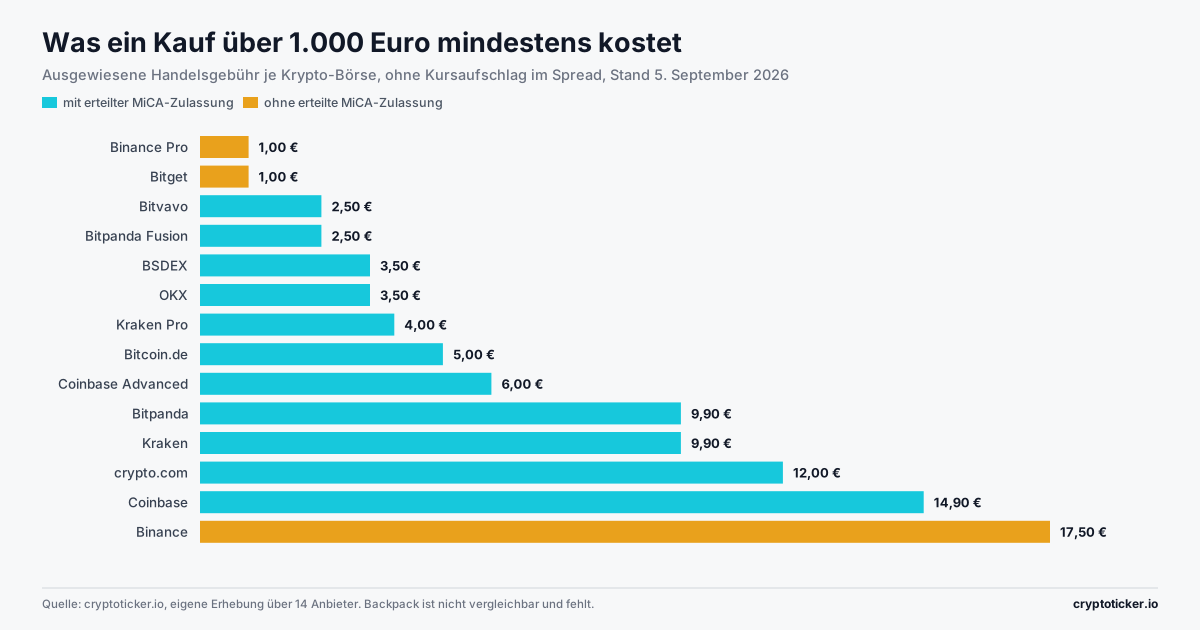
At Binance, a simple instant buy costs 1.75 percent, while trading through the pro interface costs 0.10 percent. On a purchase of 1,000 euros that is 17.50 euros against 1.00 euro, a factor of seventeen at the same provider and with the same login. The same split exists at Coinbase and Coinbase Advanced, and at Bitpanda and Bitpanda Fusion.
Anyone reading a comparison should therefore check first which of the two products it covers. A head-to-head between the simple interface of one provider and the professional interface of another compares two different things.
The most searched head-to-heads at a glance
The figures come from the respective comparison pages. The basis is a bitcoin purchase of 1,000 euros, calculated with the published trading fee. A markup in the price is not included; more on that below.
| Head-to-head | Fee, left | Fee, right | Cost per 1,000 euros | Comparison page |
|---|---|---|---|---|
| Binance Pro against eToro | 0.10 percent | 1.00 percent | 1.00 against 10.00 euros | Binance Pro vs eToro |
| Binance against Coinbase | 1.75 percent | 1.49 percent | 17.50 against 14.90 euros | Binance vs Coinbase |
| Bitpanda against Bitvavo | 0.99 percent | 0.25 percent | 9.90 against 2.50 euros | Bitpanda vs Bitvavo |
| crypto.com against OKX | 1.20 percent | 0.35 percent | 12.00 against 3.50 euros | crypto.com vs OKX |
| Revolut against Trade Republic | 1.49 percent | 0.00 percent | 14.90 against 0.00 euros | Revolut vs Trade Republic |
The last row deserves a footnote, because zero percent in fees does not mean free of charge. Where no fee is published, the provider earns on the price markup, and that markup is not disclosed. A comparison that reads the fee column alone takes this for the cheapest provider in the field.
What the fee figure does not show
The published trading fee is the part of the price a provider names voluntarily. Alongside it sit three items that appear in no price list and often add up to more.
- The price markup. The price you buy at can deviate from the market price. At providers without a published fee, that markup is the business model. From the outside it can only be measured by comparing several quotes in the same second.
- The withdrawal fee. It applies when you move coins to a wallet of your own, and it depends on the network. On the comparison pages it has a line of its own, because with small amounts it can exceed the trading fee.
- The minimum amount. It decides whether a fee tier is within your reach at all. A low percentage is of little use if the smallest possible purchase is above your budget.

The supervisory question counts too
Since MiCA, a single licensing requirement applies to crypto service providers across the European Union. For a head-to-head that has become a hard distinction, because it has nothing to do with the price and still decides whether a service is usable.
OKX holds a MiCA licence via Malta, crypto.com does too, Bitpanda is authorised in several EU states, and eToro operates under CySEC supervision. Binance withdrew its licence application with the Greek supervisor in June 2026 according to its own statement, and its BaFin application in Germany as well; which EU state is to take over instead has not been named so far. For retail investors in the EU, margin and futures products are also restricted there.
If you want to check both sides of a head-to-head on this question, the regulatory status appears on every comparison page as a line of its own, with a date. The full overview is in our comparison of regulated crypto exchanges.
Further head-to-heads that are searched for often
Beyond the five pairings above, comparisons between crypto exchanges and traditional brokers are called up most. They are the special case in which the fee does not play the leading role; what matters is whether you actually receive the coins or merely take part in their price performance.
- Bitpanda vs flatex and comdirect vs eToro: crypto provider against custodian bank
- Revolut vs Scalable Capital: two neobrokers with very different pricing models
- Bitpanda vs crypto.com and Binance vs Bitpanda: European against global providers
- Bitcoin.de vs Kraken Pro: a German marketplace against an international trading exchange
- eToro vs Plus500: two providers with a focus on derivatives
If you are after the overall picture rather than a single head-to-head, you will find it in our comparison of crypto exchanges with every provider we have assessed.
How to read a head-to-head
The order in which the lines matter depends on what you intend to do. Three typical cases, and what decides them.
- A one-off purchase left untouched: what counts is the cost per 1,000 euros and the withdrawal fee, because you move the coins to a wallet of your own in the end. The number of tradable crypto assets is a side issue.
- A monthly savings plan: what counts is the percentage, because it repeats with every instalment, along with the minimum amount. A difference of one percentage point costs around 240 euros over ten years at 200 euros a month.
- Active trading: what counts is the maker and taker model with its volume tiers, and not the entry price. Here the professional interfaces of the large providers are regularly ten times cheaper than their instant-buy variant.
One thing appears in no comparison and still decides the matter: whether you can reach your money when it counts. The providers' status pages often show withdrawal problems earlier than any news report, and a provider without a granted EU licence can restrict its offering for retail investors at any time.
Common questions about comparing exchanges
Which crypto exchange has the lowest fees?
Among the published trading fees, the professional interfaces lead the field, Binance Pro among them at 0.10 percent. Among the simple instant-buy interfaces, Bitvavo at 0.25 percent comes ahead of Bitpanda at 0.99 percent and Binance at 1.75 percent. Providers without a published fee earn on the price markup.
What is the difference between Binance and Binance Pro?
It is the same provider with the same account, but two interfaces. The instant buy costs 1.75 percent, trading through the pro view costs 0.10 percent. The same split exists at Coinbase Advanced and Bitpanda Fusion.
Can an exchange without a MiCA licence be used in Germany?
Access often remains in place, but the offering can be restricted, particularly for leveraged products. Whether and where a provider is licensed appears on every comparison page in the line on regulation.
Does it matter for tax which exchange I buy at?
Not for the amount of tax, very much so for the effort. What matters is whether the provider delivers a usable export of your transactions. The tax rules are set out in our article on crypto tax in Germany.
Why do the fees differ from the providers' own figures?
The figures here are list prices on the day of collection. Discount tiers based on trading volume, payment in a provider's own token or time-limited promotions change them. Before you open an account, the provider's price page is what counts.
Sources and status of the figures
- Fees, costs per 1,000 euros and provider figures from the CryptoTicker comparison pages, collected in September 2026
- Details on regulatory status from the providers' statements and the registers of the competent authorities
- Binance on the withdrawal of its licence application with the Greek supervisor HCMC of June 24, 2026
(As of September 10, 2026. This article is not investment advice. Prices and fee structures change; check the terms with the provider before you buy. List prices move, and the price page of the provider in question is what governs.)
The key points at a glance
- Two moments, two taxes: staking is taxed when the reward arrives and taxed again when you later sell it. Anyone thinking only about the sale is missing half the picture.
- The inflow is income from other services under Section 22(3) of the German Income Tax Act (EStG), valued at the market price at the moment it arrives and charged at your personal tax rate.
- A threshold of 256 euros a year. It is a threshold, not an allowance: one euro above it makes the entire amount taxable. It has nothing to do with the 1,000 euros under Section 23.
- Twelve months, not ten years. The extended holding period has been cleared up by the tax authorities. Every reward you receive starts a period of its own on the day it arrives.
- The market value on arrival becomes your acquisition cost. That is why a later sale is taxed only on the change in value since the inflow, and not on the whole proceeds.
Why staking is taxed twice
With staking, the most common misunderstanding concerns the number of taxes rather than their size. Two separate events take place, and for tax purposes they sit in different worlds.
The first event is the reward itself. It reaches you without you selling anything. In tax terms this is a service for which you receive a consideration: you make capital available to the network, and the network pays for it. That income belongs to the other services covered by Section 22(3) of the German Income Tax Act.
The second event is the sale of the coins you received. Section 23 applies to it, the same rule as for coins you bought: taxable within twelve months, tax-free after that.
Between the two sits a bridge that ruins a lot of calculations: the market value at the moment of the inflow is also the acquisition price for the second event. If you receive a reward worth 100 euros and sell it later for 130 euros, you pay tax once on 100 euros as other income and once on 30 euros as a capital gain. Not twice on 130.
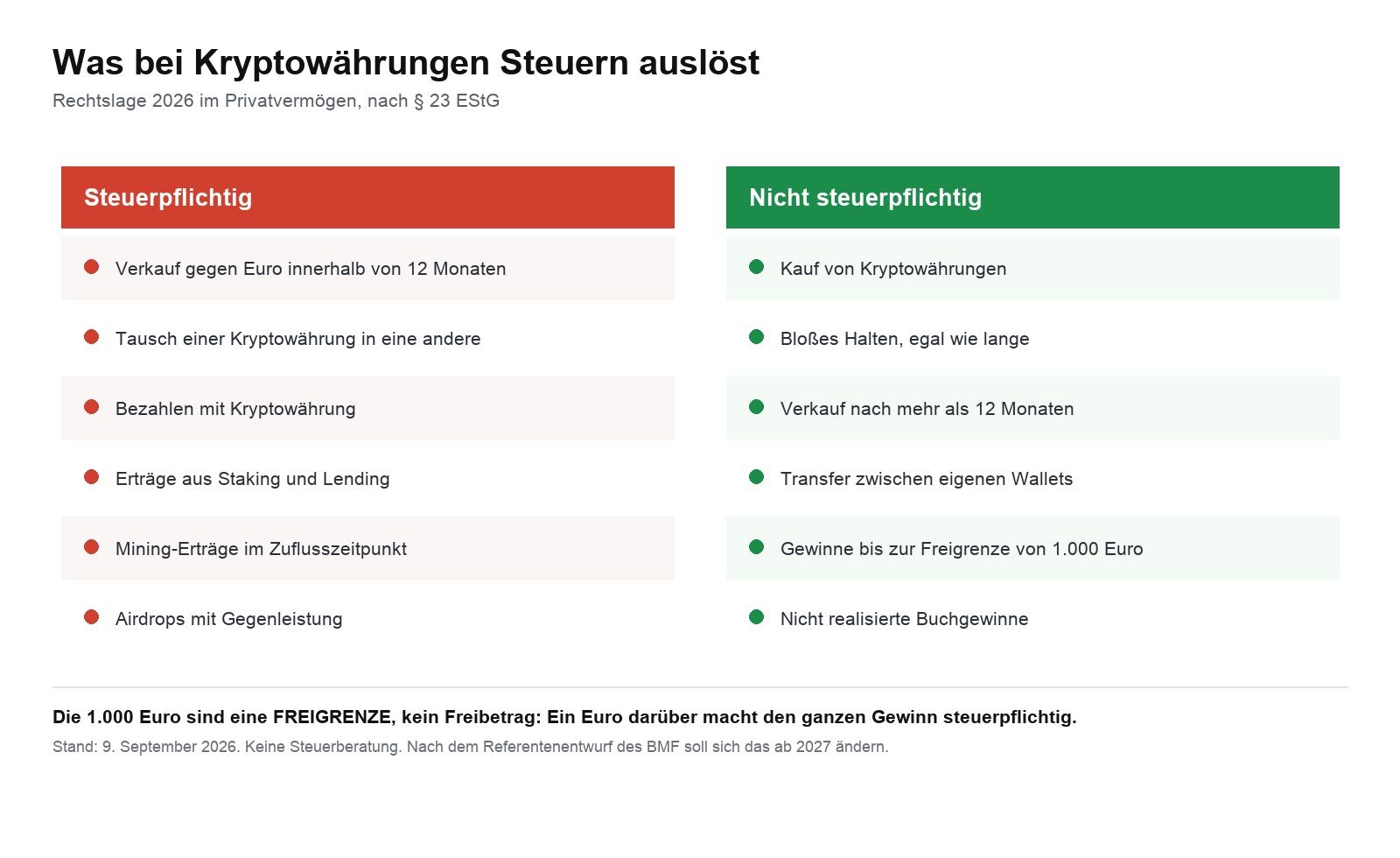
The inflow and the 256-euro threshold
What counts is the moment you can dispose of the reward. At an exchange that is the credit to your account, with your own node it is access to the address. Valuation uses the price at that moment, not the price at the end of the year and not the price when you sell.
These earnings carry a threshold of their own, 256 euros per calendar year. It is regularly confused with the 1,000-euro threshold under Section 23, yet it covers a different area and a different pot. Both are thresholds and neither is an allowance: with 255 euros of staking income you pay nothing, with 257 euros you are taxed on 257 euros.
The threshold applies to all other services in a year taken together. If you run lending alongside staking, you add both up before you compare.
Which staking event triggers what
| Event | Type of tax | Legal basis | Threshold and period |
|---|---|---|---|
| Putting coins into the stake | no taxable event | — | the twelve-month period of the staked coins keeps running |
| Reward arrives | other income | Section 22(3) EStG | threshold of 256 euros a year, market value at the moment of arrival |
| Holding the reward | no taxable event | — | its own twelve-month period from arrival |
| Selling the reward within twelve months | private disposal | Section 23 EStG | threshold of 1,000 euros, separate pot |
| Selling the reward after twelve months | tax-free | Section 23 EStG | no upper limit |
| Withdrawing the staked coins (unstaking) | no taxable event | — | not a disposal |
| Swapping the reward for another cryptocurrency | disposal and acquisition at once | Section 23 EStG | a fresh period starts for the coin you receive |
The twelve-month period in staking
Every single reward starts a period of its own on the day it arrives. Anyone collecting rewards daily accumulates three hundred and sixty-five separate deadlines over a year. That sounds impractical, and it is, but it is the legal position, and it is the reason why hardly anyone keeps track of staking without a tool.
The worry that staking stretches the holding period of the staked coins to ten years has been laid to rest. It came from an older reading of Section 23(1) no. 2 sentence 4 EStG. The tax authorities do not apply it to crypto assets. Twelve months remain the rule, for the staked coins as much as for the rewards. We have written up the dispute in detail in our comparison of the two tax models.
What applies to which kind of staking
Staking is an umbrella term for very different processes. For tax purposes they differ mainly on one point: do you receive a reward, or do you receive a different asset?
| Form | What happens for tax | Basis | What to watch |
|---|---|---|---|
| Solo staking with your own node | reward as other income | Section 22(3) EStG | at a substantial scale, business status may be examined |
| Staking through an exchange | reward as other income | Section 22(3) EStG | the inflow is the credit; the exchange report is not binding |
| Staking pool | reward as other income | Section 22(3) EStG | the pool fee reduces the inflow |
| Liquid staking with tokens such as stETH | disputed: a swap or merely a receipt | Section 23 or Section 22(3) | treated as a swap, the tax arises as soon as you enter |
| Restaking | an extra layer of rewards, same classification | Section 22(3) EStG | two reward streams, two valuations per inflow |
| Staking ETP in a securities account | investment income or disposal, depending on the structure | Section 20 or Section 23 | distributing and accumulating products are treated differently |
| Lending instead of staking | interest as other income | Section 22(3) EStG | the same threshold of 256 euros, one shared pot |
If you stake through an exchange, you should also know how its tax report is built. Which platforms deliver usable exports is set out in our comparison of crypto exchanges. We have taken apart the two tax traps that come with selling staked coins in a separate article.
Two of those rows are not conclusively settled. With liquid staking, much depends on whether the token you receive counts as an asset in its own right or merely as proof of the coins you deposited. The details are in our article on restaking and liquid staking. With exchange-traded products the structure decides, and we have written up the differences between distributing and accumulating.
A worked example with real numbers
Suppose you staked Ethereum in 2026 and received rewards worth 800 euros in total, spread across the year and each valued at the price on the day it arrived. Your personal tax rate is 30 percent.
- Step one, the inflow. 800 euros sits above the threshold of 256 euros. The taxable amount is then the full 800 euros, and not the 544 euros above the line. At 30 percent that comes to 240 euros of income tax.
- Step two, the sale. You sell the rewards after eight months for 1,100 euros in total. The acquisition cost is the 800 euros from step one. The capital gain amounts to 300 euros.
- Step three, the second threshold. The 300 euros stay below the 1,000-euro threshold under Section 23. If you had no other private disposals in the same year, this part remains tax-free.
- Result: 240 euros of tax on 1,100 euros of inflow and proceeds. Waiting twelve months would have left the same 240 euros in place, because waiting does not remove the tax on the inflow.
That last point is the practical lesson: waiting helps with the sale, not with the inflow. Anyone who stakes has a tax charge every year, even without a single sale. And that charge is in euros, while the reward sits in coins.
What you have to document
The record-keeping duty is stricter for staking than for simply buying and holding, because the tax office needs two values per event instead of one. Without records the reward cannot be valued, and an estimate rarely lands in your favour.
- Per inflow: date, time, quantity, the price at the moment of arrival and the euro amount that follows from it. The price needs a source you can name, and that source should stay the same across the year.
- Per sale: date, quantity, proceeds and the allocation showing which inflows were sold. With daily rewards this is the point where manual work ends.
- For the period: the order. If you do not fix and document which coins were sold first, you cannot prove the twelve-month period.
- Platform records: account statements and transaction overviews. They are not binding for tax purposes, but they are the evidence that the inflow happened.
How to keep that up without a spreadsheet is set out in our article on documenting staking rewards. Which tools value the inflows automatically is shown in our comparison of crypto tax tools.
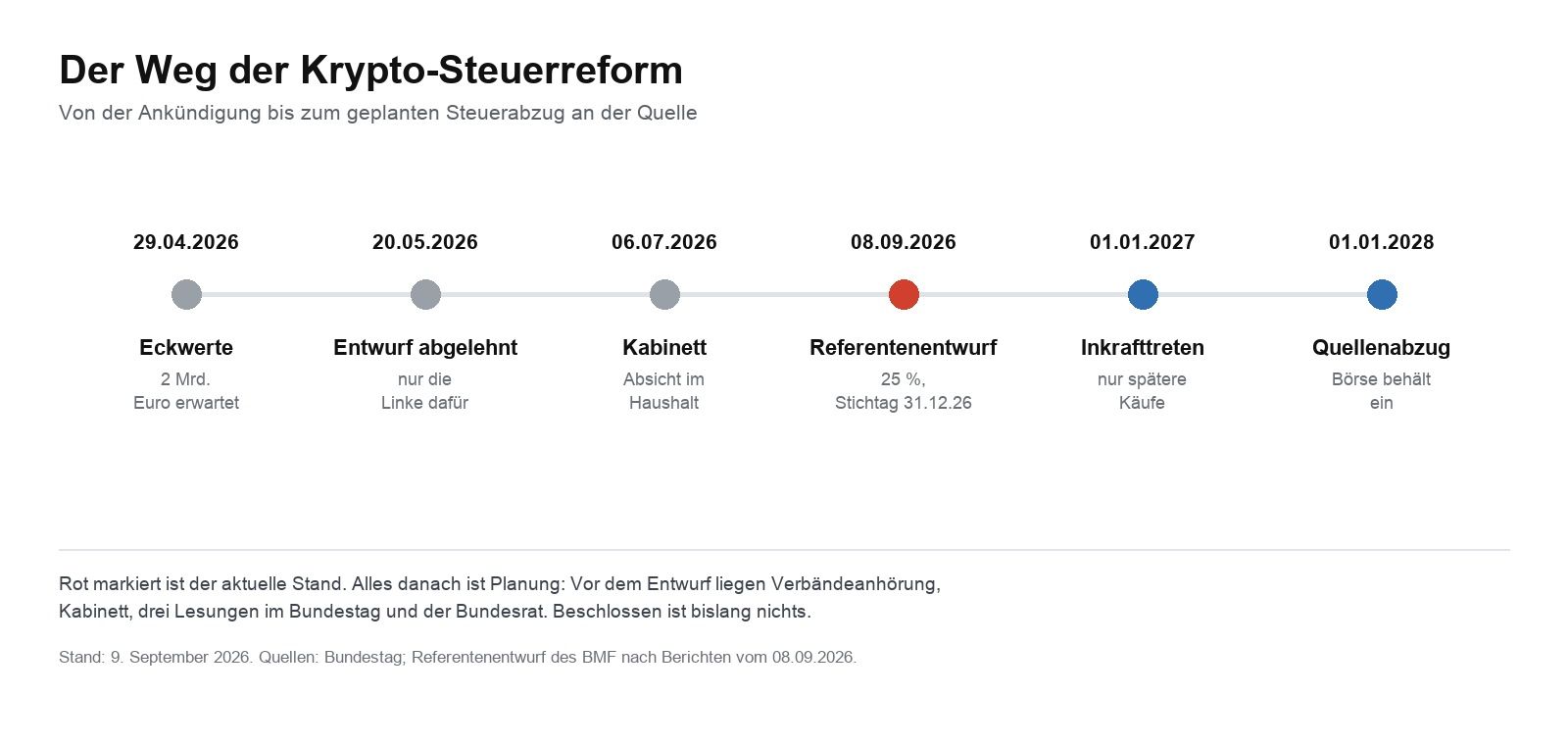
What is set to change from 2027
A ministerial draft would charge gains from the sale of crypto assets with the flat-rate withholding tax of 25 percent, for purchases made after December 31, 2026. The process is running, and no law has been enacted. The Income Tax Reform Act 2027, approved by the cabinet on September 2, 2026, contains nothing on crypto assets.
For staking, the decisive question remains open. Taxation of the inflow under Section 22(3) is left untouched in the drafts known so far. Were the flat-rate tax to arrive for disposals, stakers would face two different tax rates within one process, the personal rate on the inflow and the flat rate on the change in value. The current state of play is in our article on crypto tax in Germany.
Common questions about staking and taxes
Are staking rewards tax-free if I do not sell them?
No. The tax arises on the inflow and not on the sale. Anyone receiving rewards worth more than 256 euros in a year and selling none of them still has taxable income.
How high is the tax on staking?
Your personal income tax rate applies, so between 14 and 45 percent, plus the solidarity surcharge and church tax where they are due. The flat-rate withholding tax of 25 percent does not apply here.
Where do I enter staking income in my tax return?
In Annex SO, in the section for services. The sale of the rewards belongs in the same form, but in the section for private disposals. The details are in our article on where you enter what.
Does the threshold of 256 euros apply per coin?
No, it applies once a year to all other services taken together. Staking on three different networks plus lending gives one combined amount.
Does staking extend the holding period to ten years?
No. The tax authorities do not apply that reading to crypto assets. Twelve months remain the rule.
What happens when staked coins are sold at a loss?
Losses from private disposals can only be offset against gains from the same type of income, not against salary and not against investment income. The inflows you have already taxed are unaffected.
Do I have to list every single reward separately?
Each inflow has to be valued on its own. In the return itself the total is usually stated, while the itemised list goes into the annex as evidence. With daily rewards there is no way around it.
Sources and status
- Federal Ministry of Finance circular of March 6, 2025, on individual questions of the income tax treatment of certain crypto assets
- Federal Fiscal Court, judgment of February 14, 2023, case number IX R 3/22, on the asset status of crypto assets
- Section 22(3) and Section 23 of the German Income Tax Act
- Details of the ministerial draft based on reporting of September 8, 2026. An official full text is not available so far.
(As of September 10, 2026. This article is not investment advice. Prices and fee structures change; check the terms with the provider before you buy. It does not replace tax advice either: with liquid staking, restaking and exchange-traded products the classification is not conclusively settled, and a question to your adviser is worth the time.)
Decrypt
The hardware wallet maker said a fake security alert claimed a hardware flaw could expose users’ recovery phrases.
The Fields medalist points to a real race between OpenAI and Anthropic as proof: AI can now flatten a hard problem the moment someone starts working on it.
Crypto advocates and community bankers are targeting lawmakers in their home states as the Senate prepares for a September 15 procedural vote.
The company's first fall keynote under new leadership paired a Gemini-powered Siri overhaul with Apple's first 2-nanometer chip, plus a $1,999 foldable iPhone that won't ship until October.
Blockchain sleuths at Elliptic traced the money, Treasury sanctioned the marketplace, and Xinbi—which ran $24 billion through a Telegram scam bazaar—called the freeze unfair.
U.Today - IT, AI and Fintech Daily News for You Today
Trezor users have been hit by an unusually sophisticated phishing campaign after attackers breached a third-party email provider.
Market's main goal is extend recent recoveries, but key resistance levels and increasingly stretched momentum could determine what comes next.
U.S. Treasury Secretary Scott Bessent is urging senators to advance the CLARITY Act.
Ripple veteran David Schwartz says XRP could eventually flip Bitcoin by market capitalization.
Coinbase’s head reveals secure sub-accounts giving artificial intelligence standalone corporate banking features.
Blockonomi
Key Highlights
- The Ethereum software company will divide into two distinct entities by the conclusion of 2026
- MetaMask will become the rebrand of the current Consensys Software Inc., with Joe Lubin taking the roles of chairman and chief executive
- A restructured Consensys company will concentrate on enterprise blockchain infrastructure and Ethereum development tools
- The popular crypto wallet has exceeded 100 million installations worldwide across nearly 190 nations
- This organizational shift follows the company’s decision to postpone its public market debut amid unfavorable trading conditions
Consensys, a prominent Ethereum software development company, has announced plans to restructure its operations into two separate corporate entities before 2026 concludes. This strategic division will create distinct businesses for its popular consumer wallet product and its institutional blockchain services.
Today, MetaMask begins its next chapter as an independent company.
Consensys Software Inc., the company behind MetaMask, is rebranding as MetaMask, fully focused on the consumer platform. The protocols and institutional infrastructure businesses, including Linea, are becoming a…
— MetaMask
(@MetaMask) September 9, 2026
Under the reorganization, Consensys Software Inc., the current legal entity, will adopt the MetaMask brand name. Joe Lubin, who co-founded Ethereum, will assume the positions of chairman and chief executive officer of this consumer-focused operation.
Meanwhile, a freshly established organization will carry forward the Consensys brand. Mike Kriak will hold the CEO position, with David Cunningham as president. Lubin will maintain involvement as executive chairman of this enterprise-oriented business.
Enterprise Blockchain Infrastructure Focus
The reconstituted Consensys will consolidate development teams working on Linea, Besu, and Teku—all critical components of Ethereum’s technical ecosystem.
This entity will primarily serve financial institutions including banking organizations, investment management firms, and other traditional finance players looking to integrate blockchain capabilities. Key service areas will encompass asset tokenization, stablecoin infrastructure, and blockchain-based settlement systems.
According to the announcement, the diverging strategic objectives of these two business lines have made independent operation more practical and efficient.
MetaMask’s Evolution and Growth
Initially released in 2016 as a browser plugin for cryptocurrency management, MetaMask has evolved into a comprehensive financial platform.
The digital wallet application has surpassed 100 million installations globally across approximately 190 countries. The platform has facilitated trillions of dollars in transactions since its inception, company data shows.
This past June saw the introduction of Money Account, a feature enabling users to generate up to 4% variable annual percentage yield on deposits held in mUSD, its proprietary stablecoin, utilizing decentralized finance lending protocols.
The MetaMask Card, powered by Mastercard’s payment network, allows users to make purchases using their crypto balances. This payment solution is currently accessible throughout 49 US states and select regions in Europe, Canada, and Latin America.
Earlier in February, the platform expanded its offerings by integrating 200 tokenized securities representing US stocks, ETFs, and commodities via collaboration with Ondo Global Markets. This investment feature is accessible to qualified users residing outside US jurisdiction.
The standalone MetaMask company intends to continue its expansion into payment processing, savings products, investment opportunities, and conventional banking services.
This corporate restructuring emerges after the company postponed plans for an initial public offering. Reports indicated Consensys had enlisted JPMorgan and Goldman Sachs to manage a potential US stock exchange listing, but delayed the offering until at least this autumn citing challenging market dynamics.
The organization has not disclosed whether the IPO timeline remains valid or which of the two separated entities would proceed with a public listing.
The post Consensys Announces Corporate Split: MetaMask to Become Standalone Entity by 2026 appeared first on Blockonomi.
Key Takeaways
- The LAPTOP token debuted on Base network, reaching $190.81 within its opening minutes before plunging to $3.70 in less than sixty minutes
- Despite achieving a peak fully diluted valuation of $144 billion, the token rapidly declined with merely $48,000 in liquidity supporting it
- Prominent market makers GSR and Wintermute obtained token allocations several days prior to public availability
- Biden took to X to justify the token launch, describing LAPTOP as representing “resilience, redemption and recovery”
- The digital asset offers zero utility; founding team controls 30% of total supply with a six-month lock period
The LAPTOP memecoin associated with Hunter Biden made its debut on Base, an Ethereum layer-2 blockchain, this Wednesday. The token’s initial price of $190.81 rapidly deteriorated, falling to a low of $3.70 within sixty minutes of launch.
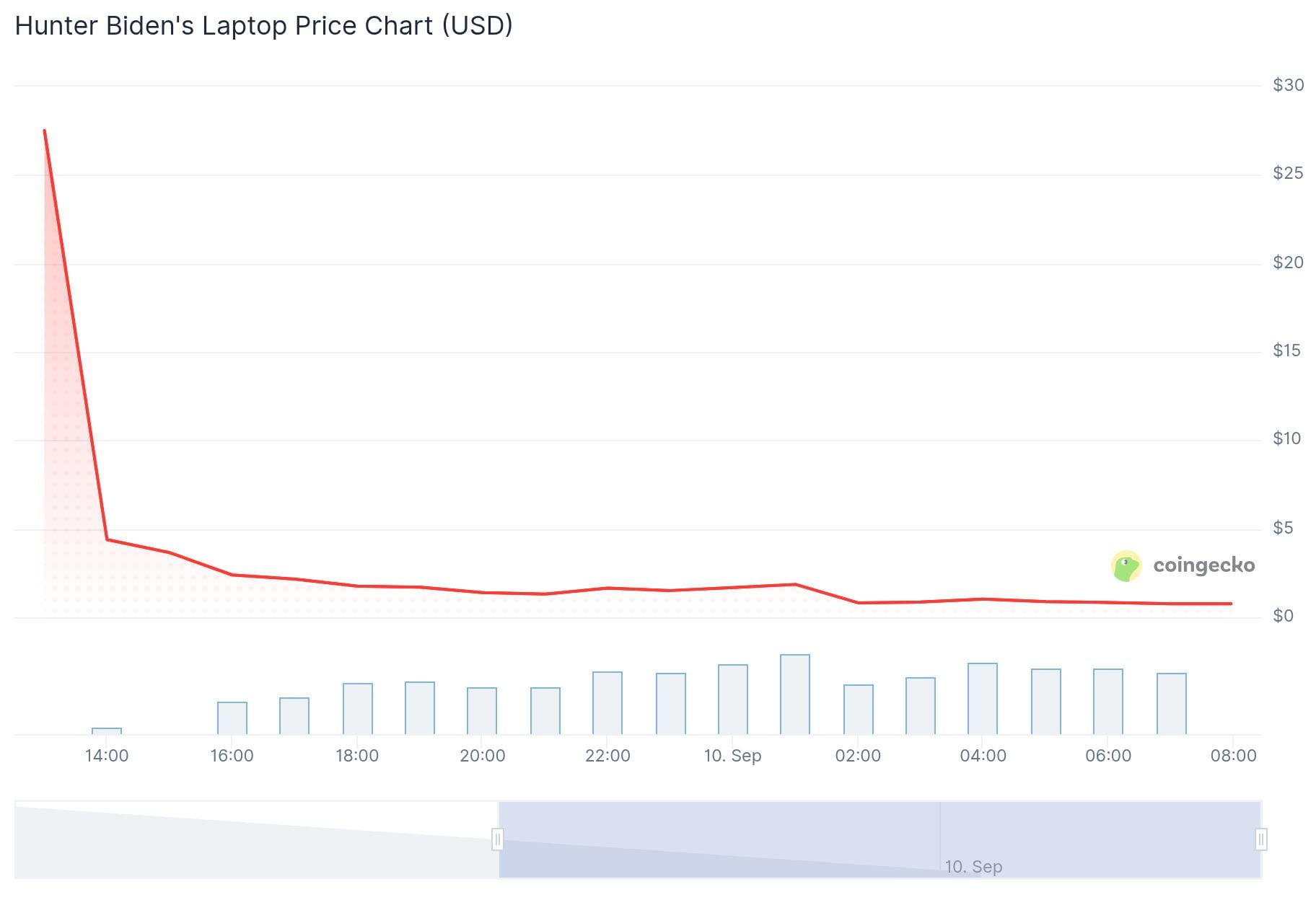
Data from CoinGecko indicated that by 3:45 PM UTC, LAPTOP was changing hands at approximately $2.10, marking a devastating 98% decline from its launch price. The initial trading hour witnessed over $13 million in volume distributed across more than 300 trading pairs.
With 350 million tokens in circulation, the asset maintained a market capitalization of roughly $1.6 billion, while its fully diluted valuation approached $4.8 billion. The liquidity pool supporting these valuations contained a mere $2.5 million.
According to blockchain analytics provider Arkham, the token’s fully diluted valuation momentarily reached $144 billion at its zenith — supported by a liquidity pool containing just $48,000.
Pre-Launch Token Allocation Revealed
Blockchain records indicate that a multisignature wallet identified by Arkham as belonging to the Laptop Token project obtained 100 million LAPTOP tokens — representing 10% of the total supply — one week prior to public availability.
Market making firm GSR obtained 15.5 million tokens four days ahead of the trading launch. Wintermute’s hot wallet contained approximately 1.8 million tokens. Token balances were also detected at deposit addresses belonging to exchanges including Bitvavo, Kraken, KuCoin and Bitpanda.
Distributing tokens to market makers before public launch represents industry standard practice. According to LAPTOP’s tokenomics structure, 20% of the supply was designated for liquidity provision and operational purposes.
Addressing criticism on X, Hunter Biden stated: “The symbol they used to try to end me is now a symbol of resilience, redemption and recovery.” He recognized widespread skepticism surrounding memecoins, characterized Trump’s token as a “grift,” and cautioned purchasers against expecting him or others to enhance the token’s value.
Official project documentation characterizes LAPTOP as a digital collectible lacking utility, ownership privileges, governance rights, or profit-sharing mechanisms. The founding team, including Biden, retains 30% of the 1 billion token supply, secured under a six-month lock followed by monthly vesting across 24 months.
Airdrop Distribution Strategy
Project organizers allocated 2% of the token supply to cryptocurrency wallets that experienced losses on the TRUMP memecoin, along with 8% designated for those subscribed to Biden’s “Where’s Hunter” Substack publication.
The TRUMP token debuted in January 2025, reaching a peak near $73 before declining to its current price of approximately $2.25 — representing a 97% drop from its all-time high. Close to one million wallets collectively sustained $3.8 billion in losses from that token.
Jesse Pollak, founder of Base, acknowledged that the LAPTOP development team reached out to his organization, though he emphasized that Base made a “conscious decision” to refrain from assisting with the token’s structure or marketing efforts.
Digital currency investigator Stephen Findeisen, operating under the Coffeezilla moniker, labeled LAPTOP a “shitcoin” and strongly advised his audience against purchasing it prior to its launch.
The token’s burning mechanism incorporates 30 conditions tied to specific outcomes, including whether LAPTOP’s market capitalization surpasses that of TRUMP — a milestone already achieved at launch, with LAPTOP at $1.6 billion compared to TRUMP’s $615 million.
The post Hunter Biden’s LAPTOP Memecoin Plummets 98% Within First Hour of Trading appeared first on Blockonomi.
Key Highlights
- StableFund represents a joint venture between Tether and Fasanara Capital, initially backed by $400 million from the two companies
- The private credit vehicle seeks to secure as much as $3 billion from institutional capital sources
- USDT stablecoin will serve as the settlement backbone for international financing operations
- Fasanara plans to distribute funds via fintech lending networks spanning over 60 nations
- Investment focus centers on SME financing and consumer credit markets
Tether, the issuer behind the world’s dominant USDT stablecoin, has joined forces with London-headquartered investment firm Fasanara Capital to introduce StableFund, a private credit initiative.
LATEST:
Tether and Fasanara Capital have launched StableFund, a private credit fund anchored by $400M that will use USDT to settle business and consumer loans through fintechs in 60+ countries. pic.twitter.com/hgUQB4rz8q
— CoinMarketCap (@CoinMarketCap) September 10, 2026
Both organizations are committing a combined $400 million as seed capital while simultaneously pursuing an additional $3 billion from external institutional backers.
Operational Framework
Fasanara will assume management responsibilities for the fund, channeling resources through its established fintech lending partnerships. Priority areas include short-duration, collateralized financing for small and medium enterprises and individual borrowers.
The initiative will maintain operations throughout more than 60 jurisdictions globally. Targeted loan categories encompass trade accounts receivable and supply chain financing solutions.
Tether’s contribution involves identifying USDT-integrated financing prospects and delivering the stablecoin technology required for seamless international capital transfers. This encompasses facilitating conversions between fiat currencies and digital dollar equivalents.
USDT will function as the underlying settlement mechanism, enabling the fund to transition flexibly between blockchain-based and traditional financial systems.
Tether’s Growing Investment Portfolio
During the second quarter of this year, Tether recorded approximately $1.5 billion in net operating earnings, predominantly derived from holdings in US Treasury securities and repurchase agreements. As of June’s conclusion, the firm disclosed $187.8 billion in total assets alongside a $4.11 billion reserve cushion.
With a market capitalization reaching $145 billion, USDT maintains its position as the leading stablecoin globally, commanding over half of the $300 billion stablecoin sector. The token sees particularly strong adoption throughout developing markets.
Tether has been strategically deploying earnings into diverse investment opportunities extending beyond its primary stablecoin operations.
Latest deployments feature a $20 million stake in Argentina’s digital banking platform Ualá, ownership positions in Mercado Bitcoin and Italian soccer franchise Juventus, plus spearheading a $50 million investment round for artificial intelligence sleep technology firm Eight Sleep this past March.
Fasanara presently oversees assets exceeding $6 billion, with specialization in private credit financing through digital lending platforms.
Paolo Ardoino, CEO of Tether, emphasized the fund capitalizes on the company’s core competencies. “Through this fund, Tether is playing the role it is best positioned to play, sourcing USDT-linked financing opportunities and providing the stablecoin infrastructure that enables seamless cross-border lending,” he stated.
StableFund operates as an evergreen structure, meaning it lacks a predetermined termination date and maintains the flexibility to accept ongoing capital contributions.
The partnership was officially announced on Wednesday, September 9, 2026.
The post Tether Launches $400M StableFund to Finance Global Private Loans with USDT appeared first on Blockonomi.
Key Takeaways
- Federal authorities have sanctioned Xinbi Guarantee, a Chinese-language digital marketplace facilitating cryptocurrency-based criminal activities
- The platform handled more than $24 billion in digital assets and traditional currency since its 2022 launch, with operations concentrated in Southeast Asia
- Federal prosecutors confiscated two digital wallets holding $12 million and obtained court orders for 47 additional wallets, bringing total seized assets beyond $52 million
- The operation had connections to North Korean cyber criminals, the Prince Group organization, and money laundering rings coordinating through Telegram
- SafeW Technology of Singapore and Anwen Technology of Cambodia received sanctions for providing technical infrastructure to Xinbi
The United States Department of the Treasury has imposed sanctions on Xinbi Guarantee, a digital marketplace implicated in orchestrating extensive cryptocurrency-related criminal schemes. Federal agencies announced the coordinated enforcement action on Wednesday.
Operating as a Chinese-language service since approximately 2022, Xinbi has facilitated transactions exceeding $24 billion, with a substantial portion conducted in digital currencies, according to the Treasury’s Office of Foreign Assets Control.
The operation allegedly enabled fraudulent call centers throughout Southeast Asia to acquire equipment and wash illicit proceeds. Federal investigators also claim it provided services to North Korean cyber operatives and organizations connected to the previously sanctioned Prince Group.
Federal Prosecutors Confiscate Digital Assets and Communication Channels
The Justice Department’s Scam Center Strike Force confiscated two cryptocurrency wallets that Xinbi utilized for collecting vendor fees. These digital wallets contained approximately $12 million in cryptocurrency.
Federal investigators additionally obtained judicial authorization to freeze 47 additional wallets associated with money laundering throughout Xinbi’s broader operational network. Combined, authorities restrained or confiscated over $52 million in digital assets.
A federal district judge granted authorization on September 7 to seize Xinbi’s Telegram communication channels. Criminal vendors exploited these channels to promote money laundering services, fraudulent investment platforms, and recruitment for forced labor scam facilities.
According to the Justice Department, stablecoin provider Tether contributed to the investigation. Blockchain analytics company Elliptic reported it assisted the U.S. Secret Service in tracing the platform’s activities.
Platform Attempted to Relocate Before Federal Intervention
Anticipating law enforcement pressure, Xinbi initiated operational changes. Beginning around June 2025, the organization migrated its merchant and money laundering networks to a secure messaging application created by Singapore-registered SafeW Technology.
Simultaneously, Xinbi introduced XinbiPay, a cryptocurrency wallet developed by Cambodia-registered Anwen Technology. Both technology companies received sanctions alongside Xinbi in Wednesday’s announcement.
According to TRM Labs Global Head of Policy Ari Redbord, following the closure of the Huione platform, Xinbi emerged as the primary escrow and liquidation service for Southeast Asian fraud operations, processing more than $36 billion overall.
Treasury Secretary Scott Bessent emphasized that Southeast Asian scam facilities defraud Americans of billions annually. He committed to continuing the department’s efforts to dismantle these criminal enterprises.
British authorities had previously sanctioned Xinbi in March, freezing its holdings and prohibiting it from accessing UK financial and commercial systems.
U.S. Attorney Jeanine Pirro noted that the task force deployed personnel to Madagascar to combat similar fraudulent operations in that region.
The sanctions freeze all U.S.-based property and interests connected to Xinbi and forbid American individuals and entities from conducting transactions with the designated organizations.
The post U.S. Treasury Dismantles Xinbi Guarantee: Inside the $24 Billion Crypto Fraud Empire appeared first on Blockonomi.
Key Takeaways
- ETH continues to hover around $2,486–$2,500, confined within a narrow corridor for more than three weeks.
- Futures open interest has failed to keep pace with price appreciation, indicating limited conviction among leveraged market participants.
- Tuesday witnessed $24.3 million in net withdrawals from US spot Ethereum ETFs.
- Primary resistance zone lies between $2,525–$2,535; breaking above could propel prices toward $2,550–$2,600.
- Critical downside levels include $2,478, $2,435–$2,445, and the stronger support zone at $2,350–$2,360.
Ethereum continues hovering around the $2,486 level as of September 9, maintaining its position just beneath the psychologically significant $2,500 threshold following an extended period of narrow-range consolidation. Price action has remained trapped between $2,431 and $2,544 without establishing a definitive directional trend.
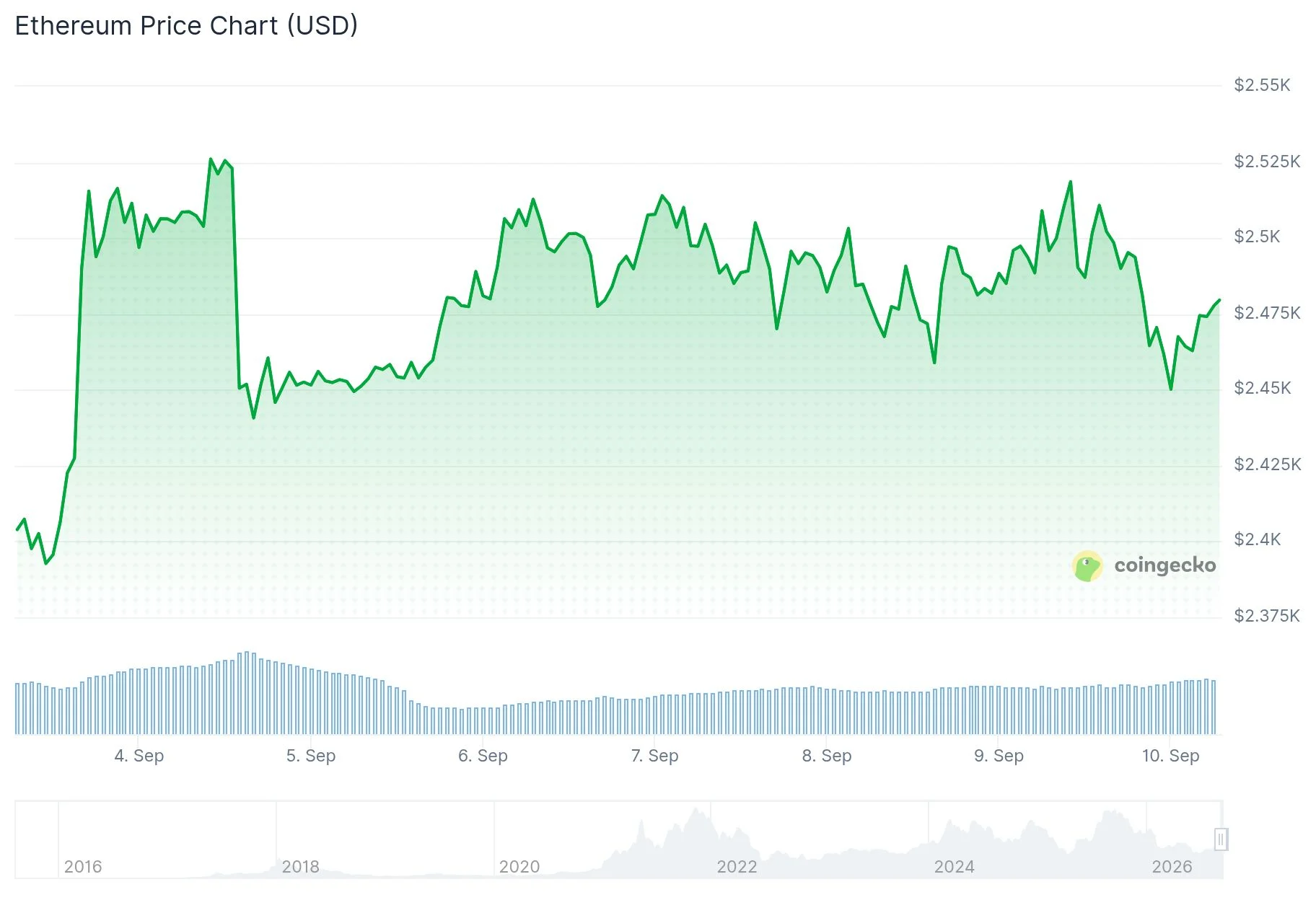
The $2,478–$2,485 region has consistently attracted buying activity, yet each upward push has encountered substantial resistance within the $2,525–$2,535 band. This overhead barrier has repeatedly rejected price advances since Ethereum’s August rally concluded.
Currently, ETH maintains its position above the 20-, 50-, 100-, and 200-day Exponential Moving Averages, suggesting the longer-term technical structure remains favorable for bulls. The 20-day EMA, positioned near $2,403, represents the nearest dynamic support level beneath current trading ranges.
The 14-day Relative Strength Index registers in the lower 60s, while the Stochastic Oscillator hovers around 62. These technical indicators point to the presence of bullish momentum, though insufficient strength to catalyze a decisive breakout attempt.
Futures Market Signals Limited Confidence
Ethereum futures open interest has declined by approximately 1 million ETH since July, despite ETH recording a 58% price gain during the same timeframe. When measured in dollar value, open interest increased 54% to reach $33.7 billion — however, price appreciation exceeding open interest growth indicates leveraged long positions are not accumulating aggressively.
Net Taker Volume across perpetual futures contracts has turned negative in recent sessions, reflecting balanced positioning between bullish and bearish derivatives traders.
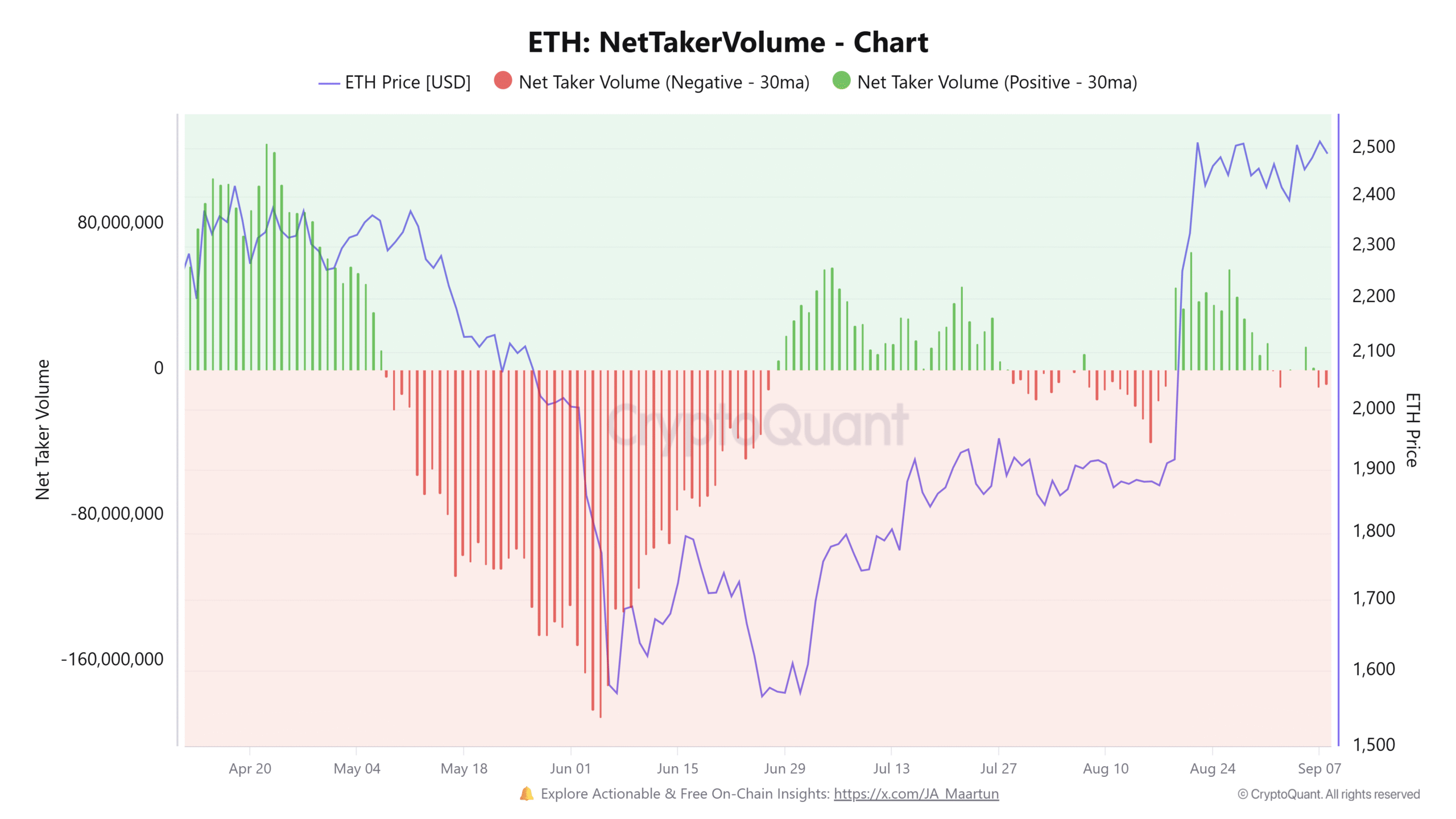
Blockchain data reveals ETH withdrawals from centralized exchanges have marginally exceeded deposits throughout the past week. This pattern suggests modest accumulation in spot markets, though the differential remains relatively minor.
US-based spot Ethereum ETFs recorded $24.3 million in net outflows on Tuesday, representing a reduction in institutional buying pressure during this consolidation phase.
Critical Price Zones Under Surveillance
Market analyst Jules highlighted the $2,478–$2,485 range as the crucial near-term pivot point, observing that multiple price bounces from this area demonstrate substantial demand. Jules commented: “Both sides have clean levels. The longer this squeeze lasts, the more the eventual break will matter.” Jules further noted that a decisive close above the $2,525–$2,535 resistance could establish a pathway toward $2,580–$2,600.
Market analyst Ted Pillows pinpointed $2,550 as a significant resistance threshold, suggesting that a robust weekly close above this level could facilitate an advance toward the $3,000 milestone.
Cryptocurrency trader Daan Crypto Trades (@DaanCrypto) shared on X that $ETH has been “chopping around in a tiny range for the past 3 weeks” and that this price compression would ultimately result in a substantial directional move. He emphasized $2,350 as the vital support level bulls must defend and $2,550 as the key resistance barrier requiring a breakout.
The CoinGlass liquidation heatmap reveals concentrated short liquidation clusters between $2,520 and $2,550, with downside liquidity pools centered near $2,430 and a more substantial accumulation zone around $2,355–$2,365.
Ethereum recorded $30.6 million in aggregate liquidations during the past 24 hours, with short positions accounting for $15.6 million of that total.
The post Ethereum (ETH) Trading Range Narrows: Two Critical Price Levels in Focus After Three-Week Stalemate appeared first on Blockonomi.
CryptoPotato
The Core Team outlined the introduction of Pi Desktop 0.6.3, carrying several important updates to SoloHost in another attempt to provide a further glimpse into the project’s plans to expand Pi Nodes far beyond blockchain validation.
In addition, the team announced a naming change as future releases will be referred to as Pi Desktop versions rather than Pi Node versions after the implementation of 0.6.3.
SoloHost Pushed Forward
SoloHost is the framework allowing Pioneers to run self-hosted applications directly from their computers. Community apps on it will now be ranked based on the number of people currently running them. According to the team, this has the potential to make the ecosystem’s most-used applications easier to find.
Developers are also getting a new “My Apps” section to manage their published products, alongside improved Docker Compose support for testing and troubleshooting.
Another introduction comes from a readiness probe designed to determine whether SoloHost apps are properly responding before they are available to users, reducing intermittent connectivity-related errors.
But perhaps the most anticipated and interesting addition from the latest batch is a new SoloHost repository specifically structured to be easily understood by AI agents. The team said this should allow AI tools to more effectively assist developers in creating such apps.
The new update also fixed an issue that could cause SoloHost login tokens to expire after Pi Desktop had been running for several days.
More Than Blockchain Infrastructure
As recently reported, Pi Network added self-hosted applications including OpenClaw and the Atlassian MCP Server, showing how Pi Desktop can be used for local AI agents and AI-integrated professional workflows. Moreover, the Core Team previously completed its first distributed-computing test through SoloHost, in which five volunteer Node operators successfully received, processed, and returned computing jobs using their own devices.
Pi has noted in the past that its longer-term goal is to enable third-party applications to tap into spare computing capacity from its network of more than 420,000 claimed Node operators, with participating Pioneers potentially receiving portions of the native token in exchange.
Although the latest update doesn’t achieve all of that, it provides another piece of infrastructure for the broader effort to transform the Pi Nodes from blockchain validators into a platform for self-hosted apps, AI, and, eventually, distributed computing.
The post Another Major Pi Network (PI) Update Is Here – What Changes for Pioneers? appeared first on CryptoPotato.
Hardware wallet maker Trezor said its third-party provider was breached and warned users that an email titled “Critical Security Alert: STM32 Entropy Vulnerability” was not sent by the company but was instead a phishing attempt.
The company urged users not to click any links.
Trezor Phishing Scam
In an update on X, Trezor said it had taken down the domain and was investigating how hackers accessed its legitimate domain. The phishing message in question attempted to convince users that a serious security flaw has been found in STM32 microcontrollers used in its devices. According to the fabricated warning, STM32 microcontrollers could generate recovery phrases without enough randomness, potentially putting users’ funds at risk. The email further claims that as many as 25% of devices may be affected.
The issue may not be limited to Trezor users, according to Casa CEO and co-founder Nick Neuman. He noted that reports of similar messages have surfaced among people using the BitBox device as well.
This isn’t the first time a third-party partner connected to Trezor has suffered a security breach. In August, the platform disclosed a similar security incident involving its logistics partner, ShipMonk, which compromised personal details tied to a large number of customers.
The exposed information included contact and delivery data. An earlier disclosure put the number of affected individuals at 13,689. However, Trezor later confirmed that roughly 67,000 additional US customers were impacted, which pushed the total to 80,689 people whose information was exposed.
Hardware Concerns
A separate security test also raised concerns about the TROPIC01 chip found in Trezor’s Safe 7 wallet. In June, Ledger’s Donjon researchers found that, with specialized equipment and physical access to a device, an attacker could interfere with the chip while it checks firmware.
The researchers used a carefully focused 1064 nm laser to trigger faults during the boot and update process. This could allow modified firmware to run. Trezor, however, said the finding does not put users’ funds at risk.
Blockchain investigator ZachXBT has been pretty blunt about hardware wallets in the past. He had earlier said that all hardware wallets are “complete garbage” and that he wouldn’t use them for important transactions or to store funds, and suggested keeping a separate iPhone just for wallet use instead.
The post Fake Trezor Warning Claims 25% of Devices Are Vulnerable in Latest Phishing Campaign appeared first on CryptoPotato.
It was less than a month ago when the US Treasury Department announced it would double the maximum size of liquidity-support buybacks for longer-dated government debt.
Bitcoin’s price reacted at the time with an immediate leg up. The Treasury now said it would triple it to $6 billion, but BTC remained flat and even dipped. So, what changed?
Same Move, Different Reaction
On August 19, the Treasury Department’s Scott Bessent unexpectedly announced that the institution would at least double liquidity-support buybacks for longer-dated government debt from $2 billion to $4 billion per operation. Financial markets reacted immediately, with BTC and gold leading the surge. Meanwhile, long-term Treasury yields dropped.
By buying older long-term Treasuries, the government was essentially attempting to improve liquidity in a bond market suffering from rapidly rising yields. Declining yields, on the other hand, typically reduce the appeal of bonds and ease financial conditions, which is a friendlier environment for bitcoin and other risk assets.
The Treasury did it again yesterday, increasing the upcoming buyback to $6 billion. However, the 10-year Treasury yield jumped to 4.85%, its highest level in almost three years. The 20-year and 30-year yields also increased to about 5.30%. In contrast, the primary cryptocurrency not only didn’t rally as it did the last time, but actually dipped below $78,000 and has barely been able to reclaim that level since.
Why No Surge?
Perhaps the most notable difference between the announcement on September 9 and August 19 was the lack of actual surprise. Treasury’s move from last month represented an unexpected policy shift, and markets repriced the possibility that it was becoming more willing to intervene as long-term borrowing costs surged. In contrast, the increase to $6 billion in buybacks doesn’t appear to be enough as Wall Street estimates had stretched toward up to $10 billion following Bessent’s comments.
In addition, the macro environment continues to deteriorate. Oil prices surged $100 as the US-Iran war continues, and inflation fears are through the roof. Last week’s strong employment data and Kevin Warsh’s hawkish stance the previous Friday have simultaneously raised expectations that the Federal Reserve could hike interest rates on September 16.
This combination is pushing yields faster than Treasury buybacks are able to push them down. The Kobeissi Letter described it as the bond market “fighting” the Treasury, warning that the 10-year yield could exceed 5% if current conditions persist. This is the key distinction for BTC, as it wasn’t exactly the Treasury buyback that sent it flying in August. Instead, it was what the announcement initially did to yields, liquidity expectations, and broader risk appetite.
The market message is quite different this time, even though the policy is similar.
The post The Same US Treasury Move Sent Bitcoin From $65K to $80K – So Why Didn’t It Work This Time? appeared first on CryptoPotato.
Consensys has announced it will separate into two independent companies, MetaMask for consumer self-custodial finance and Consensys for Ethereum (ETH) protocols and institutional infrastructure, with the split expected to close by the end of 2026.
The reorganization ends a single-company structure that has held for over a decade. MetaMask takes the self-custodial wallet, which the company says has passed 100 million downloads across roughly 190 countries and facilitated trillions of dollars in cumulative transaction volume.
MetaMask Turns to Consumer Finance
The new Consensys keeps the Protocols Group, including the Linea Layer-2 network, the Besu execution client, and Teku, along with its tokenization and stablecoin work for banks and asset managers.
Joe Lubin, who co-founded Consensys, will step in full-time as Chairman and Chief Executive Officer of MetaMask while serving as Executive Chairman of Consensys. Mike Kriak will run Consensys as Chief Executive Officer, with David Cunningham as President.
“MetaMask grew out of that work into the world’s most widely used self-custodial wallet, and today it’s becoming something larger: a platform where people don’t just hold their assets, but manage their money in its many diverse forms and aspects. Stepping into this role full-time is a recognition that consumer finance deserves the same focus and ambition that we’ve brought to building Ethereum itself,” Lubin noted.
The independent company will stay Ethereum-first while building out Money Account, a self-custodial account that combines automated earning, instant spending and one-click trading in a single balance.
The push follows MetaMask’s launch of its own dollar stablecoin, mUSD, issued through Stripe-owned Bridge, part of a move into everyday payments that includes a Mastercard-linked card. Lubin has also confirmed MetaMask will issue its own token, with a DAO planned to fund the wallet’s growth.
Consensys Keeps the Institutional Stack
Consensys will focus on the infrastructure banks and market operators use to move tokenized assets on-chain. Its Besu client already underpins permissioned EVM networks in traditional finance, and the firm set up the Swiss-based Linea Association to decentralize the Linea zkEVM network, which launched the LINEA token for governance.
“Financial institutions and market infrastructure are moving to always-on operations with tokenization at the core,” said David Cunningham, President of Consensys. “Consensys Software Inc. has built the open-source technology that is the foundation of this transition.”
Citi’s June 2026 “Tokenization 2030” report, cited in the announcement, estimated that tokenized assets could reach $5.5 trillion to $8.2 trillion by 2030. Lubin said the two companies “will keep building the same ecosystem, just with the focus each market now demands.”
The post Consensys and MetaMask to Separate Into Two Independent Companies by End of 2026 appeared first on CryptoPotato.
XRPL has pulled its Permission Delegation amendment after a bug bounty report found a high-risk flaw during testing, with a hardened V1.1 now completing security review and QA checks.
The episode shows why delegation at the protocol level needs safeguards that extend beyond the basic feature itself.
XRPL Reworks Permission Delegation After Bug Report
Permission Delegation, known as XLS-75, allows one account to give another account specific powers to act on its behalf. The permissions are meant to be narrow, rather than giving the delegate control over the entire account.
RippleX head of engineering J. Ayo Akinyele explained that the original V1.0 implementation was pulled after a vulnerability was reported through the bug bounty program before it reached the XRPL mainnet. Instead of patching that version in place, the team introduced V1.1 to separate the original implementation from the hardened release.
A researcher called Shotes found a high-severity issue involving irrevocable delegate permissions, where a delegate could delete their account and later recreate it while keeping whatever permissions it had been handed by another account, with no way for the original account to revoke them.
The changes go beyond a single bug. V1.1 addresses edge cases involving delegate identity and stops newer capabilities, including Vault and Lending operations, from being delegated unintentionally. It also fixes reserve accounting for delegated payments and closes a multi-signing route that could bypass delegation checks. Revocation behavior was tightened as well.
The review also found a medium-severity unsigned integer overflow in isDelegable, which could allow a malformed permission value to be interpreted as a delegable transaction type, although researchers said the issue had no meaningful impact without misbehavior by the delegator.
Testing Expands Across XRPL’s Delegation Surface
A QA report published by Ramkumar SG on August 26 recorded 179 dedicated Permission Delegation tests, including 112 functional tests, 48 adversarial security tests, and 19 cross-feature tests. Testing also covered interactions with Batch, Confidential MPT, the transaction queue, and multi-signing.
XRP Ledger Operations said that all findings had been fixed in V1.1 and verified by the Cantina security firm. Its QA team also reported no regressions across 5,088 tests and noted there were no open internal bugs classified as critical, concluding that the feature was ready for production use at the tested commit level.
Permission Delegation was introduced in May 2025, marked as unsupported in September 2025 pending a security fix, renamed PermissionDelegationV1_1 in October, and re-supported in June 2026.
As CryptoPotato reported last week, a public dashboard built by developer Denis Angell has been tracking how thoroughly XRPL amendments get exercised on devnet before reaching mainnet, and delegation was among the amendments it had flagged as incomplete.
For users and custody providers, the intended capability is still unchanged. As Akinyele put it, V1.1 does not change what XLS-75 can do; instead, it changes the conditions under which that capability is activated.
The post XRPL Fixes Permission Delegation After Critical Bug Found appeared first on CryptoPotato.