Cryptocurrency Posts
Crypto Briefing
Israel's reliance on Nvidia highlights the potential volatility in GDP forecasts, emphasizing the need for economic diversification and stability.
The post Israel upgrades growth forecasts, citing Nvidia’s impact appeared first on Crypto Briefing.
The Houthi attack highlights vulnerabilities in regional alliances, potentially escalating Middle East tensions and impacting global oil markets.
The post Houthi attack tests Saudi-led ‘Muslim NATO’ amid rising Middle East tensions appeared first on Crypto Briefing.
Iran's deepening economic crisis may destabilize the regime, increasing the likelihood of political upheaval and leadership changes.
The post Iran’s economic crisis deepens amid regional conflicts and fuel price hikes appeared first on Crypto Briefing.
Capital B's rise highlights growing institutional interest in regulated Bitcoin exposure, potentially reshaping Europe's financial landscape.
The post Capital B ranks 9th for trading volume on Euronext, proving Europe’s Bitcoin treasury play has legs appeared first on Crypto Briefing.
Franklin Templeton's asset growth amid Western Asset's crisis highlights resilience but underscores potential volatility in future asset flows.
The post Franklin Templeton reaches $1.8T in assets as Western Asset crisis recedes appeared first on Crypto Briefing.
Bitcoin Magazine
Bitcoin Magazine

US Treasury Secretary Scott Bessent ‘Strongly Urges’ Senate To Pass Clarity Act
U.S. Secretary of the Treasury Scott Bessent urged lawmakers to move forward with the crypto Clarity Act when they return from recess next week.
Writing on X Wednesday, Bessent said that the bill would stop “bad actors” from exploiting important digital asset tech.
Lawmakers were hoping a crucial vote on the long-awaited crypto market structure bill would go ahead in August before their five-week recess. But it was delayed and the Senate will now vote on it next week.
JUST IN: US Treasury Secretary Scott Bessent says he 'strongly urges' the Senate to pass the Clarity Act.
— Bitcoin Magazine (@BitcoinMagazine) September 9, 2026
"Failing to do so would send a troubling signal to our allies and adversaries alike that America is unwilling to lead on the future of digital assets". pic.twitter.com/dA4aIpzwYb

“When the Senate returns from August recess, I strongly urge everyone to remain at the negotiating table, agree to the motion to proceed, and continue the legislative process,” he said.
“Failing to do so would send a troubling signal to our allies and adversaries alike that America is unwilling to lead on the future of digital assets and willing to forgo enhanced national security tools to combat their misuse.”
Just in July, Bessent said lawmakers had to pass the Clarity Act if they wanted to be “on the side of American Exceptionalism” — and quoted Satoshi Nakamoto in another social media post.
“America will lead or America won’t,” he wrote at the time “It’s not more complicated than that. I believe Satoshi once said it best: ‘If you don’t believe me or don’t get it, I don’t have time to try to convince you, sorry.'”
First passed last year by the House of Representatives, the Clarity Act drafts a framework to formally divide oversight between regulators, distinguishing which digital assets are securities, commodities or stablecoins.
The digital asset industry has long been calling for such rules to be set in stone.
But the draft legislation has largely been stalled this year, mostly because the banking lobby clashed with crypto companies over paying customers stablecoin yield.
A new draft tackling the issue of ethics started circulating in July, banning government officials from promoting or making money from crypto — something Democrats have criticized President Trump’s family for doing.
Despite the changes, a group of Democrats said the bill fell short and wanted amendments.
President Donald Trump has urged lawmakers to get the legislation over the line. In August, he said that in order for the U.S. to remain the “undisputed leader in Bitcoin and crypto,” they had to pass the “very, very powerful legislation.”
This post US Treasury Secretary Scott Bessent ‘Strongly Urges’ Senate To Pass Clarity Act first appeared on Bitcoin Magazine and is written by Mathew Di Salvo.
Bitcoin Magazine
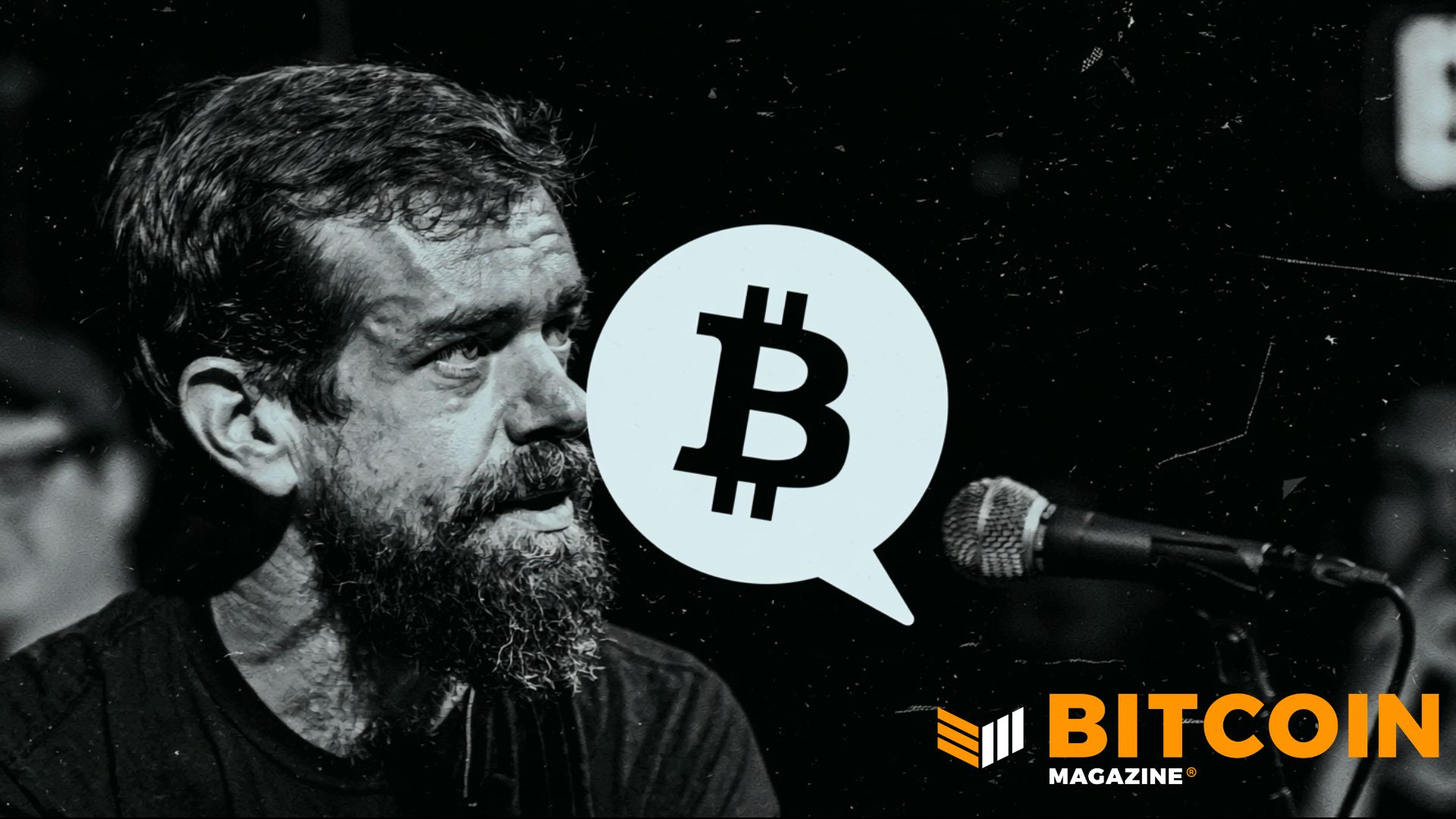
Jack Dorsey’s Block Becomes Latest Bitcoin-Focused Company To Apply for Banking Charter
Bitcoin-focused Block Inc. has become the latest company to apply for a U.S. banking charter.
The company, which manages Square, Cash App, and Bitkey, said Wednesday that it had submitted an application to the Office of the Comptroller of the Currency to establish Builders Bank & Trust, N.A.
Block joins a long-list of digital asset firms that have received conditional approval or are awaiting approval from the regulator to have the license. The charter would allow companies — if fully approved — to have certain banking powers, such as custody assets and move client funds.
JUST IN: Block applies to establish Builders Bank & Trust with the OCC, which would provide federally regulated custody and "fiduciary services" for Bitcoin and stablecoins.
— Bitcoin Magazine (@BitcoinMagazine) September 8, 2026pic.twitter.com/Dkq7WIg6Wa
“Building on Block’s experience in the digital asset space, our history with Square Financial Services, and the deep banking expertise of the team we’ve assembled, we believe Builders Bank is well positioned to support Block’s broader vision of economic empowerment,” Lee Woolley, who would serve as President and CEO of Builders Bank, said in a statement.
Block said that, if approved, Builders Bank would operate as a federally regulated national trust bank under OCC supervision and provide custody and related fiduciary services, including for bitcoin and stablecoins.
A number of top crypto companies have received conditional approval, including Coinbase, Circle, Crypto.com, and Paxos.
Decentralized financial protocol World Liberty Financial, backed by U.S. President Donald Trump, also received approval this year.
Block CEO and founder Jack Dorsey, a Bitcoin maximalist, has been pushing for the biggest and oldest cryptocurrency to become everyday money.
His point-of-sale products, Square, last year rolled out bitcoin acceptance for millions of eligible U.S. small businesses, with no setup required and transactions instantly converted to dollars at checkout.
This post Jack Dorsey’s Block Becomes Latest Bitcoin-Focused Company To Apply for Banking Charter first appeared on Bitcoin Magazine and is written by Mathew Di Salvo.
Bitcoin Magazine

Steak ‘n Shake Says Sales Grew Double Digits Since Bitcoin Adoption
Burger restaurant franchise Steak ‘n Shake has said that accepting bitcoin payments has helped the company grow.
Writing on its X account Tuesday, the Indianapolis, Indiana-based company said since accepting the largest cryptocurrency, it has achieved double-digit same-store sales growth.
It added: “And this quarter has been extraordinary, with franchise-partners same-store sales gaining 19%.”
Ever since we started accepting Bitcoin in May 2025, we have achieved double-digit same-store sales growth!
— Steak 'n Shake (@SteaknShake) September 8, 2026
And this quarter has been extraordinary, with franchise-partners same-store sales gaining 19%.
Come have a Bitcoin burger and Bitcoin shake to celebrate!
Thank…


The firm last year started accepting Bitcoin payments, using the Lightning Network to do so.
It added that it would add the cryptocurrency to its balance sheet and announced in January that it had added $10 million in Bitcoin to its strategic reserve.
Back in April, Steak ‘n Shake Chief MAHA Officer Michael Boes told attendees at the Bitcoin 2026 Conference that Bitcoin has become a core driver of the chain’s business performance.
Same-store sales rose 11% quarter over quarter in Q2 2025 and accelerated to 15% in Q3 2025, outpacing major rivals including McDonald’s, Taco Bell, and Domino’s.
He called it the highest same-store sales growth of any restaurant in the industry — and all because bitcoin on Lightning is cheaper and faster than traditional electronic payment methods.
It works like this: When customers pay with bitcoin instead of a credit card, Steak ‘n Shake saves roughly 50% on processing fees. Traditional credit card processors charge merchants between 2.5% and 3.5% per transaction.
“Bitcoin is real money made with real energy,” Boes said at the time.
The company last year also toyed with the idea of accepting other cryptocurrencies but scrapped the idea after a poll on X revealed people thought that only bitcoin was needed.
This post Steak ‘n Shake Says Sales Grew Double Digits Since Bitcoin Adoption first appeared on Bitcoin Magazine and is written by Mathew Di Salvo.
Bitcoin Magazine
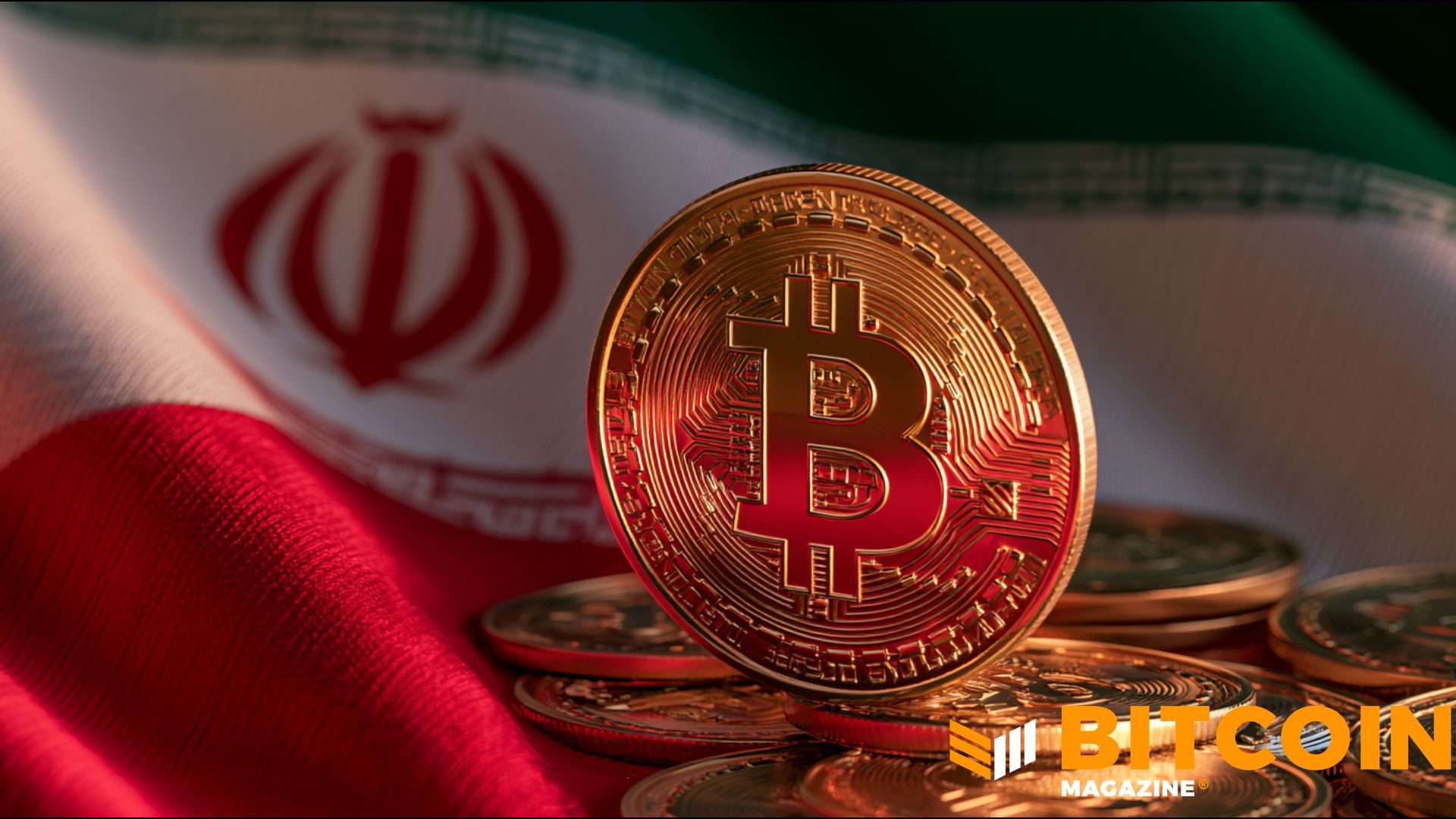
Iran Continues Using Bitcoin To Keep Economy Stable: Report
Iran is continuing to use bitcoin as a way to skirt around sanctions as the country’s central bank turns a blind eye, according to reports.
The Financial Times on Wednesday reported that the Middle Eastern country was using cryptocurrencies, including bitcoin, to settle cross-border transactions through Iranian crypto exchanges after the central bank advised its countrymen to do anything necessary to help the economy.
Citing conversations with businesses, regime insiders and analysts, the newspaper said that the central bank had “quietly encouraged traders” to get money flowing to help its struggling economy.
Bitcoin is proving to be a tried and tested way of doing so.
One business insider reportedly told the newspaper that the central bank doesn’t ask any questions about how money is transferred.
Iran has been sanctioned for decades, and a sharp escalation beginning in late 2025 — UN snapback, EU measures and expanded U.S. energy sanctions — was compounded by war with the U.S. and Israel starting in February 2026 and a naval blockade that has cut oil exports by more than 80%.
The country also has one of the highest rates of inflation in the world.
Iran started a bitcoin-backed insurance service for its counties shipping companies earlier this year.
The U.S. in July said that it had frozen crypto linked to the Iranian regime, mostly in the form of Tether’s stablecoin.
Stablecoins like Tether’s USDT can be frozen by the company that issues the asset but bitcoin, being decentralized and having no single issuer, cannot.
The U.S. Treasury’s Office of Foreign Assets Control in July said Iran had been dodging sanctions by accepting pay in bitcoin from ships passing through the Strait of Hormuz.
OFAC said at the time that Hormuz Safe, developed by Iran’s Ministry of Economy, “accepts payment in Bitcoin and other digital assets” so it can bypass sanctions.
The U.S. and Israel struck Iran in February 2026. Fighting has continued in phases since, punctuated by a Pakistan-brokered ceasefire in April and a short-lived memorandum in June.
Both ended up collapsing, and there is currently no ceasefire in place.
This post Iran Continues Using Bitcoin To Keep Economy Stable: Report first appeared on Bitcoin Magazine and is written by Mathew Di Salvo.
Bitcoin Magazine
VerifiedX Launches $15 Million Financing Round to Deploy Institutional Bitcoin Infrastructure
VerifiedX (verifiedx.io), the programmable financial operating system for Bitcoin and intelligent assets, today announced that its Foundation has launched a $15 million financing round and the first institutional investors have already invested. Initial capital will fund VerifiedX’s institutional Bitcoin distribution.
Cantor Fitzgerald is serving as VerifiedX’s investment banking partner in connection with the financing. The Foundation is not yet disclosing the identities or terms of the initial investors.
Part of the capital is allocated to expand custody relationships with partners including BitGo, the digital-asset custodian listed on the New York Stock Exchange, which will hold vBTC (VerifiedX’s Bitcoin-collateralized token) and vBTC.b (its counterpart on Base, Coinbase’s Ethereum layer-2 network). BitGo is a qualified custodian, meaning U.S. custody rules allow registered investment advisers to hold client assets there.
The capital also funds listings. Tier-one centralized exchanges will be listing vBTC and VFX, VerifiedX’s native token, with a first announcement expected within weeks. The round also supports borrow-and-lend programs: facilities that let a holder borrow against Bitcoin, or lend it out for a return, without sacrificing ownership or locking redemption rights.
“Nearly every way to put Bitcoin to work on-chain today asks the holder to swap it for someone else’s IOU. It’s the reason less than 1% of all Bitcoin held by institutions is earning any yield. vBTC is a game-changer in that regard, and this round funds the custody, exchange and lending rails that will allow institutions to use vBTC and natively turn their Bitcoin into productive financial capital,” said Brian May, a member of the VerifiedX Foundation.
With a wrapped Bitcoin token, the industry’s usual route, the holder hands Bitcoin to a custodian, or to a small group of signers acting together, and receives an off-chain representation on another network. The stand-in is only as good as whoever holds the Bitcoin behind it.
vBTC is built the other way around. When a holder creates a vBTC token, the VerifiedX network generates a unique native Bitcoin address inside each token and the holder deposits Bitcoin to their own self-custodial deposit address. The Bitcoin stays in that address, visible on Bitcoin’s own ledger and never leaves the Bitcoin ecosystem. Deposits and withdrawals are authorized by threshold signatures spread across VerifiedX’s validators, so no single party holds the key, and a holder that would rather not rely on the network’s validators can run its own and restrict signing to their own validators exclusively. The holder can redeem to native Bitcoin at any time. A holder can use vBTC for payments, trading, as collateral, in lending or in treasury. vBTC.b puts the same design on Base, so the asset can be used in applications there non-synthetically.
About VerifiedX
VerifiedX is a financial operating system for Bitcoin, intelligent, and alternative assets, enabling self-custodial ownership, instant settlement, programmable finance, native Bitcoin utility, and agentic financial infrastructure. Through products including vBTC, BFLY, and PulseXAI, VerifiedX connects institutions, users, and autonomous systems through a unified blockchain ecosystem framework.
Its ecosystem includes:
- vBTC & vBTC.b (BTC)
- BFLY payments and click to earn infrastructure
- SwitchBlade wallet technology
- PulseXAI generative and tokenized intelligence
- Institutional settlement architecture
- Consensus driven programmability
- Canonical interoperability systems
Further VerifiedX Inquiries:
Website: https://verifiedx.io/
Discord: https://discord.gg/7cd5ebDQCj
X: https://twitter.com/vfxblockchain
Github: https://github.com/verifiedxblockchain
Email: info@verifiedx.io
PulseXAI and BFLY are trademarks of VerifiedX. Copyright 2026 VerifiedX. All rights reserved.
This post VerifiedX Launches $15 Million Financing Round to Deploy Institutional Bitcoin Infrastructure first appeared on Bitcoin Magazine and is written by Bitcoin Magazine.
CryptoSlate
Paolo Ardoino offered a striking answer to a familiar U.S. debt problem: replace concentrated foreign buyers with hundreds of millions of stablecoin users.
In an Aug. 31 episode of The Wolf of All Streets, the Tether CEO said the company had created “the decentralized ownership of the US debt” through 650 million people who were “basically holding some US Treasuries.” His point was about concentration risk. Unlike a foreign government, hundreds of millions of users are unlikely to decide together to sell U.S. debt in a single morning.
The macroeconomic intuition has force. Demand for USDT gives Tether funds that it can place in a Treasury-heavy reserve portfolio. But calling token users owners of government debt collapses several different relationships into one. Tether’s own documents say users own USDT, eligible verified customers have a personal contractual right to redeem, and Tether International owns and manages the reserve assets.
The 650 million figure is also attributable to Tether, not an independently established count of Treasury investors. In an Aug. 13 audit announcement, the company said more than 650 million users across emerging markets rely on Tether daily, without publishing a methodology for that figure.
Tether’s earlier work shows why “users” needs qualification. Its 2024 methodology note treated on-chain addresses or accounts as a proxy and upper-bound estimate, acknowledging that one person can control multiple wallets. It then added estimates for people holding USDT through centralized services. Tether’s fourth-quarter 2025 report used that broad approach to estimate 534.5 million users at year-end.
Those measures are useful for estimating reach, but they do not establish 650 million unique people, 650 million current holders or 650 million customers able to redeem directly with Tether. They establish the scale Tether assigns to its network.
What USDT holders actually own
Tether’s current terms call the right to purchase or redeem tokens a personal contractual right. They also say issuance and redemption are administered by Tether and require the customer to be verified.
The company’s Relevant Information Document makes the allocation of control clearer. After a verified customer sends fiat and receives tokens, Tether says it holds or invests the funds in a basket of reserves. The composition of that basket can change at Tether’s sole discretion, and Tether says it primarily holds the assets through banks and licensed financial institutions.
Its latest Financial Figures and Reserves Report uses similarly direct accounting language. It describes the reserves as assets owned by Tether International and the issued tokens as refund liabilities recorded at their contractual redemption value.
That arrangement is not the same as owning a Treasury bill through a brokerage account or holding a beneficial interest in a fund that passes through portfolio economics. USDT holders own transferable tokens. The reserve assets sit on the issuer’s side of the structure.
| Relationship | What Tether’s documents provide |
|---|---|
| USDT holder | Ownership or control of a transferable token denominated in dollars |
| Eligible direct customer | A personal contractual right to redeem with Tether, subject to its terms |
| Reserve owner and manager | Tether International owns the assets and chooses the portfolio composition |
| Reserve investment gains | Holders are not entitled to gains above token face value |
The documents do not eliminate holder rights. They define them more narrowly. The Relevant Information Document says an eligible redemption is paid at the token’s face value in fiat, less fees. It also says holders are not entitled to increases in reserve value above face value. The income and gains from the portfolio therefore do not flow through to USDT holders merely because Treasuries back the token.
Direct access to that redemption promise is also narrower than USDT’s global circulation. Tether’s fee schedule sets a $100,000 minimum for direct acquisition or redemption. A redemption costs the greater of $1,000 or 0.1%. Applicants must complete verification, and Tether retains sole discretion to approve or reject requests to become verified customers.
The legal terms allow Tether to delay or suspend services, including redemptions, in circumstances involving suspected prohibited use, legal requirements, government directions, investigations, unauthorized access or risks that Tether considers unacceptable. Fees can change.
Holders can still sell USDT through secondary markets, subject to the rules and liquidity of the exchanges, dealers or other platforms they use. That is a market exit, however, rather than a direct exercise of the issuer contract. It may transfer the token to another buyer instead of shrinking Tether’s outstanding liabilities.
The distinction also limits what can safely be said about creditor priority. Tether’s public materials establish an issuer liability and an eligible customer’s redemption right. They do not establish one universal insolvency ranking for every secondary-market holder across every jurisdiction.
The Treasury exposure is real and large
None of this makes the reserve portfolio economically irrelevant to users. USDT’s reliability depends in part on Tether’s ability to meet its obligations, and the composition and liquidity of the reserves are central to that ability.
As of June 30, Tether International reported $187.751 billion in reserve assets against $183.642 billion in liabilities. The portfolio included $114.961 billion of direct U.S. Treasury bills.
It also reported $18.626 billion of overnight reverse-repurchase exposure, collateralized by about $18.596 billion of U.S. Treasuries. Those are distinct positions. Directly owned bills and Treasury collateral supporting a repo should not be combined and described as if they create the same legal relationship.
The scale helps explain Ardoino’s framing. Broad demand for USDT can create broad economic dependence on a company whose reserve allocation generates substantial demand for short-term government debt. Earlier CryptoSlate analysis has examined Tether’s Treasury scale and the risks embedded in U.S. debt markets and how stablecoin issuers can become marginal buyers as other holders retreat.
The ownership question is different. Tether can spread dollar access across wallets and platforms, and rising issuance can increase the pool it allocates partly to Treasuries. It does not follow that each user owns a pro rata slice of those bills, can direct their sale or receives their yield.
A more precise description is that USDT decentralizes the distribution of an issuer-mediated dollar claim. The associated funding demand is geographically dispersed. Legal title to the reserves, portfolio control and the economics above token face value remain centralized at Tether. Ardoino’s macro intuition is directionally meaningful, but the legal and economic plumbing remains issuer-mediated.
The post Paolo Ardoino says 650 million people decentralized US debt, but Tether still controls the T-bills appeared first on CryptoSlate.
Osmosis has frozen 22.65 BTC after a flaw in Nomic’s custom forwarding system allowed a double-spend that left the allBTC asset partly unbacked by Bitcoin.
allBTC is issued against a basket of Bitcoin variants held on Osmosis, including nBTC from the Nomic bridge. The official allBTC dashboard showed 110.57 allBTC in circulation and 39.84 nBTC in the basket at the reporting cutoff.
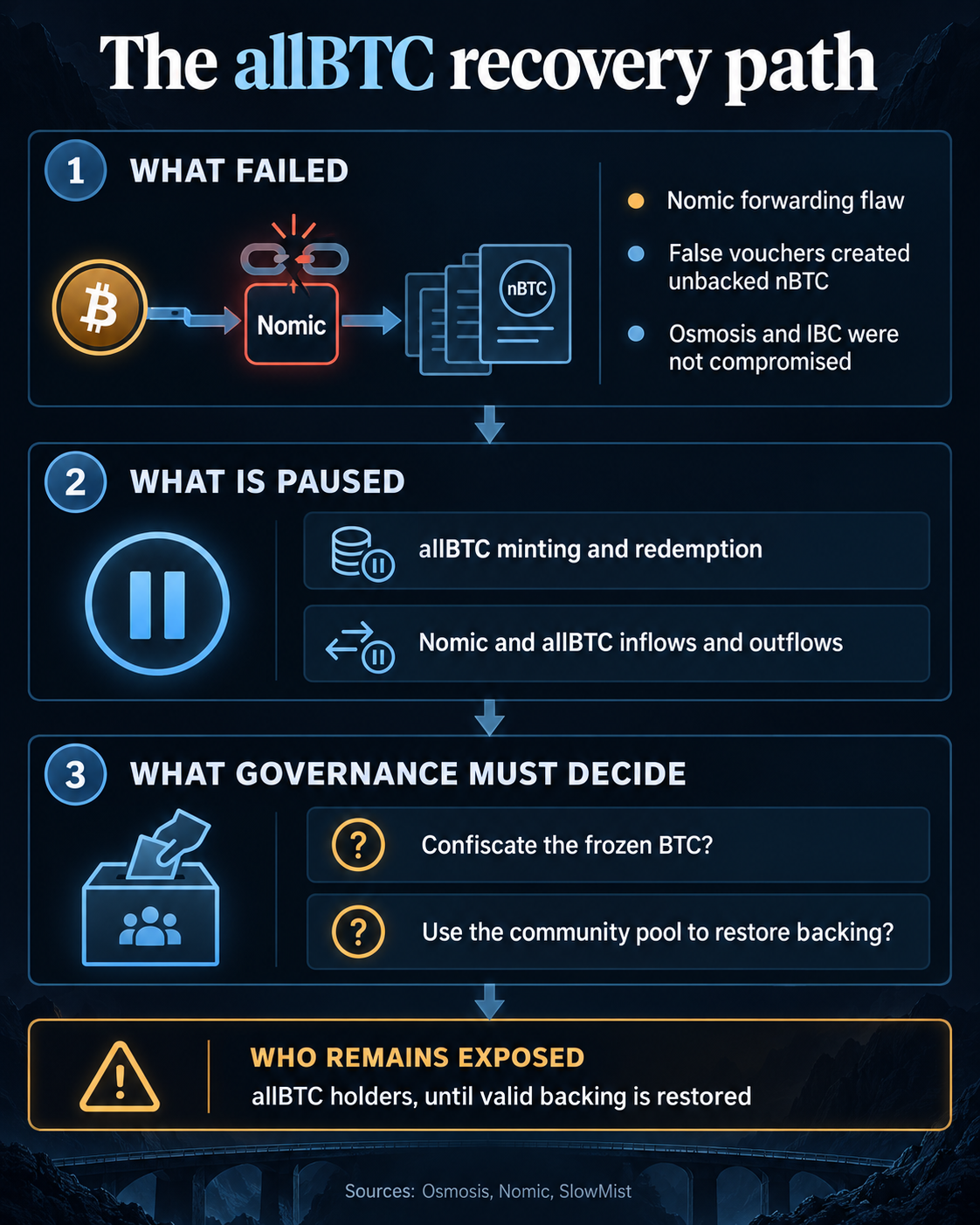
Osmosis said the nBTC was created from false vouchers, putting 36.03% of allBTC’s backing in question and leaving about 70.73 BTC-equivalent of other backing.
The statement also noted that neither its chain nor the Inter-Blockchain Communication protocol was compromised, and the bug was in Nomic’s forwarding logic.
SlowMist’s incident database also described the event as a Nomic bridge double-spend.
The public disclosure came more than two months after the apparent exploit activity. On-chain researcher Rarma traced the principal minting to June 25 and said 22.65060846 allBTC created during July 17 activity remained unmoved when the trace was published.
Nomic and allBTC inflows and outflows have been frozen, while allBTC minting and redemption are paused. Those restrictions block entry and exit through the affected functions while the backing gap remains unresolved.
Governance now carries the recovery of the Bitcoin balance
The frozen BTC has not been seized or returned to the basket. Osmosis said it plans to ask governance to confiscate the 22.65 BTC and use Bitcoin accumulated in the community pool to cover the remainder.
If governance recovers the full frozen amount, it would still need about 17.19 BTC to replace the 39.84 BTC impairment. No matching seizure or recapitalization measure appeared among the latest 20 on-chain proposals as of Sept. 9.
Osmosis governance administers the allBTC contract, while a 3-of-6 moderator subDAO can pause the pool or mark a constituent asset as corrupted. Nomic’s Bitcoin custody documentation separately says reserve disbursals require signatures representing more than 90% of its signatory set’s voting power.
Until enough valid backing is restored, allBTC holders remain collectively exposed because claims on the basket exceed its valid BTC-equivalent assets.
That does not establish a realized haircut for any holder, but redemption at full parity now depends on the governance decision and the size of any community-pool contribution.
The post Osmosis freezes 22.65 BTC after Nomic forwarding bug compromises Bitcoin reserves appeared first on CryptoSlate.
Tether is pushing USDT into the private-credit market as defaults and withdrawals strain the $3 trillion industry.
On Sept. 9, the stablecoin issuer and London-based Fasanara Capital launched StableFund with $400 million in combined sponsor capital and plans to raise up to $3 billion more from institutional investors.
Fasanara will manage the portfolio, while Tether will help originate USDT-linked financing opportunities and provide settlement and treasury infrastructure.
The expansion takes Tether beyond a crypto lending market it already dominates and closer to financing businesses and consumers in the real economy. Galaxy Research estimates that Tether controlled around 60% of the $23 billion centralized crypto-lending market at the end of June, giving it roughly $13.5 billion of outstanding secured loans.
StableFund therefore represents an attempt to extend Tether’s existing credit operation into a much larger asset class, at a time when regulators and investors are scrutinizing private credit more closely
Private credit's boom is running into a tougher test
StableFund arrives after years of rapid growth turned private lending into one of Wall Street's most sought-after businesses, but the credit cycle is becoming less forgiving.
An August Wall Street Journal analysis found worsening loan health and investor returns across publicly traded funds overseen by Ares Management, Blackstone, Blue Owl Capital and Golub Capital. Defaults at those vehicles reached their highest levels since at least 2021, while Blue Owl's default rate rose to 2.8% in the second quarter, its highest in at least five years.
Large managers have pushed back against suggestions that the deterioration signals a broader crisis, arguing that portfolio credit quality remains resilient. Default rates also remain below levels reached during more severe episodes such as the Covid-19 shock.
Still, the deterioration comes alongside redemption pressure from investors and concern about heavily indebted borrowers, including software companies facing possible disruption from artificial intelligence.
That makes the timing notable for Tether, which is entering the market with ambitions to draw billions of dollars from the same institutional capital base increasingly focused on credit quality and liquidity.
In May, the Financial Stability Board (FSB) warned that private credit has yet to be tested through a prolonged economic downturn and highlighted weaker borrower quality, high leverage, opaque valuations and growing links between private funds, banks and insurers as potential vulnerabilities. It also pointed to the rising use of payment-in-kind arrangements and rising defaults as evidence of borrower stress.
The watchdog specifically flagged the growth of funds offering redemption options, saying liquidity pressures could amplify stress when investors seek their money back.
StableFund is structured as an evergreen vehicle, allowing it to continue raising and deploying capital rather than winding down at a predetermined maturity, though Tether and Fasanara have not publicly detailed its redemption terms.
That does not mean StableFund carries the same risks already emerging elsewhere in private credit. Its strategy differs from much of the corporate direct lending highlighted in recent stress reports.
Fasanara, which manages more than $6 billion, plans to deploy the fund into short-duration, asset-backed loans across a fintech network spanning more than 60 countries. The portfolio will include financing for small and medium-sized businesses and consumers, as well as trade receivables and supply-chain credit.
Tether's share of the downside remains unclear
What separates StableFund from a conventional Fasanara vehicle is Tether's position near the front of the financing pipeline.
The USDT issuer will act as co-sponsor, originator, and adviser, sourcing opportunities linked to its stablecoin network while supplying on- and off-ramp connectivity and treasury rails.
That extends Tether beyond providing a token borrowers and lenders can use for settlement and gives it a role in identifying where capital could be deployed.
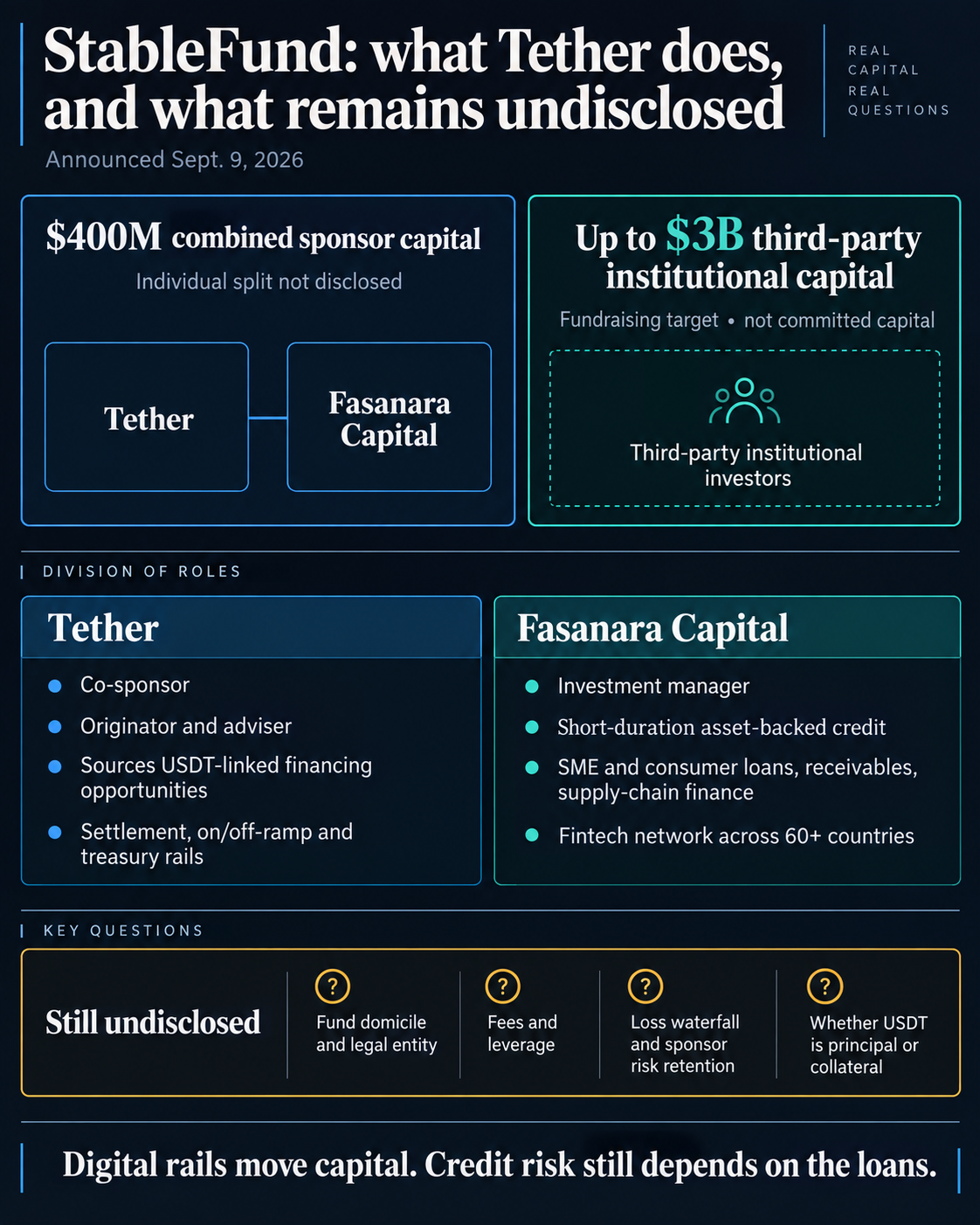
Fasanara, however, remains the investment manager with responsibility for deploying the portfolio. The announcement does not say Tether will make final underwriting decisions, nor does it establish that USDT will serve as loan principal, collateral, or the fund's denomination.
Therefore, the bigger unanswered question is how much financial risk Tether is assuming alongside that operational role.
The companies described the $400 million anchor as a joint commitment but did not divide it between the sponsors. They also did not disclose fund leverage, fees, or whether either sponsor's capital will absorb losses before money raised from third-party institutions.
Those terms become more consequential if defaults continue rising across private markets. A large junior commitment from Tether would create a different risk profile than a smaller investment alongside outside institutions on equal terms.
The post Tether is pushing USDT into a cracking $3 trillion Wall Street debt machine as defaults hit five-year highs at major funds appeared first on CryptoSlate.
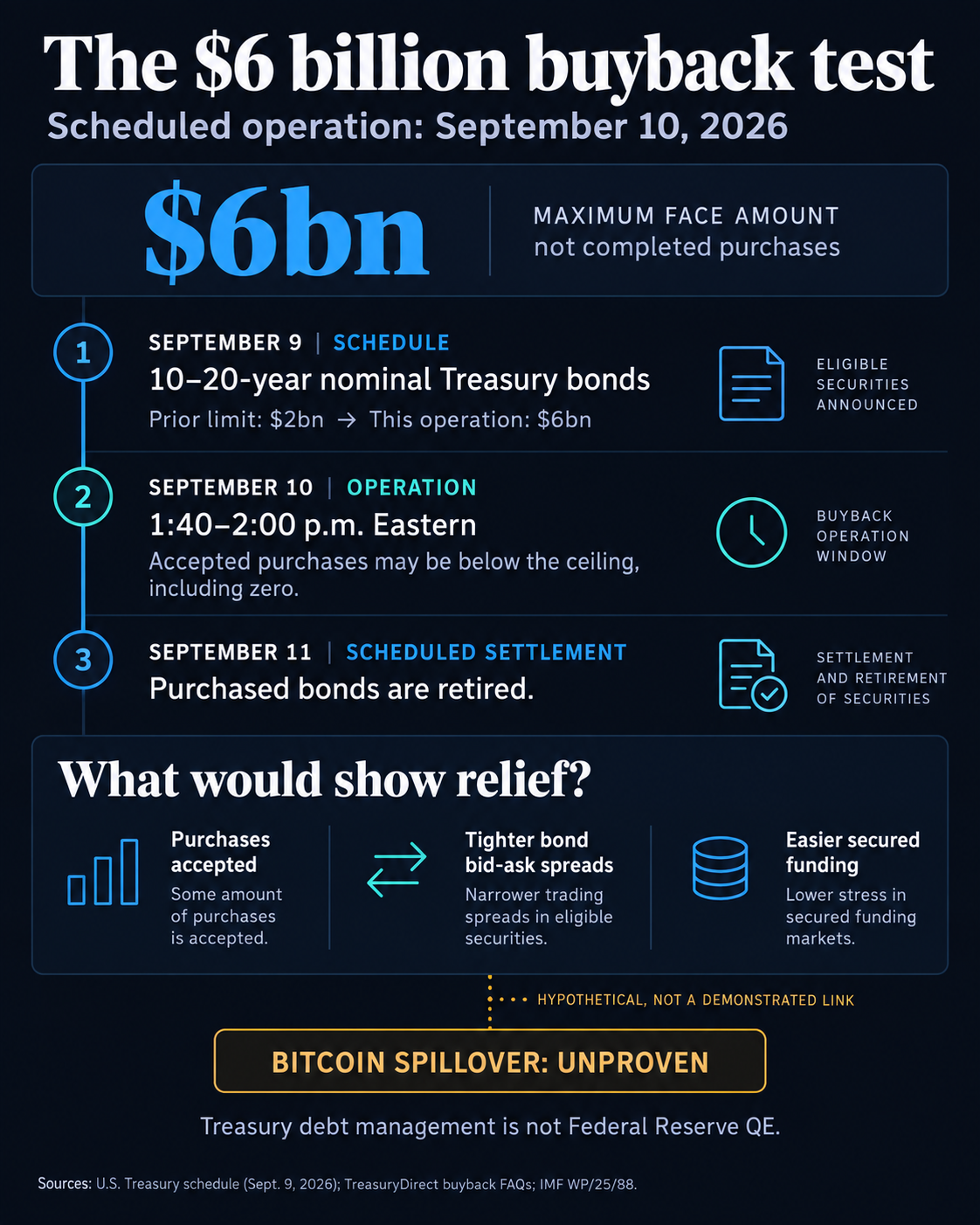
The US Treasury has set a $6 billion ceiling for a Sept. 10 buyback of older long-dated bonds, giving dealers more room to offload inventory. For Bitcoin, the question is whether that relief can extend beyond bond trading into broader financing conditions.
The tentative schedule published Sept. 9 targets nominal Treasury securities with 10 to 20 years remaining. The ceiling is triple the previous $2 billion limit and exceeds the minimum expansion Treasury announced Aug. 19, when it promised at least $4 billion in operations.
The operation is scheduled for 1:40 p.m. to 2 p.m. Eastern, with settlement on Sept. 11. Eligible maturities span Sept. 11, 2036, through Sept. 10, 2046. The final securities list is due at 11 a.m. Eastern on operation day.
Treasury’s buyback rules describe liquidity support as a predictable outlet for selling off-the-run securities, meaning older issues. This differs from cash-management buybacks, which smooth government cash balances and bill issuance.
A May 2025 IMF working paper by Jing Zhou found modest improvements in Treasury trading liquidity and reduced dealer holdings, with stronger effects when inventories were high. That suggests an outlet for older bonds can ease the burden of carrying them and make intermediation easier.
Treasury retires purchased bonds at settlement rather than lending them back into the market, so the potential benefit is less inventory for dealers to carry.
The ceiling is a maximum face amount, with no minimum purchase commitment. Treasury may accept less or nothing, depending on offers. Repurchases can use debt-sale proceeds and general-fund money, so the amount alone does not create net liquidity or constitute Federal Reserve quantitative easing.
The evidence Bitcoin’s thesis needs
A large purchase would show bonds changing hands, but it does not directly measure dealers’ remaining balance-sheet pressure. A small one would require looking at offered prices before declaring the operation ineffective.
Next comes market functioning: narrower gaps between buying and selling prices, and less strained pricing of older bonds relative to comparable newer issues. Those measures are more directly relevant to the program’s purpose than a fall in yields alone.
For Bitcoin, the hypothesis needs to be strengthened to reach broader funding conditions, including borrowing secured by securities. Easier dealer intermediation would be a plausible first link, while persistent bond or funding strain would leave that proposed relief unestablished.
The Sept. 10 accepted purchases and Sept. 11 scheduled settlement are separate milestones. The stronger signal for Bitcoin’s liquidity thesis would be sustained improvement in bond trading and funding after the operation.
The post Treasury’s $6 billion bond intervention creates a stealth test for Bitcoin’s next move appeared first on CryptoSlate.
Bitcoin’s on-chain sell-side risk has fallen to less than half its August peak, easing one measure of potential selling pressure even as a large block of older coins remains held at acquisition prices above the market.
Analytics firm Glassnode’s Sept. 9 report, using on-chain observations through Sept. 7, puts its Sell-Side Risk Ratio at 7 basis points per day on a seven-day basis, down from 16 basis points at August’s peak.
Long-term holders also accounted for 47% of realized profit, compared with 88% at the August peak. Older holders are contributing less of the market’s realized profit, although that percentage does not measure their share of all Bitcoin sales.
The Sell-Side Risk Ratio adds on-chain profits and losses and divides the total by realized capitalization. It measures value realization relative to that capital base, indicating potential selling pressure.
A ratio below half its earlier level does not mean the volume of Bitcoin sold on exchanges has halved.
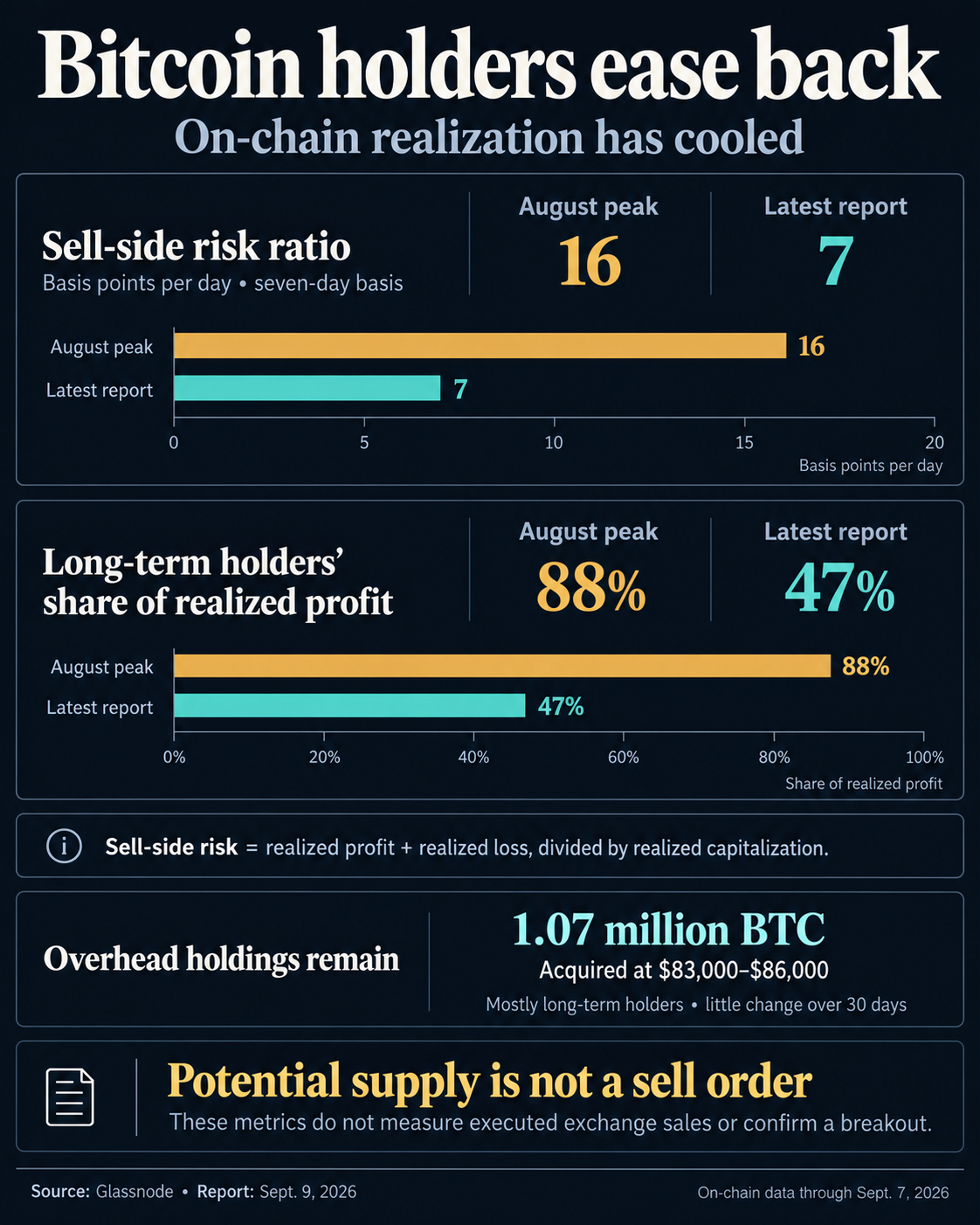
Glassnode separately reports that the realized-profit spike on Sept. 3 was less than half the size of August’s spike. That compares profit spikes, distinct from the seven-day risk measure. Together, the findings describe quieter realization and a changed mix of holders taking profits.
The report identifies roughly 1.07 million BTC acquired between $83,000 and $86,000, almost all held by long-term holders, and says that block barely changed over 30 days.
The holdings remain potential supply, while the realization data describe what holders have recently been doing.
Exchange demand is a separate test
Reports noted negative exchange spot flow in Sept. 8. Spot cumulative volume delta (CVD) remained negative despite improving, meaning aggressive exchange selling still outweighed aggressive buying in that measure.
CVD tracks the balance of executed trading, and sell-side risk tracks on-chain profit-and-loss realization relative to realized capitalization. A lower reading in the latter does not require the former to turn positive.
Bitcoin holders are realizing less profit and loss relative to the capital base, while the overhead coins remain largely in place. Treating that entire block as immediate selling pressure would overstate the evidence.
A sustained advance would still require buyers to absorb the supply that actually comes to market.
The post Bitcoin sell pressure reaches one-month low as long-term holders slow down profit taking appeared first on CryptoSlate.
CryptoTicker.io
If your LSK sits directly on the Lisk Chain or is locked up in staking there, you have to bridge it to Ethereum before October 31, 2026. Whatever is still on that chain on the day is unreachable afterwards. If your LSK is already on Ethereum or with an exchange, there is nothing for you to do at all.
That is the short answer. The longer one matters more, because it contains a date that appears in no headline. Leaving the Lisk Chain means clearing two waiting periods, and they run one after the other rather than side by side: unlocking staked tokens takes three days, and the bridge transfer to Ethereum that follows takes at least seven. Lisk therefore tells holders explicitly to start no later than ten days before the shutdown. Your actual deadline is October 21, 2026.
Coverage of the shutdown appeared at the end of August and correctly described what the company intends to do. The calculation that decides the outcome for holders does not appear in those reports. This article closes that gap. It shows which of the three possible places your tokens can sit demands which action, why the seven days cannot be shortened by any technical means, where the clock actually starts running, and what you should record for your own bookkeeping.
What Lisk shuts down on October 31, 2026 and what keeps running
Lisk is one of the oldest names in the industry. The project launched in 2016 with a network of its own, moved to a layer-2 architecture in 2024, and announced in August 2026 that it would refocus the business entirely on payment and treasury software for companies. A layer-2 chain is a network in its own right that bundles its transactions and writes the proofs for them into Ethereum; security therefore comes from Ethereum, while execution happens alongside it. That chain is now being closed.
Three things are being shut down: the Lisk Chain itself on October 31, 2026, the Lisk DAO together with its voting contracts and governance forum, and the programs running on the chain, such as the DAO fund. For development teams operating applications on the Lisk Chain, Lisk has opened a migration path together with the Celo team; it is not mandatory.
The token keeps running. LSK continues to exist, keeps its existing contract on Ethereum, and takes on the role of a loyalty point in the new business model: companies are meant to receive rewards in LSK and later pay fees with them. There is no token swap, no change to the denomination, and no new contract. Anyone holding LSK will hold the same token after October 31 as they do today, simply in a different place. Base joins Ethereum as a second main network going forward.
The pattern is a familiar one by now. We have seen it in the same form across several chains recently and summarised the general chain of actions in a separate article: Blockchain shut down: what happens to your coins and what to check now. Lisk is the most recent case in that series, and because of the staking it is the most laborious.
Exchange, Ethereum or Lisk Chain: where your LSK sits decides everything
Before you do anything, settle a single question: which network is your LSK on right now? There are three answers, and they call for completely different responses.
First, LSK on a trading platform. If your tokens sit in an account with a trading platform, there is nothing for you to do. The contract on Ethereum stays unchanged, and the burn of 100 million tokens is a single on-chain event rather than a migration, which is why existing trading pairs keep working. Lisk names Binance, OKX and Kraken as well as decentralised venues on Ethereum as places where LSK trades, and states explicitly that listings will be preserved. A residual risk remains all the same: a platform can delist a token at its own discretion at any time. If your holdings sit there, it is worth checking your platform's announcement page before you rely on the process running itself.
Second, LSK on Ethereum in your own wallet. Here, too, there is nothing to do. The contract on Ethereum carries the address 0x6033f7f88332b8db6ad452b7c6d5bb643990ae3f and remains untouched. If your wallet shows the token under the Ethereum network, you are done.
Third, LSK on the Lisk Chain or in staking. Only in this case does timing become critical. On the Lisk Chain, LSK carries a different contract address than on Ethereum, namely 0xac485391eb2d7d88253a7f1ef18c37f4242d1a24. The token uses the same address on Base, which makes the two harder to tell apart in a wallet menu. What counts is therefore the network selection in your wallet. If it says Lisk, you need to act.
The special case that affects most people: anyone staking LSK through the Lisk portal necessarily holds those tokens on the Lisk Chain. Staking and rewards continue until the shutdown day, but they do not end automatically with a repayment. Nobody sends your tokens back to you. You have to unlock them yourself and move them across yourself.
Why the bridge to Ethereum takes at least seven days
The waiting period is not an arbitrary choice by the provider but a consequence of how the chain is built. The Lisk Chain is what is known as an optimistic rollup, based on the OP Stack and part of the Optimism ecosystem. An optimistic rollup initially assumes transactions are valid and writes them to Ethereum; only afterwards does a window open in which any observer can submit a fraud proof. That window is called the challenge period and lasts seven days on practically every chain of this design.
While the window is open, a withdrawal to Ethereum is not final, and the bridge therefore does not release the tokens yet. That applies to every withdrawal through the canonical bridge, regardless of the amount and regardless of how busy or quiet the chain happens to be. Canonical means the bridge consists of the contracts that belong to the chain itself rather than the offering of a third party. Nothing shortens those seven days within the canonical bridge.

The clock on the seven days starts only at the prove step
This is where the mistake sits that actually causes people to miss the deadline. A withdrawal through a canonical bridge consists of three separate transactions, and you have to trigger all of them yourself.
- Initiate the withdrawal. You connect your wallet to the bridge, set the direction to Lisk to Ethereum, select LSK and the amount, and confirm.
- Submit the prove transaction. Roughly an hour later you return to the bridge and submit the proof for your withdrawal on Ethereum. The seven days start running at this point, not at the first step.
- Claim the withdrawal. Once the challenge period has expired you send the closing transaction and your LSK is credited on Ethereum.
Anyone who forgets the second step, or catches up on it days later, pushes the entire deadline back by exactly that much. And anyone unaware of the third step will believe after a week that the money has vanished, when it is merely waiting for a confirmation. All three steps require gas fees on both chains, so steps two and three need ether in the same wallet. Anyone holding only LSK and no ether gets stuck at the proof step, and in practice that costs more missed deadlines than any technical problem.
Unstaking LSK: a three-day wait and a penalty fee that still stands
For stakers, a second clock runs before the bridge one. Staked LSK is locked, and releasing that lock carries a waiting period of three days before you can even reach the tokens. Only then can you trigger the first bridge step.
On top of that comes a point that decides real money and that may change over the coming weeks. Lisk has put a resolution on winding up the DAO to its own community, which among other things proposes scrapping the penalty fee for early unstaking entirely. As of September 10, 2026, the official help pages still state that the fee continues to apply for now and will only fall away once the resolution has been adopted and the staking contract updated; the company says it will announce the date through its own channels.
That leaves an uncomfortable trade-off, and it is the reason this article does not offer a blanket recommendation. Unstake immediately and you may pay a fee that disappears within days. Wait, and you burn time from a window that only leaves ten days of buffer to begin with. Lisk itself advises stakers to wait for the fee to be abolished and then start straight away. What is right for you depends on the size of your holdings: with small amounts, the fee can be lower than the risk of missing the deadline.
In practice that means setting yourself a reminder for October 1. If the fee has not fallen away by then, unstake regardless. What is left of the buffer will still cover both waiting periods and one failed attempt.
How to calculate the real deadline: why October 21 is the date that counts
The arithmetic is simple, which is exactly why it stands out that nobody has written it down. Three days of waiting after unstaking, at least seven days of challenge period, ten days in total. Ten days before October 31, 2026 is October 21, 2026. A staker who starts on that day has, on paper, not a single day of buffer left.
Realistically you should start earlier. The seven days are a floor, not a promise. Network congestion on Ethereum, a forgotten prove transaction, a wallet without the ether for the gas fee, or simply a weekend in between all stretch the process out. For holders who are not staking, the same logic applies with seven days instead of ten, which puts the last possible start date at October 24.
A comparable case from our own archive shows how tight such windows become in practice: when the Harmony mainnet was shut down, the chain of actions ran along similar lines, though without the three-day staking lock. The process is documented step by step in Harmony is shutting down its mainnet. The difference with Lisk is the second waiting period, and it turns a one-week deadline into a ten-day one.
Step by step: moving LSK from the Lisk Chain to Ethereum
The full process, in the order you work through it:
- Check your holdings. Open your wallet and switch to the Lisk network. Note the amount sitting there and whether any part of it is staked.
- Prepare gas. Make sure the same wallet holds ether on Ethereum and a small amount of ether on the Lisk Chain. Without both you will come to a halt halfway through.
- Unstake. Release the lock in the Lisk portal and wait out the three-day period. Skip this step if you have not staked.
- Initiate the withdrawal through a canonical bridge. Lisk points to the bridge overview in its own portal and recommends the canonical routes there, specifically Superbridge and Lisk Bridge.
- Do not forget the prove transaction. Return roughly an hour after initiating and submit the proof. The seven days run from here.
- Claim and verify. After the challenge period, send the final transaction and check in your wallet under the Ethereum network that the full amount has arrived.
- Decide on custody. Only now does the question arise of where the tokens belong permanently. Anyone planning to hold a larger position for years is safer with a hardware wallet than with a browser extension; we have broken down the differences between the devices in our hardware wallet comparison.
What happens if you miss the deadline
Lisk leaves no doubt about this. The help page on the chain shutdown states in as many words that LSK still sitting on the Lisk Chain after October 31, 2026 becomes inaccessible and that there is no way to withdraw or recover it. There is no grace period, no application form and no customer service desk that resolves it after the fact. That is why this article insists on the arithmetic at such length.

Canonical bridge or third party: what the faster route costs
Alongside the canonical bridges there are providers that settle withdrawals from optimistic rollups in minutes rather than days. Technically these providers do not shorten the challenge period. Instead they front you the amount on Ethereum out of their own funds and collect the withdrawal themselves once the seven days are up. You pay a premium for that, and it varies with utilisation and amount.
This shortcut has a price beyond the fee: you swap the waiting period for counterparty risk. Between your deposit and the credit, your money depends on the solvency and the contract quality of a third party. For small amounts that can be a defensible trade-off when time is running short. For a position that matters to you, with six weeks left on the clock, there is no reason to take that risk.
A third option is often overlooked in discussions and is the simplest one for many people: some trading platforms accept deposits directly on the Lisk Chain. Where that works, you send the tokens there and have bypassed the bridge. Check it beforehand in the deposit menu of the platform in question, though, and never send tokens on spec to an address whose network you have not confirmed. A deposit on the wrong network is the second most common way to lose tokens for good.
What burning 100 million LSK means for the circulating supply
The winding-up resolution has a second part that concerns the token. 100 million LSK from the DAO treasury are to be burned permanently, cutting total supply from 400 million to 300 million. Around 47 million LSK are to pass to Lisk Ltd. Small residual balances in older contracts may, according to the company, remain permanently inaccessible. No further burns are planned, according to the help pages.
What that means for the price, nobody knows, and this article does not claim otherwise. What can be said is how the order of magnitude fits together. On September 10, 2026, CoinGecko data put around 233.1 million LSK in circulation at a price of roughly 0.098 euros and a market capitalisation of just under 23 million euros. The burn hits balances that had been sitting in the organisation's treasury and were not being traded at all. What it affects is future supply; the amount circulating today is untouched.
The history belongs in the picture as well: LSK reached its all-time high on January 6, 2018 at around 29 euros. Anyone who bought in back then and has left the tokens on the Lisk Chain ever since loses more than a residual value if they miss the deadline. They also lose the ability to document the loss for tax purposes at all.
What to record for your own bookkeeping
Moving between two networks creates transactions on both chains, and those turn up later in every reporting tool. Whether such a bridge transfer is to be treated as a disposal for tax purposes or as a mere relocation between your own addresses is a question of assessment that a tax adviser answers on the facts of your specific case. This article expressly does not make that call.
Regardless of that: what you do not record today, you will not reconstruct in two years, because the chain will be switched off by then and its block explorer may well have disappeared too. So note down when you unstaked, how much LSK was moved, which transaction hashes on the Lisk Chain and on Ethereum belong to it, which fees were incurred and which bridge you used. A dated screenshot of the bridge overview costs you a minute. If you want to capture this kind of activity on an ongoing basis, our overview of crypto tax tools and portfolio trackers lists the usual suspects.
One note on holding periods, because the question is bound to come up: whether a bridge transfer restarts a holding period depends on how the transaction is classified for tax purposes. That question, too, belongs in expert hands.
The three most common mistakes when a chain shuts down
The calendar mistake. The published date is read as the date to act on. In fact it is the date by which everything has to be finished. With Lisk there are ten days between the two.
The halfway mistake. The first bridge step is triggered, the confirmation appears, and the job is considered done. The prove transaction and the claim are missing, and the tokens are stuck. On a chain with a shutdown date, that is the most expensive mistake of all.
The gas mistake. The wallet holds only the token that is meant to move, but no ether for the fees on Ethereum. The process stops halfway, and topping up usually only works through a platform whose own deposit can again take days.
Checking your Lisk exposure: what to take away
- Check today which network your LSK is on. If it is on Ethereum or with a trading platform, you are done and need do nothing further. If you are tidying up your custody arrangements anyway while you are at it, our crypto exchange comparison helps you line up the terms.
- Mark October 1 as your start date if you have staked. If the penalty fee has been dropped by then, unstake immediately; if it has not, weigh the fee against the deadline risk and act anyway. For the question of where the tokens go afterwards, the hardware wallet comparison is worth a look.
- Work through the bridge in three transactions and document each one. Initiate, prove after about an hour, claim after seven days. The records belong in the same file as the rest of your evidence; which tools automate that is covered in the overview of crypto tax tools and portfolio trackers.
The evidence for all deadlines and procedures in this article comes from the company's announcement, Introducing the New Lisk, and from the official help pages on the LSK token, which describe the three-stage withdrawal route and the waiting periods in as many words.
(As of September 10, 2026. This article is not investment advice. Prices and fee structures change; check the terms with the provider before you buy.)
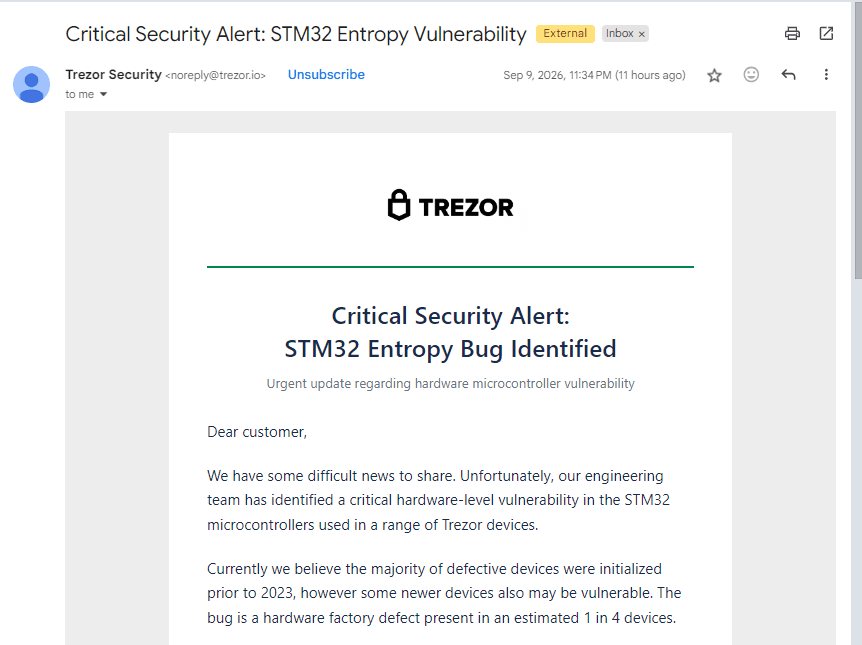
If a message titled "Critical Security Alert: STM32 Entropy Vulnerability" landed in your inbox this week, apparently from Trezor, telling you that one in four devices shipped with a defective chip and inviting you to run an entropy check in your browser, stop. Do not click anything in it. Trezor did not send it.
The company confirmed on Wednesday that attackers had gotten into its email infrastructure and used it to blast a fake security warning to customers. The email is a seed harvester dressed up as an apology, and it is one of the more convincing phishing attempts the hardware wallet space has seen in years.
What Does the Fake Trezor Security Alert Actually Claim?
The email opens with the tone of a company confessing to a disaster. It claims Trezor's engineering team found a hardware-level defect in the STM32 microcontrollers inside its devices, that the flaw was baked in at the factory, and that roughly one device in four is affected. It says the bug produces recovery phrases with as little as 40 bits of entropy, leaving seeds open to brute-force cracking.
It then does something clever. It tells the reader never to enter a recovery phrase on a website or share it with anyone. Two paragraphs later, it invites that same reader to click a link and run an "entropy check tool" that verifies BIP-39 checksums across 12, 18 and 24-word phrases, validates SLIP-39 shares, and exports extended public keys.
That contradiction is the entire scam. The warning buys credibility, then the tool collects exactly what the warning told you to protect. Anyone who works through that checker hands over enough material to drain their wallet, and in the case of an xpub export, hands over a full map of their addresses and balances even without the seed.
Why Did Trezor Users Fall For The STM32 Story?
Because a nearly identical bug was real six weeks ago, just at a different company.
Starting on 30 July 2026, attackers exploited a firmware flaw in Coinkite's Coldcard wallets. A regression shipped in March 2021 caused affected devices to generate seed phrases using a weak software randomness source instead of the hardware random number generator, cutting effective entropy from around 128 bits to as low as 40 bits on some models. Attackers drained roughly 1,816 BTC, close to 116 million dollars, from more than 5,200 addresses across four waves. Later tallies pushed the figure past 130 million dollars.
Read that against the phishing email again. Forty bits of entropy. Seeds generated before a cutoff date. Brute-force exposure. Migrate to a new seed. The scammers did not invent a threat model. They copied a documented one, swapped the brand name, and sent it to a customer list that had spent August reading about exactly this failure mode. That is why it worked on people who normally spot phishing at a glance.
How Did The Phishing Email Come From A Real Trezor Address?
This is the part that stripped away the usual defences. The message did not arrive from a lookalike domain with a swapped character. It arrived through Trezor's own legitimate sending infrastructure after attackers compromised a third-party email provider.
Trezor said it took down the domain used in the attack and is investigating how the attackers gained access to its legitimate domain. The company has said wallets, private keys and recovery backups stored on devices were never exposed. The compromise sat in the marketing pipeline, not the product.
The problem may be wider than one brand. Casa co-founder Nick Neuman said he had heard of the same campaign hitting Bitbox users and suggested a shared marketing email provider had been compromised.
What Should Trezor Owners Do Right Now?
If you only opened and read the email, nothing has happened to your funds. Delete it and move on.
If you clicked the link and entered any portion of your recovery phrase, a SLIP-39 share, or your device PIN into that page, treat the seed as burned. Generate a fresh seed on a device you trust and move everything to the new addresses immediately. Do not wait to see whether anything happens, and do not reuse the old backup for anything.
If you exported an extended public key, your funds are not directly at risk, but the attacker can now watch your balances and link your addresses. That makes you a target for follow-up scams, including phone calls and physical letters, both of which Trezor customers have already reported this year.
Going forward, the rule is unchanged and it is the only rule that matters. No legitimate wallet manufacturer will ever ask you to type your recovery phrase into a browser, for any reason, including a check that claims to protect you. Verify announcements on trezor.io or the verified Trezor account on X, and treat unexpected email as hostile regardless of what address it appears to come from.
Is This Part Of A Bigger Pattern In 2026?
It is, and the pattern is not about broken devices.
This is the third failure at a Trezor vendor in four weeks. An August incident at ShipMonk, the partner handling Trezor order fulfilment, pushed the number of exposed customers above 80,000 by early September, leaking names, phone numbers and home addresses. Trezor had already warned 66,000 users after a support portal breach in 2024, and rival SafePal leaked close to 40,000 records last month.
The hardware keeps holding. The companies sitting around the hardware, holding customer contact details, keep leaking. Combine a leaked customer list with a compromised sending domain and a real vulnerability at a competitor, and you get a phishing email that reads like the genuine article.
For anyone holding coins on a hardware wallet, the practical takeaway is that your device being secure and your data being secure are now two separate questions, and only one of them is in your hands.
Hunter Biden launched a memecoin on Wednesday morning built around the laptop that made him a political punchline, pitched it as a corrective to the political token grift, and watched it lose nearly all of its value before the first hour of trading was out. The irony was not lost on anyone.
What Is The $LAPTOP Memecoin And Why Did Hunter Biden Launch It?
$LAPTOP went live on Base, the Coinbase-built Ethereum layer 2, at 8:00 AM ET on 9 September 2026, with a fixed supply of one billion tokens.
Biden framed it as reclaiming a symbol. "They turned laptop into a weapon. I turned it into a token," he posted, while explicitly warning holders not to expect him to support the price. He pitched the project as a memecoin built around resilience, redemption and recovery, and aimed a direct shot at the incumbent political token, arguing that close to one million wallets had lost a combined 3.8 billion dollars holding $TRUMP.
The structure was unusual for a celebrity launch. Thirty percent to founders including Biden, locked for six months and vesting over two years. Twenty percent to airdrops. Ten percent to liquidity. Five percent each to a foundation treasury and to charity. And thirty percent tied to a list of public predictions, including a Democratic win in 2028, a new Bitcoin all-time high, and $LAPTOP flipping $TRUMP by market cap. Tokens tied to predictions that come true get burned. Tokens tied to predictions that fail go to charity.
On paper, that is a more thoughtful design than most political tokens get. It did not survive contact with the order book.
How Fast Did The $LAPTOP Price Actually Crash?
Very fast, and the exact numbers depend on which pool you were watching.
By one widely cited account the token fell from a high near 199 dollars to an all-time low of 1.36 dollars in 90 minutes, a 98% wipeout. Other data put the peak at 190.81 dollars with a low of 3.70 dollars inside the first hour, settling near 4.77 dollars. DEXScreener showed a spike as high as 316.75 dollars within minutes of launch, with the token near 6 dollars by midday UTC.
The valuations in that window were pure arithmetic fiction. Arkham data showed the fully diluted valuation briefly touching 144 billion dollars while the liquidity pool held around 48,000 dollars. The Block reported a peak market capitalisation near 110 billion dollars before a decline of more than 99%.
That gap is the whole story. Multiply a thin, illiquid float by a headline supply of one billion and you can print any market cap you like. It means nothing. With only 10% of supply allocated to liquidity against a 35% unlock at launch, a handful of sell orders from airdrop claimants was always going to be enough to break the price.
Did $LAPTOP Really Compensate The $TRUMP Losers?
This is where the viral framing falls apart, and it is worth correcting because it is being repeated everywhere.
The headline was "20% airdropped to people who lost money on $TRUMP." The actual breakdown is different. Of that 20%, only 2% of total supply was earmarked for traders who lost money on Trump's memecoin, distributed through partner exchanges setting their own eligibility rules. Another 8% went to subscribers of Biden's Substack as of 6 September. The remaining 10% is a discretionary later round, with timing and recipients decided by the foundation.
So the compensation slice was one tenth of what the headline implied, routed through exchanges with unpublished methodology and no confirmed claim path for a wallet that simply held $TRUMP down from its January 2025 peak. Meanwhile the largest single airdrop tranche went to Biden's own newsletter list.
The second 10% is arguably the bigger issue for anyone still holding. A discretionary, undated airdrop is not a distribution schedule, it is supply overhang that can land whenever the foundation decides.
Who Was Actually Positioned Before The Launch?
On-chain data from the first day paints an uncomfortable picture.
A multisig wallet tagged by Arkham as belonging to the project received 100 million tokens, one tenth of supply, a week before launch, and had offloaded roughly 42.5 million of them. Four days before launch, 15.5 million tokens went to market maker GSR through an intermediary address, and around 14.5 million tokens, the largest single pre-launch allocation, went to an unidentified wallet roughly two hours before trading opened.
The buyer side looked much worse. Bubblemaps found that more than 80% of wallets that bought the token were underwater after launch, over 11,500 wallets in total, and that roughly 60% of the top holders were fresh wallets funded within the previous 10 days.
None of this has been established as wrongdoing, and pre-launch allocations to market makers are standard practice. But the shape is familiar: insiders and market makers holding inventory before the open, retail buying the first green candle, and a liquidity pool far too shallow to absorb what came next.
Is This The End Of Political Memecoins?
Probably not, though the half-life keeps shrinking.
$TRUMP took months to complete its drawdown from a January 2025 peak above 73 dollars to a current level near 2.22 dollars. $LAPTOP did the equivalent in roughly the time it takes to make coffee. At least 14 copycat tokens appeared within an hour of launch across other chains, some posting absurd valuations against almost no volume, which is its own signal about who is still playing this game.
The genuinely interesting question is whether the prediction-burn mechanism does anything over time, since 30% of supply sits in a structure that either retires tokens or sends them to charity depending on real-world outcomes. That is at least a novel attempt at something other than launch-and-leave. Whether anyone is still holding by the time those events resolve is a separate matter.
For now, the lesson is the one memecoin traders keep relearning. A token that promises to fix the last grift is still a token with 10% liquidity, a 35% day-one unlock, and no mechanism that makes the price go up.
Bitcoin Loan Liquidated: The Tax Consequences of a Forced Sale in Austria
Pledging Bitcoin as collateral to raise a loan: as long as the coins merely serve as security and are not disposed of in economic terms, there is generally no Bitcoin sale yet. The picture changes once the price falls and the lender liquidates the collateral.
If the pledged Bitcoin are sold or finally realised to settle the claim, a taxable realisation event can arise in Austria. The fact that the investor did not trigger the sale voluntarily generally offers no protection from taxation. Austrian crypto rules capture sales for fiat money in particular, as well as swaps for other assets or services.
A Liquidation Can Trigger a Bitcoin Gain
An example:
- Bitcoin acquisition cost: 15,000 euros
- the Bitcoin are pledged for a loan
- the market falls
- the lender liquidates the BTC at a value of 35,000 euros
If the liquidation is treated as a disposal for tax purposes, acquisition costs of 15,000 euros are set against a realisation value of 35,000 euros.
The possible taxable gain is:
35,000 - 15,000 = 20,000 euros
Taxable new crypto assets are generally subject to the special tax rate of 27.5 percent.
Bitcoin Tax Can Arise Even Without a Payout
The awkward part is that in a liquidation the investor often receives no money in their bank account at all. The lender sells the Bitcoin and uses the proceeds directly to repay the outstanding loan debt. For tax purposes a realisation can still have occurred. What matters is not whether euros are paid out afterwards, but whether the Bitcoin were given up in economic terms in exchange for another value.
That can create an uncomfortable situation. The investor loses their Bitcoin and has to account for a taxable capital gain at the same time.
An Example With Residual Loan Debt
Assume:
- original Bitcoin purchase price: 10,000 euros
- loan: 25,000 euros
- Bitcoin value at liquidation: 40,000 euros
If Bitcoin worth 40,000 euros are realised to service the loan, a capital gain of 30,000 euros may in principle have arisen. Exactly which consideration has to be recognised for tax purposes depends on the specific contract and liquidation structure.
The Loan Terms Decide the Tax Treatment
Not every Bitcoin loan model works the same way.
The following points are particularly relevant for the tax assessment:
- Who remains the beneficial owner during the term of the loan?
- When may the lender realise the collateral?
- Are the BTC actually sold?
- Are they transferred to the lender?
- Is only part of the holding liquidated, or all of it?
- How is the liquidation value determined?
- Which amount is offset against the loan debt?
A blanket answer based on the word "liquidation" alone is therefore not enough.
A Bitcoin Capital Loss Can Arise as Well
Not every liquidation leads to a gain.
Example:
- acquisition cost: 40,000 euros
- liquidation value: 30,000 euros
In that case a realised tax loss of 10,000 euros can arise.
Provided the general conditions are met, it can be offset against certain other investment income of the same calendar year.
Documentation Matters Especially After a Liquidation
Once a liquidation has happened, investors should secure:
- the loan agreement,
- the collateral agreement,
- the liquidation statement,
- the time of realisation,
- the quantity of BTC liquidated,
- the Bitcoin price used,
- the amount of loan debt repaid,
- the original acquisition cost,
- wallet and blockchain data.
Without these details, working out the gain later can become difficult.
Conclusion
In Austria a Bitcoin liquidation can have the tax effect of a disposal. If the pledged collateral is sold or used in economic terms to repay the loan, a taxable Bitcoin gain can arise, even where the investor never wanted to sell the coins. Whether a realisation has occurred, and at what amount, depends on the specific contractual arrangement and on how the liquidation was carried out.
If you sent a transaction on the Cronos chain on August 30, 2026 between 12:38 and 14:33 UTC, it no longer exists today. Your balance stands at the value it held before that window. For most holders this is not expropriation but a complete reversal: whatever went out in that period was never debited either. There are cases, though, in which it does turn into real damage. This article shows you exactly which time window is affected, how to check your own transaction in a few minutes, and where the all-clear stops.
What happened on the Cronos chain on August 30
On September 8, 2026 the team behind Cronos published its post-mortem on the attack against the lending protocol Tectonic. A post-mortem is a project's after-the-fact investigation report into an incident. Only there do the hard numbers appear that had been missing until then.
The sequence, as the trade publication Cointelegraph relays it from the report: the attacker drove the price of the TONIC token up almost three hundred fold on thinly traded venues. A lending protocol lends out funds against posted collateral and values that collateral continuously through a price feed. That valuation is exactly where the attack landed. Against the artificially inflated collateral, the attacker borrowed $120.4 million across nine lending markets, spread over eleven transfers. The initial stake was around $5 million.
The incident was detected at 12:49 UTC, according to the report. At 14:32:47 UTC the network came to a standstill. The developers describe it as “a hard decision, taken together with the validators, weighing the finality users expect from a chain against the funds at risk”. A validator is an operator that proposes and confirms blocks; on a chain with a few dozen such operators, a coordinated agreement is technically feasible.
We described the network halt itself on August 31 in Cronos halts the chain after the Tectonic exploit. That article ended at the standstill, because the post-mortem was still outstanding at the time. This one supplies the resolution.
Which time window was erased
A block is a package of transactions that a blockchain records in fixed order. A rollback is the coordinated reset of a chain to an earlier block: everything confirmed after that point is discarded, and the chain is rebuilt onward from there.
By its own account, Cronos discarded 10,961 blocks. That amounts to one hour and 54 minutes of chain history. What matters for you is the sentence that appears in the reporting on the post-mortem: every transaction in that window was reversed, regardless of whether it had anything to do with the attack. Open positions in running applications were repriced when the chain restarted.
In terms you can orient yourself by: the reset point sits at the block carrying the timestamp August 30, 12:38:55 UTC. The standstill began at 14:32:47 UTC. Everything in between is discarded. Block production only resumed at 23:49:01 UTC the same day, a good eleven hours after the reset point.
Is your balance gone after the rollback?
In the basic case the answer is no. Your balance was reset to its state as of August 30, 12:38:55 UTC. A transfer you sent at 13:10 UTC has vanished, and with it the debit. A swap you executed at 14:00 UTC never took place, so you hold the original token again. Funds that sat at your address before 12:38:55 UTC are still sitting there unchanged.
The all-clear has edges, though, and those are the real reason for this article:
- You received a payment in that window and delivered on the strength of it. The payment no longer exists; your delivery does.
- You bridged value to another chain in that window and the counterpart arrived there. A rollback does not retrieve what has left the chain.
- You held an open, leveraged position. It was revalued at changed prices when the chain restarted.
- You deposited to an exchange in that window. A separate set of books applies there, more on which below.
- You documented a tax-relevant disposal that does not exist on today's chain. Your records then no longer match the chain.
The post-mortem names one important practical limitation itself: according to Cronos, the reversed transactions can only be traced through archived records, no longer through the public block explorers. Anyone who needs proof should therefore build it from their own documentation.

How to check your Cronos transaction in a few minutes
The check requires no expertise and no extra tooling. A block explorer is a website that makes the current contents of a blockchain searchable. Important for understanding it: it shows you the chain as it stands today, meaning the rebuilt version.
Step one: open your own address
Call up the official Cronos block explorer and enter your receiving address. You need neither connect your wallet nor enter a key. An address is a public identifier; whoever searches for it can move nothing.
Step two: narrow down the period
Look at the transaction list around August 30, 2026. The window that counts runs from 12:38:55 to 14:32:47 UTC. Convert it to your own time zone; in Central European Summer Time, two hours ahead, the window falls between roughly 14:39 and 16:33.
Step three: match up what is missing
If you find no entries in that window, your address was not affected. If you do remember a movement in that period and it is missing, then it was discarded. The funds it would have moved are back where they were before.
Step four: secure your own proof
Save the transaction hash, the unique identifier of your transfer, along with the timestamp and amount from your wallet history or from a confirmation email. These records are the only proof left to you if you have to explain to a trading counterparty, an exchange or the tax office why an event is missing from the chain.
What a rollback technically cannot retrieve
The limit of such a reset runs exactly along the chain boundary. A blockchain can rewrite only its own history. Once value has moved across a bridge to another chain, an independent and valid event sits there, out of reach of the resetting chain. A bridge is an application that transfers value from one blockchain to another by locking on one side and issuing on the other.
That is precisely what happened here. According to the post-mortem, $9.19 million had already left the chain before the halt, 7.6 percent of the affected sum. Those funds count as not recovered. Cointelegraph, citing the data service Bitquery, puts the share traced onto the Ethereum blockchain at $8.3 million. The reversal therefore undid $111.2 million and failed on the remainder.
For you as a holder, a sober rule follows: a reset protects you only as long as the event has not left the chain. How such an intervention works in principle and which cases it covers is something we described in general terms in what happens to your tokens when a chain is rolled back. The Cronos case is the first major application of that mechanism this year.
The gap is measurably present in the chain itself
You do not have to take the project's figures on trust. The event leaves an imprint that anyone can measure with a simple query. We did so on September 10, 2026 at around 00:40 UTC via the chain's public access point.
The chain ID was 25, the Cronos mainnet, and the height stood at 92,926,013 blocks. The block numbered 90,896,189 carries the timestamp August 30, 12:38:55 UTC. The block immediately following it, 90,896,190, carries the timestamp August 30, 23:49:01 UTC. Between two consecutive blocks there is thus a gap of 11 hours, 10 minutes and 6 seconds, where a few seconds would normally sit. That jump is the standstill.
The second measurement is more telling still. The block numbered 90,907,150, the height at which the chain was halted according to the report, carries the timestamp August 31, 05:59:27 UTC on today's chain. It was therefore created a good 15 hours after the attack. These block heights have demonstrably been produced anew. The branch that users saw as confirmed on August 30 has disappeared from today's chain.
Anyone wanting to check the arithmetic needs neither an account nor a subscription. Two block numbers and their timestamps are enough, and both can be retrieved from any public explorer.

If your exchange deposit fell inside the window
Trading venues keep their own books and credit a deposit once a set number of confirmations is reached. After that they post internally without consulting the chain again for every movement. If the chain is subsequently reset, a credit can be left standing without the transaction it rests on. Conversely, a withdrawal that reached you can be missing from the chain.
Stick to three sober points in that case. First: send nothing again before the position is clarified. Duplicate payments are the most common knock-on damage after an incident like this. Second: secure the transaction hash, timestamp and amount before you write to customer support. Third: compare today's position in your exchange account against your own last record from before August 30. If you buy regularly through a trading venue, our comparison of the best crypto exchanges sets out how many confirmations each provider requires for a credit.
One note on context, so that nobody draws the wrong lesson: the incident is an event of the chain, not the failure of an individual provider. An exchange that corrects a deposit after a rollback does so because the underlying booking is missing.
Finality against rescued funds: the conflict Cronos names itself
Finality is a chain's promise that a confirmed transaction will not be reversed. That promise is the reason a blockchain is fit to serve as a settlement layer at all. A rollback suspends the promise for a defined window.
What is notable is that the project names this conflict openly itself. In the passage quoted above, Cronos explicitly sets the finality users expect against the funds at risk and calls the decision a hard one. The trade-off is therefore on the record, rather than disappearing behind a success notice.
Whether a chain whose operators can roll back its history by agreement still credibly honours the promise of finality is a matter of judgement. The numbers alone cannot settle it, and this article does not settle it. What can be recorded is the verifiable fact: the intervention was possible, it was carried out, and it worked for around $111 million. Anyone deriving an expectation for future incidents from that is making their own assessment, not stating a finding.
What the case means for your own custody
The obvious lesson would be that self-custody was of no help here. That is true, and it also shows what self-custody actually protects against. Whoever holds their own keys is protected against the insolvency of a custodian and against third-party access to their account. No key protects against a rule change on the chain the value sits on, because the key proves only entitlement, not the state of the chain.
Two things follow in practice. For one, it is worth not leaving larger holdings permanently on a single chain with a manageable circle of operators. For another, your own bookkeeping counts for more than many assume: transaction hashes, timestamps and wallet statements are the only proof that survives an intervention like this. If you keep your keys separate from your everyday device, our hardware wallet comparison sets out the differences between the devices.
And one more point that gets lost in the excitement: after a network halt the chain is unreliable for hours. Time-critical payments over a chain that has just been stopped are an avoidable risk in the first days afterwards.
Checking the Cronos rollback: what to take away
- Check first whether you are affected at all. Open your address in the explorer and see whether any entries sit in the window from August 30, 12:38:55 to 14:32:47 UTC. If you deposited to a trading venue during that time, reconcile the position there against your own record; which providers require how many confirmations is set out in the exchange comparison.
- Secure your records before you do anything else. Transaction hash, timestamp and amount from your wallet history are the only proof after a reset, because the discarded events no longer appear in the public explorers. Where your keys, and with them your history, sit most safely is shown by the hardware wallet comparison.
- Spread larger holdings across more than one chain. The incident shows that the risk does not sit only with the custodian but in the chain itself. Which wallet cleanly runs several networks side by side, and where the day-to-day differences lie, is set out in the software wallet comparison.
(As of September 10, 2026. This article is not investment advice. Prices and fee structures change; check the terms with the provider before you buy.)
Decrypt
Buterin wants EIP-8288 in I-star, the upgrade after Hegota, and adopting it would make RISC-V Ethereum's canonical instruction set.
The hardware wallet maker said a fake security alert claimed a hardware flaw could expose users’ recovery phrases.
The Fields medalist points to a real race between OpenAI and Anthropic as proof: AI can now flatten a hard problem the moment someone starts working on it.
Crypto advocates and community bankers are targeting lawmakers in their home states as the Senate prepares for a September 15 procedural vote.
The company's first fall keynote under new leadership paired a Gemini-powered Siri overhaul with Apple's first 2-nanometer chip, plus a $1,999 foldable iPhone that won't ship until October.
U.Today - IT, AI and Fintech Daily News for You Today
Despite the strong technical signal, Near Protocol might struggle to maintain the current growth pace.
While Ethereum waits for 2029, XRP Ledger plans to immunize wallets against quantum threats by 2028 without changing user addresses.
Binance announces delisting of once major stablecoin Pax Dollar.
U.S. spot Bitcoin ETFs have posted a second consecutive day of outflows.
Trezor users have been hit by an unusually sophisticated phishing campaign after attackers breached a third-party email provider.
Blockonomi
Key Highlights
- The drone manufacturer delivered fiscal Q1 2027 EPS of $0.59, significantly exceeding the consensus estimate of $0.22
- Quarterly revenue reached $480.5 million, surpassing the $452 million forecast and representing 5.7% year-over-year growth
- Order backlog expanded to $1.5 billion from $1.2 billion at April’s close
- Company maintains FY2027 revenue outlook at $2.18 billion for the full year
- Shares climbed 2.9% to $144.91 in extended trading following a 5.4% decline during the regular session
Shares of AeroVironment advanced 2.9% during after-hours trading Tuesday, reaching $144.91, as the unmanned aircraft systems manufacturer unveiled quarterly results that handily surpassed Wall Street’s projections.
AeroVironment, Inc., AVAV
For the first quarter of fiscal 2027, the defense contractor reported earnings of $0.59 per share against revenue of $480.5 million. The consensus forecast had called for earnings of only $0.22 per share alongside $452 million in revenue. In the comparable period last year, the company posted $0.32 per share in earnings on $455 million in sales.
The company’s adjusted EBITDA reached $53.4 million, representing a 36.6% beat compared to analyst expectations of $39.1 million. Operating margin showed notable improvement at -2.3%, a substantial recovery from the -15.2% reported in the prior-year quarter.
While free cash flow remained negative at -$35.95 million, this marked significant progress compared to the -$146.5 million recorded during the same quarter last year.
AEROVIRONMENT $AVAV Q1’27 EARNINGS HIGHLIGHTS
Revenue: $480.5M (Est. $456M)
; +6% YoY
Affirms FY27 Guide:
— Wall St Engine (@wallstengine) September 9, 2026
The company’s backlog expanded to $1.5 billion, increasing from $1.2 billion at the conclusion of April. This metric serves as a valuable indicator of sustained customer demand for the company’s unmanned aircraft systems and related products.
Company leadership maintained their full-year fiscal 2027 revenue projection of $2.18 billion at the midpoint, alongside adjusted EPS guidance of $3.18. The EBITDA outlook of $315 million came in marginally below the Street’s $318.2 million expectation.
Shares had faced significant headwinds entering this earnings release. AVAV had declined approximately 40% year to date and experienced a similar drop since the outbreak of the Iran War, making this quarterly report particularly crucial for investor confidence.
Understanding the Stock’s Recent Weakness
The broader defense sector has experienced selling pressure since the conflict commenced, with market participants expressing concern that political divisions in Congress following midterm elections might result in budget impasses.
Beyond sector-wide challenges, AeroVironment confronted company-specific obstacles. This past March, federal authorities terminated an approximately $1 billion contract for the manufacturer’s BADGER phased-array antenna systems, citing the Space Force’s determination that commercially available alternatives would prove more cost-effective.
The contract cancellation substantially impacted share performance. The stock’s valuation multiple contracted from approximately 90 times forward earnings in early 2026 to roughly 39 times currently. Despite this compression, analysts project earnings growth of nearly 39% annually over the coming years.
Top-Line Growth Continues to Impress
Over the past five-year period, AeroVironment has expanded revenue at a 37.4% compound annual growth rate. This expansion has gained momentum recently, with annualized revenue growth reaching 63% over the past two years.
The products segment, encompassing aircraft, missile systems, and satellite technologies, has delivered average year-over-year growth of 65.4% across the last two years. The services division, which includes maintenance, training, and consulting offerings, demonstrated even more impressive growth of 195% on average during the same timeframe.
Going forward, Wall Street analysts project revenue expansion of 13.9% over the next twelve months. While this represents a deceleration from recent performance levels, it nonetheless indicates expectations for sustained business momentum.
AVAV shares historically demonstrate significant volatility following earnings announcements. The stock rallied approximately 19% after releasing Q4 fiscal 2026 results in June, while experiencing a 6% decline following the Q3 report in March.
The post AeroVironment (AVAV) Stock Surges After Crushing Q1 Earnings Expectations appeared first on Blockonomi.
TLDR
- Shares of Cloudflare experienced a remarkable 10%+ surge on September 9, fueled by Meta’s introduction of the Muse AI agent
- The Muse platform is projected to substantially boost agentic web traffic, creating significant opportunities for Cloudflare’s edge network
- On September 3, Cloudflare unveiled an AI-enhanced security solution powered by OpenAI’s GPT-5.6 Cyber model
- Second quarter revenue reached $696.1 million, representing 35.9% growth compared to the prior year, while adjusted EPS of $0.29 exceeded expectations
- The company increased its full-year financial outlook based on robust quarterly performance
Cloudflare (NET) shares experienced a powerful rally on September 9, climbing more than 10% to reach $314.18. Market participants viewed the company as a primary beneficiary following Meta Platforms’ introduction of its Muse personalized AI agent.
Cloudflare, Inc., NET
On September 8, Meta CEO Mark Zuckerberg unveiled Muse, an AI agent engineered to handle routine consumer tasks securely within an isolated Linux environment featuring dedicated browser access, CPU allocation, memory resources, and storage capacity.
With Meta’s ecosystem reaching 3.6 billion daily active users, even modest adoption rates for Muse could generate substantial increases in web traffic. Cloudflare’s infrastructure is strategically positioned to capture this expanding demand.
The company maintains distributed edge infrastructure that handles routing, security, and optimization for web traffic globally. An uptick in agentic activity translates directly into heightened demand for Cloudflare’s core services.
The partnership between these tech giants has precedent. In 2025, Meta integrated its Llama open-source model with Cloudflare’s Workers AI platform to enable localized AI inference capabilities.
During the previous quarter’s earnings call, Cloudflare CEO Matthew Prince revealed a significant milestone: non-human, agentic traffic accounted for more than 50% of network activity for the first time ever. This percentage appears poised for further expansion.
Additionally, Cloudflare recently introduced Wallet, a solution designed to facilitate secure commercial transactions between AI agents and merchants. Muse is anticipated to leverage this functionality.
OpenAI Partnership Adds Another Catalyst
Beyond the Muse-driven momentum, Cloudflare gained additional tailwinds this week. The company announced on September 3 the launch of “Vulnerability Discovery and Remediation,” an advanced feature within its Managed Defense offering.
This innovation harnesses OpenAI’s GPT-5.6 Cyber model to autonomously identify, verify, and recommend solutions for software vulnerabilities. The system performs codebase analysis while incorporating real-time traffic intelligence from Cloudflare’s worldwide network, enabling automated deployment of custom firewall rules and generation of code patches for development teams.
Strong Financials Back the Momentum
Cloudflare’s second quarter performance reinforced investor optimism. The company generated $696.1 million in revenue, marking a 35.9% year-over-year increase. Adjusted earnings per share of $0.29 surpassed analyst projections. Billings expanded 34.8% to reach $753.5 million.
While GAAP operating margins faced headwinds from a non-recurring impairment charge, the underlying business demonstrated strong momentum.
Following these impressive results, management upgraded its full-year revenue and adjusted EPS projections.
Year-to-date, the stock has appreciated 59.1% and approached its 52-week peak of $332.22 prior to the trading session.
Trading at approximately 40 times sales and 114 times forward earnings, the valuation remains elevated. However, Cloudflare has historically commanded premium multiples throughout its tenure as a publicly-traded entity.
While Cloudflare has recorded 35 moves exceeding 5% over the past year, a single-day gain of 10% represents an exceptional occurrence even for this volatile stock.
With shares priced at $314.18, the stock is hovering near its 52-week high of $332.22.
The post Cloudflare (NET) Stock Surges Over 10% on Meta’s Muse AI Launch appeared first on Blockonomi.
Key Takeaways
- Brent crude surpassed $100 per barrel for the first time since late July following escalating U.S.-Iran military confrontations
- Five Iranian oil tankers were reportedly sunk by U.S. forces; Iran retaliated by striking 10 vessels near the Strait of Hormuz
- Oil transit through the Strait of Hormuz has plummeted to under 2 million barrels daily, down from 8-9 million bpd prior to renewed hostilities
- Houthi forces from Yemen targeted Saudi Arabian energy facilities this week, hitting the Jizan refinery among other installations
- International energy stockpiles declined by 69 million barrels during July, while the IEA documented 8.3 million bpd of Middle Eastern production shutdowns
Brent crude surged past the $100 per barrel threshold on Wednesday following intensified military exchanges between U.S. and Iranian forces, heightening concerns over sustained oil supply constraints. West Texas Intermediate followed suit, climbing to approximately $96 per barrel.
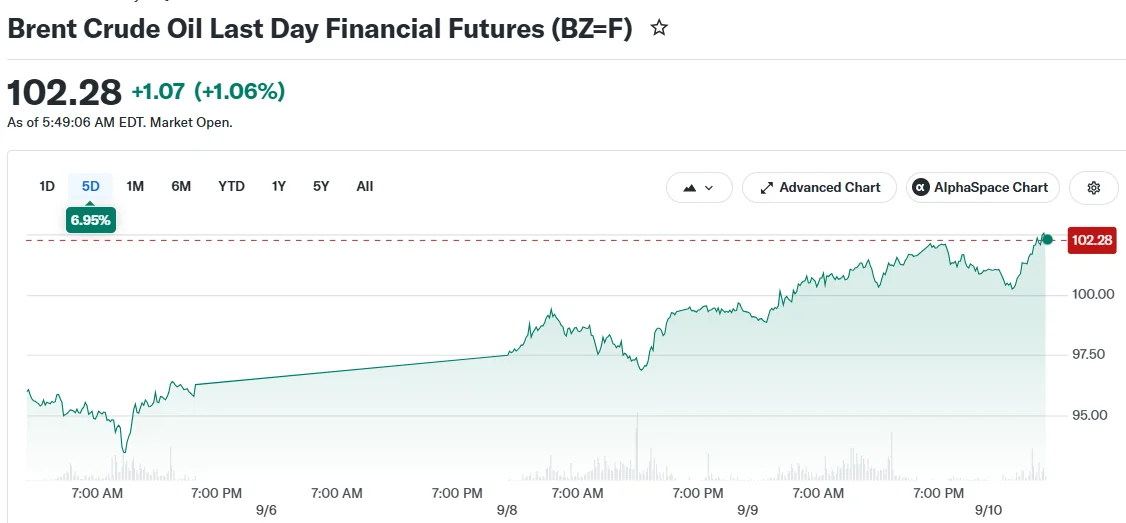
The most recent escalation involved Iranian attacks on 10 vessels operating in and around the strategic Strait of Hormuz. U.S. military forces retaliated by destroying five Iranian oil tankers operating in Persian Gulf waters. Iran subsequently launched strikes against a U.S. military installation in Jordan.
Oil transportation through the Strait of Hormuz has experienced a dramatic collapse. Prior to the resumption of military operations, daily crude shipments averaged between 8 and 9 million barrels. Current volumes have contracted to less than 2 million barrels per day, based on Rystad Energy statistics reported by Reuters.
Maritime tracking company Kpler reports that zero very large crude carriers have successfully transited the strait since September 2.
Alternative Supply Corridors Face Mounting Threats
Several Middle Eastern oil producers have redirected crude shipments through pipeline infrastructure to export terminals beyond the Hormuz chokepoint. The United Arab Emirates has activated a pipeline route to Fujairah port. Iraqi crude now flows through pipeline networks to Turkish ports. Saudi Arabia has reversed its East-West pipeline flows to access the Red Sea terminal at Yanbu.
These backup transportation routes now face their own security challenges. Iran-backed Houthi militants operating from Yemen launched attacks against Saudi energy infrastructure during the past week. The most recent assault targeted the Jizan refinery complex. Additional refining facilities across the Arabian Peninsula have similarly experienced attacks.
Energy analysts at ANZ stated in a research brief that the ongoing cycle of retaliatory strikes indicates Persian Gulf oil shipments will likely face continued disruption for an extended period.
Global Stockpiles Declining as Conflict Continues
The International Energy Agency’s most recent monthly assessment indicated that 8.3 million barrels per day of Middle Eastern crude production remained offline through July. Worldwide petroleum inventories contracted by 69 million barrels during the same timeframe, representing an average daily withdrawal of 2.7 million barrels.
Multiple physical crude pricing benchmarks have already exceeded $100. Murban crude, DME Oman, the OPEC reference basket, and the Indian crude basket are all currently trading above this threshold. Brent futures contracts have now crossed into triple-digit territory as well.
President Trump informed the media on Wednesday that the military conflict would conclude following November’s midterm elections. Conversely, a Wall Street Journal investigation revealed that Trump’s senior advisers have cautioned the confrontation may persist throughout the remainder of his presidential term.
No active peace discussions between Washington and Tehran have been reported. Crude oil consumption traditionally increases during the year’s fourth quarter, potentially driving prices even higher if supply constraints persist.
Brent crude was valued at $101.22 per barrel during Thursday morning trading sessions.
The post Oil Prices Breach $100 Mark as Middle East Tensions Escalate Supply Crisis appeared first on Blockonomi.
TLDR
- Solana trades near $103 after climbing back from a low around $60
- SOL just closed its first green monthly candle in ten months
- Monthly MACD and RSI signals point to improving momentum
- Traders are watching $120 and $146 as the next resistance targets
- Solana’s network handled $14.7 billion in tokenized asset trading over the past year
Solana is trading near $103 after climbing back from a low around $60. The token slipped about 0.18% over the past 24 hours, based on data from Brave New Coin.
The price move comes alongside a shift in longer term momentum. Traders are now watching whether Solana can hold above key support and push toward higher resistance levels.
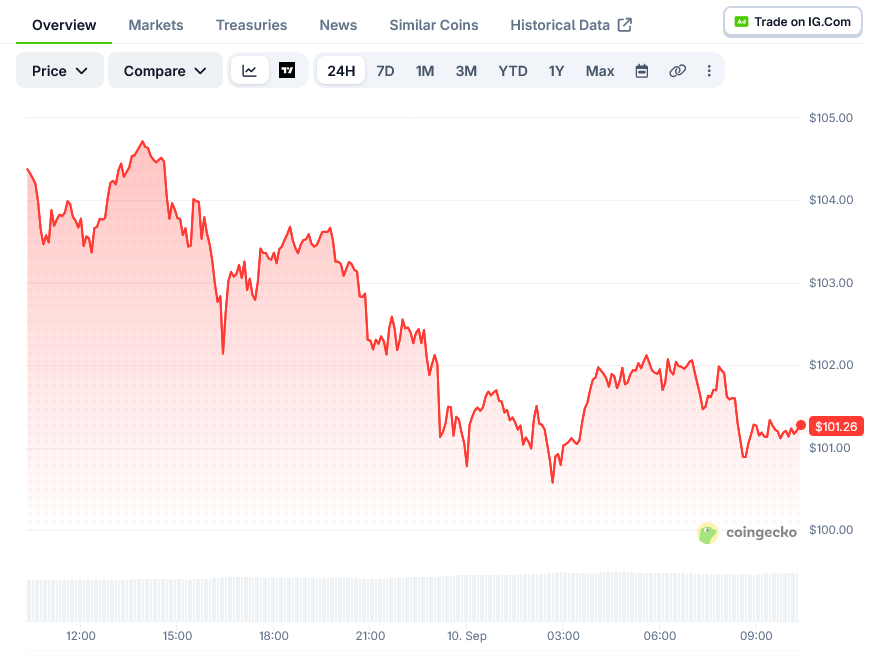
Momentum Indicators Turn Higher
Solana closed its first green monthly candle in ten months. That follows a long stretch of selling pressure that pushed the price down through most of the year.
Analyst Ash Crypto pointed out that the monthly MACD is nearing a bullish crossover. The monthly RSI has also broken above a downward trendline that had held for close to two years.
Neither signal alone confirms a full trend change. Together they suggest the broader bearish pattern may be losing strength.
If the MACD crossover confirms while Solana holds above $100, that would add support to the case for a longer recovery taking shape.
On the daily chart, Solana already broke through the $97.70 resistance level. That former resistance now acts as the first layer of support under the price.
Analyst Ucan Coin marked $120.23 as the next resistance zone. A move through that level could open the door toward $146.56.
As long as Solana stays above $97.70, the recovery structure holds. A drop below that level could pull the price back toward $81.35.
Long Term Chart Shows a Bigger Pattern
A wider view of the Solana chart shows what analyst CryptoCurb describes as a large flag pattern. It formed after the sharp rally from the 2023 lows.
CryptoCurb suggests a breakout from the pattern could eventually lead to a much larger move, with a projection above $1,000. That scenario is a long way off and remains speculative.
Before that target becomes realistic, Solana would need to clear the flag pattern and recover prior highs in the $200 to $300 range. That would require a fresh expansion phase on the higher timeframe chart.
Outside of price charts, Solana’s network activity is drawing attention. The blockchain reportedly processed $14.7 billion in tokenized asset trading over the past year.
That figure represents around 32% of the roughly $46 billion in total reported real world asset trading volume tracked across crypto networks. Backpack alone generated about $1.5 billion in equity trading volume in two months on Solana.
BlackRock and Securitize accounted for close to $993 million in institutional fixed income issuance on the network. These numbers do not set the price of Solana directly, but they add to the picture of network growth.
For now, $97.70 remains the level separating a continued recovery from a deeper pullback. $105 is the next hurdle, followed by $110 and then $120.23.
A daily close above $120 would open the path toward $130 to $140 before $146.56 comes into focus. That remains the level traders are watching most closely as the next test for Solana’s recovery.
The post Solana Price Prediction: SOL Eyes $120 and $146 Resistance appeared first on Blockonomi.
Key Takeaways
- Electronics retailer delivered 7% group like-for-like revenue growth over 17 weeks ending August 29
- UK and Ireland division achieved 6% growth, while Nordic operations surged 9%, with market share expanding across key product lines
- Management reaffirmed full-year outlook, stating comfort with existing market consensus forecasts
- Shares dropped 1.3% during early London session despite positive trading performance
- Both Panmure Liberum and Peel Hunt reaffirmed Buy recommendations, targeting 200p and 182p per share
Shares of Currys (CURY) declined 1.3% during Wednesday’s early trading session in London, settling at 146.40p, despite the electronics and appliance retailer unveiling robust trading figures that showed 7% group like-for-like sales advancement for the 17-week period concluding August 29.
Currys plc, CURY.L
The company’s UK and Ireland operations generated 6% like-for-like expansion, while its Nordic territories demonstrated even more impressive momentum with 9% growth. Leadership indicated satisfaction with prevailing market expectations and maintained existing full-year projections without adjustment.
Across the UK and Ireland, expansion was evident in both physical retail locations and digital channels. Emerging product categories and corporate sales channels registered double-digit percentage increases. The retailer also highlighted competitive position improvements across all primary product segments, despite an overall stagnant market environment.
The company attributed approximately 2 percentage points of market uplift to the World Cup tournament and unseasonably warm summer weather conditions.
Subscription-based Services revenue maintained its upward trajectory. Flexpay penetration increased by 30 basis points compared to the prior year, reaching 23.6%, while iD Mobile customer base expanded 16% to exceed 2.7 million subscribers.
Nordic performance was powered by white goods and mobile phone categories, with widespread momentum across both retail formats. The region also captured market share in most territories, although year-over-year comparisons were relatively easy.
Management characterized gross margin performance as steady in both geographic segments, underpinned by disciplined expense management.
Share Repurchase Update and Financial Position
Currys verified that its £50 million share repurchase program is progressing, with £23 million executed to date. The retailer now anticipates year-end net cash substantially exceeding its £100 million benchmark.
Management outlined objectives for sustained expansion in higher-margin recurring Services operations, establishing a target of reaching a minimum of 2.8 million iD Mobile customers by fiscal year-end.
Wall Street and City Analyst Perspectives
Citi analysts anticipated a “materially positive share price reaction” following the announcement, pointing to robust trading metrics and confirmed guidance. The investment bank noted that shares had underperformed leading up to the release, which it viewed as a potential catalyst for recovery.
Panmure Liberum, serving as the company’s corporate broker, maintained its Buy stance with a 200p price objective. Analysts highlighted that the encouraging year opening established “meaningful upgrade potential” given the organization’s substantial operational leverage.
The brokerage calculated that each one percentage point improvement in like-for-like revenues across UK, Ireland and Nordic markets contributes approximately £12.5 million to consolidated profit, representing roughly 6.5% of fiscal 2026 adjusted pre-tax earnings.
Peel Hunt similarly preserved its Buy recommendation, maintaining a 182p target. The firm indicated expectations to implement an earnings forecast revision ranging from 1% to 3% upward.
Peel Hunt emphasized caution by noting that the initial half of the fiscal year conventionally represents merely 10% to 15% of annual profitability. Consequently, a successful peak holiday shopping period will prove essential before analysts embrace more substantial estimate increases.
From a valuation perspective, the equity trades at below 10 times projected earnings. Panmure Liberum calculated the 2027 price-to-earnings ratio at 10.3 times.
The post Currys (CURY) Stock Drops Despite Strong 7% Sales Growth – What’s Behind the Decline? appeared first on Blockonomi.
CryptoPotato
Ripple remains one of the most talked-about topics in the cryptocurrency world for several reasons, including ecosystem changes, ETF progress, and XRP’s price performance.
Here are the most important recent news and developments.
The ETF Front
Institutional interest in Ripple’s native token has been strong lately, with inflows continuing to far outweigh outflows. Spot XRP ETFs have, in fact, registered eight green weeks in a row, as the cumulative total net inflow has surpassed $1.7 billion.
So far, the companies offering such products include Bitwise, Franklin Templeton, Canary Capital, 21Shares, and Grayscale. However, the lineup may grow as more entities prepare similar investment vehicles.
The X account BankXRP said T. Rowe Price updated its crypto ETF filing, which will allow exposure to multiple digital assets. XRP now sits at a 9.15% weight, dwarfing Solana’s SOL, Hyperliquid (HYPE), and Canton Network (CC), which are at 8.73%, 4.94%, and 1.60%, respectively. Bitcoin (BTC) leads at 39.54%, followed by ETH (18.86%).
In a separate post, BankXRP revealed that Exchange Listed Funds Trust filed the “CYBER HORNER S&P 500® and XRP 75/25 Strategy ETF” with the SEC. If the regulator approves it, the product will let investors gain exposure to both the stock market and Ripple’s native cryptocurrency in a 75/25 ratio.
RLUSD’s Advancement
Ripple officially unveiled its dollar-pegged stablecoin RLUSD in December 2024, and since then it has expanded its global reach. Earlier this summer, it received approval from the Japanese Financial Services Agency (JFSA) to launch the product in the country and, shortly after, revealed that last year it had committed $25 million in RLUSD to support underserved US small business owners and career programs for military veterans.
Over the years, the stablecoin gained backing from numerous exchanges and renowned banking institutions, including the oldest American bank, BNY Mellon. In July, Ripple Mint expanded RLUSD access beyond traditional platform-based workflows, giving institutions the option to manage it through a user interface or through programmatic integrations.
The asset’s market cap has grown to almost $2.5 billion, making it the 42nd-biggest cryptocurrency and the 9th-largest stablecoin. The undisputed leader in its niche remains USDT, boasting a capitalization of over $183 billion, followed by Circle’s USDC (roughly $74 billion).
Critical XRPL Bug Fixed
Recently, the XRP Ledger addressed a bug affecting its newly introduced Permission Delegation feature, known as XLS-75, which allows one account to give another specific powers to act on its behalf. The vulnerability could have enabled delegated players to perform actions beyond the permissions originally granted to them.
The team fixed the issue before any known cases of exploitation or loss of funds. The incident did not compromise XRP itself, and ordinary holders who had not used Permission Delegation were not exposed to the bug.
XRP Price Outlook
Ripple’s cross-border token has experienced substantial volatility lately, with its valuation hovering between $1.36 and $1.47 over the past week. As of this writing, it trades at around $1.38 (per CoinGecko) following a 4% daily plunge.
Meanwhile, potential developments around the CLARITY Act (expected on September 15) and the FOMC meeting (scheduled for next week) could add further turbulence to the price.
XRP remains the subject of predominantly bullish price predictions. Several days ago, Ali Martinez set the asset’s bull-market target at the implausible (at least for now) $60.
“For nearly a decade, XRP has been forming a massive ascending triangle on the monthly chart. The $3.66 resistance level is the key barrier. A monthly close above it would confirm the breakout and activate a technical target near $60,” the analyst stated.
For his part, David Schwarz recently argued that Ripple’s native token could eventually flip BTC. In his view, this will not happen from Bitcoin’s shrinking, but because XRP is growing faster than the primary cryptocurrency.
The post Important Ripple News and XRP Price Update: September 10 appeared first on CryptoPotato.
Just hours before the first of many major macro events scheduled to unfold in the following week or so, the US PPI data, bitcoin’s price has slipped toward $78,000 once again after it was rejected at $80,000 earlier this week.
The altcoins have followed suit, with some major losses from the likes of BNB, DOGE, XLM, LINK, UNI, CRO, and many others.
BTC Slips to $78K
The primary cryptocurrency had an eventful end to the previous business week, as it had dropped to over $76,800 by Wednesday before the bulls picked up the pace. Instead of dumping further, the asset went on the offensive hard. It skyrocketed by several grand within less than a day and jumped past $82,400 for the first time in well over three months.
However, it couldn’t maintain its run and quickly declined to $81,000. The US jobs report, which was much stronger than anticipated, intensified the selling pressure on Friday, and BTC slipped to $78,800.
It rebounded over the weekend, and even charged at $80,000 on Monday morning, where it was stopped once again. The subsequent rejection unfolded gradually and culminated on Tuesday with a dip to $77,600. Its rebound was halted at $79,600, and BTC now struggles at $78,000 in what is expected to be another eventful end to a business week. It starts today with the PPI numbers and, more importantly, continues tomorrow with the CPI data.
For now, its market cap has calmed at $1.560 trillion, while its dominance over the alts stands at 59% on CMC.

Alts Bleed Out
Ethereum has fared rather well during today’s correction, dipping by just 1.5% to under $2,500. In contrast, BNB has slumped by 5% to under $720, XRP is below $1.40 again, SOL is struggling to maintain the $100 level, while DOGE, XLM, LINK, CRO, MNT, and ONDO have marked major 5%-7% losses.
PONS has dumped the most from the largest 100 alts, plunging by over 26% to under $0.60. DASH (-14%), LIT (-13%), ARB (-13%), PUMP (-11%), TRUMP (-11%), and UNI (-11%) follow suit.
The cumulative market cap of all crypto assets has declined by over 2% in the past day, and it’s down to $2.660 trillion on CMC.

The post PONS Plunges Further, BTC Retreats to $78K Ahead of First US Inflation Data: Market Watch appeared first on CryptoPotato.
President Donald Trump has proposed a $5,000 “dividend” payment to every adult US citizen if Republicans hold Congress after the midterm elections.
Crypto traders picked up on it almost instantly, with at least one well-followed account framing the idea as the kind of liquidity shock that helped kick off the last major bull run.
Trump’s $5,000 Proposal Draws Crypto Attention
The president’s proposal would apply to roughly 245 million US citizens aged 18 and above, putting the estimated cost at about $1.2 trillion. The last time a stimulus of this magnitude was deployed was during the pandemic, when close to $4 trillion in fiscal support went out during lockdown.
Mark Chadwick, posting on X, focused on what the payment could mean for crypto:
“If this happens, and it’s a big IF – but if it does it would ignite the most insane Alt Season imaginable,” he wrote.
He compared the potential effect with the 2021 crypto market, calling it a “2021 Covid stim type catalyst” layered onto a bull market he already sees building. He closed with a nod to the president, saying, “Well played, Mr. Trump. Well played.”
But not everyone read it the same way, one of them being economist Peter Schiff, who dismissed the plan as an attempt to buy votes, writing that Trump was offering “a $5,000 bribe in exchange for their votes,” and warning that printing the money would push inflation well past anything seen under the Biden administration.
The Altcoin Setup Already Looks Shaky
Whether or not the payment materializes, it lands at an interesting moment for altcoins. Analyst Matthew Hyland has spent the past week pointing out that charts including ETH, Total 2, Total 3, and OTHERS have all broken multi-year downtrends, leading him to conclude that “the largest Altcoin Bull Run of all time is loading.”
As CryptoPotato reported earlier, that thesis leans on a ratio comparing coins outside the crypto top ten against the S&P 500, which has spent years sliding from a 2017 peak and now sits near the bottom of that range with an oversold reading to match.
The leverage building underneath that story looks less convincing, though. Altcoin perpetual futures open interest overtook Bitcoin’s this week for the first time since December 2024, with Zcash alone carrying roughly $2.4 billion in open derivatives positions, with investor Michael Bucella comparing the setup to October 2025, right before a market-wide liquidation event.
The post Trump’s $5K Proposal Could Ignite an ‘Insane’ Altcoin Season: Analyst appeared first on CryptoPotato.
[PRESS RELEASE – Dubai, UAE, September 10th, 2026]
Zamanat Fund CEIC Limited is the company’s first live proof point for regulated fund tokenization on ZIGChain focused on GCC private credit.
Zamanat today announced its sponsorship of Zamanat Fund CEIC Limited (the “Fund”), a DIFC-domiciled tokenized private credit fund with a target size of up to USD 100 million. The Fund targets the GCC’s estimated $250 billion SME financing gap, with only 11 percent of SMEs across the region having access to credit.
Closing a $250 billion structural gap in GCC SME credit
Across the GCC, SMEs are central to economic growth yet remain significantly underserved by traditional financing. In the UAE, SMEs generate more than half of GDP and employ the majority of the private-sector workforce, yet receive less than 10 percent of total bank lending.
The Fund will invest in private credit across the region, directing capital towards strong homegrown companies whose financing needs are not fully met through traditional lending channels. The strategy supports national ambitions to expand SME participation, private-sector growth and access to alternative financing, including priorities set out under Saudi Arabia’s Vision 2030 and the UAE Centennial 2071.
“Strong businesses across the GCC still struggle to access growth capital despite sound fundamentals. Zamanat sponsored the Fund to create a credible route between those businesses and institutional capital. With a target size of up to USD 100 million and interests issued as Investment Tokens, it is our first live proof point for bringing GCC private credit into a regulated digital structure for Professional Clients,” said Umair Tariq, Founder and CEO of Zamanat.
Bringing GCC private credit into digital markets
Tokenization expands the infrastructure around traditionally hard-to-access private-market assets without changing the underlying investment or credit profile.
The Fund combines a regional private credit strategy, a DIFC fund structure, institutional administration and digital issuance on ZIGChain. It provides a first live demonstration of how regional private credit can be brought into a DFSA-regulated tokenized structure for Professional Clients.
The Fund is a DFSA-regulated closed-ended fund registered as an Exempt Fund and classified as a Credit Fund. It is managed by Truleum Venture Partners Limited and administered by Apex Group. Fund interests will be issued as ZM1 Investment Tokens on ZIGChain within a regulated, whitelisted environment.
As sponsor, Zamanat brings its regional private credit, investment structuring and institutional partnership expertise to the Fund’s development. Truleum retains responsibility for all regulated fund-management activities.
The ZM1 Investment Token structure provides a blockchain-native ownership and settlement layer within the Fund’s regulated framework. It also allows qualifying investors who meet the DFSA Professional Client criteria to participate alongside institutional investors.
Zamanat is backed by Disrupt.com, a MENA-based, operator-led AI-native venture builder and lead investor in the business.
Building the global market for Digital Shariah Assets
Global Islamic finance assets are projected to reach $9.7 trillion by 2029, yet demand for digital and Shariah-aligned assets is growing faster than the institutional infrastructure connecting them with global capital.
Zamanat continues to build the global market for Digital Shariah Assets. Its wider operating model combines investment structuring, Shariah expertise, regulated partner routes and digital distribution to bring real-world assets to market through traditional and digital channels.
The DIFC-domiciled Fund evidences the regulated fund-tokenization, digital ownership and partner-orchestration capability within that wider build. Zamanat is progressing a separate pipeline of Digital Shariah Assets across private credit, receivables, real estate and other asset classes.
Institutional partnerships
Apex Group acts as Fund Administrator, providing institutional fund administration and controls from the outset.
“Zamanat is supporting the creation of a new category in Digital Assets. Bringing institutional structure and digital distribution together within a DFSA-regulated framework sets the standard for how this market should be built, and this fund shows the model working at institutional scale. We are proud to support the infrastructure behind it, and we look forward to partnering further on the projects Zamanat already has in motion,” said Peter Hughes, Founder & CEO, Apex Group.
The global market for Digital Shariah Assets does not yet exist as an institutional category. Zamanat is building it.
Notes to Editors
Sources
LSEG and ICD, 2025 Islamic Finance Development Indicator Report, 14 October 2025 (global Islamic finance assets projected to reach $9.7 trillion by 2029); World Bank, Competition in the GCC SME Lending Markets: An Initial Assessment (estimated $250 billion GCC SME credit gap; 11 percent of SMEs with access to credit); Kearney, GCC Retail Banking Radar 2024.
Investor notice
This communication as related to Zamanat Fund CEIC Limited is approved by Truleum Venture Partners Limited in the DIFC (DFSA License Number: F008013).
This release is for information only. It is not an offer, invitation or recommendation to subscribe for interests in Zamanat Fund CEIC Limited or acquire ZM1 Investment Tokens. Any participation will be made only through the Fund Manager, final offering documents and applicable Professional Client eligibility requirements. For avoidance of doubt, this communication is intended for and directed only to investors who meet the requirements to be considered Professional Clients as specified under the Dubai Financial Services Authority Conduct of Business Rulebook, Rule 2.3.3. The Fund is an ‘Exempt Fund’. Accordingly, the ZM1 Investment Tokens are available only to Professional Clients.
This release and the information contained herein does not constitute, and is not intended to constitute, a public offer of securities in any other jurisdiction and accordingly should not be construed as such. The ZM1 Investment Tokens are only available to a limited number of investors from the DIFC. The ZM1 Investment Tokens have not been approved by or licensed or registered with any other relevant licensing authority or governmental agency. No transaction will be concluded in onshore UAE outside the DIFC.
The Fund is not an Islamic Fund and is not marketed as Shariah-compliant. References to Shariah in this release relate to Zamanat’s broader platform and market ambition and not to the Fund.
About Zamanat
Zamanat is building the global market for Digital Shariah Assets. The company connects asset originators with global capital through investment structuring, Shariah expertise, regulated partner routes, tokenization and distribution across traditional and digital channels.
Zamanat also sponsors and develops institutional investment products through appropriately licensed partners. Each product follows its own legal and regulatory framework and, where presented as Shariah-aligned, its own product-specific Shariah review and governance process. Website: www.zamanathq.com
The post Zamanat Targets GCC’s $250 Billion SME Financing Gap With Up to $100 Million Tokenized Private Credit Fund appeared first on CryptoPotato.
[PRESS RELEASE – Dubai, United Arab Emirates, September 10th, 2026]
Tech entrepreneur and angel investor Alessio Vinassa today announced the expansion of his investment framework focusing on the convergence of artificial intelligence and cybersecurity, applying strategic risk-mitigation model lessons derived from managing high-pressure financial turnarounds to emerging enterprise technologies. Before he began investing across artificial intelligence, cybersecurity, Web3 and innovative finance, he faced a financial collapse that changed how he understood risk.
Alessio reached a point where approximately €180,000 was due while only about €2,200 remained in his bank account. The situation left him facing the possibility of bankruptcy and forced him to confront the consequences of growth without sufficient protection, diversification or structural discipline.
The experience became more than a difficult chapter in his entrepreneurial career. It influenced how he would later evaluate businesses, support founders and approach emerging technology.
Today, Alessio has more than fifteen years of operating and investment experience and has backed more than 40 ventures across cybersecurity, artificial intelligence, Web3 and innovative finance. His current work reflects a strategic reality that businesses can no longer afford to ignore artificial intelligence and cybersecurity are becoming increasingly intertwined.
Artificial intelligence is changing how companies interpret information, automate work and make decisions. Each capability can also introduce another form of dependence. Systems require access to data. Automated tools may influence customer interactions, financial activity and internal operations. The more authority companies give these technologies, the more important security, transparency and accountability become.
For Alessio, this is where innovation must meet discipline.
“AI should amplify executive judgment, not replace it,” he says.
Technology can increase speed and capability, but leaders remain responsible for determining how that capability should be used, which risks are acceptable and where human oversight must remain.
Cybersecurity provides part of the foundation for that trust. As artificial intelligence becomes embedded in important business processes, security extends beyond protecting networks from external threats. Companies must also understand who can access information, how automated actions are monitored and what happens when a system produces an unexpected result.
Businesses that address these questions early may be better positioned to earn the confidence of customers, investors and commercial partners. Those that treat security as an addition after adoption risk allowing operational exposure to grow alongside their success.

Alessio’s technology and investment perspective was shaped by learning what can happen when momentum is mistaken for stability. His financial collapse revealed that creating value and protecting it require different capabilities. A company may appear successful while becoming increasingly dependent on favourable conditions, concentrated decisions or systems that have not developed at the same rate as its growth.
The same lesson applies to emerging technology. A product can attract attention and investment before proving that it can operate securely, respond to failure or sustain customer trust.
Alessio evaluates opportunity through more than technical novelty. His approach considers whether a technology addresses a meaningful problem, whether customers can adopt it consistently and whether the company has the governance required to support expansion. In his published investment commentary, he has identified cybersecurity, artificial intelligence governance, identity solutions and enterprise automation as areas where technology is addressing essential infrastructure needs.
The leadership teams behind these products are equally important. Alessio has spoken about the value of founders who can identify where their businesses are exposed, explain how their systems will respond under pressure and recognise which evidence would require them to change direction.
“Good governance makes companies faster, not slower,” Alessio says.
Governance is sometimes treated as a restriction on innovation. Alessio views it as the structure that allows innovation to scale responsibly. Clear decision rights, reliable reporting and defined accountability enable companies to move without depending on one person to resolve every issue.
This perspective has particular relevance as businesses adopt artificial intelligence at increasing speed. Competitive pressure can encourage companies to introduce tools before they fully understand the information those tools access or the decisions they influence.
Alessio does not argue that innovation should slow by default. His position is that speed becomes commercially valuable only when the systems supporting it can be trusted. The objective is not to eliminate every possible risk. It is to understand exposure before customers, employees and operations become dependent on the technology.
His progression from financial collapse to investing across emerging technology also informs his broader work on leadership. The lesson was not simply that an entrepreneur can recover after losing money. Recovery became meaningful because it changed the structures and decisions that followed.
Alessio is developing these ideas further in his book, No One Is Coming: The Mental Operating System for Leaders Under Pressure. The book examines how founders, executives and operators make consequential decisions when certainty is unavailable and responsibility cannot be transferred to someone else.
As artificial intelligence and cybersecurity continue to converge, that responsibility will extend beyond technology teams. Investors will need to examine the security behind innovation. Boards will need to understand the systems on which their organisations depend. Founders will need to build trust as deliberately as they build capability.
The €180,000 turning point gave Alessio’s investment philosophy a personal foundation. It taught him that unmanaged exposure can remain hidden while confidence is high and growth is still visible. His work today applies that lesson to a new technological era: innovation creates lasting value only when the structures protecting it are built to endure.
About Alessio Vinassa
Alessio Vinassa is an entrepreneur, angel investor, technology builder and author with more than fifteen years of experience across cybersecurity, artificial intelligence, Web3, innovative finance and business leadership. He has backed more than 40 ventures and works with founders and executives on investment, strategy, organisational development and leadership under pressure. He operates between the UAE and Europe.
The post Alessio Vinassa Unveils an Emerging Technology Investment Approach Shaped by Financial Challenges appeared first on CryptoPotato.