Cryptocurrency Posts
Crypto Briefing
OpenAI's strategic focus on compute infrastructure highlights its commitment to scaling AI capabilities and maintaining competitive advantage.
The post OpenAI names former xAI executive Uday Ruddarraju as CTO of Compute appeared first on Crypto Briefing.
Anthropic's IPO preparations highlight the critical role of financial transparency in shaping investor confidence and market valuation expectations.
The post Anthropic gears up for IPO with financial disclosures amid market scrutiny appeared first on Crypto Briefing.
Overlooking established platforms like Ethereum and Solana could mean missing out on the foundational role they may play in future tokenization.
The post Grayscale warns investors may overlook Ethereum and Solana in crypto cycle appeared first on Crypto Briefing.
Anthropic's IPO could reshape wealth distribution in tech, creating numerous millionaires, while highlighting AI's ethical and financial risks.
The post Anthropic’s mega-IPO may create a new class of millionaires appeared first on Crypto Briefing.
The allegations could strain OpenAI-Apple relations, impacting collaboration and trust in tech industry confidentiality practices.
The post OpenAI accuses ex-employee of moving 100+ files tied to unreleased product appeared first on Crypto Briefing.
Bitcoin Magazine
Bitcoin Magazine
Bitcoin Slips Below $83,000 After Hotter-Than-Expected US Inflation Data
The price of bitcoin slid Wednesday after data dropped showing that U.S. consumer prices shot up more than expected in September due to rising gasoline prices.
The biggest cryptocurrency by market cap was recently trading for close to $82,827 after dropping nearly 1% over a 24-hour period. At one point on Wednesday morning in New York, bitcoin fell as low as nearly $82,331.
Over the past seven days, the coin has dropped by more than 1%. Bitcoin’s price had its best quarter in years after rallying in August and September and leading many analysts to declare it to have exited a bear market.
But sticky inflation is still weighing — in the short-term — on the cryptocurrency.
Data Wednesday showed that the Consumer Price Index rose 0.6% in September after climbing 0.4% in August.
In the 12 months through September, the CPI advanced 3.7% after rising 3.4% in August, the Labor Department’s Bureau of Labor Statistics said.
High prices in the U.S., in part spurred by the Trump Administration’s decision to attack Iran with Israel this year, have led the Federal Reserve to hint it may keep interest rates higher for longer.
The central bank in September said getting inflation down was its number one priority and hiked rates.
Bitcoin’s price has been sensitive to interest rate hikes in the past because higher borrowing costs restrict the liquidity the digital coin needs to run — along with other “risk-on” assets like stocks.
Still, the price of bitcoin rose in September despite the Federal Reserve talking tough on inflation.
The central bank will reveal what it plans to do with interest rates on October 28. As of Wednesday, fed funds futures were pricing a 47% chance of a rate hike at the Fed’s October meeting, according to CME Group’s FedWatch tool.
This post Bitcoin Slips Below $83,000 After Hotter-Than-Expected US Inflation Data first appeared on Bitcoin Magazine and is written by Mathew Di Salvo.
Bitcoin Magazine

Capitalism is Broken and Bitcoin is the Great Equalizer | Natalie Brunell
Young people are angry at capitalism, billionaires, and even their parents, but Natalie Brunell says they’re blaming the wrong thing. The Bitcoin Is for Everyone author explains how our financial system has become “socialism for the banks,” with privatized gains and socialized losses. She shares why Bitcoin could be the greatest equalizer for a generation that’s lost hope of owning a home or starting a family.
Chapters:
0:00 – Natalie Brunell on Leaving Legacy News for Bitcoin
1:09 – Fleeing Communism in Poland and Chasing the American Dream
2:17 – Losing Everything in the Great Financial Crisis
3:37 – Why People Still Don’t Understand Bitcoin
7:01 – Bitcoin as a Savings Technology: Start Small, Stack Sats
9:40 – What “Broken Money” and the Cantillon Effect Really Mean
12:33 – Why Young People Are Losing Hope in Capitalism
14:40 – Socialism for the Banks: Privatized Gains, Socialized Losses
17:56 – Is Bitcoin Being Painted as Partisan?
20:46 – Decentralized Media and the Collapse of Trust in Legacy News
DISCLAIMER: The views and opinions expressed in this show are those of the participants and do not necessarily reflect the official policy or position of BTC Inc., Bitcoin Magazine, or any affiliated entities. This content is provided for informational and educational purposes only and should not be construed as investment, legal, tax, or accounting advice. Nothing contained in this show constitutes a solicitation, recommendation, endorsement, or offer to buy or sell any securities or financial instruments. Viewers should consult their own advisors before making financial or business decisions.
This post Capitalism is Broken and Bitcoin is the Great Equalizer | Natalie Brunell first appeared on Bitcoin Magazine and is written by Mark Mason.
Bitcoin Magazine

Blue Coin Capital CIO: MSTR’S BTC Buying Engine is About to IGNITE | Mike Treidl
Bitcoin treasury companies have moved from convertible bonds to perpetual preferred equity, and Mike Treidl explains why. He breaks down how preferreds let issuers like Strategy defer payments without defaulting, and why preferreds returning to par could give Strategy a second engine for buying Bitcoin. He also explains how sats per share and leverage without margin calls add value beyond holding Bitcoin directly.
Chapters:
0:00 – Mike Treidl on Bitcoin’s Rebound to $83K
0:50 – From Morgan Stanley to Blue Coin Capital: Bridging Wall Street and Bitcoin
1:49 – Risk Budget First: How to Size a Bitcoin Allocation
4:11 – Seller Exhaustion and Bitcoin Treasury Companies
5:27 – Why Treasury Companies Moved From Convertibles to Preferreds
6:47 – What Strategy’s Preferreds Returning to Par Means for Bitcoin
8:13 – Sats Per Share: Leverage Without Margin Calls
9:11 – Pensions, Endowments and the Next Wave of Institutional Adoption
11:23 – Blue Coin’s BarclayHedge Ranking and Buying STRC Below Par
12:30 – Bitcoin’s Biggest Opportunities and Risks Over the Next Two Years
DISCLAIMER: The views and opinions expressed in this show are those of the participants and do not necessarily reflect the official policy or position of BTC Inc., Bitcoin Magazine, or any affiliated entities. This content is provided for informational and educational purposes only and should not be construed as investment, legal, tax, or accounting advice. Nothing contained in this show constitutes a solicitation, recommendation, endorsement, or offer to buy or sell any securities or financial instruments. Viewers should consult their own advisors before making financial or business decisions.
This post Blue Coin Capital CIO: MSTR’S BTC Buying Engine is About to IGNITE | Mike Treidl first appeared on Bitcoin Magazine and is written by Patrick Green.
Bitcoin Magazine

Kraken Parent Payward Wins Full Dubai License, Plans UAE Launch
Crypto exchange Kraken’s parent company Payward has said it has plans to launch in the United Arab Emirates.
After receiving full market approval from Dubai’s Virtual Asset Regulatory Authority, Payward said Tuesday that Payward can now operate as a regulated virtual asset service provider serving retail, professional and institutional investors.
It follows a preliminary approval in May that allowed the company to complete its operational set-up ahead of onboarding clients.
JUST IN:
— Bitcoin Magazine (@BitcoinMagazine) October 13, 2026Kraken has been approved to launch Bitcoin and crypto asset trading in the UAE
pic.twitter.com/H7gJNwK3KS
At launch, Kraken clients in the UAE will be able to trade spot and margin with dirham-denominated pairs and fund and withdraw directly in dirhams.
They’ll also have access to on-chain staking, xStocks tokenized equities and Krak for crypto transfers, while institutional clients gain OTC spot trading and Kraken Prime. Crypto derivatives and new yield products are expected later in 2026 and into 2027, subject to regulatory approval.
Payward holds more than 100 licenses and registrations worldwide, spanning Europe, the Americas, Asia-Pacific and the Middle East.
The expansion comes as the company increasingly makes a number of deals. In September, Bloomberg reported that Nasdaq Inc. was investing $100 million in Payward in a deal valuing the company at $21 billion. Kraken will distribute Nasdaq’s tokenized stocks on its own platform, according to the report.
Payward and SoFi Technologies also recently announced a deal to route SoFi customers’ crypto orders through Kraken Prime, Kraken’s prime brokerage arm launched in 2025, and to list SoFi’s stablecoin on the exchange.
Kraken, like other crypto exchanges, is pushing into the traditional finance world, allowing users to trade stocks, bonds and other assets. The company has sold its app as a “primary account for everything.”
This post Kraken Parent Payward Wins Full Dubai License, Plans UAE Launch first appeared on Bitcoin Magazine and is written by Mathew Di Salvo.
Bitcoin Magazine
Researchers Build First Working Post-Quantum Defense for Bitcoin’s Lightning Network
Whether or not quantum computers will break Bitcoin one day is a hot topic.
But what about second-layer solutions like Lightning?
Well, researchers from East Texas A&M University, North American University, Florida Gulf Coast University, and Florida Institute of Technology have been working on that.
JUST IN: East Texas A&M University students announce they've built the first post-quantum security solution for the Bitcoin Lightning Network
— Bitcoin Magazine (@BitcoinMagazine) September 22, 2026pic.twitter.com/GJYL2a9g2G
In an announcement Tuesday, the team of researchers said that they built what they describe as the first full post-quantum security design for the Lightning Network.
As first uncovered in a research paper in September, the team said they added post-quantum cryptography to Lightning’s communications, payment requests and related systems, implemented in Rust-Lightning.
It works like this: The solution layers new quantum-resistant cryptography on top of Lightning’s existing cryptography rather than replacing it. It uses ML-DSA digital signatures and ML-KEM key exchange, post-quantum algorithms standardized by the U.S. National Institute of Standards and Technology, alongside the classical methods Lightning already relies on.
In this hybrid design, an attacker would have to break both the new and the old cryptography to compromise a connection or forge a payment request.
According to the team led by Dr. Ahmet Kurt, an assistant professor in East Texas A&M’s Department of Computer Science and Information Systems, it took about three to four months and roughly 11,000 lines of code — and it’s a complete working implementation, not just a small demo.
Lightning lets users make fast, cheap Bitcoin payments through a network of off-chain channels instead of recording each one on the blockchain.
Its cryptography could eventually be broken by powerful quantum computers, and that risk exists even if Bitcoin itself gets upgraded, because Lightning has its own communication and payment systems, the team said.
They added that their work demonstrates that Lightning’s off-chain systems can begin preparing for the quantum era independently while others focus on solutions for the mainnet.
Quantum researchers have warned that a time will come when Bitcoin’s software — which underpins the biggest and strongest computer network in the world — will need to be upgraded to deal with quantum computing.
While some crypto VC firms have urged action, top developers in the space have argued that many of today’s quantum computers have limited capabilities.
Still, they have noted that their development could arrive unexpectedly — just like advances with artificial intelligence — and have started developing some solutions, including top Bitcoin infrastructure firm, Blockstream.
This post Researchers Build First Working Post-Quantum Defense for Bitcoin’s Lightning Network first appeared on Bitcoin Magazine and is written by Mathew Di Salvo.
CryptoSlate
The September 25 ruling relied on corroborated Reactor testimony and a case-specific failure to justify source-code access.
Read the full story on CryptoSlate
Understand the crypto stories that matter and what to watch next. Get The Catalyst in your inbox
Bitcoin fell below $83,000 on Wednesday as hotter-than-expected US core inflation data revived expectations of further Federal Reserve interest rate hikes, triggering a fresh wave of liquidations across the cryptocurrency market. CoinGlass data showed that over $100 million in leveraged positions were liquidated in the hour after the inflation report was released. This also pushed…
Read the full story on CryptoSlate
Understand the crypto stories that matter and what to watch next. Get The Catalyst in your inbox
EIA forecasts winter distillate inventories 20–30% below normal, while falling diesel prices keep the inflation and Bitcoin implications conditional.
Read the full story on CryptoSlate
Understand the crypto stories that matter and what to watch next. Get The Catalyst in your inbox
Bitcoin whales are accumulating before Wednesday's US inflation report, despite $744 million in recent spot ETF withdrawals. According to an Oct. 13 CryptoQuant report, large holders have increased their combined Bitcoin holdings to 3.03 million BTC, with accumulation accelerating to its fastest monthly pace since February. The buying contrasts with $744.3 million in net withdrawals…
Read the full story on CryptoSlate
Understand the crypto stories that matter and what to watch next. Get The Catalyst in your inbox
At unchanged Bitcoin price, subsidy and fees, the projected Oct. 16 retarget could push 20 J/TH equipment paying 8 cents/kWh below its electricity-only threshold.
Read the full story on CryptoSlate
Understand the crypto stories that matter and what to watch next. Get The Catalyst in your inbox
CryptoTicker.io
The Ethereum price stands at around $2,417 on Wednesday afternoon, roughly 2,179 euros. That is a good four percent less than 24 hours earlier, and the slide carries a timestamp: at 12:30 p.m. Central European time the US Labor Department published consumer prices for September. The headline rate rose to 3.7 percent year on year, where 3.6 percent had been expected. The core rate excluding energy and food came in at 2.6 percent.
With that, the level that had held twice this week has gone. On Monday the price turned higher at $2,495.93; yesterday it was still at $2,534. Today it sits below, and the daily high of $2,524.82 dates from the hours before the figure.
The inflation figure in detail: a 3.7 percent headline rate, a 2.6 percent core rate
Consumer prices are the single most important date for rate expectations in the markets. The September reading of 3.7 percent sits a tenth of a point above what economists had expected on average, and it sits clearly above the US Federal Reserve's two percent target. The core rate of 2.6 percent is the figure the central bank watches more closely, because energy and food prices swing sharply and are barely steerable by monetary policy. The numbers are in the press release of the Bureau of Labor Statistics.
A tenth of a point sounds like little. For the futures market it is not, because what trades there is not the figure itself but its deviation from expectations. That deviation fell today against every asset that lives on cheap money.
How an inflation figure feeds through to the Ethereum price
The route from an American price statistic to a price in euros runs through three stations, and it takes minutes, not days.
First, rate expectations. If inflation falls faster than thought, the market counts on earlier rate cuts. If it rises more than thought, as today, the market pushes that expectation back. Second, the discount rate. A higher expected rate makes safe assets more attractive and at the same time makes every position running on credit more expensive. Third, leverage. Positions in the futures market carry margin; if the price falls below a certain threshold, they are closed automatically, which triggers further sell orders.
That third station explains why price moves after data releases often turn out steeper than the news itself warrants. It is not only people with a view on inflation who sell. Systems that have no view at all also close positions.
Twelve months of Ethereum: 41 percent below the level of a year ago
Today is one frame. To place it, we pulled the daily readings of the past twelve months from CoinGecko and charted them ourselves. A year ago Ethereum stood at $4,126, the one-year high at $4,159, the one-year low at $1,566. From the level of twelve months ago, today's price is around 41 percent away.
The chart also shows that the recovery since the one-year low was no straight line. Between $1,566 and today's level lies a rise of a good 54 percent, interrupted by several pullbacks.
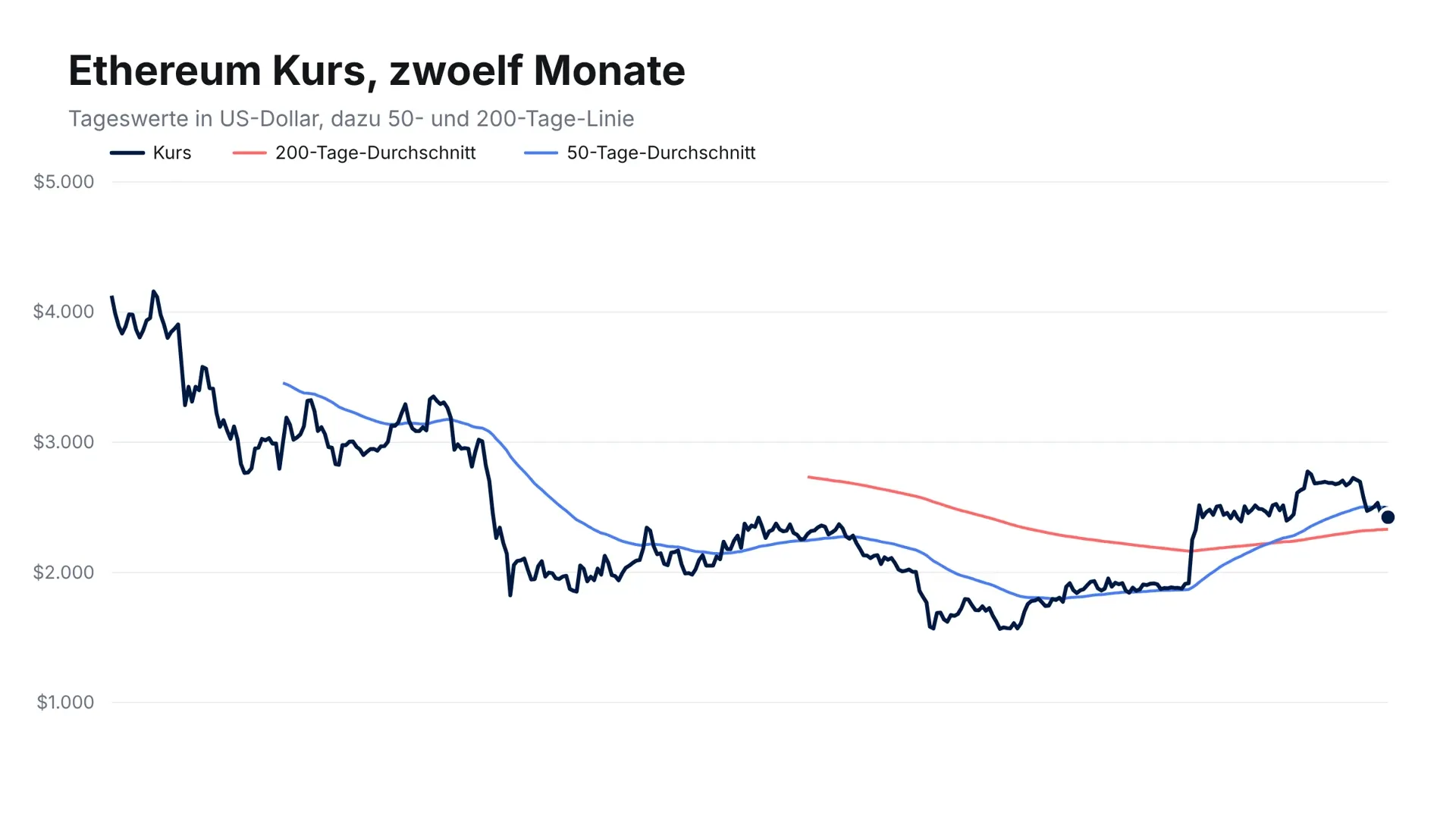
The 50-day line and the 200-day line: the Ethereum price sits in between
Two moving averages place the price. By our calculation the 50-day average sits at $2,497, the 200-day average at $2,331. A moving average is the mean of the past 50 or 200 daily closing prices; it smooths the daily swings and shows the direction of the longer move.
Today's price of $2,417 therefore sits below the short line and above the long one. For the coming days those are the two numbers from which it can be read whether today's slide stays a one-day move or becomes more. Should the price fall below $2,331, that would be the first close beneath the 200-day line in weeks. Should it climb back above $2,497, today will be smudged out of the chart.
Tuesday's deleveraging and what has happened to the Ethereum price since
On Tuesday we described in this space that open positions in the futures market had fallen by 16 percent within five days; the price stood at $2,534 at the time. That is set out in our analysis of the deleveraging of 13 October.
Two things have changed since. The price sits around $117 lower, and the $2,495 level, which on Monday still served as a turning point, has been breached. The deleveraging itself works in the other direction: fewer open positions mean fewer forced closures when things go down. Today's slide of a good four percent is therefore remarkably shallow for a data release of this size.
ETF inflows: $24.8 million on Tuesday
Beside the chart, the fund flows are worth a look, and right now they tell a different story from the price. Around $24.8 million net flowed into the American spot ETFs on Ether on Tuesday, according to market data. That is a small sum measured against the outflows of previous weeks, but it is a change of sign: in early October a single week showed $542 million of outflows on the books.
For investors in Germany these products are not directly accessible; comparable investments run here as ETNs or ETPs via the exchange. What works in Europe and what does not is covered in our overview of crypto ETFs and their European equivalents. The reason the American numbers count anyway: this data is the only daily published indicator of whether big money is flowing in or out.

28 October as the next date in the calendar for the Ethereum price
The Federal Reserve's next monetary policy meeting falls on 27 and 28 October 2026, with the decision published on the second day. The dates are in the official meeting calendar of the Federal Reserve. Until then, today's inflation figure is the most recent hard data point on which expectations rest.
In practice that means the market works with this one figure for two weeks. Anyone trading larger amounts in that time does better to reckon that 28 October will be a day of elevated swings, as this afternoon was.
Buying under MiCA: which exchanges are authorised in Germany
Since the European crypto regulation MiCA came into force, every provider addressing retail clients in Germany needs authorisation as a crypto asset service provider. Authorisation is the first check before any purchase: if the provider is in the register of BaFin or another European supervisor, the European rules on custody and client funds apply. If it is not there, they do not. Which houses hold the authorisation and what they charge for an Ethereum purchase is shown by our comparison of crypto exchanges for European investors.
The second point is custody. Ether sitting on an exchange belongs to you economically, but technically the exchange manages the keys. Anyone holding larger amounts and not trading them usually withdraws them to a wallet of their own.
Holding period and tax: what 31 December means for German investors
A price slide in Germany is also a tax question, and in both directions. Gains from selling Ether are tax-free under section 23 of the Income Tax Act if more than one year lies between purchase and sale. Within that year they are taxable as a private disposal transaction, with an exemption threshold of 1,000 euros per calendar year. Threshold means: if it is exceeded, the entire gain is taxable, not only the part above it.
That gives a concrete cut-off date. Losses from private disposal transactions can only be offset against gains of the same kind, and the calendar year ends on 31 December. Anyone who has realised gains within the one-year period this year and is currently sitting on loss positions has until then to bring both together in the same year. Anyone close to the end of the one-year period, by contrast, gives away the tax exemption with a sale now.
Which acquisition happened when can only be answered, with several purchases, from a clean record. The common tools for that are in our comparison of crypto tax software and portfolio trackers. These details place the legal position and replace no tax advice.
Staking: a 2.66 percent network yield and the question of the holding period
Stake your Ether, meaning put it to work securing the blockchain, and you receive a payment for it. The network most recently paid around 2.66 percent a year; at the providers, a good 2.2 percent arrives after fees. How the providers differ is broken down in our comparison of staking providers.
For tax purposes staking is to be viewed on its own: the running income is taxable as other income as soon as it is received. The one-year holding period for the staked Ether itself is untouched by that under the current view of the tax authorities.
Our assessment: the market is pushing back the rate turn, not the Ethereum story
In the editorial team's view today's move was a reaction to a tenth of a point, not to Ethereum itself. Three observations support that. First, the whole market fell with it: Bitcoin gave up around two percent the same afternoon, Solana a good four. Second, ETF flows have been slightly positive again since Tuesday, which argues against a flight out of Ether. Third, the level of leverage after last week's unwinding is lower than in the summer, and the daily loss still stayed in single digits.
Against it stands the fact that the $2,495 level has now been tested twice and breached on the third attempt. A level loses force the more often it is approached. As long as the market reckons with later rate cuts, the price lacks the fuel for the way back above the 50-day line at $2,497. This is an assessment of the situation and not a recommendation to buy or sell; crypto investments can lead to a total loss.
Ethereum at $2,417: without a rate turn the push above $2,500 is missing
Three things decide the price over the coming two weeks, and all three can be read off a single number.
- The $2,331 line. A daily close below it would be the first time in weeks that the price loses the long average line. If you want to buy, the authorised venues are among the authorised exchanges named above.
- 28 October. The Federal Reserve's rate decision is the next date that either confirms today's figure or devalues it.
- 31 December. The tax year ends, and with it the chance to offset gains and losses of the same year. The tools for that are in the tax software comparison.
(As of October 14, 2026. This article is not investment advice. Prices and fee structures change; check the terms with the provider before you buy.)
The Mantle network manages a treasure of $2.25 billion, and around $99 million of it sits on its own blockchain. That ratio of roughly 23 to 1 explains more about Mantle than any price level: the organisation behind it is rich, the network beneath it is small. Anyone holding MNT or thinking about it should know both figures, because the token hangs on the first and the utility on the second.
This article works through the network in order: technology, treasury, token, applications, access, trading venues for European investors and risks. cryptoticker.io compiled the figures for capital on the blockchain itself on 13 October 2026 from the public data of DefiLlama; the treasury values come from the project's overview page. How the price has moved since is covered in our Mantle price prediction.
What the Mantle network is and who stands behind it
Mantle is a layer-2 blockchain on Ethereum. A layer 2 settles transactions in a network of its own and passes the bundled result on to Ethereum, so that they become cheaper and faster than they would be directly on Ethereum mainnet. Mantle carries chain ID 5000 and works with Ethereum's developer tooling, so contracts can be ported across with little effort.
The network is carried by an organisation with its own coffers, grown out of the former BitDAO. Those coffers are called the Mantle Treasury and are the real difference from most other layer 2s. Other networks raise capital from investors; Mantle brings an existing stock with it. What happens to it is decided by token holder votes, with governance running through public proposals.
The products under the roof are called Mantle Network for the blockchain itself, mETH Protocol for staking Ether, Function for a Bitcoin connection, Mantle Index Four for a fund product and UR for an app that lets balances be spent and converted back into euros or dollars. The blockchain is therefore one part of the house, not the whole house. That layout later explains why the figures on the blockchain and the figures of the organisation sit so far apart.
From optimistic rollup to ZK validity rollup: what Mantle v2 changed in the technology
A rollup is a blockchain that executes its transactions itself and only presents the result to Ethereum. What matters is how Ethereum learns that this result is correct. An optimistic rollup initially assumes it is, and leaves a window open in which someone can prove the opposite. A validity rollup instead supplies a mathematical proof, a so-called ZK proof, which Ethereum verifies.
Mantle has made that switch. The network's technical documentation describes today's architecture as a ZK validity rollup, introduced with version Mantle v2 under the name Skadi. A service called Mantle-Succinct-Proposer passes the proofs on to a contract on Ethereum at regular intervals. The documentation no longer names a challenge period, because a verified proof does not need one.
For holders that has one practical consequence: on the way back to Ethereum the long waiting time familiar from optimistic rollups falls away. For security it means the validity of blocks hangs on the correctness of the proof programs and the contracts. Anyone wanting to read up on the architecture in detail finds the building blocks described in the same documentation.
Ethereum blobs instead of a data layer of its own: where the transaction data sits today
Every rollup has to store the data of its transactions somewhere, so that the state of the network can be reconstructed even without its operators. That property is called data availability, and it decides whether a network lives on without outside help if the worst happens.
Mantle solved this point through a layer of its own for a long time, Mantle DA, which built on EigenDA's technology. Today's documentation describes a different route: a service called op-batcher writes the rollup data into blob-carrying transactions under the Ethereum standard EIP-4844, directly onto Ethereum. The data therefore sits where the proofs are verified as well.
Mantle is built modularly: execution, data availability and settlement on Ethereum are separate modules that can be swapped out individually. The change of data layer, which left the rest of the infrastructure untouched, shows exactly that. The architecture builds on the OP Stack, an open construction kit for rollups that other layer 2s develop on too. For developers that means short routes: work on Ethereum and you bring your contracts and tools with you, while execution outside mainnet takes care of scalability.
What the documentation leaves open is who operates the sequencer, the service that sets the order of transactions. It describes node operators passing transactions on to it, and that the transaction pool is deliberately not publicly viewable. A statement on whether this service is spread across several independent operators is not there. Young layer 2s usually sit in that position, and it is at the same time the point at which real decentralisation can be measured later.
The treasury holds $2.25 billion, 71.78 percent of it in MNT
The project's treasury page reports a total value of $2,252,971,490 for 13 October 2026. The split: $1,617,206,536 in MNT, which is 71.78 percent, plus $283,593,226 in ETH at 12.58 percent, $237,810,643 in BTC at 10.55 percent, $111,168,807 in stablecoins at 4.93 percent and a small remainder in COOK.
This split carries a risk of its own. Almost three quarters of the treasure consists of the very token whose value the treasury is meant to support. If MNT falls, the coffers shrink in step, and the frequently quoted billion-dollar figure shrinks with them. Truly independent of its own price are only the stablecoins and the Ether and Bitcoin holdings, together around $632 million.
The money is used among other things for distributions to MNT holders via a rewards page of its own. The treasury page lists past distributions for this, including 4,000,000 ENA from a collaboration with Ethena, 570,000 EIGEN from the connection to EigenLayer and 200,000,000 COOK. Alongside that stands an EcoFund, which the project describes as a capital pot of $200 million for applications and technology partners in its own ecosystem.
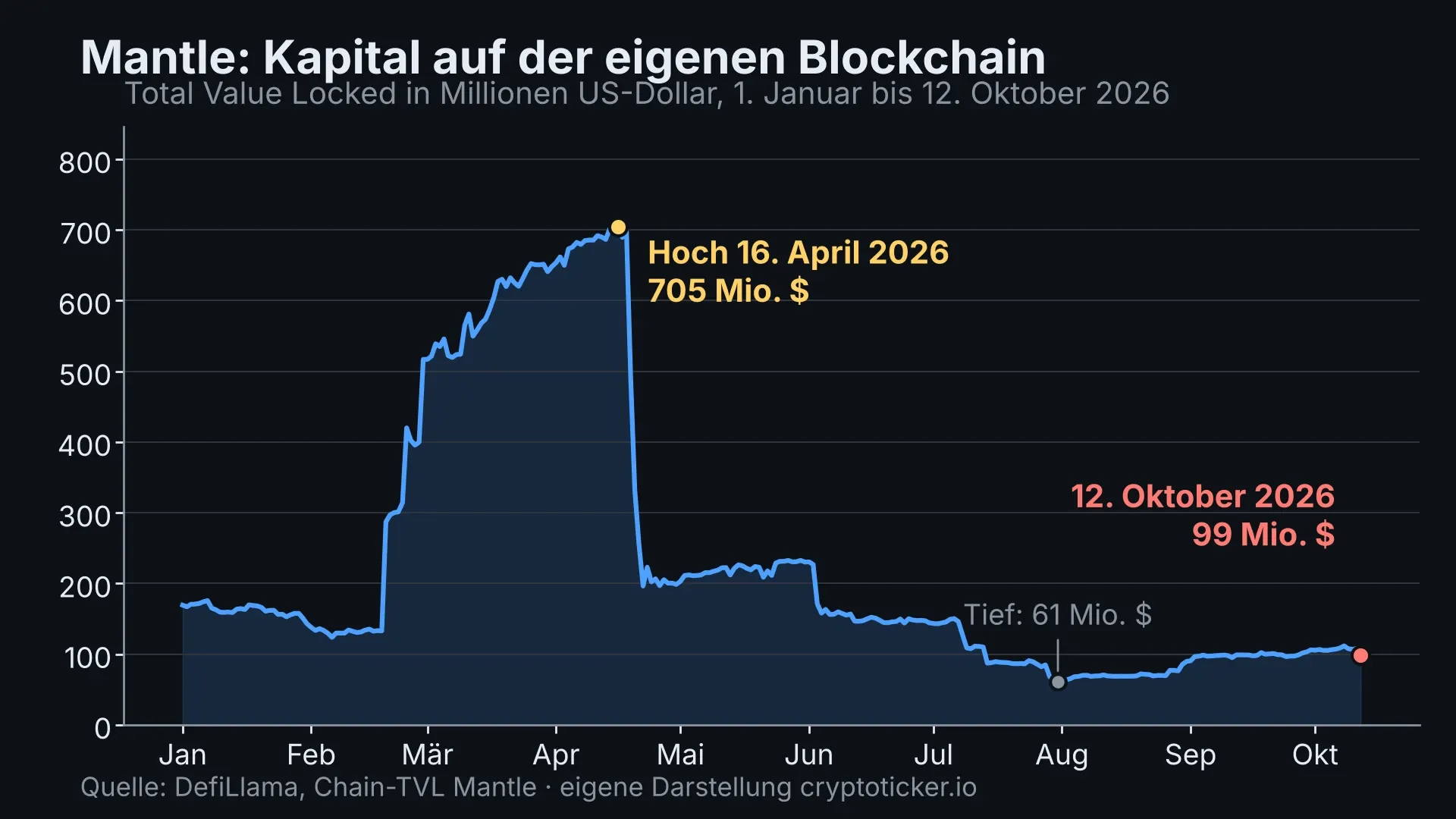
99 million dollars on its own blockchain: the gap to the treasure
Total value locked, TVL for short, measures how much capital is deposited in the applications of a blockchain. The figure says nothing about profits and little about user numbers, but it does show how much trust capital places in a network. For Mantle, cryptoticker.io analysed the course of 2026 from the public data of DefiLlama, with three verified readings.
At the start of the year $169 million sat on the blockchain. By 16 April the value had risen to $705 million, the highest level of the year. After that it collapsed: on 1 June it was $230 million, on 1 July $143 million, and on 31 July the series marked its lowest point at $61 million. Since then it has been slowly climbing again; on 11 October $108 million was on the books, on 12 October $99 million.
From the April peak to today that is around 86 percent less, while measured from the trough at the end of July it is a good 60 percent more. In the ranking of blockchains by deposited capital, Mantle therefore sits in 28th place. For scale: Ethereum carries around $51 billion, Base a good $6 billion, Arbitrum $1.4 billion and Polygon $675 million.
The treasury is untouched by this. The holdings sit predominantly in MNT, ETH and BTC on Ethereum, so outside the network's own blockchain. That is precisely where the gap between around $2.25 billion and $99 million comes from. Our ecosystem series has described a similar pattern at another network before, when we worked through Ronin after the Karst upgrade.
MNT pays the network fees, 3.3 of 6.2 billion tokens are in circulation
MNT performs two jobs in the network: the token pays the gas fees, meaning the network fees for every transaction, and it counts in votes on the treasury. No claim on profits or earnings of the project comes with it, which holds for most network tokens and matters when weighing the price.
The supply picture, taken from CoinGecko on 13 October 2026: 3,302,003,383 MNT are in circulation, the maximum supply stands at 6,219,316,795 tokens. A good half is therefore in circulation, 53.1 percent. The price stands at 0.47 euros, market capitalisation at around 1.57 billion euros, which means 59th place among all cryptocurrencies. Taking the whole supply at today's price gives a fully diluted valuation of around 2.95 billion euros.
The price record is clearly negative. Over seven days it is down 17.7 percent, over thirty days 5.4 percent, over a year 75.7 percent. From the all-time high of 2.45 euros on 8 October 2025 the price is 80.6 percent away. In trading, around 25 million euros most recently changed hands within a day.
The difference between circulating and maximum supply is the point holders should keep in view: around 2.9 billion MNT are not yet in the market. A large part of that sits in the treasury, and therefore in the hands of the organisation itself.
Aave V3, CIAN and Agni Finance: where the capital on Mantle sits
Behind the $99 million stand concrete applications. The largest positions according to the DefiLlama data of 13 October 2026: the yield manager CIAN Yield Layer holds $107 million, the lending market Aave V3 around $52 million, the exchange Agni Finance $16 million and Merchant Moe $12 million. Behind them follow Fluxion Network with $7 million, the derivatives venue IntentX with $2.3 million and the lending markets INIT Capital and Compound V3 with around $1.7 to $1.9 million each.
That the individual positions add up to more than the value of the blockchain has a technical reason: a yield manager deposits capital in other protocols, and in the TVL of a blockchain such capital is only counted once. The ranking is untouched by that.
As DEXs, meaning decentralised exchanges, Mantle mainly offers Agni Finance, Merchant Moe and Fluxion Network. A launchpad of its own for new tokens, or a notable NFT marketplace with measurable capital, does not appear in the data. Anyone looking for NFTs or fresh tokens currently finds little on Mantle; the weight lies clearly with lending, yields and tokenised assets.
The project sets its priorities there too. Its own page reports for 2026, among other things, the launch of OpenStock with pre-IPO stakes in July, the addition of tokenised equities, the move of its in-house bridge Super Portal from LayerZero to Chainlink CCIP, and since 3 September the stablecoin USDG from issuer Paxos. At its third anniversary in July the project named $116.4 million in tokenised active strategies.
Alongside its own products the house invests in those of others. The EcoFund of $200 million is the tool for that: it finances applications and technology partners building on Mantle, and such investments are the usual route for a young network to keep developers. It becomes visible in the partnerships of recent months, from stablecoin issuer Paxos through tokenisation provider Securitize to Chainlink's bridge technology. Which of these is a pilot and which runs in production is something such lists rarely distinguish; the question is worth asking at every ecosystem.
mETH, Function and Mantle Index Four: the products beside the blockchain
The largest single product of the house does not sit on Mantle but on Ethereum. The mETH Protocol takes in Ether, stakes it and issues the token mETH in return, which remains tradeable. Around $583 million is deposited there according to the DefiLlama data. A variant for restaking, cmETH, and a restaking arm with a further $41 million belong to it. If this form of yield interests you in principle, the providers are in our comparison of staking platforms.
Function is described by the project as a decentralised Bitcoin solution that makes BTC usable for applications on blockchains. Mantle Index Four, MI4 for short, is a fund product launched together with tokenisation provider Securitize in April 2025. The treasury committed up to $400 million as an anchor investment, agreed through a vote. The basket covers Bitcoin, Ether, Solana and dollar stablecoins, is reweighted quarterly and folds in staking yields via mETH, bbSOL and sUSDe. The project does not name a current fund size; the $400 million is a commitment, not a documented holding.
UR, finally, is an app for payments and for converting back into local currency. Taken together the result is a house whose revenue sources stand broader than its own blockchain. For MNT holders that is opportunity and catch at once: the products strengthen the organisation, but the token grants no direct claim on their earnings.

Super Portal, explorer and network fees: how you get onto the Mantle blockchain
The route onto Mantle runs across a bridge. The project operates the Super Portal for this, which takes in balances from Ethereum and further networks and has worked through Chainlink CCIP technology since July 2026. In your wallet you enter the network with chain ID 5000, after which it appears like any other. Which wallet is suitable for it is shown in our comparison of software wallets.
The network fees are paid in MNT. A small holding of it therefore belongs in every wallet that is to do anything on Mantle, otherwise even bridging back stalls. Serving as block explorer, meaning the public register of all transactions and contracts, is mantlescan.xyz; the former link explorer.mantle.xyz redirects there. Every transfer can be traced there and every contract address checked before you grant it anything.
One note on the order: bridge first, application second. Send a balance straight from an exchange to an address on the wrong network and you lose time at best and the amount at worst. The check costs a minute and happens in the explorer.
MNT in euros: Kraken lists the pair, Coinbase and Bitvavo do not
For investors in Europe what counts in the end is where MNT can be bought at all, ideally against euros and at a provider with European authorisation. cryptoticker.io checked that question itself on 13 October 2026 by querying the public trading registers of several exchanges.
The result: Kraken lists MNT against both euros and US dollars. At Coinbase, MNT does not appear in the register of tradeable pairs, nor does it at Bitvavo, and at Bitpanda no price page for the token exists. Of the large venues authorised in Europe, that leaves above all Kraken for a direct euro purchase.
This situation is typical for MNT and not meant reassuringly: a token tradeable against euros at only a few authorised venues is harder to sell again in case of doubt than a standard asset. If you nonetheless want to buy, compare the fees and the authorisation of providers beforehand in our exchange comparison. A purely price-based view of MNT is also available in our assessment of whether Mantle is a good buy at current prices.
Holding period, staking and total loss: the risks for German investors
For tax purposes German law treats MNT like other crypto assets, as another type of economic asset. Gains from a sale within one year of purchase fall under the private disposal transactions of the Income Tax Act and are taxable above the exemption threshold; once a year has elapsed the gain remains tax-free. Earnings from staking count separately and are recorded in the year they are received. Which program records the transactions cleanly is covered in our comparison of tax tools. An individual case is settled by a tax adviser, not by an article.
The remaining risks lie in the open. First, the concentration risk of the treasury: 71.78 percent in a single token means that treasure and price run in the same direction. Second, the technology: a validity rollup hangs on the correctness of its proof programs and its contracts on Ethereum, and on the distribution of the sequencer the documentation makes no statement. Third, the supply: around 2.9 billion MNT are not yet in circulation. Fourth, tradeability, described above.
There is also the fundamental point that applies to every network token: a total loss is possible. Prices 80 percent below the all-time high count in this market as the normal case for tokens whose usage lags behind expectations.
From the editorial team's view: the treasure does not prove the usage
Mantle is frequently described through the size of its coffers, and the figure is right: $2.25 billion is a lot of money. It is just that those coffers face a network with $99 million on its own blockchain, one that sits in 28th place in the ranking of blockchains and has lost around 86 percent of its deposited capital since April. That the money sits predominantly in MNT, ETH and BTC outside its own blockchain is no reproach, it only shifts the yardstick: Mantle today is more a holding house with an attached blockchain than a layer 2 with full coffers.
In favour of that reading is the fact that the strongest products of the house, mETH with $583 million and the fund product MI4, do not run on Mantle at all. Against it is the fact that the blockchain has gained a good 60 percent again since the trough at the end of July and carries building blocks that attract serious applications, with Aave V3, CIAN and the Paxos stablecoin USDG. Neither case is settled. The direction can be checked against a single figure: if deposited capital moves back towards the $230 million of June in the coming months, the network is growing. If it stays at around $100 million, it is mainly the coffers that carry it. This is expressly not a recommendation to buy or sell.
Mantle: 99 million in usage against a 2.25 billion treasure
Three steps if you want to look into MNT more closely:
- Clarify the venue and its authorisation. Check whether your provider lists MNT against euros at all and what authorisation it holds in Europe. The fees and the authorisation status of the large houses are in the exchange comparison.
- Settle custody before you bridge. A balance on the blockchain needs a wallet that knows the network with chain ID 5000, and a small MNT holding for the network fees. Which wallet fits is shown by the software wallet comparison.
- Record transactions from the start. Purchases, bridge transactions and staking income belong in the documentation without gaps, otherwise the one-year period turns into an arithmetic exercise later. Suitable programs are in the comparison of tax tools.
(As of October 13, 2026. This article is not investment advice. Prices and fee structures change; check the terms with the provider before you buy.)
Anyone who bought Bitcoin on 14 October 2025 is looking at a price today that sits roughly a quarter below their own entry. A year ago one Bitcoin cost $115,226 or 99,310 euros; by Wednesday midday it is $82,709 and 74,239 euros. That is 28.2 percent less in dollars and 25.2 percent less in euros. For exactly this vintage the one-year speculative period under German tax law expires today, and what changes with it is not the price but the calculation behind it.
The figures come from CoinGecko's price series for each calendar day. Deribit's futures index stood at $82,844 at the same time, $135 above the spot value. That spread of 0.16 percent is normal and shows how closely the cash market and the futures market sit together on this quiet day.
The year-on-year comparison: 99,310 euros then, 74,239 euros today
A year-on-year comparison looks at first like an accounting exercise. In Germany, though, it decides which tax rules can still be applied to a sale at all, and it frames the situation better than any single day's change. On Wednesday the price moved 0.67 percent lower; over seven days it is down 0.4 percent, while over 30 days it is up 7.08 percent.
These three figures do not contradict each other, they simply measure different windows. The monthly number carries the late-summer recovery, the annual number carries the slump from winter and spring. Look only at the day and the market seems motionless. Look only at the year and it seems to have failed. Both readings miss the situation.
| Reference date | Price in dollars | Price in euros |
|---|---|---|
| 6 October 2025, all-time high | 126,080 | no daily series |
| 14 October 2025, one year ago | 115,227 | 99,310 |
| 27 October 2025, one-year high | 114,419 | 98,195 |
| 1 July 2026, one-year low | 58,566 | 51,474 |
| 14 October 2026, today | 82,709 | 74,239 |
From the one-year low on Wednesday 1 July, the price has recovered by 41.4 percent. From the all-time high on Monday 6 October 2025, it is still 34.4 percent short. Both stretches belong to the same twelve-month span.
Why the loss in euros is smaller than in dollars
Three percentage points separate the two loss figures, and they have nothing to do with Bitcoin. The difference comes from the exchange rate. In October 2025 a euro bought around 1.16 dollars; currently it buys around 1.114. The dollar has therefore gained against the euro, and an asset quoted in dollars loses less when seen from Germany.
This distinction is not a technicality. The tax office calculates in euros. A German investor who works out a gain or loss in dollars, because that is how the trading interface displays it, arrives at a different result from the tax return. What counts is the euro value at the time of acquisition and at the time of disposal.
A worked example makes the difference tangible. Anyone who put in 10,000 euros a year ago holds a value of around 7,475 euros today. Calculated in dollars, $11,600 would have become around $8,330. The dollar calculation shows a loss a good 300 euros larger than the one that actually appears in the tax return.

The all-time high of 6 October 2025 is now more than a year old
The highest price ever paid is $126,080, set on 6 October 2025. Since last Tuesday that record has been more than twelve months old. The highest level of the past 365 days was $114,419 on 27 October 2025, already below the record.
For context that means the market has not seen a new peak in a full year. Phases like this have occurred several times in Bitcoin's history, and they have lasted for varying lengths of time. No statement about the direction of the coming months follows from that, but one about expectations does: anyone who has been betting on a quick new record since autumn 2025 has now waited longer than most timetables allowed for.
236 of 366 days closed below today's price
This is where the year-on-year comparison gets interesting. Counting through the daily closing prices of the past 366 days, 236 of them were below today's level. That is 64.5 percent. The current price is therefore not a weak reading within the year, but one that only a good third of all days exceeded.
That finding only appears to contradict the 25 percent loss. Both statements are correct because they answer different questions. The year-on-year comparison measures two points; the day count measures the whole distance in between. Anyone who bought a year ago caught one of the most expensive entries of the entire period.
The 200-day line at $72,204 and what has changed since 11 October
The 200-day line is the average of the closing prices of the past 200 trading days. It smooths out outliers and serves many market participants as a rough dividing line between a rising and a falling market. It currently sits at $72,204, putting the price 14.7 percent above it.
In our analysis of 11 October that gap was still 15.4 percent. The buffer has shrunk by 0.7 percentage points since then, and not because the price fell sharply but because the average line keeps rising. The line is gradually pulling the low prices of early summer out of its window. That shortens the gap even in a sideways market.
Tuesday's market report had seen Bitcoin at $83,200, with clear relative strength against Solana. That strength persists, the gap has only narrowed slightly: over seven days Bitcoin is down 0.4 percent, Solana 8.97 percent.
The 50-day line at $81,190 as the next level below
Much closer sits the 50-day line at $81,190. The price stands just 2.0 percent above it. That makes it the first level against which a pullback can be measured, and it has been tested several times in recent weeks.
If you work with leverage, know this number before opening a position. At five times leverage a 20 percent decline is enough for liquidation; at ten times leverage 10 percent suffices. From the current level to the 200-day line is 12.8 percent down. A ten-times leveraged position does not survive a move that far, arithmetically speaking. Look up your liquidation price in the table and you find the one number that counts if the worst happens.
What the volatility expectation in the futures market shows
The volatility index of the options exchange Deribit, DVOL for short, measures the range of movement the futures market is pricing in for the coming 30 days. It stands at 38.44 points. On 3 October it was at 35.36; over the past 90 days it moved between 33.59 and 43.41. Expectations have therefore been rising for eleven days, but remain in the middle of their range. The live readings are on Deribit's metrics page.
A rising DVOL with a barely moving price means that hedging becomes more expensive before anything moves. The nearest reason is the calendar: US consumer prices are due on Wednesday, and on Wednesday 28 October the US Federal Reserve decides on its key interest rate. Both dates fall inside the window the index covers.

The one-year period under section 23 of the German Income Tax Act and the 1,000-euro threshold
Bitcoin held as private assets falls in Germany under private disposal transactions pursuant to section 23 of the Income Tax Act. A gain is taxable if no more than one year lies between acquisition and sale. Once that year has passed, the sale is no longer a private disposal transaction and the gain remains tax-free.
The governing letter from the Federal Ministry of Finance dated 6 March 2025 replaced the version of 10 May 2022 and confirmed this line. It also makes clear that the extension of the period to ten years does not apply to payment tokens such as Bitcoin, not even when the holdings generate income through lending or staking.
Within the year an exemption threshold of 1,000 euros per calendar year applies. Threshold means: if it is reached or exceeded, the entire gain is taxable, not only the part above it. The threshold also applies to all private disposal transactions of a year taken together, so to gold or other tokens as well.
The uncomfortable side of this system concerns losses. A loss from a private disposal transaction can only be offset against gains from private disposal transactions, in the same year, through a carry-back to the previous year, or through an unlimited carry-forward. Sell at a loss after the year has elapsed, however, and you sell outside section 23. There is then no taxable gain, and consequently no loss that could be offset either. For the October 2025 vintage that is precisely the case as of today. Suitable tools for this calculation are in our comparison of crypto tax software.
How the tax office determines the order of purchases
Very few investors bought on a single day. For them the order decides which units count as sold. Where an individual unit cannot be clearly allocated, the Federal Ministry of Finance letter treats the Bitcoin acquired first as disposed of for the purposes of the holding period. This method is known as first in, first out, or FIFO.
In practice that means: buy in October 2025 and in July 2026, sell part of it today, and you give up the old pieces first. Those have been held for more than a year, so they are tax-free and at the same time carry no offsettable loss. The cheap pieces from July 2026 stay in the holding and only become tax-free in July 2027. Without knowing this order, you plan around your own tax burden.
Clean documentation is the precondition. For each purchase you need the date, the quantity and the euro equivalent at the time of acquisition, plus the same details for every sale. If your holdings are spread across several exchanges and wallets, pull this history together before you trade, not in the spring while filling in the Anlage SO form.
Our assessment ahead of the Fed meeting on 28 October
In the editorial team's view the current situation is less weak than the year-on-year comparison suggests, and less stable than the monthly gain of 7.08 percent promises. Three documented points support that. First, the price is above 64.5 percent of all daily closing prices of the past year. Second, the 14.7 percent gap to the 200-day line maintains a noticeable buffer. Third, the priced-in range of movement is tightening from 35.36 to 38.44 points, and doing so ahead of two dates whose outcome is open.
Against it stands the proximity to the 50-day line at $81,190, just 2.0 percent below the current price. Should the price fall below it, the next well-founded support is only 12.8 percent lower. This assessment evaluates the situation; it is not a recommendation to buy or sell. With crypto assets a total loss is possible.
What a sale costs in fees
Anyone who does want to give up holdings after this calculation meets a second cost item that has nothing to do with the price. Between trading venues the differences for Bitcoin are substantial depending on the model, and on a four-figure amount the fee saving quickly exceeds what an hour of price movement amounts to. Providers' terms are in our comparison of ways to sell Bitcoin.
Part of that comparison is the question of whether the balance needs to be sold at all. Moving it into self-custody triggers no tax, because no disposal takes place. It changes nothing about the running holding period, though, since that attaches to the acquisition, not to the place of storage.
Bitcoin after one year: below $72,200 the picture turns
The year since 14 October 2025 has shown two things. The entry at 99,310 euros was one of the most expensive of the period, and today's level is nonetheless above two thirds of all days of that year. What matters for the coming weeks is whether the 200-day line at $72,204 holds. Three steps put your own position in order:
- Collect purchase dates and euro equivalents for each position and check which parts have passed the one-year period. Tools for that are in our comparison of crypto tax software.
- Before a sale, set the fees of the venues in question side by side, as listed in our comparison of selling routes.
- If you want to keep building and soften the entry timing, spread the purchase over instalments instead of a single amount. The providers for that are in our savings plan comparison.
This text does not replace tax advice. A tax adviser is responsible for assessing an individual case.
(As of October 14, 2026. This article is not investment advice. Prices and fee structures change; check the terms with the provider before you buy.)
The WhiteBIT Coin price is at $78.68 and has risen 7.59 percent over the past 24 hours. If you are wondering how the WBT price stands today against the broader market: Bitcoin is down 0.86 percent over the same period, while WBT (WhiteBIT Coin) gains clearly. That divergence stands out, but on the available sources it cannot currently be tied to any single, reliably reported catalyst such as a listing, a macro event or a specific company announcement.
The data behind the striking move in the WBT price
The key figures at a glance:
- Current price: $78.68
- 24-hour change: +7.59 percent
- 24-hour high: $78.83
- 24-hour low: $72.57
- 24-hour volume: $96,426,985
- Market capitalisation: around $9.28 billion
- Market rank: 16th
The WhiteBIT token is tied to the WhiteBIT and Whitechain ecosystem, so it does not track the crypto market as a whole but demand inside one specific platform environment. Trading volume describes no more than the value of the WBT traded within 24 hours. High volume shows elevated trading activity, yet it says nothing about who the buyers are or what prompted them.

The WBT price rise lands in an already positive month
The daily gain does not stand on its own. Over seven days WBT added 9.70 percent, over 30 days 40.50 percent. A trend in this sense describes a price direction that stays visible across several time frames, yet it is no guarantee of future performance. Sharp gains can also bring sharper short-term swings, without any particular next price target following from them.
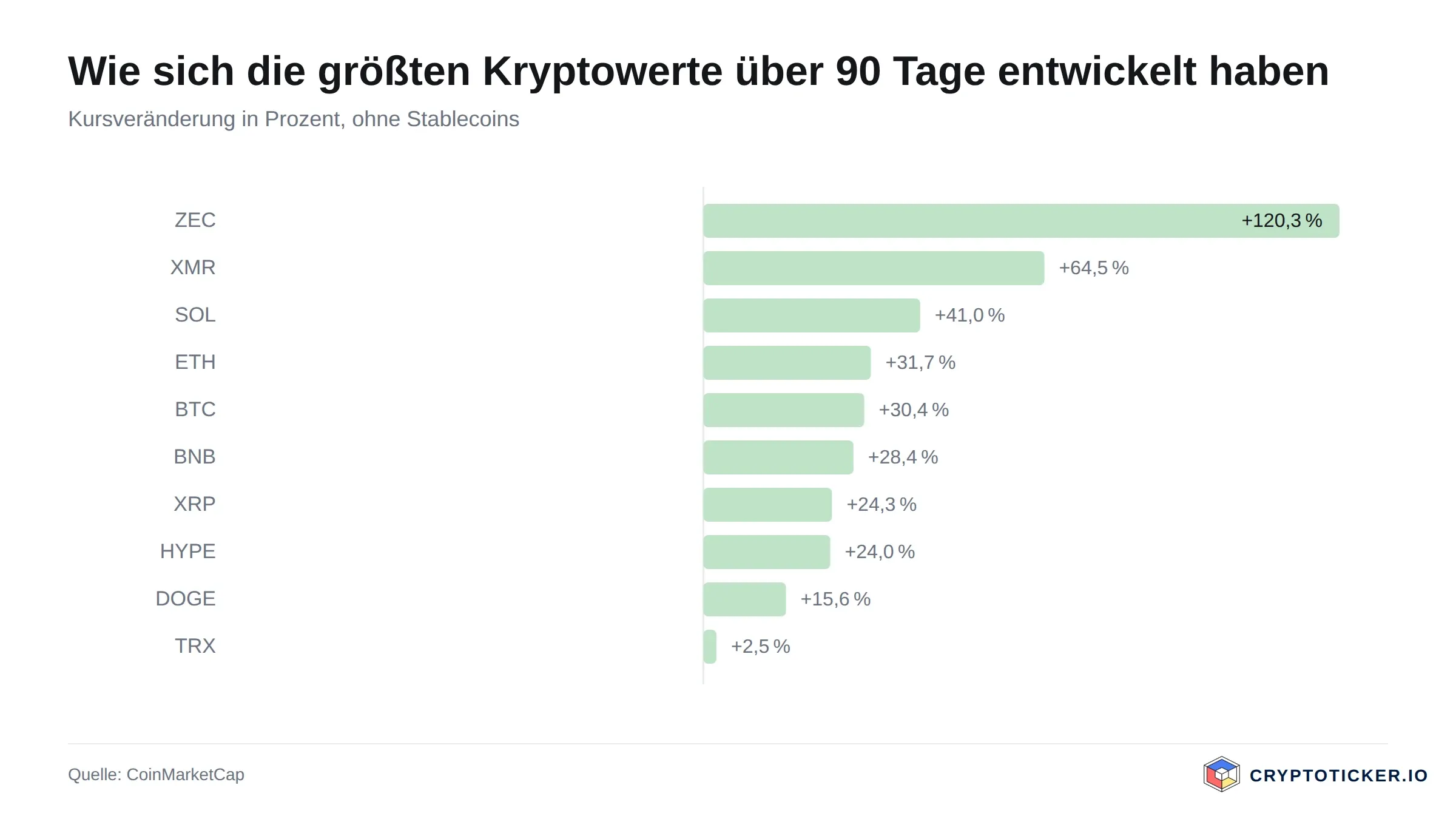
WBT performance over three time frames
24 hours · +7.59 percent
7 days · +9.70 percent
30 days · +40.50 percent
Bar length relative to the largest value (30 days, +40.50 percent). Source: the price data cited in this article, as of 14 October 2026.
What can responsibly be said about the background to the WBT move
On the current state of knowledge there is no clearly reported single trigger for the WBT rise. A rising price and elevated trading volume do broadly fit momentum-driven spot demand, a situation in which an ongoing price move draws additional attention and trading interest. Spot trading here means buying and selling the token directly, as opposed to derivatives such as futures. With an ecosystem token like WBT, platform-specific factors such as usage, fee benefits, liquidity and general market sentiment can all play a part, as the official WhiteBIT explanation of WBT also describes. That is not evidence, however, that these factors actually caused the current move.
Which levels in the WBT price are being watched now
Market watchers are currently looking at the most recent trading range, meaning the area between the daily high and the daily low. The high sits at $78.83, the low at $72.57, the current reference price at $78.68. These levels are not signals, targets or trading recommendations. The Bitcoin comparison at -0.86 percent over 24 hours only underlines that WBT is standing apart from the broader market on this day, without any lasting relative strength or any cause following from it.
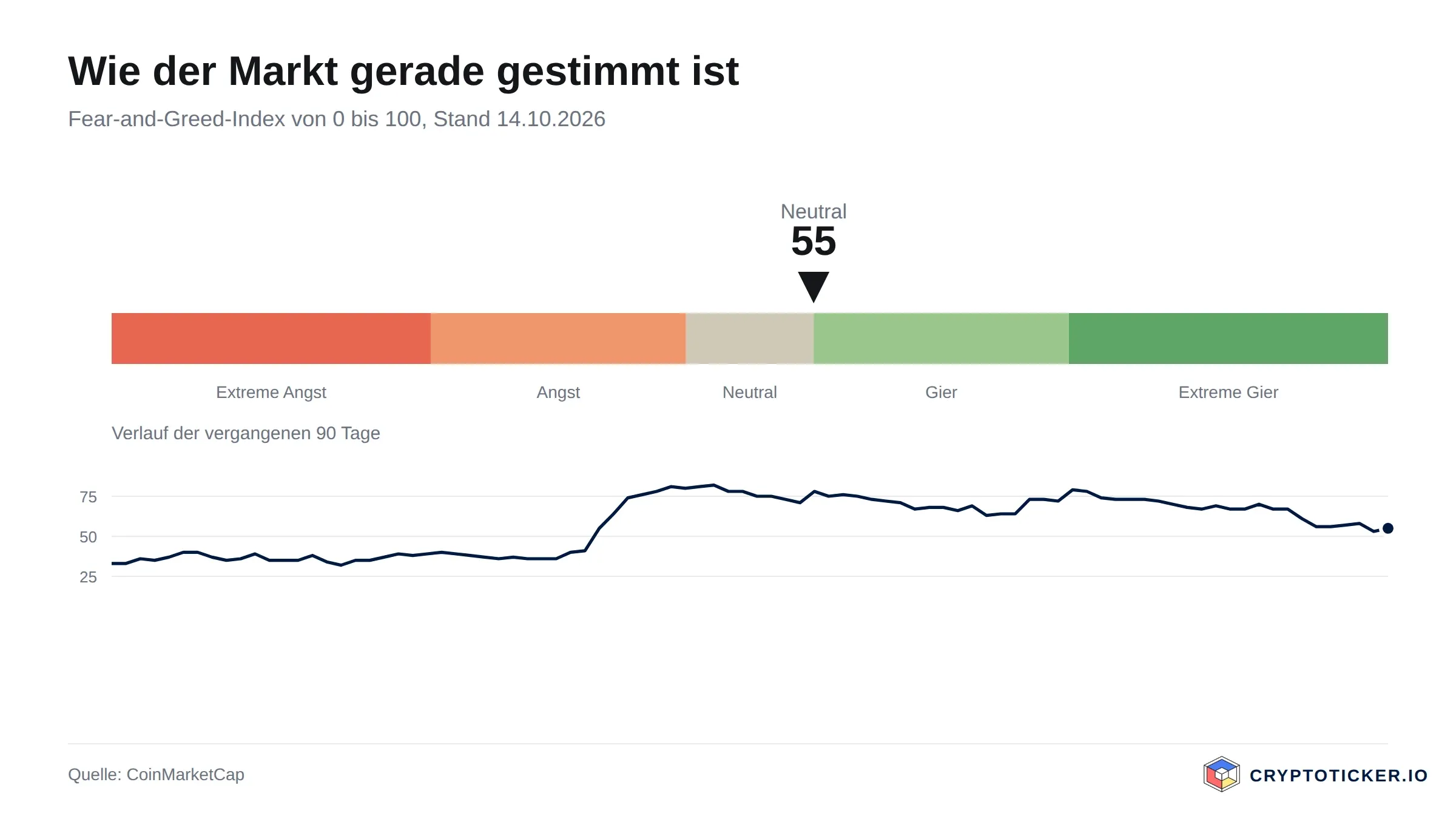
What a crypto price alert actually tells you about WBT
A crypto price alert reports a price move and nothing else, not an assessment. It makes sense to cross-check price, volume and timestamp against reliable data sources, to check official project and exchange statements for matching information, and not to confuse a 24-hour move with a confirmed long-term trend. As the German consumer advice centre explains for crypto assets, such assets can swing sharply and cause substantial losses.
The WhiteBIT Coin price stands at $78.68, with WBT up 7.59 percent on a 24-hour view. The daily high, the elevated trading activity and the positive seven-day and 30-day record make the move stand out. On the available sources a specific trigger remains open, which is why price data, market comparison and possible explanations should be kept clearly apart.
(As of October 14, 2026. This article is not investment advice. Prices and fee structures change; check the terms with the provider before you buy.)
A hardware wallet is a small device that generates the private key to your cryptocurrencies, stores it and never releases it. It looks like a USB stick or a chip card, usually carries a small display, and is connected to a computer or a phone only when you want to sign something. Everything that follows explains why this particular design makes the difference.
The question has a practical side right now. Reports of tampered devices, fake manufacturer websites and drained wallets have piled up through October 2026. To work out which of those attacks a device can actually fend off, you need to know what happens inside it.
A hardware wallet holds keys, not coins
The first and most important point contradicts the name. There is no money inside a wallet. Bitcoin and every other cryptocurrency exist purely as entries in a blockchain, a ledger kept on thousands of machines at once. Those entries cannot be moved and cannot be slotted into a device.
What a wallet holds is the private key: a very large number that proves you are entitled to dispose of a particular entry. Whoever holds that key can spend the associated coins. Whoever loses it can no longer reach them, and nobody can reset it. There is no bank here to issue a new password for a forgotten one.
That sets the entire engineering task for such a device: the key has to be usable without ever becoming visible.
The private key never leaves the device
Hardware wallets solve this by generating the key inside the device and keeping it there. Manufacturer Trezor describes the procedure in its own documentation: the private key never leaves the hardware wallet and at no point comes into direct contact with the internet-connected device.
A computer the wallet is plugged into therefore never sees the key, even with malware running on it. It receives only the result: a finished signature. Historically this answers a concrete problem. In the early years, private keys sat in encrypted files on ordinary computers, and malware emptying an entire wallet was nothing unusual. The first hardware wallet, the Trezor Model One, was built in 2014 at SatoshiLabs in Prague as a counter-design.
What really happens when a transaction is signed
The sequence has four steps, and it explains why an infected computer is less dangerous than it sounds.
First you assemble the transfer in an application on the computer or phone: recipient address, amount, fee. Those details go to the hardware wallet. Its display shows them there, independently of the computer. You confirm with a button on the device. Only then does the chip compute the signature and hand it back, at which point the application broadcasts the signed transfer to the network.
The third step is the decisive one. Because the display belongs to the device and not to the computer, malware can propose a false recipient address, but it cannot stop the real address from appearing on that small screen. Read it there and compare, and the swap shows up. Press the button blind, and it does not. The device moves security to a place the attacker cannot reach, and asks for a glance at the display in return.

Secure element and PIN: the two locks inside the device
Two layers of protection work against direct access to the device, and they work differently.
The first is the PIN. Without it the device cannot be operated, and after a manufacturer-dependent number of failed attempts it wipes its memory. A stolen device is therefore worthless to the thief at first.
The second is the secure element, a dedicated chip of the kind also found in bank cards and passports. It is designed to withhold secrets even when somebody grinds it open, measures its power draw or knocks it off its clock with targeted voltage spikes. Not every device on the market carries one; some manufacturers rely on open-source components instead and argue for verifiability over tamper resistance. Which route is better has been disputed in the industry for years, and the answer depends on the attack you want protection from.
Both locks share one limit: they protect the device, and the recovery phrase sits outside their reach.
The recovery phrase: 12 or 24 words under BIP-39
During initial setup the device shows a sequence of words, usually twelve or twenty-four. This recovery phrase, often called a seed phrase, is the key in human-readable form. From it the entire set of keys can be rebuilt at any time, on any device, including one from a different manufacturer.
Behind the procedure stands an open standard called BIP-39, published in 2013 and in use ever since. It defines how a random number becomes a sequence of words and how the words become a key again. That is exactly why no manufacturer can lock you in: if a device breaks, you restore your holdings onto a new one with the same phrase.
The standard is also clear about what it is not meant for. It exists to make randomness generated by the device readable, and expressly not to turn a self-invented sentence into a key. Inventing a phrase instead of having one generated defeats the whole protection.
2048 words, 11 bits per word: where the phrase gets its strength
A short calculation pays off here, because it makes clear why guessing is out of the question.
The standard's word list contains exactly 2,048 entries. 2,048 is the eleventh power of two, so each word carries precisely 11 bits of information. Twelve words give 132 bits, of which 128 are the actual random number and four form a checksum; twenty-four words give 264 bits, 256 of them random and eight a checksum. That checksum is why a device usually spots a mistyped phrase immediately.
128 bits of randomness mean around 340 sextillion possible phrases, a number with 39 digits. At 256 bits it has 78 digits. For comparison, the visible universe holds somewhere around 10 to the power of 80 atoms on common estimates. Working through a 24-word phrase exceeds any conceivable computing power; the limit here is set by physics.
The practical consequence is an uncomfortable one. Since nobody will guess the phrase, every successful attack runs through the human being: a photographed phrase, a fake website, a tampered device. That is exactly where the losses happen.

Hot wallet, software wallet, hardware wallet: where the difference lies
Three terms get mixed up regularly, and the difference always comes down to one question: where does the private key sit?
With an exchange wallet it sits with the provider. You have an account and a password, but no key. If the exchange fails or is attacked, you are a creditor. In exchange you can buy and sell there, and a forgotten password can be reset. Provider terms are set out in our comparison of crypto exchanges.
With a software wallet, or hot wallet, the key sits on your computer or phone, encrypted, but on a device with an internet connection. You control it yourself, while sharing the device with everything else running on it.
With a hardware wallet the key sits on a device that does nothing else and stays disconnected most of the time. The technical terms for this are cold storage, for custody without a network connection, and air gap, for the space in between.
In practice this does not make one of them right and the others wrong. A split is common: the amount being traded stays at the exchange or in the software wallet, and the holding meant to sit still goes into the device. Everyone decides for themselves at what sum the effort pays off; the devices cost between roughly 50 and 200 euros depending on the model.
Blind signing: the gap the device does not close
One weakness concerns the very step that is supposed to carry the security. For simple transfers the display shows the address and amount in plain text. For more complicated operations, such as approving a program on Ethereum, the device runs out of space or of the ability to translate, and shows nothing but an unreadable block of data. Confirm then, and you sign something you have not read. This is called blind signing.
Several manufacturers have improved on it in recent months and can now display considerably more operations in plain text. What can be changed in your own device settings we set out in detail in September.
Supply chain and fake sites: the real attack routes of 2026
This year's attacks target the device's route to the buyer and the person in front of it, leaving the mathematics untouched.
In October 2026 Ledger confirmed that an additional component had been found inside devices where it does not belong; reports of it reached Europe too. We gathered the case and the checks to run on the device. Shortly before that, according to those affected, 86 million dollars disappeared from wallets, and that case too ran through tampered devices rather than broken encryption. In parallel a fake manufacturer site topped the Google results and asked visitors there for recovery phrases.
An earlier case pointed to the same lesson, one in which a faulty random number generator made keys computable and cost 130 million dollars: a device is only as good as its provenance. Buy from the manufacturer or a named reseller, never second hand, and set it up yourself. A device that arrives with a recovery phrase already printed on it is always an attempted fraud; no manufacturer mails out phrases.
What a hardware wallet does not do
Four things are beyond even the best device, and they belong in an honest answer to the question in the title.
It offers no protection against price falls, because it stores value without judging it. It offers none against a transfer to the wrong address, because a confirmed transaction cannot be recalled. It offers none against a phrase somebody else has seen, whether in cloud storage, in a photo or on a note in a drawer. And it offers none against your own forgetting: without the phrase and without the PIN, the holding is gone once the device fails. What to do in that case, and how the tax office treats such a loss, we wrote up separately.
Tax and the holding period: what the move to your own device triggers
For investors in Germany, moving from an exchange to a device of your own is uncritical for tax purposes. A transfer between your own wallets is not a sale and triggers no taxable event; the one-year holding period under Section 23 of the German Income Tax Act keeps running and does not restart.
Two things still need attention. The acquisition date has to remain provable, because gains are tax-free after a year has passed, and the proof is yours to supply. Keep the exchange statements that show date and quantity. Second, allocating holdings remains your job once they sit spread across several wallets.
Our assessment: the device is the smaller half of security
From the newsroom's perspective, a hardware wallet makes sense for anyone holding a position for the longer term and not moving it constantly. The reason differs from the one in the advertising.
This year's evidence supports it. None of the large losses traced back to broken encryption. The causes were tampered devices, a fake site in search results and a faulty random number generator. The protection the device provides mathematically failed in none of those cases.
Nothing argues against the device itself, but plenty against the expectations placed on it. Buy a hardware wallet and then photograph the phrase, and you have spent money for nothing. Security emerges only from the combination: a device from a known source, set up by you, a phrase kept only on paper or metal, and the display read at every confirmation. Drop one of those four and the rest will not carry.
No recommendation for a particular model follows from this, and a total loss remains possible with any cryptocurrency, however well it is stored.
Hardware wallet: the phrase decides, not the device
If you want to take the step, three steps in this order are enough:
- Choose a device and buy it directly. From the manufacturer or a reseller it names, never second hand and never from a marketplace third party. Which models offer which protection is set out in our comparison of hardware wallets.
- Set it up yourself and write the phrase down by hand. Paper or a metal plate, two locations, no photo, no cloud storage and no typing it into a computer. For smaller amounts that stay in motion, a software wallet still does the job alongside.
- Transfer a small amount first. Send it back once before the rest follows, and keep the purchase statements for the holding period. The matching tax tools take the allocation off your hands later.
How randomness becomes a sequence of words and then a key again is set out verbatim in the BIP-39 specification; the description of the signing process comes from Trezor's documentation.
(As of October 14, 2026. This article is not investment advice. Prices and fee structures change; check the terms with the provider before you buy.)
Decrypt
September CPI hit 3.7%, above forecasts, sending Treasury yields higher and dragging crypto down with stocks.
Turkish police and intelligence officers reportedly seized cash, phones, jewelry and firearms at the crypto founder's address in Beşiktaş.
European electronics chain MediaMarkt Saturn has also halted Ledger sales after a customer in Germany reported finding an implant.
Sahil Arora says he's not done with celebrity meme coins, and that Fomo presents new possible strategies for his controversial schemes.
With Strategy's preferred stock STRC closing in on $100 par, Saylor might not be the number two buyer for long...
U.Today - IT, AI and Fintech Daily News for You Today
Stellar taps Chainlink infrastructure to activate billions in dormant RWA reserves and challenge Ethereum in structural DeFi.
The latest setup comes amid a challenging stretch for SHIB, with its price dropping to trade below $0.000005.
Bitcoin's network hashrate is showing signs of recovery after a sharp plunge, as miners grapple with declining profitability.
Ripple backed Evernorth set to begin deploying 473 million XRP treasury.
Crypto news this morning, Oct 14: Hot US CPI drops Bitcoin to $82,856 as StanChart opens UAE trading desks following Ripple XRPL pivot.
Blockonomi
TLDR:
- Polygon completed its Coinme acquisition on October 14, extending its payments reach across 48 U.S. states.
- The acquired business operates with 37 state money transmitter licenses and 11 applicable exemptions.
- Coinme brings more than 1 million app users and access to roughly 50,000 U.S. retail locations to Polygon.
- Tazapay, Mesh, Toku and Kira are integrating services, but associated payment volumes remain undisclosed.
Polygon Labs completed its acquisition of Coinme on October 14, giving its U.S. payments operation regulated money-transfer infrastructure across 48 states. The deal extends its role beyond blockchain transactions into services connecting bank accounts, cash channels and stablecoins.
That footprint includes 37 state money transmitter licenses and 11 applicable exemptions. The acquired business is also registered with FinCEN as a money services business. However, federal registration is not an operating license, and specific payment services remain subject to state requirements.
The expansion addresses a practical gap in digital-dollar payments. Blockchain transfers alone do not handle every stage of customer funding or bank withdrawals. The transaction now places fiat access alongside wallets and settlement within a single payments framework. That distinction matters for companies sending funds across national borders, where recipients often require access to familiar, established local payment networks.
Polygon Adds Licensed Payment Infrastructure Through Coinme
Polygon first disclosed agreements to acquire Coinme and wallet provider Sequence in January. Together, the transactions were valued above $250 million, although no standalone price was disclosed for the payments acquisition.
Founded in 2014, Coinme developed digital-asset buying and selling channels through retail cash outlets, debit cards and banking connections. Before the deal, it had more than one million app users and access to roughly 50,000 U.S. retail locations.
These services fit into Open Money Stack, which combines customer deposits, stablecoin conversions, digital wallets, transaction routing and blockchain settlement. Businesses can receive funds, convert them into digital dollars and arrange local-currency payouts through one integration.
The arrangement connects regulated entry and exit points with token transfers, resolving a practical limitation of blockchain-only payment systems. That reach matters most when the payer and recipient rely on different payment methods or banking systems.
Four Payment Firms Join Polygon’s Stablecoin Payment Stack
Four initial customers cover cross-border payments, funding, payroll and banking. Tazapay serves over 1,000 clients across 30-plus countries. Its stablecoin services operate through a registered Canadian entity.
It is using wallet and conversion infrastructure to connect stablecoins with local payment networks. Meanwhile, Mesh is integrating fiat funding into its network of more than 300 wallets, exchanges and financial companies. The service adds a funding route.
Among the first customers adopting Polygon Open Money Stack:
Tazapay: cross-border business payments
See the full announcement: https://t.co/MXEsssJDt9
— Polygon (@0xPolygon) October 14, 2026
Toku is incorporating wallet and payout functions into payroll operations across more than 100 countries, allowing stablecoin earnings to be converted into local currency. Kira is expanding stablecoin options alongside U.S. bank accounts, ACH, Fedwire, FedNow and international transfers.
Although Open Money Stack is operating, its unified integration remains in technical preview for selected customers, according to independent reporting. Related transaction volumes, revenues and processing fees for the four integrations have not been publicly disclosed.
The post Polygon Completes Coinme Acquisition, Gains Payments Reach Across 48 U.S. States appeared first on Blockonomi.
TLDR
- State Street (STT) stock plunges 7.97% to $160.23 despite a 33% earnings jump.
- State Street Q3 revenue slips 1.1% quarterly to $4 billion despite annual growth.
- State Street reports a 33% annual EPS increase to $3.69 as net income rises 27%.
- State Street assets under management reach a record $6.3 trillion, rising 16%.
- State Street returns $651 million to shareholders despite rising operating costs.
State Street Corporation (STT) stock plunged 7.97% to $160.23 during Wednesday’s morning trading, losing $13.87 following its third-quarter earnings release. The decline followed a 1.1% quarterly revenue decrease, despite stronger annual earnings and record assets under management. The company reported 33% annual growth in diluted earnings per share, although revenue missed market expectations.
State Street Corporation, STT
State Street Revenue Slips 1% Despite Strong Annual Growth
State Street reported third-quarter revenue of $4.004 billion, down from $4.048 billion in the previous quarter. However, revenue increased 13% from $3.545 billion during the corresponding period last year. Total fee revenue declined 1.5% quarterly to $3.14 billion, although it increased 11% annually.
Net interest income reached $864 million, representing a 21% increase from the previous year. Servicing fees increased 10% annually to $1.492 billion, supported by organic growth and higher market levels. Management fees also climbed 20% to $797 million, reflecting stronger asset valuations and long-term inflows.
However, foreign exchange trading revenue declined 14% quarterly to $427 million despite increasing 17% annually. Other fee revenue dropped 29% to $98 million, largely reflecting market-related adjustments. These declines contributed to weaker quarterly revenue, while stronger servicing and management fees provided partial support.
State Street Q3 Earnings Jump 33% as Expenses Increase
State Street reported diluted earnings of $3.69 per share, representing a 33% increase from $2.78 last year. Net income climbed 27% annually to $1.09 billion, compared with $861 million during the previous year. However, total operating expenses increased 8% annually to $2.62 billion, reflecting higher compensation and technology investments.
The company recorded a pretax margin of 34.6%, compared with 31.1% during the previous year. Return on average common equity increased to 16.4%, while tangible common equity returns reached 25.1%. Meanwhile, compensation expenses increased 8%, and information systems costs rose 15% following continued infrastructure investments.
Despite higher expenses, State Street returned $651 million to common shareholders during the third quarter. The total included $400 million in share repurchases and $251 million in declared dividends. Its standardized common equity tier 1 capital ratio reached 11%, compared with 11.3% a year earlier.
State Street Assets Reach Record Levels Despite Cash Outflows
State Street reported record custody and administration assets of $59.2 trillion, representing 15% annual growth. Assets under management also increased 16% annually to $6.3 trillion, supported by higher market valuations. However, quarterly net asset inflows reached only $7 billion after substantial withdrawals from cash products.
Exchange-traded funds attracted $69 billion in net inflows, while cash portfolios recorded $62 billion in withdrawals. Consequently, overall net flows declined from $114 billion during the second quarter. The company also secured $429 billion in new servicing mandates during the latest quarter.
State Street expanded its investment management business through 38 new products and solutions during the reporting period. The company also announced plans to acquire Santander CACEIS Latam Securities Services, subject to regulatory approvals. Meanwhile, its liquidity coverage ratio stood at 106%, unchanged from the corresponding quarter last year.
The post State Street (STT) Stock: Sinks 7% as Q3 Revenue Falls 1% Despite 33% Earnings Jump appeared first on Blockonomi.
TLDR
- Faraday Future (FFAI) stock jumps 5.42% following a $200 million robotics deal.
- Faraday Future signs a deal to transfer its robotics business to Nasdaq-listed FFR.
- FFAI will retain a 65.7% stake in FFR following the proposed robotics transaction.
- FFR secures up to $10 million in financing to support robotics development plans.
- Faraday Future targets Robotaxi expansion as its robotics deal nears completion.
Faraday Future Intelligent Electric (FFAI) stock climbed 5.42% to $1.1699 during Wednesday’s morning trading, gaining $0.0599. The increase followed the company’s announcement of a $200 million robotics business sale agreement. However, shares retreated from an earlier session peak near $1.50.
Faraday Future Intelligent Electric Inc., FFAI
Faraday Future Signs $200 Million Robotics Agreement
Faraday Future signed definitive agreements with FF EAI Robotics Ecosystem (FFR) to transfer its entire robotics business. The transaction values the robotics operations at approximately $200 million and FFR at $60 million. The agreement advances a previously announced proposal into a formal transaction framework.
Under the agreement, FFAI will receive newly issued FFR shares at an agreed value of $2.246 each. This valuation represents approximately a 50% premium to FFR’s referenced market price. The companies also removed the previously proposed special stock dividend to simplify the transaction.
Following completion, FFAI expects to control approximately 65.7% of FFR on a fully diluted basis. Management and employees will hold approximately 18.2%, while PIPE participants will own another 5.5%. Meanwhile, existing FFR shareholders will retain approximately 10.7% under the proposed ownership structure.
FFR Secures $10 Million Financing for Robotics Expansion
FFR has secured up to $10 million through private investment in public equity financing. The company structured the financing without discounted shares or warrants to limit dilution. Additionally, the proceeds will support robotics development, commercial operations and expansion.
The combined business plans to develop humanoid and bionic robotics through its integrated artificial intelligence ecosystem. Its operations will cover manufacturing, research, deployment, supply chains and related services. FFR intends to pursue a leading industry position within five years.
FFAI management projects robotics revenue of approximately $7 million in 2026 and $45 million in 2027. Its preliminary forecasts also indicate cumulative revenue approaching $1.98 billion through 2030. FFR has not adopted these estimates as official company guidance.
Faraday Future Plans Robotaxi and Shared Mobility Expansion
Faraday Future plans to shift its remaining operations toward shared mobility and intelligent vehicle services. The company intends to collaborate with RoboShare on Robotaxi networks and connected vehicle technology. This approach would reduce its reliance on traditional vehicle manufacturing operations.
The proposed strategy also includes integrating intelligent cabin technology into shared vehicles. Through RoboShare, FFAI plans to expand vehicle deployment, operational services, and customer access. These initiatives would connect its existing electric vehicle technology with emerging mobility services.
The companies expect to complete the robotics transaction by the end of October 2026. FFAI will retain majority ownership, while FFR will operate through a separate Nasdaq-listed corporate structure. Following closing, Faraday Future plans to announce its next business strategy and operational priorities.
The post Faraday Future (FFAI) Stock: Climbs on $200M Robotics Business Sale appeared first on Blockonomi.
TLDR
- HONA stock slipped 0.82% to $156.88 during Wednesday’s early trading session.
- Honeywell Technologies unveiled Forge Cognition with NVIDIA and Dell support.
- Forge Cognition uses AI agents to improve building maintenance and energy use.
- NVIDIA’s Voyager pilot reduced unnecessary facility alerts by up to 90% on average.
- HONA operates separately from Honeywell Technologies after its June spin-off.
Honeywell Aerospace (HONA) stock fell 0.82% to $156.88 during Wednesday’s early trading, losing $1.29 after retreating from above $159. Meanwhile, Honeywell Technologies introduced Forge Cognition, an AI platform developed using NVIDIA and Dell Technologies infrastructure. The announcement expands Honeywell Technologies’ automation business, although Honeywell Aerospace now operates as a separate publicly traded company.
Honeywell Aerospace Inc, HONA
Honeywell Technologies Launches AI Platform With NVIDIA and Dell
Honeywell Technologies introduced Forge Cognition to improve building management, industrial operations, and equipment maintenance through automated systems. The platform combines digital simulations with AI agents to analyze facility conditions and coordinate operational responses. Furthermore, it connects with existing infrastructure to support equipment reliability, energy management, and maintenance planning.
The system helps facility operators identify equipment problems, assess operational conditions, and respond to building management alerts. Its predictive maintenance features analyze HVAC equipment data to detect potential failures before major disruptions occur. Meanwhile, energy management tools simulate operational adjustments to identify opportunities for lower consumption without compromising comfort.
Honeywell Technologies developed the platform using NVIDIA’s computing technology and Dell’s enterprise infrastructure. NVIDIA Nemotron models support automated analysis, while Omniverse tools provide simulations of physical environments. Dell contributes PowerEdge servers, data storage systems, and supporting services through its Dell AI Factory.
Honeywell Reports Early Results From Forge Cognition Deployments
Honeywell Technologies has started testing Forge Cognition across several commercial, educational, and industrial facilities. These locations include NVIDIA’s Voyager campus, Dubai’s Fairmont Hotel, Singapore’s NEX Mall, and Vanderbilt University. The company also operates pilot programs at its facilities in Bangalore and Richardson, Texas.
At NVIDIA’s Voyager campus, the platform reduced unnecessary operational alerts by up to 90% on average. The pilot also identified opportunities to reduce energy and utility consumption by up to 10%. Furthermore, facility operators maintained comfort scores above 95% across monitored building zones.
The platform offers manual, semi-autonomous, and autonomous operating modes, allowing facility teams to determine appropriate oversight levels. Operators can also override automated decisions when operational conditions require direct intervention. Honeywell Technologies plans to expand deployment capabilities across its existing customer network of more than 300,000 sites.
Honeywell Aerospace Operates Independently Following June Spin-Off
Honeywell Aerospace became an independent public company on June 29, 2026, following its separation from Honeywell Technologies. The aerospace business began trading under HONA, while Honeywell Technologies retained the HON ticker. The Forge Cognition announcement concerns Honeywell Technologies rather than Honeywell Aerospace’s direct product portfolio.
Honeywell Aerospace focuses on aviation and defense technologies, including systems supporting commercial aircraft and military operations. Its separation established a dedicated aerospace company with independent management and business priorities. Meanwhile, Honeywell Technologies continues developing automation solutions for buildings, industrial facilities, and connected infrastructure.
The latest stock decline follows Honeywell Aerospace’s transition into an independent aerospace and defense supplier. However, the Forge Cognition announcement does not establish a direct connection between the platform and HONA’s financial performance. Honeywell Technologies continues pursuing industrial automation opportunities through its collaboration with NVIDIA and Dell Technologies.
The post Honeywell Aerospace (HONA) Stock: Falls Despite Major AI Launch With NVIDIA and Dell appeared first on Blockonomi.
TLDR
- Wells Fargo plans to issue a stablecoin with 20 other financial institutions in the first half of 2027.
- CEO Charlie Scharf said stablecoin use cases in the US “remain unclear,” but the bank is preparing.
- The consortium will start with a US dollar token and may later add the euro and other G7 currencies.
- Wells Fargo launched tokenized deposits for corporate and commercial clients in September.
- Third-quarter net income rose to $5.95 billion from $5.59 billion a year earlier.
Wells Fargo is preparing to issue stablecoins with 20 other financial institutions in the first half of 2027. The plan moves ahead even as CEO Charlie Scharf says stablecoin use cases in the United States are still unclear.
Scharf spoke during the bank’s earnings call on Oct. 13. He said Wells Fargo is building digital payment services while studying where stablecoins could help American customers.
“Use cases in the US for stablecoins remain unclear, but we’re building solutions to be prepared as opportunities potentially unfold,” Scharf said.
He added that the bank is speeding up investment in traditional and digital payments for consumers and businesses.
Stablecoin Venture Targets 2027 Launch
Wells Fargo and its partners announced the plan on Sept. 1. The group expects to set up the new company in the second half of 2026, subject to closing conditions.
The company will start with a US dollar token. It may later add other Group of Seven currencies, with the euro as a priority.
The group plans to serve wholesale, institutional and retail customers. This includes people making cross-border payments or settling digital asset trades.
Members include Bank of America, Citi, Goldman Sachs, Capital One, Fidelity Investments and WisdomTree. European members include Deutsche Bank, Santander, BBVA, Lloyds Banking Group and UBS, while MUFG, Standard Bank and Sirius International Holding represent other regions.
The group said the service would follow the GENIUS Act in the US and the Markets in Crypto-Assets regulation in Europe, where applicable. The company’s name will be shared later.
Tokenized Deposits and Third-Quarter Results
Scharf said Wells Fargo launched tokenized deposits in September for corporate and commercial clients. The bank expects the service to allow transfers between accounts and across borders at any time.
The rollout began with a limited US dollar to British pound exchange service for selected clients. Wells Fargo plans to add customers, countries and currencies during 2027.
The platform supports bank-held wallets and payment instructions that run when set conditions are met. In September, a Cosmos executive said Wells Fargo uses Cosmos ledger technology for the project.
Wells Fargo is also part of a separate shared deposit token network with JPMorgan Chase, Bank of America and Citigroup. The Clearing House would run that system, which also targets the first half of 2027.
Tokenized deposits are claims on funds held at commercial banks. They let customers use blockchain payment tools while keeping their money inside the banking system.
On the financial side, Wells Fargo reported net income of $5.95 billion for the quarter ended Sept. 30. That is up from $5.59 billion a year earlier.
Diluted earnings per share rose to $1.87 from $1.66. Quarterly revenue reached $21.87 billion, up 2% from $21.44 billion in the same period of 2025.
The post Wells Fargo Earnings Beat Last Year as Bank Plans 2027 Stablecoin Launch appeared first on Blockonomi.
CryptoPotato
XRP whale activity on Binance is picking up pace, at least compared with the rest of the exchange market.
CryptoQuant’s latest data revealed a sharp jump in the gap between whale and retail outflows over the past six days.
Whale Activity
From October 7 to 13, Binance’s seven-day average Whale vs Retail Spread rose from 53% to 63.5%. This is a 10.5-point jump. Across all centralized exchanges, the same reading increased from 46% to 47.7%, a much smaller 1.7-point rise. Binance’s increase was roughly 6.2 times larger. The spread tracks the relative difference between large and small XRP exchange outflows. A higher reading indicates that larger transfers are playing a bigger role.
However, it does not confirm that whales are accumulating XRP or withdrawing more coins in absolute terms.
The gap between Binance and the broader market now stands at 15.8 points. That puts it close to the 18-point difference seen on August 3. Back then, the crypto asset traded near $1.07 before climbing about 46% to $1.56. XRP is currently hovering around $1.38.
CryptoPotato had previously reported that spot volume across centralized exchanges fell by $1.943 billion between August 26 and October 11. On Binance, the spot-to-futures ratio slid from 31% to 12.7%, meaning futures activity now dwarfs spot trading. CryptoQuant explained that some traders could be waiting for a cheaper entry.
XRP sentiment, meanwhile, has slipped into negative territory as bullish comments trailed bearish ones at a ratio of 0.92 across social platforms. This growing pessimism could leave room for a rebound if market conditions improve and buying interest returns.
Despite the short-term struggle, a German analyst believes XRP could still hit a new all-time high before the year ends. He flagged that the crypto asset has tested a key resistance zone seven times but failed to break above it convincingly. That rejection sent XRP briefly back toward $1.29. The next major hurdle now stands at the $2.15-$2.20 range.
Institutional Demand Paused?
The institutional side of things looks less encouraging. Data compiled by SoSoValue revealed that US-listed spot XRP ETFs have recorded zero net flows for three consecutive days. October has seen just three days of inflows and one day of outflows so far, with total inflows sitting a little above $12 million.
While the monthly figure remains positive, the recent lack of fresh money shows that institutional interest has been fairly muted.
The post XRP Whales Are Making a Bigger Mark on Binance as Outflow Gap Nears August Levels appeared first on CryptoPotato.
Ethereum is stabilizing around $2.5K after another sharp test of demand near $2.4K. Buyers have defended the recent lows, but the recovery remains below key resistance, leaving the market caught between a potential base and another leg lower.
Ethereum Price Analysis: The Daily Chart
On the daily timeframe, Ethereum remains within its broader ascending channel despite the recent correction. The decline from approximately $2.8K pushed the price below the channel’s midpoint and into the highlighted $2.36K–$2.46K demand zone. Two pronounced lower wicks into this region suggest buyers are responding to selling pressure, though subsequent rebounds have remained relatively modest.
The latest recovery toward $2.52K keeps ETH above demand, but a move through the recent rebound highs around $2.56K–$2.58K is needed to demonstrate improving momentum. Beyond that, the former consolidation around $2.67K–$2.75K represents an important resistance area. Reclaiming it could support another challenge of the broader $2.79K–$3.05K supply zone.
Conversely, renewed weakness would bring the $2.36K–$2.46K demand zone back into focus. This area overlaps with the channel’s rising lower boundary, making it a significant support confluence. A sustained breakdown beneath both would weaken the broader recovery structure and increase the risk of a deeper correction toward $2.3K and $2.2K.
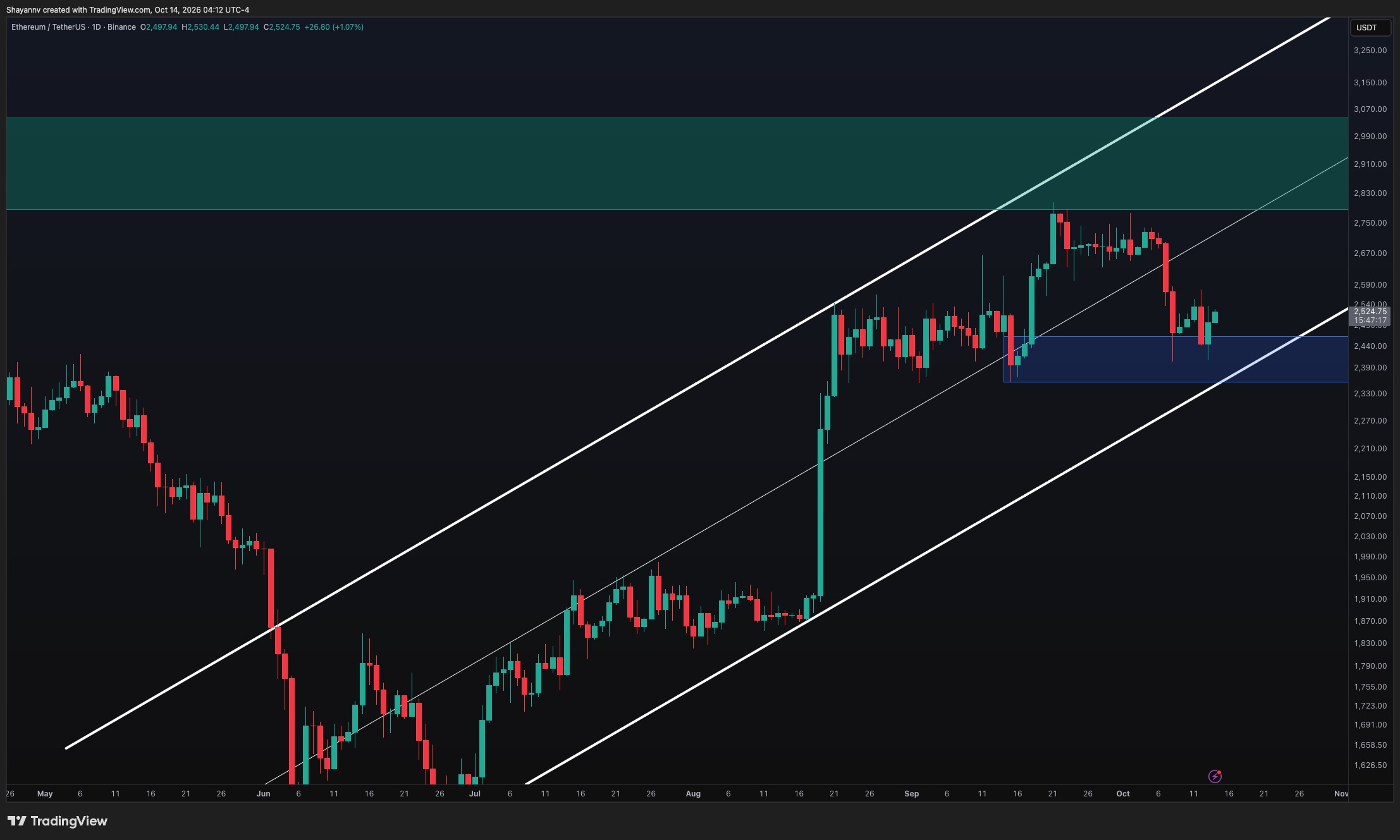
ETH/USDT 4-Hour Chart
The 4-hour chart highlights two sharp declines toward the rising lower trendline around $2.4K–$2.42K, each followed by a rebound. These reactions suggest that buyers are defending the lower portion of the structure, but the latest recovery has yet to clear the previous rebound high near $2.58K.
In the immediate term, ETH is consolidating around $2.5K–$2.53K. A sustained break above this narrow range could bring the $2.56K–$2.58K resistance area into play. Clearing that barrier would strengthen the base-building scenario and open the way toward the marked $2.68K–$2.74K supply zone, where the earlier consolidation broke down.
On the downside, losing $2.48K would expose the upper boundary of demand near $2.46K and potentially trigger another test of the rising trendline around $2.41K. Repeated tests make the response at this support increasingly important. A decisive loss of the trendline and the $2.36K demand boundary would undermine the current stabilization attempt.

Sentiment Analysis
The two-week Binance ETH/USDT liquidation heatmap shows substantial estimated liquidation concentrations above the current price. The nearest prominent overhead band sits around $2.58K–$2.6K, followed by another strong cluster near $2.63K–$2.65K. Additional concentrations remain higher around $2.74K–$2.8K.
The nearby $2.58K–$2.6K cluster aligns with the recent rebound high, making this region relevant to both price structure and leveraged positioning. A sustained advance through it could trigger short liquidations and accelerate the recovery toward the next overhead pool. However, reaching these levels would not itself confirm a lasting bullish reversal.
Below price, estimated liquidation bands remain around $2.47K–$2.49K and the broader $2.37K–$2.4K region. Another loss of nearby support could expose these concentrations and amplify selling through long liquidations. The heatmap therefore highlights potential volatility on both sides, with a break above $2.58K or renewed weakness beneath $2.48K likely to clarify the immediate direction.

The post Ethereum Price Analysis: What’s the Worst-Case Scenario if ETH Loses $2.5K Support? appeared first on CryptoPotato.
After the release of the PPI and US jobs report at the end of September and the beginning of October, all eyes turned to the next key factor that will determine the Fed’s next move: the Consumer Price Index.
The US Bureau of Labor Statistics just released the data, showing that the actual year-over-year increase of 3.7% is slightly higher than the estimated 3.6%, while the month-over-month rise matched expectations at 0.6%.
Core CPI, which excludes more volatile sectors such as energy and food, rose 2.6% YoY and 0.3% MoM. Estimates were again slightly lower at 2.5% and 0.2%, respectively.
Bitcoin reacted with an immediate nosedive that pushed it south by a grand. The asset stood at around $83,800 before it dropped to $82,800 in the initial minutes after the CPI data went live.
Lacie Zhang, Research Analyst at Bitget Wallet, told CryptoPotato that a similar reading (higher than expected) could “trigger a sharper repricing.”
“The biggest risk investors may be underpricing is that sticky core inflation — driven by energy spillovers, tariffs or sustained demand — keeps the Fed on a higher-for-longer path beyond the single additional hike many still expect later this year,” she added.
She outlined the next major support line for BTC at $81,000-$82,000, suggesting that the cryptocurrency could soon retest it if selling pressure intensifies after the CPI.
The post Bitcoin Price Plunges as September CPI Comes Out Higher Than Expected appeared first on CryptoPotato.
The viral altcoin BTW is the best-performing cryptocurrency today (October 14), up nearly 40% in a single day and 250% over the last month. It currently trades around $2.50 and has a market capitalization of almost $4 billion.
The triple-digit monthly increase has put the token in the spotlight, fueling expectations that the price could climb even higher in the near future. However, many think now is the perfect time to open short positions, and certain indicators support a bearish scenario.
Major Red Candle Incoming?
Despite the crypto market’s heightened volatility, Bitway has experienced a nearly uninterrupted upward trajectory lately and is now the 32nd-largest digital asset, after flipping popular altcoins like Bittensor (TAO), Shiba Inu (SHIB), Cronos (CRO), and many more.
The impressive price increase has rewarded early buyers with significant profits (at least on paper), leaving many market participants wondering if the asset’s uptrend still has room to continue. Nonetheless, multiple analysts warn that a short-term correction, and even a major collapse, are now more likely.
X user Zayn noted that BTW has posted eight consecutive green candles, signaling extremely overbought conditions. The analyst expects a “hard correction” to $2 and below but alerted traders to be careful when opening positions:
“Everyone will be looking to short here, so don’t go all in. Keep your position small and keep your stop-loss and liquidation levels above $3.50.”
UMER (THE BULL) issued the next warning, anticipating a short setup and monitoring the $2-$2.05 zone. The X user went even further, calling BTW a “scam coin” that can print “massive wicks” in either direction, so people should always trade it with a stop-loss.
Crypto With Gopal also chipped in. He said BTW has formed a double-top pattern after the price was rejected near $2.75-$2.80, signaling possible profit-booking pressure.
“Bears are watching the $2.40 neckline – a breakdown could trigger a deeper pullback toward $2.10. BTW is at a critical decision zone – bulls must defend support to keep the rally alive,” he concluded.
Additional Red Flags
BTW’s Relative Strength Index (RSI) supports Zayn’s theory that the token has entered extreme overbought territory. Latest data shows the ratio has surged past 80, suggesting the price has pumped too much in a short period and may be due for a short-term pullback.

- BTW RSI, Source: RSI Hunter
Another concerning factor is the high concentration of token ownership. According to CoinMarketCap, the top 10 addresses control more than 96% of BTW’s supply, making the coin highly vulnerable to potential price manipulation.

- BTW Holders Distribution, Source: CoinMarketCap
The post Bitway (BTW) Rockets 250% in a Month: Perfect Time to Short? appeared first on CryptoPotato.
Large Bitcoin (BTC) holders have resumed accumulation after months of selling, according to an analysis published by CryptoQuant. The shift comes as the cryptocurrency recovered from lows near $62,000 to highs around $87,000 and moved above its 365-day moving average.
Other market and on-chain indicators also point to improving conditions. CryptoQuant’s Bull Score Index, which combines ten market and on-chain indicators, climbed from 20 in late July to 90 on September 26. The index now stands at 80, which the firm says signals the early stages of a potential bull cycle.
Whale Accumulation and ETF Flows Signal Renewed Demand
Whale wallets, excluding exchanges and mining pools, now hold 3.03 million BTC, their highest combined balance since November 21, 2025. Their monthly accumulation rate has also reached its fastest pace since February 11, 2026.
Long-term data also show a shift in whale behavior after holdings began contracting in September 2025. The annual change in whale balances has returned close to zero and moved above its 365-day moving average, suggesting accumulation is strengthening.
Bitcoin ETF flows provide another indication of renewed demand. U.S. spot Bitcoin exchange-traded funds have recorded approximately 2,300 BTC in net inflows so far in 2026, worth around $1.5 billion. This follows earlier outflows that reached 83,000 BTC, valued at approximately $5.1 billion.
Bitcoin-Backed Borrowing Rises
Data from crypto lending platform CoinRabbit provides another indication of changing activity among large holders. In September, borrowers with BTC-backed loans exceeding $10 million increased their total USDT borrowing by 83%, following a 9% decline in July. Their average loan size also rose 33% after falling 8% in August.
Smaller borrowers showed a different pattern, with retail customers holding loans below $100,000 reducing their total borrowing by 17% in September. However, their average loan size increased, highlighting differences in borrowing behavior between large and small customers.
Taken together, these figures suggest that some large holders may be borrowing against Bitcoin for liquidity rather than selling, although the data cannot confirm their intentions. These developments also align with CryptoQuant’s broader assessment of market conditions.
The post Bitcoin Whales Resume Buying After Months of Selling: CryptoQuant appeared first on CryptoPotato.