Cryptocurrency Posts
Crypto Briefing
Man City's record signing of Anderson could bolster their EPL title chances, while Man United's failure to secure him may weaken their prospects.
The post Man City signs Elliot Anderson for club-record £116M fee appeared first on Crypto Briefing.
Ukraine's strategic focus on disrupting Russian logistics may shift conflict dynamics, affecting military operations and market confidence.
The post Ukraine sees Kerch Bridge’s reduced military value as strategic advantage appeared first on Crypto Briefing.
Gen.G's LCK victory enhances their global standing, potentially impacting their World Championship prospects and future power rankings.
The post GEN Canyon wins sixth LCK title, boosting Gen.G’s global ranking prospects appeared first on Crypto Briefing.
Anthropic's focus on AI safety and regulatory compliance could enhance its market position and investor confidence ahead of a potential IPO.
The post Anthropic CEO calls for government role in AI safety, eyes potential IPO appeared first on Crypto Briefing.
The drone strike exacerbates regional tensions, challenging diplomatic efforts and impacting global oil markets amid fragile Saudi-Iran relations.
The post Iran denies being at war with Saudi Arabia after drone strike hits critical oil pipeline appeared first on Crypto Briefing.
Bitcoin Magazine
Bitcoin Magazine

Bitcoin’s ‘Unusual Mix’: Bearish Inflation Print, Bullish Buyback Failure
Bitcoin’s path higher just got harder in the short term, but the setup further out may be improving, according to a new report.
In a Friday note, European asset manager CoinShares’ Head of Research, James Butterfill, said firmer-than-expected core inflation raises the odds of tighter Fed policy and could cap bitcoin below $80,000 for now.
But the longer-term case, he argued, rests on the U.S. Treasury’s bond buyback programme failing to bring down long-end yields — a failure that could ultimately feed the debasement narrative that has supported both bitcoin and gold.
“The result is therefore a somewhat unusual policy mix for Bitcoin,” the report read. “Today’s CPI data is negative at the margin, increasing the probability of tighter monetary policy and potentially limiting the immediate upside.
“But the apparent failure of the Treasury’s current buying programme increases the likelihood of much more substantial intervention further ahead.”
It continued: “If that happens, it could become one of the more powerful medium-term catalysts for Bitcoin.”
Data on Friday revealed that the consumer price index, excluding food and energy, climbed 0.3% in August from a month earlier — higher than expected.
According to CME’s FedWatch tool, traders think there is a 85% chance interest rates will be higher after the Federal Reserve meets next week. Bitcoin has typically performed well in a low interest rate environment.
But the U.S. Treasury’s expanded bond buyback programme has so far failed to materially suppress long-term yields.
If yields stay stubbornly high, Butterfill said, pressure will build on Treasury Secretary Scott Bessent to escalate to a much larger, “bazooka-style” buying programme aimed at forcing borrowing costs down.
Bitcoin in August had one of its best runs in years after Treasury Secretary Scott Bessent announced the department would double the size of its long-dated bond buybacks.
The announcement and subsequent price surge has led some to say the much talked-about debasement trade is back. The so-called debasement trade is when investors buy an asset as a way to hedge against a currency losing value.
Bitcoin and gold have both benefited as part of the trade as the dollar weakens.
This post Bitcoin’s ‘Unusual Mix’: Bearish Inflation Print, Bullish Buyback Failure first appeared on Bitcoin Magazine and is written by Mathew Di Salvo.
Bitcoin Magazine

Blockstream Tells Hackers To Return Remaining Bitcoin Stolen in Liquid Theft
Bitcoin infrastructure firm Blockstream has refused to negotiate further with hackers who last week stole 4,000 bitcoins from its Liquid network.
Writing on X Friday, Blockstream said that the hackers still had time to return the funds before the company would work with law enforcement.
White-hat hackers on Sunday withdrew about $320 million from the federation wallet that backs Liquid, a sidechain by Blockstream. After negotiating with Blockstream, they returned most of the funds but kept 598.5 coins worth over $46 million — demanding it as ransom.
“Blockstream will not pay a ransom for the return of stolen funds,” the post read. “Taking assets without authorization and withholding their return is a crime, not responsible disclosure. It is not white-hat activity. It is theft.”
It added: “We will work with law enforcement, exchanges, service providers, forensic specialists, and other relevant parties to trace and recover the assets and identify those responsible.”
“We will not pay for the return of stolen property. We will not abandon our users. The Bitcoin community will not stop pursuing the funds.”
Liquid, or L-BTC, is a layer-2 created by Blockstream that allows users to fast move assets backed 1:1 with bitcoin. One of the assets, LBTC, is a token backed by bitcoin that allows for quick settlement — a bit like the Lightning Network.
Hackers were able to get the funds by exploiting an inflation bug on the Liquid sidechain to create over 4,000 LBTC that did not exist before and cash them out for real, on-chain bitcoins.
The hackers then had an exchange with Blockstream via messages written into Bitcoin blocks.
In one message, the white hats wrote: “Please fix the bug first. The chain is under risk at latest commit right now. Make sure every node is patched. Then we will transfer the money back safely after confirming the fix.”
In the latest message, the hackers slammed Blocksteam as “delusional, greedy, and arrogant,” and threatened to reveal all of Blockstream’s encrypted messages in the exchange unless the company allowed thieves to keep 10% of the bitcoins.
“You SHALL pay 10% using your own money as bug bounty or you will cause all your holders a 15% loss for your irresponsibility and stinginess,” the message read.
The Bitcoin community is still reeling after hackers in July were able to steal over 1,800 bitcoins worth close to $140 million from Coldcard wallet holders.
Users of the popular hardware wallet, created by Coinkite, were targeted because the product’s manufacturer did not use a true random number generator, allowing hackers to essentially guess investor seedphrases.
This post Blockstream Tells Hackers To Return Remaining Bitcoin Stolen in Liquid Theft first appeared on Bitcoin Magazine and is written by Mathew Di Salvo.
Bitcoin Magazine

Italy’s Second Biggest Bank UniCredit Is Weighting up Crypto Custody: Report
Italy’s second largest bank is considering expanding into digital asset offerings, including custody, according to reports.
According to a Friday Bloomberg report citing people familiar with the matter, Milan-based UniCredit is selecting a technology provider that would allow it to build the infrastructure needed to hold digital assets and facilitate their buying and selling.
Bloomberg’s reporting added that tokenized investment products and fixed-income securities, the use of stablecoins and exposure to cryptocurrencies were all on the cards.
JUST IN:
— Bitcoin Magazine (@BitcoinMagazine) September 11, 2026Italy’s 2nd-largest bank UniCredit is considering to offer crypto asset custody — Bloomberg
pic.twitter.com/NAZKJBdcES
The news comes as other banks in Europe expand crypto offerings. Spain moved first on retail, with BBVA rolling out bitcoin trading and custody to all customers via its app, using its own custody infrastructure rather than a third party; Santander’s Openbank followed with its own trading service.
Cecabank — a Spanish custodian with over €400bn under management that acts as backbone for 100+ financial institutions — went live with crypto custody in June via a partnership with Bit2Me.
And in Germany, Deutsche Bank is building custody with Bitpanda’s technology arm, while Taurus and DZ Bank got BaFin approval in January for its meinKrypto platform.
New regulation in the European Union — Markets in Crypto-Assets Regulation (MiCA) — gives banks a legal definition, a supervisor, and a familiar set of obligations to launch crypto services.
UniCredit is one 37 lenders across 15 European countries working together to create a company called Qivalis with the aim of issuing a euro-denominated stablecoin.
Last year, the bank said it was offering professional clients a structured product tied to BlackRock’s iShares Bitcoin Trust exchange-traded fund, with full protection against losses.
This post Italy’s Second Biggest Bank UniCredit Is Weighting up Crypto Custody: Report first appeared on Bitcoin Magazine and is written by Mathew Di Salvo.
Bitcoin Magazine

Government Defeated as Lords Back UK Digital Assets Strategy
The UK government suffered a defeat in the House of Lords on Wednesday as peers backed an amendment requiring the Treasury to draw up a national strategy for regulating digital assets.
The upper chamber approved the measure by 194 votes to 138, with Conservative and Liberal Democrat peers combining against a near-solid bloc of Labour votes. Baroness Neville-Rolfe, a Conservative former Treasury minister, moved the amendment to the Financial Services and Markets Bill.
The new clause, titled “Digital assets strategy,” would require the Treasury to prepare, publish and consult on a strategy for regulating and developing digital assets and related digital financial market infrastructure in the UK.
JUST IN:
— Bitcoin Magazine (@BitcoinMagazine) September 11, 2026U.K. House of Lords passes amendment requiring the government to develop a national cryptocurrency strategy
The regulation of digital assets includes “cryptoassets, qualifying stablecoins, Central Bank Digital Currencies, tokenised securities and other digital and tokenised financial assets,” according to the draft.
The UK is in the process of drafting a sweeping new crypto bill. The country’s Financial Conduct Authority finalised its regulatory framework for cryptoassets in June, with the regime due to take effect on 25 October 2027. The authorisation gateway for firms opened on 30 September and runs to 28 February 2027.
Britain is trailing behind Brussels and Washington with digital asset regulation. The EU’s Markets in Crypto-Assets regulation has applied to service providers since 30 December 2024.
And the U.S. under President Donald Trump signed the GENIUS Act into law in July 2025, establishing a federal framework for dollar-backed tokens. Broader market-structure legislation remains unfinished: the Clarity Act cleared the House in July 2025 by 294-134 but has been stuck in the Senate over DeFi, stablecoin yield and ethics provisions, with a procedural vote set for next week.
This post Government Defeated as Lords Back UK Digital Assets Strategy first appeared on Bitcoin Magazine and is written by Mathew Di Salvo.
Bitcoin Magazine

Bitcoin Price Spikes, Shrugs off Hot US Inflation Data
Bitcoin’s price rose on Friday — despite data revealing that U.S. inflation had risen.
The biggest cryptocurrency by market cap was recently trading for close to $78,749 after jumping 2% over a 24-hour period. At one point on Friday morning in New York, bitcoin rose as high as $79,607.
Bitcoin’s price spike came after news dropped that U.S. consumer prices accelerated in August, reinforcing expectations that the Federal Reserve will raise interest rates next week.
The consumer price index, excluding food and energy, climbed 0.3% in August from a month earlier, which was higher than expected.
Inflation in the U.S. has been difficult to tame due to the war with Iran, which has lifted oil prices, in turn raising the costs of food, gasoline and other goods.
Higher inflation typically means the Federal Reserve will raise interest rates, which in turn could stop bitcoin’s price climbing higher.
According to CME’s FedWatch tool, traders think there is a 85% chance interest rates will be higher by next week. The Federal Reserve will meet next week and reveal what it will do with borrowing costs.
Bitcoin has typically performed well in a low interest rate environment because it means people can buy more of the cryptocurrency with increased liquidity.
Federal Reserve Chairman Kevin Warsh, who took the helm in January, last month gave his first speech as head of the U.S. central bank and said he had “more work to do” to fight inflation.
The U.S. is currently in the grips of an affordability crisis and rising oil prices are a hot topic ahead of the midterm elections.
U.S. President Donald Trump has reassured voters that prices will get under control and repeatedly put pressure on the central bank to lower interest rates.
Bitcoin in August had its biggest run in years following positive regulatory news and an announcement from the U.S. Treasury.
Treasury Secretary Scott Bessent announced the department would double the size of its long-dated bond buybacks, helping non-yielding assets like bitcoin and gold. The cryptocurrency then benefited from President Trump urging lawmakers to get key crypto legislation, the Clarity Act, over the line.
This post Bitcoin Price Spikes, Shrugs off Hot US Inflation Data first appeared on Bitcoin Magazine and is written by Mathew Di Salvo.
CryptoSlate
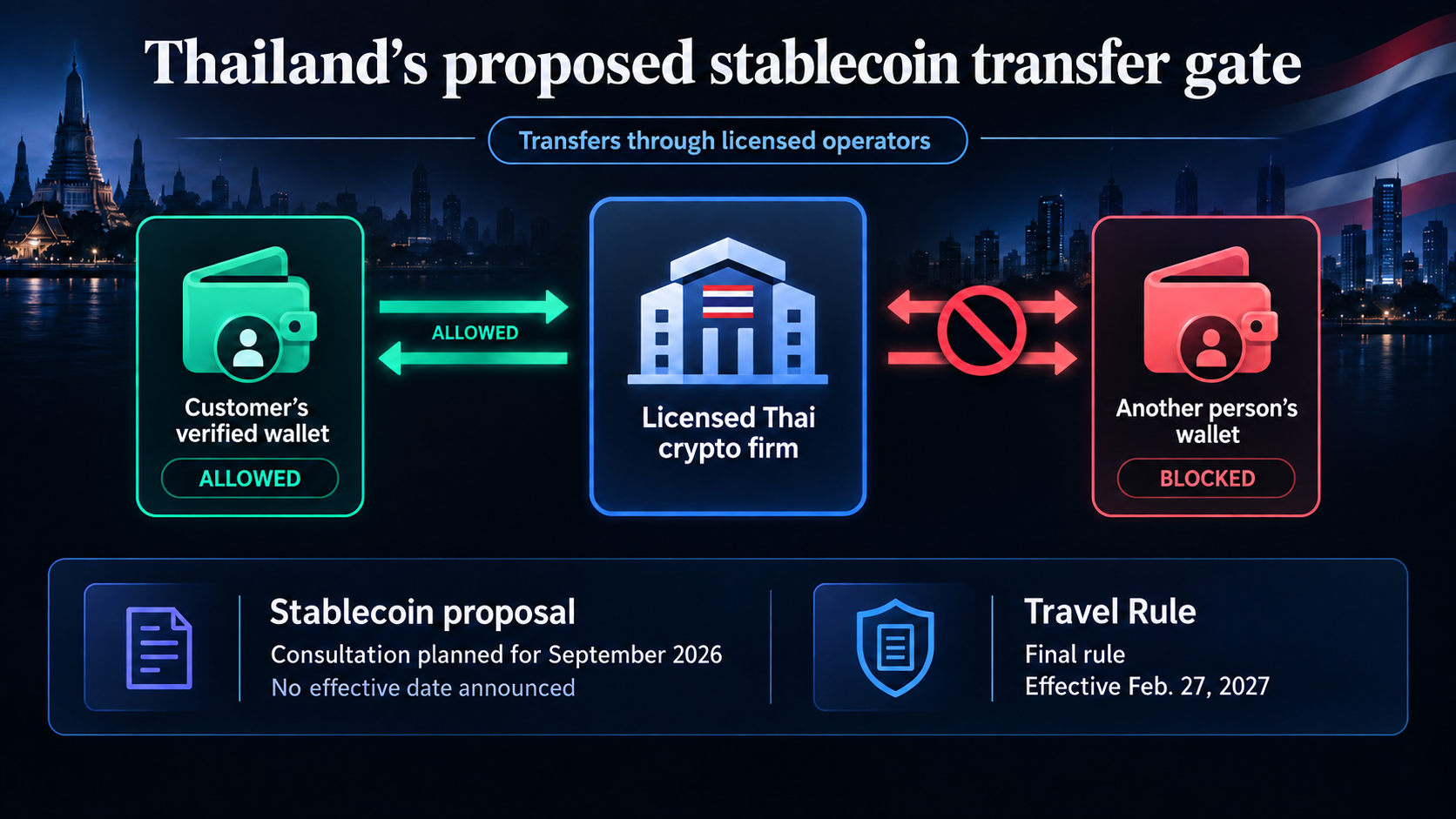
Thailand’s Securities and Exchange Commission has proposed a same-owner requirement for stablecoin transfers that would sharply narrow how customers can move tokens such as USDT through licensed crypto firms. The measure remains at the consultation stage and is not yet an operative rule.
Under the SEC Board-approved Sept. 3 consultation principles, stablecoins entering a customer account at a digital asset operator would have to come from an account or wallet verified as belonging to that customer. Withdrawals would likewise have to go to an account or wallet verified as the customer’s own.
The consequence is explicit: a stablecoin deposit from another person’s account, or a withdrawal to another person’s account, would be prohibited.
How the proposed ownership gate would work
As drafted, the restriction would stop a customer from using a Thai SEC-supervised platform to receive a transfer from someone else’s wallet or to send stablecoins to another person’s wallet. Its reach is limited to transfers conducted through supervised digital asset operators, rather than peer-to-peer transfers that take place entirely outside those firms.
The proposal would also require stablecoin transfer values to be consistent with a customer’s income source and financial position. Inbound and outbound transfers would each be capped at 5 million baht per day, per person, per operator.
The cap would not apply to transfers between customer accounts through SEC-supervised operators when both firms comply with the Travel Rule. The Sept. 11 consultation also lists cap exemptions for specified operator business transfers, certain Bank of Thailand-authorized operators and stablecoin/baht market makers. It remains unclear whether that cap waiver would affect the separately stated same-owner test, and consultation could add implementation detail.
The SEC said it developed the measures after observing significant growth in stablecoin transaction volume and value, particularly involving USDT. It also cited patterns that it associated with risks tied to money laundering, cybercrime and the circumvention of rules governing international money transfers.
The ownership test would be separate from Thailand’s finalized Travel Rule. That rule requires digital asset operators to collect information about transfer parties, check counterparties and verify ownership or control of certain self-hosted wallets. It takes effect on Feb. 27, 2027.
As described, the stablecoin proposal would add a stricter condition when a transfer crosses the boundary of a licensed operator: the outside sending or receiving account would have to belong to the platform’s customer, not another person.
On Sept. 11, the SEC opened the public consultation, with comments due by Sept. 25, 2026. It did not announce an effective date for the proposed stablecoin restrictions. Until final rules are issued, the same-owner restriction remains a proposal.
The post Thailand’s stablecoin proposal would block transfers to other people’s wallets appeared first on CryptoSlate.
Bitcoin failed to break $80,000 on Sept. 11 as US stocks climbed about 1% and long-dated Treasury yields stayed near levels not seen in years.
Bitcoin registered an intraday high of $79,890, still short of the $80,000-$82,000 resistance zone identified by digital asset trading firm QCP. The S&P 500 closed up nearly 1%, while the Dow and Nasdaq followed closely.
That split is not proof that Bitcoin has decoupled from macro conditions yet or that sellers around $80,000 have become the dominant market force. Nevertheless, Bitcoin still has to show it can reclaim the level that has capped its recent advance.
Bonds eased from their peaks, but conditions stayed tight
August core CPI rose 0.3% on the month, keeping the Fed decision central to Bitcoin’s weekend setup.
The 10-year yield briefly touched 4.9915%, its highest level in almost three years, while the 30-year reached 5.424%, a 19-year high. The yields later pulled back to roughly 4.95% and 5.341%, respectively.
The move left the 10-year yield near 5%, maintaining a demanding backdrop for risk assets. Markets priced about an 85% probability of a quarter-point Fed rate increase the following week.
Bitcoin’s weaker showing narrowed the weekend question: was the cryptocurrency only lagging an equity rebound, or was resistance near $80,000 becoming an obstacle in its own right?
The options market sets a two-level test
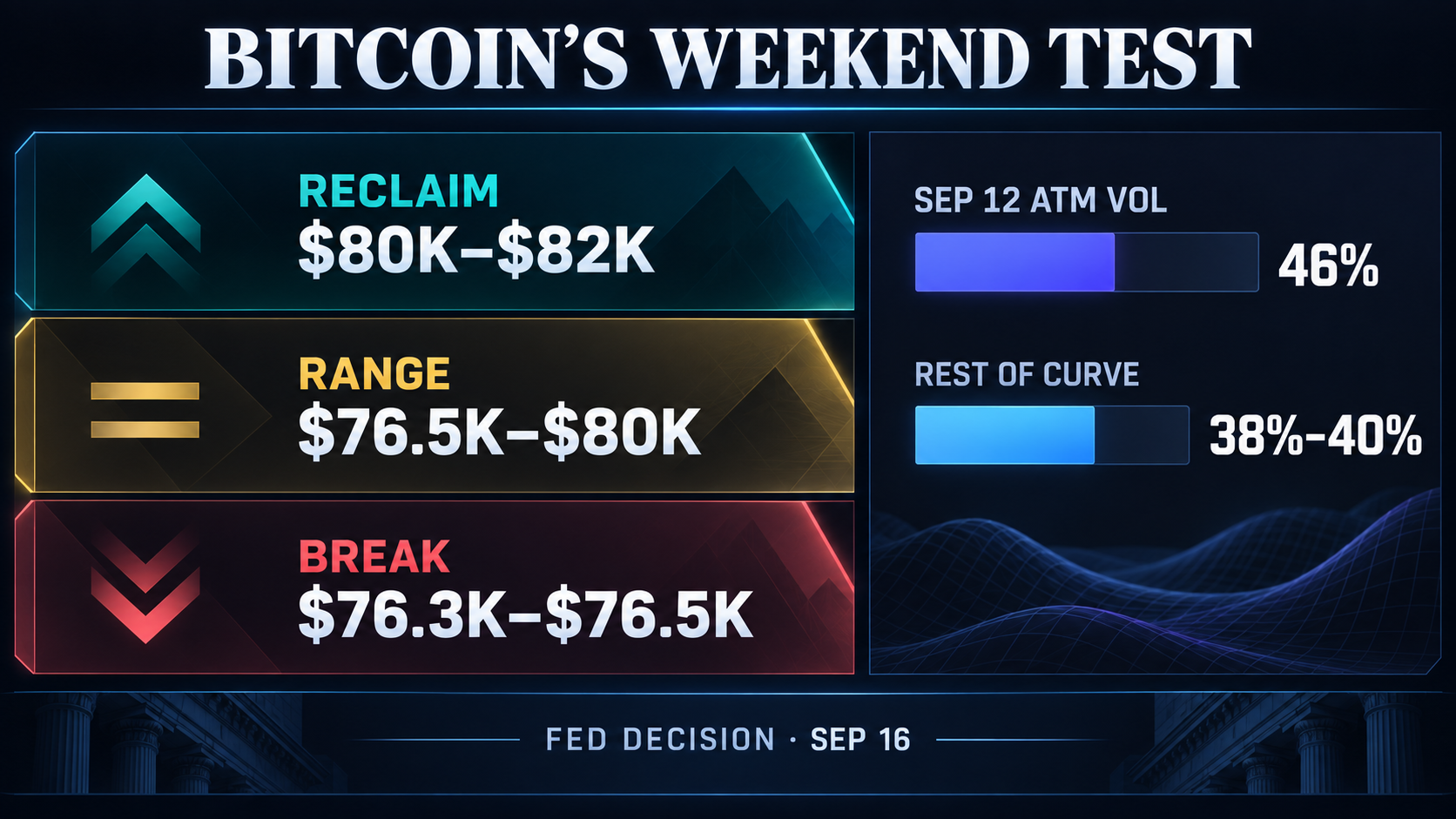
QCP reported that the Sept. 12 Bitcoin options expiry carried at-the-money implied volatility near 46%, compared with roughly 38%-40% across the rest of the curve.
Turnover was concentrated in Sept. 12 calls at $78,500 and $80,000, and QCP also saw steady demand for $75,000 puts expiring Sept. 11 and Sept. 18.
Call activity kept upside exposure active near spot, while the puts showed that investors were still paying for downside protection.
QCP’s levels reduce the weekend setup to support at the $76,300-$76,500 zone and resistance at the $80,000-$82,000 range.
| Bitcoin outcome | What it could indicate |
|---|---|
| Breaks below $76,300-$76,500 | The case that Bitcoin is merely pausing weakens, placing greater weight on downside protection around $75,000. |
| Stays between roughly $76,500 and $80,000 | Consolidation remains intact, leaving the Fed decision as the more important test. |
| Reclaims $80,000 and pushes into $80,000-$82,000 | Friday’s relative weakness looks more like delayed catch-up than a damaged recovery. |
A weekend break can establish direction, but cannot by itself distinguish macro pressure from Bitcoin-specific selling.
Wednesday’s Fed decision is the verification event
The Federal Reserve’s Sept. 15-16 meeting includes a new Summary of Economic Projections.
The test is whether Bitcoin can sustain a move beyond QCP’s range after the announcement. A break above $80,000–$82,000 would strengthen the recovery case; a loss of $76,300–$76,500 would weaken the consolidation case. Neither outcome alone would establish the cause.
The post Bitcoin’s $80,000 ceiling looks fragile after stocks shrugged off near-5% Treasury yields appeared first on CryptoSlate.
Hardware wallets might be able to protect your keys, but the paperwork from buying them could expose your identity.
To buy a hardware wallet, you give a company your name and address so it can send you a device designed to put you in control of your money. Once you've unpacked the box and set it up, there is little reason to think about the order again.
However, somewhere in the delivery business a record of that purchase may survive for years.
In a Sept. 4 update to its shipping-provider breach disclosure, Trezor said approximately 67,000 additional US customers were affected, including orders from 2019 to 2021. It said ShipMonk, the shipping company tasked with delivering the devices, gave it written assurances that it deleted the records. The company now lists 80,689 affected customers overall.
Trezor says its systems and devices were unaffected and that the contents of parcels weren't exposed. The leaked information included only contact and delivery details, so no funds were stolen or misappropriated.
And while the financial damage so far is zero, those contact details create a bigger problem for the customer that has outlasted the purchase and could continue well into the future.
The device they bought will continue protecting their money, but the information used to deliver it could help a stranger impersonate someone they trust.
The device and the person
The Bitcoin network records coins and who can spend them. Wallets hold the private keys that authorize spending: the secrets that let their owner instruct the network to transfer money.
Hardware wallets keep those secrets in a dedicated device. When you make a payment, it can approve the transaction without handing the private key to the computer running the accompanying software.
That separation means a problem with the computer doesn't automatically become a loss of money.
You also need a way to recover access if the device breaks or disappears, which is where wallet backups step in. The way they work depends mostly on the setup, but it's usually a sequence of words that can recreate the wallet on another device.
However, that recovery mechanism can also help a thief who obtains it, which is why Trezor's backup instructions advise against sharing the backup or keeping digital copies.
Any attacker who persuades the wallet owner to hand over that information bypasses all the device's protections. But convincing a person that a request for their backup is legitimate has always been the hardest part of this type of scam.
Even the tiniest bit of personal information can make that message much more convincing. An email addressed to you by name that refers to an order you recognize feels different from a generic warning sent to a million inboxes. Letters delivered to your home can easily look like official correspondence, even when their instructions are fraudulent.
Ledger's record of phishing campaigns includes physical letters directing recipients to scan a code or visit a website where they are asked for their recovery words. Those campaigns show how physical mail can carry the scam.
The phrase ‘wallet leak' can obscure what someone has actually obtained. Contact information can help a scammer approach an owner; the wallet's secrets can give them access to the money.
| Information | What it enables | Limits |
|---|---|---|
| Name and delivery address | Where an order was sent and a way to contact the recipient | Whether the recipient currently owns Bitcoin or how much |
| A public wallet address | Transactions and balances associated with that address | The real-world identity of its owner |
| A private key | Authority to spend the coins controlled by that key | A complete picture of the owner's other assets |
| A wallet backup | Restoration of wallet access | Extra passphrases or a setup requiring several backup shares can also govern access |
An order might have been a gift. The buyer might have stopped using the device or sold their coins. A shipping record is a clue to a past purchase, but it leaves plenty of uncertainty about what the buyer owns today.
An imperfect clue can still be enough to select a target for deception. The owner then has to assess messages from strangers who may know details that were guaranteed to remain private. The secret inside the hardware wallet and the information outside it are part of the same discussion of personal security, even though they require different protections.
Wallet orders outlive their delivery
Shipping information has a legitimate purpose, as someone has to put the right parcel on the right route, resolve a failed delivery, and handle a return. Given the size and scope of that logistical operation, companies selling devices internationally often rely on other businesses to do that for them.
Problems start when what should be temporary operational information becomes a permanent corporate asset. Keeping an old record costs very little, and deciding where every piece of information went can require work across departments and vendors.
The original reason for collecting it will most likely expire long before the system that stores it does.
Across businesses, information can persist in database replicas, support-system exports, and backups long after its removal from the application staff use every day. Establishing that a record is gone requires a process that accounts for the ways it was stored and shared.
The Federal Trade Commission's business guidance starts from a pretty straightforward principle: collect and retain sensitive information only for a legitimate business need, know where it goes, and dispose of it securely. Its guidance also addresses service providers, because outsourcing a task doesn't absolve the company of the need to understand how the information is handled.
A deletion clause that most contracts have is part of that process, and so is a vendor's assurance that the clause has been followed. But neither one is the same as direct evidence that every relevant system has applied the retention policy.
You can check the address on the parcel and confirm receipt of the device, but you can't inspect the fulfillment partner's databases several years later. The company choosing the partner needs to demand evidence, define retention periods, and test whether those terms are being honored.
That makes privacy a product responsibility as well as a user habit. Advising customers to be careful with their backup addresses doesn't resolve the fate of a record already entrusted to a retailer and its contractors.
Payment cards can be replaced with a new number and compromised passwords can be retired. But home addresses can remain valid long after the original purchase is forgotten, and a copied record can't be recalled from everyone who received it.
Even moving doesn't erase the association. Old addresses can still help someone match other records or impersonate a business the customer once dealt with. The ongoing cost is partly financial security and partly the effort of deciding which communications deserve attention.
Privacy has to survive the wallet purchase
There are ways to keep deliveries more private. Parcel lockers, neutral packaging, and separate contact details for online orders can make these scams much harder to pull off.
However, there's a limit to how much you can push each of these measures. Locker operators can require identification, payment providers can retain billing information, and having a hardware wallet sent in a blank box doesn't delete the retailer's records.
Buying through an unfamiliar or secondhand seller can introduce a different problem if the device's origin becomes harder to trust.
These protections work at different points in the purchase. Buyers need to know which protection they are paying for and which organizations will receive their details.
For manufacturers, the biggest improvement needs to happen before a breach notice. It means collecting less where possible, separating information that doesn't need to travel together, and establishing evidence that contractors dispose of records when their job is over.
Legitimate obligations don't automatically require keeping every old phone number and delivery address available throughout the commercial relationship.
Hardware wallets protect private keys by keeping them away from an ordinary computer. Protecting the person who buys one requires work throughout the business delivering it. Manufacturers choose the warehouse and negotiate the contract, so they can demand evidence that old records have been removed.
Those decisions help determine how much trust a customer must keep extending long after they open the box.
The post The biggest vulnerability in your Bitcoin wallet might be the shipping label appeared first on CryptoSlate.
August’s inflation report left the Federal Reserve with a mixed signal: gasoline drove much of the headline increase, but monthly core inflation accelerated. That combination kept Governor Christopher Waller’s conditional case for a rate hike in play even as Bitcoin held its daily gain.
CryptoSlate's live Bitcoin market data had BTC at $78,683, up 2.08% over 24 hours, when trading closed in the US for the week. In contrast, Reuters reported that futures had moved to about an 85% probability of a quarter-point increase at the Fed's September 15-16 meeting, from about 70% before the inflation report. CME says its FedWatch probabilities are derived from 30-Day Fed Funds futures.
The policy tension lay inside the inflation report: annual core inflation eased, while its latest monthly pace picked up.
CPI composition cut both ways
The Bureau of Labor Statistics said the consumer price index increased 0.4% in August on a seasonally adjusted basis after a 0.1% rise in July. The unadjusted 12-month rate stayed at 3.4%.
Gasoline supplied the clearest reason to look beneath the headline. Its index rose 3.9% and accounted for more than one-third of the monthly all-items increase, while the broader energy index gained 2.1%.
That composition could support a limited relief case for Bitcoin. An outsized contribution from a volatile component does not carry the same policy signal as a similarly broad increase across the basket.
The report did not, however, deliver an energy-only inflation story. Core CPI, which excludes food and energy, rose 0.3% in August after a 0.2% increase in July. Its annual rate eased to 2.4% from 2.5%, creating the central split: the longer-run measure improved while the latest monthly pace accelerated.
Other parts of the basket showed pressure too. Shelter rose 0.3% in August, and services excluding energy services were up 3.0% over 12 months. Gasoline explained a large share of the headline move, but not the entire report.
Federal Reserve Governor Christopher Waller had made August inflation central to his next decision. In a September 3 speech, Waller said continued progress toward the Fed's 2% goal would incline him to support holding the policy rate steady. He also said a hot report, or evidence that progress had reversed, could lead him to consider a hike at the September 15-16 meeting.
Waller described that view as a reaction function, not a commitment. His comments do not determine how he or the committee will vote. They do show why the monthly core acceleration cannot be dismissed simply because annual core inflation edged lower.
Waller also said core inflation was useful for seeing through energy volatility and that broader spillovers from earlier energy increases had not appeared so far. At the same time, he identified renewed energy pressure and a possible rise in longer-term inflation expectations as risks the Fed should watch.
The August report therefore landed between the two sides of his test. Annual core inflation moved closer to target, but the latest monthly core reading moved away from the pace seen in July. The futures response showed that traders gave substantial weight to the latter risk.
September’s energy risk lies beyond August CPI
Bitcoin's 24-hour move still needs careful handling. During Saturday trading, Bitcoin has fallen to around $77,500 into thin weekend liquidity.
Also, Friday's release describes August, so it cannot include the sharper oil-price move that developed in September.
CryptoSlate's pre-CPI analysis highlighted that timing gap. The new energy shock is not evidence inside August CPI, and it would be premature to say it has already spread into broader prices. It can still matter through future inflation data and expectations, the channels Waller identified as policy risks.
August CPI gave policymakers a reason to look through part of the gasoline-led jump, but faster monthly core inflation complicated the case for a hold. Whether September’s energy pressure persists or spreads remains a separate risk for subsequent data and inflation expectations.
The post Why Bitcoin initially held its gain as rate traders put September hike odds at 85% appeared first on CryptoSlate.
When you send money to someone abroad, the confirmation on your phone is only your half of the transaction: the other half belongs to the person who has to use it. Their rent may be due in local currency. Their nearest cash collection point may be across town. They may want to spend some of the money immediately and keep the rest in dollars.
Transfers can take seconds and leave recipients with an afternoon's work. Stablecoin payments compete in that everyday setting. These privately issued digital tokens are designed to track a currency, usually the dollar, and move across blockchain networks. Recipients can also keep them, retaining dollar exposure until they want to convert the money into the currency used at home.
But receiving a dollar token isn't the same as receiving money in a local bank account. Whether it's better depends partly on what the recipient intends to do next. The same transfer can be convenient for someone already using a crypto app and very difficult for their parent who wants cash for the week.
Where stablecoins stop being cheap
Consider a transfer that begins with euros in a bank account and ends with reais available to spend in Brazil. Senders using stablecoins might first fund an exchange account and buy tokens, then transfer them to the recipient. At the other end, the recipient sells those tokens and withdraws the proceeds into a local account.
The blockchain handles the movement of the token, but it doesn't set every exchange rate or control the price of every service around that movement. An inexpensive transfer between digital addresses can therefore be surrounded by more expensive transactions.
Some costs are explicit fees, while others are built into the exchange rate. Services can advertise low transfer fees while supplying fewer reais for each euro than a competitor. Households experience both as less money received, regardless of where the charge appears on the receipt.
Bank of Italy researchers examined $200 USDC transfers across routes connecting Italy with five countries in a paper published in July. Its Brazil results show how the same pair of countries can produce very different comparisons depending on which way the money travels.
| Direction | USDC route cost | Cost on $200 | Wise quote used in the paper | Cost on $200 |
|---|---|---|---|---|
| Italy to Brazil | 2.70% | $5.40 | 2.20% | $4.40 |
| Brazil to Italy | 2.21% | $4.42 | 4.68%–4.89% | $9.36–$9.78 |
USDC transactions were conducted in March 2026; Wise simulations were conducted on April 14. These are a small set of dated observations, not current quotes or market-wide averages. Dollar amounts are calculations from the paper's percentages.
The cheaper route switched with the direction of the payment. That makes sense once the transfer is understood as a sequence of purchases and withdrawals in different markets. Someone selling tokens in one country faces a different set of prices and services from someone buying them there.
The World Bank's remittance-price work also includes exchange-rate margins in the cost of sending money. Comparing the sender's total spending with the recipient's payout captures costs that an advertised fee can leave out. Country averages provide context, while individual households need quotes for the route and payout method they will actually use.
Speed depends on those surrounding services too. Tokens may appear in a wallet within seconds, while conversion or withdrawal requires a banking step that takes a day. Recipients who need the local payout have to wait for that step before they can spend.
Well-connected exchanges and fast domestic payment systems can make the last step painless. Recipients in Brazil may have little reason to care which network carried the token if the proceeds become spendable in the app they already use.
That's a much more demanding standard than counting how quickly a blockchain confirms a transfer, but it's also the standard payment services are supposed to meet.
Stablecoins give the recipient another choice
There's also another reason a simple cheapest-route comparison can miss the appeal of digital dollars: it often assumes the recipient wants to convert everything immediately.
Imagine, instead, someone receiving $200 who wants the local-currency equivalent of $120 for expenses and wants to retain the rest in dollar form. It's a hypothetical household, but it exposes two separate decisions: how to move the money and what to hold once they receive it.
Stablecoins can combine those decisions. Recipients can convert part of the balance and retain the rest, provided the available services and local rules permit it. Alongside any savings on the transfer, they gain control over how much to convert.
Keeping dollars brings exchange-rate risk for people whose expenses are in local currency. Dollars can also lose purchasing power, and holding them as tokens adds dependence on the issuer's reserves and redemption arrangements. Stablecoin balances generally lack the deposit insurance that eligible bank accounts provide.
Still, the ability to choose when and how much to convert can have genuine household value. It's different from a provider deciding that a transfer must be paid out entirely in local currency, and different again from a sender insisting the recipient learn a new financial system simply because the sender prefers it.
Access to the issuer follows its own rules. Circle Mint serves institutions obtaining and redeeming USDC, while retail users often buy and sell through exchanges or payment providers. Circle's EEA redemption policy provides a separate route for eligible holders under European rules. Households may therefore have redemption rights even when they can't open institutional accounts.
For someone sending money home, those rights work with the services they can actually reach. Redemption with an issuer still leaves the recipient needing local conversion or cash access, with support they can understand if something goes wrong.
Familiarity has an economic value here. Recipients who know the person behind the counter can ask for help; relatives using the same app can explain an unfamiliar step. Those relationships save time and reduce mistakes. They also spare the sender from becoming unpaid technical support for the whole family, a cost absent from blockchain fee estimates.
Recipients deserve a say in how they get their money. The sender's preferred app becomes a poor choice if using it means giving someone else a task they didn't ask for.
The best payment is the one you can actually use
Much of the appeal of remittance technology comes from making small payments less expensive. Fees that look modest in a comparison table add up when the same family pays them every month.
In a purely illustrative example, reducing the all-in cost of a $200 monthly transfer from 5% to 2% saves $6 each time, or $72 across twelve transfers. That's the relevant financial gain; whether it comes from a stablecoin, a bank, or a specialist payment company is secondary to whether the household can actually receive it.
The comparison also needs a fixed starting point. If the sender has $200 in total, adding a fee on top produces a different result from deducting that fee from the amount sent. Comparing only the advertised transfer amounts can accidentally compare different budgets.
Getting started takes work too. New customers may need to verify their identity and fund another account before learning which network their recipient supports. Sending to the wrong address or an unsupported network can make recovery difficult or impossible, depending on who controls the receiving account. Experienced crypto users may navigate those steps easily, while first-time customers need help that the quoted transfer price may exclude.
Conventional services impose their own work. Cash collection can require travel and waiting, while account access may depend on documents the recipient lacks. Providers with excellent apps in the sending country can offer poor service at the destination. The comparison has to include the effort each route demands from both people.
Payment companies can take on much of that work themselves. They might move stablecoins between their own accounts and pay out ordinary money through a familiar local system, handling the conversion and network choices for the household.
For someone paying for food, a familiar local balance may be the whole point. The company can choose its settlement method while the customer chooses where to spend.
Other recipients will prefer the wallet because retaining the token is the point. Services that offer both choices let households decide how much of the balance to convert, with the costs explained before they commit.
Sending money home is a personal financial transaction. The sender has often already decided who needs the money and what they want it to accomplish. The payment service earns its fee by carrying that intention through to the recipient.
For one family, that may mean more local currency for the week's expenses; for another, it may mean keeping part of the payment in dollars. Both depend on what the person receiving the money can do with it.
The post Stablecoins make sending money easy until someone needs to spend it appeared first on CryptoSlate.
CryptoTicker.io
At 13:15:45 UTC on September 23, 2026, the largest token lock-up in Humanity Protocol's history to date comes to an end. According to the emissions model, 292,857,143 H are released from six separate buckets in that single minute. Two days later, at 14:00 UTC on September 25, the exchange Kraken closes withdrawals for H and HUMANITY for good. Anyone holding H in a Kraken account therefore has to act in exactly the window in which, on paper, the largest additional supply in the project's history reaches the market.
The two dates have nothing to do with each other. One is a vesting date set by the project, the other a business decision by an exchange. For you as a holder they still fall in the same weekend, and that turns two footnotes into a task with a deadline.
The practical core of this is a custody question, not a price question. Tokens sitting in an exchange account follow that exchange's deadlines: when a trading pair is discontinued, the operator decides how long you have to move your holdings out and what happens to them afterwards. Anyone holding in self-custody does not have that problem, but has another one instead: they need to know the correct contract address. At Humanity there have been two of them since June.
This article recalculates the unlock from the emissions dataset itself rather than passing on the figure in circulation, shows which part of it can actually reach the market, and then walks through checking your own holdings. All figures were gathered first-hand on September 13, 2026.
What happens at Humanity Protocol on September 23, 2026
Humanity Protocol is an identity network: users prove by biometric means that there is a human being behind an account, and are paid in H for doing so. The token runs as an ERC-20 contract on Ethereum. Like almost every project of this kind, Humanity issued only a fraction of its total supply at launch; the rest is spread over years and released step by step.
In that schedule, September 23 is not an ordinary monthly date but a cliff: a cut-off date on which an amount that was fully locked until then becomes available all at once. Our own analysis of the DefiLlama emissions dataset (retrieved September 13, 2026, HTTP 200) shows six buckets carrying the same timestamp, 13:15:45 UTC on September 23, 2026. Those six tranches add up to 292,857,143 H.
At the price of $0.0833 that the same provider's price interface reported for the current contract at 06:21 UTC on September 13, that works out to roughly $24.4 million. For now that number is an arithmetic figure and nothing more. Whether any of the released tokens will actually be offered on the market is a different matter, and further down we resolve which part of the tranche is realistically in question.
Token unlock, cliff and vesting: the three terms behind the date
Vesting is the contractually fixed release of tokens over time. A project splits its total supply into buckets, such as team, investors and ecosystem, and sets for each bucket when tokens become available from it and at what pace.
A cliff is the lock-up period before a bucket's first release. Until the cliff date nothing is available; on the cliff date the accrued share is released in a single step. That is precisely what makes cliffs significant for the market: where a linear release produces a trickle, this produces a step.
A token unlock is the event itself, the moment locked tokens become transferable. One distinction matters here that headlines almost always drop: released only means transferable. Whether a team holds its released tokens, moves them into the project treasury or offers them on the market is not written into any contract.
At Humanity the release runs through Sablier streams, meaning on-chain contracts that handle the payout themselves. That has a practical advantage for you: the schedule is publicly visible and therefore verifiable. We have shown in detail how to reconcile such calendars against project documentation and resolve contradictions, using another token as the example: recalculating a token unlock.
The six tranches of the H unlock, broken down one by one
Quoting only the total gives away the real information. The six buckets behave completely differently, because different recipients sit behind them. Our own analysis of the emissions dataset produces this breakdown for September 23, 2026:
| Bucket | Tranche in H | Arithmetic value in USD |
|---|---|---|
| Team | 105,555,556 | $8.79m |
| Investors | 55,555,556 | $4.63m |
| Ecosystem Fund | 50,000,000 | $4.17m |
| Identity Verification Rewards | 42,857,143 | $3.57m |
| Strategic Reserve | 26,388,889 | $2.20m |
| Foundation Operational Treasury | 12,500,000 | $1.04m |
| Total | 292,857,143 | $24.40m |
The largest single item is the team bucket at a good 105 million H, followed by the investors. Together the two make up more than half the tranche. That is the part market watchers usually call insider supply, because the recipients received their tokens on terms not available to a buyer on the open market.
The Identity Verification Rewards are the bucket from which users are paid for completed verifications. Those tokens therefore go out broadly to a great many small recipients, which suggests different behaviour from a concentrated allocation to a handful of addresses. The Ecosystem Fund finances development and incentive programmes.
Why the investor tranche in particular is uncertain
This is where it gets interesting, and where the widely quoted figures depart from what can actually be evidenced. The emissions dataset lists the investor tranche at 55,555,556 H under the same timestamp as the other five buckets. The Humanity Foundation, however, restructured the investor part of its vesting in April 2026.
As the trade publication crypto.news reported on April 24, 2026, the foundation gave its investors a choice until 09:00 UTC on April 26: either an extended schedule with a cliff on September 25, 2026 followed by twelve quarterly tranches, or immediate release at a 3:10 discount, under which 16,666,666 H were replaced by 5,000,000 H and paid out as early as June 25, 2026. Early backer Trix Ventures publicly opted for the discount, according to the same report.
Two things follow that a careful article has to keep apart. First, the foundation names September 25 for the extended investor schedule, while the emissions dataset carries September 23. Second, part of the investor allocation was already settled in June, which makes the 55.56 million H held in the model for that bucket an upper bound rather than an expectation.
How many investors chose which option has not been published so far. No reliable breakdown could be found in this research step; the question could only be settled conclusively against the vesting contracts on chain. This uncertainty belongs on the record rather than written away: if you come across the round figure of 292 million H somewhere as confirmed additional supply, at least a sixth of it carries a question mark.
Circulating supply: how large the inflow actually is
Of the six buckets, the data provider explicitly lists two as non-circulating: Strategic Reserve at 26,388,889 H and Foundation Operational Treasury at 12,500,000 H, together 38,888,889 H or an arithmetic $3.24 million. Those amounts move into the foundation's treasury and are not counted as freely tradable supply in the circulation model.
That leaves 253,968,254 H, roughly $21.2 million on paper, that can actually affect circulating supply. Set against the amount released in total to date, our own analysis puts the previously released supply at 3,698,214,286 H. The tranche therefore amounts to 7.92 percent of that supply, the circulating portion to 6.87 percent. Measured against the maximum supply of ten billion H held in the model, it is 2.93 percent.
This framing is the difference between a headline and a calculation. A number like $24 million sounds enormous as long as nobody writes down what it refers to next to it. An inflow of just under seven percent on the supply already released is substantial, but it is a different order of magnitude from what the absolute number suggests.
The Kraken withdrawal deadline at 14:00 UTC on September 25
Independently of the vesting calendar, a clock of its own is running at Kraken. In its notice on Humanity, last updated June 26, 2026, the exchange states: for H and HUMANITY, trading and deposits are switched off, only withdrawals are supported, and those close at 14:00 UTC on September 25, 2026. Both tickers are slated for delisting.
That is the sharper of the two deadlines, because it demands an action from you. An unlock happens without you doing anything; a closed withdrawal, by contrast, separates you from your tokens. We described the constellation in detail on September 5, at the time looking at the four affected tickers at Kraken: the Kraken withdrawal deadline on September 25.

Forced liquidation from September 28: what happens to holdings left behind
For holdings still sitting in the account after the deadline, Kraken announces a liquidation period from September 28 to October 2, 2026. The exchange is unusually clear about what that can mean: liquidation prices could be substantially below recent reference prices and in some cases, because of insufficient market liquidity, yield minimal proceeds or none at all. Kraken explicitly recommends acting before the deadline rather than relying on the liquidation.
For you that means the liquidation is an emergency exit with an open outcome. Which currency the proceeds are credited in is likewise made dependent on market conditions by the exchange, and is not committed to in advance. Anyone who lets the date pass trades a known position for an unknown result.
Legacy H and HUMANITY: why many holders have two positions in the account
The second pitfall has nothing to do with the unlock and is still the more common source of mistakes. Following the events of June 2026, the Humanity team rolled out a new contract and issued a new token. Kraken continues to list the old holding under the ticker H and the new one under the ticker HUMANITY, to keep the two distinguishable.
According to the Kraken notice, the contract addresses are 0xcf5104D094e3864CfCBDa43B82e1cEFD26A016eB for the old token and 0xE76c5b78f93909d34404E9eb4C1f19e7582a5dE1 for the new one. The emissions dataset the unlock figures above come from refers to the second of those addresses, that is, to the new token.
On top of that comes a risk of confusion that Kraken points out itself: the new token can still be displayed as H on chain and on other platforms. The two tokens can therefore only be told apart reliably via the contract address.
Anyone holding a position on the cut-off date received the new token automatically. Kraken gives the snapshot time as 17:25 UTC on June 8, 2026 and the airdrop date as 14:00 UTC on July 1, 2026, at a one-to-one ratio. Anyone who acquired H only after the snapshot is not eligible for this airdrop and is referred by Kraken to the Humanity team's claims portal, in which the exchange says it is not involved.
The practical consequence: the same account can hold two positions that both expire in the same minute. Withdraw only one of them and the other runs into the liquidation.
Self-custody or another exchange: where the tokens can go
When a withdrawal deadline is running, there are two destinations. One is your own wallet, where you control the private key. The other is an account at a different trading platform that still lists the token.
The two routes carry different risks. Self-custody removes counterparty risk and in exchange puts the responsibility for securing the recovery words on your shoulders; an overview of the devices and how they differ is in our hardware wallet comparison. Moving to another platform keeps the convenience and merely defers the problem, should a delisting be pending there too.
Two technical points decide between success and loss: the destination address has to support the network the token sits on, and it has to carry the correct contract address. An Ethereum address can in principle receive any ERC-20 token, but for it to show up in your wallet you may have to add the contract there manually. A token missing from the overview is not lost because of that; usually it is only the entry that is missing.
Check the withdrawal fee and the minimum amount in advance as well. On small residual holdings the fee can exceed the value of the position, and then the honest answer is that moving it is not worth it. That is a decision you should take deliberately rather than let a deadline take for you.

How to check your H holdings in five steps
The following sequence takes a few minutes and covers both dates.
- Open the account balance. Check in the exchange account whether H, HUMANITY or both are sitting there. Both positions fall under the same deadline.
- Reconcile the contract address. Note the contract address for each position and compare it with the two given above. That tells you whether you hold the old or the new token.
- Prepare the destination address. Set up the receiving address and check with a small test amount that it works before you send the full holding.
- Trigger the withdrawal. Build in a buffer. Withdrawals can go into review, and the deadline at 14:00 UTC on September 25 ends with no grace period.
- Confirm arrival. Check in the block explorer that the transaction is confirmed, and add the contract in your wallet if the holding is not displayed.
A note on sequencing: do not do these steps on September 25. When the unlock goes through on September 23, things can get busier at the network level and in support queues. Moving in the days before that is the calmer option.
Tax: why even a forced sale is a disposal
One point regularly overlooked in delistings: a forced liquidation is, for tax purposes, a sale. The fact that you did not trigger it changes nothing about that. When the exchange realises your holding and credits you with proceeds, that creates an event you have to carry in your records.
A plain move from the exchange into your own wallet, by contrast, is not a sale but a transfer between two addresses of the same owner. What matters is that your records carry the acquisition date through that transfer, so that it remains traceable later when and at what price you acquired the holding. Tools that do exactly that are in the comparison of tax and portfolio tools.
Whether and how a gain is taxable depends, in Germany, among other things on the holding period and on your personal situation. The airdrop of the new token in July is a separate event with a valuation question of its own. That is precisely why these cases belong with a tax adviser and not in a classification by gut feeling.
What a token unlock does to the price, and what cannot seriously be said
The honest answer to the most common question is: nobody knows. What can be said is what mechanism sits behind the question.
A cliff raises the available supply abruptly. Whether that turns into selling pressure depends on what the recipients do, and that is not predictable. On top of that, a publicly known date can be priced in by professional market participants long before it arrives. In its April report, crypto.news describes exactly this pattern for Humanity: vesting contracts visible on chain, hedging trades in advance, and market participants positioning themselves ahead of the date.
The same outlet cites Starknet and ApeCoin as comparison cases, whose prices fell markedly after extended release schedules. That is that outlet's framing and not a statement about Humanity, and two examples do not make a rule. You will therefore not find price forecasts in this article; what you will find is the number at issue and a note on which part of it is uncertain.
More useful in practice than any forecast is the question of what you would do anyway. If you want to keep your holding, moving it into self-custody is the task. If you do not want to keep it, the question is where you can hand it over at a price you know, rather than in a liquidation at a price nobody promises you. For the trade itself you need a platform that still lists the token; which venues offer which terms is shown in the exchange comparison.
Four mistakes that make this date expensive
Withdrawing only one of the two positions. Anyone holding in June has held two tickers since July. Both expire in the same minute, and the balance shows them as separate lines.
Relying on the liquidation. Kraken itself warns that it can produce minimal proceeds or none at all. Anyone mistaking that for an orderly sale is planning with a price nobody has promised.
Taking the aggregator figure at face value. The 292 million H from the unlock calendars include just under 39 million H listed as non-circulating, and an investor tranche that is probably smaller because of the April restructuring. Anyone calculating with the gross figure overstates the inflow.
Waiting until the last day. Withdrawals can go into review, and support does not answer in minutes. A buffer of several days costs nothing.
H unlock and the Kraken deadline: what to take away
- Check today whether H or HUMANITY are sitting in an exchange account, and withdraw both before 14:00 UTC on September 25. Where to is a decision you take afterwards; the safe option is your own wallet, and the models are set side by side in the hardware wallet comparison.
- Record the process cleanly. Transfer, airdrop and a possible liquidation are three different things for tax purposes; a tool from the tax and portfolio comparison takes the allocation off your hands before the records go missing.
- Recalculate unlock figures before you believe them. Separate circulating from non-circulating tranches, and check whether a trading platform still lists the token at all; the exchange comparison shows where it is traded.
Sources for further reading: Kraken's notice on Humanity with all dates and contract addresses, and the crypto.news report on the vesting restructuring from April 2026. The unlock figures come from DefiLlama's emissions dataset and were aggregated first-hand for this article on September 13, 2026.
(As of September 13, 2026. This article is not investment advice. Prices and fee structures change; check the terms with the provider before you buy.)
Anyone holding a tokenized real-world asset does not own a piece of metal in a vault. They own an entry in a mint account on a blockchain. That account is controlled by the issuer, and in many cases it allows far more than most buyers assume: freezing balances, halting transfers and pulling individual tokens out of other people's wallets. On September 11, 2026 exactly that happened, and it was publicly documented.
For this article we checked every tokenized asset that has its own mint account on Solana and is listed in the relevant market categories. The result is unambiguous: of 32 assets checked, every single one carries a freeze authority. In 21 cases a second permission is attached, one that allows tokens to be removed from an account without any action by the holder.
What happened to the silver token SILV on September 11
Dominion Market issues the token SILV, which is meant to represent one troy ounce of physical silver per unit. According to the provider, a multisig wallet belonging to the project was compromised in the early hours of Friday, September 11, 2026, at around 01:00 UTC. Roughly three hours later the team noticed unusual activity. Market reports put the token's price fall at about 74 percent, and the Sunrise trading front end removed the market from its listing.
The issuer's response is the instructive part. Dominion pulled the liquidity, secured the affected wallets and moved to new hardware devices. The project then announced that any SILV balance bought between 01:00 and 14:00 UTC on that Friday would be removed from the wallets. Balances that existed before the window opened were left untouched. Trading has been suspended since; refund claims in USDC are to be filed from Monday, September 14, 2026, at 12:00 UTC through an on-chain check.
An issuer that can unwind purchases without asking the buyers is no glitch in a process. It is a property that has to be built into the token for it to be executable at all. And that property can be looked up before you buy.
Freeze authority and permanent delegate: the two permissions in one sentence each
Both terms come from Solana's token standards and sit openly in the mint account. Once you have understood them, you can tell within minutes how much control the issuer holds over any given token.
Freeze authority
The freeze authority is the address allowed to freeze individual token accounts. A frozen balance stays visible but can neither be sent nor sold until the same address releases it again. It exists in the classic token program just as it does in the newer Token-2022 program.
Permanent delegate
The permanent delegate is an extension of the Token-2022 program and goes considerably further: the address stored there counts as permanently authorized for every account holding that token and can transfer or burn balances without the holder's consent. That is the technical basis for a clawback of the kind Dominion has announced. The full list of these extensions is in Solana's developer documentation.
In practice the difference matters a great deal. A freeze authority holds your balance where it sits. A permanent delegate takes it away. The current price of the underlying asset is irrelevant here; how Solana develops as a network changes nothing about these permissions, because they are anchored in the individual token rather than in the network.
Our measurement: 32 tokenized assets on Solana, 32 with a freeze authority
On September 13, 2026 we queried the mint accounts of every token that is listed in the market categories for real-world assets and for tokenized gold and that has a Solana address. That came to 35 addresses. We excluded three of them because they do not represent a backed asset but infrastructure or collectibles. That left 32 tokenized stocks, fund units, money market instruments and precious metals.
Each mint account was queried directly through a public Solana node, and the fields for the freeze authority and for the active Token-2022 extensions were evaluated. cryptoticker.io collected this data itself on September 13, 2026.
- 32 of 32 assets checked carry a freeze authority that is set. Not a single asset in the basket goes without one.
- 26 run under the Token-2022 program, 6 under the classic token program.
- 21 additionally carry a permanent delegate.
- 19 can be halted as a whole through the pausable extension.
- 19 start new accounts in a locked state, releasing them only after an approval, which amounts to a whitelist.
- 20 route every transfer through a transfer hook, meaning through external program code that can reject a transfer.
The completeness is remarkable. On many questions of this kind the answer sits somewhere between the camps. Here it sits at 32 to 0.

Clawback via permanent delegate: 21 of 32 tokens can be pulled back
The 21 assets with a permanent delegate are spread across every category: tokenized stocks of large technology companies, tokenized index funds, short-dated government bond funds, one securitized credit fund and several precious metal tokens, SILV among them. With SILV the query shows a particularity that explains what happened on Friday: freeze authority and permanent delegate sit on the same address. Whoever controls that key can lock balances and withdraw them in the same move.
Supply stood at roughly 93,516 SILV at the time of our query, which at one troy ounce per token should be matched by a corresponding silver holding. The address that holds both permissions belongs on-chain to the system program. That means it is an ordinary key address or a derived address, and not the account of an on-chain multisig program. Whether several signatures stand behind that key cannot be read from the mint account alone. Dominion itself speaks of a compromised multisig wallet.
How to check a mint account yourself, in two minutes
The good news about this situation: everything that matters here is public. You need no account, no sign-up and no paid service. All you need is the token's mint address, which every trading front end and every block explorer displays.
The block explorer route
Open a Solana explorer and enter the mint address in the search field. The token's overview page shows two entries. Under Freeze Authority you will find either an address or a note that none is set. Below that the explorer lists the active extensions, provided the token runs under Token-2022. If Permanent Delegate appears there, the issuer can move your holdings. If Default Account State appears, your account starts locked and has to be approved first.
The RPC call route
If you want more precision, ask the node directly. A single call is enough, and the answer contains every field in plain text:
curl -s https://api.mainnet-beta.solana.com -X POST \
  -H "Content-Type: application/json" \
  -d '{"jsonrpc":"2.0","id":1,"method":"getAccountInfo",
       "params":["MINT_ADDRESS",{"encoding":"jsonParsed"}]}'
Three places in the response matter: freezeAuthority, mintAuthority and the list under extensions. A mint authority that is set means new units can be created at any time. If it is empty, the supply is fixed. For a backed real-world asset a set mint authority is normal, because new deposits require new tokens. That does shift the question over to the proof of backing.
Why issuers build these permissions in at all
It would be too easy to read the findings as sloppiness. Anyone bringing regulated assets onto a public blockchain is subject to obligations that are hard to meet without such interventions. An issuer has to observe sanctions lists, respond to court orders, adjust holdings in a corporate action and settle claims in an insolvency. A freeze authority is the standard tool for that, and with tokenized securities it is effectively a precondition for approval.
The price for it is clarity instead of illusion. A tokenized real-world asset behaves technically like a cryptocurrency, and legally like a claim against an issuer. Anyone keeping it in their own wallet holds the keys without holding the final say over the balance. With Bitcoin on a hardware wallet it works differently: there is nobody who could halt a transfer. That difference does not disappear because both sit side by side in the same wallet interface.
What the permission means for your hardware wallet
The common assumption is that owning your keys equals controlling your holdings. For Bitcoin and for most network tokens that holds true. For tokenized real-world assets it holds only in part, and the limitation sits in the token, not in your wallet. A hardware wallet protects you from someone else reaching your keys. It does not protect you from a permission the issuer has stored in the mint account.
In practice that leads to a simple distinction worth keeping in mind. Holdings nobody can interfere with behave differently in an incident from holdings where a third party has a say. Anyone who holds both should know which part falls into which category. On the question of who is entitled to what in case of doubt, we have already written up the ownership position on tokenized stocks and issuer risk in detail.
Tokenized stocks on Solana carry the same permission
For investors in Germany this is the most relevant part of the measurement. Tokenized stocks and index funds have been accessible through several trading venues since last year, and they make up the largest group in the basket we checked. In our query every one of these assets carried a freeze authority, and the large majority additionally carried a permanent delegate, a pause function and a transfer hook. Put differently: with a tokenized equity asset on Solana, the full chain of intervention is the normal case.
That does not speak against the product. It only shifts what you pay attention to when choosing. The interesting question is then less the fee and more who holds the permission, which supervisor that entity answers to, and what the terms say about freezing and unwinding. A supervised counterparty is no luxury here; it is the difference between an orderly procedure and an announcement on a social media account.
The SILV case: what affected holders can do from September 14
Anyone who bought SILV between 01:00 and 14:00 UTC on September 11 has to assume that the balance was removed. According to the provider, a procedure opens on September 14, 2026 at 12:00 UTC through which claims can be filed in USDC; the check is to happen on-chain. Three things matter here.
- Secure your evidence before you do anything else. That includes the signatures of the transactions concerned, the time in UTC and the wallet address used. A screenshot of the trading interface is no substitute for a transaction signature.
- Expect opportunists. Every larger incident produces pages within hours that promise a refund and ask for a signature or an approval in return. A refund never requires you to approve a transfer of your holdings.
- Use only the route the issuer names itself. The official information is on the provider's site, and only what appears there governs your case.
What our survey does not show
A measurement is worth as much as the statement of its limits. Our query reads the technical state of the mint accounts and nothing else. It says nothing about whether the stated backing actually exists, because that is not on the chain. It says nothing about who owns the authority addresses and how many signatures are needed to use them. For tokens on other chains it does not apply at all; Ethereum and the standards there have their own mechanisms, which carry different names and work in similar ways.
Nor does it check whether a permission has ever been used. For the vast majority of the 32 assets there is no public occasion for that. The measurement answers one question only: whether the possibility exists. For tokenized real-world assets on Solana the answer is yes throughout.
RWA tokens and freeze authority: what to take away
- Check the mint account before you buy. Freeze authority, mint authority and the list of extensions are looked up in two minutes. For anything meant to work without an external permission, self-custody remains the benchmark; which devices are suitable for it is covered in the hardware wallet comparison.
- Pay attention to who holds the permission and who supervises them. With a tokenized security an option to intervene is unavoidable; an unsupervised counterparty is avoidable. Which trading venues are licensed in the EU is shown in the overview of regulated crypto exchanges.
- Document purchase and inflow without gaps. In an unwinding, in a refund and later before the tax office, the documented moment counts, and not your recollection. Suitable tools for that are collected in the overview of crypto tax tools and portfolio trackers.
(As of September 13, 2026. This article is not investment advice. Prices and fee structures change; check the terms with the provider before you buy.)
If your Volksbank or Raiffeisenbank has recently started offering crypto, it holds a BaFin authorisation for it. In most cases that authorisation covers exactly one service: the execution of your buy and sell orders. It does not cover the custody of your coins. Who holds the key to your holdings is not stated in your bank's authorisation, and that is precisely the question you should settle before your first purchase.
The occasion is a shift in the European register that has become clear over recent weeks. Between August 12 and September 10, 2026, according to an analysis by the trade service The Industry Spread published on September 10, 16 new entries were added to the CASP register of the European securities regulator ESMA. Fourteen of them were German cooperative banks. The specialist service MiCA Watch arrives at the same picture for the same period and now counts 31 local banks with a MiCA authorisation, each with a single service and each for Germany only.
What a CASP authorisation under MiCAR actually permits
CASP stands for crypto-asset service provider: a company that commercially offers one of the crypto services listed in the EU's MiCAR regulation and needs an authorisation from the national supervisor to do so. MiCAR is the EU regulation on markets in crypto-assets, in force since the end of 2024; the competent authority in Germany is BaFin.
One property of this authorisation is decisive and tends to get lost in everyday use: an authorisation of this kind never applies across the board. MiCAR lists ten individual services, from custody through the operation of a trading platform to investment advice on crypto-assets. An institution applies for each of them separately, and the register then states exactly which ones it received. A bank can therefore be authorised and still not be entitled to hold your coins.
The second point concerns reach. The authorisation applies EU-wide in principle, but only for the countries into which the institution has notified it. With the cooperative banks this field is set throughout to a single country, namely Germany. For you as a customer in Germany that changes nothing, but it explains why these institutions look different in the European register from an international exchange.
Cooperative banks are filling the ESMA register: 14 of 16 new entries
The figures from the two analyses are unambiguous. For the window from August 12 to September 10, 2026, The Industry Spread gives a share of 14 of the 16 new register entries, so 87.5 percent. MiCA Watch gives 15 of 17 new entries for August, and therefore 88.2 percent. Both services name ESMA's machine-readable register file as their source. The names appearing there belong to local banks throughout: Raiffeisenbank Schwaben Mitte, Volksbank Euskirchen, VR-Bank Mittelfranken Mitte, Volksbank Raiffeisenbank Dachau, Frankfurter Volksbank Rhein/Main and others.
Differing values exist for the overall size of the register, and we are not smoothing them over: the MiCA Crypto Alliance arrives at 294 entries after the 14 new additions, while the service CASP Tracker gives 338 authorised crypto-asset service providers for September 7, 2026. The spread is likely down to the services counting differently, for instance entries against institutions, or with and without notified branches. Only the direction is reliable at this point, and that is unambiguous.
What this movement means can be described soberly. German crypto access is migrating out of the specialist-provider space and into bank distribution. Anyone who previously had to open an account at an exchange now finds the offering in the app of their own high-street bank. How the costs of that route compare with the fees of an exchange is something we calculated in a separate analysis of the commission at Sparkasse and Volksbank.
Execution only: why order execution does not include custody
The service that all the local banks concerned have registered is called "execution of orders for crypto-assets on behalf of clients" in the register. Exactly one process is meant: your bank accepts your order and passes it on for execution, buying in your name and selling in your name.
Custody is a separate service of its own under MiCAR, with the register name "custody and administration of crypto-assets on behalf of clients". What that means is the holding of the means of access, namely the private keys with which a crypto holding is disposed of. A private key is the secret sequence of numbers that can move a crypto holding; whoever holds it actually controls the coins.
For you as a customer, a concrete checking task follows from that. If your bank covers only the execution, then your holdings sit with a third party, and that third party matters just as much to your risk as the bank with which you place the order. Which custody models exist and where the differences lie is set out in our hardware wallet comparison, which describes self-custody as the counter-model.

Our own count: 66 crypto-asset service providers in the BaFin database
So as not to depend on other people's counts alone, we collected the German side ourselves. The basis is BaFin's public company database, queried through the category "crypto-asset service provider". This assessment was carried out by cryptoticker.io on September 13, 2026.
The method in one sentence: on September 13, 2026, we retrieved the "crypto-asset service provider" category of the BaFin company database in full, alphabetically, because the result list breaks off at 50 entries, and evaluated each institution's category designation.
The result across 66 institutions checked:
- BaFin lists 66 institutions in the crypto-asset service provider category.
- 21 of them belong to the cooperative sector, meaning Volksbanken, Raiffeisenbanken, VR-Banken, the Westerwald Bank and DZ BANK as the central institution.
- 33 of the 66 are also credit institutions; 23 are investment firms.
- Ten of the 66 additionally carry the crypto custodian designation.
- Not a single one of the 21 cooperative institutions carries the crypto custodian designation.
- Three institutions are additionally registered as crypto securities registrars.
The last line is the core of it. The cooperative sector accounts for a third of Germany's crypto-asset service providers and not one custodian.
Crypto custodians under section 32 of the KWG: which ten institutions hold the permission
The crypto custodian designation in the BaFin database refers to crypto custody business under the German Banking Act, a national permission that existed before MiCAR and has since been continued alongside the European authorisation. This designation is not identical to the MiCAR custody service, but it covers the same business: holding crypto-assets for others.
According to our count of September 13, 2026, these ten institutions carry the designation: BitGo Europe, Boerse Stuttgart Digital Custody, Bullish Europe, Commerzbank, Crypto Finance Deutschland, DekaBank, Hauck Aufhäuser Digital Custody, Tangany, Tradevest Digital Assets and V-Bank. That is a short list for a market with 66 authorised service providers, and it shows how heavily custody is concentrated on a few addresses.
Why this concentration counts for you
A custodian pools the holdings of many customers of many banks. Should it fail, that hits the customers of every institution attached to it, and not only the customers of a single house. This is no accusation against any individual institution but a property of the model, and it belongs in your risk assessment before you place a larger amount there. Anyone wanting to compare this route with a regulated exchange that has its own custody arrangement should therefore first establish how many stages lie between them and the coins.
meinKrypto at Atruvia and DZ BANK: who holds the keys in the background
The offering through which the local banks serve their customers is called meinKrypto. It was built by the cooperative sector's IT service provider Atruvia together with DZ BANK and, as IT-Finanzmagazin reports, has been available in the VR Banking app since January 2026. At launch, Bitcoin, Ethereum, Litecoin and Cardano were available to choose from. Of the roughly 700 affiliated cooperative banks, more than a third intended to go live in the months that followed, according to that report.
Two accounts of the division of labour in the background exist and do not fully agree, so we reproduce both. IT-Finanzmagazin writes that custody is handled by Boerse Stuttgart Digital and order execution by EUWAX AG. MiCA Watch describes the model as hub and spoke and assigns custody to DZ BANK, while the local banks take the order.
Our own count supports the first account, though only for the national permission: Boerse Stuttgart Digital Custody carries the crypto custodian designation, DZ BANK does not. EUWAX AG appears in BaFin's crypto-asset service provider category as an investment firm. What cannot be read off the BaFin database, however, is which of the ten MiCAR services DZ BANK has registered in the ESMA register. Both statements can therefore be correct at once, if DZ BANK holds the European custody service and outsources the technical custody to Boerse Stuttgart Digital. This can only be cleared up through DZ BANK's own register entry.
The question you can put to your bank
You do not have to unravel this chain yourself. A single question to your bank is enough, and it should be answered in writing: which company holds custody of my crypto-assets, and on what permission is that based? A bank that distributes crypto has to have a clear answer to that. If you do not get one, that in itself is a piece of information.
Hub and spoke: what the model means for your counterparty risk
In the hub-and-spoke model your holdings pass through three stations: the local bank with which you place the order, the entity that executes the order in the market, and the custodian where the coins sit. Every station is regulated, and every one is a separate point at which something can go wrong. The model is therefore no worse than the route through an exchange, it is simply cut differently, and you should know where the cuts lie.
One point that often gets confused with deposit protection deserves explicit mention: crypto-assets are not deposits. The statutory deposit guarantee and the protection scheme of the cooperative sector apply to balances in your account, not to coins in your portfolio. That holds at your own bank exactly as it does at an exchange, and the MiCA authorisation does not change it.
What MiCAR prescribes instead is a separation: a custodian must keep customer holdings apart from its own assets and is liable if it loses them. That is genuine progress compared with the unregulated state of affairs, but it is not a state guarantee on the value.
Transfer to your own wallet: what to settle before your first purchase
The practically most important consequence of the execution-only model concerns transfers. If your bank does not provide custody itself and the holdings sit in a pooled structure at the custodian, then paying out to a wallet address of your own is a function the provider either makes available or does not. Whether your institution offers it is not stated in the register but in the terms of the offering.
Four points are worth checking in the paperwork before you buy. First, the transfer: is a payout to an external address possible, for which coins, and what does it cost? Second, the tax records: do you receive a statement with the acquisition date and acquisition cost for each addition, one that is fit for the holding period? Third, the price at which settlement happens and the mark-up on it, because with bank offerings the cost frequently sits in the spread rather than in a stated fee. And fourth, because it counts when selling: how quickly is the order executed, and does a limit apply or only the next determinable price?
Which banks have already rolled the offering out at all is something our editorial team has gathered in the overview of crypto trading at Volksbanken.
What the registers do not show and where our count ends
Honesty requires stating the limits of one's own figures. BaFin's company database names one designation per institution, such as crypto-asset service provider or crypto custodian. What remains unnamed is which of the ten MiCAR services an institution has registered in the European register. Our count of 66 institutions therefore says with certainty who is listed in Germany as a crypto-asset service provider and who is additionally listed as a crypto custodian, and it says nothing about the precise scope of the MiCAR permission in an individual case.
The ESMA register does carry that scope, and that is where the statement comes from that the local banks hold order execution exclusively. That statement comes from the two specialist analyses named above and not from a measurement of our own: the ESMA register's search form could not be evaluated through an automated retrieval on September 13, 2026, as it serves the results page only to a browser. It is normally usable for readers, and we link to it for that reason.
DZ BANK's register entry likewise remains open, and it is the entry on which the contradictory assignment of custody would be decided. We have no measurement of our own on this and therefore reproduce both published accounts without declaring either one a fact.
Checking your Volksbank's crypto licence: your takeaways
- Separate the two questions. The fact that your bank holds a crypto authorisation says nothing about who holds custody of your coins. Ask about the custodian and about its permission, and compare the answer with the providers in our overview of regulated crypto exchanges before you commit.
- Settle the transfer question before buying. Holdings you cannot move to an address of your own are tied to the provider. Whether and how you can withdraw coins is stated in the terms; which counter-models exist is shown by our hardware wallet comparison.
- Check the tax records while you can still choose. For the holding period you need the acquisition date and acquisition cost for each addition. Ask for a sample of the annual statement before your first purchase, and place the provider in the market with our overview of regulated crypto exchanges.
The sources for this article in the original: BaFin's public company database, in which you can query the crypto-asset service provider category yourself, and ESMA's CASP register, which lists the individual approved services for each institution.
(As of September 13, 2026. This article is not investment advice. Prices and fee structures change; check the terms with the provider before you buy.)
When you want your staked coins back, the date is set by the protocol and not by your click. On Ethereum, a full exit takes around eight days this weekend, on Solana about a day and a half, on the Cosmos Hub exactly 21 days and on Polkadot 28 days. On Cardano there is no lock-up at all. These figures rarely appear in your wallet interface, and they shift with how busy the network is. We queried them on September 13, 2026, at the chains themselves and at the public queue statistics.
The lock-up period is the most frequently overlooked item in a staking yield. A reward of two and a half percent a year sounds calm as long as you leave your holdings alone. It turns uncomfortable the moment you need the money while the network still makes you wait three weeks and the price does whatever it likes in the meantime. Anyone who has pledged collateral for a loan or scheduled a tax payment plans around the deadline, not around their preferred date.
How long does unstaking take? The short answer for five networks
The overview below gives the waiting time between your withdrawal request and the moment your holdings are freely available again. All values date from September 13, 2026, shortly after midnight UTC.
| Network | Wait until funds are free | What produces it |
|---|---|---|
| Ethereum | around 8 days | empty exit queue plus 7.9 days of sweep delay |
| Solana | around 1.5 days | end of the current epoch, then a cooldown phase |
| Cosmos Hub | exactly 21 days | fixed protocol value of 1,814,400 seconds |
| Polkadot | 28 days | 28 eras of 24 hours each |
| Cardano | no waiting time | the balance stays transferable at all times |
The gap between zero and 28 days is neither an accident nor a mark of quality. It follows from one question: how long does a network need in order to punish a validator's misconduct after the fact? Where that possibility is absent, no lock-up is required.
What a staking lock-up period is and why the protocol enforces it
Staking means depositing coins in the network so that a validator may use them to propose and verify blocks, and receiving a reward for doing so. A validator is the machine that performs this work. The lock-up period, known in English as the unbonding period, is the span between your withdrawal request and the moment the coins can be moved again. During that time you generally earn nothing further and still cannot reach them.
The reason is called slashing: the penalty with which a network seizes part of the deposited balance when a validator misbehaves, for instance by signing two contradictory blocks. Behaviour of that kind often only comes to light days later. If an operator could withdraw their stake immediately, the penalty would be worthless, because the money would long since be gone. The lock-up period holds the pledge for as long as the network needs to detect a breach and act on it. What is protected is the chain, and you as a customer carry the waiting time.
From that follows a rule of thumb that helps with every new network: the further back a protocol can punish, the longer the lock-up. Chains without slashing for delegators manage without any waiting time.
Ethereum: why the exit takes around eight days even with an empty exit queue
With Ethereum, many people assume the waiting time on exit depends only on how many others want out at the same moment. That is half the truth. On September 13, 2026, at 00:41 UTC, the exit queue held precisely nothing: zero ETH, waiting time zero minutes. You still wait after leaving, however, because the second part of the route begins at that point.
That second part is called the sweep. The network works through all validators in turn and checks each one for withdrawable balance. The pointer travels in a circle, as on a clock face. At most 16 withdrawals fit into each block, which corresponds to roughly 115,200 validators a day. With 911,414 active validators, the figure the statistics showed on the day of measurement, a full circuit takes a corresponding amount of time. The measured value came to 7.9 days.
In practice that means a good seven and more likely eight days pass between your request and the credit, even in the most favourable case. The official documentation sets the sweep out in a table, where 3.5 days appear for 400,000 withdrawals and 7.0 days for 800,000. If you want to look the figure up yourself, you will find it in the documentation on staking withdrawals.

Sweep, churn and exit queue: the three clocks in Ethereum staking
To estimate the waiting time yourself when it counts, it pays to keep the three quantities cleanly apart.
The exit queue is the amount of ETH waiting to leave. On the day of measurement it was empty. The churn is the ceiling on how many validators may enter or leave per epoch; 256 per epoch were measured. An epoch on Ethereum is a fixed section of 32 slots, so a good six minutes. The sweep delay, finally, is the circuit time of the withdrawal pointer across all validators.
The first clock fluctuates heavily, because it depends on the mood in the market. The second is a rule value of the protocol. The third grows with the number of validators and therefore with the success of the network. So if you read somewhere that the exit currently takes only a few hours, that refers to the first clock and leaves out the third.
Ethereum entry queue: 31 days of waiting and what has changed since August
The opposite direction is currently the real bottleneck. On September 13, the entry queue held 1,843,131 ETH awaiting activation. The waiting time calculated from that comes to 31 days. Deposit today and you earn your first reward only in a good month's time, at whatever rate applies then. On the same day the statistics reported 43.1 million ETH staked, which is 35.3 percent of the circulating supply, at an annual yield of 2.46 percent.
That becomes interesting in comparison with our own earlier reading: cryptoticker measured the entry queue once before, on August 17, 2026, and arrived at 2,229,411 ETH and around 39 days of waiting. The details of that measurement are in the piece on the Ethereum staking queue. The queue has since grown shorter by a good 386,000 ETH, the waiting time by eight days. The trend points downwards, but the bottleneck remains.
For your planning that means two things. First, staking on Ethereum is currently a decision with a month's lead time. Second, the ratio can flip at any moment: should sentiment turn, the exit queue fills up, and its waiting time is then added on top of the eight days of sweep. You can look up the current values at any time on the Validator Queue page, which draws its data from beaconcha.in.
Solana: how the epoch determines the payout date for your staked SOL
With Solana there is no fixed number of days. What governs is the epoch, and on Solana that is defined as a block of 432,000 slots. A slot is the time window in which a validator may produce a block. Your withdrawal request only takes effect at the end of the current epoch, after which a cooldown phase follows.
How long an epoch actually lasts depends on how fast the chain is running at the time. We measured this directly at a network node on September 13, 2026: between slot 446,547,780 and slot 446,567,780 lay 6,307 seconds. That is 20,000 slots in a good 105 minutes, so 0.32 seconds per slot. A full epoch of 432,000 slots therefore takes around 38 hours.
At the time of measurement, epoch 1033 was running at slot 311,780 of 432,000. A good 120,000 slots, or roughly ten and a half hours, were still missing until the end of the epoch. That is exactly the range your payout date has on Solana: request withdrawal shortly after an epoch begins and you wait almost a day and a half; request it shortly before the end and it is a matter of hours. The documentation additionally points out that the cooldown phase can stretch across several epochs, because it depends on the behaviour of the other participants and therefore cannot be predicted to the minute.
Anyone who has delegated Solana through a wallet can see the current epoch in every common block explorer. That is the only figure you need in order to estimate your earliest possible payout date.
Cosmos Hub: 21 days of unbonding, queried at the chain itself
The Cosmos Hub makes your research easy, because it serves its staking parameters openly through a programming interface. The query of September 13, 2026, returns an unbonding_time of 1,814,400 seconds. That is exactly 21 days, and the value applies regardless of how many other delegators happen to be exiting. There is no queue here that could fill up, but rather a fixed deadline.
The same response contains two values that hardly anyone knows and that matter when it counts. max_entries stands at 7. That means you can have at most seven withdrawal requests running simultaneously per validator. Anyone withdrawing their holdings in small slices to stay flexible runs into a wall after the seventh slice and has to wait until one of them has run through. The second value, min_commission_rate, sits at five percent and sets how much a validator retains from your reward as a minimum.
The 21 days are the usual reference figure in the Cosmos world, but no law of nature: every chain in the ecosystem sets its own parameter, and many smaller networks deviate from it. Check the value for each chain separately, therefore, instead of carrying the number over from the Hub.

Polkadot and Cardano: a 28-day lock-up against no lock-up at all
Polkadot sits at the upper end of the scale. The lock-up period there amounts to 28 eras of 24 hours each, so 28 days. An era on Polkadot is the section after which the network settles rewards and reassembles the validator list. For comparison, the same documentation gives 28 eras for the sister network Kusama as well, but there an era lasts only six hours, so that seven days come out. The example shows nicely that the number of days is a consequence of the era length.
At the other end stands Cardano. Delegation locks nothing there: the balance stays in your wallet and remains transferable at all times, and you can switch pools whenever you like. That is possible because no slashing is provided for delegators. Without a penalty no pledge is needed, and without a pledge no deadline.
That is the real yardstick when you are torn between two networks: a higher reward on a chain with a 28-day lock-up is a different proposition from the same reward on a chain without one. The difference is the price you pay for availability.
Staking through an exchange: when the deadline sits in the terms of service rather than the protocol
If you stake through an exchange or an app, the protocol deadline continues to apply in the background, but you no longer see it directly. The provider pools the holdings of many customers, runs its own validators and decides for itself when it pays out. Two possible deviations arise from that, upwards and downwards.
Downwards: some providers pay out faster than the protocol, because they advance funds from their own holdings and settle the withdrawal internally. Upwards: others allow themselves additional processing times or reserve the right to stretch payouts when demand is heavy. What is binding in both cases is what stands in the terms of service, and not the figure from this article. If you want to know which platform applies which deadlines and fees, our comparison of the best staking platforms puts the terms side by side.
One point that often gets lost with provider staking: on top of the protocol risk you carry the company's default risk. Should the provider run into difficulty while your coins are locked, you can neither sell them nor withdraw them. The losses of the 2022 wave of insolvencies lay in precisely that combination.
Liquid staking: the exit through the market and its price
Liquid staking is the attempt to get around the lock-up period. You deposit coins with a provider and receive a tradable token in return that represents your share of the deposited holdings. Anyone who wants out sells that token instead of waiting the deadline out.
The catch lies in the price. The token is worth only as much as somebody is currently paying for it. In calm phases it sits close to the value of the deposited coin. When things turn choppy and many want out at once, it slips below, because the buyer on the other side takes on the lock-up period and has that risk compensated. So you are trading the waiting time for a discount whose size is largest at exactly the moment you can least afford it.
There is a second layer on top: the token lives in a smart contract, meaning a program on the chain. A flaw in it hits you on top of the price risk of the coin itself. Liquid staking therefore does not solve the availability problem, it moves it into a market and into a piece of software.
How to check the lock-up period yourself in three steps
You need no special tools for this and have to rely on no table on the web, this one included. The values stand openly at the chains.
Step 1: fetch the protocol value
Chains from the Cosmos family serve their staking parameters through an open interface, in which the value unbonding_time stands in seconds. Divide it by 86,400 and you have the days. With Polkadot the number appears as a constant of the staking component in every explorer that displays chain values.
Step 2: check the queue where there is one
Ethereum is the special case, because there a variable queue is added to the fixed mechanics. Before every decision, look at how full the entry and exit queues currently are, and add the sweep delay on top. Without that second item your estimate falls short by more than a week.
Step 3: read your provider's terms
If your staking runs through a platform, its rulebook beats the protocol. Search the terms for the keywords payout, notice period and processing time, and note the deadline down together with the date on which you read it. Providers change these passages, and in a dispute the version that applied on your reference date is what counts.
Anyone who goes through these three steps once per network has the figures together for all future decisions. They change rarely, and when they do, with advance notice.
Lock-up period and tax: two clocks with nothing to do with each other
A widespread misunderstanding holds that the lock-up period has tax significance. The protocol knows no tax deadlines; it knows blocks, epochs and timestamps. Conversely, tax law does not take its cue from whether a chain happens to be making you wait.
The lock-up period is still practically useful, namely as evidence. The start of your withdrawal request and the later credit stand immutably in the chain as transactions with timestamps. Secure the transaction ID, the date and the amount for every event, ideally as you go rather than retroactively in the spring. A portfolio tracker takes this work off your hands and assigns rewards and withdrawals automatically.
How staking income is treated in Germany is a topic of its own with pitfalls of its own, and the answer depends on your overall situation. Settle it with your tax adviser before you move larger holdings.
Three mistakes that make lock-up periods expensive
The scheduling mistake. Anyone pledging coins as security for a loan or planning a payment out of their holdings has to pull the lock-up period into the plan. A margin call does not wait 21 days. Always keep enough freely available to bridge a deadline.
The slicing mistake. Breaking your holdings into many small withdrawal requests looks flexible, but on some chains it runs into a ceiling on simultaneous operations. Check that limit before you split.
The yield mistake. Two percentage figures are comparable only when the availability behind them is the same. Count the lock-up period as a cost item, and compare afterwards.
Staking lock-up period: your takeaways
- Look the deadline up before you stake. The figure belongs in front of the decision, not behind the withdrawal request. Which platform applies which deadlines and fees stands in our comparison of the best staking platforms.
- Plan your liquidity around the longest deadline. Anyone staking on several chains takes their bearings from the network with the longest lock-up. A look at the platform comparison helps there too, because it says where holdings can be withdrawn at any time.
- Document every withdrawal request the same day. Transaction ID, date, amount. A tool from our comparison of crypto tax software and portfolio trackers handles that in the background.
(As of September 13, 2026. This article is not investment advice. Prices and fee structures change; check the terms with the provider before you buy.)
If you have sent Bitcoin across a bridge onto another blockchain, what you hold on the far side is no longer Bitcoin but a claim on it. On September 11, 2026, an attacker on the cross-chain protocol Symbiosis created exactly that claim out of thin air. The damage in real money stayed small, at roughly $336,000. The question that matters for you is a different one: can you still reach your balance? We queried the provider's own interface on September 12, and the answer is not uniform. One direction is suspended, the other is running.
What happened at Symbiosis on September 11, 2026
Symbiosis is a cross-chain protocol: software that moves balances between different blockchains without requiring you to hold an account at an exchange. By its own listing, the protocol connects dozens of networks, among them Bitcoin, Ethereum, BNB Chain, Tron and TON.
At around 04:28 UTC the team spotted an attack on its Bitcoin bridge. According to the reporting, the response was immediate: Symbiosis halted all BTC routing while leaving the remaining connections in service. The weakness sat in a contract called BridgeV2, which accepted a malformed message and then minted tokens that had not a single real Bitcoin behind them.
Bitcoin itself was never affected at any point. The network carried on as it does on any other day. What proved vulnerable was the structure built alongside it, the one that maps Bitcoin onto other chains.
syBTC explained: what a synthetic Bitcoin actually is
A synthetic Bitcoin is a token on another blockchain that stands in for a real Bitcoin and is normally backed one to one by a deposited amount of BTC. At Symbiosis this token is called syBTC. The promise behind it is simple: for every unit of syBTC in circulation, a corresponding amount of real Bitcoin sits locked in the bridge.
That promise holds only as far as the bookkeeping does. If someone mints new units without paying for them, circulation exceeds backing, and the synthetic token's price can break away from the asset it tracks. That is precisely what happened here. The loss database DeFiLlama therefore files the incident under the category "Unbacked Cross-Chain Mint", recorded under the identifier DCI-2026-304.
The contrast with custody on your own device becomes tangible at that point. A Bitcoin in your hardware wallet depends on nobody else's ledger. A bridged Bitcoin depends on exactly one ledger, and that ledger belongs to somebody else. If you have not yet settled that trade-off for yourself, our hardware wallet comparison lays out the devices and how they differ.
The flaw in BridgeV2: when the message goes unverified
Technically a bridge consists of two halves that talk to each other through messages. One half accepts a deposit on the Bitcoin side and reports it. The other half listens for that report on Ethereum or BNB Chain and mints the matching amount of syBTC. The entire security of this construction hangs on a single question: did the message really come from the other side?
Symbiosis names insufficient verification of exactly those messages as the cause. The attacker sent doctored reports to the contract across eight bridge transactions, and the contract believed them. Message authentication is the procedure by which a recipient establishes that a message originated from the stated source and was not altered in transit. Where that proof is missing or patchy, a bridge turns into a printing press.
This class of error is no rarity among bridges, and it also explains why an attack on a bridge escalates so much faster than an attack on a single application: no capital has to be drained, new capital is simply invented.
46 to 369 billion syBTC minted, 4.39 WBTC sold: why the gap is so wide
The quantities diverge widely depending on the method of counting, and we are not smoothing them over. The security firm Blockaid arrived at roughly 46.1 billion tokens created, the analysts at DefraudTG at 368.9 billion across both affected networks combined. Counted in raw units, meaning the token's smallest decimal place, some 2 to the power of 62 units moved to a freshly created address. The spread comes from the fact that mints, forwards and transfers between two chains can be counted in different ways.
Almost none of it was turned into money: 4.39 WBTC on Ethereum, swapped through Uniswap V4, which reportedly came to around $336,000. About 184.5 billion syBTC were left on BNB Chain afterwards and could no longer be sold.
There is a lesson in that which reaches beyond this case. The minted amount says nothing about the damage. What an attacker can actually extract is capped by market depth: only as much synthetic Bitcoin can be sold as there are buyers and liquidity standing on the other side. A headline about billions of tokens created therefore measures the malfunction. It does not measure the loss. For comparison, as the Cryptopolitan report notes: the average loss from a crypto attack in 2026 stands at about $219,000, according to figures from the analytics firm TRM Labs. This incident sits in the same order of magnitude.
Our own check on September 12, 2026: which Symbiosis routes are still running
This assessment was carried out by cryptoticker.io on September 12, 2026. At around 21:50 UTC we queried the protocol's public interface, the same one the provider's web front end draws its quotes from, and submitted four swap requests. Every response came back with the HTTP status named below.
- The network list answered with status 200 and listed 59 networks, Bitcoin among them.
- The token list answered with status 200 and listed 220 tokens, with syBTC on Ethereum, BNB Chain, zkSync Era and Rootstock among others.
- A request for a swap from real Bitcoin into WBTC on Ethereum was rejected with status 400, stating in plain terms that swaps out of Bitcoin are suspended.
- The opposite direction, a swap from WBTC on Ethereum into Bitcoin, returned a full quote with status 200. The interface priced Bitcoin at roughly $77,220 in doing so.
- Two control requests between pure EVM networks, from Ethereum to BNB Chain and from Ethereum to Arbitrum, also went through with status 200.
What we could not check belongs in the report just as much. An attempt to swap directly out of syBTC was rejected by a volume limit at the upstream quote provider; no block was involved, so it serves as evidence of nothing. How many of the minted units remain tradable today, and how large the final shortfall turns out to be, cannot be established from outside either. The provider itself has not released the closing account so far.
Locked going in, open coming out: what this asymmetry means for your balance
The picture from our measurement is unambiguous, and it makes technical sense. What is suspended is the direction in which minting happens: you currently cannot hand real Bitcoin to the bridge and receive syBTC for it. What is open is the direction in which tokens are burned and real Bitcoin is released. Put differently, the way out stands.
For you as a user, that is the better of two possible responses. A provider that shuts everything down after a minting fault keeps its users trapped inside. A provider that closes only the direction under attack stops the damage and still permits withdrawals. Even so, you should not rely on it indefinitely: a suspension can be widened at any time if the investigation turns up new findings.
Checking cross-chain balances: these four steps, in this order
The order matters, because each step provides the basis for the next.
- Establish what you hold. Open your wallet on every chain you have ever bridged to and look for a synthetic token there. Watch the ticker: syBTC, sBTC or any other ticker with a letter placed in front of it is a different thing from WBTC, let alone from real Bitcoin.
- Match the contract address. Compare the token's contract address in your wallet with the address the provider names in its documentation. After an incident, copycat tokens with identical names regularly appear, out to fleece whoever clicks.
- Test the withdrawal route. Request a withdrawal for a small amount before you move your whole balance. If the test amount arrives, the route is proven. If it does not arrive, you have lost little.
- Decide on the destination. Settle in advance where the balance should go. Your own wallet on the main chain is a different proposition from an exchange account, both in availability and in liability.
Step three is the one most people skip, and it is the most important. A test amount costs a few cents in fees and answers the only question that counts after a bridge incident: does the balance arrive?

Revoking token approvals: why approvals count after a bridge hack
A token approval is the permission you grant a contract once so that it may move a particular token out of your wallet. It stays in force until you revoke it, and it is frequently unlimited in size, because that is the default setting in many interfaces.
One important limitation applies to the Symbiosis incident, and we are claiming nothing sharper here: on the evidence published so far, the attack ran through minting and not through third-party approvals. We are not aware of any call from the provider to revoke approvals. The occasion is still a good moment to review your own open approvals, because an unlimited permission granted to a contract you have not used in months is a risk with nothing on the other side of the ledger.
In practice you run your wallet address through an approvals tool, sort by unlimited permissions and revoke what you no longer need. Every revocation is a transaction on the chain and costs fees. So add up in one pass what you want to deal with.
A stuck cross-chain transaction: how to tell whether it went through
A cross-chain swap always consists of at least two transactions on two chains. The money leaves one chain and appears on the other, and the normal gap between the two moments is minutes. If a route is halted in the middle of that window, the second half fails to arrive.
So check both sides separately. On the source chain you look up your outgoing transaction in the block explorer and read its status. On the destination chain you check your wallet for whether the expected token has arrived. If the outgoing transaction shows as confirmed while nothing sits on the destination side, the process is stuck and your wallet is not at fault.
In that case only the provider can help. Have the transaction ID from the source side, the chains involved and the timestamp ready before you contact support. And keep away from offers of help that reach you unsolicited on social networks. After every visible incident those platforms swarm with fake support accounts.
White-hat bounty: what Symbiosis offered the attacker
After the incident the team says it recovered roughly 15 BTC and secured them in a multi-signature wallet under its own control. A multi-signature wallet, multisig for short, requires the consent of several key holders for every payout. In parallel, Symbiosis offered the attacker the customary arrangement: 20 percent of the returned funds as a finder's fee if he hands back the rest, with a deadline of September 13, 2026.
Offers of this kind have become routine in the industry. They are neither an admission of guilt nor an acquittal, but a sober calculation: giving back a fifth is cheaper for a protocol than a total loss, and for the attacker a promised share without the pressure of pursuit is often worth more than a sum he cannot turn liquid on the markets anyway. How this case develops was open at the time of writing.
The final damage figure is open as well. The team has announced it will draw that up together with security researchers. Until then the figure of roughly $336,000 remains the documented amount that actually left.
Liquid, Sandbox and TON: why it is almost always the bridge that gets attacked
The case does not stand alone, and for placing it in context that matters more than any single loss figure. In early September the Liquid Network was hit, where we described how to recalculate the backing of L-BTC yourself. In August the Sandbox token's bridge was affected, and the TON bridge ran a shutdown deadline after which remaining holdings had to be moved.
Four incidents at four different constructions within a few weeks do not add up to a trend yet, but they do add up to a pattern: what gets attacked is rarely the chain itself, almost always the connection between two chains. Anyone using several networks should therefore treat bridged holdings as a risk class of their own and not as Bitcoin with a different address.
Leaving Symbiosis balances where they are: what happens if you do nothing
If you hold no balance with this provider and no open approvals either, nothing happens and there is nothing for you to do. The incident does not concern you.
If on the other hand you hold syBTC or a position in a liquidity pool containing that token, you carry two risks forward. The first is price: a token whose backing is in doubt can fall below the asset it tracks for as long as the review runs. The second is availability: a withdrawal direction that is open today can be closed tomorrow if the investigation brings something new to light. Both argue for checking your holdings now and not in two weeks.
One thing you should not do in the process: switch to some random fallback provider in a panic. After every incident, imitators advertise supposedly safe alternatives, and the switching costs on the chain are yours to pay in the end.
Checking the Symbiosis bridge: your takeaways
- Review your holdings and test the exit. Check your wallet for synthetic tokens out of a bridge, and test the withdrawal route with a small amount before you move everything. For custody afterwards, the hardware wallet comparison is worth a look, because holdings on your own device depend on nobody else's bookkeeping.
- Clear out open approvals. Go through the token approvals you have granted and revoke what you no longer need. If you notice in the process that your wallet software does not even display them, the software wallet comparison is the fastest route to a program that does.
- Decide how much bridge you actually need. For simply buying and holding Bitcoin you need no cross-chain bridge at all. Anyone who buys on a regulated platform anyway and keeps custody there or on their own device sidesteps this risk class entirely; our exchange comparison shows which providers qualify.
The two sources for further reading: the report from Cryptopolitan on the halt of the Bitcoin route and the breakdown of the quantities at The Crypto Times.
(As of September 12, 2026. This article is not investment advice. Prices and fee structures change; check the terms with the provider before you buy.)
Decrypt
The fintech company fulfilled a fraudulent information request sent from a government agency's own email domain, exposing ID documents and full crypto transaction histories for a "limited" number of users.
A week after launch, complaints are rolling in from users that GPT-6 Astra has been nerfed. OpenAI's last model went through the same cycle in July.
Ben Delo and Christopher Harborne each gave £36 million, and between them beat what every UK party raised last year.
The surveillance mod on GTA V brings the privacy fight to Los Santos, where players can demolish the cameras tracking them.
OpenAI's new image model promises sharper detail and more precise editing. We ran it against Google's Nano Banana 2 across six categories to see how it compares.
U.Today - IT, AI and Fintech Daily News for You Today
Galaxy Digital CEO Mike Novogratz says the Clarity Act is still alive as lawmakers negotiate key sticking points ahead of a crucial Senate vote on Tuesday.
The technology executive went on to accuse cryptocurrency companies flush with cash of using their financial clout to influence politicians.
Shiba Inu is seeing its exchange activity turn bearish over the last day as traders appear to be taking caution amid the growing market uncertainty.
RippleX head of product highlights XRP’s potential in institutional credit.
A sharp price rebound took bears who had expected a further drop by surprise, with Solana returning above $100.
Blockonomi
Key Highlights
- LINK has surged 35% in the last month, positioning for a potential move to $15
- Institutional ETF products recorded $5.36 million in September inflows via Bitwise CLNK and Grayscale GLNK
- Current trading price hovers near $11.50, with critical support established at $11.46
- Large wallet holders purchased approximately 10.36 million LINK tokens (valued at ~$120M) during recent price decline
- Breaking through the $12 resistance level could trigger a rally toward $13.30, $14, and ultimately $15
Chainlink (LINK) currently trades at $11.57, experiencing a 1.36% decline over the last day. The token’s intraday range spans from $11.46 to $11.80, supported by a market capitalization of $8.65 billion and 24-hour trading volume totaling $307.47 million.
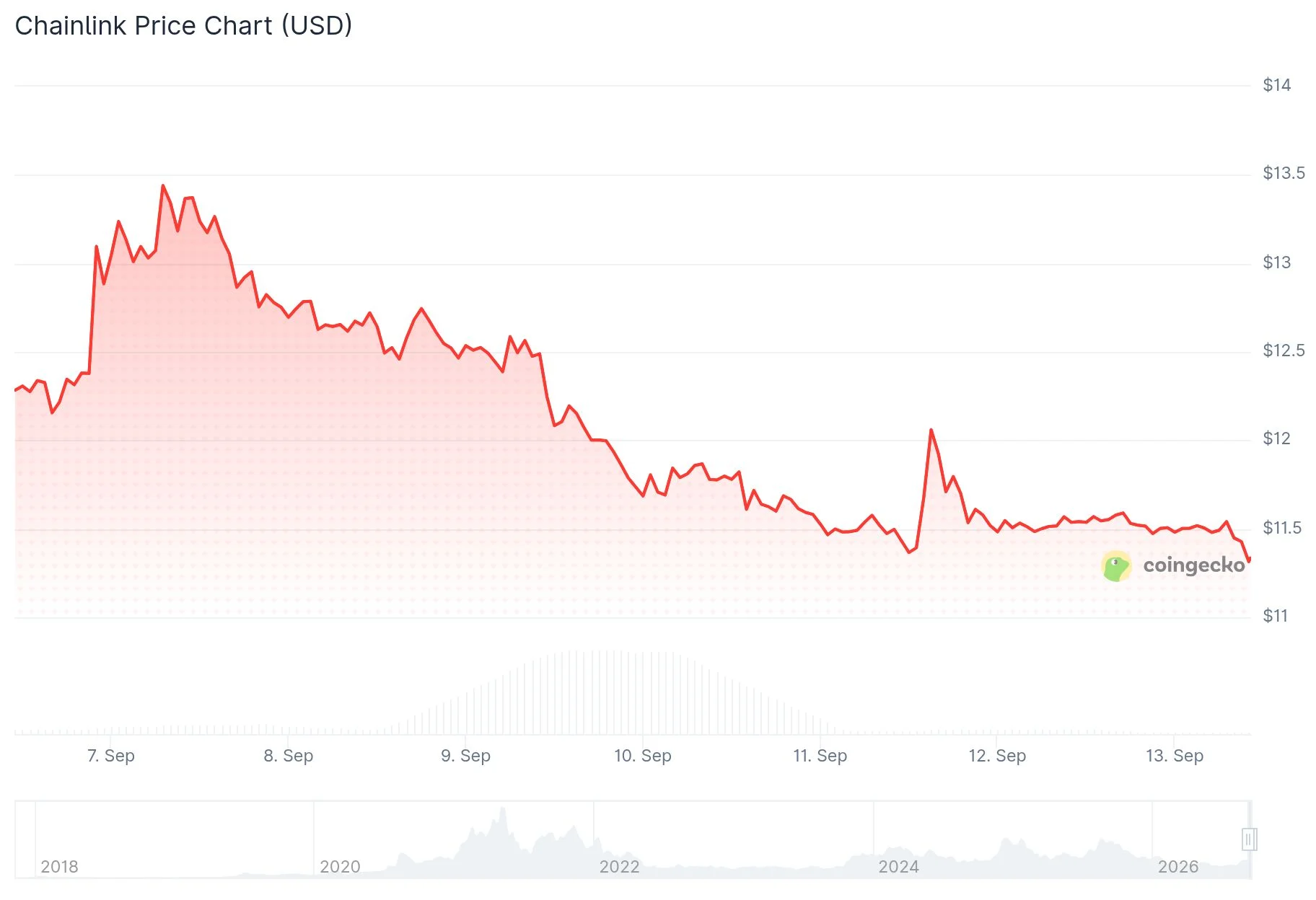
The decentralized oracle network token has delivered impressive returns of 35% throughout the past month, capturing significant interest from both retail participants and institutional capital. Despite this recent strength, LINK remains 78.05% below its historical peak of $52.70 reached in May 2021.
Market analyst Ali Charts highlighted on X that major holders capitalized on recent weakness by buying during the dip. Following a 17% retracement from $13.68 down to $11.29, substantial wallets acquired approximately 10.36 million LINK tokens over a 96-hour window, representing roughly $120 million in value. According to Ali Charts, this pattern of large-scale accumulation following significant price corrections typically signals that major players are establishing positions ahead of potential upward movement.
September Brings Renewed ETF Momentum
Chainlink-focused exchange-traded fund products experienced positive capital flows during early September. Bitwise’s CLNK and Grayscale’s GLNK recorded inflows of $1.09 million and $4.27 million on September 9 and 10, respectively. Both funds reported neutral flow activity with zero net inflows on September 11.
The cumulative lifetime inflows across both ETF products have reached $151.76 million. Combined assets under management currently stand at $181.83 million, accounting for approximately 2.10% of Chainlink’s total market capitalization.
Grayscale’s GLNK maintains its position as the dominant product with $135.88 million in managed assets, while Bitwise’s CLNK oversees $45.95 million.
Critical Technical Zones in Focus
From a technical analysis perspective, $11.46 represents the most recently validated support zone. Immediate resistance exists between $11.57 and $11.60, with additional overhead pressure at $11.80.
The MACD histogram displays a modest positive value of 0.011, indicating that bearish momentum may be weakening. Meanwhile, the RSI registers at 38.65, positioned above oversold territory but not yet reflecting robust bullish pressure.
A decisive four-hour candle close above $12 would serve as the initial confirmation signal for bulls. This development could reestablish momentum toward the $13.30 swing high. Clearing that level would direct attention to $14, followed by the $15 objective — representing approximately 29% upside from current pricing.
Analyst Moe identified a LINK/BTC chart pattern showing the trading pair consolidating within a prolonged descending formation. The pair trades near a demand zone that may serve as a potential reversal point, though no confirmed breakout has materialized yet.
The Chaikin Money Flow indicator registers at -0.39, reflecting greater distribution volume compared to accumulation during the recent period. For improved near-term momentum, LINK must recapture the $11.55 and $11.60 levels.
The post Chainlink (LINK) Whales Accumulate $120M as Price Tests Critical Support Levels appeared first on Blockonomi.
Quick Overview
- A trio of SpaceXAI engineers will livestream an ambitious 72-hour challenge to create a complete startup using autonomous AI agents
- Grok Bot Galaxy takes place September 15-17 in San Francisco with free global streaming access
- The participants begin with zero preparation — no business concept, product design, or company name pre-selected
- Grok Bot represents SpaceXAI’s autonomous agent platform, distinct from the conversational Grok chatbot available on X
- The company emerged from SpaceX’s acquisition of xAI in February, which assigned xAI a $250 billion valuation
A three-person team from SpaceXAI is preparing to launch an entirely new startup within a 72-hour window, broadcasting every moment and decision to a global audience.
The participants — Matt Palmer, Lauren Tan, and Roshan Sadanani — will begin their marathon on September 15, concluding on September 17. They’re calling this ambitious experiment Grok Bot Galaxy, hosting it at a San Francisco location.
Daily sessions are scheduled from 8:30 a.m. until 6 p.m. Pacific time. Anyone worldwide can tune in through a free livestream broadcast.
The challenge begins with a completely blank slate. They have no predetermined business name, product concept, or even a general direction. Every strategic choice will emerge organically during the live event.
Understanding Grok Bot’s Capabilities
Central to this experiment is Grok Bot, which serves as SpaceXAI’s autonomous agent platform. This should not be confused with the conversational Grok chatbot that users interact with on X (previously known as Twitter).
Grok Bot enables users to develop customized AI agents, assign them identities and goals, then activate them across various applications and web platforms. These agents operate on dedicated cloud infrastructure and can execute complex, sequential tasks continuously without interruption.
The three primary participants plan to leverage Grok Bot throughout the ideation phase, strategic planning sessions, product development discussions, and technical implementation. Additional SpaceXAI team members will contribute to focused segments addressing sales strategy, customer service operations, and marketing initiatives.
The platform has been publicly accessible for approximately one month.
SpaceXAI’s Background and Context
SpaceXAI emerged following SpaceX’s February acquisition of xAI through an all-stock transaction that established xAI’s worth at $250 billion. The company followed up in August by purchasing coding platform Cursor in a $60 billion deal.
Elon Musk has made bold public statements regarding Grok’s capabilities throughout this year. A continuous three-day build documented on camera presents a significantly greater challenge than producing edited demonstration videos.
However, this remains an internal test conducted by the company promoting its own technology. Observers will be watching closely to gauge how frequently the human participants must intervene, correct errors, or override the AI agents.
This demonstration arrives during the same week that competitor Anthropic released findings about misuse patterns involving its Claude AI models, examining concerns around cyber attacks and fraudulent activities. Musk has conceded that Grok hasn’t yet become the leading choice in certain competitive categories.
Broader industry concerns about responsibility and oversight when AI agents operate autonomously continue without clear resolution.
When the livestream concludes on September 17, viewers will have a definitive answer: did the team successfully create a functional product with genuine users, or merely produce branding elements and a basic website?
The post SpaceXAI Team Launches 72-Hour Startup Challenge Powered by Grok Bot AI Agents appeared first on Blockonomi.
TLDR:
- Uniswap price rose 4.55% to $6.39 as the protocol reported $70.6 billion in 30-day trades, exceeding PancakeSwap, BisonFi, and Meteora combined.
- Robinhood Chain supplied about $26 billion of the monthly total, ahead of Ethereum at roughly $23 billion, concentrating activity in two networks.
- StablePair Hook launched on v4 with USDC/USDG and USDC/USDT pools, varying fees as prices drift from reference rates and using Dutch auctions for corrections.
- UNI faces $6.45–$6.50 resistance and $6.30 support; a close below $6.10 shifts focus toward the $5.82 retracement level before the Fed decision.
Uniswap price traded near $6.40 in 24 hours on September 13 as Bitcoin and the broader crypto market traded nearly flat. The move focused attention on Uniswap’s DEX lead, stablecoin liquidity tools, and fee-related UNI mechanics. Uniswap said it processed more than $70 billion during the previous 30 days.
That total exceeded the combined activity of PancakeSwap, BisonFi, and Meteora. The reported $70.6 billion figure was 38% above Uniswap’s $51.1 billion monthly average from January through July. Traders watched StablePair Hook and governance discussions around UNI burns. These developments put Uniswap price levels under scrutiny.
Uniswap Price Follows $70B DEX Volume Lead and UNI Burns
Uniswap DEX volume reached $70.6 billion over the latest 30-day period, Crypto Briefing reported. Robinhood Chain contributed roughly $26 billion, its largest reported source of activity. Ethereum followed with about $23 billion, while Base, BSC, and Arbitrum supplied the remaining share. Robinhood could choose another provider or build an AMM.
Uniswap has processed $70B+ in volume over the past month
More than the next three DEXs combined
The world's value moves on
pic.twitter.com/ak426mmX1x
— Uniswap (@Uniswap) September 12, 2026
PancakeSwap processed $29.8 billion during the same period. BisonFi handled $8.9 billion, while Meteora posted roughly $5.9 billion. Together, those three venues recorded about $44.6 billion. Raydium reported $5.9 billion in DEX volume.
Uniswap’s cumulative DEX volume is near $3.7 trillion since its 2018 launch. Cumulative fees were about $5.1 billion in early August. The exchange recorded 28.9 million swaps during a single late-August week. It also reported recent USDC activity above the combined volume of other decentralized exchanges.
The Uniswap price gain overlaps with renewed attention to fee-switch tokenomics. Market discussion links revenue-based burn mechanisms to UNI supply. A reported September 4 UNI burn exceeded $1 million, with Robinhood Chain activity driving most volume. One tracked wallet doubled its UNI balance to 595,000 tokens.
Those observations do not identify wallet ownership or prove a direct cause for the gain. Uniswap price trades above the $6.30 daily pivot after reaching $6.39.
Uniswap price meets immediate resistance between $6.45 and $6.50, combining the 23.6% Fibonacci level and seven-day moving average. A close above $6.50 would strengthen recovery momentum.
A drop below $6.10 could expose $5.82, the 38.2% retracement level. A weekly chart analyst identified a rounding-bottom breakout.
StablePair Hook Changes Stablecoin Fees on Uniswap v4
Uniswap Labs launched StablePair Hook on September 10 with USDC/USDG and USDC/USDT pools on Ethereum mainnet. The v4 design adjusts pool fees as prices drift from a reference rate. Within a narrow band, it quotes a fixed bid-ask spread. It targets stablecoin markets, where small deviations create repeated arbitrage opportunities.
Outside the band, swaps that push a price farther from parity pay no fee. Corrective swaps enter a Dutch auction, beginning at a higher fee that falls each block. The design routes more pricing value to liquidity providers. Static fees can leave that spread for arbitrage traders.
Uniswap Labs said stablecoin-to-stablecoin swaps reached $43.4 billion during the second quarter. It said the total exceeded the next three onchain venues combined. StablePair Hook is upgradeable through Uniswap Governance. Governance can alter fee logic and pool parameters without forcing provider migration.
StablePair Hook joins DualPool, Permissioned Pools, and LitePSM in the v4 hook ecosystem. Liquidity providers can move positions into the listed stablecoin pools. Traders can use the pools through the Uniswap web app and wallet. The design ties market-making terms to measured drift rather than a fixed permanent fee.
The Federal Reserve announces its rate decision on September 16, the next broad macro event for UNI. Policy expectations can influence risk appetite across digital assets and decentralized finance. A daily Uniswap price close above $6.50 would validate the recovery structure. A close below $6.10 would refocus the chart on $5.82.
The post Uniswap Price Climbs as $70.6B DEX Volume Extends Market Lead appeared first on Blockonomi.
TLDR:
- Thailand stablecoin rules would require every deposit and withdrawal at a licensed operator to use an account or wallet verified in the customer’s name.
- The draft sets separate daily caps of five million baht, or roughly $151,000, for incoming and outgoing stablecoin transfers per user and operator.
- Thai-regulated operator transfers may bypass the cap only when both parties meet Travel Rule duties, which take effect on February 27, 2027.
- The consultation stays open until September 25, and the SEC has not set an effective date for the proposed same-owner wallet requirements.
Thailand’s Securities and Exchange Commission opened a public consultation after its Board approved the proposed principles on September 3. The Thailand stablecoin rules would require deposits and withdrawals to use bank accounts or wallets verified in the customer’s name. Each inbound and outbound transfer would face a five million baht daily limit, or about $151,000, per person and operator.
The proposal covers activity through SEC-supervised digital asset operators, not peer-to-peer transactions completed outside those platforms. Comments close September 25, 2026. The measure is not yet effective. No implementation date appears in the consultation or accompanying SEC notice released so far.
Thailand Stablecoin Rules Target Third-Party Wallet Transfers
Under the draft, a stablecoin transfer could reach a customer account only from that customer’s verified wallet or payment account. An operator would need to establish the connection before accepting the deposit. A withdrawal would follow the same test. It could go only to a wallet or account verified as belonging to the customer who requested it.
The Thailand stablecoin rules would stop a customer from receiving tokens from another person’s external wallet through a licensed platform. They would also bar withdrawals to a family member, trading counterparty, employee, or unrelated business wallet. The restriction applies at the operator’s transfer boundary. It does not purport to prohibit a wallet-to-wallet transfer that never touches a supervised Thai firm.
Proposed Thailand stablecoin rules would create a compliance step for platforms handling stablecoin deposits and withdrawals. Operators would need evidence linking each permitted destination and origin address to the account holder. Platforms would need to distinguish customer wallets from addresses held by other people or payment intermediaries before completing transfers.
That process could alter wallet whitelisting and fund settlement workflows for users at scale. The proposal does not list a single verification method. Firms may need procedures for wallet ownership, customer records, and transaction monitoring before processing the transfer.
The regulator describes the approach as a response to money-laundering, cybercrime, and cross-border transfer risks. The Thailand stablecoin rules place the same-owner condition beside customer due diligence at licensed operators. The measure would make third-party stablecoin payments harder to route through an exchange account. It would not regulate private transfers conducted away from regulated operator systems.
Thailand Stablecoin Rules Retain a Travel Rule Transfer Waiver
The five million baht ceiling applies separately to money entering and leaving a customer account. A customer could therefore face one daily inbound limit and one daily outbound limit at each operator. That amount equals about $151,000 at current exchange rates. The consultation also links permitted volumes to verified income and financial standing, within the proposed ceiling.
Transfers between Thai-supervised digital asset operators may receive an exemption from the cap. Both firms must comply with the Travel Rule for the waiver to apply. That regime requires specified originator and beneficiary information to accompany qualifying digital asset transfers. Thailand plans to bring its separate Travel Rule requirements into force on February 27, 2027.
The Thailand stablecoin rules could separate transfers to verified personal wallets from transfers handled between compliant local intermediaries. The consultation also outlines exceptions for some business transfers involving operators and Bank of Thailand-authorized entities.
Those carve-outs would preserve defined institutional routes while restricting ordinary third-party wallet movements. The SEC has invited public comments on the principles through September 25.
Users would need to show that each wallet belongs to them before using it with a licensed operator. The Thailand stablecoin rules do not name issuers as their target. The rules instead focus on the point where customers deposit or withdraw tokens through supervised firms. Any final text would determine the exact documents, verification process, and exempt transaction categories. Officials will decide next steps after comments close.
The post Thailand Stablecoin Rules Could Restrict Third-Party Wallet Use appeared first on Blockonomi.
TLDR:
- S&P 500 earnings growth for 2026 is now forecast at 32%, up from roughly 24% before second-quarter results.
- About 86% of reporting S&P 500 companies beat estimates, well above the long-term average of 67.5% overall.
- Communication Services’ 2026 profit growth forecast jumped to 51% from 26% as AI-driven gains spread.
- Barclays raised its 2026 S&P 500 EPS forecast to $365 and lifted its year-end index target to 7,950.
Wall Street’s 2026 earnings outlook has shifted sharply higher as artificial intelligence spending strengthens profits across technology, advertising, cloud computing, and related industries. S&P 500 earnings are now projected to rise 32% in 2026, up from roughly 24% before second-quarter reporting began.
The revision followed a strong earnings season, with 86% of companies beating analyst expectations, according to Bloomberg Intelligence data highlighted by The Kobeissi Letter. LSEG also found that 86% of 492 reporting companies topped estimates, well above the long-term average of 67.5%.
AI Drives S&P 500 2026 Earnings Forecast to 32%
Bloomberg Intelligence analyst Nathaniel Welnhofer identified the AI infrastructure buildout as the clearest driver behind the stronger 2026 earnings outlook. However, the gains have moved beyond chipmakers and now include cloud services, digital advertising, data centers, and investment income.
Communication Services recorded the largest upward revision among major sectors. Its projected 2026 earnings growth increased to 51% from 26% at the start of the second quarter.
Alphabet contributed through stronger advertising and AI monetization, while other companies also produced large earnings surprises. Consumer Discretionary followed, with projected growth climbing from about 12% to 32%.
Amazon played a major role in that upgrade after reporting profit at roughly three times market expectations. Target, Walmart, TJX, Ross Stores, and Estée Lauder also beat estimates and raised guidance.
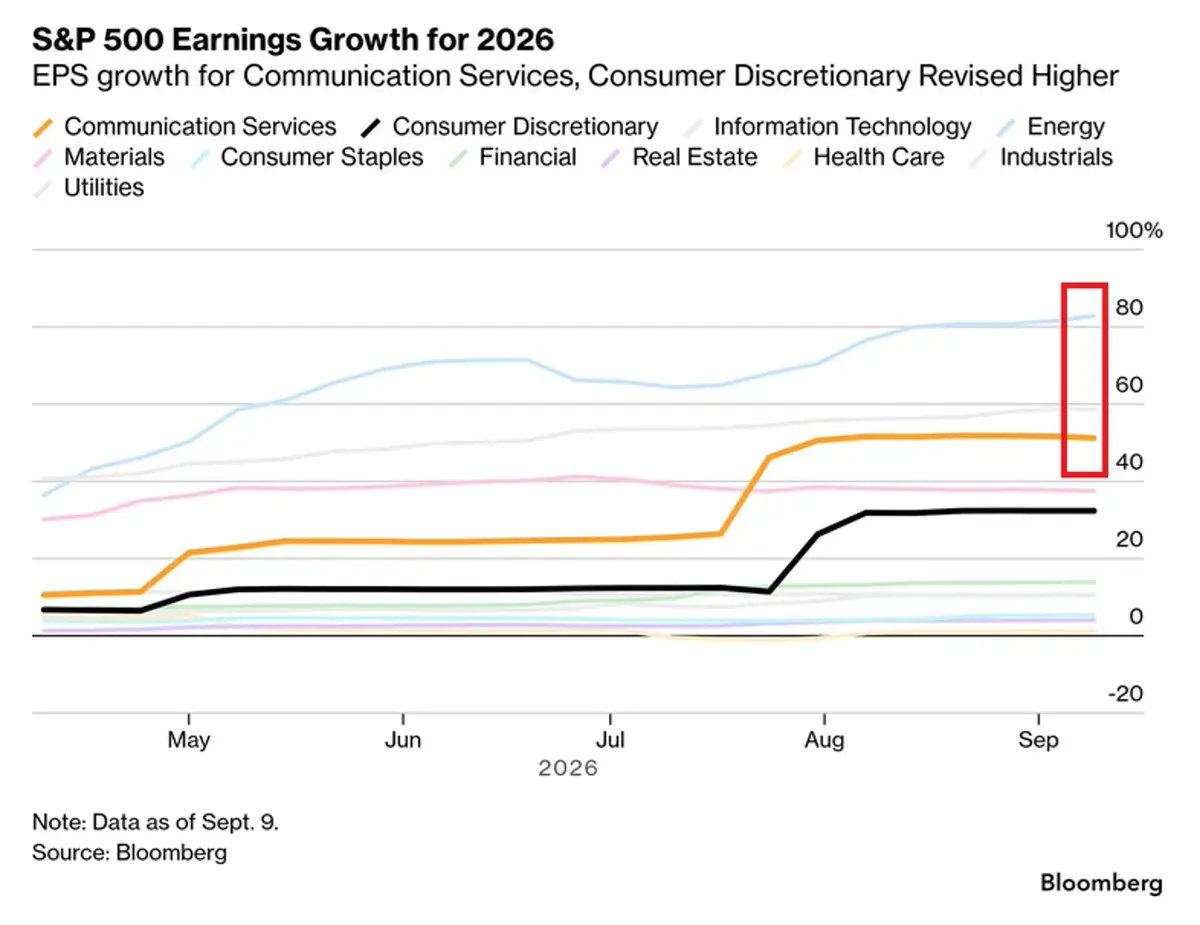
Source: X
The Bloomberg chart also showed Energy earnings projected to rise about 83% in 2026. Information Technology profits were forecast to increase roughly 59%, underscoring the breadth of the revision cycle.
The quarter also contained an important accounting effect. Reuters reported that aggregate S&P 500 second-quarter earnings were tracking about 52% higher from a year earlier. Yet, excluding large mark-to-market gains at Alphabet and Amazon, earnings growth would still have reached about 33%.
That would remain the strongest pace since 2021. Amazon recorded $53.4 billion in second-quarter non-operating pre-tax income, largely linked to investments including Anthropic. Alphabet also booked substantial unrealized investment gains.
Goldman Sachs estimated that AI infrastructure companies generated roughly one-third of S&P 500 EPS growth during the quarter. That contribution shows how deeply spending has entered the earnings picture.
Wall Street Raises Targets as AI Earnings Boom Broadens
The stronger profit outlook is already feeding into higher market targets. Barclays raised its 2026 S&P 500 EPS estimate to $365 from $337. The bank also lifted its year-end index target to 7,950 from 7,800. It cited continued AI investment and healthy economic activity as supporting factors.
UBS, Goldman Sachs, and Citigroup have projected year-end index levels of 8,000 or higher. Those forecasts reflect stronger expected profits, but the earnings expansion still carries identifiable risks.
Rising memory costs are pressuring technology margins, while higher interest rates and persistent inflation could restrict valuation expansion. Barclays also flagged the sustainability of AI spending as a key uncertainty.
For now, the data show that artificial intelligence is influencing more than market sentiment. It is reshaping earnings estimates, sector forecasts, and expectations for broader corporate profitability.
The shift marks a measurable change from the pre-season outlook, as stronger reported results translated directly into higher profit expectations for 2026.
The post AI Supercharges S&P 500 Earnings as 2026 Growth Forecast Hits 32% appeared first on Blockonomi.
CryptoPotato
For the ninth consecutive week, the exchange-traded funds tracking the popular cross-border token were in the green, attracting nearly $19 million, similar to the previous week.
The cumulative total net inflows hit another all-time high, but the underlying asset continues to struggle with its breakout attempts as its mid-August rally came to a halt.
Another ATH
During the last full week of August, the spot XRP ETFs marked their best performance since early December 2025, attracting $110.49 million. This followed another impressive week, in which the net inflows neared $40 million.
The inflows slowed down at the start of September but remained well in the green. Although there was still a single day in the red for the first time in a month, the funds gained $18.96 million during the week that ended on September 4. The next one, which was just four business days long, saw similar inflows of $18.98 million.
The numbers on Tuesday were quite modest, with just $1.55 million. However, Wednesday brought $12.29 million, followed by another $5.14 million on Thursday. Interestingly, Friday was a no-action day, according to data from SoSoValue, with net flows of $0.00. This was rather unexpected given the massive market turbulence that day, but more on that later.
Ultimately, the XRP ETFs reached another all-time high of $1.7 billion. Bitwise’s XRP fund, which recently surpassed $500 million in assets, has extended its cumulative net inflow lead – $608 million compared with $490 million for Canary Capital’s XRPC.

XRP Still Struggles
The underlying asset exploded during the market breakout between August 19 and 22, skyrocketing by 70% in less than 72 hours. It jumped from $1.00 to $1.70, where it was rejected and driven south hard, despite the positive ETF flows.
It tried to take down the crucial $1.40 resistance in the past week, only to be halted again. On Friday, it went through a wild two-hour ride after the release of the CPI numbers. It went from $1.36 to $1.32 before it soared to almost $1.45. However, it was stopped once again, and now struggles below $1.40.
Crypto analysts are now split on its short-term potential. Ali Martinez, for instance, warned that whales have started to secure profits, while the network activity has dumped hard, which could lead to another leg down. In contrast, Celal Kucuker outlined a pattern that previously led to a 600% surge and suggested that it could run it back.
The post XRP ETFs Smash Another All-Time High as Inflow Streak Hits 9 Weeks appeared first on CryptoPotato.
Similar to the previous weekends, this one is quite sluggish for bitcoin, as its price remains in a very tight range between $77,000 and $77,400.
Most larger-cap alts are in the same boat, with minor losses compared to yesterday. CRO, PUMP, and BTW have marked more substantial gains, but one alt reigns supreme.
BTC Fights for $77K
Bitcoin finished the first week of September with intense volatility after it rocketed to $82,400 for the first time since mid-May, before it was rejected and driven south to under $79,000 that Friday after the release of the US jobs report. The following week or so was less eventful, as the cryptocurrency remained between $80,000 and $77,600.
The upper boundary halted its breakout attempts, while the support managed to hold the bears. However, it all started to change on Thursday and especially on Friday. At first, the lower boundary gave in, and BTC slipped to $77,000. Then came the release of the CPI numbers for August, which sent shockwaves through the market.
The initial reaction drove BTC to $76,000, marking a multi-week low. However, the bulls stepped up somewhat surprisingly and drove the cryptocurrency north to $79,800 within an hour. Another rejection followed, and BTC returned to its starting point at $77,000. Since then, it has been trading sideways between $77,000 and $77,500, currently above the former.
Its market cap has retreated to under $1.550 trillion on CMC, while its dominance over the alts remains sluggish at 58.7%.

One Alt Above Them All
Ethereum, which rocketed to nearly $2,700 on Friday, was stopped there and now fights to stay above $2,500. BNB is down to $722 after a 1.3% daily decline, while XRP remains well below the key $1.40 level. SOL, TRX, DOGE, XMR, and LINK are also slightly in the red.
In contrast, RAIN is up by over 2%, CRO has gained 3%, while PUMP has pumped (right?) by 6%. BTW has stolen the show from the larger caps, rocketing by 11% to over $0.55.
However, the altcoin in question that has posted the biggest gains is Lisk (LSK). The asset has exploded by 325% daily to $0.82. Its weekly gains are even more impressive, posting an 800% surge.
The total crypto market cap has remained at essentially the same level as yesterday at $2.640 trillion on CMC.

The post Top 100 Viral Altcoin Explodes by 325% Daily, BTC Struggles at $77K: Weekend Watch appeared first on CryptoPotato.
Ethereum is attempting to convert its post-rally consolidation into a continuation setup. It remains compressed near the upper end of the range, and a sustained breakout could provide the foundation for another bullish leg, although the recent CPI-driven fakeout highlights the need for confirmation.
Ethereum Price Analysis: The Daily Chart
On the daily timeframe, ETH continues to hold the substantial gains generated by the explosive August breakout. More importantly, the market has avoided a meaningful retracement despite repeatedly testing the $2.43K-$2.52K area, suggesting that sellers have so far been unable to force price back toward the lower support zones.
The current consolidation is taking place around the $2.45K-$2.52K resistance zone, with ETH now trading near $2.52K. A convincing daily breakout and close above this region would strengthen the bullish structure and could open the way toward higher prices. In that case, the next major resistance visible on the chart sits around the $2.92K-$3.03K zone.
However, the market still needs to establish acceptance above the current resistance. Failure to do so would leave ETH vulnerable to another rotation inside the range. The $2.05K-$2.14K region represents the next significant daily support area below, while the moving averages are also gradually turning higher beneath the price.
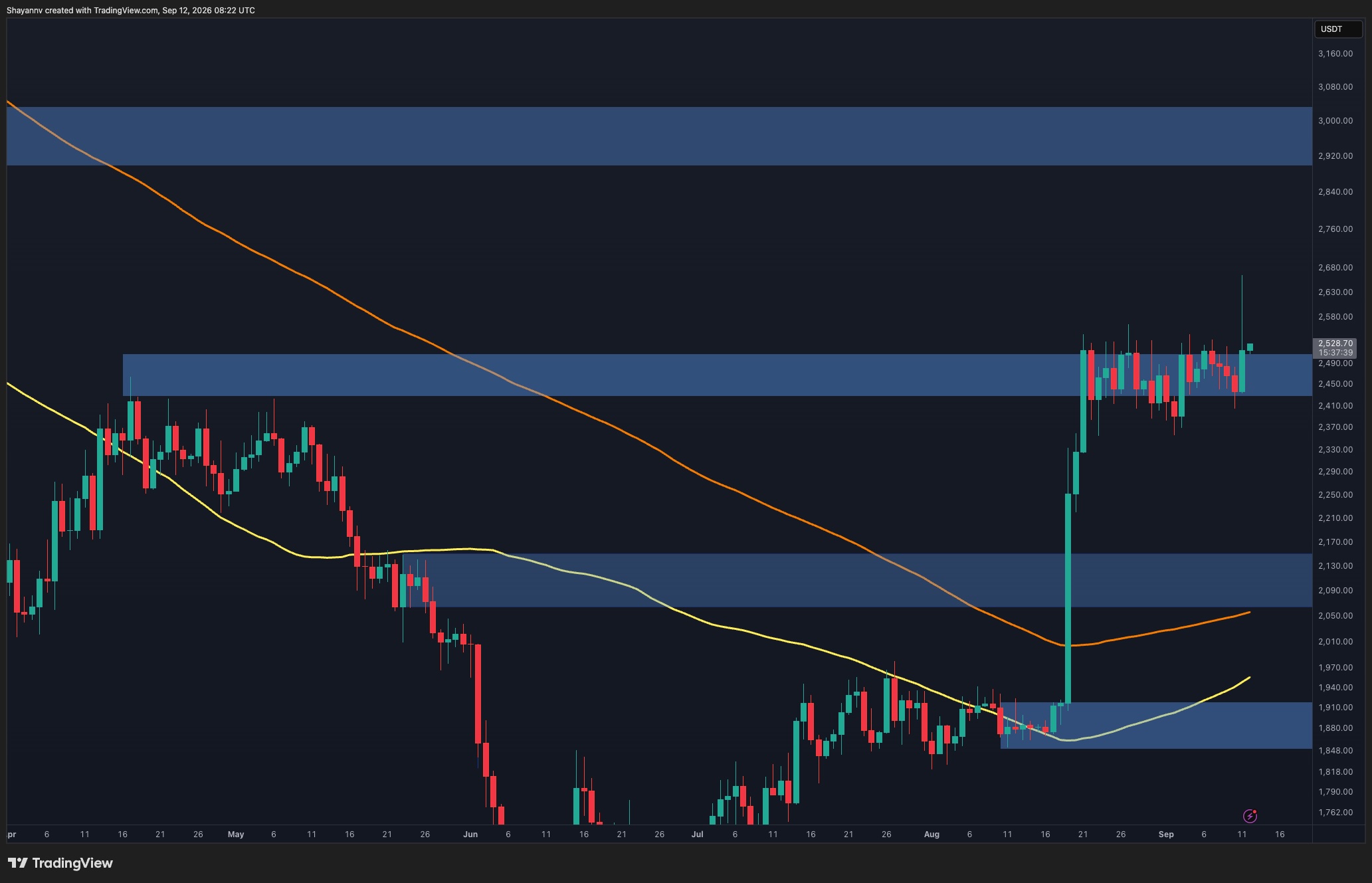
ETH/USDT 4-Hour Chart
The 4-hour chart provides a clearer view of the immediate breakout attempt. ETH has spent several weeks ranging roughly between $2.35K and $2.56K, repeatedly rejecting both ends without establishing a sustained directional move.
The latest CPI volatility briefly pushed the price above the $2.56K range high, with the wick extending toward $2.66K, but buyers failed to maintain the breakout, and ETH quickly returned inside the structure. This fakeout is important because it shows that simply trading above the range is not sufficient. The market needs to hold above the $2.56K resistance level to confirm a genuine structural breakout.
Nevertheless, ETH has recovered toward the upper boundary again rather than experiencing a sharp rejection. If buyers can secure acceptance above $2.56K, the consolidation could resolve into another bullish leg.
Conversely, another rejection would keep the range intact and expose the $2.43K-$2.45K support zone first. A more decisive breakdown below the range floor around $2.35K would weaken the continuation scenario and could shift attention toward the $2.22K-$2.27K support zone.

Sentiment Analysis
The 90-day Spot Taker CVD tracks the cumulative difference between market buy and market sell volume. An increasing positive CVD indicates taker-buy dominance, while a declining negative reading reflects stronger aggressive selling.
The latest data shows a notable shift toward green, indicating that taker buyers have become dominant again after the more neutral conditions observed during July and early August. This transition has coincided with ETH recovering toward the $2.5K region and is therefore a constructive signal for the current consolidation.
If taker-buy dominance persists while ETH establishes itself above the range resistance, the combination would provide stronger confirmation that demand is supporting another bullish leg. A loss of this buy-side dominance, particularly alongside another failed breakout, would instead suggest that aggressive demand is not yet strong enough to sustain the move.

The post Ethereum Price Analysis: $3K Back in Play After ETH Reclaims $2.5K appeared first on CryptoPotato.
Ripple’s XRP has yet to establish a clear direction after its August surge, with repeated rebounds being capped before buyers can regain control.
The current compression leaves the market at an important juncture, as holding the nearby support could eventually set up another recovery attempt.
Ripple Price Analysis: The Daily Chart
On the daily timeframe, XRP is consolidating after the sharp rally from around $0.99 to above $1.50. Since that initial surge, the price has formed a sequence of lower highs while remaining above the broader support structure, producing a descending channel.
The asset is currently trading around $1.37, close to the 0.5 Fibonacci retracement level at $1.34. This makes the $1.33-$1.34 zone an important near-term support area. So far, buyers appear to be defending it, but the rebound remains modest.
If this level gives way, the next important downside target sits around the 0.618 Fibonacci level at $1.26. This area also aligns closely with the moving average and the broader $1.22-$1.27 support zone, making it a particularly significant region for the medium-term structure.
On the upside, XRP would need to recover through the $1.45-$1.50 area before challenging the major $1.61-$1.70 resistance zone. Until then, the price action remains corrective rather than decisively bullish.
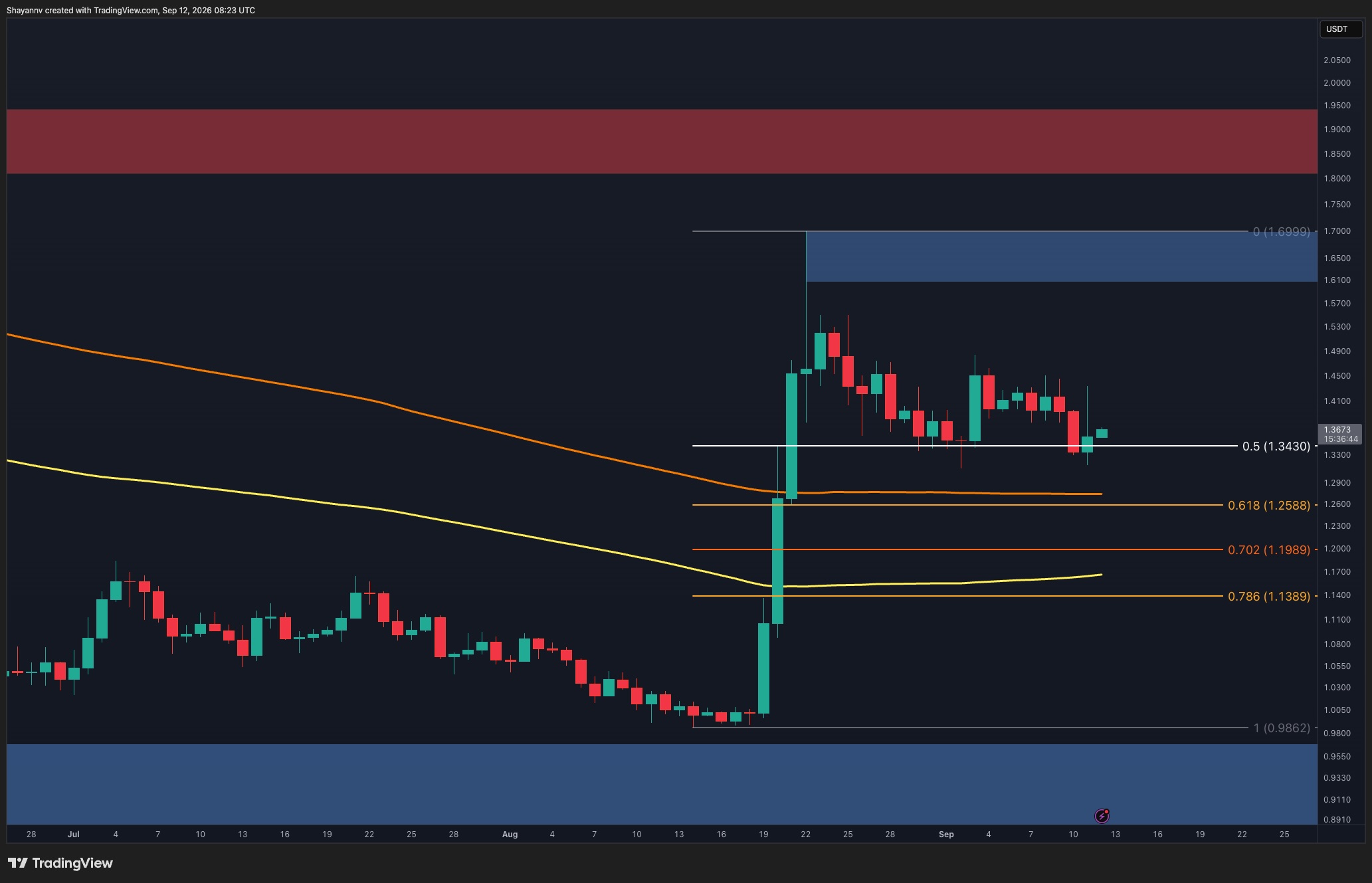
XRP/USDT 4-Hour Chart
The 4-hour chart emphasizes the gradual compression that has developed since the August peak. XRP continues to trade inside a descending channel, with the upper trendline now approaching the $1.40-$1.42 region and acting as dynamic resistance.
The latest rebound from approximately $1.33 has brought the price back toward $1.37, but buyers have yet to generate enough momentum to break the sequence of declining highs. A breakout above the descending trendline and subsequent acceptance above the $1.40-$1.42 zone would be the first meaningful indication that the correction is losing strength. Such a move could shift attention back toward $1.45 and eventually the higher resistance region.
Conversely, another rejection from the trendline would keep the descending structure intact. In that case, XRP could revisit the lower boundary of the channel, which is converging toward the $1.22-$1.27 support zone. Losing that area would represent a more significant deterioration in market structure and could expose the deeper $1.09-$1.13 support zone.

The post Ripple Price Analysis: Consecutive Lower Highs Spell Trouble for XRP Ahead of Crucial Week appeared first on CryptoPotato.
UniCredit is exploring an expansion into digital assets that would add crypto custody and brokerage, and has started selecting a technology provider to hold the assets and handle client transactions, Bloomberg reported, citing people familiar with the matter.
As per the report, the discussions are early, and no final decision has been made. Areas under consideration include custody and brokerage, tokenized investment products and fixed-income securities, and stablecoin applications for clients. UniCredit has not disclosed which providers it is weighing, how much it might spend, or when it would choose one.
Any crypto services would fall under the EU’s Markets in Crypto-Assets regulation, whose grace period ended on July 1. MiCA requires crypto-asset service providers to hold a license and lets authorized firms passport custody and trading across the 30-country European Economic Area.
Building on Earlier Crypto Moves
Selecting an outside technology provider is the path other large banks have taken into crypto custody. Deutsche Bank tapped Swiss firm Taurus for digital asset custody and tokenization after what the vendor called a detailed selection and due diligence process.
UniCredit has already put crypto products in front of clients. The bank opened a five-year, dollar-denominated certificate linked to BlackRock’s iShares Bitcoin Trust (IBIT) to professional clients in July 2025, with full capital protection at maturity, a cap of 85% on returns and a $25,000 minimum. It was the first product of its kind in Italy.
In December 2025, UniCredit and state lender Cassa Depositi e Prestiti structured Italy’s first tokenized minibond on a public blockchain, a €5 million issue for E4 Computer Engineering recorded on Polygon.
UniCredit also belongs to Qivalis, an Amsterdam consortium that has grown to 37 European banks across 15 countries and plans to launch a MiCA-compliant euro stablecoin on Ethereum in the second half of 2026. The token would be backed one-for-one by euro deposits, subject to approval from the Dutch central bank.
Banks Push Into Digital Assets
Other large lenders have already started selling crypto to clients. BBVA began offering Bitcoin (BTC) trading and custody to private banking clients in Switzerland, and Israel’s Bank Leumi lined up Galaxy to run trading and custody for a 2027 launch covering Bitcoin, Ethereum (ETH) and Solana (SOL).
UniCredit is also expanding in digital markets beyond crypto. On September 8, it bought a minority stake in VC Trade, a Frankfurt platform that digitizes bond and loan deals. The platform sits in debt markets, separate from the crypto plans, and has handled more than €90 billion across over 600 transactions.
The post UniCredit Weighs Crypto Custody and Brokerage, Hunts for a Technology Provider appeared first on CryptoPotato.