Cryptocurrency Posts
Crypto Briefing
Barcelona's reliance on La Masia talent ensures sustained success and competitive edge, highlighting the club's strategic youth development focus.
The post FC Barcelona leads 2-0 at halftime against Levante as La Masia graduates shine appeared first on Crypto Briefing.
The massive AI infrastructure investments by Alibaba and Amazon could reshape market dynamics, but they risk financial strain if returns falter.
The post Alibaba and Amazon are spending billions on AI infrastructure, and the bills are coming due appeared first on Crypto Briefing.
The unresolved voting rights issue in tokenized stocks could undermine corporate governance, prompting regulatory intervention and industry shifts.
The post Securitize president flags unanswered voting rights question for tokenized stocks in non-KYC wallets appeared first on Crypto Briefing.
Sacks' critique highlights potential stifling of innovation and competitive imbalance, questioning global cooperation feasibility in AI regulation.
The post David Sacks criticizes ‘Pace The Frontier’ initiative as regulatory capture appeared first on Crypto Briefing.
The Democratic AI commission could reshape tech policy, balancing innovation with consumer protection, and influence future legislative agendas.
The post Hakeem Jeffries launches House Democratic AI commission ahead of policy framework release appeared first on Crypto Briefing.
Bitcoin Magazine
Bitcoin Magazine

Bitcoin’s ‘Unusual Mix’: Bearish Inflation Print, Bullish Buyback Failure
Bitcoin’s path higher just got harder in the short term, but the setup further out may be improving, according to a new report.
In a Friday note, European asset manager CoinShares’ Head of Research, James Butterfill, said firmer-than-expected core inflation raises the odds of tighter Fed policy and could cap bitcoin below $80,000 for now.
But the longer-term case, he argued, rests on the U.S. Treasury’s bond buyback programme failing to bring down long-end yields — a failure that could ultimately feed the debasement narrative that has supported both bitcoin and gold.
“The result is therefore a somewhat unusual policy mix for Bitcoin,” the report read. “Today’s CPI data is negative at the margin, increasing the probability of tighter monetary policy and potentially limiting the immediate upside.
“But the apparent failure of the Treasury’s current buying programme increases the likelihood of much more substantial intervention further ahead.”
It continued: “If that happens, it could become one of the more powerful medium-term catalysts for Bitcoin.”
Data on Friday revealed that the consumer price index, excluding food and energy, climbed 0.3% in August from a month earlier — higher than expected.
According to CME’s FedWatch tool, traders think there is a 85% chance interest rates will be higher after the Federal Reserve meets next week. Bitcoin has typically performed well in a low interest rate environment.
But the U.S. Treasury’s expanded bond buyback programme has so far failed to materially suppress long-term yields.
If yields stay stubbornly high, Butterfill said, pressure will build on Treasury Secretary Scott Bessent to escalate to a much larger, “bazooka-style” buying programme aimed at forcing borrowing costs down.
Bitcoin in August had one of its best runs in years after Treasury Secretary Scott Bessent announced the department would double the size of its long-dated bond buybacks.
The announcement and subsequent price surge has led some to say the much talked-about debasement trade is back. The so-called debasement trade is when investors buy an asset as a way to hedge against a currency losing value.
Bitcoin and gold have both benefited as part of the trade as the dollar weakens.
This post Bitcoin’s ‘Unusual Mix’: Bearish Inflation Print, Bullish Buyback Failure first appeared on Bitcoin Magazine and is written by Mathew Di Salvo.
Bitcoin Magazine

Blockstream Tells Hackers To Return Remaining Bitcoin Stolen in Liquid Theft
Bitcoin infrastructure firm Blockstream has refused to negotiate further with hackers who last week stole 4,000 bitcoins from its Liquid network.
Writing on X Friday, Blockstream said that the hackers still had time to return the funds before the company would work with law enforcement.
White-hat hackers on Sunday withdrew about $320 million from the federation wallet that backs Liquid, a sidechain by Blockstream. After negotiating with Blockstream, they returned most of the funds but kept 598.5 coins worth over $46 million — demanding it as ransom.
“Blockstream will not pay a ransom for the return of stolen funds,” the post read. “Taking assets without authorization and withholding their return is a crime, not responsible disclosure. It is not white-hat activity. It is theft.”
It added: “We will work with law enforcement, exchanges, service providers, forensic specialists, and other relevant parties to trace and recover the assets and identify those responsible.”
“We will not pay for the return of stolen property. We will not abandon our users. The Bitcoin community will not stop pursuing the funds.”
Liquid, or L-BTC, is a layer-2 created by Blockstream that allows users to fast move assets backed 1:1 with bitcoin. One of the assets, LBTC, is a token backed by bitcoin that allows for quick settlement — a bit like the Lightning Network.
Hackers were able to get the funds by exploiting an inflation bug on the Liquid sidechain to create over 4,000 LBTC that did not exist before and cash them out for real, on-chain bitcoins.
The hackers then had an exchange with Blockstream via messages written into Bitcoin blocks.
In one message, the white hats wrote: “Please fix the bug first. The chain is under risk at latest commit right now. Make sure every node is patched. Then we will transfer the money back safely after confirming the fix.”
In the latest message, the hackers slammed Blocksteam as “delusional, greedy, and arrogant,” and threatened to reveal all of Blockstream’s encrypted messages in the exchange unless the company allowed thieves to keep 10% of the bitcoins.
“You SHALL pay 10% using your own money as bug bounty or you will cause all your holders a 15% loss for your irresponsibility and stinginess,” the message read.
The Bitcoin community is still reeling after hackers in July were able to steal over 1,800 bitcoins worth close to $140 million from Coldcard wallet holders.
Users of the popular hardware wallet, created by Coinkite, were targeted because the product’s manufacturer did not use a true random number generator, allowing hackers to essentially guess investor seedphrases.
This post Blockstream Tells Hackers To Return Remaining Bitcoin Stolen in Liquid Theft first appeared on Bitcoin Magazine and is written by Mathew Di Salvo.
Bitcoin Magazine

Italy’s Second Biggest Bank UniCredit Is Weighting up Crypto Custody: Report
Italy’s second largest bank is considering expanding into digital asset offerings, including custody, according to reports.
According to a Friday Bloomberg report citing people familiar with the matter, Milan-based UniCredit is selecting a technology provider that would allow it to build the infrastructure needed to hold digital assets and facilitate their buying and selling.
Bloomberg’s reporting added that tokenized investment products and fixed-income securities, the use of stablecoins and exposure to cryptocurrencies were all on the cards.
JUST IN:
— Bitcoin Magazine (@BitcoinMagazine) September 11, 2026Italy’s 2nd-largest bank UniCredit is considering to offer crypto asset custody — Bloomberg
pic.twitter.com/NAZKJBdcES
The news comes as other banks in Europe expand crypto offerings. Spain moved first on retail, with BBVA rolling out bitcoin trading and custody to all customers via its app, using its own custody infrastructure rather than a third party; Santander’s Openbank followed with its own trading service.
Cecabank — a Spanish custodian with over €400bn under management that acts as backbone for 100+ financial institutions — went live with crypto custody in June via a partnership with Bit2Me.
And in Germany, Deutsche Bank is building custody with Bitpanda’s technology arm, while Taurus and DZ Bank got BaFin approval in January for its meinKrypto platform.
New regulation in the European Union — Markets in Crypto-Assets Regulation (MiCA) — gives banks a legal definition, a supervisor, and a familiar set of obligations to launch crypto services.
UniCredit is one 37 lenders across 15 European countries working together to create a company called Qivalis with the aim of issuing a euro-denominated stablecoin.
Last year, the bank said it was offering professional clients a structured product tied to BlackRock’s iShares Bitcoin Trust exchange-traded fund, with full protection against losses.
This post Italy’s Second Biggest Bank UniCredit Is Weighting up Crypto Custody: Report first appeared on Bitcoin Magazine and is written by Mathew Di Salvo.
Bitcoin Magazine

Government Defeated as Lords Back UK Digital Assets Strategy
The UK government suffered a defeat in the House of Lords on Wednesday as peers backed an amendment requiring the Treasury to draw up a national strategy for regulating digital assets.
The upper chamber approved the measure by 194 votes to 138, with Conservative and Liberal Democrat peers combining against a near-solid bloc of Labour votes. Baroness Neville-Rolfe, a Conservative former Treasury minister, moved the amendment to the Financial Services and Markets Bill.
The new clause, titled “Digital assets strategy,” would require the Treasury to prepare, publish and consult on a strategy for regulating and developing digital assets and related digital financial market infrastructure in the UK.
JUST IN:
— Bitcoin Magazine (@BitcoinMagazine) September 11, 2026U.K. House of Lords passes amendment requiring the government to develop a national cryptocurrency strategy
The regulation of digital assets includes “cryptoassets, qualifying stablecoins, Central Bank Digital Currencies, tokenised securities and other digital and tokenised financial assets,” according to the draft.
The UK is in the process of drafting a sweeping new crypto bill. The country’s Financial Conduct Authority finalised its regulatory framework for cryptoassets in June, with the regime due to take effect on 25 October 2027. The authorisation gateway for firms opened on 30 September and runs to 28 February 2027.
Britain is trailing behind Brussels and Washington with digital asset regulation. The EU’s Markets in Crypto-Assets regulation has applied to service providers since 30 December 2024.
And the U.S. under President Donald Trump signed the GENIUS Act into law in July 2025, establishing a federal framework for dollar-backed tokens. Broader market-structure legislation remains unfinished: the Clarity Act cleared the House in July 2025 by 294-134 but has been stuck in the Senate over DeFi, stablecoin yield and ethics provisions, with a procedural vote set for next week.
This post Government Defeated as Lords Back UK Digital Assets Strategy first appeared on Bitcoin Magazine and is written by Mathew Di Salvo.
Bitcoin Magazine

Bitcoin Price Spikes, Shrugs off Hot US Inflation Data
Bitcoin’s price rose on Friday — despite data revealing that U.S. inflation had risen.
The biggest cryptocurrency by market cap was recently trading for close to $78,749 after jumping 2% over a 24-hour period. At one point on Friday morning in New York, bitcoin rose as high as $79,607.
Bitcoin’s price spike came after news dropped that U.S. consumer prices accelerated in August, reinforcing expectations that the Federal Reserve will raise interest rates next week.
The consumer price index, excluding food and energy, climbed 0.3% in August from a month earlier, which was higher than expected.
Inflation in the U.S. has been difficult to tame due to the war with Iran, which has lifted oil prices, in turn raising the costs of food, gasoline and other goods.
Higher inflation typically means the Federal Reserve will raise interest rates, which in turn could stop bitcoin’s price climbing higher.
According to CME’s FedWatch tool, traders think there is a 85% chance interest rates will be higher by next week. The Federal Reserve will meet next week and reveal what it will do with borrowing costs.
Bitcoin has typically performed well in a low interest rate environment because it means people can buy more of the cryptocurrency with increased liquidity.
Federal Reserve Chairman Kevin Warsh, who took the helm in January, last month gave his first speech as head of the U.S. central bank and said he had “more work to do” to fight inflation.
The U.S. is currently in the grips of an affordability crisis and rising oil prices are a hot topic ahead of the midterm elections.
U.S. President Donald Trump has reassured voters that prices will get under control and repeatedly put pressure on the central bank to lower interest rates.
Bitcoin in August had its biggest run in years following positive regulatory news and an announcement from the U.S. Treasury.
Treasury Secretary Scott Bessent announced the department would double the size of its long-dated bond buybacks, helping non-yielding assets like bitcoin and gold. The cryptocurrency then benefited from President Trump urging lawmakers to get key crypto legislation, the Clarity Act, over the line.
This post Bitcoin Price Spikes, Shrugs off Hot US Inflation Data first appeared on Bitcoin Magazine and is written by Mathew Di Salvo.
CryptoSlate
Bitcoin traded below $77,000 on Sunday as a weak week extended into the weekend, leaving traders facing fresh AI uncertainty and an approaching Federal Reserve meeting.
Bitcoin traded at $76,695 near press time, down 0.80% over 24 hours and 4.08% over seven days. The retreat puts the cryptocurrency back near a price area it visited before the weekend, with a Federal Reserve meeting also approaching.
The price area is also familiar. CryptoSlate’s Sept. 11 coverage reported an intraday low of $76,676 on Sept. 10, ahead of the Saturday AI statements. That chronology makes the weekend’s move an extension of existing weakness rather than the beginning of a sell-off that can be attributed entirely to the new warnings.
The scale and timing of the move matter. Bitcoin was still up 22.34% over 30 days, putting the latest losses within a broader monthly recovery.
Reported 24-hour trading volume was about $13.44 billion, down 49.98%. That describes how much trading occurred; it does not measure available buy orders or show which news prompted investors to sell. The price decline and lower turnover are separate measurements: neither reveals a single explanation for the day’s trading.
The fresh uncertainty is how investors will interpret calls to change the pace of AI development. NPR reported Saturday that Anthropic CEO Dario Amodei urged slower development and independent evaluators, and that OpenAI CEO Sam Altman agreed and said his company would follow suit.
Altman told Fortune in an interview released Saturday that OpenAI’s initial public offering would be delayed until 2027, citing safety concerns.
Those reports give investors a new question about the timing of AI progress and its commercial milestones. They do not establish an industrywide halt, a cut in chip orders or a corresponding change in listed technology companies’ earnings. A market response to those possibilities remains a scenario for Monday, not an observed outcome.
Inflation keeps a separate pressure in view
The AI debate arrives against an already difficult inflation backdrop. The Bureau of Labor Statistics reported Sept. 10 that final-demand producer prices rose 0.4% in August on a seasonally adjusted basis and 5.4% over the year before seasonal adjustment.
Goods prices increased 1.1% during the month. Energy prices rose 4.2% and accounted for more than three-fourths of that goods increase, showing how heavily energy contributed to the latest wholesale-price rise.
The energy contribution places the inflation debate on a different footing from the AI debate. One concerns prices already paid in August; the other concerns how companies may develop and commercialize technology in the future. Both will be in view ahead of the Fed’s Sept. 15–16 policy meeting, with a press conference scheduled for Sept. 16.
The calendar therefore presents two distinct checkpoints: Monday’s equity response to the weekend news, followed by the Fed meeting. Neither result is known yet.
The NYSE’s regular core session runs from 9:30 a.m. to 4 p.m. Eastern. Monday’s technology-stock performance will offer a first regular-session comparison with Bitcoin’s weekend decline. A fall in both would be consistent with broader caution, although that would still leave the cause of each move open. Futures and extended-hours activity can provide earlier indications, but they are distinct from that regular session.
A steadier technology session would weaken the case for treating Sunday’s Bitcoin move as a warning of an immediate tech sell-off. A weaker session would make the comparison more relevant without proving that the AI statements drove either market.
For Bitcoin, the immediate question is whether buyers can reverse the weekend loss as regular US markets reopen. The Fed meeting then brings a separate decision point, keeping Monday’s AI reaction from becoming the only explanation for the week ahead.
The post Bitcoin’s slide below $77,000 sets up a Monday tech test as AI leaders sound warning appeared first on CryptoSlate.
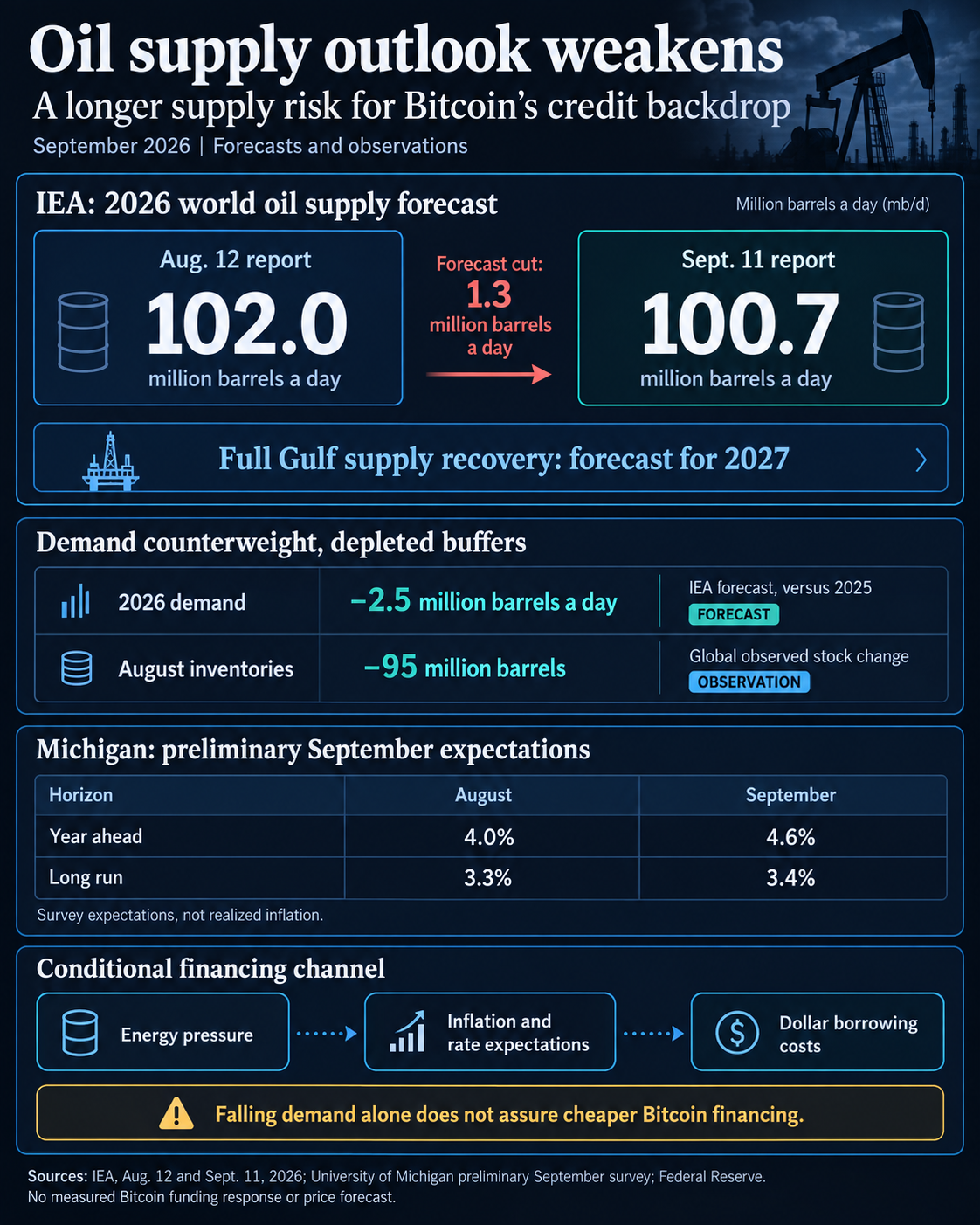
The International Energy Agency has cut its 2026 oil supply forecast and now expects full Gulf supply recovery in 2027, complicating the prospect of energy-driven relief in borrowing costs for Bitcoin investors.
Its Sept. 11 report projects average global supply of 100.7 million barrels a day this year, down from 102 million in the Aug. 12 outlook. The downward revision is 1.3 million barrels a day.
Demand is weakening too. The IEA forecasts global oil consumption will fall by 2.5 million barrels a day in 2026 compared with 2025. It puts that contraction at about 940,000 barrels a day deeper than it expected in August.
Less consumption could ease pressure on scarce supplies. Yet the agency estimates global observed inventories fell by 95 million barrels in August, indicating that weaker use has not removed physical tightness.
There is some relief in flows: the IEA says increased volumes bypassing the Strait of Hormuz and military-escorted shipments through it helped narrow crude export losses. But Gulf refined-product and liquefied petroleum gas exports in August remained nearly 60% below February. Recovery is uneven, and the 2027 timetable remains a forecast.
The inflation test for cheaper credit
For investors borrowing dollars to hold Bitcoin, the relevant link runs through inflation and expected interest rates. If persistent energy pressure keeps those expectations higher, financing relief could take longer. That risk concerns borrowers exposed to broader credit conditions; the reports do not measure changes in Bitcoin borrowing costs.
The Fed’s explanation of monetary policy describes how short-term rates influence lending costs and how expectations of future policy can affect longer-term rates and credit terms.
The University of Michigan’s preliminary September survey adds a warning signal: year-ahead inflation expectations rose to 4.6% from 4.0% in August. Long-run expectations moved to 3.4% from 3.3%. The smaller long-run move warrants attention, but one preliminary reading does not establish a lasting shift in expectations.
An earlier assessment offered a counterweight. In his Sept. 3 speech, Fed Governor Christopher Waller said his concern about energy costs spreading into many goods and services prices had not materialized so far.
Waller identified renewed energy pressure and rising longer-term expectations as risks. He said he could support holding rates if disinflation continued, but would consider a hike if August inflation reversed that progress. Those were his conditional views before the IEA release.
Ahead of the Sept. 15–16 Fed meeting, the test for cheaper credit is whether weaker consumption and recovering flows translate into less inflation pressure. Sustained supply recovery and limited spillovers would strengthen that case; persistent price pressure would weaken it. Falling oil demand alone offers Bitcoin borrowers no assurance of relief.
The post Bitcoin’s oil risk stretches into 2027 as IEA cuts supply outlook again appeared first on CryptoSlate.
Open Jupiter, tell it you want to swap SOL for USDC, check the price, and press the button. From the user's point of view, there is not much more to it.
So it's only natural to assume that Jupiter is where the trade happens. In reality, Jupiter is closer to a search engine for liquidity. Its software looks across different places willing to take the other side of the trade, compares what they are offering, and sends the order toward the best route it can find. Its current system can choose among ordinary decentralized exchanges, proprietary automated market makers, or propAMMs, and a request-for-quote network where professional market makers compete to quote a price.
The user sees one interface and one price, while underneath it several very different kinds of markets can be competing for the same order.
So the person selling you USDC might not be another user or a public pool funded by thousands of strangers. It could be a professional trading operation using its own money and pricing software, with no consumer-facing exchange and no pool into which you can deposit your own tokens. You never see most of that machinery; you just see the price that comes out of it.
A new analysis from DWF Ventures estimates that propAMMs account for roughly 15% to 27% of daily on-chain DEX volume. For one much smaller corner of the market, SOL-to-stablecoin trades routed through Jupiter, DWF puts their share above 90%.
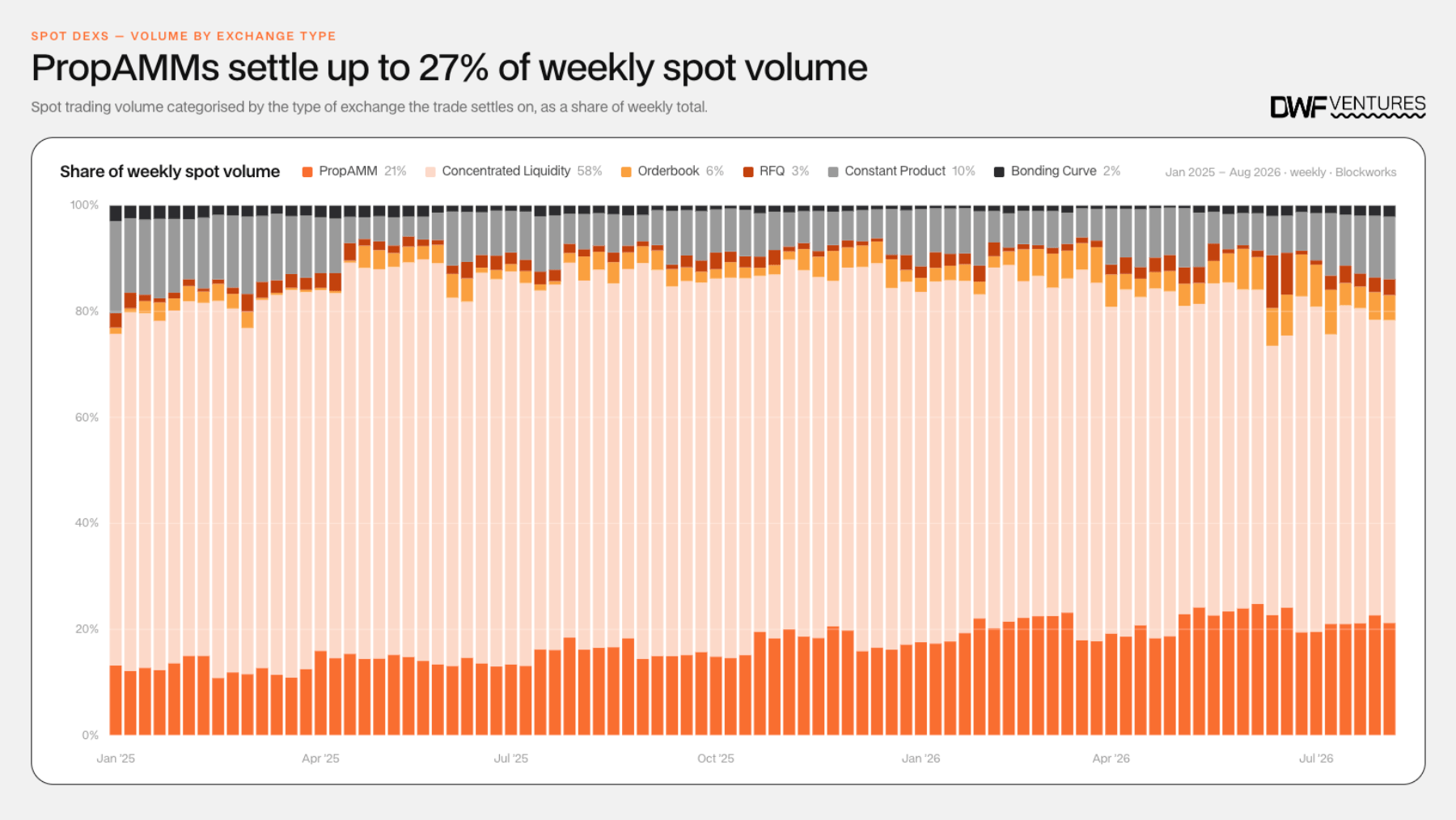
Those numbers come with an obvious caveat: DWF Ventures is part of DWF Labs, which is itself a crypto market maker and investor. Nonetheless, the exact percentage presented here is much less interesting than what the numbers describe. A form of trading that barely exists in most people's mental model of DeFi has become large enough to shape how some of its busiest markets work.
That leaves crypto in a pretty strange place right now. The first generation of decentralized exchanges was built around the idea that markets could become more open by replacing professional dealers with public software. Anyone could see the pool, put money into it, and trade against it according to rules written into code. Now the professional dealer is coming back, and in some of the most liquid markets it seems to be very, very good at the job.
That would already be an interesting turn for DeFi. It becomes much more consequential when it's happening at the same moment that Nasdaq, the London Stock Exchange, Robinhood, and Kraken are working on putting traditional stocks onto blockchain rails.
For years, finance has argued about whether Wall Street would move onto crypto's infrastructure. But now, a harder question is starting to form behind it: what kind of market will be waiting there when it does?
The dealers are back in business
The original automated market maker was one of DeFi's stranger inventions.
Imagine a currency booth with two piles of money, except there's no dealer behind the glass. One pile contains SOL and the other contains USDC. Software connects the two using a formula. You put SOL in and receive USDC. As SOL accumulates on one side and USDC disappears from the other, the formula adjusts the price. Anyone can also contribute money to the booth and collect a portion of the trading fees.
That solved an enormous problem for early DeFi. A new market did not need to persuade a professional firm to keep buying and selling all day. It needed tokens, a smart contract, and people willing to deposit capital, and the market could run itself.
Running itself, though, isn't the same thing as being good at trading.
Suppose SOL is worth $100 inside the pool. News hits, centralized exchanges move immediately, and professional traders now value SOL at $101. The pool doesn't notice by itself, but an arbitrageur does. They buy the temporarily cheap SOL and keep buying until the pool's price catches up. The pool has learned that SOL is worth $101 by selling SOL too cheaply.
Academic work calls the problem loss-versus-rebalancing. The terminology is less important than what it means: a passive pool can repeatedly trade at yesterday's price against people who already know today's price. That's a tolerable flaw when markets are calm, and trading fees compensate the people providing liquidity. It becomes an expensive problem when prices are moving quickly, and every stale quote is an invitation for serious and sizable arbitrage.
A propAMM reverses the arrangement. Instead of relying on thousands of outsiders to deposit tokens, a professional trading firm supplies its own inventory. Instead of waiting for trades to drag a formula toward the right price, its private software watches outside markets and continually changes what it is willing to buy or sell for. The transaction still settles on-chain, but the thinking that produced the price happens within the company.
It's actually much closer to an electronic currency dealer installed inside a blockchain than to the vending-machine model that defined early DeFi.
It also explains why the word “proprietary” belongs in the name. Solana's own explainer says today's propAMMs are generally closed-source, their liquidity is not open for ordinary public deposits, and getting included by an aggregator is a permissioned process. Users can verify that a transaction happened on-chain without being able to inspect the system that decided what price to offer or why one market maker got the order.
From the old DeFi worldview, that can sound like regression. But, from the perspective of somebody trying to swap SOL quickly and cheaply, the verdict is much less ideological.
Jump Crypto examined roughly 20 million propAMM fills from March and compared them with prices available across Binance, Coinbase, OKX, and Bybit. Its research found that the median SOL-USDC fill executed 0.72 basis points from its benchmark centralized-exchange midpoint, while 91.9% of fills were cheaper than Jump's estimate for the lowest institutional centralized-exchange fee tier.
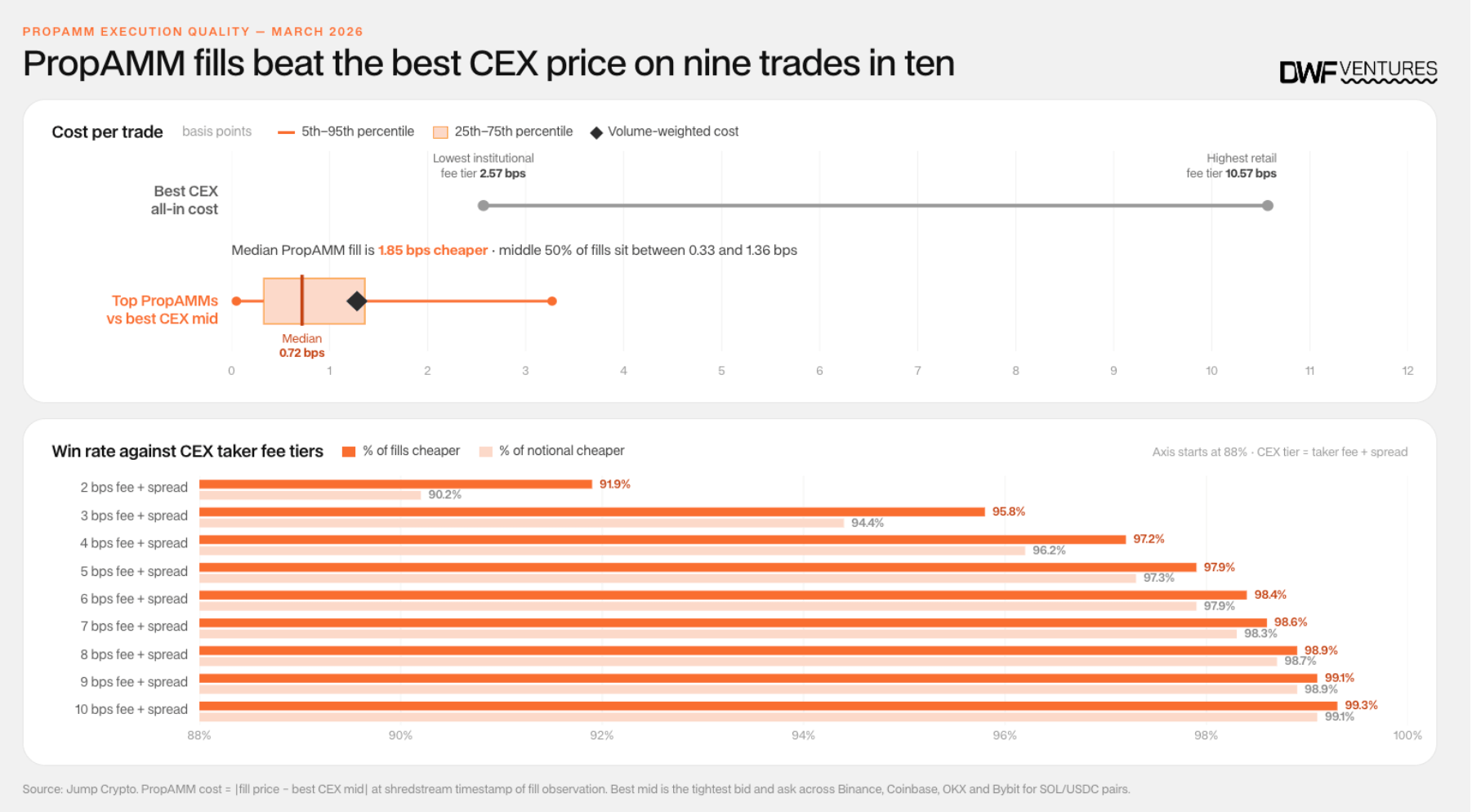
Jump is also a trading firm with commercial exposure to this market structure, so its study has its own incentives. Even so, the result helps explain why these venues are winning orders. Routers send them volume because, for certain trades, they can offer very good execution.
While this is a clear separation of both the mechanics and economics of decentralized trading, it's also a cultural break with early DeFi. The first version of DeFi treated openness as part of the product itself. The pool was public, the code could be inspected, liquidity came from users, and the route from capital to transaction was visible enough that a technically competent person could follow most of it.
The newer version asks a more consumer-like question: if another system gives you a better price, how much of that machinery do you actually need to see? Once the answer becomes “not very much,” the exchange begins to disappear behind the interface.
DeFi is turning exchanges into routers
Solana was particularly hospitable to this model because professional market makers care obsessively about old prices. A firm offering SOL at $100 doesn't want that quote hanging around while the rest of the world trades at $101. Every extra moment gives somebody an opportunity to trade against the old price before the firm can replace it.
Ethereum still operates with 12-second slots. Solana, by comparison, reached its 300-millisecond target on Aug. 28, which CryptoSlate examined through the economics of stale-price arbitrage. The networks build and process transactions differently, so the comparison is not one-for-one, but the attraction is easy to understand. Professional market makers want to update prices as often and as cheaply as possible, and Solana's own work on shorter slots explicitly points to lower stale-price exposure for liquidity providers and market makers.
You can reach the same destination another way, though. Instead of continually publishing every price on-chain, a system can ask professional firms for prices elsewhere and put only the winning trade on-chain.
That's essentially what request-for-quote systems do. On 0x's RFQ network, an application asks professional market makers for private off-chain prices, compares those offers with ordinary public AMM liquidity, and returns whichever route offers the better result. For highly traded pairs such as USDC-WETH and WBTC-WETH, 0x says its RFQ liquidity beats AMM pricing about 52% of the time.
Jupiter is combining several versions of that on Solana. Public DEX liquidity, propAMMs, and professional quote systems all live behind the same interface, which means the trader no longer has to choose what kind of market to use before making the trade.
That may be the deeper and more important transition here. Old DeFi effectively told the user: here is a pool, now trade against it. But new DeFi is starting to say: tell me what you want, and I'll figure out who should fill it.
Traditional finance already does this. When somebody submits an order to buy a stock, the customer usually doesn't choose the exact market center or dealer that executes it: it's the broker that routes the order. The SEC's basic explanation of US equity execution describes brokers choosing among exchanges, electronic networks, market makers, and internalization depending on where they can obtain the best available execution.
PropAMMs aren't just Wall Street dark pools transplanted onto Solana, and treating them that way would miss what makes the crypto version interesting. Blockchain settlement is observable, so the assets move across public infrastructure, and anyone can inspect the resulting transaction. What can remain private is the machinery around that transaction: the pricing model, the inventory decision, parts of the route, and sometimes the identity of the firm competing for the trade until execution occurs.
That creates a different definition of transparency. A financial market can expose ownership and settlement to public verification without exposing every part of price formation, and this distinction is becoming much more consequential as the assets moving through these systems stop being purely crypto assets.
Wall Street is coming just as DeFi changes course
Nasdaq said Thursday that its venture arm agreed to invest $100 million in Payward, Kraken's parent company, while the two firms continue work on Nasdaq Equity Tokens. Nasdaq expects the framework to launch in the second quarter of 2027 and plans to connect it with Payward's xStocks network.
The London Stock Exchange is moving in the same direction. On Sept. 1, LSEG announced a partnership with Payward around tokenized public equities and said it intends, subject to regulatory approval, to list xStocks for trading on its planned LSE 24 venue in 2027.
This is no longer a hypothetical market measured in a handful of pilots. CryptoSlate has already tracked tokenized stock trading at crypto-scale volumes, while the harder ownership question has become its own market-structure issue because products that resemble shares can come with very different rights. Tokenized stocks can look like familiar equities without giving buyers the same legal position, and the infrastructure beneath them can be just as unfamiliar.
Robinhood is a good example of what that infrastructure may look like in practice. Robinhood Chain has already turned tokenized stocks into assets that can circulate through permissionless crypto markets, but the professional liquidity layer looks much less like an open AMM experiment. 0x says its Stock Token implementation connects applications to professional market makers through RFQ, with USDG as the primary base pair and Tokka Labs as the primary maker participating through that system.
That's the point where the DWF report's speculation about real-world assets becomes much more important than the report itself. Mature tokenized assets don't have to inherit the market design of early DeFi simply because they settle on a blockchain. Tokenized Apple shares have a deep reference market elsewhere, professional firms capable of managing inventory around them, and traders who care about execution quality. Putting that share on-chain won't suddenly make a passive public pool the natural place to trade it.
For years, the tokenization debate asked whether Wall Street's assets would move onto crypto's rails. But a much more important question is appearing behind it: when they get there, whose market structure will they use?
CryptoSlate has already seen the same tension elsewhere in tokenized equities. Markets sold as a way to remove financial middlemen can still depend heavily on old financial infrastructure, including the brokers and custodians holding the underlying shares. One broker now handles the backing for a large share of tokenized equities. The propAMM transition points in the same broader direction from the trading side: blockchains can alter which parts of finance are public without making every intermediary disappear.
The trade is public, but the trading desk isn’t
The easiest conclusion would be that DeFi spent years trying to escape Wall Street and then rebuilt it anyway, but that's too simple. What crypto may actually be doing is separating two things that were once treated as if they had to travel together: transparency of settlement and transparency of execution.
Blockchains can publicly establish that a trade occurred, transfer the assets, and let those assets move through programmable infrastructure without requiring the market maker's pricing algorithm to be public. The settlement layer can be open while the execution layer contains private firms competing with one another.
There's an economic reason for doing this. Professional market makers that can protect themselves from stale prices and traders exploiting old quotes don't have to build those losses into every price they give ordinary users. Better information and faster repricing can make a private dealer cheaper to trade against than a fully public pool.
The trade-off moves somewhere else. If users stop choosing exchanges and start choosing routers, the router gains much more influence over the market. It decides which firms are allowed to compete, which liquidity sources receive an order, what information accompanies it, how quotes are compared, and how transactions reach the blockchain.
Solana's own propAMM explainer identified several versions of this problem. The code can be closed, inclusion by aggregators is permissioned, and users can't always independently verify why one market maker won when several offer equivalent prices. The blockchain can show the trade that happened without showing the full competition that happened before it.
That becomes more important as market making, routing, transaction delivery, and block building begin to touch one another. Blockworks Research has examined the relationship among HumidiFi, transaction-landing system Nozomi, and block builder Harmonic, all associated with Temporal, and found periods when HumidiFi price updates reached Harmonic validators first much more often than other setups. The advantage later disappeared.
The episode is more interesting as a preview of the next DeFi market-structure debate than as an allegation: when several layers can influence execution, what exactly counts as best execution on a blockchain?
Traditional finance has spent decades writing rules around versions of that problem. Best execution, order routing, market access, quote priority, and conflicts between brokers and dealers all exist because the place where an investor presses “Buy” is only the beginning of the transaction. DeFi is rediscovering some of that complexity while rebuilding the system from different pieces.
The difference is that some pieces that historically lived inside the same financial institution can now be separated and placed on public networks. That makes the market more inspectable in some places and less inspectable in others, which is a much more interesting outcome than simply declaring it more or less transparent.
None of this means the original AMM is disappearing. Its weakness is also the reason it will probably survive.
Professional market makers work best when they have some idea what an asset is worth. SOL has deep markets elsewhere; Apple has a stock exchange; Treasuries have a reference price. Trading firms can look at those markets, calculate a value, hold inventory, and quote around it.
Now imagine somebody creates Token X at 3 a.m. There may be no deep outside market, no dependable reference price, and no professional firm willing to warehouse it. Before anybody can make a sophisticated market, the asset needs a market at all. Public AMMs don't need to know what Token X is worth: someone just supplies Token X and USDC, and trading can begin.
That's why the DWF data is more interesting as evidence of a sorting process than as proof that one design is replacing another. Professional liquidity works especially well for established assets with deep reference markets. Traditional AMMs retain their advantage in the long tail, where permissionless market creation is more valuable than shaving fractions of a percentage point from execution.
Tokenized finance could divide along the same line. Apple shares, Treasuries, SOL, ETH, and other heavily traded assets are natural territory for sophisticated dealers competing behind routers. Assets without mature outside markets may still depend on public pools willing to trade whatever anyone deposits.
Crypto began with a much grander cultural promise: software would remove the financial middleman. But its trading markets are now producing a more complicated answer. Some intermediaries were products of old infrastructure, while others existed because somebody still has to price risk, hold inventory, and stand ready to trade.
Blockchain technology doesn't have to eliminate that role to remake the market around it. The rails can be public, settlement can be inspectable, assets can move between applications instead of being trapped inside one institution, and professional dealers can compete over the same order without owning the infrastructure underneath it. The person pressing “Swap” may never know which one won.
The future exchange may be a blockchain everyone can inspect, wrapped around a trading desk almost nobody can see.
The post Why 90% of your DeFi trades are quietly being routed back to Wall Street market makers appeared first on CryptoSlate.
Satsuma Technology said the High Court of Justice approved the cancellation of 11,235,874,700 B shares, authorizing the share-capital reduction behind a £30,718,881 return to shareholders. The return is fixed at £0.002734 per B share after the UK-listed company sold all 669 BTC it disclosed.
The B shares are the mechanism for moving cash back to investors. Under the transaction structure, eligible investors received one B share for each ordinary share held at the record time. Canceling those B shares allows Satsuma to make the corresponding capital repayment while the ordinary shares proceed toward delisting.
Shareholders had approved the capital return and delisting on July 20. That vote launched the sequence, but it did not itself complete the Bitcoin sale or satisfy the court condition attached to the reduction.
From Bitcoin sale to fixed return
Satsuma sold the 669.4867 BTC between July 24 and July 31 at a net volume-weighted average realized price of £47,667 per BTC, generating £31,912,395. The company reported £35,324,953 in cash at the record time, including cash held by its subsidiary.
It calculated the B-share value after allowing for £2.6 million of estimated transaction and termination costs and retaining £2 million as working capital. In the Aug. 4 announcement, both the £30,718,881 aggregate return and the £0.002734 per-share amount were still explicitly conditional on High Court approval.
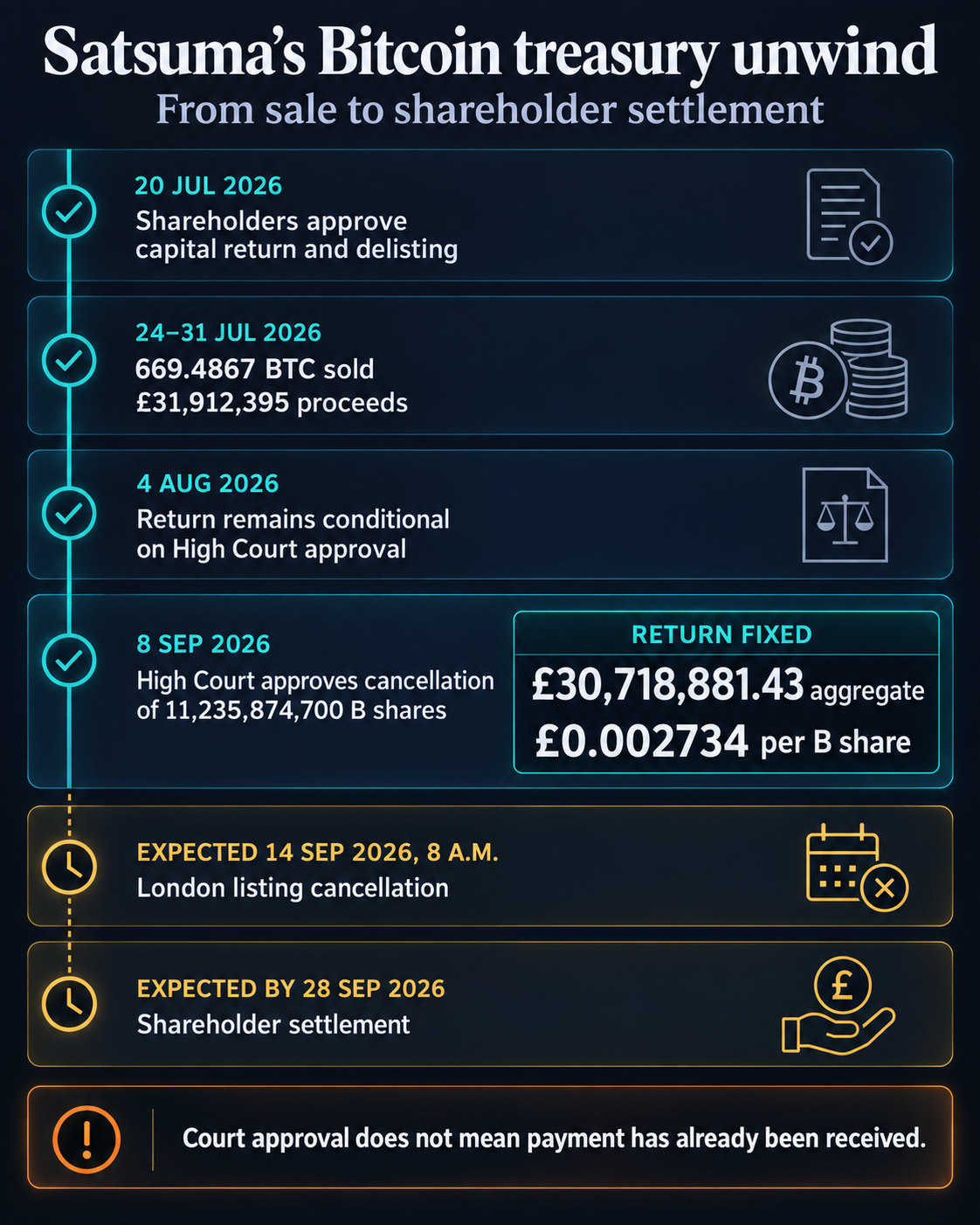
The Sept. 8 decision removed that judicial condition. Satsuma's earlier circular said the reduction would become effective when the court order was registered. The Sept. 8 court-approval notice announced that the company would return the fixed amount, but did not say the cash had already reached shareholders.
The Sept. 8 settlement update said eligible shareholders were expected to be sent checks or receive bank-account or CREST credits on or before Sept. 28. That future deadline separates approval of the payout from actual receipt.
Satsuma's last disclosed timetable listed Sept. 11 as the expected final day of dealings and 8 a.m. on Sept. 14 as the expected cancellation of its London listing. The Aug. 4 update retained the Sept. 14 date. These dates describe the announced timetable; the cited updates do not confirm completion of either milestone.
The court ruling therefore finalized the amount due to eligible B-share holders and removed the main remaining approval condition. Distribution of the cash and cancellation of the London listing are the next stated milestones.
The post UK company sells entire Bitcoin reserve to return 669 BTC to shareholders – here is who actually gets paid appeared first on CryptoSlate.
Commercial manufacturers whose connected hardware wallets or wallet software meet the European Union's product test must now warn cyber authorities within 24 hours of discovering an actively exploited vulnerability or severe security incident.
The requirement took effect Sept. 11, 2026, under the EU's Cyber Resilience Act, or CRA. The European Commission's reporting guidance says the clock applies to manufacturers of products with digital elements.
The CRA is a horizontal product law. The Commission's implementation FAQ says it applies to hardware and software made available on the EU market. The legal test also requires the product's intended or reasonably foreseeable use to include a direct or indirect data connection to a device or network.
A commercially supplied connected hardware wallet or downloadable wallet app can meet that test. However, EU guidance does not name wallet brands or declare every wallet service or project covered. Coverage depends on the specific product, how it is supplied and any applicable exclusion.
What manufacturers must report
The first filing is an early warning due without undue delay and no later than 24 hours after a manufacturer becomes aware of the vulnerability or incident. It must indicate, where applicable, the member states where the product is known to have been made available. For a severe incident, the warning must also say whether unlawful or malicious acts are suspected.
A fuller notification is due within 72 hours unless the relevant information was already provided. For an actively exploited vulnerability, that filing adds general information about the product, exploit and vulnerability, plus corrective or mitigating measures. For a severe incident, it adds the nature of the incident, an initial assessment and available mitigation information.
The final deadline differs by event. A vulnerability report is due no later than 14 days after a corrective or mitigating measure becomes available. The CRA sets the severe-incident final report deadline at one month after the 72-hour notification, as detailed in the regulation.
Manufacturers file once through the Single Reporting Platform launched by ENISA, the EU cybersecurity agency. The portal sends the notification to the designated coordinating Computer Security Incident Response Team and makes the information available to ENISA, then supports distribution to other relevant national teams. Manufacturers must also inform impacted users and, where appropriate, all users when action is needed, including measures they can take.
The reporting rule reaches in-scope products placed on the market before Dec. 11, 2027. That makes the new clock relevant to existing product lines, not only wallets first sold after the broader law takes effect.
Open-source licensing does not create a blanket exemption. The Commission's open-source guidance says commercially supplied free and open-source products can face manufacturer obligations. Non-monetized software supplied by its manufacturer should not count as commercial activity, while individual contributors are not treated as manufacturers for software outside their responsibility.
Open-source software stewards are a separate legal category, and their reporting duties begin Dec. 11, 2027. That is also when the CRA's main product-security requirements take effect. The Sept. 11 change starts the rapid reporting regime, not the law's broader secure-design and product-lifecycle framework.
The post Crypto wallet creators now have just 24 hours to alert regulators when flaws are exploited appeared first on CryptoSlate.
CryptoTicker.io
For the current year, your crypto exchange will for the first time report to Germany's Federal Central Tax Office what you have bought, sold and swapped. That report, however, contains not a single figure describing your profit. What it contains are aggregated gross amounts per crypto-asset: the sum of your purchases, the sum of your sales and the market value of every swap from one cryptocurrency into another. Anyone who reshuffles thirty times a year shows up there with a volume that is a multiple of their own portfolio value, while what is left at year-end may be a three-digit gain.
The legal basis is called the Kryptowerte-Steuertransparenzgesetz, KStTG in officialese. It transposes the European DAC8 directive into German law and obliges providers of crypto-asset services to transmit data about their customers to a central federal authority, which passes it on to the tax authorities of the federal states. Under the application provision in Section 21 KStTG, these duties apply for the first time to the 2026 calendar year. The year now running is therefore the first one on the books.
This article explains which details the report contains, why the sums named in it are systematically larger than anything you have ever owned, and how to keep your own records so that they line up with that report.
What Does Your Crypto Exchange Report to the Tax Office?
The catalogue of details to be reported is set out in Section 11 KStTG and is surprisingly concrete. It falls into two parts: details about you as a person, and details about your transactions.
On the personal side, the provider reports your name, address, tax identification number and the country or countries in which you are tax resident. Your place of birth is added where the provider is obliged under domestic law to obtain it. These details come from the tax self-certification your provider asks you to complete.
The second part is the interesting one. It is drawn up separately for each type of crypto-asset, once for one cryptocurrency, once for the next. For each type, the provider reports:
- for purchases against a fiat currency, the aggregate gross amount paid, the number of units and the number of transactions,
- for sales against a fiat currency, the aggregate gross amount received, again with units and transaction count,
- for purchases against other crypto-assets, the aggregate fair market value, the units and the number of operations,
- for sales against other crypto-assets, the same three details,
- for retail payment transactions, meaning payments to merchants, likewise market value, units and count,
- for other transfers to you or from you, the aggregate market value, the units and the count, broken down by type of transfer where the provider knows it.
Two terms are worth unpacking. Aggregate means that individual operations are not transmitted; what is transmitted is the annual total per crypto-asset and direction. The fair market value is the value a crypto-asset had on the market at the moment of the transaction, expressed in a fiat currency; it is needed because a coin-to-coin swap moves no euro amount that could be reported.
What is missing from that list matters as much as what is in it: no acquisition date per purchase, no acquisition price per individual unit, no gain, no loss, no holding period.
Why the Reported Gross Total Is Larger Than Your Portfolio
A gross amount is the full amount of a transaction, with no acquisition costs, fees or losses netted off. That is exactly how the reporting works. And because purchases, sales and swaps are each added up separately, the reported total grows with every movement while your wealth can stay unchanged.
The reason lies in how the law is built. The authority is meant to be able to see that there is something at your end worth examining. Working out the tax remains your job.
A Worked Example With Its Assumptions on the Table
Suppose you transfer 5,000 euros to your exchange in January and buy Bitcoin with it. Over the year you shift back and forth between two cryptocurrencies twenty times, each time with a counter-value of around 5,000 euros. In December you sell back into euros for 5,800 euros.
The report will then say roughly the following: 5,000 euros in gross amount paid on purchases against euros, 5,800 euros in gross amount received on sales against euros, and on the swaps an aggregate market value in the order of 100,000 euros, spread across both crypto-assets involved. Your actual increase is 800 euros. The largest figure in the data set is about a hundred and twenty times the size of your gain.
The numbers in this example are set, not measured. Their only purpose is to show the arithmetic mechanics. Anyone who trades actively should expect their own report to contain magnitudes that look wrong without an explanation.
Coin for Coin: Why Every Swap Lands in the Report With a Market Value
Many people regard switching from one cryptocurrency into another as an operation inside their own portfolio. For tax purposes it is nothing of the kind. Under Section 23 of the German Income Tax Act, a swap counts as a disposal of the asset given up and at the same time as an acquisition of the one received. For the holding period that means the clock for the new coin starts at zero.
The reporting duty maps this operation twice. The crypto-asset given up appears as a sale against other crypto-assets, the one received as a purchase against other crypto-assets. In both cases the market value at the time of the transaction is applied, converted into a single fiat currency, and under Section 11(3) KStTG the provider must carry out that conversion consistently in the same way throughout.
From this follows a practical consequence that is easily overlooked: one and the same swap generates two entries, and anyone working with four different crypto-assets spreads their annual volume across four separate positions in the data set. Your own statement therefore has to be kept per crypto-asset as well, otherwise it cannot be reconciled with the report at all. Tools that produce exactly this breakdown automatically can be found in our comparison of crypto tax software and portfolio trackers; what matters there is less the range of features than whether the tool documents the market value at the time of the swap cleanly.
For the tax itself, the exemption threshold from Section 23(3) sentence 5 of the Income Tax Act continues to apply: gains remain tax-free if the total gain from private disposal transactions in the calendar year is below 1,000 euros. An exemption threshold is not an allowance. Once it is exceeded, the entire gain is taxable, and not merely the part above it.

What Happens to Transfers to Your Own Wallet?
This point concerns everyone who moves holdings off an exchange. A self-custodial wallet is a wallet whose private key you hold yourself and which is not assigned to any provider. If your exchange transfers coins to such an address, it reports under Section 11(1) no. 2(b) the aggregate market value and the number of units for transfers to addresses about which it does not know whether they are linked to a provider or a financial institution.
The decisive clause is: about which it does not know. As a rule, your exchange has no idea that the destination address belongs to you. From its point of view, value is leaving the house. The data set arriving at the authority therefore shows an outflow with a market value, without the information that the coins still belong to you.
For you that means nothing more than that you have to be able to evidence this transfer. The proof consists of the outgoing entry at the exchange and the incoming entry at an address assigned to your wallet. Anyone moving their holdings into self-custody anyway should document the receiving addresses from the start; which devices are suitable for that is shown in our hardware wallet comparison.
Which Providers Fall Under the KStTG and Which Do Not
The scope is set out in Section 2 KStTG and distinguishes two groups. Covered first are crypto-asset service providers whose home member state, within the meaning of the European regulation on markets in crypto-assets, is the Federal Republic of Germany. The home member state is the EU country in which a provider obtained its authorisation.
Covered second are so-called crypto-asset operators with a domestic nexus, meaning providers without European authorisation that are tax resident in Germany, have their registered office or management there, or carry out their regular business activity there.
Double reporting is ruled out. Subsections 2 to 5 of Section 2 exempt an operator from the German duties where it already fulfils comparable duties in another EU member state or in a qualified third country. For you as a user that changes little: whether the data travels via Germany or via another country, it ends up at the tax office responsible for you, because the states involved exchange the data sets. That is precisely the purpose of the underlying EU Directive 2023/2226.
Not covered is whatever takes place without a provider. A decentralised exchange with no operator, a direct transfer between two self-custodial wallets, a swap through a pure protocol: for such operations there is nobody the law could put under an obligation. That does not make them tax-free. All that is missing is a third party's report. Your duty to declare to the tax office exists regardless of whether a third party transmits the same data. Anyone deliberately preferring regulated providers, because documentation and authorisation are settled there, will find the overview among the regulated crypto exchanges.
When Reporting Starts and Which Deadlines Count for You
The reporting period is the calendar year, under Section 10 KStTG. Reporting takes place annually under Section 9(1), by 31 July at the latest for the preceding reporting period. Together with the application provision from Section 21, that yields the first date: the 2026 data goes to the Federal Central Tax Office by 31 July 2027.
Two further deadlines concern you directly. For business relationships entered into up to 31 December 2025, the provider must have completed the due diligence duties under Section 7(2) by 1 January 2027; this is why many providers are currently sending out requests for tax self-certification. If you do not respond, Section 8 kicks in: the request is followed by a reminder and a formal notice, and after 90 days at the latest, though not before 60 days have elapsed, the provider has to prevent you from carrying out reportable transactions. What that means day to day we have described in detail along the course of this block: self-certification at the crypto exchange and the looming account block.
Section 13 is the more pleasant one. Under it, your provider must inform you before the first report that data is being collected and passed on, and do so early enough for you to exercise your rights. That notification is no marketing letter. In it the provider discloses what is being transmitted about you, and that is the best moment to lay your own figures alongside.
Who the Fines Hit
Section 18 KStTG makes a series of breaches punishable as administrative offences, in the more serious cases with fines of up to fifty thousand euros. The addressee of that provision is the provider, not the private user. An investor who fails to submit a self-certification risks the trading block under Section 8 rather than this fine. The tax consequences of an incomplete return continue to follow the Fiscal Code.

What the Report Does Not Say About You
Your tax liability cannot be calculated from the catalogue in Section 11. Four details needed for that are missing.
The acquisition date of the individual unit is missing. What is reported is the number of transactions in the year, not the day of each one. Whether a unit that was sold met the one-year holding period of Section 23 of the Income Tax Act therefore does not appear in the data set.
The acquisition costs of the specific unit disposed of are missing. What is reported is an annual total of all purchases, from which it cannot be derived which purchase belongs to which sale.
The holding you had at the start and at the end of the year is missing. And any link between your accounts at different providers is missing, because each provider knows only its own figures.
That makes it clear who has to fill the gap. Your return is the only place where aggregated gross amounts turn into a traceable gain. And it stands or falls with records you have secured yourself, before a provider halts trading or closes an account. Why that is no theoretical worry is shown by our piece on exporting your transaction history before an account is closed.
How to Make Your Own Statement Match the Report
The goal is a modest one: if somebody lays the reported totals next to your statement, the two sides should fit together. For that you need six details per crypto-asset and per calendar year.
- the sum of your purchases against euros, with the number of operations,
- the sum of your sales against euros, likewise with the count,
- the market value of all swaps, separated by incoming and outgoing side,
- all coin deposits and withdrawals with date, quantity and destination address,
- for each unit disposed of, the acquisition date and the acquisition costs,
- the holding as at 1 January and as at 31 December.
The first three lines establish the reconciliation with the report. The last three are what the report precisely does not contain and what determines your tax.
Which Order You Assume
FIFO stands for first in, first out and means that on a sale the units acquired first count as the ones disposed of first. The tax administration expects a method you apply uniformly per wallet or account and consistently across the years. Anyone switching method mid-year produces a statement that can no longer be audited.
Common Misunderstandings About the Crypto Reporting Rules
The Tax Office Now Knows My Profit
No. It knows gross totals per crypto-asset and the number of operations. The profit only emerges from acquisition dates and acquisition costs, which are absent from the report.
If I Stay Below the Exemption Threshold, Nothing Is Reported
That does not hold either. The provider's reporting duty does not depend on whether any tax arises at your end. Reporting happens as soon as reportable transactions have taken place, whatever your result.
A Transfer to My Own Wallet Is Invisible
The opposite is the case. Transfers to addresses not assigned to any provider are precisely the ones reported under Section 11 with market value and unit count. What is invisible, at most, is that the address belongs to you, and that is exactly the circumstance you have to evidence yourself if it comes to it.
Checking the Crypto Reporting Rules: What to Take Away
- Pull your annual statement while you still can. Download the full trading history for the current year from every provider and store it away from the exchange. A tool that turns it into an auditable statement per crypto-asset can be found in our comparison of crypto tax software.
- Answer your provider's self-certification before the deadline runs. Tax identification number and residence belong in the data set anyway; anyone who fails to respond loses access to reportable transactions after 60 to 90 days. How the providers are set up for this is shown in the overview of regulated crypto exchanges.
- Document every withdrawal to an address of your own. Note the date, the quantity and the receiving address, and record which device the address belongs to, so that a reported outflow remains explainable later as a move rather than a sale. Which devices are suitable for that is covered in the hardware wallet comparison.
(As of September 13, 2026. This article is not investment advice. Prices and fee structures change; check the terms with the provider before you buy.)
You sent bitcoin out of your wallet, the wallet shows the transaction, and for hours it has displayed the same word: unconfirmed. The short answer first: in the vast majority of cases nothing is lost, and you have two tools to sort the matter out yourself. They are called Replace-by-Fee and Child Pays For Parent, and which one you need depends on whether you are allowed to replace the transaction yourself or have to push it along from behind.
The reason this issue is hitting so many users right now lies in a technical change that entered the Bitcoin software in October 2025, and whose consequences have only become fully visible across the network this year. Since then, transactions paying fees below one satoshi per vByte can be relayed at all. Those transactions form today's backlog, the one many users are stuck in.
Bitcoin Transaction Stuck: What Is Really Happening in the Mempool
The Bitcoin price stood at roughly $76,700, or about 66,100 euros, on September 13, 2026 (CoinGecko, retrieved 09:52 UTC). The price is a side issue for this topic, but the market situation is not: when a lot of investors move their holdings off trading venues into self-custody after a pullback, the number of transfers on the network rises, and competition for space in the blocks gets tougher.
We measured instead of guessing. At the time of the survey, the Bitcoin network's waiting area held 75,903 unconfirmed transactions totalling 38.6 million vBytes. A block holds roughly one million vBytes. The backlog therefore amounted to about 38 blocks, or some six to seven hours of work for the miners if nothing new arrived. Something new arrives constantly.
Why a Full Mempool Still Does Not Mean Expensive Fees
The usual rule of thumb says: full mempool equals high fees. That rule no longer holds at the moment. The rate recommended by the common fee estimators for a prompt confirmation was a single satoshi per vByte, the lowest value those estimators ever output. A full mempool and a minimum fee are no longer mutually exclusive today, and anyone unaware of that draws the wrong conclusions.
Mempool, Feerate and sat/vByte: The Three Terms You Need
Before this gets practical, three definitions the rest of it rests on.
Mempool: The mempool is the waiting area in which every Bitcoin node holds the transactions that have been broadcast but not yet included in a block. It is not a central location; it exists thousands of times over in parallel on all the nodes of the network, which is why different providers display slightly different figures.
Feerate: The feerate is the price you pay per unit of data in your transaction, not per amount transferred. A transfer of 20 euros and one of 20,000 euros cost exactly the same if their data size is identical.
sat/vByte: A satoshi is one hundred-millionth of a bitcoin. The vByte is the measure of a transaction's size. The figure sat/vByte therefore says: this many hundred-millionths of a bitcoin per unit of size. Miners sort the waiting transactions by that number and take from the top, because their space in the block is limited. Bid too little and you slide backwards, a little further with every new transaction that bids more.
What Makes a Typical Transaction Large
The data size depends on how many earlier inputs your payment is assembled from. Anyone who has received many small amounts over the years drags all of those fragments along with every outgoing payment and pays accordingly more. How to bundle such holdings cheaply during a quiet phase is described in our piece on consolidating UTXOs while the network fee is low. That no longer helps with an acute stuck payment, but it helps a great deal in preparing the next one.
Our Measurement: 99.7 Percent of the Backlog Sits Below One Satoshi per vByte
cryptoticker.io carried out this analysis itself on September 13, 2026. Method: retrieval of the public interfaces of mempool.space on September 13, 2026 between 09:50 and 09:55 UTC; we evaluated the fee distribution of the entire waiting area as well as the fifteen most recently found blocks, from height 966,789 to 966,803. Objects examined: 75,903 waiting transactions spread across 167 fee brackets, and 15 blocks.
The result is clearer than we had expected:
- Of the 38.6 million vBytes in the waiting area, 38.4 million vBytes sat below one satoshi per vByte. That is 99.7 percent of the entire backlog.
- Above the mark of one satoshi per vByte, only 109,893 vBytes were waiting, or 0.3 percent. That is a good tenth of a single block.
- The highest fee bracket in the entire waiting area was 1.31 satoshis per vByte. Above that, the mempool was practically empty.
- All 15 blocks examined were more than 99 percent full, with an average of 5,281 transactions per block.
- In 11 of those 15 blocks, transactions below one satoshi per vByte were confirmed. The lowest floor observed was 0.286 satoshis per vByte, in block 966,802.
For you as a sender, that leads to a statement which contradicts appearances: an apparently overcrowded waiting area barely stands in your way as long as you bid above one satoshi per vByte. Only those 0.3 percent are ahead of you. Bid less and you place yourself behind almost forty blocks' worth of competition that keeps renewing itself.
What we could not verify: the measurement shows a point in time, not a trend. It rests on a single provider's view of the network, and other nodes may hold differing inventories, because every node is free to set its own acceptance rules. We were also unable to establish what share of the backlog originates from individual large senders.

Why Sub-Satoshi Fees Have Been Possible at All Since Bitcoin Core 30.0
Until recently there was an invisible floor. The default setting of the most widely used node software simply rejected transactions below one satoshi per vByte and did not relay them. Version 30.0, released on October 10, 2025, changed that. The release notes state verbatim that the default values for the minimum relay fee and the incremental fee have been changed to 0.1 satoshis per vByte; the minimum block fee has stood at 0.001 satoshis per vByte since then. You can read it in the official release notes for Bitcoin Core 30.0.
The developers placed a warning right next to it: as long as these lower values are not adopted network-wide, neither relay nor confirmation is guaranteed for transactions paying such low fees. That sentence describes precisely the problem now landing on many users' screens. The wallet is allowed to offer a very low fee, the network accepts it, and then nothing happens for a long time.
What That Means for Your Wallet Setting
If your wallet has a fee slider and proposes something in the range of 0.2 to 0.5 satoshis per vByte as its lowest step, that is no malfunction. It is the new reality. That step is meant for transfers where a confirmation within days is good enough. For anything that should still arrive today, it is currently the wrong choice.
Is Your Transaction Really Stuck? How to Check in Two Minutes
Before you repair anything, establish whether anything is broken at all. You need the transaction ID for that, a long string your wallet displays under details and which can usually be copied with a single tap.
Enter that ID into a public block explorer. Three pieces of information matter to you there:
- The feerate of your transaction in sat/vByte. If it is above one satoshi per vByte, our measurement says you have barely any competition ahead of you and should simply wait.
- The currently recommended feerate. If your rate is well below it, that is the reason for the delay.
- The replaceability flag. Explorers show whether a transaction is marked as replaceable. Which of the two tools you use in the next step depends on it.
A transaction does not simply vanish, by the way. If it goes unconfirmed for days, it eventually drops out of the nodes' waiting areas, and the bitcoin show up as available in your wallet again. Nothing is lost in the process, because an unconfirmed transaction never truly left your balance.
Replace-by-Fee (RBF): Replacing the Transaction With a More Expensive One
Replace-by-Fee is a node rule under which an unconfirmed transaction in the waiting area may be replaced by another one that spends at least one of its inputs and pays a higher fee. This is not about a second payment. You submit the same payment once more with a better offer, and the old version is discarded.
Two points are worth knowing before you press the button. First, under the widely used rule from BIP 125, the new version must pay both a higher feerate and a higher absolute fee, as the Optech compendium on Replace-by-Fee records. Making the transaction smaller is therefore not enough. Second, replacement has not been tied to a special flag since 2024: change set 30493 made general replaceability the default in August 2024, and in November 2024 the corresponding switch disappeared entirely.
How to Proceed in Practice
In most self-custody wallets you will find an entry such as Increase Fee, Accelerate or Bump Fee on an unconfirmed transaction. The wallet builds the replacement version itself and proposes a new rate. Following our measurement, set it above one satoshi per vByte; in the current environment a normal transfer needs no more than two satoshis per vByte. The additional fee is usually deducted from the change, and the recipient's amount stays the same.
A word on security: for this procedure your wallet has to sign the transaction again. On a hardware wallet that means confirming on the device once more. Check the recipient address just as carefully as you did the first time. Which devices handle this process cleanly and which leave you in the dark is shown by our comparison of crypto hardware wallets. If this is the first time in a while that you are handling your recovery words, it is a good moment to check that they are still complete and legible.
Child Pays For Parent (CPFP): When the Second Transaction Drags the First Along
Child Pays For Parent is a procedure in which you spend an output of the stuck transaction onward in a new transaction carrying a high fee, so that miners take both into a block together. The trick lies in the ordering rule of the blockchain: a transaction can only be confirmed if the transaction before it is in the block as well. So whoever wants the child has to take the parent along.
Miners therefore calculate with the combined fee rate of parent and child. If that average is attractive, both move into the block together. This sounds more cumbersome than RBF, yet it has one decisive advantage: you do not need to be allowed to touch the original transaction.
When CPFP Is the Tool of Choice
Two cases come up often in practice. The first: you are the recipient. Someone sent you bitcoin with too low a fee, and you are waiting for it. You may not replace other people's transactions, because that would require the sender's keys. You can, however, spend the output addressed to you onward and push the payment along that way. The second case: your wallet does not support raising the fee but does offer to spend an unconfirmed input.
CPFP has its limits too. Nodes cap how many connected unconfirmed transactions they keep in their memory; a long chain of parents and children eventually runs into those barriers. And if your child pays a high fee while the parent is very large, the child has to bring correspondingly more to lift the combined average.

Exchange Withdrawal Stuck: Why RBF and CPFP Will Not Help You There
If you have triggered a withdrawal at a trading venue and it is stuck, the situation looks different. The transaction belongs to the provider, not to you. The keys sit there, so only the provider can replace it. CPFP is out as well, as long as the bitcoin have not yet reached you and you cannot spend the output.
What remains is knowing the mechanics. Many trading venues bundle withdrawals into batch transactions and set their fee at their own discretion. The fee deducted from you at withdrawal often has little to do with the network charge actually paid; how far apart those two figures can be is something we looked at in our analysis of withdrawal fees and the real network fee. If a withdrawal makes no progress for hours, support is the right address, and the transaction ID belongs in the first message. Which providers handle their withdrawals promptly and transparently is one of the criteria in our comparison of the best crypto exchanges.
Which Fee You Should Really Set Today
A simple orientation can be derived from the measurement, although it applies only to the situation measured and you should re-check it before every larger transfer.
For a payment that should arrive promptly, a value just above one satoshi per vByte is currently enough. That places you ahead of 99.7 percent of the waiting volume. Two satoshis per vByte is generously judged and costs only a few cents on a simple transfer of around 140 vBytes in size.
For a payment where days are good enough for you, you may use the new low steps. But then expect it to genuinely take days, and choose a wallet that lets you raise the fee later. Without that option you sit the waiting time out.
The Mistake That Costs the Most
The most expensive mistake is the panic that follows a low fee, rather than the low fee itself. Anyone who sees a stuck transaction and promptly sends a second payment to the same address risks both being confirmed in the end, leaving the recipient with double the amount. Check first, then raise the fee or push the payment along, and under no circumstances send blindly again.
What RBF and CPFP Cannot Do: The Limits of Both Tools
Both procedures accelerate a transaction that is already on the network. They do not reverse it. You can indeed replace a payment with another via RBF and in theory change the recipient too, as long as nothing is confirmed; once a confirmation exists, the process is final. No technology brings back a transfer that was sent to the wrong address and confirmed.
They are equally useless for a transaction that your wallet displays but that never reached the network. If the block explorer cannot find the ID at all, it was not relayed. The right step is then to reconnect the wallet and repeat the send, instead of fiddling with fees.
The Tax Angle in One Sentence
A transfer between two of your own wallets is not a sale and triggers no taxable event in Germany. The network fee paid is not a deductible item in this case either. The details are in our article on whether the network fee counts for tax purposes when sending between wallets.
How to Speed Up a Bitcoin Transaction: What to Take Away
- Check your feerate first, before you do anything at all. If it is above one satoshi per vByte, our measurement puts only 0.3 percent of the backlog ahead of you, and waiting is the right decision. If it is below, the delay is explained. Anyone who wants to run such checks regularly on their own device will find the differences between the models in our comparison of crypto hardware wallets.
- Use RBF when the transaction is yours, and CPFP when it comes from someone else. When raising the fee, the new version has to pay both a higher rate and a higher total fee. When pushing a payment along, the combined rate of parent and child is what counts. Whether your wallet offers fee bumping at all is a selection criterion like any other, and it likewise appears in the comparison of crypto hardware wallets.
- For a stuck withdrawal from a trading venue, turn to the provider. The keys are there, so the leverage is there too. How quickly and how transparently the individual houses process withdrawals can be looked up in the comparison of the best crypto exchanges before you open your next account.
(As of September 13, 2026. This article is not investment advice. Prices and fee structures change; check the terms with the provider before you buy.)
When your Sparkasse starts offering Bitcoin in October, you will not be buying coins that you then move to a wallet of your own. You receive a position in your securities account, and the cryptographic keys behind it stay with the bank. That is the central difference between what a high-street bank offers and an account at a crypto exchange, and it decides what you can actually do with your holdings later on.
This article takes on exactly that point. It explains what custody in a bank account means in practice and in law, which obligations an authorised custodian has to meet under the EU regulation MiCAR, which three public registers let you look up who really holds your crypto-assets, and which questions you should settle before your first purchase. The launch timetable and the cost question we have covered elsewhere.
Crypto powered by Deka: what custody in a bank account actually means
The Sparkassen offering is called Krypto powered by Deka. It was developed by DekaBank, the securities house of the Sparkassen-Finanzgruppe, and it runs inside the Sparkasse app rather than in a separate application. For trading and the technical infrastructure, DekaBank works with Börse Stuttgart Digital. According to the reports available so far, a launch from mid-October 2026 is planned, with an internal test phase in September and a rollout in waves. Each of the roughly 370 regional Sparkassen decides for itself whether and when it switches the feature on. There is therefore no nationwide launch date, and the question of whether your own institution is taking part is answered only by your own institution.
What this construction lacks is the part many investors take for granted: the withdrawal of the coins you bought to an address that belongs to you. The holdings stay in central custody. You see them in your account, you can sell them, and you can hold them. A transfer to the outside is so far not part of what the high-street banks offer.
The difference from an ETN and a fund unit
A crypto ETN tracks a price and is legally a debt security issued by its issuer. The bank offering works differently: what is bought is the crypto-asset itself, it is simply held in custody for you. Economically the coin is yours, but the party able to dispose of it is the custodian. This split between economic ownership and actual control is the core of every custody model, and it applies in exactly the same way at a centralised crypto exchange.
Private key, wallet and custody position: the three terms kept apart
A private key is a secret sequence of numbers that allows transactions on a blockchain to be signed. Whoever holds it can move the associated holdings. Whoever does not hold it cannot, regardless of what an account overview says.
A wallet is not a purse with coins inside it but the management of those keys. The coins themselves exist only as entries on the blockchain. A hardware wallet is a device that generates the key and never lets it leave, so that it cannot be skimmed off an infected computer. If you want to see how the common devices differ, our hardware wallet comparison is a place to start.
A custody position, finally, is an entry in your bank's books. It states that a certain holding is due to you. It says nothing about which blockchain address that holding sits on and who can move it. This is exactly where the bank offering differs from self-custody, and anyone who confuses the three terms underestimates either the risk or the convenience.
Why the Sparkasse makes no provision for a transfer to an external wallet
From the provider's point of view several reasons speak for the bank model, and none of them is arbitrary. A payout to any address of the customer's choosing turns the provider into a transfer service and brings obligations from anti-money-laundering supervision with it, among them checks on the origin and the recipient of crypto-asset transfers. It also creates sources of error that a bank serving a mass-market clientele is reluctant to carry: a mistyped address, the wrong network, a loss with no way back.
For you as an investor that has two consequences. The first is convenient: you need no seed phrase, there is nothing you can misplace, and if something goes wrong you have a counterparty with an address in Germany. The second is inconvenient: you are tied to the institution. Moving to another provider means selling and buying again, not transferring. Anyone planning such a move triggers a sale that matters for tax, and that is something entirely different from shifting coins between two addresses.
What a sale instead of a transfer triggers
On a transfer between your own addresses, the acquisition date does not change. On a sale followed by a fresh purchase, the period under Section 23 of the German Income Tax Act starts again, and any gain is assessed in the year of the sale. That is no argument against the bank account, but it belongs in the calculation before you settle on a provider.
MiCAR Article 75: the obligations of the custodian holding your crypto-assets
Since Regulation (EU) 2023/1114 on markets in crypto-assets, MiCAR for short, the custody of crypto-assets is no longer a legal vacuum. In its guidance note on crypto-asset services, BaFin lists ten services that require authorisation. First among them is the custody and administration of crypto-assets on behalf of clients, defined as the safekeeping or control of crypto-assets or of the means of access to them. Anyone offering this commercially needs an authorisation.
Article 75 of the regulation describes what such a custodian has to deliver. Four points are relevant to you as a customer:
- There has to be an agreement with you that sets out at least the identity of the parties, the nature of the service, the security procedures applied, the fee structure and the applicable law.
- The custodian keeps a register of positions and of every movement of crypto-assets it holds on your behalf.
- Client holdings are segregated from own assets. That segregation applies on the blockchain as well: own holdings sit on different network addresses from client holdings.
- Under the national law applicable in each case, the crypto-assets held in custody should also stand legally separate from the service provider's own estate, so that its creditors cannot reach them in an insolvency.
That is considerably more protection than an unregulated provider offers, and it is the real reason banks are taking on this business at all. A guarantee against every loss it is not. The regulation sets obligations, it does not replace a deposit guarantee scheme, and crypto-assets are not covered by the statutory deposit protection that applies to balances in current accounts.
Insolvency of the custodian: why segregating client holdings counts
The question of what happens to your holdings in a worst case is decided at a single point: are they assigned to the custodian's estate or to yours. Where segregation is clean, they do not fall into the insolvency estate but are due to the clients. That is exactly what the segregation duty in Article 75 MiCAR aims at, and exactly why it is not red tape but the core of consumer protection in this model.
In practice that means the institution's credit standing matters less in a custody model than its organisation. What counts is whether client holdings are kept separate technically and legally, and whether the record-keeping stands up to scrutiny in case of doubt. A provider who does not answer these questions when asked has already given you an answer.
Three questions you can put to your institution
- Who is the custodian of the crypto-assets, and under which authorisation does it operate?
- Are client holdings kept separate from own holdings, and does that apply on the blockchain too?
- Which documents do I receive on acquisition date and acquisition cost, and in what format?
Checking CASP authorisation: Bundesanzeiger, the BaFin database and the ESMA register
In the language of the regulation, an authorised provider of crypto-asset services is a CASP, in full a crypto-asset service provider. On its page on crypto-asset services, BaFin names three registers in which you can look up an authorisation: the Bundesanzeiger, the BaFin company database and the MiCAR register of the European securities regulator ESMA. All three are public and free of charge.
This check is worth doing not only at your own bank, where the outcome will hardly be a surprise, but above all at every other provider you are looking at alongside it. If you are weighing a regulated trading platform as an alternative to the bank account, our overview of regulated crypto exchanges lists the providers that operate in the EU with an authorisation. Querying the register does not replace that overview, it adds to it.
How to spot a sloppy claim
It becomes conspicuous when a provider advertises a registration that is not an authorisation at all, when it names a permission for a service other than the one actually offered, or when the name in the register differs from the one on the website. Group structures are a frequent stumbling block here: what is authorised is often a particular company, not the brand.
What stays closed to you without a key of your own
The practical limits of the bank account are concrete and can be assessed in advance:
- No self-custody. The phrase "not your keys, not your coins" describes exactly this position. You carry the custodian risk, not the risk of losing your own backup.
- No staking and no lending. Anyone holding Ethereum in a bank account does not take part in validation and receives no staking rewards, as long as the provider does not explicitly offer it.
- No on-chain use. Paying, applications in decentralised finance, signing a message with your own address: all of that presupposes control over the key.
- Trading only in the provider's hours. Blockchains run around the clock, bank offerings do not necessarily. Which trading hours apply is set out in the terms.
Against that stand advantages that should not be talked down. Settlement runs through an account you already have. There is no separate onboarding, no additional identity check and no payout address you can enter wrongly while setting things up. For beginners with small amounts that is a genuine gain in safety compared with a first attempt at running a wallet.

Holding period under Section 23 of the Income Tax Act: securing acquisition data in a bank account too
For private disposals of crypto-assets, Germany currently applies the one-year holding period of Section 23 of the Income Tax Act. Hold for longer than a year and you dispose of your holdings tax-free. Sell before that and you pay tax on the gain at your personal rate, provided the exemption threshold is exceeded. So that the tax office can follow this, you need two pieces of information per position: the acquisition date and the acquisition cost.
In a bank account you get both from your institution, and that is a convenience advantage over records you keep yourself. Even so, you should not rely on it alone. Save the statements as you go and in a format you will still be able to read after changing provider. A tax and portfolio tool helps above all where you hold assets in several places, because otherwise the allocation quickly becomes hard to follow.
On top of that comes an open building site in 2026: a draft bill from the Federal Ministry of Finance would treat gains on crypto-assets as investment income in future, with a cut-off date for new acquisitions. Nothing has been decided, and today's rules continue to apply unchanged. We have written up the state of play on grandfathering and the cut-off date separately. For the custody question that means one thing above all: complete acquisition data is becoming more important rather than less.
Inheritance, power of attorney and account freezes: where the bank account has the edge
Self-custody has a weak spot that is rarely discussed: it works only as long as the holder is able to act. If the backup is lost, the holding is gone, and gone for good. If the holder dies without anyone being able to reach the backup, the same applies. In a bank account, by contrast, the familiar mechanisms take effect: heirs prove their entitlement, a lasting power of attorney has effect, and a court-appointed guardianship is recognised.
Conversely, the bank model has one case that self-custody does not know: the freeze. If an account is temporarily blocked as part of an anti-money-laundering check or on suspicion, you cannot reach your holding even though it is due to you. Both models therefore carry a risk of failure, it simply sits in different places. Those holding larger amounts often split them deliberately across both routes.
Bitcoin and Ether at launch: why the coin list differs from source to source
On the question of what is to be tradable at launch the statements diverge, and that should be said openly. In early September 2026 the Sparkassen- und Giroverband Hessen-Thüringen set out the launch for the 46 Sparkassen in Hesse and Thuringia, naming Bitcoin and Ether. Industry reports on the same project speak of a broader initial selection that, alongside Bitcoin and Ethereum, also covers XRP, Solana and Polygon.
Both can be true, because a rollout in waves means exactly that: what a single regional association announces for its own institutions need not be the full scope of the overall offering. For your decision the list is secondary in any case. What matters is what actually appears in your own institution's app on launch day, and that is settled only then. For the timetable as a whole we have gathered the detail in our assessment of the planned October launch, and the cost side in our analysis of commission and spread.
What the statements on custody still leave open
What is publicly documented so far is the division of roles between DekaBank and Börse Stuttgart Digital, along with the fact that customers receive a custody position and not a key of their own. What is not publicly documented is how the record-keeping is organised in detail, whether there is a register of holdings at individual customer level, and which evidence customers receive in a dispute. Those questions are answered only by the contract documentation, which has to be available to you before your first purchase. Read it before you agree, not afterwards.
Checking Sparkasse custody: what to take away
- Establish before buying who holds the assets and under which authorisation. The contract documents name the custodian, the three public registers confirm it. If you are considering a trading platform alongside, apply the same yardstick and take a look at our overview of regulated crypto exchanges.
- Decide deliberately between a bank account and self-custody. For small amounts and for inheritance cases much speaks for the bank account; for amounts you want to hold long term and control yourself, much speaks for a device of your own. The differences between the common models are set out in our hardware wallet comparison.
- Secure the acquisition date and the acquisition cost from your first purchase onwards. File the statements in a readable format and bring them together if you hold assets in several places. Which tools deliver that is set out in our overview of tax tools and portfolio trackers.
For further reading at the source: BaFin describes the crypto-asset services that require authorisation in its guidance note on crypto-asset services under MiCAR, and the authorisation of an individual institution can be looked up in the BaFin company database.
(As of September 12, 2026. This article is not investment advice. Prices and fee structures change; check the terms with the provider before you buy.)
At 13:15:45 UTC on September 23, 2026, the largest token lock-up in Humanity Protocol's history to date comes to an end. According to the emissions model, 292,857,143 H are released from six separate buckets in that single minute. Two days later, at 14:00 UTC on September 25, the exchange Kraken closes withdrawals for H and HUMANITY for good. Anyone holding H in a Kraken account therefore has to act in exactly the window in which, on paper, the largest additional supply in the project's history reaches the market.
The two dates have nothing to do with each other. One is a vesting date set by the project, the other a business decision by an exchange. For you as a holder they still fall in the same weekend, and that turns two footnotes into a task with a deadline.
The practical core of this is a custody question, not a price question. Tokens sitting in an exchange account follow that exchange's deadlines: when a trading pair is discontinued, the operator decides how long you have to move your holdings out and what happens to them afterwards. Anyone holding in self-custody does not have that problem, but has another one instead: they need to know the correct contract address. At Humanity there have been two of them since June.
This article recalculates the unlock from the emissions dataset itself rather than passing on the figure in circulation, shows which part of it can actually reach the market, and then walks through checking your own holdings. All figures were gathered first-hand on September 13, 2026.
What happens at Humanity Protocol on September 23, 2026
Humanity Protocol is an identity network: users prove by biometric means that there is a human being behind an account, and are paid in H for doing so. The token runs as an ERC-20 contract on Ethereum. Like almost every project of this kind, Humanity issued only a fraction of its total supply at launch; the rest is spread over years and released step by step.
In that schedule, September 23 is not an ordinary monthly date but a cliff: a cut-off date on which an amount that was fully locked until then becomes available all at once. Our own analysis of the DefiLlama emissions dataset (retrieved September 13, 2026, HTTP 200) shows six buckets carrying the same timestamp, 13:15:45 UTC on September 23, 2026. Those six tranches add up to 292,857,143 H.
At the price of $0.0833 that the same provider's price interface reported for the current contract at 06:21 UTC on September 13, that works out to roughly $24.4 million. For now that number is an arithmetic figure and nothing more. Whether any of the released tokens will actually be offered on the market is a different matter, and further down we resolve which part of the tranche is realistically in question.
Token unlock, cliff and vesting: the three terms behind the date
Vesting is the contractually fixed release of tokens over time. A project splits its total supply into buckets, such as team, investors and ecosystem, and sets for each bucket when tokens become available from it and at what pace.
A cliff is the lock-up period before a bucket's first release. Until the cliff date nothing is available; on the cliff date the accrued share is released in a single step. That is precisely what makes cliffs significant for the market: where a linear release produces a trickle, this produces a step.
A token unlock is the event itself, the moment locked tokens become transferable. One distinction matters here that headlines almost always drop: released only means transferable. Whether a team holds its released tokens, moves them into the project treasury or offers them on the market is not written into any contract.
At Humanity the release runs through Sablier streams, meaning on-chain contracts that handle the payout themselves. That has a practical advantage for you: the schedule is publicly visible and therefore verifiable. We have shown in detail how to reconcile such calendars against project documentation and resolve contradictions, using another token as the example: recalculating a token unlock.
The six tranches of the H unlock, broken down one by one
Quoting only the total gives away the real information. The six buckets behave completely differently, because different recipients sit behind them. Our own analysis of the emissions dataset produces this breakdown for September 23, 2026:
| Bucket | Tranche in H | Arithmetic value in USD |
|---|---|---|
| Team | 105,555,556 | $8.79m |
| Investors | 55,555,556 | $4.63m |
| Ecosystem Fund | 50,000,000 | $4.17m |
| Identity Verification Rewards | 42,857,143 | $3.57m |
| Strategic Reserve | 26,388,889 | $2.20m |
| Foundation Operational Treasury | 12,500,000 | $1.04m |
| Total | 292,857,143 | $24.40m |
The largest single item is the team bucket at a good 105 million H, followed by the investors. Together the two make up more than half the tranche. That is the part market watchers usually call insider supply, because the recipients received their tokens on terms not available to a buyer on the open market.
The Identity Verification Rewards are the bucket from which users are paid for completed verifications. Those tokens therefore go out broadly to a great many small recipients, which suggests different behaviour from a concentrated allocation to a handful of addresses. The Ecosystem Fund finances development and incentive programmes.
Why the investor tranche in particular is uncertain
This is where it gets interesting, and where the widely quoted figures depart from what can actually be evidenced. The emissions dataset lists the investor tranche at 55,555,556 H under the same timestamp as the other five buckets. The Humanity Foundation, however, restructured the investor part of its vesting in April 2026.
As the trade publication crypto.news reported on April 24, 2026, the foundation gave its investors a choice until 09:00 UTC on April 26: either an extended schedule with a cliff on September 25, 2026 followed by twelve quarterly tranches, or immediate release at a 3:10 discount, under which 16,666,666 H were replaced by 5,000,000 H and paid out as early as June 25, 2026. Early backer Trix Ventures publicly opted for the discount, according to the same report.
Two things follow that a careful article has to keep apart. First, the foundation names September 25 for the extended investor schedule, while the emissions dataset carries September 23. Second, part of the investor allocation was already settled in June, which makes the 55.56 million H held in the model for that bucket an upper bound rather than an expectation.
How many investors chose which option has not been published so far. No reliable breakdown could be found in this research step; the question could only be settled conclusively against the vesting contracts on chain. This uncertainty belongs on the record rather than written away: if you come across the round figure of 292 million H somewhere as confirmed additional supply, at least a sixth of it carries a question mark.
Circulating supply: how large the inflow actually is
Of the six buckets, the data provider explicitly lists two as non-circulating: Strategic Reserve at 26,388,889 H and Foundation Operational Treasury at 12,500,000 H, together 38,888,889 H or an arithmetic $3.24 million. Those amounts move into the foundation's treasury and are not counted as freely tradable supply in the circulation model.
That leaves 253,968,254 H, roughly $21.2 million on paper, that can actually affect circulating supply. Set against the amount released in total to date, our own analysis puts the previously released supply at 3,698,214,286 H. The tranche therefore amounts to 7.92 percent of that supply, the circulating portion to 6.87 percent. Measured against the maximum supply of ten billion H held in the model, it is 2.93 percent.
This framing is the difference between a headline and a calculation. A number like $24 million sounds enormous as long as nobody writes down what it refers to next to it. An inflow of just under seven percent on the supply already released is substantial, but it is a different order of magnitude from what the absolute number suggests.
The Kraken withdrawal deadline at 14:00 UTC on September 25
Independently of the vesting calendar, a clock of its own is running at Kraken. In its notice on Humanity, last updated June 26, 2026, the exchange states: for H and HUMANITY, trading and deposits are switched off, only withdrawals are supported, and those close at 14:00 UTC on September 25, 2026. Both tickers are slated for delisting.
That is the sharper of the two deadlines, because it demands an action from you. An unlock happens without you doing anything; a closed withdrawal, by contrast, separates you from your tokens. We described the constellation in detail on September 5, at the time looking at the four affected tickers at Kraken: the Kraken withdrawal deadline on September 25.

Forced liquidation from September 28: what happens to holdings left behind
For holdings still sitting in the account after the deadline, Kraken announces a liquidation period from September 28 to October 2, 2026. The exchange is unusually clear about what that can mean: liquidation prices could be substantially below recent reference prices and in some cases, because of insufficient market liquidity, yield minimal proceeds or none at all. Kraken explicitly recommends acting before the deadline rather than relying on the liquidation.
For you that means the liquidation is an emergency exit with an open outcome. Which currency the proceeds are credited in is likewise made dependent on market conditions by the exchange, and is not committed to in advance. Anyone who lets the date pass trades a known position for an unknown result.
Legacy H and HUMANITY: why many holders have two positions in the account
The second pitfall has nothing to do with the unlock and is still the more common source of mistakes. Following the events of June 2026, the Humanity team rolled out a new contract and issued a new token. Kraken continues to list the old holding under the ticker H and the new one under the ticker HUMANITY, to keep the two distinguishable.
According to the Kraken notice, the contract addresses are 0xcf5104D094e3864CfCBDa43B82e1cEFD26A016eB for the old token and 0xE76c5b78f93909d34404E9eb4C1f19e7582a5dE1 for the new one. The emissions dataset the unlock figures above come from refers to the second of those addresses, that is, to the new token.
On top of that comes a risk of confusion that Kraken points out itself: the new token can still be displayed as H on chain and on other platforms. The two tokens can therefore only be told apart reliably via the contract address.
Anyone holding a position on the cut-off date received the new token automatically. Kraken gives the snapshot time as 17:25 UTC on June 8, 2026 and the airdrop date as 14:00 UTC on July 1, 2026, at a one-to-one ratio. Anyone who acquired H only after the snapshot is not eligible for this airdrop and is referred by Kraken to the Humanity team's claims portal, in which the exchange says it is not involved.
The practical consequence: the same account can hold two positions that both expire in the same minute. Withdraw only one of them and the other runs into the liquidation.
Self-custody or another exchange: where the tokens can go
When a withdrawal deadline is running, there are two destinations. One is your own wallet, where you control the private key. The other is an account at a different trading platform that still lists the token.
The two routes carry different risks. Self-custody removes counterparty risk and in exchange puts the responsibility for securing the recovery words on your shoulders; an overview of the devices and how they differ is in our hardware wallet comparison. Moving to another platform keeps the convenience and merely defers the problem, should a delisting be pending there too.
Two technical points decide between success and loss: the destination address has to support the network the token sits on, and it has to carry the correct contract address. An Ethereum address can in principle receive any ERC-20 token, but for it to show up in your wallet you may have to add the contract there manually. A token missing from the overview is not lost because of that; usually it is only the entry that is missing.
Check the withdrawal fee and the minimum amount in advance as well. On small residual holdings the fee can exceed the value of the position, and then the honest answer is that moving it is not worth it. That is a decision you should take deliberately rather than let a deadline take for you.

How to check your H holdings in five steps
The following sequence takes a few minutes and covers both dates.
- Open the account balance. Check in the exchange account whether H, HUMANITY or both are sitting there. Both positions fall under the same deadline.
- Reconcile the contract address. Note the contract address for each position and compare it with the two given above. That tells you whether you hold the old or the new token.
- Prepare the destination address. Set up the receiving address and check with a small test amount that it works before you send the full holding.
- Trigger the withdrawal. Build in a buffer. Withdrawals can go into review, and the deadline at 14:00 UTC on September 25 ends with no grace period.
- Confirm arrival. Check in the block explorer that the transaction is confirmed, and add the contract in your wallet if the holding is not displayed.
A note on sequencing: do not do these steps on September 25. When the unlock goes through on September 23, things can get busier at the network level and in support queues. Moving in the days before that is the calmer option.
Tax: why even a forced sale is a disposal
One point regularly overlooked in delistings: a forced liquidation is, for tax purposes, a sale. The fact that you did not trigger it changes nothing about that. When the exchange realises your holding and credits you with proceeds, that creates an event you have to carry in your records.
A plain move from the exchange into your own wallet, by contrast, is not a sale but a transfer between two addresses of the same owner. What matters is that your records carry the acquisition date through that transfer, so that it remains traceable later when and at what price you acquired the holding. Tools that do exactly that are in the comparison of tax and portfolio tools.
Whether and how a gain is taxable depends, in Germany, among other things on the holding period and on your personal situation. The airdrop of the new token in July is a separate event with a valuation question of its own. That is precisely why these cases belong with a tax adviser and not in a classification by gut feeling.
What a token unlock does to the price, and what cannot seriously be said
The honest answer to the most common question is: nobody knows. What can be said is what mechanism sits behind the question.
A cliff raises the available supply abruptly. Whether that turns into selling pressure depends on what the recipients do, and that is not predictable. On top of that, a publicly known date can be priced in by professional market participants long before it arrives. In its April report, crypto.news describes exactly this pattern for Humanity: vesting contracts visible on chain, hedging trades in advance, and market participants positioning themselves ahead of the date.
The same outlet cites Starknet and ApeCoin as comparison cases, whose prices fell markedly after extended release schedules. That is that outlet's framing and not a statement about Humanity, and two examples do not make a rule. You will therefore not find price forecasts in this article; what you will find is the number at issue and a note on which part of it is uncertain.
More useful in practice than any forecast is the question of what you would do anyway. If you want to keep your holding, moving it into self-custody is the task. If you do not want to keep it, the question is where you can hand it over at a price you know, rather than in a liquidation at a price nobody promises you. For the trade itself you need a platform that still lists the token; which venues offer which terms is shown in the exchange comparison.
Four mistakes that make this date expensive
Withdrawing only one of the two positions. Anyone holding in June has held two tickers since July. Both expire in the same minute, and the balance shows them as separate lines.
Relying on the liquidation. Kraken itself warns that it can produce minimal proceeds or none at all. Anyone mistaking that for an orderly sale is planning with a price nobody has promised.
Taking the aggregator figure at face value. The 292 million H from the unlock calendars include just under 39 million H listed as non-circulating, and an investor tranche that is probably smaller because of the April restructuring. Anyone calculating with the gross figure overstates the inflow.
Waiting until the last day. Withdrawals can go into review, and support does not answer in minutes. A buffer of several days costs nothing.
H unlock and the Kraken deadline: what to take away
- Check today whether H or HUMANITY are sitting in an exchange account, and withdraw both before 14:00 UTC on September 25. Where to is a decision you take afterwards; the safe option is your own wallet, and the models are set side by side in the hardware wallet comparison.
- Record the process cleanly. Transfer, airdrop and a possible liquidation are three different things for tax purposes; a tool from the tax and portfolio comparison takes the allocation off your hands before the records go missing.
- Recalculate unlock figures before you believe them. Separate circulating from non-circulating tranches, and check whether a trading platform still lists the token at all; the exchange comparison shows where it is traded.
Sources for further reading: Kraken's notice on Humanity with all dates and contract addresses, and the crypto.news report on the vesting restructuring from April 2026. The unlock figures come from DefiLlama's emissions dataset and were aggregated first-hand for this article on September 13, 2026.
(As of September 13, 2026. This article is not investment advice. Prices and fee structures change; check the terms with the provider before you buy.)
Anyone holding a tokenized real-world asset does not own a piece of metal in a vault. They own an entry in a mint account on a blockchain. That account is controlled by the issuer, and in many cases it allows far more than most buyers assume: freezing balances, halting transfers and pulling individual tokens out of other people's wallets. On September 11, 2026 exactly that happened, and it was publicly documented.
For this article we checked every tokenized asset that has its own mint account on Solana and is listed in the relevant market categories. The result is unambiguous: of 32 assets checked, every single one carries a freeze authority. In 21 cases a second permission is attached, one that allows tokens to be removed from an account without any action by the holder.
What happened to the silver token SILV on September 11
Dominion Market issues the token SILV, which is meant to represent one troy ounce of physical silver per unit. According to the provider, a multisig wallet belonging to the project was compromised in the early hours of Friday, September 11, 2026, at around 01:00 UTC. Roughly three hours later the team noticed unusual activity. Market reports put the token's price fall at about 74 percent, and the Sunrise trading front end removed the market from its listing.
The issuer's response is the instructive part. Dominion pulled the liquidity, secured the affected wallets and moved to new hardware devices. The project then announced that any SILV balance bought between 01:00 and 14:00 UTC on that Friday would be removed from the wallets. Balances that existed before the window opened were left untouched. Trading has been suspended since; refund claims in USDC are to be filed from Monday, September 14, 2026, at 12:00 UTC through an on-chain check.
An issuer that can unwind purchases without asking the buyers is no glitch in a process. It is a property that has to be built into the token for it to be executable at all. And that property can be looked up before you buy.
Freeze authority and permanent delegate: the two permissions in one sentence each
Both terms come from Solana's token standards and sit openly in the mint account. Once you have understood them, you can tell within minutes how much control the issuer holds over any given token.
Freeze authority
The freeze authority is the address allowed to freeze individual token accounts. A frozen balance stays visible but can neither be sent nor sold until the same address releases it again. It exists in the classic token program just as it does in the newer Token-2022 program.
Permanent delegate
The permanent delegate is an extension of the Token-2022 program and goes considerably further: the address stored there counts as permanently authorized for every account holding that token and can transfer or burn balances without the holder's consent. That is the technical basis for a clawback of the kind Dominion has announced. The full list of these extensions is in Solana's developer documentation.
In practice the difference matters a great deal. A freeze authority holds your balance where it sits. A permanent delegate takes it away. The current price of the underlying asset is irrelevant here; how Solana develops as a network changes nothing about these permissions, because they are anchored in the individual token rather than in the network.
Our measurement: 32 tokenized assets on Solana, 32 with a freeze authority
On September 13, 2026 we queried the mint accounts of every token that is listed in the market categories for real-world assets and for tokenized gold and that has a Solana address. That came to 35 addresses. We excluded three of them because they do not represent a backed asset but infrastructure or collectibles. That left 32 tokenized stocks, fund units, money market instruments and precious metals.
Each mint account was queried directly through a public Solana node, and the fields for the freeze authority and for the active Token-2022 extensions were evaluated. cryptoticker.io collected this data itself on September 13, 2026.
- 32 of 32 assets checked carry a freeze authority that is set. Not a single asset in the basket goes without one.
- 26 run under the Token-2022 program, 6 under the classic token program.
- 21 additionally carry a permanent delegate.
- 19 can be halted as a whole through the pausable extension.
- 19 start new accounts in a locked state, releasing them only after an approval, which amounts to a whitelist.
- 20 route every transfer through a transfer hook, meaning through external program code that can reject a transfer.
The completeness is remarkable. On many questions of this kind the answer sits somewhere between the camps. Here it sits at 32 to 0.

Clawback via permanent delegate: 21 of 32 tokens can be pulled back
The 21 assets with a permanent delegate are spread across every category: tokenized stocks of large technology companies, tokenized index funds, short-dated government bond funds, one securitized credit fund and several precious metal tokens, SILV among them. With SILV the query shows a particularity that explains what happened on Friday: freeze authority and permanent delegate sit on the same address. Whoever controls that key can lock balances and withdraw them in the same move.
Supply stood at roughly 93,516 SILV at the time of our query, which at one troy ounce per token should be matched by a corresponding silver holding. The address that holds both permissions belongs on-chain to the system program. That means it is an ordinary key address or a derived address, and not the account of an on-chain multisig program. Whether several signatures stand behind that key cannot be read from the mint account alone. Dominion itself speaks of a compromised multisig wallet.
How to check a mint account yourself, in two minutes
The good news about this situation: everything that matters here is public. You need no account, no sign-up and no paid service. All you need is the token's mint address, which every trading front end and every block explorer displays.
The block explorer route
Open a Solana explorer and enter the mint address in the search field. The token's overview page shows two entries. Under Freeze Authority you will find either an address or a note that none is set. Below that the explorer lists the active extensions, provided the token runs under Token-2022. If Permanent Delegate appears there, the issuer can move your holdings. If Default Account State appears, your account starts locked and has to be approved first.
The RPC call route
If you want more precision, ask the node directly. A single call is enough, and the answer contains every field in plain text:
curl -s https://api.mainnet-beta.solana.com -X POST \
  -H "Content-Type: application/json" \
  -d '{"jsonrpc":"2.0","id":1,"method":"getAccountInfo",
       "params":["MINT_ADDRESS",{"encoding":"jsonParsed"}]}'
Three places in the response matter: freezeAuthority, mintAuthority and the list under extensions. A mint authority that is set means new units can be created at any time. If it is empty, the supply is fixed. For a backed real-world asset a set mint authority is normal, because new deposits require new tokens. That does shift the question over to the proof of backing.
Why issuers build these permissions in at all
It would be too easy to read the findings as sloppiness. Anyone bringing regulated assets onto a public blockchain is subject to obligations that are hard to meet without such interventions. An issuer has to observe sanctions lists, respond to court orders, adjust holdings in a corporate action and settle claims in an insolvency. A freeze authority is the standard tool for that, and with tokenized securities it is effectively a precondition for approval.
The price for it is clarity instead of illusion. A tokenized real-world asset behaves technically like a cryptocurrency, and legally like a claim against an issuer. Anyone keeping it in their own wallet holds the keys without holding the final say over the balance. With Bitcoin on a hardware wallet it works differently: there is nobody who could halt a transfer. That difference does not disappear because both sit side by side in the same wallet interface.
What the permission means for your hardware wallet
The common assumption is that owning your keys equals controlling your holdings. For Bitcoin and for most network tokens that holds true. For tokenized real-world assets it holds only in part, and the limitation sits in the token, not in your wallet. A hardware wallet protects you from someone else reaching your keys. It does not protect you from a permission the issuer has stored in the mint account.
In practice that leads to a simple distinction worth keeping in mind. Holdings nobody can interfere with behave differently in an incident from holdings where a third party has a say. Anyone who holds both should know which part falls into which category. On the question of who is entitled to what in case of doubt, we have already written up the ownership position on tokenized stocks and issuer risk in detail.
Tokenized stocks on Solana carry the same permission
For investors in Germany this is the most relevant part of the measurement. Tokenized stocks and index funds have been accessible through several trading venues since last year, and they make up the largest group in the basket we checked. In our query every one of these assets carried a freeze authority, and the large majority additionally carried a permanent delegate, a pause function and a transfer hook. Put differently: with a tokenized equity asset on Solana, the full chain of intervention is the normal case.
That does not speak against the product. It only shifts what you pay attention to when choosing. The interesting question is then less the fee and more who holds the permission, which supervisor that entity answers to, and what the terms say about freezing and unwinding. A supervised counterparty is no luxury here; it is the difference between an orderly procedure and an announcement on a social media account.
The SILV case: what affected holders can do from September 14
Anyone who bought SILV between 01:00 and 14:00 UTC on September 11 has to assume that the balance was removed. According to the provider, a procedure opens on September 14, 2026 at 12:00 UTC through which claims can be filed in USDC; the check is to happen on-chain. Three things matter here.
- Secure your evidence before you do anything else. That includes the signatures of the transactions concerned, the time in UTC and the wallet address used. A screenshot of the trading interface is no substitute for a transaction signature.
- Expect opportunists. Every larger incident produces pages within hours that promise a refund and ask for a signature or an approval in return. A refund never requires you to approve a transfer of your holdings.
- Use only the route the issuer names itself. The official information is on the provider's site, and only what appears there governs your case.
What our survey does not show
A measurement is worth as much as the statement of its limits. Our query reads the technical state of the mint accounts and nothing else. It says nothing about whether the stated backing actually exists, because that is not on the chain. It says nothing about who owns the authority addresses and how many signatures are needed to use them. For tokens on other chains it does not apply at all; Ethereum and the standards there have their own mechanisms, which carry different names and work in similar ways.
Nor does it check whether a permission has ever been used. For the vast majority of the 32 assets there is no public occasion for that. The measurement answers one question only: whether the possibility exists. For tokenized real-world assets on Solana the answer is yes throughout.
RWA tokens and freeze authority: what to take away
- Check the mint account before you buy. Freeze authority, mint authority and the list of extensions are looked up in two minutes. For anything meant to work without an external permission, self-custody remains the benchmark; which devices are suitable for it is covered in the hardware wallet comparison.
- Pay attention to who holds the permission and who supervises them. With a tokenized security an option to intervene is unavoidable; an unsupervised counterparty is avoidable. Which trading venues are licensed in the EU is shown in the overview of regulated crypto exchanges.
- Document purchase and inflow without gaps. In an unwinding, in a refund and later before the tax office, the documented moment counts, and not your recollection. Suitable tools for that are collected in the overview of crypto tax tools and portfolio trackers.
(As of September 13, 2026. This article is not investment advice. Prices and fee structures change; check the terms with the provider before you buy.)
Decrypt
TRM examined roughly $52.7 million across 198.9 million settlements using the x402 protocol. Most of it isn’t coming from AI agents, it says.
The fintech company fulfilled a fraudulent information request sent from a government agency's own email domain, exposing ID documents and full crypto transaction histories for a "limited" number of users.
A week after launch, complaints are rolling in from users that GPT-6 Astra has been nerfed. OpenAI's last model went through the same cycle in July.
Ben Delo and Christopher Harborne each gave £36 million, and between them beat what every UK party raised last year.
The surveillance mod on GTA V brings the privacy fight to Los Santos, where players can demolish the cameras tracking them.
U.Today - IT, AI and Fintech Daily News for You Today
XRP targets a 20% breakout as the tightening hourly triangle pattern nears its final apex resolution.
Whale monopolization locks 94.68% of Shiba Inu (SHIB) supply as triangle pattern forces price squeeze.
Dogecoin core seeks Japanese speakers and Mac developers for new tests.
XRP Ledger just validated its biggest-ever ledger.
Fundstrat co-founder Tom Lee says crypto could be entering an exceptionally bullish 12-month stretch.
Blockonomi
TLDR:
- Entropy32 Plus generates Bitcoin seed phrases using radioactive decay as its physical entropy source.
- A Geiger counter paired with an LM393 comparator captures decay timing for seed generation.
- SHA-256 conditioning whitens the raw radioactive entropy before mapping it to the BIP39 wordlist.
- The developer says entropy quality remains unvalidated under the NIST SP 800-90B methodology so far.
A Bitcoin seed generator that relies on radioactive decay for randomness has surfaced as a new open-source hardware project.
The device, called Entropy32 Plus, uses a Geiger counter to capture decay events. Their timing is then processed through SHA-256 conditioning before mapping to the BIP39 wordlist.
The build runs fully offline, with no wireless connectivity or stored seed data. Its developer notes the entropy has not yet been validated under NIST SP 800-90B.
How the Bitcoin Seed Generator Works
The core idea behind this Bitcoin seed generator is physical unpredictability. Standard software-based random number generators are deterministic, producing identical output from identical inputs every time.
Radioactive decay avoids that pattern entirely. Individual decay events occur at quantum-mechanically random intervals that cannot be predicted in advance, according to the project documentation.
A Geiger counter connected through a 3.5mm audio jack detects each decay pulse from a radioactive or background source.
An LM393 comparator then converts the raw voltage signal into a clean high or low reading. This conversion uses a fixed bias point set near 0.5V for consistency.
The timing gaps between successive pulses are captured by the onboard firmware. That data is passed through a SHA-256 conditioning stage to whiten it and remove statistical bias. The processed entropy is then mapped onto words from the standard 2048-word BIP39 English list.
The entire process runs on a custom PCB built around an ATmega328P microcontroller. It pairs with a small OLED display and a button-driven interface for on-device operation.
The project’s documentation describes the device as “simple, auditable, and buildable by anyone with readily available components.” No software beyond the onboard firmware is required to generate or view a completed seed phrase.
Hardware and Design Constraints
Fitting this Bitcoin seed generator onto a low-memory microcontroller required careful engineering decisions. The compiled firmware uses 30,006 bytes of the chip’s 30,720-byte flash limit. That leaves under 1,000 bytes of headroom for any future changes to the code.
The BIP39 wordlist alone accounts for 13,117 bytes, or roughly 43 percent of total program storage. The SHA-256 compression routine adds another 2,278 bytes to the total. Meanwhile, the state machine and onboard menu logic take up just over 3,000 bytes combined.
Because the wordlist consumes so much space, common display libraries could not fit alongside it. The project could not accommodate the widely used Adafruit_GFX and Adafruit_SSD1306 libraries as a result. The firmware instead communicates with the OLED screen through U8x8’s text-only mode to save memory.
The repository includes the full Arduino sketch, the SHA-256 implementation, and KiCad schematics. It also contains fabrication files and 3D-printable enclosure designs for anyone building the device.
The developer has described the build as experimental rather than independently audited. The documentation adds that users should verify the entropy source or proceed “at your own risk.”
The post Bitcoin Seed Generator Entropy32 Plus Uses Radioactive Decay for True Randomness appeared first on Blockonomi.
TLDR:
- XRP price trades near $1.34 while analyst Ali Martinez identifies $1.31-$1.35 support, $1.38 confirmation, and a $1.60 breakout target.
- RippleX Head of Product Jazzi Cooper calls XRP collateral for institutional credit a killer use case linked to the proposed XRPL lending stack.
- XLS-65 and XLS-66 still await validator approval, while the current design records uncollateralized loans and keeps underwriting off-chain.
- Evernorth plans to use XLS-66, but historical Clearpool and Cicada figures do not represent $1.8 billion in loans already originated on XRPL.
XRP price trades near $1.34 as an institutional-credit narrative meets an unresolved technical setup. RippleX Head of Product Jazzi Cooper calls XRP collateral for institutional credit a “killer use case.” Her comment links the asset to lending and collateral workflows beyond cross-border payments.
However, XLS-65 and XLS-66 have not been activated on the XRP Ledger mainnet. Both amendments still require validator approval before institutions can use their native functions.
Market attention now splits between that pending infrastructure and a short-term price test. XRP sits inside $1.31-$1.35 support, while $1.38 marks the analyst’s breakout confirmation. A successful break would place $1.60 in focus.
XRP Price Gains a Broader Institutional Credit Narrative
Cooper made the statement while responding to discussion about institutions accessing credit without selling XRP. Her view presents XRP collateral as potential working capital rather than dormant treasury inventory.
NEW: Ripple REVEALS $3.1 TRILLION $XRP COLLATERAL Opportunity for Institutions — Evernorth CONFIRMED It Plans to Use It
Ripple just highlighted $XRP as COLLATERAL for institutional CREDIT — meaning institutions could potentially put their $XRP to work to ACCESS CREDIT… https://t.co/7MIgWsuprq pic.twitter.com/UlLEN85vLT
— Diana (@InvestWithD) September 13, 2026


Ripple’s lending design supports that broader goal, although its present mechanics require careful distinction. XLS-65 defines Single Asset Vaults that pool one asset and issue ownership shares. XLS-66 defines fixed-term loans, interest, repayment schedules, fees, and defaults at the protocol layer.
The current XRPL lending design does not automate collateral or liquidations onchain. Official documentation describes its loans as uncollateralized, with underwriting and risk management handled off-chain. Institutions can structure separate collateral agreements, but XLS-66 does not itself lock XRP against a loan.
Both base amendments are available in XRPL software but are not active on mainnet. They must secure a validator supermajority for at least two consecutive weeks. LendingProtocolV1_1 is also in development, adding closed-ended vaults and cash-basis accounting.
This means XRP price has no verified mainnet lending-volume catalyst from these features today.
Evernorth has publicly stated its intent to use XLS-66 as a core treasury tool. Its SEC-filed communication describes the plan as conditional and warns that approval, operation, and projected yields are not guaranteed.
Clearpool also labels its XRPL product “coming soon.” Its website reports about $965 million in loans originated across seven existing networks. Those records demonstrate experience, not $1.8 billion of live XRPL loans.
RLUSD supplies another possible lending asset, with market capitalization near $2.42 billion. Clearpool’s planned XRPL product specifically advertises real-world yield using RLUSD and native credit primitives. That plan does not establish current XRP collateral demand.
Social posts also compare the opportunity with trillions of dollars in securities lending. S&P Global reports August average balances of $4.2 trillion, above the older $3.1 trillion figure. Neither measure represents capital committed to XRP or XRPL lending.
Mainnet lending data cannot link these unactivated features to XRP price performance. XRP collateral adoption would require published eligibility rules, haircuts, custody terms, and default procedures from participating institutions. Mainnet also has no funded lending vaults or completed loans under XLS-66 today.
Technical Setup Keeps $1.38 and $1.60 Levels in Focus
XRP price now tests the $1.31-$1.35 support zone identified by Ali Martinez. Trading near $1.34 places XRP inside that band, leaving the short-term structure without breakout confirmation.
Martinez identifies $1.38 as the decisive resistance level. A clean move above it could complete the triangle breakout and open a path toward $1.60. Until then, the setup reflects a conditional target rather than a confirmed advance.
A separate weekly analysis places $1.55 as the larger resistance test. Crypto Patel says a weekly close above that level could expose $2, followed by the prior $3.66 high. Failure to reclaim $1.55 could instead return attention to the $0.70-$0.95 demand area.
The institutional-credit narrative does not alter those confirmation levels. XRP price still depends on holding support, breaking resistance, and attracting sustained spot demand. XRPL lending also requires validator approval before usage data can show whether institutions adopt the proposed rails.
The post XRP Price Nears Breakout as XRPL Lending Plans Gain Traction appeared first on Blockonomi.
For years, crypto tried to make games more financial.
The next opportunity may be the opposite: make the creator economy around great games more efficient.
Grand Theft Auto VI is scheduled for November 19, 2026, and the release is already one of the largest attention events in gaming. But the economic story will not stop at software sales. A blockbuster game now creates a second market around itself: livestreams, reaction videos, guides, edits, memes, roleplay, commentary, Discord communities, sponsorships and thousands of independent creators competing for attention.
That matters to crypto because the creator economy has started to look less like a social-media side hustle and more like a financial market.
Creators are becoming small media companies. Brands are buying distribution from them. Platforms are underwriting future earnings. Payment providers are competing to move creator revenue across borders.
The interesting question is no longer whether creators can make money online. It is who builds the infrastructure that connects attention to money.
GTA 6 arrives into an influencer economy that already thinks like a market
Influencer marketing used to be simple enough to describe: a brand paid a creator for a post.
That model still exists, but the machinery around it is becoming more sophisticated. Campaigns now involve creator discovery, briefs, approval workflows, disclosure rules, audience quality, performance tracking, usage rights, payment terms and repeat relationships.
The creator is no longer just a distribution endpoint. The creator is an operating business.
That shift is visible in finance. In early September 2026, CreatorFi said it had secured up to $45 million in financing commitments for creator-led businesses. Its model advances capital against projected earnings from platforms including YouTube, TikTok, Spotify and Roblox. The larger implication is that creator cash flow is increasingly being treated as something measurable and financeable.
Now add a launch like GTA 6.
The game can create enormous demand for sponsored content without Rockstar having anything to do with those sponsorships. Hardware brands, gaming accessories, streaming tools, communities, crypto projects and consumer products can all want access to the audiences forming around the release.
The challenge is turning that demand into an organized market.
The real bottleneck is coordination and payment
There will be no shortage of GTA 6 content.
The shortage will be reliable systems that answer basic commercial questions. Which creators fit a campaign? What should they make? How is the work reviewed? How does a sponsor know the content is authentic? Who gets paid, how quickly and in what currency?
Those questions are less exciting than game trailers or token launches. They are also where real businesses get built.
Traditional influencer marketing platforms solve some of the coordination problem, but payments remain fragmented. Creators may earn from platforms, sponsors, affiliates, subscriptions and communities while dealing with different payout schedules, currencies and intermediaries.
Crypto payments become more interesting when they disappear into that background.
In April 2026, Meta began offering USDC payouts to select creators in Colombia and the Philippines through Stripe, with supported wallets on Solana and Polygon. Meta did not need to launch a new social token. The underlying content business stayed the same. Only the payment rail changed.
That is a more mature crypto proposition.
Stablecoins solve the boring part—and that is the point
Stablecoin payments have become one of crypto’s strongest real-world narratives because the value proposition is easy to understand.
A dollar-denominated asset can move across blockchain networks without waiting for conventional international settlement. A creator or business can receive value to a compatible wallet, hold it, transfer it or convert it depending on available services and local rules.
The user does not have to care about “Web3.” They care that the money arrived.
That is why stablecoin payment infrastructure continues attracting investment. Diameter Pay raised $10 million in September after saying it had processed more than $10 billion in payment volume during 2026, serving financial institutions with dollar accounts, payments and stablecoin on- and off-ramps.
The lesson for the creator economy is straightforward: crypto becomes more useful when it is infrastructure instead of the pitch.
A gaming creator should not need to become a token analyst to complete a campaign. A sponsor should not need to design a blockchain economy to pay creators. The technology earns its place when it reduces friction in a workflow people already understand.
Sponsored content needs more than a wallet
Payments alone do not create a functioning creator marketplace.
A wallet cannot tell a brand which creator is trustworthy. A stablecoin cannot determine whether a submission followed a brief. Fast settlement does not solve fake engagement, campaign eligibility or quality control.
The market needs a coordination layer: structured campaign briefs, creator reputation, submission review, eligibility rules, reward pools and a persistent record of participation.
That combination is more powerful than any single payment method because it creates a repeatable path from advertiser intent to creator output.
The game supplies attention. Creators turn attention into media. Brands buy access to that media. A network coordinates the transaction.
Crypto can then support rewards, payments, access or economic participation underneath that system without pretending to be part of GTA 6 itself.
Wanted Network is building around that coordination gap
Wanted Network is one example of a platform designed around this model.
It is an independent creator campaign network starting with gaming and is not affiliated with Rockstar Games or Take-Two Interactive. Its current Missions use structured creator briefs, submission requirements and review to onboard creators and test participation. Approved activity can contribute to Heat, the platform’s creator reputation score, while Mission-specific rules determine eligibility and rewards.
That current layer is distinct from the planned commercial layer.
Wanted Network’s whitepaper describes Sponsored Missions as externally funded creator campaigns in which advertisers fund structured briefs for the network. Those campaigns are intended to connect advertiser demand with eligible creator work rather than automatically paying everyone who submits content.
The project also separates reputation from token utility.
Heat is intended to support ranking, reputation and eligibility. WNTD is the planned Solana SPL utility token for creator rewards, access, platform tools and broader ecosystem participation as those functions become available.
The platform does not need WNTD to exist inside GTA 6. It is trying to build an economic layer around creators and campaigns that form around major gaming attention cycles.
The bigger bet: creator marketplaces become financial infrastructure
The first era of the creator economy was about distribution.
The next era may be about infrastructure.
Creators already know how to make content. Brands already know they want attention. The missing layer is increasingly everything between those two points: discovery, trust, campaign execution, reputation, payment and repeat commercial relationships.
GTA 6 could make that gap unusually visible because the attention wave will be enormous and the creator supply will be global.
If that happens, the winners may not be the companies trying to force crypto into the game.
They may be the companies that make it easier for creators to turn cultural attention into structured commercial opportunity—and make the payment layer feel almost invisible.
That would be a quieter crypto revolution than the industry is used to.
It may also be a much more useful one.
Explore Wanted Network
Website: https://wantednetwork.io
Whitepaper: https://wanted-network.gitbook.io/wanted-network-docs
X: https://x.com/Wanted_Network
Get Seen, Get Paid, Get Wanted
The post GTA 6 Could Turn Sponsored Content Into a New Crypto Payments Market appeared first on Blockonomi.
TLDR:
- Ethereum price fell 1.22% to $2,487.51 at 4:40 a.m. ET. A weekly close below $2,550 keeps the $2,400 support level exposed.
- August CPI rose 0.4% monthly, while annual inflation held at 3.4%. CME FedWatch then showed an 87% chance of a September rate hike.
- U.S. spot Ether ETFs drew $216.4 million on September 11. Those ETF inflows reversed the previous day’s $29.9 million net outflow.
- An X commentator calculated a 60.62% Q3 gain through September 13. Repeated rejections still keep the $2,550 weekly level in focus.
The Ethereum price fell to $2,487.51 after a 0.38% seven-day decline. The move pushes the token below $2,500 after repeated tests of nearby resistance. According to Coingecko data, ETH price traded within the $2,400-to-$2,550 range.
Short-term pressure follows stronger U.S. inflation readings, firmer Treasury yields, and reduced weekend liquidity. Yet the wider picture is mixed, as spot Ether funds recorded fresh demand on Friday while Q3 performance stays strong.
Traders now focus on the weekly close near $2,550. That level separates another failed breakout from a possible extension toward $3,000 during September trading.
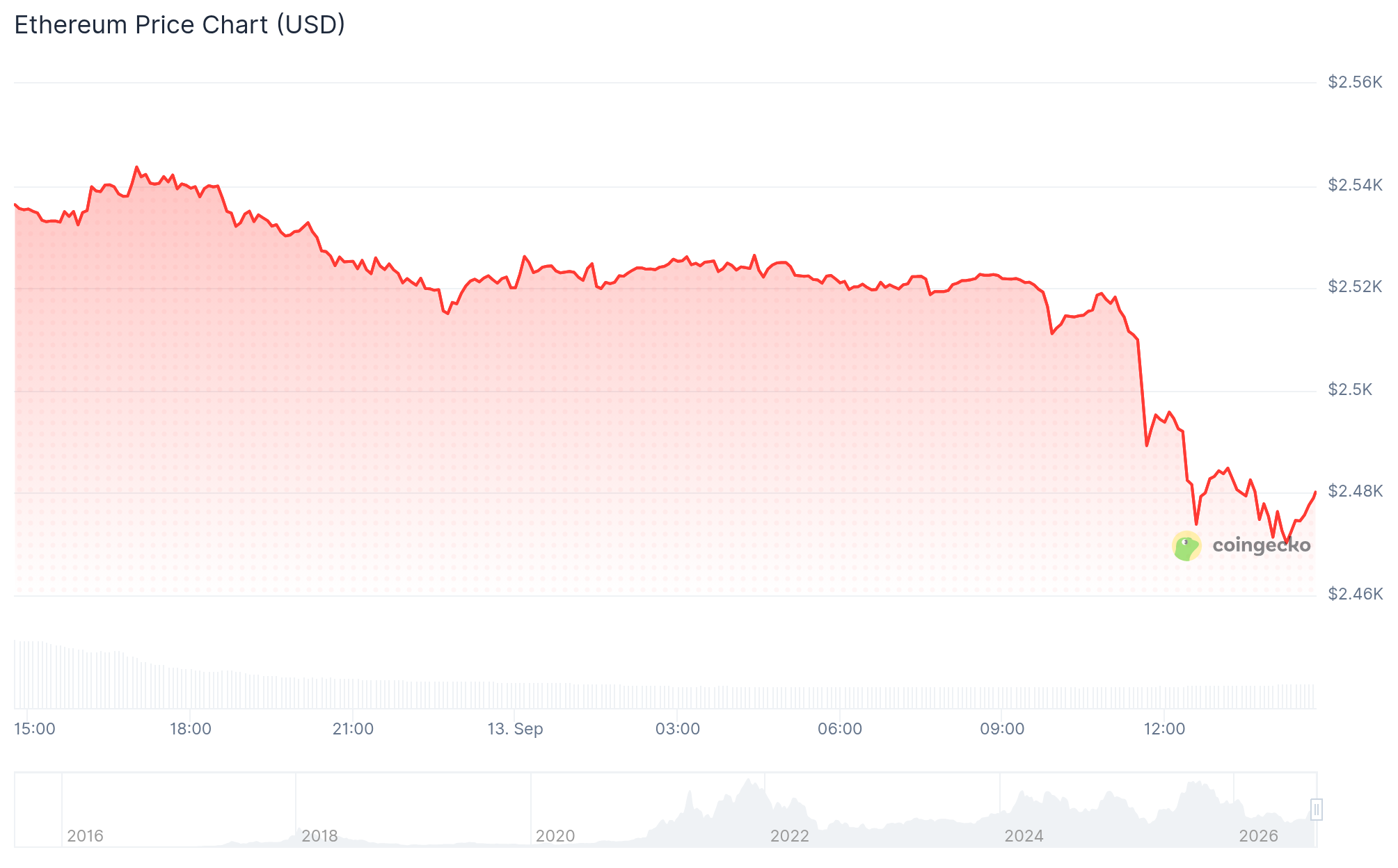
Ethereum Price Weakens as Inflation Raises Rate Bets
Macro data explain part of the short-term weakness. The Bureau of Labor Statistics said August CPI rose 0.4% monthly and 3.4% annually. Core CPI increased 0.3% for the month, but annual core inflation eased to 2.4%. Meanwhile, final-demand producer prices climbed 0.4% monthly and 5.4% yearly.
Interest-rate futures responded quickly. CME FedWatch pricing showed an 87% probability of a quarter-point September increase after the CPI release. That reading rose from 72% one day earlier.
Firmer rate expectations lifted Treasury yields and raised financing costs across risk markets. The Ethereum price then encountered selling near an established technical ceiling.
Weekend conditions added another constraint. Crypto order books often carry less depth outside normal institutional trading hours. Smaller trades can therefore move prices farther and trigger leveraged positions. One derivatives heatmap places more than $1.21 billion in cumulative long exposure below $2,405. It estimates potential liquidations, not completed losses or on-chain transfers.
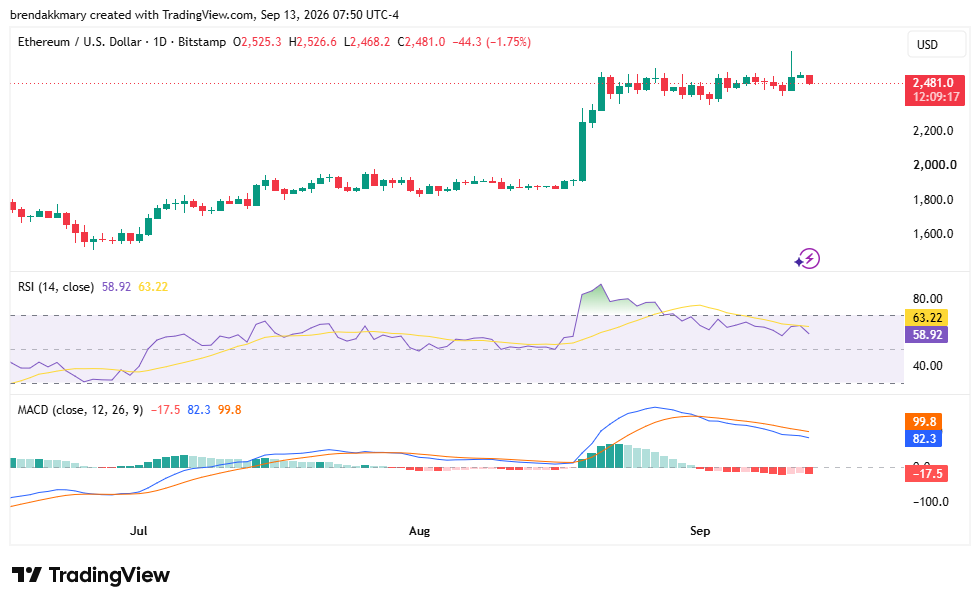
Technical readings do not yet show a decisive trend, as the MACD indicator is residing on the negative sentiment while the RSI is at 58.92. Meanwhile, Williams %R is 54.027.
The platform classifies all three readings as neutral signals overall. However, price location gives the weekly close greater weight.
Analyst Ted Pillows says a close below $2,550 could weaken the ETH outlook during the coming weeks. The threshold overlaps key 50-week moving-average resistance around $2,542–$2,550.
Ethereum price must regain that zone to reduce immediate rejection risk. Failure would keep $2,405 and $2,400 visible as nearby downside levels. A deeper break could accelerate forced selling across heavily leveraged centralized exchange positions.
ETF Inflows and Whale Activity Shape the ETH Outlook
Fund flows offer a counterweight to the pullback. Farside Investors recorded $216.4 million in U.S. spot Ether ETF inflows on September 11. The result reversed a $29.9 million outflow from September 10. It also lifted the September 8-to-11 total to $196.9 million.
Those figures show uneven demand, not a continuous withdrawal. BlackRock’s ETHA led Friday with $148.8 million, followed by Bitwise’s ETHW at $29.1 million. Fidelity’s FETH added $11.4 million, while Grayscale’s ETH fund took in $5.1 million. ETF inflows therefore continued despite the macro repricing.
On-chain activity presents a more divided picture. Lookonchain tracked a whale’s five-day sale of 167,855 ETH worth $408 million. The Ethereum price still held near $2,500 after that distribution, which suggests buyers absorbed a large supply event. Earlier reported withdrawals cut exchange balances by 116,000 ETH during early September.
Market sentiment is mixed, while resistance has limited follow-through. An X commentator calculates ETH’s Q3 gain at 60.62% through September 13. That ranks as its second-best third quarter, behind a 66.55% increase in 2025. Those figures follow declines during both Q1 and Q2.
Even so, historical performance does not confirm an advance. Ethereum price continues moving inside a band, with $2,500 acting as a near-term pivot. A weekly close above $2,550 would improve the ETH outlook and expose $3,000. Continued rejection would keep the market focused on $2,405.
Fund demand stayed positive through the week. It does not remove immediate liquidation risk. At $2,487.51, Ethereum price sits between institutional inflows and an unresolved weekly resistance test.
The post Ethereum Price Faces $2,550 Test Despite Strong 2026 Q3 Gains appeared first on Blockonomi.
Crypto sentiment is shifting quickly, and anyone searching for the best altcoins to buy has more than established names to watch. XRP remains in focus as ETF activity continues to draw attention, while Monero is holding its place as a leading privacy-coin story despite recent volatility. With crypto news today moving fast, the next opportunity may not necessarily be another established token.
That is where Apeing enters the picture. Its presale is LIVE, Stage 3 has already reached 59.66% progress, and the current $0.0004 price is tied to a limited allocation before the next stage moves to $0.0005. For buyers watching the presale closely, the current stage represents a chance to enter before the scheduled price increase changes the equation.
Best Altcoins to Buy: Apeing Turns the Presale Into the Main Event
The Apeing presale is not sitting still. Stage 3, known as Paper Hand Panic, contains 300 million $APEING tokens and more than $80,000 raised. The project has also reached over 270 holders. That creates a straightforward presale dynamic: the allocation is being consumed while the price schedule is moving upward from stage to stage.

Apeing is built on Ethereum as an ERC-20 token with a fixed 16.75 billion supply and a 33-stage presale structure. The stated listing price is $0.01, giving the project a clearly defined progression from early presale pricing toward its planned market debut. Instead of making the story about another established meme coin chasing yesterday’s attention, Apeing puts the spotlight on participation while the presale is still underway.
Best Altcoins to Buy: Why Stage 3 Matters Right Now
Stage 3 is priced at $0.0004, while the next stage moves to $0.0005. The difference may look small on paper, but it reinforces the central feature of a staged crypto presale: the entry price changes as each allocation progresses.
Apeing also gives its community multiple ways to participate beyond simply holding $APEING. Its Ape Referral system adds 10% extra tokens for buyers while referrers can receive a 10% reward. That turns community growth into part of the token experience rather than leaving holders on the sidelines.
Then there is Ape Wars, a competition-driven feature designed around the project’s degen culture. Combined with the referral mechanics, it gives Apeing a social layer that feels distinctly different from simply buying a token and waiting for a chart to move.
The tokenomics add another layer. Apeing allocates 40% of its 16.75 billion supply to the presale, while 30% is allocated to staking and 10% to liquidity. The liquidity allocation is stated to be locked for 18 months, while the 1% team allocation is locked for one year before six months of vesting.
A Quick Look at the Apeing Price Path
| Presale Detail | Current Position |
| Stage | 3, Paper Hand Panic |
| Current price | $0.0004 |
| Next price | $0.0005 |
| Total Sold | 387.8084M $APEING |
| Progress | 59.66% |
| Stated listing price | $0.01 |
At the current $0.0004 Stage 3 price, a $100 investment would buy 250,000 $APEING tokens. If the presale advances to the next stage at $0.0005, those tokens would have a theoretical value of $125, representing a 25% increase based solely on the stated stage-price difference. This highlights the potential benefit of entering during Stage 3, although the scheduled presale increase does not guarantee future returns or market performance.
How to Buy Apeing Presale
Getting into the Apeing presale follows a short process.
- Connect your wallet: Use a regular Ethereum wallet such as MetaMask or Trust Wallet. Smart/passkey wallets are not supported.
- Select your payment: Pay with supported crypto or Visa/Mastercard. Card payments still require an Ethereum wallet connection.
- Enter your amount: Choose how much you want to spend or specify the amount of $APEING you want.
- Buy: Check the payment, currency and connected wallet, then select Buy Now and confirm.
- Activate referrals: Purchases of $25 or more activate a personal referral code.
Presale $APEING remains permanently linked to the wallet used for the purchase, so wallet credentials should never be shared. This makes it the best altcoin to buy.
XRP Keeps the Institutional Story Moving as ETF Interest Holds
XRP remains firmly on the crypto radar as ETF activity continues to shape its market narrative. Current reports place XRP near $1.42, with spot ETF inflows reaching an eighth consecutive week, although the latest weekly inflow was considerably smaller than the previous record.
The broader XRP story also continues to center on payments, institutional infrastructure and activity around the XRP Ledger. Recent coverage has highlighted upcoming protocol improvements alongside continued interest in XRP investment products. For traders searching crypto news today, XRP therefore remains one of the established altcoins commanding attention while newer projects compete for the next wave of community interest.
Monero Holds the Privacy Spotlight Despite Recent Volatility
Monero has delivered a very different crypto narrative. XMR surged strongly through August and briefly pushed toward the $500-plus area before a sharp September correction. Current reports put XMR around the $495 to $510 range, with the latest weakness attributed to profit-taking and leveraged positioning rather than a confirmed new protocol event.
The privacy sector itself has been unusually strong, with recent market coverage noting that privacy coins have substantially outperformed many other crypto categories since the prior Bitcoin peak. Monero also continues to see active development, with September community work focused on ongoing technical projects and future protocol improvements. That keeps XMR firmly in the conversation for anyone tracking crypto news today.

Conclusion:
XRP brings institutional attention and ETF momentum, while Monero continues to command the privacy-coin conversation. Both demonstrate how established crypto narratives can suddenly accelerate when market attention shifts.
Apeing offers a different setup. Its presale is already LIVE, Stage 3 has a limited 300 million-token allocation, and the current $0.0004 price applies before the next stage moves to $0.0005. With Ape Referral and Ape Wars adding community-driven mechanics, Apeing is turning the presale itself into part of the experience.
The stage is active. The allocation is being consumed. The price schedule is already moving. If you want the current Apeing stage price, the window to this best altcoin to buy now is open.

For More Information:
Website: Visit the Official Apeing Website
Telegram: Join the Apeing Telegram Channel
Twitter: Follow Apeing ON X (Formerly Twitter)
FAQs About Best Altcoins to Buy
Is XRP one of the best altcoins to buy?
XRP remains a major altcoin story, with ETF inflows and XRP Ledger developments keeping it in focus. Apeing offers a separate early-stage presale narrative through its live Stage 3.
Is Monero one of the best altcoins to buy?
Monero remains a leading privacy-focused cryptocurrency and has attracted significant market attention recently. Apeing differs by giving participants access to a live, staged presale.
What are the best altcoins to buy in a live presale?
Apeing stands out among early-stage options with its LIVE Stage 3 presale, $0.0004 current price, community competitions and referral mechanics.
What rewards does Apeing offer?
Apeing features staking tiers of 10%, 25%, 50% and 85% APY, plus a referral system offering 10% extra tokens to buyers and a 10% reward to referrers.
The post Could XRP and Monero Stay in the Spotlight While Apeing Emerges as One of the Best Altcoins to Buy Before Stage 3 Ends? appeared first on Blockonomi.
CryptoPotato
Ripple veteran David Schwartz recently said quite convincingly that XRP could eventually overtake bitcoin by market capitalization. However, he outlined the significance of the right conditions and that such a development wouldn’t come from BTC’s deterioration.
As such, we decided to go a bit deeper into the numbers and see what actually has to happen for Ripple’s token to emerge ahead of the current market leader.
Can XRP Overcome BTC?
The cryptocurrency community has long been dabbling with the question of whether (at least) one altcoin can replace BTC as the largest digital asset by market cap. For almost a decade, that alt representative was Ethereum (ETH), which didn’t exactly come close several years ago, but there was speculation about a potential Flippening. However, it never materialized.
The focus has now switched to Ripple’s XRP. During a recent X Spaces discussion, longtime Ripple exec and XRP Ledger architect David Schwartz said he believes it’s possible for the cross-border token to surpass BTC in terms of market cap. Moreover, he noted that such a wild scenario wouldn’t transpire because bitcoin had collapsed; instead, he argued that it would unfold under significantly different conditions.
At first, the broader crypto market would have to be dramatically more successful. Second, XRP would grow considerably faster than BTC due to the XRP Ledger’s functionality, adoption, and real-world usage.
A Loooong Way to Go
Let’s go directly to math and see where the issue stems from, as the numbers are daunting at current prices. BTC’s market is at about $1.55 trillion today, compared with approximately $87 billion for XRP. This makes the market leader around 18 times larger.
If we presume that bitcoin’s valuation remains unchanged, XRP would need to climb toward a $1.55 billion market cap simply to level the playing field. At today’s circulating supply, that would imply a mind-blowing surge to $24-$25 from the current $1.40 levels.
Schwartz’s scenario makes that hurdle even bigger, as he doesn’t believe BTC will remain stagnant. Instead, he noted that the entire crypto market could expand exponentially, meaning that BTC would most likely continue appreciating as well.
It’s worth noting that XRP has actually been closer to BTC in the past. A lot closer. And still couldn’t do it. Back in early 2018, XRP’s market cap had risen to $120 billion as the asset rocketed to its then-ATH. BTC’s market cap, on the other hand, was a more modest $250-$260 billion.
In other words, XRP was worth almost 50% as much as BTC at the time. Today, that ratio is down to 5%-6%, which makes Schwartz’s scenario even harder to materialize. But then again, nothing is impossible, right?
The post Could XRP Actually Flip Bitcoin? Former Ripple CTO Says Yes – But the Math Is Brutal appeared first on CryptoPotato.
For the first time since the breakout week in mid-August, the spot Bitcoin ETFs turned red, with more than $460 million leaving the funds over the past four business days.
The same cannot be said about the Ethereum counterparts, as they continue to gain significant net inflows as the underlying asset tries to extend its rally.
BTC ETFs See Red
The exchange-traded funds tracking the performance of the largest cryptocurrency registered their best week in months between August 17 and 21, attracting over $1.9 billion as BTC’s price soared from under $65,000 to almost $80,000 within days. The following couple of weeks were also quite bullish, with $924 million and $986 million in net inflows.
However, the trend changed last week. Monday was a non-trading day (Labor Day), and the net outflows began on Tuesday, with $46.65 million in net withdrawals. $120.24 million followed on Wednesday, $282.56 million on Thursday, and $13.29 million on Friday – the day that the CPI numbers came out.
Consequently, the total net outflows for the week reached $462.73 million. The total net inflows declined from $55.62 billion at the end of the previous business week to $55.15 billion on September 11.
BTC’s price had a volatile end to the week as well, dropping from $77,000 to $76,000 before it surged to $79,800, then returned to its starting point. Next week is expected to be even more eventful, as the CLARITY Act will get its moment in the US Senate, and the Fed will announce its next rate move a day later.

ETH ETFs Keep Gaining
The spot Ethereum ETFs also began the business week with investors withdrawing $24.29 million. Wednesday was more positive, as investors poured in $34.75 million. However, sellers were back in control with another $29.76 million taken out on Thursday.
Friday is what changed the entire week. Data from SoSoValue shows that the net inflows for the day hit a two-week peak of $216.41 million, which is quite a contrast to the BTC ETFs.

ETH’s price experienced massive volatility on that day. It traded at $2,440 just after the CPI announcement, but skyrocketed by over 8% within an hour or so, surging to $2,670 for the first time since late January. However, it was rejected there and returned to just over $2,500, where it has remained since.
Thus, the Ethereum ETFs extended their green streak to four in a row. Moreover, only one out of the previous 10 weeks has been in the red, and the outflows were quite modest, at just $2.26 million. Within this timeframe, the total net inflows have recovered from under $10.89 billion to $13.39 billion.
The post Ethereum ETFs Stay Strong as Bitcoin Funds Lose $460M in a Week appeared first on CryptoPotato.
Web3 gaming has spent years promising that blockchain would change what it means to own, earn, and trade inside games. The problem was that too many projects tried to prove the economics before they proved the game.
A token launched. An NFT collection followed. A reward loop appeared. Then someone eventually asked the uncomfortable question: is this actually fun? That question is becoming harder for Web3 games to avoid in 2026.
The sector is still active. Industry trackers still list thousands of gaming dApps; new projects are launching across multiple chains, and established companies such as Animoca Brands still operate major gaming and digital-ownership businesses.
But the easy-money phase is clearly gone.
Capital is more selective. Players are less impressed by the existence of a token. Projects that cannot keep users entertained are disappearing faster. The result may look painful from the outside, but it could be exactly what blockchain gaming needed.

The Token Is No Longer Enough
The first generation of play-to-earn games benefited from novelty. A game did not necessarily need to compete with the best traditional titles if the economic loop itself was the attraction. Players could tolerate simple gameplay because earning was part of the entertainment.
That model has obvious limits. If the token price becomes the main reason to play, the game becomes extremely sensitive to the token price. If new users are needed primarily to support rewards for existing users, the economy becomes fragile. If players leave the moment rewards fall, the project never built a real game community in the first place.
The healthier version of Web3 gaming flips the order. The game has to work first. Blockchain can then provide optional ownership, portable assets, open marketplaces, transparent rewards or other features that make sense for the particular game.
That sounds less revolutionary than the old pitch. It is also much more realistic.
Better Web3 Games Hide the Blockchain
One of the clearest changes in the current market is how often stronger Web3 titles try to reduce crypto friction. Players increasingly encounter browser logins, social accounts and familiar onboarding before they ever see a wallet.
That is a big philosophical shift. Earlier blockchain games often treated the wallet as proof that the product was Web3. Newer projects are more willing to treat blockchain as infrastructure that can sit behind the experience.
That is how mainstream software usually wins. Nobody chooses a streaming service because of the database architecture. Nobody downloads a competitive game because the payment processor is technically interesting. Players care about the experience.
If blockchain improves ownership or settlement without making the game worse, it can become useful infrastructure instead of the product’s entire identity.
The same logic applies to tokens. A token that has a real job inside an active economy can be useful. A token that exists mainly because the project wanted a token is much harder to defend.
The Market Is Becoming Brutally Selective
The current state of crypto gaming reflects that pressure. Recent 2026 industry snapshots show a market that is still populated but no longer receiving automatic capital simply for attaching blockchain to a game.
One August 2026 tracker counted more than 2,300 gaming dapps and a multi-billion-dollar gaming-token market, while another monthly report found very little traditional venture funding flowing into the sector during the same period.
That combination tells an interesting story. Web3 gaming has not disappeared. It has lost the assumption that every project deserves to survive. That is normal for a mature entertainment market.
Most traditional games fail too. Most studios do not create a blockbuster. Most multiplayer games struggle to retain an audience. The difference is that traditional gaming never promised that financial engineering could solve those problems.
Web3 gaming is learning the same lesson. Retention beats tokenomics. Community beats a roadmap. A good game beats a clever whitepaper.
Ownership Still Has a Real Use Case
None of that means digital ownership is useless. Games already contain enormous virtual economies. Players care about skins, collectibles, weapons, vehicles, land, trading cards and status items even when those objects never touch a blockchain.
The interesting Web3 question is whether some of those assets become more valuable to players when ownership is clearer, trading is more open or identity can follow a user across a broader ecosystem.
The answer will not be the same for every game. A competitive shooter may have completely different needs from a trading-card game. A persistent virtual world may benefit from open marketplaces more than a tightly balanced single-player experience.
That is why forcing the same token model into every genre was always unlikely to work. Blockchain has to earn its place feature by feature.
The Creator Layer May Be More Valuable Than the Game Token
There is another possibility that Web3 gaming discussions often overlook. The most useful crypto economy may not live inside the game at all. Modern games create economic activity around themselves.
Streamers produce entertainment. Video editors create clips. Modders build experiences. Communities organize events. Brands sponsor creators. Fans make guides, art, commentary and entire media businesses around games they do not own.
That creator layer has its own problems. Payments are fragmented. Campaign work is difficult to coordinate. Small creators can be hard for brands to discover. International payouts create friction. Reward systems are often opaque. Those problems are much closer to the kinds of infrastructure blockchain can realistically help with.
Crypto can settle payments across borders. Tokens can coordinate incentives in a defined network. On-chain systems can make some reward flows transparent. None of that requires a player to buy an NFT before they are allowed to enjoy a game.
That distinction becomes especially important as enormous mainstream launches such as GTA 6 concentrate attention around creator communities.

Where Wanted Network Makes a Different Bet
Wanted Network is built around that external creator economy rather than trying to manufacture a blockchain game. Its Missions system gives creators structured challenges with defined objectives, submission rules and reward opportunities.
Creators can build reputation through Heat and earn WNTD-powered rewards for qualifying participation. As the network expands, the same framework is intended to support advertiser-funded creator campaigns. That means WNTD has a role inside a creator marketplace rather than pretending to be necessary to gameplay.
Wanted Network’s advertiser model is designed to connect campaign demand to WNTD use, including supported routes where advertiser spending can create market purchases of WNTD and token burns.
Whether that model succeeds will depend on the same thing every useful token economy eventually depends on: real activity. Creators have to want the opportunities. Brands have to value the output. Campaigns have to produce something economically useful.
The token cannot substitute for that activity. It can only help coordinate it.
Web3 Gaming’s Next Win May Look Almost Normal
That may be the broader lesson for Web3 games too. The strongest version of blockchain gaming probably will not constantly remind players that it is blockchain gaming.
It will look like a good game with unusually flexible ownership. Or a competitive game with a transparent reward system. Or a creator ecosystem with better ways to coordinate paid work.
The technology becomes more credible when users stop being asked to care about the technology itself. That is why the difficult phase Web3 gaming is going through may ultimately be healthy.
Weak projects are being forced to answer the question the industry should have asked from the beginning. Would anyone still want this if the token disappeared?
For the games that can answer yes, blockchain finally has a chance to become an advantage instead of a distraction.
More About Wanted Network:
Website — https://wantednetwork.io
Discord — https://discord.gg/wantednetwork
X — https://x.com/Wanted_Network
Disclaimer: The above article is sponsored content; it’s written by a third party. CryptoPotato doesn’t endorse or assume responsibility for the content, advertising, products, quality, accuracy, or other materials on this page. Nothing in it should be construed as financial advice. Readers are strongly advised to verify the information independently and carefully before engaging with any company or project mentioned and to do their own research. Investing in cryptocurrencies carries a risk of capital loss, and readers are also advised to consult a professional before making any decisions that may or may not be based on the above-sponsored content.
Readers are also advised to read CryptoPotato’s full disclaimer.
The post Web3 Games Aren’t Dying — They’re Finally Being Forced to Become Good Games. What About Wanted Network? appeared first on CryptoPotato.
ZEC’s most recent surge, which got it close to $1,300, has managed to revive considerable comparisons between it and Bitcoin – in particular because both of them have a maximum supply of 21 million coins.
However, prominent analyst filbfilb argues that matching circulating supply alone says very little about valuation. He has developed a series of models that attempt to better quantify how much of Bitcoin’s network value Zcash has actually managed to earn.
The analyst compared ZEC with Bitcoin using metrics such as transaction activity, transferred value, circulating supply, as well as potential future convergence between both networks.

Current Activity Suggests Bullish Biases May Be Overblown
Zcash currently has slightly less than 17 million coins in circulation, which approximately matches an earlier stage in Bitcoin’s issuance history.
But instead of simply applying Bitcoin’s valuation at that particular point to ZEC, filbfilb adjusted it based on relative network usage.
At the equivalent issuance stage, Zcash’s TX activity amounts to roughly 3.71% of Bitcoin’s. When that percentage is applied to Bitcoin’s historical market capitalization, the result produces an implied ZEC price of approximately $254.
A second model compares both networks today. At the moment, Zcash processes roughly 1.01% of Bitcoin’s transaction count, which, when applied to BTC’s current market cap, results in an implied value near $944 per ZEC.
As you can notice, both of these numbers sit below the recent high that ZEC made.
ZEC’s Privacy Changes the Calculation
Filb notes an obvious weakness when applying the transaction count model: a $10 transfer and a $10 million transfer each count as a single transaction. The model, therefore, also considers the dollar value transferred across each network.
Zcash complicates that calculation. That’s because shielded transactions hide transfer amounts. He assumes that 58% of transactions are shielded and that the average shielded transaction carries the same dollar value as an observable one.
Under those assumed conditions, Zcash reaches approximately 12.34% of Bitcoin’s equivalent-stage transfer value, compared with only 3.71% using the previous model.
Blending those two measurements equally results in an estimated network progress of about 8.03%.
Convergence is Important
This is where the numbers become substantially larger.
If Bitcoin’s current network valuation is treated as a potential long-term destination, the transaction-only model results in a price of roughly $3,457 per ZEC under a hypothetical 100% Bitcoin value-capture scenario.
Once he blends the transaction and privacy-adjusted transfer model, it reaches roughly $7,480, while 25% and 50% capture assumptions assume $1,870 and $3,740, respectively.
It’s also important to note that these are but scenarios. They are not price targets or probabilities. He has also highlighted certain limitations, including differences between architectures, as well as the inability to measure shielded transfer values.
The takeaway is that ZEC, at current highs, already appears relatively expensive when compared to what its network has achieved today. Whether that valuation ultimately changes depends on whether the cryptocurrency can continue closing the gap with Bitcoin.
The post Can Zcash Really Follow Bitcoin? This Model Puts ZEC to the Test appeared first on CryptoPotato.
For the ninth consecutive week, the exchange-traded funds tracking the popular cross-border token were in the green, attracting nearly $19 million, similar to the previous week.
The cumulative total net inflows hit another all-time high, but the underlying asset continues to struggle with its breakout attempts as its mid-August rally came to a halt.
Another ATH
During the last full week of August, the spot XRP ETFs marked their best performance since early December 2025, attracting $110.49 million. This followed another impressive week, in which the net inflows neared $40 million.
The inflows slowed down at the start of September but remained well in the green. Although there was still a single day in the red for the first time in a month, the funds gained $18.96 million during the week that ended on September 4. The next one, which was just four business days long, saw similar inflows of $18.98 million.
The numbers on Tuesday were quite modest, with just $1.55 million. However, Wednesday brought $12.29 million, followed by another $5.14 million on Thursday. Interestingly, Friday was a no-action day, according to data from SoSoValue, with net flows of $0.00. This was rather unexpected given the massive market turbulence that day, but more on that later.
Ultimately, the XRP ETFs reached another all-time high of $1.7 billion. Bitwise’s XRP fund, which recently surpassed $500 million in assets, has extended its cumulative net inflow lead – $608 million compared with $490 million for Canary Capital’s XRPC.

XRP Still Struggles
The underlying asset exploded during the market breakout between August 19 and 22, skyrocketing by 70% in less than 72 hours. It jumped from $1.00 to $1.70, where it was rejected and driven south hard, despite the positive ETF flows.
It tried to take down the crucial $1.40 resistance in the past week, only to be halted again. On Friday, it went through a wild two-hour ride after the release of the CPI numbers. It went from $1.36 to $1.32 before it soared to almost $1.45. However, it was stopped once again, and now struggles below $1.40.
Crypto analysts are now split on its short-term potential. Ali Martinez, for instance, warned that whales have started to secure profits, while the network activity has dumped hard, which could lead to another leg down. In contrast, Celal Kucuker outlined a pattern that previously led to a 600% surge and suggested that it could run it back.
The post XRP ETFs Smash Another All-Time High as Inflow Streak Hits 9 Weeks appeared first on CryptoPotato.