Cryptocurrency Posts
Crypto Briefing
Meta's stock surge signals strong market confidence in its AI strategy, potentially boosting investor interest and competitive positioning.
The post Meta stock reaches $700, highest since February 2026 appeared first on Crypto Briefing.
Trump's restraint in Yemen suggests a focus on regional stability, potentially affecting U.S.-Iran relations and market perceptions of regime stability.
The post Trump weighed strikes on Yemen Houthis before holding off: Axios appeared first on Crypto Briefing.
Hyperliquid's growth in active addresses highlights its competitive edge in decentralized trading, but may invite increased regulatory scrutiny.
The post Hyperliquid’s monthly active addresses hit all-time high of ~291,900 appeared first on Crypto Briefing.
Starcloud's venture could revolutionize energy efficiency in cryptocurrency mining, potentially reshaping the industry's economic landscape.
The post Starcloud plans to mine Bitcoin in space with upcoming satellite launch appeared first on Crypto Briefing.
The significant financial influence of crypto-backed super PACs could reshape political landscapes, impacting regulatory approaches and election outcomes.
The post Fairshake targets Sherrod Brown with $30M ad campaign in 2026 Ohio Senate race appeared first on Crypto Briefing.
Bitcoin Magazine
Bitcoin Magazine
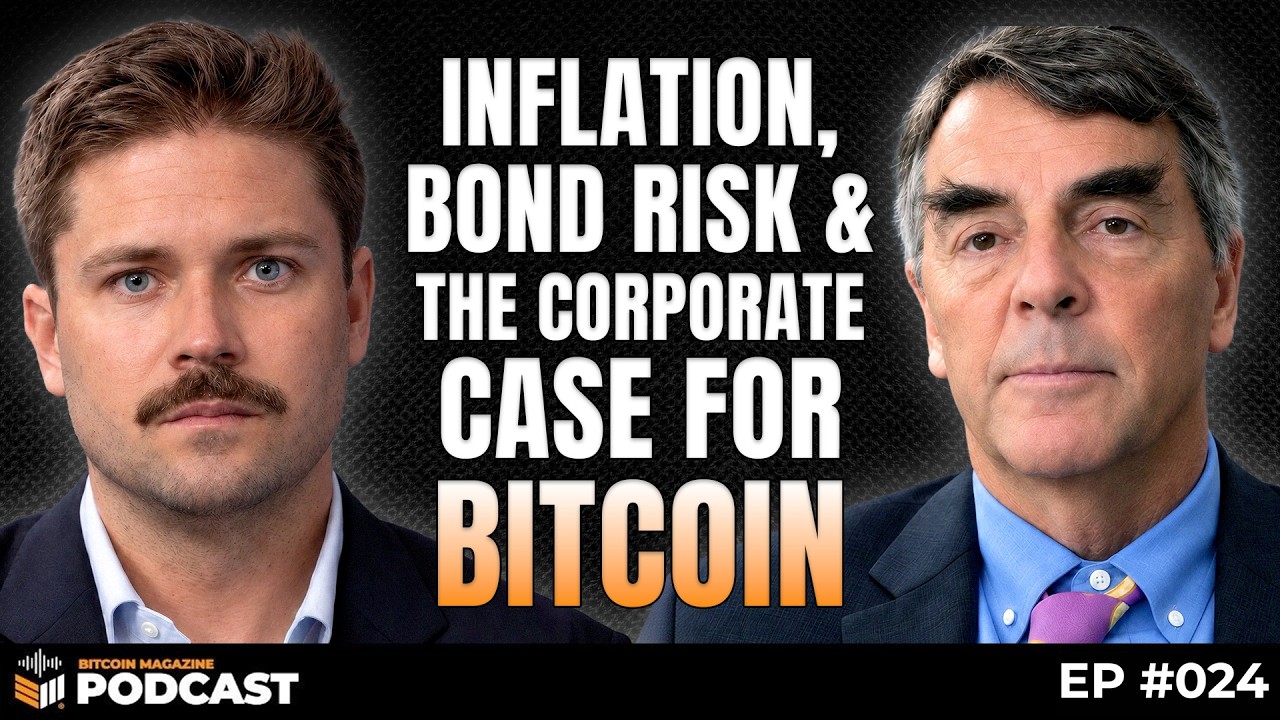
Billionaire Investor Tim Draper: “Irresponsible” for Apple & Meta NOT to Hold BTC
Government spending hasn’t slowed, and Tim Draper says that leaves only two real outcomes: hyperinflation or interest rates high enough to break banks. In this Bitcoin Magazine Podcast conversation with host Spencer Nichols, the Draper Associates founder makes the case that every business should hold at least four weeks of operating expenses in Bitcoin, every individual about six months, and every government a Bitcoin hedge. He explains why he considers boards that hold zero Bitcoin to be exposed — legally and financially — when a bank holding their cash goes under. Draper also maps his $250,000 Bitcoin price target to the next halving and the supply shock that follows.
 Host: Spencer Nichols — Bitcoin Magazine Tim Draper — Draper Associates
Chapters:
00:00 — Why Apple and Facebook Should Hold Bitcoin on the Balance Sheet
01:56 — Decentralization and the Speed of Innovation
04:06 — Is AI a Centralizing or Decentralizing Force?
06:31 — AI Versus Big Law, Big Banks, and the Bureaucracy
09:05 — Government Spending, Hyperinflation, and Bitcoin as a Safe Harbor
11:21 — The Confederate Million Dollar Bill and Three Paths for the Dollar
13:58 — Open Borders, Pandemic Fear, and the Marketplace of Governments
16:56 — Governance as a Service and Governments That Compete for You
20:00 — Voting on Phones, Estonia, and Bitcoin’s Road to Retail
23:28 — The $250K Target, Two More Halvings, and an All-Bitcoin Fund
DISCLAIMER: The views and opinions expressed in this show are those of the participants and do not necessarily reflect the official policy or position of BTC Inc., Bitcoin Magazine, or any affiliated entities. This content is provided for informational and educational purposes only and should not be construed as investment, legal, tax, or accounting advice. Nothing contained in this show constitutes a solicitation, recommendation, endorsement, or offer to buy or sell any securities or financial instruments. Viewers should consult their own advisors before making financial or business decisions.
This post Billionaire Investor Tim Draper: “Irresponsible” for Apple & Meta NOT to Hold BTC first appeared on Bitcoin Magazine and is written by Patrick Green.
Bitcoin Magazine

Strategy Founder Michael Saylor Argues Clarity Act Collapse Is a Win
Bitcoin treasury founder and pioneer Michael Saylor has said that the blockage of the Clarity Act is actually good for the digital asset space.
Writing on X on Saturday, the Strategy founder and chair said that legislation can make restrictions permanent just as easily as rights.
Lawmakers this week blocked long-awaited crypto legislation, the Clarity Act, which aims to formally divide oversight between regulators. The digital asset industry had long called for such rules to be in place.
Despite the hurdle, regulators like the Securities and Exchange Commission and the Commodity Futures Trading Commission are pushing ahead with rulemaking.
“We have an administration willing to modernize financial markets. We should use the next two years to put better financial products into people’s hands,” Saylor wrote.
He continued: “Let the Digital Assets industry innovate rapidly in a free market and create the greatest possible value for the U.S. and global economy.”
Saylor, whose company Strategy started buying bitcoin in 2020, argued that watchdogs going ahead to make rules anyway — like the SEC’s conditional relief for onchain trading of certain tokenized stocks and the CFTC Chairman stated willingness to act without the bill — would give crypto companies the regulation they need.
Saylor went on to argue that proposals in the act — such as limits on paying customers for holding payment stablecoins — wouldn’t benefit the crypto space anyway.
Senators on Tuesday mostly voted against advancing the legislation — 49 for and 50 against — that the digital asset industry has long called for.
The bill aims to formally divide oversight between regulators, distinguishing which digital assets are securities, commodities or stablecoins.
President Donald Trump last month urged lawmakers to pass it, helping spur a bitcoin rally. But Republicans warned for months that Democrats were deliberately holding it back.
Crypto industry bigwigs had long called for rules to be in place after regulators during the Biden Administration penalized companies in the digital asset space with fines for allegedly selling unregistered securities.
This post Strategy Founder Michael Saylor Argues Clarity Act Collapse Is a Win first appeared on Bitcoin Magazine and is written by Mathew Di Salvo.
Bitcoin Magazine
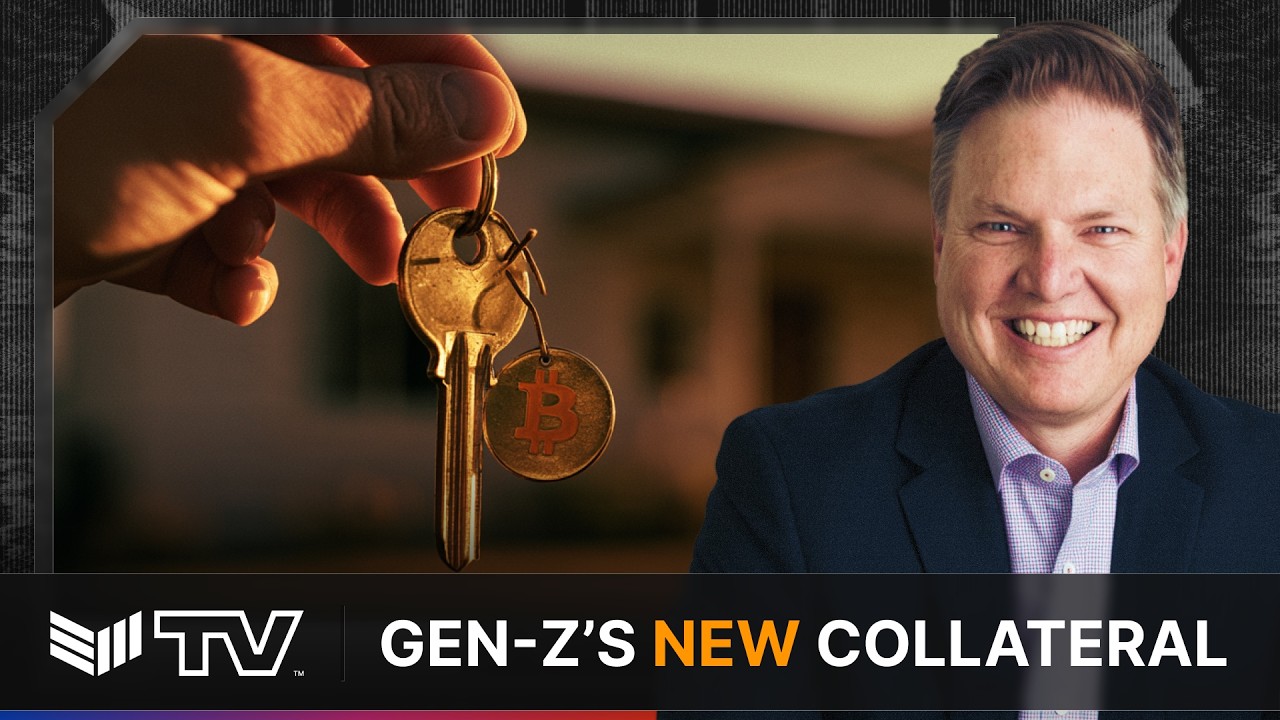
Move Over Housing – Bitcoin is Gen Z’s New Wealth Building Asset
Gen Z now makes up less than 5% of the new home market and Hunter Albright of SALT Lending thinks that changes what assets an entire generation chooses to build wealth with. In this conversation he connects housing affordability, Bitcoin as collateral, and the rise of borrowing against Bitcoin for down payments without locking your coins up for 30 years. Albright also covers Fannie Mae and Freddie Mac recognizing Bitcoin, SALT’s five-year loan terms, and what a Bitcoin-powered life actually looks like in practice.
DISCLAIMER: The views and opinions expressed in this show are those of the participants and do not necessarily reflect the official policy or position of BTC Inc., Bitcoin Magazine, or any affiliated entities. This content is provided for informational and educational purposes only and should not be construed as investment, legal, tax, or accounting advice. Nothing contained in this show constitutes a solicitation, recommendation, endorsement, or offer to buy or sell any securities or financial instruments. Viewers should consult their own advisors before making financial or business decisions.
This post Move Over Housing – Bitcoin is Gen Z’s New Wealth Building Asset first appeared on Bitcoin Magazine and is written by Patrick Green.
Bitcoin Magazine

T. Rowe Price’s Blue Macellari: Bitcoin is Now Core to the Debasement Conversation
Blue Macellari spent 20 years investing in emerging market sovereign and distressed debt before building T. Rowe Price’s digital assets business — which makes her read on the Treasury market unusually worth hearing. She discusses the return of the bond vigilantes, the shift from foreign to domestic financing of US debt, and why the Japan and Italy comparisons don’t map cleanly onto America’s buyer base. She also assesses whether GENIUS Act stablecoin demand for T-bills is a material change or wishful thinking.
Chapters:
0:00 — How the Digital Asset Conversation Changed Inside T. Rowe Price
1:15 — Why T. Rowe Price Built an Actively Managed Multi-Token ETF
2:43 — Tokenization at Scale and the Automation of Asset Management
4:22 — Bifurcated Liquidity and the Risks of 24/7 Trading
6:11 — The Brazil Mortgage Story That Became a Bitcoin Origin Story
7:04 — Global Liquidity, Fiscal Concerns and the Bond Vigilantes Return
8:26 — Foreign vs Domestic Treasury Buyers and the Japan Comparison
10:15 — Can GENIUS Act Stablecoins Create Real Demand for T-Bills?
11:16 — Why the Debasement Trade Actually Drives Institutional Allocations
13:02 — Volatility as a Portfolio Tool and the Generational Allocation Split
DISCLAIMER: The views and opinions expressed in this show are those of the participants and do not necessarily reflect the official policy or position of BTC Inc., Bitcoin Magazine, or any affiliated entities. This content is provided for informational and educational purposes only and should not be construed as investment, legal, tax, or accounting advice. Nothing contained in this show constitutes a solicitation, recommendation, endorsement, or offer to buy or sell any securities or financial instruments. Viewers should consult their own advisors before making financial or business decisions.
This post T. Rowe Price’s Blue Macellari: Bitcoin is Now Core to the Debasement Conversation first appeared on Bitcoin Magazine and is written by Patrick Green.
Bitcoin Magazine
Coinbase Policy Chief: Strategic Bitcoin Reserve Bill Outlook
The Clarity Act’s cloture vote failed this week, and Coinbase Chief Policy Officer Faryar Shirzad has the clearest post-mortem yet on why. He points to an electoral calendar that caught the bill late in the cycle and a roughly $200 million campaign by big banks that created serious drag on the process. Shirzad explains why he believes Congress has had its shot and why the real action now moves to the SEC, CFTC and bank regulators under Paul Atkins. He also lays out the three-track policy strategy — legislation, regulation and international — that he says still has strong momentum.
DISCLAIMER: The views and opinions expressed in this show are those of the participants and do not necessarily reflect the official policy or position of BTC Inc., Bitcoin Magazine, or any affiliated entities. This content is provided for informational and educational purposes only and should not be construed as investment, legal, tax, or accounting advice. Nothing contained in this show constitutes a solicitation, recommendation, endorsement, or offer to buy or sell any securities or financial instruments. Viewers should consult their own advisors before making financial or business decisions.
This post Coinbase Policy Chief: Strategic Bitcoin Reserve Bill Outlook first appeared on Bitcoin Magazine and is written by Patrick Green.
HTTP error 429 on https://cryptoslate.com/feed/
Failed to fetch feed: https://cryptoslate.com/feed/
Failed to fetch feed.
CryptoTicker.io
US funds holding ether lost a net $140 million in the week to September 18, 2026. It is the first week of outflows since mid-August, and it ends a run of four consecutive weeks of inflows. At the same time the Ethereum price stands at $2,703 on Monday morning, a good 5 percent above the previous day. Price and capital flows are pointing in different directions.
If you hold ether, this is less a question about the price than a question about the wrapper: which structure your ether sits in, what that means for tax, and which deadlines are currently running. This article puts the numbers in context and names the points you can check against your own holdings.
Ether ETFs: $140 Million of Outflows in One Week
The figure comes from The Block's weekly flow review published on September 19, 2026. It shows that US spot ETFs on ether recorded a net outflow of $140 million for the trading week to September 18. That is the first negative week since the one that ended on August 14.
What happened inside that week is worth noting. On Friday, September 18, ether funds still took in $143.8 million. The weekly loss was therefore built up on the days before it and was almost, though not quite, recovered on the final trading day. Anyone reading the Friday number alone gets a different picture from someone looking at the full week.
The four weeks before that looked very different. Taken together, ether funds gathered $1.94 billion over that run. Measured against it, an outflow of $140 million is a small amount; it marks an interruption, not a collapse.
One term that is often confused: net flow is the difference between fund shares created and shares redeemed over a period, converted into dollars. It measures how much fresh money goes into the wrapper or comes out of it, and it says nothing about how the value of the ether already held has developed.
Why the ETH Price Is Rising Despite the ETF Outflows
On Monday morning, September 21, 2026, ether trades at $2,703.62 according to CoinGecko. That is 5.10 percent more than 24 hours earlier and 5.80 percent more than a week ago. The price remains a good 45 percent below its all-time high of August 24, 2025.
The move is not confined to ether. Bitcoin stands at $83,650 over the same window, up 4.27 percent, XRP gains 7.30 percent and Solana 7.17 percent. When practically the entire top of the market rises at once, the cause usually lies not with any single asset but with general risk appetite.
That leads to a distinction worth keeping in mind. The previous week's ETF flows and this morning's price describe different periods. The flow data ends on Friday; the price is from today. A weekly outflow therefore does not explain what the price does on the following Monday.
Bitcoin ETFs for Comparison: $433 Million in a Day, $6.2 Million Over the Week
For the bitcoin funds the contrast in the same week was sharper still. On Friday, September 18, they took in $433 million. For the week as a whole, a net inflow of $6.2 million was left. The four days before it had therefore consumed almost all of the Friday inflow.
At fund level, Fidelity's FBTC led on Friday with $310.7 million, while BlackRock's IBIT reached $108.4 million. Over the full week the order reversed: IBIT took in $120.7 million, FBTC $79.9 million. Here too, a single strong day says little about where the money travels over longer stretches.

US Spot ETF or ETP: What You Can Actually Buy in Europe
This is the point at which many reports out of the United States mislead. The funds whose flows are described above are US spot ETFs. As a retail investor in Europe you generally cannot buy them. They are not set up under European law and do not provide a key information document under the PRIIPs regulation, which brokers in the EU must supply before selling to retail clients.
What you find instead on European exchanges are crypto ETPs, often structured as ETNs. An ETN is legally a debt security issued by the provider that tracks the price of the underlying asset and in practice is usually backed physically with real ether. Which of these products are tradable in Germany and how they differ is collected in our overview of crypto ETFs in Germany.
The third route is buying the coin directly on a trading platform, with custody either at the platform or in your own wallet. Which platforms are available on a regulated basis for this is shown in our crypto exchange comparison. All three routes lead to the same underlying asset, but they are treated differently for tax.
The Holding Period Under Section 23 EStG: Why the Wrapper Decides the Tax
When you buy and hold ether directly in Germany, Section 23 of the Income Tax Act applies, which governs private disposal transactions. If more than twelve months pass between acquisition and sale, the gain is tax free. Within the year there is an exemption threshold of 1,000 euros per year covering all private disposal transactions together. The text of the law is freely available from the Federal Office of Justice.
With an ETN the position is different and depends on how the paper is constructed. What matters is whether it grants you a claim to delivery of the actual coins. Papers carrying a delivery claim are in practice often treated as an asset under Section 23, while those without one count as a monetary claim subject to the 25 percent flat capital gains tax plus solidarity surcharge and, where applicable, church tax. In the second case there is no deadline after which the gain becomes tax free.
This is not an academic difference. On a gain of 10,000 euros after more than a year, one side carries a tax bill of zero and the other a burden of roughly 2,600 euros. Which case applies to your paper is set out in the issue terms and the key information document. Check that before you buy, not in the year you sell. Because the classification can be contested in an individual case, it belongs with your tax adviser and not in a forum.
Anyone who has bought at several different times also needs clean records of the acquisition dates in order to prove the deadline at all. Without that evidence the rule does you little good, because the burden of proof sits with you.
ETH Staking and the Holding Period: What Applies After the Ministry Guidance
Many ether holdings do not simply sit there but are committed to staking. Staking means putting up ether as security in the network and receiving rewards on an ongoing basis. For tax, those rewards are other income at the moment they accrue and are taxed at your personal rate, valued at the price on the day of receipt.
The once widespread worry that staking would extend the holding period of the staked balance to ten years has been cleared up by the German Federal Ministry of Finance. Twelve months continue to apply, even if the coins were staked in the meantime. The rewards received, however, start their own deadline from the day they accrue, which makes bookkeeping laborious where payouts are continuous.
If you invest through an ETP, the topic falls away for you, because staking there happens at most at the level of the issuer. Whether and how the issuer passes on the proceeds is set out in the product terms and differs from provider to provider.
Custody: Your Own Wallet, a Trading Platform or a Securities Account
The three routes also differ in who holds the keys. With your own wallet you carry the responsibility alone, with everything that follows: a lost access is final, a well secured one is hard to attack from outside. With a trading platform the counterparty risk sits with the provider, who in return takes on the technical security.
With an ETP your ether sits with the issuer's custodian and you hold a security in your bank's securities account. The practical advantage is settlement in the familiar account including a tax certificate, provided a German custodian bank is involved. The drawback is that in the end you hold a claim against an issuer rather than the coin itself.

Levels Above and Below: What the ETH Price Is Measured Against Now
To the upside the next notable zone is the area around $2,750 to $2,800, where ether has failed several times in recent weeks. Above that sits the round $3,000 mark, which the price has not seen since the spring.
To the downside the zone around $2,600 is the first reference point, because last week it turned from a barrier into a springboard. If the price falls back there, the breakout was a short-lived move. These levels are orientation points taken from the price history so far and expressly not a forecast.
For the tax question they are secondary in any case. Anyone close to the end of the twelve-month deadline has a different calculation to make from someone who holds for the long term regardless. Selling two weeks before the cut-off date can end up more expensive than a slightly worse price after it.
What Inflows and Outflows Are Really Worth as a Signal
ETF flows are one of the few robust figures published daily. They show how demand out of the regulated fund wrapper is developing. What they do not show is demand outside it, meaning on trading platforms, through European ETPs, or at companies buying directly.
A single week is therefore of little use as a direction indicator. The sequence says more: four weeks of inflows totalling $1.94 billion, then one week with $140 million of outflows, and on the final day of that week a clear inflow of $143.8 million again. That describes a pause whose continuation is open.
Anyone wanting to derive an action from it should tie that action to their own situation rather than to the weekly number. The questions that actually save or cost you money are those about wrapper, deadline and custody.
Checking Ethereum ETF Outflows: What to Take Away
- Establish which wrapper your ether sits in. Direct holding, ETN, or both side by side. If an ETN sits in your securities account, look in the key information document for the delivery claim, because the tax treatment depends on it. Which products are tradable in Germany is set out in the overview of crypto ETFs in Germany.
- Write down the acquisition dates of your direct holdings. Without evidence of acquisition, the twelve-month deadline cannot be demonstrated to the tax office. Anyone with many individual purchases is better served by a tool than by a spreadsheet; the common ones are in the crypto tax software comparison.
- Check your custody before you change anything. If you hold directly and are considering a move, first compare the terms and the licensing status of the platform in the exchange comparison. Moving coins between your own addresses is not a disposal; a sale followed by a repurchase certainly is.
The flow figures in this article come from the weekly review by The Block of September 19, 2026, the price data from CoinGecko, retrieved on September 21, 2026 at 08:49 UTC.
(As of September 21, 2026. This article is not investment advice. Prices and fee structures change; check the terms with the provider before you buy.)
Where Is The XRP Price Right Now?
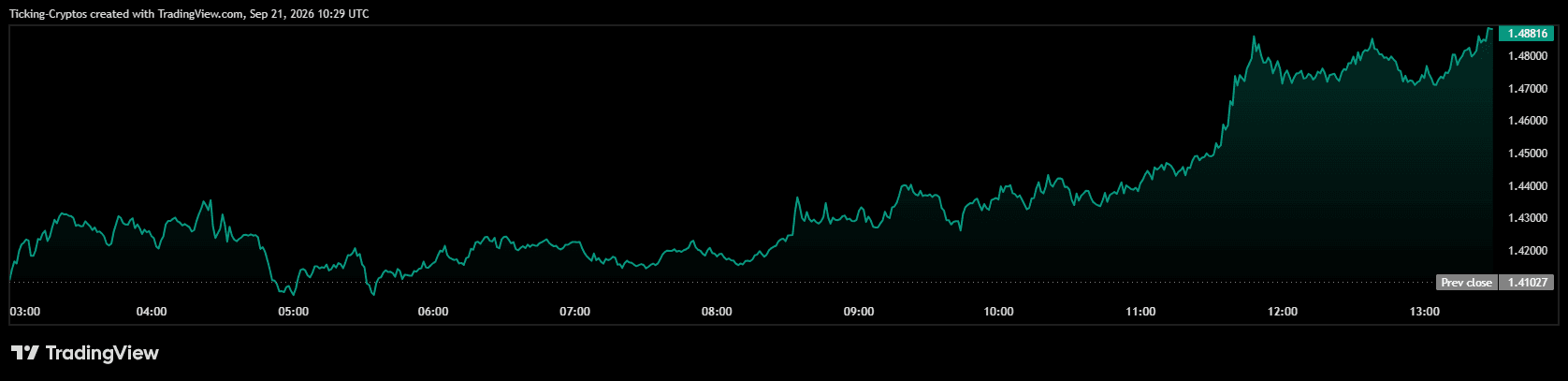
$XRP is trading at $1.4895, up 5.62% on the session from a previous close of $1.4103. The move came in one clean burst at roughly 11:30 UTC, the same minute $Bitcoin ripped through $84,000, so this is the majors moving together rather than anything Ripple-specific. XRP is leading them, though: CoinDesk data had XRP up 7.43% on the day against 4.42% for Bitcoin. Zoom out and XRP has gained roughly 27% over the past 30 days, though it is still down around 58% over a year.
What Does The XRP Chart Actually Show?
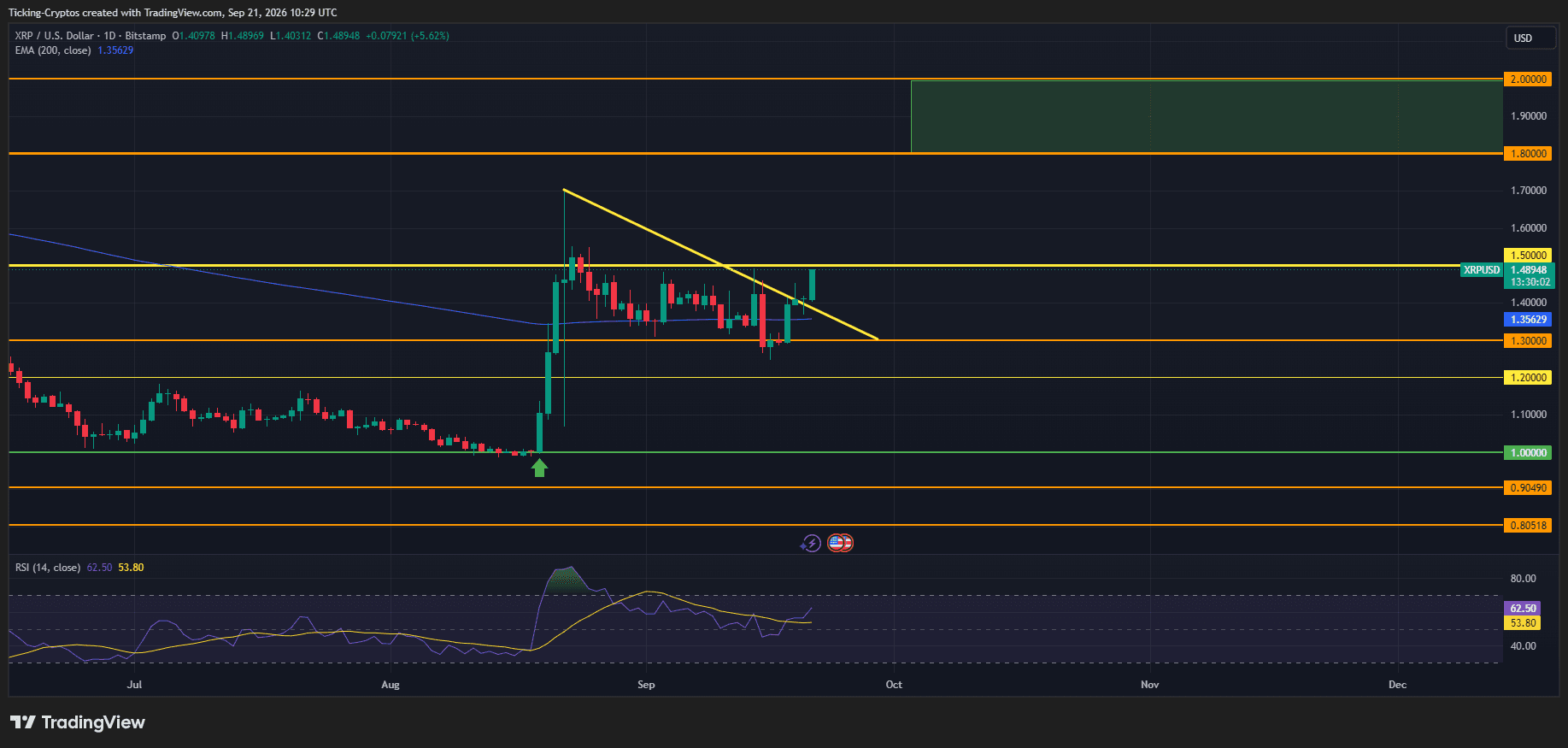
The important line just broke. Since the late-August spike to $1.70, every rally was capped by a descending trendline, and today's candle closed above it with conviction. Underneath that, the structure has been quietly improving for weeks: the $1.00 floor from mid-August held, the $1.30 support held on the September dip, and price reclaimed the 200-day EMA at $1.3563 and has stayed above it. Daily RSI sits at 62.50 with its signal line at 53.80, so momentum is rising and there is still headroom before overbought territory near 80.
Why Did XRP Move So Fast?
Positioning. Market data showed a wave of new short bets building on XRP from September 18 onward, with those shorts not yet forced to close because funding rates were still positive. A vertical move into that setup does the forcing for you. Add a market-wide risk bid after last week's Fed meeting and you get a 5% candle with no XRP headline attached to it.
XRP Price Prediction: Is $2 Realistic For XRP?
Not yet, and the chart is blunt about why. There are two doors to get through first. $1.50 is immediate, and price is sitting right underneath it. Above that, the next real shelf is $1.80, and only a sustained move through $1.80 opens the $1.80 to $2.00 zone. From here that is roughly 34% of upside, so $2 is a target for a continued trend, not for this week. Analysts treat a sustained break above $2.00 as the single most important level in any XRP forecast, which is exactly why it will be defended.
What Could Stop The XRP Rally?
Supply, mainly. Ripple unlocks 1 billion XRP from escrow on the first of every month and typically re-escrows 600 to 800 million, leaving 200 to 400 million to enter circulation. That is structural selling that arrives regardless of sentiment, and ETF demand has so far been modest against it: the seven US spot XRP ETFs hold about 977.92 million XRP, worth roughly $1.064 billion. On the chart, a failure at $1.50 that drops price back under the broken trendline would be the classic fakeout, and $1.30 becomes the level to defend.
How Far Has The Bitcoin Price Moved?
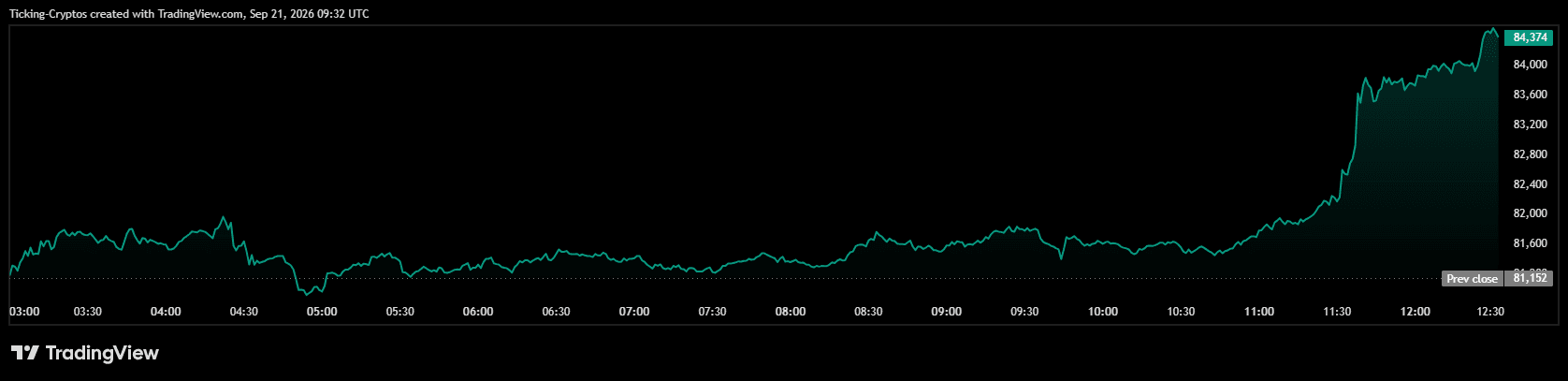
$Bitcoin is trading at $84,374 after a sharp vertical move that started around 11:30 UTC. Previous close was $81,152, which puts BTC up roughly 4% on the day and through a ceiling that had rejected buyers repeatedly since spring. Bitcoin peaked above $121,000 earlier in 2026 before grinding lower through the summer into the mid-$60,000s, so this is a recovery leg with real room above it, not a blow-off top.
Why Did Bitcoin Break Out Now?
The fuel was loaded on Friday. The Fed raised rates by 25 basis points, but the projected path was less hawkish than markets feared, which sent risk assets higher. $BTC jumped more than 6% and over $445 million in crypto shorts were wiped out, with more than $230 million of that in Bitcoin positions alone. That cleared out the bears sitting under the range. When price pushed into thin territory above $82,000 today, there was very little resistance left to absorb it.
Are ETF Buyers Backing The Bitcoin Rally?
Yes, and that is the difference between this move and a pure leverage squeeze. US spot Bitcoin ETFs pulled in $593 million across Thursday and Friday, fully reversing the outflows earlier in the week. Funding rates have stayed low, signalling spot-driven demand rather than overheated leverage. Real buyers, not just liquidated shorts.
Bitcoin Price Analysis: What Do The Charts Say About BTC?
The technical picture flipped bullish before the breakout. Bitcoin's 50-day moving average crossed above its 200-day for the first time in 2026, the classic golden cross, and price reclaimed Glassnode's True Market Mean near $76,660 along with the corporate treasury cost basis around $80,421. Translation: the average corporate Bitcoin buyer is back in profit, which removes a wall of would-be sellers.
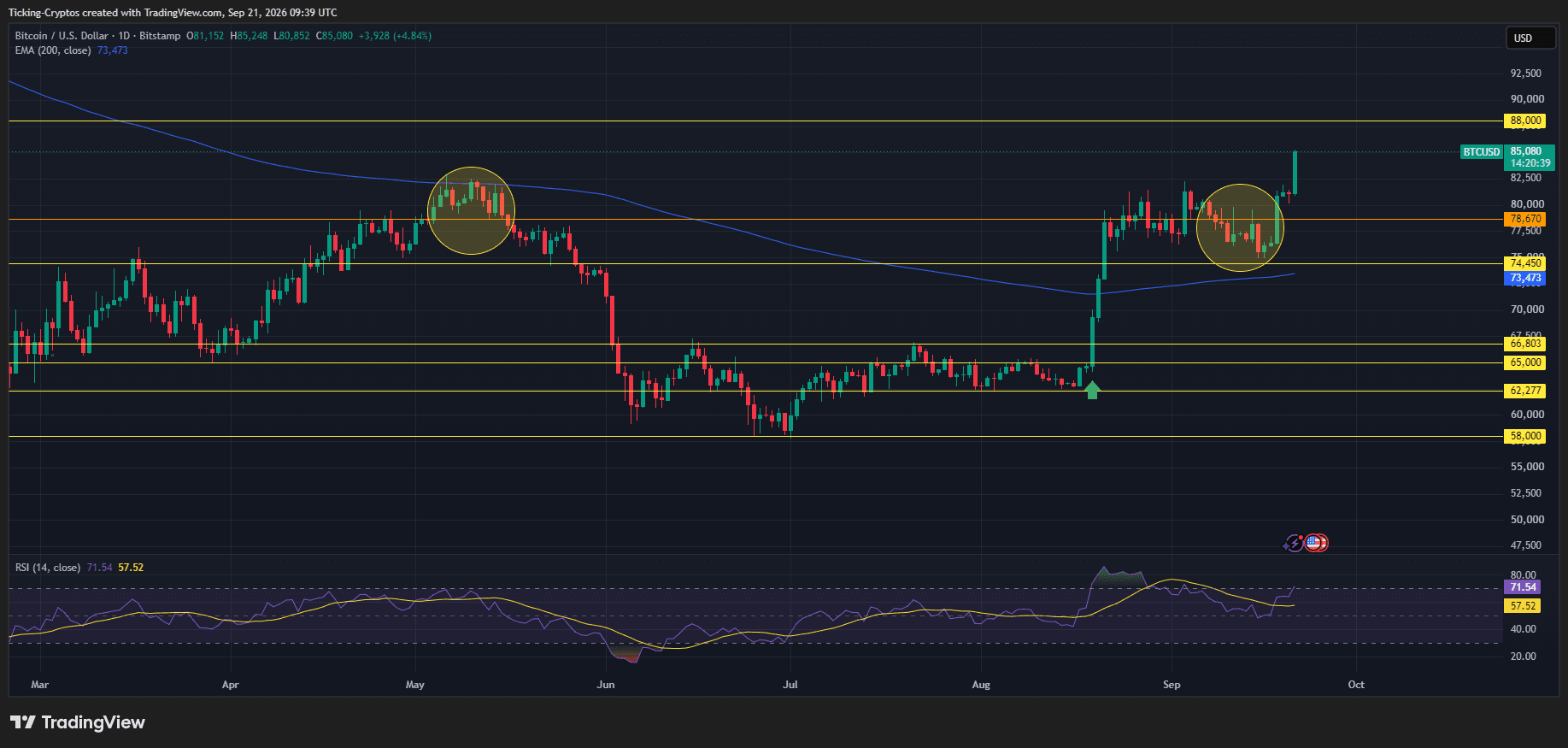
Bitcoin Price Prediction: What Is The Next Level For Bitcoin?
$85,000. Glassnode pegs that as the ETF cost basis, the average entry price of spot ETF buyers, and it is the last major overhead level before the market opens up. Analysts had flagged $84,100 and $85,000 as the key weekly obstacles, with sustained acceptance above $85,000 pointing toward $88,000 to $90,000. On the downside, losing $77,500 would undo the breakout.
If you hold ZETA, the short answer is that in most cases you do not have to do anything yourself. One thing is still worth settling over the next few days, namely whether the exchange where your ZETA sits will take part in the swap at all. On September 20, 2026, ZETA holders voted with 99.4 percent approval to move the token 1:1 to Solana as an SPL token and to shut down the project's own blockchain afterwards. There is still no date for it.
This article sets out what the decision means for investors in Germany: what Proposal 68 actually allows, what role your exchange plays in it, what happens to staked balances and to ZETA on Ethereum and BNB Chain, how a swap like this can look for tax purposes, and which three steps make sense now. The basis is the project's announcement of September 17, 2026 and the voting result, which we pulled straight from the governance interface of the ZetaChain blockchain on September 21, 2026 at 06:37 UTC and recalculated ourselves.
What did the ZETA community decide in Proposal 68?
In a blockchain such as ZetaChain, a proposal is a governance motion: a request that all token holders vote on with their balance and that applies to the entire network once it is accepted. Proposal 68 carries the title "Migrate ZETA to Solana" and closed on September 20, 2026 at 14:58:18 UTC. Its status has read PROPOSAL_STATUS_PASSED ever since, so the motion is accepted.
The count, which we recalculated ourselves, was clear-cut: around 263.65 million ZETA voted yes, roughly 744,658 ZETA voted no, and a further 752,300 ZETA abstained. That puts the yes share at 99.4 percent of all votes cast. This was nothing like a narrow result, and that is precisely why the direction is now set.
A word on the mechanics of this vote: ZetaChain is built as a Cosmos EVM chain and uses the governance module of that toolkit. Motions are filed directly on the blockchain, voting weight follows the balance held, and a quorum sets the minimum participation required. We therefore did not take the result from a news report but queried the chain's own governance endpoint and recalculated the count.
What has been decided is the direction, not the schedule. The text of the motion says so explicitly: acceptance confirms "the direction and proposed approach", and a second motion is to supply the specific mechanism and the dates of the migration afterwards. For you that means the move is coming and the dates come later. Still open are the migration mechanism, any cut-off block for balances, known in the jargon as the snapshot height, and the timetable.
In substance, the decision provides for ZETA to exist as a native SPL token in future. An SPL token is a token built to the token standard of the Solana blockchain, comparable to what ERC-20 is on Ethereum. The ticker stays ZETA, the swap runs at a ratio of 1:1, the total supply remains unchanged, and no new tokens are created in the process. ZetaChain's own layer 1, meaning the project's standalone blockchain, is to be wound down once the balances have moved.
Do ZETA holders have to do anything now?
The project puts it this way in its announcement: "Most holders should not need to do anything." That reassurance comes with one clearly named exception, and it concerns the very place where most German investors keep their coins: the exchange.
According to the announcement, what stays unchanged is the ticker and the 1:1 swap ratio, the total supply with no new tokens, the vesting schedules with their original dates, and your balance including locked and staked positions. ZETA on Ethereum and BNB Chain is likewise untouched. Vesting refers to the staggered release of tokens to the team, investors or early backers over time; the fact that these dates stand means for the market that the move triggers no additional wave of selling.
What will change is the blockchain ZETA runs on, the token standard, the validators and the ecosystem around it: Solana's infrastructure instead of a validator set of its own, and the trading venues, wallets and payment rails there instead of the project's own environment. For you as a holder this is above all a technical switch, as long as your balance really does travel with it.
The sentence that matters comes a little further down in the same announcement: "Exchange conversions depend on each exchange confirming the swap." And the list of participating venues is to be published before anything moves at all. That is exactly where your only real task over the coming weeks comes from.

How to check whether your exchange supports the ZETA swap
The sequence is always the same with token conversions: the exchange announces the swap, halts deposits and withdrawals of the affected token for a few hours or days, rebooks the balances, and reopens trading afterwards. Anyone sitting at a venue that does not take part has a limited window in which to react. How tight such windows can become is something we traced most recently in the swap from STG into ZRO and in the one-way street from ICX to SODA.
In practice that means three things. First, check the status page or the announcements section of your exchange to see whether ZETA appears there. Second, if nothing is stated there, ask support in writing whether the exchange supports the swap, and keep the reply. Third, if no confirmation comes, you have two routes, namely selling before the switch or withdrawing to a wallet of your own that supports Solana. Either is a decision with consequences, and you should take it calmly while no date is on the table.
A word on choosing a venue: if you are thinking about a change anyway, it is worth looking at our comparison of the best crypto exchanges, which sets fees, deposit routes and licensing status side by side.
ZETA on Ethereum and BNB Chain: what the decision does not change there
This is the point where English-language coverage becomes imprecise, so here is the wording of the primary source: ZETA on Ethereum and BSC appears in the announcement under the heading "What stays", and there it says in as many words that the proposal does not touch these balances. So the decision does not exclude them from the swap; it simply does not deal with them.
For you that is an important distinction. Anyone holding ZETA as an ERC-20 token in an Ethereum wallet is not directly affected by the shutdown of the ZetaChain layer 1. What happens to those balances in the medium term is one of the points the announced second motion will have to settle. Until then the rule is: no panic, but no assumption that this sorts itself out either.
So check first where your ZETA technically sits. A look at the block explorer of the chain in question, or at the network display in your wallet, will show you whether you hold native ZETA on the ZetaChain blockchain, an ERC-20 token on Ethereum or a BEP-20 token on BNB Chain. That answer decides which part of the decision applies to you.
What happens to staked ZETA and to the validators?
Staking means locking up tokens in support of network security, for which holders receive an ongoing reward. At ZetaChain this staking continues for the time being: until the layer 1 is shut down, the validators will keep validating as before according to the project, and staking works unchanged.
What is open, by contrast, is what becomes of staking on Solana. The project writes that the question of how staking, and in particular the transition of staking rewards to Solana, is to be solved is "under active exploration"; the formal motion is to set the mechanism. Anyone with larger amounts staked today should keep an eye on this, because a gap can open up between the end of the old rewards and the start of a new model.
Important for your own bookkeeping: staking rewards are treated differently in Germany from the sale of a coin. As a rule such rewards count as other income at the point at which they are received. So keep a running note of the date, amount and price of the rewards received, regardless of how the migration is ultimately designed.
Why there is no bridge route to the SPL token
A bridge connects two blockchains by locking the original token on the source chain and issuing a wrapped copy on the target chain. That route is ruled out here, and the reasoning in the announcement is technically compelling: a wrapped token needs the original, locked on a chain that will no longer exist in future.
It follows that the SPL token on Solana is meant to end up as the only ZETA still in existence, and that the formal motion will have to define how the balances transfer. For investors that is rather good news, because bridge constructions are among the most vulnerable components in the crypto market. A native token on an established chain saves that attack surface.

When will the ZETA migration come? What is known about the date
The primary source is terse on the question of timing: "There is no date yet." The schedule, it says, depends on the exchanges confirming the swap, and the formal motion is to carry the dates.
Anyone who gives you a specific migration date today has made it up. What you can watch instead are two solid signals: the announced list of participating exchanges, and the second governance motion with the mechanism and the dates. Both will run through the project's official channels, and both come before the switch itself.
A look at comparable cases helps to place the time frame. With the shutdown of the Harmony mainnet, weeks passed between announcement and execution, and exchanges followed one after another. That is not a fixed rule, but it does suggest that haste in the first few days is rarely necessary.
What the price jump since the vote says about the risk
The market acknowledged the decision emphatically. On September 21, 2026 at around 06:37 UTC, ZETA was quoted between 0.057 and 0.058 euros depending on the source: 0.0573 euros on CoinGecko, 0.0578 euros in the ZETA-EUR pair at Bitvavo and 0.0582 euros at Kraken. CoinGecko showed a gain of around 70 percent within 24 hours and a market capitalisation of some 92 million euros, while the daily range at Kraken ran from 0.0332 to 0.0705 euros.
Swings like this are a risk warning and not a buy recommendation. A price doubling within a single day shows above all how thin the order book of a token of this size is. Buying into a move like that means paying for the expectation that the move will go through smoothly; selling means giving up the possibility that the larger market on Solana brings the token lasting usage.
To place the target network, it is worth looking at its own constitution: Solana processes transactions in around 400 milliseconds at fees in the region of a tenth of a cent, according to the project, and it is precisely this cost structure that ZetaChain cites as the reason for the switch.
Part of the background to the move is the product ZetaChain brings with it: Anuma, a private AI application with, according to the project, more than 300,000 users since February 2026 and over a million requests across 35 models. Anuma sits on top of the project's Private Memory Layer, an encrypted memory layer that several AI models can access without any one provider receiving the full history. It is exactly this application layer that is to be opened up on Solana to further AI apps and agents. ZETA serves there as an access token that users lock in order to receive credit for AI usage. Whether that usage holds up is the real bet behind the switch to Solana's application layer.
Tax in Germany: is a 1:1 swap a disposal under Section 23 EStG?
For private investors in Germany the rule is this: gains from the sale of crypto assets are tax-free under Section 23 of the German Income Tax Act if more than a year lies between acquisition and disposal. Within that holding period, an exemption threshold of 1,000 euros has applied since the 2024 assessment period, covering all private disposal transactions of a year taken together. If it is exceeded, the entire gain is taxable, not just the part above it.
Swapping one coin for another generally has the same tax effect as a sale followed by a fresh purchase. Why that is so and what consequences it has for the holding period is something we have explained in detail in our article on why a coin swap can have the tax effect of a sale.
That does not, however, answer whether a chain migration at a ratio of 1:1 falls under the same provision. The authoritative circular of the German Federal Ministry of Finance of March 6, 2025, which replaced the version of May 10, 2022, covers acquisition, disposal, swaps, staking and record-keeping duties, but does not expressly govern the case of a chain change with an identical token. In practice two readings stand opposed: one sees no disposal in the mere switch of technical standard, because economically the same asset continues to exist in an unchanged quantity. The other treats every change of token as a swap with a new holding period.
As long as that question is open, what protects you above all is clean documentation. For every holding, record when you acquired it and at what price, how large the amount was on the day of the switch, which route it was switched through, and what notice your exchange sent about it. A tax tool or portfolio tracker takes that chronology off your hands, and with larger holdings the assessment belongs in the hands of a tax adviser. This assessment is no substitute for tax advice.
Where ZETA can be traded in Germany and what MiCA has to do with it
ZETA is regularly tradable in euros for German investors. We asked the trading venues directly on September 21, 2026 at 06:33 UTC: Bitvavo lists the ZETA-EUR pair with the status "trading", Kraken lists the pairs ZETA/EUR and ZETA/USD. Both houses operate under the European crypto regulation MiCA, Bitvavo with an authorisation from the Dutch supervisor AFM dating from June 2025, Kraken with an authorisation via the Irish central bank.
MiCA stands for "Markets in Crypto-Assets" and is the EU regulation that has set uniform rules for trading platforms, custodians and issuers since the end of 2024. A MiCA authorisation is not a seal of quality for an individual token and no protection against price losses. The status means that the provider has to comply with requirements on own funds, custody of client money and complaint procedures, and that a European supervisor is responsible.
For the upcoming swap that means two things. An authorised exchange is obliged to inform customers about material changes, which increases the chance that you receive an announcement in good time. An obligation to follow every token migration technically does not follow from it. Each venue takes that decision for itself, which is why asking support remains the quickest route to certainty.
Custody: how to prepare a Solana wallet without falling for phishing
If you want to hold your ZETA yourself, you need a wallet that supports Solana. With a hardware wallet the private key sits on a device with no internet connection, and every transaction has to be confirmed there physically. Which models suit which purpose is shown by the comparison further down in step two.
Token migrations are a favourite occasion for fraudsters, because they supply a plausible excuse for haste. The pattern is always similar: an email or a post on social media announces a "migration portal", demands the recovery phrase or a signature, and then empties the wallet. Remember the counter-rule: for a 1:1 swap carried out by the exchange and the protocol, you never have to enter your recovery phrase, and a swap that demands an upfront payment from you is not one.
Two further habits help. Get information on the state of the migration exclusively through the official channels of the project and of your exchange, rather than following links from search ads or direct messages. And before the first transfer to a new address, check with a small test amount that the route works, before the whole holding goes.
ZETA migration: what you take away from it
- Establish where your ZETA sits, and ask your exchange. Native ZETA on the ZetaChain blockchain is affected by the shutdown; balances on Ethereum and BNB Chain are not touched by the decision. If your venue's status page says nothing about the swap, ask support in writing. Anyone planning to change venue anyway will find fees and licences in the exchange comparison.
- Prepare your own custody before a date is set. Setting up a Solana-capable wallet and testing it with a small amount costs half an hour and takes the time pressure off you should your exchange not take part in the swap. Which devices are up to it is shown by the hardware wallet comparison.
- Document your holdings and acquisition data now, not later. Amount, acquisition date, acquisition price and your exchange's notice about the swap belong in a file, so that the holding period remains traceable later on. A portfolio tracker with a tax function does that on an ongoing basis.
(As of September 21, 2026. This article is not investment advice. Prices and fee structures change; check the terms with the provider before you buy.)
Crypto Airdrops in Week 39: The Deadlines Running Now
This week holds one date that is final, and it is four days away. Anyone holding Beldex or Humanity at the crypto exchange Kraken was credited the respective replacement token automatically by airdrop. It can only be withdrawn until September 25, 2026 at 14:00 UTC. After that the exchange liquidates the remainder itself, and it states in its own notice that the proceeds may come to little or nothing.
A second closing date falls into this week as well, one that was missing from this list until now and is harder than any exchange deadline. Sonic burns roughly 32.69 million unclaimed S tokens from Season 1 and Season 2 on October 15, 2026. The tokens are destroyed on chain rather than merely withheld, and in such a way that afterwards any address at all can trigger the burn. Anyone sitting on an old Sonic allocation has a good three weeks left.
This overview lists the airdrops for which a claim window is open this week or a date is fixed. Every figure comes from the source linked at that point, retrieved on September 21, 2026. Where a project has published no end date, that is said explicitly; estimated deadlines have no place here. Last week’s status is in our piece on the week 38 airdrops.
The Deadlines at a Glance
| Project | Status | Date / Deadline |
|---|---|---|
| Beldex and Humanity (at Kraken) | Airdrop credited, withdrawal required | until September 25, 2026, 14:00 UTC |
| Sonic (S), Seasons 1 and 2 | Claim open, burn afterwards | until October 15, 2026 |
| Grass (Stage 2) | Claim open | until January 22, 2027 |
| GRVT | Tranches keep running | 30 days per tranche; date of the next unlock not published |
| Plume (Season 2) and dappOS (DOS) | Claim open | no end date published |
1. Beldex and Humanity at Kraken: Four Days Until the Airdrop Expires
This entry is the most urgent on the list and at the same time the most unusual, because nobody had to claim anything here. Both projects were attacked in June 2026, both rolled out a new token contract in response and distributed the replacement one for one to holders as of the snapshot. Kraken handled the distribution for its customers and credited it automatically. An airdrop that nobody had to claim can expire all the same.
The key data differ by project, which is why there are two separate notices. For Humanity the snapshot was taken on June 8, 2026 at 17:25 UTC, set by the project team itself; the new $HUMANITY was credited on July 1, 2026 at 14:00 UTC. For Beldex the snapshot was taken on June 10, 2026, and the new $BELDEX was credited on July 10, 2026 at 14:00 UTC. Anyone who bought the respective token only after the snapshot has no entitlement according to the exchange; for Beldex it explicitly names neither an application portal nor any other route.
Kraken lists four affected tickers rather than two: the old $H and $BDX and the new $HUMANITY and $BELDEX. Trading and deposits are switched off permanently, and only withdrawals are still supported. Withdrawals close on September 25, 2026 at 14:00 UTC. Whatever is still in the account after that goes into a liquidation phase running from September 28 to October 2, 2026. The exchange writes itself that the proceeds could fall well below the reference prices last seen and, depending on liquidity, may be minimal or zero.
Anyone who held both tokens has two separate jobs to do. The details are in the exchange’s notices on Humanity (H) and on the Beldex migration. We wrote up the background to the Humanity case in more detail in our piece on the Kraken deadline for $H.
2. Sonic (S): 32.69 Million Tokens Will Be Burned on October 15
This is the new addition of the week, and it belongs here because it has something that is rare in this field: a hard end date, published for months, with a clear consequence. Sonic Labs announced on April 2, 2026 that all unclaimed airdrop shares from Season 1 and Season 2 would be released for burning after October 15, 2026. According to the project, around 32,690,000 S are affected.
The mechanism is remarkable and it is the reason why no renegotiation is possible here: once the deadline has passed, the contract allows any address at all to trigger the burn. No decision by the team is needed any more, and no announcement of a date. The date is October 15, and after that it can happen at any time. Anyone hoping for a quiet extension of the kind common at many claim portals is hoping for something the contract does not provide for.
Important for context: since April 18, 2026 the claim has been possible without a penalty, before that it came with a reduction. Anyone who waited out of fear of the penalty has been waiting for no reason for months. The claim runs through the project’s portal at my.soniclabs.com/airdrop, and for positions held as fNFTs additionally through the marketplace set up for that purpose. The announcement with all the details is in the Sonic Labs blog.
A word on expectations: the fact that so many tokens are still unclaimed after a year and a half is the rule rather than an oversight by users. A substantial share of every allocation is never collected, because the wallet was forgotten, the amount was small or the announcement went unnoticed. If you were active on Sonic in 2024 or 2025, the look into the portal is due now, in September rather than in October.
3. Grass (Stage 2): The Only Window With a Clean Closing Date
Grass has been distributing its Stage 2 rewards since July 22, 2026 and has given the claim a six-month window: until January 22, 2027. Whatever has not been claimed by then expires according to the project and stays with it. That makes Grass the counterpart to the three entries further down, with an end date that stood there from the start.
Eligible are wallets that contributed bandwidth between October 14, 2024 and June 8, 2026 (epochs 1 to 19) and linked a Solana wallet as part of Stage 2. The allocation is visible after signing in to the dashboard; a separate application is not required. Two of the six months have now passed, leaving four.
The only legitimate place to check and claim is the dashboard at app.grass.io. The project points out explicitly that it never contacts anyone of its own accord and never asks for a seed phrase or a private key. Those are exactly the patterns at work around every larger airdrop.
4. GRVT: 30 Days per Tranche, and the Calendar Sits Only in Your Account
The derivatives exchange GRVT held its token generation event on July 30, 2026 and is distributing 280 million GRVT in total. The distribution runs in tranches over twelve months, and each unlocked tranche carries a claim window of 30 days. Once it expires, the tranche is permanently lost according to the project, and it does not roll into the next one.
This is the most awkward entry on the list, because there is no published unlock schedule. When the help page was retrieved again this week, it still carried no date for the next tranche. For allocation and timing the project refers exclusively to the reward portal of your own account. The calendar is therefore individual, and there is no public place where you could look it up.
There is also a distinction that is easily missed: only the first tranche due is paid out automatically, and only for registrations made before July 17, 2026. Anyone who signed up later has to claim every tranche themselves according to the wording of the help page, within 30 days in each case. Practical advice: take one look at the reward portal, enter the end date given there in your calendar, with a reminder a few days ahead.
5. Plume and dappOS: Open, but Without a Published End
Two entries carry over unchanged from previous weeks, and both share the same problem. At Plume (Season 2) the points programme ended on March 31, 2026 and registration ran until May 27, 2026; anyone who missed it is excluded, and that cannot be made up. The claim has been running through the official portal since the end of May, and Plume has at no point named an end date. Secondary reports circulate a period of roughly three months that would have run out at the end of August. That figure does not come from the project, and we carry it here only because it circulates, explicitly not as a deadline.
At dappOS, phase 2 has been running since August 11, 2026, in which eligible wallets can claim transferable DOS. Here too the project has published no end for any of the phases so far. The only correct route is the claim portal on the project domain.
The conclusion is the same for both and it matters more than any assessment of token value: a claim without a published end date is not a claim with unlimited time. It is one whose closure does not have to be announced. Anyone eligible should claim instead of waiting.
Not Included, and Why
This section is the more important part of the research. The following candidates were checked this week and deliberately left out:
- LAPTOP (Hunter Biden’s memecoin) at Bitvavo: the deadline cannot be evidenced at the source. For customers with losses of more than 1,000 euros in the TRUMP token, a registration deadline of October 10, 2026, 23:59 CEST is circulating. We cannot get it confirmed: the project page names only a claim window of “30 days” without a calendar date, the project’s claim portal shows neither start nor end, and the exchange’s own pages could not be read when retrieved on September 21, 2026 (HTTP 403). Thirty days from a date that has not been published do not add up to an end date, and we do not calculate one here. Two things should be said anyway, in case you see an invitation in your account: under its own terms the campaign is a promotional reward programme and explicitly not compensation, reimbursement or redress for TRUMP losses, and a memecoin stays a memecoin even when it is distributed through a regulated exchange.
- Fireplace: a wind-down, not an airdrop. September 30, 2026 is a real and important deadline, but it is the cut-off by which users of the discontinued Polymarket trading terminal have to withdraw their balances and migrate open positions. A platform wind-down is not a token distribution.
- XDAO ($DAO): deadline passed, never confirmed at the source. The snapshot cut-off circulating for September 20, 2026 at 14:00 UTC appeared exclusively on aggregator sites; the project page and the documentation mentioned neither a snapshot nor a TGE. The date has now passed and a TGE date is still unpublished. Last week’s decision to leave it out was right and stands.
- Meteora (MET): from last year. Unchanged: the widely shared announcement of “September 10” dates from September 10, 2025, and the TGE took place on October 23, 2025.
- AVANT: TGE without a date. The token generation event was last targeted “for September”, and the claim is meant to open “around the TGE”. A period is not a date.
- Arcium (ARX): open, but without a deadline. The retroactive token grants continue in rolling waves, without any point by which the claim has to be made.
- Canopy (CNPY), RISEx, mint.io (MNTD), Ink (INK), OpenSea (SEA): points programmes or TGE without a date. At OpenSea the launch originally expected for the end of March 2026 has been postponed without a replacement date being named.
- ARC (Circle): a mainnet launch is no airdrop. The public launch on September 16, 2026 carries neither a TGE date nor a confirmed community allocation.
- Exchange dates with no airdrop link. Trading closures and delisting deadlines are real, yet they remain something other than airdrops, with the exception of the Kraken case above, where the token to be withdrawn itself comes from a distribution.
On top of that comes the standing rule of this format: projects listed as “live” on aggregator sites but naming neither a snapshot nor a claim window at the project source do not get in. “Airdrop confirmed, date open” is no deadline.
What to Watch Out for With Every Claim
Airdrops are the preferred hunting ground for wallet drainers, and the patterns repeat:
- Check the year first. For several weeks running this column carried a prominently traded “current” airdrop that in truth dated from the previous year, and an expired claim is the perfect template for a cloned scam page.
- Always open the claim page through the official project domain, never through links in direct messages, comments or search ads.
- No serious airdrop asks for your seed phrase or your private key.
- Check which permission you are granting before you sign. An unlimited token approval is never needed for a claim.
- Weigh the network fee against the value of the allocation. With very small amounts the claim can cost more than it brings in.
- Put every deadline in your calendar, and with staggered distributions such as GRVT’s, every single tranche rather than only the first.
- And the point that carries this week too: a published end date is the only thing that makes the closure of a claim predictable. Without one, that closure never has to be announced at all.
And Afterwards? The Token Sits in the Wallet
The question that comes after every successful claim is a practical one: what do you do with an allocation that is not listed on any large exchange? Most freshly distributed tokens are low-cap assets with a thin order book, and that is exactly where the gap between looking and acting is widest. Tools such as Dexscreener or TradingView show you prices and liquidity, but you cannot execute anything there. An app like FOMO Family takes the other route: meme and low-cap tokens can be discovered, swiped through and traded directly in the app, with fast deposits. Download the app through the link and secure yourself ten percent off trading fees. The necessary warning belongs right next to it: trading meme and low-cap tokens is highly risky, volatility is extreme, and a total loss is possible at any time. Do not put anything in here whose loss would hurt you.
If you want to read into the subject instead of just working through deadlines: how airdrops work, who is typically eligible and how dubious campaigns can be recognised is covered in our guide to crypto airdrops.
Think About Tax Straight Away
An airdrop is not a tax-free gift by definition. Whether the allocation has to be treated as other income under section 22 number 3 of the German Income Tax Act depends above all on whether you provided something in return, which is also how the still authoritative circular of the German Federal Ministry of Finance of March 6, 2025 draws the line. Two cases from this week show why that is more than theory. In the Kraken case the inflow of the replacement token in July and the later withdrawal or sale have to be kept apart, and a forced liquidation by the exchange is a transaction you have to document even though you did not trigger it. In the Sonic case the question runs the other way: a burn of unclaimed tokens is neither a sale nor a loss you could claim.
So secure the time, amount, market value, price source, transaction hash and the terms of participation right at the moment of the claim. Experience shows the terms are the first thing to disappear when a campaign page is switched off. Which details count individually is set out in our guide “Receiving airdrops: save this data immediately”. That unsold tokens can trigger a tax liability as well is explained under “Unsold airdrops: tax liability even without a sale”.
Conclusion
Week 39 carries two tasks and three observation posts. The first task is September 25, 14:00 UTC: anyone who held Beldex or Humanity at Kraken has had the replacement token in the account for a long time and four days to withdraw it, twice over where both tokens are affected. After that the exchange decides on the liquidation, and it says itself that the proceeds may come to little or nothing.
The second task is October 15 and it concerns considerably more people than are aware of it: 32.69 million unclaimed Sonic tokens will be released for burning after that date, triggerable by anyone. This is no portal you can still reach later if it comes to it. A look into the Sonic portal costs five minutes and is the most worthwhile action of the week if you were active there in 2024 or 2025.
The remaining entries are for observation: Grass with the only clean closing date on January 22, 2027, GRVT with a 30-day window per tranche whose calendar sits only in your own account, plus Plume and dappOS with open windows and no published end.
The methodological finding of the week sits in the section above. The most prominent new deadline of this week, the LAPTOP campaign through a large European exchange, did not make the list because the date could not be evidenced at any project or exchange source. A date that appears only in reports about the date is no documented date. And the necessary sobering note stands: most allocations move in the double to low triple digits, and the fee for claiming eats a noticeable part of that. The effort pays off above all where you are already eligible anyway.
Disclosure: some of the providers named in this article work with us through partner programmes. This has no influence on the editorial assessment.
(As of September 21, 2026. This article is not investment advice. Prices and fee structures change; check the terms with the provider before you buy.)
Decrypt
The Bitcoin treasury firm’s holdings bottomed at 840,447 BTC in August. They have since climbed 5,553 BTC, to within 0.2% of the high.
A short squeeze started the move, but spot buyers have sustained it, and one measure of selling pressure is near a record low.
France is the worst-hit country in the world for these attacks, with more than 70 logged in the first eight months of 2026.
After banks lost their push for tighter stablecoin rules in the failed Clarity Act, JP Morgan scored a narrower win as Visa moves to stop meme coin purchases from being coded as ordinary "digital media" and earning card rewards.
A Glassnode and Bybit report frames the divergence as the defining feature of this cycle, with froth pooling in the market's riskiest corners even as Bitcoin does the heavy lifting.
U.Today - IT, AI and Fintech Daily News for You Today
Ledger CTO Charles Guillemet has warned crypto holders to update their iPhones after highlighting DarkSword.
October set to be significant for XRP community with two events ahead.
Ripple has entered a major partnership with Absa Corporate and Investment Banking (CIB) to launch Absa Digital Asset Custody in Africa.
XRP breaks its downtrend to hit $1.48 as big buyers snap up $2.2 billion in tokens.
Shiba Inu crossed critical resistance level that used to dictate the price dynamic for the last 2 months.
Blockonomi
Key Highlights
- SpaceX shares advanced approximately 1% during Monday’s premarket session following a significant Nasdaq-100 index rebalancing.
- The company’s index representation jumped to 2.82% from approximately 1.28%.
- According to TipRanks, this adjustment may generate between $15.5 billion and $22 billion in passive investment flows.
- NASA recently awarded SpaceX a $946 million contract extension for three additional astronaut transport missions.
- Market participants continue monitoring the company’s progress toward its upcoming Starship test flight.
SpaceX (SPCX) shares gained approximately 1% during Monday’s premarket session following the implementation of a significant Nasdaq-100 index rebalancing. The stock was changing hands near $153 following Friday’s closing price of $152.71.
Space Exploration Technologies Corp., SPCX
The primary driver behind this movement is SpaceX’s enhanced representation within the Nasdaq-100 index. According to Bloomberg’s reporting, the company’s index allocation has expanded to 2.82% from its previous level of approximately 1.28%.
This substantial increase means that index-tracking funds must significantly boost their SpaceX holdings to maintain proper alignment. TipRanks projects that this rebalancing could generate passive investment flows ranging from $15.5 billion to $22 billion.
SpaceX joined the index back in July, following its initial public offering. The company’s initial weighting was limited because Nasdaq calculates exposure partially based on free float, which represents the portion of shares accessible to public market participants.
Index Rebalancing Significantly Boosts SpaceX Representation
Additional SpaceX shares have entered public circulation after post-IPO lockup periods expired. This development has enabled the company’s index representation to align more accurately with its overall market capitalization.
The expansion from 1.28% to 2.82% represents more than a doubling of SpaceX’s Nasdaq-100 footprint. Monday marks the official implementation date for this revised weighting.
Index-tracking funds don’t make purchases based on fundamental analysis, earnings projections, or valuation metrics. Instead, they modify their positions to mirror adjustments made by their benchmark index.
This creates automatic buying pressure whenever a company’s index representation increases. The precise volume of shares purchased can fluctuate based on fund inflows, tracking methodologies, and the timing of portfolio manager rebalancing activities.
SpaceX shares have recently recovered above the $150 level where they opened during the IPO. However, they remain more than 10% below their early July trading levels, as reported by Barron’s.
Recent NASA Contract Extension Provides Additional Positive Catalyst
The index adjustment comes on the heels of a new $946 million NASA contract announced on September 18. The space agency added three additional SpaceX crewed transport missions to its Commercial Crew Transportation Capability agreement.
These missions—designated Crew-15, Crew-16, and Crew-17—have projected readiness dates spanning 2027 and 2028. This extension brings SpaceX’s total contract value under this program to $5.92 billion.
According to NASA, the agreement encompasses ground operations, launch services, orbital operations, spacecraft return and recovery, cargo delivery, and emergency evacuation capabilities. The contract extends through 2030.
Additionally, SpaceX secured another NASA contract last week for launching the StarBurst scientific satellite. This mission has a target launch date no earlier than 2028 utilizing a Falcon 9 rocket.
Market observers are also monitoring SpaceX’s forthcoming Starship test activities. The company’s operational milestones represent another near-term factor drawing investor attention beyond the Nasdaq-100 rebalancing.
For Monday’s trading session, the confirmed market driver is the index modification. SpaceX’s Nasdaq-100 representation now stands at 2.82%, representing more than double its earlier weighting of roughly 1.28%.
The post SpaceX (SPCX) Stock Gains Momentum Following Major Nasdaq-100 Index Rebalancing appeared first on Blockonomi.
Key Highlights
- Shares of Ciena surged approximately 6.5% to 7% during Monday’s premarket session following an upgrade from Evercore ISI to Outperform.
- The firm increased its price target significantly to $550 from $375, suggesting roughly 58% potential gains from Friday’s closing price of $348.80.
- Analysts anticipate Ciena will capitalize on growing optical networking requirements driven by AI data center expansion and high-speed connectivity needs.
- The company has outlined ambitious fiscal 2029 goals including approximately 30% annual revenue expansion, 50% adjusted gross margins, and 32% to 35% adjusted operating margins.
- Third-quarter fiscal results showed revenue hitting $1.67 billion, representing a 37% year-over-year increase, with adjusted earnings per share reaching $2.11.
Ciena (CIEN) shares experienced a notable surge of up to 6.5%, reaching $371.36 during Monday’s premarket hours after Evercore ISI elevated its rating on the networking equipment provider to Outperform from In Line. The stock had finished Friday’s session at $348.80, marking approximately 49% gains year-to-date through 2026.
Ciena Corporation, CIEN
Evercore’s analyst Amit Daryanani simultaneously lifted his price objective to $550 from the previous $375 level. This new target indicates potential upside of roughly 58% compared to Friday’s final trading price.
The rating enhancement focuses on Ciena’s strategic position within optical networking infrastructure supporting artificial intelligence deployment. Evercore contends that connectivity solutions linking and operating within data centers are emerging as critical bottlenecks as organizations scale up their AI capabilities.
The investment firm forecasts Ciena’s total addressable market will expand at approximately 24% per year, reaching $52 billion by the conclusion of fiscal 2029. Evercore further anticipates revenue growth exceeding 30% annually alongside earnings expansion surpassing 35% throughout this timeframe.
AI-Powered Networking Infrastructure Fuels Optimism
Evercore projects Ciena could achieve or surpass $25 in earnings per share by fiscal year 2029. The analyst highlighted cloud wavelength-division multiplexing technology, strengthening hyperscaler partnerships, and coherent pluggable solutions as primary growth catalysts.
This upgrade arrives on the heels of Ciena’s investor presentation held last week. Company leadership established an objective of roughly 30% compound annual revenue growth spanning fiscal 2026 through fiscal 2029.
Management also anticipates achieving an adjusted gross margin of approximately 50% by fiscal 2029. The projected adjusted operating margin falls between 32% and 35%, with free cash flow margins approaching 20%.
These ambitious projections have already influenced other Wall Street analysts. Morgan Stanley increased its price target to $450 from $425 while keeping its Equal Weight stance unchanged.
According to FactSet data referenced by Barron’s, Ciena currently holds an average Overweight rating among analysts with a consensus price target of $525.78. This average still sits below Evercore’s newly established $550 projection.
Robust Quarterly Performance Bolsters Bullish Case
Ciena’s latest quarterly financial results provide additional support for the increasingly bullish perspective. Third-quarter fiscal revenue totaled $1.67 billion, representing a 37% climb compared to the prior-year period.
Adjusted earnings per share registered at $2.11, marking a substantial 215% increase from the same quarter in the previous fiscal year. The company also elevated its full-year fiscal 2026 revenue guidance to approximately $6.42 billion.
This growth trajectory is underpinned by accelerating investments in AI-focused data center infrastructure and heightened demand for optical connectivity solutions. Company executives indicate that supply capacity is expanding, potentially enabling the firm to capture more demand moving forward.
Investors should carefully consider valuation levels and execution risks following the stock’s impressive performance. CIEN has already appreciated roughly 49% in 2026, and achieving the company’s fiscal 2029 objectives depends on persistent AI infrastructure investment, supply chain enhancements, and continued market share expansion.
Ciena remains vulnerable to fluctuations in customer capital expenditure patterns, supply chain disruptions, and intensifying competition within the networking equipment sector. Management acknowledges that its long-range targets represent forward-looking projections that may diverge from actual outcomes.
For Monday’s trading session, the primary catalyst driving momentum is Evercore’s upgrade paired with its $550 price objective. The critical question ahead is whether Ciena can successfully execute on the aggressive growth and profitability targets outlined for fiscal 2029.
The post Ciena (CIEN) Stock Surges 7% Following Evercore’s Bullish Upgrade on AI Infrastructure appeared first on Blockonomi.
Key Takeaways
- Shares of Greenland Energy climbed approximately 153% to roughly $3.04 during Monday’s premarket session.
- The spike came after President Trump unveiled a security pact between the United States, Denmark, and Greenland.
- The company maintains exploration rights in Greenland’s Jameson Land Basin with potential to secure up to 70% working interest.
- An all-stock merger proposal with 80 Mile PLC is currently under consideration.
- The price surge is largely speculative, as the security pact contains no direct financial support or commercial guarantees for Greenland Energy.
Greenland Energy (GLND) shares rocketed 153.3% higher during premarket trading on Monday, climbing to approximately $3.04. The stock had been hovering near its 52-week low of $1.09, far below its 52-week peak of $23.
Greenland Energy Company Common Stock, GLND
The dramatic price movement came after President Donald Trump revealed a security arrangement between the United States, Denmark, and Greenland. Other companies with Greenland connections also experienced upward momentum as traders responded to the news.
According to Trump, the agreement provides the United States with permanent authority to implement necessary measures for Greenland’s defense. Both Danish and Greenlandic officials have emphasized that the arrangement honors Greenland’s sovereignty and territorial integrity.
The pact is slated for signing at the upcoming United Nations General Assembly. Danish authorities have indicated the agreement will expand NATO’s involvement in Arctic regional security.
Arctic Exploration Assets Draw Renewed Attention
Greenland Energy’s primary exploration footprint lies within the Jameson Land Basin. The firm has outlined plans for two exploratory wells and stands to gain up to a 70% working stake in the venture.
The site has been linked to resource estimates suggesting up to 13 billion barrels of oil. However, these figures represent potential resources rather than verified commercial reserves.
The newly announced security framework has refocused market attention on Greenland’s natural resource wealth. Trump has indicated the pact prevents adversarial nations from building military installations or making certain strategic investments without American consent.
Both China and Russia factor prominently in Washington’s Arctic security calculations regarding Greenland. The complete text of the agreement has not been made public, leaving specific investment restriction details undefined.
Greenlandic and Danish officials have repeatedly clarified that no sovereignty transfer to the United States is occurring. Greenland continues to function as an autonomous territory within the Kingdom of Denmark.
Pending 80 Mile Transaction Adds Second Layer of Interest
Greenland Energy is also navigating an all-stock merger proposal with 80 Mile PLC. The deal was first disclosed in September and represents another development monitored by market participants.
A fresh dealing disclosure filed Monday under United Kingdom takeover regulations kept the proposed combination visible alongside the Greenland security headlines.
Broader market conditions were favorable Monday, with leading U.S. equity indices trending upward ahead of the opening bell. Multiple Greenland-associated firms registered heightened trading activity following Friday’s policy announcement.
Investors need to contextualize the magnitude of GLND’s movement. The security framework does not deliver direct federal funding to Greenland Energy, nor does it provide drilling authorizations, offtake agreements, or assurances that exploration properties will transition to producing assets.
The company remains in the exploration phase and continues to operate without profitability or positive cash flow. This reality makes its market value especially vulnerable to drilling outcomes, capital requirements, merger progress, and evolving sentiment regarding Greenland’s resource landscape.
The most recent confirmed policy development is that the United States, Denmark, and Greenland are moving toward formalizing the security agreement, while Greenland Energy’s drilling agenda and proposed 80 Mile combination represent distinct corporate matters.
The post Greenland Energy (GLND) Stock Rockets 153% on U.S.-Denmark Security Agreement appeared first on Blockonomi.
TLDR:
- Bitmine ETH holdings reached 5.98 million tokens, representing 4.9% of Ethereum’s total supply.
- Bitmine staked 5.07 million ETH, representing about 85% of its total Ethereum holdings.
- The company reported $17.1 billion in combined crypto, cash and investment assets.
- Bitmine purchased another 27,562 ETH as it moves closer to its 5% supply target.
Bitmine ETH holdings reached 5,983,940 tokens as of September 20, 2026, according to a company announcement. The NYSE-listed company, ticker BMNR, reported combined crypto, cash, and investment holdings of $17.1 billion.
Bitmine now controls 4.9% of the 122.1 million ETH supply. It bought 27,562 ETH last week and has purchased ETH weekly since June 30, 2025. The purchases bring the firm 98% of the way toward its 5% ETH supply target within 15 months.
Bitmine ETH Holdings and Staking Position
The company’s crypto holdings include 5,983,940 ETH valued at $2,688 per token, based on Coinbase pricing. Additionally, Bitmine holds 212 BTC, a $180 million stake in Beast Industries, and a $105 million stake in Eightco.
Eightco, listed on NASDAQ as ORBS, offers indirect exposure to OpenAI. Total cash and marketable securities stand at $714 million.
Bitmine has staked 5,067,309 ETH, worth $13.6 billion at the same price. That amount covers 85% of Bitmine ETH holdings. A portion of the stake runs on MAVAN, the Made in America VAlidator Network.
Institutional investors and custodians can also use the platform. According to Chairman Tom Lee, Bitmine has staked more ETH than any other entity.
Projected annualized staking revenue for Bitmine ETH holdings stands at $357 million. If all holdings were staked, projected annual rewards would reach $421 million. The $421 million estimate uses a 7-day annualized yield of 2.62%.
Bitmine ETH holdings remain the largest of any Ethereum treasury worldwide. Its total crypto holdings rank second among global treasuries, behind Strategy.
Furthermore, institutional backers include ARK’s Cathie Wood, MOZAYYX, Founders Fund, Bill Miller III, Pantera, Kraken, DCG, and Galaxy Digital.
Market Standing and Tom Lee’s Outlook
Bitmine was added to the Russell 1000 Large-cap index on June 26, 2026. Its Series A Preferred Stock trades on the NYSE under the symbol BMNP.
Meanwhile, BMNR averaged $1.2 billion in daily dollar volume over five days through September 18. That ranked the stock 100th among 5,704 US-listed stocks, per Fundstrat.
Lee said Bitmine believes a crypto bull market began in late June. He cited the rotation from AI back to crypto and stronger fundamentals around tokenization and AI.
He also pointed to the end of the four-year cycle. Management compares the GENIUS Act and SEC Project Crypto to the 1971 action that ended Bretton Woods.
Lee said ETH is the best-performing macro asset of the third quarter so far. ETH has outperformed the S&P 500 by 6,519 basis points. He described the gap as a possible prelude to a stronger move in the fourth quarter.
Lee expects institutions to raise their crypto exposure during the final three months of 2026. He said institutions have underweighted crypto this year, partly due to early AI stock outperformance. Separately, Lee will deliver a keynote at Korea Blockchain Week in Seoul on September 30.
The post Bitmine Adds 27,562 ETH as Total Holdings Reach 5.98 Million appeared first on Blockonomi.
TLDR:
- Strategy BTC holdings climbed to 846,000 after the company acquired another 950 BTC.
- Strategy also repurchased $174 million worth of its STRC preferred stock.
- The company reported $5.10 billion in USD Reserve and $1.30 billion in USD Cash.
- Strive acquired 1,355 BTC for $107.7 million, lifting its holdings to 26,355 BTC.
Strategy BTC holdings rose to 846,000 after the company announced it acquired 950 additional coins. The company also repurchased $174 million worth of STRC preferred stock.
As of September 20, Strategy held approximately $6.09 billion in USD assets alongside its bitcoin. The update follows a week in which the company made no bitcoin purchases or sales.
Separately, Strive reported that it bought 1,355 BTC. Both updates came through recent company disclosures and public statements.
Strategy BTC Position and Preferred Stock Buyback
Strategy previously disclosed holdings of 845,050 BTC. Those coins were acquired at an average price of $75,412 each. The total acquisition cost came to approximately $63.73 billion, including fees and expenses. With the latest purchase, Strategy BTC holdings moved from 845,050 BTC to 846,000 BTC.
Earlier, during a market downturn, unrealized losses on the company’s bitcoin holdings exceeded $10 billion. Strategy Inc., based in Tysons Corner, Virginia, outlined its activity through September 13 in a Form 8-K filing.
The filing followed the company’s September 14 announcement. STRF, STRC, STRK, STRD, and MSTR shares all trade on the Nasdaq Global Select Market.
According to the filing, Strategy repurchased 1,420,467 shares of STRC stock between September 8 and September 13. STRC is the Variable Rate Series A Perpetual Stretch Preferred Stock.
Other series include the 10.00% Strife, 8.00% Strike, and 10.00% Stride preferred stocks. The aggregate purchase price was $139.3 million.
No other preferred securities or MSTR shares were repurchased. During the same period, Strategy did not sell any shares under its at-the-market program.
In addition, the latest Strategy BTC announcement separately cites a $174 million STRC repurchase. As of September 13, $1.05 billion in aggregate purchase price remained available under Strategy’s digital credit securities repurchase program.
A separate $1.0 billion in aggregate purchase price remained available for MSTR stock repurchases. The company said it used $139.3 million of USD Cash to fund STRC repurchases during that period.
USD Reserve and Strive’s Bitcoin Purchase
Strategy maintains a USD reserve to support dividends on its preferred stock and interest on its outstanding debt. It also holds USD cash for broader bitcoin treasury company purposes. Those purposes include acquiring bitcoin, expanding the reserve, and other capital management uses.
As of September 13, the USD Reserve was $5.10 billion, and USD Cash was $1.30 billion on the same date. Strategy reported these balances in its September 14 update on repurchases and bitcoin activity.
Separately, Strive CEO Matt Cole said the company acquired 1,355 BTC for $107.7 million. The average price was $79,475 per coin. According to Cole, the purchase brought Strive’s total holdings to 26,355 BTC.
Cole also said Strive began accepting warrant exercises last week. The company has received $21.2 million in gross proceeds so far. Including these funds, SATA accounts for 57.7% of its total capital raised, Cole said.
The post Strategy BTC Holdings Hits 846,000 as Company Buys 950 BTC appeared first on Blockonomi.
HTTP error 429 on https://cryptopotato.com/feed/
Failed to fetch feed: https://cryptopotato.com/feed/
Failed to fetch feed.