Cryptocurrency Posts
Crypto Briefing
The FAA's AI tool could revolutionize air traffic management, enhancing efficiency and reducing delays, but requires careful integration and scaling.
The post US FAA rolls out AI tool to help reduce flight delays appeared first on Crypto Briefing.
Geopolitical tensions in the Middle East are heightening market volatility, affecting investor confidence and potentially influencing oil prices.
The post Gulf markets dip amid Middle East tensions; Qatar index bucks trend appeared first on Crypto Briefing.
Vitality's rise signals a formidable challenge for rivals at the upcoming Major, highlighting their renewed cohesion and strategic prowess.
The post Team Vitality climbs to No. 2 in HLTV World Rankings after StarSeries win appeared first on Crypto Briefing.
Derive's V3 upgrade could revolutionize onchain options trading, enhancing scalability, security, and accessibility for diverse traders.
The post Derive unveils v3 upgrade to enhance onchain options trading appeared first on Crypto Briefing.
Agora's OCC approval highlights growing regulatory acceptance of stablecoin firms, potentially reshaping digital finance compliance standards.
The post Agora receives preliminary OCC approval to organize as a national trust bank appeared first on Crypto Briefing.
Bitcoin Magazine
Bitcoin Magazine
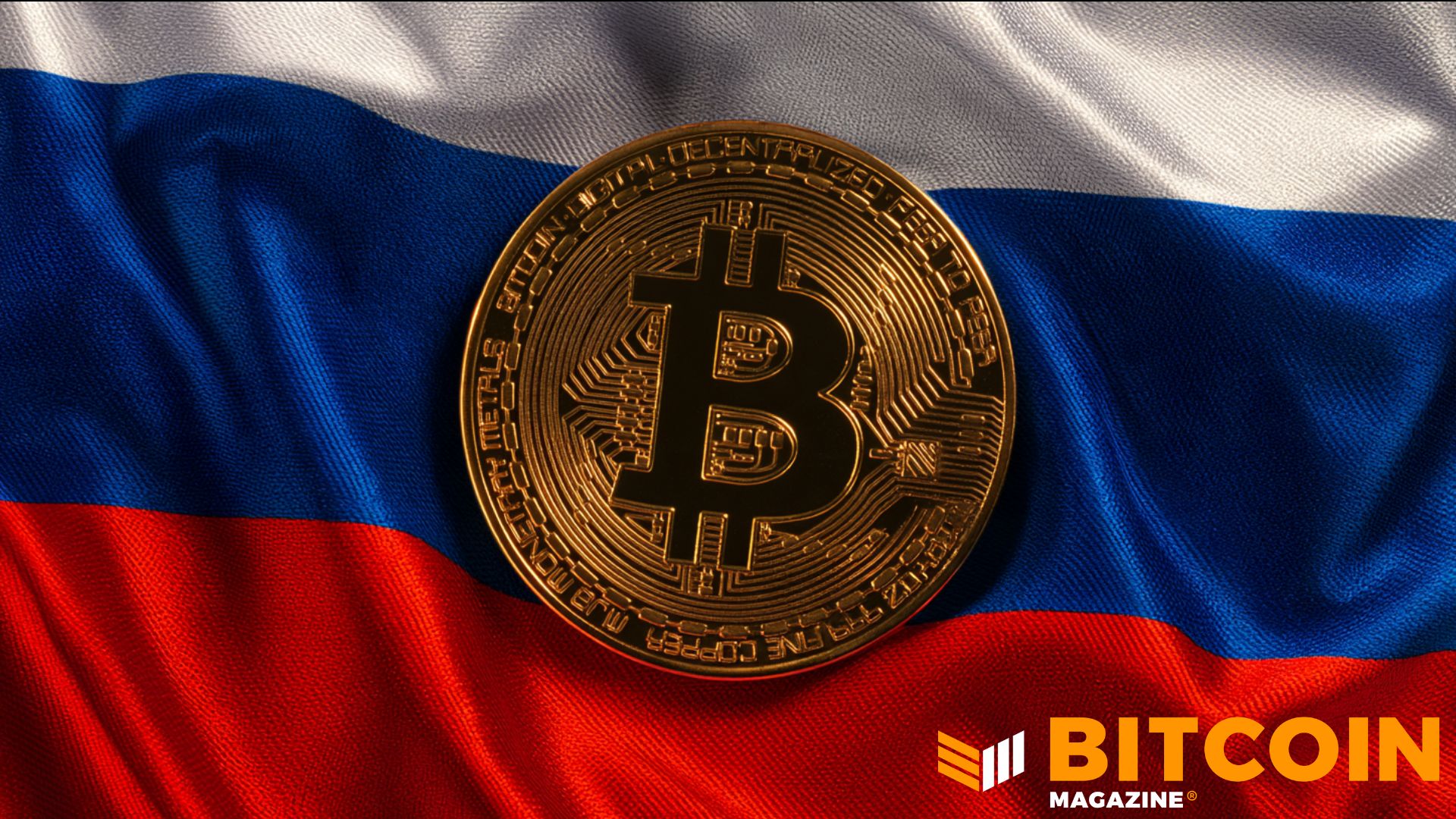
Russian Crypto Industry Could Be Operating Legally by Year-End: Central Bank
Russia’s crypto industry may have all it needs to start legally functioning by year-end, according to reports.
The deputy governor of the country’s central bank, Vladimir Chistyukhin, said that regulations were moving ahead as scheduled, Interfax reported on Monday.
Russia this year has pressed ahead with crypto legislation. President Vladimir Putin in August signed a law to set in stone the regulation of digital currencies and digital rights in the country — although using bitcoin for payments is still banned.
JUST IN:
— Bitcoin Magazine (@BitcoinMagazine) September 21, 2026The Russian Bitcoin and crypto industry may begin functioning within a legal framework before the end of this year, Central Bank Deputy Governor says. pic.twitter.com/Kp1ICUgDrg
“Right now we are talking about creating subordinate regulation; it is very large and significant,” Chistyukhin was quoted saying, adding that the “fine-tuning” of internal rules could be carried out before the end of 2026.
Russia’s central bank has approved Bitcoin trading for the public on the country’s crypto exchanges. Law currency states that unqualified investors can buy 300,000 rubles ($3,582) worth of bitcoin and other assets through one intermediary; qualified investors have no limits.
Sberbank, the biggest bank in Russia, plans to debut a Bitcoin and crypto wallet as well as digital asset custody by December. The bank in August said it expected trading volume with its new crypto rollout to hit 4 trillion rubles ($47 bln) in the first year.
Using digital assets as a means of payment or legal tender within Russia has been prohibited in Russia since 2022.
Despite Putin appearing to praise Bitcoin in the past, its use as a medium of exchange and currency has been banned for years.
Russian lawmakers have made an exception for international payments — but most likely as a way to dodge Western sanctions.
The U.S. and European governments cut Russia off from the SWIFT payments system after it invaded Ukraine in 2022 and Russian companies have been using Bitcoin to skirt around the penalties, according to the country’s finance minister.
This post Russian Crypto Industry Could Be Operating Legally by Year-End: Central Bank first appeared on Bitcoin Magazine and is written by Mathew Di Salvo.
Bitcoin Magazine

Bitcoin Price Shrugs Off Clarity Act Fail, Blasts Past $86,000
Long-awaited crypto legislation failed last week — but Bitcoin buyers don’t seem to care.
The price of the leading cryptocurrency shot up Monday by nearly 7% over a 24-hour period, six days after lawmakers blocked the Clarity Act.
Digital asset industry bigwigs have been calling for clear rules to be put in place to regulate the fast-moving space. But the key legislation aiming to do so in the form of the crypto market structure bill didn’t progress last week after Democrats mostly disagreed with the ethics side of the bill.
JUST IN: Bitcoin surges to $86,030
— Bitcoin Magazine (@BitcoinMagazine) September 21, 2026pic.twitter.com/3Z0RvIVvJ3
Bitcoin’s price has shrugged off the bill’s collapse, and recently stood at $86,225 after touching as high as $86,247 Monday morning in New York.
Over a 30-day period, the coin is up 10%. Bitcoin started a phenomenal run in August — its best in years — after the U.S. Treasury announced it would at least double the size of its liquidity-support buyback operations.
The asset’s price further benefited after U.S. President Donald Trump the same week hosted a meeting at the White House with crypto industry leaders and urged lawmakers to get what he called the “powerful” Clarity Act over the line.
Both Republicans and Democrats blocked the bill but Democrats had mostly been accused of trying to deliberately stall it by pro-crypto lawmakers for months.
The central sticking point for Democratic lawmakers was the conflict of interest posed by the Trump family’s crypto holdings. Beginning in the run-up to his return to office, the president and his sons launched a series of digital asset ventures, and Trump’s own financial disclosure reported roughly $1.4 billion in crypto-related income.
The White House says his assets sit in a trust managed by his children and that no conflict exists.
Democratic Senator Elizabeth Warren, of the crypto industry’s loudest critics, told congress ahead of the vote that the bill “posed a massive risk to families.”
Though despite the bill not advancing, the Securities and Exchange Commission and Commodity Futures Trading Commission are pushing ahead with rulemaking.
Bitcoin exchange-traded funds in the U.S. experienced positive net flows last week after having started the week with investors cashing out.
On Thursday and Friday, investors bought nearly $593 million in shares in the products managed by BlackRock, Fidelity, and Grayscale, according to Farside Investors data.
The Federal Reserve also last week raised interest rates — as expected — but the price of bitcoin hasn’t been affected by the central bank’s decision. Bitcoin has performed well in the past in a low interest rate environment.
This post Bitcoin Price Shrugs Off Clarity Act Fail, Blasts Past $86,000 first appeared on Bitcoin Magazine and is written by Mathew Di Salvo.
Bitcoin Magazine
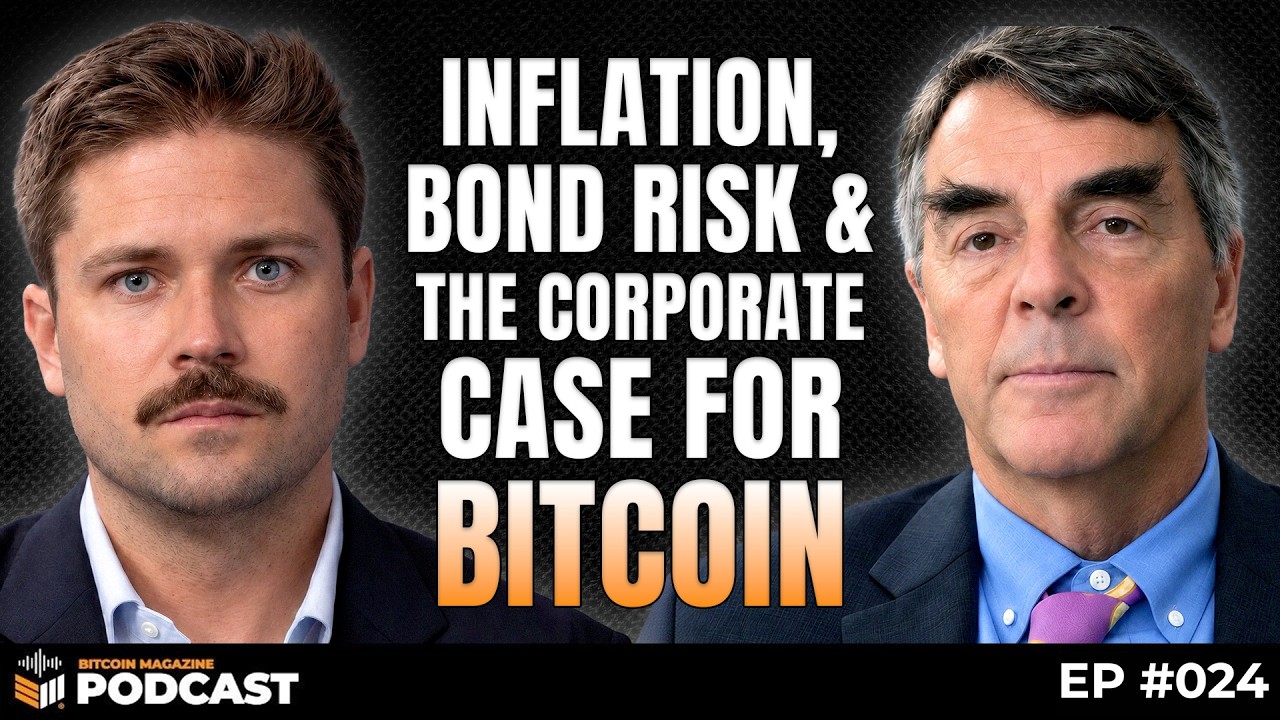
Billionaire Investor Tim Draper: “Irresponsible” for Apple & Meta NOT to Hold BTC
Government spending hasn’t slowed, and Tim Draper says that leaves only two real outcomes: hyperinflation or interest rates high enough to break banks. In this Bitcoin Magazine Podcast conversation with host Spencer Nichols, the Draper Associates founder makes the case that every business should hold at least four weeks of operating expenses in Bitcoin, every individual about six months, and every government a Bitcoin hedge. He explains why he considers boards that hold zero Bitcoin to be exposed — legally and financially — when a bank holding their cash goes under. Draper also maps his $250,000 Bitcoin price target to the next halving and the supply shock that follows.
 Host: Spencer Nichols — Bitcoin Magazine Tim Draper — Draper Associates
Chapters:
00:00 — Why Apple and Facebook Should Hold Bitcoin on the Balance Sheet
01:56 — Decentralization and the Speed of Innovation
04:06 — Is AI a Centralizing or Decentralizing Force?
06:31 — AI Versus Big Law, Big Banks, and the Bureaucracy
09:05 — Government Spending, Hyperinflation, and Bitcoin as a Safe Harbor
11:21 — The Confederate Million Dollar Bill and Three Paths for the Dollar
13:58 — Open Borders, Pandemic Fear, and the Marketplace of Governments
16:56 — Governance as a Service and Governments That Compete for You
20:00 — Voting on Phones, Estonia, and Bitcoin’s Road to Retail
23:28 — The $250K Target, Two More Halvings, and an All-Bitcoin Fund
DISCLAIMER: The views and opinions expressed in this show are those of the participants and do not necessarily reflect the official policy or position of BTC Inc., Bitcoin Magazine, or any affiliated entities. This content is provided for informational and educational purposes only and should not be construed as investment, legal, tax, or accounting advice. Nothing contained in this show constitutes a solicitation, recommendation, endorsement, or offer to buy or sell any securities or financial instruments. Viewers should consult their own advisors before making financial or business decisions.
This post Billionaire Investor Tim Draper: “Irresponsible” for Apple & Meta NOT to Hold BTC first appeared on Bitcoin Magazine and is written by Patrick Green.
Bitcoin Magazine
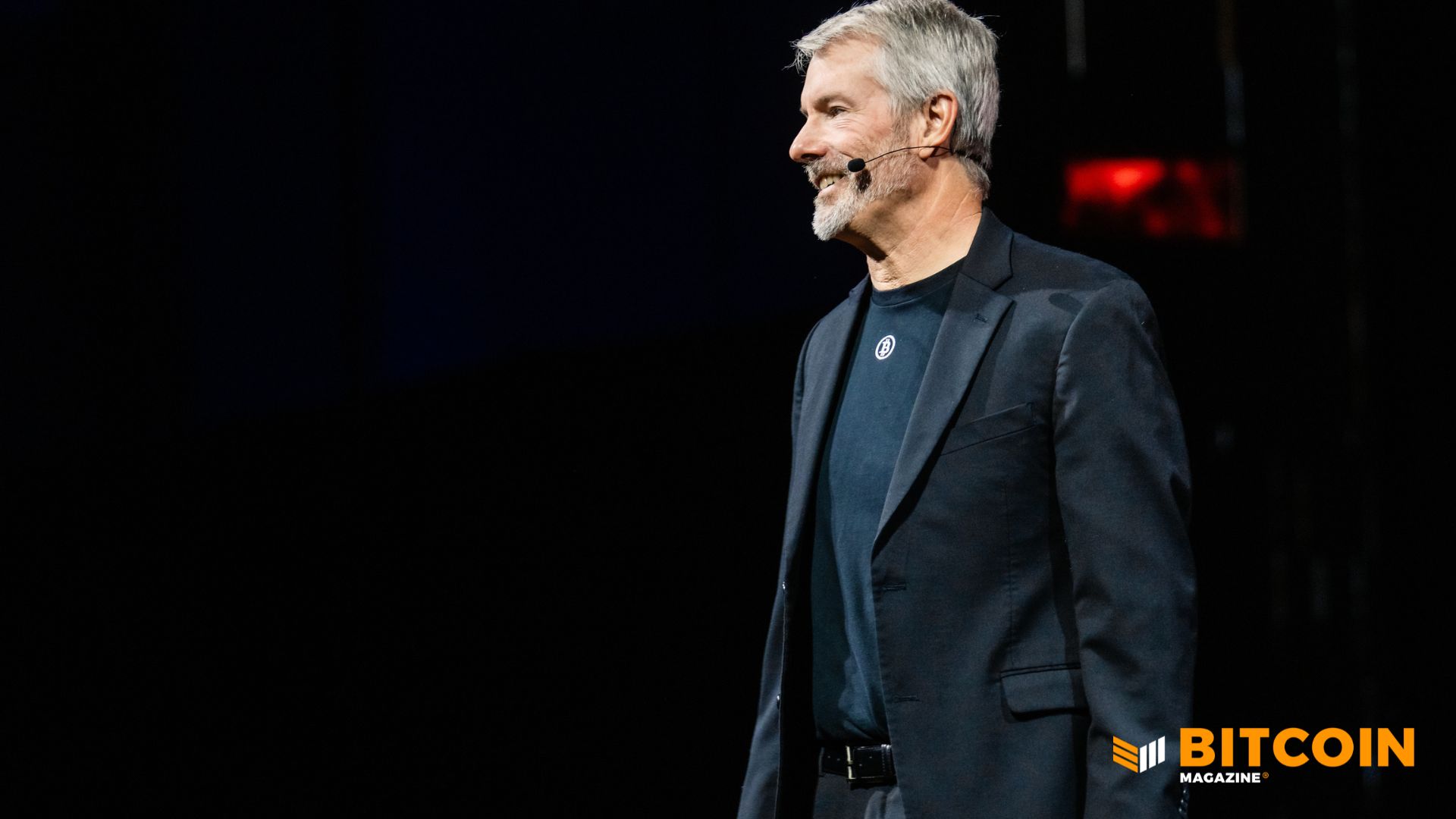
Strategy Founder Michael Saylor Argues Clarity Act Collapse Is a Win
Bitcoin treasury founder and pioneer Michael Saylor has said that the blockage of the Clarity Act is actually good for the digital asset space.
Writing on X on Saturday, the Strategy founder and chair said that legislation can make restrictions permanent just as easily as rights.
Lawmakers this week blocked long-awaited crypto legislation, the Clarity Act, which aims to formally divide oversight between regulators. The digital asset industry had long called for such rules to be in place.
Despite the hurdle, regulators like the Securities and Exchange Commission and the Commodity Futures Trading Commission are pushing ahead with rulemaking.
“We have an administration willing to modernize financial markets. We should use the next two years to put better financial products into people’s hands,” Saylor wrote.
He continued: “Let the Digital Assets industry innovate rapidly in a free market and create the greatest possible value for the U.S. and global economy.”
Saylor, whose company Strategy started buying bitcoin in 2020, argued that watchdogs going ahead to make rules anyway — like the SEC’s conditional relief for onchain trading of certain tokenized stocks and the CFTC Chairman stated willingness to act without the bill — would give crypto companies the regulation they need.
Saylor went on to argue that proposals in the act — such as limits on paying customers for holding payment stablecoins — wouldn’t benefit the crypto space anyway.
Senators on Tuesday mostly voted against advancing the legislation — 49 for and 50 against — that the digital asset industry has long called for.
The bill aims to formally divide oversight between regulators, distinguishing which digital assets are securities, commodities or stablecoins.
President Donald Trump last month urged lawmakers to pass it, helping spur a bitcoin rally. But Republicans warned for months that Democrats were deliberately holding it back.
Crypto industry bigwigs had long called for rules to be in place after regulators during the Biden Administration penalized companies in the digital asset space with fines for allegedly selling unregistered securities.
This post Strategy Founder Michael Saylor Argues Clarity Act Collapse Is a Win first appeared on Bitcoin Magazine and is written by Mathew Di Salvo.
Bitcoin Magazine
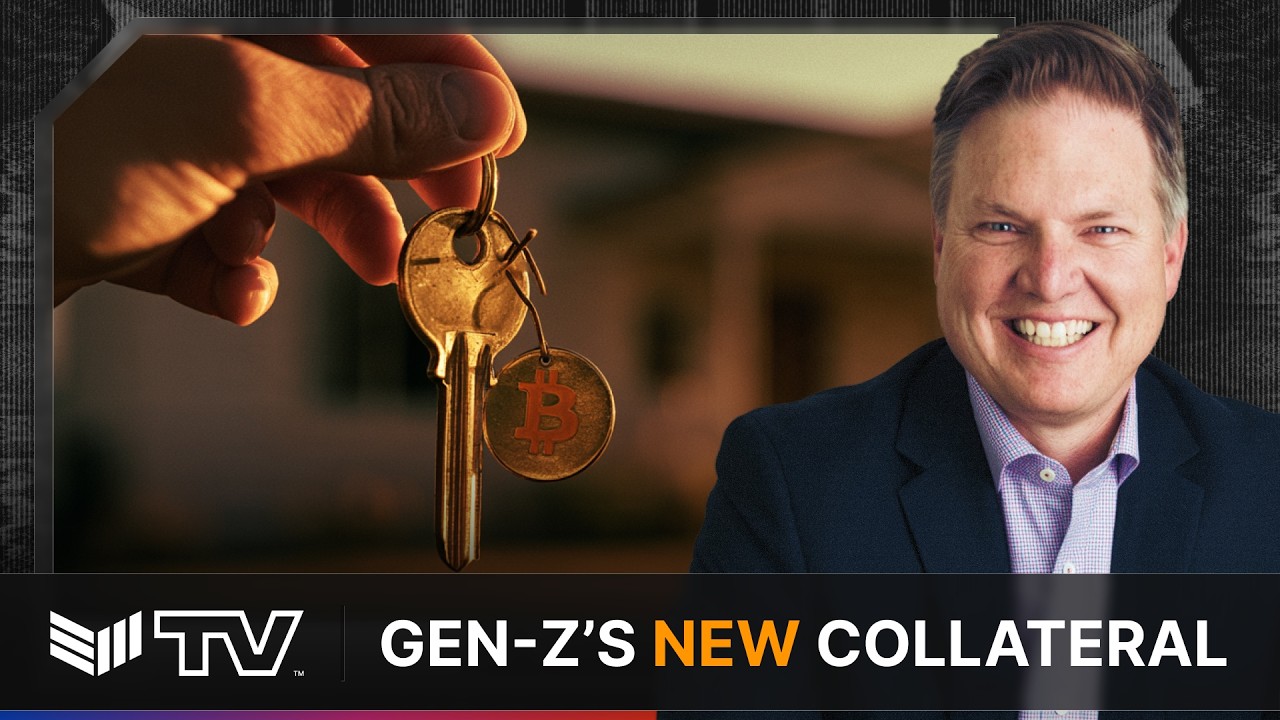
Move Over Housing – Bitcoin is Gen Z’s New Wealth Building Asset
Gen Z now makes up less than 5% of the new home market and Hunter Albright of SALT Lending thinks that changes what assets an entire generation chooses to build wealth with. In this conversation he connects housing affordability, Bitcoin as collateral, and the rise of borrowing against Bitcoin for down payments without locking your coins up for 30 years. Albright also covers Fannie Mae and Freddie Mac recognizing Bitcoin, SALT’s five-year loan terms, and what a Bitcoin-powered life actually looks like in practice.
DISCLAIMER: The views and opinions expressed in this show are those of the participants and do not necessarily reflect the official policy or position of BTC Inc., Bitcoin Magazine, or any affiliated entities. This content is provided for informational and educational purposes only and should not be construed as investment, legal, tax, or accounting advice. Nothing contained in this show constitutes a solicitation, recommendation, endorsement, or offer to buy or sell any securities or financial instruments. Viewers should consult their own advisors before making financial or business decisions.
This post Move Over Housing – Bitcoin is Gen Z’s New Wealth Building Asset first appeared on Bitcoin Magazine and is written by Patrick Green.
CryptoSlate
Ethereum developers are weighing Ethereum Quick Slots for Hegotá, a proposed faster block rhythm that would reduce waiting without expanding the network's per-second capacity. EIP-8198, or Quick Slots, remains Proposed for Inclusion rather than scheduled, and neither its eight-second draft parameter nor the 10-second alternative has been adopted.
That makes validator performance the deciding issue. Shorter slots could refresh onchain prices sooner and accelerate confirmations and finality, but validators would have less time to receive, check and attest to each block. The proposal's market benefits are modeled; its effect on the slowest operators remains the evidence Ethereum still needs.
The Hegotá meta-EIP lists Quick Slots as Proposed for Inclusion, while Ethereum's official roadmap says most of the upgrade's scope remains undecided. Developers are choosing whether to spend performance headroom on lower latency while preserving the broad participation that gives Ethereum its decentralization.
Ethereum Quick Slots: a faster clock with the same per-second capacity
The canonical EIP-8198 draft uses eight seconds as a placeholder, down from Ethereum's current 12-second slot. It also says the exact target should follow performance characterization and may change before deployment.
Ethlabs favors a more conservative first move. Its updated Hegotá position advocates 10-second slots first, with later cuts only as evidence of safety accumulates. An open sponsor rewrite likewise proposes 10 seconds, but it has not been merged into the canonical EIP.
The possible outcomes therefore extend beyond an eight- versus 10-second choice. Hegotá could start at 10 seconds, retain the draft's eight-second parameter, or leave the 12-second schedule unchanged if testing shows that a cut would be unsafe.
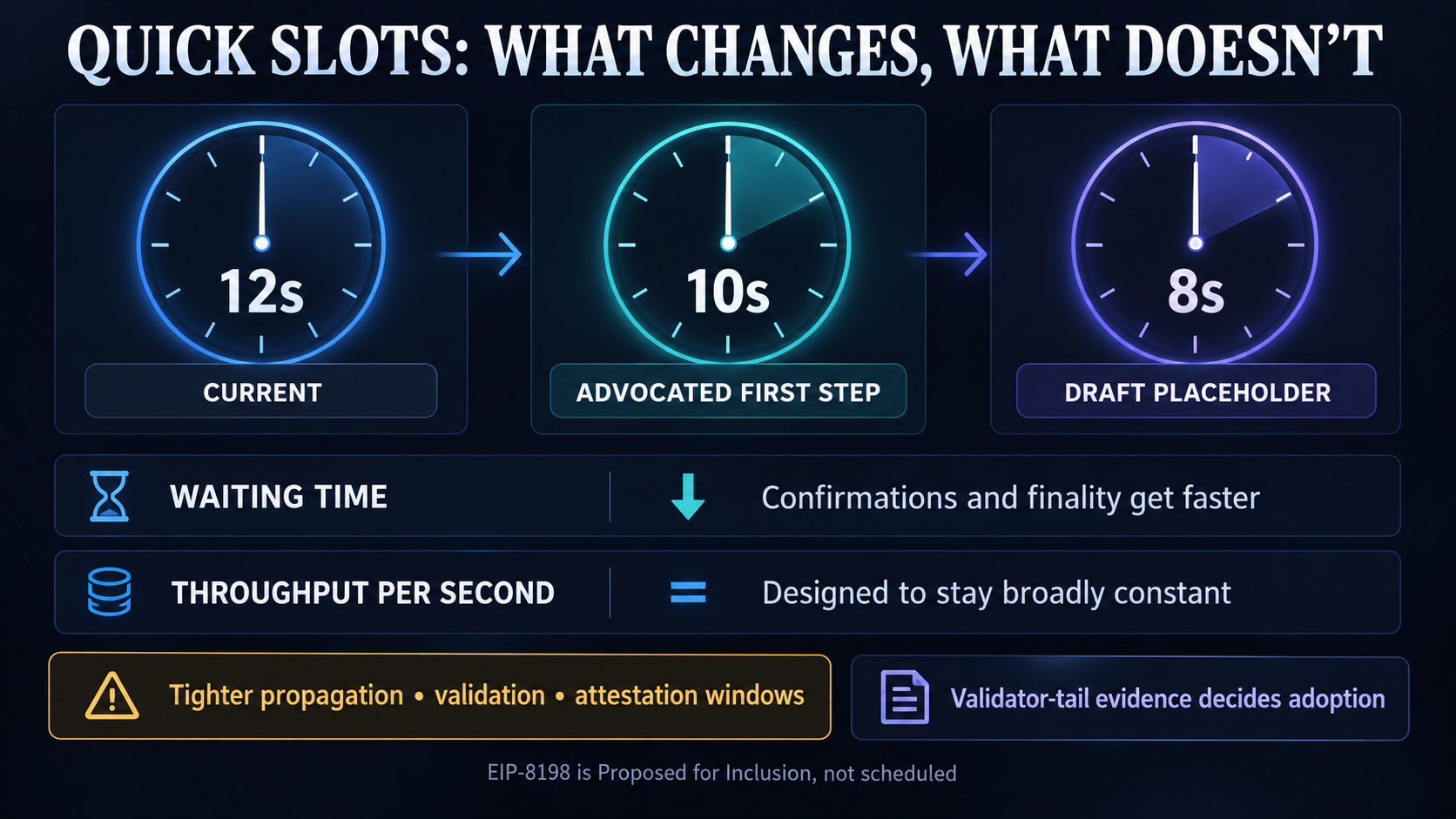
Under either shorter target, capacity per second stays broadly level only if the gas limit and maximum blob count per block fall in proportion to slot duration. Smaller blocks would arrive more frequently. Users could receive a first confirmation sooner, onchain markets could update more often, and systems that inherit Ethereum's cadence could react faster. Normal validator gas-limit voting would resume after the transition, and integer rounding could make blob capacity slightly lower rather than perfectly constant.
Keeping 32 slots in an epoch would also shorten epoch-based finality in wall-clock time. Under the draft's eight-second assumptions, EIP-8198 estimates finality falling from about 13 minutes to about 8.5 minutes. That is a proposal estimate, not an observed result from production Ethereum.
The same distinction applies to the draft's claim that a 12-to-eight-second change would reduce arbitrage losses by roughly 18%. The figure comes from a model in which those losses scale with the square root of the time between blocks. Ethereum has not operated an eight-second production regime that could demonstrate the result.
Independent work supports the direction more strongly than the exact magnitude. An empirical study of automated market maker losses found that faster blocks reduce losses to arbitrageurs, but the effect varied materially by trading pair. A newer jump-diffusion model found that sudden price jumps create a floor that shorter intervals do not eliminate.
Fresher prices could improve spreads and liquidity-provider economics while compressing some surplus available to searchers, builders and proposers. Yet fees, liquidity, volatility, jumps and burned base fees affect who captures the change. A separate Ethereum Research analysis shows why lower nominal arbitrage does not translate mechanically into a uniform 18% gain for users or liquidity providers.
Validator tails decide whether the trade works
Smaller blocks reduce peak payload size, but a faster cadence raises computational and bandwidth demands per second. Validators also face tighter absolute windows for propagation, validation and attestation aggregation. Average performance cannot settle the decentralization question because the network must remain usable for operators in slower regions, on weaker hardware and with varied client configurations.
An analysis of mainnet attestation timing found potential headroom for a shorter schedule alongside a meaningful tail. Some attestations in its sample arrived after the aggregation deadline contemplated for a six-second design, and timings differed across clients, operators and configurations. The study was exploratory and does not establish the safety of six, eight or 10 seconds.
Separate post-Pectra research found propagation delay strongly associated with reorg risk near the attestation boundary. Those observations support a distributional risk: reducing the timing margin could burden slower or poorly configured validators more than well-provisioned peers. They do not quantify validator reward losses under EIP-8198 or prove that either proposed target would centralize the network.
The proposal itself acknowledges incomplete knowledge about blob propagation, attestation aggregation, local block building and validator hardware. Developers have also linked Quick Slots to work on faster execution-payload broadcast, treating propagation improvements as part of the safety case rather than a later optimization.
The Ethereum Foundation Protocol cluster's Hegotá assessment placed Quick Slots in B tier after research teams offered stronger support than delivery-focused engineering teams. The practical requirements behind that split are clear: a complete specification, a full-spec prototype, a downstream-effects assessment and confirmation that Quick Slots will not complicate Ethereum's planned decoupled-consensus architecture.
Those requirements turn Hegotá's decision into an empirical test. A 10-second first step could deliver a measurable latency gain and defer a harder cut if client simulations and devnets show broad validator resilience. Eight seconds could remain the draft's ambition rather than the first deployment. If timing tails or reorg behavior worsen enough to favor larger operators, the market-quality benefit would carry a decentralization cost.
Ethereum Quick Slots could offer fresher markets, shorter transaction-inclusion waits and faster finality without increasing throughput. Broad validator resilience remains the condition that must be demonstrated before the faster clock is worth adopting.
The post Will proposed faster block times really fix Ethereum’s biggest market losses? appeared first on CryptoSlate.
Bitcoin treasury companies Strategy and Strive bought about $183 million of BTC last week as the cryptocurrency’s rebound helped corporate balance sheets recover losses.
Strategy Inc., the largest corporate holder of Bitcoin, acquired 950 BTC for $75.7 million between Sept. 14 and Sept. 20 at an average price of $79,670, according to a regulatory filing Monday. The purchase returned its holdings to 846,000 BTC, acquired for a total of $63.8 billion at an average cost of $75,416.
Strive Inc. separately bought 1,355 BTC for $107.7 million at an average price of $79,475 between Sept. 14 and Sept. 18, taking its treasury to 26,355 BTC. Cash and equivalents rose to $229.6 million over the same period.
Both purchases were made below Bitcoin’s latest market price. The token surged above $85,000 Monday, its highest level since January, extending a recovery of almost 30% from its August lows.
The buying stands out because the broader corporate treasury trade has slowed sharply. Listed companies added about 5,900 BTC over the past three months, Glassnode said in a report last week. That compares with roughly 89,000 BTC accumulated in July 2025 alone.
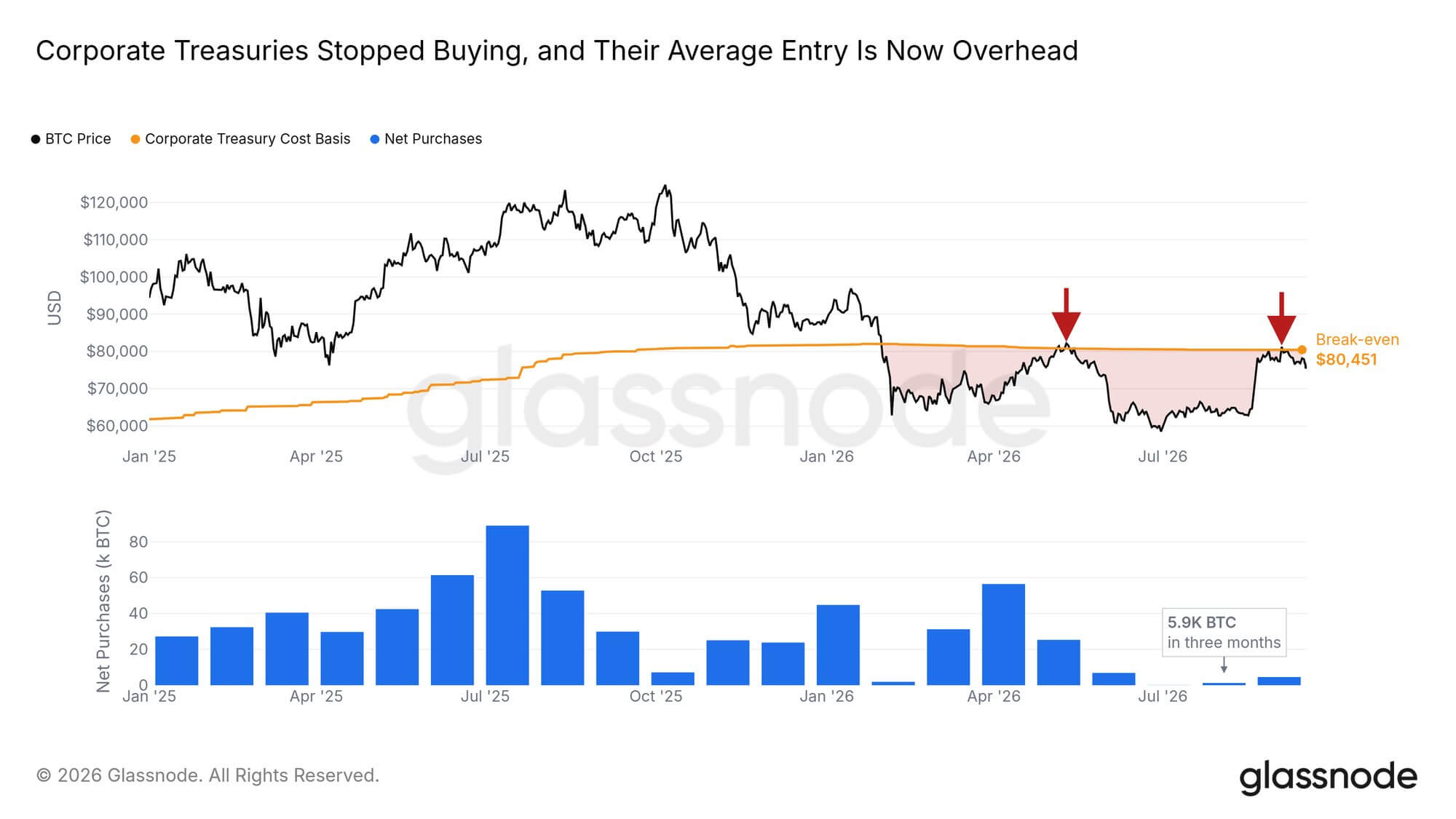
Glassnode estimated the sector’s average acquisition price at roughly $80,500. Bitcoin was still below that threshold when the firm published its report, leaving the aggregate corporate treasury cohort underwater. Monday’s move through $85,000 has reversed that position and pushed the group back above its estimated cost basis.
Strategy’s Bitcoin rebound collides with a capital-management pivot
For Strategy, the rally has particularly large accounting consequences.
Bitcoin ended the second quarter at $58,714, when Strategy held the same 846,000 BTC it does today. The decline contributed to an $8.32 billion loss on digital assets during the three months through June, including $8.31 billion of unrealized losses.
At $85,000, Strategy’s current Bitcoin holdings would be worth about $71.9 billion, roughly $8.1 billion above their aggregate acquisition cost. Their gross market value would also stand more than $22 billion above the value of 846,000 BTC at the June 30 closing price.
That comparison does not translate directly into Strategy’s eventual third-quarter accounting gain because the company bought and sold Bitcoin during the quarter and fair-value changes are recognized as they occur. Still, it illustrates the scale of the balance-sheet swing created by Bitcoin’s rebound.
Strategy has also been directing capital away from Bitcoin at times to manage the securities used to finance its treasury.
The company repurchased 1.77 million shares of its variable-rate STRC preferred stock for $174 million last week. It used another $57.4 million from its dollar reserve for preferred dividends and debt interest, leaving $5.04 billion in its reserve and $1.05 billion of separately designated cash as of Sept. 20.
Strategy has spent months trying to keep STRC near its $100 par value through buybacks and changes to its capital framework. Chief Executive Phong Le said in July that repurchasing the security below par can reduce future dividend obligations while supporting what the company considers a sustainable market for the preferred shares.
Since then, the firm has now spent roughly $1.1 billion on STRC buybacks.
The latest Bitcoin purchase therefore marks a return to accumulation alongside, rather than instead of, that balance-sheet management. Strategy had reported no Bitcoin purchases in the previous two weekly updates and held 845,050 BTC as recently as Sept. 13.
Strive leans on preferred stock to keep accumulating
Meanwhile, Strive has continued buying BTC more consistently while relying on its preferred stock.
Its latest purchase followed a 469-BTC acquisition the previous week and a 1,375-BTC purchase earlier in September, extending a strategy that has increasingly relied on its SATA preferred stock to raise capital.
Strive said warrant exercises also began generating fresh capital last week, producing about $21.2 million in gross proceeds. Including those funds, the company said SATA has accounted for about 57.7% of the total capital it has raised, reflecting how preferred equity has become central to financing its Bitcoin accumulation.
The latest filing showed SATA shares outstanding rose by 786,194 during the week to 11.18 million, while Strive’s Class A share count increased by about 2.07 million.
That financing model becomes easier to sustain when Bitcoin rises faster than the cost of the securities used to acquire it. Strive’s latest BTC was purchased almost $5,500 below Monday’s roughly $85,000 price, though its overall treasury remains closer to its historical acquisition cost than Strategy’s.
The broader question is whether other corporate buyers return now that Bitcoin has cleared the $80,500 sector cost basis.
Glassnode’s data suggest the treasury trade that absorbed tens of thousands of Bitcoin each month during 2025 has become increasingly concentrated among a smaller group of aggressive buyers. Strategy and Strive are adding again as prices recover, but matching last year’s corporate demand would require companies currently sitting on the sidelines to follow them.
The post Strategy and Strive buy $183 million in Bitcoin as $85,000 rally revives treasury trade appeared first on CryptoSlate.
The Balancer V1 recovery proposal would divide 296.401711 ETH returned after an Aug. 31 exploit among liquidity providers in 120 legacy pools, but it does not yet show what any address could claim.
The proposal says tokens worth about $1.39 million at attack-time prices were drained from the pools. It lists five ETH returns to the Balancer DAO Multisig between Sept. 8 and Sept. 16 from the main greyhat, three anonymous whitehats and block builder Ultrasound.money.
The 296.401711 ETH is the amount the proposal records as returned, not a promise of full reimbursement. The attack loss is expressed in dollars at historical prices while the recovery pool is denominated in ETH, and the proposal does not state a recovery percentage.
How Balancer would allocate the recovered ETH
Under the plan, Balancer would first allocate recovered ETH to each pool according to that pool’s share of the total dollar loss at the time of the attack. It would then divide each pool’s allocation among liquidity providers based on their pool-token holdings at Ethereum block 25,872,248.
That block immediately preceded the first exploit transaction at block 25,872,249. Using one pre-attack snapshot would cover all 120 pools, including those later targeted by copycat activity.
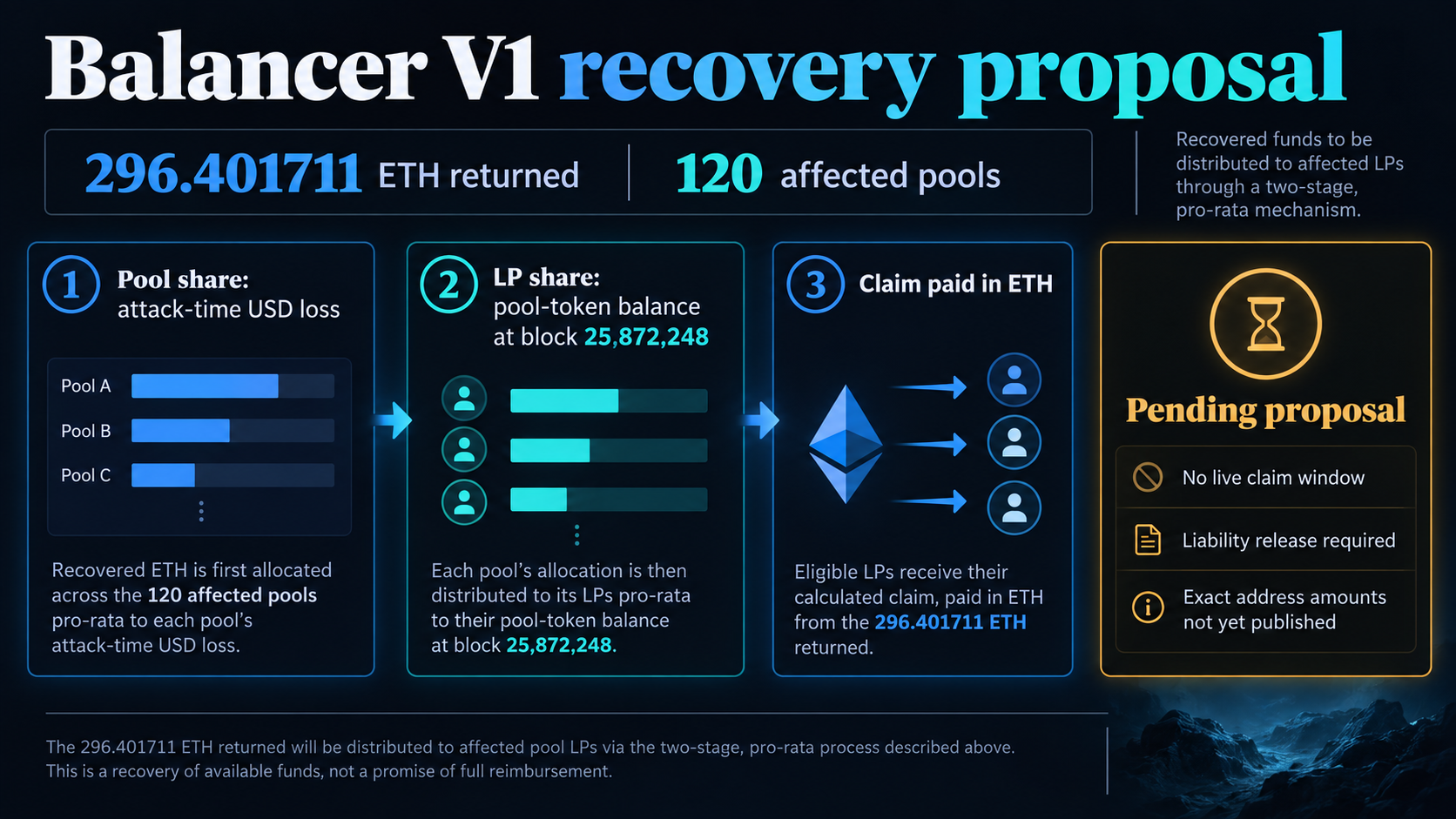
The formula determines the relative weighting of claims, but the Sept. 18 post does not include the per-pool allocation table, holder lists or per-address amounts. Until those files are published, an individual LP cannot calculate an exact ETH payout.
Claims await a vote and address-level data
Receiving the proposed payment would also carry a legal condition. Claimants would have to provide digital consent releasing Balancer Labs, Balancer DAO, Balancer Foundation, affiliated parties and service providers from liabilities related to the incident. Payments would be made in ETH, while contract and multisig claims would be handled case by case.
As of Sept. 20, the Sept. 18 forum post remained labeled BIP-XXX and contained no Snapshot vote link. It says claim data would be published and a claim mechanism deployed only if the proposal passes, leaving the V1 claim window unopened and without announced start or end dates.
The recovery pool is separate from the assets covered by Balancer’s proposed shutdown. Its wind-down proposal says funds recovered from protocol attacks belong to affected LPs and sit outside the treasury distribution intended for BAL holders, a distinction also noted in CryptoSlate’s earlier coverage.
That separation preserves recovered exploit funds for LPs, but the pending vote and unpublished allocation data mean the Balancer V1 recovery proposal defines a recovery route, not a confirmed payout.
The post Why Balancer’s $1.4M hack recovery won’t pay LPs anytime soon appeared first on CryptoSlate.
SEC Commissioner Hester Peirce drew a sharp line around decentralized finance on Sept. 17. She said investors need no exemption to use permissionless smart contracts for peer-to-peer trading. The SEC and CFTC actions examined here set separate limits on intermediary control.
The unresolved question is how much control a software provider can retain before it begins to resemble a regulated intermediary.
Peirce’s statement expressed her own position. A binding definition from the US Securities and Exchange Commission would require Commission action. The SEC’s tokenized-securities order and a separate staff statement leave her phrase “truly decentralized” undefined. Their specific provisions focus on custody, access, software parameters, fees, recommendations, routing and execution.
Each action operates under a different statute and carries a different legal effect. Together, they show how federal regulators are examining the authority that identifiable providers retain. A unified federal decentralization test remains absent.
The SEC traces control from the market to the frontend
The SEC’s Sept. 17 tokenized-securities order is an order of the Commission. It creates temporary, conditional relief for a defined Tokenized Securities Venue, or TSV, using automated market maker pools for permissioned trading in Tokenized NMS Stocks.
A TSV under the order performs two functions: It provides one or more AMM pools for permissioned participants, and it sets standards governing who may access those pools.
The order gives “provides” a functional meaning for that exemption. Selecting and designating a pool can count. Deploying its trading contract, changing its rules or parameters, setting its fees, or retaining authority to pause trading can also establish provision or control. Solely performing the administrative task of encoding a whitelist falls outside that definition.
Automation leaves several consequential choices in human hands. People may still choose the venue, set fees, pause activity or decide who gets in. Peirce placed the order outside decentralized finance and described genuinely permissionless software as a different model. The permissioned venue illustrates why operational powers matter even when smart contracts execute trades.
The interface creates another layer of control.
An April statement from the SEC’s Division of Trading and Markets describes when staff would refrain from objecting to certain crypto asset securities interface providers operating without broker-dealer registration under Section 15. Its legal effect is limited: The statement represents staff, has no legal force, creates no new obligations and will be considered withdrawn five years after April 13, 2026 absent intervening Commission action.
The covered interfaces help users prepare transactions through self-custodial wallets. The user holds the keys, chooses or customizes transaction parameters, signs the transaction and transmits the instructions. Multiple displayed execution routes must be filterable or sortable using objective factors. When an interface displays one route, users must be able to view alternatives when they exist. Software used to prepare instructions or display route information must operate on pre-disclosed, objective and independently verifiable parameters.
The staff position excludes functions that more closely resemble brokerage. It excludes a provider that solicits a specific crypto asset securities transaction, recommends an investment, holds or accesses user assets, executes or settles a transaction, or takes or routes an order.
How the provider is paid also matters. Staff says it would refrain from objecting when a user pays a flat fee or percentage transaction charge that is objectively determined, consistently applied and neutral among products, routes, venues and counterparties. Payments from another party based on the size, value or occurrence of a transaction fall outside the position.
These conditions make the frontend part of the regulatory analysis. Default settings, route rankings, preferred venues and fee incentives can steer users even when the user signs the final transaction from a self-custodial wallet.
The CFTC permits more promotion under a narrower registration position
The CFTC’s Sept. 17 announcement and Staff Letter 26-25 state a staff no-action position. The Market Participants Division said it would refrain from recommending enforcement against qualifying passive-software providers for failing to register as introducing brokers, or against relevant personnel for failing to register as associated persons.
The position applies when users transact on a designated contract market directly as members or indirectly through a futures commission merchant or introducing broker that is a DCM member. It is based on the presented facts, leaves Commission authority intact and may be changed, suspended or terminated by the Division.
Its covered activities allow more promotion and compensation than the SEC interface position. A provider may promote particular derivatives, direct users toward specific registered firms, charge users transaction-based fees and receive a share of a registrant’s revenue.
The provider must remain hands-off in several important respects. Users must be able to reach the registrant directly. The provider is barred from custody or control of customer property, explicit buy or sell signals, affirmative involvement in a particular order, and discretion over routing or execution.
The relief also depends on disclosures, marketing controls, written undertakings with registrants, recordkeeping and notices to the Division. These requirements preserve accountability while the software provider remains outside introducing-broker registration.
The main differences concern six forms of control.
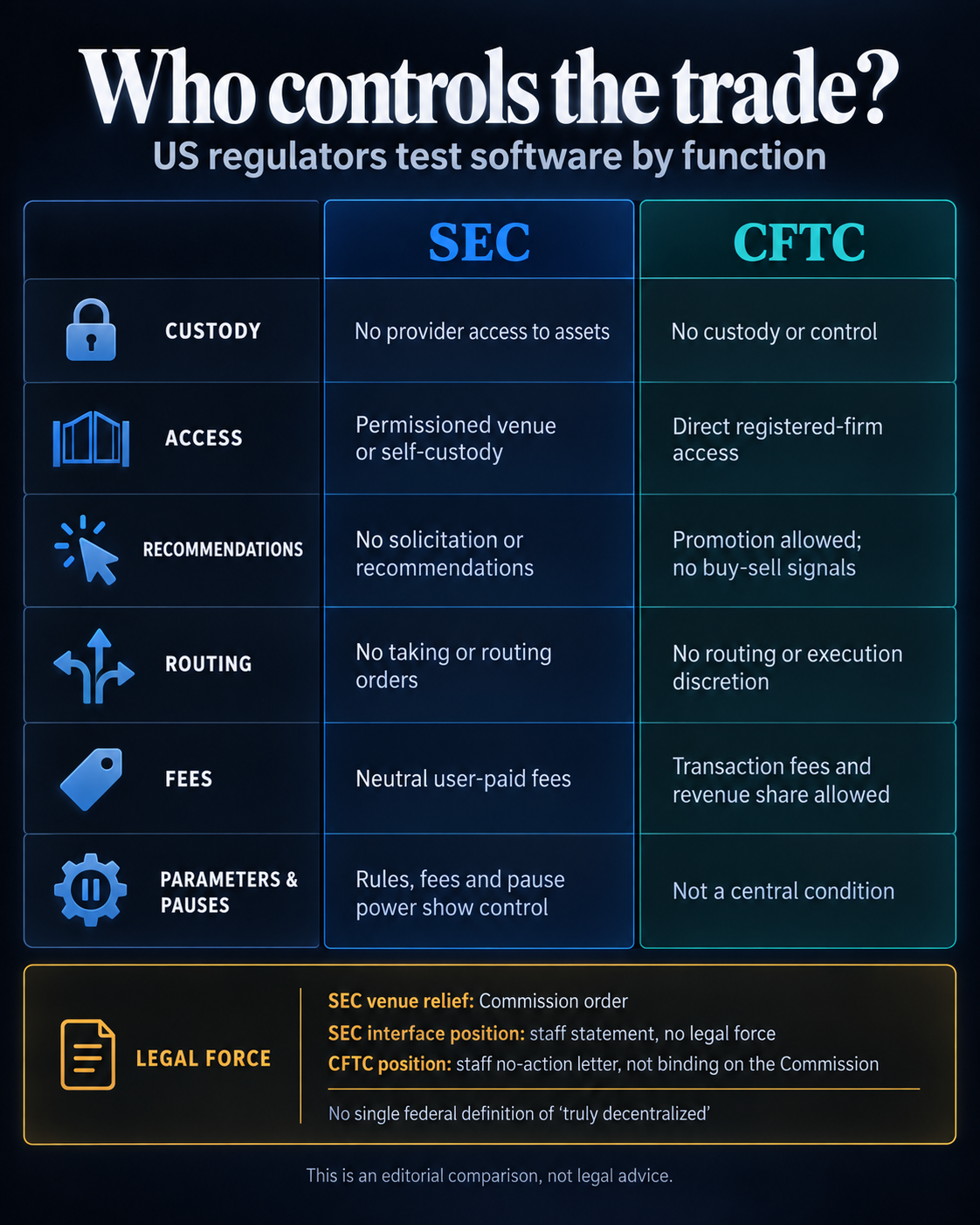
| Area of control | SEC order or staff position | CFTC staff position | Scope of the condition |
|---|---|---|---|
| Custody | The interface provider is barred from holding or accessing user assets | The provider is barred from custody or control of customer property | Each staff position requires separation from customer property |
| Access | A TSV sets participant standards; an interface discloses venue limits | Users trade on a DCM directly or through a member FCM or IB and retain direct access to the registrant | Each document specifies its own access structure |
| Recommendations | The interface position excludes specific-transaction solicitation and investment recommendations | Promotion may be allowed; explicit buy or sell signals are excluded | The staff positions draw different lines around steering |
| Routing | The interface provider is barred from taking or routing orders; displayed alternatives use objective parameters | User-directed transmission may occur; provider discretion over routing or execution is barred | The SEC position excludes order routing, while the CFTC position centers on discretion |
| Fees | User-paid charges must be objectively determined and neutral | Transaction fees and registrant revenue sharing may be allowed | Compensation is treated within each statutory setting |
| Parameters and pauses | Changing pool rules, parameters or fees, or pausing trading can mean a person provides the pool | The letter gives these powers no central role | The SEC factor belongs to the order’s specific venue exemption |
Every factor operates inside its source document’s narrow scope. The Commission order governs one securities-venue model. SEC staff states its Section 15 position for covered interfaces. CFTC staff offers conditional enforcement forbearance within the registered derivatives market.
Technical design matters alongside disclosures, access arrangements, marketing limits, recordkeeping and retained authority. The relevant mix changes across securities venues, crypto interfaces and derivatives software.
Who decides what counts as “truly decentralized”
Peirce supplies a principle: Removing the trusted intermediary weakens the regulatory rationale built around that intermediary. Her individual statement carries no power to establish a Commission category.
Authority is divided across the actions described here. The Commission defines the scope of its TSV order. The SEC’s Division of Trading and Markets applies its own nonbinding Section 15 position. The CFTC’s Market Participants Division decides whether presented facts fit its conditional enforcement posture. Each judgment answers a question arising under a particular statute and form of relief.
A protocol, its governance process and its frontend may occupy different points on the control spectrum. The core protocol may be difficult to alter while an interface remains curated, fee-taking and capable of steering users. Software may also connect users to regulated firms while leaving orders, assets and execution outside the provider’s discretion.
For builders and users, the practical inquiry begins with specific powers: Who controls access and assets? Who can recommend, route or execute a transaction? Who sets fees or changes software parameters? Who can pause the system? The governing statute and the actor exercising those powers then determine which regulator and legal standard apply.
“Truly decentralized” remains Peirce’s description. Federal law provides no matching legal category. These SEC and CFTC actions produce a fact-specific map of retained authority, with separate boundaries for the Commission order and each staff position.
The post Why truly decentralized DeFi needs no legal exemption according to SEC Commissioner Hester Peirce appeared first on CryptoSlate.
Bitcoin’s post-retarget relief for miners was real, but narrow.
Using a BTC price of $84,751, the completed difficulty increase and the latest gross hashprice is about $40.31 per petahash per second per day. That is roughly 2.65% above the prior modeled baseline.
However, the next difficulty estimate is pointing 2.48% lower. The estimate came after only 14.43% of the new epoch, making it an early signal from slower blocks rather than a result or proof that miners were switching off.
The two readings are compatible. Price had restored a modest amount of gross revenue per unit of computing power after the Sept. 19 retarget. The early block pace showed that the network’s next adjustment remained unsettled.
Bitcoin mining economics improved versus the prior model
A Sept. 15 CryptoSlate analysis calculated that BTC would need to reach about $82,877 to neutralize the revenue-per-hash impact of the difficulty increase then forecast for Sept. 19. That was a modeled network threshold, not an industry-wide production cost.
The realized adjustment was less severe than projected. Mempool’s completed difficulty history shows difficulty rose 4.1634% at block 967,680 on Sept. 19, from 127.451 trillion to 132.757 trillion. At press time, CryptoSlate’s Bitcoin market page showed $84,751, which was about 2.26% above the prior model threshold.
Relative to the Sept. 15 model inputs, BTC’s price had risen about 7.07% while realized difficulty increased 4.16%. The price-to-difficulty ratio improved roughly 2.79%. Including the lower recent fee average, theoretical gross hashprice was about 2.65% above the prior baseline.
| Indicator | Frozen value | Comparison | Interpretation |
|---|---|---|---|
| BTC price | $84,751 | 2.26% above the $82,877 model threshold | Price cleared the prior revenue-per-hash hurdle |
| Mining difficulty | 132.757 trillion | Up 4.16% on Sept. 19 | Competition for each unit of reward increased |
| Theoretical gross hashprice | About $40.31 per PH/s per day | About 2.65% above the prior model baseline | Gross network revenue per unit of hash improved modestly |
| Fees in the 144-block sample | 0.01422626 BTC per block | 0.45% of total rewards | Fees added little support in this window |
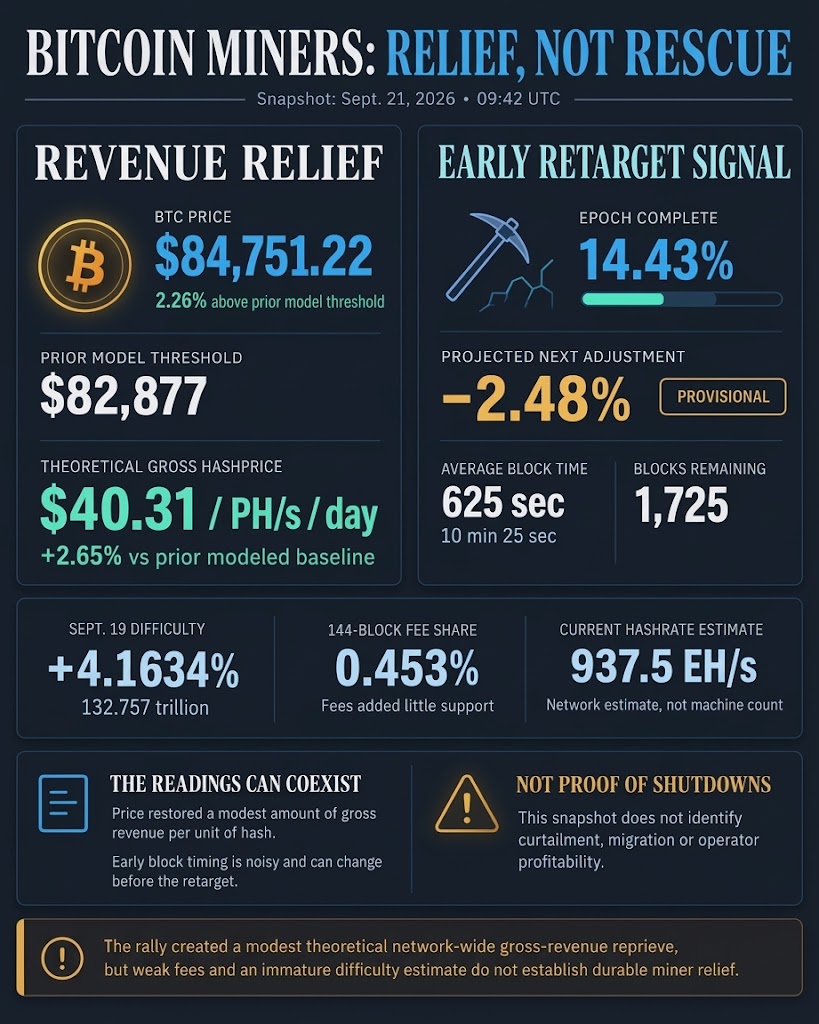
The hashprice estimate uses the 3.125 BTC subsidy, the observed average fee, the frozen BTC price and the network difficulty. It is a theoretical gross revenue benchmark, not reported realized revenue or profit.
Fees offered little extra protection in the measured window. Mempool’s reward statistics show that blocks 967,828 through 967,971 generated 2.04858206 BTC in fees, averaging 0.01422626 BTC per block. Fees were about 0.45% of the 452 BTC total reward across those 144 blocks.
That figure should not be extended into a durable fee regime. It says only that miner revenue in this sample remained overwhelmingly dependent on the block subsidy and BTC price.
Network hashprice also cannot determine which operators were profitable. Fleet efficiency, power contracts, financing, staffing and other costs differ across businesses. As prior CryptoSlate mining analysis documented, the same network revenue level can affect operators differently because their cost structures differ.
The projected difficulty decline is an early signal, not a result
The frozen Mempool difficulty snapshot placed the new epoch at 14.43% complete. Blocks had averaged 625.3 seconds, or about 10 minutes and 25 seconds, with 1,725 blocks remaining. On that pace, the estimate pointed to a 2.48% difficulty reduction around Oct. 3.
Bitcoin recalibrates difficulty every 2,016 blocks to bring average production back toward one block every 10 minutes, as the Bitcoin developer guide explains. Slower-than-target blocks therefore push the next estimate lower.
But a difficulty projection is not a direct count of active machines. Block discovery is stochastic, so short samples can change sharply even if underlying computing power has not made an equally sharp move. Hashrate Index research found that constant-block-time forecasts are especially inaccurate near the beginning of an epoch.
Technical work by Pieter Wuille and academic research on Bitcoin block arrivals support the broader point that early block timing is a noisy hashrate signal. The evidence does not justify treating the Mempool estimate as a diagnosis of shutdowns, curtailment or equipment migration.
Mempool’s one-month estimated hashrate series ranged from roughly 826.1 EH/s to 1.053 ZH/s, while its current estimate was about 937.5 EH/s. Within that observation window, the series showed no sustained, obvious cliff.
Those figures are estimates inferred from block production, not direct readings from every mining machine. They cannot rule out changes at individual operators, and the current estimate should not be confused with the latest daily observation. They show only that the available network series did not display the kind of persistent collapse that would make a broad shutdown claim defensible.
The early retarget reading still matters. If slower blocks persist as the sample grows, the projected decline becomes more informative and a lower completed difficulty would reduce the amount of work competing for each block reward. If blocks accelerate, the estimate can shrink or reverse before the retarget.
What would make the improvement durable
The next test has three parts: BTC price, transaction fees and the maturing block sample.
Price remaining above the prior modeled hurdle would preserve the relief created by the rally. A larger fee contribution would add a second source of revenue instead of leaving miners almost entirely dependent on subsidy and price. A downward retarget that survives a much larger share of the epoch would provide stronger evidence that effective network hashrate had softened.
Even then, network data would not identify the operational cause. Previous CryptoSlate reporting has tracked large AI infrastructure commitments across public miners, but that sector shift does not explain this snapshot’s slower blocks without operator-level evidence.
For now, the strongest conclusion is narrower. Bitcoin’s rally more than offset the finalized difficulty increase in a theoretical network-wide calculation, producing a modest gross-revenue reprieve. Weak fees and an immature next-retarget estimate leave the durability of that relief unresolved.
The post Bitcoin’s $84K rally isn’t saving miners as difficulty signals already flash caution appeared first on CryptoSlate.
CryptoTicker.io
Render rose around 19 percent to $1.83 on Sunday, making it the second strongest asset in the upper market segment after Sui (CoinGecko, September 21, 2026, 12:50 UTC). Over the week it is up a good 27 percent, across 30 days just under 20 percent.
The advance is no isolated case. The whole group of AI-adjacent cryptocurrencies posted double-digit gains that day, Bittensor among them with just under 14 percent. For Render, though, figures from its own network come on top, and those can be checked independently of the price.

What The Render Network Actually Does
Render brokers computing power from graphics cards. Anyone wanting to render an elaborate 3D scene or train an AI model rents distributed GPU capacity through the network instead of buying their own hardware. Payment is in RENDER.
That sets the project apart from many other assets traded as AI cryptocurrencies. There is a service somebody draws on, and a number that can be tracked: the quantity of rendered images. That figure most recently stood at around 77 million frames.
Technically the token runs on Solana. That explains part of the move: Solana itself added 7.6 percent, and capital rotated visibly into applications of the Solana ecosystem that day.
Three Metrics That Support The Render Price
First, the expansion of the AI subnets through which specialised computing tasks are handled. Second, the burn of around 1.16 million RENDER, which permanently reduces supply. Third, the weighting by institutional providers: Grayscale most recently assigned Render a good 21 percent share in its fund for decentralised AI, which puts the project among the largest positions there.
None of these figures explains a single-day gain of 19 percent. Taken together they explain why capital lands here during a sector rotation and not with any other asset carrying AI in its name.

The Context That Gets Lost In The Rally
The distance to the all-time high sits at around 87 percent despite the rally. Render has therefore made up only a small part of the slump of recent months. Trading volume of around $162 million in 24 hours is solid for an asset of this size, but no outlier.
Anyone setting these figures side by side sees a recovery inside a long downtrend, not its end. That can change; so far it is not established.
Why AI Tokens Rise And Fall As A Block
The move on this Sunday follows a pattern that has been repeating for two years. When the overall market rises, and bitcoin reached its highest level since January at more than $85,000, freed-up capital looks for themes. AI is currently the strongest of them, and the associated tokens largely move together.
For investors that means picking a single AI token offers little protection from the sector's move. If the group falls, all of them fall, regardless of the quality of the individual network. The difference only shows over longer stretches, when projects without usage fall behind.
What To Watch On The Render Price Now
Three points are checkable and therefore more useful than any forecast. First, the number of rendered frames in the coming weeks: if it keeps rising, demand is genuinely growing. Second, the pace of the token burn. Third, the question of whether Render stays stronger relative to Solana. Applications run ahead in upward phases and lag in downward ones.
The current crypto prices give an overview of the move in the overall market. Anyone looking to acquire Render will find the terms in the comparison of the best crypto exchanges.
Solana added around 7.6 percent to $116.63 on Sunday. The move is considerably stronger among the applications running on Solana: Jupiter, the network's largest trading aggregator, rose around 13 percent to $0.305 (CoinGecko, September 21, 2026, 12:50 UTC). Over a month JUP is up just under 49 percent, Solana itself 25.5 percent.
That ratio is the actual finding. When application tokens rise faster than the chain they run on, capital is no longer just buying access to the ecosystem; it is reaching for leverage inside it.

Why Jupiter Amplifies The Solana Upswing
Jupiter bundles the liquidity of the trading venues on Solana and routes an order automatically to wherever it is filled most cheaply. A substantial share of trading on Solana therefore passes through this one application without users noticing.
How an aggregator differs from the individual trading venues is shown by the comparison of decentralised exchanges.
For the token that means a direct coupling: when trading volume on Solana rises, fees at Jupiter rise. Parts of that income flow into buybacks of its own token. Volume, fees and buybacks therefore move in lockstep, upwards as well as downwards.
That explains why JUP gains more than SOL in upward phases. It equally explains why the move in the opposite direction turns out sharper as soon as volume eases.
What Is Moving Capital Right Now
Three things are coming together. First the overall market: bitcoin stands above $85,000, as high as it has been since January, triggered by the liquidation of short positions in the hundreds of millions. That frees up capital which then looks for destinations.
Second, the reports of further filings for exchange traded Solana funds. Filings of that kind are not approvals, but they change what institutional investors expect of the chain.
Third, the rotation within the Solana ecosystem itself. Render, which runs its token on Solana, also added around 19 percent. Anyone invested in the ecosystem is currently shifting capital from the base chain into the applications.

The Metrics That Make The Difference
With application tokens it pays to look at the ratio of trading volume to market capitalisation. Jupiter reached around $116 million in volume over 24 hours. Measured against Solana with more than $5 billion that is little, but for an application token it is considerable.
The more important test runs over time: does the trading volume routed through Jupiter rise durably, or was it a one-day event? The answer will only be settled in a few days, and it decides whether the price rise has a foundation.
The Risk That Application Tokens Carry
A token like JUP carries two risks stacked on top of each other. The first belongs to the chain: if Solana goes down or loses traction, that hits every application on it. The second is its own: a competing aggregator, a flaw in the contracts or a change to the fee distribution acts on JUP alone.
The distance to the all-time high of around 85 percent shows how deep the move of recent months ran. A gain of 49 percent in a month sounds like a lot, yet it restores only a small part of that stretch.
What To Watch On The Jupiter Price Now
For Solana itself the $120 mark remains the next hurdle, a few dollars above the current level. If it is cleared and holds, the rotation into the applications should continue. If the attempt fails, the pullback hits the application tokens harder than the chain.
An overview of the overall market is given by the current crypto prices. Anyone interested specifically in how the chain develops will find the assessment of the $120 mark in the Solana price prediction.
Arbitrum is the strongest performer of the past four weeks. The ARB price stands at $0.246, a gain of around 17 percent within 24 hours, a good 82 percent over the week and around 151 percent across 30 days (CoinGecko, September 21, 2026, 13:12 UTC). No other asset in the top 60 has covered comparable ground over the same period.
Many of this week's price jumps trace back to a single rumour. This one rests on a measurable shift in activity instead. Two developments carry it, and both come with a catch.

Robinhood Builds On Arbitrum, And The ARB Price Feels It
The broker Robinhood runs its own second-layer network, Robinhood Chain, built on Arbitrum technology. That chain now generates a multiple of the fees accruing on the Arbitrum network itself. At peak times a factor on the order of 240 was mentioned.
For valuing ARB, that is the actual point. A layer 2 network earns from someone using it. When a regulated broker with millions of customers puts its settlement on it, the demand is of a different kind from the activity of a handful of DeFi users.
The catch: part of that activity ran on subsidised fees. Once the subsidy expires, how much volume stays is an open question. That is the first real stress test for the thesis.
Tokenised Assets Are Moving Onto The Chain
The second driver is the tokenisation of real assets, real world assets in the jargon. Arbitrum has grown into one of the largest venues for this and now sits within reach of Solana on the volume of tokenised assets.
That is notable because this segment works differently from the rest of the crypto market. Anyone bringing government bonds or credit funds onto a blockchain does not switch chains because of a price rise. Decisions of that kind have lead times of months and last correspondingly longer.

The ARB Price Breakout In The Chart
Technically ARB has cleared the downward line that had capped the recovery since spring. The price trades at its highest level since January. Trading volume came in at around $547 million in 24 hours, a multiple of the previous weeks' average.
At the same time the distance to the all-time high remains around 90 percent. Anyone taking the roughly 150 percent of the past 30 days as a yardstick should set that figure alongside it: ARB is working its way out of a very deep trough, and it is breaking no record.
The Two Dates Where The Rally Has To Prove Itself
Two events decide whether the advance holds. First, the release of around 92.6 million ARB on September 16. Releases like that increase supply, and in this case the market absorbed it without a visible drop. Whether that stays the case will only show once the released holdings are actually moved.
Second, the end of the fee subsidy on Robinhood Chain. If volume falls off sharply afterwards, part of the activity was bought. If it stays stable, Arbitrum has won a customer who brings revenue.
What That Means For Reading The ARB Price
Arbitrum is one of the few assets in this rally where the price rise can be tied to figures that exist independently of the price: fee income, volume of tokenised assets, number of transactions. That does not make the move safe, but it does make it verifiable.
The broader market is helping at the moment: bitcoin stands above $85,000, as high as it has been since January. Anyone wanting to place the overall picture will find the current crypto prices in the overview. If sentiment turns there, assets with a monthly gain of 150 percent are hit first. Which trading venues list ARB and at what fees is shown by the comparison of the best crypto exchanges.
Sui is the strongest asset among the 30 largest cryptocurrencies on Sunday. The price stands at $1.04, a gain of around 26 percent within 24 hours and of a good 40 percent over the week (CoinGecko, September 21, 2026, 12:50 UTC). That puts Sui well ahead of the wider market: bitcoin added 6 percent over the same period, ethereum 5.9 percent.
The jump did not come out of nowhere. It coincides with a broad risk-on day across the crypto market, but it lands on two pieces of news that concern Sui specifically. One at a time.

What Sets The Sui Price Apart From The Other Gainers
On a day when almost everything is rising, a gain on its own says little. It gets interesting at the trading volume: around $2.0 billion changed hands in 24 hours. For comparison, Avalanche, which also posted a double-digit gain, reached a fraction of that. Volume on that scale means real demand was in play, beyond the closing out of derivatives positions.
Open interest on the futures exchanges rose roughly 21 percent alongside it. A rising price with rising open interest is taken as a sign that new money is building positions rather than old positions being forced shut. The counter-test is still outstanding: whether those positions hold will only show up on the first pullback.
Reason One: Sui As A Bet On The AI Economy
The macro investor Raoul Pal has publicly described Sui as his highest-conviction position for the emerging economy of autonomous AI agents. His thesis: after Ethereum and Solana, Sui is the third smart contract network built for machine speed.
Technically that points to a Sui feature called programmable transaction blocks. Several working steps, say a swap, a deposit and a forwarding, can be settled in a single transaction. For a human that is convenient. For software working through thousands of such chains per hour, it is the difference between feasible and unaffordable.
An assessment from a prominent investor is not a fundamental. It does move capital, though, and that is exactly what happened here in measurable terms.

Reason Two: Bitcoin As Collateral On Sui
In parallel, Hashi went live, a protocol that makes bitcoin usable as programmable collateral on Sui without the coins leaving the bitcoin blockchain. The approach targets an old problem: bitcoin is by some distance the largest pool of capital in the crypto market, yet it largely sits idle. Any chain that pulls part of it into its own DeFi landscape gains liquidity without having to attract it first.
Whether the protocol holds up in operation remains open. Custody solutions for bitcoin on foreign chains have repeatedly failed at their bridges in the past. Anyone stepping in here should understand the construction before capital flows.
The Rotation Into Layer 1 Chains
The third driver is a market move rather than a Sui event. On September 21, capital rotated visibly into large layer 1 networks and into application tokens. Alongside Sui, Render added around 19 percent, Arbitrum a good 15 percent, Bittensor just under 14 percent. The trigger lies with bitcoin: the price reached its highest level since January at more than $85,000, carried by the liquidation of short positions in the hundreds of millions.
Rotations like this follow a familiar pattern. Bitcoin rises first, then the large alternatives follow, and the smaller application tokens come last. Anyone entering at the end of that chain is often buying the close of the move.
What To Watch On The Sui Price Now
Three levels decide how this develops. First the zone around $1.05, where Sui has been rejected several times in recent weeks. A daily close above it would be the first solid breakout in months. Second, open interest: if it falls while the price holds, speculators have reduced and the advance rests on spot demand. Third, the distance to the all-time high, which despite the rally sits at around 81 percent. Sui is not breaking a record right now; it is working its way back out of a deep trough.
For placing the wider market, it helps to look at the current crypto prices and at the question of whether the bitcoin advance carries or remains a squeeze spike. Anyone looking to acquire Sui will find the terms of the trading venues in the overview of the best crypto exchanges.
US funds holding ether lost a net $140 million in the week to September 18, 2026. It is the first week of outflows since mid-August, and it ends a run of four consecutive weeks of inflows. At the same time the Ethereum price stands at $2,703 on Monday morning, a good 5 percent above the previous day. Price and capital flows are pointing in different directions.
If you hold ether, this is less a question about the price than a question about the wrapper: which structure your ether sits in, what that means for tax, and which deadlines are currently running. This article puts the numbers in context and names the points you can check against your own holdings.
Ether ETFs: $140 Million of Outflows in One Week
The figure comes from The Block's weekly flow review published on September 19, 2026. It shows that US spot ETFs on ether recorded a net outflow of $140 million for the trading week to September 18. That is the first negative week since the one that ended on August 14.
What happened inside that week is worth noting. On Friday, September 18, ether funds still took in $143.8 million. The weekly loss was therefore built up on the days before it and was almost, though not quite, recovered on the final trading day. Anyone reading the Friday number alone gets a different picture from someone looking at the full week.
The four weeks before that looked very different. Taken together, ether funds gathered $1.94 billion over that run. Measured against it, an outflow of $140 million is a small amount; it marks an interruption, not a collapse.
One term that is often confused: net flow is the difference between fund shares created and shares redeemed over a period, converted into dollars. It measures how much fresh money goes into the wrapper or comes out of it, and it says nothing about how the value of the ether already held has developed.
Why the ETH Price Is Rising Despite the ETF Outflows
On Monday morning, September 21, 2026, ether trades at $2,703.62 according to CoinGecko. That is 5.10 percent more than 24 hours earlier and 5.80 percent more than a week ago. The price remains a good 45 percent below its all-time high of August 24, 2025.
The move is not confined to ether. Bitcoin stands at $83,650 over the same window, up 4.27 percent, XRP gains 7.30 percent and Solana 7.17 percent. When practically the entire top of the market rises at once, the cause usually lies not with any single asset but with general risk appetite.
That leads to a distinction worth keeping in mind. The previous week's ETF flows and this morning's price describe different periods. The flow data ends on Friday; the price is from today. A weekly outflow therefore does not explain what the price does on the following Monday.
Bitcoin ETFs for Comparison: $433 Million in a Day, $6.2 Million Over the Week
For the bitcoin funds the contrast in the same week was sharper still. On Friday, September 18, they took in $433 million. For the week as a whole, a net inflow of $6.2 million was left. The four days before it had therefore consumed almost all of the Friday inflow.
At fund level, Fidelity's FBTC led on Friday with $310.7 million, while BlackRock's IBIT reached $108.4 million. Over the full week the order reversed: IBIT took in $120.7 million, FBTC $79.9 million. Here too, a single strong day says little about where the money travels over longer stretches.

US Spot ETF or ETP: What You Can Actually Buy in Europe
This is the point at which many reports out of the United States mislead. The funds whose flows are described above are US spot ETFs. As a retail investor in Europe you generally cannot buy them. They are not set up under European law and do not provide a key information document under the PRIIPs regulation, which brokers in the EU must supply before selling to retail clients.
What you find instead on European exchanges are crypto ETPs, often structured as ETNs. An ETN is legally a debt security issued by the provider that tracks the price of the underlying asset and in practice is usually backed physically with real ether. Which of these products are tradable in Germany and how they differ is collected in our overview of crypto ETFs in Germany.
The third route is buying the coin directly on a trading platform, with custody either at the platform or in your own wallet. Which platforms are available on a regulated basis for this is shown in our crypto exchange comparison. All three routes lead to the same underlying asset, but they are treated differently for tax.
The Holding Period Under Section 23 EStG: Why the Wrapper Decides the Tax
When you buy and hold ether directly in Germany, Section 23 of the Income Tax Act applies, which governs private disposal transactions. If more than twelve months pass between acquisition and sale, the gain is tax free. Within the year there is an exemption threshold of 1,000 euros per year covering all private disposal transactions together. The text of the law is freely available from the Federal Office of Justice.
With an ETN the position is different and depends on how the paper is constructed. What matters is whether it grants you a claim to delivery of the actual coins. Papers carrying a delivery claim are in practice often treated as an asset under Section 23, while those without one count as a monetary claim subject to the 25 percent flat capital gains tax plus solidarity surcharge and, where applicable, church tax. In the second case there is no deadline after which the gain becomes tax free.
This is not an academic difference. On a gain of 10,000 euros after more than a year, one side carries a tax bill of zero and the other a burden of roughly 2,600 euros. Which case applies to your paper is set out in the issue terms and the key information document. Check that before you buy, not in the year you sell. Because the classification can be contested in an individual case, it belongs with your tax adviser and not in a forum.
Anyone who has bought at several different times also needs clean records of the acquisition dates in order to prove the deadline at all. Without that evidence the rule does you little good, because the burden of proof sits with you.
ETH Staking and the Holding Period: What Applies After the Ministry Guidance
Many ether holdings do not simply sit there but are committed to staking. Staking means putting up ether as security in the network and receiving rewards on an ongoing basis. For tax, those rewards are other income at the moment they accrue and are taxed at your personal rate, valued at the price on the day of receipt.
The once widespread worry that staking would extend the holding period of the staked balance to ten years has been cleared up by the German Federal Ministry of Finance. Twelve months continue to apply, even if the coins were staked in the meantime. The rewards received, however, start their own deadline from the day they accrue, which makes bookkeeping laborious where payouts are continuous.
If you invest through an ETP, the topic falls away for you, because staking there happens at most at the level of the issuer. Whether and how the issuer passes on the proceeds is set out in the product terms and differs from provider to provider.
Custody: Your Own Wallet, a Trading Platform or a Securities Account
The three routes also differ in who holds the keys. With your own wallet you carry the responsibility alone, with everything that follows: a lost access is final, a well secured one is hard to attack from outside. With a trading platform the counterparty risk sits with the provider, who in return takes on the technical security.
With an ETP your ether sits with the issuer's custodian and you hold a security in your bank's securities account. The practical advantage is settlement in the familiar account including a tax certificate, provided a German custodian bank is involved. The drawback is that in the end you hold a claim against an issuer rather than the coin itself.

Levels Above and Below: What the ETH Price Is Measured Against Now
To the upside the next notable zone is the area around $2,750 to $2,800, where ether has failed several times in recent weeks. Above that sits the round $3,000 mark, which the price has not seen since the spring.
To the downside the zone around $2,600 is the first reference point, because last week it turned from a barrier into a springboard. If the price falls back there, the breakout was a short-lived move. These levels are orientation points taken from the price history so far and expressly not a forecast.
For the tax question they are secondary in any case. Anyone close to the end of the twelve-month deadline has a different calculation to make from someone who holds for the long term regardless. Selling two weeks before the cut-off date can end up more expensive than a slightly worse price after it.
What Inflows and Outflows Are Really Worth as a Signal
ETF flows are one of the few robust figures published daily. They show how demand out of the regulated fund wrapper is developing. What they do not show is demand outside it, meaning on trading platforms, through European ETPs, or at companies buying directly.
A single week is therefore of little use as a direction indicator. The sequence says more: four weeks of inflows totalling $1.94 billion, then one week with $140 million of outflows, and on the final day of that week a clear inflow of $143.8 million again. That describes a pause whose continuation is open.
Anyone wanting to derive an action from it should tie that action to their own situation rather than to the weekly number. The questions that actually save or cost you money are those about wrapper, deadline and custody.
Checking Ethereum ETF Outflows: What to Take Away
- Establish which wrapper your ether sits in. Direct holding, ETN, or both side by side. If an ETN sits in your securities account, look in the key information document for the delivery claim, because the tax treatment depends on it. Which products are tradable in Germany is set out in the overview of crypto ETFs in Germany.
- Write down the acquisition dates of your direct holdings. Without evidence of acquisition, the twelve-month deadline cannot be demonstrated to the tax office. Anyone with many individual purchases is better served by a tool than by a spreadsheet; the common ones are in the crypto tax software comparison.
- Check your custody before you change anything. If you hold directly and are considering a move, first compare the terms and the licensing status of the platform in the exchange comparison. Moving coins between your own addresses is not a disposal; a sale followed by a repurchase certainly is.
The flow figures in this article come from the weekly review by The Block of September 19, 2026, the price data from CoinGecko, retrieved on September 21, 2026 at 08:49 UTC.
(As of September 21, 2026. This article is not investment advice. Prices and fee structures change; check the terms with the provider before you buy.)
Decrypt
xAI says the new model is a "notable improvement" over Grok 4.6 at the same price. The benchmarks say it's still in second place.
Crypto advocates argue that NFTs can deliver real digital ownership, but privacy gaps and integration hurdles have held the tech back.
The senior roles cover Apple’s consumer payment products and Google Cloud’s institutional blockchain business in Asia.
The rally cleared an eight-month ceiling on a short squeeze and falling oil prices. The next three weeks will decide if it sticks.
The purchase lifts Bitmine's stash to nearly 5.99 million ETH—4.9% of supply—as chairman Tom Lee argues Ethereum's outperformance signals a stronger move ahead and institutions remain underweight.
U.Today - IT, AI and Fintech Daily News for You Today
Ethereum's open interest on Binance surges to its highest level on Binance in over nine months following a major breakout in its trading price.
An altcoin breakout led by XRP and NEAR triggered $666 million in crypto short position liquidations over the last 24 hours.
Dogecoin gathers momentum toward $0.10 as OI surges.
Ledger CTO Charles Guillemet has warned crypto holders to update their iPhones after highlighting DarkSword.
October set to be significant for XRP community with two events ahead.
Blockonomi
TLDR
- Coherent stock jumps 4.82% to $332.66 as new AI optics drive momentum.
- Coherent unveils a 6.4T optical engine for high-density AI infrastructure.
- New 3.2T transceiver advances Coherent’s next-generation connectivity push.
- Optical transport systems support up to 25.6Tbps across datacenter links.
- Advanced thermal materials target rising power density in AI infrastructure.
Coherent Corp. stock gained 4.82% to $332.66 as the company introduced new optical technologies for expanding AI infrastructure. The shares recovered from an early decline and reached an intraday high during Monday trading. Meanwhile, Coherent outlined new products ahead of the ECOC 2026 conference in Málaga, Spain.
Coherent, Inc., COHR
Coherent Corp. Stock Rises as AI Optics Portfolio Expands
Coherent plans to demonstrate technologies covering datacenter connectivity, optical transport, advanced materials, specialty fibers, and thermal management. The company will also highlight solutions for co-packaged and near-packaged optical systems. These technologies address rising bandwidth and power requirements across large computing networks.
Meanwhile, Coherent introduced PhotonLink, an integrated optics platform supporting advanced packaged optics and chip-to-chip connections. The platform combines optical components, assemblies, integration capabilities, and large-scale manufacturing. Therefore, Coherent aims to provide customers with a broader portfolio for building high-density computing infrastructure.
The company operates across materials, devices, modules, components, and optical systems for networking markets. This vertical structure allows Coherent to combine several technologies within complete connectivity products. Its expanded portfolio also targets network links inside datacenters and connections between separate facilities.
New 6.4T Optical Engine Targets High-Density Networks
Coherent will demonstrate a 6.4T near-packaged optical engine for high-density scale-up and scale-out networks. The engine combines silicon photonics, fiber attachment technology, external laser sources, and Coherent laser components. Consequently, the design targets greater capacity while addressing space and power constraints.
Coherent will also demonstrate a compact 3.2T transceiver using two 1.6T optical paths. The OSFP-sized design includes eight 425G PAM4 optical lanes alongside Coherent emitters and photodiodes. This architecture highlights development toward next-generation 400G-per-lane optical connectivity.
Coherent will showcase high-density VCSEL and photodiode arrays for highly parallel optical architectures. These components target low-latency connections used within packaged optical systems. The company will also present specialty fibers designed for improved coupling and higher-density datacenter connections.
Optical Transport and Cooling Support Broader AI Growth
Coherent will present its LS200 full C-band pluggable optical line system for datacenter interconnect applications. The architecture places optical transport functions closer to network routers and switches. Furthermore, it supports flexible point-to-point connections between datacenters handling growing computing workloads.
Another pluggable system supports 800G digital coherent optics and as many as 32 DWDM wavelengths. The system can carry up to 25.6Tbps across distances ranging from two to 200 kilometers. Coherent designed the compact system to increase transport capacity while reducing equipment requirements.
Coherent will also showcase advanced thermal materials designed for infrastructure facing higher power density and cooling requirements. Diamond-based materials form part of the company’s approach to managing heat from increasingly dense computing systems. Together, these optical and thermal technologies expand Coherent’s exposure to continued spending on high-capacity AI infrastructure.
The post Coherent Corp. (COHR) Stock: Surge as New 6.4T Optics Boost AI Growth Outlook appeared first on Blockonomi.
TLDR
- IBM stock trades at $229.66, up 0.05%, after an early rise above $233.
- IBM finds a major gap between employee AI skills and CHRO workforce priorities.
- About 71% of CHROs rank AI oversight skills as essential for the workforce.
- Around 60% of employees worry AI adoption could erode key workplace skills.
- IBM finds clear human and AI workflows can improve quality and reduce risks.
International Business Machines Corporation stock traded at $229.66, up 0.05%, as the company released new research on workplace AI skills. The study found a wide gap between skills human resources leaders prioritize and those employees consider important. IBM shares had earlier climbed above $233 before giving back most intraday gains.
International Business Machines Corporation, IBM
IBM Study Finds AI Workforce Skills Gap
The IBM Institute for Business Value surveyed 1,500 chief human resources officers and 8,800 full-time employees worldwide. Researchers conducted the surveys between April and June 2026 with support from Oxford Economics. The research covered organizations across 21 geographies and 23 industries.
About 71% of CHROs identified supervising, validating, and overriding AI outputs as the most important workforce skill. However, only 29% of employees ranked human judgment among their important skills. This difference highlights a substantial gap between management priorities and employee perceptions.
Meanwhile, 60% of employees expressed concerns that increased AI use could weaken some workplace skills. Critical thinking ranked as the skill employees most frequently believed could decline. Among concerned employees, three-quarters reported that AI had already weakened at least some abilities.
Critical Thinking Becomes Central to AI Workflows
Critical thinking also ranked highly among human resources executives assessing skills needed alongside workplace AI systems. About 57% of CHROs identified critical thinking and problem framing as important capabilities. Another 48% identified human judgment as an important workforce capability.
The study also linked clearer human oversight with stronger employee confidence in decisions supported by AI systems. About 62% of CHROs reported improving confidence when organizations incorporated judgment into workflows. By comparison, 57% reported declining confidence when organizations lacked clear judgment mechanisms.
Accountability remains another issue as companies expand workplace AI adoption across different business functions. About 43% of employees said organizations blamed them when AI-supported processes produced problems. Furthermore, 41% of CHROs believed employees could feel uncomfortable challenging or overriding automated outputs.
HR Departments Face AI Adoption Challenges
Organizations also reported additional workloads linked to the adoption of AI across everyday business processes. About 80% of CHROs said AI creates unseen tasks involving validation, corrections, context, and exception management. Similarly, 42% of employees said AI increased their workload or left some work unrecognized.
However, many human resources departments remain behind other business functions in their own AI adoption. The study found 72% of organizations make limited or no AI use within HR operations. CHROs also reported weak capabilities in AI literacy, performance measurement, and managing organizational changes linked to adoption.
IBM found stronger results among organizations that clearly divide tasks between employees and automated systems. These organizations reported an 18% reduction in risk and a 20% improvement in quality. However, 46% of organizations still exclude CHROs when leadership teams define broader AI strategies.
The post International Business Machines Corporation (IBM) Stock: New Study Reveals AI Workforce Skills Gap appeared first on Blockonomi.
Key Takeaways
- Shares of GRAIL climbed over 22% on Monday as market participants prepared for an FDA advisory committee session set for Sept. 23.
- The committee will evaluate GRAIL’s premarket approval submission for Galleri, a blood test designed to detect multiple cancers early.
- While the FDA panel will deliberate, vote, and provide guidance, its recommendations are advisory in nature and not legally binding.
- Galleri works by identifying cancer-related methylation signatures in blood samples and is intended for screening adults 50 years and older across various cancer types.
- The investment carries significant risk given the unpredictable nature of the panel’s conclusion and GRAIL’s ongoing substantial financial losses.
Shares of GRAIL (GRAL) climbed over 22% during Monday’s trading session as market participants prepared for a significant regulatory milestone approaching later this week. The upward movement occurred without any fresh corporate announcements or regulatory filings to explain the surge.
GRAIL Inc., GRAL
The primary driver appears to be an FDA advisory committee session set for Wednesday, Sept. 23. The Molecular and Clinical Genetics Panel has been tasked with examining GRAIL’s premarket approval submission for Galleri, its blood-based multi-cancer early detection platform.
The session is slated to begin at 9 a.m. ET and continue until 6 p.m., with public access available. Panel members are anticipated to review the supporting data, offer recommendations, and conduct a vote on the application.
It’s crucial to note this doesn’t represent a final regulatory green light from the FDA. Advisory panels serve an independent consultative function, and while the FDA typically weighs their input heavily, it retains full discretion and isn’t obligated to adopt their conclusions.
FDA Panel Meeting Takes Center Stage
Galleri operates as a prescription blood test that employs next-generation sequencing technology to identify cancer-specific methylation signatures within cell-free DNA. GRAIL has submitted for approval to screen individuals aged 50 and above for early identification of numerous cancer varieties.
The diagnostic platform also attempts to pinpoint the tissue of origin for any cancer signals detected. Should the test return a positive result, patients would require additional diagnostic workup through their healthcare provider.
Though the FDA committee meeting has been public knowledge since August, investor attention has intensified as the review date draws near. GRAIL formally disclosed the Sept. 23 advisory committee session on Aug. 7.
This context suggests Monday’s rally represents primarily speculative positioning. Market participants seem to be betting on a potentially constructive panel discussion or favorable vote outcome rather than responding to concrete regulatory developments.
Trading volumes also experienced a notable spike Monday. The advance built on GRAL’s performance over the trailing twelve months and lifted shares considerably above levels observed earlier in 2026.
Significant Uncertainty Surrounds Panel Outcome
While the approaching panel session could mark a critical juncture for GRAIL, the result remains highly uncertain. Advisory committees frequently scrutinize clinical evidence quality, diagnostic accuracy metrics, appropriate patient populations, and the risk-benefit profile.
Galleri also confronts questions regarding its clinical validation data. Published analyses have highlighted that a major randomized trial conducted in the U.K. did not achieve its primary endpoint, a point likely to surface during the FDA panel’s evidence review.
GRAIL’s financial viability depends heavily on successful Galleri commercialization and expanded insurance reimbursement. The company’s most recent quarterly filing showed revenue of $44.69 million alongside continued significant operating losses.
This financial profile makes the stock extremely vulnerable to regulatory developments. A supportive panel recommendation might boost approval expectations, whereas committee concerns could provoke an equally dramatic selloff.
Investors must also recognize that even an affirmative advisory committee vote wouldn’t constitute official FDA clearance. The agency would still need to finalize its assessment and render a binding determination.
For Monday’s session, the most apparent catalyst was anticipation surrounding Wednesday’s FDA advisory committee proceedings. The panel’s Sept. 23 review and vote on Galleri’s application represents the pivotal near-term event influencing GRAL trading dynamics.
The post GRAIL (GRAL) Stock Surges 22% Before Critical FDA Panel Meeting on Galleri Test appeared first on Blockonomi.
TLDR
- STI stock surges 10.13% to $7.50 during late-morning trading Monday.
- CEO Jaymes Winters adds the Chairman role under Solidion’s board shakeup.
- Mark Schwartz becomes Lead Independent Director to support board oversight.
- Former Chairman Bor Jang remains a director following the leadership change.
- Solidion holds over 385 patents covering advanced battery technologies.
Solidion Technology (STI) stock surged 10.13% to $7.50 during late-morning trading, extending its recovery from earlier session lows. The move came as Solidion announced changes to its board leadership structure. Chief Executive Officer Jaymes Winters has also taken the Chairman role as the company aligns management with strategic priorities.
Solidion Technology Inc., STI
Jaymes Winters Takes Chairman Role at Solidion Technology
Solidion Technology appointed Winters as Chairman of the Board, effective September 16, while he continues serving as Chief Executive Officer. The combined position places corporate strategy and daily execution under the same executive leader. Solidion said the structure aims to strengthen alignment between its governance, operations, and broader business priorities.
Winters brings more than 15 years of chief executive experience across telecommunications, energy, and retail businesses. Before joining Solidion, he served as CEO of special purpose acquisition company Nubia Brand International. He also founded United Energy, which expanded to nearly $100 million in revenue under his leadership.
His previous experience includes directing mergers and acquisitions involving private equity firms and other corporate parties. Winters also spent more than nine years teaching business subjects at Portland State University. His academic work covered business strategy, venture capital, and mergers and acquisitions.
Solidion Names Mark Schwartz Lead Independent Director
Solidion also appointed independent director Mark N. Schwartz as Lead Independent Director, effective September 16. The position gives the board an independent leadership role alongside Winters’ combined Chairman and CEO responsibilities. Schwartz will work with board members while supporting independent oversight of the company’s leadership.
Schwartz brings more than 36 years of executive and board experience across technology, healthcare, and consumer businesses. He co-founded Bodega Latina Corporation, which developed into a multibillion-dollar grocery business. He also led DD Group’s public listing and oversaw Bartell Drug Company’s sale to Rite Aid.
His board experience includes positions at more than a dozen public and private companies, including Starbucks Coffee Company. Meanwhile, former Chairman Dr. Bor Jang remains a director following the leadership changes. Jang previously supported the development of Solidion’s technology and intellectual property portfolio.
STI Stock Rises as Solidion Advances Battery Strategy
Solidion Technology develops battery materials, components, and next-generation energy storage technologies from its Dallas headquarters. The company also operates pilot production facilities in Dayton, Ohio. Its technologies target electric transportation, energy storage, and uninterruptible power systems serving artificial intelligence data centers.
The company’s technology portfolio includes more than 385 patents covering several battery materials and energy storage technologies. These include graphene-enabled silicon anodes, biomass-based graphite, lithium-sulfur batteries, and advanced lithium-metal technologies. Solidion also develops high-capacity silicon anodes designed without silane gas during production.
STI stock’s 10.13% late-morning gain accompanied the company’s latest board leadership announcement. The stock reached $7.50 after rebounding sharply from lower levels earlier in the trading session. The leadership changes place Winters at the center of Solidion’s strategy while preserving independent oversight through Schwartz.
The post Solidion Technology (STI) Stock: Climbs as CEO Jaymes Winters Adds Chairman Role appeared first on Blockonomi.
Key Highlights
- Shares of Accenture climbed approximately 5.9%, or roughly 6% when rounded, during Monday’s premarket session following news of a significant AI collaboration with Anthropic.
- Both Accenture and Anthropic plan to invest a minimum of $1 billion each across five years, resulting in a total commitment exceeding $2 billion.
- The consulting firm’s Faculty unit will spearhead efforts to evaluate and conduct red-team exercises on Anthropic’s cutting-edge AI systems.
- Deutsche Bank increased its price target for ACN to $175 from $136 while keeping its Hold rating unchanged.
- The stock’s gains moderated to approximately 3.5% as Monday’s trading session progressed.
Shares of Accenture (ACN) rallied as much as 5.9% during premarket hours Monday following the announcement of an expanded AI collaboration with Anthropic. The consulting giant’s stock maintained gains of around 3.5% later in the trading day as AI-focused equities provided support to broader market indices.
Accenture plc, ACN
Under the newly announced arrangement, a specialized team of AI evaluators will be embedded to work directly with Anthropic’s in-house development teams. Both organizations anticipate investing no less than $1 billion over a five-year period, pushing the total joint commitment beyond $2 billion.
This dedicated group will perform evaluations and red-team testing of Anthropic’s AI systems, carry out alignment reviews, and validate safety protocols. Accenture’s Faculty division, known for its expertise in practical AI applications, will oversee these operations.
Expanding the Anthropic-Accenture Alliance
This agreement represents an expansion of an already-established relationship between the two firms. Accenture had previously established a specialized business unit focused on Anthropic and announced plans to train approximately 30,000 staff members on Claude, Anthropic’s AI assistant.
Embedded evaluators differ from conventional external auditors by working in much closer proximity to AI development teams. According to Anthropic, this approach grants them access similar to internal employees, allowing them to monitor model training processes, deployment procedures, and safety testing protocols.
Anthropic clarified that its partnership with Accenture is not exclusive, and the company intends to engage additional evaluators. The AI firm also recognized that industry standards for embedded evaluation practices, including funding structures and disclosure obligations, remain under development.
Accenture’s CEO Julie Sweet characterized embedded evaluation as an evolving discipline. The firm believes its extensive background in implementing AI solutions across enterprise and government sectors positions it well to evaluate how advanced models perform in practical applications.
Wall Street Analyst Lifts Price Forecast
Additional momentum came from Deutsche Bank, which boosted its price objective for Accenture to $175 from a previous $136 in advance of the company’s fiscal fourth-quarter financial results. However, the firm retained its Hold rating, indicating the adjustment stopped short of a complete bullish upgrade.
Deutsche Bank attributed the raised target partially to improved valuations among Accenture’s industry peers. The firm also warned that conventional IT services expenditures remain subdued and noted minimal signs of a comprehensive spending recovery.
This observation offers an important counterpoint to Monday’s stock performance. Although the Anthropic collaboration presents Accenture with another prominent AI-related opportunity, both parties are allocating considerable resources while the financial returns from embedded AI evaluation remain unproven.
The partnership emerges amid growing discussions surrounding AI safety protocols. Anthropic has advocated for more rigorous evaluation of advanced AI models while simultaneously developing and releasing new systems.
For shareholders, Accenture’s upcoming fiscal fourth-quarter earnings announcement represents the next significant company milestone. These financial results should offer greater insight into whether increasing AI-related demand is starting to compensate for weaker performance in the company’s conventional consulting and technology services segments.
The post Accenture (ACN) Stock Surges 6% Following $2B Anthropic AI Safety Deal appeared first on Blockonomi.
CryptoPotato
BitMine Immersion Technologies (BMNR) bought 27,562 Ethereum (ETH) over the week to September 20 and reported combined crypto, cash, and moonshot holdings of $17.1 billion in a press release and 8-K filed September 21.
Total holdings rose $1.3 billion from the $15.8 billion BitMine reported a week earlier, when it added 27,180 ETH. The company marked its Ether at $2,688 per token, per Coinbase, up from $2,513 a week earlier. That mark puts the week’s purchases at roughly $74 million, with the treasury at 5,983,940 ETH.
Staked Total Flat Since Late August
BitMine Chairman Thomas “Tom” Lee stated the company “has bought ETH each and every week since the inception of its ETH Treasury Strategy on June 30, 2025,” a track record he called “unmatched by any public company in the world.” The pace has swung this year; one July purchase fell to 7,430 ETH, down from more than 30,500, a slowdown Lee tied to share buybacks.
Holdings equal 4.9% of the 122.1 million ETH in supply, and BitMine puts itself 98% of the way to its target of owning 5% of all ETH, the plan it calls the Alchemy of 5%, 15 months after the strategy began.
BitMine stakes 5,067,309 ETH, worth $13.6 billion at its mark and 85% of the treasury, through MAVAN, its Made in America Validator Network. The staked count has held there for five consecutive weekly updates, even as the token total kept climbing.
Lee put projected annualized staking revenue at $357 million, up from $334 million a week earlier, rising to $421 million once the ether is fully staked, on a 2.62% seven-day yield.
Lee Sees Stronger Fourth Quarter
“We believe a crypto bull market is underway, having started in late June,” Lee said, citing “the rotation from AI back to crypto.”
He put Ether’s quarter-to-date lead over the S&P 500 at 6,519 basis points, called the run “a prelude to a potentially stronger up move in the 4th quarter of 2026,” and said the company expects institutions “to substantially increase their exposure in the final 3 months of 2026.”
Cash and marketable securities rose to $714 million from $549 million a week earlier. The release gave no reason for the increase. Alongside the ether, BitMine held 212 Bitcoin (BTC), a $180 million stake in Beast Industries and a $105 million position in Eightco Holdings (ORBS), up from $98 million.
BMNR traded $1.2 billion in average daily dollar volume over the five days to September 18, ranking 100th of 5,704 US-listed stocks, according to Fundstrat, Lee’s research firm. The release ranks BitMine first among ether treasuries and second among crypto treasuries overall, behind Strategy (MSTR), which the release said owns 845,080 Bitcoin worth about $75 billion.
The post BitMine Buys 27,562 ETH in a Week as Holdings Reach $17.1 Billion appeared first on CryptoPotato.
The cryptocurrency market has been on fire over the last few days despite negative news such as the CLARITY Act failure, rising interest rates in the United States, and escalating global geopolitical tensions.
The past 24 hours have delivered even more gains, with Bitcoin (BTC) climbing past $85,000 for the first time since January, while Ethereum (ETH) hit a nine-month high of roughly $2,750. Many analysts believe the second-largest cryptocurrency is poised for a further rally in the near future, but some describe the current setup as a classic bull trap.
Don’t Pop the Champagne Yet?
At first glance, it seems like ETH’s cycle bottom is behind us and might be gearing up for a shift toward a bull run. X user DANNY, though, doesn’t support that thesis, claiming that the asset is setting up “a huge trap.”
The analyst argued that if ETH pumps to $2,670 (as it happened), sentiment will flip fast, and then people will start projecting further pumps to $4,000 and $5,000. For the X user, that level is the area where the market can trap late buyers before the real flush starts.
DANNY envisioned a slip toward $1,800, which could trigger the first real panic, followed by $1,500 and capitulation that may occur in the final months of the year. The analyst then sees an incoming reversal and a jump above $3,250 in the second or third quarter of 2027.
X user Midas also shared a pessimistic bet, maintaining that ETH has formed “a huge bearish setup.” The analyst doesn’t expect the upward move to last in the short term and forecasts a retest of the $1,700-$1,800 range.
“And if that liquidity gets swept, ETH can extend lower toward $1.4K-$1.5K. But I still don’t expect ETH to make the same kind of new cycle lows as BTC. ETH has been showing much stronger relative structure, and I still think it will outperform once this correction is finished. There is just one major downside target left to clear before the real expansion starts. So, short-term, I’m bearish on ETH. Long term this setup can become one of the strongest opportunities of the cycle ” they added.
Ted also predicted a potential correction ahead, but expects it to come once Ethereum’s price taps the $2,900-$3,000 area.
These Factors Favor the Bulls
The combination of multiple positive elements suggests ETH’s price may keep surging in the short term. As CryptoPotato recently reported, whale transactions have been climbing, showing that large holders have become increasingly active.
Ethereum’s non-empty wallets have risen to 207.17 million, with staking remaining a major reason why ETH stays parked in the long run. Just hours ago, Lookonchain revealed that a mysterious whale has sold 1,107 BTC (worth over $86 million) over the past five days, bought 34,422 ETH, and staked it all.
The solid institutional interest is another bullish factor. Although they finally registered a red week, spot ETH ETFs have attracted a lot of capital over the past few months, which could support a more substantial price rally ahead.
Not long ago, renowned analyst Ali Martinez highlighted the $2,570 level, saying a decisive breakout could open the door to a jump toward $2,700 and even $3,000. For more ETH price forecasts, check out our article here.
The post Ethereum Crosses $2,700: Bull Trap or the Start of a Major Rally? appeared first on CryptoPotato.
[PRESS RELEASE – Tallinn, Estonia, September 21st, 2026]
NOWPayments today published new empirical data analyzing six months of enterprise payout activity, offering a comparative performance benchmark across TRON, BNB Smart Chain, Solana, Bitcoin, and Ethereum to help businesses select optimal blockchain rails based on speed, transaction volume, and cost efficiency.
The dataset reveals distinct operational advantages depending on transfer priorities: Solana recorded the fastest average payout speed at 1 minute and 45 seconds while accounting for 3.08% of volume and 3.86% of transactions. TRON led in total monetary volume at 43.69%, and BNB Smart Chain handled the largest share of individual payout transactions at 48.23%.
High-Frequency Payouts Put BNB Smart Chain in the Lead
Together, TRON, BNB Smart Chain, Ethereum, Bitcoin, and Solana accounted for 94.04% of payout volume and 77.84% of payout transactions during the period analyzed.
BNB Smart Chain accounted for 48.23% of transactions, compared with 15.73% for TRON. Its share of payout volume was lower at 21.75%.
The network handled far more individual transfers without carrying the largest share of value, a pattern consistent with higher-frequency, lower-value payouts in the NOWPayments dataset.
Higher-Value Payouts Put TRON in the Lead
TRON moved 43.69% of payout volume, more than twice BNB Smart Chain’s 21.75% share, despite accounting for a much smaller share of transactions.
Based on those shares, the average TRON payout was approximately 6.2 times larger than the average BNB Smart Chain payout during the period. The networks served different payout patterns: TRON carried more value, while BNB Smart Chain handled far more individual transfers.
Ethereum ranked third by volume at 18.84% and represented 7.42% of transactions. Bitcoin accounted for 6.68% of volume and 2.60% of transactions, while Solana represented 3.08% of volume and 3.86% of transactions.

The data suggests a practical framework for matching the network to the payout flow:
 The data offers a starting point, not a universal network recommendation.
When Speed Matters, Solana Leads
Solana led on speed with an average payout time of 1:45. Bitcoin followed at 2:53, ahead of TRON at 3:08 and BNB Smart Chain at 3:13. Ethereum recorded the longest average at 5:56.
The gap between the fastest and slowest networks was 4 minutes and 11 seconds. Every network in the comparison still averaged less than six minutes, while TRON and BNB Smart Chain were separated by only five seconds.
The fastest network was not the most widely used. That points to a broader principle: crypto infrastructure should be evaluated across the full movement of funds, not by a single headline metric.
Kate Lifshits, Commercial Director at NOWPayments, applies the same data-first approach in Crypto That Works for Business, her Cryptopolitan series on the commercial impact of crypto payments. The first column, the 22% Sales Boost Hiding in Your Crypto Checkout, examined checkout performance; future editions will cover other points where payment infrastructure affects revenue, costs, and growth.
“The useful question is not which network tops a leaderboard. It is what a specific payout flow needs to optimize: value, frequency, speed, or cost,” said Kate Lifshits, Commercial Director at NOWPayments.
When Cost Matters, The Best Route May Not Be a Blockchain Network
When minimizing payout costs is the priority, comparing blockchain networks may be the wrong place to start.
NOWPayments allows businesses to send payouts to ChangeNOW Pro wallets with no network or service fees within the ecosystem. Creator Andy Tries Coding publicly tested the route and reported receiving a fee-free payout in under five seconds.
Recipients are identified by email and confirm the transfer before funds move, so businesses do not need to collect wallet addresses at the beginning of the payout process. An interactive guide walks through the process from payout creation to recipient access.
The takeaway is simple: define the payout flow first, then select the network or route. Value, frequency, speed, and cost will not point every business to the same answer.
About NOWPayments
NOWPayments is a crypto business ecosystem designed to help companies accept payments, automate mass payouts, manage stablecoin treasury, and scale global digital asset operations through a single infrastructure. The platform supports more than 350 cryptocurrencies, over 30 stablecoins, flexible settlement options, and enterprise-grade APIs.
The post NOWPayments Releases Cross-Chain Payout Data Revealing Key Performance Benchmarks Across TRON, BNB Chain, and Solana appeared first on CryptoPotato.
Bitcoin pushed through $85,000 on Monday as the latest leg higher took it to levels last seen in late January. The crypto asset has gained 6% over the past 24 hours.
But data suggests that this recovery has yet to receive strong confirmation from US spot demand.
Recovery Has a Missing Piece
According to the latest data shared by CryptoQuant, the Coinbase Premium Index has turned negative again. The index measures the price difference between Bitcoin on Coinbase’s USD market and Binance’s USDT market. A positive reading usually means stronger buying activity from US investors. A negative reading, on the other hand, suggests weaker demand or relatively stronger selling pressure on Coinbase.
It’s worth noting that the data came earlier today when BTC stood at around $81,500, and the index was at -0.02. The premium had briefly moved above zero but has now slipped back into negative territory. This means the recent Bitcoin recovery is not being matched by consistently stronger demand on Coinbase.
In previous cases, steady positive Coinbase premiums have often appeared during periods when US spot demand was supporting BTC’s price gains. CryptoQuant stated that traders should watch whether the premium can move back above zero, remain positive, and rise alongside Bitcoin’s price. Such a move would provide stronger evidence that US-based spot buyers are taking part in the recovery.
However, the current negative reading does not necessarily signal a bearish reversal. The index is only slightly below zero and is not showing an extreme reading.
Experts are increasingly debating whether crypto winter has finally ended. Bitwise CIO Matt Hougan, meanwhile, believes the market has entered “crypto spring.” Speaking to CNBC, the exec said the downturn after BTC’s all-time high above $126,000 in October 2025 is now over. He expects the current cycle to develop into the “strongest and longest-running” bull market in the industry’s history.
Strategy’s Comeback
Adding to the bullish backdrop, Strategy resumed its Bitcoin purchases after a three-week pause. The company bought 950 BTC for $75.7 million at an average price of $79,670, co-founder Michael Saylor announced.
The latest purchase takes its total Bitcoin holdings to 846,000 BTC, acquired for $63.8 billion. At current prices, the stash is worth about $72 billion.
The post Bitcoin (BTC) Just Reached $86K: There’s Just One Problem appeared first on CryptoPotato.
Ripple’s XRP is approaching a technically important inflection point after rebounding sharply from its recent lows. The recovery has brought the price back to the upper boundary of its declining structure, where a confirmed breakout could shift short-term momentum further in favor of buyers.
Ripple Price Analysis: The Daily Chart
On the daily timeframe, XRP continues to recover from the sharp August rally and subsequent consolidation. The asset is currently trading around $1.48, comfortably above the major moving averages shown on the chart.
The recent correction found support near the 200-day moving average around $1.27-$1.28. Buyers responded aggressively from this region, preventing a deeper retracement and pushing XRP back toward the upper portion of its recent range.
However, the major overhead supply zone remains considerably higher at $1.61-$1.70. This area marks the principal resistance that buyers would ultimately need to reclaim before a broader bullish continuation becomes more convincing.
For now, holding above the $1.27-$1.30 region keeps the larger recovery structure intact. A renewed rejection and breakdown below this support would weaken the setup and could expose the lower moving average near $1.18, while the major demand zone around $0.93-$0.97 remains the deeper structural support.
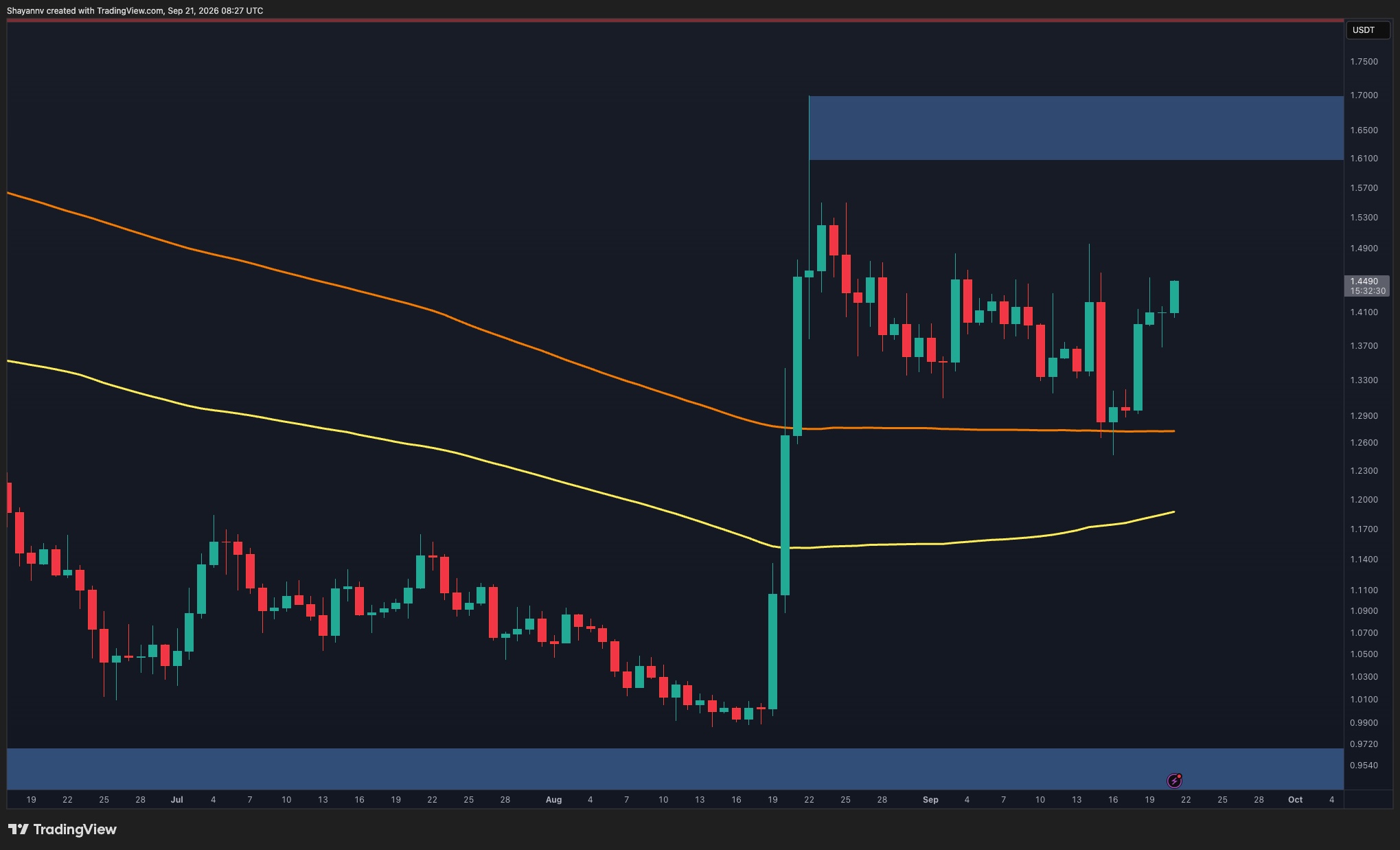
XRP/USDT 4-Hour Chart
The 4-hour timeframe highlights the immediate decision point more clearly. XRP has been trading within a descending channel, but the latest rebound from the $1.22-$1.28 demand zone has driven the price all the way back toward the channel’s upper boundary around $1.43-$1.45.
Importantly, the recovery also reclaimed the $1.33-$1.36 zone, which had previously acted as a key short-term barrier. As long as the asset remains above this region, buyers retain control of the latest recovery leg.
The next challenge is a confirmed breakout above the descending trendline. A sustained move beyond roughly $1.45 would invalidate the immediate bearish channel structure and could allow XRP to target the $1.51-$1.55 resistance zone. Beyond that, the larger $1.61-$1.65 supply region would become the next major objective.
On the other hand, another rejection from the descending trendline would indicate that the corrective structure remains active. In that scenario, the reclaimed $1.33-$1.36 zone would be the first key support to watch. Losing it could shift attention back toward the major $1.22-$1.28 demand area, where the latest recovery originated.

The post Ripple Price Analysis: XRP Approaches a Critical Breakout Level After 8% Daily Surge appeared first on CryptoPotato.