Cryptocurrency Posts
Crypto Briefing
Anthropic's marketplace expansion may boost growth, but market skepticism persists about reaching higher valuation milestones soon.
The post Anthropic expands Claude Marketplace with over 2,000 connectors and plugins appeared first on Crypto Briefing.
Zelenskyy's warning underscores potential for heightened NATO-Russia tensions, impacting European stability and global security dynamics.
The post Zelenskyy warns Putin’s actions could escalate across Europe appeared first on Crypto Briefing.
Kalshi's situation highlights the tension between regulatory oversight and market innovation, impacting the future of crypto derivatives trading.
The post Kalshi denies CFTC investigation amid scrutiny of ether perpetual futures trading patterns appeared first on Crypto Briefing.
OpenAI's integration of GPT-6 into ChatGPT Voice mode could shift AI market dynamics, challenging competitors and influencing future AI developments.
The post OpenAI integrates GPT-6 models into ChatGPT Voice mode for enhanced work tasks appeared first on Crypto Briefing.
Nvidia's open-source move with Nemotron 3 could revolutionize real-time audio processing, enhancing multi-speaker applications and AI integration.
The post Nvidia open-sources Nemotron 3 for real-time speaker tracking appeared first on Crypto Briefing.
Bitcoin Magazine
Bitcoin Magazine

NYSE and Blockchain.com Working Together To List Tokenized Stocks
The New York Stock Exchange and crypto exchange Blockchain.com have signed a memorandum of understanding to debut tokenized stocks.
According to a Wednesday statement, if approved, Blockchain.com users would be able to trade tokenized U.S.-listed stocks and exchange-traded funds on NYSE’s planned digital alternative trading system.
It comes as Wall Street increasingly eyes up Bitcoin and its related infrastructure. NYSE’s parent company, Intercontinental Exchange, earlier this year announced it had invested in crypto exchange OKX.
“People shouldn’t be limited in owning stocks based on where they happen to live or the brokerage and information they may or may not have access to,” Peter Smith, Blockchain.com’s executive chairman and CEO, said in a statement.
“Connecting to the NYSE digital alternative trading system will enable us to extend the opportunity to invest in these digital assets to tens of millions of Blockchain.com users around the world.”
And NYSE Group President Lynn Martin added: “The future of capital markets belongs to institutions that unite the trust of traditional finance with the innovation and accessibility of digital assets.”
In January, the NYSE said it was building a platform allowing traders to buy and sell tokenized versions of U.S.-listed equities and exchange-traded funds and settle those trades on the blockchain, 24/7.
Wall Street has been eying up crypto companies and their infrastructure particularly because it’s interested in tokenizing assets like stocks. Traditional finance titans like BlackRock and Franklin Templeton for years have used blockchain rails to tokenize money funds.
But things have accelerated since the U.S. elected pro-crypto president Donald Trump and regulators have taken a more friendly stance to watchdogging the space. The U.S. Securities and Exchange Commission last week approved tokenized stocks trading.
In January, the S&P 500 gave crypto platform Trade[XYZ] the green light to debut a new derivative contract on decentralized exchange Hyperliquid, giving traders the ability to trade the stock index 24-7.
And Last month, Payward, the parent company of crypto exchange Kraken, and fintech company SoFi Technologies, announced a deal to route SoFi customers’ crypto orders through Kraken’s institutional trading platform and list SoFi’s stablecoin on the exchange.
This post NYSE and Blockchain.com Working Together To List Tokenized Stocks first appeared on Bitcoin Magazine and is written by Mathew Di Salvo.
Bitcoin Magazine

The Quantum Issue: You Never Really Know The Future
People have been debating whether a quantum computer presents a realistic threat to the Bitcoin network for over a decade. It was a serious topic of conversation over 13 years ago when I first discovered Bitcoin myself.
There has been quite a lot of progress, both in terms of theory and real-world engineering, since long ago when I was just a bumbling idiot trying to figure out what was going on here.
Two major milestones have been reached since then that make a material difference in the likelihood of a viable quantum computer actually being produced sometime in the next decade or so. That doesn’t inherently mean that it will reach a point of ubiquity, or even relative ease of access for those with large amounts of capital.
But it is very possible that a number of viable machines will be produced in the near future.
Error Correction Improvements
The first major improvement has been in error correction. To account for the inherent noise in working with things at this kind of tiny scale, to get a logical qubit that is useful in computation in practice requires the use of multiple redundant physical qubits.
The prior state of the art way of doing this was surface codes, a way of bundling multiple physical qubits together in a grid and using some of them as check qubits that periodically “check on” their neighbors to ensure no internal errors in the superposition have occurred (without collapsing the superposition). Each grid’s empty spaces need to be filled with check qubits.
This check qubit requirement creates an extra overhead that can get close to 1,000 physical qubits per logical qubit in total, and it gets bad at scale because check qubits can only check on the qubits immediately next to them. So every grouping of qubits needs to have checkers in equidistant spacing.
Quantum low-density parity-check (qLDPC) codes remove this bottleneck, allowing check qubits to check other qubits at large distances (either through traces interwoven to communicate across chip sections, or by physically moving atoms like with the neutral atom design) across the device. This has allowed a 10x reduction in the amount of physical qubits necessary to produce a reliable logical qubit.
That is not something to sneeze at. While it might not be a fully functional machine making progress at gaining more efficiency, it is material efficiency gains in the engineering processes that underlie the production of a fully functional quantum computer.
Progress In Proving Fundamentals
The second has to do with a more fundamental question around the assertion that adding more physical qubits leads to a reduction in overall noise in the system rather than an increase. This is really at this point still theory, and you have to keep in mind that to this day there has never been a fully functional quantum computer that has end-to-end performed a computation a classical computer is incapable of.
Google performed an experiment using their Sycamore (and later Willow) chips to experimentally verify the effect of adding more physical qubits. To be very clear, this was not a demonstration of performing computations, but simply a demonstration of storing information in memory without it decaying.
They demonstrated through the use of logical qubits composed of a bundle of 17 physical qubits, a bundle of 49 physical qubits, and a bundle of 101 physical qubits that the logical error rate, the frequency of data corruption, decreased as the physical qubit count went up. This test passed a critical threshold, where the logical qubit being created out of the independent physical qubits maintained coherence longer than any individual physical qubit it was composed of.
Now again, this is not a jump to a fully functional quantum computer performing computations that classical machines are incapable of, but it is material progress proving one of the fundamental assumptions underlying quantum computers.
AI
These aren’t the only things that we are finding better solutions to in this problem space either. Artificial intelligence has become a big component in these systems. It is being used in the actual process of reading and decoding information from a quantum computer, a big bottleneck for actually making use of it at scale.
AI is also being used in the development of new quantum algorithms optimized for these types of machines, and given the recent spate of AI helping to solve (or even disprove existing conjectures) major problems in the field of mathematics, this isn’t really that crazy of a leap to consider the possibility of major breakthroughs brought about by AI.
They are being put to the same use in actually designing the actual physical quantum circuits that are built using different architectures. This is a very complex problem, actually, finding the optimal way to lay out quantum gates in a physical space to minimize noise at the quantum level, without creating so much empty space that you introduce latency, inefficiency, and other problems to solve.
This is a factor that very well could hypercharge progress at solving the necessary fundamental problems.
Outlook Ahead
Ultimately, in my opinion, this comes down to one question: does the assumption that adding more physical qubits reduce noise actually hold when it comes to computation and the active manipulation of quantum information.
If that assumption does hold, and isn’t experimentally disproven sometime in the near future, then I think there is a very realistic case for a viable quantum computer being produced in the next ten years.
There is a massive amount of resources being thrown at this problem, significant (but not overwhelming) progress at solving pieces of the problem, and if there fundamentally is a way to do something, human beings usually figure it out.
I’m not saying that it’s time to panic, but don’t discount the possibility.

This piece is featured in the latest Print edition of Bitcoin Magazine, The Quantum Issue. We’re sharing it here as an early look at the ideas explored throughout the full issue.
This post The Quantum Issue: You Never Really Know The Future first appeared on Bitcoin Magazine and is written by Shinobi.
Bitcoin Magazine

Raiffeisen Bank International to Roll Out Bitcoin Services Across Europe in Expanded Bitpanda Deal
Austrian banking group Raiffeisen is rolling out bitcoin trading for its 18 million customers.
The firm said in a Wednesday statement that it was working with brokerage Bitpanda as part of the initiative.
Raiffeisen’s announcement comes as top banks worldwide launch crypto trading and custody services. BBVA, Santander’s Openbank, Germany’s cooperative and savings banks, SoFi, PNC, Charles Schwab and Morgan Stanley have all either launched or announced retail crypto trading over the past 18 months.
RBI chief executive Michael Höllerer pointed to customer demand as the driving force. “We are seeing growing demand for crypto assets in our markets, which we are addressing with a strong, reputable partner,” he said, adding that the bank is committed to “meeting our customers’ needs in the best possible way.”
The deal builds on an arrangement that began in Austria. In 2024, Raiffeisen Landesbank Niederösterreich-Wien (RLB NÖ-Wien) became the first traditional bank in the European Union to offer crypto trading within its existing banking environment, using Bitpanda’s technology.
The new agreement moves away from striking separate integrations market by market and instead sets up a single approach for the whole group.
Bitpanda Enterprise provides banks, fintechs, brokers, trading firms and family offices with the tools to offer digital asset products to retail and corporate clients. Its services include investment infrastructure, liquidity, custody, payments, stablecoins and tokenisation, with an emphasis on compliance and scalability.
RBI treats Austria and Central and Eastern Europe as its home market, with subsidiary banks in 11 countries in the region. The group has about 42,000 employees serving 18.8 million customers through roughly 1,300 branches, most of them in CEE. Its shares trade on the Vienna Stock Exchange, and the regional Raiffeisen banks own about 61.2 per cent of the company, with the rest in free float.
This post Raiffeisen Bank International to Roll Out Bitcoin Services Across Europe in Expanded Bitpanda Deal first appeared on Bitcoin Magazine and is written by Mathew Di Salvo.
Bitcoin Magazine

BitGo CEO Mike Belshe: Why Dollar Debasement Fuels the K-Shaped Economy
Mike Belshe says tokenization isn’t really about trading — it’s about access. The BitGo CEO walks through how the current system dates back to the 1960s paper crisis, when the New York Stock Exchange had to shut down weekly just to settle physical share certificates, and why the structure built to fix it still caters to the largest players. He explains why retail’s inability to borrow against assets, rather than sell them, is what drives the K-shaped economy. In this BMTV interview he describes what ghost stocks and tokenized equities change about that.
Chapters:
00:00 — Does Custody Concentration Create a New Centralization Risk
00:35 — Multisig, MPC, and Eliminating Single Points of Failure
01:49 — What the US Regulatory Framework Still Needs Beyond Clarity
02:39 — How Boardrooms Actually Decide Without a Legislative Path
04:17 — Ghost Stocks and Tokenized Equities
04:51 — The 1960s Paper Crisis and the System Built to Fix It
05:31 — The K-Shaped Economy and Who Can Borrow Against Assets
06:54 — Proof of Reserves and Time-Locking Shares to Show Conviction
08:18 — Where AI Agents Fit Into Managing Assets
10:04 — What He Actually Meant About the Dollar Going to Zero
DISCLAIMER: The views and opinions expressed in this show are those of the participants and do not necessarily reflect the official policy or position of BTC Inc., Bitcoin Magazine, or any affiliated entities. This content is provided for informational and educational purposes only and should not be construed as investment, legal, tax, or accounting advice. Nothing contained in this show constitutes a solicitation, recommendation, endorsement, or offer to buy or sell any securities or financial instruments. Viewers should consult their own advisors before making financial or business decisions.
This post BitGo CEO Mike Belshe: Why Dollar Debasement Fuels the K-Shaped Economy first appeared on Bitcoin Magazine and is written by Patrick Green.
Bitcoin Magazine
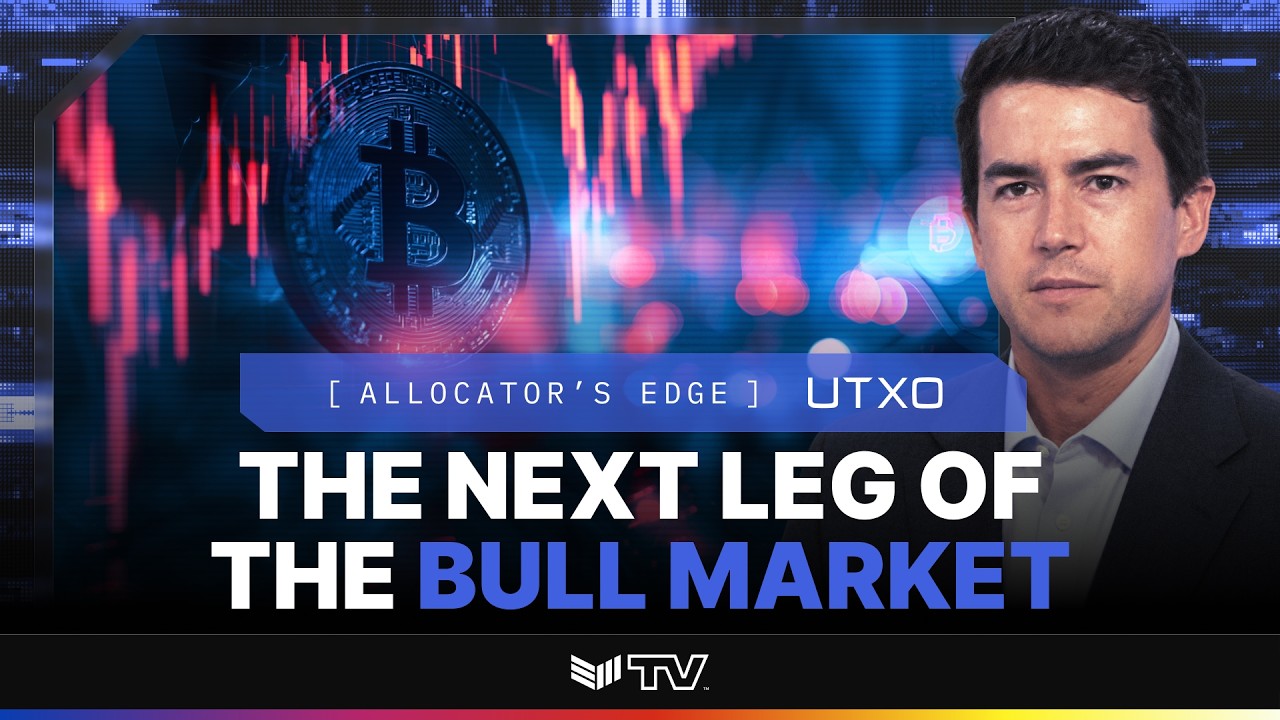
BTC Market & Institutional Adoption Forecast with UTXO’s Daniel Hinton
“Bitcoin plays on hard mode.” Daniel Hinton spent years managing global liquidity relationships at SFOX, and he explains why a 24/7 global market with no clearinghouse outside the blockchain itself is so hard to keep efficient. He describes the multi-percentage-point dislocations that were routine between exchanges in 2018, why they’ve largely disappeared, and how the recent BitMEX wind-down still produced a perp market wick above $150,000 on thin liquidity. Hosts Grace Remington and Sean Hagan dig into what that means for anyone running margin or stop losses.
Chapters:
00:00 — Where the Most Sophisticated Bitcoin Capital Is Going Right Now
01:41 — Exchange Dislocations, OTC Desks, and Why Bitcoin Plays on Hard Mode
03:18 — The BitMEX Wind-Down and a Perp Wick Above $150,000
04:01 — Why Custody Is Back on the Underdeveloped List
05:30 — Building the UTXO Oracle for a Market With No Single Price
07:25 — Running Free Open Source Price Software Next to Your Node
08:21 — Sustainable Balance Sheets Versus Pure Leverage
10:20 — Hunting Dislocated Assets Across a Dozen Global Markets
12:02 — What Has to Be Built for Institutional Mandates to Allow Bitcoin
14:18 — Rounded Bottoms, the Honey Badger, and Resistance Priced in Gold
This video is for informational purposes only and does not constitute an offer to sell or a solicitation of an offer to buy any securities. Past performance is not indicative of future results. Investments in digital assets involve significant risk and may result in loss of capital. Both UTXO Management and BTC Inc., producer of BMTV, are owned by Nakamoto Inc. (NASDAQ: NAKA)
DISCLAIMER: The views and opinions expressed in this show are those of the participants and do not necessarily reflect the official policy or position of BTC Inc., Bitcoin Magazine, or any affiliated entities. This content is provided for informational and educational purposes only and should not be construed as investment, legal, tax, or accounting advice. Nothing contained in this show constitutes a solicitation, recommendation, endorsement, or offer to buy or sell any securities or financial instruments. Viewers should consult their own advisors before making financial or business decisions.
This post BTC Market & Institutional Adoption Forecast with UTXO’s Daniel Hinton first appeared on Bitcoin Magazine and is written by Patrick Green.
CryptoSlate
Nearly $20 million of XRP was drained from thousands of hardware wallets in six waves spanning nearly a week.
Blockchain analysis firm XRPL.to traced 11.75 million XRP leaving 6,678 distinct wallets between Sept. 15 and Sept. 20, including several collection waves after DCENT warned users of unauthorized transfers involving its mobile App Wallet.
At XRP’s current price of about $1.59, the tokens are worth roughly $18.68 million.
XRPL.to dates the first identified sweep to 15:35 UTC on Sept. 15. DCENT said it received its first customer report in Korea on Sept. 16 and began notifying users through its app and official channels that day.

The draining then resumed.
Another collection wave began at 07:05 UTC on Sept. 17, according to XRPL.to, while the final sweep captured in its investigation occurred at 20:56 UTC on Sept. 20.
The investigator counted 4,208 wallets swept through payment transactions and another 2,470 emptied through account deletion without a preceding payment in the dataset it traced. It also identified 5,001 AccountDelete transactions originating from 4,950 wallets, including accounts that had already been partially emptied.
Account deletion allowed whoever controlled the keys to extract balances that ordinary payment sweeps could leave behind. XRP Ledger (XRPL) accounts maintain a reserve while they remain open, but an AccountDelete transaction can close an eligible account and forward its remaining XRP, minus the deletion fee, to another address.
One such deletion moved 107,507 XRP, worth about $171,000 at current prices.
XRPL.to said the payment and deletion transactions were validly signed with the affected accounts’ keys. The blockchain trail does not reveal how those keys were obtained, and DCENT has yet to disclose the technical cause of the incident.
More than 5.6 million XRP moved through THORChain
Much of the stolen XRP had already begun leaving the XRP Ledger by the time investigators mapped the flows.
XRPL.to traced 5.67 million XRP through THORChain as of 11:26 UTC on Sept. 21, including about 5.59 million XRP sent from two collection waves through transactions whose memos specified Ethereum destination addresses.
Another 3.24 million XRP flowed to unionchain.ai, which XRPL.to described as an exchange, while about 546,080 XRP reached NEAR Intents and 535,666 XRP moved into Binance deposit tags.
Around 1.31 million XRP remained in wallets linked to the operation at the investigator’s snapshot.
The destinations complicate attempts to recover the assets. THORChain and NEAR Intents can move value between networks, creating additional trails investigators must follow once XRP has been exchanged for assets on another blockchain.
Meanwhile, transfers to exchange-linked addresses could offer potential intervention points, though a deposit address alone does not establish whether the funds were sold or remain accessible.
DCENT said it has been working with Korean law enforcement, outside security specialists, blockchain projects and exchanges to trace the money and request freezes where possible.
The company has not announced a completed freeze or recovery. It has said any such action depends on law enforcement, exchanges and other third parties controlling the services through which funds traveled.
DCENT urges holders to abandon exposed recovery phrases
The continuing sweeps prompted DCENT to escalate its warning on Sept. 20, asking the broader blockchain and crypto community to help reach App Wallet users who might not have seen its earlier notices.
“The most important step to prevent further damage is moving assets out of the DCENT App Wallet,” the company said, urging users and crypto communities to spread its guidance directly to anyone known to use the app.
DCENT told affected users to update the app from an official app store before taking further action and move their holdings to a wallet created with an entirely new recovery phrase.
That requirement also extends to some hardware-wallet users.
DCENT said anyone who previously entered or restored a hardware wallet’s recovery phrase inside its App Wallet should follow the same migration procedure. Moving the same phrase back onto a hardware device does not generate new private keys, meaning any prior exposure follows the phrase into the new device.
The company’s potential-impact criteria also include addresses whose recovery phrase was used in the App Wallet and that signed transactions using an app version earlier than 8.1.0, released Nov. 5, 2025. Users who later upgraded the software are still being asked to consider which version was installed when they previously signed transactions.
DCENT says hardware users who never entered their recovery phrase into the App Wallet and never used the software wallet to sign transactions do not need to migrate under its current criteria.
The company has also warned users against a second wave of potential losses from impersonators exploiting the incident. DCENT said it will never ask for a recovery phrase, private key, or PIN and will not provide a wallet address to which users must send assets for recovery or compensation.
For users who have already suffered unauthorized transfers, DCENT said on Sept. 20 that it was still developing a process for determining the scope of impact and the status of affected assets.
The post Nearly $20 million in XRP drained from 6,678 wallets across six attack waves appeared first on CryptoSlate.
More than $1 billion in reported trading makes Coinbase's stock tokens look active. For a holder looking to sell, the question is how much the market can absorb now, and at what price, particularly outside US equity hours.
A Sept. 23 premarket check found indicative buy and sell routes for about $100,000 of each of Coinbase's ten stock tokens on Base. The estimated proceeds from selling were 0.06% to 0.71% below KyberSwap's own dollar valuation of the tokens offered. The routes price individual orders at one instant; they do not establish capacity for a simultaneous selloff.
The ten principal Aerodrome stock/USDC pools held about $12.97 million in combined displayed balances during the check. Individual pools ranged from roughly $818,700 for MSFTc to $2.11 million for NVDAc. Those balances include both the stock token and USDC. The total alone leaves the amount available to absorb a sale within a specified price range unknown.
Dromos Kitchen's stock-token dashboard put cumulative trading volume at about $1.02 billion and total tokenized value at $19.82 million on Sept. 23. Its community-built data carries a warning that it may be incomplete. Turnover accumulates across trades; it cannot be read as a fresh pool of buyers waiting for a large sell order.
What the $100,000 quotes show
The table pairs each displayed Aerodrome pool balance with KyberSwap's estimated routes for selling a stock token into USDC and buying it with USDC. The quote gap measures how far the router's estimated output dollar value fell below its own dollar valuation of the input. It does not compare the token with the underlying share's exchange price or record a completed trade.
| Token | Aerodrome stock/USDC pool | $100,000 sell quote gap | $100,000 buy quote gap |
|---|---|---|---|
| NVDAc | $2.11 million | 0.13% | 0.16% |
| AAPLc | $1.50 million | 0.06% | 0.10% |
| GOOGLc | $1.66 million | 0.10% | 0.09% |
| METAc | $2.10 million | 0.13% | 0.22% |
| AMZNc | $1.03 million | 0.30% | 0.22% |
| MSFTc | $818,700 | 0.39% | 0.43% |
| TSLAc | $861,985 | 0.42% | 0.51% |
| MSTRc | $940,283 | 0.71% | 0.76% |
| SNDKc | $952,629 | 0.61% | 0.69% |
| SPCXc | $1.00 million | 0.50% | 0.25% |
Method: Pool balances are from the ten matching Aerodrome Slipstream 3 stock/USDC records at about 08:00 UTC. KyberSwap GET route summaries were captured from 08:02:01 to 08:02:42 UTC. Sell quantities approximated $100,000 at displayed token prices; KyberSwap's own input marks varied slightly. Values are rounded, gas is separate, and no trades were sent. Its API requires a separate step to build a transaction.
At roughly $10,000 per token, sell-side quote gaps were 0.01% to 0.12%. The $100,000 orders generally widened those gaps. Some routes combined Aerodrome with other liquidity sources, so their estimated prices reflect the router's reach beyond any one pool. That extra access may change quickly as market makers and liquidity providers adjust their offers.
The displayed balances depend partly on what liquidity providers are paid to keep capital in the market. Under Aerodrome's gauge rules, providers who stake their pool positions for AERO emissions give up their direct swap-fee rewards, which go to voters directing the emissions. Fee generation and the AERO stream are separate parts of the pool's economics.
At the August launch, Beefy said Coinbase was supplying USDC incentives through Merkl in two-week periods and Beefy was adding its own boosts alongside Aerodrome emissions. That describes how liquidity was encouraged at launch, not a verified current return for every stock pool. If incentives or votes move elsewhere, providers can reassess their positions regardless of how much the tokens have traded historically.
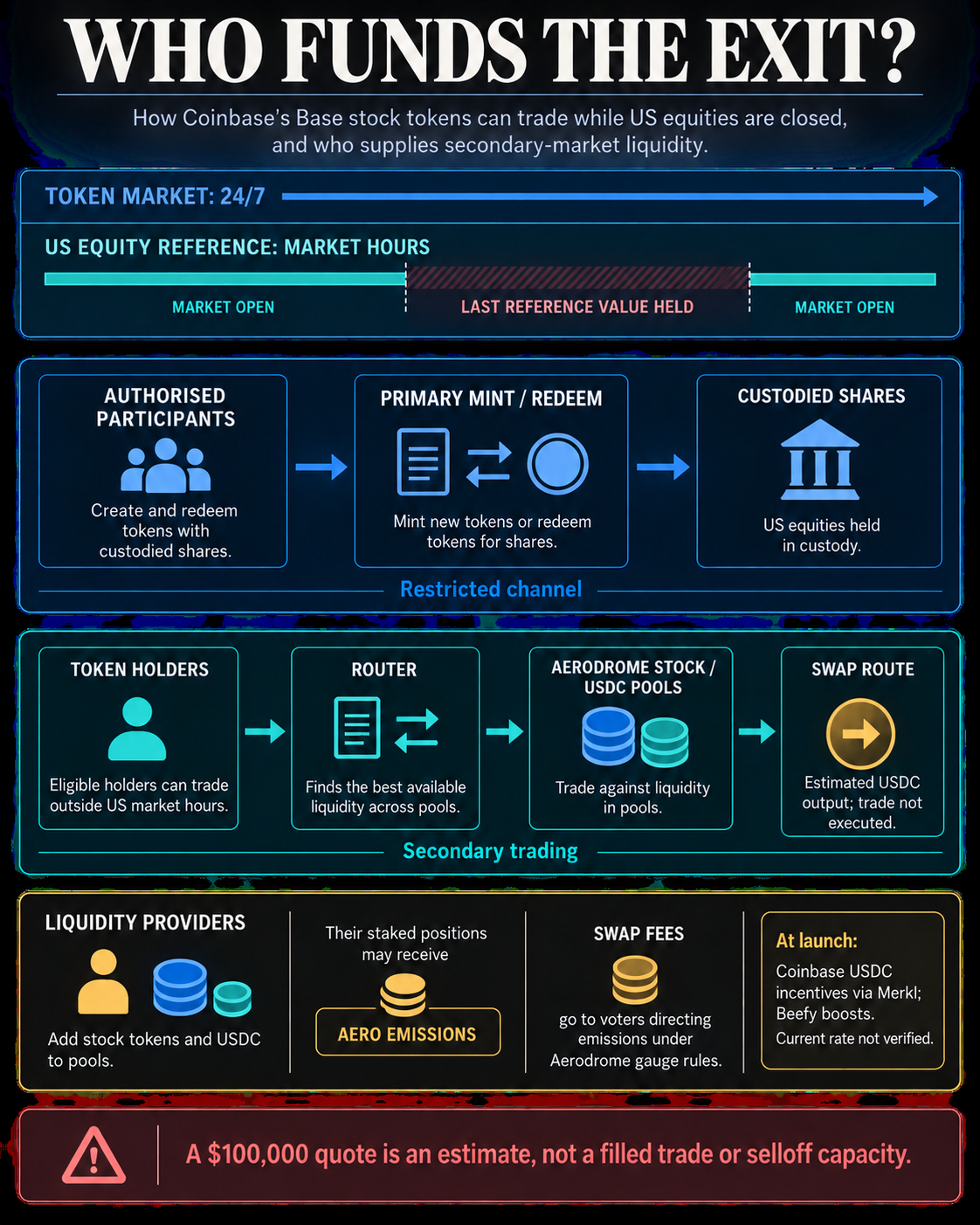
The funding structure matters most when token trading outlasts the underlying share market.
Base says Coinbase's tokens are backed by underlying shares held in regulated custody and are available only in eligible jurisdictions outside the United States. Its developer documentation describes secondary token trading as permissionless, subject to address controls, while primary minting and redemption of the underlying shares are restricted to authorized participants.
The tokens can change hands while the US stock market is closed. The same Base documentation says the Chainlink equity feed holds its last value outside market hours while onchain token trading can continue. A holder selling after hours therefore faces a live token market whose underlying equity reference may still reflect the prior session. Authorized participants control the separate share-creation and redemption channel, leaving secondary-market liquidity providers to set the price of an immediate exit.
The Sept. 23 routes show that $100,000 individual orders received indicative prices despite modest displayed pools. A change in AERO votes, provider capital or after-hours stock news could alter those routes while the equity feed holds its last value.
The post $1 billion in trading volume masks hidden liquidity risks for Coinbase stock token holders appeared first on CryptoSlate.
Money-market mutual funds absorbed approximately 85% of the US government's latest Treasury-bill surge, giving traditional cash managers the clearest claim to the marginal demand behind the summer issuance wave.
The Treasury Department said net bill supply grew by more than $550 billion in July and August, an increase of about 8% in two months. Money funds took down most of that additional supply, according to remarks delivered Sept. 22 by Deputy Treasury Secretary Francis Brooke.
Stablecoin providers remain important holders of short-dated government debt. Treasury puts their holdings at nearly $200 billion. Yet that number measures a stock of Treasury bills and other close-to-maturity securities, while the money-fund figure measures purchases associated with a specific two-month supply increase. The categories can also overlap because stablecoin reserves may be invested through government money-market funds and repurchase agreements.
The result is a more precise picture of crypto's role in government finance. Stablecoins are already material Treasury-linked investors and could become a larger source of demand as regulation takes shape. The documented incremental buying in 2026, however, has come primarily from money funds and the Federal Reserve, with foreign investors returning in July.
What Treasury's buyer breakdown shows
Four figures frame the market, but they use different clocks and measure different things. They are context for one another, not amounts that can be added into a single buyer total.
| Buyer or holder | Reported amount | Measurement window | What the figure establishes |
|---|---|---|---|
| Money-market mutual funds | About 85% of more than $550 billion | July-August 2026 | Share of additional bill supply absorbed |
| Stablecoin providers | Nearly $200 billion | Holdings stock; date not specified | Bills and other near-maturity Treasuries owned |
| Federal Reserve | More than $300 billion | 2026 through Sept. 22 | Bill purchases through two portfolio channels |
| Foreign residents | $38.8 billion increase | July 2026 | One-month change in foreign bill holdings |
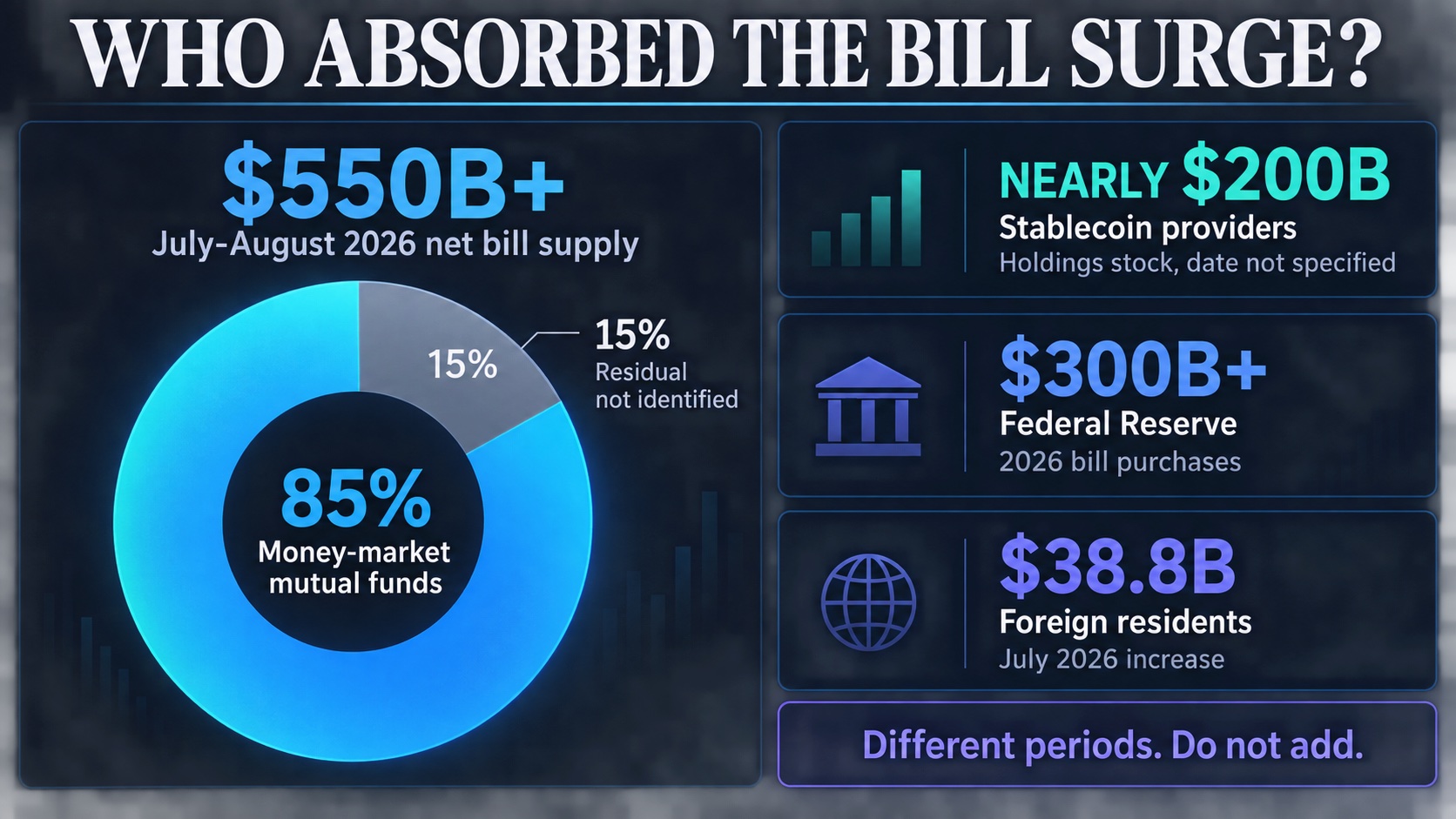
Treasury's 85% estimate directly addresses the latest increase in supply. It applies to the additional bills issued during July and August rather than the entire bill market. The remaining share was not allocated among other buyers in the speech.
The stablecoin total serves a different purpose. It shows that issuers have become a meaningful source of demand for short-dated government assets. Treasury described the nearly $200 billion as bills and other close-to-maturity Treasury securities, without splitting the total by security type or specifying how much was acquired during the summer.
Issuer disclosures show why stablecoins and money funds are not always cleanly separated. Circle said in its second-quarter filing that approximately 84% of USDC reserves were held in the Circle Reserve Fund at June 30. The company describes the vehicle as a Rule 2a-7 government money-market fund.
USDC reserve demand can therefore appear inside the money-fund category. Circle is one issuer, so its allocation does not describe the whole stablecoin market, but it demonstrates the accounting overlap behind the broad buyer labels.
The fund's assets also show that Treasury exposure is broader than direct bill ownership. Its annual shareholder report listed $19.111 billion of direct Treasury obligations and $46.998 billion of repurchase agreements at April 30. The repos were collateralized by Treasuries, but remained a separate asset category. The portfolio date precedes Circle's June reserve disclosure and the mix can change, so the filings establish the structure rather than an exact June allocation.
Treasury presented stablecoin demand as a source of potential growth. Brooke said providers may continue expanding and add to their Treasury holdings as rules implementing the GENIUS Act are finalized. That conditional language makes the regulatory channel an option for future demand, rather than a quantified forecast or an explanation for the July-August absorption.
The Fed and foreign buyers add demand on different timelines
The Federal Reserve has also become a major bill buyer in 2026. Treasury said the Fed purchased more than $300 billion through reserve-management purchases and reinvestment of principal payments from agency securities.
The Fed's July monetary policy report had recorded nearly $250 billion of bill purchases through July 1. About $160 billion came from reserve-management purchases and roughly $90 billion from the reinvestment of agency mortgage-backed security principal. The later Treasury figure reflects a more recent cutoff.
These purchases occur in the secondary market, rather than directly at Treasury auctions. The operations are designed to maintain ample reserves and manage the composition of the System Open Market Account, which separates them from both direct government financing and conventional quantitative easing.
The Fed's published balance sheet corroborates the scale of the expansion. Bill holdings were $233.592 billion on Dec. 31, 2025 in the Jan. 2 H.4.1 release and $550.482 billion on Sept. 16 in the Sept. 17 release. The change is a net stock movement rather than a gross-purchase figure, and it does not allocate the July-August issuance. It does show how quickly bills became a larger part of the Fed's portfolio.
Foreign demand turned positive before Treasury published its buyer breakdown. Foreign residents increased their bill holdings by $38.8 billion in July, according to the Treasury International Capital release. That followed declines of $20.0 billion in April, $43.5 billion in May and $29.0 billion in June.
Private foreign holdings rose by $45.0 billion in July, while foreign official holdings fell by $6.3 billion. The rebound shows overseas buyers returning after three monthly declines, but it covers July alone and tracks foreign holdings rather than every buyer class. Treasury also cautions that custody-based TIC data can obscure the beneficial owner when securities are held through third countries or managed by foreign portfolio managers.
Together, the data show broad demand for short-term government debt without making each buyer measure interchangeable. Money funds dominate Treasury's account of the July-August supply increase. The Fed supplied substantial year-to-date secondary-market demand, and foreign holdings rebounded in July. Stablecoin issuers sit inside that market as large holders whose reserve structures can channel demand through money funds and repo.
The regulatory outlook could make stablecoins a bigger force in future Treasury financing. The latest issuance surge arrived before that possibility could be measured as a distinct flow, leaving traditional money funds as the buyer class Treasury identified most clearly.
The post Stablecoins hold nearly $200 billion in US debt, but money funds bought the surge appeared first on CryptoSlate.
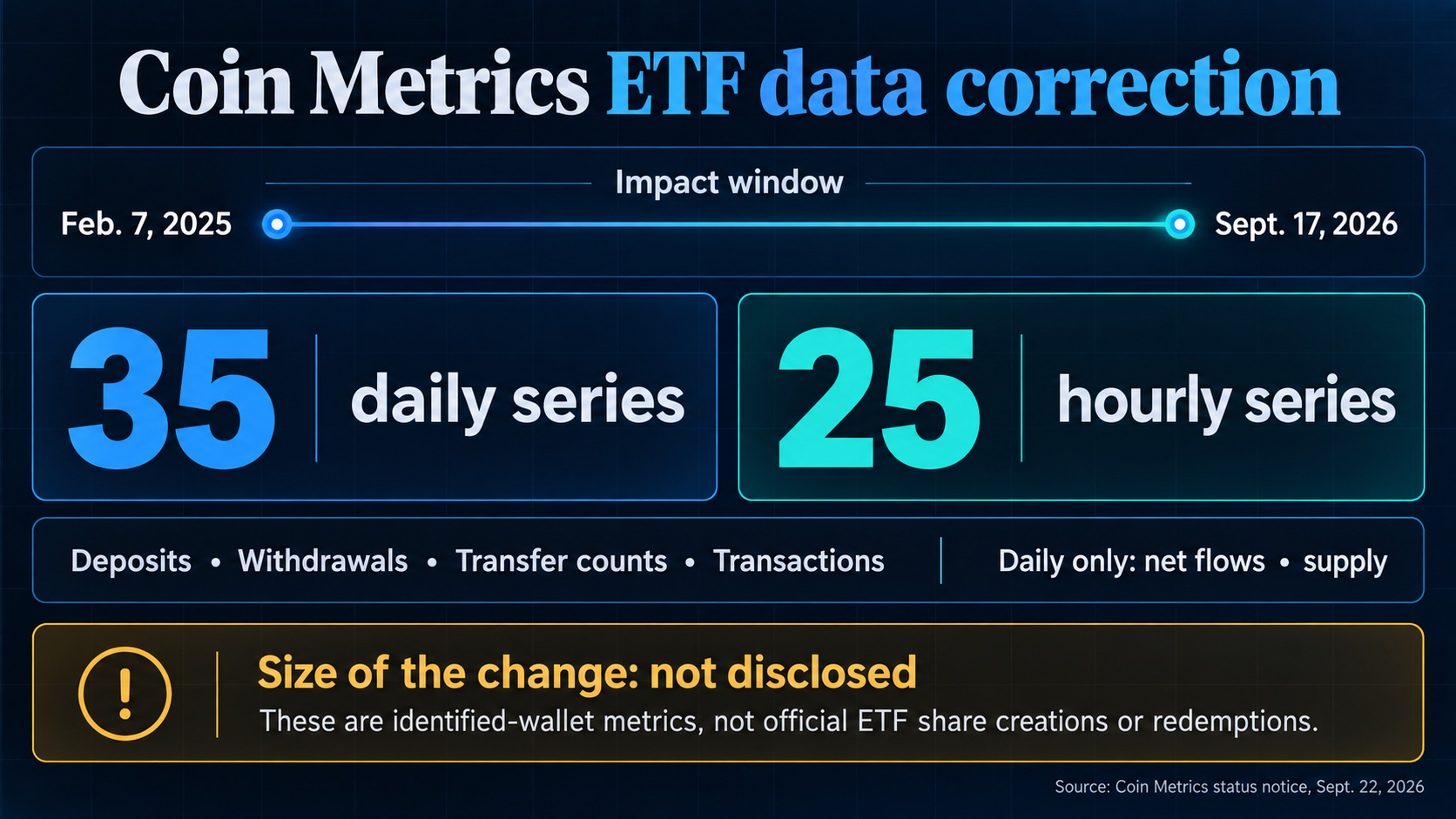
Coin Metrics corrected more than 19 months of Bitcoin ETF-related on-chain data, leaving users of its identified-wallet series to reassess any analysis built on the affected history.
The Sept. 22 status notice says the correction covers Bitcoin data from Feb. 7, 2025 through Sept. 17, 2026. Coin Metrics listed 35 affected daily series and 25 hourly series, including ETF deposits, withdrawals, transfer counts and transactions. The daily list also included net-flow and supply measures.
These are provider-derived observations of activity involving blockchain addresses Coin Metrics identifies as ETF-owned, rather than official ETF share-creation, redemption or fund-accounting records.
The notice does not state what caused the recalculation. Moreover, it gives no before-and-after values, aggregate difference or percentage change; does not say whether the revisions generally raised or lowered the figures; and does not identify the largest adjustment or any affected research.
What the correction can change
Coin Metrics' deposit methodology defines an ETF deposit as assets sent during an interval to an address the company identifies as ETF-owned. Dollar-denominated deposit flows are calculated from native-unit flows using its PriceUSD metric.
Its withdrawal methodology counts assets leaving the control of identified ETF addresses. For Bitcoin withdrawals, Coin Metrics excludes the effect of change outputs, so coins returned to the same fund cluster are not counted as a separate inflow.
Coverage is another constraint. Coin Metrics says its ETF transaction-count metric includes only ETFs and addresses it has identified, making that specific metric a minimum potential value. The daily correction list also reaches its ETF supply series.
Wallet movements cannot be treated as a one-to-one proxy for authorized-participant creations or redemptions. Coin Metrics measures attributed blockchain activity, while the regulated fund process concerns orders for ETF shares, including the in-kind mechanism permitted under the SEC's July 2025 approval. The Sept. 22 notice describes a correction to Coin Metrics Network Data, not a revision to issuer records.
The practical impact is therefore limited to work that used the affected Coin Metrics series. Anyone who stored those daily or hourly values, or used them in models, charts or research covering the corrected interval, may need to backfill the history and rerun that work. The notice does not show that unrelated ETF analysis changed.
Until Coin Metrics publishes deltas or a fuller explanation, the responsible conclusion remains narrow: the provider changed a broad slice of its ETF-wallet picture, but has not shown the public how much that picture moved.
The post Coin Metrics revises 19 months of ETF wallet data but by how much? appeared first on CryptoSlate.
Bitcoin exchange-traded funds (ETFs) have erased their 2026 flow deficit after a sharp buying revival, even as the top crypto struggles to hold its latest gains.
Data from SoSoValue shows that the US-listed funds have attracted more than $1.7 billion in fresh capital this week, with the products drawing $999 million on Sept. 21 and $715 million on Sept. 22.
At the current pace, the funds are positioned to surpass their strongest inflow week of the year, when they drew about $1.92 billion during the week ended Aug. 21.
BlackRock has captured a disproportionate share of the latest demand, with its iShares Bitcoin Trust (IBIT) attracting roughly $1.02 billion over four trading sessions, according to Arkham Intelligence.
ETF buying repairs a $5.7 billion hole
The latest inflows cap a sharp reversal for a market that had accumulated a $5.69 billion year-to-date deficit by July 13.
Askthetape data show roughly $6.04 billion has flowed back into the products since that trough, pushing the annual tally to about $349 million in net inflows. About $3.17 billion of the recovery came during the past 30 days.
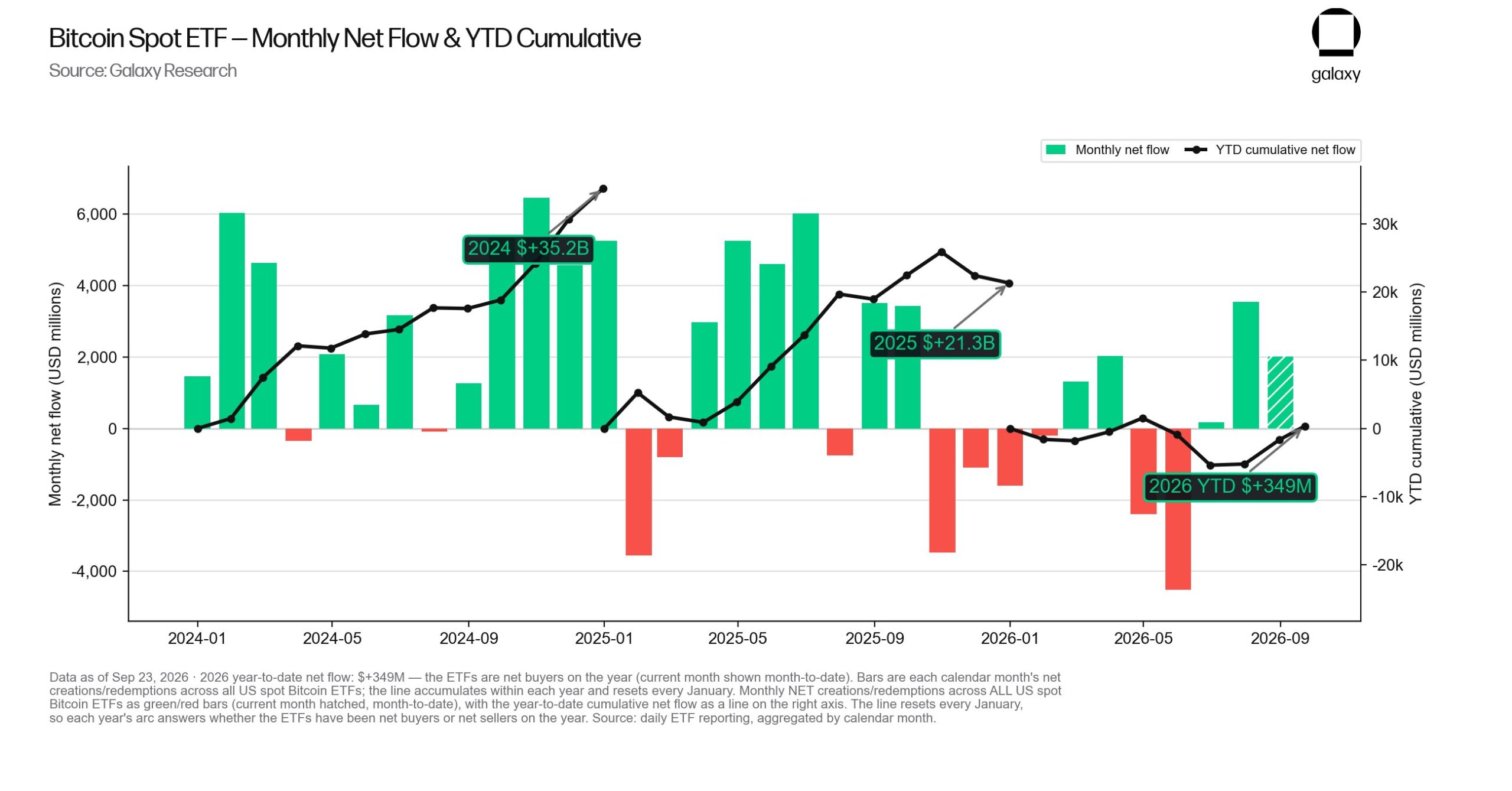
Bloomberg Intelligence ETF analyst Eric Balchunas said the renewed demand began gathering pace in August after Treasury Secretary Scott Bessent signaled increased purchases of longer-dated government bonds, a development some market participants interpreted as evidence of mounting pressure in long-duration debt markets.
Bitcoin has risen about 35% since then, climbing from roughly $64,100 to above $85,000, while the ETFs absorbed about $4.6 billion over the same period, Balchunas said.
The rebound has also repaired losses for investors who spent parts of 2026 holding ETF positions below their purchase price. The average cost basis of Bitcoin held through the funds is estimated near $82,000, leaving the cohort back in unrealized profit with BTC trading above $85,000.
That marks a clear shift from July, when persistent redemptions were adding pressure to an already weak market. ETF investors are now increasing exposure after a roughly one-third rally, with fresh creations arriving as Bitcoin trades near eight-month highs.
Profit-taking absorbs the ETF bid as Bitcoin slips below $85,000
That stronger demand helped push Bitcoin as high as $87,265 over the past 24 hours, but the rally has since lost momentum. Data from CryptoSlate shows the cryptocurrency traded at $84,589 as of press time as investors increasingly took profits in the advance.
CryptoQuant data show short-term holders sent about 47,600 BTC held at a profit to exchanges as Bitcoin approached $88,000, one of the largest spikes in the series. At prices near $85,000, the coins were worth more than $4 billion, highlighting the scale of potential supply moving toward trading venues as ETF demand accelerated.
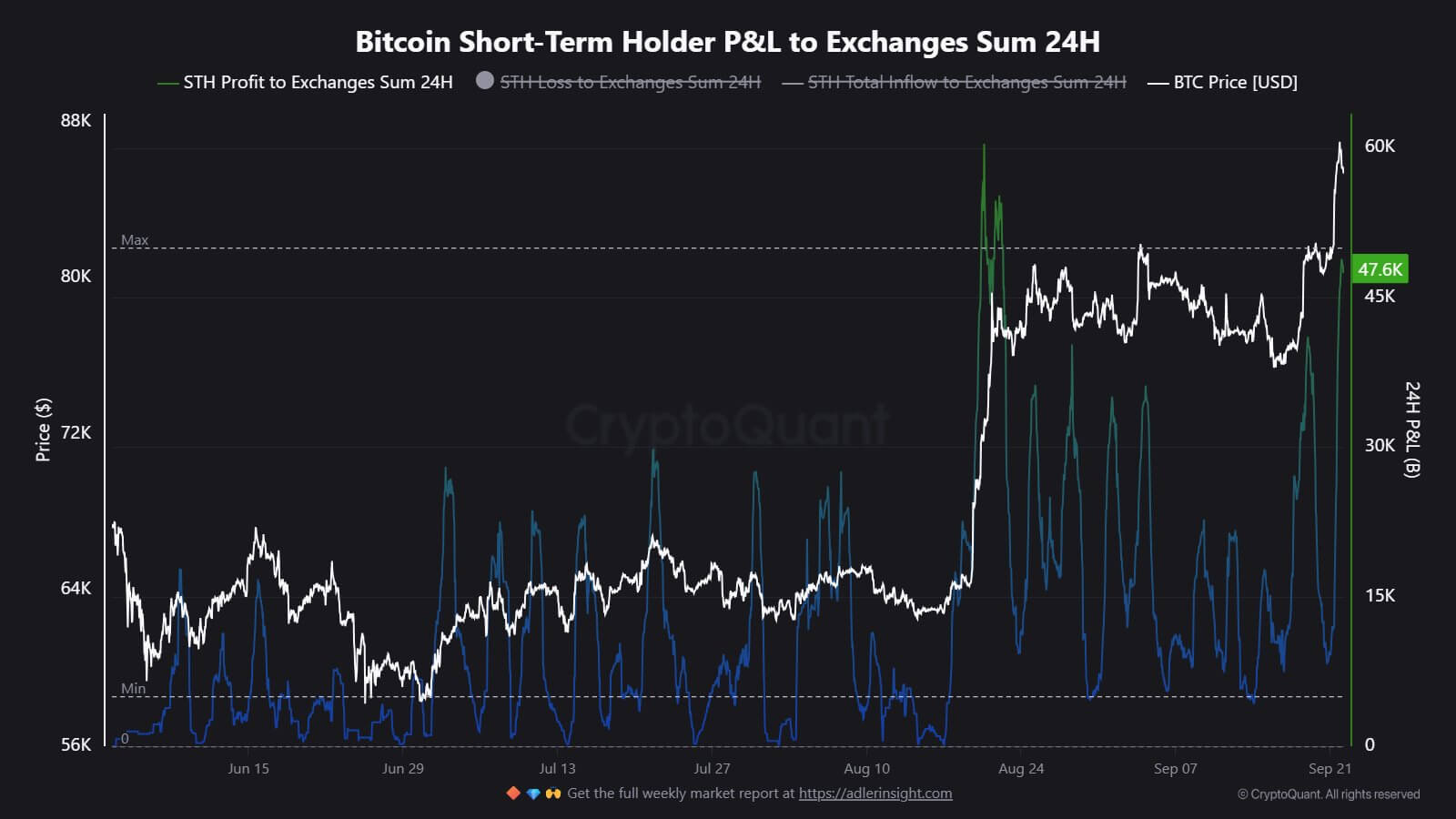
Exchange deposits do not mean every transferred coin was sold. Still, the surge shows that profitable short-term holders became considerably more active around the local high.
That supply helps explain why more than $1.7 billion of ETF inflows this week has not produced an uninterrupted advance. Fresh institutional money continues to enter through the funds, while investors who accumulated Bitcoin at lower prices are using the rebound to lock in gains.
However, Santiment warned that strong ETF demand could itself become a source of caution.
The analytics firm said unusually large ETF inflows have repeatedly clustered around local market turning points, as investors tend to chase exposure after Bitcoin has already made a substantial move. The latest surge fits that pattern, with ETF demand reaching an extreme after Bitcoin climbed about 35% over the past month.
Santiment stressed that such inflows do not guarantee an immediate reversal. Strong buying can continue to carry prices higher, but past episodes suggest exceptionally large creations can coincide with rising euphoria and leave the market more vulnerable once marginal demand begins to fade.
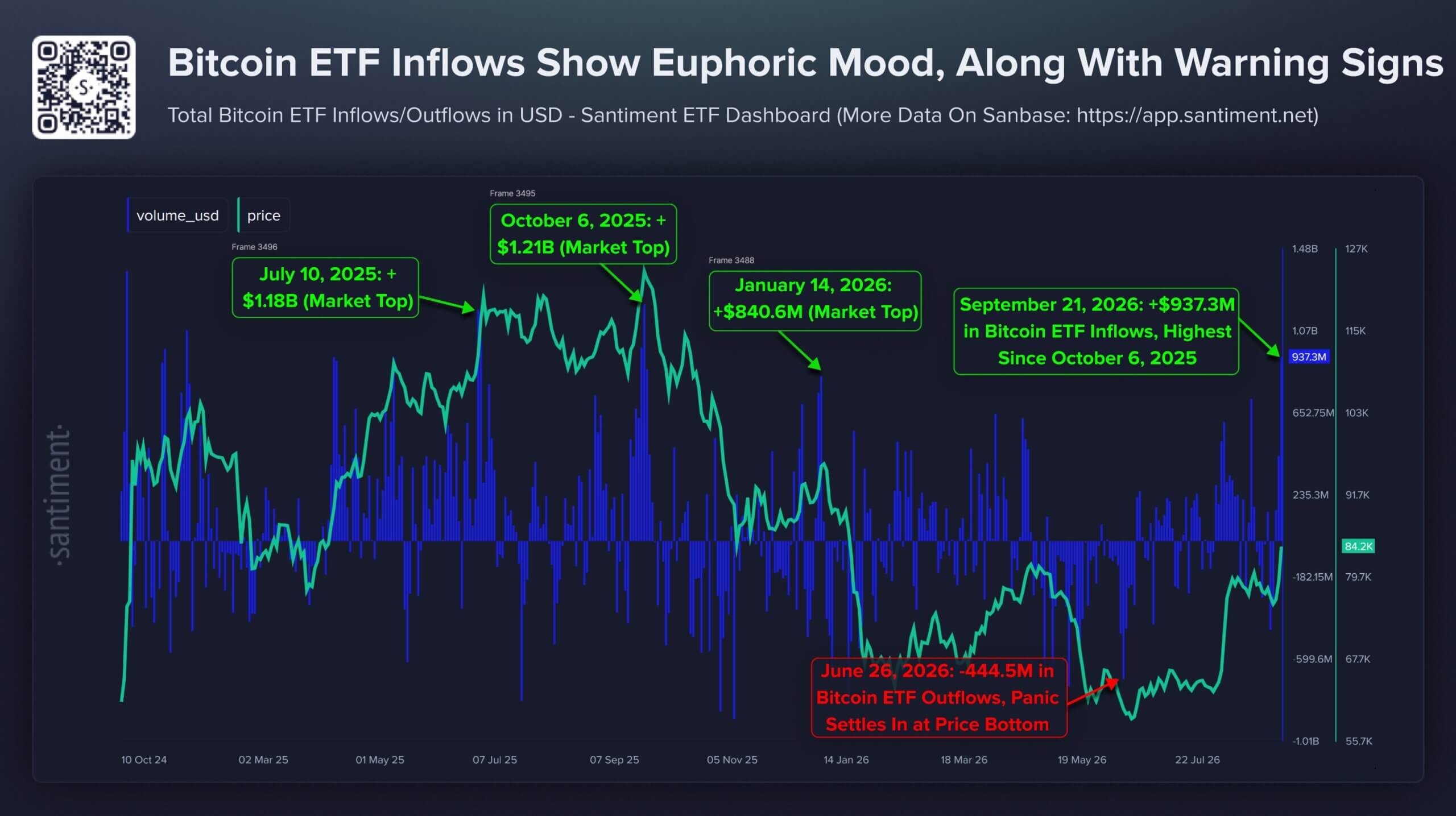
That risk is now developing alongside heavier profit-taking. Bitcoin’s rally has returned the average ETF investor to unrealized profit while also giving short-term holders acquired at lower prices an opportunity to distribute coins into strength.
Continued ETF creations would give the market more capacity to absorb that supply. A slowdown in fund demand while short-term-holder exchange deposits remain elevated would leave Bitcoin increasingly reliant on other spot buyers to sustain a rally that has already brought a large share of recent investors back into profit.
The post Bitcoin ETFs just erased a $5.7 billion hole, but profit-taking is swallowing the new demand appeared first on CryptoSlate.
CryptoTicker.io
The Solana price stood at $114.55, or 100.56 euros, at 18:45 German time on September 23, 2026. That is 2.2 percent less than the day before and still 17.7 percent more than seven days ago. Anyone holding Solana therefore has a strong week and a weak day behind them. The more important question arises regardless: in five days the feature gate opens for the largest overhaul the network has prepared in years, and the tax clock on every SOL bought in September has been running anew since this week. Both are things you can check today. The price merely supplies the occasion.
Solana price on September 23: $114 after 17.7 percent in seven days
The figures come from the CoinGecko market database, retrieved on September 23, 2026 at 16:45 UTC, which is 18:45 German time. SOL is quoted at $114.55. The daily high was $119.66, the daily low $113.31. Market capitalisation stands at $67.3 billion, trading turnover over the past 24 hours at $5.33 billion.
Over one week there is a gain of 17.7 percent, over one month one of 18.7 percent. Working the weekly gain backwards puts the price seven days ago at around $97. The entire move of this week therefore plays out in a range of roughly $97 to $119.66. SOL remains 60.9 percent away from its all-time high of $293.31. That last figure is the most uncomfortable one in this article, and it belongs at the start: a weekly gain of 17.7 percent sounds like a turn, but it shortens the distance to the record by only a few percentage points.
Today's pullback of 2.2 percent is not a standalone event. Bitcoin gave up 2.5 percent over the same period, Ethereum 2.7 percent, XRP 3.3 percent. SOL is therefore falling somewhat less than the rest of the field and stays ahead over the week. Anyone deriving an action from a single daily loss is measuring noise.
What has carried the SOL price this week
Two things are running in parallel. One is the network side: Anza, the development firm behind the widely used Agave client, published the release plan for version 4.3 in August and named September 28 in it as the target for activating the new consensus procedure on mainnet. That is a date market participants have been counting down to for weeks.
The other is the supply side. The network's inflation rate stands at 4.9 percent according to the analytics service Staking Rewards, with a staking ratio of 69.32 percent of circulating supply. Almost seven out of ten SOL are therefore locked up and unavailable to the market in the short term. At the same time, the developer community is discussing a doubling of the disinflation rate from minus 15 to minus 30 percent per year under the identifier SIMD-0411. That would shorten the path to the target inflation of 1.5 percent to roughly three years instead of six. Important for context: this switch was not yet active on mainnet as of September 17. It is a proposal, not a network rule in force.
One term that comes up in both contexts deserves a brief definition. A feature gate is a switch in the protocol that arms an already shipped function at a set point in time. The software sits on validators' machines beforehand; it takes effect only once enough stake weight flips the switch.

Alpenglow opens on September 28: what delegators should check beforehand
Alpenglow is the name of the consensus overhaul. It replaces the previous TowerBFT procedure with a new voting protocol called Votor. The tangible effect: the finality of a transaction is meant to drop from around 12.8 seconds to roughly 150 milliseconds. Finality describes the moment from which a transaction can practically no longer be reversed. At the same time, the network's fault tolerance rises from 33 to 40 percent. The network can therefore cope with a larger share of failed or malicious validators before it stalls.
For you as a delegator, meaning someone who makes their own SOL available to a third-party validator, one concrete check follows from this. First: is your validator already running a client version that supports the switch? Validators running an outdated version on the cut-off date can miss blocks, and missed blocks mean lower rewards for everyone delegating to them. You will find the version details on your validator's page in any common network explorer.
Second: how high is your validator's commission, and has it been changed recently? A commission raised at short notice is the most common silent drag on returns. Third: how much stake weight does your validator bundle? Very large validators are convenient, but they concentrate the network. We described the details of the timetable and the requirements more fully in our assessment of the Alpenglow activation from September 1.
What this date explicitly is not: a price forecast. A protocol upgrade with a date known for weeks is largely priced in. Anyone buying today because September 28 is approaching is buying information everyone else has had for a long time.
Holding period under Section 23 of the Income Tax Act: buying into the September rally restarts the clock
This is where the price move turns into a tax question. In Germany, gains from selling crypto assets held as private assets are tax-free under Section 23 of the Income Tax Act if more than one year lies between acquisition and sale. Sell earlier and the gain is taxable, at your personal income tax rate and not at the 25 percent flat withholding tax.
This week's advance has very probably triggered purchases. Each of those purchases sets its own one-year clock running. Anyone who bought on September 18 is free on September 19, 2027, not earlier. That sounds trivial and is regularly overlooked in practice, because many investors think of their holdings as one block rather than as a series of individually dated additions.
There are two things you should record today, while the figures are fresh. First, the acquisition date of each tranche, to the day. Second, the acquisition price in euros at the time of purchase, not in dollars. The tax office calculates in euros, and anyone back-calculating from dollar prices later builds in a source of error that can hardly be resolved cleanly after the fact. A portfolio tracker takes this bookkeeping off your hands; which tools deliver German reports is set out in our overview of crypto tax software and portfolio trackers.
For the order of sales, the rule is generally individual attribution per wallet, or failing that the first in, first out method. Which tranche you sell therefore co-determines whether a gain falls into the tax net. Anyone holding an old position kept well beyond a year alongside a fresh one from this week should settle that before a sale rather than after.

Staking yield at 6.0 to 6.7 percent: when the 256-euro exemption threshold breaks
For tax purposes, staking rewards are something different from price gains. Under Section 22 number 3 of the Income Tax Act they count as other income from services. An exemption threshold of 256 euros per calendar year applies to them. Exemption threshold means: stay below it and the entire amount is tax-free. Reach or exceed it and the entire amount becomes taxable, not merely the excess. The difference from an allowance is the whole point here.
Each reward is valued at the moment it accrues, in euros. And this is exactly where this week's price advance reaches into your tax return. Work it through on today's figures. One SOL costs 100.56 euros. The 256-euro threshold is therefore reached after around 2.55 SOL of rewards. Staking Rewards reports a reward rate of 6.67 percent on September 23; other surveys from the same week came in at a good 6.0 percent. So take the range: at an annual yield of 6.0 to 6.7 percent you need roughly 38 to 42 SOL staked to break the threshold within a year.
A month ago the same calculation looked different. With SOL 18.7 percent lower, that worked out at roughly 85 euros a piece, assuming an unchanged euro-dollar relationship. The threshold would then only have been reached at around three SOL of rewards, and for that you would have had to stake roughly 45 to 50 SOL. The price advance therefore lowers the bar by about seven to eight SOL without your having done anything at all. That is exactly why this check belongs in a price article and not in the week before the filing deadline.
Two additions that are often missing. The 256 euros apply to all income under Section 22 number 3 taken together, not per coin and not per exchange. Anyone staking or lending assets besides SOL has to add them up. And the coins received start a one-year holding period of their own from the moment they accrue. In its circular of March 6, 2025, the Federal Ministry of Finance confirmed that an extension to ten years does not apply to staking and lending. That question was considered open for years and has not been since.
Validator commission: what is really left of the staking yield
The reward rate quoted is a gross figure. Your validator's commission comes off it, a percentage of the reward that the operator retains for running the node. Values between zero and ten percent are common. Work it through on the upper estimate: at a five percent commission, 6.67 percent becomes roughly 6.34 percent; at a ten percent commission, roughly 6.0 percent.
That difference looks small and, calculated over a year, it is. It becomes relevant once the gross yield falls anyway. That is exactly what lies ahead: rewards are fed by network inflation, and that is declining as planned. What the decision on the falling payout means in concrete terms is written up in our analysis of the falling Solana staking yield. Anyone paying a ten percent commission today will still be paying it when the gross yield is four percent. An overview of providers and their terms can be found in the comparison of the best staking platforms.
A note on the distinction: staking through a centralised exchange and delegating yourself from a wallet are the same category of income for tax, but they differ considerably in counterparty risk. At the exchange, the provider holds the keys. When delegating yourself, the key stays with you and the validator receives only the voting right, never control over the coins.
Buying under MiCA: how to recognise an authorised exchange
When the price rises, people buy, and in doing so investors regularly end up with providers that are no longer permitted to operate in Germany at all. The European Markets in Crypto-Assets Regulation, MiCAR for short, has applied directly since December 30, 2024. Germany shortened the available transition period through its Crypto Markets Supervision Act: under Section 50 of that act it ended on December 31, 2025. Since January 1, 2026, crypto service providers without MiCAR authorisation may no longer provide services in Germany.
The check takes two minutes. Look the provider up in BaFin's company database or in ESMA's European register. If it is not listed there as an authorised crypto service provider, that is not a detail for lawyers but your problem: in a dispute you have no supervisory route, and deposit protection does not apply to crypto assets in any case. Which trading venues hold European authorisation is compiled in our overview of regulated crypto exchanges.
Pay attention to the execution route as well. A purchase through a contract for difference or a certificate does not deliver you SOL but a claim against the issuer. You cannot stake with it, and different tax rules apply, namely those for investment income with flat withholding tax. Anyone buying because of the holding period has to actually own the coins.
Custody and unstaking: why your SOL is not immediately ready to sell
Delegated SOL is not available instantly. Deactivating a delegation only takes effect at the end of the current epoch, and an epoch on Solana usually lasts about two to three days. So anyone wanting to sell at the high cannot readily do so with staked holdings. Between your decision and the available balance lies the remainder of the epoch.
A simple split follows from this, one many investors run anyway: part of the holdings staked for yield, part liquid for the ability to act. How large those parts are depends on your own situation and not on a rule of thumb from the internet.
On custody itself: anyone holding larger amounts does not belong on an exchange. A hardware wallet separates the private key from the internet-connected computer, and delegating is possible from a hardware wallet too. The recovery phrase remains crucial: keep it offline, in two physically separate places, and never as a photo or a text file on a device.
Levels above and below: $119.66 against $113.31
The levels that count today are measured values and not drawn lines. On the upside, the next relevant figure is the daily high at $119.66. It sits just below the round $120 mark, and the price has not taken that one yet in the current attempt. As long as that remains the case, the move of the past seven days is a forceful recovery within a range and not a confirmed breakout.
On the downside, the first figure is the daily low at $113.31. Below that lies the middle of the weekly range at roughly $108, and below that the starting point of the move at around $97. A fall back to there would erase the entire weekly gain without anything having had to change on the network side. That, too, belongs to an honest reading of a 17.7 percent gain over seven days.
The basis for these three values is deliberately narrow: the daily high and daily low are collected figures from live trading, and the weekly starting point is back-calculated from the weekly change. Anything beyond that would be an expectation, and expectations belong attributed by name rather than presented as fact.
Checking the Solana price: what to take away
- Record this week's tranches with their date and euro price. Every purchase starts its own one-year clock under Section 23 of the Income Tax Act. Capturing that today spares you the reconstruction next year. Tools for it are in the comparison of crypto tax software and portfolio trackers.
- Measure your staking rewards against the 256-euro exemption threshold. At a price of 100.56 euros and a yield of 6.0 to 6.7 percent, roughly 38 to 42 SOL staked will break the threshold within a year. Check your validator's commission at the same time, because it comes off the gross yield. Provider terms can be found in the comparison of the best staking platforms.
- Before September 28, check your validator's client version and your exchange's authorisation. A validator on an outdated version costs rewards, and a provider without MiCAR authorisation has not been allowed to serve you in Germany since January 1, 2026. Authorised trading venues are listed in the overview of regulated crypto exchanges.
You can read the legal basis yourself: the exemption threshold for other income in Section 22 of the Income Tax Act and the treatment of staking and lending in the Federal Ministry of Finance circular of March 6, 2025.
(As of September 23, 2026. This article is not investment advice. Prices and fee structures change; check the terms with the provider before you buy.)
The crypto market gave back its move above $87,000 on September 23, 2026. Bitcoin lost 2.59 percent over 24 hours. That sounds like a quiet session, and for Bitcoin it was one. For leveraged altcoin positions it was not: Uniswap travelled 17.04 percent between its daily high and its daily low and still ended almost exactly where it had started, at minus 0.97 percent.
Anyone who sized their distance to liquidation against the daily loss used the wrong number for this session. This analysis was compiled by cryptoticker.io on September 23, 2026. It measures two quantities separately across the top 25: the change over 24 hours, and the daily range, meaning the distance between high and low. The result looks different from what the day's headlines suggest.
What happened in the crypto market on September 23, 2026
Bitcoin reached a high of $87,283 in the 24 hours before the reading and then fell back to $83,856. At the time of measurement the price stood at $84,155. The move above the $85,000 mark was the first since January, and it did not hold.
A pullback after a fast advance is the normal case, not a break. It becomes interesting only once you break it down into 16 individual moves. That is exactly what this analysis does. A retail investor typically holds two or three positions rather than the whole market. For that investor a different question matters: how far did their own holdings swing along the way?
The measurement: 16 top-25 assets, daily loss against daily range
All spot tickers on the OKX exchange were pulled on September 23, 2026 at 15:54 UTC. From them, the USDT pairs of the non-dollar-pegged assets in the CoinGecko top 25 were extracted, 16 in total: Bitcoin and 15 altcoins. For each one, the change over 24 hours and the daily range, measured as the distance between high and low relative to the daily high, were calculated. The ranking was cross-checked against coinlore.net.
| Asset | Price in USD | 24 hours | Daily range |
|---|---|---|---|
| Bitcoin | 84,154.80 | -2.59 % | 3.93 % |
| Dogecoin | 0.0927 | -7.29 % | 11.48 % |
| Chainlink | 12.19 | -6.52 % | 8.67 % |
| Cardano | 0.2376 | -5.68 % | 10.18 % |
| Stellar | 0.2025 | -5.22 % | 10.25 % |
| XRP | 1.5059 | -4.39 % | 9.37 % |
| BNB | 761.90 | -3.30 % | 5.08 % |
| Ethereum | 2,658.39 | -3.19 % | 5.06 % |
| Litecoin | 59.46 | -3.18 % | 9.05 % |
| Solana | 113.95 | -2.94 % | 5.62 % |
| Hyperliquid | 92.90 | -2.19 % | 5.49 % |
| NEAR Protocol | 4.295 | -2.05 % | 12.09 % |
| Uniswap | 9.106 | -0.97 % | 17.04 % |
| TRON | 0.3395 | -0.59 % | 1.68 % |
| Zcash | 1,557.01 | +0.86 % | 10.92 % |
| Bitcoin Cash | 340.60 | +4.99 % | 13.25 % |
The median of the 15 altcoins came in at minus 3.18 percent over 24 hours. Bitcoin stood at minus 2.59 percent. The ratio is therefore 1.22 to 1. Under the common narrative that altcoins fall by a multiple in a pullback, a far larger figure would have to appear there. It does not.
With the daily range the picture flips. Bitcoin swung by 3.93 percent. The median altcoin swung by 9.37 percent, which is 2.4 times as much. The extremes sit well above that: Uniswap at 17.04 percent, Bitcoin Cash at 13.25, NEAR Protocol at 12.09 and Dogecoin at 11.48 percent.
Why daily loss and daily range measure two different things
The daily loss is a difference between two points in time. It says where an asset stood 24 hours ago and where it stands now. What happened in between is invisible to it. The daily range describes precisely that in-between: the furthest point up and the furthest point down.
For an unleveraged investor who simply holds a position, the daily loss is the more relevant number. Their portfolio value follows the current price, and a swing that has since retraced has cost them nothing. As soon as leverage, a stop order or a margin threshold enters the picture, the relationship inverts. These mechanisms do not check the closing price; they check every price along the way. They are triggered by the low, not by the finish.
A stop-loss order at a price that is touched once during the day is executed. It is not reversed because the price ran back afterwards. The same applies to a liquidation, only harder: there the position disappears along with the collateral behind it.

The Uniswap case: 17 percent range on a one percent daily loss
Uniswap is the clearest case in the measurement. The asset ran from $10.944 at the high down to $9.079 at the low and stood at $9.106 when the data was pulled. Calculated over 24 hours, that is a loss of 0.97 percent. In every price table of the day, Uniswap therefore appears as all but unmoved.
Anyone who entered at the previous day's high with five-times leverage was long liquidated by a 17 percent decline, before the price ran back. The table shows that investor a quiet day while their position no longer exists. This is neither an exception nor a quirk of a single exchange. It is the normal consequence of confusing two different quantities.
NEAR Protocol shows the same pattern in weaker form: a 12.09 percent range on a daily loss of 2.05 percent. Zcash belongs in the group too, with a 10.92 percent range and a gain of 0.86 percent at the close. An asset that ends the day higher can have given up eleven percent along the way.
Calculating your liquidation distance: which reference figure is the right one
The liquidation price is the price at which the collateral behind a leveraged position is exhausted and the exchange closes the position by force. On a long position with five-times leverage it sits roughly 20 percent below entry, at ten-times leverage roughly 10 percent, in each case before fees and funding. What the exact calculation looks like, and what role the maintenance margin plays in it, depends on the provider.
What matters is what you hold that distance against. Set it against the average daily loss, meaning three to four percent, and ten-times leverage looks comfortable. Set it against the measured daily range and it looks different: with Uniswap, ten-times leverage would not have survived this single day, with Dogecoin, NEAR Protocol and Bitcoin Cash it would have been close, and all of that on a day nobody would call a crash.
The practical consequence is unspectacular: leverage belongs calibrated to the swing width of the asset actually traded, not to that of the broader market. Leverage that is defensible on Bitcoin with its 3.93 percent daily range is a different bet on the median altcoin at 9.37 percent. On TRON with a 1.68 percent range, the same leverage would in turn be far more cautious than the market allows for. The number sits in every price overview under high and low and costs you ten seconds.
Funding rate, margin calls and licensing: where investors get leverage
For investors in Germany, the question of where leverage may lawfully be offered at all comes before the arithmetic. Since the European crypto regulation MiCA became fully applicable, trading platforms may provide services to German retail clients only with the corresponding authorisation. For derivatives, the securities-law framework is added on top, and the leverage cap it imposes on retail clients trading contracts for difference is considerably stricter than what unregulated platforms offer.
Three different routes with three different risk profiles follow from this. With a regulated broker offering contracts for difference, the supervisory leverage cap applies, and in return protection against a margin-call obligation generally applies too. On a decentralised perpetual exchange there is no such cap, but there is also no deposit protection and no complaints body; an overview of the providers in this segment can be found in our comparison of the best perp DEXs. The third route is to forgo leverage altogether, and on a day like this one it is the route on which the daily range stays without consequence.
With open-ended futures contracts, known as perpetuals, the funding rate is added. It is the payment that flows between the long and the short side at fixed intervals so that the contract price does not detach from the spot price. In phases where many investors are positioned for rising prices, the long side pays. This running payment reduces the collateral posted and pushes the liquidation price closer to the current price over the holding period. Anyone holding a position for several days needs to factor it in.
Holding period and loss offsetting: what a forced sale triggers for tax
A liquidation is not a neutral event for tax purposes; it is a sale. In Germany, the one-year holding period under Section 23 of the Income Tax Act continues to apply to crypto assets held as private assets. An asset that is closed by force before that year is up therefore falls into the taxable range, regardless of whether you wanted the sale.
Where there is a loss, that is not only bad news. Losses from private disposal transactions can be offset against gains in the same category in the same year, and carried forward beyond that. So anyone who realised gains within the one-year window in the same year can set a forced loss against them. The precondition is documentation that evidences the acquisition date, the acquisition cost and the disposal date for each position.
That is precisely where things regularly fail after a liquidation, because the position was not closed by you and the event appears differently in the trading history than a normal sale. It pays to secure the statement on the same day, while it is still retrievable in the account. With derivatives, a different framework applies than with holding the coin directly: gains and losses from futures transactions fall under investment income and are subject to their own offsetting restrictions there. Anyone using both is better off keeping the records separate.

Bitcoin Cash and Zcash in the green: why this was not a broad sell-off
Of the 15 altcoins measured, 13 ended lower and two higher. Bitcoin Cash gained 4.99 percent, Zcash 0.86 percent. Both are at the same time among the assets with the widest daily range, at 13.25 and 10.92 percent respectively.
That argues against reading the day as a broad, top-to-bottom sell-off. A sell-off of that kind usually catches the entire field and leaves little room for exceptions. What the measurement shows instead is a market in which part of the field has its own drivers and detaches from the overall picture. For assessing an individual asset, that means inferring your own position from the market's daily picture misleads you at both ends.
Part of the context is that the weekly balance looks nothing like the day. Over seven days, most of the assets measured stood clearly higher. The pullback on September 23 gives back a portion of that week; it does not reverse it.
Levels above and below: what the market is orienting itself on
On the upside, the level at which the move failed is Bitcoin's daily high of $87,283. As long as that area is not reclaimed durably, the move above $85,000 remains a swing and not an establishment. On the downside, the daily low of $83,856 marks the first point at which it becomes clear whether the pullback ends there.
For the altcoins, the corresponding levels are the daily highs and daily lows from the table above. For an existing position, the lower level is the more practically significant one, because it names the point that has already been reached once during the ongoing pullback. A distance to liquidation that is smaller than the distance to that low is used up on a comparable day.
Anyone looking for a view on the direction from here will deliberately find none in this measurement. It says nothing about whether prices rise or fall. It says something about how far they move on an ordinary day, and that is the quantity against which leverage is measured.
Limits of the measurement: what this analysis does not show
The data comes from a single trading venue. On other exchanges, highs and lows can differ, particularly on the smaller assets and during short spikes. Anyone checking their own liquidation price should take the price series of the venue on which the position actually sits.
Monero could not be measured because no corresponding trading pair is listed there; the analysis therefore covers 16 rather than 17 of the eligible assets. Also not collected were the actual liquidation volumes per asset, since there is no open and verifiable source for them, and the order book depth at the trading venues available in Germany. The daily range of a single day is also not a volatility measure over longer periods; it describes this one day.
Putting the altcoin pullback in context: what to take away
- Calculate your leverage against the daily range, not against the daily loss. On September 23 the two figures were a factor of 17 apart on Uniswap. The high and low of the past 24 hours sit next to the price at every provider. Which platforms are authorised for investors in Germany and what leverage limits apply there is set out in our comparison of the best crypto brokers.
- Secure the statement when a position has been closed by force. A loss within the one-year holding period can be offset against gains from the same year, but only with evidence of acquisition and disposal. Tools that keep these records automatically can be found among the crypto tax software and portfolio trackers.
- Check the swing width per asset rather than for the market as a whole. Between TRON at 1.68 percent and Uniswap at 17.04 percent lies a factor of ten on a single day. Where you can trade which assets and on what terms is shown in the overview of the best crypto exchanges.
The raw data behind this analysis is publicly accessible: the price pages for Uniswap and Bitcoin at OKX carry the high, the low and the 24-hour change on a running basis.
(As of September 23, 2026. This article is not investment advice. Prices and fee structures change; check the terms with the provider before you buy.)
On September 16, 2026, the financial services committee of the US House of Representatives advanced a bill, by 28 votes to 21, that would make America's government-held Bitcoin unsellable for at least twenty years. For you as a German investor it changes neither your tax burden nor your holding period today. It does change a quantity you will not see in any portfolio statement: how much Bitcoin in state hands can reach the market at all over the medium term.
This article draws a clean line between what the bill says and what market commentary makes of it. The draft is publicly available, and in several places it reads considerably more soberly than its headlines.
What the US financial services committee decided on September 16
The House Committee on Financial Services debated the bill in what is known as a markup session and then released it for a floor vote. Markup means the committee goes through the text section by section, accepts or rejects amendments and finally votes on the version it recommends to the chamber. The result of 28 votes to 21 fell largely along party lines.
A committee vote of this kind is not legislation. It is the stage at which the vast majority of bills get stuck, and that is exactly why it counts as a signal: no bill on a government Bitcoin reserve had come that far in the United States before.
American Reserve Modernization Act: what the text of H.R. 8957 says
The bill carries the number H.R. 8957 and the short title "American Reserve Modernization Act of 2026". It was introduced on May 21, 2026 by Representative Nicholas J. Begich III of Alaska and then referred to the financial services committee. The official long title states the purpose: to establish a strategic Bitcoin reserve, to manage the federal government's Bitcoin holdings transparently, and to offset the costs through certain funds of the Federal Reserve System.
Operationally the text governs four things. Section 4(a)(1) obliges the Treasury to set up a secure custody facility for Bitcoin within the department. Section 4(d)(1) channels all "qualifying Bitcoin" of the federal government into it. What qualifies is defined narrowly by section 3(4): Bitcoin finally forfeited in a criminal or civil proceeding. And section 5 sets out how long the state has to hold the holdings.
Anyone reading the bill as a purchase programme is reading it wrongly. First and foremost it puts order into what the state already owns.
At least 20 years of holding: why section 5 is the decisive clause
Section 5(a) provides that the Treasury holds all Bitcoin "for not less than 20 years from the date of deposit into the strategic Bitcoin reserve". Section 5(b) prohibits any sale or other disposal during that minimum period. The period runs per deposit, not for the total holding from a cut-off date: if Bitcoin forfeited in 2029 is added, it is locked up until 2049.
This is the clause where something would actually be decided for the market. Government holdings have so far been a latent source of supply; every forfeiture can at some point land on the market as an offer. A statutory lock-up over two decades takes that source out of the equation for as long as the law stands. How large the effect would be hangs on a figure nobody knows reliably.
How much Bitcoin the US actually holds, and why nobody knows exactly
The estimates diverge. The executive order of March 6, 2025, which first established the strategic Bitcoin reserve by decree, capitalised it, on concurring accounts, with around 198,000 BTC originating from forfeitures. For the entire federal holding, by contrast, surveys from early 2026 put the figure at around 328,000 BTC. The range persists because the two numbers measure different things and neither comes from an official, continuously maintained schedule.
The bill itself addresses precisely that gap. Section 6 requires quarterly reports with detailed information on total holdings, transactions and demonstrated control over the private keys, plus a cryptographic attestation, published on the Treasury's website; the Comptroller General, the head of the US audit office, is to review this regularly. That such a duty is needed at all says more about today's state of the data than any single estimate.

No taxpayer money for Bitcoin purchases: the line drawn by section 9
Section 9 instructs the Treasury to examine budget-neutral routes for acquisitions. Named are the conversion of other federal digital assets, surplus remittances from the Federal Reserve System or a revaluation of the gold certificates, as well as proceeds from forfeitures, fines and settlements. Section 9(d) then draws the line and expressly prohibits any borrowing, any new tax and any deficit-financed spending for the acquisition of Bitcoin.
For market expectations this is the coolest passage in the bill. A state that may only reallocate but not buy with fresh money is not a source of demand on which a price forecast can rest. If you need a figure to place the current market situation: Bitcoin was quoted at $84,534.90 on September 23, 2026 at 14:59 UTC on the spot market of the OKX exchange, after $87,283.00 at the day's high and $83,856.40 at the day's low, down 2.0 percent over 24 hours.
From committee to statute: which hurdles H.R. 8957 still has to clear
Several steps are missing before the bill becomes law. The House floor has to call it up and pass it, the Senate has to agree, differences between the two versions have to be resolved, and at the end comes the president's signature. Each of those stations can change the text, and a committee vote along party lines is no indication that it will go quickly.
Then there is the calendar. The 119th Congress ends in early January 2027. Whatever has not been passed by then lapses and would have to be reintroduced in the new Congress. The recent history of US crypto legislation offers plenty of illustration: the CLARITY Act, the far larger market structure bill, did not survive a vote in September 2026. Anyone treating H.R. 8957 as settled today is pre-empting the most likely outcome instead of waiting for it.
Saxony sold 49,858 Bitcoin: what the German comparison case shows
Germany has already taken the opposite route, and did so without a statutory basis for either course. In January 2024 a defendant in the proceedings concerning the movie2k.to portal transferred around 49,858 Bitcoin to the Federal Criminal Police Office; at the then price of about 39,400 euros that came to roughly 1.96 billion euros. Between June 19 and July 12, 2024 the Saxon authorities sold the entire holding in tranches, realising around 2.6 billion euros. The Saxon justice ministry described the exercise as an emergency disposal.
To this day the proceeds are not budget money. They are held on deposit for the criminal proceedings at the Leipzig regional court and will remain so until those conclude. And the much-quoted calculation of how much more a later sale would have brought is hindsight: it presupposes that the authority could know a price path it could not know.
The comparison is therefore no good as a reproach, but it works as an illustration. In the United States a statute is meant to take the timing of a sale out of the realm of discretion and fix it for twenty years. In Germany procedural law decided, and it decided on an immediate sale. They are two answers to the same question, and neither is a recommendation for your own portfolio.

Custody, holding period, concentration risk: what German Bitcoin holders should check now
A US bill is no reason to rebuild your portfolio. It is a good reason to look over three points that decide your outcome regardless of Washington.
The holding period. In Germany, Section 23 of the Income Tax Act applies to privately held crypto-assets: if more than a year lies between purchase and sale, the gain is tax free. Below that it counts as other income, and the 1,000 euro threshold per calendar year is a cliff, not an allowance. Exceed it by one euro and the entire gain is taxable. Check which of your positions reach the one-year mark and when, before you think about selling.
Custody. The bill requires the US Treasury to demonstrate control of the private keys. You can put the same question to yourself: who holds your keys? If the holdings sit on an exchange, you hold a claim against a company, not the coins themselves. For an investment horizon of years that argues for self-custody; which devices come into question and how to recognise a solid model is set out in the hardware wallet comparison.
Concentration risk. A state buyer that, by its own bill, may not buy with fresh money justifies no higher weighting. If a report like this one makes you want to add, first check what share of your total wealth Bitcoin already accounts for. The cost side is the part you can reliably influence: trading fees, spread and withdrawal costs differ markedly between providers, and one percentage point of difference at purchase weighs more over an investment horizon of years than most headlines.
Spot, ETN or your own wallet: which buying route suits which horizon
The twenty-year lock-up in the US bill raises a question that is practically more relevant to you than any price forecast: in what wrapper do you want to hold Bitcoin over long periods? In Germany three routes are essentially open to you, and they differ in tax and legal terms.
With a direct purchase through an exchange or a broker you acquire the coins themselves. Under the European crypto regulation MiCA, providers addressing retail clients in the EU need authorisation as a crypto-asset service provider; whether a provider holds such a licence can be looked up in the register of the competent supervisor and is the first check worth making. For this route the one-year period under Section 23 of the Income Tax Act applies.
With a crypto exchange followed by a transfer to your own wallet, one step is added that takes you out of the provider's counterparty risk. The transfer itself is not a sale and triggers no tax, but it does bring effort and duties of care in securing the recovery words.
Exchange-traded notes on Bitcoin, traded in Europe as ETNs or ETPs, you buy through your existing securities account. They are convenient but carry issuer risk, and their tax treatment is not in every case the same as for direct holdings: depending on the structure, a paper may fall under the flat-rate withholding tax rather than under the one-year period. Which products are tradable in Germany and what to look out for when selecting is worked through in the overview of crypto ETFs and ETNs in Germany. If in doubt, have the specific classification of your paper confirmed by a tax adviser.
Levels above and below: what the Bitcoin price is currently orienting on
The short-term situation has little to do with the bill. Above, the next notable level is $87,283, the high of the past 24 hours; beyond that begins the zone around $90,000, which has not been sustainably overcome so far this year. Below, the day's low at $83,856 marks the first line of support, and beneath it the round number at $80,000, which the market has oriented on several times in mid-September.
These levels are observation points, not signals. They tell you where many market participants are looking, not what happens next.
Bull and bear case: what speaks for and against the supply thesis
The mechanics of the lock-up speak for the bull case. If a structural source of supply falls away over two decades while further forfeitures keep being added, that tightens the freely tradable supply, and does so independently of the demand side. Were a copycat effect among other states to come on top, the impact would be larger than the US holding alone.
Against the thesis speaks, first of all, the text of the bill itself: without permission to buy with fresh money, no new source of demand arises. On top of that, the holdings are not being sold today either, so to that extent a statute fixes an existing state of affairs rather than changing it. And third, every statute is reversible: what one Congress passes a later one can amend, particularly with a period stretching across five electoral terms. Anyone basing a purchase decision on this supply thesis alone is basing it on a law that is not yet one.
Placing the Bitcoin state reserve: what to take away
- Treat the bill as news, not as a buy signal. H.R. 8957 has passed a committee and nothing else. If you were going to build or reallocate your Bitcoin position anyway, your outcome is decided by the cost side and not by the headline; the differences in fees and spread are in the crypto exchange comparison.
- Check your own holding period before you sell anything. A sale one day before the one-year mark costs you tax exemption on the entire gain. Which position falls due when is something you should have documented rather than estimated; which tools keep the periods and acquisition dates cleanly is set out in the comparison of crypto tax software.
- Settle the custody question for your actual horizon. Anyone intending to hold for years should not be left sitting on an exchange permanently. What self-custody achieves and which mistakes get expensive is broken down in the hardware wallet comparison.
You can read the full text of H.R. 8957 in the original at the US publishing office; the procedural status including co-sponsors is tracked by Congress.gov.
(As of September 23, 2026. This article is not investment advice. Prices and fee structures change; check the terms with the provider before you buy.)
If you accept a fee in Bitcoin as a freelancer or a trader, two separate tax events arise from it, and the second one surprises most people. The first is the inflow: the fee is perfectly ordinary business income, valued at the euro equivalent on the day it reaches you. The second is everything that happens to those coins afterwards. And that is exactly where something different applies to you than to a private investor, because the familiar one-year holding period does not apply to business assets.
This text answers the question for Germany, along the lines of the Income Tax Act, the VAT Act and the two relevant circulars of the Federal Ministry of Finance. It does not replace advice in an individual case, but it shows you which questions to put to your tax adviser and what to document yourself before the first invoice goes out.
Bitcoin as a fee: why the inflow is perfectly ordinary business income
Business income is any accrual of assets in money or money's worth that is occasioned by the business. Bitcoin falls under "money's worth", not under money, and the whole treatment follows from that. For tax purposes, the form of payment does nothing to change the fact that you performed a service and received consideration for it. A graphic designer who builds a campaign has made a sale, whether the client transfers euros or pays in coins.
That accrual is valued at its euro amount at the time of the inflow. Under a cash-basis profit calculation pursuant to Section 4(3) of the Income Tax Act, the inflow principle applies: what counts is the day on which you can economically dispose of the coins, which as a rule means the day they arrive in your wallet and are confirmed. Not the invoice date, and not the day you eventually swap them into euros.
From that follows the first practical piece of advice, and it costs you nothing: record the price at the moment of inflow, ideally with a screenshot, a source and a time of day. That single figure determines two things at once, namely the amount of your business income and the acquisition cost of the coins for everything that comes afterwards. Anyone who fails to document it has to reconstruct it later, and with volatile prices that rarely works out in your favour.
Invoicing in Bitcoin: what really happens for VAT purposes
Here we clear up the most stubborn misunderstanding. It is true that Bitcoin enjoys privileged treatment for VAT, but that concerns the exchange, not your service. Your own service remains subject to VAT, exactly as with any euro invoice. Anyone selling web design for 5,000 euros owes VAT on it, even if the client pays in coins.
The basis for this is the Federal Ministry of Finance circular of February 27, 2018 on the VAT treatment of Bitcoin, which implements a judgment of the European Court of Justice (Hedqvist, C-264/14, judgment of October 22, 2015). Two statements from it are worth knowing:
- Handing over Bitcoin merely to settle a payment is not a taxable transaction. To that extent the use of Bitcoin is treated the same as the use of conventional means of payment. Your client is therefore not supplying you with an additional service by paying in coins.
- The exchange of Bitcoin into conventional currency is exempt, based on Section 4 no. 8(b) of the VAT Act read in conformity with EU law. If you later swap the coins you received into euros, that exchange does not in itself trigger VAT.
That leaves the question of the amount on which you calculate VAT. What counts is the euro equivalent at the time your service is performed, converted at the last published selling rate. In practice that means: your invoice states a euro amount and the VAT attributable to it in euros, and payment in coins is merely the way that amount is settled. An invoice that names only a coin amount is useless to the tax office.

The small business scheme under Section 19 of the VAT Act: when you charge no VAT
If you fall under the small business scheme, the VAT element drops away and matters become considerably simpler. Under the wording of Section 19 of the VAT Act in force since 2025, your turnover is exempt if total turnover in the preceding calendar year did not exceed 25,000 euros and does not exceed 100,000 euros in the current calendar year. If the second threshold is breached during the year, the relief ends from that point.
Two things are not changed by it, though. First, income tax is unaffected: your fee remains business income in full. Second, you still have to establish the euro equivalent cleanly, because that figure is what determines whether you are still within the thresholds at all. With sharply fluctuating prices, that is no detail: a job that was below the threshold when invoiced may be above it on inflow.
The real trap: business assets carry no one-year holding period
This is the point where business and private treatment part company for good, and in practice it costs the most money. As a private investor you know Section 23(1) sentence 1 no. 2 of the Income Tax Act: if more than a year lies between acquisition and sale, the gain stays tax free. That does not apply to crypto-assets held as business assets. There, all changes in value are subject to ongoing taxation, regardless of how long you have held the coins.
A worked example makes the consequence tangible. Suppose you issue an invoice for 10,000 euros and let yourself be paid in Bitcoin. On the day of inflow the coins are worth 10,000 euros, so you book 10,000 euros of business income. Two years later you sell the same coins for 18,000 euros. As a private investor the 8,000 euros of price gain would be tax free once the one-year period had run. As business assets they are a further 8,000 euros of business income and are taxed at your personal rate, and for traders with trade tax on top.
The reverse applies equally, and it is the consolation in this rule: if the value falls between inflow and sale, that loss reduces your business profit without the offsetting restrictions that apply in the private sphere. In private assets, losses from private disposal transactions may only be set against gains of the same kind. In a business they are simply an expense.

Private or business assets: what the allocation turns on
Because so much hangs on this distinction, a closer look pays off. Coins you receive as consideration for a business service enter your business assets upon inflow. That is not a choice you make but a consequence of the transaction, because the coins stem from your business activity. The revised Federal Ministry of Finance circular of March 6, 2025 expressly distinguishes crypto-assets in private and in business assets and places particular weight on the allocation.
If you want to move the coins into private assets, that is a withdrawal, and a withdrawal is valued at going-concern value. Any hidden reserve built up until then is thereby realised and taxed. Switching to the private sphere is therefore not a way to escape business taxation; it merely brings it forward. From the withdrawal onwards, however, the private period does start running, with the withdrawal value as the acquisition cost.
So keep business and private holdings technically separate, ideally in different wallets. Anyone mixing the two in the same address will barely be able to evidence the allocation later, and the burden of proof is on you. It is the same thought that lies behind separating a business account from a private one.
Bookkeeping and records: what you have to capture per payment
The circular of March 6, 2025 considerably expanded the requirements on tax return, cooperation and record-keeping obligations compared with the 2022 predecessor. For you as a self-employed person that means, concretely, that you have to record more per incoming payment than you would for a bank transfer. A fixed set of details you capture every time makes sense:
- Date and time of the inflow, meaning the moment the coins were available, not the moment of the invoice.
- Quantity and type of the crypto-asset, in the unit in which it arrived.
- The price used, together with its source, so the euro figure stays traceable and is not disputed later.
- The euro amount derived from it, which serves both as business income and as acquisition cost.
- The receiving address or account, so the allocation to business assets can be evidenced.
- The associated invoice with the euro amount and separately stated VAT, to the extent you charge any.
Because doing this by hand adds up quickly, software that brings inflows and prices together automatically, and can distinguish between business and private holdings, is worth having. Which tools manage that and where the differences lie is set out in the comparison of crypto tax software and portfolio trackers. When choosing, make sure business holdings can be kept separately, because many programs are cut for private investors and do not know the distinction at all.
Price risk between invoice and payment: what to settle in the contract
Between the day you write the invoice and the day the coins arrive there are often weeks. Over that time the price moves, and without a provision you carry that risk alone. Two routes are customary, and both belong in the contract, not in an arrangement by message.
One route is denominated in euros: you agree a euro amount and record that the client owes the coin amount corresponding to it at the time of payment. Then they carry the price risk, and your bookkeeping stays simple because the invoice amount and the business income agree in euros. The other route is denominated in a fixed quantity of coins. That can make sense if you intend to hold the coins anyway, but it shifts the entire price risk to you and means the invoice amount and the actual inflow diverge.
Also settle which price and which source apply, how long your offer is binding, and who bears the network fee. The network fee is no detail: if less arrives with you because the fee was deducted, the inflow is correspondingly lower, while your claim stood at the full amount.
Trader or freelancer: where the difference lies for you
For income tax it initially makes no difference whether you work in a liberal profession under Section 18 of the Income Tax Act or in a trade under Section 15: in both cases the fee is business income, and in both cases the coins belong to business assets with no holding period. The difference lies in trade tax, which falls only on trades and thus burdens the later price gain additionally.
A second difference concerns the method of calculating profit. Members of the liberal professions may use the cash-basis profit calculation regardless of their size, and there the inflow principle applies. If, on the other hand, you are required to keep double-entry books, it is not the inflow that counts but the arising of the receivable, and the crypto-assets have to be valued as at the balance sheet date. That is a different arithmetical world with valuation questions of its own, and at this point at the latest you should not think the matter through alone.
Swap into euros immediately or hold: the practical trade-off
Many self-employed people swap the coins they receive straight into euros. For tax that is the cleanest route, for a simple reason: if inflow and sale take place on the same day at practically the same price, no appreciable change in value arises that you would have to capture and tax separately later. You then have exactly one event instead of two, and the exchange itself is VAT exempt.
If, on the other hand, you want to hold the coins, do so with your eyes open. Every price move afterwards is taxable in the business, you need a solid valuation, and you are tying up business assets in a fluctuating value while your tax liability arises and falls due in euros. Anyone who collects a large fee in the spring and has to pay the tax on it the following year can run into a liquidity gap if the price has fallen, even though they never sold a cent. The tax is measured on the value at inflow, not on today's price.
If you do intend to hold balances for longer, the question of custody belongs with it. Coins that sit permanently in business assets should not be left indefinitely on a trading account.
Taxing Bitcoin received as a fee: what to take away
Three steps with which you set the matter up correctly from the start.
- Agree in euros and document the inflow. Write the invoice for a euro amount with separately stated VAT, and on receipt record the date, time, quantity, price and source. Where you can reliably realise the equivalent in euros is shown by the crypto exchange comparison.
- Separate business and private holdings technically. Use a dedicated address for fees, so the allocation stays provable later and private holdings are not pulled into business taxation. For balances held permanently, a custody solution of its own is worth having; the candidates are in the hardware wallet comparison.
- Plan the tax in euros and decide deliberately about holding. Set the tax portion aside as soon as the fee comes in, and reckon with every later price move remaining taxable in the business. Anyone regularly shifting larger amounts will find the right trading routes in the broker comparison.
You can read the two governing administrative instructions yourself: the income tax treatment in the Federal Ministry of Finance circular of March 6, 2025 on individual questions of the income tax treatment of certain crypto-assets and the VAT side in the Federal Ministry of Finance circular of February 27, 2018 on the VAT treatment of Bitcoin. What the taxation looks like when you receive crypto not as a self-employed person but as an employee is covered in our piece on a salary paid in Bitcoin; the basics for private investors we have written up separately.
(As of September 23, 2026. This article is not investment advice. Prices and fee structures change; check the terms with the provider before you buy.)
If you have ZEC sitting in a wallet file from 2016 or 2017 and your Zcash addresses begin with the letters zc, then your balance is in what is known as the Sprout pool, and you should move it. The reason is set out in a change proposal numbered ZIP 2003, due to ship with the NU7 network upgrade: it disallows transactions of the old v4 format, and that is the only format with which Sprout funds can be spent at all. The planned activation date for NU7 on mainnet is November 5, 2026.
One point of context before the panic sets in: this is not about all ZEC, only about the balance in this single, oldest shielded pool. Anyone who keeps their Zcash on an exchange, uses a modern wallet, or created their addresses only in recent years is very unlikely to be affected. Those affected are the small group who have not looked in years. Which is precisely why they would otherwise hear about it too late.
What the Sprout pool in Zcash is and why it concerns you now
A value pool in Zcash is a separate accounting circle with its own cryptographic machinery, holding shielded funds. Zcash has renewed that machinery several times over the years, and each renewal created a new pool rather than rebuilding the old one. Sprout is the first of them, launched with the network in 2016. It was the first large-scale application of general zero-knowledge proofs anywhere, but suffered from long computation times and high memory requirements. Its successors Sapling and Orchard fixed exactly that and brought additional features such as viewing keys and diversified addresses.
The consequence of that design: your balance does not migrate automatically when the protocol moves up a step. It stays in the pool it once arrived in until you move it yourself. Anyone who sent ZEC to a shielded address in 2016 or 2017 and never touched the wallet again still has that balance in Sprout. The ZIP 2003 specification puts it drily: Sprout is at this point "essentially unused". That low usage is exactly the developers' argument for retiring the pool now.
For the Zcash project this is housekeeping. The parts of Sprout that do not overlap with Sapling, such as the JoinSplit circuit and the handling of Sprout nullifiers, weigh on the complexity and the attack surface of every full-node implementation. Because Sprout is barely used, node developers have little incentive to optimise its verification, which makes denial-of-service attacks at that point comparatively cheap. For you as a holder it is nonetheless simply a deadline.
ZIP 2003 in its own words: why the end of v4 transactions closes the Sprout pool
The technical link is explained in one sentence, and it is worth understanding, because it is why no later wallet version can simply solve the problem. The NU5 upgrade introduced the v5 transaction format. That format plainly does not support Sprout. The specification puts it this way: "The v5 transaction format introduced in the NU5 network upgrade does not support Sprout, and so this will have the effect of disabling the ability to spend Sprout funds." As long as the network still accepts v4 transactions alongside it, there is a way out. ZIP 2003 closes exactly that way out.
Formally, the proposal changes a single consensus rule. Since NU5 the rule has been that the transaction version must be 4 or 5. In future that rule is to apply only "[NU5 and NU6, pre-NU7]", and from NU7 version 4 is no longer to be permitted. The change works identically on mainnet and testnet. The author is Daira-Emma Hopwood; the category is Consensus.
There is one caveat you should know, and it is left out of many short reports: ZIP 2003 still carries the status Draft, and the reference implementation is marked "TBD" in the specification. This is not settled yet. According to Cointelegraph, the Zcash project intends to decide on October 20, 2026 whether the targeted mainnet activation on November 5 will actually take place. You should act now regardless, and the reason is further down, in the section on zcashd.
Are my ZEC burned? What really happens to funds in the Sprout pool
This is where the most common misunderstanding sits, and the answer is more cheerful than the headlines suggest. Nothing is burned. The specification says explicitly that it is not intended to unissue, burn or permanently strand Sprout funds: "It is not proposed in this ZIP to unissue, burn, or otherwise make Sprout funds permanently unavailable." The amounts remain issued and in circulation for accounting purposes. For the planned Network Sustainability Mechanism, too, the Sprout value pool is explicitly not counted towards the "Money Reserve".
What is lost is the ability to move the balance. The door could in theory be reopened by permitting v4 transactions again or by creating a dedicated recovery mechanism. But the specification itself does not rely on that; it states the call to action unambiguously: "since it is possible the ability to spend Sprout funds will never be re-enabled, holders of these funds should move them out of the Sprout pool without delay."
In practice, then, you should treat this as a final deadline. A later recovery effort would be a political decision by the Zcash community that nobody has promised you, and it would depend on developer capacity that is currently being invested in the opposite direction.

zc, zs and t1: how to spot a Sprout address in your wallet
The check takes a minute once you can reach your old addresses, because the prefixes are unambiguous. The official Zcash documentation describes the types as follows:
- Begins with
zc— a shielded Sprout address, the legacy type. This is the case at issue here. Such addresses are conspicuously long; the example in the documentation runs to well over eighty characters. - Begins with
zs— a shielded Sapling address, introduced with the Sapling upgrade. Not affected by ZIP 2003. - Begins with
t1ort3— a transparent address, technically comparable to a Bitcoin address and without privacy properties. Likewise not affected. - Begins with
u1— a unified address, the newer combined type used by modern wallets. Likewise not affected.
A second point from the same documentation matters at least as much in practice and is mentioned almost nowhere: HD support is not enabled for Sprout addresses or for transparent addresses. With Sapling the entire set of addresses can be restored from a master seed; with Sprout it cannot. So anyone who only has a recovery phrase on paper but has lost or overwritten the old wallet file can no longer reach a Sprout balance. The file itself is the backup. If you still have it, copy it before you do anything else, and put the copy on a second medium.
It is also useful to know that Sprout supports incoming viewing keys only. You may therefore be able to see incoming payments without that implying any ability to spend. A visible balance is no proof that you hold the key to spend it.
Why the retirement of zcashd is the harder deadline than November 5
This is the point that determines your window, and it appears in ZIP 2003 as a subordinate clause rather than a headline. The zcashd software is the only maintained application that still provides wallet functionality for Sprout at all, and its discontinuation is explicitly planned for before NU7. In the wording: "The deprecation of zcashd, planned to be in advance of NU7, will also remove the only maintained software that still provides wallet functionality for Sprout, which would in any case make it impractical to move funds out of the Sprout pool."
An uncomfortable sequence follows. November 5 is the outer limit at which the network closes the door. The practical limit lies before it, namely on the day the last piece of software disappears with which you can operate that door at all. The specification names no fixed date for it, and that is precisely what makes this awkward: you cannot rely on a calendar entry, only on being early.
The Zcash project has been working for some time on replacing zcashd with the Zebra node implementation and the new Zallet wallet software. For everyday use that is the better foundation. For Sprout holders it means the successors are not meant to carry the old function over at all. If you have a working zcashd installation or a backup of one, that is your most valuable tool right now.
The zcashd migration tool: how z_setmigration works
A migration tool has been built into zcashd since version 2.0.5-2, and the documentation explicitly recommends using it instead of migrating by hand. The reason is privacy, not convenience, and it leads to a quirk that matters in a moment.
The background: zcashd's ordinary payment commands, z_sendmany and z_mergetoaddress, forbid sending directly from a Sprout address to a Sapling address. Anyone who wants to take that route by hand has to use a transparent address as a staging post, and in doing so the amount becomes publicly visible and stays linked to that transparent address. At the consensus level a direct transition is possible, but even then the amount passes through the transparent value pool and becomes visible. Because that is not obvious to users, the function was deliberately kept out of the standard commands and moved into a tool of its own, whose design is set out in ZIP 308.
The tool is controlled by two commands. zcash-cli z_setmigration true switches it on, zcash-cli z_setmigration false switches it off again. You read the progress with z_getmigrationstatus. By default the destination is the first Sapling address derived from your wallet's master seed; if you want a different one, you enter it as -migrationdestaddress in the zcash.conf file before starting. The tool consolidates all Sprout addresses in the wallet onto a single Sapling destination address.
Why the migration takes weeks and is not done in one evening
This is where most people underestimate the deadline. The tool does not send your balance in one transaction; it deliberately spreads it out. According to the documentation it creates at most five transactions each time the blockchain reaches an interval of 500 blocks, with the amounts randomly distributed. That way your move disappears into the crowd of everyone else's moves happening at the same time. The process only ends once the wallet's Sprout balance falls below 0.01 ZEC.
Work that through once and the timing problem becomes clear. At the current target of 75 seconds per block, 500 blocks come to about ten and a half hours — that is a simple multiplication of block time by interval size, not a figure from the project. Per interval, at most five part-transfers are possible. How many intervals you need depends on how many individual notes make up your balance. With a holding grown over years, that can easily turn into several days or weeks.
On top of that comes a condition that often fails in practice: the node has to keep running until all funds have been transferred. A laptop you close in between extends the whole thing accordingly. So anyone who starts only in late October can do everything right and still be too late. The clock that counts is not the one running to November 5, but the one running to the end of your own migration. And if you intend to dispose of the holdings anyway, settle early which crypto trading venue that should run through, rather than picking the first available one under time pressure at the end.

Which dates in the NU7 timetable matter for you
So that you can place the reports of the coming weeks, here are the dates on the table as things stand. Two of them are decision dates; one is the event itself:
- October 20, 2026 — the decision. According to Cointelegraph, the project intends to settle on that day whether mainnet activation takes place as targeted. Until then ZIP 2003 remains a draft.
- November 5, 2026 — the targeted activation of NU7 on mainnet. From that point v4 transactions are to be invalid, and with them the ability to spend in the Sprout pool ends.
- No fixed date: the discontinuation of zcashd, planned per the specification for before NU7. For Sprout holders this is the date that really counts, and it is the only one of the three you cannot look up in a calendar.
Besides the Sprout question, NU7 brings further changes that affect all ZEC holders, among them a markedly shorter target block time of 25 seconds instead of 75. What else this upgrade changes, and who actually has to do something about it, we set out in our overview of the NU7 upgrade on November 5. One qualification on our own account: that piece says holders of ZEC need not move anything. For Sapling, Orchard and transparent holdings that is correct. For Sprout funds, ZIP 2003 says the opposite, and this text is the addition to it.
Holding period and tax: what the move out of the Sprout pool triggers in Germany
A transfer between addresses that belong to you is, on the reading customary in Germany, not a disposal. Simply shifting funds out of the Sprout pool into your own Sapling address therefore does not in itself trigger a taxable event, and the original acquisition date remains the relevant one. The one-year holding period under Section 23(1) sentence 1 no. 2 of the Income Tax Act thus continues to run and does not start afresh. With ZEC untouched since 2016 or 2017 it has long since expired in any case.
The authority for the treatment of crypto-assets in Germany is the Federal Ministry of Finance circular on individual questions of the income tax treatment of crypto-assets of March 6, 2025, which updates the earlier 2022 version. Two things are still worth observing. First, document the move cleanly, meaning date, amount, source and destination address, because otherwise you will struggle to show the tax office that this was a transfer and not a sale. With Sprout that is particularly delicate, because shielded transactions by their nature leave little public evidence; your own wallet records are then your proof. Second, a migration in which the amount passes through the transparent value pool remains a transfer for tax purposes, even though it becomes visible on chain.
If, on the other hand, you sell in the course of the exercise, or swap ZEC for another cryptocurrency, that very much is a disposal with all the consequences. Anyone holding several tranches of differing age should work that through beforehand. Tools that handle exactly this allocation exist as a category of their own; the comparison is linked below. This section is a general orientation and does not replace tax advice in an individual case.
Where to put the ZEC after migration: Sapling wallet, hardware wallet or exchange
The migration tool first brings your balance onto a Sapling address in your own wallet. That settles the deadline and gives you time for the second decision. In principle three routes are open to you, and which one fits depends on what you intend to do with the holdings.
If you want to stay shielded, a current Zcash wallet with Sapling or Orchard support is the obvious place. The same lesson applies here that you have just learned, though: Sapling and Orchard are not built for eternity either, and the project has already shown that it retires old pools. How a migration between newer pools works, and how to tell whether your balance still has to move, we have already described using the Orchard pool and its turnstile as the example.
If your concern is above all secure long-term custody, there is much to be said for a hardware device, provided it supports ZEC in the address form you want. Check that before buying rather than after, because support for shielded addresses is considerably rarer among hardware wallets than support for transparent addresses. And if you intend to sell or actively trade the holdings anyway, an exchange is the easier place, with the familiar drawback that the keys are then no longer with you.
Beware of wallet recovery offers: how to spot dubious help
Whenever a deadline goes through the trade press, offers appear that use exactly that deadline as leverage. The pattern is predictable, and you should know it before someone writes to you in a forum or by direct message. Work from these principles:
- Nobody helping you legitimately needs your wallet file, your private keys or your recovery phrase. Anyone asking for them gains full access to your funds with that data, immediately and irreversibly.
- Supposedly official help desks that contact you unprompted are a warning sign. The specification and the documentation are publicly available, and the tools are part of the software.
- Time pressure as a sales argument is a warning sign in itself. The real deadline is real, but it does not change the fact that every step can be checked calmly.
- Paid recovery that demands payment up front is a classic pattern in the crypto space. Reputable providers bill on success and do not work with your keys in the clear.
- Download wallet software exclusively from the project's official source and, where possible, check the file's signature.
If you have found an old wallet file, the safest order is: first make a copy, then work on a machine that holds nothing else of importance, and take the file offline again afterwards.
If your ZEC sit on an exchange: why this mostly does not concern you
For most readers the matter ends here with an all-clear. If you hold ZEC on a trading platform, that platform manages the addresses, and the vast majority of venues moved their holdings out of Sprout long ago, because they have to keep adapting their systems to new protocol versions. In that case you do not have a Sprout address yourself, but a claim against the platform.
What you can still do is a simple check. Look through your records for withdrawal addresses from the years 2016 to 2018 and check whether one of them begins with zc. If you withdrew to your own shielded address back then, there may be a remainder sitting there that you have not thought about in years. Precisely such forgotten remainders are the typical case this whole deadline is about.
Also worth noting: anything you hold in ZEC through an exchange-traded product is untouched by the Sprout question. There you hold not a network balance but a security, and the protocol's pool mechanics do not reach you. How these products work in Germany we have described using the first European Zcash ETP as the example.
Moving Zcash Sprout funds: what to take away
The situation boils down to three steps, and the first costs you five minutes.
- Check whether you are affected at all. Look through old wallet files, backups and withdrawal records for addresses beginning with
zc. If you find none, you are done. If you find one, copy the wallet file onto a second medium immediately, because with Sprout there is no recovery from a seed phrase. Which current application shows you the address form in plain text is set out in the software wallet comparison. - Start the migration early, not just before the date. With a working zcashd installation you switch the tool on with
z_setmigration trueand track progress withz_getmigrationstatus. Reckon with several days, keep the node online throughout, and budget the time until zcashd is discontinued, not the time until November 5. Where the ZEC then go for long-term custody is settled by the hardware wallet comparison. - Document the move and plan the tax side with it. Record the date, the amount and the source and destination addresses so the transfer stays provable. If you sell or swap in the same move, check the holding periods of your individual tranches first; suitable tools are listed in the comparison of crypto tax software and portfolio trackers.
You can read the wording of the planned rule yourself at any time: the specification is public as ZIP 2003 "Disallow version 4 transactions", and the operation of the migration tool is described in the official documentation on the Sprout-to-Sapling migration. Both pages are the solid ground, while reports about the upgrade may still change over the coming weeks.
(As of September 23, 2026. This article is not investment advice. Prices and fee structures change; check the terms with the provider before you buy.)
Decrypt
Deribit's strike-by-strike data shows a book stacked with calls, and one price level drawing hedging pressure from both sides at once.
The product lets users lock in their rate and repayment date when borrowing USDC against Bitcoin, marking the first enterprise-scale deployment of Morpho Midnight and a shift away from on-chain lending's variable-rate norm.
BitMEX ended trading at 04:00 UTC Wednesday and is urging users to withdraw their remaining funds, as fees now apply to balances left on the exchange.
RBC, TD, BMO, Scotiabank, CIBC and National Bank are jointly exploring a Canadian-dollar tokenized deposit system, starting with transfers between the banks themselves.
Blockchain.com and NYSE Group signed a preliminary agreement to give the crypto exchange's users access to tokenized U.S. stocks and ETFs, pending regulatory approval.
U.Today - IT, AI and Fintech Daily News for You Today
Coinbase Markets has flagged unusually strong bullish demand in XRP options.
Bitcoin ETFs have staged a stunning comeback.
Zcash cofounder Eli Ben-Sasson names two features that could eventually become baseline requirements across the crypto industry.
A 3,049% liquidation imbalance slams overheated BTC, XRP, and ETH buyers as global markets pivot to $101 Brent oil.
The total value of assets on the Solana blockchain has climbed to over $4.6 billion amid growing adoption as Circle leads the pack.
Blockonomi
Key Takeaways
- Shares of IonQ climbed approximately 6% on Wednesday, reaching around $43 per share.
- Nvidia has chosen Superion 256 as the inaugural quantum processing unit for its quantum research facility.
- The quantum system will integrate directly with Nvidia’s GB200 NVL72 infrastructure via NVQLink technology.
- Nvidia’s CUDA-Q platform will manage hybrid computing tasks between quantum and traditional processors.
- While strategically significant, quantum computing commercialization faces ongoing technical and execution challenges.
Shares of IonQ (IONQ) surged approximately 6% on Wednesday, trading near $43 following news of a major collaboration with Nvidia. Earlier in the trading session, the stock peaked at $45.93, up from Tuesday’s closing price of $40.74.
IonQ, Inc., IONQ
The market enthusiasm stems from an agreement that positions IonQ’s Superion 256 quantum processor at the Nvidia Accelerated Quantum Research Center. According to IonQ, this represents the inaugural on-site quantum computing deployment at Nvidia’s research facility.
This designation carries weight because the collaboration extends beyond simple software compatibility. IonQ’s quantum processing technology will be physically co-located with Nvidia’s artificial intelligence infrastructure, enabling direct participation in hybrid quantum-classical computing research initiatives.
Direct Integration With Nvidia’s Computing Infrastructure
The Superion 256 system will establish a connection with Nvidia’s GB200 NVL72 platform using NVQLink technology. Nvidia’s open-source CUDA-Q framework will manage workflow coordination, enabling computational tasks to transition seamlessly between quantum and conventional processing units.
Research efforts will concentrate on developing hybrid software applications and prototyping large-scale integrated systems. Both companies intend to publish open research findings and architectural guidelines for designing next-generation AI and quantum-GPU computing systems.
IonQ unveiled its Superion 256 platform earlier this month, positioning it as the company’s sixth-generation quantum technology. The system is currently available for order, with initial customer installations projected for 2027.
The Nvidia research center deployment is similarly scheduled for next year. This timeline indicates Wednesday’s announcement represents a forward-looking strategic partnership rather than an immediate revenue-generating commercial contract.
IonQ and Nvidia have previously collaborated on research initiatives. Earlier this month, the two companies joined Oak Ridge National Laboratory and the University of Tennessee in publishing research that merged generative artificial intelligence with distributed quantum computing algorithms.
The current deployment represents a significant expansion of that existing relationship by establishing IonQ’s physical hardware presence within Nvidia’s research ecosystem.
Strategic Partnership Bolsters IonQ’s Market Position
IonQ CEO Niccolo de Masi has articulated the company’s vision to establish itself as a leading platform provider within the quantum computing sector. This Nvidia collaboration offers investors tangible evidence of how IonQ technology might integrate into future data center architectures.
The underlying concept centers on hybrid computational models. Quantum processors would address specific specialized calculations while Nvidia’s GPU technology continues handling artificial intelligence and conventional computing workloads.
This architectural approach may prove essential because practical quantum systems are unlikely to function in complete isolation. Error correction protocols, task scheduling, and substantial portions of supporting computational processes continue to rely heavily on traditional processor technology.
IonQ has recently pursued international expansion for its Superion platform. On September 21, the company revealed an agreement with South Korea’s SDT involving a Superion 256 system alongside a quantum memory module.
The primary concern remains the nascent stage of commercial quantum computing. Technical advancement doesn’t automatically translate to short-term revenue generation, and companies must still demonstrate that hybrid quantum architectures can deliver meaningful performance benefits at economically viable costs.
IONQ stock also exhibits significant volatility. Wednesday’s gains follow considerable daily price fluctuations throughout September, indicating investors are pricing in substantial future growth that depends on ongoing technology development and market acceptance.
Currently, the Nvidia deployment serves as the most significant near-term catalyst. By securing the first quantum processor installation at Nvidia’s NVAQC, IonQ has positioned itself prominently in research programs designed to integrate GPUs and quantum processing units into future quantum supercomputing architectures.
The post IonQ (IONQ) Stock Surges 6% on Nvidia Quantum Computing Partnership appeared first on Blockonomi.
Key Highlights
- U.S. equities declined as crude prices and government bond yields climbed higher.
- Meta’s surge continued with investor attention on strong early traction for its Muse AI platform.
- NYSE Group and Blockchain.com announced plans to explore tokenization of U.S. equities and ETFs.
- Bitcoin maintained levels around $86,000 following a brief spike above $87,000.
- Coinbase introduced a fixed-rate lending service allowing users to borrow USDC using Bitcoin collateral.
U.S. equity markets experienced downward pressure on Wednesday as climbing crude oil prices and government bond yields weighed on investor sentiment, even as Bitcoin sustained its position near recent peaks. Meanwhile, Meta’s artificial intelligence-driven momentum, developments in tokenized securities, and Coinbase’s new crypto lending product captured significant attention across financial markets.
Equity Markets Retreat Amid Rising Oil Prices and Bond Yields
American stock indices moved into negative territory Wednesday as market participants digested climbing crude oil prices, robust economic indicators, and an additional increase in Treasury yields.
The Nasdaq Composite dropped approximately 0.9% throughout trading, while both the S&P 500 and Dow Jones Industrial Average declined roughly 0.5%. The downturn followed multiple consecutive sessions of strength in technology shares and occurred as investors continued tracking Middle Eastern geopolitical developments and diplomatic efforts between the U.S. and Iran.
U.S. business activity indicators also registered their highest reading in over five years. This development heightened speculation that inflationary pressures could prove more persistent and that the Federal Reserve might maintain elevated interest rates for an extended period.
Elevated bond yields tend to exert disproportionate pressure on technology and growth-oriented equities by diminishing the current value of projected future profits. Additionally, higher yields enhance the relative attractiveness of government securities when compared to riskier investment alternatives.
Meta’s Momentum Continues as Muse AI Captures Market Attention
Meta sustained its position among Wall Street’s top-performing large-capitalization technology names as excitement surrounding its recently introduced Muse AI platform persisted.
Shares advanced again Wednesday following a surge exceeding 11% earlier during the week. Meta’s stock price has climbed over 20% since Muse’s debut on September 8, contributing approximately $200 billion to the company’s overall market capitalization.
According to reports, Muse generated roughly 2.8 million downloads across the United States and Canada within its initial 12-day period. The artificial intelligence-powered assistant handles various functions including email management, travel arrangements, and transaction processing.
Market observers are now evaluating whether Meta can convert this initial user adoption into sustainable revenue streams through subscription models, advertising partnerships, and commerce integrations.
NYSE Advances Plans for Blockchain-Based Stock Trading
The convergence between traditional financial markets and cryptocurrency infrastructure progressed further after NYSE Group and Blockchain.com revealed a preliminary partnership focused on tokenized securities and exchange-traded funds.
Both organizations are investigating methods to provide Blockchain.com’s user base with access to blockchain-enabled versions of U.S.-listed financial instruments.
Tokenized equities could potentially enable market participants to trade conventional assets beyond standard trading hours while simultaneously enhancing settlement efficiency. However, this market segment remains nascent, and widespread acceptance will largely depend on regulatory frameworks and investor appetite.
Bitcoin Reaches $87,000 Before Consolidating
Bitcoin sustained trading activity near multi-month peaks after momentarily surpassing the $87,000 threshold.
BTC climbed to approximately $87,300 before encountering resistance and retreating toward the $85,000 to $86,000 trading band. Bitcoin remains substantially elevated compared to price levels observed prior to this week’s upward movement, though market participants appear increasingly cautious following the rapid appreciation.
The retracement coincided with strengthening Treasury yields and U.S. dollar values, establishing a more challenging backdrop for risk-oriented assets.
Bitcoin’s capacity to maintain support above $85,000 may prove significant in the near term as traders evaluate whether additional buying interest can propel the rally further.
Coinbase Introduces Fixed-Rate Cryptocurrency Lending Product
Coinbase has unveiled a lending facility enabling qualified users to borrow USDC stablecoin against Bitcoin holdings through a fixed interest rate structure and predetermined repayment schedule.
This offering allows market participants to obtain dollar-denominated liquidity without liquidating their Bitcoin positions, enabling them to preserve price exposure to BTC while utilizing it as loan collateral.
Bitcoin-collateralized lending has emerged as an expanding segment within crypto finance as platforms seek additional methods to make long-term digital asset portfolios functional within broader financial applications.
Wednesday’s market activity illustrated the conflicting dynamics confronting investors, with elevated yields constraining equity valuations while artificial intelligence enthusiasm, cryptocurrency innovation, and Bitcoin’s recent strength continue supporting selective areas of risk appetite.
The post Market Wrap: Stocks Retreat While Bitcoin (BTC) Hovers at $86K and Meta AI Gains Continue appeared first on Blockonomi.
Key Highlights
- CrowdStrike shares climbed over 4% Wednesday, hitting a fresh 52-week peak.
- CRWD approached $260 despite the Nasdaq declining approximately 1%.
- Fresh analyst price target upgrades are fueling the upward move.
- Expanded Falcon platform partnerships are broadening CrowdStrike’s AI security reach.
- Elevated valuation presents the primary concern following the stock’s 2026 surge.
CrowdStrike (CRWD) shares rallied over 4% during Wednesday’s session, approaching $260 and establishing a fresh 52-week peak. The advance is particularly notable given the Nasdaq’s approximately 1% decline, suggesting company-specific strength rather than broader tech sector momentum.
CrowdStrike Holdings, Inc., CRWD
CRWD finished Tuesday’s session at $250.06 before breaking through its prior 52-week high Wednesday. Intraday trading activity showed the shares touching approximately $260.60 to $261.69 during the session.
The upward movement reflects multiple converging factors rather than a single catalyst. Fresh analyst price target revisions, improving cybersecurity sentiment, and expanded Falcon platform partnerships are collectively driving momentum.
Wall Street Analysts Embrace AI Security Narrative
Bank of America upgraded its CrowdStrike price objective to $260 recently while maintaining a Neutral stance. The firm emphasized that AI is progressively being recognized as a generator of novel security vulnerabilities that organizations must defend against, rather than merely a threat to legacy cybersecurity software providers.
Morgan Stanley and Stephens have similarly increased their price objectives in recent sessions, while Wedbush launched coverage with an Outperform designation. This concentration of favorable Wall Street commentary has sustained upward pressure on shares.
CrowdStrike’s fundamental performance validates the optimistic sentiment. Fiscal second-quarter revenue expanded 26% year-over-year to $1.47 billion, while free cash flow totaled approximately $377 million.
Annual recurring revenue expansion remains a critical metric for investors. Recent disclosures highlighted 25% ARR growth alongside a 51% jump in net new ARR, demonstrating that customer acquisition remains robust despite the company’s substantial existing revenue foundation.
AI security is evolving into a more prominent component of the investment thesis. As enterprises roll out AI agents and integrate them with internal applications, databases, and APIs, these systems generate additional vulnerability points that cybersecurity solutions must safeguard.
Falcon Platform Partnerships Continue Proliferation
CrowdStrike has been steadily broadening integration partnerships surrounding its Falcon Next-Gen SIEM offering. Recent partnership announcements encompass Salt Security, Horizon3, Nord Security, and Wipro.
Salt Security, for instance, deepened its CrowdStrike integration to provide mutual customers with enhanced visibility into AI agent behavior, API connections, access permissions, and linked infrastructure. This integration spans Falcon Foundry, Falcon Next-Gen SIEM, and Falcon Firewall Management.
This expanding partnership network enables CrowdStrike to consolidate more endpoint, identity, cloud, and AI telemetry within Falcon. It may also increase customer switching costs as additional security operations become embedded within the platform.
The most significant concern remains valuation. CRWD has experienced a sharp rally throughout the year and currently trades above numerous published analyst price targets, implying that additional appreciation increasingly hinges on sustained robust ARR expansion and effective AI revenue capture.
Competitive pressure from Palo Alto Networks, Fortinet, Zscaler, and other security providers remains formidable. Any deceleration in enterprise technology spending or disappointing customer acquisition metrics could pressure a stock trading near all-time highs.
Currently, CrowdStrike is outpacing both broader market indices and numerous technology sector peers. The latest advance positions CRWD around $260 following its breakthrough to a new 52-week high, propelled by analyst enthusiasm, AI security tailwinds, and Falcon platform expansion.
The post CrowdStrike (CRWD) Stock Hits New 52-Week Peak with 4% Jump on AI Security Tailwinds appeared first on Blockonomi.
Key Highlights
- SECZ shares soared 12% on Wednesday, touching an all-time peak.
- Cantor Fitzgerald launched coverage with an Overweight stance and $21.20 price objective.
- Securities regulators unveiled a five-year pilot program for tokenized equity trading.
- New York Stock Exchange and Blockchain.com are pursuing expanded tokenized asset offerings.
- Despite strong momentum, SECZ faces execution challenges, profitability concerns, and elevated valuations.
Shares of Securitize (SECZ) surged as high as 12% during Wednesday’s session, touching an all-time peak of $14.57 as market participants embraced the expanding tokenized securities ecosystem. The stock has delivered approximately 170% returns since bottoming at $5.39 per share in August.
Securitize Corp., SECZ
The recent upward momentum extends gains triggered by Cantor Fitzgerald’s launch of research coverage on Securitize, assigning an Overweight recommendation alongside a $21.20 price objective. This target implies roughly 63% appreciation potential from Tuesday’s closing level of $13.
The stock has additionally capitalized on transformative regulatory developments for tokenized equity markets. Last week, securities regulators unveiled provisional exemptions enabling qualified digital trading platforms to offer tokenized representations of U.S. equities under specified parameters.
Cantor Views Securitize as Critical Digital Asset Infrastructure Player
Cantor’s bullish thesis emphasizes Securitize‘s position as foundational infrastructure spanning the complete digital securities value chain. The platform delivers capabilities encompassing issuance, registry management, distribution networks, custodial services, marketplace access, and transaction settlement.
The connection between the two organizations runs deeper than equity research. Last July, Securitize and Cantor unveiled a strategic collaboration designed to facilitate public companies conducting initial and secondary offerings through blockchain-enabled infrastructure.
Securitize has simultaneously secured enhanced FINRA authorizations permitting its registered broker-dealer subsidiary to hold tokenized assets and engage in underwriting syndicates. These expanded permissions strengthen the company’s capacity to support securities throughout their entire lifecycle.
Regulatory conditions improved substantially on September 17 when securities authorities launched the Innovation Exemption initiative. This provisional program authorizes restricted trading of tokenized National Market System equities on approved digital venues.
The framework contains specific requirements and doesn’t grant automatic authorization to all tokenized platforms. Digital securities must maintain the economic rights associated with traditional equities, while derivative products merely tracking asset prices remain ineligible.
NYSE Partnership Accelerates Tokenization Industry Development
Additional industry momentum materialized Wednesday following the New York Stock Exchange and Blockchain.com’s announcement of a memorandum of understanding focused on tokenized American equities and exchange-traded funds.
The contemplated offering would integrate Blockchain.com’s user base with the NYSE’s forthcoming digital trading infrastructure. The initiative awaits regulatory clearances and has not commenced operations.
Securitize stands positioned to capture indirect benefits as premier exchanges and major financial institutions allocate greater resources toward tokenized marketplaces. The NYSE had previously established an arrangement with Securitize regarding its planned digital exchange platform.
The firm has simultaneously advanced initiatives with organizations including Jump Trading and Jupiter focused on supporting compliant blockchain-based public equity transactions.
The primary concern centers on investor sentiment potentially outpacing actual market development. Tokenization remains nascent, while emerging platforms continue confronting regulatory, market adoption, and operational challenges.
Securitize also grapples with ongoing operating losses, cash consumption, and capital-raising uncertainties. The accelerated appreciation in SECZ consequently heightens vulnerability to substantial corrections should adoption materialize more gradually than market participants anticipate.
Currently, the regulatory evolution and Cantor’s $21.20 price objective constitute the most prominent catalysts. Wednesday’s record valuation demonstrates growing investor conviction that Securitize represents essential infrastructure should tokenized equities achieve broader mainstream acceptance.
The post Securitize (SECZ) Soars to Record Peak Amid Tokenized Trading Expansion appeared first on Blockonomi.
Key Takeaways
- ONDS shares showed modest gains Wednesday following a 4.6% increase to $7.72 on Tuesday.
- Three defense technology companies were purchased for a combined $56 million.
- New capabilities include drone detection systems, secure battlefield communications, and satellite-independent navigation.
- Performance-based earnout payments could reach an additional $32 million by 2028.
- Significant stock issuance and resale registrations pose potential dilution concerns for shareholders.
Ondas (ONDS) shares registered modest gains Wednesday following Tuesday’s close at $7.72, representing a 4.6% increase. The wireless technology company revealed it has finalized the purchase of three specialized defense firms for a total consideration of $56 million.
Ondas Holdings Inc., ONDS
The trio of acquisitions—Insignito, Ottopia Defense, and Caribou Labs—are designed to strengthen Ondas’ autonomous defense capabilities spanning drone identification, resilient battlefield communications, and navigation systems that function without GPS availability.
The purchase price of $56 million will be settled through a combination of cash and company equity. Additional performance-based payments totaling up to $32 million could be triggered if the acquired entities achieve specified milestones between now and 2028.
Strategic Acquisitions Strengthen Defense Technology Portfolio
Insignito brings passive acoustic detection capabilities specifically engineered to identify and monitor unmanned aerial vehicles through their acoustic profiles. The company’s DUMBO platform has seen deployment in active combat zones and excels at detecting smaller first-person-view drones and low-flying craft that evade conventional radar systems.
Ottopia Defense specializes in communications infrastructure and remote operation software for unmanned platforms. The technology enables reliable transmission of video feeds, telemetry data, and control commands across networks with limited bandwidth or unstable connectivity, ensuring operators maintain effective control in challenging operational conditions.
Caribou Labs delivers resilient positioning and communications technology designed for scenarios where GPS signals are compromised or completely unavailable. The company’s solutions are currently operational in active conflict theaters and are positioned to integrate seamlessly with Ondas‘ existing aerial, ground-based, and command infrastructure.
According to company leadership, these acquisitions advance its comprehensive “Systems-of-Systems” approach by merging detection, connectivity, positioning, and autonomous capabilities into unified defense offerings.
Management emphasized that the $56 million transaction value represents under three times the projected combined 2027 revenues for the three businesses. However, this multiple is calculated using Ondas’ internal projections rather than independently verified financial forecasts.
Equity Issuance Raises Shareholder Dilution Concerns
The transactions involve substantial new stock creation. Ondas has authorized approximately 2.98 million restricted stock units plus options covering an additional 80,000 shares for 37 employees transitioning from the acquired companies.
A companion Securities and Exchange Commission filing registered roughly 7.82 million ONDS shares for potential resale by stakeholders associated with the Insignito, Caribou Labs, and Ottopia transactions. The company will not receive any proceeds from these secondary sales.
While the resale registration represents a relatively small fraction of the approximately 582 million outstanding ONDS shares, it nevertheless introduces additional selling pressure into the market. Contractual restrictions limit the pace at which acquisition-related shareholders can liquidate their positions.
Primary investment concerns center on successful integration, shareholder dilution, and operational execution. Ondas must demonstrate that the newly acquired technologies can deliver projected revenues and create sufficient synergies with existing operations to validate the acquisition costs.
Share price volatility remains a consideration. Although ONDS closed Tuesday at $7.72 following a 4.6% gain, the stock continues trading significantly below its 52-week peak above $15.
The completed acquisitions represent the most significant near-term catalyst for the company. With all three transactions finalized, Ondas is transitioning to the integration phase while the market evaluates whether enhanced defense capabilities offset concerns about earnout obligations and equity-based transaction financing.
The post Ondas (ONDS) Stock Climbs on $56M Triple Defense Technology Acquisition appeared first on Blockonomi.
CryptoPotato
Cardano’s native token has been thriving amid the latest green environment, with its valuation climbing to a peak not seen since May.
Naturally, the major ascent has drawn multiple bullish predictions from analysts, but certain elements suggest a correction could also be in the cards.
The Next Upward Move?
As of press time, ADA is worth around $0.25, up about 30% in a week. X user CW claimed that the asset is showing an accumulation signal while gradually rising.
“Accumulation is taking place at the current level. It is gathering energy for its next upward move. MACD and EMA trends are forming a bullish momentum,” they added.
For his part, Jesse Olson argued that Cardano’s cryptocurrency has flipped “ultra bullish” on the daily chart, with the price breaking above a vital zone and continuing to make higher highs and higher lows. Shortly after, the analyst estimated that ADA has a pending buy signal on the weekly chart, noting that it hasn’t been bullish on the seven-day timeframe in 14 months.
More Crypto Online also weighed in, saying the token continues to follow a specific bullish price channel and setting $0.315 as the next target to watch.
Somewhat expected, X user Sssebi, who has issued optimistic price predictions even when ADA traded at much lower levels over the past several months, couldn’t stay silent amid the rally. They simply claimed the token could do “something really crazy” without providing a specific target.
Those who want to explore additional forecasts can read our detailed article here.
Short Setup?
X user Mork differentiated themselves from the overall bullish sentiment, describing ADA as one of their favorite short setups right now. The market observer noted the asset’s strong recent performance but said they won’t rush to chase the first move away from resistance.
“I’m waiting for another move into the level. If buyers don’t step in there, I’ll take a closer look at the short,” they said.
Meanwhile, ADA’s Relative Strength Index (RSI) suggests that the asset may indeed experience a short-term correction. The ratio has risen into overbought territory above 70, meaning the price has soared too much in a short period, and it might be time to cool off. Conversely, readings below 30 are usually interpreted as buying opportunities.

The post Top Cardano Price Predictions as ADA Explodes 30% in a Week appeared first on CryptoPotato.
Bitcoin has moved above a key long-term technical level that CryptoQuant says has historically marked major shifts in the cryptocurrency’s market cycle. BTC closed above its 365-day moving average, which stood near $80,500, for the first time since March 2023.
At the time, the asset was trading around $86,000 when it closed above the average. The analytics firm said the move confirms the start of a new bull market. The firm cited similar breaks above the average that preceded major advances in 2019 and 2023.
Bitcoin’s Market Signals Turn Positive
CryptoQuant also pointed to earlier periods when Bitcoin fell below the same average, including the end of the 2021 market peak and the downturn in November 2025. Rather than treating the indicator as a short-term trading tool, analysts described the 365-day average as a marker of broader market cycles.
Bitcoin had remained below the level for an extended period before the latest move, making the reclaim a notable change in its longer-term structure. The move also follows signals from CryptoQuant’s internal market indicators, which had already turned more positive several weeks earlier.
Those indicators, including the firm’s Bull Score Index and Bull-Bear Market Cycle Indicator, both moved toward an early bull-market phase by mid-August. The latest price action has now aligned with those earlier on-chain signals.
BTC Clears Key Supply Zone
Bitcoin has also cleared a major supply barrier between $76,000 and $81,000, held by long-term investors and wallets inactive for over seven years. According to the analytics firm, many of those coins were sold earlier this year, creating significant overhead supply that BTC has now cleared.
The next major supply area sits between $88,000 and $90,000, where another large group of coins is concentrated. That range also lines up with the upper end of traders’ realized price, making it an important level to monitor as BTC moves higher.
Below the current price, support remains around the 200-day moving average near $70,600 and the recently reclaimed 365-day average. CryptoQuant warned that pullbacks can still occur even after a broader market-cycle signal turns positive.
Against this backdrop, the latest move follows months of consolidation after Bitcoin’s decline last year. Market participants will watch whether BTC holds above the 365-day average and approaches the $88,000 to $90,000 supply zone.
The post Bitcoin Just Cleared a Crucial Level – Has the New Bull Market Begun? appeared first on CryptoPotato.
The primary cryptocurrency has climbed roughly 15% over the past week and briefly reached an eight-month high above $87,000. As of this writing, it trades just below $86,000, but overall bullish sentiment remains.
Popular analyst Ali Martinez set $100,000 as the next target, and here’s why it might come sooner than you think.
The Positive Factors
The renowned X user started his bullish observation by noting that BTC has risen more than 50% since bottoming below $58,000 in July. He claimed that even after this evident resurgence, large investors seem reluctant to take profits.
“Yesterday alone, the BTC network recorded more than 2,722 transactions, each worth over $1 million, showing that large entities remain active during the rally,” he said.
Martinez then turned to the ETF front, highlighting that spot Bitcoin exchange-traded funds have accumulated more than $1.6 billion worth of the cryptocurrency over the past 72 hours, adding significant buying pressure.
The analyst claimed that BTC continues trading above strong support at $84,569, where nearly 600,000 coins previously changed hands. The second major demand zone sits near $77,000, he added.
“With strong support below, overhead resistance is thinning out. The next major URPD resistance sits near $104,765, where roughly 283,000 BTC were traded,” Martinez revealed.
Last but not least, he paid attention to the MVRV Pricing Bands, which tell a similar story. Martinez said the mean band near $100,670 is the next key resistance for BTC, while the -0.5 band around $74,361 acts as a major support.
“As long as demand remains strong, $100,000 is in focus,” he concluded.
Don’t FOMO Here?
Bitcoin’s $10,000 price increase in less than a week has undoubtedly sparked huge enthusiasm across the crypto world and has led to the highest FOMO (Fear of Missing Out) since 2024.
This phenomenon happens when traders rush to buy the asset after a strong rally, fearing they will miss the chance to make substantial profits. It is worth noting that such crowded positioning often leaves the market vulnerable, and even a small wave of profit-taking can trigger a pullback, sending prices significantly lower.
X user Gerla recently advised traders and investors not to FOMO at current levels, expecting BTC to potentially correct to roughly $80,000 or higher, which could offer another buying opportunity.
“If we get that chance, I’d rather DCA there than chase $95K-$100K,” he concluded.
The post Bitcoin (BTC) Eyes $100K as Key Bullish Signals Emerge appeared first on CryptoPotato.
BlackRock is arguing that the wider adoption of AI could create new demand for stablecoins and blockchain payments.
According to the asset manager, autonomous AI systems may require financial infrastructure built for machines, and blockchains could also become a way to pay for the computing resources those systems use.
Three Areas of Convergence
In a paper it published on September 22, the firm described AI as “machine-native intelligence” and digital assets as “machine-native money.”
It argued that the technologies, which have largely developed along separate tracks, are beginning to converge as AI systems gain the ability to interact with financial networks and carry out transactions with limited human involvement.
BlackRock focused on three areas of overlap, with the first being tokenization. Here, large language models divide text into tokens that can be processed numerically, while blockchains represent value and ownership claims as digital tokens. Their functions may be different, but both systems translate information into standardized formats that machines can handle.
Another area BlackRock identified was agentic commerce, where AI agents can make financial transactions. According to the company, this could increase demand for programmable payment infrastructure, and stablecoins and other cryptocurrencies could serve as payment and settlement instruments.
Traditional systems such as card networks and the Automated Clearing House (ACH) already support automated payments; however, per the paper, their onboarding requirements and settlement economics can make them less suited to continuous, very low-value transactions that require programmable execution.
The third area is computing capacity. BlackRock cited analyst estimates that hyperscaler cloud revenue could exceed $1 trillion annually by 2030, and standardized claims on computing capacity, the paper argues, could become a digital asset use case for financing and programmable settlement.
CZ and Arthur Hayes Have the Same Idea
The firm’s argument extended beyond using crypto to pay for goods and services. It also posited that as AI agents become more capable and operate for longer periods, they need access to computing resources through standardized, transferable claims.
Such assets could then allow financing and settlement to take place through programmable systems rather than relying entirely on conventional processes. The report also drew a distinction between the two technologies’ roles. AI interprets information and directs activity, while blockchains can provide machine-readable assets and rules for transferring them.
Smart contracts can apply predefined conditions to transactions, allowing assets to move when the required criteria are met. Essentially, BlackRock describes AI as a potential structural catalyst for digital asset adoption, while presenting digital assets as possible infrastructure for an increasingly autonomous economy.
However, the paper’s case rests on whether autonomous systems can create enough demand for programmable payments and tokenized claims to justify broader use.
As CryptoPotato reported previously, Arthur Hayes has argued that agents consume floating-point operations, not groceries, and may want a token redeemable for compute. Additionally, in June, Changpeng Zhao told Galaxy Research that agentic trading and payments would arrive in months, not years, and would use crypto because blockchains already speak in APIs.
The post BlackRock: AI Agents Will Drive Major Demand for Stablecoins and Blockchain Payments appeared first on CryptoPotato.
CryptoQuant founder Ki Young Ju has said that he expects Bitcoin’s current cycle to deliver a 3-to-5x rally rather than another 10x-plus parabolic run, followed by a milder bear market than past cycles produced.
His case rests on how much the market has grown, with a larger base of institutional buyers dampening both the euphoric highs and the brutal drawdowns that defined BTC’s early years.
Ki Young Ju’s Case for a Calmer Cycle
The analyst pointed to the PnL Index, which tracks aggregate holder profitability, as evidence that the extremes are already narrowing, with cycle tops and bottoms forming at higher profitability levels than before. MVRV never fell below 1 this cycle, he noted, meaning holders as a whole never went underwater even at the lows.
He also cited a rising realized cap and OG whales who have stopped selling, as well as futures whales who built large long positions near the bottom.
“None of this means Bitcoin has a ceiling. It means the trade-off has changed,” he wrote. “Giving up the 10x parabola also means giving up the 80% crash.”
Additionally, he argued that the trade-off is what will draw patient, long-horizon capital instead of hot money.
CryptoQuant’s own research backs the bullish read: Bitcoin closed above its 365-day moving average near $80,500 for the first time since March 2023, a level that previously marked the 2019 and 2023 bull markets.
On-chain indicators turned bullish in mid-August, and BTC has since cleared the $76,000-$81,000 zone where long-term holders had been selling heavily. The firm has put the next resistance at $88,000 to $90,000.
Technician Jamie Coutts flagged the same $80,000 area as the market’s biggest cluster of long-term resistance, citing ETF cost basis and long-term holder averages, and noted his volatility breakout model found seven of eight similar setups since 2016 up a median of 41% six months later.
How Bitcoin Got Here
Bitcoin was trading near $86,500 at the time of writing, up 1.5% over 24 hours and 14% in the past week. It had also gained over 12% over the last month, although it is still down more than 23% from where it was a year ago.
That run started after a rough stretch that saw the CLARITY Act fail a Senate vote and the Federal Reserve raise rates for the first time since July 2023.
That pressure pushed BTC down to $75,000 more than once, but it recovered through last week, then broke higher on Monday as ETF inflows accelerated, adding about $7,000 to its price in under a day and pushing past $87,000 for the first time since late January.
Market watchers at Bitfinex believe the next test will land on September 25, when a large options expiry could add volatility, while US real yields near 2.68% remain a headwind for risk assets broadly.
The post Bitcoin Could Still Explode 5x, but the 10x Days Are Over: CryptoQuant CEO appeared first on CryptoPotato.