Cryptocurrency Posts
Crypto Briefing
Xi Jinping's optimism may foster improved US-China relations, potentially stabilizing global markets and enhancing bilateral cooperation.
The post Xi Jinping optimistic on US-China cooperation under Trump administration appeared first on Crypto Briefing.
Meta's AI-driven success with Muse highlights the transformative potential of consumer AI, reshaping market dynamics and investor confidence.
The post Meta Platforms shares break out, signaling renewed market momentum appeared first on Crypto Briefing.
Geopolitical tensions and Fed rate hikes may lead to sustained pressure on gold prices, impacting investment strategies and market dynamics.
The post Gold prices dip amid Iran tensions, Fed rate hike expectations appeared first on Crypto Briefing.
The ongoing conflict's impact on oil markets could lead to prolonged global energy supply instability, influencing strategic market decisions.
The post JPMorgan sees ongoing US-Israeli conflict with Iran impacting oil markets appeared first on Crypto Briefing.
Oracle's ongoing financial obligations despite power issues highlight the risks of large-scale tech investments and the limits of force majeure.
The post Oracle obligated to pay data center investors despite power issues appeared first on Crypto Briefing.
Bitcoin Magazine
Bitcoin Magazine

Nearly $352M Moved From Crypto Exchange Bitget Wallets in Suspected Hack
An estimated $351.6 million in crypto has been moved from digital asset exchange Bitget’s hot wallets in a suspected hack.
The platform’s CEO said in a Thursday statement that Bitget’s security team activated an emergency response when the movements were detected. Blockchain security firms had flagged the issue earlier in the day.
“At 18:31 UTC on September 24, 2026, Bitget’s security systems detected unauthorized transfers from some of our hot wallets,” Bitget CEO Gracy Chen wrote on X. “Our security team activated emergency response protocols immediately.”
She added: “Bitget has navigated multiple market cycles. We will not run from this. Every dollar and every decision will be accounted for, transparently and in full.”
Victoria, Seychelles-based Bitget is the sixth biggest exchange, processing over $1.1 billion in trading volume per day, according to CoinGecko data.
The incident comes as crypto security is in the limelight after a string of breaches this year have the community reeling. Just in July, hackers targeted a firmware bug in the popular bitcoin hardware wallet, Coldcard, to steal nearly $120 million in user funds.
And this month, purported white-hat hackers withdrew about 4,000 bitcoins — worth about $320 million at the time — from Blockstream’s Liquid sidechain’s federation wallet.
Chen added that the exchange’s cold wallets remained fully secure and that user funds were safe.
She wrote: “Bitget operates a three-tier wallet architecture — the breach contained only a portion of the hot wallet and warm wallet layers.”
According to the statement, deposits and trading remain fully operational but withdrawals are temporarily paused until a security review is complete.
Blockchain data firm Arkham Intelligence created a dashboard soon after the unauthorized transfers showing that a number of different cryptocurrencies — including stablecoins — had been moved from the Bitget hot wallet.
While Bitcoin was not on Arkham’s list, crypto security firm Hacken later said on X that the largest cryptocurrency had been moved.
This post Nearly $352M Moved From Crypto Exchange Bitget Wallets in Suspected Hack first appeared on Bitcoin Magazine and is written by Mathew Di Salvo.
Bitcoin Magazine

New York Sues Polymarket, Calling Prediction Market an Illegal Gambling Operation
New York Attorney General Letitia James and Governor Kathy Hochul on Thursday filed a lawsuit against crypto-based prediction market Polymarket, accusing the platform of running an unlicensed gambling operation in the state.
An investigation by the Attorney General’s office concluded that these markets meet New York’s legal definition of gambling because users stake money on uncertain outcomes they cannot control.
Polymarket never obtained a license from the New York State Gaming Commission, the suit alleges, and so avoided the taxes that licensed casinos and mobile sportsbooks pay. That revenue helps fund public schools, youth sports programs and problem gambling treatment.
The suit comes as regulators like the Securities and Exchange Commission and the Commodity Futures Trading Commission are working to regulate crypto-powered prediction markets.
Polymarket and rival Kalshi argue they aren’t gambling sites at all, but rather federally regulated exchanges offering “event contracts,” a type of derivative, which would put them under the Commodity Futures Trading Commission rather than state gaming laws.
The CFTC agrees, and it has joined the fight on the platforms’ side. In 2026 it sued nine states, arguing that it should have exclusive nationwide authority over the industry.
Thursday’s complaint also says the platform is open to users aged 18 to 20, although New York requires mobile sports bettors to be at least 21.
“By skirting New York’s laws, Polymarket is targeting the most vulnerable,” James said. Hochul added that the company had “knowingly” violated state law and put underage users at risk.
The state is asking a court to bar Polymarket from operating as an unlicensed gambling business in New York. It also wants the company to forfeit its illegal gains, repay harmed users and pay fines equal to three times those gains.
The lawsuit is the latest in a string of New York actions against gambling-adjacent platforms. James and Hochul sued rival prediction market Kalshi in July, and James sued Coinbase and Gemini in April over similar claims. Earlier this month, James secured $8 million from the leading operator of sweepstakes casinos.
Polymarket launched in the United States in December 2025, initially letting users bet on sporting events with plans to expand into markets on a wide range of topics.
This post New York Sues Polymarket, Calling Prediction Market an Illegal Gambling Operation first appeared on Bitcoin Magazine and is written by Mathew Di Salvo.
Bitcoin Magazine
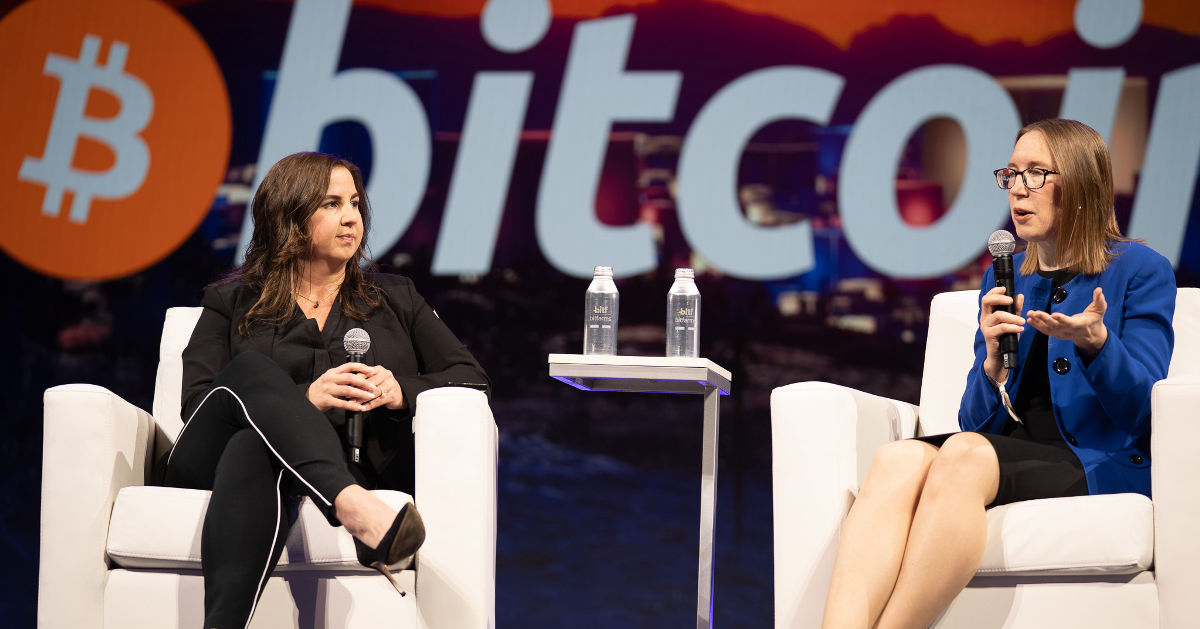
SEC Commissioner Hester ‘Crypto Mom’ Peirce Advocates Privacy-Preserving Tech
Outgoing Securities and Exchange Commission Commissioner Hester Peirce has said that regulators should rethink how they monitor the financial system, and to press for less personal data collection, not more.
In a speech Wednesday focusing on digital identity systems and decentralized networks, Peirce took aim at know-your-customer and anti-money-laundering rules.
U.S. regulators are now racing ahead with crypto rulemaking. Peirce, who earned the nickname “crypto mom” for her friendly approach to watchdogging the space, is set to leave the SEC in November.
“Today society is at a crossroads,” Peirce said at the SIFMA’s Digital Assets Conference in New York.
“Down one path lies the status quo: more data collection, more intermediary surveillance, more ‘know your customer’ requirements that turn our financial rails into a panopticon.”
“Down the other path lies an opportunity to use new technologies to improve our ability to catch criminals while collecting less personal information than ever before, and monitoring more sparingly to protect Americans’ privacy.”
Peirce argued that piling up ever more data on law-abiding customers to help find criminals doesn’t work. In her view, bigger “haystacks” make the needles harder to find, while every stored data point raises the risk of leaks or misuse.
She criticized a regulatory mindset fixated on “data go up,” comparing it to crypto enthusiasts’ obsession with rising prices.
Peirce pointed to cryptographic tools such as zero-knowledge proofs and attribute-based credentials, which can confirm facts like a person’s age, accredited-investor status, or absence from sanctions lists without revealing the underlying personal details.
She also urged the SEC to let firms rely on identity checks already performed by other regulated institutions, rather than making every firm collect and store the same sensitive information.
Under President Joe Biden, the SEC was tough on the crypto space, with its Biden-appointed former Chair Gary Gensler frequently suing major crypto companies for allegedly selling unregistered securities.
Peirce was appointed to lead the Crypto Task Force in 2025. The regulator has taken a far more friendly approach to watchdogging the space since Donald Trump became president again.
Now, regulators are saying they want to create clear rules for the fast-moving industry, despite landmark legislation, the Clarity Act, being blocked last week.
Despite Commissioner Peirce’s alias, she previously said she would not describe herself as an advocate of the industry, but rather a “freedom maximalist.”
This post SEC Commissioner Hester ‘Crypto Mom’ Peirce Advocates Privacy-Preserving Tech first appeared on Bitcoin Magazine and is written by Mathew Di Salvo.
Bitcoin Magazine

Jeff Booth: Why $1 Million BTC is Thinking too Small
Is a $1 million Bitcoin price target thinking too small? Jeff Booth thinks so, and he explains why valuing Bitcoin in dollars means pricing it from a game that’s rigged by debasement. He argues that Bitcoin isn’t just a coin or an asset, but the beginning of a decentralized, secure, and private protocol stack that will look a lot like the internet. In his view, Bitcoin is evidence of the first free market that has ever existed.
Chapters:
0:00 Jeff Booth, The Price of Tomorrow & Technological Deflation
0:30 AI Valuations & Why Free Markets Push AI Prices Toward Zero
1:29 AI Deflation vs the Debt-Based Monetary System
2:38 $40 Trillion US Debt, Bond Yields & the $350 Trillion Insolvent System
4:06 AI Singularity Claims, Fear & Monopoly Regulation
6:50 Productivity & Bitcoin’s True Value in a Deflationary Future
8:43 Why a $1 Million Bitcoin Price Target Is Thinking Too Small
10:11 Bitcoin Adoption Timeline & Why Bitcoin Isn’t Just an Asset
12:38 Bitcoin Payments & Circular Economies Scaling Worldwide
13:49 Bitcoin-Backed Private Equity & Owning Businesses Forever
DISCLAIMER: The views and opinions expressed in this show are those of the participants and do not necessarily reflect the official policy or position of BTC Inc., Bitcoin Magazine, or any affiliated entities. This content is provided for informational and educational purposes only and should not be construed as investment, legal, tax, or accounting advice. Nothing contained in this show constitutes a solicitation, recommendation, endorsement, or offer to buy or sell any securities or financial instruments. Viewers should consult their own advisors before making financial or business decisions.
This post Jeff Booth: Why $1 Million BTC is Thinking too Small first appeared on Bitcoin Magazine and is written by Patrick Green.
Bitcoin Magazine

Saifedean Ammous: The Bond Crisis & Bitcoin’s Rise as a True Macro Asset
Bitcoin’s volatility is falling, and Saifedean Ammous calls that the most bullish development in Bitcoin right now. Bear-market drawdowns have shrunk from roughly 87% to 77% to about 54% this cycle, which moves Bitcoin closer to an investable asset for money managers. Saifedean explains why the halving still drives the four-year Bitcoin cycle and why fewer people are buying with leverage at the top. He also discusses how markets may eventually arbitrage these cycles away.
Chapters:
0:00 Tether, Bitcoin & the Dollar Milkshake Theory
1:45 How the US Carries $40 Trillion in Debt as the World’s Reserve Currency
4:21 Treasury Yields Hit Multi-Decade Highs & the Bond Market Bear Case
7:00 War Spending, Iran & the Collapse of Fiscal Hope
9:20 Stablecoins vs Banks & the Hidden Treasury Rollover Risk
15:11 The Longest Hash Rate Bear Market in Bitcoin History
18:47 Why Miners Are Pivoting to AI Data Centers
21:31 The Halving, Bitcoin Cycles & Shrinking Drawdowns
25:56 MicroStrategy, Strive & Bitcoin Treasury Companies
29:07 The Humble Peasant Theory of High Finance
DISCLAIMER: The views and opinions expressed in this show are those of the participants and do not necessarily reflect the official policy or position of BTC Inc., Bitcoin Magazine, or any affiliated entities. This content is provided for informational and educational purposes only and should not be construed as investment, legal, tax, or accounting advice. Nothing contained in this show constitutes a solicitation, recommendation, endorsement, or offer to buy or sell any securities or financial instruments. Viewers should consult their own advisors before making financial or business decisions.
This post Saifedean Ammous: The Bond Crisis & Bitcoin’s Rise as a True Macro Asset first appeared on Bitcoin Magazine and is written by Patrick Green.
CryptoSlate
A flaw in older Lightning Terminal software could mark a Bitcoin Lightning invoice paid after the payment was cancelled and returned to its sender, Lightning Labs disclosed on Sept. 21, 2026.
A merchant relying on that invoice status could release goods or credit without receiving funds. The company describes that risk but gives no tally of actual merchant losses.
The issue was a mismatch between the software's invoice record and the payment's outcome. A Lightning payment uses a hashed time-locked contract (HTLC) to carry funds.
In this case, the HTLC was canceled on the network and returned to the sender, while the receiving node still recorded the invoice as settled. The advisory does not describe a failure of Bitcoin's base chain.
Lightning Terminal bundles tapd, software for Taproot Assets, with the lnd Lightning node. In the affected setup, tapd enabled its invoice interceptor and treated any HTLC carrying custom wire records as an asset payment.
Some sender implementations added an experimental endorsement record even to ordinary BTC payments, causing tapd's strict-forwarding rule to instruct lnd to cancel the HTLC set. The trigger did not require the merchant to have any open asset channels.
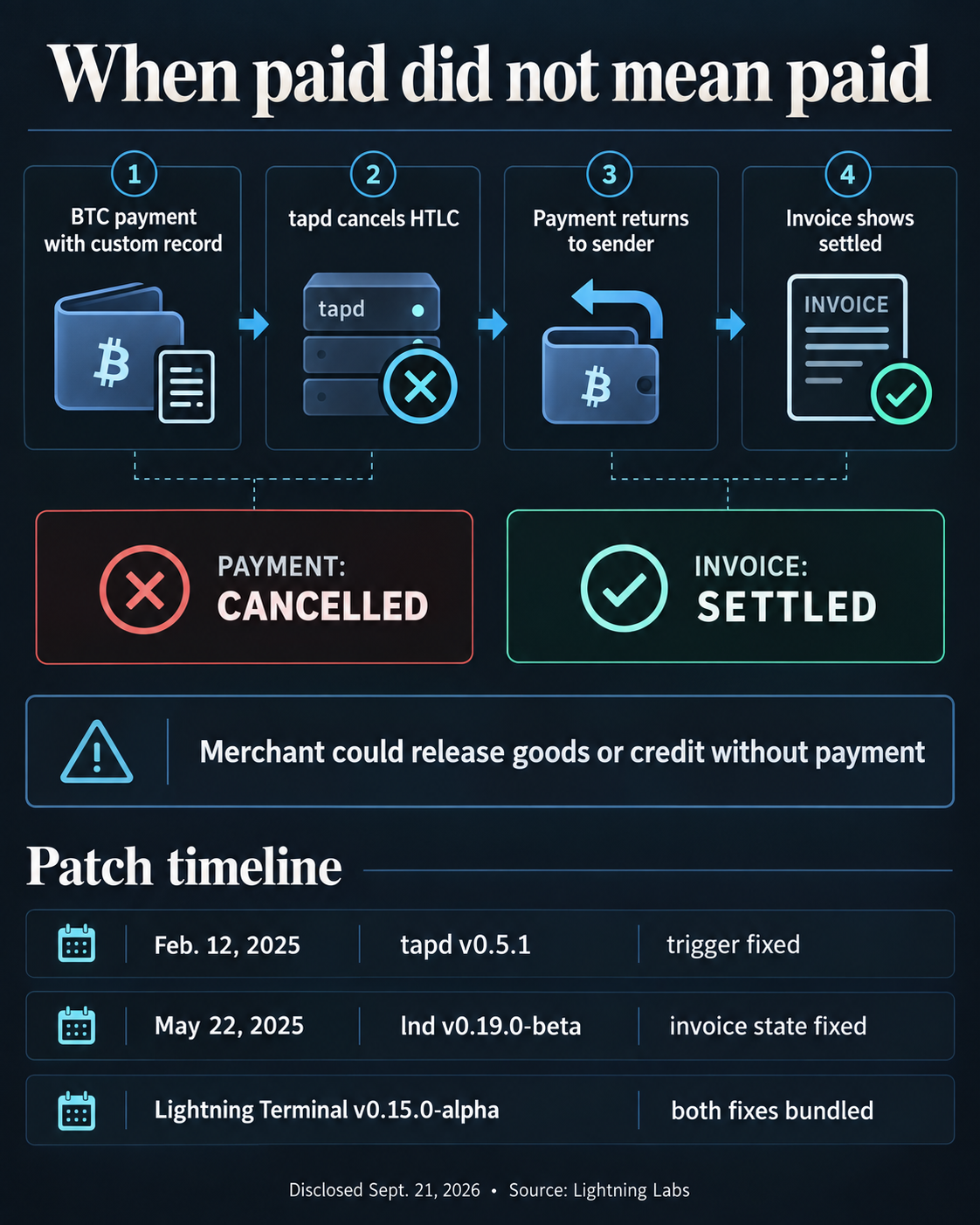
The second defect sat in lnd. When an interceptor canceled the HTLC set, affected versions canceled the payment on the wire but still marked its invoice as settled in the database.
That meant the error stood in another client of lnd's HtlcModifier interface that canceled an HTLC set could produce the same mismatch. Lightning Labs rates the vulnerability high severity because a false paid status could lead an operator or payment service to release value against a payment that never completed. According to the advisory, the sender's funds were not at risk.
Fixes shipped before disclosure
Lightning Terminal v0.15.0-alpha bundles fixes for both defects. Lightning Labs lists earlier Terminal versions as affected, along with taproot assets through v0.5.0 and lnd 0.18.4-beta through 0.18.5-beta.
The tapd trigger was fixed in v0.5.1 on Feb. 12, 2025. Terminal v0.14.1-alpha included that fix, but its bundled lnd version still had the underlying invoice-state defect.
lnd v0.19.0-beta fixed the accounting error on May 22, 2025. The September 2026 advisory therefore disclosed a vulnerability whose relevant fixes had shipped in 2025. For Terminal operators who cannot update and have no asset channels, Lightning Labs identifies --taproot-assets-mode=disable as a way to avoid the observed tapd trigger.
The post Lightning Labs discloses critical bug marking canceled invoices paid, risking free product delivery appeared first on CryptoSlate.
New York has sued Polymarket, alleging its US prediction market is an unlicensed gambling business operating across the state.
On Sept. 24, Attorney General Letitia James asked a New York state court to stop QCX LLC, which operates as Polymarket US, from offering event contracts without a state gaming license and to order restitution, disgorgement, and potentially substantial penalties. The petition covers contracts tied to sports, elections, culture, and other events.
The action targets a company that is also regulated at the federal level. QCX has been a Commodity Futures Trading Commission (CFTC)-designated contract market since July 2025, placing the lawsuit within a broader dispute over how federal derivatives oversight interacts with state gambling laws.
New York says Polymarket contracts amount to gambling
New York's case starts with the structure of Polymarket's contracts.
Users buy contracts tied to the outcome of future events, with winning positions ultimately paying according to whether the specified event occurs. The state argues that because customers risk money on outcomes outside their control, the transactions meet New York's definition of gambling.
The petition describes Polymarket as offering what is “quintessentially wagering” under the guise of event contracts and alleges that the company accepts public wagers despite having no license from the New York State Gaming Commission.
Kathy Hochul, New York's Governor, said:
“Calling it a ‘prediction market’ doesn’t change the facts. If you’re taking bets in New York, our gambling laws apply.”
The state cited Polymarket's marketing in its case. The company announced its US app in December 2025 with “sports—followed by markets on everything” and advertised itself as “legal in all 50 states.” An earlier promotion said users would be able to “TRADE EVERY FOOTBALL GAME IN ALL 50 STATES.”
Investigators said the platform offered markets involving the New York Mets, college football games, the New York governor's race and reality television show “Big Brother.” The petition also alleges Polymarket repeatedly advertised and solicited users located in New York through the internet and social media.
Sports contracts add another layer to the state's case. New York requires mobile sports wagering operators to hold a state license, while Polymarket has none, according to the filing.
The attorney general also alleges violations of the federal Wire Act through the transmission of sports wagers, information used to place them, and communications confirming payments across state lines.
Age restrictions are also central to the complaint. Polymarket allows users aged 18 and above, while New York requires mobile sports bettors to be at least 21. The state is asking the court to prohibit Polymarket from allowing people under 21 to wager on the covered event contracts.
James tied those requirements to New York's broader argument that unlicensed operators avoid safeguards and taxes imposed on licensed gaming companies.
“By skirting New York’s laws, Polymarket is targeting the most vulnerable and depriving New York families of critical services and support,” James said. New York says gambling tax revenue supports schools, youth programs and treatment for problem gambling.
State seeks triple gains and $100,000 penalties
The remedies sought by New York extend beyond shutting down Polymarket's sports contracts.
James wants a permanent injunction preventing the company from operating an unlicensed gambling business within or from New York, including by offering contracts tied to “sports, culture, elections, and other events” without obtaining the required state licenses. The requested order would also cover advertising, marketing, and soliciting participation in those contracts.
That wording would place political and cultural markets alongside sports contracts under the same requested restrictions rather than confining the case to products that resemble conventional sportsbook wagers.
New York also wants Polymarket to provide an accounting that identifies its customers and itemizes bets placed, customer losses, and gains the company received. It is seeking full restitution for customers, damages, and disgorgement of money obtained through the alleged violations.
The state is also seeking a penalty equal to three times Polymarket's gains from the alleged illegal activity.
Sports wagering carries a separate potential cost. The petition seeks $100,000 for each offering or attempt to offer unauthorized sports wagering or mobile sports wagering within or from New York. It does not specify how many offers could ultimately qualify, leaving the size of that portion of any potential penalty unresolved.
The attorney general alleges Polymarket has operated or indirectly operated a sports wagering platform in New York since at least Jan. 23, 2025, and has continued to advertise it to people in the state.
Polymarket becomes latest target of New York prediction-market push
The lawsuit follows a series of similar actions by New York against companies offering event contracts under prediction-market structures.
James sued Coinbase Financial Markets and Gemini Titan in April, alleging their prediction markets constituted unlicensed gambling because customers could bet on sports, elections and entertainment events.
Those cases also sought forfeiture of alleged illegal profits, restitution and fines equal to three times the companies' profits from the challenged activity.
New York followed in July with a lawsuit against Kalshi, another CFTC-designated contract market. That petition similarly sought to stop Kalshi from operating an unlicensed gambling business, recover alleged illegal gains, compensate users and impose fines equal to three times its gains.
The Kalshi dispute had already tested the boundary between federal derivatives regulation and state gambling enforcement.
Earlier in July, James and Hochul said Kalshi had lost a lawsuit against the New York Gaming Commission and pledged to continue applying state gambling laws to prediction markets.
The Polymarket petition now asks the same state court system for a comparable package of relief, while adding allegations tied to Polymarket's own sports promotions and New York activity.
The post New York sues Polymarket, seeks triple gains and $100,000 penalties over prediction markets appeared first on CryptoSlate.
Bitget has suspended withdrawals after unauthorized transfers drained about $351.6 million from a limited number of its hot and warm wallets.
The crypto exchange detected the transfers at 18:31 UTC on Sept. 24 and activated its emergency response procedures within minutes, Chief Executive Officer Gracy Chen said. Bitget’s cold wallets and most assets held on the platform were unaffected.
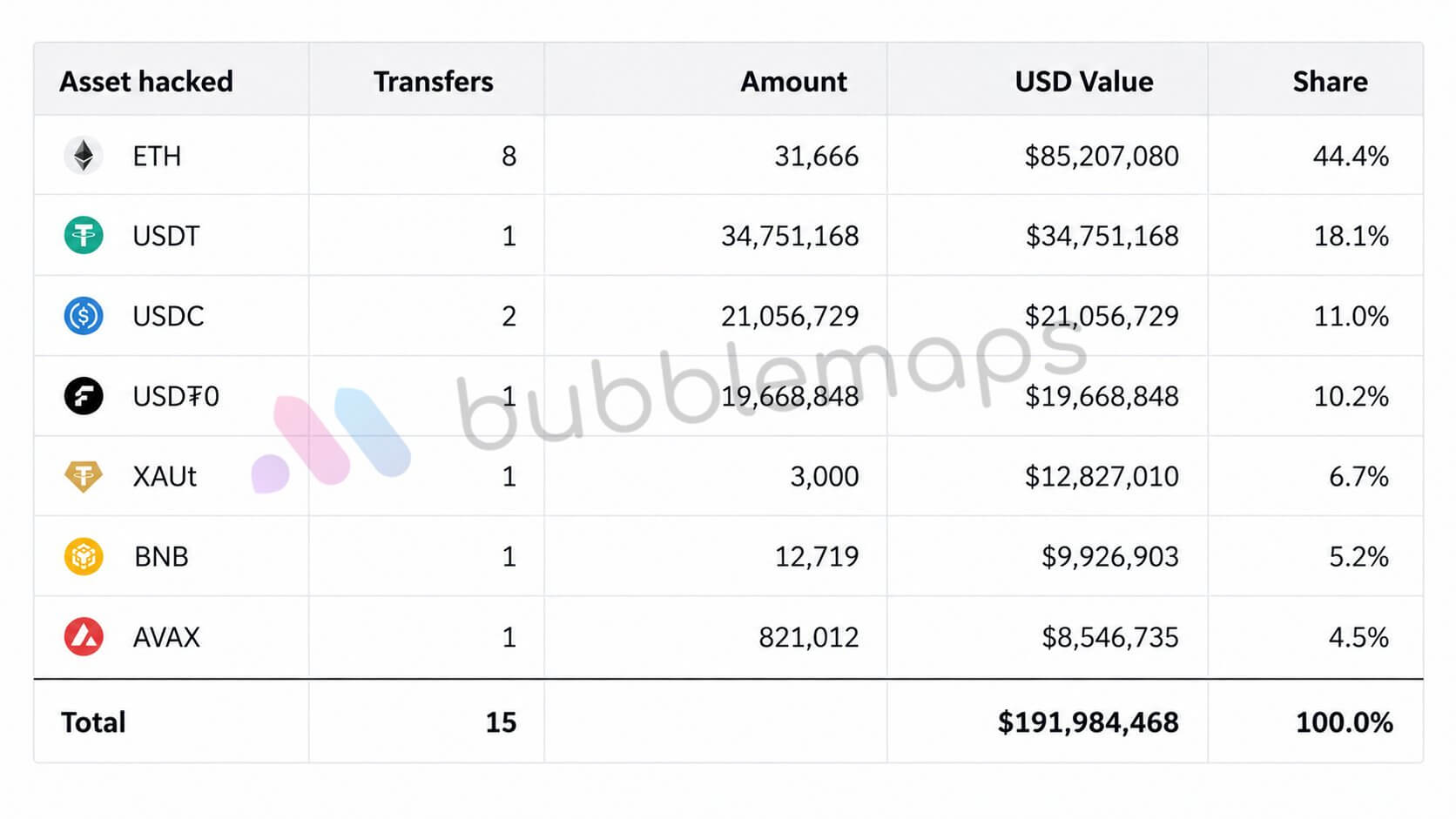
Chen said customer balances remain accurate and the losses are covered by Bitget’s User Protection Fund, which currently holds more than $464 million. Deposits and trading continue to operate normally while withdrawals remain paused pending a security review.
She said:
“The full amount of this loss falls within the coverage of Bitget's User Protection Fund.”
The exchange has identified and flagged addresses connected to the transfers and notified law enforcement agencies and on-chain security firms. It has yet to disclose how the wallets were compromised and said it would not speculate on the attack vector while the investigation remains underway.
Bitget plans to provide hourly updates and publish a full incident report within 24 hours, including the root cause and corrective measures.
September crypto losses surge past April
The breach comes during Bitget’s eighth-anniversary campaign, which the exchange launched this month as it expands beyond crypto into equities, foreign exchange and other markets under its Universal Exchange strategy.
It also makes an already expensive month for crypto security even more costly.
DeFiLlama had recorded about $331 million in losses across 17 September incidents before the Sept. 19 Fetch.ai exploit. Subsequent attacks pushed that figure above $342 million, with most of the damage linked to a roughly $320 million incident involving Liquid Network.
Adding Bitget’s $351.6 million in affected assets would push September’s reported total above $684 million, making it the costliest month of 2026 on a gross-loss basis.
That would surpass April, when crypto exploits generated about $646.9 million in losses, largely because of the Drift and KelpDAO attacks. Those two incidents accounted for roughly $577 million of the month’s total.
The September figure could still change as investigations determine whether affected assets are recovered or ultimately classified as losses.
For Bitget, the immediate focus is restoring withdrawals. Chen said the exchange would keep them suspended until its security review is complete and pledged that “every dollar and every decision will be accounted for, transparently and in full.”
The post Bitget’s $351.6 million hack pushes September crypto losses to 2026 high appeared first on CryptoSlate.
TRON has surpassed $30 trillion in lifetime transaction volume as its USDT-heavy network pushes deeper into payments and regulated finance.
More than $94 billion of Tether’s USDT now circulates on TRON, the largest supply on any blockchain, TRON DAO said Sept. 24. The network has processed about $6 trillion of USDT transfers so far in 2026, averaging roughly $25 billion a day, citing Token Terminal data.
The figures underscore how closely TRON’s growth has become tied to dollar-denominated transfers. The blockchain has recorded more than 15 billion transactions across 405 million accounts since launch, while payment-card activity is beginning to extend that footprint beyond transfers between crypto wallets.
TRON accounted for 34% of crypto payment-card volume in the second quarter, up from 33% in the first, as overall card volume increased to $2.4 billion from $2 billion, according to CoinDesk Research figures cited by the DAO.
The $30 trillion figure covers cumulative value moved across the network since launch rather than commerce alone. TRON does not break out how much represents merchant payments, exchange transfers or movements between wallets, leaving the composition of that volume less clear than its scale.
That distinction has become increasingly important as TRON tries to translate its dominance in USDT transfers into a broader role across payments, custody and institutional markets.
Stablecoin scale carries a compliance burden
The same low-cost and liquid stablecoin infrastructure that attracted legitimate users has also made TRON a major route for illicit funds.
TRM Labs estimated that TRON handled more than $26 billion of the $45 billion in illicit crypto volume it identified in 2024, more than any other blockchain. The activity included funds tied to scams, hacks, sanctioned entities, and darknet markets. TRM said low transaction costs and access to widely used stablecoins helped explain the concentration.
TRON and Tether have since made enforcement a more visible part of the network’s infrastructure.
Their T3 Financial Crime Unit, established with TRM Labs in 2024, had frozen more than $450 million in illicit assets by May 2026. The group works with authorities across 23 jurisdictions and has supported cases involving exchange hacks, North Korea-linked activity, terrorist financing, drugs and violent crimes. In some incidents, authorities have frozen suspicious USDT within 24 hours of a law-enforcement request.
That push follows years of US regulatory scrutiny of TRON and founder Justin Sun.
The Securities and Exchange Commission (SEC) sued Sun, the Tron Foundation, and related entities in 2023 over allegations including securities violations and manipulative trading. A March 2026 resolution settled a wash-trading claim against Rainberry and dismissed the remaining claims against Rainberry, as well as all claims against Sun, the Tron Foundation, and the BitTorrent Foundation.
TRON is meanwhile widening its reach into regulated products. Canary Capital launched a staked TRX exchange-traded fund this month, while Anchorage Digital has added TRX staking and custody for TRC-20 assets. A tokenized Hamilton Lane fund issued through Securitize has also arrived on the network.
Those products raise the commercial stakes around TRON’s compliance infrastructure. Asset managers, custodians and payment firms looking to use the network gain access to one of crypto’s deepest pools of dollar liquidity, but they also inherit exposure to a chain with a substantial history of illicit flows.
TRON’s next phase will depend on whether enforcement tools such as T3 can keep pace as USDT activity expands further into payments and institutional products. For regulated firms considering the network, liquidity may already be abundant; confidence in how that liquidity is policed could determine how much additional business follows.
The post Why TRON’s $30 trillion lifetime volume could become a trap appeared first on CryptoSlate.
A Brooklyn man was sentenced to as much as 12 years in prison for stealing nearly $16 million from Coinbase users.
On Sept. 23, Ronald Spektor, 23, received a four-to-12-year sentence after pleading guilty to a 31-count indictment stemming from a fake customer-support operation that targeted about 100 people across the US, according to the Brooklyn District Attorney’s Office.
Prosecutors said Spektor posed as a Coinbase representative and warned users that hackers were threatening their accounts. Victims were then instructed to move their crypto to wallets presented as secure but secretly accessible to Spektor.
The scheme generated about $15.944 million in losses, with some victims losing more than $1 million. Spektor pleaded guilty Sept. 2 to charges including first-degree money laundering, grand larceny, and criminal possession of stolen property.
The scam relied on victims executing the transfers themselves after being convinced their assets were in immediate danger.
In one case detailed by prosecutors, a Pennsylvania man received spoofed two-factor authentication messages before a caller identifying himself as “Fred Wilson” from Coinbase security warned of an attempted crypto transfer. The victim moved his assets and lost about $53,150.
Investigators had interviewed more than 70 victims when charges were announced in December 2025. The sentencing release raised the estimated victim count to about 100 nationwide.
How Spektor laundered the stolen crypto
Spektor’s operation extended beyond the initial deception.
Prosecutors said stolen crypto moved through repeated swaps, exchanges and mixing services before reaching cash-out points. Funds were converted into other tokens, sent to gambling platforms and used at online storefronts, including for gift cards and digital assets.
Blockchain analysis, transaction records and search warrants eventually tied Spektor to the operation. Prosecutors said his home IP address was linked to several wallets associated with stolen funds.
Investigators also found evidence that he recruited other social engineers through online forums and operated a Telegram channel under the handle @lolimfeelingevil, where prosecutors said he boasted about thefts. Messages recovered from his phone showed he discarded one hardware wallet after fraud allegations surfaced online and bought another.
Meanwhile, the sentence came in below what prosecutors sought.
Spektor pleaded guilty to the full indictment in exchange for a promised sentence of four to 12 years. The district attorney’s office objected and asked Justice Danny Chun to impose seven to 21 years, but the judge upheld the earlier commitment.
The court also ordered Spektor to forfeit more than $500,000 in cash, cryptocurrency, and personal property and to pay nearly $16 million in restitution.
That leaves the recovery picture unresolved. The forfeiture represents only a fraction of the estimated losses, and prosecutors did not say how much stolen crypto has been recovered or how much victims have received.
Coinbase warns customers that its support staff will never ask them to transfer funds to a new wallet, disclose seed phrases or provide passwords and authentication codes. The case leaves exchanges facing the harder problem of stopping impersonation scams that succeed before users ever interact with an official support channel.
The post Man sentenced to 12 years for $16M Coinbase customer support scam appeared first on CryptoSlate.
CryptoTicker.io
Whether a crypto gain raises your health insurance contribution hangs on a single question: how are you insured? If you are compulsorily insured as an employee, a private disposal gain has no effect on the contribution. If you are voluntarily insured, as a self-employed person or as a high earner above the compulsory insurance threshold, it counts. And if you are covered without contributions through your partner's family insurance, a single gain can tip that cover over for months.
This article sorts the three cases, gives the 2026 thresholds from the reference values ordinance, and shows which distinction moves the most money: the one between a taxable and a tax-free gain.
The decisive lever: what counts as income for social insurance purposes
Social insurance does not invent an income concept of its own; it borrows one from tax law. Under section 16 of Book Four of the German Social Code, total income is the sum of the income within the meaning of income tax law. That one sentence decides almost everything that follows.
For Bitcoin and other coins, section 23 subsection 1 sentence 1 number 2 of the Income Tax Act applies for tax purposes. If you sell within one year of buying, the gain is a private disposal and therefore taxable income. If you sell after a year has passed, the transaction is not taxable at all. It appears in no category of income, and it therefore does not raise total income within the meaning of section 16 SGB IV either.
From this follows the most important rule of thumb in this article: the holding period works twice over. That single period decides your income tax and, in many constellations, your health insurance contribution along with it. A gain of 6,000 euros after fourteen months is tax-free and, as a rule, irrelevant for social insurance. The same gain after ten months is neither.
A second point up front, because it often gets muddled: what matters is the realised gain, not the value of your holding. A portfolio that has risen in price without your having sold generates no income and moves no contribution. Health insurance contributions are assessed on receipts, not on assets. That sets them apart from procedures in which the holding itself is precisely what matters, such as the seizure of coins.
Case 1: compulsorily insured as an employee
Anyone compulsorily insured in the statutory health insurance scheme as an employee pays contributions on their employment earnings. That is the pay from the employment relationship, and only that. Income from capital, from letting property or from private disposals does not belong to it.
A crypto gain therefore does not raise your contribution in this case, not even when it is large and not even when it arises within the one-year period. You still have to declare it for tax as soon as the sum of all private disposal gains reaches the threshold in section 23 EStG. Where that belongs in the forms is set out in the article on where to enter crypto in your tax return.
Two qualifications are worth knowing. If your trading becomes a commercial activity, through its scale, its organisation and the use of borrowed capital for instance, the picture changes completely, because earned income from self-employment then arises. Where that line runs is covered in our article on the difference between private and commercial trading. And anyone who becomes self-employed on a full-time basis alongside the job may lose compulsory insurance as an employee.

Case 2: voluntarily insured, and why total economic capacity counts here
Voluntarily insured means anyone who is not subject to compulsory insurance and nevertheless stays in the statutory fund. That mainly concerns the full-time self-employed and employees whose pay exceeds the compulsory insurance threshold. Section 240 SGB V applies to this group, and its subsection 1 sets a markedly wider yardstick than employment earnings: it must be ensured that the contribution burden takes account of the member's total economic capacity.
The details are set uniformly by the National Association of Statutory Health Insurance Funds. The underlying idea: all receipts that cover the cost of living are drawn on, irrespective of their classification for tax. A taxable gain from a private disposal falls under this. With a tax-free gain after the one-year period the position is less clear-cut, because no point of connection in tax law exists there. Where in doubt, clarify this with your fund beforehand and have the answer given to you in writing rather than fighting it out afterwards.
The 2026 figures
The Social Insurance Reference Values Ordinance 2026 sets the limits between which all of this plays out:
| Figure | 2026 value |
|---|---|
| Reference value | 3,955 euros a month (47,460 euros a year) |
| Contribution assessment ceiling for health and long-term care insurance | 5,812.50 euros a month (69,750 euros a year) |
| Compulsory insurance threshold | 6,450 euros a month (77,400 euros a year) |
| Minimum assessment basis for voluntary members | around 1,318 euros a month |
The contribution assessment ceiling is the cap here. Anyone whose contributory receipts already sit above it pays not a cent more because of an additional crypto gain. The minimum assessment basis follows from section 240 subsection 4 SGB V, under which at least a ninetieth of the monthly reference value is to be applied for each calendar day.
What a gain actually costs
Reckon with the general contribution rate of 14.6 percent, the fund's own supplementary contribution and the long-term care insurance contribution. Voluntary members without an employer bear the total alone. With a taxable gain of 10,000 euros and a combined rate of roughly twenty percent, you end up in the order of some 2,000 euros in additional contributions, provided you stay below the contribution assessment ceiling with it. The exact figure depends on your fund and your other receipts, but the order of magnitude shows what is at stake.
The provisional assessment and the recalculation
For the self-employed, the fund initially assesses contributions provisionally under section 240 subsection 4a SGB V, on the basis of the most recent income tax assessment. The final calculation only happens once the assessment for the year in question is available. A crypto gain from 2026 may therefore only catch up with you in 2027 or 2028, but then retrospectively for the whole year. Anyone who has spent the gain by then faces a back payment with nothing to set against it.
Case 3: covered by family insurance, and why the smallest limit applies here
Family insurance under section 10 SGB V is free of contributions. It is open to spouses, civil partners and children, as long as several conditions are met at the same time. Crypto gains regularly breach one of them: the family member must have no total income that regularly exceeds a seventh of the monthly reference value in a month.
For 2026 that means, concretely: 3,955 euros divided by seven gives 565 euros a month. Anyone in marginal employment may instead earn up to the marginal earnings threshold. And because total income under section 16 SGB IV is the sum of income within the meaning of tax law, a taxable crypto gain counts here in full, while a tax-free gain after the one-year period stays outside the reckoning.
The word regularly is the reason so many underestimate this threshold. A one-off gain is not simply added to the month it was received and forgotten about afterwards. One-off receipts are customarily looked at spread over twelve months. A taxable gain of 8,000 euros comes to roughly 667 euros a month when apportioned, and therefore sits above the limit, even though it arose on a single day.

What happens when it falls away
If family insurance falls away, no gap in cover arises, but a liability to pay contributions does. As a rule you become a voluntary member and pay at least the contribution on the minimum assessment basis. The retrospective effect is what makes it critical: funds check the conditions on a regular cycle with a questionnaire, and if it turns out months later that the limit was exceeded, the account is settled retrospectively. That is why a larger realised gain should be reported to the fund before it asks.
What happens with staking, lending and airdrops
Income from staking and lending is for tax purposes usually other income under section 22 number 3 EStG and therefore income within the meaning of tax law. This income flows continuously rather than once, which makes it trickier for the family insurance regularity test than a single disposal gain. For voluntary members it raises contributory receipts like any other income.
A widespread misconception concerns the valuation: what is taxed, and therefore also captured for social insurance, is the inflow in euros at the price on the day of receipt, not the later sale. Anyone drawing rewards in coins and leaving them where they are has income without having seen a single euro. For airdrops it depends on whether you provided something in return. Where that is entirely absent, there is often no taxable receipt at the time of the inflow.
In all three cases you need a robust record with the date, the quantity and the euro price for each inflow. A portfolio tracker with tax reporting takes this work off your hands and supplies the statement you can put before both the tax office and the insurance fund.
Evidence: what happens if you do not supply it
Section 240 subsection 1 SGB V contains a rule that gets expensive if you overlook it. If a member does not produce the requested evidence of their contributory receipts, a thirtieth of the monthly contribution assessment ceiling counts as the contributory receipt for each calendar day. You are then classified as though you had 5,812.50 euros a month, regardless of what you actually had.
The law allows a correction. If you apply for a fresh assessment within twelve months of that assessment being notified and submit the evidence subsequently, the contributions for the periods concerned are to be recalculated. That twelve-month period works as a cut-off in everyday practice: anyone who lets it pass stays stuck with the maximum classification.
The comparison with private health insurance
Privately insured people pay risk-based premiums according to tariff, age and state of health. Income plays no part there in the size of the premium, so a crypto gain does not move it. Income is relevant at only one point, namely the employer's subsidy for employees, and when switching back to the statutory fund, which is tied to the compulsory insurance threshold of 77,400 euros in 2026.
Anyone weighing the two systems as a self-employed person should factor in that fluctuating crypto income feeds straight through to the contribution in the statutory fund and does not in the private one. That is not an argument for switching, because switching is as a rule a one-way street with considerable consequences in old age. It is an argument for building the contribution effect into the planning of a sale.
How to keep the contribution effect small before a sale
The most effective lever sits before the sale, not after it. Four points are worth a look.
Wait out the one-year period wherever you can. A sale after more than twelve months of holding is tax-free and as a rule generates no total income. If your position is just short of the period and you do not absolutely need the liquidity, waiting is by far the cheapest measure. Check the period for each tranche, because it runs separately for each acquisition.
Choose the order of the tranches. If you have to sell, dispose first of the units that already have the one-year period behind them. Which selling routes are available and what fees they carry is something you decide independently of that, but you should be able to document how the tranches were allocated.
Keep the contribution assessment ceiling in view. If as a voluntary member your other receipts already put you above 5,812.50 euros a month, the contribution effect of an additional gain is zero. That check costs five minutes and may spare you an unnecessary postponement.
With family insurance, do the arithmetic beforehand. The 565-euro monthly limit is low, and a one-off gain is apportioned. If the sale can be stretched across several years, the cover may well be preserved. Have your fund confirm the method of calculation before you rely on it.
Crypto gains and health insurance: what to take away
- Establish your insurance status first, everything else second. As a compulsorily insured employee, a private crypto gain leaves your contribution untouched. As a voluntary member it counts through section 240 SGB V; as a family member the 565-euro monthly limit decides whether contribution-free cover survives. Without that classification, every further calculation is worthless.
- Keep a complete record of your inflows and sales with the date and the euro price. You need it for your tax return and for any evidence put to the fund, and without it voluntary membership risks classification at the contribution assessment ceiling. A portfolio tracker with tax reporting handles that as you go instead of once a year under time pressure.
- Check the holding period for each tranche before any larger sale. Above the one-year mark the gain is tax-free and usually stays free of contributions; below it, it may hit you twice. If you want to keep your holdings cleanly separated for that purpose, orderly custody helps, for instance on a hardware wallet of your own with separate accounts for each acquisition period.
Sources in the text of the law: section 240 SGB V on the contributory receipts of voluntary members and the Social Insurance Reference Values Ordinance 2026.
(As of September 24, 2026. This article is not investment advice and not legal or tax advice. Contribution rates, reference values and fee structures change; check the terms with the provider before you buy, and have your individual case examined by your health insurance fund or a tax adviser.)
Yes, your crypto holdings count as assets for Bürgergeld, Germany's basic income support. They are a realisable asset within the meaning of the Social Code, they are valued at their market value, and they are set against the same allowances as an instant-access savings account or a share portfolio. What has changed since the summer of 2026: the allowances are no longer the same for everyone, and the one-year grace period at the start of a claim no longer exists for financial assets.
This article explains how much you may keep, which day decides the valuation, what you must tell the Jobcenter of your own accord, and the routes by which an authority learns of holdings you have not declared. All the figures come from the text of the law itself, not from advice portals.
Bürgergeld has become Grundsicherungsgeld: what changed on assets
The benefit that people still colloquially call Bürgergeld carries a new name in the law. Under section 19 of Book Two of the German Social Code, claimants capable of work receive Grundsicherungsgeld, basic income support. Official jargon and the search engines still lag behind; the decision letters do not. Anyone filing a claim today has the new rules applied, even if they searched for the old word.
More important than the name are two changes of substance. First, the blanket grace period for assets has gone. Assets used to be left untouched up to a high ceiling in the first year of a claim, and only then did the actual allowances bite. Under section 12 SGB II that grace period now applies only to owner-occupied residential property: a house or a flat you live in yourself stays out of the reckoning during the grace period, regardless of value and size. For portfolios, savings books and coins that buffer no longer exists. Your allowances apply from day one.
Second, the size of the allowance now depends on your age. For a crypto holder that is no marginal detail, because it can make the difference between an untouched holding and one you have to spend down, without anything about your holding having changed at all.
The asset allowances under section 12 SGB II: what your age decides
An allowance is the amount you may keep before anything at all is counted against you. Section 12 subsection 2 SGB II grades it by age, and it does so for each person in the benefit unit separately:
| Age | Allowance per person |
|---|---|
| up to the completion of age 30 | 5,000 euros |
| from age 31 | 10,000 euros |
| from age 41 | 12,500 euros |
| from age 51 | 20,000 euros |
Under the law the higher amount applies from the beginning of the month in which you reach the relevant age threshold. Someone turning 41 on the 20th of a month therefore has 12,500 euros free from the first of that same month. With a holding that sits just above a threshold, that single month can decide the outcome.
Work it through on an actual holding. Bitcoin stood at roughly 74,100 euros on September 24, 2026 (CoinGecko, retrieved 18:40 UTC). A quarter of a bitcoin is therefore about 18,500 euros. For a single person aged 35 with an allowance of 10,000 euros, some 8,500 euros sit above the line and count as assets to be spent down. The same 0.25 BTC is fully protected for a 52-year-old with a 20,000-euro allowance.
Transferable allowances: how the benefit unit adds up
In social law a benefit unit is the circle of people who are jointly responsible for their upkeep, typically partners and minor children in the household. For assets, a rule applies there that many overlook: allowances the other members have not used up are transferred under section 12 subsection 2 SGB II to the person whose assets breach their own limit.
A couple aged 34 and 52 bring 10,000 plus 20,000 euros between them, so 30,000 euros. If the entire wealth sits in the younger person's wallet alone, that does no harm as long as the total stays below 30,000 euros. The older person's unused allowance moves across in the arithmetic. Hurriedly transferring your coins to your partner before a claim therefore gains you nothing the law does not already give you, and it may well invite questions.
The second half of the calculation gets overlooked too. Alongside the allowance, section 12 subsection 1 SGB II lists items that do not count as assets in the first place. These include reasonable household effects, one reasonable motor vehicle for each employable person in the benefit unit, insurance contracts earmarked for retirement provision, and state-subsidised pension savings. A crypto holding falls under none of these exceptions, not even if you personally regard it as your retirement provision. Number 4 of that subsection does protect assets expressly designated as retirement provision, but only for periods of full-time self-employment without contributions to the state pension scheme, and only up to a statutorily calculated maximum for each year begun.

Market value on the cut-off date: why the day you file decides your entitlement
Section 12 subsection 3 SGB II contains the sentence that weighs most heavily when prices move. Assets are to be taken into account at their market value, and the decisive moment for the valuation is the point at which the claim for an award, or for a renewed award, is filed. If you acquire assets only later, the moment of acquisition counts.
Market value is the price that could be achieved on the market. For a coin with an active exchange listing, that is the price on that day, not your purchase price and not the level from the week before last. Three things follow for you, and the third is where clawbacks arise in practice.
The cut-off date is a day, not an average. A holding that sits below the allowance on a monthly average can sit above it on the day of filing and then count in full. The reverse applies in your favour. Next: every renewal claim sets a new cut-off date. A holding that raised no eyebrows on the initial claim can be above the line at renewal if the price has risen in the meantime. And finally the rule works in the other direction too. Anyone acquiring coins while receiving the benefit, from staking rewards or an airdrop for instance, has new assets at the moment of receipt, which section 60 SGB I requires them to report without delay.
If you hold your assets spread across several wallets and exchanges, have a coherent consolidated statement ready for the cut-off date. A portfolio tracker with tax reporting delivers exactly that snapshot with date, price and source, and you will need it a second time for the tax office anyway.
Which crypto holdings count as realisable and which do not
Realisable in social law means you can turn the item into money or borrow against it within a foreseeable period. For a liquid coin on a mainstream exchange that is uncontroversial. The edge cases are the interesting ones.
Locked, pledged and illiquid holdings
Coins tied up in staking for a fixed term cannot be sold immediately. That does not reduce their value, however, and a lock-up of a few weeks does not make them unrealisable. Long lock-up periods with no option to exit, or tokens without a functioning market, are a different matter. Here it comes down to the individual case, and here it pays to document the lock-up in writing rather than merely assert it.
Particular hardship
Section 12 subsection 1 number 7 SGB II exempts items and rights whose realisation would amount to particular hardship. That is a narrow exception for cases in which a sale would be economically unreasonable, for instance a sale well below value in a forced situation. As a rule it cannot be founded on a price loss since purchase. Anyone wanting to rely on it should discuss the point with an advice centre or a lawyer specialising in social law before writing it into the claim.
Debts
Assets are looked at gross as a matter of principle. An overdraft on your current account is not automatically netted off against a wallet. Anyone who has pledged coins as security for a loan should be able to document the pledge, because it genuinely does restrict realisability. How loans with coins as collateral work for tax and under civil law is set out in the article on bitcoin-backed loans, tax and the holding period.
The duty to cooperate under section 60 SGB I: what you must declare to the Jobcenter
The obligation to declare crypto is not in SGB II but one level above it. Under section 60 subsection 1 of Book One of the German Social Code, anyone who applies for or receives social benefits must state all facts that are material to the benefit. On top of that comes the duty to report changes in circumstances without delay, and the duty to name evidence and produce it on request.
That wording is deliberately broad. It does not turn on whether the claim form expressly asks about cryptocurrencies. What is material is whatever can influence the entitlement, and assets can influence it. The question about existing assets covers coins just as it covers a savings book, even if the word is missing from the form.
What changes during a claim is therefore reportable without delay as well: an inflow from staking or lending, an airdrop, an inheritance in coins, a sale that puts money in your account. Anyone who reports an inherited holding only months later also acquires an evidence problem, because they have to reconstruct the deceased's holding period and acquisition costs. How that is done is set out in our article on proving the holding period and purchase price of inherited bitcoin.

How the Jobcenter finds out about your coins
Many assume that a self-custodied wallet is invisible to an authority. That holds for the wallet itself, and it has long ceased to hold for the route that leads to it. Three channels are responsible, and they operate independently of one another.
The automated data comparison, and what it cannot do
Under section 52 SGB II, the Federal Employment Agency and the municipal bodies compare claimants' data automatically four times a year, on 1 January, 1 April, 1 July and 1 October. That comparison looks for pensions, for periods of compulsory insurance, for benefits from other institutions and for data on exemption orders reported to the Federal Central Tax Office. It does not capture crypto holdings. Anyone concluding from this that a wallet stays undetected draws the wrong conclusion, because the comparison is only the first of three routes.
The account data retrieval at the Federal Central Tax Office
Section 93 subsection 8 of the Fiscal Code expressly permits the authorities responsible for basic income support for jobseekers to retrieve account master data from the Federal Central Tax Office. The conditions are that it is necessary in order to examine the conditions of entitlement, and that a prior request for information addressed to you has not achieved its purpose or holds no promise of success. The retrieval yields no balances and no wallet addresses, but the master data of the accounts and securities accounts held in your name at German credit institutions.
For crypto it is nevertheless the most effective channel, because almost every holding came into being via a bank account. Anyone transferring euros to an exchange and later receiving euros back leaves a trail on the bank statement that leads to the exchange. From there section 60 subsection 2 SGB II carries on: anyone who holds balances or safeguards assets for a person receiving benefits must provide information to the Employment Agency on request. An exchange that holds your coins in custody falls under that provision.
The reporting duty for crypto service providers since 2026
The third channel is new. With the Crypto-Asset Tax Transparency Act, Germany implemented the EU's DAC8 directive, which builds on the international CARF framework. Since 1 January 2026, reporting crypto-asset service providers have had to collect data on their users and transmit it to the Federal Central Tax Office, which exchanges it with the tax authorities of the other member states. The first reporting period is the 2026 calendar year, with transmission in the year that follows.
What gets reported is identification data along with aggregated figures on purchases, sales and transfers for each crypto-asset. That is a tax procedure to begin with and not a social data comparison, and a Jobcenter does not receive these reports automatically. It does shift the starting point, though: a holding that is on file with the tax office is also documentable to another authority if a dispute arises. What that means for tax is described in detail in the article on where to enter crypto in your tax return.
If you have to spend down crypto: holding period, section 23 EStG and the double trap
If your holding is above the allowance, the Jobcenter will require you to spend down the excess before benefits are paid. In practice that means selling. And this is precisely where two sets of rules meet that know nothing of each other.
For tax purposes, coins count as other assets within the meaning of section 23 subsection 1 sentence 1 number 2 of the Income Tax Act. A sale within one year of acquisition is a private disposal and the gain is taxable. After a year has passed it is tax-free. Anyone selling under time pressure because the Jobcenter insists on the assets being spent down can therefore trigger a taxable gain they would not have had with a little more patience.
The second half of the trap: the sale proceeds are not income in the month of receipt but remain assets, because they derive from an asset that already existed. They are therefore not counted as income on top. The gain from them can, however, trigger a tax payment in the following year for which the money is no longer there. Anyone who has to sell should therefore set aside the likely tax out of the proceeds before spending the rest. Which routes exist for selling and where the fees sit is a topic of its own, and the differences are not incidental in a forced sale.
One point you should not overlook: within limits, you may determine the order and the timing yourself. If part of your coins has already passed the one-year mark and another part has not, it is as a rule more favourable to sell the older ones first. Social law does not prescribe which units you dispose of; it is interested only in the result.
What happens if you conceal crypto
If an undeclared holding later comes to light, the authority revokes the award decision for the periods concerned and reclaims the benefits paid. The clawback is measured by what you would have been entitled to had you declared correctly, and it can span several award periods. On top of that, incomplete statements about assets can bring administrative fine proceedings or criminal proceedings in their wake.
That is the expensive route, and it is avoidable. The cheap route is a complete declaration with clean supporting documents, in which you set out yourself, where there is doubt, why in your view a holding should not be taken into account or only in part. An authority handed a complete set of facts decides a question of law. An authority that finds a holding by itself decides on your credibility.
If a decision treats you wrongly on the substance, an objection is open to you, as a rule within one month of notification. The deadline is stated in the decision itself. Free advice is available from the social welfare associations and from independent advice centres, and with larger amounts a lawyer specialising in social law is worth the money.
Preparing your evidence: what to assemble before you file
The effort lies in the documentation, hardly at all in the form-filling. So assemble before you file what you are going to need anyway.
- A statement of all holdings by coin and by place of custody, with the position as at the day the claim is filed.
- That day's price for each coin, with the source and the time of retrieval, so that the market value applied is verifiable.
- The acquisition data, meaning date, quantity and purchase price, because they decide the one-year period for tax.
- Evidence of lock-ups, pledges or commitments that genuinely restrict realisability.
- The bank statements showing deposits to and withdrawals from exchanges, because that is the route along which questions come anyway.
Self-custodied holdings should be listed just as fully as a balance on an exchange. An authority cannot establish a wallet address by itself, and the missing declaration weighs more heavily later than the holding does. If you have kept your coins exclusively on trading platforms so far, transferring them to a hardware wallet of your own is incidentally no way to hide assets. Moving the coins changes nothing about the duty to declare and nothing about the valuation; it changes only who holds the keys.
Drawing the lines: seizure, insolvency and basic income support are three separate procedures
The allowances in SGB II apply exclusively to social benefits. When a private creditor reaches for your assets, the attachment exemption limits of the Code of Civil Procedure apply, and those amounts are different ones. A holding that is protected for basic income support can still be realised by a bailiff. How access to coins works in practice is set out in the article on whether bitcoin can be seized by creditors and insolvency administrators.
Just as non-transferable are the rules of personal insolvency and those of social assistance under Book Twelve of the Social Code, which has an asset framework of its own. Anyone facing several of these procedures at once should have them examined separately, because a statement in one procedure can have quite different consequences in another.
Crypto and Bürgergeld: what to take away
- Work out your allowance from your age, not from something you read somewhere. There are four bands between 5,000 and 20,000 euros per person, and within a benefit unit unused allowances are transferred. Then draw up a statement of holdings as at the day you intend to file, most easily with a portfolio tracker with tax reporting that supplies the price, the date and the source along with it.
- Declare all holdings in full and report every change immediately. The duty follows from section 60 SGB I, regardless of whether the form asks about cryptocurrencies. Document your figures once too often rather than once too rarely, and keep ready the bank statements showing the transfers to exchanges. Where the figures belong in your tax return is shown in the article on where to enter crypto in your tax return.
- Check the one-year period before a forced sale. Coins you have held for more than a year can be disposed of tax-free under section 23 EStG. Where in doubt, sell the oldest units first, compare the selling routes and their fees beforehand, and set aside the likely tax out of the proceeds before you spend the rest.
Sources in the text of the law: section 12 SGB II on assets to be taken into account and section 60 SGB I on the statement of facts.
(As of September 24, 2026. This article is not investment advice and not legal advice. The state of the law, prices and fee structures change; check the terms with the provider before you buy, and where in doubt have your individual case examined by an advice centre or a specialist lawyer.)
Chainlink traded at $12.96 on September 24, 2026 at 16:46 UTC, 5.72 percent higher than 24 hours earlier (source: CoinGecko). Over the week the gain is 13.36 percent. The trigger dates back two days: the IT services group Infosys is making the Chainlink stack a standard in its banking and payments software. What that means for you as a LINK holder in Germany rests on three questions the announcement itself does not answer.
Chainlink price today: $12.96, daily low of $12.11
The numbers in detail, all from CoinGecko as of September 24, 2026, 16:46 UTC: Chainlink stands at $12.96. The daily low was $12.11 and the reported daily high $12.78. The current price therefore sits above the reported 24-hour range, which is normal during an active move because the database range lags the tick.
Market capitalisation is $9.68 billion, good for rank 16. Over 24 hours, LINK worth $499 million changed hands. Roughly 748.1 million LINK are in circulation. The all-time high of $52.70 dates from May 9, 2021, more than four times above today's price.
Two conflicting figures exist for the weekly move, and they are not smoothed over here. CoinGecko reports 13.36 percent over seven days, while the US finance portal 24/7 Wall St. cited 8.3 percent on the week and 9.1 percent on the month in its September 24 analysis. The difference comes down to different measurement points within a day in which the price swung by more than seven percent. For 2026 as a whole, LINK is down roughly 43 percent according to the same analysis.
What Infosys and Chainlink announced on September 22
On September 22, 2026, Chainlink said that Infosys would use the Chainlink stack as a standard component in its software for banks and payments. Infosys is an Indian IT group whose financial services arm runs systems that, by the company's own account, carry 1.7 billion customer accounts.
The agreement covers six services. The Cross-Chain Interoperability Protocol, or CCIP, is a transfer standard for moving messages and value between different blockchains. The Chainlink Runtime Environment, or CRE, is an execution environment in which banks define workflows that run partly on their own servers and partly on a blockchain. The Automated Compliance Engine, or ACE, checks automatically whether a transaction meets regulatory requirements before it is executed.
Three data services complete the set. Proof of Reserve is a procedure that continuously and mechanically demonstrates whether a posted reserve actually exists. Data Feeds deliver price data to a smart contract at fixed intervals; Data Streams deliver it on demand and with lower latency. All six fall under the oracle category: an oracle is a bridge that carries outside-world data into a blockchain in a form that a contract there can rely on.
1.7 billion accounts: what the number proves and what it does not
The 1.7 billion figure is the reach of Infosys, not the number of banks that have committed to Chainlink. These are accounts administered through systems run by Infosys clients. Not one of those banks has stated, in connection with the announcement, that it will use the Chainlink stack or hold LINK.
That distinction is the heart of the day. Standardisation on the vendor side lowers the hurdle for any individual bank that later wants to integrate. It does not replace that bank's own decision. The path from standardisation in a product catalogue to live settlement runs through tenders, regulatory sign-off and budget cycles, and the announcement settles none of those steps.

Why LINK first lost 4.4 percent on the news
The sequence of the price move is what stands out. In the 24 hours after the announcement, LINK fell 4.4 percent, according to the September 24 assessment by 24/7 Wall St. Only then did the price turn, and today it trades 5.72 percent higher.
The analysis gives three reasons for that first decline: the partnership names no participating banks, it sets no timetable and it says nothing about fees. A technical point is often overlooked on top of that. A bank can use CCIP and settle in dollars or in a stablecoin without ever holding LINK. The connection between network usage and demand for the token is therefore not automatic; it depends on how the fees are ultimately paid and passed on. The number of newly created Chainlink addresses on the day of the announcement was below the previous day's figure and below the monthly average.
Bottomline and Swift: the run-up on September 3
The Infosys deal is the second major infrastructure event within three weeks. On September 3, 2026, Bottomline, by its own account one of the three largest service providers in the Swift ecosystem, announced a strategic partnership with Chainlink. Bottomline says it moves more than $16 trillion in annual payment volume for over 600 bank clients in 92 countries. That deal also centres on CCIP and CRE, and there too the names of individual banks are missing.
Two announcements of the same pattern in quick succession make a picture: Chainlink is positioning itself with the banks' suppliers rather than with the banks themselves. That is strategically sound, because a single supplier reaches many institutions at once. For valuing the token, however, it merely pushes the decisive question back a step.
If you want to know how far German institutions have come with their own crypto offering, the situation at the Sparkasse and Volksbank networks is covered separately. That is the level at which you as a customer would actually notice a change.
Buying LINK under MiCA: the route that remains open to you in Germany
A clear framework has applied to purchases since the EU's MiCA regulation took full effect. MiCA stands for Markets in Crypto-Assets and governs across Europe who may offer and hold crypto-assets. In practice, your provider needs authorisation as a crypto-asset service provider in an EU member state, and that authorisation then applies throughout the single market.
Check three things before you buy. First, whether the provider actually holds the authorisation and in which country it was granted. Second, whether LINK is listed there for spot trading and not only as a contract for difference, because those are two entirely different transactions for tax purposes. Third, whether you can withdraw the coins to an address of your own, because a venue without withdrawals is unsuitable for longer holding periods. An overview sorted by those criteria is in our comparison of the best crypto exchanges.
One note on offers from the United States: reports of new trading options at US brokers generally do not apply to the German market, because those firms hold no retail authorisation here. The European route remains the one that matters for you.
Holding period and tax: what applies when you sell LINK
In Germany, crypto-assets held privately count as other assets under section 23 of the Income Tax Act. If you sell LINK at a profit within one year of buying it, that profit is taxable and is charged at your personal income tax rate. Once a year has passed, the gain on a sale is tax-free.
A threshold of 1,000 euros applies to all private disposals in a year taken together. A threshold is not an allowance: if you come in one euro above it at 1,001 euros, the entire amount is taxable, and not just the single euro. Allocation generally follows the order of acquisition, the FIFO principle, under which the coins bought first count as the ones sold first.
In practical terms for an occasion like today: if you bought LINK less than twelve months ago and are now considering a sale into the strength, work out the tax effect first. A clean transaction history is the precondition for that, and it is best collected as you go rather than in April.
Staking LINK: why the holding period becomes the question
Chainlink runs its own staking programme, in which you post LINK and receive a reward for it. Staking here means that your balance serves as security for the reliability of the oracle network and stays locked for a cooldown period before you can withdraw it again.
Two levels must be kept apart for tax purposes. The running income from staking counts as other income and is taxable in the year it is received; a separate threshold of 256 euros a year applies to it. The sale of the underlying coins still falls under section 23. The once-common worry that staking extends the holding period to ten years was cleared up by the Federal Ministry of Finance in its circular on the income taxation of crypto-assets; one year remains the rule.
Check your provider's cooldown period and the capacity limit of the pool before you commit anyway. If you want to stay able to sell within the next few weeks, a locked balance with a multi-week notice period is the wrong instrument. Terms differ considerably between providers, from the minimum amount to the length of the lock-up.

Leverage and liquidation: what an infrastructure story does not support
News about software standards is not a catalyst that pays off within days. Anyone using leverage on it is not betting on the partnership but on a short-term price move, and that can run in either direction.
On the mechanics: with a leveraged product you post only a fraction of the position value as collateral. Liquidation means the exchange closes your position by force as soon as that collateral is used up. At ten times leverage, an adverse move of roughly ten percent is arithmetically enough, and usually somewhat less once fees and funding costs are deducted. LINK alone ran a range of $12.11 to $12.96 in today's session, about seven percent. Price in a day like that before you open any position size.
If you use derivatives in any case, the funding rate and the liquidation threshold belong among the terms you need to know before opening a position; the differences between venues are considerable.
Levels above and below: how to tell a breakout from a pullback
On the upside, the first relevant level is today's area around $12.96; a daily close above it confirms the break out of last week's range. The next hurdle lies around $13.24, the level from which the price fell back after the Infosys news. Only above that does a recovery attempt become a trend.
On the downside, today's daily low of $12.11 is the first line of support. If the price falls back below it and closes there, today's move was a counter-move within the downtrend that stands at roughly 43 percent for 2026. Below that lies the zone around $10.93, where the week began.
These levels are orientation and not a forecast. Levels of this kind show you where your original assumption would have been disproved, and that is exactly what they are for.
Custody: exchange account, software wallet or hardware wallet
Where your LINK sits decides who has access if things go wrong. On an exchange account the provider holds the keys; you have a claim against it, but not the coins themselves in your hand. That is workable for short holding periods and for active trading.
A software wallet on your own device gives you the keys but ties security to the security of that device. A hardware wallet keeps the private key in a separate device that is never connected to the internet, which is the usual route for holdings meant to sit for longer. Which model makes which trade-off depends above all on how often you need access. Whichever route you take, the recovery words belong offline and in a different place from the device.
Putting the Chainlink and Infosys deal in context: what to take away
Today's rise has a real cause, and that cause is smaller than the figure of 1.7 billion suggests. Three steps follow from it:
- Check your buying route before you react. Establish whether your provider holds MiCA authorisation, lists LINK for spot trading and permits withdrawal to an address of your own. The overview is in the comparison of the best crypto exchanges.
- Calculate the holding period and the threshold, do not estimate them. If your LINK is younger than twelve months, determine the taxable gain before you sell and keep the 1,000-euro threshold in view. Tools that keep the history clean are in the comparison of crypto tax software.
- Set the staking cooldown against your time horizon. A locked balance is not an available balance; check the notice period and the capacity in the comparison of staking platforms before you commit.
And the point that carries the whole story: standardisation at a software supplier is a precondition for adoption; it is not evidence of one. The next solid signal would be the first named bank with a date, or a fee structure that ties the token into the value chain. Until then the news stays what it is, a door opened without a date.
Sources in full: the report on the Infosys agreement of September 22, 2026 and the announcement of the Bottomline partnership of September 3, 2026.
(As of September 24, 2026. This article is not investment advice. Prices and fee structures change; check the terms with the provider before you buy.)
Ether was quoted at $2,700.98 on September 24, 2026 at 16:43 UTC. That is 0.7 percent above the level of 24 hours earlier, 10.5 percent above a week earlier and 38.3 percent above 60 days earlier. The figures come from the public price interface of the Kraken exchange, retrieved at the time stated. What is interesting about this situation is less the level itself than the ceiling above it: three times in the past thirty days Ethereum ran up to the zone around $2,800, and not once did a trading day close above it.
Anyone making a buying or selling decision now is making it at precisely that edge. This article sorts out what is documented, and what you as an investor in Germany can concretely take from it.
Ethereum price prediction: the price stands at $2,700 and the zone around $2,800 holds
The daily candle for September 24 shows a high of $2,704.82 and a low of $2,627.68. The range of a single trading day therefore comes to roughly $77, or just under three percent. For Ether that is a quiet session, measured against the swings of the summer.
The view over longer stretches is ambivalent. Against June 26, 2026, the lowest point of the past 90 days at $1,510.00, there is a gain of roughly 79 percent. Against September 24, 2025, when Ether closed at $4,154.62, there is a loss of roughly 35 percent. And against the start of the year on January 2, 2026, with a closing price of $3,124.04, roughly 13.5 percent is still missing.
Both perspectives are correct, and they explain why sentiment in the market is so uneven. Anyone who bought in June is sitting on a considerable gain. Anyone who entered last autumn is still waiting to break even.
Three attempts, no daily close above: what our own count shows
For this article we counted the daily candles of the last thirty completed trading days, meaning the period from August 25 to September 23, 2026. The basis is Kraken's public OHLC interface for the ETH against US dollar pair, retrieved on September 24, 2026. We counted on how many days the daily high reached the $2,750 mark, and on how many days the closing price sat above $2,800.
The result is narrow. Three days reached $2,750 at the high: September 21 at $2,806.69, September 22 at $2,776.79 and September 23 at $2,787.89. Not a single day closed above $2,800. The high of September 21 is at the same time the highest point of the past 90 days.
This analysis was carried out by cryptoticker.io itself on September 24, 2026. Thirty daily candles from a single exchange were examined. What we explicitly could not measure: the order book, the distribution of trading volume across the day, and the situation at other venues, whose prices can differ slightly.
What follows from that? A zone tested three times and three times not overcome is a place where sellers sit. That is therefore not a forecast, only the observation of where supply met demand in the recent past. If the price breaks above it on a fourth attempt, that supply falls away and the next point of reference lies considerably higher. If it fails again, the zone grows stronger with every attempt as an argument for taking profits.
Why the rate rise of September 16 did not tip the Ether price over
On September 16, 2026, the Federal Open Market Committee raised the target range for the policy rate by a quarter point to 3.75 to 4.00 percent. The decision was unanimous at twelve votes to none. The statement says inflation remains elevated and that the measure supports a more timely return to the two percent objective. The Federal Reserve statement is publicly available.
A rate rise is classically regarded as a headwind for assets with no running yield. That is exactly what is remarkable here: in the week after the decision, Ether rose by 10.5 percent. The market evidently absorbed the increase, and part of the move is likely to go back to the step having been expected.
In parallel, several trade publications reported substantial outflows from the US spot ETFs on Ether. The figures cited range from $224 million on a single day around the rate decision to $366 million within 48 hours. We did not collect those figures ourselves, and they come from secondary reporting. They remain important for context nonetheless, because they show the price rise was not carried by institutional inflows.

October 28 in the calendar: what the next rate decision means for Ether
The next regular meeting of the Federal Open Market Committee is on October 27 and 28, 2026. That follows from the Federal Reserve's official meeting calendar, retrieved on September 24, 2026. After that comes December 8 and 9.
For your planning that means you have roughly five weeks ahead of you with no major monetary policy date. In that time, more will probably be settled at the zone around $2,800 than by the macro picture. Experience suggests a rate date draws volatility in, in both directions. Anyone working with thin collateral should have the date in their calendar before they feel it in their portfolio.
One point of context, so that no expectation arises here which the article cannot support: how the committee decides in October is open. Neither we nor anyone else knows. What can be documented is the date alone, and the direction of the last step.
Levels up and down: $2,806, $2,628 and $2,355 in view
Three reference points can be derived from the same daily data, each with a date and a source.
On the upside: $2,806.69, the high of September 21 and at the same time the highest price of the past 90 days. As long as no daily close lies above it, that point remains the ceiling. A closing price above it would be the first hard signal that supply in this zone has been worked through.
As a short-term support line: $2,627.68, the low of the current trading day. If the price falls below it, the run-up of recent days has fizzled out.
As a deeper support line: $2,355.48, the low of the past thirty days. Only below that would the entire upward move since the end of August be in question.
These three numbers are observations, not recommendations. They serve well for formulating your own decision in advance rather than making it in the moment of the move. Anyone who writes down beforehand at which price they will do what acts on gut feeling less often. A cross-check against the market leader pays off: how Bitcoin behaves shapes, in experience, a good part of the direction for Ether.
A year of ownership decides the tax: what Section 23 of the Income Tax Act means for your Ether gain
Here lies the real lever in this situation for investors in Germany, and it has only an indirect connection to the price forecast.
The sale of crypto assets held privately falls under the rules on private disposals in Section 23 of the German Income Tax Act. What matters is the time between acquisition and disposal. If more than a year lies between purchase and sale, the gain is free of income tax. If less, the gain is charged at your personal income tax rate, not at the 25 percent flat-rate withholding tax. For gains within the year, an exemption limit of €1,000 per year applies. Exceed it by one euro and you pay tax on the full amount, not just the part above the line.
Run that through on the current situation. Anyone who bought on June 26, 2026 near the low at $1,510 is up roughly 79 percent today. That gain is tied up for tax purposes until June 26, 2027. A sale into the zone around $2,800 would therefore be a sale within the period, and depending on your personal rate, noticeable portions of it go to the tax office. Waiting nine months costs price risk but may save more than the move brings in by then.
The reverse holds just as much: anyone who bought their Ether more than a year ago can sell tax free. For that group, a resistance zone tested three times is a distinctly more attractive exit point than for someone still inside the period. That supply appears at precisely such levels therefore has more than chart-technical reasons.
Two notes on this, because much is misunderstood here. First, you need a date for every single acquisition, otherwise the period cannot be evidenced. A clean record of your purchases is the prerequisite, and there are specialised tax and portfolio tools for that which allocate inflows and outflows automatically. Second, this section does not replace tax advice. It names the rule and the source; your individual case is for a tax adviser to assess.

Staking with Ether: how the lock-up narrows your selling decision
Ether is a proof-of-stake network. That means anyone depositing coins in the network secures its operation and receives a reward for doing so. That reward is widely stated at an order of magnitude of around three percent a year, though it fluctuates with the number of participants.
For the question this article asks, another point matters more than the yield. Staked Ether is not immediately available. Releasing it from the network runs through a queue, and the length of that queue depends on how many others are doing the same thing at the same time. Precisely when many want to sell, the queue is at its longest.
In practice that means: if you have staked your Ether and want to sell at the $2,800 zone, your exit is not the press of a button. You should know how long the release takes at your provider, whether it offers its own instant payout at a discount, and what that costs. Anyone comparing staking providers should therefore examine the payout periods just as closely as the advertised yield.
One tax addition that often causes uncertainty: in its circular on crypto assets of March 6, 2025, the German Federal Ministry of Finance clarified that the one-year period is not extended to ten years by staking. The ten-year worry that circulated earlier is thereby laid to rest. The rewards themselves are to be treated separately, and here too the individual case belongs with a tax adviser.
Leverage and liquidation at a level tested three times: what can go wrong
At a zone that has rejected price several times, leveraged positions accumulate on both sides. For you as an investor, a very practical warning follows from that.
With a leveraged product, the distance between your entry and your liquidation price determines how much movement you can withstand. For Ether the daily range today came to roughly three percent, and considerably more on the busy days of the summer. A leverage of ten means a counter-move of ten percent consumes your stake entirely. Ether has shown such a move several times within a single day over the past months.
On top of that comes an effect that is readily overlooked: just above a known resistance zone sit many stops from short sellers, just below it many stops from buyers. If one of those clusters is triggered, the move accelerates, and the price can briefly run further than the order situation justifies. Anyone calculating tightly is stopped out in precisely those seconds.
Three things you should check specifically before working with leverage at this level: your actual liquidation price in dollars, not in percent. The financing costs of your position per day, because they eat into the gain if you hold for longer. And the question of whether your provider has a margin call obligation. Anyone trading derivatives will find the terms compared in our overview of venues for perpetual contracts.
Where you buy under MiCA: how to recognise an authorised exchange in Germany
Since the European Markets in Crypto-Assets Regulation became fully applicable, providers addressing customers in the EU need authorisation as a crypto asset service provider. In Germany, BaFin exercises supervision. For you that is no bureaucratic detail but the difference between a supervised counterparty and one that leaves you standing alone in a dispute.
How to check it: the provider names its authorisation and the competent supervisor in its imprint or legal notices. It holds client funds separately from its own assets. It provides you with a comprehensible schedule of fees in which the mark-up in the price itself is also stated, not only the visible order fee. And it supplies trading data in a form with which you can later evidence the periods from the previous section.
That last point is almost never considered when buying and almost always regretted at tax time. An overview of supervised venues and their fee models is in our crypto exchange comparison.
Custody and payout: what to set up before the next attempt
Two things can be dealt with today, regardless of where the price runs.
The first is custody. Ether you intend to hold for longer than a year does not belong permanently in a trading account. Your own wallet, whose keys you control, takes the counterparty risk off you. The price for that is personal responsibility: lose the recovery phrase and the balance is gone, and nobody can retrieve it.
The second is the payout route. Before you need it, check whether your bank account is verified with the provider, what daily limit applies to withdrawals, and how long a transfer takes in practice. Anyone who sells on a volatile day and then discovers verification is still pending loses days.
Both cost half an hour today and cannot be caught up on the day you need them.
Ethereum price prediction: what to take away
- Write your levels down before the fourth attempt runs. Upside $2,806.69 as a daily close, downside $2,627.68 and $2,355.48. If you determine in advance what you will do at which price, you will not decide on impulse. Where you trade is something to check in the exchange comparison.
- Check the acquisition date of every position before you sell. A sale within a year costs your personal tax rate, a sale after it costs nothing. With a gain of roughly 79 percent since the end of June, that is the most expensive figure in this article. A portfolio and tax tool allocates the periods automatically.
- Settle your staking payout period today, not on the day of the sale. Locked-up Ether cannot be sold at the press of a button, and the queue is at its longest precisely when time is short. The providers' periods are in the staking comparison.
(As of September 24, 2026. This article is not investment advice. Prices and fee structures change; check the terms with the provider before you buy.)
Yes, Bitcoin can be seized. A creditor holding an enforceable title can reach a debtor's crypto assets, and anyone entering personal insolvency has to declare their coins to the insolvency estate. The question that decides everything in practice is a different one: which route the access runs through, and what happens if the debtor claims they can no longer reach their own keys.
Both sides regularly misjudge this situation. Creditors assume crypto assets are out of reach and give up on the attempt from the outset. Debtors assume self-custody is effective protection and then discover that the German Code of Civil Procedure can compel cooperation, with detention if need be. This article sorts out the legal position as it stands in September 2026 and names the points at which it remains open.
Can Bitcoin and other crypto assets be seized at all?
The Code of Civil Procedure contains no separate provision for crypto assets. Crypto assets therefore have to be captured through an existing category, and that happens through Section 857 of the Code of Civil Procedure: the attachment of other property rights, meaning asset positions that are neither a physical object nor a monetary claim and for which the law provides no dedicated route of access.
That classification is no longer theory. The Berlin Higher Regional Court confirmed it at appellate level for the first time in its order of December 6, 2023: crypto assets are attachable as other property rights under Section 857 of the Code of Civil Procedure. The basic question is therefore settled, and arguments that Bitcoin escapes enforcement law because of its technical nature do not hold up in court.
What follows is a distinction you have to keep in mind, because the entire subsequent process turns on it: are the coins held with a service provider, or are they held by the debtor themselves? In the first case there is a third party you can write to. In the second there is nobody but the debtor.
The route via the provider: attaching the payout claim against the third-party debtor
If a trading platform holds the coins for the debtor, the debtor has a claim against the provider for delivery or payout. It is precisely that claim which is attached, and the provider is the third-party debtor, meaning the party that owes the debtor something and on whom the attachment order is served.
The attachment takes effect upon service on that third-party debtor. From that moment the provider may no longer transfer or pay out the affected holdings to the debtor, and if it does so anyway it is liable to the creditor. For the creditor this is the most comfortable case in the whole of crypto enforcement law: no keys are needed, no technical detail is needed, only the right address for service.
In practice, then, success turns on a thoroughly non-legal question, namely whether the provider is reachable within the European Union. A service provider authorised in Germany or in the EU has an address for service, a supervisory framework and an interest in complying with court orders. A platform with no seat and no authorisation within the jurisdiction may well not respond at all, and a German attachment order cannot in fact be enforced against it.

Self-custody: why the bailiff cannot simply open the wallet
If the coins sit in self-custody, meaning in a wallet whose keys the debtor alone controls, the convenient route falls away. There is no third party on whom anything could be served, and there is no technical means of opening a wallet against the holder's will. A bailiff can take a hardware device away during a search, but the device alone moves no coins: without a PIN or recovery words it is a locked object.
The entire access question therefore shifts onto a duty for the debtor to act. At this point the law works not with technical force but with personal pressure: the debtor has to disclose what they hold, and has to cooperate in realising it. If they refuse, coercive measures apply against their person. That self-custody is technically secure therefore changes nothing about the legal outcome, and anyone using it as protection against enforcement merely shifts their problem from their assets to their liberty. Which devices are candidates for custody, and how the approaches differ, is shown in our hardware wallet comparison.
The asset disclosure: where crypto holdings have to be declared
Before anything can be attached, the creditor has to know there is something to attach. For that the law provides the asset disclosure, formerly the sworn affidavit: on the creditor's application, the debtor has to disclose their assets in full to the bailiff, as governed by Section 802c of the Code of Civil Procedure.
Crypto assets have to be stated. Crypto assets are assets, and the duty of disclosure covers all assets, with no exception for digital forms. Concealing them is not a mere administrative offence: the statement is given in lieu of an oath, and a false declaration constitutes a criminal offence. That is the lever which most often works in practice, long before any order is served.
For creditors that still does not mean sitting back is enough. A disclosure containing nothing is at first only an assertion, and establishing indications of your own remains the creditor's task. Bank statements are the most obvious source here, because a transfer to a trading platform shows up there with the recipient's name and thereby identifies the third-party debtor you can write to.
Coercive fine and detention: what the Cologne Higher Regional Court decided on lost credentials
The obvious defence for a debtor is to say they have lost their credentials. The Cologne Higher Regional Court ruled on exactly that on June 26, 2024, and for practical purposes the decision is the most important of recent years: a debtor may not rely on lost credentials in blanket terms. They have to exhaust all reasonable measures to regain access, and they have to set out what they have done to that end.
If they stick to the blanket assertion, the court can impose a coercive fine, meaning a financial sanction to compel an act that cannot be performed by a substitute, and can order coercive detention in the alternative. The basis for that is Section 888 of the Code of Civil Procedure. Not substitutable means nobody else can perform the act on the debtor's behalf, and that applies precisely to entering recovery words.
The consequence is uncomfortably clear. A debtor who can in fact still reach coins and denies it risks detention as a means of compulsion. A debtor who really has lost access bears the burden of making that plausible, and the larger the former holding was, the more closely the court will enquire. Both lead to the same practical advice: anyone caught up in enforcement should be able to evidence the history of their holdings rather than rely on gaps in memory.
Crypto assets in personal insolvency: the insolvency estate and the duty to cooperate
In insolvency proceedings the situation shifts, because there an administrator organises the entire estate and no individual enforcement runs any more. Crypto assets form part of the insolvency estate, meaning the assets all creditors access jointly. The basis is Section 35 of the German Insolvency Code, which covers the debtor's entire assets, and an asset that can be realised falls under it.
The duty to cooperate is spelled out even more clearly in insolvency proceedings than in individual enforcement. The debtor has to provide the administrator with information and cooperate in realisation. In practice it often runs so that the administrator asks them to sell the crypto assets themselves and hand the euro proceeds over to the estate, because that spares the administrator from handling the technical side.
Anyone seeking discharge from residual debt has the strongest reason for openness here. Concealed assets that surface later jeopardise the discharge as a whole, and that costs more than the concealed holding was worth. The notion that a wallet could be smuggled through proceedings is, of all the mistaken assumptions in this field, the most expensive.
What attachment protection means and where it does not apply to crypto assets
German enforcement law contains protected areas. Earned income is exempt from attachment up to certain thresholds, an attachment protection account secures a basic amount per month, and certain household items are left out. Those rules share one purpose: the debtor should be able to live and work despite enforcement.
That protection can barely be transferred to crypto assets. A balance in Bitcoin is not earned income, it does not sit in a payment account, and it serves no household purpose. A crypto position is therefore, as a rule, fully realisable property, comparable to a securities account or a coin collection. Anyone expecting a basic amount to stay protected automatically, because that is how it works with a current account, is mistaken.
One exception deserves attention, because it is often overlooked in advice. If earned income or a social benefit is received as a stablecoin or cryptocurrency, it remains a protected payment in its legal nature, and the protection may continue to apply. That constellation is rare, it is not entirely settled in law, and anyone wanting to rely on it needs legal representation and full evidence of the origin of the funds.

Price swings during realisation: the unresolved valuation problem
One point makes realising crypto assets harder than realising a car or a property: the value changes daily, and considerably. Weeks can pass between the day of attachment, the day of realisation and the day of distribution to creditors, and the amount can shift markedly in that time.
That creates interests which run against each other. The creditor wants to sell quickly to lock in the value achieved. The debtor wants to wait, because a rising price could reduce their residual debt. And the administrator in insolvency proceedings is liable if they diminish the estate through an avoidably poor realisation, which pushes them to act fast, while realising into a falling market can trigger precisely the accusation they are trying to avoid.
There is so far no statutory rule resolving that conflict. Neither for the valuation date nor for the permissible duration of realisation does an express provision for crypto assets exist, and a reform of enforcement law that would change this is not currently in sight. For both sides that means the timing is negotiable, and whoever makes a reasoned proposal on it early shapes the outcome.
When third parties fight over access: divorce, inheritance, estate
Enforcement is not the only case in which a third party has to get at crypto assets. The same basic question of evidence and access arises in the equalisation of accrued gains on divorce and in inheritance, and the answers follow the same logic: whoever cannot evidence the holdings has the weaker position in a dispute, and whoever cannot hand over the keys triggers duties to cooperate and coercive measures.
We have broken this down in detail for divorce, because there the valuation dates of family law come into play on top: crypto assets in the equalisation of accrued gains. In the event of death a different particularity applies, because there the debtor is entirely absent as a source of information, and without provision the holding is lost to the heirs; how to arrange that is set out in our guide on passing crypto assets on.
What you need to prepare as a creditor
In enforcement law the sequence matters more than the choice of argument. At the beginning there is always an enforceable title, meaning a court decision or an equivalent instrument from which the claim can be enforced. Without a title nothing moves, and no provision on crypto assets changes that.
After that comes the fact-finding. Apply for the asset disclosure at the bailiff's office and read the answer against your own records. If you know the debtor's bank statements, look through them for transfers to trading platforms, because such an entry identifies the third-party debtor you have to write to. If the disclosure contains nothing although there are indications, the next step is to follow up with the bailiff.
Why the attachment application has to name the route of access
An application seeking in blanket terms to attach crypto assets does not help the court. Draft it according to the route of access: for holdings on a platform, attach the debtor's claim against that provider for delivery and payout, and name the provider as third-party debtor with a complete address for service. For self-custody, direct the application at the handover of the credentials and at cooperation in the transfer, because there the compulsion attaches to the debtor's person.
Expect longer proceedings in the second variant. The route via a coercive fine and coercive detention in the alternative takes time, it requires evidence that the debtor has access, and in some cases it ends without result, because a genuinely lost key cannot be replaced by any coercive measure. So quantify the effort before you undertake it.
Checking Bitcoin attachment: what to take away
- First establish where the coins are held. The whole process hangs on it: with a provider authorised in the EU, an attachment order plus service on it as third-party debtor is enough, and from that moment it may no longer pay out to the debtor. With a platform that has no seat and no authorisation within the jurisdiction, the order is in fact unenforceable. How to recognise an authorisation is shown in our overview of regulated crypto exchanges.
- Document holdings on an ongoing basis, from either role. As a creditor you need indications in order to attach anything at all. As a debtor you need evidence to make credible what you can still reach and what you cannot, because a blanket assertion about lost credentials no longer carries weight under the case law. Export the transaction history regularly; which tools manage that over the long term is set out in our overview of crypto tax tools and portfolio trackers.
- Do not treat self-custody as protection against enforcement. Technical inaccessibility does not end the legal obligation: the law then reaches for the person, through the duty of disclosure, the asset disclosure in lieu of an oath, a coercive fine and, in the extreme, detention. Choose your custody by security and by everyday accessibility, as described in the hardware wallet comparison, and never in the expectation of locking creditors out.
(As of September 24, 2026. This article is not investment advice. Prices and fee structures change; check the terms with the provider before you buy.)
This article places the legal position in general terms and does not replace legal advice in an individual case. Anyone actually affected should seek advice from a lawyer, because with crypto assets much often turns on the particulars of the case at hand.
Decrypt
The central bank opened two proposals for comment under the GENIUS Act, requiring issuers it supervises to back tokens fully with safe assets and creating an application process for banks seeking to issue stablecoins.
A newly created wallet drained hot and cold reserves labeled as belonging to Bitget across multiple blockchains in under an hour.
A proposed class action accuses OpenAI of quietly routing real conversations to outside contractors through a program called Project Lily—without telling users first.
Muse Charm is Meta's palm-sized gadget for talking to its Muse AI agent on the go. It has cameras, a fingerprint sensor, and its own cell connection.
A February research paper showing AI can unmask pseudonymous internet users is freaking everyone out again this week. Here's what the paper actually says.
U.Today - IT, AI and Fintech Daily News for You Today
XRP, Dogecoin, Ethereum and Stellar are trying to preserve their recent breakouts as correction covers the market.
JPMorgan says Bitcoin’s brief move above the crucial $85,000 production-cost level could ease pressure on miners after BTC spent a staggering 280 days below it.
Solana-based stablecoins can now be used to book flights across more than 300 airlines through crypto travel platform Nomadz, expanding the network’s real-world payments footprint into global travel.
BlackRock-designed investment portfolios are officially moving onto blockchain rails.
XRP trading in South Korea outpaces the U.S. as Upbit drives $224 million in daily volume, leaving Coinbase metrics behind.
Blockonomi
TLDR
- Paramount Skydance stock climbs after launching a $7.5 billion loan plan
- New financing supports the company’s Warner Bros. Discovery acquisition deal
- Paramount prepares a broader $44.4 billion secured debt funding package
- Legal settlements help clear major hurdles for the Hollywood merger
- PSKY shares gain as investors track progress on the transaction
Paramount Skydance Corporation (PSKY) stock closed at $10.18, gaining 2.21% after recovering from early losses. The company advanced toward the $10.20 resistance zone as trading activity strengthened late in the session. The move followed Paramount’s launch of a $7.5 billion loan syndication to support its Warner Bros. Discovery acquisition.
Paramount Skydance Corporation Class B Common Stock, PSKY
Paramount Skydance Launches $7.5 Billion Debt Financing
Paramount Skydance started the senior secured term loan process as part of its broader merger funding plan. The financing supports the company’s proposed acquisition of Warner Bros. Discovery and related debt repayments. Therefore, the loan represents a major step in completing the transaction’s financial structure.
The company plans to raise about $44.4 billion in additional secured debt alongside previously announced funding arrangements. Paramount will combine the new borrowings with cash reserves and equity financing proceeds. This strategy aims to provide the capital needed for the Warner Bros. Discovery purchase.
Bank of America, Citigroup, and Apollo are leading the debt financing process for the acquisition. The wider package includes investment-grade loans, bonds, and second-lien debt structures. , the financing effort ranks among the largest entertainment industry funding deals.
Warner Bros. Discovery Deal Moves Toward Completion
Paramount Skydance’s agreement to acquire Warner Bros. Discovery gained momentum after resolving legal challenges. The company settled an antitrust case involving several state attorneys general and the Writers Guild of America. As a result, the merger moved closer to receiving final approvals.
The proposed transaction could reshape Hollywood by combining Paramount’s media assets with Warner Bros. Discovery’s entertainment portfolio. The deal would bring major brands and streaming platforms under one corporate structure. The companies continue preparing for completion after clearing key regulatory issues.
The merger remains supported by significant equity commitments from major financial backers. Larry Ellison has committed substantial equity support, while Middle Eastern sovereign wealth funds joined the financing effort. However, the combined company would carry significant debt following the transaction.
PSKY Stock Gains as Financing Supports Merger Plans
Paramount Skydance strengthened as the company advanced its acquisition funding process. The shares recovered from intraday weakness and maintained positive momentum during the closing session. Meanwhile, market activity reflected attention toward developments surrounding the Warner Bros. Discovery agreement.
The combined Paramount and Warner Bros. Discovery company is expected to carry considerable financial obligations after completion. Morgan Stanley analysts previously estimated the merged entity could hold substantial net debt. Therefore, the financing structure remains a central factor in the merger process.
Paramount Skydance continues working toward completing the Warner Bros. Discovery acquisition within the expected timeline. The company’s latest debt move marks another milestone in its strategy to finalize the transaction. Meanwhile, PSKY stock performance remains linked to progress surrounding the major entertainment merger.
The post Paramount Skydance (PSKY) Stock: Rises as $7.5B Loan Fuels WBD Deal appeared first on Blockonomi.
TLDR:
- CFTC guidance now covers tokenized permitted assets and blockchain-based regulatory recordkeeping.
- Regulation 1.25 still limits eligible customer investments despite expanded guidance on tokenized assets.
- Tokenized collateral must preserve the same legal and economic rights as its traditional equivalent.
- Blockchain records can satisfy Regulation 1.31 if they remain reliable, accessible and producible.
The U.S. Commodity Futures Trading Commission has expanded its crypto guidance to explain how regulated derivatives firms can handle tokenized investments and digital recordkeeping. The September 24 update addresses two practical questions facing regulated firms.
It covers customer funds invested in tokenized permitted assets and the use of blockchain systems for records. The revisions were issued by the agency’s Market Participants Division, Division of Market Oversight, and Division of Clearing and Risk.
However, the guidance does not change existing regulations. The underlying FAQs state that staff interpretations do not create enforceable rights, amend CFTC rules, or guarantee protection from future enforcement action.
Tokenized Assets Must Still Meet Existing Investment Rules
The latest clarification builds on guidance published in March covering the use of crypto-related infrastructure within existing derivatives regulations. A key distinction remains between tokenized assets representing permitted financial instruments and standalone cryptocurrencies that are not eligible under customer investment rules.
Earlier guidance said swap dealers may use tokenized forms of eligible collateral when those instruments satisfy existing regulatory standards. Those tokenized instruments must also provide legal and economic rights equivalent to the rights attached to their traditional versions.
However, the framework does not automatically make every cryptocurrency suitable for customer funds. The March FAQs specifically said Staff Letter 26-05 did not change the list of permitted investments under Regulation 1.25.
They also said futures commission merchants could not invest customer funds directly in payment stablecoins solely because those assets appeared within broader crypto guidance. The distinction keeps the focus on the underlying asset rather than its digital format.
As a result, tokenization can change how ownership or settlement is represented without changing whether the investment itself qualifies under existing rules.
Blockchain Records Must Still Meet Regulation 1.31 Standards
The second clarification addresses whether regulated firms can use blockchain technology to satisfy recordkeeping obligations. CFTC Regulation 1.31 already follows a technology-neutral framework for storing, retaining, and producing regulated records.
That structure was designed to accommodate changing electronic systems rather than require firms to use one specific recordkeeping technology. The updated guidance therefore gives firms a clearer compliance route for distributed ledger systems.
Records must still remain reliable, accessible, retained for the required period, and available when regulators request them. The update also aligns with Chairman Michael Selig’s recent comments about tokenization, stablecoins, and potentially continuous markets becoming more important within derivatives infrastructure.
For regulated firms, the main clarification is operational rather than expansive. Blockchain infrastructure can fit within existing CFTC compliance systems, but technology alone does not determine whether a structure is permissible.
The underlying asset, custody arrangements, accessibility of records, and existing regulatory requirements remain central to compliance.
The post CFTC Expands Crypto Guidance to Cover Tokenized Assets and Blockchain-Based Records appeared first on Blockonomi.
TLDR
- SMX stock drops as molecular marking technology gains manufacturing attention
- Company builds digital tools for material tracking and verification processes
- SMX platform connects physical materials with secure digital records
- Technology supports recycling, compliance, and supply chain transparency
- Molecular verification aims to improve trust across industrial markets
SMX (Security Matters) Public Limited Company (SMX) stock traded at $8.77, down 9.02%, after a sharp decline from the $9.60 area. The shares found support near $8.00 before recovering slightly during the afternoon session. The movement came as the company highlighted its molecular marking technology for improving manufacturing transparency.
SMX (Security Matters) Public Limited Company, SMX
SMX Stock Falls as Company Expands Material Traceability Technology
SMX develops technology that gives physical materials unique molecular identities and connects them with digital records. The system allows manufacturers to track material origin, recycled content, authenticity, and movement across supply chains. Therefore, the company aims to improve verification standards across industrial markets.
The technology focuses on replacing traditional tracking methods that depend mainly on documents and supplier information. SMX embeds markers into materials and links them with secure digital records. This approach helps companies verify product information throughout different stages of production.
Meanwhile, manufacturers face growing pressure to improve supply chain visibility and meet stricter compliance requirements. SMX positions its platform as a tool for industries seeking stronger material verification. The company’s solutions support sectors that require accurate records of production and material usage.
Molecular Technology Supports Trusted Manufacturing Processes
SMX’s Digital Material Passport Platform connects physical materials with digital information throughout their lifecycle. The platform records details from manufacturing through reuse, recycling, and resale. As a result, companies can maintain clearer records of material history and ownership.
The technology supports efforts to increase recycling efficiency by identifying materials and tracking their movement. Manufacturers can use verified information to improve resource management. This creates a system where materials maintain reliable digital identities beyond initial production.
SMX’s technology addresses challenges linked to global supply chains and sourcing verification. Companies increasingly require accurate information about materials and production methods. The platform provides a framework for improving transparency between manufacturers, regulators, and customers.
SMX Targets Greater Supply Chain Transparency With Digital Verification
The company’s molecular marking technology supports industries seeking better control over manufacturing data. SMX focuses on making material claims easier to confirm through digital verification. This creates opportunities for companies that need stronger proof of origin and compliance.
The technology can help manufacturers demonstrate domestic production standards through verifiable material records. Supply chain participants can access information about where materials originated and how they moved. This reduces reliance on traditional labeling systems alone.
SMX continues developing solutions designed for a manufacturing environment that values transparency and accountability. The company’s platform connects physical materials with digital records to strengthen industrial verification. However, SMX stock performance remains influenced by market activity and company developments as the business expands its technology adoption.
The post SMX (SMX) Stock: Drops as Molecular Technology Powers Future of Trusted Manufacturing appeared first on Blockonomi.
TLDR
- CoreWeave stock gains after JPMorgan raises its rating to overweight
- The bank highlights stronger pricing conditions across the compute market
- Premium short-term contracts support CoreWeave’s near-term revenue outlook
- The company continues expanding its role in large-scale computing services
- CRWV shares rise as brokerage confidence improves across the sector
CoreWeave, Inc. (CRWV) stock traded at $89.89, up 3.45%, after JPMorgan upgraded the company from neutral to overweight. The upgrade reflects stronger demand for computing capacity and improving pricing conditions. The brokerage also raised its price target to $125 from $120.
CoreWeave, Inc. Class A Common Stock, CRWV
JPMorgan highlighted CoreWeave’s ability to secure premium short-term contracts as demand remains strong. The company has increased its focus on flexible agreements that support higher pricing opportunities. Therefore, the upgrade reflects expectations for stronger business performance.
CoreWeave provides large-scale computing infrastructure for advanced technology companies and research operations. The company has positioned itself within the expanding market for high-performance computing services. Meanwhile, demand growth continues to support expansion across the sector.
JPMorgan Points to Stronger Compute Pricing Environment
The JPMorgan upgrade comes as computing demand continues to increase across multiple industries. The brokerage expects pricing conditions to improve as companies seek additional capacity. CoreWeave’s contract strategy has also become a key factor behind the rating change.
The company has expanded its infrastructure footprint to meet rising demand for computing resources. However, the sector continues to require significant investment in facilities and equipment. CoreWeave’s growth strategy depends on maintaining capacity while securing long-term customer relationships.
The latest rating change follows broader market attention toward companies linked to computing infrastructure. Other technology firms have also received updated ratings based on demand trends. As a result, brokerage activity has focused on companies positioned for future expansion.
CoreWeave Growth Strategy Supports Market Attention
CoreWeave entered the public market with a focus on providing specialized computing infrastructure. The company has attracted attention due to increasing demand from technology firms. Its business model relies on delivering scalable computing services through large infrastructure networks.
JPMorgan’s revised outlook highlights CoreWeave’s pricing power and contract flexibility. The company’s short-term premium agreements provide additional opportunities during periods of strong demand. These agreements can support revenue growth as capacity expands.
CoreWeave continues to develop its market presence while navigating infrastructure requirements. The latest upgrade places the company among firms benefiting from rising computing needs. The stock movement reflects renewed market attention following the brokerage assessment.
The post CoreWeave, Inc. (CRWV) Stock: Gains Momentum as JPMorgan Sees Strong AI Demand appeared first on Blockonomi.
TLDR
- Oracle stock declines as Project Jupiter faces New Mexico permit challenges and delays
- The company invokes force majeure terms to limit risks from possible project setbacks
- Project Jupiter remains central to Oracle’s large artificial intelligence expansion plans
- Data center hurdles raise concerns around infrastructure delivery and future revenue timing
- Oracle continues its cloud growth push despite rising development and funding pressures
Oracle (ORCL) shares traded at $138.43, down 6.13%, after reports highlighted challenges around its New Mexico data center project. The decline followed concerns about Project Jupiter and possible delays affecting the planned facility launch. Oracle has moved to protect its financial position as the large infrastructure project faces regulatory obstacles.
Oracle Corporation, ORCL
Oracle Moves to Reduce Exposure From New Mexico Data Center Project
Oracle notified the project developer about a force majeure provision linked to Project Jupiter, according to reports. The move aims to delay certain payments if the facility fails to start operations in 2028. Oracle stated that the project remains on its planned schedule.
Project Jupiter forms part of a major infrastructure expansion involving Oracle, OpenAI, and SoftBank. The New Mexico campus targets 2.45 gigawatts of power capacity for advanced computing workloads. The project has faced permit issues and public concerns over energy demand.
The facility depends on supporting infrastructure, including power solutions from suppliers such as Bloom Energy. Regulatory decisions affecting energy routes have created additional challenges for the development timeline. Delays could affect the broader rollout of the planned data center network.
Oracle Faces Revenue Timing and Funding Pressure
Oracle has expanded its data center capacity to support growing cloud service demand. The company reported $664 billion in remaining performance obligations from future contracted sales. Delays in infrastructure delivery could affect the timing of revenue recognition.
The company has increased spending to build additional capacity for large computing contracts. This expansion contributed to negative free cash flow of $5.4 billion in its latest earnings report. As a result, funding requirements remain a key factor in Oracle’s infrastructure strategy.
Rising borrowing costs have also created pressure for companies developing large facilities. Oracle continues to balance long-term cloud growth with higher infrastructure expenses. The New Mexico project remains a major part of its future expansion plans.
Oracle’s latest move highlights challenges facing large data center developments across the technology sector. The company continues to pursue its infrastructure goals while addressing regulatory and financial concerns. Project Jupiter’s progress will remain linked to permit approvals and construction timelines.
The post Oracle (ORCL) Stock: Retreats as New Mexico AI Campus Faces Permit Challenges appeared first on Blockonomi.
CryptoPotato
The Trump administration is reportedly considering an initiative to promote dollar-denominated stablecoins overseas.
The goal, according to a Bloomberg report citing people familiar with the plans, is to protect the dollar’s place as the world’s reserve asset and to raise demand for US Treasuries, which stablecoin issuers typically hold as reserves.
Joint Ventures and Federal Agencies Under Discussion
Per the report, the initiative could involve several federal agencies, including the Treasury Department and the State Department. The US International Development Finance Corp. (DFC) could also be part of the plan.
One option under consideration involves creating joint ventures between the government and private-sector firms to support stablecoin projects in overseas markets.
That’s probably where the DFC would come in, as it often partners with private companies to advance US foreign policy goals, and its head is incidentally Ben Black, son of Apollo Global Management co-founder Leon Black. Apollo has reach in crypto and stablecoins, including a partnership with Coinbase Asset Management that lets users borrow against their digital assets.
Stablecoins are typically pegged to traditional currencies, with issuers generally maintaining reserves in cash and short-term government debt to back the tokens, and the US government’s proposal will focus on the dollar-backed versions, which could create a potential source of demand for US Treasuries as their circulation expands.
President Donald Trump signed the GENIUS Act into law last year, establishing a federal framework that requires stablecoin issuers to hold reserves that include the dollar and short-term Treasuries. Scott Bessent, the Treasury Secretary, has also argued that stablecoin adoption could strengthen the dollar’s position as the world’s reserve currency.
Dollar Tokens Dominate, Euro Market Is Still Small
DefiLlama data puts the total stablecoin market cap at about $306 billion, with Tether’s USDT holding nearly 60%. According to RWA.xyz, dollar-pegged stablecoins represent about $305 billion of that market cap, with their euro-backed counterparts holding nearly $805 million, and almost $81 million goes to those pegged to the Brazilian real.
The platform’s net flow data also shows positive flows for several dollar stablecoins, including $1.2 billion for USDC and $1.1 billion for USDT, followed by $819 million for Ethena’s USDe and $355 million for Ripple’s RLUSD. Meanwhile, Visa Onchain Analytics recorded $6.4 trillion in total stablecoin transaction volume over the last 30 days, with a total transaction count of 1.7 billion.
However, Washington’s plan has come at a time when other economies are developing competing payment infrastructure. For example, China’s digital yuan is already being used in Project mBridge, while the European Central Bank is advancing its digital euro project and recently launched an initiative connecting blockchain markets with existing European payment systems.
More than 12 euro stablecoins are now fully authorized under the MiCA framework, including EURR, issued by Stripe-owned Bridge, which Revolut started rolling out to select customers in Denmark, Poland, and Portugal in August.
The post Report: US Weighs Overseas Push for Dollar Stablecoins to Boost Treasury Demand appeared first on CryptoPotato.
Just a few days ago, SUI crossed the $1 psychological level and surged to a four-month high of $1.05.
Bears then stepped in and pushed the price down to $0.95 (per CoinGecko), but according to popular analyst Ali Martinez, the bull market has already begun.
Why So?
The X user said that after an 83% drop during the bear market, SUI has flashed one of its most important macro bullish signals. Specifically, the Parabolic SAR dots have flipped below price on the weekly chart, indicating a shift from a downtrend into a new uptrend.
“The indicator is designed to identify trend direction and potential reversals, with dots below the price signaling bullish momentum. After such a deep correction, this weekly flip suggests that SUI has finally entered a new bull market,” the analyst claimed.
This isn’t the first time Martinez has touched on the asset this month. Several days ago, he outlined three key reasons why the price can soon reach $1.40. Some of those include the Tom DeMark Sequential, which printed a 13th buy signal in late July, and the SuperTrend indicator, which also flipped to “buy.”
Lucky and Michael van de Poppe have also paid attention to SUI lately. The former argued that the token has been screaming NEAR vibes, highlighting its “strong development, growing ecosystem, and plenty of momentum” behind its network.
“Expecting SUI to go on a majestic run from here,” the X user added.
Michael van de Poppe warned that SUI may experience a correction (as it did), but could then jump toward $1.16 and $1.60 in the coming period.
For his part, Crypto With Gopal noted that the coin has printed a massive double bottom on its chart. He said SUI has defended the $0.55-$0.60 zone for the second time, while the neckline sits near $2.70.
“A confirmed breakout could signal a major momentum shift. The chart projects a potential move toward $5.00 if the neckline breaks convincingly. Market sentiment: Bullish setup – breakout confirmation is key,” the analyst projected.
Additional Forecasts
Earlier this week, Crypto Tony identified $1.12 as the first bullish target about to be hit, saying he plans to take some profits once the price reaches that level.
KALEO has also been quite vocal on the matter. The analyst first claimed that SUI looks like “it’s finally ready to break out.” Shortly after, they predicted a quick squeeze from $1 to $2, adding that people forget how fast the asset can run once it starts rallying.
The post SUI Flashes a Key Macro Signal: Has the Bull Market Begun? appeared first on CryptoPotato.
A clear difference has emerged in the long-term MVRV levels of major crypto assets. Bitcoin, Ethereum, and Chainlink are slightly above 0%. This means the average market participant who has held these assets over the past year is still sitting on a small profit.
XRP and Dogecoin, on the other hand, are in a different position.
Deep MVRV Discounts
According to the latest findings by Santiment, XRP’s 365-day MVRV stands at around -11.75%. DOGE is even lower at about -19.26%. The negative readings essentially mean that many long-term holders are currently holding unrealized losses. A lower MVRV can sometimes point to lower selling pressure.
Fewer traders are sitting on large profits that could lead to immediate selling. In previous instances, periods of heavy unrealized losses have also created longer-term recovery opportunities.
Santiment stated that XRP and DOGE currently stand out because their long-term holders remain deep in the red even as the market recovered.
“BTC, ETH, and LINK aren’t suddenly ‘bad buys’ just because their MVRV is slightly positive. But when comparing opportunities, assets far below 0% often deserve extra attention. The deeper the losses compared with other coins, the more interesting the setup can become.”
Fresh Selling Pressure
After a strong start to the week, the crypto market has started to cool off. XRP has been hit particularly hard in the latest pullback. Ripple’s native token dropped more than 7% over the past 24 hours and is now trading near the $1.48 level. Ali Martinez believes that “everything comes down to $1.60.” As such, a decisive break above this could confirm the pattern and trigger another 30% rally toward $2.
The OG meme coin, meanwhile, is also among the poorest performers in the past day as it shed 6.6%.
It faced a setback earlier this month when Bitwise announced that it would shut down its spot DOGE ETF, BWOW, after roughly 10 months, citing changes in investor demand and its plans to optimize its product lineup. The fund was scheduled to trade on NYSE Arca until October 14 before being liquidated.
However, investor interest in US-based spot DOGE ETFs appears to have picked up since then. These funds raked in $909,650 on Monday, and around $1.2 million on Tuesday, pushing weekly net inflows above $2 million.
The post XRP and DOGE Are Deep in the Red: Could That Be a Bullish Signal? appeared first on CryptoPotato.
New York Attorney General Letitia James and Governor Kathy Hochul sued Polymarket’s US arm on Thursday, alleging the prediction market has been running an illegal gambling operation in the state without a license.
The suit targets QCX LLC, which does business as Polymarket US and launched in the United States in December 2025, letting users bet money on sporting events and other outcomes.
Triple Fines and Restitution Sought
The state argues those markets meet New York’s legal definition of gambling because their results are uncertain and outside the bettor’s control, and says the company never obtained a license from the New York State Gaming Commission or paid the taxes licensed operators owe.
The complaint also says Polymarket lets users aged 18 to 20 trade, while New York requires mobile sports bettors to be at least 21.
James is asking the court to halt Polymarket’s unlicensed gambling operations in New York, order it to forfeit all illegal gains and pay restitution to harmed users, and impose fines equal to three times those gains.
“Our gambling laws exist to protect New Yorkers, prevent the potential harms of problem gambling, and ensure funding for educational and public benefit programs,” James said.
Hochul said Polymarket had knowingly violated state law and put New Yorkers at risk, particularly underage users most vulnerable to problem gambling.
“We’ll fight for our users,” Polymarket Chief Legal Officer Neal Kumar said in a statement reported by the Associated Press.
Kumar added that the company started in a small New York City apartment, now employs more than 350 people in the city and intends to stay.
Kalshi, Coinbase and Gemini Came First
The case follows the state’s lawsuit against Kalshi in July, which made the same unlicensed gambling and underage access arguments and was filed in Manhattan state court. James sued Coinbase and Gemini in April over their prediction market products.
Likewise, Baltimore separately sued both Kalshi and Polymarket on August 13, alleging they misled consumers about whether their products were legal and properly regulated.
The platforms argue that states have no authority over them because the Commodity Futures Trading Commission (CFTC) regulates them at the federal level. Kalshi has said its contracts are federally regulated derivatives, not gambling products subject to state gaming laws, and the CFTC has opposed state regulation of the sector.
The post New York Sues Polymarket Over Alleged Unlicensed Gambling and Underage Trading appeared first on CryptoPotato.
[PRESS RELEASE – Willemstad, Curaçao, September 24th, 2026]
1win Markets has launched Crypto Live, a new category for short-term cryptocurrency price predictions. The new format allows users to predict whether the price of major cryptocurrencies will move higher or lower over a selected period, with intervals ranging from five minutes to one day.
Crypto Live turns crypto price movements into a simple two-option prediction. Instead of trying to guess exactly where Bitcoin, Ethereum, or Solana will trade next, users choose whether the price will be Higher or Lower than it was at the beginning of the round.
At launch, Crypto Live features BTC, ETH, SOL, BNB, XRP and DOGE, with prediction rounds available across five timeframes.
How 1win’s Crypto Live works
- Pick a coin: BTC, ETH, SOL, BNB, XRP or DOGE
- Choose a timeframe: 5 min, 15 min, 1 hour, 4 hours, or 1 day
- Make the call: Higher or Lower
- Watch the price: follow the market during the round
- Get the result: when time runs out, the closing price is compared with the price at the start of the round
For example, Bitcoin is trading at $110,000 when a five-minute round begins. A user who thinks BTC will be above that price five minutes later selects Higher. If Bitcoin finishes the round above $110,000, Higher wins; if it finishes below, Lower wins.
The same format applies across every available cryptocurrency and timeframe, with new rounds repeating throughout the day.
Crypto Live brings a faster format to 1win Markets. While many prediction markets focus on questions that can take days, weeks or even months to resolve, Crypto Live is built around decisions with near-immediate outcomes. The shortest rounds take just five minutes from the opening price to the final result.
The format also removes the need to predict an exact price target. A user doesn’t need to decide whether Bitcoin will reach $112,000 or Ethereum will hit $4,500. The question is simply about direction: will the price be higher or lower when the timer reaches zero?
With crypto trading 24/7, Crypto Live allows users to make predictions across different market conditions and time horizons — from a five-minute BTC move to where SOL, ETH or DOGE could be by the end of the day.
Additional features are planned following the initial launch, including the ability to make predictions on upcoming rounds and manage multiple active positions more easily.
Crypto Live is available as a dedicated category within 1win Markets.
About 1win
Founded in 2016, 1win is a crypto entertainment platform in the global gaming industry. Operating across Asia, Latin America, and Africa, 1win offers a wide range of entertainment products adapted to regional audiences. In 2026, 1win welcomed rapper Tyga, UFC legend Ilia Topuria, reggaeton star Nicky Jam, Olympic champion and UFC fighter Gable Steveson, and Nina Drama, UFC interviewer and content creator, as members of the 1win VIP community.
The post Bitcoin Up or Down in 5 Minutes? 1win Markets Launches Crypto Live appeared first on CryptoPotato.