Cryptocurrency Posts
Crypto Briefing
SpaceX's rapid AI development could intensify competition, strain resources, and shift industry dynamics, impacting innovation and talent allocation.
The post Elon Musk says SpaceX could have a Fable or GPT-6 level AI model within months appeared first on Crypto Briefing.
Lightspeed's strategic shift to early-stage AI investments in India reflects a broader industry trend prioritizing AI innovation and agility.
The post Lightspeed targets $300–$350M for new early-stage AI fund in India appeared first on Crypto Briefing.
DensityAI's rapid rise highlights the growing demand for specialized AI chips, potentially reshaping the semiconductor industry landscape.
The post DensityAI nears $10B valuation with hundreds of millions in funding and AWS deal appeared first on Crypto Briefing.
Musk's GPU expansion could redefine AI capabilities, but raises concerns over environmental impact and energy demands in tech infrastructure.
The post Elon Musk plans 660K GB300 GPUs for Colossus 2 by year-end appeared first on Crypto Briefing.
Xi Jinping's optimism may foster improved US-China relations, potentially stabilizing global markets and enhancing bilateral cooperation.
The post Xi Jinping optimistic on US-China cooperation under Trump administration appeared first on Crypto Briefing.
Bitcoin Magazine
Bitcoin Magazine

Nearly $352M Moved From Crypto Exchange Bitget Wallets in Suspected Hack
An estimated $351.6 million in crypto has been moved from digital asset exchange Bitget’s hot wallets in a suspected hack.
The platform’s CEO said in a Thursday statement that Bitget’s security team activated an emergency response when the movements were detected. Blockchain security firms had flagged the issue earlier in the day.
“At 18:31 UTC on September 24, 2026, Bitget’s security systems detected unauthorized transfers from some of our hot wallets,” Bitget CEO Gracy Chen wrote on X. “Our security team activated emergency response protocols immediately.”
She added: “Bitget has navigated multiple market cycles. We will not run from this. Every dollar and every decision will be accounted for, transparently and in full.”
Victoria, Seychelles-based Bitget is the sixth biggest exchange, processing over $1.1 billion in trading volume per day, according to CoinGecko data.
The incident comes as crypto security is in the limelight after a string of breaches this year have the community reeling. Just in July, hackers targeted a firmware bug in the popular bitcoin hardware wallet, Coldcard, to steal nearly $120 million in user funds.
And this month, purported white-hat hackers withdrew about 4,000 bitcoins — worth about $320 million at the time — from Blockstream’s Liquid sidechain’s federation wallet.
Chen added that the exchange’s cold wallets remained fully secure and that user funds were safe.
She wrote: “Bitget operates a three-tier wallet architecture — the breach contained only a portion of the hot wallet and warm wallet layers.”
According to the statement, deposits and trading remain fully operational but withdrawals are temporarily paused until a security review is complete.
Blockchain data firm Arkham Intelligence created a dashboard soon after the unauthorized transfers showing that a number of different cryptocurrencies — including stablecoins — had been moved from the Bitget hot wallet.
While Bitcoin was not on Arkham’s list, crypto security firm Hacken later said on X that the largest cryptocurrency had been moved.
This post Nearly $352M Moved From Crypto Exchange Bitget Wallets in Suspected Hack first appeared on Bitcoin Magazine and is written by Mathew Di Salvo.
Bitcoin Magazine
New York Sues Polymarket, Calling Prediction Market an Illegal Gambling Operation
New York Attorney General Letitia James and Governor Kathy Hochul on Thursday filed a lawsuit against crypto-based prediction market Polymarket, accusing the platform of running an unlicensed gambling operation in the state.
An investigation by the Attorney General’s office concluded that these markets meet New York’s legal definition of gambling because users stake money on uncertain outcomes they cannot control.
Polymarket never obtained a license from the New York State Gaming Commission, the suit alleges, and so avoided the taxes that licensed casinos and mobile sportsbooks pay. That revenue helps fund public schools, youth sports programs and problem gambling treatment.
The suit comes as regulators like the Securities and Exchange Commission and the Commodity Futures Trading Commission are working to regulate crypto-powered prediction markets.
Polymarket and rival Kalshi argue they aren’t gambling sites at all, but rather federally regulated exchanges offering “event contracts,” a type of derivative, which would put them under the Commodity Futures Trading Commission rather than state gaming laws.
The CFTC agrees, and it has joined the fight on the platforms’ side. In 2026 it sued nine states, arguing that it should have exclusive nationwide authority over the industry.
Thursday’s complaint also says the platform is open to users aged 18 to 20, although New York requires mobile sports bettors to be at least 21.
“By skirting New York’s laws, Polymarket is targeting the most vulnerable,” James said. Hochul added that the company had “knowingly” violated state law and put underage users at risk.
The state is asking a court to bar Polymarket from operating as an unlicensed gambling business in New York. It also wants the company to forfeit its illegal gains, repay harmed users and pay fines equal to three times those gains.
The lawsuit is the latest in a string of New York actions against gambling-adjacent platforms. James and Hochul sued rival prediction market Kalshi in July, and James sued Coinbase and Gemini in April over similar claims. Earlier this month, James secured $8 million from the leading operator of sweepstakes casinos.
Polymarket launched in the United States in December 2025, initially letting users bet on sporting events with plans to expand into markets on a wide range of topics.
This post New York Sues Polymarket, Calling Prediction Market an Illegal Gambling Operation first appeared on Bitcoin Magazine and is written by Mathew Di Salvo.
Bitcoin Magazine
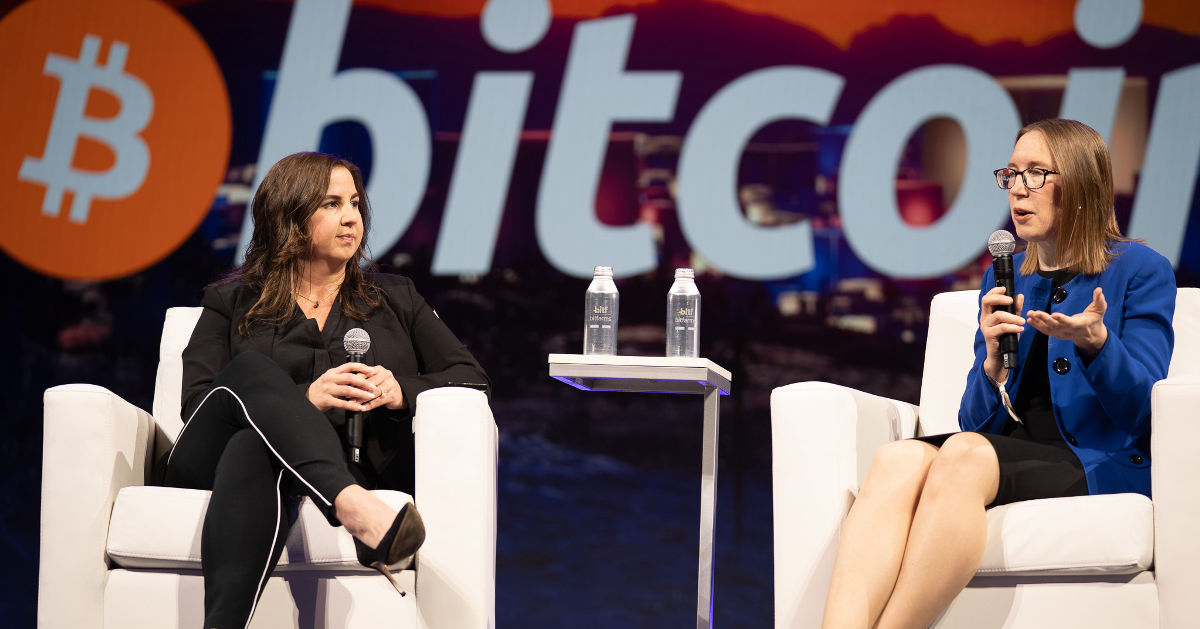
SEC Commissioner Hester ‘Crypto Mom’ Peirce Advocates Privacy-Preserving Tech
Outgoing Securities and Exchange Commission Commissioner Hester Peirce has said that regulators should rethink how they monitor the financial system, and to press for less personal data collection, not more.
In a speech Wednesday focusing on digital identity systems and decentralized networks, Peirce took aim at know-your-customer and anti-money-laundering rules.
U.S. regulators are now racing ahead with crypto rulemaking. Peirce, who earned the nickname “crypto mom” for her friendly approach to watchdogging the space, is set to leave the SEC in November.
“Today society is at a crossroads,” Peirce said at the SIFMA’s Digital Assets Conference in New York.
“Down one path lies the status quo: more data collection, more intermediary surveillance, more ‘know your customer’ requirements that turn our financial rails into a panopticon.”
“Down the other path lies an opportunity to use new technologies to improve our ability to catch criminals while collecting less personal information than ever before, and monitoring more sparingly to protect Americans’ privacy.”
Peirce argued that piling up ever more data on law-abiding customers to help find criminals doesn’t work. In her view, bigger “haystacks” make the needles harder to find, while every stored data point raises the risk of leaks or misuse.
She criticized a regulatory mindset fixated on “data go up,” comparing it to crypto enthusiasts’ obsession with rising prices.
Peirce pointed to cryptographic tools such as zero-knowledge proofs and attribute-based credentials, which can confirm facts like a person’s age, accredited-investor status, or absence from sanctions lists without revealing the underlying personal details.
She also urged the SEC to let firms rely on identity checks already performed by other regulated institutions, rather than making every firm collect and store the same sensitive information.
Under President Joe Biden, the SEC was tough on the crypto space, with its Biden-appointed former Chair Gary Gensler frequently suing major crypto companies for allegedly selling unregistered securities.
Peirce was appointed to lead the Crypto Task Force in 2025. The regulator has taken a far more friendly approach to watchdogging the space since Donald Trump became president again.
Now, regulators are saying they want to create clear rules for the fast-moving industry, despite landmark legislation, the Clarity Act, being blocked last week.
Despite Commissioner Peirce’s alias, she previously said she would not describe herself as an advocate of the industry, but rather a “freedom maximalist.”
This post SEC Commissioner Hester ‘Crypto Mom’ Peirce Advocates Privacy-Preserving Tech first appeared on Bitcoin Magazine and is written by Mathew Di Salvo.
Bitcoin Magazine

Jeff Booth: Why $1 Million BTC is Thinking too Small
Is a $1 million Bitcoin price target thinking too small? Jeff Booth thinks so, and he explains why valuing Bitcoin in dollars means pricing it from a game that’s rigged by debasement. He argues that Bitcoin isn’t just a coin or an asset, but the beginning of a decentralized, secure, and private protocol stack that will look a lot like the internet. In his view, Bitcoin is evidence of the first free market that has ever existed.
Chapters:
0:00 Jeff Booth, The Price of Tomorrow & Technological Deflation
0:30 AI Valuations & Why Free Markets Push AI Prices Toward Zero
1:29 AI Deflation vs the Debt-Based Monetary System
2:38 $40 Trillion US Debt, Bond Yields & the $350 Trillion Insolvent System
4:06 AI Singularity Claims, Fear & Monopoly Regulation
6:50 Productivity & Bitcoin’s True Value in a Deflationary Future
8:43 Why a $1 Million Bitcoin Price Target Is Thinking Too Small
10:11 Bitcoin Adoption Timeline & Why Bitcoin Isn’t Just an Asset
12:38 Bitcoin Payments & Circular Economies Scaling Worldwide
13:49 Bitcoin-Backed Private Equity & Owning Businesses Forever
DISCLAIMER: The views and opinions expressed in this show are those of the participants and do not necessarily reflect the official policy or position of BTC Inc., Bitcoin Magazine, or any affiliated entities. This content is provided for informational and educational purposes only and should not be construed as investment, legal, tax, or accounting advice. Nothing contained in this show constitutes a solicitation, recommendation, endorsement, or offer to buy or sell any securities or financial instruments. Viewers should consult their own advisors before making financial or business decisions.
This post Jeff Booth: Why $1 Million BTC is Thinking too Small first appeared on Bitcoin Magazine and is written by Patrick Green.
Bitcoin Magazine
Saifedean Ammous: The Bond Crisis & Bitcoin’s Rise as a True Macro Asset
Bitcoin’s volatility is falling, and Saifedean Ammous calls that the most bullish development in Bitcoin right now. Bear-market drawdowns have shrunk from roughly 87% to 77% to about 54% this cycle, which moves Bitcoin closer to an investable asset for money managers. Saifedean explains why the halving still drives the four-year Bitcoin cycle and why fewer people are buying with leverage at the top. He also discusses how markets may eventually arbitrage these cycles away.
Chapters:
0:00 Tether, Bitcoin & the Dollar Milkshake Theory
1:45 How the US Carries $40 Trillion in Debt as the World’s Reserve Currency
4:21 Treasury Yields Hit Multi-Decade Highs & the Bond Market Bear Case
7:00 War Spending, Iran & the Collapse of Fiscal Hope
9:20 Stablecoins vs Banks & the Hidden Treasury Rollover Risk
15:11 The Longest Hash Rate Bear Market in Bitcoin History
18:47 Why Miners Are Pivoting to AI Data Centers
21:31 The Halving, Bitcoin Cycles & Shrinking Drawdowns
25:56 MicroStrategy, Strive & Bitcoin Treasury Companies
29:07 The Humble Peasant Theory of High Finance
DISCLAIMER: The views and opinions expressed in this show are those of the participants and do not necessarily reflect the official policy or position of BTC Inc., Bitcoin Magazine, or any affiliated entities. This content is provided for informational and educational purposes only and should not be construed as investment, legal, tax, or accounting advice. Nothing contained in this show constitutes a solicitation, recommendation, endorsement, or offer to buy or sell any securities or financial instruments. Viewers should consult their own advisors before making financial or business decisions.
This post Saifedean Ammous: The Bond Crisis & Bitcoin’s Rise as a True Macro Asset first appeared on Bitcoin Magazine and is written by Patrick Green.
HTTP error 429 on https://cryptoslate.com/feed/
Failed to fetch feed: https://cryptoslate.com/feed/
Failed to fetch feed.
CryptoTicker.io
The three European financial supervisory authorities added quantum risk to their official autumn risk picture on September 23, 2026. Nothing about your holdings changes today, and the paper is not a warning about an imminent attack. What changes is the expectation placed on your provider: exchanges, custodians and banks in the EU now have to plan the migration of their encryption, and you can measure them against that.
This article sets out what the document actually says, which deadlines sit behind it, where the real attack surface lies for Bitcoin and Ether, and which three things you can check about your own custody without waiting for technology that does not yet exist.
What the EU supervisors wrote about quantum risk on September 23
Behind the paper stand the three European Supervisory Authorities, the ESAs: the banking authority EBA, the insurance authority EIOPA and the markets authority ESMA. Twice a year they publish a joint risk update in which the Joint Committee names the weak points of the EU financial system. The autumn 2026 edition appeared on September 23, and its core findings had been presented on September 10 at the Financial Stability Table of the EU Economic and Financial Committee. The statement is available in full at ESMA and at the EBA.
On quantum computing the text says the technology could transform the financial sector in central areas, from process optimisation through fraud and compliance monitoring to pricing. The same paragraph carries the flip side: the technology could equally create significant risks by undermining cryptographic systems that are used at scale to secure communications, transactions, databases and blockchains. Blockchains are named explicitly there, and not as a footnote to a banking topic.
The sentence that carries the urgency is a different one: the risks could materialise faster than any commercially viable application. In other words, the supervisors expect the ability to break old encryption to arrive before the economic benefit with which quantum computers are otherwise advertised.
Three weak points in one paper
The quantum topic does not stand alone. The ESAs name three fields: dependence on providers and infrastructure outside the EU, new technologies involving artificial intelligence and quantum computing, and the rapidly grown market for private credit. For crypto investors the first two fields are relevant, and they interlock. On the same September 23 ESMA additionally declared digital innovation a new supervisory priority from 2027, which shows that this is more than a one-off remark.
“Harvest now, decrypt later”: why intercepted data becomes a problem later
Harvest now, decrypt later describes an approach in which an attacker records encrypted data today and stores it, in order to decrypt it only once the necessary computing power exists. The attack therefore happens in two steps that can lie years apart.
For banking data, health records or contract documents that is the core of the problem, because their value does not expire. With a public blockchain the case is different and in one respect more uncomfortable: there, nobody has to intercept anything. The data lies open, permanently and retrievable by anyone. Whoever stores a copy of the chain today has everything they would need in ten years.
That is precisely why the distinction in the next section matters. The transaction history is always open. What decides the question is whether the public key belonging to a particular address is open as well.
Post-quantum cryptography: the migration deadline of end-2026 and who it binds
Post-quantum cryptography, abbreviated PQC, covers encryption and signature schemes that cannot be broken even by a powerful quantum computer. It rests on different mathematical foundations, and it is not about longer passwords.
The European timetable for this was not set by the Joint Committee. It comes from the NIS Cooperation Group, in which the member states work together. In June 2025 the group adopted a roadmap that the states endorsed. It provides for three stages: by the end of 2026 all member states should have begun the migration, meaning national strategies, inventories of the schemes in use and first migration steps. High-risk applications, which expressly include the financial sector, should be protected as early as possible and by 2030 at the latest. By 2035 the migration should reach as far as is practically feasible.
One point matters for placing this correctly: these deadlines bind member states, operators of critical infrastructure and supervised financial firms. As a private individual you are bound by no deadline. That is a relief, and at the same time it is the reason you have to look for yourself, because nobody migrates your self-custody on your behalf.
Elliptic curves, public keys and Bitcoin addresses: where the attack surface sits
Bitcoin and Ethereum sign transactions with schemes based on elliptic curves. A public key is computed from a private key, and that computation is easy in one direction and practically impossible in reverse. A sufficiently large quantum computer would make the reverse direction attackable, because a known method from quantum computing solves exactly this problem.
Here is the message for holders. With the address formats common today, the chain does not hold the public key itself, only its hash. The key becomes visible only when you spend from that address for the first time. As long as an address has only received, the information needed for this attack is not public.
That leaves two groups with a clearly raised attack surface. First, very old holdings from the early days, where the public key sits directly in the chain. Second, addresses that were used again and refilled after a spend, because from the first spend onwards the key stays permanently visible.
On the question of how far the hardware is from that point there is no reliable year, and this article deliberately names none. What is documented is that the estimates are moving towards lower effort: work published by Google Quantum AI in March 2026 concluded that breaking the 256-bit curves in use should require considerably fewer physical qubits than older models had assumed, by roughly a factor of twenty according to the reporting on that work. That is a correction to an estimate, not a date.
Dependence on non-EU service providers: the second finding that hits your exchange
The finding that takes up more room in the paper than the quantum topic is dependence on providers outside Europe. The ESAs identify a persistently strong dependence on IT service providers and payment systems outside the EU, and point out that it remains visible in the financial infrastructures as well, where clearing, repo business and ratings are predominantly handled by entities outside the EU.
For you this is not an abstract subject, because a trading platform is first and foremost software. The servers, the custody system, the identity checks and often the settlement sit with service providers whose names appear in the terms and conditions rather than on the front page. When supervisors expect cryptographic migration, that whole stack has to move with it, and the migration is only as fast as the slowest supplier.
In practical terms: a platform licensed in the EU gives you a counterparty bound by European rules, and a supervisor able to ask questions. If the choice is still ahead of you, the comparison of regulated crypto exchanges breaks down the licences, the registered seat and the custody model for each provider. That does not replace reading the terms yourself, but it shortens the job considerably.
AI-assisted attacks: why phishing is the nearer risk than the quantum computer
In the same chapter the ESAs write that the rapid development of advanced AI systems could make cyberattacks more effective and harder to control, because attackers could find and exploit weaknesses at unprecedented speed. For insurers they expect more frequent and more severe claims as a result.
That ordering is worth holding on to, because public debate often runs it the other way round. Quantum risk is significant, and it has no date. Automatically generated phishing pages, convincingly written support messages and cloned voices on the phone are circulating today and cost holdings today. The same precaution works against both, and it is unspectacular: the private key never leaves the device on which it was created, and an approval is confirmed on a screen that does not belong to the sender of the message.
That is exactly the purpose of a hardware wallet: the signature is created inside the device, and the content of the transaction is displayed there. A compromised computer can then propose a false payment, but it cannot approve one unnoticed.
Exchange balance, hardware wallet or self-custody: what supervisors do not settle for you
The obligations arising from the risk picture are addressed to supervised firms. Where your coins sit therefore decides who carries the migration burden.
If the balance sits with a regulated exchange or a custodian, that provider carries the migration of its systems, and the supervisor can question it about them. In return you depend on its diligence and on its insolvency risk. If you hold the keys yourself, you carry the migration yourself, and in return nobody stands between you and your coins. A third variant is the split, in which an actively traded portion stays on the exchange while the long-term holding sits in self-custody.
What you can ask your provider
- Is there a published roadmap for post-quantum migration, and does it name years?
- Which parts of custody sit with service providers outside the EU, and who is your contact if something fails?
- Are deposit addresses generated fresh for each transaction or permanently reused?
- Can withdrawal addresses be locked and approvals tied to a second device?
- When was custody last audited, and is the result available to read?
The last three points take effect immediately, independently of any quantum debate. If the first question goes unanswered, that is no proof of negligence, but it does indicate how far the planning has got.

MiCA licence and custody duties: what you find in your provider's terms and conditions
Since the European regulation on markets in crypto-assets applies in full, service providers need an authorisation as a crypto-asset service provider, CASP in the wording of the regulation, in order to offer trading and custody. The authorisation brings duties that bite at exactly the point at issue here: client holdings have to be segregated from the firm's own funds, custody has to be documented, and there are reporting and contingency duties for outages and attacks.
These duties are the lever through which a supervisory finding reaches the provider. An ESA risk picture is not a law and sets no deadline for an individual firm. It does feed into supervisory practice, and that is where an observation turns into a question in an examination report. Which duties apply in detail and when the transitional rules run out is set out in our overview of the MiCA obligations for crypto firms.
For your own records one point matters more in practice than any debate about the regulation: write down which provider holds which assets and under which authorisation. If a provider changes its offering or leaves the market, you need that overview immediately.
Moving wallets and the holding period: why a transfer between your own wallets is not a sale
Anyone who takes this as the occasion to move holdings from an old address to a new one, or from the exchange into self-custody, rightly asks the tax question. The basic rule in Germany is clear: a transfer between two wallets that both belong to you is not a disposal. There is no sale, so no gain arises, and the one-year holding period keeps running. Only a sale, a swap into another coin or a payment made with it is a taxable event.
In practice this rarely fails on the law and often on the documentation. A portfolio tracker that does not recognise a self-transfer as such books the outgoing leg as a sale and the incoming leg as a purchase. A gain that never existed then shows up in the report, and the holding period starts again inside the software. So anyone moving holdings marks the event in their tool as an internal transfer and keeps the transaction IDs. Which programs merge self-transfers reliably is shown by the comparison of crypto tax tools.
A second point concerns the sequence. If you are consolidating several addresses anyway, it is better done calmly than under time pressure, because every move is an operation in which an address can be copied down wrongly. The most common loss in this area has nothing to do with cryptography.
“Quantum-safe” coins and wallets: how to spot dubious offers
Every supervisory announcement carrying a technical buzzword produces offers that lean on it. The pattern is predictable, and so are the markers.
- An offer promises protection and asks you to enter your existing recovery words for it, for a migration or a check, say. That is a theft attempt in every case, without exception.
- A new token is advertised as quantum-safe and is therefore supposed to rise in value. The security properties of a protocol say nothing about the price of a token.
- A year is named from which existing schemes are said to be broken. No such figure is reliable at present, including in the supervisors' papers.
- There is time pressure, a countdown or an offer valid only today. A genuine protocol migration is announced and debated over months.
The protocols themselves work on this seriously, and visibly so. Proposals for quantum-resistant signature schemes are debated in open development processes, with specifications, testnets and objections. A migration of that size will surprise nobody who follows the developer channels of their own coin.
Quantum risk and custody: what to take away
The EU supervisors have moved a long-term risk into an ongoing supervisory process. That is good news, because it creates accountability where there was only debate before. Three steps follow for you, and none of them is urgent.
- Sort your addresses. Check whether you hold balances on addresses that have already been spent from, and whether you manage very old holdings from the early days. Those are the parts that are affected at all. If everything sits with a provider, first check who holds the keys there, and compare the custody model in the overview of regulated crypto exchanges.
- Harden your approvals. The nearer risk is the attack on you rather than on the mathematics. Tie withdrawals to a second device, fix address book entries and sign larger amounts on a device kept for that purpose alone. The differences between the devices are set out in the comparison of hardware wallets.
- Book your moves cleanly. When you reorder addresses, mark every self-transfer as such and keep the transaction IDs, so that the holding period does not restart in the report. Which programs handle that reliably is shown by the comparison of crypto tax tools.
And the sentence for calm: if the ability to break elliptic curves ever exists, your wallet will not be the first target. Ahead of it stand bank connections, government communications and the signatures that hold the internet together. That is why the topic appears in the risk picture of a financial supervisor and not in a warning notice to retail investors.
(As of September 25, 2026. This article is not investment advice. Prices and fee structures change; check the terms with the provider before you buy.)
No, you cannot buy a house in Germany with Bitcoin. Since April 1, 2023, section 16a of the German Money Laundering Act has banned exactly that: the purchase price for a domestic property may not be settled in cash, nor in crypto-assets, gold, platinum or gemstones, whatever the amount involved. Your Bitcoin holdings still work as a down payment for a mortgage, but only along a single route: you sell them, have the euro amount paid into an account in your own name, and prove to the bank and the notary, without gaps, where the money came from.
That shifts the real task away from the purchase and towards the paperwork. Anyone who has moved coins across several wallets and exchanges over the years rarely fails on the value of the portfolio, and almost always on the missing proof of origin. This article sets out what German banks accept as a down payment, which documents close the chain, how the holding period changes the sum available to you, and in which order to proceed.
Can you pay for a property in Germany directly with Bitcoin?
The short answer is no. The reason lies in an explicit statutory rule, not in the convenience of the banks. The Money Laundering Act, GwG for short, is the German law that requires banks, notaries and other obliged parties to check and document the origin of the assets used. Since 2023 it has contained a prohibition of its own for property transactions.
In practice that means: even if a seller were willing to accept coins, and even if both sides recorded it in the purchase contract, the transaction could not be validly performed. The notary who applies for the transfer of title at the land registry must be shown evidence of the non-cash payment. Without that evidence the transfer cannot proceed, and without the transfer you do not become the owner.
The reverse idea does not hold either. Some buyers hope that part of the purchase price could be settled in coins at the notary's desk and only the remainder through the bank. The prohibition recognises no de minimis threshold. It applies to the obligation as a whole, and therefore to a small part-payment as well.
What section 16a of the Money Laundering Act has banned since April 1, 2023
The provision applies to legal transactions covering the purchase or exchange of domestic property, and to the acquisition of shares in companies whose assets include domestic property. The obligation owed may only be discharged by means other than cash, crypto-assets, gold, platinum or gemstones. The wording can be read at the federal justice ministry in the official text of section 16a GwG.
The consequence of a breach is more unpleasant than many expect. A prohibited payment does not render the purchase contract void, but the payment loses its discharging effect. In legal terms: the seller's claim to the purchase price continues to exist. Anyone who has paid in coins has therefore not paid the price in law and owes it again, while the transferred holdings can only be recovered under the general law of unjust enrichment. For a financing running into several hundred thousand euros, that is a risk out of all proportion to the effort of an ordinary bank transfer.
One detail often gets lost in advice: the rule applies only to legal transactions concluded on or after April 1, 2023. It does not apply to older contracts. Since the provision has now been in force for more than three years, only residual cases are affected today.

What counts as a down payment at the bank and what counts as collateral
Two terms are constantly confused in conversations with the bank, and the confusion costs negotiating position. A down payment is the freely available funds you contribute to the property financing yourself, reducing the loan amount required. Collateral, by contrast, is an asset the bank may seize in an emergency, without it reducing the loan amount. In a classic property loan the collateral is the property itself, registered by way of a land charge.
Crypto holdings can count towards the down payment once converted into euros. As collateral they are of practically no use at German banks. The building society Schwäbisch Hall puts it plainly in its guide on cryptocurrency as equity: Bitcoin as security for a loan has so far been rejected by the banks. As a source of equity, the route is open, but only through conversion into euros.
How large a down payment you need depends on the house, your income and the credit terms. Advisory practice works on the rule of thumb that the incidental purchase costs should come entirely from your own funds, plus roughly twenty percent of the purchase price. Those incidental costs are no sideshow: land transfer tax ranges from 3.5 to 6.5 percent depending on the federal state, notary and land registry account for around 1.5 to 2 percent, and where an agent is involved further percentage points are added. Together that lands at roughly 9 to 15 percent of the purchase price, depending on location and who is involved.
Why banks do not accept crypto holdings as collateral
The reason lies in the valuation logic of property financing. Banks work with the mortgage lending value, a deliberately conservative figure that should still be achievable in a weak property market. It regularly sits below the market value of the property. For a residential building, that figure can be derived plausibly through a valuation using comparable properties, replacement cost and income capitalisation.
Crypto holdings resist that logic on several counts at once. The price can move by double-digit percentages within days, which makes any valuation on a thirty-year horizon questionable. Enforcement in the event of default is legally cumbersome, because the bank can realise nothing without the private key. And any realisation would have to run through a trading venue whose liquidity is not guaranteed. A land charge has the land registry behind it; a wallet has no equivalent.
This reticence is no verdict on crypto as an asset class. Deutsche Bank announced custody of Bitcoin, Ether and selected stablecoins for institutional clients from 2026. Custody for large clients and acceptance as loan collateral in retail banking are two different things, though, and the second does not automatically follow from the first.
How crypto holdings become a recognised down payment: the route through the euro
The sequence is unspectacular, and that is precisely its strength. You sell the amount you need on an exchange or through a broker, have the euro equivalent paid out to an account in your own name, and bring that amount into the financing as your down payment. What matters is that the payout goes to your own account and not to a third party's. Every intermediate step through another person tears open the chain of evidence and creates exactly the suspicion the Money Laundering Act is aimed at.
One point deserves more attention than it usually gets: the choice of trading venue. An exchange based and authorised in the EU gives you machine-readable annual statements, trading histories and payout records in a form a bank accepts. A provider without European authorisation often does not, and a later export can turn out to be impossible if an account has been frozen or a service discontinued. So if the sale is still ahead of you, it is worth looking at our crypto exchange comparison with documentation in mind, and not only fees. The difference between two providers here is not measured in tenths of a percent, but in whether the financing goes through.
Allow time as well. Between the sell order, the credit to the reference account and the onward transfer to your own current account, several working days pass depending on provider and amount. With larger sums, checks are added that extend the process.
What proof of source of funds banks and notaries require for crypto
Proof of source of funds is the evidence showing where the money used came from. It is no formality to be dealt with by way of a screenshot. The review is risk-based: the more conspicuous a transaction looks, the deeper the bank and the notary probe. A six-figure euro amount arriving from a crypto exchange shortly before a property purchase reliably falls into the higher risk class.
What is typically required is a closed chain: wallet, then exchange, then your own bank account, then the notary's escrow account or the seller. Each transition needs its own record. Completeness is what counts, not the volume of paper. A single transfer confirmation does not answer the question of origin, because it shows only the final step.
This scrutiny does not only reach you when buying property, incidentally. In the opposite direction, when depositing funds at an exchange, a query about the source of funds can trigger a freeze. How that plays out and which documents help there is described in our article on a crypto deposit frozen over the source of funds. The logic is the same; only the direction of the money flow differs.

Which documents prove the chain from wallet to exchange to account
Gather the records before the first meeting with the bank, not after. An application that goes into a second round for want of documents loses time and often the interest rate initially offered. These are the documents asked for in practice:
- The complete trading history from the exchange as a machine-readable export, not as a screenshot. A CSV export can be checked; a photograph cannot.
- Purchase records for the original acquisition, ideally with date, quantity and euro equivalent.
- Bank statements showing the deposit made to the exchange at the time, that is, the origin of the money originally used.
- Wallet addresses and transaction identifiers for movements that ran outside an exchange.
- The exchange's payout record for the sale, together with the matching statement from your current account.
- For coins from mining, staking or airdrops, the relevant statements, because such inflows are treated differently for tax than a purchase.
A gap is not the end of the world, but it has to be explicable. A discontinued exchange, a lost login or a wallet from the early years all happen. Write such cases up in advance in a short, factual note and attach whatever still exists. A gap that is named openly and explained plausibly is usually accepted; one passed over in silence leads to a query at the worst possible moment.
How the holding period under section 23 of the Income Tax Act decides your available sum
Selling for your own home is, for tax purposes, a private disposal transaction. The governing provision is section 23 of the Income Tax Act, which can be read in the official text of section 23 EStG. The holding period is the span between the acquisition and the sale of a coin position. Where more than a year lies between the two, the gain is entirely tax-free, with no upper limit. Sell within the year and your personal income tax rate applies.
Beneath that sits an exemption limit of 1,000 euros a year. The difference from an allowance is decisive and is constantly confused: with an allowance, that amount would always stay tax-free and only the excess would be taxable. With an exemption limit, the treatment flips as soon as the limit is reached. A gain of 999 euros stays untaxed; a gain of 1,010 euros is taxable in full. For a financing where every available euro counts, that is a figure worth knowing in advance.
The calculation becomes concrete once you run it against your own holdings. Suppose you need 80,000 euros as a down payment and hold positions from two different years. The older ones are past the one-year mark and deliver their amount tax-free. The younger ones trigger a tax charge at your personal rate, falling due the following year, which you have to set aside. Sell the younger ones first and you will later be short of money you had long since earmarked. Which position was acquired when therefore helps determine your financing sum and is no mere bookkeeping question. Anyone who has accumulated many transactions over the years will not get around a clean schedule; a look at the crypto tax software and portfolio trackers saves weeks of manual work here and supplies at once the records the bank and the tax office want to see.
Why the sale belongs before the financing meeting
Banks work with euro amounts sitting in an account. A portfolio carrying price risk does not appear as a down payment in the affordability calculation, because its value on the day the loan is paid out may differ from its value on the day of the meeting. Walking into the advice session with a portfolio statement and planning the sale only after approval means negotiating over funds that do not yet exist for the bank.
The opposite mistake is just as expensive. Selling before a property is even in sight means bearing the tax consequence and giving up any price movement, without gaining planning certainty in return. The sensible moment lies between the two: once a specific property has been found and the financing request is being prepared, but before the documents are submitted. Then the amount is fixed, the records are fresh, and the bank sees a figure rather than an intention.
What the banks' three-month rule means for your bank statements
Many institutions ask for the last three months of bank statements in order to assess income, spending and the origin of the down payment. A larger inflow from a crypto exchange within that window inevitably leads to a query. That is not particular scepticism towards crypto. Every conspicuous inflow is treated this way, a gift or a severance payment included.
From that follows a practical recommendation: if you are planning the sale anyway, carry it out so that the inflow and its record are visible and explained within the review window. An inflow that disappears precisely between two statement periods strikes a case handler as more in need of explanation than a harmless one. Attach the exchange records without being asked. That shortens processing measurably, because the query falls away.
How savings banks and cooperative banks separate crypto trading from credit assessment
One observation causes many customers confusion. The same savings bank that now offers crypto-asset trading in its app still does not treat your crypto holdings as collateral in a credit assessment. What lies behind the institutions' entry into trading is described in detail in our article on the launch of crypto trading at Sparkasse.
The contradiction is only apparent, because two different departments work with two different rulebooks. The securities and custody business sells you access to an asset class and earns fees. The credit department has to secure a claim over decades and is subject to regulatory requirements on the soundness of collateral. That one house offers both says nothing about the second question. So do not count on a portfolio held at your own house bank easing the negotiation. What counts is the euro amount in the account and the quality of your records.
What is different in the United States and why it changes nothing in German practice
In the United States things are genuinely moving. On June 25, 2025, the regulator FHFA directed the two large mortgage financiers Fannie Mae and Freddie Mac to develop a proposal for how crypto holdings can be taken into account as reserves in the risk assessment of residential mortgages, without prior conversion into US dollars. The directive is confined to holdings demonstrably held on a trading platform regulated in the United States, and requires haircuts for price volatility.
Two limitations matter for you. First, the subject there was reserves in the risk assessment, meaning proof of funds held alongside the down payment, and not payment of a purchase price in coins. Second, as of mid-2026 no finally approved guideline for broad application was in place. For a property purchase in Germany it has no bearing in any case: German law applies here, and section 16a GwG rules out payment in crypto-assets. Anyone inferring from American headlines that their German bank will soon calculate along similar lines is planning on a basis that does not exist here.
Which mistakes most often sink the financing
Most refusals in this context trace back to a few readily avoidable patterns:
- Payout to someone else's account. A sale whose proceeds land in the account of a parent or partner breaks the chain. Where family funds are involved, they belong documented as a gift in their own right, not mixed in.
- Screenshots instead of exports. A photograph of an app view is not evidence. What is required is a complete, machine-readable export.
- Tax not set aside. Sell within the one-year period and you have to pay the following year. If that amount is counted into the down payment, it will be missing later for repayments.
- Incidental costs underestimated. Banks usually do not finance land transfer tax and notary fees. Allocate the entire crypto proceeds to the purchase price and you stand before the incidental costs with no funds.
- Documents left too late. Exchange exports going back years take time, and with discontinued providers they are sometimes no longer obtainable. Noticing that only after the property has been secured means losing the deadline.
A last word on expectations: even with clean documents, approval remains a decision on the individual case. Income, term, repayment rate and the valuation of the property weigh more heavily than the question of where the down payment came from. Complete proof of origin removes one obstacle; it does not replace a sound affordability calculation.
Crypto as a down payment: what to take away
- Calculate first, sell afterwards. Go through your positions by acquisition date and separate the holdings past the one-year mark from the younger ones. Only when you know which part is tax-free and what tax charge the rest triggers do you know your real down payment. The practical steps of selling, including payout routes, are set out in our overview on selling Bitcoin.
- Gather the records before you go to the bank. Trading history as an export, purchase records, bank statements for the original deposit, payout record. Check whether your trading venue supplies these documents in a usable form at all; the exchange comparison helps with that assessment, and if you are switching provider, pull the exports beforehand.
- Document the tax side in writing. A traceable schedule of all acquisitions and sales serves two purposes at once, the tax office and the credit case handler. With one of the crypto tax tools you produce it once and use it twice.
(As of September 25, 2026. This article is not investment advice. Prices and fee structures change; check the terms with the provider before you buy.)
On the evening of Thursday, September 24, 2026, the crypto exchange Bitget said it detected unauthorised outflows from part of its wallets at 18:31 UTC and suspended withdrawals in response. The figure the company itself gives is around $351.6 million. For a European investor, the most important detail is not the size of the loss but the withdrawal freeze: anyone still holding a residual balance at Bitget cannot reach it right now.
That hits a group already working against the clock. Since July 1, 2026, providers without MiCA authorisation have been barred from taking on new business in the European Economic Area. Bitget has exited the EEA market in stages and told existing customers to withdraw their balances. That single remaining route is now temporarily closed.
What happened at Bitget: hot wallets, warm wallets and $351.6 million
A hot wallet is an exchange wallet whose private key stays permanently connected to the internet. It has to be, because withdrawals are meant to settle in seconds. A cold wallet keeps the key offline instead, usually on separated hardware; it is slow, but out of reach for an attacker working over the network. Between the two sits the warm wallet, an intermediate tier with limited but real network access.
Bitget describes its custody setup as a three-tier architecture built from exactly those layers. According to chief executive Gracy Chen, quoted by CoinDesk, only part of the hot and warm wallet tier is affected and the cold wallets are intact. The amounts on-chain observers could see diverged at first: blockchain analysts reported movements of roughly $178 million to $183 million in the opening hours, while the company puts the figure at $351.6 million. A spread like that is normal in the first hours after an incident, because outside observers only see the transactions they have already been able to attribute.
The outflows were spread across fifteen transfers and seven assets on several networks, according to an analysis by CryptoSlate. The largest single block, 44.4 percent, was Ethereum; BNB, AVAX and the stablecoin USDT were among the others affected. Notably, the funds were then consolidated into a single address.
The exchange treats deposits and withdrawals differently: deposits and trading continue to run, the company says, and only withdrawals are paused for the duration of the security review. Bitget announced hourly updates and a full report on the root cause within 24 hours. Neither had appeared by the time this article went to press.
Why the withdrawal freeze hits existing European customers hardest
To a European investor the case may look remote at first, because Bitget is no longer permitted to write new business here. That is precisely what makes the situation more awkward rather than less. When a provider withdraws from the EEA in an orderly fashion, existing customers are usually left with exactly one action: withdraw. If that route is blocked for an indefinite period, the people affected lose the only option regulation had left them.
A second deadline runs alongside, unrelated to the incident. On September 18 Bitget announced it would delist the trading pairs COTI/USDT, SAGA/USDT and RVN/USDT on September 24 at 10:00 UTC. For those three assets, withdrawals run until December 24, 2026, 10:00 UTC, according to the announcement. Anyone still holding positions there has a date in the calendar and a blocked withdrawal route at the same time. That combination is why waiting does not resolve itself here.
In practice: check today whether you are affected at all. Log in, note the balance with the date and time, take a screenshot and file a withdrawal request as soon as the function reopens. A documented balance is the basis for any later claim and for your tax return. Do not respond to emails or direct messages offering help with the withdrawal in this situation: a withdrawal freeze is exactly the moment when fraudsters approach customer lists with supposed recovery services.
MiCA and the ESMA register: which exchange is allowed to serve you
The European regulation on markets in crypto-assets, MiCA for short, has since 2025 required every provider offering crypto-asset services in the EEA to hold an authorisation as a CASP (crypto-asset service provider). Authorised providers appear in a public register kept by the European securities regulator ESMA. The transitional rules for legacy providers expired on July 1, 2026.
Bitget holds no such authorisation and does not appear in that register. The company has applied for a licence in Austria and is building a European entity in Vienna; until a licence is granted, it offers no services in the EEA. What looks like a formality in hindsight is the real difference for you: with an authorised provider you would have a European supervisor to address, reporting duties and documented custody requirements. Without authorisation that whole apparatus is missing, and you depend on the company's assurances.
From that follows the first check, and it reaches beyond this one case. Find out under which company and in which country your provider is actually authorised, and compare that against the ESMA register. If you want a starting point, our overview of regulated crypto exchanges for European investors lists the providers that have cleared this hurdle. The obligations those companies face under the MiCA licensing regime are a separate subject we have set out elsewhere.
One misunderstanding comes up often: a MiCA authorisation is no shield against hacks. It obliges the provider to meet organisational requirements and to segregate client assets, and it gives you a regulated counterparty if something goes wrong. It does not prevent the technical break-in.
Three wallet tiers at an exchange: what actually protects your balance
When you hold coins in an exchange account, you do not own coins on the blockchain. You own a claim against the company. The exchange runs an internal ledger of your balance and keeps all customer holdings pooled in its own wallets. That distinction matters the moment the exchange's holdings fall below the sum of the claims against it.
Splitting funds into hot, warm and cold is the standard answer to that risk. The large majority of customer holdings is meant to sit offline, while only a working float is kept online, large enough for day-to-day withdrawals. If the split works as intended, a break-in at the hot wallet reaches only that working float. In this case, though, the sum the company names runs into the hundreds of millions, which shows how large that float gets at a major exchange.
From that you can derive a question to put to any provider: does it publish proof of reserves, and can that proof be verified independently? A meaningful attestation names addresses, a cut-off date and a method by which customers can confirm their own balance was included. A press release with a total and no verifiable addresses does not meet that bar.
The protection fund is not deposit insurance: what $464 million in cover means
Bitget points to its own protection fund, which the company says holds more than $464 million and will cover the loss in full. That is a solid commitment only within the frame in which it is meant, and that frame differs fundamentally from what you know from your bank account.
Statutory deposit insurance in the European Union protects bank balances up to 100,000 euros per customer and institution. It rests on a directive, is supervised by the state, and applies whether or not the bank wants to pay. A crypto exchange's protection fund, by contrast, is a voluntary reserve held by the company. The company itself decides on payout, priority and amount. No statutory deposit insurance exists for crypto-assets in the EU, and MiCA does not create one.
This says nothing about Bitget's willingness to pay; it describes the nature of the instrument. A protection fund can absorb a loss in full, and funds in this industry have done so before. What you cannot do is rely on it the way you rely on a bank guarantee.
Self-custody and hardware wallets: when moving off an exchange account pays
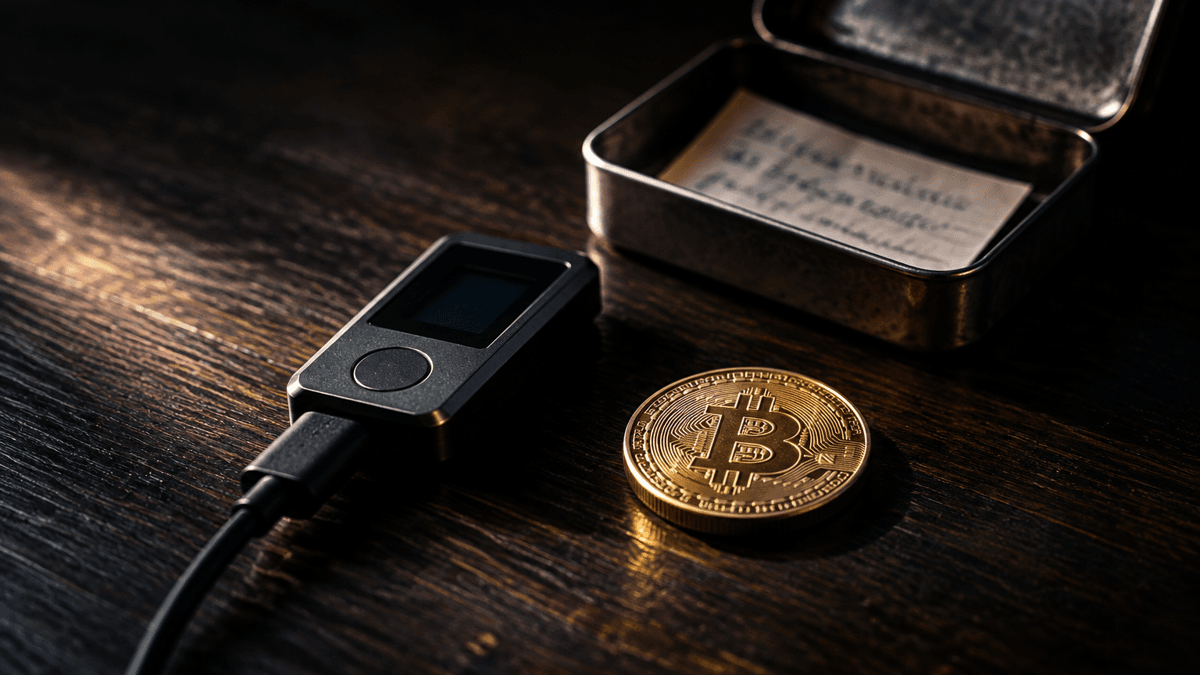
Self-custody means you hold the private key to your coins yourself and nobody else can dispose of them. A hardware wallet is a small device that generates that key and keeps it permanently separated from your computer; transfers are confirmed on the device and the key never leaves it. The seed phrase is the sequence of words from which the key can be restored, and therefore the actual access to your assets.
The advantage is obvious: a break-in at an exchange does not reach holdings that sit on your own device. The downside is often underestimated. Self-custody comes with no recovery hotline. A lost or photographed seed means permanent loss, and in August 2026 a flaw in the key generation of certain offline devices showed that this route carries risks of its own.
A workable rule of thumb separates funds by purpose. Amounts you actively trade may sit at a regulated exchange, because you need to be able to act quickly there. Anything you intend to hold for months, and whose loss would hurt, belongs on your own hardware. If you are moving funds for the first time, read up in our hardware wallet comparison first and send a small test amount before you move the rest.
One element of diligence costs nothing and is regularly forgotten: write the seed phrase down by hand, keep it separate from the device, and never store it as a photo, a text file or in cloud storage. Total losses in self-custody rarely trace back to an attack on the device. Usually a copy of the seed existed somewhere that somebody else could reach.
Tax and the holding period: what a frozen balance means for your return
A withdrawal freeze is, for tax purposes, a non-event to begin with. As long as your coins sit in the account and merely cannot be moved, you have neither sold nor swapped, and no disposal has taken place. In Germany the one-year holding period under section 23 of the Income Tax Act keeps running during this time, because it attaches to acquisition and disposal, not to availability.
It looks different once a blocked balance turns into an actual loss. Whether and how a loss from stolen or no longer withdrawable crypto-assets can be claimed for tax has not been settled in Germany and depends on the individual case. The federal finance ministry did not take a clear position on theft losses in its guidance on crypto-assets. What follows for you is above all a duty to document on your own account: secure account statements, transaction lists and the provider's notices with dates while you still have access to your account.
If you already run a portfolio tool, record the event there as a separate item rather than keeping it in your head. Our overview of crypto tax software and portfolio trackers shows which programmes produce records in a form a tax office accepts. For larger amounts a tax adviser is the cheaper option, because a wrongly stated loss position triggers questions later.
September 2026 in the hack ledger: Liquid Network, Bitget and the year's total
The incident does not stand alone. On figures CryptoSlate compiles from DeFiLlama, losses from attacks in September 2026 already stood at roughly $342 million before the Bitget incident. With the loss now reported, the month adds up to more than $684 million, surpassing the previous high for the year set in April at $646.9 million.
The largest single item before that came in early September from the Liquid Network at around $320 million, where the attackers stated they had acted as white hats. Smaller incidents followed, among them an attack on a hot wallet belonging to the provider Duelbits worth about $7 million. For context, a monthly tally depends heavily on a few large individual cases, and no trend for the coming quarter can be read from it.
For judging your own risk, another observation is more useful anyway. The large losses of this year arose overwhelmingly where assets sat pooled with a single custodian. That holds for the orderly cases too: both the shutdown of BitMEX on September 23 and the announced closure of CoinEx at the end of the year put customers in the same position, having to pull balances under time pressure off a platform they could no longer choose. Bitcoin itself barely reacted to the news that evening; the market now treats a break-in at a single exchange as an event belonging to that exchange.
Checking the Bitget hack: what to take away
- Establish today whether you are affected, and document the position. Log in, note balances with date and time, save the transaction list and the provider's notices, and file the withdrawal request as soon as the function reopens. For the three trading pairs delisted on September 24, the withdrawal window closes on December 24, 2026. Keep the records in the form a tax office will later want to see — the tools for that are in our comparison of crypto tax software.
- Check the authorisation of every exchange you use. Find out which company in which country is liable for your account, and match it against the ESMA register. A provider without CASP authorisation may not serve you in the EEA, and in a dispute you have no European supervisor to turn to. The houses that have cleared this hurdle are in our overview of regulated crypto exchanges.
- Separate trading holdings from long-term holdings. What you move around may sit at the exchange; what you hold for months belongs on your own hardware, with the seed phrase written by hand and kept apart from the device, and a small test amount sent before the first large transfer. The devices and how they differ are in our hardware wallet comparison.
A final note that applies at the time of writing: Bitget reported the incident itself, quantified the loss and promised cover from its own protection fund. Whether withdrawals reopen quickly, and whether the promised root-cause report answers the open questions, could not be foreseen as this article went to press. Until then the sober rule this evening has confirmed again applies to you: a balance at an exchange is a claim against a company, and its worth depends on that company being able and permitted to pay.
(As of September 24, 2026. This article is not investment advice. Prices and fee structures change; check the terms with the provider before you buy.)
Whether a crypto gain raises your health insurance contribution hangs on a single question: how are you insured? If you are compulsorily insured as an employee, a private disposal gain has no effect on the contribution. If you are voluntarily insured, as a self-employed person or as a high earner above the compulsory insurance threshold, it counts. And if you are covered without contributions through your partner's family insurance, a single gain can tip that cover over for months.
This article sorts the three cases, gives the 2026 thresholds from the reference values ordinance, and shows which distinction moves the most money: the one between a taxable and a tax-free gain.
The decisive lever: what counts as income for social insurance purposes
Social insurance does not invent an income concept of its own; it borrows one from tax law. Under section 16 of Book Four of the German Social Code, total income is the sum of the income within the meaning of income tax law. That one sentence decides almost everything that follows.
For Bitcoin and other coins, section 23 subsection 1 sentence 1 number 2 of the Income Tax Act applies for tax purposes. If you sell within one year of buying, the gain is a private disposal and therefore taxable income. If you sell after a year has passed, the transaction is not taxable at all. It appears in no category of income, and it therefore does not raise total income within the meaning of section 16 SGB IV either.
From this follows the most important rule of thumb in this article: the holding period works twice over. That single period decides your income tax and, in many constellations, your health insurance contribution along with it. A gain of 6,000 euros after fourteen months is tax-free and, as a rule, irrelevant for social insurance. The same gain after ten months is neither.
A second point up front, because it often gets muddled: what matters is the realised gain, not the value of your holding. A portfolio that has risen in price without your having sold generates no income and moves no contribution. Health insurance contributions are assessed on receipts, not on assets. That sets them apart from procedures in which the holding itself is precisely what matters, such as the seizure of coins.
Case 1: compulsorily insured as an employee
Anyone compulsorily insured in the statutory health insurance scheme as an employee pays contributions on their employment earnings. That is the pay from the employment relationship, and only that. Income from capital, from letting property or from private disposals does not belong to it.
A crypto gain therefore does not raise your contribution in this case, not even when it is large and not even when it arises within the one-year period. You still have to declare it for tax as soon as the sum of all private disposal gains reaches the threshold in section 23 EStG. Where that belongs in the forms is set out in the article on where to enter crypto in your tax return.
Two qualifications are worth knowing. If your trading becomes a commercial activity, through its scale, its organisation and the use of borrowed capital for instance, the picture changes completely, because earned income from self-employment then arises. Where that line runs is covered in our article on the difference between private and commercial trading. And anyone who becomes self-employed on a full-time basis alongside the job may lose compulsory insurance as an employee.

Case 2: voluntarily insured, and why total economic capacity counts here
Voluntarily insured means anyone who is not subject to compulsory insurance and nevertheless stays in the statutory fund. That mainly concerns the full-time self-employed and employees whose pay exceeds the compulsory insurance threshold. Section 240 SGB V applies to this group, and its subsection 1 sets a markedly wider yardstick than employment earnings: it must be ensured that the contribution burden takes account of the member's total economic capacity.
The details are set uniformly by the National Association of Statutory Health Insurance Funds. The underlying idea: all receipts that cover the cost of living are drawn on, irrespective of their classification for tax. A taxable gain from a private disposal falls under this. With a tax-free gain after the one-year period the position is less clear-cut, because no point of connection in tax law exists there. Where in doubt, clarify this with your fund beforehand and have the answer given to you in writing rather than fighting it out afterwards.
The 2026 figures
The Social Insurance Reference Values Ordinance 2026 sets the limits between which all of this plays out:
| Figure | 2026 value |
|---|---|
| Reference value | 3,955 euros a month (47,460 euros a year) |
| Contribution assessment ceiling for health and long-term care insurance | 5,812.50 euros a month (69,750 euros a year) |
| Compulsory insurance threshold | 6,450 euros a month (77,400 euros a year) |
| Minimum assessment basis for voluntary members | around 1,318 euros a month |
The contribution assessment ceiling is the cap here. Anyone whose contributory receipts already sit above it pays not a cent more because of an additional crypto gain. The minimum assessment basis follows from section 240 subsection 4 SGB V, under which at least a ninetieth of the monthly reference value is to be applied for each calendar day.
What a gain actually costs
Reckon with the general contribution rate of 14.6 percent, the fund's own supplementary contribution and the long-term care insurance contribution. Voluntary members without an employer bear the total alone. With a taxable gain of 10,000 euros and a combined rate of roughly twenty percent, you end up in the order of some 2,000 euros in additional contributions, provided you stay below the contribution assessment ceiling with it. The exact figure depends on your fund and your other receipts, but the order of magnitude shows what is at stake.
The provisional assessment and the recalculation
For the self-employed, the fund initially assesses contributions provisionally under section 240 subsection 4a SGB V, on the basis of the most recent income tax assessment. The final calculation only happens once the assessment for the year in question is available. A crypto gain from 2026 may therefore only catch up with you in 2027 or 2028, but then retrospectively for the whole year. Anyone who has spent the gain by then faces a back payment with nothing to set against it.
Case 3: covered by family insurance, and why the smallest limit applies here
Family insurance under section 10 SGB V is free of contributions. It is open to spouses, civil partners and children, as long as several conditions are met at the same time. Crypto gains regularly breach one of them: the family member must have no total income that regularly exceeds a seventh of the monthly reference value in a month.
For 2026 that means, concretely: 3,955 euros divided by seven gives 565 euros a month. Anyone in marginal employment may instead earn up to the marginal earnings threshold. And because total income under section 16 SGB IV is the sum of income within the meaning of tax law, a taxable crypto gain counts here in full, while a tax-free gain after the one-year period stays outside the reckoning.
The word regularly is the reason so many underestimate this threshold. A one-off gain is not simply added to the month it was received and forgotten about afterwards. One-off receipts are customarily looked at spread over twelve months. A taxable gain of 8,000 euros comes to roughly 667 euros a month when apportioned, and therefore sits above the limit, even though it arose on a single day.

What happens when it falls away
If family insurance falls away, no gap in cover arises, but a liability to pay contributions does. As a rule you become a voluntary member and pay at least the contribution on the minimum assessment basis. The retrospective effect is what makes it critical: funds check the conditions on a regular cycle with a questionnaire, and if it turns out months later that the limit was exceeded, the account is settled retrospectively. That is why a larger realised gain should be reported to the fund before it asks.
What happens with staking, lending and airdrops
Income from staking and lending is for tax purposes usually other income under section 22 number 3 EStG and therefore income within the meaning of tax law. This income flows continuously rather than once, which makes it trickier for the family insurance regularity test than a single disposal gain. For voluntary members it raises contributory receipts like any other income.
A widespread misconception concerns the valuation: what is taxed, and therefore also captured for social insurance, is the inflow in euros at the price on the day of receipt, not the later sale. Anyone drawing rewards in coins and leaving them where they are has income without having seen a single euro. For airdrops it depends on whether you provided something in return. Where that is entirely absent, there is often no taxable receipt at the time of the inflow.
In all three cases you need a robust record with the date, the quantity and the euro price for each inflow. A portfolio tracker with tax reporting takes this work off your hands and supplies the statement you can put before both the tax office and the insurance fund.
Evidence: what happens if you do not supply it
Section 240 subsection 1 SGB V contains a rule that gets expensive if you overlook it. If a member does not produce the requested evidence of their contributory receipts, a thirtieth of the monthly contribution assessment ceiling counts as the contributory receipt for each calendar day. You are then classified as though you had 5,812.50 euros a month, regardless of what you actually had.
The law allows a correction. If you apply for a fresh assessment within twelve months of that assessment being notified and submit the evidence subsequently, the contributions for the periods concerned are to be recalculated. That twelve-month period works as a cut-off in everyday practice: anyone who lets it pass stays stuck with the maximum classification.
The comparison with private health insurance
Privately insured people pay risk-based premiums according to tariff, age and state of health. Income plays no part there in the size of the premium, so a crypto gain does not move it. Income is relevant at only one point, namely the employer's subsidy for employees, and when switching back to the statutory fund, which is tied to the compulsory insurance threshold of 77,400 euros in 2026.
Anyone weighing the two systems as a self-employed person should factor in that fluctuating crypto income feeds straight through to the contribution in the statutory fund and does not in the private one. That is not an argument for switching, because switching is as a rule a one-way street with considerable consequences in old age. It is an argument for building the contribution effect into the planning of a sale.
How to keep the contribution effect small before a sale
The most effective lever sits before the sale, not after it. Four points are worth a look.
Wait out the one-year period wherever you can. A sale after more than twelve months of holding is tax-free and as a rule generates no total income. If your position is just short of the period and you do not absolutely need the liquidity, waiting is by far the cheapest measure. Check the period for each tranche, because it runs separately for each acquisition.
Choose the order of the tranches. If you have to sell, dispose first of the units that already have the one-year period behind them. Which selling routes are available and what fees they carry is something you decide independently of that, but you should be able to document how the tranches were allocated.
Keep the contribution assessment ceiling in view. If as a voluntary member your other receipts already put you above 5,812.50 euros a month, the contribution effect of an additional gain is zero. That check costs five minutes and may spare you an unnecessary postponement.
With family insurance, do the arithmetic beforehand. The 565-euro monthly limit is low, and a one-off gain is apportioned. If the sale can be stretched across several years, the cover may well be preserved. Have your fund confirm the method of calculation before you rely on it.
Crypto gains and health insurance: what to take away
- Establish your insurance status first, everything else second. As a compulsorily insured employee, a private crypto gain leaves your contribution untouched. As a voluntary member it counts through section 240 SGB V; as a family member the 565-euro monthly limit decides whether contribution-free cover survives. Without that classification, every further calculation is worthless.
- Keep a complete record of your inflows and sales with the date and the euro price. You need it for your tax return and for any evidence put to the fund, and without it voluntary membership risks classification at the contribution assessment ceiling. A portfolio tracker with tax reporting handles that as you go instead of once a year under time pressure.
- Check the holding period for each tranche before any larger sale. Above the one-year mark the gain is tax-free and usually stays free of contributions; below it, it may hit you twice. If you want to keep your holdings cleanly separated for that purpose, orderly custody helps, for instance on a hardware wallet of your own with separate accounts for each acquisition period.
Sources in the text of the law: section 240 SGB V on the contributory receipts of voluntary members and the Social Insurance Reference Values Ordinance 2026.
(As of September 24, 2026. This article is not investment advice and not legal or tax advice. Contribution rates, reference values and fee structures change; check the terms with the provider before you buy, and have your individual case examined by your health insurance fund or a tax adviser.)
Yes, your crypto holdings count as assets for Bürgergeld, Germany's basic income support. They are a realisable asset within the meaning of the Social Code, they are valued at their market value, and they are set against the same allowances as an instant-access savings account or a share portfolio. What has changed since the summer of 2026: the allowances are no longer the same for everyone, and the one-year grace period at the start of a claim no longer exists for financial assets.
This article explains how much you may keep, which day decides the valuation, what you must tell the Jobcenter of your own accord, and the routes by which an authority learns of holdings you have not declared. All the figures come from the text of the law itself, not from advice portals.
Bürgergeld has become Grundsicherungsgeld: what changed on assets
The benefit that people still colloquially call Bürgergeld carries a new name in the law. Under section 19 of Book Two of the German Social Code, claimants capable of work receive Grundsicherungsgeld, basic income support. Official jargon and the search engines still lag behind; the decision letters do not. Anyone filing a claim today has the new rules applied, even if they searched for the old word.
More important than the name are two changes of substance. First, the blanket grace period for assets has gone. Assets used to be left untouched up to a high ceiling in the first year of a claim, and only then did the actual allowances bite. Under section 12 SGB II that grace period now applies only to owner-occupied residential property: a house or a flat you live in yourself stays out of the reckoning during the grace period, regardless of value and size. For portfolios, savings books and coins that buffer no longer exists. Your allowances apply from day one.
Second, the size of the allowance now depends on your age. For a crypto holder that is no marginal detail, because it can make the difference between an untouched holding and one you have to spend down, without anything about your holding having changed at all.
The asset allowances under section 12 SGB II: what your age decides
An allowance is the amount you may keep before anything at all is counted against you. Section 12 subsection 2 SGB II grades it by age, and it does so for each person in the benefit unit separately:
| Age | Allowance per person |
|---|---|
| up to the completion of age 30 | 5,000 euros |
| from age 31 | 10,000 euros |
| from age 41 | 12,500 euros |
| from age 51 | 20,000 euros |
Under the law the higher amount applies from the beginning of the month in which you reach the relevant age threshold. Someone turning 41 on the 20th of a month therefore has 12,500 euros free from the first of that same month. With a holding that sits just above a threshold, that single month can decide the outcome.
Work it through on an actual holding. Bitcoin stood at roughly 74,100 euros on September 24, 2026 (CoinGecko, retrieved 18:40 UTC). A quarter of a bitcoin is therefore about 18,500 euros. For a single person aged 35 with an allowance of 10,000 euros, some 8,500 euros sit above the line and count as assets to be spent down. The same 0.25 BTC is fully protected for a 52-year-old with a 20,000-euro allowance.
Transferable allowances: how the benefit unit adds up
In social law a benefit unit is the circle of people who are jointly responsible for their upkeep, typically partners and minor children in the household. For assets, a rule applies there that many overlook: allowances the other members have not used up are transferred under section 12 subsection 2 SGB II to the person whose assets breach their own limit.
A couple aged 34 and 52 bring 10,000 plus 20,000 euros between them, so 30,000 euros. If the entire wealth sits in the younger person's wallet alone, that does no harm as long as the total stays below 30,000 euros. The older person's unused allowance moves across in the arithmetic. Hurriedly transferring your coins to your partner before a claim therefore gains you nothing the law does not already give you, and it may well invite questions.
The second half of the calculation gets overlooked too. Alongside the allowance, section 12 subsection 1 SGB II lists items that do not count as assets in the first place. These include reasonable household effects, one reasonable motor vehicle for each employable person in the benefit unit, insurance contracts earmarked for retirement provision, and state-subsidised pension savings. A crypto holding falls under none of these exceptions, not even if you personally regard it as your retirement provision. Number 4 of that subsection does protect assets expressly designated as retirement provision, but only for periods of full-time self-employment without contributions to the state pension scheme, and only up to a statutorily calculated maximum for each year begun.

Market value on the cut-off date: why the day you file decides your entitlement
Section 12 subsection 3 SGB II contains the sentence that weighs most heavily when prices move. Assets are to be taken into account at their market value, and the decisive moment for the valuation is the point at which the claim for an award, or for a renewed award, is filed. If you acquire assets only later, the moment of acquisition counts.
Market value is the price that could be achieved on the market. For a coin with an active exchange listing, that is the price on that day, not your purchase price and not the level from the week before last. Three things follow for you, and the third is where clawbacks arise in practice.
The cut-off date is a day, not an average. A holding that sits below the allowance on a monthly average can sit above it on the day of filing and then count in full. The reverse applies in your favour. Next: every renewal claim sets a new cut-off date. A holding that raised no eyebrows on the initial claim can be above the line at renewal if the price has risen in the meantime. And finally the rule works in the other direction too. Anyone acquiring coins while receiving the benefit, from staking rewards or an airdrop for instance, has new assets at the moment of receipt, which section 60 SGB I requires them to report without delay.
If you hold your assets spread across several wallets and exchanges, have a coherent consolidated statement ready for the cut-off date. A portfolio tracker with tax reporting delivers exactly that snapshot with date, price and source, and you will need it a second time for the tax office anyway.
Which crypto holdings count as realisable and which do not
Realisable in social law means you can turn the item into money or borrow against it within a foreseeable period. For a liquid coin on a mainstream exchange that is uncontroversial. The edge cases are the interesting ones.
Locked, pledged and illiquid holdings
Coins tied up in staking for a fixed term cannot be sold immediately. That does not reduce their value, however, and a lock-up of a few weeks does not make them unrealisable. Long lock-up periods with no option to exit, or tokens without a functioning market, are a different matter. Here it comes down to the individual case, and here it pays to document the lock-up in writing rather than merely assert it.
Particular hardship
Section 12 subsection 1 number 7 SGB II exempts items and rights whose realisation would amount to particular hardship. That is a narrow exception for cases in which a sale would be economically unreasonable, for instance a sale well below value in a forced situation. As a rule it cannot be founded on a price loss since purchase. Anyone wanting to rely on it should discuss the point with an advice centre or a lawyer specialising in social law before writing it into the claim.
Debts
Assets are looked at gross as a matter of principle. An overdraft on your current account is not automatically netted off against a wallet. Anyone who has pledged coins as security for a loan should be able to document the pledge, because it genuinely does restrict realisability. How loans with coins as collateral work for tax and under civil law is set out in the article on bitcoin-backed loans, tax and the holding period.
The duty to cooperate under section 60 SGB I: what you must declare to the Jobcenter
The obligation to declare crypto is not in SGB II but one level above it. Under section 60 subsection 1 of Book One of the German Social Code, anyone who applies for or receives social benefits must state all facts that are material to the benefit. On top of that comes the duty to report changes in circumstances without delay, and the duty to name evidence and produce it on request.
That wording is deliberately broad. It does not turn on whether the claim form expressly asks about cryptocurrencies. What is material is whatever can influence the entitlement, and assets can influence it. The question about existing assets covers coins just as it covers a savings book, even if the word is missing from the form.
What changes during a claim is therefore reportable without delay as well: an inflow from staking or lending, an airdrop, an inheritance in coins, a sale that puts money in your account. Anyone who reports an inherited holding only months later also acquires an evidence problem, because they have to reconstruct the deceased's holding period and acquisition costs. How that is done is set out in our article on proving the holding period and purchase price of inherited bitcoin.

How the Jobcenter finds out about your coins
Many assume that a self-custodied wallet is invisible to an authority. That holds for the wallet itself, and it has long ceased to hold for the route that leads to it. Three channels are responsible, and they operate independently of one another.
The automated data comparison, and what it cannot do
Under section 52 SGB II, the Federal Employment Agency and the municipal bodies compare claimants' data automatically four times a year, on 1 January, 1 April, 1 July and 1 October. That comparison looks for pensions, for periods of compulsory insurance, for benefits from other institutions and for data on exemption orders reported to the Federal Central Tax Office. It does not capture crypto holdings. Anyone concluding from this that a wallet stays undetected draws the wrong conclusion, because the comparison is only the first of three routes.
The account data retrieval at the Federal Central Tax Office
Section 93 subsection 8 of the Fiscal Code expressly permits the authorities responsible for basic income support for jobseekers to retrieve account master data from the Federal Central Tax Office. The conditions are that it is necessary in order to examine the conditions of entitlement, and that a prior request for information addressed to you has not achieved its purpose or holds no promise of success. The retrieval yields no balances and no wallet addresses, but the master data of the accounts and securities accounts held in your name at German credit institutions.
For crypto it is nevertheless the most effective channel, because almost every holding came into being via a bank account. Anyone transferring euros to an exchange and later receiving euros back leaves a trail on the bank statement that leads to the exchange. From there section 60 subsection 2 SGB II carries on: anyone who holds balances or safeguards assets for a person receiving benefits must provide information to the Employment Agency on request. An exchange that holds your coins in custody falls under that provision.
The reporting duty for crypto service providers since 2026
The third channel is new. With the Crypto-Asset Tax Transparency Act, Germany implemented the EU's DAC8 directive, which builds on the international CARF framework. Since 1 January 2026, reporting crypto-asset service providers have had to collect data on their users and transmit it to the Federal Central Tax Office, which exchanges it with the tax authorities of the other member states. The first reporting period is the 2026 calendar year, with transmission in the year that follows.
What gets reported is identification data along with aggregated figures on purchases, sales and transfers for each crypto-asset. That is a tax procedure to begin with and not a social data comparison, and a Jobcenter does not receive these reports automatically. It does shift the starting point, though: a holding that is on file with the tax office is also documentable to another authority if a dispute arises. What that means for tax is described in detail in the article on where to enter crypto in your tax return.
If you have to spend down crypto: holding period, section 23 EStG and the double trap
If your holding is above the allowance, the Jobcenter will require you to spend down the excess before benefits are paid. In practice that means selling. And this is precisely where two sets of rules meet that know nothing of each other.
For tax purposes, coins count as other assets within the meaning of section 23 subsection 1 sentence 1 number 2 of the Income Tax Act. A sale within one year of acquisition is a private disposal and the gain is taxable. After a year has passed it is tax-free. Anyone selling under time pressure because the Jobcenter insists on the assets being spent down can therefore trigger a taxable gain they would not have had with a little more patience.
The second half of the trap: the sale proceeds are not income in the month of receipt but remain assets, because they derive from an asset that already existed. They are therefore not counted as income on top. The gain from them can, however, trigger a tax payment in the following year for which the money is no longer there. Anyone who has to sell should therefore set aside the likely tax out of the proceeds before spending the rest. Which routes exist for selling and where the fees sit is a topic of its own, and the differences are not incidental in a forced sale.
One point you should not overlook: within limits, you may determine the order and the timing yourself. If part of your coins has already passed the one-year mark and another part has not, it is as a rule more favourable to sell the older ones first. Social law does not prescribe which units you dispose of; it is interested only in the result.
What happens if you conceal crypto
If an undeclared holding later comes to light, the authority revokes the award decision for the periods concerned and reclaims the benefits paid. The clawback is measured by what you would have been entitled to had you declared correctly, and it can span several award periods. On top of that, incomplete statements about assets can bring administrative fine proceedings or criminal proceedings in their wake.
That is the expensive route, and it is avoidable. The cheap route is a complete declaration with clean supporting documents, in which you set out yourself, where there is doubt, why in your view a holding should not be taken into account or only in part. An authority handed a complete set of facts decides a question of law. An authority that finds a holding by itself decides on your credibility.
If a decision treats you wrongly on the substance, an objection is open to you, as a rule within one month of notification. The deadline is stated in the decision itself. Free advice is available from the social welfare associations and from independent advice centres, and with larger amounts a lawyer specialising in social law is worth the money.
Preparing your evidence: what to assemble before you file
The effort lies in the documentation, hardly at all in the form-filling. So assemble before you file what you are going to need anyway.
- A statement of all holdings by coin and by place of custody, with the position as at the day the claim is filed.
- That day's price for each coin, with the source and the time of retrieval, so that the market value applied is verifiable.
- The acquisition data, meaning date, quantity and purchase price, because they decide the one-year period for tax.
- Evidence of lock-ups, pledges or commitments that genuinely restrict realisability.
- The bank statements showing deposits to and withdrawals from exchanges, because that is the route along which questions come anyway.
Self-custodied holdings should be listed just as fully as a balance on an exchange. An authority cannot establish a wallet address by itself, and the missing declaration weighs more heavily later than the holding does. If you have kept your coins exclusively on trading platforms so far, transferring them to a hardware wallet of your own is incidentally no way to hide assets. Moving the coins changes nothing about the duty to declare and nothing about the valuation; it changes only who holds the keys.
Drawing the lines: seizure, insolvency and basic income support are three separate procedures
The allowances in SGB II apply exclusively to social benefits. When a private creditor reaches for your assets, the attachment exemption limits of the Code of Civil Procedure apply, and those amounts are different ones. A holding that is protected for basic income support can still be realised by a bailiff. How access to coins works in practice is set out in the article on whether bitcoin can be seized by creditors and insolvency administrators.
Just as non-transferable are the rules of personal insolvency and those of social assistance under Book Twelve of the Social Code, which has an asset framework of its own. Anyone facing several of these procedures at once should have them examined separately, because a statement in one procedure can have quite different consequences in another.
Crypto and Bürgergeld: what to take away
- Work out your allowance from your age, not from something you read somewhere. There are four bands between 5,000 and 20,000 euros per person, and within a benefit unit unused allowances are transferred. Then draw up a statement of holdings as at the day you intend to file, most easily with a portfolio tracker with tax reporting that supplies the price, the date and the source along with it.
- Declare all holdings in full and report every change immediately. The duty follows from section 60 SGB I, regardless of whether the form asks about cryptocurrencies. Document your figures once too often rather than once too rarely, and keep ready the bank statements showing the transfers to exchanges. Where the figures belong in your tax return is shown in the article on where to enter crypto in your tax return.
- Check the one-year period before a forced sale. Coins you have held for more than a year can be disposed of tax-free under section 23 EStG. Where in doubt, sell the oldest units first, compare the selling routes and their fees beforehand, and set aside the likely tax out of the proceeds before you spend the rest.
Sources in the text of the law: section 12 SGB II on assets to be taken into account and section 60 SGB I on the statement of facts.
(As of September 24, 2026. This article is not investment advice and not legal advice. The state of the law, prices and fee structures change; check the terms with the provider before you buy, and where in doubt have your individual case examined by an advice centre or a specialist lawyer.)
Decrypt
The central bank opened two proposals for comment under the GENIUS Act, requiring issuers it supervises to back tokens fully with safe assets and creating an application process for banks seeking to issue stablecoins.
A newly created wallet drained hot and cold reserves labeled as belonging to Bitget across multiple blockchains in under an hour.
A proposed class action accuses OpenAI of quietly routing real conversations to outside contractors through a program called Project Lily—without telling users first.
Muse Charm is Meta's palm-sized gadget for talking to its Muse AI agent on the go. It has cameras, a fingerprint sensor, and its own cell connection.
A February research paper showing AI can unmask pseudonymous internet users is freaking everyone out again this week. Here's what the paper actually says.
U.Today - IT, AI and Fintech Daily News for You Today
Bitcoin could surge to $500,000 within roughly two years, according to Volmex Labs CEO Cole Kennelly.
XRP, Dogecoin, Ethereum and Stellar are trying to preserve their recent breakouts as correction covers the market.
JPMorgan says Bitcoin’s brief move above the crucial $85,000 production-cost level could ease pressure on miners after BTC spent a staggering 280 days below it.
Solana-based stablecoins can now be used to book flights across more than 300 airlines through crypto travel platform Nomadz, expanding the network’s real-world payments footprint into global travel.
BlackRock-designed investment portfolios are officially moving onto blockchain rails.
Blockonomi
Key Highlights
- Block has become a member of the x402 Foundation and integrated Bitcoin Lightning Network into the open payment standard.
- The x402 protocol enables AI agents to conduct automated payments for digital services, APIs, and data using HTTP 402 payment requests.
- Development code committed on September 23 revealed Lightning integration before the official public announcement.
- The x402 platform processed 75.41 million transactions totaling $24.24 million in volume during the most recent 30-day window.
- Multiple blockchain ecosystems including Cardano, Casper, and XRP Ledger have integrated support for the protocol.
Block has become a member of the x402 Foundation and integrated Bitcoin Lightning Network functionality into the payment standard designed for AI agents and digital services.
The integration was publicly revealed on September 24. Block emphasized that Lightning Network aligns perfectly with the payment requirements of AI agents—specifically low fees, rapid settlement, and high transaction frequency.
Steve Lee, who oversees Block’s Bitcoin development arm Spiral, described the Lightning integration as progress toward establishing Bitcoin as practical currency for daily transactions conducted by both humans and their automated agents.
Understanding x402’s Function
x402 operates as an open payment framework. Originally developed by Coinbase, the protocol now operates under Linux Foundation governance.
The system leverages the HTTP 402 “Payment Required” status code. When AI agents attempt to access APIs, datasets, or digital resources, servers can issue payment requests through this mechanism.
Agents automatically process these payment demands and resubmit their requests with payment verification. The entire sequence occurs autonomously, eliminating manual checkout processes.
Public code repositories reveal that Lightning implementation was underway before the formal announcement. A September 23 commit introduced what developers labeled “exact Lightning on lnbtc,” referencing the network identifier for this functionality.
Block has not disclosed specific metrics for Lightning transactions, merchant adoption, or AI agent usage related to this new capability. The x402 Foundation’s dashboard displays aggregate statistics across all payment methods: 75.41 million transactions, $24.24 million in total volume, 94,060 buyers, and 22,000 sellers during the preceding 30-day period.
Stablecoin Dominance in Payment Activity
Stablecoins currently represent the majority of x402 transaction volume rather than Bitcoin. According to Circle’s data, USDC comprised 99.3 percent of x402 payment volume during their latest reporting quarter.
Lightning Network provides developers an alternative for direct Bitcoin settlement without dollar-pegged tokens. Erik Reppel, x402’s creator and Technical Steering Committee member, explained the protocol was architected for network-agnostic expansion without privileging specific payment infrastructure.
Block now joins an expanding roster of x402 Foundation supporters. Current participants include Google, Amazon Web Services, Coinbase, Mastercard, Visa, Stripe, Circle, Ripple, Shopify, and the Solana Foundation.
Microsoft appeared among initial supporters when the Foundation launched in April. However, the company was absent from the 40 organizations listed as operational members in the Foundation’s July announcement.
Block maintains several related initiatives in this domain. The company contributes to goose, an open-source AI agent, co-founded the Agentic AI Foundation, and participates in Google’s Universal Commerce Protocol initiative.
Multiple organizations have recently integrated x402 across various blockchain platforms. Cardano’s development environment received x402 support through an experimental testnet implementation.
Casper’s production network already operates x402 functionality enabling AI agent payments for digital services. XRP Ledger surpassed one million x402 transactions by July, with Ripple-supported t54.ai developing infrastructure for AI applications on that platform.
Amazon Bedrock AgentCore incorporated Coinbase’s x402 implementation for USDC settlements, enabling corporate AI agents to conduct payments within enterprise spending frameworks. The Graph similarly employs x402, offering developers pay-per-query blockchain data access instead of subscription models.
Block has not announced a timeline for incorporating Lightning-based x402 functionality into consumer-facing products including Square, Cash App, or Bitkey. The company confirmed ongoing Lightning development contributions and continued participation in x402 Foundation working groups.
The post Block Integrates Bitcoin Lightning Network Into x402 Protocol for AI Agent Payments appeared first on Blockonomi.
Key Highlights
- Ondo Finance introduced three blockchain-based portfolio tokens utilizing BlackRock model portfolio frameworks.
- The newly launched tokens include BLKHIon, BLKDIGon, and BLKGRWon, representing income, diversified growth, and high growth investment approaches.
- ONDO token climbed more than 16% to approximately $0.48, marking a 37% increase over seven days.
- These investment products are exclusively accessible to qualified non-U.S. investors in approved regions.
- The product debut occurs amid an ongoing legal battle regarding company leadership following the passing of founder Nathan Allman.
Ondo Finance introduced three blockchain-based portfolio products on Thursday, utilizing investment strategies crafted by BlackRock. This release represents part of a broader initiative involving seven tokenized model portfolios.
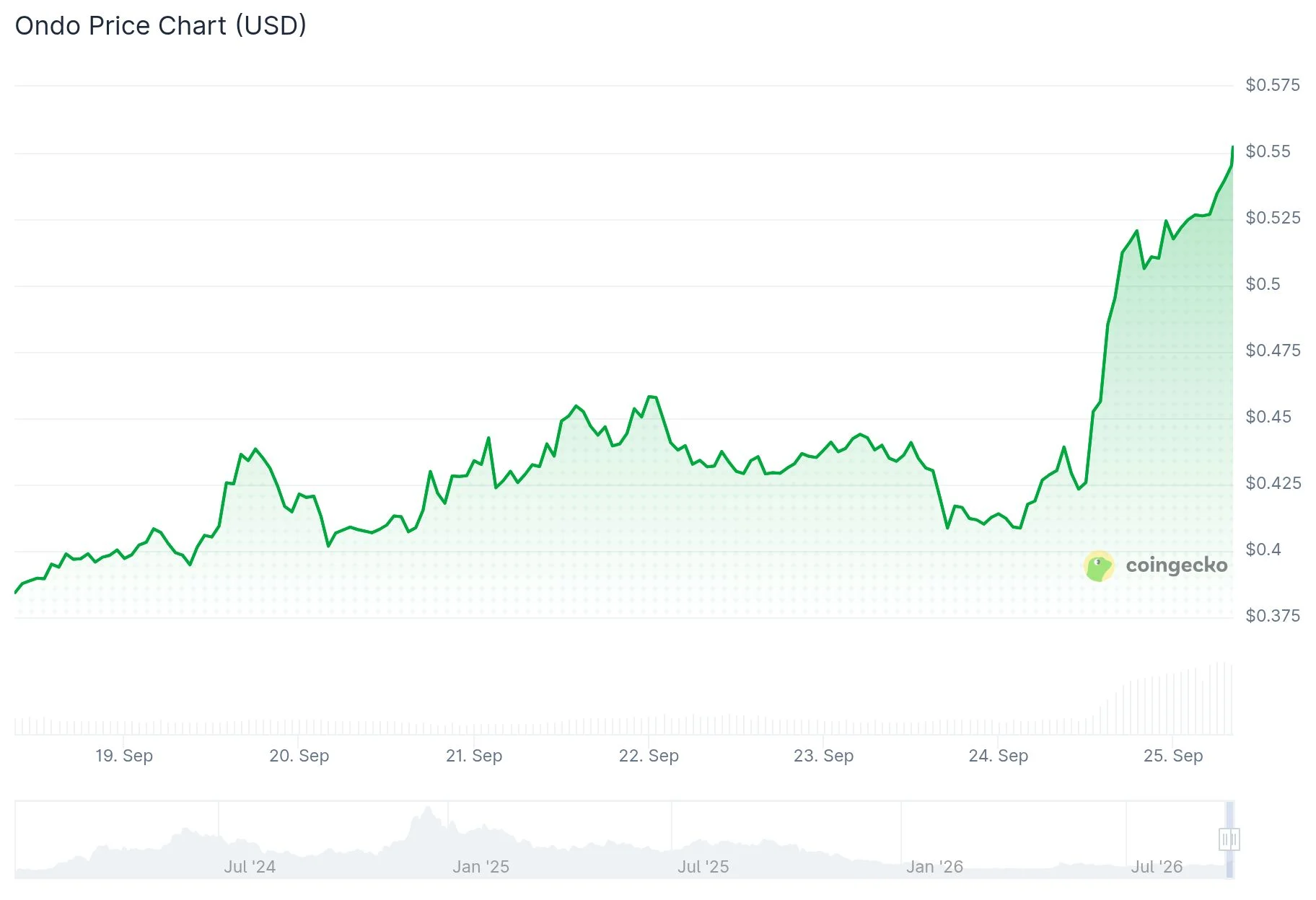
The newly unveiled tokens are designated as Ondo High Income Powered by BlackRock (BLKHIon), Ondo Diversified Growth Powered by BlackRock (BLKDIGon), and Ondo High Growth Powered by BlackRock (BLKGRWon). Each token corresponds to a distinct investment approach.
JUST IN: BlackRock is bringing investment portfolios ONCHAIN, per WSJ.
Three BlackRock strategies holding stock, bond and Bitcoin ETFs will be tokenized by Ondo Finance.
The tokenization will give non-U.S. investors 24/7 trading, transfers and the ability to borrow against… pic.twitter.com/4UQj0uVADg
— Coin Bureau (@coinbureau) September 24, 2026
These investment vehicles contain various asset classes. The composition varies by strategy and may encompass equities, fixed income securities, and Bitcoin exchange-traded funds.
Mechanics Behind The Tokenized Investment Products
Participants are not required to purchase individual assets. Rather, they create or redeem a singular token representing the entire asset collection.
According to Ondo, all asset compositions, allocation percentages, and portfolio adjustments are transparently recorded on the blockchain. This transparency allows anyone to inspect portfolio contents in real-time.
These tokens possess transferability across digital wallets, cryptocurrency exchanges, and decentralized finance platforms. This functionality enables continuous trading around the clock, contrasting with conventional investment vehicles.
Currently, these offerings are restricted to qualified investors situated beyond United States borders. Participants must additionally reside within approved regulatory jurisdictions.
BlackRock’s participation in this collaboration is confined to specific functions. The financial giant solely supplies the model portfolio frameworks based on requirements outlined by Ondo.
BlackRock does not oversee the blockchain-based tokens themselves. The company is not involved in token creation, safekeeping, or routine management activities.
Ian De Bode, Ondo Finance’s Acting CEO, stated the portfolios offer investors an innovative method to gain exposure to diversified investment approaches via a single digital asset. Lisa O’Connor from BlackRock remarked that this partnership demonstrates how established portfolio methodologies can transition to contemporary technological infrastructure.
Ondo’s Expanding Tokenization Efforts
This collaboration marks another milestone in Ondo’s partnerships with established financial institutions. Recently, the platform joined forces with Near Protocol to introduce tokenized equities and exchange-traded funds, featuring companies like Tesla, Nvidia, Apple, alongside QQQ investment products.
Ondo Stocks achieved $1 billion in total value locked just eight months after its introduction. The platform previously transferred $95 million worth of OUSG holdings into BlackRock’s BUIDL fund.
BlackRock has been actively expanding its blockchain tokenization initiatives throughout this year. Last August, the asset management giant unveiled two tokenized money market instruments targeting stablecoin reserve applications.
The ONDO token experienced significant upward movement following the announcement. Current trading activity shows the token near $0.48, reflecting a daily increase exceeding 16%.
Throughout the previous week, ONDO recorded gains surpassing 37%. Since the beginning of the year, the token has appreciated over 33%.
This price appreciation occurred despite broader cryptocurrency market declines. Bitcoin experienced a downturn to $83,000 during the identical 24-hour timeframe.
The product launch unfolds against the backdrop of continuing legal proceedings at Ondo Finance. Kathleen Allman, mother of deceased founder Nathan Allman, is pursuing company control and requesting the dismissal of De Bode from his CEO position, claiming he assumed leadership without proper board authorization. De Bode has dismissed these allegations as unfounded.
The post Ondo Finance (ONDO) Surges 16% on BlackRock Tokenized Portfolio Collaboration appeared first on Blockonomi.
TLDR
- TSLA stock gained 0.3% overnight and is up about 4% this week ahead of Tesla’s October 1 Roadster unveiling.
- Tesla’s latest Roadster teaser sparked fresh speculation about possible SpaceX-linked technology and a redesigned front light bar.
- Tesla has not confirmed new Roadster specifications, pricing, or delivery timing.
- Tesla launched high-volume Semi production at its 1.8-million-square-foot Nevada factory, with capacity for 50,000 trucks annually.
- Elon Musk said the Semi could gain self-driving features soon, while Tesla says its Megacharger can restore 60% of range in 30 minutes.
Tesla shares edged 0.3% higher overnight heading into Friday as investors watched two product developments. TSLA stock has gained about 4% this week, putting it on course for its strongest weekly advance in more than a month. The move followed a mixed week in which product updates kept Tesla in focus.
Tesla, Inc., TSLA
Tesla released a short Roadster teaser before its October 1 unveiling. The clip showed industrial doors opening onto a dark scene, but Tesla gave no new price, delivery date, or technical specifications. The Roadster event will come before Tesla releases its quarterly vehicle delivery figures.
TSLA Stock Watches Roadster Reveal
Tesla investors focused on details visible in the teaser. Some online observers said the clip appeared to show part of a SpaceX logo and a front light bar. Interest has also grown after Tesla recently resumed Roadster reservations ahead of the scheduled unveiling.
Musk has discussed a Roadster version using cold-gas thrusters linked to SpaceX technology. Tesla has not confirmed what the logo means. The company first showed the Roadster in 2017 and once targeted 2020 deliveries, while its latest capacity update still listed the car in development.
Tesla Starts High-Volume Semi Production
Tesla also launched high-volume Semi production at its dedicated 1.8-million-square-foot factory in Sparks, Nevada. The company says the plant can build 50,000 trucks annually. The production push follows other recent developments, including Tesla securing its first Fitch BBB credit rating this week.
Musk said the Semi can carry heavy loads over long distances and recharge through Tesla’s Megacharger system. He also said self-driving features would arrive in the near future. Tesla says the truck uses its in-house 4680 battery cells and can recover up to 60% of range in 30 minutes.
Roadster and Semi Add to Tesla Schedule
Tesla says customer deliveries of the Semi are starting as production rises. Musk said electricity costs less per mile than diesel under Tesla’s operating assumptions. The launch comes as investors also track the company’s latest Cybercab production progress and other vehicle programs.
Tesla has not disclosed how many Semi trucks it expects to deliver this year. Musk said the order waiting list was already large and encouraged more customers to place orders. With the Roadster reveal scheduled for October 1, TSLA stock traders now have another product event to follow alongside the Semi production ramp.
The post TSLA Stock Gains as Tesla Hints at Roadster Surprise appeared first on Blockonomi.
Key Highlights
- QNT surged to approximately $95, marking its highest level in 2025 with a 27% single-day gain.
- The Clearing House selected Quant as an interoperability provider for tokenized deposit infrastructure spanning 25 leading US banks.
- The tokenized deposit network is scheduled to go live during the first half of 2027.
- Technical indicators show QNT positioned above key moving averages, though RSI readings at 81 signal overbought momentum.
- Market analyst Crypto With Gopal identifies a triangle consolidation pattern with potential upside targets near $130.
Quant (QNT) reached its peak 2025 valuation this week, climbing to approximately $95 following a remarkable 27% single-session advance. This surge positioned QNT as the top-performing digital asset during that 24-hour window.
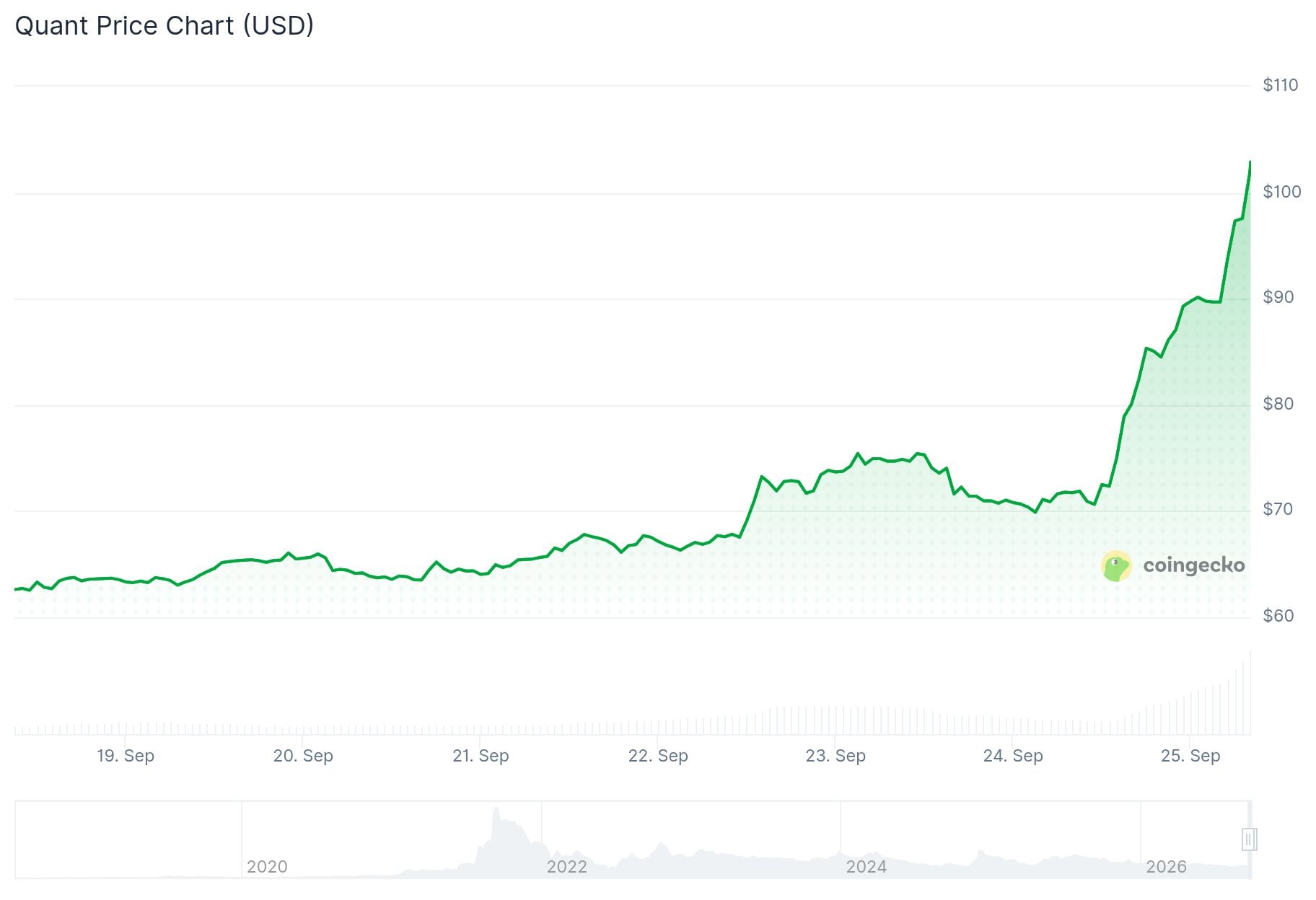
The price acceleration came after Quant announced its collaboration with The Clearing House, America’s primary payments infrastructure operator. The Clearing House processes over $2 trillion in daily transaction volume.
Within this initiative, Quant will serve as the interoperability framework for the platform. Its role involves bridging disparate systems to enable seamless movement of tokenized deposits across institutional boundaries.
The collaboration encompasses 25 prominent American banking institutions. Quant’s technology will supply the orchestration infrastructure and transaction processing layer essential for clearing and settling these tokenized deposits.
Launch of the network is targeted for the first six months of 2027. This development positions Quant at the forefront as major US financial institutions advance their exploration of tokenized real-world assets.
Quant Network announced the development via their X platform: “Quant partners with The Clearing House as an interoperability layer to handle tokenized deposits across 25 major US banks.”
Chart Analysis Reveals Bullish Momentum
QNT currently trades above critical moving average benchmarks including the 50-day, 100-day, and 200-day EMAs, positioned at $66.29, $65.91, and $68.42 respectively. This configuration indicates solid support underlying the current upward trajectory.
The token successfully breached a significant resistance trendline that had connected peak levels from July 2025 and May 2026. Current price action is challenging the 127.2% Fibonacci extension threshold at $95.55.
Should price action decisively clear this level, the next technical target emerges at the 161.8% extension around $110.89. Daily Relative Strength Index readings currently register at 81, placing momentum in overbought territory.
The MACD indicator continues trading above its signal line. For downside scenarios, initial support emerges at the $85.00 level, with a more substantial support zone identified near $77.52.
During September, QNT experienced a pullback into the upper $50s before establishing a floor in the $58-$59 range around September 16. From there, the token rebounded to the $70-$72 area before continuing its ascent.
Market Activity and Price Projections
Crypto With Gopal, a cryptocurrency analyst monitoring QNT, highlighted an emerging triangle formation visible on the charts. This structure displays descending highs combined with ascending support, typically indicating price compression preceding a significant directional move.
$QNT — Triangle Pattern
QNT is consolidating inside a Triangle, with lower highs and a gradually rising support zone creating price compression.
A confirmed breakout above the upper trendline could trigger stronger bullish momentum toward the chart’s projected $130… pic.twitter.com/ctk4MUN5oj
— Crypto With Gopal (@cryptowithgopal) September 24, 2026


Based on Crypto With Gopal’s analysis, a successful breakout above the triangle’s upper boundary could propel QNT toward the $130 level. The analyst emphasized that confirmation remains necessary, as pattern identification alone doesn’t guarantee directional outcomes.
Derivatives market engagement has also intensified around QNT. Trading volume expanded by 20.90% to reach $39.11 million, while open interest climbed 11.95% to $18.93 million, per CoinGlass metrics.
This demonstrates growing trader participation in QNT derivatives positions during the consolidation phase. However, elevated activity levels don’t inherently predict whether subsequent price movement will be positive or negative.
QNT’s future trajectory will likely hinge on which boundary of the triangle pattern yields first. Beyond the US market, Quant’s tokenization initiatives extend into the United Kingdom, European markets, and additional international jurisdictions.
The post Quant (QNT) Surges to Annual Peak Following Major US Banking Partnership appeared first on Blockonomi.
Key Highlights
- SOL currently trading around $116 following a surge from approximately $75 in August.
- Former resistance zone at $95-$100 now functioning as key support level.
- Technical indicators show RSI at 64.14 with bullish MACD configuration indicating sustained momentum.
- Network testing Alpenglow upgrade targeting finality reduction to approximately 150 milliseconds.
- Foundation expands leadership team while real-world assets exceed $4.5 billion milestone.
As of September 25, Solana (SOL) is changing hands at approximately $116.27. The cryptocurrency reached an intraday peak of $118.45 earlier in the trading session.
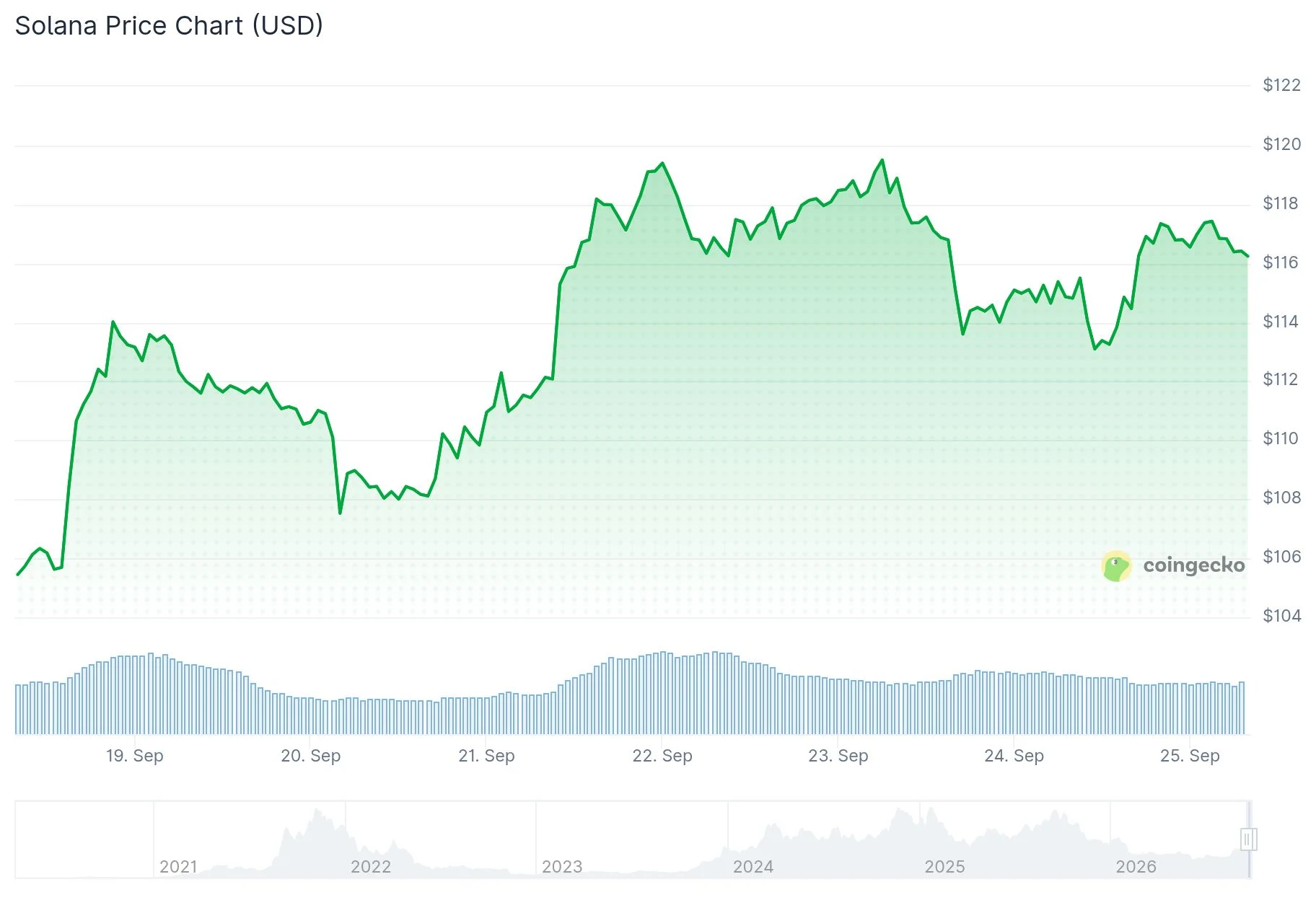
Since bottoming near $75 in August, SOL has maintained a consistent upward trajectory. The daily price chart reveals a series of progressively higher lows forming from that base.
An upward-sloping trend line has provided support for this September rally. That technical support line currently intersects around the $100-$105 price region.
This month, SOL successfully breached a resistance corridor spanning $95 to $100. This price band had previously rejected multiple rally attempts during 2026’s first half.
Market Focus Shifts to $120 Threshold
Market participants are now closely monitoring the $118-$120 price region. SOL has approached this zone multiple times without securing a daily close above it.
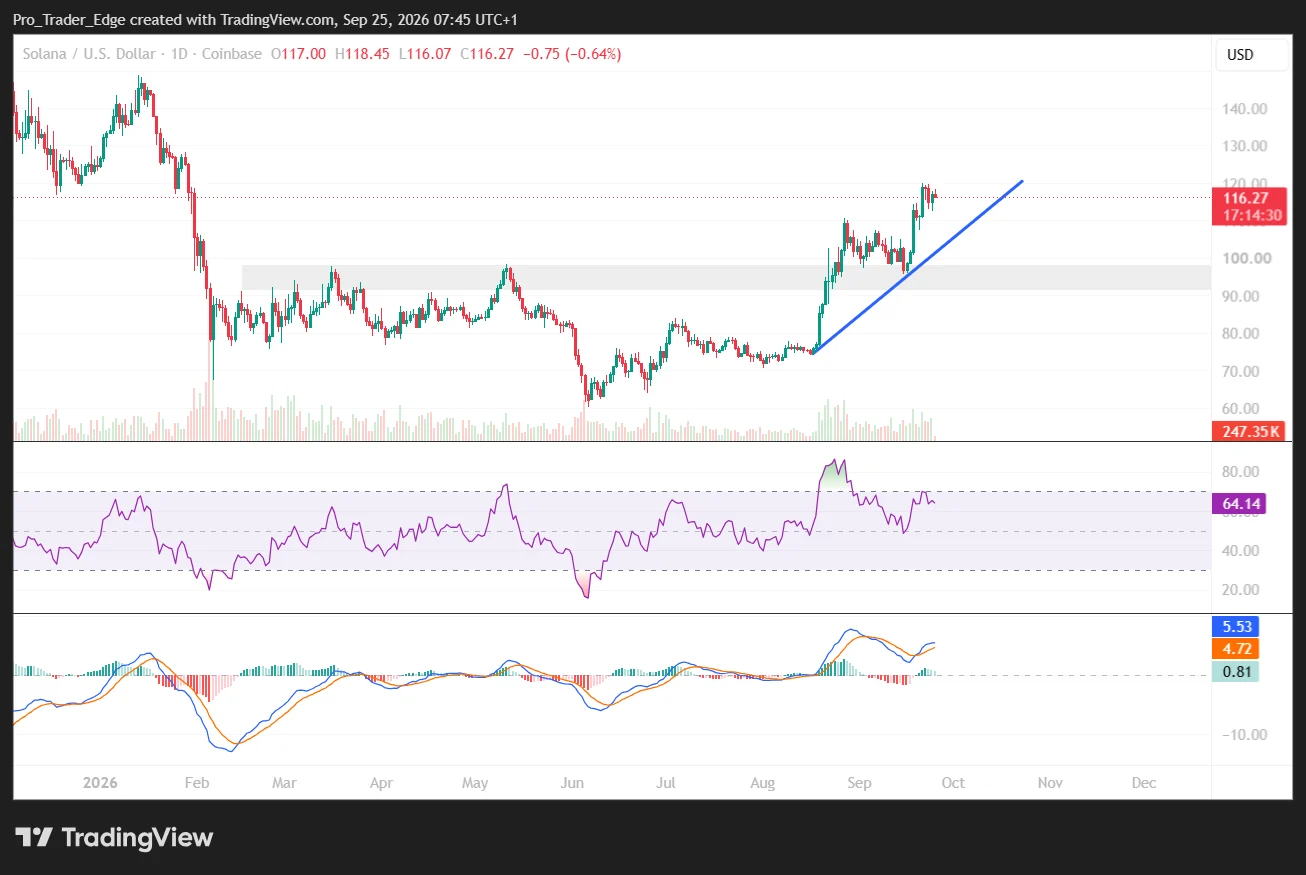
A decisive move above $120 would mark SOL’s strongest position since this year’s earlier decline. Beyond that threshold, the next obstacle lies within the December and January price ranges.
The daily Relative Strength Index currently reads 64.14. This places it above the neutral 50 threshold while remaining below the 70 level typically associated with overbought conditions.
The MACD indicator continues displaying bullish signals. The MACD line stands at 5.53, positioned above its signal line at 4.72, generating a histogram reading of 0.81.
Market analyst Crypto Patel provided a macro perspective on Solana’s chart formation. Patel identifies a supply region spanning $138 to $149 on higher timeframes, highlighting $148.73 as a critical threshold that could validate a structural market shift. Patel sketched two potential scenarios: a decisive close above $150 might pave the way toward $250, followed by $500, and ultimately the $700-$1000 territory, whereas a rejection within the $139-$150 band could trigger a retreat toward $95, $74, or the $60.14 bottom.
Should SOL retrace from present levels, the ascending trend line represents the initial support layer. The broader $95-$100 region maintains significance as the primary support floor given its historical role as resistance.
Technical Advancements and Corporate Developments
Solana’s Alpenglow consensus mechanism upgrade has commenced public testnet evaluation. The enhancement aims to reduce transaction finality from approximately 12.8 seconds to around 150 milliseconds.
Alpenglow will supersede the existing TowerBFT framework with an innovative mechanism called Votor. Validators would achieve block finalization following one or two voting cycles, although mainnet deployment timing remains unannounced.
The Solana Foundation appointed Rachel Conlan, formerly of Binance, as chief strategy officer. Additionally, Jamal Raees, previously with Polygon Labs, joined as general manager of payments.
These appointments underscore the foundation’s commitment to institutional collaboration and payment infrastructure expansion. According to foundation data, Solana has facilitated over $5 trillion in stablecoin transaction volume year-to-date.
The value of real-world assets deployed on Solana has surpassed $4.5 billion. Tokenized equity supply across the network has exceeded $620 million.
A notable event scheduled for September 25 involves the discontinuation of Switchboard’s oracle infrastructure. Multiple protocols including Kamino, Jito, MarginFi, and Drift have relied on these services and are currently managing migration strategies.
The post Solana (SOL) Price: Can Bulls Push SOL Past $120 After Strong Rally? appeared first on Blockonomi.
HTTP error 429 on https://cryptopotato.com/feed/
Failed to fetch feed: https://cryptopotato.com/feed/
Failed to fetch feed.