Cryptocurrency Posts
Crypto Briefing
Jumper will launch its JUMP token sale on Legion on September 29 as the crosschain app expands into perps, RWAs, yield and advanced trading.
The post Jumper to launch JUMP token sale on Legion September 29 appeared first on Crypto Briefing.
Circle Foundation's support for onchain aid payments could revolutionize global humanitarian efforts by enhancing efficiency and transparency.
The post Circle Foundation backs UN push to move aid payments onchain appeared first on Crypto Briefing.
The incident underscores vulnerabilities in centralized exchanges, potentially affecting market confidence and prompting calls for enhanced security.
The post Bitget halts withdrawals after $351M hack, CEO assures funds safe appeared first on Crypto Briefing.
Daily dividends could boost liquidity and investor confidence, potentially enhancing market expectations and STRC's price trajectory.
The post Strategy seeks shareholder approval for daily dividends on US preferred stocks appeared first on Crypto Briefing.
The integration of tokenized stocks into DeFi platforms signals a growing convergence of traditional finance and blockchain, boosting ecosystem utility.
The post Coinbase’s tokenized US stocks on Base hit $22M market cap appeared first on Crypto Briefing.
Bitcoin Magazine
Bitcoin Magazine
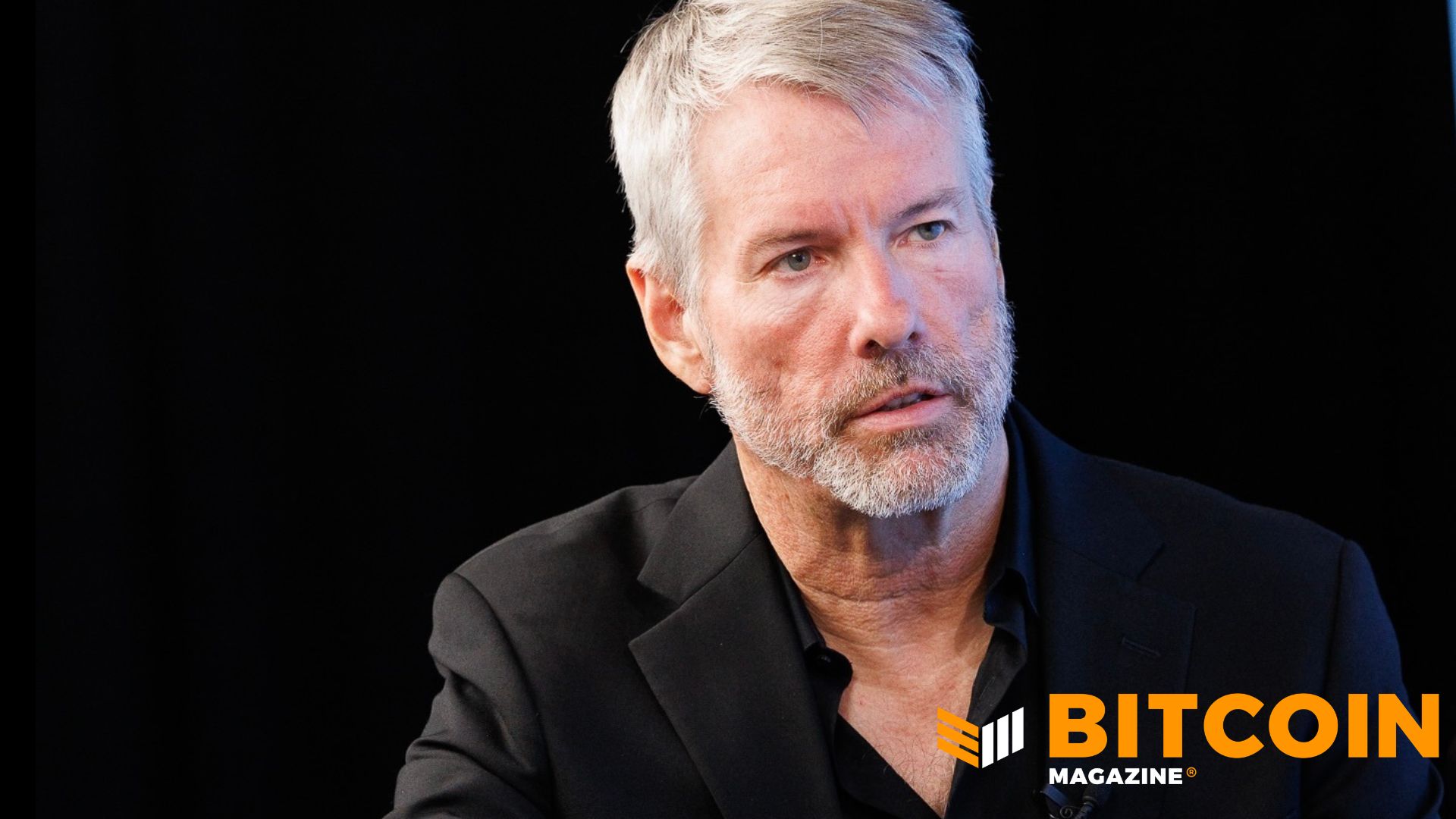
Bitcoin Treasury Strategy Proposes Daily Dividends For Preferred Stocks
Bitcoin treasury company Strategy wants to pay investors daily dividends on four of its preferred stocks.
The largest corporate holder of bitcoin said Friday that it was asking shareholders to approve the move, which would pay investors dividends every calendar day — including weekends and holidays — on STRF, STRC, STRK, and STRD.
“If approved and adopted, we believe this would reduce reinvestment lag, enhance liquidity and market efficiency, and increase price stability,” Strategy said in a statement. Stockholders will attend a meeting to vote on the proposal on October 28.
Strategy slowed down with its aggressive bitcoin buys this year, as the largest cryptocurrency fell into a bear market. The Nasdaq-listed company instead focused on protecting its balance sheet and sold chunks of its bitcoin.
Friday’s announcement claimed the move would help both investors and common stockholders.
“We believe these enhancements can also benefit our common stockholders by increasing the attractiveness and utility of our Digital Credit instruments, supporting our ability to access preferred equity capital efficiently and expanding the capital markets toolkit we use to execute our Bitcoin Treasury strategy,” Strategy added in a statement.
Strategy — formerly MicroStrategy — is an enterprise software company that pivoted to buying and holding bitcoin in 2020.
It first bought the cryptocurrency to protect its shareholders from inflation. Since then, it has aggressively bought the asset and pivoted to being a bitcoin treasury.
Investors can now buy its shares to get heightened exposure to the cryptocurrency, or get paid a yield via its digital credit products.
The company would buy bitcoin every Monday but slowed down its buys after announcing a program under which it may sell BTC from time to time to generate up to $1.25 billion in proceeds for the USD reserve, additionally fund preferred stock dividends and interest expenses or fund repurchases.
Strategy said in a filing Monday that it last week bought 950 bitcoins for $75.7 million — its first buy since August.
Its Nasdaq-listed stock (MSTR) is down nearly 50% over the past year after the price of bitcoin took a hit.
But since the company started buying bitcoin in 2020, MSTR has appreciated by nearly 1,000%.
This post Bitcoin Treasury Strategy Proposes Daily Dividends For Preferred Stocks first appeared on Bitcoin Magazine and is written by Mathew Di Salvo.
Bitcoin Magazine

Is US Defence Secretary Pete Hegseth a Bitcoiner? This Is What His Accounts Say
U.S. Secretary of Defense Peter Hegseth holds more cash than he does bitcoin.
That’s according to his newly released 2025 annual financial disclosure, which shows he has between $16,000 and $65,000 in the leading cryptocurrency while a bank account holds $1 million in cash.
Hegseth, who was appointed Defense Secretary in January 2025, is part of the most crypto-friendly administration the U.S. has had.
President Donald Trump was backed by digital asset industry bigwigs and last month pushed for landmark crypto legislation, the Clarity Act, to pass.
Hegseth’s Office of Government Ethics filing also showed that he and his wife have retirement accounts containing investments worth roughly $2.05 million to $4.35 million.
Some of the investments include exchange-traded funds like the tech-heavy Invesco QQQ Trust and the closed-end fund the Apollo Diversified Real Estate Fund.
Transactions made by Hegseth including sales of Amazon, Microsoft, and Apple stock.
The bitcoin stash held by Hegseth is kept in a Coinbase wallet, the filing states.
Hegseth’s crypto holdings are modest compared to the Trump family’s, which has made billions in crypto ventures since the president took office.
President Trump personally disclosed that he’d made more than $1.4 billion from the family’s digital asset ventures, making crypto his largest income source and far ahead of real estate and legal settlements.
His family — including sons Eric and Donald Jr. — made $2.3 billion from four crypto ventures through the end of April 2026, a Reuters investigation reported this year.
Critics, including Democrats, have accused Trump of profiting from crypto while shaping policy on it. The White House has consistently denied any conflicts of interest, and Trump has pointed to stock trading by members of Congress, particularly Nancy Pelosi, calling for a ban on the practice.
This post Is US Defence Secretary Pete Hegseth a Bitcoiner? This Is What His Accounts Say first appeared on Bitcoin Magazine and is written by Mathew Di Salvo.
Bitcoin Magazine
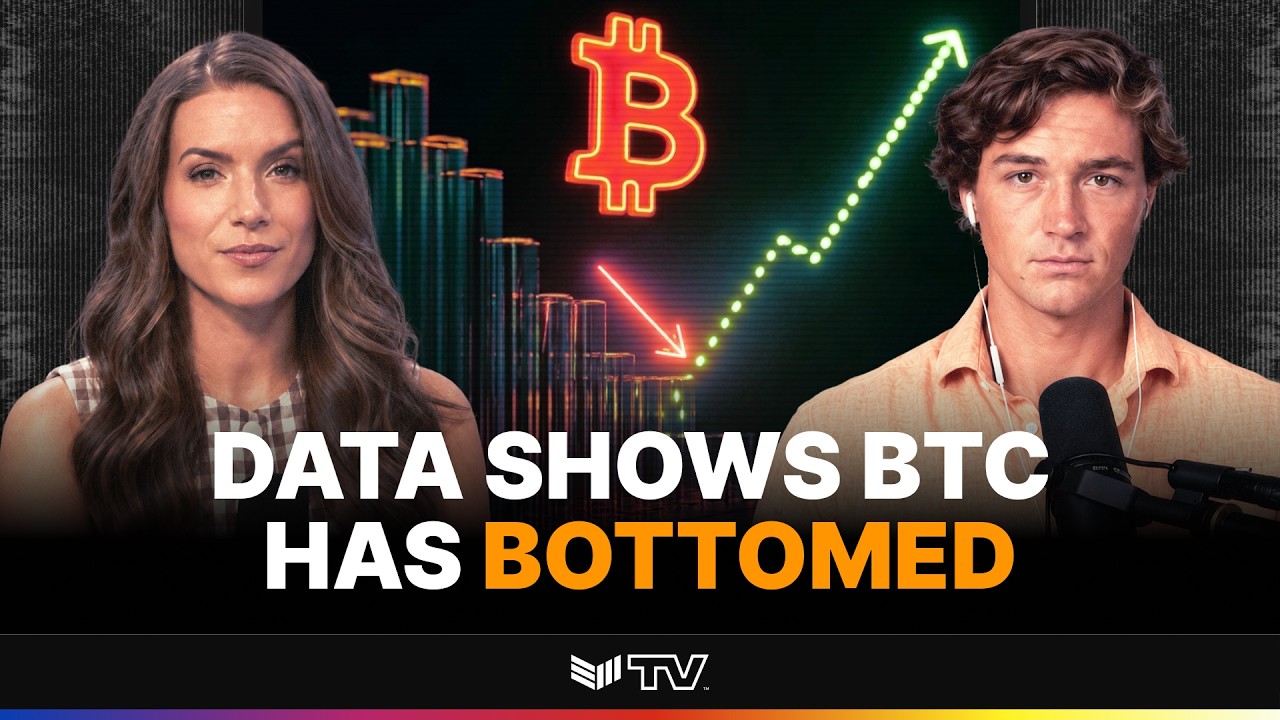
Mitchell Askew Explains What 15M Inactive BTC Means for Bitcoin’s Next Move
Bitcoin is rallying despite a Fed rate hike and the failure of the Clarity Act, and the on-chain data suggests sellers may be nearly exhausted. Mitchell Askew, Head of Blockware Intelligence, breaks down long-term holder supply, which hit an all-time high of 15 million BTC this summer. He explains why so many coins sitting still signals more room for price to run. He also shares what Bitcoin ETF flows reveal about institutional buyers returning to the market.
Chapters:
0:00 Mitchell Askew of Blockware Intelligence on Bitcoin’s Rally
0:22 Is Bitcoin Selling Pressure Exhausted? Long-Term Holder Supply
1:36 Bitcoin ETF Flows & Returning Institutional Buyers
2:36 Why the Four-Year Halving Cycle Is Breaking
4:06 AI Data Centers Pulling Compute Away From Bitcoin Mining
5:56 The Hash Rate Bear Market: Should Bitcoiners Worry?
6:58 Stranded Energy, Global Mining & AI Data Center Arbitrage
8:12 Why Gen Z Isn’t Buying Homes
9:58 Will Gen Z Ever Save in Bitcoin?
11:26 Shallower Drawdowns & the Future of Bitcoin Cycles
DISCLAIMER: The views and opinions expressed in this show are those of the participants and do not necessarily reflect the official policy or position of BTC Inc., Bitcoin Magazine, or any affiliated entities. This content is provided for informational and educational purposes only and should not be construed as investment, legal, tax, or accounting advice. Nothing contained in this show constitutes a solicitation, recommendation, endorsement, or offer to buy or sell any securities or financial instruments. Viewers should consult their own advisors before making financial or business decisions.
This post Mitchell Askew Explains What 15M Inactive BTC Means for Bitcoin’s Next Move first appeared on Bitcoin Magazine and is written by Patrick Green.
Bitcoin Magazine

Nearly $352M Moved From Crypto Exchange Bitget Wallets in Suspected Hack
An estimated $351.6 million in crypto has been moved from digital asset exchange Bitget’s hot wallets in a suspected hack.
The platform’s CEO said in a Thursday statement that Bitget’s security team activated an emergency response when the movements were detected. Blockchain security firms had flagged the issue earlier in the day.
“At 18:31 UTC on September 24, 2026, Bitget’s security systems detected unauthorized transfers from some of our hot wallets,” Bitget CEO Gracy Chen wrote on X. “Our security team activated emergency response protocols immediately.”
She added: “Bitget has navigated multiple market cycles. We will not run from this. Every dollar and every decision will be accounted for, transparently and in full.”
Victoria, Seychelles-based Bitget is the sixth biggest exchange, processing over $1.1 billion in trading volume per day, according to CoinGecko data.
The incident comes as crypto security is in the limelight after a string of breaches this year have the community reeling. Just in July, hackers targeted a firmware bug in the popular bitcoin hardware wallet, Coldcard, to steal nearly $120 million in user funds.
And this month, purported white-hat hackers withdrew about 4,000 bitcoins — worth about $320 million at the time — from Blockstream’s Liquid sidechain’s federation wallet.
Chen added that the exchange’s cold wallets remained fully secure and that user funds were safe.
She wrote: “Bitget operates a three-tier wallet architecture — the breach contained only a portion of the hot wallet and warm wallet layers.”
According to the statement, deposits and trading remain fully operational but withdrawals are temporarily paused until a security review is complete.
Blockchain data firm Arkham Intelligence created a dashboard soon after the unauthorized transfers showing that a number of different cryptocurrencies — including stablecoins — had been moved from the Bitget hot wallet.
While Bitcoin was not on Arkham’s list, crypto security firm Hacken later said on X that the largest cryptocurrency had been moved.
This post Nearly $352M Moved From Crypto Exchange Bitget Wallets in Suspected Hack first appeared on Bitcoin Magazine and is written by Mathew Di Salvo.
Bitcoin Magazine
New York Sues Polymarket, Calling Prediction Market an Illegal Gambling Operation
New York Attorney General Letitia James and Governor Kathy Hochul on Thursday filed a lawsuit against crypto-based prediction market Polymarket, accusing the platform of running an unlicensed gambling operation in the state.
An investigation by the Attorney General’s office concluded that these markets meet New York’s legal definition of gambling because users stake money on uncertain outcomes they cannot control.
Polymarket never obtained a license from the New York State Gaming Commission, the suit alleges, and so avoided the taxes that licensed casinos and mobile sportsbooks pay. That revenue helps fund public schools, youth sports programs and problem gambling treatment.
The suit comes as regulators like the Securities and Exchange Commission and the Commodity Futures Trading Commission are working to regulate crypto-powered prediction markets.
Polymarket and rival Kalshi argue they aren’t gambling sites at all, but rather federally regulated exchanges offering “event contracts,” a type of derivative, which would put them under the Commodity Futures Trading Commission rather than state gaming laws.
The CFTC agrees, and it has joined the fight on the platforms’ side. In 2026 it sued nine states, arguing that it should have exclusive nationwide authority over the industry.
Thursday’s complaint also says the platform is open to users aged 18 to 20, although New York requires mobile sports bettors to be at least 21.
“By skirting New York’s laws, Polymarket is targeting the most vulnerable,” James said. Hochul added that the company had “knowingly” violated state law and put underage users at risk.
The state is asking a court to bar Polymarket from operating as an unlicensed gambling business in New York. It also wants the company to forfeit its illegal gains, repay harmed users and pay fines equal to three times those gains.
The lawsuit is the latest in a string of New York actions against gambling-adjacent platforms. James and Hochul sued rival prediction market Kalshi in July, and James sued Coinbase and Gemini in April over similar claims. Earlier this month, James secured $8 million from the leading operator of sweepstakes casinos.
Polymarket launched in the United States in December 2025, initially letting users bet on sporting events with plans to expand into markets on a wide range of topics.
This post New York Sues Polymarket, Calling Prediction Market an Illegal Gambling Operation first appeared on Bitcoin Magazine and is written by Mathew Di Salvo.
HTTP error 429 on https://cryptoslate.com/feed/
Failed to fetch feed: https://cryptoslate.com/feed/
Failed to fetch feed.
CryptoTicker.io
The cross-chain protocol Universal is being wound down. Anyone holding uSOL, uXRP, uDOGE, uADA, uBTC or uLTC on Base can redeem these six tokens through a smart contract into the respective bridged counterpart after November 17, 2026. Anyone holding any of the other roughly 80 uAssets gets USDC. Until November 17 everything runs as normal: you can sell through the Universal app or redeem straight into the underlying asset held in reserve.
That makes the question you face clearly defined, and it has a date. Either you decide yourself by November 17 what happens to your position, or a contract decides it for you afterwards. For everything other than the six named tokens, that means a forced conversion into a dollar stablecoin, at a moment you did not choose. For holders in Germany there is also a tax question attached, which gets a section of its own further down.
What Universal announced on September 18
The team behind Universal announced the wind-down on September 18, 2026 on its own site. As its reason it states, in its own words, that adoption did not reach the scale that would have been needed to make the protocol viable in the long run. Over two years, Universal says it supported more than 80 underlying assets.
The timetable is short and unambiguously worded: "The Universal protocol will remain operational, business-as-usual, for the next 60 days, through November 17." During that period the uAssets remain backed by their underlying assets as usual, and the existing infrastructure stays in operation. After November 17 the protocol is wound down, and remaining uAssets become redeemable through a smart contract.
uAssets explained: what sits behind uSOL, uXRP and uDOGE
A uAsset is a token on one blockchain that represents an underlying asset from another blockchain and is backed one to one by that underlying asset. uSOL on Base therefore stands for Solana, uXRP for XRP and uDOGE for Dogecoin. The purpose of such constructions: an asset sitting on its home chain becomes tradable in a foreign ecosystem without having to switch chains.
From that follows the property that matters most for this deadline. A uAsset is a placeholder whose value hangs on the promise that somebody custodies the underlying asset and handles redemption. If the operator falls away, it is not the market that decides the placeholder's fate but the wind-down rule. That rule is exactly what Universal has now published.
The November 17 deadline: what stays unchanged until then
Up to and including November 17, 2026, nothing changes for you in the mechanics. Universal expressly undertakes to maintain the backing of the uAssets with their underlying assets and to provide relayer liquidity as usual. Two routes are open to you in that window.
- Selling through the Universal app. The protocol itself calls this the simplest route for most users wanting to close their position.
- Redeeming directly through the mint-and-redeem interface, if you want the underlying asset itself rather than sale proceeds.
One caveat is also in the announcement and belongs here rather than in the small print: because of the elevated number of redemptions during the wind-down, a direct redemption may take longer than usual for security reasons. So anyone waiting for the last day is planning with no buffer. For larger amounts, Universal points to contacting the team so the process can be coordinated.
After November 17: six uAssets get the original, the rest get USDC
For the period after the deadline, Universal has published a table. Six uAssets held on Base are then redeemable into their respective bridged counterpart:
| uAsset on Base | redeemable into |
|---|---|
| uSOL | SOL on Base |
| uXRP | cbXRP |
| uDOGE | cbDOGE |
| uADA | cbADA |
| uBTC | cbBTC |
| uLTC | cbLTC |
| all other uAssets | USDC |
The prefix cb stands for the bridged versions held on Base. Anyone holding one of the six tokens therefore swaps one placeholder for another and stays in the same underlying asset. Anyone holding one of the other roughly 80 uAssets leaves their underlying asset entirely and afterwards holds a dollar-pegged stablecoin.
Sell or redeem: which route is right for you
The decision comes down to a single question: do you want to stay invested in the underlying asset or not?
You want to stay invested. Then you redeem directly by November 17 and hold the underlying asset itself afterwards, or you take the bridged counterpart after the deadline if you hold one of the six named tokens. With all other uAssets that is not an option: there the link to the underlying asset ends on the deadline, and you would have to buy the asset back after the conversion with the USDC you receive, at whatever price applies then.
You want out. Then you sell through the app while the liquidity is being guaranteed. Anyone who waits meets a market everybody wants to leave at the same time, and at trading volumes that are small. How small is shown in the next section.
There is no third possibility. Doing nothing is a deferred swap for the six tokens and, for everything else, a conversion into USDC that you do not control.
Why waiting gets expensive: what market cap and daily turnover say
This is not a billion-dollar affair, and that is precisely the point. Our own query to CoinGecko on September 25, 2026 at around 12:49 UTC: uXRP shows a market capitalisation of roughly $2.95 million on daily turnover of about $279,000. uDOGE stands at around $341,000 market capitalisation and about $72,000 daily turnover.
Put those figures in proportion. With uXRP, daily turnover does not even amount to a tenth of the outstanding supply. If a meaningful share of holders wants to sell simultaneously in the last days before November 17, that supply meets a very thin market. The discount you would then accept is not market risk in the usual sense, but a consequence of the deadline.
The flip side: deciding early costs you little in this case. As long as Universal guarantees relayer liquidity and the backing is intact, you sell close to the price of the underlying asset. That is the real message in these numbers.
Is the peg still holding? Our own measurement on uXRP and uDOGE
A holder's first question is whether the placeholder still trades where its underlying asset stands. Measured at the same time, September 25, 2026 at around 12:49 UTC: uXRP trades at $1.60, XRP itself at $1.61. That is a discount of roughly 0.6 percent. uDOGE trades at $0.098152, dogecoin itself at $0.098275, so around 0.1 percent below. Solana stood at $120.40 at the same moment.
The peg is therefore holding, with a small discount that reflects the uncertainty about the wind-down. That is a snapshot and no guarantee for November 16. Anyone wanting to follow the situation themselves compares the price of the uAsset with the price of the underlying asset, ideally daily and from the same data source. If the discount widens noticeably, that is a sign the market is judging redemption less favourably than before.
What the caveat in the announcement means for you
On the published redemption table, Universal writes explicitly: "The redemption assets above reflect our current plans and are subject to change as the wind-down progresses." The mapping of which uAsset is redeemed into which asset is therefore provisional. The team says it will publish final details on redemption values, the smart contract and the exact procedure before November 17.
For you that sentence has a practical consequence. Planning around the table means planning around a statement of intent. Selling or redeeming directly before the deadline, by contrast, makes you independent of the final version. This is no reproach to the protocol, which communicates the caveat openly, but a trade-off you make for yourself.

Tax: why the forced conversion into USDC is a disposal
A private disposal transaction under section 23 of the German income tax act exists where an asset is disposed of again within one year of acquisition. A swap counts as a disposal, because you give up one asset and receive another. Anyone whose uAsset gets converted into USDC therefore has a transaction the tax office treats like a sale, even though a contract triggers it rather than you.
Three points follow that you should settle before November 17. First: if your acquisition is more than a year back, a gain is tax free under the law as it stands, and the timing of the conversion is immaterial to you. Second: if it is more recent, the gain counts among private disposal transactions, for which an exemption threshold of 1,000 euros per calendar year has applied since 2024. Third: by choosing when you sell you also decide which tax year the transaction falls into. Anyone converted only after November 17 no longer has that choice.
Unsettled is the treatment of redeeming a uAsset into its bridged counterpart, say from uXRP into cbXRP. Whether that constitutes a swap of two different assets or merely a change of technical wrapper has not been conclusively determined. Tools that carry acquisition dates and holding periods across such events are in our overview of crypto tax software and portfolio trackers. This section is not tax advice; with larger positions the individual case belongs with a tax adviser.
Where investors hold uAssets in the first place
uAssets are not tokens you find on a European-authorised trading platform. These tokens live on Base, an Ethereum layer 2, and are traded there through decentralised venues and the Universal app. Anyone holding them generally has them in a self-custodied wallet, not in an account with a provider holding European authorisation.
That has two consequences for this deadline. First, nobody will remind you. There is no provider dropping a deadline into your inbox, and no German-language outlet has picked the matter up so far. Second, the entire process is in your hands: you need access to the wallet holding the tokens, and some network fee on Base to be able to trade or redeem at all. Both are better checked now than on November 16.
Anyone wanting to carry on afterwards with the USDC received or the redeemed underlying asset will sooner or later come back to the question of where they trade and where they custody. Both are decisions in their own right, and neither should be made under time pressure.
Redeeming uAssets: what to take away
- Check by the end of October whether you hold any uAssets at all, and which. What matters is the distinction between the six tokens with a bridged counterpart and all the others, which end in USDC. If you then want to sell, you need a venue for the proceeds: our comparison of crypto exchanges shows which providers come into question.
- Decide early rather than on the deadline. Daily turnover is small, direct redemptions may take longer, and the redemption table carries a caveat. Anyone wanting to keep the underlying asset and custody it themselves will find suitable devices in our hardware wallet comparison.
- Settle the holding period before the contract decides for you. A conversion into USDC is a disposal for tax purposes. Which tools keep acquisition data and deadlines cleanly in view is set out in our overview of tax software and portfolio trackers.
The announcement in full is in Universal's wind-down notice of September 18, 2026; an independent report on it was published by PANews on September 20, 2026.
(As of September 25, 2026. This article is not investment advice. Prices and fee structures change; check the terms with the provider before you buy.)
From September 29, 2026, Binance will move its users' crypto balances out of the Funding Account and into the Spot Account. From that day the Funding Account accepts no further on-chain deposits, and in January 2027 it will be renamed "Stocks Account". You do not have to act: anything you have not moved yourself will migrate automatically, in batches, into the Spot Account from January 2027, with no change to your total holdings. Two points sit in the small print of the announcement, though, and they will cost you time or money if you miss them. First, an outdated app version will no longer show your Funding balance at all. Second, standing instructions and recurring orders stop running if they are paid exclusively out of the Funding Account.
For users in Germany the date carries extra weight. Since the MiCA transition period ended on July 1, 2026, Binance has held no European authorisation as a crypto-asset service provider. Anyone with an account here can view and withdraw their balance, but can no longer trade under regular terms. That is precisely the group holding residual balances that need to leave the account at some point, and precisely for them the question of which sub-account this money sits in is now shifting.
What Binance is doing with the Funding Account on September 29
The exchange announced the change on September 23, 2026. The stated purpose: the account structure is to become simpler, and the settlement of stocks and stock options is to get an account of its own. Binance has run a US stock trading service since 2026; its settlement will in future be separated from the crypto business.
Two things happen simultaneously on September 29. The Funding Account accepts no further on-chain deposits, and a One-Click Migration button appears in the account, with which you move your crypto holdings into the Spot Account yourself. Deposits and withdrawals for all other crypto assets run exclusively through the Spot Account from that point. The rest is a timetable that runs into January 2027.
The announcement states verbatim that Binance will move users' crypto holdings "starting from 2026-09-29 to January 2027" from Funding Accounts into Spot Accounts, with the exact dates to be announced later. One assurance is in there too: the total value and the security of holdings remain untouched, and historical transaction records keep their original Funding Account label.
Funding Account, Spot Account, Earn Account: which sub-account does what
Binance runs several sub-accounts with separate balances. The Spot Account is the trading account: whatever sits there can go straight into buy and sell orders. The Funding Account was until now the collecting account for everything alongside that, meaning P2P trades, Binance Pay, gift cards and card payments. The Earn Account holds balances tied up in interest or staking products.
This split explains an observation many users know well: a deposit has arrived, yet it does not appear in the trading window, because it sits in a different sub-account. That duplication is what Binance is now clearing away. After the migration there is only one place where crypto assets come in and go out.
One term recurs throughout the announcement: settlement assets. These are the six currencies in which Binance settles stock transactions, namely USD, USDC, USDT, USD1, U and BNB. These six remain usable in what will then be called the Stocks Account after the renaming, though with one restriction we return to below.
The timetable to January 2027: four stages worth knowing
The changeover runs over four stages. Anyone with only September 29 in the diary will miss the stages at which something actually falls away.
- September 29, 2026: No further on-chain deposits into the Funding Account. One-Click Migration is switched on. Binance Card, gift card and Binance Pay credit incoming amounts to the Spot Account from then on. New Convert limit orders freeze their funds in the Spot Account and settle there. Recurring orders settle into the Spot Account or the Earn Account.
- From December 2026: P2P advertisers get a dedicated P2P account. Anyone running adverts will be prompted to move the amounts tied to them across.
- January 2027: The Funding Account becomes the Stocks Account. Crypto holdings not moved by the user migrate automatically, in batches, into the Spot Account. Binance has not yet named an exact date.
- After January 2027: P2P adverts that have not moved to the new account are closed automatically.
In between sits a date without a fixed day that matters in practice: the Funding Account will be removed as a payment source before the renaming takes place. Until then, amounts can still be debited from it for payments.
One-Click Migration: how to move your balance into the Spot Account yourself
The button appears in the Funding Account from September 29. One press transfers the supported holdings into the Spot Account. It is an internal transfer between two sub-accounts of the same provider, not a transaction on a blockchain: there is no network fee, and there is no recipient address that could be wrong.
Whether you do it yourself or leave it to Binance from January 2027 makes no difference to the total value. It does make a difference to your room for manoeuvre. As long as your balance sits in the Funding Account, it is attached to an account that is being rebuilt and will end up reserved for stock settlement. In the Spot Account it sits where withdrawals leave from anyway. For users in Germany, who may now only withdraw, that is the shorter route.
Anyone taking the holding off the exchange entirely needs somewhere to put it. A wallet of your own removes your dependence on any account structure, but demands that you manage the key material yourself. Anyone wanting to keep trading needs an exchange with European authorisation instead.
Outdated app version: why your Funding balance suddenly disappears
This point is the quietest and the most expensive in the whole announcement. The wording: "Users will not see the 'One-Click Migration' feature on older versions of the app, including their assets in Funding Accounts." In plain terms: on an outdated app version, not only the button is missing but the display of the Funding Account holdings as well.
Anyone who has not updated their app for months may therefore see part of their balance vanish from view on September 29 and, in the worst case, assume it is gone. It is not. Binance moves such holdings automatically from January 2027, and the total value stays untouched. The route there still runs through an update: bring the app up to date, then look in the Funding Account to see what is actually in there.
That check is worth doing for a second reason. Many users have no idea they hold anything in the Funding Account at all. Residues from P2P trades, returns from card payments and old gift card amounts accumulate there without ever appearing in the trading window.
Binance Pay, Binance Card and gift cards: where payments go from September 29
From September 29, amounts you receive through Binance Card, gift cards or Binance Pay are credited to the Spot Account. Balances in the future Stocks Account will no longer be debited for payments. Payments can still be debited from the Funding Account for a transitional period, but only until Binance removes it as a payment source.
One consequence of that is spelled out in the announcement: recurring payment plans served solely from the Funding Account will stop executing afterwards. Binance writes that users have to set up new recurring plans with a different payment source. No automatic reminder is given; anyone running such a plan is better off checking it themselves.
A separate rule applies to Binance Alpha 2.0: from September 29, stablecoins for purchases and sales of Alpha tokens are debited from and credited to the Alpha Account on limit orders. Rewards from the liquidity provider programme on limit orders land there too.
Limit orders, recurring orders and API connections: where standing instructions break
With Convert limit orders, meaning conversion orders with a price limit including take-profit and stop-loss variants, amounts already frozen stay frozen in the Funding Account. After September 29, however, these orders settle into the Spot Account. Expired limit orders likewise release their funds there. New limit orders from September 29 freeze exclusively in the Spot Account and settle there.
With recurring orders, meaning repeated purchases of the savings plan type, all orders settle into the Spot Account or the Earn Account from September 29. Refunds on failed orders go to the Spot Account. Binance explicitly asks users to switch the account selection from Funding to Spot so that their plans keep running. Anyone buying regularly therefore has a setting to change.
Anyone running an API connection, whether for a portfolio tool, a tax tracker or a trading bot, has to switch the account reference from Funding to Spot. Leave it as it is and the tool reads out an account that holds nothing after the migration. With tax tools this produces gaps in the history that are laborious to close by hand later on.

Why the changeover hits German users hardest after the MiCA exit
The European regulation on markets in crypto-assets, MiCA for short, requires every crypto-asset service provider to hold an authorisation in an EU member state. Binance withdrew its application in Greece and let the transition period pass on July 1, 2026 without a valid authorisation. Existing customers in Germany have since been able to reach their account and balance and to withdraw; regular trading and new deposits are restricted. We described the situation in detail in our piece on switching to a MiCA-regulated exchange, and the obligations the regulation places on providers are set out in our overview of the MiCA duties through 2026.
What follows for you is a very practical order of operations. If your residual balance is due to leave the account anyway, the best approach is to do it in one go: update the app, check the Funding Account, move the holding into the Spot Account, withdraw. Every stage of the migration you wait out only lengthens the route. If you want to keep trading instead, you need a provider with European authorisation; which exchanges hold it and how their fees differ is shown in our comparison of regulated crypto exchanges.
A word of context: the account change is a worldwide measure and not a response to European supervision. Binance gives the separation of stock and crypto settlement as its reason. The changeover hits German users harder only because their room for manoeuvre has shrunk to withdrawal.
Stocks Account: which six settlement assets remain and why you cannot withdraw them directly
After the renaming in January 2027, the Stocks Account serves exclusively to settle stocks and stock options. The six settlement currencies USD, USDC, USDT, USD1, U and BNB can still be used there for stock purchases. Deposits and withdrawals of all other crypto assets run only through the Spot Account.
A practical note on navigating this: these accounts carry English proper names, including in the notices Binance sends to German users. So in the app you are looking for Funding Account, Spot Account, Earn Account and, from January 2027, Stocks Account. For trading between private individuals, a separate P2P Account arrives in December 2026, purchases of Alpha tokens run through the Alpha Account, and the transfer itself is called One-Click Migration. Anyone searching the interface for translated terms will find nothing.
One detail from the accompanying FAQ Binance published on the migration matters: direct deposits and withdrawals to a blockchain are not provided for out of the Stocks Account, not even for these six assets. So anyone wanting to get USDT or BNB out of the Stocks Account first transfers them internally into the Spot Account and withdraws from there. For users in Germany, who may now only withdraw anyway, that is an extra intermediate step better known before you need it.
P2P trading: what December brings for adverts
Trading between private individuals follows its own schedule. From September 29, P2P users with no advert history and no merchant status use the Spot Account as the default source of funds for buy and sell orders, as soon as their app is current. Advertisers continue working with the Funding Account until December 2026, for all P2P activity including posting adverts, merchant deposits and maker and taker orders.
From December 2026, Binance introduces a dedicated P2P account for advertisers and instructs them to move the amounts tied to their adverts there. Adverts that have not moved by January 2027 are closed automatically. Anyone based in Germany is barely affected, because P2P trading here is constrained by the missing authorisation in any case. Anyone running an account from another country has one more deadline to keep.
Tax and holding period: does the internal transfer change anything for the tax office?
A transfer between two sub-accounts of the same provider is neither a sale nor a swap. There is no disposal, so no taxable gain arises, and the one-year holding period under section 23 of the German income tax act keeps running. That holds whether you press One-Click Migration yourself or Binance moves the holding automatically from January 2027.
More important than the tax question here is the documentation. Binance writes that historical transaction records from before and after the migration keep their original Funding Account label and are not altered. That helps with reconciliation, but it replaces no record of your own. Pull an export of your transaction history before September 29, while the account structure is still the old one. Tools that read in such histories and track holding periods are in our overview of tax software. This is not tax advice; with larger holdings, settle the individual case with a tax adviser.
Binance Funding Account: what to take away
- Update the app and look inside the Funding Account before September 29 arrives. On an old app version the holdings there are no longer displayed. If you intend to take the balance off the exchange anyway, you need somewhere to put it: our hardware wallet comparison shows which devices suit which amounts.
- Switch recurring orders and API connections from Funding to Spot. Plans paid solely out of the Funding Account stop executing as soon as that account falls away as a payment source. If you want to keep trading afterwards, the route runs through an authorised provider: comparison of regulated crypto exchanges.
- Secure your transaction history while the old account structure is still standing. An export before the move saves you hunting for gaps later. Which tools track holding periods and acquisition costs is set out in our overview of crypto tax software and portfolio trackers.
The announcement in full is in the Binance notice of September 23, 2026; an independent account of the move comes from crypto.news.
(As of September 25, 2026. This article is not investment advice. Prices and fee structures change; check the terms with the provider before you buy.)
Chainlink trades at $13.93 on September 25, 2026 at 13:46 UTC, putting it 12.21 percent above where it stood 24 hours earlier. Behind the rise sits a concrete product launch: on September 24, Paxos Labs brought the token PAXGy to market and made Chainlink's cross-chain rail CCIP the sole route between networks. What you can draw from that as a holder or a prospective buyer depends less on the percentage than on four things: the buying route, the holding period, custody, and whether you want staking at all.
Chainlink price at $13.93: the numbers behind the jump
The groundwork first, so you can place the move. All the figures below come from our own retrieval of CoinGecko market data on September 25, 2026 at 13:46 UTC.
- Price: $13.93
- Change over 24 hours: plus 12.21 percent
- Change over seven days: plus 19.19 percent
- Daily range: $12.41 to $14.19
- Trading volume over 24 hours: around $1.05 billion
- Market capitalisation: around $10.43 billion, rank 13
Two figures matter more for context than the daily gain. The first is the ratio of volume to market capitalisation: a good billion dollars of turnover against ten billion dollars of market value means that roughly a tenth of the stock changed hands that day. That is a day with real participation, not thin trading. The second figure is the distance to the all-time high. That sits at $52.70, set on May 9, 2021, leaving the current price about 73.6 percent below it. A twelve percent day changes little about that distance.
Of the total supply of one billion LINK, 748.1 million units are in circulation. Around a quarter of the supply is therefore not yet on the market, a point worth carrying with you whenever you look at the market capitalisation.
Why is the Chainlink price rising? The documented drivers of September 24 and 25
There is one trigger on this day that can be traced to a primary source, and a second that has been running in the background for weeks. Both feed the same narrative: Chainlink earns money not from an application of its own, but from other applications using its infrastructure.
PAXGy: what Paxos Labs launched on September 24
Paxos Labs has issued a token called PAXGy. It is backed by PAX Gold, the house's existing gold-backed token, and differs from it in one respect: the number of fine ounces attributed to a token grows over time. The yield for that comes from institutional gold lending, in which large market participants lend out physical gold for a fee.
For you as someone interested in Chainlink, the technical footnote is the heart of the news. According to the Paxos Labs announcement, PAXGy uses Chainlink's Cross-Chain Interoperability Protocol (CCIP) as the exclusive provider for messaging between blockchains, alongside Chainlink Price Feeds for price data. The token launched simultaneously on the OKX exchange and on several on-chain platforms. Anyone moving PAXGy from one network to another triggers a CCIP operation in doing so.
CCIP: what the Cross-Chain Interoperability Protocol actually does
CCIP is a transfer protocol that moves messages and tokens between different blockchains without sender and recipient having to trust each other. In practice, a network of independent nodes takes on the job of confirming that what is claimed on the destination chain really happened on the origin chain. Centralised bridges used to perform the same function, and for years those were the most vulnerable point in the crypto market.
The economic link to the token is indirect and deserves a sober look. Fees for CCIP operations can be paid in LINK, and the Chainlink Reserve collects revenue from network operations in LINK. A single product launch does not move that revenue noticeably. What it moves is the expectation of how many such launches are still to come.

Chainlink Reserve: what the accumulation says about supply
The Chainlink Reserve is a holding of LINK built up from network revenue and secured against rapid outflows by a time lock in the contract. Consistent market reports from mid-September put the holding at around 5.96 million LINK, worth roughly $68.7 million. On September 18, according to those reports, 97,500 LINK worth around $1.1 million were added, and over 30 days some 480,700 LINK worth about $5.5 million.
These figures come from reporting; we did not read them out of the contract ourselves. If the point matters to you, it is better to check it yourself: Chainlink maintains a public dashboard for the reserve showing the current holding. The same applies to the PAXGy announcement, available in full as a press release from Paxos Labs.
What that means for you: around 5.96 million LINK, measured against 748.1 million circulating units, is less than one percent of supply. As a signal about the direction of network revenue the reserve is interesting; as a supply squeeze it is currently far too small to carry a price. Anyone using it as a reason to buy is stretching the number.
The Infosys partnership: why 1.7 billion accounts are not revenue yet
On September 22, Chainlink announced a collaboration with the Indian IT services provider Infosys. According to the announcements it covers six Chainlink services: CCIP for transfers between chains, CRE for orchestrating workflows, ACE for compliance checks, Proof of Reserve for automated backing attestations, and Data Feeds and Data Streams for market data on chain. Infosys puts the reach of the systems involved at more than 1.7 billion customer accounts worldwide.
The figure sounds enormous and is given commensurate prominence in headlines. In fact it describes the reach of the systems Infosys looks after, and not the number of accounts on which Chainlink technology will run. Neither Chainlink nor Infosys has named a single bank, payment network or asset manager that will deploy the services first. Commercial terms and timelines were likewise not disclosed. On what is known so far, this is a technology partnership and not yet live operation.
The market initially read it the same way: in the first hours after the announcement, LINK gave up around four percent according to reports from several trade publications. That the price is now up twelve percent two trading days later is hard to explain by the partnership alone. The more plausible reading is the combination of the concrete PAXGy launch and a broad altcoin day on which other names in the top 25 also rose sharply.
Buying LINK in Europe: the buying route, MiCA and what to check at your provider
LINK is available on practically every major trading platform active in Europe. The difference between providers rarely lies in availability and almost always in three other places: the actual fee including the spread, whether you can withdraw the token to an address of your own afterwards, and the regulatory status of the firm.
On status: crypto service providers targeting customers in the EU need an authorisation under the European MiCA regulation. You can check that without specialist knowledge. Look for the provider in the register of authorised providers held by ESMA and in the national company register of your supervisor. If you do not find it there, that is no proof of a problem, but it is a reason to look more closely before your first deposit. An overview of the firms that can be traded with under regular terms is in our comparison of the best crypto exchanges.
On fees, a concrete calculation. On a purchase of 1,000 euros, a difference of 0.5 percentage points in the total fee comes to 5 euros. That sounds like little. Buy monthly and you pay 60 euros over a year, and at a price of around 12 euros per LINK that is about five tokens. The fee is the only part of your return you know in advance.

Holding period and tax: what section 23 of the German income tax act means for your LINK
For crypto assets held privately in Germany, section 23(1) sentence 1 no. 2 of the income tax act applies. Sell at a profit within one year of acquisition and that profit is taxable, charged at your personal income tax rate. Leave more than a year between purchase and sale and the profit stays tax free. Since the 2024 assessment period, gains within the period benefit from an exemption threshold of 1,000 euros per calendar year. An exemption threshold is not an allowance: exceed it by one euro and the entire gain is taxed.
On a day with a twelve percent gain, that is the practically most important question. If you bought LINK in the past six months and sell now, the profit falls inside the period. Which units count as sold follows the first in, first out principle per wallet or account. That is exactly why you need a clean record of your acquisition dates, and you need it before you sell rather than in May of the following year. Tools that keep that running for you are set side by side in our comparison of crypto tax software.
Staking rewards work differently for tax than capital gains
Rewards from staking are not disposal gains. For tax purposes they count as other income under section 22 no. 3 of the income tax act and must be recognised in the year of receipt at the market value at the time of receipt. There is a separate exemption threshold of 256 euros a year for them. The extension of the holding period to ten years for staking and lending, once under discussion, was ruled out by the German federal finance ministry in its circular of May 10, 2022; it does not apply to crypto assets. None of this replaces advice in an individual case, and with larger amounts the road leads to a tax adviser.
Staking LINK: what to check before the lock-up
Chainlink offers staking of its own, in which LINK is posted as economic security for the reliability of its data services. Alongside that, trading platforms advertise staking offers for LINK that are something else entirely in technical terms: there you hand your tokens to the provider and are promised a yield.
The difference decides your risk. When you stake through a platform, you no longer hold a key of your own. What remains is a claim against a company. Should that company become insolvent or fall victim to an attack, your holding takes its place in the queue of creditors. The events of recent years have shown how short that queue can turn out to be for retail customers.
Three questions to settle before the first deposit. How long is your holding tied up, and is there a cooldown period before you can dispose of it again? Is the promised yield paid out in LINK or in some other asset? And who carries the risk if the provider does not earn the promised return? If one of those answers is not in the terms, that is the answer.
Storing LINK: why the network is what counts when you send
LINK is originally an ERC-20 token on Ethereum. Through CCIP, editions now exist on further networks, and that is exactly where the most common expensive mistake when withdrawing from an exchange comes from. Addresses look identical across many networks even though they point to different chains. Send LINK on one network to an address that has no key there, and the holding is not lost in the sense of destroyed, but it is out of reach without outside help.
The routine that prevents this is unspectacular: the network on the sending side and on the receiving side have to be the same, and you check that with a small test amount before you send the rest. The fee for that test is the cheapest insurance in all of crypto.
Whether you want to self-custody at all is a question of amounts and of your own diligence. A holding you could shrug off if it were lost may sit on a regulated platform. Anything beyond that belongs on an address whose key only you know, with a backup of the recovery words that survives a house fire.
Leverage and liquidation: what the daily range says about your risk
The daily range of $12.41 to $14.19 amounts to a gap of roughly 14.3 percent between low and high. Do the arithmetic against leverage before you take any on. At ten times leverage, a move of around ten percent against your position is enough to consume the capital you put in; in practice liquidation bites before that, because fees and funding costs run alongside. A range of 14 percent in a single day is therefore no outlier for LINK. It is the environment a leveraged position lives in.
With perpetual futures, the funding rate comes on top. It is typically settled several times a day between the buy and sell sides, and after a sharp rise it regularly turns expensive for the buy side. Anyone entering with leverage on a day like this generally pays the premium for everyone else wanting to trade in the same direction. How platforms for such contracts differ is something we have prepared separately.
For investors without derivatives experience, the sober answer is this: a spot purchase without leverage turns bad timing into a bad entry, while leverage turns it into a total loss.
Levels above and below: where to anchor your next step
Price levels are not a forecast. They are useful as observation points at which you carry out a decision made beforehand. Three figures from the September 25 retrieval serve that purpose.
On the upside, the daily high of $14.19 is the first point. If the day closes above it, the move has carried beyond the day; if the price stays below, the high was a spike within the day. On the downside, the daily low of $12.41 is the counterpart. A drop below it would clear out the entire daily gain and shrink the weekly balance of plus 19.19 percent considerably. And as a long-term marker, the all-time high of $52.70 from May 9, 2021 stands: anyone buying today is buying around 73.6 percent below it.
What you do at these levels is better fixed in advance than in the moment of the move. A selling target formulated only after the rise is usually just permission to keep waiting.
Checking the Chainlink rally: what to take away
- Settle the buying route and the provider's status before you react to a rally in progress. Look for the provider in the ESMA register and in your national supervisor's register, calculate the total fee including the spread on your actual order size, and check whether a withdrawal to an address of your own is possible. For the custody side, our hardware wallet comparison shows which devices come into question.
- Assemble your acquisition dates before you sell. The one-year clock under section 23 of the German income tax act and the 1,000 euro exemption threshold decide your tax bill; staking rewards run under section 22 no. 3 with their own threshold. If you are considering staking, compare lock-up and counterparty first in our comparison of staking platforms.
- With leverage, take the daily range as your yardstick, not the daily direction. A 14.3 percent gap between low and high means a ten times leveraged position can be stopped out within a single trading day. Anyone still intent on using futures should lay the funding rates and liquidation logic of the platforms side by side in our perp DEX comparison.
(As of September 25, 2026. This article is not investment advice. Prices and fee structures change; check the terms with the provider before you buy.)
When a crypto exchange loses money, no government steps in. What protects your balance there is first a voluntary promise by the exchange, and second a liability rule from the European crypto regulation. The exchange can change the first one tomorrow; the second applies only if the exchange is authorised. The attack on Bitget during the night leading into September 25, 2026 is putting both on display.
So rather than rewrite what is being reported about the incident, we retrieved the protection promises ourselves and ran the numbers. This analysis was compiled by cryptoticker.io on September 25, 2026. The finding in one sentence: the largest in-house protection fund in the industry covers the damage from this single incident only 1.32 times over, and it is held in exactly the currency that falls along with the market in a crisis.
The Bitget hack of September 24, 2026: $351.6 million and suspended withdrawals
The exchange Bitget has confirmed that around $351.6 million flowed out of its hot and warm wallets on September 24, 2026. The company gives 18:31 UTC as the time of detection. According to chief executive Gracy Chen, no private keys were compromised; the attackers are said to have taken over a wallet backend, faked transaction data and thereby triggered the internal approval process. Withdrawals have been suspended since then, and the company describes its cold holdings as untouched. Chen has publicly voiced the suspicion that North Korean attackers were behind it, pointing to IP traces.
A hot wallet is a wallet whose keys sit on a system connected to the internet, so that withdrawals can run automatically. A warm wallet sits in between: it is not permanently online, but it is faster to reach than cold storage. Exchanges keep only a fraction of customer holdings there. That fraction is precisely what was hit here.
For you as a customer, the interesting question is not how the attack worked technically. It is this: who replaces the money when an exchange loses it, and what is that claim based on?
What a crypto exchange protection fund is, and what it is not in legal terms
A protection fund, often called an insurance fund or a safety fund, is a stock of coins that an exchange sets aside to compensate customers in a platform-wide loss event. It is a self-imposed commitment, not a statutory protection scheme. Nobody audits it, nobody prescribes its size, and no authority pays out when it is empty.
This is where retail investors regularly mix something up. Anyone coming from a current account knows deposit insurance up to 100,000 euros and mentally transfers it to the exchange account. That transfer does not hold, for a reason written into the statute and set out further below.
How robust such a fund is comes down to three figures: its size measured against a realistic loss event, the currency it is held in, and the conditions under which it pays out. The first two can be calculated. The third sits in the exchange's fine print.
Our analysis: 5,500 bitcoin in the protection fund, valued at the September 25 price
We retrieved Bitget's fund page on September 25, 2026 at around 12:55 UTC (HTTP 200). The public fund page puts the holding at 5,500 BTC and carries that figure in the page title as well. The value shown next to it read "The fund is currently valued at $0" at the time of our retrieval, plainly a display error on the page, since the holding itself is quantified in the same line. For valuation, the page refers to the opening price at 2:00 (UTC+2) of the respective day.
Because the page does not output the dollar value, we derived it ourselves. The bitcoin price stood at $84,462 when we pulled market data at 12:50 UTC.
- Fund value today: 5,500 BTC times $84,462 comes to roughly $464.5 million. That matches the $464 million the chief executive has cited publicly and confirms the composition.
- Share taken by this one loss: $351.6 million out of $464.5 million is 75.7 percent of the fund.
- What would be left on paper: around $112.9 million, or about 1,337 BTC.
- Coverage ratio: 1.32 times the loss. A second incident of this magnitude would no longer be covered.
These figures are not a forecast and say nothing about the solvency of the company, which by its own account is bearing the loss in full and describes customer balances as correct. They describe only how much buffer the publicly stated protection promise has left after this single event.

The design flaw: a bitcoin protection fund shrinks when it is needed
The second finding of our calculation weighs heavier than the first. The fund is held in bitcoin, so its protective value swings with the price. At the time of our retrieval, bitcoin was trading 33.0 percent below its record high of $126,080 set on October 6, 2025.
The same holding of 5,500 BTC would have been worth around $693.4 million at that record. Today it is $464.5 million. The protective effect has shrunk by roughly $228.9 million without a single coin leaving the fund.
This is systematic and affects every exchange that holds its insurance fund in cryptocurrencies. Loss events cluster in turbulent market phases, and turbulent market phases are exactly when such a fund is worth least. Our calculation also shows where the limit sits: below a bitcoin price of around $63,900, 5,500 BTC would no longer have covered the September 24 loss. That price level has already been within reach this year.
Anyone picking an exchange by its protection fund should therefore never read the holding in dollars, but in coins, and hold it against a realistic loss event. Which providers disclose their safeguards, and how they are supervised, can be checked before opening an account.
Deposit insurance up to 100,000 euros: why the German deposit guarantee act does not cover crypto assets
Statutory deposit insurance is the benchmark almost everyone carries in their head. In Germany it sits in the Einlagensicherungsgesetz, EinSiG for short. Under section 2(3) EinSiG, deposits are "credit balances, including fixed-term and savings deposits" that arise from amounts held in an account and "are repayable by the CRR credit institution under the applicable statutory and contractual terms". The coverage limit under section 8(1) EinSiG is 100,000 euros per depositor.
Two features of that definition rule out your exchange account. First, a CRR credit institution has to stand behind it, meaning a bank with the corresponding licence. A crypto exchange is generally not one. Second, the subject is money balances repayable at face value. Bitcoin, ether and solana are not money balances and have no face value.
In practice that means: if you hold euros in a settlement account run by a licensed partner bank, deposit insurance can apply to that euro amount. It does not apply to the coins sitting beside it, not even pro rata. This is not a gap somebody forgot to close, it is how the statute is built.
MiCA Article 75: the liability an authorised crypto exchange cannot contract away
Since the European regulation on markets in crypto-assets came into force, something else has taken the place of deposit insurance, and it is often overlooked in practice: a direct liability on the part of the custodian.
Article 75(7) MiCA requires crypto-asset service providers to segregate client holdings from their own and to keep them legally separate from their own assets. Paragraph 8 goes further: the provider is liable to its clients for the loss of crypto-assets or of the means of access to them where the incident is attributable to the provider. That liability is capped at the market value of the lost crypto-asset at the time of the loss. Excluded are events where the provider demonstrates that they occurred independently of its service, such as disruptions of the underlying blockchain itself.
The decisive difference from a protection fund: this liability is not a goodwill gesture. An authorised custodian cannot limit it towards clients through its terms and conditions where the loss goes back to operational incidents, malfunctions or attacks connected to its service. An attack that runs through the provider's own wallet backend, as in the Bitget case, falls squarely within the provider's sphere of responsibility on this reading.
What counts as custody was described by BaFin in its guidance note on crypto-asset services under MiCAR of January 3, 2025: the safekeeping or control of crypto-assets, or of the means of access to them, on behalf of clients, Article 3(1)(17) MiCAR. Which obligations this brings for providers is something we have broken down in our overview of the MiCA licensing duties.
Bitget and MiCA authorisation: what the pending application means for customers in Germany
That liability hangs on a single word: authorised. It applies to providers that hold an authorisation as a crypto-asset service provider in the EU and therefore fall under the supervision of a European authority.
According to its own announcement of July 2, 2026, Bitget has filed an application for authorisation under MiCAR with the Austrian financial market authority through its Bitget EU entity. The company itself writes there that it intends to offer crypto-asset services in the EU "once the required authorisation has been granted and all applicable regulatory steps have been completed", and points out that the timing, scope and outcome of the procedure are subject to assessment by the authority. For existing customers of the global offering, that announcement states, the previous contractual and legal arrangements continue to apply.
What follows for you is a sober reading, and one that implies no accusation against the company: as long as an authorisation is pending, your claim in a loss event rests on a contract with an entity outside the European supervisory framework and on the voluntary fund promise. The non-waivable liability under Article 75 MiCA and access to a European supervisory authority only come with the authorisation. That is the practical difference between an authorised and a non-authorised trading venue, and it only shows once something has gone wrong.
Proof of reserves and 1:1 backing: what other exchanges' attestations show and what they do not
For context, we retrieved the security disclosures of two further providers available to German investors on the same reference date. Both take a different approach to the loss-fund model.
Kraken publishes proof of reserves using the Merkle tree method, reviewed by an independent third party. The coverage ratios shown on the page stood, as of the June 30, 2026 reference date, at 102.9 percent for bitcoin, 100.5 percent for ether, 100.6 percent for solana, 102.3 percent for XRP and 100.3 percent for cardano; for the stablecoins named there, above 105 percent. No loss fund or insurance for customer holdings is mentioned on that page.
Bitpanda cites on its security page a legally binding separation between its own assets and those of its customers, physical 1:1 backing of all user holdings, cold storage and a commitment not to speculate with customer funds. Here too there is no protection fund and no reference to deposit insurance for crypto assets.
What proof of reserves delivers is narrowly bounded, and that belongs in the picture. It shows that the holdings existed on a given date. It says nothing about whether they are encumbered by liabilities, and it replaces no compensation if they are stolen later. The gap is worth noting: the most recent attestation shown on the page was 87 days old on the day of our survey.
Protection fund or self-custody: the buying route under MiCA and the holding period
No blanket recommendation to pull coins off the exchange follows from these findings. What follows is a split by purpose.
Amounts you actively trade belong on a trading venue, and there the supervisory question is the more important one: does the provider hold a MiCA authorisation, and which authority supervises it? Holdings you intend to keep for longer are exposed to no exchange risk at all on your own hardware wallet. There, however, nobody is liable for you any more either: a lost recovery phrase is lost for good, and Article 75 MiCA does not help, because no custodian is involved.
What the move triggers for tax, and what it does not
One important point, because it is often misunderstood: merely moving your own coins from an exchange to your own wallet is not a taxable event. You are not disposing of anything, you are only changing where it is kept, and the one-year holding period under section 23 of the German income tax act keeps running unchanged. Tax becomes relevant on a sale and on a swap into another cryptocurrency.
In practice that means you have to carry your acquisition data with you. Anyone spreading holdings across several platforms easily loses track of the acquisition date and acquisition cost per lot, and those are exactly what the tax office will want later. Clean documentation is easiest with a tax and portfolio tool that consolidates deposits and withdrawals across platforms. For larger holdings and for borderline questions, that is no substitute for tax advice.
Markers and thresholds: how to measure whether a protection promise holds
So that you do not have to think this through afresh with every provider, here are the checkpoints that came out of our survey.
- Authorisation before fund. Check first whether the provider holds a MiCA authorisation and which authority supervises it. Only then does the non-waivable liability under Article 75 apply. A fund without authorisation is a promise, not a claim.
- Read the fund size in coins, not in dollars. The dollar figure on a provider page is a snapshot of the price. The holding in BTC or ETH is the figure that can be compared.
- Calculate against a realistic loss. Set the fund size against an incident of the magnitude this industry has actually seen. A coverage ratio near 1 is not a buffer.
- Read the payout conditions. Bitget's fund page, for instance, explicitly names platform-wide events as a precondition and reserves the right to review each individual claim. An individual account loss is evidently not covered.
- Check the age of the proof of reserves. A reference date months in the past says little about the situation today.
- Treat euro balances separately. Deposit insurance only comes into consideration for money amounts held at a licensed partner bank.
Method of our survey: six objects, one reference date, three open points
The survey date is September 25, 2026, and all retrievals took place between 12:50 and 13:05 UTC. Six objects were checked, each returning HTTP 200: Bitget's public fund page, the same provider's MiCAR announcement, Kraken's proof-of-reserves page, Bitpanda's security page, sections 2 and 8 of the German deposit guarantee act, and BaFin's guidance note on crypto-asset services under MiCAR. The market data comes from a separate retrieval at 12:50 UTC. Method: retrieval of the disclosures in the original, followed by our own conversion of the coin holding into dollars at the spot price and a cross-calculation against the reported loss amount.
Three things we could not verify, and they belong on the record. First, the fund's coin holding could not be counted independently on the blockchain; the fund page does link a wallet, but counting the address ourselves was not possible within this survey. The 5,500 BTC are therefore a figure stated by the provider, which we report, not a quantity we counted. Second, the loss amount of $351.6 million is a company statement that had not been conclusively confirmed externally at the time of our retrieval. Third, the full text of the MiCA regulation was not retrievable from our environment; the account of Article 75 rests on a generally available version of the regulatory text and on the BaFin guidance note for the definition of the custody service.
Checking a protection fund: what to take away
- Check today which supervisor your trading venue sits under. Look on your provider's site for the authorisation, the supervisory authority and the registered seat of the entity you have the contract with. If you find a pending procedure rather than a granted licence, you know that liability under Article 75 does not apply yet. A sorted starting point is the overview of regulated crypto exchanges.
- Run the numbers on your provider's protection fund once yourself. Take the stated coin holding, multiply it by today's price and hold the result against a loss in the order of $350 million. If the coverage ratio is near 1, the fund is a signal and not a safety net. How the major trading venues compare on fees, supervision and custody is shown in our comparison of the best crypto exchanges.
- Separate your trading balance from your long-term balance. What you are not moving in the next few weeks does not belong on an exchange account. Moving it to your own hardware wallet triggers no tax and does not interrupt the holding period; store the recovery phrase separately from the device and note the acquisition date and acquisition cost for each lot.
(As of September 25, 2026. This article is not investment advice. Prices and fee structures change; check the terms with the provider before you buy.)
If you listed an NFT, placed an offer or accepted one on Magic Eden's former Ethereum marketplace in 2024, you need to act now. A bug in Limit Break's Payment Processor, the trading protocol behind that marketplace, has been used since Thursday to pull NFTs and Wrapped Ether (WETH) out of other people's wallets. On ApeChain, Wrapped ApeCoin (WAPE) was hit. Our own analysis of the blockchain shows 530.7 WETH gone from 911 wallets, plus thousands of NFTs, and at our last check at 12:40 UTC the drain was still running.
Protecting yourself takes minutes: you revoke the approvals for two contracts. Cancelling a listing is not enough. And a hardware wallet does not protect you here. We explain why in detail below, because it is being misrepresented in many replies on X right now.
Magic Eden and Limit Break: the two approvals you need to revoke now
Two contracts are affected. Quit, VP of Blockchain at Yuga Labs, named them publicly on Friday morning:
- Payment Processor V2 on Ethereum: 0x9A1D00bEd7CD04BCDA516d721A596eb22Aac6834
- Payment Processor V3 on ApeChain: 0x9a1D00000000fC540e2000560054812452eB5366
Magic Eden also names Polygon and Base, because the marketplace used Payment Processor V2 there as well. Check your wallet on all four networks. In your wallet the contract usually shows up as "Limit Break: Payment Processor". That is the name you saw in the signature window back then, when you placed or accepted an offer.
What happened in the Limit Break exploit: the timeline
We built the timeline from three sources: posts by the people involved on X, the incident page on Revoke.cash and our own analysis of the events that the Payment Processor leaves on the blockchain. All times are UTC.
- Thursday, September 24, 13:08: The first attack. A single address pulls 305 NFTs out of a single wallet in three transactions, each as a "sale" at a price of zero. Quit lists 10 Meebits, 50 Otherdeeds, 10 World of Women and 235 Desperate ApeWives, exactly 305. Nobody notices for twelve hours.
- Friday, September 25, around 01:00: Quit comes across the incident and realises that a large number of other wallets can be reached through the same bug. He contacts Limit Break, which pauses Payment Processor V3. V2 on Ethereum cannot be paused.
- 05:46: The rescue begins. Quit and helpers pull at-risk NFTs out through the bug themselves and park them at 0x71cF3f5724bD2B72Ef6464992aCd26216De7fe33.
- 06:31: NFT trader Cirrus raises the alarm because one address is "buying" thousands of NFTs for 0 ETH. At 06:47 Quit confirms that it is his rescue.
- 07:06: The rescue starts on ApeChain as well.
- 08:09: Quit publicly calls on users to revoke their approvals.
- 08:25: The WETH drain begins. The first transaction alone takes 281.66 WETH from 25 wallets. By 09:00, 522.5 WETH are gone.
- 08:51 and 09:10: Other tokens are hit too: 8,380 USDC from 62 wallets and around 549,000 WILD from eleven wallets.
- 09:11: Revoke.cash publishes a dedicated checker page for the incident.
- 09:54: On ApeChain, 7,680 WAPE disappear from 19 wallets in a single transaction.
- 10:11: The last transfer to the rescue address. At 10:19 all activity on the ApeChain contract stops.
- From 09:27 until at least 12:22: Other addresses keep pulling NFTs at zero price, 7,870 transfers from 1,786 wallets in total. The latest WETH drain in our data is at 12:19.
- 12:22 to 12:40: Our follow-up check shows another 2,292 NFT transfers at zero price and another 0.55 WETH from five purchases. The attack is not over.
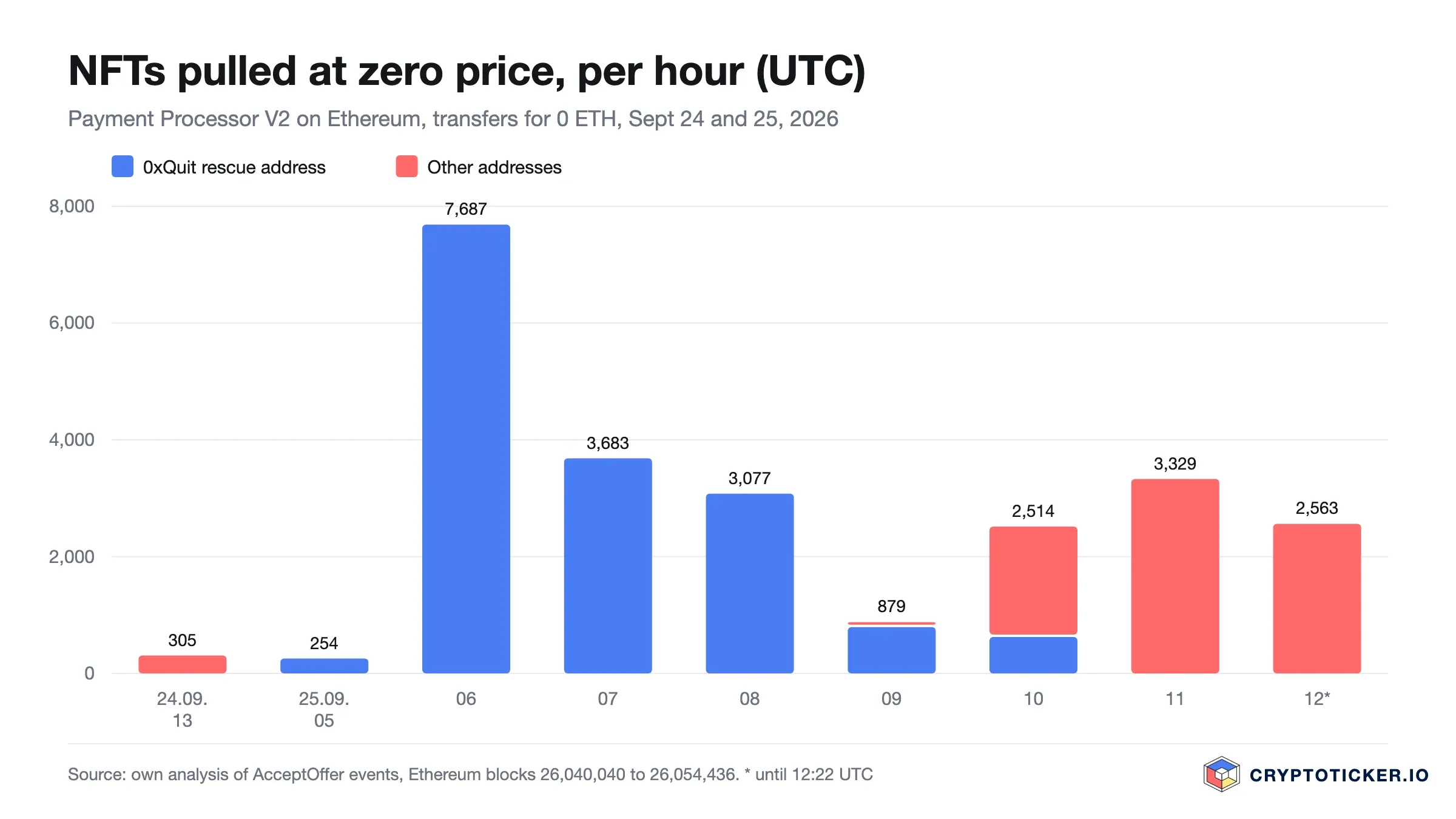
The chart shows the turning point. Until late morning almost every transfer comes from the rescue address. After that, others take over. Who is behind those addresses cannot be read from the blockchain. They could be further helpers or copycats who rebuilt the exploit. For you it makes no difference: as long as the approval stands, anyone can use it.
Quit puts the night's result at 23,155 rescued NFTs worth more than $5.7 million. Our data shows 16,117 transfers to the rescue address on Ethereum and 9,795 on ApeChain. The figures do not match one to one, because one event is not always exactly one NFT; multi-edition tokens can carry several copies. The order of magnitude is right.
Why WETH and WAPE were drained
Many people are asking this, and the answer explains the whole attack. No contract can pull plain Ether out of your wallet. A contract can only move tokens you have given it permission for, an approval in crypto jargon. NFT marketplaces use two kinds.
The NFT approval. Listing an NFT lets the marketplace contract transfer it on sale, usually for the whole collection ("approved for all"). The zero-price NFT transfers went out through this approval.
The token approval. An offer on an NFT is not paid in Ether but in wrapped Ethereum, WETH. It is a token pegged one to one to Ether that can be approved like any other token. So that an offer can be settled automatically later, you allow the Payment Processor to spend your WETH, as a rule in unlimited amounts and with no expiry. On ApeChain it works the same way with WAPE, the wrapped form of ApeCoin.
That is why these two tokens were hit. The USDC, WILD and APE drains in our data show, however, that any token you ever approved for the Payment Processor is exposed.
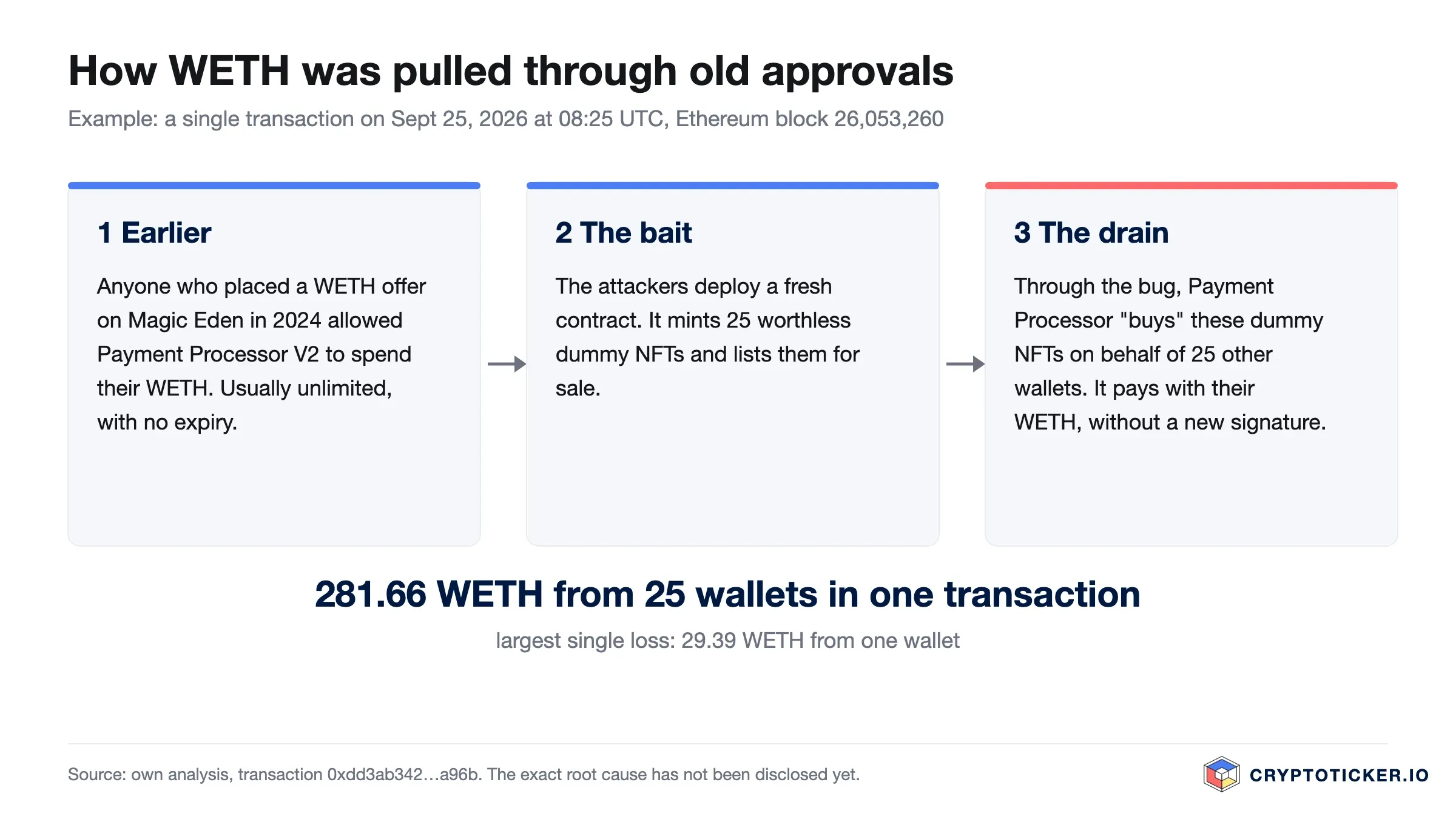
A single transaction shows the trick step by step. The attackers deploy a fresh contract that mints 25 worthless dummy NFTs and lists them for sale. They then have the Payment Processor "buy" these dummy NFTs on behalf of 25 other wallets. Payment comes out of the victims' WETH, via the old approval, without any of them signing anything. The largest single item in this transaction: 29.39 WETH from one wallet. How exactly the contract is made to act on someone else's behalf has not been disclosed by Limit Break or Quit so far.
Important if you still hold or swap WETH: the approval covers every WETH that lands in your wallet, including future balances. If you wrap Ether into WETH or receive WETH in a swap while the approval stands, you put it straight within the attackers' reach. Revoke first, then swap.
"But I had a hardware wallet": why a Ledger does not protect you
Under the warnings on X, some are mocking victims: anyone using a hardware wallet is safe, they say. That is not true here, and many of those affected had one. An acquaintance of our newsroom lost 5.94 WETH despite using a Ledger.
The reason lies in where an approval is stored. A hardware wallet protects your private key. It ensures that nobody can sign in your name without the device. But you already signed the approval, back then, perhaps two years ago, with that very device. Since then it has sat in the token contract on the blockchain: "The Payment Processor may move WETH from this address." When the Payment Processor now pulls WETH, nobody asks your device. The Ledger stays in the drawer, and the money leaves anyway.
A hardware wallet protects against stolen keys, not against rights you granted yourself. Keeping the two apart helps you focus on what actually works in incidents like this. For an overview of devices, see our hardware wallet comparison; you still have to manage your approvals yourself.
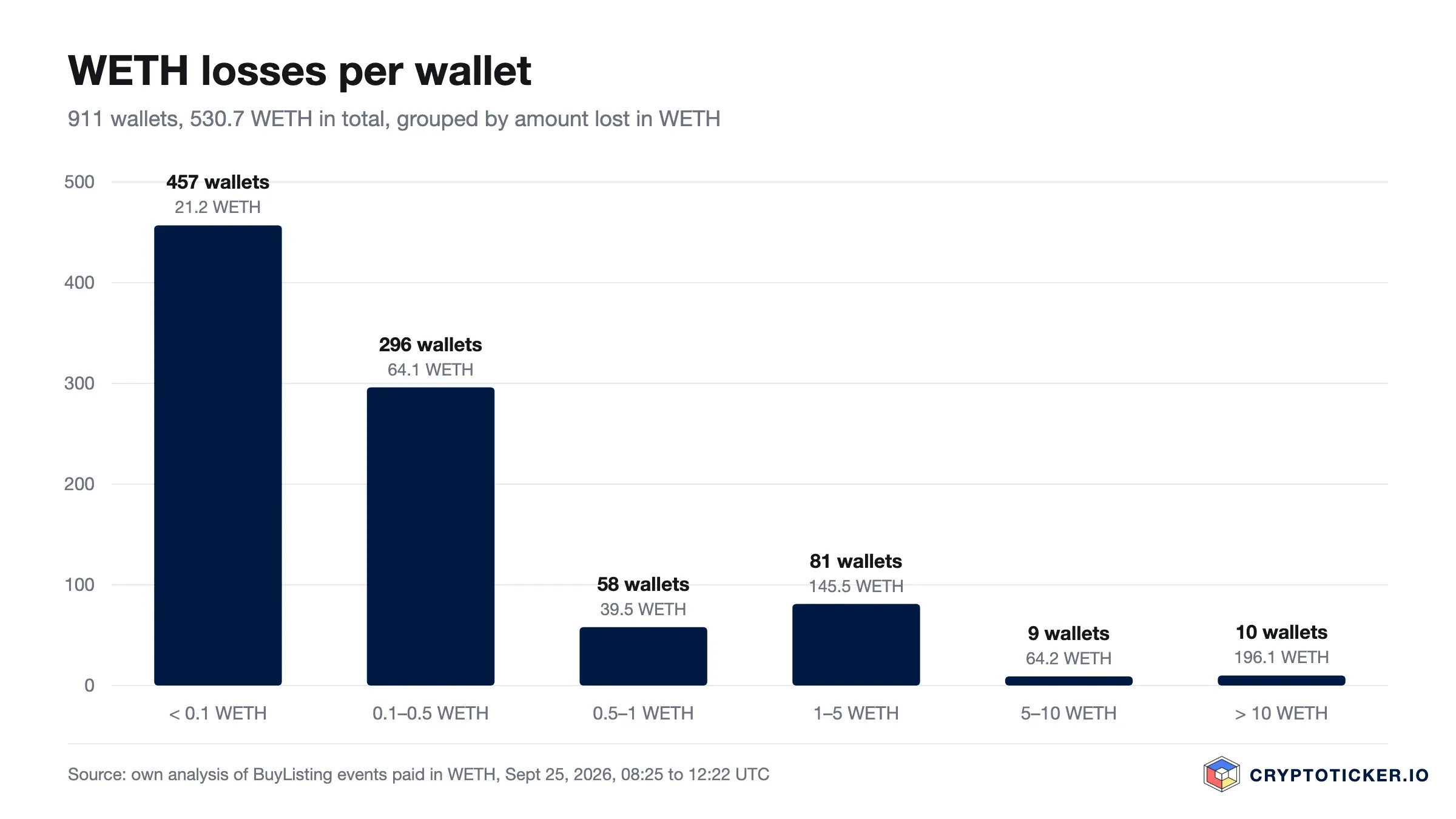
How big is the damage from the Magic Eden exploit?
Our count on Ethereum comes to 530.7 WETH from 911 wallets. At an Ether price of $2,702.88 (CoinGecko, September 25, 2026, 12:25 UTC) that is about $1.43 million. Most victims lost small amounts: half the wallets lost less than 0.1 WETH. Ten wallets, by contrast, each lost more than 10 WETH, 196 WETH between them.
Quit speaks of 660 WETH he could no longer rescue, about $1.7 million. The gap to our figure is probably explained by the fact that we only analysed Ethereum; Polygon and Base are missing. On top of that, our data shows 8,380 USDC, about 549,000 WILD (roughly $7,200), 12.9 APE on Ethereum and 7,680 WAPE on ApeChain.
The NFT picture is harder to add up. What sits at the rescue address is due to be returned. What has gone to other addresses since late morning, 7,870 transfers from 1,786 wallets, remains an open question for now.
Quit wrote on Friday morning that he had worked through the night to save around $6 million worth of NFTs, and that all he could think about was the $1.7 million in WETH he was not fast enough for. Since then, victims who lost WETH have been replying under his posts, some of them by their own account having revoked an hour too late.
Who is 0xQuit, the overnight rescuer?
Quit is VP of Blockchain at Yuga Labs, the company behind Bored Ape Yacht Club, CryptoPunks and Otherside. On X he describes himself as a Solidity developer and auditor, and he founded the NFT tool oSnipe. He regularly warns about vulnerabilities on X and, when in doubt, steps in himself before others can exploit them.
It is not his first rescue this year. In June, during a bug in Flooring Protocol, he pulled 68 NFTs worth more than $500,000 out of vulnerable pools, including 29 Bored Apes and two CryptoPunks, and held them for their owners. The approach was the same both times: whoever knows the bug pulls the assets out first, before someone with bad intentions does, and returns them once the danger has passed.
What Magic Eden and Limit Break say
Magic Eden stresses the distinction: the marketplace itself was not attacked. Co-founder and CEO Jack Lu wrote on X that the incident concerns Limit Break's trading protocol and contracts, which Magic Eden stopped using two years ago. According to Magic Eden, it used Payment Processor V2 from February to October 2024 and shut down its EVM marketplace entirely in the first quarter of 2026. Current listings are not affected, and the company says it is talking to Limit Break about further steps.
Limit Break itself had not issued a statement of its own by our deadline. All that is known is what Quit reports: that the team quickly paused V3 on ApeChain. Several NFT projects on ApeChain acted on their own. The team behind Dengs, for example, says it temporarily froze all Deng NFTs, and ApeDroidz reported that some of its collection is among the rescued assets.
If you want to review the marketplaces where NFTs trade today, you will find the comparison below. More on Magic Eden's retreat from the Ethereum business is in our analysis of the Magic Eden shutdown.
Revoke approvals: how to protect your wallet step by step
- Open Revoke.cash and enter your address or connect your wallet. Revoke.cash lists the incident on its own checker page, where you can test your address directly.
- Go through network by network: Ethereum, ApeChain, Polygon and Base.
- Revoke every approval for the Payment Processor, that is 0x9A1D00bEd7CD04BCDA516d721A596eb22Aac6834 on Ethereum, Polygon and Base and 0x9a1D00000000fC540e2000560054812452eB5366 on ApeChain. This covers NFT approvals ("approved for all") as well as token approvals for WETH, WAPE, USDC or APE.
- Each revoke transaction costs a small fee and has to be signed with your wallet, on the device itself if you use a hardware wallet.
- Only then touch WETH again. No swap into WETH and no wrapping of Ether while the approval stands.
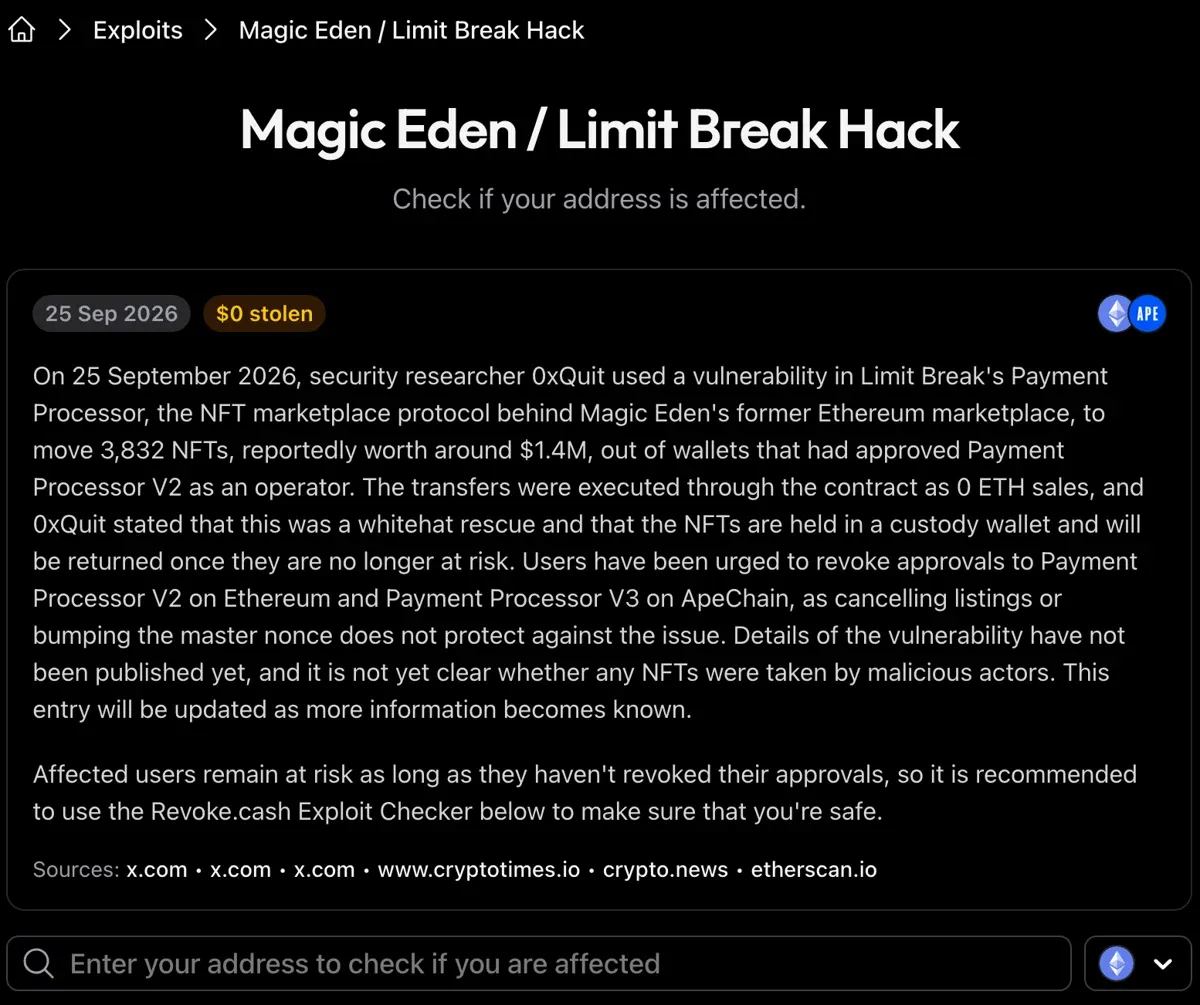
What does not help: cancelling listings or bumping the so-called master nonce. Revoke.cash explicitly points out that neither does anything against this bug. And revoking does not bring back what has already gone. It only stops more from leaving.
According to Quit, you will only get rescued NFTs back once your approval has been revoked, otherwise the NFT would be exposed again straight away. There is no official return process yet. Expect scammers to exploit exactly this situation over the coming days: direct messages offering "recovery", fake return pages, requests to sign a message. Do not sign anything someone sends you, and wait for announcements from the known accounts.
What the exploit means for the NFT market
The real lesson of the day is an uncomfortable one: approvals do not expire. Magic Eden stopped using Payment Processor V2 almost two years ago and closed the marketplace this spring. The rights that thousands of users had granted to that contract stayed in place regardless, and the contract itself kept running, with no emergency brake. A platform can close; its contracts on the blockchain do not close with it.
Add to that the industry habit of granting unlimited approvals, so that users do not have to pay for a second transaction with every offer. It saves a few cents and turns every forgotten approval into an open account.
The incident falls in a striking week. On Thursday evening Bitget reported an outflow of about $352 million from hot wallets, the largest hack of the year; what Bitget customers should check now is in our report. The same evening, Quit also counted an attack on Payy worth $1.8 million. The tools are getting better on both sides. Research published this year shows that AI agents can now find and exploit smart contract vulnerabilities at scale, particularly in old contracts that nobody maintains any more. Whether AI played a role in this attack is not known. What is clear: searching for forgotten bugs is getting cheaper, and this night's rescue hinged on one person who happened to be awake.
How we analysed the blockchain data on the Limit Break exploit
We read every trade event that Payment Processor V2 emitted on Ethereum between September 23, 2026, 12:00 UTC and September 25, 2026, 12:22 UTC, blocks 26,040,040 to 26,054,436, queried through public Ethereum nodes. That comes to 25,299 events of the AcceptOffer and BuyListing types. The positive control: for the same block range, three independent nodes returned the same count. On ApeChain we read Payment Processor V3 from September 24 in the same way, 10,041 events.
We count a sale at a price below 0.001 tokens as an NFT drain. A token drain is a purchase in which the victim's wallet pays as the buyer. We checked the mechanism against individual transactions, such as the one with the 281.66 WETH. One cross-check with an outside source: our count for the first attack on September 24 comes to 305 NFTs, the same figure Quit gives.
What the figures cannot do: Polygon and Base are not included. Who is behind the individual addresses, helper or attacker, cannot be read from the data. And one event is not always exactly one NFT. Dollar values are based on prices as of September 25, 2026, 12:25 UTC.
Magic Eden, WETH and old approvals: key takeaways
If you traded on Magic Eden, Otherside or an ApeChain marketplace in 2024, revoke the approvals for the Payment Processor today, on Ethereum, ApeChain, Polygon and Base. Do not wrap Ether into WETH while the approval stands. A hardware wallet protects your key, not rights you have already granted. And beyond today: go through your approvals regularly, say once a quarter, and revoke them immediately when a platform shuts down. Keep valuable assets in a wallet you do not trade from and never approve anything with.
(As of September 25, 2026, 12:45 UTC. This article is not investment advice. The situation is still developing; check official statements from Limit Break and Magic Eden before you act.)
Decrypt
An attacker faked internal transfer requests to drain $387.5 million from Bitget's hot and warm wallets, and the exchange's CEO says the fingerprints look like Pyongyang's.
A flaw in Limit Break's Payment Processor V2 put old Magic Eden Ethereum listings at risk, prompting a whitehat rescue of more than 23,000 NFTs.
Pullback or reversal? Here's what the charts suggest for BTC.
STRF, STRC, STRK and STRD would accrue dividends on weekends and holidays, in a move Strategy says will dampen volatility.
The bulk of prediction market trades are still sports bets, while valuations are predicated on rising institutional interest.
U.Today - IT, AI and Fintech Daily News for You Today
Binance has added two new crypto assets to its alpha platform, allowing its users access to exclusive investment opportunities.
CoinMarketCap has acquired CoinGlass, one of the crypto industry’s most widely used platforms for tracking Bitcoin, XRP, Shiba Inu and other tokens’ liquidations, open interest and derivatives activity.
Stellar (XLM) has overtaken Bitcoin Cash (BCH) in market capitalization as a fresh wave of buying pressure sends XLM higher over 13%.
Cardano setting up for what could become its first major golden cross of 2026.
XRP whales bought 470 million tokens in hope to spark a massive chart reversal, mirroring an August run that could force a fast breakout toward $2.
Blockonomi
TLDR
- Nike stock falls as analysts delay recovery expectations until fiscal 2028
- Bank cuts Nike price target after weaker sales growth forecasts emerge
- North America wholesale growth faces pressure from slowing demand trends
- China operations struggle with weak demand and excess inventory levels
- Nike shares remain under pressure after major earnings estimate cuts
NIKE, Inc. traded at $36.08, gaining 0.24%, after analysts lowered the company’s outlook and delayed expectations for a sales recovery. The downgrade reduced the price target to $30 from $47, while the firm cited weaker growth conditions. Nike faces renewed pressure as its turnaround timeline moves further into fiscal 2028.
NIKE, Inc., NKE
The sportswear company has experienced a difficult period as demand patterns continue changing across major markets. Analysts have reduced earnings expectations for the coming fiscal years. The latest outlook reflects concerns over slower sales momentum and weaker product performance.
Nike remains focused on improving product innovation and rebuilding consumer demand. Analysts expect challenges to continue as the company manages inventory levels and shifting customer preferences. The stock has already declined significantly this year compared with broader market gains.
Nike Earnings Forecasts Face Further Reductions
Analysts lowered their fiscal 2027 and fiscal 2028 earnings per share estimates by 11% and 12%, respectively. Forecasts now show negative sales growth continuing through fiscal 2027. The changes reversed earlier expectations that Nike could see a faster recovery.
The revised outlook also reduced Nike’s income rating because of concerns surrounding dividend sustainability. The analysts highlighted that the company’s dividend payout ratio exceeds current earnings levels. The valuation outlook has weakened as profit expectations decline.
The new $30 price target uses a 16 times price-to-earnings multiple. Previously, the target used a higher 22 times multiple based on stronger growth expectations. The adjustment reflects a lower valuation approach compared with earlier projections.
North America Wholesale Growth Faces Pressure
Nike’s North America wholesale business showed recent strength with 14% growth in fiscal 2026. Analysts expect this momentum to weaken as retailer demand slows. Retailers may reduce orders when new products fail to generate expected sales.
The company faces pressure because product launches and classic styles have not delivered consistent consumer interest. Analysts expect North America wholesale sales declines during fiscal 2027. The slowdown could affect Nike’s broader recovery strategy.
Nike has relied heavily on wholesale partnerships to support regional growth. Changing customer demand and cautious retail purchasing could limit future expansion. The company continues efforts to strengthen its product pipeline and brand appeal.
China Market Challenges Add Pressure on Nike Stock
Nike’s China operations face additional challenges as the company changes its online distribution strategy. The transition is expected to increase promotional pressure before the company creates a more unified online presence. As a result, short-term sales conditions remain difficult.
Analysts identified weak sports demand, slower running category growth, and excess inventory across China. Newer products have struggled to attract stronger consumer interest. These factors have created additional obstacles for Nike’s regional recovery plans.
Nike shares have fallen 44% year to date, while the S&P 500 has gained 12% during the same period. Analysts noted that earnings estimates have already declined significantly. Further reductions could continue influencing the company’s valuation.
Nike has made progress with product innovation and brand improvements. Those efforts have not fully offset weakness across larger casual product categories. The company now faces a longer path toward restoring sales growth and improving financial performance.
The post NIKE, Inc. (NKE) Stock: Price Target Slashed as Sales Recovery Faces Delays appeared first on Blockonomi.
TLDR
- Cipher Digital stock fell despite a major $5.2 billion revenue expansion deal
- Barber Lake lease extension lifts contracted revenue above $9 billion
- Cipher Digital shifts focus toward large-scale computing infrastructure growth
- Texas data center project gains longer contracts and stronger demand outlook
- ERCOT power approvals remain key for future facility expansion plans
Cipher Digital Inc. (CIFR) traded at $17.75, down 1.93%, after its shares retreated from intraday highs. The company expanded its Barber Lake data center agreement, adding $5.2 billion in contracted revenue potential. The lease extension increased the facility’s contracted period while supporting its shift toward computing infrastructure.
Cipher Mining Inc., CIFR
Cipher Digital Extends Barber Lake Contract With $9 Billion Revenue Potential
Cipher Digital secured a lease amendment with Fluidstack that extends the Barber Lake contract framework. The updated arrangement covers a 300-megawatt Texas facility and expands the contract duration up to 20 years. The agreement raises the site’s potential contracted revenue from $3.8 billion to more than $9 billion.
The company also established a separate long-term commitment with a leading artificial intelligence laboratory. The additional agreement could generate about $5.2 billion in incremental contracted revenue over ten years. However, the stock declined as the market absorbed the expanded project details and recent trading pressure.
The Barber Lake site remains scheduled for phased delivery between the fourth quarter of 2026 and first quarter of 2027. Cipher Digital expects individual data halls to begin generating rent after each delivery milestone. The company linked the updated schedule to tenant requirements and project changes.
Cipher Digital Faces Pressure After Infrastructure Expansion Update
Cipher Digital continues building its position in large-scale data center development. The company has moved its focus toward high-performance computing infrastructure and away from traditional Bitcoin mining operations. This transition has increased demand for its long-term facility agreements.
The company will cover the first $359.3 million in costs above the original Barber Lake budget. Meanwhile, the tenant will reimburse 50% of additional costs above that amount through extra rent payments. The structure aims to provide Cipher Digital with a contracted return on reimbursed expenses.
Cipher Digital has secured additional support for Fluidstack obligations through financial backing arrangements. The company expects these agreements to strengthen the project’s long-term revenue visibility. The development highlights rising demand for large-scale computing facilities across the sector.
Cipher Digital Tracks Texas Data Center Growth Challenges
Cipher Digital continues addressing power access requirements linked to expanding data center operations in Texas. The company received conditional grid-capacity designations from ERCOT for several projects. However, those designations still require final approvals before active power connections begin.
The company must complete construction, grid connections, and delivery milestones before reaching full operational capacity. Therefore, project execution remains a key factor for future revenue realization. Cipher Digital maintains that Barber Lake remains aligned with its revised delivery timeline.
The latest contract expansion strengthens Cipher Digital’s contracted infrastructure portfolio while adding new revenue opportunities. The stock performance reflected short-term market pressure despite the broader project expansion. The company remains focused on developing long-duration data center assets for growing computing demand.
The post Cipher Digital Inc. (CIFR) Stock: Slip Despite $5.2 Billion AI Revenue Expansion appeared first on Blockonomi.
TLDR:
- Solana price moved above $120 and reached $122.18 during the session, placing the $122 to $124 band at the center of the next technical test.
- The Federal Reserve opened comment on two GENIUS Act proposals covering reserves, capital, custody, risk management, and application procedures for supervised issuers.
- The Federal Reserve action does not regulate Solana or endorse SOL, although stablecoin regulation can shape how supervised issuers approach public blockchain activity.
- ETF buying and short liquidations supported the move, while a loss of $120 could bring $116 and the $108 to $110 demand zone into view.
Solana price climbed above $120 on September 25, hitting an intraday high of $122.18 after a 4.97% daily gain. The advance carried SOL into its strongest trading area in months after recovering from below $100 earlier in September. The SOL price outpaced a mostly flat Bitcoin, while renewed spot demand and liquidations supported the move.
Traders now face a narrow technical decision around the $120 breakout level. The next ceiling sits between $122 and $124, where sellers slowed the session. A durable move through that band could bring the $132 chart target into view. A reversal could return attention to $116 first.
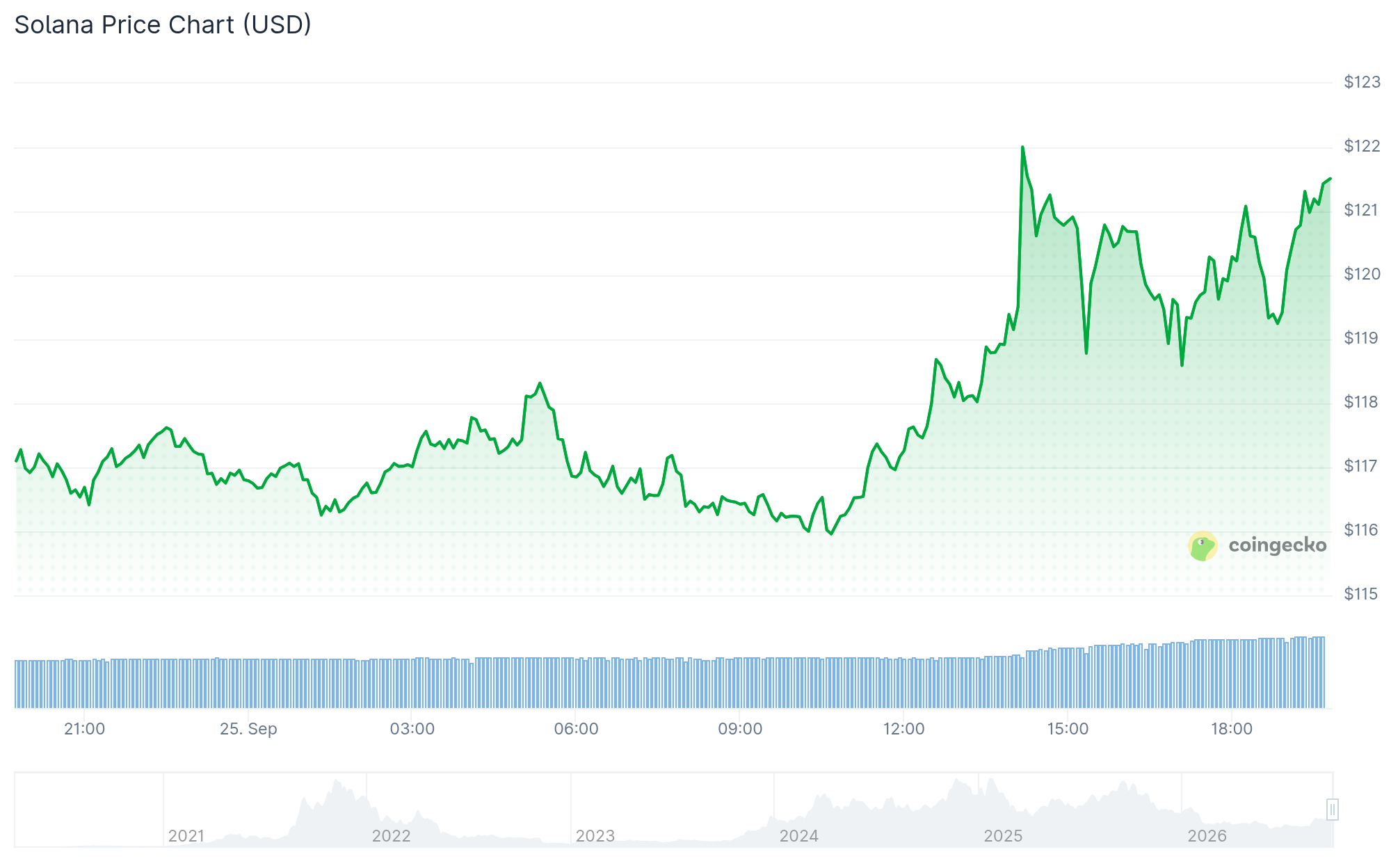
Solana Price Rises as Stablecoin Rules Enter Review
On September 24, the Federal Reserve requested comment on two payment stablecoin issuer proposals under the GENIUS Act. The first would require issuers to fully back payment stablecoins with permissible reserve assets. Short-term Treasury bills and other high-quality liquid assets appear among the listed examples.
The proposal also sets standardized capital requirements for credit and operational risks. It would establish risk management standards and rules for firms safeguarding reserve assets.
Payment stablecoins would need assets that can be converted rapidly during redemptions. Capital standards address losses from credit and operational events. The comment period closes 60 days after publication in the Federal Register. Public comments may shape final standards before they take effect. Comments are invited.
The second proposal creates a tailored application process for Board-supervised banks seeking approval to issue payment stablecoins. Applicants must submit business plans and financial information to the Federal Reserve. The rules concern supervised institutions, reserves, custody, and approval procedures. They do not regulate the Solana blockchain or endorse its token. Solana price nevertheless moved higher as traders tracked a broader rotation into large alternative coins.
Stablecoin regulation can matter to the network because digital dollars support trading, payments, and decentralized finance activity. Clearer rules may reduce uncertainty for supervised issuers without deciding which public blockchain they use.
Any issuer choosing Solana would still need to meet those institution-level standards. Network activity alone does not alter an issuer’s regulatory status. Nothing in the proposals creates a new approval for a blockchain.
Solana Price Faces $122 to $124 Test After the Rally
SOL reached $122.18 before moving back toward $120, leaving the $122 to $124 area as immediate resistance. The rally began near $115.86 and accelerated after the price moved through $118.38 on the 30-minute chart. That pattern placed $120 at the first support level to watch. The Solana price needs to hold above that former barrier to preserve the short-term breakout.
Ali Charts marked $132 as the next upside objective if buyers maintain control. The target reflects a technical scenario, not a confirmed outcome. Volume increased alongside the price climb, lending support to the recovery. Yet the intraday pullback showed active selling near the high. Buyers must still reclaim the upper range on a sustained basis.
Two-week ETF purchases exceeded 1.4 million SOL, while roughly $19.5 million in shorts were liquidated. Those flows coincided with stronger interest in other large-cap tokens. Solana price outpaced Bitcoin during the same period. Forced buying from closing short positions can accelerate an existing rise, but it can also fade quickly. This makes the next close around $120 important for the SOL price.
A rejection below that level exposes $116 as the nearest support. A wider pullback could send attention toward the $108 to $110 zone, where buyers previously appeared. The $122 to $124 range will show whether demand can absorb supply. A close above $124 would strengthen the current chart structure. It would also leave $132 as the next chart target for buyers.
The post Solana Price Faces New Test as Stablecoin Rules Enter Review appeared first on Blockonomi.
TLDR:
- Seven Coinbase tokenized stocks are now back USDC loans on Aave V4’s Base deployment.
- Shares sit at Alpaca Securities, with Coinbase holding them as bare trustee for holders.
- Chainlink’s 24/5 feeds price the tokens; weekend prices hold at the last published value.
- Equities are collateral-only for now; borrowing the stock tokens isn’t yet enabled.
Coinbase tokenized stocks are now live as collateral on Aave V4, deployed on Base. Seven tokenized US equities, AAPLc, AMZNc, GOOGLc, METAc, MSFTc, NVDAc, and TSLAc, can now back USDC loans on the protocol.
Chainlink supplies the pricing data as Coinbase’s official oracle. The launch is available in eligible jurisdictions outside the United States, according to Aave’s official announcement.
The move connects a market Aave itself values at more than $150 trillion to onchain lending. As global equities shift onchain, holders can now borrow against stock positions instead of selling them.
What Are Coinbase Tokenized Stocks?
According to an announcement, Coinbase tokenized stocks represent shares issued onchain as tokens. Each token is a certificate issued by Coinbase Onchain SPV Ltd.
The underlying shares sit with Alpaca Securities LLC, an SEC-registered broker-dealer. They are held in segregated custody accounts under the issuer’s name. The custodian cannot lend the shares or use them for its own account and holds no lien over them.
Coinbase holds them as bare trustee for token holders under a deed of trust. That structure gives holders real economic exposure to equities, not a synthetic price reference.
Dividends do not pay out directly. Instead, they get reinvested, buying additional shares net of fees and withholding tax. Stock splits work the same way.
Both flow through a multiplier that starts at 1.0 and shifts only on corporate actions. Over time, that makes the token a total return instrument that drifts above the raw share price.
Aave V4 Lending Mechanics for Tokenized Stocks
The Equities Hub runs on one USDC reserve. It pairs with a single lending spoke that pools all collateral. Users can post any combination of the seven tokenized stocks and borrow USDC against them. Each token carries its own collateral factor.
At launch, the equities function as collateral only. Borrowing the stock tokens themselves, or opening equity-against-equity positions, is not yet enabled.
The market runs 24/7. Users can supply, borrow, repay, and withdraw at any time, with one exception. During corporate actions like stock splits, the affected reserve pauses until the new multiplier applies.
Pricing comes from Chainlink’s 24/5 tokenized equity feeds, live from Sunday 8 PM ET to Friday 8 PM ET. Over weekends and US market holidays, feeds hold the last published price. Collateral values stay fixed during that window, so a position’s health factor can only fall through interest accrual.
This V4 instance was deployed by Aave Labs on behalf of Aave DAO. LlamaRisk completed the risk analysis behind the launch, per the announcement.
Why It Matters
The integration turns idle stock exposure into working capital without a taxable sale. Traders holding tokenized Apple, Tesla, or Nvidia shares can unlock USDC liquidity while keeping upside exposure.
It also signals a broader shift. Real-world assets are becoming functional DeFi collateral, not just onchain representations sitting in wallets.
More Coinbase tokenized stocks are expected to join the Aave V4 market on Base over time. GHO is also expected to join as a borrowable asset.
Each addition goes through Aave DAO’s governance and risk review process. Supply and borrow caps will also be revisited as token supply and venue depth grow, per the risk steward process.
The post Coinbase Tokenized Stocks Go Live as Collateral on Aave V4 appeared first on Blockonomi.
TLDR:
- SUI price gained 39.77% in seven days, with $1.12 now testing the $1.07 resistance.
- Dami-Defi sees $1.15, $1.25 and $1.34 as potential levels after a $1.07 breakout.
- The 0.81–0.83 zone remains key support for SUI’s developing recovery structure.
- Michaël van de Poppe cited gasless fees and confidential payments as Sui ecosystem drivers.
Sui (SUI) has climbed 13.07% in 24 hours, reaching $1.12 as traders watch a key resistance zone.
CoinGecko data shows $1.44 billion in 24-hour trading volume and a 39.77% weekly gain. The move comes as analysts track SUI’s recovery above a former support zone and its next technical barriers.
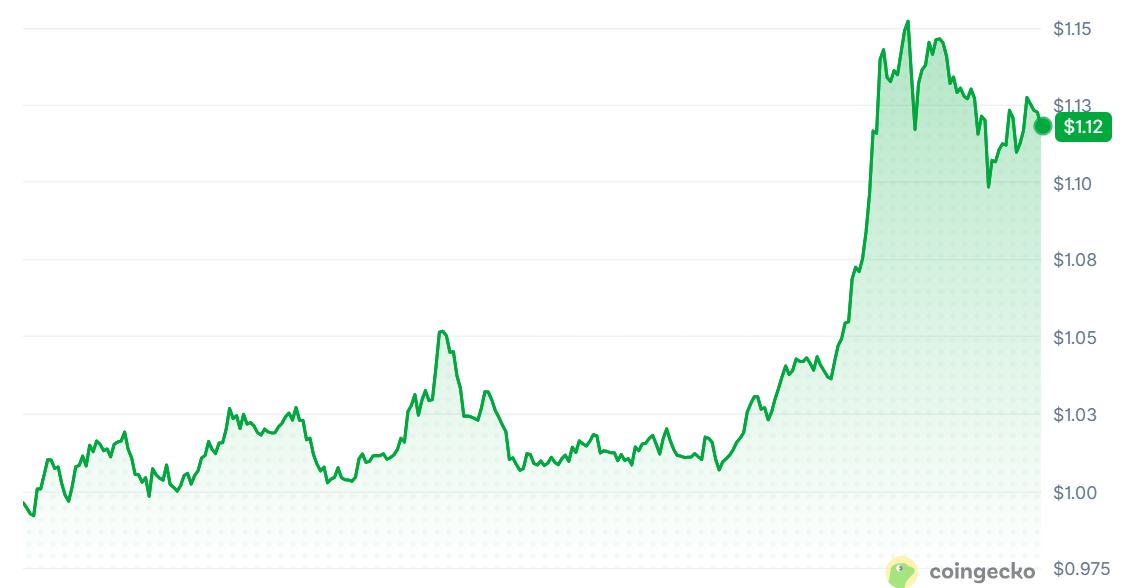
SUI Price Tests $1.07 Resistance After Reclaiming 0.81-0.83
Crypto analyst Dami-Defi said SUI reclaimed the 0.81–0.83 zone on the three-day chart. That area previously acted as support before turning into resistance after the June breakdown.
SUI has now moved above the zone and is testing the next horizontal barrier near $1.07. Dami-Defi views the move as an early reversal attempt after months of basing.
However, the analyst said confirmation remains pending because the current three-day candle remains open. A three-day close above $1.07 could strengthen the continuation setup, according to Dami-Defi.
The analyst would then watch approximately $1.15 and $1.25 as successive levels. The upper resistance sits around $1.34 on the referenced chart.
Dami-Defi also identified 0.81–0.83 as the key zone for maintaining the recovery. A loss of that area would weaken the technical structure behind the current move. This creates a clear technical framework around confirmation, continuation, and invalidation levels.
Sui’s Network Utility Adds to the SUI Market Narrative
Michaël van de Poppe pointed to Sui’s network developments alongside the recent price recovery. He specifically cited gasless stablecoin fees as a factor supporting the network’s potential payment use cases.
Gasless transfers allow users to move supported stablecoins without paying separate network fees, according to his analysis. He also argued that this design could support transfers involving both people and AI agents.
Van de Poppe further highlighted Sui’s planned confidential payments as another ecosystem development. Confidential payments can add privacy to transactions while expanding the network’s potential financial use cases.
He connected these developments with Sui’s scalability and broader ecosystem activity. However, those observations represent the analyst’s view rather than a confirmed forecast for SUI’s price.
For now, the SUI price sits at an inflection point. The 0.81–0.83 zone is the line traders are defending. A break below it would undercut the recovery narrative. Holding above it keeps $1.15, $1.25, and $1.34 in play as the next markers to watch.
The post Sui (SUI) Price Eyes $1.34 Resistance After Reclaiming Key Support Zone appeared first on Blockonomi.
HTTP error 429 on https://cryptopotato.com/feed/
Failed to fetch feed: https://cryptopotato.com/feed/
Failed to fetch feed.