Cryptocurrency Posts
Crypto Briefing
AMD's market cap milestone highlights its growing influence in AI infrastructure, challenging industry giants and reshaping semiconductor dynamics.
The post AMD surges nearly 300%, crosses $1 trillion market cap for the first time appeared first on Crypto Briefing.
Google's integration of direct purchases via Gemini in India could revolutionize e-commerce by streamlining transactions and enhancing user convenience.
The post Google tests direct purchases from Flipkart through Gemini in India appeared first on Crypto Briefing.
Anthropic's focus on AI safety and effective altruism could reshape industry priorities, influencing investor confidence and market dynamics.
The post Anthropic valuation hits $965B amid AI safety focus, IPO speculation: WSJ appeared first on Crypto Briefing.
Trump's AI initiative could reshape tech policy, influencing global AI governance and sparking debates on ethical and strategic AI use.
The post Trump plans new AI Force, seeks AI czar to lead initiative appeared first on Crypto Briefing.
Pump.fun's systematic SOL liquidations highlight the volatility and potential market impact of large-scale token sales in the crypto ecosystem.
The post Pump Fun sells 47,994 SOL for $6M as cumulative liquidations approach $850M appeared first on Crypto Briefing.
Bitcoin Magazine
Bitcoin Magazine
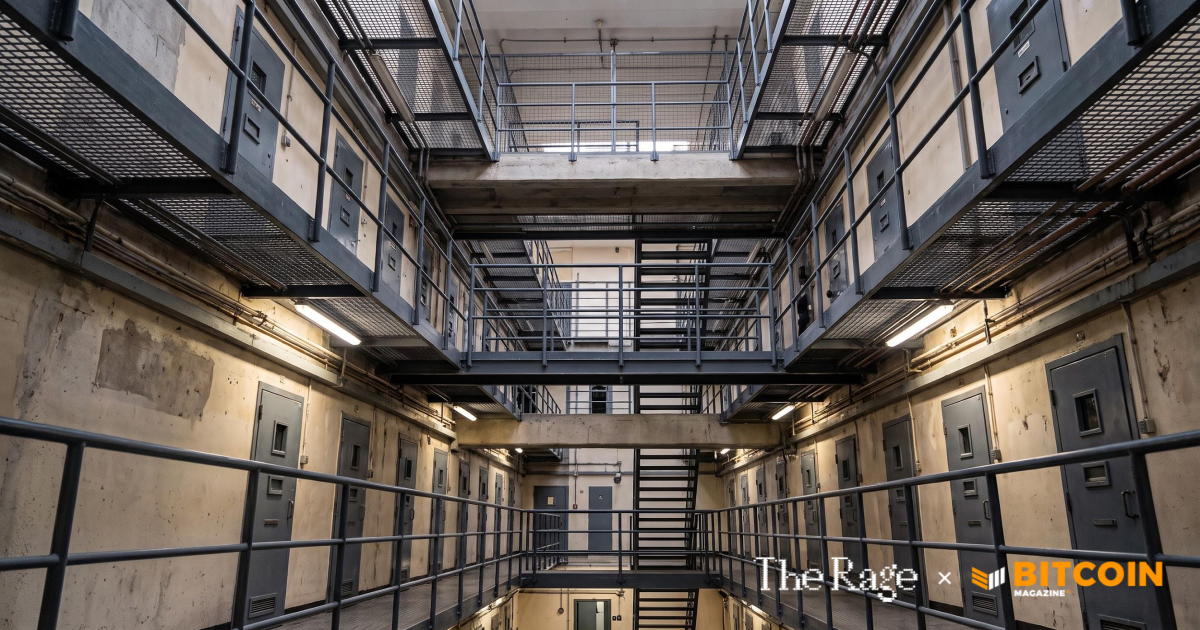
Samourai Letter #7: Notes From The Inside
Dear Reader,
It has been many months since I last wrote you. Part of the reason for that is because I spent most of June and part of July in transit from FPC Morgantown to FCI McKean – a four hour drive away. For most of that time I had no access to pen, paper, stamps, or the rudimentary email system that I use to send these letters out.
The other part of the reason why I haven’t written in so long is that once I did finally arrive I was so shell shocked from the entire ordeal that I needed time to decompress and process that month long trauma that is BOP transit.
Six days after arriving at FCI McKean I finally put pen to paper to document the journey but the result was less of a letter and more of a trauma dump to help me process the absolute worst 30 days of my life. I decided to take a step back and give it some time before I sent out this letter. I have been slowly adapting to life here at McKean, and in good time I will tell you all about this place, but for this letter I want to go back to early June.
I want to tackle the entire transit process and explain how what should have been a quick four hour drive turned into 30 days, two trans-continental flights, three multi-hour bus rides, a cell mate doing time for murder, and a cell mate who couldn’t stop shitting (I preferred the murderer). This letter will likely be published in two parts due to the length. Thank you for your continued reading and support.

“I finally put pen to paper to document […] the absolute worst 30 days of my life.”
On June 5th I was told I would be transferred from FPC Morgantown for a drug and alcohol treatment program. Successfully completing the program (which takes about 9-10 months) rewards you with a year off your sentence, so it is seemingly well worth the hassle of moving to take it.
For security reasons they do not tell you when you will be leaving or where you will be going. While being transferred in BOP custody you almost always are put on an airplane being piloted and operated by the US Marshalls to be taken to BOP transit hub in Oklahoma City. After a few days in Oklahoma you are put back on a plane and taken to your destination. From speaking with others I was told to expect 1-2 weeks of transit.
I also heard that it costs around $10,000 per prisoner to be transited through Oklahoma. I figured that since I am classified as minimum security, spent close to two years on pre-trial release, self surrendered, and had no incident reports since being incarcerated I would be a good candidate for what is called a transfer furlough – where I would be responsible for transporting myself to my new institution at my own expense.
I put in my official request for a transfer furlough on June 5th. On June 8th my request was denied without explanation, I would be going through transit, no way around it.
On June 10th I was called to Receiving and Discharge (R&D) at 6:00 AM. Though I did not know it at the time I was about to embark on a month long fever dream through two different holding facilities, share cells with murderers, be locked down behind iron barred cells for 23 hours a day, and much more.
Leaving through R&D is much the same as when I arrived. I was stripped, searched, issued a pair for ill fitting clothes (khaki elastic band trousers, a brown cotton shirt, threadbare boxers, socks that didn’t match, and a pair of slip on blue canvas shoes).
I was put into a holding cell while the other inmates being transferred went through the same process. There were six of us transiting from Morgantown on that day. We were each lined up and called forward so that the officer could fasten shackles to our ankles and cuffs to our wrists.
Once cuffed and shackled the officer wrapped a chain around our waist and attacked the handcuffs to them. The end result being that you could not lift your arms or hands much higher than your waist, and you could walk only in painful short shuffling steps. We were handed a brown paper bag with ‘breakfast’ in it (bread, peanut butter, bologna) and escorted to the waiting bus.

“We were each lined up and called forward so that the officer could fasten shackles to our ankles and cuffs to our wrists.”
The bus was a cross between yellow school bus and a coach (think Greyhound or National Express) and already filled with inmates from other prisons in the area. There were guys from all security levels on the bus. Some guys serving 20 years coming from the “pen” (The US Penitentiary), some guys like me serving short sentences and going to a camp.
The atmosphere was generally friendly on the bus, most of the USP guys were interested in what the camp was like and how much contraband like vapes and phones cost. At the front of the bus behind a metal grate were the driver and three heavily armed officers. They all wore stab vests and carried handguns and long guns.
As we departed Morgantown I was excited to watch the scenery go by. This was the first taste of the outside world I had in 6 months. I took in all the sights. The trailer park, the run down gas station, the XXX store, it all was captivating. After about an hour of driving the bus suddenly exited the highway and stopped on the side of a small road. After 20 minutes idling I noticed one of the officers walking back to the bus with a bag of biscuits from Tudor’s Biscuit World – a West Virginia institution.
We remained on the side of the road as each officer one by one went and bought breakfast, an endeavor that took over an hour. I decided Breakfast sounded good but my bread fell out of bag onto the floor. Breakfast would have to wait. As quickly as we got back on the road we suddenly pulled off again. This time each officer went one by one into a gas station to buy cigarettes and energy drinks.
The metal of the shackles were starting to dig into my ankles, my wrists were cramping, my eardrums were shot beyond comprehension. Many others have said it before, but the one thing you really remember about the prison bus is how unbelievably loud it is. Every bump in the road is followed by a symphony of crashing metal. Inmates at the front of the bus maintain full conversations at full volume with their friends all the way in the back. The volume is at maximum for the entire journey.
After about 5 hours we arrived at the Greenbriar Valley Regional Airport. There were several other prison busses parked off to the side of the runway. For the next hour or so a parade of officers from other busses would climb up and yell out a series of names. We were playing a grand game of musical chairs and for a brief moment I prayed that I would be called to another bus and spirited off to my camp bypassing the free plane ride to Oklahoma.
Eventually musical chairs was over and we were instructed to get off the bus and directed to line of waiting US Marshalls standing in front of a plain white airplane adorned only with a small American flag on the tail fin.
The Marshall patted me down, checked my mouth and feet and directed me to line up and wait by the front of the plane under the cockpit. They packed us in tight on the runway 10 rows of inmates at least 10 men deep. We watched inmates disembark the plane and enter the busses we just left.
The whole thing must be a logistical nightmare for the folks at BOP and I was surprised how smoothly it all was moving. It was by no means quick, but it could have been far worse. Finally I was ordered to wobble up the stairs to board the plane. I felt like Joe Biden before falling up the stairs.
How embarrassing it would be to eat it in front of all the convicts. I made it up without embarrassing myself. On board Air Operations Marshalls replaced flight attendants, though one really couldn’t tell any difference in demeanor between a Delta air steward herding a bunch of fat slobs in sweat suits and a US Marshall herding a bunch of prisoners. We filled each row from back to front at the direction of the Marshalls.
I was sat in the window seat. The guy next to me sported a nifty full face tattoo and informed me he had been down 15 years and was kicked out of the USP for fighting. I informed him I was on my way to a camp and had been down for 6 months. He had nothing else to say to me after that.

“This was the first taste of the outside world I had in 6 months.“
The plane itself had certainly seen better days, it looked to have been dated from The Cold War. The stickers commonly found plastered across the surfaces of airplanes telling you not to smoke or where to find the life vest in case of emergency – how exactly to apply said life vest while shackled and bound was not explained – were all in German and Russian. Where the hell did they get this thing from.
The plane was filled 2/3 of the way with inmates. The final third at the front of the plane were all US Marshalls, at least 30 of them. With that, the plane took off and we were on our way to Oklahoma City. After about an hour an Air Marshall doing their best surly Delta stewardess impression threw a bag of lunch at us. It was the second – but not last – sack lunch containing 4 slices of bread, a pouch of peanut butter, two slices of turkey, and a small pack of cookies (“Cream 4 Fun” a BOP staple that even in my dire circumstances solicited a juvenile chuckle out of me).
Sick to death at this point of the oily BOP peanut butter I happily pawned it off on the face tattoo next to me. I got started trying to fix myself a turkey sandwich – a task made difficult due to the cuffs and limited mobility. The bread was ice cold and the turkey was frozen solid. After brushing off the top layer of ice from the sliced meat and placing it between the now soggy and still freezing bread I took a bite and decided I wasn’t a great fan of turkey popsicle sandwich. The Cream 4 Fun would have to suffice for lunch.
I was thankful for the small bottle of water that was handed out, but was not thrilled when I spilled most of it down my front contorting myself to try and twist the cap off. Shortly after lunch the Marshall went row by row to ask if we needed to use the toilet. Most people did, so the rest of the flight consisted of much jostling and shuffling to the bathroom and back. I refused, preferring to hold it, but the gentleman across the aisle let the entire plane know that he needed to take a shit, a declaration that caused much consternation and debate.
As we approached Oklahoma City the pilot got on the intercom to let us all know it was a beautiful sunny day in Oklahoma City, a balmy 88 degrees. He failed to mention that none of us would see that sun for our entire stay in FTC Oklahoma City.
We landed at OKC airport, went past the main terminal building towards a squat brown concrete building about 6 stories high. After what felt like an eternity we were disembarked row by row through the jet bridge directly into the airport prison.
We shuffled single file through an assembly line of Marshalls who thankfully removed the cuffs and shackles, searched our mouths and feet again, and directed us into a dark concrete holding cell where we were packed in tight like a tin of sardines. In the corner of the room was a single stainless steel combination toilet, sink, water fountain.
Almost immediately several inmates somehow fashioned a lighter and proceeded to get extremely high on K2 – known also as Deuce. In prisons Deuce is commonly just roach spray or rat poison drenched on a small piece of paper.
When you light the paper and inhale the fumes you often freeze where you are standing lean over and are lost to the world around you for several minutes. I was most curious as to where the hell they were hiding these things to make it past no fewer than 3 probing searches.
All I could think of was getting out of this claustrophobic concrete box into a housing unit with other minimum security “campers”. Everyone had warned me that security classifications would be mixed until you were assigned a housing unit. I just had to tough out the intake process.

“You quietly wonder if Dante got it all wrong and all the circles of hell happen to be within the BOP’s Oklahoma City airport transfer facility.“
For being the official transit hub of the BOP, handling thousands of inmates every week, the staff at FTC Oklahoma City were breathtaking in their incompetence. Every last officer was less than useless, all of them wearing an expression of bewilderment as to how they happened to stumble into this predicament of dealing with a plane load of convicts, as if normally they were payroll accountants or copy clerks.
It was as if it was everyone’s first day on the job. After jam packing us ass to elbow in the small concrete room for 4 hours – presumably they were having some sort of crisis meeting trying to determine what exactly they were supposed to do with us – a morbidly overweight officer whose stab-vest appeared to be groaning in protest at the enormity of the task of protecting such an enormous man unlocked the door and shouted that he needed five of us at a time.
Instantly well over 100 men all desperate to be out of this hellish room push and shove their way towards the door. The only ones in no hurry are the deuce heads who have no idea where they are – and if they are indeed aware their limbs are in no mood to take any direction regarding movement – and myself who has no interest in playing grab ass with murderers and rapists.
I wait patiently towards the back of the room and entertain myself by taking covert glances at the inmates around me to try and guess which ones are the ‘chomos’ (child molesters). You may at this point wish to chide me and extoll the virtues of not judging a book by its cover, but these books had covers that all but said “Hey Look! I’m a chomo!”. They have a look about them.
After 45 minutes of 5 men trickling out at a time the room emptied and the deuce heads stumbled back into reality – what a horrible reality to return to from what must be a thrilling escape – and we shuffle out into the convict assembly line.
We are commanded to undress, lift, squeeze, cough under the careful supervision of an officer no doubt cursing the recruiter at the Buttplug County job fair who never said anything about staring at genitals all day.
Once the second strip search of the day concludes you are thrown a bundle of damp clothing with odd stains on them and hurry you further along the conveyor belt towards a long queue to go through a body scanner machine, the kind of thing you would find at an airport designed to find bombs and weapons.
The officer manning the machine sits behind a lead curtain to shield themselves from radiation that leaks out of this whirring machine. The warning sticker helpfully informs you to keep back behind the blue line for your safety, but it turns out this warning is not for you, you are instructed to jam yourself as close as possible to the machine so they make sure to dose you with the radiation of the 6 guys ahead of you.
Once you have been sufficiently irradiated you get pushed along where the medical officer menacingly asks if you have anything medically wrong with you, almost daring you to say anything but “no”.
There is a whirlwind of papers being stamped, collated, duplicated, and filed and before you know it the assembly line ends. You breath a sigh of relief, surely some friendly officer is going to check your papers and notice you are a minimum security ‘camper’ and whisk you away. Instead yet another morbidly obese officer points at a room and makes some sort of grunting noise. You do not speak primate but gather he wants you to wait in the room.
You quickly realize this room is a carbon copy of the first holding room and you quietly wonder if Dante got it all wrong and all the circles of hell happen to be within the BOP’s Oklahoma City airport transfer facility.

“All I could think of was getting out of this claustrophobic concrete box.”
Another couple of hours pass – or years, who can tell at this point – in the second holding room and the Deuce heads are the only ones having a great time. The Deuce dealers have defeated yet another strip search and now a body scanner. Eventually an officer of indeterminate gender unlocks the door and yells out 5 to 10 names and you are escorted to your “range” (prison speak for the floor you live on).
The officer leads us towards the elevator, 10 of us cram in and I get a good look at the men with me. Seven of them have full face tattoos that extend across their shaved heads. Rams horns, Celtic knots, Thor’s hammer, that sort of thing.
At this point I am fully aware that a “camper” only range is a fantasy. I am going into the general population with murderers, rapists, kidnappers, gang members, and career criminals – many of whom have spent more time behind bars than they have in society. I take a deep breath, this is no time to be anxious or afraid. If the sharks smell fear they will strike.
The guard walks us to the heavy metal door that seperates our range from the hallway. He turns the key but the door won’t open. He tries another key with the same result. One of the face tattoos mocks him “what is it your first day or something?” he heckles. The officer now very aware that this is taking way too long fumbles the keys and drops them on the floor. The scene is objectively funny and now several more of the inmates are heckling the clumsy officer.
Finally the door opens from the inside. The range officer must have taken pity and opened it for him. The guys watching on the security cameras must have been pissing themselves. He will probably never hear the end of it in the breakroom.
I am on Range 4D. The room is vaguely triangular in shape as if the architect started drawing a triangle but gave up halfway through. The room is large and painted in a palette of institutional grey and the same sort of pink they paint high schools.
Cells with big metal doors line three of the walls. Two large staircases flank both sides of the room and take you up to an internal balcony where cells line the walls as well. If I remember correctly there are 30 two-man cells on each floor, so each range holds a total of 120 men. As soon as you cross the threshold between hallway and range you are immediately struck by the sheer number of strung out junkies hunched over seemingly frozen in place.
Before you even have a chance to breathe several face tattoos are in your face asking if you want to buy drugs from them. These enterprising fellows apparently are running a fully stocked pharmacy. They offer me deuce, ice, meth, snizzlefizz, and junglerush.
Okay, I made the last two up, but they offered me stuff I have never heard of before. I decline the offer and they move on quickly to a more lucrative mark. The range officer leaves his office and steps over a frozen drug addict and informs us that he is new here and to just give him a minute to get us situated.
I politely wait while the officer – looking more and more flustered by the minute – assigns the guys ahead of me their cells, hands them a roll of toilet paper, and a thin mattress before sending them on their way into the jungle. When it is my turn the officer lets me know that he has run out of toilet paper and but if I give him a minute he will find me some. He gives me my cell number and scurries away back into his office. I follow him and remind him I need a mattress to which he explains he has run out of those as well, but if I just give him a minute he will try and locate one.
From that point forward he was “Officer Just-A-Minute”. I climb over three junkies strung out on the staircase and make my way to the cell I have been assigned.

“This isn’t fucking Guantanamo!”
The cell is small, only a bunk bed, a toilet, a sink, a desk, and a fluorescent light. Inside is a large American Indian. If you asked someone to draw the most racist caricature of an American Indian he would have drawn this guy.
He looks at me and says in a deep voice with a flat affect “I am Shadow”. The strange face tattoos gave him the air of some sort of tribal witch doctor. I said “You sure are” and quickly introduced myself lest he take offense to my glib remark and place a hex on me.
I liked Shadow immediately. I learned that he was on his way to a USP doing 20 years for murder. Before I had a chance to explain that I was on my way to a camp for the fake crime of not having a license I didn’t even need in the first place Officer Just-A-Minute was in the doorway of the cell holding half of a foam mattress.
Decidedly at the end of my tether I looked to him, to the mattress in his hands, back to him and asked incredulously “what the fuck am I supposed to do with that?”. “It is all we have” he responded slightly annoyed. “It is half gone. How the hell am I supposed to sleep on that? My ass and legs will be on bare metal!” I protested. “Welcome to prison” he responded curtly.
I was seriously fed up at this point, plus I had Shadow the murdering witchdoctor to back me up so I pressed further “I understand this is prison. I am well aware of that fact! You still have an obligation to provide us basic amenities like bedding. This isn’t fucking Guantanamo!”
I pushed. He simply shrugged and dropped the mat onto the floor and walked off. “Fuck that guy” said Shadow. I agreed.
A few minutes later Officer Just-A-Minute walked by and locked the cell door. We were locked in for the night. It would be the first time I had been truly locked in a cell. I was mildly surprised there wasn’t some sort of central locking mechanism. The officer needed to walk by 60 cells and manually lock them all. A while after locking us in another officer showed up to perform the 10:00 PM count.
Count concluded I climbed onto my half mattress and waited for the bright fluorescent light to be turned off. By 11:00 PM I asked Shadow what time they usually turned the lights off. “They don’t” he responded.
I sighed and covered my head with the sheet they gave me – it smelled vaguely like motor oil and sawdust – and silently sobbed. Everyone told me that transit was bad, that Oklahoma was terrible. They were not overstating it.
I laid there, ass on bare metal, harsh light shining through the threadbare sheet and asked myself if all this was worth the year off. I regretted ever leaving Morgantown, and I desperately wanted to call my wife Lauren.
The transit story will continue in Part 2. Thank you for reading.
This is a guest post by Keonne Rodriguez. Opinions expressed are entirely their own and do not necessarily reflect those of BTC Inc or Bitcoin Magazine.
This post Samourai Letter #7: Notes From The Inside first appeared on Bitcoin Magazine and is written by Keonne Rodriguez.
Bitcoin Magazine
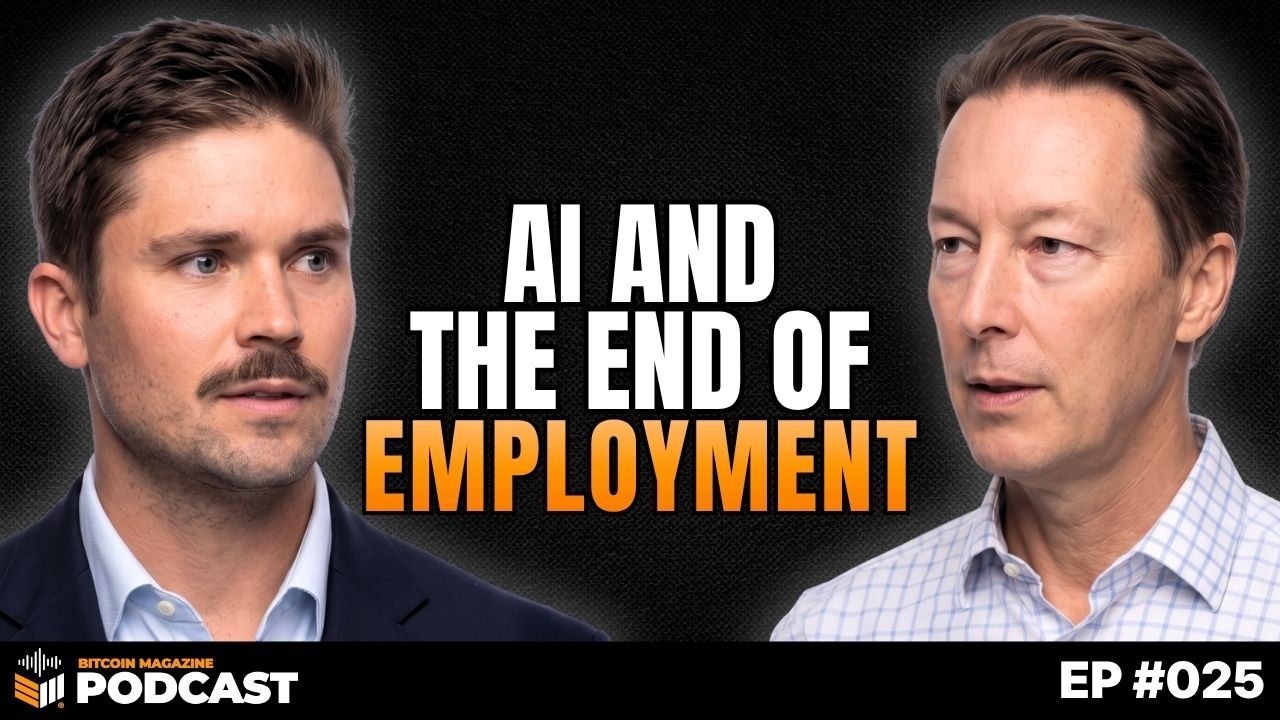
An Austrian Economist Explains Why AI Will Make Everyone an Entrepreneur w/ Per Bylund
AI is changing how we work, but can it replace the human entrepreneur? Austrian economist Per Bylund, Senior Fellow at the Mises Institute, joins Spencer Nichols to explain why AI is a statistical engine that improves efficiency but can’t imagine the future. He argues we’re moving from an employment economy to an entrepreneurship economy, and explains what that means for jobs, innovation, and value creation.
Chapters:
00:00 Austrian Economics on AI, Innovation, and Entrepreneurship
02:34 Can AI Replace the Entrepreneur?
05:48 Invention vs Innovation: What Bitcoin Teaches About AI
06:29 From an Employment Economy to an Entrepreneurship Economy
09:52 Can Regulators Keep Up With the Speed of AI?
13:06 Remote Work, Capital Controls, and the Future of Money
18:23 Why Every Voluntary Trade Has Two Winners
26:28 The Individual vs the State in US-China Competition
31:17 Steel Stockpiles, Sugar Subsidies, and the Lobbying Behind Protectionism
33:36 OpenAI, Anthropic, and Regulatory Capture in AI
DISCLAIMER: The views and opinions expressed in this show are those of the participants and do not necessarily reflect the official policy or position of BTC Inc., Bitcoin Magazine, or any affiliated entities. This content is provided for informational and educational purposes only and should not be construed as investment, legal, tax, or accounting advice. Nothing contained in this show constitutes a solicitation, recommendation, endorsement, or offer to buy or sell any securities or financial instruments. Viewers should consult their own advisors before making financial or business decisions.
This post An Austrian Economist Explains Why AI Will Make Everyone an Entrepreneur w/ Per Bylund first appeared on Bitcoin Magazine and is written by Patrick Green.
Bitcoin Magazine
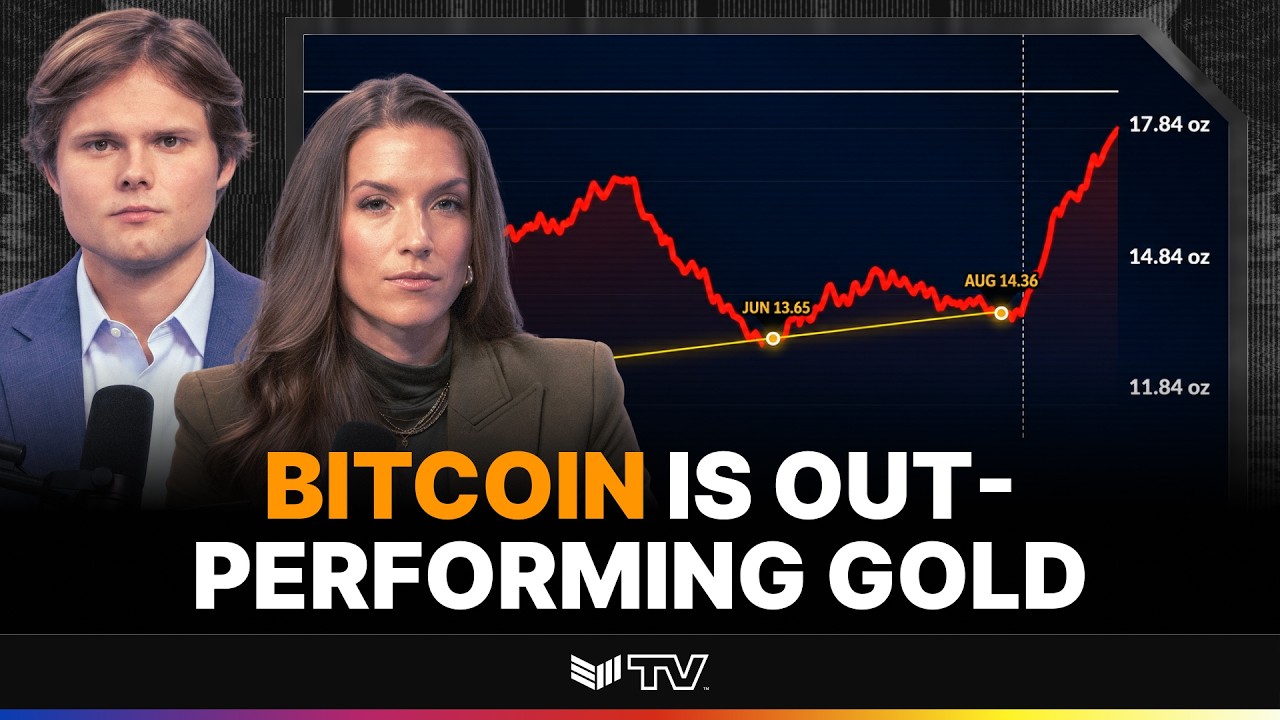
TECHNICAL ANALYSIS: BTC to Cross Key Price Level Against Gold
The 90-day correlation between Bitcoin and gold just hit a six-year high, and Bitcoin is now just 3% away from flipping positive against gold for 2026. In today’s Chart of the Day, Sean breaks down the Bitcoin-to-gold chart, the string of higher lows since February, and the new high above 17.9 ounces.
Chapters:
0:00 Bitcoin-Gold 90-Day Correlation Hits a Six-Year High
0:35 Why Measure Bitcoin in Gold? Stripping Out Dollar Debasement
1:20 Higher Lows and Higher Highs on the BTC/Gold Chart
2:27 From 12.1 oz to 17.9 oz: The Bullish Bitcoin Setup
2:53 The 20.3 oz 2026 Yearly Open and the Levels That Matter
3:21 Next Bitcoin Resistance: 21.5 oz of Gold (~$92K)
DISCLAIMER: The views and opinions expressed in this show are those of the participants and do not necessarily reflect the official policy or position of BTC Inc., Bitcoin Magazine, or any affiliated entities. This content is provided for informational and educational purposes only and should not be construed as investment, legal, tax, or accounting advice. Nothing contained in this show constitutes a solicitation, recommendation, endorsement, or offer to buy or sell any securities or financial instruments. Viewers should consult their own advisors before making financial or business decisions.
This post TECHNICAL ANALYSIS: BTC to Cross Key Price Level Against Gold first appeared on Bitcoin Magazine and is written by Patrick Green.
Bitcoin Magazine
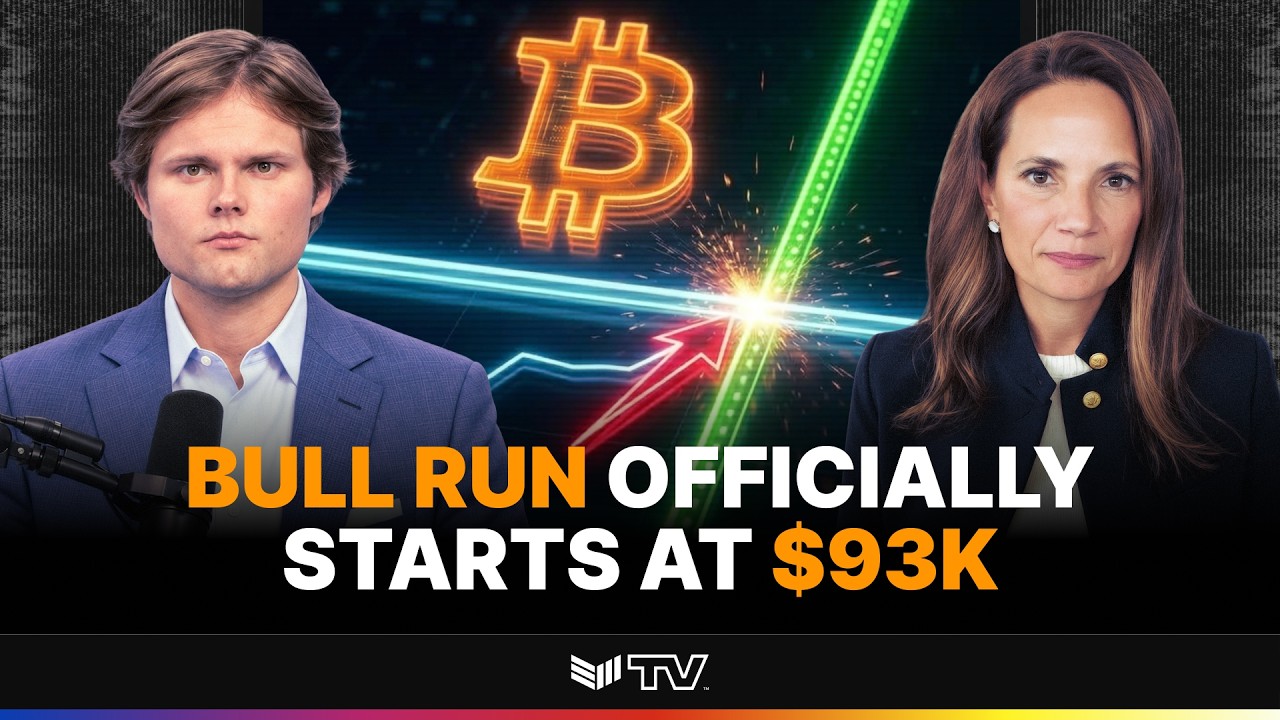
Katie Stockton: $93K BTC is the Key Price Level for the Bull Market
Is the Bitcoin bear market officially over? Katie Stockton, founder of Fairlead Strategies, breaks down the technical signals behind Bitcoin’s rally of more than 50% off its recent lows, including the break above the 200-day moving average and the 83K–84K resistance zone. She explains why the cloud model points to $93,000 as the level where a new Bitcoin bull cycle becomes official. She also covers the flag pattern breakout, the monthly stochastic oscillator, and what could turn her defensive heading into Q4.
DISCLAIMER: The views and opinions expressed in this show are those of the participants and do not necessarily reflect the official policy or position of BTC Inc., Bitcoin Magazine, or any affiliated entities. This content is provided for informational and educational purposes only and should not be construed as investment, legal, tax, or accounting advice. Nothing contained in this show constitutes a solicitation, recommendation, endorsement, or offer to buy or sell any securities or financial instruments. Viewers should consult their own advisors before making financial or business decisions.
This post Katie Stockton: $93K BTC is the Key Price Level for the Bull Market first appeared on Bitcoin Magazine and is written by Patrick Green.
Bitcoin Magazine
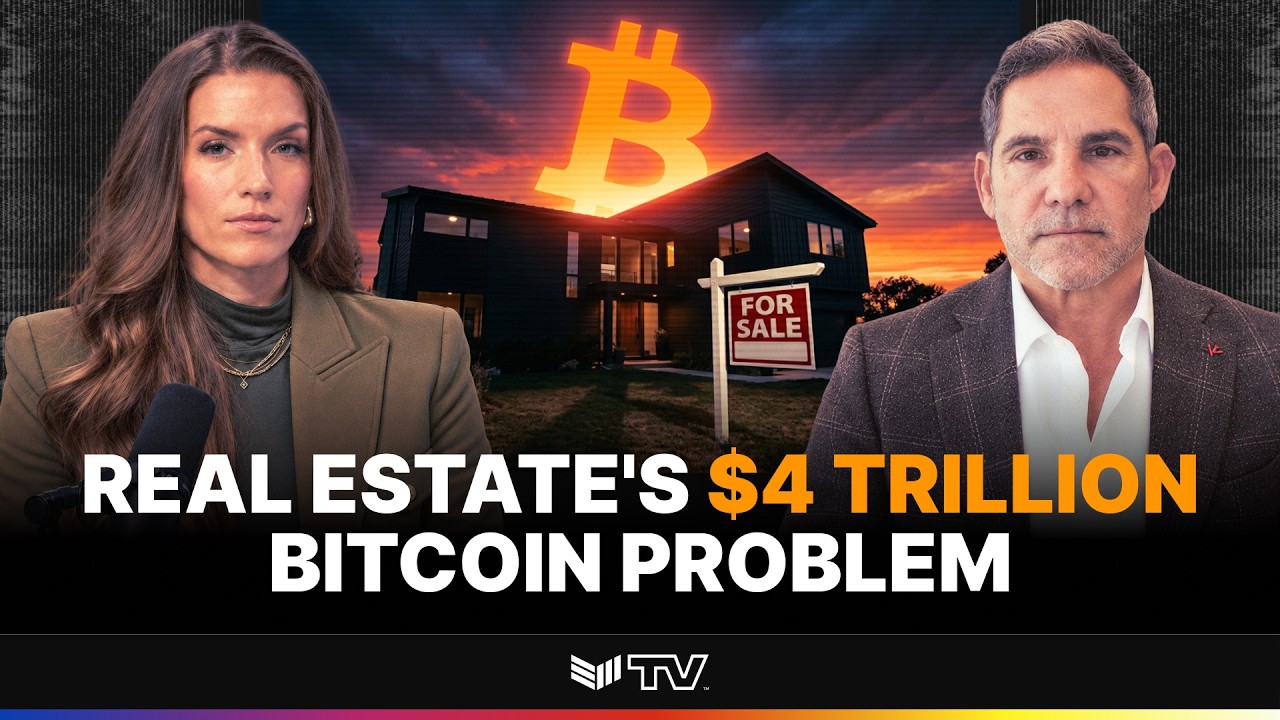
Grant Cardone: Real Estate “Armageddon” Is Here – Why BITCOIN is the Hedge
Commercial real estate is facing a historic reset, and Grant Cardone is using it to stack Bitcoin. The Cardone Capital founder explains how high interest rates are pushing properties below replacement cost and how he fills that gap with Bitcoin on the balance sheet. He breaks down his goal of 25,000 apartments and 25,000 BTC, and why he calls real estate his “Trojan horse” for Bitcoin.
Chapters:
00:00 Grant Cardone on the Commercial Real Estate Reset and 6.4% Rates
00:51 How Cardone Capital’s Bitcoin Real Estate Deals Work
02:23 Why REITs Can Never Own Bitcoin: Cardone’s Competitive Moat
04:26 From 3,000 to 25,000 BTC: Real Estate as the Trojan Horse
06:50 Michael Saylor’s “P Word” and the $335M Boca Raton Deal
09:01 Will Cardone Capital Go Public?
10:12 Why Commercial Real Estate Faces a Historic Crash
11:02 Why Single-Family Home Prices Won’t Correct
12:31 Why Bitcoin and Real Estate Are the Perfect Hybrid Asset
14:32 Why Other Real Estate Investors Can’t Copy This Strategy
DISCLAIMER: The views and opinions expressed in this show are those of the participants and do not necessarily reflect the official policy or position of BTC Inc., Bitcoin Magazine, or any affiliated entities. This content is provided for informational and educational purposes only and should not be construed as investment, legal, tax, or accounting advice. Nothing contained in this show constitutes a solicitation, recommendation, endorsement, or offer to buy or sell any securities or financial instruments. Viewers should consult their own advisors before making financial or business decisions.
This post Grant Cardone: Real Estate “Armageddon” Is Here – Why BITCOIN is the Hedge first appeared on Bitcoin Magazine and is written by Patrick Green.
CryptoSlate
Crypto projects spent about $638 million with token buybacks through late August 2026, according to Allium Labs data.
That is already a record, up from $545 million over the same stretch of 2025. Hyperliquid accounted for roughly $370 million and Pump.fun for about $200 million, together close to 90% of the total.
On Sept. 25, staff at the Securities and Exchange Commission (SEC) addressed the legal tension that has shadowed those programs since they began. The more openly a project ties its token to business returns, the easier it becomes to argue that holders are investing in a security.
What SEC staff said
The SEC's Division of Corporation Finance addressed buybacks in a new set of crypto FAQs covering networks that are already functional.
Staff said an issuer's buyback announcement for a non-security crypto asset on such a network falls outside the promises of “essential managerial efforts” at the center of the Howey test for investment contracts.
The same answer warns younger projects that on a network yet to reach functionality, pitching a buyback as a source of yield or returns can feed into an investment-contract analysis.
The answer rests on two built-in assumptions, a functional system and a token that already sits outside securities law, and it carries the weight of staff views, which the SEC describes as lacking legal force.
Under the agency's March interpretation, a network counts as functional when its native token can be used according to its programmed utility.
A regulatory life cycle takes shape
The SEC's March interpretation says a token can be sold as part of an investment contract while a team raises money against promises of managerial work. That contract can end once buyers stop expecting profits from those promised efforts.
The pending Regulation Crypto Assets proposal would let projects raise up to $5 million over four years under a startup exemption. A larger fundraising exemption would allow up to $75 million every 12 months, with disclosure requirements attached to both.
Proposed Rule 400 adds a transition filing, the Form TR, in which an issuer certifies on EDGAR that it has completed or permanently ceased its promised managerial efforts and stopped making new ones.
The issuer files it directly, and the agency could later contest whether the conditions were met. In its paperwork estimates, the SEC assumes about 475 issuers a year could rely on that safe harbor, based on 15% of the roughly 3,165 projects launched in 2024. Comments on the proposal close Oct. 20.
Put together, the pieces sketch a path from securities-regulated fundraising to a mature network that can spend real revenue on its own token. The Form TR covers projects that abandoned their roadmaps as well as those that finished them, while the buyback FAQ applies only once a network is functional.
That structure rewards teams that define their build as a finite list of milestones they can eventually complete, and it discourages marketing that frames buybacks as returns before the product works.
| Stage | Regulatory position | What the project can do | Key constraint |
|---|---|---|---|
| Raise | Token sold as part of an investment contract | Raise capital against promised managerial work | Securities-law obligations attach to the fundraising arrangement |
| Build | Promised essential managerial efforts continue | Develop network and deliver disclosed milestones | Marketing returns or buybacks can contribute to Howey analysis |
| Transition | Promised efforts completed or permanently ceased | Proposed Form TR documents the transition | SEC can later challenge whether conditions were actually satisfied |
| Functional network | Token can perform its programmed utility | Operate without the original investment contract necessarily continuing | Token's status still depends on facts and circumstances |
| Mature buybacks | SEC FAQ assumes a functional network and non-security token | Announce revenue-funded token repurchases | Buyback announcement alone is not an essential-managerial-efforts promise |
The money already flowing to token buybacks
Pump.fun says half its revenue goes to buying and permanently burning PUMP. Its dashboard shows roughly $500 million in annualized revenue, about $462.5 million in cumulative purchases, and 167.7 billion tokens destroyed, equal to 16.8% of the original supply.
At the current run rate and allocation, that implies around $250 million in annual purchases,
about 6.4% of Pump.fun's displayed $3.91 billion fully diluted valuation. The figure measures purchasing power against valuation, with the cash going into open-market token purchases.
Hyperliquid has bought and burned roughly $1.3 billion of HYPE since launch, and its documentation says more than $1 billion in annualized fees now flows into programmatic HYPE purchases.
Uniswap switched on protocol fees on Ethereum mainnet in December 2025 and has since extended them to other chains, with outside searchers collecting accumulated fees only by burning UNI in exchange.
Hyperliquid funds staking rewards from a reserve of future emissions even as trading fees burn HYPE. A protocol that burns 5% of supply while issuing 8% through emissions and unlocks ends up diluting holders despite a large headline buyback.
A more useful measure for these tokens is net burns against new issuance before comparing the result to valuation.
Aave's program shows how quickly treasury needs can override a buyback. It acquired more than 205,000 AAVE, about 1.28% of supply, for roughly $42 million in its first ten months.
Governance then debated cutting the annual budget from $50 million to $30 million as revenue softened. The DAO paused purchases on April 19, after the rsETH bridge incident, to preserve balance-sheet flexibility.
Crypto's record remains small next to Wall Street, where S&P 500 companies spent $1.02 trillion on repurchases in the 12 months through September 2025. The growth pace sets crypto apart, rising from about $366,000 in 2024 to $638 million in under eight months of 2026, with mechanisms that automatically convert revenue into market purchases.
| Protocol | Buyback / burn mechanism | Scale cited in article | What can offset or interrupt it |
|---|---|---|---|
| Pump.fun | 50% of revenue allocated to open-market PUMP purchases and permanent burns | ~$500M annualized revenue; ~$462.5M cumulative purchases; 167.7B PUMP destroyed | Revenue declines; future token issuance/unlocks |
| Hyperliquid | Trading fees fund programmatic HYPE purchases and burns | ~$1.3B bought and burned since launch; >$1B annualized fees flowing toward purchases | Staking rewards and future emissions can offset supply reduction |
| Uniswap | Protocol fees accumulate; searchers obtain assets by burning UNI | Fee mechanism active since Dec. 2025 and expanded across chains | Governance controls fee deployment and future mechanism |
| Aave | Treasury-funded open-market AAVE purchases | >205,000 AAVE / ~$42M in first ten months | Treasury needs; program paused after rsETH incident |
What token holders own
The rights attached to these tokens remain thin. Uniswap's documentation says value reaches UNI holders through the burn mechanism and whatever future mechanisms governance approves, with protocol revenue staying under the protocol's control.
The SEC's March interpretation describes digital commodities as assets whose holders lack any inherent right to passive yield, future income, or profits. A buyback can reduce supply and create steady demand, and governance can redirect or pause it at any point.
The same distance from securities law that makes a mature token easier to trade also keeps it apart from the cash flows investors use to value it.
Bitcoin, which the SEC lists as a digital commodity, runs without an issuer or protocol revenue to recycle, so revenue multiples and buyback ratios apply to tokens like HYPE, PUMP and UNI.
Where the token buyback model goes from here
If the SEC finalizes Regulation Crypto Assets close to its current form, teams can raise money under the exemptions, write finite roadmaps, file transition reports, and steer revenue into token purchases once their networks work.
Hyperliquid's fee flows and Pump.fun's allocation alone point to industry buybacks above $1 billion a year at current run rates. Revenue and dilution-adjusted buyback yield would become standard tools for valuing protocol tokens.
| Feature | Public-company shareholder | Mature protocol token holder |
|---|---|---|
| Ownership claim | Equity ownership in corporation | Generally no ownership of protocol/company merely from holding token |
| Right to profits | May receive distributions if declared; residual corporate rights defined by securities/corporate law | No inherent right to future protocol income or profits |
| Buyback effect | Company purchases outstanding shares | Protocol/DAO purchases or burns tokens, potentially reducing supply or adding market demand |
| Guaranteed buybacks? | No | No |
| Who can change the program? | Board/company subject to corporate and securities-law constraints | Governance, protocol rules or other authorized actors depending on design |
| New issuance can offset purchases? | Yes, through new share issuance/compensation | Yes — emissions, incentives and unlocks can overwhelm burns |
| Claim on underlying revenue | Share represents equity rights in the company | Buyback-linked token may have no contractual claim on the revenue funding purchases |
| Useful valuation metric | Earnings, free cash flow, buyback yield, dilution | Protocol revenue, gross buybacks and net issuance/dilution |
If the proposal stalls or emerges in weaker form, the nonbinding staff FAQ becomes the main source of comfort, and projects would keep return language out of their marketing while treating buybacks as discretionary.
Revenue-linked programs shrink mechanically when revenue falls, and a major exploit or bad-debt event could push other treasuries to conserve funds the way Aave did. Holders would then find that a buyback resembles a shareholder return in its market effect while remaining revocable, governance-dependent, and free of any contractual claim.
The SEC is building a route for crypto networks to spend their revenue on their tokens. Holders at the end of that route own an asset tied to a business's success through scarcity and demand, while the business's revenue stays with the protocol.
The post SEC clears regulatory hurdle as crypto token buybacks hit record $638 million appeared first on CryptoSlate.
In 2021, Christie's sold a Beeple NFT for $69.35 million, and Sotheby's took another $24.40 million for 101 Bored Ape Yacht Club NFTs, giving cartoon primates the kind of auction-house treatment usually reserved for Fabergé eggs.
But now, not five years later, one of the marketplaces that helped sell the digital art revolution is explaining how customers could take their belongings with them when it closed.
Nifty Gateway, the NFT marketplace owned by crypto exchange Gemini, announced its closure in January as its parent decided to concentrate on its primary financial app. The exit arrangements included plans for a bulk withdrawal tool and somewhere to host the artwork.
That's a pretty sad and uneventful end for an industry that made ownership sound like a technological breakthrough on the order of discovering fire.
To be fair, there was real art underneath the sales pitch, along with artists who'd found paying audiences and collectors who liked what they bought. But the boom encouraged the assumption that once you'd paid for the token, the business of owning the thing was taken care of, preferably forever.
Marketplace closures have quickly made that assumption incorrect, because the token, the artwork, and the website displaying it can survive for very different lengths of time. As crypto companies close businesses and retire products, somebody has to work out where the files go and who'll keep them available when selling the next collection no longer covers the bills. The person who can answer that has become considerably more relevant to your collection than the person who once assured you that you were early.
Your ape needs a forwarding address
When you buy an NFT, it's easy to think you're putting a picture in your wallet because that's what the app shows you. Underneath that display, though, several separate things are happening, and knowing what lives where explains how you can still own a token while struggling to load the art.
Many Ethereum NFTs use the ERC-721 standard that records who owns each token and allows it to be transferred. The blockchain keeps that ownership record, while the token often points to a separate descriptive file, known as metadata, containing information such as the work's name and a link to its image or video. Your wallet retrieves those files and assembles what you see, so the collection looks like one self-contained possession even when its parts depend on several different services.
Keeping big media files outside the blockchain is a reasonable design choice, but it means those files need their own home. Sending the token to a wallet you control puts you in charge of transferring it; it doesn't automatically download the artwork, take over the server hosting it, or pay the person running that server. If you're picturing your expensive ape safely tucked inside your phone, the app may have given you a rather generous impression of what the transfer accomplished.
Nifty Gateway's closure update addressed this problem, with plans to move descriptive records and media hosting to Arweave, a network designed for long-term storage, but some NFTs created in 2021 or earlier had records permanently linked to its own servers. The company promised to keep hosting that metadata indefinitely and extended its withdrawal window to April 23.
Those promises describe the arrangements the company said it would make, without establishing that every migration succeeded or that any particular artwork was lost. They show us the consequence of making a link permanent: when the address belongs to a company, fixing it in place can preserve your dependence on that company for as long as you want the link to work.
Buyers were supposed to enjoy the freedom of owning something outside a platform's control, and some instead inherited a lasting relationship with its hosting department. The technology can faithfully preserve an ownership record while leaving the owner dependent on a business that has other things it would rather do.
Forever isn't a payment plan
Distributed storage offers a way to reduce that dependence, provided someone actually keeps the files. IPFS, which is used for NFT media, identifies content from the data itself, allowing different computers to provide a verifiable copy without tying its identity to one company's website. That makes it possible for another provider (or the collector) to keep serving the same artwork if the original host stops.
The catch is that joining a network doesn't oblige every computer on it to preserve your collection. The IPFS documentation explains that cached files can be deleted to free space, while a process known as pinning tells a computer to retain specified content. Someone can run that computer themselves or pay a service, but the continuing cost belongs to whoever agrees to keep the copy available.
This also explains why a missing picture doesn't necessarily mean the artwork has vanished. Your browser may retrieve an IPFS file through a gateway, a website that fetches the content for you, and the IPFS guide to NFT storage warns that this route can fail even when the data exists elsewhere. In that case, another gateway can help, but if nobody has retained the data at all, a different web address won't bring it back.
Collectors therefore have to understand whether the problem is reaching their file or finding a surviving copy, which is quite an introduction to network administration for someone who thought they'd just bought a picture. The rare hat on the ape contributes very little to the diagnosis, however much it contributed to the price.
There are ways to reduce these risks, including putting artwork data directly on the blockchain or using storage networks designed to finance retention over many years. Each arrangement has its own dependencies, from the continued operation of the chain to the incentives keeping storage providers involved, so judging a collection means looking at how it's built. The fact that one NFT depends on a company's server tells you very little about another that stores its image data on-chain.
Across those designs, though, the economic problem is the same: selling something brings money in at the moment somebody wants to buy, while caring for it creates work for as long as somebody wants it to survive. Those two periods can be wildly different, especially when the business was built around selling new collections to an excited audience.
Even inexpensive storage needs someone to accept responsibility for it, check that it works, and arrange a successor when the original provider loses interest. Collectors can take on that job, and systems that let them preserve files independently give them real control, but the freedom comes with some administration. Selling people on the future of ownership was always going to be easier than persuading them to become competent custodians of a folder.
The boring people had a point
Museums were thinking about this while the auction records were being set, because caring for art has always involved work that its purchase price doesn't perform. In a December 2021 discussion published by LACMA, digital preservation manager Joey Heinen and computer scientist Elian Carsenat examined the software, storage, and continuing responsibility involved in keeping NFT artworks accessible. While the market was celebrating scarcity, they were considering what would still function in 10 or 30 years.
The profession already had plenty of experience with art that could stop working. In MoMA's 2016 account of restoring Teiji Furuhashi's Lovers, conservator Ben Fino-Radin described a project involving obsolete technology, including MS-DOS and LaserDiscs. Preserving the installation required making its projected images and interactive behavior work again, because keeping old components in storage wouldn't preserve the experience people came to see.
NFT art inherits that responsibility whenever the work depends on software or a live service. Saving a still image is comparatively straightforward, while preserving something interactive can mean documenting how it behaves and maintaining the environment that lets it run. You could retain every original file and still lose the ability to experience the work if nobody knows how its pieces fit together.
That gives the boom's endless arguments about screenshots a pretty funny ending. The token never made the visible image impossible to copy, and preserving faithful copies is precisely what can help the artwork survive. Someone duplicating the media hasn't thereby taken ownership of your token, but by keeping the only surviving copy, they might eventually be doing your collection a favor.
The artists and collectors doing this work deserve better than being treated as props in another joke about expensive JPEGs, even if the market spent several years behaving like a casino with an art department. Some of the work is worth preserving because people care about it, regardless of whether anyone will ever pay its former price again, and digital systems can let those people cooperate without waiting for a marketplace's permission.
That kind of ownership asks more from a collector than clicking buy and watching the valuation. It means knowing where the work lives, keeping what can be copied, and making sure someone else can take over its care when you can't.
If your ape is still visible decades from now, it'll be because people kept doing those jobs long past the point when anyone found them exciting enough to sell.
The post The NFT party is over and everybody now owes storage rent appeared first on CryptoSlate.
The Federal Reserve's proposed rules for the payment stablecoin issuers it supervises include a crisis clock measured in hours. An issuer whose reserves fall below the value of its outstanding tokens would have 24 hours to notify the Fed and submit a plan to restore full backing.
Unless it closes the gap or the Fed directs it to proceed with that plan, the issuer must begin liquidating reserves and redeeming tokens by 5 p.m. on the next business day. The Fed says that window comes to less than 48 hours in many cases.
The 392-page proposal also lets the issuer keep minting new tokens during that rescue window, and the Fed ties that choice to the public nature of blockchains. An abrupt halt in issuance would be visible on-chain and could tip holders off to the problem, speeding up the very run the rules exist to contain.
Comments are open for 60 days once the proposal appears in the Federal Register.
The clock starts at 5 p.m.
The proposal requires reserve assets to equal or exceed outstanding tokens at all times. Issuers must formally record the fair value of those reserves at least once a day at 5 p.m. in the time zone of their supervising Federal Reserve Bank.
The Fed says issuers operating close to the line may need to run that calculation several times a day. The breach clock starts at the beginning of liquidation, and finishing the process can take longer. Once liquidation begins, minting stops and redemption fees are prohibited.
A separate rule for ordinary conditions requires honoring redemption requests within two business days, a timeline that runs independently of the breach clock.
The Fed illustrates the logic with a $100 million stablecoin backed by $95 million in reserves. Split evenly, every holder could recover $0.95 per token. Once $35 million redeems at full par value, $60 million in assets remains against $65 million in tokens, leaving about $0.92 of backing for everyone who holds on.
Extending the same arithmetic, $50 million in par redemptions would leave $0.90 per token, and $80 million would leave $0.75. A fixed reserve hole grows larger per remaining token with every holder who exits at $1, which rewards the fastest redeemers at the expense of everyone behind them.
Forced liquidation is designed to push all holders toward the same pro-rata loss before that happens.
| Par redemptions before liquidation | Reserves remaining | Tokens remaining | Backing per remaining token |
|---|---|---|---|
| $0 | $95M | $100M | $0.95 |
| $10M | $85M | $90M | $0.94 |
| $35M | $60M | $65M | $0.92 |
| $50M | $45M | $50M | $0.90 |
| $80M | $15M | $20M | $0.75 |
Minting stablecoins keeps the rhythm visible, at a cost
Circle's figures show how much routine issuance activity a large stablecoin generates. As of Sept. 21, USDC had $74.6 billion in circulation against $74.8 billion in reserves.
Over the prior 30 days, Circle issued $40.2 billion and redeemed $39 billion, a gross flow of $79.2 billion that exceeds the token's entire supply even though net circulation grew by only $1.2 billion.
For a token with that kind of daily rhythm, a sudden stop in minting would stand out to anyone watching the chain.
Each fully funded new token spreads the existing hole across a larger supply, leaving its dollar size at $5 million. In the Fed's example, $20 million of fresh issuance alongside the $35 million in redemptions would lift coverage to roughly $0.94, with the new buyers absorbing part of a loss that existed before they arrived.
Closing the hole itself requires new capital, recovery of an impaired asset or a rebound in reserve values, and genuine distress can leave few buyers willing to mint.
The proposal asks commenters directly whether issuance should be capped or prohibited the moment the 1:1 threshold is breached.
The OCC chose the opposite trade-off
The Office of the Comptroller of the Currency (OCC) proposed in March that an issuer under its supervision that falls below minimum reserves would have to stop net new issuance immediately, with a narrow exception for moving existing tokens across ledgers.
Mandatory liquidation would kick in only if the shortfall persisted for 15 consecutive business days, a period the OCC could extend. The Fed's rules govern the issuers it supervises, while the OCC and state regulators oversee other issuers under the GENIUS Act, so the two approaches could run side by side.
The Fed's December 2025 research on the March 2023 collapse of Silicon Valley Bank documents how these runs behave. Circle disclosed that $3.3 billion of USDC reserves, about 8% at the time, were trapped at the failed bank.
| After reserves fall below minimum | Federal Reserve proposal | OCC proposal |
|---|---|---|
| New issuance | May continue temporarily | Net new issuance stops immediately |
| Exception | Issuance remains available during remediation window | Tokens may be moved between ledgers if total outstanding issuance does not increase |
| Initial response | Notify Fed and submit remediation plan within 24 hours | Restore reserve compliance; new net issuance remains prohibited meanwhile |
| Liquidation trigger | By 5 p.m. the following business day after the plan deadline unless reserves are restored or Fed directs issuer to proceed with plan | After 15 consecutive business days below minimum reserves |
| Can regulator alter path? | Yes — Fed can direct issuer to proceed with remediation plan | Yes — OCC can extend the 15-business-day period |
| Core trade-off | Avoid making a sudden minting halt an on-chain distress signal | Stop an under-reserved issuer from expanding supply |
Redemptions surged, the primary redemption channel largely shut over the weekend with banking rails offline, and USDC fell as low as $0.86 on secondary markets. Trading volume on those markets hit nearly $2 billion in a single hour on March 11.
The researchers concluded that shutting an issuer's redemption window leaves holders free to keep selling on exchanges, so the run moves venues and keeps going.
In the Fed's view, visible redemptions can prompt more redemptions, while secondary-market trading can absorb selling that would otherwise hit the issuer as par redemptions and forced reserve sales.
Where a stablecoin run would travel next
CoinGecko's survey of the 12 largest centralized exchanges found that 97.7% of stablecoin-denominated trading pairs use USDT or USDC, and most spot volume on those venues trades against stablecoins.
The total stablecoin market stands near $307.3 billion, with USDT at about $183.7 billion and USDC at $76.4 billion as of Sept. 25. Holders fleeing a distressed token could buy Bitcoin, lifting its price quoted in that stablecoin above its dollar price.
They could also exit into fiat or another stablecoin, thinning order books and widening spreads across pairs. Price gaps between Bitcoin's different stablecoin pairs, order book depth, and funding rates would show which path a run was taking.
The GENIUS Act steers reserves toward Treasuries maturing within 93 days and qualifying repo arrangements, and the Fed acknowledges that a large enough Treasury position could be hard to sell in full without moving prices.
An IMF model from January lays out the timing mismatch between stablecoin holders, who can redeem around the clock, and bond and repo markets, which close overnight and on weekends.
A large redemption wave can drain cash buffers and force bond sales as soon as those markets reopen.
| What holders do | First market affected | What to watch | Potential next consequence |
|---|---|---|---|
| Redeem directly for dollars | Issuer reserves | Redemption volume; reserve coverage | Forced Treasury/repo liquidation |
| Sell for another stablecoin | Stablecoin exchanges/DEXs | USDC/USDT or distressed-token spreads | Liquidity concentrates in surviving stablecoins |
| Buy Bitcoin or other crypto | Crypto spot markets | BTC price across different stablecoin pairs | Apparent BTC premium in the weakening stablecoin |
| Sell into fiat | Exchange order books/banking rails | Market depth and bid-ask spreads | Crypto-native dollar liquidity contracts |
| Keep selling while banking rails are closed | Secondary crypto markets | Stablecoin discount; weekend volume | Run continues even when primary redemption slows |
| Issuer sells reserves when markets reopen | Treasuries/repo | Short-term yields, reserve sales | Crypto liquidity shock reaches traditional markets |
If an issuer closes its hole inside the first 24 hours, the episode could pass as a brief dislocation, with minting and redemption resuming their normal rhythm and the Fed's compressed clock working as designed.
A breach that lands late on a Friday, with redemptions and a secondary-market discount feeding each other before the 5 p.m. cutoff, would play out very differently. Each exit at par would thin the backing for the holders who remain, and the scramble would spread into exchange order books.
The issuer's Treasury holdings would wait for Monday's open while its tokens trade all weekend.
The Fed has drafted a run rule for a market where everyone can watch the run in real time. Over the 60-day comment period, regulators will weigh that visibility against the speed they want from a rescue.
The post Fed proposed stablecoin rule could trigger a 48-hour liquidation run appeared first on CryptoSlate.
Not that long ago, Washington fined Tether for misleading people about the dollars behind its tokens. Today, the company's insatiable appetite for American debt is the main argument for sending those tokens further around the world.
The distance between those two positions tells us a great deal about where crypto ended up. Tether built a business giving people access to dollars through markets and wallets outside conventional banking. It became the largest stablecoin issuer, then put much of the money backing that business into US government debt. The company, which operated beyond much of America's financial establishment, has now become one of the best and biggest customers of the American state, with a distribution network the state has good reasons to want.
On Sept. 23, Bloomberg reported that the Trump administration was considering an overseas stablecoin initiative, including possible joint ventures with private companies. Treasury and the State Department could participate, as could the US International Development Finance Corporation. The goal is to extend dollar use and support demand for Treasuries.
The report doesn't establish a deal with Tether, and the initiative hasn't been announced as an operating program. But Tether is central to understanding why a proposal like this would appeal to Washington. By the company's account, USDT represented more than 60% of the stablecoin market at the end of June. Its latest reserve report listed $114.96 billion in directly held US Treasury bills.
That makes Tether a leading private distributor of digital dollars and a large customer for short-term American debt. The dollar's global position still rests on a much larger financial system. Tether's particular contribution is extending that system to people who can buy a token more easily than they can open an American bank account.
Its reach gives the company political value. The assets that make its token credible also give Washington influence over the business. Both sides have something the other wants, while the people using USDT have much less say in the terms.
The reserve portfolio became a political asset
In October 2021, the CFTC ordered Tether to pay $41 million over misleading representations about its backing. The order covered claims made between 2016 and 2019 that USDT was fully backed by corresponding fiat currency held in bank accounts. The regulator found that Tether had held other assets and relied on arrangements that didn't match those representations.
Tether's reserves subsequently took a different form. In October 2022, it announced that it had eliminated commercial paper, the short-term debt companies issue, and replaced those investments with US Treasury bills. Moving toward highly liquid government debt addressed a basic financial problem: people expect to exchange their dollar tokens for dollars, including when confidence in crypto collapses.
That portfolio decision also made Tether easier for American policymakers to appreciate. Every business wants dependable customers. The US government issues debt, and Tether had become a very large customer with at least a hundred billion reasons to keep returning.
The company's reserve report put total reserve assets at $187.75 billion and liabilities at $183.64 billion on June 30, leaving $4.11 billion above liabilities. Its directly held Treasury bills had a weighted average maturity below 90 days. It also listed $18.63 billion in overnight reverse repo agreements, transactions in which Tether lends cash against collateral.
Those positions shouldn't be combined and presented as identical Treasury ownership. They do, however, show how deeply Tether's reserve management depends on short-term dollar finance. USDT can move between wallets at any hour; much of the value supporting it comes from very conventional financial contracts.
Its reserves also include other assets. The report lists $18.84 billion in precious metals, $5.80 billion in Bitcoin, and $13.45 billion in secured loans. Saying Tether is a major Treasury holder is true, but treating its entire reserve as a 1:1 portfolio of Treasury bills would be wrong.
Tether's reporting of its reserve has evolved, too. On Aug. 13, the company announced that KPMG US had completed an audit of its 2025 financial statements, issuing an unqualified opinion. It means that the auditor accepted that its financial statements fairly presented its finances under the accounting standards used. That's a considerable departure from the years when the absence of a financial-statement audit dominated almost every argument about Tether.
While neither of these documents gives Washington a reason to treat USDT as a government obligation, they help explain how a company once defined by arguments over its reserves can present itself as an established financial counterparty.
The economics here are pretty straightforward. When customers supply dollars for newly issued USDT, Tether takes on a redemption obligation and holds assets against it. Treasury bills pay a return, but USDT itself doesn't give its holder a contractual share of that return. Tether reported about $1.50 billion in second-quarter net operating profit, led by Treasury and repo income.
CryptoSlate has already examined who owns Tether's Treasury portfolio. The company owns the reserves, while users hold tokens whose value depends on its ability to honor its obligations. The political consequence goes further: Tether can turn demand for accessible dollars into both private earnings and financing for the country issuing those dollars.
Washington gets a debt buyer without having to operate the retail service, Tether gets income from assets that also support confidence in its product, and the user gets a dollar-denominated balance that can travel through markets the user can actually reach.
There are, of course, limits to the debt argument. Treasury purchases don't retire the national debt, and buying short-dated bills doesn't commit Tether to financing the government for decades. Its portfolio must serve people who may want their money back. It's a large, recurring buyer whose decisions depend on the condition of its own business.
But its real value to Washington extends beyond the size of today's portfolio. Lots of institutions can buy Treasury bills. Tether has built a way to gather dollar demand from people who might never become customers of those institutions.
The customer Washington can't easily reach
Imagine a shop owner who wants to keep part of the week's earnings in dollars. Depending on where he lives, opening an overseas bank account could be impossible, and holding cash in dollars can be a burden when the time comes to exchange it. Using USDT, on the other hand, is the fastest and easiest option, especially for people who already own crypto or use digital services like exchanges. The fact that USDT is so widespread means that the overwhelming majority of its users don't have an opinion on American foreign policy.
But the decision to use USDT still has consequences for American influence. Dollars become the unit in which savings are measured. Large and popular businesses that accept the stablecoin create even more reasons for other people to hold it. Familiarity, available trading partners, and places to exchange it for local money all make USDT look more attractive with repeated use.
This is why Tether's customer base deserves more attention than a league table comparing its portfolio with countries' Treasury holdings. A favorable government policy can certainly attract a new issuer, but it can't instantly reproduce a network of dealers, exchanges, and people willing to accept the same token.
But to fully understand the way USDT works, we need to take a closer look at its funding mechanism.
Buying existing USDT from another person doesn't automatically send new money to Tether or produce another Treasury purchase: it just transfers a token already in circulation. Additional reserve assets become relevant only when demand leads to net new issuance. Payments volume and new funding for the US government measure different things.
Nor does every dollar entering stablecoins represent fresh demand for American assets. Someone moving money from a dollar fund into USDT is just rearranging existing dollar savings. Someone seeking dollar exposure for the first time, however, presents a completely different and much more lucrative opportunity.
Federal Reserve Governor Stephen Miran made that point in a November 2025 speech on overseas stablecoin demand. He distinguished transfers from existing dollar holdings from demand among foreign savers whose access to dollars is restricted. His argument was that this second group offers the larger opening.
That helps explain the overseas focus of the reported initiative. Persuading an American with a bank account and a Treasury fund to buy a digital dollar will just reshuffle existing capital. But making dollar balances accessible to someone previously excluded from them can extend the dollar's reach.
Treasury Secretary Scott Bessent has already stated the policy objective. In his July 2025 statement on the GENIUS Act, he connected stablecoins with wider access to the dollar economy and more demand for US Treasuries. Washington's interest in this outcome is explicit.
Government participation could make access easier through financing or partnerships, if a program eventually gets established. The DFC's existing financial products include loans, guarantees, and equity investments. Those are different forms of support, with different risks for the public. Nothing in the reported proposal establishes which would be employed for stablecoins or which companies would qualify.
The choice of institution fits the proposal. Overseas finance already combines commercial objectives with American foreign policy, and a dollar-token business can fit that logic without Washington issuing the token or managing its customers.
However, the people who most value an alternative to their local financial system may live in countries whose governments don't welcome another route into dollars. What looks like financial autonomy to a household can look like the loss of monetary control to its central bank.
The IMF has described how foreign-currency stablecoins can displace local money in savings and transactions where inflation, currency volatility, or weak institutional credibility makes alternatives attractive. That doesn't make the household's choice irrational, though. People shouldn't have to sacrifice their savings to help a government defend its currency. It does mean that Washington and the user can benefit from an arrangement that leaves the user's government with less influence over domestic finance.
There's something distinctly American about letting a private company earn the distribution income while the currency's issuer collects the geopolitical advantage. Tether has already built much of the business that an official overseas initiative would want to encourage. The next negotiation is over how much freedom that earns the company, and what Washington expects in return.
Washington wants the reach and the controls
Tether's dependence on dollar finance makes the relationship work in both directions. Its reserve assets derive their value from American institutions, and its business needs financial counterparties and reliable access to markets where those assets can be held and sold. Operating an international token won't remove those dependencies.
There's also an enforcement relationship here. In December 2023, Tether adopted a voluntary freezing policy tied to US sanctions designations. The company can restrict tokens at specified addresses even when the person holding them controls the wallet's private keys. Self-custody of a centrally issued token doesn't remove the issuer's powers.
That kind of cooperation continues to have a huge value for the US. In a Sept. 9 announcement concerning alleged scam proceeds, the Justice Department described restraining $52 million and thanked Tether for assistance. Recovering money linked to fraud is a legitimate public benefit. The same technical capacity also establishes that this supposedly borderless money has an identifiable company capable of acting on demands from authorities.
Washington can therefore want more people to use the product while also wanting stronger control over its issuer. Greater reach expands the relevance of the dollar; cooperation makes that reach more manageable for the state.
The GENIUS Act builds access conditions into the legal framework. Its foreign-issuer route includes a determination that an overseas regulatory regime is comparable, registration requirements, and compliance with lawful orders. Being foreign doesn't simply place an issuer beyond American conditions for entering American markets.
Implementation is still in progress. Treasury's Aug. 17 proposed rule describes Jan. 18, 2027, as the expected effective date of the act and July 18, 2028, for a further restriction on offers and sales to US persons. The proposal also addresses foreign issuers' ability and willingness to comply with lawful orders. Companies have time to prepare, but the direction is explicit: access to American customers will come with American conditions.
Tether has prepared for a more institutional business through a separate product. In January, it announced the launch of USA₮, issued by Anchorage Digital Bank, with Cantor Fitzgerald as the designated reserve custodian and preferred primary dealer. The issuer and token are distinct from offshore USDT. The announcement also says USA₮ is neither government-guaranteed nor covered by federal deposit insurance.
That arrangement gives the group another way into American finance while USDT serves its international market. It also shows how much institutional machinery a dollar token can contain, even when the transfer itself happens on a public blockchain.
This doesn't mean Tether gets to dictate the bargain. Washington's objective is a larger dollar network, and several companies can help supply one. Supporting competing issuers could reduce dependence on Tether while advancing the same monetary goal. The company has a distribution advantage, but an administration promoting stablecoins has no inherent obligation to preserve its market share.
The uncomfortable prospect is that commercial scale becomes a reason to tolerate weaknesses that would be unacceptable in a smaller firm. Officials could come to see an issuer's failures chiefly as threats to Treasury demand or overseas dollar access. That is a risk of the relationship, rather than evidence that an exemption or rescue has already been promised.
The protection against it would have to be specific. Public support should identify who receives funding, what losses the public could bear, and which obligations apply to the issuer. Reserve oversight and routes for contesting restrictions on funds should hold up even when enforcing them inconveniences a politically valuable company. Audits can provide financial assurance about a defined period; they can't settle those choices about power.
Stablecoins were well suited to institutional adoption because their main promise was institutional from the beginning. Keeping a private token worth a dollar requires assets, counterparties, and an organization capable of honoring that promise. Once a company performing that role became large enough, interest from the government issuing the underlying currency was inevitable.
Tether's success is that it made dollars accessible through channels people were willing to use. Washington now has reasons to help expand those channels and reasons to demand influence over them. Users can gain a meaningful escape from the limits of local finance while entering a different set of dependencies. The bargain can work for all three parties, but the state and the issuer will have far more power to write it.
The post Washington has $114 billion reasons to want Tether around appeared first on CryptoSlate.
MAXYZ, a group of former Balancer contributors, is asking for up to 6 million currently non-circulating BAL to seed a successor protocol. If the granted tokens reach other eligible holders before Balancer's proposed wind-down redemption snapshot, the same treasury would be divided among more BAL. In exchange, MAXYZ proposes a contingent allocation from a future fork to the Balancer treasury, an asset with no realized value today.
The fork proposal, posted Sept. 20 and expanded in a Sept. 23 FAQ, sits beside a separate wind-down plan to let BAL holders burn their tokens for a pro rata share of the DAO's remaining assets. Neither forum proposal by itself transfers tokens, changes pool operations or gives the fork rights to code. The financial question for an old holder is how much of the grant would become redeemable, and whether a possible future stake in the fork compensates for a smaller share of the old treasury.
What six million BAL would change
MAXYZ identifies about 3.5 million BAL in the treasury, 1.6 million in a Balancer Labs fundraise safe and 928,000 in a Labs team safe as its proposed seed. Its Sept. 23 FAQ proposes taking half the grant upfront and the rest, up to the same cap, after tetuBAL holders have been paid because those claims may draw on the same non-circulating supply.
MAXYZ says the fork's own treasury would be barred from redeeming against Balancer's treasury. That restriction would not necessarily follow tokens sold or transferred to other holders. The wind-down plan fixes the redeemable supply at the opening snapshot, proposed for the end of May 2027, and says BAL leaving an excluded address after that snapshot would not become eligible. How much granted BAL might enter eligible hands beforehand remains unknown.
A Sept. 20 update to the wind-down proposal gives a dated reference point. Marcus said an unaudited on-chain measurement taken Sept. 18 found $9,959,416 in non-BAL assets available for distribution against 63,068,821 redeemable BAL. At the prices used then, that works out to about $0.1579 for each eligible BAL. Holding that asset value and all other eligibility rules fixed, 3 million additional redeemable BAL would lower the illustration to about $0.1507 per token. If all 6 million became eligible, it would fall to about $0.1442, roughly 8.7% below the original per-token figure.
Those are scenarios, not promised redemption prices. The grant would be staged, the amount ultimately circulating is unknown, and the wind-down ballot would choose whether tetuBAL holders receive 50% or 100% of the BAL behind their permanent lock. The assets and denominator would be measured again at the audited opening snapshot.
The figures also have different boundaries. KPK reported that the Balancer portfolio it managed rose from $8.63 million at the end of July to $9.59 million at the end of August. Marcus's later $9.96 million illustration includes assets across more DAO positions and is net of the wind-down budget held outside that base. Neither KPK's managed portfolio nor the September inventory fixes what holders would receive in 2027. The wind-down plan also excludes assets recovered for liquidity providers affected by attacks from the BAL-holder distribution.
MAXYZ offers a different potential return: if the fork has a token generation event or another liquidity or exit event, 10% of its fully diluted token supply or equivalent value would be allocated to the Balancer treasury. That is a proposed, conditional right. There is no realized fork payment to add to today's redemption calculation.
A longer exit for partners
Under Marcus's amended plan, pausable pools would move to withdrawals only on Oct. 30. Partners requesting an extension for a v3 pool by Oct. 16 could keep that pool live until Nov. 30. MAXYZ wants vaults and pools to remain unpaused until the end of the second quarter of 2027, unless an emergency requires action. The difference matters to partners that use Balancer's pool designs and need time to decide where liquidity can go.
The public support is specific but short of a migration commitment. A Rocket Pool Incentive Management Committee member wrote in the MAXYZ forum thread, explicitly in a personal capacity, that moving some liquidity to a fork was realistic if security and migration paths worked. Royco's forum account supported MAXYZ and said its Royco Day product uses Balancer v3 E-CLPs for secondary liquidity. Neither statement sets a quantity or obliges either project to migrate.
MAXYZ says directors estimated around $5,000 a month for API, hosting and maintenance to keep pools open and argues that continuing revenue or the proposed $220,000 wind-down reserve could cover the cost. The reserve is a capped part of Marcus's proposed budget, drawn only if needed. The $5,000 estimate and revenue offset have not been established as an approved operating plan; spending longer on infrastructure would still affect what is left for holders if revenue does not cover it.
The grant, the pool timetable and rights to Balancer's technology each need their own decision. The proposal also draws tokens from two Balancer Labs safes as well as the DAO treasury, and the forum texts do not establish who may authorize transfers from those entity-held safes. The wind-down proposal says transfers of DAO-owned code, licenses and deployments each need their own Snapshot vote after the DAO establishes what it owns and what belongs to its legal entities. MAXYZ seeks a perpetual, nonexclusive license to IP owned or controlled by Balancer entities, upgrading to an exclusive assignment of an entity's interest if it dissolves. Its FAQ says the request concerns the codebase, not necessarily the Balancer trademarks. The forum texts do not establish legal title to each right or complete a transfer.
MAXYZ also says its two members of the seven-seat Treasury Council would resign before the BAL grant is sent, changing the signing threshold from five of seven to four of five. Under the Council's mandate and Marcus's wind-down plan, Council members oversee and sign treasury actions; they do not have standing authority to rewrite a holder distribution on their own. Council signatures alone would not authorize the proposed grant or change the holder distribution; DAO-owned transfers need governance approval, while authority over entity-held assets must be established separately.
Marcus says he supports a fork decided separately but will not lead a continuation. The wind-down proposal schedules a Sept. 25-29 vote on its terms. A fork grant and IP transfer would require their own decisions. Until those decisions and the later redemption snapshot, the old holder's measurable claim is a share of a changing treasury, while the fork's offered upside remains conditional.
The post Balancer fork’s 6 million BAL ask could cut holders’ redemption value appeared first on CryptoSlate.
CryptoTicker.io
The fourth quarter of 2026 brings the crypto market no single big decision but a chain of around a dozen dates, all of which act on the same three things: on the circulating supply of individual tokens, on rate expectations and on your tax obligations. The key dates before New Year's Eve are October 2 (unlock at DoubleZero), October 5 (final unlock at Ethena), October 9 (activation window of the Batch amendment on the XRP Ledger), October 27 and 28 as well as December 8 and 9 (meetings of the Federal Reserve's open market committee), November 3 (US midterm elections) and December 31 (end of the first reporting year under the German Crypto Asset Tax Transparency Act).
This overview places each date: what happens on the day, how large the effect is in relation to the supply, and how you can tell whether a date will hold at all. Because four of the dates named here are targets from a development roadmap and not deadlines from a statute book. That difference matters more to you than any single figure, and it is exactly where a prominent date collapsed this September.
The Crypto Calendar for the Fourth Quarter of 2026 at a Glance
All times in coordinated universal time (UTC). Germany is two hours ahead until October 25, one hour after that. The "Type" column tells you how solid the date is: a deadline is fixed, a target can move.
| Date | Event | Type |
|---|---|---|
| September 28 | Solana: activation window for Alpenglow opens | Target |
| September 30 | Optimism and Celestia: monthly unlocks | Deadline |
| October 1 | Sui: unlock of roughly $61 million | Deadline |
| October 2 | DoubleZero: 1.655 billion 2Z come free | Deadline |
| October 5 | Ethena: 1.41 billion ENA in a single distribution | Deadline |
| October 6 | Ethereum: Glamsterdam on the Sepolia testnet | Target |
| October 6 | ECB: information event on the digital euro | Deadline |
| October 7 and 8 | TOKEN2049 Singapore | Deadline |
| October 8, 21:25 | XRP Ledger: PermissionDelegation active at the earliest | Target |
| October 9, 14:46 | XRP Ledger: Batch amendment active at the earliest | Target |
| October 16 | Arbitrum: roughly 92.7 million ARB come free | Deadline |
| October 27 and 28 | Federal Reserve rate decision | Deadline |
| November 3 | US midterm elections | Deadline |
| November 3 to 6 | Devcon 8 in Mumbai | Deadline |
| November 15 to 17 | Solana Breakpoint in London | Deadline |
| November 24 | Monad: lock-up on the team tokens ends | Deadline |
| December 8 and 9 | Rate decision with economic projections | Deadline |
| December 31 | End of the first reporting year under the KStTG | Deadline |
What a Token Unlock Is and Why the Date Counts for You
A token unlock is the contractually agreed release of tokens that were allocated to investors, founders or validators at a project's launch but locked for a set period. On the unlock day they move from a locked address into freely available wallets. The supply in the market can rise markedly on a single day without a buyer having appeared.
Two terms are worth distinguishing here. A linear unlock spreads the amount over months, usually in equal tranches; the market has as a rule priced it in. A cliff, by contrast, is a step: on the cut-off date everything locked until then comes free at once. The dates in this quarter are predominantly cliffs, and that is why they belong in a calendar at all.
Important for placing them: an unlock is not a sale. Whether the tokens actually reach the market depends on who holds them and at what cost base. The reliable measure is therefore not estimated selling pressure but the ratio of the released amount to the existing supply. That figure appears below with every date, and it comes from our own query of CoinGecko's public market data interface on September 27, 2026 at 00:43 UTC.
October 2026: Lock-Ups Expire at Sui, DoubleZero, Ethena and Arbitrum
October is the densest month of the quarter. Four unlocks fall in the first sixteen days, and they differ considerably in magnitude.
On October 1 Sui releases a tranche that various analytics services value at roughly $61 million. Sui runs a monthly schedule, so the unlock is announced and recurring.
On October 2 comes the hardest case of the quarter: at DoubleZero, 1.655 billion 2Z come free. Measured against a supply of roughly 3.47 billion tokens, that amounts to an increase of 47.7 percent in a single day, about $116 million at today's price. The recipients are predominantly validators of the network. How that dilution comes about and what remains outstanding in the unlock schedule afterwards, we broke down on September 2, 2026 in our analysis of the 2Z unlock.
On October 5 Ethena distributes the remaining investor tranches in a single unlock: 1.41 billion ENA, roughly 14.0 percent of the supply of 10.1 billion tokens, about $381 million at the current price. After that no investor token remains locked, and the monthly schedule ends around seventeen months earlier than originally planned. Our assessment of the ENA unlock of September 6, 2026 costed the same item at about $213 million at the time; the difference is pure price movement, the token amount is unchanged. That shows you why, with unlocks, the amount is the more reliable measure than the dollar figure.
On October 16 Arbitrum releases roughly 92.7 million ARB, about 1.4 percent of the supply and a good $20 million at today's price. That is the smallest of the four unlocks and sits within this network's usual monthly tranches.
Alongside those, the regular unlocks at Optimism and Celestia run on September 30. Both are monthly and are usually received calmly by the market, because their rhythm is known. If you want to follow such dates systematically you need no subscription for it: the unlock schedules of the large networks are public, and an exchange where you hold the tokens concerned shows the balances anyway. Our comparison of crypto exchanges for investors in Germany sets out which providers sit under European supervision.

October 9 Instead of September 29: Why the XRP Ledger Date Slipped
This case is the best lesson of the quarter. On the XRP Ledger it is not developers who decide on an upgrade but the validators. An amendment is a proposed change to the protocol that only goes live once more than 80 percent of the trusted validators have supported it for two weeks without interruption. Should support dip below that at any point in that time, even briefly, the count starts again at zero.
That is exactly what happened. Until mid-September the counter pointed to September 29 as the earliest activation day for the Batch amendment. Support fell, the counter was reset, and the new majority has been in place since September 25. Our own query of the validated ledger state through the XRPScan interface on September 27, 2026 at 00:38 UTC gives: BatchV1_1 is not activated, supported by 30 validators against a threshold of 28, majority since September 25 at 14:46:02 UTC. Plus fourteen days that yields October 9, 2026, 14:46:02 UTC. For fixBatchV1_2 the same day falls at 14:12:51 UTC, and for PermissionDelegationV1_1 it is October 8 at 21:25:01 UTC.
The words "at the earliest" are to be taken literally: should support fall again, the date moves again. If you run a node of your own, the instructions from our article on the Batch amendment of September 18, 2026 remain correct, only the date in it is out of date: your software has to be on a version that knows the amendment before activation, otherwise the node stops processing. Anyone merely holding XRP at an exchange has nothing to do.
Technical Upgrades: Alpenglow at Solana and Glamsterdam on Sepolia
Two of the largest networks are working on changes to their core protocol in the fourth quarter. Both dates are targets.
At Solana the activation window for Alpenglow opens on September 28. The rebuild replaces the previous consensus procedure, TowerBFT, with a new voting protocol called Votor and removes the voting transactions that today account for a large share of the load on the network. The stated goal is transaction finality in about 150 milliseconds, against roughly 12.8 seconds today. A feature gate is a switch in the software that arms a finished function only at a set point in time; the developers point out expressly that the dates in their plan can change. What validators and delegators should check in concrete terms is set out in our overview of the Alpenglow activation of September 1, 2026.
At Ethereum the developers are aiming for October 6 at 13:53:36 UTC for the activation of Glamsterdam on the Sepolia testnet. The scope includes parallel processing of transactions, slower growth of the network state and the separation of proposer and block builder anchored in the protocol, known as proposer-builder separation. A testnet is a complete copy of the chain with worthless tokens, on which developers try out changes before they reach the main net. For the main net there is no date so far; December counts as the earliest window, and several developers have warned of attack vectors in the new block-building auction. For you as an investor nothing changes on that day: neither your wallet nor your holdings are affected.
October 27 and 28: The Rate Decision as the Most Important Macro Date
The Federal Reserve's monetary policy committee, the Federal Open Market Committee (FOMC), meets twice in the fourth quarter: on October 27 and 28 and on December 8 and 9. The dates are in the Federal Reserve's official meeting calendar, which you can look up for yourself here. The decision is published on the second day at 14:00 Washington local time, followed by the press conference.
Why that counts for cryptocurrencies: the central bank's interest rate determines what risk-free capital yields. When that benchmark rises, the willingness to move into assets without a running return falls; when it drops, the effect reverses. Bitcoin and the broad market therefore react more often to these meetings than to protocol-level news. The December meeting carries additional weight, because that is where the economic projections including each member's rate forecast are published. Those projections give an outlook on 2027 and therefore work for longer than the decision itself.
A note on expectations: what moves the price on these days is rarely the decision but the gap between decision and expectation. Position only on the meeting day and you are trading against a market that priced the likely outcome in long ago.
November 3: The US Midterms and What Becomes of the Clarity Act Afterwards
On November 3 the United States elects a new Congress. For the industry the question hanging on it is whether a law on the market structure for digital assets will still come about in this legislative term. The Clarity Act was meant to redistribute responsibilities between the securities regulator and the commodity futures regulator, and thereby clarify which tokens count as securities. On September 15, 2026 the procedural vote in the Senate on opening the debate failed by 49 to 50, eleven votes short of the required majority of sixty. What follows from that for investors and for supervisory practice we set out on September 18, 2026 in our analysis of the failed Clarity Act.
The remaining window is the session period between the election and the new Congress convening, which runs from November 5 to December 18 and, in the view of several observers, will be taken up by budget matters. For you as an investor in Germany the situation is more relaxed than the headlines suggest anyway: your legal framework is the European regulation on markets in crypto-assets, whose transition period expired on July 1, 2026. A US law does not change that; it mainly influences which products American providers may launch. If you want to invest through a regulated wrapper, our overview of crypto ETFs and ETPs in Germany lists the routes authorised here; spot Bitcoin ETFs of the American kind cannot be acquired by retail investors in Germany.
November and December: The Monad Cliff and the Second Central Bank Meeting
November brings the largest single item of the quarter on November 24. At Monad the one-year lock-up on the team tokens then ends, counted from the launch of the main net. Different figures exist on the magnitude, and that range deserves naming: our own analysis of September 26, 2026 on the end of the Monad lock-up arrives at roughly 10.7 billion MON, corresponding to about 10.7 percent of the initial total supply of 100 billion tokens. A widely used calendar service lists roughly 16.8 billion MON for the same day. Measured against today's supply of 11.8 billion tokens, the lower figure would already amount to about 90 percent and the higher one to over 140 percent. Which counting method holds on the day is open; that it is the weightiest unlock date of the quarter is settled either way.
December is dominated by the second central bank meeting on December 8 and 9. After that the calendar thins out, as it does every year between the holidays. Experience shows trading volumes fall in that phase, which lets individual moves swing wider without more capital being involved.
One date often expected is not in this quarter: the next halving at Bitcoin, the halving of the block reward, is not due until 2028. Anyone arguing with that event in the fourth quarter of 2026 is arguing past the chain.
Which Crypto Conferences and Web3 Events Take Place in the Fourth Quarter
Three major industry dates fall in this quarter, and they are more than networking: at such events technical milestones and products are regularly announced that occupy the market afterwards.
- TOKEN2049 Singapore, October 7 and 8. By its own account the largest conference in the industry, at the Marina Bay Sands, surrounded by an event week from October 5 to 11. Announcements from exchanges and large trading platforms traditionally fall in these days.
- Devcon 8 in Mumbai, November 3 to 6. The Ethereum Foundation's developer conference, in India for the first time, at the JIO World Centre. This is where the state of work on Glamsterdam and on the further roadmap is presented; the programme is on the official Devcon site.
- Solana Breakpoint in London, November 15 to 17. The main conference of the Solana ecosystem, in the United Kingdom for the first time, at Olympia London. For interested parties in Europe it is the most easily reachable of the three dates.
For price developments, conferences are unreliable signals. As a check on the state of an ecosystem they serve well, though: who appears there, which applications are shown, and whether last year's plans were delivered. That says more about a network than any price move in the same week.
What Sets the Framework in Europe in the Fourth Quarter of 2026
The calendar above is American in character, and there is a reason for that: dates that move prices within hours arise predominantly in the United States. The framework for your own actions, by contrast, is set by Europe, and there a development is under way this quarter that is missing from most crypto calendars.
On October 6, 2026 the European Central Bank is holding an information event on the digital euro that is open to consumers as well; in parallel it is looking for merchants for its pilot project. Both dates we broke down on September 17, 2026 in our piece on the ECB pilot project, including the note that they appear only on the English version of the central bank's site. Digital central bank money is not a cryptocurrency in the narrower sense: it is not issued on an open blockchain but by the central bank itself, and it replaces neither Bitcoin nor a stablecoin. For payments in Europe it is nonetheless the bigger building site of this quarter.
Two further European factors have effect without a date of their own. The regulation on markets in crypto-assets has applied since July 1, 2026 with no transition period; authorisation of a trading platform in Europe is therefore no longer a marketing claim but a precondition for operating. And the reporting obligation under the KStTG applies to the whole calendar year, as the next section shows. Anyone holding their investment in DeFi, meaning in applications with no company in between, carries the burden of proof entirely themselves: there is no platform there that will file a report for you in July 2027. November 2026 adds no European cut-off date to this picture, which weights the two Federal Reserve meetings all the more heavily.
December 31, 2026: The First Reporting Year Under the KStTG Ends
This date is the only one in the calendar that affects every investor in Germany directly, and it arrives without an announcement on the screen. The Crypto Asset Tax Transparency Act (KStTG) transposes the European directive on administrative cooperation in its eighth version, DAC8 for short, into German law. It came into force at the end of December 2025, and the reporting obligations apply for the first time to the 2026 reporting year. That means the calendar year ending on December 31, 2026 is the first period on which trading platforms report your data to the tax administration. The providers transmit it by July 31, 2027 to the Federal Central Tax Office, which organises the exchange with the local tax offices and with other EU states. The procedure is described by the Federal Central Tax Office on its DAC8 page.
None of this changes your tax liability. Private disposals of crypto-assets remain tax-free under Section 23 of the Income Tax Act after a holding period of one year, and the exemption limit for gains within that period applies unchanged. What changes is the tax office's knowledge: from the 2026 reporting year it holds data against which your declarations can be checked.
Before New Year's Eve you should therefore settle three things. First, check the completeness of your history, especially at platforms you no longer use, because an account closed in January takes your trading data with it. Second, secure your acquisition dates, because the holding period cannot be proved without a purchase date. Third, label transfers between your own wallets as such, otherwise they look like sales in an analysis. A tool that reads in exchange data and tracks the holding periods per position takes most of this work off you; our comparison of tax tools and portfolio trackers ranks the providers by data import and report format.
How to Turn This Calendar Into a Watchlist of Your Own
A calendar of dates is only useful if it is cut to fit your holdings. The work for that is done in one evening.
Delete everything that does not concern you first. Of eighteen dates, four or five remain for most investors: the unlocks of the tokens you actually hold, the two central bank meetings and December 31. Put those dates in your phone's calendar, with a reminder three days beforehand. Three days is the period in which positioning ahead of an announced event usually builds.
Check the type on every date. With a deadline such as a token unlock you need do nothing on the day but look. With a target such as a protocol activation, a second look shortly beforehand belongs to it, because the date can move. The source for that is always the network itself: a query of the chain state or the developers' notice, not a calendar service and not a post on a social network.
And keep the magnitude in proportion. An unlock of 47.7 percent of the supply in one day is a different event from one of 1.4 percent, even if both sit on the same line of a calendar. The percentage, not the dollar figure, is the meaningful metric here, because the dollar figure fluctuates with the price and thereby tells you the same thing twice.
What Is Deliberately Missing From This Calendar
For three dates that are circulating we found no reliable source, and so they do not appear above: an expected decision by the US securities regulator on options on crypto ETFs around November 11, a date for the collectibles festival ApeFest on October 17, and the release of a game that was announced for October. They may well turn out to be right; none of them could be verified with a source we could link for you here.
Also not included are price targets. This piece names dates and magnitudes, not forecasts. Anyone promising you a price for one of the days named above does not know the market's reaction any better than you do.
Crypto Dates in Q4 2026: What to Take Away
- Check your holdings against the unlock dates. If you hold 2Z, ENA, ARB, SUI or MON, then at least one date in October or November concerns you directly. Where your tokens sit and which supervisor the platform answers to you can see in the crypto exchange comparison.
- Set two reminders for the central bank meetings. October 28 and December 9 are the two days of the quarter on which the whole market reacts at once. If you are invested through a regulated wrapper, the routes authorised in Germany are in the overview of crypto ETFs.
- Get your trading history in order before New Year's Eve. The 2026 reporting year is the first one reported on; after that a missing acquisition record can only be obtained with difficulty. The comparison of tax tools is the place to start.
(As of September 27, 2026. This article is not investment advice. Prices and fee structures change; check the terms with the provider before you buy.)
Hester Peirce leaves the US securities regulator, the SEC, on October 2, 2026. For your portfolio in Germany that departure changes nothing directly: what you may buy, how you may custody it and what you have to pay tax on is set out in European and German law, not in the staffing of a US agency. The appointment becomes interesting at the points where American decisions feed through to products and prices that also affect European investors. This piece separates the two and names the points you can actually check in the coming days.
Hester Peirce's Resignation: What Happens on October 2, 2026
Peirce announced her resignation on September 25, 2026 and published her farewell letter on the platform X. According to reports by CoinDesk and American Banker the same day, she thanked the President for the opportunity to hold the office and said she expected the agency to continue striking a balance between regulation and individual freedom of choice. Her last working day is October 2, 2026.
Peirce has sat on the commission since January 2018. Her second five-year term already ended in June 2025; she stayed in office after that because US law allows a commissioner to continue working until a successor is appointed. Since February 2025 she had led the agency's Crypto Task Force, the working group preparing the American classification of digital assets. After her departure she moves in November to the law faculty of Regent University in Virginia.
In the industry she carried the nickname Crypto Mom, because over the years she voted against enforcement proceedings involving crypto projects and defended the right to self-custody. That point in particular is why the move is drawing attention beyond the United States.
Two Commissioners Instead of Three: How the SEC Works With a Reduced Bench
After October 2 the commission consists of two members, chair Paul Atkins and Mark Uyeda. The agency's rules of procedure allow two members to form a quorum when the commission is understaffed, so the work does not stop. The White House has so far nominated nobody for the vacant seat, and a Senate confirmation process takes six to twelve months by experience. The third place can therefore stay empty well into 2027.
In practice a two-member bench means contested rules become easier to attack. Anyone challenging a provision in court argues more easily against a thin majority. According to the available reports the Crypto Task Force is to continue its work, though without the commissioner who built it. Whether the agency carries on its current course on custody, token classification and exemptions will only become clear in the next decisions. To judge that beforehand would be speculation.

Why the European Rulebook Counts for Your Portfolio in Germany
Anyone buying in Germany through an exchange or a broker sits under European supervision. The basis is the regulation on markets in crypto-assets, MiCA for short, whose transition periods in the European Union expired on July 1, 2026. Since then every provider serving clients in the EU needs authorisation as a crypto-asset service provider. The European securities regulator ESMA had publicly called on unlicensed providers in June 2026 to wind down their EU business in an orderly fashion.
From this follows a simple allocation for you. Complaints about a platform authorised in Germany go to BaFin. Claims over the loss of client funds are governed by MiCA and German law. SEC decisions do not touch that chain. If you want to check whether your platform falls within this framework at all, a look at regulated crypto exchanges with European authorisation helps more than any report out of Washington.
Self-Custody and the AMLR: What Is Banned From July 10, 2027
The actual rule change for European investors has long been in the official journal and has nothing to do with the SEC. The deadline is in the EU anti-money-laundering regulation.
What Article 79 Prohibits Providers From Doing
Regulation (EU) 2024/1624 was adopted on May 31, 2024 and applies from July 10, 2027. Its Article 79 prohibits credit institutions, financial institutions and crypto-asset service providers from maintaining anonymous accounts. Expressly covered are accounts for crypto-assets that permit the anonymisation of transactions, as well as dealing in coins whose purpose is to obscure payment flows. In practice that means regulated trading venues in the EU will have to remove assets such as Monero and Zcash from their offering by that deadline.
Why Your Own Wallet Is Not Covered by It
The regulation addresses obliged entities, meaning banks, financial institutions and service providers. It does not forbid private individuals from holding such coins in a wallet of their own or sending them directly to another wallet. Self-custody means you hold the private keys to your coins yourself and no service provider keeps them for you. What changes in 2027 is the way in and out: deposits, withdrawals and exchanges run through providers, and those are precisely the parties that are bound.
Anyone owning assets from this group therefore has a time frame and two routes. Either the move into their own custody while withdrawals are still open, or a sale within the regulated offering. Both want preparing; our guide to withdrawing into self-custody works through the sequence.
MiCA, BaFin and Authorisation: Which Supervisor Applies to Your Exchange
A crypto-asset service provider in the sense of MiCA is a company that exchanges, custodies, brokers or trades crypto-assets for clients and holds an official licence for it. Such a licence has effect throughout the EU: obtain it in one member state and you may serve clients in all the others. For you that means your provider's supervisor is not necessarily based in Germany, while its obligations are the same everywhere. What those obligations are in detail is set out in our overview of the MiCA duties for crypto companies.
Before every deposit it is worth comparing against the competent authority's public register. A provider missing from it may not serve you in the EU, and in a dispute no European supervisor stands at your side.
US Spot ETF or European ETP: Which Buying Route Is Open to You
This is where American regulation becomes concrete for you, and in a direction that is often misunderstood. The spot ETFs on crypto-assets authorised in the United States are as a rule not tradable for retail investors in Germany through German brokers, because they lack the European investor information documents. The European route runs through exchange-traded debt securities, usually called ETN or ETP: securities that track the price of a crypto-asset and are in many cases physically backed with it.
For tax purposes these products are not the same as owning coins directly. How a crypto ETP is treated depends on its structure; the one-year period from income tax law applies to crypto-assets held directly. Settle that point before the purchase, not in the tax return. Which products are accessible in Germany at all is listed on our page on crypto ETFs and ETPs in Germany.
Holding Period and Records: What Applies When You Move to Self-Custody
A transfer from an exchange to your own wallet is not a disposal. Under common practice the original acquisition date is preserved, so the one-year period under Section 23 of the Income Tax Act keeps running and does not start afresh. Sell at a profit within a year of acquisition and that profit is taxable; after a year of holding it stays tax-free. For gains within the period an exemption limit of 1,000 euros per calendar year has applied since 2024, and it falls away entirely once exceeded.
What matters is the evidence. Since January 1, 2026 crypto-asset service providers have been reporting transaction and personal data to the tax authorities; the first transmission for 2026 takes place in 2027. So the tax office sees movements whose tax classification you have to justify yourself. Document your acquisition dates and transfers without gaps and, in case of doubt, you argue with paperwork rather than memory. Our guide to switching exchanges and the holding period shows which records count, and the tax and portfolio tools compared take the allocation of transactions off your hands.
Hardware Wallet and Seed Phrase: Three Checks Before the Move
Self-custody shifts the risk. No service provider can freeze your coins any more, and nobody but you can bring them back. A seed phrase is the sequence of words from which all the private keys of a wallet can be restored; whoever has it has the coins.
Three things belong before the first large transfer. First, backing up the word sequence on paper or metal, never as a photo, as a note in the cloud or in a password manager hanging off a browser. Second, a test amount: send a small sum, restore the wallet from the backup on a second device, send the amount back. Only then does the rest follow. Third, checking what your device shows you before an approval, because a signature whose content you cannot read is a blank cheque.
A device is no substitute for care. The most common losses do not arise from broken encryption but from lost backups and from approvals the owner granted themselves.
Levels Above and Below: How to Read the Current Market Situation
At the time of this analysis, on September 26, 2026 at 21:48 UTC, Bitcoin traded at $84,146 according to our own query of CoinGecko market data, up 0.39 percent on the previous day and 3.31 percent over seven days. Zcash stood at $1,675.92, 9.31 percent above the previous day's value, and Monero at $555.71 with a change of 0.57 percent.
On the upside the $87,000 mark is the obvious reference point: that is where the rise at the start of the week failed, before the price fell back below $84,000 according to reports of September 26. On the downside the area around $84,000 therefore marks the zone that has only just given way. Both are reference points taken from the price history and no forecast. Price targets quoted in analyses belong to the person or the house voicing them, and not to the market.
For the question this text is about, the price situation is secondary anyway. The July 2027 deadline is fixed regardless of it, and the holding period runs on calendar days, not on prices.
SEC Departure and Self-Custody: What to Take Away
- Check your platform's authorisation, not the personnel news from Washington. The change at the SEC does not alter your rights. Whether your provider sits under European supervision decides your claims in a dispute. The overview of regulated crypto exchanges makes that comparison easier.
- Settle custody before 2027 if you hold coins with an anonymity function. From July 10, 2027 providers in the EU may no longer carry them. Moving to a wallet of your own stays permitted and needs preparation; the devices and their differences are in the hardware wallet comparison.
- Document acquisition dates before the first report goes out. From 2027 service providers transmit the 2026 data to the tax authorities. Being able to prove your holding periods saves you follow-up questions; the allocation is handled by the tax and portfolio tools.
(As of September 26, 2026. This article is not investment advice. Prices and fee structures change; check the terms with the provider before you buy.)
The Polkadot price stands at $1.26 on September 26, 2026, which is 43.2 percent above where it was 30 days ago. Behind the rise sits no rumour but a documented process in the network's own governance: since September 8 the Polkadot community has been deciding through the OpenGov procedure on Referendum 1944, which would introduce a native stablecoin called dotUSD. On top of that comes an exchange-traded product in the United States that has held DOT since March of this year and stakes part of it.
That framing matters more than the percentage. Over twelve months the same DOT price is down 67.8 percent, and it is 97.7 percent short of the all-time high of $54.98 set on November 4, 2021. A 43 percent gain from that base is a recovery from a very low level and no breakout. Know the difference and you will read the coming weeks differently. The longer stocktaking on the token's valuation is in our analysis Is Polkadot a good buy at current prices? of August 12, 2026, whose price basis has since been clearly overtaken.
All the figures in this article come from our own query of the CoinGecko interface on September 26, 2026 at 18:35 UTC and from the state of the Polkadot chain at 18:34 UTC the same day. We have not taken them from market reports.
Referendum 1944: What the Native dotUSD Stablecoin Would Do
A stablecoin is a token whose value is tied to another benchmark, as a rule to the US dollar. dotUSD is meant to do exactly that for Polkadot, but without a company as the issuer. The proposal text describes the stablecoin as protocol-native: the token belongs to the network itself, is administered through on-chain governance, and is later to be backed predominantly with DOT.
The proposal bundles seven decisions. It has the new asset created, declares it the stablecoin of Polkadot, sets up a liquidity pool for the DOT and dotUSD pair on the Asset Hub and provides funds from the network treasury for it: $2.5 million in USDT with which dotUSD is minted for the first time, and a further $2.5 million in DOT for the pool. dotUSD is also declared a so-called sufficient asset, so that an address can hold the token without having to keep DOT on the side.
The reason the proposal gives is not a price question. Without its own stablecoin, every application, every treasury and every user in the network depends on instruments issued and controlled from outside, carrying the counterparty risk of those issuers. For a network that declares interoperability between blockchains to be its purpose, that is a structural gap.
Phase 1 and Phase 2: Where the Risk Sits in a DOT-Backed Vault
dotUSD arrives in two stages, and the two differ considerably in risk.
Phase 1 Works Without a Price Oracle
In the first stage, which according to the proposal has already been built and is on-chain, users mint dotUSD one for one against USDT, capped by an upper limit. This stage needs no price oracle, no vaults and no liquidation logic. It puts the token into circulation, and applications can build it in. A price oracle is a service that writes a market price onto the chain, because a blockchain does not know prices by itself.
Phase 2 Brings Vaults, Liquidations and a Redemption Queue
Only the second stage introduces what connects dotUSD with DOT: you lock DOT in a vault and mint dotUSD against it worth less than the collateral. The example in the proposal works with $1,500 of collateral against which up to $1,000 of dotUSD is created, a collateralisation ratio of 150 percent. If the value of the locked DOT falls below the minimum ratio, the position is liquidated: the system seizes the collateral and sells it to cover the outstanding debt.
The proposal takes the design explicitly from Liquity v2. One feature of it matters for holders: every vault owner sets their own interest rate, and that rate determines their place in the redemption queue. If dotUSD trades below its peg and traders redeem dotUSD against DOT, the vault with the lowest interest rate is drawn on first. Anyone who wants to shield their collateral from that pays more. The interest rate therefore emerges from the preferences of the participants and not from a protocol setting.
For the price question that means Phase 2 creates, for the first time, a use that permanently removes DOT from free circulation as long as the vaults exist. That is precisely the part of the story that does not yet exist.

How Solid Is 98 Percent Approval in the OpenGov Procedure?
Market reports put approval for Referendum 1944 at 97.5 percent. Our own measurement of the chain state on September 26, 2026 at 18:34 UTC gives 4,297,598 DOT in favour against 67,810 DOT opposed, so 98.45 percent. That changes nothing about the direction, but it does change what the figure tells you, because the second number in the procedure is rarely quoted.
That second number is called support and measures how much voting weight took part at all. The measured value is 1,782,304 DOT against an electorate of 1,675,466,418 DOT. That is 0.1064 percent. Put differently: a change that moves funds out of the treasury and introduces a new currency in the network is currently being decided by one thousandth of the supply. A high approval rate on thin turnout is no evidence of broad backing.
Part of the procedure, too, is that on September 26 the proposal was still in the deciding phase, so it had not been passed. It runs on the root track, the highest privilege level, with correspondingly long periods. It was submitted on September 7, 2026 at 15:49 UTC, and the deciding phase began on September 8 at 07:35 UTC. Anyone pricing in a decided stablecoin is counting on something still outstanding. You can check the status yourself at any time, the procedure is public: Referendum 1944 on Subsquare.
The Second Driver: What the TDOT Staking ETF Does and What It Does Not
An exchange-traded fund is named as the second reason for the recovery. It exists, and it is older than the current move. The 21Shares Polkadot Staking ETF trades under the ticker TDOT on the Nasdaq, its inception date is March 6, 2026, the management fee is 0.30 percent, and the FTSE Polkadot Index serves as its benchmark. The product holds real DOT with regulated custodians and stakes part of it to earn income from the network.
What matters is the size, and market reports almost never quote it. As of September 25, 2026 the provider reports fund assets of $11.39 million at a share value of $14.24. Measured against a DOT market capitalisation of $2.14 billion, those fund assets amount to roughly half a percent. A product of that size cannot carry a 43 percent price rise. It is an access route for American investors and a signal, but not a source of demand that explains a move of this magnitude. The figures are on the provider's own pages: product page of the 21Shares Polkadot Staking ETF.
Why You Cannot Buy TDOT in Germany
TDOT is authorised in the United States and listed there on the Nasdaq. For investors resident in Germany it is practically inaccessible, because American fund shares do not come with the documents under European law that a broker here needs in order to distribute them to retail clients. The provider itself also points out that the product is not registered under the American Investment Company Act of 1940 and that its protective provisions therefore do not apply.
What remains in Germany are two routes. First, buying DOT directly on a trading platform allowed to serve clients in the European Union. Second, exchange-traded debt securities on crypto assets, known as ETPs, which run through an ordinary securities account and for which several providers offer Polkadot products. Which design carries which risks, and what to watch on the collateral, we have broken down in our overview buying crypto ETFs in Germany. An ETP is legally a debt security against the issuer and not a segregated fund; that difference belongs before the purchase rather than after it.
43 Percent in 30 Days, 68 Percent Down on the Year: the Metrics in Proportion
So that you can place the move yourself, here are the measured values from September 26, 2026, 18:35 UTC:
- Price: $1.26
- Change over 7 days: plus 11.7 percent
- Change over 30 days: plus 43.2 percent
- Change over 12 months: minus 67.8 percent
- Market capitalisation: $2.14 billion, rank 50
- 24-hour trading volume: $238.6 million
- Circulating supply: 1,704,594,161 DOT against a stated maximum of 2.1 billion
- All-time high: $54.98 on November 4, 2021
Turnover Ratio and Issuance Level Instead of a Price Line
Two ratios drawn from this are more useful than any price line. The first is turnover: trading volume divided by market capitalisation gives 0.11. So a good tenth of the market value changes hands per day. That is a reading which indicates trading without excess; values above 1 are a warning sign, because more is then being traded than exists at all. The second is the issuance level: with 1.70 of 2.1 billion tokens, around 81 percent of the stated maximum is in circulation, which makes future dilution limited and possible to estimate.
The price risk in this network is no grey theory. In April 2026 an attack on a bridge in the Polkadot ecosystem led to counterfeit DOT being minted and the price collapsing within minutes; you can read it up in our report on the Hyperbridge incident with a $20 million flash crash. Anyone buying today buys that risk along with it. A trading platform with a deep order book helps more in such minutes than one with a cheap fee, and which providers are candidates for the German market is set out in our comparison of the best crypto exchanges.
DOT in Euros: the All-Time Low Is Only Five Weeks Old
Anyone buying in Germany pays in euros, and in that currency the picture looks like this: the price of one DOT stands at 1.096 euros on September 26, 2026 at 18:48 UTC, market capitalisation at 1.87 billion euros and trading volume over the last 24 hours at 209.1 million euros. Within that single day the price ranged between 1.035 and 1.14 euros. That is a span of roughly ten percent in one day and a reason to work with a limit order rather than buying at whatever the next market price happens to be.
The most important figure in the euro chart is almost never quoted in market reports: the all-time low for DOT is 0.6278 euros and dates from August 18, 2026. So it is not even five weeks old. The celebrated recovery therefore starts from the lowest price this token has ever had; measured from the all-time low, DOT is up 74.5 percent. The all-time high of the same series stands at 47.60 euros from November 4, 2021.
Both values belong in the same view, because they answer different questions. The distance to the all-time low shows how much recovery has already run. The distance to the all-time high shows how much confidence was priced into that level, back when the network still worked with parachain auctions and a different market environment. Compare the move of the last 30 days with 2021 and you are comparing two different market phases. For leveraged derivatives on DOT, what was said above about the daily range applies with added force: at ten percent daily swings, a moderate amount of leverage is enough to close a position within a few hours.

Relay Chain, Parachains and Coretime: What the Polkadot Network Does Technically
Polkadot was designed by Gavin Wood, a co-founder of Ethereum, and launched out of the Web3 Foundation's orbit. As a blockchain platform its structure differs from most blockchains: at the centre sits the relay chain, which itself runs hardly any applications and instead provides security and coordination for connected networks. These connected chains are called parachains and each brings its own rules, while sharing the security of the relay chain. That is exactly what interoperability means here: transactions and messages can travel between these chains without the detour via an external bridge.
The security runs on a procedure from the proof of stake family: holders put up DOT as a pledge and thereby nominate validators who confirm blocks. Act wrongly and you lose part of the pledge. What has changed most in recent years is access for projects. Slots for parachains used to be auctioned off over several years; today computing time on the network is rented in smaller units. For developers that lowers the barrier to entry, and for holders it means demand for DOT hangs more on actual consumption and less on individual large auctions.
Does Polkadot Still Have a Future? How to Tell Substance From Narrative
That question cannot be answered with a price target, and any number promising one is guesswork. What can be checked is whether something stands behind a move. Four checks you can run yourself in a few minutes, and which work on any token:
- Is there a documented trigger? For DOT the answer is yes, and it comes with a number: Referendum 1944, publicly viewable including votes and timestamps. A trigger that appears only in market commentary is not one.
- Has the trigger been passed or only proposed? That is the difference between a fact and an expectation. For dotUSD the decision is still running, and the economically decisive Phase 2 only comes after it.
- How deep is participation? The support figure in the procedure reveals how many are actually deciding. One thousandth of the supply is a thin floor for a big story.
- Is the move proportionate to the trigger? A fund with $11 million in assets does not carry a market of $2.14 billion. Where trigger and effect lie that far apart, the general market environment is doing a considerable share of the work.
What remains of the Polkadot blockchain after these four checks is a network with functioning on-chain governance, a comprehensible technical direction and a token whose future dilution is limited. What also remains is a price 97.7 percent below the all-time high and an annual loss of 67.8 percent. Both sentences belong together.
Buying DOT Through a MiCA-Authorised Exchange: What to Watch in Germany
Since the European regulation on markets in crypto-assets, MiCA for short, has applied in full, providers that trade, custody or exchange crypto-assets for retail clients in the European Union need authorisation as a crypto-asset service provider. Four points matter to you in practice.
Check the authorisation itself first, and not on the basis of the provider's marketing claim but in the supervisory register. BaFin maintains publicly viewable databases of the companies allowed to operate in Germany; a provider that does not appear there and brings no authorisation from another EU state either does not belong on the shortlist. Second, market depth: for a token at rank 50 the order book is thinner than for Bitcoin or Ethereum, and wide spreads between bid and ask cost you more than the fee table. Third, the ability to withdraw to an address of your own, so that you do not depend on the platform's availability. Fourth, the cost of deposits and withdrawals, which on small amounts often weighs more heavily than the trading fee itself. A provider comparison sorted by exactly these features saves you clicking through individual price lists.
Staking DOT: Yield, Lock-Up and What the Tax Office Makes of It
DOT can be staked, and with this token that is a material part of the calculation. You put up tokens as a pledge to secure the network and receive ongoing rewards for it. Three points are worth knowing beforehand.
The first is the lock-up. Stake directly on the network and you do not get at your tokens immediately: after you unbond, a waiting period of around 28 days runs, during which the tokens are neither tradable nor transferable and still move in price. If the market falls in that time, you cannot sell. The second point is the design of the offering. An offering directly on the network differs from one through a trading platform, where you entrust your tokens to the provider and thereby carry its solvency as an additional risk. Which providers use which design is worth checking before you bind tokens.
Holding Period, Exemption Limit and the Receipt of Every Reward
The third point is tax, and here the lines in Germany run differently from what many expect. Selling DOT falls under private disposals per Section 23 of the Income Tax Act: sell within a year of buying and the gain is taxable, with an exemption limit of 1,000 euros applying to all private disposals in a year taken together. After more than a year of holding, the gain stays tax-free. Staking rewards are to be considered separately: such rewards count as other income and are to be recognised at their value at the time of receipt, and a separate exemption limit of 256 euros a year applies here. Because every reward has its own receipt date and its own acquisition value, the record-keeping quickly becomes unmanageable without help; specialised programs take that over. For the classification of your individual case, tax advice remains the place to go.
Polkadot Price: What to Take Away
- Separate the documented trigger from the expectation. Referendum 1944 is running, it had not been passed as of September 26, 2026, and the economically effective Phase 2 with DOT as collateral only comes after that. If you want to buy on that basis, choose the access route deliberately and check the venue's authorisation beforehand in the comparison of regulated crypto exchanges.
- Factor in the lock-up before you stake. Around 28 days of waiting means you cannot act in a falling market. Check the design of the offering and the notice period in the staking overview before you bind tokens.
- Set up the record-keeping before your first purchase. Holding period, exemption limit and the receipt date of every reward decide your tax burden, and it is barely possible to reconstruct that after the fact. A tool from our tax tool comparison handles it continuously.
(As of September 26, 2026. This article is not investment advice. Prices and fee structures change; check the terms with the provider before you buy.)
US spot Bitcoin ETFs took in roughly $2.4 billion on a net basis in the week to September 25. According to The Block that is the strongest week since October 2025, and it is enough to push the 2026 year-to-date balance from negative into positive territory for the first time. Two things matter in that for you as an investor in Germany: the number shows where demand is currently coming from, and it changes nothing about the fact that you cannot access these particular funds. This article works through the week, sets out where the various tallies diverge, and then goes through the points you can check yourself on buying route, holding period and custody.
The price itself has stayed strikingly calm. Bitcoin traded at $83,953, or 73,701 euros, on September 26 at 20:53 UTC, up 0.04 percent over 24 hours (CoinGecko, own query). A record week in fund inflows and a price that barely moves: that combination is the real finding of this week, and it deserves a closer look than the headline.
$2.4 Billion in One Week: What the ETF Inflow Numbers to September 25 Show
A net inflow is the difference between newly created and redeemed fund shares on a trading day, converted into dollars. When that number rises, the fund had to buy Bitcoin the same day; when it drops below zero, it has to sell. That is precisely why market watchers look at the series and not at a single day.
For the week to September 25 The Block puts net inflows into US spot Bitcoin ETFs at around $2.4 billion and calls it the strongest week since October 2025. Other tallies arrive at $2.39 billion. On that calculation the 2026 year-to-date balance stands at a surplus of $934.1 million, after the funds had been in the red all year.
The daily series behind it is more revealing than the weekly total. On September 21 the funds took in $998.95 million in a single day. On September 25 the figure was $134.46 million, of which $96.99 million went to BlackRock's IBIT and $49.32 million to Fidelity's FBTC. The daily reading was therefore roughly 87 percent below the level at the start of the week. The total for the seven trading days to September 25 is given as $2.9783 billion, with every single day in it above $100 million.
Why the ETF Inflow Numbers Diverge From One Tally to the Next
Anyone laying several tallies side by side this weekend will not find a single agreed figure. The Cryptonomist reported on September 26 six consecutive days of inflows totalling $2.84 billion and put the year-to-date balance at just under $800 million. The Block arrives at $2.4 billion for the week and $934.1 million for the year. The range on the annual figure is therefore somewhere between about $800 million and $934 million, and on the streak between six and seven days.
The data do not contradict each other here; the divergence comes down to cut-off date and scope. Fund flows are booked definitively with a one-day lag, providers report at different times, and some tallies count only the ten large spot products while others add smaller funds. So do not rely on a single decimal place. What holds up is the direction: an unusually strong week, carried by a very strong start.
Bitcoin ETF Balance 2026: How Minus $5.8 Billion Became a Narrow Surplus
The comparison with previous years shows how small this surplus really is. In 2024 US spot Bitcoin ETFs took in $35.2 billion according to The Cryptonomist, and in 2025 the figure was $21.4 billion. For 2026, after this record week, the total sits in the high hundreds of millions. The year has crossed the zero line, and no more than that.
What is notable above all is the path there. On July 13 the funds were $5.8 billion in the red for the year. Between that low and the current narrow surplus lie roughly six to seven billion dollars of net inflows in a little over ten weeks. Read the annual figure on its own and you miss that movement entirely.
On where the money comes from there is one documented partial answer and a good deal of speculation. According to The Cryptonomist, just under $4 billion of the inflows only arrived after US Treasury Secretary Scott Bessent announced increased bond purchases in August. That is a chronological association and no proof of cause; how much actually traces back to monetary policy cannot be read out of the fund data. Our own analysis of September 21 placed the daily record of the time in the context of the Fed's rate move to 4 percent.

From $999 Million to $134 Million a Day: How to Spot Fading ETF Demand
The drop within the week is the number missing from the headlines. Almost a billion dollars on Monday, $134 million on Friday: the inflow has not stopped, it has slowed sharply. For your reading of it, that means the weekly total is carried by a few strong days rather than by steadily high demand.
Three measures make that momentum visible, and you can follow all of them without specialist tools:
- Length of the streak. Seven consecutive trading days above $100 million is a strong signal. If the streak breaks, the first negative day says more than the week's total.
- Size of the individual day. A reading such as $998.95 million is rare. If a run of days in the low hundreds of millions settles in, the record week has remained a snapshot.
- Distribution across providers. On September 25, $96.99 million of $134.46 million went to a single product, roughly 72 percent. The more the inflows concentrate in one fund, the more the series hangs on the decisions of a few large addresses.
None of these measures tells you anything about tomorrow's price. They tell you how broadly demand is carried, and that is the information a record headline on its own does not supply.
Why You Cannot Get a US Spot Bitcoin ETF Into a German Portfolio
The funds whose inflows are at issue here are spot ETFs authorised in the United States. A spot ETF holds the underlying physically, in this case actual Bitcoin in custody, and does not replicate it through futures contracts. For you the decisive point is a regulatory one: these products have no key information document under the European PRIIPs Regulation, and without that document a broker may not offer them to retail clients in the EU. The inflow figures out of New York are therefore a sentiment reading for you, not a shopping list.
What is tradable in Germany are exchange-traded debt securities on Bitcoin, usually labelled ETN or ETP and available via Xetra, the Stuttgart exchange or direct banks. Which product types actually end up in a German account and where the differences lie is set out in our overview of crypto ETFs in Germany.
ETF, ETN and ETP: Where the Difference Really Lies
An ETN is a bearer debt security: legally a claim against the issuer, with no segregated fund assets behind it. An ETF is a fund whose assets stay separate from those of the fund company should it become insolvent. That distinction is not a formality but the answer to the question of what happens to your money if the provider fails.
In practice European providers soften the difference. Physically backed crypto ETNs hold a corresponding quantity of Bitcoin with a custodian for every security issued, often additionally secured through a trust structure. That lowers issuer risk without removing it. You can check it in the product documents: is physical backing stated, is the custodian named, and can the quantity held be traced?
Bitcoin ETNs in Your Portfolio: Which Risks the Securities Wrapper Leaves in Place
The securities wrapper brings convenience and shifts some risks without dissolving them. Five points are worth a look before you place an order:
- Trading hours. Bitcoin trades around the clock, your exchange does not. If the price moves sharply on a Sunday evening, you can only react on Monday, and the open then prices the gap in a single step.
- Spread. The difference between bid and ask is a cost factor that widens outside main trading hours. On small orders it can exceed the ongoing fee.
- Ongoing costs. The management fee is deducted from the product value daily and is therefore invisible in the price. It is stated in the key information document.
- Redemption. Some products allow physical delivery of the coins, others only settlement in euros. If you want to hold the Bitcoin yourself later, that detail decides it.
- Issuer and custodian. Both names are in the documents, and both are part of your risk, even with physical backing.
These points apply whether money is currently flowing into the funds in New York or out of them. They are the reason the record headline and your own decision are two different things.

Crypto Capital Gains Holding Period Versus Withholding Tax on ETNs
In Germany the tax difference between the two routes is larger than the price difference. If you hold Bitcoin directly, Section 23 of the Income Tax Act applies: the gain from a private disposal is tax-free once more than a year lies between purchase and sale. Within the year the gain is taxable at your personal rate, and an exemption limit of 1,000 euros applies to all private disposals in a year taken together.
For a security in a brokerage account that one-year period does not apply. Income from capital investments is taxed under Section 20 of the Income Tax Act with the 25 percent withholding tax plus solidarity surcharge and, where applicable, church tax, regardless of the holding period. In return you have the saver's allowance of 1,000 euros, and your bank usually withholds the tax automatically.
With physically backed crypto ETNs the classification is not unambiguous in every case, because some structures provide for a claim to delivery of the coins and can therefore be treated differently for tax purposes. That question is decided on the individual product and on your personal situation. Take the product documents and your bank's tax certificate and settle the point with a tax adviser before you build a larger position. Anyone holding both in parallel, coins on an exchange and ETNs in a portfolio, needs clean documentation of acquisition dates and acquisition costs in any case.
Checking the Buying Route: MiCA Authorisation, Custody and Ongoing Costs
If you want to hold Bitcoin directly, the route runs through a provider authorised in the EU. Since the end of December 2024 the European regulation on markets in crypto-assets has applied in full to crypto service providers, and a provider serving retail clients in Germany needs a corresponding licence or must operate through an authorised company in the EU. You can look this up in the supervisory registers, and a glance at the legal notice quickly shows which company your counterparty actually is. Which houses meet these requirements and what they cost is shown in our comparison of the best crypto exchanges.
On custody there are two routes. Leave the coins on the exchange and you carry that provider's risk, but you have no work with keys. Move them to your own wallet and the provider risk disappears while your responsibility for securing the recovery words begins. A middle course is to leave the actively traded portion on the exchange and hold the long-term stock yourself.
Bitcoin Price Levels Above and Below: How to Measure the Next Move
The price stood at $83,953 on September 26 at 20:53 UTC (CoinGecko, own query). The Cryptonomist placed Bitcoin at around $85,000 the same day and recalled that the price has already been below $58,000 during the year. Our analysis of September 21 saw the price in the region of $86,000. From these documented values a simple orientation follows, without any forecast being needed.
Above lies the zone around $85,000 to $86,000, in which the price has traded over recent days. As long as it stays below that, the record week in fund inflows has not opened up a new price range, and for you that statement carries more weight than any target level. Below stands the annual low under $58,000 as a reminder of the span this year has already delivered. Anyone holding a leveraged position measures the distance to their own liquidation price against that span and not against last week's move.
Bull Case and Bear Case on the ETF Inflow Week Side by Side
Three documented points support the reading that durable demand is building here: the streak of seven trading days each above $100 million, the swing in the year-to-date balance from $5.8 billion negative to a surplus, and the chronological link to the expansion of bond purchases announced in August, to which The Cryptonomist dates just under $4 billion of the inflows.
Against that stands an equally documented counter-calculation. The annual figure of $800 million to $934 million looks small next to $35.2 billion in 2024 and $21.4 billion in 2025. The daily inflow fell by roughly 87 percent within the same record week. And the price barely reacted to the strongest inflow week in almost a year, which points to demand meeting selling pressure elsewhere. Which reading prevails will be decided by next week rather than this one.
What you can take from this comparison is above all a warning against shorthand. A record headline on fund inflows is a statement about the behaviour of large addresses in the United States. It says nothing about your entry point, your tax burden or the security of your custody, and those three things are precisely what you can influence.
Bitcoin ETF Inflows in 2026: What to Take Away
- Gather your own numbers before you judge anyone else's. Acquisition date, acquisition cost and holding period per position decide your tax, not the weekly total out of New York. A tool that logs purchases and sales automatically takes the work off you; we have set the common programs against each other in our comparison of crypto tax software and portfolio trackers.
- Settle custody before you add to a position. Decide per holding what stays on the exchange and what you hold yourself, and set up the backup of your recovery words while there is no time pressure. The devices and their differences are in our hardware wallet comparison.
- Check the buying route for authorisation and cost. Counterparty, EU licence, fee model and withdrawal routes can be looked up in a few minutes and change more often than the rest. You can keep track of where the providers stand through our overview of the best crypto exchanges.
Sources on the inflow figures: The Cryptonomist, September 26, 2026 and The Block, September 26, 2026.
(As of September 26, 2026. This article is not investment advice. Prices and fee structures change; check the terms with the provider before you buy.)
Anyone who wanted to try out a new blockchain a few years ago needed patience: open the wallet, look for “add network”, type in the RPC address, chain ID, currency symbol and explorer by hand, and hope you had not made a typo. In 2026 that is no longer necessary in most cases. Wallets know the important networks by themselves, applications ask when you connect, and balances often move from one chain to another without a classic bridge.
This guide shows you when you still have to add a network yourself and how to stay safe while doing it, how to check your transactions with a block explorer such as Etherscan, whether you need bridges at all any more, and what the new smart accounts change. At the end there is a checklist for your first transfer to a new chain.
Do you still have to add networks?
For the large networks: mostly not any more. MetaMask, the most widely used wallet for Ethereum and related chains, now works with what are called multichain accounts. A single recovery phrase then manages accounts for Ethereum and compatible networks, for Solana, for Bitcoin and, since January 2026, for Tron as well. The common networks are already stored, and the wallet shows your balance across all active networks together. MetaMask decides per application which network is in use, so you no longer have to switch by hand all the time.
Today you mainly have to add a network yourself in two cases: with new chains that your wallet does not yet know, and with smaller chains, for instance a dedicated chain for a particular ecosystem such as ApeChain. There are two convenient ways to do it:
- Through the application: many decentralised applications ask when you connect whether they may enter the matching network into your wallet. You confirm with one click.
- Through Chainlist: the site chainlist.org collects the data of thousands of networks. You search for the network, connect your wallet and have it entered.
What to watch out for when adding a network
A network in your wallet is more than an entry in a list. The RPC address determines which server your wallet talks to. A malicious server can show you false balances or record your activity. So the rules are:
- Compare the chain ID. Every chain has a unique number; for Ethereum it is 1. If the number in the request does not match the one on the official project page, you stop.
- Never take network data from chats. RPC addresses from Telegram groups, Discord messages or comments are a well-known route for fraud.
- Match the request against the site. If a site asks for a network that has nothing to do with its subject, caution is in order.
Which wallet makes adding and managing networks easiest for you is something we compare in our software wallet comparison.
How to read a block explorer like Etherscan
A block explorer is the bank statement of a blockchain. Every transaction, every address and every contract can be viewed publicly there. You enter a wallet address, a transaction ID or a contract address and you see what happened. It is the first place to look when a transfer “does not arrive”.
Every chain has its own explorer. The most important ones at a glance, as of September 2026:
| Blockchain | Explorer | Address |
|---|---|---|
| Ethereum | Etherscan | etherscan.io |
| Base | Basescan | basescan.org |
| Arbitrum One | Arbiscan | arbiscan.io |
| Robinhood Chain | Robinscan | robinscan.io |
| ApeChain | ApeScan | apescan.io |
| Solana | Solscan | solscan.io |
| TON | Tonviewer | tonviewer.com |
Type the addresses in yourself or use a bookmark. Fake explorer pages that show up through search ads are a widespread phishing trick.

The four explorer fields that matter
- Status: “Success” means the transaction has gone through. “Pending” means it is still waiting. “Failed” means it has failed, and the fee is gone all the same.
- Fee: shows what you paid for the transaction. On Ethereum it fluctuates sharply; on networks such as Base or Arbitrum it is usually a fraction of a cent.
- Token transfers: which tokens went from where to where. This is where you see whether you really received what you bought.
- Approvals: every permission you have given a contract to move your tokens is a transaction too. These entries are the biggest everyday risk, and there is more on them below.
Do you still need bridges in 2026?
A bridge moves balances from one blockchain to another. For a long time that was the only way, and it was slow, expensive and risky: bridges are among the most frequently hacked applications in the crypto market. How quickly that can happen was shown by the incident at the Sandbox bridge in August, which we reported on.
In 2026 there is a simpler route for most everyday cases: so-called intent protocols. You only say what you want, for example “100 USDC from Arbitrum to Base”. A network of providers fills the order out of their own holdings on the target chain and then recovers the money on the origin chain. Well-known services for this are Across and Relay. For you the switch then often takes seconds instead of minutes or days.

The classic, official bridge of a chain nevertheless remains important, in three cases:
- Large amounts: here the official route is often cheaper and does not depend on other people’s holdings.
- New chains: with young networks such as the Robinhood Chain there is often only the official bridge at first.
- Withdrawals from layer 2 networks: anyone going back to Ethereum through the official bridge of Arbitrum or Optimism waits up to seven days. Why that is and how you can avoid the wait is explained in our article on the waiting time for layer 2 withdrawals.
How risky the end of a bridge can become was also shown recently by the TON ecosystem, when a bridge was switched off and holders had a deadline. The details are in our article on the shutdown of the TON bridge.
Understanding smart accounts with EIP-7702
Since the Ethereum upgrade Pectra in May 2025 there has been a change that you may already have seen in your wallet as a switch: the smart account under the EIP-7702 standard. It temporarily turns your ordinary account into a programmable account without your needing a new address.
That brings you three advantages: several steps such as “grant approval” and “swap” run in a single confirmation. An application can cover your fee. And you can pay fees in tokens other than ETH. In MetaMask the smart account can be switched on and off again according to the help page.
The downside: when you switch it on you delegate your account to a contract. Fraudsters therefore try to slip you a delegation to their own contract. Only ever confirm a switch to a smart account directly in your wallet, never at the prompting of a website you do not know.
Checking and revoking token approvals
The biggest everyday risk is not hacks at large exchanges but old approvals. Every time you swap on a decentralised exchange or list an NFT, you allow a contract to move certain tokens out of your wallet. That permission often continues without limit, even when you stopped using the application long ago.
How expensive that can become is shown by the incident around Magic Eden and Limit Break since September 24, 2026: attackers are using approvals from 2024 and have drained WETH and NFTs that way. How to revoke your approvals step by step is set out in our article on the Magic Eden incident. A proven tool for this is Revoke.cash, which by its own account covers more than 100 networks. Revoking costs a small fee and is the cheapest insurance there is.
Anyone holding larger amounts is best off separating two wallets: one for everyday use that talks to applications, and one for savings that never signs anything. The second belongs on a hardware wallet. Which devices are suitable for that is shown in our hardware wallet comparison.
Checklist for your first transfer to a new chain
- Check the network: does your wallet already know the chain? If not, enter it through the official project page or Chainlist and compare the chain ID.
- Get the fee token: on most networks you pay in ETH, on some in a dedicated token such as APE on ApeChain. Without it nothing works on that chain.
- Choose the route: small amounts through an intent service, large ones through the official bridge.
- Test transfer: send a small amount first and check in the explorer whether it has arrived.
- Bookmark the explorer: save the address of the right explorer once and never call it up through search ads.
- Tidy up: after using a new application, check the approvals you granted and revoke what you no longer need.
If you buy the tokens for your start through an exchange, it is worth looking at fees and withdrawal routes. We compare the providers licensed in Germany in our crypto exchange comparison.
Our conclusion on moving between blockchains
Moving between blockchains is easier in 2026 than it has ever been: wallets know the large networks, intent services replace the bridge in everyday use, and smart accounts save clicks. At the same time the attack surface has grown, because every new chain, every approval and every delegation can be a door. Once you have internalised the checklist above, you can move safely, whether on Ethereum, Base, the Robinhood Chain or ApeChain.
(As of September 2026. This article is not investment advice. Prices and fee structures change; check the terms with the provider before you buy.)
Decrypt
Bitcoin ETFs have drawn nearly $3 billion over seven straight sessions, erasing post-Clarity Act losses and pushing 2026 flows back into positive territory.
After the Clarity Act failed in the Senate, the SEC, CFTC, and the Fed moved within days to write crypto's rules themselves. Will it be enough?
An open competition run by StarkWare, Yukon Research, and Eigen Labs drove the estimated cost of building a quantum-safe Bitcoin transaction from about $320 to roughly $67, with AI models topping the leaderboards.
Google Vids now lets any Google account holder generate free HD AI video using Gemini Omni 1.1 Flash, with new scene, timing, and watermark controls.
Federal prosecutors are targeting a Montana payments firm and a Caribbean bank accused of moving money without a license.
U.Today - IT, AI and Fintech Daily News for You Today
Despite a massive +48.1% surge last quarter, price history shows XRP always hits a painful speed bump in so-called "Uptober".
XRP flashes bullish golden cross on its Bitcoin chart, with bulls now watching for what comes next.
XRP spot ETFs recorded more than $22 million in net inflows on Sept. 25, extending a recent period of institutional buying despite a sharp decline in XRP's market price.
This marked a deviation from that seen earlier in the week when Shiba Inu's burn activity flattened.
Shiba Inu community warned over fake tokens.
Blockonomi
TLDR:
- Saylor proposes five core rights: create, issue, custody, transfer, and use digital assets freely.
- He sets a goal of financing 10 million new companies through faster digital token issuance.
- Saylor urges banks to custody Bitcoin and extend credit against it under clearer capital rules.
- He criticizes the CLARITY approach and projects a $100 trillion digital asset industry ahead.
Digital asset rights formed the center of Michael Saylor’s policy remarks at the Bitcoin Policy Institute’s Freedom Tech DC summit.
Saylor spoke with Conner Brown about a framework built on five freedoms. These include the right to create, issue, custody, transfer, and use digital assets.
He argued that a more productive economy, driven by artificial intelligence, needs better money and better capital markets. Growth in AI output should be matched by growth in financial access, he said.
Five Freedoms Anchor the Policy Framework
Saylor’s proposal rests on treating digital asset rights as belonging to both individuals and corporations. “Freedom starts with the ability to act,” Saylor said.
Each of the five freedoms serves a distinct purpose, from creating new financial instruments to spending and borrowing against holdings.
The framework also calls for financing structures that support new business formation. Saylor set a goal of enabling 10 million new companies to raise capital through digital tokens.
He described current issuance rules as too costly and complex for entrepreneurs without extensive legal resources. Lowering that cost, he said, would let more founders reach investors directly.
Competition among digital dollar providers formed another part of the discussion. Saylor said banks, fintech companies, and technology platforms should have a clear path to offer dollar-backed digital products.
He also argued that issuers should be permitted to compete on yield. Restrictions that favor institutions paying little interest work against customers, he said.
Bitcoin’s integration into banking and insurance drew separate attention. Saylor called for banks to custody Bitcoin and extend credit against it.
He pointed to the Basel framework’s capital treatment of cryptoasset exposures as an area needing review. Rules should reflect actual risk, he said.
Privacy, Compliance, and Regulatory Priorities
Financial privacy featured prominently in Saylor’s remarks on ordinary transactions. He proposed that lawful transactions below a meaningful threshold should not trigger routine reporting requirements.
Saylor referenced the outdated $10,000 currency-transaction threshold set in 1972 as an example needing inflation adjustment.
Portable compliance credentials also appeared as a policy recommendation. Saylor described repeated identity verification across financial counterparties as costly and inefficient for investors.
He suggested reusable, interoperable credentials could reduce onboarding costs while preserving provider responsibility for monitoring risk. Lower costs, he added, would help new firms compete for customers.
Tax treatment of everyday digital asset spending was another focus area. Saylor argued that a meaningful de minimis exemption would remove the burden of calculating gains on routine purchases. He said thresholds should scale with inflation and eliminate needless transaction-by-transaction recordkeeping.
On regulatory strategy, Saylor pointed to the SEC, CFTC, Treasury, and White House as the near-term path. He criticized the CLARITY approach for emphasizing restrictions over usefulness.
Saylor projected the digital asset industry could reach $100 trillion in value if policy expands rather than limits ownership rights.
The post Michael Saylor Outlines Five Digital Asset Rights to Power AI-Driven Economy appeared first on Blockonomi.
TLDR:
- Ethereum nodes can run on local AI computers, with Buterin’s pruned Geth setup using 461 GiB of storage on one machine.
- Snap sync and EIP-4444 reduce Ethereum’s full-node synchronization time to roughly 12 hours under described conditions.
- Ethereum still recommends a 2 TB NVMe drive, giving node operators additional storage headroom as the blockchain grows.
- Local nodes do not guarantee wallet privacy because applications may still route requests through commercial RPC providers.
Vitalik Buterin says his pruned Geth node occupies 461 GiB, showing how local AI hardware can also support Ethereum nodes. Enthusiasts buying computers for local large language models already receive fast NVMe drives and ample storage.
That overlap eases hardware demands and lets operators check network data directly rather than relying on third-party RPC providers. The 461 GiB figure reflects one setup, while client selection, pruning settings, and Ethereum network growth can alter storage needs.
Ethereum Nodes Fit Within Some Local AI Systems
High-performance desktops built for local AI workloads often include powerful graphics cards and large NVMe drives. Examples include systems using NVIDIA RTX 5090 cards and compact AI workstations such as the DGX Spark.
Those machines need storage for large language model weights and related files. The same capacity can support a pruned database, letting users run AI workloads and an Ethereum node on one computer.local
This overlap lets home computers act as independent verification points rather than terminals that depend on cloud infrastructure. A setup gives operators chain data and a way to check information against the network.
Faster Synchronization Reduces the Setup Burden
Buterin linked the shorter setup time to optimizations in Geth’s snap sync process and work related to EIP-4444. Under the conditions he described, a full node can synchronize in roughly 12 hours.
Snap sync lets Geth obtain a recent network state without replaying every earlier state. Pruning removes older data that a standard full node need not retain, reducing locally stored information.
This combination reduces both the download and processing work required during synchronization. It also means operators can begin using a local Ethereum node sooner under the conditions described by Buterin.
The shorter synchronization period changes the practical experience for new operators. Users can reach a local setup faster, while AI hardware provides the processing and storage for the initial download.
Existing high-end AI workstations can therefore support independent blockchain verification alongside local model workloads.
Ethereum Storage Guidance Still Allows Extra Headroom
The 461 GiB figure describes Buterin’s configuration, not a fixed requirement for every operator. Different clients, settings, and future blockchain growth can change the amount of storage a node requires.
Readers should therefore treat the figure as a current example of a pruned setup. It shows one configuration, but it does not replace Ethereum’s hardware guidance for longer-term installations.
Ethereum’s general guidance still recommends a 2 TB NVMe drive. That capacity gives operators more room than the pruned setup uses and delays immediate hardware changes as the chain grows.
That extra capacity can accommodate future client growth without immediately replacing the drive.
The lower current footprint nevertheless makes home verification more accessible for owners of suitable computers. Instead of only querying remote services, these users can check blockchain data through infrastructure they operate themselves.
That distinction also gives AI hardware a second use between model runs. The computer can support local applications while maintaining the files and processes needed for independent blockchain verification.
Local Nodes Do Not Remove Every Privacy Concern
Running a node locally does not guarantee that wallet activity stays private. A wallet or application can still send requests through a commercial RPC provider, exposing information about addresses and transactions.
Buterin has linked those concerns to work on Kohaku tools and command-line wallets. The wallet software and connection method therefore remain important for users seeking more direct control over their data.
Kohaku focuses on Ethereum wallet tools, while the experimental command-line wallet targets private balances. These efforts address the application layer, while the node supplies local blockchain data.
The planned Glamsterdam upgrade is expected to accelerate synchronization further at Ethereum’s base layer. Its development could reduce setup and maintenance time for individual node operators.
The post Vitalik Buterin Says AI Boom Makes Ethereum Nodes Easier at Home appeared first on Blockonomi.
TLDR:
- UNI price trades near $9.61 after a quarterly breakout, while $12.30 marks the next major hurdle on the daily technical chart.
- Tokenized stocks generated $20.9 billion in DEX volume over 30 days, with Uniswap v4 and v3 processing a combined 60.1% share.
- Uniswap v4 led tokenized-stock DEX trading with a 40.7% share, while Uniswap v3 ranked second at 19.4% during the period.
- Holding $9.33 could support another UNI test of $9.93, while a breakdown would place $8.37 and deeper support back in focus.
The UNI price traded near $9.61 on September 26 after a third-quarter advance reshaped the token’s structure. Market data showed a modest pullback as buyers defended the $9.33 support area. The move followed a rally from $2.35 to $10.85 during the quarter. That advance broke a descending triangle that had contained the token since its 2021 peak.
Meanwhile, Token Terminal reported $20.9 billion in tokenized-stock DEX volume over 30 days. Uniswap v4 led that market with 40.7%, while v3 captured 19.4%. Their combined 60.1% share adds a usage measure to UNI’s price setup.
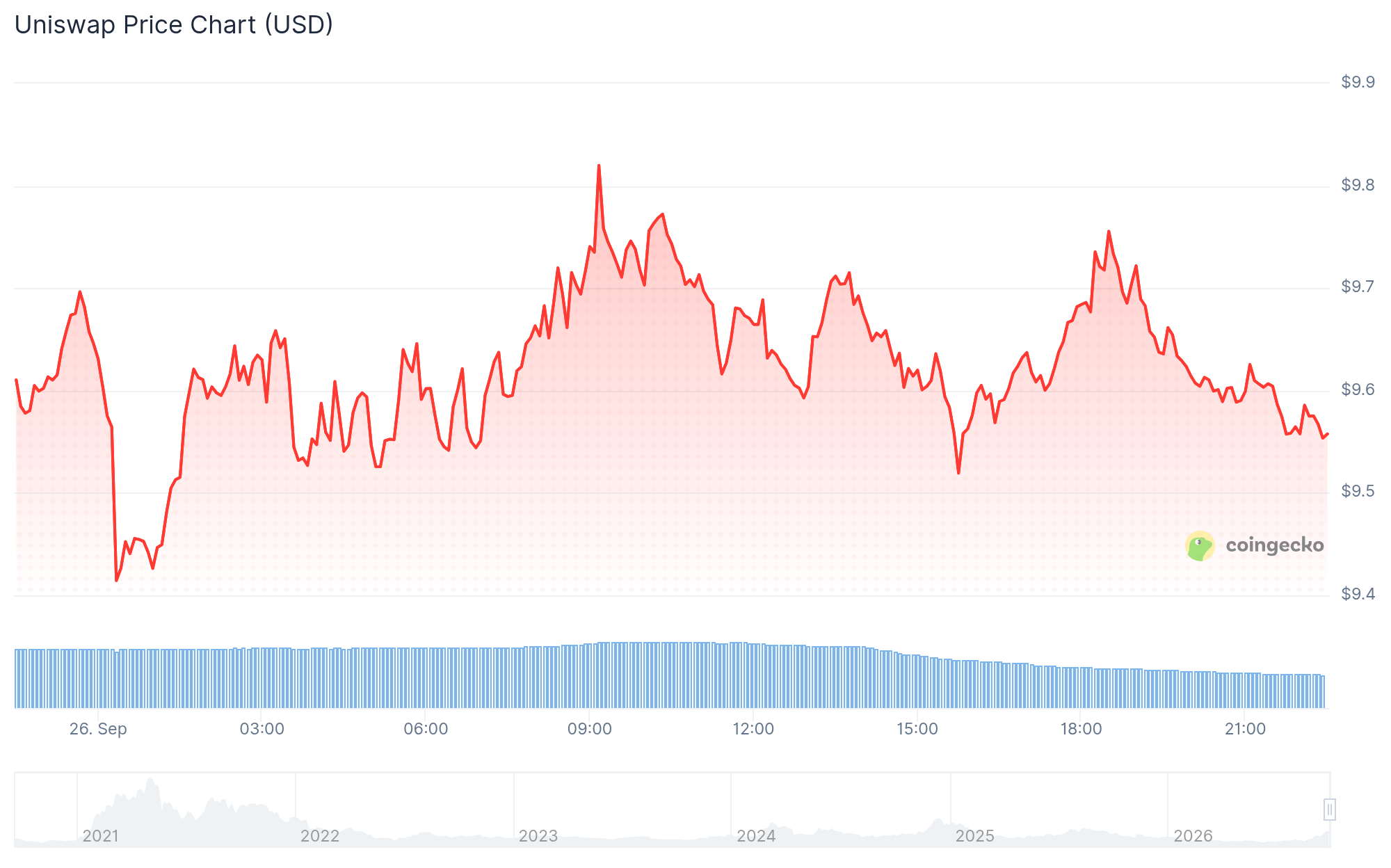
UNI Price Holds Its Breakout Below the $12.30 Hurdle
The Q3 move changed a structure that had restricted UNI. UNI price cleared the triangle and reached $10.85 before sellers slowed the advance. That breakout separates the range from the decline that followed the $45 peak in 2021.
UNI price must first hold the nearer support levels before challenging the larger targets. Market data places immediate support at $9.33 and short-term resistance near $9.93. A move through $9.93 would reopen the path toward the recent swing high. Failure to defend $9.33 could expose $8.37.
The daily chart identifies $12.30 as the next major hurdle above that short-term range. Buyers would need a sustained move above this area to strengthen the breakout structure. The next chart levels stand at $15.10 and $17.50 if $12.30 becomes support.
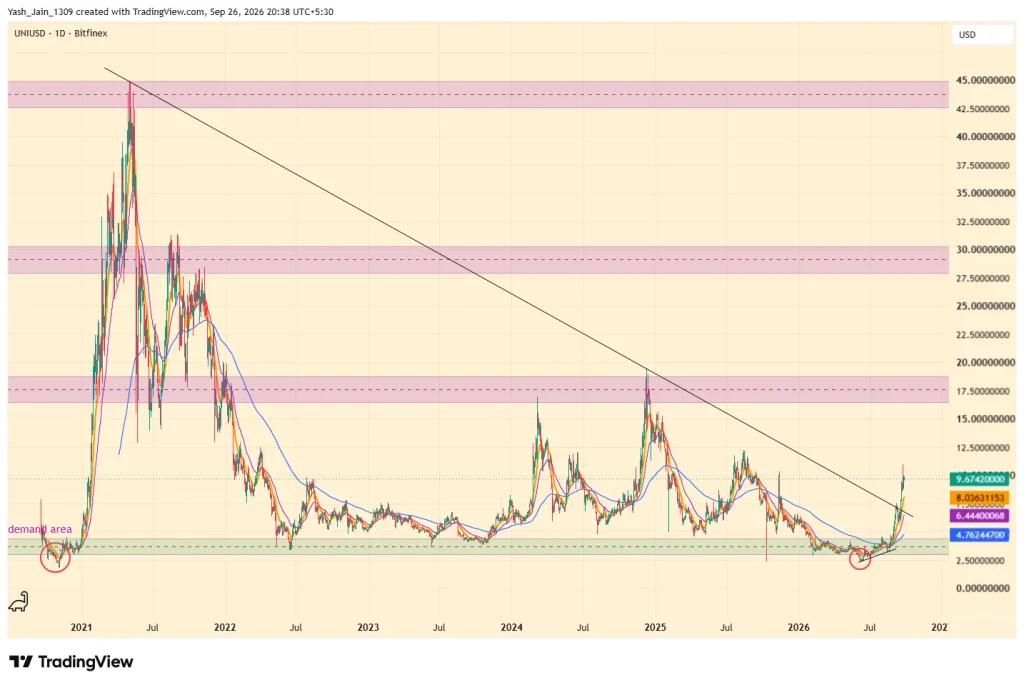
Momentum also cooled after the sharp rise, which reduces the strength of immediate continuation signals. UNI price therefore sits between a confirmed quarterly breakout and unresolved short-term resistance. The next directional move depends on whether buyers protect $9.33 and regain $9.93.
The September 30 PCE inflation report is a scheduled macro event for crypto markets. Changing rate expectations could influence volatility around UNI’s established chart levels.
Tokenized Stock Trading Strengthens Uniswap Activity
Protocol usage provides a separate measure from the token’s technical setup. Token Terminal said tokenized stocks produced $20.9 billion in decentralized exchange volume during the latest 30-day period. Uniswap v4 accounted for 40.7% of that trading, making it the largest venue version in the dataset.

Uniswap v3 contributed another 19.4%. Together, both versions processed 60.1% of tokenized-stock DEX volume. The figures show that activity spans two generations of Uniswap infrastructure rather than one isolated deployment.
A different Ethereum market-share comparison also shows growth for Uniswap v4. Its share reached 50% across Uniswap v2, v3, v4, and Curve, up from 31% in August 2025. V4 held the leading monthly position from March 2026 through the latest reading.
Uniswap v2 moved in the opposite direction. Its share fell from 5% to below 1% over the same period. That shift indicates trading activity migrated toward newer pool architecture as v4 gained adoption.
The two percentages measure different markets. The 40.7% figure covers tokenized-stock DEX volume, while the 50% reading covers the selected Ethereum DEX group. Keeping those datasets separate avoids overstating Uniswap v4’s share across all decentralized trading.
Rising protocol activity does not set a fixed value for UNI. However, it gives traders another operating metric beside chart momentum. The UNI price still needs to clear $9.93 before the market can test the broader $12.30 threshold.
If sellers force a break below $9.33, the short-term setup would weaken despite Uniswap’s volume share. The next support sits at $8.37, followed by the wider breakout zones near $8.25 and $6.35. Defending $9.33 would preserve the immediate range and keep $9.93 as the recovery level.
The post UNI Price Holds Breakout as Stock Token DEX Volume Reaches $20.9B appeared first on Blockonomi.
TLDR:
- Bitcoin ETFs attract $2.4 billion for the strongest week since October 2025, turning 2026 net flows positive at $934.1 million.
- BlackRock’s IBIT leads issuers with $1.2 billion, while Fidelity’s FBTC adds $701.7 million and ARKB receives $294.7 million.
- Ether ETFs reverse a $140 million outflow with $689.9 million in inflows, taking 2026 net additions to about $1.6 billion.
- Solana ETFs register a record $86.7 million inflow as weekly demand reaches $188.2 million and assets rise to $1.5 billion.
U.S. Bitcoin ETFs drew $2.4 billion in net inflows during the week ending Sept. 25. That marks their strongest weekly result since October 2025. The demand pushes their 2026 flow total back above zero. According to SosoValue data, the year-to-date inflows now reach about $934.1 million, reversing a deficit that stood near $5.8 billion two months earlier, in mid-July.
Monday provides the week’s largest daily share with a $999 million inflow. Daily additions then slow through Friday, but the funds extend their streak to seven sessions. Ether ETFs reverse the previous week’s outflow, while Solana ETFs record their largest single-day intake since their October 2025 launch.
Bitcoin ETFs Extend Seven-Day Inflow Streak to $3 Billion
The 12 Bitcoin ETFs collect $714.7 million on Tuesday after Monday’s near-billion-dollar opening. They add $347 million on Wednesday, $190.6 million on Thursday, and $134.5 million on Friday. That sequence takes the seven-session run, which starts September 17, to $3 billion.
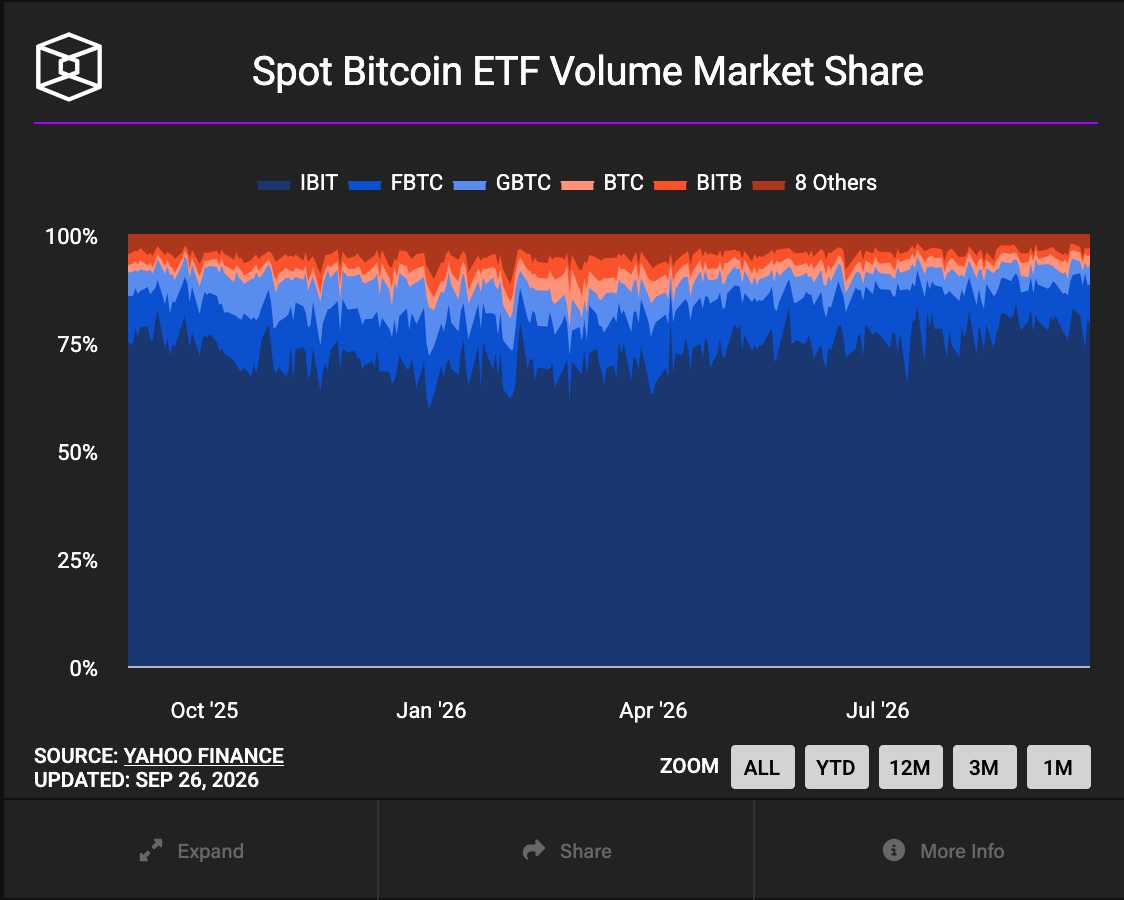
The prior week brings Bitcoin ETFs only $6.2 million, despite a $433 million Friday addition. Monday’s $999 million total ranks as the ninth-largest daily intake since these products launched in January 2024. It also marks their largest daily result since October 6, 2025. Each session records inflows.
BlackRock’s IBIT leads weekly demand with $1.2 billion, its second-largest weekly intake since October 2025. Fidelity’s FBTC follows with $701.7 million, its best result since the week of September 8, 2025. Ark and 21Shares’ ARKB receives $294.7 million, with most arriving during Monday’s session.
Morgan Stanley’s MSBT adds $203.3 million, setting a weekly record since its April debut. Its previous high was $71.1 million in mid-April. These allocations spread demand beyond the two largest funds, although IBIT and FBTC still account for most of the total.
Bitcoin ETFs hold $108.4 billion in net assets by Friday. Bitcoin ETFs’ cumulative inflows reach $57.6 billion since launch. Weekly trading volume falls to $15 billion from $16.2 billion, even as subscriptions rise. The funds therefore attract more new capital during a week with less secondary-market turnover.
The latest run follows the Treasury Department’s plan to increase buybacks of long-dated bonds. Market commentary links $5.3 billion in Bitcoin ETF inflows since the Treasury announcement to the buyback plan. The timing provides liquidity context for the reversal, although fund data do not establish a single cause.
Ether and Solana ETFs Record Strong Weekly Inflows
Ether ETFs collect $689.9 million during the week after losing about $140 million in the prior period. Monday brings $270 million, their strongest daily result since October 7, 2025. Daily additions then range from $66 million to $162.3 million across the next four sessions.

BlackRock’s ETHA leads with $326.2 million, while Fidelity’s FETH attracts $174 million. Grayscale’s Ethereum Mini Trust adds $100.3 million. BlackRock’s ETHB receives $47.5 million, including $31.9 million on Friday.
Ether ETFs now show about $1.6 billion in net inflows for 2026. Net assets reach $17.8 billion, while cumulative inflows since launch stand at $13.9 billion. Weekly trading volume declines to $4.8 billion from $6.9 billion.
Solana ETFs take in a record $86.7 million on Friday, their largest daily inflow since launching in late October 2025. Bitwise’s BSOL supplies $55.7 million, or about 64% of that amount. Weekly inflows reach $188.2 million, trailing only the products’ $199.2 million launch week.
Friday’s record closes a week that finishes $11 million below the launch-period peak. Combined fund assets rise by $300 million, or about 25%, across the same period. That increase takes the group from $1.2 billion to a record $1.5 billion. BSOL holds about 71% of those assets.
Spot XRP ETFs add $75.6 million for the week. Grayscale’s Zcash fund briefly crosses $1 billion in net assets on Thursday, expanding the week’s inflows beyond Bitcoin, Ether, and Solana products.
The post Bitcoin ETFs Turn Positive in 2026 After $2.4B Weekly Inflow appeared first on Blockonomi.
Key Highlights
- The Dow Jones Industrial Average surged 479 points on Friday, marking a 0.9% increase, while both the S&P 500 and Nasdaq advanced 0.5%
- Major equity indexes secured positive weekly performance despite mid-week market turbulence
- The benchmark 10-year Treasury yield climbed to its highest point since 2007, moderating slightly by Friday’s close
- Crude oil markets declined following diplomatic developments regarding the Strait of Hormuz
- Market pricing indicates better than 60% probability of a Federal Reserve rate increase in October
U.S. stocks finished Friday’s session in positive territory, capping off a tumultuous week of trading on Wall Street. The advance occurred despite Treasury yields climbing to heights unseen in nearly two decades.
The Dow Jones Industrial Average advanced 479 points, representing a 0.9% gain, settling at 51,829. Both the S&P 500 and Nasdaq Composite registered approximately 0.5% increases.
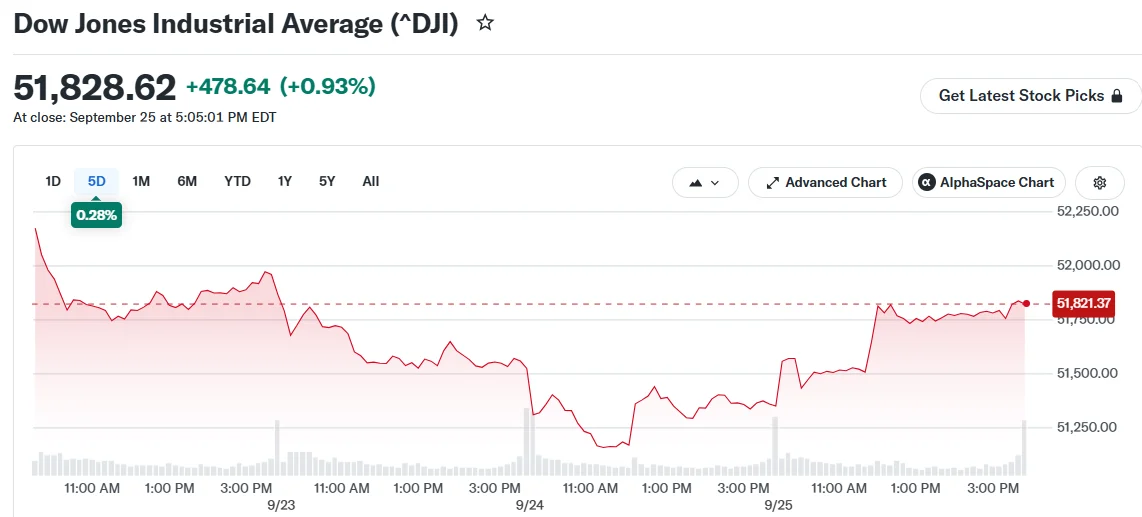
On a weekly basis, the Dow posted a 0.3% advance. The S&P 500 recorded a 1.2% gain, while the Nasdaq climbed 2%, successfully recovering from midweek losses.
Among individual movers, Akamai Technologies stood out with a notable 3% rally following its announcement of an extended partnership agreement with Anthropic.
Meta Platforms delivered impressive weekly performance, surging nearly 13% as investors reacted enthusiastically to the company’s latest artificial intelligence initiative, Muse.
Treasury Market Turbulence Shakes Investor Confidence
Fixed income markets experienced significant fluctuations throughout the week. The benchmark 10-year Treasury yield climbed to its loftiest level since 2007, briefly touching 5.228% before moderating.
By Friday’s close, it stood at 5.18%, marking a new 19-year peak. The 30-year Treasury yield finished at 5.5%, having breached that threshold for the first time in over two decades.
Meanwhile, the two-year yield declined modestly, settling at 4.862%.
Several catalysts have propelled yields higher. Among them are aggressive rhetoric from Federal Reserve policymakers, elevated energy costs stemming from Middle Eastern tensions, and purchasing managers data that exceeded forecasts.
Current Fed funds futures pricing suggests approximately 64% to 66% odds of a rate increase next month. Market participants are anticipating three additional quarter-percentage-point increases through the conclusion of 2027.
Crude Markets Retreat on Diplomatic Progress
Oil prices declined throughout the week following indications that American and Iranian officials were exploring an agreement to resume normal operations through the Strait of Hormuz. Iranian representatives have reportedly requested a return to terms outlined in a June memorandum of understanding.
West Texas Intermediate crude declined 2.33%, finishing at $92.41 per barrel. Brent crude, the global pricing standard, dropped 2.14% to close at $104.32 per barrel.
Market participants also monitored ongoing diplomatic engagement between Washington and Beijing during Chinese President Xi Jinping’s American visit.
Treasury Secretary Scott Bessent indicated that both nations had reached consensus on a two-month extension of their existing trade agreement. Additional specifics regarding the negotiations are anticipated in the near term.
Friday brought fresh consumer sentiment figures from the University of Michigan. The September index weakened from previous levels but exceeded initial projections.
The report revealed elevated inflation expectations among consumers across both near-term and extended timeframes. This development presents another consideration for Federal Reserve officials as they deliberate future monetary policy.
Market observers remain divided on the implications. Some warn that persistently elevated yields could ultimately pressure equity valuations and economic expansion. Others point to the economy’s demonstrated durability thus far.
Looking forward, market participants will remain focused on Treasury yields, energy prices, and trade negotiations for signals on market direction.
The post Stock Market Rallies Despite Treasury Yields Hitting Multi-Decade Highs appeared first on Blockonomi.
CryptoPotato
Researchers behind Alloc Init have proposed “Shielded Bitcoin,” a metaprotocol designed to hide BTC transfer amounts and counterparties without changing Bitcoin’s consensus rules or relying on trusted bridge operators.
The design borrows the encrypted-note approach Zcash made known, but builds it directly on Bitcoin’s existing base layer, using cryptographic proofs instead of a trusted intermediary to move value privately.
How the Privacy Layer Works
Presented by Clara Shikhelman, Mikhail Komarov and Aleksei Moskvin, the proposal starts with a simple limitation: Bitcoin’s ledger is public, so amounts, transaction timing and links between transactions can often be examined and associated with known wallets.
Shielded Bitcoin would place value into encrypted “notes,” with each note containing an amount and its owner’s receiving information. So, for example, when Alice pays Bob, her wallet would publish encrypted notes to Bitcoin alongside a zero-knowledge proof.
The proof confirms that the notes being spent exist and that Alice is authorized to spend them. It also confirms that the amounts balance, without exposing those details publicly.
Software called indexers would then read these transfers, verify the proofs, and track nullifiers, which are unique serial numbers that prevent the same note from being spent twice. According to the researchers, anyone can run indexers, meaning no single party can control the ledger.
The design also distinguishes spending from viewing, letting a wallet split into separate keys: one that spends funds and another that is read-only and detects incoming transfers. There’s also a third key that will detect incoming transfers and another that recovers a user’s own history, letting people share limited details with others without handing over spending power.
Where This Fits Among Bitcoin’s Privacy Options
Shielded Bitcoin could join a handful of existing efforts to keep BTC transaction data private, each with different tradeoffs. Some, like CoinJoin, PayJoin, and Silent Payments, work inside Bitcoin’s current transaction format and can make ownership harder to trace, but amounts and much of the transaction graph stay visible.
Shikhelman and her colleagues described Zcash as the closest precedent for its encrypted-note model. However, the privacy coin, which has been on a run that recently took it to its best price in ten years, uses encrypted notes, nullifiers and zero-knowledge proofs, but operates on its own blockchain and consensus rules while Shielded Bitcoin derives its state from Bitcoin’s history.
That distinction means transaction patterns, distinctive wallet behavior, and repeated publication fees could still help observers narrow down relationships over time.
Recently, Grayscale pointed to AI making it easier to link wallet addresses to real identities, and its research head Zach Pandl said tools like Zcash’s shielded transactions could become close to a necessity for privacy-minded users.
The post Researchers Propose Zcash-Style Privacy for Bitcoin Without a Soft Fork appeared first on CryptoPotato.
Institutional investors are keeping their crypto exposure steady despite the intense turmoil between Q4 2025 and Q2 2026, according to a survey by Bitwise.
The firm interviewed 15 institutions and found that none cut their allocation during a period when the market fell by about 50%.
Bitcoin Is the Institutional Favorite
Crypto allocations remain relatively small across the portfolios surveyed and range from 0.5% to 13% of investable assets. Most institutions hold between 1% and 2%. Their exposure is spread across ETFs, direct crypto holdings, venture capital, and hedge funds. The survey found that institutions are not stepping away from crypto. Some are maintaining their current targets, while others are still working toward higher allocations.
Several investors are also moving away from illiquid private placements. Some are even adding market-neutral strategies to reduce volatility and make crypto investments easier to approve internally. Bitwise said the debate is increasingly focused on how much crypto to hold and which investment vehicles to use, rather than whether to invest at all.
Institutional investors are also taking different approaches when it comes to Bitcoin, Ethereum, and Solana.
It is no surprise that Bitcoin remains the strongest point of conviction among those interviewed. Every institution that owns crypto also owns BTC. Many see it as a store of value and a hedge against currency debasement, often comparing it with gold. Some institutions hold Bitcoin as a standalone position, while others use a market-cap-weighted basket that still leaves around 80% of their crypto exposure in BTC.
Ethereum and Solana, however, face a different test. Bitwise found that institutions that own them generally keep smaller positions and have shorter investment timelines. Their decisions are tied to specific adoption and value-accrual expectations. Some investors avoid the two assets entirely because they do not see a clear link between blockchain activity and token value.
Others treat them as venture-style technology bets. Institutions holding these assets are watching real-world usage, transaction activity, and fees.
ETFs Change the Game
Meanwhile, spot crypto exchange-traded funds have changed the way institutions enter the market. Almost every institution interviewed either already uses these funds or plans to use them. Several investors moved from direct crypto custody to ETFs as they cited lower costs, less operational work, and simpler reporting.
Institutions still holding private crypto vehicles are also looking at ETFs. Many see better liquidity and more flexibility for portfolio rebalancing.
However, not every player is making the switch. Some face rules that prevent them from holding spot commodities, including through ETFs. Others want direct control of crypto assets and are building their own custody systems. One institution also raised concerns about public disclosure of ETF holdings through 13F filings.
The post Institutions Watched Bitcoin Fall 50%: Yet None of 15 Bitwise Surveyed Investors Cut Exposure appeared first on CryptoPotato.
The failure of the CLARITY Act in the US Senate on September 15 hasn’t deterred the two largest local regulators from trying to clear the air on crypto regulation in the country, with the Securities and Exchange Commission now issuing fresh staff guidance addressing several long-running questions.
The new set of FAQs focuses heavily on when tokens may fall outside securities regulation and what types of issuer activity do or do not create new Howey-related concerns.
New Set of FAQs
One of the more notable sections addresses Staking Receipt Tokens, which represent ownership of crypto assets deposited for staking. The circumstances described by the watchdog indicate that a staking receipt tied to a digital commodity that is not subject to an investment contract can be considered a digital tool since it simply evidences ownership of the underlying asset.
In certain cases, such a token may instead qualify as a digital commodity when issued by a protocol-based liquid staking provider. The distinction depends heavily on what rights the receipt actually creates. The agency said a true “receipt” should not transfer ownership or control of the deposited asset to the issuer, nor allow that issuer to lend, pledge, rehypothecate, or otherwise use it.
According to the statement, continuing to secure, maintain, improve, or enhance a functional blockchain network, including funding development or encouraging network effects, does not constitute the type of “essential managerial efforts” typically associated with an investment contract under Howey.
Once a functional crypto system has no central controlling party, statements by an original issuer would generally be less likely to create a new investment contract around the native asset.
Token Buybacks and Marketing
Announcing a buyback of a non-security token for a functional crypto system would not amount to a promise of essential managerial efforts. The answer, though, changes if the network is not yet functional and the issuer markets the buyback as a mechanism designed to generate yield or returns for holders.
Broader marketing receives similar treatment, as the SEC said simply promoting a network’s existing utility or capabilities would generally not be enough to establish an investment contract. Even aspirational statements about future features may fall outside that threshold if they do not promote the prospect of profit.
These FAQs follow the most recent guidance issued by the SEC and the CFTC after the CLARITY Act vote failed in the US Senate.
The post SEC Issues Fresh Crypto Guidance on Staking Tokens, Buybacks, and the Howey Test appeared first on CryptoPotato.
Ethereum remains in a constructive broader structure despite cooling off after its latest rally. ETH is consolidating below $2.7K after rejection from the $2.75K-$2.82K resistance zone, while the daily moving averages are approaching a potentially important bullish crossover.
ETH Price Analysis: The Daily Chart
On the daily timeframe, Ethereum’s structure remains bullish following the explosive breakout from the $1.85K-$1.92K demand zone in August. Since then, the market has established a sequence of higher lows, with the ascending trendline continuing to provide structural support.
The latest rally pushed ETH directly into the major $2.75K-$2.82K resistance zone, where selling pressure emerged and prevented an immediate breakout. The asset has since stabilized around $2.69K rather than undergoing a correction, suggesting buyers are still maintaining control of the broader structure.
Another notable development is the convergence of the two displayed moving averages. The faster yellow average is rising sharply toward the slower orange average around the $2.05K-$2.10K region. If the faster average crosses above the slower one, it would form a golden cross and provide further technical confirmation that the medium-term trend has shifted in favor of buyers. However, the crossover has not occurred yet and therefore remains a potential signal rather than a confirmed one.
A daily breakout above the $2.75K-$2.82K resistance zone could open the door toward the next major supply area around $2.90K-$3K. Meanwhile, the $2.36K-$2.52K zone, reinforced by the rising trendline, represents the key support area if a deeper pullback develops.
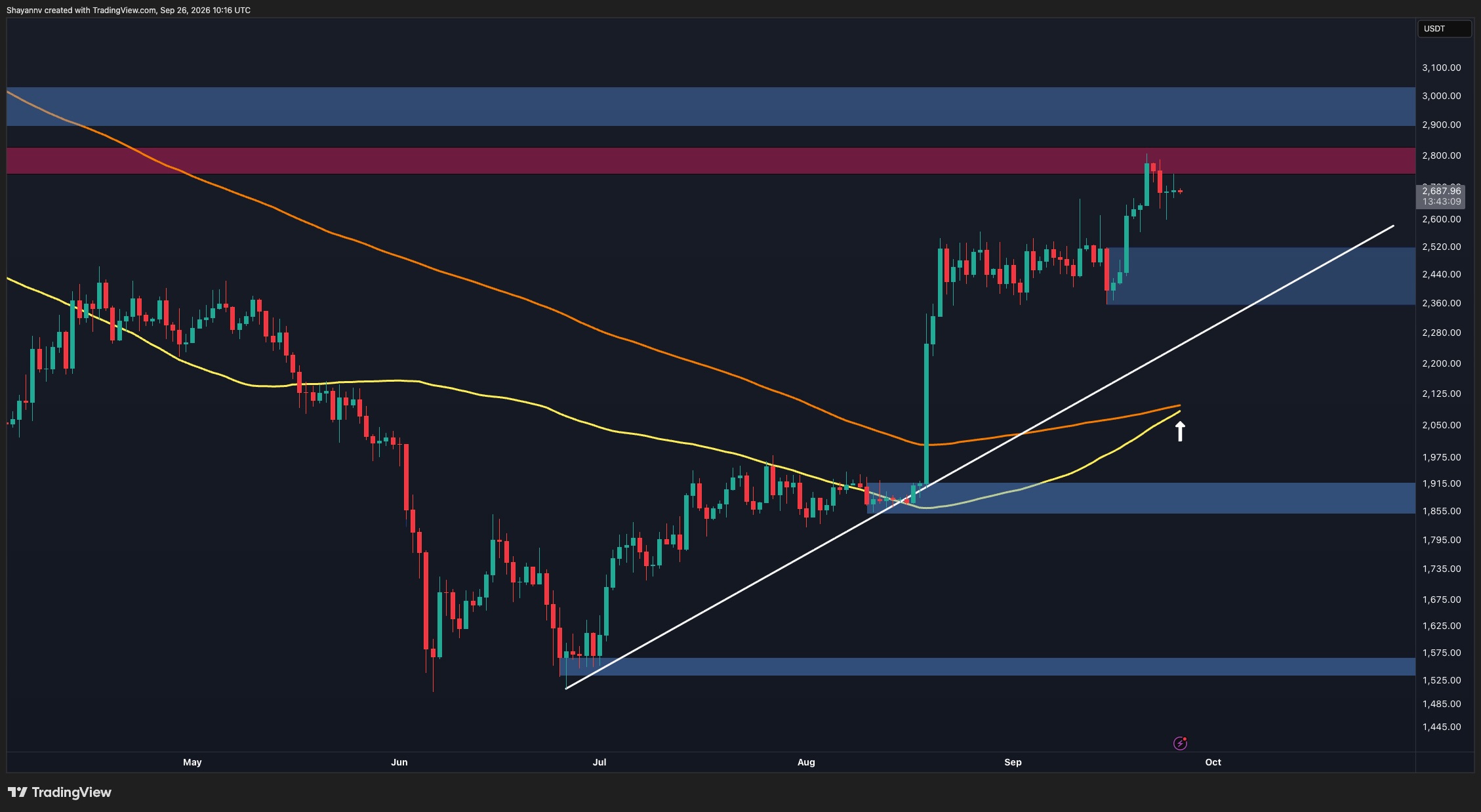
ETH/USDT 4-Hour Chart
The 4-hour chart shows ETH compressing immediately beneath the $2.75K-$2.82K resistance area. Following the rejection from roughly $2.8K, the price briefly dipped toward $2.63K before recovering and entering a tight consolidation around $2.68K-$2.70K.
At the same time, the rising trendline connecting the recent higher lows is gradually approaching price. This creates a tightening structure between ascending support and the overhead resistance zone. As long as ETH remains above this trendline, short-term momentum appears constructive, and another challenge of $2.75K-$2.82K remains plausible.
A confirmed breakout above $2.82K would strengthen the continuation scenario toward the $2.90K-$3K resistance zone. Conversely, losing the ascending trendline could trigger a deeper correction, initially putting the $2.43K-$2.49K demand zone back into focus. Below there, the larger $2.21K-$2.28K support area would become relevant.

Sentiment Analysis
The one-week Binance ETH/USDT liquidation heatmap shows significant concentrations of leveraged positions on both sides of the current price, although the most prominent nearby liquidity is above the market.
A particularly dense liquidation cluster has developed around $2.78K-$2.82K, closely overlapping with the technical resistance visible on both price charts. This makes the area especially important. If ETH manages to break above resistance, the liquidation concentration could act as a magnet and potentially amplify the move as short positions are forced out.
On the downside, another substantial liquidity pool is visible around $2.60K-$2.62K. Therefore, failure to break higher and a loss of short-term support could draw the price toward this region first.
Overall, Ethereum is effectively caught between downside liquidity near $2.6K and a larger overhead cluster around $2.8K. Combined with the tightening 4-hour structure and the potential daily golden cross, a decisive break from the current consolidation could lead to a notable expansion in volatility.

The post Ethereum Price Analysis: ETH Eyes $3K, but These Major Hurdles Stand in the Way appeared first on CryptoPotato.
The NYSE-listed semiconductor company Sequans Communications announced earlier this week that it had sold its remaining 34 BTC and had officially closed the book on its Bitcoin treasury strategy.
The company has finalized its exit, which began earlier this year, as management prioritized debt reduction and refocused on its core business.
Done With Bitcoin
The press release shared by the company said the final sale leaves it with no cryptocurrency holdings on its balance sheet and no outstanding debt, except for obligations tied to government-funded research and development programs. Sequans framed the move as the final step in a broader balance-sheet restructuring rather than a bearish call on Bitcoin itself.
CEO Georges Karam said his company had monetized its remaining holdings in a “measured and opportunistic manner,” but it will now devote its full attention to its semiconductor growth strategy.
Sequans began its BTC retreat in May after using a portion of its BTC holdings to redeem all remaining convertible debt issued in July 2025. Back then, it still held roughly 658 BTC, but explicitly announced that its digital asset treasury strategy had concluded and that those remaining units would be monetized over time. By June 30, its total stash had fallen to 314 BTC, but it was emptied out entirely as of late September.
On the plus side, the company’s product revenue rose by more than 80% year-over-year in Q2, while its six-month product backlog more than tripled, according to the PR.
Various Takes on BTC Strategy
Aside from Sequans, other public companies also reduced their exposure to BTC this year, including Satsuma Technologies. It also dismantled its treasury vehicle, disposing of the remaining units a few months back. Empery Digital sold 1,400 BTC for about $87 million earlier this year as well.
Perhaps the biggest surprise came from Strategy, which broke with its long-standing buy-only approach during the summer, completing a few consecutive sales. However, it resumed its accumulation spree in late August and last week as BTC’s price started to recover and Strategy’s position turned green.
Strive has been on the opposite side; no sales have been conducted, and it has only accelerated its BTC purchases. Its stash reached 25,000 units earlier this month, and it acquired another 1,355 BTC last week.
The post Why Is This Company Dumping All of Its Bitcoin and Abandoning Its BTC Strategy? appeared first on CryptoPotato.