Cryptocurrency Posts
Crypto Briefing
HPE's $1.2B Vultr order highlights the escalating investment in AI infrastructure, potentially boosting HPE's financial growth and market position.
The post Hewlett Packard Enterprise secures $1.2B Vultr order for AMD Helios AI racks appeared first on Crypto Briefing.
The CFTC is investigating Adam Kinzinger over Kalshi prediction market trades tied to his own presidential pardon, netting him just $823.
The post CFTC investigates Adam Kinzinger over Kalshi trades tied to his own pardon appeared first on Crypto Briefing.
The UK's regulatory shift could enhance crypto market stability, ensuring consumer protection and fostering trust in digital assets.
The post UK FCA begins accepting crypto authorization applications appeared first on Crypto Briefing.
Scorechain's integration with Sui Network enhances compliance capabilities, potentially setting new standards for blockchain monitoring and security.
The post Scorechain brings compliance monitoring tools to the Sui Network appeared first on Crypto Briefing.
Increased altcoin exchange deposits may signal impending market volatility, highlighting potential shifts in investor sentiment and market dynamics.
The post CryptoQuant reports 160% surge in altcoin exchange deposits in 2 weeks appeared first on Crypto Briefing.
Bitcoin Magazine
Bitcoin Magazine
Bitget Customers Withdraw Over 4,000 Bitcoins in One Hour Following $388M Hack
Investors withdrew over 4,000 bitcoins worth over $334 million at today’s prices in one hour after hacked Bitget resumed customer withdrawals, the company’s CEO has said.
Bitget CEO Gracy Chen told Bloomberg Television Tuesday that withdrawals from the exchange had since stabilized following the immediate bitcoin transactions.
Hackers last week made away with $388 million in crypto after targeting the Victoria, Seychelles-based exchange’s hot wallets.
“The withdrawals actually stabilized a lot today,” Chen said. “Those hundreds of millions [in bitcoin withdrawals] actually most of them happen on the first hour of the withdrawal restart.”
In a Monday X post, Chen said that 9,585 orders of 4,098 bitcoins were processed. The exchange is allowing customers to withdraw funds in phases.
Bitget froze withdrawals after blockchain experts flagged that money was leaving the exchange. Bitget later said the attack method in the incident was “highly consistent with known patterns of North Korean hacker organizations.”
Chen said that no cold storage funds were touched but rather attackers had “exploited vulnerabilities from third-party products to steal internal credentials, then used those credentials to send fraudulent withdrawal commands that bypassed our risk controls.”
She added that the company was using its own money to top up its protection fund after it dropped in size. Bloomberg reported that it was below $200 million after standing at $464 million before the hack.
Bitget said that it was the first “security incident of this nature in eight years.”
“The incident remains contained, and no further unauthorized transfers are possible,” the exchange noted.
Bitget is the sixth biggest by trading volume, according to CoinGecko, processing in the past 24 hours $811 million in transactions. The exchange’s customers are mostly based in Asia.
Attackers linked to North Korea’s government have long targeted crypto exchanges and are some of the most sophisticated cyber criminals out there.
This post Bitget Customers Withdraw Over 4,000 Bitcoins in One Hour Following $388M Hack first appeared on Bitcoin Magazine and is written by Mathew Di Salvo.
Bitcoin Magazine

Bitwise Head of Research: Sovereigns Selling Gold for Bitcoin | Ryan Rasmussen
When Bitcoin fell from $125K to $60K, not one of the 15 major institutions Bitwise interviewed sold, and many bought more. Ryan Rasmussen, head of research at Bitwise, breaks down the firm’s first institutional crypto adoption report, covering pensions, endowments, foundations, and sovereign wealth funds, and why they treat Bitcoin alongside gold as a hedge against debasement.
Chapters:
0:00 Ryan Rasmussen on Bitwise’s Institutional Crypto Adoption Report
0:49 Why No Institutions Sold Bitcoin During the Bear Market
1:45 Wells Fargo’s 2–3% Bitcoin Allocation and the Debasement Thesis
3:45 Fidelity, BlackRock, and 2–8% Bitcoin Allocations
4:50 How ETFs Made This Bitcoin Bear Market Shallower
6:24 $2.5B in Weekly ETF Inflows and a New Wave of Capital
7:06 Why Bitwise Believes the Bitcoin Bottom Was $60K
9:36 Why Institutions Hold Both Bitcoin and Gold
11:37 Sovereign Wealth Funds Selling Gold to Buy Bitcoin
15:17 Why Bitcoin Isn’t Correlated to Bonds, Gold, or Stocks
DISCLAIMER: The views and opinions expressed in this show are those of the participants and do not necessarily reflect the official policy or position of BTC Inc., Bitcoin Magazine, or any affiliated entities. This content is provided for informational and educational purposes only and should not be construed as investment, legal, tax, or accounting advice. Nothing contained in this show constitutes a solicitation, recommendation, endorsement, or offer to buy or sell any securities or financial instruments. Viewers should consult their own advisors before making financial or business decisions.
This post Bitwise Head of Research: Sovereigns Selling Gold for Bitcoin | Ryan Rasmussen first appeared on Bitcoin Magazine and is written by Patrick Green.
Bitcoin Magazine

Tracy Shuchart: BTC & the Commodities Supercycle
Six million barrels a day of oil still aren’t getting through the Strait of Hormuz, and Tracy Shuchart says markets are still tightening. The NinjaTrader Live senior economist explains why lost GCC production won’t come back quickly, why crack spreads are signaling stress, and why the global refining shortage could get worse heading into winter.
Chapters:
0:00 Tracy Shuchart on the Strait of Hormuz and Tightening Oil Markets
1:07 Crack Spreads, Russian Refineries, and the Global Refining Shortage
2:50 Fall Refinery Maintenance and a Dire Winter Setup
3:22 Why a US Diesel Export Ban Would Backfire
4:45 Gold vs. Bitcoin: Why Hard Assets Are Holding Up
7:15 Venezuela’s Oil Discount and What It Means for US Refiners
8:31 Venezuela as a Geopolitical and Critical Minerals Play
9:28 AI Data Center Debt and Stress in the Bond Market
11:02 The Coming Copper Shortage and AI’s Supply Problem
12:41 Can the US Grow Its Way Through a Supply Shock?
DISCLAIMER: The views and opinions expressed in this show are those of the participants and do not necessarily reflect the official policy or position of BTC Inc., Bitcoin Magazine, or any affiliated entities. This content is provided for informational and educational purposes only and should not be construed as investment, legal, tax, or accounting advice. Nothing contained in this show constitutes a solicitation, recommendation, endorsement, or offer to buy or sell any securities or financial instruments. Viewers should consult their own advisors before making financial or business decisions.
This post Tracy Shuchart: BTC & the Commodities Supercycle first appeared on Bitcoin Magazine and is written by Patrick Green.
Bitcoin Magazine
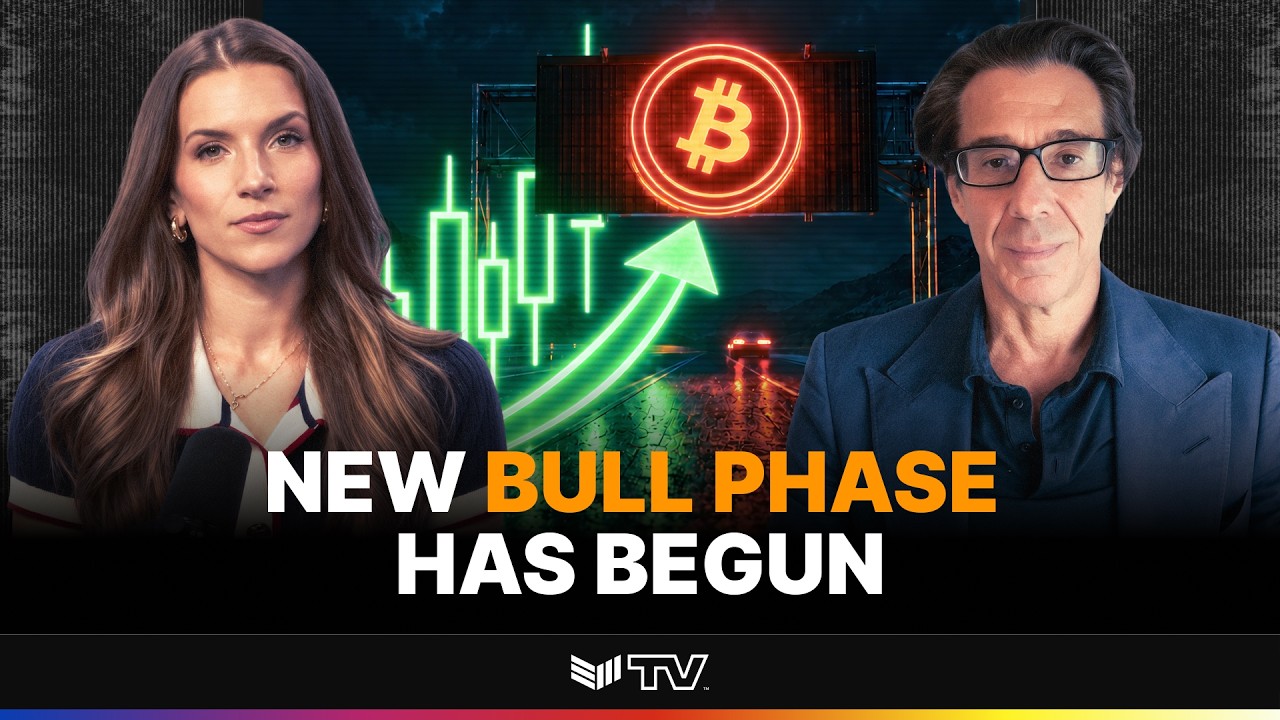
Dan Tapiero: “We’ve Begun a Bull Phase” in Bitcoin
Dan Tapiero says a new bull phase has begun in the core assets of the digital asset space. The founder and CEO of 50T Funds explains where he’s seeing real revenue growth underneath the hood, from stablecoins and tokenization to Kraken, Ledger, and Polymarket, and why Hyperliquid has been leading the market.
Chapters:
0:00 Dan Tapiero on What Makes a Digital Asset Company Worth Backing
1:25 Passing on FTX, Celsius, and BlockFi – Why Valuation Matters
3:50 Where the Real Revenue Growth Is: Stablecoins, Tokenization, and Kraken
5:15 Bitcoin, Solana, and Why Hyperliquid Is Leading This Bull Phase
6:59 Raising the $500M 50T Fund and Institutional Appetite
9:41 50T’s $42M MoonPay Investment
11:05 Japan’s 30-Year Bond Base and the Biggest Macro Theme
14:04 Scott Bessent, the Yen, and Kevin Warsh’s Rate Hike
16:31 AI, Productivity, and the Natural Rate of Interest
18:22 The Debasement Trade: Why Bitcoin and Gold Win Long Term
DISCLAIMER: The views and opinions expressed in this show are those of the participants and do not necessarily reflect the official policy or position of BTC Inc., Bitcoin Magazine, or any affiliated entities. This content is provided for informational and educational purposes only and should not be construed as investment, legal, tax, or accounting advice. Nothing contained in this show constitutes a solicitation, recommendation, endorsement, or offer to buy or sell any securities or financial instruments. Viewers should consult their own advisors before making financial or business decisions.
This post Dan Tapiero: “We’ve Begun a Bull Phase” in Bitcoin first appeared on Bitcoin Magazine and is written by Patrick Green.
Bitcoin Magazine
HANetf Debuts Euro-Hedged Bitcoin Fund in World First
A new bitcoin exchange-traded fund has hit Europe — with a twist.
Debuted by $9.2 billion ETF provider HANetf, the Arrow Bitcoin EUR Hedged ETF gives European investors exposure to bitcoin while reducing the impact of movements between the euro and the US dollar.
Because bitcoin is priced in dollars, European investors who buy an unhedged product are exposed to two things at once: the bitcoin price and the dollar’s moves against the euro.
JUST IN:
— Bitcoin Magazine (@BitcoinMagazine) September 29, 2026$9.2 billion ETF provider HANetf launches the first ever euro-hedged Bitcoin exchange traded commodity
pic.twitter.com/Bg5tFJ2yAj
The new exchange-traded commodity — a fund that gives investors exposure to a commodity — aims to remove the second of these in a product described by HANetf as the world’s first.
“With this launch, we are bringing the established logic of euro-hedged ETFs to the crypto market,” Hector McNeil, co-founder and co-CEO of HANetf, said in a statement. “Investors have long understood that currency movements can have a meaningful impact on returns on different asset classes, for example gold.”
“Similar to gold, bitcoin is priced in US dollars, meaning European investors can end up taking two views at once: a view on bitcoin itself and a view on the dollar.
HSBC will provide the currency hedging for the product. Typically, euro-hedged funds work by a bank entering forward contracts to sell the equivalent dollar amount for euros at a fixed rate on a future date.
If the dollar then weakens against the euro, the loss on the bitcoin’s euro value is offset by a gain on the forward, and vice versa. These contracts are usually rolled monthly, and the hedge is resized when they roll.
Bitcoin ETFs in the U.S. have been a huge success since the Securities and Exchange Commission approved them in 2024.
Managed by the likes of BlackRock, Fidelity, Morgan Stanley and others, the products allow investors to buy shares that track the price of bitcoin, without having to worry about storing the cryptocurrency themselves.
The funds now manage a combined total of $111.1 billion in assets, according to Coinglass, following the most successful launch in the history of ETFs.
This post HANetf Debuts Euro-Hedged Bitcoin Fund in World First first appeared on Bitcoin Magazine and is written by Mathew Di Salvo.
CryptoSlate
Coinbase, the largest US-based crypto exchange, has secured Commodity Futures Trading Commission (CFTC) approval for its own derivatives clearinghouse, completing a vertically integrated US trading stack.
On Sept. 28, the CFTC registered Coinbase Clearing LLC as a derivatives clearing organization, authorizing it to clear fully collateralized futures, options on futures, and swaps. The approval gives Coinbase control over a function that has previously depended on outside clearing partners.
Coinbase now operates across the three main layers of the regulated US derivatives market: Coinbase Financial Markets as a futures commission merchant, Coinbase Derivatives as a designated contract market and Coinbase Clearing as a registered clearinghouse. The company said the structure gives it end-to-end infrastructure for bringing regulated products to market.
The immediate scope is narrower than the full derivatives business Coinbase is building. The new clearinghouse can directly create and settle fully collateralized contracts, with Coinbase pitching USDC collateral and 24-hour settlement as advantages for products designed around always-on markets.
Owning that infrastructure could shorten product-development cycles and reduce reliance on third parties for eligible contracts. The firm said it expects the clearinghouse to support more efficient operations and give it greater flexibility to introduce regulated derivatives over time.
Stock perps remain outside Coinbase's new clearinghouse
However, one of Coinbase’s most ambitious planned products will initially remain outside that integrated structure.
The company said it will continue using existing partners for parts of its margined derivatives business and for its planned single-stock perpetual futures. Those contracts remain under separate regulatory review even after the clearinghouse approval.
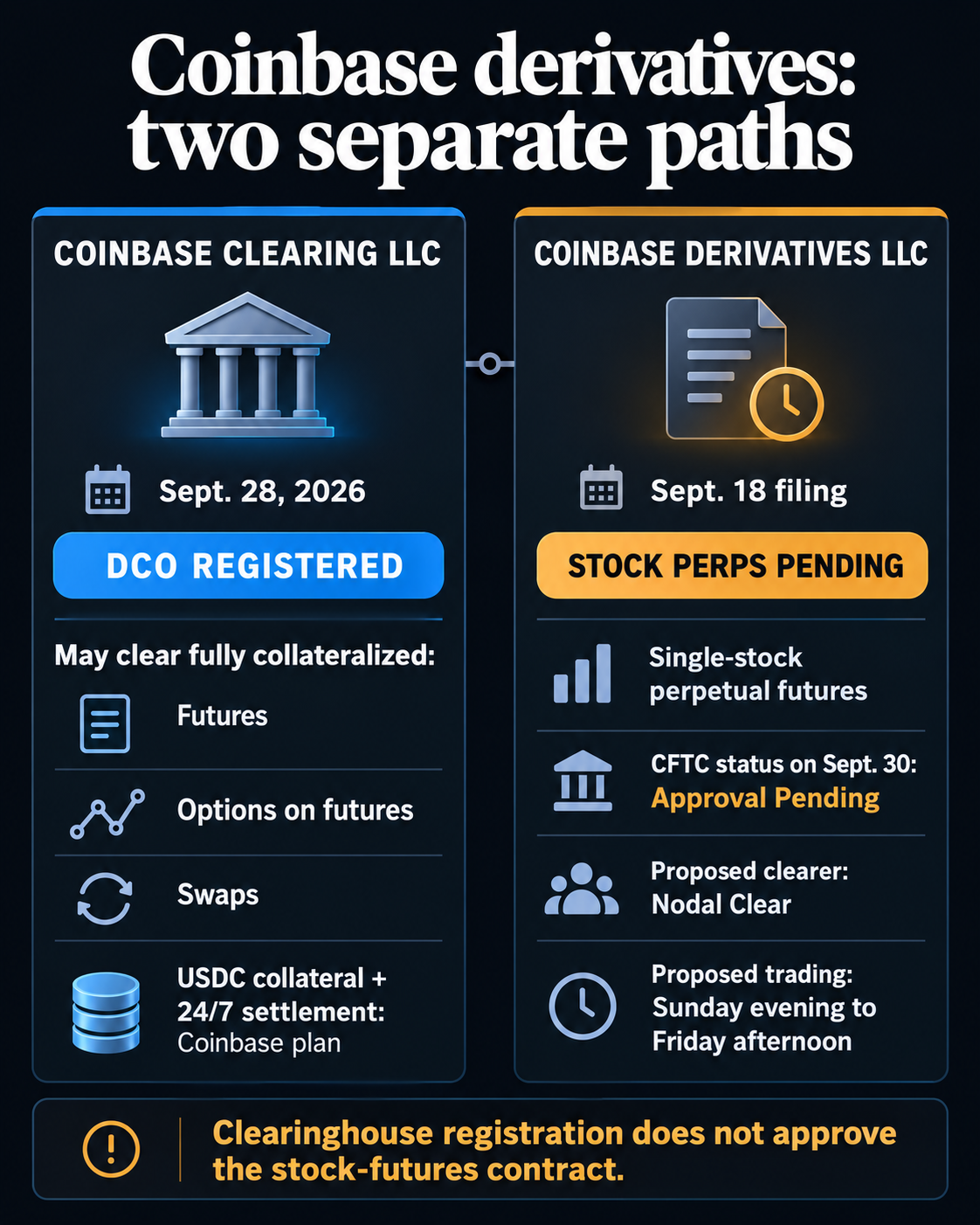
The CFTC’s product record for Coinbase Derivatives continued to show its Single Stock Perpetual Futures Contract as “Approval Pending” on Sept. 30. The exchange filed the proposal on Sept. 18 and said it intended to begin listing the contracts shortly after approval, subject to any additional regulatory requirements
The filing proposes cash-settled perpetual futures tied to individual US equities and exchange-traded funds, with Apple serving as the representative contract. Unlike conventional futures, the contracts have no fixed expiration and use periodic funding payments to keep their prices aligned with the underlying shares.
That representative Apple contract names Nodal Clear LLC, rather than Coinbase Clearing, as the central counterparty. Its proposed trading window runs from 8 p.m. Eastern on Sunday through 5 p.m. Friday, while Coinbase describes its new clearing infrastructure as capable of 24/7 settlement.
The split gives the US-based crypto trading platform more control over fully collateralized derivatives while retaining external infrastructure for products that require a different clearing arrangement.
What moves onto Coinbase Clearing next will determine how quickly that changes. The company can now develop products around its own USDC-based clearing system, while approval of the stock perpetuals would open a separate expansion into equity-linked derivatives.
For now, the next regulatory milestone sits with the stock-perpetual filing. If approved, Coinbase will gain the product it has positioned as a major extension of its derivatives business, even as the contracts begin life on infrastructure the company does not fully control.
The post Coinbase just completed its US derivatives stack but its biggest bet still sits outside it appeared first on CryptoSlate.
Bitcoin’s newly confirmed bull market is already showing signs that the rally powering it may be losing momentum.
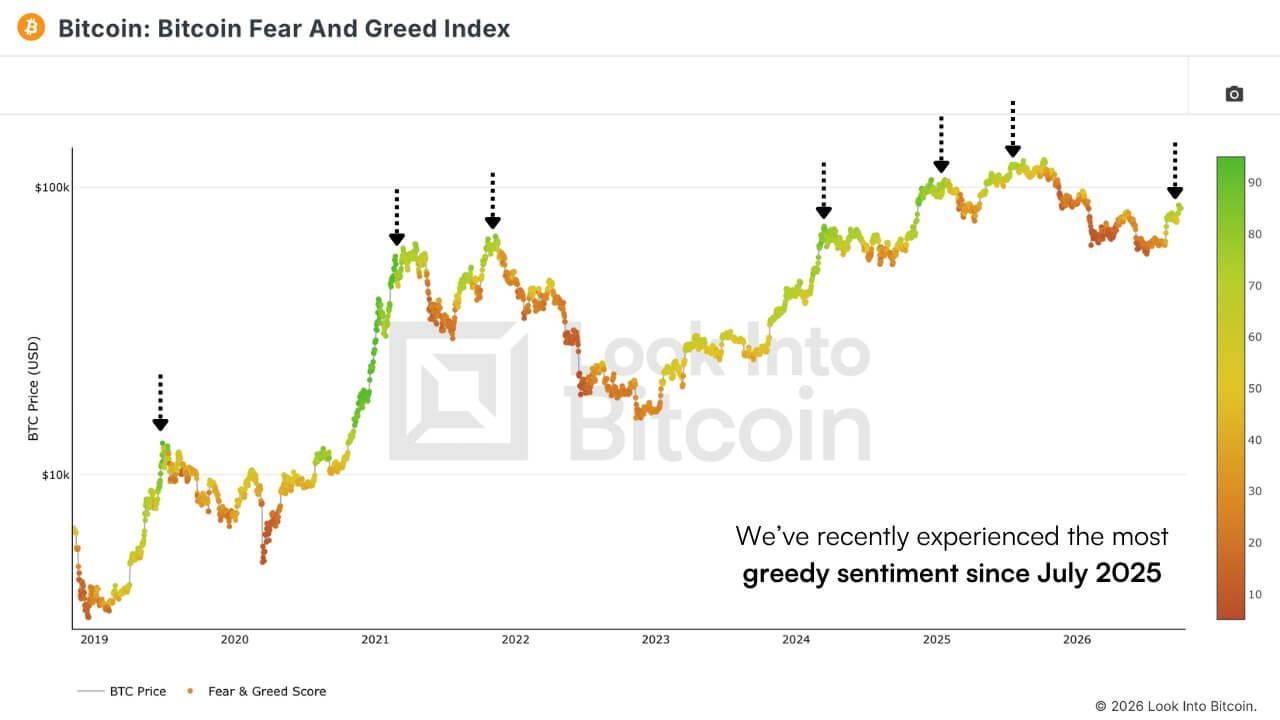
Last week, the top digital asset climbed to an eight-month high near $87,400 after reclaiming a long-term technical threshold that CryptoQuant says marked the start of a fresh bullish phase. Its Bitcoin Bull Score Index has since risen to 90 out of 100, a reading consistent with broadly favorable market conditions.
In fact, data from Look Into Bitcoin shows that “Bitcoin sentiment has hit its greediest reading since July 2025.”
But beneath that headline strength, the balance between new demand and existing holders looking to cash out is beginning to shift.
The change does not yet amount to a breakdown in the broader trend. Bitcoin remains above several long-term support levels and has retained much of its recent advance. Still, weakening demand and heavier profit-taking raise the prospect that the market could face its first meaningful test since the bullish breakout.
Demand fades as spot buying weakens and holders take profits
The clearest strain is emerging across the sources of demand that supported Bitcoin’s advance.
CryptoQuant estimates apparent spot demand contracted by about 170,000 BTC over the past 30 days, suggesting cash-market buying has failed to keep pace with the rally.
US exchange-traded fund flows point in the same direction. CryptoSlate previously reported that ETF daily inflows declined by 97% over the past week, falling from around $1 billion to just $31 million by Sept. 28.
Speculative demand has cooled even faster.
CryptoQuant estimates growth in futures demand has fallen to about 16,000 BTC from 164,000 BTC on Sept. 14, removing another source of incremental demand as Bitcoin retreats from $87,400.
The slowdown is becoming more consequential because existing holders are sitting on increasingly large gains.
Short-term traders’ unrealized profit margin has climbed to 33%, its highest since December 2024, expanding the pool of gains available to be realized if investors choose to reduce exposure.
Some have already done so.
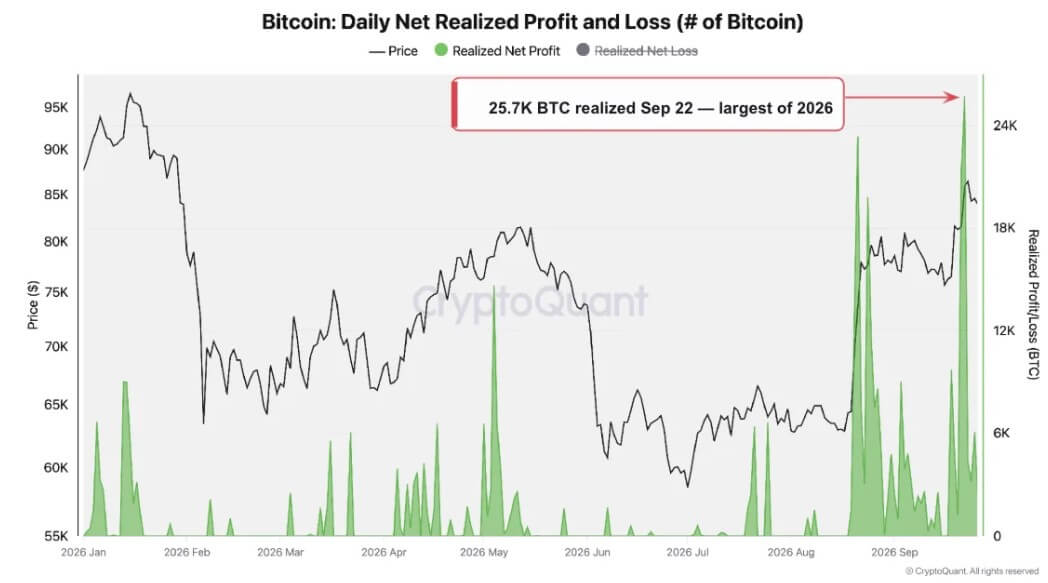
Bitcoin holders realized profits on 25,700 BTC on Sept. 22, the largest single-day total of 2026, according to CryptoQuant, as investors used the rally to lock in gains near the top of the recent range.
That leaves Bitcoin confronting a widening imbalance: the pace of fresh buying has weakened while the amount of profitable supply available for sale has increased.
The combination does not establish a cycle top. But another sustained leg higher would likely require spot demand to strengthen enough to absorb profit-taking from holders who accumulated Bitcoin at lower prices.
Futures take control as liquidation risk flips to Bitcoin longs
Bitcoin’s market structure has become increasingly dependent on derivatives even as overall leverage retreats.
CryptoQuant data shows the spot-to-futures volume ratio on Binance at about 0.12, meaning roughly 90% of combined trading activity is in futures. For every dollar traded in the spot market, roughly $8 to $9 is changing hands through derivatives.
Despite falling leverage, that imbalance has barely improved because cash-market participation remains subdued.
Open interest on Binance has dropped to about $9.2 billion from $10.6 billion over the past week. Glassnode data points to a broader decline, showing that BTC's coin-denominated open interest has fallen nearly 20% to its lowest since March despite the recent market rally.
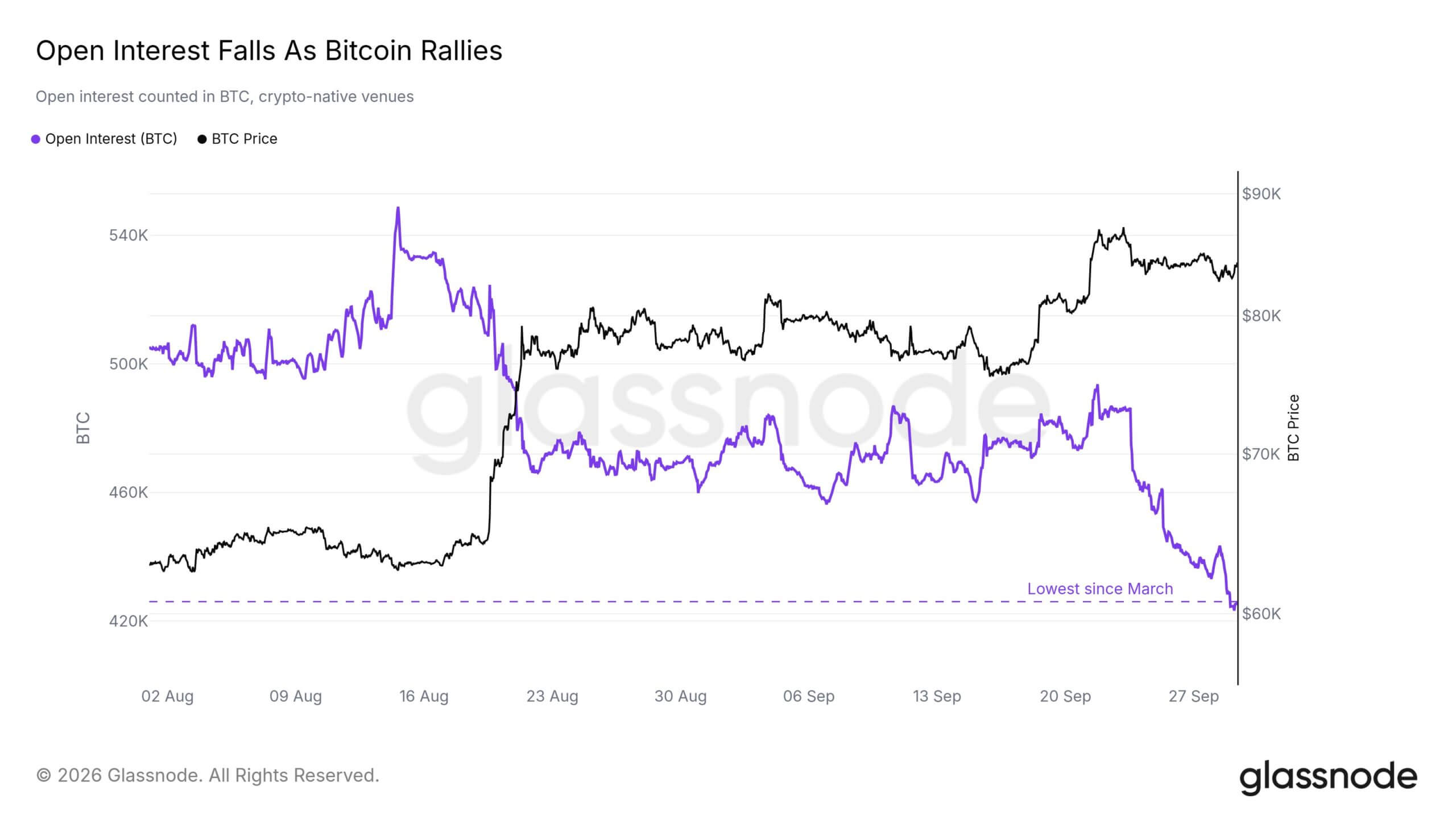
That retreat cuts both ways. Lower leverage reduces the amount of speculative fuel available for another rapid advance, but it also makes the market less vulnerable to the kind of crowded positioning that can amplify liquidations.
The composition of the remaining leverage, however, is becoming more important.
Alphractal data shows Bitcoin’s advance toward $87,000 swept through the largest clusters of short positions accumulated over the past 365 days. The move included what the analytics firm described as the biggest short-liquidation pool of the year, forcing bearish traders out as the price accelerated higher.
Those liquidations reinforced the advance because short sellers were compelled to buy back positions as Bitcoin rose.
That source of forced buying has now largely been exhausted.
Alphractal said the largest unliquidated position clusters are concentrated on the long side, shifting the market’s liquidation exposure after the recent short squeeze.
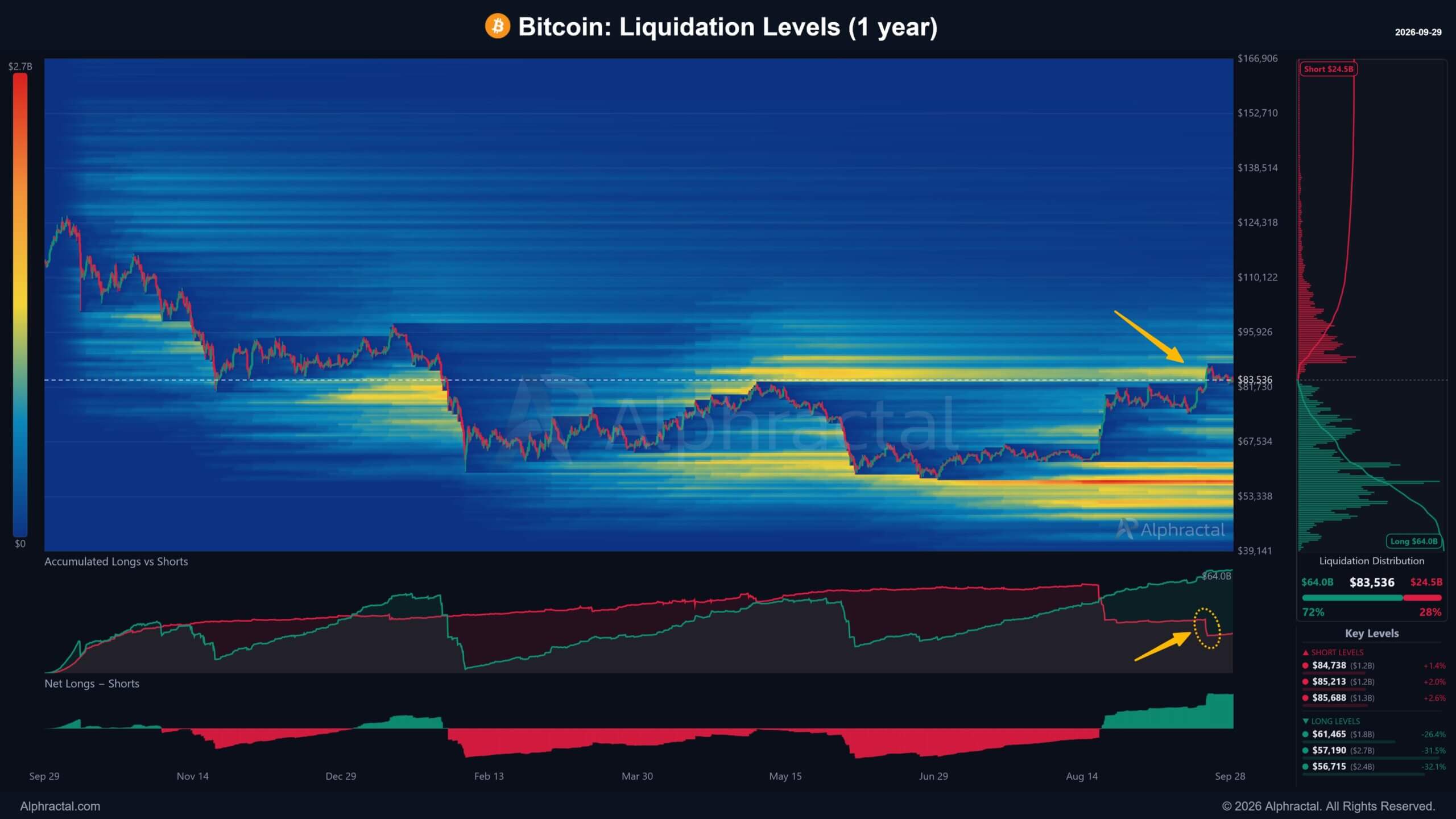
That leaves fewer large short positions available to provide forced buying if Bitcoin rises again. A decline, by contrast, could begin hitting concentrated long positions, turning leveraged traders into a source of forced selling.
Large investors have also yet to signal sustained bullishness.
Joao Wedson, chief executive officer of Alphractal, said the firm’s Whales vs. Retail Delta recently showed whales becoming more bullish relative to smaller traders, but the shift failed to persist. He said the indicator would need to turn positive and remain there before providing stronger evidence that larger investors are positioned for a lasting continuation of the rally.
The change in positioning puts more significance on Bitcoin’s downside levels if momentum continues to fade.
The 365-day moving average sits near $80,000, the level Bitcoin reclaimed when CryptoQuant identified the start of the new bull phase. Below that, the 200-day moving average stands near $71,000, while traders’ realized price is around $67,000.
A retreat toward $80,000 would provide the first indication of how well the breakout can withstand the shift in demand and positioning. Losing that level would expose progressively deeper support while increasing the risk that the long positions left behind after the short squeeze become the next source of forced liquidation.
The post Bitcoin’s $87,000 rally just flipped from short squeeze to long risk appeared first on CryptoSlate.
Anthropic’s planned IPO could force a fast-growing crypto derivatives market to reconcile its synthetic valuation with Wall Street’s actual price.
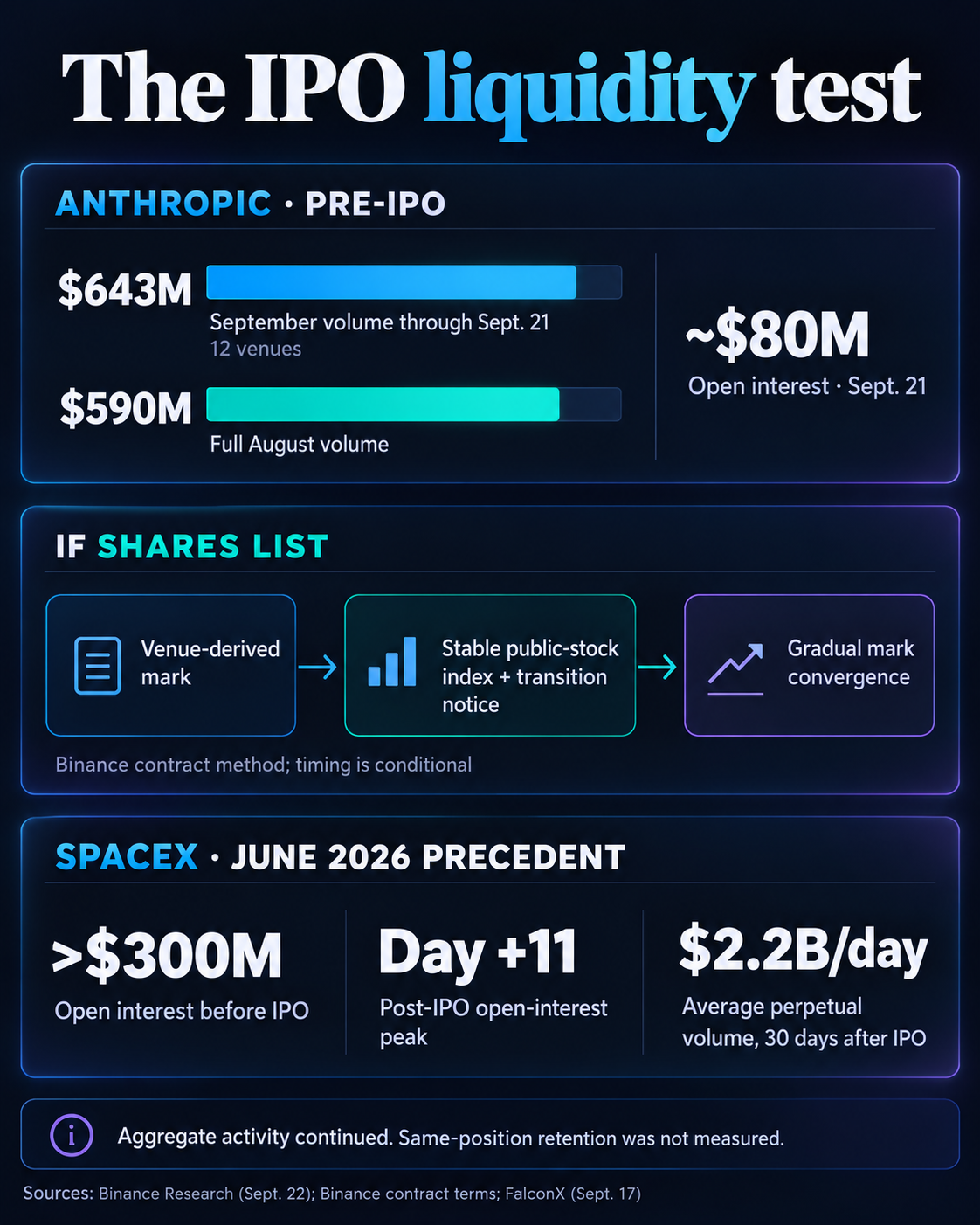
Pre-IPO perpetual contracts linked to the artificial-intelligence company generated $643 million in trading across 12 crypto venues through Sept. 21, already exceeding the $590 million recorded in all of August, according to Binance Research.
About $80 million of Anthropic-linked open interest was outstanding at the September snapshot. On Binance alone, open interest rose 88% over 30 days to $31.2 million from $16.6 million.
The growth has taken place without publicly traded Anthropic shares anchoring the market.
Instead, traders are buying and selling cash-settled contracts whose prices reflect a crypto market estimate of Anthropic's value. That arrangement becomes more consequential once a stock listing introduces an external price that could differ sharply from the valuation implied by the derivatives.
Anthropic announced a confidential draft IPO filing in June, though reports this week suggested the debut may slip beyond the November US midterm elections.
That leaves traders building positions in a market whose eventual reference point has yet to exist.
A synthetic valuation meets a real stock price
Binance currently derives the mark price for its Anthropic perpetual from recent trading in the contract itself.
The exchange averages recent prices and limits how far the mark can move from one second to the next, allowing positions to be valued before any public share price exists.
That changes after an IPO.
Binance says it can convert a pre-IPO perpetual into a standard equity-linked contract once it has a stable third-party stock-price index and issues a transition notice. The process does not necessarily begin as soon as shares start trading.
During the transition, the mark price gradually shifts toward the stock-linked calculation.
That creates a potential repricing event for traders carrying positions through the listing.
If Anthropic’s crypto-implied valuation differs materially from the price established in public markets, the convergence could alter unrealized gains and losses, collateral values and liquidation thresholds.
The scale of the market makes that risk more than theoretical.
Binance Research measured combined open interest in Anthropic and OpenAI pre-IPO perpetuals above $160 million as of Sept. 15, up from roughly $1 million in April.
The growth suggests crypto venues are increasingly becoming a market for expressing views on private AI companies before conventional investors can buy their shares.
Anthropic-linked contracts have already shown some sensitivity to IPO expectations.
During a weekend when reports indicated a potential shift in the company’s listing timetable, Binance’s ANTHROPICUSDT perpetual fell 0.89% to $2,084 from $2,103.
Binance said the muted move was consistent with some delay already being priced in, though the reaction alone cannot establish what traders expected.
SpaceX shows listing can expand the trade
SpaceX offers the clearest precedent for what can happen when a pre-IPO crypto contract gains a public equity benchmark.
When the company listed in June, Binance kept existing positions and open orders in place while transitioning its mark price toward a stock index. The exchange said the adjustment could take as long as three hours depending on volatility and the stability of the reference price.
Trading activity expanded sharply afterward.
FalconX said SpaceX perpetual open interest exceeded $300 million before the IPO and peaked 11 days after the listing. Average daily perpetual volume across venues reached $2.2 billion during the following 30 days.
Binance separately said average daily SpaceX perpetual volume on its platform climbed to about $1.6 billion after conversion from roughly $89 million before the IPO.
The figures cover different groups of venues, but both point to the same outcome: the arrival of publicly traded shares did not remove demand for the crypto derivative.
What remains unclear is whether the original pre-IPO traders stayed.
Higher open interest after a listing can also reflect new participants entering once price discovery improves and the contract becomes easier to hedge against the stock.
That distinction will matter for Anthropic because its existing market has formed without a public benchmark.
OpenAI provides the contrasting case. Sam Altman has said the company will not go public in 2026, leaving its pre-IPO contracts without a listed share price to force the same reconciliation this year.
Anthropic could therefore become the more immediate test of how far crypto markets can front-run private-company valuation before Wall Street sets its own price.
The next signals will come from Anthropic’s IPO timetable and any Binance transition notice.
After that, traders will watch the gap between the perpetual and the listed shares, how quickly the two converge, and whether the open interest built before the IPO survives once the synthetic valuation has to answer to a public market.
The post Anthropic tokenized pre-IPO volume hits $643M, but liquidity test looms appeared first on CryptoSlate.
Bitcoin registered an intraday low of $82,775.94 on Sept. 29 before rebounding above $83,000, close to a price that could change the estimated profitability of the average Bitcoin ETF holder when Wednesday’s US inflation data arrive.
A decline of about 2.2% from mid-$83,000 would reach $81,722, a target that Bloomberg ETF analyst James Seyffart estimated on Sept. 21 as the average ETF holder’s cost basis, saying the recent rally had put that holder back in profit.
Individual investors have different purchase prices, and a move through $81,722 would make their trading decisions worth watching. A Sept. 9 Glassnode report placed a differently measured ETF-complex break-even near $86,000.
Seyffart’s later estimate gives Wednesday’s price action a specific threshold, with its scope and date attached.
Levels around the ETF estimate
The immediate reference above Tuesday’s captured price is an $84,000-$85,000 zone, as Glassnode’s Sept. 23 report called it the largest cluster of long-term-holder supply. Bitcoin traded above that zone when the report was published, while Tuesday’s quoted price was below it.
Analyst Axel Adler Jr. calculated Bitcoin’s 365-day moving average at $80,500 on Sept. 22, so a fall through $81,722 followed by a test of $80,500 would carry price below two separate reference points.
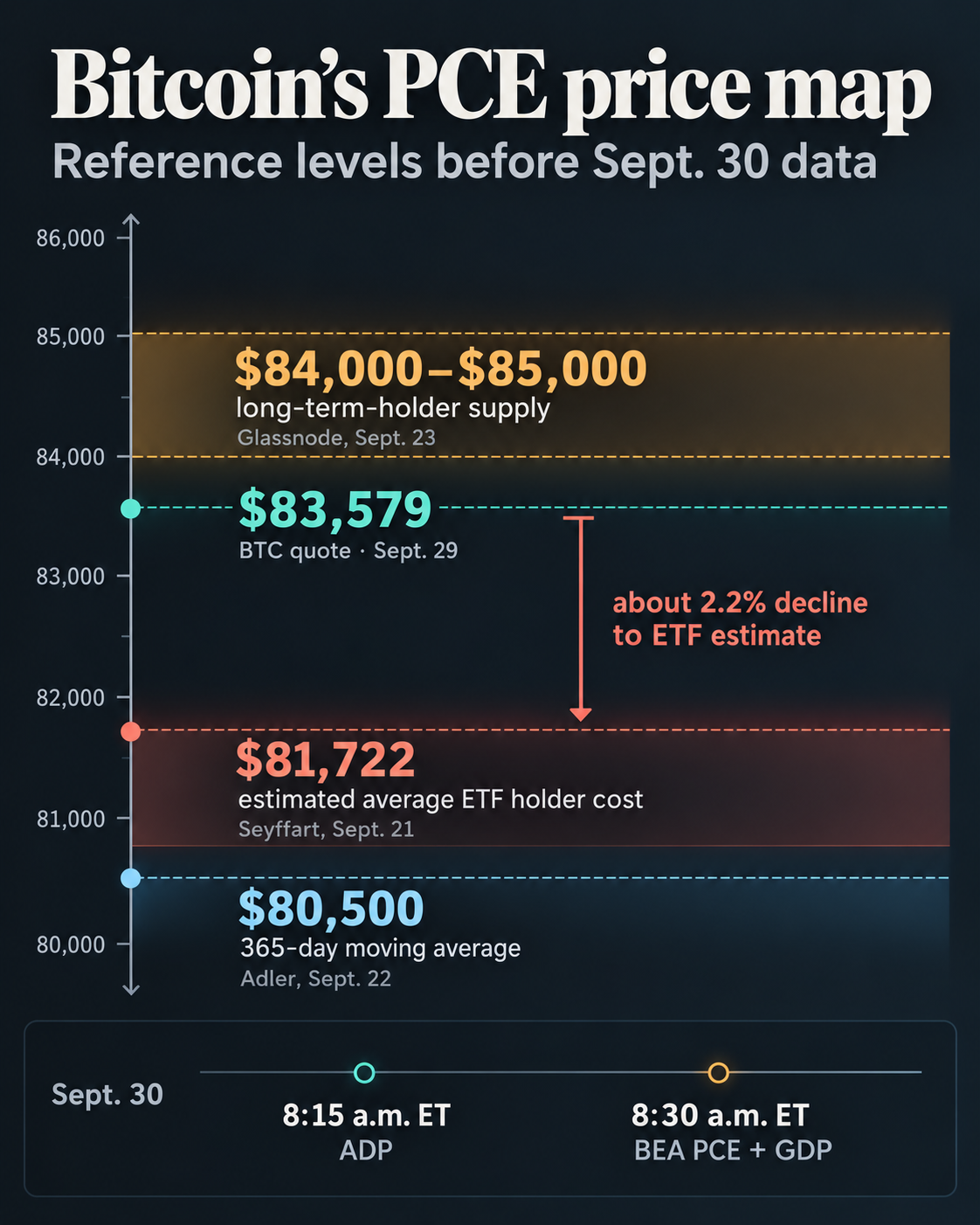
ADP schedules its September private employment report for 8:15 a.m. ET; the Bureau of Economic Analysis is due to release August personal income and outlays at 8:30 a.m. ET, and BEA also schedules the third estimate of second-quarter GDP for that time.
Those releases coincide with BEA’s annual update of national and regional economic accounts, which includes revisions to historical series. Traders may reassess their initial reaction to the new inflation figures as they absorb the employment data, GDP estimate, and revisions.
Because ADP comes first, yields may already be moving before the PCE figure lands. The 8:30 a.m. window then combines new inflation data with GDP and a revised historical baseline.
A Bitcoin move during those minutes could reflect more than one release. Following yields through the session and checking where Bitcoin trades after the initial swings would give the price reaction a clearer macro context.
If a hotter PCE reading lifts yields and Bitcoin trades below $81,722, the average position under Seyffart’s estimate would be back in loss territory. The next evidence would come from whether price remains below that level after the first burst of volatility and what subsequent ETF flows and spot buying show.
If a softer reading pulls yields lower, Bitcoin could instead test Glassnode’s $84,000-$85,000 zone. A sustained move through it would say more about demand than a brief spike. A reading close to expectations may give ADP, GDP, and the revisions more influence, keeping Bitcoin between the nearby levels despite sharp intraday moves.
The $81,722 figure is close enough to the Sept. 29 intraday low to be tested by a modest move, but the lasting signal is whether yields confirm the direction and price holds on one side of the estimated ETF-holder basis after the data window clears.
The post Bitcoin could put the average ETF buyer back in losses this week appeared first on CryptoSlate.
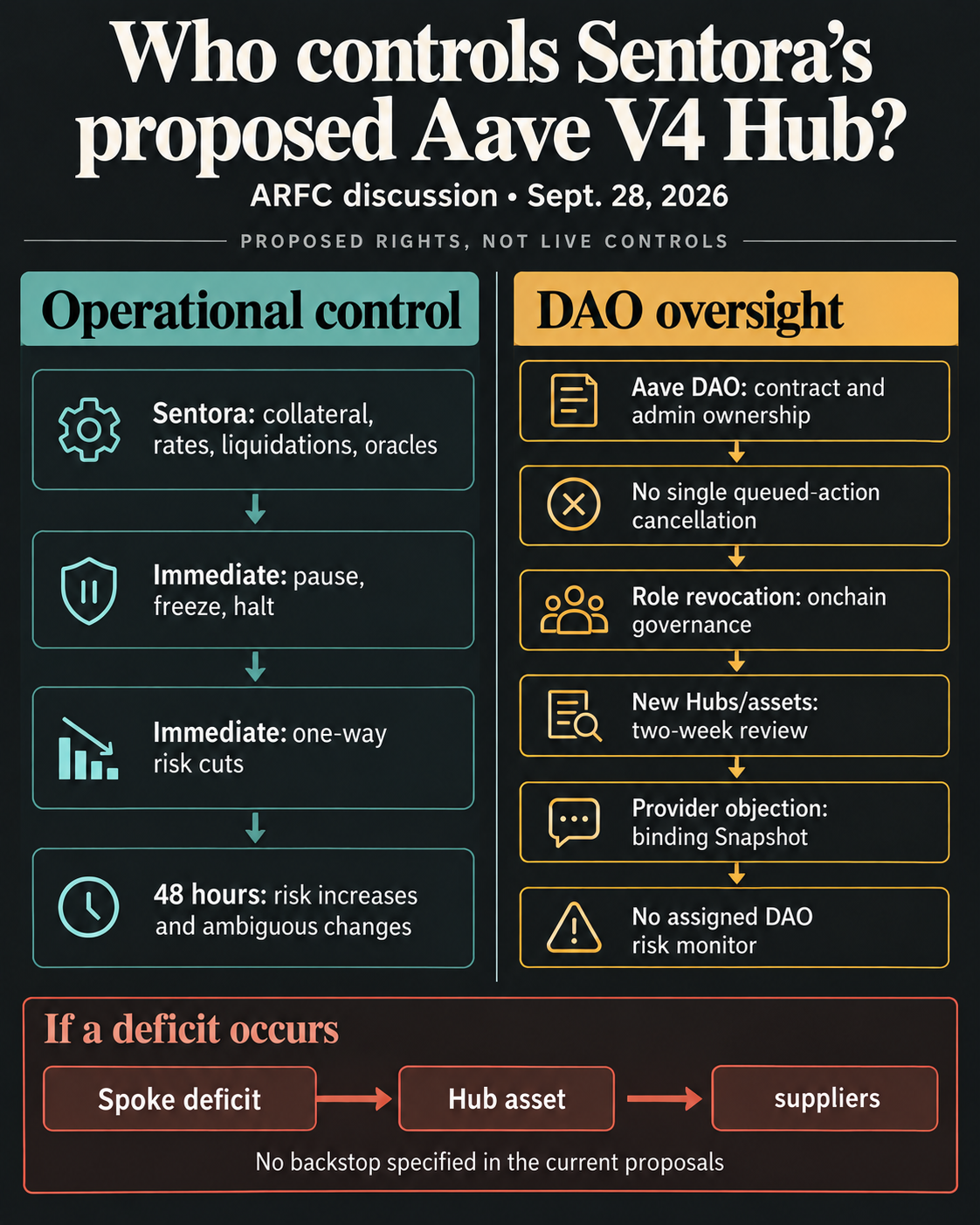
Aave DAO would own the contracts for a proposed Ethereum lending market, but Sentora would make the day-to-day decisions that shape its credit risk.
In a governance proposal posted Sept. 28, the DeFi risk manager asks to operate an isolated Aave V4 Hub and its lending Spokes through revocable roles. The split puts an immediate risk response in Sentora’s hands and leaves the DAO with ownership, a review path for new markets and the power to withdraw those roles.
Sentora would choose its collateral, interest-rate curves, liquidation settings, and oracles. Aave’s existing risk service providers would have no assignment to monitor the instance, recommend changes, or respond to incidents.
The proposal is still an ARFC for community discussion, and the next steps include a Snapshot vote followed by an on-chain Aave Improvement Proposal before any approval.
Who can act, and when
Aave V4 separates the Hub that holds liquidity from the Spokes where loans originate against collateral. Sentora proposes one Ethereum Hub for its Spokes, with no credit lines to or from other Aave DAO Hubs, and its own Spokes would still draw from suppliers in Sentora’s Hub.
The proposal limits borrowable assets to RLUSD, PYUSD, and OUSD, excluding USDC and USDT.
Under the plan, the DAO’s Governance Short Executor would retain the admin roles over the Hub, Spokes, and AccessManager. The DAO would retain contract upgrades and role grants, and Sentora would own none of the contracts.
Instead, it would receive operational roles to manage the markets, and the DAO could revoke those grants through an on-chain governance proposal.
Those roles create different response times:
| Proposed action | Who acts | When | DAO recourse |
|---|---|---|---|
| Pause or freeze a reserve, halt an asset or Spoke | Sentora operational address | Immediately through a restrictive role | Revoke Sentora’s roles through governance |
| Reduce a collateral factor or tighten a cap | Sentora through a one-way Risk Steward | Immediately | Revoke Sentora’s roles through governance |
| Increase risk, or change a rate model or liquidation configuration | Sentora operational address | After a 48-hour on-chain delay | Observe the scheduled change and pursue role revocation; no individual cancellation power is specified |
| Add collateral or deploy another Hub | Sentora proposes; an appointed DAO service provider may object | Two-week forum review before scheduling or deployment | An objection pauses the action for a binding Snapshot vote |
The 48-hour delay applies to risk increases and to functions whose direction is ambiguous, including rate models and liquidation configurations. The proposal sets no limit on the size of an increase and no cooldown between updates.
The delay makes a scheduled action visible, but the DAO would have no mechanism to cancel that one action inside the window. Revoking Sentora’s roles would require a separate on-chain governance proposal and would remove its authority going forward.
For a new Hub or collateral asset, Sentora would post an analysis and wait two weeks. An objection from any appointed Aave DAO service provider would stop the rollout and send it to a binding Snapshot vote.
The same proposal says no service provider is scoped or compensated to review these submissions. It also excludes the instance from the providers’ monitoring, parameter-recommendation, and incident-response mandates.
Providers could raise concerns on their own initiative, but a quiet review window would not establish that anyone examined the change. The proposed veto depends on someone noticing a problem and choosing to object.
Sentora CEO Anthony DeMartino argued in a November 2025 essay that risk management needs measurable controls and continuous monitoring. The new proposal would assign that operating role to Sentora, while leaving the DAO’s providers free to speak up without requiring them to watch the market.
Who absorbs a shortfall?
If a liquidation exhausts a borrower’s collateral while debt remains, the Spoke reports the shortfall to the Hub from which it drew the debt asset. The Hub records the deficit against that asset, and TokenLogic’s V4 Umbrella proposal says suppliers of that Hub asset bear the loss.
A separate ledger identifies the Spoke that originated it, and the absence of cross-Hub credit lines would prevent a direct draw on other DAO Hubs for this instance’s loans. It would not shield suppliers inside Sentora’s Hub from its own Spokes.
The proposed commercial bargain gives 50% of the instance’s protocol revenue to Sentora and 50% to the DAO, including reserve-factor earnings and protocol liquidation fees.
Aave’s separate V4 Umbrella ARFC proposes deficit offsets and staked coverage for Core WETH, Core USDC, and Core USDT. Its coverage does not name Sentora’s proposed Hub, and Sentora’s ARFC specifies no Umbrella market, deficit offset, or Sentora-funded first-loss layer for it.
A future proposal could address that gap, but a lender cannot infer protection from the DAO’s contract ownership or its fee share.
Sentora’s narrative says USDe and PST would back the first RLUSD yield loans, with PRIME and mWIN added later, while its specification lists all four. Its Bluechip description names RLUSD borrowing against kBTC, but the table lists RLUSD, PYUSD and OUSD.
The OUSD oracle is also left to be confirmed before launch. The final asset and price-feed choices would help define the risk borne by suppliers.
For the DAO, the decision before any Snapshot or AIP is whether to grant these operating rights with no assigned independent watcher and no stated first-loss protection for the isolated Hub.
For prospective suppliers, the final asset list, oracle choices, and any explicit deficit coverage will determine how much risk sits behind those DAO-held contract keys.
The post Sentora split 50% Aave revenue, but suppliers absorb all losses appeared first on CryptoSlate.
CryptoTicker.io
Anyone who has held crypto for a few years stands a good chance of still having a position in MATIC somewhere. The token no longer exists in that form. The Polygon network has replaced it with POL, as a pure change of name and function at a rate of one to one, without any haircut in value. Anyone who never carried out the exchange will find their balance either long since converted automatically or still sitting as the old token on Ethereum, depending on where it is kept.
This piece answers both questions: what happened to your MATIC, and how you use the Polygon network day to day. So setting up a wallet, judging the fees, reading the block explorer Polygonscan, and knowing the traps that most often catch people out when withdrawing from an exchange.
POL instead of MATIC: what actually happened in the token switch
Since September 4, 2024, POL has carried the jobs on Polygon's mainnet that previously belonged to MATIC: fees and staking. The exchange runs one to one, so for every MATIC you get one POL. According to the project, around a year later roughly 99 percent of holdings had been converted.
What matters for you is where your balance sits. A holding that was on the Polygon network itself was converted automatically; there you never had to do anything. A holding on Ethereum does not convert by itself. For that there is an exchange function in Polygon's official portal, where you confirm the swap yourself. That is how it is set out in the documentation on the transition from MATIC to POL.
At trading venues the switch mostly ran in the background: the balance in the account became POL overnight, often without any customer noticing. If your exchange still shows you MATIC today, it is worth a look at its announcements, because two separate balances would be a sign that something got stuck there.
One misunderstanding is persistent: the switch did not change the value of your holding. Where the token's price stands and how the project has developed is something you can check on our price page for the Polygon ecosystem token.
The network details: chain ID 137, POL as the fee token, Polygonscan as the explorer
Polygon PoS is an independent blockchain, closely linked to Ethereum and using the same address formats and the same kind of smart contracts. The chain ID, the identifying number by which wallets recognise the network, is 137. The block explorer is called Polygonscan. And the currency for fees is POL.
This is exactly where the most important difference from everything running on Ethereum and its extensions lies: on Polygon you pay with POL, not with ether. Anyone who sends stablecoins to the network without POL alongside them cannot move those coins on. An equivalent of one to two euros in POL covers a great many transactions and saves you that standstill.
A second point concerns readers who know the name Polygon from older guides. Alongside the mainnet the project ran several further components, among them a variant called zkEVM, whose operation was shut down on July 1, 2026. The Polygon PoS mainnet is unaffected by that and continues to run unchanged. If an older guide leads you to a different Polygon network, it is out of date.
Setting up the wallet: pick the network rather than create a new address
In most wallets Polygon is already stored as a network, and you pick it from a list. If you have to enter it by hand, you need three details: the identifying number 137, an access point, and POL as the network's currency. Your existing address continues to apply, because Polygon uses the same address format as Ethereum.
From that follows the same rule of thumb that applies on all Ethereum-adjacent networks: you do not have several addresses, you have one address on several networks. Which type of wallet suits which amount is set out in our comparison of software wallets; the general procedure for any network we wrote up in the overview of adding networks, bridges and explorers.
If your wallet shows an empty balance after switching over, usually nothing has been lost. As a rule the money is simply on another network, and the explorer shows you which one.
Fees on Polygon: what a transfer costs at the end of September
We recalculated several real transactions from a live Polygon block at the end of September. A simple transfer came to roughly 0.05 cents in converted terms. More demanding operations, such as a swap through a decentralised exchange, ranged between a good tenth of a cent and almost 2.6 cents.
The fee is calculated in POL and hangs on two figures: how busy the network is and the token's price. Because POL currently trades in the range of a few cents, the amounts stay small even when the load picks up. That is convenient, and at the same time it tempts people into making many small transactions, which quickly makes the later documentation for tax purposes hard to follow.
The way onto the network: exchange withdrawal versus a bridge through the Polygon portal
There are two ways to get a balance onto Polygon, and the simpler one is usually also the cheaper. At many trading venues you can pick Polygon directly as the target network when withdrawing. The amount then appears at your address within a few minutes, and you pay only the provider's withdrawal fee.
The second route runs through a bridge, in Polygon's case through the project's official portal. You send your balance from Ethereum to a contract that releases it again on Polygon. This route costs you a full Ethereum transaction and pays off above all when your holding already sits in your own wallet on Ethereum.
On the way back, Polygon PoS differs noticeably from the Ethereum extensions with a challenge period: there, withdrawals through the official bridge wait seven days, as we described using the example of Arbitrum and its seven-day period. At Polygon the waiting time for the way back to Ethereum is well below that, but it depends on the route chosen. What counts is therefore the span the portal or the provider shows you before you confirm, not a blanket figure from a guide.
Anyone using faster routes through third parties should know how they work: a liquidity provider fronts you the amount on the target network and handles the slow route itself. That costs a discount and brings an additional counterparty risk with it, because for the duration of the process you are trusting a contract and an operator. For small amounts that is often acceptable, for the bulk of a holding rather less so.
Reading Polygonscan: status, token transfers and open approvals
A block explorer is a search window into the blockchain. You enter an address or the identifier of a transaction and see what was actually recorded, regardless of what your wallet happens to be showing. For Polygon that tool is called Polygonscan.
Four fields are decisive in everyday use. The status reveals whether a transaction went through or broke off with an error; a failed transaction still costs a fee. Under token transfers you see which tokens really changed hands in the operation. The transaction fee field names the fee actually paid, in POL. And the token approvals tab lists every approval your address has ever granted.
That last tab is the most useful and the least often opened. Anyone swapping on a network over the years builds up a long list of open permissions there, most of which have not been needed for a long time. Tools that pull such lists together across several networks you will find in our comparison of analytics platforms.

Typical mishaps on Polygon: wrong network, missing POL, fake tokens
The withdrawal to the wrong network. You accidentally pick Ethereum instead of Polygon at the exchange, and the balance lands at the right address on the wrong network. That is not a total loss, because the address belongs to you on both networks. You do have to move the amount across a bridge, though, and pay Ethereum fees for it that can come to a multiple of the sum you saved. So always check the target network in the withdrawal window before you confirm.
The missing fee token. Without POL on the network every transaction fails, including passing stablecoins on. Set a small amount aside before you transfer larger sums.
The worthless token in the wallet. On open networks anyone can create a token with any name they like and send it to other people's addresses. The fact that a well-known name turns up in your overview says nothing about whether it is genuine. What counts is the contract address alone, and you match that in the explorer against the project's own statement. A token sent to you unasked that invites you to swap it on an unfamiliar site is the entry point to an attempted fraud.
The old guide. Because Polygon has run several networks and the token was renamed, plenty of outdated step-by-step texts are circulating. A guide that names MATIC as the fee token or points to the discontinued zkEVM is older than today's state of affairs.
Revoking approvals and spotting phishing on Polygon
An approval is the permission you grant a smart contract to move a particular token from your address. Without it no swap on a decentralised exchange works. The problem is the duration: many applications ask by default for an unlimited approval, and that stays in force until you actively withdraw it.
The revocation itself is unspectacular. You call up the list of your approvals, select what you no longer need, and send a transaction that sets the value to zero. On Polygon that costs you fractions of a cent. A pass like that makes sense whenever you have not used an application for a longer stretch, or when you read of an incident at a project you once gave access to.
With phishing, the most dangerous form has long since stopped being the faked input screen for the recovery phrase. Heavier still is the signature you give for something you have not read. Your wallet shows you before every confirmation which contract gets which permission. Anyone holding larger amounts is in any case better off keeping them separate from the wallet they use day to day.

POL in the network: staking, validators and the lockup on giving it back
POL has a second job on Polygon alongside the fees. The token serves to secure the network: anyone depositing POL supports a validator, an operator that confirms transactions, and receives a share of the network's rewards for it. The procedure is called staking.
Two things matter here for investors in Germany. First, the balance is tied up while it is deposited, and a waiting period applies to giving it back, one whose length varies with the route. Second, the income is to be treated differently for tax purposes from a price gain. According to the project, around a year after the start roughly 99 percent of holdings had been converted. How the various staking providers and routes differ is shown by our comparison of staking platforms.
Anyone using Polygon purely as a cheap payment network needs none of this. For everyone else the rule is: income and lockups belong in the same schedule as purchases and swaps, otherwise half the figures are missing at the end of the year.
Tax in Germany: keeping the exchange, bridging and swapping apart
For investors in Germany the principle from section 23 of the Income Tax Act applies: selling or swapping a cryptocurrency is a private disposal. If the purchase lies more than a year back, a gain stays tax-free. Below that it counts towards taxable income as soon as the sum of all private disposals in a year exceeds the exemption limit.
On Polygon three operations have to be kept apart, and they are easily confused. The exchange of MATIC into POL is a technical switch of the same asset at a rate of one to one; the tax administration has published no separate rule on it, and the prevailing view does not treat it as a disposal. Bridging between Ethereum and Polygon moves your own balance between two networks and is therefore likewise not a sale. A swap of one token for another on the network, by contrast, is a disposal just as it would be on any exchange.
Because Polygon's low fees mean many small operations pile up, the schedule quickly grows long. Keep the record as you go rather than retroactively in the spring. These statements are no substitute for tax advice; how a specific case is to be assessed belongs in expert hands.
Polygon: the key points for your decision
- First establish where your old holding sits. A balance on the Polygon network was converted into POL automatically long ago, while a balance on Ethereum may still be waiting for your confirmation in the official portal. For a holding at a trading venue you check the display in your account. Which providers are authorised in the EU is shown by our comparison of regulated crypto exchanges.
- Set POL aside for the fees before you transfer anything. An equivalent of one to two euros covers a great many transactions and prevents the most common standstill on the network. How the ecosystem around Polygon stands today we examined in our stocktake of Polygon 2026.
- Document every movement from the outset. Note the date, amount and equivalent value for every swap, so that the holding period stays traceable later. Which programs record this automatically is shown by our comparison of tax and portfolio tools.
(As of September 29, 2026. This article is not investment advice. Prices and fee structures change; check the terms with the provider before you buy.)
The lockup on team and investor tokens at Arbitrum is running out. Every month exactly 92,645,833 ARB come out of the lock, and under DefiLlama's release model only five of those tranches are left, the last on February 14, 2027. That makes the question that really counts at ARB a datable one: not what happens on the next release day, but how much longer the monthly supply pressure lasts at all.
This piece answers both. It recalculates the monthly tranche from the Arbitrum Foundation's own allocation table rather than copying it off an aggregator, it names the remaining dates, and it points to the one spot where two serious sources are a month apart.
The Arbitrum lockup ends in the first quarter of 2027
The rule is set out in the documentation of the Arbitrum Foundation, and it is explicit: all investor and team tokens are subject to a four-year lockup, the first release takes place one year after the token generation event of March 16, 2023, and monthly releases follow over the remaining three years.
Work that through from the start and you get a cliff on March 16, 2024 followed by 36 monthly instalments. Where the last of those falls hangs on a single question: does the cliff month itself count as the first of the 36 instalments, or does the count begin the month after? The question sounds like bookkeeping, yet it moves the end by four weeks.
Both readings are out there. DefiLlama's emission model lists 36 insider releases, the first on March 16, 2024 together with the cliff, the last on February 14, 2027. The tokenomics services Tokenomist and CryptoRank, along with the literal four-year boundary from March 16, 2023, point to March 2027 instead. What holds up is therefore the range and not the single day: Arbitrum's insider lock ends between mid-February and the end of March 2027. Anyone who needs the exact day reads it off the vesting contract, not off an overview.
92,645,833 ARB a month: the tranche recalculated from the allocation
The monthly tranche can be reproduced in full from the allocation table, and that is why it can be trusted. The allocation under resolutions AIP 1.1 and 1.2 splits the ten billion ARB like this: 35.28 percent or 3.528 billion to the ArbitrumDAO treasury, 26.94 percent or 2.694 billion to team, contributors and advisors, 17.53 percent or 1.753 billion to investors, 11.62 percent or 1.162 billion to users of the platform through the airdrop, 7.5 percent or 750 million to the Arbitrum Foundation, and 1.13 percent or 113 million to DAOs building on Arbitrum.
Locked out of that are team and investors together, so 44.47 percent or 4.447 billion ARB. A quarter of that amount comes free at the cliff, and the remaining three quarters spread across 36 equal monthly instalments. That gives 4.447 billion times 0.75 divided by 36, so 92,645,833 ARB a month.
The check also works separately for each recipient group, and it comes out exactly. For the team: 2.694 billion times 0.75 divided by 36 gives 56,125,000 ARB. For the investors: 1.753 billion times 0.75 divided by 36 gives 36,520,833 ARB. Those are precisely the two amounts DefiLlama lists as two separate events on every release day. Two independently built calculations, the same figures down to the token: the tranche is therefore derived from the primary source rather than taken from an overview.
A footnote on diligence belongs here. Older notes in our date calendar carried the figure 93,159,180 ARB for the October date. That amount cannot be reproduced from the allocation table, while the 92,645,833 can be, three times over. We therefore carry the recalculated number and let the other one stand rather than stirring both into an average.

The cliff of March 16, 2024 freed a quarter of the insider tokens
The single biggest day in ARB's history is already behind us, and has been for two and a half years. On March 16, 2024, 673,500,000 ARB were released to the team and 438,250,000 ARB to investors, 1,111,750,000 ARB in total. That is exactly the quarter of the locked 4.447 billion that the four-year rule provides for after the first year.
On the same day the first monthly instalment of 92,645,833 ARB also ran, so the cliff day came to 1,204,395,833 ARB all told. For today's situation something reassuring follows from that: the peak in volume is in the past. What is still to come are even monthly instalments on the order of a thirteenth of that single day.
Team, investors and the foundation follow three different release rules
This is where the most common mix-up arises, and it distorts every estimate of supply pressure. Three different clocks are running at Arbitrum.
Team and investors share the same mechanics, the cliff after one year and 36 monthly instalments after that. The Arbitrum Foundation with its 7.5 percent or 750 million ARB runs separately and differently: the foundation's lockup began on April 17, 2023 and unwinds linearly over four years, enforced by the foundation's Vesting Budget Smart Contract Wallet. Under DefiLlama's model that works out at around 3.59 million ARB a week, so roughly 513,000 a day, and this stream does not end until April 17, 2027. The DAO treasury, finally, releases funds through irregular resolutions and counts as non-circulating in the emission models.
So anyone asking when the last token at Arbitrum comes free gets a different answer from the question about the end of the insider lock. The insider lock ends in the first quarter of 2027, the foundation stream in April 2027.
Lockup, cliff and vesting: the three terms in one sentence each
A lockup is the period in which allocated tokens may not be moved, either by contract or by a smart contract. A cliff is the date on which, after a waiting period, a larger share first comes free in one go. Vesting describes the release in instalments after that, monthly in Arbitrum's case. And an unlock or release is the individual event at which an instalment falls due.
Important for placing all this: a release does not mean tokens are being sold. Released only means they could be sold. The difference between the two is the whole reason release dates hit prices so differently. How to tell them apart in an individual case is something we worked through on another token in our guide to recalculating token unlocks yourself.
Five monthly tranches left: the release calendar to February 2027
Under DefiLlama's emission model, five insider tranches are outstanding as of the end of September 2026, each of 92,645,833 ARB:
- October 15, 2026
- November 15, 2026
- December 15, 2026
- January 14, 2027
- February 14, 2027
That adds up to 463,229,167 ARB coming out of the insider lock over the next four and a half months. On the reading that points to March 2027, a sixth tranche would be added and the total would rise to around 556 million ARB. Both figures sit far below what many people expect from the word lockup, and the reason is the 2024 cliff, which worked off the bulk of it long ago. Anyone wanting to see the date alongside the rest of this quarter's crypto dates will find it in our overview of the dates up to the end of the year.
A note on the times of day: the dates fall during the day rather than at midnight, and they shift by a few hours from month to month. For a decision on what to do, the date is enough.
1.32 percent of the circulating supply per tranche, 70.4 percent of tokens already in the market
An absolute figure says little until you set it against the circulating supply. Of the ten billion ARB, around 7.04 billion are in circulation, which is 70.4 percent. Locked or non-circulating are a further 2.96 billion or so, although that item includes the DAO treasury and the foundation's share and is therefore larger than the rest of the insider lock.
A monthly tranche of 92,645,833 ARB thus corresponds to 1.32 percent of the circulating supply. At an ARB price of around $0.20 at the end of September, that is just under $19 million of theoretical supply. For context: the circulating supply grew by around 108 million ARB over the preceding 30 days, so slightly more than one monthly tranche, because the foundation stream keeps being added.

Other models put the same amount at a somewhat different share. Tokenomist reports around 1.98 percent of the circulating supply for the same tranche, because a lower circulation assumption and a different split between team and investors underlie it there. The range of roughly 1.3 to 2.0 percent a month is therefore the honest answer, and it is precise enough for any decision a retail investor would hang on it. Which tools track supply data like this on an ongoing basis is shown by our comparison of analytics platforms.
What holders should watch before the next release on October 15
The next date is October 15, 2026. Less useful is the question of whether the price falls on that day, because uniform releases announced long in advance are known to the market. More revealing is what happens to the circulating supply and to exchange balances in the days afterwards, because that is where it shows whether the released tokens actually go into selling.
In practice that means: compare the circulating supply before and after the date, watch the inflows to exchanges, and set the tranche size against daily trading volume. A tranche that amounts to a fraction of one trading day is a different event from one that reaches a multiple of it. Anyone using Arbitrum on the network anyway will find the practical groundwork for this in our article on Arbitrum One, the bridge and gas.
Where to read the ARB release calendar yourself
The most reliable source is the Arbitrum Foundation's documentation, because it holds the allocation and the lock mechanics from which everything else can be derived. Anyone needing the calendar as a list will find the individual dates at DefiLlama; its model lists team and investors separately, so the total per date is made up of two lines.
With any such overview a counter-check pays off: multiply the stated tranche by the number of remaining dates and compare the result with the amount still locked. If the two diverge sharply, the overview is working from a different assumption about the cliff or the term. We had the same case recently at the end of Filecoin's vesting, where two services likewise differed by one instalment.
Tax and holding period: what applies in Germany when you sell after a release
For you as a holder in Germany, a release at another market participant has no tax significance. Tax only becomes relevant when you sell yourself. Gains on the sale of crypto assets count as a private disposal under section 23 of the German Income Tax Act. If you sell within a year of buying, the gain is taxable above the 1,000 euro exemption limit per year. Hold for longer than a year and the gain stays tax-free.
From that follows a connection often overlooked around release dates: if you are thinking of selling ahead of a date, your own purchase date helps determine what the decision costs. A sale eleven months after the purchase can be more expensive than a price drop you sit out. The tax office expects the entry in the SO annex to your tax return, and the burden of proof for the purchase date and price lies with you. Whether Arbitrum carries as a price story beyond this is something we looked at recently in connection with Robinhood Chain and RWA.
These statements describe the general legal position, not personal advice. With larger amounts, with staking income or with purchases in several tranches, a tax adviser will settle the individual case more reliably than any overview.
Arbitrum lockup: what to take away
Arbitrum's lockup is no longer an open question but a calendar with a foreseeable end. Five or six equally sized monthly tranches of 92,645,833 ARB each are outstanding, after which the insider lock is worked off, and the foundation stream runs out in April 2027. Three steps to make that usable for yourself:
- Put the calendar in your diary. Note the five dates from October 15, 2026 to February 14, 2027 and treat them as known quantities rather than surprises. Where you can get ARB tradable and on what terms is shown by our comparison of crypto exchanges.
- Know your own purchase date. Check when your positions reach the one-year mark before you line a sale up with a release date. The tools in our overview of tax software and portfolio trackers help with that.
- Settle the custody question. If you want to hold ARB beyond the end of the lockup, the question of your own custody belongs with it; the differences are set out in our hardware wallet comparison.
And one last piece of context, so the figures do not look larger than they are: the remaining 463 million ARB amount to a good six percent of today's circulating supply, spread over more than four months. The day that really moved volume at Arbitrum was March 16, 2024, and that lies behind us.
(As of September 30, 2026. This article is not investment advice. Prices and fee structures change; check the terms with the provider before you buy.)
There are 1,603,958 ETH sitting in the entry queue for Ethereum staking this Wednesday morning. Anyone depositing today will see their validator activated only around 28 days later, so somewhere near October 28. For the Ethereum price prediction that figure says more than the daily quote, because it describes supply: a good 1.6 million ETH worth roughly $4.27 billion have already been deposited, yet they can neither be sold nor moved while they stand in the lock.
Ethereum itself trades at $2,661, or 2,342 euros, a good one percent below the previous day and almost four percent below the previous week. The price on its own tells you little. The queues on both sides of staking tell you more, and they have turned noticeably over the past ten days.
Where the Ethereum staking queue stands right now
The figures come from the public queue overview at validatorqueue.com, which draws its data from beaconcha.in. As of September 30 the picture is this:
- Entry queue: 1,603,958 ETH, waiting time 27 days and 20 hours
- Exit queue: 205,011 ETH, waiting time 3 days and 13 hours
- Active validators: 884,366
- Total amount staked: 43.7 million ETH, or 35.77 percent of the circulating supply
- Yield according to the network: 2.63 percent a year
Why the waiting time adds up on paper
Ethereum admits only a fixed amount of entries and exits per epoch, currently 256 ETH. An epoch lasts 6.4 minutes, which gives 225 epochs a day and therefore a daily throughput of 57,600 ETH. Divide the 1,603,958 ETH on the entry side by those 57,600 and you arrive at 27.8 days. The exit side works out at exactly 3.6 days with its 205,011 ETH. Both values match the display, so the figure has been recalculated rather than merely read off.
This throttle is called the churn limit in the protocol, and it exists so that the number of validators never changes abruptly and the network keeps its security assumptions intact. For you as an investor it is the reason why staking is never a decision you take from one day to the next.
Why the entry queue supports the Ethereum price
Every ETH in the entry queue is capital that someone has voluntarily taken out of trading for at least four weeks before it earns anything at all. That is a different signal from a purchase on an exchange, because it cannot be reversed on a whim. Whoever stands in the queue and changes their mind has to wait for their slot, then exit, and wait all over again.
Set the 1,603,958 ETH against the circulating supply and they amount to roughly 1.3 percent of all Ethereum. Measured against daily trading volume the number is starker still, equal to several trading days of volume that the market will lack in selling pressure over the coming weeks.
The counter-check: this is not a one-sided picture
A high staking ratio has an uncomfortable side to it as well. At 35.77 percent of supply staked, the yield falls, because the same issuance is spread across more validators. The 2.63 percent on display sits well below what staking paid out in earlier years. Anyone getting in purely for the yield is getting into a market where the return shrinks with every new validator.

The turn on the exit side: 205,011 ETH want out again
More remarkable than the entry side is the movement at the exit. As recently as September 20 several market services, among them Blockonomi, reported around 2.48 million ETH on the entry side with a waiting time of 43 to 45 days, while the exit queue was practically empty.
Today the entry side stands at 1.6 million ETH and the exit side at 205,011 ETH, worth roughly $546 million. The direction still holds, but the pace has changed: fewer new validators are pushing in, and for the first time in weeks meaningful amounts want back out. For a forecast over the next few weeks this is the metric with the longest lead, because it turns earlier than the price does.
Ethereum price prediction: the levels that decide before the quarter turns
Ethereum is at $2,661 and therefore around 46 percent below its all-time high of $4,946. To the upside the next dense supply zone runs between $2,750 and $2,800; a daily close above it opens the road to the round $3,000 mark. To the downside $2,530 to $2,570 carries the price, a zone that has held several times in September.
Ethereum closes the third quarter strongly. By our own reading of CoinGecko daily levels, ETH stood at $1,569.83 on July 1 and at $2,661.66 today, a gain of 69.6 percent. Two losing quarters came before that: minus 31.8 percent in the first and minus 20.5 percent in the second quarter of 2026. Other houses report third-quarter figures between 60.6 and 72 percent, depending on which cut-off date counts as the start of the quarter. That range is left standing here rather than smoothed into a single number.
What analysts say, with names attached
Standard Chartered puts a price target of $7,500 on Ethereum for the end of 2026. Arthur Hayes, co-founder of BitMEX, expects Ethereum in a range of $10,000 to $20,000 by the 2028 US election. These are the expectations of individual houses and individual people, not a market view and certainly not a promise. The obvious counter-position stands against them: as long as ETH trades at almost half its all-time high, every one of those figures assumes a doubling or more to begin with.
How long your capital is really tied up going in and coming out
The 28 days on the entry side are only half the calculation. On the exit side a further 7.7 days of so-called sweep delay come on top of the queue of 3 days and 13 hours. That is the time it takes for the network's payout run to reach your validator and for the balance to actually land on the withdrawal address. Together that currently makes a good eleven days from decision to available ETH. How the process works technically is described in the documentation on ethereum.org.
In practice that means: anyone entering today and wanting out again in December spends about 39 days in that window with capital that is neither tradable nor productive. At a 2.63 percent annual yield, a stake of 10,000 euros earns roughly 28 euros over those 39 days. A price move of one percent in the wrong direction costs 100 euros. The ratio between those two numbers is the real decision.
The detour via an exchange
Many German investors do not stake themselves but go through their trading platform. There the protocol queue often falls away, because the provider settles internally and serves the position from its own holdings. That is convenient and it costs yield, because the provider keeps a share. Which platforms are still allowed to offer staking to retail clients under European regulation, and what they keep, is laid out in the overview of staking providers compared.
Staking yield and tax in Germany: the 256 euro exemption limit
Here lies the part that most price analyses leave out, although it determines your return after tax. Under the administrative view of the German Federal Ministry of Finance, most recently in its letter of March 6, 2025, staking rewards count as other income under section 22 number 3 of the Income Tax Act. They are taxable at the moment they accrue, valued at the market price on that day.
An exemption limit of 256 euros per calendar year applies to them. The word limit is the decisive one: stay below it and everything is tax-free. Exceed it by even a single euro and the entire amount becomes taxable, not merely the part above the line. The 256 euros also apply to all income under section 22 number 3 added together, so staking plus lending plus mining plus airdrops with a service in return.
At what stake the exemption limit breaks
At the 2.63 percent annual yield currently displayed, a stake of around 9,734 euros breaks the limit, which corresponds to about 4.2 ETH. Anyone staking less and having no further income of this kind stays below it. Anyone staking more should document the inflows to the day, because the tax office wants to see the market value for each day of accrual. Tools that record this automatically are collected in our comparison of crypto tax software and portfolio trackers.
The coins themselves keep their one-year holding period under section 23 of the Income Tax Act. Since the ministry's 2022 letter, staking expressly no longer extends it to ten years. The rewards do start a holding year of their own, counted from the day they accrue.

Liquid staking instead of the queue: the tax catch in the swap
Liquid staking gets around the waiting time by letting you deposit ETH with a protocol and receive a tradable token in return that certifies your share of the staked holdings. Entry is possible immediately, and the exit runs through trading that token rather than through the exit queue.
The catch is a tax one and it is regularly overlooked: swapping ETH into a liquid staking token and later back again each counts as a disposal under the prevailing view. If less than a year lies between acquisition and swap, the gain becomes taxable as soon as the 1,000 euro exemption limit for private disposals is exceeded. The holding period starts again from scratch after the swap. Anyone close to the one-year anniversary of their ETH may therefore be giving away the tax exemption on their entire holding by moving into liquid staking.
What the ETF inflows contribute to the Ethereum forecast
The second supply side is the exchange-traded funds. Over September, inflows into the US spot Ethereum ETFs added up to $723.9 million according to data from the industry service Coinspeaker, and to $1.66 billion for the year so far. Five consecutive trading days accounted for $746.5 million of that on their own.
It does not add up to a clean picture. In the week to September 18 the same funds recorded net outflows of around $140 million, the first week of outflows since mid-August. ETF demand and staking demand therefore point in the same direction, but both with dents in them. Anyone drawing a straight line upward from this is drawing more than the data supports.
Solo staking with 32 ETH or staking through a provider
Solo staking means running your own validator with 32 ETH, currently a good 75,000 euros. You keep the full rewards but carry the risk of downtime and, in the extreme case, of slashing, meaning the deduction of part of your stake when the software misbehaves. For the great majority of retail investors in Germany the operating effort makes this an unrealistic option.
The route via a regulated provider costs yield and takes the operation off your hands. Since the European crypto regulation MiCA came into force, providers addressing German retail clients need the corresponding authorisation. On terms it is worth looking at three figures: the share withheld, the question of whether the provider keeps the coins segregated, and the notice period for returning them. Which trading venues hold that authorisation is set out in our comparison of the best crypto exchanges.
Bull case and bear case for the fourth quarter
Bull case
The entry queue stays full, the ETF inflows keep their September pace, and the Sepolia fork on October 6 passes without incident as a dress rehearsal for the next major network upgrade. In that case the zone between $2,750 and $2,800 is the first target, and $3,000 above it.
Bear case
The exit queue grows further beyond today's 205,011 ETH, the ETF inflows tip into the red as they did in the week to September 18, and the market takes profits after a quarter with almost 70 percent in gains. Then the zone from $2,530 to $2,570 goes on trial, and below it things get thin. Which dates could bring additional movement in the coming weeks is set out in our overview of crypto dates in the fourth quarter.
Ethereum staking queue: what to take away
- Work out the lock-up before you deposit. It is currently around 28 days to activation and a good eleven days more to payout. If you need the money in that window, staking is the wrong tool. Anyone wanting a shorter commitment will find the alternative in the comparison of lending providers.
- Hold your rewards up against the 256 euro exemption limit. At 2.63 percent a stake from about 9,734 euros breaks the limit, and then the full amount becomes taxable. A tracker that values the inflows to the day saves you the reconstruction a year later; the selection is in the comparison of crypto tax software.
- Look at your holding period before you move into liquid staking. The swap counts as a disposal and resets the one-year clock. Anyone close to the anniversary is better off waiting it out. Where you can choose between the two routes at all is shown by the regulated crypto exchanges.
(As of September 30, 2026. This article is not investment advice. Prices and fee structures change; check the terms with the provider before you buy.)
The Tangem Wallet is a hardware wallet in the format of a bank card, and it works without a battery, without a cable and, in the standard case, without a seed phrase. The two-card set costs 59.90 euros, the three-card set 69.90 euros. The private key is generated inside the card's chip and never leaves it. The backup runs through a second and a third card that carry the same key. Both the great advantage of this design and its biggest risk follow from exactly that.
For you as an investor in Germany, this is a trade-off between two sources of error. With a classic hardware wallet the seed phrase is the weak point: anyone who photographs it, types it into the cloud or stores it carelessly loses their holdings. With the card wallet that sheet of paper does not exist in the first place, but everything then hangs on the cards themselves. This article weighs the two models against each other, gives the documented prices and certifications, and says where the limits lie.
What the Tangem Wallet is: card, NFC chip and the Tangem app
A hardware wallet is a device that keeps your private keys offline and signs transactions without handing the key over to the computer or the smartphone. The Tangem Wallet does that job in a form factor closer to a debit card than to a USB stick.
The card has no screen, no button, no port and no battery. It is addressed over NFC, the near-field communication your smartphone also uses for contactless payments. You hold the card against the back of the phone, the Tangem app builds the connection, and the chip in the card signs the transaction. After that the connection is gone again.
That has a practical consequence which rarely appears on a data sheet: with no battery there is nothing to run flat, and with no port there is nothing to wear out. Tangem states a service life of at least 25 years for the cards, along with a temperature range from minus 25 to plus 50 degrees Celsius and IP69K protection. The flip side: without a display there is nothing you can check on the card itself. What you sign, you read on the phone, and therefore on a device that is online.
Without a seed phrase: how the Tangem Wallet generates the private key
A seed phrase is a sequence of usually 12 or 24 words from which every private key of a wallet can be restored. On hardware wallets it is the customary lifeline, and at the same time the most common route by which holdings are lost.
Tangem takes a different path by default. On activation the chip generates the private key itself, using a certified hardware random number generator. According to the manufacturer, that key never leaves the chip and cannot be read out or copied even with physical access; every signature is created inside the card. In this case there are no 24 words for anyone to copy down, photograph or pull out of a cupboard.
The manufacturer names three ways for the key to get onto the card. The first is the random number generator described above. In the second, the app generates a seed phrase which you then import. In the third, you import an existing wallet. Anyone choosing the second or third route has a sheet of words again, and with it that route's advantages and disadvantages.
The access code is the second hurdle
The card on its own is not enough. During setup you define an access code, and without it the card cannot be persuaded to sign. Someone who takes the card out of your drawer does not yet have access. The reverse also holds: if you forget the code and own only two cards, nobody can help you, because there is no body that could reset anything.
Backup with two or three cards instead of 24 words
A set contains two or three outwardly identical cards, and all of them carry the same private key. Each one on its own gives full access to your holdings. The backup therefore consists of storing the cards in different places.
In practice that means: one card stays with you, the second sits with someone you trust or in a safe deposit box, the third in a third location. If one location fails, through fire or burglary for instance, access remains through the other cards. That is why the ten-euro step up from the two-card to the three-card set almost always pays for itself in practice.
Against the sheet of words this has an advantage that is easy to underrate: a card looks like a card. A slip of paper with 24 English words tells any finder immediately what it is about, and it can be photographed in seconds. A card would have to be physically taken away, and even then the access code is still missing.
What the Tangem Wallet costs: the card sets at a glance
The basis for the figures below is the manufacturer's German pricing page with five product variants. cryptoticker.io gathered this data itself on September 30, 2026.
- Two-card set: 59.90 euros. The entry-level variant, two cards with the same key.
- Three-card set: 69.90 euros. Ten euros more for a third backup copy.
- Family Pack: 129.80 euros. Two separate wallets in one package.
- Tangem Ring: 160.00 euros. A ring using the same technology, plus two cards.
- Pro Kit: 180.00 euros. The manufacturer's all-round variant.
Two side conditions from the same source come on top: shipping is free from an order value of 100 euros excluding VAT, and the manufacturer credits up to 20 dollars in Bitcoin per card, to be booked in within 14 days of activation. The app itself costs nothing. The current terms are on Tangem's pricing page.
For context, a look at the competition: the Trezor Safe 3 is listed by its manufacturer at 59 euros and works with a word backup, optionally with 12, 20 or 24 words; two cards for writing them down are included. On price, then, there is little between the entry-level devices. The difference lies not in the money but in the backup model. Anyone who wants to see several devices and designs side by side will find them in our hardware wallet comparison.
The EAL6+ chip and the three security audits
The secure element is a walled-off special-purpose chip that stores keys and performs cryptographic operations without any other component reaching its contents. In the Tangem card it comes from Samsung.
On the exact type designation the manufacturer is not consistent: the Learning Hub names an S3D350A, while the help page on reliability names an S3D232A from the S3D350 family. Both pages state the same certification level, namely EAL6+ under Common Criteria (ISO/IEC 15408). That level is customary in the identity document and payment card world, and it says how strictly the chip's development and testing were formally secured.
According to the manufacturer there have been three independent examinations: Kudelski Security in 2018, Riscure in 2023 and Cure53 in 2026. Tangem lists the supporting documents in its own security overview. An audit is a snapshot and not a guarantee, but three examinations over eight years are more than many providers can show.
Firmware without updates: a security gain and a drawback at once
The card's firmware is loaded at the factory and cannot be updated afterwards. That is a deliberate decision, and it cuts off an entire attack route: where no update can be installed, no manipulated update can be slipped in either. A considerable share of the attacks on hardware wallets aims at exactly that.
The other side of the same coin: should a flaw ever be found in the firmware, it cannot be fixed by an update. The only remaining option would be to move the holdings to a new wallet. Anyone opting for this design is therefore opting for a fixed state, for better and for worse. On top of that, the firmware is not open source; it can only be examined indirectly, through the audits named above.

The biggest risk: all cards gone, no seed, no access
This is the point at which the card wallet becomes unforgiving. Tangem puts it unambiguously in its own documentation: if all the cards are lost and no seed phrase was set up, access is permanently gone. There is no recovery, no customer service that could help, and no back door.
That is not a design flaw but the logical consequence of nobody but you holding the key. It does, however, shift the demand it places on you: instead of protecting a sheet of paper, you have to manage two or three cards in separate places over years, and you have to make sure that if the worst happens, someone else also knows where they are and what they are.
Anyone who does not want that finality can choose the route with an imported seed phrase. The card then behaves like a classic hardware wallet and you have the sheet of words as an additional layer of rescue. In exchange, though, you take back on precisely the risk the design set out to avoid.
Tangem, Trezor and Ledger: the differences in the backup
All three providers keep the private key away from the internet, that much they share. They part company on the question of what the backup consists of and what you look at when signing.
With Trezor and Ledger the backup is a word backup, and both devices have a display of their own on which you can check the recipient address and the amount before you confirm. That is genuine protection against malware that substitutes a different address on the computer from the one you entered. With Tangem this display is missing; the check happens on the phone.
With Tangem the backup consists of the card copies, and in the standard case there is nothing for anyone to copy down. In exchange, operation is tied to a smartphone with NFC, and there is no desktop route. Which model suits you better depends less on the price than on which mistake you consider yourself more likely to make: a mislaid slip of paper or three lost cards. For everyday use on the phone, our software wallet comparison is also worth a look, because many investors run a dual track: small amounts in the app, the holdings on the hardware.
Holding period and the tax office: moving to your own wallet is not a sale
When you transfer Bitcoin from an exchange to your own wallet, the goods do not change owner. You are moving your own holdings between two of your own addresses, and that does not constitute a disposal. The one-year holding period therefore keeps running and does not start again.
The bookkeeping matters all the same. The tax office is interested in the acquisition date and the acquisition cost, and after the move those no longer appear automatically in the exchange's statement. Anyone using several wallets and trading venues alongside each other should pull the transaction list across while it is still retrievable; if you leave an exchange altogether, experience shows the history quickly becomes inaccessible.
The card itself is unremarkable for tax purposes. It is an object, not a financial product, and it is not subject to any authorisation requirement under MiCA either: anyone holding their own keys is not using a service for which a licensed provider would be needed. What requires a licence is the trading venue where you buy, not the hardware you store on afterwards.
Who the Tangem Wallet suits and who it does not
It is a good fit if you handle everything on your phone anyway, if the thought of a sheet of words in a cupboard bothers you, and if you have several secure storage locations. It also works well as a supplement: one card set for the long-term holdings, an app wallet for day-to-day business.
It is less of a fit if you move larger amounts and do not want to do without a confirmation display on the device, if you work from the desktop, or if you want to be certain that a software flaw could still be fixed later. If you are only just considering a purchase, our piece on Tangem reviews covers the practical side of the setup.
One note on where to buy, which applies to every hardware wallet: buy from the manufacturer or from a named dealer. A device from resale may have been tampered with, and on a card wallet without a display that is even harder to spot than elsewhere.
Tangem Wallet: Your next three steps
- Decide on a backup model before you order. Card copies without a sheet of words, or an imported seed phrase: both are defensible, but switching afterwards means moving the holdings to a new wallet. Which other designs exist is shown by our overview of tax and portfolio tools in combination with how you keep your records.
- Fix the storage locations before the cards arrive. Three cards in three places only protect you if the places are genuinely independent. A card in the drawer next to it is not a second backup.
- Pull your transaction history from the exchange before you withdraw. You will need the acquisition date and the purchase price later for your tax return. If you are changing trading venue in the process, our overview of crypto exchanges helps with the choice.
(As of September 30, 2026. This article is not investment advice. Prices and fee structures change; check the terms with the provider before you buy.)
ICX disappears from Bitvavo on Friday, 2 October 2026. Anyone who does nothing until then will not lose the coins, but will lose the decision over when they are sold: Bitvavo converts every remaining balance into euros automatically, by Monday 12 October at the latest. All the room for manoeuvre sits between those two dates, and it is tighter than the ten days between them suggest.
The exchange published the timetable on 29 September in its help centre. It names three times on a single day and a cut-off date ten days later. After that, ICON, as the project behind the ICX ticker is called, is history on this platform. The full record of your ICX purchases stays visible in the account; the balance itself then exists there only as a euro amount.
This piece sorts out what actually happens on 2 October, what a withdrawal to your own wallet costs, why that withdrawal only has somewhere to go until the end of the year, and which tax side effect the forced sale on 12 October triggers.
Bitvavo's Timetable: Three Deadlines on 2 October and a Forced Conversion on 12 October
Bitvavo staggers the shutdown across three hours. The entrance closes first, then trading, and the exit last. The order matters, because it determines which action you can still take at which point.
- Friday 2 October, 13:00 CEST: ICX deposits close. From that moment the exchange no longer accepts incoming ICX.
- Friday 2 October, 14:00 CEST: buying and selling stop. The ICX against euro market can no longer be traded after that.
- Friday 2 October, 15:00 CEST: withdrawals close. From here on no ICX leaves the account.
- Monday 12 October, or earlier: Bitvavo converts all remaining ICX into euros automatically and credits the amount to the account.
The exchange pairs that with a warning that goes beyond the bare list of dates. The announcement states: "Do not attempt to deposit ICX after deposits close on 2 October 2026 at 13:00 CEST. Any deposits made after that point will not be processed and may be permanently lost." That concerns anyone planning to send ICX to Bitvavo from another platform or a wallet in order to sell it there. After 13:00 that route is not merely closed, it is dangerous.
Delisting: what the term means in practice
A delisting is the removal of a trading pair from an exchange. The token does not thereby vanish from the world, it vanishes from that one provider's offering. Everything that happens to the balance afterwards follows the rules the provider has set for the wind-down. At Bitvavo that is the automatic conversion into euros.
Why the Automatic Euro Conversion Is a Disposal and Not a Custody Step
The decisive sentence of the announcement sits in the questions and answers section: anyone still holding an ICX balance after withdrawals close on 2 October will have that balance converted into euros automatically, by 12 October at the latest, and the resulting euro balance credited directly to the Bitvavo account.
That is something other than an exchange freezing residual balances or moving them into separate custody. Here they are sold. The holder plays no part in that sale, learns the price only afterwards, and cannot choose the timing. For a market with thin residual liquidity that is no detail: a forced sale hits the order book at exactly the moment when every other Bitvavo holder is being sold out as well.
Anyone who wants to set the timing themselves has until 14:00 on Friday to do it. Anyone who wants to keep the token has until 15:00 on Friday. Everything after that is the exchange's decision.

The Withdrawal Fee of 43 ICX Makes Small Balances Uneconomic
Bitvavo puts the fee for an ICX withdrawal at 43 ICX. That is a fixed quantity of coins, not a percentage, and that is precisely why it bites so hard on small balances. At a price in the range of €0.0068 to €0.0098, a withdrawal therefore costs roughly €0.29 to €0.42. That sounds like very little, but it is a great deal relative to the minimum withdrawal.
The minimum withdrawal is 160 ICX. Anyone withdrawing exactly that amount pays 43 of it as the fee and keeps 117. A good quarter of the amount stays with the exchange. Only from several thousand ICX upwards does the fee cease to matter much.
The calculation everyone has to do for themselves
The right comparison is "withdrawal against a sale of your own choosing" and not "withdrawal against forced conversion". Anyone who intends to sell anyway saves the fee entirely and only has to act before 14:00 on Friday. Anyone who wants to keep the coins, because they believe in the successor project or because they do not want to realise a loss in this tax year, pays the 43 ICX and then needs a plan for what is still possible on the ICON blockchain. That plan, as the next section shows, has an expiry date.
Minimum Withdrawal 160 ICX, Minimum Order 422 ICX: The Limits Inside the Bitvavo Account
Beyond the withdrawal limit there is a second threshold that is easily overlooked. An order in the ICX against euro market has to be at least around 422 ICX, which in value terms is roughly €2.87 to €4.13. Anyone holding less than 422 ICX can no longer actively sell that remainder at all and inevitably ends up in the automatic conversion.
There is no malice behind it. It is a standard minimum order size that every exchange sets so that settling an order is worth doing at all. For the holder of a very small balance it nevertheless means the decision has already been taken out of their hands. For them, 12 October is the day their ICX turns into euros, and there is nothing they can do about it.
Anyone holding such a residual balance who still wants to keep their options open would have to top it up before 13:00 on Friday. That is possible while deposits remain open, but it is the decision to buy more into a shrinking market. Anyone who would rather move to another exchange will find the providers available in Germany, and whose fee models can be compared, in our comparison of the best crypto exchanges.
The Two-Way Migration Between ICX and SODA Has Been Closed Since 25 September
This is the point that matters to everyone who wants to move ICX to their own wallet rather than sell. Because the token has an expiry date of its own, independent of Bitvavo, and the situation there tightened a few days ago.
ICON has been moving to a successor project called SODAX since 2025. Holders swap ICX for the new SODA token. Until recently that swap worked in both directions, so it was also possible to go from SODA back to ICX. That return leg has been closed since Friday 25 September 2026, five days earlier than previously announced.
The ICON Foundation gives as its reason that price formation for ICX has become more volatile and the remaining liquidity is thinning further, partly as an after-effect of the August incident. Closing the return leg early is meant to protect the successor project's infrastructure from precisely that volatility. The foundation's advice to holders is unusually blunt: anyone still holding ICX should move to SODA in self-custody now rather than waiting on a centralised exchange.
What is left of the migration
Still open is the one-way street from ICX to SODA, and it stays open until 31 December 2026. Anyone withdrawing ICX from Bitvavo therefore lands in a window that runs for another three months. The swap itself additionally requires a small balance of the network token S on the Sonic network, because that is where the transaction fees fall. How closely the two migration deadlines are linked is something we wrote up in August in Swapping ICX for SODA: Two Deadlines Before the Shutdown.
On 31 December the ICON Blockchain Shuts Down and Leaves a Read-Only Archive
31 December 2026 is not only the last chance to swap ICX for SODA. It is also the day the ICON blockchain is halted permanently. The foundation has announced an archive for the period afterwards, in which old transactions can be looked up. Nothing can be moved there any more.
From that follows an uncomfortable consequence for anyone who moves ICX to their own wallet now and then lets the matter rest. An ICX still sitting on the ICON blockchain on 1 January 2027 is no longer an asset with an unclear price. It is an entry in a decommissioned register. Withdrawing to your own wallet therefore only makes sense if the swap into SODA genuinely follows.
The foundation set this deadline in May 2026 and has since confirmed repeatedly that it will not be moved. Its justification is that the date has been coordinated with exchanges, wallet providers and partners for months, and that postponing it would create exactly the uncertainty the fixed date is meant to avoid.
How much is still sitting there
The circulating supply stands at around 1.097 billion ICX. In early September we described in an analysis of our own that at that point 1.109 billion ICX were still sitting on the ICON blockchain. The order of magnitude has barely shifted since, which means a substantial share of holders still has the switch ahead of them, and some of them will miss it.

The Replay Exploit of 27 August Stands at the Start of the Delisting Wave
That several exchanges are dropping ICX within a few weeks of each other has a common trigger. On 27 August 2026 an attacker exploited a flaw in the ICON blockchain's migration contract within a twenty-minute window. He replayed two already validly signed withdrawal messages 1,492 times. That released 119,866,000 ICX and 531,600 bnUSD.
A replay attack is exactly that: a message that was lawful once is submitted again repeatedly, because the receiving system does not recognise that it has already been processed.
What did not happen belongs in the same paragraph as the quantity. According to the ICON Foundation, all the affected holdings belonged to the foundation itself. Its post-mortem states: "All assets involved were foundation-held. No user deposits, balances, or positions were accessed or affected." The blockchain stood still for around 25 hours after the incident before restarting on 28 August.
For the price, and for exchanges' willingness to keep the trading pair going, the incident was nevertheless the turning point. Anyone wanting to follow the chain of removals will find it in our report on OKX dropping ICX, STORJ and ELF.
Upbit Follows on 19 October: The Other Exchanges' Dates
Bitvavo is not the last stop. The South Korean exchange Upbit announced on 19 September that it would drop ICX on 19 October 2026. Trading in the ICX against won pair ends there at 15:00 Korean time, and the final withdrawal deadline runs until 18 November 2026. Upbit cites unresolved security risks as its reason; the token had been on a watch list since the end of August.
That sequence is of interest to German holders for a sober reason. The more trading venues fall away, the thinner the order book on those that remain, and the harder every larger sell order hits the price. The forced conversion on 12 October therefore meets a market that has already lost trading venues in the weeks before.
How Bitvavo handles such wind-downs is, incidentally, no one-off: the same exchange already dropped Kava, Nano and Ravencoin to the same pattern in mid-September, with staggered deadlines and an automatic conversion at the end.
What the ICX Price Is Doing: €0.0068 to €0.0098 and 40 Percent Down in a Week
The price readings for ICX diverge markedly as of 30 September, and that is a finding in itself. In Bitvavo's order book it last traded at €0.0068, while broadly collected market data across all venues sits at around €0.0098. The spread of a good 40 percent between two measurement points for the same token is what the ICON Foundation means when it speaks of thinned-out liquidity.
Over seven days the token is down around 40 percent. The total market value of all circulating ICX is about €10.7 million. For comparison: the all-time high of €11.03 dates from January 2018, and today's price is more than 99 percent below it.
No argument for or against any decision follows from these figures. The time pressure, though, is explained by them: in a market of this size a single larger order moves the price, and the forced conversion on 12 October bundles many orders into one moment.
Why there is no price target in this article
For a token whose blockchain will be switched off in three months, a price forecast makes no sense. The relevant question is whether your balance finds its way into the successor or ends up as a euro amount in your exchange account. Where ICX stands in a year is beside the point.
For Tax Purposes 12 October Is the Date That Counts: Holding Period, Threshold and a Timing You Do Not Control
The automatic conversion into euros is a sale for tax purposes. That brings into play the German framework for private disposals under Section 23 of the Income Tax Act. Three points from it matter in this case.
First, the holding period: if more than a year lies between acquisition and disposal, a gain stays tax free. If less, it is taxable. Second, the threshold: if all private disposal gains in a calendar year together stay below €1,000, no tax is due; once the threshold is exceeded, the entire amount is taxable and not only the part above it. Third, the timing: it decides which tax year the transaction falls into.
It is that third point which is special in a forced conversion. Normally the holder chooses when to sell and can thereby control whether a gain still falls inside the holding period, or whether a loss arises in this year or the next. On 12 October the exchange decides that. Anyone who bought ICX less than a year ago and is in profit should therefore know that they will realise that gain in 2026 either way, whether they want to or not.
Conversely, the same mechanism can be useful: a loss that is coming anyway is realised this year by the forced conversion and can be offset against other private disposal gains from the same year. How that works out in an individual case depends on your acquisition data, and that is exactly what you need documented cleanly. Which tools pull acquisition date, holding period and cost basis automatically out of exchange reports is shown by our comparison of crypto tax software and portfolio trackers.
The Three Mistakes That Cost the Most When Withdrawing on 2 October
If you decide to withdraw, the most expensive mishaps arise with the address and the timing, not with the fee.
The wrong network. Bitvavo points out expressly in the announcement that the external wallet must support the ICON network. ICX is not a token on Ethereum or BNB Chain; it has a blockchain of its own. A withdrawal to an address belonging to another network generally leads to the total loss of the amount sent, and no exchange retrieves it.
The deposit that comes too late. The reflex of sending ICX from another platform to Bitvavo in order to sell it for euros there only works until 13:00 on Friday. A blockchain transfer needs confirmations, and a deposit that only arrives at 13:05 will not be processed, according to the exchange, and may be permanently lost. Anyone taking that route starts it days beforehand, not at Friday lunchtime.
The forgotten follow-up step. A withdrawal to your own wallet is only the first part. Without the swap into SODA by 31 December, the balance then sits on a switched-off blockchain. For that swap you need a wallet you control yourself and a small holding of the network token S on the Sonic network for the fees. Which device wallets are available in Germany and what they cost is set out in our hardware wallet comparison.
A fourth point belongs here for completeness, even though it is not a mistake: doing nothing is a valid decision. Your balance is then sold on 12 October at a price you do not know in advance, and the proceeds sit as euros in your Bitvavo account. For very small balances below the minimum order size it is the only possible decision anyway.
ICX at Bitvavo: How to Proceed Now
The deadlines are hard and the order is fixed. Three steps are enough, and the first is the only one that costs time today.
- Check your balance and acquisition date. Open your Bitvavo account and note how many ICX are sitting there and when you bought them. Below around 422 ICX an active sale is no longer possible, and below 160 ICX neither is a withdrawal. Whether a gain falls inside the one-year holding period follows from the acquisition date; a portfolio tracker takes that mapping off your hands.
- Decide between selling and withdrawing before 14:00 on Friday. Selling costs no additional fee and puts the timing in your hands. Withdrawing costs 43 ICX and requires a wallet that supports the ICON network, such as a hardware wallet. Anyone wanting to move to another exchange should check first in the exchange comparison whether the provider still lists ICX at all.
- If you withdraw, put 31 December in the calendar. The swap from ICX into SODA runs only until the end of the year, after which the ICON blockchain is switched off. Set yourself a reminder with several weeks' lead time, and get a small holding of the network token S on the Sonic network ready beforehand for the fees.
Bitvavo published the full timetable in its announcement on the delisting of ICON; the migration deadlines and the shutdown date are in the ICON Foundation statement of 24 September.
(As of September 30, 2026. This article is not investment advice. Prices and fee structures change; check the terms with the provider before you buy.)
Decrypt
Robinhood is leaning deeper into crypto as they look to unlock their “everything app” vision.
The former congressman says he made $823 on the trades, had no inside information, and had checked the platform's rules first.
Machine-learning models set an 'optimal price' per item per restaurant, and have widened the gap between branches two miles apart.
The Connecticut Senator's subcommittee released its report on Monday and referred the findings to Treasury and the Justice Department.
Aztec Labs relaunched its self-custodial zk.money wallet on Aztec Network, letting users make private stablecoin payments using readable tags.
U.Today - IT, AI and Fintech Daily News for You Today
Major crypto exchange Coinbase takes SHIB burn lead with over 144 million tokens burned.
ChainLink loses volume way too rapidly as bulls take a slow step back on the market in general.
Following CZ's viral teaser, Fundstrat's Tom Lee challenges whether the market is owning enough crypto while his fund controls $16 billion in ETH.
Hyperliquid found itself invalidating an important support level that shouldn't have been touched.
A Bitcoin wallet dating back to 2011 has suddenly come back to life, moving 20.43 BTC worth roughly $1.7 million after more than 15 years of complete inactivity.
Blockonomi
Key Highlights
- Shares of Capricor Therapeutics (CAPR) climbed following the presentation of extended Phase 3 trial results for deramiocel, a treatment candidate for Duchenne muscular dystrophy, at the World Muscle Society conference in Hiroshima.
- Extended trial data revealed that 82 out of 106 participants in the HOPE-3 study completed 24 months of follow-up, with findings incorporated into the firm’s regulatory submission.
- The therapy previously achieved its primary objective at the 12-month mark, demonstrating a 54% reduction in upper-limb function decline compared to control groups.
- In July, an FDA advisory panel delivered a 9-3 vote against supporting the treatment’s cardiomyopathy indication, while showing greater receptiveness to the upper-limb efficacy data.
- The company awaits a regulatory determination from the FDA, scheduled for November 22 under the PDUFA deadline.
Capricor Therapeutics stock experienced upward movement in extended trading hours Tuesday following the disclosure of extended-duration data for deramiocel, the company’s investigational therapy for Duchenne muscular dystrophy. The information emerged through electronic posters presented at the World Muscle Society’s 31st Annual Congress taking place in Hiroshima, Japan.
Capricor Therapeutics, Inc., CAPR
The release timing carries significance. The biotech firm is awaiting regulatory clearance from the FDA for deramiocel, with November 22 serving as the target action date. The newly presented findings represent more than routine scientific updates—they form part of a substantial amendment submitted to the company’s Biologics License Application, indicating that regulatory authorities are actively reviewing this information.
The scientific poster encompasses patient data from both the Phase 3 HOPE-3 trial and its subsequent open-label extension study. Among the 106 participants initially enrolled and randomized, 82 reached the two-year milestone. This cohort consisted of 40 individuals who received deramiocel from study initiation and 42 who initially received placebo.
Insights from the Delayed-Start Trial Architecture
The study employed a delayed-start framework. Participants received either the active treatment or placebo during the initial 12-month period. Subsequently, qualifying participants gained access to the open-label extension phase, where they began receiving deramiocel irrespective of their initial treatment assignment.
This methodology enables scientists to evaluate outcomes between early-treatment and delayed-treatment groups. It addresses critical questions regarding whether initiating therapy earlier provides sustained advantages, and whether participants switching from placebo demonstrate altered disease progression patterns. The poster additionally compares two-year outcomes against natural history databases, offering an additional benchmark for typical disease progression patterns.
These extended-duration findings expand upon the initial 12-month HOPE-3 outcomes. That study achieved its primary efficacy measure, demonstrating a 54% reduction in upper-limb functional decline versus placebo on the Performance of the Upper Limb 2.0 assessment tool. The statistical significance registered at p=0.03. The Lancet published these results in July.
Regulatory Challenges and Advisory Committee Feedback
The path toward regulatory approval has encountered obstacles. In July, an FDA advisory committee delivered a 9-3 vote indicating that available evidence failed to substantiate deramiocel’s effectiveness specifically for cardiomyopathy management in the Duchenne patient population.
However, that vote addressed a limited scope. It exclusively evaluated the cardiomyopathy indication rather than the therapy’s comprehensive risk-benefit assessment, and committee members expressed more favorable perspectives when discussing the upper-limb efficacy data from HOPE-3. The FDA maintains discretion to diverge from advisory committee recommendations.
Capricor is simultaneously leveraging the WMS congress to present earlier-stage research initiatives. A poster scheduled for Wednesday presentation details the company’s StealthX exosome technology platform, designed to deliver micro-dystrophin as a redosable therapeutic approach for Duchenne. An additional Friday poster explores a comparable delivery strategy targeting Pompe disease.
Both programs remain in preclinical development stages, positioning them years away from potential regulatory submissions. They provide stakeholders visibility into Capricor’s development pipeline extending beyond the deramiocel program.
Additional scientific presentations are planned throughout the week. Craig McDonald from UC Davis is scheduled to deliver an oral presentation on October 3 examining HOPE-3 evidence addressing both skeletal muscle and cardiac endpoints.
Capricor has committed to publishing presentation materials and posters on its corporate website following each session’s conclusion. The company maintains a market capitalization near $498 million and currently operates without commercial product revenue, depending on financing activities and collaborative agreements including its Japanese partnership with Nippon Shinyaku.
The post Capricor Therapeutics (CAPR) Stock Surges on Extended Duchenne Treatment Data appeared first on Blockonomi.
Key Takeaways
- Shares of Concentrix plummeted 11% in premarket trading to $22.11 following fiscal Q3 2026 earnings that fell short of revenue projections.
- Sales declined 1% year-over-year to $2.45 billion, though adjusted earnings per share of $2.92 exceeded analyst forecasts.
- An operating loss of $910 million was recorded, a stark contrast to the $147 million in operating income from the prior year period.
- Fourth-quarter guidance indicates a 3% to 5% revenue decline driven by increasing AI automation reducing client service needs.
- Chief Executive Chris Caldwell noted that more than half of the company’s revenue is now tied to AI-influenced customer programs.
Concentrix stock tumbled 11% during Wednesday’s premarket session, falling to $22.11 following the release of fiscal third-quarter results Tuesday evening. While the customer experience solutions provider exceeded profit expectations, a revenue shortfall and cautious forward guidance spooked market participants.
Concentrix Corporation, CNXC
Quarterly revenue totaled $2.45 billion, representing a 1% year-over-year decline. This figure missed the Street consensus of $2.47 billion.
On the profitability front, however, results proved more favorable. Adjusted earnings reached $2.92 per share, surpassing analyst estimates of $2.71.
Concentrix, $CNXC, Q3-26.
Profitability beat, but revenue remains under pressure as the AI transition reshapes the business.
Revenue: $2.454B vs $2.48B est. | -1.2% YoY
Adj. EPS: $2.92 vs $2.71 est. | +5% YoY
New AI-era wins: 50% of revenue pic.twitter.com/7CeSCSyF8y
— EarningsTime (@Earnings_Time) September 29, 2026
The more concerning development emerged in the operating results. Concentrix recorded an operating loss totaling $910 million during the quarter. This compares unfavorably to operating income of $147 million reported in the same period last year.
Weak Forward Outlook Rattles Markets
Company leadership issued fourth-quarter revenue guidance projecting a decline of 3% to 5% on a constant-currency basis. Executives attributed the softening demand to accelerated artificial intelligence adoption among customer bases and evolving spending patterns among hyperscale cloud providers.
Full-year fiscal 2026 revenue projections were also revised downward. The company now anticipates revenue between $9.827 billion and $9.877 billion, falling short of the roughly $9.97 billion consensus estimate.
Contributing to the challenging headline figures was a $1.05 billion non-cash goodwill impairment charge. While this accounting item doesn’t impact actual cash generation, it further clouded the quarterly report.
Still, certain metrics showed strength. The company delivered record adjusted free cash flow of $218 million for the third quarter.
Non-GAAP operating margin improved by 30 basis points to reach 12.6%. Additionally, management increased the quarterly dividend payment to $0.37 per share from $0.36.
Chief Executive Chris Caldwell highlighted that over half of company revenue now originates from AI-influenced or recently transformed customer programs. He characterized this as a significant milestone achieved earlier than originally planned.
Caldwell described the organization’s strategy as “aggressively disrupting our own traditional business.” He maintained that the emerging business model is “stronger and healthier,” citing robust free cash flow generation and services expansion.
Sector-Wide Transformation Underway
The challenges facing Concentrix aren’t isolated. Competitor Teleperformance underwent a rebranding to TP last year, positioning itself as “powered by emotional intelligence and enabled by AI.”
TP announced in July plans to equip its entire workforce with AI capabilities by 2027. The company’s Paris-listed shares also experienced downward pressure Wednesday.
Broader market conditions offered little support for Concentrix shares. The S&P 500 and Dow Jones Industrial Average traded essentially flat, while the Nasdaq Composite showed only modest weakness.
Concentrix stock appeared headed for its sixth consecutive session in negative territory. Shares are now trading near the 52-week low of $19.12.
Bureau of Labor Statistics projections indicate U.S. customer service employment will contract by approximately 142,000 positions through 2030. This represents roughly a 5% reduction from 2025 levels, primarily attributed to advancing automation technologies.
The post Concentrix (CNXC) Stock Plunges 11% as AI Automation Pressures Revenue Outlook appeared first on Blockonomi.
TLDR
- FactSet stock declines despite FY2026 revenue growth and stronger AI solutions demand.
- FactSet reports $2.48 billion revenue as annual subscription value rises 7%.
- The company returns $808 million to shareholders through buybacks and dividends.
- FactSet expands AI offerings as fiscal 2027 revenue guidance targets further growth.
- Higher costs pressure margins despite stronger earnings and cash flow performance.
FactSet (FDS) stock declined after the company reported fiscal 2026 results with revenue growth, strong subscriptions, and expanded AI solutions. The stock closed at $259.97, down 2.88%, before falling further in pre-market trading. FactSet delivered higher revenue, increased adjusted earnings, and returned significant capital to shareholders.
FactSet Research Systems Inc., FDS
The financial data provider reported fourth-quarter revenue of $634.7 million, representing 6.3% year-over-year growth. Meanwhile, organic revenue increased 7.1% as demand for financial intelligence solutions continued across global markets. FactSet also recorded organic annual subscription value growth of 7% during fiscal 2026.
The company maintained its long-term expansion strategy through stronger client relationships and technology development. Additionally, annual subscription value reached $2.57 billion by the end of August 2026. FactSet also reported that annual subscription value retention remained above 95%.
FactSet Revenue Growth and AI Solutions Expansion Drive FY2026 Results
FactSet generated $2.48 billion in fiscal 2026 revenue, marking a 6.7% increase from the previous year. The company also achieved its 47th consecutive year of revenue growth. Furthermore, organic revenue reached $2.46 billion during the same period.
The company expanded its AI solutions business as annual subscription value additions more than doubled year over year. FactSet continued developing data solutions that support financial market operations. Therefore, technology expansion remained a key part of its growth strategy.
However, profitability faced pressure from higher employee compensation and technology expenses. GAAP operating income declined 6.5% to $699.9 million during fiscal 2026. Adjusted operating income increased 1.4% to $855.3 million despite rising costs.
FactSet Buybacks and FY2027 Outlook Support Future Growth Plans
FactSet returned more than $808 million to shareholders throughout fiscal 2026 through dividends and share repurchases. The company repurchased shares worth $138 million during the fourth quarter. Additionally, FactSet continued its record of annual dividend increases.
The company reported adjusted diluted earnings per share of $18.01 for fiscal 2026. This figure increased 6.1% compared with the previous year. Moreover, free cash flow increased 14.6% to $707.5 million during the period.
FactSet expects fiscal 2027 revenue between $2.6 billion and $2.625 billion. The company projects organic annual subscription value growth between 5% and 6.5%. It also expects adjusted diluted earnings per share between $19.25 and $19.65.
FactSet operates as a global provider of financial data, analytics, and workflow solutions for market professionals. The company serves institutions that require research tools, market information, and technology platforms. Its latest results highlight continued business growth despite the recent stock decline.
The post FactSet (FDS) Stock: Drops Despite FY2026 Earnings Show Growth, Buybacks and AI Expansion appeared first on Blockonomi.
Key Takeaways
- CALM shares plunged following a 42% year-over-year revenue decline in fiscal Q1 driven by collapsing egg prices.
- The egg producer reported a wider-than-expected loss of $1.26 per share versus analyst projections of a 77-cent loss.
- Conventional shell egg prices plummeted over 59% compared to the prior-year period.
- The stock touched a 52-week low during Wednesday’s premarket session, declining as much as 8%.
- Management is focusing on specialty egg products and prepared foods divisions to counterbalance commodity egg market volatility.
Shares of Cal-Maine Foods tumbled as much as 8% during Wednesday’s premarket session, reaching a 52-week low of $63.28. The decline followed disappointing fiscal first-quarter earnings that fell short of already pessimistic Wall Street forecasts.
Cal-Maine Foods, Inc., CALM
For the quarter ending August 29, the company disclosed a loss of $1.26 per share. This represents a significantly larger shortfall than the 77-cent loss Wall Street anticipated, and marks a dramatic turnaround from the $4.12 earnings per share recorded in the same quarter last year.
Revenue tumbled 42% to $539.6 million, falling short of the $561.6 million consensus estimate compiled by FactSet.
CAL-MAINE FOODS $CALM Q1’27 EARNINGS HIGHLIGHTS
Revenue: $539.6M (Est. $562M)
Segment Net Sales:
— Wall St Engine (@wallstengine) September 30, 2026
The company attributed its weak performance to excessive supply in the egg market. Management characterized pricing conditions as “historically softer” than typical seasonal patterns would suggest.
The average selling price for conventional shell eggs per dozen collapsed more than 59% compared to the year-ago period. Since volume in this category remained largely unchanged, the revenue impact stemmed almost exclusively from pricing pressure rather than weakening consumer demand.
Breaking Down the Earnings Shortfall
Revenue from conventional shell eggs plummeted 59.5%, reflecting the severe price compression. The specialty shell egg segment demonstrated greater resilience, declining only 14% as average pricing fell 10.7% and volume decreased a modest 3.8%.
The prepared foods division saw sales contract 13%, primarily due to a 19.3% reduction in pounds sold. The company explained this decline as a result of temporary production cutbacks during a facility capacity expansion project.
This volume contraction was partially balanced by a 7.9% rise in average selling price per pound within prepared foods. While the segment is experiencing volume headwinds, it’s achieving higher per-unit pricing.
From an operational standpoint, Cal-Maine swung dramatically from profitability to loss territory. The company recorded an operating loss of $82.2 million, contrasting sharply with the $249.2 million operating profit generated in the comparable quarter last year. This substantial swing underscores how closely Cal-Maine’s financial performance tracks the volatile egg commodity market.
Management Perspective on Market Conditions
Chief Executive Officer Sherman Miller characterized the quarter as reflecting a challenging phase in the commodity cycle rather than indicating fundamental business problems. “Current earnings reflect a difficult point in the commodity cycle while we are simultaneously investing ahead of growth,” Miller stated.
Miller emphasized that consumer demand for eggs “remains healthy,” despite pricing pressure stemming from market oversupply. The company’s strategic focus on expanding specialty egg offerings and prepared food products aims to reduce exposure to conventional egg price volatility over the longer term.
CALM shares have declined 27% from their recent peak of $93.50 reached on July 29. Through Monday’s close, the stock was down approximately 14% year-to-date, with Wednesday’s premarket selloff deepening those losses.
Barron’s featured Cal-Maine as a stock recommendation on December 10, 2025. Since that publication, shares have dropped 20%.
The company refrained from providing explicit financial guidance for the upcoming quarter in its earnings release. Market participants will be monitoring whether egg pricing finds stability or continues its downward trajectory throughout the remainder of fiscal 2027.
The post Cal-Maine Foods (CALM) Stock Plunges 8% as Egg Market Oversupply Crushes Profits appeared first on Blockonomi.
Key Takeaways
- Boeing shares advanced approximately 3% Wednesday following a Navy fighter jet contract valued at around $20 billion.
- Northrop Grumman shares declined roughly 4% after failing to secure the competitive contract.
- Ameriprise Financial shares tumbled 9% even after revealing a $5.5 billion stock buyback program.
- GameStop shares gained momentum as CEO Ryan Cohen acquired 450,000 additional shares.
- Concentrix shares plummeted 11% following disappointing third-quarter revenue performance.
Shares of Boeing advanced approximately 3% during Wednesday’s premarket trading session. The aerospace giant’s stock surge followed news that it secured a substantial multibillion-dollar agreement to develop the Navy’s advanced carrier-based fighter aircraft.
The Boeing Company, BA
The military contract carries an estimated value of approximately $20 billion. This represents Boeing’s second significant sixth-generation fighter aircraft victory within a two-year span, after being chosen in 2025 to manufacture the Air Force’s F-47.
Northrop Grumman was the unsuccessful bidder for this identical contract. The company’s shares declined approximately 4% following the announcement.
Understanding The Navy’s Fighter Jet Program
The military aircraft initiative is presently designated as F/A-XX. Defense officials anticipate it becoming a critical component of the Navy’s Next Generation Air Dominance framework.
The agreement encompasses the engineering and production of prototype aircraft. The completed fighter jet is designed to eventually succeed the Navy’s current Super Hornet aircraft.
This represented one of the Defense Department’s most substantial combat-aircraft procurement competitions in years. Boeing successfully outmaneuvered Northrop Grumman to claim the contract.
In other market developments, Ameriprise Financial shares plunged 9% Wednesday. The decline occurred despite the company’s board greenlighting an additional $5.5 billion allocation for stock repurchases.
The fresh buyback authorization extends through September 30, 2028. At the end of June, Ameriprise maintained approximately $1.1 billion remaining from a previous 2025 repurchase initiative.
GameStop shares climbed about 1% following a new regulatory disclosure. Chief Executive Ryan Cohen purchased 450,000 common shares on Tuesday, paying $23.48 per share.
Robinhood shares increased roughly 2%. The brokerage firm revealed at a Houston conference that it will introduce AI-powered agents designed to execute trades autonomously for account holders.
Robinhood additionally announced intentions to offer 24/7 weekend stock trading capabilities. The company has not yet specified an official rollout timeline.
Additional Wednesday Market Movements
Concentrix shares dropped 11% after the business process outsourcing firm fell short of analysts’ third-quarter revenue projections. Management attributed the shortfall partially to expensive investments in AI-driven technology solutions.
Amentum shares increased 2% after the company’s UK-based subsidiary, Sellafield Ltd, selected an Amentum-led joint venture as its preferred contractor. The asset maintenance program carries a potential value reaching $2.78 billion.
Pyxis Oncology shares decreased 3.5% following the announcement of a public equity offering. The transaction is projected to generate approximately $110 million through the sale of 36.05 million shares plus related warrants.
Overall market futures displayed mixed signals Wednesday. Market participants monitored Treasury yields, which had retreated following a recent upward trajectory.
Investors were simultaneously evaluating whether declining crude oil prices could provide the Federal Reserve flexibility to maintain current interest rates during next month’s policy meeting. Multiple corporations, including Micron, Conagra Brands, and FactSet, were scheduled to announce quarterly results throughout the trading day.
The post Wednesday’s Stock Market Highlights: Boeing (BA), GameStop, and Micron Lead Trading Action appeared first on Blockonomi.
CryptoPotato
Bitcoin has undoubtedly become very familiar to investors in New Zealand. However, the rules surrounding the cryptocurrency industry can differ from those governing conventional investments.
Bitcoin is legal to buy, hold, and sell in New Zealand, yet that doesn’t mean it operates within a comprehensive regulatory system.
Instead, the country applies a mix of existing solutions, anti-money laundering and tax rules, to crypto activities. For anyone buying Bitcoin there, understanding that distinction is important.

How is Bitcoin Regulated in New Zealand?
The Financial Markets Authority (FMA) states that cryptocurrencies are not specifically regulated in New Zealand.
The authority says that crypto is a high-risk and speculative investment, the price of which can change very quickly.
Therefore, investors may not receive the same consumer protection they would expect when dealing with more traditional and regulated financial products such as stocks, for instance.
That said, this doesn’t mean that the cryptocurrency industry operates without any rules.
Whether New Zealand financial legislation applies to a crypto business depends on the services provided and the characteristics of the cryptocurrency in question. Some service providers may have obligations under legislation including the Financial Markets Conduct Act and the Financial Services Providers Act.
The FMA recommends that local investors who buy or trade cryptocurrency should use service providers that are registered on the country’s Financial Service Providers Register (FSPR).
Crypto Exchanges and Anti-Money-Laundering (AML) Rules
Another important part of the way New Zealand approaches the field is the Anti-Money Laundering and Counter Financing of Terrorism regime.
Virtual Asset Service Providers can within the country’s requirements for AML/CFT. These rules might sometimes require businesses to identify customers, assess risks, and carry out thorough customer due diligence.
The Department of Internal Affairs also maintains specific guidance for VASPs, including updated AML/CFT and CDD guidance published in 2026.
What About Crypto Exchanges like Binance?
Crypto exchanges have to follow a certain set of rules to operate legally in the country, and according to Binance’s official website, the exchange is compliant.
For people following the market locally, Bitcoin’s price against NZD on Binance can provide the NZD-denominated perspective on movements in the world’s leading cryptocurrency.
However, there are multiple considerations to account for and market prices are just one. Users also have to keep fees, exchange-rate conversions, platform risks, and tax obligations in mind – these can all affect their financial results.
How is Bitcoin Taxed in New Zealand?
Tax is perhaps the most important practical issue for holders of Bitcoin in New Zealand and, to be fair, this has to be one of the critical considerations globally.
Inland Revenue treats crypto as property for tax purposes. This means that in most cases, money received from selling, trading, or exchanging cryptocurrencies is taxable where the relevant tax rules apply.
Intent can also matter. If you acquire crypto primarily for the purpose of selling or exchanging it, Inland Revenue says that the profit from the disposal is taxable.
The specific rates can vary from 10.5% to 39%, with no separate capital gains tax system.
In Conclusion: Bitcoin in New Zealand
New Zealand hasn’t banned Bitcoin or created a single law that governs all aspects of crypto. Instead, existing rules that govern financial services, AML/CFT requirements and tax legislation come together to create a framework that investors, as well as crypto businesses, have to oblige by.
Disclaimer: The above article is sponsored content; it’s written by a third party. CryptoPotato doesn’t endorse or assume responsibility for the content, advertising, products, quality, accuracy, or other materials on this page. Nothing in it should be construed as financial advice. Readers are strongly advised to verify the information independently and carefully before engaging with any company or project mentioned and to do their own research. Investing in cryptocurrencies carries a risk of capital loss, and readers are also advised to consult a professional before making any decisions that may or may not be based on the above-sponsored content.
Readers are also advised to read CryptoPotato’s full disclaimer.
The post Bitcoin in New Zealand: Regulation, Tax, and What Investors Need to Know appeared first on CryptoPotato.
The popular altcoin has soared by 180% over the past month, and several hours ago it surpassed $5.50 for the first time since the start of 2025. It currently trades around $5.10 (per CoinGecko), up 7% for the day, making it one of the top performers today (September 30).
The most obvious catalyst behind the latest uptick is the launch of the first spot NEAR ETF. Bitwise introduced the product, dubbed NRR, with Coinbase Custody as custodian. The impressive rally has naturally fueled a wave of bullish predictions, with many analysts expecting further upside ahead. Others, though, warned that a major correction might come next.
The Bullish Scenario
X user Nebraskangooner spotted a double-bottom formation on the asset’s chart and claimed that “a strong monthly candle” is in progress. Team LAMBO Charts said NEAR bulls have been waiting for years for the recent rally, speculating that a price discovery mode might be in the cards.
WIZZ and Altcoin Sherpa also weighed in. The former believes that NEAR’s next stop is above $10, while the latter maintained that the token’s performance will mostly depend on BTC.
“Break to the upside, and this was the low. If we break below 83k, though, then NEAR probably goes to $4 or lower. No position now, but currently watching very closely,” the analyst said.
For his part, Crypto Rover highlighted the launch of the first spot NEAR ETF and noted that Bitwise (the company behind the investment vehicle) recently raised its base-case price target to $155, while its bull-case target stands at $562.
Michael van de Poppe has also been quite vocal on the asset lately. Earlier this month, he described NEAR as “one of the easiest ones to hold in this bull market,” saying he has been “happily accumulating” at $1.20-$1.50.
‘Generational Short Opportunity’
Of course, not everyone is in the bulls’ corner. X user Gordon noted NEAR’s triple-digit increase over the past month, alerting that such major pumps have historically been followed by violent corrections. The analyst went further, saying that NEAR currently presents a “generational short opportunity.”
The token’s Relative Strength Index (RSI) backs the bearish theory. The ratio has surged past 70, suggesting NEAR’s price has risen too much in a short period, entered overbought territory, and may be setting up a pullback. The index runs from 0 to 100, where anything below 30 is considered bullish.

The post NEAR Hits a 21-Month Peak Following This Strong Catalyst: Key Predictions Ahead appeared first on CryptoPotato.
Bitcoin continues to trade sideways within a well-defined range between $83,000 and $85,000, with the former providing strong support after another dip earlier today.
Most larger-cap alts are slightly in the red today as well, with ETH sliding below $2,700 again, while LINK has plummeted by over 7%. NEAR and QNT are in the green again.
BTC Consolidation Continues
Last week was a lot more eventful for the primary cryptocurrency, especially its start. BTC stood at $80,000 last Monday before it exploded by seven grand in less than 12 hours and topped $87,000 to mark an eight-month peak. Although it was stopped there at first, the bulls initiated another leg up a day later, which resulted in it touching the same local high.
However, the bears finally stepped up at this point and didn’t allow another breakthrough attempt. Just the opposite; BTC started to correct hard and slumped to $83,000 within 24 hours. Since then, it has been mostly sideways trading between $83,000, which serves as the lower boundary of this range, and the upper one at $85,000.
The lower boundary has come under fire a lot more in the past several days, including a couple of dips to $82,400. Nevertheless, it has been able to hold strong, at least for now. The latest rebound came earlier today when bitcoin dropped to $82,850. It trades almost a grand higher now, but it’s still slightly in the red on a 24-hour scale.
Its market capitalization remains at around $1.680 trillion on CMC, while its dominance over the alts is at 58.6%.

Big Altcoin Gainers
ETH was stopped at $2,700 once again and now sits slightly below it after a 1% daily decline. BNB is down to $764, while XRP fights to stay above $1.50. Yesterday’s high-flyer LINK is down by over 7% now and sits below $14.5 after some profit-taking from investors. CRO, ONDO, BTW, CC, HBAR, and LIT are also well in the red, some by double digits.
In contrast, QNT has rocketed by 13% once again, currently trading at $290. PUMP has pumped by 15% as well and now sits close to $0.006. NIGHT is today’s top performer, jumping by over 17.5% to $0.035.
The total crypto market cap has declined slightly and sits at $2.870 trillion on CMC.

The post These Altcoins Pump With Double Digits as Bitcoin (BTC) Consolidation Continues: Market Watch appeared first on CryptoPotato.
[PRESS RELEASE – WILLEMSTAD, Curaçao, September 30th, 2026]
BetFury, a leading crypto casino, offers BetFury Futures – a crypto derivatives product built into the ecosystem with up to a x1000 multiplier. It provides a unique combination of top-volume Bitcoin trading and the proprietary FuryWaves game tool. This setup merges traditional crypto markets with in-house gaming, serving both traders and players on a single venue.
An x1000 Multiplier and No Order-book Problems
Such a high multiplier is a clear break from standard exchanges. In fact, almost all centralized exchanges apply a 100x to 125x ceiling to even their most liquid contracts. What makes a high multiplier in BetFury Futures usable is the underlying execution model, which removes the frictions traders usually accept on a traditional order book:
- Zero slippage. Traditional exchanges shift prices against you on large orders. BetFury keeps entry and exit prices identical regardless of trade size.
- Guaranteed fills. Every single trade executes instantly at your exact stated price. This eliminates wait queues and the risk of unfulfilled orders.
- Flexible fees. Traders can choose between a standard flat fee or a profit-only fee model. Under the profit model, losing or break-even trades pay no commission.
Paired with the x1000 multiplier, this execution model is what drives the figures to the top of the leaderboard. A confirmed BTC trade recently returned roughly 10% ROI, while FuryWaves positions have reached the 3.9% to 4.0% range. Traders can also set Take Profit and Stop Loss levels, or hold long and short positions on the same asset simultaneously.
How Many Assets Do BetFury Futures Include?
BetFury Futures lists eight major cryptocurrencies (BTC, ETH, BNB, XRP, DOGE, SOL, BCH, and ADA) alongside FuryWaves, a proprietary tool found nowhere else. The prices of FuryWaves come from a randomizer, reset to $1,000 every 24 hours at 00:00 UTC, and swing by an average of about 250%, peaking near +290%. It follows the same provably fair logic as hash-based game rounds: every outcome is generated in advance and cannot be altered by the platform.
In addition, new listings are fast. An asset already available elsewhere on BetFury reaches the Futures platform in about 30 seconds, while a brand-new coin takes just a few hours.
The volume rankings over the last three months (Bitcoin, FuryWaves, BNB, Ethereum, and Dogecoin) confirm the dual appeal of the platform. The product draws real-asset traders and game-tool players in roughly equal measure, which separates it from a pure crypto exchange.
“The exchanges built their futures around the order book, and traders inherited its problems: slippage, queues, fills that never land,” said the CPO of BetFury. “We rebuilt the product without that baggage. A fixed price, a guaranteed fill, and the option to pay a fee only when you win. That is what futures should have been from the start.”
One Balance Across Trading, Staking, and Gaming
Futures sits directly inside BetFury’s wider crypto toolset, using the exact same account as everything else. Users can seamlessly move capital between Futures, Crypto Staking (with up to 60% APR), and Crypto Swap without leaving the ecosystem. This allows them to route returns right back into trading or gaming. It provides a unified ecosystem where a single balance works across markets, staking, and play.
About BetFury
BetFury is a crypto entertainment ecosystem founded in 2019. The platform offers more than 13,000 casino games, 24 Original games with RTP up to 99.28%, and 80+ sports for betting with odds higher than the market average. Beyond gaming and standard crypto tools, BetFury provides BFG Staking for accumulating more native tokens or collecting payouts in USDT. BetFury continuously evolves based on user feedback and is committed to responsible gambling practices. Learn more at betfury.com.
The post BetFury Offers Futures With an x1000 Multiplier and Slippage-Free Crypto Trading appeared first on CryptoPotato.
BIT Research published a report on Wednesday arguing that Bitcoin’s bear market is over, with one upside scenario for this cycle running from $185,000 to $215,000.
The primary cryptocurrency is trading above $83,000 and looks set to finish its third straight month in the green, pushing quarterly gains to 42%.
BIT Calls the Bottom on Holder Profits
The firm says it called the cycle low in late July, after Bitcoin hit a downside target from Elliott Wave analysis and held above $62,900.
Weekly RSI, a gauge of how hard prices are falling, stopped dropping in June and July even as price made new lows, a split the report compares to the 2022 bottom. BTC then crossed its 21-week moving average at $69,272 and reclaimed $70,000. It now trades around $83,000, above its March 2024 high of $73,084.
The report leaned on cost basis, with the True Market Mean, the estimated average price holders paid, sitting at $76,897, so the typical holder and the average spot ETF buyer are back in profit; therefore, in the analysts’ view, this removes a source of selling pressure.
Another thing BIT considered was the fact that US federal debt has passed $40 trillion, and rising Treasury yields caused by worries over government finances can send money toward gold and BTC.
Its debt model gives a reference valuation near $105,000, but the main headwind is a stronger dollar, with traders pricing in more Fed rate hikes and the Strait of Hormuz still closed. However, the firm does not expect it to derail the rally, since past dollar strength has hurt gold more than Bitcoin.
The OG crypto has traded between $83,000 and $85,000 since a rejection near $87,000 last week, and at the time of writing, CoinGecko showed it just above that $83,000 level, although it represented a dip of over 4% in seven days.
Still, that price is a nearly 10% improvement across two weeks and more than 7% higher than where it was 30 days ago. Coinglass data puts the third quarter at +42.22%, the best quarter since Q4 2024 and the best Q3 performance since 2017.
ETF flows have also improved, with the funds recording $2.8 billion of net inflows in September so far, taking cumulative inflows to $57.6 billion and total net assets to about $108 billion.
How the Range Gets to $215,000
In past cycles, Bitcoin climbed at least 85% above the average holder’s cost, which is about $142,000 today.
“This is a reference level for tracking the bull market, not a minimum target or a final top,” BIT’s market watchers clarified. “Historically, price has kept rising after crossing it, but there’s no guarantee that repeats.”
Last cycle, it first reached the 85% mark near $73,000 in March 2024 and peaked at $126,000, roughly 1.7 times higher. If the multiple shrinks to 1.3 to 1.5 times on a $142,000 base, the result is $185,000 to $215,000.
Timing is looser. The last cycle took about 19 months to go from the 85% level to the peak, so a similar pattern would put $200,000 around 2028 or 2029, but the analysts called that pattern-matching and described timing as highly uncertain. Closer to now, they say the asset looks stretched after a fast climb, so a pause or a larger pullback is still possible.
The post Bitcoin $215K Scenario Emerges as BTC Reclaims Key Market Levels appeared first on CryptoPotato.